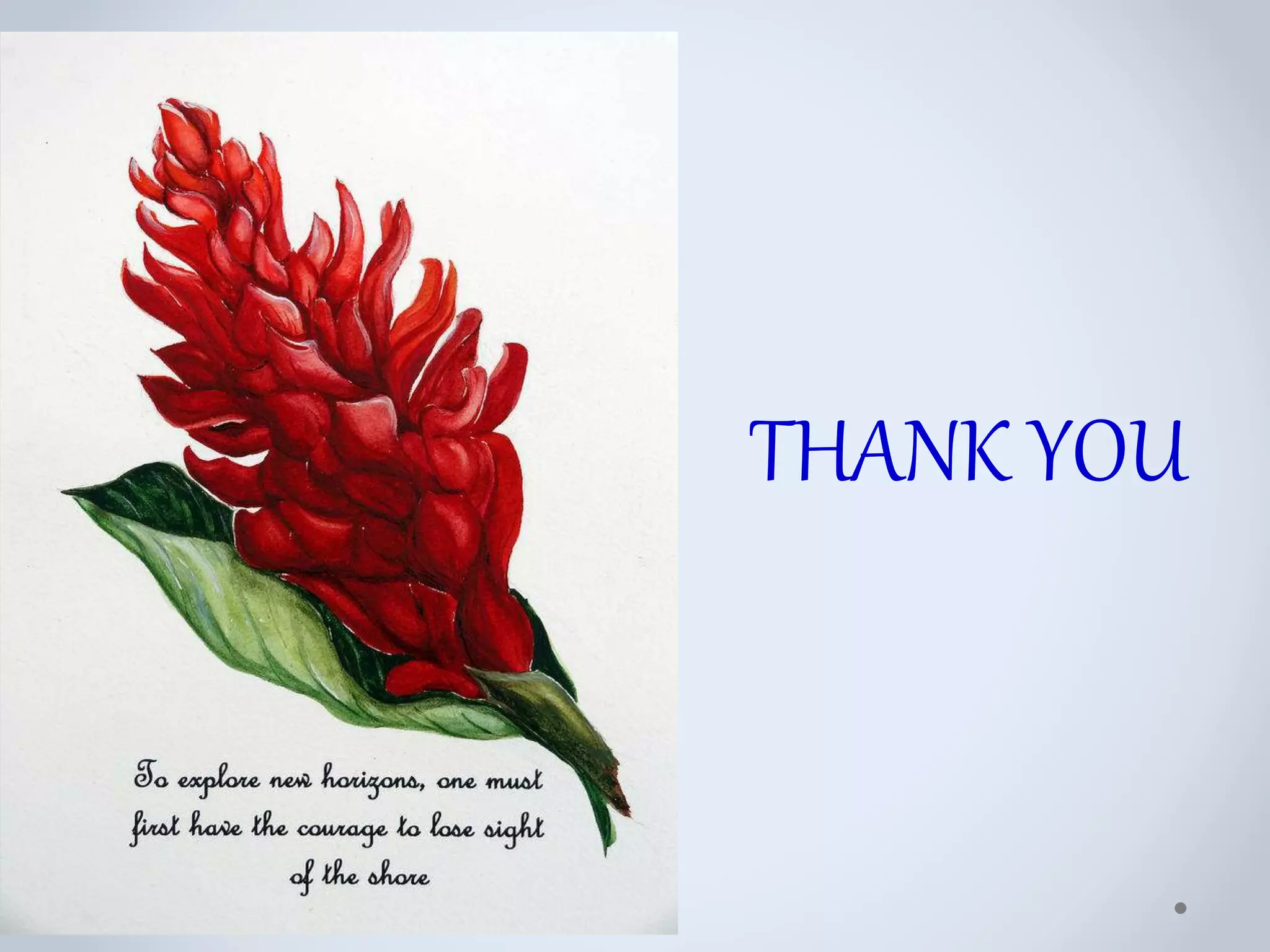
This document summarizes the production of Alpinia purpurata, also known as red ginger. It discusses the plant's description, soil and climate requirements, propagation methods including offshoots and rhizomes, planting, fertilization, irrigation, pruning, harvesting, grading standards, storage, packing and shipping. Red ginger is commonly propagated through offshoots and rhizomes and prefers well-drained soil, partial shade, and temperatures under 30°C. It requires regular irrigation and fertilization to produce marketable flowers from early summer to late summer.
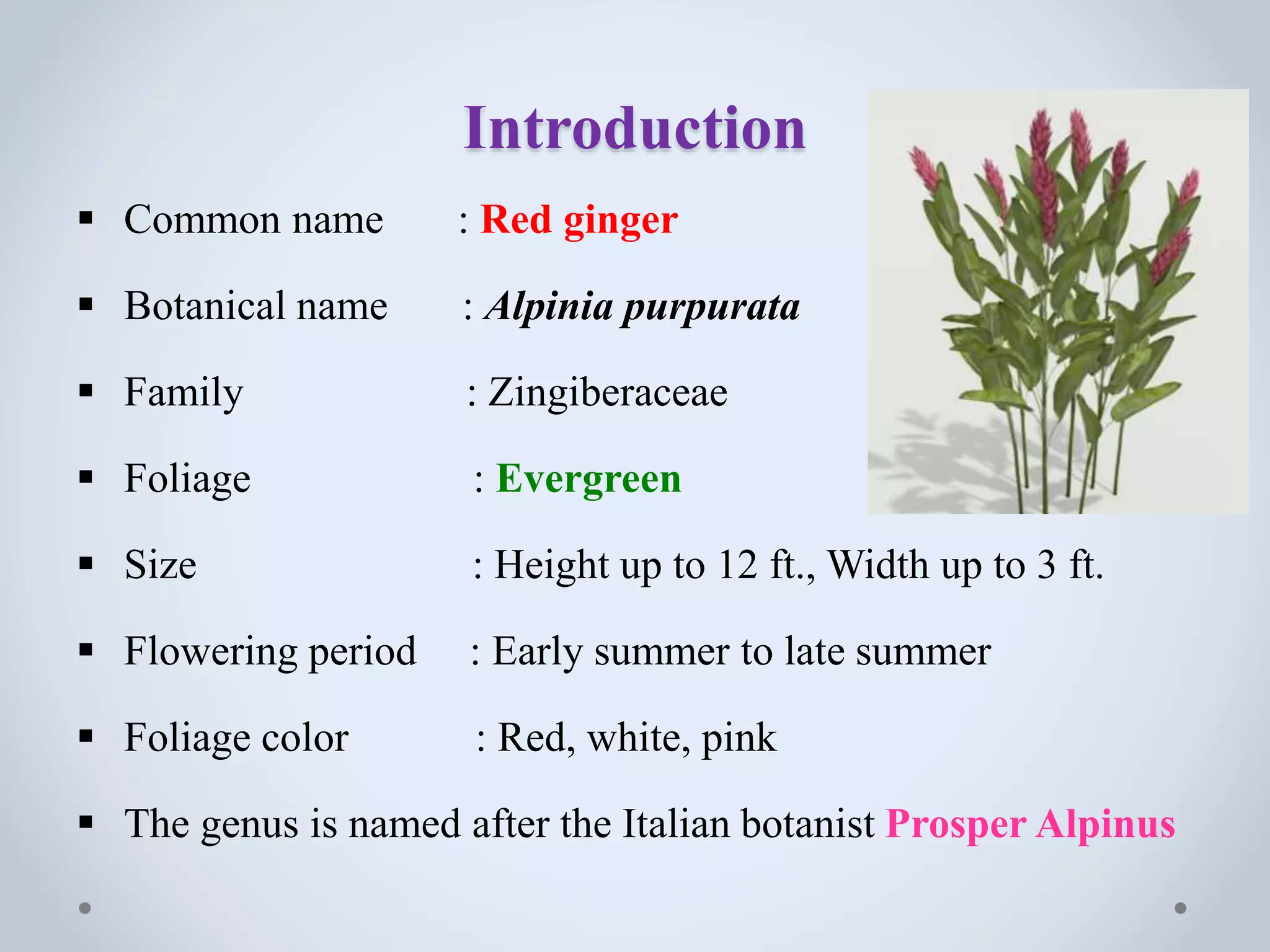
Introduction to Alpinia purpurata, known as Red Ginger, its family, size, and properties.
Soil requirements include well-drained, fertile soil with specific pH. Climate needs: tolerance to 30°C, partial shade, growth elevation up to 1500 ft.
Propagation can be done through offshoots, rhizomes, seeds, or micropropagation, detailing methods for each.
Preparation of planting beds, spacing for optimal yield, manuring, fertilization, irrigation, and pruning practices.
Optimal harvesting timing and conditions, postharvest life extension techniques, storage conditions, and packing methods.
Shipping guidelines to maintain quality, with references for further reading on production technology.
Introduction
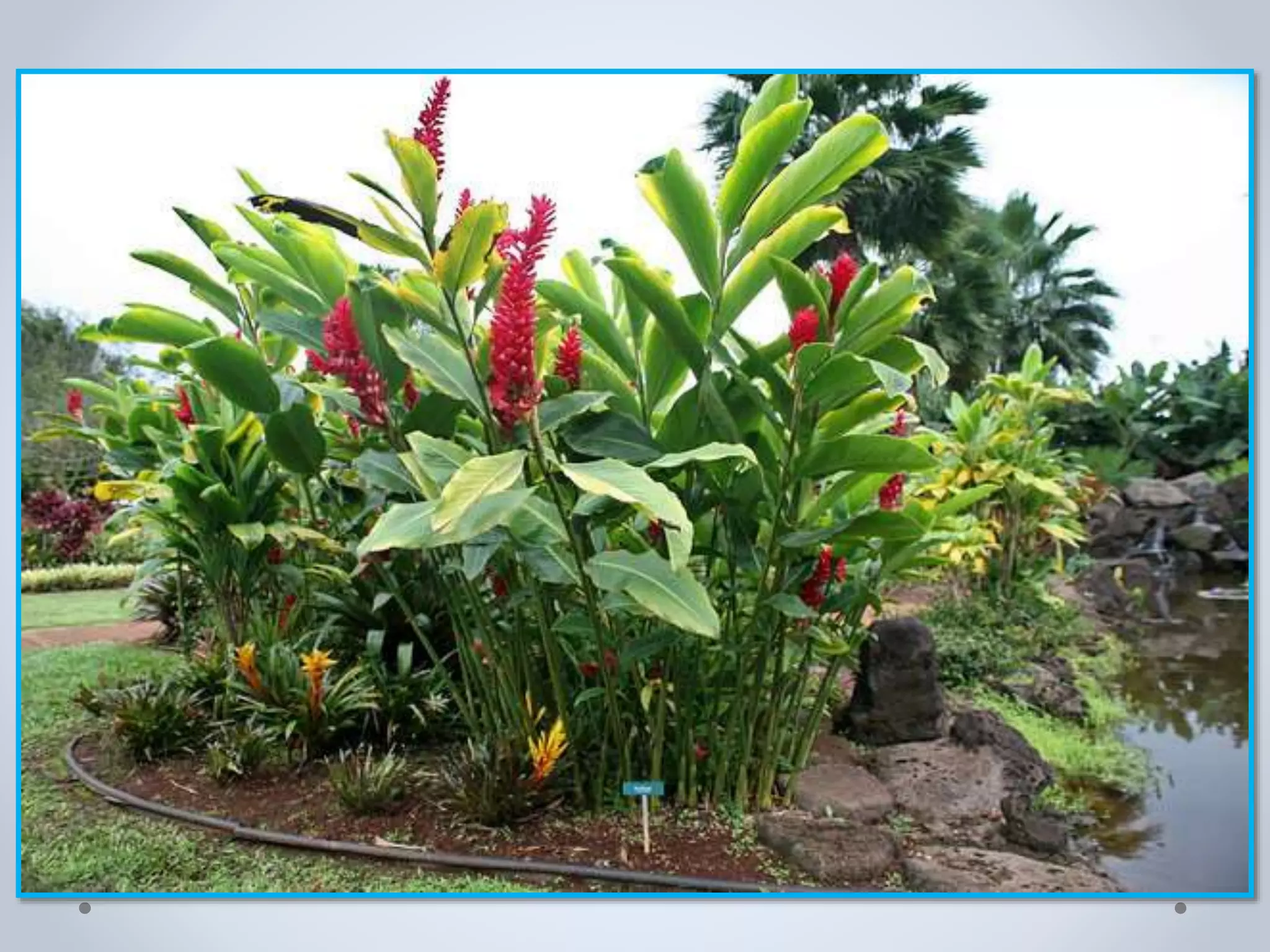
Common name: Red ginger
Botanical name : Alpinia purpurata
Family : Zingiberaceae
Foliage : Evergreen
Size : Height up to 12 ft., Width up to 3 ft.
Flowering period : Early summer to late summer
Foliage color : Red, white, pink
The genus is named after the Italian botanist Prosper Alpinus
3.
Soil Requirement
Awell-drained fertile one
Porous sandy loam to clay loam soils should be selected for
cultivation
pH: 6 -7.5 is optimum
Soil should have good amount of organic matter.
Monoculture should be avoided.
Chlorosis due to high pH in calcareous soils is a common problem
4.
Climatic Requirement
• Beingtropical plant can tolerate up to 30oC
• Partial shade is required for optimum flowering
• Can grow up to 1500 ft. elevation
Seeds
Seeds arerarely produced
Sow seeds shallow in a moist, slightly acidic, well drained
organic medium
Seeds germinate in 2–3 weeks
7.
Rhizome
• Some cultivarsdo not develop offshoots and must be
propagated by rhizome divisions. Divide the rhizomatous mat
into small clumps of one to four stems.
• Plant them 2 inches below the surface in vermiculite or any
well drained medium.
• Rhizome propagated plants typically produce marketable
flowers within a year when planted in beds.
8.
Offshoots
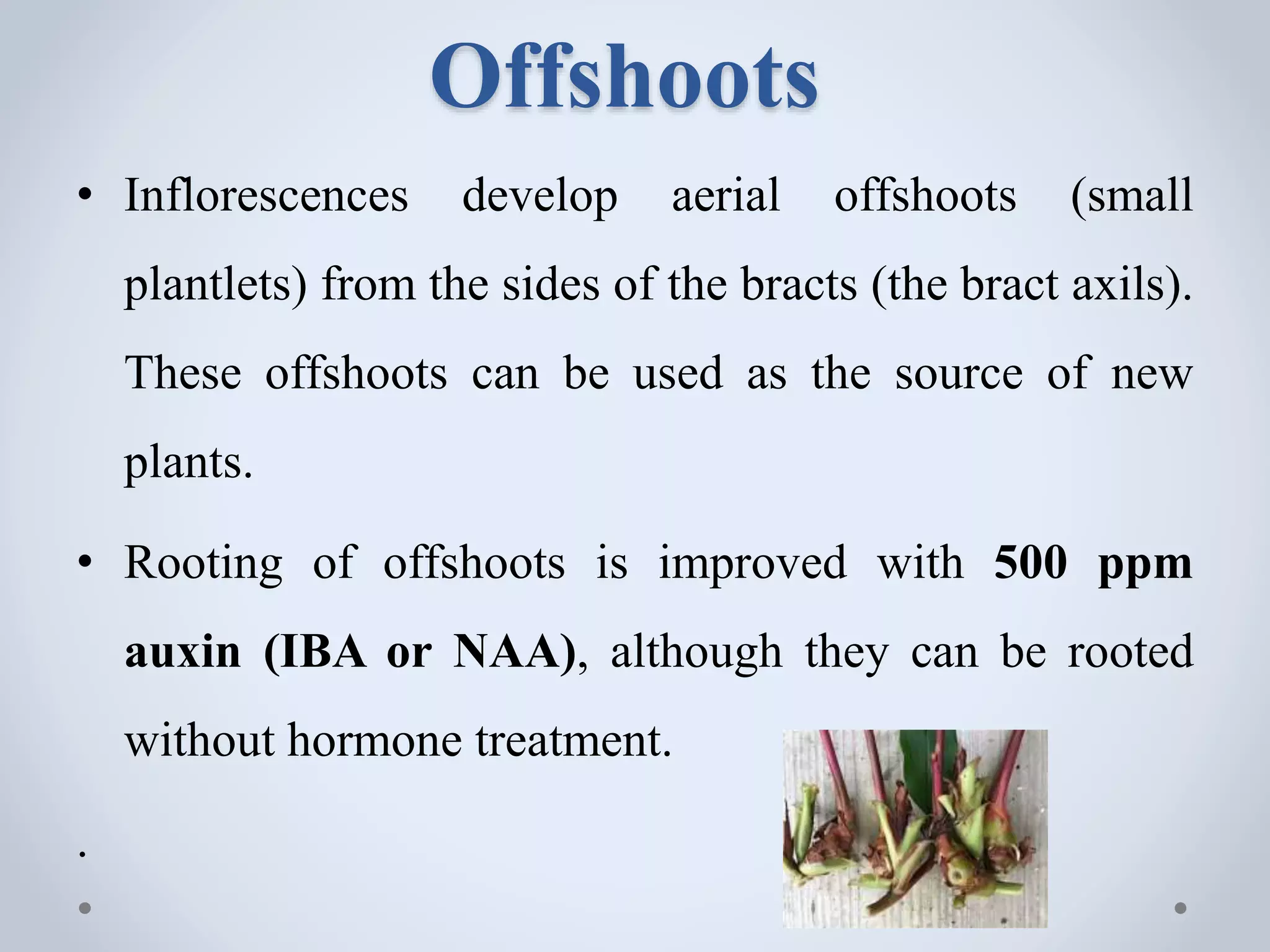
• Inflorescences developaerial offshoots (small
plantlets) from the sides of the bracts (the bract axils).
These offshoots can be used as the source of new
plants.
• Rooting of offshoots is improved with 500 ppm
auxin (IBA or NAA), although they can be rooted
without hormone treatment.
.
9.
Planting
First preparethe bed by ploughing to a fine tilth.
Sterilize by applying Dazomet @ 30g/sq. m
Spacing: 30x30 cm
Beds: 3x1m (40 plants)
Closer spacing increases yield per unit of production area, but
yield per plant is reduced
Less dense plantings permit greater per-plant yields
11.
Manuring and fertilization
A basal dose of 10 to 15 tons of FYM/ha along with 75:75:50
kg/ha of NPK is recommended
The suggested minimum elemental content of healthy green
foliage is 2% N, 0.16% P, 1.8% K, 1.8% Ca, and 0.4% Mg.
Increasing nitrogen fertilizer increases the number of
marketable flowers
12.
Irrigation
Keep thesoil moist
Red ginger requires 1 inch or more of water per week from
irrigation during droughty periods
The best flower quality is achieved with generous irrigation
13.
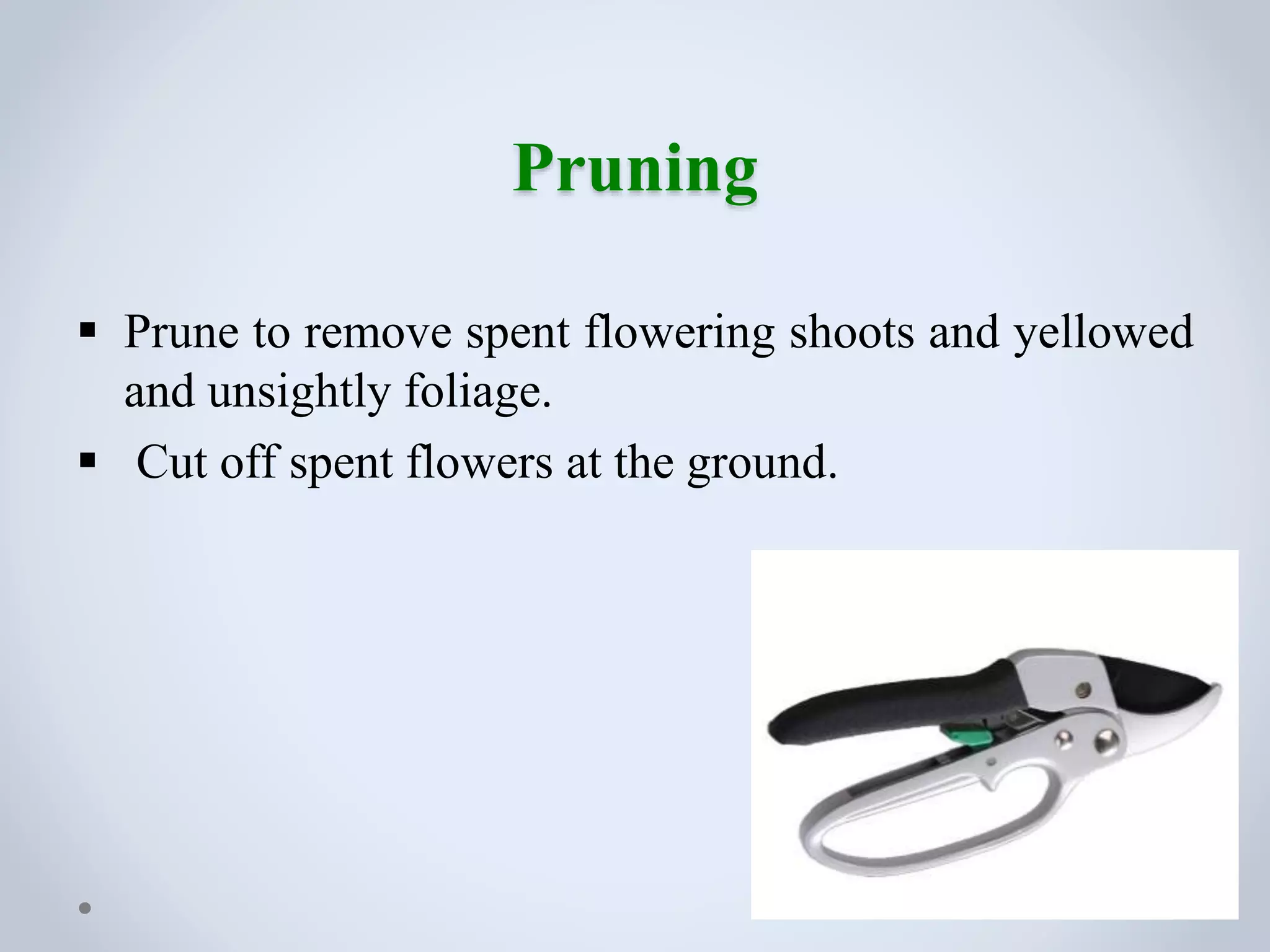
Pruning
Prune toremove spent flowering shoots and yellowed
and unsightly foliage.
Cut off spent flowers at the ground.
14.
Harvesting
Time toharvest is shorter in the summer than in the winter
Inflorescences are harvested in the early morning while still
turgid
Bracts are about two-thirds to three-fourths open, as an
immature flower has a longer shelf life than a mature flower
Floral spikes are harvested about 4 - 5 months after stem
emergence
Production is year-round, the greatest number of flowers is
produced during the summer months
15.
Red ginger isoften heavily
infested with ants, aphids,
soft scales, and mealybugs
Postharvest life
Postharvestlife is increased by use of floral preservatives
containing 2% sucrose and 8-HQC (8-hydroxyquinoline
citrate), antitranspirants, or simply precutting the stems
Hot water treatment of red ginger at 120–122°F for 12–15
minutes extends postharvest life, kills most of the pests
that infest red ginger, and reduces the geotropic response
18.
Grades and standards
For Hawaii Standard grade, an
inflorescence length of 6 inches
is preferred. The cut end of the
stem should be a minimum of 3/8
- inch diameter
19.
Storage
Store redginger at 54.5–59°F, making sure that the flowers do
not exhibit chill damage symptoms such as off colored
(grayish or bluish) blooms.
The inflorescence has a strong geotropic response and should
be stored upright in water to avoid bending. A holding solution
of 2% sucrose (w/v) is recommended.
To maintain the best quality, the relative humidity should be
greater than 90%.
20.
Packing
• Allow flowersto air-dry before packing
• Red ginger stems are packed flat, singly or bunched, in
standard or insulated fiberboard boxes or cartons. Single
stems are layered in rows in the box.
• Bunches may be wrapped in a polyethylene film, or
moistened, shredded newspaper may be packed around
the bunches, with unshredded newspaper separating the
layers.
21.
Shipping
To preventgeotropic bending during shipping, it is
preferable that the boxes be kept upright, so that the
stems are in a vertical orientation
Holding temperature should be no lower than 59°F