PROCESS TECHNOLOGIES FOR TOMORROWSM
POWDER AND PARTICLE PROCESSING
ALPINE CLASSIFYING TECHNOLOGY
Hosokawa Alpine is a member of the Hosokawa Micron Group, responding
to global needs through emphasis on materials science and engineering.
The Group is an international provider of equipment and technology
for powder and particle processing, plastics processing and confectionery
products. The Group maintains facilities for research, engineering,
manufacturing and service in each of the world's major industrial markets.
© Hosokawa Alpine 2010. Printed in Germany.
HOSOKAWA ALPINE Aktiengesellschaft	
	 P.O. Box 10 11 51
	 86001 Augsburg, Germany
Delivery address:
	 Peter-Doerfler-Straße 13 – 25
	 86199 Augsburg, Germany
	
Phone: 	+ 49 821 5906-0
Fax: 	 + 49 821 5906-101
E-mail:	mail@alpine.hosokawa.com
www.alpinehosokawa.com
Subject to change without notice.
All information in this brochure is purely
informative and non-binding. Our quotations are
authoritative with regard to orders.
Sichtertechnologie01.10/1.5(EN)
2 / 
PROCESS TECHNOLOGIES FOR TOMORROWSM
WE ARE YOUR COMPETENT PARTNER
HOSOKAWA  ALPINE
ONE COMPANY - TWO BUSINESS DIVISIONS
WE ARE YOUR COMPETENT PARTNER
POWDER  PARTICLE PROCESSING
Formed in 1898, Hosokawa Alpine's range
includes the development, design and
manufacture of components and turnkey
systems to produce powders, granules
and bulk materials for the chemical,
pharmaceutical, food, minerals, metals and
recycling industries. Whether the task is
comminution, classification, dust removal,
handling, metering, weighing or packing,
you will always find Hosokawa Alpine to be
a competent and innovative partner.
Hosokawa Alpine has been in business for over 100 years. Regardless of the field,
i.e. blown film processing or powder  particle processing, we are traditional
trendsetters on the market. The driving force behind refining our technologies is the
experience we gain and the challenges we face as market leaders.
DIVISIONAL STRUCTURE
The name ALPINE stands for competence in
all areas of comminution technology. The
long years of close cooperation between our
engineers and the development departments
of our customers have made us leading
specialists for powder and particle processing
technology around the world. Because our
aim is to offer our customers the very best
in professional and accomplished advice
tailored to their specific branch of industry,
our powder and particle processing division is
divided into five subdivisions:
BLOWN FILM PROCESSING
As a specialist for film blowing lines to
manufacture thin plastic film, Hosokawa
Alpine ranks among the world's foremost
suppliers in this market segment.
The vast fund of know-how, the high quality
standards, the continuous innovation and
high degree of reliability are all reasons
for the constant growth of this business
division.
everything from
one single
responsible source.
- Pharma  Food
The manufacture of powdery substances for
the pharmaceutical industry is a job for
specialists. Hosokawa Alpine conforms with
international pharma standards and supplies
a wide range of products and performance,
including special processes for the food
industry. Whatever method of size reduction
is used, we are the specialists.
- CHEMICALS
The range of chemical products is just as wide
and diverse as are the different demands on
the properties of pigments or powders. We
supply process-technological solutions for
the chemical industry as a single-source
partner. Our comprehensive range of
products means that we are able to meet a
vast number of different requirements. We
also offer competent advice on solutions
for basic chemical products and auxiliary
products, as well as for toners, paints,
pigments, herbicides or fertilisers.
- Minerals  Metals
We supply complete dry and wet processes
with state-of-the-art mills and classifiers
for processing mineral raw materials. Our
machines and systems for fillers, ceramic raw
materials, metallic compounds and alloys
all meet the high demands set by our
customers. We are not just manufacturers,
however, but also competent partners for
the engineering and design of complete
turnkey systems.
- RECYCLING  GRANULATORS
We design, build and deliver complete
granulator systems to include all necessary
system components. Whether the feed
material is injection mouldings, sprues, film
webs or film edge trims, our granulators are
designed for even the most difficult cutting
tasks. In addition, we also supply in-line
recycling solutions for rubber or cable which
are tailored to the individual requirements.
- Service
Our service division gives support during
the entire lifetime of any Hosokawa Alpine
system or machine. Our extensive range
of services includes spare parts supply,
maintenance, inspection, servicing, repairs,
general overhauls, system upgrading, and
training. A fairly recent addition to our
portfolio of services is a range of
pre-owned ALPINE machines.
No matter what part of the world you are
in or what your processing challenge is,
Hosokawa Alpine is never far away with
the best solutions and support. Our range
of services includes project management,
installation, commissioning, training,
maintenance and system upgrades.
PROCESS TECHNOLOGIES FOR TOMORROWSM 4 / 
OVERVIEW
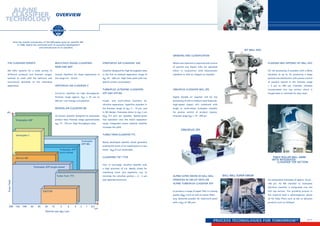
THE CLASSIFIER EXPERTS
We offer systems for a wide variety of
different products and fineness ranges,
tailored to meet with the technical and
economical demands of the individual
application.
ZIRKOPLEX CLASSIFIER MILL ZPS
Highly flexible air classifier mill for the
processing of soft to medium hard materials.
High-speed impact mill combined with
single or multi-wheel Turboplex classifier
for precise control of product topsize.
Fineness range d97  10 - 200 µm.
ALPINE SUPER ORION so BALL MILL
operated IN CIRCUIT WITH AN
ALPINE TURBOPLEX CLASSIFIER ATP
to produce a range of paper filler in coating
quality (d80 2 µm) as well as coarse fillers
(e.g. dolomite powder for road-work paint
with a d97 of 100 µm).
FLUIDISED BED OPPOSED JET MILL AFG
For the processing of powders with a Mohs
Hardness of up to 10, producing a steep
particle size distribution with precise control
of product topsize in the fineness range
 5 µm to 200 µm. Classifier wheel(s)
incorporated into top section which is
hinged back or removed for easy clean.
Since the market introduction of the Mikroplex spiral air classifier MP
	 in 1948, Alpine has continued with its successful development
		 and manufacture of air classifiers.
GRINDING AND CLASSIfication
Where size reduction is required with control
of particle size Alpine mills are operated
either in conjunction with downstream
classifiers or with an integral air classifier.
Stratoplex AIR CLASSIFIER ASP
Classifier designed for high throughput rates
in the fine to medium separation range of
d97 20 – 200 µm. High fines yield with low
specific power consumption.
Turboplex ULTRAFINE CLASSIFIERS
ATP AND ATP-NG
Single- and multi-wheel classifiers for
ultrafine separations. Superfine powders in
the fineness range of d97 3 – 10 µm, and
in NG design, finenesses down to d97 2 µm
(d50 0.5 µm) are possible. Spatter-grain
free operation over the entire separation
range. Integrated coarse material classifier
increases the yield.
Turbo-twin-CLASSIFIER TTC
Newly developed classifier wheel geometry
pushing the limits of air classification to new
levels - d50 0.5 µm achievable.
CLASSIFIERS TSP / TTSP
One- or two-stage ultrafine classifier with
a high precision of cut. Ideally suited for
classifying toner and pigments, e.g. to
minimise the ultrafine portion  2 - 5 µm
(see separate brochure).
Multi-Plex ZIGZAG CLASSIFIERS
MZM AND MZF
Gravity classifiers for sharp separations in
the range 0.3 - 10 mm.
ventoplex air CLASSIFIER V
Circuit-air classifiers for high throughputs.
Fineness range approx. d97 = 32 µm to
200 µm. Low energy consumption.
Micron AIR CLASSIFIER MS
Air-stream classifier designed for pneumatic
product feed. Fineness range approximately
d97 15 – 150 µm. High throughput rates.
For end-product finenesses of approx. 10 µm -
100 µm. An MS classifier or Turboplex
ultrafine classifier is integrated into the
mill top section. The grinding process in
the material bed is advantageous above
all for flaky fillers such as talc or abrasive
products such as feldspar.
200 150 100 50 45 20 15 5 4 3 12 0,5
µm
t/h
Stratoplex ASP
Ventoplex C
Micron MS
Turboplex ATP
multi-wheel
Turboplex ATP single-wheel
Turbo Twin TTC
TSP/TTSP
Particle size d97 / µm
FinesYield
Turboplex
ATP-NG
TABLE ROLLER MILL AWM
WITH INTEGRATED
CLASSIFIER TOP SECTION
Jet Mill AFG
Zirkoplex ZPS
Ball-Mill Super-Orion
PROCESS TECHNOLOGIES FOR TOMORROWSM 6 / 
application areas
Limestone, quick lime, fertilising lime, feed
lime, bentonite, dolomite, gypsum, chamotte,
quartz, feldspar, pegmatite, raw kaolin, ore,
phosphor, glass powder, abrasives, rice flour,
bone meal, etc. Because of the high wear
resistance and the high achievable fines
throughput, the Ventoplex air classifier is
ideal for use in the mineral powder industry,
especially for ceramic powders that need to
be produced without iron contamination.
features
-	Wide fineness range
-	High fines throughput rate
-	Insensitive to overload
-	Low specific energy consumption
-	Low peripheral speed
-	Low air circulation rate
-	Low overall height
-	Good accessibility for inspections
-	Maintenance-friendly design, use of
inexpensive wear parts and thus low
maintenance costs.
*) Reference material: limestone with density 2700 kg/m³; feed material with 70%  d97
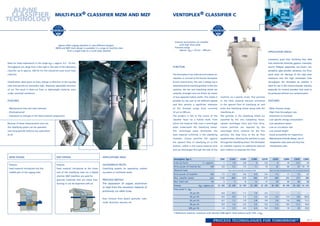
VENTOPLEX® CLASSIFIER C
	Ventoplex Typ C		 C9V	 C12V	 C15V	 C18V	 C21V	 C25V	 C28V	 C32V	 C36V
	Scale-up factor	 F = approx.	 1	 1.8	 2.8	 4	 5.6	 8	 10	 12.5	 16
	Drive power of internal fan	 kW	 3.0	 5.5	 7.5	 11	 15	 22	 30	 37	 55 - 75
	 Material feed:	 from above centrally via hollow shaft	 from the side via feed screw or air conveying channel
	Drive power of classifier	 kW	 1.5	 2.2	 3.0	 4.0	 5.5	 7.5	 11	 15	 22
	Max. classifier speed	 rpm	 1120	 800	 670	 560	 475	 400	 355	 315	 280
	Max. feed rate	 t/h	 3	 5	 8	 12	 17	 24	 30	 38	 48
	Fineness		 d97 = approx. µm	 32 - 200	 32 - 200	 32 - 200	 32 - 200	 32 - 200	 40 - 200	 40 - 200	 45 - 250	 50 - 250
	Fines yield *) d97
			 32 µm t/h	 0.4	 0.7	 1.1	 1.6	 2.2	 ---	 ---	 ---	 ---
			 45 µm t/h	 0.5	 0.9	 1.5	 2.2	 3.0	 4.3	 5.4	 6.8	 (8.5)
			 63 µm t/h	 0.7	 1.2	 1.9	 2.8	 3.9	 5.6	 7.0	 8.8	 11.2
			 90 µm t/h	 0.9	 1.6	 2.5	 3.6	 5.0	 7.2	 9.0	 11.3	 14.4
			 200 µm t/h	 1.6	 2.9	 4.5	 6.4	 9.0	 12.8	 16	 20	 25.6
Ideal for sharp separations in the range d97 = approx. 0.3 - 10 mm.
Throughputs can range from a few kg/h in the case of the laboratory
classifier up to approx. 200 t/h for the industrial-scale multi-tube
classifier.
Classification takes place at every change in direction of the Zig-Zag
tube and permits an extremely high, steplessly adjustable precision
of cut. The result is clean-cut fines or lightweight material, even
under overload conditions.
APPLICATIONS AREA
OLEAGINOUS FRUITS
Classifying systems for separating cracked
soy beans or sunflower seeds.
PRECIOUS METALS
The separation of copper, aluminium
or lead from the insulation material of
previously cut cable scrap.
Dust removal from plastic granules, coke,
chalk, fertilizers, bauxite, etc.
Alpine offers zigzag classifiers in two different designs:
MZM and MZF. Each design is available in a range of machine sizes
from a single-tube to a multi-tube classifier.
MZM DESIGN
Feature:
Feed material introduced into the
middle part of the zigzag tube.
MZF DESIGN
Feature:
Feed material introduced at the lower
end of the classifying tube via a flybed
channel. MZF classifiers are used for
granular materials that are either free-
flowing or can be dispersed with air.
FEATURES
-	Maintenance-free and wear-resistant
-	Overload-proof
-	Insensitive to changes in the feed material composition
Because of these characteristics once set,
the classifying system can be operated
over long periods without any supervision
at all.
FUNCTION
TheVentoplexCisaninternalrecirculationair
classifier. In contrast to the former Ventoplex
B with central drive, the new C design has a
separatelydrivenclassifyingwheel.Inthenew
machine, the fan and classifying wheel are
coaxially arranged and are driven by means
of two separate hollow shafts. This makes it
possible for the user to set different speeds
and thus permits a significant extension
of the fineness range from currently
32 µm to 200 µm.
The product is fed to the centre of the
classifier head via a hollow shaft, from
which the material falls onto a centrifugal
plate underneath the classifying wheel.
The centrifugal plate distributes the
feed material uniformly in the classifying
chamber. Coarse particles fall against
the upward flow of classifying air to the
bottom, collect in the coarse material cone
and are discharged through the side of the
Internal recirculation air classifier
with high fines yield.
Fineness range
approx. d97 = 32 µm – 200 µm.
machine via a gravity chute. Fine particles
in the feed material become entrained
in the upward flow of classifying air and
enter the classifying wheel along with the
classifying air.
The particles in the classifying wheel are
classified by the two competing forces,
namely centrifugal force and flow force.
Coarse particles are rejected by the
centrifugal force, whereas for the fine
particles, the drag force of the air flow
predominates, allowing the particles to pass
through the classifying wheel. The Ventoplex
air classifier requires no additional external
dust collector to separate the fines.
MULTI-PLEX® CLASSIFIER mzm And mzf
PROCESS TECHNOLOGIES FOR TOMORROWSM 8 / 
1
2
3
4
5
6
6
6
7
8
9
10
11
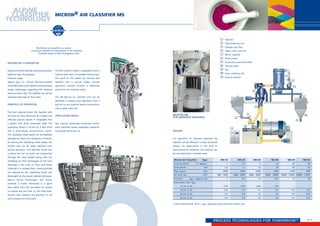
MICRON AIR CLASSIFIER MS
Robust air-stream classifier (pneumatic product
feed) for high throughputs.
Fineness range:
approx. d97 = 15 - 150 µm. The slow rotation
of the MS wheel in the medium fineness range
brings advantages regarding the pressure
drop and wear rate. The classifier can also be
operated with high air flow rates.
PRINCIPLE OF OPERATION
The feed material enters the classifier with
the main air flow which can be a highly cost
effective process option if integrated into
a system with direct pneumatic feed. The
classifying wheel is driven by a belt drive
and a three-phase asynchronous motor.
The classifying wheel speed can be steplessly
adjusted by means of a frequency converter.
By altering the classifying wheel speed, the
particle size can be easily adjusted even
during operation. Fine particles whose size
is below the set cut point are transported
through the rotor blades along with the
classifying air, then discharged via the fines
discharge in the main air flow, and finally
collected in a suitable filter. Coarse particles
are rejected by the classifying wheel and
discharged via the coarse material discharge.
Before being discharged, the coarse
material is rinsed intensively in a spiral
flow taken from the secondary air stream
to remove any last fines, i.e. this final classi-
fication step improves the precision of cut
and increases the fines yield.
The MS classifier wheel is suspended from a
vertical shaft and is of welded construction.
The vanes of the wheel are inclined and
tapered into a conical shape. During
operation oversize product is deflected
away from the rotating wheel.
The MS Micron air classifier unit can be
operated in closed circuit operation with a
ball mill or as a classifier head in conjunction
with a table roller mill.
APPLICATION AREAS
Talc, calcium carbonate, bentonite, kaolin,
loam, dolomite, quartz, kieselguhr, pigments,
fine-grade chemicals, etc.
The Micron air classifier is a robust
air-stream classifier for separations in the medium
fineness range at high throughput rates.
DESIGNS
For operation on abrasive materials the
classifier can be offered in a wear protected
design. For applications in the food or
pharmaceutical industries, the classifier can
be manufactured in stainless steel.
1 	 Feed bin
2 	 Feed metering unit
3 	 Change-over flap
4 	 Super orion ball mill
5 	 MS air classifier
6 	 Rotary valve
7 	 Automatic reverse jet filter
8 	 Control valve
9 	 Fan
10 	 Fines collection bin
11 	 Control cabinet
MICRON MS
for abrasive material
* Feed material with 70 %  d97, capacities with minimum airflow rate
Micron Air Classifier 	 Type	 MS-1H	 MS-2H	 MS-3H	 MS-4H	 MS-5H	 MS-6H
Scale-up factor 	 F = approx.	 1	 2.7	 5	 10	 20	 40
Drive power 	 kW	 5.5	 11	 15	 30	 45	 55
Max. speed 	 rpm	 5000	 3300	 2500	 1600	 1100	 800
Air flow rate 	 m3/h	 900 - 1600	 2400 - 3600	 4800 - 9000	 9000 - 18000	 18000 - 33000	 36000 - 72000
Fineness 	 d97 = approx. µm	 7	 8.5	 10	 12.5	 15	 18
Fines yield, max* d97
	 15 µm in t/h		 0.16	 0.45	 0.90	 1.50	 --	 --
	 20 µm in t/h		 0.2	 0.6	 1.1	 2.1	 4.2	 8.4
	 45 µm in t/h		 0.3	 0.8	 1.6	 2.9	 5.9	 12.0
	 63 µm in t/h		 0.4	 0.9	 1.8	 3.4	 6.7	 13.5
MICRON® AIR CLASSIFIER MS
PROCESS TECHNOLOGIES FOR TOMORROWSM 10 / 11
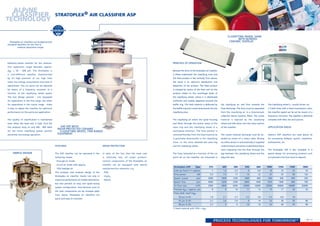
STRATOPLEX® AIR CLASSIFIER asp
Deflector-wheel classifier for the medium-
fine separation range between approx.
d97 = 20 - 200 µm. The Stratoplex is
a cost-effective classifier characterised
by it's high precision of cut, high fines
yield, low energy consumption and ease of
adjustment. The cut point can be adjusted
by means of a frequency converter as a
function of the classifying wheel speed.
The two design variants - one equipped
for separations in the fine range, the other
for separations in the coarse range - make
it easy to adjust the classifier for optimum
performance on the particular application.
The quality of classification is maintained
even when the feed rate is high. And the
low pressure drop of only 600 - 800 daPa
for the entire classifying system permits
extremely low-energy operation.
630 ASP WITH
WEAR-PROTECTED CERAMIC
CLASSIFYING WHEEL, FINE-RANGE
EQUIPMENT
FEATURES
The ASP classifier can be operated in the
following modes:
-	through-air mode
-	circuit-air mode with approx.
	 10% leakage air
The compact and modular design of the
Stratoplex air classifier results not only in
maximum performance at modest dimensions,
but also permits an easy and space-saving
system configuration. And because most of
the main components can be accessed easily
from above, Stratoplex air classifiers are
quick and easy to maintain.
Stratoplex air classifiers are budget-priced
standard classifiers for the fine to
	 medium separation range.
WEAR PROTECTION
In spite of the fact that the wear rate
is relatively low, all major product-
contact components of the Stratoplex air
classifier can be equipped with special
wearprotection elements, e.g.
-	PUR
-	Al2O3
-	Naxtra
SIMPLE DESIGN
PRINCIPLE OF OPERATION
Because the drive of the Stratoplex air classifier
is fitted underneath the classifying zone and
the feed product is fed centrally from above,
the result is an optimum distribution and
dispersion of the product. The feed product
is charged by means of the feed unit via the
product intake to the centrifugal plate of
the classifying wheel, where it is distributed
uniformly and radially dispersed towards the
baffle ring. The feed material is deflected by
the baffle ring and routed downwards into the
classifying zone.
The classifying air enters the spiral housing
and flows through the helical vanes of the
vane ring and the classifying wheel in a
centripetal direction. The fines portion is
removed thereby from the feed material as
it gravitates downwards in the classifying
zone, i.e. the zone between the vane ring
and the classifying wheel.
The fines, extracted as a function of the cut
point set on the classifier, are entrained in
the classifying air and flow towards the
fines discharge. The fines must be separated
from the classifying air in a downstream
collection device (cyclone, filter). The coarse
material is rejected by the classifying
wheel and falls down into the lower section
of the classifier.
The coarse material discharge must be air-
sealed by means of a rotary valve. Rinsing
air, either drawn in automatically or supplied
underpressure,preventsunclassifiedproduct
from migrating into the fines through the
gap between the classifying wheel and the
labyrinth seal.
The classifying wheel is usually driven via
a V-belt drive with a fixed transmission ratio;
the classifier speed can be set by means of a
frequency converter. The classifier is delivered
complete with filter, fan and cyclone.
APPLICATION AREAS
Alpine's ASP classifiers are used above all
for processing feldspar, quartz, nepheline,
wollastonite, etc.
The Stratoplex ASP is also available in a
special design for processing products such
as hydrated lime that tend to deposit.
CLASSIFYING WHEEL VANE
WITH BONDED
CERAMIC OVERLAY
Stratoplex ASP 		 Type	 315	 400	 500	 630	 800	 1000	 1250	 1500	 1800
Scale-up factor 	F = approx.	 1	 1.6	 2.5	 4	 6.4	 10	 16	 25	 33
Drive power 				 kW	 5.5	 7.5	 11	 15	 22	 37	 55	 90	 132
Speed / coarse 				 rpm	 2000	 1600	 1250	 1000	 800	 630	 500	 420	 350	
Speed / fine 				 rpm	 4000	 3200	 2500	 2000	 1600	 1250	 1000	 840	 700	
Air flow rate 				 m3/h	 2500	 4000	 6300	 10000	 16000	 25000	 40000	 64000	 82000
Fineness 	d97 = approx. µm 	 8	 9	 10	 11	 13	 15	 17	 20	 25
Fines yield, max*) d97	
	 20 µm in t/h 		 1.8	 2.1	 2.7	 3.2	 3.8	 5.5	 6.8	 10	 -
	 63 µm in t/h				 2.2	 3.6	 5.4	 9	 14	 22	 36	 50	 80
	 90 µm in t/h				 2.5	 4	 6	 10	 16	 25	 40	 55	 80
*) Feed material with 70%  d97
PROCESS TECHNOLOGIES FOR TOMORROWSM 12 / 13
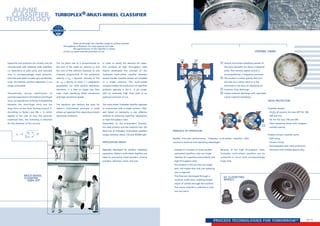
Turboplex® AIR CLASSIFIER atp
The Turboplex classifier is the classic all-rounder, offers the
most variations and application possibilities, and is available
	 as a single-wheel or multi-wheel classifier.
HORIZONTAL CLASSIFier WHEEL
Although the first ATP classifiers (1981)
still had vertically arranged classifying
wheels, trials showed relatively quickly that
a horizontal arrangement is much more
advantageous for the Turboplex. There
is no need to deflect the fines, meaning
that problems with sticky products or hard
agglomerates are avoided and that the
classifying wheel operates in a product cloud
and is thus always uniformly charged.
Close manufacturing tolerances make it
possible to set a very small rinsing gap which
enables particle spatter to be avoided. The
maintenance of precise tolerances in the case
of the bearings ensures a long service life.
PRINCIPLE OF OPERATION
After entering the machine, the classifying
air flows through the classifying wheel in
a centripetal direction. In the process, the
classifying wheel extracts the fines from the
feed material and conveys them to the fines
discharge. The coarse material rejected by
the classifying wheel gravitates downwards.
The air routing shown in the schematic on
the right is much simplified, because before
the coarse material exits the classifier, it is
rinsed again intensively by air to remove the
remaining fines. This results in an extremely
clean coarse fraction.
The product is fed either via a rotary valve
or in the case of an air-flow classifier,
entrained in the classifying air. Product
fineness is controlled by adjustment of the
classifier wheel speed using a frequency
converter. The horizontal arrangement
of the classifying wheel means that even
difficult products can be processed with
no problem.
FEATURES
There is hardly another type of classifier
that is so well adapted to the demands of
practical operation as the Turboplex ultra­
fine classifier:
-	The simple and robust design reduces
costs for maintenance and servicing
-	The horizontal arrangement of the
classifying wheel reduces wear even with 	
abrasive products and guarantees a long 	
service life
-	If processing extremely abrasive products, 	
a wear-protection lining prevents
excessive wear
-	Modest space requirement
-	High fines yield
-	Sharp top size limitation.
-	Stable operation even if the feed rate
fluctuates
-	Long service life
-	Coating formation prevented, e.g. when
classifying CaCO3
-	Rinsing gap easy to adjust
-	Narrow rinsing gap possible
-	Vibration-free
Wear Protecion
The applied materials and the wear
protection is customised for individual
applications. For the pharmaceutical industry
the ATP is manufatured in stainless steel.
ENLARGED FINES
DISCHARGE
SINGLE-WHEEL ATP
Turboplex atp SINGLE-WHEEL CLASSIFIER
Turboplex ATP		 Type	 100	 140	 200	 315	 400	 500	 630	 750	 1000
Scale-up factor 		F = approx.	 0.25	 0.5	 1	 2.5	 4	 6.25	 10	 14	 25
Drive power 		 kW	 4	 5.5	 5.5	 11	 11	 22	 30	 37	 45
Max. Speed 		 rpm 	 11000	 8500	 6000	 4000	 3150	 2400	 2000	 1600	 1200
Max. air flow rate 	 m3
/h	 300 	 600 	 1200 	 3000 	 4800 	 7500 	 12000 	 17000 	 30000
Fineness d97 = 	approx. µm	 4-100	 5-120	 5-120	 6-150	 7-150	 8-150	 9-200	 10-200	 12-200
Fines yield max *) d97	
		 8 µm in t/h		 0.035	 0.070	 0.14	 0.35	 0.56	 0.80	 1.2	 -	 -
		 20 µm in t/h 		 0.07	 0.14	 0.28	 0.70	 1.12	 1.75	 2.8	 3.9	 6.5
		 45 µm in t/h 		 0.1	 0.2	 0.4	 1.0	 1.6	 2.5	 4.0	 5.6	 9.5	
Turboplex ATP		 Type	 100/4	 140/4	 200/4	 315/3	 315/6	 500/3	 500/4	 630/4
Scale-up factor 		F = approx.	 1	 2	 4	 7.5	 15	 19	 25	 40
Drive Power 		 kW	 4 x 3	 4 x 4	 4 x 5.5	 3 x 11	 6 x 11	 3 x 15	 4 x 15	 4 x 22
Max. Speed 		 rpm	 11000	 8500	 6000	 4000	 4000	 2400	 2400	 2000
Max. air flow rate 	 m3
/h	 1200	 3000	 4800	 9000	 18000	 22500	 30000	 48000
Fineness d97 = approx. µm	 4-100	 5-120	 5-120	 6-150	 6-150	 8-150	 8-150	 9-200
Fines yield max.*) d97	
		 8 µm in t/h		 0.14	 0.28	 0.56	 1.0	 2.1	 2.4	 3.2	 4.8
		 20 µm in t/h		 0.28	 0.56	 1.12	 2.1	 4.2	 5.2	 7	 11
		 45 µm in t/h		 0.4	 0.8	 1.6	 3	 6	 7.5	 10	 16
Turboplex atp mULTI-WHEEL CLASSIFIER
*) Feed material with 70%  d97
Designs
For applications on explosive materials, in addition to the standard
machine design, with the exception of the 750 ATP and the 1000 ATP
all classifiers in the range are available in explosion-pressure-shock-
proof design to 10 bar overpressure.
PROCESS TECHNOLOGIES FOR TOMORROWSM
1 1
2	 3
4
1
1
2
3 3
14 / 15
Turboplex®-MULTI-WHEEL CLASSIFIER
The cut point size xT is proportionate to
the root of the radial air velocity wr and
the root of the collector diameter D, and
inversely proportional to the peripheral
velocity u (ηL = dynamic viscosity of the
air, ρS = density of solid, F = adaptation
parameter). For small particle diameters,
therefore, it is best to target low flow
rates, small classifying wheel dimensions
and high peripheral speeds.
The equation also delivers the basis for
Alpine's multi-wheel principle: a small
wheel can separate finer assuming constant
operating conditions.
In order to satisfy the demand for super-
fine products at high throughput rates
Alpine developed the concept of the
Turboplex multi-wheel classifier whereby
several smaller classifier wheels are installed
in a single machine. This multi-wheel
concept enables the production of superfine
products, typically in the 3 - 6 µm range,
with an extremely high fines yield at an
optimum precision of cut.
The multi-wheel Turboplex classifier operates
in conjunction with a single cyclone / filter
and fanset so represents a cost effective
method of achieving superfine separations
at high throughput rates.
Dependent on the end-product fineness,
the feed product and the machine size, the
feed rate of Turboplex multi-wheel classifiers
ranges between about 150 and 30,000 kg/h.
APPLICATION AREAS
Especially developed for ultrafine classifying
operations, Alpine's multi-wheel classifiers are
ideal for processing metal powders, mineral
powders, abrasives, toner, and wax.
Superfine end products can usually only be
manufactured with relatively small classifiers,
i.e. laboratory or pilot units, and naturally
only in correspondingly small amounts.
Once the pilot plant is scaled up to production
scale, the desired ultrafine separation is no
longer achievable.
Theoretically, during classification of
particles separated in the field of centrifugal
force, an equilibrium of forces is established
between the centrifugal force and the
drag force of the fluid flowing around it.
According to Stoke's law (Re  1), which
applies in the case of very fine particles
examined here, the following is obtained
for the diameter of the cut-size:
	 Scale-up through the classifier range to achieve greater
throughputs influences not only capacity but also
	 the performance of the classifier in terms
of the cut point and the precision of cut.
MULTI-WHEEL
CLASSIFIER
630/4 ATP
1 	 Several horizontal classifying wheels of
	 the same diameter are driven independ-
	 ently. The common speed control is 	
	 accomplished by a frequency converter
2 	 The product is either gravity fed from 	
	 the side via a rotary valve or is fed 	
	 entrained in the flow of classifying air
3 	 Common fines discharge
4 	 Coarse material discharge with optimised
	 coarse material classifying
WEAR PROTECTION
Classifier wheels:
-	Al2O3 all-ceramic for sizes ATP 50, 100, 	
	 200 and 315
-	SiC for the sizes 100 and 200
-	Steel classifying wheel with tungsten
	 carbide coating
Product-contact classifier parts:
-	PUR lining
-	Ceramic lining
-	Exchangeable steel wear-protection
	 elements with welded special alloy
PRINCIPLE OF OPERATION
Besides first-class performance, Turboplex multi-wheel classifiers offer
numerous technical and operating advantages:
-	Instead of a number of small parallel-	
	 connected classifiers, only one single 	
	 classifier for superfine end products and 	
	 high throughput rates
-	The product is fed via only one single 	
	 port; this means that only one metering 	
	 unit is required
-	The fines are discharged through a
	 common outlet duct, enabling simple
	 adjust of airflow through the machine
-	The coarse material is collected at only 	
	 one exit point
Because of the high throughput rates,
Turboplex multi-wheel classifiers can be
combined in circuit with correspondingly
large mills.
SiC CLASSIFYING 	
WHEELS
CERAMIC LINING
PROCESS TECHNOLOGIES FOR TOMORROWSM
100
90
80
70
60
50
40
30
20
10
0
0,5 1 1,5 2 2,5
16 / 17
Turboplex® ATP-NG
e.g. the Hosokawa Alpine ball mill S.O.-SF
or the agitated ball mill ATR, fine products
with a d50 of 0.7 and even 0.3 µm have been
achieved.
Whereas when manufacturing ultrafine
limestone and talc filler it is the fineness of
the classification that is all-important, other
applications target a coarse end product with
a particle size distribution that is as steep as
possible. Here, too, the new generation of
classifiers has proved itself.
In contrast to conventional methods, it was
possible in this particular case to increase
the coarse yield with the new classifier
from 33 % to 38 % without any appreciable
change to the quality of the coarse material.
At the same time, the reduction of the
pressure drop also led here to substantial
energy savings.
THE TURBOPLEX ATP-ng
In a grinding-classifying circuit, the amount
of energy needed for the classification
increases with increasing end-product
fineness. This fact gave rise to the demand
for a low-energy classifier that was capable
of achieving fineness values in the range
of d50  1 µm. The New Generation
Turboplex (ATP-NG) operates in accordance
with a completely new classifying principle
that is based on the concept of solid-bed
flow instead of the conventional potential
flow. This new concept has made it possible
to reduce the pressure drop and the entire
classifying energy quite considerably. A
special vane geometry permits a uniform
material flow and thus an even finer
classification. The advantages of this new
classifier generation are especially con­
spicuous when used in the submicron range:
low energy consumption at high yield.
Another plus point is the ease with which
existing ATP classifiers can be upgraded with
the new classifying wheels.
With the new NG wheels, it has been possible
to reduce the pressure drop by approx. 60 %
when compared with the ATP standard
classifying wheel.
And because in the ultrafine range, it has
also been possible to improve the yield, the
result in many cases is an energy saving of
between 30 and 50 % referred to the fines
yield. With the new classifier generation,
end-fineness values are possible that were
to date inconceivable with production-scale
systems. And in combination with new mills,
Multi-wheel classifiers are the classifier of choice for
ultrafine classifying operations, and because the particle
	 diameter is also directly dependent on the classifying
wheel diameter, it is possible in the majority of cases
			 to fulfil customer requirements.
FEATURES
-	 30 - 50 % less energy requirement in 	
	 comparison with the standard Turboplex
	 classifier
-	 Classification down to d50 = 0.5 µm
-	 High fines yield
-	 Easy Upgrade - conversion of existing
	 machines to ATP-NG design can be
	 achieved by simple replacement of the
	 classifier wheel and drive unit.
Wear PROTECTION
-	Classifying wheels with tungsten carbide.
	 (Ceramic classifying wheels are not used 	
	 with the ATP-NG.)
d50
[µm]
Energyreferredtothefinesyield(%)
= ATP
= ATP-NG
MULTI-WHEEL CLASSIFIER
315/6 ATP-NG
Turboplex ATP-NG 	 Type	 315	 500	 630	 750	 315/3	 315/6	 500/3	 500/4	 630/4
Scale-up factor 	F = approx.	 2.5	 6.25	 10	 13.5	 7.5	 15	 19	 25	 40
Drive power 		 kW	 18.5	 30	 45	 55	 3 x 18.5	 6 x 18.5	 3 x 30	 4 x 30	 4 x 45
Max. speed 		 rpm	 5600	 2800	 2400	 1920	 5600	 5600	 2800	 2800	 2400
Max. air flow rate 		 m3
/h	 3500	 8800	 14000	 22000	 10500	 20000	 26000	 35000	 56000
Fineness 	d97 = approx. µm	 2.5 - 150	 3.5 - 150	 6 - 200	 7 - 200	 2.5 - 150	 2.5 - 150	 3.5 - 150	 3.5 - 150	 6.0 - 200
	Fines yield max*) d97
	 4 µm in t/h		 0.10	 0.25	 -	 -	 0.3	 0.6	 0.75	 1.0	 -
	 5 µm in t/h		 0.2	 0.45	 -	 -	 0.5	 1.1	 1.3	 1.8	 -
	 6 µm in t/h		 0.3	 -	 -	 0.8	 -	 -	 -	 -	 -
	 8 µm in t/h		 0.4	 1.0	 1.6	 2	 1.2	 2.3	 3.0	 4.1	 6.2
	 10 µm in t/h		 0.6	 1.3	 2.0	 2.6	 1.5	 3.1	 3.9	 5.3	 8.5
*) Feed material with 70%  d97
PROCESS TECHNOLOGIES FOR TOMORROWSM
1
2
3
3
13
5
11
12
7
6
11
9
11
10
8
18 / 19
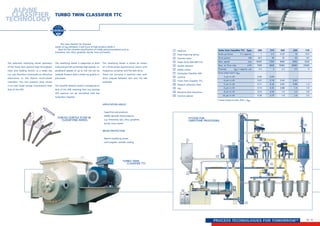
turbo twin CLASSIFIER TTC
The patented classifying wheel geometry
of the Turbo Twin permits high throughput
rates and loading factors at a steep top
cut, and therefore constitutes an attractive
alternative to the Alpine multi-wheel
classifiers. The low pressure drop results
in an even lower energy consumption than
that of the ATP.
The classifying wheel is supported at both
ends and permits extremely high speeds, i.e.
peripheral speeds of up to 120 m/s can be
realised. Product feed is either by gravity or
pneumatic.
The classifier bottom section corresponds to
that of the ATP, meaning that any existing
ATP machine can be retrofitted with the
TurboTwin classifier.
The classifying wheel is driven by means
of a three-phase asynchronous motor with
frequency converter and flat belt drive.
There are currently 5 machine sizes with
drive outputs between 18.5 and 132 kW
available.
Turbo Twin
CLASSIFIER TTC
This new classifier for fineness
values of d97 between 2 and 4 µm at high product yields is
ideal for the ultrafine classification of mildly abrasive products such as
limestone, talc, silica, graphite, barite, mica and kaolin.
aPPLICATION AREAS
-	Superfine end products
-	Mildly abrasive feed products,
	 e.g. limestone, talc, silica, graphite,
	 barite, mica, kaolin
WEAR PROTECTION
-	Naxtra classifying wheel
-	and tungsten carbide coating
forced vortex flow in
classifying wheel
	Turbo Twin Classifier TTC 	 Type 	 200	 315	 500	 630	 710
	Scale-up factor		 F = approx.	 1	 2.5	 6.25	 10	 12.5
	Drive power	 	 kW	 18.5	 30	 55	 90	 132
	Max. speed 		 rpm	 10000	 7300	 4600	 3650	 3250
	Max. air flow rate 	 m³/h	 1600	 4000	 10000	 18000	 25000
	Fineness 		d97 = approx. µm	 2.5	 3	 3.3	 3.5	 4
	Fines yield max*) d97		
		 3 µm in t/h		 0.04	 0.09	 -	 -	 -
		 4 µm in t/h		 0.07	 0.18	 0.42	 0.63	 -
		 5 µm in t/h		 0.11	 0.26	 0.65	 0.98	 1.3
		 6 µm in t/h		 0.14	 0.35	 0.88	 1.4	 1.9
		 8 µm in t/h		 0.23	 0.56	 1.4	 2.3	 2.9
		 10 µm in t/h		 0.28	 0.79	 1.8	 2.8	 3.5
*) Feed material with 70%  d97
1 	 Feed bin
2 	 Feed metering device
3 	 Diverter valve
4 	 Super Orion Ball Mill S.O.
5 	 Bucket elevator
6 	 Safety screen
7 	 Stratoplex Classifier ASP
8 	 Cyclone
9 	 Turbo Twin Classifier TTC
10 	 Product collection filter
11 	 Fan
12 	 Nuisance dust extraction
13 	 Control cabinet
SYSTEM FOR
limestone processing
PROCESS TECHNOLOGIES FOR TOMORROWSM
1
1 2 3 5 10 20 50100
2
3
5
10
20
30
40
60
80
95
99,8
100
%
90
80
70
60
50
40
30
20
10
0
5 10 15 20 25 30 µm
100
%
90
80
70
60
50
40
30
20
10
0
5 10 15 20 25 30 µm
1
5
2
3
12
4
6
11
6
6
10
9
8
7
20 / 21
size 100 TTSP ready for
shipment
In contrast to all other ultrafine classifiers
featured in this brochure, the TSP is not
oriented towards obtaining spatter-grain-
freefinesbutrathertowardstheachievement
of clean coarse fractions. Thanks to the
special design of this classifier, the coarse
material can no longer be contaminated by
fresh material once it has passed through
the classifying zone. This results in high-
quality coarse material and extremely
good yields. In other cases, the separated
fines must often be reprocessed, and this
naturally involves costs. In other words,
the high coarse yields make an effective
and lasting contribution towards reducing
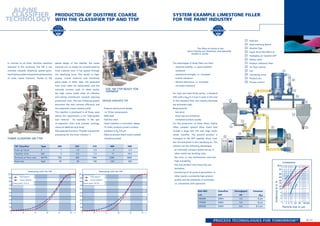
production costs. The two following graphs
document the dust removal efficiency and
the respective coarse material yield.
The classifier is employed in all those cases
where the requirement is for high-quality
dust removal - for example, in the case
of pigments, silicic acid, powder coatings,
chemical additives and toner.
(See separate brochure “Powder and particle
processing for the toner industry”.)
Design variants TSP
-	Pressure-shock-proof design
	 to 10 bar overpressure
-	Mild steel
-	Stainless steel
-	Small classifiers in monobloc design
-	To order, product-contact surfaces
	 polished to Ra 0.8 µm
-	Wear-protected (hard-metal-coated)
	 classifying wheel.toner classifier 200 ttsp
	TSP Classifier	 Type	 200	 250	 315	 400	 500
	Scale-up factor	 F	 1	 1.6	 2.5	 4	 6.3
	Classifier drive	 kW	 3	 5.5	 7.5	 11	 18.5
	Nominal air flow rate	 Nm3
/h	 560	 900	 1400	 2300	 3600
	Feed rate	 kg/h	 60	 90	 140	 230	 360
Dedusting with the TSP
	 Feed product
	 Coarse material
Coarse yield = 91,6 %
Dedusting with the TSP
	 Feed product
	 Coarse material
Coarse yield = 81,3%
The advantages of these fillers are their:
-	 chemical stability, i.e. good weather-
	 resistance
-	 mechanical strength, i.e. increased
	 scratch-resistance
-	 alkaline behaviour, i.e. increased
	 corrosion-resistance
For matt and satin-finish paints, a standard
filler with a d50 to 2.5 µm is used. In the case
of this standard filler, the industry demands
are extremely high.
Requirements:
-	 low price
-	 sharp top size limitation
-	 consistent product quality
For the production of these fillers, Alpine
offers compact systems (flow chart) that
include a large ball mill and large multi-
wheel classifier. The ground product is
conveyed to the ATP classifier direct from
the mill entrained in the classifying air. This
solution has the following advantages:
-	an extremely compact system set-up, in
other words low building costs,
-	less units, i.e. low maintenance costs and
high availability,
-	fine end product with sharp top size
limitation,
-	monitoring of all product parameters, in
other words a constantly high product
quality and the possibility of automatic,
i.e. unmanned, shift operation.
The fillers of choice in the
paint industry are limestone, and especially
marble or calcite.
SYSTEM EXAMPLE LIMESTONE FILLER
FOR THE PAINT INDUSTRY
1 	 Feed bin
2 	 Feed metering device
3 	 Diverter flap
4 	 Super Orion Ball Mill S.O.
5 	 Turboplex air classifier ATP
6 	 Rotary valve
7 	 Product collection filter
8 	 Air flow control
9 	 Fan
10 	 Conveying screw
11 	 Product silo
12 	 Process control
	Ball Mill	 Classifier	 Throughput	 Fineness
	S.O.	 ATP	 t/h		 d97
	200/600	 500/4 	 3.0	 	 8 µm
	270/400	 500/4 	 4.0	 	 8 µm
	300/500	 630/4 	 6.0		 8.5 µm
Limestone
UndersizeDin%
Particle size in µm
producton of dustfree coarse
with the CLASSIFIER tsp and ttsp
Coarse
Feed
Fines
1
10
2
3
4
6 6
7
3
3 3
8
3
9
5 5
22 / 23PROCESS TECHNOLOGIES FOR TOMORROWSM
Alpine employs the Turboplex ultrafine
classifiers to achieve precise separations into
a high-protein fraction and a low-protein
fraction.
The classifiers have a high precision of cut,
deliver top quality, a high proportionate
yield and extremely low-protein flour
concentrates. We distinguish here between
standard and precision processes.
Precision process: This is used for wheat flour
and a multitude of other raw materials.
The process employs the Zirkoplex classifier
mill ZPS (4) for the fine grinding and
the Turboplex ultrafine classifier for the
separation.
Soft wheat flour:
Reference values for the system configuration:
-	Protein content: approx. 10 %
-	Flour fineness:
	 approx. 65 %  32 µm
	 approx. 85 %  63 µm
	 Fg = fines
	 Gg = coarse material
The table gives reference values for the
combination of a Zirkoplex classifier mill ZPS
with a Turboplex ultrafine classifier ATP-GS
as shown in the system schematic.
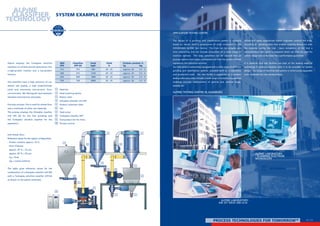
1 	 Feed bin
2 	 Feed metering device
3 	 Rotary valve
4 	 Zirkoplex classifier mill ZPS
5 	 Product collection filter
6 	 Fan
7 	 Feed screw
8 	 Turboplex classifier ATP
9 	 End-product bin for fines
10 	 Process control
	 Mill	 Classifier	 Feed	 Yield	 Protein content %
	ZPS 	 ATP-GS	 kg/h	 %	 Fg	 Gg
	 315	 315	 500	 20 - 25	 approx. 20	 5.5 - 6
	 500	 315	 1250	 20 - 25	 approx. 20	 5.5 - 6
	 630	 500	 1800	 20 - 25	 approx. 20	 5.5 - 6
	 750	 750	 3000	 20 - 25	 approx. 20	 5.5 - 6
APPLICATION TESTING CENTRE
The design of a grinding and classification system is normally
based on results from a programme of trials conducted in the
HOSOKAWA ALPINE Test Centre. The trials can be complex and
time consuming and can include evaluation of a wide range of
machine options. This way, customers can be assured that all
process options have been considered and that the system offered
represents the optimum solution.
Our test centre is extensively equipped with a wide range of different
grinding and classification systems, available both on a laboratory
and production scale. The test facility is supported by a modern
testing laboratory that includes a wide range of analytical equipment
enabling accurate measurement of particle size, particle shape,
density, etc.
Skilled and vastly experienced Alpine Engineers conduct the trials,
recording all operating data that enables ongoing discussions with
the customer during the trial. Upon completion of the trial a
comprehensive test report is prepared which can then be used for
system design and as the basis for a performance guarantee.
It is essential that test facilities are kept at the leading edge of
technology if optimum baseline data is to be provided for system
design. Our range of machines and systems is continuously upgraded
and is extended by new developments.
ALPINE TESTING CENTRE IN AUGSBURG
ALPINE LABORATORY
- SCANNING ELECTRON
MICROSCOPE
ALPINE LABORATORY -
AIR JET SIEVE 200 LS-N
SYSTEM EXAMPLE PROTEIN SHIFTING
PROCESS TECHNOLOGIES FOR TOMORROWSM
x
min
q(x) qA(x)
f·qF(x) g·qG(x)
x
0
x
50
x
100
x
x
max
0
0,25
0,50
0,75
T
1,00
x
0
x
25
x
75
x
50
x
100
x
g·qG(x)
qA(x)T (x) =
0
0,25
0,50
0,75
x
0
x
25
x
75
x
50
x
100
x
g·qG(x)
qA(x)T (x) =
q
x
0
x
a
x
50
x
100 x
g·qG(x)
qA(x)
1-QF(x)
QF(x)
QG(x)
Ü (%)
f·qF(x)
Q
x
F min
x
G min
x
ü
x
F max
x
Gmax
x
24 / 25
FUNDAMENTALS
Air classification is a method of separating
powdery, granular or fibrous materials in
accordance with their settling velocity as
a function of particle size, density and
particle shape. Ideally, the separation effect
of an air classifier should be such that all
particles which exceed the “cut point”
are transported into the coarse fraction
Frequency Distribution Curve
and the smaller particles into the fines
fraction. Such accuracy, however, is virtually
impossible to achieve. Regardless of the
type of air classifier used, a certain amount
of fines is always going to be present in the
coarse fraction and vice versa, the so-called
overlap zone.
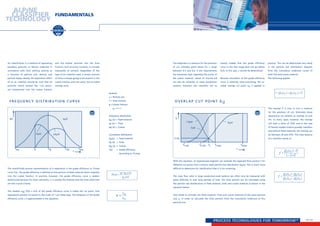
The scientifically precise representation of a separation is the grade efficiency or Tromp
curve T(x). The grade efficiency is defined as that portion of feed material which migrates
into the coarse fraction. In practice, however, the grade efficiency curve is seldom
determined because for most customers, it is usually the fineness and the fines yield that
are the crucial criteria.
The median x50 (T(x) = 0.5) of the grade efficiency curve is called the cut point. Fine
separations achieve cut points to the order of 1 µm these days. The steepness of the grade
efficiency curve κ is approximated in the equation:
With this equation, an experienced engineer can estimate the expected fines portion f for
different cut points from a known feed particle size distribution QA(x). This is much more
difficult to determine for classification than it is for screening.
The mass flow rates in large production-scale systems can often only be measured with
great difficulty or over long periods of time. The fines portion can be calculated using
the particle size distributions of feed material, fines and coarse material as shown in the
equation below.
One needs to consider the feed material, fines and coarse material of the same particle
size xO in order to calculate the fines portion from the cumulative undersize at this
particle size.
Symbols
x =	Particle size
f =	 Fines fraction
g =	Coarse fraction
	 g + f = 1
Frequency distribution
qA (x) =	 Feed material
qF (x) =	 Fines
qG (x) =	 Coarse
Cumulative distribution
QA(x)	 =	 Feed material
QF (x)	 =	 Fines
QG (x)	 =	 Coarse
T(x)	 =	 Grade efficiency
		 (according to Tromp)
The steepness is a measure for the precision
of cut, whereby good values for κ range
between 0.5 and 0.6. If the requirements
are extremely high regarding the purity of
the coarse material, values of around 0.8
can also be achieved. In many production
systems, however, the classifiers are so
heavily loaded that the grade efficiency
curve in the fine range does not go below
0.25. In this case, κ cannot be determined.
Because calculation of the grade efficiency
curve is relatively time-consuming, the so-
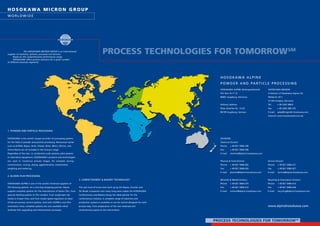
called overlap cut point xÜ is applied in
practice. This can be determined very easily
in the particle size distribution diagram
from the cumulative undersize curves of
both fine and coarse material.
The following applies:
The overlap Ü is now in turn a measure
for the precision of cut. Extremely sharp
separations can achieve an overlap of only
5%. In many cases, however, the overlap
will have a value of 10%; and in the case
of heavily loaded mineral powder classifiers
and difficult feed materials, the overlap can
be between 20 and 25%. The mass balance
of a classifier results in:
OVERLAP CUT POINT xÜ
2 / 27
PROCESS TECHNOLOGIES FOR TOMORROWSM
PROCESS TECHNOLOGIES FOR TOMORROWSM
HOSOKAWA MICRON GRoup
worldwide
The HOSOKAWA MICRON GROUP is an international
supplier of machines, systems, processes and services.
Based on this comprehensive performance range,
HOSOKAWA offers process solutions for a great number
of different business segments:
1. Powder and Particle processing
HOSOKAWA is the world's largest provider of processing systems
for the field of powder and particle processing. Renowned names
such as ALPINE, Bepex, Stott, Vitalair, Rietz, Mikro, Micron, and
Vrieco-Nauta are all included in the Group's range.
Regardless of the size, i.e. production-scale systems, pilot systems
or laboratory equipment, HOSOKAWA's products and technologies
are used in numerous process stages, for example during
comminution, mixing, drying, agglomeration, classification,
weighing and metering.
2. blown FiLM Processing
HOSOKAWA ALPINE is one of the world's foremost suppliers of
film blowing systems. As a one-stop shopping partner, Alpine
supplies complete systems for the manufacture of blown film, from
granule feeding systems to film winders, from single-layer die
heads to 9-layer lines, and from simple speed regulators to state-
of-the-art process control systems. And with ALPINE's own film
orientation lines, complete systems are now available which
facilitate film upgrading and enhancement processes.
3. Confectionery  bakery technology
The vast fund of know-how built up by the Bepex, Kreuter and
Ter Braak companies over many long years makes the HOSOKAWA
Confectionery and Bakery Group the ideal partner for the
confectionery industry. A complete range of machines and
production systems is available or can be custom-designed for each
process step, from preparation of the raw materials and
confectionery pastes to the end product.
www.alpinehosokawa.com
hOSOKAWA ALPINE
POWDER AND PARTICLE PROCESSING
HOSOKAWA ALPINE Aktiengesellschaft
P.O. Box 10 11 51
86001 Augsburg, Germany
Delivery address:
Peter-Doerfler-Str. 13-25
86199 Augsburg, German
DIVISIONS
Chemical Division
Phone:	 + 49 821 5906-238
Fax:	 + 49 821 5906-438
E-mail: 	 chemical@alpine.hosokawa.com
Pharma  Food Division
Phone:	 + 49 821 5906-283
Fax:	 + 49 821 5906-620
E-mail: 	 pharma@alpine.hosokawa.com
Minerals  Metals Division
Phone:	 + 49 821 5906-279
Fax:	 + 49 821 5906-610
E-mail: 	 mineral@alpine.hosokawa.com
Service Division
Phone:	 + 49 821 5906-271
Fax:	 + 49 821 5906-457
E-mail:	 service@alpine.hosokawa.com	
Recycling  Granulators Division
Phone:	 + 49 821 5906-415
Fax:	 + 49 821 5906-630
E-mail:	 recycling@alpine.hosokawa.com
HOSOKAWA MICRON
A Division of Hosokawa Alpine AG
Welserstr. 9/11
51149 Cologne, Germany
Tel: 	 + 49 2203 308-0
Fax: 	 + 49 2203 308-125
E-mail: 	 sales@hmgmbh.hosokawa.com
Internet:	www.hosokawamicron.de

Alpine classifier technology (en)

  • 1.
    PROCESS TECHNOLOGIES FOR TOMORROWSM POWDER ANDPARTICLE PROCESSING ALPINE CLASSIFYING TECHNOLOGY Hosokawa Alpine is a member of the Hosokawa Micron Group, responding to global needs through emphasis on materials science and engineering. The Group is an international provider of equipment and technology for powder and particle processing, plastics processing and confectionery products. The Group maintains facilities for research, engineering, manufacturing and service in each of the world's major industrial markets. © Hosokawa Alpine 2010. Printed in Germany. HOSOKAWA ALPINE Aktiengesellschaft P.O. Box 10 11 51 86001 Augsburg, Germany Delivery address: Peter-Doerfler-Straße 13 – 25 86199 Augsburg, Germany Phone: + 49 821 5906-0 Fax: + 49 821 5906-101 E-mail: mail@alpine.hosokawa.com www.alpinehosokawa.com Subject to change without notice. All information in this brochure is purely informative and non-binding. Our quotations are authoritative with regard to orders. Sichtertechnologie01.10/1.5(EN)
  • 2.
    2 / PROCESSTECHNOLOGIES FOR TOMORROWSM WE ARE YOUR COMPETENT PARTNER HOSOKAWA  ALPINE ONE COMPANY - TWO BUSINESS DIVISIONS WE ARE YOUR COMPETENT PARTNER POWDER PARTICLE PROCESSING Formed in 1898, Hosokawa Alpine's range includes the development, design and manufacture of components and turnkey systems to produce powders, granules and bulk materials for the chemical, pharmaceutical, food, minerals, metals and recycling industries. Whether the task is comminution, classification, dust removal, handling, metering, weighing or packing, you will always find Hosokawa Alpine to be a competent and innovative partner. Hosokawa Alpine has been in business for over 100 years. Regardless of the field, i.e. blown film processing or powder particle processing, we are traditional trendsetters on the market. The driving force behind refining our technologies is the experience we gain and the challenges we face as market leaders. DIVISIONAL STRUCTURE The name ALPINE stands for competence in all areas of comminution technology. The long years of close cooperation between our engineers and the development departments of our customers have made us leading specialists for powder and particle processing technology around the world. Because our aim is to offer our customers the very best in professional and accomplished advice tailored to their specific branch of industry, our powder and particle processing division is divided into five subdivisions: BLOWN FILM PROCESSING As a specialist for film blowing lines to manufacture thin plastic film, Hosokawa Alpine ranks among the world's foremost suppliers in this market segment. The vast fund of know-how, the high quality standards, the continuous innovation and high degree of reliability are all reasons for the constant growth of this business division. everything from one single responsible source. - Pharma Food The manufacture of powdery substances for the pharmaceutical industry is a job for specialists. Hosokawa Alpine conforms with international pharma standards and supplies a wide range of products and performance, including special processes for the food industry. Whatever method of size reduction is used, we are the specialists. - CHEMICALS The range of chemical products is just as wide and diverse as are the different demands on the properties of pigments or powders. We supply process-technological solutions for the chemical industry as a single-source partner. Our comprehensive range of products means that we are able to meet a vast number of different requirements. We also offer competent advice on solutions for basic chemical products and auxiliary products, as well as for toners, paints, pigments, herbicides or fertilisers. - Minerals Metals We supply complete dry and wet processes with state-of-the-art mills and classifiers for processing mineral raw materials. Our machines and systems for fillers, ceramic raw materials, metallic compounds and alloys all meet the high demands set by our customers. We are not just manufacturers, however, but also competent partners for the engineering and design of complete turnkey systems. - RECYCLING GRANULATORS We design, build and deliver complete granulator systems to include all necessary system components. Whether the feed material is injection mouldings, sprues, film webs or film edge trims, our granulators are designed for even the most difficult cutting tasks. In addition, we also supply in-line recycling solutions for rubber or cable which are tailored to the individual requirements. - Service Our service division gives support during the entire lifetime of any Hosokawa Alpine system or machine. Our extensive range of services includes spare parts supply, maintenance, inspection, servicing, repairs, general overhauls, system upgrading, and training. A fairly recent addition to our portfolio of services is a range of pre-owned ALPINE machines. No matter what part of the world you are in or what your processing challenge is, Hosokawa Alpine is never far away with the best solutions and support. Our range of services includes project management, installation, commissioning, training, maintenance and system upgrades.
  • 3.
    PROCESS TECHNOLOGIES FORTOMORROWSM 4 / OVERVIEW THE CLASSIFIER EXPERTS We offer systems for a wide variety of different products and fineness ranges, tailored to meet with the technical and economical demands of the individual application. ZIRKOPLEX CLASSIFIER MILL ZPS Highly flexible air classifier mill for the processing of soft to medium hard materials. High-speed impact mill combined with single or multi-wheel Turboplex classifier for precise control of product topsize. Fineness range d97 10 - 200 µm. ALPINE SUPER ORION so BALL MILL operated IN CIRCUIT WITH AN ALPINE TURBOPLEX CLASSIFIER ATP to produce a range of paper filler in coating quality (d80 2 µm) as well as coarse fillers (e.g. dolomite powder for road-work paint with a d97 of 100 µm). FLUIDISED BED OPPOSED JET MILL AFG For the processing of powders with a Mohs Hardness of up to 10, producing a steep particle size distribution with precise control of product topsize in the fineness range 5 µm to 200 µm. Classifier wheel(s) incorporated into top section which is hinged back or removed for easy clean. Since the market introduction of the Mikroplex spiral air classifier MP in 1948, Alpine has continued with its successful development and manufacture of air classifiers. GRINDING AND CLASSIfication Where size reduction is required with control of particle size Alpine mills are operated either in conjunction with downstream classifiers or with an integral air classifier. Stratoplex AIR CLASSIFIER ASP Classifier designed for high throughput rates in the fine to medium separation range of d97 20 – 200 µm. High fines yield with low specific power consumption. Turboplex ULTRAFINE CLASSIFIERS ATP AND ATP-NG Single- and multi-wheel classifiers for ultrafine separations. Superfine powders in the fineness range of d97 3 – 10 µm, and in NG design, finenesses down to d97 2 µm (d50 0.5 µm) are possible. Spatter-grain free operation over the entire separation range. Integrated coarse material classifier increases the yield. Turbo-twin-CLASSIFIER TTC Newly developed classifier wheel geometry pushing the limits of air classification to new levels - d50 0.5 µm achievable. CLASSIFIERS TSP / TTSP One- or two-stage ultrafine classifier with a high precision of cut. Ideally suited for classifying toner and pigments, e.g. to minimise the ultrafine portion 2 - 5 µm (see separate brochure). Multi-Plex ZIGZAG CLASSIFIERS MZM AND MZF Gravity classifiers for sharp separations in the range 0.3 - 10 mm. ventoplex air CLASSIFIER V Circuit-air classifiers for high throughputs. Fineness range approx. d97 = 32 µm to 200 µm. Low energy consumption. Micron AIR CLASSIFIER MS Air-stream classifier designed for pneumatic product feed. Fineness range approximately d97 15 – 150 µm. High throughput rates. For end-product finenesses of approx. 10 µm - 100 µm. An MS classifier or Turboplex ultrafine classifier is integrated into the mill top section. The grinding process in the material bed is advantageous above all for flaky fillers such as talc or abrasive products such as feldspar. 200 150 100 50 45 20 15 5 4 3 12 0,5 µm t/h Stratoplex ASP Ventoplex C Micron MS Turboplex ATP multi-wheel Turboplex ATP single-wheel Turbo Twin TTC TSP/TTSP Particle size d97 / µm FinesYield Turboplex ATP-NG TABLE ROLLER MILL AWM WITH INTEGRATED CLASSIFIER TOP SECTION Jet Mill AFG Zirkoplex ZPS Ball-Mill Super-Orion
  • 4.
    PROCESS TECHNOLOGIES FORTOMORROWSM 6 / application areas Limestone, quick lime, fertilising lime, feed lime, bentonite, dolomite, gypsum, chamotte, quartz, feldspar, pegmatite, raw kaolin, ore, phosphor, glass powder, abrasives, rice flour, bone meal, etc. Because of the high wear resistance and the high achievable fines throughput, the Ventoplex air classifier is ideal for use in the mineral powder industry, especially for ceramic powders that need to be produced without iron contamination. features - Wide fineness range - High fines throughput rate - Insensitive to overload - Low specific energy consumption - Low peripheral speed - Low air circulation rate - Low overall height - Good accessibility for inspections - Maintenance-friendly design, use of inexpensive wear parts and thus low maintenance costs. *) Reference material: limestone with density 2700 kg/m³; feed material with 70% d97 VENTOPLEX® CLASSIFIER C Ventoplex Typ C C9V C12V C15V C18V C21V C25V C28V C32V C36V Scale-up factor F = approx. 1 1.8 2.8 4 5.6 8 10 12.5 16 Drive power of internal fan kW 3.0 5.5 7.5 11 15 22 30 37 55 - 75 Material feed: from above centrally via hollow shaft from the side via feed screw or air conveying channel Drive power of classifier kW 1.5 2.2 3.0 4.0 5.5 7.5 11 15 22 Max. classifier speed rpm 1120 800 670 560 475 400 355 315 280 Max. feed rate t/h 3 5 8 12 17 24 30 38 48 Fineness d97 = approx. µm 32 - 200 32 - 200 32 - 200 32 - 200 32 - 200 40 - 200 40 - 200 45 - 250 50 - 250 Fines yield *) d97 32 µm t/h 0.4 0.7 1.1 1.6 2.2 --- --- --- --- 45 µm t/h 0.5 0.9 1.5 2.2 3.0 4.3 5.4 6.8 (8.5) 63 µm t/h 0.7 1.2 1.9 2.8 3.9 5.6 7.0 8.8 11.2 90 µm t/h 0.9 1.6 2.5 3.6 5.0 7.2 9.0 11.3 14.4 200 µm t/h 1.6 2.9 4.5 6.4 9.0 12.8 16 20 25.6 Ideal for sharp separations in the range d97 = approx. 0.3 - 10 mm. Throughputs can range from a few kg/h in the case of the laboratory classifier up to approx. 200 t/h for the industrial-scale multi-tube classifier. Classification takes place at every change in direction of the Zig-Zag tube and permits an extremely high, steplessly adjustable precision of cut. The result is clean-cut fines or lightweight material, even under overload conditions. APPLICATIONS AREA OLEAGINOUS FRUITS Classifying systems for separating cracked soy beans or sunflower seeds. PRECIOUS METALS The separation of copper, aluminium or lead from the insulation material of previously cut cable scrap. Dust removal from plastic granules, coke, chalk, fertilizers, bauxite, etc. Alpine offers zigzag classifiers in two different designs: MZM and MZF. Each design is available in a range of machine sizes from a single-tube to a multi-tube classifier. MZM DESIGN Feature: Feed material introduced into the middle part of the zigzag tube. MZF DESIGN Feature: Feed material introduced at the lower end of the classifying tube via a flybed channel. MZF classifiers are used for granular materials that are either free- flowing or can be dispersed with air. FEATURES - Maintenance-free and wear-resistant - Overload-proof - Insensitive to changes in the feed material composition Because of these characteristics once set, the classifying system can be operated over long periods without any supervision at all. FUNCTION TheVentoplexCisaninternalrecirculationair classifier. In contrast to the former Ventoplex B with central drive, the new C design has a separatelydrivenclassifyingwheel.Inthenew machine, the fan and classifying wheel are coaxially arranged and are driven by means of two separate hollow shafts. This makes it possible for the user to set different speeds and thus permits a significant extension of the fineness range from currently 32 µm to 200 µm. The product is fed to the centre of the classifier head via a hollow shaft, from which the material falls onto a centrifugal plate underneath the classifying wheel. The centrifugal plate distributes the feed material uniformly in the classifying chamber. Coarse particles fall against the upward flow of classifying air to the bottom, collect in the coarse material cone and are discharged through the side of the Internal recirculation air classifier with high fines yield. Fineness range approx. d97 = 32 µm – 200 µm. machine via a gravity chute. Fine particles in the feed material become entrained in the upward flow of classifying air and enter the classifying wheel along with the classifying air. The particles in the classifying wheel are classified by the two competing forces, namely centrifugal force and flow force. Coarse particles are rejected by the centrifugal force, whereas for the fine particles, the drag force of the air flow predominates, allowing the particles to pass through the classifying wheel. The Ventoplex air classifier requires no additional external dust collector to separate the fines. MULTI-PLEX® CLASSIFIER mzm And mzf
  • 5.
    PROCESS TECHNOLOGIES FORTOMORROWSM 8 / 1 2 3 4 5 6 6 6 7 8 9 10 11 MICRON AIR CLASSIFIER MS Robust air-stream classifier (pneumatic product feed) for high throughputs. Fineness range: approx. d97 = 15 - 150 µm. The slow rotation of the MS wheel in the medium fineness range brings advantages regarding the pressure drop and wear rate. The classifier can also be operated with high air flow rates. PRINCIPLE OF OPERATION The feed material enters the classifier with the main air flow which can be a highly cost effective process option if integrated into a system with direct pneumatic feed. The classifying wheel is driven by a belt drive and a three-phase asynchronous motor. The classifying wheel speed can be steplessly adjusted by means of a frequency converter. By altering the classifying wheel speed, the particle size can be easily adjusted even during operation. Fine particles whose size is below the set cut point are transported through the rotor blades along with the classifying air, then discharged via the fines discharge in the main air flow, and finally collected in a suitable filter. Coarse particles are rejected by the classifying wheel and discharged via the coarse material discharge. Before being discharged, the coarse material is rinsed intensively in a spiral flow taken from the secondary air stream to remove any last fines, i.e. this final classi- fication step improves the precision of cut and increases the fines yield. The MS classifier wheel is suspended from a vertical shaft and is of welded construction. The vanes of the wheel are inclined and tapered into a conical shape. During operation oversize product is deflected away from the rotating wheel. The MS Micron air classifier unit can be operated in closed circuit operation with a ball mill or as a classifier head in conjunction with a table roller mill. APPLICATION AREAS Talc, calcium carbonate, bentonite, kaolin, loam, dolomite, quartz, kieselguhr, pigments, fine-grade chemicals, etc. The Micron air classifier is a robust air-stream classifier for separations in the medium fineness range at high throughput rates. DESIGNS For operation on abrasive materials the classifier can be offered in a wear protected design. For applications in the food or pharmaceutical industries, the classifier can be manufactured in stainless steel. 1 Feed bin 2 Feed metering unit 3 Change-over flap 4 Super orion ball mill 5 MS air classifier 6 Rotary valve 7 Automatic reverse jet filter 8 Control valve 9 Fan 10 Fines collection bin 11 Control cabinet MICRON MS for abrasive material * Feed material with 70 % d97, capacities with minimum airflow rate Micron Air Classifier Type MS-1H MS-2H MS-3H MS-4H MS-5H MS-6H Scale-up factor F = approx. 1 2.7 5 10 20 40 Drive power kW 5.5 11 15 30 45 55 Max. speed rpm 5000 3300 2500 1600 1100 800 Air flow rate m3/h 900 - 1600 2400 - 3600 4800 - 9000 9000 - 18000 18000 - 33000 36000 - 72000 Fineness d97 = approx. µm 7 8.5 10 12.5 15 18 Fines yield, max* d97 15 µm in t/h 0.16 0.45 0.90 1.50 -- -- 20 µm in t/h 0.2 0.6 1.1 2.1 4.2 8.4 45 µm in t/h 0.3 0.8 1.6 2.9 5.9 12.0 63 µm in t/h 0.4 0.9 1.8 3.4 6.7 13.5 MICRON® AIR CLASSIFIER MS
  • 6.
    PROCESS TECHNOLOGIES FORTOMORROWSM 10 / 11 STRATOPLEX® AIR CLASSIFIER asp Deflector-wheel classifier for the medium- fine separation range between approx. d97 = 20 - 200 µm. The Stratoplex is a cost-effective classifier characterised by it's high precision of cut, high fines yield, low energy consumption and ease of adjustment. The cut point can be adjusted by means of a frequency converter as a function of the classifying wheel speed. The two design variants - one equipped for separations in the fine range, the other for separations in the coarse range - make it easy to adjust the classifier for optimum performance on the particular application. The quality of classification is maintained even when the feed rate is high. And the low pressure drop of only 600 - 800 daPa for the entire classifying system permits extremely low-energy operation. 630 ASP WITH WEAR-PROTECTED CERAMIC CLASSIFYING WHEEL, FINE-RANGE EQUIPMENT FEATURES The ASP classifier can be operated in the following modes: - through-air mode - circuit-air mode with approx. 10% leakage air The compact and modular design of the Stratoplex air classifier results not only in maximum performance at modest dimensions, but also permits an easy and space-saving system configuration. And because most of the main components can be accessed easily from above, Stratoplex air classifiers are quick and easy to maintain. Stratoplex air classifiers are budget-priced standard classifiers for the fine to medium separation range. WEAR PROTECTION In spite of the fact that the wear rate is relatively low, all major product- contact components of the Stratoplex air classifier can be equipped with special wearprotection elements, e.g. - PUR - Al2O3 - Naxtra SIMPLE DESIGN PRINCIPLE OF OPERATION Because the drive of the Stratoplex air classifier is fitted underneath the classifying zone and the feed product is fed centrally from above, the result is an optimum distribution and dispersion of the product. The feed product is charged by means of the feed unit via the product intake to the centrifugal plate of the classifying wheel, where it is distributed uniformly and radially dispersed towards the baffle ring. The feed material is deflected by the baffle ring and routed downwards into the classifying zone. The classifying air enters the spiral housing and flows through the helical vanes of the vane ring and the classifying wheel in a centripetal direction. The fines portion is removed thereby from the feed material as it gravitates downwards in the classifying zone, i.e. the zone between the vane ring and the classifying wheel. The fines, extracted as a function of the cut point set on the classifier, are entrained in the classifying air and flow towards the fines discharge. The fines must be separated from the classifying air in a downstream collection device (cyclone, filter). The coarse material is rejected by the classifying wheel and falls down into the lower section of the classifier. The coarse material discharge must be air- sealed by means of a rotary valve. Rinsing air, either drawn in automatically or supplied underpressure,preventsunclassifiedproduct from migrating into the fines through the gap between the classifying wheel and the labyrinth seal. The classifying wheel is usually driven via a V-belt drive with a fixed transmission ratio; the classifier speed can be set by means of a frequency converter. The classifier is delivered complete with filter, fan and cyclone. APPLICATION AREAS Alpine's ASP classifiers are used above all for processing feldspar, quartz, nepheline, wollastonite, etc. The Stratoplex ASP is also available in a special design for processing products such as hydrated lime that tend to deposit. CLASSIFYING WHEEL VANE WITH BONDED CERAMIC OVERLAY Stratoplex ASP Type 315 400 500 630 800 1000 1250 1500 1800 Scale-up factor F = approx. 1 1.6 2.5 4 6.4 10 16 25 33 Drive power kW 5.5 7.5 11 15 22 37 55 90 132 Speed / coarse rpm 2000 1600 1250 1000 800 630 500 420 350 Speed / fine rpm 4000 3200 2500 2000 1600 1250 1000 840 700 Air flow rate m3/h 2500 4000 6300 10000 16000 25000 40000 64000 82000 Fineness d97 = approx. µm 8 9 10 11 13 15 17 20 25 Fines yield, max*) d97 20 µm in t/h 1.8 2.1 2.7 3.2 3.8 5.5 6.8 10 - 63 µm in t/h 2.2 3.6 5.4 9 14 22 36 50 80 90 µm in t/h 2.5 4 6 10 16 25 40 55 80 *) Feed material with 70% d97
  • 7.
    PROCESS TECHNOLOGIES FORTOMORROWSM 12 / 13 Turboplex® AIR CLASSIFIER atp The Turboplex classifier is the classic all-rounder, offers the most variations and application possibilities, and is available as a single-wheel or multi-wheel classifier. HORIZONTAL CLASSIFier WHEEL Although the first ATP classifiers (1981) still had vertically arranged classifying wheels, trials showed relatively quickly that a horizontal arrangement is much more advantageous for the Turboplex. There is no need to deflect the fines, meaning that problems with sticky products or hard agglomerates are avoided and that the classifying wheel operates in a product cloud and is thus always uniformly charged. Close manufacturing tolerances make it possible to set a very small rinsing gap which enables particle spatter to be avoided. The maintenance of precise tolerances in the case of the bearings ensures a long service life. PRINCIPLE OF OPERATION After entering the machine, the classifying air flows through the classifying wheel in a centripetal direction. In the process, the classifying wheel extracts the fines from the feed material and conveys them to the fines discharge. The coarse material rejected by the classifying wheel gravitates downwards. The air routing shown in the schematic on the right is much simplified, because before the coarse material exits the classifier, it is rinsed again intensively by air to remove the remaining fines. This results in an extremely clean coarse fraction. The product is fed either via a rotary valve or in the case of an air-flow classifier, entrained in the classifying air. Product fineness is controlled by adjustment of the classifier wheel speed using a frequency converter. The horizontal arrangement of the classifying wheel means that even difficult products can be processed with no problem. FEATURES There is hardly another type of classifier that is so well adapted to the demands of practical operation as the Turboplex ultra­ fine classifier: - The simple and robust design reduces costs for maintenance and servicing - The horizontal arrangement of the classifying wheel reduces wear even with abrasive products and guarantees a long service life - If processing extremely abrasive products, a wear-protection lining prevents excessive wear - Modest space requirement - High fines yield - Sharp top size limitation. - Stable operation even if the feed rate fluctuates - Long service life - Coating formation prevented, e.g. when classifying CaCO3 - Rinsing gap easy to adjust - Narrow rinsing gap possible - Vibration-free Wear Protecion The applied materials and the wear protection is customised for individual applications. For the pharmaceutical industry the ATP is manufatured in stainless steel. ENLARGED FINES DISCHARGE SINGLE-WHEEL ATP Turboplex atp SINGLE-WHEEL CLASSIFIER Turboplex ATP Type 100 140 200 315 400 500 630 750 1000 Scale-up factor F = approx. 0.25 0.5 1 2.5 4 6.25 10 14 25 Drive power kW 4 5.5 5.5 11 11 22 30 37 45 Max. Speed rpm 11000 8500 6000 4000 3150 2400 2000 1600 1200 Max. air flow rate m3 /h 300 600 1200 3000 4800 7500 12000 17000 30000 Fineness d97 = approx. µm 4-100 5-120 5-120 6-150 7-150 8-150 9-200 10-200 12-200 Fines yield max *) d97 8 µm in t/h 0.035 0.070 0.14 0.35 0.56 0.80 1.2 - - 20 µm in t/h 0.07 0.14 0.28 0.70 1.12 1.75 2.8 3.9 6.5 45 µm in t/h 0.1 0.2 0.4 1.0 1.6 2.5 4.0 5.6 9.5 Turboplex ATP Type 100/4 140/4 200/4 315/3 315/6 500/3 500/4 630/4 Scale-up factor F = approx. 1 2 4 7.5 15 19 25 40 Drive Power kW 4 x 3 4 x 4 4 x 5.5 3 x 11 6 x 11 3 x 15 4 x 15 4 x 22 Max. Speed rpm 11000 8500 6000 4000 4000 2400 2400 2000 Max. air flow rate m3 /h 1200 3000 4800 9000 18000 22500 30000 48000 Fineness d97 = approx. µm 4-100 5-120 5-120 6-150 6-150 8-150 8-150 9-200 Fines yield max.*) d97 8 µm in t/h 0.14 0.28 0.56 1.0 2.1 2.4 3.2 4.8 20 µm in t/h 0.28 0.56 1.12 2.1 4.2 5.2 7 11 45 µm in t/h 0.4 0.8 1.6 3 6 7.5 10 16 Turboplex atp mULTI-WHEEL CLASSIFIER *) Feed material with 70% d97 Designs For applications on explosive materials, in addition to the standard machine design, with the exception of the 750 ATP and the 1000 ATP all classifiers in the range are available in explosion-pressure-shock- proof design to 10 bar overpressure.
  • 8.
    PROCESS TECHNOLOGIES FORTOMORROWSM 1 1 2 3 4 1 1 2 3 3 14 / 15 Turboplex®-MULTI-WHEEL CLASSIFIER The cut point size xT is proportionate to the root of the radial air velocity wr and the root of the collector diameter D, and inversely proportional to the peripheral velocity u (ηL = dynamic viscosity of the air, ρS = density of solid, F = adaptation parameter). For small particle diameters, therefore, it is best to target low flow rates, small classifying wheel dimensions and high peripheral speeds. The equation also delivers the basis for Alpine's multi-wheel principle: a small wheel can separate finer assuming constant operating conditions. In order to satisfy the demand for super- fine products at high throughput rates Alpine developed the concept of the Turboplex multi-wheel classifier whereby several smaller classifier wheels are installed in a single machine. This multi-wheel concept enables the production of superfine products, typically in the 3 - 6 µm range, with an extremely high fines yield at an optimum precision of cut. The multi-wheel Turboplex classifier operates in conjunction with a single cyclone / filter and fanset so represents a cost effective method of achieving superfine separations at high throughput rates. Dependent on the end-product fineness, the feed product and the machine size, the feed rate of Turboplex multi-wheel classifiers ranges between about 150 and 30,000 kg/h. APPLICATION AREAS Especially developed for ultrafine classifying operations, Alpine's multi-wheel classifiers are ideal for processing metal powders, mineral powders, abrasives, toner, and wax. Superfine end products can usually only be manufactured with relatively small classifiers, i.e. laboratory or pilot units, and naturally only in correspondingly small amounts. Once the pilot plant is scaled up to production scale, the desired ultrafine separation is no longer achievable. Theoretically, during classification of particles separated in the field of centrifugal force, an equilibrium of forces is established between the centrifugal force and the drag force of the fluid flowing around it. According to Stoke's law (Re 1), which applies in the case of very fine particles examined here, the following is obtained for the diameter of the cut-size: Scale-up through the classifier range to achieve greater throughputs influences not only capacity but also the performance of the classifier in terms of the cut point and the precision of cut. MULTI-WHEEL CLASSIFIER 630/4 ATP 1 Several horizontal classifying wheels of the same diameter are driven independ- ently. The common speed control is accomplished by a frequency converter 2 The product is either gravity fed from the side via a rotary valve or is fed entrained in the flow of classifying air 3 Common fines discharge 4 Coarse material discharge with optimised coarse material classifying WEAR PROTECTION Classifier wheels: - Al2O3 all-ceramic for sizes ATP 50, 100, 200 and 315 - SiC for the sizes 100 and 200 - Steel classifying wheel with tungsten carbide coating Product-contact classifier parts: - PUR lining - Ceramic lining - Exchangeable steel wear-protection elements with welded special alloy PRINCIPLE OF OPERATION Besides first-class performance, Turboplex multi-wheel classifiers offer numerous technical and operating advantages: - Instead of a number of small parallel- connected classifiers, only one single classifier for superfine end products and high throughput rates - The product is fed via only one single port; this means that only one metering unit is required - The fines are discharged through a common outlet duct, enabling simple adjust of airflow through the machine - The coarse material is collected at only one exit point Because of the high throughput rates, Turboplex multi-wheel classifiers can be combined in circuit with correspondingly large mills. SiC CLASSIFYING WHEELS CERAMIC LINING
  • 9.
    PROCESS TECHNOLOGIES FORTOMORROWSM 100 90 80 70 60 50 40 30 20 10 0 0,5 1 1,5 2 2,5 16 / 17 Turboplex® ATP-NG e.g. the Hosokawa Alpine ball mill S.O.-SF or the agitated ball mill ATR, fine products with a d50 of 0.7 and even 0.3 µm have been achieved. Whereas when manufacturing ultrafine limestone and talc filler it is the fineness of the classification that is all-important, other applications target a coarse end product with a particle size distribution that is as steep as possible. Here, too, the new generation of classifiers has proved itself. In contrast to conventional methods, it was possible in this particular case to increase the coarse yield with the new classifier from 33 % to 38 % without any appreciable change to the quality of the coarse material. At the same time, the reduction of the pressure drop also led here to substantial energy savings. THE TURBOPLEX ATP-ng In a grinding-classifying circuit, the amount of energy needed for the classification increases with increasing end-product fineness. This fact gave rise to the demand for a low-energy classifier that was capable of achieving fineness values in the range of d50 1 µm. The New Generation Turboplex (ATP-NG) operates in accordance with a completely new classifying principle that is based on the concept of solid-bed flow instead of the conventional potential flow. This new concept has made it possible to reduce the pressure drop and the entire classifying energy quite considerably. A special vane geometry permits a uniform material flow and thus an even finer classification. The advantages of this new classifier generation are especially con­ spicuous when used in the submicron range: low energy consumption at high yield. Another plus point is the ease with which existing ATP classifiers can be upgraded with the new classifying wheels. With the new NG wheels, it has been possible to reduce the pressure drop by approx. 60 % when compared with the ATP standard classifying wheel. And because in the ultrafine range, it has also been possible to improve the yield, the result in many cases is an energy saving of between 30 and 50 % referred to the fines yield. With the new classifier generation, end-fineness values are possible that were to date inconceivable with production-scale systems. And in combination with new mills, Multi-wheel classifiers are the classifier of choice for ultrafine classifying operations, and because the particle diameter is also directly dependent on the classifying wheel diameter, it is possible in the majority of cases to fulfil customer requirements. FEATURES - 30 - 50 % less energy requirement in comparison with the standard Turboplex classifier - Classification down to d50 = 0.5 µm - High fines yield - Easy Upgrade - conversion of existing machines to ATP-NG design can be achieved by simple replacement of the classifier wheel and drive unit. Wear PROTECTION - Classifying wheels with tungsten carbide. (Ceramic classifying wheels are not used with the ATP-NG.) d50 [µm] Energyreferredtothefinesyield(%) = ATP = ATP-NG MULTI-WHEEL CLASSIFIER 315/6 ATP-NG Turboplex ATP-NG Type 315 500 630 750 315/3 315/6 500/3 500/4 630/4 Scale-up factor F = approx. 2.5 6.25 10 13.5 7.5 15 19 25 40 Drive power kW 18.5 30 45 55 3 x 18.5 6 x 18.5 3 x 30 4 x 30 4 x 45 Max. speed rpm 5600 2800 2400 1920 5600 5600 2800 2800 2400 Max. air flow rate m3 /h 3500 8800 14000 22000 10500 20000 26000 35000 56000 Fineness d97 = approx. µm 2.5 - 150 3.5 - 150 6 - 200 7 - 200 2.5 - 150 2.5 - 150 3.5 - 150 3.5 - 150 6.0 - 200 Fines yield max*) d97 4 µm in t/h 0.10 0.25 - - 0.3 0.6 0.75 1.0 - 5 µm in t/h 0.2 0.45 - - 0.5 1.1 1.3 1.8 - 6 µm in t/h 0.3 - - 0.8 - - - - - 8 µm in t/h 0.4 1.0 1.6 2 1.2 2.3 3.0 4.1 6.2 10 µm in t/h 0.6 1.3 2.0 2.6 1.5 3.1 3.9 5.3 8.5 *) Feed material with 70% d97
  • 10.
    PROCESS TECHNOLOGIES FORTOMORROWSM 1 2 3 3 13 5 11 12 7 6 11 9 11 10 8 18 / 19 turbo twin CLASSIFIER TTC The patented classifying wheel geometry of the Turbo Twin permits high throughput rates and loading factors at a steep top cut, and therefore constitutes an attractive alternative to the Alpine multi-wheel classifiers. The low pressure drop results in an even lower energy consumption than that of the ATP. The classifying wheel is supported at both ends and permits extremely high speeds, i.e. peripheral speeds of up to 120 m/s can be realised. Product feed is either by gravity or pneumatic. The classifier bottom section corresponds to that of the ATP, meaning that any existing ATP machine can be retrofitted with the TurboTwin classifier. The classifying wheel is driven by means of a three-phase asynchronous motor with frequency converter and flat belt drive. There are currently 5 machine sizes with drive outputs between 18.5 and 132 kW available. Turbo Twin CLASSIFIER TTC This new classifier for fineness values of d97 between 2 and 4 µm at high product yields is ideal for the ultrafine classification of mildly abrasive products such as limestone, talc, silica, graphite, barite, mica and kaolin. aPPLICATION AREAS - Superfine end products - Mildly abrasive feed products, e.g. limestone, talc, silica, graphite, barite, mica, kaolin WEAR PROTECTION - Naxtra classifying wheel - and tungsten carbide coating forced vortex flow in classifying wheel Turbo Twin Classifier TTC Type 200 315 500 630 710 Scale-up factor F = approx. 1 2.5 6.25 10 12.5 Drive power kW 18.5 30 55 90 132 Max. speed rpm 10000 7300 4600 3650 3250 Max. air flow rate m³/h 1600 4000 10000 18000 25000 Fineness d97 = approx. µm 2.5 3 3.3 3.5 4 Fines yield max*) d97 3 µm in t/h 0.04 0.09 - - - 4 µm in t/h 0.07 0.18 0.42 0.63 - 5 µm in t/h 0.11 0.26 0.65 0.98 1.3 6 µm in t/h 0.14 0.35 0.88 1.4 1.9 8 µm in t/h 0.23 0.56 1.4 2.3 2.9 10 µm in t/h 0.28 0.79 1.8 2.8 3.5 *) Feed material with 70% d97 1 Feed bin 2 Feed metering device 3 Diverter valve 4 Super Orion Ball Mill S.O. 5 Bucket elevator 6 Safety screen 7 Stratoplex Classifier ASP 8 Cyclone 9 Turbo Twin Classifier TTC 10 Product collection filter 11 Fan 12 Nuisance dust extraction 13 Control cabinet SYSTEM FOR limestone processing
  • 11.
    PROCESS TECHNOLOGIES FORTOMORROWSM 1 1 2 3 5 10 20 50100 2 3 5 10 20 30 40 60 80 95 99,8 100 % 90 80 70 60 50 40 30 20 10 0 5 10 15 20 25 30 µm 100 % 90 80 70 60 50 40 30 20 10 0 5 10 15 20 25 30 µm 1 5 2 3 12 4 6 11 6 6 10 9 8 7 20 / 21 size 100 TTSP ready for shipment In contrast to all other ultrafine classifiers featured in this brochure, the TSP is not oriented towards obtaining spatter-grain- freefinesbutrathertowardstheachievement of clean coarse fractions. Thanks to the special design of this classifier, the coarse material can no longer be contaminated by fresh material once it has passed through the classifying zone. This results in high- quality coarse material and extremely good yields. In other cases, the separated fines must often be reprocessed, and this naturally involves costs. In other words, the high coarse yields make an effective and lasting contribution towards reducing production costs. The two following graphs document the dust removal efficiency and the respective coarse material yield. The classifier is employed in all those cases where the requirement is for high-quality dust removal - for example, in the case of pigments, silicic acid, powder coatings, chemical additives and toner. (See separate brochure “Powder and particle processing for the toner industry”.) Design variants TSP - Pressure-shock-proof design to 10 bar overpressure - Mild steel - Stainless steel - Small classifiers in monobloc design - To order, product-contact surfaces polished to Ra 0.8 µm - Wear-protected (hard-metal-coated) classifying wheel.toner classifier 200 ttsp TSP Classifier Type 200 250 315 400 500 Scale-up factor F 1 1.6 2.5 4 6.3 Classifier drive kW 3 5.5 7.5 11 18.5 Nominal air flow rate Nm3 /h 560 900 1400 2300 3600 Feed rate kg/h 60 90 140 230 360 Dedusting with the TSP Feed product Coarse material Coarse yield = 91,6 % Dedusting with the TSP Feed product Coarse material Coarse yield = 81,3% The advantages of these fillers are their: - chemical stability, i.e. good weather- resistance - mechanical strength, i.e. increased scratch-resistance - alkaline behaviour, i.e. increased corrosion-resistance For matt and satin-finish paints, a standard filler with a d50 to 2.5 µm is used. In the case of this standard filler, the industry demands are extremely high. Requirements: - low price - sharp top size limitation - consistent product quality For the production of these fillers, Alpine offers compact systems (flow chart) that include a large ball mill and large multi- wheel classifier. The ground product is conveyed to the ATP classifier direct from the mill entrained in the classifying air. This solution has the following advantages: - an extremely compact system set-up, in other words low building costs, - less units, i.e. low maintenance costs and high availability, - fine end product with sharp top size limitation, - monitoring of all product parameters, in other words a constantly high product quality and the possibility of automatic, i.e. unmanned, shift operation. The fillers of choice in the paint industry are limestone, and especially marble or calcite. SYSTEM EXAMPLE LIMESTONE FILLER FOR THE PAINT INDUSTRY 1 Feed bin 2 Feed metering device 3 Diverter flap 4 Super Orion Ball Mill S.O. 5 Turboplex air classifier ATP 6 Rotary valve 7 Product collection filter 8 Air flow control 9 Fan 10 Conveying screw 11 Product silo 12 Process control Ball Mill Classifier Throughput Fineness S.O. ATP t/h d97 200/600 500/4 3.0 8 µm 270/400 500/4 4.0 8 µm 300/500 630/4 6.0 8.5 µm Limestone UndersizeDin% Particle size in µm producton of dustfree coarse with the CLASSIFIER tsp and ttsp Coarse Feed Fines
  • 12.
    1 10 2 3 4 6 6 7 3 3 3 8 3 9 55 22 / 23PROCESS TECHNOLOGIES FOR TOMORROWSM Alpine employs the Turboplex ultrafine classifiers to achieve precise separations into a high-protein fraction and a low-protein fraction. The classifiers have a high precision of cut, deliver top quality, a high proportionate yield and extremely low-protein flour concentrates. We distinguish here between standard and precision processes. Precision process: This is used for wheat flour and a multitude of other raw materials. The process employs the Zirkoplex classifier mill ZPS (4) for the fine grinding and the Turboplex ultrafine classifier for the separation. Soft wheat flour: Reference values for the system configuration: - Protein content: approx. 10 % - Flour fineness: approx. 65 % 32 µm approx. 85 % 63 µm Fg = fines Gg = coarse material The table gives reference values for the combination of a Zirkoplex classifier mill ZPS with a Turboplex ultrafine classifier ATP-GS as shown in the system schematic. 1 Feed bin 2 Feed metering device 3 Rotary valve 4 Zirkoplex classifier mill ZPS 5 Product collection filter 6 Fan 7 Feed screw 8 Turboplex classifier ATP 9 End-product bin for fines 10 Process control Mill Classifier Feed Yield Protein content % ZPS ATP-GS kg/h % Fg Gg 315 315 500 20 - 25 approx. 20 5.5 - 6 500 315 1250 20 - 25 approx. 20 5.5 - 6 630 500 1800 20 - 25 approx. 20 5.5 - 6 750 750 3000 20 - 25 approx. 20 5.5 - 6 APPLICATION TESTING CENTRE The design of a grinding and classification system is normally based on results from a programme of trials conducted in the HOSOKAWA ALPINE Test Centre. The trials can be complex and time consuming and can include evaluation of a wide range of machine options. This way, customers can be assured that all process options have been considered and that the system offered represents the optimum solution. Our test centre is extensively equipped with a wide range of different grinding and classification systems, available both on a laboratory and production scale. The test facility is supported by a modern testing laboratory that includes a wide range of analytical equipment enabling accurate measurement of particle size, particle shape, density, etc. Skilled and vastly experienced Alpine Engineers conduct the trials, recording all operating data that enables ongoing discussions with the customer during the trial. Upon completion of the trial a comprehensive test report is prepared which can then be used for system design and as the basis for a performance guarantee. It is essential that test facilities are kept at the leading edge of technology if optimum baseline data is to be provided for system design. Our range of machines and systems is continuously upgraded and is extended by new developments. ALPINE TESTING CENTRE IN AUGSBURG ALPINE LABORATORY - SCANNING ELECTRON MICROSCOPE ALPINE LABORATORY - AIR JET SIEVE 200 LS-N SYSTEM EXAMPLE PROTEIN SHIFTING
  • 13.
    PROCESS TECHNOLOGIES FORTOMORROWSM x min q(x) qA(x) f·qF(x) g·qG(x) x 0 x 50 x 100 x x max 0 0,25 0,50 0,75 T 1,00 x 0 x 25 x 75 x 50 x 100 x g·qG(x) qA(x)T (x) = 0 0,25 0,50 0,75 x 0 x 25 x 75 x 50 x 100 x g·qG(x) qA(x)T (x) = q x 0 x a x 50 x 100 x g·qG(x) qA(x) 1-QF(x) QF(x) QG(x) Ü (%) f·qF(x) Q x F min x G min x ü x F max x Gmax x 24 / 25 FUNDAMENTALS Air classification is a method of separating powdery, granular or fibrous materials in accordance with their settling velocity as a function of particle size, density and particle shape. Ideally, the separation effect of an air classifier should be such that all particles which exceed the “cut point” are transported into the coarse fraction Frequency Distribution Curve and the smaller particles into the fines fraction. Such accuracy, however, is virtually impossible to achieve. Regardless of the type of air classifier used, a certain amount of fines is always going to be present in the coarse fraction and vice versa, the so-called overlap zone. The scientifically precise representation of a separation is the grade efficiency or Tromp curve T(x). The grade efficiency is defined as that portion of feed material which migrates into the coarse fraction. In practice, however, the grade efficiency curve is seldom determined because for most customers, it is usually the fineness and the fines yield that are the crucial criteria. The median x50 (T(x) = 0.5) of the grade efficiency curve is called the cut point. Fine separations achieve cut points to the order of 1 µm these days. The steepness of the grade efficiency curve κ is approximated in the equation: With this equation, an experienced engineer can estimate the expected fines portion f for different cut points from a known feed particle size distribution QA(x). This is much more difficult to determine for classification than it is for screening. The mass flow rates in large production-scale systems can often only be measured with great difficulty or over long periods of time. The fines portion can be calculated using the particle size distributions of feed material, fines and coarse material as shown in the equation below. One needs to consider the feed material, fines and coarse material of the same particle size xO in order to calculate the fines portion from the cumulative undersize at this particle size. Symbols x = Particle size f = Fines fraction g = Coarse fraction g + f = 1 Frequency distribution qA (x) = Feed material qF (x) = Fines qG (x) = Coarse Cumulative distribution QA(x) = Feed material QF (x) = Fines QG (x) = Coarse T(x) = Grade efficiency (according to Tromp) The steepness is a measure for the precision of cut, whereby good values for κ range between 0.5 and 0.6. If the requirements are extremely high regarding the purity of the coarse material, values of around 0.8 can also be achieved. In many production systems, however, the classifiers are so heavily loaded that the grade efficiency curve in the fine range does not go below 0.25. In this case, κ cannot be determined. Because calculation of the grade efficiency curve is relatively time-consuming, the so- called overlap cut point xÜ is applied in practice. This can be determined very easily in the particle size distribution diagram from the cumulative undersize curves of both fine and coarse material. The following applies: The overlap Ü is now in turn a measure for the precision of cut. Extremely sharp separations can achieve an overlap of only 5%. In many cases, however, the overlap will have a value of 10%; and in the case of heavily loaded mineral powder classifiers and difficult feed materials, the overlap can be between 20 and 25%. The mass balance of a classifier results in: OVERLAP CUT POINT xÜ
  • 14.
    2 / 27 PROCESSTECHNOLOGIES FOR TOMORROWSM PROCESS TECHNOLOGIES FOR TOMORROWSM PROCESS TECHNOLOGIES FOR TOMORROWSM HOSOKAWA MICRON GRoup worldwide The HOSOKAWA MICRON GROUP is an international supplier of machines, systems, processes and services. Based on this comprehensive performance range, HOSOKAWA offers process solutions for a great number of different business segments: 1. Powder and Particle processing HOSOKAWA is the world's largest provider of processing systems for the field of powder and particle processing. Renowned names such as ALPINE, Bepex, Stott, Vitalair, Rietz, Mikro, Micron, and Vrieco-Nauta are all included in the Group's range. Regardless of the size, i.e. production-scale systems, pilot systems or laboratory equipment, HOSOKAWA's products and technologies are used in numerous process stages, for example during comminution, mixing, drying, agglomeration, classification, weighing and metering. 2. blown FiLM Processing HOSOKAWA ALPINE is one of the world's foremost suppliers of film blowing systems. As a one-stop shopping partner, Alpine supplies complete systems for the manufacture of blown film, from granule feeding systems to film winders, from single-layer die heads to 9-layer lines, and from simple speed regulators to state- of-the-art process control systems. And with ALPINE's own film orientation lines, complete systems are now available which facilitate film upgrading and enhancement processes. 3. Confectionery bakery technology The vast fund of know-how built up by the Bepex, Kreuter and Ter Braak companies over many long years makes the HOSOKAWA Confectionery and Bakery Group the ideal partner for the confectionery industry. A complete range of machines and production systems is available or can be custom-designed for each process step, from preparation of the raw materials and confectionery pastes to the end product. www.alpinehosokawa.com hOSOKAWA ALPINE POWDER AND PARTICLE PROCESSING HOSOKAWA ALPINE Aktiengesellschaft P.O. Box 10 11 51 86001 Augsburg, Germany Delivery address: Peter-Doerfler-Str. 13-25 86199 Augsburg, German DIVISIONS Chemical Division Phone: + 49 821 5906-238 Fax: + 49 821 5906-438 E-mail: chemical@alpine.hosokawa.com Pharma Food Division Phone: + 49 821 5906-283 Fax: + 49 821 5906-620 E-mail: pharma@alpine.hosokawa.com Minerals Metals Division Phone: + 49 821 5906-279 Fax: + 49 821 5906-610 E-mail: mineral@alpine.hosokawa.com Service Division Phone: + 49 821 5906-271 Fax: + 49 821 5906-457 E-mail: service@alpine.hosokawa.com Recycling Granulators Division Phone: + 49 821 5906-415 Fax: + 49 821 5906-630 E-mail: recycling@alpine.hosokawa.com HOSOKAWA MICRON A Division of Hosokawa Alpine AG Welserstr. 9/11 51149 Cologne, Germany Tel: + 49 2203 308-0 Fax: + 49 2203 308-125 E-mail: sales@hmgmbh.hosokawa.com Internet: www.hosokawamicron.de