Allometric scaling of pharmacokinetic parameters:
A crucial step in discovery of
New Chemical Entity
What is scaling in pharmacology?
Interpolation or extrapolation of drug dose or
pharmacokinetic parameters to a species of interest.
Why Scaling of dose is required???
Mainly in three main situations:
1) To calculate FIH doses for clinical trials,
2) Dose extrapolation in veterinary practice and
3) Dose extrapolation for experimental purposes.

1. Linear extrapolation/simple scaling/isometric scaling method
2. Non linear extrapolation/allometric scaling method
Methods of scaling drugs
• mg/kg dose established for one species is applied
across all species
• Advantage : simple
• Problems arise when this method is applied to other
species
Linear extrapolation (method no.1)
This method assumes that -
• any differences in species PK/PD are not clinically
relevant
• Dosage and weight are directly (linearly)
proportional.
Linear extrapolation ( contd…)
Drawbacks of method no.1
• This method tends to overdose large animals and
underdose small animals, which may be very
clinically significant.
• Typically, this method is only effective with drugs
that have large margins of safety and wide therapeutic
ranges
Allometric scaling (method no.2)
• Dedrick et al.
• drug pharmacokinetics has a nonlinear (allometric)
relationship to weight.
• Allometric scaling has become the method of
choice for interspecies extrapolation in drug
discovery and development.
Allometric scaling (contd…)
• It is the study of size and its consequences
• Derieved from the Greek alloios meaning different
and is used to distinguish from isometric scaling
• Based on the principle that major physiologic
processes are related to body weight raised to
allometric exponent
• Figure changes as a function of size.
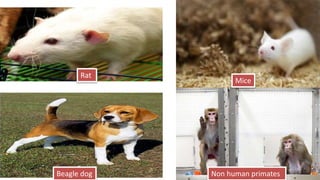
Rat
Mice
Beagle dog Non human primates
Application requires gathering of species-specific PK
data, such as half-life (t½), clearance (Cl), and
volume of distribution (Vd), from multiple species.
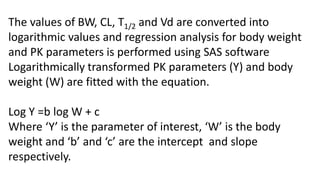
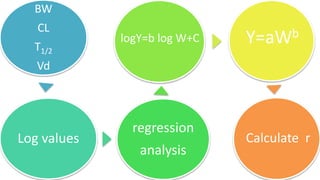
The values of BW, CL, T1/2 and Vd are converted into
logarithmic values and regression analysis for body weight
and PK parameters is performed using SAS software
Logarithmically transformed PK parameters (Y) and body
weight (W) are fitted with the equation.
Log Y =b log W + c
Where ‘Y’ is the parameter of interest, ‘W’ is the body
weight and ‘b’ and ‘c’ are the intercept and slope
respectively.
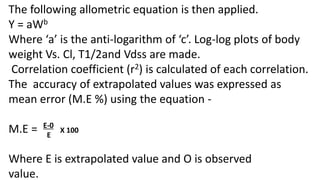
The following allometric equation is then applied.
Y = aWb
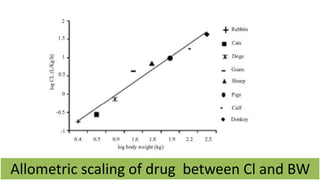
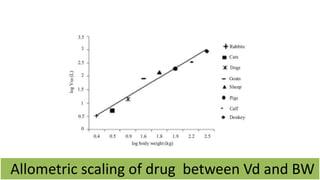
Where ‘a’ is the anti-logarithm of ‘c’. Log-log plots of body
weight Vs. Cl, T1/2and Vdss are made.
Correlation coefficient (r2) is calculated of each correlation.
The accuracy of extrapolated values was expressed as
mean error (M.E %) using the equation -
M.E =
Where E is extrapolated value and O is observed
value.
E-0
E
X 100
BW
CL
T1/2
Vd
Log values
regression
analysis
Calculate r
Y=aWblogY=b log W+C
Allometric scaling of drug between Cl and BW
Allometric scaling of drug between Vd and BW
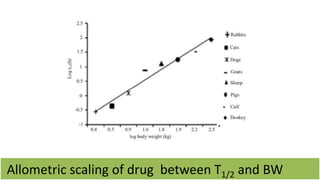
Allometric scaling of drug between T1/2 and BW
Interspecies difference between PK
phase
Body metabolic rate
• As the size of the animal species gets larger
the body surface area in relation to body
weight decreses relatively
• Reason : transportation distance of nutrients…
• Absorption of lipophilic compounds is greater in dog
• Belladona is not toxic to rabbit
• Morphine produces CNS excitation in cats
• Absorption of orally administered drugs is faster in
monogastric animals
Species differences (size independent)
Rate of drug distribution
Determined by-
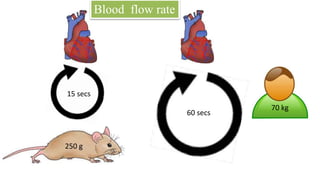
• Blood flow and rate of transport.
• Circulation time and blood flow can be scaled
allometrically
15 secs
60 secs
250 g
70 kg
Blood flow rate
Protein binding (Size independent)
• Drug affinity
• No.of PBS
• Efflux protein
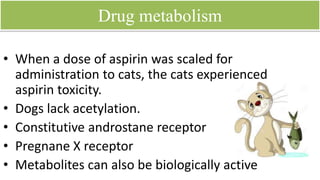
Drug metabolism
• When a dose of aspirin was scaled for
administration to cats, the cats experienced
aspirin toxicity.
• Dogs lack acetylation.
• Constitutive androstane receptor
• Pregnane X receptor
• Metabolites can also be biologically active
Drug elimination
• Compounds with molecular wt exceeding 350
with amphipathic structures or which
undergo conjugation reaction are excreted in
the bile.
Interspecies difference between PD
phase
Dose response
Drug affinity (size independent)
• Na/K ATPase transporter
• Dog,sheep and human are 1000 times more
sensitive than rat and mice
• Gene regulation and expression
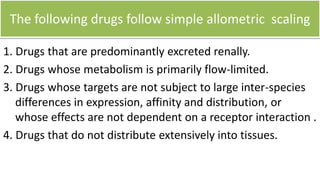
1. Drugs that are predominantly excreted renally.
2. Drugs whose metabolism is primarily flow-limited.
3. Drugs whose targets are not subject to large inter-species
differences in expression, affinity and distribution, or
whose effects are not dependent on a receptor interaction .
4. Drugs that do not distribute extensively into tissues.
The following drugs follow simple allometric scaling
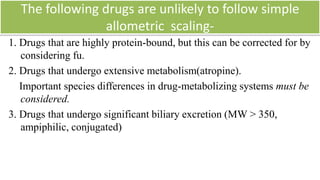
The following drugs are unlikely to follow simple
allometric scaling-
1. Drugs that are highly protein-bound, but this can be corrected for by
considering fu.
2. Drugs that undergo extensive metabolism(atropine).
Important species differences in drug-metabolizing systems must be
considered.
3. Drugs that undergo significant biliary excretion (MW > 350,
ampiphilic, conjugated)
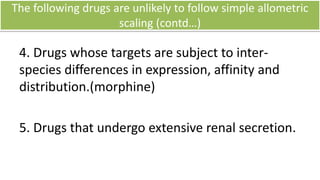
The following drugs are unlikely to follow simple allometric
scaling (contd…)
4. Drugs whose targets are subject to inter-
species differences in expression, affinity and
distribution.(morphine)
5. Drugs that undergo extensive renal secretion.
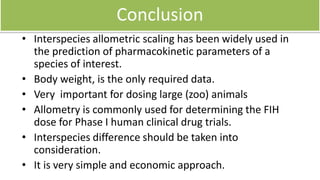
Conclusion
• Interspecies allometric scaling has been widely used in
the prediction of pharmacokinetic parameters of a
species of interest.
• Body weight, is the only required data.
• Very important for dosing large (zoo) animals
• Allometry is commonly used for determining the FIH
dose for Phase I human clinical drug trials.
• Interspecies difference should be taken into
consideration.
• It is very simple and economic approach.
Thank you
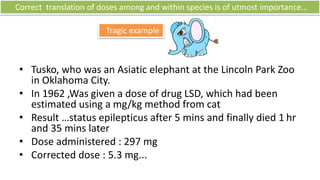
• Tusko, who was an Asiatic elephant at the Lincoln Park Zoo
in Oklahoma City.
• In 1962 ,Was given a dose of drug LSD, which had been
estimated using a mg/kg method from cat
• Result …status epilepticus after 5 mins and finally died 1 hr
and 35 mins later
• Dose administered : 297 mg
• Corrected dose : 5.3 mg...
Correct translation of doses among and within species is of utmost importance…
Tragic example
Allometric scaling (contd…)
• Allometric scaling is a method of interspecies
extrapolation that is commonly used to
estimate human PK parameters from PK
parameters measured in animals.

Allometric scaling

  • 1.
    Allometric scaling ofpharmacokinetic parameters: A crucial step in discovery of New Chemical Entity
  • 2.
    What is scalingin pharmacology? Interpolation or extrapolation of drug dose or pharmacokinetic parameters to a species of interest.
  • 3.
    Why Scaling ofdose is required??? Mainly in three main situations: 1) To calculate FIH doses for clinical trials, 2) Dose extrapolation in veterinary practice and 3) Dose extrapolation for experimental purposes.

  • 4.
    1. Linear extrapolation/simplescaling/isometric scaling method 2. Non linear extrapolation/allometric scaling method Methods of scaling drugs
  • 5.
    • mg/kg doseestablished for one species is applied across all species • Advantage : simple • Problems arise when this method is applied to other species Linear extrapolation (method no.1)
  • 6.
    This method assumesthat - • any differences in species PK/PD are not clinically relevant • Dosage and weight are directly (linearly) proportional. Linear extrapolation ( contd…)
  • 7.
    Drawbacks of methodno.1 • This method tends to overdose large animals and underdose small animals, which may be very clinically significant. • Typically, this method is only effective with drugs that have large margins of safety and wide therapeutic ranges
  • 8.
    Allometric scaling (methodno.2) • Dedrick et al. • drug pharmacokinetics has a nonlinear (allometric) relationship to weight. • Allometric scaling has become the method of choice for interspecies extrapolation in drug discovery and development.
  • 9.
    Allometric scaling (contd…) •It is the study of size and its consequences • Derieved from the Greek alloios meaning different and is used to distinguish from isometric scaling • Based on the principle that major physiologic processes are related to body weight raised to allometric exponent • Figure changes as a function of size.
  • 10.
  • 11.
    Application requires gatheringof species-specific PK data, such as half-life (t½), clearance (Cl), and volume of distribution (Vd), from multiple species.
  • 12.
    The values ofBW, CL, T1/2 and Vd are converted into logarithmic values and regression analysis for body weight and PK parameters is performed using SAS software Logarithmically transformed PK parameters (Y) and body weight (W) are fitted with the equation. Log Y =b log W + c Where ‘Y’ is the parameter of interest, ‘W’ is the body weight and ‘b’ and ‘c’ are the intercept and slope respectively.
  • 13.
    The following allometricequation is then applied. Y = aWb Where ‘a’ is the anti-logarithm of ‘c’. Log-log plots of body weight Vs. Cl, T1/2and Vdss are made. Correlation coefficient (r2) is calculated of each correlation. The accuracy of extrapolated values was expressed as mean error (M.E %) using the equation - M.E = Where E is extrapolated value and O is observed value. E-0 E X 100
  • 14.
  • 15.
    Allometric scaling ofdrug between Cl and BW
  • 16.
    Allometric scaling ofdrug between Vd and BW
  • 17.
    Allometric scaling ofdrug between T1/2 and BW
  • 18.
  • 19.
    Body metabolic rate •As the size of the animal species gets larger the body surface area in relation to body weight decreses relatively • Reason : transportation distance of nutrients…
  • 20.
    • Absorption oflipophilic compounds is greater in dog • Belladona is not toxic to rabbit • Morphine produces CNS excitation in cats • Absorption of orally administered drugs is faster in monogastric animals Species differences (size independent)
  • 21.
    Rate of drugdistribution Determined by- • Blood flow and rate of transport. • Circulation time and blood flow can be scaled allometrically
  • 22.
    15 secs 60 secs 250g 70 kg Blood flow rate
  • 23.
    Protein binding (Sizeindependent) • Drug affinity • No.of PBS • Efflux protein
  • 24.
    Drug metabolism • Whena dose of aspirin was scaled for administration to cats, the cats experienced aspirin toxicity. • Dogs lack acetylation. • Constitutive androstane receptor • Pregnane X receptor • Metabolites can also be biologically active
  • 25.
    Drug elimination • Compoundswith molecular wt exceeding 350 with amphipathic structures or which undergo conjugation reaction are excreted in the bile.
  • 26.
  • 27.
  • 28.
    Drug affinity (sizeindependent) • Na/K ATPase transporter • Dog,sheep and human are 1000 times more sensitive than rat and mice • Gene regulation and expression
  • 29.
    1. Drugs thatare predominantly excreted renally. 2. Drugs whose metabolism is primarily flow-limited. 3. Drugs whose targets are not subject to large inter-species differences in expression, affinity and distribution, or whose effects are not dependent on a receptor interaction . 4. Drugs that do not distribute extensively into tissues. The following drugs follow simple allometric scaling
  • 30.
    The following drugsare unlikely to follow simple allometric scaling- 1. Drugs that are highly protein-bound, but this can be corrected for by considering fu. 2. Drugs that undergo extensive metabolism(atropine). Important species differences in drug-metabolizing systems must be considered. 3. Drugs that undergo significant biliary excretion (MW > 350, ampiphilic, conjugated)
  • 31.
    The following drugsare unlikely to follow simple allometric scaling (contd…) 4. Drugs whose targets are subject to inter- species differences in expression, affinity and distribution.(morphine) 5. Drugs that undergo extensive renal secretion.
  • 32.
    Conclusion • Interspecies allometricscaling has been widely used in the prediction of pharmacokinetic parameters of a species of interest. • Body weight, is the only required data. • Very important for dosing large (zoo) animals • Allometry is commonly used for determining the FIH dose for Phase I human clinical drug trials. • Interspecies difference should be taken into consideration. • It is very simple and economic approach.
  • 33.
  • 36.
    • Tusko, whowas an Asiatic elephant at the Lincoln Park Zoo in Oklahoma City. • In 1962 ,Was given a dose of drug LSD, which had been estimated using a mg/kg method from cat • Result …status epilepticus after 5 mins and finally died 1 hr and 35 mins later • Dose administered : 297 mg • Corrected dose : 5.3 mg... Correct translation of doses among and within species is of utmost importance… Tragic example
  • 37.
    Allometric scaling (contd…) •Allometric scaling is a method of interspecies extrapolation that is commonly used to estimate human PK parameters from PK parameters measured in animals.

Editor's Notes

  • #6 without taking into account of pharmacological parameters
  • #21 Metabolites can also be biologically active that y it is said dat extensively metabolised drug do not follow…