Alleviating Data Sparsity For
Twitter Sentiment Analysis

        Hassan Saif, Yulan He & Harith Alani
Knowledge Media Institute, The Open University, Milton
             Keynes, United Kingdom


Making Sense of Microblogs – WWW2012 Conference
                   Lyon - France
Outline
•   Hello World
•   Motivation
•   Related Work
•   Semantic Features
•   Topic-Sentiment Features
•   Evaluation
•   Demos
•   The Future
Sentiment Analysis
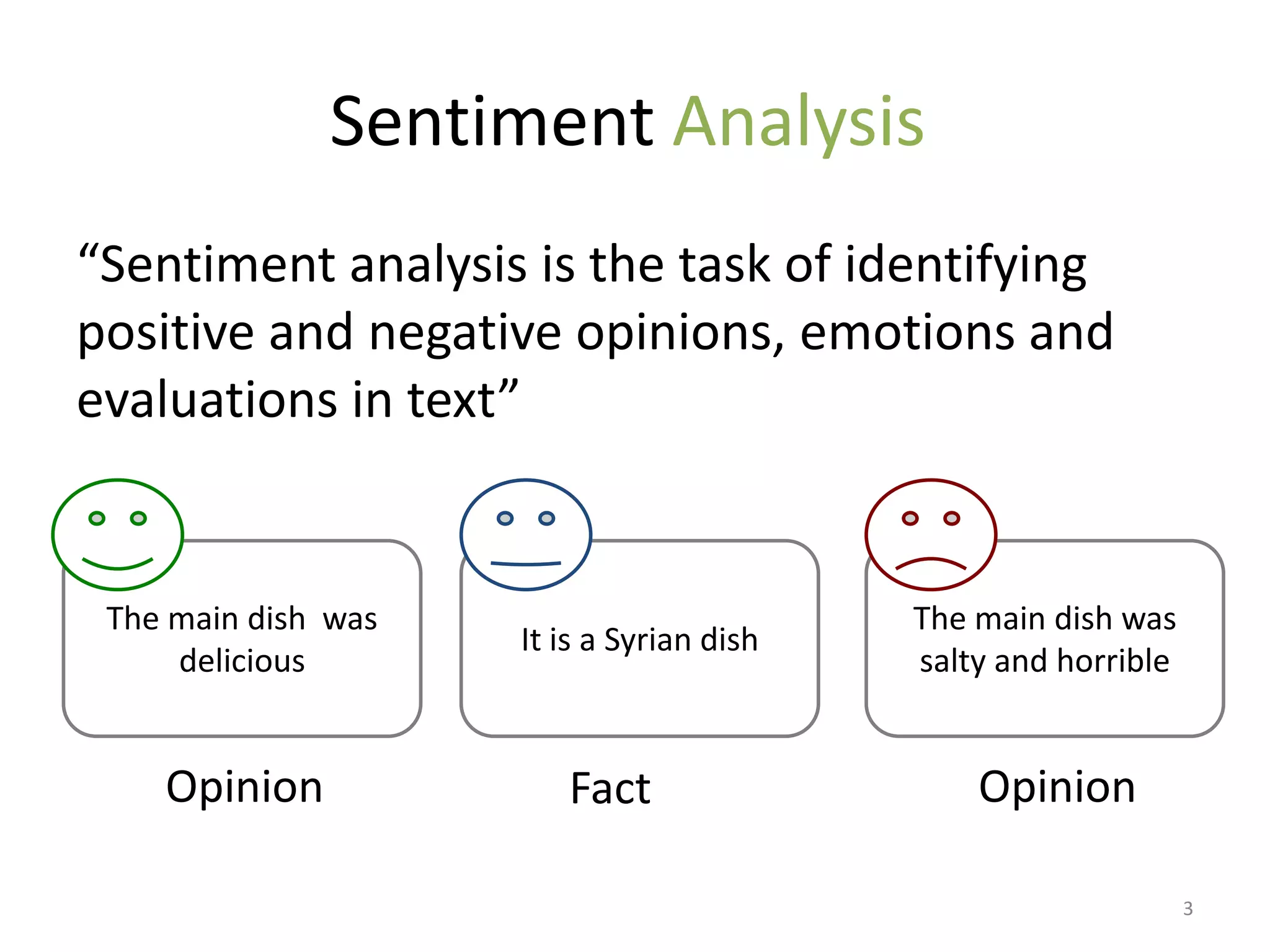
“Sentiment analysis is the task of identifying
positive and negative opinions, emotions and
evaluations in text”


 The main dish was                         The main dish was
                     It is a Syrian dish
     delicious                             salty and horrible


    Opinion             Fact                   Opinion

                                                                3
Microblogging
• Service which allows subscribers to post short
  updates online and broadcast them

• Answers the question: What are you doing
  now?

• Twitter, Plurk, sfeed, Yammer, BlueTwi, etc.


                                                   4
Together!
Sense?
Sense?
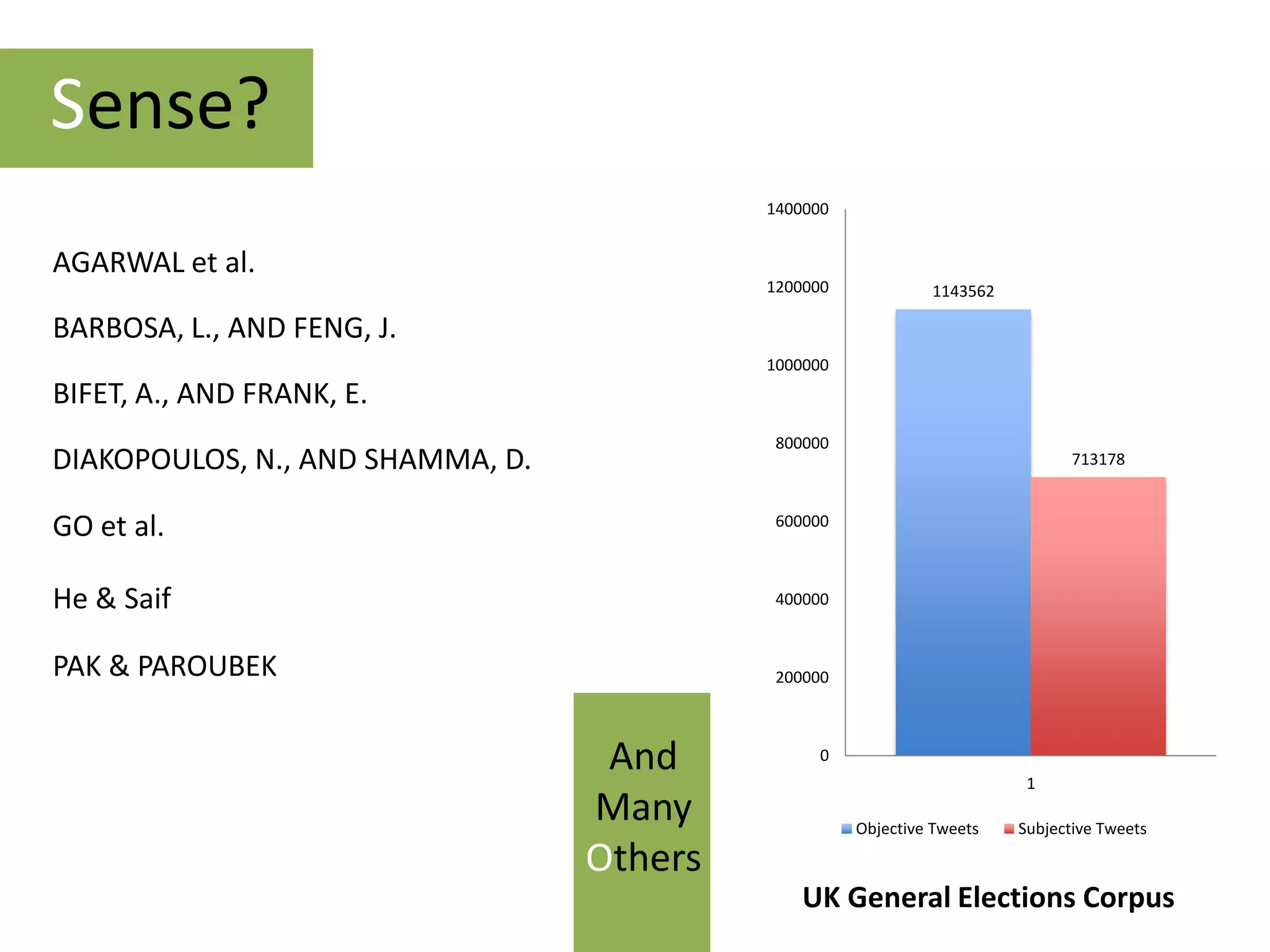
                                           1400000


AGARWAL et al.
                                           1200000            1143562

BARBOSA, L., AND FENG, J.
                                           1000000
BIFET, A., AND FRANK, E.
                                            800000
DIAKOPOULOS, N., AND SHAMMA, D.                                                713178


GO et al.                                   600000


He & Saif                                   400000


PAK & PAROUBEK                              200000


                                   And           0
                                                                         1
                                  Many               Objective Tweets   Subjective Tweets

                                  Others
                                               UK General Elections Corpus
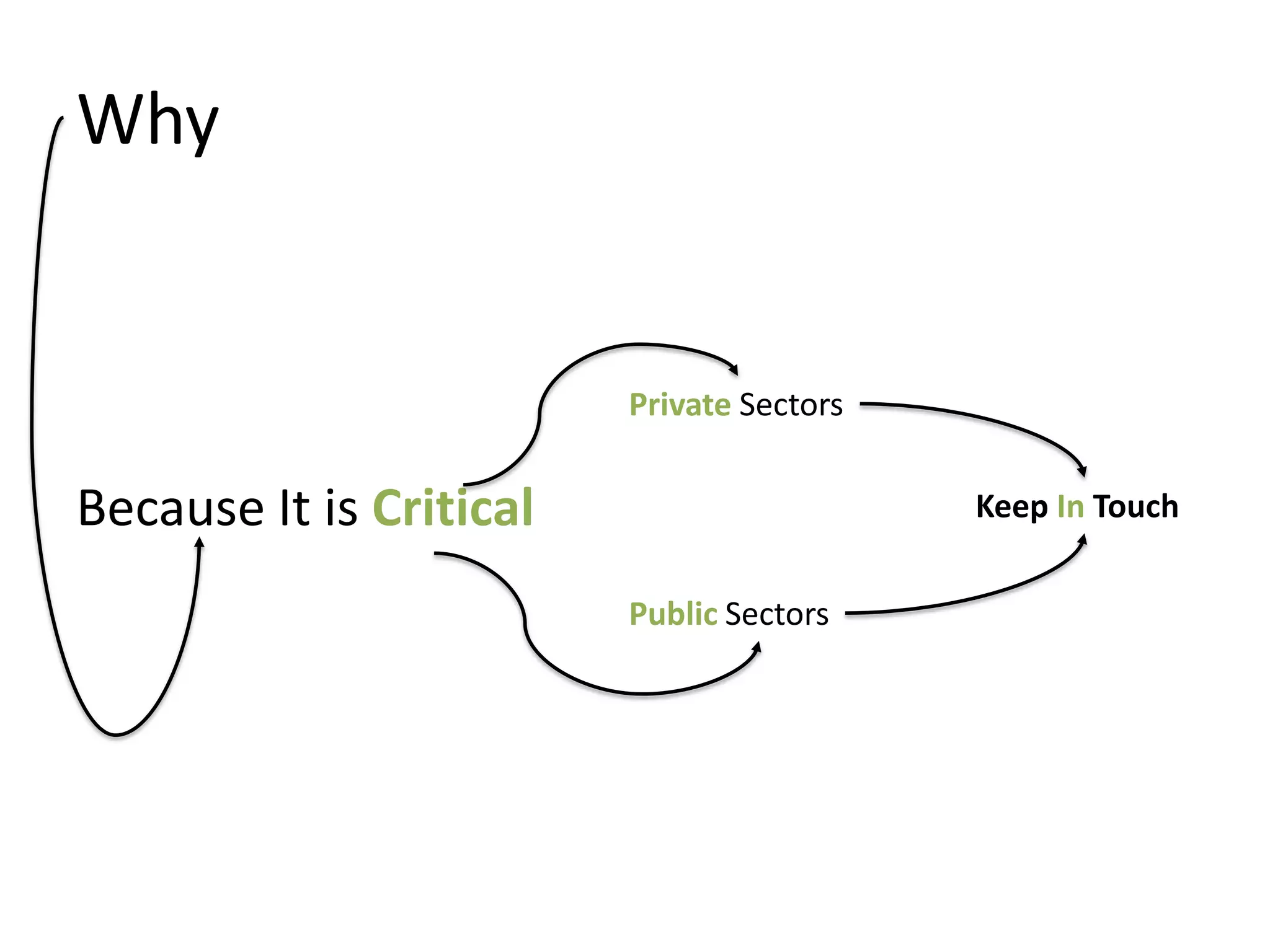
Why


                         Private Sectors


Because It is Critical
    df                                     Keep In Touch


                         Public Sectors
Related Work
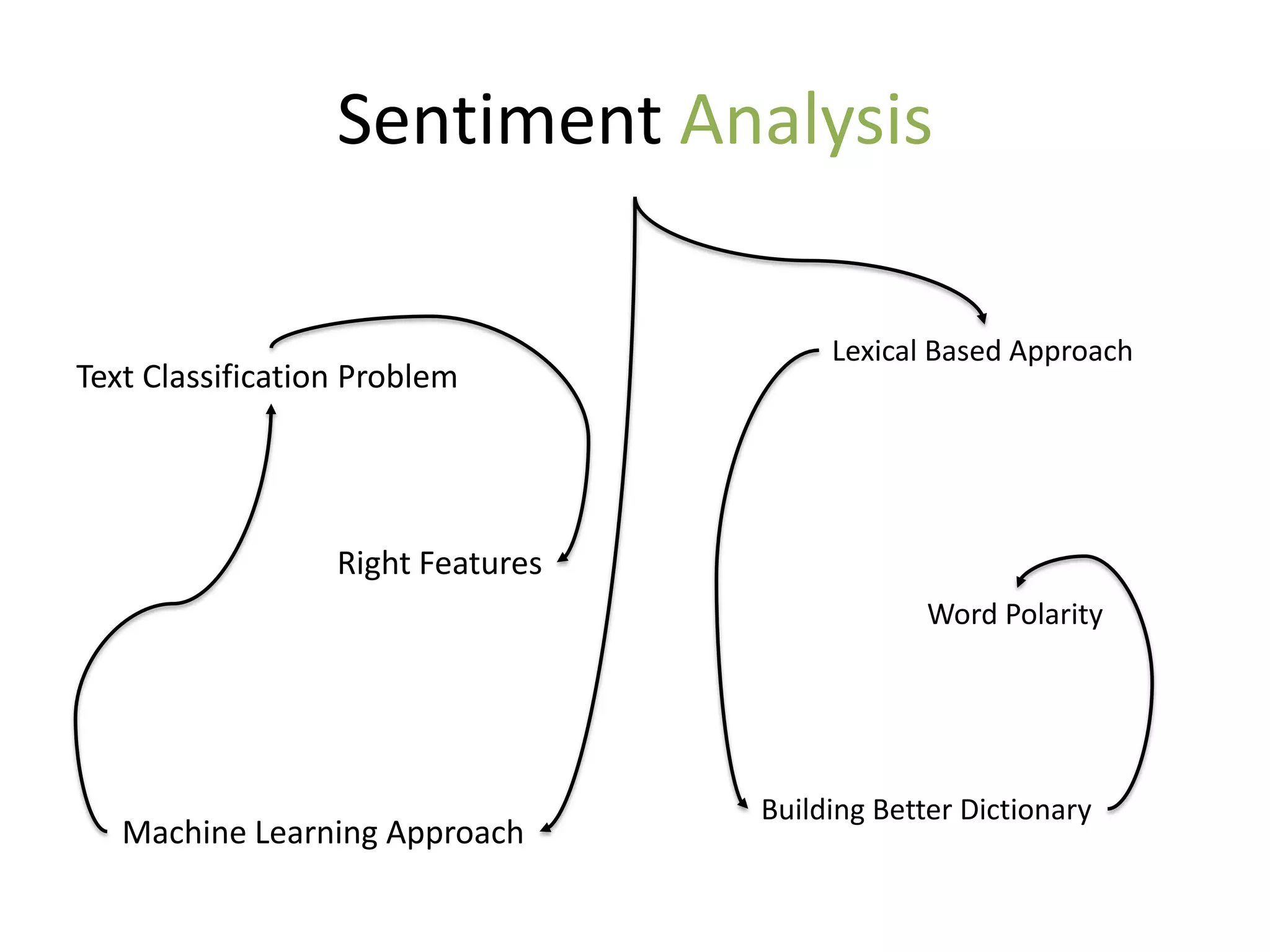
Sentiment Analysis

                                        Lexical Based Approach
Text Classification Problem


                  Right Features
                                                Word Polarity


                                   Building Better Dictionary
   Machine Learning Approach
Twitter Sentiment Analysis

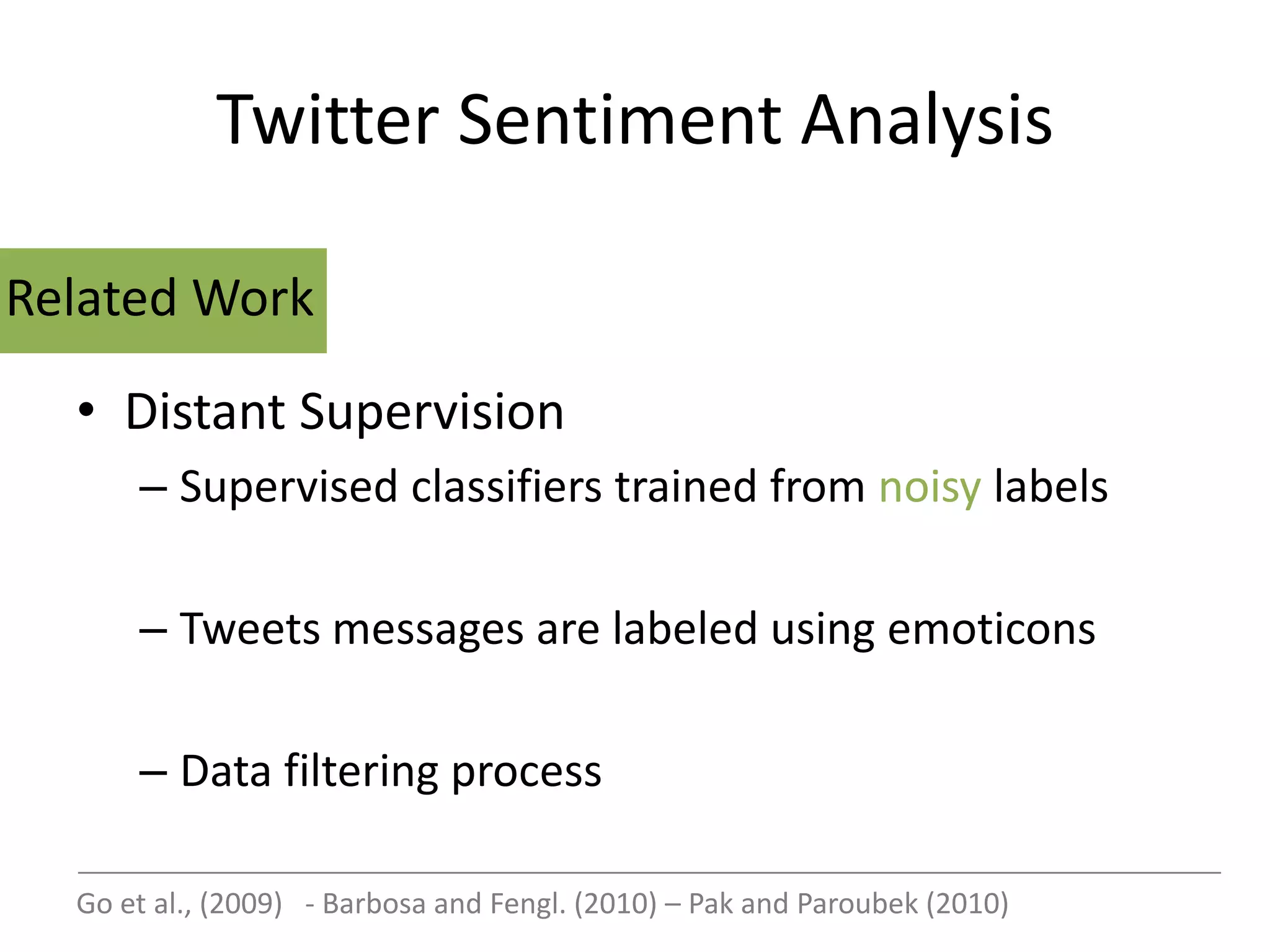
Challenges

    – The short length of status update

    – Language Variations

    – Open Social Environment
Twitter Sentiment Analysis

Related Work

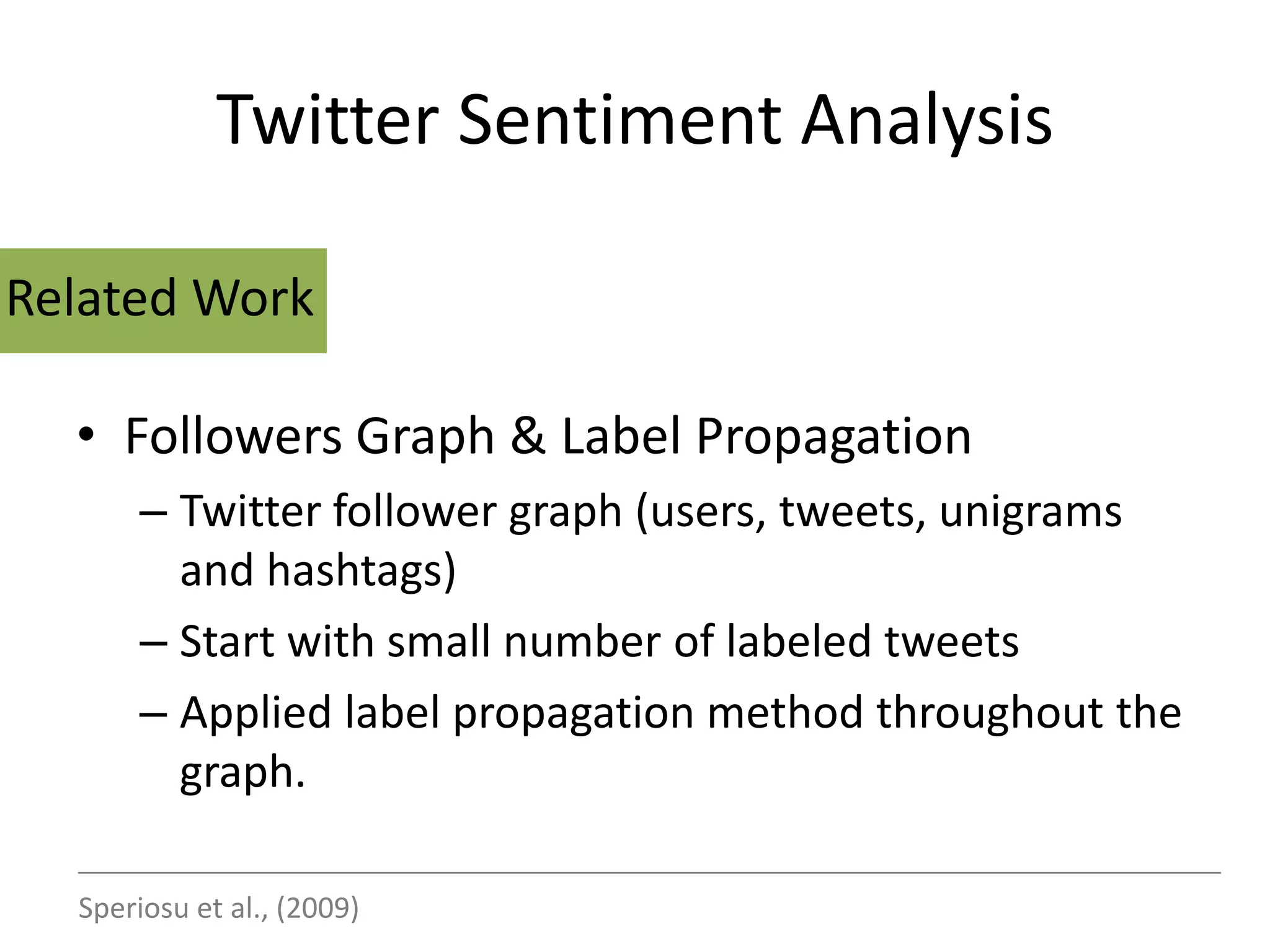
  • Distant Supervision
      – Supervised classifiers trained from noisy labels

      – Tweets messages are labeled using emoticons

      – Data filtering process

  Go et al., (2009) - Barbosa and Fengl. (2010) – Pak and Paroubek (2010)
Twitter Sentiment Analysis

Related Work

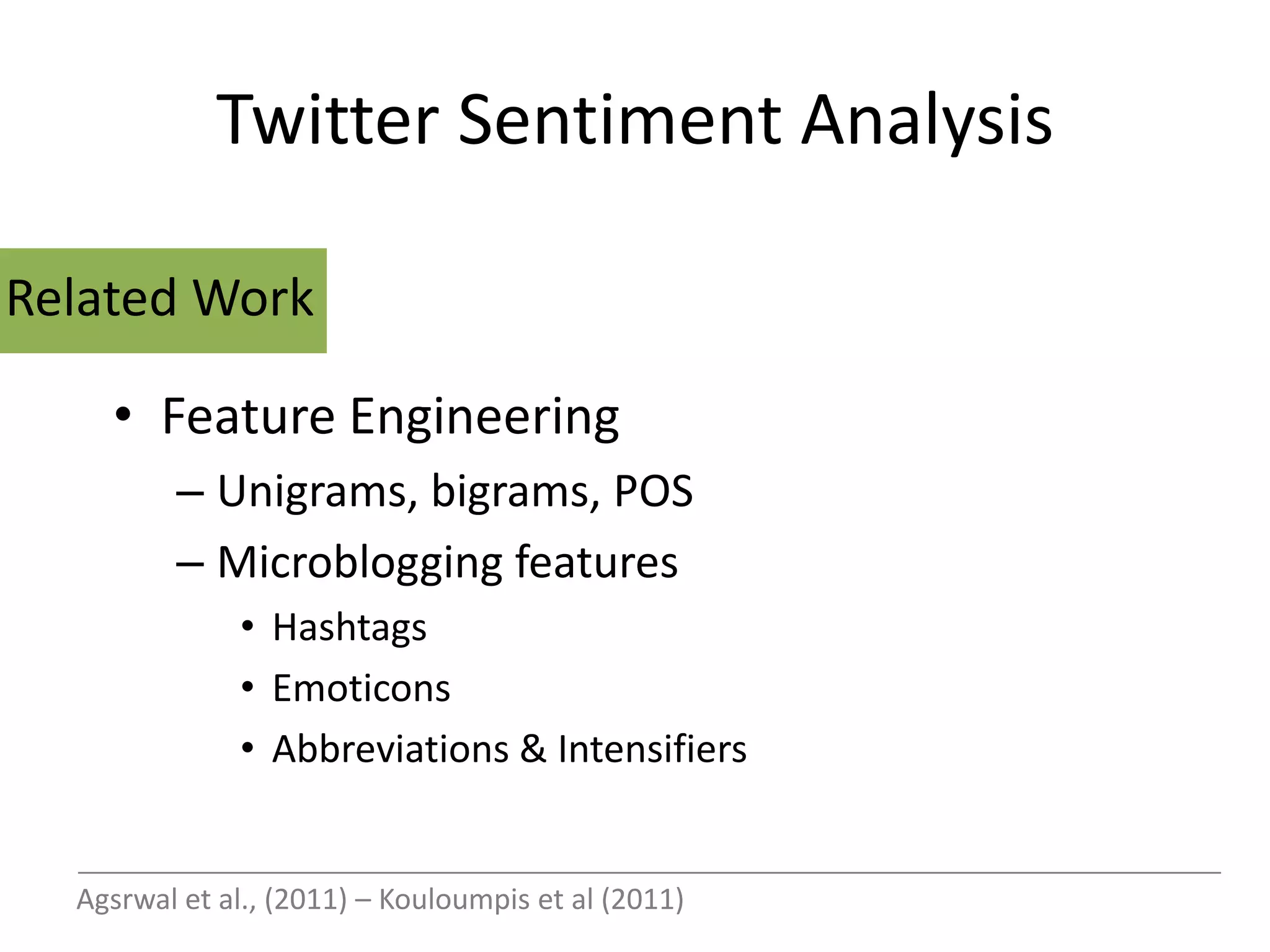
  • Followers Graph & Label Propagation
       – Twitter follower graph (users, tweets, unigrams
         and hashtags)
       – Start with small number of labeled tweets
       – Applied label propagation method throughout the
         graph.

  Speriosu et al., (2009)
Twitter Sentiment Analysis

Related Work

    • Feature Engineering
         – Unigrams, bigrams, POS
         – Microblogging features
              • Hashtags
              • Emoticons
              • Abbreviations & Intensifiers


  Agsrwal et al., (2011) – Kouloumpis et al (2011)
So?
What Does sparsity mean?


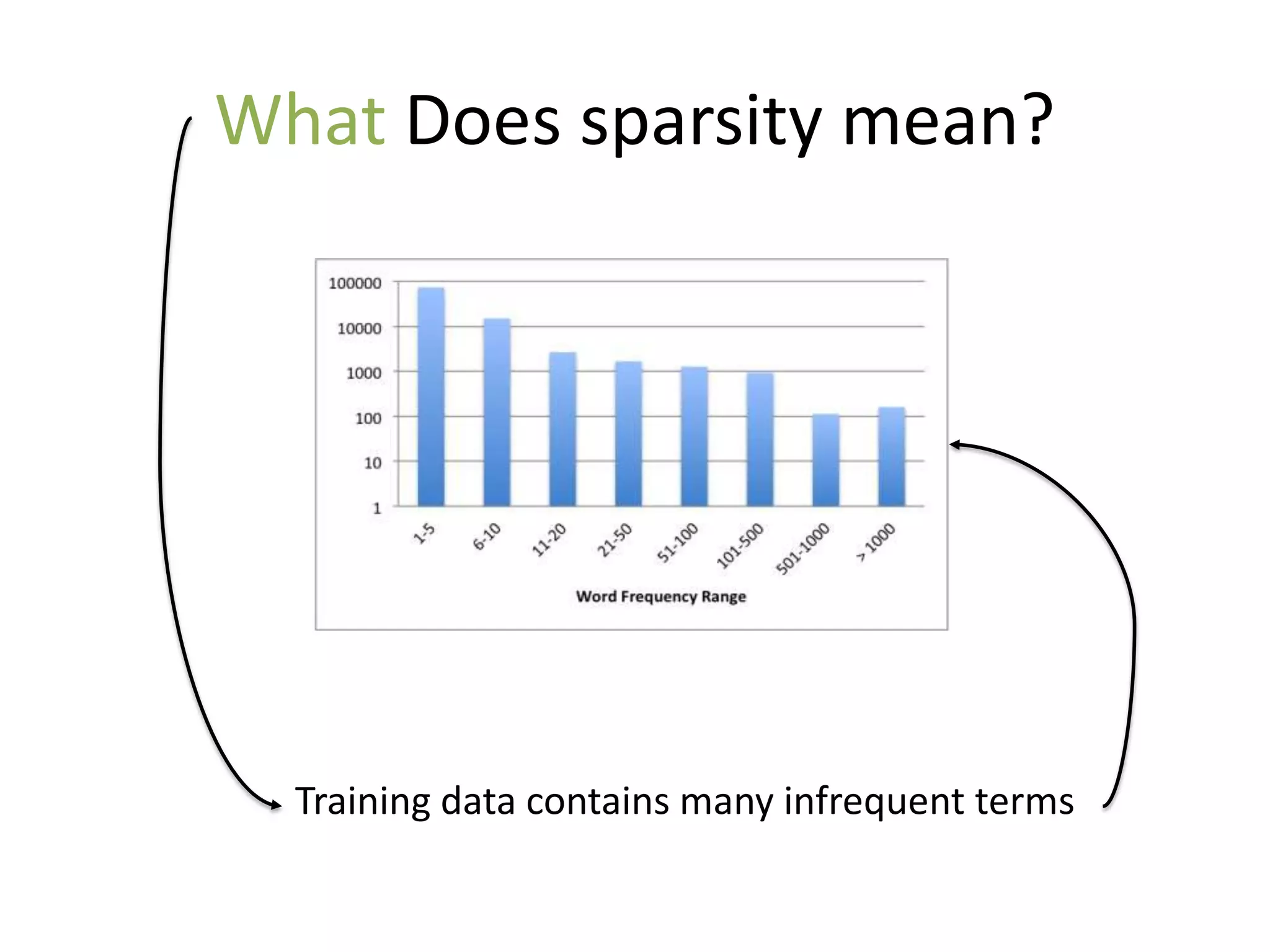
  Training data contains many infrequent terms
What Does sparsity mean?


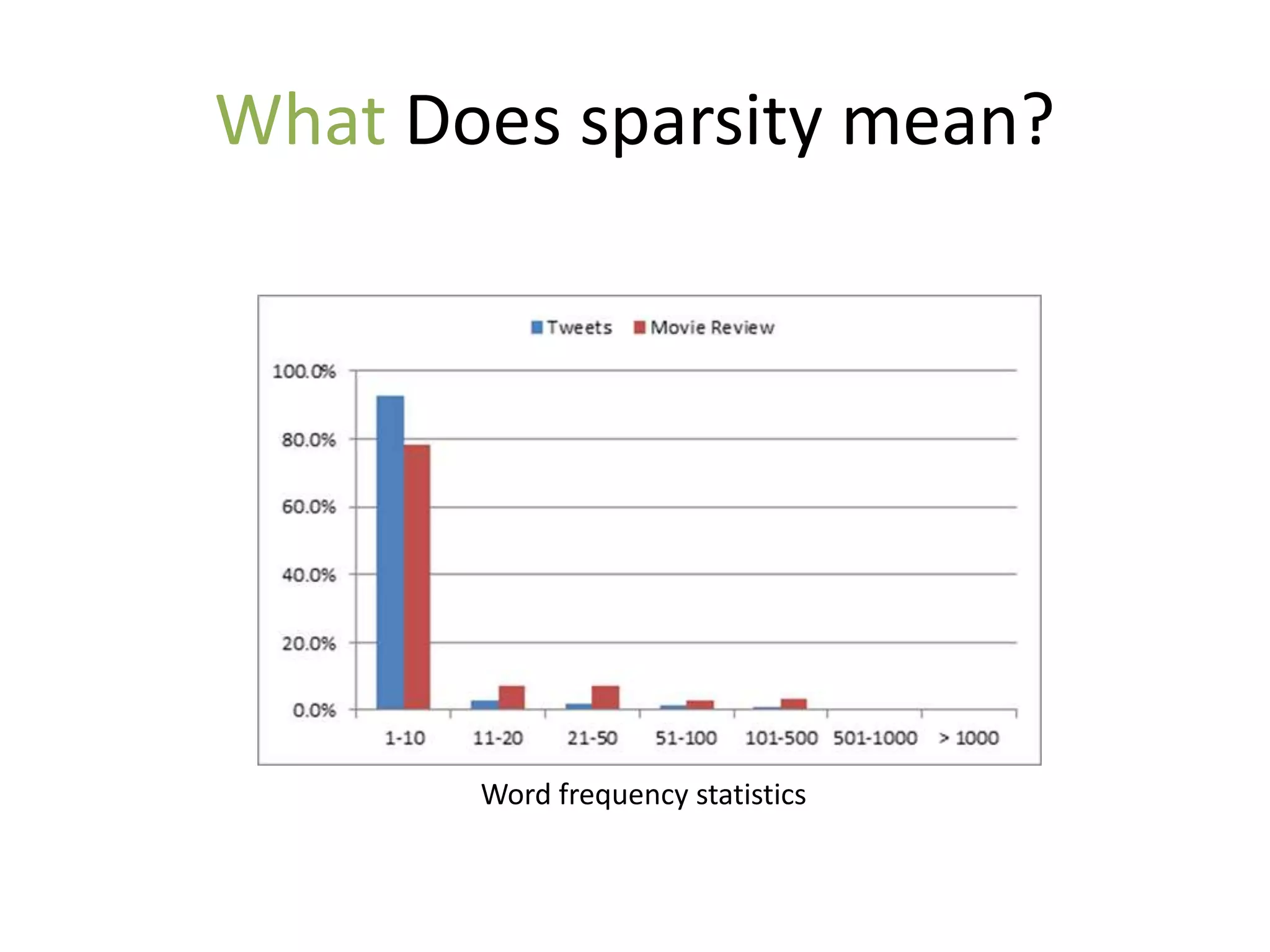
       Word frequency statistics
How!


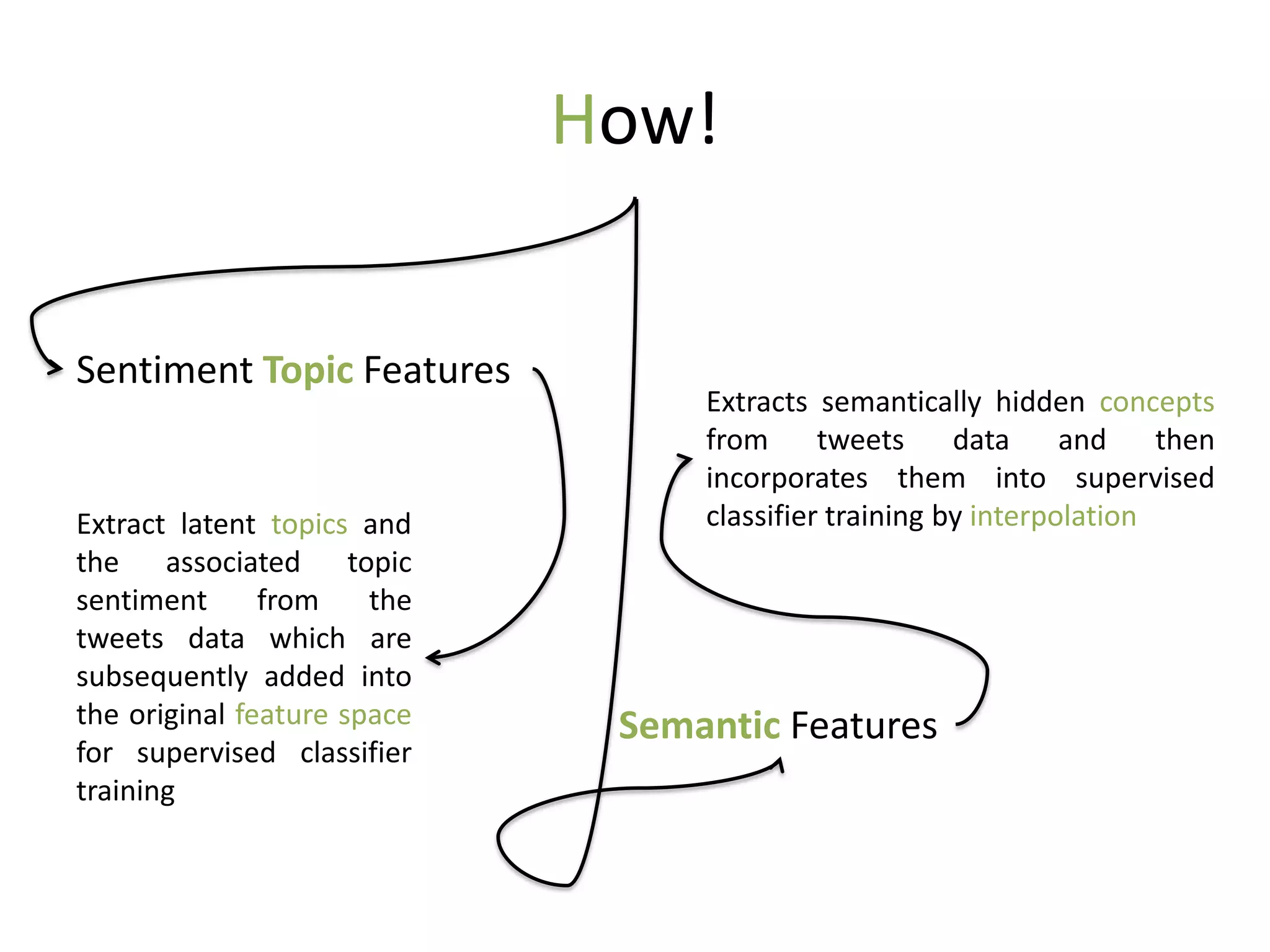
Sentiment Topic Features
                                  Extracts semantically hidden concepts
                                  from      tweets     data     and    then
                                  incorporates them into supervised
Extract latent topics and         classifier training by interpolation
the associated topic
sentiment      from    the
tweets data which are
subsequently added into
the original feature space    Semantic Features
for supervised classifier
training
Semantic Features
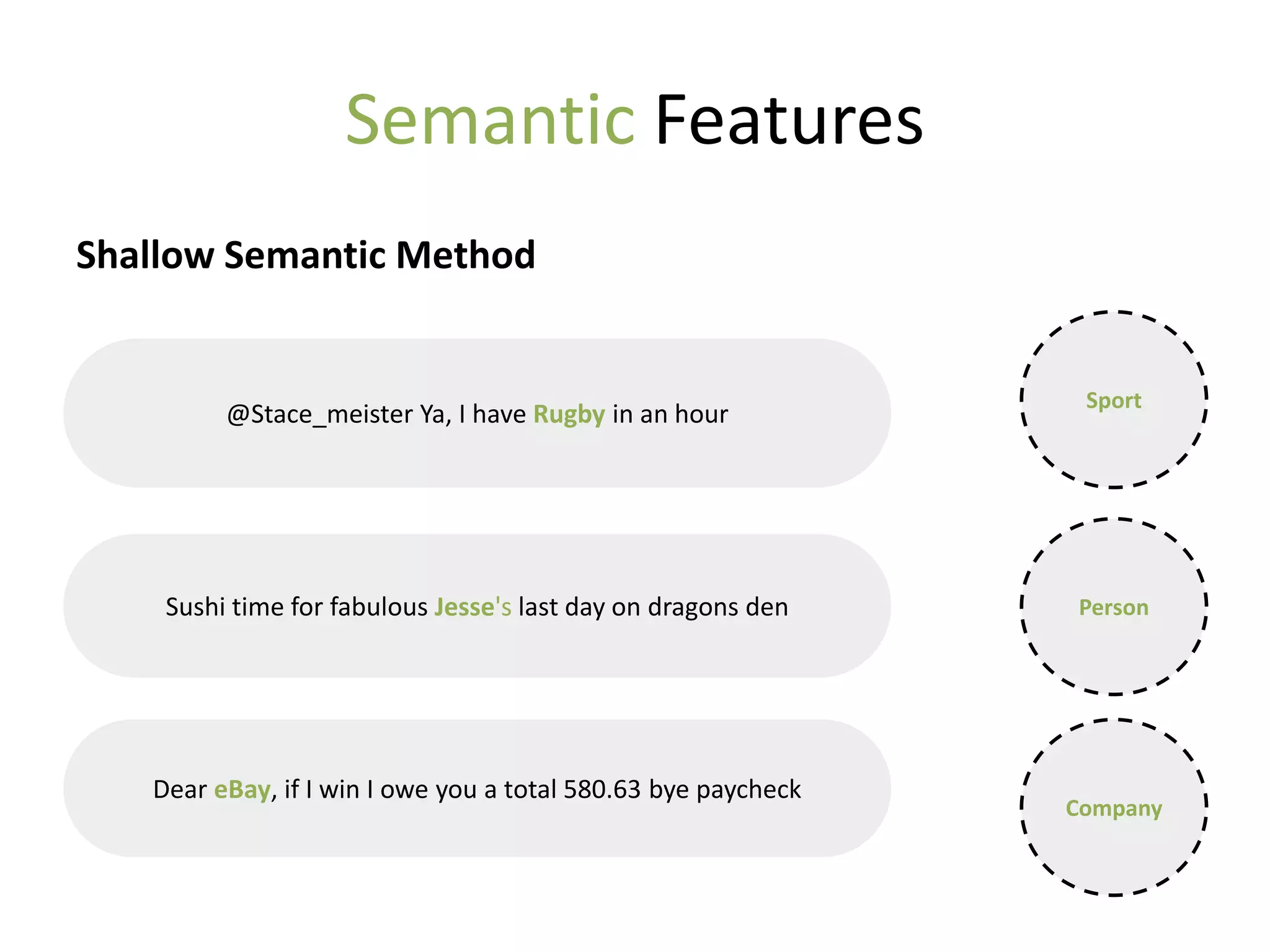
Shallow Semantic Method


                                                                Sport
         @Stace_meister Ya, I have Rugby in an hour


    Sushi time for fabulous Jesse's last day on dragons den    Person


   Dear eBay, if I win I owe you a total 580.63 bye paycheck
                                                               Company
Sematic Features
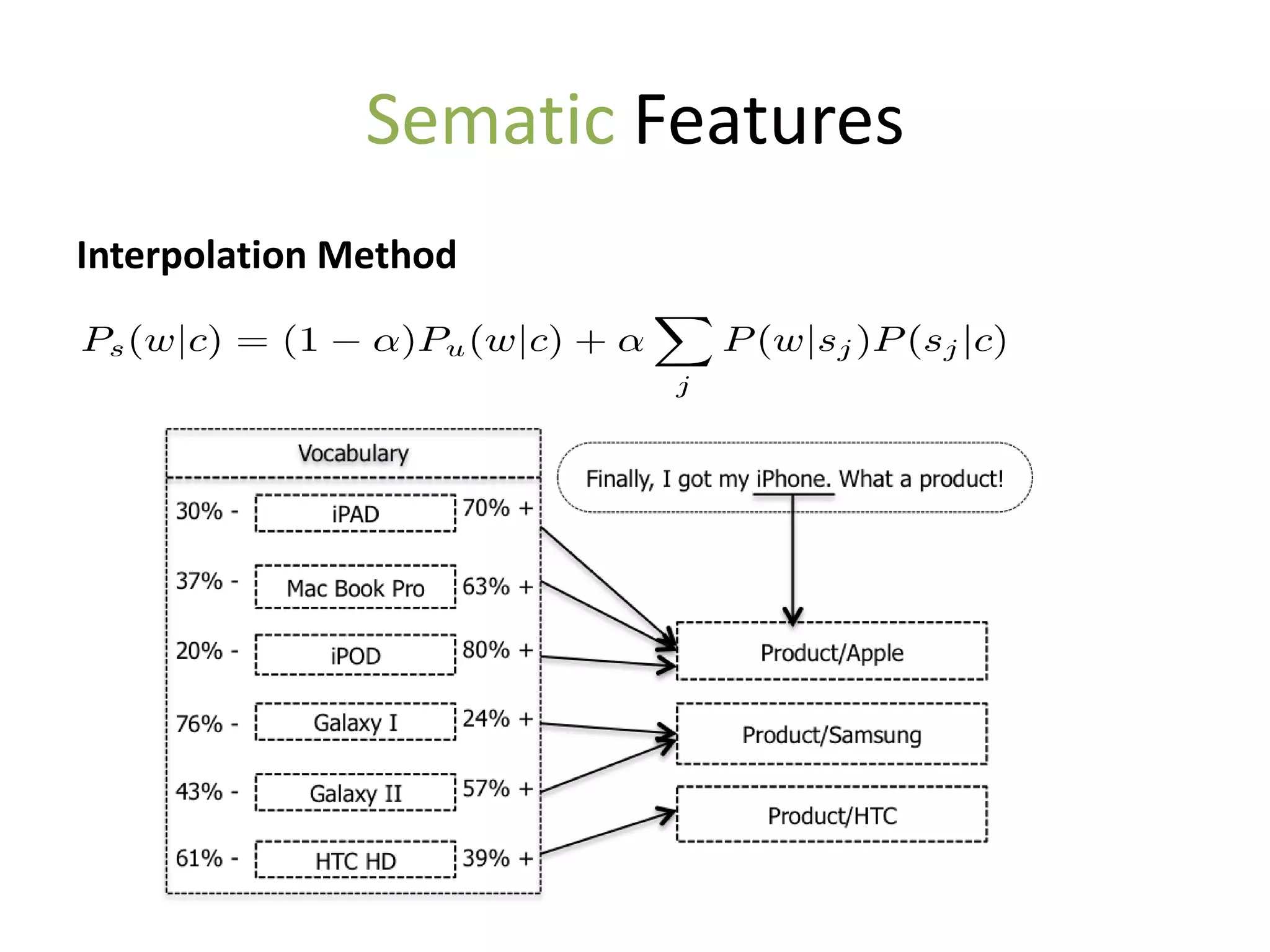
Interpolation Method
Topic-Sentiment Features
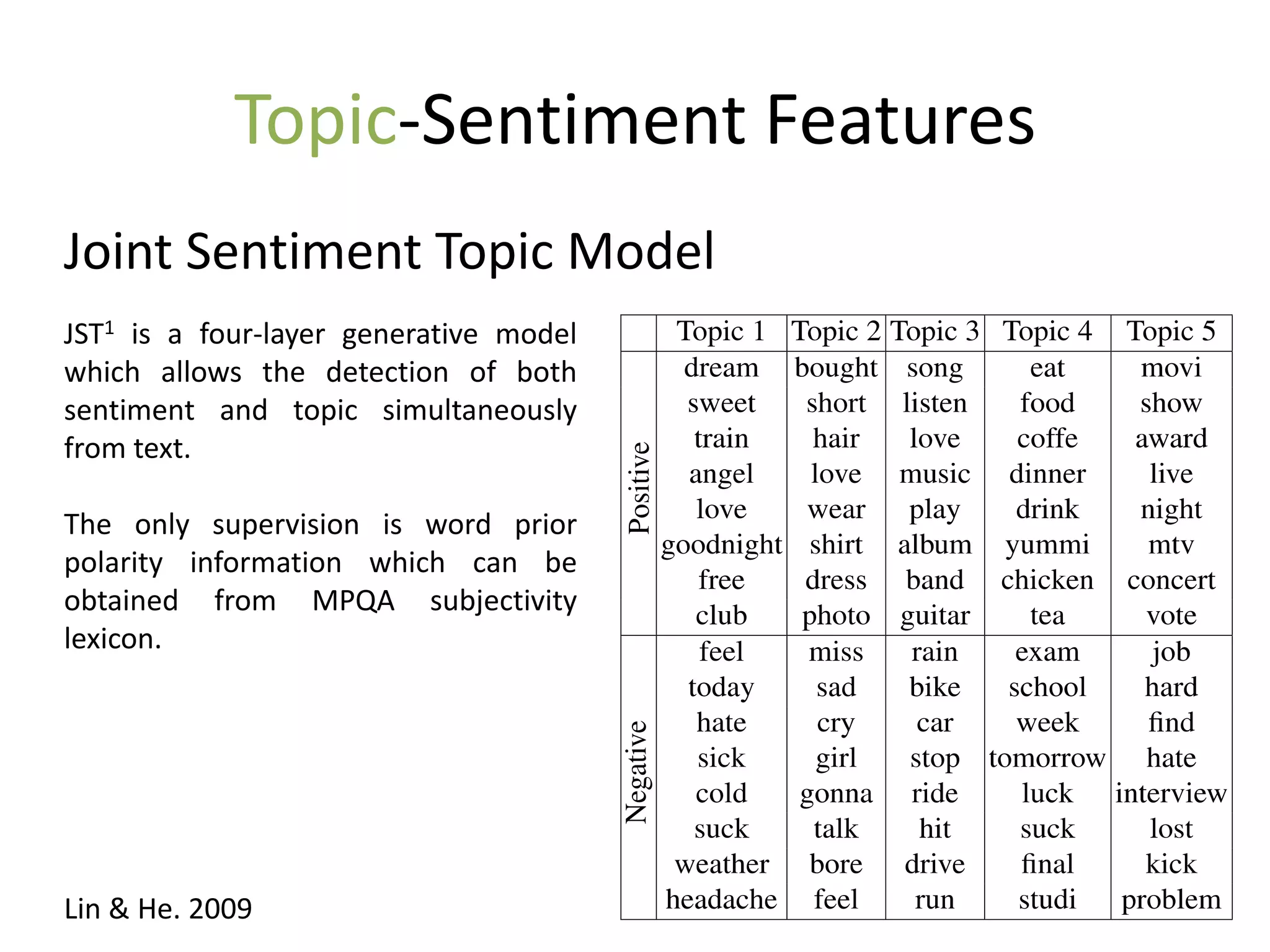
Joint Sentiment Topic Model
JST1 is a four-layer generative model
which allows the detection of both
sentiment and topic simultaneously
from text.

The only supervision is word prior
polarity information which can be
obtained from MPQA subjectivity
lexicon.


Lin & He. 2009
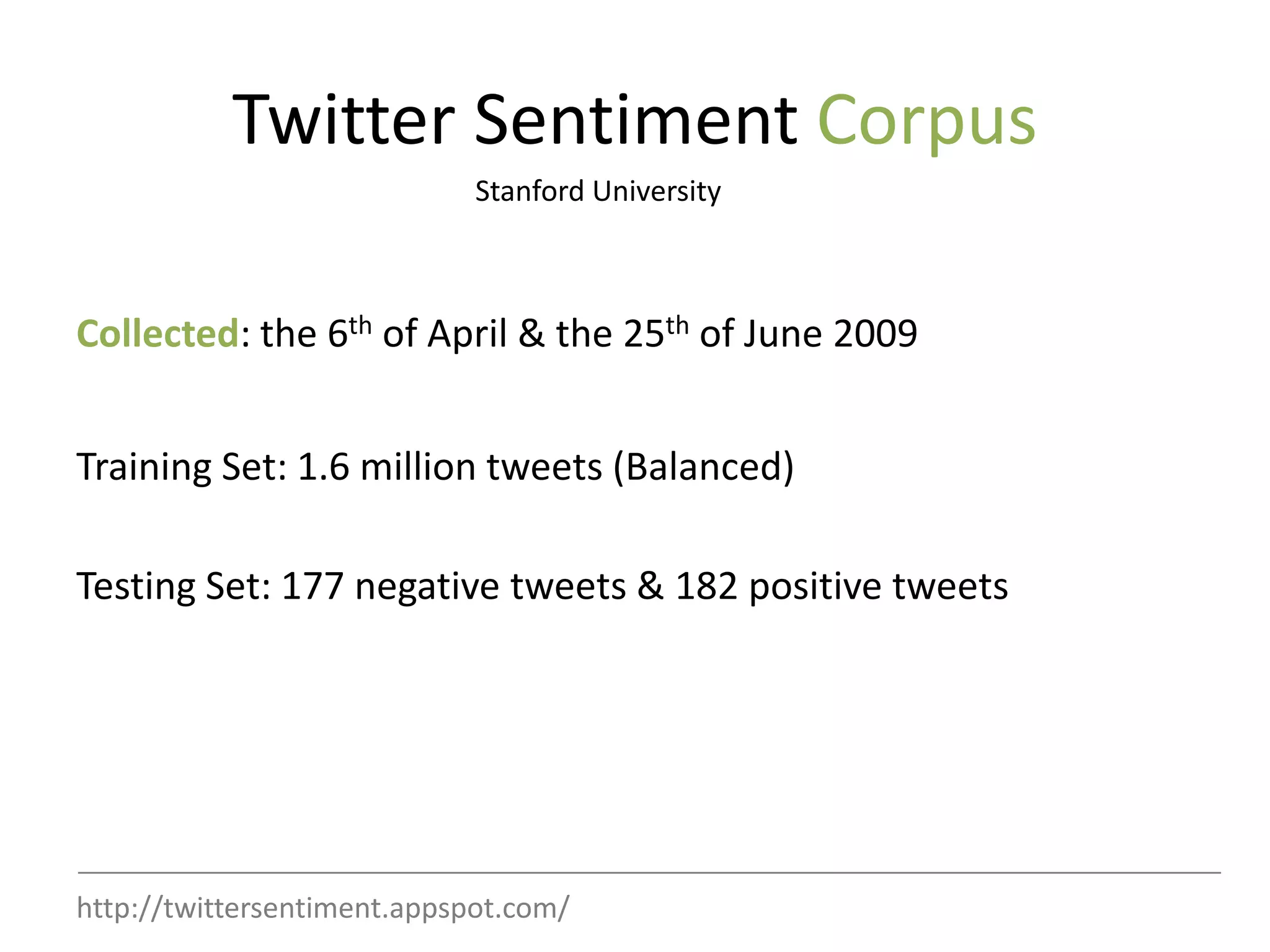
Twitter Sentiment Corpus
                             Stanford University


Collected: the 6th of April & the 25th of June 2009


Training Set: 1.6 million tweets (Balanced)

Testing Set: 177 negative tweets & 182 positive tweets


http://twittersentiment.appspot.com/
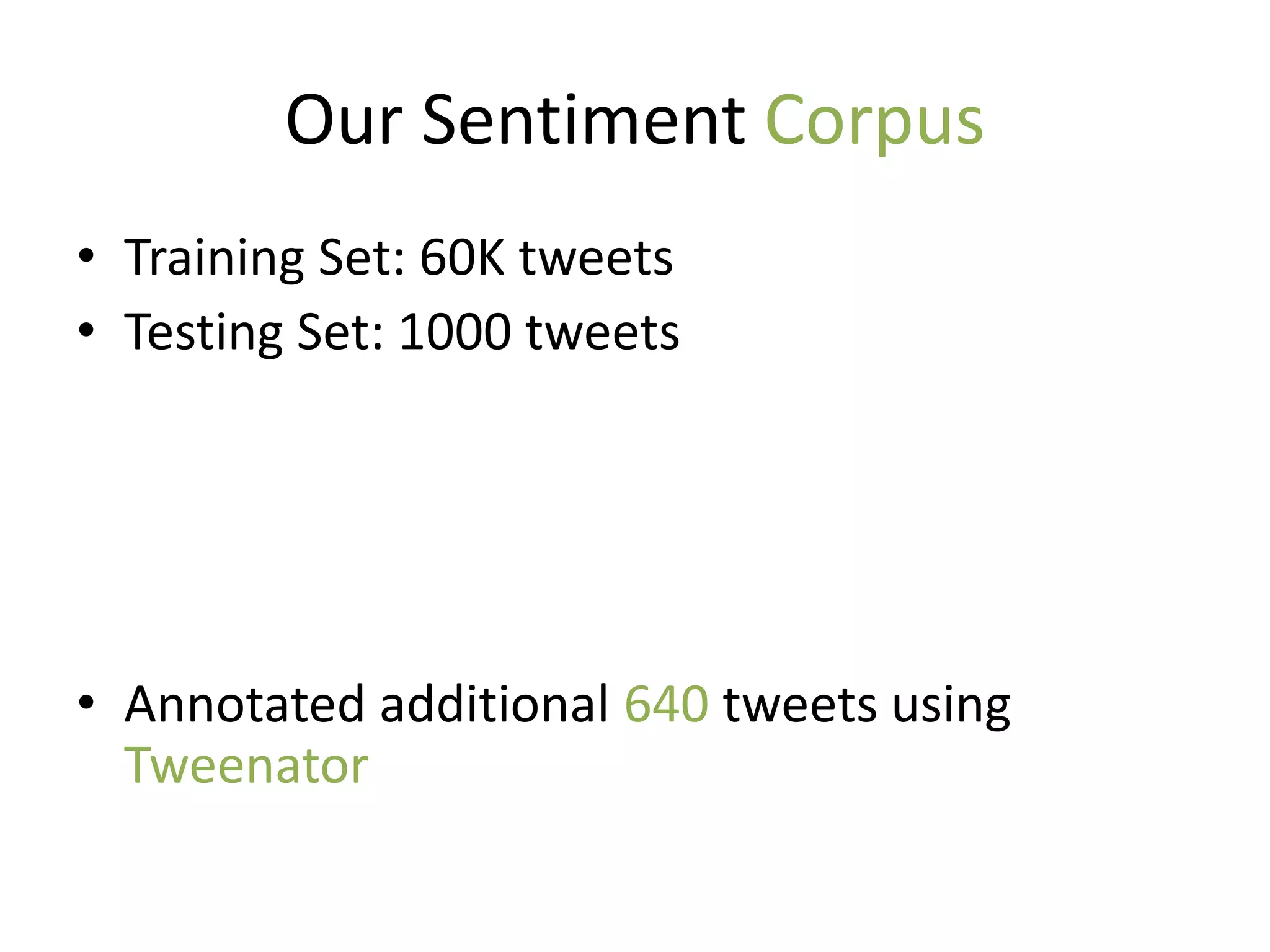
Our Sentiment Corpus
• Training Set: 60K tweets
• Testing Set: 1000 tweets


• Annotated additional 640 tweets using
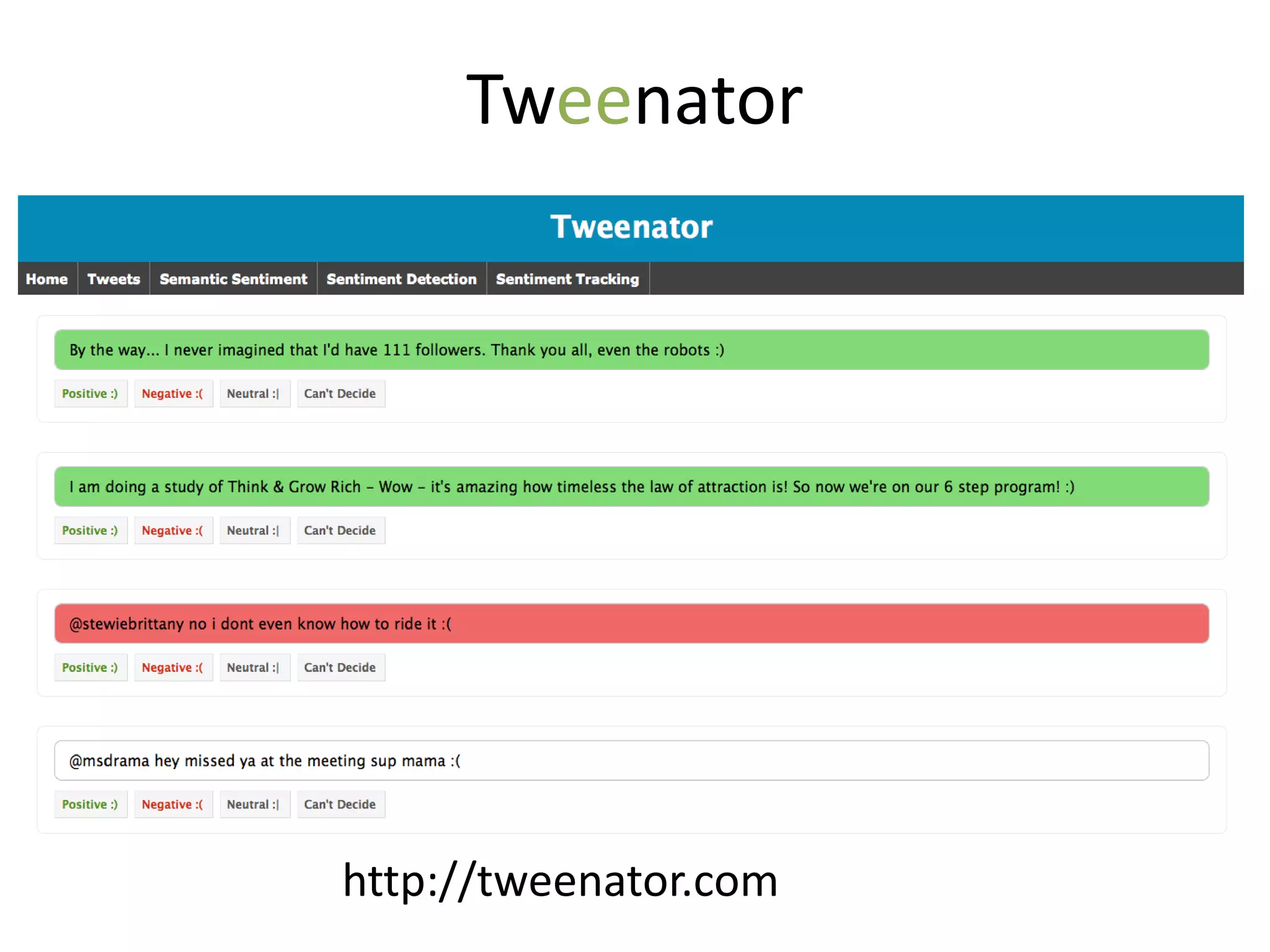
  Tweenator
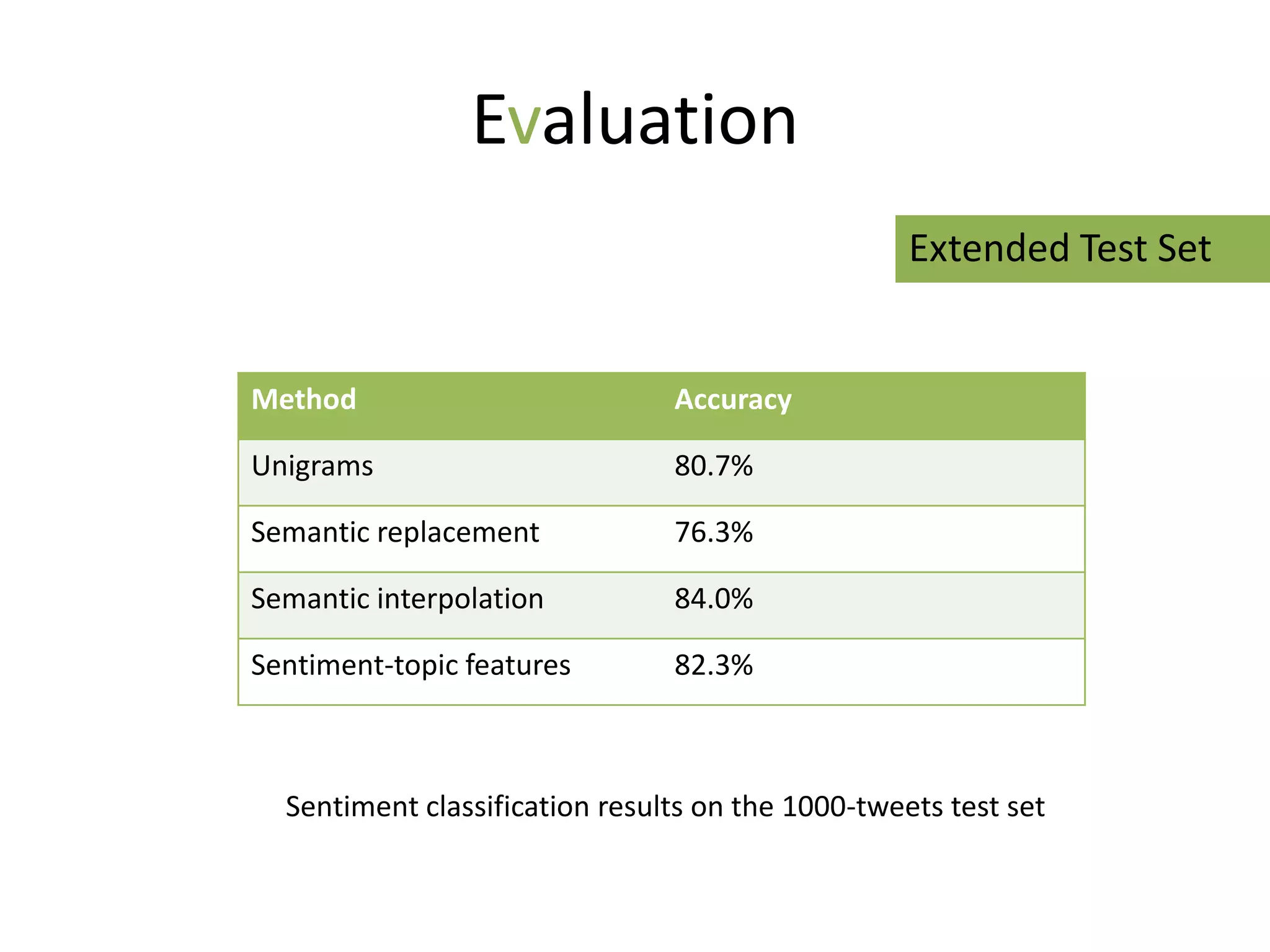
Evaluation
                                                   Extended Test Set


Method                          Accuracy

Unigrams                        80.7%

Semantic replacement            76.3%

Semantic interpolation          84.0%

Sentiment-topic features        82.3%


  Sentiment classification results on the 1000-tweets test set
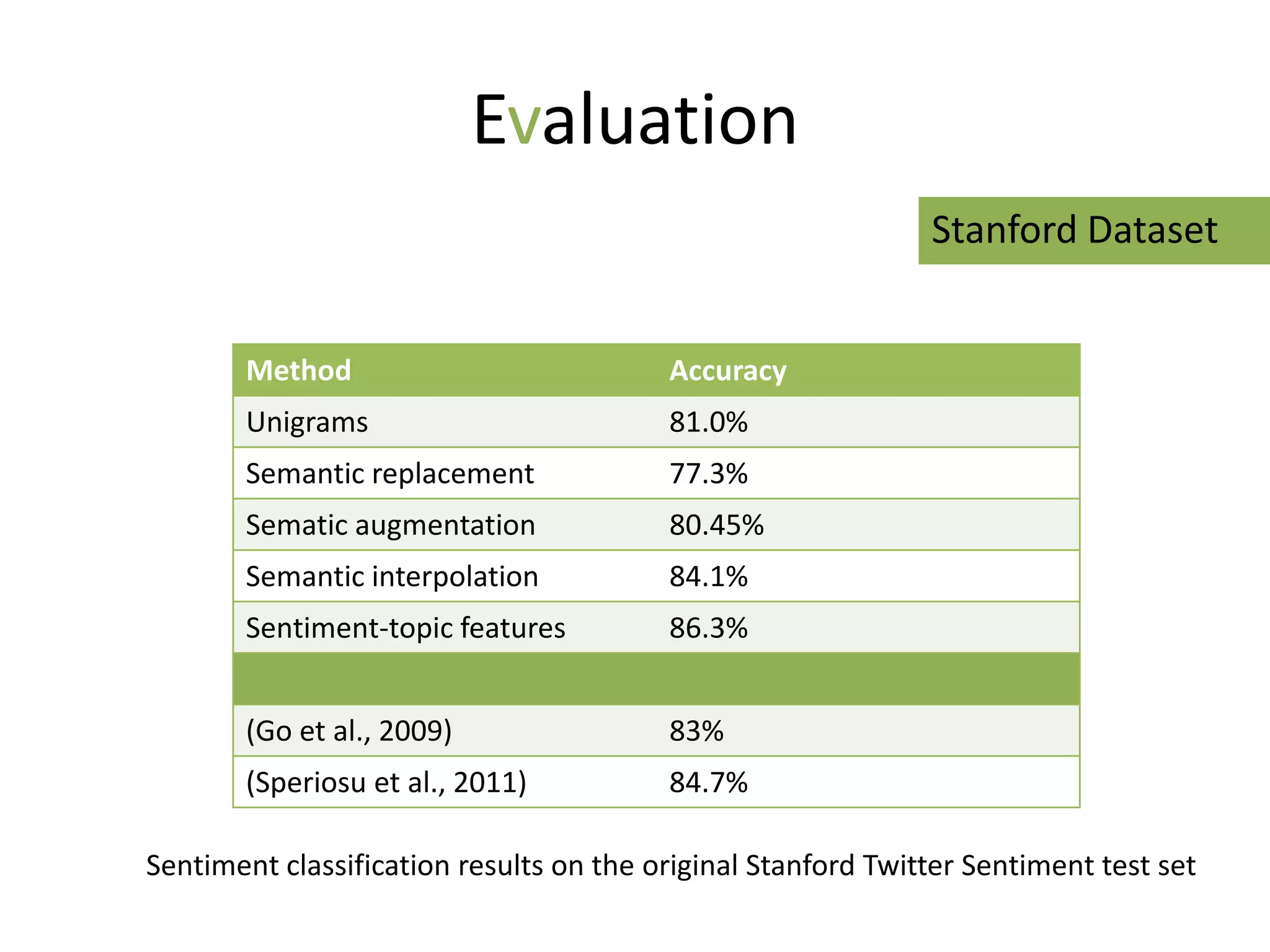
Evaluation
                                                              Stanford Dataset


       Method                            Accuracy
       Unigrams                          81.0%
       Semantic replacement              77.3%
       Sematic augmentation              80.45%
       Semantic interpolation            84.1%
       Sentiment-topic features          86.3%


       (Go et al., 2009)                 83%
       (Speriosu et al., 2011)           84.7%

Sentiment classification results on the original Stanford Twitter Sentiment test set
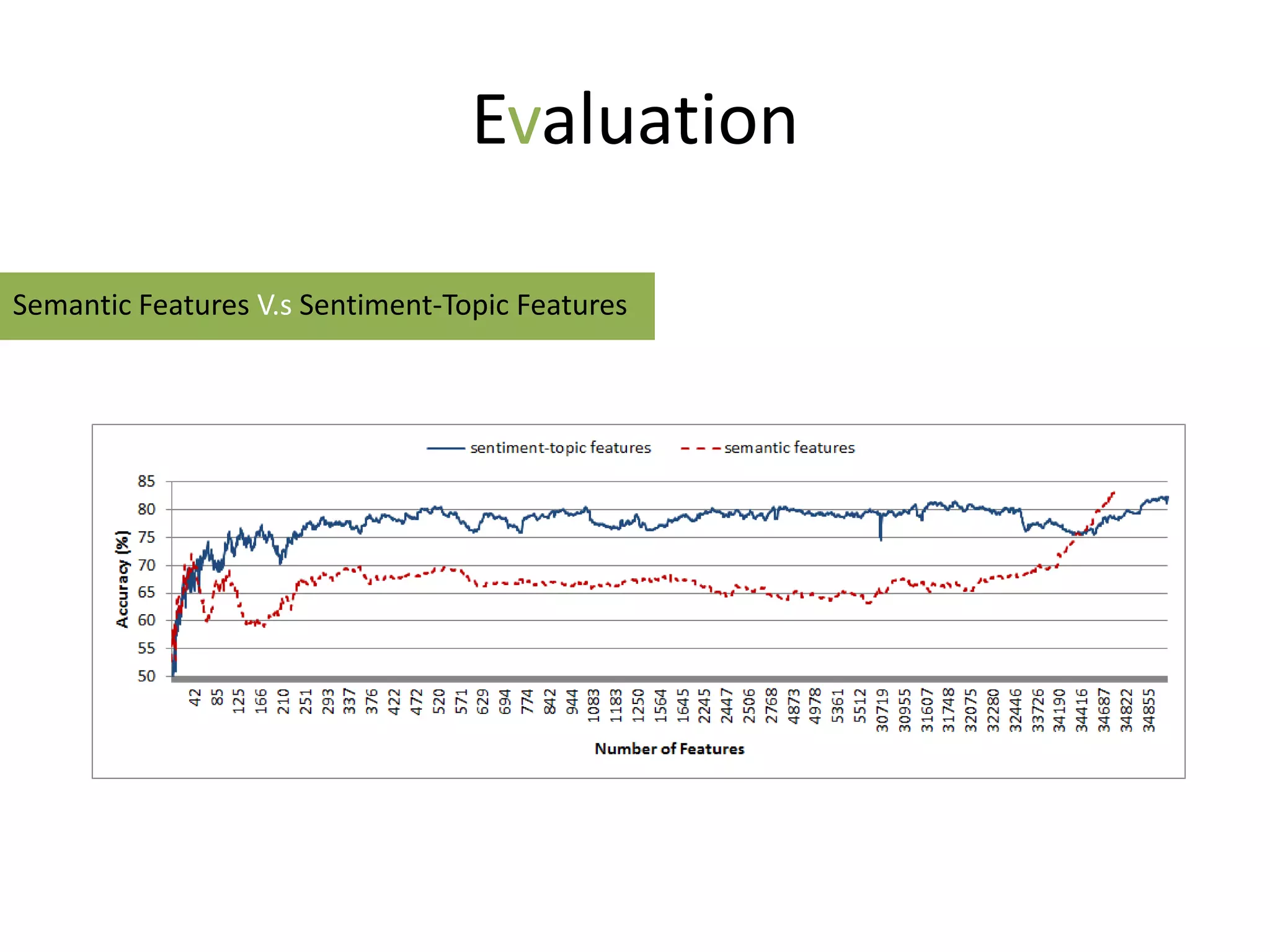
Evaluation

Semantic Features V.s Sentiment-Topic Features
Tweenator


http://tweenator.com
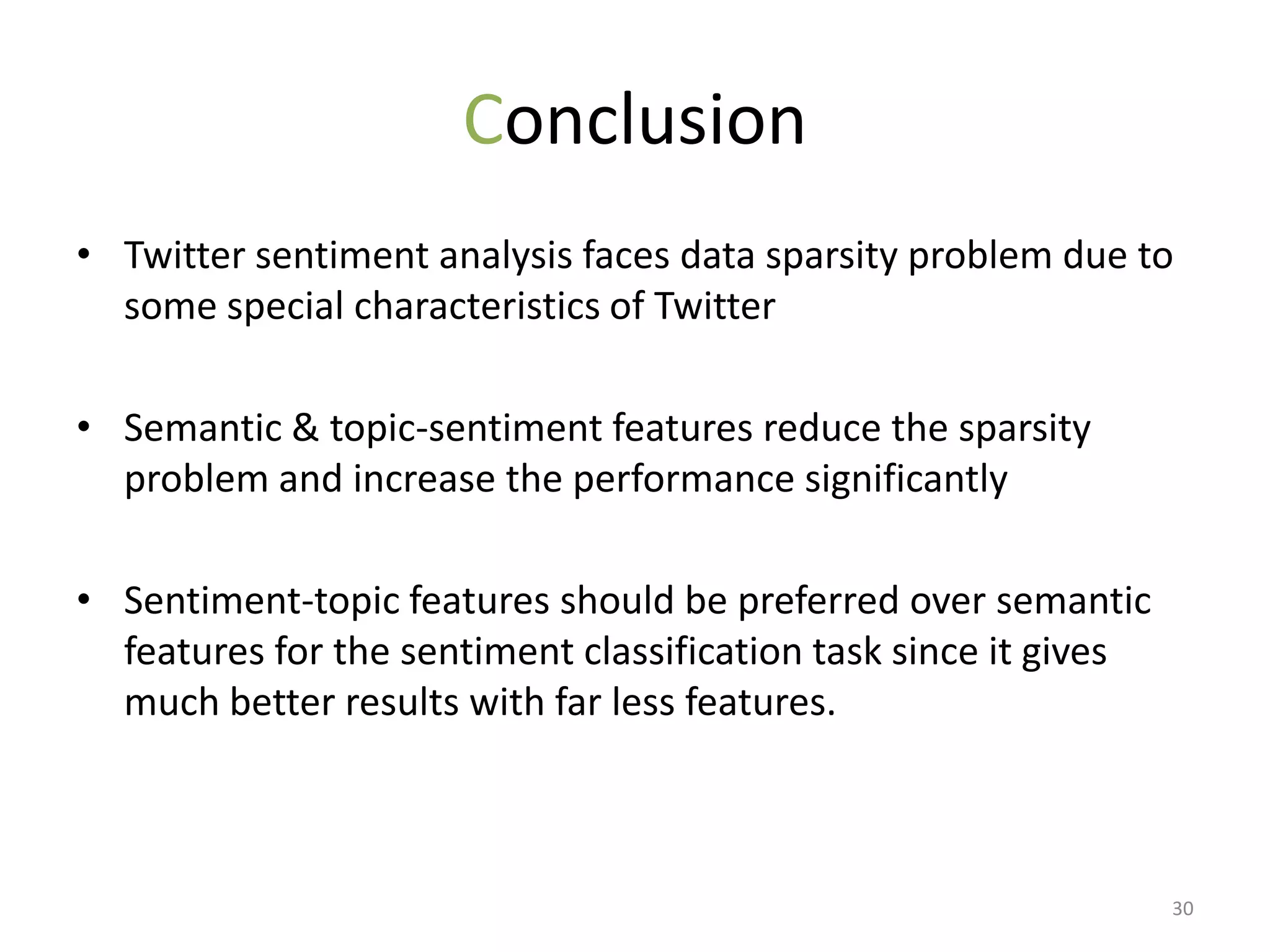
Conclusion
• Twitter sentiment analysis faces data sparsity problem due to
  some special characteristics of Twitter

• Semantic & topic-sentiment features reduce the sparsity
  problem and increase the performance significantly

• Sentiment-topic features should be preferred over semantic
  features for the sentiment classification task since it gives
  much better results with far less features.


                                                                  30
The Future
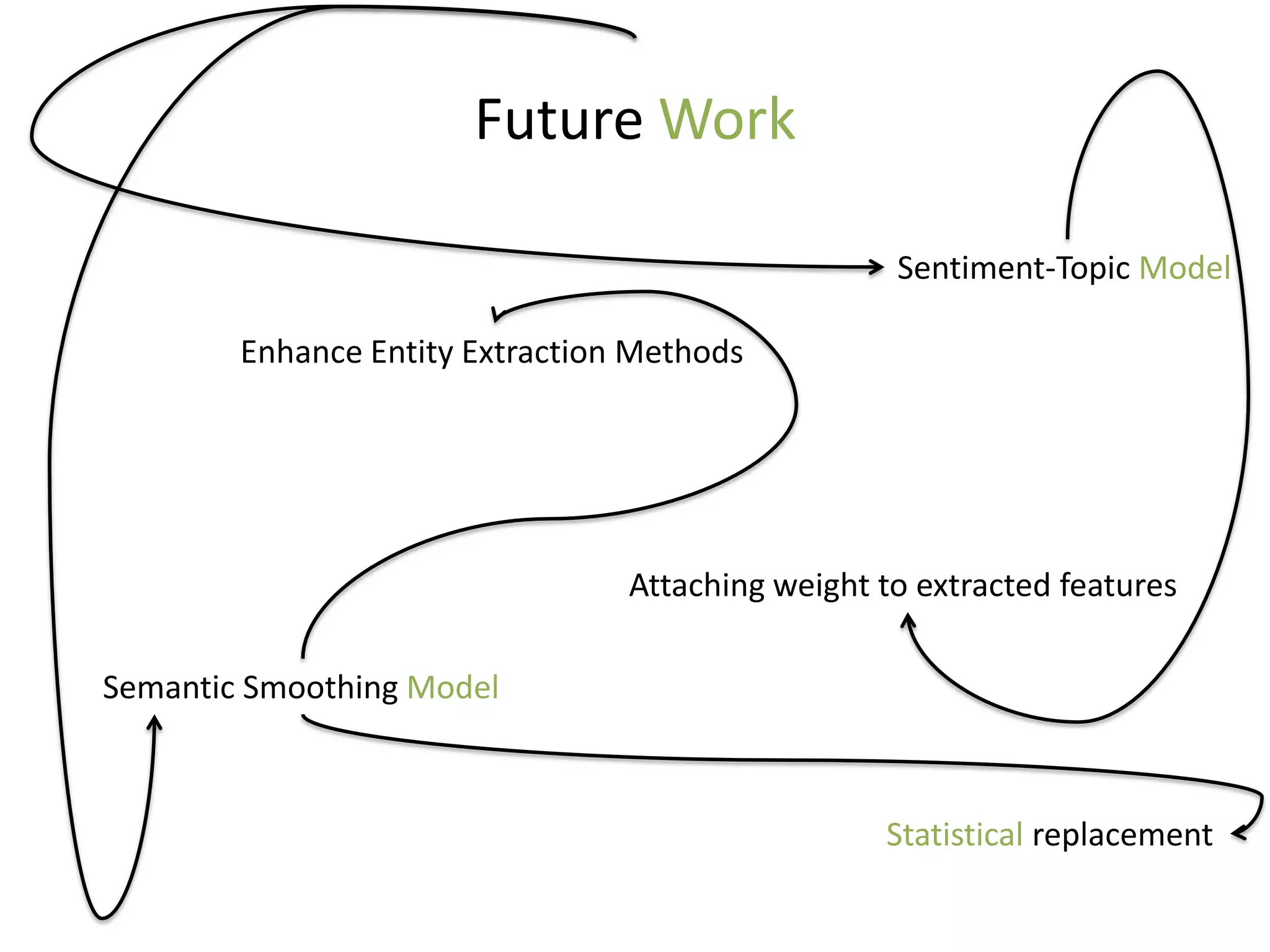
Future Work

                                                   Sentiment-Topic Model

        Enhance Entity Extraction Methods


                                 Attaching weight to extracted features

Semantic Smoothing Model


                                                  Statistical replacement
References
[1] AGARWAL, A., XIE, B., VOVSHA, I., RAMBOW, O., AND PASSONNEAU, R. Sentiment analysis of twitter data. In Proceedings of
the ACL 2011 Workshop on Languages in Social Media (2011), pp. 30–38.

[2] BARBOSA, L., AND FENG, J. Robust sentiment detection on twitter from biased and noisy data. In Proceedings of COLING
(2010), pp. 36–44.

[3] BIFET, A., AND FRANK, E. Sentiment knowledge discovery in twitter streaming data. In Discovery Science (2010), Springer, pp.
1–15.

[4] GO, A., BHAYANI, R., AND HUANG, L. Twitter sentiment classification using distant supervision. CS224N Project
Report, Stanford (2009).

[5] KOULOUMPIS, E., WILSON, T., AND MOORE, J. Twitter sentiment analysis: The good the bad and the omg! In Proceedings of
the ICWSM (2011).

[5]LIN, C., AND HE, Y. Joint sentiment/topic model for sentiment analysis. In Proceeding of the 18th ACM conference on
Information and knowledge management (2009), ACM, pp. 375–384.
[6] PAK, A., AND PAROUBEK, P. Twitter as a corpus for sentiment analysis and opinion mining. Proceedings of LREC 2010 (2010).

[7]SAIF, H., HE, Y., AND ALANI, H. Semantic Smoothing for Twitter Sentiment Analysis. In Proceeding of the 10th International
Semantic Web Conference (ISWC) (2011).
Thank


        You

Alleviating Data Sparsity for Twitter Sentiment Analysis

  • 1.
    Alleviating Data SparsityFor Twitter Sentiment Analysis Hassan Saif, Yulan He & Harith Alani Knowledge Media Institute, The Open University, Milton Keynes, United Kingdom Making Sense of Microblogs – WWW2012 Conference Lyon - France
  • 2.
    Outline • Hello World • Motivation • Related Work • Semantic Features • Topic-Sentiment Features • Evaluation • Demos • The Future
  • 3.
    Sentiment Analysis “Sentiment analysisis the task of identifying positive and negative opinions, emotions and evaluations in text” The main dish was The main dish was It is a Syrian dish delicious salty and horrible Opinion Fact Opinion 3
  • 4.
    Microblogging • Service whichallows subscribers to post short updates online and broadcast them • Answers the question: What are you doing now? • Twitter, Plurk, sfeed, Yammer, BlueTwi, etc. 4
  • 5.
  • 6.
  • 7.
    Sense? 1400000 AGARWAL et al. 1200000 1143562 BARBOSA, L., AND FENG, J. 1000000 BIFET, A., AND FRANK, E. 800000 DIAKOPOULOS, N., AND SHAMMA, D. 713178 GO et al. 600000 He & Saif 400000 PAK & PAROUBEK 200000 And 0 1 Many Objective Tweets Subjective Tweets Others UK General Elections Corpus
  • 8.
    Why Private Sectors Because It is Critical df Keep In Touch Public Sectors
  • 9.
  • 10.
    Sentiment Analysis Lexical Based Approach Text Classification Problem Right Features Word Polarity Building Better Dictionary Machine Learning Approach
  • 11.
    Twitter Sentiment Analysis Challenges – The short length of status update – Language Variations – Open Social Environment
  • 12.
    Twitter Sentiment Analysis RelatedWork • Distant Supervision – Supervised classifiers trained from noisy labels – Tweets messages are labeled using emoticons – Data filtering process Go et al., (2009) - Barbosa and Fengl. (2010) – Pak and Paroubek (2010)
  • 13.
    Twitter Sentiment Analysis RelatedWork • Followers Graph & Label Propagation – Twitter follower graph (users, tweets, unigrams and hashtags) – Start with small number of labeled tweets – Applied label propagation method throughout the graph. Speriosu et al., (2009)
  • 14.
    Twitter Sentiment Analysis RelatedWork • Feature Engineering – Unigrams, bigrams, POS – Microblogging features • Hashtags • Emoticons • Abbreviations & Intensifiers Agsrwal et al., (2011) – Kouloumpis et al (2011)
  • 15.
  • 16.
    What Does sparsitymean? Training data contains many infrequent terms
  • 17.
    What Does sparsitymean? Word frequency statistics
  • 18.
    How! Sentiment Topic Features Extracts semantically hidden concepts from tweets data and then incorporates them into supervised Extract latent topics and classifier training by interpolation the associated topic sentiment from the tweets data which are subsequently added into the original feature space Semantic Features for supervised classifier training
  • 19.
    Semantic Features Shallow SemanticMethod Sport @Stace_meister Ya, I have Rugby in an hour Sushi time for fabulous Jesse's last day on dragons den Person Dear eBay, if I win I owe you a total 580.63 bye paycheck Company
  • 20.
  • 21.
    Topic-Sentiment Features Joint SentimentTopic Model JST1 is a four-layer generative model which allows the detection of both sentiment and topic simultaneously from text. The only supervision is word prior polarity information which can be obtained from MPQA subjectivity lexicon. Lin & He. 2009
  • 22.
    Twitter Sentiment Corpus Stanford University Collected: the 6th of April & the 25th of June 2009 Training Set: 1.6 million tweets (Balanced) Testing Set: 177 negative tweets & 182 positive tweets http://twittersentiment.appspot.com/
  • 23.
    Our Sentiment Corpus •Training Set: 60K tweets • Testing Set: 1000 tweets • Annotated additional 640 tweets using Tweenator
  • 24.
    Evaluation Extended Test Set Method Accuracy Unigrams 80.7% Semantic replacement 76.3% Semantic interpolation 84.0% Sentiment-topic features 82.3% Sentiment classification results on the 1000-tweets test set
  • 25.
    Evaluation Stanford Dataset Method Accuracy Unigrams 81.0% Semantic replacement 77.3% Sematic augmentation 80.45% Semantic interpolation 84.1% Sentiment-topic features 86.3% (Go et al., 2009) 83% (Speriosu et al., 2011) 84.7% Sentiment classification results on the original Stanford Twitter Sentiment test set
  • 26.
    Evaluation Semantic Features V.sSentiment-Topic Features
  • 27.
  • 28.
    Conclusion • Twitter sentimentanalysis faces data sparsity problem due to some special characteristics of Twitter • Semantic & topic-sentiment features reduce the sparsity problem and increase the performance significantly • Sentiment-topic features should be preferred over semantic features for the sentiment classification task since it gives much better results with far less features. 30
  • 29.
  • 30.
    Future Work Sentiment-Topic Model Enhance Entity Extraction Methods Attaching weight to extracted features Semantic Smoothing Model Statistical replacement
  • 31.
    References [1] AGARWAL, A.,XIE, B., VOVSHA, I., RAMBOW, O., AND PASSONNEAU, R. Sentiment analysis of twitter data. In Proceedings of the ACL 2011 Workshop on Languages in Social Media (2011), pp. 30–38. [2] BARBOSA, L., AND FENG, J. Robust sentiment detection on twitter from biased and noisy data. In Proceedings of COLING (2010), pp. 36–44. [3] BIFET, A., AND FRANK, E. Sentiment knowledge discovery in twitter streaming data. In Discovery Science (2010), Springer, pp. 1–15. [4] GO, A., BHAYANI, R., AND HUANG, L. Twitter sentiment classification using distant supervision. CS224N Project Report, Stanford (2009). [5] KOULOUMPIS, E., WILSON, T., AND MOORE, J. Twitter sentiment analysis: The good the bad and the omg! In Proceedings of the ICWSM (2011). [5]LIN, C., AND HE, Y. Joint sentiment/topic model for sentiment analysis. In Proceeding of the 18th ACM conference on Information and knowledge management (2009), ACM, pp. 375–384. [6] PAK, A., AND PAROUBEK, P. Twitter as a corpus for sentiment analysis and opinion mining. Proceedings of LREC 2010 (2010). [7]SAIF, H., HE, Y., AND ALANI, H. Semantic Smoothing for Twitter Sentiment Analysis. In Proceeding of the 10th International Semantic Web Conference (ISWC) (2011).
  • 32.
    Thank You

Editor's Notes

  • #8 Can we extract sentiment from microblogs?Provide list of people who said users express more opinions on microblogscustomers are less controlled of their emotions when interacting in a social environment.So, yes we can do sentiment analysis over microblogs.
  • #9 Now, Why do we need to do it?Millionsof status updates and tweets messages are shared everyday among usersFor public sectors: social data can be used to predict public political opinion which make easier to policy makers to put political strategies based on that.For private sector: Companies can track public opinion about their products and services
  • #11 Two Main ApproachesLexical-based ApproachBuilding a better dictionaryFocuses on words and phrases as bearers of semantic orientationMachine Learning Approach Finding the Right FeaturesYet another form of text classification
  • #15 To overcome the noisy label data
  • #16 To overcome the noisy label data
  • #17 To overcome the noisy label data
  • #18 Previous work tried to overcome the sparsity problem partially and indirectly by either apply some data filtering or depending on different set of microblogs features. However,None of them studied the affect of data sparsity on the classification performance.
  • #19 Why: many words and terms in the testing corpus doesn’t appear in the training corpus.
  • #20 Compares the word frequency statistics of the tweets data we used in our experiments and the movie review dataX-axis shows the word frequency interval, e.g., words occur up to 10 times. (1-10), more than 10 times but up to 20 times (10-20), etc.Y-axis shows the percentage of words falls within certain word frequency interval.It can be observed that the tweets data are sparser than the movie review data since the former contain more infrequent words, with 93% of the words in the tweets data occurring less than 10 times (cf. 78% in the movie review data).
  • #28 §
  • #29 §