SENTIMENT ANALYSIS
ON TWITTER
PRESENTED BY : SUBARNO PAL
SUVAM MONDAL
SOURAV KAR
SOURAV SENAPATI
SUBHAJIT GHOSH
DEPARTMENT : CSE
UNDER GUIDANCE OF : Dr. SOUMADIP GHOSH
PROJECT : CS892CS892
ACADEMY OF TECHNOLOGY
Date: 01/06/2017
1Sentiment Analysis
Sentiment Analysis
What is Sentiment Analysis?

Computational process for identifying and
categorizing opinions expressed in a piece of
text

Determining the writer's attitude towards a
particular topic, product, etc. is positive,
negative

Extract Sentiment of a Text

“Supervised Machine Learning Problem”
2
Sentiment Analysis
Related Works(1)

Mehto A. proposed a ‘Lexicon based approach for Sentiment Analysis’
based on an aspect catalogue. [1]
 The keywords present in aspect catalogue identified in those
sentences in which features of any product are mentioned.
 Based on these sentences weighted features from the aspect
catalogue are summed up to find the sentiment of the text.

Nizam and AkÕn unsupervised learning for sentiment classification in
Turkish. [2]
 Used tweet words as features and tweet data were clustered in
positive, negative and neutral labelled classes.
 Then, this dataset is used to detect classification accuracy with NB,
DT and KNN algorithms.
3
Sentiment Analysis
Related Works(2)

In a recent work cited as “A New Approach to Target Dependent
Sentiment Analysis with Onto-Fuzzy Logic”.[3]
 Hash-tagged words of twitter are given special preference for
determining sentiment of the text.
 Hash-tags Category: Topic hash tags , sentiment hash-tags
and sentiment-topic hash tags .

Chikersal P. et. al. developed by Rule-based Classified
combining with Supervised Learning.[4]
 The Support Vector Machine (SVM) is trained on semantic,
dependency, and sentiment lexicon based features. By this it
identify +ve, –ve & neutral keyword.
4
Sentiment Analysis
Sentiment Analysis: Domains
Customer Product Reviews
Example: Reviews from Amazon, Yelp, etc.
Movie Reviews
Example: IMDB, Rotten Tomatoes, etc.
Tweets (approximately 313 million users monthly)
Facebook posts
News articles headings
… and so on.
5
Sentiment Analysis
Quirks of Tweets:
Informal, and short (140 characters)
Abbreviations and shortenings.
 Spelling mistakes and creative spellings.
Special strings
Hashtags, emoticons, conjoined words.
High volume, 500 million tweets posted every
day.
6
Sentiment Analysis
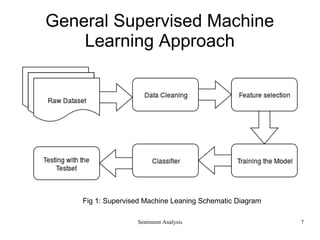
General Supervised Machine
Learning Approach
Fig 1: Supervised Machine Leaning Schematic Diagram
7
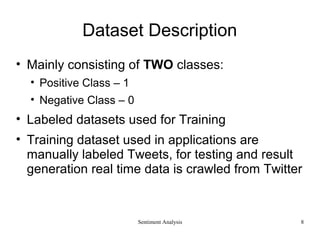
Dataset Description
• Mainly consisting of TWO classes:
• Positive Class – 1
• Negative Class – 0
• Labeled datasets used for Training
• Training dataset used in applications are
manually labeled Tweets, for testing and result
generation real time data is crawled from Twitter
Sentiment Analysis 8
Sentiment Analysis
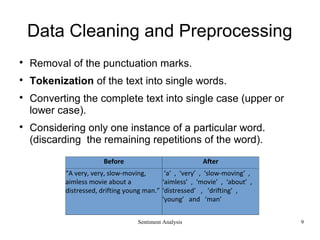
Data Cleaning and Preprocessing

Removal of the punctuation marks.

Tokenization of the text into single words.

Converting the complete text into single case (upper or
lower case).

Considering only one instance of a particular word.
(discarding the remaining repetitions of the word).
Before After
“A very, very, slow-moving,
aimless movie about a
distressed, drifting young man.”
‘a’ , ‘very’ , ‘slow-moving’ ,
‘aimless’ , ‘movie’ , ‘about’ ,
‘distressed’ , ‘drifting’ ,
‘young’ and ‘man’
9
Sentiment Analysis
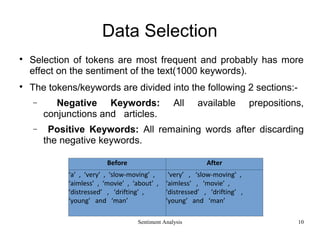
Data Selection

Selection of tokens are most frequent and probably has more
effect on the sentiment of the text(1000 keywords).

The tokens/keywords are divided into the following 2 sections:-
− Negative Keywords: All available prepositions,
conjunctions and articles.
− Positive Keywords: All remaining words after discarding
the negative keywords.
Before After
‘a’ , ‘very’ , ‘slow-moving’ ,
‘aimless’ , ‘movie’ , ‘about’ ,
‘distressed’ , ‘drifting’ ,
‘young’ and ‘man’
‘very’ , ‘slow-moving’ ,
‘aimless’ , ‘movie’ ,
‘distressed’ , ‘drifting’ ,
‘young’ and ‘man’
10
Sentiment Analysis
Contruction Of Histograms

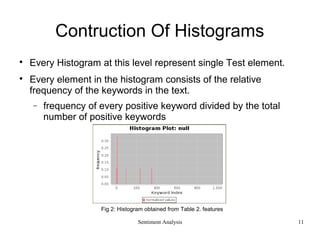
Every Histogram at this level represent single Test element.

Every element in the histogram consists of the relative
frequency of the keywords in the text.
− frequency of every positive keyword divided by the total
number of positive keywords
Fig 2: Histogram obtained from Table 2. features
11
Sentiment Analysis
Averaged Histogram

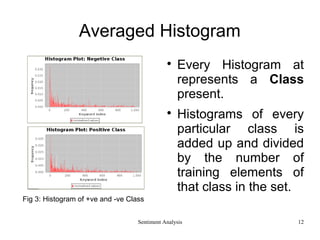
Every Histogram at
represents a Class
present.

Histograms of every
particular class is
added up and divided
by the number of
training elements of
that class in the set.
Fig 3: Histogram of +ve and -ve Class
12
Sentiment Analysis
Workflow
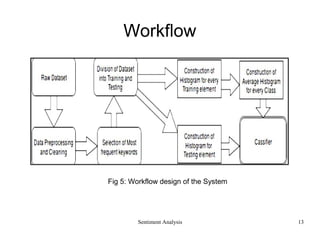
Fig 5: Workflow design of the System
13
Sentiment Analysis
k-Nearest Neighbour Classifier
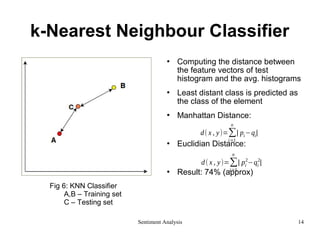
 Computing the distance between
the feature vectors of test
histogram and the avg. histograms
 Least distant class is predicted as
the class of the element
 Manhattan Distance:
 Euclidian Distance:
 Result: 74% (approx)
Fig 6: KNN Classifier
A,B – Training set
C – Testing set
14
d( x , y)=∑
i=1
n
| pi−qi|
d( x , y)=∑
i=1
n
| pi
2
−qi
2
|
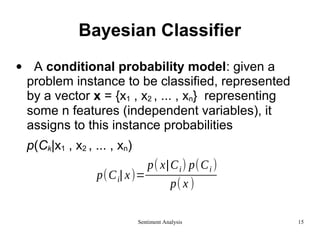
Bayesian Classifier
• A conditional probability model: given a
problem instance to be classified, represented
by a vector x = {x1 , x2 , ... , xn} representing
some n features (independent variables), it
assigns to this instance probabilities
p(Ck|x1 , x2 , ... , xn)
p(Ci| x)=
p( x|Ci) p(Ci )
p( x )
Sentiment Analysis 15
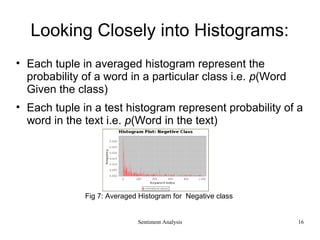
Looking Closely into Histograms:
• Each tuple in averaged histogram represent the
probability of a word in a particular class i.e. p(Word
Given the class)
• Each tuple in a test histogram represent probability of a
word in the text i.e. p(Word in the text)
Fig 7: Averaged Histogram for Negative class
Sentiment Analysis 16
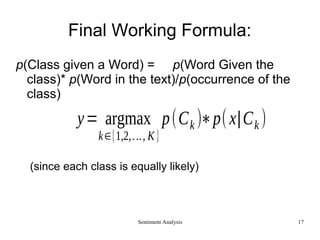
Final Working Formula:
p(Class given a Word) = p(Word Given the
class)* p(Word in the text)/p(occurrence of the
class)
(since each class is equally likely)
y= argmax
k∈{1,2,..., K}
p(Ck )∗p(x|Ck )
Sentiment Analysis 17
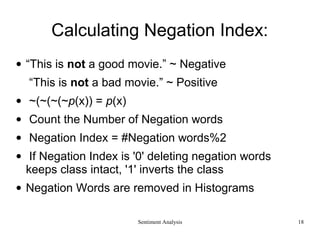
Calculating Negation Index:
• “This is not a good movie.” ~ Negative
“This is not a bad movie.” ~ Positive
• ~(~(~(~p(x)) = p(x)
• Count the Number of Negation words
• Negation Index = #Negation words%2
• If Negation Index is '0' deleting negation words
keeps class intact, '1' inverts the class
• Negation Words are removed in Histograms
Sentiment Analysis 18
Bayesian Model Implementation:
For Training part:
• Negation Index 1 inverts the class while training & negation
0 keeps same class.
For Testing Part and Result Generation:
• Negation words are deleted from the text
• Bayesian classifier is used for prediction
• Negation Index 1 inverts the class & negation 0 keeps
prediction.
• Result: 80% and above (approx)
Sentiment Analysis 19
Recurrent Neural Network
Sentiment Analysis 20
• Recurrent Neural Network has the
histograms as inputs and it passes through
one hidden layer and finally output layer
gives the result
• Activation function tanh is used
• Weight and bias matrix continuously
updates matching the output in
subsequent steps (6000-10000)
•
• . varies [-1,1]
• Accuracy : above 75% (approx)
• Vanishing gradient problem
hW ,b( x )=f (WT
x )=f ( ∑
i=1
1000
Wi xi+b)
f ( x)=tanh ( x)=
e
x
−e
−x
ex
+e−x
Fig 8: Recurrent Neural Net
Long Short Term Memory(LSTM)
•Input gate layer
•Forget gate and tanh layer
•Cell state update layer
•Output layer
Sentiment Analysis 21
f t=σ(Wf .[ht−1 ,xt ]+bf )
it=σ(Wi .[ht−1 ,xt ]+bi )
~
Ct=tanh(WC.[ht−1,xt]+bc )
Ct=ft∗Ct−1+it∗
~
Ct
ot=σ(Wo[ht−1, xt ]+bo)
ht=ot *tanh(Ct )
Fig 9: RNN & LSTM unfolded [6]
LSTM Network Implementation
Input_1: Layer that represents a particular
input port in the network.
Embedding_1: Turn positive integers
(indexes) into dense vectors of fixed size,
with dropout rate 0.2.
LSTM_1: LSTM Layer. Dropout rates for
gate and itself is 0.2. Activation function
tanh is used.
Dense_1: Just your regular densely-
connected nn layer. Activation function
sigmoid is used.
Output_1: Layer that represents a
particular output port in the network.
Sentiment Analysis 22
Fig 10: LSTM Flowchart [7]
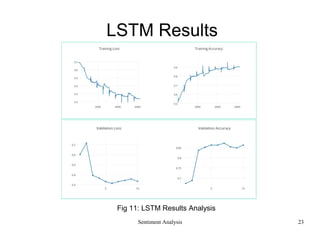
LSTM Results
Sentiment Analysis 23
Fig 11: LSTM Results Analysis
Desktop Application
Implementation
Sentiment Analysis 24
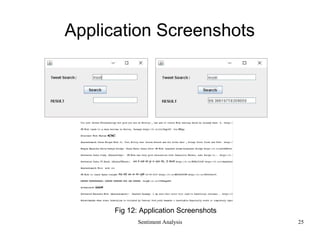
Application Screenshots
Sentiment Analysis 25
Fig 12: Application Screenshots
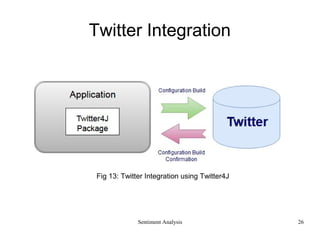
Twitter Integration
Sentiment Analysis 26
Fig 13: Twitter Integration using Twitter4J
Sentiment Analysis 27
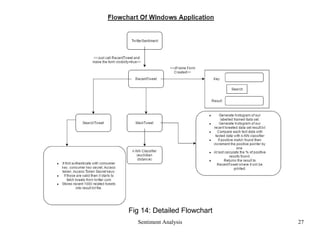
Fig 14: Detailed Flowchart
Android
Implementation
Sentiment Analysis 28
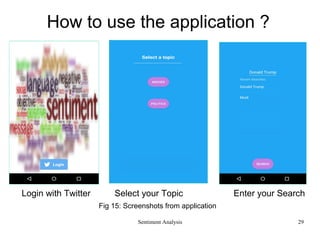
How to use the application ?
Login with Twitter Select your Topic Enter your Search
Fig 15: Screenshots from application
Sentiment Analysis 29
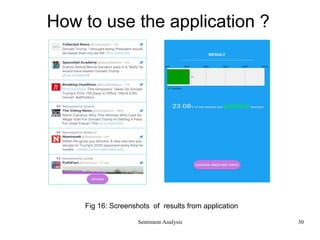
How to use the application ?
Fig 16: Screenshots of results from application
Sentiment Analysis 30
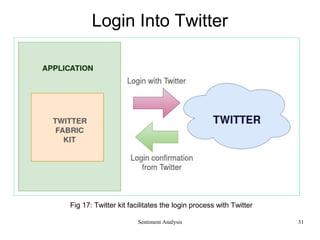
Login Into Twitter
Fig 17: Twitter kit facilitates the login process with Twitter
Sentiment Analysis 31
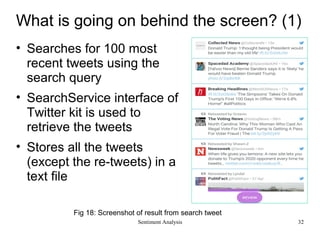
What is going on behind the screen? (1)
• Searches for 100 most
recent tweets using the
search query
• SearchService interface of
Twitter kit is used to
retrieve the tweets
• Stores all the tweets
(except the re-tweets) in a
text file
Fig 18: Screenshot of result from search tweet
Sentiment Analysis 32
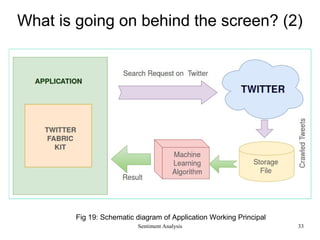
What is going on behind the screen? (2)
Fig 19: Schematic diagram of Application Working Principal
Sentiment Analysis 33
Future Improvements on Android App
• New Topics
• New features
Saving the result
Sharing the result
Search history
Progress bar to show the percentage of result calculated
Using meta information like location, date, more better review
Improved Machine Learning Algorithms to be improvised
Sentiment Analysis
CONCLUSIONS

Language Independent Model

Doesn't involve dictionary

Can deal with non-dictionary much used words

Doesn't work good for less frequently used
words

LSTM takes GPU K80 12GB – 90mins

Bayesian model gives decent accuracy on
limited computation resource
35
Sentiment Analysis
References
(1) A. Mehto and K. Indras. “Data Mining through Sentiment Analysis: Lexicon
based Sentiment Analysis Model using Aspect Catalogue”, IEEE, 2016 Symposium
on Colossal Data Analysis and Networking (CDAN).
(2) H. Nizam and S. S. AkÕn, “Sosyal Medyada Makine Öenmesi ile Duygu Analizinde
Dengeli ve Dengesiz Veri Setlerinin PerformanslarÕnÕnKarúÕlaútÕrÕlmasÕ”, In 19.
Türkiye’de ønternet KonferansÕ, øzmir, 2014.
(3) S. Joshi, S. Mehta, P. Mestry and A. Save. “A New Approach to Target Dependent
Sentiment Analysis withOnto-Fuzzy Logic”, 2 nd IEEE International Conference on
Engineering and Technology (ICETECH), 17 th & 18 th March 2016.
(4) P. Chikersal, S. Poria and E. Cambria. “SeNTU: Sentiment Analysis of Tweets by
Combining a Rule-based Classifier with Supervised Learning”, Proceedings of the 9th
International Workshop on Semantic Evaluation (SemEval 2015), pp.647–651.
(5) Han J. and Kamber M. “Data Mining: Concepts and Techniques”.
(6) http://colah.github.io/posts/2015-08-Understanding-LSTMs/
(7) http://deepcognition.ai/
36
Sentiment Analysis
THANK YOU
37
https://github.com/Suvam-Mondal/Sentiment-Analysis-Project
http://www.ijcaonline.org/archives/volume162/number12/27296-2017913421

Sentiment Analysis on Twitter

  • 1.
    SENTIMENT ANALYSIS ON TWITTER PRESENTEDBY : SUBARNO PAL SUVAM MONDAL SOURAV KAR SOURAV SENAPATI SUBHAJIT GHOSH DEPARTMENT : CSE UNDER GUIDANCE OF : Dr. SOUMADIP GHOSH PROJECT : CS892CS892 ACADEMY OF TECHNOLOGY Date: 01/06/2017 1Sentiment Analysis
  • 2.
    Sentiment Analysis What isSentiment Analysis?  Computational process for identifying and categorizing opinions expressed in a piece of text  Determining the writer's attitude towards a particular topic, product, etc. is positive, negative  Extract Sentiment of a Text  “Supervised Machine Learning Problem” 2
  • 3.
    Sentiment Analysis Related Works(1)  MehtoA. proposed a ‘Lexicon based approach for Sentiment Analysis’ based on an aspect catalogue. [1]  The keywords present in aspect catalogue identified in those sentences in which features of any product are mentioned.  Based on these sentences weighted features from the aspect catalogue are summed up to find the sentiment of the text.  Nizam and AkÕn unsupervised learning for sentiment classification in Turkish. [2]  Used tweet words as features and tweet data were clustered in positive, negative and neutral labelled classes.  Then, this dataset is used to detect classification accuracy with NB, DT and KNN algorithms. 3
  • 4.
    Sentiment Analysis Related Works(2)  Ina recent work cited as “A New Approach to Target Dependent Sentiment Analysis with Onto-Fuzzy Logic”.[3]  Hash-tagged words of twitter are given special preference for determining sentiment of the text.  Hash-tags Category: Topic hash tags , sentiment hash-tags and sentiment-topic hash tags .  Chikersal P. et. al. developed by Rule-based Classified combining with Supervised Learning.[4]  The Support Vector Machine (SVM) is trained on semantic, dependency, and sentiment lexicon based features. By this it identify +ve, –ve & neutral keyword. 4
  • 5.
    Sentiment Analysis Sentiment Analysis:Domains Customer Product Reviews Example: Reviews from Amazon, Yelp, etc. Movie Reviews Example: IMDB, Rotten Tomatoes, etc. Tweets (approximately 313 million users monthly) Facebook posts News articles headings … and so on. 5
  • 6.
    Sentiment Analysis Quirks ofTweets: Informal, and short (140 characters) Abbreviations and shortenings.  Spelling mistakes and creative spellings. Special strings Hashtags, emoticons, conjoined words. High volume, 500 million tweets posted every day. 6
  • 7.
    Sentiment Analysis General SupervisedMachine Learning Approach Fig 1: Supervised Machine Leaning Schematic Diagram 7
  • 8.
    Dataset Description • Mainlyconsisting of TWO classes: • Positive Class – 1 • Negative Class – 0 • Labeled datasets used for Training • Training dataset used in applications are manually labeled Tweets, for testing and result generation real time data is crawled from Twitter Sentiment Analysis 8
  • 9.
    Sentiment Analysis Data Cleaningand Preprocessing  Removal of the punctuation marks.  Tokenization of the text into single words.  Converting the complete text into single case (upper or lower case).  Considering only one instance of a particular word. (discarding the remaining repetitions of the word). Before After “A very, very, slow-moving, aimless movie about a distressed, drifting young man.” ‘a’ , ‘very’ , ‘slow-moving’ , ‘aimless’ , ‘movie’ , ‘about’ , ‘distressed’ , ‘drifting’ , ‘young’ and ‘man’ 9
  • 10.
    Sentiment Analysis Data Selection  Selectionof tokens are most frequent and probably has more effect on the sentiment of the text(1000 keywords).  The tokens/keywords are divided into the following 2 sections:- − Negative Keywords: All available prepositions, conjunctions and articles. − Positive Keywords: All remaining words after discarding the negative keywords. Before After ‘a’ , ‘very’ , ‘slow-moving’ , ‘aimless’ , ‘movie’ , ‘about’ , ‘distressed’ , ‘drifting’ , ‘young’ and ‘man’ ‘very’ , ‘slow-moving’ , ‘aimless’ , ‘movie’ , ‘distressed’ , ‘drifting’ , ‘young’ and ‘man’ 10
  • 11.
    Sentiment Analysis Contruction OfHistograms  Every Histogram at this level represent single Test element.  Every element in the histogram consists of the relative frequency of the keywords in the text. − frequency of every positive keyword divided by the total number of positive keywords Fig 2: Histogram obtained from Table 2. features 11
  • 12.
    Sentiment Analysis Averaged Histogram  EveryHistogram at represents a Class present.  Histograms of every particular class is added up and divided by the number of training elements of that class in the set. Fig 3: Histogram of +ve and -ve Class 12
  • 13.
    Sentiment Analysis Workflow Fig 5:Workflow design of the System 13
  • 14.
    Sentiment Analysis k-Nearest NeighbourClassifier  Computing the distance between the feature vectors of test histogram and the avg. histograms  Least distant class is predicted as the class of the element  Manhattan Distance:  Euclidian Distance:  Result: 74% (approx) Fig 6: KNN Classifier A,B – Training set C – Testing set 14 d( x , y)=∑ i=1 n | pi−qi| d( x , y)=∑ i=1 n | pi 2 −qi 2 |
  • 15.
    Bayesian Classifier • Aconditional probability model: given a problem instance to be classified, represented by a vector x = {x1 , x2 , ... , xn} representing some n features (independent variables), it assigns to this instance probabilities p(Ck|x1 , x2 , ... , xn) p(Ci| x)= p( x|Ci) p(Ci ) p( x ) Sentiment Analysis 15
  • 16.
    Looking Closely intoHistograms: • Each tuple in averaged histogram represent the probability of a word in a particular class i.e. p(Word Given the class) • Each tuple in a test histogram represent probability of a word in the text i.e. p(Word in the text) Fig 7: Averaged Histogram for Negative class Sentiment Analysis 16
  • 17.
    Final Working Formula: p(Classgiven a Word) = p(Word Given the class)* p(Word in the text)/p(occurrence of the class) (since each class is equally likely) y= argmax k∈{1,2,..., K} p(Ck )∗p(x|Ck ) Sentiment Analysis 17
  • 18.
    Calculating Negation Index: •“This is not a good movie.” ~ Negative “This is not a bad movie.” ~ Positive • ~(~(~(~p(x)) = p(x) • Count the Number of Negation words • Negation Index = #Negation words%2 • If Negation Index is '0' deleting negation words keeps class intact, '1' inverts the class • Negation Words are removed in Histograms Sentiment Analysis 18
  • 19.
    Bayesian Model Implementation: ForTraining part: • Negation Index 1 inverts the class while training & negation 0 keeps same class. For Testing Part and Result Generation: • Negation words are deleted from the text • Bayesian classifier is used for prediction • Negation Index 1 inverts the class & negation 0 keeps prediction. • Result: 80% and above (approx) Sentiment Analysis 19
  • 20.
    Recurrent Neural Network SentimentAnalysis 20 • Recurrent Neural Network has the histograms as inputs and it passes through one hidden layer and finally output layer gives the result • Activation function tanh is used • Weight and bias matrix continuously updates matching the output in subsequent steps (6000-10000) • • . varies [-1,1] • Accuracy : above 75% (approx) • Vanishing gradient problem hW ,b( x )=f (WT x )=f ( ∑ i=1 1000 Wi xi+b) f ( x)=tanh ( x)= e x −e −x ex +e−x Fig 8: Recurrent Neural Net
  • 21.
    Long Short TermMemory(LSTM) •Input gate layer •Forget gate and tanh layer •Cell state update layer •Output layer Sentiment Analysis 21 f t=σ(Wf .[ht−1 ,xt ]+bf ) it=σ(Wi .[ht−1 ,xt ]+bi ) ~ Ct=tanh(WC.[ht−1,xt]+bc ) Ct=ft∗Ct−1+it∗ ~ Ct ot=σ(Wo[ht−1, xt ]+bo) ht=ot *tanh(Ct ) Fig 9: RNN & LSTM unfolded [6]
  • 22.
    LSTM Network Implementation Input_1:Layer that represents a particular input port in the network. Embedding_1: Turn positive integers (indexes) into dense vectors of fixed size, with dropout rate 0.2. LSTM_1: LSTM Layer. Dropout rates for gate and itself is 0.2. Activation function tanh is used. Dense_1: Just your regular densely- connected nn layer. Activation function sigmoid is used. Output_1: Layer that represents a particular output port in the network. Sentiment Analysis 22 Fig 10: LSTM Flowchart [7]
  • 23.
    LSTM Results Sentiment Analysis23 Fig 11: LSTM Results Analysis
  • 24.
  • 25.
    Application Screenshots Sentiment Analysis25 Fig 12: Application Screenshots
  • 26.
    Twitter Integration Sentiment Analysis26 Fig 13: Twitter Integration using Twitter4J
  • 27.
    Sentiment Analysis 27 Fig14: Detailed Flowchart
  • 28.
  • 29.
    How to usethe application ? Login with Twitter Select your Topic Enter your Search Fig 15: Screenshots from application Sentiment Analysis 29
  • 30.
    How to usethe application ? Fig 16: Screenshots of results from application Sentiment Analysis 30
  • 31.
    Login Into Twitter Fig17: Twitter kit facilitates the login process with Twitter Sentiment Analysis 31
  • 32.
    What is goingon behind the screen? (1) • Searches for 100 most recent tweets using the search query • SearchService interface of Twitter kit is used to retrieve the tweets • Stores all the tweets (except the re-tweets) in a text file Fig 18: Screenshot of result from search tweet Sentiment Analysis 32
  • 33.
    What is goingon behind the screen? (2) Fig 19: Schematic diagram of Application Working Principal Sentiment Analysis 33
  • 34.
    Future Improvements onAndroid App • New Topics • New features Saving the result Sharing the result Search history Progress bar to show the percentage of result calculated Using meta information like location, date, more better review Improved Machine Learning Algorithms to be improvised
  • 35.
    Sentiment Analysis CONCLUSIONS  Language IndependentModel  Doesn't involve dictionary  Can deal with non-dictionary much used words  Doesn't work good for less frequently used words  LSTM takes GPU K80 12GB – 90mins  Bayesian model gives decent accuracy on limited computation resource 35
  • 36.
    Sentiment Analysis References (1) A.Mehto and K. Indras. “Data Mining through Sentiment Analysis: Lexicon based Sentiment Analysis Model using Aspect Catalogue”, IEEE, 2016 Symposium on Colossal Data Analysis and Networking (CDAN). (2) H. Nizam and S. S. AkÕn, “Sosyal Medyada Makine Öenmesi ile Duygu Analizinde Dengeli ve Dengesiz Veri Setlerinin PerformanslarÕnÕnKarúÕlaútÕrÕlmasÕ”, In 19. Türkiye’de ønternet KonferansÕ, øzmir, 2014. (3) S. Joshi, S. Mehta, P. Mestry and A. Save. “A New Approach to Target Dependent Sentiment Analysis withOnto-Fuzzy Logic”, 2 nd IEEE International Conference on Engineering and Technology (ICETECH), 17 th & 18 th March 2016. (4) P. Chikersal, S. Poria and E. Cambria. “SeNTU: Sentiment Analysis of Tweets by Combining a Rule-based Classifier with Supervised Learning”, Proceedings of the 9th International Workshop on Semantic Evaluation (SemEval 2015), pp.647–651. (5) Han J. and Kamber M. “Data Mining: Concepts and Techniques”. (6) http://colah.github.io/posts/2015-08-Understanding-LSTMs/ (7) http://deepcognition.ai/ 36
  • 37.