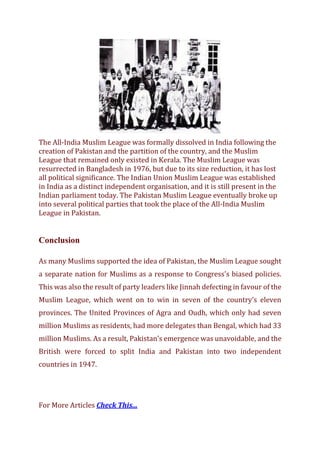
ALL INDIA MUSLIM LEAGUE
➢Introduction
➢Factors that led to the formation of the Muslim League
➢Muslim League after Partition
➢Conclusion
Introduction
A political party called the All-India Muslim League was founded in British
India in 1906 and became known as the Muslim League. The Nawab of Dhaka,
Khwaja Salimullah, proposed the formation of a political party to further the
interests of Muslims in British India at the All-India Muslim Education
Conference's annual conference in Ahsan Manzil in 1906. The conference
unanimously approved the resolution, which resulted in the official
establishment of the All-India Muslim League in Dhaka. The league and its
leaders, most notably Mohammed Ali Jinnah, have advocated for Hindu-
Muslim harmony in a united and independent India for many years. The league
did not advocate for the creation of a Muslim state distinct from India, the
future sovereign nation, until 1940. The league envisioned a separate country
for Muslims in India because it thought Hindus would control an independent
India. Its ardent support for the creation of a distinct nation-state with a Muslim
majority, Pakistan, helped the British Empire effectively divide India in 1947.
Factors that led to the formation of the Muslim League
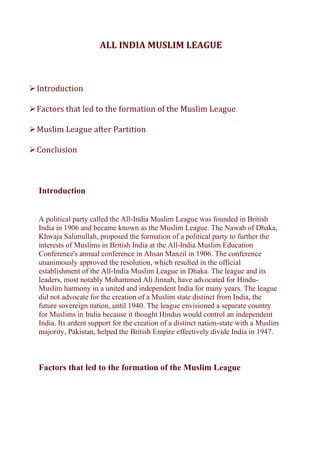
The British initiative, illiteracy, the loss of Muslim autonomy, the
manifestation of religious colour, India's economic backwardness, and
other crucial elements all contributed to the foundation of the Muslim
League in India. Apart from them, the following are some prominent
factors;
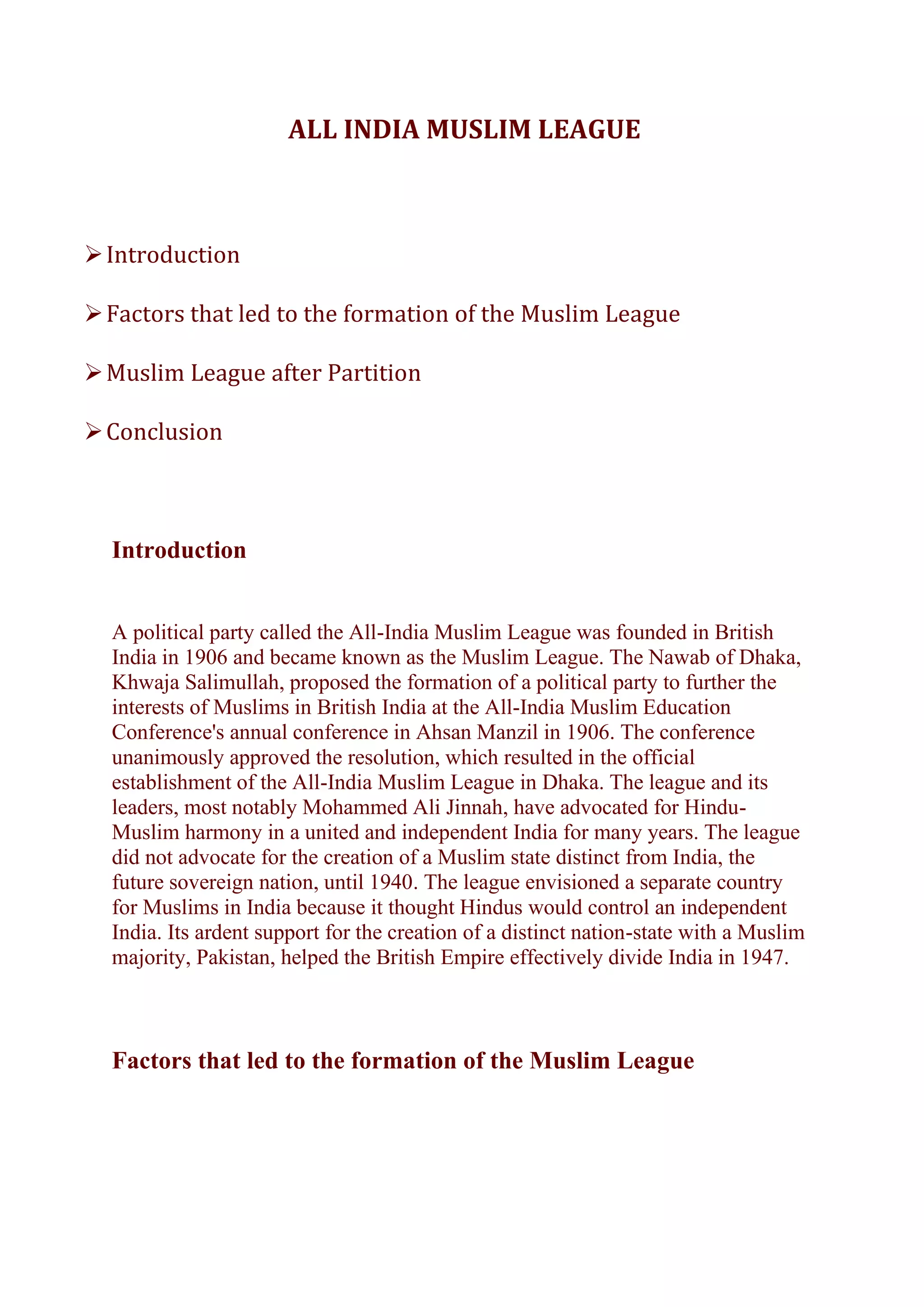
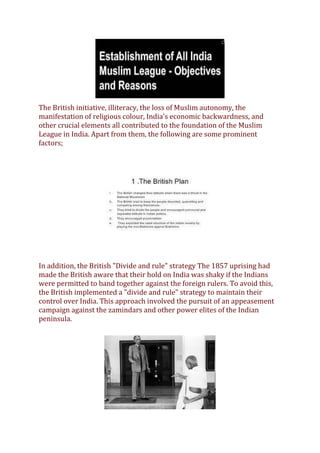
In addition, the British "Divide and rule" strategy The 1857 uprising had
made the British aware that their hold on India was shaky if the Indians
were permitted to band together against the foreign rulers. To avoid this,
the British implemented a "divide and rule" strategy to maintain their
control over India. This approach involved the pursuit of an appeasement
campaign against the zamindars and other power elites of the Indian
peninsula.
Furthermore, the Religious/Revivalist Attitudes of Congress Leaders
Conservative Congress leaders like Tilak and Lala Lajpat Rai did not
hesitate to use religious language and symbolism in their political speeches.
Numerous times, they have been influenced by traditional Hinduism. To
encourage Indians to have faith in their old culture, Tilak started to observe
the public holidays of Ganesh Chaturthi and Shiva Jayanti. Additionally, a
large-scale effort was made to organise the populace. Even though this was
not done with a community goal in mind, it did in the end drive Muslims
away from Congress politics.
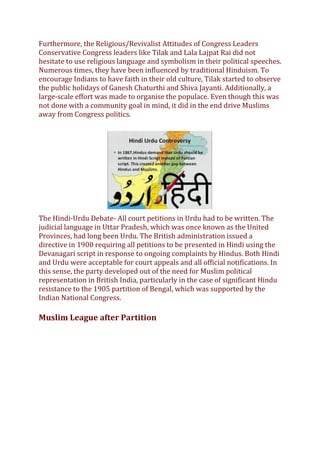
The Hindi-Urdu Debate- All court petitions in Urdu had to be written. The
judicial language in Uttar Pradesh, which was once known as the United
Provinces, had long been Urdu. The British administration issued a
directive in 1900 requiring all petitions to be presented in Hindi using the
Devanagari script in response to ongoing complaints by Hindus. Both Hindi
and Urdu were acceptable for court appeals and all official notifications. In
this sense, the party developed out of the need for Muslim political
representation in British India, particularly in the case of significant Hindu
resistance to the 1905 partition of Bengal, which was supported by the
Indian National Congress.
Muslim League after Partition
The All-India Muslim League was formally dissolved in India following the
creation of Pakistan and the partition of the country, and the Muslim
League that remained only existed in Kerala. The Muslim League was
resurrected in Bangladesh in 1976, but due to its size reduction, it has lost
all political significance. The Indian Union Muslim League was established
in India as a distinct independent organisation, and it is still present in the
Indian parliament today. The Pakistan Muslim League eventually broke up
into several political parties that took the place of the All-India Muslim
League in Pakistan.
Conclusion
As many Muslims supported the idea of Pakistan, the Muslim League sought
a separate nation for Muslims as a response to Congress's biased policies.
This was also the result of party leaders like Jinnah defecting in favour of the
Muslim League, which went on to win in seven of the country's eleven
provinces. The United Provinces of Agra and Oudh, which only had seven
million Muslims as residents, had more delegates than Bengal, which had 33
million Muslims. As a result, Pakistan's emergence was unavoidable, and the
British were forced to split India and Pakistan into two independent
countries in 1947.
For More Articles Check This...

All India Muslim League

  • 1.
    ALL INDIA MUSLIMLEAGUE ➢Introduction ➢Factors that led to the formation of the Muslim League ➢Muslim League after Partition ➢Conclusion Introduction A political party called the All-India Muslim League was founded in British India in 1906 and became known as the Muslim League. The Nawab of Dhaka, Khwaja Salimullah, proposed the formation of a political party to further the interests of Muslims in British India at the All-India Muslim Education Conference's annual conference in Ahsan Manzil in 1906. The conference unanimously approved the resolution, which resulted in the official establishment of the All-India Muslim League in Dhaka. The league and its leaders, most notably Mohammed Ali Jinnah, have advocated for Hindu- Muslim harmony in a united and independent India for many years. The league did not advocate for the creation of a Muslim state distinct from India, the future sovereign nation, until 1940. The league envisioned a separate country for Muslims in India because it thought Hindus would control an independent India. Its ardent support for the creation of a distinct nation-state with a Muslim majority, Pakistan, helped the British Empire effectively divide India in 1947. Factors that led to the formation of the Muslim League
  • 2.
    The British initiative,illiteracy, the loss of Muslim autonomy, the manifestation of religious colour, India's economic backwardness, and other crucial elements all contributed to the foundation of the Muslim League in India. Apart from them, the following are some prominent factors; In addition, the British "Divide and rule" strategy The 1857 uprising had made the British aware that their hold on India was shaky if the Indians were permitted to band together against the foreign rulers. To avoid this, the British implemented a "divide and rule" strategy to maintain their control over India. This approach involved the pursuit of an appeasement campaign against the zamindars and other power elites of the Indian peninsula.
  • 3.
    Furthermore, the Religious/RevivalistAttitudes of Congress Leaders Conservative Congress leaders like Tilak and Lala Lajpat Rai did not hesitate to use religious language and symbolism in their political speeches. Numerous times, they have been influenced by traditional Hinduism. To encourage Indians to have faith in their old culture, Tilak started to observe the public holidays of Ganesh Chaturthi and Shiva Jayanti. Additionally, a large-scale effort was made to organise the populace. Even though this was not done with a community goal in mind, it did in the end drive Muslims away from Congress politics. The Hindi-Urdu Debate- All court petitions in Urdu had to be written. The judicial language in Uttar Pradesh, which was once known as the United Provinces, had long been Urdu. The British administration issued a directive in 1900 requiring all petitions to be presented in Hindi using the Devanagari script in response to ongoing complaints by Hindus. Both Hindi and Urdu were acceptable for court appeals and all official notifications. In this sense, the party developed out of the need for Muslim political representation in British India, particularly in the case of significant Hindu resistance to the 1905 partition of Bengal, which was supported by the Indian National Congress. Muslim League after Partition
  • 4.
    The All-India MuslimLeague was formally dissolved in India following the creation of Pakistan and the partition of the country, and the Muslim League that remained only existed in Kerala. The Muslim League was resurrected in Bangladesh in 1976, but due to its size reduction, it has lost all political significance. The Indian Union Muslim League was established in India as a distinct independent organisation, and it is still present in the Indian parliament today. The Pakistan Muslim League eventually broke up into several political parties that took the place of the All-India Muslim League in Pakistan. Conclusion As many Muslims supported the idea of Pakistan, the Muslim League sought a separate nation for Muslims as a response to Congress's biased policies. This was also the result of party leaders like Jinnah defecting in favour of the Muslim League, which went on to win in seven of the country's eleven provinces. The United Provinces of Agra and Oudh, which only had seven million Muslims as residents, had more delegates than Bengal, which had 33 million Muslims. As a result, Pakistan's emergence was unavoidable, and the British were forced to split India and Pakistan into two independent countries in 1947. For More Articles Check This...