PROCESSOR
PROCESSOR
CONTENTS
CONTENTS
 Introduction
Introduction
 What is Processor
What is Processor
 Types of Processor
Types of Processor
 Functions of Processor
Functions of Processor
 Role of Processor
Role of Processor
 Challenge Area in Processor
Challenge Area in Processor
 Conclusion
Conclusion
INTRODUCTION
INTRODUCTION
 The processor (really a short form for
The processor (really a short form for
microprocessor
microprocessor and also often called the
and also often called the
CPU
CPU or
or central processing unit
central processing unit) is the
) is the
central component of the PC. It is the brain
that runs the show inside the PC. All work
that you do on your computer is performed
directly or indirectly by the processor.
Obviously, it is one of the most important
components of the PC
What is Processor?
What is Processor?
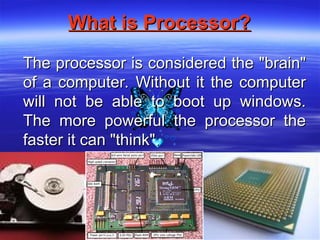
The processor is considered the "brain"
of a computer. Without it the computer
will not be able to boot up windows.
The more powerful the processor the
faster it can "think".
TYPES OF PROCESSOR
TYPES OF PROCESSOR
There are 3 types of Processors:
1.
1. AMD,
AMD,
2.
2. Intel and
Intel and
3.
3. Via.
Via.
there are single core, dual core, quad
core processors.
core processors.
to be able to use a PC with functions
FUNCTIONS OF PROCESSOR
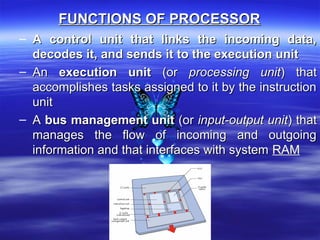
– A control unit that links the incoming data,
A control unit that links the incoming data,
decodes it, and sends it to the execution unit
– An
An execution unit
execution unit (or
(or processing unit
processing unit) that
) that
accomplishes tasks assigned to it by the instruction
unit
unit
– A
A bus management unit
bus management unit (or
(or input-output unit
input-output unit) that
) that
manages the flow of incoming and outgoing
information and that interfaces with system
information and that interfaces with system RAM
ROLE OF PROCESSOR
ROLE OF PROCESSOR
The processor plays a significant role in the
following important aspects of your computer
system:
system:
– Performance:
Performance: The processor is probably the
The processor is probably the
most important single determinant of system
performance in the PC. The processor's
capabilities dictate the maximum performance
of a system. The other devices only allow the
processor to reach its full potential.
– Software Support:
Software Support: Newer, faster processors
Newer, faster processors
enable the use of the latest software. In
addition, new processors such as the Pentium
with MMX Technology, enable the use of
specialized software not usable on earlier
machines.
machines.
ROLE OF PROCESSOR
ROLE OF PROCESSOR
– Reliability and Stability:
Reliability and Stability: The quality of the
The quality of the
processor is one factor that determines how
reliably your system will run.
– Energy Consumption and Cooling:
Energy Consumption and Cooling: Originally
Originally
processors consumed relatively little power
compared to other system devices. Power
consumption has an impact on everything
from cooling method selection to overall
system reliability.
system reliability.
– Motherboard Support:
Motherboard Support: The processor you
The processor you
decide to use in your system will be a major
determining factor in what sort of chipset you
must use, and hence what motherboard you
buy.
buy.
Challenge Areas in
Challenge Areas in
Processor
Processor
 Speed
 Power
 Workload Characterization
 Nanoscale Computing
CONCLUSION
CONCLUSION
 The Processor is a Brain of Computer
The Processor is a Brain of Computer
 It is the thing to Increase the Speed
It is the thing to Increase the Speed
 It CHALLANGES the Human in Speed &
It CHALLANGES the Human in Speed &
Memory
Memory
 “
“Throughout human history, we have
Throughout human history, we have
been dependent on machines to survive.
Fate, it seems, is not without a sense of
irony.”
irony.”
THANK YOU
THANK YOU
CREATED BY :
CREATED BY :
girls
girls

All about Processor and Rams in computer science

  • 1.
  • 2.
    CONTENTS CONTENTS  Introduction Introduction  Whatis Processor What is Processor  Types of Processor Types of Processor  Functions of Processor Functions of Processor  Role of Processor Role of Processor  Challenge Area in Processor Challenge Area in Processor  Conclusion Conclusion
  • 3.
    INTRODUCTION INTRODUCTION  The processor(really a short form for The processor (really a short form for microprocessor microprocessor and also often called the and also often called the CPU CPU or or central processing unit central processing unit) is the ) is the central component of the PC. It is the brain central component of the PC. It is the brain that runs the show inside the PC. All work that runs the show inside the PC. All work that you do on your computer is performed that you do on your computer is performed directly or indirectly by the processor. directly or indirectly by the processor. Obviously, it is one of the most important Obviously, it is one of the most important components of the PC components of the PC
  • 4.
    What is Processor? Whatis Processor? The processor is considered the "brain" The processor is considered the "brain" of a computer. Without it the computer of a computer. Without it the computer will not be able to boot up windows. will not be able to boot up windows. The more powerful the processor the The more powerful the processor the faster it can "think". faster it can "think".
  • 5.
    TYPES OF PROCESSOR TYPESOF PROCESSOR There are 3 types of Processors: There are 3 types of Processors: 1. 1. AMD, AMD, 2. 2. Intel and Intel and 3. 3. Via. Via. there are single core, dual core, quad there are single core, dual core, quad core processors. core processors. to be able to use a PC with functions to be able to use a PC with functions
  • 6.
    FUNCTIONS OF PROCESSOR FUNCTIONSOF PROCESSOR – A control unit that links the incoming data, A control unit that links the incoming data, decodes it, and sends it to the execution unit decodes it, and sends it to the execution unit – An An execution unit execution unit (or (or processing unit processing unit) that ) that accomplishes tasks assigned to it by the instruction accomplishes tasks assigned to it by the instruction unit unit – A A bus management unit bus management unit (or (or input-output unit input-output unit) that ) that manages the flow of incoming and outgoing manages the flow of incoming and outgoing information and that interfaces with system information and that interfaces with system RAM
  • 7.
    ROLE OF PROCESSOR ROLEOF PROCESSOR The processor plays a significant role in the The processor plays a significant role in the following important aspects of your computer following important aspects of your computer system: system: – Performance: Performance: The processor is probably the The processor is probably the most important single determinant of system most important single determinant of system performance in the PC. The processor's performance in the PC. The processor's capabilities dictate the maximum performance capabilities dictate the maximum performance of a system. The other devices only allow the of a system. The other devices only allow the processor to reach its full potential. processor to reach its full potential. – Software Support: Software Support: Newer, faster processors Newer, faster processors enable the use of the latest software. In enable the use of the latest software. In addition, new processors such as the Pentium addition, new processors such as the Pentium with MMX Technology, enable the use of with MMX Technology, enable the use of specialized software not usable on earlier specialized software not usable on earlier machines. machines.
  • 8.
    ROLE OF PROCESSOR ROLEOF PROCESSOR – Reliability and Stability: Reliability and Stability: The quality of the The quality of the processor is one factor that determines how processor is one factor that determines how reliably your system will run. reliably your system will run. – Energy Consumption and Cooling: Energy Consumption and Cooling: Originally Originally processors consumed relatively little power processors consumed relatively little power compared to other system devices. Power compared to other system devices. Power consumption has an impact on everything consumption has an impact on everything from cooling method selection to overall from cooling method selection to overall system reliability. system reliability. – Motherboard Support: Motherboard Support: The processor you The processor you decide to use in your system will be a major decide to use in your system will be a major determining factor in what sort of chipset you determining factor in what sort of chipset you must use, and hence what motherboard you must use, and hence what motherboard you buy. buy.
  • 9.
    Challenge Areas in ChallengeAreas in Processor Processor  Speed  Power  Workload Characterization  Nanoscale Computing
  • 10.
    CONCLUSION CONCLUSION  The Processoris a Brain of Computer The Processor is a Brain of Computer  It is the thing to Increase the Speed It is the thing to Increase the Speed  It CHALLANGES the Human in Speed & It CHALLANGES the Human in Speed & Memory Memory  “ “Throughout human history, we have Throughout human history, we have been dependent on machines to survive. been dependent on machines to survive. Fate, it seems, is not without a sense of Fate, it seems, is not without a sense of irony.” irony.”
  • 11.
    THANK YOU THANK YOU CREATEDBY : CREATED BY : girls girls