BLDEA’s Shri SanganabasavaMaha Swamiji College of Pharmacy
and Research Centre Vijayapur–586103
SUBJECT: CHEMISTRY OF NATURAL PRODUCTS
TOPIC : ALKALOID
Presented By
KAVYA.C.PUJARI
M.PHARMA 1st
Semester
Department of Pharmaceutical Chemistry
Submitted to
Dr. Somashekhar Metri M. PHARM, Ph D
Associate Professor & HOD
Department of Pharmaceutical Chemistry
BLDEA’s SSM College of Pharmacy and Research
Centre,Vijayapur – 586103 Karnata
2.
CONTENT
1. GENERAL INTRUDUCTION.
2.CLASSIFICATION.
3. ISOLATION OF ALKALOID.
4. STEREOCHEMISTRY.
5. GENERAL METHOD OF STRUCTURAL DETERMINATION OF ALKALOIDS.
6. STRUCTURAL ELUCIDATION OF
-EPHEDRINE
-MORPHINE
-ERGOT
-EMETINE
-RESERPINE.
3.
INTRUDUCTION:
Alkaloids are alarge and diverse group of naturally occurring organic compounds that are
primarily known for their biological activity.
These nitrogen-containing compounds are found in a variety of organisms, most commonly
in plants, but also in fungi, animals, and even bacteria.
-Source of alkaloids
Plants: The most abundant source, including families like Solanaceae (e.g., nicotine from
tobacco, atropine from belladonna), Papaveraceae (e.g., morphine from opium poppy), and
Rubiaceae (e.g., caffeine from coffee, quinine from cinchona).
Fungi: Certain fungi like Claviceps purpurea (ergot fungus) produce alkaloids such as
ergotamine and LSD, while Psilocybe species produce hallucinogenic compounds like
psilocybin.
Animals: Some amphibians and insects, such as poison dart frogs, produce toxic alkaloids
like batrachotoxin and bufotoxin.
Bacteria: Certain species of bacteria, especially Streptomyces, produce antibiotic alkaloids
like streptomycin.
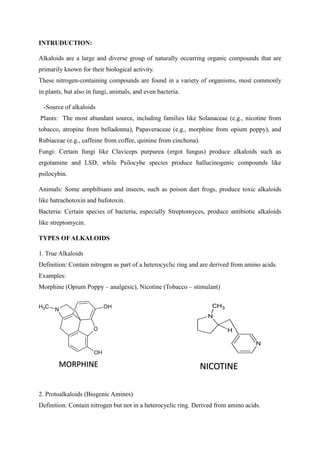
TYPES OFALKALOIDS
1. True Alkaloids
Definition: Contain nitrogen as part of a heterocyclic ring and are derived from amino acids.
Examples:
Morphine (Opium Poppy – analgesic), Nicotine (Tobacco – stimulant)
O
N
C
H3
OH
OH
N
N
H
CH3
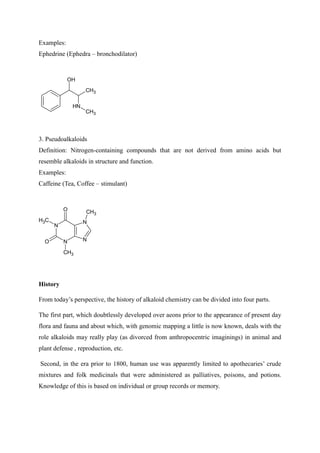
2. Protoalkaloids (Biogenic Amines)
Definition: Contain nitrogen but not in a heterocyclic ring. Derived from amino acids.
MORPHINE NICOTINE
4.
Examples:
Ephedrine (Ephedra –bronchodilator)
CH3
OH
N
H
CH3
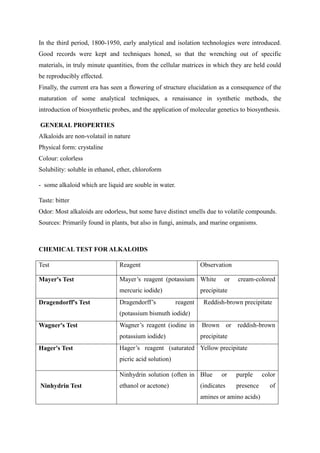
3. Pseudoalkaloids
Definition: Nitrogen-containing compounds that are not derived from amino acids but
resemble alkaloids in structure and function.
Examples:
Caffeine (Tea, Coffee – stimulant)
N
N
N
N
O
O
CH3
C
H3
CH3
History
From today’s perspective, the history of alkaloid chemistry can be divided into four parts.
The first part, which doubtlessly developed over aeons prior to the appearance of present day
flora and fauna and about which, with genomic mapping a little is now known, deals with the
role alkaloids may really play (as divorced from anthropocentric imaginings) in animal and
plant defense , reproduction, etc.
Second, in the era prior to 1800, human use was apparently limited to apothecaries’ crude
mixtures and folk medicinals that were administered as palliatives, poisons, and potions.
Knowledge of this is based on individual or group records or memory.
5.
In the thirdperiod, 1800-1950, early analytical and isolation technologies were introduced.
Good records were kept and techniques honed, so that the wrenching out of specific
materials, in truly minute quantities, from the cellular matrices in which they are held could
be reproducibly effected.
Finally, the current era has seen a flowering of structure elucidation as a consequence of the
maturation of some analytical techniques, a renaissance in synthetic methods, the
introduction of biosynthetic probes, and the application of molecular genetics to biosynthesis.
GENERAL PROPERTIES
Alkaloids are non-volatail in nature
Physical form: crystaline
Colour: colorless
Solubility: soluble in ethanol, ether, chloroform
- some alkaloid which are liquid are souble in water.
Taste: bitter
Odor: Most alkaloids are odorless, but some have distinct smells due to volatile compounds.
Sources: Primarily found in plants, but also in fungi, animals, and marine organisms.
CHEMICAL TEST FOR ALKALOIDS
Test Reagent Observation
Mayer's Test Mayer’s reagent (potassium
mercuric iodide)
White or cream-colored
precipitate
Dragendorff's Test Dragendorff’s reagent
(potassium bismuth iodide)
Reddish-brown precipitate
Wagner's Test Wagner’s reagent (iodine in
potassium iodide)
Brown or reddish-brown
precipitate
Hager's Test Hager’s reagent (saturated
picric acid solution)
Yellow precipitate
Ninhydrin Test
Ninhydrin solution (often in
ethanol or acetone)
Blue or purple color
(indicates presence of
amines or amino acids)
6.
Tannic Acid TestTannic acid solution
Precipitate or cloudiness
CLASSIFICATION OFALKALOIDS
1. Based on Chemical Structure
a. Indole Alkaloids
These alkaloids contain an indole ring, which is a fused structure made up of a benzene ring
and a nitrogen-containing pyrrole ring.
Examples:
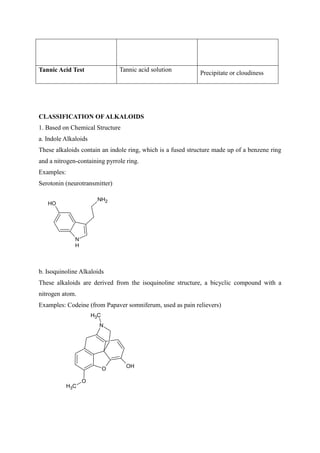
Serotonin (neurotransmitter)
b. Isoquinoline Alkaloids
These alkaloids are derived from the isoquinoline structure, a bicyclic compound with a
nitrogen atom.
Examples: Codeine (from Papaver somniferum, used as pain relievers)
O OH
O
C
H3
N
C
H3
7.
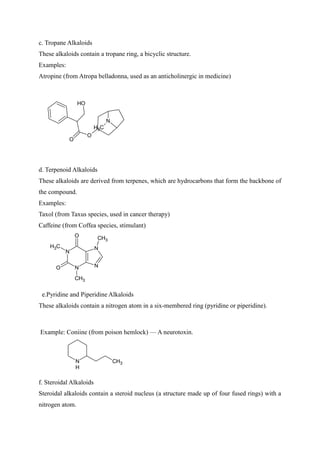
c. Tropane Alkaloids
Thesealkaloids contain a tropane ring, a bicyclic structure.
Examples:
Atropine (from Atropa belladonna, used as an anticholinergic in medicine)
O
O
O
H
N
C
H3
d. Terpenoid Alkaloids
These alkaloids are derived from terpenes, which are hydrocarbons that form the backbone of
the compound.
Examples:
Taxol (from Taxus species, used in cancer therapy)
Caffeine (from Coffea species, stimulant)
N
N
N
N
O
O
CH3
CH3
C
H3
e.Pyridine and Piperidine Alkaloids
These alkaloids contain a nitrogen atom in a six-membered ring (pyridine or piperidine).
Example: Coniine (from poison hemlock) — A neurotoxin.
N
H
CH3
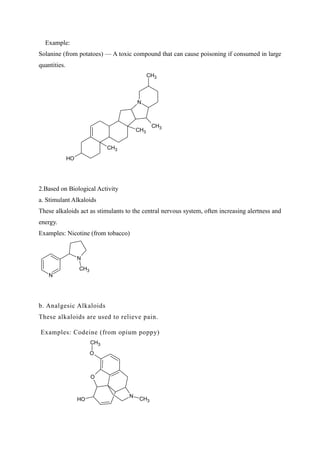
f. Steroidal Alkaloids
Steroidal alkaloids contain a steroid nucleus (a structure made up of four fused rings) with a
nitrogen atom.
8.
Example:
Solanine (from potatoes)— A toxic compound that can cause poisoning if consumed in large
quantities.
N
O
H
CH3
CH3
CH3
CH3
2.Based on Biological Activity
a. Stimulant Alkaloids
These alkaloids act as stimulants to the central nervous system, often increasing alertness and
energy.
Examples: Nicotine (from tobacco)
N
N
CH3
b. Analgesic Alkaloids
These alkaloids are used to relieve pain.
Examples: Codeine (from opium poppy)
O
O
H
O
CH3
N
CH3
9.
c. Hallucinogenic Alkaloids
Thesealkaloids induce altered states of consciousness or hallucinations.
e. Toxic Alkaloids
These alkaloids are highly toxic and can be fatal
Examples:
Psilocybin (from Psilocybe mushrooms)
N
H
O
P
O
O
H
OH
N
CH3
C
H3
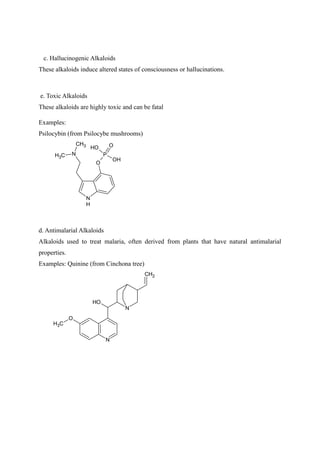
d. Antimalarial Alkaloids
Alkaloids used to treat malaria, often derived from plants that have natural antimalarial
properties.
Examples: Quinine (from Cinchona tree)
N
O
C
H3
N
CH2
O
H
10.
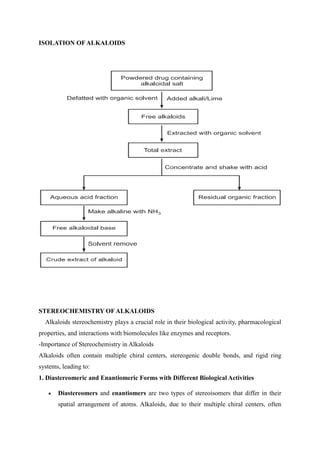
ISOLATION OFALKALOIDS
STEREOCHEMISTRY OFALKALOIDS
Alkaloids stereochemistry plays a crucial role in their biological activity, pharmacological
properties, and interactions with biomolecules like enzymes and receptors.
-Importance of Stereochemistry in Alkaloids
Alkaloids often contain multiple chiral centers, stereogenic double bonds, and rigid ring
systems, leading to:
1. Diastereomeric and Enantiomeric Forms with Different Biological Activities
Diastereomers and enantiomers are two types of stereoisomers that differ in their
spatial arrangement of atoms. Alkaloids, due to their multiple chiral centers, often
11.
exist as pairsof enantiomers (non-superimposable mirror images) or as diastereomers
(non-mirror image stereoisomers). These isomers can have vastly different biological
effects because their shape and size affect how they interact with biological targets,
such as enzymes, receptors, and DNA.
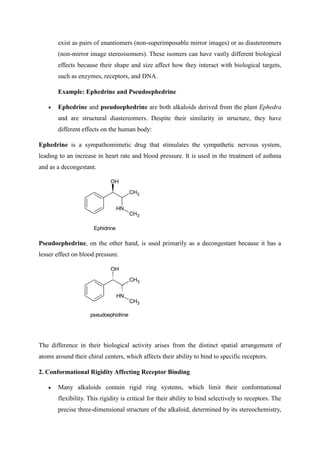
Example: Ephedrine and Pseudoephedrine
Ephedrine and pseudoephedrine are both alkaloids derived from the plant Ephedra
and are structural diastereomers. Despite their similarity in structure, they have
different effects on the human body:
Ephedrine is a sympathomimetic drug that stimulates the sympathetic nervous system,
leading to an increase in heart rate and blood pressure. It is used in the treatment of asthma
and as a decongestant.
CH3
N
H
CH3
OH
Ephidrine
Pseudoephedrine, on the other hand, is used primarily as a decongestant because it has a
lesser effect on blood pressure.
CH3
N
H
CH3
OH
pseudoephidrine
The difference in their biological activity arises from the distinct spatial arrangement of
atoms around their chiral centers, which affects their ability to bind to specific receptors.
2. Conformational Rigidity Affecting Receptor Binding
Many alkaloids contain rigid ring systems, which limit their conformational
flexibility. This rigidity is critical for their ability to bind selectively to receptors. The
precise three-dimensional structure of the alkaloid, determined by its stereochemistry,
12.
allows it tofit snugly into a receptor binding site, leading to specific biological
effects.
Example: Morphine
Morphine, a potent analgesic alkaloid derived from the poppy plant, has a rigid ring
structure that interacts specifically with opioid receptors in the brain. The
stereochemistry of morphine plays a crucial role in its ability to bind to these
receptors and produce its pain-relieving effects.
If the stereochemistry of morphine were altered (for example, by modifying the chiral
centers), its ability to bind to the opioid receptors could be reduced, making it less effective
or potentially more harmful.
The conformational rigidity of morphine also ensures that it doesn't bind indiscriminately to
other types of receptors, reducing unwanted side effects.
3. Optical Activity
Alkaloids are often optically active due to their chiral centers, meaning they can rotate
plane-polarized light. The direction and degree of rotation provide valuable
information about the structure and purity of the compound. Optical activity is widely
used in the characterization of alkaloids, especially in the pharmaceutical industry.
Example: Quinine
Quinine, an alkaloid derived from the bark of the cinchona tree, is known for its use
in treating malaria. The compound is optically active, and its specific rotation (the
degree to which it rotates plane-polarized light) can be used to confirm its identity and
purity.
o The (–)-quinine enantiomer is effective against malaria, while the (+)-quinine
enantiomer is much less active. The enantiomeric difference in optical rotation
directly correlates with its biological activity, emphasizing the importance of
stereochemistry in its therapeutic efficacy.
GENERAL METHODS OF STRUCTURE DETERMINATION OFALKALOIDS
In structure determination of alkaloids, a variety of general chemical methods and more
recently physical methods are employed.
In general, elemental composition is obtained from combustion analysis and after
13.
determination of molecularweight, molecular formula is calculated. The measurement of
optical rotation indicates the presence of optical activity.
• METHODS
– A. Chemical Methods
– B. Degradation of Alkaloids
– C. Physical Methods
A.CHEMICAL METHODS
The alkaloids mostly contains one or more oxygen atoms, which may be present as hydroxyl,
methoxy, methylenedioxy, carbonyl, carbonyl ester, lactone, amide, lactam, epoxide groups
or ether linkage.
i) Hydroxyl group
Molecule contains hydroxyl group or -NH group then the number of these groups can be
estimated by acetylation or Zerewitinoff's method.
Ex: Acetylation's method
R-OH + CH3 -CO-Cl → R-OCO-CH3
R-NH-R1 + CH3 -CO-Cl → R-N(COCH3 )-R1
ii) Carbonyl group
Ascertained by usual reactions with hydroxylamine, semicarbazide or 2,4-
dinitrophenyldrazine. The carbonyl group may be present as an aldehyde or a ketone. This
distinction can be made from Tollen's reagent and silver mirror.
Ex: Reaction with Hydroxylamine (Oxime Formation)
R2C=O+NH2OH→R2C=NOH+H2O
Forms oximes, confirming the presence of a carbonyl group (-C=O).
iii) Carboxyl group
Dissolved in bicarbonate or ammonia and reprecipitation with carbon dioxide indicates the
presence of carboxyl group. The formation of ester on treatment with alcohol in the presence
of dehydrating agent.
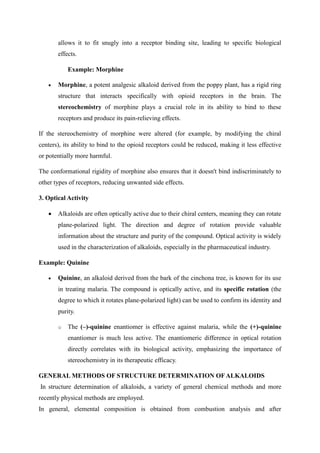
Example: Cocaine (Benzoylmethylecgonine)
Cocaine (C₁₇H₂₁NO₄) contains an ester (-COO-) and a carboxyl (-COOH) group in its
structure.
14.
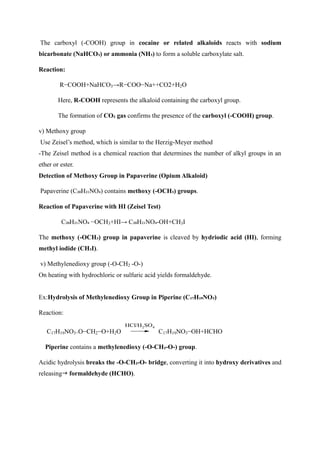
The carboxyl (-COOH)group in cocaine or related alkaloids reacts with sodium
bicarbonate (NaHCO₃) or ammonia (NH₃) to form a soluble carboxylate salt.
Reaction:
R−COOH+NaHCO3→R−COO−Na++CO2+H2O
Here, R-COOH represents the alkaloid containing the carboxyl group.
The formation of CO₂ gas confirms the presence of the carboxyl (-COOH) group.
v) Methoxy group
Use Zeisel’s method, which is similar to the Herzig-Meyer method
-The Zeisel method is a chemical reaction that determines the number of alkyl groups in an
ether or ester.
Detection of Methoxy Group in Papaverine (Opium Alkaloid)
Papaverine (C₂₀H₂₁NO₄) contains methoxy (-OCH₃) groups.
Reaction of Papaverine with HI (Zeisel Test)
C₂₀H₂₁NO₄ −OCH3+HI→ C₂₀H₂₁NO₄-OH+CH3I
The methoxy (-OCH₃) group in papaverine is cleaved by hydriodic acid (HI), forming
methyl iodide (CH₃I).
v) Methylenedioxy group (-O-CH2 -O-)
On heating with hydrochloric or sulfuric acid yields formaldehyde.
Ex:Hydrolysis of Methylenedioxy Group in Piperine (C₁₇H₁₉NO₃)
Reaction:
C17H19NO3−O−CH2−O+H2O
HCl/H2SO4
C17H19NO3−OH+HCHO
Piperine contains a methylenedioxy (-O-CH₂-O-) group.
Acidic hydrolysis breaks the -O-CH₂-O- bridge, converting it into hydroxy derivatives and
releasing formaldehyde (HCHO).
15.
vi) Amide, lactam,ester, lactone groups
Be detected and estimated through acid or alkaline hydrolysis
Functional Group
Acidic Hydrolysis
Product
Alkaline Hydrolysis Product
Amide (-CONH₂)
Carboxylic Acid +
Ammonium Salt
Carboxylate Salt + Ammonia
Lactam (Cyclic Amide) Amino Acid Amino Acid Salt
Ester (-COOR)
Carboxylic Acid +
Alcohol
Carboxylate Salt + Alcohol
Lactone (Cyclic Ester) Hydroxy Acid Hydroxy Carboxylate Salt
vii) Epoxide and ether linkage
Be cleaved by the addition of hydrogen bromide or hydroiodic acid.
Example: Epoxide (Ethylene Oxide) Cleavage by HBr
C2H4O+HBr→C2H5Br+H2O
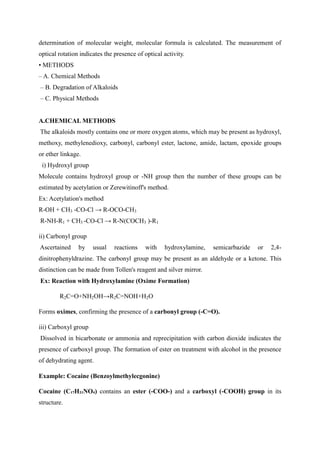
B.DEGRADATION OFALKALOIDS
Hofmann exhaustive methylation
•It consists in opening of the heterocyclic ring with elimination of ‘N’ to give a carbon
fraction.
•In this method, the alkaloid is first hydrogenated (if it is unsaturated) and then converted
into quaternary methyl ammonium hydroxide, which on heating loses a molecule of water.
C4H9N + 3CH3I →[C4H9N(CH3)3] + I−
[C4H9N(CH3)3] + I−
+ Ag2O + H2O → [C4H9N(CH3)3] + OH−
•The hydroxyl group is eliminated from tetra methyl ammonium hydroxide and the hydrogen
atom from the position with respect to the ‘N’ atom resulting in ring opening at the “N’ atom
on the same side from which the hydrogen was eliminated.
16.
[C4H9N(CH3)3] + OH−
CH2=CH−CH3+N(CH3)3+H2O
•The process is repeated on the formed product till the ‘N’ is eliminated & an unsaturated
hydrocarbon is left which isomerizes to a conjugated diene.
C.PHYSICAL METHODS
Recently physical methods are used, in conjunction with chemical reactions to elucidate
structure of alkaloids and it is possible to determine a structure in a matter of days given a
few milligrams(or less) of a pure compound.
• Infrared spectrum:Gives information about many functional groups
• Ultraviolet spectra:Used to indicate the nature of unsaturation or aromatic rings
• NMR spectroscopy:More versatile for detecting many function groups, the nature of
protons, carbons, heterocyclic rings etc
.• Mass spectra:The fragmentation gives the information about molecular weight and
degradation of the skeleton.
Single crystal X-ray analysis: Offers means for determining or confirming stereochemistry as
well as distinguishing between alternate structures that appear to fit well for a particular
alkaloid.
optical rotatory dispersion or circular dichroism: Further support for the stereochemistry
STRUCTURAL ELUCIDATION OFALKALOIDS
EPHEDRINE
Ephedrine is a naturally occurring alkaloid found in Ephedra species. It is a sympathomimetic
amine used in bronchodilators and nasal decongestants. Structurally, ephedrine is related to
amphetamines and possesses both hydroxyl (-OH) and amine (-NH) functional groups.
STRUCTURAL MODIFICATION
Elemental Analysis & Mass Spectrometry (MS)
Carbon (C), Hydrogen (H), Oxygen (O), and Nitrogen (N) are determined.
Molecular formula: C₁₀H₁₅NO
Molecular weight: 165 Da
17.
CH3
N
H
CH3
OH
Ephidrine
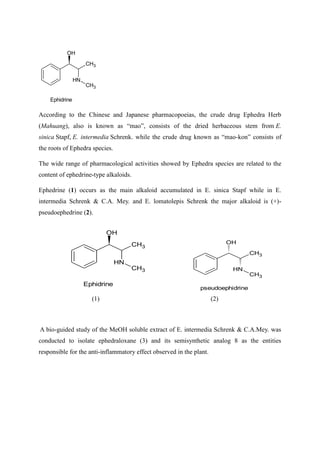
According to theChinese and Japanese pharmacopoeias, the crude drug Ephedra Herb
(Mahuang), also is known as “mao”, consists of the dried herbaceous stem from E.
sinica Stapf, E. intermedia Schrenk. while the crude drug known as “mao-kon” consists of
the roots of Ephedra species.
The wide range of pharmacological activities showed by Ephedra species are related to the
content of ephedrine-type alkaloids.
Ephedrine (1) occurs as the main alkaloid accumulated in E. sinica Stapf while in E.
intermedia Schrenk & C.A. Mey. and E. lomatolepis Schrenk the major alkaloid is (+)-
pseudoephedrine (2).
CH3
N
H
CH3
OH
pseudoephidrine
(1) (2)
A bio-guided study of the MeOH soluble extract of E. intermedia Schrenk & C.A.Mey. was
conducted to isolate ephedraloxane (3) and its semisynthetic analog 8 as the entities
responsible for the anti-inflammatory effect observed in the plant.
CH3
N
H
CH3
OH
Ephidrine
18.
C
H3
O
N
O
CH3
Ephedraloxane
(3)
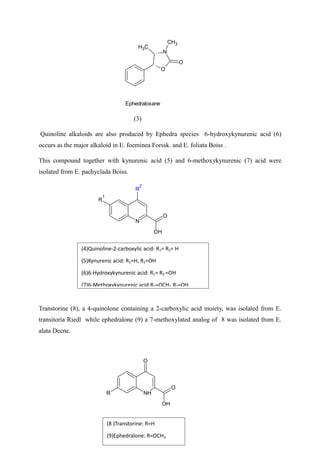
Quinoline alkaloids arealso produced by Ephedra species 6-hydroxykynurenic acid (6)
occurs as the major alkaloid in E. foeminea Forssk. and E. foliata Boiss .
This compound together with kynurenic acid (5) and 6-methoxykynurenic (7) acid were
isolated from E. pachyclada Boiss.
N
R
2
R
1
O
OH
Transtorine (8), a 4-quinolone containing a 2-carboxylic acid moiety, was isolated from E.
transitoria Riedl while ephedralone (9) a 7-methoxylated analog of 8 was isolated from E.
alata Decne.
NH
O
OH
O
R
(4)Quinoline-2-carboxylic acid: R1= R2= H
(5)Kynurenic acid: R1=H, R2=OH
(6)6-Hydroxykynurenic acid: R1= R2 =OH
(7)6-Methoxykynurenic acid:R1=OCH3, R2=OH
(8 )Transtorine: R=H
(9)Ephedralone: R=OCH3
19.
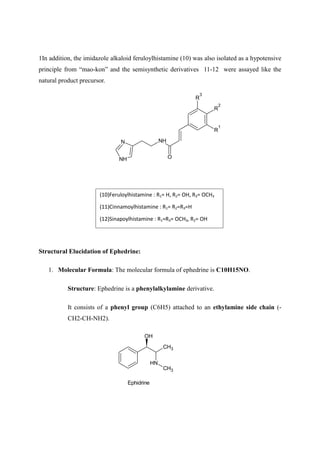
1In addition, theimidazole alkaloid feruloylhistamine (10) was also isolated as a hypotensive
principle from “mao-kon” and the semisynthetic derivatives 11-12 were assayed like the
natural product precursor.
N
NH
NH
O
R
1
R
2
R
3
Structural Elucidation of Ephedrine:
1. Molecular Formula: The molecular formula of ephedrine is C10H15NO.
Structure: Ephedrine is a phenylalkylamine derivative.
It consists of a phenyl group (C6H5) attached to an ethylamine side chain (-
CH2-CH-NH2).
CH3
N
H
CH3
OH
Ephidrine
(10)Feruloylhistamine : R1= H, R2= OH, R3= OCH3
(11)Cinnamoylhistamine : R1= R2=R3=H
(12)Sinapoylhistamine : R1=R3= OCH3, R2= OH
20.
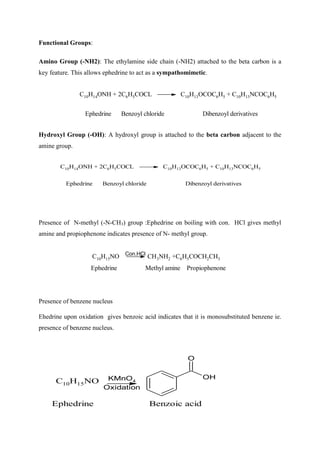
Functional Groups:
Amino Group(-NH2): The ethylamine side chain (-NH2) attached to the beta carbon is a
key feature. This allows ephedrine to act as a sympathomimetic.
C10H14ONH + 2C6H5COCL C10H13OCOC6H5 + C10H13NCOC6H5
Ephedrine Benzoyl chloride Dibenzoyl derivatives
Hydroxyl Group (-OH): A hydroxyl group is attached to the beta carbon adjacent to the
amine group.
C10H14ONH + 2C6H5COCL C10H13OCOC6H5 + C10H13NCOC6H5
Ephedrine Benzoyl chloride Dibenzoyl derivatives
Presence of N-methyl (-N-CH3) group :Ephedrine on boiling with con. HCl gives methyl
amine and propiophenone indicates presence of N- methyl group.
C10H15NO CH3NH2 +C6H5COCH2CH3
Con.HCl
Ephedrine Methyl amine Propiophenone
Presence of benzene nucleus
Ehedrine upon oxidation gives benzoic acid indicates that it is monosubstituted benzene ie.
presence of benzene nucleus.
C10H15NO
O
OH
KMnO4
Oxidation
Ephedrine Benzoic acid
21.
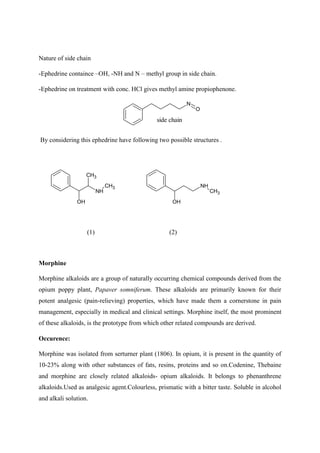
Nature of sidechain
-Ephedrine containce –OH, -NH and N – methyl group in side chain.
-Ephedrine on treatment with conc. HCl gives methyl amine propiophenone.
N
O
side chain
By considering this ephedrine have following two possible structures .
CH3
NH
OH
CH3
OH
NH
CH3
(1) (2)
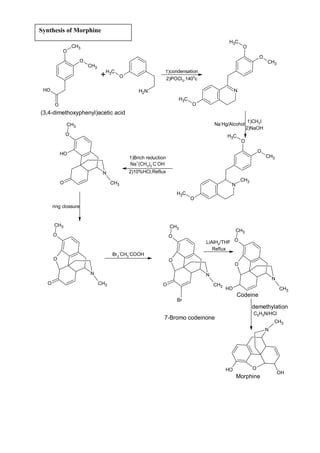
Morphine
Morphine alkaloids are a group of naturally occurring chemical compounds derived from the
opium poppy plant, Papaver somniferum. These alkaloids are primarily known for their
potent analgesic (pain-relieving) properties, which have made them a cornerstone in pain
management, especially in medical and clinical settings. Morphine itself, the most prominent
of these alkaloids, is the prototype from which other related compounds are derived.
Occurence:
Morphine was isolated from serturner plant (1806). In opium, it is present in the quantity of
10-23% along with other substances of fats, resins, proteins and so on.Codenine, Thebaine
and morphine are closely related alkaloids- opium alkaloids. It belongs to phenanthrene
alkaloids.Used as analgesic agent.Colourless, prismatic with a bitter taste. Soluble in alcohol
and alkali solution.
22.
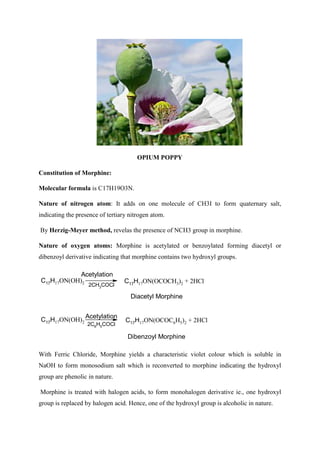
OPIUM POPPY
Constitution ofMorphine:
Molecular formula is C17H19O3N.
Nature of nitrogen atom: It adds on one molecule of CH3I to form quaternary salt,
indicating the presence of tertiary nitrogen atom.
By Herzig-Meyer method, revelas the presence of NCH3 group in morphine.
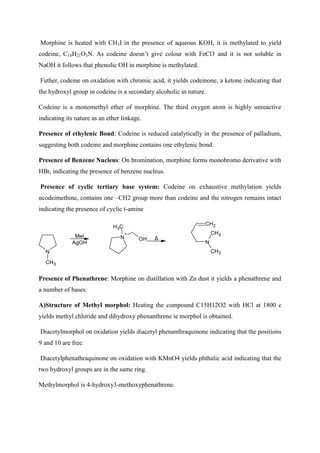
Nature of oxygen atoms: Morphine is acetylated or benzoylated forming diacetyl or
dibenzoyl derivative indicating that morphine contains two hydroxyl groups.
C17H17ON(OH)2 C17H17ON(OCOCH3)2 + 2HCl
2CH3COCl
Acetylation
Diacetyl Morphine
C17H17ON(OH)2 C17H17ON(OCOC6H5)2 + 2HCl
Acetylation
2C6H5COCl
Dibenzoyl Morphine
With Ferric Chloride, Morphine yields a characteristic violet colour which is soluble in
NaOH to form monosodium salt which is reconverted to morphine indicating the hydroxyl
group are phenolic in nature.
Morphine is treated with halogen acids, to form monohalogen derivative ie., one hydroxyl
group is replaced by halogen acid. Hence, one of the hydroxyl group is alcoholic in nature.
23.
Morphine is heatedwith CH3I in the presence of aqueous KOH, it is methylated to yield
codeine, C18H21O3N. As codeine doesn’t give colour with FeCl3 and it is not soluble in
NaOH it follows that phenolic OH in morphine is methylated.
Futher, codeine on oxidation with chromic acid, it yields codeinone, a ketone indicating that
the hydroxyl group in codeine is a secondary alcoholic in nature.
Codeine is a monomethyl ether of morphine. The third oxygen atom is highly unreactive
indicating its nature as an ether linkage.
Presence of ethylenic Bond: Codeine is reduced catalytically in the presence of palladium,
suggesting both codeine and morphine contains one ethylenic bond.
Presence of Benzene Nucleus: On bromination, morphine forms monobromo derivative with
HBr, indicating the presence of benzene nucleus.
Presence of cyclic tertiary base system: Codeine on exhaustive methylation yields
αcodeimethine, contains one –CH2 group more than codeine and the nitrogen remains intact
indicating the presence of cyclic t-amine
N
CH3
MeI
AgOH
N
+
C
H3
OH Δ
N
CH3
CH3
CH2
Presence of Phenathrene: Morphine on distillation with Zn dust it yields a phenathrene and
a number of bases.
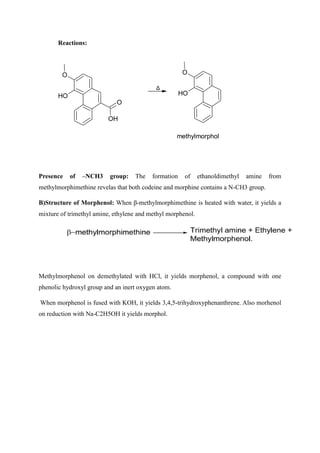
A)Structure of Methyl morphol: Heating the compound C15H12O2 with HCl at 1800 c
yields methyl chloride and dihydroxy phenanthrene ie morphol is obtained.
Diacetylmorphol on oxidation yields diacetyl phenanthraquinone indicating that the positions
9 and 10 are free.
Diacetylphenathraquinone on oxidation with KMnO4 yields phthalic acid indicating that the
two hydroxyl groups are in the same ring.
Methylmorphol is 4-hydroxy3-methoxyphenathrene.
24.
Reactions:
O
OH
O
O
H
Δ
O
O
H
methylmorphol
Presence of –NCH3group: The formation of ethanoldimethyl amine from
methylmorphimethine revelas that both codeine and morphine contains a N-CH3 group.
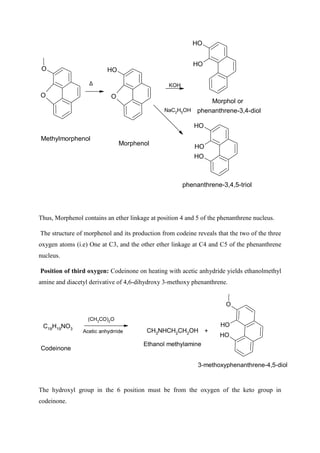
B)Structure of Morphenol: When β-methylmorphimethine is heated with water, it yields a
mixture of trimethyl amine, ethylene and methyl morphenol.
Methylmorphenol on demethylated with HCl, it yields morphenol, a compound with one
phenolic hydroxyl group and an inert oxygen atom.
When morphenol is fused with KOH, it yields 3,4,5-trihydroxyphenanthrene. Also morhenol
on reduction with Na-C2H5OH it yields morphol.
25.
Δ
O
O
O
H
O
KOH
NaC2H5OH
O
H
O
H
O
H
O
H
O
H
Methylmorphenol
Morphenol
Morphol or
phenanthrene-3,4,5-triol
phenanthrene-3,4-diol
Thus, Morphenolcontains an ether linkage at position 4 and 5 of the phenanthrene nucleus.
The structure of morphenol and its production from codeine reveals that the two of the three
oxygen atoms (i.e) One at C3, and the other ether linkage at C4 and C5 of the phenanthrene
nucleus.
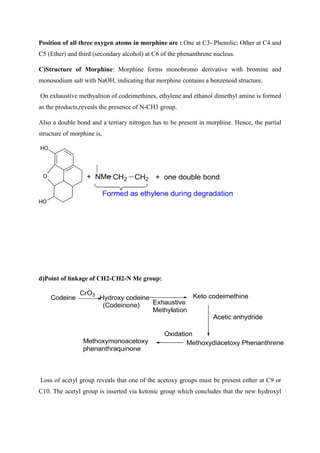
Position of third oxygen: Codeinone on heating with acetic anhydride yields ethanolmethyl
amine and diacetyl derivative of 4,6-dihydroxy 3-methoxy phenanthrene.
C18H19NO3
(CH3CO)2O
Acetic anhydrride CH3NHCH2CH2OH
O
O
H
O
H
+
3-methoxyphenanthrene-4,5-diol
Ethanol methylamine
Codeinone
The hydroxyl group in the 6 position must be from the oxygen of the keto group in
codeinone.
26.
Position of allthree oxygen atoms in morphine are : One at C3- Phenolic; Other at C4 and
C5 (Ether) and third (secondary alcohol) at C6 of the phenanthrene nucleus.
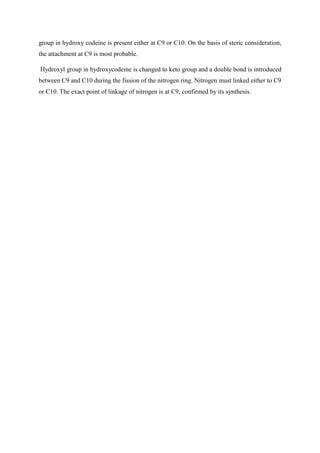
C)Structure of Morphine: Morphine forms monobromo derivative with bromine and
monosodium salt with NaOH, indicating that morphine contains a benzenoid structure.
On exhaustive methyaltion of codeimethines, ethylene and ethanol dimethyl amine is formed
as the products,reveals the presence of N-CH3 group.
Also a double bond and a tertiary nitrogen has to be present in morphine. Hence, the partial
structure of morphine is,
O
H
O
H
O
d)Point of linkage of CH2-CH2-N Me group:
Loss of acetyl group reveals that one of the acetoxy groups must be present either at C9 or
C10. The acetyl group is inserted via ketonic group which concludes that the new hydroxyl
27.
group in hydroxycodeine is present either at C9 or C10. On the basis of steric consideration,
the attachment at C9 is most probable.
Hydroxyl group in hydroxycodeine is changed to keto group and a double bond is introduced
between C9 and C10 during the fission of the nitrogen ring. Nitrogen must linked either to C9
or C10. The exact point of linkage of nitrogen is at C9, confirmed by its synthesis.
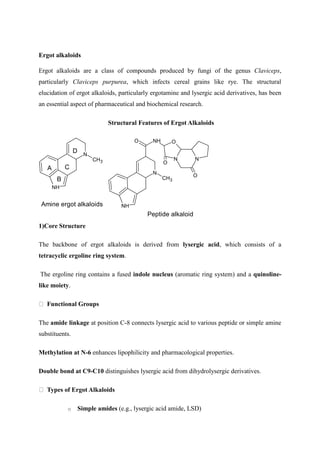
Ergot alkaloids
Ergot alkaloidsare a class of compounds produced by fungi of the genus Claviceps,
particularly Claviceps purpurea, which infects cereal grains like rye. The structural
elucidation of ergot alkaloids, particularly ergotamine and lysergic acid derivatives, has been
an essential aspect of pharmaceutical and biochemical research.
Structural Features of Ergot Alkaloids
N
NH
CH3
NH O
N N
O
O
O
Peptide alkaloid
1)Core Structure
The backbone of ergot alkaloids is derived from lysergic acid, which consists of a
tetracyclic ergoline ring system.
The ergoline ring contains a fused indole nucleus (aromatic ring system) and a quinoline-
like moiety.
Functional Groups
The amide linkage at position C-8 connects lysergic acid to various peptide or simple amine
substituents.
Methylation at N-6 enhances lipophilicity and pharmacological properties.
Double bond at C9-C10 distinguishes lysergic acid from dihydrolysergic derivatives.
Types of Ergot Alkaloids
o Simple amides (e.g., lysergic acid amide, LSD)
N
NH
CH3
A
B
C
D
Amine ergot alkaloids
30.
o Peptide alkaloids(e.g., ergotamine, ergometrine)
o Clavine alkaloids (e.g., agroclavine, elymoclavine)
1. Chemical Structure of Ergotamine
Molecular Formula: C₃₃H₃₅N₅O₅
Molecular Weight: 581.66 g/mol
Core Features:
Ergoline Ring System (Tetracyclic structure: A, B, C, and D rings).
Lysergic Acid Backbone (Indole-derived nucleus).
Peptide Moiety (L-alanine, Phenylalanine, and Proline).
Amide Functional Group (Connecting lysergic acid to the peptide).
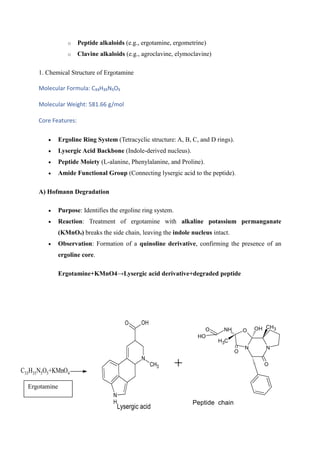
A) Hofmann Degradation
Purpose: Identifies the ergoline ring system.
Reaction: Treatment of ergotamine with alkaline potassium permanganate
(KMnO₄) breaks the side chain, leaving the indole nucleus intact.
Observation: Formation of a quinoline derivative, confirming the presence of an
ergoline core.
Ergotamine+KMnO4→Lysergic acid derivative+degraded peptide
NH O
N N
O
O
O
C
H3
OH CH3
O
H
Peptide chain
N
N
H
CH3
O OH
Lysergic acid
C33H35N5O5+KMnO4
Ergotamine
+
31.
B) Acid Hydrolysis(Identifies Peptide and Amide Moieties)
Purpose: Hydrolyzes the amide bond to release lysergic acid and amino acids.
Reaction: Treatment with 6M HCl at 100°C produces:
o Lysergic acid (confirms ergoline nucleus).
o Amino acids (alanine, phenylalanine, proline).
Ergotamine+HCl→Lysergic Acid+Amino Acids
Analysis: The amino acids are identified using Thin-Layer Chromatography
(TLC), High-Performance Liquid Chromatography (HPLC), or NMR.
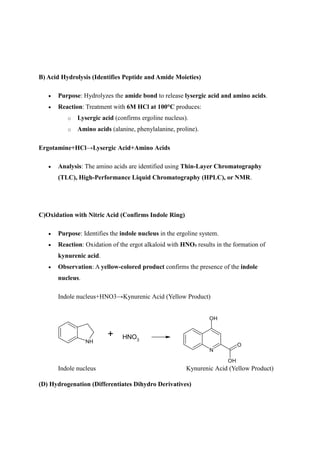
C)Oxidation with Nitric Acid (Confirms Indole Ring)
Purpose: Identifies the indole nucleus in the ergoline system.
Reaction: Oxidation of the ergot alkaloid with HNO₃ results in the formation of
kynurenic acid.
Observation: A yellow-colored product confirms the presence of the indole
nucleus.
Indole nucleus+HNO3→Kynurenic Acid (Yellow Product)
NH
+ HNO3
N
O
OH
OH
Indole nucleus Kynurenic Acid (Yellow Product)
(D) Hydrogenation (Differentiates Dihydro Derivatives)
32.
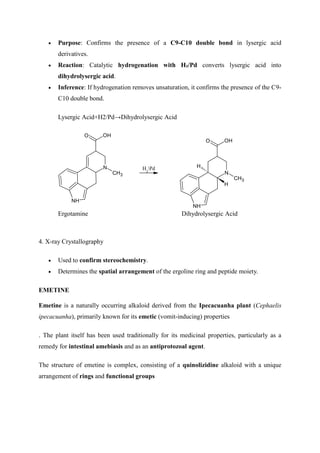
Purpose: Confirmsthe presence of a C9-C10 double bond in lysergic acid
derivatives.
Reaction: Catalytic hydrogenation with H₂/Pd converts lysergic acid into
dihydrolysergic acid.
Inference: If hydrogenation removes unsaturation, it confirms the presence of the C9-
C10 double bond.
Lysergic Acid+H2/Pd→Dihydrolysergic Acid
N
NH
CH3
O OH
H2
Pd
N
NH
CH3
O OH
H
H
Ergotamine Dihydrolysergic Acid
4. X-ray Crystallography
Used to confirm stereochemistry.
Determines the spatial arrangement of the ergoline ring and peptide moiety.
EMETINE
Emetine is a naturally occurring alkaloid derived from the Ipecacuanha plant (Cephaelis
ipecacuanha), primarily known for its emetic (vomit-inducing) properties
. The plant itself has been used traditionally for its medicinal properties, particularly as a
remedy for intestinal amebiasis and as an antiprotozoal agent.
The structure of emetine is complex, consisting of a quinolizidine alkaloid with a unique
arrangement of rings and functional groups
33.
Emetine has foundclinical use as a treatment for amebic dysentery and amoebiasis,
caused by the protozoan Entamoeba histolytica, but its use has become less common due to
side effects and the availability of more effective treatments.
STRUCTURAL ELUCIDATION OF EMETINE
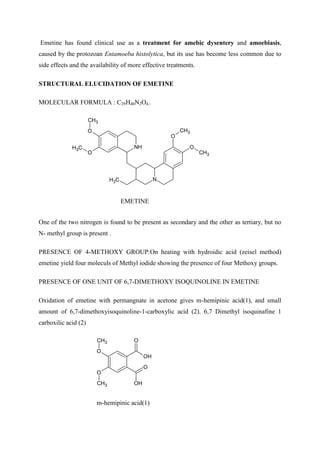
MOLECULAR FORMULA : C29H40N2O4.
NH
N
O
O
O
O
CH3
C
H3
C
H3
CH3
CH3
EMETINE
One of the two nitrogen is found to be present as secondary and the other as tertiary, but no
N- methyl group is present .
PRESENCE OF 4-METHOXY GROUP:On heating with hydroidic acid (zeisel method)
emetine yield four moleculs of Methyl iodide showing the presence of four Methoxy groups.
PRESENCE OF ONE UNIT OF 6,7-DIMETHOXY ISOQUINOLINE IN EMETINE
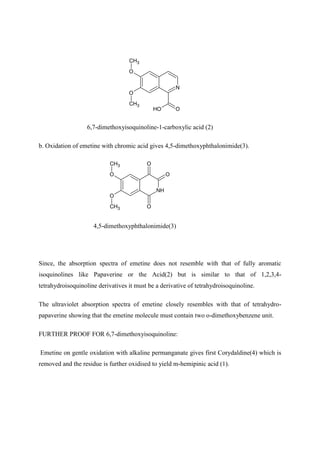
Oxidation of emetine with permangnate in acetone gives m-hemipinic acid(1), and small
amount of 6,7-dimethoxyisoquinoline-1-carboxylic acid (2). 6,7 Dimethyl isoquinafine 1
carboxilic acid (2)
O
OH
O
OH
O
O
CH3
CH3
m-hemipinic acid(1)
34.
N
O
O
CH3
CH3
O
O
H
6,7-dimethoxyisoquinoline-1-carboxylic acid (2)
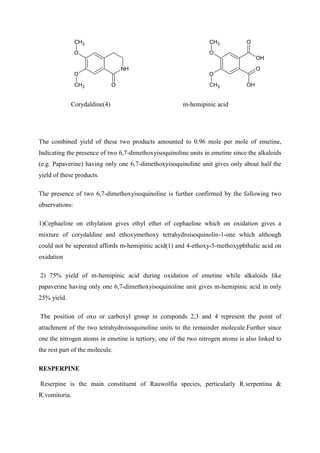
b.Oxidation of emetine with chromic acid gives 4,5-dimethoxyphthalonimide(3).
NH
O
O
CH3
CH3
O
O
O
4,5-dimethoxyphthalonimide(3)
Since, the absorption spectra of emetine does not resemble with that of fully aromatic
isoquinolines like Papaverine or the Acid(2) but is similar to that of 1,2,3,4-
tetrahydroisoquinoline derivatives it must be a derivative of tetrahydroisoquinoline.
The ultraviolet absorption spectra of emetine closely resembles with that of tetrahydro-
papaverine showing that the emetine molecule must contain two o-dimethoxybenzene unit.
FURTHER PROOF FOR 6,7-dimethoxyisoquinoline:
Emetine on gentle oxidation with alkaline permanganate gives first Corydaldine(4) which is
removed and the residue is further oxidised to yield m-hemipinic acid (1).
35.
NH
O
O
O
CH3
CH3
O
OH
O
OH
O
O
CH3
CH3
Corydaldine(4) m-hemipinic acid
Thecombined yield of these two products amounted to 0.96 mole per mole of emetine,
Indicating the presence of two 6,7-dimethoxyisoquinoline units in emetine since the alkaloids
(e.g. Papaverine) having only one 6,7-dimethoxyisoquinoline unit gives only about half the
yield of these products.
The presence of two 6,7-dimethoxyisoquinoline is further confirmed by the following two
observations:
1)Cephaeline on ethylation gives ethyl ether of cephaeline which on oxidation gives a
mixture of corydaldine and ethoxymethoxy tetrahydroisoquinolin-1-one which although
could not be seperated affords m-hemipinic acid(1) and 4-ethoxy-5-methoxyphthalic acid on
oxidation
2) 75% yield of m-hemipinic acid during oxidation of emetine while alkaloids like
papaverine having only one 6,7-dimethoxyisoquinoline unit gives m-hemipinic acid in only
25% yield.
The position of oxo or carboxyl group in componds 2,3 and 4 represent the point of
attachment of the two tetrahydroisoquinoline units to the remainder molecule.Further since
one the nitrogen atoms in emetine is tertiory, one of the two nitrogen atoms is also linked to
the rest part of the molecule.
RESPERPINE
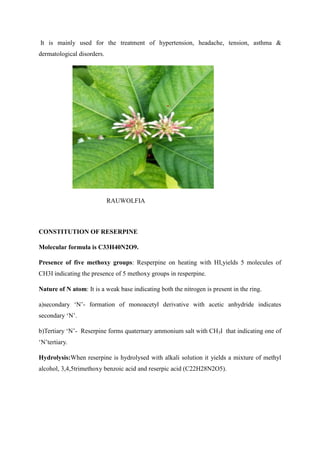
Reserpine is the main constituent of Rauwolfia species, perticularly R.serpentina &
R.vomitoria.
36.
It is mainlyused for the treatment of hypertension, headache, tension, asthma &
dermatological disorders.
RAUWOLFIA
CONSTITUTION OF RESERPINE
Molecular formula is C33H40N2O9.
Presence of five methoxy groups: Resperpine on heating with HI,yields 5 molecules of
CH3I indicating the presence of 5 methoxy groups in resperpine.
Nature of N atom: It is a weak base indicating both the nitrogen is present in the ring.
a)secondary ‘N’- formation of monoacetyl derivative with acetic anhydride indicates
secondary ‘N’.
b)Tertiary ‘N’- Reserpine forms quaternary ammonium salt with CH3I that indicating one of
‘N’tertiary.
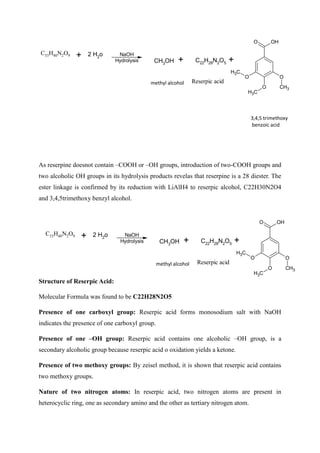
Hydrolysis:When reserpine is hydrolysed with alkali solution it yields a mixture of methyl
alcohol, 3,4,5trimethoxy benzoic acid and reserpic acid (C22H28N2O5).
37.
C33H40N2O9 + 2H2o NaOH
Hydrolysis CH3OH + C22H28N2O5 +
O OH
O
C
H3
O
O
CH3
C
H3
Reserpic acid
methyl alcohol
3,4,5 trimethoxy
benzoic acid
As reserpine doesnot contain –COOH or –OH groups, introduction of two-COOH groups and
two alcoholic OH groups in its hydrolysis products revelas that reserpine is a 28 diester. The
ester linkage is confirmed by its reduction with LiAlH4 to reserpic alcohol, C22H30N2O4
and 3,4,5trimethoxy benzyl alcohol.
Structure of Reserpic Acid:
Molecular Formula was found to be C22H28N2O5
Presence of one carboxyl group: Reserpic acid forms monosodium salt with NaOH
indicates the presence of one carboxyl group.
Presence of one –OH group: Reserpic acid contains one alcoholic –OH group, is a
secondary alcoholic group because reserpic acid o oxidation yields a ketone.
Presence of two methoxy groups: By zeisel method, it is shown that reserpic acid contains
two methoxy groups.
Nature of two nitrogen atoms: In reserpic acid, two nitrogen atoms are present in
heterocyclic ring, one as secondary amino and the other as tertiary nitrogen atom.
C33H40N2O9 + 2 H2o NaOH
Hydrolysis CH3OH + C22H28N2O5 +
O OH
O
C
H3
O
O
CH3
C
H3
Reserpic acid
methyl alcohol
38.
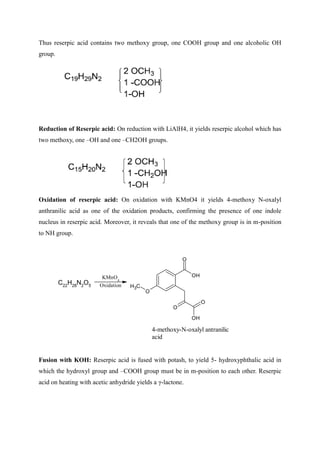
Thus reserpic acidcontains two methoxy group, one COOH group and one alcoholic OH
group.
Reduction of Reserpic acid: On reduction with LiAlH4, it yields reserpic alcohol which has
two methoxy, one –OH and one –CH2OH groups.
Oxidation of reserpic acid: On oxidation with KMnO4 it yields 4-methoxy N-oxalyl
anthranilic acid as one of the oxidation products, confirming the presence of one indole
nucleus in reserpic acid. Moreover, it reveals that one of the methoxy group is in m-position
to NH group.
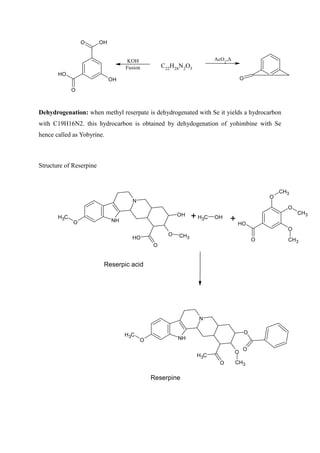
Fusion with KOH: Reserpic acid is fused with potash, to yield 5- hydroxyphthalic acid in
which the hydroxyl group and –COOH group must be in m-position to each other. Reserpic
acid on heating with acetic anhydride yields a γ-lactone.
C22
H28
N2
O5
KMnO4
Oxidation
O
OH
O
C
H3
O
O
OH
4-methoxy-N-oxalyl antranilic
acid
39.
O OH
O
O
H
OH
KOH
Fusion C22H28N2O5
AcO2
,Δ
O
Dehydrogenation:when methyl reserpate is dehydrogenated with Se it yields a hydrocarbon
with C19H16N2. this hydrocarbon is obtained by dehydogenation of yohimbine with Se
hence called as Yobyrine.
Structure of Reserpine
O
C
H3 NH
N
OH
O
O
O
H CH3
+ C
H3 OH
+
O
O
H
O
CH3
O
CH3
O
CH3
Reserpic acid
O
C
H3 NH
N
O
O
O
C
H3
CH3
O
Reserpine
40.
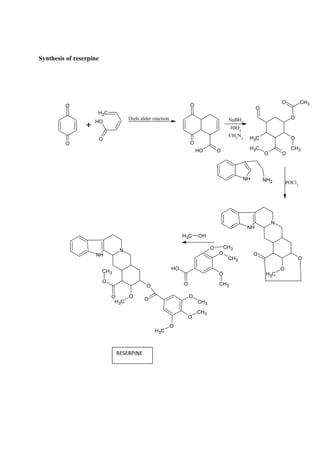
Synthesis of reserpine
O
O
+
C
H2
O
O
H
Dielsalder reaction
O
O
O
O
H
NaBH4
HIO4
CH2
N2
O
O
CH3
O
CH3
O
O
C
H3
C
H3
O
POCl3
NH NH2
NH
N
O
C
H3
O
O
C
H3 OH
O
O
H
O
CH3
O
CH3
O CH3
NH
N
O
C
H3
O
O
O
O
O
O
O
O
O
O
O
O
O
O
O
O
O
O
O
O
O
O
O
O
CH3
O
O
CH3
O
C
H3
O
CH3
RESERPINE
41.
REFFERANCE
1.Hong, H.; Chen,H.B.; Yang, D.H.; Shang, M.Y.; Wang, X.; Cai, S.Q.; Mikage, M.
Comparison of contentsof five ephedrine alkaloids in three o_cial origins of Ephedra Herb in
China by high-performance liquidchromatography. J. Nat. Med. 2011, 65, 623–628.
[CrossRef] [PubMed]
2.Tamada, M.; Endo, K.; Hikino, H.; Kabuto, C. Structure of ephedradine A, a hypotensive
principle of Ephedra
roots. Tetrahedron Lett. 1979, 84, 873–876. [CrossRef]
3. Krizevski, R.; Bar, E.; Shalit, O.; Sitrit, Y.; Ben-Shabat, S.; Lewinsohn, E. Composition
and stereochemistry of
ephedrine alkaloids accumulation in Ephedra sinica Stapf. Phytochemistry 2010, 71, 895–
903. [CrossRef]
5.Konno, C.; Taguchi, T.; Tamada, M.; Hikino, H. Ephedroxane, anti-inflammatory principle
from Ephedra herbs. Phytochemistry 1979, 18, 697–698. [CrossRef]
6. Starratt, A.N.; Caveney, S. Quinoline 2-carboxylic acids from Ephedra species.
Phytochemistry 1996, 42, 1477–1478. [CrossRef]
7.Al-Khalil, S.; Alkofahi, A.; El-Eisawi, D.; Shibib, A. Transtorine, a new quinoline alkaloid
from Ephedra transitoria. J. Nat. Prod. 1998, 61, 262–263. [CrossRef] [PubMed]
8. Nawwar, M.A.M.; El-Sissi, H.I.; Barakat, H.H. Flavonoid constituents of Ephedra alata.
Phytochemistry 1984, 23, 2937–2939. [CrossRef]
9.Hikino, H.; Ogata, K.; Konno, C.; Sato, S. Hypotensive actions of ephedradines, macrocytic
spermine alkaloids of Ephedra roots. Planta Med. 1983, 48, 290–293. [CrossRef]
10. Hikino, H.; Ogata, M.; Konno, C. Structure of feruloylhistamine, a hypotensive principle
of Ephedra roots. Planta Med. 1983, 48, 108–110. [CrossRef]
11. Hikino, H.; Kiso, Y.; Ogata, M.; Konno, C.; Aisaka, K.; Kubota, H.; Hirose, N.; Ishihara,
T. Pharmacological actions of analogues of feruloylhistamine, an imidazole alkaloid of
Ephedra roots. Planta Med. 1984, 50, 478–480. [CrossRef]
12. Cao, J., Zhong, J., Li, F., & Jiang, Y. (2025). Elucidation of the biosynthetic pathway of
reserpine. bioRxiv, 2025-01.

![vi) Amide, lactam, ester, lactone groups
Be detected and estimated through acid or alkaline hydrolysis
Functional Group
Acidic Hydrolysis
Product
Alkaline Hydrolysis Product
Amide (-CONH₂)
Carboxylic Acid +
Ammonium Salt
Carboxylate Salt + Ammonia
Lactam (Cyclic Amide) Amino Acid Amino Acid Salt
Ester (-COOR)
Carboxylic Acid +
Alcohol
Carboxylate Salt + Alcohol
Lactone (Cyclic Ester) Hydroxy Acid Hydroxy Carboxylate Salt
vii) Epoxide and ether linkage
Be cleaved by the addition of hydrogen bromide or hydroiodic acid.
Example: Epoxide (Ethylene Oxide) Cleavage by HBr
C2H4O+HBr→C2H5Br+H2O
B.DEGRADATION OFALKALOIDS
Hofmann exhaustive methylation
•It consists in opening of the heterocyclic ring with elimination of ‘N’ to give a carbon
fraction.
•In this method, the alkaloid is first hydrogenated (if it is unsaturated) and then converted
into quaternary methyl ammonium hydroxide, which on heating loses a molecule of water.
C4H9N + 3CH3I →[C4H9N(CH3)3] + I−
[C4H9N(CH3)3] + I−
+ Ag2O + H2O → [C4H9N(CH3)3] + OH−
•The hydroxyl group is eliminated from tetra methyl ammonium hydroxide and the hydrogen
atom from the position with respect to the ‘N’ atom resulting in ring opening at the “N’ atom
on the same side from which the hydrogen was eliminated.](https://image.slidesharecdn.com/alkaloidspdf-250315095046-3c8c08aa/85/Alkaloids-classification-structural-Elucidation-15-320.jpg)
![[C4H9N(CH3)3] + OH−
CH2=CH−CH3+N(CH3)3+H2O
•The process is repeated on the formed product till the ‘N’ is eliminated & an unsaturated
hydrocarbon is left which isomerizes to a conjugated diene.
C.PHYSICAL METHODS
Recently physical methods are used, in conjunction with chemical reactions to elucidate
structure of alkaloids and it is possible to determine a structure in a matter of days given a
few milligrams(or less) of a pure compound.
• Infrared spectrum:Gives information about many functional groups
• Ultraviolet spectra:Used to indicate the nature of unsaturation or aromatic rings
• NMR spectroscopy:More versatile for detecting many function groups, the nature of
protons, carbons, heterocyclic rings etc
.• Mass spectra:The fragmentation gives the information about molecular weight and
degradation of the skeleton.
Single crystal X-ray analysis: Offers means for determining or confirming stereochemistry as
well as distinguishing between alternate structures that appear to fit well for a particular
alkaloid.
optical rotatory dispersion or circular dichroism: Further support for the stereochemistry
STRUCTURAL ELUCIDATION OFALKALOIDS
EPHEDRINE
Ephedrine is a naturally occurring alkaloid found in Ephedra species. It is a sympathomimetic
amine used in bronchodilators and nasal decongestants. Structurally, ephedrine is related to
amphetamines and possesses both hydroxyl (-OH) and amine (-NH) functional groups.
STRUCTURAL MODIFICATION
Elemental Analysis & Mass Spectrometry (MS)
Carbon (C), Hydrogen (H), Oxygen (O), and Nitrogen (N) are determined.
Molecular formula: C₁₀H₁₅NO
Molecular weight: 165 Da](https://image.slidesharecdn.com/alkaloidspdf-250315095046-3c8c08aa/85/Alkaloids-classification-structural-Elucidation-16-320.jpg)
![REFFERANCE
1.Hong, H.; Chen, H.B.; Yang, D.H.; Shang, M.Y.; Wang, X.; Cai, S.Q.; Mikage, M.
Comparison of contentsof five ephedrine alkaloids in three o_cial origins of Ephedra Herb in
China by high-performance liquidchromatography. J. Nat. Med. 2011, 65, 623–628.
[CrossRef] [PubMed]
2.Tamada, M.; Endo, K.; Hikino, H.; Kabuto, C. Structure of ephedradine A, a hypotensive
principle of Ephedra
roots. Tetrahedron Lett. 1979, 84, 873–876. [CrossRef]
3. Krizevski, R.; Bar, E.; Shalit, O.; Sitrit, Y.; Ben-Shabat, S.; Lewinsohn, E. Composition
and stereochemistry of
ephedrine alkaloids accumulation in Ephedra sinica Stapf. Phytochemistry 2010, 71, 895–
903. [CrossRef]
5.Konno, C.; Taguchi, T.; Tamada, M.; Hikino, H. Ephedroxane, anti-inflammatory principle
from Ephedra herbs. Phytochemistry 1979, 18, 697–698. [CrossRef]
6. Starratt, A.N.; Caveney, S. Quinoline 2-carboxylic acids from Ephedra species.
Phytochemistry 1996, 42, 1477–1478. [CrossRef]
7.Al-Khalil, S.; Alkofahi, A.; El-Eisawi, D.; Shibib, A. Transtorine, a new quinoline alkaloid
from Ephedra transitoria. J. Nat. Prod. 1998, 61, 262–263. [CrossRef] [PubMed]
8. Nawwar, M.A.M.; El-Sissi, H.I.; Barakat, H.H. Flavonoid constituents of Ephedra alata.
Phytochemistry 1984, 23, 2937–2939. [CrossRef]
9.Hikino, H.; Ogata, K.; Konno, C.; Sato, S. Hypotensive actions of ephedradines, macrocytic
spermine alkaloids of Ephedra roots. Planta Med. 1983, 48, 290–293. [CrossRef]
10. Hikino, H.; Ogata, M.; Konno, C. Structure of feruloylhistamine, a hypotensive principle
of Ephedra roots. Planta Med. 1983, 48, 108–110. [CrossRef]
11. Hikino, H.; Kiso, Y.; Ogata, M.; Konno, C.; Aisaka, K.; Kubota, H.; Hirose, N.; Ishihara,
T. Pharmacological actions of analogues of feruloylhistamine, an imidazole alkaloid of
Ephedra roots. Planta Med. 1984, 50, 478–480. [CrossRef]
12. Cao, J., Zhong, J., Li, F., & Jiang, Y. (2025). Elucidation of the biosynthetic pathway of
reserpine. bioRxiv, 2025-01.](https://image.slidesharecdn.com/alkaloidspdf-250315095046-3c8c08aa/85/Alkaloids-classification-structural-Elucidation-41-320.jpg)


