Aligning Performance To
Organizational Goals and Objectives
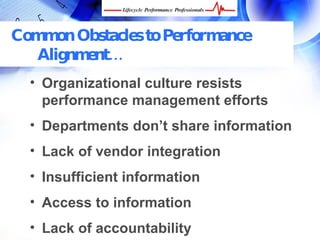
Common Obstacles to Performance
   Alignment…
  • Organizational culture resists
    performance management efforts
  • Departments don’t share information
  • Lack of vendor integration
  • Insufficient information
  • Access to information
  •FREE Performance Management Kit at www.performance-success.com
     Lack of accountability
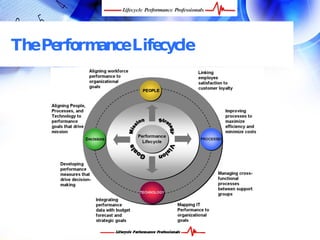
The Performance Lifecycle


  FREE Performance Management Kit at www.performance-success.com
Linking Corporate Strategy to Executive,
   Managerial, and Individual Goals


  FREE Performance Management Kit at www.performance-success.com
4 Performance Alignment Areas


• Division/departmental performance
  alignment

• Workforce performance alignment

• Financial performance alignment

• Resource performance alignment
  FREE Performance Management Kit at www.performance-success.com
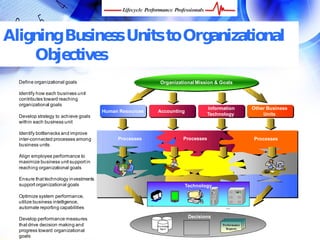
Aligning Business Units to Organizational
    Objectives
  Define organizational goals                                      Organizational Mission & Goals

  Identify how each business unit
  contributes toward reaching
  organizational goals
                                                                                         Information         Other Business
                                       Human Resources           Accounting
  Develop strategy to achieve goals                                                      Technology              Units
  within each business unit

  Identify bottlenecks and improve
  inter-connected processes among           Processes                        Processes                       Processes
  business units

  Align employee performance to
  maximize business unit support in
  reaching organizational goals

  Ensure that technology investments
  support organizational goals                                                Technology

  Optimize system performance,
  utilize business intelligence,
  automate reporting capabilities
                                                         Group


                                                                                                 Server


  Develop performance measures                                                 Decisions
  that drive decision making and                                 Knowledge
                                                                                               Performance
                                                                                                 Reports
  progress toward organizational                                   Mgmt


  goals FREE Performance Management Kit at www.performance-success.com
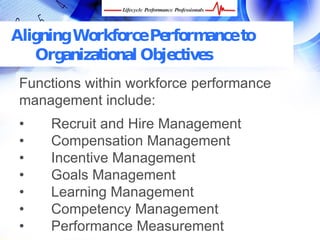
Aligning Workforce Performance to
   Organizational Objectives
 Functions within workforce performance
 management include:
 •       Recruit and Hire Management
 •       Compensation Management
 •       Incentive Management
 •       Goals Management
 •       Learning Management
 •       Competency Management
 •       Performance Measurement
     FREE Performance Management Kit at www.performance-success.com
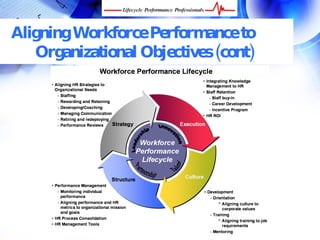
Aligning Workforce Performance to
   Organizational Objectives (cont)


  FREE Performance Management Kit at www.performance-success.com
Aligning Financial Performance to
   Organizational Objectives

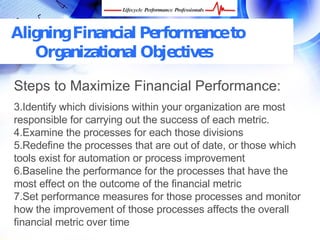
Steps to Maximize Financial Performance:
3.Identify which divisions within your organization are most
responsible for carrying out the success of each metric.
4.Examine the processes for each those divisions
5.Redefine the processes that are out of date, or those which
tools exist for automation or process improvement
6.Baseline the performance for the processes that have the
most effect on the outcome of the financial metric
7.Set performance measures for those processes and
monitor how the improvement of those processes affects the
overall financial metric over time
   FREE Performance Management Kit at www.performance-success.com
Aligning Financial Performance to
    Organizational Objectives

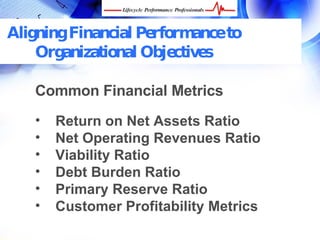
   Common Financial Metrics
   •    Return on Net Assets Ratio
   •    Net Operating Revenues Ratio
   •    Viability Ratio
   •    Debt Burden Ratio
   •    Primary Reserve Ratio
   •    Customer Profitability Metrics
   FREE Performance Management Kit at www.performance-success.com
Additional Financial Metrics –
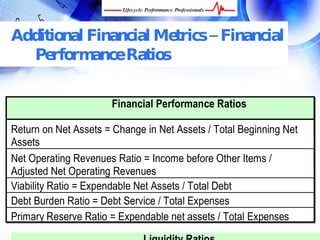
  Financial Performance Ratios

                      Financial Performance Ratios

Return on Net Assets = Change in Net Assets / Total Beginning Net
Assets
Net Operating Revenues Ratio = Income before Other Items /
Adjusted Net Operating Revenues
Viability Ratio = Expendable Net Assets / Total Debt
Debt Burden Ratio = Debt Service / Total Expenses
Primary Reserve Ratio = Expendable net assets / Total Expenses
    FREE Performance Management Kit at www.performance-success.com
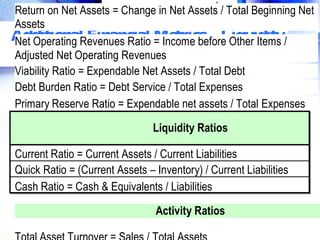
Return on Net Assets = Change in Net Assets / Total Beginning Net
Assets
Net Operating Revenues Ratio Metrics –
Additional Financial = Income before Other Items /
    Liquidity Ratios
Adjusted Net Operating Revenues
Viability Ratio = Expendable Net Assets / Total Debt
Debt Burden Ratio = Debt Service / Total Expenses
Primary Reserve Ratio = Expendable net assets / Total Expenses

                                Liquidity Ratios

Current Ratio = Current Assets / Current Liabilities
Quick Ratio = (Current Assets – Inventory) / Current Liabilities
Cash Ratio = Cash & Equivalents / Liabilities

                                Activity Ratios
    FREE Performance Management Kit at www.performance-success.com
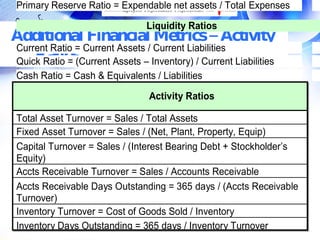
Primary Reserve Ratio = Expendable net assets / Total Expenses

                                Liquidity Ratios
Additional Financial Metrics – Activity
Current Ratio = Current Assets / Current Liabilities
    Ratios
Quick Ratio = (Current Assets – Inventory) / Current Liabilities
 Cash Ratio = Cash & Equivalents / Liabilities

                                 Activity Ratios

 Total Asset Turnover = Sales / Total Assets
 Fixed Asset Turnover = Sales / (Net, Plant, Property, Equip)
 Capital Turnover = Sales / (Interest Bearing Debt + Stockholder’s
 Equity)
 Accts Receivable Turnover = Sales / Accounts Receivable
 Accts Receivable Days Outstanding = 365 days / (Accts Receivable
 Turnover)
 Inventory Turnover = Cost of Goods Sold / Inventory
 Inventory Days Outstanding = 365 days / Inventory Turnover
     FREE Performance Management Kit at www.performance-success.com
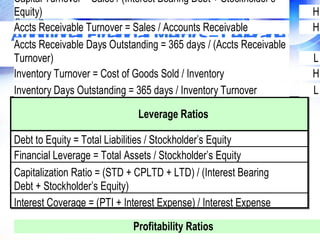
Capital Turnover = Sales / (Interest Bearing Debt + Stockholder’s
Equity)                                                              H
Accts Receivable Turnover = Sales / Accounts Receivable              H
Additional Days OutstandingMetrics/ – Receivable
Accts Receivable
                  Financial = 365 days (Accts
     Leverage Ratios
Turnover)                                                            L
Inventory Turnover = Cost of Goods Sold / Inventory                  H
Inventory Days Outstanding = 365 days / Inventory Turnover           L

                              Leverage Ratios

Debt to Equity = Total Liabilities / Stockholder’s Equity            L
Financial Leverage = Total Assets / Stockholder’s Equity             L
Capitalization Ratio = (STD + CPLTD + LTD) / (Interest Bearing
Debt + Stockholder’s Equity)                                         L
Interest Coverage = (PTI + Interest Expense) / Interest Expense      H

                             Profitability Ratios
    FREE Performance Management Kit at www.performance-success.com
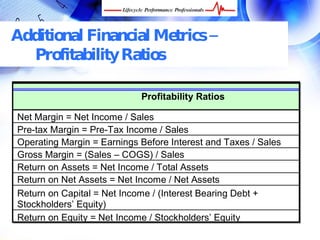
Additional Financial Metrics –
  Profitability Ratios

                            Profitability Ratios

Net Margin = Net Income / Sales
Pre-tax Margin = Pre-Tax Income / Sales
Operating Margin = Earnings Before Interest and Taxes / Sales
Gross Margin = (Sales – COGS) / Sales
Return on Assets = Net Income / Total Assets
Return on Net Assets = Net Income / Net Assets
Return on Capital = Net Income / (Interest Bearing Debt +
Stockholders’ Equity)
Return on Equity = Net Income / Stockholders’ Equity
   FREE Performance Management Kit at www.performance-success.com
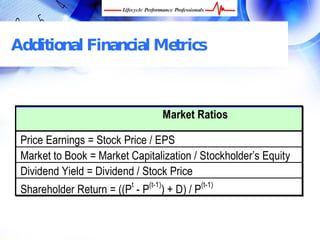
Additional Financial Metrics


                                      Market Ratios

 Price Earnings = Stock Price / EPS
 Market to Book = Market Capitalization / Stockholder’s Equity
 Dividend Yield = Dividend / Stock Price
                          t   (t-1)            (t-1)
 Shareholder Return = ((P - P     ) + D) / P


   FREE Performance Management Kit at www.performance-success.com
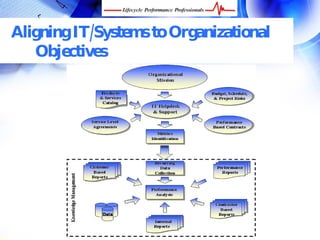
Aligning IT/Systems to Organizational
   Objectives


  FREE Performance Management Kit at www.performance-success.com
Questions to Ask Regarding IT Strategic
  Alignment

• Which of your business unit’s processes support the
  organization’s mission the most? Do the metrics we
  report on drive those processes?
• Are you satisfied with the current performance
  throughout your organization?
• Do our metrics address the company's critical needs?
• Do our reports provide the required information to
  make business decisions? Do they identify areas of
  misalignment?
• Do IT initiatives appear to be prioritized appropriately?
    FREE Performance Management Kit at www.performance-success.com
Common Pitfalls to Avoid When
  Aligning Performance to Strategy


   • Inflexibility

   • Insufficient vertical alignment

   • Insufficient horizontal alignment

  FREE Performance Management Kit at www.performance-success.com

Strategic Alignment, Organizational Performance Alignment

  • 1.
  • 2.
    Common Obstacles toPerformance Alignment… • Organizational culture resists performance management efforts • Departments don’t share information • Lack of vendor integration • Insufficient information • Access to information •FREE Performance Management Kit at www.performance-success.com Lack of accountability
  • 3.
    The Performance Lifecycle FREE Performance Management Kit at www.performance-success.com
  • 4.
    Linking Corporate Strategyto Executive, Managerial, and Individual Goals FREE Performance Management Kit at www.performance-success.com
  • 5.
    4 Performance AlignmentAreas • Division/departmental performance alignment • Workforce performance alignment • Financial performance alignment • Resource performance alignment FREE Performance Management Kit at www.performance-success.com
  • 6.
    Aligning Business Unitsto Organizational Objectives Define organizational goals Organizational Mission & Goals Identify how each business unit contributes toward reaching organizational goals Information Other Business Human Resources Accounting Develop strategy to achieve goals Technology Units within each business unit Identify bottlenecks and improve inter-connected processes among Processes Processes Processes business units Align employee performance to maximize business unit support in reaching organizational goals Ensure that technology investments support organizational goals Technology Optimize system performance, utilize business intelligence, automate reporting capabilities Group Server Develop performance measures Decisions that drive decision making and Knowledge Performance Reports progress toward organizational Mgmt goals FREE Performance Management Kit at www.performance-success.com
  • 7.
    Aligning Workforce Performanceto Organizational Objectives Functions within workforce performance management include: • Recruit and Hire Management • Compensation Management • Incentive Management • Goals Management • Learning Management • Competency Management • Performance Measurement FREE Performance Management Kit at www.performance-success.com
  • 8.
    Aligning Workforce Performanceto Organizational Objectives (cont) FREE Performance Management Kit at www.performance-success.com
  • 9.
    Aligning Financial Performanceto Organizational Objectives Steps to Maximize Financial Performance: 3.Identify which divisions within your organization are most responsible for carrying out the success of each metric. 4.Examine the processes for each those divisions 5.Redefine the processes that are out of date, or those which tools exist for automation or process improvement 6.Baseline the performance for the processes that have the most effect on the outcome of the financial metric 7.Set performance measures for those processes and monitor how the improvement of those processes affects the overall financial metric over time FREE Performance Management Kit at www.performance-success.com
  • 10.
    Aligning Financial Performanceto Organizational Objectives Common Financial Metrics • Return on Net Assets Ratio • Net Operating Revenues Ratio • Viability Ratio • Debt Burden Ratio • Primary Reserve Ratio • Customer Profitability Metrics FREE Performance Management Kit at www.performance-success.com
  • 11.
    Additional Financial Metrics– Financial Performance Ratios Financial Performance Ratios Return on Net Assets = Change in Net Assets / Total Beginning Net Assets Net Operating Revenues Ratio = Income before Other Items / Adjusted Net Operating Revenues Viability Ratio = Expendable Net Assets / Total Debt Debt Burden Ratio = Debt Service / Total Expenses Primary Reserve Ratio = Expendable net assets / Total Expenses FREE Performance Management Kit at www.performance-success.com
  • 12.
    Return on NetAssets = Change in Net Assets / Total Beginning Net Assets Net Operating Revenues Ratio Metrics – Additional Financial = Income before Other Items / Liquidity Ratios Adjusted Net Operating Revenues Viability Ratio = Expendable Net Assets / Total Debt Debt Burden Ratio = Debt Service / Total Expenses Primary Reserve Ratio = Expendable net assets / Total Expenses Liquidity Ratios Current Ratio = Current Assets / Current Liabilities Quick Ratio = (Current Assets – Inventory) / Current Liabilities Cash Ratio = Cash & Equivalents / Liabilities Activity Ratios FREE Performance Management Kit at www.performance-success.com
  • 13.
    Primary Reserve Ratio= Expendable net assets / Total Expenses Liquidity Ratios Additional Financial Metrics – Activity Current Ratio = Current Assets / Current Liabilities Ratios Quick Ratio = (Current Assets – Inventory) / Current Liabilities Cash Ratio = Cash & Equivalents / Liabilities Activity Ratios Total Asset Turnover = Sales / Total Assets Fixed Asset Turnover = Sales / (Net, Plant, Property, Equip) Capital Turnover = Sales / (Interest Bearing Debt + Stockholder’s Equity) Accts Receivable Turnover = Sales / Accounts Receivable Accts Receivable Days Outstanding = 365 days / (Accts Receivable Turnover) Inventory Turnover = Cost of Goods Sold / Inventory Inventory Days Outstanding = 365 days / Inventory Turnover FREE Performance Management Kit at www.performance-success.com
  • 14.
    Capital Turnover =Sales / (Interest Bearing Debt + Stockholder’s Equity) H Accts Receivable Turnover = Sales / Accounts Receivable H Additional Days OutstandingMetrics/ – Receivable Accts Receivable Financial = 365 days (Accts Leverage Ratios Turnover) L Inventory Turnover = Cost of Goods Sold / Inventory H Inventory Days Outstanding = 365 days / Inventory Turnover L Leverage Ratios Debt to Equity = Total Liabilities / Stockholder’s Equity L Financial Leverage = Total Assets / Stockholder’s Equity L Capitalization Ratio = (STD + CPLTD + LTD) / (Interest Bearing Debt + Stockholder’s Equity) L Interest Coverage = (PTI + Interest Expense) / Interest Expense H Profitability Ratios FREE Performance Management Kit at www.performance-success.com
  • 15.
    Additional Financial Metrics– Profitability Ratios Profitability Ratios Net Margin = Net Income / Sales Pre-tax Margin = Pre-Tax Income / Sales Operating Margin = Earnings Before Interest and Taxes / Sales Gross Margin = (Sales – COGS) / Sales Return on Assets = Net Income / Total Assets Return on Net Assets = Net Income / Net Assets Return on Capital = Net Income / (Interest Bearing Debt + Stockholders’ Equity) Return on Equity = Net Income / Stockholders’ Equity FREE Performance Management Kit at www.performance-success.com
  • 16.
    Additional Financial Metrics Market Ratios Price Earnings = Stock Price / EPS Market to Book = Market Capitalization / Stockholder’s Equity Dividend Yield = Dividend / Stock Price t (t-1) (t-1) Shareholder Return = ((P - P ) + D) / P FREE Performance Management Kit at www.performance-success.com
  • 17.
    Aligning IT/Systems toOrganizational Objectives FREE Performance Management Kit at www.performance-success.com
  • 18.
    Questions to AskRegarding IT Strategic Alignment • Which of your business unit’s processes support the organization’s mission the most? Do the metrics we report on drive those processes? • Are you satisfied with the current performance throughout your organization? • Do our metrics address the company's critical needs? • Do our reports provide the required information to make business decisions? Do they identify areas of misalignment? • Do IT initiatives appear to be prioritized appropriately? FREE Performance Management Kit at www.performance-success.com
  • 19.
    Common Pitfalls toAvoid When Aligning Performance to Strategy • Inflexibility • Insufficient vertical alignment • Insufficient horizontal alignment FREE Performance Management Kit at www.performance-success.com