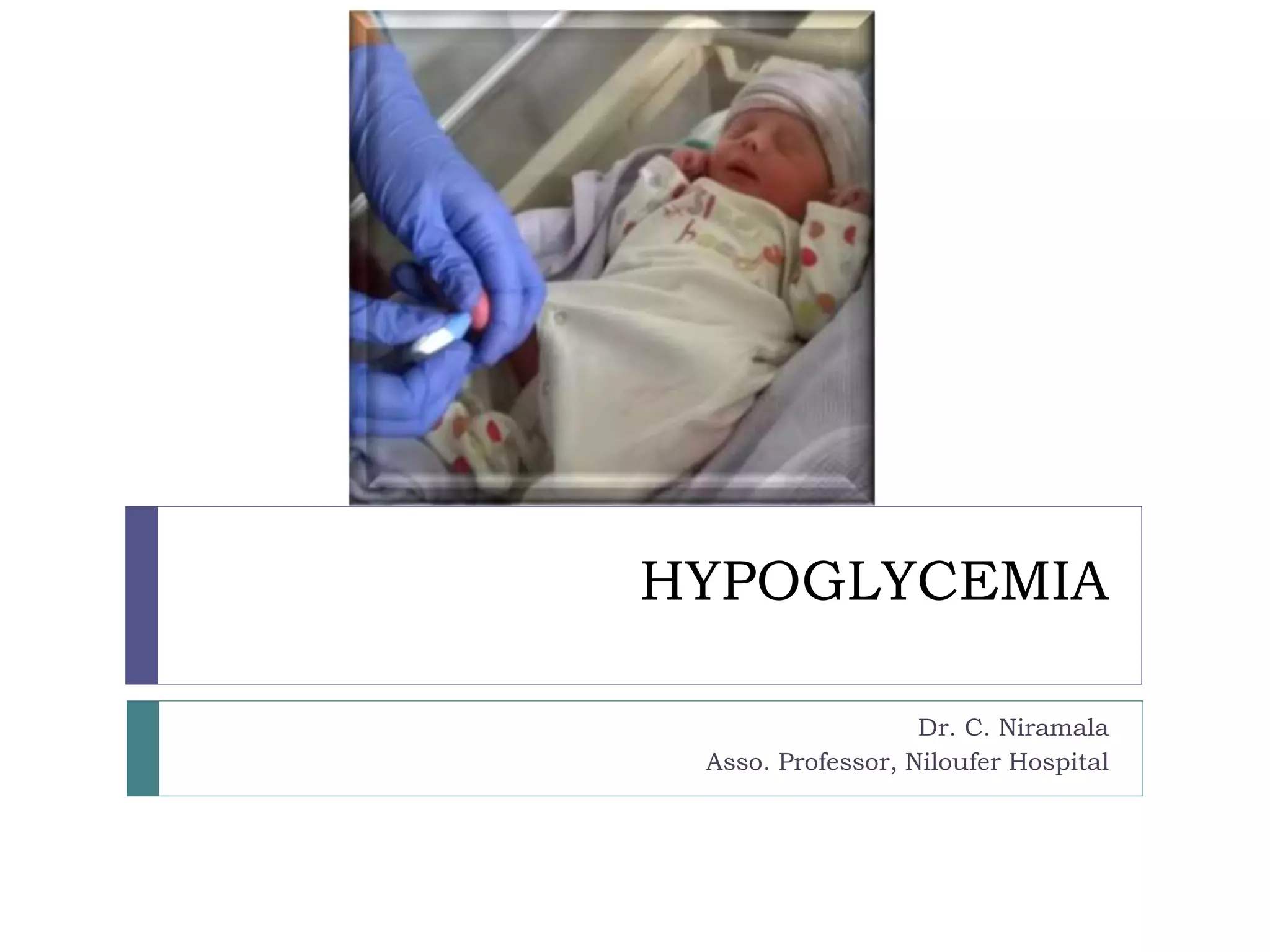
HYPOGLYCEMIA
Dr. C. Niramala
Asso. Professor, Niloufer Hospital
INCIDENCE
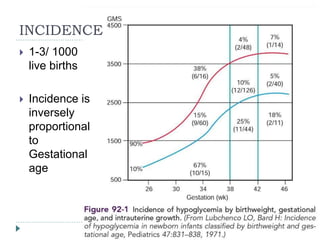
 1-3/ 1000
live births
 Incidence is
inversely
proportional
to
Gestational
age
Why identify hypoglycemia in newborns?
 Hypoglycemia is a common disorder in neonates,
however no clear definition exists.
 The level of blood glucose that warrants treatment
depends much on other factors: Gestational Age,
concomitant risk factors, and conditon of the
newborn
 Significant neurodevelopmental deficits can occur in
neonates who experience days of hypoglyemia.
 Adolescent monkeys when exposed to blood glucose of
<20mg/dL for more than 2 hours showed neuronal injury
predominantly in the regions of parieto-occipital cortex. Less
commonly involved regions were hippocampus, caudate nucleus,
& putamen.The injury was most in regions contiguous to
cerebrospinal fluid-superficial cerebral cortical layers
 (Agardh et al., 1980; Auer et al., 1984, 1985;Kalimo et al., 1985;
Siesjo, 1988).
 Similar topographical distribution of neuropathology was observed
in premature infants using autopsy studies, computed
tomography, magnetic resonance imaging and single photon
emission computed tomography blood flow scans
 (Anderson et al., 1967; Spar et al., 1994; Chiu et al., 1998; Volpe,
2008).
Studies based on neurodevelpoment
 The hypoglycemic brain injury primarily involves neurons but glia
are also affected
 (Anderson et al., 1967).
 Studies of oligodendrocyte precursor cells and cerebellar slice
cultures showed that hypoglycemia induces apoptotic cell death
and inhibits differentiation and myelination
 (Yan & Rivkees 2006).
 At birth, the blood glucose concentration is about 70% of the maternal level.
 It falls rapidly to a nadir by 1 h or so of life to as low as 20 to 25 mg/dl.
 The decrease is a part of the normal adaptation for postnatal life that helps
establish postnatal glucose homeostasis.
 The decrease in glucose concentrations
 essential to stimulate physiological
processes including gluconeogenesis and glycogenolysis.
 enhances oxidative fat metabolism,
stimulates appetite and may help adapt to fast-feed cycles.
 might be the result of mechanisms for
the fetus to allow maternal-to-fetal glucose transport but not reversed after birth.
Neonatal hypoglycemia: is 60 the new 40? The questions remain the same DH Adamkin1 and R Polin2; Journal of Perinatology
(2016) 36, 10–12; doi:10.1038/jp.2015.125
 Low blood glucose concentrations (< 2.6 mmol/l) are
commonly found during the initial days in healthy AGA
and SGA term neonates.
 Marked ketogenic response occurs.
 Ketone bodies - provides glucose-sparing fuel to the
brain - protects neurological function.
 No studies have shown that treating transiently low blood glucose
levels results in better short-term or long-term outcomes
compared with no treatment
 There is no evidence that hypoglycemic infants with no clinical
signs benefit from treatment.
 Transient, single, brief periods of hypoglycemia are unlikely to
cause permanent neurologic damage.
ABM Clinical Protocol #1: Guidelines for Blood Glucose Monitoring and Treatment of Hypoglycemia in Term and Late-
Preterm Neonates, Revised 2014 Nancy Wight,1,2 Kathleen A. Marinelli,3,4 and The Academy of Breastfeeding Medicine
In some conditions
 preterm delivery
 IUGR
 Perinatal hypoxic–ischaemia
suboptimal control of diabetes in
pregnancy, there is impaired ketone
body production and hypoglycaemia, if
present, must be diagnosed and treated
effectively.
Hypoglycemia
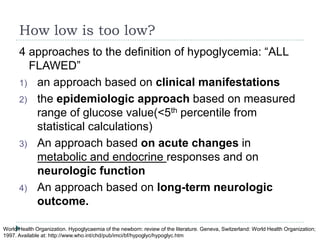
How low is too low?
4 approaches to the definition of hypoglycemia: “ALL
FLAWED”
1) an approach based on clinical manifestations
2) the epidemiologic approach based on measured
range of glucose value(<5th percentile from
statistical calculations)
3) An approach based on acute changes in
metabolic and endocrine responses and on
neurologic function
4) An approach based on long-term neurologic
outcome.
World Health Organization. Hypoglycaemia of the newborn: review of the literature. Geneva, Switzerland: World Health Organization;
1997. Available at: http://www.who.int/chd/pub/imci/bf/hypoglyc/hypoglyc.htm
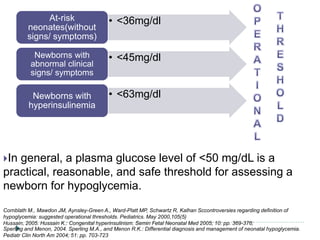
In general, a plasma glucose level of <50 mg/dL is a
practical, reasonable, and safe threshold for assessing a
newborn for hypoglycemia.
Cornblath M., Mawdon JM, Aynsley-Green A., Ward-Platt MP, Schwartz R, Kalhan Sccontroversies regarding definition of
hypoglycemia: suggested operational thresholds. Pediatrics. May 2000,105(5)
Hussain, 2005. Hussain K.: Congenital hyperinsulinism. Semin Fetal Neonatal Med 2005; 10: pp. 369-376;
Sperling and Menon, 2004. Sperling M.A., and Menon R.K.: Differential diagnosis and management of neonatal hypoglycemia.
Pediatr Clin North Am 2004; 51: pp. 703-723
• <36mg/dlAt-risk
neonates(without
signs/ symptoms)
• <45mg/dlNewborns with
abnormal clinical
signs/ symptoms
• <63mg/dlNewborns with
hyperinsulinemia
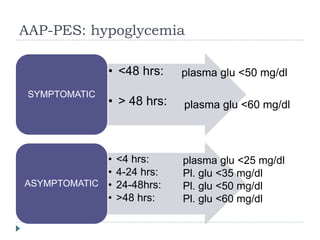
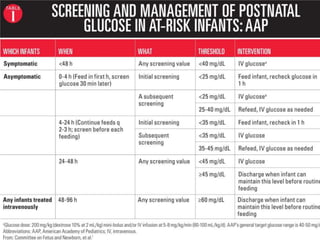
AAP-PES: hypoglycemia
• <48 hrs:
• > 48 hrs:
SYMPTOMATIC
• <4 hrs:
• 4-24 hrs:
• 24-48hrs:
• >48 hrs:
ASYMPTOMATIC
plasma glu <50 mg/dl
plasma glu <60 mg/dl
plasma glu <25 mg/dl
Pl. glu <35 mg/dl
Pl. glu <50 mg/dl
Pl. glu <60 mg/dl
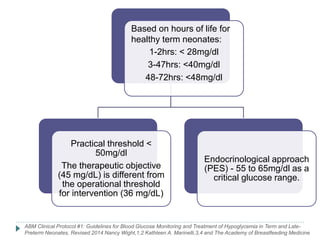
1-2hrs: < 28mg/dl
3-47hrs: <40mg/dl
48-72hrs: <48mg/dl
Practical threshold <
50mg/dl
The therapeutic objective
(45 mg/dL) is different from
the operational threshold
for intervention (36 mg/dL)
Endocrinological approach
(PES) - 55 to 65mg/dl as a
critical glucose range.
ABM Clinical Protocol #1: Guidelines for Blood Glucose Monitoring and Treatment of Hypoglycemia in Term and Late-
Preterm Neonates, Revised 2014 Nancy Wight,1,2 Kathleen A. Marinelli,3,4 and The Academy of Breastfeeding Medicine
Based on hours of life for
healthy term neonates:
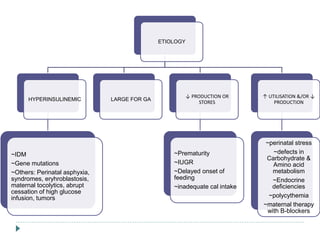
ETIOLOGY
HYPERINSULINEMIC
~IDM
~Gene mutations
~Others: Perinatal asphyxia,
syndromes, eryhroblastosis,
maternal tocolytics, abrupt
cessation of high glucose
infusion, tumors
LARGE FOR GA
↓ PRODUCTION OR
STORES
~Prematurity
~IUGR
~Delayed onset of
feeding
~inadequate cal intake
↑ UTILISATION &/OR ↓
PRODUCTION
~perinatal stress
~defects in
Carbohydrate &
Amino acid
metabolism
~Endocrine
deficiencies
~polycythemia
~maternal therapy
with B-blockers
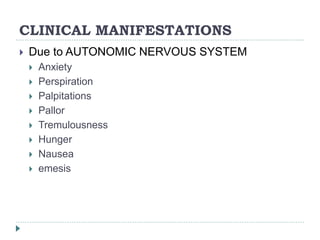
CLINICAL MANIFESTATIONS
 Due to AUTONOMIC NERVOUS SYSTEM
 Anxiety
 Perspiration
 Palpitations
 Pallor
 Tremulousness
 Hunger
 Nausea
 emesis
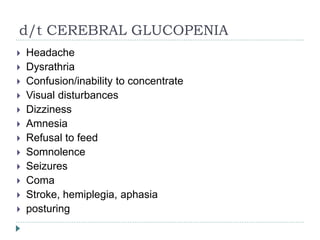
d/t CEREBRAL GLUCOPENIA
 Headache
 Dysrathria
 Confusion/inability to concentrate
 Visual disturbances
 Dizziness
 Amnesia
 Refusal to feed
 Somnolence
 Seizures
 Coma
 Stroke, hemiplegia, aphasia
 posturing
APPROACH
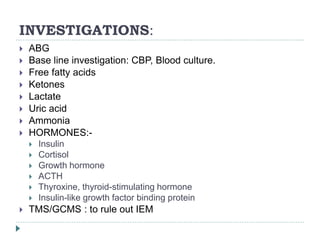
INVESTIGATIONS:
 ABG
 Base line investigation: CBP, Blood culture.
 Free fatty acids
 Ketones
 Lactate
 Uric acid
 Ammonia
 HORMONES:-
 Insulin
 Cortisol
 Growth hormone
 ACTH
 Thyroxine, thyroid-stimulating hormone
 Insulin-like growth factor binding protein
 TMS/GCMS : to rule out IEM
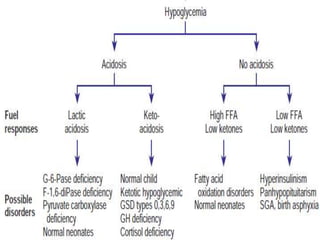
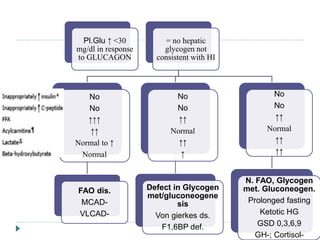
Pl.Glu ↑ <30
mg/dl in response
to GLUCAGON
= no hepatic
glycogen not
consistent with HI
No
No
↑↑↑
↑↑
Normal to ↑
Normal
FAO dis.
MCAD-
VLCAD-
No
No
↑↑
Normal
↑↑
↑
Defect in Glycogen
met/gluconeogene
sis
Von gierkes ds.
F1,6BP def.
No
No
↑↑
Normal
↑↑
↑↑
N. FAO, Glycogen
met. Gluconeogen.
Prolonged fasting
Ketotic HG
GSD 0,3,6,9
GH-; Cortisol-
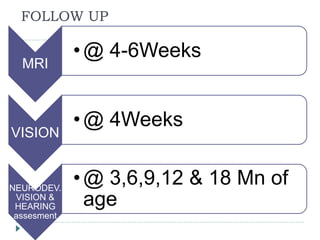
FOLLOW UP
MRI
•@ 4-6Weeks
VISION
•@ 4Weeks
NEURODEV.
VISION &
HEARING
assesment
•@ 3,6,9,12 & 18 Mn of
age
Thank you

Algortihm hypoglycemia

  • 1.
    HYPOGLYCEMIA Dr. C. Niramala Asso.Professor, Niloufer Hospital
  • 2.
    INCIDENCE  1-3/ 1000 livebirths  Incidence is inversely proportional to Gestational age
  • 3.
    Why identify hypoglycemiain newborns?  Hypoglycemia is a common disorder in neonates, however no clear definition exists.  The level of blood glucose that warrants treatment depends much on other factors: Gestational Age, concomitant risk factors, and conditon of the newborn  Significant neurodevelopmental deficits can occur in neonates who experience days of hypoglyemia.
  • 4.
     Adolescent monkeyswhen exposed to blood glucose of <20mg/dL for more than 2 hours showed neuronal injury predominantly in the regions of parieto-occipital cortex. Less commonly involved regions were hippocampus, caudate nucleus, & putamen.The injury was most in regions contiguous to cerebrospinal fluid-superficial cerebral cortical layers  (Agardh et al., 1980; Auer et al., 1984, 1985;Kalimo et al., 1985; Siesjo, 1988).  Similar topographical distribution of neuropathology was observed in premature infants using autopsy studies, computed tomography, magnetic resonance imaging and single photon emission computed tomography blood flow scans  (Anderson et al., 1967; Spar et al., 1994; Chiu et al., 1998; Volpe, 2008). Studies based on neurodevelpoment
  • 5.
     The hypoglycemicbrain injury primarily involves neurons but glia are also affected  (Anderson et al., 1967).  Studies of oligodendrocyte precursor cells and cerebellar slice cultures showed that hypoglycemia induces apoptotic cell death and inhibits differentiation and myelination  (Yan & Rivkees 2006).
  • 6.
     At birth,the blood glucose concentration is about 70% of the maternal level.  It falls rapidly to a nadir by 1 h or so of life to as low as 20 to 25 mg/dl.  The decrease is a part of the normal adaptation for postnatal life that helps establish postnatal glucose homeostasis.  The decrease in glucose concentrations  essential to stimulate physiological processes including gluconeogenesis and glycogenolysis.  enhances oxidative fat metabolism, stimulates appetite and may help adapt to fast-feed cycles.  might be the result of mechanisms for the fetus to allow maternal-to-fetal glucose transport but not reversed after birth. Neonatal hypoglycemia: is 60 the new 40? The questions remain the same DH Adamkin1 and R Polin2; Journal of Perinatology (2016) 36, 10–12; doi:10.1038/jp.2015.125
  • 7.
     Low bloodglucose concentrations (< 2.6 mmol/l) are commonly found during the initial days in healthy AGA and SGA term neonates.  Marked ketogenic response occurs.  Ketone bodies - provides glucose-sparing fuel to the brain - protects neurological function.  No studies have shown that treating transiently low blood glucose levels results in better short-term or long-term outcomes compared with no treatment  There is no evidence that hypoglycemic infants with no clinical signs benefit from treatment.  Transient, single, brief periods of hypoglycemia are unlikely to cause permanent neurologic damage. ABM Clinical Protocol #1: Guidelines for Blood Glucose Monitoring and Treatment of Hypoglycemia in Term and Late- Preterm Neonates, Revised 2014 Nancy Wight,1,2 Kathleen A. Marinelli,3,4 and The Academy of Breastfeeding Medicine
  • 8.
    In some conditions preterm delivery  IUGR  Perinatal hypoxic–ischaemia suboptimal control of diabetes in pregnancy, there is impaired ketone body production and hypoglycaemia, if present, must be diagnosed and treated effectively.
  • 9.
  • 10.
    How low istoo low? 4 approaches to the definition of hypoglycemia: “ALL FLAWED” 1) an approach based on clinical manifestations 2) the epidemiologic approach based on measured range of glucose value(<5th percentile from statistical calculations) 3) An approach based on acute changes in metabolic and endocrine responses and on neurologic function 4) An approach based on long-term neurologic outcome. World Health Organization. Hypoglycaemia of the newborn: review of the literature. Geneva, Switzerland: World Health Organization; 1997. Available at: http://www.who.int/chd/pub/imci/bf/hypoglyc/hypoglyc.htm
  • 11.
    In general, aplasma glucose level of <50 mg/dL is a practical, reasonable, and safe threshold for assessing a newborn for hypoglycemia. Cornblath M., Mawdon JM, Aynsley-Green A., Ward-Platt MP, Schwartz R, Kalhan Sccontroversies regarding definition of hypoglycemia: suggested operational thresholds. Pediatrics. May 2000,105(5) Hussain, 2005. Hussain K.: Congenital hyperinsulinism. Semin Fetal Neonatal Med 2005; 10: pp. 369-376; Sperling and Menon, 2004. Sperling M.A., and Menon R.K.: Differential diagnosis and management of neonatal hypoglycemia. Pediatr Clin North Am 2004; 51: pp. 703-723 • <36mg/dlAt-risk neonates(without signs/ symptoms) • <45mg/dlNewborns with abnormal clinical signs/ symptoms • <63mg/dlNewborns with hyperinsulinemia
  • 12.
    AAP-PES: hypoglycemia • <48hrs: • > 48 hrs: SYMPTOMATIC • <4 hrs: • 4-24 hrs: • 24-48hrs: • >48 hrs: ASYMPTOMATIC plasma glu <50 mg/dl plasma glu <60 mg/dl plasma glu <25 mg/dl Pl. glu <35 mg/dl Pl. glu <50 mg/dl Pl. glu <60 mg/dl
  • 13.
    1-2hrs: < 28mg/dl 3-47hrs:<40mg/dl 48-72hrs: <48mg/dl Practical threshold < 50mg/dl The therapeutic objective (45 mg/dL) is different from the operational threshold for intervention (36 mg/dL) Endocrinological approach (PES) - 55 to 65mg/dl as a critical glucose range. ABM Clinical Protocol #1: Guidelines for Blood Glucose Monitoring and Treatment of Hypoglycemia in Term and Late- Preterm Neonates, Revised 2014 Nancy Wight,1,2 Kathleen A. Marinelli,3,4 and The Academy of Breastfeeding Medicine Based on hours of life for healthy term neonates:
  • 14.
    ETIOLOGY HYPERINSULINEMIC ~IDM ~Gene mutations ~Others: Perinatalasphyxia, syndromes, eryhroblastosis, maternal tocolytics, abrupt cessation of high glucose infusion, tumors LARGE FOR GA ↓ PRODUCTION OR STORES ~Prematurity ~IUGR ~Delayed onset of feeding ~inadequate cal intake ↑ UTILISATION &/OR ↓ PRODUCTION ~perinatal stress ~defects in Carbohydrate & Amino acid metabolism ~Endocrine deficiencies ~polycythemia ~maternal therapy with B-blockers
  • 15.
    CLINICAL MANIFESTATIONS  Dueto AUTONOMIC NERVOUS SYSTEM  Anxiety  Perspiration  Palpitations  Pallor  Tremulousness  Hunger  Nausea  emesis
  • 16.
    d/t CEREBRAL GLUCOPENIA Headache  Dysrathria  Confusion/inability to concentrate  Visual disturbances  Dizziness  Amnesia  Refusal to feed  Somnolence  Seizures  Coma  Stroke, hemiplegia, aphasia  posturing
  • 17.
  • 18.
    INVESTIGATIONS:  ABG  Baseline investigation: CBP, Blood culture.  Free fatty acids  Ketones  Lactate  Uric acid  Ammonia  HORMONES:-  Insulin  Cortisol  Growth hormone  ACTH  Thyroxine, thyroid-stimulating hormone  Insulin-like growth factor binding protein  TMS/GCMS : to rule out IEM
  • 20.
    Pl.Glu ↑ <30 mg/dlin response to GLUCAGON = no hepatic glycogen not consistent with HI No No ↑↑↑ ↑↑ Normal to ↑ Normal FAO dis. MCAD- VLCAD- No No ↑↑ Normal ↑↑ ↑ Defect in Glycogen met/gluconeogene sis Von gierkes ds. F1,6BP def. No No ↑↑ Normal ↑↑ ↑↑ N. FAO, Glycogen met. Gluconeogen. Prolonged fasting Ketotic HG GSD 0,3,6,9 GH-; Cortisol-
  • 22.
    FOLLOW UP MRI •@ 4-6Weeks VISION •@4Weeks NEURODEV. VISION & HEARING assesment •@ 3,6,9,12 & 18 Mn of age
  • 23.