Algorithmic & High-Frequency Trading
COMPLEXITY ARISING FROM CENTRALIZATION
Electronic Trading
• Open Outcry to Computer-based Execution
• Reduced Costs
• Greater Liquidity
• Tighter Spreads
• Increased Competition
• More Transparency
• Transition gained velocity in the early 2000s
SEC Regulation NMS (National Market System)
• Order Protection Rule – receive best price when executing an order.
• Access Rule – improve access to quotes from exchanges in the NMS by required linkages
and reduced access fees.
• Sub-Penny Rule – quotation increment for all stocks over $1.00/share to at least $0.01
• Market Data Rule – revenue allocated to organizations that promote and improve
market data access.
• Aimed at improving fairness in price execution, displayed quote data, and
access to market data.
• Prices are posted on all (most) exchanges simultaneously improving chances
for investors to ascertain the best price.
Centralizing the Markets
• SIP – “Securities Information Processor”
• Links US markets by consolidating all protected bid/ask quotes and
trades from every trading venue into a single data feed.
• NBBO – “National Best Bid and Offer”
• The best price (lowest available ask price / highest available bid
price)
• The “typical” bid/ask the average person sees.
• LULD – “limit up limit down” price bands
• Regulatory Halts & Short Sale Restrictions
• UTP – “Unlisted Trading Priveleges”
• Regulation the gives exchanges the right to trade securities
without meeting the minimum requirements (security not listed
or registered on the exchange)
Dark Pools
• No Swimming Allowed
• Markets/exchanges where liquidity is deliberately hidden
• Report trades to the SIP and trades recorded to the national consolidated
tape but with as much delay as possible (to reduce market impact) and
recorded as OTC transactions (detailed volume and transaction type data is
not reported)
• Market Impact
• Allow large blocks of shares to be traded while reducing the effect of such
size orders would have on the market price
• Liquidity seen by a trader in the book may not be an accurate reflection of
the true liquidity available.
Arbitrage Strategies
• Index and ETF Arbitrage
• Taking advantage of mispricing between indices and associated ETFs
• Statistical Arbitrage
• Does contribute to increased liquidity.
• Latency Arbitrage
• Increases liquidity at the expense of other investors/traders.
• Large order enters the market, HFT traders are able to buy shares from other exchanges (often a penny
or so cheaper) before the order hits the other exchanges.
• Market participants both receive a slightly less than best possible price had the middle man not been
present.
• Rebate Arbitrage
• Exchanges offer rebates or fees for making and taking liquidity
• Fees differ from between exchanges
• Would a broker route an order to an exchange that offers a rebate rather than charges a fee
resulting in an execution that may not give the best possible price to the client?
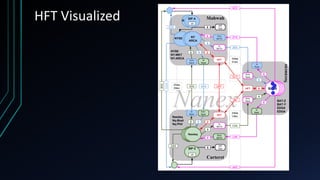
HFT Visualized
One Half of One Second of Trades in One Stock Around the World
Slowed Down to the Millisecond
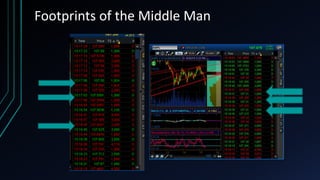
Footprints of the Middle Man
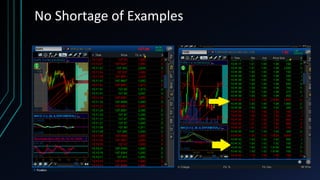
No Shortage of Examples
The Bigger Picture Trumps All
August 24th, 2015
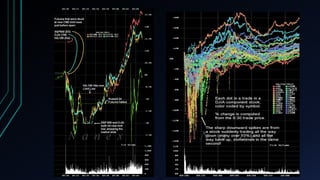
• LULD bands prevented a much more catastrophic event.
• Stocks such as AAPL traded in <2% ranges in under 60 seconds.
• AAPL itself opened -10%, fell to -12%, but closed +3%. Kudos to all of you
who bought under $93.
• The overall market rally into the end of the day became the
headline. Most don’t want to acknowledge that something was
seriously wrong, many have no idea, and the rest aren’t going to
risk their profits by saying anything.
• One headline did note that an HFT firm posted a record-breaking
profit that day.
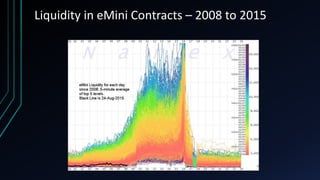
Liquidity in eMini Contracts – 2008 to 2015
Futures Tick Data – 8/24/2015
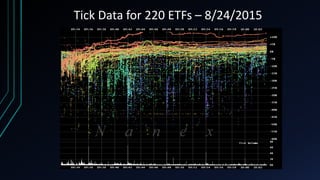
Tick Data for 220 ETFs – 8/24/2015
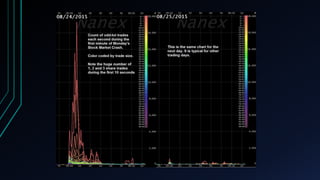
AAPL – 8/24/2015 – 9:30am to 9:32am
Black Swan Events
• The Black Swan Theory was developed by Nassim Nicholas Taleb.
• The disproportionate role of high-profile, hard-to-predict, and rare
events that are beyond the realm of normal expectations in history,
science, finance, and technology.
• The non-computability of the probability of the consequential rare
events using scientific methods (owing to the very nature of small
probabilities).
• This is to say events that have a probability in the tail of a normal
distribution far (greater than 2 or even 3 Std Devs) from the center.
• Taleb advises a hedge fund that made in excess of 1 billion dollars
on August 24th representing a 20% increase in the firms valuation.
Some Final Thoughts
• Over 50% of all trades in the US equity markets are from algorithmic
execution of block orders but are represent an important tool controlled
execution of share blocks.
• HFT traders provide volume but not necessarily liquidity.
• Regulation on HFT and electronic market-making is being “reviewed and
implemented”. Just keep in mind the old saying: “Ye who has the gold
makes the rules”
• Look up the name Navinder Sarao, an individual trader who caused (was blamed
for causing) the 2010 flash crash.
• Algorithmic trading and HFT are here to stay.
• I want to the thank Nanex, LLC for the incredible images provided as well as their ongoing work in
analyzing the vasts amounts of market data and bringing to light many of the issues that would
otherwise never be known by the average investor. You can follow the founder of Nanex, Eric Scott
Hunsader, on Twitter @nanexllc.

Algorithmic & High-Frequency Trading

  • 1.
    Algorithmic & High-FrequencyTrading COMPLEXITY ARISING FROM CENTRALIZATION
  • 2.
    Electronic Trading • OpenOutcry to Computer-based Execution • Reduced Costs • Greater Liquidity • Tighter Spreads • Increased Competition • More Transparency • Transition gained velocity in the early 2000s
  • 3.
    SEC Regulation NMS(National Market System) • Order Protection Rule – receive best price when executing an order. • Access Rule – improve access to quotes from exchanges in the NMS by required linkages and reduced access fees. • Sub-Penny Rule – quotation increment for all stocks over $1.00/share to at least $0.01 • Market Data Rule – revenue allocated to organizations that promote and improve market data access. • Aimed at improving fairness in price execution, displayed quote data, and access to market data. • Prices are posted on all (most) exchanges simultaneously improving chances for investors to ascertain the best price.
  • 4.
    Centralizing the Markets •SIP – “Securities Information Processor” • Links US markets by consolidating all protected bid/ask quotes and trades from every trading venue into a single data feed. • NBBO – “National Best Bid and Offer” • The best price (lowest available ask price / highest available bid price) • The “typical” bid/ask the average person sees. • LULD – “limit up limit down” price bands • Regulatory Halts & Short Sale Restrictions • UTP – “Unlisted Trading Priveleges” • Regulation the gives exchanges the right to trade securities without meeting the minimum requirements (security not listed or registered on the exchange)
  • 5.
    Dark Pools • NoSwimming Allowed • Markets/exchanges where liquidity is deliberately hidden • Report trades to the SIP and trades recorded to the national consolidated tape but with as much delay as possible (to reduce market impact) and recorded as OTC transactions (detailed volume and transaction type data is not reported) • Market Impact • Allow large blocks of shares to be traded while reducing the effect of such size orders would have on the market price • Liquidity seen by a trader in the book may not be an accurate reflection of the true liquidity available.
  • 6.
    Arbitrage Strategies • Indexand ETF Arbitrage • Taking advantage of mispricing between indices and associated ETFs • Statistical Arbitrage • Does contribute to increased liquidity. • Latency Arbitrage • Increases liquidity at the expense of other investors/traders. • Large order enters the market, HFT traders are able to buy shares from other exchanges (often a penny or so cheaper) before the order hits the other exchanges. • Market participants both receive a slightly less than best possible price had the middle man not been present. • Rebate Arbitrage • Exchanges offer rebates or fees for making and taking liquidity • Fees differ from between exchanges • Would a broker route an order to an exchange that offers a rebate rather than charges a fee resulting in an execution that may not give the best possible price to the client?
  • 7.
  • 8.
    One Half ofOne Second of Trades in One Stock Around the World
  • 9.
    Slowed Down tothe Millisecond
  • 10.
  • 11.
  • 12.
  • 13.
    August 24th, 2015 •LULD bands prevented a much more catastrophic event. • Stocks such as AAPL traded in <2% ranges in under 60 seconds. • AAPL itself opened -10%, fell to -12%, but closed +3%. Kudos to all of you who bought under $93. • The overall market rally into the end of the day became the headline. Most don’t want to acknowledge that something was seriously wrong, many have no idea, and the rest aren’t going to risk their profits by saying anything. • One headline did note that an HFT firm posted a record-breaking profit that day.
  • 15.
    Liquidity in eMiniContracts – 2008 to 2015
  • 16.
    Futures Tick Data– 8/24/2015
  • 17.
    Tick Data for220 ETFs – 8/24/2015
  • 19.
    AAPL – 8/24/2015– 9:30am to 9:32am
  • 21.
    Black Swan Events •The Black Swan Theory was developed by Nassim Nicholas Taleb. • The disproportionate role of high-profile, hard-to-predict, and rare events that are beyond the realm of normal expectations in history, science, finance, and technology. • The non-computability of the probability of the consequential rare events using scientific methods (owing to the very nature of small probabilities). • This is to say events that have a probability in the tail of a normal distribution far (greater than 2 or even 3 Std Devs) from the center. • Taleb advises a hedge fund that made in excess of 1 billion dollars on August 24th representing a 20% increase in the firms valuation.
  • 22.
    Some Final Thoughts •Over 50% of all trades in the US equity markets are from algorithmic execution of block orders but are represent an important tool controlled execution of share blocks. • HFT traders provide volume but not necessarily liquidity. • Regulation on HFT and electronic market-making is being “reviewed and implemented”. Just keep in mind the old saying: “Ye who has the gold makes the rules” • Look up the name Navinder Sarao, an individual trader who caused (was blamed for causing) the 2010 flash crash. • Algorithmic trading and HFT are here to stay. • I want to the thank Nanex, LLC for the incredible images provided as well as their ongoing work in analyzing the vasts amounts of market data and bringing to light many of the issues that would otherwise never be known by the average investor. You can follow the founder of Nanex, Eric Scott Hunsader, on Twitter @nanexllc.

Editor's Notes

  • #3 Reduced Costs – reduced costs for trade execution. Depending on trading volume, traders can pay pennies on the share. Increased Competition – trades can be executed by the click of a mouse without needing to go through someone on the floor Greater Liquidity – greater efficiency allows for firms to participate regardless of location. Tighter Spreads – created by increased liquidity More Transparency – information about security, prices, and historical prices is readily available to anyone who seeks it.
  • #7 Does contribute to increased liquidity. Mainly due to HFT having access to hidden liquidity that most traders do not. Also with options contracts, one can usually find a buyer for contracts if they are willing to sell for below par value. HFT can buy, exercise, and sell the shares within a few milliseconds.
  • #13 These images are from October 30, 2014. At 13:17, a massive surge in /ES futures volume resulting from a major overhead resistance being broken cause a system wide error that resulted in trades being executed in a greater than 50cent range as indicated by the extremely long tails on the 1m and 133tick candles.
  • #14 Does contribute to increased liquidity. Mainly due to HFT having access to hidden liquidity that most traders do not. Also with options contracts, one can usually find a buyer for contracts if they are willing to sell for below par value. HFT can buy, exercise, and sell the shares within a few milliseconds.
  • #17 Can anyone guess what the red line represents? Hint: its not China, that line is the purple one at the very bottom.
  • #19 Same as previous showing range
  • #20 Chart on the left represents retail orders, red being sells and green being buys. Chart on the right represents HFT trades during the same period.