The Present and Future of
High-Frequency Trading


 Edgar Perez, Author, The Speed Traders
The Present and Future of High-Frequency
       Click to edit Master title style
                  Trading

 High-Frequency Trading is a set of tools that
  encompasses a rather diverse number of strategies
  that prioritize speed, low-latency, volume, liquid
  instruments and short timeframes
 High-Frequency Trading has been referred to as the natural
  progression of technology applied to the investing and trading
  worlds
 In the process, High-Frequency Trading has unmasked
  structural issues in the U.S. equity markets that are currently
  being examined by legislators and regulators
 Speed traders will continue finding alpha-generating
  opportunities by trading new asset classes in new geographies
  employing more sophisticated tools than ever
Defining High-Frequency Trading
            Click to edit Master title style

 Professional traders acting in a proprietary capacity that engage
  in strategies that generate a large number of trades on a daily
  basis
 Organized as proprietary trading firm, as the proprietary trading
  desk of a multi-service broker-dealer, or as a hedge fund
 Main characteristics:
     Usage of extraordinarily high-speed and sophisticated computer
      programs for generating, routing, and executing orders
     Co-location services and individual data feeds offered by exchanges
      and others to minimize network and other types of latencies
     Very short time-frames for establishing and liquidating positions
     Submission of numerous orders that are cancelled shortly after
      submission
     Ending the trading day in as close to a flat position as possible (that
      is, not carrying significant, un-hedged positions overnight)
     Focus on highly liquid instruments (e.g., Citi example)
Understanding High-Frequency Trading
           Click to edit Master title style

 At a recent investment management event, 66% of managers
    didn’t have an opinion about High-Frequency Trading
   A recent poll by Greenwich Associates found that 20% of
    institutional investors don't fully understand the practice of
    High-Frequency Trading
   Algorithmic trading is broader, encompassing the automation of
    alpha-seeking and potentially execution trading decision making
   High-Frequency Trading specifically monitors the market for
    patterns that indicate alpha-making trading opportunities; then
    places orders to take instant advantage of those opportunities
   As market data is coming in fast, and conditions are changing by
    the millisecond, the firms that leverage High-Frequency Trading
    are able to jump on opportunities faster than the competition


Source: Progress Software
The Present and Future of High-Frequency
       Click to edit Master title style
                  Trading

 High-Frequency Trading is a set of tools that
  encompasses a rather diverse number of strategies that
  prioritize speed, low-latency, volume, liquid instruments
  and short timeframes
 High-Frequency Trading has been referred to as
  the natural progression of technology applied to
  the investing and trading worlds
 In the process, High-Frequency Trading has unmasked
  structural issues in the U.S. equity markets that are
  currently being examined by legislators and regulators
 Speed traders will continue finding alpha-generating
  opportunities by trading new asset classes in new
  geographies employing more sophisticated tools than
  ever
Technology and Changes to Market Structure
       Click to Key Enablers style
                edit Master title

 Technological innovation:
   Faster, cheaper computing power

   Advancements in the field of complex event processing

   Increase in availability of low-latency bandwidth

 Shift to electronic trading
 Rise of alternative trading systems
 Decimalization
 Regulatory changes, e.g., Reg NMS
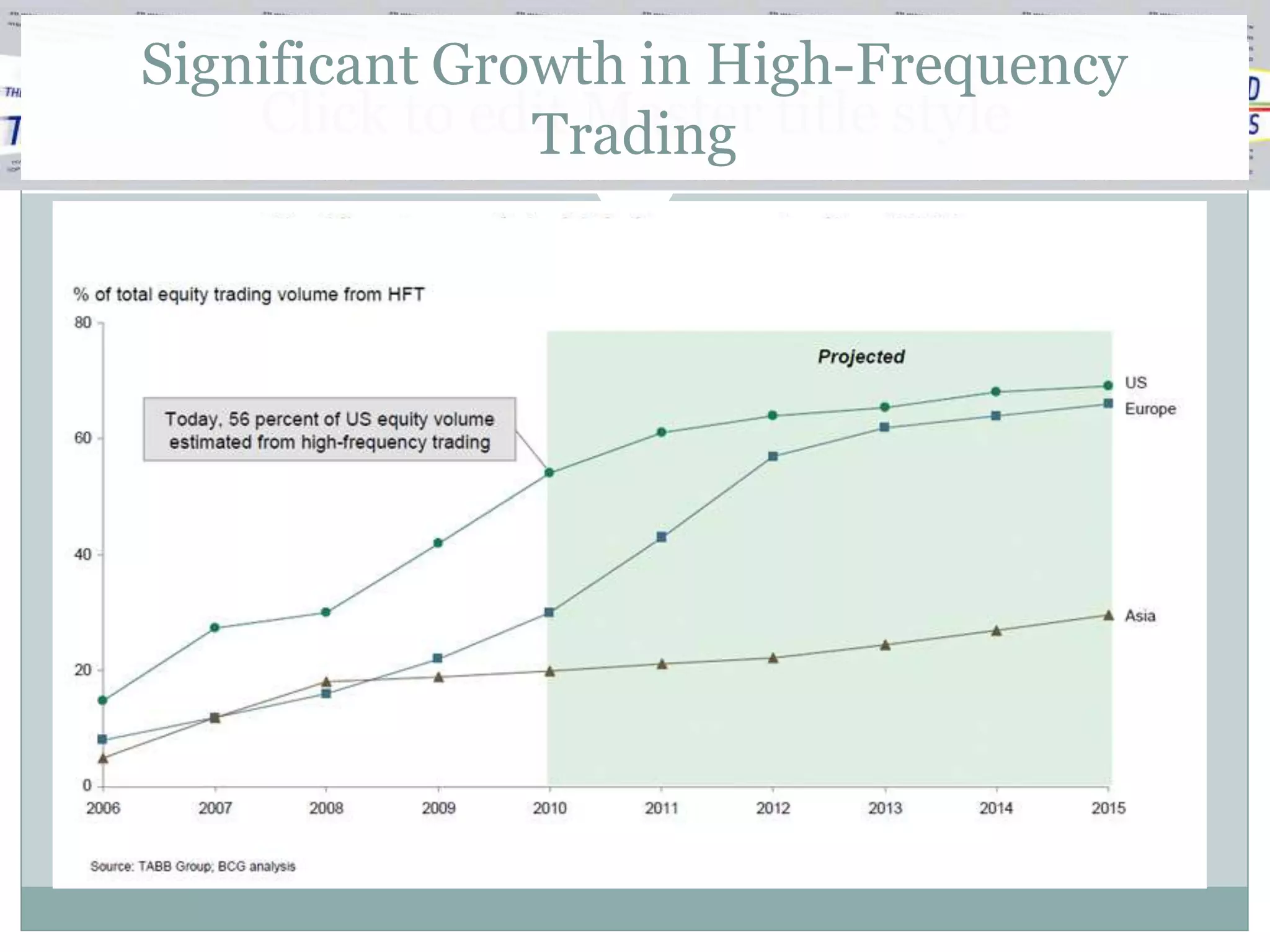
Significant Growth in High-Frequency
    Click to edit Master title style
               Trading
High-Frequency Trading a Natural Evolution
       Clickthe edit Master title style
         of to Securities Markets

 There is a clear evolutionary process in the adoption
  of new technologies triggered by competition,
  innovation and regulation
 Like all other technologies, High-Frequency Trading
  enables sophisticated market participants to profit
  on their investments – especially in technology –
  and compensation for their market, counterparty
  and operational risk exposures
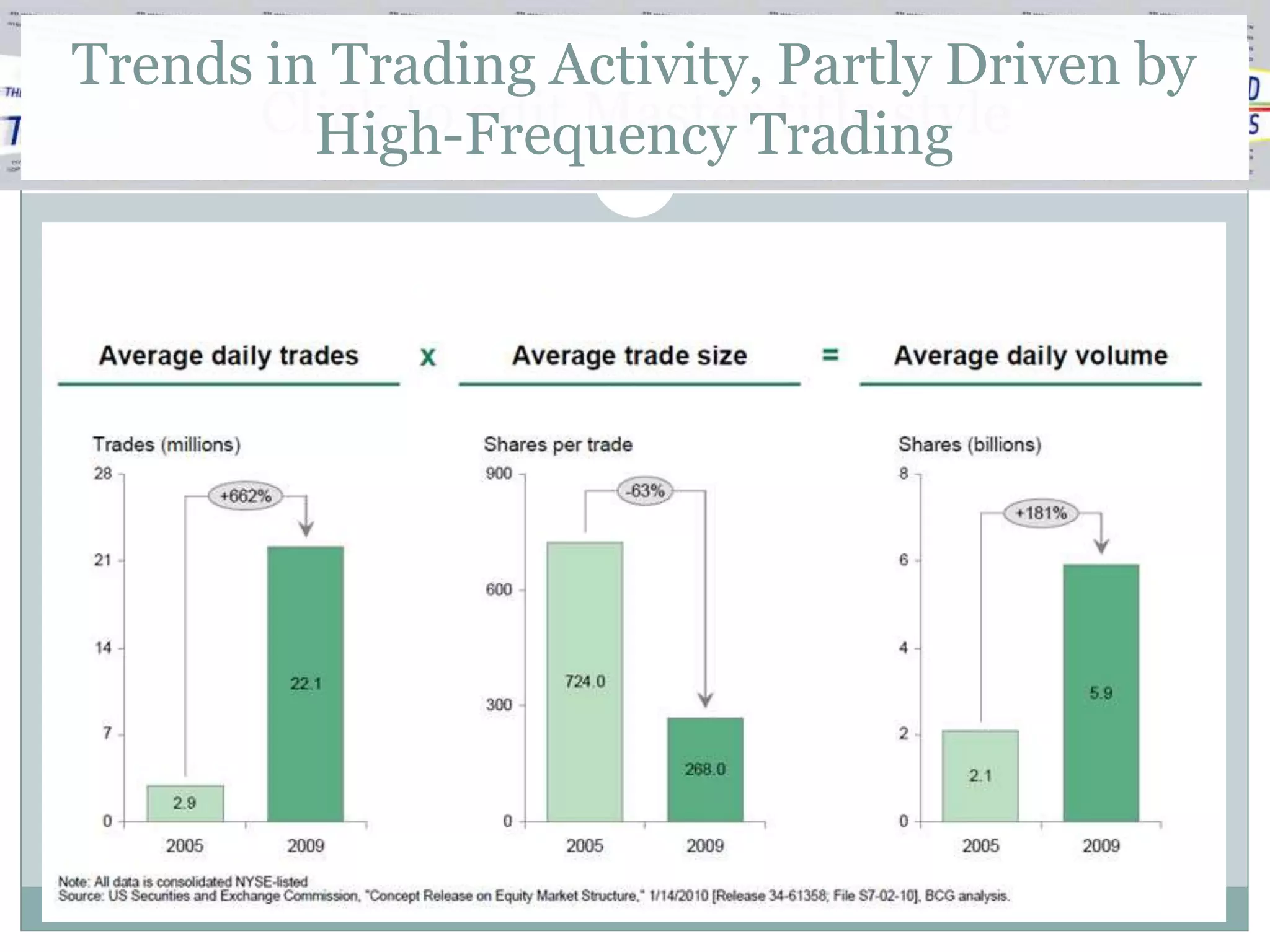
Trends in Trading Activity, Partly Driven by
       Click to edit Master title style
         High-Frequency Trading
The Present and Future of High-Frequency
       Click to edit Master title style
                  Trading

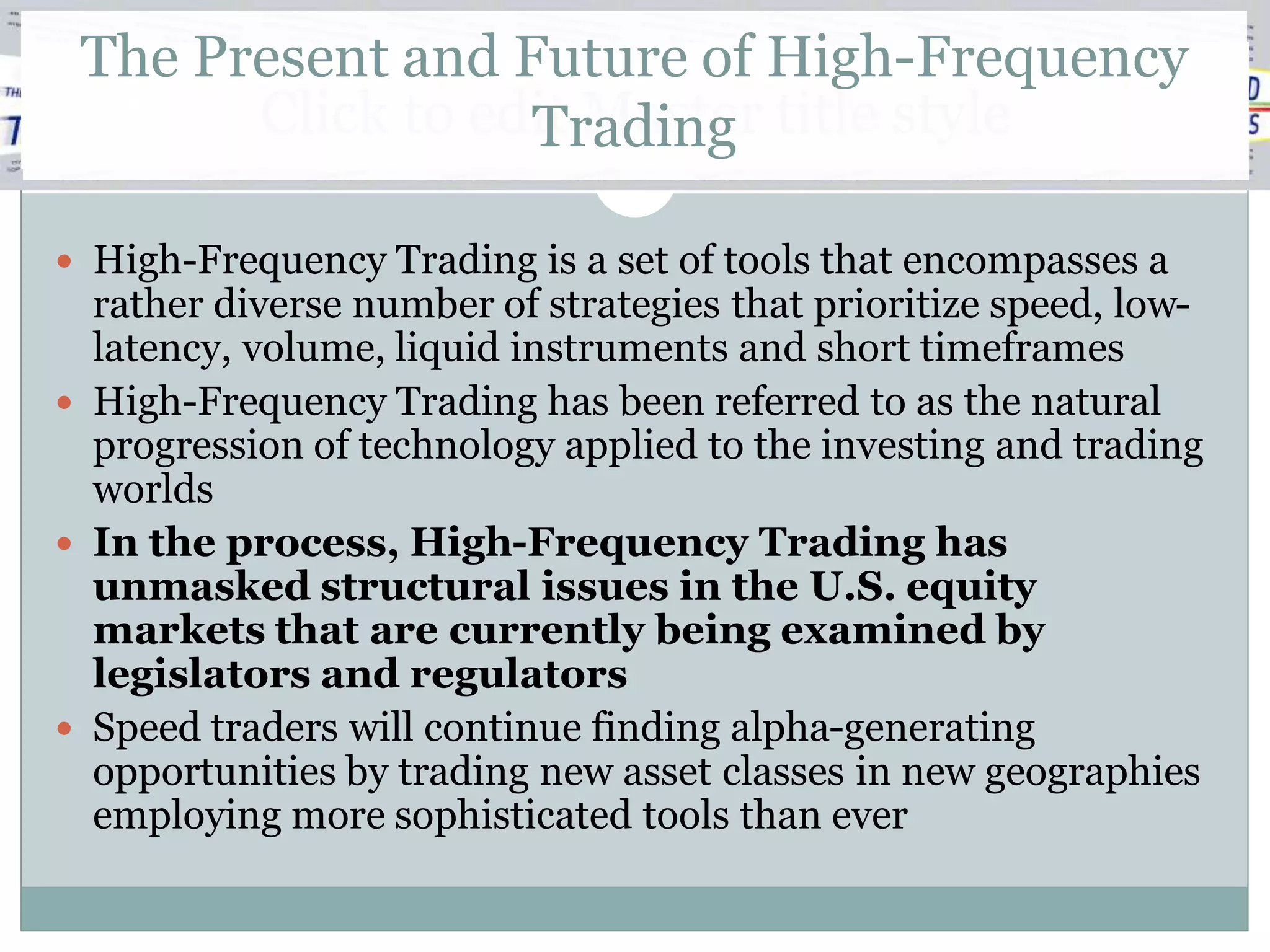
 High-Frequency Trading is a set of tools that encompasses a
  rather diverse number of strategies that prioritize speed, low-
  latency, volume, liquid instruments and short timeframes
 High-Frequency Trading has been referred to as the natural
  progression of technology applied to the investing and trading
  worlds
 In the process, High-Frequency Trading has
  unmasked structural issues in the U.S. equity
  markets that are currently being examined by
  legislators and regulators
 Speed traders will continue finding alpha-generating
  opportunities by trading new asset classes in new geographies
  employing more sophisticated tools than ever
The Flash Crash According to David
         Click to edit Master title style
                   Cummings

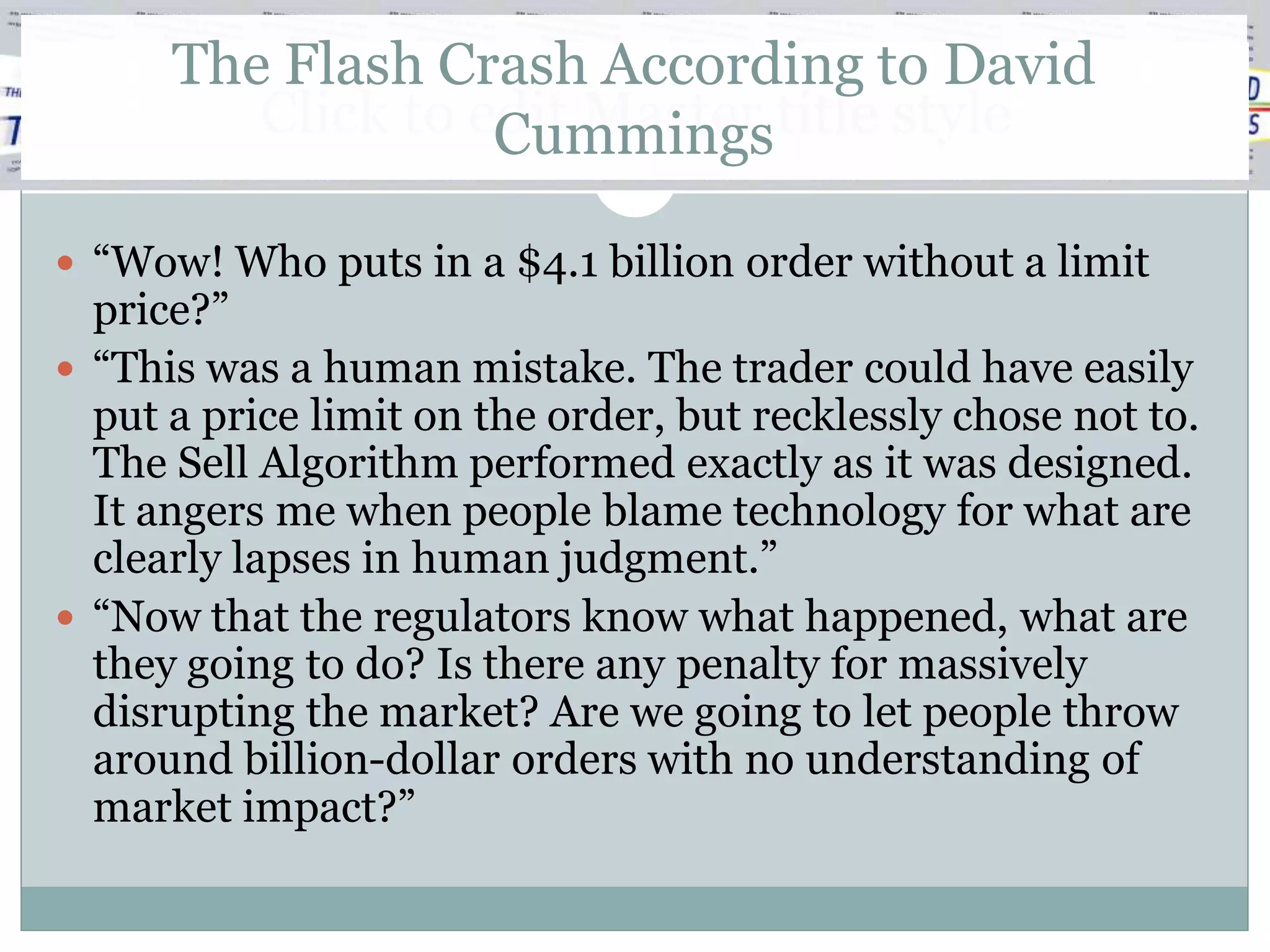
 “Wow! Who puts in a $4.1 billion order without a limit
  price?”
 “This was a human mistake. The trader could have easily
  put a price limit on the order, but recklessly chose not to.
  The Sell Algorithm performed exactly as it was designed.
  It angers me when people blame technology for what are
  clearly lapses in human judgment.”
 “Now that the regulators know what happened, what are
  they going to do? Is there any penalty for massively
  disrupting the market? Are we going to let people throw
  around billion-dollar orders with no understanding of
  market impact?”
What do Warren Buffett and James Simons
   Have to Sayedit MasterFlashstyle
       Click to About the title Crash?

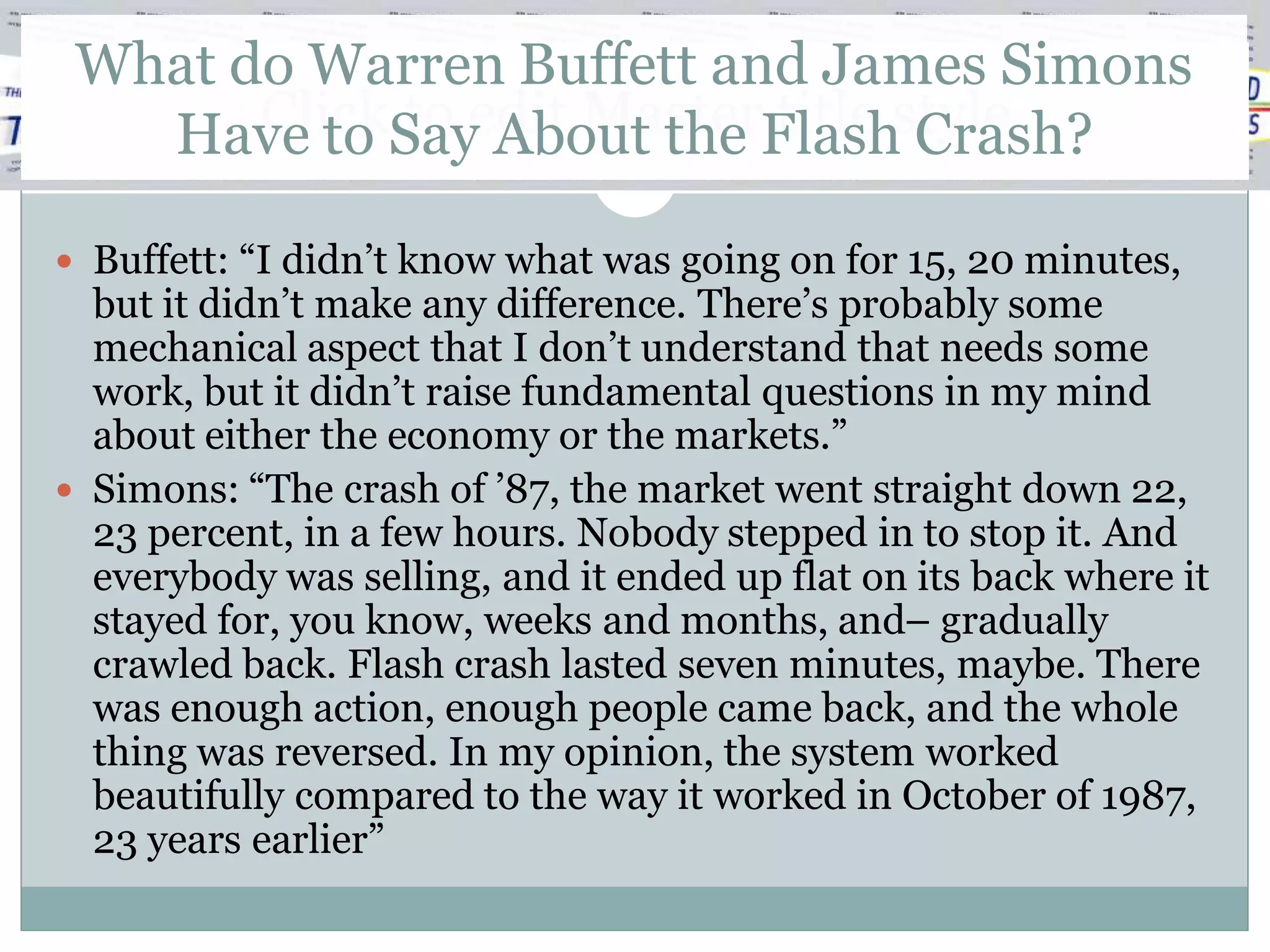
 Buffett: “I didn’t know what was going on for 15, 20 minutes,
  but it didn’t make any difference. There’s probably some
  mechanical aspect that I don’t understand that needs some
  work, but it didn’t raise fundamental questions in my mind
  about either the economy or the markets.”
 Simons: “The crash of ’87, the market went straight down 22,
  23 percent, in a few hours. Nobody stepped in to stop it. And
  everybody was selling, and it ended up flat on its back where it
  stayed for, you know, weeks and months, and– gradually
  crawled back. Flash crash lasted seven minutes, maybe. There
  was enough action, enough people came back, and the whole
  thing was reversed. In my opinion, the system worked
  beautifully compared to the way it worked in October of 1987,
  23 years earlier”
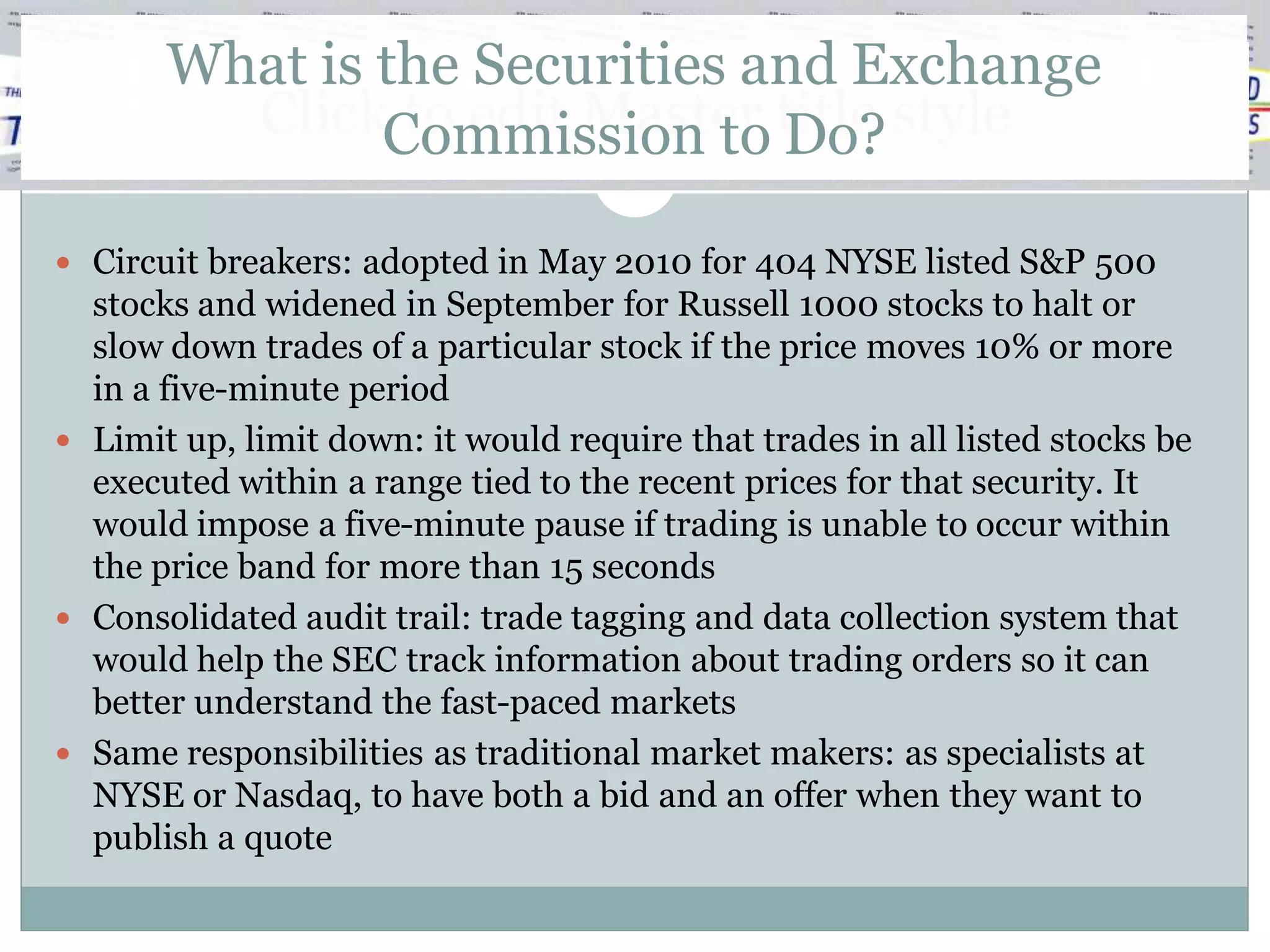
What is the Securities and Exchange
         ClickCommission to title style
                to edit Master Do?

 Circuit breakers: adopted in May 2010 for 404 NYSE listed S&P 500
  stocks and widened in September for Russell 1000 stocks to halt or
  slow down trades of a particular stock if the price moves 10% or more
  in a five-minute period
 Limit up, limit down: it would require that trades in all listed stocks be
  executed within a range tied to the recent prices for that security. It
  would impose a five-minute pause if trading is unable to occur within
  the price band for more than 15 seconds
 Consolidated audit trail: trade tagging and data collection system that
  would help the SEC track information about trading orders so it can
  better understand the fast-paced markets
 Same responsibilities as traditional market makers: as specialists at
  NYSE or Nasdaq, to have both a bid and an offer when they want to
  publish a quote
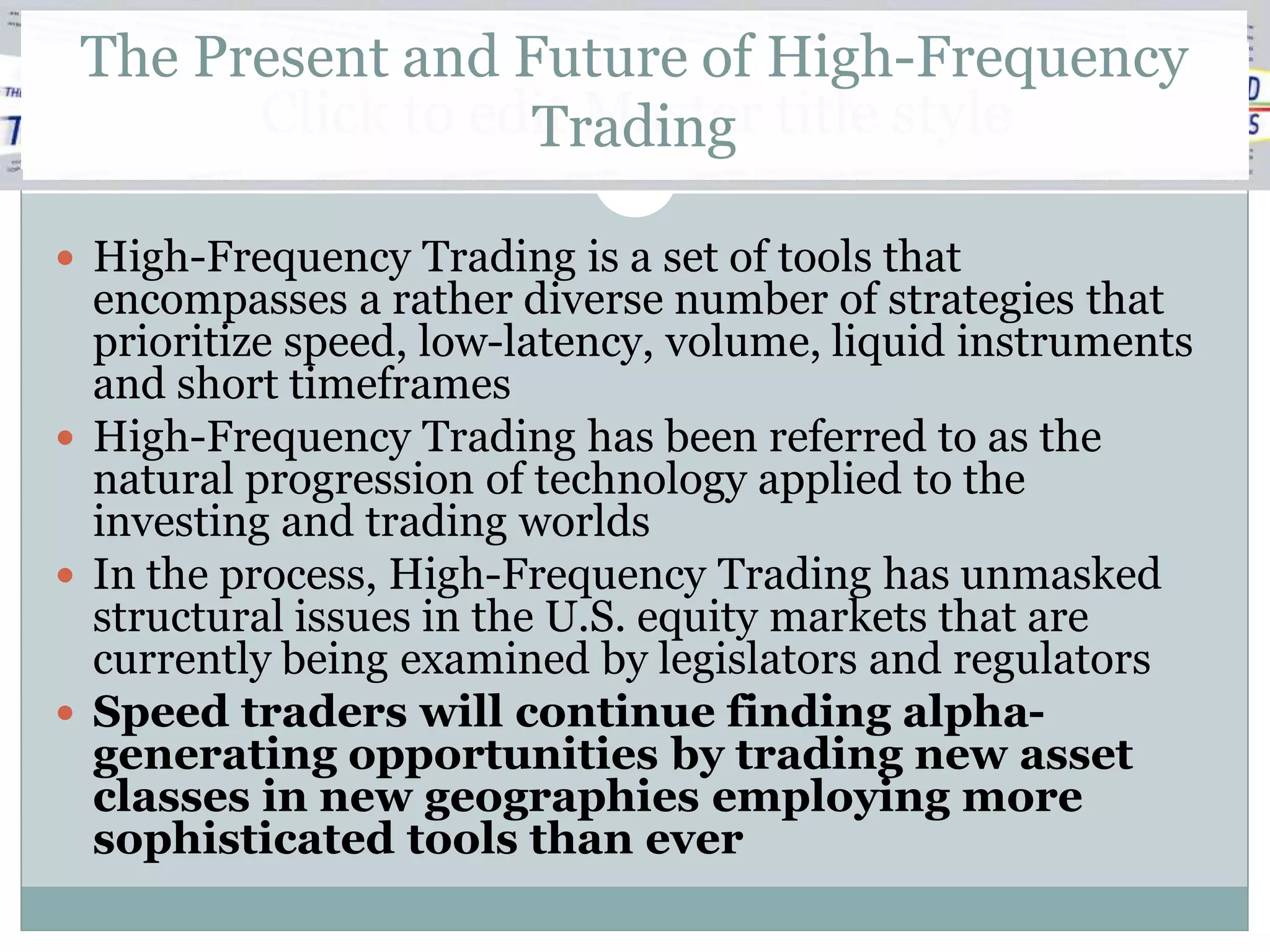
The Present and Future of High-Frequency
       Click to edit Master title style
                  Trading

 High-Frequency Trading is a set of tools that
  encompasses a rather diverse number of strategies that
  prioritize speed, low-latency, volume, liquid instruments
  and short timeframes
 High-Frequency Trading has been referred to as the
  natural progression of technology applied to the
  investing and trading worlds
 In the process, High-Frequency Trading has unmasked
  structural issues in the U.S. equity markets that are
  currently being examined by legislators and regulators
 Speed traders will continue finding alpha-
  generating opportunities by trading new asset
  classes in new geographies employing more
  sophisticated tools than ever
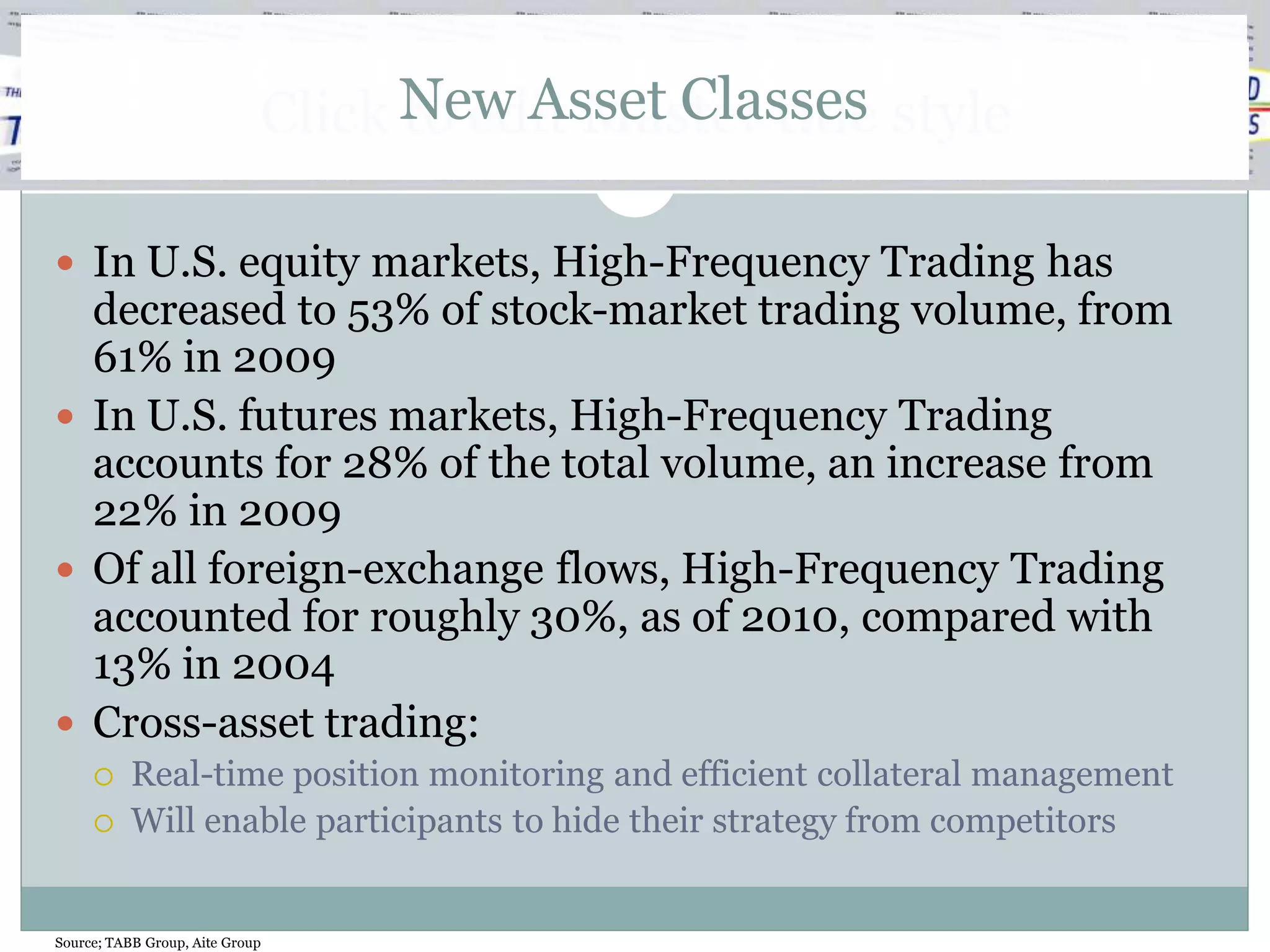
Click New Asset Classes style
                                   to edit Master title

 In U.S. equity markets, High-Frequency Trading has
  decreased to 53% of stock-market trading volume, from
  61% in 2009
 In U.S. futures markets, High-Frequency Trading
  accounts for 28% of the total volume, an increase from
  22% in 2009
 Of all foreign-exchange flows, High-Frequency Trading
  accounted for roughly 30%, as of 2010, compared with
  13% in 2004
 Cross-asset trading:
          Real-time position monitoring and efficient collateral management
          Will enable participants to hide their strategy from competitors


Source; TABB Group, Aite Group
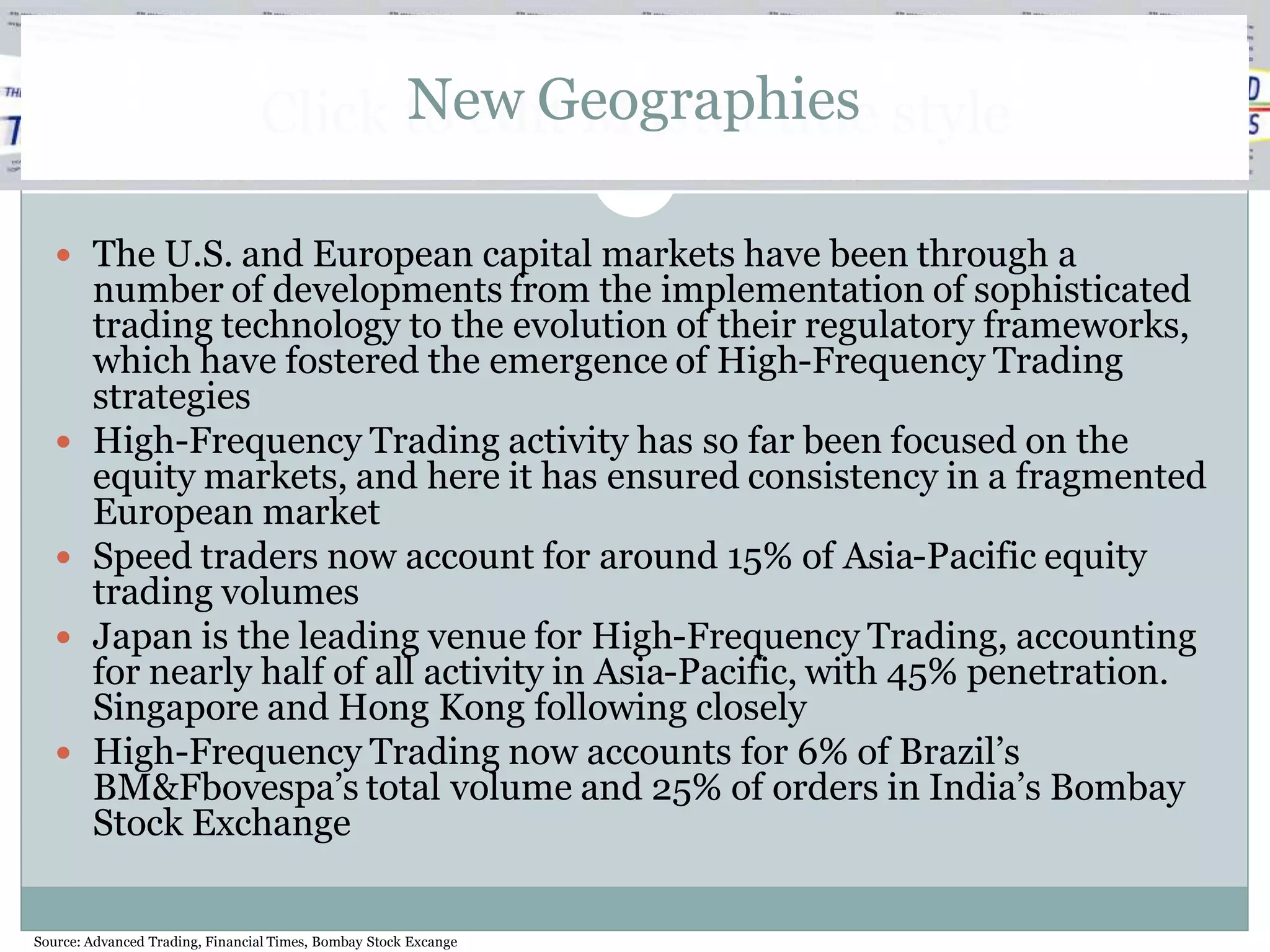
New Geographies
                                 Click to edit Master title style

    The U.S. and European capital markets have been through a
        number of developments from the implementation of sophisticated
        trading technology to the evolution of their regulatory frameworks,
        which have fostered the emergence of High-Frequency Trading
        strategies
       High-Frequency Trading activity has so far been focused on the
        equity markets, and here it has ensured consistency in a fragmented
        European market
       Speed traders now account for around 15% of Asia-Pacific equity
        trading volumes
       Japan is the leading venue for High-Frequency Trading, accounting
        for nearly half of all activity in Asia-Pacific, with 45% penetration.
        Singapore and Hong Kong following closely
       High-Frequency Trading now accounts for 6% of Brazil’s
        BM&Fbovespa’s total volume and 25% of orders in India’s Bombay
        Stock Exchange

Source: Advanced Trading, Financial Times, Bombay Stock Excange
More Sophisticated Tools Than Ever
       Click to edit Master title style

 GPUs (Graphical Processing Units): Recent
  developments in high performance computing provide
  strong evidence that graphic cards can be successfully
  used as high-performance many-core processors. Usually
  provide advantageous scalability in terms of calculations
  that can be done in parallel, plus savings in terms of
  electric power consumption, computing power and heat
  emission.
 FPGA (Field Programmable Gate Arrays): Acceleration
  using hardware. Really good at doing bit-level
  manipulation, which makes them particularly well suited
  for certain types of signal processing.
TheSpeedTraders.com
  @TheSpeedTraders


Edgar Perez, Author, The Speed Traders

The Present and Future of High Frequency Trading

  • 1.
    The Present andFuture of High-Frequency Trading Edgar Perez, Author, The Speed Traders
  • 2.
    The Present andFuture of High-Frequency Click to edit Master title style Trading  High-Frequency Trading is a set of tools that encompasses a rather diverse number of strategies that prioritize speed, low-latency, volume, liquid instruments and short timeframes  High-Frequency Trading has been referred to as the natural progression of technology applied to the investing and trading worlds  In the process, High-Frequency Trading has unmasked structural issues in the U.S. equity markets that are currently being examined by legislators and regulators  Speed traders will continue finding alpha-generating opportunities by trading new asset classes in new geographies employing more sophisticated tools than ever
  • 3.
    Defining High-Frequency Trading Click to edit Master title style  Professional traders acting in a proprietary capacity that engage in strategies that generate a large number of trades on a daily basis  Organized as proprietary trading firm, as the proprietary trading desk of a multi-service broker-dealer, or as a hedge fund  Main characteristics:  Usage of extraordinarily high-speed and sophisticated computer programs for generating, routing, and executing orders  Co-location services and individual data feeds offered by exchanges and others to minimize network and other types of latencies  Very short time-frames for establishing and liquidating positions  Submission of numerous orders that are cancelled shortly after submission  Ending the trading day in as close to a flat position as possible (that is, not carrying significant, un-hedged positions overnight)  Focus on highly liquid instruments (e.g., Citi example)
  • 4.
    Understanding High-Frequency Trading Click to edit Master title style  At a recent investment management event, 66% of managers didn’t have an opinion about High-Frequency Trading  A recent poll by Greenwich Associates found that 20% of institutional investors don't fully understand the practice of High-Frequency Trading  Algorithmic trading is broader, encompassing the automation of alpha-seeking and potentially execution trading decision making  High-Frequency Trading specifically monitors the market for patterns that indicate alpha-making trading opportunities; then places orders to take instant advantage of those opportunities  As market data is coming in fast, and conditions are changing by the millisecond, the firms that leverage High-Frequency Trading are able to jump on opportunities faster than the competition Source: Progress Software
  • 5.
    The Present andFuture of High-Frequency Click to edit Master title style Trading  High-Frequency Trading is a set of tools that encompasses a rather diverse number of strategies that prioritize speed, low-latency, volume, liquid instruments and short timeframes  High-Frequency Trading has been referred to as the natural progression of technology applied to the investing and trading worlds  In the process, High-Frequency Trading has unmasked structural issues in the U.S. equity markets that are currently being examined by legislators and regulators  Speed traders will continue finding alpha-generating opportunities by trading new asset classes in new geographies employing more sophisticated tools than ever
  • 6.
    Technology and Changesto Market Structure Click to Key Enablers style edit Master title  Technological innovation:  Faster, cheaper computing power  Advancements in the field of complex event processing  Increase in availability of low-latency bandwidth  Shift to electronic trading  Rise of alternative trading systems  Decimalization  Regulatory changes, e.g., Reg NMS
  • 7.
    Significant Growth inHigh-Frequency Click to edit Master title style Trading
  • 8.
    High-Frequency Trading aNatural Evolution Clickthe edit Master title style of to Securities Markets  There is a clear evolutionary process in the adoption of new technologies triggered by competition, innovation and regulation  Like all other technologies, High-Frequency Trading enables sophisticated market participants to profit on their investments – especially in technology – and compensation for their market, counterparty and operational risk exposures
  • 9.
    Trends in TradingActivity, Partly Driven by Click to edit Master title style High-Frequency Trading
  • 10.
    The Present andFuture of High-Frequency Click to edit Master title style Trading  High-Frequency Trading is a set of tools that encompasses a rather diverse number of strategies that prioritize speed, low- latency, volume, liquid instruments and short timeframes  High-Frequency Trading has been referred to as the natural progression of technology applied to the investing and trading worlds  In the process, High-Frequency Trading has unmasked structural issues in the U.S. equity markets that are currently being examined by legislators and regulators  Speed traders will continue finding alpha-generating opportunities by trading new asset classes in new geographies employing more sophisticated tools than ever
  • 11.
    The Flash CrashAccording to David Click to edit Master title style Cummings  “Wow! Who puts in a $4.1 billion order without a limit price?”  “This was a human mistake. The trader could have easily put a price limit on the order, but recklessly chose not to. The Sell Algorithm performed exactly as it was designed. It angers me when people blame technology for what are clearly lapses in human judgment.”  “Now that the regulators know what happened, what are they going to do? Is there any penalty for massively disrupting the market? Are we going to let people throw around billion-dollar orders with no understanding of market impact?”
  • 12.
    What do WarrenBuffett and James Simons Have to Sayedit MasterFlashstyle Click to About the title Crash?  Buffett: “I didn’t know what was going on for 15, 20 minutes, but it didn’t make any difference. There’s probably some mechanical aspect that I don’t understand that needs some work, but it didn’t raise fundamental questions in my mind about either the economy or the markets.”  Simons: “The crash of ’87, the market went straight down 22, 23 percent, in a few hours. Nobody stepped in to stop it. And everybody was selling, and it ended up flat on its back where it stayed for, you know, weeks and months, and– gradually crawled back. Flash crash lasted seven minutes, maybe. There was enough action, enough people came back, and the whole thing was reversed. In my opinion, the system worked beautifully compared to the way it worked in October of 1987, 23 years earlier”
  • 13.
    What is theSecurities and Exchange ClickCommission to title style to edit Master Do?  Circuit breakers: adopted in May 2010 for 404 NYSE listed S&P 500 stocks and widened in September for Russell 1000 stocks to halt or slow down trades of a particular stock if the price moves 10% or more in a five-minute period  Limit up, limit down: it would require that trades in all listed stocks be executed within a range tied to the recent prices for that security. It would impose a five-minute pause if trading is unable to occur within the price band for more than 15 seconds  Consolidated audit trail: trade tagging and data collection system that would help the SEC track information about trading orders so it can better understand the fast-paced markets  Same responsibilities as traditional market makers: as specialists at NYSE or Nasdaq, to have both a bid and an offer when they want to publish a quote
  • 14.
    The Present andFuture of High-Frequency Click to edit Master title style Trading  High-Frequency Trading is a set of tools that encompasses a rather diverse number of strategies that prioritize speed, low-latency, volume, liquid instruments and short timeframes  High-Frequency Trading has been referred to as the natural progression of technology applied to the investing and trading worlds  In the process, High-Frequency Trading has unmasked structural issues in the U.S. equity markets that are currently being examined by legislators and regulators  Speed traders will continue finding alpha- generating opportunities by trading new asset classes in new geographies employing more sophisticated tools than ever
  • 15.
    Click New AssetClasses style to edit Master title  In U.S. equity markets, High-Frequency Trading has decreased to 53% of stock-market trading volume, from 61% in 2009  In U.S. futures markets, High-Frequency Trading accounts for 28% of the total volume, an increase from 22% in 2009  Of all foreign-exchange flows, High-Frequency Trading accounted for roughly 30%, as of 2010, compared with 13% in 2004  Cross-asset trading:  Real-time position monitoring and efficient collateral management  Will enable participants to hide their strategy from competitors Source; TABB Group, Aite Group
  • 16.
    New Geographies Click to edit Master title style  The U.S. and European capital markets have been through a number of developments from the implementation of sophisticated trading technology to the evolution of their regulatory frameworks, which have fostered the emergence of High-Frequency Trading strategies  High-Frequency Trading activity has so far been focused on the equity markets, and here it has ensured consistency in a fragmented European market  Speed traders now account for around 15% of Asia-Pacific equity trading volumes  Japan is the leading venue for High-Frequency Trading, accounting for nearly half of all activity in Asia-Pacific, with 45% penetration. Singapore and Hong Kong following closely  High-Frequency Trading now accounts for 6% of Brazil’s BM&Fbovespa’s total volume and 25% of orders in India’s Bombay Stock Exchange Source: Advanced Trading, Financial Times, Bombay Stock Excange
  • 17.
    More Sophisticated ToolsThan Ever Click to edit Master title style  GPUs (Graphical Processing Units): Recent developments in high performance computing provide strong evidence that graphic cards can be successfully used as high-performance many-core processors. Usually provide advantageous scalability in terms of calculations that can be done in parallel, plus savings in terms of electric power consumption, computing power and heat emission.  FPGA (Field Programmable Gate Arrays): Acceleration using hardware. Really good at doing bit-level manipulation, which makes them particularly well suited for certain types of signal processing.
  • 18.
    TheSpeedTraders.com @TheSpeedTraders EdgarPerez, Author, The Speed Traders