

YIELD CURVE TRADING STRATEGIES
A PRIMER ON SPREAD TRADING
OPPORTUNITIES IN THE US TREASURY MARKET
PRESENTED BY ONLINE FINANCE ACADEMY INC.
2017©
AUTHORS: MARK SHLAES, ADAM JAGIELLOWICZ
Contents
This brief course will explain the following and more:
 What is spread trading?
 Why spreading is the trading technique most likely to lead to a
consistently profitable trading career.
 Rudiments of trading the yield curve and treasury market
 Key strategies for trading the yield curve
 Answers to frequently asked questions about spread trading US treasuries.
 Sources of free and essential information for trading the yield curve.
Rudiments of Spread Trading
What is Spread Trading?
 Spread trading involves taking a long position in one futures contract and a
short position in another futures contract. The reason a trader would do this is
when they perceive mispricing in either or both contracts. When markets come
back into sync (mean reversion), the spread would be unwound and the trader
would profit from the difference.
 This can involve having multiple positions across a variety of contracts (such as
butterflies and condors), or times to expiration (calendar spreads).
 Spread trades can be executed across financial jurisdictions and exchanges
(intermarket spreads) or within a particular exchange (intramarket spread).
Why should someone trade a spread?
Spread Trading requires far lower margins to put on a trade.
 This enables a trader to scale into positions and to increase size in
increments suiting their risk parameters.
 This enables spread traders to hold onto winning trades longer
Spread Trading forces a trader to think in terms of more clearly defined
price targets based on historical probabilities.
 This mitigates the psychological challenges that traders often face.
 This allows a trader to establish better risk / capital management
Why should someone trade a spread?
You don’t require ultra-fast execution speeds to succeed as a spreader.
 Financial markets have become an arms race to some degree;
those firms that have invested heavily in co-location and
automated trading algorithms have an advantage in terms of
speed. Computers may be faster but they are not smarter.
 Because spreads take time to develop, spreading allows anyone
who has the necessary intelligence and knowledge of the
treasury market to profit from longer term moves in the market.
Why would someone trade a spread?
Spread Trading helps a trader develop a better understanding of the
macroeconomic fundamentals of the financial markets.
 Novice traders are often tempted by the ‘easy route’, such as technical
indicators, etc. and chasing momentum. However, these technical indicators
rarely perform anywhere near expectations. A solid foundation of economic
macrofundamentals is required to succeed in the long term.
Spread trading helps keep you in the game.
 It takes many months, if not several years to master any profession. If
you chase momentum you are about 90% sure to lose money in your
first year of trading; this is less likely with spreading. Remember,
staying in the game is the first step to winning the game.
Why spread traders have the longest
and most profitable trading careers
 Trading is the business of managing probabilities.; it is also a mental
sport. The stress involved in scalping or short term momentum
strategies is significant. You really need to watch market action
continually to be able to succeed.
 Spread trading is a different type of business. It is a waiting game with
fewer opportunities, but opportunities which have greater odds of
success. In a business where having the slightest edge is of paramount
importance, it is critical that one focuses on only the highest
probability trade setups.
Examples of Spread Trading
strategies
There are a variety of ways of trading the treasury futures market, some of
which can be rather complex, The finer details of these strategies are available
in our full mentoring program. In brief, here are some of the main strategies
and techniques that you can look forward to learning. Ultimately, you will likely
want to focus on just one strategy and master it with the help of your trading
mentor.
 Intermarket spreads
 Calendar Spreads
 Condors and Butterflies
 Legging spreads (a hedged momentum strategy)
 Macro-based
Examples of Spread Trading strategies
Intermarket spreads: this strategy involves taking a position in one market,
and the opposite position in another (foreign) market.
 Due to differences in currency prices, monetary and fiscal policies, these type
of spreads provide significant opportunities through greater volatility and
complexity of positioning.
 Intermarket spreading is a highly engaging aspect of the trading business.
This method of trading may require greater margin than intramarket spreads,
but offers great opportunities for anyone with an interest in, and proficiency
in global financial markets and macroeconomics.
Why trade an Intermarket Spread?
When would one trade an intermarket spread? When one expects
any of the following scenarios:
i) a rate rise or decline in one market but not the other;
ii) a disparity in yields;
iii) an appreciation of the equities index in one market but not the other,
iv) fiscal policy changes;
v) sensitivity around a particular yield, etc.
Examples of Spread Trading strategies
As one studies macroeconomics and intermarket relationships in greater detail
they begin to discover how bond trading, and specifically spread trading, can
be quite a creative pursuit. One’s mind is constantly thinking of emerging
opportunities and ways to profit from these emerging trends.
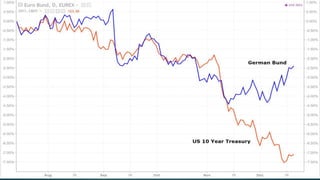
For example, consider following chart and how the US treasury market and the
German bund market began to diverge in the autumn of 2016. Notice how
these two 10 year bonds normally would follow each other quite closely, but
then began to diverge after the election of Donald Trump. If you have an
understanding of macroeconomics and the bond market, such trends can be
anticipated, and significant profits can be earned.
Examples of Spread Trading Strategies
The previous chart exemplifies a risk-on environment in the US and a risk-off
environment in Europe. The US election in Nov. 2016 gave rise to a very bullish stock
market. This combined with a more hawkish stance from the Fed caused US bond
futures to plummet. A spread trade (going long the bund and short the US 10 year)
would have been ideal in this situation.
Would you like to understand how such a trade could have been anticipated? This is
what this course “Yield Curve Trading Strategies” explains in fine detail.
Great opportunities like this are not that common but when they do occur, they can
result in huge profits for anyone who is prepared for them. Preparation means having a
solid knowledge of the macroeconomic and geopolitical factors which influence the
bond and currency markets. This is also something which is taught in detail in the ‘Yield
Curve Trading Strategies’ course. There is a lot to learn of course, as you will see…
Some of the Topics you will Learn in the
Yield Curve Strategies course
 Calendar Spreads: learn the most consistently profitable trade known to pros (contract roll-over)
 Butterflies and Condors: learn how to profit from changes in term structure (flattening and
steepening)
 Legging Spreads: capitalizing on short term price discrepancies to get ideal pricing on a spread
 Rudiments of the Yield Curve: normal, flat, and inverted yield curve, steepening, flattening
 Monetary Policy and Market Expectations: how news events affect the curve
 Fiscal Policy: understand the long term effects on bond yields from a global perspective
 Inflation / Deflation Expectations and Effects on the Bond Markets
 Effects of Currency Valuations on Bond Markets
 Correlations: understanding when a trend has started or mean reversion is likely to occur
 Geopolitics and the Flight to Quality: risk-on vs. risk-off
 Understanding Treasury Auctions and Supply / Demand Considerations.
Spread Ratios
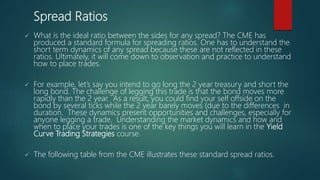
 What is the ideal ratio between the sides for any spread? The CME has
produced a standard formula for spreading ratios. One has to understand the
short term dynamics of any spread because these are not reflected in these
ratios. Ultimately, it will come down to observation and practice to understand
how to place trades.
 For example, let’s say you intend to go long the 2 year treasury and short the
long bond. The challenge of legging this trade is that the bond moves more
rapidly than the 2 year. As a result, you could find your self offside on the
bond by several ticks while the 2 year barely moves (due to the differences in
duration. These dynamics present opportunities and challenges, especially for
anyone legging a trade. Understanding the market dynamics and how and
when to place your trades is one of the key things you will learn in the Yield
Curve Trading Strategies course.
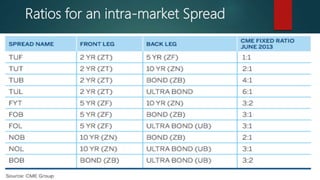
 The following table from the CME illustrates these standard spread ratios.
Ratios for an intra-market Spread
Spread Ratio Calculations
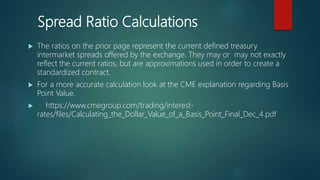
 The ratios on the prior page represent the current defined treasury
intermarket spreads offered by the exchange. They may or may not exactly
reflect the current ratios, but are approximations used in order to create a
standardized contract.
 For a more accurate calculation look at the CME explanation regarding Basis
Point Value.
 https://www.cmegroup.com/trading/interest-
rates/files/Calculating_the_Dollar_Value_of_a_Basis_Point_Final_Dec_4.pdf
Spread Ratio Calculations
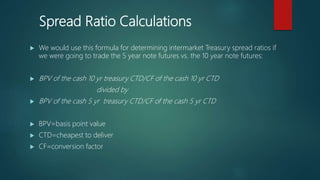
 We would use this formula for determining intermarket Treasury spread ratios if
we were going to trade the 5 year note futures vs. the 10 year note futures:
 BPV of the cash 10 yr treasury CTD/CF of the cash 10 yr CTD
divided by
 BPV of the cash 5 yr treasury CTD/CF of the cash 5 yr CTD
 BPV=basis point value
 CTD=cheapest to deliver
 CF=conversion factor
Questions and Answers
Becoming a master trader of the treasury futures market requires a deep
knowledge base of macroeconomic fundamentals complemented by strategic
thinking and technical experience in placing trades on a trading platform. These
three aspects of spread trading must work together for a trader to be successful.
Once one has learned the core fundamentals and soaked up the knowledge and
experience of a highly qualified mentor, the rewards of this knowledge acquisition
are long lasting and highly rewarding.
In the following frames we highlight some of the most frequently asked questions
about spread trading the treasury futures market to get you started on the right
path. There is also a significant amount of reliable information about spread
trading available through exchanges (see appendix of this presentation) and we
suggest you consult these resources as you work with your trading mentor.
1. Is there any real difference between a ‘treasury note’ and a ‘bond’?
No, not really. They are all backed by the full faith and credit of the US Government.
It’s only a difference in terminology with notes defined by maturities at issuance of 2
10 Years (2, 3, 5 7, 10 years) and bonds (or the long bond) issued with a 30 year
maturity.
2. Why are these treasuries all denoted in 32nds.
There remains to be seen any verifiable explanation; only theories. The most popular
theory is that the pricing convention was a base 8 taken from the Spanish pieces of
eight which evolved into 32nds to make a more affordable tick size.
3. Why is the tick value different for the 10 year, 5 year, 30 year etc.
The exchange assigned smaller tick sizes to the shorter maturities to create tighter
markets and to better reflect the underlying cash market.
4. Why is the Eurodollar called the Eurodollar instead of just the 3 months etc treasury?
Eurodollars are defined as time deposits of US dollars held in off-shore banks. They are not
defined by a specific currency or geography, but may be any foreign bank deposit.
5. Why are the longer term treasuries more volatile than the shorter term treasuries?
As the length of maturities (duration) increase(s), the risks increase. In other words, a 10 year
note buyer would have a longer exposure to market and data changes that could impact
pricing than a 2 year note buyer.
6. Is there a contract I can buy which is a spread in itself so I don’t pay double commissions
or worry about getting filled on one side but not on the other?
Yes. The CME group offers multiple defined spread contracts in financials, agricultural, and
energy contracts.
7. Why do treasuries perform strongly in the event of a catastrophe?
Catastrophic events produce a market reaction referred to as ‘flight to quality’ or safe
haven trades. When participants are uncertain of the future, they will liquidate what is
perceived to be at-risk investments and move money into surer assets, i.e. government
bonds, currencies, precious metals.
8. Is there any advantage to trading a further out expiry rather than the nearest expiry?
Ex: trading March instead of December.
Usually the best advantage is trading in months with the greatest volume. Those offer
the best liquidity and ease for moving in and out. Under certain circumstances, a
deferred expiration may be more advantageous. If for example, a trader expected a
dislocation of supply in a more distant expiration, and wanted to be long the market,
could buy the more distant contract anticipating a greater return.
9. What is the correlation between the US dollar index and treasury futures? Can you
explain the relationship from a macrofundamental perspective?
In order to discover the correlation, you have to understand the reasons that are
causing each individual market to move up or down. The movement between
futures and the dollar index would usually be negatively correlated. Higher yields of
treasuries (which would cause treasury futures to go lower) in a healthy economy
draw investors, both domestic and foreign, in search of yield.
On the other hand, investors could sour on the US economy and exit the treasury
market in order to move their dollars to offshore investments. Changing their dollars
for other currencies would cause a drop in the dollar index, and would lead to lower
treasury futures prices with the liquidation of those positions.
10. If there is a catastrophic event, terrorist attack etc, should I be buying the shorter
term treasuries or longer term and why?
In times of uncertainty investors will move into what is perceived as the safest assets.
Treasuries are safe because of their full faith and credit backing by the US
Longer maturities will increase in value, but because they add a level of risk, they
would not be the best choice. Shorter maturities would be the choice because they
are perceived to be the safest.
11.What are the most popular products being spread? (5 /30, 2/10 ) etc.
5/10 (FITE or FIT), 10/30 (NOB), 5/30 (FOB), and maybe the 2/10 (TUT)
12. Is it possible to spread three different treasuries? When or why would I do that?
Ex: long 10 TU, Long 5 FV, and short 5 ZN
You may spread 3 different treasury maturities or even 4. The most common 3
legged spread is a butterfly which most often consists of the longer and shorter
expirations at front and back and the medium expiration in the middle. Ex: long 5
FV, short 6 TY, long 1 US. You would want to trade a butterfly when the middle leg
perceived to be out of line with the other spread components (in this case the TY
price is thought to be too rich vs. the FV and US).
A 4 legged spread is called a condor EX: long 12 TU, short 9 FV, short 6 TY, long 2
(In this example and similarly in the prior example, the curve is expected to move
more in the middle).
13. What should I do if I get filled on one side but I don’t get filled on the other side of the
spread?
If the price on the filled leg is still available in the market, offset the position immediately to
scratch (break even on) the position. Otherwise, go to the market on the missed leg. At
point you still have an opportunity to scratch the spread position. The third choice you
would have is to immediately take a loss on the filled position. You can’t let the position get
away from you. Trying to scratch the single leg once the market has turned, or working the
missed leg, you’re risking a much greater loss than you hoped to gain from the spread. You
can also trade inter-commodity treasury spreads where both legs of the spread are filled
without legging risk.
14. Why do we sometimes get flatteners and then a steepener several days later, even if
nothing has really changed in the economy.
Institutions and traders move up and down the curve for a number of reasons. It could be
nothing more than a dislocation in the market where someone needs to buy or sell a
particular maturity and the curve moves out of line.
15. If a market looks like it is about to steepen what spreading strategy should I employ?
As the market moves from a flat yield curve environment, you would expect to see the 5
year and ten year treasuries outperform the 30 year and 2 year. You could also see
strength occur in the belly if the market perceives a better appreciation from the middle
or a relatively cheaper cost to carry.
16. Why would an institution decide to put on or unwind its flatteners or steepeners?
There could be a number of reasons. Often times it’s in anticipation or reaction to FED
moves. In other circumstances, there might be the perception of a reversal of the trend,
thus liquidation and possibly a reversal. Or, it might be due to reaching an objective
leading to profit-taking. Or, it could be a central bank adjusting the duration of their
portfolio, or liquidating treasuries to lower currency risk.
17. How do I know if they are going to do this? Do they reveal their hand in the short
end of the curve or the long end first? In other words, is any duration a leading
indicator
The greatest indicator is big picture, provided by FED guidance and actions. In the
the FED and other central banks impacted interest rates (which impacted the curve)
through short term instruments (discount rate and fed funds). More recently, Central
Banks have re-shaped the yield curve with the purchase of treasuries up and down the
curve.
18. If the leading indicator changes at times, what causes it to change?
Inflation, deflation, catastrophic events, fiscal surplus or deficit, high levels of
unemployment, GDP, are all factors that change the trend of the curve. This list is non-
exclusive.
19. Why is the ‘5 year’ considered a hedging product and what is meant by that?
Hedging products are financial instruments that can be used for risk management.
The five year treasury can be used to mitigate risk against positions of corporate
of similar duration, auto loans, or credit card portfolios which are configured in five
year duration. If, for example, you are a bank making loans to car buyers for 60
months, you can offset the credit risk by selling 5 year notes against the loans and
protecting your opportunity costs if interest rates rise.
About the course and the instructor
Students of this course can have the utmost confidence that they are learning from a
true trading master (and master instructor).
 Mark Shlaes: a successful CBOT trader and board member
for 3 decades; curriculum developer and trading mentor to
over 200 professional traders.
 Mark possesses a rare combination of traits: a profound
knowledge of trading combined with a talent for teaching
and the generosity to impart his knowledge to a new
generation of traders.
 Mark teaches this course in a small class format, offering a true mentoring
experience. Students study course material before class, work on current case study
examples and practice placing trades on a simulator in an interactive lass setting.
A shortened version of Mark’s extensive biography follows…
Biography Mark Shlaes
 Member of the Chicago Board of Trade (CBOT) for over 29 years
 Successfully traded in 9 trading pits for 29+ years, as an independent trader, as
a floor broker on behalf of institutional clients, and running trading floor-based
arbitrage operations.
 Served as CBOT Director for 3 years and as Second Vice-Chairman for 1 year, as
well as 20+ exchange committees, including Executive Committee; chaired 11
committees including: strategic planning, executive compensation, product and
marketing.
Biography Mark Shlaes
 Ten years as part of Senior Management Team at Goldenberg, Hehmeyer and successor firms:
 Established successful New York proprietary trading group office for GHCO, including:
operations, strategic planning, trader recruitment, initial and ongoing training/mentoring.
 Developed global curriculum for new traders, psychologically-based interview processes, risk
procedures, and oversight for offices in London, New York and Chicago.
 Managed global proprietary trading group operations from 2003-2005, including subsequent
training of London, UK staff.
 Provided personalized mentoring for 200+ traders and 10 trading managers.
 Provided insights and guidance for business development/growth via Senior Management
Strategic Planning Group.
How to register for this course
To ensure a highly productive classroom environment, we carefully select all
students who apply for this course. One does not require a university degree or
significant trading experience.
This is what you should send us to take part in this exclusive course:
 A 1 page c.v. to be sent to info@onlinefinanceacademy.com (Be sure to indicate
any trading experience you may have.)
 Also, you should have at least a rudimentary knowledge of trading products and
specifically, futures. If you have not taken the OFA Master in Trading core course,
you should contact us for a brief interview to ensure suitability to the Yield Curve
Trading Strategies course. We can be reached at
info@onlinefinanceacademy.com
Links to recommended articles and
books
 http://www.cmegroup.com/trading/interest-rates/treasury-futures-white-paper.html
 Interest Rate Markets: A Practical Approach to Fixed Income (Wiley Trading) Kindle Edition,
by Siddhartha Jha (Author)
 http://www.iijournals.com/doi/abs/10.3905/jod.1997.407992?journalCode=jod
 https://www.cmegroup.com/trading/interest-rates/files/understanding-eurodollar-futures.pdf
 https://www.cmegroup.com/trading/interest-rates/files/TreasurySwap_SpreadOverview.pdf

Yield Curve Trading Strategies

  • 1.
  • 2.
    A PRIMER ONSPREAD TRADING OPPORTUNITIES IN THE US TREASURY MARKET PRESENTED BY ONLINE FINANCE ACADEMY INC. 2017© AUTHORS: MARK SHLAES, ADAM JAGIELLOWICZ
  • 3.
    Contents This brief coursewill explain the following and more:  What is spread trading?  Why spreading is the trading technique most likely to lead to a consistently profitable trading career.  Rudiments of trading the yield curve and treasury market  Key strategies for trading the yield curve  Answers to frequently asked questions about spread trading US treasuries.  Sources of free and essential information for trading the yield curve.
  • 4.
    Rudiments of SpreadTrading What is Spread Trading?  Spread trading involves taking a long position in one futures contract and a short position in another futures contract. The reason a trader would do this is when they perceive mispricing in either or both contracts. When markets come back into sync (mean reversion), the spread would be unwound and the trader would profit from the difference.  This can involve having multiple positions across a variety of contracts (such as butterflies and condors), or times to expiration (calendar spreads).  Spread trades can be executed across financial jurisdictions and exchanges (intermarket spreads) or within a particular exchange (intramarket spread).
  • 5.
    Why should someonetrade a spread? Spread Trading requires far lower margins to put on a trade.  This enables a trader to scale into positions and to increase size in increments suiting their risk parameters.  This enables spread traders to hold onto winning trades longer Spread Trading forces a trader to think in terms of more clearly defined price targets based on historical probabilities.  This mitigates the psychological challenges that traders often face.  This allows a trader to establish better risk / capital management
  • 6.
    Why should someonetrade a spread? You don’t require ultra-fast execution speeds to succeed as a spreader.  Financial markets have become an arms race to some degree; those firms that have invested heavily in co-location and automated trading algorithms have an advantage in terms of speed. Computers may be faster but they are not smarter.  Because spreads take time to develop, spreading allows anyone who has the necessary intelligence and knowledge of the treasury market to profit from longer term moves in the market.
  • 7.
    Why would someonetrade a spread? Spread Trading helps a trader develop a better understanding of the macroeconomic fundamentals of the financial markets.  Novice traders are often tempted by the ‘easy route’, such as technical indicators, etc. and chasing momentum. However, these technical indicators rarely perform anywhere near expectations. A solid foundation of economic macrofundamentals is required to succeed in the long term. Spread trading helps keep you in the game.  It takes many months, if not several years to master any profession. If you chase momentum you are about 90% sure to lose money in your first year of trading; this is less likely with spreading. Remember, staying in the game is the first step to winning the game.
  • 8.
    Why spread tradershave the longest and most profitable trading careers  Trading is the business of managing probabilities.; it is also a mental sport. The stress involved in scalping or short term momentum strategies is significant. You really need to watch market action continually to be able to succeed.  Spread trading is a different type of business. It is a waiting game with fewer opportunities, but opportunities which have greater odds of success. In a business where having the slightest edge is of paramount importance, it is critical that one focuses on only the highest probability trade setups.
  • 9.
    Examples of SpreadTrading strategies There are a variety of ways of trading the treasury futures market, some of which can be rather complex, The finer details of these strategies are available in our full mentoring program. In brief, here are some of the main strategies and techniques that you can look forward to learning. Ultimately, you will likely want to focus on just one strategy and master it with the help of your trading mentor.  Intermarket spreads  Calendar Spreads  Condors and Butterflies  Legging spreads (a hedged momentum strategy)  Macro-based
  • 10.
    Examples of SpreadTrading strategies Intermarket spreads: this strategy involves taking a position in one market, and the opposite position in another (foreign) market.  Due to differences in currency prices, monetary and fiscal policies, these type of spreads provide significant opportunities through greater volatility and complexity of positioning.  Intermarket spreading is a highly engaging aspect of the trading business. This method of trading may require greater margin than intramarket spreads, but offers great opportunities for anyone with an interest in, and proficiency in global financial markets and macroeconomics.
  • 11.
    Why trade anIntermarket Spread? When would one trade an intermarket spread? When one expects any of the following scenarios: i) a rate rise or decline in one market but not the other; ii) a disparity in yields; iii) an appreciation of the equities index in one market but not the other, iv) fiscal policy changes; v) sensitivity around a particular yield, etc.
  • 12.
    Examples of SpreadTrading strategies As one studies macroeconomics and intermarket relationships in greater detail they begin to discover how bond trading, and specifically spread trading, can be quite a creative pursuit. One’s mind is constantly thinking of emerging opportunities and ways to profit from these emerging trends. For example, consider following chart and how the US treasury market and the German bund market began to diverge in the autumn of 2016. Notice how these two 10 year bonds normally would follow each other quite closely, but then began to diverge after the election of Donald Trump. If you have an understanding of macroeconomics and the bond market, such trends can be anticipated, and significant profits can be earned.
  • 14.
    Examples of SpreadTrading Strategies The previous chart exemplifies a risk-on environment in the US and a risk-off environment in Europe. The US election in Nov. 2016 gave rise to a very bullish stock market. This combined with a more hawkish stance from the Fed caused US bond futures to plummet. A spread trade (going long the bund and short the US 10 year) would have been ideal in this situation. Would you like to understand how such a trade could have been anticipated? This is what this course “Yield Curve Trading Strategies” explains in fine detail. Great opportunities like this are not that common but when they do occur, they can result in huge profits for anyone who is prepared for them. Preparation means having a solid knowledge of the macroeconomic and geopolitical factors which influence the bond and currency markets. This is also something which is taught in detail in the ‘Yield Curve Trading Strategies’ course. There is a lot to learn of course, as you will see…
  • 15.
    Some of theTopics you will Learn in the Yield Curve Strategies course  Calendar Spreads: learn the most consistently profitable trade known to pros (contract roll-over)  Butterflies and Condors: learn how to profit from changes in term structure (flattening and steepening)  Legging Spreads: capitalizing on short term price discrepancies to get ideal pricing on a spread  Rudiments of the Yield Curve: normal, flat, and inverted yield curve, steepening, flattening  Monetary Policy and Market Expectations: how news events affect the curve  Fiscal Policy: understand the long term effects on bond yields from a global perspective  Inflation / Deflation Expectations and Effects on the Bond Markets  Effects of Currency Valuations on Bond Markets  Correlations: understanding when a trend has started or mean reversion is likely to occur  Geopolitics and the Flight to Quality: risk-on vs. risk-off  Understanding Treasury Auctions and Supply / Demand Considerations.
  • 16.
    Spread Ratios  Whatis the ideal ratio between the sides for any spread? The CME has produced a standard formula for spreading ratios. One has to understand the short term dynamics of any spread because these are not reflected in these ratios. Ultimately, it will come down to observation and practice to understand how to place trades.  For example, let’s say you intend to go long the 2 year treasury and short the long bond. The challenge of legging this trade is that the bond moves more rapidly than the 2 year. As a result, you could find your self offside on the bond by several ticks while the 2 year barely moves (due to the differences in duration. These dynamics present opportunities and challenges, especially for anyone legging a trade. Understanding the market dynamics and how and when to place your trades is one of the key things you will learn in the Yield Curve Trading Strategies course.  The following table from the CME illustrates these standard spread ratios.
  • 17.
    Ratios for anintra-market Spread
  • 18.
    Spread Ratio Calculations The ratios on the prior page represent the current defined treasury intermarket spreads offered by the exchange. They may or may not exactly reflect the current ratios, but are approximations used in order to create a standardized contract.  For a more accurate calculation look at the CME explanation regarding Basis Point Value.  https://www.cmegroup.com/trading/interest- rates/files/Calculating_the_Dollar_Value_of_a_Basis_Point_Final_Dec_4.pdf
  • 19.
    Spread Ratio Calculations We would use this formula for determining intermarket Treasury spread ratios if we were going to trade the 5 year note futures vs. the 10 year note futures:  BPV of the cash 10 yr treasury CTD/CF of the cash 10 yr CTD divided by  BPV of the cash 5 yr treasury CTD/CF of the cash 5 yr CTD  BPV=basis point value  CTD=cheapest to deliver  CF=conversion factor
  • 20.
    Questions and Answers Becominga master trader of the treasury futures market requires a deep knowledge base of macroeconomic fundamentals complemented by strategic thinking and technical experience in placing trades on a trading platform. These three aspects of spread trading must work together for a trader to be successful. Once one has learned the core fundamentals and soaked up the knowledge and experience of a highly qualified mentor, the rewards of this knowledge acquisition are long lasting and highly rewarding. In the following frames we highlight some of the most frequently asked questions about spread trading the treasury futures market to get you started on the right path. There is also a significant amount of reliable information about spread trading available through exchanges (see appendix of this presentation) and we suggest you consult these resources as you work with your trading mentor.
  • 21.
    1. Is thereany real difference between a ‘treasury note’ and a ‘bond’? No, not really. They are all backed by the full faith and credit of the US Government. It’s only a difference in terminology with notes defined by maturities at issuance of 2 10 Years (2, 3, 5 7, 10 years) and bonds (or the long bond) issued with a 30 year maturity. 2. Why are these treasuries all denoted in 32nds. There remains to be seen any verifiable explanation; only theories. The most popular theory is that the pricing convention was a base 8 taken from the Spanish pieces of eight which evolved into 32nds to make a more affordable tick size. 3. Why is the tick value different for the 10 year, 5 year, 30 year etc. The exchange assigned smaller tick sizes to the shorter maturities to create tighter markets and to better reflect the underlying cash market.
  • 22.
    4. Why isthe Eurodollar called the Eurodollar instead of just the 3 months etc treasury? Eurodollars are defined as time deposits of US dollars held in off-shore banks. They are not defined by a specific currency or geography, but may be any foreign bank deposit. 5. Why are the longer term treasuries more volatile than the shorter term treasuries? As the length of maturities (duration) increase(s), the risks increase. In other words, a 10 year note buyer would have a longer exposure to market and data changes that could impact pricing than a 2 year note buyer. 6. Is there a contract I can buy which is a spread in itself so I don’t pay double commissions or worry about getting filled on one side but not on the other? Yes. The CME group offers multiple defined spread contracts in financials, agricultural, and energy contracts.
  • 23.
    7. Why dotreasuries perform strongly in the event of a catastrophe? Catastrophic events produce a market reaction referred to as ‘flight to quality’ or safe haven trades. When participants are uncertain of the future, they will liquidate what is perceived to be at-risk investments and move money into surer assets, i.e. government bonds, currencies, precious metals. 8. Is there any advantage to trading a further out expiry rather than the nearest expiry? Ex: trading March instead of December. Usually the best advantage is trading in months with the greatest volume. Those offer the best liquidity and ease for moving in and out. Under certain circumstances, a deferred expiration may be more advantageous. If for example, a trader expected a dislocation of supply in a more distant expiration, and wanted to be long the market, could buy the more distant contract anticipating a greater return.
  • 24.
    9. What isthe correlation between the US dollar index and treasury futures? Can you explain the relationship from a macrofundamental perspective? In order to discover the correlation, you have to understand the reasons that are causing each individual market to move up or down. The movement between futures and the dollar index would usually be negatively correlated. Higher yields of treasuries (which would cause treasury futures to go lower) in a healthy economy draw investors, both domestic and foreign, in search of yield. On the other hand, investors could sour on the US economy and exit the treasury market in order to move their dollars to offshore investments. Changing their dollars for other currencies would cause a drop in the dollar index, and would lead to lower treasury futures prices with the liquidation of those positions.
  • 25.
    10. If thereis a catastrophic event, terrorist attack etc, should I be buying the shorter term treasuries or longer term and why? In times of uncertainty investors will move into what is perceived as the safest assets. Treasuries are safe because of their full faith and credit backing by the US Longer maturities will increase in value, but because they add a level of risk, they would not be the best choice. Shorter maturities would be the choice because they are perceived to be the safest. 11.What are the most popular products being spread? (5 /30, 2/10 ) etc. 5/10 (FITE or FIT), 10/30 (NOB), 5/30 (FOB), and maybe the 2/10 (TUT)
  • 26.
    12. Is itpossible to spread three different treasuries? When or why would I do that? Ex: long 10 TU, Long 5 FV, and short 5 ZN You may spread 3 different treasury maturities or even 4. The most common 3 legged spread is a butterfly which most often consists of the longer and shorter expirations at front and back and the medium expiration in the middle. Ex: long 5 FV, short 6 TY, long 1 US. You would want to trade a butterfly when the middle leg perceived to be out of line with the other spread components (in this case the TY price is thought to be too rich vs. the FV and US). A 4 legged spread is called a condor EX: long 12 TU, short 9 FV, short 6 TY, long 2 (In this example and similarly in the prior example, the curve is expected to move more in the middle).
  • 27.
    13. What shouldI do if I get filled on one side but I don’t get filled on the other side of the spread? If the price on the filled leg is still available in the market, offset the position immediately to scratch (break even on) the position. Otherwise, go to the market on the missed leg. At point you still have an opportunity to scratch the spread position. The third choice you would have is to immediately take a loss on the filled position. You can’t let the position get away from you. Trying to scratch the single leg once the market has turned, or working the missed leg, you’re risking a much greater loss than you hoped to gain from the spread. You can also trade inter-commodity treasury spreads where both legs of the spread are filled without legging risk. 14. Why do we sometimes get flatteners and then a steepener several days later, even if nothing has really changed in the economy. Institutions and traders move up and down the curve for a number of reasons. It could be nothing more than a dislocation in the market where someone needs to buy or sell a particular maturity and the curve moves out of line.
  • 28.
    15. If amarket looks like it is about to steepen what spreading strategy should I employ? As the market moves from a flat yield curve environment, you would expect to see the 5 year and ten year treasuries outperform the 30 year and 2 year. You could also see strength occur in the belly if the market perceives a better appreciation from the middle or a relatively cheaper cost to carry. 16. Why would an institution decide to put on or unwind its flatteners or steepeners? There could be a number of reasons. Often times it’s in anticipation or reaction to FED moves. In other circumstances, there might be the perception of a reversal of the trend, thus liquidation and possibly a reversal. Or, it might be due to reaching an objective leading to profit-taking. Or, it could be a central bank adjusting the duration of their portfolio, or liquidating treasuries to lower currency risk.
  • 29.
    17. How doI know if they are going to do this? Do they reveal their hand in the short end of the curve or the long end first? In other words, is any duration a leading indicator The greatest indicator is big picture, provided by FED guidance and actions. In the the FED and other central banks impacted interest rates (which impacted the curve) through short term instruments (discount rate and fed funds). More recently, Central Banks have re-shaped the yield curve with the purchase of treasuries up and down the curve. 18. If the leading indicator changes at times, what causes it to change? Inflation, deflation, catastrophic events, fiscal surplus or deficit, high levels of unemployment, GDP, are all factors that change the trend of the curve. This list is non- exclusive.
  • 30.
    19. Why isthe ‘5 year’ considered a hedging product and what is meant by that? Hedging products are financial instruments that can be used for risk management. The five year treasury can be used to mitigate risk against positions of corporate of similar duration, auto loans, or credit card portfolios which are configured in five year duration. If, for example, you are a bank making loans to car buyers for 60 months, you can offset the credit risk by selling 5 year notes against the loans and protecting your opportunity costs if interest rates rise.
  • 31.
    About the courseand the instructor Students of this course can have the utmost confidence that they are learning from a true trading master (and master instructor).  Mark Shlaes: a successful CBOT trader and board member for 3 decades; curriculum developer and trading mentor to over 200 professional traders.  Mark possesses a rare combination of traits: a profound knowledge of trading combined with a talent for teaching and the generosity to impart his knowledge to a new generation of traders.  Mark teaches this course in a small class format, offering a true mentoring experience. Students study course material before class, work on current case study examples and practice placing trades on a simulator in an interactive lass setting. A shortened version of Mark’s extensive biography follows…
  • 32.
    Biography Mark Shlaes Member of the Chicago Board of Trade (CBOT) for over 29 years  Successfully traded in 9 trading pits for 29+ years, as an independent trader, as a floor broker on behalf of institutional clients, and running trading floor-based arbitrage operations.  Served as CBOT Director for 3 years and as Second Vice-Chairman for 1 year, as well as 20+ exchange committees, including Executive Committee; chaired 11 committees including: strategic planning, executive compensation, product and marketing.
  • 33.
    Biography Mark Shlaes Ten years as part of Senior Management Team at Goldenberg, Hehmeyer and successor firms:  Established successful New York proprietary trading group office for GHCO, including: operations, strategic planning, trader recruitment, initial and ongoing training/mentoring.  Developed global curriculum for new traders, psychologically-based interview processes, risk procedures, and oversight for offices in London, New York and Chicago.  Managed global proprietary trading group operations from 2003-2005, including subsequent training of London, UK staff.  Provided personalized mentoring for 200+ traders and 10 trading managers.  Provided insights and guidance for business development/growth via Senior Management Strategic Planning Group.
  • 34.
    How to registerfor this course To ensure a highly productive classroom environment, we carefully select all students who apply for this course. One does not require a university degree or significant trading experience. This is what you should send us to take part in this exclusive course:  A 1 page c.v. to be sent to info@onlinefinanceacademy.com (Be sure to indicate any trading experience you may have.)  Also, you should have at least a rudimentary knowledge of trading products and specifically, futures. If you have not taken the OFA Master in Trading core course, you should contact us for a brief interview to ensure suitability to the Yield Curve Trading Strategies course. We can be reached at info@onlinefinanceacademy.com
  • 35.
    Links to recommendedarticles and books  http://www.cmegroup.com/trading/interest-rates/treasury-futures-white-paper.html  Interest Rate Markets: A Practical Approach to Fixed Income (Wiley Trading) Kindle Edition, by Siddhartha Jha (Author)  http://www.iijournals.com/doi/abs/10.3905/jod.1997.407992?journalCode=jod  https://www.cmegroup.com/trading/interest-rates/files/understanding-eurodollar-futures.pdf  https://www.cmegroup.com/trading/interest-rates/files/TreasurySwap_SpreadOverview.pdf