


A STRATEGIC ANALYSISEXPLORING THE SUSTAINABILITY OF WAL-MART’S INTERNATIONAL STRATEGYBy Try L. Muller
What is Wal-Mart’s Strategic Threshold?
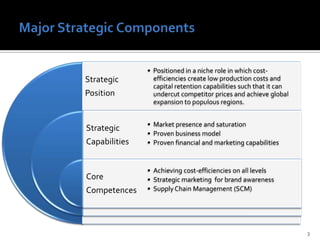
Major Strategic Components3
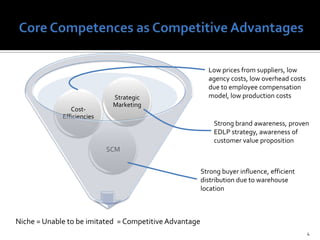
Core Competences as Competitive AdvantagesLow prices from suppliers, low agency costs, low overhead costs due to employee compensation model, low production costsStrong brand awareness, proven EDLP strategy, awareness of customer value propositionStrong buyer influence, efficient distribution due to warehouse location4
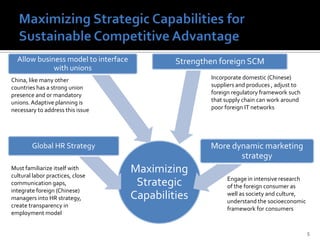
Maximizing Strategic Capabilities for Sustainable Competitive Advantage5Incorporate domestic (Chinese) suppliers and produces , adjust to foreign regulatory framework such that supply chain can work around poor foreign IT networksChina, like many other countries has a strong union presence and or mandatory unions. Adaptive planning is necessary to address this issueMust familiarize itself with cultural labor practices, close communication gaps, integrate foreign (Chinese) managers into HR strategy, create transparency in employment model Engage in intensive research of the foreign consumer as well as society and culture, understand the socioeconomic framework for consumers
Wal-Mart’s Competitive Advantages and Barriers in Customer Countries
Customer Country Features 7Dothe socioeconomic and regulatory frameworks of Wal-Mart’s customer countries provide the corporation with a competitive advantage?What will Wal-Mart need to do in order to improve on to sustain or augment these global competitive advantages?
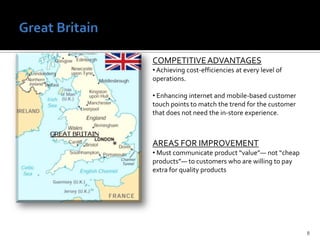
Great Britain8COMPETITIVE ADVANTAGES Achieving cost-efficiencies at every level of operations.
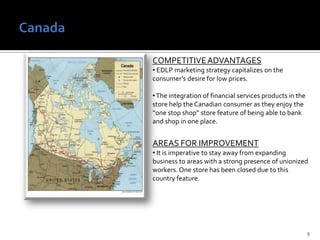
 Enhancing internet and mobile-based customer touch points to match the trend for the customer that does not need the in-store experience.AREAS FOR IMPROVEMENT Must communicate product “value”— not “cheap products”— to customers who are willing to pay extra for quality products Canada9COMPETITIVE ADVANTAGES EDLP marketing strategy capitalizes on the consumer’s desire for low prices.
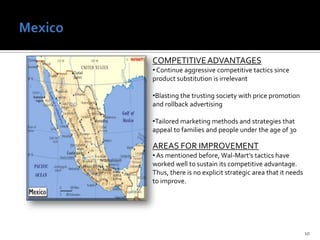
 The integration of financial services products in the store help the Canadian consumer as they enjoy the “one stop shop” store feature of being able to bank and shop in one place. AREAS FOR IMPROVEMENT It is imperative to stay away from expanding business to areas with a strong presence of unionized workers. One store has been closed due to this country feature. Mexico10COMPETITIVE ADVANTAGES Continue aggressive competitive tactics since product substitution is irrelevant
Blasting the trusting society with price promotion and rollback advertising
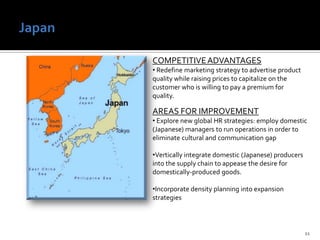
Tailored marketing methods and strategies that appeal to families and people under the age of 30AREAS FOR IMPROVEMENT As mentioned before, Wal-Mart’s tactics have worked well to sustain its competitive advantage. Thus, there is no explicit strategic area that it needs to improve.Japan11COMPETITIVE ADVANTAGES Redefine marketing strategy to advertise product quality while raising prices to capitalize on the customer who is willing to pay a premium for quality. AREAS FOR IMPROVEMENT Explore new global HR strategies: employ domestic (Japanese) managers to run operations in order to eliminate cultural and communication gap
Vertically integrate domestic (Japanese) producers into the supply chain to appease the desire for domestically-produced goods.
Incorporate density planning into expansion strategiesOvercoming Internal and External Barriers to Executing Strategy in China
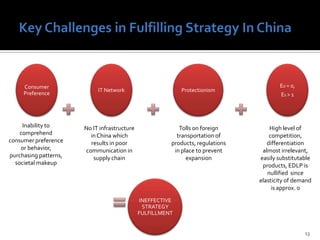
Key Challenges in Fulfilling Strategy In China13Inability to comprehend consumer preference or behavior, purchasing patterns, societal makeupNo IT infrastructure in China which results in poor communication in supply chainTolls on foreign transportation of products, regulations in place to prevent expansionHigh level of competition, differentiation almost irrelevant, easily substitutable products, EDLP is nullified  since elasticity of demand  is approx. 0
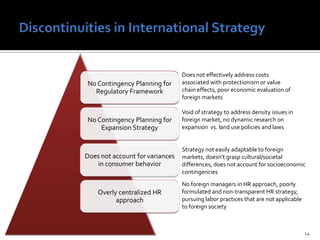
Discontinuities in International Strategy 14Does not effectively address costs associated with protectionism or value chain effects, poor economic evaluation of foreign markets Void of strategy to address density issues in foreign market, no dynamic research on expansion  vs. land use policies and lawsStrategy not easily adaptable to foreign markets, doesn’t grasp cultural/societal differences, does not account for socioeconomic contingenciesNo foreign managers in HR approach, poorly formulated and non-transparent HR strategy, pursuing labor practices that are not applicable to foreign society

Strategic Analysis

  • 1.
    A STRATEGIC ANALYSISEXPLORINGTHE SUSTAINABILITY OF WAL-MART’S INTERNATIONAL STRATEGYBy Try L. Muller
  • 2.
    What is Wal-Mart’sStrategic Threshold?
  • 3.
  • 4.
    Core Competences asCompetitive AdvantagesLow prices from suppliers, low agency costs, low overhead costs due to employee compensation model, low production costsStrong brand awareness, proven EDLP strategy, awareness of customer value propositionStrong buyer influence, efficient distribution due to warehouse location4
  • 5.
    Maximizing Strategic Capabilitiesfor Sustainable Competitive Advantage5Incorporate domestic (Chinese) suppliers and produces , adjust to foreign regulatory framework such that supply chain can work around poor foreign IT networksChina, like many other countries has a strong union presence and or mandatory unions. Adaptive planning is necessary to address this issueMust familiarize itself with cultural labor practices, close communication gaps, integrate foreign (Chinese) managers into HR strategy, create transparency in employment model Engage in intensive research of the foreign consumer as well as society and culture, understand the socioeconomic framework for consumers
  • 6.
    Wal-Mart’s Competitive Advantagesand Barriers in Customer Countries
  • 7.
    Customer Country Features7Dothe socioeconomic and regulatory frameworks of Wal-Mart’s customer countries provide the corporation with a competitive advantage?What will Wal-Mart need to do in order to improve on to sustain or augment these global competitive advantages?
  • 8.
    Great Britain8COMPETITIVE ADVANTAGESAchieving cost-efficiencies at every level of operations.
  • 9.
    Enhancing internetand mobile-based customer touch points to match the trend for the customer that does not need the in-store experience.AREAS FOR IMPROVEMENT Must communicate product “value”— not “cheap products”— to customers who are willing to pay extra for quality products Canada9COMPETITIVE ADVANTAGES EDLP marketing strategy capitalizes on the consumer’s desire for low prices.
  • 10.
    The integrationof financial services products in the store help the Canadian consumer as they enjoy the “one stop shop” store feature of being able to bank and shop in one place. AREAS FOR IMPROVEMENT It is imperative to stay away from expanding business to areas with a strong presence of unionized workers. One store has been closed due to this country feature. Mexico10COMPETITIVE ADVANTAGES Continue aggressive competitive tactics since product substitution is irrelevant
  • 11.
    Blasting the trustingsociety with price promotion and rollback advertising
  • 12.
    Tailored marketing methodsand strategies that appeal to families and people under the age of 30AREAS FOR IMPROVEMENT As mentioned before, Wal-Mart’s tactics have worked well to sustain its competitive advantage. Thus, there is no explicit strategic area that it needs to improve.Japan11COMPETITIVE ADVANTAGES Redefine marketing strategy to advertise product quality while raising prices to capitalize on the customer who is willing to pay a premium for quality. AREAS FOR IMPROVEMENT Explore new global HR strategies: employ domestic (Japanese) managers to run operations in order to eliminate cultural and communication gap
  • 13.
    Vertically integrate domestic(Japanese) producers into the supply chain to appease the desire for domestically-produced goods.
  • 14.
    Incorporate density planninginto expansion strategiesOvercoming Internal and External Barriers to Executing Strategy in China
  • 15.
    Key Challenges inFulfilling Strategy In China13Inability to comprehend consumer preference or behavior, purchasing patterns, societal makeupNo IT infrastructure in China which results in poor communication in supply chainTolls on foreign transportation of products, regulations in place to prevent expansionHigh level of competition, differentiation almost irrelevant, easily substitutable products, EDLP is nullified since elasticity of demand is approx. 0
  • 16.
    Discontinuities in InternationalStrategy 14Does not effectively address costs associated with protectionism or value chain effects, poor economic evaluation of foreign markets Void of strategy to address density issues in foreign market, no dynamic research on expansion vs. land use policies and lawsStrategy not easily adaptable to foreign markets, doesn’t grasp cultural/societal differences, does not account for socioeconomic contingenciesNo foreign managers in HR approach, poorly formulated and non-transparent HR strategy, pursuing labor practices that are not applicable to foreign society

Editor's Notes

  • #8 Understanding the global customer is essential to sustaining competitive advantage because socioeconomic factors in other countries will create a high level of variability in consumer preferences— impacting the corporate, marketing, and operational strategies both positively and negatively. Thus, it is not only important to identify and sustain competitive advantages, but to find areas to improve on in order to augment these strategic capabilities.
  • #9 Great Britain presents Wal-mart with a great market to explore its strategic capabilities and enhance its core competences. The presence of flexible labor regulations, coupled with low cost of employment and termination, will help reduce operating costs and allow the corporation to continue to achieve cost-efficiencies and reduction its operating overhead. Furthermore, consumers here are willing to pay a premium for quality which has strong implications for Wal-Mart’s revenue margins if they can redefine its marketing strategy to fit customer preferences. Another competitive advantage that Wal-Mart could capitalize on is the preference for consumer in Great Britain to shop via mobile and internet channels. It is found that they prefer such shopping methods 25% of the time (Wal-Mart Research Team, 2009).
  • #10 Wal-Mart’s EDLP strategy should create a strong competitive advantage in Canada since the customers are cost-conscious consumers that desire shopping at lower-priced retailers and they enjoy saving money (Flavelle, 2010). Even more importantly, demand is relatively elastic and the consumers will respond to the “roll back” advertising that the company engages in. Still, Wal-Mart must keep the integrity of its marketing as substitution is highly elastic and consumers can easily become customers of competitors. Even more impactful is that 29% of Canadian employees carry union cards (Flavelle, 2010). Thus, to remain a strong presence, Wal-Mart will need to make sure that it prevents expansion in areas dense with union members and employees.
  • #11 Mexico is a country where Wal-Mart probably experiences its highest level of competitive advantage. There is no real threat of substitution and members of society are very trusting of promotions and advertising promises (Feuer, 2010). Since Wal-Mart has done a good job delivering on its customer value proposition, they can continue aggressive competitive tactics because there is rapport built up between the corporation and its consumers. Furthermore, substitution is very inelastic, which should make it easier for the company to expand throughout the country. Another competitive advantage that Wal-Mart can experience is changing marketing to appease to people under the age of 30— as this number accounts for 65% of the population (Feuer, 2010).
  • #12 Japan presents Wal-Mart with more of a challenge as its consumers are very frugal. These consumers are willing to pay a premium for quality which is implicative of the company’s need to stray away from EDLP marketing and start with more quality-oriented advertising. In terms of management, if Wal-Mart can incorporate more Japanese mangers into the current employee structure, then it will quell some cultural and communication issues that derive from having American managers run a corporation all Japanese employees (Wal-Mart Research Team, 2007). The Japanese consumers also have a dislike for cheaply made, foreign-manufactured goods (Wal-Mart Research Team, 2007). Thus, Wal-Mart would benefit from vertically integrating Japanese producers (domestic) into the supply chain to appease the customer desires. Lastly, land use policies are stringent against big-box sprawl. There will need to be some contingency planning involved if expansion endeavors are thwarted by such policies.