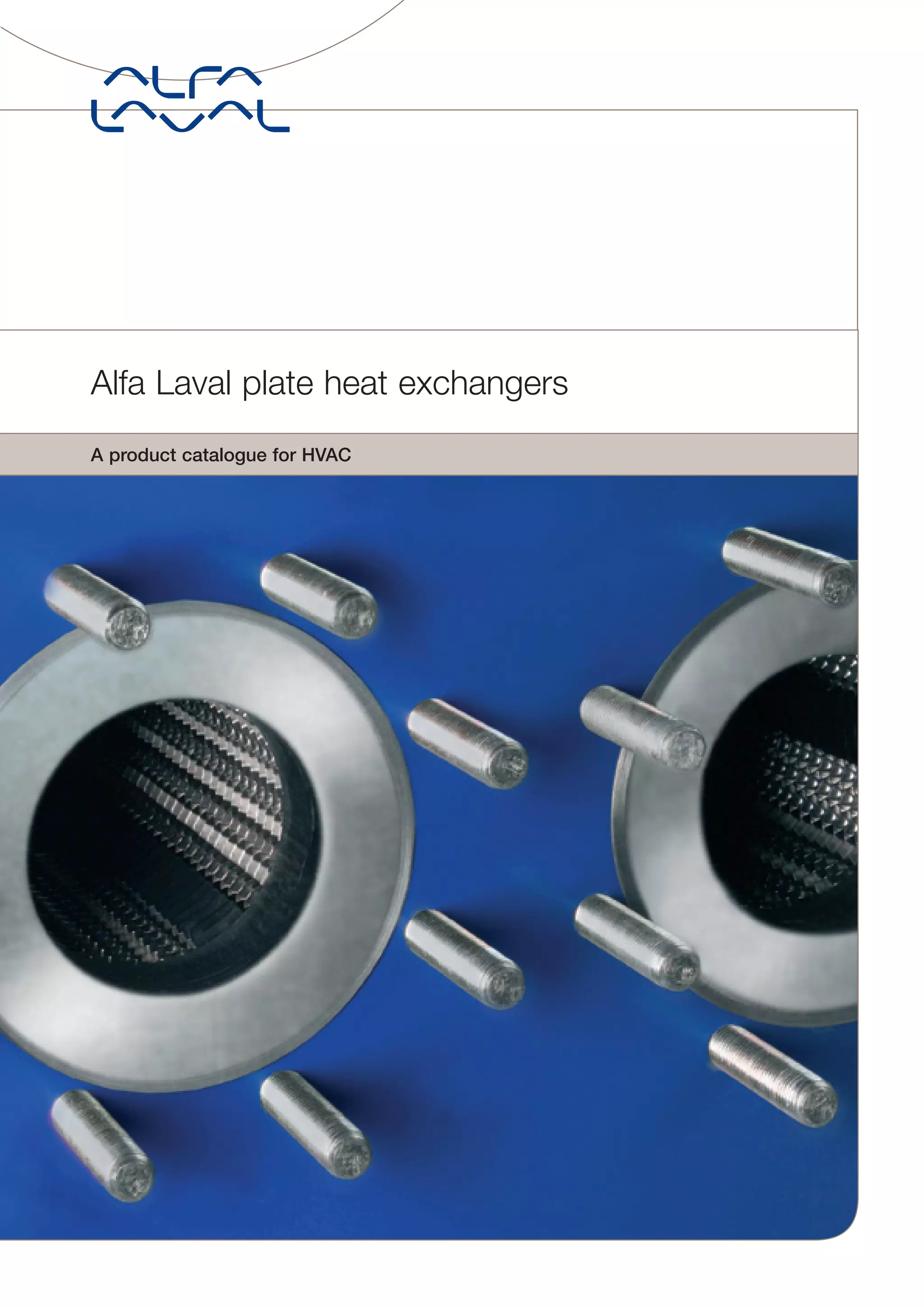
Alfa Laval plate heat exchangers
A product catalogue for HVAC
2
	 3	 Six sound reasons to buy your PHEs from the market leader
	 4	 Alfa Laval gasketed heat exchangers
	
	 6	 Heating applications
	 7	 Cooling applications
	
	 8	 Product specifications
10		 Accessories
		
Inside view
Six sound reasons to
buy your PHEs from
the market leader
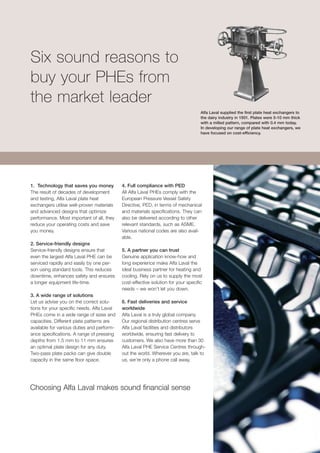
Alfa Laval supplied the first plate heat exchangers to
the dairy industry in 1931. Plates were 5-10 mm thick
with a milled pattern, compared with 0.4 mm today.
In developing our range of plate heat exchangers, we
have focused on cost-efficiency.
1. Technology that saves you money
The result of decades of development
and testing, Alfa Laval plate heat
exchangers utilise well-proven materials
and advanced designs that optimize
performance. Most important of all, they
reduce your operating costs and save
you money.
2. Service-friendly designs
Service-friendly designs ensure that
even the largest Alfa Laval PHE can be
serviced rapidly and easily by one per-
son using standard tools. This reduces
downtime, enhances safety and ensures
a longer equipment life-time.
3. A wide range of solutions
Let us advise you on the correct solu-
tions for your specific needs. Alfa Laval
PHEs come in a wide range of sizes and
capacities. Different plate patterns are
available for various duties and perform-
ance specifications. A range of pressing
depths from 1.5 mm to 11 mm ensures
an optimal plate design for any duty.
Two-pass plate packs can give double
capacity in the same floor space.
4. Full compliance with PED
All Alfa Laval PHEs comply with the
European Pressure Vessel Safety
Directive, PED, in terms of mechanical
and materials specifications. They can
also be delivered according to other
relevant standards, such as ASME.
Various national codes are also avail-
able.
5. A partner you can trust
Genuine application know-how and
long experience make Alfa Laval the
ideal business partner for heating and
cooling. Rely on us to supply the most
cost-effective solution for your specific
needs – we won’t let you down.
6. Fast deliveries and service
worldwide
Alfa Laval is a truly global company.
Our regional distribution centres serve
Alfa Laval facilities and distributors
worldwide, ensuring fast delivery to
customers. We also have more than 30
Alfa Laval PHE Service Centres through-
out the world. Wherever you are, talk to
us, we’re only a phone call away.
Choosing Alfa Laval makes sound financial sense
44
Alfa Laval gasketed heat exchangers
Alfa Laval plate heat exchangers (PHEs) are the most cost-efficient solution available
for your comfort heating and cooling needs. The result of decades of development
and testing, our PHEs utilise well-proven materials and advanced designs that optimise
performance and reduce your operating costs. We are the market leader. Our cost-
efficient products and unmatched global distribution and service capabilities make
us the ideal business partner.
Reliability in a single step
The heat transfer efficiency and degree
of process control offered by a PHE
depend partly on the thickness of the
plates. In today’s advanced Alfa Laval
units, plates as thin as 0.4 mm, normal-
ly in stainless steel, offer highly efficient
heat transfer and impressive strength. 	
Each plate is pressed in a single
step in a hydraulic press exerting a
pressure of up to 40,000 tons. Thus all
plates are identical, minimising the risk
of distortion and leakage when hund-
reds are stacked together in a PHE.
When assembled with gaskets, the
metal-to-metal contact points on the
plates create a flexible, yet mechanically
stable construction that can withstand
enormous stress.
The pattern of performance
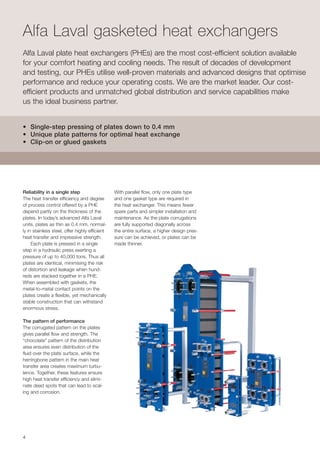
The corrugated pattern on the plates
gives parallel flow and strength. The
“chocolate” pattern of the distribution
area ensures even distribution of the
fluid over the plate surface, while the
herringbone pattern in the main heat
transfer area creates maximum turbu-
lence. Together, these features ensure
high heat transfer efficiency and elimi-
nate dead spots that can lead to scal-
ing and corrosion.			
• Single-step pressing of plates down to 0.4 mm
• Unique plate patterns for optimal heat exchange
• Clip-on or glued gaskets
With parallel flow, only one plate type
and one gasket type are required in
the heat exchanger. This means fewer
spare parts and simpler installation and
maintenance. As the plate corrugations
are fully supported diagonally across
the entire surface, a higher design pres-
sure can be achieved, or plates can be
made thinner.
5
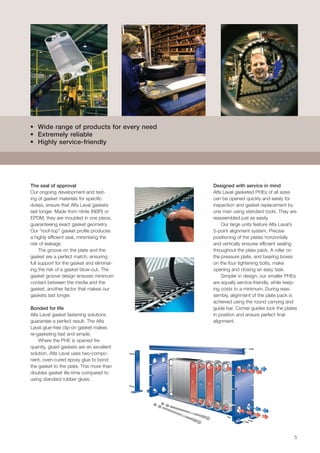
Designed with service in mind
Alfa Laval gasketed PHEs of all sizes
can be opened quickly and easily for
inspection and gasket replacement by
one man using standard tools. They are
reassembled just as easily. 	
Our large units feature Alfa Laval’s
5-point alignment system. Precise
positioning of the plates horizontally
and vertically ensures efficient sealing
throughout the plate pack. A roller on
the pressure plate, and bearing boxes
on the four tightening bolts, make
opening and closing an easy task.
Simpler in design, our smaller PHEs
are equally service-friendly, while keep-
ing costs to a minimum. During reas-
sembly, alignment of the plate pack is
achieved using the round carrying and
guide bar. Corner guides lock the plates
in position and ensure perfect final
alignment.
• Wide range of products for every need
• Extremely reliable
• Highly service-friendly
The seal of approval
Our ongoing development and test-
ing of gasket materials for specific
duties, ensure that Alfa Laval gaskets
last longer. Made from nitrile (NBR) or
EPDM, they are moulded in one piece,
guaranteeing exact gasket geometry.
Our “roof-top” gasket profile produces
a highly efficient seal, minimising the
risk of leakage. 				
The groove on the plate and the
gasket are a perfect match, ensuring
full support for the gasket and eliminat-
ing the risk of a gasket blow-out. The
gasket groove design ensures minimum
contact between the media and the
gasket, another factor that makes our
gaskets last longer.
Bonded for life
Alfa Laval gasket fastening solutions
guarantee a perfect result. The Alfa
Laval glue-free clip-on gasket makes
re-gasketing fast and simple.
Where the PHE is opened fre-
quently, glued gaskets are an excellent
solution. Alfa Laval uses two-compo-
nent, oven-cured epoxy glue to bond
the gasket to the plate. This more than
doubles gasket life-time compared to
using standard rubber glues.
6
Heating applications
PHEs in heating systems
Plate heat exchangers are commonly used
in all types of heating applications with
demands on comfort, reliability and safety.
In addition to transferring heat from one
circuit to another, the heat exchanger also
efficiently handles the pressure differences
that normally exist between the primary
and secondary sides. The Alfa Laval range
of gasketed plate heat exchanger models
covers all comfort heating duties like tap
water heating and swimming pool heating,
from small to large capacities. Thanks to a
flexible design, the PHE can be tailor-made
to fit your specific needs exactly.
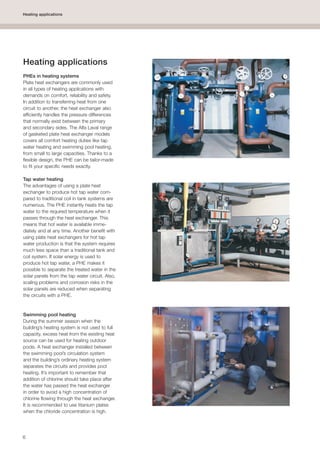
Tap water heating
The advantages of using a plate heat
exchanger to produce hot tap water com-
pared to traditional coil in tank systems are
numerous. The PHE instantly heats the tap
water to the required temperature when it
passes through the heat exchanger. This
means that hot water is available imme-
diately and at any time. Another benefit with
using plate heat exchangers for hot tap
water production is that the system requires
much less space than a traditional tank and
coil system. If solar energy is used to
produce hot tap water, a PHE makes it
possible to separate the treated water in the
solar panels from the tap water circuit. Also,
scaling problems and corrosion risks in the
solar panels are reduced when separating
the circuits with a PHE.
Swimming pool heating
During the summer season when the
building’s heating system is not used to full
capacity, excess heat from the existing heat
source can be used for heating outdoor
pools. A heat exchanger installed between
the swimming pool’s circulation system
and the building’s ordinary heating system
separates the circuits and provides pool
heating. It’s important to remember that
addition of chlorine should take place after
the water has passed the heat exchanger
in order to avoid a high concentration of
chlorine flowing through the heat exchanger.
It is recommended to use titanium plates
when the chloride concentration is high.
7
Cooling applications
PHEs in cooling systems
The requirement for thermal efficiency -
close temperatures - is very high particularly
in cooling applications e.g. thermal storage
and free cooling. Thanks to Alfa Laval’s
superior competence in plate pressing,
temperature approaches of down to 0.5°C
(0.9°F) between the two circuits can be
achieved. In addition, this can be accom-
plished in a single pass connection with all
four connections on the front plate, making
installation and maintenance very easy.
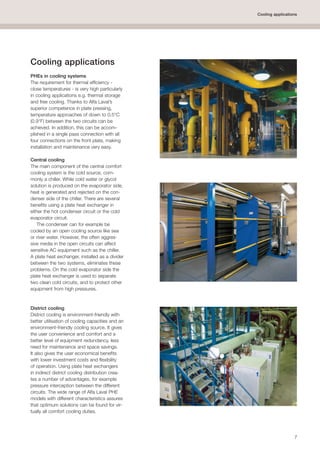
Central cooling
The main component of the central comfort
cooling system is the cold source, com-
monly a chiller. While cold water or glycol
solution is produced on the evaporator side,
heat is generated and rejected on the con-
denser side of the chiller. There are several
benefits using a plate heat exchanger in
either the hot condenser circuit or the cold
evaporator circuit.
The condenser can for example be
cooled by an open cooling source like sea
or river water. However, the often aggres-
sive media in the open circuits can affect
sensitive AC equipment such as the chiller.
A plate heat exchanger, installed as a divider
between the two systems, eliminates these
problems. On the cold evaporator side the
plate heat exchanger is used to separate
two clean cold circuits, and to protect other
equipment from high pressures.
District cooling
District cooling is environment-friendly with
better utilisation of cooling capacities and an
environment-friendly cooling source. It gives
the user convenience and comfort and a
better level of equipment redundancy, less
need for maintenance and space savings.
It also gives the user economical benefits
with lower investment costs and flexibility
of operation. Using plate heat exchangers
in indirect district cooling distribution crea-
tes a number of advantages, for example
pressure interception between the different
circuits. The wide range of Alfa Laval PHE
models with different characteristics assures
that optimum solutions can be found for vir-
tually all comfort cooling duties.
Small
Model	 T2	 M3	 TL3	 T5	 M6	 TL6 	
Plate types	 T2B	 M3/M3D	 TL3B/TL3P/TL3BD	 T5M/T5B	 M6, M6M, M6MD 	 TL6B	
Frame type	 FG	 FG	 FG	 FG	 FG	 FD	 FM	 FG	
Height, H [mm]	 380	 480	 790	 737	 920	 940 	 1264	 1299	
Width, W [mm]	 140	 180	 190	 245	 320	 330 	 320	 320	
Min standard length, L [mm]	 165	 400	 420	 190	 500	 500 	 615	 620	
Max standard length, L [mm]	 275	 650	 1370	 365	 1500	 1500 	 1665	 1670	
Vertical port distance, VC [mm]	 298	 357	 668	 553	 640	 640 	 1036	 1036	
Horizontal port distance, HC [mm]	 50	 60	 60	 100	 140	 140 	 140	 140	
Max temperature [°C]	 180	 180	 180	 180	 180	 180	 180	 180	
Max pressure [barg]	 16	 16	 16	 16	 16	 25	 10	 16	
PV codes and directives*	 ALS	 ALS, PED, ASME	 ALS, PED, ASME	 ALS, PED, ASME	 ALS, PED, ASME	 PED, ASME	 ALS, PED	 ALS, PED, ASME	 ALS
Flange size	 –	 –	 –	 –	 DN50/2”	 DN50/2”		 DN50/DN65/2"/2,5"		
Pipe size	 3/4”	 1¼”	 1¼”	 2”		 2”		 2”			
Max. flow rate [kg/s]	 2	 4	 4	 14		 16		 20		
Medium
Model	 M10	 TL10	
Plate types	 M10M,M10B,M10BD	 TL10B	
Frame type	 FL	 FM		 FG	 FD	 FM	 FG		 FD	 FS	
Height, H [mm]	 1084	 1084		 1084	 1084	 1885	 1923		 1923	 1923	
Width, W [mm]	 470	 470		 470	 470	 480	 480		 480	 480	
Min standard length, L [mm]	 800	 700		 700	 800	 850	 850		 850	 850	
Max standard length, L [mm]	 1100	 2300		 2300	 2400	 2350	 3250		 3250	 3250	
Vertical port distance, VC [mm]	 719	 719		 719	 719	 1338	 1338		 1338	 1338	
Horizontal port distance, HC [mm]	 225	 225		 225	 225	 225	 225		 225	 225	
Max temperature [°C]	 130	 180		 180	 180	 160	 160		 160	 160	
Max pressure [barg]	 6	 10		 16	 25	 10	 16		 25	 27.6	
PV codes and directives*	 ALS	 ALS, PED		 ALS, PED, ASME	 ALS, PED, ASME	 ALS	 ALS, PED, ASME		 PED	 ASME	
Flange size			 DN100/4”			 DN100/4”	 DN100/4”		 DN100/4”	 4”		
Max. flow rate [kg/s]			 50					 50				
Large
Model		 TS20			 T20				
Plate types		 TS20M			 T20M, T20B, T20P				
Frame types	 FM	 FG	 FS	 FM	 FG	 FS	 FMS	 FGS	
Height, H [mm]	 1405	 1405	 1435	 2150	 2150	 2180	 2595	 2595	
Width, W [mm]	 740	 800	 800	 750	 780	 780	 920	 920	
Min standard length, L [mm]	 900	 900	 950	 1250	 1250	 1300	 1550	 1600	
Max standard length, L [mm]	 2700	 2700	 2750	 3350	 3950	 4000	 3350	 3400	
Vertical port distance, VC [mm]	 698	 698	 698	 1478	 1478	 1478	 1939	 1939	
Horizontal port distance, HC [mm]	 363	 363	 363	 353	 353	 363	 439	 439	
Max temperature [°C]	 180	 180	 180	 180	 180	 180	 180	 180	
Max pressure [barg]	 10	 16	 30	 10	 16	 30	 10	 16	
PV codes and directives*	 ALS, PED	 ALS, PED, ASME	 PED, ASME	 ALS	 ALS, PED, ASME	 PED, ASME	 ALS, PED	 ALS, PED, ASME	
Flange size	 DN200/8”	 DN200/8”	 DN200/8”	 DN200/8”	 DN200/8”	 DN200/8”	 DN200/DN250/8”/10”	 DN200/8”	
Max. flow rate [kg/s]		 190			 225				
	* PV code ALS is an internal Alfa Laval standard for fulfilment of sound engineering practice. ALS is also valid for PED cat. 0. 	 ** Release July 2009
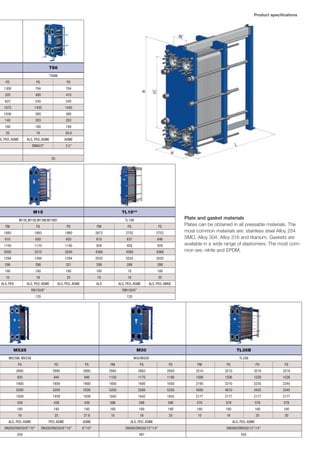
Product specifications
TS6
TS6M
FD 	 FG	 FD
1308	 704	 704
320	 400	 410
625	 530	 540
1675	 1430	 1440
1036	 380	 380
140	 203	 203
180	 180	 180
25	 16	 20.6
S, PED, ASME	 ALS, PED, ASME	 ASME
		 DN65/2”	 2.5”
			
		 20
M15	 TL15**
M15E,M15B,M15M,M15BD	 TL15B
FM	 FG	 FD	 FM	 FG	 FS
1885	 1885	 1980	 2672	 2752	 2752
610	 650	 650	 610	 637	 646
1150	 1110	 1140	 928	 928	 928
2050	 3210	 3240	 4368	 4368	 4368
1294	 1294	 1294	 2035	 2035	 2035
298	 298	 321	 288	 288	 288
180	 180	 180	 180	 18	 180
10	 16	 25	 10	 16	 30
ALS, PED	 ALS, PED, ASME	 ALS, PED, ASME	 ALS	 ALS, PED, ASME	 ALS, PED, AMSE
		 DN150/6”			 DIN150/6”
				 120			 120
MX25				 M30	 TL35B
MX25M, MX25B				 M30/M30D	 TL35B
FG	 FD	 FS	 FM	 FG	 FD	 FM	 FG	 FD	 FS
2895	 2895	 2895	 2882	 2882	 2920	 3210	 3210	 3218	 3218
920	 940	 940	 1150	 1170	 1190	 1506	 1506	 1529	 1526
1600	 1600	 1600	 1600	 1600	 1650	 2195	 2210	 2235	 2245
5200	 5200	 5200	 5200	 5200	 5250	 4595	 4610	 3435	 3345
1939	 1939	 1939	 1842	 1842	 1842	 2177	 2177	 2177	 2177
439	 439	 439	 596	 596	 596	 578	 578	 578	 578
180	 180	 180	 180	 180	 180	 180	 180	 180	 180
16	 25	 27.6	 10	 16	 25	 10	 16	 25	 30
ALS, PED, ASME	 PED, ASME	 ASME		 ALS, PED, ASME			 ALS, PED, ASME
DN200/DN250/8”/10”	 DN200/DN250/8”/10”	 8”/10”		 DN300/DN350/12”/14”			 DIN300/DIN350/12”/14”
250				 497			 550
Plate and gasket materials
Plates can be obtained in all pressable materials. The
most common materials are: stainless steel Alloy 254
SMO, Alloy 304, Alloy 316 and titanium. Gaskets are
available in a wide range of elastomers: The most com-
mon are: nitrile and EPDM.
Product specifications
10
Accessories
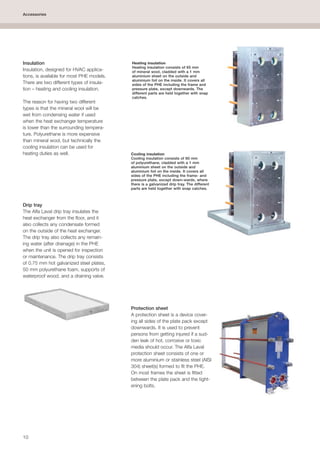
Protection sheet
A protection sheet is a device cover-
ing all sides of the plate pack except
downwards. It is used to prevent
persons from getting injured if a sud-
den leak of hot, corrosive or toxic
media should occur. The Alfa Laval
protection sheet consists of one or
more aluminium or stainless steel (AISI
304) sheet(s) formed to fit the PHE.
On most frames the sheet is fitted
between the plate pack and the tight-
ening bolts.
Insulation
Insulation, designed for HVAC applica-
tions, is available for most PHE models.
There are two different types of insula-
tion – heating and cooling insulation.
The reason for having two different
types is that the mineral wool will be
wet from condensing water if used
when the heat exchanger temperature
is lower than the surrounding tempera-
ture. Polyurethane is more expensive
than mineral wool, but technically the
cooling insulation can be used for
heating duties as well.
Drip tray
The Alfa Laval drip tray insulates the
heat exchanger from the floor, and it
also collects any condensate formed
on the outside of the heat exchanger.
The drip tray also collects any remain-
ing water (after drainage) in the PHE
when the unit is opened for inspection
or maintenance. The drip tray consists
of 0.75 mm hot galvanized steel plates,
50 mm polyurethane foam, supports of
waterproof wood, and a draining valve.
Cooling insulation
Cooling insulation consists of 60 mm
of polyurethane, cladded with a 1 mm
aluminium sheet on the outside and
aluminium foil on the inside. It covers all
sides of the PHE including the frame- and
pressure plate, except down-wards, where
there is a galvanized drip tray. The different
parts are held together with snap catches.
Heating insulation
Heating insulation consists of 65 mm
of mineral wool, cladded with a 1 mm
aluminium sheet on the outside and
aluminium foil on the inside. It covers all
sides of the PHE including the frame and
pressure plate, except downwards. The
different parts are held together with snap
catches.
11
How to contact Alfa Laval
Up-to-date Alfa Laval contact details
for all countries are always available
on our website at www.alfalaval.com
ECR00047EN 0904
Alfa Laval in brief
Alfa Laval is a leading global provider
of specialized products and
engineered solutions.
	 Our equipment, systems and
services are dedicated to helping
customers to optimize the
performance of their processes.
Time and time again.
	 We help our customers to heat,
cool, separate and transport products
such as oil, water, chemicals,
beverages, foodstuffs, starch and
pharmaceuticals.
	 Our worldwide organization works
closely with customers in almost 100
countries to help them stay ahead.
ALFALAVALisatrademarkregisteredandownedbyAlfaLavalCorporateAB
Alfa Laval reserves the right to change
specifications without prior notification.
© 2004 Alfa Laval

Alfa_laval Plate Excanger

  • 1.
    Alfa Laval plateheat exchangers A product catalogue for HVAC
  • 2.
    2 3 Sixsound reasons to buy your PHEs from the market leader 4 Alfa Laval gasketed heat exchangers 6 Heating applications 7 Cooling applications 8 Product specifications 10 Accessories Inside view
  • 3.
    Six sound reasonsto buy your PHEs from the market leader Alfa Laval supplied the first plate heat exchangers to the dairy industry in 1931. Plates were 5-10 mm thick with a milled pattern, compared with 0.4 mm today. In developing our range of plate heat exchangers, we have focused on cost-efficiency. 1. Technology that saves you money The result of decades of development and testing, Alfa Laval plate heat exchangers utilise well-proven materials and advanced designs that optimize performance. Most important of all, they reduce your operating costs and save you money. 2. Service-friendly designs Service-friendly designs ensure that even the largest Alfa Laval PHE can be serviced rapidly and easily by one per- son using standard tools. This reduces downtime, enhances safety and ensures a longer equipment life-time. 3. A wide range of solutions Let us advise you on the correct solu- tions for your specific needs. Alfa Laval PHEs come in a wide range of sizes and capacities. Different plate patterns are available for various duties and perform- ance specifications. A range of pressing depths from 1.5 mm to 11 mm ensures an optimal plate design for any duty. Two-pass plate packs can give double capacity in the same floor space. 4. Full compliance with PED All Alfa Laval PHEs comply with the European Pressure Vessel Safety Directive, PED, in terms of mechanical and materials specifications. They can also be delivered according to other relevant standards, such as ASME. Various national codes are also avail- able. 5. A partner you can trust Genuine application know-how and long experience make Alfa Laval the ideal business partner for heating and cooling. Rely on us to supply the most cost-effective solution for your specific needs – we won’t let you down. 6. Fast deliveries and service worldwide Alfa Laval is a truly global company. Our regional distribution centres serve Alfa Laval facilities and distributors worldwide, ensuring fast delivery to customers. We also have more than 30 Alfa Laval PHE Service Centres through- out the world. Wherever you are, talk to us, we’re only a phone call away. Choosing Alfa Laval makes sound financial sense
  • 4.
    44 Alfa Laval gasketedheat exchangers Alfa Laval plate heat exchangers (PHEs) are the most cost-efficient solution available for your comfort heating and cooling needs. The result of decades of development and testing, our PHEs utilise well-proven materials and advanced designs that optimise performance and reduce your operating costs. We are the market leader. Our cost- efficient products and unmatched global distribution and service capabilities make us the ideal business partner. Reliability in a single step The heat transfer efficiency and degree of process control offered by a PHE depend partly on the thickness of the plates. In today’s advanced Alfa Laval units, plates as thin as 0.4 mm, normal- ly in stainless steel, offer highly efficient heat transfer and impressive strength. Each plate is pressed in a single step in a hydraulic press exerting a pressure of up to 40,000 tons. Thus all plates are identical, minimising the risk of distortion and leakage when hund- reds are stacked together in a PHE. When assembled with gaskets, the metal-to-metal contact points on the plates create a flexible, yet mechanically stable construction that can withstand enormous stress. The pattern of performance The corrugated pattern on the plates gives parallel flow and strength. The “chocolate” pattern of the distribution area ensures even distribution of the fluid over the plate surface, while the herringbone pattern in the main heat transfer area creates maximum turbu- lence. Together, these features ensure high heat transfer efficiency and elimi- nate dead spots that can lead to scal- ing and corrosion. • Single-step pressing of plates down to 0.4 mm • Unique plate patterns for optimal heat exchange • Clip-on or glued gaskets With parallel flow, only one plate type and one gasket type are required in the heat exchanger. This means fewer spare parts and simpler installation and maintenance. As the plate corrugations are fully supported diagonally across the entire surface, a higher design pres- sure can be achieved, or plates can be made thinner.
  • 5.
    5 Designed with servicein mind Alfa Laval gasketed PHEs of all sizes can be opened quickly and easily for inspection and gasket replacement by one man using standard tools. They are reassembled just as easily. Our large units feature Alfa Laval’s 5-point alignment system. Precise positioning of the plates horizontally and vertically ensures efficient sealing throughout the plate pack. A roller on the pressure plate, and bearing boxes on the four tightening bolts, make opening and closing an easy task. Simpler in design, our smaller PHEs are equally service-friendly, while keep- ing costs to a minimum. During reas- sembly, alignment of the plate pack is achieved using the round carrying and guide bar. Corner guides lock the plates in position and ensure perfect final alignment. • Wide range of products for every need • Extremely reliable • Highly service-friendly The seal of approval Our ongoing development and test- ing of gasket materials for specific duties, ensure that Alfa Laval gaskets last longer. Made from nitrile (NBR) or EPDM, they are moulded in one piece, guaranteeing exact gasket geometry. Our “roof-top” gasket profile produces a highly efficient seal, minimising the risk of leakage. The groove on the plate and the gasket are a perfect match, ensuring full support for the gasket and eliminat- ing the risk of a gasket blow-out. The gasket groove design ensures minimum contact between the media and the gasket, another factor that makes our gaskets last longer. Bonded for life Alfa Laval gasket fastening solutions guarantee a perfect result. The Alfa Laval glue-free clip-on gasket makes re-gasketing fast and simple. Where the PHE is opened fre- quently, glued gaskets are an excellent solution. Alfa Laval uses two-compo- nent, oven-cured epoxy glue to bond the gasket to the plate. This more than doubles gasket life-time compared to using standard rubber glues.
  • 6.
    6 Heating applications Heating applications PHEsin heating systems Plate heat exchangers are commonly used in all types of heating applications with demands on comfort, reliability and safety. In addition to transferring heat from one circuit to another, the heat exchanger also efficiently handles the pressure differences that normally exist between the primary and secondary sides. The Alfa Laval range of gasketed plate heat exchanger models covers all comfort heating duties like tap water heating and swimming pool heating, from small to large capacities. Thanks to a flexible design, the PHE can be tailor-made to fit your specific needs exactly. Tap water heating The advantages of using a plate heat exchanger to produce hot tap water com- pared to traditional coil in tank systems are numerous. The PHE instantly heats the tap water to the required temperature when it passes through the heat exchanger. This means that hot water is available imme- diately and at any time. Another benefit with using plate heat exchangers for hot tap water production is that the system requires much less space than a traditional tank and coil system. If solar energy is used to produce hot tap water, a PHE makes it possible to separate the treated water in the solar panels from the tap water circuit. Also, scaling problems and corrosion risks in the solar panels are reduced when separating the circuits with a PHE. Swimming pool heating During the summer season when the building’s heating system is not used to full capacity, excess heat from the existing heat source can be used for heating outdoor pools. A heat exchanger installed between the swimming pool’s circulation system and the building’s ordinary heating system separates the circuits and provides pool heating. It’s important to remember that addition of chlorine should take place after the water has passed the heat exchanger in order to avoid a high concentration of chlorine flowing through the heat exchanger. It is recommended to use titanium plates when the chloride concentration is high.
  • 7.
    7 Cooling applications Cooling applications PHEsin cooling systems The requirement for thermal efficiency - close temperatures - is very high particularly in cooling applications e.g. thermal storage and free cooling. Thanks to Alfa Laval’s superior competence in plate pressing, temperature approaches of down to 0.5°C (0.9°F) between the two circuits can be achieved. In addition, this can be accom- plished in a single pass connection with all four connections on the front plate, making installation and maintenance very easy. Central cooling The main component of the central comfort cooling system is the cold source, com- monly a chiller. While cold water or glycol solution is produced on the evaporator side, heat is generated and rejected on the con- denser side of the chiller. There are several benefits using a plate heat exchanger in either the hot condenser circuit or the cold evaporator circuit. The condenser can for example be cooled by an open cooling source like sea or river water. However, the often aggres- sive media in the open circuits can affect sensitive AC equipment such as the chiller. A plate heat exchanger, installed as a divider between the two systems, eliminates these problems. On the cold evaporator side the plate heat exchanger is used to separate two clean cold circuits, and to protect other equipment from high pressures. District cooling District cooling is environment-friendly with better utilisation of cooling capacities and an environment-friendly cooling source. It gives the user convenience and comfort and a better level of equipment redundancy, less need for maintenance and space savings. It also gives the user economical benefits with lower investment costs and flexibility of operation. Using plate heat exchangers in indirect district cooling distribution crea- tes a number of advantages, for example pressure interception between the different circuits. The wide range of Alfa Laval PHE models with different characteristics assures that optimum solutions can be found for vir- tually all comfort cooling duties.
  • 8.
    Small Model T2 M3 TL3 T5 M6 TL6 Plate types T2B M3/M3D TL3B/TL3P/TL3BD T5M/T5B M6, M6M, M6MD TL6B Frame type FG FG FG FG FG FD FM FG Height, H [mm] 380 480 790 737 920 940 1264 1299 Width, W [mm] 140 180 190 245 320 330 320 320 Min standard length, L [mm] 165 400 420 190 500 500 615 620 Max standard length, L [mm] 275 650 1370 365 1500 1500 1665 1670 Vertical port distance, VC [mm] 298 357 668 553 640 640 1036 1036 Horizontal port distance, HC [mm] 50 60 60 100 140 140 140 140 Max temperature [°C] 180 180 180 180 180 180 180 180 Max pressure [barg] 16 16 16 16 16 25 10 16 PV codes and directives* ALS ALS, PED, ASME ALS, PED, ASME ALS, PED, ASME ALS, PED, ASME PED, ASME ALS, PED ALS, PED, ASME ALS Flange size – – – – DN50/2” DN50/2” DN50/DN65/2"/2,5" Pipe size 3/4” 1¼” 1¼” 2” 2” 2” Max. flow rate [kg/s] 2 4 4 14 16 20 Medium Model M10 TL10 Plate types M10M,M10B,M10BD TL10B Frame type FL FM FG FD FM FG FD FS Height, H [mm] 1084 1084 1084 1084 1885 1923 1923 1923 Width, W [mm] 470 470 470 470 480 480 480 480 Min standard length, L [mm] 800 700 700 800 850 850 850 850 Max standard length, L [mm] 1100 2300 2300 2400 2350 3250 3250 3250 Vertical port distance, VC [mm] 719 719 719 719 1338 1338 1338 1338 Horizontal port distance, HC [mm] 225 225 225 225 225 225 225 225 Max temperature [°C] 130 180 180 180 160 160 160 160 Max pressure [barg] 6 10 16 25 10 16 25 27.6 PV codes and directives* ALS ALS, PED ALS, PED, ASME ALS, PED, ASME ALS ALS, PED, ASME PED ASME Flange size DN100/4” DN100/4” DN100/4” DN100/4” 4” Max. flow rate [kg/s] 50 50 Large Model TS20 T20 Plate types TS20M T20M, T20B, T20P Frame types FM FG FS FM FG FS FMS FGS Height, H [mm] 1405 1405 1435 2150 2150 2180 2595 2595 Width, W [mm] 740 800 800 750 780 780 920 920 Min standard length, L [mm] 900 900 950 1250 1250 1300 1550 1600 Max standard length, L [mm] 2700 2700 2750 3350 3950 4000 3350 3400 Vertical port distance, VC [mm] 698 698 698 1478 1478 1478 1939 1939 Horizontal port distance, HC [mm] 363 363 363 353 353 363 439 439 Max temperature [°C] 180 180 180 180 180 180 180 180 Max pressure [barg] 10 16 30 10 16 30 10 16 PV codes and directives* ALS, PED ALS, PED, ASME PED, ASME ALS ALS, PED, ASME PED, ASME ALS, PED ALS, PED, ASME Flange size DN200/8” DN200/8” DN200/8” DN200/8” DN200/8” DN200/8” DN200/DN250/8”/10” DN200/8” Max. flow rate [kg/s] 190 225 * PV code ALS is an internal Alfa Laval standard for fulfilment of sound engineering practice. ALS is also valid for PED cat. 0. ** Release July 2009 Product specifications
  • 9.
    TS6 TS6M FD FG FD 1308 704 704 320 400 410 625 530 540 1675 1430 1440 1036 380 380 140 203 203 180 180 180 25 16 20.6 S, PED, ASME ALS, PED, ASME ASME DN65/2” 2.5” 20 M15 TL15** M15E,M15B,M15M,M15BD TL15B FM FG FD FM FG FS 1885 1885 1980 2672 2752 2752 610 650 650 610 637 646 1150 1110 1140 928 928 928 2050 3210 3240 4368 4368 4368 1294 1294 1294 2035 2035 2035 298 298 321 288 288 288 180 180 180 180 18 180 10 16 25 10 16 30 ALS, PED ALS, PED, ASME ALS, PED, ASME ALS ALS, PED, ASME ALS, PED, AMSE DN150/6” DIN150/6” 120 120 MX25 M30 TL35B MX25M, MX25B M30/M30D TL35B FG FD FS FM FG FD FM FG FD FS 2895 2895 2895 2882 2882 2920 3210 3210 3218 3218 920 940 940 1150 1170 1190 1506 1506 1529 1526 1600 1600 1600 1600 1600 1650 2195 2210 2235 2245 5200 5200 5200 5200 5200 5250 4595 4610 3435 3345 1939 1939 1939 1842 1842 1842 2177 2177 2177 2177 439 439 439 596 596 596 578 578 578 578 180 180 180 180 180 180 180 180 180 180 16 25 27.6 10 16 25 10 16 25 30 ALS, PED, ASME PED, ASME ASME ALS, PED, ASME ALS, PED, ASME DN200/DN250/8”/10” DN200/DN250/8”/10” 8”/10” DN300/DN350/12”/14” DIN300/DIN350/12”/14” 250 497 550 Plate and gasket materials Plates can be obtained in all pressable materials. The most common materials are: stainless steel Alloy 254 SMO, Alloy 304, Alloy 316 and titanium. Gaskets are available in a wide range of elastomers: The most com- mon are: nitrile and EPDM. Product specifications
  • 10.
    10 Accessories Protection sheet A protectionsheet is a device cover- ing all sides of the plate pack except downwards. It is used to prevent persons from getting injured if a sud- den leak of hot, corrosive or toxic media should occur. The Alfa Laval protection sheet consists of one or more aluminium or stainless steel (AISI 304) sheet(s) formed to fit the PHE. On most frames the sheet is fitted between the plate pack and the tight- ening bolts. Insulation Insulation, designed for HVAC applica- tions, is available for most PHE models. There are two different types of insula- tion – heating and cooling insulation. The reason for having two different types is that the mineral wool will be wet from condensing water if used when the heat exchanger temperature is lower than the surrounding tempera- ture. Polyurethane is more expensive than mineral wool, but technically the cooling insulation can be used for heating duties as well. Drip tray The Alfa Laval drip tray insulates the heat exchanger from the floor, and it also collects any condensate formed on the outside of the heat exchanger. The drip tray also collects any remain- ing water (after drainage) in the PHE when the unit is opened for inspection or maintenance. The drip tray consists of 0.75 mm hot galvanized steel plates, 50 mm polyurethane foam, supports of waterproof wood, and a draining valve. Cooling insulation Cooling insulation consists of 60 mm of polyurethane, cladded with a 1 mm aluminium sheet on the outside and aluminium foil on the inside. It covers all sides of the PHE including the frame- and pressure plate, except down-wards, where there is a galvanized drip tray. The different parts are held together with snap catches. Heating insulation Heating insulation consists of 65 mm of mineral wool, cladded with a 1 mm aluminium sheet on the outside and aluminium foil on the inside. It covers all sides of the PHE including the frame and pressure plate, except downwards. The different parts are held together with snap catches.
  • 11.
  • 12.
    How to contactAlfa Laval Up-to-date Alfa Laval contact details for all countries are always available on our website at www.alfalaval.com ECR00047EN 0904 Alfa Laval in brief Alfa Laval is a leading global provider of specialized products and engineered solutions. Our equipment, systems and services are dedicated to helping customers to optimize the performance of their processes. Time and time again. We help our customers to heat, cool, separate and transport products such as oil, water, chemicals, beverages, foodstuffs, starch and pharmaceuticals. Our worldwide organization works closely with customers in almost 100 countries to help them stay ahead. ALFALAVALisatrademarkregisteredandownedbyAlfaLavalCorporateAB Alfa Laval reserves the right to change specifications without prior notification. © 2004 Alfa Laval