TECHNOLOGY OF PROCESSING OF
WASTEWATER SEWAGE SLUDGE
INTO PHOSPHATE FERTILIZERS
ACTIVIL
SHORT SUMMARY OF THE PROJECT
Project
description
• First stage: working out of the new technology of processing the wastewater sewage
sludge into phosphate fertilizers - R & D, design and construction of a pilot plant;
• Second stage: attraction of a strategic investor, production and sales of phosphate
fertilizers manufactured from the municipal waste – sludge (sewage sludge)
• The following stages: provision of engineering services
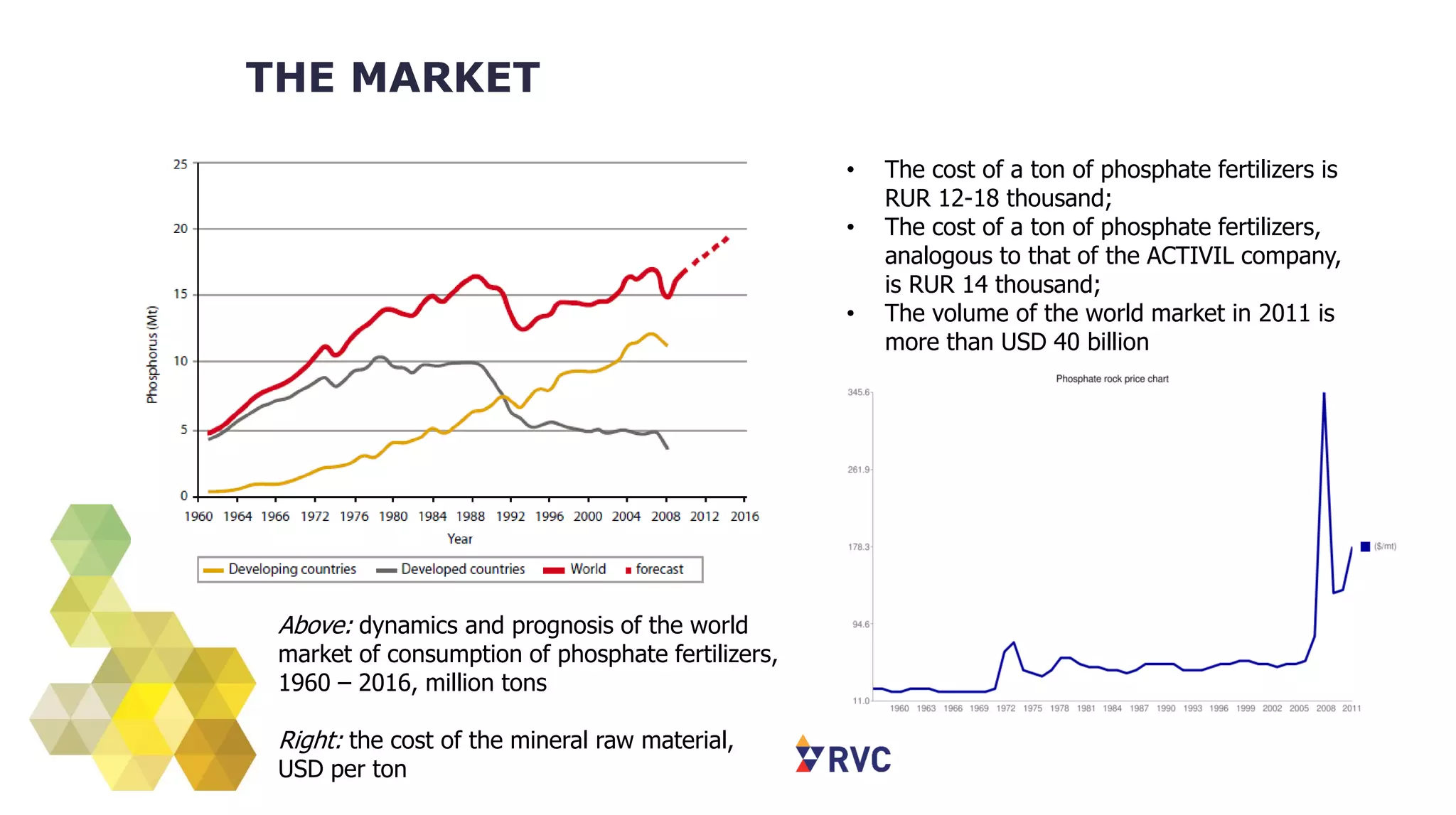
At the end of 2011, the market volume of the phosphate fertilizers consumption
comprised more than USD 40 billion. The projected growth is not less than 5%
annually at the 20-years horizon (according to the FAO)
Market volume
and dynamics
THE GLOBAL PROBLEM
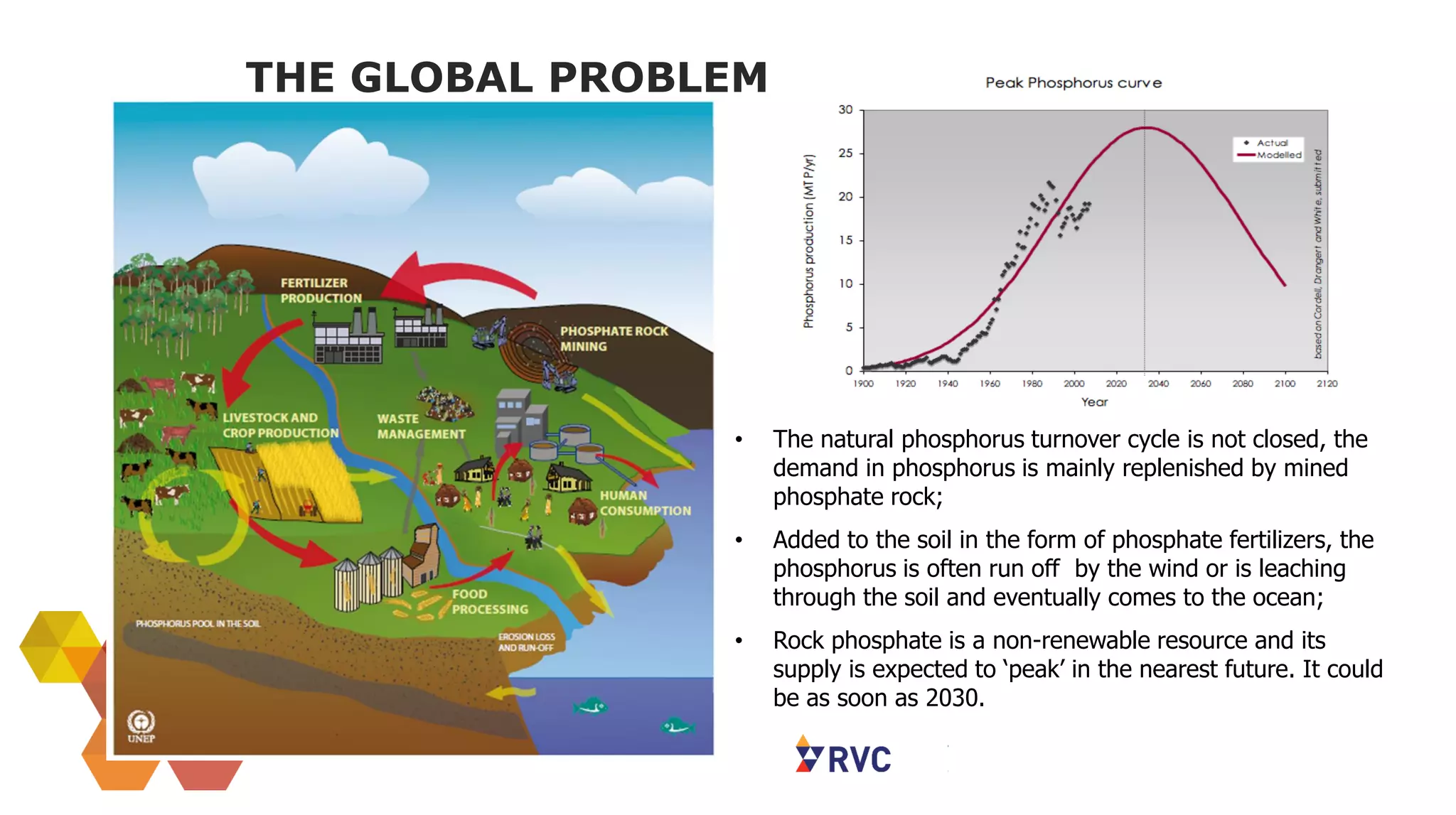
• The natural phosphorus turnover cycle is not closed, the
demand in phosphorus is mainly replenished by mined
phosphate rock;
• Added to the soil in the form of phosphate fertilizers, the
phosphorus is often run off by the wind or is leaching
through the soil and eventually comes to the ocean;
• Rock phosphate is a non-renewable resource and its
supply is expected to ‘peak’ in the nearest future. It could
be as soon as 2030.
THE PRODUCT AND ITS APPLICATIONS
• Development and depletion of phosphate ore reserves
• The ecological damage caused by application of modern technologies of
production of phosphate fertilizers
• The solution to the impending “peak phosphorus” problem by reconstruction
of the phosphorus turnover cycle;
• A new technology of the phosphate fertilizers production;
• A new type of raw material;
• Simultaneous utilization of carcinogenic human wastes.
• The minimum level of phosphorus leaching out into the environment;
• Interactivity – a capability to regulate the level of phosphorus take up by the
plants themselves;
• Prolonged action of the fertilizers for at least two seasons;
• Compliance with the generally accepted standards of the market.
Existing problem
Suggested solution,
novelty
Advantages for the
buyer
KEY ADVANTAGES
• This technology is a solution to the food safety problem for the regions that have no resources for
production of the phosphate fertilizers (Europe);
• The raw materials: wastewater sludge VS expensive phosphorus-containing ore;
• No costs for extraction of the raw material;
• Substantial reduction of raw material transportation and processing costs;
• Use of both mineral and thermal potential of the sewage sludge, complete self-supply of the production
process by thermal energy;
• Reduction of energy capacity of the support processes by 7 to 9 times;
• Reduction of capital costs for construction of plants by 4 to 6 times;
• The production process causes no damage to the environment;
• Absence of waste products (dumps, phosphogypsum);
• Additionally, a solution to an important environmental issue: safe and cost-effective utilization of
carcinogenic sludge.
ACHIEVEMENTS ON THE PROJECT
• The technological schemes of the processes have been worked out;
• The efficiency of the technology is verified in the laboratory conditions;
• In the course of the previous work on the project the main technological problem of sewage
sludge use was solved – that of removal of heavy metals from phosphate fertilizers;
• The product samples, manufactured by an alternative technology, have confirmed the compliance
with the state standards;
• The project team has been formed;
• The business plan has been worked out;
• An agreement with a private investor is reached about a possibility of co-financing the project.
The results of the intellectual activity on the project:
- The technological scheme of the production (subject to patenting);
- The modes of raw material processing at all stages of the cycle (know-how);
- Constructional features of the equipment (subject to patenting).
THE MARKET
• The cost of a ton of phosphate fertilizers is
RUR 12-18 thousand;
• The cost of a ton of phosphate fertilizers,
analogous to that of the ACTIVIL company,
is RUR 14 thousand;
• The volume of the world market in 2011 is
more than USD 40 billion
Above: dynamics and prognosis of the world
market of consumption of phosphate fertilizers,
1960 – 2016, million tons
Right: the cost of the mineral raw material,
USD per ton
MARKET DEVELOPMENT TRENDS
Increase in demand for mineral fertilizers due to the necessity of intensification of
agriculture:
• Population growth => increased demand for food;
• Increasing caloric content and nutrition quality in the diet of the inhabitants of the
Earth;
• Change in the diet of the population in South-East Asia resulting in growing meat
consumption => increasing demand for plant biomass for fodder;
• Reducing availability of arable land due to desertification and land degradation;
• Reduction of yield of a part of arable lands due to their irrational use or due to
poisoning;
• The use of crops to produce biofuels => increase of demand for plant biomass
All these factors allow us confidently predict growth of demand for phosphate fertilizers.
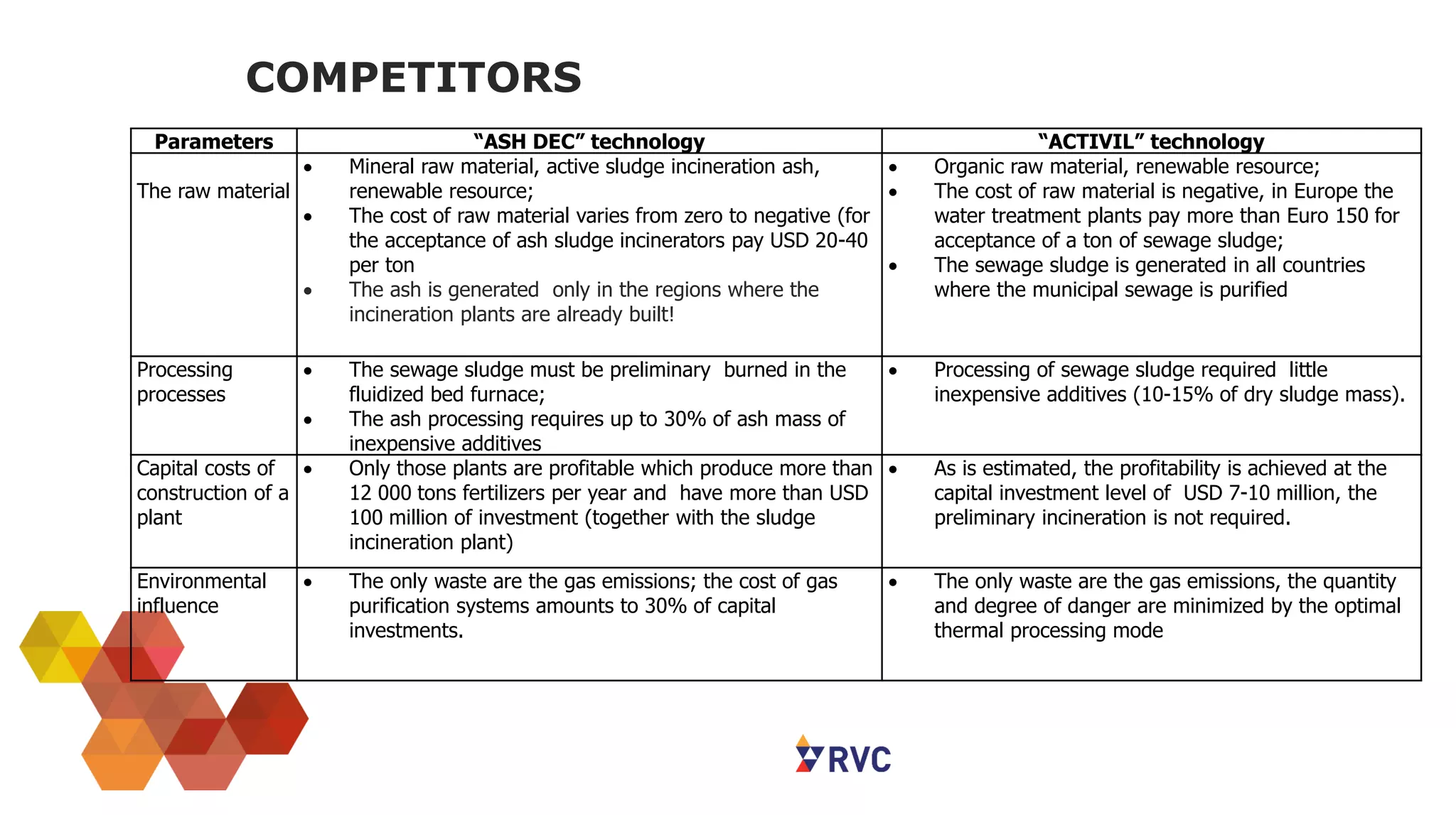
COMPETITORS
Parameters “ASH DEC” technology “ACTIVIL” technology
The raw material
 Mineral raw material, active sludge incineration ash,
renewable resource;
 The cost of raw material varies from zero to negative (for
the acceptance of ash sludge incinerators pay USD 20-40
per ton
 The ash is generated only in the regions where the
incineration plants are already built!
 Organic raw material, renewable resource;
 The cost of raw material is negative, in Europe the
water treatment plants pay more than Euro 150 for
acceptance of a ton of sewage sludge;
 The sewage sludge is generated in all countries
where the municipal sewage is purified
Processing
processes
 The sewage sludge must be preliminary burned in the
fluidized bed furnace;
 The ash processing requires up to 30% of ash mass of
inexpensive additives
 Processing of sewage sludge required little
inexpensive additives (10-15% of dry sludge mass).
Capital costs of
construction of a
plant
 Only those plants are profitable which produce more than
12 000 tons fertilizers per year and have more than USD
100 million of investment (together with the sludge
incineration plant)
 As is estimated, the profitability is achieved at the
capital investment level of USD 7-10 million, the
preliminary incineration is not required.
Environmental
influence
 The only waste are the gas emissions; the cost of gas
purification systems amounts to 30% of capital
investments.
 The only waste are the gas emissions, the quantity
and degree of danger are minimized by the optimal
thermal processing mode
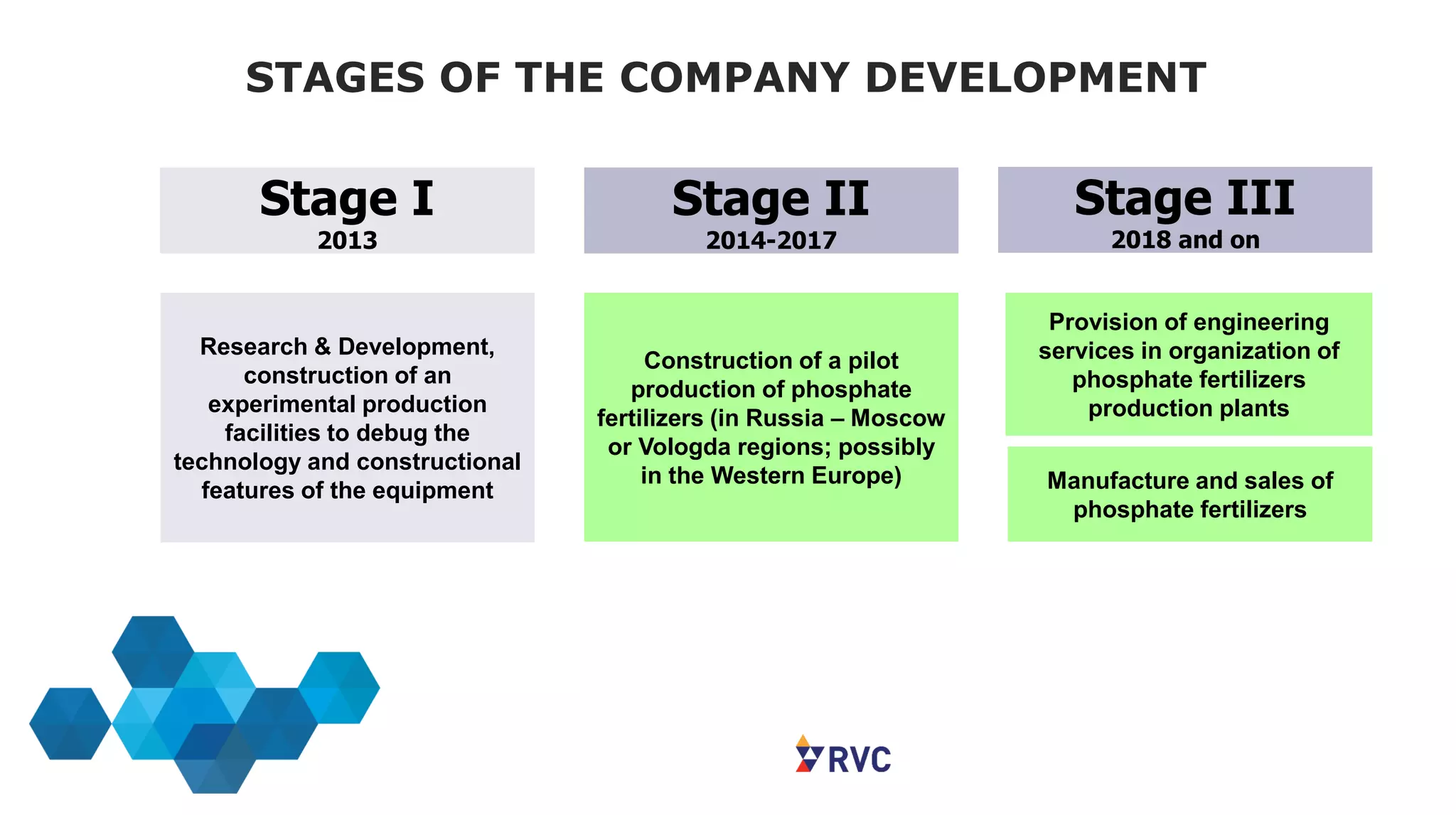
STAGES OF THE COMPANY DEVELOPMENT
Stage I
2013
Stage II
2014-2017
Stage III
2018 and on
Research & Development,
construction of an
experimental production
facilities to debug the
technology and constructional
features of the equipment
Construction of a pilot
production of phosphate
fertilizers (in Russia – Moscow
or Vologda regions; possibly
in the Western Europe)
Provision of engineering
services in organization of
phosphate fertilizers
production plants
Manufacture and sales of
phosphate fertilizers
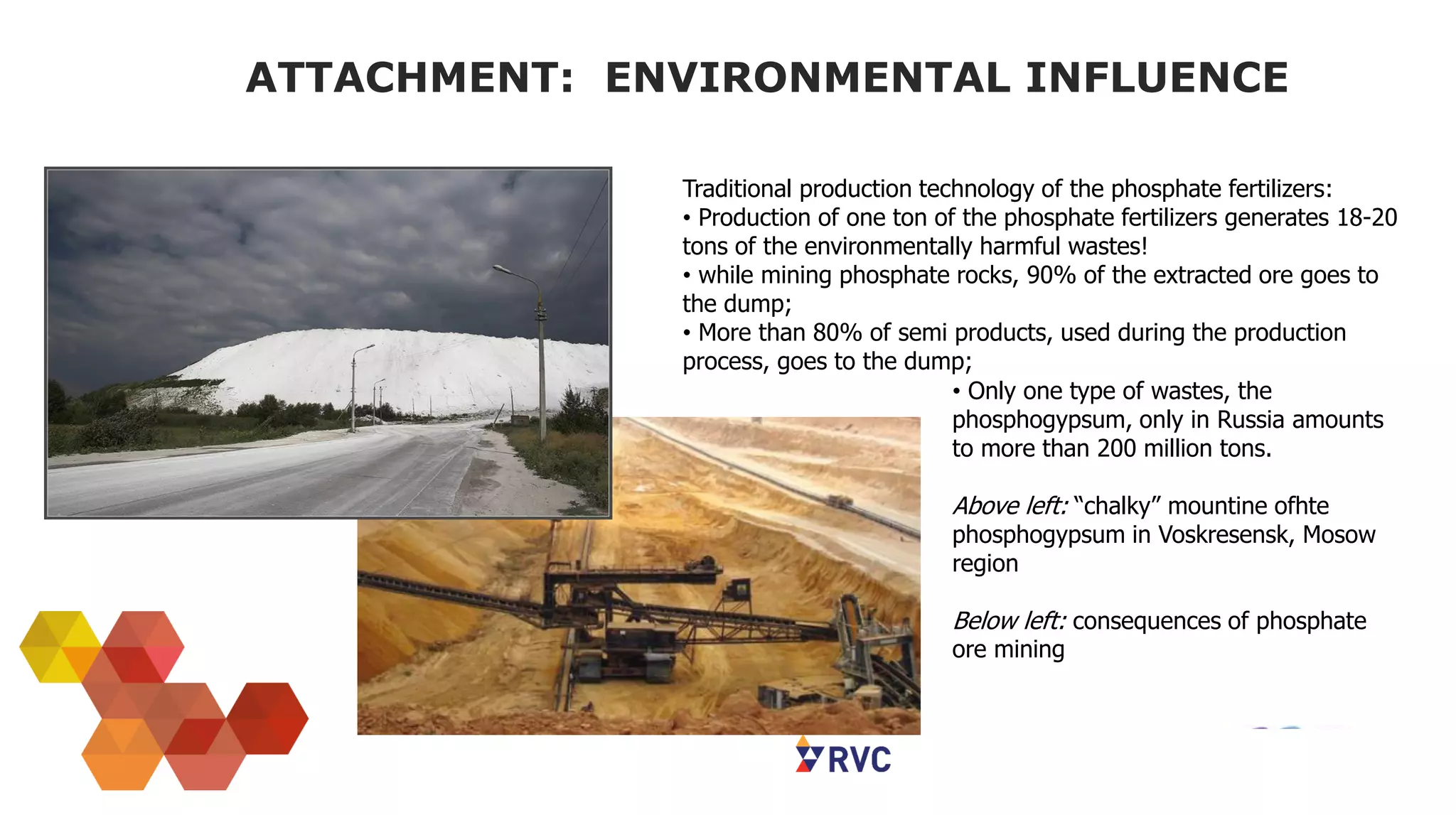
ATTACHMENT: ENVIRONMENTAL INFLUENCE
Traditional production technology of the phosphate fertilizers:
• Production of one ton of the phosphate fertilizers generates 18-20
tons of the environmentally harmful wastes!
• while mining phosphate rocks, 90% of the extracted ore goes to
the dump;
• More than 80% of semi products, used during the production
process, goes to the dump;
• Only one type of wastes, the
phosphogypsum, only in Russia amounts
to more than 200 million tons.
Above left: “chalky” mountine ofhte
phosphogypsum in Voskresensk, Mosow
region
Below left: consequences of phosphate
ore mining

Aktivil

  • 1.
    TECHNOLOGY OF PROCESSINGOF WASTEWATER SEWAGE SLUDGE INTO PHOSPHATE FERTILIZERS ACTIVIL
  • 2.
    SHORT SUMMARY OFTHE PROJECT Project description • First stage: working out of the new technology of processing the wastewater sewage sludge into phosphate fertilizers - R & D, design and construction of a pilot plant; • Second stage: attraction of a strategic investor, production and sales of phosphate fertilizers manufactured from the municipal waste – sludge (sewage sludge) • The following stages: provision of engineering services At the end of 2011, the market volume of the phosphate fertilizers consumption comprised more than USD 40 billion. The projected growth is not less than 5% annually at the 20-years horizon (according to the FAO) Market volume and dynamics
  • 3.
    THE GLOBAL PROBLEM •The natural phosphorus turnover cycle is not closed, the demand in phosphorus is mainly replenished by mined phosphate rock; • Added to the soil in the form of phosphate fertilizers, the phosphorus is often run off by the wind or is leaching through the soil and eventually comes to the ocean; • Rock phosphate is a non-renewable resource and its supply is expected to ‘peak’ in the nearest future. It could be as soon as 2030.
  • 4.
    THE PRODUCT ANDITS APPLICATIONS • Development and depletion of phosphate ore reserves • The ecological damage caused by application of modern technologies of production of phosphate fertilizers • The solution to the impending “peak phosphorus” problem by reconstruction of the phosphorus turnover cycle; • A new technology of the phosphate fertilizers production; • A new type of raw material; • Simultaneous utilization of carcinogenic human wastes. • The minimum level of phosphorus leaching out into the environment; • Interactivity – a capability to regulate the level of phosphorus take up by the plants themselves; • Prolonged action of the fertilizers for at least two seasons; • Compliance with the generally accepted standards of the market. Existing problem Suggested solution, novelty Advantages for the buyer
  • 5.
    KEY ADVANTAGES • Thistechnology is a solution to the food safety problem for the regions that have no resources for production of the phosphate fertilizers (Europe); • The raw materials: wastewater sludge VS expensive phosphorus-containing ore; • No costs for extraction of the raw material; • Substantial reduction of raw material transportation and processing costs; • Use of both mineral and thermal potential of the sewage sludge, complete self-supply of the production process by thermal energy; • Reduction of energy capacity of the support processes by 7 to 9 times; • Reduction of capital costs for construction of plants by 4 to 6 times; • The production process causes no damage to the environment; • Absence of waste products (dumps, phosphogypsum); • Additionally, a solution to an important environmental issue: safe and cost-effective utilization of carcinogenic sludge.
  • 6.
    ACHIEVEMENTS ON THEPROJECT • The technological schemes of the processes have been worked out; • The efficiency of the technology is verified in the laboratory conditions; • In the course of the previous work on the project the main technological problem of sewage sludge use was solved – that of removal of heavy metals from phosphate fertilizers; • The product samples, manufactured by an alternative technology, have confirmed the compliance with the state standards; • The project team has been formed; • The business plan has been worked out; • An agreement with a private investor is reached about a possibility of co-financing the project. The results of the intellectual activity on the project: - The technological scheme of the production (subject to patenting); - The modes of raw material processing at all stages of the cycle (know-how); - Constructional features of the equipment (subject to patenting).
  • 7.
    THE MARKET • Thecost of a ton of phosphate fertilizers is RUR 12-18 thousand; • The cost of a ton of phosphate fertilizers, analogous to that of the ACTIVIL company, is RUR 14 thousand; • The volume of the world market in 2011 is more than USD 40 billion Above: dynamics and prognosis of the world market of consumption of phosphate fertilizers, 1960 – 2016, million tons Right: the cost of the mineral raw material, USD per ton
  • 8.
    MARKET DEVELOPMENT TRENDS Increasein demand for mineral fertilizers due to the necessity of intensification of agriculture: • Population growth => increased demand for food; • Increasing caloric content and nutrition quality in the diet of the inhabitants of the Earth; • Change in the diet of the population in South-East Asia resulting in growing meat consumption => increasing demand for plant biomass for fodder; • Reducing availability of arable land due to desertification and land degradation; • Reduction of yield of a part of arable lands due to their irrational use or due to poisoning; • The use of crops to produce biofuels => increase of demand for plant biomass All these factors allow us confidently predict growth of demand for phosphate fertilizers.
  • 9.
    COMPETITORS Parameters “ASH DEC”technology “ACTIVIL” technology The raw material  Mineral raw material, active sludge incineration ash, renewable resource;  The cost of raw material varies from zero to negative (for the acceptance of ash sludge incinerators pay USD 20-40 per ton  The ash is generated only in the regions where the incineration plants are already built!  Organic raw material, renewable resource;  The cost of raw material is negative, in Europe the water treatment plants pay more than Euro 150 for acceptance of a ton of sewage sludge;  The sewage sludge is generated in all countries where the municipal sewage is purified Processing processes  The sewage sludge must be preliminary burned in the fluidized bed furnace;  The ash processing requires up to 30% of ash mass of inexpensive additives  Processing of sewage sludge required little inexpensive additives (10-15% of dry sludge mass). Capital costs of construction of a plant  Only those plants are profitable which produce more than 12 000 tons fertilizers per year and have more than USD 100 million of investment (together with the sludge incineration plant)  As is estimated, the profitability is achieved at the capital investment level of USD 7-10 million, the preliminary incineration is not required. Environmental influence  The only waste are the gas emissions; the cost of gas purification systems amounts to 30% of capital investments.  The only waste are the gas emissions, the quantity and degree of danger are minimized by the optimal thermal processing mode
  • 10.
    STAGES OF THECOMPANY DEVELOPMENT Stage I 2013 Stage II 2014-2017 Stage III 2018 and on Research & Development, construction of an experimental production facilities to debug the technology and constructional features of the equipment Construction of a pilot production of phosphate fertilizers (in Russia – Moscow or Vologda regions; possibly in the Western Europe) Provision of engineering services in organization of phosphate fertilizers production plants Manufacture and sales of phosphate fertilizers
  • 11.
    ATTACHMENT: ENVIRONMENTAL INFLUENCE Traditionalproduction technology of the phosphate fertilizers: • Production of one ton of the phosphate fertilizers generates 18-20 tons of the environmentally harmful wastes! • while mining phosphate rocks, 90% of the extracted ore goes to the dump; • More than 80% of semi products, used during the production process, goes to the dump; • Only one type of wastes, the phosphogypsum, only in Russia amounts to more than 200 million tons. Above left: “chalky” mountine ofhte phosphogypsum in Voskresensk, Mosow region Below left: consequences of phosphate ore mining