Jubail, 5 June 2016
THE WORLD ENVIRONMENT DAY SYMPOSIUM
ROYAL COMMISSION IN JUBAIL
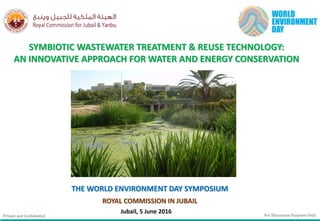
SYMBIOTIC WASTEWATER TREATMENT & REUSE TECHNOLOGY:
AN INNOVATIVE APPROACH FOR WATER AND ENERGY CONSERVATION
For Discussion Purposes OnlyPrivate and Confidential
Contents
2
Introduction: Water sector in KSA1
Main Advantages & Applications
3
4
Symbiotic Wastewater Treatment2
Examples/Case study
3
17
23
9
Slide No.
3
Introduction: Wastewater situation in KSA
• Total volume of generated WW (SWW+IWW) in KSA: 4.5-5 Million m³/d (*)
• Kingdom’s sewage collection total coverage: over 50%
• Sewage systems including WWTP are only available in large urban centers
• WW disposal is limited only to cesspits in small towns and rural areas
• At least 35% of the total WW produced is discharged in the untreated form
• Majority of WWTPs in KSA have secondary levels of treatment. Main
technologies used are:
 Activated sludge or trickling filters
 Extended aeration
 Aerated lagoons
 Carousel systems
• Tertiary treatment facilities do exist, mainly around larger cities
(*) Produced water not included
4
Introduction-Wastewater reuse situation in KSA
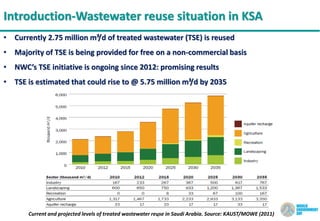
• Currently 2.75 million m³/d of treated wastewater (TSE) is reused
• Majority of TSE is being provided for free on a non-commercial basis
• NWC’s TSE initiative is ongoing since 2012: promising results
• TSE is estimated that could rise to @ 5.75 million m³/d by 2035
Current and projected levels of treated wastewater reuse in Saudi Arabia. Source: KAUST/MOWE (2011)
5
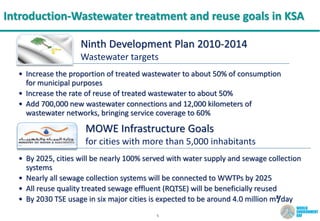
Introduction-Wastewater treatment and reuse goals in KSA
MOWE Infrastructure Goals
for cities with more than 5,000 inhabitants
• By 2025, cities will be nearly 100% served with water supply and sewage collection
systems
• Nearly all sewage collection systems will be connected to WWTPs by 2025
• All reuse quality treated sewage effluent (RQTSE) will be beneficially reused
• By 2030 TSE usage in six major cities is expected to be around 4.0 million m³/day
Ninth Development Plan 2010-2014
Wastewater targets
• Increase the proportion of treated wastewater to about 50% of consumption
for municipal purposes
• Increase the rate of reuse of treated wastewater to about 50%
• Add 700,000 new wastewater connections and 12,000 kilometers of
wastewater networks, bringing service coverage to 60%
6
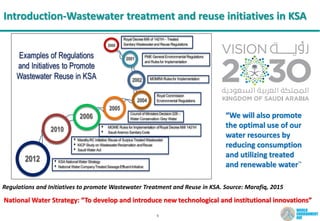
Introduction-Wastewater treatment and reuse initiatives in KSA
“We will also promote
the optimal use of our
water resources by
reducing consumption
and utilizing treated
and renewable water¨
National Water Strategy: “To develop and introduce new technological and institutional innovations”
Regulations and Initiatives to promote Wastewater Treatment and Reuse in KSA. Source: Marafiq, 2015
7
Introduction-Wastewater treatment and reuse potential in KSA
0
200
400
600
800
1000
1200
STP Capacity Treated Sewage TSE Reuse
Volume[1000m3/day]
Wastewater Treatment and Reuse Potential in KSA. Source: Ministry of Water and Electricity, 2010
8
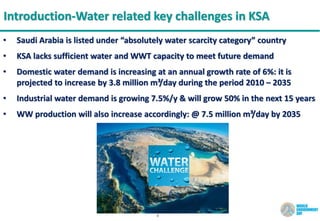
Introduction-Water related key challenges in KSA
• Saudi Arabia is listed under “absolutely water scarcity category” country
• KSA lacks sufficient water and WWT capacity to meet future demand
• Domestic water demand is increasing at an annual growth rate of 6%: it is
projected to increase by 3.8 million m³/day during the period 2010 – 2035
• Industrial water demand is growing 7.5%/y & will grow 50% in the next 15 years
• WW production will also increase accordingly: @ 7.5 million m³/day by 2035
9
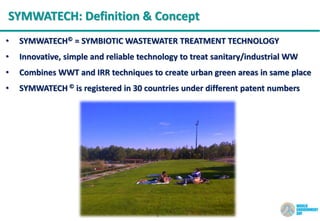
SYMWATECH: Definition & Concept
• SYMWATECH© = SYMBIOTIC WASTEWATER TREATMENT TECHNOLOGY
• Innovative, simple and reliable technology to treat sanitary/industrial WW
• Combines WWT and IRR techniques to create urban green areas in same place
• SYMWATECH © is registered in 30 countries under different patent numbers
10
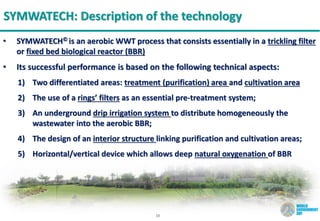
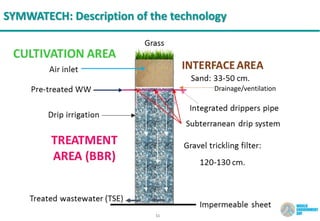
SYMWATECH: Description of the technology
• SYMWATECH© is an aerobic WWT process that consists essentially in a trickling filter
or fixed bed biological reactor (BBR)
• Its successful performance is based on the following technical aspects:
1) Two differentiated areas: treatment (purification) area and cultivation area
2) The use of a rings’ filters as an essential pre-treatment system;
3) An underground drip irrigation system to distribute homogeneously the
wastewater into the aerobic BBR;
4) The design of an interior structure linking purification and cultivation areas;
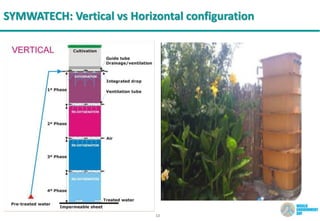
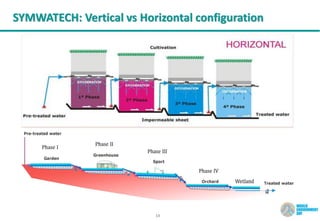
5) Horizontal/vertical device which allows deep natural oxygenation of BBR
11
SYMWATECH: Description of the technology
Drainage/ventilation
12
SYMWATECH: Vertical vs Horizontal configuration
13
SYMWATECH: Vertical vs Horizontal configuration
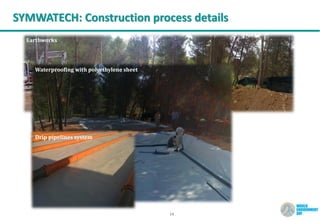
750 habitantes
Earthworks
Waterproofing with polyethylene sheet
Drip pipelines system
14
SYMWATECH: Construction process details
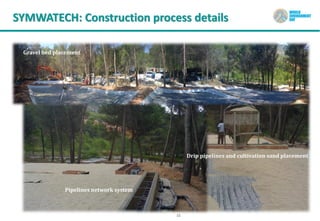
Pipelines network system
Gravel bed placement
Drip pipelines and cultivation sand placement
15
SYMWATECH: Construction process details
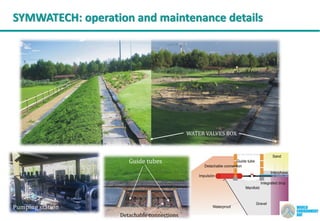
750 habitantes
WATER VALVES BOX
Detachable connections
Guide tubes
16
SYMWATECH: operation and maintenance details
Pumping station
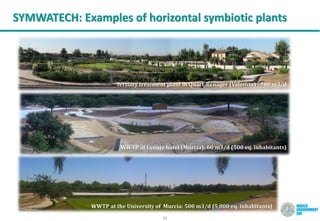
Tertiary treatment plant in Quart-Benager (Valencia) : 780 m3/d
Camping Moratalla (Murcia): 750 people
WWTP at Cenajo hotel (Murcia): 60 m3/d (500 eq. inhabitants)
17
SYMWATECH: Examples of horizontal symbiotic plants
WWTP at the University of Murcia: 500 m3/d (5,000 eq. inhabitants)
18
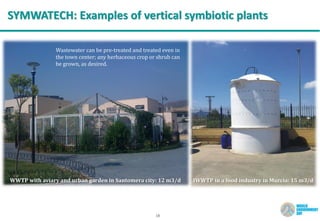
SYMWATECH: Examples of vertical symbiotic plants
Wastewater can be pre-treated and treated even in
the town center; any herbaceous crop or shrub can
be grown, as desired.
WWTP with aviary and urban garden in Santomera city: 12 m3/d IWWTP in a food industry in Murcia: 15 m3/d
19
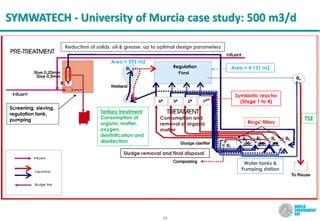
SYMWATECH - University of Murcia case study: 500 m3/d
Reduction of solids, oil & grease, up to optimal design parameters
Sludge removal and final disposal
Screening, sieving,
regulation tank,
pumping Consumption and
removal of organic
matter
Regulation
Symbiotic reactor
(Stage 1 to 4)
Tertiary treatment:
Consumption of
organic matter,
oxygen,
denitrification and
disinfection
Water tanks &
Pumping station
TSE
Rings’ filters
Area = 395 m2
Area = 4,131 m2
20
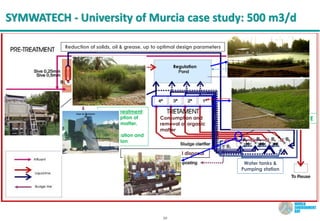
SYMWATECH - University of Murcia case study: 500 m3/d
Reduction of solids, oil & grease, up to optimal design parameters
Sludge removal and final disposal
Screening, sieving,
regulation tank,
pumping Consumption and
removal of organic
matter
Regulation
Symbiotic reactor
(Stage 1 to 4)
Tertiary treatment:
Consumption of
organic matter,
oxygen,
denitrification and
disinfection
Water tanks &
Pumping station
TSE
Rings’ filters
Area = 395 m2
Area = 4,131 m2
21
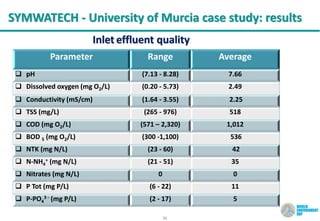
SYMWATECH - University of Murcia case study: results
Inlet effluent quality
Parameter Range Average
 pH (7.13 - 8.28) 7.66
 Dissolved oxygen (mg O2/L) (0.20 - 5.73) 2.49
 Conductivity (mS/cm) (1.64 - 3.55) 2.25
 TSS (mg/L) (265 - 976) 518
 COD (mg O2/L) (571 – 2,320) 1,012
 BOD 5 (mg O2/L) (300 -1,100) 536
 NTK (mg N/L) (23 - 60) 42
 N-NH4
+ (mg N/L) (21 - 51) 35
 Nitrates (mg N/L) 0 0
 P Tot (mg P/L) (6 - 22) 11
 P-PO4
3 - (mg P/L) (2 - 17) 5
22
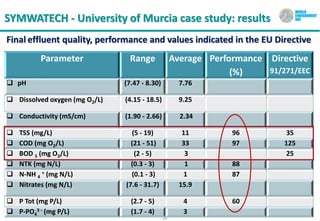
SYMWATECH - University of Murcia case study: results
Final effluent quality, performance and values indicated in the EU Directive
Parameter Range Average Performance
(%)
Directive
91/271/EEC
 pH (7.47 - 8.30) 7.76
 Dissolved oxygen (mg O2/L) (4.15 - 18.5) 9.25
 Conductivity (mS/cm) (1.90 - 2.66) 2.34
 TSS (mg/L) (5 - 19) 11 96 35
 COD (mg O2/L) (21 - 51) 33 97 125
 BOD 5 (mg O2/L) (2 - 5) 3 25
 NTK (mg N/L) (0.3 - 3) 1 88
 N-NH 4
+ (mg N/L) (0.1 - 3) 1 87
 Nitrates (mg N/L) (7.6 - 31.7) 15.9
 P Tot (mg P/L) (2.7 - 5) 4 60
 P-PO4
3 - (mg P/L) (1.7 - 4) 3
23
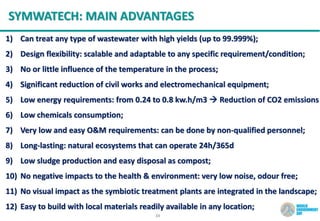
SYMWATECH: MAIN ADVANTAGES
1) Can treat any type of wastewater with high yields (up to 99.999%);
2) Design flexibility: scalable and adaptable to any specific requirement/condition;
3) No or little influence of the temperature in the process;
4) Significant reduction of civil works and electromechanical equipment;
5) Low energy requirements: from 0.24 to 0.8 kw.h/m3  Reduction of CO2 emissions
6) Low chemicals consumption;
7) Very low and easy O&M requirements: can be done by non-qualified personnel;
8) Long-lasting: natural ecosystems that can operate 24h/365d
9) Low sludge production and easy disposal as compost;
10) No negative impacts to the health & environment: very low noise, odour free;
11) No visual impact as the symbiotic treatment plants are integrated in the landscape;
12) Easy to build with local materials readily available in any location;
24
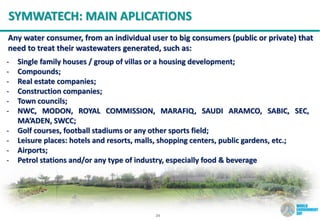
SYMWATECH: MAIN APLICATIONS
Any water consumer, from an individual user to big consumers (public or private) that
need to treat their wastewaters generated, such as:
- Single family houses / group of villas or a housing development;
- Compounds;
- Real estate companies;
- Construction companies;
- Town councils;
- NWC, MODON, ROYAL COMMISSION, MARAFIQ, SAUDI ARAMCO, SABIC, SEC,
MA’ADEN, SWCC;
- Golf courses, football stadiums or any other sports field;
- Leisure places: hotels and resorts, malls, shopping centers, public gardens, etc.;
- Airports;
- Petrol stations and/or any type of industry, especially food & beverage
For further information:
THANK YOU
‫شكرا‬
Manuel Hidalgo
Phone: +966 (0) 597203761
Email: manuel.hidalgo.linkedin@gmail.com
RAMADAN MUBARAK
‫مبارك‬ ‫رمضان‬

Presentation-Symwatech-WED-05.06.16-final

  • 1.
    Jubail, 5 June2016 THE WORLD ENVIRONMENT DAY SYMPOSIUM ROYAL COMMISSION IN JUBAIL SYMBIOTIC WASTEWATER TREATMENT & REUSE TECHNOLOGY: AN INNOVATIVE APPROACH FOR WATER AND ENERGY CONSERVATION For Discussion Purposes OnlyPrivate and Confidential
  • 2.
    Contents 2 Introduction: Water sectorin KSA1 Main Advantages & Applications 3 4 Symbiotic Wastewater Treatment2 Examples/Case study 3 17 23 9 Slide No.
  • 3.
    3 Introduction: Wastewater situationin KSA • Total volume of generated WW (SWW+IWW) in KSA: 4.5-5 Million m³/d (*) • Kingdom’s sewage collection total coverage: over 50% • Sewage systems including WWTP are only available in large urban centers • WW disposal is limited only to cesspits in small towns and rural areas • At least 35% of the total WW produced is discharged in the untreated form • Majority of WWTPs in KSA have secondary levels of treatment. Main technologies used are:  Activated sludge or trickling filters  Extended aeration  Aerated lagoons  Carousel systems • Tertiary treatment facilities do exist, mainly around larger cities (*) Produced water not included
  • 4.
    4 Introduction-Wastewater reuse situationin KSA • Currently 2.75 million m³/d of treated wastewater (TSE) is reused • Majority of TSE is being provided for free on a non-commercial basis • NWC’s TSE initiative is ongoing since 2012: promising results • TSE is estimated that could rise to @ 5.75 million m³/d by 2035 Current and projected levels of treated wastewater reuse in Saudi Arabia. Source: KAUST/MOWE (2011)
  • 5.
    5 Introduction-Wastewater treatment andreuse goals in KSA MOWE Infrastructure Goals for cities with more than 5,000 inhabitants • By 2025, cities will be nearly 100% served with water supply and sewage collection systems • Nearly all sewage collection systems will be connected to WWTPs by 2025 • All reuse quality treated sewage effluent (RQTSE) will be beneficially reused • By 2030 TSE usage in six major cities is expected to be around 4.0 million m³/day Ninth Development Plan 2010-2014 Wastewater targets • Increase the proportion of treated wastewater to about 50% of consumption for municipal purposes • Increase the rate of reuse of treated wastewater to about 50% • Add 700,000 new wastewater connections and 12,000 kilometers of wastewater networks, bringing service coverage to 60%
  • 6.
    6 Introduction-Wastewater treatment andreuse initiatives in KSA “We will also promote the optimal use of our water resources by reducing consumption and utilizing treated and renewable water¨ National Water Strategy: “To develop and introduce new technological and institutional innovations” Regulations and Initiatives to promote Wastewater Treatment and Reuse in KSA. Source: Marafiq, 2015
  • 7.
    7 Introduction-Wastewater treatment andreuse potential in KSA 0 200 400 600 800 1000 1200 STP Capacity Treated Sewage TSE Reuse Volume[1000m3/day] Wastewater Treatment and Reuse Potential in KSA. Source: Ministry of Water and Electricity, 2010
  • 8.
    8 Introduction-Water related keychallenges in KSA • Saudi Arabia is listed under “absolutely water scarcity category” country • KSA lacks sufficient water and WWT capacity to meet future demand • Domestic water demand is increasing at an annual growth rate of 6%: it is projected to increase by 3.8 million m³/day during the period 2010 – 2035 • Industrial water demand is growing 7.5%/y & will grow 50% in the next 15 years • WW production will also increase accordingly: @ 7.5 million m³/day by 2035
  • 9.
    9 SYMWATECH: Definition &Concept • SYMWATECH© = SYMBIOTIC WASTEWATER TREATMENT TECHNOLOGY • Innovative, simple and reliable technology to treat sanitary/industrial WW • Combines WWT and IRR techniques to create urban green areas in same place • SYMWATECH © is registered in 30 countries under different patent numbers
  • 10.
    10 SYMWATECH: Description ofthe technology • SYMWATECH© is an aerobic WWT process that consists essentially in a trickling filter or fixed bed biological reactor (BBR) • Its successful performance is based on the following technical aspects: 1) Two differentiated areas: treatment (purification) area and cultivation area 2) The use of a rings’ filters as an essential pre-treatment system; 3) An underground drip irrigation system to distribute homogeneously the wastewater into the aerobic BBR; 4) The design of an interior structure linking purification and cultivation areas; 5) Horizontal/vertical device which allows deep natural oxygenation of BBR
  • 11.
    11 SYMWATECH: Description ofthe technology Drainage/ventilation
  • 12.
    12 SYMWATECH: Vertical vsHorizontal configuration
  • 13.
    13 SYMWATECH: Vertical vsHorizontal configuration
  • 14.
    750 habitantes Earthworks Waterproofing withpolyethylene sheet Drip pipelines system 14 SYMWATECH: Construction process details
  • 15.
    Pipelines network system Gravelbed placement Drip pipelines and cultivation sand placement 15 SYMWATECH: Construction process details
  • 16.
    750 habitantes WATER VALVESBOX Detachable connections Guide tubes 16 SYMWATECH: operation and maintenance details Pumping station
  • 17.
    Tertiary treatment plantin Quart-Benager (Valencia) : 780 m3/d Camping Moratalla (Murcia): 750 people WWTP at Cenajo hotel (Murcia): 60 m3/d (500 eq. inhabitants) 17 SYMWATECH: Examples of horizontal symbiotic plants WWTP at the University of Murcia: 500 m3/d (5,000 eq. inhabitants)
  • 18.
    18 SYMWATECH: Examples ofvertical symbiotic plants Wastewater can be pre-treated and treated even in the town center; any herbaceous crop or shrub can be grown, as desired. WWTP with aviary and urban garden in Santomera city: 12 m3/d IWWTP in a food industry in Murcia: 15 m3/d
  • 19.
    19 SYMWATECH - Universityof Murcia case study: 500 m3/d Reduction of solids, oil & grease, up to optimal design parameters Sludge removal and final disposal Screening, sieving, regulation tank, pumping Consumption and removal of organic matter Regulation Symbiotic reactor (Stage 1 to 4) Tertiary treatment: Consumption of organic matter, oxygen, denitrification and disinfection Water tanks & Pumping station TSE Rings’ filters Area = 395 m2 Area = 4,131 m2
  • 20.
    20 SYMWATECH - Universityof Murcia case study: 500 m3/d Reduction of solids, oil & grease, up to optimal design parameters Sludge removal and final disposal Screening, sieving, regulation tank, pumping Consumption and removal of organic matter Regulation Symbiotic reactor (Stage 1 to 4) Tertiary treatment: Consumption of organic matter, oxygen, denitrification and disinfection Water tanks & Pumping station TSE Rings’ filters Area = 395 m2 Area = 4,131 m2
  • 21.
    21 SYMWATECH - Universityof Murcia case study: results Inlet effluent quality Parameter Range Average  pH (7.13 - 8.28) 7.66  Dissolved oxygen (mg O2/L) (0.20 - 5.73) 2.49  Conductivity (mS/cm) (1.64 - 3.55) 2.25  TSS (mg/L) (265 - 976) 518  COD (mg O2/L) (571 – 2,320) 1,012  BOD 5 (mg O2/L) (300 -1,100) 536  NTK (mg N/L) (23 - 60) 42  N-NH4 + (mg N/L) (21 - 51) 35  Nitrates (mg N/L) 0 0  P Tot (mg P/L) (6 - 22) 11  P-PO4 3 - (mg P/L) (2 - 17) 5
  • 22.
    22 SYMWATECH - Universityof Murcia case study: results Final effluent quality, performance and values indicated in the EU Directive Parameter Range Average Performance (%) Directive 91/271/EEC  pH (7.47 - 8.30) 7.76  Dissolved oxygen (mg O2/L) (4.15 - 18.5) 9.25  Conductivity (mS/cm) (1.90 - 2.66) 2.34  TSS (mg/L) (5 - 19) 11 96 35  COD (mg O2/L) (21 - 51) 33 97 125  BOD 5 (mg O2/L) (2 - 5) 3 25  NTK (mg N/L) (0.3 - 3) 1 88  N-NH 4 + (mg N/L) (0.1 - 3) 1 87  Nitrates (mg N/L) (7.6 - 31.7) 15.9  P Tot (mg P/L) (2.7 - 5) 4 60  P-PO4 3 - (mg P/L) (1.7 - 4) 3
  • 23.
    23 SYMWATECH: MAIN ADVANTAGES 1)Can treat any type of wastewater with high yields (up to 99.999%); 2) Design flexibility: scalable and adaptable to any specific requirement/condition; 3) No or little influence of the temperature in the process; 4) Significant reduction of civil works and electromechanical equipment; 5) Low energy requirements: from 0.24 to 0.8 kw.h/m3  Reduction of CO2 emissions 6) Low chemicals consumption; 7) Very low and easy O&M requirements: can be done by non-qualified personnel; 8) Long-lasting: natural ecosystems that can operate 24h/365d 9) Low sludge production and easy disposal as compost; 10) No negative impacts to the health & environment: very low noise, odour free; 11) No visual impact as the symbiotic treatment plants are integrated in the landscape; 12) Easy to build with local materials readily available in any location;
  • 24.
    24 SYMWATECH: MAIN APLICATIONS Anywater consumer, from an individual user to big consumers (public or private) that need to treat their wastewaters generated, such as: - Single family houses / group of villas or a housing development; - Compounds; - Real estate companies; - Construction companies; - Town councils; - NWC, MODON, ROYAL COMMISSION, MARAFIQ, SAUDI ARAMCO, SABIC, SEC, MA’ADEN, SWCC; - Golf courses, football stadiums or any other sports field; - Leisure places: hotels and resorts, malls, shopping centers, public gardens, etc.; - Airports; - Petrol stations and/or any type of industry, especially food & beverage
  • 25.
    For further information: THANKYOU ‫شكرا‬ Manuel Hidalgo Phone: +966 (0) 597203761 Email: manuel.hidalgo.linkedin@gmail.com RAMADAN MUBARAK ‫مبارك‬ ‫رمضان‬