How is Japan Managing Its Debt?
-V. Karthik Varma.
Over the next few years Bank of Japan (BOJ) will monetize
several trillions dollars of debt. One will obviously fear that its 2.5 decades of
national debt has to be cleared by printing currency to fund present and past
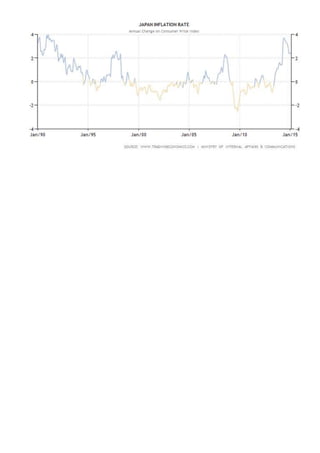
fiscal deficits, which will inevitably lead to dangerous inflation though there is a
small tick up in growth.
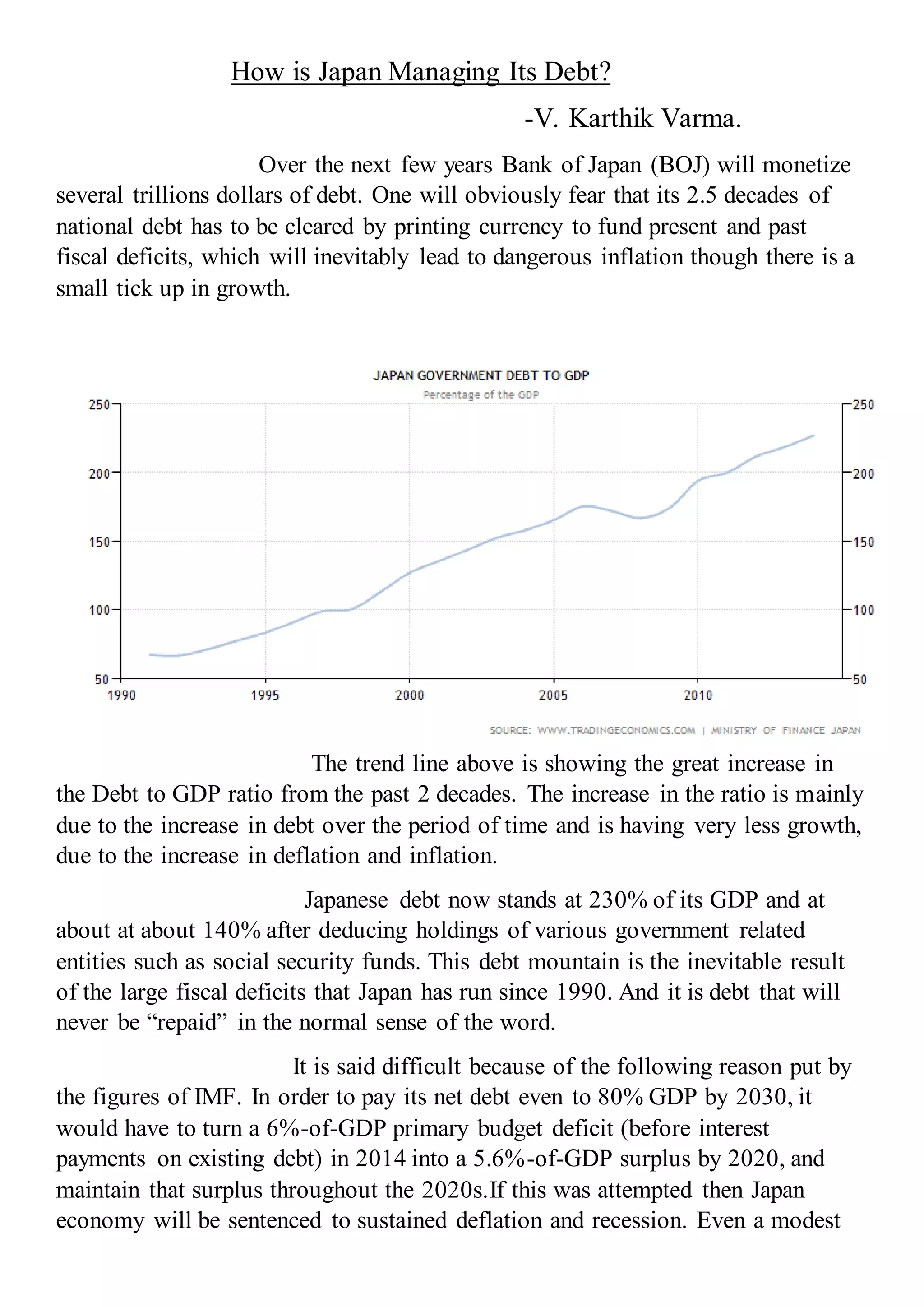
The trend line above is showing the great increase in
the Debt to GDP ratio from the past 2 decades. The increase in the ratio is mainly
due to the increase in debt over the period of time and is having very less growth,
due to the increase in deflation and inflation.
Japanese debt now stands at 230% of its GDP and at
about at about 140% after deducing holdings of various government related
entities such as social security funds. This debt mountain is the inevitable result
of the large fiscal deficits that Japan has run since 1990. And it is debt that will
never be “repaid” in the normal sense of the word.
It is said difficult because of the following reason put by
the figures of IMF. In order to pay its net debt even to 80% GDP by 2030, it
would have to turn a 6%-of-GDP primary budget deficit (before interest
payments on existing debt) in 2014 into a 5.6%-of-GDP surplus by 2020, and
maintain that surplus throughout the 2020s.If this was attempted then Japan
economy will be sentenced to sustained deflation and recession. Even a modest
step towards it will lead to set back of economy recovery which is happened with
increase in sales tax in 2014.
Instead of being repaid, Bank of Japan (BOJ) started
buying its government bonds, whose purchases of 80 trillion yen per year now
exceed more than new government debt issue of 50 trillion yen. Due to this the
residual debt after excluding BOJ and government entity holding is being
reduced over the period of time. If this continues the total residual debt which is
neither held by BOJ nor by government related entities will be reduced to around
65% of GDP by 2017. One interesting fact in this is , since BOJ is also
government holding the interest paid on government bonds return back to
government and due to this the net figure of liability payment will be declining
for future Japanese Tax payers.
Few months ago Japan has initiated quantitative
easing whose main aim is to lessen the interest rates, increase the asset price and
weaken the exchange rate which would stimuli the economy growth and reduce
the inflation by increase in investments and exports. This is a small stimulus but
the big stimulus will come if the fiscal deficit is efficiently funded with BOJ-
created money. This reality is not officially admitted. The official news for BOJ
is that it will sell all the bonds that were acquired to bring money into
government treasury. Instead government would have done in this way by selling
new bonds as existing one matures and BOJ can maintain the reserves of
commercial banks with it which can support excessive credit growth and
inflation.
The Japanese authorities are now following what Ben
Bernanke the ex U.S. Federal Reserve Chairman –using monetized fiscal deficits
to put spending power into the hands of companies and households. At that time
BOJ did not accept this and they opined that deficits should be cleared only by
issuing bonds. But however now Japan government is following the methodology
suggested by Ben Bernanke. If Japan would have adopted it earlier it would have
experienced slight decrease in deflation increase in growth and reduction in
public debt.
Experts opine that in the current prevailing process
can be made better buy initiating a part of bonds with zero coupon which will
reduce government spending during the bond maturity. But the more probable
market reaction will be a collective shrug of the shoulders, accepting permanent
monetization as the only possible safe way to alleviate an otherwise intractable
debt burden. Japan was already one the world’s richest countries in 1990, and its
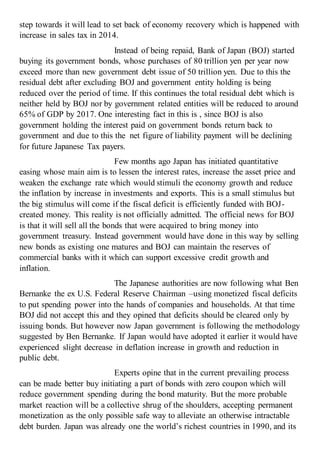
per capita income has continued to grow, albeit slowly. Its unemployment rate,
now 3.6%, has been consistently below European levels. And its “public debt
burden” will turn out to be an illusion.
japan debt

japan debt

  • 1.
    How is JapanManaging Its Debt? -V. Karthik Varma. Over the next few years Bank of Japan (BOJ) will monetize several trillions dollars of debt. One will obviously fear that its 2.5 decades of national debt has to be cleared by printing currency to fund present and past fiscal deficits, which will inevitably lead to dangerous inflation though there is a small tick up in growth. The trend line above is showing the great increase in the Debt to GDP ratio from the past 2 decades. The increase in the ratio is mainly due to the increase in debt over the period of time and is having very less growth, due to the increase in deflation and inflation. Japanese debt now stands at 230% of its GDP and at about at about 140% after deducing holdings of various government related entities such as social security funds. This debt mountain is the inevitable result of the large fiscal deficits that Japan has run since 1990. And it is debt that will never be “repaid” in the normal sense of the word. It is said difficult because of the following reason put by the figures of IMF. In order to pay its net debt even to 80% GDP by 2030, it would have to turn a 6%-of-GDP primary budget deficit (before interest payments on existing debt) in 2014 into a 5.6%-of-GDP surplus by 2020, and maintain that surplus throughout the 2020s.If this was attempted then Japan economy will be sentenced to sustained deflation and recession. Even a modest
  • 2.
    step towards itwill lead to set back of economy recovery which is happened with increase in sales tax in 2014. Instead of being repaid, Bank of Japan (BOJ) started buying its government bonds, whose purchases of 80 trillion yen per year now exceed more than new government debt issue of 50 trillion yen. Due to this the residual debt after excluding BOJ and government entity holding is being reduced over the period of time. If this continues the total residual debt which is neither held by BOJ nor by government related entities will be reduced to around 65% of GDP by 2017. One interesting fact in this is , since BOJ is also government holding the interest paid on government bonds return back to government and due to this the net figure of liability payment will be declining for future Japanese Tax payers. Few months ago Japan has initiated quantitative easing whose main aim is to lessen the interest rates, increase the asset price and weaken the exchange rate which would stimuli the economy growth and reduce the inflation by increase in investments and exports. This is a small stimulus but the big stimulus will come if the fiscal deficit is efficiently funded with BOJ- created money. This reality is not officially admitted. The official news for BOJ is that it will sell all the bonds that were acquired to bring money into government treasury. Instead government would have done in this way by selling new bonds as existing one matures and BOJ can maintain the reserves of commercial banks with it which can support excessive credit growth and inflation. The Japanese authorities are now following what Ben Bernanke the ex U.S. Federal Reserve Chairman –using monetized fiscal deficits to put spending power into the hands of companies and households. At that time BOJ did not accept this and they opined that deficits should be cleared only by issuing bonds. But however now Japan government is following the methodology suggested by Ben Bernanke. If Japan would have adopted it earlier it would have experienced slight decrease in deflation increase in growth and reduction in public debt. Experts opine that in the current prevailing process can be made better buy initiating a part of bonds with zero coupon which will reduce government spending during the bond maturity. But the more probable market reaction will be a collective shrug of the shoulders, accepting permanent monetization as the only possible safe way to alleviate an otherwise intractable debt burden. Japan was already one the world’s richest countries in 1990, and its
  • 3.
    per capita incomehas continued to grow, albeit slowly. Its unemployment rate, now 3.6%, has been consistently below European levels. And its “public debt burden” will turn out to be an illusion.