Contract Management in the Cloud
Ariba Knowledge Nuggets   Supply uncertainty, capacity volatility, resource constraints, and a
                          heightened need to assess and mitigate operational and trading partner
                          risk have fundamentally changed the way companies organize and
                          measure success. As the recovery progresses, one thing is becoming
                          clear—this is no temporary shift in approach. Leading companies have
                          realized that the organizational agility required to survive the downturn
                          can act as a differentiator, enabling them to emerge more strongly
                          positioned to compete and be successful.
                             This story can fit 175-225 words.

                          This newto marketof normalor service, and alsoinformation to a targeted audience. Newslettersidentity a
                             The purpose of a newsletter is to provide specialized
                             great way
                                         state your product places a laser focus onand build your organization’s can be
                                                                                    create credibility
                                                                                                       managing costs while
                          better anticipatingemployees, or vendors. market conditions. Both buyers and
                             among peers, members, fluctuations in
                          sellers must place a renewed importance on building successful information it
                             First, determine the audience of the newsletter. This could be anyone who might benefit from the
                          relationships. Noemployees or people interested in purchasing a product or requesting to the point
                             contains, for example, longer can buyers bleed sellers for savings your service.
                          of You can compile a In addition business reply cards, customer information sheets, business cards collected at
                             insolvency. mailing list from to cost savings attainment, more elegant
                          methods ofor membership lists. You might consider purchasing a mailing list from a company.
                             trade shows, measuring success are necessary for procurement—including
                          supplier satisfaction catalog,innovation. Meanwhile, match the style of required to be
                             If you explore the Publisher and you will find many publications that sellers are your newsletter.
                          more flexible with theirand money you can often agreeing to These factors will help determine
                             Next, establish how much time customers, spend on your newsletter. renegotiate terms
                          and service levels. the newsletter and its length. It’s recommended that you publish your newsletter at
                             how frequently you publish
                             least quarterly so that it’s considered a consistent source of information. Your customers or employees will look
                             forward to its arrival.
                          The tools and processes that companies are employing to achieve
                          success today are wide and varied. However, in terms of technology, a
                          clear transformation has taken place. Faster time to value, lower total cost
                          of ownership, more flexible pricing and usage models, and rapid
                          innovation cycles have brought Software-as-a-Service (SaaS) and Cloud
                          computing delivery models to the forefront—as has the fact that these
                          models enable the CIO to focus on more strategic initiatives and manage
                          information versus technology. Leveraging SaaS solutions, businesses
                          can be up and running faster with minimal upfront investment. They also
                          have the ability to dial up (or down) usage in order to meet the needs of
                          the organization and pressures of the market. And while we will discuss a
                          number of data and security considerations in this paper, the reality is that
                          the security level provided by leading SaaS providers exceeds that of
                          most enterprise companies.

                          The emergence and growing acceptance of these models has sparked a
                          fundamental shift in the way that procurement, sales operations, IT, and
                          finance go about achieving their objectives. Legal and contracting
                          professionals must be at the forefront enabling this organizational
                          transformation.
Where To Start ? ? ?
                 Start Internally
                 Ask a legal or contracting professional what his or her largest pain point in
                 negotiating contracts is, and you’ll likely hear that it is a lack of alignment between
                 the buying group who sources a contract and those responsible for negotiating the
                 actual agreement. Too often, thorough diligence in evaluating SaaS or Cloud-
                 based solutions focuses on educating consumers on the benefits of technology to
                 automate the contract process and allaying concerns about data availability,
                 access, and security. Contract negotiators are not commonly included in these
                 discussions and, as a result, their concerns—and ultimately, the real issues
related to contract negotiations—are not captured and must be revisited after the fact.
The contract management group should consider creating a checklist that will enable the business
functions to acquire the tools and benefits they seek. Meanwhile, it can be assured that the
company as a whole is comfortable with the terms of the agreement in order to open the dialogue
between functional areas of the business and legal/contract management.


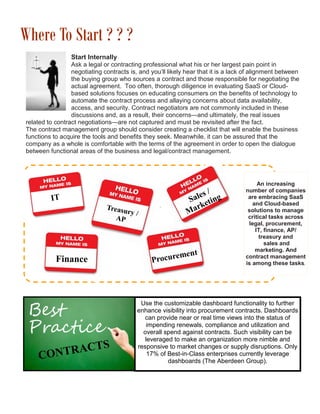
                                                                                        An increasing
                                                                                   number of companies
                                                                  s/
         IT                                                   ale ting
                                                             S e                    are embracing SaaS
                                                                                      and Cloud-based
                              Treasu                            rk
                                    ry /                     Ma                     solutions to manage
                                 AP                                                 critical tasks across
                                                                                    legal, procurement,
                                                                                       IT, finance, AP/
                                                                                         treasury and
                                                                                           sales and
                                                                                       marketing. And
                                                       e nt
           Finance                             Procurem                            contract management
                                                                                   is among these tasks.


                                           Use the customizable dashboard functionality to further
                                          enhance visibility into procurement contracts. Dashboards
                                             can provide near or real time views into the status of
                                              impending renewals, compliance and utilization and
                                            overall spend against contracts. Such visibility can be
                                             leveraged to make an organization more nimble and
               T             S
      N T R AC
                                          responsive to market changes or supply disruptions. Only
    CO                                        17% of Best-in-Class enterprises currently leverage
                                                     dashboards (The Aberdeen Group).
Trading Partner Contract Process—An Overview
Trading partners work toward joint value in their relationships. Contract lifecycle management can ensure
the value of partners by enabling them to ensure compliance to the contract and understand all terms and
conditions as related to the business expectations, both in good and unfavorable circumstances.
The CLM process has five steps:

       Contract authoring and creation—Contracts typically contain, but not are limited to, trading partner
       information, contract value, contract time period, specific terms and conditions that must be met by
       each trading partner, addenda, approval signatures, and date of signatures.
       Contract negotiation and revision—The second step is where contract terms are negotiated,
       reworded, and changed by one or both parties and their legal and finance departments.
       Contract approval—This step includes approvals for clauses, quantitative amounts such as total
       dollar value and total items contracted, and terms and conditions by each trading partner and its
       organization. The organization may include, but is not limited to, the CEO, CFO, legal counsel, CPO,
       and CSCO or representative organization.
       Signature—This is where the final agreement between two parties becomes definitive. When both
       identifying parties have signed the contract, the contract is considered complete. It is also active for
       the duration as defined in the contract.
       Contract archiving— Archiving, the final step, is one that immature companies take for granted, often
       just filing the contract away for future record. More advanced companies use the information for
       compliance and value analysis.


The four elements of value in contracts:
To gain the most success from the contract, companies must also understand and be able to act on the value
that can be derived from a contract. Trading partners can derive four elements of value in particular from
their contracts:

       Compliance—Many companies audit and review their trading partner relationships. Search
       capabilities and analytics are the most utilized tools to ensure compliance with trading partner
       agreements.

       Visibility—Contract visibility provides a view of each step of the contract process, progress, revisions,
       and remaining steps that must be fulfilled. In addition, dashboards and alerts are configured for more
       visibility based on quantitative and qualitative requirements, such as volume, lead time, and inventory
       requirements.

       Collaboration—This refers to the ability for a contract to track revisions, ideas, comments, and
       alternatives for clauses and terms. Innovative ideas and key performance criteria can be jointly
       defined and enabled with a collaborative workflow.

       Contract value analysis—This is where the meat of the contract is embedded. Understanding the
       true quantitative and qualitative requirements between trading partners and their ability to meet the
       parameters outlined is critical to ensuring a joint value relationship. The total dollars and cents, relative
       to the revenue, margin, and overall supply chain ecosystem costs, are highlighted, assessed, and tied
       to business requirements.

Ariba Knowledge Nuggets: Contracts in the Cloud

  • 1.
    Contract Management inthe Cloud Ariba Knowledge Nuggets Supply uncertainty, capacity volatility, resource constraints, and a heightened need to assess and mitigate operational and trading partner risk have fundamentally changed the way companies organize and measure success. As the recovery progresses, one thing is becoming clear—this is no temporary shift in approach. Leading companies have realized that the organizational agility required to survive the downturn can act as a differentiator, enabling them to emerge more strongly positioned to compete and be successful. This story can fit 175-225 words. This newto marketof normalor service, and alsoinformation to a targeted audience. Newslettersidentity a The purpose of a newsletter is to provide specialized great way state your product places a laser focus onand build your organization’s can be create credibility managing costs while better anticipatingemployees, or vendors. market conditions. Both buyers and among peers, members, fluctuations in sellers must place a renewed importance on building successful information it First, determine the audience of the newsletter. This could be anyone who might benefit from the relationships. Noemployees or people interested in purchasing a product or requesting to the point contains, for example, longer can buyers bleed sellers for savings your service. of You can compile a In addition business reply cards, customer information sheets, business cards collected at insolvency. mailing list from to cost savings attainment, more elegant methods ofor membership lists. You might consider purchasing a mailing list from a company. trade shows, measuring success are necessary for procurement—including supplier satisfaction catalog,innovation. Meanwhile, match the style of required to be If you explore the Publisher and you will find many publications that sellers are your newsletter. more flexible with theirand money you can often agreeing to These factors will help determine Next, establish how much time customers, spend on your newsletter. renegotiate terms and service levels. the newsletter and its length. It’s recommended that you publish your newsletter at how frequently you publish least quarterly so that it’s considered a consistent source of information. Your customers or employees will look forward to its arrival. The tools and processes that companies are employing to achieve success today are wide and varied. However, in terms of technology, a clear transformation has taken place. Faster time to value, lower total cost of ownership, more flexible pricing and usage models, and rapid innovation cycles have brought Software-as-a-Service (SaaS) and Cloud computing delivery models to the forefront—as has the fact that these models enable the CIO to focus on more strategic initiatives and manage information versus technology. Leveraging SaaS solutions, businesses can be up and running faster with minimal upfront investment. They also have the ability to dial up (or down) usage in order to meet the needs of the organization and pressures of the market. And while we will discuss a number of data and security considerations in this paper, the reality is that the security level provided by leading SaaS providers exceeds that of most enterprise companies. The emergence and growing acceptance of these models has sparked a fundamental shift in the way that procurement, sales operations, IT, and finance go about achieving their objectives. Legal and contracting professionals must be at the forefront enabling this organizational transformation.
  • 2.
    Where To Start? ? ? Start Internally Ask a legal or contracting professional what his or her largest pain point in negotiating contracts is, and you’ll likely hear that it is a lack of alignment between the buying group who sources a contract and those responsible for negotiating the actual agreement. Too often, thorough diligence in evaluating SaaS or Cloud- based solutions focuses on educating consumers on the benefits of technology to automate the contract process and allaying concerns about data availability, access, and security. Contract negotiators are not commonly included in these discussions and, as a result, their concerns—and ultimately, the real issues related to contract negotiations—are not captured and must be revisited after the fact. The contract management group should consider creating a checklist that will enable the business functions to acquire the tools and benefits they seek. Meanwhile, it can be assured that the company as a whole is comfortable with the terms of the agreement in order to open the dialogue between functional areas of the business and legal/contract management. An increasing number of companies s/ IT ale ting S e are embracing SaaS and Cloud-based Treasu rk ry / Ma solutions to manage AP critical tasks across legal, procurement, IT, finance, AP/ treasury and sales and marketing. And e nt Finance Procurem contract management is among these tasks. Use the customizable dashboard functionality to further enhance visibility into procurement contracts. Dashboards can provide near or real time views into the status of impending renewals, compliance and utilization and overall spend against contracts. Such visibility can be leveraged to make an organization more nimble and T S N T R AC responsive to market changes or supply disruptions. Only CO 17% of Best-in-Class enterprises currently leverage dashboards (The Aberdeen Group).
  • 3.
    Trading Partner ContractProcess—An Overview Trading partners work toward joint value in their relationships. Contract lifecycle management can ensure the value of partners by enabling them to ensure compliance to the contract and understand all terms and conditions as related to the business expectations, both in good and unfavorable circumstances. The CLM process has five steps: Contract authoring and creation—Contracts typically contain, but not are limited to, trading partner information, contract value, contract time period, specific terms and conditions that must be met by each trading partner, addenda, approval signatures, and date of signatures. Contract negotiation and revision—The second step is where contract terms are negotiated, reworded, and changed by one or both parties and their legal and finance departments. Contract approval—This step includes approvals for clauses, quantitative amounts such as total dollar value and total items contracted, and terms and conditions by each trading partner and its organization. The organization may include, but is not limited to, the CEO, CFO, legal counsel, CPO, and CSCO or representative organization. Signature—This is where the final agreement between two parties becomes definitive. When both identifying parties have signed the contract, the contract is considered complete. It is also active for the duration as defined in the contract. Contract archiving— Archiving, the final step, is one that immature companies take for granted, often just filing the contract away for future record. More advanced companies use the information for compliance and value analysis. The four elements of value in contracts: To gain the most success from the contract, companies must also understand and be able to act on the value that can be derived from a contract. Trading partners can derive four elements of value in particular from their contracts: Compliance—Many companies audit and review their trading partner relationships. Search capabilities and analytics are the most utilized tools to ensure compliance with trading partner agreements. Visibility—Contract visibility provides a view of each step of the contract process, progress, revisions, and remaining steps that must be fulfilled. In addition, dashboards and alerts are configured for more visibility based on quantitative and qualitative requirements, such as volume, lead time, and inventory requirements. Collaboration—This refers to the ability for a contract to track revisions, ideas, comments, and alternatives for clauses and terms. Innovative ideas and key performance criteria can be jointly defined and enabled with a collaborative workflow. Contract value analysis—This is where the meat of the contract is embedded. Understanding the true quantitative and qualitative requirements between trading partners and their ability to meet the parameters outlined is critical to ensuring a joint value relationship. The total dollars and cents, relative to the revenue, margin, and overall supply chain ecosystem costs, are highlighted, assessed, and tied to business requirements.