DIARRHEA
Introduction
 Diarrhea is having three or more loose or liquid stools (poos) in one day,
or more frequently than normal.
 If you have diarrhea, you will experience an increase in the volume,
wateriness or frequency of your bowel movements.
 Diarrhea is one of the most common health complaints.
 It can range from a mild, temporary condition to a potentially life
threatening one.
 Diarrhea is characterized by abnormally loose or watery
stools.
 Most cases of diarrhea are due to bacteria, viruses, or
parasites.
SYMPTOMS
 It may be present alone or be associated with other symptoms.
 Signs and symptoms associated with diarrhea (loose, watery stools) may
include:
 Abdominal cramps or pain
 Bloating
 Nausea (feeling sick) and vomiting
 Fever and headache
 Bloating and flatulence (excess gas)
 Loss of appetite and weakness
 Dehydration
 Blood in the stool
 Mucus in the stool
 You may feel an urgent need to go to the toilet.
 In general, diarrhea is self-limited and goes away (resolves)
without intervention.
 If it fails to improve and resolve completely, it can lead to
serious complications (dehydration, electrolyte imbalance,
kidney failure and organ damage).
 Dehydration can become serious if it fails to resolve (get
better), worsens and is not addressed adequately.
 You need to drink plenty of fluids to replace what’s lost.
TYPES OF DIARRHEA
 There are actually several different ways to classify diarrhea.
 Acute diarrhea: The most common, acute diarrhea is loose watery
diarrhea that lasts one to two days. This type doesn’t need
treatment and it usually goes away after a few days.
 Persistent diarrhea: This type of diarrhea generally persists for
several weeks – two to four weeks
 Chronic diarrhea: Diarrhea that lasts for more than four weeks or
comes and goes regularly over a long period of time is called
chronic diarrhea.
Who can get diarrhea?
 Anyone can get diarrhea.
 However, diarrhea can be serious in certain groups of people,
including:
 Young children.
 Older adults (the elderly).
 Those with medical conditions.

 The most commonly identified causes of acute
diarrhea in the United States are the bacteria
Salmonella, Campylobacter, Shigella, and Escherichia
coli.
HOST-MICROBE
INTERACTIONS
Chapter 17
ANATOMICAL BARRIERS AS
ECOSYSTEM
Skin and mucous membranes provide
anatomical barriers to infection
 Also supply foundation for microbial
ecosystem
 Microbial community offers protection from
disease-causing organisms
Intimate interaction between
microorganisms and human body is an
example of symbiosis
SYMBIOTIC RELATIONSHIPS
Symbiotic relationships
between microorganism
and host
 Organisms can have variety
of relationships
 Symbiotic relationships can
be one of several forms
 Relationships may change
depending on state of host and
attributes of microbes
Forms of symbiotic
relationships
 Mutualism
 Association in which both
partners benefit
 Bacteria and synthesis of vitamins
K and B
 Commensalism
 Association in which one
partner benefits and other is
unharmed
 Flora living on skin
 Parasitism
 Association in which the
microbe benefits at expense of
host
 Pathogenic infection
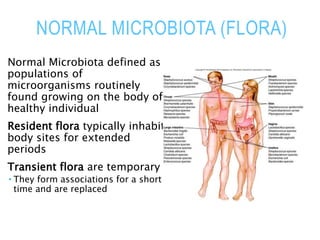
NORMAL MICROBIOTA (FLORA)
Normal Microbiota defined as
populations of
microorganisms routinely
found growing on the body of
healthy individual
Resident flora typically inhabit
body sites for extended
periods
Transient flora are temporary
 They form associations for a short
time and are replaced
NORMAL MICROBIOTA
 Protection against potentially harmful organisms
› Normal flora competitively exclude pathogens through
 Covering binding sites used for pathogenic attachment
 Consuming available nutrients
 Producing toxic compounds such as antibiotics
 Development of immune system tolerance
› Prevents overreaction to harmless microbes/substances
NORMAL MICROBIOTA
Dynamic nature of normal Microbiota
 Normal flora established during birth process
 Once established, composition of flora is dynamic
 Changes in response to physiological variation within the host
 Each member of flora ecosystem influenced by presence and condition of other members
PRINCIPLES OF
INFECTIOUS DISEASE
 If colonized organisms have parasitic
relationship with host, the term infection
applies
›Infection does not always lead to noticeable
adverse effects
 Termed subclinical or inapparent
 Symptoms do not appear or are mild enough to go
unnoticed
›Infection that results in disease is termed
infectious disease
 Disease causes characteristic signs and symptoms
 Symptoms are effects experienced by patient such as pain and
nausea
 Signs are effects that can be observed through examination
 Rash, puss formation and swelling
PRINCIPLES OF
INFECTIOUS DISEASE
One infectious disease may leave individual predisposed
to developing new disease
 Initial disease is termed primary infection
 Additional infections resulting from primary infection are termed
secondary infection
PATHOGENICITY
 Pathogens are organisms that can cause
disease in otherwise healthy people
›That pathogen termed primary pathogen
 Microbes that cause disease when the
body’s defenses are down termed
opportunistic pathogen
 Virulence is quantitative term referring to
pathogen’s disease-causing ability
›Highly virulent organisms have high degree of
pathogenicity
These organisms more likely to cause disease
Example: Streptococcus pyogenes
 Causes disease from strep throat to necrotizing fasciitis
CHARACTERISTICS OF
INFECTIOUS DISEASE
Disease that spreads from host to host termed communicable or
contagious
Ease of spread partly determined by infectious dose
 Infectious dose is number of organisms required to establish infection
 Diseases with small infectious dose more easily spread than those requiring large
numbers
COURSE OF INFECTIOUS
DISEASE
Disease course follows several stages
 Incubation
 Time between introduction of organism to onset of symptoms
 Incubation period depends on numerous factors
 Illness
 Follows incubation
 Individual experiences signs and symptoms of disease
 Convalescence
 Period of recuperation and recovery
 Infectious agents may still be spread
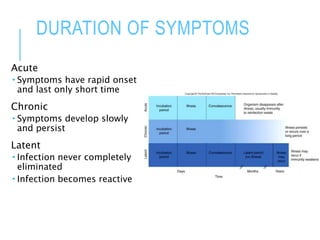
DURATION OF SYMPTOMS
Acute
 Symptoms have rapid onset
and last only short time
Chronic
 Symptoms develop slowly
and persist
Latent
 Infection never completely
eliminated
 Infection becomes reactive
DISTRIBUTION OF PATHOGEN
 Infections often described according to
distribution within the body
›Localized
Infection limited to small area
Example = boil
›Systemic or generalized
Agent has spread or disseminated throughout the
body
Example = measles
›Toxemia
Toxins circulating in blood
›Viremia
Viruses circulating in blood
›Septicemia
Acute life-threatening illness causes by infectious
agent or its products circulating in blood
ESTABLISHING CAUSE OF INFECTIOUS DISEASE
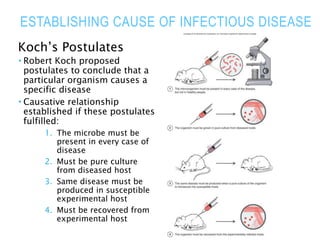
Koch’s Postulates
 Robert Koch proposed
postulates to conclude that a
particular organism causes a
specific disease
 Causative relationship
established if these postulates
fulfilled:
1. The microbe must be
present in every case of
disease
2. Must be pure culture
from diseased host
3. Same disease must be
produced in susceptible
experimental host
4. Must be recovered from
experimental host
ESTABLISHING CAUSE OF
INFECTIOUS DISEASE
Molecular Koch’s Postulates
1. Virulence factor—gene or products should be
found in pathogenic strain
2. Mutating the virulence gene to disrupt function
should reduce virulence of the pathogen
3. Reversion of mutated virulence gene or
replacement with wild type version should
restore virulence to strain
ESTABLISHING CAUSE OF
INFECTIOUS DISEASE
Mechanisms of pathogenesis
 Human body is a source of nutrient as long as the innate and adaptive
immunity can be overcome
 Ability to overcome obstacles of immunity separates pathogens from non-disease causing organisms
 Mechanism used to overcome immune response termed mechanisms of
pathogenicity
 Arsenal of mechanisms referred to as virulence determinants
ESTABLISHING CAUSE OF
INFECTIOUS DISEASE
Mechanisms of pathogenesis
 Immune responses do not need to be overcome indefinitely
 Only long enough for organisms to multiply and leave host
 Pathogens and host evolve over time to state of balanced
pathogenicity
 Pathogen becomes less virulent while host becomes less susceptible
MECHANISMS OF PATHOGENESIS
 Mechanisms of disease follow several patterns
 Production of toxins that are ingested
 Foodborne intoxication
 Clostridium botulinum and Staphylococcus aureus
 Colonization of mucous membranes followed by toxin
production
 Organism multiplies to high numbers on host surface then produces
toxin that interferes with cell function
 E. coli O157:H7 and Vibrio cholerae
 Invasion of host tissue
 Microbes penetrate barriers and multiply in tissues
 Generally have mechanism to avoid destruction by macrophages
 Mycobacterium tuberculosis and Yersinia pestis
 Invasion of host tissues followed by toxin production
 Penetration of host barriers with addition of toxin production
 Streptococcus pyogenes
ESTABLISHMENT OF INFECTION
 In order to cause disease, pathogen must follow a series
of steps
› Adherence
› Colonization
› Delivery of effector molecules
 Adherence
› Pathogen must adhere to host cells to establish infection
› Bacteria use adhesins
 Often located at the top of pili or fimbriae
› Binding of adhesins to host cell receptors is highly specific
 Often dictates type of cell to which bacteria can
attach
ESTABLISHMENT OF
INFECTION
Colonization
 Organism must multiply in order to colonize
 New organisms must compete with established organisms for nutrients and
space
 New organism must also overcome toxic products produced by existing organisms as well as host
immune responses
 Microbes have developed counterstrategies, including rapid turnover of pili
 Some organisms produce iron-binding molecules called siderophores
 Compete with host proteins for circulating iron
ESTABLISHMENT OF INFECTION
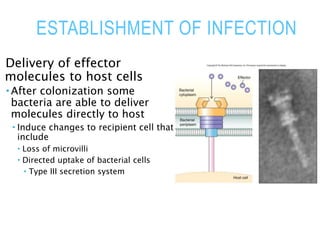
Delivery of effector
molecules to host cells
 After colonization some
bacteria are able to deliver
molecules directly to host
 Induce changes to recipient cell that
include
 Loss of microvilli
 Directed uptake of bacterial cells
 Type III secretion system
INVASION – BREACHING
ANATOMICAL BARRIERS
Penetration of skin
 Skin is most difficult barrier to penetrate
 Bacteria that penetrate via this route rely on trauma that destroys
skin integrity
Penetration of mucous membranes
 Most common route of entry
 Two general mechanisms
 Directed uptake
 Exploitation of antigen sampling
INVASION – BREACHING
ANATOMICAL BARRIERS
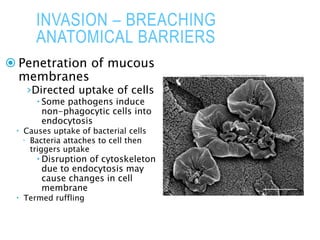
 Penetration of mucous
membranes
›Directed uptake of cells
 Some pathogens induce
non-phagocytic cells into
endocytosis
 Causes uptake of bacterial cells
 Bacteria attaches to cell then
triggers uptake
 Disruption of cytoskeleton
due to endocytosis may
cause changes in cell
membrane
 Termed ruffling
INVASION – BREACHING
ANATOMICAL BARRIERS
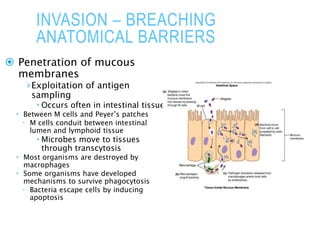
 Penetration of mucous
membranes
›Exploitation of antigen
sampling
 Occurs often in intestinal tissues
 Between M cells and Peyer’s patches
 M cells conduit between intestinal
lumen and lymphoid tissue
 Microbes move to tissues
through transcytosis
 Most organisms are destroyed by
macrophages
 Some organisms have developed
mechanisms to survive phagocytosis
 Bacteria escape cells by inducing
apoptosis
AVOIDING HOST DEFENSES
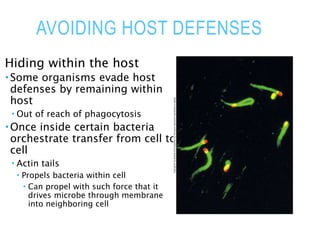
Hiding within the host
 Some organisms evade host
defenses by remaining within
host
 Out of reach of phagocytosis
 Once inside certain bacteria
orchestrate transfer from cell to
cell
 Actin tails
 Propels bacteria within cell
 Can propel with such force that it
drives microbe through membrane
into neighboring cell
AVOIDING HOST DEFENSES
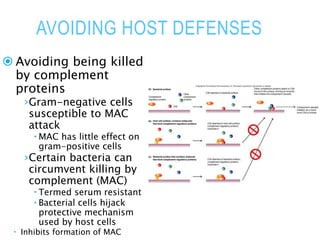
 Avoiding being killed
by complement
proteins
›Gram-negative cells
susceptible to MAC
attack
 MAC has little effect on
gram-positive cells
›Certain bacteria can
circumvent killing by
complement (MAC)
 Termed serum resistant
 Bacterial cells hijack
protective mechanism
used by host cells
 Inhibits formation of MAC
AVOIDING HOST DEFENSES
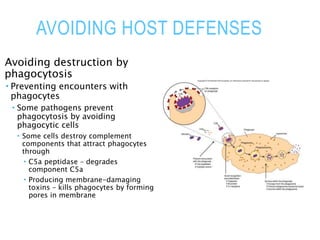
Avoiding destruction by
phagocytosis
 Preventing encounters with
phagocytes
 Some pathogens prevent
phagocytosis by avoiding
phagocytic cells
 Some cells destroy complement
components that attract phagocytes
through
 C5a peptidase – degrades
component C5a
 Producing membrane-damaging
toxins – kills phagocytes by forming
pores in membrane
AVOIDING HOST DEFENSES
Avoiding destruction by
phagocytosis
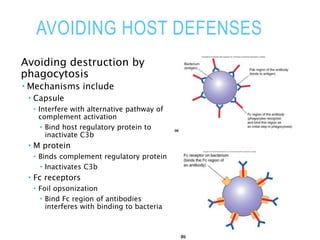
 Mechanisms include
 Capsule
 Interfere with alternative pathway of
complement activation
 Bind host regulatory protein to
inactivate C3b
 M protein
 Binds complement regulatory protein
 Inactivates C3b
 Fc receptors
 Foil opsonization
 Bind Fc region of antibodies
interferes with binding to bacteria
AVOIDING HOST DEFENSES
Surviving within the phagocyte
 Allows bacteria to hide from antibodies and control immune response
 Mechanisms include
 Escape from phagosome
 Escapes before phagosome-lysosome fusion
 Allows bacteria to multiply in cytoplasm
 Preventing phagosome-lysosome fusion
 Avoids exposure to degradative enzymes of lysosome
 Surviving within phagolysosome
 Delay fusion to allow organism time to equip itself for growth within phagosome
AVOIDING HOST DEFENSES
Avoiding antibodies
 Mechanisms
 IgA protease
 Cleaves IgA antibodies
 Antigenic variation
 Alteration of surface antigens
 Allows bacteria to stay ahead of antibody production
 Mimicking host molecules
 Pathogens can cover themselves with molecules that resemble normal host “self”
molecules
DAMAGE TO THE HOST
In order to cause disease, pathogen must cause damage
 Damage facilitates dispersal of organisms
 Vibrio cholerae causes diarrhea
 Bordetella pertussis causes coughing
 Damage can be direct result of pathogen, such as toxin production,
or indirect via immune response
DAMAGE TO THE HOST
Exotoxins
 Numerous organisms produce exotoxins
 Have very specific damaging effects
 Among most potent toxins known
 Often major cause of damage to infected host
 Exotoxins are secreted by bacterium or leak into surrounding
fluids following cell lysis
 Toxins act locally or systemically
 Made of protein
 Makes them heat labile
 So powerful fatal damage can occur before adequate immune
response mounted
 Passive immunity in form of antitoxin can be given as treatment
DAMAGE TO THE HOST
Exotoxins
 Can be grouped into functional categories
 Neurotoxins
 Cause damage to nervous system
 Major symptom is paralysis
 Enterotoxins
 Damage to intestines and tissues of digestive tract
 Major symptom is vomiting and diarrhea
 Cytotoxins
 Damage to variety of cells
 Damage caused by interference with cell function or cell lysis
DAMAGE TO THE
HOST
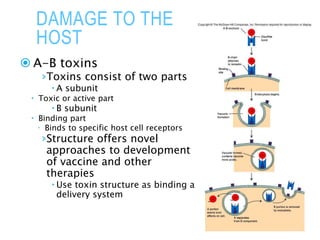
 A-B toxins
›Toxins consist of two parts
 A subunit
 Toxic or active part
 B subunit
 Binding part
 Binds to specific host cell receptors
›Structure offers novel
approaches to development
of vaccine and other
therapies
 Use toxin structure as binding a
delivery system
DAMAGE TO THE HOST
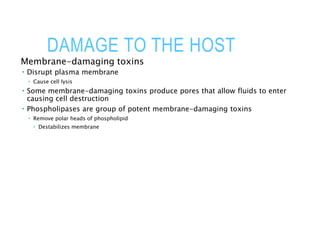
Membrane-damaging toxins
 Disrupt plasma membrane
 Cause cell lysis
 Some membrane-damaging toxins produce pores that allow fluids to enter
causing cell destruction
 Phospholipases are group of potent membrane-damaging toxins
 Remove polar heads of phospholipid
 Destabilizes membrane
DAMAGE TO THE HOST
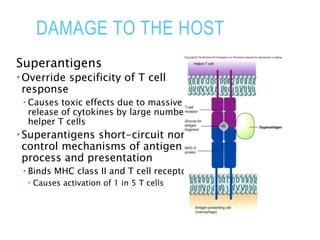
Superantigens
 Override specificity of T cell
response
 Causes toxic effects due to massive
release of cytokines by large number of
helper T cells
 Superantigens short-circuit normal
control mechanisms of antigen
process and presentation
 Binds MHC class II and T cell receptor
 Causes activation of 1 in 5 T cells
DAMAGE TO THE HOST
Endotoxins
 Endotoxins are LPS of gram-negative cell wall
 Toxin fundamental part of gram-negative organism
 Endotoxins are heat stable
 Lipid A responsible for toxic properties
 Symptoms associated with vigorous immune
response
 Toxin responsible for septic shock
 a.k.a endotoxic shock
MECHANISMS OF VIRAL
PATHOGENESIS
Binding to host cells and invasion
 All viruses have surface proteins to interact with specific host cell
receptors
 Once attached, viruses are taken up through receptor mediated
endocytosis or membrane fusion
 Membrane fusion occurs in enveloped viruses
 Viruses released from infected cell may infect new cell or disseminate
into bloodstream
MECHANISMS OF VIRAL
PATHOGENESIS
Avoiding immune responses
 Avoiding antiviral effects of interferon
 Interferons alter regulatory responses of cell in event of viral
infection
 Helps limit viral replication
 Some viruses encode specific proteins to interrupt inhibition of viral
replication
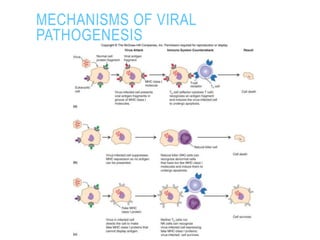
 Regulation of host cell death by viruses
 Kill host after production of large numbers of viral copies
 Allows spread to other cells
 Viruses prevent apoptosis
 Inhibits protein that regulates apoptosis
 Block antigen presentation of MHC class I
 No sign of infection
 Cause production of “counterfit” MHC class I molecules
MECHANISMS OF VIRAL
PATHOGENESIS
Avoiding immune responses
 Antibodies and viruses
 Antibodies interact with extracellular viruses only
 To avoid antibody exposure some viruses develop mechanisms to
directly transfer from one cell to immediate neighbor
 Viruses can remain intracellular by forcing neighboring cells to
fuse in the formation of syncytium
 Viruses can modify viral surface antigens
 Viruses replicate and change faster than the human body can
replicate antibody
MECHANISMS OF VIRAL
PATHOGENESIS

Aklilu.ppt

  • 1.
  • 2.
    Introduction  Diarrhea ishaving three or more loose or liquid stools (poos) in one day, or more frequently than normal.  If you have diarrhea, you will experience an increase in the volume, wateriness or frequency of your bowel movements.  Diarrhea is one of the most common health complaints.  It can range from a mild, temporary condition to a potentially life threatening one.  Diarrhea is characterized by abnormally loose or watery stools.  Most cases of diarrhea are due to bacteria, viruses, or parasites.
  • 3.
    SYMPTOMS  It maybe present alone or be associated with other symptoms.  Signs and symptoms associated with diarrhea (loose, watery stools) may include:  Abdominal cramps or pain  Bloating  Nausea (feeling sick) and vomiting  Fever and headache  Bloating and flatulence (excess gas)  Loss of appetite and weakness  Dehydration  Blood in the stool  Mucus in the stool  You may feel an urgent need to go to the toilet.
  • 4.
     In general,diarrhea is self-limited and goes away (resolves) without intervention.  If it fails to improve and resolve completely, it can lead to serious complications (dehydration, electrolyte imbalance, kidney failure and organ damage).  Dehydration can become serious if it fails to resolve (get better), worsens and is not addressed adequately.  You need to drink plenty of fluids to replace what’s lost.
  • 5.
    TYPES OF DIARRHEA There are actually several different ways to classify diarrhea.  Acute diarrhea: The most common, acute diarrhea is loose watery diarrhea that lasts one to two days. This type doesn’t need treatment and it usually goes away after a few days.  Persistent diarrhea: This type of diarrhea generally persists for several weeks – two to four weeks  Chronic diarrhea: Diarrhea that lasts for more than four weeks or comes and goes regularly over a long period of time is called chronic diarrhea. Who can get diarrhea?  Anyone can get diarrhea.  However, diarrhea can be serious in certain groups of people, including:  Young children.  Older adults (the elderly).  Those with medical conditions. 
  • 6.
     The mostcommonly identified causes of acute diarrhea in the United States are the bacteria Salmonella, Campylobacter, Shigella, and Escherichia coli.
  • 7.
  • 9.
    ANATOMICAL BARRIERS AS ECOSYSTEM Skinand mucous membranes provide anatomical barriers to infection  Also supply foundation for microbial ecosystem  Microbial community offers protection from disease-causing organisms Intimate interaction between microorganisms and human body is an example of symbiosis
  • 10.
    SYMBIOTIC RELATIONSHIPS Symbiotic relationships betweenmicroorganism and host  Organisms can have variety of relationships  Symbiotic relationships can be one of several forms  Relationships may change depending on state of host and attributes of microbes Forms of symbiotic relationships  Mutualism  Association in which both partners benefit  Bacteria and synthesis of vitamins K and B  Commensalism  Association in which one partner benefits and other is unharmed  Flora living on skin  Parasitism  Association in which the microbe benefits at expense of host  Pathogenic infection
  • 11.
    NORMAL MICROBIOTA (FLORA) NormalMicrobiota defined as populations of microorganisms routinely found growing on the body of healthy individual Resident flora typically inhabit body sites for extended periods Transient flora are temporary  They form associations for a short time and are replaced
  • 12.
    NORMAL MICROBIOTA  Protectionagainst potentially harmful organisms › Normal flora competitively exclude pathogens through  Covering binding sites used for pathogenic attachment  Consuming available nutrients  Producing toxic compounds such as antibiotics  Development of immune system tolerance › Prevents overreaction to harmless microbes/substances
  • 13.
    NORMAL MICROBIOTA Dynamic natureof normal Microbiota  Normal flora established during birth process  Once established, composition of flora is dynamic  Changes in response to physiological variation within the host  Each member of flora ecosystem influenced by presence and condition of other members
  • 14.
    PRINCIPLES OF INFECTIOUS DISEASE If colonized organisms have parasitic relationship with host, the term infection applies ›Infection does not always lead to noticeable adverse effects  Termed subclinical or inapparent  Symptoms do not appear or are mild enough to go unnoticed ›Infection that results in disease is termed infectious disease  Disease causes characteristic signs and symptoms  Symptoms are effects experienced by patient such as pain and nausea  Signs are effects that can be observed through examination  Rash, puss formation and swelling
  • 15.
    PRINCIPLES OF INFECTIOUS DISEASE Oneinfectious disease may leave individual predisposed to developing new disease  Initial disease is termed primary infection  Additional infections resulting from primary infection are termed secondary infection
  • 16.
    PATHOGENICITY  Pathogens areorganisms that can cause disease in otherwise healthy people ›That pathogen termed primary pathogen  Microbes that cause disease when the body’s defenses are down termed opportunistic pathogen  Virulence is quantitative term referring to pathogen’s disease-causing ability ›Highly virulent organisms have high degree of pathogenicity These organisms more likely to cause disease Example: Streptococcus pyogenes  Causes disease from strep throat to necrotizing fasciitis
  • 17.
    CHARACTERISTICS OF INFECTIOUS DISEASE Diseasethat spreads from host to host termed communicable or contagious Ease of spread partly determined by infectious dose  Infectious dose is number of organisms required to establish infection  Diseases with small infectious dose more easily spread than those requiring large numbers
  • 18.
    COURSE OF INFECTIOUS DISEASE Diseasecourse follows several stages  Incubation  Time between introduction of organism to onset of symptoms  Incubation period depends on numerous factors  Illness  Follows incubation  Individual experiences signs and symptoms of disease  Convalescence  Period of recuperation and recovery  Infectious agents may still be spread
  • 19.
    DURATION OF SYMPTOMS Acute Symptoms have rapid onset and last only short time Chronic  Symptoms develop slowly and persist Latent  Infection never completely eliminated  Infection becomes reactive
  • 20.
    DISTRIBUTION OF PATHOGEN Infections often described according to distribution within the body ›Localized Infection limited to small area Example = boil ›Systemic or generalized Agent has spread or disseminated throughout the body Example = measles ›Toxemia Toxins circulating in blood ›Viremia Viruses circulating in blood ›Septicemia Acute life-threatening illness causes by infectious agent or its products circulating in blood
  • 21.
    ESTABLISHING CAUSE OFINFECTIOUS DISEASE Koch’s Postulates  Robert Koch proposed postulates to conclude that a particular organism causes a specific disease  Causative relationship established if these postulates fulfilled: 1. The microbe must be present in every case of disease 2. Must be pure culture from diseased host 3. Same disease must be produced in susceptible experimental host 4. Must be recovered from experimental host
  • 22.
    ESTABLISHING CAUSE OF INFECTIOUSDISEASE Molecular Koch’s Postulates 1. Virulence factor—gene or products should be found in pathogenic strain 2. Mutating the virulence gene to disrupt function should reduce virulence of the pathogen 3. Reversion of mutated virulence gene or replacement with wild type version should restore virulence to strain
  • 23.
    ESTABLISHING CAUSE OF INFECTIOUSDISEASE Mechanisms of pathogenesis  Human body is a source of nutrient as long as the innate and adaptive immunity can be overcome  Ability to overcome obstacles of immunity separates pathogens from non-disease causing organisms  Mechanism used to overcome immune response termed mechanisms of pathogenicity  Arsenal of mechanisms referred to as virulence determinants
  • 24.
    ESTABLISHING CAUSE OF INFECTIOUSDISEASE Mechanisms of pathogenesis  Immune responses do not need to be overcome indefinitely  Only long enough for organisms to multiply and leave host  Pathogens and host evolve over time to state of balanced pathogenicity  Pathogen becomes less virulent while host becomes less susceptible
  • 25.
    MECHANISMS OF PATHOGENESIS Mechanisms of disease follow several patterns  Production of toxins that are ingested  Foodborne intoxication  Clostridium botulinum and Staphylococcus aureus  Colonization of mucous membranes followed by toxin production  Organism multiplies to high numbers on host surface then produces toxin that interferes with cell function  E. coli O157:H7 and Vibrio cholerae  Invasion of host tissue  Microbes penetrate barriers and multiply in tissues  Generally have mechanism to avoid destruction by macrophages  Mycobacterium tuberculosis and Yersinia pestis  Invasion of host tissues followed by toxin production  Penetration of host barriers with addition of toxin production  Streptococcus pyogenes
  • 26.
    ESTABLISHMENT OF INFECTION In order to cause disease, pathogen must follow a series of steps › Adherence › Colonization › Delivery of effector molecules  Adherence › Pathogen must adhere to host cells to establish infection › Bacteria use adhesins  Often located at the top of pili or fimbriae › Binding of adhesins to host cell receptors is highly specific  Often dictates type of cell to which bacteria can attach
  • 27.
    ESTABLISHMENT OF INFECTION Colonization  Organismmust multiply in order to colonize  New organisms must compete with established organisms for nutrients and space  New organism must also overcome toxic products produced by existing organisms as well as host immune responses  Microbes have developed counterstrategies, including rapid turnover of pili  Some organisms produce iron-binding molecules called siderophores  Compete with host proteins for circulating iron
  • 28.
    ESTABLISHMENT OF INFECTION Deliveryof effector molecules to host cells  After colonization some bacteria are able to deliver molecules directly to host  Induce changes to recipient cell that include  Loss of microvilli  Directed uptake of bacterial cells  Type III secretion system
  • 29.
    INVASION – BREACHING ANATOMICALBARRIERS Penetration of skin  Skin is most difficult barrier to penetrate  Bacteria that penetrate via this route rely on trauma that destroys skin integrity Penetration of mucous membranes  Most common route of entry  Two general mechanisms  Directed uptake  Exploitation of antigen sampling
  • 30.
    INVASION – BREACHING ANATOMICALBARRIERS  Penetration of mucous membranes ›Directed uptake of cells  Some pathogens induce non-phagocytic cells into endocytosis  Causes uptake of bacterial cells  Bacteria attaches to cell then triggers uptake  Disruption of cytoskeleton due to endocytosis may cause changes in cell membrane  Termed ruffling
  • 31.
    INVASION – BREACHING ANATOMICALBARRIERS  Penetration of mucous membranes ›Exploitation of antigen sampling  Occurs often in intestinal tissues  Between M cells and Peyer’s patches  M cells conduit between intestinal lumen and lymphoid tissue  Microbes move to tissues through transcytosis  Most organisms are destroyed by macrophages  Some organisms have developed mechanisms to survive phagocytosis  Bacteria escape cells by inducing apoptosis
  • 32.
    AVOIDING HOST DEFENSES Hidingwithin the host  Some organisms evade host defenses by remaining within host  Out of reach of phagocytosis  Once inside certain bacteria orchestrate transfer from cell to cell  Actin tails  Propels bacteria within cell  Can propel with such force that it drives microbe through membrane into neighboring cell
  • 33.
    AVOIDING HOST DEFENSES Avoiding being killed by complement proteins ›Gram-negative cells susceptible to MAC attack  MAC has little effect on gram-positive cells ›Certain bacteria can circumvent killing by complement (MAC)  Termed serum resistant  Bacterial cells hijack protective mechanism used by host cells  Inhibits formation of MAC
  • 34.
    AVOIDING HOST DEFENSES Avoidingdestruction by phagocytosis  Preventing encounters with phagocytes  Some pathogens prevent phagocytosis by avoiding phagocytic cells  Some cells destroy complement components that attract phagocytes through  C5a peptidase – degrades component C5a  Producing membrane-damaging toxins – kills phagocytes by forming pores in membrane
  • 35.
    AVOIDING HOST DEFENSES Avoidingdestruction by phagocytosis  Mechanisms include  Capsule  Interfere with alternative pathway of complement activation  Bind host regulatory protein to inactivate C3b  M protein  Binds complement regulatory protein  Inactivates C3b  Fc receptors  Foil opsonization  Bind Fc region of antibodies interferes with binding to bacteria
  • 36.
    AVOIDING HOST DEFENSES Survivingwithin the phagocyte  Allows bacteria to hide from antibodies and control immune response  Mechanisms include  Escape from phagosome  Escapes before phagosome-lysosome fusion  Allows bacteria to multiply in cytoplasm  Preventing phagosome-lysosome fusion  Avoids exposure to degradative enzymes of lysosome  Surviving within phagolysosome  Delay fusion to allow organism time to equip itself for growth within phagosome
  • 37.
    AVOIDING HOST DEFENSES Avoidingantibodies  Mechanisms  IgA protease  Cleaves IgA antibodies  Antigenic variation  Alteration of surface antigens  Allows bacteria to stay ahead of antibody production  Mimicking host molecules  Pathogens can cover themselves with molecules that resemble normal host “self” molecules
  • 38.
    DAMAGE TO THEHOST In order to cause disease, pathogen must cause damage  Damage facilitates dispersal of organisms  Vibrio cholerae causes diarrhea  Bordetella pertussis causes coughing  Damage can be direct result of pathogen, such as toxin production, or indirect via immune response
  • 39.
    DAMAGE TO THEHOST Exotoxins  Numerous organisms produce exotoxins  Have very specific damaging effects  Among most potent toxins known  Often major cause of damage to infected host  Exotoxins are secreted by bacterium or leak into surrounding fluids following cell lysis  Toxins act locally or systemically  Made of protein  Makes them heat labile  So powerful fatal damage can occur before adequate immune response mounted  Passive immunity in form of antitoxin can be given as treatment
  • 40.
    DAMAGE TO THEHOST Exotoxins  Can be grouped into functional categories  Neurotoxins  Cause damage to nervous system  Major symptom is paralysis  Enterotoxins  Damage to intestines and tissues of digestive tract  Major symptom is vomiting and diarrhea  Cytotoxins  Damage to variety of cells  Damage caused by interference with cell function or cell lysis
  • 41.
    DAMAGE TO THE HOST A-B toxins ›Toxins consist of two parts  A subunit  Toxic or active part  B subunit  Binding part  Binds to specific host cell receptors ›Structure offers novel approaches to development of vaccine and other therapies  Use toxin structure as binding a delivery system
  • 42.
    DAMAGE TO THEHOST Membrane-damaging toxins  Disrupt plasma membrane  Cause cell lysis  Some membrane-damaging toxins produce pores that allow fluids to enter causing cell destruction  Phospholipases are group of potent membrane-damaging toxins  Remove polar heads of phospholipid  Destabilizes membrane
  • 43.
    DAMAGE TO THEHOST Superantigens  Override specificity of T cell response  Causes toxic effects due to massive release of cytokines by large number of helper T cells  Superantigens short-circuit normal control mechanisms of antigen process and presentation  Binds MHC class II and T cell receptor  Causes activation of 1 in 5 T cells
  • 44.
    DAMAGE TO THEHOST Endotoxins  Endotoxins are LPS of gram-negative cell wall  Toxin fundamental part of gram-negative organism  Endotoxins are heat stable  Lipid A responsible for toxic properties  Symptoms associated with vigorous immune response  Toxin responsible for septic shock  a.k.a endotoxic shock
  • 45.
    MECHANISMS OF VIRAL PATHOGENESIS Bindingto host cells and invasion  All viruses have surface proteins to interact with specific host cell receptors  Once attached, viruses are taken up through receptor mediated endocytosis or membrane fusion  Membrane fusion occurs in enveloped viruses  Viruses released from infected cell may infect new cell or disseminate into bloodstream
  • 46.
    MECHANISMS OF VIRAL PATHOGENESIS Avoidingimmune responses  Avoiding antiviral effects of interferon  Interferons alter regulatory responses of cell in event of viral infection  Helps limit viral replication  Some viruses encode specific proteins to interrupt inhibition of viral replication  Regulation of host cell death by viruses  Kill host after production of large numbers of viral copies  Allows spread to other cells  Viruses prevent apoptosis  Inhibits protein that regulates apoptosis  Block antigen presentation of MHC class I  No sign of infection  Cause production of “counterfit” MHC class I molecules
  • 47.
    MECHANISMS OF VIRAL PATHOGENESIS Avoidingimmune responses  Antibodies and viruses  Antibodies interact with extracellular viruses only  To avoid antibody exposure some viruses develop mechanisms to directly transfer from one cell to immediate neighbor  Viruses can remain intracellular by forcing neighboring cells to fuse in the formation of syncytium  Viruses can modify viral surface antigens  Viruses replicate and change faster than the human body can replicate antibody
  • 48.

Editor's Notes

  • #4 Dehydration is a dangerous side effect of diarrhea.
  • #5 Can diarrhea harm your health? It can cause dehydration (when your body loses large amounts of water), electrolyte imbalance (loss of sodium, potassium and magnesium that play a key role in vital bodily functions) and kidney failure (not enough blood / fluid is supplied to the kidneys).