Download as PDF, PPTX



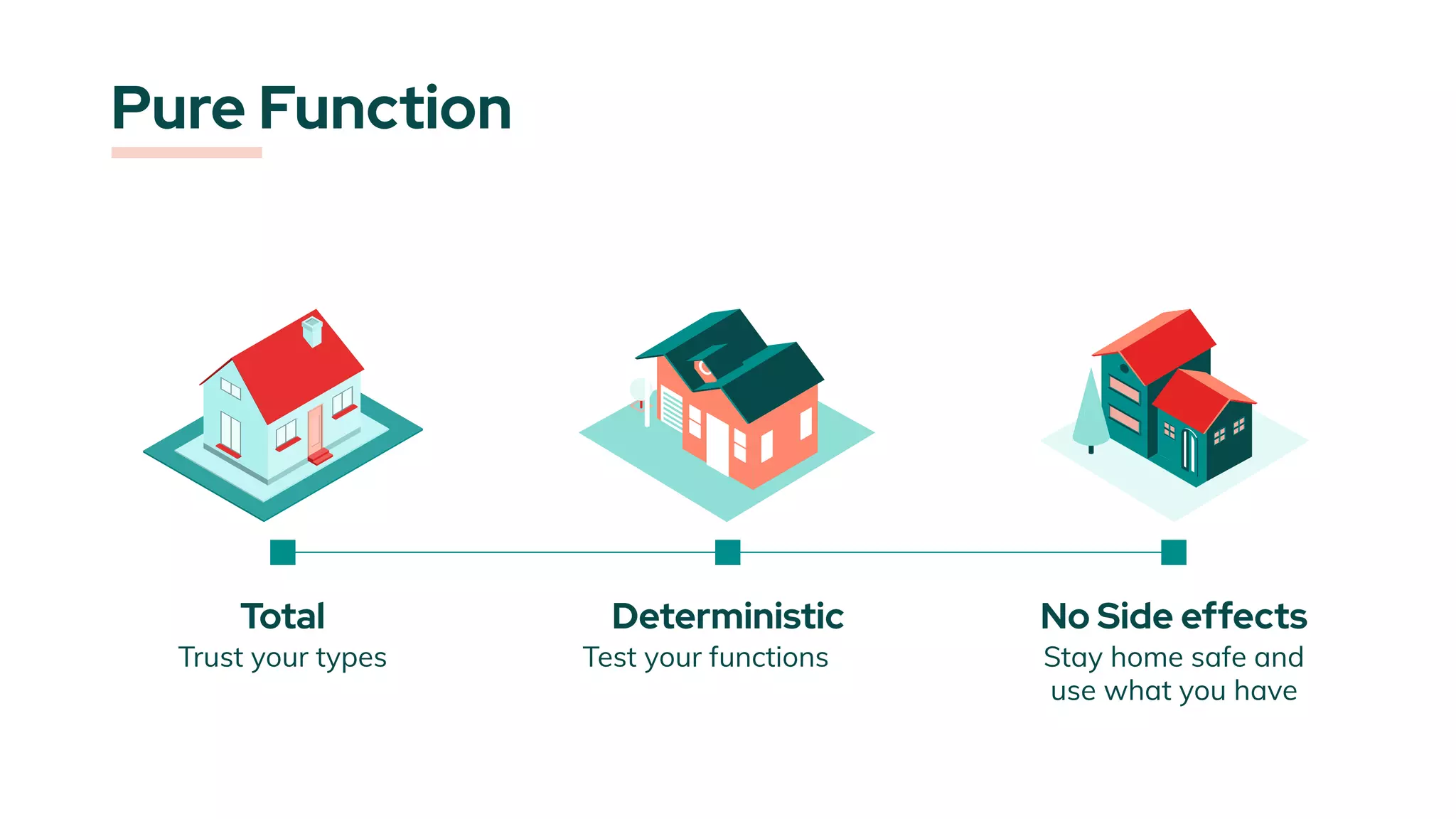
![Stay home safe and
use what you have
No Side effects
Pure Function
Trust your types
Total
Test your functions
Deterministic
def toInt(str: String): Try[Int] =
Try(str.toInt)](https://image.slidesharecdn.com/ziofromhome2-200528221427/75/Zio-from-Home-5-2048.jpg)
![Stay home safe and
use what you have
No Side effects
Pure Function
Trust your types
Total
Test your functions
Deterministic
def toInt(str: String): Try[Int] =
Try(str.toInt)
toInt("One")](https://image.slidesharecdn.com/ziofromhome2-200528221427/75/Zio-from-Home-6-2048.jpg)
![Stay home safe and
use what you have
No Side effects
Pure Function
Trust your types
Total
Test your functions
Deterministic
def toInt(str: String): Try[Int] =
Try(str.toInt)
toInt("One")
Failure(java.lang.NumberFormatException: For input string: "One")](https://image.slidesharecdn.com/ziofromhome2-200528221427/75/Zio-from-Home-7-2048.jpg)


![Stay home safe and
use what you have
No Side effects
Pure Function
Trust your types
Total
Test your functions
Deterministic
def add(pasta: Pasta, sauce: Sauce,
water: Water): Cooked[Pasta] = {
val p = water.boil.map(_.put(pasta))
p.addSauce(sauce)
}](https://image.slidesharecdn.com/ziofromhome2-200528221427/75/Zio-from-Home-10-2048.jpg)
 => A) {
def map[B](f: A => B): IO[B] = ???
def flatMap[B](f: A => IO[B]): IO[B] = ???
}
object IO {
def effect[A](a: => A): IO[A] = new IO[A](() => a)
}](https://image.slidesharecdn.com/ziofromhome2-200528221427/75/Zio-from-Home-14-2048.jpg)
![Functional Program
val program: IO[Unit] = for {
event <- IO.effect(handleEvent)
user <- IO.effect(getUser(event.userId))
_ <- IO.effect(logInfo(user))
...
} yield ()](https://image.slidesharecdn.com/ziofromhome2-200528221427/75/Zio-from-Home-15-2048.jpg)
![Functional Program
val program: IO[Unit] = for {
event <- IO.effect(handleEvent)
user <- IO.effect(getUser(event.userId))
_ <- IO.effect(logInfo(user))
...
} yield ()
program.unsafeRun()](https://image.slidesharecdn.com/ziofromhome2-200528221427/75/Zio-from-Home-16-2048.jpg)

 => A) {
def map[B](f: A => B): IO[B] = ???
def flatMap[B](f: A => IO[B]): IO[B] = ???
}
object IO {
def effect[A](a: => A): IO[A] = new IO[A](() => a)
}](https://image.slidesharecdn.com/ziofromhome2-200528221427/75/Zio-from-Home-19-2048.jpg)

![Functional Effects in ZIO
ZIO[R, E, A]
Description of a program
R
E A
Dependencies
Error Success](https://image.slidesharecdn.com/ziofromhome2-200528221427/75/Zio-from-Home-21-2048.jpg)
![Functional Effects in ZIO
RIO[R, A]
Description of a program
R
Throwable A
Dependencies
Error Success](https://image.slidesharecdn.com/ziofromhome2-200528221427/75/Zio-from-Home-22-2048.jpg)
![Functional Effects in ZIO
URIO[R, A]
Description of a program
R
A
Dependencies
Success](https://image.slidesharecdn.com/ziofromhome2-200528221427/75/Zio-from-Home-23-2048.jpg)
![Functional Effects in ZIO
Task[A]
Description of a program
Throwable A
Error Success](https://image.slidesharecdn.com/ziofromhome2-200528221427/75/Zio-from-Home-24-2048.jpg)
![Functional Effects in ZIO
IO[E, A]
Description of a program
E A
Error Success](https://image.slidesharecdn.com/ziofromhome2-200528221427/75/Zio-from-Home-25-2048.jpg)
![Functional Effects in ZIO
UIO[A]
Description of a program
A
Success](https://image.slidesharecdn.com/ziofromhome2-200528221427/75/Zio-from-Home-26-2048.jpg)
![Run Effects
object Main extends zio.App {
override def run(args: List[String]): IO[Nothing, Int] =
program.fold(_ => 1, _ => 0)
}
OR
object Main {
Runtime.default.unsafeRun(program)
}](https://image.slidesharecdn.com/ziofromhome2-200528221427/75/Zio-from-Home-27-2048.jpg)
![Error Management
Throwable
def divideM(a: Int, b: Int): Task[Int] =
Task(divide(a, b))
Task[Int]
Throwable Int](https://image.slidesharecdn.com/ziofromhome2-200528221427/75/Zio-from-Home-29-2048.jpg)
![Error Management
Throwable
val throwException: Task[Nothing] =
Task(throw new Exception("sorry"))
Task[Nothing]
Throwable](https://image.slidesharecdn.com/ziofromhome2-200528221427/75/Zio-from-Home-30-2048.jpg)
![Error Management
String
val failedIO: IO[String, Nothing] = IO.fail("sorry again")
IO[String, Nothing]
String](https://image.slidesharecdn.com/ziofromhome2-200528221427/75/Zio-from-Home-31-2048.jpg)
![Error Management
Customized Errors
sealed trait Error
object Error {
case class UserNotFound(id: UserId) extends Error
case class InternalServer(t: Throwable) extends Error
...
}
val program: IO[Error, Unit] = ???](https://image.slidesharecdn.com/ziofromhome2-200528221427/75/Zio-from-Home-32-2048.jpg)
![Error Management
Customized Errors
val program: IO[Error, Unit] =
for {
userId <- requestListener // IO[InternalServer, UserId]
user <- getUser(userId) // IO[UserNotFound, User]
_ <- logInfo(user) // IO[ Nothing, Unit]
_ <- sendResponse(user) // IO[InternalServer, Unit]
} yield ()](https://image.slidesharecdn.com/ziofromhome2-200528221427/75/Zio-from-Home-33-2048.jpg)
![Error Management
The state of the program
val program: IO[Error, Unit] = ???
val programState: IO[Nothing, Exit[Error, Unit]] = program.run](https://image.slidesharecdn.com/ziofromhome2-200528221427/75/Zio-from-Home-34-2048.jpg)
![Error Management
Exit[E, A]
Success[A]Failure[E]](https://image.slidesharecdn.com/ziofromhome2-200528221427/75/Zio-from-Home-35-2048.jpg)
![Error Management
Exit[E, A]
Success[A]Failure[E]](https://image.slidesharecdn.com/ziofromhome2-200528221427/75/Zio-from-Home-36-2048.jpg)
![Error Management
Exit[E, A]
Success[A]Failure[E]
Cause[E]](https://image.slidesharecdn.com/ziofromhome2-200528221427/75/Zio-from-Home-37-2048.jpg)
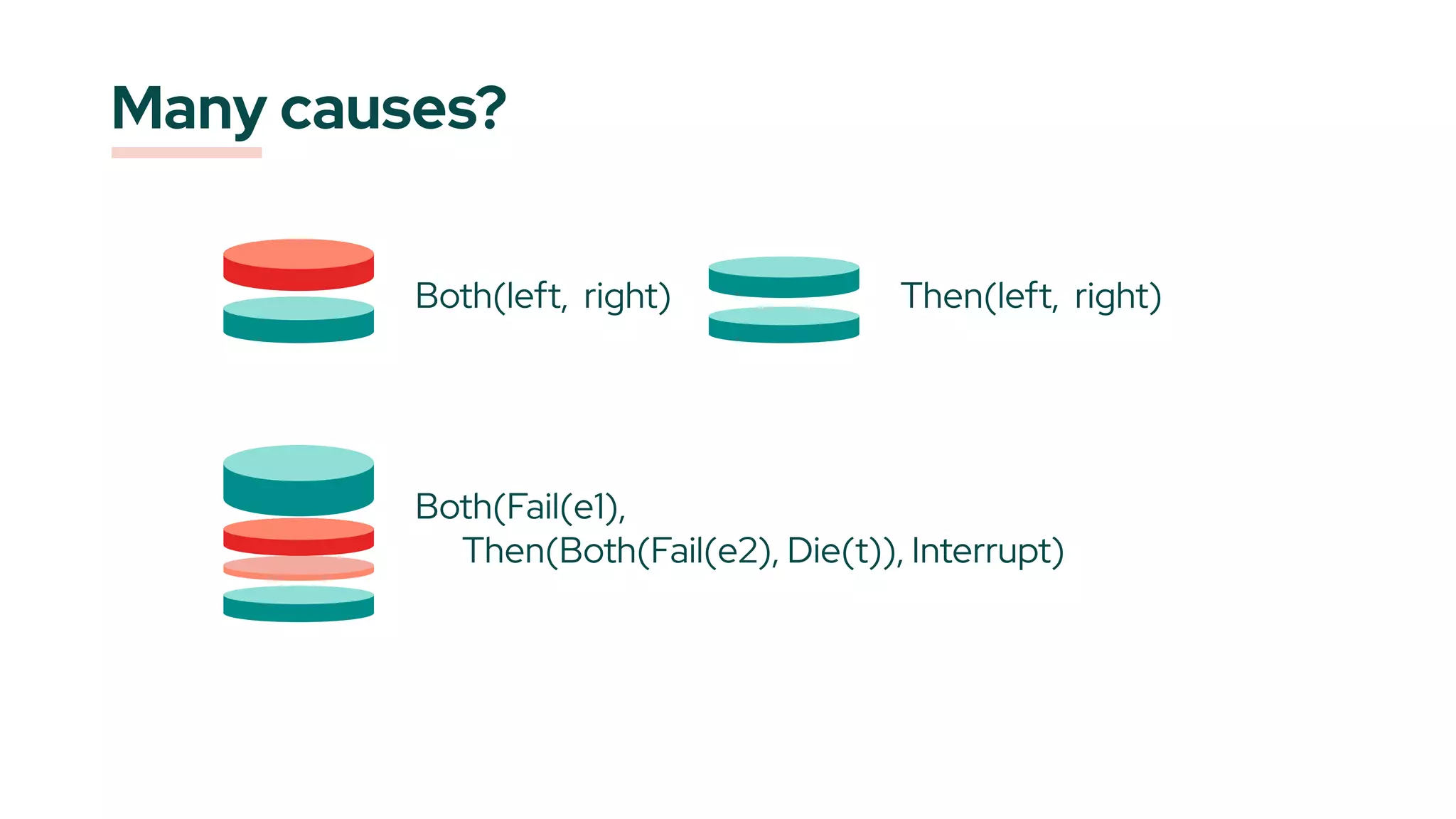
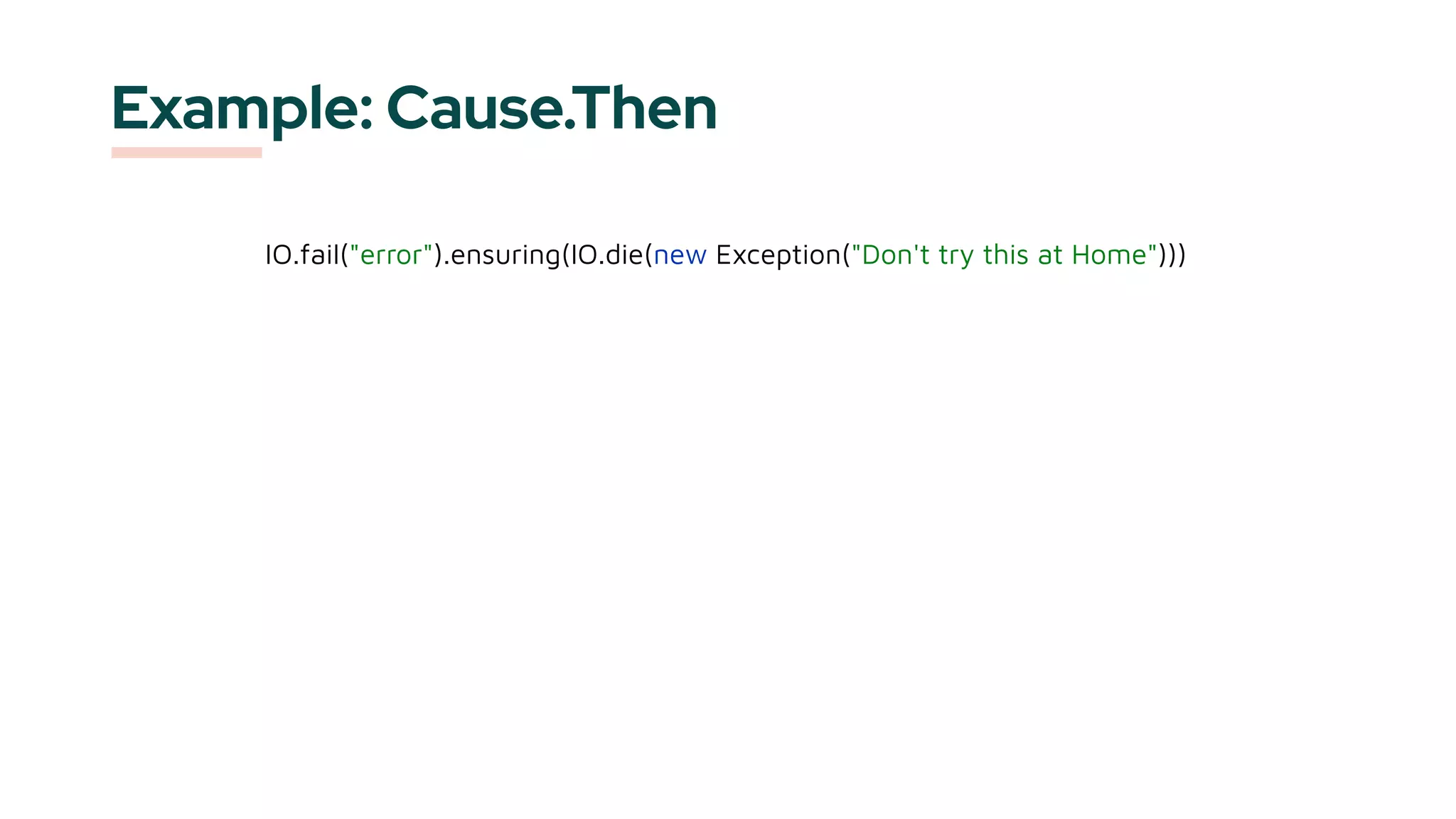
![Cause[E]
Die
Expected Error
Unexpected Error, Exception
Fail[E]
Interrupted effect
Interrupt](https://image.slidesharecdn.com/ziofromhome2-200528221427/75/Zio-from-Home-38-2048.jpg)


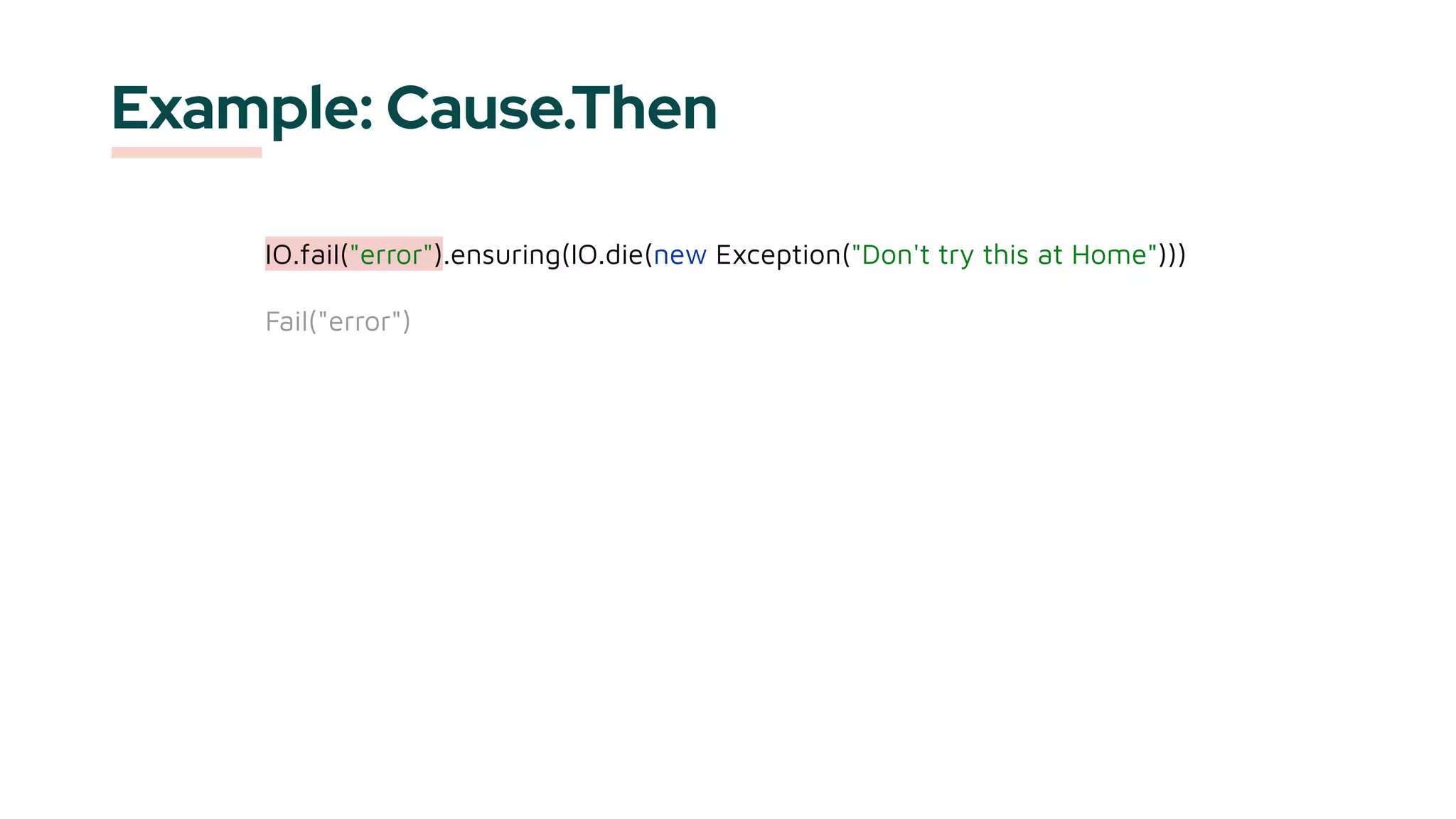


![Error Management
Expose all causes:
def divide(a: Int, b: Int): IO[Cause[Throwable], Int] =
Task(a / b).sandbox](https://image.slidesharecdn.com/ziofromhome2-200528221427/75/Zio-from-Home-48-2048.jpg)
![Error Management
Catch Errors:
def divide(a: Int, b: Int): Task[Int] =
Task(a / b)
.catchSome{
case _: ArithmeticException => UIO(0)
}](https://image.slidesharecdn.com/ziofromhome2-200528221427/75/Zio-from-Home-49-2048.jpg)
![Error Management
Peek at the errors:
def divide(a: Int, b: Int): Task[Int] =
Task(a / b)
.tapError{
error => UIO(println(s"failed with: $e"))
}](https://image.slidesharecdn.com/ziofromhome2-200528221427/75/Zio-from-Home-50-2048.jpg)
![Error Management
Fallback:
val io1: IO[Error, Int] = ???
val io2: IO[String, Int] = ???
val result: IO[String, Int] = io1.orElse(io2)](https://image.slidesharecdn.com/ziofromhome2-200528221427/75/Zio-from-Home-51-2048.jpg)
![Error Management
Fallback:
val loginUser: IO[Error, Profile] = ???
val loginAnonymous: IO[Throwable, LimitedProfile] = ???
val result: IO[Throwable, Either[Profile, LimitedProfile]] =
loginUser.orElseEither(loginAnonymous)](https://image.slidesharecdn.com/ziofromhome2-200528221427/75/Zio-from-Home-52-2048.jpg)
![Error Management
Recover:
def divide(a: Int, b: Int): UIO[Int] =
Task(a / b).foldM(_ => UIO(0), n => UIO(n))](https://image.slidesharecdn.com/ziofromhome2-200528221427/75/Zio-from-Home-53-2048.jpg)
![Error Management
Crash it:
def divide(a: Int, b: Int): UIO[Int] =
Task(a / b).orDie](https://image.slidesharecdn.com/ziofromhome2-200528221427/75/Zio-from-Home-54-2048.jpg)
![Error Management
Make defects as expected errors:
val io: IO[String, Nothing] =
IO.succeed(throw new Exception("💣"))
.unrefine(e => s"The error is: $e")](https://image.slidesharecdn.com/ziofromhome2-200528221427/75/Zio-from-Home-55-2048.jpg)

 = c.getSimpleName
object Example
Task(simpleName(Example.getClass))](https://image.slidesharecdn.com/ziofromhome2-200528221427/75/Zio-from-Home-57-2048.jpg)
 = c.getSimpleName
object Example
Task(simpleName(Example.getClass))
[error] java.lang.InternalError: Malformed class name
[error] at java.lang.Class.getSimpleName(Class.java:1330)](https://image.slidesharecdn.com/ziofromhome2-200528221427/75/Zio-from-Home-58-2048.jpg)
![Error Management
object Main extends zio.App {
override val platform: Platform =
Platform.default.withFatal (_ => false)
override def run(args: List[String]): ZIO[zio.ZEnv, Nothing, Int] = {
Task(simpleName(Example.getClass)).fold(_ =>1, _ => 0)
}
}](https://image.slidesharecdn.com/ziofromhome2-200528221427/75/Zio-from-Home-59-2048.jpg)
![Error Management
override val platform: Platform = new Platform {
val executor = Executor.makeDefault(2)
val tracing = Tracing.disabled
def fatal(t: Throwable): Boolean =
!t.isInstanceOf[InternalError] && t.isInstanceOf[VirtualMachineError]
def reportFatal(t: Throwable): Nothing = {
t.printStackTrace()
throw t
}
def reportFailure(cause: Cause[Any]): Unit = {
if (cause.died)
System.err.println(cause.prettyPrint)
}
...
}](https://image.slidesharecdn.com/ziofromhome2-200528221427/75/Zio-from-Home-60-2048.jpg)
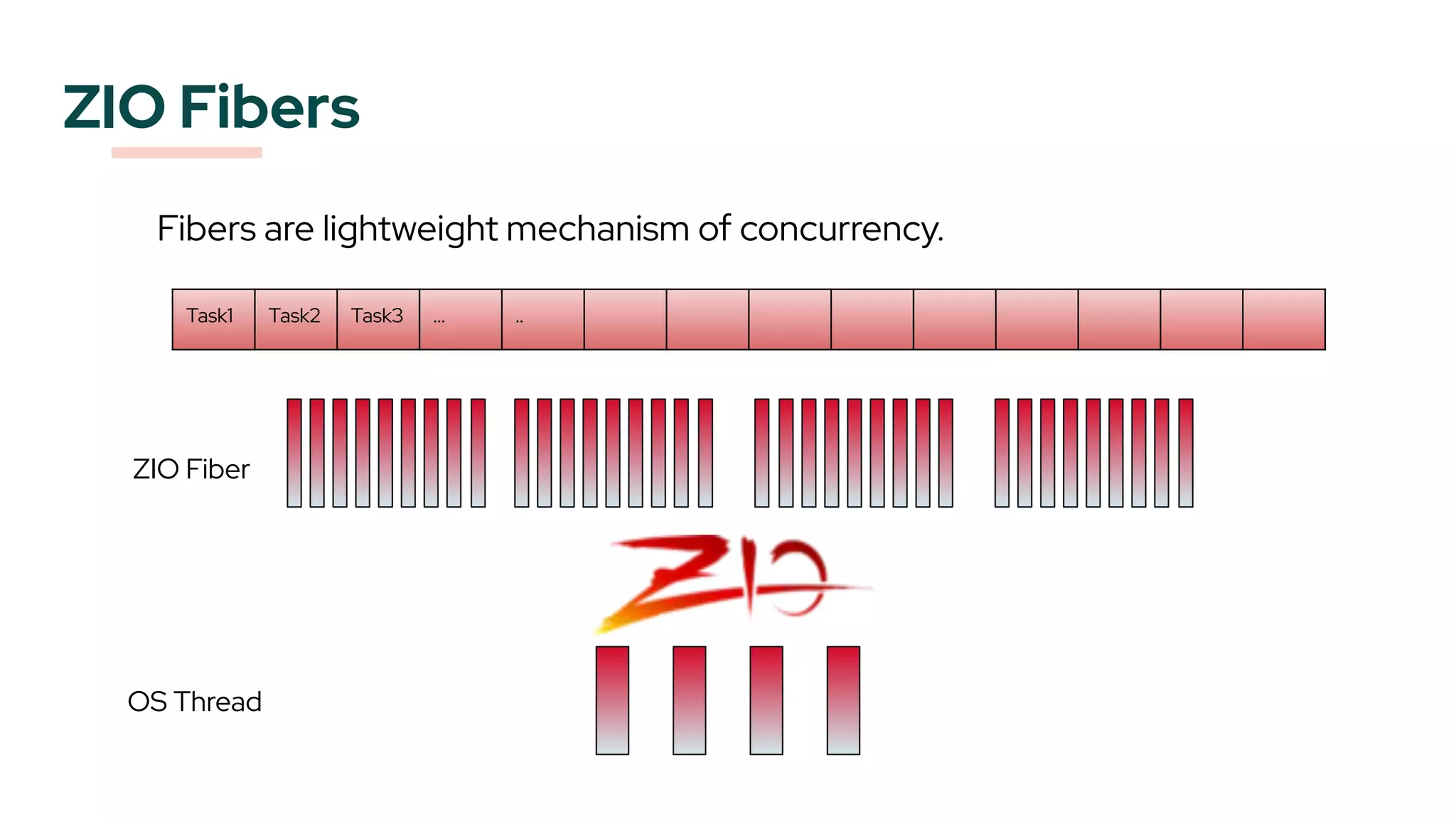
![How ZIO runs Effects?
ZIO[R, E, A]](https://image.slidesharecdn.com/ziofromhome2-200528221427/75/Zio-from-Home-63-2048.jpg)
![How ZIO runs Effects?
ZIO[R, E, A]
R => IO[E, A]](https://image.slidesharecdn.com/ziofromhome2-200528221427/75/Zio-from-Home-64-2048.jpg)
![How ZIO runs Effects?
ZIO[R, E, A]
R => IO[E, A]](https://image.slidesharecdn.com/ziofromhome2-200528221427/75/Zio-from-Home-65-2048.jpg)
![How ZIO runs Effects?
ZIO[R, E, A]
R => IO[E, A]](https://image.slidesharecdn.com/ziofromhome2-200528221427/75/Zio-from-Home-66-2048.jpg)
![How ZIO runs Effects?
IO[E, A]](https://image.slidesharecdn.com/ziofromhome2-200528221427/75/Zio-from-Home-67-2048.jpg)
![How ZIO runs Effects?
IO[E, A]
Fiber[E, A]
unsafeRun](https://image.slidesharecdn.com/ziofromhome2-200528221427/75/Zio-from-Home-68-2048.jpg)
![How ZIO runs Effects?
IO[E, A]
Fiber[E, A]
unsafeRun](https://image.slidesharecdn.com/ziofromhome2-200528221427/75/Zio-from-Home-69-2048.jpg)
![How ZIO runs Effects?
IO[E, A]
Fiber[E, A]
unsafeRun](https://image.slidesharecdn.com/ziofromhome2-200528221427/75/Zio-from-Home-70-2048.jpg)
![How ZIO runs concurrent Effects?
IO[E, A]
Fiber[E, A]
unsafeRun
IO[Nothing,Fiber[E, A]]
fork](https://image.slidesharecdn.com/ziofromhome2-200528221427/75/Zio-from-Home-71-2048.jpg)
![How ZIO runs concurrent Effects?
IO[E, A]
Fiber[E, A]
unsafeRun
IO[Nothing,Fiber[E, A]]
fork](https://image.slidesharecdn.com/ziofromhome2-200528221427/75/Zio-from-Home-72-2048.jpg)
![How ZIO runs concurrent Effects?
IO[E, A]
Fiber[E, A]
unsafeRun
IO[Nothing,Fiber[E, A]]
fork
Fiber[E, A]
unsafeRun](https://image.slidesharecdn.com/ziofromhome2-200528221427/75/Zio-from-Home-73-2048.jpg)
![How ZIO runs concurrent Effects?
IO[E, A]
Fiber[E, A]
unsafeRun
IO[Nothing,Fiber[E, A]]
fork
Fiber[E, A]
unsafeRun](https://image.slidesharecdn.com/ziofromhome2-200528221427/75/Zio-from-Home-74-2048.jpg)
![Concurrent Tasks
trait ZIO[R, E, A] {
def race(that: ZIO[R, E, A]): ZIO[R, E, A]
def raceAll(ios: Iterable[ZIO[R, E, A]]): ZIO[R, E, A]
def zipPar(that: ZIO[R, E, B]): ZIO[R, E, (A, B)]
def on(ec: ExecutionContext): ZIO[R, E, A]
...
}
object ZIO {
def foreachPar(as: Iterable[A])(fn: A => ZIO[R, E, B]): ZIO[R, E, List[B]]
...
}](https://image.slidesharecdn.com/ziofromhome2-200528221427/75/Zio-from-Home-75-2048.jpg)
![Concurrent Tasks
def getUserInfo(id: Id): Task[(User, Profile)] =
fetchUser(id).zipPar(fetchProfile(id))
Task 1 Task 2
(User, Profile)](https://image.slidesharecdn.com/ziofromhome2-200528221427/75/Zio-from-Home-76-2048.jpg)
![Example
case class IlForno(queue: Queue[Request], currentIngredients: Ref[Ingredients]) {
def handleRequests(p: Promise[Nothing, Unit]): ZIO[Clock, MissingIngredient, Unit] =
(for {
request <- queue.take
rest <- currentIngredients.update(preparePizza(request, _))
_ <- evaluate(rest)
} yield ())
.tapError(_ => p.succeed(()))
.repeat(Schedule.duration(8.hours) && Schedule.spaced(10.minutes))
.unit
val listenRequests: IO[Error, Unit] = ???
}](https://image.slidesharecdn.com/ziofromhome2-200528221427/75/Zio-from-Home-77-2048.jpg)
![val program: ZIO[Clock, Error, Unit] = for {
ilForno <- IlForno(initialIngredient)
f1 <- ilForno.listenRequests.fork
p <- Promise.make[Nothing, Unit]
f2 <- ilForno.handleRequests(p).fork
_ <- p.await
_ <- f1.interrupt.zipPar(f2.interrupt)
} yield ()
Example](https://image.slidesharecdn.com/ziofromhome2-200528221427/75/Zio-from-Home-78-2048.jpg)
![Example
val program: ZIO[Clock, Error, Unit] = for {
ilForno <- IlForno(initialIngredient)
f1 <- ilForno.listenRequests.fork
p <- Promise.make[Nothing, Unit]
f2 <- ilForno.handleRequests(p).fork
_ <- p.await
_ <- f1.interrupt.zipPar(f2.interrupt)
} yield ()](https://image.slidesharecdn.com/ziofromhome2-200528221427/75/Zio-from-Home-79-2048.jpg)
![Example
val program: ZIO[Clock, Error, Unit] = for {
ilForno <- IlForno(initialIngredient)
f1 <- ilForno.listenRequests.fork
p <- Promise.make[Nothing, Unit]
f2 <- ilForno.handleRequests(p).fork
_ <- p.await
_ <- f1.interrupt.zipPar(f2.interrupt)
} yield ()](https://image.slidesharecdn.com/ziofromhome2-200528221427/75/Zio-from-Home-80-2048.jpg)
![Example
val program: ZIO[Clock, Error, Unit] = for {
ilForno <- IlForno(initialIngredient)
f1 <- ilForno.listenRequests.fork
p <- Promise.make[Nothing, Unit]
f2 <- ilForno.handleRequests(p).fork
_ <- p.await
_ <- f1.interrupt.zipPar(f2.interrupt)
} yield ()](https://image.slidesharecdn.com/ziofromhome2-200528221427/75/Zio-from-Home-81-2048.jpg)


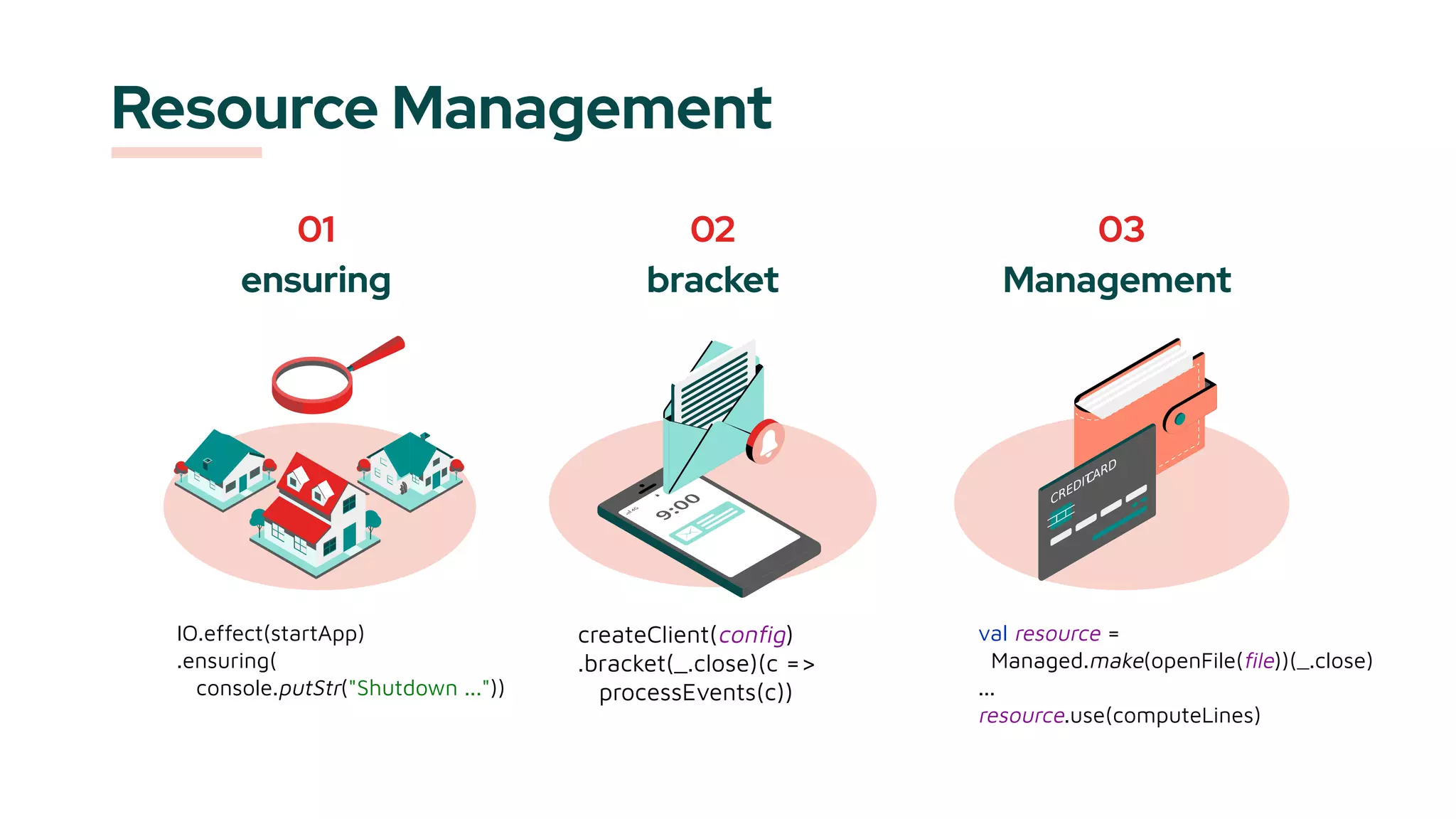
![Resource Management
● You can use the methods provided by the dependencies in your
program.
● once you provide a layer or an environment, the implementation
will be acquired and used then released at the end.
ZIO Environment & ZLayer[R, E, A]](https://image.slidesharecdn.com/ziofromhome2-200528221427/75/Zio-from-Home-87-2048.jpg)


The document discusses functional programming concepts using ZIO, a Scala library that supports asynchronous and concurrent programming. Key ideas include pure functions, immutability, functional effects, error management, and resource management, along with practical application examples. It emphasizes the importance of composing functions and managing dependencies effectively within a purely functional programming paradigm.


![To Effect or Not to Effect - a Scala Perspective [Func Prog Conf 2025]](https://cdn.slidesharecdn.com/ss_thumbnails/funcprogconf2025-251027100405-65b508f2-thumbnail.jpg?width=640&height=640&fit=bounds)


