INDUSTRIAL TRAINING PRESENTATIONBy AJAY
KUMAR
Roll. No.
1305232005
E.I FINAL
YEAR
Research Designs and Standards
Organization (RDSO)
(Research Directorate Electronics Lab)
INTRODUCTION- ABOUT RDSO
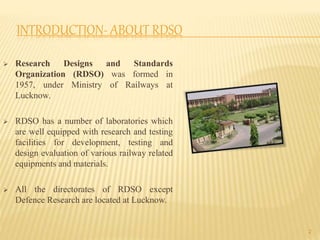
 Research Designs and Standards
Organization (RDSO) was formed in
1957, under Ministry of Railways at
Lucknow.
 RDSO has a number of laboratories which
are well equipped with research and testing
facilities for development, testing and
design evaluation of various railway related
equipments and materials.
 All the directorates of RDSO except
Defence Research are located at Lucknow.
2
FUNCTIONS
 Development of new and improved designs
 Development and adoption of new technologies for use
on Indian Railways
 Development of standards for materials and products especially
needed by Indian Railways
 Technical investigation, statutory clearance, testing and
provision of consulting services
 Inspection of critical and safety items for rolling stock,
locomotives, signals, Telecommunications equipment,
and track.
3
SIGNALING IN INDIAN RAILWAYS
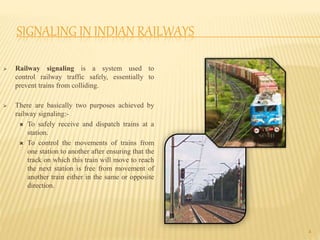
 Railway signaling is a system used to
control railway traffic safely, essentially to
prevent trains from colliding.
 There are basically two purposes achieved by
railway signaling:-
 To safely receive and dispatch trains at a
station.
 To control the movements of trains from
one station to another after ensuring that the
track on which this train will move to reach
the next station is free from movement of
another train either in the same or opposite
direction.
4
SOME IMPORTANT TERMS IN RAILWAY
SIGNALING
5
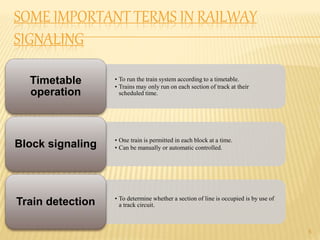
• To run the train system according to a timetable.
• Trains may only run on each section of track at their
scheduled time.
Timetable
operation
• One train is permitted in each block at a time.
• Can be manually or automatic controlled.Block signaling
• To determine whether a section of line is occupied is by use of
a track circuit.Train detection
FIXED SIGNALS
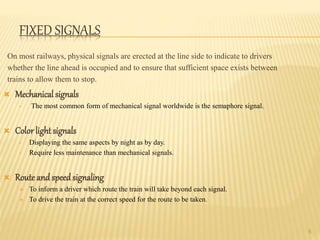
On most railways, physical signals are erected at the line side to indicate to drivers
whether the line ahead is occupied and to ensure that sufficient space exists between
trains to allow them to stop.
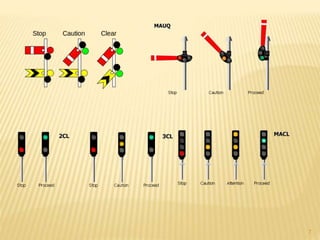
 Mechanical signals
• The most common form of mechanical signal worldwide is the semaphore signal.
 Color light signals
• Displaying the same aspects by night as by day.
• Require less maintenance than mechanical signals.
 Route andspeedsignaling
 To inform a driver which route the train will take beyond each signal.
 To drive the train at the correct speed for the route to be taken.
6
7
TRANSDUCERS
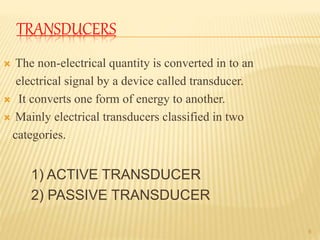
 The non-electrical quantity is converted in to an
electrical signal by a device called transducer.
 It converts one form of energy to another.
 Mainly electrical transducers classified in two
categories.
1) ACTIVE TRANSDUCER
2) PASSIVE TRANSDUCER
8
LVDT
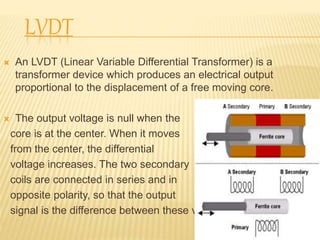
 An LVDT (Linear Variable Differential Transformer) is a
transformer device which produces an electrical output
proportional to the displacement of a free moving core.
 The output voltage is null when the
core is at the center. When it moves
from the center, the differential
voltage increases. The two secondary
coils are connected in series and in
opposite polarity, so that the output
signal is the difference between these voltages.
9
ACCELEROMETER
 An accelerometer is a device that
measures proper acceleration .
 Accelerometers are used to detect and monitor
vibration in machinery.
 Some accelerometers use the piezoelectric effect
–
they contain microscopic crystal structures that get
stressed by accelerative forces, which causes a
voltage to be generated. Another way to do it is by
sensing changes in capacitance. 10
APPLICATION OF LVDT AND ACCELEROMETER IN
RAILWAYS
 Monitoring and control for track maintenance.
 Optimize braking for passenger comfort.
 For vibration measurement on bogies and train
structure.
 For track gradient and slope measurement
 Quality Control and Balancing
11
OSCILLATION MONITORING SYSTEM
 OMS are used for measuring vertical and lateral
accelerations to assess the condition of track.
 This system is useful for monitoring of tracks and
monitoring of railway vehicles(railway coaches,wagons
and locomotives).
 The portable OMS2000 is a microprocessor-based
system
for track monitoring by measurement of the following
parameters:
1. Speed
2. Vertical and lateral accelerations on loco/coach floor.
12
13
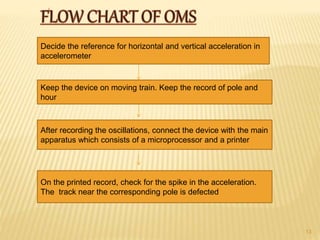
Decide the reference for horizontal and vertical acceleration in
accelerometer
Keep the device on moving train. Keep the record of pole and
hour
After recording the oscillations, connect the device with the main
apparatus which consists of a microprocessor and a printer
On the printed record, check for the spike in the acceleration.
The track near the corresponding pole is defected
WHEEL IMPACT LOAD DETECTOR (WILD)
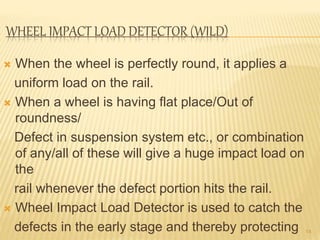
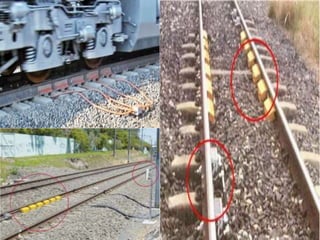
 When the wheel is perfectly round, it applies a
uniform load on the rail.
 When a wheel is having flat place/Out of
roundness/
Defect in suspension system etc., or combination
of any/all of these will give a huge impact load on
the
rail whenever the defect portion hits the rail.
 Wheel Impact Load Detector is used to catch the
defects in the early stage and thereby protecting 14
15
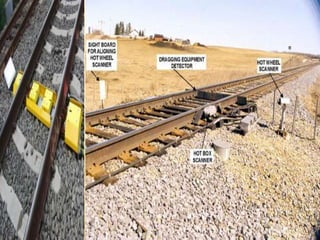
HOT WHEEL DETECTION SYSTEM (HWDS)
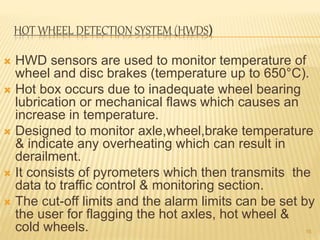
 HWD sensors are used to monitor temperature of
wheel and disc brakes (temperature up to 650°C).
 Hot box occurs due to inadequate wheel bearing
lubrication or mechanical flaws which causes an
increase in temperature.
 Designed to monitor axle,wheel,brake temperature
& indicate any overheating which can result in
derailment.
 It consists of pyrometers which then transmits the
data to traffic control & monitoring section.
 The cut-off limits and the alarm limits can be set by
the user for flagging the hot axles, hot wheel &
cold wheels. 16
17
YOU

AJAY CHAUHAN ppt

  • 1.
    INDUSTRIAL TRAINING PRESENTATIONByAJAY KUMAR Roll. No. 1305232005 E.I FINAL YEAR Research Designs and Standards Organization (RDSO) (Research Directorate Electronics Lab)
  • 2.
    INTRODUCTION- ABOUT RDSO Research Designs and Standards Organization (RDSO) was formed in 1957, under Ministry of Railways at Lucknow.  RDSO has a number of laboratories which are well equipped with research and testing facilities for development, testing and design evaluation of various railway related equipments and materials.  All the directorates of RDSO except Defence Research are located at Lucknow. 2
  • 3.
    FUNCTIONS  Development ofnew and improved designs  Development and adoption of new technologies for use on Indian Railways  Development of standards for materials and products especially needed by Indian Railways  Technical investigation, statutory clearance, testing and provision of consulting services  Inspection of critical and safety items for rolling stock, locomotives, signals, Telecommunications equipment, and track. 3
  • 4.
    SIGNALING IN INDIANRAILWAYS  Railway signaling is a system used to control railway traffic safely, essentially to prevent trains from colliding.  There are basically two purposes achieved by railway signaling:-  To safely receive and dispatch trains at a station.  To control the movements of trains from one station to another after ensuring that the track on which this train will move to reach the next station is free from movement of another train either in the same or opposite direction. 4
  • 5.
    SOME IMPORTANT TERMSIN RAILWAY SIGNALING 5 • To run the train system according to a timetable. • Trains may only run on each section of track at their scheduled time. Timetable operation • One train is permitted in each block at a time. • Can be manually or automatic controlled.Block signaling • To determine whether a section of line is occupied is by use of a track circuit.Train detection
  • 6.
    FIXED SIGNALS On mostrailways, physical signals are erected at the line side to indicate to drivers whether the line ahead is occupied and to ensure that sufficient space exists between trains to allow them to stop.  Mechanical signals • The most common form of mechanical signal worldwide is the semaphore signal.  Color light signals • Displaying the same aspects by night as by day. • Require less maintenance than mechanical signals.  Route andspeedsignaling  To inform a driver which route the train will take beyond each signal.  To drive the train at the correct speed for the route to be taken. 6
  • 7.
  • 8.
    TRANSDUCERS  The non-electricalquantity is converted in to an electrical signal by a device called transducer.  It converts one form of energy to another.  Mainly electrical transducers classified in two categories. 1) ACTIVE TRANSDUCER 2) PASSIVE TRANSDUCER 8
  • 9.
    LVDT  An LVDT(Linear Variable Differential Transformer) is a transformer device which produces an electrical output proportional to the displacement of a free moving core.  The output voltage is null when the core is at the center. When it moves from the center, the differential voltage increases. The two secondary coils are connected in series and in opposite polarity, so that the output signal is the difference between these voltages. 9
  • 10.
    ACCELEROMETER  An accelerometeris a device that measures proper acceleration .  Accelerometers are used to detect and monitor vibration in machinery.  Some accelerometers use the piezoelectric effect – they contain microscopic crystal structures that get stressed by accelerative forces, which causes a voltage to be generated. Another way to do it is by sensing changes in capacitance. 10
  • 11.
    APPLICATION OF LVDTAND ACCELEROMETER IN RAILWAYS  Monitoring and control for track maintenance.  Optimize braking for passenger comfort.  For vibration measurement on bogies and train structure.  For track gradient and slope measurement  Quality Control and Balancing 11
  • 12.
    OSCILLATION MONITORING SYSTEM OMS are used for measuring vertical and lateral accelerations to assess the condition of track.  This system is useful for monitoring of tracks and monitoring of railway vehicles(railway coaches,wagons and locomotives).  The portable OMS2000 is a microprocessor-based system for track monitoring by measurement of the following parameters: 1. Speed 2. Vertical and lateral accelerations on loco/coach floor. 12
  • 13.
    13 Decide the referencefor horizontal and vertical acceleration in accelerometer Keep the device on moving train. Keep the record of pole and hour After recording the oscillations, connect the device with the main apparatus which consists of a microprocessor and a printer On the printed record, check for the spike in the acceleration. The track near the corresponding pole is defected
  • 14.
    WHEEL IMPACT LOADDETECTOR (WILD)  When the wheel is perfectly round, it applies a uniform load on the rail.  When a wheel is having flat place/Out of roundness/ Defect in suspension system etc., or combination of any/all of these will give a huge impact load on the rail whenever the defect portion hits the rail.  Wheel Impact Load Detector is used to catch the defects in the early stage and thereby protecting 14
  • 15.
  • 16.
    HOT WHEEL DETECTIONSYSTEM (HWDS)  HWD sensors are used to monitor temperature of wheel and disc brakes (temperature up to 650°C).  Hot box occurs due to inadequate wheel bearing lubrication or mechanical flaws which causes an increase in temperature.  Designed to monitor axle,wheel,brake temperature & indicate any overheating which can result in derailment.  It consists of pyrometers which then transmits the data to traffic control & monitoring section.  The cut-off limits and the alarm limits can be set by the user for flagging the hot axles, hot wheel & cold wheels. 16
  • 17.
  • 18.