


COMB SORTING
 The basic idea is to eliminate turtles, or small
values near the end of the list, Since in a
bubble sort these slow the sorting down
tremendously. Rabbits, large values around the
beginning of the list, do not pose a problem in
bubble sort.
 Instead of comparing adjacent elements, comb
sort allows for a larger gap between elements.
 This eliminates the number of required swaps.
 We get small numbers at the end to reach
beginning of the list.
 In bubble sort, when any two elements are
compared, they always have a gap (distance
from each other) of 1.
 The basic idea of comb sort is that the gap can
be much more than 1
 Rabbits & turtles: RABBITS are the elements
with the large values located near the
beginning while TURTLES are the elements
with the small values located near the end of
the list.
 Gap size the distance b/w two elements
 Shrink Factor usually taken 1.3
 Begin with a gap size equal to n
 Recalculate the gap size by dividing the
previous gap size by a shrink factor
 Iterate through the list, swapping elements
 If the gap is currently 1 and no swap is
occurred during this iteration, then the list is
sorted.
 Otherwise repeat.
Unsorted list
:
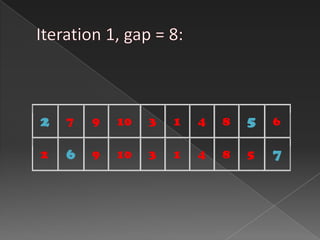
5 7 9 10 3 1 4 8 2 6
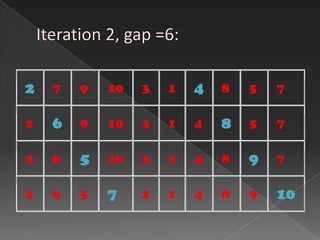
2 7 9 10 3 1 4 8 5 6
2 6 9 10 3 1 4 8 5 7
2 7 9 10 3 1 4 8 5 7
2 6 9 10 3 1 4 8 5 7
2 6 5 10 3 1 4 8 9 7
2 6 5 7 2 1 4 8 9 10
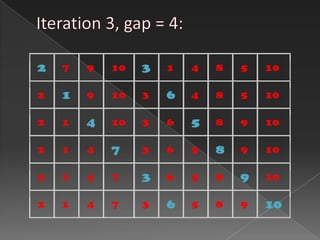
2 7 9 10 3 1 4 8 5 10
2 1 9 10 3 6 4 8 5 10
2 1 4 10 3 6 5 8 9 10
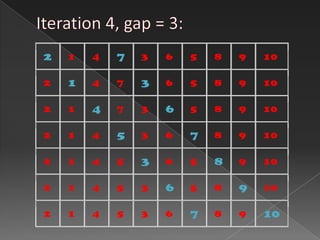
2 1 4 7 3 6 5 8 9 10
2 1 4 7 3 6 5 8 9 10
2 1 4 7 3 6 5 8 9 10
2 1 4 7 3 6 5 8 9 10
2 1 4 7 3 6 5 8 9 10
2 1 4 7 3 6 5 8 9 10
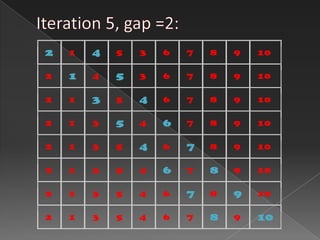
2 1 4 5 3 6 7 8 9 10
2 1 4 5 3 6 5 8 9 10
2 1 4 5 3 6 5 8 9 10
2 1 4 5 3 6 7 8 9 10
2 1 4 5 3 6 7 8 9 10
2 1 4 5 3 6 7 8 9 10
2 1 3 5 4 6 7 8 9 10
2 1 3 5 4 6 7 8 9 10
2 1 3 5 4 6 7 8 9 10
2 1 3 5 4 6 7 8 9 10
2 1 3 5 4 6 7 8 9 10
2 1 3 5 4 6 7 8 9 10
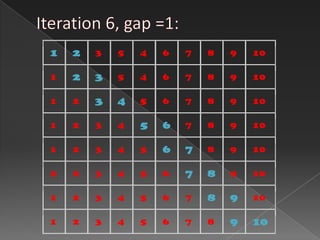
1 2 3 5 4 6 7 8 9 10
1 2 3 5 4 6 7 8 9 10
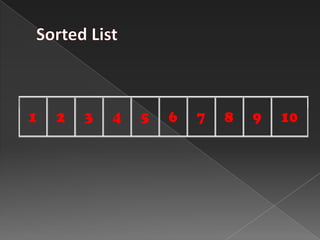
1 2 3 4 5 6 7 8 9 10
1 2 3 4 5 6 7 8 9 10
1 2 3 4 5 6 7 8 9 10
2 2 3 4 5 6 7 8 9 10
1 2 3 4 5 6 7 8 9 10
1 2 3 4 5 6 7 8 9 10
1 2 3 4 5 6 7 8 9 10
void combSort(int a[], int len)
{
int gap = len;
bool swapped;
do{
swapped = false;
gap = newGap(gap);
for(int i=0; i < len-gap; ++i){
if(a[i] > a[i+gap]){
swapped = true;
swap(a[i], a[i+gap]);
}
}
}while(gap > 1 || swapped);
for(int i=0;i<len;i++)
cout<<" "<<a[i];
}
 http://xlinux.nist.gov/dads/HTML/combSort.
html
 http://en.wikipedia.org/wiki/Comb_sort

Aizaz comb sort

  • 1.
  • 2.
     The basicidea is to eliminate turtles, or small values near the end of the list, Since in a bubble sort these slow the sorting down tremendously. Rabbits, large values around the beginning of the list, do not pose a problem in bubble sort.
  • 3.
     Instead ofcomparing adjacent elements, comb sort allows for a larger gap between elements.  This eliminates the number of required swaps.  We get small numbers at the end to reach beginning of the list.  In bubble sort, when any two elements are compared, they always have a gap (distance from each other) of 1.  The basic idea of comb sort is that the gap can be much more than 1
  • 4.
     Rabbits &turtles: RABBITS are the elements with the large values located near the beginning while TURTLES are the elements with the small values located near the end of the list.  Gap size the distance b/w two elements  Shrink Factor usually taken 1.3
  • 5.
     Begin witha gap size equal to n  Recalculate the gap size by dividing the previous gap size by a shrink factor  Iterate through the list, swapping elements  If the gap is currently 1 and no swap is occurred during this iteration, then the list is sorted.  Otherwise repeat.
  • 6.
    Unsorted list : 5 79 10 3 1 4 8 2 6
  • 7.
    2 7 910 3 1 4 8 5 6 2 6 9 10 3 1 4 8 5 7
  • 8.
    2 7 910 3 1 4 8 5 7 2 6 9 10 3 1 4 8 5 7 2 6 5 10 3 1 4 8 9 7 2 6 5 7 2 1 4 8 9 10
  • 9.
    2 7 910 3 1 4 8 5 10 2 1 9 10 3 6 4 8 5 10 2 1 4 10 3 6 5 8 9 10 2 1 4 7 3 6 5 8 9 10 2 1 4 7 3 6 5 8 9 10 2 1 4 7 3 6 5 8 9 10
  • 10.
    2 1 47 3 6 5 8 9 10 2 1 4 7 3 6 5 8 9 10 2 1 4 7 3 6 5 8 9 10 2 1 4 5 3 6 7 8 9 10 2 1 4 5 3 6 5 8 9 10 2 1 4 5 3 6 5 8 9 10 2 1 4 5 3 6 7 8 9 10
  • 11.
    2 1 45 3 6 7 8 9 10 2 1 4 5 3 6 7 8 9 10 2 1 3 5 4 6 7 8 9 10 2 1 3 5 4 6 7 8 9 10 2 1 3 5 4 6 7 8 9 10 2 1 3 5 4 6 7 8 9 10 2 1 3 5 4 6 7 8 9 10 2 1 3 5 4 6 7 8 9 10
  • 12.
    1 2 35 4 6 7 8 9 10 1 2 3 5 4 6 7 8 9 10 1 2 3 4 5 6 7 8 9 10 1 2 3 4 5 6 7 8 9 10 1 2 3 4 5 6 7 8 9 10 2 2 3 4 5 6 7 8 9 10 1 2 3 4 5 6 7 8 9 10 1 2 3 4 5 6 7 8 9 10
  • 13.
    1 2 34 5 6 7 8 9 10
  • 14.
    void combSort(int a[],int len) { int gap = len; bool swapped; do{ swapped = false; gap = newGap(gap); for(int i=0; i < len-gap; ++i){ if(a[i] > a[i+gap]){ swapped = true; swap(a[i], a[i+gap]); } } }while(gap > 1 || swapped); for(int i=0;i<len;i++) cout<<" "<<a[i]; }
  • 15.