Airport Collaborative Decision
Making (A-CDM
Isometric Scene of Pitstop (in progress)
• Worldwide Services Operational Efficiency
enhancement includes:• Airport CDM
• Fuel Efficiency
• Airline & Ground handling procedures
• Gap Analysis / Site Surveys
• DMAN / AMAN / ASMGCS
• Flow Management
• Capacity Enhancement
• Training / Transfer of knowledge
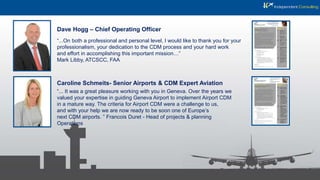
Dave Hogg – Chief Operating Officer
“...On both a professional and personal level, I would like to thank you for your
professionalism, your dedication to the CDM process and your hard work
and effort in accomplishing this important mission…”
Mark Libby, ATCSCC, FAA
Caroline Schmeits- Senior Airports & CDM Expert Aviation
“... It was a great pleasure working with you in Geneva. Over the years we
valued your expertise in guiding Geneva Airport to implement Airport CDM
in a mature way. The criteria for Airport CDM were a challenge to us,
and with your help we are now ready to be soon one of Europe’s
next CDM airports. ” Francois Duret - Head of projects & planning
Operations
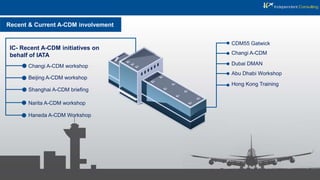
Recent & Current A-CDM involvement
IC- Recent A-CDM initiatives on
behalf of IATA
Haneda A-CDM Workshop
CDM55 Gatwick
Changi A-CDM workshop
Beijing A-CDM workshop
Shanghai A-CDM briefing
Narita A-CDM workshop
Changi A-CDM
Dubai DMAN
Abu Dhabi Workshop
Hong Kong Training
Introduction to A-CDM
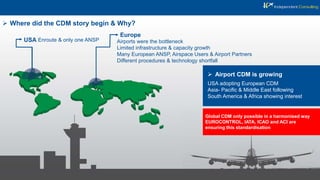
 Where did the CDM story begin & Why?
USA Enroute & only one ANSP
Europe
Airports were the bottleneck
Limited infrastructure & capacity growth
Many European ANSP, Airspace Users & Airport Partners
Different procedures & technology shortfall
 Airport CDM is growing
USA adopting European CDM
Asia- Pacific & Middle East following
South America & Africa showing interest
Global CDM only possible in a harmonised way
EUROCONTROL, IATA, ICAO and ACI are
ensuring this standardisation
What ARE the inefficiencies today?
No optimal use of Airport infrastructure
Not using all available data
Being reactive rather than pro-active
Keeping our operations to ourselves
We have a blaming culture today
Possible Causes?
Sitting on Information
Lack of having the full picture
Buffering of planning
Lack of procedures amongst partners
Different Definitions
The symptoms…
• No single partner has the complete picture
• Information is passed too late for partners to respond – and has not the same meaning
Examples:
• Airport & ATC don’t know when the aircraft are ready for departure
(Ground handler knows)
• Airlines don’t know when the aircraft can start up until getting
clearance. (hard for ATC to plan in advance)
• Airport & GHA only know the estimated arrival time when aircraft
enter FIR boundary (Airline knows earlier)
Have you ever asked yourself
WHY?
Have you ever considered the impact
on the operations of others?
The cure…
What if we’re able to share and predict the aircraft readiness time?
• departure sequence can be planned earlier.
• runway / taxiway congestion can be managed in a better way.
• aircraft holding at stand instead of taxiway, save fuel.
• pilot will know in advance the engine start-up time.
What if we’re able to get a better ETA much earlier than today?
• airport will have more time to resolve gate conflict, better passenger
experience
• ground handlers will be able to deploy resources more efficiently
Airport Collaborative
Decision Making
(A-CDM)
Different Definitions…
ETA – Estimated Time of Arrival
• ATC ACC: arrival on TMA entry
• ATC TWR: landing time on runway
• GH / Airport / Airline: arrival on stand
ETD - Estimated Time of Departure
• ATC TWR: take off time
• GH / Airport / Airline: pushback from stand
Inaccurate Information
EOBT (FPL) not updated by Airlines, despite
knowledge of delay
Taxi time calculated based on
standard taxi times
Flights have equal EOBT even though
capacity cannot accommodate Take off
time unpredictable due to large holding queue
A-CDM will improve:
• resources usage
• decision making
• infrastructure usage
• predictability
• situational Awareness
NEED FOR COLLABORATION
Amongst all Airport Parties for
A-CDM to WORK
A-CDM Stakeholders
ATC
MET
AIS
Aircraft Operator
GA
ATC Flow
Aircraft Operator
Airport CDM is about
PEOPLE, not just tools!
CULTURE CHANGE
Pick any card and concentrate on only that card…
Card Gone?
This power-game is a metaphor for our inability
to see change – or the need to change.
You see; the six cards and the subsequent
group of 5 cards never contained the same cards…
It is easier for companies to come up with new ideas than to let go of old ones"
Why are partners reluctant to change?
 Why share data, oar why not?
• Confidentiality of data
• Fear of the ‘unknown’?
 no understanding of partners’ operations
• If they are not involved in the changes?
The Challenge
How to convince to change
Who to convince to change
No Charging
for DATA &
share data
Understand
each others
operations &
difficulties
Being
prepared to
work with
new
procedures
No Blame
culture
created
All partners
involved &
working
together
A-CDM is not a
IT tool
Change
Management
The Airlines are critical in the A-CDM project, both in local implementation of A-CDM and
in protecting their interests in multiple A-CDM destinations
• Pilots
• Operations Control Centers (OCC)
• Airline ground staff
• Hub Control Centers
Operational requirements to protect theAirlines
• Airlines are involved from the outset of any A-CDM initiative
• Airlines delegate TOBT responsibility to GH if needed
• A-CDM procedures are agreed by the partners i.e. Airlines
e.g. some airports applying rules with no consultation
• Airlines proactively share data with other partners
Airline involvement worldwide & support
• In development
To safe guard airline input in
procedures
• In implementation
To safe-guard benefits as an
outcome
In general to safe-guard global harmonization
Additional help from Organisations
• To engage partners
• To maintain commitment
• To have a need for common procedures
• To safe-guard interests of all involved
IATA & IACA efforts
In relation to Member Airlines
• Recommend Airlines to be A-CDM compliant
Recommend a uniform way of executing A-CDM
Need to look at delay codes?
In relation to Ground Handler Organisation
• Need for harmonised SLA with Airlines
Next
• What data is shared and how
• New terminology
• Best planned best served
• What can it do for you in adverse conditions
Airport CDM Elements
Airport CDM
Elements
Air Traffic Flow Management
Adverse Conditions
Pre Departure Sequencing
Variable Taxi Times
Flight Progress
Information Sharing
Information Sharing
Information Sharing is the Foundation
At the right time To the right peopleThe right information
Clearly link arrivals & deprtures
A-CDM Platform Requirements
Avoid information overload
Create consistent look and feel
Avoid extra display
Tailor to each partner’s needs
Airport database: the best platform to store,
process and share Airport CDM information
2. Milestone Approach
Milestones link the three phases:
• Inbound (Arrival)
• Turnaround
• Outbound (Departure)
In-Block /
Actual Ground
Handling Starts
TOBT TowingBoarding
Starts
A-CDM INFORMATION SHARING & MILESTONE APPROACH
Taxi In
(EXIT)
ATC Flight Plan
Activation
(EOBT – 3 hrs)
INBOUND
TSAT
TOBT
Update Prior
to TSAT
TURN ROUND OUTBOUND
Local Radar
Update
Take Off from
Outstation
Landing
ALDT
EOBT-2 hrs
Final
Approach
Aircraft Ready
Start Up
Request
Start Up
Approved
Taxi Out
(EXOT)
Off-Block
AOBT
Take Off
ATOT
3. Variable Taxi Times
Need for Airport partners ;
To have accurate IN BLOCK prediction to start turnround process
To have accurate TAKE OFF prediction for network ATFM capacity – demand balancing
Default Taxi Times are inaccurate
Variable Taxi Times provide…
…improved Network
Planning for the ATFM
…better Stand & Gate
Planning at the airport
…increased Resource
efficiency
…economical benefits
…environmental gains
4. Pre-departure sequencing
• Reactive handling method of flights by ATC
• Positive on FCFS
• Equality of all flights – all flights get same treatment
• No disputes – everybody listens to same frequency
• Problem with FCFS
• Unpredictable
• Less balanced use of resources (e.g. runway)
Today:
First Come First Serve!
Best Planned Best Served?
Objectives;
• Improve prediction of push back order
• Improve management of queuing aircraft at holding point
By using Principles;
• Transparency
• Replace “first come first served” principle
Target Effect of Sequencing
Benefits
Reduced:
Queuing, fuel burn, emissions and noise
workload for ATC
Improved:
Predictability for Airline
Stand & Gate management
Ground Handler planning
Safety
5. A-CDM in Adverse Conditions?
Disruption to Adverse Condition =
• Major reduction in Capacity
• Slow Recovery due to
• Lack of information
• Lack of communication
• Lack of prioritization
Objectives:
• Improve management of disruptions
• Enhance Utilisation of Available Capacity
• Improve Situational Awareness
A-CDM will:
• Facilitate recovery after disruptions
• Anticipate strong capacity reductions
How?
• Crisis management with A-CDM procedures & tools
• Full, same operational picture
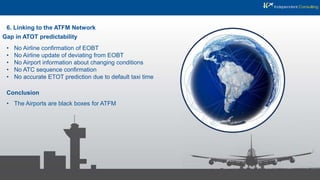
6. Linking to the ATFM Network
Gap in ATOT predictability
• No Airline confirmation of EOBT
• No Airline update of deviating from EOBT
• No Airport information about changing conditions
• No ATC sequence confirmation
• No accurate ETOT prediction due to default taxi time
Conclusion
• The Airports are black boxes for ATFM
Example: CDM Messages to ATFM
Departure Planning Information (DPI) Message
• Aims to send frequent airport status and flight TOBTTTOT
and TSAT predictions
• Integrated Airports receive priority in ATFM regulations
Development of Regional ATFM
Initiatives in Asia Pacific
• Thailand’s capacity enhancement initiatives
(with A-CDM) Interim Framework for
Collaborative ATFM?
• Sub-regional ATFM network operational trial
2013-2014 (with A-CDM) - Hong Kong
China, Indonesia, Malaysia, Singapore,
Thailand and Viet Nam
• Others?
Current implementation status in Europe
44
CDG
VIE
BUD
Initial phase Ongoing A-CDM Airport
PRG
ZRH
MXP
AMS
FCO
MUC
LYS
HEL
LIS
BRU
WAW
OSL
ATH
ARN
BCN
BBI
GVA
IST
MAD
PMI
LGW
FRA
DUS
TLS
KBP
LIN
VCE
MAN
BHX
DUB
CPH
LTN
A-CDM 2013
LJU
ORY
LHR
BENEFITS
Operational benefits
Inbound;
Better arrival times and sequence information = pro-active decision making
Turnaround;
Improved ground handling processes = improved resource efficiency
Outbound;
Improved punctuality = improved image
Reduced taxi- & runway queuing = reduced fuel and improved safety
Improved communication and situational awareness
High level Benefits Airlines
Improved situational
awareness, more
accurate fleet
predictions
Significant decrease in
fuel costs & engine
running
Accurate Arrival &
Departure times and
planning
Better use of resources
and communication
High level benefits Ground Handling
• Accurate Arrival & Departure times and planning.
• Better use of resources and communication
Operational examples and benefits for Airlines and Ground Handlers
• Late arrival = late departure?
• Transfer pax?
Earlier and different decision making based on TOBT & TSAT mechanism
• Visibility of towing aircraft?
Ground radar display and TOBT for towings
• Daily programme of flight operations and turn-round times on schedule – enhanced punctuality
• Possible schedule disruptions predicted early, thus managed efficiently
• Preferences and priorities taken into account
• Less equipment has to be moved and less often (less fuel and maintenance)
Benefits Airports
• Accurate Arrival & Departure times and planning = operational efficiency
• Better use of resources
• Airport image on punctuality
• Airport revenue (more customers?)
Benefits passengers
• reduced delays and missed connections
• better reliability on flights meaning improved customer
satisfaction
Benefits environment
• less noise & emissions (NoX, CO2)
ATC benefits
• Reduced / Improved
• workload with predictability of traffic
• Improved planning
• RWY waiting time
• taxi times
The Proven Benefits
Munich – source: www.euro-cdm.org (“CDM special bulletin Dec 2011”)
Improved punctuality and reduced delays
20% (approx.)reduction in taxi times for departures
2.75 M € annual fuel savings
93% ATFM slot adherence
= 5400 tons of fuel to airlines = € 2.7M
Paris CDG - source: www.eurocontrol.int (“CDM@CDG”)
13% reduction in taxi times for departures (average 2 min per flight)
40% reduction in waiting time at the runway
90% ATFM slot adherence
Paris CDG - source: www.euro-cdm.org
25% reduction in taxi times for departures (average 3 min per flight)
17022 tons carbon dioxide (Co2) & 22 tons of nitrogen oxides (NoX)
Madrid – source: International Airport Review – Aug 2014 8% reduction in taxi
times (average 2 min per flight)Over 1 million liters kerosene
in savings
Lessons learned in implementation
Lessons Learned from other Airports?
• Clear project driver
• Establish MoU from outset
• Dedicated Project Manager
• Lack of PMP with tasks, accountability and timeframes
• Project overlapping
• Poor Communication
• A-CDM cherry picking
• Working Groups too large or not consistent
• participation
• Steering Groups slow in resolving issues & politics
• Too many ‘talkers 'and lack of ‘doer’s’
• Platform developed around CDM Procedures
• Involving ALL and maintaining Commitment of
all partners
• Harmonised, standardised Global A-CDM
Isometric Scene of Pitstop (in progress)
Questions & Answers
Likes and concerns of what you heard?
Dislike Like
What will be the changes?
Is this rocket science?
Nothing is impossible, the impossible just takes a bit longer
THANKYOU

Airport Collaborative Decision Making

  • 1.
  • 2.
    Isometric Scene ofPitstop (in progress)
  • 3.
    • Worldwide ServicesOperational Efficiency enhancement includes:• Airport CDM • Fuel Efficiency • Airline & Ground handling procedures • Gap Analysis / Site Surveys • DMAN / AMAN / ASMGCS • Flow Management • Capacity Enhancement • Training / Transfer of knowledge
  • 4.
    Dave Hogg –Chief Operating Officer “...On both a professional and personal level, I would like to thank you for your professionalism, your dedication to the CDM process and your hard work and effort in accomplishing this important mission…” Mark Libby, ATCSCC, FAA Caroline Schmeits- Senior Airports & CDM Expert Aviation “... It was a great pleasure working with you in Geneva. Over the years we valued your expertise in guiding Geneva Airport to implement Airport CDM in a mature way. The criteria for Airport CDM were a challenge to us, and with your help we are now ready to be soon one of Europe’s next CDM airports. ” Francois Duret - Head of projects & planning Operations
  • 5.
    Recent & CurrentA-CDM involvement IC- Recent A-CDM initiatives on behalf of IATA Haneda A-CDM Workshop CDM55 Gatwick Changi A-CDM workshop Beijing A-CDM workshop Shanghai A-CDM briefing Narita A-CDM workshop Changi A-CDM Dubai DMAN Abu Dhabi Workshop Hong Kong Training
  • 6.
  • 7.
     Where didthe CDM story begin & Why? USA Enroute & only one ANSP Europe Airports were the bottleneck Limited infrastructure & capacity growth Many European ANSP, Airspace Users & Airport Partners Different procedures & technology shortfall  Airport CDM is growing USA adopting European CDM Asia- Pacific & Middle East following South America & Africa showing interest Global CDM only possible in a harmonised way EUROCONTROL, IATA, ICAO and ACI are ensuring this standardisation
  • 8.
    What ARE theinefficiencies today? No optimal use of Airport infrastructure Not using all available data Being reactive rather than pro-active Keeping our operations to ourselves We have a blaming culture today Possible Causes? Sitting on Information Lack of having the full picture Buffering of planning Lack of procedures amongst partners Different Definitions
  • 9.
    The symptoms… • Nosingle partner has the complete picture • Information is passed too late for partners to respond – and has not the same meaning Examples: • Airport & ATC don’t know when the aircraft are ready for departure (Ground handler knows) • Airlines don’t know when the aircraft can start up until getting clearance. (hard for ATC to plan in advance) • Airport & GHA only know the estimated arrival time when aircraft enter FIR boundary (Airline knows earlier) Have you ever asked yourself WHY? Have you ever considered the impact on the operations of others?
  • 10.
    The cure… What ifwe’re able to share and predict the aircraft readiness time? • departure sequence can be planned earlier. • runway / taxiway congestion can be managed in a better way. • aircraft holding at stand instead of taxiway, save fuel. • pilot will know in advance the engine start-up time. What if we’re able to get a better ETA much earlier than today? • airport will have more time to resolve gate conflict, better passenger experience • ground handlers will be able to deploy resources more efficiently Airport Collaborative Decision Making (A-CDM)
  • 11.
    Different Definitions… ETA –Estimated Time of Arrival • ATC ACC: arrival on TMA entry • ATC TWR: landing time on runway • GH / Airport / Airline: arrival on stand ETD - Estimated Time of Departure • ATC TWR: take off time • GH / Airport / Airline: pushback from stand
  • 12.
    Inaccurate Information EOBT (FPL)not updated by Airlines, despite knowledge of delay Taxi time calculated based on standard taxi times Flights have equal EOBT even though capacity cannot accommodate Take off time unpredictable due to large holding queue
  • 13.
    A-CDM will improve: •resources usage • decision making • infrastructure usage • predictability • situational Awareness NEED FOR COLLABORATION Amongst all Airport Parties for A-CDM to WORK
  • 14.
  • 15.
    Airport CDM isabout PEOPLE, not just tools! CULTURE CHANGE
  • 16.
    Pick any cardand concentrate on only that card…
  • 17.
    Pick any cardand concentrate on only that card…
  • 18.
  • 19.
    This power-game isa metaphor for our inability to see change – or the need to change. You see; the six cards and the subsequent group of 5 cards never contained the same cards…
  • 20.
    It is easierfor companies to come up with new ideas than to let go of old ones" Why are partners reluctant to change?  Why share data, oar why not? • Confidentiality of data • Fear of the ‘unknown’?  no understanding of partners’ operations • If they are not involved in the changes?
  • 21.
    The Challenge How toconvince to change Who to convince to change No Charging for DATA & share data Understand each others operations & difficulties Being prepared to work with new procedures No Blame culture created All partners involved & working together A-CDM is not a IT tool Change Management
  • 22.
    The Airlines arecritical in the A-CDM project, both in local implementation of A-CDM and in protecting their interests in multiple A-CDM destinations • Pilots • Operations Control Centers (OCC) • Airline ground staff • Hub Control Centers
  • 23.
    Operational requirements toprotect theAirlines • Airlines are involved from the outset of any A-CDM initiative • Airlines delegate TOBT responsibility to GH if needed • A-CDM procedures are agreed by the partners i.e. Airlines e.g. some airports applying rules with no consultation • Airlines proactively share data with other partners
  • 24.
    Airline involvement worldwide& support • In development To safe guard airline input in procedures • In implementation To safe-guard benefits as an outcome In general to safe-guard global harmonization
  • 25.
    Additional help fromOrganisations • To engage partners • To maintain commitment • To have a need for common procedures • To safe-guard interests of all involved
  • 26.
    IATA & IACAefforts In relation to Member Airlines • Recommend Airlines to be A-CDM compliant Recommend a uniform way of executing A-CDM Need to look at delay codes? In relation to Ground Handler Organisation • Need for harmonised SLA with Airlines
  • 27.
    Next • What datais shared and how • New terminology • Best planned best served • What can it do for you in adverse conditions
  • 28.
    Airport CDM Elements AirportCDM Elements Air Traffic Flow Management Adverse Conditions Pre Departure Sequencing Variable Taxi Times Flight Progress Information Sharing
  • 29.
    Information Sharing Information Sharingis the Foundation At the right time To the right peopleThe right information
  • 30.
    Clearly link arrivals& deprtures A-CDM Platform Requirements Avoid information overload Create consistent look and feel Avoid extra display Tailor to each partner’s needs Airport database: the best platform to store, process and share Airport CDM information
  • 31.
    2. Milestone Approach Milestoneslink the three phases: • Inbound (Arrival) • Turnaround • Outbound (Departure)
  • 32.
    In-Block / Actual Ground HandlingStarts TOBT TowingBoarding Starts A-CDM INFORMATION SHARING & MILESTONE APPROACH Taxi In (EXIT) ATC Flight Plan Activation (EOBT – 3 hrs) INBOUND TSAT TOBT Update Prior to TSAT TURN ROUND OUTBOUND Local Radar Update Take Off from Outstation Landing ALDT EOBT-2 hrs Final Approach Aircraft Ready Start Up Request Start Up Approved Taxi Out (EXOT) Off-Block AOBT Take Off ATOT
  • 33.
    3. Variable TaxiTimes Need for Airport partners ; To have accurate IN BLOCK prediction to start turnround process To have accurate TAKE OFF prediction for network ATFM capacity – demand balancing Default Taxi Times are inaccurate
  • 34.
    Variable Taxi Timesprovide… …improved Network Planning for the ATFM …better Stand & Gate Planning at the airport …increased Resource efficiency …economical benefits …environmental gains
  • 35.
    4. Pre-departure sequencing •Reactive handling method of flights by ATC • Positive on FCFS • Equality of all flights – all flights get same treatment • No disputes – everybody listens to same frequency • Problem with FCFS • Unpredictable • Less balanced use of resources (e.g. runway) Today: First Come First Serve!
  • 36.
    Best Planned BestServed? Objectives; • Improve prediction of push back order • Improve management of queuing aircraft at holding point By using Principles; • Transparency • Replace “first come first served” principle
  • 37.
    Target Effect ofSequencing
  • 38.
    Benefits Reduced: Queuing, fuel burn,emissions and noise workload for ATC Improved: Predictability for Airline Stand & Gate management Ground Handler planning Safety
  • 39.
    5. A-CDM inAdverse Conditions? Disruption to Adverse Condition = • Major reduction in Capacity • Slow Recovery due to • Lack of information • Lack of communication • Lack of prioritization
  • 40.
    Objectives: • Improve managementof disruptions • Enhance Utilisation of Available Capacity • Improve Situational Awareness A-CDM will: • Facilitate recovery after disruptions • Anticipate strong capacity reductions How? • Crisis management with A-CDM procedures & tools • Full, same operational picture
  • 41.
    6. Linking tothe ATFM Network Gap in ATOT predictability • No Airline confirmation of EOBT • No Airline update of deviating from EOBT • No Airport information about changing conditions • No ATC sequence confirmation • No accurate ETOT prediction due to default taxi time Conclusion • The Airports are black boxes for ATFM
  • 42.
    Example: CDM Messagesto ATFM Departure Planning Information (DPI) Message • Aims to send frequent airport status and flight TOBTTTOT and TSAT predictions • Integrated Airports receive priority in ATFM regulations
  • 43.
    Development of RegionalATFM Initiatives in Asia Pacific • Thailand’s capacity enhancement initiatives (with A-CDM) Interim Framework for Collaborative ATFM? • Sub-regional ATFM network operational trial 2013-2014 (with A-CDM) - Hong Kong China, Indonesia, Malaysia, Singapore, Thailand and Viet Nam • Others?
  • 44.
    Current implementation statusin Europe 44 CDG VIE BUD Initial phase Ongoing A-CDM Airport PRG ZRH MXP AMS FCO MUC LYS HEL LIS BRU WAW OSL ATH ARN BCN BBI GVA IST MAD PMI LGW FRA DUS TLS KBP LIN VCE MAN BHX DUB CPH LTN A-CDM 2013 LJU ORY LHR
  • 45.
  • 46.
    Operational benefits Inbound; Better arrivaltimes and sequence information = pro-active decision making Turnaround; Improved ground handling processes = improved resource efficiency Outbound; Improved punctuality = improved image Reduced taxi- & runway queuing = reduced fuel and improved safety Improved communication and situational awareness
  • 47.
    High level BenefitsAirlines Improved situational awareness, more accurate fleet predictions Significant decrease in fuel costs & engine running Accurate Arrival & Departure times and planning Better use of resources and communication
  • 48.
    High level benefitsGround Handling • Accurate Arrival & Departure times and planning. • Better use of resources and communication
  • 49.
    Operational examples andbenefits for Airlines and Ground Handlers • Late arrival = late departure? • Transfer pax? Earlier and different decision making based on TOBT & TSAT mechanism • Visibility of towing aircraft? Ground radar display and TOBT for towings • Daily programme of flight operations and turn-round times on schedule – enhanced punctuality • Possible schedule disruptions predicted early, thus managed efficiently • Preferences and priorities taken into account • Less equipment has to be moved and less often (less fuel and maintenance)
  • 50.
    Benefits Airports • AccurateArrival & Departure times and planning = operational efficiency • Better use of resources • Airport image on punctuality • Airport revenue (more customers?)
  • 51.
    Benefits passengers • reduceddelays and missed connections • better reliability on flights meaning improved customer satisfaction Benefits environment • less noise & emissions (NoX, CO2)
  • 52.
    ATC benefits • Reduced/ Improved • workload with predictability of traffic • Improved planning • RWY waiting time • taxi times
  • 53.
    The Proven Benefits Munich– source: www.euro-cdm.org (“CDM special bulletin Dec 2011”) Improved punctuality and reduced delays 20% (approx.)reduction in taxi times for departures 2.75 M € annual fuel savings 93% ATFM slot adherence = 5400 tons of fuel to airlines = € 2.7M Paris CDG - source: www.eurocontrol.int (“CDM@CDG”) 13% reduction in taxi times for departures (average 2 min per flight) 40% reduction in waiting time at the runway 90% ATFM slot adherence Paris CDG - source: www.euro-cdm.org 25% reduction in taxi times for departures (average 3 min per flight) 17022 tons carbon dioxide (Co2) & 22 tons of nitrogen oxides (NoX) Madrid – source: International Airport Review – Aug 2014 8% reduction in taxi times (average 2 min per flight)Over 1 million liters kerosene in savings
  • 54.
    Lessons learned inimplementation
  • 55.
    Lessons Learned fromother Airports? • Clear project driver • Establish MoU from outset • Dedicated Project Manager • Lack of PMP with tasks, accountability and timeframes • Project overlapping • Poor Communication • A-CDM cherry picking • Working Groups too large or not consistent • participation • Steering Groups slow in resolving issues & politics • Too many ‘talkers 'and lack of ‘doer’s’ • Platform developed around CDM Procedures • Involving ALL and maintaining Commitment of all partners • Harmonised, standardised Global A-CDM
  • 56.
    Isometric Scene ofPitstop (in progress)
  • 57.
  • 58.
    Likes and concernsof what you heard? Dislike Like
  • 59.
    What will bethe changes?
  • 60.
  • 61.
    Nothing is impossible,the impossible just takes a bit longer
  • 62.