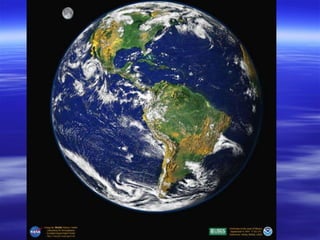
Meteorology Air Masses, Fronts, and Weather
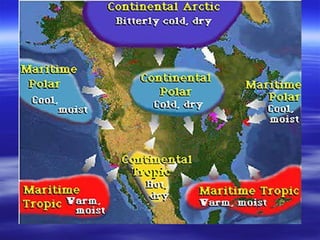
What is an air mass? 10.  Air mass - A large region of the atmosphere where the air has similar properties throughout. Air masses get their properties from the region over which it forms.  For example, air over the Gulf of Mexico is above warm water so the water warms the air.  When air masses move they bring these conditions with them.
How do these air masses move?
Air masses are moved by global winds that tend to move from west to east.  Between 30° North Latitude and 60° North Latitude is the zone of  westerly winds .  Westerly winds  blow from the west.  What are lines of latitude?  Who can show me on the globe?
 
What happens if two air masses collide?
When air masses of different temperatures meet they do not mix together.  These air masses form a boundary between them called a front.  Fronts often cause rainy, unsettled weather.
5.  Weather  changes often occur at  fronts  where different air masses meet
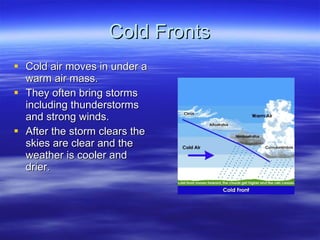
Cold Fronts Cold air moves in under a warm air mass. They often bring storms including thunderstorms and strong winds. After the storm clears the skies are clear and the weather is cooler and drier.
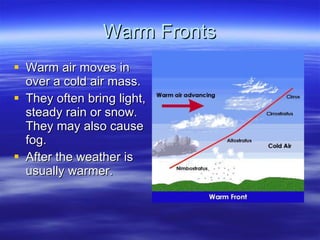
Warm Fronts Warm air moves in over a cold air mass. They often bring light, steady rain or snow.  They may also cause fog. After the weather is usually warmer.
VIDEO
Why are weather satellites so important?
Satellites in space allow us to see fronts and storms.  These satellites orbit the Earth and take pictures of weather patterns.  When fronts collide, scientists can see places where the weather may change quickly and dangerously.
 
Why is it so important that scientists are able to predict what the weather is going to be?

Airmasses

  • 1.
    Meteorology Air Masses,Fronts, and Weather
  • 2.
    What is anair mass? 10. Air mass - A large region of the atmosphere where the air has similar properties throughout. Air masses get their properties from the region over which it forms. For example, air over the Gulf of Mexico is above warm water so the water warms the air. When air masses move they bring these conditions with them.
  • 3.
    How do theseair masses move?
  • 4.
    Air masses aremoved by global winds that tend to move from west to east. Between 30° North Latitude and 60° North Latitude is the zone of westerly winds . Westerly winds blow from the west. What are lines of latitude? Who can show me on the globe?
  • 5.
  • 6.
    What happens iftwo air masses collide?
  • 7.
    When air massesof different temperatures meet they do not mix together. These air masses form a boundary between them called a front. Fronts often cause rainy, unsettled weather.
  • 8.
    5. Weather changes often occur at fronts where different air masses meet
  • 9.
    Cold Fronts Coldair moves in under a warm air mass. They often bring storms including thunderstorms and strong winds. After the storm clears the skies are clear and the weather is cooler and drier.
  • 10.
    Warm Fronts Warmair moves in over a cold air mass. They often bring light, steady rain or snow. They may also cause fog. After the weather is usually warmer.
  • 11.
  • 12.
    Why are weathersatellites so important?
  • 13.
    Satellites in spaceallow us to see fronts and storms. These satellites orbit the Earth and take pictures of weather patterns. When fronts collide, scientists can see places where the weather may change quickly and dangerously.
  • 14.
  • 15.
    Why is itso important that scientists are able to predict what the weather is going to be?