Air-Cured & Fermented Sausages
History
• Preservation method that employs curing,
fermenting, smoking/heating, drying, and storage
• Depending on terroir/geography, environment and
culture techniques and combinations vary
• Curing: mostly through the addition of salt and
nitrates; which prevent bacterial growth of
botulism. Curing also denatures protein,
rendering a raw meat product edible once dry
History
Fermentation: Aided by salt for controlled
growth of beneficial bacteria (i.e.
Lactobacilli)
Converts proteins into lactic acid, lowering
pH, reducing pathenogenic and spoilage
causing bacteria
Also adds to flavor from increased acidity, or
“tang”
History
• Fermentation also increases salt and acid
concentration during drying causing
reduced bacterial growth
• Typical process for fermented sausage
• Meat>Fat>Culture>Salt/Sugar/Spices/Nitr
ate
• Bactoferm: Acidification and Listeria
prevention, slow: <77 F, fast 95-115 F
History
• Fermentation
• Commercial starters began to be used in
1957
• Slow fermentation styles are more
european, require more humidity control
• Fast fermentation style is more american
like semi dry summer sausage & pizza
pepperoni
Commercial Starters
• Bactoferm T-SPX – “slow-fermented
culture for traditional fermentation profiles
applying fermentation temperatures not
higher than 24 C or 75 F.
• This culture is recommended for use with
slow long cured sausages, with sugar, and
low water content. Combination of 2
beneficial bacteria to enhance acidification
and color retention.
Commercial Starters
• Bactoferm F-LC – fast fermenting culture
for commercial fermentation/acidification
and prevention of Listeria. Works well at
higher fermentation/culturing
temperatures. Creates a more “American”
style product. Use dextrose instead of
traditional sugar to feed culture slowly.
• Combination of three beneficial bacteria
Commercial Starters
• Bactoferm LHP – fast fermenting culture
causes quick acidification in under 2 days
and is best used for thinner style
sausages. Dextrose is recommended for
slow feeding of starter.
Smoking/Heating
• In Northern Europe where humidity was
higher, cold smoking in tall drying facilities
was common
• Sausages like landjager, chorizo,
saucisse, saussicon sec, were cured for 2-
3 days and then cold smoked for several
weeks
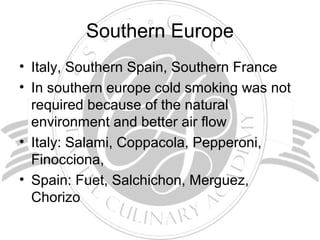
Southern Europe
• Italy, Southern Spain, Southern France
• In southern europe cold smoking was not
required because of the natural
environment and better air flow
• Italy: Salami, Coppacola, Pepperoni,
Finocciona,
• Spain: Fuet, Salchichon, Merguez,
Chorizo
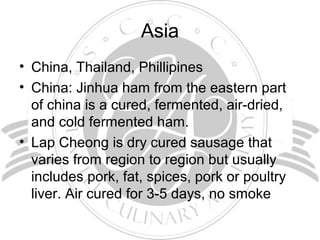
Asia
• China, Thailand, Phillipines
• China: Jinhua ham from the eastern part
of china is a cured, fermented, air-dried,
and cold fermented ham.
• Lap Cheong is dry cured sausage that
varies from region to region but usually
includes pork, fat, spices, pork or poultry
liver. Air cured for 3-5 days, no smoke
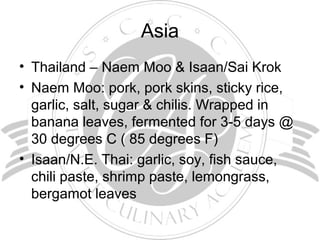
Asia
• Thailand – Naem Moo & Isaan/Sai Krok
• Naem Moo: pork, pork skins, sticky rice,
garlic, salt, sugar & chilis. Wrapped in
banana leaves, fermented for 3-5 days @
30 degrees C ( 85 degrees F)
• Isaan/N.E. Thai: garlic, soy, fish sauce,
chili paste, shrimp paste, lemongrass,
bergamot leaves
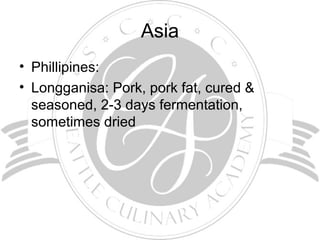
Asia
• Phillipines:
• Longganisa: Pork, pork fat, cured &
seasoned, 2-3 days fermentation,
sometimes dried
Controls
• Various controls reduce or slow bacterial
growth to prevent spoilage, pathenogenic,
and to slowly grow beneficial bacteria
• Bacteria that causes spoilage typically
leaves a slimy appearance, or off odors or
colors
• Pathenogenic bacteria grows from the
outside toward the interior of a sausage
and can cause illness or death
Controls
• Beneficial bacteria develops flavor and
reduces other bacterial growth through
increase in acid and lowering of pH where
pathenogenic bacteria do not grow well
Controls
• Time: reduce duration spent on processing at unsafe
temperature, control curing, fermentation, and drying
time
• Temperature: cold processing, and reduced exposure to
higher temperatures
• Acidity: through fermentation, or addition of acids, sugars
to change pH of product
• Moisture: maintain good level of humidity during
fermentation, adjust size of ground meat to aid in faster
evaporation, control humidity during drying process,
• Salt: controls osmosis, dehydration, denaturation
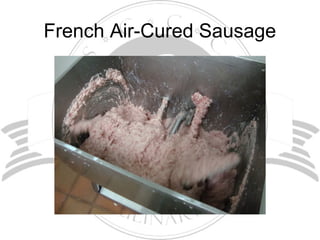
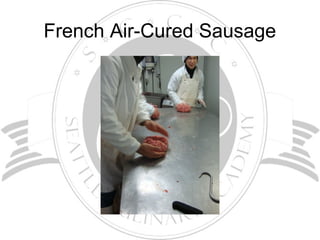
French Air-Cured Sausage
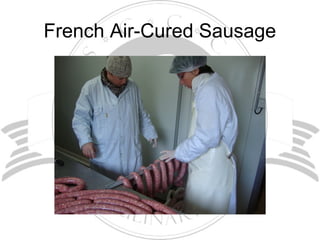
French Air Cured Sausage
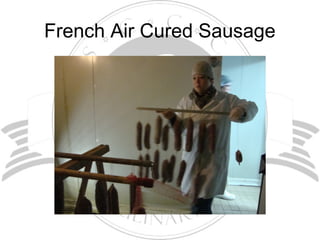
French Air-Cured Sausage
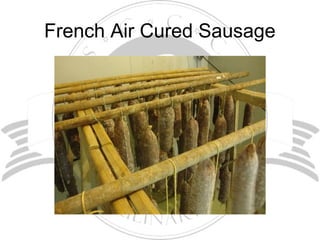
French Air Cured Sausage

Aircured sausages

  • 1.
  • 2.
    History • Preservation methodthat employs curing, fermenting, smoking/heating, drying, and storage • Depending on terroir/geography, environment and culture techniques and combinations vary • Curing: mostly through the addition of salt and nitrates; which prevent bacterial growth of botulism. Curing also denatures protein, rendering a raw meat product edible once dry
  • 3.
    History Fermentation: Aided bysalt for controlled growth of beneficial bacteria (i.e. Lactobacilli) Converts proteins into lactic acid, lowering pH, reducing pathenogenic and spoilage causing bacteria Also adds to flavor from increased acidity, or “tang”
  • 4.
    History • Fermentation alsoincreases salt and acid concentration during drying causing reduced bacterial growth • Typical process for fermented sausage • Meat>Fat>Culture>Salt/Sugar/Spices/Nitr ate • Bactoferm: Acidification and Listeria prevention, slow: <77 F, fast 95-115 F
  • 5.
    History • Fermentation • Commercialstarters began to be used in 1957 • Slow fermentation styles are more european, require more humidity control • Fast fermentation style is more american like semi dry summer sausage & pizza pepperoni
  • 6.
    Commercial Starters • BactofermT-SPX – “slow-fermented culture for traditional fermentation profiles applying fermentation temperatures not higher than 24 C or 75 F. • This culture is recommended for use with slow long cured sausages, with sugar, and low water content. Combination of 2 beneficial bacteria to enhance acidification and color retention.
  • 7.
    Commercial Starters • BactofermF-LC – fast fermenting culture for commercial fermentation/acidification and prevention of Listeria. Works well at higher fermentation/culturing temperatures. Creates a more “American” style product. Use dextrose instead of traditional sugar to feed culture slowly. • Combination of three beneficial bacteria
  • 8.
    Commercial Starters • BactofermLHP – fast fermenting culture causes quick acidification in under 2 days and is best used for thinner style sausages. Dextrose is recommended for slow feeding of starter.
  • 9.
    Smoking/Heating • In NorthernEurope where humidity was higher, cold smoking in tall drying facilities was common • Sausages like landjager, chorizo, saucisse, saussicon sec, were cured for 2- 3 days and then cold smoked for several weeks
  • 10.
    Southern Europe • Italy,Southern Spain, Southern France • In southern europe cold smoking was not required because of the natural environment and better air flow • Italy: Salami, Coppacola, Pepperoni, Finocciona, • Spain: Fuet, Salchichon, Merguez, Chorizo
  • 11.
    Asia • China, Thailand,Phillipines • China: Jinhua ham from the eastern part of china is a cured, fermented, air-dried, and cold fermented ham. • Lap Cheong is dry cured sausage that varies from region to region but usually includes pork, fat, spices, pork or poultry liver. Air cured for 3-5 days, no smoke
  • 12.
    Asia • Thailand –Naem Moo & Isaan/Sai Krok • Naem Moo: pork, pork skins, sticky rice, garlic, salt, sugar & chilis. Wrapped in banana leaves, fermented for 3-5 days @ 30 degrees C ( 85 degrees F) • Isaan/N.E. Thai: garlic, soy, fish sauce, chili paste, shrimp paste, lemongrass, bergamot leaves
  • 13.
    Asia • Phillipines: • Longganisa:Pork, pork fat, cured & seasoned, 2-3 days fermentation, sometimes dried
  • 14.
    Controls • Various controlsreduce or slow bacterial growth to prevent spoilage, pathenogenic, and to slowly grow beneficial bacteria • Bacteria that causes spoilage typically leaves a slimy appearance, or off odors or colors • Pathenogenic bacteria grows from the outside toward the interior of a sausage and can cause illness or death
  • 15.
    Controls • Beneficial bacteriadevelops flavor and reduces other bacterial growth through increase in acid and lowering of pH where pathenogenic bacteria do not grow well
  • 16.
    Controls • Time: reduceduration spent on processing at unsafe temperature, control curing, fermentation, and drying time • Temperature: cold processing, and reduced exposure to higher temperatures • Acidity: through fermentation, or addition of acids, sugars to change pH of product • Moisture: maintain good level of humidity during fermentation, adjust size of ground meat to aid in faster evaporation, control humidity during drying process, • Salt: controls osmosis, dehydration, denaturation
  • 17.
  • 18.
  • 19.
  • 20.
  • 21.
  • 22.
  • 23.