Sugar Valley Comp Sq
Civil Air Patrol
Matthew T. Phillips, Maj, CAP
Professional Development Officer, MER-NC-082
Mission Pilot and SET-qualified Mission
Observer
Observer
Training
The SQTR Process
 Every CAP Emergency Services qualification is awarded
following the completion of training objectives in a “Specialty
Qualification Training Record” (“SQTR,” pronounced ‘skeeter’)
 Prerequisites
 Familiarization and Preparatory Training
 Advanced Training
 Exercise Participation
 The tasks involved at each level are tracked in “OpsQuals,”
which is available in eServices (http://www.capnhq.gov/).
 Members frequently keep track of their training on paper
equivalents to the online system.
 YOU own your training.
Prerequisites
 General Emergency Services (Level 1 and CAPT 116)
 Mission Scanner
 Age Eligibility: 18 years
 Commander Approval
Mission Observer
Familiarization and Preparatory Training
 Use In-Flight Services (O-2010)
 Plot a Route on a Sectional Chart (O-2013)
 Prepare for a Trip to a Remote Mission Base (O-2107)
 Discuss Mission Observer Duties and Responsibilities (P-2007)
 Discuss the Dangers of Icing (P-2008)
 Discuss the Dangers of Reduced Visibility Conditions (P-2009)
 Discuss the Dangers of Wind and Thunderstorms (P-2010)
 Discuss the Effects of Density Altitude on Aircraft Performance
(P-2011)
 Identify Controlled and Special Use Airspace on a Sectional (P-
2012)
Mission Observer
Advanced Training
 IS100 (FEMA Course; see http://bit.ly/capescourses)
 IS700 (FEMA Course)
 Aicraft Ground Handling
 O-2002: Operate the Aircraft Radios
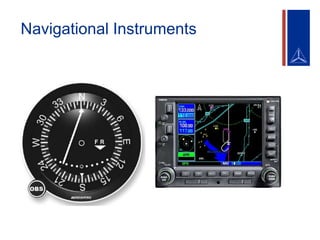
 O-2011: Operate the VOR and DME
 O-2012: Operate the GPS
 O-2108: Assist in ELT Searches
 O-2109: Assist in Planning and Performing a Route Search
 O-2110: Assist in Planning and Performing a Parallel Search
 O-2112: Assist in Planning and Performing Point Based Searches
 O-2115: Assist in Planning and Performing a Creeping Line Search
Mission Observer
Observer Resources
 National Emergency Services Academy / Mission Aircrew
School
http://nesa.cap.gov/mas-curriculum-2
 Mission Aircrew Reference Text: Volume II – Mission
Pilot/Mission Observer
http://bit.ly/mo-reference
 Operational Mission Inflight Guide
http://bit.ly/inflight-guide
Links updated 13 June 2014
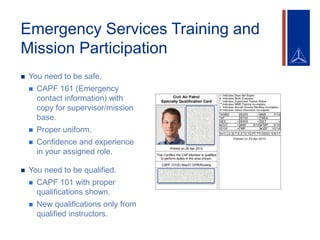
Emergency Services Training and
Mission Participation
 You need to be safe.
 CAPF 161 (Emergency
contact information) with
copy for supervisor/mission
base.
 Proper uniform.
 Confidence and experience
in your assigned role.
 You need to be qualified.
 CAPF 101 with proper
qualifications shown.
 New qualifications only from
qualified instructors.
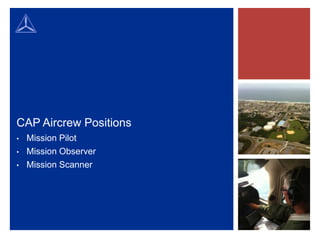
CAP Aircrew Positions
• Mission Pilot
• Mission Observer
• Mission Scanner
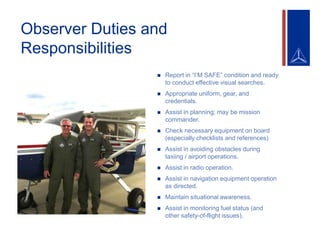
Observer Duties and
Responsibilities
 Report in “I’M SAFE” condition and ready
to conduct effective visual searches.
 Appropriate uniform, gear, and
credentials.
 Assist in planning; may be mission
commander.
 Check necessary equipment on board
(especially checklists and references)
 Assist in avoiding obstacles during
taxiing / airport operations.
 Assist in radio operation.
 Assist in navigation equipment operation
as directed.
 Maintain situational awareness.
 Assist in monitoring fuel status (and
other safety-of-flight issues).
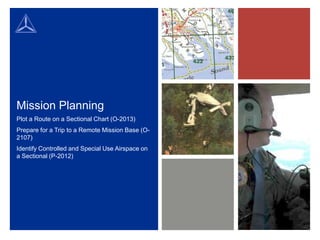
Mission Planning
Plot a Route on a Sectional Chart (O-2013)
Prepare for a Trip to a Remote Mission Base (O-
2107)
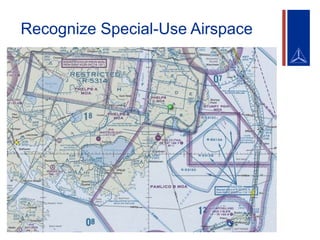
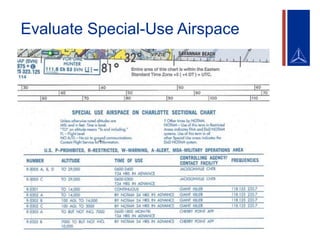
Identify Controlled and Special Use Airspace on
a Sectional (P-2012)
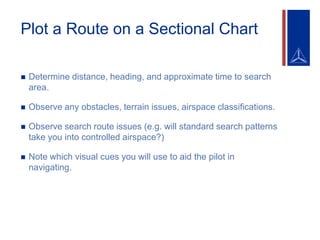
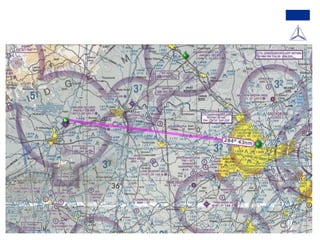
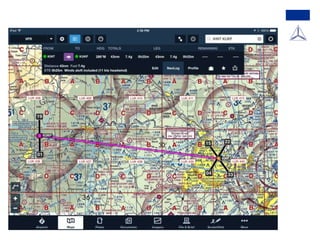
Plot a Route on a Sectional Chart
 Determine distance, heading, and approximate time to search
area.
 Observe any obstacles, terrain issues, airspace classifications.
 Observe search route issues (e.g. will standard search patterns
take you into controlled airspace?)
 Note which visual cues you will use to aid the pilot in
navigating.
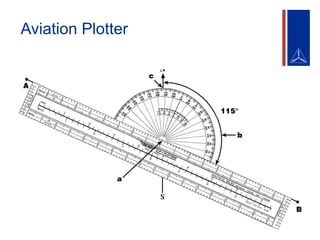
Aviation Plotter
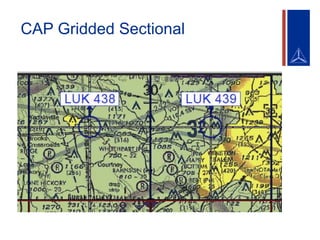
CAP Gridded Sectional
Recognize Special-Use Airspace
Evaluate Special-Use Airspace
Prepare for Trip to Remote Base
 Try to always have in a mission-ready bag:
 Uniform (incl. change of t-shirts, etc.)
 Credentials (PIC must certify to IC/FRO): FAA, Medical, CAPF 101,
CAPF 161, Driver License (state and CAP), SQTRs.
 Planning supplies (sectionals, plotter, pens/pencils/highlighters,
extra paper, log forms, CAPF 104)
 Personal equipment: headset, snacks, water, money
 Cell phone (turned off in flight!)
 Charts for mission areas
 Road maps for mission areas
 Back up the pilot: pre-flight inspections, weight-and-balance,
ORM analysis.
Weather and Hazards to Flight
Discuss the Dangers of Icing (P-2008)
Discuss the Dangers of Reduced Visibility Conditions (P-2009)
Discuss the Dangers of Wind and Thunderstorms (P-2010)
Discuss the Effects of Density Altitude on Aircraft Performance (P-2011)
Use In-Flight Services (O-2010)
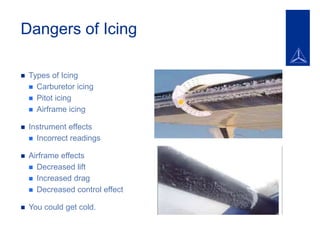
Dangers of Icing
 Types of Icing
 Carburetor icing
 Pitot icing
 Airframe icing
 Instrument effects
 Incorrect readings
 Airframe effects
 Decreased lift
 Increased drag
 Decreased control effect
 You could get cold.
Reduced Visibility and Turbulence
 Reduced visibility makes it harder to see directly and indirectly.
 Items outside the aircraft are obscured.
 Looking into reduced visibility conditions tends to cause accelerated
eye fatigue.
 Identifying hazards to flight is more difficult.
 Turbulence is a disturbance in air patterns. Except in extreme
conditions, it is not unsafe…
 UNLESS it makes aircrew uncomfortable or nauseous,
compromising effectiveness.
 Do not try to be a hero.
 Any adverse weather requires heightened vigilance by all
aircrew.
Dangers of Wind and
Thunderstorms
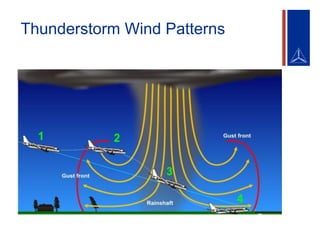
 Control of aircraft, especially by crosswinds (particular danger
during takeoff and landing).
 Compromised airspeed (rapid wind changes around the aircraft
can cause loss of control or stall).
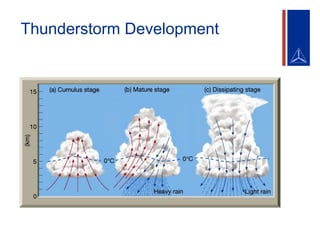
 Downdrafts can cause aircraft to lose altitude (see
development of thunderstorms on next slide).
Thunderstorm Development
Thunderstorm Wind Patterns
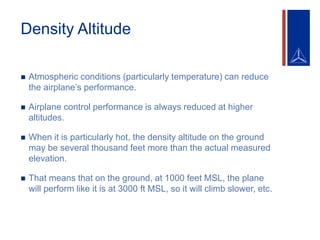
Density Altitude
 Atmospheric conditions (particularly temperature) can reduce
the airplane’s performance.
 Airplane control performance is always reduced at higher
altitudes.
 When it is particularly hot, the density altitude on the ground
may be several thousand feet more than the actual measured
elevation.
 That means that on the ground, at 1000 feet MSL, the plane
will perform like it is at 3000 ft MSL, so it will climb slower, etc.
In-Flight Services
 Flight Service Stations (also
called for briefing before flight).
 Flight Watch (tune 122.0 and
call “Flight Watch”).
 Automatic Terminal Information
Service (ATIS).
 Hazardous In-Flight Weather
Advisory Service (HIWAS).
 Pilot Reports (PIREP).
What to Expect from Inflight Training
Advanced training tasks are the practical information you’ll need to perform
as a Mission Observer.
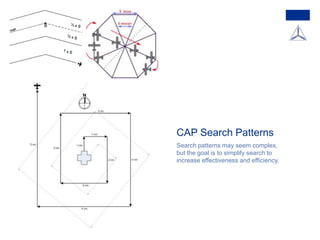
CAP Search Patterns
Search patterns may seem complex,
but the goal is to simplify search to
increase effectiveness and efficiency.
Navigational Instruments
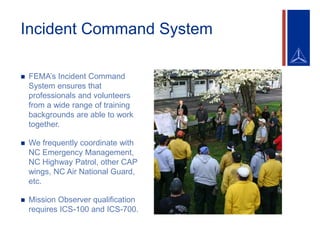
Incident Command System
 FEMA’s Incident Command
System ensures that
professionals and volunteers
from a wide range of training
backgrounds are able to work
together.
 We frequently coordinate with
NC Emergency Management,
NC Highway Patrol, other CAP
wings, NC Air National Guard,
etc.
 Mission Observer qualification
requires ICS-100 and ICS-700.
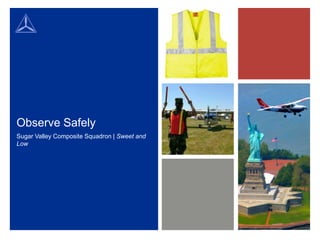
Observe Safely
Sugar Valley Composite Squadron | Sweet and
Low

Mission Observer Ground Training

  • 1.
    Sugar Valley CompSq Civil Air Patrol Matthew T. Phillips, Maj, CAP Professional Development Officer, MER-NC-082 Mission Pilot and SET-qualified Mission Observer Observer Training
  • 2.
    The SQTR Process Every CAP Emergency Services qualification is awarded following the completion of training objectives in a “Specialty Qualification Training Record” (“SQTR,” pronounced ‘skeeter’)  Prerequisites  Familiarization and Preparatory Training  Advanced Training  Exercise Participation  The tasks involved at each level are tracked in “OpsQuals,” which is available in eServices (http://www.capnhq.gov/).  Members frequently keep track of their training on paper equivalents to the online system.  YOU own your training.
  • 3.
    Prerequisites  General EmergencyServices (Level 1 and CAPT 116)  Mission Scanner  Age Eligibility: 18 years  Commander Approval Mission Observer
  • 4.
    Familiarization and PreparatoryTraining  Use In-Flight Services (O-2010)  Plot a Route on a Sectional Chart (O-2013)  Prepare for a Trip to a Remote Mission Base (O-2107)  Discuss Mission Observer Duties and Responsibilities (P-2007)  Discuss the Dangers of Icing (P-2008)  Discuss the Dangers of Reduced Visibility Conditions (P-2009)  Discuss the Dangers of Wind and Thunderstorms (P-2010)  Discuss the Effects of Density Altitude on Aircraft Performance (P-2011)  Identify Controlled and Special Use Airspace on a Sectional (P- 2012) Mission Observer
  • 5.
    Advanced Training  IS100(FEMA Course; see http://bit.ly/capescourses)  IS700 (FEMA Course)  Aicraft Ground Handling  O-2002: Operate the Aircraft Radios  O-2011: Operate the VOR and DME  O-2012: Operate the GPS  O-2108: Assist in ELT Searches  O-2109: Assist in Planning and Performing a Route Search  O-2110: Assist in Planning and Performing a Parallel Search  O-2112: Assist in Planning and Performing Point Based Searches  O-2115: Assist in Planning and Performing a Creeping Line Search Mission Observer
  • 6.
    Observer Resources  NationalEmergency Services Academy / Mission Aircrew School http://nesa.cap.gov/mas-curriculum-2  Mission Aircrew Reference Text: Volume II – Mission Pilot/Mission Observer http://bit.ly/mo-reference  Operational Mission Inflight Guide http://bit.ly/inflight-guide Links updated 13 June 2014
  • 7.
    Emergency Services Trainingand Mission Participation  You need to be safe.  CAPF 161 (Emergency contact information) with copy for supervisor/mission base.  Proper uniform.  Confidence and experience in your assigned role.  You need to be qualified.  CAPF 101 with proper qualifications shown.  New qualifications only from qualified instructors.
  • 8.
    CAP Aircrew Positions •Mission Pilot • Mission Observer • Mission Scanner
  • 9.
    Observer Duties and Responsibilities Report in “I’M SAFE” condition and ready to conduct effective visual searches.  Appropriate uniform, gear, and credentials.  Assist in planning; may be mission commander.  Check necessary equipment on board (especially checklists and references)  Assist in avoiding obstacles during taxiing / airport operations.  Assist in radio operation.  Assist in navigation equipment operation as directed.  Maintain situational awareness.  Assist in monitoring fuel status (and other safety-of-flight issues).
  • 10.
    Mission Planning Plot aRoute on a Sectional Chart (O-2013) Prepare for a Trip to a Remote Mission Base (O- 2107) Identify Controlled and Special Use Airspace on a Sectional (P-2012)
  • 11.
    Plot a Routeon a Sectional Chart  Determine distance, heading, and approximate time to search area.  Observe any obstacles, terrain issues, airspace classifications.  Observe search route issues (e.g. will standard search patterns take you into controlled airspace?)  Note which visual cues you will use to aid the pilot in navigating.
  • 12.
  • 15.
  • 16.
  • 17.
  • 18.
    Prepare for Tripto Remote Base  Try to always have in a mission-ready bag:  Uniform (incl. change of t-shirts, etc.)  Credentials (PIC must certify to IC/FRO): FAA, Medical, CAPF 101, CAPF 161, Driver License (state and CAP), SQTRs.  Planning supplies (sectionals, plotter, pens/pencils/highlighters, extra paper, log forms, CAPF 104)  Personal equipment: headset, snacks, water, money  Cell phone (turned off in flight!)  Charts for mission areas  Road maps for mission areas  Back up the pilot: pre-flight inspections, weight-and-balance, ORM analysis.
  • 19.
    Weather and Hazardsto Flight Discuss the Dangers of Icing (P-2008) Discuss the Dangers of Reduced Visibility Conditions (P-2009) Discuss the Dangers of Wind and Thunderstorms (P-2010) Discuss the Effects of Density Altitude on Aircraft Performance (P-2011) Use In-Flight Services (O-2010)
  • 20.
    Dangers of Icing Types of Icing  Carburetor icing  Pitot icing  Airframe icing  Instrument effects  Incorrect readings  Airframe effects  Decreased lift  Increased drag  Decreased control effect  You could get cold.
  • 21.
    Reduced Visibility andTurbulence  Reduced visibility makes it harder to see directly and indirectly.  Items outside the aircraft are obscured.  Looking into reduced visibility conditions tends to cause accelerated eye fatigue.  Identifying hazards to flight is more difficult.  Turbulence is a disturbance in air patterns. Except in extreme conditions, it is not unsafe…  UNLESS it makes aircrew uncomfortable or nauseous, compromising effectiveness.  Do not try to be a hero.  Any adverse weather requires heightened vigilance by all aircrew.
  • 22.
    Dangers of Windand Thunderstorms  Control of aircraft, especially by crosswinds (particular danger during takeoff and landing).  Compromised airspeed (rapid wind changes around the aircraft can cause loss of control or stall).  Downdrafts can cause aircraft to lose altitude (see development of thunderstorms on next slide).
  • 23.
  • 24.
  • 25.
    Density Altitude  Atmosphericconditions (particularly temperature) can reduce the airplane’s performance.  Airplane control performance is always reduced at higher altitudes.  When it is particularly hot, the density altitude on the ground may be several thousand feet more than the actual measured elevation.  That means that on the ground, at 1000 feet MSL, the plane will perform like it is at 3000 ft MSL, so it will climb slower, etc.
  • 26.
    In-Flight Services  FlightService Stations (also called for briefing before flight).  Flight Watch (tune 122.0 and call “Flight Watch”).  Automatic Terminal Information Service (ATIS).  Hazardous In-Flight Weather Advisory Service (HIWAS).  Pilot Reports (PIREP).
  • 27.
    What to Expectfrom Inflight Training Advanced training tasks are the practical information you’ll need to perform as a Mission Observer.
  • 28.
    CAP Search Patterns Searchpatterns may seem complex, but the goal is to simplify search to increase effectiveness and efficiency.
  • 29.
  • 30.
    Incident Command System FEMA’s Incident Command System ensures that professionals and volunteers from a wide range of training backgrounds are able to work together.  We frequently coordinate with NC Emergency Management, NC Highway Patrol, other CAP wings, NC Air National Guard, etc.  Mission Observer qualification requires ICS-100 and ICS-700.
  • 31.
    Observe Safely Sugar ValleyComposite Squadron | Sweet and Low