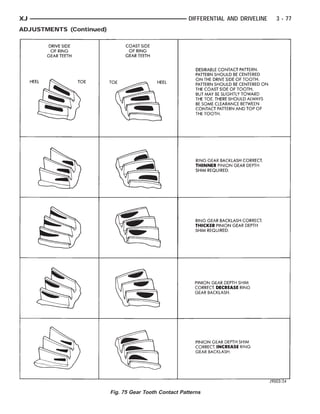
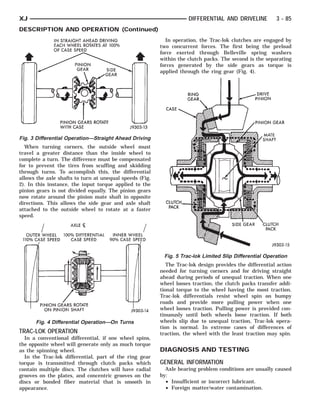
XJ                                                                                            DIFFERENTIAL AND DRIVELINE                3-1


                                  DIFFERENTIAL AND DRIVELINE
                                                               CONTENTS

                                                                   page                                                                  page

194 RBI AXLE . . . . . . . . . . . . . . . . . . . . . . . . . 47              PROPELLER SHAFTS . . . . . . . . . . . . . . . . . . . . . 1
8 1/4 REAR AXLE . . . . . . . . . . . . . . . . . . . . . . . 83               TUBE AND 181 FBI AXLE . . . . . . . . . . . . . . . . 15


                                                   PROPELLER SHAFTS

                                                                           INDEX
                                                                   page                                                                  page

GENERAL INFORMATION                                                              REAR PROPELLER SHAFT . . . . . . . . . . . . . . . .          6
  LUBRICATION . . . . . . . . . . . . . . . . . . . . . . . .      .   .   1   DISASSEMBLY AND ASSEMBLY
  PROPELLER SHAFT JOINT ANGLE . . . . . . . .                      .   .   2     DOUBLE CARDAN JOINT . . . . . . . . . . . . . . . . .         9
  PROPELLER SHAFT JOINTS . . . . . . . . . . . . .                 .   .   2     SINGLE CARDAN UNIVERSAL JOINT . . . . . . . .                 7
  PROPELLER SHAFTS . . . . . . . . . . . . . . . . . .             .   .   1   CLEANING AND INSPECTION
DIAGNOSIS AND TESTING                                                            PROPELLER SHAFT . . . . . . . . . . . . . . . . . . . .      12
  RUNOUT . . . . . . . . . . . . . . . . . . . . . . . . . . . .   .. 4        ADJUSTMENTS
  UNBALANCE . . . . . . . . . . . . . . . . . . . . . . . . .      .. 3          ADJUSTMENT AT AXLE WITH
  VIBRATION . . . . . . . . . . . . . . . . . . . . . . . . . .    .. 3            LEAF SPRINGS . . . . . . . . . . . . . . . . . . . . . .   12
SERVICE PROCEDURES                                                               FRONT AXLE ANGLE ADJUSTMENT . . . . . . . .                  13
  DRIVELINE ANGLE MEASUREMENT                                                  SPECIFICATIONS
    PREPARATION . . . . . . . . . . . . . . . . . . . . . .        .. 5          PROPELLER SHAFTS AND U–JOINTS . . . . . .                    14
  PROPELLER SHAFT ANGLE MEASUREMENT                                .. 5        SPECIAL TOOLS
REMOVAL AND INSTALLATION                                                         PROPELLER SHAFT . . . . . . . . . . . . . . . . . . . .      14
  FRONT PROPELLER SHAFT . . . . . . . . . . . . .                  .. 6

GENERAL INFORMATION                                                              Tubular propeller shafts are balanced by the man-
                                                                               ufacturer with weights spot welded to the tube.
PROPELLER SHAFTS                                                                 The propeller shaft is designed and built with the
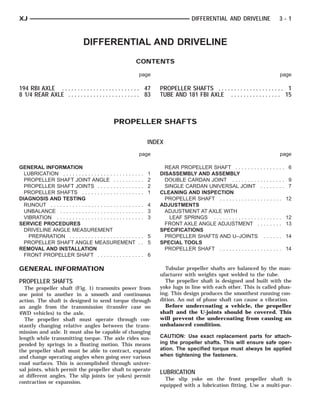
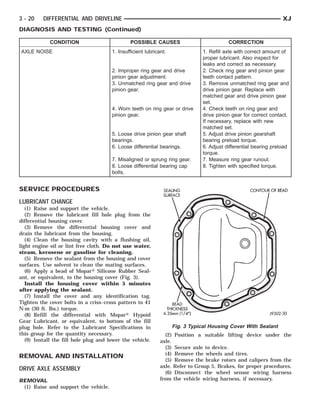
  The propeller shaft (Fig. 1) transmits power from                            yoke lugs in line with each other. This is called phas-
one point to another in a smooth and continuous                                ing. This design produces the smoothest running con-
action. The shaft is designed to send torque through                           dition. An out of phase shaft can cause a vibration.
an angle from the transmission (transfer case on                                 Before undercoating a vehicle, the propeller
4WD vehicles) to the axle.                                                     shaft and the U-joints should be covered. This
  The propeller shaft must operate through con-                                will prevent the undercoating from causing an
stantly changing relative angles between the trans-                            unbalanced condition.
mission and axle. It must also be capable of changing
length while transmitting torque. The axle rides sus-                          CAUTION: Use exact replacement parts for attach-
pended by springs in a floating motion. This means                             ing the propeller shafts. This will ensure safe oper-
the propeller shaft must be able to contract, expand                           ation. The specified torque must always be applied
and change operating angles when going over various                            when tightening the fasteners.
road surfaces. This is accomplished through univer-
sal joints, which permit the propeller shaft to operate
                                                                               LUBRICATION
at different angles. The slip joints (or yokes) permit
                                                                                 The slip yoke on the front propeller shaft is
contraction or expansion.
                                                                               equipped with a lubrication fitting. Use a multi-pur-
REAR AXLE            REAR PROPELLER SHAFT
                                  STRAP BOOT           STRAP                            TRANSFER CASE
                                                                                                   FRONT LER SHAFT
                                                                                                           PROPEL-
                                                                                                                 FRONT
                                                                                                                    AXLE


3-2       DIFFERENTIAL AND DRIVELINE                                                                                XJ
GENERAL INFORMATION (Continued)


                                    Fig. 1 Front & Rear Propeller Shafts—4WD
pose NLGI Grade 2 EP lubricant. The factory                      • Angles that are equal or opposite within 1
installed universal joints are lubricated for the life of      degree of each other.
the vehicle and do not need lubrication. All universal           • Have a 3 degree maximum operating angle.
joints should be inspected for leakage and damage                • Have at least a 1/2 degree continuous operating
each time the vehicle is serviced. If seal leakage or          (propeller shaft) angle.
damage exists, the universal joint should be replaced.           Engine speed (rpm) is the main factor in determin-
Refer to Group 0, Lubrication and Maintenance, for             ing the maximum allowable operating angle. As a
additional information.                                        guide to the maximum normal operating angles refer
                                                               to (Fig. 2).
PROPELLER SHAFT JOINT ANGLE
  When two shafts come together at a common joint,                PROPELLER SHAFT            MAX. NORMAL
the bend that is formed is called the operating angle.                 R.P.M.              OPERATING ANGLES
The larger the angle, the larger the amount of accel-                   5000                       3°
eration and deceleration of the joint. This speeding                    4500                       3°
up and slowing down of the joint must be cancelled                      4000                       4°
to produce a smooth power flow. This is done through                    3500                       5°
the phasing of a propeller shaft and ensuring that                      3000                       5°
the proper propeller shaft joint working angles are                     2500                       7°
maintained.                                                             2000                       8°
  A propeller shaft is properly phased when the yoke                    1500                      11°
ends are in the same plane, or in line. A twisted
shaft will make the yokes out of phase and cause a
                                                                   Fig. 2 Maximum Angles And Engine Speed
noticeable vibration.
  When taking propeller shaft joint angle measure-             PROPELLER SHAFT JOINTS
ments, or checking the phasing, of two piece shafts,             Two different types of propeller shaft joints are
consider each shaft separately.                                used:
  Ideally the driveline system should have;                      • Single cardan universal joint (Fig. 3).
NEEDLE BEARING RETAINER
       RETAININGYOKE
        5. THRUST WASHER
        4. SCOKET BEARINGS
        3. SOCKETCAP
        2. LINK SPIDER
        1.BEARINGSEAL
           NEEDLE BEARING
                 YOKE
                   CLIP
                    BALL
                    SPRING                     6. SEAL SPIDER
                                               10.
                                               9. REAR
                                               8. BEARINGBALL
                                               7. SOCKET YOKE
                                                          CAP                  15. DRIVE SPIDER
                                                                               14. THRUST
                                                                               13. NEEDLE WASHER
                                                                               12. FRONT SHAFT YOKE
                                                                               11. RETAINING CLIP


XJ                                                                           DIFFERENTIAL AND DRIVELINE          3-3
GENERAL INFORMATION (Continued)
   • Double cardan (CV) universal joint (Fig. 4).               DIAGNOSIS AND TESTING
   None of the universal joints are servicible. If one
becomes worn or damaged, the complete universal                 VIBRATION
joint assembly must be replaced.                                   Tires that are out-of-round, or wheels that are
                                                                unbalanced, will cause a low frequency vibration.
                                                                Refer to Group 22, Tires and Wheels, for additional
                                                                information.
                                                                   Brake drums that are unbalanced will cause a
                                                                harsh, low frequency vibration. Refer to Group 5,
                                                                Brakes, for additional information.
                                                                   Driveline vibration can also result from loose or
                                                                damaged engine mounts. Refer to Group 9, Engines,
                                                                for additional information.
                                                                   Propeller shaft vibration increases as the vehicle
                                                                speed is increased. A vibration that occurs within a
                                                                specific speed range is not usually caused by a pro-
                                                                peller shaft being unbalanced. Defective universal
                                                                joints, or an incorrect propeller shaft angle, are usu-
                                                                ally the cause of such a vibration.

                                                                UNBALANCE
                                                                NOTE: Removing and re-indexing the propeller
                                                                shaft 180° relative to the yoke may eliminate some
                                                                vibrations.

        Fig. 3 Single Cardan Universal Joint


                                  Fig. 4 Double Cardan (CV) Universal Joint
CLAMP                SCREWDRIVER


3-4     DIFFERENTIAL AND DRIVELINE                                                                                  XJ
DIAGNOSIS AND TESTING (Continued)
                                           DRIVELINE VIBRATION

          Drive Condition                       Possible Cause                               Correction
PROPELLER SHAFT                       a. Undercoating or other foreign        a. Clean exterior of shaft and wash
                                      material on shaft.                      with solvent.
                                      b. Loose U-joint clamp screws.          b. Tighten screws properly.
                                      c. Loose or bent U-joint yoke or        c. Install replacement yoke.
                                      excessive runout.
                                      d. Incorrect drive line angularity.     d. Correct angularity.
                                      e. Rear spring center bolt not in       e. Loosen spring U-bolts and seat
                                      seat.                                   center bolts.
                                      f. Worn U-joint bearings.               f. Replace U-joint.
                                      g. Propeller shaft damaged (bent        g. Install replacement propeller
                                      tube) or out of balance.                shaft.
                                      h. Broken rear spring.                  h. Replace rear spring.
                                      i. Excessive runout or unbalanced       i. Reindex propeller shaft 180°, test
                                      condition.                              and correct as necessary.
                                      j. Excessive drive pinion gear shaft    j. Reindex propeller shaft 180° and
                                      yoke runout.                            evaluate.
UNIVERSAL JOINT NOISE                 a. U-joint clamp screws loose.          a. Tighten screws with specified
                                                                              torque.
                                      b. Lack of lubrication.                 Replace U-joint.

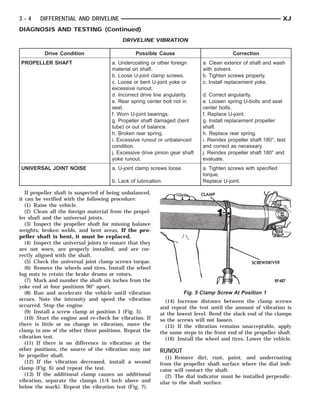
   If propeller shaft is suspected of being unbalanced,
it can be verified with the following procedure:
   (1) Raise the vehicle.
   (2) Clean all the foreign material from the propel-
ler shaft and the universal joints.
   (3) Inspect the propeller shaft for missing balance
weights, broken welds, and bent areas. If the pro-
peller shaft is bent, it must be replaced.
   (4) Inspect the universal joints to ensure that they
are not worn, are properly installed, and are cor-
rectly aligned with the shaft.
   (5) Check the universal joint clamp screws torque.
   (6) Remove the wheels and tires. Install the wheel
lug nuts to retain the brake drums or rotors.
   (7) Mark and number the shaft six inches from the
yoke end at four positions 90° apart.
   (8) Run and accelerate the vehicle until vibration                  Fig. 5 Clamp Screw At Position 1
occurs. Note the intensity and speed the vibration            (14) Increase distance between the clamp screws
occurred. Stop the engine.                                  and repeat the test until the amount of vibration is
   (9) Install a screw clamp at position 1 (Fig. 5).        at the lowest level. Bend the slack end of the clamps
   (10) Start the engine and re-check for vibration. If     so the screws will not loosen.
there is little or no change in vibration, move the           (15) If the vibration remains unacceptable, apply
clamp to one of the other three positions. Repeat the       the same steps to the front end of the propeller shaft.
vibration test.                                               (16) Install the wheel and tires. Lower the vehicle.
   (11) If there is no difference in vibration at the
other positions, the source of the vibration may not        RUNOUT
be propeller shaft.                                           (1) Remove dirt, rust, paint, and undercoating
   (12) If the vibration decreased, install a second        from the propeller shaft surface where the dial indi-
clamp (Fig. 6) and repeat the test.                         cator will contact the shaft.
   (13) If the additional clamp causes an additional          (2) The dial indicator must be installed perpendic-
vibration, separate the clamps (1/4 inch above and          ular to the shaft surface.
below the mark). Repeat the vibration test (Fig. 7).
⁄ INCH
                             12                             SLIP YOKE BEARING CAP               SPECIAL   TOOL
                                                                                                             (J-23498A)
                                                                                                                   7663


XJ                                                                        DIFFERENTIAL AND DRIVELINE            3-5
DIAGNOSIS AND TESTING (Continued)
                                                           SERVICE PROCEDURES
                                                           DRIVELINE ANGLE MEASUREMENT PREPARATION
                                                             Before measuring universal joint angles, the fol-
                                                           lowing must be done;
                                                             • Inflate all tires to correct pressure.
                                                             • Check the angles in the same loaded or
                                                           unloaded condition as when the vibration occurred.
                                                           Propeller shaft angles change according to the
                                                           amount of load in the vehicle.
                                                             • Check the condition of all suspension compo-
                                                           nents and verify all fasteners are torqued to specifi-
                                                           cations.
                                                             • Check the condition of the engine and transmis-
                                                           sion mounts and verify all fasteners are torqued to
                                                           specifications.
  Fig. 6 Two Clamp Screws At The Same Position
                                                           PROPELLER SHAFT ANGLE MEASUREMENT
                                                             To accurately check driveline alignment, raise and
                                                           support the vehicle at the axles as level as possible.
                                                           Allow the wheels and propeller shaft to turn. Remove
                                                           any external bearing snap rings (if equipped) from
                                                           universal joint so that the inclinometer base sits flat.
                                                             (1) Rotate the shaft until transmission/transfer
                                                           case output yoke bearing cap is facing downward.
                                                             Always make measurements from front to
                                                           rear.
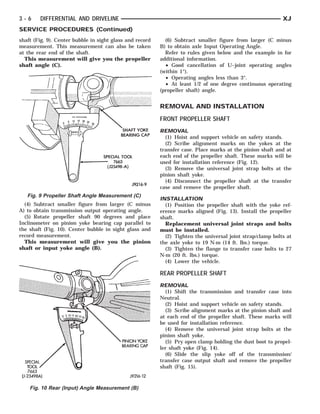
                                                             (2) Place Inclinometer on yoke bearing cap (A) par-
                                                           allel to the shaft (Fig. 8). Center bubble in sight glass
                                                           and record measurement.
                                                             This measurement will give you the transmis-
                                                           sion or Output Yoke Angle (A).

          Fig. 7 Clamp Screws Separated
  (3) Measure runout at the center and ends of the
shaft sufficiently far away from weld areas to ensure
that the effects of the weld process will not enter into
the measurements.
  (4) Refer to Runout Specifications chart.
  (5) Replace the propeller shaft if the runout
exceeds the limit.
           RUNOUT SPECIFICATIONS

Front of shaft               0.010 in. (0.25 mm)
Center of shaft              0.015 in. (0.38 mm)
Rear of shaft                0.010 in. (0.25 mm)
NOTE: Measure front/rear runout approximately 3
inches (76 mm) from the weld seam at each end of
the shaft tube for tube lengths over 30 inches. Under
30 inches the max. runout is 0.20 inch for full length
of the tube.

                                                              Fig. 8 Front (Output) Angle Measurement (A)
                                                             (3) Rotate propeller shaft 90 degrees and place
                                                           Inclinometer on yoke bearing cap parallel to the
SPECIAL   TOOL
             (J-23498A)
                   7663          PINION YOKE BEARING CAP7663
                                 SHAFT YOKE BEARING CAP
                                      SPECIAL   TOOL
                                                   (J23498–A)


3-6       DIFFERENTIAL AND DRIVELINE                                                                              XJ
SERVICE PROCEDURES (Continued)
shaft (Fig. 9). Center bubble in sight glass and record           (6) Subtract smaller figure from larger (C minus
measurement. This measurement can also be taken                 B) to obtain axle Input Operating Angle.
at the rear end of the shaft.                                     Refer to rules given below and the example in for
  This measurement will give you the propeller                  additional information.
shaft angle (C).                                                  • Good cancellation of U–joint operating angles
                                                                (within 1°).
                                                                  • Operating angles less than 3°.
                                                                  • At least 1/2 of one degree continuous operating
                                                                (propeller shaft) angle.


                                                                REMOVAL AND INSTALLATION
                                                                FRONT PROPELLER SHAFT
                                                                REMOVAL
                                                                  (1) Hoist and support vehicle on safety stands.
                                                                  (2) Scribe alignment marks on the yokes at the
                                                                transfer case. Place marks at the pinion shaft and at
                                                                each end of the propeller shaft. These marks will be
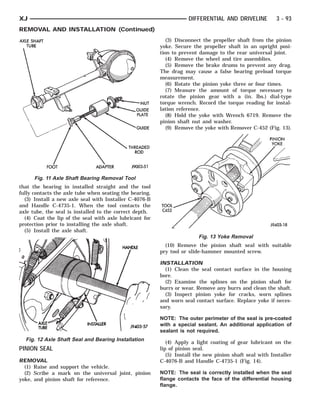
                                                                used for installation reference (Fig. 12).
                                                                  (3) Remove the universal joint strap bolts at the
                                                                pinion shaft yoke.
                                                                  (4) Disconnect the propeller shaft at the transfer
                                                                case and remove the propeller shaft.
   Fig. 9 Propeller Shaft Angle Measurement (C)
                                                                INSTALLATION
  (4) Subtract smaller figure from larger (C minus                (1) Position the propeller shaft with the yoke ref-
A) to obtain transmission output operating angle.               erence marks aligned (Fig. 13). Install the propeller
  (5) Rotate propeller shaft 90 degrees and place               shaft.
Inclinometer on pinion yoke bearing cap parallel to               Replacement universal joint straps and bolts
the shaft (Fig. 10). Center bubble in sight glass and           must be installed.
record measurement.                                               (2) Tighten the universal joint strap/clamp bolts at
  This measurement will give you the pinion                     the axle yoke to 19 N·m (14 ft. lbs.) torque.
shaft or input yoke angle (B).                                    (3) Tighten the flange to transfer case bolts to 27
                                                                N·m (20 ft. lbs.) torque.
                                                                  (4) Lower the vehicle.

                                                                REAR PROPELLER SHAFT
                                                                REMOVAL
                                                                  (1) Shift the transmission and transfer case into
                                                                Neutral.
                                                                  (2) Hoist and support vehicle on safety stands.
                                                                  (3) Scribe alignment marks at the pinion shaft and
                                                                at each end of the propeller shaft. These marks will
                                                                be used for installation reference.
                                                                  (4) Remove the universal joint strap bolts at the
                                                                pinion shaft yoke.
                                                                  (5) Pry open clamp holding the dust boot to propel-
                                                                ler shaft yoke (Fig. 14).
                                                                  (6) Slide the slip yoke off of the transmission/
                                                                transfer case output shaft and remove the propeller
                                                                shaft (Fig. 15).


    Fig. 10 Rear (Input) Angle Measurement (B)
FRONT AXLE CLAMP BOOT (C) PROPELLER =4.9°
   YOKE   Output Yoke
                   Transmission OutputShaft (A) 3.0° −3.0° Horizontal Level AngleAmountOutputOperatingInputShaft MARKS Input Yoke
                             (A) Prop. Angle =
                                 Output Operating Angle CV-JOINT TRANSFER CASE Trans. Input Operating Angle−1.7° 4.9° 3.2° −3.2°
                                  3.0° SHAFT
                                         Yoke           4.9°
                                                        1.9°
                                                          or           SLINGER (C)
                                                                       4.9° BOOT Axle of U-Joint(B) 3.2° Angle 1.9° =Angle 1.7°
                                                                                                AxleProp. Operating
                                                                                                (C) Axle Input 0.2°
                                                                                                orREFERENCE =
                                                                                                 Cancellation (B)
                                                                                                       Angle Yoke              4.9°


XJ                                                                                                          DIFFERENTIAL AND DRIVELINE   3-7
REMOVAL AND INSTALLATION (Continued)


                                                      Fig. 11 Universal Joint Angle Example


                 Fig. 12 Front Propeller Shaft                                                        Fig. 13 Reference Marks on Yokes
INSTALLATION                                                                               (4) Lower the vehicle.
  (1) Slide the slip yoke on the transmission/transfer
case output shaft. Align the installation reference                                     DISASSEMBLY AND ASSEMBLY
marks at the axle yoke and install the propeller shaft
(Fig. 15).                                                                              SINGLE CARDAN UNIVERSAL JOINT
  Replacement universal joint straps and bolts
must be installed.                                                                      DISASSEMBLY
  (2) Tighten the universal joint strap/clamp bolts at                                    Individual components of cardan universal joints
the axle yoke to 19 N·m (14 ft. lbs.) torque.                                           are not serviceable. If worn or leaking, they must be
  (3) Crimp clamp to hold dust boot to propeller                                        replaced as an assembly.
shaft yoke (Fig. 16).                                                                     (1) Remove the propeller shaft.
SPECIAL SHAFT TRANSFER CASE BOOT PROPELLER AWL
    BOOT C-4975–A CLAMPSLINGER
     OUTPUT TOOL
       SLINGER               YOKECLAMP
                                  BOOT     SHAFT
                                             CLAMP   AXLE YOKE        SNAP RING SOCKET       PRESS


3-8     DIFFERENTIAL AND DRIVELINE                                                                                 XJ
DISASSEMBLY AND ASSEMBLY (Continued)


               Fig. 14 Dust Boot Clamp

                                                                               Fig. 17 Remove Snap Ring
                                                                   (4) Set the yoke in an arbor press or vise with a
                                                                 socket whose inside diameter is large enough to
                                                                 receive the bearing cap positioned beneath the yoke.
                                                                   (5) Position the yoke with the grease fitting, if
                                                                 equipped, pointing up.
                                                                   (6) Place a socket with an outside diameter
                                                                 smaller than the upper bearing cap on the upper
                                                                 bearing cap and press the cap through the yoke to
                                                                 release the lower bearing cap (Fig. 18).


             Fig. 15 Rear Propeller Shaft


    Fig. 16 Crimping Dust Boot Clamp—Typical                                   Fig. 18 Press Out Bearing
  (2) Using a soft drift, tap the outside of the bear-             (7) If the bearing cap will not pull out of the yoke
ing cap assembly to loosen snap ring.                            by hand after pressing, tap the yoke ear near the
  (3) Remove snap rings from both sides of yoke                  bearing cap to dislodge the cap.
(Fig. 17).
BEARING CAP
                                                    CROSS      BEARING CAP                 CROSS    TRUNNION   YOKE


XJ                                                                           DIFFERENTIAL AND DRIVELINE               3-9
DISASSEMBLY AND ASSEMBLY (Continued)
  (8) To remove the opposite bearing cap, turn the
yoke over and straighten the cross in the open hole.
Then, carefully press the end of the cross until the
remaining bearing cap can be removed (Fig. 19).

CAUTION: If the cross or bearing cap are not
straight during installation, the bearing cap will
score the walls of the yoke bore and damage can
occur.


                                                                             Fig. 20 Install Cross In Yoke


        Fig. 19 Press Out Remaining Bearing
ASSEMBLY
   (1) Apply extreme pressure (EP) N.L.G.I. Grade 1
or 2 grease to inside of yoke bores to aid in installa-
tion.
   (2) Position the cross in the yoke with its lube fit-
ting, if equipped, pointing up (Fig. 20).
   (3) Place a bearing cap over the trunnion and
align the cap with the yoke bore (Fig. 21). Keep the
needle bearings upright in the bearing assembly. A
needle bearing lying at the bottom of the cap will
prevent proper assembly.
   (4) Press the bearing cap into the yoke bore
enough to install a snap ring.                                        Fig. 21 Install Bearing On Trunnion
   (5) Install a snap ring.
   (6) Repeat Step 3 and Step 4 to install the oppo-         DOUBLE CARDAN JOINT
site bearing cap. If the joint is stiff or binding, strike
the yoke with a soft hammer to seat the needle bear-         DISASSEMBLY
ings.                                                          Individual components of cardan universal joints
   (7) Add grease to lube fitting, if equipped.              are not serviceable. If worn or leaking, they must be
   (8) Install the propeller shaft.                          replaced as an assembly.
                                                               (1) Remove the propeller shaft.
                                                               (2) Using a soft drift, tap the outside of the bear-
                                                             ing cap assembly to loosen snap ring.
3 - 10   DIFFERENTIAL AND DRIVELINE                                                                     XJ
DISASSEMBLY AND ASSEMBLY (Continued)
  (3) Remove all the bearing cap snap rings (Fig.        (6) Grasp the protruding bearing by vise jaws. Tap
22).                                                   the link yoke with a mallet and drift to dislodge the
                                                       bearing cap from the yoke (Fig. 24).


           Fig. 22 Remove Snap Rings
  (4) Set the joint in an arbor press or vise with a           Fig. 24 Remove Bearing From Yoke
socket whose inside diameter is large enough to
                                                         (7) Flip assembly and repeat Step 4, Step 5, and
receive the bearing cap positioned beneath the link
                                                       Step 6 to remove the opposite bearing cap. This will
yoke.
                                                       then allow removal of the cross centering kit assem-
  (5) Place a socket with an outside diameter
                                                       bly and spring (Fig. 25).
smaller than the upper bearing cap on the upper
bearing cap and partially press one bearing cap from
the outboard side of the link yoke enough to grasp
the bearing cap with vise jaws (Fig. 23). Be sure to
remove grease fittings that interfere with removal.


                                                                  Fig. 25 Remove Centering Kit
                                                         (8) Press the remaining bearing caps out the other
                                                       end of the link yoke as described above to complete
                                                       the disassembly.

            Fig. 23 Press Out Bearing
XJ                                                                   DIFFERENTIAL AND DRIVELINE        3 - 11
DISASSEMBLY AND ASSEMBLY (Continued)
ASSEMBLY                                                    (4) Press the bearing cap into the yoke bore
   During assembly, ensure that the alignment             enough to install a snap ring (Fig. 28).
marks on the link yoke and propeller shaft                  (5) Install a snap ring.
yoke are aligned.
   (1) Apply extreme pressure (EP) N.L.G.I. Grade 1
or 2 grease to inside of yoke bores to aid in installa-
tion.
   (2) Fit a cross into the propeller shaft yoke (Fig.
26).


                                                                     Fig. 28 Press In Bearing Cap
                                                            (6) Flip the propeller shaft yoke and install the
                                                          bearing cap onto the opposite trunnion. Install a
            Fig. 26 Install Cross In Yoke                 snap ring (Fig. 29).

  (3) Place a bearing cap over the trunnion and
align the cap with the yoke bore (Fig. 27). Keep the
needle bearings upright in the bearing assembly. A
needle bearing lying at the bottom of the cap will
prevent proper assembly.


                                                                     Fig. 29 Press In Bearing Cap
                                                            (7) Fit the link yoke on the remaining two trun-
                                                          nions and press both bearing caps into place (Fig.
                                                          30).
             Fig. 27 Install Bearing Cap                    (8) Install snap rings.
3 - 12   DIFFERENTIAL AND DRIVELINE                                                                   XJ
DISASSEMBLY AND ASSEMBLY (Continued)


             Fig. 30 Install Link Yoke                          Fig. 32 Install Remaining Cross
   (9) Install the centering kit assembly inside the
link yoke making sure the spring is properly posi-
tioned (Fig. 31).


                                                                  Fig. 33 Press In Bearing Cap
                                                       CLEANING AND INSPECTION
            Fig. 31 Install Centering Kit              PROPELLER SHAFT
  (10) Place two bearing caps on opposite trunnions      (1) Clean all universal joint bores with cleaning
of the remaining cross. Fit the open trunnions into    solvent and a wire brush.
the link yoke bores and the bearing caps into the        (2) Inspect the yokes for distortion, cracks, and
centering kit (Fig. 32).                               worn bearing cap bores.
  (11) Press the remaining two bearing caps into
place and install snap rings (Fig. 33).                ADJUSTMENTS
  (12) Tap the snap rings to allow them to seat into
the grooves (Fig. 34).                                 ADJUSTMENT AT AXLE WITH LEAF SPRINGS
  (13) Check for proper assembly. Flex the joint
                                                         Adjust the pinion shaft angle at the springs with
beyond center, it should snap over-center in both
                                                       tapered shims (Fig. 36). Install tapered shims
directions when correctly assembled (Fig. 35).
                                                       between the springs and axle pad to correct the
  (14) Install the propeller shaft.
WEDGE
                                                                 SUSPENSION ARM                     SHIM


XJ                                                            DIFFERENTIAL AND DRIVELINE         3 - 13
ADJUSTMENTS (Continued)


                                                         Fig. 36 Angle Adjustment at Leaf Springs


        Fig. 34 Seat Snap Rings In Groove


                                                           Fig. 37 Front Axle Angle Adjustment


              Fig. 35 Check Assembly
angle. Refer to Group 2, Suspension, for additional
information.

FRONT AXLE ANGLE ADJUSTMENT
  Adjust the pinion gear angle at the lower suspen-
sion arms with shims (Fig. 37). Adding shims will
decrease the pinion gear shaft angle but will increase
the caster angle. The pinion gear shaft angle has pri-
ority over the caster angle. Refer to Group 2, Suspen-
sion, for additional information.
3 - 14     DIFFERENTIAL AND DRIVELINE                                                             XJ


SPECIFICATIONS                                                    SPECIAL TOOLS
PROPELLER SHAFTS AND U–JOINTS                                     PROPELLER SHAFT

DESCRIPTION                                        TORQUE
Bolts, Transfer Case Yoke . . . . . . 27 N·m (20 ft. lbs.)
Bolts, Axle Yoke . . . . . . . . . . . . . 19 N·m (14 ft. lbs.)


                                                                              Inclinometer—7663
XJ                                                                                                             DIFFERENTIAL AND DRIVELINE                            3 - 15


                                               TUBE AND 181 FBI AXLE

                                                                                           INDEX
                                                                                       page                                                                              page

GENERAL INFORMATION                                                                               HUB BEARING AND AXLE SHAFT . . . . . .                     .   .   .   .   24
  181 FBI AXLE . . . . . . . . . . . . . . .   . . . . . . . . . . . 15                           PINION GEAR . . . . . . . . . . . . . . . . . . . . .      .   .   .   .   30
  LUBRICANT SPECIFICATIONS .                   . . . . . . . . . . . 15                           PINION SHAFT SEAL . . . . . . . . . . . . . . . .          .   .   .   .   23
DESCRIPTION AND OPERATION                                                                         RING GEAR . . . . . . . . . . . . . . . . . . . . . . .    .   .   .   .   29
  STANDARD DIFFERENTIAL . . . .                . . . . . . . . . . . 16                           STEERING KNUCKLE AND BALL STUDS                            .   .   .   .   25
DIAGNOSIS AND TESTING                                                                             TUBE AXLE ASSEMBLY . . . . . . . . . . . . . .             .   .   .   .   21
  BEARING NOISE . . . . . . . . . . . .        .   .   .   .   .   .   .   .   .   .   .   17   DISASSEMBLY AND ASSEMBLY
  DRIVELINE SNAP . . . . . . . . . . .         .   .   .   .   .   .   .   .   .   .   .   17     FINAL ASSEMBLY . . . . . . . . . . . . . . . . . .         . . . . 34
  FRONT AXLES . . . . . . . . . . . . . .      .   .   .   .   .   .   .   .   .   .   .   18     STANDARD DIFFERENTIAL . . . . . . . . . . .                . . . . 34
  GEAR NOISE . . . . . . . . . . . . . . .     .   .   .   .   .   .   .   .   .   .   .   16   CLEANING AND INSPECTION
  GENERAL INFORMATION . . . . .                .   .   .   .   .   .   .   .   .   .   .   16     AXLE COMPONENTS . . . . . . . . . . . . . . .              . . . . 35
  LOW SPEED KNOCK . . . . . . . . .            .   .   .   .   .   .   .   .   .   .   .   17     CARDAN U-JOINT . . . . . . . . . . . . . . . . . .         . . . . 35
  VIBRATION . . . . . . . . . . . . . . . .    .   .   .   .   .   .   .   .   .   .   .   17   ADJUSTMENTS
SERVICE PROCEDURES                                                                                DIFFERENTIAL BEARING PRELOAD AND
  LUBRICANT CHANGE . . . . . . . .             . . . . . . . . . . . 20                             GEAR BACKLASH . . . . . . . . . . . . . . . . .          . . . . 38
REMOVAL AND INSTALLATION                                                                          GEAR CONTACT PATTERN ANALYSIS . .                          . . . . 41
  AXLE BUSHING REPLACEMENT                     ...         .   .   .   .   .   .   .   .   26     PINION GEAR DEPTH . . . . . . . . . . . . . . .            . . . . 35
  AXLE SHAFT OIL SEAL . . . . . . .            ...         .   .   .   .   .   .   .   .   29   SPECIFICATIONS
  AXLE SHAFT—CARDAN U-JOINT                     ..         .   .   .   .   .   .   .   .   22     181 FBI AXLE . . . . . . . . . . . . . . . . . . . . . .   . . . . 43
  DIFFERENTIAL SIDE BEARINGS                   ...         .   .   .   .   .   .   .   .   28     181 FBI AXLE . . . . . . . . . . . . . . . . . . . . . .   . . . . 43
  DIFFERENTIAL . . . . . . . . . . . . .       ...         .   .   .   .   .   .   .   .   26   SPECIAL TOOLS
  DRIVE AXLE ASSEMBLY . . . . . .              ...         .   .   .   .   .   .   .   .   20     181 FBI AXLE . . . . . . . . . . . . . . . . . . . . . .   . . . . 43

GENERAL INFORMATION                                                                                The 181 FBI axle has the assembly part number
                                                                                                and gear ratio listed on a tag. The tag is attached to
181 FBI AXLE                                                                                    the housing cover by a cover bolt. Build date identi-
  The 181 Front Beam-design Iron (FBI) axle con-                                                fication codes are stamped on the cover side of the
sists of a cast iron differential housing with axle                                             axle shaft tube.
shaft tubes extending from either side. The tubes are                                              The differential case is a one–piece design. The dif-
pressed into the differential housing and welded.                                               ferential pinion mate shaft is retained with a roll
  The integral type housing, hypoid gear design has                                             pin. Differential bearing preload and ring gear back-
the centerline of the pinion set above the centerline                                           lash is adjusted by the use of shims (select thick-
of the ring gear.                                                                               ness). The shims are located between the differential
  The axle has a fitting for a vent hose used to                                                bearing cones and case. Pinion bearing preload is set
relieve internal pressure caused by lubricant vapor-                                            and maintained by the use of shims (select thick-
ization and internal expansion.                                                                 ness).
  The axles are equipped with semi–floating axle
shafts, meaning that loads are supported by the hub                                             LUBRICANT SPECIFICATIONS
bearings. The axle shafts are retained by nuts at the                                             A multi–purpose, hypoid gear lubricant which con-
hub bearings. The hub bearings are bolted to the                                                forms to the following specifications should be used.
steering knuckle at the outboard end of the axle tube                                           Mopar௡ Hypoid Gear Lubricant conforms to all of
yoke. The hub bearings are serviced as an assembly.                                             these specifications.
  For vehicles with ABS brakes, the ABS wheel                                                     • The lubricant should have MIL–L–2105C and
speed sensors are attached to the knuckle assem-                                                API GL 5 quality specifications.
blies. The tone rings for the ABS system are pressed                                              • Lubricant is a thermally stable SAE 80W–90
onto the axle shaft. Do not damage ABS tone                                                     gear lubricant.
wheel or the sensor when removing axle shafts.                                                    • Lubricant for axles intended for heavy-duty or
  The stamped steel cover provides a means for                                                  trailer tow use is SAE 75W–140 SYNTHETIC gear
inspection and servicing the differential.                                                      lubricant.
WHEEL ROTATES AT 100% CASE
               IN STRAIGHTPINION GEAR OF EACHGEAR
                 PINION GEARS ROTATE WITH
                          AHEAD DRIVING SIDE
                                        SPEED
                                         CASE                          PINION GEARS ROTATE ON
                                                                                  PINION SHAFT
                                                                                      100% AXLE SPEED
                                                                                            DIFFERENTIAL
                                                                                             CASE
                                                           OUTER   WHEEL   110%    CASE                    INNER   WHEEL   90%    CASE
                                                                                  SPEED                                          SPEED


3 - 16    DIFFERENTIAL AND DRIVELINE                                                                                             XJ
GENERAL INFORMATION (Continued)
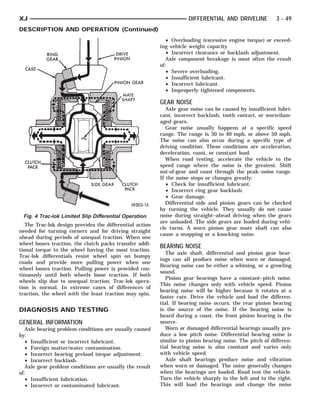
  The 181 FBI axle lubricant capacity is 1.48 L (3.13      2). In this instance, the input torque applied to the
pts.).                                                     pinion gears is not divided equally. The pinion gears
                                                           now rotate around the pinion mate shaft in opposite
CAUTION: If axle is submerged in water, lubricant          directions. This allows the side gear and axle shaft
must be replaced immediately to avoid possible             attached to the outside wheel to rotate at a faster
premature axle failure.                                    speed.


DESCRIPTION AND OPERATION
STANDARD DIFFERENTIAL
  The differential gear system divides the torque
between the axle shafts. It allows the axle shafts to
rotate at different speeds when turning corners.
  Each differential side gear is splined to an axle
shaft. The pinion gears are mounted on a pinion
mate shaft and are free to rotate on the shaft. The
pinion gear is fitted in a bore in the differential case
and is positioned at a right angle to the axle shafts.
  In operation, power flow occurs as follows:
  • The pinion gear rotates the ring gear.
  • The ring gear (bolted to the differential case)
rotates the case.                                                    Fig. 2 Differential Operation—On Turns
  • The differential pinion gears (mounted on the          DIAGNOSIS AND TESTING
pinion mate shaft in the case) rotate the side gears.
  • The side gears (splined to the axle shafts) rotate     GENERAL INFORMATION
the shafts.                                                   Axle bearing problem conditions are usually caused
  During straight-ahead driving, the differential pin-     by:
ion gears do not rotate on the pinion mate shaft. This        • Insufficient or incorrect lubricant.
occurs because input torque applied to the gears is           • Foreign matter/water contamination.
divided and distributed equally between the two side          • Incorrect bearing preload torque adjustment.
gears. As a result, the pinion gears revolve with the         • Incorrect backlash.
pinion mate shaft but do not rotate around it (Fig. 1).       Axle gear problem conditions are usually the result
                                                           of:
                                                              • Insufficient lubrication.
                                                              • Incorrect or contaminated lubricant.
                                                              • Overloading (excessive engine torque) or exceed-
                                                           ing vehicle weight capacity.
                                                              • Incorrect clearance or backlash adjustment.
                                                              Axle component breakage is most often the result
                                                           of:
                                                              • Severe overloading.
                                                              • Insufficient lubricant.
                                                              • Incorrect lubricant.
                                                              • Improperly tightened components.

                                                           GEAR NOISE
                                                             Axle gear noise can be caused by insufficient lubri-
                                                           cant, incorrect backlash, tooth contact, or worn/dam-
Fig. 1 Differential Operation—Straight Ahead Driving       aged gears.
  When turning corners, the outside wheel must               Gear noise usually happens at a specific speed
travel a greater distance than the inside wheel to         range. The range is 30 to 40 mph, or above 50 mph.
complete a turn. The difference must be compensated        The noise can also occur during a specific type of
for to prevent the tires from scuffing and skidding        driving condition. These conditions are acceleration,
through turns. To accomplish this, the differential        deceleration, coast, or constant load.
allows the axle shafts to turn at unequal speeds (Fig.
XJ                                                                    DIFFERENTIAL AND DRIVELINE          3 - 17
DIAGNOSIS AND TESTING (Continued)
   When road testing, accelerate the vehicle to the       pinion gear shaft bore will also cause low speed
speed range where the noise is the greatest. Shift        knock.
out-of-gear and coast through the peak–noise range.
If the noise stops or changes greatly:                    VIBRATION
   • Check for insufficient lubricant.                      Vibration at the rear of the vehicle is usually
   • Incorrect ring gear backlash.                        caused by a:
   • Gear damage.                                           • Damaged drive shaft.
   Differential side and pinion gears can be checked        • Missing drive shaft balance weight(s).
by turning the vehicle. They usually do not cause           • Worn or out–of–balance wheels.
noise during straight–ahead driving when the gears          • Loose wheel lug nuts.
are unloaded. The side gears are loaded during vehi-        • Worn U–joint(s).
cle turns. A worn pinion gear mate shaft can also           • Loose/broken springs.
cause a snapping or a knocking noise.                       • Damaged axle shaft bearing(s).
                                                            • Loose pinion gear nut.
BEARING NOISE                                               • Excessive pinion yoke run out.
   The axle shaft, differential and pinion gear bear-       • Bent axle shaft(s).
ings can all produce noise when worn or damaged.            Check for loose or damaged front–end components
Bearing noise can be either a whining, or a growling      or engine/transmission mounts. These components
sound.                                                    can contribute to what appears to be a rear–end
   Pinion gear bearings have a constant–pitch noise.      vibration. Do not overlook engine accessories, brack-
This noise changes only with vehicle speed. Pinion        ets and drive belts.
bearing noise will be higher because it rotates at a        All driveline components should be examined
faster rate. Drive the vehicle and load the differen-     before starting any repair.
tial. If bearing noise occurs, the rear pinion bearing      Refer to Group 22, Wheels and Tires, for additional
is the source of the noise. If the bearing noise is       vibration information.
heard during a coast, the front pinion bearing is the
source.                                                   DRIVELINE SNAP
   Worn or damaged differential bearings usually pro-       A snap or clunk noise when the vehicle is shifted
duce a low pitch noise. Differential bearing noise is     into gear (or the clutch engaged), can be caused by:
similar to pinion bearing noise. The pitch of differen-     • High engine idle speed.
tial bearing noise is also constant and varies only         • Loose engine/transmission/transfer case mounts.
with vehicle speed.                                         • Worn U–joints.
   Axle shaft bearings produce noise and vibration          • Loose spring mounts.
when worn or damaged. The noise generally changes           • Loose pinion gear nut and yoke.
when the bearings are loaded. Road test the vehicle.        • Excessive ring gear backlash.
Turn the vehicle sharply to the left and to the right.      • Excessive side gear/case clearance.
This will load the bearings and change the noise            The source of a snap or a clunk noise can be deter-
level. Where axle bearing damage is slight, the noise     mined with the assistance of a helper. Raise the vehi-
is usually not noticeable at speeds above 30 mph.         cle on a hoist with the wheels free to rotate. Instruct
                                                          the helper to shift the transmission into gear. Listen
LOW SPEED KNOCK                                           for the noise, a mechanics stethoscope is helpful in
 Low speed knock is generally caused by a worn            isolating the source of a noise.
U–joint or by worn side–gear thrust washers. A worn
3 - 18   DIFFERENTIAL AND DRIVELINE                                                                        XJ
DIAGNOSIS AND TESTING (Continued)
FRONT AXLES

                                           DIAGNOSIS

           CONDITION                   POSSIBLE CAUSES                            CORRECTION
WHEEL NOISE                    1. Wheel loose.                         1. Tighten loose nuts.
                               2. Faulty, brinelled wheel bearing.     2. Faulty or brinelled bearings must
                                                                       be replaced.
AXLE SHAFT NOISE               1. Misaligned axle shaft tube.          1. Inspect axle shaft tube alignment.
                                                                       Correct as necessary.
                               2. Bent or sprung axle shaft.           2. Replace bent or sprung axle
                                                                       shaft.
                               3. End play in drive pinion bearings.   3. Refer to Drive Pinion Bearing
                                                                       Pre-Load Adjustment.
                               4. Excessive gear backlash between      4. Check adjustment of ring gear
                               ring gear and pinion gear.              backlash and pinion gear. Correct as
                                                                       necessary.
                               5. Improper adjustment of drive         5. Adjust drive pinion shaft bearings.
                               pinion gear shaft bearings.
                               6. Loose drive pinion gearshaft yoke    6. Tighten drive pinion gearshaft
                               nut.                                    yoke nut with specified torque.
                               7. Improper wheel bearing               7. Readjust as necessary.
                               adjustment.
                               8. Scuffed gear tooth contact           8. If necessary, replace scuffed
                               surfaces.                               gears.
AXLE SHAFT BROKE               1. Misaligned axle shaft tube.          1. Replace broken axle shaft after
                                                                       correcting axle shaft tube alignment.
                               2. Vehicle overloaded.                  2. Replace broken axle shaft. Avoid
                                                                       excessive weight on vehicle.
                               3. Erratic clutch operation.            3. Replace broken axle shaft after
                                                                       inspecting for other possible casues.
                                                                       Avoid erratic use of clutch.
                               4. Grabbing clutch.                     4. Replace broken axle shaft.
                                                                       Inspect clutch and make necessary
                                                                       repairs or adjustments.
DIFFERENTIAL CASE CRACKED      1. Improper adjustment of differential 1. Replace cracked case; examine
                               bearings.                              gears and bearings for possible
                                                                      damage. At reassembly, adjust
                                                                      differential bearings properly.
                               2. Excessive ring gear backlash.       2. Replace cracked case; examine
                                                                      gears and bearings for possible
                                                                      damage. At reassembly, adjust ring
                                                                      gear backlash properly.
                               3. Vehicle overloaded.                 3. Replace cracked case; examine
                                                                      gears and bearings for possible
                                                                      damage. Avoid excessive weight on
                                                                      vehicle.
                               4. Erratic clutch operation.           4. Replace cracked case. After
                                                                      inspecting for other possible causes,
                                                                      examine gears and bearings for
                                                                      possible damage. Avoid erratic use
                                                                      of clutch.
XJ                                                               DIFFERENTIAL AND DRIVELINE             3 - 19
DIAGNOSIS AND TESTING (Continued)

         CONDITION                    POSSIBLE CAUSES                             CORRECTION
DIFFERENTIAL GEARS SCORED     1. Insufficient lubrication.            1. Replace scored gears. Scoring
                                                                      marks on the drive face of gear
                                                                      teeth or in the bore are caused by
                                                                      instantaneous fusing of the mating
                                                                      surfaces. Scored gears should be
                                                                      replaced. Fill rear differential housing
                                                                      to required capacity with proper
                                                                      lubricant. Refer to Specifications.
                              2. Improper grade of lubricant.         2. Replace scored gears. Inspect all
                                                                      gears and bearings for possible
                                                                      damage. Clean and refill differential
                                                                      housing to required capacity with
                                                                      proper lubricant.
                              3. Excessive spinning of one            3. Replace scored gears. Inspect all
                              wheel/tire.                             gears, pinion bores and shaft for
                                                                      damage. Service as necessary.
LOSS OF LUBRICANT             1. Lubricant level too high.            1. Drain excess lubricant by
                                                                      removing fill plug and allow lubricant
                                                                      to level at lower edge of fill plug
                                                                      hole.
                              2. Worn axle shaft seals.               Replace worn seals.
                              3. Cracked differential housing.        3. Repair or replace housing as
                                                                      necessary.
                              4. Worn drive pinion gear shaft seal.   4. Replace worn drive pinion gear
                                                                      shaft seal.
                              5. Scored and worn yoke.                5. Replace worn or scored yoke and
                                                                      seal.
                              6. Axle cover not properly sealed.      6. Remove cover and clean flange
                                                                      and reseal.
AXLE OVERHEATING              1. Lubricant level too low.             1. Refill differential housing.
                              2. Incorrect grade of lubricant.        2. Drain, flush and refill with correct
                                                                      amount of the correct lubricant.
                              3. Bearings adjusted too tight.         3. Readjust bearings.
                              4. Excessive gear wear.                 4. Inspect gears for excessive wear
                                                                      or scoring. Replace as necessary.
                              5. Insufficient ring gear backlash.     5. Readjust ring gear backlash and
                                                                      inspect gears for possible scoring.
GEAR TEETH BROKE (RING GEAR 1. Overloading.                           1. Replace gears. Examine other
AND PINION)                                                           gears and bearings for possible
                                                                      damage.
                              2. Erratic clutch operation.            2. Replace gears and examine the
                                                                      remaining parts for possible
                                                                      damage. Avoid erratic clutch
                                                                      operation.
                              3. Ice-spotted pavements.               3. Replace gears. Examine the
                                                                      remaining parts for possible
                                                                      damage. Replace parts as required.
                              4. Improper adjustments.                4. Replace gears. Examine other
                                                                      parts for possible damage. Ensure
                                                                      ring gear backlash is correct.
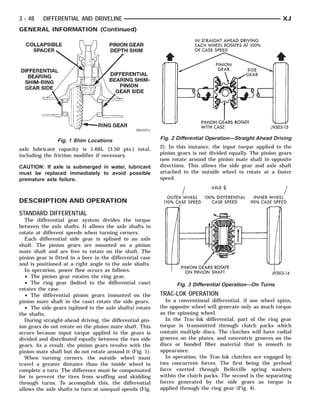
SEALING (1/4”)
                                                               NESS THICK-
                                                               BEAD 6.35MM
                                                                  SURFACE                          CONTOUR OF BEAD


3 - 20    DIFFERENTIAL AND DRIVELINE                                                                                 XJ
DIAGNOSIS AND TESTING (Continued)

             CONDITION                         POSSIBLE CAUSES                             CORRECTION
AXLE NOISE                             1. Insufficient lubricant.               1. Refill axle with correct amount of
                                                                                proper lubricant. Also inspect for
                                                                                leaks and correct as necessary.
                                       2. Improper ring gear and drive          2. Check ring gear and pinion gear
                                       pinion gear adjustment.                  teeth contact pattern.
                                       3. Unmatched ring gear and drive         3. Remove unmatched ring gear and
                                       pinion gear.                             drive pinion gear. Replace with
                                                                                matched gear and drive pinion gear
                                                                                set.
                                       4. Worn teeth on ring gear or drive      4. Check teeth on ring gear and
                                       pinion gear.                             drive pinion gear for correct contact.
                                                                                If necessary, replace with new
                                                                                matched set.
                                       5. Loose drive pinion gear shaft         5. Adjust drive pinion gearshaft
                                       bearings.                                bearing preload torque.
                                       6. Loose differential bearings.          6. Adjust differential bearing preload
                                                                                torque.
                                       7. Misaligned or sprung ring gear.       7. Measure ring gear runout.
                                       8. Loose differential bearing cap        8. Tighten with specified torque.
                                       bolts.


SERVICE PROCEDURES
LUBRICANT CHANGE
   (1) Raise and support the vehicle.
   (2) Remove the lubricant fill hole plug from the
differential housing cover.
   (3) Remove the differential housing cover and
drain the lubricant from the housing.
   (4) Clean the housing cavity with a flushing oil,
light engine oil or lint free cloth. Do not use water,
steam, kerosene or gasoline for cleaning.
   (5) Remove the sealant from the housing and cover
surfaces. Use solvent to clean the mating surfaces.
   (6) Apply a bead of Mopar௡ Silicone Rubber Seal-
ant, or equivalent, to the housing cover (Fig. 3).
   Install the housing cover within 5 minutes
after applying the sealant.
   (7) Install the cover and any identification tag.
Tighten the cover bolts in a criss–cross pattern to 41
N·m (30 ft. lbs.) torque.
   (8) Refill the differential with Mopar௡ Hypoid
Gear Lubricant, or equivalent, to bottom of the fill
plug hole. Refer to the Lubricant Specifications in                  Fig. 3 Typical Housing Cover With Sealant
this group for the quantity necessary.                          (2) Position a suitable lifting device under the
   (9) Install the fill hole plug and lower the vehicle.      axle.
                                                                (3) Secure axle to device.
                                                                (4) Remove the wheels and tires.
REMOVAL AND INSTALLATION
                                                                (5) Remove the brake rotors and calipers from the
                                                              axle. Refer to Group 5, Brakes, for proper procedures.
DRIVE AXLE ASSEMBLY
                                                                (6) Disconnect the wheel sensor wiring harness
REMOVAL                                                       from the vehicle wiring harness, if necessary.
 (1) Raise and support the vehicle.
XJ                                                                    DIFFERENTIAL AND DRIVELINE           3 - 21
REMOVAL AND INSTALLATION (Continued)
   (7) Disconnect the vent hose from the axle shaft          (13) Align the previously made marks on the pro-
tube.                                                     peller shaft and the yoke.
   (8) Mark the propeller shaft and yoke for installa-       (14) Install the straps and bolts to hold the propel-
tion alignment reference.                                 ler shaft to the yoke.
   (9) Remove propeller shaft.                               (15) Check and fill axle lubricant. Refer to the
   (10) Disconnect stabilizer bar links at the axle.      Lubricant Specifications in this group for the quan-
   (11) Disconnect shock absorbers from axle brack-       tity necessary.
ets.                                                         (16) Install the wheel and tire assemblies.
   (12) Disconnect track bar.                                (17) Remove the lifting device from the axle and
   (13) Disconnect the tie rod and drag link from the     lower the vehicle.
steering knuckle. Refer to Group 2, Suspension, for          (18) Tighten the upper suspension arm nuts to 75
proper procedures.                                        N·m (55 ft. lbs.) torque. Tighten the lower suspension
   (14) Disconnect the steering damper from the axle      arm nuts to 115 N·m (85 ft. lbs.) torque.
bracket.                                                     (19) Tighten the track bar bolt at the axle bracket
   (15) Disconnect the upper and lower suspension         to 100 N·m (74 ft. lbs.) torque.
arms from the axle brackets.                                 (20) Check the front wheel alignment.
   (16) Lower the lifting device enough to remove the
axle. The coil springs will drop with the axle.           TUBE AXLE ASSEMBLY
   (17) Remove the coil springs from the axle.
                                                          REMOVAL
INSTALLATION                                                (1) Raise and support the vehicle.
                                                            (2) Position a suitable lifting device under the
CAUTION: The weight of the vehicle must be sup-           axle.
ported by the springs before suspension arms and            (3) Secure axle to device.
track bar fasteners can be tightened. If the springs        (4) Remove the wheels and tires.
are not at their normal ride position, ride height and      (5) Remove the brake rotors and calipers from the
handling could be affected.                               axle. Refer to Group 5, Brakes, for proper procedures.
                                                            (6) Disconnect the wheel sensor wiring harness
  (1) Install the springs and retainer clips. Tighten     from the vehicle wiring harness, if necessary.
the retainer bolts to 21 N·m (16 ft. lbs.) torque.          (7) Disconnect stabilizer bar links at the axle.
  (2) Support the axle on a suitable lifting device         (8) Disconnect shock absorbers from axle brackets.
and position axle under the vehicle.                        (9) Disconnect track bar.
  (3) Raise the axle and align it with the spring           (10) Disconnect the tie rod and drag link from the
pads.                                                     steering knuckle. Refer to Group 2, Suspension, for
  (4) Position the upper and lower suspension arms        proper procedures.
in the axle brackets. Loosely install bolts and nuts to     (11) Disconnect the steering damper from the axle
hold suspension arms to the axle brackets.                bracket.
  (5) Connect the vent hose to the axle shaft tube.         (12) Disconnect the upper and lower suspension
  (6) Connect the track bar to the axle bracket.          arms from the axle brackets.
Loosely install the bolt to hold the track bar to the       (13) Lower the lifting device enough to remove the
axle bracket.                                             axle. The coil springs will drop with the axle.
  (7) Install the shock absorbers and tighten the           (14) Remove the coil springs from the axle.
bolts to 23 N·m (17 ft. lbs.) torque.
  (8) Install the stabilizer bar links to the axle        INSTALLATION
brackets. Tighten the nut to 95 N·m (70 ft. lbs.)
torque.                                                   CAUTION: The weight of the vehicle must be sup-
  (9) Install the drag link and tie rod to the steering   ported by the springs before suspension arms and
knuckles. Refer to Group 2, Suspension, for proper        track bar fasteners can be tightened. If the springs
procedures.                                               are not at their normal ride position, ride height and
  (10) Install the steering damper to the axle            handling could be affected.
bracket and tighten the nut to 75 N·m (55 ft. lbs.)
torque.                                                     (1) Install the springs and retainer clips. Tighten
  (11) Install the brake rotors and calipers. Refer to    the retainer bolts to 21 N·m (16 ft. lbs.) torque.
Group 5, Brakes, for the proper procedures.                 (2) Support the axle on a suitable lifting device
  (12) Connect the wheel speed sensor wiring har-         and position axle under the vehicle.
ness to the vehicle wiring harness, if necessary.           (3) Raise the axle and align it with the spring
                                                          pads.
SMALL-DIAMETER YOKEEARING CAP
                                                                   SHAFT WRENCH
                                                                          SOCKET
                                                                            BBEARING CAP
                                                                                      LARGE-DIAMETER WRENCH BEARING CAPVISE
                                                                                             SNAP RINGS RINGS
                                                                                                   SNAP
                                                                                                      SOCKET  BEARING CAP
                                                                                                               SPINDLE YOKE
                                                                                                                BEARING


3 - 22    DIFFERENTIAL AND DRIVELINE                                                                                   XJ
REMOVAL AND INSTALLATION (Continued)
  (4) Position the upper and lower suspension arms
in the axle brackets. Loosely install bolts and nuts to
hold suspension arms to the axle brackets.
  (5) Connect the track bar to the axle bracket.
Loosely install the bolt to hold the track bar to the
axle bracket.
  (6) Install the shock absorbers and tighten the
bolts to 23 N·m (17 ft. lbs.) torque.
  (7) Install the stabilizer bar links to the axle
brackets. Tighten the nut to 95 N·m (70 ft. lbs.)
torque.
  (8) Install the drag link and tie rod to the steering
knuckles. Refer to Group 2, Suspension, for proper
procedures.
  (9) Install the steering damper to the axle bracket
and tighten the nut to 75 N·m (55 ft. lbs.) torque.
  (10) Install the brake rotors and calipers. Refer to
Group 5, Brakes, for the proper procedures.
  (11) Connect the wheel speed sensor wiring har-
ness to the vehicle wiring harness, if necessary.
  (12) Install the wheel and tire assemblies.                         Fig. 4 Axle Shaft Outer U–Joint
  (13) Remove the lifting device from the axle and
lower the vehicle.
  (14) Tighten the upper suspension arm nuts to 75
N·m (55 ft. lbs.) torque. Tighten the lower suspension
arm nuts to 115 N·m (85 ft. lbs.) torque.
  (15) Tighten the track bar bolt at the axle bracket
to 100 N·m (74 ft. lbs.) torque.
  (16) Check the front wheel alignment.

AXLE SHAFT—CARDAN U-JOINT
  Single cardan U–joint components are not service-
able. If defective, they must be replaced as a unit. If
the bearings, seals, spider, or bearing caps are dam-
aged or worn, replace the complete U–joint.

REMOVAL

CAUTION: Clamp only the narrow forged portion of
the yoke in the vise. Also, to avoid distorting the
yoke, do not over tighten the vise jaws.

  (1) Remove axle shaft.
  (2) Remove the bearing cap retaining snap rings                    Fig. 5 Yoke Bearing Cap Removal
(Fig. 4).
                                                            (6) Compress the vise jaws to force the bearing cap
  It can be helpful to saturate the bearing caps
                                                          into the larger socket (receiver).
with penetrating oil prior to removal.
                                                            (7) Release the vise jaws. Remove the sockets and
  (3) Locate a socket where the inside diameter is
                                                          bearing cap that was partially forced out of the yoke.
larger in diameter than the bearing cap. Place the
                                                            (8) Repeat the above procedure for the remaining
socket (receiver) against the yoke and around the
                                                          bearing cap.
perimeter of the bearing cap to be removed.
                                                            (9) Remove the remaining bearing cap, bearings,
  (4) Locate a socket where the outside diameter is
                                                          seals and spider from the propeller shaft yoke.
smaller in diameter than the bearing cap. Place the
socket (driver) against the opposite bearing cap.
  (5) Position the yoke with the sockets in a vise
(Fig. 5).
SPECIAL SPECIAL TOOL C-3281
                        TOOL C-452     YOKE                                             SPECIAL TOOL C-3972–A PINIONC-4171
                                                                                                      SPECIAL TOOL YOKE
                                                                                                            AXLE HOUSING


XJ                                                                    DIFFERENTIAL AND DRIVELINE                 3 - 23
REMOVAL AND INSTALLATION (Continued)
INSTALLATION                                              INSTALLATION
  (1) Pack the bearing caps 1/3 full of wheel bearing        (1) Apply a light coating of gear lubricant on the
lubricant. Apply extreme pressure (EP), lithium–base      lip of pinion seal. Install seal with Installer C-3972-A
lubricant to aid in installation.                         and Handle C-4171 (Fig. 7).
  (2) Position the spider in the yoke. Insert the seals
and bearings. Tap the bearing caps into the yoke
bores far enough to hold the spider in position.
  (3) Place the socket (driver) against one bearing
cap. Position the yoke with the socket wrench in a
vise.
  (4) Compress the vise to force the bearing caps
into the yoke. Force the caps enough to install the
retaining clips.
  (5) Install the bearing cap retaining clips.
  (6) Install axle shaft.

PINION SHAFT SEAL
REMOVAL
  (1) Raise and support the vehicle.
  (2) Remove wheel and tire assemblies.
  (3) Remove brake rotors and calipers. Refer to
                                                                      Fig. 7 Pinion Seal Installation
Group 5, Brakes, for proper procedures.                    (2) Install yoke on the pinion gear with Installer
  (4) Mark the propeller shaft and pinion yoke for        W-162–D, Cup 8109, and Holder 6958 (Fig. 8).
installation reference.
  (5) Remove the propeller shaft from the yoke.
  (6) Rotate the pinion gear three or four times.
  (7) Measure the amount of torque necessary to
rotate the pinion gear with a (in. lbs.) dial-type
torque wrench. Record the torque reading for instal-
lation reference.
  (8) Using Holder 6958 to hold the pinion yoke,
remove the pinion nut and washer.
  (9) Use Remover C-452 and Wrench C-3281 to
remove the pinion yoke (Fig. 6).


                                                                      Fig. 8 Pinion Yoke Installation
                                                          CAUTION: Do not exceed the minimum tightening
                                                          torque when installing the pinion yoke retaining nut
                                                          at this point. Damage to the pinion bearings may
                                                          result.

                                                            (3) Install the pinion washer and a new nut on the
                                                          pinion gear. Tighten the nut only enough to
                                                          remove the shaft end play.
                                                            (4) Tighten pinion nut to 217 N·m (160 ft. lbs.).
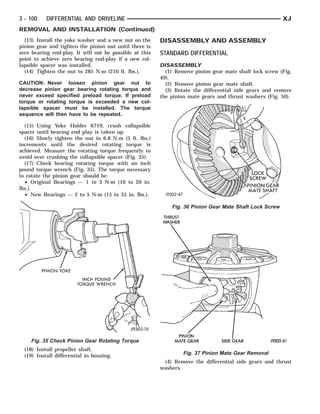
                                                            (5) Rotate the pinion shaft using a (in. lbs.) torque
             Fig. 6 Pinion Yoke Removal                   wrench. Rotating torque should be equal to the read-
                                                          ing recorded during removal, plus an additional 0.56
 (10) Use a suitable pry tool or a slide hammer
                                                          N·m (5 in. lbs.) (Fig. 9).
mounted screw to remove the pinion shaft seal.
                                                            (6) If the rotating torque is low, use Holder 6958 to
                                                          hold the pinion yoke, and tighten the pinion shaft
TONE WHEEL (ABS) YOKE
              PINION    INCH   POUND
                                BOLT   WRENCH
                                       TORQUE   STEERINGNUCKLE
                                                       K                      HUB ANDASSEMBLY
                                                                              BRAKE SHIELD
                                                                                      BEARING     WASHER
                                                                                                  NUT        COTTER PIN
                                                                                                                RETAINER


3 - 24    DIFFERENTIAL AND DRIVELINE                                                                                  XJ
REMOVAL AND INSTALLATION (Continued)
                                                                   (10) Install wheel and tire assemblies.
                                                                   (11) Lower the vehicle.

                                                                 HUB BEARING AND AXLE SHAFT
                                                                   If the axle shaft and hub bearing are being
                                                                 removed in order to service another component, the
                                                                 axle shaft and hub bearing can be removed as an
                                                                 assembly.

                                                                 REMOVAL
                                                                   (1) Raise and support the vehicle.
                                                                   (2) Remove the wheel and tire assembly.
                                                                   (3) Remove the brake caliper and rotor. Refer to
                                                                 Group 5, Brakes, for proper procedures.
                                                                   (4) Remove ABS wheel speed sensor, if necessary.
                                                                 Refer to Group 5, Brakes, for proper procedures.
                                                                   (5) Remove the cotter pin, nut retainer, and axle
                                                                 hub nut (Fig. 10), if necessary.
                                                                   (6) Remove the hub to knuckle bolts (Fig. 11).
                                                                   (7) Remove the hub from the steering knuckle and
                                                                 axle shaft, if necessary.
                                                                   (8) Remove hub bearing and axle shaft assembly
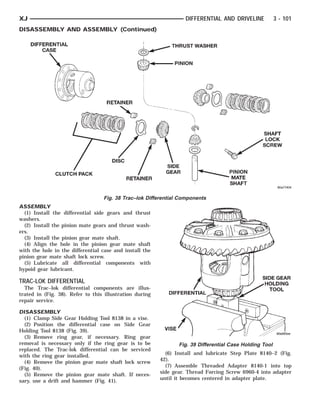
         Fig. 9 Check Pinion Rotation Torque                     (Fig. 12), or axle shaft from axle. Avoid damaging
                                                                 the axle shaft oil seals in the axle housing.
nut in 6.8 N·m (5 ft. lbs.) increments until proper
                                                                   (9) Remove the brake rotor shield from the hub
rotating torque is achieved.
                                                                 bearing or knuckle (Fig. 10).
  (7) Align the installation reference marks on the
propeller shaft and yoke, and install the propeller              INSTALLATION
shaft.                                                             (1) Thoroughly clean the axle shaft (Fig. 10) and
  (8) Check and fill the gear lubricant. Refer to the            apply a thin film of Mopar௡ Wheel Bearing Grease,
Lubricant Specifications for gear lubricant require-             or equivalent, to the shaft splines, seal contact sur-
ments.                                                           face, and hub bore.
  (9) Install the brake rotors and calipers. Refer to              (2) Install the brake rotor shield to the knuckle.
Group 5, Brakes, for proper procedures.


                                          Fig. 10 Hub, Knuckle and Axle Shaft
HUB BEARING
           HUB BEARING     AXLE SHAFT   KNUCKLE AXLE SHAFT
                                           KNUCKLE      AXLE   AXLE YOKE
                                                                STEERING
                                                                      KNUCKLE                        LOWER BALL STUD
                                                                                                           UPPER STUD
                                                                                                                   BALL


XJ                                                                              DIFFERENTIAL AND DRIVELINE      3 - 25
REMOVAL AND INSTALLATION (Continued)
                                                               installation of upper and lower ball studs require the
                                                               use of Tool Kit 6289.

                                                               KNUCKLE REMOVAL
                                                                 (1) Remove hub bearing and axle shaft.
                                                                 (2) Disconnect the tie-rod or drag link from the
                                                               steering knuckle arm. Refer to Group 2, Suspension,
                                                               for proper procedures.
                                                                 (3) Remove the cotter pins from the upper and
                                                               lower ball studs.
                                                                 (4) Remove the upper and lower ball stud nuts.
                                                                 (5) Strike the steering knuckle with a brass ham-
                                                               mer to loosen knuckle from the ball studs. Remove
                                                               knuckle from ball studs (Fig. 13).


                Fig. 11 Hub Bearing Bolts


       Fig. 12 Hub Bearing and Axle Assembly
  (3) Install the hub bearing and axle shaft assem-
bly, or axle shaft, into the housing and differential             Fig. 13 Steering Knuckle Removal/Installation
side gears. Avoid damaging the axle shaft oil seals in
the axle housing.                                              UPPER BALL STUD REPLACEMENT
  (4) Install the hub bearing, if necessary.                     (1) Position tools as shown to remove and install
  (5) Install the hub to knuckle bolts and tighten to          ball stud (Fig. 14).
102 N·m (75 ft. lbs.) torque.
                                                               LOWER BALL STUD REPLACEMENT
  (6) Install the hub washer and nut, if necessary.
                                                                 (1) Position tools as shown to remove and install
Tighten the hub nut to 237 N·m (175 ft. lbs.) torque.
                                                               ball stud (Fig. 15).
Install the nut retainer and a new cotter pin (Fig.
10).                                                           KNUCKLE INSTALLATION
  (7) Install ABS wheel speed sensor, if necessary.              (1) Position the steering knuckle on the ball studs.
Refer to Group 5, Brakes, for proper procedures.                 (2) Install and tighten the bottom retaining nut to
  (8) Install the brake rotor and caliper. Refer to            109 N·m (80 ft. lbs.) torque. Install new cotter pin.
Group 5, Brakes, for proper procedures.                          (3) Install and tighten the top retaining nut to 101
  (9) Install the wheel and tire assembly.                     N·m (75 ft. lbs.) torque. Install new cotter pin.
  (10) Remove support and lower the vehicle.                     (4) Install the hub bearing and axle shaft.
                                                                 (5) Connect the tie-rod or drag link end to the
STEERING KNUCKLE AND BALL STUDS                                steering knuckle arm. Refer to Group 2, Suspension,
  Ball stud service procedures below require removal           for proper procedures.
of the hub bearing and axle shaft. Removal and
REMOVAL                                         INSTALLATION


3 - 26    DIFFERENTIAL AND DRIVELINE                                                                          XJ
REMOVAL AND INSTALLATION (Continued)


                                     Fig. 14 Upper Ball Stud Remove/Install
AXLE BUSHING REPLACEMENT                                   CAUTION: Do not spread over 0.50 mm (0.020 in). If
  Refer to Group 2, Suspension, for the proper axle        the housing is over-spread, it could be distorted or
bushing procedures.                                        damaged.

DIFFERENTIAL                                                 (9) Spread the housing enough to remove the dif-
                                                           ferential case from the housing. Measure the dis-
REMOVAL                                                    tance with the dial indicator (Fig. 19).
   (1) Raise and support vehicle.                            (10) Remove the dial indicator.
   (2) Remove the lubricant fill hole plug from the          (11) While holding the differential case in position,
differential housing cover.                                remove the differential bearing cap bolts and caps.
   (3) Remove the differential housing cover and             (12) Remove the differential from the housing.
allow fluid to drain.                                      Ensure that the differential bearing cups remain in
   (4) Remove hub bearings and axle shafts.                position on the differential bearings (Fig. 20).
   (5) Note the installation reference letters stamped       (13) Mark or tag the differential bearing cups to
on the bearing caps and housing machined sealing           indicate which side of the differential they were
surface (Fig. 16).                                         removed from.
   (6) Loosen the differential bearing cap bolts.            (14) Remove spreader from housing.
   (7) Position Spreader W–129–B, utilizing some
items from Adapter Kit 6987, with the tool dowel           INSTALLATION
pins seated in the locating holes (Fig. 17). Install the      If replacement differential bearings or differential
holddown clamps and tighten the tool turnbuckle fin-       case are being installed, differential side bearing
ger–tight.                                                 shim requirements may change. Refer to the Differ-
   (8) Install a Guide Pin C-3288-B at the left side of    ential Bearing Preload and Gear Backlash proce-
the differential housing. Attach Dial Indicator C-3339     dures in this section to determine the proper shim
to guide pin. Load the lever adapter against the           selection.
opposite side of the housing (Fig. 18) and zero the           (1) Position Spreader W-129-B, utilizing some
indicator.                                                 items from Adapter Kit 6987, with the tool dowel
INSTALLATION LETTERS
        ENCE REFER-              REMOVALINSTALLATION LETTERS
                                           SPECIAL TOOL 6289–3
                                           SPECIAL TOOL 4212F
                                                ENCE REFER-
                                                        6289–1          AXLE HOUSING     TURNBUCKLE
                                                                                          INSTALLATION   SPECIAL TOOLW-129–B
                                                                                                          SPECIAL HOLD 6289–4
                                                                                                          SPECIAL TOOL DOWN
                                                                                                                 SPECIALTOOL
                                                                                                                 SAFETY 4212F
                                                                                                                   TOOL
                                                                                                                      DOWEL
                                                                                                                      6289–12


XJ                                                                          DIFFERENTIAL AND DRIVELINE              3 - 27
REMOVAL AND INSTALLATION (Continued)


                                     Fig. 15 Lower Ball Stud Remove/Install


           Fig. 16 Bearing Cap Identification
pins seated in the locating holes (Fig. 21). Install the
holddown clamps and tighten the tool turnbuckle fin-
ger–tight.
  (2) Install a Guide Pin C-3288-B at the left side of
the differential housing. Attach Dial Indicator C-3339
to guide pin. Load the lever adapter against the                        Fig. 17 Install Axle Housing Spreader
opposite side of the housing (Fig. 18) and zero the              CAUTION: Do not spread over 0.50 mm (0.020 in). If
indicator.                                                       the housing is over-spread, it could be distorted or
                                                                 damaged.
SPECIAL TOOLTOOL TOOL
             SPECIALC-3339
             SPECIAL TOOLW-129–B
                C-3339 SPECIAL
                  C-3288–B                    DIAL INDICATOR
                                               LEVERW-129–B
                                                SPECIALTOOL
                                                   ADAPTER             AXLE HOUSING
                                                                               BEARING CUPS   TURNBUCKLE   DIFFERENTIAL CASE
                                                                                                                   SPECIALTOOL
                                                                                                                   SAFETY
                                                                                                                    HOLD DOWN
                                                                                                                         W-129–B
                                                                                                                         DOWEL


3 - 28    DIFFERENTIAL AND DRIVELINE                                                                                       XJ
REMOVAL AND INSTALLATION (Continued)


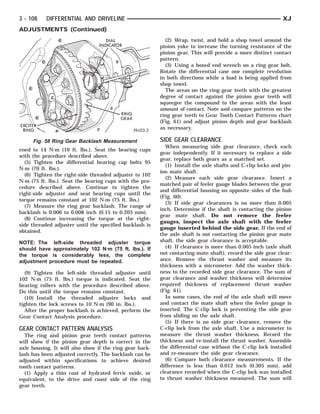
             Fig. 18 Install Dial Indicator                              Fig. 20 Differential Case Removal


             Fig. 19 Spread Axle Housing                               Fig. 21 Install Axle Housing Spreader
   (3) Spread the housing enough to install the case           DIFFERENTIAL SIDE BEARINGS
in the housing. Measure the distance with the dial
indicator (Fig. 19).                                           REMOVAL
   (4) Remove the dial indicator.                                (1) Remove differential case from axle housing.
   (5) Install differential case in the housing. Ensure          (2) Remove the bearings from the differential case
that the differential bearing cups remain in position          with Puller/Press C-293-PA, C-293-39 Adapter
on the differential bearings. Tap the differential case        Blocks, and Plug SP-3289 (Fig. 23).
to ensure the bearings cups are fully seated in the
housing.                                                       INSTALLATION
   (6) Install the bearing caps at their original loca-          If replacement differential side bearings or differ-
tions (Fig. 22).                                               ential case are being installed, differential side bear-
   (7) Loosely install differential bearing cap bolts.         ing shim requirements may change. Refer to the
   (8) Remove axle housing spreader.                           Differential Bearing Preload and Gear Backlash pro-
   (9) Tighten the bearing cap bolts to 61 N·m (45 ft.         cedures in this section to determine the proper shim
lbs.) torque.                                                  selection.
   (10) Install the hub bearings and axle shafts.
INSTALLATIONDIFFERENTIAL
     SPECIAL TOOL
       SPECIALREFER- BEARING
        ENCE LETTERS
          C-293–PA
              SP-3289
                TOOL                  INSTALLATION LETTERS
                                              ENCE C-293–39
                                               SPECIAL TOOL
                                                    REFER-     SPECIAL   C-3716–A
                                                                            TOOL                      SPECIAL TOOL C-4171


XJ                                                                          DIFFERENTIAL AND DRIVELINE           3 - 29
REMOVAL AND INSTALLATION (Continued)


 Fig. 22 Differential Bearing Cap Reference Letters


                                                                   Fig. 24 Differential Side Bearing Installation
                                                              AXLE SHAFT OIL SEAL
                                                              REMOVAL
                                                                (1) Raise and support vehicle.
                                                                (2) Remove differential assembly.
                                                                (3) Remove the inner axle shaft seals with a pry
                                                              bay.

                                                              INSTALLATION
                                                                 (1) Remove any sealer remaining from original
                                                              seals.
                                                                 (2) Remove sealer from axle tube to housing junc-
                                                              tion, if necessary.
                                                                 (3) Install oil seals with Discs 8110 and Turn-
                                                              buckle 6797 (Fig. 25). Tighten tool until disc bottoms
                                                              in housing.
                                                                 (4) Install differential assembly.

                                                              RING GEAR
                                                                The ring and pinion gears are service in a matched
                                                              set. Do not replace the ring gear without replacing
                                                              the pinion gear.
          Fig. 23 Differential Bearing Removal
                                                              REMOVAL
  (1) Install differential side bearing shims onto dif-         (1) Remove differential from axle housing.
ferential case hubs.                                            (2) Place differential case in a suitable vise with
  (2) Using Installer C-3716-A and Handle C-4171,             soft metal jaw protectors. (Fig. 26)
install differential side bearings (Fig. 24).                   (3) Remove bolts holding ring gear to differential
  (3) Install differential in axle housing.                   case.
                                                                (4) Using a soft hammer, drive ring gear from dif-
                                                              ferential case (Fig. 26).
RAWHIDE HAM-
        MER                  TURNBUCKLE 6797 CASE
                                 DISCS 8110         RING GEAR   RING GEAR
                                                                     CASE         SPECIAL SPECIAL TOOL C-3281
                                                                                          TOOL C-452     YOKE   TORQUE WRENCH
                                                                                                                  RING GEAR BOLT


3 - 30     DIFFERENTIAL AND DRIVELINE                                                                                      XJ
REMOVAL AND INSTALLATION (Continued)


               Fig. 25 Axle Seal Installation                               Fig. 27 Ring Gear Bolt Installation
                                                                PINION GEAR
                                                                  The ring and pinion gears are serviced as a
                                                                matched set. Do not replace the pinion gear without
                                                                replacing the ring gear.

                                                                REMOVAL
                                                                  (1) Remove differential assembly from axle hous-
                                                                ing.
                                                                  (2) Mark pinion yoke and propeller shaft for
                                                                installation alignment.
                                                                  (3) Disconnect propeller shaft from pinion yoke.
                                                                Using suitable wire, tie propeller shaft to underbody.
                                                                  (4) Using Holder 6958 to hold yoke, remove the
                                                                pinion nut and washer.
                                                                  (5) Using Remover C-452 and Holder C-3281,
                                                                remove the pinion yoke from pinion shaft (Fig. 28).
                Fig. 26 Ring Gear Removal
INSTALLATION

CAUTION: Do not reuse the bolts that held the ring
gear to the differential case. The bolts can fracture
causing extensive damage.

   (1) Invert the differential case and start two ring
gear bolts. This will provide case-to-ring gear bolt
hole alignment.
   (2) Invert the differential case in the vise.
   (3) Install new ring gear bolts and alternately
tighten to 95–122 N·m (70–90 ft. lbs.) torque (Fig.
27).
   (4) Install differential in axle housing and verify
gear mesh and contact pattern.
                                                                              Fig. 28 Pinion Yoke Removal
REMOVER                            RAWHIDE HAM-
                                               HANDLE
                                                   MER      DRIVER                                      HANDLE


XJ                                                                     DIFFERENTIAL AND DRIVELINE       3 - 31
REMOVAL AND INSTALLATION (Continued)
  (6) Remove the pinion gear and preload shims             (9) Remove the depth shims from rear pinion bear-
from housing (Fig. 29). Catch the pinion with your       ing cup bore in axle housing. Record the thickness of
hand to prevent it from falling and being damaged.       the depth shims.

                                                         NOTE: The pinion depth shims can be very thin.
                                                         Verify that all shims have been removed before pro-
                                                         ceeding.


            Fig. 29 Remove Pinion Gear
   (7) Remove the front pinion bearing cup, bearing,
oil slinger, if equipped, and pinion seal with Remover
                                                                     Fig. 31 Rear Bearing Cup Removal
D-147 and Handle C–4171 (Fig. 30).
                                                           (10) Remove the rear pinion bearing from the pin-
                                                         ion with Puller/Press C–293-PA and Adapters
                                                         C-293-39 (Fig. 32).
                                                           Place 4 adapter blocks so they do not damage
                                                         the bearing cage.

                                                         INSTALLATION

                                                         NOTE: Pinion depth shims are placed between the
                                                         rear pinion bearing cup and axle housing to achieve
                                                         proper ring and pinion gear mesh. If the factory
                                                         installed ring and pinion gears are reused, the pin-
                                                         ion depth shim should not require replacement.
                                                         Refer to Pinion Gear Depth to select the proper
                                                         thickness shim before installing pinion gear.

                                                           (1) Place proper thickness depth shim in rear pin-
                                                         ion bearing cup bore in the axle housing.
                                                           (2) Apply Mopar௡ Door Ease, or equivalent, stick
                                                         lubricant to outside surface of rear pinion bearing
                                                         cup. Install the bearing cup with Installer D-146 and
                                                         Handle C–4171 (Fig. 33). Verify cup is correctly
                                                         seated.
        Fig. 30 Front Bearing Cup Removal                  (3) Apply Mopar௡ Door Ease, or equivalent, stick
  (8) Remove the rear pinion bearing cup from axle       lubricant to outside surface of front pinion bearing
housing (Fig. 31). Use Remover D-149 and Handle          cup. Install the bearing cup with Installer D-144 and
C–4171.                                                  Handle C–4171 (Fig. 34).
DRIVE
  GEAR PINION
    HANDLE
    ADAPTERS
        SHAFT    SPECIAL   C-293–PA
                              TOOL       INSTALLER   VISE        INSTALLER                      SPECIAL TOOL
                                                                                                   HANDLE SPECIAL TOOL
                                                                                                    C-3972–A     C-4171


3 - 32     DIFFERENTIAL AND DRIVELINE                                                                             XJ
REMOVAL AND INSTALLATION (Continued)


                                                               Fig. 34 Pinion Outer Bearing Cup Installation


                Fig. 32 Inner Bearing Removal


                                                                        Fig. 35 Pinion Seal Installation
                                                              (8) Install pinion gear in housing.
                                                              (9) Install yoke with Installer W-162-B, Cup 8109,
                                                            and Holder 6958 (Fig. 38).
                                                              (10) Install the pinion washer and a new nut on
                                                            the pinion gear. Tighten the nut to 217 N·m (160 ft.
                                                            lbs.).

                                                            CAUTION: Never loosen pinion gear nut to
                                                            decrease pinion gear bearing rotating torque and
                                                            never exceed specified preload rotating torque.

    Fig. 33 Rear Pinion Bearing Cup Installation              (11) Check bearing preload torque with an inch
   (4) Install front pinion bearing, and oil slinger, if    pound torque wrench (Fig. 39). The torque necessary
equipped.                                                   to rotate the pinion gear should be:
   (5) Apply a light coating of gear lubricant on the         • Original Bearings—1 to 3 N·m (10 to 20 in. lbs.).
lip of pinion seal. Install seal with Installer C-3972-A      • New Bearings—2 to 5 N·m (15 to 35 in. lbs.).
and Handle C–4171 (Fig. 35).                                  (12) If rotating torque is above the desired
   (6) Install the rear pinion bearing and oil slinger,     amount, remove the pinion yoke and increase the
if equipped, on the pinion gear with Installer W-262        preload shim pack thickness. Increasing the shim
and a shop press (Fig. 36).                                 pack thickness 0.025 mm (0.001 in.) will decrease the
   (7) Install pinion bearing preload shims onto the        rotating torque approximately 0.9 N·m (8 in. lbs.).
pinion gear (Fig. 37).
DRIVE TOOL REARPRELOAD SPACER
INSTALLA-PINION BEARING
 TION PINION GEAR SHAFT
                      PINION PRELOAD SHIMS
                                         SHOULDER FOR OIL SLINGER SLINGER
                                               FRONT BEARING CUP
                                                PRELOAD SPACERGEAR
                                                      DRIVE
                                                         PINION
                                                              PINION        FRONT BEARING CONE
                                                                                 PINION YOKE         PINION OIL SEAL
                                                                                                                WASHER   AXLE HOUSING
                                                                                                                           PINION YOKE
                                                                                                                            PINION NUT


XJ                                                                                   DIFFERENTIAL AND DRIVELINE              3 - 33
REMOVAL AND INSTALLATION (Continued)


                                                                                    Fig. 38 Pinion Yoke Installation
                                                                         (14) If the maximum tightening torque is reached
                                                                       prior to achieving the desired rotating torque, remove
                                                                       the pinion yoke and decrease the thickness of the
                                                                       preload shim pack. Decreasing the shim pack thick-
                                                                       ness 0.025 mm (0.001 in.) will increase the rotating
        Fig. 36 Rear Pinion Bearing Installation
                                                                       torque approximately 0.9 N·m (8 in. lbs.).
  (13) Tighten pinion shaft nut in 6.8 N·m (5 ft. lbs.)                  (15) Install differential assembly.
increments until the maximum tightening or desired
rotating torque is reached.


                                             Fig. 37 Pinion Preload Shims–Typical
in. MATE SHAFT WRENCH
      lbs. TORQUE
            LOCKPIN                      PINION YOKEDRIFT    THRUST
                                                               PINION MATE
                                                               WASHERGEAR                   SIDE GEAR


3 - 34     DIFFERENTIAL AND DRIVELINE                                                                           XJ


                                                              (3) Remove the pinion gear mate shaft from the
                                                            differential case and the pinion mate gears.
                                                              (4) Rotate differential side gears and remove the
                                                            pinion mate gears and thrust washers (Fig. 41).


    Fig. 39 Check Pinion Gear Rotating Torque
DISASSEMBLY AND ASSEMBLY
STANDARD DIFFERENTIAL
                                                                      Fig. 41 Pinion Mate Gear Removal
DISASSEMBLY                                                  (5) Remove the differential side gears and thrust
  (1) Remove the ring gear.                                 washers.
  (2) Using a suitable roll pin punch, drive out the
roll pin holding pinion gear mate shaft in the differ-      ASSEMBLY
ential case (Fig. 40).                                        (1) Install the differential side gears and thrust
                                                            washers.
                                                              (2) Install the pinion mate gears and thrust wash-
                                                            ers.
                                                              (3) Install the pinion gear mate shaft. Align the
                                                            roll pin holes in shaft and the differential case.
                                                              (4) Install the roll pin to hold the pinion mate
                                                            shaft in the differential case (Fig. 42).
                                                              (5) Install the ring gear.
                                                              (6) Lubricate all differential components with
                                                            hypoid gear lubricant.

                                                            FINAL ASSEMBLY
                                                              (1) Scrape the residual sealant from the housing
                                                            and cover mating surfaces. Clean the mating surfaces
                                                            with mineral spirits. Apply a bead of Mopar௡ Silicone
                                                            Rubber Sealant, or equivalent, on the housing cover
                                                            (Fig. 43).
                                                              Install the housing cover within 5 minutes
                                                            after applying the sealant.
                                                              (2) Install the cover on the differential with the
                                                            attaching bolts. Install the identification tag. Tighten
                                                            the cover bolts to 41 N·m (30 ft. lbs.) torque.
         Fig. 40 Mate Shaft Roll Pin Removal
SEALING (1/4”)
NESS THICK-
BEAD 6.35MM
   MATE SHAFT LOCKPIN
   SURFACE                          CONTOUR OF SHAFT
                                    PINION
                                        PUNCH BEAD
                                                MATE


XJ                                                                   DIFFERENTIAL AND DRIVELINE           3 - 35
DISASSEMBLY AND ASSEMBLY (Continued)
                                                         CLEANING AND INSPECTION
                                                         CARDAN U-JOINT
                                                           Clean all the U–joint yoke bores with cleaning sol-
                                                         vent and a wire brush. Ensure that all the rust and
                                                         foreign matter are removed from the bores.
                                                           Inspect the yokes for distortion, cracks and worn
                                                         bearing cap bores.
                                                           Replace the complete U–joint if any of the compo-
                                                         nents are defective.

                                                         AXLE COMPONENTS
                                                           Wash differential components with cleaning solvent
                                                         and dry with compressed air. Do not steam clean
                                                         the differential components.
                                                           Wash bearings with solvent and towel dry, or dry
                                                         with compressed air. DO NOT spin bearings with
                                                         compressed air. Cup and bearing must be
                                                         replaced as matched sets only.
                                                           Clean axle shaft tubes and oil channels in housing.
                                                           Inspect for;
                                                           • Smooth appearance with no broken/dented sur-
       Fig. 42 Mate Shaft Roll Pin Installation          faces on the bearing rollers or the roller contact sur-
                                                         faces.
                                                           • Bearing cups must not be distorted or cracked.
                                                           • Machined surfaces should be smooth and with-
                                                         out any raised edges.
                                                           • Raised metal on shoulders of cup bores should
                                                         be removed with a hand stone.
                                                           • Wear and damage to pinion gear mate shaft,
                                                         pinion gears, side gears and thrust washers. Replace
                                                         as a matched set only.
                                                           • Ring and pinion gear for worn and chipped
                                                         teeth.
                                                           • Ring gear for damaged bolt threads. Replaced as
                                                         a matched set only.
                                                           • Pinion yoke for cracks, worn splines, pitted
                                                         areas, and a rough/corroded seal contact surface.
                                                         Repair or replace as necessary.
                                                           • Preload shims for damage and distortion. Install
                                                         new shims, if necessary.


                                                         ADJUSTMENTS
                                                         PINION GEAR DEPTH
     Fig. 43 Typical Housing Cover With Sealant
CAUTION: Overfilling the differential can result in      GENERAL INFORMATION
lubricant foaming and overheating.                          Ring and pinion gears are supplied as matched
                                                         sets only. The identifying numbers for the ring and
  (3) Refill the differential housing with gear lubri-   pinion gear are etched into the face of each gear (Fig.
cant. Refer to the Lubricant Specifications section of   44). A plus (+) number, minus (–) number or zero (0)
this group for the gear lubricant requirements.          is etched into the face of the pinion gear. This num-
  (4) Install the fill hole plug.                        ber is the amount (in thousandths of an inch) the
                                                         depth varies from the standard depth setting of a
                                                         pinion etched with a (0). The standard setting from
                                                         the center line of the ring gear to the back face of the
DIFFERENTIAL BERS SHIM
PRODUCTION NUM- NUM-
(SAME MATCHING BEARING
GEAR AS RING GEAR BER)
                 NUMBER                    DRIVE PINION GEAR
                                               GEAR
                                               DRIVE VARIANCE
                                                 DEPTH SHIM
                                                         PINION
                                                         DEPTH


3 - 36     DIFFERENTIAL AND DRIVELINE                                                                                XJ
ADJUSTMENTS (Continued)
pinion is 92.08 mm (3.625 in.). The standard depth                   Note where Old and New Pinion Marking columns
provides the best gear tooth contact pattern. Refer to            intersect. Intersecting figure represents plus or
Backlash and Contact Pattern Analysis paragraph in                minus the amount needed.
this section for additional information.                             Note the etched number on the face of the drive
                                                                  pinion gear (–1, –2, 0, +1, +2, etc.). The numbers rep-
                                                                  resent thousands of an inch deviation from the stan-
                                                                  dard. If the number is negative, add that value to the
                                                                  required thickness of the depth shims. If the number
                                                                  is positive, subtract that value from the thickness of
                                                                  the depth shim. If the number is 0 no change is nec-
                                                                  essary.

                                                                  PINION DEPTH MEASUREMENT AND
                                                                  ADJUSTMENT
                                                                     Measurements are taken with pinion bearing cups
                                                                  and pinion bearings installed in the axle housing
                                                                  without any shims placed behind the rear pinion
                                                                  bearing cup. Take measurements with Pinion Gauge
                                                                  Set 6774 and Dial Indicator C-3339 (Fig. 46).
                                                                     (1) Assemble Pinion Height Block 6739, Pinion
                                                                  Block 6733, and rear pinion bearing onto Screw 6741
            Fig. 44 Pinion Gear ID Numbers                        (Fig. 46).
  Compensation for pinion depth variance is                          (2) Insert assembled height gauge components,
achieved with select shims. The shims are placed                  rear bearing and screw into axle housing through
behind the rear pinion bearing cup (Fig. 45).                     pinion bearing cups (Fig. 47).
                                                                     (3) Install front pinion bearing and Cone-nut 6740
                                                                  hand tight (Fig. 46).
                                                                     (4) Place Arbor Disc 6732 on Arbor D-115-3 in posi-
                                                                  tion in axle housing side bearing cradles (Fig. 48).
                                                                  Install differential bearing caps on Arbor Discs and
                                                                  tighten cap bolts to 41 N·m (30 ft. lbs.).

                                                                  NOTE: Arbor Discs 6732 has different step diame-
                                                                  ters to fit other axles. Choose proper step for axle
                                                                  being serviced.

                                                                     (5) Assemble Dial Indicator C-3339 into Scooter
                                                                  Block D-115-2 and secure set screw.
                                                                     (6) Place Scooter Block/Dial Indicator in position
                                                                  in axle housing so dial probe and scooter block are
                                                                  flush against the rearward surface of the pinion
                                                                  height block (Fig. 46). Hold scooter block in place and
                                                                  zero the dial indicator face to the pointer. Tighten
                                                                  dial indicator face lock screw.
                                                                     (7) With scooter block still in position against the
                                                                  pinion height block, slowly slide the dial indicator
                                                                  probe over the edge of the pinion height block.
                                                                     (8) Slide the dial indicator probe across the gap
                  Fig. 45 Shim Locations                          between the pinion height block and the arbor bar
  If a new gear set is being installed, note the depth            with the scooter block against the pinion height block
variance etched into both the original and replace-               (Fig. 49). When the dial probe contacts the arbor bar,
ment pinion gear. Add or subtract the thickness of                the dial pointer will turn clockwise. Bring dial
the original depth shims to compensate for the differ-            pointer back to zero against the arbor bar, do not
ence in the depth variances. Refer to the Depth Vari-             turn dial face. Continue moving the dial probe to the
ance chart.                                                       crest of the arbor bar and record the highest reading.
                                                                  If the dial indicator can not achieve the zero reading,
PINION HEIGHT SCREW
   DIAL SCOOTER ARBOR
        INDICATORBLOCK
           PINION CONE
             ARBOR DISC                                       ARBOR DISC
                                                               PINION HEIGHT
                                                                       BLOCK    PINION HEIGHT
                                                                                        BLOCK
                                                                                            PINION BLOCK        PINION BLOCK
                                                                                                                       ARBOR


XJ                                                                          DIFFERENTIAL AND DRIVELINE                   3 - 37
ADJUSTMENTS (Continued)
                                         PINION GEAR DEPTH VARIANCE

 Original Pinion                              Replacement Pinion Gear Depth Variance
  Gear Depth
    Variance               −4       −3       −2       −1             0          +1          +2             +3           +4
         +4               +0.008   +0.007   +0.006   +0.005      +0.004        +0.003     +0.002       +0.001            0
         +3               +0.007   +0.006   +0.005   +0.004      +0.003        +0.002     +0.001           0          −0.001
         +2               +0.006   +0.005   +0.004   +0.003      +0.002        +0.001        0         −0.001         −0.002
         +1               +0.005   +0.004   +0.003   +0.002      +0.001          0        −0.001       −0.002         −0.003
          0               +0.004   +0.003   +0.002   +0.001          0         −0.001     −0.002       −0.003         −0.004
         −1               +0.003   +0.002   +0.001       0       −0.001        −0.002     −0.003       −0.004         −0.005
         −2               +0.002   +0.001     0      −0.001      −0.002        −0.003     −0.004       −0.005         −0.006
         −3               +0.001     0      −0.001   −0.002      −0.003        −0.004     −0.005       −0.006         −0.007
         −4                 0      −0.001   −0.002   −0.003      −0.004        −0.005     −0.006       −0.007         −0.008


                                                                         Fig. 47 Pinion Height Block—Typical


  Fig. 46 Pinion Gear Depth Gauge Tools—Typical
the rear bearing cup or the pinion depth gauge set is
not installed correctly.
  (9) Select a shim equal to the dial indicator read-
ing plus the drive pinion gear depth variance number
etched in the face of the pinion gear (Fig. 44). For
example, if the depth variance is –2, add +0.002 in.
to the dial indicator reading.

NOTE: If an oil slinger is used behind the inner pin-
ion bearing, deduct the thickness of the slinger
from the dial indicator reading and use that total for              Fig. 48 Gauge Tools In Housing—Typical
shim selection.
ARBOR DIAL INDICATOR
                                           SCOOTER BLOCK   DIFFERENTIAL
                                                              DIFFERENTIAL CASE HOUSING
                                                                            BEARING
                                                                             AXLE
                                                                               SHIM               DRIVE PINION GEAR
                                                                                                        DEPTH SHIM
                                                                                                          BEARING CAP


3 - 38    DIFFERENTIAL AND DRIVELINE                                                                            XJ
ADJUSTMENTS (Continued)


 Fig. 49 Pinion Gear Depth Measurement—Typical
DIFFERENTIAL BEARING PRELOAD AND GEAR
BACKLASH
INTRODUCTION
   Differential side bearing preload and gear backlash
                                                                  Fig. 50 Axle Adjustment Shim Locations
is achieved by selective shims positioned behind the
differential side bearing cones. The proper shim              (3) Install ring gear on differential case and
thickness can be determined using slip-fit dummy           tighten bolts to specification.
bearings D-348 in place of the differential side bear-        (4) Install dummy side bearings D-348 on differen-
ings and a dial indicator C-3339. Before proceeding        tial case.
with the differential bearing preload and gear back-          (5) Install differential case in axle housing.
lash measurements, measure the pinion gear depth              (6) Install the marked bearing caps in their correct
and prepare the pinion gear for installation. Estab-       positions. Install and snug the bolts (Fig. 51).
lishing proper pinion gear depth is essential to estab-
lishing gear backlash and tooth contact patterns.
After the overall shim thickness to take up differen-
tial side play is measured, the pinion gear is
installed, and the gear backlash shim thickness is
measured. The overall shim thickness is the total of
the dial indicator reading and the preload specifica-
tion added together. The gear backlash measurement
determines the thickness of the shim used on the
ring gear side of the differential case. Subtract the
gear backlash shim thickness from the total overall
shim thickness and select that amount for the pinion
gear side of the differential (Fig. 50). Differential
shim measurements are performed with axle
spreader W-129-B removed.

SHIM SELECTION                                                  Fig. 51 Tighten Bolts Holding Bearing Caps
NOTE: It is difficult to salvage the differential side       (7) Using a dead-blow type mallet, seat the differ-
bearings during the removal procedure. Install             ential dummy bearings to each side of the axle hous-
replacement bearings if necessary.                         ing (Fig. 52) and (Fig. 53).
                                                             (8) Thread guide stud C-3288-B into rear cover
   (1) Remove differential side bearings from differ-      bolt hole below ring gear (Fig. 54).
ential case.                                                 (9) Attach a dial indicator C-3339 to guide stud.
   (2) Remove factory installed shims from differen-       Position the dial indicator plunger on a flat surface
tial case.                                                 between the ring gear bolt heads (Fig. 54).
DIFFERENTIAL
        CASE      MALLET              AXLE HOUSING MALLET
                                            AXLE HOUSING      SPECIAL TOOL C-3339 FACE
                                                               ZEROC-3288–B C-3339
                                                                SPECIAL TOOL
                                                                SPECIAL TOOL
                                                                    DIAL INDICATOR       DIFFEREN-TOOL C-3288–BAXLE HOUSING
                                                                                          SPECIAL FORCE DIFFERENTIAL CASE
                                                                                           TIAL CASE    TO PINION GEAR SIDE


XJ                                                                       DIFFERENTIAL AND DRIVELINE                3 - 39
ADJUSTMENTS (Continued)


 Fig. 52 Seat Pinion Gear Side Differential Dummy
                   Side Bearing


                                                                 Fig. 54 Differential Side play Measurement


  Fig. 53 Seat Ring Gear Side Differential Dummy
                   Side Bearing
  (10) Push and hold differential case to pinion gear
side of axle housing (Fig. 55).
  (11) Zero dial indicator face to pointer (Fig. 55).
  (12) Push and hold differential case to ring gear             Fig. 55 Hold Differential Case and Zero Dial
side of the axle housing (Fig. 56).                                               Indicator
  (13) Record dial indicator reading (Fig. 56).
                                                              (20) Position the dial indicator plunger on a flat
  (14) Add 0.008 in. (0.2 mm) to the zero end play
                                                            surface between the ring gear bolt heads. (Fig. 54).
total. This new total represents the thickness of
                                                              (21) Push and hold differential case toward pinion
shims to compress, or preload the new bearings when
                                                            gear (Fig. 57).
the differential is installed.
                                                              (22) Zero dial indicator face to pointer (Fig. 57).
  (15) Rotate dial indicator out of the way on the
                                                              (23) Push and hold differential case to ring gear
guide stud.
                                                            side of the axle housing (Fig. 58).
  (16) Remove differential case and dummy bearings
                                                              (24) Record dial indicator reading (Fig. 58).
from axle housing.
                                                              (25) Subtract 0.002 in. (0.05 mm) from the dial
  (17) Install the pinion gear in axle housing. Install
                                                            indicator reading to compensate for backlash between
the pinion yoke and establish the correct pinion
                                                            ring and pinion gears. This total is the thickness
rotating torque.
                                                            shim required to achieve proper backlash.
  (18) Install differential case and dummy bearings
                                                              (26) Subtract the backlash shim thickness from
D-348 in axle housing (without shims), install bear-
                                                            the total preload shim thickness. The remainder is
ing caps and tighten bolts snug.
  (19) Seat ring gear side dummy bearing (Fig. 53).
AXLE HOUSING HOUSING
      DIFFERENTIAL CASE
          DIFFERENTIAL CASE
          AXLE HOUSING
           AXLE                   ZERO DIAL INDICATOR FACE
                                   FORCEREAD DIAL INDICATOR
                                        READ DIAL INDICATOR
                                         TO RINGGEAR CASE
                                         DIFFERENTIAL SIDE
                                          PINION GEAR
                                             PINION GEAR             DIAL CATOR
                                                                            INDI-
                                        FORCE
                                            FORCE DIFFERENTIAL
                                                      DIFFEREN-
                                        CASETIAL CASE TOGEAR
                                              TO PINION    RING
                                                     GEARSIDE
                                                           SIDE

3 - 40      DIFFERENTIAL AND DRIVELINE                                                                               XJ
ADJUSTMENTS (Continued)
                                                                  the shim thickness required on the pinion side of the
                                                                  axle housing.
                                                                    (27) Rotate dial indicator out of the way on guide
                                                                  stud.
                                                                    (28) Remove differential case and dummy bearings
                                                                  from axle housing.
                                                                    (29) Install side bearing shims on differential case
                                                                  hubs.
                                                                    (30) Install side bearings and cups on differential
                                                                  case.
                                                                    (31) Install spreader W-129-B, utilizing some items
                                                                  from Adapter Set 6987, on axle housing and spread
                                                                  axle opening enough to receive differential case.
                                                                    (32) Install differential case in axle housing.
                                                                    (33) Remove spreader from axle housing.
                                                                    (34) Rotate the differential case several times to
    Fig. 56 Hold Differential Case and Read Dial                  seat the side bearings.
                      Indicator                                     (35) Position the indicator plunger against a ring
                                                                  gear tooth (Fig. 59).
                                                                    (36) Push and hold ring gear upward while not
                                                                  allowing the pinion gear to rotate.
                                                                    (37) Zero dial indicator face to pointer.
                                                                    (38) Push and hold ring gear downward while not
                                                                  allowing the pinion gear to rotate. Dial indicator
                                                                  reading should be between 0.12 mm (0.005 in.) and
                                                                  0.20 mm (0.008 in.). If backlash is not within specifi-
                                                                  cations transfer the necessary amount of shim thick-
                                                                  ness from one side of the axle housing to the other
                                                                  (Fig. 60).
                                                                    (39) Verify differential case and ring gear runout
                                                                  by measuring ring to pinion gear backlash at several
                                                                  locations around the ring gear. Readings should not
                                                                  vary more than 0.05 mm (0.002 in.). If readings vary
                                                                  more than specified, the ring gear or the differential
                                                                  case is defective.
     Fig. 57 Hold Differential Case and Zero Dial
                                                                    After the proper backlash is achieved, perform
                       Indicator
                                                                  Gear Contact Pattern Analysis procedure.


    Fig. 58 Hold Differential Case and Read Dial
                      Indicator                                         Fig. 59 Ring Gear Backlash Measurement
FOR MORE BACKLASH INCREASE MORE BACKLASH
                          FOR LESS BACKLASH    FOR SHIM THIS SIDE
DECREASE SHIM
INCREASE SHIM THISTHIS
                   DIE                        DECREASE SHIM THIS
SIDEFOR LESS BACKLASH
     FOR MORE BACK-                           SIDE FOR LESS BACK-
                 LASH                                        LASH

XJ                                                                             DIFFERENTIAL AND DRIVELINE          3 - 41
ADJUSTMENTS (Continued)
                                                                    axle housing. It will also show if the ring gear back-
                                                                    lash has been adjusted correctly. The backlash can be
                                                                    adjusted within specifications to achieve desired
                                                                    tooth contact patterns.
                                                                      (1) Apply a thin coat of hydrated ferric oxide, or
                                                                    equivalent, to the drive and coast side of the ring
                                                                    gear teeth.
                                                                      (2) Wrap, twist, and hold a shop towel around the
                                                                    pinion yoke to increase the turning resistance of the
                                                                    pinion gear. This will provide a more distinct contact
                                                                    pattern.
                                                                      (3) Using a boxed end wrench on a ring gear bolt,
                                                                    Rotate the differential case one complete revolution
                                                                    in both directions while a load is being applied from
                                                                    shop towel.
                                                                      The areas on the ring gear teeth with the greatest
                                                                    degree of contact against the pinion gear teeth will
                                                                    squeegee the compound to the areas with the least
                                                                    amount of contact. Note and compare patterns on the
                                                                    ring gear teeth to Gear Tooth Contact Patterns chart
                                                                    (Fig. 61) and adjust pinion depth and gear backlash
                                                                    as necessary.
             Fig. 60 Backlash Shim Adjustment
GEAR CONTACT PATTERN ANALYSIS
  The ring and pinion gear teeth contact patterns
will show if the pinion gear depth is correct in the
HEEL   DRIVE GEAR TEETH
             RING   SIDE  OF   TOE      TOE
                                         COAST SIDE OF RINGTEETH HEEL
                                                            GEAR           GEAR THE COASTBACKLASHTOP OF
                                                                           CORRECT.GEARDEPTHPINIONTOWARD
                                                                           PINIONBACKLASH.SLIGHTLY BETWEEN
                                                                           GEARSOMEINCREASE BESHIMALWAYS
                                                                           CORRECT. DECREASEPINION TOOTH,
                                                                           PINIONBACKLASH. BACKLASH TOOTH.
                                                                            CORRECT. DRIVE SIDESHIM
                                                                            RING TOOTH.CLEARANCEOF
                                                                            REQUIRED. THICKER SHIMPATTERN.
                                                                            GEARTOE. DEPTH SIDE CENTERED
                                                                            REQUIRED. THINNER RING
                                                                            GEAR GEAR
                                                                            CORRECT. PATTERN SHIM
                                                                            RING GEAR CONTACT
                                                                            CONTACT DEPTH
                                                                            BE
                                                                            THE
                                                                            BUT GEAR DEPTH AND
                                                                            ON MAY THERE SHOULD
                                                                            PATTERN SHOULD RING
                                                                            DESIRABLE BE


3 - 42      DIFFERENTIAL AND DRIVELINE                                                                       XJ
ADJUSTMENTS (Continued)


                                     Fig. 61 Gear Tooth Contact Patterns
XJ                                                                       DIFFERENTIAL AND DRIVELINE   3 - 43


SPECIFICATIONS
181 FBI AXLE

Axle Type . . . . . . . . . . . . . . . . . . . . . . . . . . . Hypoid
Lubricant . . . . . . . . SAE Thermally Stable 80W–90
Lube Capacity . . . . . . . . . . . . . . . . . . 1.2 L (2.5 pts.)
Axle Ratio . . . . . . . . 3.07, 3.31, 3.54, 3.55, 3.73, 4.10
Differential Side Gear Clearance . . . . 0.12–0.20 mm
                                                 (0.005–0.008 in.)
Ring Gear Diameter . . . . . . . . . 18.09 cm (7.125 in.)                      Plug—SP-3289
Backlash . . . . . . . . . . . 0–0.15 mm (0.005–0.008 in.)
Pinion Std. Depth . . . . . . . . . . . 92.1 mm (3.625 in.)
Pinion Bearing Rotating Torque
Original Bearings . . . . . . . . 1–2 N·m (10–20 in. lbs.)
New Bearings . . . . . . . . . 1.5–4 N·m (15–35 in. lbs.)
181 FBI AXLE

DESCRIPTION                                        TORQUE
Fill Hole Plug . . . . . . . . . . . . . . 34 N·m (25 ft. lbs.)
Diff. Cover Bolt . . . . . . . . . . . . 41 N·m (30 ft. lbs.)                Adapter—C-293-39
Bearing Cap Bolt . . . . . . . . . . . 61 N·m (45 ft. lbs.)
Ring Gear Bolt . . . . . . 95–122 N·m (70–90 ft. lbs.)
Axle Nut . . . . . . . . . . . . . . . . 237 N·m (175 ft. lbs.)
Hub Brg. Bolt . . . . . . . . . . . . . 102 N·m (75 ft. lbs.)
Lower Ball Stud . . . . . . . . . . . 108 N·m (80 ft. lbs.)
Upper Ball Stud . . . . . . . . . . . 101 N·m (75 ft. lbs.)

SPECIAL TOOLS
181 FBI AXLE
                                                                               Puller—C-452


                       Puller—C-293-PA
                                                                              Wrench—C-3281
3 - 44   DIFFERENTIAL AND DRIVELINE                            XJ
SPECIAL TOOLS (Continued)


             Dial Indicator—C-3339       Remover—D-149


                                        Installer—W-162-D
               Driver—C-3716-A


                                            Cup—8109


                Handle—C-4171


                                      Remover/Installer—6289


                Installer—D-146
XJ                                    DIFFERENTIAL AND DRIVELINE   3 - 45
SPECIAL TOOLS (Continued)


              Installer—6761
                                          Gauge Block—6733


              Installer—6752
                                            Spanner—6958


           Installer Discs—8110
                                          Installer—C-3972-A


             Turnbuckle—6797

                                          Spreader—W-129-B


        Tool Set, Pinion Depth—6774
3 - 46   DIFFERENTIAL AND DRIVELINE                     XJ
SPECIAL TOOLS (Continued)


               Adapter Kit—6987       Installer—W-262


              Pilot Stud—C-3288-B


               Remover—D-147


                Installer—D-144
XJ                                                                                                       DIFFERENTIAL AND DRIVELINE                            3 - 47


                                                                     194 RBI AXLE

                                                                                     INDEX
                                                                                 page                                                                              page

GENERAL INFORMATION                                                                         DIFFERENTIAL . . . . . . . . . . . . . . . . . . . .       .   .   .   .   60
  194 RBI AXLE . . . . . . . . . . . . . . .    . . . . . . . . . . 47                      FINAL ASSEMBLY . . . . . . . . . . . . . . . . . .         .   .   .   .   67
  LUBRICANT SPECIFICATIONS . .                  . . . . . . . . . . 47                      PINION GEAR . . . . . . . . . . . . . . . . . . . . .      .   .   .   .   63
DESCRIPTION AND OPERATION                                                                   PINION SHAFT SEAL . . . . . . . . . . . . . . . .          .   .   .   .   55
  STANDARD DIFFERENTIAL . . . . .               . . . . . . . . . . 48                      REAR AXLE . . . . . . . . . . . . . . . . . . . . . . .    .   .   .   .   54
  TRAC-LOK OPERATION . . . . . . . .            . . . . . . . . . . 48                      RING GEAR . . . . . . . . . . . . . . . . . . . . . . .    .   .   .   .   62
DIAGNOSIS AND TESTING                                                                     DISASSEMBLY AND ASSEMBLY
  BEARING NOISE . . . . . . . . . . . . .       ..   .   .   .   .   .   .   .   .   49     STANDARD DIFFERENTIAL . . . . . . . . . . .                . . . . 67
  DRIVELINE SNAP . . . . . . . . . . . .        ..   .   .   .   .   .   .   .   .   50     TRAC-LOK DIFFERENTIAL . . . . . . . . . . .                . . . . 68
  GEAR NOISE . . . . . . . . . . . . . . . .    ..   .   .   .   .   .   .   .   .   49   CLEANING AND INSPECTION
  GENERAL INFORMATION . . . . . .               ..   .   .   .   .   .   .   .   .   49     AXLE COMPONENTS . . . . . . . . . . . . . . .              . . . . 72
  LOW SPEED KNOCK . . . . . . . . . .           ..   .   .   .   .   .   .   .   .   50     TRAC-LOK . . . . . . . . . . . . . . . . . . . . . . . .   . . . . 72
  TRAC–LOK DIFFERENTIAL NOISE                    .   .   .   .   .   .   .   .   .   50   ADJUSTMENTS
  TRAC–LOK TEST . . . . . . . . . . . . .       ..   .   .   .   .   .   .   .   .   53     DIFFERENTIAL BEARING PRELOAD AND
  VIBRATION . . . . . . . . . . . . . . . . .   ..   .   .   .   .   .   .   .   .   50       GEAR BACKLASH . . . . . . . . . . . . . . . . .          . . . . 74
SERVICE PROCEDURES                                                                          GEAR CONTACT PATTERN ANALYSIS . .                          . . . . 76
  LUBRICANT CHANGE . . . . . . . . .            . . . . . . . . . . 53                      PINION GEAR DEPTH . . . . . . . . . . . . . . .            . . . . 72
REMOVAL AND INSTALLATION                                                                  SPECIFICATIONS
  AXLE SHAFT SEAL AND BEARING                    ...         .   .   .   .   .   .   59     194 RBI AXLE . . . . . . . . . . . . . . . . . . . . .     . . . . 78
  AXLE SHAFT . . . . . . . . . . . . . . . .    ....         .   .   .   .   .   .   58     194 RBI AXLE . . . . . . . . . . . . . . . . . . . . .     . . . . 78
  COLLAPSIBLE SPACER . . . . . . . .            ....         .   .   .   .   .   .   56   SPECIAL TOOLS
  DIFFERENTIAL SIDE BEARINGS .                  ....         .   .   .   .   .   .   62     194 RBI AXLE . . . . . . . . . . . . . . . . . . . . .     . . . . 78

GENERAL INFORMATION                                                                         The 194 RBI axle has the assembly part number
                                                                                          and gear ratio listed on a tag. The tag is attached to
194 RBI AXLE                                                                              the differential housing by a cover bolt. Build date
  The 194 Rear Beam-design Iron (RBI) axle housing                                        identification codes are stamped on the cover side of
has an iron center casting (differential housing) with                                    an axle shaft tube.
axle shaft tubes extending from either side. The                                            The differential case is a one-piece design. The dif-
tubes are pressed into and welded to the differential                                     ferential pinion mate shaft is retained with a
housing to form a one-piece axle housing.                                                 threaded pin. Differential bearing preload and ring
  The integral type, hypoid gear design, housing has                                      gear backlash is adjusted by the use of selective
the centerline of the pinion set below the centerline                                     spacer shims. Pinion bearing preload is set and
of the ring gear.                                                                         maintained by the use of a collapsible spacer (Fig. 1).
  The axle has a vent hose to relieve internal pres-
sure caused by lubricant vaporization and internal                                        LUBRICANT SPECIFICATIONS
expansion.                                                                                  A multi-purpose, hypoid gear lubricant which con-
  The axles are equipped with semi–floating axle                                          forms to the following specifications should be used.
shafts, meaning that loads are supported by the axle                                      Mopar௡ Hypoid Gear Lubricant conforms to all of
shaft and bearings. The axle shafts are retained by                                       these specifications.
C–clips in the differential side gears.                                                     • The lubricant should have MIL–L–2105C and
  The cover provides a means for servicing the differ-                                    API GL 5 quality specifications.
ential without removing the axle.                                                           • Lubricant is a thermally stable SAE 80W–90
  For vehicles equipped with ABS brakes, the axles                                        gear lubricant.
have a tone ring pressed onto the axle shaft. Use                                           • Lubricant for axles intended for heavy-duty or
care when removing axle shafts to ensure that the                                         trailer tow use is SAE 75W–140 SYNTHETIC gear
tone wheel or the wheel speed sensor are not dam-                                         lubricant.
aged.                                                                                       Trac-lok differentials require the addition of 4 oz.
                                                                                          of friction modifier to the axle lubricant. The 194 RBI
DIFFERENTIAL BEARING
 SHIM-RING GEAR SIDE
       COLLAPSIBLE SPACER           PINION GEAR DEPTH SHIM
                                           PINION GEAR
                                           BEARING GEAR
                                           DIFFERENTIAL
                                             RING   SHIM-
                                                     SIDE                PINION GEARS ROTATE PINION GEAR OF EACHGEAR
                                                                                   WHEEL ROTATES ROTATE WITH
                                                                                   IN PINION SHAFT AT 100% CASE
                                                                                     PINION GEARS
                                                                                       STRAIGHT ON
                                                                                          100% AHEAD DRIVING SIDE
                                                                                                 AXLE SPEED SPEED
                                                                                                 DIFFERENTIAL CASE
                                                                                                  CASE
                                                             OUTER   WHEEL   110%    CASE                      INNER   WHEEL   90%    CASE
                                                                                    SPEED                                            SPEED


3 - 48      DIFFERENTIAL AND DRIVELINE                                                                                               XJ
GENERAL INFORMATION (Continued)


                   Fig. 1 Shim Locations                     Fig. 2 Differential Operation—Straight Ahead Driving

axle lubricant capacity is 1.66L (3.50 pts.) total,          2). In this instance, the input torque applied to the
including the friction modifier if necessary.                pinion gears is not divided equally. The pinion gears
                                                             now rotate around the pinion mate shaft in opposite
CAUTION: If axle is submerged in water, lubricant            directions. This allows the side gear and axle shaft
must be replaced immediately to avoid possible               attached to the outside wheel to rotate at a faster
premature axle failure.                                      speed.


DESCRIPTION AND OPERATION
STANDARD DIFFERENTIAL
  The differential gear system divides the torque
between the axle shafts. It allows the axle shafts to
rotate at different speeds when turning corners.
  Each differential side gear is splined to an axle
shaft. The pinion gears are mounted on a pinion
mate shaft and are free to rotate on the shaft. The
pinion gear is fitted in a bore in the differential case
and is positioned at a right angle to the axle shafts.
  In operation, power flow occurs as follows:
  • The pinion gear rotates the ring gear.
  • The ring gear (bolted to the differential case)                    Fig. 3 Differential Operation—On Turns
rotates the case.
  • The differential pinion gears (mounted on the            TRAC-LOK OPERATION
pinion mate shaft in the case) rotate the side gears.          In a conventional differential, if one wheel spins,
  • The side gears (splined to the axle shafts) rotate       the opposite wheel will generate only as much torque
the shafts.                                                  as the spinning wheel.
  During straight-ahead driving, the differential pin-         In the Trac-lok differential, part of the ring gear
ion gears do not rotate on the pinion mate shaft. This       torque is transmitted through clutch packs which
occurs because input torque applied to the gears is          contain multiple discs. The clutches will have radial
divided and distributed equally between the two side         grooves on the plates, and concentric grooves on the
gears. As a result, the pinion gears revolve with the        discs or bonded fiber material that is smooth in
pinion mate shaft but do not rotate around it (Fig. 1).      appearance.
  When turning corners, the outside wheel must                 In operation, the Trac-lok clutches are engaged by
travel a greater distance than the inside wheel to           two concurrent forces. The first being the preload
complete a turn. The difference must be compensated          force exerted through Belleville spring washers
for to prevent the tires from scuffing and skidding          within the clutch packs. The second is the separating
through turns. To accomplish this, the differential          forces generated by the side gears as torque is
allows the axle shafts to turn at unequal speeds (Fig.       applied through the ring gear (Fig. 4).
CLUTCH PACK
     CASE       RING GEAR        SIDE GEAR   PINION PINION
                                             DRIVE GEAR
                                              CLUTCH PACK
                                               MATE SHAFT


XJ                                                                      DIFFERENTIAL AND DRIVELINE           3 - 49
DESCRIPTION AND OPERATION (Continued)
                                                                • Overloading (excessive engine torque) or exceed-
                                                             ing vehicle weight capacity.
                                                                • Incorrect clearance or backlash adjustment.
                                                                Axle component breakage is most often the result
                                                             of:
                                                                • Severe overloading.
                                                                • Insufficient lubricant.
                                                                • Incorrect lubricant.
                                                                • Improperly tightened components.

                                                             GEAR NOISE
                                                                Axle gear noise can be caused by insufficient lubri-
                                                             cant, incorrect backlash, tooth contact, or worn/dam-
                                                             aged gears.
                                                                Gear noise usually happens at a specific speed
                                                             range. The range is 30 to 40 mph, or above 50 mph.
                                                             The noise can also occur during a specific type of
                                                             driving condition. These conditions are acceleration,
                                                             deceleration, coast, or constant load.
                                                                When road testing, accelerate the vehicle to the
                                                             speed range where the noise is the greatest. Shift
                                                             out-of-gear and coast through the peak–noise range.
                                                             If the noise stops or changes greatly:
                                                                • Check for insufficient lubricant.
                                                                • Incorrect ring gear backlash.
                                                                • Gear damage.
                                                                Differential side and pinion gears can be checked
                                                             by turning the vehicle. They usually do not cause
 Fig. 4 Trac-lok Limited Slip Differential Operation         noise during straight–ahead driving when the gears
                                                             are unloaded. The side gears are loaded during vehi-
   The Trac-lok design provides the differential action
                                                             cle turns. A worn pinion gear mate shaft can also
needed for turning corners and for driving straight
                                                             cause a snapping or a knocking noise.
ahead during periods of unequal traction. When one
wheel looses traction, the clutch packs transfer addi-
                                                             BEARING NOISE
tional torque to the wheel having the most traction.
                                                                The axle shaft, differential and pinion gear bear-
Trac-lok differentials resist wheel spin on bumpy
                                                             ings can all produce noise when worn or damaged.
roads and provide more pulling power when one
                                                             Bearing noise can be either a whining, or a growling
wheel looses traction. Pulling power is provided con-
                                                             sound.
tinuously until both wheels loose traction. If both
                                                                Pinion gear bearings have a constant–pitch noise.
wheels slip due to unequal traction, Trac-lok opera-
                                                             This noise changes only with vehicle speed. Pinion
tion is normal. In extreme cases of differences of
                                                             bearing noise will be higher because it rotates at a
traction, the wheel with the least traction may spin.
                                                             faster rate. Drive the vehicle and load the differen-
                                                             tial. If bearing noise occurs, the rear pinion bearing
DIAGNOSIS AND TESTING                                        is the source of the noise. If the bearing noise is
                                                             heard during a coast, the front pinion bearing is the
GENERAL INFORMATION                                          source.
   Axle bearing problem conditions are usually caused           Worn or damaged differential bearings usually pro-
by:                                                          duce a low pitch noise. Differential bearing noise is
   • Insufficient or incorrect lubricant.                    similar to pinion bearing noise. The pitch of differen-
   • Foreign matter/water contamination.                     tial bearing noise is also constant and varies only
   • Incorrect bearing preload torque adjustment.            with vehicle speed.
   • Incorrect backlash.                                        Axle shaft bearings produce noise and vibration
   Axle gear problem conditions are usually the result       when worn or damaged. The noise generally changes
of:                                                          when the bearings are loaded. Road test the vehicle.
   • Insufficient lubrication.                               Turn the vehicle sharply to the left and to the right.
   • Incorrect or contaminated lubricant.                    This will load the bearings and change the noise
3 - 50   DIFFERENTIAL AND DRIVELINE                                                                        XJ
DIAGNOSIS AND TESTING (Continued)
level. Where axle bearing damage is slight, the noise     • High engine idle speed.
is usually not noticeable at speeds above 30 mph.         • Loose engine/transmission/transfer case mounts.
                                                          • Worn U–joints.
LOW SPEED KNOCK                                           • Loose spring mounts.
  Low speed knock is generally caused by a worn           • Loose pinion gear nut and yoke.
U–joint or by worn side–gear thrust washers. A worn       • Excessive ring gear backlash.
pinion gear shaft bore will also cause low speed          • Excessive side gear/case clearance.
knock.                                                    The source of a snap or a clunk noise can be deter-
                                                        mined with the assistance of a helper. Raise the vehi-
VIBRATION                                               cle on a hoist with the wheels free to rotate. Instruct
  Vibration at the rear of the vehicle is usually       the helper to shift the transmission into gear. Listen
caused by a:                                            for the noise, a mechanics stethoscope is helpful in
  • Damaged drive shaft.                                isolating the source of a noise.
  • Missing drive shaft balance weight(s).
  • Worn or out–of–balance wheels.                      TRAC–LOK DIFFERENTIAL NOISE
  • Loose wheel lug nuts.                                  The most common problem is a chatter noise when
  • Worn U–joint(s).                                    turning corners. Before removing a Trac-lok unit for
  • Loose/broken springs.                               repair, drain, flush and refill the axle with the spec-
  • Damaged axle shaft bearing(s).                      ified lubricant. Refer to Lubricant change in this
  • Loose pinion gear nut.                              Group.
  • Excessive pinion yoke run out.                         A container of Mopar௡ Trac-lok Lubricant (friction
  • Bent axle shaft(s).                                 modifier) should be added after repair service or dur-
  Check for loose or damaged front–end components       ing a lubricant change.
or engine/transmission mounts. These components            After changing the lubricant, drive the vehicle and
can contribute to what appears to be a rear–end         make 10 to 12 slow, figure-eight turns. This maneu-
vibration. Do not overlook engine accessories, brack-   ver will pump lubricant through the clutches. This
ets and drive belts.                                    will correct the condition in most instances. If the
  All driveline components should be examined           chatter persists, clutch damage could have occurred
before starting any repair.
  Refer to Group 22, Wheels and Tires, for additional
vibration information.

DRIVELINE SNAP
  A snap or clunk noise when the vehicle is shifted
into gear (or the clutch engaged), can be caused by:
XJ                                                            DIFFERENTIAL AND DRIVELINE               3 - 51
DIAGNOSIS AND TESTING (Continued)

         CONDITION                  POSSIBLE CAUSES                            CORRECTION
WHEEL NOISE                 1. Wheel loose.                         1. Tighten loose nuts.
                            2. Faulty, brinelled wheel bearing.     2. Faulty or brinelled bearings must
                                                                    be replaced.
AXLE SHAFT NOISE            1. Misaligned axle shaft tube.          1. Inspect axle shaft tube alignment.
                                                                    Correct as necessary.
                            2. Bent or sprung axle shaft.           2. Replace bent or sprung axle
                                                                    shaft.
                            3. End play in drive pinion bearings.   3. Refer to Drive Pinion Bearing
                                                                    Pre-Load Adjustment.
                            4. Excessive gear backlash between      4. Check adjustment of ring gear
                            ring gear and pinion gear.              backlash and pinion gear. Correct as
                                                                    necessary.
                            5. Improper adjustment of drive         5. Adjust drive pinion shaft bearings.
                            pinion gear shaft bearings.
                            6. Loose drive pinion gearshaft yoke    6. Tighten drive pinion gearshaft
                            nut.                                    yoke nut with specified torque.
                            7. Improper wheel bearing               7. Readjust as necessary.
                            adjustment.
                            8. Scuffed gear tooth contact           8. If necessary, replace scuffed
                            surfaces.                               gears.
AXLE SHAFT BROKE            1. Misaligned axle shaft tube.          1. Replace broken axle shaft after
                                                                    correcting axle shaft tube alignment.
                            2. Vehicle overloaded.                  2. Replace broken axle shaft. Avoid
                                                                    excessive weight on vehicle.
                            3. Erratic clutch operation.            3. Replace broken axle shaft after
                                                                    inspecting for other possible casues.
                                                                    Avoid erratic use of clutch.
                            4. Grabbing clutch.                     4. Replace broken axle shaft.
                                                                    Inspect clutch and make necessary
                                                                    repairs or adjustments.
DIFFERENTIAL CASE CRACKED   1. Improper adjustment of differential 1. Replace cracked case; examine
                            bearings.                              gears and bearings for possible
                                                                   damage. At reassembly, adjust
                                                                   differential bearings properly.
                            2. Excessive ring gear backlash.       2. Replace cracked case; examine
                                                                   gears and bearings for possible
                                                                   damage. At reassembly, adjust ring
                                                                   gear backlash properly.
                            3. Vehicle overloaded.                 3. Replace cracked case; examine
                                                                   gears and bearings for possible
                                                                   damage. Avoid excessive weight on
                                                                   vehicle.
                            4. Erratic clutch operation.           4. Replace cracked case. After
                                                                   inspecting for other possible causes,
                                                                   examine gears and bearings for
                                                                   possible damage. Avoid erratic use
                                                                   of clutch.
3 - 52   DIFFERENTIAL AND DRIVELINE                                                                         XJ
DIAGNOSIS AND TESTING (Continued)

           CONDITION                   POSSIBLE CAUSES                             CORRECTION
DIFFERENTIAL GEARS SCORED      1. Insufficient lubrication.            1. Replace scored gears. Scoring
                                                                       marks on the drive face of gear
                                                                       teeth or in the bore are caused by
                                                                       instantaneous fusing of the mating
                                                                       surfaces. Scored gears should be
                                                                       replaced. Fill rear differential housing
                                                                       to required capacity with proper
                                                                       lubricant. Refer to Specifications.
                               2. Improper grade of lubricant.         2. Replace scored gears. Inspect all
                                                                       gears and bearings for possible
                                                                       damage. Clean and refill differential
                                                                       housing to required capacity with
                                                                       proper lubricant.
                               3. Excessive spinning of one            3. Replace scored gears. Inspect all
                               wheel/tire.                             gears, pinion bores and shaft for
                                                                       damage. Service as necessary.
LOSS OF LUBRICANT              1. Lubricant level too high.            1. Drain excess lubricant by
                                                                       removing fill plug and allow lubricant
                                                                       to level at lower edge of fill plug
                                                                       hole.
                               2. Worn axle shaft seals.               Replace worn seals.
                               3. Cracked differential housing.        3. Repair or replace housing as
                                                                       necessary.
                               4. Worn drive pinion gear shaft seal.   4. Replace worn drive pinion gear
                                                                       shaft seal.
                               5. Scored and worn yoke.                5. Replace worn or scored yoke and
                                                                       seal.
                               6. Axle cover not properly sealed.      6. Remove cover and clean flange
                                                                       and reseal.
AXLE OVERHEATING               1. Lubricant level too low.             1. Refill differential housing.
                               2. Incorrect grade of lubricant.        2. Drain, flush and refill with correct
                                                                       amount of the correct lubricant.
                               3. Bearings adjusted too tight.         3. Readjust bearings.
                               4. Excessive gear wear.                 4. Inspect gears for excessive wear
                                                                       or scoring. Replace as necessary.
                               5. Insufficient ring gear backlash.     5. Readjust ring gear backlash and
                                                                       inspect gears for possible scoring.
GEAR TEETH BROKE (RING GEAR 1. Overloading.                            1. Replace gears. Examine other
AND PINION)                                                            gears and bearings for possible
                                                                       damage.
                               2. Erratic clutch operation.            2. Replace gears and examine the
                                                                       remaining parts for possible
                                                                       damage. Avoid erratic clutch
                                                                       operation.
                               3. Ice-spotted pavements.               3. Replace gears. Examine the
                                                                       remaining parts for possible
                                                                       damage. Replace parts as required.
                               4. Improper adjustments.                4. Replace gears. Examine other
                                                                       parts for possible damage. Ensure
                                                                       ring gear backlash is correct.
IN
                                                                  6790 WITH TOOL
                                                                  SPECIAL HOLE
                                                                         CENTER
                                                                            BOLT                        TORQUE WRENCH


XJ                                                                      DIFFERENTIAL AND DRIVELINE                 3 - 53
DIAGNOSIS AND TESTING (Continued)

            CONDITION                        POSSIBLE CAUSES                                  CORRECTION
AXLE NOISE                           1. Insufficient lubricant.                    1. Refill axle with correct amount of
                                                                                   proper lubricant. Also inspect for
                                                                                   leaks and correct as necessary.
                                     2. Improper ring gear and drive               2. Check ring gear and pinion gear
                                     pinion gear adjustment.                       teeth contact pattern.
                                     3. Unmatched ring gear and drive              3. Remove unmatched ring gear and
                                     pinion gear.                                  drive pinion gear. Replace with
                                                                                   matched gear and drive pinion gear
                                                                                   set.
                                     4. Worn teeth on ring gear or drive           4. Check teeth on ring gear and
                                     pinion gear.                                  drive pinion gear for correct contact.
                                                                                   If necessary, replace with new
                                                                                   matched set.
                                     5. Loose drive pinion gear shaft              5. Adjust drive pinion gearshaft
                                     bearings.                                     bearing preload torque.
                                     6. Loose differential bearings.               6. Adjust differential bearing preload
                                                                                   torque.
                                     7. Misaligned or sprung ring gear.            7. Measure ring gear runout.
                                     8. Loose differential bearing cap             8. Tighten with specified torque.
                                     bolts.


TRAC–LOK TEST
WARNING: WHEN SERVICING VEHICLES WITH A
TRAC–LOK DIFFERENTIAL DO NOT USE THE
ENGINE TO TURN THE AXLE AND WHEELS. BOTH
REAR WHEELS MUST BE RAISED AND THE VEHI-
CLE SUPPORTED. A TRAC–LOK AXLE CAN EXERT
ENOUGH FORCE IF ONE WHEEL IS IN CONTACT
WITH A SURFACE TO CAUSE THE VEHICLE TO
MOVE.

  The differential can be tested without removing the
differential case by measuring rotating torque. Make
sure brakes are not dragging during this measure-
ment.
  (1) Place blocks in front and rear of both front
wheels.                                                                  Fig. 5 Trac-lok Test —Typical
  (2) Raise one rear wheel until it is completely off
the ground.                                                 SERVICE PROCEDURES
  (3) Engine off, transmission in neutral, and park-
ing brake off.                                              LUBRICANT CHANGE
  (4) Remove wheel and bolt Special Tool 6790 to               (1) Raise and support the vehicle.
studs.                                                         (2) Remove the lubricant fill hole plug from the
  (5) Use torque wrench on special tool to rotate           differential housing cover.
wheel and read rotating torque (Fig. 5).                       (3) Remove the differential housing cover and
  (6) If rotating torque is less than 22 N·m (30 ft.        drain the lubricant from the housing.
lbs.) or more than 271 N·m (200 ft. lbs.) on either            (4) Clean the housing cavity with a flushing oil,
wheel the unit should be serviced.                          light engine oil, or lint free cloth. Do not use water,
                                                            steam, kerosene, or gasoline for cleaning.
                                                               (5) Remove the original sealant from the housing
                                                            and cover surfaces.
                                                               (6) Apply a bead of Mopar௡ Silicone Rubber Seal-
                                                            ant, or equivalent, to the housing cover (Fig. 6).
SEALANT   AXLE HOUSING COVER


3 - 54    DIFFERENTIAL AND DRIVELINE                                                                         XJ
SERVICE PROCEDURES (Continued)
                                                             (7) Remove wheel speed sensors, if necessary.
                                                           Refer to Group 5, Brakes, for proper procedures.
                                                             (8) Disconnect the brake hose at the axle junction
                                                           block. Do not disconnect the brake hydraulic lines at
                                                           the wheel cylinders. Refer to Group 5, Brakes, for
                                                           proper procedures.
                                                             (9) Disconnect the vent hose from the axle shaft
                                                           tube.
                                                             (10) Mark the propeller shaft and yokes for instal-
                                                           lation alignment reference.
                                                             (11) Remove propeller shaft.
                                                             (12) Disconnect stabilizer bar links.
                                                             (13) Disconnect shock absorbers from axle.
                                                             (14) Remove the U-bolts which hold the axle to the
                                                           spring brackets.
                                                             (15) Separate the axle from the vehicle.
                    Fig. 6 Apply Sealant
                                                           INSTALLATION
   Install the housing cover within 5 minutes
after applying the sealant.                                NOTE: The weight of the vehicle must be sup-
   (7) Install the cover and any identification tag.       ported by the springs before suspension arms and
Tighten the cover bolts to 41 N·m (30 ft. lbs.) torque.    track bar fasteners can be tightened. If the springs
   (8) For Trac–lok differentials, a quantity of           are not at their normal ride position, vehicle ride
Mopar௡ Trac–lok lubricant (friction modifier), or          height and handling could be affected.
equivalent, must be added after repair service or a
lubricant change. Refer to the Lubricant Specifica-          (1) Raise the axle with lifting device and align the
tions section of this group for the quantity necessary.    spring centering bolts with the mating holes in the
   (9) Fill differential with Mopar௡ Hypoid Gear           axle spring perch.
Lubricant, or equivalent, to bottom of the fill plug         (2) Install the U-bolts which hold the axle to the
hole. Refer to the Lubricant Specifications section of     spring brackets. Tighten nuts to 70 N·m (52 ft. lbs.).
this group for the quantity necessary.                       (3) Install shock absorbers and tighten nuts to 60
                                                           N·m (44 ft. lbs.) torque.
CAUTION: Overfilling the differential can result in          (4) Install stabilizer bar links and tighten nuts to
lubricant foaming and overheating.                         74 N·m (55 ft. lbs.) torque.
                                                             (5) Install the wheel speed sensors, if necessary.
  (10) Install the fill hole plug and lower the vehicle.
                                                           Refer to Group 5, Brakes, for proper procedures.
  (11) Trac–lok differential equipped vehicles should
                                                             (6) Connect parking brake cable to brackets and
be road tested by making 10 to 12 slow figure-eight
                                                           lever.
turns. This maneuver will pump the lubricant
                                                             (7) Install the brake drums. Refer to Group 5,
through the clutch discs to eliminate a possible chat-
                                                           Brakes, for proper procedures.
ter noise complaint.
                                                             (8) Connect the brake hose to the axle junction
                                                           block. Refer to Group 5, Brakes, for proper proce-
REMOVAL AND INSTALLATION                                   dures.
                                                             (9) Install axle vent hose.
REAR AXLE                                                    (10) Align propeller shaft and pinion yoke refer-
                                                           ence marks. Install U-joint straps and bolts. Tighten
REMOVAL                                                    to 19 N·m (14 ft. lbs.) torque.
  (1) Raise and support the vehicle.                         (11) Install the wheels and tires.
  (2) Position a suitable lifting device under the           (12) Add gear lubricant, if necessary. Refer to
axle.                                                      Lubricant Specifications in this section for lubricant
  (3) Secure axle to device.                               requirements.
  (4) Remove the wheels and tires.                           (13) Remove lifting device from axle and lower the
  (5) Remove the brake drums from the axle. Refer          vehicle.
to Group 5, Brakes, for proper procedures.
  (6) Disconnect parking brake cables from brackets
and lever.
SPECIAL SPECIAL TOOL C-3281
                        TOOL C-452     YOKE                                             SPECIAL TOOL C-3972–A PINIONC-4171
                                                                                                      SPECIAL TOOL YOKE
                                                                                                           AXLE HOUSING


XJ                                                                    DIFFERENTIAL AND DRIVELINE                 3 - 55
REMOVAL AND INSTALLATION (Continued)
PINION SHAFT SEAL
REMOVAL
  (1) Raise and support the vehicle.
  (2) Remove wheel and tire assemblies.
  (3) Remove the brake drums. Refer to Group 5,
Brakes, for proper procedures.
  (4) Mark the propeller shaft and pinion yoke for
installation alignment reference.
  (5) Remove the propeller shaft from the yoke.
  (6) Rotate the pinion gear three or four times.
  (7) Measure the amount of torque necessary to
rotate the pinion gear with a (in. lbs.) dial-type
torque wrench. Record the torque reading for instal-
lation reference.
  (8) Using Holder 6958 to hold the pinion yoke,
remove the pinion nut and washer.                                      Fig. 8 Pinion Seal Installation
  (9) Use Remover C-452 and Wrench C-3281 to
remove the pinion yoke (Fig. 7).


                                                                      Fig. 9 Pinion Yoke Installation
                                                           CAUTION: Never loosen pinion gear nut to
             Fig. 7 Pinion Yoke Removal                    decrease pinion gear bearing rotating torque and
 (10) Use a suitable pry tool or slide hammer              never exceed specified preload torque. If preload
mounted screw to remove the pinion gear seal.              torque or rotating torque is exceeded a new col-
                                                           lapsible spacer must be installed. The torque
INSTALLATION                                               sequence will then have to be repeated.
   (1) Apply a light coating of gear lubricant on the
lip of pinion seal. Install seal with Installer C-3972-A     (5) Rotate the pinion shaft using a (in. lbs.) torque
and Handle C-4171 (Fig. 8).                                wrench. Rotating torque should be equal to the read-
   (2) Install yoke on the pinion gear with Screw          ing recorded during removal plus an additional 0.56
8112, Cup 8109, and Holder 6958 (Fig. 9).                  N·m (5 in. lbs.) (Fig. 10).
                                                             (6) If the rotating torque is low, use Holder 6958 to
CAUTION: Do not exceed the minimum tightening              hold the pinion yoke (Fig. 11), and tighten the pinion
torque when installing the pinion yoke at this point.      shaft nut in 6.8 N·m (5 ft. lbs.) increments until the
Damage to the collapsible spacer or bearings may           proper rotating torque is achieved.
result.
                                                           CAUTION: If the maximum tightening torque is
  (3) Install the yoke washer and a new nut on the         reached prior to reaching the required rotating
pinion gear and tighten the pinion nut until there is      torque, the collapsible spacer may have been dam-
zero bearing end-play.                                     aged. Replace the collapsible spacer.
  (4) Tighten the nut to 271 N·m (200 ft. lbs.).
3/4   DRIVE YOKE
               PINION  WRENCH SPECIAL TOOL
                       TORQUE POUND 6958
                       INCH            WRENCH
                                       TORQUE   1 in. PIPE                   SPECIAL SPECIAL TOOL C-3281
                                                                                     TOOL C-452     YOKE


3 - 56     DIFFERENTIAL AND DRIVELINE                                                                           XJ
REMOVAL AND INSTALLATION (Continued)
                                                               (3) Remove rear brake drums. Refer to Group 5,
                                                             Brakes, for proper procedures.
                                                               (4) Mark the propeller shaft and pinion yoke for
                                                             installation reference.
                                                               (5) Remove the propeller shaft from the yoke.
                                                               (6) Rotate the pinion gear three or four times.
                                                               (7) Measure the amount of torque necessary to
                                                             rotate the pinion gear with a (in. lbs.) dial-type
                                                             torque wrench. Record the torque reading for instal-
                                                             lation reference.
                                                               (8) Using Holder 6958 to hold the pinion yoke,
                                                             remove the pinion nut and washer.
                                                               (9) Use Remover C-452 and Wrench C-3281 to
                                                             remove the pinion yoke (Fig. 12).
                                                               (10) Use a suitable pry tool or a slide hammer
                                                             mounted screw to remove the pinion shaft seal.
                                                               (11) Remove the front pinion bearing using a pair
                                                             of suitable pick tools to pull the bearing straight off
                                                             the pinion gear shaft. It may be necessary to lightly
                                                             tap the end of the pinion gear with a rawhide or rub-
                                                             ber mallet if the bearing becomes bound on the pin-
                                                             ion shaft.
         Fig. 10 Check Pinion Rotation Torque                  (12) Remove the collapsible spacer.


    Fig. 11 Tightening Pinion Shaft Nut–Typical                          Fig. 12 Pinion Yoke Removal
   (7) Align the installation reference marks on the         REMOVAL W/PINION REMOVED
propeller shaft and yoke and install the propeller             (1) Raise and support the vehicle.
shaft.                                                         (2) Remove wheel and tire assemblies.
   (8) Add gear lubricant to the differential housing,         (3) Remove rear brake drums. Refer to Group 5,
if necessary. Refer to the Lubricant Specifications for      Brakes, for proper procedures.
gear lubricant requirements.                                   (4) Mark the propeller shaft and pinion yoke for
   (9) Install the brake drums. Refer to Group 5,            installation reference.
Brakes, for proper procedures.                                 (5) Remove the propeller shaft from the yoke.
   (10) Install wheel and tire assemblies.                     (6) Rotate the pinion gear three or four times.
   (11) Lower the vehicle.                                     (7) Measure the amount of torque necessary to
                                                             rotate the pinion gear with a (in. lbs.) dial-type
COLLAPSIBLE SPACER                                           torque wrench. Record the torque reading for instal-
                                                             lation reference.
REMOVAL W/PINION INSTALLED
                                                               (8) Remove differential assembly from axle hous-
 (1) Raise and support the vehicle.
                                                             ing.
 (2) Remove wheel and tire assemblies.
RAWHIDE HAM-
                                                    MER      OIL SLINGER
                                                              REAR BEAR-ING                      SPECIAL TOOLSHOULDER
                                                                                                     C-3972–A SPACER
                                                                                                           IBLE PINION
                                                                                                           COLLAPS-C-4171
                                                                                                             SPECIALGEAR
                                                                                                                     TOOL


XJ                                                                       DIFFERENTIAL AND DRIVELINE             3 - 57
REMOVAL AND INSTALLATION (Continued)
  (9) Using Holder 6958 to hold yoke, remove the
pinion yoke nut and washer.
  (10) Using Remover C–452 and Wrench C–3281,
remove the pinion yoke from pinion shaft (Fig. 12).
  (11) Remove the pinion gear from housing (Fig.
13). Catch the pinion with your hand to prevent it
from falling and being damaged.
  (12) Remove collapsible spacer from pinion shaft.


                                                                      Fig. 14 Collapsible Preload Spacer


             Fig. 13 Remove Pinion Gear
INSTALLATION
   (1) Install a new collapsible preload spacer on pin-
ion shaft (Fig. 14).
   (2) If pinion gear was removed, install pinion gear
in housing.
   (3) Install pinion front bearing, if necessary.
   (4) Apply a light coating of gear lubricant on the
lip of pinion seal. Install seal with Installer C-3972-A
and Handle C–4171 (Fig. 15).                                             Fig. 15 Pinion Seal Installation
   (5) Install yoke with Screw 8112, Cup 8109, and
                                                           CAUTION: Never loosen pinion gear nut to
Holder 6958 (Fig. 16).
                                                           decrease pinion gear bearing rotating torque and
   (6) If the original pinion bearings are being used,
                                                           never exceed specified preload torque. If preload
install differential assembly and axle shafts, if neces-
                                                           torque or rotating torque is exceeded a new col-
sary.
                                                           lapsible spacer must be installed. The torque
NOTE: If new pinion bearings were installed, do not        sequence will then have to be repeated.
install the differential assembly and axle shafts until
                                                             (9) Using yoke holder 6958 and a torque wrench
after the pinion bearing preload and rotating torque
                                                           set at 474 N·m (350 ft. lbs.), crush collapsible spacer
are set.
                                                           until bearing end play is taken up (Fig. 17).
  (7) Install the yoke washer and a new nut on the
                                                           NOTE: If more than 474 N·m (350 ft. lbs.) of torque
pinion gear. Tighten the pinion nut until there is zero
                                                           is necessary to remove the bearing end play, the
bearing end-play.
                                                           collapsible spacer is defective and must be
  (8) Tighten the nut to 271 N·m (200 ft. lbs.).
                                                           replaced.
3/4     DRIVE   WRENCH SPECIAL TOOL
                         TORQUE          6958     AXLE1HOUSING
                                                    PINIONPIPE
                                                        in. YOKE                PINION YOKE
                                                                                         INCH   POUND   WRENCH
                                                                                                        TORQUE


3 - 58     DIFFERENTIAL AND DRIVELINE                                                                                XJ
REMOVAL AND INSTALLATION (Continued)


               Fig. 16 Pinion Yoke Installation
  (10) Slowly tighten the nut in 6.8 N·m (5 ft. lbs.)
increments until the rotating torque is achieved.
Measure the rotating torque frequently to avoid over
crushing the collapsible spacer (Fig. 18).
                                                                       Fig. 18 Check Pinion Gear Rotation Torque
                                                                   AXLE SHAFT
                                                                   REMOVAL
                                                                     (1) Raise and support vehicle. Ensure that the
                                                                   transmission is in neutral.
                                                                     (2) Remove wheel and tire assembly.
                                                                     (3) Remove brake drum. Refer to Group 5, Brakes,
                                                                   for proper procedure.
                                                                     (4) Clean all foreign material from housing cover
                                                                   area.
                                                                     (5) Loosen housing cover bolts. Drain lubricant
                                                                   from the housing and axle shaft tubes. Remove hous-
                                                                   ing cover.
                                                                     (6) Rotate differential case so that pinion mate
                                                                   gear shaft lock screw is accessible. Remove lock
         Fig. 17 Tightening Pinion Nut–Typical
                                                                   screw and pinion mate gear shaft from differential
   (11) Check rotating torque with a (in. lbs.) torque             case (Fig. 19).
wrench (Fig. 18). The torque necessary to rotate the                 (7) Push axle shaft inward and remove axle shaft
pinion gear should be:                                             C–clip lock from the axle shaft (Fig. 20).
   • Original Bearings — The reading recorded dur-                   (8) Remove axle shaft. Use care to prevent damage
ing removal, plus an additional 0.56 N·m (5 in. lbs.).             to axle shaft bearing and seal, which will remain in
   • New Bearings — 2 to 5 N·m (15 to 35 in. lbs.).                axle shaft tube. Also, exercise care not to damage the
   (12) Install differential assembly and axle shafts,             wheel speed sensor on vehicles equipped with ABS
if necessary.                                                      brakes.
   (13) Align marks made previously on yoke and                      (9) Inspect axle shaft seal for leakage or damage.
propeller shaft and install propeller shaft.                         (10) Inspect roller bearing contact surface on axle
   (14) Install rear brake drums. Refer to Group 5,                shaft for signs of brinelling, galling and pitting. If
Brakes, for proper procedures.                                     any of these conditions exist, the axle shaft and/or
   (15) Add gear lubricant, if necessary. Refer to                 bearing and seal must be replaced.
Lubricant Specifications of this section for lubricant
requirements.
   (16) Install wheel and tire assemblies.
   (17) Lower vehicle.
SIDE GEAR   AXLEPINION GEAR MATE SHAFT
                                       SHAFT
                                        LOCK
                                           SCREW
                                            C-CLIPLOCK          AXLE   SHAFT
                                                                        TUBE         FOOT           ADAPTER
                                                                                                          THREADED ROD
                                                                                                              GUIDE NUT
                                                                                                                 PLATE
                                                                                                                  GUIDE


XJ                                                                             DIFFERENTIAL AND DRIVELINE      3 - 59
REMOVAL AND INSTALLATION (Continued)
                                                                  (6) Install brake drum. Refer to Group 5, Brakes,
                                                                for proper procedures.
                                                                  (7) Install wheel and tire.
                                                                  (8) Lower vehicle.

                                                                AXLE SHAFT SEAL AND BEARING
                                                                REMOVAL
                                                                  (1) Remove the axle shaft.
                                                                  (2) Remove the axle shaft seal from the end of the
                                                                axle shaft tube with a small pry bar.

                                                                NOTE: The seal and bearing can be removed at the
                                                                same time with the bearing removal tool.

                                                                  (3) Remove the axle shaft bearing from the axle
                                                                tube with Bearing Removal Tool Set 6310 using
           Fig. 19 Mate Shaft Lock Screw                        Adapter Foot 6310-5 (Fig. 21).


           Fig. 20 Axle Shaft C–Clip Lock
INSTALLATION
  (1) Lubricate bearing bore and seal lip with gear
lubricant. Insert axle shaft through seal, bearing,
and engage it into side gear splines.

NOTE: Use care to prevent shaft splines from dam-
aging axle shaft seal lip. Also, exercise care not to                    Fig. 21 Axle Shaft Bearing Removal
damage the wheel speed sensor on vehicles                         (4) Inspect the axle shaft tube bore for roughness
equipped with ABS brakes                                        and burrs. Remove as necessary.
  (2) Insert C–clip lock in end of axle shaft. Push             INSTALLATION
axle shaft outward to seat C–clip lock in side gear.              Do not install the original axle shaft seal.
  (3) Insert pinion mate shaft into differential case           Always install a new seal.
and through thrust washers and pinion gears.                      (1) Wipe the axle shaft tube bore clean.
  (4) Align hole in shaft with hole in the differential           (2) Install axle shaft bearing with Installer 6436
case and install lock screw with Loctite௡ on the                and Handle C–4171. Ensure that the part number on
threads. Tighten lock screw to 19 N·m (14 ft. lbs.)             the bearing is against the installer.
torque.                                                           (3) Install the new axle shaft seal with Installer
  (5) Install cover and add fluid. Refer to Lubricant           6437 and Handle C–4171 (Fig. 22).
Change procedure in this section for procedure and                (4) Install the axle shaft.
lubricant requirements.
INSTALLATION LETTERS TOOL C-4171
        ENCE SPECIAL
              REFER-        SPECIAL TOOL 6437 SEAL
                                             AXLE INSTALLATION LETTERS
                                                   SHAFT TUBE
                                                          ENCE REFER-            AXLE HOUSING TOOLW-129–B
                                                                                      SPECIALC-3339 TOOL
                                                                                       SPECIAL TOOL
                                                                                           C-3288–B
                                                                                                SPECIAL TURNBUCKLE     DIAL INDICATOR
                                                                                                                        LEVER W-129–B
                                                                                                                          SPECIALTOOL
                                                                                                                          SAFETY
                                                                                                                           HOLD DOWN
                                                                                                                            ADAPTER
                                                                                                                               DOWEL


3 - 60      DIFFERENTIAL AND DRIVELINE                                                                                          XJ
REMOVAL AND INSTALLATION (Continued)


           Fig. 22 Axle Shaft Seal Installation
DIFFERENTIAL
REMOVAL
  (1) Raise and support vehicle.
  (2) Remove the lubricant fill hole plug from the
differential housing cover.                                                      Fig. 24 Install Axle Housing Spreader
  (3) Remove the differential housing cover and                          opposite side of the housing (Fig. 25) and zero the
allow fluid to drain.                                                    indicator.
  (4) Remove axle shafts.
  (5) Note the installation reference letters stamped                    CAUTION: Do not spread over 0.38 mm (0.015 in). If
on the bearing caps and housing machined sealing                         the housing is over–spread, it could be distorted or
surface (Fig. 23).                                                       damaged.

                                                                           (9) Spread the housing enough to remove the dif-
                                                                         ferential case from the housing. Measure the dis-
                                                                         tance with the dial indicator (Fig. 26).


           Fig. 23 Bearing Cap Identification
   (6) Loosen the differential bearing cap bolts.
   (7) Position Spreader W–129–B, utilizing some
items from Adapter set 6987, with the tool dowel pins                                 Fig. 25 Install Dial Indicator
seated in the locating holes (Fig. 24). Install the hold-
down clamps and tighten the tool turnbuckle finger-                        (10) Remove the dial indicator.
–tight.                                                                    (11) While holding the differential case in position,
   (8) Install a Pilot Stud C-3288-B at the left side of                 remove the differential bearing cap bolts and caps.
the differential housing. Attach Dial Indicator C-3339
to pilot stud. Load the indicator plunger against the
AXLE HOUSING
         SPECIALBEARING CUPS
                C-3339
                 TOOL                 DIFFERENTIAL W-129–B
                                             SPECIALTOOL
                                                   CASE              AXLE HOUSING       TURNBUCKLE          SPECIALTOOL
                                                                                                            SAFETY
                                                                                                             HOLD DOWN
                                                                                                                W-129–B
                                                                                                                DOWEL


XJ                                                                       DIFFERENTIAL AND DRIVELINE            3 - 61
REMOVAL AND INSTALLATION (Continued)
                                                             shim requirements may change. Refer to the Differ-
                                                             ential Bearing Preload and Gear Backlash proce-
                                                             dures in this section to determine the proper shim
                                                             selection.
                                                                (1) Position Spreader W–129–B, utilizing some
                                                             items from Adapter set 6987, with the tool dowel pins
                                                             seated in the locating holes (Fig. 28). Install the hold-
                                                             down clamps and tighten the tool turnbuckle finger-
                                                             –tight.


             Fig. 26 Spread Axle Housing
  (12) Remove the differential from the housing.
Ensure that the differential bearing cups remain in
position on the differential bearings (Fig. 27).


                                                                     Fig. 28 Install Axle Housing Spreader
                                                               (2) Install a Pilot Stud C-3288-B at the left side of
                                                             the differential housing. Attach Dial Indicator C-3339
                                                             to pilot stud. Load the indicator plunger against the
                                                             opposite side of the housing (Fig. 25) and zero the
                                                             indicator.

                                                             CAUTION: Do not spread over 0.38 mm (0.015 in). If
                                                             the housing is over–spread, it could be distorted or
                                                             damaged.

          Fig. 27 Differential Case Removal                     (3) Spread the housing enough to install the case
                                                             in the housing. Measure the distance with the dial
  (13) Mark or tag the differential bearing cups to
                                                             indicator (Fig. 26).
indicate which side of the differential they were
                                                                (4) Remove the dial indicator.
removed from.
                                                                (5) Install differential case in the housing. Ensure
  (14) Retrieve differential case preload shims from
                                                             that the differential bearing cups remain in position
axle housing. Mark or tag the differential case pre-
                                                             on the differential bearings and that the preload
load shims to indicate which side of the differential
                                                             shims remain between the face of the bearing cup
they were removed from.
                                                             and the housing. Tap the differential case to ensure
  (15) Remove spreader from housing.
                                                             the bearings cups and shims are fully seated in the
INSTALLATION                                                 housing.
  If replacement differential bearings or differential          (6) Install the bearing caps at their original loca-
case are being installed, differential side bearing          tions (Fig. 29).
                                                                (7) Loosely install differential bearing cap bolts.
INSTALLATION LETTERS
        ENCE REFER-                  INSTALLATION LETTERS
                                             ENCE REFER-    SPECIAL C-293–PA C-3716–A
                                                              SPECIAL DIFFERENTIAL
                                                                       TOOL
                                                                        TOOL
                                                                        SP-3289 BEARING
                                                                          TOOL
                                                                            BEARING                SPECIAL DIFFERENTIAL
                                                                                                        HANDLE C-4171
                                                                                                           TOOL C-293–39


3 - 62     DIFFERENTIAL AND DRIVELINE                                                                              XJ
REMOVAL AND INSTALLATION (Continued)


 Fig. 29 Differential Bearing Cap Reference Letters
  (8) Remove axle housing spreader.
  (9) Tighten the bearing cap bolts to 77 N·m (57 ft.
lbs.) torque.
  (10) Install the axle shafts.

DIFFERENTIAL SIDE BEARINGS
REMOVAL
  (1) Remove differential from axle housing.
  (2) Remove the bearings from the differential case
with Puller/Press C-293-PA, C-293-39 Blocks, and
Plug SP-3289 (Fig. 30).                                              Fig. 30 Differential Bearing Removal

INSTALLATION
  (1) Using tool C-3716-A with handle C-4171,
install differential side bearings (Fig. 31).
  (2) Install differential in axle housing.

RING GEAR
  The ring and pinion gears are service in a matched
set. Do not replace the ring gear without replacing
the pinion gear.

REMOVAL
  (1) Remove differential from axle housing.
  (2) Place differential case in a suitable vise with
soft metal jaw protectors. (Fig. 26)
  (3) Remove bolts holding ring gear to differential
case.
  (4) Using a soft hammer, drive ring gear from dif-
ferential case (Fig. 26).

INSTALLATION

CAUTION: Do not reuse the bolts that held the ring
gear to the differential case. The bolts can fracture              Fig. 31 Install Differential Side Bearings
causing extensive damage.                                     (1) Invert the differential case and start two ring
                                                            gear bolts. This will provide case-to-ring gear bolt
                                                            hole alignment.
                                                              (2) Invert the differential case in the vise.
RAWHIDE HAM-
RING GEAR
     CASEMER                           CASE RING GEAR BOLT
                                          TORQUE WRENCH
                                               RING GEAR                     SPECIAL SPECIAL TOOL C-3281
                                                                                     TOOL C-452     YOKE   RAWHIDE HAM-
                                                                                                                   MER


XJ                                                                      DIFFERENTIAL AND DRIVELINE              3 - 63
REMOVAL AND INSTALLATION (Continued)
                                                               (4) Using Holder 6958 to hold yoke, remove the
                                                             pinion yoke nut and washer.
                                                               (5) Using Remover C–452 and Wrench C–3281,
                                                             remove the pinion yoke from pinion shaft (Fig. 34).


               Fig. 32 Ring Gear Removal
   (3) Install new ring gear bolts and alternately
tighten to 95–122 N·m (70–90 ft. lbs.) torque (Fig.
27).
   (4) Install differential in axle housing and verify                   Fig. 34 Pinion Yoke Removal
gear mesh and contact pattern.
                                                               (6) Remove the pinion gear from housing (Fig. 35).
                                                             Catch the pinion with your hand to prevent it from
                                                             falling and being damaged.


          Fig. 33 Ring Gear Bolt Installation
PINION GEAR
  The ring and pinion gears are serviced in a                            Fig. 35 Remove Pinion Gear
matched set. Do not replace the pinion gear without
                                                               (7) Use a suitable pry tool or a slide hammer
replacing the ring gear.
                                                             mounted screw to remove the pinion shaft seal.
REMOVAL                                                        (8) Remove oil slinger, if equipped, and front pin-
  (1) Remove differential from the axle housing.             ion bearing.
  (2) Mark pinion yoke and propeller shaft for                 (9) Remove the front pinion bearing cup with
installation alignment.                                      Remover C-4345 and Handle C–4171 (Fig. 36).
  (3) Disconnect propeller shaft from pinion yoke.             (10) Remove the rear bearing cup from housing
Using suitable wire, tie propeller shaft to underbody.       (Fig. 37). Use Remover D-149 and Handle C–4171.
DRIVER
        REMOVER                              HANDLE
                                              HANDLE   DRIVE SLINGER
                                                         OIL
                                                         GEAR PINION SPECIAL
                                                           REAR BEAR-
                                                           ADAPTERS
                                                                SHAFT
                                                                    ING        C-293–PA
                                                                                  TOOL             IBLE PINION
                                                                                                   COLLAPS- GEAR
                                                                                                     SHOULDER
                                                                                                       SPACERVISE


3 - 64    DIFFERENTIAL AND DRIVELINE                                                                        XJ
REMOVAL AND INSTALLATION (Continued)


         Fig. 36 Front Bearing Cup Removal                            Fig. 38 Collapsible Spacer


         Fig. 37 Rear Bearing Cup Removal
  (11) Remove the collapsible preload spacer (Fig.                  Fig. 39 Rear Bearing Removal
38).
                                                       INSTALLATION
  (12) Remove the rear bearing from the pinion with
                                                         (1) Apply Mopar௡ Door Ease, or equivalent, stick
Puller/Press C-293-PA and Adapters C-293-40 (Fig.
                                                       lubricant to outside surface of bearing cup.
39).
                                                         (2) Install the pinion rear bearing cup with
  Place 4 adapter blocks so they do not damage
                                                       Installer D-146 and Driver Handle C–4171 (Fig. 40).
the bearing cage.
                                                       Ensure cup is correctly seated.
  (13) Remove the depth shims from the pinion gear
                                                         (3) Apply Mopar௡ Door Ease, or equivalent, stick
shaft. Record the thickness of the depth shims.
                                                       lubricant to outside surface of bearing cup.
HANDLE
        INSTALLER                      HANDLE
                                        INSTALLER          DRIVE PINION GEAR SHAFT PRESS
                                                                    DRIVE PINION GEAR
                                                                      REAR BEARING              SPECIALINSTALLATIONC-4171
                                                                                                    C-3972–A
                                                                                                        TOOLSPECIAL TOOL
                                                                                                                    TOOL


XJ                                                                      DIFFERENTIAL AND DRIVELINE              3 - 65
REMOVAL AND INSTALLATION (Continued)


                                                                        Fig. 42 Pinion Seal Installation
                                                           proper thickness shim before installing rear pinion
                                                           bearing.

                                                             (7) Place the proper thickness depth shim on the
                                                           pinion gear.
      Fig. 40 Pinion Rear Bearing Cup Installation           (8) Install the rear bearing and slinger, if
  (4) Install the pinion front bearing cup with            equipped, on the pinion gear with Installer W-262
Installer D–130 and Handle C–4171 (Fig. 41).               (Fig. 43).


     Fig. 41 Pinion Front Bearing Cup Installation
   (5) Install pinion front bearing, and oil slinger, if
equipped.
   (6) Apply a light coating of gear lubricant on the
lip of pinion seal. Install seal with Installer C-3972-A
and Handle C–4171 (Fig. 42).
                                                                   Fig. 43 Shaft Rear Bearing Installation
NOTE: Pinion depth shims are placed between the              (9) Install a new collapsible preload spacer on pin-
rear pinion bearing cone and pinion gear to achieve        ion shaft and install pinion gear in housing (Fig. 44).
proper ring and pinion gear mesh. If the factory             (10) Install pinion gear in housing.
installed ring and pinion gears are reused, the pin-         (11) Install yoke with Installer Screw 8112, Cup
ion depth shim should not require replacement. If          8109, and holder 6958 (Fig. 45).
required, refer to Pinion Gear Depth to select the
OIL SLINGER
   REAR BEAR-ING                                AXLE PINION
                                                IBLE HOUSING
                                                COLLAPS- GEAR
                                                  SHOULDER
                                                   PINION YOKE
                                                    SPACER               3/4   DRIVE YOKE
                                                                               PINION  WRENCH SPECIAL TOOL
                                                                                       TORQUE POUND 6958
                                                                                       INCH            WRENCH
                                                                                                       TORQUE   1 in. PIPE


3 - 66      DIFFERENTIAL AND DRIVELINE                                                                                XJ
REMOVAL AND INSTALLATION (Continued)
                                                                 NOTE: If the spacer requires more than 474 N·m
                                                                 (350 ft. lbs.) torque to crush, the collapsible spacer
                                                                 is defective and must be replaced.

                                                                   (15) Slowly tighten the nut in 6.8 N·m (5 ft. lbs.)
                                                                 increments until the rotating torque is achieved.
                                                                 Measure the rotating torque frequently to avoid over
                                                                 crushing the collapsible spacer (Fig. 47).


           Fig. 44 Collapsible Preload Spacer

                                                                        Fig. 46 Tightening Pinion Nut–Typical
                                                                   (16) Check bearing rotating torque with a (in. lbs.)
                                                                 torque wrench (Fig. 47). The torque necessary to
                                                                 rotate the pinion gear should be:
                                                                   • Original Bearings — 1 to 3 N·m (10 to 20 in.
                                                                 lbs.).
                                                                   • New Bearings — 2 to 5 N·m (15 to 35 in. lbs.).


             Fig. 45 Pinion Yoke Installation
  (12) Install the yoke washer and a new nut on the
pinion gear and tighten the pinion nut until there is
zero bearing end-play.
  (13) Tighten the nut to 271 N·m (200 ft. lbs.).

CAUTION: Never loosen pinion gear nut to
decrease pinion gear bearing rotating torque and
never exceed specified preload torque. If preload
torque or rotating torque is exceeded a new col-
lapsible spacer must be installed. The torque
sequence will then have to be repeated.

  (14) Using yoke holder 6958 and a torque wrench
set at 474 N·m (350 ft. lbs.), crush collapsible spacer              Fig. 47 Check Pinion Gear Rotating Torque
until bearing end play is taken up (Fig. 46).
                                                                   (17) Install differential in housing.
SEALING (1/4”)
NESS THICK-
BEAD 6.35MM
   SURFACE                           CONTOUR OF BEAD        THRUST
                                                              PINION MATE
                                                              WASHERGEAR                  SIDE GEAR SCREW MATE SHAFT
                                                                                                PINION GEAR
                                                                                                  LOCK


XJ                                                                      DIFFERENTIAL AND DRIVELINE           3 - 67
REMOVAL AND INSTALLATION (Continued)
FINAL ASSEMBLY
  (1) Scrape the residual sealant from the housing
and cover mating surfaces. Clean the mating surfaces
with mineral spirits. Apply a bead of Mopar௡ Silicone
Rubber Sealant, or equivalent, on the housing cover
(Fig. 43).


                                                                Fig. 49 Pinion Gear Mate Shaft Lock Screw


     Fig. 48 Typical Housing Cover With Sealant
  Install the housing cover within 5 minutes
after applying the sealant.
  (2) Install the cover on the differential with the
attaching bolts. Install the identification tag. Tighten
the cover bolts to 41 N·m (30 ft. lbs.) torque.

CAUTION: Overfilling the differential can result in
lubricant foaming and overheating.

  (3) Refill the differential housing with gear lubri-
cant. Refer to the Lubricant Specifications section of               Fig. 50 Pinion Mate Gear Removal
this group for the gear lubricant requirements.            ASSEMBLY
  (4) Install the fill hole plug.                            (1) Install the differential side gears and thrust
                                                           washers.
DISASSEMBLY AND ASSEMBLY                                     (2) Install the pinion mate gears and thrust wash-
                                                           ers.
STANDARD DIFFERENTIAL                                        (3) Install the pinion gear mate shaft.
                                                             (4) Align the hole in the pinion gear mate shaft
DISASSEMBLY                                                with the hole in the differential case and install the
  (1) Remove pinion gear mate shaft lock screw (Fig.       pinion gear mate shaft lock screw.
49).                                                         (5) Lubricate all differential components with
  (2) Remove pinion gear mate shaft.                       hypoid gear lubricant.
  (3) Rotate the differential side gears and remove
the pinion mate gears and thrust washers (Fig. 50).
  (4) Remove the differential side gears and thrust
washers.
DIFFERENTIAL CASE CLUTCH PACK            RETAINERRETAINER
                                                   DISC              SIDE GEAR PINION
                                                                      DIFFERENTIAL VISE
                                                                            THRUST WASHER       PINION MATE SHAFT
                                                                                                     SHAFT SPECIAL
                                                                                                           LOCK SCREW6965
                                                                                                                    TOOL


3 - 68     DIFFERENTIAL AND DRIVELINE                                                                               XJ
DISASSEMBLY AND ASSEMBLY (Continued)


                                         Fig. 51 Trac–lok Differential Components
TRAC-LOK DIFFERENTIAL
  The Trac–lok differential components are illus-
trated in (Fig. 51). Refer to this illustration during
repair service.

DISASSEMBLY
  (1) Clamp Side Gear Holding Tool 6965 in a vise.
  (2) Position the differential case on Side Gear
Holding Tool 6965 (Fig. 52).
  (3) Remove ring gear, if necessary. Ring gear
removal is necessary only if the ring gear is to be
replaced. The Trac-lok differential can be serviced
with the ring gear installed.


                                                                       Fig. 52 Differential Case Holding Tool
DRIFT
               PINION MATE GEAR    PINION GEARSIDESHAFT
                                    LOCK
                                       SCREW MATE SHAFT
                                        PINION     GEAR
                                                   MATE   THREADED DIFFERENTIAL CASE
                                                            THREADED ROD C-6960–3
                                                             SPECIALC-6960–3 DISC
                                                               DISC ADAPTER
                                                                     TOOLC–6960–1
                                                                           C-6960–4                 LOWER SIDE GEAR
                                                                                                     SOCKET ADAPTER
                                                                                                      SLOT IN
                                                                                                         SCREWDRIVER


XJ                                                                      DIFFERENTIAL AND DRIVELINE           3 - 69
DISASSEMBLY AND ASSEMBLY (Continued)
  (4) Remove the pinion gear mate shaft lock screw
(Fig. 53).


          Fig. 53 Mate Shaft Lock Screw
  (5) Remove the pinion gear mate shaft. If neces-
sary, use a drift and hammer (Fig. 54).
                                                                     Fig. 55 Step Plate Tool Installation


            Fig. 54 Mate Shaft Removal
  (6) Install and lubricate Step Plate C-6960-3 (Fig.
55).
  (7) Assemble Threaded Adapter C-6960-1 into top
side gear. Thread Forcing Screw C-6960-4 into
adapter until it becomes centered in adapter plate.
  (8) Position a small screw driver in slot of
Threaded Adapter C-6960-1 (Fig. 56) to prevent                     Fig. 56 Threaded Adapter Installation
adapter from turning.
TORQUE WRENCH
       THRUST DIFFERENTIAL CASE BLED
              WASHER TOOL      ASSEM-     FEELER GAUGE     PINIONGEAR AND CLUTCH
                                                           SIDE   GEARS RETAINER
                                                                          DISC PACK              DIFFERENTIAL CASE
                                                                                                         TOOL


3 - 70     DIFFERENTIAL AND DRIVELINE                                                                          XJ
DISASSEMBLY AND ASSEMBLY (Continued)
  (9) Tighten forcing screw tool 122 N·m (90 ft. lbs.)
maximum to compress Belleville springs in clutch
packs (Fig. 57).


                                                                        Fig. 59 Pinion Gear Removal
                                                           (15) Remove Forcing Screw C-6960-4, Step Plate
                                                         C-6960-3, and Threaded Adapter C-6960-1.
 Fig. 57 Tighten Belleville Spring Compressor Tool         (16) Remove top side gear, clutch pack retainer,
  (10) Using an appropriate size feeler gauge,           and clutch pack. Keep plates in correct order during
remove thrust washers from behind the pinion gears       removal (Fig. 60).
(Fig. 58).


                                                               Fig. 60 Side Gear & Clutch Disc Removal
    Fig. 58 Remove Pinion Gear Thrust Washer               (17) Remove differential case from Side Gear Hold-
  (11) Insert Turning Bar C-6960-2 in case (Fig. 59).    ing Tool 6965. Remove side gear, clutch pack retainer,
  (12) Loosen the Forcing Screw C-6960-4 in small        and clutch pack. Keep plates in correct order during
increments until the clutch pack tension is relieved     removal.
and the differential case can be turned using Turning
                                                         ASSEMBLY
Bar C-6960-2.
  (13) Rotate differential case until the pinion gears   NOTE: The clutch discs are replaceable as com-
can be removed.                                          plete sets only. If one clutch disc pack is damaged,
  (14) Remove pinion gears from differential case.       both packs must be replaced.
DIFFERENTIAL CASE   CLUTCH PACK
                           RETAINER       LOWER SIDE GEAR
                                          AND CLUTCH PACK
                                               SIDE GEAR
                                               RETAINER
                                                      DISC                               UPPER CLUTCHGEAR PACK
                                                                                                SIDE  DISC SPECIAL CASE
                                                                                                         DIFFERENTIAL
                                                                                                            TOOLC-6960–3
                                                                                                            AND


XJ                                                                      DIFFERENTIAL AND DRIVELINE               3 - 71
DISASSEMBLY AND ASSEMBLY (Continued)
  Lubricate each component with gear lubricant                 (4) Position the differential case on Side Gear
before assembly.                                             Holding Tool 6965.
  (1) Assemble the clutch discs into packs and                 (5) Install lubricated Step Plate C-6960-3 in lower
secure disc packs with retaining clips (Fig. 61).            side gear (Fig. 63).


               Fig. 61 Clutch Disc Pack
                                                                 Fig. 63 Upper Side Gear & Clutch Disc Pack
  (2) Position assembled clutch disc packs on the                                Installation
side gear hubs.
  (3) Install clutch pack and side gear in the ring             (6) Install the upper side gear and clutch disc pack
gear side of the differential case (Fig. 62). Be sure        (Fig. 63).
clutch pack retaining clips remain in position                  (7) Hold assembly in position. Insert Threaded
and are seated in the case pockets.                          Adapter C-6960-1 into top side gear.
                                                                (8) Insert Forcing Screw C-6960-4.
                                                                (9) Tighten forcing screw tool to slightly compress
                                                             clutch discs.
                                                                (10) Place pinion gears in position in side gears
                                                             and verify that the pinion mate shaft hole is aligned.
                                                                (11) Rotate case with Turning Bar C-6960-2 until
                                                             the pinion mate shaft holes in pinion gears align
                                                             with holes in case. It may be necessary to slightly
                                                             tighten the forcing screw in order to install the pin-
                                                             ion gears.
                                                                (12) Tighten forcing screw to 122 N·m (90 ft. lbs.)
                                                             maximum to compress the Belleville springs.
                                                                (13) Lubricate and install thrust washers behind
                                                             pinion gears and align washers with a small screw
                                                             driver. Insert mate shaft into each pinion gear to ver-
                                                             ify alignment.
                                                                (14) Remove Forcing Screw C-6960-4, Step Plate
                                                             C-6960-3, and Threaded Adapter C-6960-1.
                                                                (15) Install pinion gear mate shaft and align holes
                                                             in shaft and case.
                                                                (16) Install the pinion mate shaft lock screw finger
                                                             tight to hold shaft during differential installation.
                                                                If replacement gears and thrust washers were
Fig. 62 Clutch Discs & Lower Side Gear Installation          installed, it is not necessary to measure the
DIFFERENTIAL BEARINGBER)
                                                          PRODUCTION BERS SPACER
                                                           (SAME MATCHING SIDE
                                                           GEAR AS RING GEAR NUM-
                                                            SHIM-RING GEAR NUMBER
                                                                  COLLAPSIBLE
                                                                        NUM-                  PINION GEAR DEPTH SHIM
                                                                                                     PINION GEAR PINION
                                                                                                     BEARING GEAR
                                                                                                     DIFFERENTIALDEPTH
                                                                                                       RING
                                                                                                        GEAR SHIM-
                                                                                                        DRIVE VARIANCE
                                                                                                               SIDE


3 - 72    DIFFERENTIAL AND DRIVELINE                                                                              XJ
DISASSEMBLY AND ASSEMBLY (Continued)
gear backlash. Correct fit is due to close                ADJUSTMENTS
machining tolerances during manufacture.
  (17) Lubricate all differential components with         PINION GEAR DEPTH
hypoid gear lubricant.
                                                          GENERAL INFORMATION
                                                             Ring and pinion gears are supplied as matched
CLEANING AND INSPECTION                                   sets only. The identifying numbers for the ring and
                                                          pinion gear are etched into the face of each gear (Fig.
AXLE COMPONENTS                                           64). A plus (+) number, minus (–) number or zero (0)
  Wash differential components with cleaning solvent      is etched into the face of the pinion gear. This num-
and dry with compressed air. Do not steam clean           ber is the amount (in thousandths of an inch) the
the differential components.                              depth varies from the standard depth setting of a
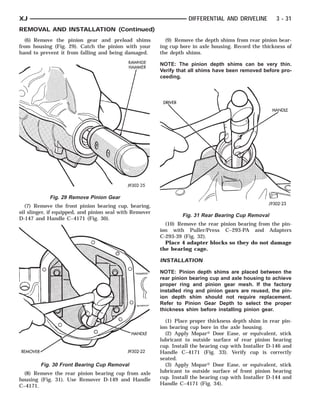
  Wash bearings with solvent and towel dry, or dry        pinion etched with a (0). The standard setting from
with compressed air. DO NOT spin bearings with            the center line of the ring gear to the back face of the
compressed air. Cup and bearing must be                   pinion is 96.850 mm (3.813 in.). The standard depth
replaced as matched sets only.                            provides the best teeth contact pattern. Refer to
  Clean axle shaft tubes and oil channels in housing.     Backlash and Contact Pattern Analysis Paragraph in
  Inspect for;                                            this section for additional information.
  • Smooth appearance with no broken/dented sur-
faces on the bearing rollers or the roller contact sur-
faces.
  • Bearing cups must not be distorted or cracked.
  • Machined surfaces should be smooth and with-
out any raised edges.
  • Raised metal on shoulders of cup bores should
be removed with a hand stone.
  • Wear and damage to pinion gear mate shaft,
pinion gears, side gears and thrust washers. Replace
as a matched set only.
  • Ring and pinion gear for worn and chipped
teeth.
  • Ring gear for damaged bolt threads. Replaced as
a matched set only.
  • Pinion yoke for cracks, worn splines, pitted
areas, and a rough/corroded seal contact surface.
Repair or replace as necessary.                                       Fig. 64 Pinion Gear ID Numbers
  • Preload shims for damage and distortion. Install        Compensation for pinion depth variance is
new shims, if necessary.                                  achieved with select shims. The shims are placed
                                                          under the inner pinion bearing cone (Fig. 65).
TRAC-LOK
  Clean all components in cleaning solvent. Dry com-
ponents with compressed air. Inspect clutch pack
plates for wear, scoring or damage. Replace both
clutch packs if any one component in either pack is
damaged. Inspect side and pinion gears. Replace any
gear that is worn, cracked, chipped or damaged.
Inspect differential case and pinion shaft. Replace if
worn or damaged.

PRESOAK PLATES AND DISC
   Plates and discs with fiber coating (no grooves or
lines) must be presoaked in Friction Modifier before
assembly. Soak plates and discs for a minimum of 20
minutes.


                                                                           Fig. 65 Shim Locations
PINION HEIGHT SCREW
                                                                DIAL SCOOTER ARBOR
                                                                     INDICATORBLOCK
                                                                        PINION CONE
                                                                          ARBOR DISC


XJ                                                                         DIFFERENTIAL AND DRIVELINE         3 - 73
ADJUSTMENTS (Continued)

                                      PINION GEAR DEPTH VARIANCE

 Original Pinion                           Replacement Pinion Gear Depth Variance
  Gear Depth
    Variance          −4         −3        −2         −1            0            +1     +2         +3         +4
       +4           +0.008    +0.007     +0.006     +0.005      +0.004        +0.003   +0.002    +0.001       0
       +3           +0.007    +0.006     +0.005     +0.004      +0.003        +0.002   +0.001      0       −0.001
       +2           +0.006    +0.005     +0.004     +0.003      +0.002        +0.001     0       −0.001    −0.002
       +1           +0.005    +0.004     +0.003     +0.002      +0.001            0    −0.001    −0.002    −0.003
        0           +0.004    +0.003     +0.002     +0.001          0         −0.001   −0.002    −0.003    −0.004
       −1           +0.003    +0.002     +0.001       0         −0.001        −0.002   −0.003    −0.004    −0.005
       −2           +0.002    +0.001        0       −0.001      −0.002        −0.003   −0.004    −0.005    −0.006
       −3           +0.001       0       −0.001     −0.002      −0.003        −0.004   −0.005    −0.006    −0.007
       −4              0      −0.001     −0.002     −0.003      −0.004        −0.005   −0.006    −0.007    −0.008

  If a new gear set is being installed, note the depth
variance etched into both the original and replace-
ment pinion gear. Add or subtract the thickness of
the original depth shims to compensate for the differ-
ence in the depth variances. Refer to the Depth Vari-
ance charts.
  Note where Old and New Pinion Marking columns
intersect. Intersecting figure represents plus or
minus amount needed.
  Note the etched number on the face of the drive
pinion gear (–1, –2, 0, +1, +2, etc.). The numbers rep-
resent thousands of an inch deviation from the stan-
dard. If the number is negative, add that value to the
required thickness of the depth shim(s). If the num-
ber is positive, subtract that value from the thickness
of the depth shim(s). If the number is 0 no change is
necessary. Refer to the Pinion Gear Depth Variance
Chart.

PINION DEPTH MEASUREMENT AND
ADJUSTMENT
   Measurements are taken with pinion cups and pin-
ion bearings installed in housing. Take measure-               Fig. 66 Pinion Gear Depth Gauge Tools—Typical
ments with a Pinion Gauge Set, Pinion Block 6735,
                                                             tighten cap bolts. Refer to the Torque Specifications
Arbor Discs 6732, and Dial Indicator C-3339 (Fig.
                                                             in this section.
66).
   (1) Assemble Pinion Height Block 6739, Pinion             NOTE: Arbor Discs 6732 have different step diame-
Block 6735, and rear pinion bearing onto Screw 6741          ters to fit other axle sizes. Pick correct size step for
(Fig. 66).                                                   axle being serviced.
   (2) Insert assembled height gauge components,
rear bearing and screw into axle housing through                (5) Assemble Dial Indicator C-3339 into Scooter
pinion bearing cups (Fig. 67).                               Block D-115-2 and secure set screw.
   (3) Install front pinion bearing and Cone 6740               (6) Place Scooter Block/Dial Indicator in position
hand tight (Fig. 66).                                        in axle housing so dial probe and scooter block are
   (4) Place Arbor Disc 6732 on Arbor D-115-3 in posi-       flush against the surface of the pinion height block.
tion in axle housing side bearing cradles (Fig. 68).         Hold scooter block in place and zero the dial indica-
Install differential bearing caps on Arbor Discs and         tor face to the pointer. Tighten dial indicator face
                                                             lock screw.
ARBOR DISC
 PINION HEIGHT
         BLOCK   PINION HEIGHT
                         BLOCK
                             PINION BLOCK   PINION BLOCK
                                                   ARBOR                              ARBOR DIAL INDICATOR
                                                                                                      SCOOTER BLOCK


3 - 74     DIFFERENTIAL AND DRIVELINE                                                                                 XJ
ADJUSTMENTS (Continued)
                                                           ple, if the depth variance is –2, add +0.002 in. to the
                                                           dial indicator reading.


         Fig. 67 Pinion Height Block—Typical

                                                            Fig. 69 Pinion Gear Depth Measurement—Typical
                                                             (10) Remove the pinion depth gauge components
                                                           from the axle housing

                                                           DIFFERENTIAL BEARING PRELOAD AND GEAR
                                                           BACKLASH
                                                              Differential side bearing preload and gear backlash
                                                           is achieved by selective shims inserted between the
                                                           bearing cup and the axle housing. The proper shim
                                                           thickness can be determined using slip-fit dummy
                                                           bearings D-348 in place of the differential side bear-
                                                           ings and a dial indicator C-3339. Before proceeding
                                                           with the differential bearing preload and gear back-
                                                           lash measurements, measure the pinion gear depth
                                                           and prepare the pinion gear for installation. Estab-
      Fig. 68 Gauge Tools In Housing—Typical               lishing proper pinion gear depth is essential to estab-
   (7) With scooter block still in position against the    lishing gear backlash and tooth contact patterns.
pinion height block, slowly slide the dial indicator       After the overall shim thickness to take up differen-
probe over the edge of the pinion height block.            tial side play is measured, the pinion gear is
Observe how many revolutions counterclockwise the          installed, and the gear backlash shim thickness is
dial pointer travels (approximately 0.125 in.) to the      measured. The overall shim thickness is the total of
out-stop of the dial indicator.                            the dial indicator reading, starting point shim thick-
   (8) Slide the dial indicator probe across the gap       ness, and the preload specification added together.
between the pinion height block and the arbor bar          The gear backlash measurement determines the
with the scooter block against the pinion height block     thickness of the shim used on the ring gear side of
(Fig. 69). When the dial probe contacts the arbor bar,     the differential case. Subtract the gear backlash shim
the dial pointer will turn clockwise. Bring dial           thickness from the total overall shim thickness and
pointer back to zero against the arbor bar, do not         select that amount for the pinion gear side of the dif-
turn dial face. Continue moving the dial probe to the      ferential (Fig. 70).
crest of the arbor bar and record the highest reading.
If the dial indicator can not achieve the zero reading,    SHIM SELECTION
the rear bearing cup or the pinion depth gauge set is
not installed correctly.                                   NOTE: It is difficult to salvage the differential side
   (9) Select a shim equal to the dial indicator read-     bearings during the removal procedure. Install
ing plus the drive pinion gear depth variance number       replacement bearings if necessary.
etched in the face of the pinion gear (Fig. 64) using
                                                             (1) Remove side bearings from differential case.
the opposite sign on the variance number. For exam-
DIFFERENTIAL BEARING D-348 CASE
 SHIM-RING GEAR TOOL
       COLLAPSIBLE SPACER
        SPECIAL SIDE
              DIFFERENTIAL          PINION GEAR DEPTH SHIM
                                           SPECIALGEAR 8107
                                           PINION TOOL
                                           BEARINGHOUSING
                                           DIFFERENTIAL
                                             RING
                                                AXLE SIDE
                                                    GEAR
                                                    SHIM-         SPECIAL TOOL C-3339     DIFFEREN-TOOL C-3288–BAXLE HOUSING
                                                                                           SPECIAL
                                                                                            TIAL CASE


XJ                                                                          DIFFERENTIAL AND DRIVELINE              3 - 75
ADJUSTMENTS (Continued)


       Fig. 70 Axle Adjustment Shim Locations
   (2) Install ring gear, if necessary, on differential
case and tighten bolts to specification.
   (3) Install dummy side bearings D-348 on differen-
tial case.
   (4) Install differential case in axle housing.
   (5) Insert Dummy Shims 8107 (0.118 in. (3.0 mm))                Fig. 72 Differential Side play Measurement
starting point shims between the dummy bearing                  (9) Push firmly and hold differential case to pinion
and the axle housing (Fig. 71).                               gear side of axle housing.
                                                                (10) Zero dial indicator face to pointer.
                                                                (11) Push firmly and hold differential case to ring
                                                              gear side of the axle housing.
                                                                (12) Record dial indicator reading.
                                                                (13) Add the dial indicator reading to the starting
                                                              point shim thickness to determine total shim thick-
                                                              ness to achieve zero differential end play.
                                                                (14) Add 0.008 in. (0.2 mm) to the zero end play
                                                              total. This new total represents the thickness of
                                                              shims to compress, or preload the new bearings when
                                                              the differential is installed.
                                                                (15) Rotate dial indicator out of the way on guide
                                                              stud.
                                                                (16) Remove differential case, dummy bearings,
                                                              and starting point shims from axle housing.
                                                                (17) Install pinion gear in axle housing. Install the
                                                              yoke and establish the correct pinion rotating torque.
                                                                (18) Install differential case and dummy bearings
                                                              in axle housing (without shims) and tighten retaining
                                                              cap bolts.
                                                                (19) Position the dial indicator plunger on a flat
                                                              surface between the ring gear bolt heads (Fig. 72).
           Fig. 71 Insert Starting Point Shims                  (20) Push and hold differential case toward pinion
                                                              gear.
  (6) Install the marked bearing caps in their correct          (21) Zero dial indicator face to pointer.
positions. Install and tighten the bolts.                       (22) Push and hold differential case to ring gear
  (7) Thread guide stud C-3288-B into rear cover              side of the axle housing.
bolt hole below ring gear (Fig. 72).                            (23) Record dial indicator reading.
  (8) Attach dial indicator C-3339 to guide stud.               (24) Subtract 0.002 in. (0.05 mm) from the dial
Position the dial indicator plunger on a flat surface         indicator reading to compensate for backlash between
on a ring gear bolt head (Fig. 72).
DIAL CATOR
                                                                     INDI-         FOR MORE BACKLASH INCREASE MORE BACKLASH
                                                                                    FOR LESS BACKLASH    FOR SHIM THIS SIDE
                                                          DECREASE SHIM
                                                          INCREASE SHIM THISTHIS
                                                                             DIE                        DECREASE SHIM THIS
                                                          SIDEFOR LESS BACKLASH
                                                               FOR MORE BACK-                           SIDE FOR LESS BACK-
                                                                           LASH                                        LASH

3 - 76    DIFFERENTIAL AND DRIVELINE                                                                                   XJ
ADJUSTMENTS (Continued)
ring and pinion gears. This total is the thickness of
shim required to achieve proper backlash.
  (25) Subtract the backlash shim thickness from
the total preload shim thickness. The remainder is
the shim thickness required on the pinion side of the
axle housing.
  (26) Rotate dial indicator out of the way on guide
stud.
  (27) Remove differential case and dummy bearings
from axle housing.
  (28) Install new side bearing cones and cups on
differential case.
  (29) Install spreader W-129-B, utilizing some com-
ponents of Adapter Set 6987, on axle housing and
spread axle opening enough to receive differential
case.
  (30) Place side bearing shims in axle housing
                                                                 Fig. 73 Ring Gear Backlash Measurement
against axle tubes.
  (31) Install differential case in axle housing.
  (32) Rotate the differential case several times to
seat the side bearings.
  (33) Position the indicator plunger against a ring
gear tooth (Fig. 73).
  (34) Push and hold ring gear upward while not
allowing the pinion gear to rotate.
  (35) Zero dial indicator face to pointer.
  (36) Push and hold ring gear downward while not
allowing the pinion gear to rotate. Dial indicator
reading should be between 0.12 mm (0.005 in.) and
0.20 mm (0.008 in.). If backlash is not within specifi-
cations transfer the necessary amount of shim thick-
ness from one side of the differential housing to the
other (Fig. 74).
  (37) Verify differential case and ring gear runout
by measuring ring to pinion gear backlash at several
locations around the ring gear. Readings should not
vary more than 0.05 mm (0.002 in.). If readings vary
more than specified, the ring gear or the differential
case is defective.
  After the proper backlash is achieved, perform the
Gear Contact Pattern Analysis procedure.                               Fig. 74 Backlash Shim Adjustment
                                                            (3) Using a boxed end wrench on a ring gear bolt,
GEAR CONTACT PATTERN ANALYSIS                             Rotate the differential case one complete revolution
  The ring and pinion gear teeth contact patterns         in both directions while a load is being applied from
will show if the pinion gear depth is correct in the      shop towel.
axle housing. It will also show if the ring gear back-      The areas on the ring gear teeth with the greatest
lash has been adjusted correctly. The backlash can be     degree of contact against the pinion gear teeth will
adjusted within specifications to achieve desired         squeegee the compound to the areas with the least
tooth contact patterns.                                   amount of contact. Note and compare patterns on the
  (1) Apply a thin coat of hydrated ferric oxide, or      ring gear teeth to Gear Tooth Contact Patterns chart
equivalent, to the drive and coast side of the ring       (Fig. 61) and adjust pinion depth and gear backlash
gear teeth.                                               as necessary.
  (2) Wrap, twist, and hold a shop towel around the
pinion yoke to increase the turning resistance of the
pinion gear. This will provide a more distinct contact
pattern.
HEEL   DRIVE GEAR TEETH
             RING   SIDE  OF   TOE      TOE
                                         COAST SIDE OF RINGTEETH HEEL
                                                            GEAR             GEAR THE COASTBACKLASHTOP OF
                                                                             CORRECT.GEARDEPTHPINIONTOWARD
                                                                             PINIONBACKLASH.SLIGHTLY BETWEEN
                                                                             GEARSOMEINCREASE BESHIMALWAYS
                                                                             CORRECT. DECREASEPINION TOOTH,
                                                                             PINIONBACKLASH. BACKLASH TOOTH.
                                                                              CORRECT. DRIVE SIDESHIM
                                                                              RING TOOTH.CLEARANCEOF
                                                                              REQUIRED. THICKER SHIMPATTERN.
                                                                              GEARTOE. DEPTH SIDE CENTERED
                                                                              REQUIRED. THINNER RING
                                                                              GEAR GEAR
                                                                              CORRECT. PATTERN SHIM
                                                                              RING GEAR CONTACT
                                                                              CONTACT DEPTH
                                                                              BE
                                                                              THE
                                                                              BUT GEAR DEPTH AND
                                                                              ON MAY THERE SHOULD
                                                                              PATTERN SHOULD RING
                                                                              DESIRABLE BE


XJ                                                                      DIFFERENTIAL AND DRIVELINE             3 - 77
ADJUSTMENTS (Continued)


                                     Fig. 75 Gear Tooth Contact Patterns
3 - 78     DIFFERENTIAL AND DRIVELINE                                                   XJ


SPECIFICATIONS
194 RBI AXLE

DESCRIPTION                                  SPECIFICATION
Axle Type . . . . . . . . . . . . . . . Semi–Floating Hypoid
Lubricant . . . . . . . . SAE Thermally Stable 80W–90
Lubricant Trailer Tow . . . . . . . . Synthetic 75W–140
Lube Capacity . . . . . . . . . . . . . . . . 1.66 L (3.50 pts.)
Axle Ratios . . . . . . . . . . . . . . . . 3.07, 3.55, 3.73, 4.11
Differential Bearing Preload . . . . 0.1 mm (0.004 in.)              Adapter—C-293-39
Differential Side Gear
  Clearance . . . . . . . . . . . . 0–0.15 mm (0–0.006 in.)
Ring Gear Diameter . . . . . . . . . . 19.2 cm (7.562 in.)
Ring Gear Backlash . . . 0–0.15 mm (0.005–0.008 in.)
Pinion Std. Depth . . . . . . . . . . 92.08 mm (3.625 in.)
Pinion Bearing Preload-Original
  Bearings . . . . . . . . . . . . . 1–2 N·m (10–20 in. lbs.)
Pinion Bearing Preload-New
  Bearings . . . . . . . . . . . 1.5–4 N·m (15–35 in. lbs.)
194 RBI AXLE                                                         Adapter—C-293-40

DESCRIPTION                                         TORQUE
Bolt, Diff. Cover . . . . . . . . . . . . . 41 N·m (30 ft. lbs.)
Bolot, Bearing Cap . . . . . . . . . . . 77 N·m (57 ft. lbs.)
Nut, Pinion . . . . . . . 271–474 N·m (200–350 ft. lbs.)
Screw, Pinion Mate
  Shaft Lock . . . . . . . . . . . . . 16.25 N·m (12 ft. lbs.)
Bolt, Ring Gear . . . . . . . 95–122 N·m (70–90 ft. lbs.)
Bolt, RWAL/ABS Sensor . . . . . . . 8 N·m (70 in. lbs.)

SPECIAL TOOLS                                                         Plug—SP-3289

194 RBI AXLE


                                                                       Puller—C-452

                      Puller—C-293-PA
XJ                               DIFFERENTIAL AND DRIVELINE   3 - 79
SPECIAL TOOLS (Continued)


                                        Cup—8109
            Wrench—C-3281


           Installer—C-3972-A


                                      Handle—C-4171


            Spanner—6958


                                      Driver—C-3716-A


          Installer Screw—8112


                                      Installer—D-130
3 - 80   DIFFERENTIAL AND DRIVELINE                           XJ
SPECIAL TOOLS (Continued)


                                         Installer—6436
                Installer—D-146


               Remover—C-4345


                                         Installer—6437


               Remover—D-149


                                      Disc, Axle Arbor—6732


                Installer—W-262


                                       Gauge Block—6735
XJ                                    DIFFERENTIAL AND DRIVELINE   3 - 81
SPECIAL TOOLS (Continued)


        Tool Set, Pinion Depth—6774    Starting Point Shim—8107


          Trac-lok Tool Set—6960          Spreader—W-129-B


               Holder—6965
                                          Adapter Kit—6987


              Puller—7794-A              Guide Pin—C-3288-B
3 - 82   DIFFERENTIAL AND DRIVELINE      XJ
SPECIAL TOOLS (Continued)


         Bearing Remover Tool Set—6310


               Hub Puller—6790


             Dial Indicator—C-3339
XJ                                                                                                         DIFFERENTIAL AND DRIVELINE                     3 - 83


                                                               8 1/4 REAR AXLE

                                                                                       INDEX
                                                                                   page                                                                     page

GENERAL INFORMATION                                                                           DIFFERENTIAL . . . . . . . . . . . . . . . . . . . . . . . .       95
  8 1/4 AXLES . . . . . . . . . . . . . . . . .   . . . . . . . . . . 83                      PINION GEAR . . . . . . . . . . . . . . . . . . . . . . . . .      96
  AXLE IDENTIFICATION . . . . . . . .             . . . . . . . . . . 83                      PINION SEAL . . . . . . . . . . . . . . . . . . . . . . . . . .    93
  LUBRICANT SPECIFICATIONS . .                    . . . . . . . . . . 83                      REAR AXLE . . . . . . . . . . . . . . . . . . . . . . . . . . .    91
DESCRIPTION AND OPERATION                                                                     RING GEAR . . . . . . . . . . . . . . . . . . . . . . . . . . .    96
  STANDARD DIFFERENTIAL . . . . .                 . . . . . . . . . . 84                    DISASSEMBLY AND ASSEMBLY
  TRAC-LOK OPERATION . . . . . . . .              . . . . . . . . . . 85                      STANDARD DIFFERENTIAL . . . . . . . . . . . . . .                 100
DIAGNOSIS AND TESTING                                                                         TRAC-LOK DIFFERENTIAL . . . . . . . . . . . . . .                 101
  BEARING NOISE . . . . . . . . . . . . .         ..   .   .   .   .   .   .   .   .   86   CLEANING AND INSPECTION
  DRIVELINE SNAP . . . . . . . . . . . .          ..   .   .   .   .   .   .   .   .   86     8 1/4 AXLES . . . . . . . . . . . . . . . . . . . . . . . . . .   104
  GEAR NOISE . . . . . . . . . . . . . . . .      ..   .   .   .   .   .   .   .   .   86     TRAC-LOK . . . . . . . . . . . . . . . . . . . . . . . . . . .    105
  GENERAL INFORMATION . . . . . .                 ..   .   .   .   .   .   .   .   .   85   ADJUSTMENTS
  LOW SPEED KNOCK . . . . . . . . . .             ..   .   .   .   .   .   .   .   .   86     8 1/4 AXLE PINION GEAR DEPTH . . . . . . . . .                    105
  TRAC–LOK DIFFERENTIAL NOISE                      .   .   .   .   .   .   .   .   .   87     DIFFERENTIAL BEARING PRELOAD AND
  TRAC–LOK TEST . . . . . . . . . . . . .         ..   .   .   .   .   .   .   .   .   90       GEAR BACKLASH . . . . . . . . . . . . . . . . . . . .           107
  VIBRATION . . . . . . . . . . . . . . . . .     ..   .   .   .   .   .   .   .   .   86     GEAR CONTACT PATTERN ANALYSIS . . . . . .                         108
SERVICE PROCEDURES                                                                            SIDE GEAR CLEARANCE . . . . . . . . . . . . . . .                 108
  LUBRICANT CHANGE . . . . . . . . .              . . . . . . . . . . 90                    SPECIFICATIONS
REMOVAL AND INSTALLATION                                                                      8 1/4 INCH AXLE . . . . . . . . . . . . . . . . . . . . . .       110
  AXLE SEAL AND BEARING . . . . .                 . . . . . . . . . . 92                      8 1/4 INCH AXLE . . . . . . . . . . . . . . . . . . . . . .       110
  AXLE SHAFT . . . . . . . . . . . . . . . .      . . . . . . . . . . 91                    SPECIAL TOOLS
  DIFFERENTIAL SIDE BEARINGS .                    . . . . . . . . . . 95                      8 1/4 AXLES . . . . . . . . . . . . . . . . . . . . . . . . . .   111

GENERAL INFORMATION                                                                         Pinion bearing preload is set and maintained by the
                                                                                            use of a collapsible spacer.
8 1/4 AXLES                                                                                   Axles equipped with a Trac-Lok௢ differential are
  The 8 1/4 inch axle housings consist of a cast iron                                       optional. A Trac-Lok differential has a one-piece dif-
center section with axle shaft tubes extending from                                         ferential case, and the same internal components as
either side. The tubes are pressed into and welded to                                       a standard differential, plus two clutch disc packs.
the differential housing to form a one-piece axle
housing (Fig. 1).                                                                           AXLE IDENTIFICATION
  The axles have a vent hose to relieve internal pres-                                        The axle differential cover can be used for identifi-
sure caused by lubricant vaporization and internal                                          cation of the axle (Fig. 2). A tag is also attached to
expansion.                                                                                  the cover.
  The axles are equipped with semi-floating axle
shafts, meaning vehicle loads are supported by the                                          LUBRICANT SPECIFICATIONS
axle shaft and bearings. The axle shafts are retained                                         Multi-purpose, hypoid gear lubricant should be
by C-clips in the differential side gears.                                                  used for rear axles with a standard differential. The
  The removable, stamped steel cover provides a                                             lubricant should have a MIL-L-2105C and API GL 5
means for inspection and service without removing                                           quality specifications.
the complete axle from the vehicle.                                                           Trac-Lok differentials require the addition of 5 oz.
  The 8 1/4 axle have the assembly part number and                                          of friction modifier to the axle lubricant after service.
gear ratio listed on tag. The tag is attached to the                                        The 8 1/4 axle lubricant capacity is 2.27 L (4.8 pts.)
differential housing by a cover bolt.                                                       total, including the friction modifier, if necessary.
  The differential case is a one-piece design. The dif-
ferential pinion mate shaft is retained with a                                              NOTE: If the rear axle is submerged in water, the
threaded pin. Differential bearing preload and ring                                         lubricant must be replaced immediately. Avoid the
gear backlash are set and maintained by threaded                                            possibility of premature axle failure resulting from
adjusters at the outside of the differential housing.                                       water contamination of the lubricant.
DIFFERENTIAL CUP SHAFT REAR BEARING
 PUSH-IN FILL PRELOAD COLLAPSIBLE SPACER
  10.
  9.
  8.
  7.
  6.
  5.
  4. PINION COVERHOUSING
  3. PINION GEAR BEARING
  2. BEARINGGEAR CASE FRONT
  1. DIFFERENTIALDEPTH SHIMS BEARING
              PLUGSHAFT                    IDENTIFICATION TAGADJUSTER
                                                          11. SEAL GEAR
                                                          20.
                                                          19. C-LOCK
                                                          18. SIDE
                                                          17. BEARING
                                                          16. LOCK
                                                          15. NUT
                                                          14. WASHER CAP
                                                          13. THRUST WASHER
                                                          12. YOKE                     21. THRUSTGEARS
                                                                                       28.
                                                                                       27. PLUG
                                                                                       26. COVER
                                                                                       25. RING GEAR
                                                                                       24. MAT SHAFT BOLT
                                                                                       23. SHAFT WAHSERS
                                                                                       22. PINION LOCK BOLT


3 - 84      DIFFERENTIAL AND DRIVELINE                                                                                XJ


                                                     Fig. 1 8 1/4 Axle
                                                                  DESCRIPTION AND OPERATION
                                                                  STANDARD DIFFERENTIAL
                                                                    The differential gear system divides the torque
                                                                  between the axle shafts. It allows the axle shafts to
                                                                  rotate at different speeds when turning corners.
                                                                    Each differential side gear is splined to an axle
                                                                  shaft. The pinion gears are mounted on a pinion
                                                                  mate shaft and are free to rotate on the shaft. The
                                                                  pinion gear is fitted in a bore in the differential case
                                                                  and is positioned at a right angle to the axle shafts.
                                                                    In operation, power flow occurs as follows:
                                                                    • The pinion gear rotates the ring gear.
                                                                    • The ring gear (bolted to the differential case)
                                                                  rotates the case.
                                                                    • The differential pinion gears (mounted on the
                                                                  pinion mate shaft in the case) rotate the side gears.
                                                                    • The side gears (splined to the axle shafts) rotate
                                                                  the shafts.
                                                                    During straight-ahead driving, the differential pin-
                                                                  ion gears do not rotate on the pinion mate shaft. This
                                                                  occurs because input torque applied to the gears is
         Fig. 2 Differential Cover 8 1/4 Inch Axle                divided and distributed equally between the two side
                                                                  gears. As a result, the pinion gears revolve with the
                                                                  pinion mate shaft but do not rotate around it (Fig. 1).
PINION GEARS ROTATE PINION GEAR OF EACHGEAR
                      WHEEL ROTATES ROTATE WITH
                      IN PINION SHAFT AT 100% CASE
                        PINION GEARS
                          STRAIGHT ON
                             100% AHEAD DRIVING SIDE
                                    AXLE SPEED SPEED
                                    DIFFERENTIAL CASE
                                     CASE                                        CLUTCH PACK
                                                                                     CASE         RING GEAR      SIDE GEAR   PINION PINION
                                                                                                                             DRIVE GEAR
                                                                                                                              CLUTCH PACK
                                                                                                                               MATE SHAFT
OUTER   WHEEL   110%    CASE                      INNER   WHEEL   90%    CASE
                       SPEED                                            SPEED


XJ                                                                                             DIFFERENTIAL AND DRIVELINE        3 - 85
DESCRIPTION AND OPERATION (Continued)
                                                                                  In operation, the Trac-lok clutches are engaged by
                                                                                two concurrent forces. The first being the preload
                                                                                force exerted through Belleville spring washers
                                                                                within the clutch packs. The second is the separating
                                                                                forces generated by the side gears as torque is
                                                                                applied through the ring gear (Fig. 4).


Fig. 3 Differential Operation—Straight Ahead Driving
  When turning corners, the outside wheel must
travel a greater distance than the inside wheel to
complete a turn. The difference must be compensated
for to prevent the tires from scuffing and skidding
through turns. To accomplish this, the differential
allows the axle shafts to turn at unequal speeds (Fig.
2). In this instance, the input torque applied to the
pinion gears is not divided equally. The pinion gears
now rotate around the pinion mate shaft in opposite
directions. This allows the side gear and axle shaft
attached to the outside wheel to rotate at a faster
speed.


                                                                                 Fig. 5 Trac-lok Limited Slip Differential Operation
                                                                                   The Trac-lok design provides the differential action
                                                                                needed for turning corners and for driving straight
                                                                                ahead during periods of unequal traction. When one
                                                                                wheel looses traction, the clutch packs transfer addi-
                                                                                tional torque to the wheel having the most traction.
                                                                                Trac-lok differentials resist wheel spin on bumpy
                                                                                roads and provide more pulling power when one
                                                                                wheel looses traction. Pulling power is provided con-
                                                                                tinuously until both wheels loose traction. If both
          Fig. 4 Differential Operation—On Turns                                wheels slip due to unequal traction, Trac-lok opera-
                                                                                tion is normal. In extreme cases of differences of
TRAC-LOK OPERATION                                                              traction, the wheel with the least traction may spin.
  In a conventional differential, if one wheel spins,
the opposite wheel will generate only as much torque
as the spinning wheel.                                                          DIAGNOSIS AND TESTING
  In the Trac-lok differential, part of the ring gear
torque is transmitted through clutch packs which                                GENERAL INFORMATION
contain multiple discs. The clutches will have radial                             Axle bearing problem conditions are usually caused
grooves on the plates, and concentric grooves on the                            by:
discs or bonded fiber material that is smooth in                                  • Insufficient or incorrect lubricant.
appearance.                                                                       • Foreign matter/water contamination.
3 - 86    DIFFERENTIAL AND DRIVELINE                                                                         XJ
DIAGNOSIS AND TESTING (Continued)
   • Incorrect bearing preload torque adjustment.         tial bearing noise is also constant and varies only
   • Incorrect backlash.                                  with vehicle speed.
   Axle gear problem conditions are usually the result       Axle shaft bearings produce noise and vibration
of:                                                       when worn or damaged. The noise generally changes
   • Insufficient lubrication.                            when the bearings are loaded. Road test the vehicle.
   • Incorrect or contaminated lubricant.                 Turn the vehicle sharply to the left and to the right.
   • Overloading (excessive engine torque) or exceed-     This will load the bearings and change the noise
ing vehicle weight capacity.                              level. Where axle bearing damage is slight, the noise
   • Incorrect clearance or backlash adjustment.          is usually not noticeable at speeds above 30 mph.
   Axle component breakage is most often the result
of:                                                       LOW SPEED KNOCK
   • Severe overloading.                                    Low speed knock is generally caused by a worn
   • Insufficient lubricant.                              U–joint or by worn side–gear thrust washers. A worn
   • Incorrect lubricant.                                 pinion gear shaft bore will also cause low speed
   • Improperly tightened components.                     knock.

GEAR NOISE                                                VIBRATION
   Axle gear noise can be caused by insufficient lubri-     Vibration at the rear of the vehicle is usually
cant, incorrect backlash, tooth contact, or worn/dam-     caused by a:
aged gears.                                                 • Damaged drive shaft.
   Gear noise usually happens at a specific speed           • Missing drive shaft balance weight(s).
range. The range is 30 to 40 mph, or above 50 mph.          • Worn or out–of–balance wheels.
The noise can also occur during a specific type of          • Loose wheel lug nuts.
driving condition. These conditions are acceleration,       • Worn U–joint(s).
deceleration, coast, or constant load.                      • Loose/broken springs.
   When road testing, accelerate the vehicle to the         • Damaged axle shaft bearing(s).
speed range where the noise is the greatest. Shift          • Loose pinion gear nut.
out-of-gear and coast through the peak–noise range.         • Excessive pinion yoke run out.
If the noise stops or changes greatly:                      • Bent axle shaft(s).
   • Check for insufficient lubricant.                      Check for loose or damaged front–end components
   • Incorrect ring gear backlash.                        or engine/transmission mounts. These components
   • Gear damage.                                         can contribute to what appears to be a rear–end
   Differential side and pinion gears can be checked      vibration. Do not overlook engine accessories, brack-
by turning the vehicle. They usually do not cause         ets and drive belts.
noise during straight–ahead driving when the gears          All driveline components should be examined
are unloaded. The side gears are loaded during vehi-      before starting any repair.
cle turns. A worn pinion gear mate shaft can also           Refer to Group 22, Wheels and Tires, for additional
cause a snapping or a knocking noise.                     vibration information.

BEARING NOISE                                             DRIVELINE SNAP
   The axle shaft, differential and pinion gear bear-       A snap or clunk noise when the vehicle is shifted
ings can all produce noise when worn or damaged.          into gear (or the clutch engaged), can be caused by:
Bearing noise can be either a whining, or a growling        • High engine idle speed.
sound.                                                      • Loose engine/transmission/transfer case mounts.
   Pinion gear bearings have a constant–pitch noise.        • Worn U–joints.
This noise changes only with vehicle speed. Pinion          • Loose spring mounts.
bearing noise will be higher because it rotates at a        • Loose pinion gear nut and yoke.
faster rate. Drive the vehicle and load the differen-       • Excessive ring gear backlash.
tial. If bearing noise occurs, the rear pinion bearing      • Excessive side gear/case clearance.
is the source of the noise. If the bearing noise is         The source of a snap or a clunk noise can be deter-
heard during a coast, the front pinion bearing is the     mined with the assistance of a helper. Raise the vehi-
source.                                                   cle on a hoist with the wheels free to rotate. Instruct
   Worn or damaged differential bearings usually pro-     the helper to shift the transmission into gear. Listen
duce a low pitch noise. Differential bearing noise is     for the noise, a mechanics stethoscope is helpful in
similar to pinion bearing noise. The pitch of differen-   isolating the source of a noise.
XJ                                                                   DIFFERENTIAL AND DRIVELINE         3 - 87
DIAGNOSIS AND TESTING (Continued)
TRAC–LOK DIFFERENTIAL NOISE                                 After changing the lubricant, drive the vehicle and
   The most common problem is a chatter noise when        make 10 to 12 slow, figure-eight turns. This maneu-
turning corners. Before removing a Trac-lok unit for      ver will pump lubricant through the clutches. This
repair, drain, flush and refill the axle with the spec-   will correct the condition in most instances. If the
ified lubricant. Refer to Lubricant change in this        chatter persists, clutch damage could have occurred.
Group.
   A container of Mopar௡ Trac-lok Lubricant (friction
modifier) should be added after repair service or dur-
ing a lubricant change.
3 - 88   DIFFERENTIAL AND DRIVELINE                                                                        XJ
DIAGNOSIS AND TESTING (Continued)

           CONDITION                   POSSIBLE CAUSES                            CORRECTION
WHEEL NOISE                    1. Wheel loose.                         1. Tighten loose nuts.
                               2. Faulty, brinelled wheel bearing.     2. Faulty or brinelled bearings must
                                                                       be replaced.
AXLE SHAFT NOISE               1. Misaligned axle shaft tube.          1. Inspect axle shaft tube alignment.
                                                                       Correct as necessary.
                               2. Bent or sprung axle shaft.           2. Replace bent or sprung axle
                                                                       shaft.
                               3. End play in drive pinion bearings.   3. Refer to Drive Pinion Bearing
                                                                       Pre-Load Adjustment.
                               4. Excessive gear backlash between      4. Check adjustment of ring gear
                               ring gear and pinion gear.              backlash and pinion gear. Correct as
                                                                       necessary.
                               5. Improper adjustment of drive         5. Adjust drive pinion shaft bearings.
                               pinion gear shaft bearings.
                               6. Loose drive pinion gearshaft yoke    6. Tighten drive pinion gearshaft
                               nut.                                    yoke nut with specified torque.
                               7. Improper wheel bearing               7. Readjust as necessary.
                               adjustment.
                               8. Scuffed gear tooth contact           8. If necessary, replace scuffed
                               surfaces.                               gears.
AXLE SHAFT BROKE               1. Misaligned axle shaft tube.          1. Replace broken axle shaft after
                                                                       correcting axle shaft tube alignment.
                               2. Vehicle overloaded.                  2. Replace broken axle shaft. Avoid
                                                                       excessive weight on vehicle.
                               3. Erratic clutch operation.            3. Replace broken axle shaft after
                                                                       inspecting for other possible casues.
                                                                       Avoid erratic use of clutch.
                               4. Grabbing clutch.                     4. Replace broken axle shaft.
                                                                       Inspect clutch and make necessary
                                                                       repairs or adjustments.
DIFFERENTIAL CASE CRACKED      1. Improper adjustment of differential 1. Replace cracked case; examine
                               bearings.                              gears and bearings for possible
                                                                      damage. At reassembly, adjust
                                                                      differential bearings properly.
                               2. Excessive ring gear backlash.       2. Replace cracked case; examine
                                                                      gears and bearings for possible
                                                                      damage. At reassembly, adjust ring
                                                                      gear backlash properly.
                               3. Vehicle overloaded.                 3. Replace cracked case; examine
                                                                      gears and bearings for possible
                                                                      damage. Avoid excessive weight on
                                                                      vehicle.
                               4. Erratic clutch operation.           4. Replace cracked case. After
                                                                      inspecting for other possible causes,
                                                                      examine gears and bearings for
                                                                      possible damage. Avoid erratic use
                                                                      of clutch.
XJ                                                               DIFFERENTIAL AND DRIVELINE             3 - 89
DIAGNOSIS AND TESTING (Continued)

         CONDITION                    POSSIBLE CAUSES                             CORRECTION
DIFFERENTIAL GEARS SCORED     1. Insufficient lubrication.            1. Replace scored gears. Scoring
                                                                      marks on the drive face of gear
                                                                      teeth or in the bore are caused by
                                                                      instantaneous fusing of the mating
                                                                      surfaces. Scored gears should be
                                                                      replaced. Fill rear differential housing
                                                                      to required capacity with proper
                                                                      lubricant. Refer to Specifications.
                              2. Improper grade of lubricant.         2. Replace scored gears. Inspect all
                                                                      gears and bearings for possible
                                                                      damage. Clean and refill differential
                                                                      housing to required capacity with
                                                                      proper lubricant.
                              3. Excessive spinning of one            3. Replace scored gears. Inspect all
                              wheel/tire.                             gears, pinion bores and shaft for
                                                                      damage. Service as necessary.
LOSS OF LUBRICANT             1. Lubricant level too high.            1. Drain excess lubricant by
                                                                      removing fill plug and allow lubricant
                                                                      to level at lower edge of fill plug
                                                                      hole.
LOSS OF LUBRICANT             2. Worn axle shaft seals.               Replace worn seals.
                              3. Cracked differential housing.        3. Repair or replace housing as
                                                                      necessary.
                              4. Worn drive pinion gear shaft seal.   4. Replace worn drive pinion gear
                                                                      shaft seal.
                              5. Scored and worn yoke.                5. Replace worn or scored yoke and
                                                                      seal.
                              6. Axle cover not properly sealed.      6. Remove cover and clean flange
                                                                      and reseal.
AXLE OVERHEATING              1. Lubricant level too low.             1. Refill differential housing.
                              2. Incorrect grade of lubricant.        2. Drain, flush and refill with correct
                                                                      amount of the correct lubricant.
                              3. Bearings adjusted too tight.         3. Readjust bearings.
                              4. Excessive gear wear.                 4. Inspect gears for excessive wear
                                                                      or scoring. Replace as necessary.
                              5. Insufficient ring gear backlash.     5. Readjust ring gear backlash and
                                                                      inspect gears for possible scoring.
GEAR TEETH BROKE (RING GEAR 1. Overloading.                           1. Replace gears. Examine other
AND PINION)                                                           gears and bearings for possible
                                                                      damage.
                              2. Erratic clutch operation.            2. Replace gears and examine the
                                                                      remaining parts for possible
                                                                      damage. Avoid erratic clutch
                                                                      operation.
                              3. Ice-spotted pavements.               3. Replace gears. Examine the
                                                                      remaining parts for possible
                                                                      damage. Replace parts as required.
                              4. Improper adjustments.                4. Replace gears. Examine other
                                                                      parts for possible damage. Ensure
                                                                      ring gear backlash is correct.
IN
                                                                  6790 WITH TOOL
                                                                  SPECIAL HOLE
                                                                         CENTER
                                                                            BOLT                        TORQUE WRENCH


3 - 90   DIFFERENTIAL AND DRIVELINE                                                                                     XJ
DIAGNOSIS AND TESTING (Continued)

            CONDITION                        POSSIBLE CAUSES                                  CORRECTION
AXLE NOISE                           1. Insufficient lubricant.                    1. Refill axle with correct amount of
                                                                                   proper lubricant. Also inspect for
                                                                                   leaks and correct as necessary.
                                     2. Improper ring gear and drive               2. Check ring gear and pinion gear
                                     pinion gear adjustment.                       teeth contact pattern.
                                     3. Unmatched ring gear and drive              3. Remove unmatched ring gear and
                                     pinion gear.                                  drive pinion gear. Replace with
                                                                                   matched gear and drive pinion gear
                                                                                   set.
                                     4. Worn teeth on ring gear or drive           4. Check teeth on ring gear and
                                     pinion gear.                                  drive pinion gear for correct contact.
                                                                                   If necessary, replace with new
                                                                                   matched set.
                                     5. Loose drive pinion gear shaft              5. Adjust drive pinion gearshaft
                                     bearings.                                     bearing preload torque.
                                     6. Loose differential bearings.               6. Adjust differential bearing preload
                                                                                   torque.
                                     7. Misaligned or sprung ring gear.            7. Measure ring gear runout.
                                     8. Loose differential bearing cap             8. Tighten with specified torque.
                                     bolts.


TRAC–LOK TEST
WARNING: WHEN SERVICING VEHICLES WITH A
TRAC–LOK DIFFERENTIAL DO NOT USE THE
ENGINE TO TURN THE AXLE AND WHEELS. BOTH
REAR WHEELS MUST BE RAISED AND THE VEHI-
CLE SUPPORTED. A TRAC–LOK AXLE CAN EXERT
ENOUGH FORCE IF ONE WHEEL IS IN CONTACT
WITH A SURFACE TO CAUSE THE VEHICLE TO
MOVE.

  The differential can be tested without removing the
differential case by measuring rotating torque. Make
sure brakes are not dragging during this measure-
ment.
  (1) Place blocks in front and rear of both front
wheels.                                                                  Fig. 6 Trac-lok Test —Typical
  (2) Raise one rear wheel until it is completely off
the ground.                                                 SERVICE PROCEDURES
  (3) Engine off, transmission in neutral, and park-
ing brake off.                                              LUBRICANT CHANGE
  (4) Remove wheel and bolt Special Tool 6790 to               (1) Raise and support the vehicle.
studs.                                                         (2) Remove the lubricant fill hole plug from the
  (5) Use torque wrench on special tool to rotate           differential housing cover.
wheel and read rotating torque (Fig. 5).                       (3) Remove the differential housing cover and
  (6) If rotating torque is less than 22 N·m (30 ft.        drain the lubricant from the housing.
lbs.) or more than 271 N·m (200 ft. lbs.) on either            (4) Clean the housing cavity with a flushing oil,
wheel the unit should be serviced.                          light engine oil, or lint free cloth. Do not use water,
                                                            steam, kerosene, or gasoline for cleaning.
                                                               (5) Remove the original sealant from the housing
                                                            and cover surfaces.
                                                               (6) Apply a bead of Mopar௡ Silicone Rubber Seal-
                                                            ant, or equivalent, to the housing cover (Fig. 6).
SEALANT   AXLE HOUSING COVER


XJ                                                                    DIFFERENTIAL AND DRIVELINE          3 - 91
SERVICE PROCEDURES (Continued)
                                                              (7) Disconnect the parking brake cables and cable
                                                           brackets.
                                                              (8) Disconnect the vent hose from the axle shaft
                                                           tube.
                                                              (9) Mark the propeller shaft and yoke for installa-
                                                           tion alignment reference.
                                                              (10) Remove propeller shaft.
                                                              (11) Disconnect shock absorbers from axle.
                                                              (12) Remove the stabilizer links.
                                                              (13) Remove the spring clamps and spring brack-
                                                           ets. Refer to Group 2, Suspension, for proper proce-
                                                           dures.
                                                              (14) Separate the axle from the vehicle.

                                                           INSTALLATION
                                                              (1) Raise the axle with lifting device and align to
                   Fig. 7 Apply Sealant                    the leaf spring centering bolts.
                                                              (2) Install the spring clamps and spring brackets.
   Install the housing cover within 5 minutes
                                                           Refer to Group 2, Suspension, for proper procedures.
after applying the sealant.
                                                              (3) Install shock absorbers and tighten nuts to 60
   (7) Install the cover and any identification tag.
                                                           N·m (44 ft. lbs.) torque.
Tighten the cover bolts to 41 N·m (30 ft. lbs.) torque.
                                                              (4) Install the stabilizer links. Tighten sway bar
   (8) For Trac–lok differentials, a quantity of
                                                           links to 74 N·m (55 ft. lbs.).
Mopar௡ Trac–lok lubricant (friction modifier), or
                                                              (5) Connect the parking brake cables and cable
equivalent, must be added after repair service or a
                                                           brackets.
lubricant change. Refer to the Lubricant Specifica-
                                                              (6) Install the brake drums. Refer to Group 5,
tions section of this group for the quantity necessary.
                                                           Brakes, for proper procedures.
   (9) Fill differential with Mopar௡ Hypoid Gear
                                                              (7) Connect the brake hose to the axle junction
Lubricant, or equivalent, to bottom of the fill plug
                                                           block. Refer to Group 5, Brakes, for proper proce-
hole. Refer to the Lubricant Specifications section of
                                                           dures.
this group for the quantity necessary.
                                                              (8) Install axle vent hose.
CAUTION: Overfilling the differential can result in           (9) Align propeller shaft and pinion yoke reference
lubricant foaming and overheating.                         marks. Install universal joint straps and bolts.
                                                           Tighten to 19 N·m (14 ft. lbs.) torque.
  (10) Install the fill hole plug and lower the vehicle.      (10) Install the wheels and tires.
  (11) Trac–lok differential equipped vehicles should         (11) Add gear lubricant, if necessary. Refer to
be road tested by making 10 to 12 slow figure-eight        Lubricant Specifications in this section for lubricant
turns. This maneuver will pump the lubricant               requirements.
through the clutch discs to eliminate a possible chat-        (12) Remove lifting device from axle and lower the
ter noise complaint.                                       vehicle.

                                                           AXLE SHAFT
REMOVAL AND INSTALLATION
                                                           REMOVAL
REAR AXLE                                                    (1) Raise and support vehicle. Ensure that the
                                                           transmission is in neutral.
REMOVAL                                                      (2) Remove wheel and tire assembly.
  (1) Raise and support the vehicle.                         (3) Remove brake drum. Refer to Group 5, Brakes,
  (2) Position a suitable lifting device under the         for proper procedure.
axle.                                                        (4) Clean all foreign material from housing cover
  (3) Secure axle to device.                               area.
  (4) Remove the wheels and tires.                           (5) Loosen housing cover bolts. Drain lubricant
  (5) Secure brake drums to the axle shaft.                from the housing and axle shaft tubes. Remove hous-
  (6) Disconnect the brake hose at the axle junction       ing cover.
block. Do not disconnect the brake hydraulic lines at        (6) Rotate differential case so that pinion mate
the wheel cylinders. Refer to Group 5, Brakes, for         gear shaft lock screw is accessible. Remove lock
proper procedures.
SIDE GEAR   AXLEPINION GEAR MATE SHAFT
                                       SHAFT
                                        LOCK
                                           SCREW
                                            C-CLIPLOCK                       PRY BAR                           AXLESEAL
                                                                                                                AXLETUBE


3 - 92   DIFFERENTIAL AND DRIVELINE                                                                                XJ
REMOVAL AND INSTALLATION (Continued)
screw and pinion mate gear shaft from differential                (2) Insert C–clip lock in end of axle shaft. Push
case (Fig. 8).                                                  axle shaft outward to seat C–clip lock in side gear.
                                                                  (3) Insert pinion mate shaft into differential case
                                                                and through thrust washers and pinion gears.
                                                                  (4) Align hole in shaft with hole in the differential
                                                                case and install lock screw with Loctite௡ on the
                                                                threads. Tighten lock screw to 11 N·m (8 ft. lbs.)
                                                                torque.
                                                                  (5) Install cover and add fluid. Refer to Lubricant
                                                                Change procedure in this section for procedure and
                                                                lubricant requirements.
                                                                  (6) Install brake drum. Refer to Group 5, Brakes,
                                                                for proper procedures.
                                                                  (7) Install wheel and tire.
                                                                  (8) Lower vehicle.

                                                                AXLE SEAL AND BEARING
                                                                REMOVAL
           Fig. 8 Mate Shaft Lock Screw                           (1) Remove axle shaft.
  (7) Push axle shaft inward and remove axle shaft                (2) Remove axle shaft seal from the end of the axle
C–clip lock from the axle shaft (Fig. 9).                       tube with a small pry bar (Fig. 10).

                                                                NOTE: The seal and bearing can be removed at the
                                                                same time with the bearing removal tool.

                                                                  (3) Remove the axle shaft bearing from the axle
                                                                tube with Bearing Removal Tool Set 6310, using
                                                                Adapter Foot 6310-9 (Fig. 11).


           Fig. 9 Axle Shaft C–Clip Lock
  (8) Remove axle shaft. Use care to prevent damage
to axle shaft bearing and seal, which will remain in
axle shaft tube.
  (9) Inspect axle shaft seal for leakage or damage.
  (10) Inspect roller bearing contact surface on axle
shaft for signs of brinelling, galling and pitting. If
any of these conditions exist, the axle shaft and/or                         Fig. 10 Axle Seal Removal
bearing and seal must be replaced.                              INSTALLATION

INSTALLATION                                                    NOTE: Do not install the original axle shaft seal.
  (1) Lubricate bearing bore and seal lip with gear             Always install a new seal.
lubricant. Insert axle shaft through seal, bearing,
and engage it into side gear splines.                             (1) Wipe the axle tube bore clean. Remove any old
                                                                sealer or burrs from the tube.
NOTE: Use care to prevent shaft splines from dam-                 (2) Install the axle shaft bearing with Installer
aging axle shaft seal lip.                                      C-4198 and Handle C-4171 (Fig. 12). Ensure that the
                                                                bearing part number is against the installer. Verify
AXLE   SHAFT TUBE
        TUBE
         AXLE       FOOT         INSTALLER
                                        ADAPTER
                                              THREADED ROD
                                                  GUIDE NUT
                                                     HANDLE
                                                     PLATE
                                                      GUIDE     TOOL C452                                  PINION YOKE


XJ                                                                          DIFFERENTIAL AND DRIVELINE        3 - 93
REMOVAL AND INSTALLATION (Continued)
                                                                 (3) Disconnect the propeller shaft from the pinion
                                                              yoke. Secure the propeller shaft in an upright posi-
                                                              tion to prevent damage to the rear universal joint.
                                                                 (4) Remove the wheel and tire assemblies.
                                                                 (5) Remove the brake drums to prevent any drag.
                                                              The drag may cause a false bearing preload torque
                                                              measurement.
                                                                 (6) Rotate the pinion yoke three or four times.
                                                                 (7) Measure the amount of torque necessary to
                                                              rotate the pinion gear with a (in. lbs.) dial-type
                                                              torque wrench. Record the torque reading for instal-
                                                              lation reference.
                                                                 (8) Hold the yoke with Wrench 6719. Remove the
                                                              pinion shaft nut and washer.
                                                                 (9) Remove the yoke with Remover C-452 (Fig. 13).


       Fig. 11 Axle Shaft Bearing Removal Tool
that the bearing in installed straight and the tool
fully contacts the axle tube when seating the bearing.
  (3) Install a new axle seal with Installer C-4076-B
and Handle C-4735-1. When the tool contacts the
axle tube, the seal is installed to the correct depth.
  (4) Coat the lip of the seal with axle lubricant for
protection prior to installing the axle shaft.
  (5) Install the axle shaft.
                                                                               Fig. 13 Yoke Removal
                                                                (10) Remove the pinion shaft seal with suitable
                                                              pry tool or slide-hammer mounted screw.

                                                              INSTALLATION
                                                                (1) Clean the seal contact surface in the housing
                                                              bore.
                                                                (2) Examine the splines on the pinion shaft for
                                                              burrs or wear. Remove any burrs and clean the shaft.
                                                                (3) Inspect pinion yoke for cracks, worn splines
                                                              and worn seal contact surface. Replace yoke if neces-
                                                              sary.

                                                              NOTE: The outer perimeter of the seal is pre-coated
                                                              with a special sealant. An additional application of
                                                              sealant is not required.
   Fig. 12 Axle Shaft Seal and Bearing Installation
                                                                 (4) Apply a light coating of gear lubricant on the
PINION SEAL                                                   lip of pinion seal.
                                                                 (5) Install the new pinion shaft seal with Installer
REMOVAL                                                       C-4076-B and Handle C-4735-1 (Fig. 14).
  (1) Raise and support the vehicle.
  (2) Scribe a mark on the universal joint, pinion            NOTE: The seal is correctly installed when the seal
yoke, and pinion shaft for reference.                         flange contacts the face of the differential housing
                                                              flange.
SPECIAL    C-4735
            TOOLSPECIAL TOOL C-4076-A   DIFFERENTIAL HOUSING      DIFFERENTIAL HOUSING INCH
                                                                              YOKE HOLDER TORQUE WRENCH
                                                                                PINION YOKE    POUND  WRENCH
                                                                                                      TORQUE


3 - 94        DIFFERENTIAL AND DRIVELINE                                                                         XJ
REMOVAL AND INSTALLATION (Continued)


          Fig. 14 8 1/4 Axle Pinion Seal Installation
  (6) Position the pinion yoke on the end of the shaft
with the reference marks aligned.
  (7) Seat yoke on pinion shaft with Installer C-3718
and Wrench 6719.
  (8) Remove the tools and install the pinion yoke
                                                                        Fig. 15 Tightening Pinion Shaft Nut
washer. The convex side of the washer must face out-
ward.

CAUTION: Do not exceed the minimum tightening
torque when installing the pinion yoke retaining nut
at this point. Damage to collapsible spacer or bear-
ings may result.

   (9) Hold pinion yoke with Yoke Holder 6719 and
tighten shaft nut to 285 N·m (210 ft. lbs.) (Fig. 15).
Rotate pinion shaft several revolutions to ensure the
bearing rollers are seated.
   (10) Rotate the pinion shaft using an (in. lbs.)
torque wrench. Rotating torque should be equal to
the reading recorded during removal, plus an addi-
tional 0.56 N·m (5 in. lbs.) (Fig. 16).

CAUTION: Never loosen pinion gear nut to
decrease pinion gear bearing rotating torque and
never exceed specified preload torque. If preload
torque is exceeded a new collapsible spacer must
be installed. The torque sequence will then have to
be repeated.

  (11) If the rotating torque is low, use Yoke Holder                 Fig. 16 Check Pinion Rotation Torque
6719 to hold the pinion yoke (Fig. 15) and tighten the            (12) The seal replacement is unacceptable if the
pinion shaft nut in 6.8 N·m (5 ft. lbs.) increments            final pinion nut torque is less than 285 N·m (210 ft.
until proper rotating torque is achieved.                      lbs.).
                                                                  (13) Install the propeller shaft with the installa-
NOTE: The bearing rotating torque should be con-               tion reference marks aligned.
stant during a complete revolution of the pinion. If              (14) Tighten the universal joint yoke clamp screws
the rotating torque varies, this indicates a binding           to 19 N·m (14 ft. lbs.).
condition.                                                        (15) Install the brake drums.
DIFFERENTIAL BACKING PLATE
  REFERENCE
  INSTALLATION
      HOUSING
        MARKS                  C-4164
                                TOOL         INSTALLATIONTUBE
                                             REFERENCE ARKS
                                                    AXLE
                                                       M        DIFFERENTIAL
                                                                  REFERENCE
                                                                  INSTALLATION
                                                                      HOUSING
                                                                        MARKS                               INSTALLATION
                                                                                                            REFERENCE ARKS
                                                                                                                      M
BEARING                                                         BEARING
      CAP                                                             CAP


XJ                                                                               DIFFERENTIAL AND DRIVELINE        3 - 95
REMOVAL AND INSTALLATION (Continued)
  (16) Install wheel and tire assemblies and lower                (5) Hold the differential case while removing bear-
the vehicle.                                                    ing caps and adjusters.
  (17) Check the differential housing lubricant level.            (6) Remove the differential case.

DIFFERENTIAL                                                    NOTE: Each differential bearing cup and threaded
                                                                adjuster must be kept with their respective bearing.
REMOVAL
 (1) Remove the axle shafts.                                    INSTALLATION
                                                                  (1) Apply a coating of hypoid gear lubricant to the
NOTE: Side play resulting from bearing races being              differential bearings, bearing cups, and threaded
loose on case hubs requires replacement of the dif-             adjusters. A dab of grease can be used to keep the
ferential case.                                                 adjusters in position. Carefully position the assem-
                                                                bled differential case in the housing.
   (2) Mark the differential housing and the differen-            (2) Observe the reference marks and install the
tial bearing caps for installation reference (Fig. 17).         differential bearing caps at their original locations
                                                                (Fig. 19).


            Fig. 17 Mark For Installation Reference
  (3) Remove bearing threaded adjuster lock from                                 Fig. 19 Bearing Caps & Bolts
each bearing cap. Loosen the bolts, but do not                     (3) Install bearing cap bolts and tighten the upper
remove the bearing caps.                                        bolts to 14 N·m (10 ft. lbs.). Tighten the lower bolts
  (4) Loosen the threaded adjusters with Wrench                 finger-tight until the bolt head is seated.
C-4164 (Fig. 18).                                                  (4) Perform the differential bearing preload and
                                                                adjustment procedure.
                                                                   (5) Install axle shafts and differential housing
                                                                cover.

                                                                DIFFERENTIAL SIDE BEARINGS
                                                                REMOVAL
                                                                  (1) Remove differential case from axle housing.
                                                                  (2) Remove the bearings from the differential case
                                                                with Puller/Press C-293-PA and Adapters C-293-48
                                                                and Plug SP-3289 (Fig. 20).

                                                                INSTALLATION
                                                                  (1) Install differential side bearings. Use Installer
                                                                C-4340 with handle C-4171 (Fig. 21).
                                                                  (2) Install differential case in axle housing.
               Fig. 18 Threaded Adjuster Tool
SPECIALSP-3289
SPECIAL TOOL
 DIFFERENTIAL
      C-293–PA
          TOOL
           BEARING
            BEARING
             TOOLC-4340                  SPECIAL TOOL C-293–48
                                           HANDLE C-4171
                                               DIFFEREN-TIAL     RAWHIDE HAM-
                                                                         MER                           CASE   RING GEAR


3 - 96      DIFFERENTIAL AND DRIVELINE                                                                              XJ
REMOVAL AND INSTALLATION (Continued)
                                                                 RING GEAR
                                                                   The ring and pinion gears are serviced in a
                                                                 matched set. Do not replace the ring gear without
                                                                 replacing the pinion gear.

                                                                 REMOVAL
                                                                   (1) Remove differential from axle housing.
                                                                   (2) Place differential case in a suitable vise with
                                                                 soft metal jaw protectors. (Fig. 22).
                                                                   (3) Remove bolts holding ring gear to differential
                                                                 case.
                                                                   (4) Using a soft hammer, drive ring gear from dif-
                                                                 ferential case (Fig. 22).


          Fig. 20 Differential Bearing Removal
                                                                                Fig. 22 Ring Gear Removal
                                                                 INSTALLATION

                                                                 CAUTION: Do not reuse the bolts that held the ring
                                                                 gear to the differential case. The bolts can fracture
                                                                 causing extensive damage.

                                                                    (1) Invert the differential case.
                                                                    (2) Position ring gear on the differential case and
                                                                 start two ring gear bolts. This will provide case-to-
                                                                 ring gear bolt hole alignment.
                                                                    (3) Invert the differential case in the vise.
                                                                    (4) Install new ring gear bolts and alternately
                                                                 tighten to 102 N·m (75 ft. lbs.) torque (Fig. 23).
                                                                    (5) Install differential in axle housing and verify
                                                                 gear mesh and contact pattern.

                                                                 PINION GEAR
                                                                   The ring and pinion gears are serviced in a
                                                                 matched set. Do not replace the pinion gear without
                                                                 replacing the ring gear.

         Fig. 21 Install Differential Side Bearings              REMOVAL
                                                                   (1) Remove differential from the axle housing.
                                                                   (2) Mark pinion yoke and propeller shaft for
                                                                 installation alignment.
RING GEAR
   TOOL C452
     CASE                                 TORQUE WRENCH
                                            RING GEAR BOLT
                                               PINION YOKE         REMOVER                           RAWHIDE HAM-
                                                                                                          HANDLE
                                                                                                              MER


XJ                                                                      DIFFERENTIAL AND DRIVELINE        3 - 97
REMOVAL AND INSTALLATION (Continued)


           Fig. 23 Ring Gear Bolt Installation                          Fig. 25 Remove Pinion Gear
  (3) Disconnect propeller shaft from pinion yoke.             (10) Remove the front pinion bearing cup with
Using suitable wire, tie propeller shaft to underbody.       Remover C-4345 and Handle C–4171 (Fig. 26).
  (4) Using Yoke Holder 6719 to hold yoke and
remove the pinion yoke nut and washer.
  (5) Using Remover C–452, remove the pinion yoke
from pinion shaft (Fig. 24).


               Fig. 24 Pinion Yoke Removal
  (6) Partially install pinion nut onto pinion to pro-
tect the threads.                                                   Fig. 26 Front Bearing Cup Removal
  (7) Remove the pinion gear from housing (Fig. 25).
Catch the pinion with your hand to prevent it from
falling and being damaged.
  (8) Remove the pinion shaft seal with suitable pry
tool or slide-hammer mounted screw.
  (9) Remove oil slinger, if equipped, and front pin-
ion bearing.
OIL SLINGER
   DRIVER BEAR-
   REAR      ING                                IBLE PINION
                                                COLLAPS- GEAR
                                                  SHOULDER
                                                    SPACER
                                                      HANDLE    DRIVE
                                                                  GEAR PINION
                                                                    HANDLE
                                                                    ADAPTERS
                                                                        SHAFT   SPECIAL   C-293–PA
                                                                                             TOOL        INSTALLER   VISE


3 - 98      DIFFERENTIAL AND DRIVELINE                                                                               XJ
REMOVAL AND INSTALLATION (Continued)
  (11) Remove the rear bearing cup from housing
(Fig. 27). Use Remover C-4307 and Handle C–4171.


                                                                                Fig. 29 Rear Bearing Removal
           Fig. 27 Rear Bearing Cup Removal                       (14) Remove the depth shims from the pinion gear
  (12) Remove the collapsible preload spacer (Fig.              shaft. Record the thickness of the depth shims.
28).
                                                                INSTALLATION
                                                                  (1) Apply Mopar௡ Door Ease, or equivalent, stick
                                                                lubricant to outside surface of bearing cup.
                                                                  (2) Install the pinion rear bearing cup (Fig. 30)
                                                                with Installer C-4308 and Driver Handle C–4171.
                                                                  (3) Ensure cup is correctly seated.


                   Fig. 28 Collapsible Spacer
  (13) Remove the rear bearing from the pinion (Fig.
29) with Puller/Press C-293-PA and Adapters C-293-
47.
  Place 4 adapter blocks so they do not damage
the bearing cage.                                                   Fig. 30 Pinion Rear Bearing Cup Installation
SPECIAL INSTALLER
          C-4735
           TOOLSPECIAL TOOL C-4076-A   DIFFERENTIAL HOUSING
                                              HANDLE          DRIVE PINION GEAR SHAFT PRESS
                                                                 OIL SLINGER PINION GEAR
                                                                  REARDRIVE BEARING
                                                                          REAR
                                                                          BEAR-
                                                                            ING                        INSTALLATION GEAR
                                                                                                           IBLE PINION
                                                                                                           COLLAPS- TOOL
                                                                                                             SHOULDER
                                                                                                               SPACER


XJ                                                                         DIFFERENTIAL AND DRIVELINE           3 - 99
REMOVAL AND INSTALLATION (Continued)
  (4) Apply Mopar௡ Door Ease, or equivalent, stick              (9) Install the rear bearing and slinger, if
lubricant to outside surface of bearing cup.                  equipped, on the pinion gear (Fig. 33) with Installer
  (5) Install the pinion front bearing cup (Fig. 31)          6448.
with Installer D–130 and Handle C–4171.


     Fig. 31 Pinion Front Bearing Cup Installation
   (6) Install pinion front bearing, and oil slinger, if
equipped.
   (7) Apply a light coating of gear lubricant on the
lip of pinion seal. Install seal with Installer
C-4076–B and Handle C-4735-1 (Fig. 32).                               Fig. 33 Shaft Rear Bearing Installation
                                                                (10) Install a new collapsible preload spacer on
                                                              pinion shaft and install pinion gear in housing (Fig.
                                                              34).
                                                                (11) Install pinion gear in housing.


               Fig. 32 Pinion Seal Installation
NOTE: Pinion depth shims are placed between the
rear pinion bearing cone and pinion gear to achieve
proper ring and pinion gear mesh. If the factory
installed ring and pinion gears are reused, the pin-
ion depth shim should not require replacement. If
required, refer to Pinion Gear Depth to select the
proper thickness shim before installing rear pinion
bearing.

  (8) Place the proper thickness depth shim on the                      Fig. 34 Collapsible Preload Spacer
pinion gear.                                                   (12) Install yoke with Installer C-3718 and Yoke
                                                              Holder 6719.
PINION YOKE
                       INCH   POUND   WRENCH
                                      TORQUE              THRUST
                                                            PINION MATE
                                                            WASHERGEAR                 SIDE GEAR SCREW MATE SHAFT
                                                                                             PINION GEAR
                                                                                               LOCK


3 - 100    DIFFERENTIAL AND DRIVELINE                                                                        XJ
REMOVAL AND INSTALLATION (Continued)
  (13) Install the yoke washer and a new nut on the      DISASSEMBLY AND ASSEMBLY
pinion gear and tighten the pinion nut until there is
zero bearing end-play. It will not be possible at this   STANDARD DIFFERENTIAL
point to achieve zero bearing end-play if a new col-
lapsible spacer was installed.                           DISASSEMBLY
  (14) Tighten the nut to 285 N·m (210 ft. lbs.).          (1) Remove pinion gear mate shaft lock screw (Fig.
                                                         49).
CAUTION: Never loosen pinion gear nut to                   (2) Remove pinion gear mate shaft.
decrease pinion gear bearing rotating torque and           (3) Rotate the differential side gears and remove
never exceed specified preload torque. If preload        the pinion mate gears and thrust washers (Fig. 50).
torque or rotating torque is exceeded a new col-
lapsible spacer must be installed. The torque
sequence will then have to be repeated.

  (15) Using Yoke Holder 6719, crush collapsible
spacer until bearing end play is taken up.
  (16) Slowly tighten the nut in 6.8 N·m (5 ft. lbs.)
increments until the desired rotating torque is
achieved. Measure the rotating torque frequently to
avoid over crushing the collapsible spacer (Fig. 35).
  (17) Check bearing rotating torque with an inch
pound torque wrench (Fig. 35). The torque necessary
to rotate the pinion gear should be:
  • Original Bearings — 1 to 3 N·m (10 to 20 in.
lbs.).
  • New Bearings — 2 to 5 N·m (15 to 35 in. lbs.).

                                                              Fig. 36 Pinion Gear Mate Shaft Lock Screw


    Fig. 35 Check Pinion Gear Rotating Torque
  (18) Install propeller shaft.
  (19) Install differential in housing.                            Fig. 37 Pinion Mate Gear Removal
                                                          (4) Remove the differential side gears and thrust
                                                         washers.
DIFFERENTIAL CASE CLUTCH PACK            RETAINERRETAINER
                                                  DISC                   VISE GEAR PINION
                                                                           SIDE DIFFERENTIAL
                                                                                 THRUST WASHER       PINION MATE SHAFT HOLD-
                                                                                                          SHAFT LOCK SCREW
                                                                                                             SIDE GEAR TOOL
                                                                                                                     ING


XJ                                                                            DIFFERENTIAL AND DRIVELINE            3 - 101
DISASSEMBLY AND ASSEMBLY (Continued)


                                        Fig. 38 Trac–lok Differential Components
ASSEMBLY
  (1) Install the differential side gears and thrust
washers.
  (2) Install the pinion mate gears and thrust wash-
ers.
  (3) Install the pinion gear mate shaft.
  (4) Align the hole in the pinion gear mate shaft
with the hole in the differential case and install the
pinion gear mate shaft lock screw.
  (5) Lubricate all differential components with
hypoid gear lubricant.

TRAC-LOK DIFFERENTIAL
  The Trac–lok differential components are illus-
trated in (Fig. 38). Refer to this illustration during
repair service.

DISASSEMBLY
  (1) Clamp Side Gear Holding Tool 8138 in a vise.
  (2) Position the differential case on Side Gear
Holding Tool 8138 (Fig. 39).
  (3) Remove ring gear, if necessary. Ring gear
removal is necessary only if the ring gear is to be                        Fig. 39 Differential Case Holding Tool
replaced. The Trac-lok differential can be serviced
with the ring gear installed.                                         (6) Install and lubricate Step Plate 8140–2 (Fig.
  (4) Remove the pinion gear mate shaft lock screw                  42).
(Fig. 40).                                                            (7) Assemble Threaded Adapter 8140-1 into top
  (5) Remove the pinion gear mate shaft. If neces-                  side gear. Thread Forcing Screw 6960-4 into adapter
sary, use a drift and hammer (Fig. 41).                             until it becomes centered in adapter plate.
DRIFT
               PINION MATE GEAR     PINION GEARSIDESHAFT
                                     LOCK
                                        SCREW MATE SHAFT
                                         PINION     GEAR
                                                    MATE   THREADED ADAPTER CASE
                                                            THREADED ROD C-6960–4
                                                            SPECIAL TOOL 8140–2DISC
                                                                 DIFFERENTIAL8140–1
                                                                           DISC 8140–2              LOWER IN ADAPTER
                                                                                                     SLOT SIDE GEAR
                                                                                                      SOCKET
                                                                                                         SCREWDRIVER


3 - 102    DIFFERENTIAL AND DRIVELINE                                                                           XJ
DISASSEMBLY AND ASSEMBLY (Continued)


          Fig. 40 Mate Shaft Lock Screw


                                                                      Fig. 42 Step Plate Tool Installation


            Fig. 41 Mate Shaft Removal
  (8) Position a small screw driver in slot of
Threaded Adapter 8140-1 (Fig. 43) to prevent adapter
from turning.
  (9) Tighten forcing screw tool 122 N·m (90 ft. lbs.)
maximum to compress Belleville springs in clutch
packs (Fig. 44).
  (10) Using an appropriate size feeler gauge,
remove thrust washers from behind the pinion gears
(Fig. 45).
  (11) Insert Turning Bar 6960-2 in case (Fig. 46).
  (12) Loosen the Forcing Screw 6960-4 in small
                                                                    Fig. 43 Threaded Adapter Installation
increments until the clutch pack tension is relieved
and the differential case can be turned using Turning        (16) Remove top side gear, clutch pack retainer,
Bar 6960-2.                                                and clutch pack. Keep plates in correct order during
  (13) Rotate differential case until the pinion gears     removal (Fig. 47).
can be removed.                                              (17) Remove differential case from Side Gear Hold-
  (14) Remove pinion gears from differential case.         ing Tool 8138. Remove side gear, clutch pack retainer,
  (15) Remove Forcing Screw 6960-4, Step Plate             and clutch pack. Keep plates in correct order during
8140–2, and Threaded Adapter 8140–1.                       removal.
TORQUE WRENCH
       THRUST DIFFERENTIAL CASE BLED
              WASHER TOOL      ASSEM-    FEELER GAUGE     PINIONGEAR AND CLUTCH
                                                          SIDE   GEARS RETAINER
                                                                         DISC PACK              DIFFERENTIAL CASE
                                                                                                        TOOL


XJ                                                                   DIFFERENTIAL AND DRIVELINE          3 - 103
DISASSEMBLY AND ASSEMBLY (Continued)


 Fig. 44 Tighten Belleville Spring Compressor Tool                     Fig. 46 Pinion Gear Removal


     Fig. 45 Remove Pinion Gear Thrust Washer                 Fig. 47 Side Gear & Clutch Disc Removal
ASSEMBLY                                                  (4) Position the differential case on Side Gear
                                                        Holding Tool 8138.
NOTE: The clutch discs are replaceable as com-            (5) Install lubricated Step Plate 8140–2 in lower
plete sets only. If one clutch disc pack is damaged,    side gear (Fig. 50).
both packs must be replaced.                              (6) Install the upper side gear and clutch disc pack
                                                        (Fig. 50).
  Lubricate each component with gear lubricant            (7) Hold assembly in position. Insert Threaded
before assembly.                                        Adapter 8140-1 into top side gear.
  (1) Assemble the clutch discs into packs and            (8) Insert Forcing Screw 6960-4.
secure disc packs with retaining clips (Fig. 48).         (9) Tighten forcing screw tool to slightly compress
  (2) Position assembled clutch disc packs on the       clutch discs.
side gear hubs.                                           (10) Place pinion gears in position in side gears
  (3) Install clutch pack and side gear in the ring     and verify that the pinion mate shaft holes are
gear side of the differential case (Fig. 49). Be sure   aligned.
clutch pack retaining clips remain in position            (11) Rotate case with Turning Bar 6960-2 until the
and are seated in the case pockets.                     pinion mate shaft holes in pinion gears align with
DIFFERENTIAL CASE   CLUTCH PACK
                           RETAINER       LOWER SIDE GEAR
                                          AND CLUTCH PACK
                                               SIDE GEAR
                                               RETAINER
                                                      DISC                                UPPER CLUTCHGEAR PACK CASE
                                                                                                 SIDE DIFFERENTIAL 8140–2
                                                                                                         DISC SPECIAL
                                                                                                               TOOL
                                                                                                               AND


3 - 104     DIFFERENTIAL AND DRIVELINE                                                                               XJ
DISASSEMBLY AND ASSEMBLY (Continued)


               Fig. 48 Clutch Disc Pack
                                                                 Fig. 50 Upper Side Gear & Clutch Disc Pack
                                                                                 Installation
                                                                (15) Install pinion gear mate shaft and align holes
                                                             in shaft and case.
                                                                (16) Install the pinion mate shaft lock screw finger
                                                             tight to hold shaft during differential installation.
                                                                (17) Lubricate all differential components with
                                                             hypoid gear lubricant.


                                                             CLEANING AND INSPECTION
                                                             8 1/4 AXLES
                                                               Wash differential components with cleaning solvent
                                                             and dry with compressed air. Do not steam clean
                                                             the differential components.
                                                               Wash bearings with solvent and towel dry, or dry
                                                             with compressed air. DO NOT spin bearings with
                                                             compressed air. Cup and bearing must be
                                                             replaced as matched sets only.
                                                               Clean axle shaft tubes and oil channels in housing.
                                                               Inspect for:
                                                               • Smooth appearance with no broken/dented sur-
Fig. 49 Clutch Discs & Lower Side Gear Installation          faces on the bearing rollers or the roller contact sur-
holes in case. It may be necessary to slightly tighten       faces.
the forcing screw in order to install the pinion gears.        • Bearing cups must not be distorted or cracked.
   (12) Tighten forcing screw to 122 N·m (90 ft. lbs.)         • Machined surfaces should be smooth and with-
maximum to compress the Belleville springs.                  out any raised edges.
   (13) Lubricate and install thrust washers behind            • Raised metal on shoulders of cup bores should
pinion gears and align washers with a small screw            be removed with a hand stone.
driver. Insert mate shaft into each pinion gear to ver-        • Wear and damage to pinion gear mate shaft,
ify alignment.                                               pinion gears, side gears and thrust washers. Replace
   (14) Remove Forcing Screw 6960-4, Step Plate              as a matched set only.
8140–2, and Threaded Adapter 8140-1.
PRODUCTION BERS
                                                         (SAME GEAR
                                                         GEARBEARING NUM- NUM-
                                                         PINIONAS RINGCUPNUMBER
                                                          AXLE MATCHING
                                                             HOUSING   GEAR BER)                    PINION PINION
                                                                                                    COLLAPSIBLE
                                                                                                    GEAR BEARING
                                                                                                    DRIVE SPACER
                                                                                                            VARIANCE
                                                                                                               DEPTH
                                                                                                               PINION
                                                                                                                DEPTH
                                                                                                                 SHIM


XJ                                                                   DIFFERENTIAL AND DRIVELINE            3 - 105
CLEANING AND INSPECTION (Continued)
  • Ring and pinion gear for worn and chipped
teeth.
  • Ring gear for damaged bolt threads. Replaced as
a matched set only.
  • Pinion yoke for cracks, worn splines, pitted
areas, and a rough/corroded seal contact surface.
Repair or replace as necessary.
  • Pinion depth shims for damage and distortion.
Install new shims if necessary.
  • The differential case. Replace the case if cracked
or damaged.
  • The axle shaft C-clip locks for cracks and exces-
sive wear. Replace them if necessary.
  • Each threaded adjuster to determine if it rotates
freely. If an adjuster binds, repair the damaged
threads or replace the adjuster.
  Polish each axle shaft sealing surface with No. 600                Fig. 51 Pinion Gear ID Numbers
crocus cloth. This can remove slight surface damage.
Do not reduce the diameter of the axle shaft seal con-     Compensation for pinion depth variance is
tact surface. When polishing, the crocus cloth should    achieved with select shims. The shims are placed
be moved around the circumference of the shaft (not      under the rear pinion bearing cone (Fig. 52).
in-line with the shaft).

TRAC-LOK
  Clean all components in cleaning solvent. Dry com-
ponents with compressed air. Inspect clutch pack
plates for wear, scoring or damage. Replace both
clutch packs if any one component in either pack is
damaged. Inspect side and pinion gears. Replace any
gear that is worn, cracked, chipped or damaged.
Inspect differential case and pinion shaft. Replace if
worn or damaged.

PRESOAK PLATES AND DISC
   Plates and discs with fiber coating (no grooves or
lines) must be presoaked in Friction Modifier before
assembly. Soak plates and discs for a minimum of 20
minutes.                                                                   Fig. 52 Shim Locations
                                                           If a new gear set is being installed, note the depth
ADJUSTMENTS                                              variance marked on both the original and replace-
                                                         ment pinion gear. Add or subtract the thickness of
8 1/4 AXLE PINION GEAR DEPTH                             the original depth shims to compensate for the differ-
                                                         ence in the depth variances. Refer to the Depth Vari-
GENERAL INFORMATION                                      ance charts.
   Ring and pinion gears are supplied as matched           Note where Old and New Pinion Marking columns
sets only. The identifying numbers for the ring and      intersect. Intersecting figure represents plus or
pinion gear are marked on the face of each gear (Fig.    minus amount needed.
51). A plus (+) number, minus (–) number or zero (0)       Note the marked number on the face of the drive
is marked on the face of the pinion gear. This num-      pinion gear (–1, –2, 0, +1, +2, etc.). The numbers rep-
ber is the amount (in thousandths of an inch) the        resent thousands of an inch deviation from the stan-
depth varies from the standard depth setting of a        dard. If the number is negative, add that value to the
pinion marked with a (0). The standard depth pro-        required thickness of the depth shim(s). If the num-
vides the best teeth contact pattern. Refer to Back-     ber is positive, subtract that value from the thickness
lash and Contact Pattern Analysis Paragraph in this      of the depth shim(s). If the number is 0 no change is
section for additional information.                      necessary. Refer to the Pinion Gear Depth Variance
                                                         Chart.
SPECIAL     TOOLC-3715–B
                                      SET                            PINION
                                                                        BEARING   GAUGE BLOCK    AXLE HOUSING        ADJUSTER


3 - 106        DIFFERENTIAL AND DRIVELINE                                                                                           XJ
ADJUSTMENTS (Continued)
                                                 PINION GEAR DEPTH VARIANCE

 Original Pinion                                     Replacement Pinion Gear Depth Variance
  Gear Depth
    Variance                −4              −3       −2       −1           0            +1       +2             +3          +4
          +4               +0.008     +0.007       +0.006   +0.005      +0.004        +0.003    +0.002     +0.001               0
          +3               +0.007     +0.006       +0.005   +0.004      +0.003        +0.002    +0.001          0         −0.001
          +2               +0.006     +0.005       +0.004   +0.003      +0.002        +0.001      0        −0.001         −0.002
          +1               +0.005     +0.004       +0.003   +0.002      +0.001           0      −0.001     −0.002         −0.003
          0                +0.004     +0.003       +0.002   +0.001         0          −0.001    −0.002     −0.003         −0.004
          −1               +0.003     +0.002       +0.001     0         −0.001        −0.002    −0.003     −0.004         −0.005
          −2               +0.002     +0.001         0      −0.001      −0.002        −0.003    −0.004     −0.005         −0.006
          −3               +0.001           0      −0.001   −0.002      −0.003        −0.004    −0.005     −0.006         −0.007
          −4                 0        −0.001       −0.002   −0.003      −0.004        −0.005    −0.006     −0.007         −0.008

PINION DEPTH MEASUREMENT AND                                         (13) Lubricate the pinion gear front and rear bear-
ADJUSTMENT                                                         ings with gear lubricant.
  (1) Install front pinion bearing cup. Use Installer                (14) Re-tighten the compression nut tool to 1-3
D-130 and Handle C-4171.                                           N·m (15-25 in. lbs.) torque.
  (2) Install rear pinion bearing cup. Use Installer                 (15) Rotate the pinion gear several complete revo-
C-4308 and Handle C-4171.                                          lutions to align the bearing rollers.
  (3) Use Pinion Gear Adjustment Gauge Set                           (16) Install Gauge Block (Fig. 54).
C-3715-B (Fig. 53).
  (4) Position Spacer SP-6030 over Shaft SP-5385.
  (5) Position pinion rear bearing on shaft.
  (6) Position tools (with bearing) in the housing.
  (7) Install Sleeve SP-5382.
  (8) Install pinion front bearing.
  (9) Install Spacer SP-6022.
  (10) Install Sleeve SP-3194-B, Washer SP-534, and
Nut SP-3193.


                                                                                        Fig. 54 Gauge Block
                                                                      (17) Install Gauge Block SP-5383 at the end of
                                                                   SP-5385.
                                                                      (18) Install Cap Screw SP-536 and tighten with
                                                                   Wrench SP-531.
                                                                      (19) Position Crossbore Arbor SP-6029 in the dif-
                                                                   ferential housing (Fig. 55).
                                                                      (20) Center the arbor tool.
                                                                      (21) Position the bearing caps on the arbor tool.
     Fig. 53 8 1/4 Axle Pinion Adjustment Tools                       (22) Install the attaching bolts.
  (11) Tighten the nut to seat the pinion bearings in                 (23) Tighten the cap bolts to 14 N·m (10 ft. lbs.).
the housing. Allow the sleeve to turn several times                   (24) Trial fit depth shim(s) between the crossbore
during tightening to prevent brinelling bearing cups               arbor and gauge block (Fig. 56). The depth shim(s)
or bearings.                                                       fit must be snug but not tight (drag friction of a
  (12) Loosen the compression nut tool.                            feeler gauge blade).
SHIMS    CROSSBORE ARBOR
               AXLE HOUSING      CROSSBORE ARBOR
                                               BEARING CAP              BACKING PLATE   TOOL C-4164         AXLE TUBE


XJ                                                                     DIFFERENTIAL AND DRIVELINE           3 - 107
ADJUSTMENTS (Continued)
                                                                • Maintain the torque while adjusting the bearing
                                                             preload and ring gear backlash.
                                                                • Excessive adjuster torque will introduce a high
                                                             bearing load and cause premature bearing failure.
                                                             Insufficient adjuster torque can result in excessive
                                                             differential case free-play and ring gear noise.
                                                                • Insufficient adjuster torque will not support the
                                                             ring gear correctly and can cause excessive differen-
                                                             tial case free-play and ring gear noise.

                                                             NOTE: The differential bearing cups will not always
                                                             immediately follow the threaded adjusters as they
                                                             are moved during adjustment. To ensure accurate
                                                             bearing cup responses to the adjustments:
                                                               • Maintain the gear teeth engaged (meshed) as
                                                             marked.
                 Fig. 55 Crossbore Arbor                       • The bearings must be seated by rapidly rotat-
                                                             ing the pinion gear a half turn back and forth.
                                                               • Do this five to ten times each time the
                                                             threaded adjusters are adjusted.

                                                               (1) Use Wrench C-4164 to adjust each threaded
                                                             adjuster inward until the differential bearing free-
                                                             play is eliminated (Fig. 57). Allow some ring gear
                                                             backlash (approximately 0.01 inch/0.25 mm) between
                                                             the ring and pinion gear. Seat the bearing cups with
                                                             the procedure described above.


              Fig. 56 Depth Shim(s) Selection
  (25) Select a shim equal to the shim selected above
plus the drive pinion gear depth variance number
marked on the face of the pinion gear (Fig. 51) using
the opposite sign on the variance number. For exam-
ple, if the depth variance is –2, add +0.002 in. to the
dial indicator reading.

NOTE: Depth shims are available in 0.001-inch
increments from 0.020 inch to 0.038 inch.
                                                                        Fig. 57 Threaded Adjuster Tool
  (26) Remove the tools from the differential hous-            (2) Install dial indicator and position the plunger
ing.                                                         against the drive side of a ring gear tooth (Fig. 58).
                                                             Measure the backlash at 4 positions (90 degrees
DIFFERENTIAL BEARING PRELOAD AND GEAR                        apart) around the ring gear. Locate and mark the
BACKLASH                                                     area of minimum backlash.
  The following must be considered when adjusting              (3) Rotate the ring gear to the position of the least
bearing preload and gear backlash:                           backlash. Mark the gear so that all future backlash
  • The maximum ring gear backlash variation is              measurements will be taken with the same gear
0.003 inch (0.076 mm).                                       teeth meshed.
  • Mark the gears so the same teeth are meshed                (4) Loosen the right-side, tighten the left-side
during all backlash measurements.                            threaded adjuster. Obtain backlash of 0.003 to 0.004
                                                             inch (0.076 to 0.102 mm) with each adjuster tight-
EXCITER
   RING                               DIAL INDICATORGEAR
                                                RING


3 - 108    DIFFERENTIAL AND DRIVELINE                                                                         XJ
ADJUSTMENTS (Continued)
                                                             (2) Wrap, twist, and hold a shop towel around the
                                                           pinion yoke to increase the turning resistance of the
                                                           pinion gear. This will provide a more distinct contact
                                                           pattern.
                                                             (3) Using a boxed end wrench on a ring gear bolt,
                                                           Rotate the differential case one complete revolution
                                                           in both directions while a load is being applied from
                                                           shop towel.
                                                             The areas on the ring gear teeth with the greatest
                                                           degree of contact against the pinion gear teeth will
                                                           squeegee the compound to the areas with the least
                                                           amount of contact. Note and compare patterns on the
                                                           ring gear teeth to Gear Tooth Contact Patterns chart
                                                           (Fig. 61) and adjust pinion depth and gear backlash
                                                           as necessary.

      Fig. 58 Ring Gear Backlash Measurement               SIDE GEAR CLEARANCE
                                                             When measuring side gear clearance, check each
ened to 14 N·m (10 ft. lbs.). Seat the bearing cups
                                                           gear independently. If it necessary to replace a side
with the procedure described above.
                                                           gear, replace both gears as a matched set.
  (5) Tighten the differential bearing cap bolts 95
                                                             (1) Install the axle shafts and C-clip locks and pin-
N·m (70 ft. lbs.).
                                                           ion mate shaft.
  (6) Tighten the right-side threaded adjuster to 102
                                                             (2) Measure each side gear clearance. Insert a
N·m (75 ft. lbs.). Seat the bearing cups with the pro-
                                                           matched pair of feeler gauge blades between the gear
cedure described above. Continue to tighten the
                                                           and differential housing on opposite sides of the hub
right-side adjuster and seat bearing cups until the
                                                           (Fig. 60).
torque remains constant at 102 N·m (75 ft. lbs.)
                                                             (3) If side gear clearances is no more than 0.005
  (7) Measure the ring gear backlash. The range of
                                                           inch. Determine if the shaft is contacting the pinion
backlash is 0.006 to 0.008 inch (0.15 to 0.203 mm).
                                                           gear mate shaft. Do not remove the feeler
  (8) Continue increasing the torque at the right-
                                                           gauges, inspect the axle shaft with the feeler
side threaded adjuster until the specified backlash is
                                                           gauge inserted behind the side gear. If the end of
obtained.
                                                           the axle shaft is not contacting the pinion gear mate
NOTE: The left-side threaded adjuster torque               shaft, the side gear clearance is acceptable.
should have approximately 102 N·m (75 ft. lbs.). If          (4) If clearance is more than 0.005 inch (axle shaft
the torque is considerably less, the complete              not contacting mate shaft), record the side gear clear-
adjustment procedure must be repeated.                     ance. Remove the thrust washer and measure its
                                                           thickness with a micrometer. Add the washer thick-
   (9) Tighten the left-side threaded adjuster until       ness to the recorded side gear clearance. The sum of
102 N·m (75 ft. lbs.) torque is indicated. Seat the        gear clearance and washer thickness will determine
bearing rollers with the procedure described above.        required thickness of replacement thrust washer
Do this until the torque remains constant.                 (Fig. 61).
   (10) Install the threaded adjuster locks and              In some cases, the end of the axle shaft will move
tighten the lock screws to 10 N·m (90 in. lbs.).           and contact the mate shaft when the feeler gauge is
   After the proper backlash is achieved, perform the      inserted. The C-clip lock is preventing the side gear
Gear Contact Analysis procedure.                           from sliding on the axle shaft.
                                                             (5) If there is no side gear clearance, remove the
GEAR CONTACT PATTERN ANALYSIS                              C-clip lock from the axle shaft. Use a micrometer to
  The ring and pinion gear teeth contact patterns          measure the thrust washer thickness. Record the
will show if the pinion gear depth is correct in the       thickness and re-install the thrust washer. Assemble
axle housing. It will also show if the ring gear back-     the differential case without the C-clip lock installed
lash has been adjusted correctly. The backlash can be      and re-measure the side gear clearance.
adjusted within specifications to achieve desired            (6) Compare both clearance measurements. If the
tooth contact patterns.                                    difference is less than 0.012 inch (0.305 mm), add
  (1) Apply a thin coat of hydrated ferric oxide, or       clearance recorded when the C-clip lock was installed
equivalent, to the drive and coast side of the ring        to thrust washer thickness measured. The sum will
gear teeth.
HEEL   DRIVE GEAR TEETH
             RING   SIDE  OF   TOE      TOE
                                         COAST SIDE OF RINGTEETH HEEL
                                                            GEAR              GEAR THE COASTBACKLASHTOP OF
                                                                              CORRECT.GEARDEPTHPINIONTOWARD
                                                                              PINIONBACKLASH.SLIGHTLY BETWEEN
                                                                              GEARSOMEINCREASE BESHIMALWAYS
                                                                              CORRECT. DECREASEPINION TOOTH,
                                                                              PINIONBACKLASH. BACKLASH TOOTH.
                                                                               CORRECT. DRIVE SIDESHIM
                                                                               RING TOOTH.CLEARANCEOF
                                                                               REQUIRED. THICKER SHIMPATTERN.
                                                                               GEARTOE. DEPTH SIDE CENTERED
                                                                               REQUIRED. THINNER RING
                                                                               GEAR GEAR
                                                                               CORRECT. PATTERN SHIM
                                                                               RING GEAR CONTACT
                                                                               CONTACT DEPTH
                                                                               BE
                                                                               THE
                                                                               BUT GEAR DEPTH AND
                                                                               ON MAY THERE SHOULD
                                                                               PATTERN SHOULD RING
                                                                               DESIRABLE BE


XJ                                                                      DIFFERENTIAL AND DRIVELINE              3 - 109
ADJUSTMENTS (Continued)


                                     Fig. 59 Gear Tooth Contact Patterns
NEW SIDE GEAR WASHER
REPLACEMENT CLEARANCETHICKNESS
WASHER THICKNESS
SIDE  GEAR    CLEARANCE THRUST
                        TOTAL                    SIDEGEAR
                                                     −0.037
                                                     +0.033
                                                      0.007
                                                      0.003
                                                      0.040
FEELER GAUGE
       BLADES


3 - 110         DIFFERENTIAL AND DRIVELINE                                                                                    XJ
ADJUSTMENTS (Continued)
                                                              SPECIFICATIONS
                                                              8 1/4 INCH AXLE

                                                              Axle Type . . . . . . . . . . . . . . . . Semi-floating, hypoid
                                                              Lubricant . . . . . . . . . . . . . . . . . . . . . . . SAE 80W-90
                                                              Lube Capacity . . . . . . . . . . . . . . . . . 2.27 L (4.8 pts.)
                                                              Trac-Lok Additive . . . . . . . . . . . . . . . . 148 ml (5 oz.)
                                                              Axle Ratio . . . . . . . . . . . . . . . . . . . . . 3.21, 3.55, 3.90
                                                              Differential
                                                              Case Clearance . . . . . . . . . . . . . 0.12 mm (0.005 in.)
                                                              Case Flange Runout . . . . . . . . 0.076 mm (0.003 in.)
                                                              Ring Gear
                                                              Diameter . . . . . . . . . . . . . . . . . . . 20.95 cm (8.25 in.)
                                                              Backlash . . . . . . . . . . 0.12-0.20 mm (0.005-0.008 in.)
      Fig. 60 Side Gear Clearance Measurement                 Runout . . . . . . . . . . . . . . . . . . . 0.127 mm (0.005 in.)
                                                              Pinion Bearing
                                                              Preload . . . . . . . . . . . . . . . . . 1-2 N·m (10-20 in.lbs.)
                                                              8 1/4 INCH AXLE

                                                              DESCRIPTION                                          TORQUE
                                                              Diff. Cover Bolt . . . . . . . . . . . . . . 41 N·m (30 ft. lbs.)
                                                              Bearing Cap Bolt . . . . . . . . . . 136 N·m (100 ft. lbs.)
                Fig. 61 Side Gear Calculations                Pinion Nut–Minimum . . . . . . . 285 N·m (210 ft. lbs.)
                                                              Ring Gear Bolt . . . . . . . . . . . . . . 95 N·m (70 ft. lbs.)
determine the required thickness of the replacement
                                                              Backing Plate Bolt . . . . . . . . . . . 64 N·m (48 ft. lbs.)
thrust washer.
  (7) If clearance is 0.012 inch (0.305 mm) or                RWAL/ABS Sensor Bolt . . . . . . . 24 N·m (18. ft. lbs.)
greater, both side gears must be replaced (matched
set) and the clearance measurements repeated.
  (8) If clearance (above) continues to be 0.012 inch
(0.305 mm) or greater, the case must be replaced.
XJ                                    DIFFERENTIAL AND DRIVELINE   3 - 111


SPECIAL TOOLS
8 1/4 AXLES


                Puller, Hub—6790
                                            Handle—C-4171


              Remover, Bearing—6310
                                           Installer—C-4076-B


                 Installer—C-4198
                                           Handle—C-4735-1


                                             Holder—6719
3 - 112   DIFFERENTIAL AND DRIVELINE                       XJ
SPECIAL TOOLS (Continued)


                 Puller—C-452          Adapters—C-293-48


               Installer—C-3718          Plug—SP-3289


            Adjustment Rod—C-4164      Adapters—C-293-47


            Puller/Press—C-293–PA       Installer—C-4340
XJ                             DIFFERENTIAL AND DRIVELINE   3 - 113
SPECIAL TOOLS (Continued)


             Holder—8138
                                      Installer—6448


            Installer—C-4345
                                   Trac-lok Tools—8140


           Remover—C-4307
                                   Trac-lok Tools—6960


            Installer—C-4308
                                   Gauge Set—C-3715-B


            Installer—D-130
Exj 3

Exj 3

  • 1.
    XJ DIFFERENTIAL AND DRIVELINE 3-1 DIFFERENTIAL AND DRIVELINE CONTENTS page page 194 RBI AXLE . . . . . . . . . . . . . . . . . . . . . . . . . 47 PROPELLER SHAFTS . . . . . . . . . . . . . . . . . . . . . 1 8 1/4 REAR AXLE . . . . . . . . . . . . . . . . . . . . . . . 83 TUBE AND 181 FBI AXLE . . . . . . . . . . . . . . . . 15 PROPELLER SHAFTS INDEX page page GENERAL INFORMATION REAR PROPELLER SHAFT . . . . . . . . . . . . . . . . 6 LUBRICATION . . . . . . . . . . . . . . . . . . . . . . . . . . 1 DISASSEMBLY AND ASSEMBLY PROPELLER SHAFT JOINT ANGLE . . . . . . . . . . 2 DOUBLE CARDAN JOINT . . . . . . . . . . . . . . . . . 9 PROPELLER SHAFT JOINTS . . . . . . . . . . . . . . . 2 SINGLE CARDAN UNIVERSAL JOINT . . . . . . . . 7 PROPELLER SHAFTS . . . . . . . . . . . . . . . . . . . . 1 CLEANING AND INSPECTION DIAGNOSIS AND TESTING PROPELLER SHAFT . . . . . . . . . . . . . . . . . . . . 12 RUNOUT . . . . . . . . . . . . . . . . . . . . . . . . . . . . .. 4 ADJUSTMENTS UNBALANCE . . . . . . . . . . . . . . . . . . . . . . . . . .. 3 ADJUSTMENT AT AXLE WITH VIBRATION . . . . . . . . . . . . . . . . . . . . . . . . . . .. 3 LEAF SPRINGS . . . . . . . . . . . . . . . . . . . . . . 12 SERVICE PROCEDURES FRONT AXLE ANGLE ADJUSTMENT . . . . . . . . 13 DRIVELINE ANGLE MEASUREMENT SPECIFICATIONS PREPARATION . . . . . . . . . . . . . . . . . . . . . . .. 5 PROPELLER SHAFTS AND U–JOINTS . . . . . . 14 PROPELLER SHAFT ANGLE MEASUREMENT .. 5 SPECIAL TOOLS REMOVAL AND INSTALLATION PROPELLER SHAFT . . . . . . . . . . . . . . . . . . . . 14 FRONT PROPELLER SHAFT . . . . . . . . . . . . . .. 6 GENERAL INFORMATION Tubular propeller shafts are balanced by the man- ufacturer with weights spot welded to the tube. PROPELLER SHAFTS The propeller shaft is designed and built with the The propeller shaft (Fig. 1) transmits power from yoke lugs in line with each other. This is called phas- one point to another in a smooth and continuous ing. This design produces the smoothest running con- action. The shaft is designed to send torque through dition. An out of phase shaft can cause a vibration. an angle from the transmission (transfer case on Before undercoating a vehicle, the propeller 4WD vehicles) to the axle. shaft and the U-joints should be covered. This The propeller shaft must operate through con- will prevent the undercoating from causing an stantly changing relative angles between the trans- unbalanced condition. mission and axle. It must also be capable of changing length while transmitting torque. The axle rides sus- CAUTION: Use exact replacement parts for attach- pended by springs in a floating motion. This means ing the propeller shafts. This will ensure safe oper- the propeller shaft must be able to contract, expand ation. The specified torque must always be applied and change operating angles when going over various when tightening the fasteners. road surfaces. This is accomplished through univer- sal joints, which permit the propeller shaft to operate LUBRICATION at different angles. The slip joints (or yokes) permit The slip yoke on the front propeller shaft is contraction or expansion. equipped with a lubrication fitting. Use a multi-pur-
  • 2.
    REAR AXLE REAR PROPELLER SHAFT STRAP BOOT STRAP TRANSFER CASE FRONT LER SHAFT PROPEL- FRONT AXLE 3-2 DIFFERENTIAL AND DRIVELINE XJ GENERAL INFORMATION (Continued) Fig. 1 Front & Rear Propeller Shafts—4WD pose NLGI Grade 2 EP lubricant. The factory • Angles that are equal or opposite within 1 installed universal joints are lubricated for the life of degree of each other. the vehicle and do not need lubrication. All universal • Have a 3 degree maximum operating angle. joints should be inspected for leakage and damage • Have at least a 1/2 degree continuous operating each time the vehicle is serviced. If seal leakage or (propeller shaft) angle. damage exists, the universal joint should be replaced. Engine speed (rpm) is the main factor in determin- Refer to Group 0, Lubrication and Maintenance, for ing the maximum allowable operating angle. As a additional information. guide to the maximum normal operating angles refer to (Fig. 2). PROPELLER SHAFT JOINT ANGLE When two shafts come together at a common joint, PROPELLER SHAFT MAX. NORMAL the bend that is formed is called the operating angle. R.P.M. OPERATING ANGLES The larger the angle, the larger the amount of accel- 5000 3° eration and deceleration of the joint. This speeding 4500 3° up and slowing down of the joint must be cancelled 4000 4° to produce a smooth power flow. This is done through 3500 5° the phasing of a propeller shaft and ensuring that 3000 5° the proper propeller shaft joint working angles are 2500 7° maintained. 2000 8° A propeller shaft is properly phased when the yoke 1500 11° ends are in the same plane, or in line. A twisted shaft will make the yokes out of phase and cause a Fig. 2 Maximum Angles And Engine Speed noticeable vibration. When taking propeller shaft joint angle measure- PROPELLER SHAFT JOINTS ments, or checking the phasing, of two piece shafts, Two different types of propeller shaft joints are consider each shaft separately. used: Ideally the driveline system should have; • Single cardan universal joint (Fig. 3).
  • 3.
    NEEDLE BEARING RETAINER RETAININGYOKE 5. THRUST WASHER 4. SCOKET BEARINGS 3. SOCKETCAP 2. LINK SPIDER 1.BEARINGSEAL NEEDLE BEARING YOKE CLIP BALL SPRING 6. SEAL SPIDER 10. 9. REAR 8. BEARINGBALL 7. SOCKET YOKE CAP 15. DRIVE SPIDER 14. THRUST 13. NEEDLE WASHER 12. FRONT SHAFT YOKE 11. RETAINING CLIP XJ DIFFERENTIAL AND DRIVELINE 3-3 GENERAL INFORMATION (Continued) • Double cardan (CV) universal joint (Fig. 4). DIAGNOSIS AND TESTING None of the universal joints are servicible. If one becomes worn or damaged, the complete universal VIBRATION joint assembly must be replaced. Tires that are out-of-round, or wheels that are unbalanced, will cause a low frequency vibration. Refer to Group 22, Tires and Wheels, for additional information. Brake drums that are unbalanced will cause a harsh, low frequency vibration. Refer to Group 5, Brakes, for additional information. Driveline vibration can also result from loose or damaged engine mounts. Refer to Group 9, Engines, for additional information. Propeller shaft vibration increases as the vehicle speed is increased. A vibration that occurs within a specific speed range is not usually caused by a pro- peller shaft being unbalanced. Defective universal joints, or an incorrect propeller shaft angle, are usu- ally the cause of such a vibration. UNBALANCE NOTE: Removing and re-indexing the propeller shaft 180° relative to the yoke may eliminate some vibrations. Fig. 3 Single Cardan Universal Joint Fig. 4 Double Cardan (CV) Universal Joint
  • 4.
    CLAMP SCREWDRIVER 3-4 DIFFERENTIAL AND DRIVELINE XJ DIAGNOSIS AND TESTING (Continued) DRIVELINE VIBRATION Drive Condition Possible Cause Correction PROPELLER SHAFT a. Undercoating or other foreign a. Clean exterior of shaft and wash material on shaft. with solvent. b. Loose U-joint clamp screws. b. Tighten screws properly. c. Loose or bent U-joint yoke or c. Install replacement yoke. excessive runout. d. Incorrect drive line angularity. d. Correct angularity. e. Rear spring center bolt not in e. Loosen spring U-bolts and seat seat. center bolts. f. Worn U-joint bearings. f. Replace U-joint. g. Propeller shaft damaged (bent g. Install replacement propeller tube) or out of balance. shaft. h. Broken rear spring. h. Replace rear spring. i. Excessive runout or unbalanced i. Reindex propeller shaft 180°, test condition. and correct as necessary. j. Excessive drive pinion gear shaft j. Reindex propeller shaft 180° and yoke runout. evaluate. UNIVERSAL JOINT NOISE a. U-joint clamp screws loose. a. Tighten screws with specified torque. b. Lack of lubrication. Replace U-joint. If propeller shaft is suspected of being unbalanced, it can be verified with the following procedure: (1) Raise the vehicle. (2) Clean all the foreign material from the propel- ler shaft and the universal joints. (3) Inspect the propeller shaft for missing balance weights, broken welds, and bent areas. If the pro- peller shaft is bent, it must be replaced. (4) Inspect the universal joints to ensure that they are not worn, are properly installed, and are cor- rectly aligned with the shaft. (5) Check the universal joint clamp screws torque. (6) Remove the wheels and tires. Install the wheel lug nuts to retain the brake drums or rotors. (7) Mark and number the shaft six inches from the yoke end at four positions 90° apart. (8) Run and accelerate the vehicle until vibration Fig. 5 Clamp Screw At Position 1 occurs. Note the intensity and speed the vibration (14) Increase distance between the clamp screws occurred. Stop the engine. and repeat the test until the amount of vibration is (9) Install a screw clamp at position 1 (Fig. 5). at the lowest level. Bend the slack end of the clamps (10) Start the engine and re-check for vibration. If so the screws will not loosen. there is little or no change in vibration, move the (15) If the vibration remains unacceptable, apply clamp to one of the other three positions. Repeat the the same steps to the front end of the propeller shaft. vibration test. (16) Install the wheel and tires. Lower the vehicle. (11) If there is no difference in vibration at the other positions, the source of the vibration may not RUNOUT be propeller shaft. (1) Remove dirt, rust, paint, and undercoating (12) If the vibration decreased, install a second from the propeller shaft surface where the dial indi- clamp (Fig. 6) and repeat the test. cator will contact the shaft. (13) If the additional clamp causes an additional (2) The dial indicator must be installed perpendic- vibration, separate the clamps (1/4 inch above and ular to the shaft surface. below the mark). Repeat the vibration test (Fig. 7).
  • 5.
    ⁄ INCH 12 SLIP YOKE BEARING CAP SPECIAL TOOL (J-23498A) 7663 XJ DIFFERENTIAL AND DRIVELINE 3-5 DIAGNOSIS AND TESTING (Continued) SERVICE PROCEDURES DRIVELINE ANGLE MEASUREMENT PREPARATION Before measuring universal joint angles, the fol- lowing must be done; • Inflate all tires to correct pressure. • Check the angles in the same loaded or unloaded condition as when the vibration occurred. Propeller shaft angles change according to the amount of load in the vehicle. • Check the condition of all suspension compo- nents and verify all fasteners are torqued to specifi- cations. • Check the condition of the engine and transmis- sion mounts and verify all fasteners are torqued to specifications. Fig. 6 Two Clamp Screws At The Same Position PROPELLER SHAFT ANGLE MEASUREMENT To accurately check driveline alignment, raise and support the vehicle at the axles as level as possible. Allow the wheels and propeller shaft to turn. Remove any external bearing snap rings (if equipped) from universal joint so that the inclinometer base sits flat. (1) Rotate the shaft until transmission/transfer case output yoke bearing cap is facing downward. Always make measurements from front to rear. (2) Place Inclinometer on yoke bearing cap (A) par- allel to the shaft (Fig. 8). Center bubble in sight glass and record measurement. This measurement will give you the transmis- sion or Output Yoke Angle (A). Fig. 7 Clamp Screws Separated (3) Measure runout at the center and ends of the shaft sufficiently far away from weld areas to ensure that the effects of the weld process will not enter into the measurements. (4) Refer to Runout Specifications chart. (5) Replace the propeller shaft if the runout exceeds the limit. RUNOUT SPECIFICATIONS Front of shaft 0.010 in. (0.25 mm) Center of shaft 0.015 in. (0.38 mm) Rear of shaft 0.010 in. (0.25 mm) NOTE: Measure front/rear runout approximately 3 inches (76 mm) from the weld seam at each end of the shaft tube for tube lengths over 30 inches. Under 30 inches the max. runout is 0.20 inch for full length of the tube. Fig. 8 Front (Output) Angle Measurement (A) (3) Rotate propeller shaft 90 degrees and place Inclinometer on yoke bearing cap parallel to the
  • 6.
    SPECIAL TOOL (J-23498A) 7663 PINION YOKE BEARING CAP7663 SHAFT YOKE BEARING CAP SPECIAL TOOL (J23498–A) 3-6 DIFFERENTIAL AND DRIVELINE XJ SERVICE PROCEDURES (Continued) shaft (Fig. 9). Center bubble in sight glass and record (6) Subtract smaller figure from larger (C minus measurement. This measurement can also be taken B) to obtain axle Input Operating Angle. at the rear end of the shaft. Refer to rules given below and the example in for This measurement will give you the propeller additional information. shaft angle (C). • Good cancellation of U–joint operating angles (within 1°). • Operating angles less than 3°. • At least 1/2 of one degree continuous operating (propeller shaft) angle. REMOVAL AND INSTALLATION FRONT PROPELLER SHAFT REMOVAL (1) Hoist and support vehicle on safety stands. (2) Scribe alignment marks on the yokes at the transfer case. Place marks at the pinion shaft and at each end of the propeller shaft. These marks will be used for installation reference (Fig. 12). (3) Remove the universal joint strap bolts at the pinion shaft yoke. (4) Disconnect the propeller shaft at the transfer case and remove the propeller shaft. Fig. 9 Propeller Shaft Angle Measurement (C) INSTALLATION (4) Subtract smaller figure from larger (C minus (1) Position the propeller shaft with the yoke ref- A) to obtain transmission output operating angle. erence marks aligned (Fig. 13). Install the propeller (5) Rotate propeller shaft 90 degrees and place shaft. Inclinometer on pinion yoke bearing cap parallel to Replacement universal joint straps and bolts the shaft (Fig. 10). Center bubble in sight glass and must be installed. record measurement. (2) Tighten the universal joint strap/clamp bolts at This measurement will give you the pinion the axle yoke to 19 N·m (14 ft. lbs.) torque. shaft or input yoke angle (B). (3) Tighten the flange to transfer case bolts to 27 N·m (20 ft. lbs.) torque. (4) Lower the vehicle. REAR PROPELLER SHAFT REMOVAL (1) Shift the transmission and transfer case into Neutral. (2) Hoist and support vehicle on safety stands. (3) Scribe alignment marks at the pinion shaft and at each end of the propeller shaft. These marks will be used for installation reference. (4) Remove the universal joint strap bolts at the pinion shaft yoke. (5) Pry open clamp holding the dust boot to propel- ler shaft yoke (Fig. 14). (6) Slide the slip yoke off of the transmission/ transfer case output shaft and remove the propeller shaft (Fig. 15). Fig. 10 Rear (Input) Angle Measurement (B)
  • 7.
    FRONT AXLE CLAMPBOOT (C) PROPELLER =4.9° YOKE Output Yoke Transmission OutputShaft (A) 3.0° −3.0° Horizontal Level AngleAmountOutputOperatingInputShaft MARKS Input Yoke (A) Prop. Angle = Output Operating Angle CV-JOINT TRANSFER CASE Trans. Input Operating Angle−1.7° 4.9° 3.2° −3.2° 3.0° SHAFT Yoke 4.9° 1.9° or SLINGER (C) 4.9° BOOT Axle of U-Joint(B) 3.2° Angle 1.9° =Angle 1.7° AxleProp. Operating (C) Axle Input 0.2° orREFERENCE = Cancellation (B) Angle Yoke 4.9° XJ DIFFERENTIAL AND DRIVELINE 3-7 REMOVAL AND INSTALLATION (Continued) Fig. 11 Universal Joint Angle Example Fig. 12 Front Propeller Shaft Fig. 13 Reference Marks on Yokes INSTALLATION (4) Lower the vehicle. (1) Slide the slip yoke on the transmission/transfer case output shaft. Align the installation reference DISASSEMBLY AND ASSEMBLY marks at the axle yoke and install the propeller shaft (Fig. 15). SINGLE CARDAN UNIVERSAL JOINT Replacement universal joint straps and bolts must be installed. DISASSEMBLY (2) Tighten the universal joint strap/clamp bolts at Individual components of cardan universal joints the axle yoke to 19 N·m (14 ft. lbs.) torque. are not serviceable. If worn or leaking, they must be (3) Crimp clamp to hold dust boot to propeller replaced as an assembly. shaft yoke (Fig. 16). (1) Remove the propeller shaft.
  • 8.
    SPECIAL SHAFT TRANSFERCASE BOOT PROPELLER AWL BOOT C-4975–A CLAMPSLINGER OUTPUT TOOL SLINGER YOKECLAMP BOOT SHAFT CLAMP AXLE YOKE SNAP RING SOCKET PRESS 3-8 DIFFERENTIAL AND DRIVELINE XJ DISASSEMBLY AND ASSEMBLY (Continued) Fig. 14 Dust Boot Clamp Fig. 17 Remove Snap Ring (4) Set the yoke in an arbor press or vise with a socket whose inside diameter is large enough to receive the bearing cap positioned beneath the yoke. (5) Position the yoke with the grease fitting, if equipped, pointing up. (6) Place a socket with an outside diameter smaller than the upper bearing cap on the upper bearing cap and press the cap through the yoke to release the lower bearing cap (Fig. 18). Fig. 15 Rear Propeller Shaft Fig. 16 Crimping Dust Boot Clamp—Typical Fig. 18 Press Out Bearing (2) Using a soft drift, tap the outside of the bear- (7) If the bearing cap will not pull out of the yoke ing cap assembly to loosen snap ring. by hand after pressing, tap the yoke ear near the (3) Remove snap rings from both sides of yoke bearing cap to dislodge the cap. (Fig. 17).
  • 9.
    BEARING CAP CROSS BEARING CAP CROSS TRUNNION YOKE XJ DIFFERENTIAL AND DRIVELINE 3-9 DISASSEMBLY AND ASSEMBLY (Continued) (8) To remove the opposite bearing cap, turn the yoke over and straighten the cross in the open hole. Then, carefully press the end of the cross until the remaining bearing cap can be removed (Fig. 19). CAUTION: If the cross or bearing cap are not straight during installation, the bearing cap will score the walls of the yoke bore and damage can occur. Fig. 20 Install Cross In Yoke Fig. 19 Press Out Remaining Bearing ASSEMBLY (1) Apply extreme pressure (EP) N.L.G.I. Grade 1 or 2 grease to inside of yoke bores to aid in installa- tion. (2) Position the cross in the yoke with its lube fit- ting, if equipped, pointing up (Fig. 20). (3) Place a bearing cap over the trunnion and align the cap with the yoke bore (Fig. 21). Keep the needle bearings upright in the bearing assembly. A needle bearing lying at the bottom of the cap will prevent proper assembly. (4) Press the bearing cap into the yoke bore enough to install a snap ring. Fig. 21 Install Bearing On Trunnion (5) Install a snap ring. (6) Repeat Step 3 and Step 4 to install the oppo- DOUBLE CARDAN JOINT site bearing cap. If the joint is stiff or binding, strike the yoke with a soft hammer to seat the needle bear- DISASSEMBLY ings. Individual components of cardan universal joints (7) Add grease to lube fitting, if equipped. are not serviceable. If worn or leaking, they must be (8) Install the propeller shaft. replaced as an assembly. (1) Remove the propeller shaft. (2) Using a soft drift, tap the outside of the bear- ing cap assembly to loosen snap ring.
  • 10.
    3 - 10 DIFFERENTIAL AND DRIVELINE XJ DISASSEMBLY AND ASSEMBLY (Continued) (3) Remove all the bearing cap snap rings (Fig. (6) Grasp the protruding bearing by vise jaws. Tap 22). the link yoke with a mallet and drift to dislodge the bearing cap from the yoke (Fig. 24). Fig. 22 Remove Snap Rings (4) Set the joint in an arbor press or vise with a Fig. 24 Remove Bearing From Yoke socket whose inside diameter is large enough to (7) Flip assembly and repeat Step 4, Step 5, and receive the bearing cap positioned beneath the link Step 6 to remove the opposite bearing cap. This will yoke. then allow removal of the cross centering kit assem- (5) Place a socket with an outside diameter bly and spring (Fig. 25). smaller than the upper bearing cap on the upper bearing cap and partially press one bearing cap from the outboard side of the link yoke enough to grasp the bearing cap with vise jaws (Fig. 23). Be sure to remove grease fittings that interfere with removal. Fig. 25 Remove Centering Kit (8) Press the remaining bearing caps out the other end of the link yoke as described above to complete the disassembly. Fig. 23 Press Out Bearing
  • 11.
    XJ DIFFERENTIAL AND DRIVELINE 3 - 11 DISASSEMBLY AND ASSEMBLY (Continued) ASSEMBLY (4) Press the bearing cap into the yoke bore During assembly, ensure that the alignment enough to install a snap ring (Fig. 28). marks on the link yoke and propeller shaft (5) Install a snap ring. yoke are aligned. (1) Apply extreme pressure (EP) N.L.G.I. Grade 1 or 2 grease to inside of yoke bores to aid in installa- tion. (2) Fit a cross into the propeller shaft yoke (Fig. 26). Fig. 28 Press In Bearing Cap (6) Flip the propeller shaft yoke and install the bearing cap onto the opposite trunnion. Install a Fig. 26 Install Cross In Yoke snap ring (Fig. 29). (3) Place a bearing cap over the trunnion and align the cap with the yoke bore (Fig. 27). Keep the needle bearings upright in the bearing assembly. A needle bearing lying at the bottom of the cap will prevent proper assembly. Fig. 29 Press In Bearing Cap (7) Fit the link yoke on the remaining two trun- nions and press both bearing caps into place (Fig. 30). Fig. 27 Install Bearing Cap (8) Install snap rings.
  • 12.
    3 - 12 DIFFERENTIAL AND DRIVELINE XJ DISASSEMBLY AND ASSEMBLY (Continued) Fig. 30 Install Link Yoke Fig. 32 Install Remaining Cross (9) Install the centering kit assembly inside the link yoke making sure the spring is properly posi- tioned (Fig. 31). Fig. 33 Press In Bearing Cap CLEANING AND INSPECTION Fig. 31 Install Centering Kit PROPELLER SHAFT (10) Place two bearing caps on opposite trunnions (1) Clean all universal joint bores with cleaning of the remaining cross. Fit the open trunnions into solvent and a wire brush. the link yoke bores and the bearing caps into the (2) Inspect the yokes for distortion, cracks, and centering kit (Fig. 32). worn bearing cap bores. (11) Press the remaining two bearing caps into place and install snap rings (Fig. 33). ADJUSTMENTS (12) Tap the snap rings to allow them to seat into the grooves (Fig. 34). ADJUSTMENT AT AXLE WITH LEAF SPRINGS (13) Check for proper assembly. Flex the joint Adjust the pinion shaft angle at the springs with beyond center, it should snap over-center in both tapered shims (Fig. 36). Install tapered shims directions when correctly assembled (Fig. 35). between the springs and axle pad to correct the (14) Install the propeller shaft.
  • 13.
    WEDGE SUSPENSION ARM SHIM XJ DIFFERENTIAL AND DRIVELINE 3 - 13 ADJUSTMENTS (Continued) Fig. 36 Angle Adjustment at Leaf Springs Fig. 34 Seat Snap Rings In Groove Fig. 37 Front Axle Angle Adjustment Fig. 35 Check Assembly angle. Refer to Group 2, Suspension, for additional information. FRONT AXLE ANGLE ADJUSTMENT Adjust the pinion gear angle at the lower suspen- sion arms with shims (Fig. 37). Adding shims will decrease the pinion gear shaft angle but will increase the caster angle. The pinion gear shaft angle has pri- ority over the caster angle. Refer to Group 2, Suspen- sion, for additional information.
  • 14.
    3 - 14 DIFFERENTIAL AND DRIVELINE XJ SPECIFICATIONS SPECIAL TOOLS PROPELLER SHAFTS AND U–JOINTS PROPELLER SHAFT DESCRIPTION TORQUE Bolts, Transfer Case Yoke . . . . . . 27 N·m (20 ft. lbs.) Bolts, Axle Yoke . . . . . . . . . . . . . 19 N·m (14 ft. lbs.) Bolts, Axle Yoke . . . . . . . . . . . . . 19 N·m (14 ft. lbs.) Inclinometer—7663
  • 15.
    XJ DIFFERENTIAL AND DRIVELINE 3 - 15 TUBE AND 181 FBI AXLE INDEX page page GENERAL INFORMATION HUB BEARING AND AXLE SHAFT . . . . . . . . . . 24 181 FBI AXLE . . . . . . . . . . . . . . . . . . . . . . . . . . 15 PINION GEAR . . . . . . . . . . . . . . . . . . . . . . . . . 30 LUBRICANT SPECIFICATIONS . . . . . . . . . . . . 15 PINION SHAFT SEAL . . . . . . . . . . . . . . . . . . . . 23 DESCRIPTION AND OPERATION RING GEAR . . . . . . . . . . . . . . . . . . . . . . . . . . . 29 STANDARD DIFFERENTIAL . . . . . . . . . . . . . . . 16 STEERING KNUCKLE AND BALL STUDS . . . . 25 DIAGNOSIS AND TESTING TUBE AXLE ASSEMBLY . . . . . . . . . . . . . . . . . . 21 BEARING NOISE . . . . . . . . . . . . . . . . . . . . . . . 17 DISASSEMBLY AND ASSEMBLY DRIVELINE SNAP . . . . . . . . . . . . . . . . . . . . . . 17 FINAL ASSEMBLY . . . . . . . . . . . . . . . . . . . . . . 34 FRONT AXLES . . . . . . . . . . . . . . . . . . . . . . . . . 18 STANDARD DIFFERENTIAL . . . . . . . . . . . . . . . 34 GEAR NOISE . . . . . . . . . . . . . . . . . . . . . . . . . . 16 CLEANING AND INSPECTION GENERAL INFORMATION . . . . . . . . . . . . . . . . 16 AXLE COMPONENTS . . . . . . . . . . . . . . . . . . . 35 LOW SPEED KNOCK . . . . . . . . . . . . . . . . . . . . 17 CARDAN U-JOINT . . . . . . . . . . . . . . . . . . . . . . 35 VIBRATION . . . . . . . . . . . . . . . . . . . . . . . . . . . 17 ADJUSTMENTS SERVICE PROCEDURES DIFFERENTIAL BEARING PRELOAD AND LUBRICANT CHANGE . . . . . . . . . . . . . . . . . . . 20 GEAR BACKLASH . . . . . . . . . . . . . . . . . . . . . 38 REMOVAL AND INSTALLATION GEAR CONTACT PATTERN ANALYSIS . . . . . . 41 AXLE BUSHING REPLACEMENT ... . . . . . . . . 26 PINION GEAR DEPTH . . . . . . . . . . . . . . . . . . . 35 AXLE SHAFT OIL SEAL . . . . . . . ... . . . . . . . . 29 SPECIFICATIONS AXLE SHAFT—CARDAN U-JOINT .. . . . . . . . . 22 181 FBI AXLE . . . . . . . . . . . . . . . . . . . . . . . . . . 43 DIFFERENTIAL SIDE BEARINGS ... . . . . . . . . 28 181 FBI AXLE . . . . . . . . . . . . . . . . . . . . . . . . . . 43 DIFFERENTIAL . . . . . . . . . . . . . ... . . . . . . . . 26 SPECIAL TOOLS DRIVE AXLE ASSEMBLY . . . . . . ... . . . . . . . . 20 181 FBI AXLE . . . . . . . . . . . . . . . . . . . . . . . . . . 43 GENERAL INFORMATION The 181 FBI axle has the assembly part number and gear ratio listed on a tag. The tag is attached to 181 FBI AXLE the housing cover by a cover bolt. Build date identi- The 181 Front Beam-design Iron (FBI) axle con- fication codes are stamped on the cover side of the sists of a cast iron differential housing with axle axle shaft tube. shaft tubes extending from either side. The tubes are The differential case is a one–piece design. The dif- pressed into the differential housing and welded. ferential pinion mate shaft is retained with a roll The integral type housing, hypoid gear design has pin. Differential bearing preload and ring gear back- the centerline of the pinion set above the centerline lash is adjusted by the use of shims (select thick- of the ring gear. ness). The shims are located between the differential The axle has a fitting for a vent hose used to bearing cones and case. Pinion bearing preload is set relieve internal pressure caused by lubricant vapor- and maintained by the use of shims (select thick- ization and internal expansion. ness). The axles are equipped with semi–floating axle shafts, meaning that loads are supported by the hub LUBRICANT SPECIFICATIONS bearings. The axle shafts are retained by nuts at the A multi–purpose, hypoid gear lubricant which con- hub bearings. The hub bearings are bolted to the forms to the following specifications should be used. steering knuckle at the outboard end of the axle tube Mopar௡ Hypoid Gear Lubricant conforms to all of yoke. The hub bearings are serviced as an assembly. these specifications. For vehicles with ABS brakes, the ABS wheel • The lubricant should have MIL–L–2105C and speed sensors are attached to the knuckle assem- API GL 5 quality specifications. blies. The tone rings for the ABS system are pressed • Lubricant is a thermally stable SAE 80W–90 onto the axle shaft. Do not damage ABS tone gear lubricant. wheel or the sensor when removing axle shafts. • Lubricant for axles intended for heavy-duty or The stamped steel cover provides a means for trailer tow use is SAE 75W–140 SYNTHETIC gear inspection and servicing the differential. lubricant.
  • 16.
    WHEEL ROTATES AT100% CASE IN STRAIGHTPINION GEAR OF EACHGEAR PINION GEARS ROTATE WITH AHEAD DRIVING SIDE SPEED CASE PINION GEARS ROTATE ON PINION SHAFT 100% AXLE SPEED DIFFERENTIAL CASE OUTER WHEEL 110% CASE INNER WHEEL 90% CASE SPEED SPEED 3 - 16 DIFFERENTIAL AND DRIVELINE XJ GENERAL INFORMATION (Continued) The 181 FBI axle lubricant capacity is 1.48 L (3.13 2). In this instance, the input torque applied to the pts.). pinion gears is not divided equally. The pinion gears now rotate around the pinion mate shaft in opposite CAUTION: If axle is submerged in water, lubricant directions. This allows the side gear and axle shaft must be replaced immediately to avoid possible attached to the outside wheel to rotate at a faster premature axle failure. speed. DESCRIPTION AND OPERATION STANDARD DIFFERENTIAL The differential gear system divides the torque between the axle shafts. It allows the axle shafts to rotate at different speeds when turning corners. Each differential side gear is splined to an axle shaft. The pinion gears are mounted on a pinion mate shaft and are free to rotate on the shaft. The pinion gear is fitted in a bore in the differential case and is positioned at a right angle to the axle shafts. In operation, power flow occurs as follows: • The pinion gear rotates the ring gear. • The ring gear (bolted to the differential case) rotates the case. Fig. 2 Differential Operation—On Turns • The differential pinion gears (mounted on the DIAGNOSIS AND TESTING pinion mate shaft in the case) rotate the side gears. • The side gears (splined to the axle shafts) rotate GENERAL INFORMATION the shafts. Axle bearing problem conditions are usually caused During straight-ahead driving, the differential pin- by: ion gears do not rotate on the pinion mate shaft. This • Insufficient or incorrect lubricant. occurs because input torque applied to the gears is • Foreign matter/water contamination. divided and distributed equally between the two side • Incorrect bearing preload torque adjustment. gears. As a result, the pinion gears revolve with the • Incorrect backlash. pinion mate shaft but do not rotate around it (Fig. 1). Axle gear problem conditions are usually the result of: • Insufficient lubrication. • Incorrect or contaminated lubricant. • Overloading (excessive engine torque) or exceed- ing vehicle weight capacity. • Incorrect clearance or backlash adjustment. Axle component breakage is most often the result of: • Severe overloading. • Insufficient lubricant. • Incorrect lubricant. • Improperly tightened components. GEAR NOISE Axle gear noise can be caused by insufficient lubri- cant, incorrect backlash, tooth contact, or worn/dam- Fig. 1 Differential Operation—Straight Ahead Driving aged gears. When turning corners, the outside wheel must Gear noise usually happens at a specific speed travel a greater distance than the inside wheel to range. The range is 30 to 40 mph, or above 50 mph. complete a turn. The difference must be compensated The noise can also occur during a specific type of for to prevent the tires from scuffing and skidding driving condition. These conditions are acceleration, through turns. To accomplish this, the differential deceleration, coast, or constant load. allows the axle shafts to turn at unequal speeds (Fig.
  • 17.
    XJ DIFFERENTIAL AND DRIVELINE 3 - 17 DIAGNOSIS AND TESTING (Continued) When road testing, accelerate the vehicle to the pinion gear shaft bore will also cause low speed speed range where the noise is the greatest. Shift knock. out-of-gear and coast through the peak–noise range. If the noise stops or changes greatly: VIBRATION • Check for insufficient lubricant. Vibration at the rear of the vehicle is usually • Incorrect ring gear backlash. caused by a: • Gear damage. • Damaged drive shaft. Differential side and pinion gears can be checked • Missing drive shaft balance weight(s). by turning the vehicle. They usually do not cause • Worn or out–of–balance wheels. noise during straight–ahead driving when the gears • Loose wheel lug nuts. are unloaded. The side gears are loaded during vehi- • Worn U–joint(s). cle turns. A worn pinion gear mate shaft can also • Loose/broken springs. cause a snapping or a knocking noise. • Damaged axle shaft bearing(s). • Loose pinion gear nut. BEARING NOISE • Excessive pinion yoke run out. The axle shaft, differential and pinion gear bear- • Bent axle shaft(s). ings can all produce noise when worn or damaged. Check for loose or damaged front–end components Bearing noise can be either a whining, or a growling or engine/transmission mounts. These components sound. can contribute to what appears to be a rear–end Pinion gear bearings have a constant–pitch noise. vibration. Do not overlook engine accessories, brack- This noise changes only with vehicle speed. Pinion ets and drive belts. bearing noise will be higher because it rotates at a All driveline components should be examined faster rate. Drive the vehicle and load the differen- before starting any repair. tial. If bearing noise occurs, the rear pinion bearing Refer to Group 22, Wheels and Tires, for additional is the source of the noise. If the bearing noise is vibration information. heard during a coast, the front pinion bearing is the source. DRIVELINE SNAP Worn or damaged differential bearings usually pro- A snap or clunk noise when the vehicle is shifted duce a low pitch noise. Differential bearing noise is into gear (or the clutch engaged), can be caused by: similar to pinion bearing noise. The pitch of differen- • High engine idle speed. tial bearing noise is also constant and varies only • Loose engine/transmission/transfer case mounts. with vehicle speed. • Worn U–joints. Axle shaft bearings produce noise and vibration • Loose spring mounts. when worn or damaged. The noise generally changes • Loose pinion gear nut and yoke. when the bearings are loaded. Road test the vehicle. • Excessive ring gear backlash. Turn the vehicle sharply to the left and to the right. • Excessive side gear/case clearance. This will load the bearings and change the noise The source of a snap or a clunk noise can be deter- level. Where axle bearing damage is slight, the noise mined with the assistance of a helper. Raise the vehi- is usually not noticeable at speeds above 30 mph. cle on a hoist with the wheels free to rotate. Instruct the helper to shift the transmission into gear. Listen LOW SPEED KNOCK for the noise, a mechanics stethoscope is helpful in Low speed knock is generally caused by a worn isolating the source of a noise. U–joint or by worn side–gear thrust washers. A worn
  • 18.
    3 - 18 DIFFERENTIAL AND DRIVELINE XJ DIAGNOSIS AND TESTING (Continued) FRONT AXLES DIAGNOSIS CONDITION POSSIBLE CAUSES CORRECTION WHEEL NOISE 1. Wheel loose. 1. Tighten loose nuts. 2. Faulty, brinelled wheel bearing. 2. Faulty or brinelled bearings must be replaced. AXLE SHAFT NOISE 1. Misaligned axle shaft tube. 1. Inspect axle shaft tube alignment. Correct as necessary. 2. Bent or sprung axle shaft. 2. Replace bent or sprung axle shaft. 3. End play in drive pinion bearings. 3. Refer to Drive Pinion Bearing Pre-Load Adjustment. 4. Excessive gear backlash between 4. Check adjustment of ring gear ring gear and pinion gear. backlash and pinion gear. Correct as necessary. 5. Improper adjustment of drive 5. Adjust drive pinion shaft bearings. pinion gear shaft bearings. 6. Loose drive pinion gearshaft yoke 6. Tighten drive pinion gearshaft nut. yoke nut with specified torque. 7. Improper wheel bearing 7. Readjust as necessary. adjustment. 8. Scuffed gear tooth contact 8. If necessary, replace scuffed surfaces. gears. AXLE SHAFT BROKE 1. Misaligned axle shaft tube. 1. Replace broken axle shaft after correcting axle shaft tube alignment. 2. Vehicle overloaded. 2. Replace broken axle shaft. Avoid excessive weight on vehicle. 3. Erratic clutch operation. 3. Replace broken axle shaft after inspecting for other possible casues. Avoid erratic use of clutch. 4. Grabbing clutch. 4. Replace broken axle shaft. Inspect clutch and make necessary repairs or adjustments. DIFFERENTIAL CASE CRACKED 1. Improper adjustment of differential 1. Replace cracked case; examine bearings. gears and bearings for possible damage. At reassembly, adjust differential bearings properly. 2. Excessive ring gear backlash. 2. Replace cracked case; examine gears and bearings for possible damage. At reassembly, adjust ring gear backlash properly. 3. Vehicle overloaded. 3. Replace cracked case; examine gears and bearings for possible damage. Avoid excessive weight on vehicle. 4. Erratic clutch operation. 4. Replace cracked case. After inspecting for other possible causes, examine gears and bearings for possible damage. Avoid erratic use of clutch.
  • 19.
    XJ DIFFERENTIAL AND DRIVELINE 3 - 19 DIAGNOSIS AND TESTING (Continued) CONDITION POSSIBLE CAUSES CORRECTION DIFFERENTIAL GEARS SCORED 1. Insufficient lubrication. 1. Replace scored gears. Scoring marks on the drive face of gear teeth or in the bore are caused by instantaneous fusing of the mating surfaces. Scored gears should be replaced. Fill rear differential housing to required capacity with proper lubricant. Refer to Specifications. 2. Improper grade of lubricant. 2. Replace scored gears. Inspect all gears and bearings for possible damage. Clean and refill differential housing to required capacity with proper lubricant. 3. Excessive spinning of one 3. Replace scored gears. Inspect all wheel/tire. gears, pinion bores and shaft for damage. Service as necessary. LOSS OF LUBRICANT 1. Lubricant level too high. 1. Drain excess lubricant by removing fill plug and allow lubricant to level at lower edge of fill plug hole. 2. Worn axle shaft seals. Replace worn seals. 3. Cracked differential housing. 3. Repair or replace housing as necessary. 4. Worn drive pinion gear shaft seal. 4. Replace worn drive pinion gear shaft seal. 5. Scored and worn yoke. 5. Replace worn or scored yoke and seal. 6. Axle cover not properly sealed. 6. Remove cover and clean flange and reseal. AXLE OVERHEATING 1. Lubricant level too low. 1. Refill differential housing. 2. Incorrect grade of lubricant. 2. Drain, flush and refill with correct amount of the correct lubricant. 3. Bearings adjusted too tight. 3. Readjust bearings. 4. Excessive gear wear. 4. Inspect gears for excessive wear or scoring. Replace as necessary. 5. Insufficient ring gear backlash. 5. Readjust ring gear backlash and inspect gears for possible scoring. GEAR TEETH BROKE (RING GEAR 1. Overloading. 1. Replace gears. Examine other AND PINION) gears and bearings for possible damage. 2. Erratic clutch operation. 2. Replace gears and examine the remaining parts for possible damage. Avoid erratic clutch operation. 3. Ice-spotted pavements. 3. Replace gears. Examine the remaining parts for possible damage. Replace parts as required. 4. Improper adjustments. 4. Replace gears. Examine other parts for possible damage. Ensure ring gear backlash is correct.
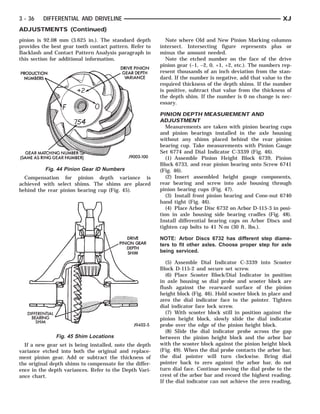
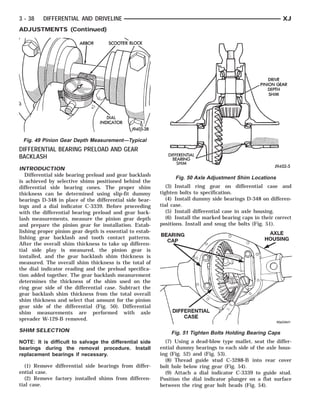
  • 20.
    SEALING (1/4”) NESS THICK- BEAD 6.35MM SURFACE CONTOUR OF BEAD 3 - 20 DIFFERENTIAL AND DRIVELINE XJ DIAGNOSIS AND TESTING (Continued) CONDITION POSSIBLE CAUSES CORRECTION AXLE NOISE 1. Insufficient lubricant. 1. Refill axle with correct amount of proper lubricant. Also inspect for leaks and correct as necessary. 2. Improper ring gear and drive 2. Check ring gear and pinion gear pinion gear adjustment. teeth contact pattern. 3. Unmatched ring gear and drive 3. Remove unmatched ring gear and pinion gear. drive pinion gear. Replace with matched gear and drive pinion gear set. 4. Worn teeth on ring gear or drive 4. Check teeth on ring gear and pinion gear. drive pinion gear for correct contact. If necessary, replace with new matched set. 5. Loose drive pinion gear shaft 5. Adjust drive pinion gearshaft bearings. bearing preload torque. 6. Loose differential bearings. 6. Adjust differential bearing preload torque. 7. Misaligned or sprung ring gear. 7. Measure ring gear runout. 8. Loose differential bearing cap 8. Tighten with specified torque. bolts. SERVICE PROCEDURES LUBRICANT CHANGE (1) Raise and support the vehicle. (2) Remove the lubricant fill hole plug from the differential housing cover. (3) Remove the differential housing cover and drain the lubricant from the housing. (4) Clean the housing cavity with a flushing oil, light engine oil or lint free cloth. Do not use water, steam, kerosene or gasoline for cleaning. (5) Remove the sealant from the housing and cover surfaces. Use solvent to clean the mating surfaces. (6) Apply a bead of Mopar௡ Silicone Rubber Seal- ant, or equivalent, to the housing cover (Fig. 3). Install the housing cover within 5 minutes after applying the sealant. (7) Install the cover and any identification tag. Tighten the cover bolts in a criss–cross pattern to 41 N·m (30 ft. lbs.) torque. (8) Refill the differential with Mopar௡ Hypoid Gear Lubricant, or equivalent, to bottom of the fill plug hole. Refer to the Lubricant Specifications in Fig. 3 Typical Housing Cover With Sealant this group for the quantity necessary. (2) Position a suitable lifting device under the (9) Install the fill hole plug and lower the vehicle. axle. (3) Secure axle to device. (4) Remove the wheels and tires. REMOVAL AND INSTALLATION (5) Remove the brake rotors and calipers from the axle. Refer to Group 5, Brakes, for proper procedures. DRIVE AXLE ASSEMBLY (6) Disconnect the wheel sensor wiring harness REMOVAL from the vehicle wiring harness, if necessary. (1) Raise and support the vehicle.
  • 21.
    XJ DIFFERENTIAL AND DRIVELINE 3 - 21 REMOVAL AND INSTALLATION (Continued) (7) Disconnect the vent hose from the axle shaft (13) Align the previously made marks on the pro- tube. peller shaft and the yoke. (8) Mark the propeller shaft and yoke for installa- (14) Install the straps and bolts to hold the propel- tion alignment reference. ler shaft to the yoke. (9) Remove propeller shaft. (15) Check and fill axle lubricant. Refer to the (10) Disconnect stabilizer bar links at the axle. Lubricant Specifications in this group for the quan- (11) Disconnect shock absorbers from axle brack- tity necessary. ets. (16) Install the wheel and tire assemblies. (12) Disconnect track bar. (17) Remove the lifting device from the axle and (13) Disconnect the tie rod and drag link from the lower the vehicle. steering knuckle. Refer to Group 2, Suspension, for (18) Tighten the upper suspension arm nuts to 75 proper procedures. N·m (55 ft. lbs.) torque. Tighten the lower suspension (14) Disconnect the steering damper from the axle arm nuts to 115 N·m (85 ft. lbs.) torque. bracket. (19) Tighten the track bar bolt at the axle bracket (15) Disconnect the upper and lower suspension to 100 N·m (74 ft. lbs.) torque. arms from the axle brackets. (20) Check the front wheel alignment. (16) Lower the lifting device enough to remove the axle. The coil springs will drop with the axle. TUBE AXLE ASSEMBLY (17) Remove the coil springs from the axle. REMOVAL INSTALLATION (1) Raise and support the vehicle. (2) Position a suitable lifting device under the CAUTION: The weight of the vehicle must be sup- axle. ported by the springs before suspension arms and (3) Secure axle to device. track bar fasteners can be tightened. If the springs (4) Remove the wheels and tires. are not at their normal ride position, ride height and (5) Remove the brake rotors and calipers from the handling could be affected. axle. Refer to Group 5, Brakes, for proper procedures. (6) Disconnect the wheel sensor wiring harness (1) Install the springs and retainer clips. Tighten from the vehicle wiring harness, if necessary. the retainer bolts to 21 N·m (16 ft. lbs.) torque. (7) Disconnect stabilizer bar links at the axle. (2) Support the axle on a suitable lifting device (8) Disconnect shock absorbers from axle brackets. and position axle under the vehicle. (9) Disconnect track bar. (3) Raise the axle and align it with the spring (10) Disconnect the tie rod and drag link from the pads. steering knuckle. Refer to Group 2, Suspension, for (4) Position the upper and lower suspension arms proper procedures. in the axle brackets. Loosely install bolts and nuts to (11) Disconnect the steering damper from the axle hold suspension arms to the axle brackets. bracket. (5) Connect the vent hose to the axle shaft tube. (12) Disconnect the upper and lower suspension (6) Connect the track bar to the axle bracket. arms from the axle brackets. Loosely install the bolt to hold the track bar to the (13) Lower the lifting device enough to remove the axle bracket. axle. The coil springs will drop with the axle. (7) Install the shock absorbers and tighten the (14) Remove the coil springs from the axle. bolts to 23 N·m (17 ft. lbs.) torque. (8) Install the stabilizer bar links to the axle INSTALLATION brackets. Tighten the nut to 95 N·m (70 ft. lbs.) torque. CAUTION: The weight of the vehicle must be sup- (9) Install the drag link and tie rod to the steering ported by the springs before suspension arms and knuckles. Refer to Group 2, Suspension, for proper track bar fasteners can be tightened. If the springs procedures. are not at their normal ride position, ride height and (10) Install the steering damper to the axle handling could be affected. bracket and tighten the nut to 75 N·m (55 ft. lbs.) torque. (1) Install the springs and retainer clips. Tighten (11) Install the brake rotors and calipers. Refer to the retainer bolts to 21 N·m (16 ft. lbs.) torque. Group 5, Brakes, for the proper procedures. (2) Support the axle on a suitable lifting device (12) Connect the wheel speed sensor wiring har- and position axle under the vehicle. ness to the vehicle wiring harness, if necessary. (3) Raise the axle and align it with the spring pads.
  • 22.
    SMALL-DIAMETER YOKEEARING CAP SHAFT WRENCH SOCKET BBEARING CAP LARGE-DIAMETER WRENCH BEARING CAPVISE SNAP RINGS RINGS SNAP SOCKET BEARING CAP SPINDLE YOKE BEARING 3 - 22 DIFFERENTIAL AND DRIVELINE XJ REMOVAL AND INSTALLATION (Continued) (4) Position the upper and lower suspension arms in the axle brackets. Loosely install bolts and nuts to hold suspension arms to the axle brackets. (5) Connect the track bar to the axle bracket. Loosely install the bolt to hold the track bar to the axle bracket. (6) Install the shock absorbers and tighten the bolts to 23 N·m (17 ft. lbs.) torque. (7) Install the stabilizer bar links to the axle brackets. Tighten the nut to 95 N·m (70 ft. lbs.) torque. (8) Install the drag link and tie rod to the steering knuckles. Refer to Group 2, Suspension, for proper procedures. (9) Install the steering damper to the axle bracket and tighten the nut to 75 N·m (55 ft. lbs.) torque. (10) Install the brake rotors and calipers. Refer to Group 5, Brakes, for the proper procedures. (11) Connect the wheel speed sensor wiring har- ness to the vehicle wiring harness, if necessary. (12) Install the wheel and tire assemblies. Fig. 4 Axle Shaft Outer U–Joint (13) Remove the lifting device from the axle and lower the vehicle. (14) Tighten the upper suspension arm nuts to 75 N·m (55 ft. lbs.) torque. Tighten the lower suspension arm nuts to 115 N·m (85 ft. lbs.) torque. (15) Tighten the track bar bolt at the axle bracket to 100 N·m (74 ft. lbs.) torque. (16) Check the front wheel alignment. AXLE SHAFT—CARDAN U-JOINT Single cardan U–joint components are not service- able. If defective, they must be replaced as a unit. If the bearings, seals, spider, or bearing caps are dam- aged or worn, replace the complete U–joint. REMOVAL CAUTION: Clamp only the narrow forged portion of the yoke in the vise. Also, to avoid distorting the yoke, do not over tighten the vise jaws. (1) Remove axle shaft. (2) Remove the bearing cap retaining snap rings Fig. 5 Yoke Bearing Cap Removal (Fig. 4). (6) Compress the vise jaws to force the bearing cap It can be helpful to saturate the bearing caps into the larger socket (receiver). with penetrating oil prior to removal. (7) Release the vise jaws. Remove the sockets and (3) Locate a socket where the inside diameter is bearing cap that was partially forced out of the yoke. larger in diameter than the bearing cap. Place the (8) Repeat the above procedure for the remaining socket (receiver) against the yoke and around the bearing cap. perimeter of the bearing cap to be removed. (9) Remove the remaining bearing cap, bearings, (4) Locate a socket where the outside diameter is seals and spider from the propeller shaft yoke. smaller in diameter than the bearing cap. Place the socket (driver) against the opposite bearing cap. (5) Position the yoke with the sockets in a vise (Fig. 5).
  • 23.
    SPECIAL SPECIAL TOOLC-3281 TOOL C-452 YOKE SPECIAL TOOL C-3972–A PINIONC-4171 SPECIAL TOOL YOKE AXLE HOUSING XJ DIFFERENTIAL AND DRIVELINE 3 - 23 REMOVAL AND INSTALLATION (Continued) INSTALLATION INSTALLATION (1) Pack the bearing caps 1/3 full of wheel bearing (1) Apply a light coating of gear lubricant on the lubricant. Apply extreme pressure (EP), lithium–base lip of pinion seal. Install seal with Installer C-3972-A lubricant to aid in installation. and Handle C-4171 (Fig. 7). (2) Position the spider in the yoke. Insert the seals and bearings. Tap the bearing caps into the yoke bores far enough to hold the spider in position. (3) Place the socket (driver) against one bearing cap. Position the yoke with the socket wrench in a vise. (4) Compress the vise to force the bearing caps into the yoke. Force the caps enough to install the retaining clips. (5) Install the bearing cap retaining clips. (6) Install axle shaft. PINION SHAFT SEAL REMOVAL (1) Raise and support the vehicle. (2) Remove wheel and tire assemblies. (3) Remove brake rotors and calipers. Refer to Fig. 7 Pinion Seal Installation Group 5, Brakes, for proper procedures. (2) Install yoke on the pinion gear with Installer (4) Mark the propeller shaft and pinion yoke for W-162–D, Cup 8109, and Holder 6958 (Fig. 8). installation reference. (5) Remove the propeller shaft from the yoke. (6) Rotate the pinion gear three or four times. (7) Measure the amount of torque necessary to rotate the pinion gear with a (in. lbs.) dial-type torque wrench. Record the torque reading for instal- lation reference. (8) Using Holder 6958 to hold the pinion yoke, remove the pinion nut and washer. (9) Use Remover C-452 and Wrench C-3281 to remove the pinion yoke (Fig. 6). Fig. 8 Pinion Yoke Installation CAUTION: Do not exceed the minimum tightening torque when installing the pinion yoke retaining nut at this point. Damage to the pinion bearings may result. (3) Install the pinion washer and a new nut on the pinion gear. Tighten the nut only enough to remove the shaft end play. (4) Tighten pinion nut to 217 N·m (160 ft. lbs.). (5) Rotate the pinion shaft using a (in. lbs.) torque Fig. 6 Pinion Yoke Removal wrench. Rotating torque should be equal to the read- ing recorded during removal, plus an additional 0.56 (10) Use a suitable pry tool or a slide hammer N·m (5 in. lbs.) (Fig. 9). mounted screw to remove the pinion shaft seal. (6) If the rotating torque is low, use Holder 6958 to hold the pinion yoke, and tighten the pinion shaft
  • 24.
    TONE WHEEL (ABS)YOKE PINION INCH POUND BOLT WRENCH TORQUE STEERINGNUCKLE K HUB ANDASSEMBLY BRAKE SHIELD BEARING WASHER NUT COTTER PIN RETAINER 3 - 24 DIFFERENTIAL AND DRIVELINE XJ REMOVAL AND INSTALLATION (Continued) (10) Install wheel and tire assemblies. (11) Lower the vehicle. HUB BEARING AND AXLE SHAFT If the axle shaft and hub bearing are being removed in order to service another component, the axle shaft and hub bearing can be removed as an assembly. REMOVAL (1) Raise and support the vehicle. (2) Remove the wheel and tire assembly. (3) Remove the brake caliper and rotor. Refer to Group 5, Brakes, for proper procedures. (4) Remove ABS wheel speed sensor, if necessary. Refer to Group 5, Brakes, for proper procedures. (5) Remove the cotter pin, nut retainer, and axle hub nut (Fig. 10), if necessary. (6) Remove the hub to knuckle bolts (Fig. 11). (7) Remove the hub from the steering knuckle and axle shaft, if necessary. (8) Remove hub bearing and axle shaft assembly Fig. 9 Check Pinion Rotation Torque (Fig. 12), or axle shaft from axle. Avoid damaging the axle shaft oil seals in the axle housing. nut in 6.8 N·m (5 ft. lbs.) increments until proper (9) Remove the brake rotor shield from the hub rotating torque is achieved. bearing or knuckle (Fig. 10). (7) Align the installation reference marks on the propeller shaft and yoke, and install the propeller INSTALLATION shaft. (1) Thoroughly clean the axle shaft (Fig. 10) and (8) Check and fill the gear lubricant. Refer to the apply a thin film of Mopar௡ Wheel Bearing Grease, Lubricant Specifications for gear lubricant require- or equivalent, to the shaft splines, seal contact sur- ments. face, and hub bore. (9) Install the brake rotors and calipers. Refer to (2) Install the brake rotor shield to the knuckle. Group 5, Brakes, for proper procedures. Fig. 10 Hub, Knuckle and Axle Shaft
  • 25.
    HUB BEARING HUB BEARING AXLE SHAFT KNUCKLE AXLE SHAFT KNUCKLE AXLE AXLE YOKE STEERING KNUCKLE LOWER BALL STUD UPPER STUD BALL XJ DIFFERENTIAL AND DRIVELINE 3 - 25 REMOVAL AND INSTALLATION (Continued) installation of upper and lower ball studs require the use of Tool Kit 6289. KNUCKLE REMOVAL (1) Remove hub bearing and axle shaft. (2) Disconnect the tie-rod or drag link from the steering knuckle arm. Refer to Group 2, Suspension, for proper procedures. (3) Remove the cotter pins from the upper and lower ball studs. (4) Remove the upper and lower ball stud nuts. (5) Strike the steering knuckle with a brass ham- mer to loosen knuckle from the ball studs. Remove knuckle from ball studs (Fig. 13). Fig. 11 Hub Bearing Bolts Fig. 12 Hub Bearing and Axle Assembly (3) Install the hub bearing and axle shaft assem- bly, or axle shaft, into the housing and differential Fig. 13 Steering Knuckle Removal/Installation side gears. Avoid damaging the axle shaft oil seals in the axle housing. UPPER BALL STUD REPLACEMENT (4) Install the hub bearing, if necessary. (1) Position tools as shown to remove and install (5) Install the hub to knuckle bolts and tighten to ball stud (Fig. 14). 102 N·m (75 ft. lbs.) torque. LOWER BALL STUD REPLACEMENT (6) Install the hub washer and nut, if necessary. (1) Position tools as shown to remove and install Tighten the hub nut to 237 N·m (175 ft. lbs.) torque. ball stud (Fig. 15). Install the nut retainer and a new cotter pin (Fig. 10). KNUCKLE INSTALLATION (7) Install ABS wheel speed sensor, if necessary. (1) Position the steering knuckle on the ball studs. Refer to Group 5, Brakes, for proper procedures. (2) Install and tighten the bottom retaining nut to (8) Install the brake rotor and caliper. Refer to 109 N·m (80 ft. lbs.) torque. Install new cotter pin. Group 5, Brakes, for proper procedures. (3) Install and tighten the top retaining nut to 101 (9) Install the wheel and tire assembly. N·m (75 ft. lbs.) torque. Install new cotter pin. (10) Remove support and lower the vehicle. (4) Install the hub bearing and axle shaft. (5) Connect the tie-rod or drag link end to the STEERING KNUCKLE AND BALL STUDS steering knuckle arm. Refer to Group 2, Suspension, Ball stud service procedures below require removal for proper procedures. of the hub bearing and axle shaft. Removal and
  • 26.
    REMOVAL INSTALLATION 3 - 26 DIFFERENTIAL AND DRIVELINE XJ REMOVAL AND INSTALLATION (Continued) Fig. 14 Upper Ball Stud Remove/Install AXLE BUSHING REPLACEMENT CAUTION: Do not spread over 0.50 mm (0.020 in). If Refer to Group 2, Suspension, for the proper axle the housing is over-spread, it could be distorted or bushing procedures. damaged. DIFFERENTIAL (9) Spread the housing enough to remove the dif- ferential case from the housing. Measure the dis- REMOVAL tance with the dial indicator (Fig. 19). (1) Raise and support vehicle. (10) Remove the dial indicator. (2) Remove the lubricant fill hole plug from the (11) While holding the differential case in position, differential housing cover. remove the differential bearing cap bolts and caps. (3) Remove the differential housing cover and (12) Remove the differential from the housing. allow fluid to drain. Ensure that the differential bearing cups remain in (4) Remove hub bearings and axle shafts. position on the differential bearings (Fig. 20). (5) Note the installation reference letters stamped (13) Mark or tag the differential bearing cups to on the bearing caps and housing machined sealing indicate which side of the differential they were surface (Fig. 16). removed from. (6) Loosen the differential bearing cap bolts. (14) Remove spreader from housing. (7) Position Spreader W–129–B, utilizing some items from Adapter Kit 6987, with the tool dowel INSTALLATION pins seated in the locating holes (Fig. 17). Install the If replacement differential bearings or differential holddown clamps and tighten the tool turnbuckle fin- case are being installed, differential side bearing ger–tight. shim requirements may change. Refer to the Differ- (8) Install a Guide Pin C-3288-B at the left side of ential Bearing Preload and Gear Backlash proce- the differential housing. Attach Dial Indicator C-3339 dures in this section to determine the proper shim to guide pin. Load the lever adapter against the selection. opposite side of the housing (Fig. 18) and zero the (1) Position Spreader W-129-B, utilizing some indicator. items from Adapter Kit 6987, with the tool dowel
  • 27.
    INSTALLATION LETTERS ENCE REFER- REMOVALINSTALLATION LETTERS SPECIAL TOOL 6289–3 SPECIAL TOOL 4212F ENCE REFER- 6289–1 AXLE HOUSING TURNBUCKLE INSTALLATION SPECIAL TOOLW-129–B SPECIAL HOLD 6289–4 SPECIAL TOOL DOWN SPECIALTOOL SAFETY 4212F TOOL DOWEL 6289–12 XJ DIFFERENTIAL AND DRIVELINE 3 - 27 REMOVAL AND INSTALLATION (Continued) Fig. 15 Lower Ball Stud Remove/Install Fig. 16 Bearing Cap Identification pins seated in the locating holes (Fig. 21). Install the holddown clamps and tighten the tool turnbuckle fin- ger–tight. (2) Install a Guide Pin C-3288-B at the left side of the differential housing. Attach Dial Indicator C-3339 to guide pin. Load the lever adapter against the Fig. 17 Install Axle Housing Spreader opposite side of the housing (Fig. 18) and zero the CAUTION: Do not spread over 0.50 mm (0.020 in). If indicator. the housing is over-spread, it could be distorted or damaged.
  • 28.
    SPECIAL TOOLTOOL TOOL SPECIALC-3339 SPECIAL TOOLW-129–B C-3339 SPECIAL C-3288–B DIAL INDICATOR LEVERW-129–B SPECIALTOOL ADAPTER AXLE HOUSING BEARING CUPS TURNBUCKLE DIFFERENTIAL CASE SPECIALTOOL SAFETY HOLD DOWN W-129–B DOWEL 3 - 28 DIFFERENTIAL AND DRIVELINE XJ REMOVAL AND INSTALLATION (Continued) Fig. 18 Install Dial Indicator Fig. 20 Differential Case Removal Fig. 19 Spread Axle Housing Fig. 21 Install Axle Housing Spreader (3) Spread the housing enough to install the case DIFFERENTIAL SIDE BEARINGS in the housing. Measure the distance with the dial indicator (Fig. 19). REMOVAL (4) Remove the dial indicator. (1) Remove differential case from axle housing. (5) Install differential case in the housing. Ensure (2) Remove the bearings from the differential case that the differential bearing cups remain in position with Puller/Press C-293-PA, C-293-39 Adapter on the differential bearings. Tap the differential case Blocks, and Plug SP-3289 (Fig. 23). to ensure the bearings cups are fully seated in the housing. INSTALLATION (6) Install the bearing caps at their original loca- If replacement differential side bearings or differ- tions (Fig. 22). ential case are being installed, differential side bear- (7) Loosely install differential bearing cap bolts. ing shim requirements may change. Refer to the (8) Remove axle housing spreader. Differential Bearing Preload and Gear Backlash pro- (9) Tighten the bearing cap bolts to 61 N·m (45 ft. cedures in this section to determine the proper shim lbs.) torque. selection. (10) Install the hub bearings and axle shafts.
  • 29.
    INSTALLATIONDIFFERENTIAL SPECIAL TOOL SPECIALREFER- BEARING ENCE LETTERS C-293–PA SP-3289 TOOL INSTALLATION LETTERS ENCE C-293–39 SPECIAL TOOL REFER- SPECIAL C-3716–A TOOL SPECIAL TOOL C-4171 XJ DIFFERENTIAL AND DRIVELINE 3 - 29 REMOVAL AND INSTALLATION (Continued) Fig. 22 Differential Bearing Cap Reference Letters Fig. 24 Differential Side Bearing Installation AXLE SHAFT OIL SEAL REMOVAL (1) Raise and support vehicle. (2) Remove differential assembly. (3) Remove the inner axle shaft seals with a pry bay. INSTALLATION (1) Remove any sealer remaining from original seals. (2) Remove sealer from axle tube to housing junc- tion, if necessary. (3) Install oil seals with Discs 8110 and Turn- buckle 6797 (Fig. 25). Tighten tool until disc bottoms in housing. (4) Install differential assembly. RING GEAR The ring and pinion gears are service in a matched set. Do not replace the ring gear without replacing the pinion gear. Fig. 23 Differential Bearing Removal REMOVAL (1) Install differential side bearing shims onto dif- (1) Remove differential from axle housing. ferential case hubs. (2) Place differential case in a suitable vise with (2) Using Installer C-3716-A and Handle C-4171, soft metal jaw protectors. (Fig. 26) install differential side bearings (Fig. 24). (3) Remove bolts holding ring gear to differential (3) Install differential in axle housing. case. (4) Using a soft hammer, drive ring gear from dif- ferential case (Fig. 26).
  • 30.
    RAWHIDE HAM- MER TURNBUCKLE 6797 CASE DISCS 8110 RING GEAR RING GEAR CASE SPECIAL SPECIAL TOOL C-3281 TOOL C-452 YOKE TORQUE WRENCH RING GEAR BOLT 3 - 30 DIFFERENTIAL AND DRIVELINE XJ REMOVAL AND INSTALLATION (Continued) Fig. 25 Axle Seal Installation Fig. 27 Ring Gear Bolt Installation PINION GEAR The ring and pinion gears are serviced as a matched set. Do not replace the pinion gear without replacing the ring gear. REMOVAL (1) Remove differential assembly from axle hous- ing. (2) Mark pinion yoke and propeller shaft for installation alignment. (3) Disconnect propeller shaft from pinion yoke. Using suitable wire, tie propeller shaft to underbody. (4) Using Holder 6958 to hold yoke, remove the pinion nut and washer. (5) Using Remover C-452 and Holder C-3281, remove the pinion yoke from pinion shaft (Fig. 28). Fig. 26 Ring Gear Removal INSTALLATION CAUTION: Do not reuse the bolts that held the ring gear to the differential case. The bolts can fracture causing extensive damage. (1) Invert the differential case and start two ring gear bolts. This will provide case-to-ring gear bolt hole alignment. (2) Invert the differential case in the vise. (3) Install new ring gear bolts and alternately tighten to 95–122 N·m (70–90 ft. lbs.) torque (Fig. 27). (4) Install differential in axle housing and verify gear mesh and contact pattern. Fig. 28 Pinion Yoke Removal
  • 31.
    REMOVER RAWHIDE HAM- HANDLE MER DRIVER HANDLE XJ DIFFERENTIAL AND DRIVELINE 3 - 31 REMOVAL AND INSTALLATION (Continued) (6) Remove the pinion gear and preload shims (9) Remove the depth shims from rear pinion bear- from housing (Fig. 29). Catch the pinion with your ing cup bore in axle housing. Record the thickness of hand to prevent it from falling and being damaged. the depth shims. NOTE: The pinion depth shims can be very thin. Verify that all shims have been removed before pro- ceeding. Fig. 29 Remove Pinion Gear (7) Remove the front pinion bearing cup, bearing, oil slinger, if equipped, and pinion seal with Remover Fig. 31 Rear Bearing Cup Removal D-147 and Handle C–4171 (Fig. 30). (10) Remove the rear pinion bearing from the pin- ion with Puller/Press C–293-PA and Adapters C-293-39 (Fig. 32). Place 4 adapter blocks so they do not damage the bearing cage. INSTALLATION NOTE: Pinion depth shims are placed between the rear pinion bearing cup and axle housing to achieve proper ring and pinion gear mesh. If the factory installed ring and pinion gears are reused, the pin- ion depth shim should not require replacement. Refer to Pinion Gear Depth to select the proper thickness shim before installing pinion gear. (1) Place proper thickness depth shim in rear pin- ion bearing cup bore in the axle housing. (2) Apply Mopar௡ Door Ease, or equivalent, stick lubricant to outside surface of rear pinion bearing cup. Install the bearing cup with Installer D-146 and Handle C–4171 (Fig. 33). Verify cup is correctly seated. Fig. 30 Front Bearing Cup Removal (3) Apply Mopar௡ Door Ease, or equivalent, stick (8) Remove the rear pinion bearing cup from axle lubricant to outside surface of front pinion bearing housing (Fig. 31). Use Remover D-149 and Handle cup. Install the bearing cup with Installer D-144 and C–4171. Handle C–4171 (Fig. 34).
  • 32.
    DRIVE GEARPINION HANDLE ADAPTERS SHAFT SPECIAL C-293–PA TOOL INSTALLER VISE INSTALLER SPECIAL TOOL HANDLE SPECIAL TOOL C-3972–A C-4171 3 - 32 DIFFERENTIAL AND DRIVELINE XJ REMOVAL AND INSTALLATION (Continued) Fig. 34 Pinion Outer Bearing Cup Installation Fig. 32 Inner Bearing Removal Fig. 35 Pinion Seal Installation (8) Install pinion gear in housing. (9) Install yoke with Installer W-162-B, Cup 8109, and Holder 6958 (Fig. 38). (10) Install the pinion washer and a new nut on the pinion gear. Tighten the nut to 217 N·m (160 ft. lbs.). CAUTION: Never loosen pinion gear nut to decrease pinion gear bearing rotating torque and never exceed specified preload rotating torque. Fig. 33 Rear Pinion Bearing Cup Installation (11) Check bearing preload torque with an inch (4) Install front pinion bearing, and oil slinger, if pound torque wrench (Fig. 39). The torque necessary equipped. to rotate the pinion gear should be: (5) Apply a light coating of gear lubricant on the • Original Bearings—1 to 3 N·m (10 to 20 in. lbs.). lip of pinion seal. Install seal with Installer C-3972-A • New Bearings—2 to 5 N·m (15 to 35 in. lbs.). and Handle C–4171 (Fig. 35). (12) If rotating torque is above the desired (6) Install the rear pinion bearing and oil slinger, amount, remove the pinion yoke and increase the if equipped, on the pinion gear with Installer W-262 preload shim pack thickness. Increasing the shim and a shop press (Fig. 36). pack thickness 0.025 mm (0.001 in.) will decrease the (7) Install pinion bearing preload shims onto the rotating torque approximately 0.9 N·m (8 in. lbs.). pinion gear (Fig. 37).
  • 33.
    DRIVE TOOL REARPRELOADSPACER INSTALLA-PINION BEARING TION PINION GEAR SHAFT PINION PRELOAD SHIMS SHOULDER FOR OIL SLINGER SLINGER FRONT BEARING CUP PRELOAD SPACERGEAR DRIVE PINION PINION FRONT BEARING CONE PINION YOKE PINION OIL SEAL WASHER AXLE HOUSING PINION YOKE PINION NUT XJ DIFFERENTIAL AND DRIVELINE 3 - 33 REMOVAL AND INSTALLATION (Continued) Fig. 38 Pinion Yoke Installation (14) If the maximum tightening torque is reached prior to achieving the desired rotating torque, remove the pinion yoke and decrease the thickness of the preload shim pack. Decreasing the shim pack thick- ness 0.025 mm (0.001 in.) will increase the rotating Fig. 36 Rear Pinion Bearing Installation torque approximately 0.9 N·m (8 in. lbs.). (13) Tighten pinion shaft nut in 6.8 N·m (5 ft. lbs.) (15) Install differential assembly. increments until the maximum tightening or desired rotating torque is reached. Fig. 37 Pinion Preload Shims–Typical
  • 34.
    in. MATE SHAFTWRENCH lbs. TORQUE LOCKPIN PINION YOKEDRIFT THRUST PINION MATE WASHERGEAR SIDE GEAR 3 - 34 DIFFERENTIAL AND DRIVELINE XJ (3) Remove the pinion gear mate shaft from the differential case and the pinion mate gears. (4) Rotate differential side gears and remove the pinion mate gears and thrust washers (Fig. 41). Fig. 39 Check Pinion Gear Rotating Torque DISASSEMBLY AND ASSEMBLY STANDARD DIFFERENTIAL Fig. 41 Pinion Mate Gear Removal DISASSEMBLY (5) Remove the differential side gears and thrust (1) Remove the ring gear. washers. (2) Using a suitable roll pin punch, drive out the roll pin holding pinion gear mate shaft in the differ- ASSEMBLY ential case (Fig. 40). (1) Install the differential side gears and thrust washers. (2) Install the pinion mate gears and thrust wash- ers. (3) Install the pinion gear mate shaft. Align the roll pin holes in shaft and the differential case. (4) Install the roll pin to hold the pinion mate shaft in the differential case (Fig. 42). (5) Install the ring gear. (6) Lubricate all differential components with hypoid gear lubricant. FINAL ASSEMBLY (1) Scrape the residual sealant from the housing and cover mating surfaces. Clean the mating surfaces with mineral spirits. Apply a bead of Mopar௡ Silicone Rubber Sealant, or equivalent, on the housing cover (Fig. 43). Install the housing cover within 5 minutes after applying the sealant. (2) Install the cover on the differential with the attaching bolts. Install the identification tag. Tighten the cover bolts to 41 N·m (30 ft. lbs.) torque. Fig. 40 Mate Shaft Roll Pin Removal
  • 35.
    SEALING (1/4”) NESS THICK- BEAD6.35MM MATE SHAFT LOCKPIN SURFACE CONTOUR OF SHAFT PINION PUNCH BEAD MATE XJ DIFFERENTIAL AND DRIVELINE 3 - 35 DISASSEMBLY AND ASSEMBLY (Continued) CLEANING AND INSPECTION CARDAN U-JOINT Clean all the U–joint yoke bores with cleaning sol- vent and a wire brush. Ensure that all the rust and foreign matter are removed from the bores. Inspect the yokes for distortion, cracks and worn bearing cap bores. Replace the complete U–joint if any of the compo- nents are defective. AXLE COMPONENTS Wash differential components with cleaning solvent and dry with compressed air. Do not steam clean the differential components. Wash bearings with solvent and towel dry, or dry with compressed air. DO NOT spin bearings with compressed air. Cup and bearing must be replaced as matched sets only. Clean axle shaft tubes and oil channels in housing. Inspect for; • Smooth appearance with no broken/dented sur- Fig. 42 Mate Shaft Roll Pin Installation faces on the bearing rollers or the roller contact sur- faces. • Bearing cups must not be distorted or cracked. • Machined surfaces should be smooth and with- out any raised edges. • Raised metal on shoulders of cup bores should be removed with a hand stone. • Wear and damage to pinion gear mate shaft, pinion gears, side gears and thrust washers. Replace as a matched set only. • Ring and pinion gear for worn and chipped teeth. • Ring gear for damaged bolt threads. Replaced as a matched set only. • Pinion yoke for cracks, worn splines, pitted areas, and a rough/corroded seal contact surface. Repair or replace as necessary. • Preload shims for damage and distortion. Install new shims, if necessary. ADJUSTMENTS PINION GEAR DEPTH Fig. 43 Typical Housing Cover With Sealant CAUTION: Overfilling the differential can result in GENERAL INFORMATION lubricant foaming and overheating. Ring and pinion gears are supplied as matched sets only. The identifying numbers for the ring and (3) Refill the differential housing with gear lubri- pinion gear are etched into the face of each gear (Fig. cant. Refer to the Lubricant Specifications section of 44). A plus (+) number, minus (–) number or zero (0) this group for the gear lubricant requirements. is etched into the face of the pinion gear. This num- (4) Install the fill hole plug. ber is the amount (in thousandths of an inch) the depth varies from the standard depth setting of a pinion etched with a (0). The standard setting from the center line of the ring gear to the back face of the
  • 36.
    DIFFERENTIAL BERS SHIM PRODUCTIONNUM- NUM- (SAME MATCHING BEARING GEAR AS RING GEAR BER) NUMBER DRIVE PINION GEAR GEAR DRIVE VARIANCE DEPTH SHIM PINION DEPTH 3 - 36 DIFFERENTIAL AND DRIVELINE XJ ADJUSTMENTS (Continued) pinion is 92.08 mm (3.625 in.). The standard depth Note where Old and New Pinion Marking columns provides the best gear tooth contact pattern. Refer to intersect. Intersecting figure represents plus or Backlash and Contact Pattern Analysis paragraph in minus the amount needed. this section for additional information. Note the etched number on the face of the drive pinion gear (–1, –2, 0, +1, +2, etc.). The numbers rep- resent thousands of an inch deviation from the stan- dard. If the number is negative, add that value to the required thickness of the depth shims. If the number is positive, subtract that value from the thickness of the depth shim. If the number is 0 no change is nec- essary. PINION DEPTH MEASUREMENT AND ADJUSTMENT Measurements are taken with pinion bearing cups and pinion bearings installed in the axle housing without any shims placed behind the rear pinion bearing cup. Take measurements with Pinion Gauge Set 6774 and Dial Indicator C-3339 (Fig. 46). (1) Assemble Pinion Height Block 6739, Pinion Block 6733, and rear pinion bearing onto Screw 6741 Fig. 44 Pinion Gear ID Numbers (Fig. 46). Compensation for pinion depth variance is (2) Insert assembled height gauge components, achieved with select shims. The shims are placed rear bearing and screw into axle housing through behind the rear pinion bearing cup (Fig. 45). pinion bearing cups (Fig. 47). (3) Install front pinion bearing and Cone-nut 6740 hand tight (Fig. 46). (4) Place Arbor Disc 6732 on Arbor D-115-3 in posi- tion in axle housing side bearing cradles (Fig. 48). Install differential bearing caps on Arbor Discs and tighten cap bolts to 41 N·m (30 ft. lbs.). NOTE: Arbor Discs 6732 has different step diame- ters to fit other axles. Choose proper step for axle being serviced. (5) Assemble Dial Indicator C-3339 into Scooter Block D-115-2 and secure set screw. (6) Place Scooter Block/Dial Indicator in position in axle housing so dial probe and scooter block are flush against the rearward surface of the pinion height block (Fig. 46). Hold scooter block in place and zero the dial indicator face to the pointer. Tighten dial indicator face lock screw. (7) With scooter block still in position against the pinion height block, slowly slide the dial indicator probe over the edge of the pinion height block. (8) Slide the dial indicator probe across the gap Fig. 45 Shim Locations between the pinion height block and the arbor bar If a new gear set is being installed, note the depth with the scooter block against the pinion height block variance etched into both the original and replace- (Fig. 49). When the dial probe contacts the arbor bar, ment pinion gear. Add or subtract the thickness of the dial pointer will turn clockwise. Bring dial the original depth shims to compensate for the differ- pointer back to zero against the arbor bar, do not ence in the depth variances. Refer to the Depth Vari- turn dial face. Continue moving the dial probe to the ance chart. crest of the arbor bar and record the highest reading. If the dial indicator can not achieve the zero reading,
  • 37.
    PINION HEIGHT SCREW DIAL SCOOTER ARBOR INDICATORBLOCK PINION CONE ARBOR DISC ARBOR DISC PINION HEIGHT BLOCK PINION HEIGHT BLOCK PINION BLOCK PINION BLOCK ARBOR XJ DIFFERENTIAL AND DRIVELINE 3 - 37 ADJUSTMENTS (Continued) PINION GEAR DEPTH VARIANCE Original Pinion Replacement Pinion Gear Depth Variance Gear Depth Variance −4 −3 −2 −1 0 +1 +2 +3 +4 +4 +0.008 +0.007 +0.006 +0.005 +0.004 +0.003 +0.002 +0.001 0 +3 +0.007 +0.006 +0.005 +0.004 +0.003 +0.002 +0.001 0 −0.001 +2 +0.006 +0.005 +0.004 +0.003 +0.002 +0.001 0 −0.001 −0.002 +1 +0.005 +0.004 +0.003 +0.002 +0.001 0 −0.001 −0.002 −0.003 0 +0.004 +0.003 +0.002 +0.001 0 −0.001 −0.002 −0.003 −0.004 −1 +0.003 +0.002 +0.001 0 −0.001 −0.002 −0.003 −0.004 −0.005 −2 +0.002 +0.001 0 −0.001 −0.002 −0.003 −0.004 −0.005 −0.006 −3 +0.001 0 −0.001 −0.002 −0.003 −0.004 −0.005 −0.006 −0.007 −4 0 −0.001 −0.002 −0.003 −0.004 −0.005 −0.006 −0.007 −0.008 Fig. 47 Pinion Height Block—Typical Fig. 46 Pinion Gear Depth Gauge Tools—Typical the rear bearing cup or the pinion depth gauge set is not installed correctly. (9) Select a shim equal to the dial indicator read- ing plus the drive pinion gear depth variance number etched in the face of the pinion gear (Fig. 44). For example, if the depth variance is –2, add +0.002 in. to the dial indicator reading. NOTE: If an oil slinger is used behind the inner pin- ion bearing, deduct the thickness of the slinger from the dial indicator reading and use that total for Fig. 48 Gauge Tools In Housing—Typical shim selection.
  • 38.
    ARBOR DIAL INDICATOR SCOOTER BLOCK DIFFERENTIAL DIFFERENTIAL CASE HOUSING BEARING AXLE SHIM DRIVE PINION GEAR DEPTH SHIM BEARING CAP 3 - 38 DIFFERENTIAL AND DRIVELINE XJ ADJUSTMENTS (Continued) Fig. 49 Pinion Gear Depth Measurement—Typical DIFFERENTIAL BEARING PRELOAD AND GEAR BACKLASH INTRODUCTION Differential side bearing preload and gear backlash Fig. 50 Axle Adjustment Shim Locations is achieved by selective shims positioned behind the differential side bearing cones. The proper shim (3) Install ring gear on differential case and thickness can be determined using slip-fit dummy tighten bolts to specification. bearings D-348 in place of the differential side bear- (4) Install dummy side bearings D-348 on differen- ings and a dial indicator C-3339. Before proceeding tial case. with the differential bearing preload and gear back- (5) Install differential case in axle housing. lash measurements, measure the pinion gear depth (6) Install the marked bearing caps in their correct and prepare the pinion gear for installation. Estab- positions. Install and snug the bolts (Fig. 51). lishing proper pinion gear depth is essential to estab- lishing gear backlash and tooth contact patterns. After the overall shim thickness to take up differen- tial side play is measured, the pinion gear is installed, and the gear backlash shim thickness is measured. The overall shim thickness is the total of the dial indicator reading and the preload specifica- tion added together. The gear backlash measurement determines the thickness of the shim used on the ring gear side of the differential case. Subtract the gear backlash shim thickness from the total overall shim thickness and select that amount for the pinion gear side of the differential (Fig. 50). Differential shim measurements are performed with axle spreader W-129-B removed. SHIM SELECTION Fig. 51 Tighten Bolts Holding Bearing Caps NOTE: It is difficult to salvage the differential side (7) Using a dead-blow type mallet, seat the differ- bearings during the removal procedure. Install ential dummy bearings to each side of the axle hous- replacement bearings if necessary. ing (Fig. 52) and (Fig. 53). (8) Thread guide stud C-3288-B into rear cover (1) Remove differential side bearings from differ- bolt hole below ring gear (Fig. 54). ential case. (9) Attach a dial indicator C-3339 to guide stud. (2) Remove factory installed shims from differen- Position the dial indicator plunger on a flat surface tial case. between the ring gear bolt heads (Fig. 54).
  • 39.
    DIFFERENTIAL CASE MALLET AXLE HOUSING MALLET AXLE HOUSING SPECIAL TOOL C-3339 FACE ZEROC-3288–B C-3339 SPECIAL TOOL SPECIAL TOOL DIAL INDICATOR DIFFEREN-TOOL C-3288–BAXLE HOUSING SPECIAL FORCE DIFFERENTIAL CASE TIAL CASE TO PINION GEAR SIDE XJ DIFFERENTIAL AND DRIVELINE 3 - 39 ADJUSTMENTS (Continued) Fig. 52 Seat Pinion Gear Side Differential Dummy Side Bearing Fig. 54 Differential Side play Measurement Fig. 53 Seat Ring Gear Side Differential Dummy Side Bearing (10) Push and hold differential case to pinion gear side of axle housing (Fig. 55). (11) Zero dial indicator face to pointer (Fig. 55). (12) Push and hold differential case to ring gear Fig. 55 Hold Differential Case and Zero Dial side of the axle housing (Fig. 56). Indicator (13) Record dial indicator reading (Fig. 56). (20) Position the dial indicator plunger on a flat (14) Add 0.008 in. (0.2 mm) to the zero end play surface between the ring gear bolt heads. (Fig. 54). total. This new total represents the thickness of (21) Push and hold differential case toward pinion shims to compress, or preload the new bearings when gear (Fig. 57). the differential is installed. (22) Zero dial indicator face to pointer (Fig. 57). (15) Rotate dial indicator out of the way on the (23) Push and hold differential case to ring gear guide stud. side of the axle housing (Fig. 58). (16) Remove differential case and dummy bearings (24) Record dial indicator reading (Fig. 58). from axle housing. (25) Subtract 0.002 in. (0.05 mm) from the dial (17) Install the pinion gear in axle housing. Install indicator reading to compensate for backlash between the pinion yoke and establish the correct pinion ring and pinion gears. This total is the thickness rotating torque. shim required to achieve proper backlash. (18) Install differential case and dummy bearings (26) Subtract the backlash shim thickness from D-348 in axle housing (without shims), install bear- the total preload shim thickness. The remainder is ing caps and tighten bolts snug. (19) Seat ring gear side dummy bearing (Fig. 53).
  • 40.
    AXLE HOUSING HOUSING DIFFERENTIAL CASE DIFFERENTIAL CASE AXLE HOUSING AXLE ZERO DIAL INDICATOR FACE FORCEREAD DIAL INDICATOR READ DIAL INDICATOR TO RINGGEAR CASE DIFFERENTIAL SIDE PINION GEAR PINION GEAR DIAL CATOR INDI- FORCE FORCE DIFFERENTIAL DIFFEREN- CASETIAL CASE TOGEAR TO PINION RING GEARSIDE SIDE 3 - 40 DIFFERENTIAL AND DRIVELINE XJ ADJUSTMENTS (Continued) the shim thickness required on the pinion side of the axle housing. (27) Rotate dial indicator out of the way on guide stud. (28) Remove differential case and dummy bearings from axle housing. (29) Install side bearing shims on differential case hubs. (30) Install side bearings and cups on differential case. (31) Install spreader W-129-B, utilizing some items from Adapter Set 6987, on axle housing and spread axle opening enough to receive differential case. (32) Install differential case in axle housing. (33) Remove spreader from axle housing. (34) Rotate the differential case several times to Fig. 56 Hold Differential Case and Read Dial seat the side bearings. Indicator (35) Position the indicator plunger against a ring gear tooth (Fig. 59). (36) Push and hold ring gear upward while not allowing the pinion gear to rotate. (37) Zero dial indicator face to pointer. (38) Push and hold ring gear downward while not allowing the pinion gear to rotate. Dial indicator reading should be between 0.12 mm (0.005 in.) and 0.20 mm (0.008 in.). If backlash is not within specifi- cations transfer the necessary amount of shim thick- ness from one side of the axle housing to the other (Fig. 60). (39) Verify differential case and ring gear runout by measuring ring to pinion gear backlash at several locations around the ring gear. Readings should not vary more than 0.05 mm (0.002 in.). If readings vary more than specified, the ring gear or the differential case is defective. Fig. 57 Hold Differential Case and Zero Dial After the proper backlash is achieved, perform Indicator Gear Contact Pattern Analysis procedure. Fig. 58 Hold Differential Case and Read Dial Indicator Fig. 59 Ring Gear Backlash Measurement
  • 41.
    FOR MORE BACKLASHINCREASE MORE BACKLASH FOR LESS BACKLASH FOR SHIM THIS SIDE DECREASE SHIM INCREASE SHIM THISTHIS DIE DECREASE SHIM THIS SIDEFOR LESS BACKLASH FOR MORE BACK- SIDE FOR LESS BACK- LASH LASH XJ DIFFERENTIAL AND DRIVELINE 3 - 41 ADJUSTMENTS (Continued) axle housing. It will also show if the ring gear back- lash has been adjusted correctly. The backlash can be adjusted within specifications to achieve desired tooth contact patterns. (1) Apply a thin coat of hydrated ferric oxide, or equivalent, to the drive and coast side of the ring gear teeth. (2) Wrap, twist, and hold a shop towel around the pinion yoke to increase the turning resistance of the pinion gear. This will provide a more distinct contact pattern. (3) Using a boxed end wrench on a ring gear bolt, Rotate the differential case one complete revolution in both directions while a load is being applied from shop towel. The areas on the ring gear teeth with the greatest degree of contact against the pinion gear teeth will squeegee the compound to the areas with the least amount of contact. Note and compare patterns on the ring gear teeth to Gear Tooth Contact Patterns chart (Fig. 61) and adjust pinion depth and gear backlash as necessary. Fig. 60 Backlash Shim Adjustment GEAR CONTACT PATTERN ANALYSIS The ring and pinion gear teeth contact patterns will show if the pinion gear depth is correct in the
  • 42.
    HEEL DRIVE GEAR TEETH RING SIDE OF TOE TOE COAST SIDE OF RINGTEETH HEEL GEAR GEAR THE COASTBACKLASHTOP OF CORRECT.GEARDEPTHPINIONTOWARD PINIONBACKLASH.SLIGHTLY BETWEEN GEARSOMEINCREASE BESHIMALWAYS CORRECT. DECREASEPINION TOOTH, PINIONBACKLASH. BACKLASH TOOTH. CORRECT. DRIVE SIDESHIM RING TOOTH.CLEARANCEOF REQUIRED. THICKER SHIMPATTERN. GEARTOE. DEPTH SIDE CENTERED REQUIRED. THINNER RING GEAR GEAR CORRECT. PATTERN SHIM RING GEAR CONTACT CONTACT DEPTH BE THE BUT GEAR DEPTH AND ON MAY THERE SHOULD PATTERN SHOULD RING DESIRABLE BE 3 - 42 DIFFERENTIAL AND DRIVELINE XJ ADJUSTMENTS (Continued) Fig. 61 Gear Tooth Contact Patterns
  • 43.
    XJ DIFFERENTIAL AND DRIVELINE 3 - 43 SPECIFICATIONS 181 FBI AXLE Axle Type . . . . . . . . . . . . . . . . . . . . . . . . . . . Hypoid Lubricant . . . . . . . . SAE Thermally Stable 80W–90 Lube Capacity . . . . . . . . . . . . . . . . . . 1.2 L (2.5 pts.) Axle Ratio . . . . . . . . 3.07, 3.31, 3.54, 3.55, 3.73, 4.10 Differential Side Gear Clearance . . . . 0.12–0.20 mm (0.005–0.008 in.) Ring Gear Diameter . . . . . . . . . 18.09 cm (7.125 in.) Plug—SP-3289 Backlash . . . . . . . . . . . 0–0.15 mm (0.005–0.008 in.) Pinion Std. Depth . . . . . . . . . . . 92.1 mm (3.625 in.) Pinion Bearing Rotating Torque Original Bearings . . . . . . . . 1–2 N·m (10–20 in. lbs.) New Bearings . . . . . . . . . 1.5–4 N·m (15–35 in. lbs.) 181 FBI AXLE DESCRIPTION TORQUE Fill Hole Plug . . . . . . . . . . . . . . 34 N·m (25 ft. lbs.) Diff. Cover Bolt . . . . . . . . . . . . 41 N·m (30 ft. lbs.) Adapter—C-293-39 Bearing Cap Bolt . . . . . . . . . . . 61 N·m (45 ft. lbs.) Ring Gear Bolt . . . . . . 95–122 N·m (70–90 ft. lbs.) Axle Nut . . . . . . . . . . . . . . . . 237 N·m (175 ft. lbs.) Hub Brg. Bolt . . . . . . . . . . . . . 102 N·m (75 ft. lbs.) Lower Ball Stud . . . . . . . . . . . 108 N·m (80 ft. lbs.) Upper Ball Stud . . . . . . . . . . . 101 N·m (75 ft. lbs.) SPECIAL TOOLS 181 FBI AXLE Puller—C-452 Puller—C-293-PA Wrench—C-3281
  • 44.
    3 - 44 DIFFERENTIAL AND DRIVELINE XJ SPECIAL TOOLS (Continued) Dial Indicator—C-3339 Remover—D-149 Installer—W-162-D Driver—C-3716-A Cup—8109 Handle—C-4171 Remover/Installer—6289 Installer—D-146
  • 45.
    XJ DIFFERENTIAL AND DRIVELINE 3 - 45 SPECIAL TOOLS (Continued) Installer—6761 Gauge Block—6733 Installer—6752 Spanner—6958 Installer Discs—8110 Installer—C-3972-A Turnbuckle—6797 Spreader—W-129-B Tool Set, Pinion Depth—6774
  • 46.
    3 - 46 DIFFERENTIAL AND DRIVELINE XJ SPECIAL TOOLS (Continued) Adapter Kit—6987 Installer—W-262 Pilot Stud—C-3288-B Remover—D-147 Installer—D-144
  • 47.
    XJ DIFFERENTIAL AND DRIVELINE 3 - 47 194 RBI AXLE INDEX page page GENERAL INFORMATION DIFFERENTIAL . . . . . . . . . . . . . . . . . . . . . . . . 60 194 RBI AXLE . . . . . . . . . . . . . . . . . . . . . . . . . 47 FINAL ASSEMBLY . . . . . . . . . . . . . . . . . . . . . . 67 LUBRICANT SPECIFICATIONS . . . . . . . . . . . . 47 PINION GEAR . . . . . . . . . . . . . . . . . . . . . . . . . 63 DESCRIPTION AND OPERATION PINION SHAFT SEAL . . . . . . . . . . . . . . . . . . . . 55 STANDARD DIFFERENTIAL . . . . . . . . . . . . . . . 48 REAR AXLE . . . . . . . . . . . . . . . . . . . . . . . . . . . 54 TRAC-LOK OPERATION . . . . . . . . . . . . . . . . . . 48 RING GEAR . . . . . . . . . . . . . . . . . . . . . . . . . . . 62 DIAGNOSIS AND TESTING DISASSEMBLY AND ASSEMBLY BEARING NOISE . . . . . . . . . . . . . .. . . . . . . . . 49 STANDARD DIFFERENTIAL . . . . . . . . . . . . . . . 67 DRIVELINE SNAP . . . . . . . . . . . . .. . . . . . . . . 50 TRAC-LOK DIFFERENTIAL . . . . . . . . . . . . . . . 68 GEAR NOISE . . . . . . . . . . . . . . . . .. . . . . . . . . 49 CLEANING AND INSPECTION GENERAL INFORMATION . . . . . . .. . . . . . . . . 49 AXLE COMPONENTS . . . . . . . . . . . . . . . . . . . 72 LOW SPEED KNOCK . . . . . . . . . . .. . . . . . . . . 50 TRAC-LOK . . . . . . . . . . . . . . . . . . . . . . . . . . . . 72 TRAC–LOK DIFFERENTIAL NOISE . . . . . . . . . 50 ADJUSTMENTS TRAC–LOK TEST . . . . . . . . . . . . . .. . . . . . . . . 53 DIFFERENTIAL BEARING PRELOAD AND VIBRATION . . . . . . . . . . . . . . . . . .. . . . . . . . . 50 GEAR BACKLASH . . . . . . . . . . . . . . . . . . . . . 74 SERVICE PROCEDURES GEAR CONTACT PATTERN ANALYSIS . . . . . . 76 LUBRICANT CHANGE . . . . . . . . . . . . . . . . . . . 53 PINION GEAR DEPTH . . . . . . . . . . . . . . . . . . . 72 REMOVAL AND INSTALLATION SPECIFICATIONS AXLE SHAFT SEAL AND BEARING ... . . . . . . 59 194 RBI AXLE . . . . . . . . . . . . . . . . . . . . . . . . . 78 AXLE SHAFT . . . . . . . . . . . . . . . . .... . . . . . . 58 194 RBI AXLE . . . . . . . . . . . . . . . . . . . . . . . . . 78 COLLAPSIBLE SPACER . . . . . . . . .... . . . . . . 56 SPECIAL TOOLS DIFFERENTIAL SIDE BEARINGS . .... . . . . . . 62 194 RBI AXLE . . . . . . . . . . . . . . . . . . . . . . . . . 78 GENERAL INFORMATION The 194 RBI axle has the assembly part number and gear ratio listed on a tag. The tag is attached to 194 RBI AXLE the differential housing by a cover bolt. Build date The 194 Rear Beam-design Iron (RBI) axle housing identification codes are stamped on the cover side of has an iron center casting (differential housing) with an axle shaft tube. axle shaft tubes extending from either side. The The differential case is a one-piece design. The dif- tubes are pressed into and welded to the differential ferential pinion mate shaft is retained with a housing to form a one-piece axle housing. threaded pin. Differential bearing preload and ring The integral type, hypoid gear design, housing has gear backlash is adjusted by the use of selective the centerline of the pinion set below the centerline spacer shims. Pinion bearing preload is set and of the ring gear. maintained by the use of a collapsible spacer (Fig. 1). The axle has a vent hose to relieve internal pres- sure caused by lubricant vaporization and internal LUBRICANT SPECIFICATIONS expansion. A multi-purpose, hypoid gear lubricant which con- The axles are equipped with semi–floating axle forms to the following specifications should be used. shafts, meaning that loads are supported by the axle Mopar௡ Hypoid Gear Lubricant conforms to all of shaft and bearings. The axle shafts are retained by these specifications. C–clips in the differential side gears. • The lubricant should have MIL–L–2105C and The cover provides a means for servicing the differ- API GL 5 quality specifications. ential without removing the axle. • Lubricant is a thermally stable SAE 80W–90 For vehicles equipped with ABS brakes, the axles gear lubricant. have a tone ring pressed onto the axle shaft. Use • Lubricant for axles intended for heavy-duty or care when removing axle shafts to ensure that the trailer tow use is SAE 75W–140 SYNTHETIC gear tone wheel or the wheel speed sensor are not dam- lubricant. aged. Trac-lok differentials require the addition of 4 oz. of friction modifier to the axle lubricant. The 194 RBI
  • 48.
    DIFFERENTIAL BEARING SHIM-RINGGEAR SIDE COLLAPSIBLE SPACER PINION GEAR DEPTH SHIM PINION GEAR BEARING GEAR DIFFERENTIAL RING SHIM- SIDE PINION GEARS ROTATE PINION GEAR OF EACHGEAR WHEEL ROTATES ROTATE WITH IN PINION SHAFT AT 100% CASE PINION GEARS STRAIGHT ON 100% AHEAD DRIVING SIDE AXLE SPEED SPEED DIFFERENTIAL CASE CASE OUTER WHEEL 110% CASE INNER WHEEL 90% CASE SPEED SPEED 3 - 48 DIFFERENTIAL AND DRIVELINE XJ GENERAL INFORMATION (Continued) Fig. 1 Shim Locations Fig. 2 Differential Operation—Straight Ahead Driving axle lubricant capacity is 1.66L (3.50 pts.) total, 2). In this instance, the input torque applied to the including the friction modifier if necessary. pinion gears is not divided equally. The pinion gears now rotate around the pinion mate shaft in opposite CAUTION: If axle is submerged in water, lubricant directions. This allows the side gear and axle shaft must be replaced immediately to avoid possible attached to the outside wheel to rotate at a faster premature axle failure. speed. DESCRIPTION AND OPERATION STANDARD DIFFERENTIAL The differential gear system divides the torque between the axle shafts. It allows the axle shafts to rotate at different speeds when turning corners. Each differential side gear is splined to an axle shaft. The pinion gears are mounted on a pinion mate shaft and are free to rotate on the shaft. The pinion gear is fitted in a bore in the differential case and is positioned at a right angle to the axle shafts. In operation, power flow occurs as follows: • The pinion gear rotates the ring gear. • The ring gear (bolted to the differential case) Fig. 3 Differential Operation—On Turns rotates the case. • The differential pinion gears (mounted on the TRAC-LOK OPERATION pinion mate shaft in the case) rotate the side gears. In a conventional differential, if one wheel spins, • The side gears (splined to the axle shafts) rotate the opposite wheel will generate only as much torque the shafts. as the spinning wheel. During straight-ahead driving, the differential pin- In the Trac-lok differential, part of the ring gear ion gears do not rotate on the pinion mate shaft. This torque is transmitted through clutch packs which occurs because input torque applied to the gears is contain multiple discs. The clutches will have radial divided and distributed equally between the two side grooves on the plates, and concentric grooves on the gears. As a result, the pinion gears revolve with the discs or bonded fiber material that is smooth in pinion mate shaft but do not rotate around it (Fig. 1). appearance. When turning corners, the outside wheel must In operation, the Trac-lok clutches are engaged by travel a greater distance than the inside wheel to two concurrent forces. The first being the preload complete a turn. The difference must be compensated force exerted through Belleville spring washers for to prevent the tires from scuffing and skidding within the clutch packs. The second is the separating through turns. To accomplish this, the differential forces generated by the side gears as torque is allows the axle shafts to turn at unequal speeds (Fig. applied through the ring gear (Fig. 4).
  • 49.
    CLUTCH PACK CASE RING GEAR SIDE GEAR PINION PINION DRIVE GEAR CLUTCH PACK MATE SHAFT XJ DIFFERENTIAL AND DRIVELINE 3 - 49 DESCRIPTION AND OPERATION (Continued) • Overloading (excessive engine torque) or exceed- ing vehicle weight capacity. • Incorrect clearance or backlash adjustment. Axle component breakage is most often the result of: • Severe overloading. • Insufficient lubricant. • Incorrect lubricant. • Improperly tightened components. GEAR NOISE Axle gear noise can be caused by insufficient lubri- cant, incorrect backlash, tooth contact, or worn/dam- aged gears. Gear noise usually happens at a specific speed range. The range is 30 to 40 mph, or above 50 mph. The noise can also occur during a specific type of driving condition. These conditions are acceleration, deceleration, coast, or constant load. When road testing, accelerate the vehicle to the speed range where the noise is the greatest. Shift out-of-gear and coast through the peak–noise range. If the noise stops or changes greatly: • Check for insufficient lubricant. • Incorrect ring gear backlash. • Gear damage. Differential side and pinion gears can be checked by turning the vehicle. They usually do not cause Fig. 4 Trac-lok Limited Slip Differential Operation noise during straight–ahead driving when the gears are unloaded. The side gears are loaded during vehi- The Trac-lok design provides the differential action cle turns. A worn pinion gear mate shaft can also needed for turning corners and for driving straight cause a snapping or a knocking noise. ahead during periods of unequal traction. When one wheel looses traction, the clutch packs transfer addi- BEARING NOISE tional torque to the wheel having the most traction. The axle shaft, differential and pinion gear bear- Trac-lok differentials resist wheel spin on bumpy ings can all produce noise when worn or damaged. roads and provide more pulling power when one Bearing noise can be either a whining, or a growling wheel looses traction. Pulling power is provided con- sound. tinuously until both wheels loose traction. If both Pinion gear bearings have a constant–pitch noise. wheels slip due to unequal traction, Trac-lok opera- This noise changes only with vehicle speed. Pinion tion is normal. In extreme cases of differences of bearing noise will be higher because it rotates at a traction, the wheel with the least traction may spin. faster rate. Drive the vehicle and load the differen- tial. If bearing noise occurs, the rear pinion bearing DIAGNOSIS AND TESTING is the source of the noise. If the bearing noise is heard during a coast, the front pinion bearing is the GENERAL INFORMATION source. Axle bearing problem conditions are usually caused Worn or damaged differential bearings usually pro- by: duce a low pitch noise. Differential bearing noise is • Insufficient or incorrect lubricant. similar to pinion bearing noise. The pitch of differen- • Foreign matter/water contamination. tial bearing noise is also constant and varies only • Incorrect bearing preload torque adjustment. with vehicle speed. • Incorrect backlash. Axle shaft bearings produce noise and vibration Axle gear problem conditions are usually the result when worn or damaged. The noise generally changes of: when the bearings are loaded. Road test the vehicle. • Insufficient lubrication. Turn the vehicle sharply to the left and to the right. • Incorrect or contaminated lubricant. This will load the bearings and change the noise
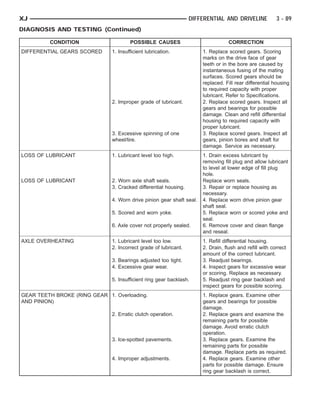
  • 50.
    3 - 50 DIFFERENTIAL AND DRIVELINE XJ DIAGNOSIS AND TESTING (Continued) level. Where axle bearing damage is slight, the noise • High engine idle speed. is usually not noticeable at speeds above 30 mph. • Loose engine/transmission/transfer case mounts. • Worn U–joints. LOW SPEED KNOCK • Loose spring mounts. Low speed knock is generally caused by a worn • Loose pinion gear nut and yoke. U–joint or by worn side–gear thrust washers. A worn • Excessive ring gear backlash. pinion gear shaft bore will also cause low speed • Excessive side gear/case clearance. knock. The source of a snap or a clunk noise can be deter- mined with the assistance of a helper. Raise the vehi- VIBRATION cle on a hoist with the wheels free to rotate. Instruct Vibration at the rear of the vehicle is usually the helper to shift the transmission into gear. Listen caused by a: for the noise, a mechanics stethoscope is helpful in • Damaged drive shaft. isolating the source of a noise. • Missing drive shaft balance weight(s). • Worn or out–of–balance wheels. TRAC–LOK DIFFERENTIAL NOISE • Loose wheel lug nuts. The most common problem is a chatter noise when • Worn U–joint(s). turning corners. Before removing a Trac-lok unit for • Loose/broken springs. repair, drain, flush and refill the axle with the spec- • Damaged axle shaft bearing(s). ified lubricant. Refer to Lubricant change in this • Loose pinion gear nut. Group. • Excessive pinion yoke run out. A container of Mopar௡ Trac-lok Lubricant (friction • Bent axle shaft(s). modifier) should be added after repair service or dur- Check for loose or damaged front–end components ing a lubricant change. or engine/transmission mounts. These components After changing the lubricant, drive the vehicle and can contribute to what appears to be a rear–end make 10 to 12 slow, figure-eight turns. This maneu- vibration. Do not overlook engine accessories, brack- ver will pump lubricant through the clutches. This ets and drive belts. will correct the condition in most instances. If the All driveline components should be examined chatter persists, clutch damage could have occurred before starting any repair. Refer to Group 22, Wheels and Tires, for additional vibration information. DRIVELINE SNAP A snap or clunk noise when the vehicle is shifted into gear (or the clutch engaged), can be caused by:
  • 51.
    XJ DIFFERENTIAL AND DRIVELINE 3 - 51 DIAGNOSIS AND TESTING (Continued) CONDITION POSSIBLE CAUSES CORRECTION WHEEL NOISE 1. Wheel loose. 1. Tighten loose nuts. 2. Faulty, brinelled wheel bearing. 2. Faulty or brinelled bearings must be replaced. AXLE SHAFT NOISE 1. Misaligned axle shaft tube. 1. Inspect axle shaft tube alignment. Correct as necessary. 2. Bent or sprung axle shaft. 2. Replace bent or sprung axle shaft. 3. End play in drive pinion bearings. 3. Refer to Drive Pinion Bearing Pre-Load Adjustment. 4. Excessive gear backlash between 4. Check adjustment of ring gear ring gear and pinion gear. backlash and pinion gear. Correct as necessary. 5. Improper adjustment of drive 5. Adjust drive pinion shaft bearings. pinion gear shaft bearings. 6. Loose drive pinion gearshaft yoke 6. Tighten drive pinion gearshaft nut. yoke nut with specified torque. 7. Improper wheel bearing 7. Readjust as necessary. adjustment. 8. Scuffed gear tooth contact 8. If necessary, replace scuffed surfaces. gears. AXLE SHAFT BROKE 1. Misaligned axle shaft tube. 1. Replace broken axle shaft after correcting axle shaft tube alignment. 2. Vehicle overloaded. 2. Replace broken axle shaft. Avoid excessive weight on vehicle. 3. Erratic clutch operation. 3. Replace broken axle shaft after inspecting for other possible casues. Avoid erratic use of clutch. 4. Grabbing clutch. 4. Replace broken axle shaft. Inspect clutch and make necessary repairs or adjustments. DIFFERENTIAL CASE CRACKED 1. Improper adjustment of differential 1. Replace cracked case; examine bearings. gears and bearings for possible damage. At reassembly, adjust differential bearings properly. 2. Excessive ring gear backlash. 2. Replace cracked case; examine gears and bearings for possible damage. At reassembly, adjust ring gear backlash properly. 3. Vehicle overloaded. 3. Replace cracked case; examine gears and bearings for possible damage. Avoid excessive weight on vehicle. 4. Erratic clutch operation. 4. Replace cracked case. After inspecting for other possible causes, examine gears and bearings for possible damage. Avoid erratic use of clutch.
  • 52.
    3 - 52 DIFFERENTIAL AND DRIVELINE XJ DIAGNOSIS AND TESTING (Continued) CONDITION POSSIBLE CAUSES CORRECTION DIFFERENTIAL GEARS SCORED 1. Insufficient lubrication. 1. Replace scored gears. Scoring marks on the drive face of gear teeth or in the bore are caused by instantaneous fusing of the mating surfaces. Scored gears should be replaced. Fill rear differential housing to required capacity with proper lubricant. Refer to Specifications. 2. Improper grade of lubricant. 2. Replace scored gears. Inspect all gears and bearings for possible damage. Clean and refill differential housing to required capacity with proper lubricant. 3. Excessive spinning of one 3. Replace scored gears. Inspect all wheel/tire. gears, pinion bores and shaft for damage. Service as necessary. LOSS OF LUBRICANT 1. Lubricant level too high. 1. Drain excess lubricant by removing fill plug and allow lubricant to level at lower edge of fill plug hole. 2. Worn axle shaft seals. Replace worn seals. 3. Cracked differential housing. 3. Repair or replace housing as necessary. 4. Worn drive pinion gear shaft seal. 4. Replace worn drive pinion gear shaft seal. 5. Scored and worn yoke. 5. Replace worn or scored yoke and seal. 6. Axle cover not properly sealed. 6. Remove cover and clean flange and reseal. AXLE OVERHEATING 1. Lubricant level too low. 1. Refill differential housing. 2. Incorrect grade of lubricant. 2. Drain, flush and refill with correct amount of the correct lubricant. 3. Bearings adjusted too tight. 3. Readjust bearings. 4. Excessive gear wear. 4. Inspect gears for excessive wear or scoring. Replace as necessary. 5. Insufficient ring gear backlash. 5. Readjust ring gear backlash and inspect gears for possible scoring. GEAR TEETH BROKE (RING GEAR 1. Overloading. 1. Replace gears. Examine other AND PINION) gears and bearings for possible damage. 2. Erratic clutch operation. 2. Replace gears and examine the remaining parts for possible damage. Avoid erratic clutch operation. 3. Ice-spotted pavements. 3. Replace gears. Examine the remaining parts for possible damage. Replace parts as required. 4. Improper adjustments. 4. Replace gears. Examine other parts for possible damage. Ensure ring gear backlash is correct.
  • 53.
    IN 6790 WITH TOOL SPECIAL HOLE CENTER BOLT TORQUE WRENCH XJ DIFFERENTIAL AND DRIVELINE 3 - 53 DIAGNOSIS AND TESTING (Continued) CONDITION POSSIBLE CAUSES CORRECTION AXLE NOISE 1. Insufficient lubricant. 1. Refill axle with correct amount of proper lubricant. Also inspect for leaks and correct as necessary. 2. Improper ring gear and drive 2. Check ring gear and pinion gear pinion gear adjustment. teeth contact pattern. 3. Unmatched ring gear and drive 3. Remove unmatched ring gear and pinion gear. drive pinion gear. Replace with matched gear and drive pinion gear set. 4. Worn teeth on ring gear or drive 4. Check teeth on ring gear and pinion gear. drive pinion gear for correct contact. If necessary, replace with new matched set. 5. Loose drive pinion gear shaft 5. Adjust drive pinion gearshaft bearings. bearing preload torque. 6. Loose differential bearings. 6. Adjust differential bearing preload torque. 7. Misaligned or sprung ring gear. 7. Measure ring gear runout. 8. Loose differential bearing cap 8. Tighten with specified torque. bolts. TRAC–LOK TEST WARNING: WHEN SERVICING VEHICLES WITH A TRAC–LOK DIFFERENTIAL DO NOT USE THE ENGINE TO TURN THE AXLE AND WHEELS. BOTH REAR WHEELS MUST BE RAISED AND THE VEHI- CLE SUPPORTED. A TRAC–LOK AXLE CAN EXERT ENOUGH FORCE IF ONE WHEEL IS IN CONTACT WITH A SURFACE TO CAUSE THE VEHICLE TO MOVE. The differential can be tested without removing the differential case by measuring rotating torque. Make sure brakes are not dragging during this measure- ment. (1) Place blocks in front and rear of both front wheels. Fig. 5 Trac-lok Test —Typical (2) Raise one rear wheel until it is completely off the ground. SERVICE PROCEDURES (3) Engine off, transmission in neutral, and park- ing brake off. LUBRICANT CHANGE (4) Remove wheel and bolt Special Tool 6790 to (1) Raise and support the vehicle. studs. (2) Remove the lubricant fill hole plug from the (5) Use torque wrench on special tool to rotate differential housing cover. wheel and read rotating torque (Fig. 5). (3) Remove the differential housing cover and (6) If rotating torque is less than 22 N·m (30 ft. drain the lubricant from the housing. lbs.) or more than 271 N·m (200 ft. lbs.) on either (4) Clean the housing cavity with a flushing oil, wheel the unit should be serviced. light engine oil, or lint free cloth. Do not use water, steam, kerosene, or gasoline for cleaning. (5) Remove the original sealant from the housing and cover surfaces. (6) Apply a bead of Mopar௡ Silicone Rubber Seal- ant, or equivalent, to the housing cover (Fig. 6).
  • 54.
    SEALANT AXLE HOUSING COVER 3 - 54 DIFFERENTIAL AND DRIVELINE XJ SERVICE PROCEDURES (Continued) (7) Remove wheel speed sensors, if necessary. Refer to Group 5, Brakes, for proper procedures. (8) Disconnect the brake hose at the axle junction block. Do not disconnect the brake hydraulic lines at the wheel cylinders. Refer to Group 5, Brakes, for proper procedures. (9) Disconnect the vent hose from the axle shaft tube. (10) Mark the propeller shaft and yokes for instal- lation alignment reference. (11) Remove propeller shaft. (12) Disconnect stabilizer bar links. (13) Disconnect shock absorbers from axle. (14) Remove the U-bolts which hold the axle to the spring brackets. (15) Separate the axle from the vehicle. Fig. 6 Apply Sealant INSTALLATION Install the housing cover within 5 minutes after applying the sealant. NOTE: The weight of the vehicle must be sup- (7) Install the cover and any identification tag. ported by the springs before suspension arms and Tighten the cover bolts to 41 N·m (30 ft. lbs.) torque. track bar fasteners can be tightened. If the springs (8) For Trac–lok differentials, a quantity of are not at their normal ride position, vehicle ride Mopar௡ Trac–lok lubricant (friction modifier), or height and handling could be affected. equivalent, must be added after repair service or a lubricant change. Refer to the Lubricant Specifica- (1) Raise the axle with lifting device and align the tions section of this group for the quantity necessary. spring centering bolts with the mating holes in the (9) Fill differential with Mopar௡ Hypoid Gear axle spring perch. Lubricant, or equivalent, to bottom of the fill plug (2) Install the U-bolts which hold the axle to the hole. Refer to the Lubricant Specifications section of spring brackets. Tighten nuts to 70 N·m (52 ft. lbs.). this group for the quantity necessary. (3) Install shock absorbers and tighten nuts to 60 N·m (44 ft. lbs.) torque. CAUTION: Overfilling the differential can result in (4) Install stabilizer bar links and tighten nuts to lubricant foaming and overheating. 74 N·m (55 ft. lbs.) torque. (5) Install the wheel speed sensors, if necessary. (10) Install the fill hole plug and lower the vehicle. Refer to Group 5, Brakes, for proper procedures. (11) Trac–lok differential equipped vehicles should (6) Connect parking brake cable to brackets and be road tested by making 10 to 12 slow figure-eight lever. turns. This maneuver will pump the lubricant (7) Install the brake drums. Refer to Group 5, through the clutch discs to eliminate a possible chat- Brakes, for proper procedures. ter noise complaint. (8) Connect the brake hose to the axle junction block. Refer to Group 5, Brakes, for proper proce- REMOVAL AND INSTALLATION dures. (9) Install axle vent hose. REAR AXLE (10) Align propeller shaft and pinion yoke refer- ence marks. Install U-joint straps and bolts. Tighten REMOVAL to 19 N·m (14 ft. lbs.) torque. (1) Raise and support the vehicle. (11) Install the wheels and tires. (2) Position a suitable lifting device under the (12) Add gear lubricant, if necessary. Refer to axle. Lubricant Specifications in this section for lubricant (3) Secure axle to device. requirements. (4) Remove the wheels and tires. (13) Remove lifting device from axle and lower the (5) Remove the brake drums from the axle. Refer vehicle. to Group 5, Brakes, for proper procedures. (6) Disconnect parking brake cables from brackets and lever.
  • 55.
    SPECIAL SPECIAL TOOLC-3281 TOOL C-452 YOKE SPECIAL TOOL C-3972–A PINIONC-4171 SPECIAL TOOL YOKE AXLE HOUSING XJ DIFFERENTIAL AND DRIVELINE 3 - 55 REMOVAL AND INSTALLATION (Continued) PINION SHAFT SEAL REMOVAL (1) Raise and support the vehicle. (2) Remove wheel and tire assemblies. (3) Remove the brake drums. Refer to Group 5, Brakes, for proper procedures. (4) Mark the propeller shaft and pinion yoke for installation alignment reference. (5) Remove the propeller shaft from the yoke. (6) Rotate the pinion gear three or four times. (7) Measure the amount of torque necessary to rotate the pinion gear with a (in. lbs.) dial-type torque wrench. Record the torque reading for instal- lation reference. (8) Using Holder 6958 to hold the pinion yoke, remove the pinion nut and washer. Fig. 8 Pinion Seal Installation (9) Use Remover C-452 and Wrench C-3281 to remove the pinion yoke (Fig. 7). Fig. 9 Pinion Yoke Installation CAUTION: Never loosen pinion gear nut to Fig. 7 Pinion Yoke Removal decrease pinion gear bearing rotating torque and (10) Use a suitable pry tool or slide hammer never exceed specified preload torque. If preload mounted screw to remove the pinion gear seal. torque or rotating torque is exceeded a new col- lapsible spacer must be installed. The torque INSTALLATION sequence will then have to be repeated. (1) Apply a light coating of gear lubricant on the lip of pinion seal. Install seal with Installer C-3972-A (5) Rotate the pinion shaft using a (in. lbs.) torque and Handle C-4171 (Fig. 8). wrench. Rotating torque should be equal to the read- (2) Install yoke on the pinion gear with Screw ing recorded during removal plus an additional 0.56 8112, Cup 8109, and Holder 6958 (Fig. 9). N·m (5 in. lbs.) (Fig. 10). (6) If the rotating torque is low, use Holder 6958 to CAUTION: Do not exceed the minimum tightening hold the pinion yoke (Fig. 11), and tighten the pinion torque when installing the pinion yoke at this point. shaft nut in 6.8 N·m (5 ft. lbs.) increments until the Damage to the collapsible spacer or bearings may proper rotating torque is achieved. result. CAUTION: If the maximum tightening torque is (3) Install the yoke washer and a new nut on the reached prior to reaching the required rotating pinion gear and tighten the pinion nut until there is torque, the collapsible spacer may have been dam- zero bearing end-play. aged. Replace the collapsible spacer. (4) Tighten the nut to 271 N·m (200 ft. lbs.).
  • 56.
    3/4 DRIVE YOKE PINION WRENCH SPECIAL TOOL TORQUE POUND 6958 INCH WRENCH TORQUE 1 in. PIPE SPECIAL SPECIAL TOOL C-3281 TOOL C-452 YOKE 3 - 56 DIFFERENTIAL AND DRIVELINE XJ REMOVAL AND INSTALLATION (Continued) (3) Remove rear brake drums. Refer to Group 5, Brakes, for proper procedures. (4) Mark the propeller shaft and pinion yoke for installation reference. (5) Remove the propeller shaft from the yoke. (6) Rotate the pinion gear three or four times. (7) Measure the amount of torque necessary to rotate the pinion gear with a (in. lbs.) dial-type torque wrench. Record the torque reading for instal- lation reference. (8) Using Holder 6958 to hold the pinion yoke, remove the pinion nut and washer. (9) Use Remover C-452 and Wrench C-3281 to remove the pinion yoke (Fig. 12). (10) Use a suitable pry tool or a slide hammer mounted screw to remove the pinion shaft seal. (11) Remove the front pinion bearing using a pair of suitable pick tools to pull the bearing straight off the pinion gear shaft. It may be necessary to lightly tap the end of the pinion gear with a rawhide or rub- ber mallet if the bearing becomes bound on the pin- ion shaft. Fig. 10 Check Pinion Rotation Torque (12) Remove the collapsible spacer. Fig. 11 Tightening Pinion Shaft Nut–Typical Fig. 12 Pinion Yoke Removal (7) Align the installation reference marks on the REMOVAL W/PINION REMOVED propeller shaft and yoke and install the propeller (1) Raise and support the vehicle. shaft. (2) Remove wheel and tire assemblies. (8) Add gear lubricant to the differential housing, (3) Remove rear brake drums. Refer to Group 5, if necessary. Refer to the Lubricant Specifications for Brakes, for proper procedures. gear lubricant requirements. (4) Mark the propeller shaft and pinion yoke for (9) Install the brake drums. Refer to Group 5, installation reference. Brakes, for proper procedures. (5) Remove the propeller shaft from the yoke. (10) Install wheel and tire assemblies. (6) Rotate the pinion gear three or four times. (11) Lower the vehicle. (7) Measure the amount of torque necessary to rotate the pinion gear with a (in. lbs.) dial-type COLLAPSIBLE SPACER torque wrench. Record the torque reading for instal- lation reference. REMOVAL W/PINION INSTALLED (8) Remove differential assembly from axle hous- (1) Raise and support the vehicle. ing. (2) Remove wheel and tire assemblies.
  • 57.
    RAWHIDE HAM- MER OIL SLINGER REAR BEAR-ING SPECIAL TOOLSHOULDER C-3972–A SPACER IBLE PINION COLLAPS-C-4171 SPECIALGEAR TOOL XJ DIFFERENTIAL AND DRIVELINE 3 - 57 REMOVAL AND INSTALLATION (Continued) (9) Using Holder 6958 to hold yoke, remove the pinion yoke nut and washer. (10) Using Remover C–452 and Wrench C–3281, remove the pinion yoke from pinion shaft (Fig. 12). (11) Remove the pinion gear from housing (Fig. 13). Catch the pinion with your hand to prevent it from falling and being damaged. (12) Remove collapsible spacer from pinion shaft. Fig. 14 Collapsible Preload Spacer Fig. 13 Remove Pinion Gear INSTALLATION (1) Install a new collapsible preload spacer on pin- ion shaft (Fig. 14). (2) If pinion gear was removed, install pinion gear in housing. (3) Install pinion front bearing, if necessary. (4) Apply a light coating of gear lubricant on the lip of pinion seal. Install seal with Installer C-3972-A and Handle C–4171 (Fig. 15). Fig. 15 Pinion Seal Installation (5) Install yoke with Screw 8112, Cup 8109, and CAUTION: Never loosen pinion gear nut to Holder 6958 (Fig. 16). decrease pinion gear bearing rotating torque and (6) If the original pinion bearings are being used, never exceed specified preload torque. If preload install differential assembly and axle shafts, if neces- torque or rotating torque is exceeded a new col- sary. lapsible spacer must be installed. The torque NOTE: If new pinion bearings were installed, do not sequence will then have to be repeated. install the differential assembly and axle shafts until (9) Using yoke holder 6958 and a torque wrench after the pinion bearing preload and rotating torque set at 474 N·m (350 ft. lbs.), crush collapsible spacer are set. until bearing end play is taken up (Fig. 17). (7) Install the yoke washer and a new nut on the NOTE: If more than 474 N·m (350 ft. lbs.) of torque pinion gear. Tighten the pinion nut until there is zero is necessary to remove the bearing end play, the bearing end-play. collapsible spacer is defective and must be (8) Tighten the nut to 271 N·m (200 ft. lbs.). replaced.
  • 58.
    3/4 DRIVE WRENCH SPECIAL TOOL TORQUE 6958 AXLE1HOUSING PINIONPIPE in. YOKE PINION YOKE INCH POUND WRENCH TORQUE 3 - 58 DIFFERENTIAL AND DRIVELINE XJ REMOVAL AND INSTALLATION (Continued) Fig. 16 Pinion Yoke Installation (10) Slowly tighten the nut in 6.8 N·m (5 ft. lbs.) increments until the rotating torque is achieved. Measure the rotating torque frequently to avoid over crushing the collapsible spacer (Fig. 18). Fig. 18 Check Pinion Gear Rotation Torque AXLE SHAFT REMOVAL (1) Raise and support vehicle. Ensure that the transmission is in neutral. (2) Remove wheel and tire assembly. (3) Remove brake drum. Refer to Group 5, Brakes, for proper procedure. (4) Clean all foreign material from housing cover area. (5) Loosen housing cover bolts. Drain lubricant from the housing and axle shaft tubes. Remove hous- ing cover. (6) Rotate differential case so that pinion mate gear shaft lock screw is accessible. Remove lock Fig. 17 Tightening Pinion Nut–Typical screw and pinion mate gear shaft from differential (11) Check rotating torque with a (in. lbs.) torque case (Fig. 19). wrench (Fig. 18). The torque necessary to rotate the (7) Push axle shaft inward and remove axle shaft pinion gear should be: C–clip lock from the axle shaft (Fig. 20). • Original Bearings — The reading recorded dur- (8) Remove axle shaft. Use care to prevent damage ing removal, plus an additional 0.56 N·m (5 in. lbs.). to axle shaft bearing and seal, which will remain in • New Bearings — 2 to 5 N·m (15 to 35 in. lbs.). axle shaft tube. Also, exercise care not to damage the (12) Install differential assembly and axle shafts, wheel speed sensor on vehicles equipped with ABS if necessary. brakes. (13) Align marks made previously on yoke and (9) Inspect axle shaft seal for leakage or damage. propeller shaft and install propeller shaft. (10) Inspect roller bearing contact surface on axle (14) Install rear brake drums. Refer to Group 5, shaft for signs of brinelling, galling and pitting. If Brakes, for proper procedures. any of these conditions exist, the axle shaft and/or (15) Add gear lubricant, if necessary. Refer to bearing and seal must be replaced. Lubricant Specifications of this section for lubricant requirements. (16) Install wheel and tire assemblies. (17) Lower vehicle.
  • 59.
    SIDE GEAR AXLEPINION GEAR MATE SHAFT SHAFT LOCK SCREW C-CLIPLOCK AXLE SHAFT TUBE FOOT ADAPTER THREADED ROD GUIDE NUT PLATE GUIDE XJ DIFFERENTIAL AND DRIVELINE 3 - 59 REMOVAL AND INSTALLATION (Continued) (6) Install brake drum. Refer to Group 5, Brakes, for proper procedures. (7) Install wheel and tire. (8) Lower vehicle. AXLE SHAFT SEAL AND BEARING REMOVAL (1) Remove the axle shaft. (2) Remove the axle shaft seal from the end of the axle shaft tube with a small pry bar. NOTE: The seal and bearing can be removed at the same time with the bearing removal tool. (3) Remove the axle shaft bearing from the axle tube with Bearing Removal Tool Set 6310 using Fig. 19 Mate Shaft Lock Screw Adapter Foot 6310-5 (Fig. 21). Fig. 20 Axle Shaft C–Clip Lock INSTALLATION (1) Lubricate bearing bore and seal lip with gear lubricant. Insert axle shaft through seal, bearing, and engage it into side gear splines. NOTE: Use care to prevent shaft splines from dam- aging axle shaft seal lip. Also, exercise care not to Fig. 21 Axle Shaft Bearing Removal damage the wheel speed sensor on vehicles (4) Inspect the axle shaft tube bore for roughness equipped with ABS brakes and burrs. Remove as necessary. (2) Insert C–clip lock in end of axle shaft. Push INSTALLATION axle shaft outward to seat C–clip lock in side gear. Do not install the original axle shaft seal. (3) Insert pinion mate shaft into differential case Always install a new seal. and through thrust washers and pinion gears. (1) Wipe the axle shaft tube bore clean. (4) Align hole in shaft with hole in the differential (2) Install axle shaft bearing with Installer 6436 case and install lock screw with Loctite௡ on the and Handle C–4171. Ensure that the part number on threads. Tighten lock screw to 19 N·m (14 ft. lbs.) the bearing is against the installer. torque. (3) Install the new axle shaft seal with Installer (5) Install cover and add fluid. Refer to Lubricant 6437 and Handle C–4171 (Fig. 22). Change procedure in this section for procedure and (4) Install the axle shaft. lubricant requirements.
  • 60.
    INSTALLATION LETTERS TOOLC-4171 ENCE SPECIAL REFER- SPECIAL TOOL 6437 SEAL AXLE INSTALLATION LETTERS SHAFT TUBE ENCE REFER- AXLE HOUSING TOOLW-129–B SPECIALC-3339 TOOL SPECIAL TOOL C-3288–B SPECIAL TURNBUCKLE DIAL INDICATOR LEVER W-129–B SPECIALTOOL SAFETY HOLD DOWN ADAPTER DOWEL 3 - 60 DIFFERENTIAL AND DRIVELINE XJ REMOVAL AND INSTALLATION (Continued) Fig. 22 Axle Shaft Seal Installation DIFFERENTIAL REMOVAL (1) Raise and support vehicle. (2) Remove the lubricant fill hole plug from the differential housing cover. Fig. 24 Install Axle Housing Spreader (3) Remove the differential housing cover and opposite side of the housing (Fig. 25) and zero the allow fluid to drain. indicator. (4) Remove axle shafts. (5) Note the installation reference letters stamped CAUTION: Do not spread over 0.38 mm (0.015 in). If on the bearing caps and housing machined sealing the housing is over–spread, it could be distorted or surface (Fig. 23). damaged. (9) Spread the housing enough to remove the dif- ferential case from the housing. Measure the dis- tance with the dial indicator (Fig. 26). Fig. 23 Bearing Cap Identification (6) Loosen the differential bearing cap bolts. (7) Position Spreader W–129–B, utilizing some items from Adapter set 6987, with the tool dowel pins Fig. 25 Install Dial Indicator seated in the locating holes (Fig. 24). Install the hold- down clamps and tighten the tool turnbuckle finger- (10) Remove the dial indicator. –tight. (11) While holding the differential case in position, (8) Install a Pilot Stud C-3288-B at the left side of remove the differential bearing cap bolts and caps. the differential housing. Attach Dial Indicator C-3339 to pilot stud. Load the indicator plunger against the
  • 61.
    AXLE HOUSING SPECIALBEARING CUPS C-3339 TOOL DIFFERENTIAL W-129–B SPECIALTOOL CASE AXLE HOUSING TURNBUCKLE SPECIALTOOL SAFETY HOLD DOWN W-129–B DOWEL XJ DIFFERENTIAL AND DRIVELINE 3 - 61 REMOVAL AND INSTALLATION (Continued) shim requirements may change. Refer to the Differ- ential Bearing Preload and Gear Backlash proce- dures in this section to determine the proper shim selection. (1) Position Spreader W–129–B, utilizing some items from Adapter set 6987, with the tool dowel pins seated in the locating holes (Fig. 28). Install the hold- down clamps and tighten the tool turnbuckle finger- –tight. Fig. 26 Spread Axle Housing (12) Remove the differential from the housing. Ensure that the differential bearing cups remain in position on the differential bearings (Fig. 27). Fig. 28 Install Axle Housing Spreader (2) Install a Pilot Stud C-3288-B at the left side of the differential housing. Attach Dial Indicator C-3339 to pilot stud. Load the indicator plunger against the opposite side of the housing (Fig. 25) and zero the indicator. CAUTION: Do not spread over 0.38 mm (0.015 in). If the housing is over–spread, it could be distorted or damaged. Fig. 27 Differential Case Removal (3) Spread the housing enough to install the case in the housing. Measure the distance with the dial (13) Mark or tag the differential bearing cups to indicator (Fig. 26). indicate which side of the differential they were (4) Remove the dial indicator. removed from. (5) Install differential case in the housing. Ensure (14) Retrieve differential case preload shims from that the differential bearing cups remain in position axle housing. Mark or tag the differential case pre- on the differential bearings and that the preload load shims to indicate which side of the differential shims remain between the face of the bearing cup they were removed from. and the housing. Tap the differential case to ensure (15) Remove spreader from housing. the bearings cups and shims are fully seated in the INSTALLATION housing. If replacement differential bearings or differential (6) Install the bearing caps at their original loca- case are being installed, differential side bearing tions (Fig. 29). (7) Loosely install differential bearing cap bolts.
  • 62.
    INSTALLATION LETTERS ENCE REFER- INSTALLATION LETTERS ENCE REFER- SPECIAL C-293–PA C-3716–A SPECIAL DIFFERENTIAL TOOL TOOL SP-3289 BEARING TOOL BEARING SPECIAL DIFFERENTIAL HANDLE C-4171 TOOL C-293–39 3 - 62 DIFFERENTIAL AND DRIVELINE XJ REMOVAL AND INSTALLATION (Continued) Fig. 29 Differential Bearing Cap Reference Letters (8) Remove axle housing spreader. (9) Tighten the bearing cap bolts to 77 N·m (57 ft. lbs.) torque. (10) Install the axle shafts. DIFFERENTIAL SIDE BEARINGS REMOVAL (1) Remove differential from axle housing. (2) Remove the bearings from the differential case with Puller/Press C-293-PA, C-293-39 Blocks, and Plug SP-3289 (Fig. 30). Fig. 30 Differential Bearing Removal INSTALLATION (1) Using tool C-3716-A with handle C-4171, install differential side bearings (Fig. 31). (2) Install differential in axle housing. RING GEAR The ring and pinion gears are service in a matched set. Do not replace the ring gear without replacing the pinion gear. REMOVAL (1) Remove differential from axle housing. (2) Place differential case in a suitable vise with soft metal jaw protectors. (Fig. 26) (3) Remove bolts holding ring gear to differential case. (4) Using a soft hammer, drive ring gear from dif- ferential case (Fig. 26). INSTALLATION CAUTION: Do not reuse the bolts that held the ring gear to the differential case. The bolts can fracture Fig. 31 Install Differential Side Bearings causing extensive damage. (1) Invert the differential case and start two ring gear bolts. This will provide case-to-ring gear bolt hole alignment. (2) Invert the differential case in the vise.
  • 63.
    RAWHIDE HAM- RING GEAR CASEMER CASE RING GEAR BOLT TORQUE WRENCH RING GEAR SPECIAL SPECIAL TOOL C-3281 TOOL C-452 YOKE RAWHIDE HAM- MER XJ DIFFERENTIAL AND DRIVELINE 3 - 63 REMOVAL AND INSTALLATION (Continued) (4) Using Holder 6958 to hold yoke, remove the pinion yoke nut and washer. (5) Using Remover C–452 and Wrench C–3281, remove the pinion yoke from pinion shaft (Fig. 34). Fig. 32 Ring Gear Removal (3) Install new ring gear bolts and alternately tighten to 95–122 N·m (70–90 ft. lbs.) torque (Fig. 27). (4) Install differential in axle housing and verify Fig. 34 Pinion Yoke Removal gear mesh and contact pattern. (6) Remove the pinion gear from housing (Fig. 35). Catch the pinion with your hand to prevent it from falling and being damaged. Fig. 33 Ring Gear Bolt Installation PINION GEAR The ring and pinion gears are serviced in a Fig. 35 Remove Pinion Gear matched set. Do not replace the pinion gear without (7) Use a suitable pry tool or a slide hammer replacing the ring gear. mounted screw to remove the pinion shaft seal. REMOVAL (8) Remove oil slinger, if equipped, and front pin- (1) Remove differential from the axle housing. ion bearing. (2) Mark pinion yoke and propeller shaft for (9) Remove the front pinion bearing cup with installation alignment. Remover C-4345 and Handle C–4171 (Fig. 36). (3) Disconnect propeller shaft from pinion yoke. (10) Remove the rear bearing cup from housing Using suitable wire, tie propeller shaft to underbody. (Fig. 37). Use Remover D-149 and Handle C–4171.
  • 64.
    DRIVER REMOVER HANDLE HANDLE DRIVE SLINGER OIL GEAR PINION SPECIAL REAR BEAR- ADAPTERS SHAFT ING C-293–PA TOOL IBLE PINION COLLAPS- GEAR SHOULDER SPACERVISE 3 - 64 DIFFERENTIAL AND DRIVELINE XJ REMOVAL AND INSTALLATION (Continued) Fig. 36 Front Bearing Cup Removal Fig. 38 Collapsible Spacer Fig. 37 Rear Bearing Cup Removal (11) Remove the collapsible preload spacer (Fig. Fig. 39 Rear Bearing Removal 38). INSTALLATION (12) Remove the rear bearing from the pinion with (1) Apply Mopar௡ Door Ease, or equivalent, stick Puller/Press C-293-PA and Adapters C-293-40 (Fig. lubricant to outside surface of bearing cup. 39). (2) Install the pinion rear bearing cup with Place 4 adapter blocks so they do not damage Installer D-146 and Driver Handle C–4171 (Fig. 40). the bearing cage. Ensure cup is correctly seated. (13) Remove the depth shims from the pinion gear (3) Apply Mopar௡ Door Ease, or equivalent, stick shaft. Record the thickness of the depth shims. lubricant to outside surface of bearing cup.
  • 65.
    HANDLE INSTALLER HANDLE INSTALLER DRIVE PINION GEAR SHAFT PRESS DRIVE PINION GEAR REAR BEARING SPECIALINSTALLATIONC-4171 C-3972–A TOOLSPECIAL TOOL TOOL XJ DIFFERENTIAL AND DRIVELINE 3 - 65 REMOVAL AND INSTALLATION (Continued) Fig. 42 Pinion Seal Installation proper thickness shim before installing rear pinion bearing. (7) Place the proper thickness depth shim on the pinion gear. Fig. 40 Pinion Rear Bearing Cup Installation (8) Install the rear bearing and slinger, if (4) Install the pinion front bearing cup with equipped, on the pinion gear with Installer W-262 Installer D–130 and Handle C–4171 (Fig. 41). (Fig. 43). Fig. 41 Pinion Front Bearing Cup Installation (5) Install pinion front bearing, and oil slinger, if equipped. (6) Apply a light coating of gear lubricant on the lip of pinion seal. Install seal with Installer C-3972-A and Handle C–4171 (Fig. 42). Fig. 43 Shaft Rear Bearing Installation NOTE: Pinion depth shims are placed between the (9) Install a new collapsible preload spacer on pin- rear pinion bearing cone and pinion gear to achieve ion shaft and install pinion gear in housing (Fig. 44). proper ring and pinion gear mesh. If the factory (10) Install pinion gear in housing. installed ring and pinion gears are reused, the pin- (11) Install yoke with Installer Screw 8112, Cup ion depth shim should not require replacement. If 8109, and holder 6958 (Fig. 45). required, refer to Pinion Gear Depth to select the
  • 66.
    OIL SLINGER REAR BEAR-ING AXLE PINION IBLE HOUSING COLLAPS- GEAR SHOULDER PINION YOKE SPACER 3/4 DRIVE YOKE PINION WRENCH SPECIAL TOOL TORQUE POUND 6958 INCH WRENCH TORQUE 1 in. PIPE 3 - 66 DIFFERENTIAL AND DRIVELINE XJ REMOVAL AND INSTALLATION (Continued) NOTE: If the spacer requires more than 474 N·m (350 ft. lbs.) torque to crush, the collapsible spacer is defective and must be replaced. (15) Slowly tighten the nut in 6.8 N·m (5 ft. lbs.) increments until the rotating torque is achieved. Measure the rotating torque frequently to avoid over crushing the collapsible spacer (Fig. 47). Fig. 44 Collapsible Preload Spacer Fig. 46 Tightening Pinion Nut–Typical (16) Check bearing rotating torque with a (in. lbs.) torque wrench (Fig. 47). The torque necessary to rotate the pinion gear should be: • Original Bearings — 1 to 3 N·m (10 to 20 in. lbs.). • New Bearings — 2 to 5 N·m (15 to 35 in. lbs.). Fig. 45 Pinion Yoke Installation (12) Install the yoke washer and a new nut on the pinion gear and tighten the pinion nut until there is zero bearing end-play. (13) Tighten the nut to 271 N·m (200 ft. lbs.). CAUTION: Never loosen pinion gear nut to decrease pinion gear bearing rotating torque and never exceed specified preload torque. If preload torque or rotating torque is exceeded a new col- lapsible spacer must be installed. The torque sequence will then have to be repeated. (14) Using yoke holder 6958 and a torque wrench set at 474 N·m (350 ft. lbs.), crush collapsible spacer Fig. 47 Check Pinion Gear Rotating Torque until bearing end play is taken up (Fig. 46). (17) Install differential in housing.
  • 67.
    SEALING (1/4”) NESS THICK- BEAD6.35MM SURFACE CONTOUR OF BEAD THRUST PINION MATE WASHERGEAR SIDE GEAR SCREW MATE SHAFT PINION GEAR LOCK XJ DIFFERENTIAL AND DRIVELINE 3 - 67 REMOVAL AND INSTALLATION (Continued) FINAL ASSEMBLY (1) Scrape the residual sealant from the housing and cover mating surfaces. Clean the mating surfaces with mineral spirits. Apply a bead of Mopar௡ Silicone Rubber Sealant, or equivalent, on the housing cover (Fig. 43). Fig. 49 Pinion Gear Mate Shaft Lock Screw Fig. 48 Typical Housing Cover With Sealant Install the housing cover within 5 minutes after applying the sealant. (2) Install the cover on the differential with the attaching bolts. Install the identification tag. Tighten the cover bolts to 41 N·m (30 ft. lbs.) torque. CAUTION: Overfilling the differential can result in lubricant foaming and overheating. (3) Refill the differential housing with gear lubri- cant. Refer to the Lubricant Specifications section of Fig. 50 Pinion Mate Gear Removal this group for the gear lubricant requirements. ASSEMBLY (4) Install the fill hole plug. (1) Install the differential side gears and thrust washers. DISASSEMBLY AND ASSEMBLY (2) Install the pinion mate gears and thrust wash- ers. STANDARD DIFFERENTIAL (3) Install the pinion gear mate shaft. (4) Align the hole in the pinion gear mate shaft DISASSEMBLY with the hole in the differential case and install the (1) Remove pinion gear mate shaft lock screw (Fig. pinion gear mate shaft lock screw. 49). (5) Lubricate all differential components with (2) Remove pinion gear mate shaft. hypoid gear lubricant. (3) Rotate the differential side gears and remove the pinion mate gears and thrust washers (Fig. 50). (4) Remove the differential side gears and thrust washers.
  • 68.
    DIFFERENTIAL CASE CLUTCHPACK RETAINERRETAINER DISC SIDE GEAR PINION DIFFERENTIAL VISE THRUST WASHER PINION MATE SHAFT SHAFT SPECIAL LOCK SCREW6965 TOOL 3 - 68 DIFFERENTIAL AND DRIVELINE XJ DISASSEMBLY AND ASSEMBLY (Continued) Fig. 51 Trac–lok Differential Components TRAC-LOK DIFFERENTIAL The Trac–lok differential components are illus- trated in (Fig. 51). Refer to this illustration during repair service. DISASSEMBLY (1) Clamp Side Gear Holding Tool 6965 in a vise. (2) Position the differential case on Side Gear Holding Tool 6965 (Fig. 52). (3) Remove ring gear, if necessary. Ring gear removal is necessary only if the ring gear is to be replaced. The Trac-lok differential can be serviced with the ring gear installed. Fig. 52 Differential Case Holding Tool
  • 69.
    DRIFT PINION MATE GEAR PINION GEARSIDESHAFT LOCK SCREW MATE SHAFT PINION GEAR MATE THREADED DIFFERENTIAL CASE THREADED ROD C-6960–3 SPECIALC-6960–3 DISC DISC ADAPTER TOOLC–6960–1 C-6960–4 LOWER SIDE GEAR SOCKET ADAPTER SLOT IN SCREWDRIVER XJ DIFFERENTIAL AND DRIVELINE 3 - 69 DISASSEMBLY AND ASSEMBLY (Continued) (4) Remove the pinion gear mate shaft lock screw (Fig. 53). Fig. 53 Mate Shaft Lock Screw (5) Remove the pinion gear mate shaft. If neces- sary, use a drift and hammer (Fig. 54). Fig. 55 Step Plate Tool Installation Fig. 54 Mate Shaft Removal (6) Install and lubricate Step Plate C-6960-3 (Fig. 55). (7) Assemble Threaded Adapter C-6960-1 into top side gear. Thread Forcing Screw C-6960-4 into adapter until it becomes centered in adapter plate. (8) Position a small screw driver in slot of Threaded Adapter C-6960-1 (Fig. 56) to prevent Fig. 56 Threaded Adapter Installation adapter from turning.
  • 70.
    TORQUE WRENCH THRUST DIFFERENTIAL CASE BLED WASHER TOOL ASSEM- FEELER GAUGE PINIONGEAR AND CLUTCH SIDE GEARS RETAINER DISC PACK DIFFERENTIAL CASE TOOL 3 - 70 DIFFERENTIAL AND DRIVELINE XJ DISASSEMBLY AND ASSEMBLY (Continued) (9) Tighten forcing screw tool 122 N·m (90 ft. lbs.) maximum to compress Belleville springs in clutch packs (Fig. 57). Fig. 59 Pinion Gear Removal (15) Remove Forcing Screw C-6960-4, Step Plate C-6960-3, and Threaded Adapter C-6960-1. Fig. 57 Tighten Belleville Spring Compressor Tool (16) Remove top side gear, clutch pack retainer, (10) Using an appropriate size feeler gauge, and clutch pack. Keep plates in correct order during remove thrust washers from behind the pinion gears removal (Fig. 60). (Fig. 58). Fig. 60 Side Gear & Clutch Disc Removal Fig. 58 Remove Pinion Gear Thrust Washer (17) Remove differential case from Side Gear Hold- (11) Insert Turning Bar C-6960-2 in case (Fig. 59). ing Tool 6965. Remove side gear, clutch pack retainer, (12) Loosen the Forcing Screw C-6960-4 in small and clutch pack. Keep plates in correct order during increments until the clutch pack tension is relieved removal. and the differential case can be turned using Turning ASSEMBLY Bar C-6960-2. (13) Rotate differential case until the pinion gears NOTE: The clutch discs are replaceable as com- can be removed. plete sets only. If one clutch disc pack is damaged, (14) Remove pinion gears from differential case. both packs must be replaced.
  • 71.
    DIFFERENTIAL CASE CLUTCH PACK RETAINER LOWER SIDE GEAR AND CLUTCH PACK SIDE GEAR RETAINER DISC UPPER CLUTCHGEAR PACK SIDE DISC SPECIAL CASE DIFFERENTIAL TOOLC-6960–3 AND XJ DIFFERENTIAL AND DRIVELINE 3 - 71 DISASSEMBLY AND ASSEMBLY (Continued) Lubricate each component with gear lubricant (4) Position the differential case on Side Gear before assembly. Holding Tool 6965. (1) Assemble the clutch discs into packs and (5) Install lubricated Step Plate C-6960-3 in lower secure disc packs with retaining clips (Fig. 61). side gear (Fig. 63). Fig. 61 Clutch Disc Pack Fig. 63 Upper Side Gear & Clutch Disc Pack (2) Position assembled clutch disc packs on the Installation side gear hubs. (3) Install clutch pack and side gear in the ring (6) Install the upper side gear and clutch disc pack gear side of the differential case (Fig. 62). Be sure (Fig. 63). clutch pack retaining clips remain in position (7) Hold assembly in position. Insert Threaded and are seated in the case pockets. Adapter C-6960-1 into top side gear. (8) Insert Forcing Screw C-6960-4. (9) Tighten forcing screw tool to slightly compress clutch discs. (10) Place pinion gears in position in side gears and verify that the pinion mate shaft hole is aligned. (11) Rotate case with Turning Bar C-6960-2 until the pinion mate shaft holes in pinion gears align with holes in case. It may be necessary to slightly tighten the forcing screw in order to install the pin- ion gears. (12) Tighten forcing screw to 122 N·m (90 ft. lbs.) maximum to compress the Belleville springs. (13) Lubricate and install thrust washers behind pinion gears and align washers with a small screw driver. Insert mate shaft into each pinion gear to ver- ify alignment. (14) Remove Forcing Screw C-6960-4, Step Plate C-6960-3, and Threaded Adapter C-6960-1. (15) Install pinion gear mate shaft and align holes in shaft and case. (16) Install the pinion mate shaft lock screw finger tight to hold shaft during differential installation. If replacement gears and thrust washers were Fig. 62 Clutch Discs & Lower Side Gear Installation installed, it is not necessary to measure the
  • 72.
    DIFFERENTIAL BEARINGBER) PRODUCTION BERS SPACER (SAME MATCHING SIDE GEAR AS RING GEAR NUM- SHIM-RING GEAR NUMBER COLLAPSIBLE NUM- PINION GEAR DEPTH SHIM PINION GEAR PINION BEARING GEAR DIFFERENTIALDEPTH RING GEAR SHIM- DRIVE VARIANCE SIDE 3 - 72 DIFFERENTIAL AND DRIVELINE XJ DISASSEMBLY AND ASSEMBLY (Continued) gear backlash. Correct fit is due to close ADJUSTMENTS machining tolerances during manufacture. (17) Lubricate all differential components with PINION GEAR DEPTH hypoid gear lubricant. GENERAL INFORMATION Ring and pinion gears are supplied as matched CLEANING AND INSPECTION sets only. The identifying numbers for the ring and pinion gear are etched into the face of each gear (Fig. AXLE COMPONENTS 64). A plus (+) number, minus (–) number or zero (0) Wash differential components with cleaning solvent is etched into the face of the pinion gear. This num- and dry with compressed air. Do not steam clean ber is the amount (in thousandths of an inch) the the differential components. depth varies from the standard depth setting of a Wash bearings with solvent and towel dry, or dry pinion etched with a (0). The standard setting from with compressed air. DO NOT spin bearings with the center line of the ring gear to the back face of the compressed air. Cup and bearing must be pinion is 96.850 mm (3.813 in.). The standard depth replaced as matched sets only. provides the best teeth contact pattern. Refer to Clean axle shaft tubes and oil channels in housing. Backlash and Contact Pattern Analysis Paragraph in Inspect for; this section for additional information. • Smooth appearance with no broken/dented sur- faces on the bearing rollers or the roller contact sur- faces. • Bearing cups must not be distorted or cracked. • Machined surfaces should be smooth and with- out any raised edges. • Raised metal on shoulders of cup bores should be removed with a hand stone. • Wear and damage to pinion gear mate shaft, pinion gears, side gears and thrust washers. Replace as a matched set only. • Ring and pinion gear for worn and chipped teeth. • Ring gear for damaged bolt threads. Replaced as a matched set only. • Pinion yoke for cracks, worn splines, pitted areas, and a rough/corroded seal contact surface. Repair or replace as necessary. Fig. 64 Pinion Gear ID Numbers • Preload shims for damage and distortion. Install Compensation for pinion depth variance is new shims, if necessary. achieved with select shims. The shims are placed under the inner pinion bearing cone (Fig. 65). TRAC-LOK Clean all components in cleaning solvent. Dry com- ponents with compressed air. Inspect clutch pack plates for wear, scoring or damage. Replace both clutch packs if any one component in either pack is damaged. Inspect side and pinion gears. Replace any gear that is worn, cracked, chipped or damaged. Inspect differential case and pinion shaft. Replace if worn or damaged. PRESOAK PLATES AND DISC Plates and discs with fiber coating (no grooves or lines) must be presoaked in Friction Modifier before assembly. Soak plates and discs for a minimum of 20 minutes. Fig. 65 Shim Locations
  • 73.
    PINION HEIGHT SCREW DIAL SCOOTER ARBOR INDICATORBLOCK PINION CONE ARBOR DISC XJ DIFFERENTIAL AND DRIVELINE 3 - 73 ADJUSTMENTS (Continued) PINION GEAR DEPTH VARIANCE Original Pinion Replacement Pinion Gear Depth Variance Gear Depth Variance −4 −3 −2 −1 0 +1 +2 +3 +4 +4 +0.008 +0.007 +0.006 +0.005 +0.004 +0.003 +0.002 +0.001 0 +3 +0.007 +0.006 +0.005 +0.004 +0.003 +0.002 +0.001 0 −0.001 +2 +0.006 +0.005 +0.004 +0.003 +0.002 +0.001 0 −0.001 −0.002 +1 +0.005 +0.004 +0.003 +0.002 +0.001 0 −0.001 −0.002 −0.003 0 +0.004 +0.003 +0.002 +0.001 0 −0.001 −0.002 −0.003 −0.004 −1 +0.003 +0.002 +0.001 0 −0.001 −0.002 −0.003 −0.004 −0.005 −2 +0.002 +0.001 0 −0.001 −0.002 −0.003 −0.004 −0.005 −0.006 −3 +0.001 0 −0.001 −0.002 −0.003 −0.004 −0.005 −0.006 −0.007 −4 0 −0.001 −0.002 −0.003 −0.004 −0.005 −0.006 −0.007 −0.008 If a new gear set is being installed, note the depth variance etched into both the original and replace- ment pinion gear. Add or subtract the thickness of the original depth shims to compensate for the differ- ence in the depth variances. Refer to the Depth Vari- ance charts. Note where Old and New Pinion Marking columns intersect. Intersecting figure represents plus or minus amount needed. Note the etched number on the face of the drive pinion gear (–1, –2, 0, +1, +2, etc.). The numbers rep- resent thousands of an inch deviation from the stan- dard. If the number is negative, add that value to the required thickness of the depth shim(s). If the num- ber is positive, subtract that value from the thickness of the depth shim(s). If the number is 0 no change is necessary. Refer to the Pinion Gear Depth Variance Chart. PINION DEPTH MEASUREMENT AND ADJUSTMENT Measurements are taken with pinion cups and pin- ion bearings installed in housing. Take measure- Fig. 66 Pinion Gear Depth Gauge Tools—Typical ments with a Pinion Gauge Set, Pinion Block 6735, tighten cap bolts. Refer to the Torque Specifications Arbor Discs 6732, and Dial Indicator C-3339 (Fig. in this section. 66). (1) Assemble Pinion Height Block 6739, Pinion NOTE: Arbor Discs 6732 have different step diame- Block 6735, and rear pinion bearing onto Screw 6741 ters to fit other axle sizes. Pick correct size step for (Fig. 66). axle being serviced. (2) Insert assembled height gauge components, rear bearing and screw into axle housing through (5) Assemble Dial Indicator C-3339 into Scooter pinion bearing cups (Fig. 67). Block D-115-2 and secure set screw. (3) Install front pinion bearing and Cone 6740 (6) Place Scooter Block/Dial Indicator in position hand tight (Fig. 66). in axle housing so dial probe and scooter block are (4) Place Arbor Disc 6732 on Arbor D-115-3 in posi- flush against the surface of the pinion height block. tion in axle housing side bearing cradles (Fig. 68). Hold scooter block in place and zero the dial indica- Install differential bearing caps on Arbor Discs and tor face to the pointer. Tighten dial indicator face lock screw.
  • 74.
    ARBOR DISC PINIONHEIGHT BLOCK PINION HEIGHT BLOCK PINION BLOCK PINION BLOCK ARBOR ARBOR DIAL INDICATOR SCOOTER BLOCK 3 - 74 DIFFERENTIAL AND DRIVELINE XJ ADJUSTMENTS (Continued) ple, if the depth variance is –2, add +0.002 in. to the dial indicator reading. Fig. 67 Pinion Height Block—Typical Fig. 69 Pinion Gear Depth Measurement—Typical (10) Remove the pinion depth gauge components from the axle housing DIFFERENTIAL BEARING PRELOAD AND GEAR BACKLASH Differential side bearing preload and gear backlash is achieved by selective shims inserted between the bearing cup and the axle housing. The proper shim thickness can be determined using slip-fit dummy bearings D-348 in place of the differential side bear- ings and a dial indicator C-3339. Before proceeding with the differential bearing preload and gear back- lash measurements, measure the pinion gear depth and prepare the pinion gear for installation. Estab- Fig. 68 Gauge Tools In Housing—Typical lishing proper pinion gear depth is essential to estab- (7) With scooter block still in position against the lishing gear backlash and tooth contact patterns. pinion height block, slowly slide the dial indicator After the overall shim thickness to take up differen- probe over the edge of the pinion height block. tial side play is measured, the pinion gear is Observe how many revolutions counterclockwise the installed, and the gear backlash shim thickness is dial pointer travels (approximately 0.125 in.) to the measured. The overall shim thickness is the total of out-stop of the dial indicator. the dial indicator reading, starting point shim thick- (8) Slide the dial indicator probe across the gap ness, and the preload specification added together. between the pinion height block and the arbor bar The gear backlash measurement determines the with the scooter block against the pinion height block thickness of the shim used on the ring gear side of (Fig. 69). When the dial probe contacts the arbor bar, the differential case. Subtract the gear backlash shim the dial pointer will turn clockwise. Bring dial thickness from the total overall shim thickness and pointer back to zero against the arbor bar, do not select that amount for the pinion gear side of the dif- turn dial face. Continue moving the dial probe to the ferential (Fig. 70). crest of the arbor bar and record the highest reading. If the dial indicator can not achieve the zero reading, SHIM SELECTION the rear bearing cup or the pinion depth gauge set is not installed correctly. NOTE: It is difficult to salvage the differential side (9) Select a shim equal to the dial indicator read- bearings during the removal procedure. Install ing plus the drive pinion gear depth variance number replacement bearings if necessary. etched in the face of the pinion gear (Fig. 64) using (1) Remove side bearings from differential case. the opposite sign on the variance number. For exam-
  • 75.
    DIFFERENTIAL BEARING D-348CASE SHIM-RING GEAR TOOL COLLAPSIBLE SPACER SPECIAL SIDE DIFFERENTIAL PINION GEAR DEPTH SHIM SPECIALGEAR 8107 PINION TOOL BEARINGHOUSING DIFFERENTIAL RING AXLE SIDE GEAR SHIM- SPECIAL TOOL C-3339 DIFFEREN-TOOL C-3288–BAXLE HOUSING SPECIAL TIAL CASE XJ DIFFERENTIAL AND DRIVELINE 3 - 75 ADJUSTMENTS (Continued) Fig. 70 Axle Adjustment Shim Locations (2) Install ring gear, if necessary, on differential case and tighten bolts to specification. (3) Install dummy side bearings D-348 on differen- tial case. (4) Install differential case in axle housing. (5) Insert Dummy Shims 8107 (0.118 in. (3.0 mm)) Fig. 72 Differential Side play Measurement starting point shims between the dummy bearing (9) Push firmly and hold differential case to pinion and the axle housing (Fig. 71). gear side of axle housing. (10) Zero dial indicator face to pointer. (11) Push firmly and hold differential case to ring gear side of the axle housing. (12) Record dial indicator reading. (13) Add the dial indicator reading to the starting point shim thickness to determine total shim thick- ness to achieve zero differential end play. (14) Add 0.008 in. (0.2 mm) to the zero end play total. This new total represents the thickness of shims to compress, or preload the new bearings when the differential is installed. (15) Rotate dial indicator out of the way on guide stud. (16) Remove differential case, dummy bearings, and starting point shims from axle housing. (17) Install pinion gear in axle housing. Install the yoke and establish the correct pinion rotating torque. (18) Install differential case and dummy bearings in axle housing (without shims) and tighten retaining cap bolts. (19) Position the dial indicator plunger on a flat surface between the ring gear bolt heads (Fig. 72). Fig. 71 Insert Starting Point Shims (20) Push and hold differential case toward pinion gear. (6) Install the marked bearing caps in their correct (21) Zero dial indicator face to pointer. positions. Install and tighten the bolts. (22) Push and hold differential case to ring gear (7) Thread guide stud C-3288-B into rear cover side of the axle housing. bolt hole below ring gear (Fig. 72). (23) Record dial indicator reading. (8) Attach dial indicator C-3339 to guide stud. (24) Subtract 0.002 in. (0.05 mm) from the dial Position the dial indicator plunger on a flat surface indicator reading to compensate for backlash between on a ring gear bolt head (Fig. 72).
  • 76.
    DIAL CATOR INDI- FOR MORE BACKLASH INCREASE MORE BACKLASH FOR LESS BACKLASH FOR SHIM THIS SIDE DECREASE SHIM INCREASE SHIM THISTHIS DIE DECREASE SHIM THIS SIDEFOR LESS BACKLASH FOR MORE BACK- SIDE FOR LESS BACK- LASH LASH 3 - 76 DIFFERENTIAL AND DRIVELINE XJ ADJUSTMENTS (Continued) ring and pinion gears. This total is the thickness of shim required to achieve proper backlash. (25) Subtract the backlash shim thickness from the total preload shim thickness. The remainder is the shim thickness required on the pinion side of the axle housing. (26) Rotate dial indicator out of the way on guide stud. (27) Remove differential case and dummy bearings from axle housing. (28) Install new side bearing cones and cups on differential case. (29) Install spreader W-129-B, utilizing some com- ponents of Adapter Set 6987, on axle housing and spread axle opening enough to receive differential case. (30) Place side bearing shims in axle housing Fig. 73 Ring Gear Backlash Measurement against axle tubes. (31) Install differential case in axle housing. (32) Rotate the differential case several times to seat the side bearings. (33) Position the indicator plunger against a ring gear tooth (Fig. 73). (34) Push and hold ring gear upward while not allowing the pinion gear to rotate. (35) Zero dial indicator face to pointer. (36) Push and hold ring gear downward while not allowing the pinion gear to rotate. Dial indicator reading should be between 0.12 mm (0.005 in.) and 0.20 mm (0.008 in.). If backlash is not within specifi- cations transfer the necessary amount of shim thick- ness from one side of the differential housing to the other (Fig. 74). (37) Verify differential case and ring gear runout by measuring ring to pinion gear backlash at several locations around the ring gear. Readings should not vary more than 0.05 mm (0.002 in.). If readings vary more than specified, the ring gear or the differential case is defective. After the proper backlash is achieved, perform the Gear Contact Pattern Analysis procedure. Fig. 74 Backlash Shim Adjustment (3) Using a boxed end wrench on a ring gear bolt, GEAR CONTACT PATTERN ANALYSIS Rotate the differential case one complete revolution The ring and pinion gear teeth contact patterns in both directions while a load is being applied from will show if the pinion gear depth is correct in the shop towel. axle housing. It will also show if the ring gear back- The areas on the ring gear teeth with the greatest lash has been adjusted correctly. The backlash can be degree of contact against the pinion gear teeth will adjusted within specifications to achieve desired squeegee the compound to the areas with the least tooth contact patterns. amount of contact. Note and compare patterns on the (1) Apply a thin coat of hydrated ferric oxide, or ring gear teeth to Gear Tooth Contact Patterns chart equivalent, to the drive and coast side of the ring (Fig. 61) and adjust pinion depth and gear backlash gear teeth. as necessary. (2) Wrap, twist, and hold a shop towel around the pinion yoke to increase the turning resistance of the pinion gear. This will provide a more distinct contact pattern.
  • 77.
    HEEL DRIVE GEAR TEETH RING SIDE OF TOE TOE COAST SIDE OF RINGTEETH HEEL GEAR GEAR THE COASTBACKLASHTOP OF CORRECT.GEARDEPTHPINIONTOWARD PINIONBACKLASH.SLIGHTLY BETWEEN GEARSOMEINCREASE BESHIMALWAYS CORRECT. DECREASEPINION TOOTH, PINIONBACKLASH. BACKLASH TOOTH. CORRECT. DRIVE SIDESHIM RING TOOTH.CLEARANCEOF REQUIRED. THICKER SHIMPATTERN. GEARTOE. DEPTH SIDE CENTERED REQUIRED. THINNER RING GEAR GEAR CORRECT. PATTERN SHIM RING GEAR CONTACT CONTACT DEPTH BE THE BUT GEAR DEPTH AND ON MAY THERE SHOULD PATTERN SHOULD RING DESIRABLE BE XJ DIFFERENTIAL AND DRIVELINE 3 - 77 ADJUSTMENTS (Continued) Fig. 75 Gear Tooth Contact Patterns
  • 78.
    3 - 78 DIFFERENTIAL AND DRIVELINE XJ SPECIFICATIONS 194 RBI AXLE DESCRIPTION SPECIFICATION Axle Type . . . . . . . . . . . . . . . Semi–Floating Hypoid Lubricant . . . . . . . . SAE Thermally Stable 80W–90 Lubricant Trailer Tow . . . . . . . . Synthetic 75W–140 Lube Capacity . . . . . . . . . . . . . . . . 1.66 L (3.50 pts.) Axle Ratios . . . . . . . . . . . . . . . . 3.07, 3.55, 3.73, 4.11 Differential Bearing Preload . . . . 0.1 mm (0.004 in.) Adapter—C-293-39 Differential Side Gear Clearance . . . . . . . . . . . . 0–0.15 mm (0–0.006 in.) Ring Gear Diameter . . . . . . . . . . 19.2 cm (7.562 in.) Ring Gear Backlash . . . 0–0.15 mm (0.005–0.008 in.) Pinion Std. Depth . . . . . . . . . . 92.08 mm (3.625 in.) Pinion Bearing Preload-Original Bearings . . . . . . . . . . . . . 1–2 N·m (10–20 in. lbs.) Pinion Bearing Preload-New Bearings . . . . . . . . . . . 1.5–4 N·m (15–35 in. lbs.) 194 RBI AXLE Adapter—C-293-40 DESCRIPTION TORQUE Bolt, Diff. Cover . . . . . . . . . . . . . 41 N·m (30 ft. lbs.) Bolot, Bearing Cap . . . . . . . . . . . 77 N·m (57 ft. lbs.) Nut, Pinion . . . . . . . 271–474 N·m (200–350 ft. lbs.) Screw, Pinion Mate Shaft Lock . . . . . . . . . . . . . 16.25 N·m (12 ft. lbs.) Bolt, Ring Gear . . . . . . . 95–122 N·m (70–90 ft. lbs.) Bolt, RWAL/ABS Sensor . . . . . . . 8 N·m (70 in. lbs.) SPECIAL TOOLS Plug—SP-3289 194 RBI AXLE Puller—C-452 Puller—C-293-PA
  • 79.
    XJ DIFFERENTIAL AND DRIVELINE 3 - 79 SPECIAL TOOLS (Continued) Cup—8109 Wrench—C-3281 Installer—C-3972-A Handle—C-4171 Spanner—6958 Driver—C-3716-A Installer Screw—8112 Installer—D-130
  • 80.
    3 - 80 DIFFERENTIAL AND DRIVELINE XJ SPECIAL TOOLS (Continued) Installer—6436 Installer—D-146 Remover—C-4345 Installer—6437 Remover—D-149 Disc, Axle Arbor—6732 Installer—W-262 Gauge Block—6735
  • 81.
    XJ DIFFERENTIAL AND DRIVELINE 3 - 81 SPECIAL TOOLS (Continued) Tool Set, Pinion Depth—6774 Starting Point Shim—8107 Trac-lok Tool Set—6960 Spreader—W-129-B Holder—6965 Adapter Kit—6987 Puller—7794-A Guide Pin—C-3288-B
  • 82.
    3 - 82 DIFFERENTIAL AND DRIVELINE XJ SPECIAL TOOLS (Continued) Bearing Remover Tool Set—6310 Hub Puller—6790 Dial Indicator—C-3339
  • 83.
    XJ DIFFERENTIAL AND DRIVELINE 3 - 83 8 1/4 REAR AXLE INDEX page page GENERAL INFORMATION DIFFERENTIAL . . . . . . . . . . . . . . . . . . . . . . . . 95 8 1/4 AXLES . . . . . . . . . . . . . . . . . . . . . . . . . . . 83 PINION GEAR . . . . . . . . . . . . . . . . . . . . . . . . . 96 AXLE IDENTIFICATION . . . . . . . . . . . . . . . . . . 83 PINION SEAL . . . . . . . . . . . . . . . . . . . . . . . . . . 93 LUBRICANT SPECIFICATIONS . . . . . . . . . . . . 83 REAR AXLE . . . . . . . . . . . . . . . . . . . . . . . . . . . 91 DESCRIPTION AND OPERATION RING GEAR . . . . . . . . . . . . . . . . . . . . . . . . . . . 96 STANDARD DIFFERENTIAL . . . . . . . . . . . . . . . 84 DISASSEMBLY AND ASSEMBLY TRAC-LOK OPERATION . . . . . . . . . . . . . . . . . . 85 STANDARD DIFFERENTIAL . . . . . . . . . . . . . . 100 DIAGNOSIS AND TESTING TRAC-LOK DIFFERENTIAL . . . . . . . . . . . . . . 101 BEARING NOISE . . . . . . . . . . . . . .. . . . . . . . . 86 CLEANING AND INSPECTION DRIVELINE SNAP . . . . . . . . . . . . .. . . . . . . . . 86 8 1/4 AXLES . . . . . . . . . . . . . . . . . . . . . . . . . . 104 GEAR NOISE . . . . . . . . . . . . . . . . .. . . . . . . . . 86 TRAC-LOK . . . . . . . . . . . . . . . . . . . . . . . . . . . 105 GENERAL INFORMATION . . . . . . .. . . . . . . . . 85 ADJUSTMENTS LOW SPEED KNOCK . . . . . . . . . . .. . . . . . . . . 86 8 1/4 AXLE PINION GEAR DEPTH . . . . . . . . . 105 TRAC–LOK DIFFERENTIAL NOISE . . . . . . . . . 87 DIFFERENTIAL BEARING PRELOAD AND TRAC–LOK TEST . . . . . . . . . . . . . .. . . . . . . . . 90 GEAR BACKLASH . . . . . . . . . . . . . . . . . . . . 107 VIBRATION . . . . . . . . . . . . . . . . . .. . . . . . . . . 86 GEAR CONTACT PATTERN ANALYSIS . . . . . . 108 SERVICE PROCEDURES SIDE GEAR CLEARANCE . . . . . . . . . . . . . . . 108 LUBRICANT CHANGE . . . . . . . . . . . . . . . . . . . 90 SPECIFICATIONS REMOVAL AND INSTALLATION 8 1/4 INCH AXLE . . . . . . . . . . . . . . . . . . . . . . 110 AXLE SEAL AND BEARING . . . . . . . . . . . . . . . 92 8 1/4 INCH AXLE . . . . . . . . . . . . . . . . . . . . . . 110 AXLE SHAFT . . . . . . . . . . . . . . . . . . . . . . . . . . 91 SPECIAL TOOLS DIFFERENTIAL SIDE BEARINGS . . . . . . . . . . . 95 8 1/4 AXLES . . . . . . . . . . . . . . . . . . . . . . . . . . 111 GENERAL INFORMATION Pinion bearing preload is set and maintained by the use of a collapsible spacer. 8 1/4 AXLES Axles equipped with a Trac-Lok௢ differential are The 8 1/4 inch axle housings consist of a cast iron optional. A Trac-Lok differential has a one-piece dif- center section with axle shaft tubes extending from ferential case, and the same internal components as either side. The tubes are pressed into and welded to a standard differential, plus two clutch disc packs. the differential housing to form a one-piece axle housing (Fig. 1). AXLE IDENTIFICATION The axles have a vent hose to relieve internal pres- The axle differential cover can be used for identifi- sure caused by lubricant vaporization and internal cation of the axle (Fig. 2). A tag is also attached to expansion. the cover. The axles are equipped with semi-floating axle shafts, meaning vehicle loads are supported by the LUBRICANT SPECIFICATIONS axle shaft and bearings. The axle shafts are retained Multi-purpose, hypoid gear lubricant should be by C-clips in the differential side gears. used for rear axles with a standard differential. The The removable, stamped steel cover provides a lubricant should have a MIL-L-2105C and API GL 5 means for inspection and service without removing quality specifications. the complete axle from the vehicle. Trac-Lok differentials require the addition of 5 oz. The 8 1/4 axle have the assembly part number and of friction modifier to the axle lubricant after service. gear ratio listed on tag. The tag is attached to the The 8 1/4 axle lubricant capacity is 2.27 L (4.8 pts.) differential housing by a cover bolt. total, including the friction modifier, if necessary. The differential case is a one-piece design. The dif- ferential pinion mate shaft is retained with a NOTE: If the rear axle is submerged in water, the threaded pin. Differential bearing preload and ring lubricant must be replaced immediately. Avoid the gear backlash are set and maintained by threaded possibility of premature axle failure resulting from adjusters at the outside of the differential housing. water contamination of the lubricant.
  • 84.
    DIFFERENTIAL CUP SHAFTREAR BEARING PUSH-IN FILL PRELOAD COLLAPSIBLE SPACER 10. 9. 8. 7. 6. 5. 4. PINION COVERHOUSING 3. PINION GEAR BEARING 2. BEARINGGEAR CASE FRONT 1. DIFFERENTIALDEPTH SHIMS BEARING PLUGSHAFT IDENTIFICATION TAGADJUSTER 11. SEAL GEAR 20. 19. C-LOCK 18. SIDE 17. BEARING 16. LOCK 15. NUT 14. WASHER CAP 13. THRUST WASHER 12. YOKE 21. THRUSTGEARS 28. 27. PLUG 26. COVER 25. RING GEAR 24. MAT SHAFT BOLT 23. SHAFT WAHSERS 22. PINION LOCK BOLT 3 - 84 DIFFERENTIAL AND DRIVELINE XJ Fig. 1 8 1/4 Axle DESCRIPTION AND OPERATION STANDARD DIFFERENTIAL The differential gear system divides the torque between the axle shafts. It allows the axle shafts to rotate at different speeds when turning corners. Each differential side gear is splined to an axle shaft. The pinion gears are mounted on a pinion mate shaft and are free to rotate on the shaft. The pinion gear is fitted in a bore in the differential case and is positioned at a right angle to the axle shafts. In operation, power flow occurs as follows: • The pinion gear rotates the ring gear. • The ring gear (bolted to the differential case) rotates the case. • The differential pinion gears (mounted on the pinion mate shaft in the case) rotate the side gears. • The side gears (splined to the axle shafts) rotate the shafts. During straight-ahead driving, the differential pin- ion gears do not rotate on the pinion mate shaft. This occurs because input torque applied to the gears is Fig. 2 Differential Cover 8 1/4 Inch Axle divided and distributed equally between the two side gears. As a result, the pinion gears revolve with the pinion mate shaft but do not rotate around it (Fig. 1).
  • 85.
    PINION GEARS ROTATEPINION GEAR OF EACHGEAR WHEEL ROTATES ROTATE WITH IN PINION SHAFT AT 100% CASE PINION GEARS STRAIGHT ON 100% AHEAD DRIVING SIDE AXLE SPEED SPEED DIFFERENTIAL CASE CASE CLUTCH PACK CASE RING GEAR SIDE GEAR PINION PINION DRIVE GEAR CLUTCH PACK MATE SHAFT OUTER WHEEL 110% CASE INNER WHEEL 90% CASE SPEED SPEED XJ DIFFERENTIAL AND DRIVELINE 3 - 85 DESCRIPTION AND OPERATION (Continued) In operation, the Trac-lok clutches are engaged by two concurrent forces. The first being the preload force exerted through Belleville spring washers within the clutch packs. The second is the separating forces generated by the side gears as torque is applied through the ring gear (Fig. 4). Fig. 3 Differential Operation—Straight Ahead Driving When turning corners, the outside wheel must travel a greater distance than the inside wheel to complete a turn. The difference must be compensated for to prevent the tires from scuffing and skidding through turns. To accomplish this, the differential allows the axle shafts to turn at unequal speeds (Fig. 2). In this instance, the input torque applied to the pinion gears is not divided equally. The pinion gears now rotate around the pinion mate shaft in opposite directions. This allows the side gear and axle shaft attached to the outside wheel to rotate at a faster speed. Fig. 5 Trac-lok Limited Slip Differential Operation The Trac-lok design provides the differential action needed for turning corners and for driving straight ahead during periods of unequal traction. When one wheel looses traction, the clutch packs transfer addi- tional torque to the wheel having the most traction. Trac-lok differentials resist wheel spin on bumpy roads and provide more pulling power when one wheel looses traction. Pulling power is provided con- tinuously until both wheels loose traction. If both Fig. 4 Differential Operation—On Turns wheels slip due to unequal traction, Trac-lok opera- tion is normal. In extreme cases of differences of TRAC-LOK OPERATION traction, the wheel with the least traction may spin. In a conventional differential, if one wheel spins, the opposite wheel will generate only as much torque as the spinning wheel. DIAGNOSIS AND TESTING In the Trac-lok differential, part of the ring gear torque is transmitted through clutch packs which GENERAL INFORMATION contain multiple discs. The clutches will have radial Axle bearing problem conditions are usually caused grooves on the plates, and concentric grooves on the by: discs or bonded fiber material that is smooth in • Insufficient or incorrect lubricant. appearance. • Foreign matter/water contamination.
  • 86.
    3 - 86 DIFFERENTIAL AND DRIVELINE XJ DIAGNOSIS AND TESTING (Continued) • Incorrect bearing preload torque adjustment. tial bearing noise is also constant and varies only • Incorrect backlash. with vehicle speed. Axle gear problem conditions are usually the result Axle shaft bearings produce noise and vibration of: when worn or damaged. The noise generally changes • Insufficient lubrication. when the bearings are loaded. Road test the vehicle. • Incorrect or contaminated lubricant. Turn the vehicle sharply to the left and to the right. • Overloading (excessive engine torque) or exceed- This will load the bearings and change the noise ing vehicle weight capacity. level. Where axle bearing damage is slight, the noise • Incorrect clearance or backlash adjustment. is usually not noticeable at speeds above 30 mph. Axle component breakage is most often the result of: LOW SPEED KNOCK • Severe overloading. Low speed knock is generally caused by a worn • Insufficient lubricant. U–joint or by worn side–gear thrust washers. A worn • Incorrect lubricant. pinion gear shaft bore will also cause low speed • Improperly tightened components. knock. GEAR NOISE VIBRATION Axle gear noise can be caused by insufficient lubri- Vibration at the rear of the vehicle is usually cant, incorrect backlash, tooth contact, or worn/dam- caused by a: aged gears. • Damaged drive shaft. Gear noise usually happens at a specific speed • Missing drive shaft balance weight(s). range. The range is 30 to 40 mph, or above 50 mph. • Worn or out–of–balance wheels. The noise can also occur during a specific type of • Loose wheel lug nuts. driving condition. These conditions are acceleration, • Worn U–joint(s). deceleration, coast, or constant load. • Loose/broken springs. When road testing, accelerate the vehicle to the • Damaged axle shaft bearing(s). speed range where the noise is the greatest. Shift • Loose pinion gear nut. out-of-gear and coast through the peak–noise range. • Excessive pinion yoke run out. If the noise stops or changes greatly: • Bent axle shaft(s). • Check for insufficient lubricant. Check for loose or damaged front–end components • Incorrect ring gear backlash. or engine/transmission mounts. These components • Gear damage. can contribute to what appears to be a rear–end Differential side and pinion gears can be checked vibration. Do not overlook engine accessories, brack- by turning the vehicle. They usually do not cause ets and drive belts. noise during straight–ahead driving when the gears All driveline components should be examined are unloaded. The side gears are loaded during vehi- before starting any repair. cle turns. A worn pinion gear mate shaft can also Refer to Group 22, Wheels and Tires, for additional cause a snapping or a knocking noise. vibration information. BEARING NOISE DRIVELINE SNAP The axle shaft, differential and pinion gear bear- A snap or clunk noise when the vehicle is shifted ings can all produce noise when worn or damaged. into gear (or the clutch engaged), can be caused by: Bearing noise can be either a whining, or a growling • High engine idle speed. sound. • Loose engine/transmission/transfer case mounts. Pinion gear bearings have a constant–pitch noise. • Worn U–joints. This noise changes only with vehicle speed. Pinion • Loose spring mounts. bearing noise will be higher because it rotates at a • Loose pinion gear nut and yoke. faster rate. Drive the vehicle and load the differen- • Excessive ring gear backlash. tial. If bearing noise occurs, the rear pinion bearing • Excessive side gear/case clearance. is the source of the noise. If the bearing noise is The source of a snap or a clunk noise can be deter- heard during a coast, the front pinion bearing is the mined with the assistance of a helper. Raise the vehi- source. cle on a hoist with the wheels free to rotate. Instruct Worn or damaged differential bearings usually pro- the helper to shift the transmission into gear. Listen duce a low pitch noise. Differential bearing noise is for the noise, a mechanics stethoscope is helpful in similar to pinion bearing noise. The pitch of differen- isolating the source of a noise.
  • 87.
    XJ DIFFERENTIAL AND DRIVELINE 3 - 87 DIAGNOSIS AND TESTING (Continued) TRAC–LOK DIFFERENTIAL NOISE After changing the lubricant, drive the vehicle and The most common problem is a chatter noise when make 10 to 12 slow, figure-eight turns. This maneu- turning corners. Before removing a Trac-lok unit for ver will pump lubricant through the clutches. This repair, drain, flush and refill the axle with the spec- will correct the condition in most instances. If the ified lubricant. Refer to Lubricant change in this chatter persists, clutch damage could have occurred. Group. A container of Mopar௡ Trac-lok Lubricant (friction modifier) should be added after repair service or dur- ing a lubricant change.
  • 88.
    3 - 88 DIFFERENTIAL AND DRIVELINE XJ DIAGNOSIS AND TESTING (Continued) CONDITION POSSIBLE CAUSES CORRECTION WHEEL NOISE 1. Wheel loose. 1. Tighten loose nuts. 2. Faulty, brinelled wheel bearing. 2. Faulty or brinelled bearings must be replaced. AXLE SHAFT NOISE 1. Misaligned axle shaft tube. 1. Inspect axle shaft tube alignment. Correct as necessary. 2. Bent or sprung axle shaft. 2. Replace bent or sprung axle shaft. 3. End play in drive pinion bearings. 3. Refer to Drive Pinion Bearing Pre-Load Adjustment. 4. Excessive gear backlash between 4. Check adjustment of ring gear ring gear and pinion gear. backlash and pinion gear. Correct as necessary. 5. Improper adjustment of drive 5. Adjust drive pinion shaft bearings. pinion gear shaft bearings. 6. Loose drive pinion gearshaft yoke 6. Tighten drive pinion gearshaft nut. yoke nut with specified torque. 7. Improper wheel bearing 7. Readjust as necessary. adjustment. 8. Scuffed gear tooth contact 8. If necessary, replace scuffed surfaces. gears. AXLE SHAFT BROKE 1. Misaligned axle shaft tube. 1. Replace broken axle shaft after correcting axle shaft tube alignment. 2. Vehicle overloaded. 2. Replace broken axle shaft. Avoid excessive weight on vehicle. 3. Erratic clutch operation. 3. Replace broken axle shaft after inspecting for other possible casues. Avoid erratic use of clutch. 4. Grabbing clutch. 4. Replace broken axle shaft. Inspect clutch and make necessary repairs or adjustments. DIFFERENTIAL CASE CRACKED 1. Improper adjustment of differential 1. Replace cracked case; examine bearings. gears and bearings for possible damage. At reassembly, adjust differential bearings properly. 2. Excessive ring gear backlash. 2. Replace cracked case; examine gears and bearings for possible damage. At reassembly, adjust ring gear backlash properly. 3. Vehicle overloaded. 3. Replace cracked case; examine gears and bearings for possible damage. Avoid excessive weight on vehicle. 4. Erratic clutch operation. 4. Replace cracked case. After inspecting for other possible causes, examine gears and bearings for possible damage. Avoid erratic use of clutch.
  • 89.
    XJ DIFFERENTIAL AND DRIVELINE 3 - 89 DIAGNOSIS AND TESTING (Continued) CONDITION POSSIBLE CAUSES CORRECTION DIFFERENTIAL GEARS SCORED 1. Insufficient lubrication. 1. Replace scored gears. Scoring marks on the drive face of gear teeth or in the bore are caused by instantaneous fusing of the mating surfaces. Scored gears should be replaced. Fill rear differential housing to required capacity with proper lubricant. Refer to Specifications. 2. Improper grade of lubricant. 2. Replace scored gears. Inspect all gears and bearings for possible damage. Clean and refill differential housing to required capacity with proper lubricant. 3. Excessive spinning of one 3. Replace scored gears. Inspect all wheel/tire. gears, pinion bores and shaft for damage. Service as necessary. LOSS OF LUBRICANT 1. Lubricant level too high. 1. Drain excess lubricant by removing fill plug and allow lubricant to level at lower edge of fill plug hole. LOSS OF LUBRICANT 2. Worn axle shaft seals. Replace worn seals. 3. Cracked differential housing. 3. Repair or replace housing as necessary. 4. Worn drive pinion gear shaft seal. 4. Replace worn drive pinion gear shaft seal. 5. Scored and worn yoke. 5. Replace worn or scored yoke and seal. 6. Axle cover not properly sealed. 6. Remove cover and clean flange and reseal. AXLE OVERHEATING 1. Lubricant level too low. 1. Refill differential housing. 2. Incorrect grade of lubricant. 2. Drain, flush and refill with correct amount of the correct lubricant. 3. Bearings adjusted too tight. 3. Readjust bearings. 4. Excessive gear wear. 4. Inspect gears for excessive wear or scoring. Replace as necessary. 5. Insufficient ring gear backlash. 5. Readjust ring gear backlash and inspect gears for possible scoring. GEAR TEETH BROKE (RING GEAR 1. Overloading. 1. Replace gears. Examine other AND PINION) gears and bearings for possible damage. 2. Erratic clutch operation. 2. Replace gears and examine the remaining parts for possible damage. Avoid erratic clutch operation. 3. Ice-spotted pavements. 3. Replace gears. Examine the remaining parts for possible damage. Replace parts as required. 4. Improper adjustments. 4. Replace gears. Examine other parts for possible damage. Ensure ring gear backlash is correct.
  • 90.
    IN 6790 WITH TOOL SPECIAL HOLE CENTER BOLT TORQUE WRENCH 3 - 90 DIFFERENTIAL AND DRIVELINE XJ DIAGNOSIS AND TESTING (Continued) CONDITION POSSIBLE CAUSES CORRECTION AXLE NOISE 1. Insufficient lubricant. 1. Refill axle with correct amount of proper lubricant. Also inspect for leaks and correct as necessary. 2. Improper ring gear and drive 2. Check ring gear and pinion gear pinion gear adjustment. teeth contact pattern. 3. Unmatched ring gear and drive 3. Remove unmatched ring gear and pinion gear. drive pinion gear. Replace with matched gear and drive pinion gear set. 4. Worn teeth on ring gear or drive 4. Check teeth on ring gear and pinion gear. drive pinion gear for correct contact. If necessary, replace with new matched set. 5. Loose drive pinion gear shaft 5. Adjust drive pinion gearshaft bearings. bearing preload torque. 6. Loose differential bearings. 6. Adjust differential bearing preload torque. 7. Misaligned or sprung ring gear. 7. Measure ring gear runout. 8. Loose differential bearing cap 8. Tighten with specified torque. bolts. TRAC–LOK TEST WARNING: WHEN SERVICING VEHICLES WITH A TRAC–LOK DIFFERENTIAL DO NOT USE THE ENGINE TO TURN THE AXLE AND WHEELS. BOTH REAR WHEELS MUST BE RAISED AND THE VEHI- CLE SUPPORTED. A TRAC–LOK AXLE CAN EXERT ENOUGH FORCE IF ONE WHEEL IS IN CONTACT WITH A SURFACE TO CAUSE THE VEHICLE TO MOVE. The differential can be tested without removing the differential case by measuring rotating torque. Make sure brakes are not dragging during this measure- ment. (1) Place blocks in front and rear of both front wheels. Fig. 6 Trac-lok Test —Typical (2) Raise one rear wheel until it is completely off the ground. SERVICE PROCEDURES (3) Engine off, transmission in neutral, and park- ing brake off. LUBRICANT CHANGE (4) Remove wheel and bolt Special Tool 6790 to (1) Raise and support the vehicle. studs. (2) Remove the lubricant fill hole plug from the (5) Use torque wrench on special tool to rotate differential housing cover. wheel and read rotating torque (Fig. 5). (3) Remove the differential housing cover and (6) If rotating torque is less than 22 N·m (30 ft. drain the lubricant from the housing. lbs.) or more than 271 N·m (200 ft. lbs.) on either (4) Clean the housing cavity with a flushing oil, wheel the unit should be serviced. light engine oil, or lint free cloth. Do not use water, steam, kerosene, or gasoline for cleaning. (5) Remove the original sealant from the housing and cover surfaces. (6) Apply a bead of Mopar௡ Silicone Rubber Seal- ant, or equivalent, to the housing cover (Fig. 6).
  • 91.
    SEALANT AXLE HOUSING COVER XJ DIFFERENTIAL AND DRIVELINE 3 - 91 SERVICE PROCEDURES (Continued) (7) Disconnect the parking brake cables and cable brackets. (8) Disconnect the vent hose from the axle shaft tube. (9) Mark the propeller shaft and yoke for installa- tion alignment reference. (10) Remove propeller shaft. (11) Disconnect shock absorbers from axle. (12) Remove the stabilizer links. (13) Remove the spring clamps and spring brack- ets. Refer to Group 2, Suspension, for proper proce- dures. (14) Separate the axle from the vehicle. INSTALLATION (1) Raise the axle with lifting device and align to Fig. 7 Apply Sealant the leaf spring centering bolts. (2) Install the spring clamps and spring brackets. Install the housing cover within 5 minutes Refer to Group 2, Suspension, for proper procedures. after applying the sealant. (3) Install shock absorbers and tighten nuts to 60 (7) Install the cover and any identification tag. N·m (44 ft. lbs.) torque. Tighten the cover bolts to 41 N·m (30 ft. lbs.) torque. (4) Install the stabilizer links. Tighten sway bar (8) For Trac–lok differentials, a quantity of links to 74 N·m (55 ft. lbs.). Mopar௡ Trac–lok lubricant (friction modifier), or (5) Connect the parking brake cables and cable equivalent, must be added after repair service or a brackets. lubricant change. Refer to the Lubricant Specifica- (6) Install the brake drums. Refer to Group 5, tions section of this group for the quantity necessary. Brakes, for proper procedures. (9) Fill differential with Mopar௡ Hypoid Gear (7) Connect the brake hose to the axle junction Lubricant, or equivalent, to bottom of the fill plug block. Refer to Group 5, Brakes, for proper proce- hole. Refer to the Lubricant Specifications section of dures. this group for the quantity necessary. (8) Install axle vent hose. CAUTION: Overfilling the differential can result in (9) Align propeller shaft and pinion yoke reference lubricant foaming and overheating. marks. Install universal joint straps and bolts. Tighten to 19 N·m (14 ft. lbs.) torque. (10) Install the fill hole plug and lower the vehicle. (10) Install the wheels and tires. (11) Trac–lok differential equipped vehicles should (11) Add gear lubricant, if necessary. Refer to be road tested by making 10 to 12 slow figure-eight Lubricant Specifications in this section for lubricant turns. This maneuver will pump the lubricant requirements. through the clutch discs to eliminate a possible chat- (12) Remove lifting device from axle and lower the ter noise complaint. vehicle. AXLE SHAFT REMOVAL AND INSTALLATION REMOVAL REAR AXLE (1) Raise and support vehicle. Ensure that the transmission is in neutral. REMOVAL (2) Remove wheel and tire assembly. (1) Raise and support the vehicle. (3) Remove brake drum. Refer to Group 5, Brakes, (2) Position a suitable lifting device under the for proper procedure. axle. (4) Clean all foreign material from housing cover (3) Secure axle to device. area. (4) Remove the wheels and tires. (5) Loosen housing cover bolts. Drain lubricant (5) Secure brake drums to the axle shaft. from the housing and axle shaft tubes. Remove hous- (6) Disconnect the brake hose at the axle junction ing cover. block. Do not disconnect the brake hydraulic lines at (6) Rotate differential case so that pinion mate the wheel cylinders. Refer to Group 5, Brakes, for gear shaft lock screw is accessible. Remove lock proper procedures.
  • 92.
    SIDE GEAR AXLEPINION GEAR MATE SHAFT SHAFT LOCK SCREW C-CLIPLOCK PRY BAR AXLESEAL AXLETUBE 3 - 92 DIFFERENTIAL AND DRIVELINE XJ REMOVAL AND INSTALLATION (Continued) screw and pinion mate gear shaft from differential (2) Insert C–clip lock in end of axle shaft. Push case (Fig. 8). axle shaft outward to seat C–clip lock in side gear. (3) Insert pinion mate shaft into differential case and through thrust washers and pinion gears. (4) Align hole in shaft with hole in the differential case and install lock screw with Loctite௡ on the threads. Tighten lock screw to 11 N·m (8 ft. lbs.) torque. (5) Install cover and add fluid. Refer to Lubricant Change procedure in this section for procedure and lubricant requirements. (6) Install brake drum. Refer to Group 5, Brakes, for proper procedures. (7) Install wheel and tire. (8) Lower vehicle. AXLE SEAL AND BEARING REMOVAL Fig. 8 Mate Shaft Lock Screw (1) Remove axle shaft. (7) Push axle shaft inward and remove axle shaft (2) Remove axle shaft seal from the end of the axle C–clip lock from the axle shaft (Fig. 9). tube with a small pry bar (Fig. 10). NOTE: The seal and bearing can be removed at the same time with the bearing removal tool. (3) Remove the axle shaft bearing from the axle tube with Bearing Removal Tool Set 6310, using Adapter Foot 6310-9 (Fig. 11). Fig. 9 Axle Shaft C–Clip Lock (8) Remove axle shaft. Use care to prevent damage to axle shaft bearing and seal, which will remain in axle shaft tube. (9) Inspect axle shaft seal for leakage or damage. (10) Inspect roller bearing contact surface on axle shaft for signs of brinelling, galling and pitting. If any of these conditions exist, the axle shaft and/or Fig. 10 Axle Seal Removal bearing and seal must be replaced. INSTALLATION INSTALLATION NOTE: Do not install the original axle shaft seal. (1) Lubricate bearing bore and seal lip with gear Always install a new seal. lubricant. Insert axle shaft through seal, bearing, and engage it into side gear splines. (1) Wipe the axle tube bore clean. Remove any old sealer or burrs from the tube. NOTE: Use care to prevent shaft splines from dam- (2) Install the axle shaft bearing with Installer aging axle shaft seal lip. C-4198 and Handle C-4171 (Fig. 12). Ensure that the bearing part number is against the installer. Verify
  • 93.
    AXLE SHAFT TUBE TUBE AXLE FOOT INSTALLER ADAPTER THREADED ROD GUIDE NUT HANDLE PLATE GUIDE TOOL C452 PINION YOKE XJ DIFFERENTIAL AND DRIVELINE 3 - 93 REMOVAL AND INSTALLATION (Continued) (3) Disconnect the propeller shaft from the pinion yoke. Secure the propeller shaft in an upright posi- tion to prevent damage to the rear universal joint. (4) Remove the wheel and tire assemblies. (5) Remove the brake drums to prevent any drag. The drag may cause a false bearing preload torque measurement. (6) Rotate the pinion yoke three or four times. (7) Measure the amount of torque necessary to rotate the pinion gear with a (in. lbs.) dial-type torque wrench. Record the torque reading for instal- lation reference. (8) Hold the yoke with Wrench 6719. Remove the pinion shaft nut and washer. (9) Remove the yoke with Remover C-452 (Fig. 13). Fig. 11 Axle Shaft Bearing Removal Tool that the bearing in installed straight and the tool fully contacts the axle tube when seating the bearing. (3) Install a new axle seal with Installer C-4076-B and Handle C-4735-1. When the tool contacts the axle tube, the seal is installed to the correct depth. (4) Coat the lip of the seal with axle lubricant for protection prior to installing the axle shaft. (5) Install the axle shaft. Fig. 13 Yoke Removal (10) Remove the pinion shaft seal with suitable pry tool or slide-hammer mounted screw. INSTALLATION (1) Clean the seal contact surface in the housing bore. (2) Examine the splines on the pinion shaft for burrs or wear. Remove any burrs and clean the shaft. (3) Inspect pinion yoke for cracks, worn splines and worn seal contact surface. Replace yoke if neces- sary. NOTE: The outer perimeter of the seal is pre-coated with a special sealant. An additional application of sealant is not required. Fig. 12 Axle Shaft Seal and Bearing Installation (4) Apply a light coating of gear lubricant on the PINION SEAL lip of pinion seal. (5) Install the new pinion shaft seal with Installer REMOVAL C-4076-B and Handle C-4735-1 (Fig. 14). (1) Raise and support the vehicle. (2) Scribe a mark on the universal joint, pinion NOTE: The seal is correctly installed when the seal yoke, and pinion shaft for reference. flange contacts the face of the differential housing flange.
  • 94.
    SPECIAL C-4735 TOOLSPECIAL TOOL C-4076-A DIFFERENTIAL HOUSING DIFFERENTIAL HOUSING INCH YOKE HOLDER TORQUE WRENCH PINION YOKE POUND WRENCH TORQUE 3 - 94 DIFFERENTIAL AND DRIVELINE XJ REMOVAL AND INSTALLATION (Continued) Fig. 14 8 1/4 Axle Pinion Seal Installation (6) Position the pinion yoke on the end of the shaft with the reference marks aligned. (7) Seat yoke on pinion shaft with Installer C-3718 and Wrench 6719. (8) Remove the tools and install the pinion yoke Fig. 15 Tightening Pinion Shaft Nut washer. The convex side of the washer must face out- ward. CAUTION: Do not exceed the minimum tightening torque when installing the pinion yoke retaining nut at this point. Damage to collapsible spacer or bear- ings may result. (9) Hold pinion yoke with Yoke Holder 6719 and tighten shaft nut to 285 N·m (210 ft. lbs.) (Fig. 15). Rotate pinion shaft several revolutions to ensure the bearing rollers are seated. (10) Rotate the pinion shaft using an (in. lbs.) torque wrench. Rotating torque should be equal to the reading recorded during removal, plus an addi- tional 0.56 N·m (5 in. lbs.) (Fig. 16). CAUTION: Never loosen pinion gear nut to decrease pinion gear bearing rotating torque and never exceed specified preload torque. If preload torque is exceeded a new collapsible spacer must be installed. The torque sequence will then have to be repeated. (11) If the rotating torque is low, use Yoke Holder Fig. 16 Check Pinion Rotation Torque 6719 to hold the pinion yoke (Fig. 15) and tighten the (12) The seal replacement is unacceptable if the pinion shaft nut in 6.8 N·m (5 ft. lbs.) increments final pinion nut torque is less than 285 N·m (210 ft. until proper rotating torque is achieved. lbs.). (13) Install the propeller shaft with the installa- NOTE: The bearing rotating torque should be con- tion reference marks aligned. stant during a complete revolution of the pinion. If (14) Tighten the universal joint yoke clamp screws the rotating torque varies, this indicates a binding to 19 N·m (14 ft. lbs.). condition. (15) Install the brake drums.
  • 95.
    DIFFERENTIAL BACKING PLATE REFERENCE INSTALLATION HOUSING MARKS C-4164 TOOL INSTALLATIONTUBE REFERENCE ARKS AXLE M DIFFERENTIAL REFERENCE INSTALLATION HOUSING MARKS INSTALLATION REFERENCE ARKS M BEARING BEARING CAP CAP XJ DIFFERENTIAL AND DRIVELINE 3 - 95 REMOVAL AND INSTALLATION (Continued) (16) Install wheel and tire assemblies and lower (5) Hold the differential case while removing bear- the vehicle. ing caps and adjusters. (17) Check the differential housing lubricant level. (6) Remove the differential case. DIFFERENTIAL NOTE: Each differential bearing cup and threaded adjuster must be kept with their respective bearing. REMOVAL (1) Remove the axle shafts. INSTALLATION (1) Apply a coating of hypoid gear lubricant to the NOTE: Side play resulting from bearing races being differential bearings, bearing cups, and threaded loose on case hubs requires replacement of the dif- adjusters. A dab of grease can be used to keep the ferential case. adjusters in position. Carefully position the assem- bled differential case in the housing. (2) Mark the differential housing and the differen- (2) Observe the reference marks and install the tial bearing caps for installation reference (Fig. 17). differential bearing caps at their original locations (Fig. 19). Fig. 17 Mark For Installation Reference (3) Remove bearing threaded adjuster lock from Fig. 19 Bearing Caps & Bolts each bearing cap. Loosen the bolts, but do not (3) Install bearing cap bolts and tighten the upper remove the bearing caps. bolts to 14 N·m (10 ft. lbs.). Tighten the lower bolts (4) Loosen the threaded adjusters with Wrench finger-tight until the bolt head is seated. C-4164 (Fig. 18). (4) Perform the differential bearing preload and adjustment procedure. (5) Install axle shafts and differential housing cover. DIFFERENTIAL SIDE BEARINGS REMOVAL (1) Remove differential case from axle housing. (2) Remove the bearings from the differential case with Puller/Press C-293-PA and Adapters C-293-48 and Plug SP-3289 (Fig. 20). INSTALLATION (1) Install differential side bearings. Use Installer C-4340 with handle C-4171 (Fig. 21). (2) Install differential case in axle housing. Fig. 18 Threaded Adjuster Tool
  • 96.
    SPECIALSP-3289 SPECIAL TOOL DIFFERENTIAL C-293–PA TOOL BEARING BEARING TOOLC-4340 SPECIAL TOOL C-293–48 HANDLE C-4171 DIFFEREN-TIAL RAWHIDE HAM- MER CASE RING GEAR 3 - 96 DIFFERENTIAL AND DRIVELINE XJ REMOVAL AND INSTALLATION (Continued) RING GEAR The ring and pinion gears are serviced in a matched set. Do not replace the ring gear without replacing the pinion gear. REMOVAL (1) Remove differential from axle housing. (2) Place differential case in a suitable vise with soft metal jaw protectors. (Fig. 22). (3) Remove bolts holding ring gear to differential case. (4) Using a soft hammer, drive ring gear from dif- ferential case (Fig. 22). Fig. 20 Differential Bearing Removal Fig. 22 Ring Gear Removal INSTALLATION CAUTION: Do not reuse the bolts that held the ring gear to the differential case. The bolts can fracture causing extensive damage. (1) Invert the differential case. (2) Position ring gear on the differential case and start two ring gear bolts. This will provide case-to- ring gear bolt hole alignment. (3) Invert the differential case in the vise. (4) Install new ring gear bolts and alternately tighten to 102 N·m (75 ft. lbs.) torque (Fig. 23). (5) Install differential in axle housing and verify gear mesh and contact pattern. PINION GEAR The ring and pinion gears are serviced in a matched set. Do not replace the pinion gear without replacing the ring gear. Fig. 21 Install Differential Side Bearings REMOVAL (1) Remove differential from the axle housing. (2) Mark pinion yoke and propeller shaft for installation alignment.
  • 97.
    RING GEAR TOOL C452 CASE TORQUE WRENCH RING GEAR BOLT PINION YOKE REMOVER RAWHIDE HAM- HANDLE MER XJ DIFFERENTIAL AND DRIVELINE 3 - 97 REMOVAL AND INSTALLATION (Continued) Fig. 23 Ring Gear Bolt Installation Fig. 25 Remove Pinion Gear (3) Disconnect propeller shaft from pinion yoke. (10) Remove the front pinion bearing cup with Using suitable wire, tie propeller shaft to underbody. Remover C-4345 and Handle C–4171 (Fig. 26). (4) Using Yoke Holder 6719 to hold yoke and remove the pinion yoke nut and washer. (5) Using Remover C–452, remove the pinion yoke from pinion shaft (Fig. 24). Fig. 24 Pinion Yoke Removal (6) Partially install pinion nut onto pinion to pro- tect the threads. Fig. 26 Front Bearing Cup Removal (7) Remove the pinion gear from housing (Fig. 25). Catch the pinion with your hand to prevent it from falling and being damaged. (8) Remove the pinion shaft seal with suitable pry tool or slide-hammer mounted screw. (9) Remove oil slinger, if equipped, and front pin- ion bearing.
  • 98.
    OIL SLINGER DRIVER BEAR- REAR ING IBLE PINION COLLAPS- GEAR SHOULDER SPACER HANDLE DRIVE GEAR PINION HANDLE ADAPTERS SHAFT SPECIAL C-293–PA TOOL INSTALLER VISE 3 - 98 DIFFERENTIAL AND DRIVELINE XJ REMOVAL AND INSTALLATION (Continued) (11) Remove the rear bearing cup from housing (Fig. 27). Use Remover C-4307 and Handle C–4171. Fig. 29 Rear Bearing Removal Fig. 27 Rear Bearing Cup Removal (14) Remove the depth shims from the pinion gear (12) Remove the collapsible preload spacer (Fig. shaft. Record the thickness of the depth shims. 28). INSTALLATION (1) Apply Mopar௡ Door Ease, or equivalent, stick lubricant to outside surface of bearing cup. (2) Install the pinion rear bearing cup (Fig. 30) with Installer C-4308 and Driver Handle C–4171. (3) Ensure cup is correctly seated. Fig. 28 Collapsible Spacer (13) Remove the rear bearing from the pinion (Fig. 29) with Puller/Press C-293-PA and Adapters C-293- 47. Place 4 adapter blocks so they do not damage the bearing cage. Fig. 30 Pinion Rear Bearing Cup Installation
  • 99.
    SPECIAL INSTALLER C-4735 TOOLSPECIAL TOOL C-4076-A DIFFERENTIAL HOUSING HANDLE DRIVE PINION GEAR SHAFT PRESS OIL SLINGER PINION GEAR REARDRIVE BEARING REAR BEAR- ING INSTALLATION GEAR IBLE PINION COLLAPS- TOOL SHOULDER SPACER XJ DIFFERENTIAL AND DRIVELINE 3 - 99 REMOVAL AND INSTALLATION (Continued) (4) Apply Mopar௡ Door Ease, or equivalent, stick (9) Install the rear bearing and slinger, if lubricant to outside surface of bearing cup. equipped, on the pinion gear (Fig. 33) with Installer (5) Install the pinion front bearing cup (Fig. 31) 6448. with Installer D–130 and Handle C–4171. Fig. 31 Pinion Front Bearing Cup Installation (6) Install pinion front bearing, and oil slinger, if equipped. (7) Apply a light coating of gear lubricant on the lip of pinion seal. Install seal with Installer C-4076–B and Handle C-4735-1 (Fig. 32). Fig. 33 Shaft Rear Bearing Installation (10) Install a new collapsible preload spacer on pinion shaft and install pinion gear in housing (Fig. 34). (11) Install pinion gear in housing. Fig. 32 Pinion Seal Installation NOTE: Pinion depth shims are placed between the rear pinion bearing cone and pinion gear to achieve proper ring and pinion gear mesh. If the factory installed ring and pinion gears are reused, the pin- ion depth shim should not require replacement. If required, refer to Pinion Gear Depth to select the proper thickness shim before installing rear pinion bearing. (8) Place the proper thickness depth shim on the Fig. 34 Collapsible Preload Spacer pinion gear. (12) Install yoke with Installer C-3718 and Yoke Holder 6719.
  • 100.
    PINION YOKE INCH POUND WRENCH TORQUE THRUST PINION MATE WASHERGEAR SIDE GEAR SCREW MATE SHAFT PINION GEAR LOCK 3 - 100 DIFFERENTIAL AND DRIVELINE XJ REMOVAL AND INSTALLATION (Continued) (13) Install the yoke washer and a new nut on the DISASSEMBLY AND ASSEMBLY pinion gear and tighten the pinion nut until there is zero bearing end-play. It will not be possible at this STANDARD DIFFERENTIAL point to achieve zero bearing end-play if a new col- lapsible spacer was installed. DISASSEMBLY (14) Tighten the nut to 285 N·m (210 ft. lbs.). (1) Remove pinion gear mate shaft lock screw (Fig. 49). CAUTION: Never loosen pinion gear nut to (2) Remove pinion gear mate shaft. decrease pinion gear bearing rotating torque and (3) Rotate the differential side gears and remove never exceed specified preload torque. If preload the pinion mate gears and thrust washers (Fig. 50). torque or rotating torque is exceeded a new col- lapsible spacer must be installed. The torque sequence will then have to be repeated. (15) Using Yoke Holder 6719, crush collapsible spacer until bearing end play is taken up. (16) Slowly tighten the nut in 6.8 N·m (5 ft. lbs.) increments until the desired rotating torque is achieved. Measure the rotating torque frequently to avoid over crushing the collapsible spacer (Fig. 35). (17) Check bearing rotating torque with an inch pound torque wrench (Fig. 35). The torque necessary to rotate the pinion gear should be: • Original Bearings — 1 to 3 N·m (10 to 20 in. lbs.). • New Bearings — 2 to 5 N·m (15 to 35 in. lbs.). Fig. 36 Pinion Gear Mate Shaft Lock Screw Fig. 35 Check Pinion Gear Rotating Torque (18) Install propeller shaft. (19) Install differential in housing. Fig. 37 Pinion Mate Gear Removal (4) Remove the differential side gears and thrust washers.
  • 101.
    DIFFERENTIAL CASE CLUTCHPACK RETAINERRETAINER DISC VISE GEAR PINION SIDE DIFFERENTIAL THRUST WASHER PINION MATE SHAFT HOLD- SHAFT LOCK SCREW SIDE GEAR TOOL ING XJ DIFFERENTIAL AND DRIVELINE 3 - 101 DISASSEMBLY AND ASSEMBLY (Continued) Fig. 38 Trac–lok Differential Components ASSEMBLY (1) Install the differential side gears and thrust washers. (2) Install the pinion mate gears and thrust wash- ers. (3) Install the pinion gear mate shaft. (4) Align the hole in the pinion gear mate shaft with the hole in the differential case and install the pinion gear mate shaft lock screw. (5) Lubricate all differential components with hypoid gear lubricant. TRAC-LOK DIFFERENTIAL The Trac–lok differential components are illus- trated in (Fig. 38). Refer to this illustration during repair service. DISASSEMBLY (1) Clamp Side Gear Holding Tool 8138 in a vise. (2) Position the differential case on Side Gear Holding Tool 8138 (Fig. 39). (3) Remove ring gear, if necessary. Ring gear removal is necessary only if the ring gear is to be Fig. 39 Differential Case Holding Tool replaced. The Trac-lok differential can be serviced with the ring gear installed. (6) Install and lubricate Step Plate 8140–2 (Fig. (4) Remove the pinion gear mate shaft lock screw 42). (Fig. 40). (7) Assemble Threaded Adapter 8140-1 into top (5) Remove the pinion gear mate shaft. If neces- side gear. Thread Forcing Screw 6960-4 into adapter sary, use a drift and hammer (Fig. 41). until it becomes centered in adapter plate.
  • 102.
    DRIFT PINION MATE GEAR PINION GEARSIDESHAFT LOCK SCREW MATE SHAFT PINION GEAR MATE THREADED ADAPTER CASE THREADED ROD C-6960–4 SPECIAL TOOL 8140–2DISC DIFFERENTIAL8140–1 DISC 8140–2 LOWER IN ADAPTER SLOT SIDE GEAR SOCKET SCREWDRIVER 3 - 102 DIFFERENTIAL AND DRIVELINE XJ DISASSEMBLY AND ASSEMBLY (Continued) Fig. 40 Mate Shaft Lock Screw Fig. 42 Step Plate Tool Installation Fig. 41 Mate Shaft Removal (8) Position a small screw driver in slot of Threaded Adapter 8140-1 (Fig. 43) to prevent adapter from turning. (9) Tighten forcing screw tool 122 N·m (90 ft. lbs.) maximum to compress Belleville springs in clutch packs (Fig. 44). (10) Using an appropriate size feeler gauge, remove thrust washers from behind the pinion gears (Fig. 45). (11) Insert Turning Bar 6960-2 in case (Fig. 46). (12) Loosen the Forcing Screw 6960-4 in small Fig. 43 Threaded Adapter Installation increments until the clutch pack tension is relieved and the differential case can be turned using Turning (16) Remove top side gear, clutch pack retainer, Bar 6960-2. and clutch pack. Keep plates in correct order during (13) Rotate differential case until the pinion gears removal (Fig. 47). can be removed. (17) Remove differential case from Side Gear Hold- (14) Remove pinion gears from differential case. ing Tool 8138. Remove side gear, clutch pack retainer, (15) Remove Forcing Screw 6960-4, Step Plate and clutch pack. Keep plates in correct order during 8140–2, and Threaded Adapter 8140–1. removal.
  • 103.
    TORQUE WRENCH THRUST DIFFERENTIAL CASE BLED WASHER TOOL ASSEM- FEELER GAUGE PINIONGEAR AND CLUTCH SIDE GEARS RETAINER DISC PACK DIFFERENTIAL CASE TOOL XJ DIFFERENTIAL AND DRIVELINE 3 - 103 DISASSEMBLY AND ASSEMBLY (Continued) Fig. 44 Tighten Belleville Spring Compressor Tool Fig. 46 Pinion Gear Removal Fig. 45 Remove Pinion Gear Thrust Washer Fig. 47 Side Gear & Clutch Disc Removal ASSEMBLY (4) Position the differential case on Side Gear Holding Tool 8138. NOTE: The clutch discs are replaceable as com- (5) Install lubricated Step Plate 8140–2 in lower plete sets only. If one clutch disc pack is damaged, side gear (Fig. 50). both packs must be replaced. (6) Install the upper side gear and clutch disc pack (Fig. 50). Lubricate each component with gear lubricant (7) Hold assembly in position. Insert Threaded before assembly. Adapter 8140-1 into top side gear. (1) Assemble the clutch discs into packs and (8) Insert Forcing Screw 6960-4. secure disc packs with retaining clips (Fig. 48). (9) Tighten forcing screw tool to slightly compress (2) Position assembled clutch disc packs on the clutch discs. side gear hubs. (10) Place pinion gears in position in side gears (3) Install clutch pack and side gear in the ring and verify that the pinion mate shaft holes are gear side of the differential case (Fig. 49). Be sure aligned. clutch pack retaining clips remain in position (11) Rotate case with Turning Bar 6960-2 until the and are seated in the case pockets. pinion mate shaft holes in pinion gears align with
  • 104.
    DIFFERENTIAL CASE CLUTCH PACK RETAINER LOWER SIDE GEAR AND CLUTCH PACK SIDE GEAR RETAINER DISC UPPER CLUTCHGEAR PACK CASE SIDE DIFFERENTIAL 8140–2 DISC SPECIAL TOOL AND 3 - 104 DIFFERENTIAL AND DRIVELINE XJ DISASSEMBLY AND ASSEMBLY (Continued) Fig. 48 Clutch Disc Pack Fig. 50 Upper Side Gear & Clutch Disc Pack Installation (15) Install pinion gear mate shaft and align holes in shaft and case. (16) Install the pinion mate shaft lock screw finger tight to hold shaft during differential installation. (17) Lubricate all differential components with hypoid gear lubricant. CLEANING AND INSPECTION 8 1/4 AXLES Wash differential components with cleaning solvent and dry with compressed air. Do not steam clean the differential components. Wash bearings with solvent and towel dry, or dry with compressed air. DO NOT spin bearings with compressed air. Cup and bearing must be replaced as matched sets only. Clean axle shaft tubes and oil channels in housing. Inspect for: • Smooth appearance with no broken/dented sur- Fig. 49 Clutch Discs & Lower Side Gear Installation faces on the bearing rollers or the roller contact sur- holes in case. It may be necessary to slightly tighten faces. the forcing screw in order to install the pinion gears. • Bearing cups must not be distorted or cracked. (12) Tighten forcing screw to 122 N·m (90 ft. lbs.) • Machined surfaces should be smooth and with- maximum to compress the Belleville springs. out any raised edges. (13) Lubricate and install thrust washers behind • Raised metal on shoulders of cup bores should pinion gears and align washers with a small screw be removed with a hand stone. driver. Insert mate shaft into each pinion gear to ver- • Wear and damage to pinion gear mate shaft, ify alignment. pinion gears, side gears and thrust washers. Replace (14) Remove Forcing Screw 6960-4, Step Plate as a matched set only. 8140–2, and Threaded Adapter 8140-1.
  • 105.
    PRODUCTION BERS (SAME GEAR GEARBEARING NUM- NUM- PINIONAS RINGCUPNUMBER AXLE MATCHING HOUSING GEAR BER) PINION PINION COLLAPSIBLE GEAR BEARING DRIVE SPACER VARIANCE DEPTH PINION DEPTH SHIM XJ DIFFERENTIAL AND DRIVELINE 3 - 105 CLEANING AND INSPECTION (Continued) • Ring and pinion gear for worn and chipped teeth. • Ring gear for damaged bolt threads. Replaced as a matched set only. • Pinion yoke for cracks, worn splines, pitted areas, and a rough/corroded seal contact surface. Repair or replace as necessary. • Pinion depth shims for damage and distortion. Install new shims if necessary. • The differential case. Replace the case if cracked or damaged. • The axle shaft C-clip locks for cracks and exces- sive wear. Replace them if necessary. • Each threaded adjuster to determine if it rotates freely. If an adjuster binds, repair the damaged threads or replace the adjuster. Polish each axle shaft sealing surface with No. 600 Fig. 51 Pinion Gear ID Numbers crocus cloth. This can remove slight surface damage. Do not reduce the diameter of the axle shaft seal con- Compensation for pinion depth variance is tact surface. When polishing, the crocus cloth should achieved with select shims. The shims are placed be moved around the circumference of the shaft (not under the rear pinion bearing cone (Fig. 52). in-line with the shaft). TRAC-LOK Clean all components in cleaning solvent. Dry com- ponents with compressed air. Inspect clutch pack plates for wear, scoring or damage. Replace both clutch packs if any one component in either pack is damaged. Inspect side and pinion gears. Replace any gear that is worn, cracked, chipped or damaged. Inspect differential case and pinion shaft. Replace if worn or damaged. PRESOAK PLATES AND DISC Plates and discs with fiber coating (no grooves or lines) must be presoaked in Friction Modifier before assembly. Soak plates and discs for a minimum of 20 minutes. Fig. 52 Shim Locations If a new gear set is being installed, note the depth ADJUSTMENTS variance marked on both the original and replace- ment pinion gear. Add or subtract the thickness of 8 1/4 AXLE PINION GEAR DEPTH the original depth shims to compensate for the differ- ence in the depth variances. Refer to the Depth Vari- GENERAL INFORMATION ance charts. Ring and pinion gears are supplied as matched Note where Old and New Pinion Marking columns sets only. The identifying numbers for the ring and intersect. Intersecting figure represents plus or pinion gear are marked on the face of each gear (Fig. minus amount needed. 51). A plus (+) number, minus (–) number or zero (0) Note the marked number on the face of the drive is marked on the face of the pinion gear. This num- pinion gear (–1, –2, 0, +1, +2, etc.). The numbers rep- ber is the amount (in thousandths of an inch) the resent thousands of an inch deviation from the stan- depth varies from the standard depth setting of a dard. If the number is negative, add that value to the pinion marked with a (0). The standard depth pro- required thickness of the depth shim(s). If the num- vides the best teeth contact pattern. Refer to Back- ber is positive, subtract that value from the thickness lash and Contact Pattern Analysis Paragraph in this of the depth shim(s). If the number is 0 no change is section for additional information. necessary. Refer to the Pinion Gear Depth Variance Chart.
  • 106.
    SPECIAL TOOLC-3715–B SET PINION BEARING GAUGE BLOCK AXLE HOUSING ADJUSTER 3 - 106 DIFFERENTIAL AND DRIVELINE XJ ADJUSTMENTS (Continued) PINION GEAR DEPTH VARIANCE Original Pinion Replacement Pinion Gear Depth Variance Gear Depth Variance −4 −3 −2 −1 0 +1 +2 +3 +4 +4 +0.008 +0.007 +0.006 +0.005 +0.004 +0.003 +0.002 +0.001 0 +3 +0.007 +0.006 +0.005 +0.004 +0.003 +0.002 +0.001 0 −0.001 +2 +0.006 +0.005 +0.004 +0.003 +0.002 +0.001 0 −0.001 −0.002 +1 +0.005 +0.004 +0.003 +0.002 +0.001 0 −0.001 −0.002 −0.003 0 +0.004 +0.003 +0.002 +0.001 0 −0.001 −0.002 −0.003 −0.004 −1 +0.003 +0.002 +0.001 0 −0.001 −0.002 −0.003 −0.004 −0.005 −2 +0.002 +0.001 0 −0.001 −0.002 −0.003 −0.004 −0.005 −0.006 −3 +0.001 0 −0.001 −0.002 −0.003 −0.004 −0.005 −0.006 −0.007 −4 0 −0.001 −0.002 −0.003 −0.004 −0.005 −0.006 −0.007 −0.008 PINION DEPTH MEASUREMENT AND (13) Lubricate the pinion gear front and rear bear- ADJUSTMENT ings with gear lubricant. (1) Install front pinion bearing cup. Use Installer (14) Re-tighten the compression nut tool to 1-3 D-130 and Handle C-4171. N·m (15-25 in. lbs.) torque. (2) Install rear pinion bearing cup. Use Installer (15) Rotate the pinion gear several complete revo- C-4308 and Handle C-4171. lutions to align the bearing rollers. (3) Use Pinion Gear Adjustment Gauge Set (16) Install Gauge Block (Fig. 54). C-3715-B (Fig. 53). (4) Position Spacer SP-6030 over Shaft SP-5385. (5) Position pinion rear bearing on shaft. (6) Position tools (with bearing) in the housing. (7) Install Sleeve SP-5382. (8) Install pinion front bearing. (9) Install Spacer SP-6022. (10) Install Sleeve SP-3194-B, Washer SP-534, and Nut SP-3193. Fig. 54 Gauge Block (17) Install Gauge Block SP-5383 at the end of SP-5385. (18) Install Cap Screw SP-536 and tighten with Wrench SP-531. (19) Position Crossbore Arbor SP-6029 in the dif- ferential housing (Fig. 55). (20) Center the arbor tool. (21) Position the bearing caps on the arbor tool. Fig. 53 8 1/4 Axle Pinion Adjustment Tools (22) Install the attaching bolts. (11) Tighten the nut to seat the pinion bearings in (23) Tighten the cap bolts to 14 N·m (10 ft. lbs.). the housing. Allow the sleeve to turn several times (24) Trial fit depth shim(s) between the crossbore during tightening to prevent brinelling bearing cups arbor and gauge block (Fig. 56). The depth shim(s) or bearings. fit must be snug but not tight (drag friction of a (12) Loosen the compression nut tool. feeler gauge blade).
  • 107.
    SHIMS CROSSBORE ARBOR AXLE HOUSING CROSSBORE ARBOR BEARING CAP BACKING PLATE TOOL C-4164 AXLE TUBE XJ DIFFERENTIAL AND DRIVELINE 3 - 107 ADJUSTMENTS (Continued) • Maintain the torque while adjusting the bearing preload and ring gear backlash. • Excessive adjuster torque will introduce a high bearing load and cause premature bearing failure. Insufficient adjuster torque can result in excessive differential case free-play and ring gear noise. • Insufficient adjuster torque will not support the ring gear correctly and can cause excessive differen- tial case free-play and ring gear noise. NOTE: The differential bearing cups will not always immediately follow the threaded adjusters as they are moved during adjustment. To ensure accurate bearing cup responses to the adjustments: • Maintain the gear teeth engaged (meshed) as marked. Fig. 55 Crossbore Arbor • The bearings must be seated by rapidly rotat- ing the pinion gear a half turn back and forth. • Do this five to ten times each time the threaded adjusters are adjusted. (1) Use Wrench C-4164 to adjust each threaded adjuster inward until the differential bearing free- play is eliminated (Fig. 57). Allow some ring gear backlash (approximately 0.01 inch/0.25 mm) between the ring and pinion gear. Seat the bearing cups with the procedure described above. Fig. 56 Depth Shim(s) Selection (25) Select a shim equal to the shim selected above plus the drive pinion gear depth variance number marked on the face of the pinion gear (Fig. 51) using the opposite sign on the variance number. For exam- ple, if the depth variance is –2, add +0.002 in. to the dial indicator reading. NOTE: Depth shims are available in 0.001-inch increments from 0.020 inch to 0.038 inch. Fig. 57 Threaded Adjuster Tool (26) Remove the tools from the differential hous- (2) Install dial indicator and position the plunger ing. against the drive side of a ring gear tooth (Fig. 58). Measure the backlash at 4 positions (90 degrees DIFFERENTIAL BEARING PRELOAD AND GEAR apart) around the ring gear. Locate and mark the BACKLASH area of minimum backlash. The following must be considered when adjusting (3) Rotate the ring gear to the position of the least bearing preload and gear backlash: backlash. Mark the gear so that all future backlash • The maximum ring gear backlash variation is measurements will be taken with the same gear 0.003 inch (0.076 mm). teeth meshed. • Mark the gears so the same teeth are meshed (4) Loosen the right-side, tighten the left-side during all backlash measurements. threaded adjuster. Obtain backlash of 0.003 to 0.004 inch (0.076 to 0.102 mm) with each adjuster tight-
  • 108.
    EXCITER RING DIAL INDICATORGEAR RING 3 - 108 DIFFERENTIAL AND DRIVELINE XJ ADJUSTMENTS (Continued) (2) Wrap, twist, and hold a shop towel around the pinion yoke to increase the turning resistance of the pinion gear. This will provide a more distinct contact pattern. (3) Using a boxed end wrench on a ring gear bolt, Rotate the differential case one complete revolution in both directions while a load is being applied from shop towel. The areas on the ring gear teeth with the greatest degree of contact against the pinion gear teeth will squeegee the compound to the areas with the least amount of contact. Note and compare patterns on the ring gear teeth to Gear Tooth Contact Patterns chart (Fig. 61) and adjust pinion depth and gear backlash as necessary. Fig. 58 Ring Gear Backlash Measurement SIDE GEAR CLEARANCE When measuring side gear clearance, check each ened to 14 N·m (10 ft. lbs.). Seat the bearing cups gear independently. If it necessary to replace a side with the procedure described above. gear, replace both gears as a matched set. (5) Tighten the differential bearing cap bolts 95 (1) Install the axle shafts and C-clip locks and pin- N·m (70 ft. lbs.). ion mate shaft. (6) Tighten the right-side threaded adjuster to 102 (2) Measure each side gear clearance. Insert a N·m (75 ft. lbs.). Seat the bearing cups with the pro- matched pair of feeler gauge blades between the gear cedure described above. Continue to tighten the and differential housing on opposite sides of the hub right-side adjuster and seat bearing cups until the (Fig. 60). torque remains constant at 102 N·m (75 ft. lbs.) (3) If side gear clearances is no more than 0.005 (7) Measure the ring gear backlash. The range of inch. Determine if the shaft is contacting the pinion backlash is 0.006 to 0.008 inch (0.15 to 0.203 mm). gear mate shaft. Do not remove the feeler (8) Continue increasing the torque at the right- gauges, inspect the axle shaft with the feeler side threaded adjuster until the specified backlash is gauge inserted behind the side gear. If the end of obtained. the axle shaft is not contacting the pinion gear mate NOTE: The left-side threaded adjuster torque shaft, the side gear clearance is acceptable. should have approximately 102 N·m (75 ft. lbs.). If (4) If clearance is more than 0.005 inch (axle shaft the torque is considerably less, the complete not contacting mate shaft), record the side gear clear- adjustment procedure must be repeated. ance. Remove the thrust washer and measure its thickness with a micrometer. Add the washer thick- (9) Tighten the left-side threaded adjuster until ness to the recorded side gear clearance. The sum of 102 N·m (75 ft. lbs.) torque is indicated. Seat the gear clearance and washer thickness will determine bearing rollers with the procedure described above. required thickness of replacement thrust washer Do this until the torque remains constant. (Fig. 61). (10) Install the threaded adjuster locks and In some cases, the end of the axle shaft will move tighten the lock screws to 10 N·m (90 in. lbs.). and contact the mate shaft when the feeler gauge is After the proper backlash is achieved, perform the inserted. The C-clip lock is preventing the side gear Gear Contact Analysis procedure. from sliding on the axle shaft. (5) If there is no side gear clearance, remove the GEAR CONTACT PATTERN ANALYSIS C-clip lock from the axle shaft. Use a micrometer to The ring and pinion gear teeth contact patterns measure the thrust washer thickness. Record the will show if the pinion gear depth is correct in the thickness and re-install the thrust washer. Assemble axle housing. It will also show if the ring gear back- the differential case without the C-clip lock installed lash has been adjusted correctly. The backlash can be and re-measure the side gear clearance. adjusted within specifications to achieve desired (6) Compare both clearance measurements. If the tooth contact patterns. difference is less than 0.012 inch (0.305 mm), add (1) Apply a thin coat of hydrated ferric oxide, or clearance recorded when the C-clip lock was installed equivalent, to the drive and coast side of the ring to thrust washer thickness measured. The sum will gear teeth.
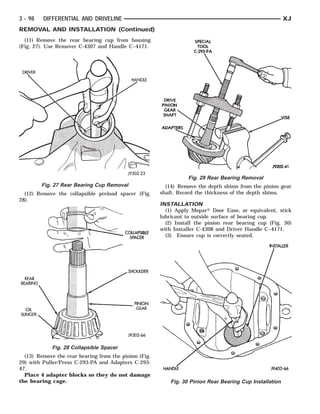
  • 109.
    HEEL DRIVE GEAR TEETH RING SIDE OF TOE TOE COAST SIDE OF RINGTEETH HEEL GEAR GEAR THE COASTBACKLASHTOP OF CORRECT.GEARDEPTHPINIONTOWARD PINIONBACKLASH.SLIGHTLY BETWEEN GEARSOMEINCREASE BESHIMALWAYS CORRECT. DECREASEPINION TOOTH, PINIONBACKLASH. BACKLASH TOOTH. CORRECT. DRIVE SIDESHIM RING TOOTH.CLEARANCEOF REQUIRED. THICKER SHIMPATTERN. GEARTOE. DEPTH SIDE CENTERED REQUIRED. THINNER RING GEAR GEAR CORRECT. PATTERN SHIM RING GEAR CONTACT CONTACT DEPTH BE THE BUT GEAR DEPTH AND ON MAY THERE SHOULD PATTERN SHOULD RING DESIRABLE BE XJ DIFFERENTIAL AND DRIVELINE 3 - 109 ADJUSTMENTS (Continued) Fig. 59 Gear Tooth Contact Patterns
  • 110.
    NEW SIDE GEARWASHER REPLACEMENT CLEARANCETHICKNESS WASHER THICKNESS SIDE GEAR CLEARANCE THRUST TOTAL SIDEGEAR −0.037 +0.033 0.007 0.003 0.040 FEELER GAUGE BLADES 3 - 110 DIFFERENTIAL AND DRIVELINE XJ ADJUSTMENTS (Continued) SPECIFICATIONS 8 1/4 INCH AXLE Axle Type . . . . . . . . . . . . . . . . Semi-floating, hypoid Lubricant . . . . . . . . . . . . . . . . . . . . . . . SAE 80W-90 Lube Capacity . . . . . . . . . . . . . . . . . 2.27 L (4.8 pts.) Trac-Lok Additive . . . . . . . . . . . . . . . . 148 ml (5 oz.) Axle Ratio . . . . . . . . . . . . . . . . . . . . . 3.21, 3.55, 3.90 Differential Case Clearance . . . . . . . . . . . . . 0.12 mm (0.005 in.) Case Flange Runout . . . . . . . . 0.076 mm (0.003 in.) Ring Gear Diameter . . . . . . . . . . . . . . . . . . . 20.95 cm (8.25 in.) Backlash . . . . . . . . . . 0.12-0.20 mm (0.005-0.008 in.) Fig. 60 Side Gear Clearance Measurement Runout . . . . . . . . . . . . . . . . . . . 0.127 mm (0.005 in.) Pinion Bearing Preload . . . . . . . . . . . . . . . . . 1-2 N·m (10-20 in.lbs.) 8 1/4 INCH AXLE DESCRIPTION TORQUE Diff. Cover Bolt . . . . . . . . . . . . . . 41 N·m (30 ft. lbs.) Bearing Cap Bolt . . . . . . . . . . 136 N·m (100 ft. lbs.) Fig. 61 Side Gear Calculations Pinion Nut–Minimum . . . . . . . 285 N·m (210 ft. lbs.) Ring Gear Bolt . . . . . . . . . . . . . . 95 N·m (70 ft. lbs.) determine the required thickness of the replacement Backing Plate Bolt . . . . . . . . . . . 64 N·m (48 ft. lbs.) thrust washer. (7) If clearance is 0.012 inch (0.305 mm) or RWAL/ABS Sensor Bolt . . . . . . . 24 N·m (18. ft. lbs.) greater, both side gears must be replaced (matched set) and the clearance measurements repeated. (8) If clearance (above) continues to be 0.012 inch (0.305 mm) or greater, the case must be replaced.
  • 111.
    XJ DIFFERENTIAL AND DRIVELINE 3 - 111 SPECIAL TOOLS 8 1/4 AXLES Puller, Hub—6790 Handle—C-4171 Remover, Bearing—6310 Installer—C-4076-B Installer—C-4198 Handle—C-4735-1 Holder—6719
  • 112.
    3 - 112 DIFFERENTIAL AND DRIVELINE XJ SPECIAL TOOLS (Continued) Puller—C-452 Adapters—C-293-48 Installer—C-3718 Plug—SP-3289 Adjustment Rod—C-4164 Adapters—C-293-47 Puller/Press—C-293–PA Installer—C-4340
  • 113.
    XJ DIFFERENTIAL AND DRIVELINE 3 - 113 SPECIAL TOOLS (Continued) Holder—8138 Installer—6448 Installer—C-4345 Trac-lok Tools—8140 Remover—C-4307 Trac-lok Tools—6960 Installer—C-4308 Gauge Set—C-3715-B Installer—D-130