Aircraft
Weight and Balance
Handbook
U.S. Department of Transportation
FEDERAL AVIATION ADMINISTRATION
Flight Standards Service
2016
ii
iii
The Aircraft Weight and Balance Handbook has been prepared in recognition of the importance of weight and balance
technology in conducting safe and efficient flight. The objective of this handbook is twofold: to provide the airframe and
powerplant mechanic (A&P) with the method of determining the empty weight and empty weight center of gravity (EWCG)
of an aircraft and to furnish the flight crew with information on loading and operating the aircraft to ensure its weight is
within the allowable limit and the center of gravity (CG) is within the allowable range.
Any time there is a conflict between the information in this handbook and specific information issued by an aircraft
manufacturer, the manufacturer’s data takes precedence over information in this handbook. Occasionally, the word “must”
or similar language is used where the desired action is deemed critical. The use of such language is not intended to add to,
interpret, or relieve a duty imposed by Title 14 of the Code of Federal Regulations (14 CFR).
It is essential for persons using this handbook to become familiar with and apply the pertinent parts of 14 CFR. The current
Flight Standards Service airman training and testing material and learning statements for all airman certificates and ratings
can be obtained from www.faa.gov.
This handbook supersedes FAA-H-8083-1A, Aircraft Weight and Balance Handbook, dated 2007.
This handbook is available for download, in PDF format, from www.faa.gov.
This handbook is published by the United States Department of Transportation, Federal Aviation Administration, Airman
Testing Standards Branch, AFS-630, P.O. Box 25082, Oklahoma City, OK 73125.
Comments regarding this publication should be sent, in email form, to the following address:
AFS630comments@faa.gov.
John S. Duncan
Director, Flight Standards Service
Preface
iv
v
This handbook begins with the basic principle of aircraft weight and balance control, emphasizing its importance and
including examples of documentation furnished by the aircraft manufacturer and by the FAA to ensure the aircraft weight
and balance records contain the proper data.
Procedures for the preparation and the actual weighing of an aircraft are described, as are the methods of determining the
location of the empty weight center of gravity (EWCG) relative to both the datum and the mean aerodynamic chord (MAC).
Loading computations for general aviation aircraft are discussed using both loading graphs and tables of weight and
moment indexes.
Information is included that allows an FAA-certifi ated mechanic or repairman to determine the weight and center of gravity
(CG) changes caused by repairs and alterations or removal and installation of equipment. This includes instructions for
conducting adverse-loaded CG checks, also explaining the way to determine the amount and location of ballast needed to
bring the CG within allowable limits.
The unique requirements for helicopter weight and balance control are discussed, including the determination of lateral CG
and the way both lateral and longitudinal CG change as fuel is consumed.
One chapter includes the methods and examples of solving weight and balance problems using a hand-held electronic
calculator, E6-B flight computer, and a dedicated electronic flight compute
Introduction
vi
vii
The Aircraft Weight and Balance Handbook (FAA-H-8083-1B) was produced by the Federal Aviation Administration
(FAA) with the assistance of Safety Research Corporation of America (SRCA). The FAA wishes to acknowledge the
following contributors:
Larry Jackson of Jackson Aircraft Weighing Service, for content and photographs used in Chapter 3
The White Planes Picture Company (www.whiteplanes.com), for images used in Chapter 4
Terri Sipantzi of Precision Windsports, for the weight-shift control sample weight and loading diagram used in Chapter 4
AirBorne Windsports Pty Ltd., for weight-shift control sample weight and loading data sheet used in Chapter 4
Jim Stevens of Aerosports Connection, for powered parachute sample weight and balance information sheet used in
Chapter 4
Sporty’s Pilot Shop, for image of an E6B Flight Computer used in Chapter 10
Acknowledgments
viii
ix
Preface....................................................................iii
Introduction.
.............................................................v
Acknowledgments.
................................................vii
Table of Contents...................................................ix
Chapter 1
Weight and Balance Control.
...............................1-1
Introduction.....................................................................1-1
Responsibility for Weight and Balance Control.............1-2
Terminology.
...................................................................1-2
Weight Control .
..............................................................1-2
Effects of Weight............................................................1-3
Weight Changes..............................................................1-3
Stability and Balance Control.........................................1-4
Weight Control for Aircraft Other Than Fixed and
Rotor-wing......................................................................1-5
Weight-Shift Control Aircraft.....................................1-5
Powered Parachutes.
....................................................1-6
Balloons.
......................................................................1-6
Underestimating the Importance of Weight and
Balance.
...........................................................................1-6
Chapter 2
Weight and Balance Theory................................2-1
Introduction.....................................................................2-1
Weight and Balance Theory.
...........................................2-2
Arm .
............................................................................2-2
Moment.......................................................................2-2
The Law of the Lever.
.....................................................2-2
Shifting the Balance Point or CG.
...................................2-4
Solution by Chart........................................................2-4
Basic Weight and Balance Equation...........................2-4
Solution by Formula....................................................2-5
Mean Aerodynamic Chord.
.............................................2-5
FAA-Furnished Weight and Balance Information .
........2-6
CG Range....................................................................2-6
Empty Weight CG Range (EWCG)............................2-6
Maximum Weights......................................................2-6
Number of Seats..........................................................2-6
Maximum Baggage ....................................................2-6
Fuel Capacity.
..............................................................2-6
Oil Capacity (Wet Sump)............................................2-6
Data Pertinent to all Models......................................2-10
Manufacturer-Furnished Information...........................2-10
Chapter 3
Weighing the Aircraft and Determining the
Empty Weight Center of Gravity.........................3-1
Introduction.....................................................................3-1
Requirements..................................................................3-2
Equipment for Weighing.
................................................3-2
Preparation for Weighing.
...............................................3-3
Scale Preparation.........................................................3-3
Weigh Clean Aircraft Inside Hangar...........................3-4
Equipment List............................................................3-4
Ballast..........................................................................3-4
Standard Weights........................................................3-4
Draining the Fuel.
........................................................3-4
Oil................................................................................3-4
Other Fluids.................................................................3-4
Configuration of the Aircraf .......................................3-5
Jacking the Aircraft.....................................................3-5
Leveling the Aircraft...................................................3-5
Safety Considerations.
.................................................3-5
Determining the CG........................................................3-5
EWCG Formulas.
............................................................3-6
Datum Forward of the Airplane—Nosewheel
Landing Gear...............................................................3-6
Datum Aft of the Main Wheels—Nosewheel
Landing Gear...............................................................3-6
Location of Datum..........................................................3-7
Datum Forward of the Main Wheels—Tailwheel
Landing Gear...............................................................3-7
Datum Aft of the Main Wheels—Tailwheel
Landing Gear...............................................................3-7
Center of Gravity (CG) and Mean Aerodynamic
Chord (MAC)..................................................................3-8
Table of Contents
x
Center of Gravity (CG)...............................................3-8
Mean Aerodynamic Chord (MAC).............................3-8
Chapter 4
Light Sport Aircraft Weight and Balance
Control.
..................................................................4-1
Introduction.....................................................................4-1
LSA Definition of Term .
............................................4-2
Weight and Balance........................................................4-3
WSC Aircraft.
..............................................................4-3
Powered Parachutes.
....................................................4-4
Weight and Balance Computations (Amateur-Built
Aircraft).
..........................................................................4-4
Chapter 5
Single-Engine Aircraft Weight and Balance
Computations.......................................................5-1
Introduction.....................................................................5-1
Determining the Loaded Weight and CG.......................5-2
Manual Computational Method..................................5-2
Loading Graph Method...............................................5-4
Moment Indexes......................................................5-4
Loading Graph.........................................................5-4
Compute Weight and Balance Using the
Loading Graph.........................................................5-4
Chapter 6
Multiengine Aircraft Weight and Balance
Computations.......................................................6-1
Introduction.....................................................................6-1
Determine the Loaded CG..............................................6-2
Chart Method Using Weight, Arm, and Moments......6-2
Determining the CG in Percentage of Mean
Aerodynamic Chord (MAC).......................................6-3
The Chart Method Using Weight and
Moment Indexes..........................................................6-3
Chapter 7
Center of Gravity Change After a
Repair or Alteration..............................................7-1
Introduction.....................................................................7-1
Equipment List................................................................7-2
Major Alteration and Repair...........................................7-3
Weight and Balance Revision Record............................7-3
Weight Changes Caused by a Repair or Alteration........7-5
Computations Using Weight, Arm, and Moment.......7-5
Computations Using Weight and Moment Indexes....7-5
Determining the CG in Percentage of Mean
Aerodynamic Chord (Percent MAC)..........................7-6
Empty Weight CG (EWCG) Range................................7-6
Adverse-Load CG Checks..............................................7-6
Forward Adverse-Load CG Check.
.............................7-7
Aft Adverse-Load CG Check......................................7-7
Ballast.............................................................................7-7
Temporary Ballast.......................................................7-8
Temporary Ballast Formula........................................7-8
Permanent Ballast.
.......................................................7-8
Chapter 8
Weight and Balance Control—Helicopter..........8-1
Introduction.....................................................................8-1
Determining the Loaded CG of a Helicopter..................8-3
Effects of Offloading Passengers and Using Fue .
..........8-3
Chapter 9
Weight and Balance Control—Commuter
Category and Large Aircraft................................9-1
Introduction.....................................................................9-1
Establishing the Initial Weight of an Aircraft ................9-2
Determining the Empty Weight and Empty Weight
CG (EWCG).
...................................................................9-2
Documenting Changes to an Aircraft’s Weight and
Balance .
..........................................................................9-3
Determining the Loaded CG of the Airplane in
Percent MAC..................................................................9-3
Operational Empty Weight (OEW)................................9-5
Reestablishing the OEW.............................................9-5
Fleet Operating Empty Weights (FOEW) ..................9-5
Onboard Aircraft Weighing System.
...........................9-5
Determining the Correct Stabilizer Trim Setting........9-6
Determining CG Changes Caused by Modifying the
Cargo...............................................................................9-6
Effects of Loading or Offloading Cargo ....................9-6
Effects of Shifting Cargo From One Hold to
Another........................................................................9-8
Determining Cargo Pallet Loads and Floor
Loading Limits............................................................9-9
Determining the Maximum Amount of Payload
That Can Be Carried.
.................................................9-10
Determining the Landing Weight.
.............................9-10
Determining Fuel Dump Time in Minutes................9-12
Weight and Balance of Commuter Category
Airplanes...................................................................9-12
Determining the Loaded Weight and CG.
.................9-12
Determining the Changes in CG When Passengers
Are Shifted................................................................9-16
Determining Changes in Weight and CG When
the Aircraft Is Operated in Its Cargo
Configuratio .
............................................................9-18
Determining the CG Shift When Cargo Is Moved
From One Section to Another...................................9-18
Determining the CG Shift When Cargo Is Added
or Removed...............................................................9-18
Determining Which Limits Are Exceeded................9-18
xi
Chapter 10
Use of Computer for Weight and Balance
Computations.....................................................10-1
Introduction...................................................................10-1
Electronic Calculator....................................................10-2
E6-B Flight Computer..................................................10-2
Dedicated Electronic Flight Computer.........................10-3
Typical Weight and Balance Problems.....................10-4
Determining CG in Inches From the Datum.............10-4
Nosewheel Airplane With Datum Ahead of the
Main Wheels..........................................................10-4
Nosewheel Airplane With Datum Behind the
Main Wheels..........................................................10-4
Tailwheel Airplane With Datum Ahead of the
Main Wheels..........................................................10-4
Tailwheel Airplane With Datum Behind the
Main Wheels..........................................................10-4
Determining CG, Given Weights, and Arms............10-5
Determining CG, Given Weights, and Moment
Indexes......................................................................10-5
Determining CG in Percent Mean Aerodynamic
Chord (MAC)............................................................10-5
Determining Lateral CG of a Helicopter...................10-5
Determining ΔCG Caused by Shifting Weights.......10-6
Determining Weight Shifted to Cause Specified
ΔCG.
..........................................................................10-6
Determining Distance Weight Is Shifted to Move
CG a Specific Distanc .
.............................................10-6
Determining Total Weight of an Aircraft With a
Specified ΔCG When Cargo Is Move .....................10-7
Determining Amount of Ballast Needed to Move
CG to a Desired Location..........................................10-7
Appendix A.
..........................................................A-1
Appendix B.
..........................................................B-1
Glossary...............................................................G-1
Index.......................................................................I-1
xii
1-1
Introduction
There are many factors in the safe and efficient operation of
aircraft, including proper weight and balance control. The
weight and balance system commonly employed among
aircraft consists of three equally important elements: the
weighing of the aircraft, the maintaining of the weight and
balance records, and the proper loading of the aircraft. An
inaccuracy in any one of these elements defeats the purpose
of the system. The finalloading calculations are meaningless
if either the aircraft has been improperly weighed or the
records contain an error.
Improper loading decreases the effic ency and performance of
an aircraft from the standpoint of altitude, maneuverability,
rate of climb, and speed. It may even be the cause of failure
to complete the flight or, for that matter, failure to start the
flight.Because of abnormal stresses placed upon the structure
of an improperly loaded aircraft, or because of changed fly ng
characteristics of the aircraft, loss of life and destruction of
valuable equipment may result.
Weight and Balance
Control
Chapter 1
1-2
Aircraft can perform safely and achieve their designed
efficiency only when they are operated and maintained in the
way their designers intended. This safety and efficiency is
determined to a large degree by holding the aircraft’s weight
andbalanceparameterswithinthelimitsspecifiedforitsdesign.
The remainder of this handbook describes how this is done.
Responsibility for Weight and Balance
Control
The responsibility for proper weight and balance control
begins with the engineers and designers and extends to the
technicians who maintain the aircraft and the pilots who
operate them. Modern aircraft are engineered utilizing state-
of-the-art technology and materials to achieve maximum
reliability and performance for the intended category. As
much care and expertise must be exercised in operating
and maintaining these efficient aircraft as was taken in their
design and manufacturing:
1. The designers of an aircraft set the maximum weight
based on the amount of lift the wings or rotors can
provide under the operational conditions for which
the aircraft is designed. The structural strength of the
aircraft also limits the maximum weight the aircraft
can safely carry. The designers carefully determine
the ideal center of gravity (CG) and calculate the
maximum allowable deviation from this specific
location.
2. The manufacturer provides the aircraft operator with
the empty weight of the aircraft and the location of its
empty weight center of gravity (EWCG) at the time
the certifiedaircraft leaves the factory. Amateur-built
aircraft must have this information determined and
available at the time of certification
3. The FAA-certificated mechanic or repairman who
maintains the aircraft keeps the weight and balance
records current, recording any changes that have been
made because of repairs or alterations.
4. The pilot in command (PIC) has the responsibility
prior to every flight to know the maximum allowable
weight of the aircraft and its CG limits. This allows
the pilot to determine during the preflight inspection
that the aircraft is loaded so that the CG is within the
allowable limits.
Terminology
Pilots and FAA-certificated mechanics or repairmen must
ensure they understand the terms as they relate to the
aircraft in question. For small aircraft terminology, use
the information found in sources associated with Civil
Air Regulation (CAR) 3 certification or General Aviation
Manufacturers Association (GAMA) Specification No. 1
for part 23 aircraft or part 27 for rotorcraft. For terminology
applied to large part 25 aircraft, information can be found
in Advisory Circular (AC) 120-27, Aircraft Weight and
Balance Control. The glossary contains the most current
terms and defin tions. Current regulations are available from
the Superintendent of Documents; U.S. Government Printing
Office;Washington, DC 20402. They are also located on the
FAA website at www.faa.gov. Earlier regulations may be
available in libraries or in the Federal Register.
Weight Control
Weight is a major factor in airplane construction and
operation, and it demands respect from all pilots and
particular diligence by all maintenance personnel. Excessive
weight reduces the efficiencyof an aircraft and the available
safety margin if an emergency condition should arise.
When an aircraft is designed, it is made as light as the
required structural strength allows, and the wings or rotors are
designed to support the maximum allowable weight. When
the weight of an aircraft is increased, the wings or rotors must
produce additional lift and the structure must support not
only the additional static loads, but also the dynamic loads
imposed by flight maneuvers. For example, the wings of a
3,000-pound airplane must support 3,000 pounds in level
flight, but when the airplane is turned smoothly and sharply
using a bank angle of 60°, the dynamic load requires the
wings to support twice this or 6,000 pounds.
Severe uncoordinated maneuvers or flight into turbulence
can impose dynamic loads on the structure great enough
to cause failure. In accordance with Title 14 of the Code
of Federal Regulations (14 CFR) part 23, the structure of a
normal category airplane must be strong enough to sustain
a load factor of 3.8 times its weight. Every pound of weight
added to a normal category aircraft requires that the structure
be strong enough to support 3.8 pounds. An aircraft operated
in the utility category must sustain a load factor of 4.4 times
its weight, and acrobatic category aircraft must be strong
enough to withstand 6.0 times their weight.
The lift produced by a wing is determined by its airfoil shape,
angle of attack, speed through the air, and air density. When
an aircraft takes off from an airport with a high density
altitude, it must accelerate to a speed faster than would be
required at sea level to produce enough lift to allow takeoff;
therefore, a longer takeoff run is necessary. The distance
needed may be longer than the available runway. When
operating from a high density altitude airport, the Pilot’s
Operating Handbook (POH) or Airplane Flight Manual
(AFM) must be consulted to determine the maximum weight
allowed for the aircraft under the conditions of altitude,
temperature, wind, and runway conditions.
1-3
Effects of Weight
Most modern aircraft are so designed that, when all seats
are occupied, the baggage compartment is full, and all fuel
tanks are full, the aircraft is grossly overloaded. This type
of design requires the pilot to give great consideration to
the requirements of each specific flight. If maximum range
is required, occupants or baggage must be left behind, or if
the maximum load must be carried, the range, dictated by
the amount of fuel on board, must be reduced.
Overloading an aircraft can create a variety of problems:
• The aircraft needs a higher takeoff speed, which results
in a longer takeoff run.
• Both the rate and angle of climb are reduced.
• The service ceiling is lowered.
• The cruising speed is reduced.
• The cruising range is shortened.
• Maneuverability is decreased.
• A longer landing roll is required because the landing
speed is higher.
• Excessive loads are imposed on the structure,
especially the landing gear.
The POH or AFM includes tables or charts that give the pilot
an indication of the performance expected for any weight.
An important part of careful preflight planning includes a
check of these charts to determine if the aircraft is loaded so
the proposed flight can be safely made
Weight Changes
The maximum allowable weight for an aircraft is determined
by design considerations. However, the maximum operational
weight may be less than the maximum allowable weight due
to such considerations as high density altitude or high-drag
fieldconditions caused by wet grass or water on the runway.
The maximum operational weight may also be limited by the
departure or arrival airport’s runway length.
One important preflight consideration is the distribution
of the load in the aircraft. Loading the aircraft so the gross
weight is less than the maximum allowable is not enough.
This weight must be distributed to keep the CG within the
limits specified in the POH or AFM
If the CG is too far forward, a heavy passenger can be moved
to one of the rear seats or baggage may be shifted from a
forward baggage compartment to a rear compartment. If the
CG is too far aft, passenger weight or baggage can be shifted
forward. The fuel load should be balanced laterally. The pilot
should pay special attention to the POH or AFM regarding
the operation of the fuel system in order to keep the aircraft
balanced in flight
Weight and balance of a helicopter is far more critical
than for an airplane. Some helicopters may be properly
loaded for takeoff, but near the end of a long flight when
the fuel tanks are almost empty, the CG may have shifted
enough for the helicopter to be out of balance laterally or
longitudinally. Before making any long flight, the CG with
the fuel available for landing must be checked to ensure it is
within the allowable range.
Airplanes with tandem seating normally have a limitation
requiring solo flight to be made from the front seat in some
airplanes or the rear seat in others. Some of the smaller
helicopters also require solo flight be made from a specific
seat, either the right, left, or center. These seating limitations
are noted by a placard, usually on the instrument panel, and
they should be strictly followed.
As an aircraft ages, its weight usually increases due to debris
and dirt collecting in hard-to-reach locations and moisture
absorbed in the cabin insulation. This increase in weight is
normally small, but it can be determined only by accurately
weighing the aircraft.
Changes of fixed equipment may have a major effect upon
the weight of the aircraft. Many aircraft are overloaded by
the installation of extra radios or instruments. Fortunately,
the replacement of older, heavy electronic equipment with
newer, lighter types results in a weight reduction. This
weight change, however helpful, can cause the CG to shift,
which must be computed and annotated in the weight and
balance record.
Repairs and alterations are the major sources of weight
changes. It is the responsibility of the FAA-certificate
mechanic or repairman making any repair or alteration to
know the weight and location of a change, to compute the
CG, record the new empty weight and EWCG in the aircraft
weight and balance record, and update the equipment lists.
If the newly calculated EWCG should happen to fall outside
the EWCG range, it is necessary to perform an adverse-
loading check. This requires a forward and rearward
adverse-loading check and a maximum weight check.
These weight and balance extreme conditions represent the
maximum forward and rearward CG position for the aircraft.
An adverse-loading check is a deliberate attempt to load an
aircraft in a manner that creates the most critical balance
condition and still remains within the design CG limits of the
aircraft. If any of the checks fall outside the loaded CG range,
1-4
Figure 1-1. Longitudinal forces acting on an airplane in flight.
Lift
Variable
Nose-up force
dependent upon airspeed
Fixed
Nose-down force
independent of airspeed
CG
Figure 1-2. If the CG is too far aft at the low stall airspeed, there
might not be enough elevator nose-down authority to get the nose
down for recovery.
Lift
Insufficient elevator
Nose-down force
CG too far aft
CG
Figure 1-3. If the CG is too far forward, there is not enough elevator
nose-up force to flare the airplane for landing.
Lift
Insufficient elevator
Nose-up force
CG too far forward
CG
the aircraft must be reconfigured or placarded to prevent the
pilot from loading the aircraft improperly. It is sometimes
possible to install a fixed ballast in order for the aircraft to
operate again within the normal CG range.
The FAA-certificated mechanic or repairman conducting an
annual or condition inspection must ensure the weight and
balance data in the aircraft records is current and accurate. It
is the responsibility of the PIC to use the most current weight
and balance data when operating the aircraft.
Stability and Balance Control
Balance control refers to the location of the CG of an aircraft.
This is of primary importance to aircraft stability, which is a
factor in flight safety. The CG is the point at which the total
weight of the aircraft is assumed to be concentrated, and the
CG must be located within specificlimits for safe flight.Both
lateral and longitudinal balance are important, but the prime
concern is longitudinal balance; that is, the location of the
CG along the longitudinal or lengthwise axis.
An airplane is designed to have stability that allows it to be
trimmed to maintain straight-and-level flight with hands off
the controls. Longitudinal stability is maintained by ensuring
the CG is slightly ahead of the center of lift. This produces a
fixed nose-down force independent of the airspeed. This is
balanced by a variable nose-up force, which is produced by a
downward aerodynamic force on the horizontal tail surfaces
that varies directly with the airspeed. [Figure 1-1]
If a rising air current should cause the nose to pitch up, the
airplane slows and the downward force on the tail decreases.
The weight concentrated at the CG pulls the nose back down.
If the nose should drop in flight, the airspeed increases and
the increased downward tail load brings the nose back up
to level flight
As long as the CG is maintained within the allowable limits
for its weight, the airplane has adequate longitudinal stability
and control. If the CG is too far aft, it is too near the center
of lift; the airplane is unstable and difficult to recover from
a stall. [Figure 1-2] If the unstable airplane should enter a
spin, the spin could become flat making recovery difficult
or impossible. If the CG is too far forward, the downward
tail load needs to be increased to maintain level flight. This
increased tail load has the same effect as carrying additional
weight; the aircraft must fly at a higher angle of attack and
drag increases.
A more serious problem caused by the CG being too far
forward is the lack of sufficient elevator authority. At low
takeoff speeds, the elevator might not produce enough
nose-up force to rotate; on landing there may not be enough
elevator force to flarethe airplane. [Figure 1-3] Both takeoff
and landing runs are lengthened if the CG is too far forward.
The basic aircraft design is such that lateral symmetry is
assumed to exist. For each item of weight added to the left
of the center line of the aircraft (also known as buttock
line zero or BL‑0), there is generally an equal weight at a
corresponding location on the right.
The lateral balance can be upset by uneven fuel loading
or burnoff. The position of the lateral CG is not normally
computed for an airplane, but the pilot must be aware of
1-5
Figure 1-4. Lateral imbalance causes wing heaviness, which may
be corrected by deflecting the aileron. The additional lift causes
additional drag, and the airplane flies inefficiently.
Empty Full
Additional lift and drag
Additional weight
Figure 1-5. Fuel in the tanks of a swept-wing airplane affects both
lateral and longitudinal balance. As fuel is used from an outboard
tank, the CG shifts forward.
Inboard fuel: nose heavy
Outboard fuel: tail heavy
the adverse effects that result from a laterally unbalanced
condition. [Figure 1-4] This is corrected by using the aileron
trim tab until enough fuel has been used from the tank on
the heavy side to balance the airplane. The deflectedtrim tab
deflects the aileron to produce additional lift on the heavy
side, but it also produces additional drag, and the airplane
flies inefficientl
Helicopters are more often affected by lateral imbalance
than airplanes. If a helicopter is loaded with heavy occupants
and fuel on the same side, it could be out of balance enough
to make it unsafe to fly. It is also possible that if external
loads are carried in such a position that requires large lateral
displacement of the cyclic control to maintain level fl ght, the
fore-and-aft cyclic control effectiveness is limited.
Swept-wing airplanes are more critical due to fuel imbalance
because as the fuel is used from the outboard tanks, the CG
shifts forward. As fuel is used from the inboard tanks, the CG
shifts aft. [Figure 1-5] For this reason, fuel-use scheduling
in swept-wing airplanes operation is critical.
Weight Control for Aircraft Other Than
Fixed and Rotor-wing
Some light aircraft utilize different methods of determining
weight and balance from the traditional fixedand rotor-wing
aircraft. These aircraft achieve flight control by methods
different from the fixed-wing airplane or helicopter. Most
notable of these are weight-shift control (WSC) aircraft (also
known as trikes), powered parachutes, and balloons. These
aircraft typically do not specify either an EWCG or a CG
range. They require only a certified or approved maximum
weight. To understand why this is so, a look at how flight
control is achieved is helpful.
Airplanes and WSC aircraft control flightunder the influenc
of the same four forces (lift, gravity, thrust, and drag), and
around the same three axes (pitch, yaw, and roll). However,
each aircraft accomplishes this control in a very different
manner. This difference helps explain why the fixed-wing
airplane requires an established weight and a known CG,
whereas the WSC aircraft only requires the known weight.
The fixed-wing airplane has movable controls that alter lift
on various airfoil surfaces to vary pitch, roll, and yaw. In
turn, these changes in lift affect the characteristics of the
flight parameters. Weight normally decreases in flight due
to fuel consumption, and the airplane CG changes with this
weight reduction. An airplane utilizes its variable fligh
controls to compensate and maintain controllability through
the various flightmodes and as the CG changes. An airplane
has a CG range or envelope within which it must remain if
the flight controls are to remain effective and the airplane
safely operated.
Weight-Shift Control Aircraft
The WSC aircraft has a relatively set platform wing without
a tail. The pilot achieves control by shifting weight. In the
design of this aircraft, the weight of the airframe and its
payload is attached to the wing at a single point in a pendulous
arrangement. The pilot, through the flight controls, controls the
arm of this pendulum and thereby controls the aircraft. When
a change in flight parameter is desired, the pilot displaces the
aircraft’s weight by the appropriate distance and direction.
This change momentarily disrupts the equilibrium between the
four forces acting on the aircraft. The wing, due to its inherent
stability, then moves appropriately to reestablish the desired
relationship between these forces; the wing flexes and alter
its shape. As the shape is changed, lift is varied at different
points on the wing to achieve the desired flight parameters
1-6
The flight controls primarily affect the pitch-and-roll axes.
Since there is no vertical tail plane, there is minimal or no
yaw control. Unlike in an airplane, the CG experienced by
the WSC aircraft wing remains constant. Since the weight
of the airframe acts through a single point (the wing attach
point), the range over which the weight may act is fixed at
the pendulum arm or length. Even though weight decreases
as fuel is consumed, weight remains focused at the wing
attach point. Because the range is fixed, there is no need to
establish a calculated range. The pilot should consult the
POH or Aircraft Operating Instructions (AOI) for maximum
takeoff weight and minimum and maximum seat weight
limits prior to each flight
Powered Parachutes
The powered parachute is also a pendulum-style aircraft. Its
airframe CG is fixed at the pendulum attach point. It is more
limited in controllability than the WSC aircraft because it
lacks an aerodynamic pitch control. Pitch (and lift) control
is primarily a function of the power control. Increased power
results in increased lift; cruise power amounts to level flight;
decreased power causes a descent. Due to this characteristic,
the aircraft is basically a one-airspeed aircraft. Once again,
because the CG is fixed at the attach point to the wing, there
is no CG range. As with WSC, the pilot should consult the
POH or AOI for maximum takeoff weight and minimum and
maximum seat weight limits prior to each flight
Roll control on a powered parachute is achieved by changing
the shape of the wing. The change is achieved by varying
the length of steering lines attached to the outboard trailing
edges of the wing. The trailing edge of the parachute is pulled
down slightly on one side or the other to create increased
drag along that side. This change in drag creates roll and
yaw, permitting the aircraft to be steered.
Balloons
The balloon is controlled by the pilot only in the vertical
dimension; this is in contrast to all other aircraft. He or she
achieves this control through the use of lift and weight.
Wind provides all other movement. The CG of the gondola
remains constant beneath the balloon envelope. As in WSC
and powered-parachute aircraft, there is no CG limitation.
Underestimating the Importance of
Weight and Balance
Many pilots, from sport pilot to commercial pilot, tend to
underestimate the importance of proper weight and balance
of their aircraft. Load sheets are taken for granted and hasty
calculations are made of the aircraft’s CG. Unfortunately,
each year there are a number of accidents related to weight
and balance issues. Many of these occurrences could have
been avoided had more attention been given to weight and
balance.
Every student pilot is taught how to work a weight and
balance problem and that it is important to make sure
every flight is loaded “within the envelope” (no more than
maximum gross weight) for both takeoff and landing. But
does he or she really understand just why this is so and the
disastrous effect of being out of the envelope? Two examples
of documented cases are provided below in an effort to
indicate the serious nature of maintaining the proper weight
and balance. In case studies when weight and balance was
listed as the major factor of the accident, many were fatal.
For instance, a small aircraft was loaded with hunters, gear,
and dogs (none of the dogs were secured inside the aircraft).
During takeoff, all the dogs went to the aft of the airplane.
This shifted the CG well aft of its allowable limit. The
airplane stalled and crashed. The airplane was destroyed
with casualties.
Another accident occurred when a group of skydivers were
sitting on the floor toward the aft portion of the airplane
(they were unsecured). During takeoff, the CG was again
well beyond its aft limit. The airplane stalled and crashed.
The airplane was destroyed with casualties.
There is a safety factor built into the formula for maximum
gross weight. Any airplane can fly when it takes off at a
weight greater than maximum gross weight if the runway
is long enough and the density altitude is low enough.
However, landing is a different matter. All airplanes are built
to withstand an occasional hard landing, but what would
happen if the hard landing were combined with a substantially
overweight airplane? Something would probably break at that
time or the structure would be weakened enough to break
sometime in the future when everything might seem normal to
a pilot unaware of the previous situation. Even more disastrous
than an overweight, hard landing is reaching or exceeding
the structural integrity of the metal and/or composite design
values when maneuvering or when turbulence is encountered.
Hidden damage could result, causing an unexpected
catastrophic failure at some future time.
If an airplane is certificated with a maximum gross weight
of 6,000 pounds (its weight on the ground) and is rolled into
a 60° bank, the forces exerted make it feel as if it weighed
12,000 pounds. At its maximum certificated gross weight,
there is no problem because the aircraft is operated within its
certificated maneuvering loads. But loaded to 8,000 pounds
with a 60° bank or an abrupt pullup, it suddenly weighs
16,000 pounds and might not be able to perform! Even if it
could, there would probably be internal stress damage that
would show up on future flights
2-1
Introduction
Weight and balance in aircraft is based on the law of the lever.
This chapter discusses the application of the law of the lever
and its applications relative to locating the balance point of a
beam or lever on which various weights are located or shifted.
The chapter also discusses the documentation pertaining to
weight and balance that is furnished by the Federal Aviation
Administration (FAA) and aircraft manufacturers.
Weight and Balance Theory
Chapter 2
2-2
Figure 2-1. Balance lever.
B = 200
A = 100
Arm B (+25")
Arm A (−50")
Fulcrum
Datum
− Moment + Moment
−
F
o
r
c
e
s
+
F
o
r
c
e
s
Figure 2-2. Balance point locations.
Item Weight (lb) Arm (in) Moment (lb-in)
−5,000
+5,000
0
Weight A
Weight B
100
200
300
−50
+25
Figure 2-3. Balance lever datum located off the lever.
C = 200
A = 100 B = 100
+50
+90
+110
+150
CG
Datum
Weight and Balance Theory
Twoelementsarevitalintheweightandbalanceconsiderations
of an aircraft.
• The total weight of the aircraft must be no greater
than the maximum weight allowed by the FAA for
the make and model of the aircraft.
• The center of gravity (CG), or the point at which
all of the weight of the aircraft is considered to be
concentrated, must be maintained within the allowable
range for the operational weight of the aircraft.
Arm
The arm is usually measured and expressed in inches and
refers to the horizontal distance between the CG of an item
or object and the datum, a point from where all measurements
are taken. Arms to the left of the datum are negative (–) and
those to the right of the datum are positive (+). The datum is an
imaginary vertical plane from which all horizontal distances
are measured for balance purposes. The position of the
reference datum varies by aircraft design and manufacturer.
When the datum is located off of the lever and to the left, all of
the arms are positive and computational errors are minimized.
Note: When the datum is established ahead of the aircraft, for
example at the aircraft nose, all of the arms are positive and
computational errors are minimized.
Moment
A moment is a force that tries to cause rotation and is the
product of the arm, in inches, and the weight, in pounds.
Moments are generally expressed in pound-inches (lb-in)
and may be either positive or negative.
The Law of the Lever
Weight and balance problems are based on the physical law
of the lever. This law states that a lever is balanced when the
weight on one side of the fulcrum (a pivot point for the lever)
multiplied by its arm is equal to the weight on the opposite
side multiplied by its arm. In other words, the lever is balanced
when the sum of the moments about the fulcrum is zero. This
is the condition in which the positive moments (those that
try to rotate the lever clockwise) are equal to the negative
moments (those that try to rotate it counterclockwise). In an
aircraft, the balance point is referred to as the CG.
One of the easiest ways to understand weight and balance is
to consider a lever with weights placed at various locations.
The balance point or CG of the lever can be changed by either
moving the weights closer or farther from the fulcrum or by
increasing or decreasing the weights. The balance point or
CG of a lever may be determined by using these four steps:
1. Measure the arm of each weight in inches from the
datum.
2. Multiply each arm by its weight in pounds to determine
the moment in pound-inches of each weight.
3. Determine the total of all weights and of all the
moments. (Disregard the weight of the lever).
4. Divide the total moment by the total weight to
determine the balance point.
Consider these facts about the lever in Figure 2-1. The
100-pound weight A is located 50 inches to the left of the
fulcrum (the datum, in this instance), and it has a moment of
100 × –50 = –5,000 lb-in. The 200-pound weight B is located
25 inches to the right of the fulcrum, and its moment is
200 × +25 = +5,000 lb-in. In Figure 2-2, the sum of the
moments is –5,000 + 5,000 = 0, and the lever is balanced. The
forces that try to rotate it clockwise have the same magnitude
as those that try to rotate it counterclockwise. If either weight
is moved or changed, the balance point or CG changes and
the lever becomes unbalanced.
In Figure 2-3, the datum is located off the lever to the left
of weight A. Using the information provided in Figure 2-3,
2-3
Figure 2-4. Finding balance point with datum located off the lever.
Item Weight (lb) Arm (in) Moment CG
5,000
9,000
30,000
44,000 110
Weight A
Weight B
Weight C
100
100
200
400
50
90
150
Figure 2-5. Locating balance point.
C = 200
A = 100 B = 100
−20
−60
110
+40
CG
Original datum New datum
Figure 2-6. Proving balance point with three weights is correct.
Item Weight (lb) Arm (in) Moment (lb-in)
−6,000
−2,000
+8,000
0
Weight A
Weight B
Weight C
100
100
200
−60
−20
+40
Figure 2-7. Locating balance point with datum at C.
C = 200
A = 100 B = 100
−60
−100
Datum
Figure 2-8. Determining new balance point.
Item Weight (lb) Arm (in) Moment CG
−10,000
−6,000
0
−16,000 −40
Weight A
Weight B
Weight C
100
100
200
400
−100
−60
Figure 2-9. Locating balance point with datum left of original.
C = 200
A = 100 B = 100
−40
Datum
−20
−60
+40
determine the balance point by making a chart like the one
in Figure 2-4.
As noted in Figure 2-4, A weighs 100 pounds and is 50 inches
from the datum; B weighs 100 pounds and is 90 inches from
the datum; C weighs 200 pounds and is 150 inches from the
datum. The total of the weights is 400 pounds, and the total
moment is 44,000 lb-in.
Determine the balance point by dividing the total moment
by the total weight. A balance point is equal to the CG and
can be mathematically written as:
CG =
total moment
total weight
To prove this is the correct balance, move the datum to a
location 110 inches to the right of the original datum and
determine the arm of each weight from this new datum.
[Figure 2-5] Then, make a new chart similar to the one in
Figure 2-6. If the balance point is correct, the sum of the
moments is zero.
The new arm of weight A is 60 inches (the difference between
110 and 50), and since this weight is to the left of the datum,
its arm is negative or –60 inches. The new arm of weight B is
20 inches (110 – 90), and it is also to the left of the datum, so
it is –20; the new arm of weight C is 40 inches (150 – 110).
It is to the right of the datum and is therefore positive.
The lever is balanced when the sum of the moments is zero.
The location of the datum used for determining the arms of
the weights is not important; it may be in various locations,
but all of the measurements must be made from the same
datum location.
The procedure for finding the balance point is the same
anywhere the datum is located. In Figure 2-7, the datum is
located at C. Weight A has an arm of –100 inches (negative
because it is to the left) of the datum and weight B has an
arm of –60 inches from the datum. The table in Figure 2-8
is used to determine the new balance point.
To verify that this is the correct balance point, move the datum
40 inches to the left of the original datum and determine the
arm of each weight from this new datum as in Figure 2-9.
2-4
Figure 2-10. Proving the new balance point is correct.
Item Weight (lb) Arm (in) Moment (lb-in)
−6,000
−2,000
+8,000
0
Weight A
Weight B
Weight C
100
100
200
−60
−20
40
Figure 2-11. Locating balance point with three weights.
C = 200
B = 200
A = 100
80
72
100
CG
Datum
Before Weight Shift
Figure 2-12. Proving the new balance point is correct.
Item Weight (lb) Arm (in) Moment (lb-in)
−5,000
+10,000
+5,000
Weight A
Weight B
Weight C
100
200
−50
+50
Figure 2-13. Weight distribution to balance lever.
B = 200
A = 100 C = 100
−50 50
−25
CG
Datum
After Weight Shift
Figure 2-14. Weight shift provides correct CG.
Item Weight (lb) Arm (in) Moment (lb-in)
−5,000
−5,000
+10,000
0
Weight A
Weight B
Weight C
100
200
200
−50
−25
+50
The new arm for weight A would be –100 + 40 = –60; for
weight B, –60 + 40 = –20; and point C, is +40. The lever is
balanced and the balance point is correct when the sum of
the moments is zero. [Figure 2-10]
Shifting the Balance Point or CG
One common weight and balance problem involves moving
or shifting weight from one point to another in order to move
the balance point or CG to a desired location. This can be
demonstrated by using a lever with three weights to work
out the problem.
Solution by Chart
As the lever is loaded in Figure 2-11, it balances at a point
72 inches from the CG of weight A.
To shift weight B so the lever balances about its center, 50
inches from the CG of weight A, first determine the arm of
weight B that produces a moment that causes the total moment
of all three weights around this desired balance point to be
zero. The combined moment of weights A and C around this
new balance point is 5,000 lb-in, so the moment of weight B
must be –5,000 lb-in for the lever to balance. [Figure 2-12]
Determine the arm of weight B by dividing its moment,
–5,000 lb-in, by its weight of 200 pounds. The arm is –25
inches. To balance the lever at its center, weight B must be
placed so its CG is 25 inches to the left of the center of the
lever. [Figure 2-13]
Figure 2-14 indicates that the shift in weight depicted in
Figure 2-13 allows the lever to balance as the sum of the
moments is zero.
Basic Weight and Balance Equation
The following formulas can be used to determine the distance
weight must be shifted to obtain a desired change in the CG
location. The equation can also be rearranged to fi d the
amount of weight required to be shifted to move the CG
to a desired location, to find the distance the CG is moved
when a specified amount of weight is shifted, or to find the
total weight that would allow shifting a specified amount of
weight to move the CG a given distance.
Weight to be shifted
=
∆ CG
Total weight Distance weight is shifted
Total weight =
Weight shifted × Distance weight is shifted
∆ CG
Weight shifted =
Total weight shifted × ∆ CG
Distance weight is shifted
∆ CG =
Weight shifted × Distance weight is shifted
Total weight
Distance weight is shifted =
Total weight × ∆ CG
Weight shifted
2-5
Figure 2-14. Center of gravity expressed as percent mean
aerodynamic chord.
MAC MAC
30% MAC
15% MAC Datum
Quarter chord
Half
semi-span
Solution by Formula
The problem in Figure 2-11 can be solved by using variations
of this basic equation. First, rearrange the formula to
determine the distance weight B must be shifted:
Distance weight B is shifted = Total weight × ∆ CG
			 Weight shifted
			 = 500 × –22
			 200
			 = –55 inches
The CG of the lever in Figure 2-11 was 72 inches from the
datum. This CG can be shifted to the center of the lever as in
Figure 2-13 by moving weight B. If the 200-pound weight B
is moved 55 inches to the left, the CG shifts from +72 inches
to +50 inches, a distance of 22 inches.
When the distance the weight is to be shifted is known,
the amount of weight to be shifted to move the CG to any
location can be determined by another arrangement of the
basic equation. Use the following arrangement of the formula
to determine the amount of weight that has to be shifted from
station 8 to station +25, to move the CG from station +72
to station +50.
Weight shifted = Total weight × ∆ CG
Distance weight is shifted
=
500 × 22
55
= 200 inches
If the 200-pound weight B is shifted from station +80 to
station +25, the CG moves from station +72 to station +50.
A third arrangement of this basic equation is used to
determine the amount the CG is shifted when a given amount
of weight is moved for a specified distance (as it was done
in Figure 2-11). The following formula is used to determine
the amount the CG is shifted when 200-pound weight B is
moved from +80 to +25.
∆ CG =
Weight shifted × Distance it is shifted
		 Total weight
=
200 × 55
500
= 22 inches
Moving weight B from +80 to +25 moves the CG 22 inches
from its original location at +72 to its new location at +50
as seen in Figure 2-13.
To complete the calculations, return to the original formula
and enter the appropriate numbers.
Weight to be shifted
=
∆ CG
Total weight Distance weight is shifted
200
=
22
500 55
		 .4 = .4
The equation is balanced.
Mean Aerodynamic Chord
The CG point affects the stability of the aircraft. To ensure
the aircraft is safe to fly, the CG must fall within specified
limits established by the manufacturer.
On some aircraft, the CG is expressed as a percentage of the
length of the mean aerodynamic chord (MAC) or “percent
MAC.” [Figure 2-14] In order to make such a calculation,
the position of the leading edge of the MAC must be known
ahead of time.
CG limits are specifiedforward and aft and/or lateral (left and
right) limits within which the aircraft’s CG must be located
during flight. The area between the limits is called the CG
range of the aircraft.
2-6
The position of the fore and aft CG limits is measured as a
percentage of MAC from the MAC leading edge. Usually for
a single or two-seat aircraft, the most forward position would
be forward of 30–35 percent MAC. Thus, the allowable CG
range in a light aircraft should not exceed 20 percent MAC.
Note: For a rectangular width of constant airfoil section
dimensions, MAC is just the chord. For a symmetrically-
tapered wing, it is the average of the root chord and the tip
chord.
FAA-Furnished Weight and Balance
Information
The information discussed to this point can be readily applied
to any aircraft weight and balance problem. To apply the
techniques, certain elements of information are required.
This information is obtained from both FAA documents and
manufacturer provided data.
Before an aircraft CG can be computed, certain information
must be known. This information, furnished by the FAA
for every certificated aircraft in the Type Certificate Data
Sheets (TCDS) or Aircraft Specifications, can be accessed
at www.faa.gov. When the design of an aircraft is approved
by the FAA, an Approved Type Certificate and TCDS are
issued. The TCDS includes all of the pertinent specification
for the aircraft; at each annual or 100-hour inspection, it is
the responsibility of the inspecting mechanic or repairman
to ensure that the aircraft adheres to them. A note about the
TCDS: aircraft certifi ated before January 1, 1958, were
issued Aircraft Specifica ions under the Civil Air Regulations
(CARs), but when the Civil Aeronautical Administration
(CAA) was replaced by the FAA, Aircraft Specification
were replaced by the TCDS.
The weight and balance information on a TCDS includes CG
range, empty weight CG range (EWCG), maximum weights,
number of seats, maximum baggage, fuel capacity, oil
capacity, and datum location. Data pertinent to an individual
model is located in its respective section of the TCDS. Use
the TCDS excerpts in Figure 2-15 to verify the following for
a Cirrus Design Corporation SR 20 normal category:
CG Range
S/N 1005 through 1147:
Forward Limits: 138.7 inches at 2,110 lb with a straight line
taper to 141.0 in at 2,694 lb and 143.0 in at 2,900 lb
Aft Limits: 144.6 in at 2,110 lb, with straight line taper to
147.4 in at 2,570 lb, and to 147.9 in at 2,745 lb, and 148.2
in at 2,900 lb
S/N 1148 through 1877, 1879 through 1885, and S/N 1005
through 1147 if Cirrus Service Bulletin SB 20-01-00 is
complied with:
Forward Limits: 138.7 in at 2,110 lb with a straight line taper
to 141.0 in at 2,694 lb and 144.1 in at 3,000 lb
Aft Limits: 144.6 in at 2,110 lb, with straight line taper to
147.4 in at 2,570 lb, and to 148.1 in at 2,900 lb, and 148.0
in at 3,000 lb
S/N 1878, 1886 and Subsequent:
Forward Limits: 137.8 in at 2,100 lb with a straight line taper
to 139.1 in at 2,700 lb, and to 140.7 in at 3,050 lb
Aft Limits: 148.1 in at 2,100 lb, with straight line to 148.1
in at 3,050 lb
Empty Weight CG Range (EWCG)
When all of the seats and baggage compartments are located
close together, it is not possible (as long as the EWCG is
located within the EWCG range) to legally load the aircraft
so that its operational CG falls outside this allowable range.
If the seats and baggage areas extend over a wide range, the
EWCG range is listed as “None.”
Maximum Weights
The maximum allowable takeoff and landing weights and
the maximum allowable ramp weight are given. This basic
information may be altered by a note. Notes are found in data
pertinent to all models. An example would be Note 6 at the
end of Figure 2-15.
Number of Seats
The number of seats and their arms are given in such terms
as: 4 (2 at 143.5 aft of datum, 2 at 180 aft of datum).
Maximum Baggage
Maximum baggage for this model is 130 pounds at 208
inches.
Fuel Capacity
This important information is given in such terms as: 60.5
gal at 153.75 in. Usable: 56 gal (See Note 1). Notes can be
found in data pertinent to all models.
Oil Capacity (Wet Sump)
The quantity of the full oil supply and its arm are given: 8
quarts at 76.2 in.
2-7
Figure 2-15. Sample excerpt from TCDS A00009CH.
Page No. 1 2 3 4 5 6 7
Rev. No. 11 12 12 14 14 16 16
DEPARTMENT OF TRANSPORTATION
FEDERAL AVIATION ADMINISTRATION
A00009CH
Revision 16
Cirrus Design Corporation
SR20
SR22
April 22, 2009
TYPE CERTIFICATE DATA SHEET NO. A00009CH
This data sheet, which is part of Type Certificate No. A00009CH, prescribes conditions and limitations under which the product
for the which type certificate was issued meets the airworthiness requirements of the Federal Aviation Regulations.
Type Certificate Holder: Cirrus Design Corporation
4515 Taylor Circle
Duluth, MN 55811
I - Model SR20, (Normal Category), Approved October 23, 1998
Engine Teledyne Continental IO-360-ES, Type Certificate Data Sheet (TCDS) E1CE
Fuel 100/100LL minimum grade aviation gasoline
Engine Limits Maximum Take-off 2700 RPM (200 hp)
Maximum Continuous Power 2700 RPM (200 hp)
Propeller and
Propeller limits 1. Hartzell Propeller Inc. P/N BHC-J2YF-1BF/F7694
TCDS P37EA
Maximum Diameter: 76 inches
Minimum Diameter: 73 inches
Number of Blades: 2
Low Pitch: 14.6°+/-0.5°
High Pitch: 35.0°+/-1.0°
Not to be operated above 24 inches of manifold pressure between 1900 and 2200 RPM.
Spinner: Hartzell P/N A-2295(P) NOTE: Spinner may be painted or polished.
2. Hartzell Propeller Inc. P/N PHC-J3YF-1MF/F7392-1
TCDS P36EA
Maximum Diameter: 74 inches
Minimum Diameter: 72 inches
Number of Blades: 3
Low Pitch: 14.1°+/-0.5°
High Pitch: 35.0°+/-1.0°
No operating limitations to 2800 RPM
Spinner: Hartzell P/N A-2295-1P
3. Hartzell Propeller Inc. P/N PHC-J3YF-1RF/F7392-1
TCDS P36EA
Maximum Diameter: 74 inches
Minimum Diameter: 72 inches
Number of Blades: 3
Low Pitch: 13.9°+/-0.5°
High Pitch: 35.0°+/-1.0°
No operating limitations to 2800 RPM
Spinner: Hartzell P/N A-2295-1(P) NOTE: Spinner may be painted or polished.
2-8
Figure 2-15. Sample excerpt from TCDS A00009CH (continued).
A00009CH -2-
Airspeed Limits S/N 1005 thru 1147:
Vne Never Exceed Speed 200 KIAS
Vno Maximum Structural Cruising Speed 165 KIAS
Vo (2900 lbs) Operating Maneuvering Speed 135 KIAS
Vo (2600 lbs) Operating Maneuvering Speed 126 KIAS
Vo (2200 lbs) Operating Maneuvering Speed 116 KIAS
Vfe Maximum Flap Extension Speed 100 KIAS
Vpd Maximum Parachute Deployment Speed 135 KIAS
S/N 1148 thru 1877, 1879 thru 1885, and S/N 1005 thru 1147 if Cirrus Service Bulletin SB 20-01-
00 is complied with:
Vne Never Exceed Speed 200 KIAS
Vno Maximum Structural Cruising Speed 165 KIAS
Vo (3000 lbs) Operating Maneuvering Speed 131 KIAS
Vo (2600 lbs) Operating Maneuvering Speed 122 KIAS
Vo (2300 lbs) Operating Maneuvering Speed 114 KIAS
Vfe Maximum Flap Extension Speed 100 KIAS
Vpd Maximum Parachute Deployment Speed 135 KIAS
S/N 1878, 1886 and subsequent:
Vne Never Exceed Speed 200 KIAS
Vno Maximum Structural Cruising Speed 163 KIAS
Vo (3050 lbs) Operating Maneuvering Speed 130 KIAS
Vfe Maximum Flap Extension Speed 104 KIAS
Vpd Maximum Parachute Deployment Speed 133 KIAS
C.G. Range S/N 1005 thru 1147:
Forward Limits: 138.7 inches at 2110 lbs with a straight line taper to 141.0 inches at 2694 lbs, and
143.0 inches at 2900 lbs.
Aft Limits: 144.6 inches at 2110 lbs, with straight line taper to 147.4 inches at 2570 lbs, and to
147.9 inches at 2745 lbs, and 148.2 inches at 2900 lbs.
S/N 1148 thru 1877, 1879 thru 1885, and S/N 1005 thru 1147 if Cirrus Service Bulletin SB 20-01-
00 is complied with:
Forward Limits: 138.7 inches at 2110 lbs with a straight line taper to 141.0 inches at 2694 lbs, and
144.1 inches at 3000 lbs.
Aft Limits: 144.6 inches at 2110 lbs, with straight line taper to 147.4 inches at 2570 lbs, and to
148.1 inches at 2900 lbs, and 148.0 inches at 3000 lbs.
S/N 1878, 1886 and subsequent:
Forward Limits: 137.8 inches at 2100 lbs with a straight line taper to 139.1 inches at 2700 lbs, and
to 140.7 inches at 3050 lbs
Aft Limits: 148.1 inches at 2100 lbs, with straight line to 148.1 inches at 3050 lbs.
Empty Weight
C.G. Range None
Maximum Weight S/N 1005 thru 1147:
Takeoff and Landing: 2900 lbs.
S/N 1148 thru 1877, 1879 thru 1885, and S/N 1005 thru 1147 if Cirrus Service Bulletin SB 20-01-
00 is complied with:
Takeoff: 3000 lbs.
Landing: 2900 lbs.
Zero Fuel: 2900 lbs.
S/N 1878, 1886 and subsequent:
Takeoff and Landing: 3050 lbs.
2-9
Figure 2-15. Sample excerpt from TCDS A00009CH (continued).
-3- A00009CH
Minimum Crew One (1) Pilot
Number of Seats 4 (2 at 143.5 inches aft of datum, 2 at 180 inches aft of datum)
Maximum Baggage 130 Lbs. at 208 inches
Fuel Capacity Total: S/N 1005 thru 1877, 1879 thru 1885
60.5 gal at 153.75 inches
Usable: 56 gal (See Note 1)
S/N 1878, 1886 and subsequent:
58.5 gal at 154.9 inches
Usable: 56 gal (See Note 1)
Oil Capacity 8 quarts at 76.2 inches
Maximum Operating
Altitude With a portable oxygen system, the aircraft is limited to 17,500 ft MSL.
Oxygen must be provided as required by the operating rules. Only portable oxygen systems listed
in the FAA Approved Airplane Flight Manual, document number 11934-002, or later FAA
approved revisions, are allowed.
Control Surface
Movements Wing Flaps: Up 0°± 0.5° Down 50% 16°± 0.5° Down 100% 32°± 0.5°
Aileron: Up 12.5° ± 1.0° Down 12.5° ±1.0°
Elevator: Up 25.0° +0°/-1.0° Down 15° ± 1.0°
Elevator Trim: Up 17.0° Minimum Down 10.5° ± 1.0°
Rudder: Right 20.0° ± 1.0° Left 20.0° ± 1.0°
Additional Limitations: Airframe life limit: 12,000 flight hours
Design Data: The airplane shall be manufactured in accordance with the latest FAA approved revision of
“Master Drawing List”, Document No. 13750, or other FAA approved data. NOTE: Document
No. 12609 is the predecessor document to Document No. 13750.
Serial Nos. Eligible 1005 and on
II - Model SR22, Normal Category, Approved November 30, 2000
Engine Teledyne Continental IO-550-N, Type Certificate Data Sheet E3SO
Engine Limits Maximum Take-off 2700 RPM (310 hp)
Maximum Continuous Power 2700 RPM (310 hp)
Propeller and
Propeller limits 1. Hartzell Propeller Inc. P/N PHC-J3YF-1RF/F7694 or F7694B
TCDS P36EA Hartzell
Maximum Diameter: 78 inches
Minimum Diameter: 76 inches
Number of Blades: 3
Low Pitch: 14.1°+/-0.5°
High Pitch: 35.0°+/-1.0°
No operating limitations to 2700 RPM
Spinner: Hartzell P/N A-2295-1(P) NOTE: Spinner may be painted or polished.
2. McCauley Propeller Systems P/N D3A34C443/78CYA-0
TCDS P47GL McCauley
Maximum Diameter: 78 inches
Minimum Diameter: 76 inches
Number of Blades: 3
-5- A00009CH
Minimum Crew One (1) Pilot
Number of Seats 4 (2 at 143.5 inches aft of datum, 2 at 180 inches aft of datum)
Maximum Baggage 130 Lbs. at 208 inches
Fuel Capacity Total: S/N 0002 thru 2333, 2335 thru 2419, and 2421 thru 2437
84 gallon at 154.9 inches
Usable: 81 gallon (See Note 1)
S/N 2334, 2420, 2438 and subsequent
94.5 gallon at 154.9 inches
Usable: 92.0 gallon (See Note 1)
or
58.5 gal at 154.9 inches
Usable: 56 gal (See Note 1)
Oil Capacity 8 quarts at 77.1 inches
Maximum Operating
Altitude With a portable oxygen system, the aircraft is limited to 17,500 ft MSL.
Oxygen must be provided as required by the operating rules. Only portable oxygen systems listed
in the FAA Approved Airplane Flight Manual, document number 13772-001, or later FAA
approved revisions, are allowed.
Control Surface
Movements Wing Flaps: Up 0°±0.5° Down 50% 16° ± 0.5° Down 100% 32° ±0.5°
Aileron: Up 12.5° ± 1.0° Down 12.5° ± 1.0°
Aileron Trim: Up 6 ± 1.0° Down 6 ± 1.0°
Elevator: Up 25.0° +0°/-1.0° Down 15° ± 1.0°
Elevator Trim: Up 17.0° Minimum Down 10.5° ± 1.0°
Rudder: Right 20.0° ± 1.0° Left 20.0° ± 1.0°
Additional Limitations: Airframe life limit: 12,000 flight hours
Design Data: The airplane shall be manufactured in accordance with the latest FAA approved revision of
“Master Drawing List”, Document No. 13750, or other FAA approved data.
Serial Nos. Eligible 0001 and on.
Data Pertinent to All Models
Reference Datum 100 inches in front of the forward face of firewall bulkhead
Leveling Means Door sill and leveling points as defined in AFM
Certification Basis Model SR20: 14 CFR Part 23 of the Federal Aviation Regulations effective February 1, 1965, as
amended by 23-1 through 23-47, except as follows:
14 CFR 23.573, 23.575, 23.611, 23.657, 23.673 through Amendment 23-48;
14 CFR 23.783, 23.785, 23.867, 23.1303, 23.1307, 23.1309, 23.1311, 23.1321, 23.1323,
23.1329, 23,1361, 23.1383, 23.1401, 23.1431, 23.1435 through Amendment 23-49;
14 CFR 23.3, 23.25, 23.143, 23.145, 23.155, 23.1325, 23.1521, 23.1543, 23.1555, 23.1559,
23.1567, 23.1583, 23.1585, 23.1589 through Amendment 23-50;
14 CFR 23.777, 23.779, 23.901, 23.907, 23.955, 23.959, 23.963, 23.965, 23.973, 23.975,
23.1041, 23.1091, 23.1093, 23.1107, 23.1121, 23.1141, 23.1143, 23.1181, 23.1191, 23.1337
through Amendment 23-51;
14 CFR 23.1305 through Amendment 23-52
Noise: 14 CFR Part 36 dated December 1, 1969 as amended by 36-1 through 36-21.
2-10
Figure 2-16. Weight and balance report.
Item C.G. Arm (in) Moment (lb-in/1,000)
Standard empty weight
Optional equipment
Special installation
Paint
Unusable fuel
Basic empty weight
1,876.0
1.2
6.2
—
30.0
1,913.4
67,798.6
16.7
257.3
—
1,380.0
69,452.6
36.1
13.9
41.5
—
46.0
Aircraft Serial No. 18259080 FAA Registration No. N42565 Date: 4-22-09
Weight (lb) ×
Figure 2-15. Sample excerpt from TCDS A00009CH (continued).
Note 2. All placards specified in the latest FAA approved revisions of the "PILOT'S OPERATING HANDBOOK AND
FAA APPROVED AIRPLANE FLIGHT MANUAL FOR THE CIRRUS SR20", document numbers 11934-001,
11934-002, 11934-003 or 11934-004 and the latest FAA approved revisions of the "PILOT'S OPERATING
HANDBOOK AND FAA APPROVED AIRPLANE FLIGHT MANUAL FOR THE CIRRUS SR22" document
numbers 13772-001 or 13772-002 must be displayed in the airplane in the appropriate locations.
Note 3. FAA approved Airworthiness Limitations are included in Section 4 of the Airplane Maintenance Manual (AMM)
Document No. 12137-001 for model SR20, and 13773-001 for model SR22.
Note 4. Exterior colors are limited to those specified in the latest FAA accepted revision of the Airplane Maintenance
Manual (AMM) Document No. 12137-001 for model SR20, and 13773-001 for model SR22.
Note 5. Major structural repairs must be accomplished in accordance with FAA approved Cirrus
Design repair methods or other methods approved by the FAA.
Note 6. For Model SR22 S/N 0002 thru 2333, 2335 thru 2419, and 2421 thru 2437 a maximum landing weight exists
along the line between 141.4 inches at 3210 lbs and 142.7 inches at 3400 lbs.
-- END --
Data Pertinent to all Models
The location of the datum is specified and is described, for
example, as: 100 inches in front of the forward face of the
firewall bulkhead.
Manufacturer-Furnished Information
When an aircraft is initially certificated,its empty weight and
EWCG are determined and recorded in the weight and balance
record, such as the one in Figure 2-16. Notice in this figur
that the moment is expressed as “Moment (lb-in/1,000).” This
is a moment index, which means that the moment, a very
large number, has been divided by 1,000 to make it more
manageable. Chapter 4, Light Sport Aircraft—Weight and
Balance Control, discusses moment indices in more detail.
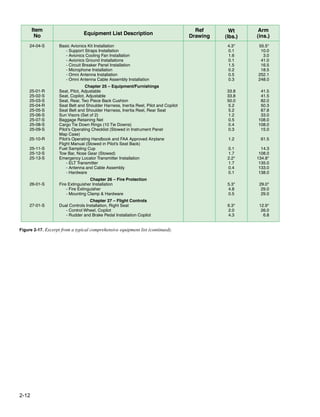
The aircraft is furnished with an equipment list, specifies
all the required equipment and all equipment approved for
installation in the aircraft. The weight and arm of all installed
equipment are included on the list and checked prior to the
aircraft leaving the factory.
When an aircraft mechanic or repairman adds or removes
any item on the equipment list, he or she must change the
weight and balance record to indicate the new empty weight
and EWCG, and the equipment list is revised to show
which equipment is actually installed. Figure 2-17 is from a
comprehensive equipment list that includes all of the items
of equipment approved for this particular model of aircraft.
The pilot’s operating handbook (POH) for each individual
aircraft includes an aircraft-specific equipment list of the
items from this master list. When any item is added to or
removed from the aircraft, its weight and arm are determined
in the equipment list and used to update the weight and
balance record. The POH and airplane flight manual (AFM)
also contain CG moment envelopes and loading graphs.
Examples of the use of these helpful graphs are given in
Chapter 5, Single-Engine Aircraft Weight and Balance
Computations.
In addition to the weight and balance report and equipment
list, the manufacturer also provides a CG range chart. The
CG range can be found in text form in the TCDS. The CG
range chart is furnished in the POH.
2-11
Figure 2-17. Excerpt from a typical comprehensive equipment list.
2-12
Figure 2-17. Excerpt from a typical comprehensive equipment list (continued).
3-1
Introduction
Chapter 2, Weight and Balance Theory, explained the theory
of weight and balance and gave examples of the way the
center of gravity (CG) could be found for a lever loaded
with several weights. In this chapter, the practical aspects
of weighing an airplane and locating its CG are discussed.
Formulas are introduced that allow the CG location to be
measured in inches from various datum locations and in
percentage of the mean aerodynamic chord (MAC).
Weighing the Aircraft and
Determining the Empty Weight
Center of Gravity
Chapter 3
3-2
Figure 3-1. Platform scales.
Requirements
Regulations do not require periodic weighing of privately
owned and operated aircraft. Such aircraft are usually
weighed when originally certificatedor after major alterations
that can affect the weight and balance. The primary purpose
of aircraft weight and balance control is safety. Manufacturers
conduct extensive flight tests to establish loading limits
for their aircraft because limit information is critical for
safe flight. A secondary purpose is to aid efficiency during
flight. Overloading of the aircraft is not the only concern;
the distribution of the weight is important also. The aircraft
has CG limits, and any loading that places the CG outside
the established limits seriously impairs controllability of
the aircraft.
Weight and balance is of such vital importance that each
Federal Aviation Administration (FAA) certificated
mechanic or repairman maintaining an aircraft must be fully
aware of his or her responsibility to provide the pilot with
current and accurate information for the actual weight of the
aircraft and the location of the CG. The pilot in command
(PIC) is responsible for knowing the weight of the load, CG,
maximum allowable weight, and CG limits of the aircraft.
The weight and balance report must include an equipment
list showing weights and moment arms of all required and
optional items of equipment included in the certificate
empty weight.
Weight and balance records used in accounting for and
correcting the CG location are reliable for only limited
periods of time. For this reason, periodic aircraft weighing is
desirable. An aircraft should be reweighed and a new weight
and balance record should be started after the aircraft has
undergone extensive repair or major alteration, when the pilot
reports unsatisfactory flight characteristics (e.g., nose or tail
heaviness), and when recorded weight and balance data are
suspected to be in error.
Repairs and alterations are major sources of weight change.
The airframe and powerplant (A&P) FAA-certificated
mechanic or repairman who is responsible for making any
repair or alteration must:
1. Establish by computation that the authorized weight
and CG limits as shown in the type certificate data
sheet (TCDS) and aircraft specifications are not
exceeded, and
2. Record the new empty weight center of gravity
(EWCG) data in the current approved aircraft flight
manual or issued operating limitations.
When an aircraft has undergone extensive repair or major
alteration, it should be reweighed and a new weight and
balance record started. The A&P FAA-certificatedmechanic
or repairman responsible for the work must provide the pilot
with current and accurate aircraft weight information and
location of the EWCG.
Equipment for Weighing
Weighing aircraft with accurately calibrated scales is the only
sure method of obtaining an accurate empty weight and CG
location. The two basic types of scales used to weigh aircraft
are platform and load cell.
Platform scales [Figure 3-1] or ramp wheel scales
[Figure 3-2] (usually a form or modified version of the
platform scale) are low profi e, easy to handle, safe, and
reliable. Tow or push the aircraft wheels or skids onto the
scale pad at ground level. With one scale per wheel, each
device should be capable of measuring up to at least 60,000
pounds since the weight on each wheel rarely exceeds this
figure
Load cell scales [Figure 3-3] are also a reliable means to
weigh aircraft and are typically cheaper than the platform
type.Using load cell scales allows for the aircraft to be set
up and weighed in its level flight attitude. With this method,
the aircraft is placed on jacks with electronic load cells
placed between the jack and the jack pad on the aircraft.
The aircraft is raised on the jacks until the wheels or skids
are off the floor and the aircraft is in a level flight attitude.
The weight measured by each load cell is indicated on the
control panel. Jacking an aircraft off the ground from all
load points can be an inconvenience, as well as a safety
risk, which some operators would rather avoid by opting for
more expensive—but simpler to use—platform equipment.
In addition, weighing with platform scales typically takes
only one-third of the time needed to weigh with load cells.
3-3
Figure 3-2. Ramp scales.
Figure 3-3. Load cell scales.
All scales for aviation use, manual or electronic, must be
protected when stored or shipped, and they must be checked
periodically for accuracy. The maximum recognized period
between calibration checks is 12 months; however, this period
may be reduced by an airworthiness authority dependent on
the conditions of use. Scales in daily use may require a shorter
interval and/or testing to determine the continued accuracy
of the unit. Scales should be returned to the manufacturer for
proper calibration and testing.
Preparation for Weighing
In general, weight procedures may vary with the aircraft
and types of weight equipment employed. The weighing
procedure contained in the manufacturer’s maintenance
manual should be followed for each particular aircraft. The
major considerations in preparing an aircraft for weighing
are described in the following paragraphs.
Scale Preparation
Mechanical and electronic scales shall be inspected prior to
use and set to zero. This is done by adding and removing
a weight, then rechecking for zero. This process should be
repeated until a steady zero setting is obtained. The scales
should be located in the same environment in which they
3-4
Figure 3-4. Standard fuels and weights with temperatures of 32 °F
and 59 °F.
Weighing Point
AVGAS (Aviation Gasoline)
JET A & A-1
Water
Oil
6.14
6.75
8.35
7.50
6.01
6.68
8.33
7.43
Pounds per U.S. Gallon
32 °F 59 °F
are to be used and allowed to come up to temperature at
least 2 hours prior to use. Scales should not be used in
temperature extremes below 40 °F or above 100 °F unless the
scale is specifically designed for use in those temperatures.
Electronic scales are very sensitive and, if subjected to
freezing temperatures, the liquid displays may be damaged
beyond use.
Weigh Clean Aircraft Inside Hangar
The aircraft should be weighed inside a hangar where wind
cannot blow over the surface and cause fluctuating or false
scale readings. The aircraft should be clean inside and out,
with special attention paid to the bilge area to ensure that no
water or debris is trapped there. The outside of the aircraft
should be as free as possible of all mud and dirt.
Equipment List
All of the required equipment must be properly installed, and
there should be no equipment installed that is not included in
the equipment list. If such equipment is installed, the weight
and balance record must be corrected to indicate it.
Ballast
All required permanent ballasts must be properly secured in
place. All temporary ballasts must be removed.
Standard Weights
Standard weights are established weights for numerous items
involved in weight and balance computations. These weights
should not be used if actual weights are available. Some of
the standard weights are listed in Figure 3-4.
Note the difference in weight as temperatures change.
Althoughthischangeisaverysmallamountpergallon,itcould
endupinasignificanttotalweightgainwhendealingwithlarge
quantities of fluids,such as those found in commercial aircraft.
Draining the Fuel
Drain fuel from the tanks in the manner specified by the
aircraft manufacturer. If there are no specific instructions,
drain the fuel until the fuel quantity gauges read empty when
the aircraft is in level-flight attitude. Any fuel remaining in
the system is considered residual or unusable fuel and is part
of the aircraft empty weight.
The amount of residual fuel and its arm are normally found
in Note 1 in the section of the Type Certificate Data Sheets
(TCDS), “Data pertaining to all Models.” For additional fuel
capacity information, see Chapter 2, Weight and Balance
Theory.
If it is not feasible to drain the fuel, the tanks can be topped
off to be sure of the quantity they contain and the aircraft
weighed with full fuel. After weighing is complete, the
weight of the fuel and its moment are subtracted from those
of the aircraft as weighed. To correct the empty weight for
the residual fuel, add its weight and moment.
When computing the weight of the fuel (e.g., a tank full of
jet fuel), measure its specific gravity (sg) with a hydrometer
and multiply it by 8.345 (the nominal weight of 1 gallon of
pure water whose sg is 1.0). If the ambient temperature is
high and the jet fuel in the tank is hot enough for its specific
gravity to reach 0.81 rather than its nominal sg of 0.82, the
fuel actually weighs 6.76 pounds per gallon rather than its
normal weight of 6.84 pounds per gallon.
Oil
The empty weight for aircraft certificated under the Civilian
Air Regulations (CAR) part 3 does not include the engine
lubricating oil. The oil must either be drained before the
aircraft is weighed, or its weight must be subtracted from
the scale readings to determine the empty weight. To weigh
an aircraft that does not include the engine lubricating oil
as part of the empty weight, place it in level flight attitude,
then open the drain valves and allow the oil to drain out.
Any remaining is undrainable oil and is part of the empty
weight. Aircraft certificated under Title 14 of the Code of
Federal Regulations (14 CFR) parts 23 and 25 include full
oil as part of the empty weight. If it is impractical to drain the
oil, the reservoir can be filled to the specified level and the
weight of the oil computed at 7.5 pounds per gallon. Then,
its weight and moment are subtracted from the weight and
moment of the aircraft as weighed. The amount and arm of
the undrainable oil are found in Note 1 of the TCDS, and
this must be added to the empty weight.
Other Fluids
The hydraulic fluid reservoir and all other reservoirs
containing fluidsrequired for normal operation of the aircraft
should be full. Fluids not considered to be part of the empty
weight of the aircraft are potable (drinkable) water, lavatory
precharge water, and water for injection into the engines.
3-5
Figure 3-5. Locating the CG of an airplane relative to the datum.
Weighing point Net weight (lb)
TARE weight (lb)
Scale reading (lb) Arm (in) Moment (lb-in) CG
46.0
46.0
−32.0
32.8
Right side
Left side
Nose
Total
16
16
8
830
836
340
2,006
38,180
38,456
−10,880
65,756
846
852
348
Configuration of the Aircraf
Consult the aircraft service manual regarding position of
the landing gear shock struts and the control surfaces for
weighing. When weighing a helicopter, the main rotor must
be in its correct position.
Jacking the Aircraft
Aircraft are often weighed by rolling them onto ramps in
which load cells are embedded. This eliminates the problems
associated with jacking the aircraft off the ground. However,
many aircraft are weighed by jacking the aircraft up and then
lowering them onto scales or load cells.
Extra care must be used when raising an aircraft on jacks for
weighing. If the aircraft has spring steel landing gear and it
is jacked at the wheel, the landing gear will slide inward as
the weight is taken off of the tire, and care must be taken to
prevent the jack from tipping over.
Forsomeaircraft,stresspanelsorplatesmustbeinstalledbefore
the aircraft is raised with wing jacks to distribute the weight
over the jack pad. Be sure to follow the recommendations
of the aircraft manufacturer in detail anytime an aircraft is
jacked. When using two wing jacks, take special care to raise
them simultaneously, keeping the aircraft so it does not slip
off the jacks. As the jacks are raised, keep the safety collars
screwed down against the jack cylinder to prevent the aircraft
from tilting if one of the jacks should lose hydraulic pressure.
Leveling the Aircraft
When an aircraft is weighed, it must be in its level fligh
attitude so that all of the components are at their correct
distance from the datum. This attitude is determined by
information in the TCDS. Some aircraft require a plumb line
to be dropped from a specifiedlocation so that the point of the
weight (the bob) hangs directly above an identifiable point.
Others specify that a spirit level be placed across two leveling
lugs, often special screws on the outside of the fuselage. Other
aircraft call for a spirit level to be placed on the upper door sill.
Lateral level is not specified for all light aircraft, but
provisions are normally made on helicopters for determining
both longitudinal and lateral level. This may be done by
built-in leveling indicators, or by a plumb bob that shows the
conditions of both longitudinal and lateral level.
The actual adjustments to level the aircraft using load cells
are made with the jacks. When weighing from the wheels,
leveling is normally done by adjusting the air pressure in the
nosewheel shock strut.
Safety Considerations
Special precautions must be taken when raising an aircraft
on jacks.
1. Stress plates must be installed under the jack pads if
the manufacturer specifies them
2. If anyone is required to be in the aircraft while it is
being jacked, there must be no movement.
3. The jacks must be straight under the jack pads before
beginning to raise the aircraft.
4. All jacks must be raised simultaneously and the safety
devices are against the jack cylinder to prevent the
aircraft tipping if any jack should lose pressure. Not
all jacks have screw down collars, some use drop pins
or friction locks.
Determining the CG
When the aircraft is in its level flight attitude, drop a plumb
line from the datum and make a mark on the hangar floor
below the tip of the bob. Draw a chalk line through this point
parallel to the longitudinal axis of the aircraft.
Then, draw lateral lines between the actual weighing
points for the main wheels, and make a mark along the
longitudinal line at the weighing point for the nosewheel
or the tailwheel. These lines and marks on the floor allow
accurate measurements between the datum and the weighting
points to determine their arms.
Determine the CG by adding the weight and moment of
each weighing point to determine the total weight and total
moment. Then, divide the total moment by the total weight
to determine the CG relative to the datum. As an example of
locating the CG with respect to the datum, which in this case
is the firewall, consider the tricycle landing gear airplane as
detailed in the Figure 3-5 table and illustrated in Figure 3-6.
When the airplane is on the scales with the parking brakes
3-6
Figure 3-9. Determining the CG with datum forward of an airplane
with nosewheel landing gear.
CG
F × L
W
= D −
= 128 −
114.8
=
( )
340 × 78
2,006
( )
Figure 3-8. The datum is 100 inches forward of the wing root
leading edge.
D = 128.0
100.0 13.2
50
114.8
Datum
L = 78.0
Figure 3-10. The datum is aft of the main wheels at the wing
trailing edge.
153
D = 75
88.2
Datum
L = 78.0
Figure 3-7. Determining the CG.
CG
Total moment
Total weight
=
65,756
2,006
=
32.8 inches behind the datum
=
Figure 3-6. The datum is located at the firewall.
46.0
32
32.8
Datum
off, place chocks around the wheels to keep the airplane
from rolling. Subtract the weight of the chocks, called tare
weight, from the scale reading to determine the net weight
at each weighing point. Multiply each net weight by its arm
to determine its moment, and then determine the total weight
and total moment. The CG is determined by dividing the total
moment by the total weight. [Figure 3-7]
The airplane illustrated in Figures 3-5 and 3-6 has a net
weight of 2,006 pounds, and its CG is 32.8 inches behind
the datum.
EWCG Formulas
A chart such as the one in Figure 3-5 helps the pilot visualize
the weights, arms, and moments when solving an EWCG
problem, but it is quicker to determine the EWCG by using
formulas and an electronic calculator. The use of a calculator
for solving these problems is described in Chapter 8, Use of
Computers in Weight and Balance Computations.
There are four possible conditions and their formulas that
relate the location of CG to the datum. Notice that the
formula for each condition first determines the moment of
the nosewheel or tailwheel and then divides it by the total
weight of the airplane. The arm thus determined is then added
to or subtracted from the distance between the main wheels
and the datum, distance D.
Datum Forward of the Airplane—Nosewheel
Landing Gear
The datum of the airplane in Figure 3-8 is 100 inches forward
of the leading edge of the wing root or 128 inches forward
of the main-wheel weighing points. This is distance (D). The
weight of the nosewheel (F) is 340 pounds, and the distance
between main wheels and nosewheel (L) is 78 inches. The
total weight of the airplane (W) is 2,006 pounds. Determine
the CG by using the formula in Figure 3-9.
The CG is 114.8 inches aft of the datum. This is 13.2 inches
forward of the main-wheel weighing points, which proves
the location of the datum has no effect on the location of the
CG if all measurements are made from the same location.
Datum Aft of the Main Wheels—Nosewheel
Landing Gear
The datum of some aircraft may be located aft of the main
wheels. The airplane in this example is the same one just
discussed, but the datum is at the intersection of the trailing
edge of the wing with the fuselage. The distance (D) between
the datum of the airplane in Figure 3-10 and the main-wheel
3-7
Figure 3-13. Determining the CG with datum forward of the main
wheels in an airplane with tailwheel landing gear.
CG
R × L
W
= D +
= 7.5 +
19.7
=
( )
67 × 222
1,218
( )
Figure 3-11. Determining the CG with datum aft of the main wheels
of an airplane with nosewheel landing gear.
CG
F × L
W
= − D +
= − 75 +
−88.2
=
( )
340 × 78
2,006
( )
Figure 3-12. The datum of this tailwheel airplane is the wing root
leading edge.
D = 7.5
Datum
229.5
L = 222.0
19.7
Datum
L = 222.0
D = −80 142
67.8
Figure 3-14. The datum is aft of the main wheels, at the intersection
of the wing trailing edge and the fuselage.
CG
R × L
W
= −D +
= −80 +
= −67.8
( )
67 × 222
1,218
( )
Figure 3-16. Determining the CG with datum aft of the main wheels
in an airplane with tailwheel landing gear.
weighing points is 75 inches, the weight of the nosewheel
(F) is 340 pounds, and the distance between main wheels
and nosewheel (L) is 78 inches. The total net weight of the
airplane (W) is 2,006 pounds.
The location of the CG may be determined by using the
formula in Figure 3-11.
The CG location is a negative value, which means it is 88.2
inches forward of the datum. This places it 13.2 inches
forward of the main wheels, exactly the same location as
when it was measured from other datum locations.
Location of Datum
The location of the datum is not important, but all
measurements must be made from the same location.
Datum Forward of the Main Wheels—Tailwheel
Landing Gear
Locating the CG of a tailwheel airplane is done in the same
way as locating it for a nosewheel airplane except the formula
is .
The distance (D) between the datum of the airplane in
Figure 3-12 and the main-gear weighing points is 7.5 inches,
the weight of the tailwheel (R) is 67 pounds, and the distance
(L) between the main-wheel and the tailwheel weighing points
is 222 inches. The total weight of the airplane (W) is 1,218
pounds.DeterminetheCGbyusingtheformulainFigure3-13.
R × L
W
The CG is 19.7 inches behind the datum.
Datum Aft of the Main Wheels—Tailwheel
Landing Gear
The datum of the airplane in Figure 3-14 is located at the
intersection of the wing root trailing edge and the fuselage.
This places the arm of the main gear (D) at –80 inches. The
net weight of the tailwheel (R) is 67 pounds, the distance
between the main wheels and the tailwheel (L) is 222 inches,
and the total net weight (W) of the airplane is 1,218 pounds.
Since the datum is aft of the main wheels, use the formula
found in Figure 3-15.
The CG is 67.8 inches forward of the datum or 12.2 inches
aft of the main-gear weighing points. The CG is in exactly
the same location relative to the main wheels, regardless of
3-8
Figure 3-16. The MAC is the chord drawn through the geographic
center of the plan area of the wing.
CG MAC
Trailing edge mean
aerodynamic chord
Leading edge mean
aerodynamic chord
TEMAC
LEMAC
Datum
where the datum is located.
Center of Gravity (CG) and Mean
Aerodynamic Chord (MAC)
Center of Gravity (CG)
In addition to overloading or drastically reducing the
aircraft’s weight, the distribution of weight is also a concern.
When aircraft equipment is changed, the person making the
equipment change must make an entry on the equipment list
indicating items added, removed, or relocated; the date of
the change; and the person’s name and certification number
in the aircraft’s maintenance records.
For the purpose of weight and balance computations, the CG
of an airplane is an imaginary point about which the nose-
heavy (–) moments and tail-heavy (+) moments are exactly
equal in magnitude. If suspended from the CG point, the
aircraft would have no tendency to rotate nose up or nose
down. The CG of the loaded aircraft can range fore and aft
within certain limits that are determined during the fl ght test
for type certific tion. These limits are the most forward- and
rearward-loaded CG positions at which the aircraft meets the
performance and flight characteristics required by the FAA.
Any loading that places the CG outside the limits for a
particular aircraft seriously impairs the pilot’s ability to
control the aircraft. For example, it is more difficult to take
off and gain altitude in a nose-heavy aircraft, and the aircraft
tends to drop its nose when the pilot reduces throttle. It also
requires a higher speed to land safely. A tail-heavy aircraft is
more susceptible to stalling at low speed, which is a concern
during the landing approach.
On small airplanes and on all helicopters, the CG location
is identified as being a specific number of inches from the
datum. The CG range is identifiedin the same way. On larger
airplanes, from private business jets to large jumbo jets, the
CG and its range are typically identified in relation to the
width of the wing.
Mean Aerodynamic Chord (MAC)
The width of the wing, or straight-line distance from the
leading edge to the trailing edge, on an airplane is known as
the chord. If the leading edge and the trailing edge of a wing
are parallel, the chord is equal at all points along the entire
length of the wing. The average length of the chord, or MAC,
of a tapered wing is more complicated to define. The MAC,
as seen in Figure 3-16, is the chord of an imaginary airfoil
that has the same aerodynamic characteristics as the actual
airfoil. You can also think of it as the chord drawn through
the geographic center of the plan area of the wing.
Usually listed in the aircraft’s TCDS when it is required for
weight and balance computations, the MAC is established
by the manufacturer, defining its leading edge (LEMAC)
and trailing edge (TEMAC) in terms of inches from the
datum. [Figure 3-16] The CG location and various limits
are then expressed in percentage of the chord or percent
MAC. In order to relate the percent MAC to the datum, all
weight and balance information includes two items: the MAC
length in inches and the location of the LEMAC in inches
from the datum. For the purpose of simplicity, most light-
aircraft manufacturers express the CG range in inches from
the datum; transport-category aircraft CGs are expressed in
percent MAC.
The relative positions of the CG and the aerodynamic
center of lift of the wing have critical effects on the flight
characteristics of the aircraft. Consequently, relating the
CG location to the chord of the wing is convenient from
a design and operations standpoint. Normally, an aircraft
has acceptable fl ght characteristics if the CG is located
somewhere near the 25 percent average chord point. This
means the CG is located one-fourth of the distance back from
the LEMAC to the TEMAC. Such a location places the CG
forward of the aerodynamic center for most airfoils.
TheweightandbalancedataoftheairplaneinFigure3-17states
that the MAC is from stations 144 to 206 and the CG is
located at station 161.
MAC = TEMAC – LEMAC
MAC = 206" – 144"
MAC = 62"
3-9
Figure 3-18. Formula for determining the CG expressed in percent
MAC.
CG inches % MAC =
Distance aft of LEMAC × 100
MAC
=
= 27.4
17 × 100
62
Figure 3-17. Large aircraft weight and balance calculation diagram.
CG = 27.4%
CG = 161
MAC
TEMAC
LEMAC
Datum
CG = 27.4%
CG
CG 1
= 161
1
61
MAC
Station 144" Station 206"
Figure 3-19. Formula for determining the CG in inches from the
datum.
CG inches from datum = LEMAC +
MAC × CG % MAC
100
= 144 +
= 160.9
62 × 27.4
100
CG = 161"
In order to findthe percent MAC, firs determine the distance
of the CG from LEMAC.
CG – LEMAC = Distance from LEMAC
161" – 144" = 17"
The location of the CG expressed in percent MAC is
determined using the formula found in Figure 3-18. The CG
of the airplane is located at 27.4 percent MAC.
It is sometimes necessary to determine the location of the
CG in inches from the datum when its location in percent
MAC is known.
The CG of the airplane is located at 27.4 percent MAC.
MAC = 206 – 144 = 62
LEMAC = station 144
Determine the location of the CG in inches from the datum
by using the formula found in Figure 3-19.
The CG of this airplane is located at station 160.9 inches aft
of the datum. It is important for longitudinal stability that the
CG be located ahead of the center of lift of a wing. Since the
center of lift is expressed as percent MAC, the location of
the CG is expressed in the same terms.
3-10
4-1
Introduction
This chapter discusses the weight and balance procedures
for light sport aircraft (LSA) that differ from conventional
aircraft, specifically weight-shift control (WSC) aircraft
(also called trikes), powered parachutes, and amateur-built
LSA. [Figure 4-1]
Light Sport Aircraft Weight
and Balance Control
Chapter 4
4-2
Figure 4-1. Examples of light sport aircraft (from top left, clockwise): weight-shift control, powered parachute, glider, airplanes, hot
air balloon, and amateur-built LSA.
LSA Definition of Term
LSA is a category of simple, very basic, small, light-weight,
low-performance aircraft, other than a helicopter or powered-
lift, and a classification of aircraft specific to the United
States. The Federal Aviation Administration (FAA) defines
LSA as an aircraft with a maximum gross takeoff weight of
not more than 1,320 pounds (600 kg) for aircraft not intended
for operation over water, or 1,430 pounds (650 kg) for aircraft
intended for operation over water; a maximum airspeed in
level flight of 120 knots (220 kilometers per hour (km/h); 140
miles per hour (mph)); a maximum stall speed of 45 knots
(83 km/h; 52 mph); a maximum seating capacity of no more
than two persons (including the pilot); fixed undercarriage
and fixed-pitch or ground-adjustable propeller; and a single
reciprocating engine (if powered).
An aircraft that qualifies as LSA may be operated by the
holder of a sport pilot certificate, whether registered as LSA
or not. Pilots with a private, recreational, or higher pilot
certificatemay also flyLSA, even if their medical certificate
have expired, as long as they have a valid driver’s license to
prove that they are in good enough health to fly. LSA also
have less restrictive maintenance requirements and may be
maintained and inspected by traditionally certificatedaircraft
maintenance technicians (AMTs) or by individuals holding
4-3
Figure 4-2. CG of a trike.
CG
Aircraft CG
• CG is under wing hang point for level flight.
• Center of lift is directly above CG, above the
wing hang point for level flight.
Thrust line is typically
designed to be at vertical
CG.
Fuel tank
a Repairman: Light Sport certificate, and (in some cases) by
their pilots and/or owners.
Weight and Balance
Aircraft such as balloons, powered parachutes, and WSC do
not require weight and balance computations because the load
is suspended below the lifting mechanism. The CG range in
these types of aircraft is such that it is difficult to exceed CG
limits. For example, the rear seat position and fuel of a WSC
aircraft are as close as possible to the hang point with the
aircraft in a suspended attitude. Thus, load variations have
little effect on the CG. This also holds true for lighter-than-
air aircraft, such as a balloon basket or gondola. While it is
difficult to exceed CG limits in these aircraft, pilots should
never overload an aircraft, as doing so may cause structural
damage and/or failures.
Weight affects performance; therefore, pilots should calculate
weight and remain within the manufacturer’s established
limits at all times.
WSC Aircraft
WSC aircraft are one- and two-place aircraft that exceed the
criteria of an ultra-light vehicle but do meet the criteria of an
LSA. The definitionfor WSC can be found in 14 CFR part 1.
A WSC aircraft used for sport and private pilot flying must
be registered with an FAA N-number, have an airworthiness
certificate, a pilot’s operating handbook (POH), and/or
limitations with a weight and loading document aboard.
As mentioned earlier, WSC aircraft are commonly called
trikes. These aircraft have few options for loading because
they lack places to put useful load items. One-place trikes
have only one seat and a fuel tank, which means the only
variables for a flight are amount of fuel and weight of the
pilot. Two-place trikes can accommodate a pilot and a
passenger. This version may have a small storage bin in
addition to the fuel tank.
The most significant factor affecting the weight and balance
of a trike is the weight of the pilot and, if the aircraft has two
seats, the weight of the passenger. The trike acts somewhat
like a single, main-rotor helicopter because the weight of the
aircraft hangs like a pendulum under the wing. Figure 4-2
shows a two-place trike, in which the mast and the nose strut
come together slightly below the wing attach point. When
the trike is in flight, the weight of the aircraft hangs from
the wing attach point. The weight of the engine and fuel is
behind this point, the passenger is almost directly below this
point, and the pilot is forward of this point. The balance of
the aircraft is determined by how all these weights compare.
The wing attach point, with respect to the wing keel, is an
adjustable location. The attach point is moved slightly forward
or slightly aft, depending on the weight of the occupants. For
4-4
Figure 4-3. Wing attach point.
Front collar
Trike mast
Keel nose plate
Control frame apex
Distance from nose
plate to front edge
of front collar
Rear collar adjusted to eliminate gap when
pivot block assembly is against front collar
501/2" to 521/2"
example, if the aircraft is flownby a heavy person, the attach
point can be moved farther aft, bringing the wing forward to
compensate for the change in CG. Figure 4-3 shows a close-
up of the wing attach point and the small amount of forward
and aft movement that is available.
Similar to airplanes, sailplanes, and powered parachutes,
increasing weight creates increases in speed and descent
rate. However, the WSC aircraft has a unique characteristic.
Adding weight to a WSC aircraft creates more twist in the
wing because the outboard leading edges flex more. With
less lift at the tips, a nose-up effect is created and the trim
speed lowers. Therefore, adding weight can increase speed
similar to other aircraft, but reduce the trim speed because
of the increased twist unique to the WSC aircraft. Each
manufacturer’s make/model has different effects depending
on the specific design. For detailed weight and balance
information, characteristics, and operating limitations, always
reference the specificmanufacturer’s manual or POH for the
make and model. Figure 4-4 shows an example of a weight
and loading sheet that would be issued with a WSC aircraft.
Every aircraft has its own weight and loading data that should
come from the manufacturer. The example in Figure 4-4
comes from Airborne, an Australian company, named
Airborne XT WSC aircraft. For additional information,
refer to the Weight-Shift Control Aircraft Flying Handbook
(FAA-H-8083-5).
Powered Parachutes
Powered parachutes have many of the same characteristics
as WSC aircraft when it comes to weight and balance. They
have the same limited loading, with only one or two seats, and
a fuel tank. A powered parachute acts like a pendulum with
the weight of the aircraft hanging beneath the inflated wing
(parachute). The point at which the inflated wing attaches
to the structure of the aircraft is adjustable to compensate
for pilots and passengers of varying weights. With a
very heavy pilot, the wing attach point would be moved
forward to prevent the aircraft from being too nose heavy.
Figure 4-5 illustrates the structure of a powered parachute
and the location of the wing attachment.
A powered parachute used for sport and private flying must
be registered with an FAA N-number, have an airworthiness
certificate, a POH, and/or limitations with a weight and
balance document aboard. The aircraft must be maintained
properly by the aircraft owner, or other qualified personnel,
and have the aircraft logbooks available for inspection.
Always refer to the POH for weight and balance information
specifi to the powered parachute being fl wn. For additional
information, refer to the Powered Parachute Flying Handbook
(FAA-H-8083-29).
Weight and Balance Computations
(Amateur-Built Aircraft)
A good weight and balance calculation is the keystone
of flight testing an amateur-built aircraft. Accurately
determining the aircraft’s takeoff weight and ensuring that
the CG is within the aircraft’s design for each flightis critical
to conducting a safe flight test
The aircraft should be level when weighed, spanwise and
fore and aft in accordance with the kit manufacturer’s
instructions, and should be in the level flight position. It
is highly recommended that the aircraft be weighed in an
enclosed area using three calibrated scales. Bathroom scales
are not recommended because they are not always accurate.
4-5
Figure 4-4. Weight and loading for WSC aircraft.
Hang point
Keel roller
Rear
Front
Keel roller
adjustment holes
U bracket
The effect of changing the hang position is to change the trim speed of the aircraft. Moving the hang point forward
increases trim speed (shorter distances to the datum). The hang point position range may be used on the
applicable wings for the entire weight range of the aircraft. CG limits on the trike base/gondola section of the
aircraft limits are not critical. The defined hang point position and its limits are defined in this document.
The datum point is the forward bolt on
the nose plate (a line between the
leading edge pivot bolts on the nose
plate) referenced to the hang bolt at
the top of the mast for the trike base
(gondola).
Moving hang point position is made by
moving the keel roller forward or
backward along the keel or by moving
the hang point within the U-bracket. A
sticker is used on the keel to show the
standard position for the keel roller. It
lists the keel tube holes used as
standard trim points for each model
wing. The table below shows the
standard keel roller position and the
allowable range of CG position/hang
bolt position referenced to the nose
plate datum.
Diagram of the wing hang point construction, showing
keel, U-bracket, and the top of the control frame.
Wing model and
maximum takeoff
weight
Streak 3
MTO@ 450 kg
Streak 2B
MTOW 450 kg
Cruze
MTOW 450 kg
Wizard
MTOW 430 kg
Standard trim position and range
Distance from the forward keel roller
bolt to forward nose plate bolt
Keel hole 2, second from front
1,340 mm +0 – 20 mm
Keel hole 3, third from front
1,360 mm ±20 mm
Keel hole 3, third from front
1,360 mm ±20 mm
Keel hole 1, at front
1,545 mm +0 – 45 mm
Distance from the hang point to forward
nose-plate bolt
Permissible rear and foremost positions
Permissible U-bracket holes
1,293.5 mm (54.9 in) rear limit
1,353.5 mm (53.3 in) forward limit
Middle U-bracket hole only
1,413.5 mm (55.6 in) rear limit
1,373.5 mm (54.1 in) forward limit
Front and middle U-bracket hole only
1,413.5 mm (55.6 in) rear limit
1,373.5 mm (54.1 in) forward limit
Middle U-bracket hole only
1,578.5 mm (61.2 in) rear limit
1,648.5 mm (64.9 in) forward limit
All U-bracket holes permitted
Date
Empty weight
Maximum takeoff weight
Registration
Wing model
Serial number
Make and (trike) base model Airborne XT series/X series aircraft
Applicable wing models Airborne streak 3/Streak 2B/Cruze/Wizard wing
4-6
Figure 4-8. Powered parachute.
5-1
Introduction
Weight and balance data allows the pilot to determine the
loaded weight of the aircraft and determine whether or not
the loaded center of gravity (CG) is within the allowable
range for the weight. See Figure 5-1 for an example of the
data necessary for these calculations.
Single-Engine Aircraft Weight
and Balance Computations
Chapter 5
5-2
3,200
3,000
2,800
2,600
2,400
2,200
2,000
1,800
32 34 36 38 40 42 44 46 48
Fuselage station (in)
Loaded
aircraft
weight
(lb)
Airplane basic empty weight 1,874.0 lb, EWCG +36.1
CG range (+40.9) to (+46.0) at 3,100 lb
(+33.0) to (+46.0) at 2,250 lb or less
Straight line variation between points
given
Empty weight CG range None
Maximum weight 3,100 lb takeoff/flight
2,950 lb landing
No. of seats 4 (2 front at +37.0)
(2 rear at +74.0)
Maximum baggage 160 lb
Area A (100 lb at +97.0)
Area B (60 lb at +116.0)
Fuel capacity 92 gal (88 gal usable); two 46 gal
integral tanks in wings at +46.6
Oil capacity 12 qt (−15)
Figure 5-1. Weight and balance data needed to determine proper
loading of a small airplane.
100 lb
max
60 lb
max
Datum Front seats +37 Rear seats +74 Baggage B +116
Fuel +46.6 Baggage A +97
88 gal usable
EWCG 36.1
Figure 5-2. Airplane loading diagram.
Determining the Loaded Weight and CG
An important part of preflight planning is determining that
the aircraft is loaded so its weight and CG location are within
the allowable limits. The methods of accomplishing this are
the manual computational method using weights, arms, and
moments; the chart method using weight and moment indexes
[Figure 5-2]; and the loading graph method, which eliminates
the need for some mathematical calculations.
Manual Computational Method
The manual computational method uses weights, arms, and
moments. It relates the total weight and CG location to a CG
limits chart similar to those included in the Type Certificate
Data Sheet (TCDS) and the Pilot’s Operating Handbook/
Aircraft Flight Manual (POH/AFM).
A worksheet, such as the one shown in Figure 5-3, provides
a means to record and compute pertinent weights, arms, and
moments for all onboard fuel, personnel, equipment, cargo,
and baggage that is not included in the aircraft’s basic empty
weight (BEW). Figure 5-4 is a sample of a typical equipment
list where many of the pertinent weights and moment values
can be found.
As part of preflight planning, fill in the blanks in the
worksheet with the specificdata for the flight.The following
weights were used to complete the sample weight and balance
worksheet in Figure 5-3.
Pilot.................................................................120 lb
Front seat passenger........................................180 lb
Rear seat passenger.........................................175 lb
Fuel (88 gal)....................................................528 lb
Baggage A.......................................................100 lb
Baggage B.........................................................50 lb
Multiply each item’s weight by its arm to determine the
moment. Then, determine the total weight and the sum of
the moments. Divide the total moment by the total weight to
determine the CG in inches from the datum. For this example,
the total weight is 3,027 pounds and the CG is 43.54 inches
aft of the datum (a negative result would have indicated a
CG forward of the datum).
To determine whether or not the airplane is properly loaded
for this flight, use the CG limits chart. [Figure 5-5] Draw a
line vertically upward from the CG of 43.54 inches and one
horizontally to the right from the loaded weight of 3,027
pounds. These lines cross inside the envelope, which shows
the airplane is properly loaded for takeoff, but 77 pounds
overweight for landing. Note that for this sample chart, the
envelope is defined by the solid black line that indicates
CG limits at or below the maximum weight for takeoff
and landing. There is an additional region identified by a
segmented black line that includes weights suitable only for
takeoff. It is important to note these subtle differences as they
may or may not be found in every POH/AFM.
5-3
Item Weight (3,100 lb max.) Arm (in) Moment (lb-in) CG (inches from datum)
67,651.4
+43.54
Airplane
Front seats
Rear seats
Fuel (88 gal usable)
Baggage A (100 max.)
Baggage B (60 max.)
1,874 36.1
37.0
74.0
46.6
97.0
116.0
300
175
528
100
50
3,027
11,100.0
12,950.0
24,604.8
9,700.0
5,800.0
131,806.2
x =
Figure 5-3. Loading schedule chart derived from loading problem.
* Indicates total weight/arm for all subcomponents
Figure 5-4. Typical equipment list.
5-4
3,200
3,100
3,000
2,950
2,900
2,800
2,700
2,600
2,500
2,400
2,300
2,200
2,100
2,000
1,900
1,800
1,450
1,400
1,350
1,300
1,250
1,200
1,150
1,100
1,050
1,000
950
900
850
+32 +34 +36 +38 +40 +42 +44 +46
850 900 950 1,000 1,050 1,100 1,150 1,200
Aircraft CG location
Inches aft of datum (Sta. 0.0)
Loaded
aircraft
weight
(lb)
Loaded
aircraft
weight
(kg)
Aircraft CG location
Millimeters aft of datum (Sta. 0.0)
CG limits
Takeoff and landing
Takeoff only
If takeoff weight is more than
landing weight of 2,950 pounds,
allow flight time for fuel burn-off
to 2,950 pounds before landing
Figure 5-5. CG limits chart from a typical POH.
Loading Graph Method
The charts and graphs found in the POH/AFM can help
simplify and expedite the preflight weight and balance
computation process. Some use a loading graph and moment
indexes rather than the arms and moments. These charts
eliminate the need for calculating moments and make
computations quicker and easier. [Figure 5-6]
Moment Indexes
Moments determined by multiplying the weight of each
componentbyitsarmresultinlarge numbers thatare awkward
to calculate and can become a source of mathematical error.
To eliminate these large numbers, moment indexes are
sometimes used. The moment is divided by a reduction
factor, such as 100 or 1,000, to get the moment index. The
loading graph provides the moment index for each component
to avoid mathematical calculations. The CG envelope uses
moment indexes rather than arms and moments.
The CG limits envelope is the enclosed area on a graph of
the airplane loaded weight and the CG location. If lines
drawn from the weight and CG cross within this envelope,
the airplane is properly loaded.
Loading Graph
Figure 5-6 is a typical loading graph taken from the POH
of a modern four-place airplane. It is a graph of load weight
and load moment indexes. Diagonal lines for each item
relate the weight to the moment index without having to use
mathematical calculations.
Compute Weight and Balance Using the Loading
Graph
To compute the weight and balance using the loading graph
in Figure 5-6, make a loading schedule chart like the one
in Figure 5-7. In Figure 5-6, follow the horizontal line for
300 pounds load weight to the right until it intersects the
diagonal line for pilot and front passenger. From this point,
drop a line vertically to the load moment index along the
bottom to determine the load moment for the front seat
occupants. This is 11.1 lb‑in divided by 1,000. Record it in
the loading schedule chart. Determine the load moment for
the 175 pounds of rear seat occupants along the diagonal for
second row passengers or cargo. This is 12.9; record it in the
loading schedule chart.
Determine the load moment for the fuel and the baggage
in areas A and B in the same way and enter them all in the
loading schedule chart. The maximum fuel is marked on
the diagonal line for fuel in terms of gallons or liters. The
maximum is 88 gallons of usable fuel. The total capacity is 92
gallons, but in our example, 4 gallons are unusable and have
already been included in the empty weight of the aircraft. The
weight of 88 gallons of fuel is 528 pounds and its moment
index is 24.6. The 100 pounds of baggage in area A has a
moment index of 9.7 and the 50 pounds in area B has an
index of 5.8. Enter all of these weights and moment indexes
in the loading schedule chart and add all of the weights and
moment indexes to determine the totals.
Transfer totals to the CG moment envelope in Figure 5-8.
The CG moment envelope is an enclosed area on a graph
of the airplane loaded weight and loaded moment. If lines
drawn from the weight and loaded moment cross within
this envelope, the airplane is properly loaded. The loading
schedule from the example in Figure 5-7 shows that the total
weight of the loaded aircraft is 3,027 pounds, and the loaded
airplane moment divided by 1,000 is 131.8.
5-5
550
500
450
400
350
300
250
200
150
100
50
0
250
225
200
175
150
125
100
75
50
25
0
0 5 10 15 20 25 30 35
0 50 100 150 200 250 300 350 400
Load moment/1,000 (lb-in)
Load
weight
(lb)
Load
weight
(kg)
Load moment/1,000 (kg-mm)
Note: Line representing adjustable seats shows pilot and front seat passenger CG on adjustable seat positioned for an
average occupant. Refer to the Loading Arrangements diagram for forward and aft limits of occupant CG range.
80 (302.8)
70 (265.0)
65 gal reduced
Loading graph
60 (227.1)
50 (189.3)
40 (151.4)
30 (113.6)
20 (75.7)
10 (37.9)
88 gal max (333.1liters)
Baggage (Area “B”) (60 lb max)
Baggage (Area “A”) (100 lb max)
F
u
e
l
(
6
l
b
/
g
a
l
)
P
i
l
o
t
&
f
r
o
n
t
p
a
s
s
e
n
g
e
r
2nd
row
passengers or cargo
Figure 5-6. Typical loading graph.
Figure 5-7. Loading schedule chart.
Item Weight Moment/1,000
67.7
Airplane (BEW)
Front seats
Rear seats
Fuel
Baggage A
Baggage B
Total
1,874
300
175
528
100
50
3,027
11.1
12.9
24.6
9.7
5.8
131.8
5-6
3,200
3,100
3,000
2,950
2,900
2,800
2,700
2,600
2,500
2,400
2,300
2,200
2,100
2,000
1,900
1,800
1,450
1,400
1,350
1,300
1,250
1,200
1,150
1,100
1,050
1,000
950
900
850
55 65 75 85 95 105 115 125 135 145
650 850 1,050 1,250 1,450 1,650
750 950 1,150 1,350 1,550
Loaded aircraft moment/1,000 (lb-in)
Loaded
aircraft
weight
(lb)
Loaded
aircraft
weight
(kg)
Loaded aircraft moment/1,000 (kg-mm)
Center of gravity
Moment envelope
Takeoff and landing
Takeoff only
If takeoff weight is more than
landing weight of 2,950 pounds,
allow flight time for fuel burn-off
to 2,950 pounds before landing.
Figure 5-8. CG moment envelope.
Referring to Figure 5-8, draw a line vertically upward from
131.8 on the horizontal index at the bottom of the chart and
a horizontal line from 3,027 pounds in the left-vertical index.
These lines intersect within the dashed area, which shows
that the aircraft is loaded properly for takeoff, but it is too
heavy for landing (similar to the previous example). Because
of this, if the aircraft had to return for landing immediately
after takeoff, it would need to fly long enough to burn 77
pounds (slightly less than 13 gallons) of fuel to reduce its
weight for landing.
6-1
Introduction
Weight and balance computations for small multiengine
airplanes are similar to those discussed for single-engine
airplanes. See Figure 6-1 for an example of weight and
balance data for a typical light twin-engine airplane.
Multiengine Aircraft
Weight and Balance
Computations
Chapter 6
6-2
Figure 6-1. Typical weight and balance data for a light twin-engine
airplane.
Datum Forward face of fuselage bulkhead ahead of
rudder pedals
Seats 2 at 37.0
2 at 75.0
1 at 113.0: 200 lb limit
Fuel 213.4 gal (2 wing tanks, 105.0 gal each 103.0 gal
usable at +61.0)
Undrainable fuel: 1.6 lb at +62
Oil 24 quarts (12 quarts in each engine): −3.3
Baggage Forward 100 lb limit : −15
Aft 200 lb limit: +113
CG Range (+38) to (+43.1) at 5,200 lb
(+43.6) at 4,800 lb
(+32) to (+43.6) at 4,300 lb or less
Straight line variation between points given
Engine 2 240-horsepower horizontally opposed engines
Fuel burn: 24 gph for 65% cruise at 175 knots
29 gph for 75% cruise at 180 knots
Datum
Front seats +37 2nd seats +75 3rd seat or baggage limit 200 lb +113
Fuel +61
100 lb baggage −15 EWCG 35.28
32.0 43.6
CG limits
MAC = 61.6
20.1
Figure 6-2. Twin-engine airplane weight and balance diagram.
Item Weight (lb) (5,200 max.) Arm (in) Moment (lb-in) CG
120,093
51,240
11,840
23,250
−1,500
10,170
215,093 42.47
Airplane
Fuel (140 gal)
Front seat
Row 2 seats
Foward baggage
Aft baggage
Total
3,404
840
320
310
100
90
5,064
35.28
61.0
37.0
75.0
−15.0
113.0
x =
Figure 6-3. Determining the loaded CG of the sample airplane in Figure 6-2.
The airplane in this example was weighed to determine its
basic empty weight (BEW) and empty weight center of
gravity (EWCG). The weighing conditions and results are:
Weight with fuel drained and oil full:
Right wheel scales.........................1,084 lb, tare 8 lb
Left wheel scales...........................1,148 lb, tare 8 lb
Nose wheel scales.
.......................1,202 lb, tare 14 lb
Determine the Loaded CG
First, add the weights indicated by the individual scales and
then subtract the tare weights to determine the BEW. Next,
using the BEW and EWCG, the loaded weight and CG of the
aircraft can be determined with data from Figure 6-2, using
a chart such as the one in Figure 6-3.
The aircraft is loaded as shown:
Fuel (140 gal)................................................. 840 lb
Front seats...................................................... 320 lb
Row 2 seats.
.................................................... 310 lb
Forward baggage............................................ 100 lb
Aft baggage...................................................... 90 lb
Chart Method Using Weight, Arm, and Moments
Make a chart showing the weight, arm, and moments of the
airplane and its load.
6-3
5,200
5,000
4,800
4,600
4,400
4,200
4,000
32 34 36 38 40 42 44
Inches from the datum
Weight
(lb)
Figure 6-4. Sample CG range chart.
CG in % MAC
CG in inches from LEMAC x 100
MAC
=
22.37 x 100
61.6
=
36.3% MAC
=
Figure 6-5. Finding CG in percent MAC.
The loaded weight for this fl ght is 5,064 pounds, and the CG
is located at 42.47 inches aft of the datum.
To determine that the weight and CG are within the allowable
range, refer to the CG range chart in Figure 6-4. Draw a line
vertically upward from 42.47 inches from the datum and one
horizontally from 5,064 pounds. These lines cross inside the
envelope, showing that the airplane is properly loaded.
Determining the CG in Percentage of Mean
Aerodynamic Chord (MAC)
Refer again to Figures 6-2 and 6-3.
The loaded CG is 42.47 inches aft of the datum.
The MAC is 61.6 inches long.
The LEMAC is located at station 20.1.
The CG is 42.47 – 20.1 = 22.37 inches aft of LEMAC.
Use the formula in Figure 6-5 to findthe CG in percent MAC.
The loaded CG is located at 36.3 percent MAC.
The Chart Method Using Weight and Moment
Indexes
As mentioned in the previous chapter, anything that can be
done to make careful preflight planning easier makes flying
safer. Many manufacturers furnish charts in the Pilot’s
Operating Handbook/Aircraft Flight Manual (POH/AFM)
that use weight and moment indexes rather than weight, arm,
and moments. The charts also help reduce errors by including
tables of moment indexes for the various weights.
Consider the loading for this particular flight
Cruise fuel flow = 16 gallons per hou
Estimated time en route = 2 hours, 10 minutes
Reserve fuel = 45 minutes = 12 gallons
Total required fuel = 47 gallons
The pilot completes a chart like the one in Figure 6-6 using
moment indexes from tables in Figures 6-7 and 6-8.
The moments divided by 100 in the index column are found
in the charts in Figures 6-7 through 6-9. If the exact weight
is not in the chart, interpolate between the weights that are
included. When a weight is greater than any of those shown
in the charts, add the moment indexes for a combination of
weights to get that which is desired. For example, to get the
moments divided by 100 for the 320 pounds in the front seats,
add the moment index for 100 pounds (105) to that for 220
pounds (231). This gives the moment index of 336 for 320
pounds in the front seats.
Use the moment limits versus weight envelope in Figure 6-10
to determine if the weight and balance conditions are
within allowable limits for both takeoff and landing at the
destination. The moment limits versus weight envelope is an
enclosed area on a graph of three parameters. The diagonal
line representing the moment divided by 100 crosses the
horizontal line representing the weight at the vertical line
representing the CG location in inches aft of the datum. When
the lines cross inside the envelope, the aircraft is loaded
within its weight and CG limits.
Takeoff: – 3,781 lb and 4,296 moment divided by 100
Landing: – 3,571 lb and 4,050 moment divided by 100
6-4
Weight and Balance Loading Form
Model _________________________________________________ Date ____________________________________________________
Serial Number___________________________________________ Reg. Number _____________________________________________
Item Pounds (3,900 max.) Index moment/100
Airplane basic empty weight
Front seat occupants
Row 2 seats
Baggage (200 lb max.)
Subtotal
Zero fuel condition (3,500 max.)
Fuel loading (gallons)
Subtotal
Ramp condition
*Less fuel for start, taxi, and takeoff
Subtotal
Takeoff condition
Less fuel to destination (gallons)
Landing condition
*Fuel for start, taxi, and takeoff is normally 24 pounds at a moment index of 28.
2,625
320
290
90
3,325
480
3,805
−24
3,781
−210
3,571
2,864
336
412
150
3,762
562
4,324
−28
4,296
−246
4,050
80
35
Figure 6-6. Typical weight and balance loading form.
Occupant Moments/100
Weight
Front seats
Arm +105
Row 2 seats
Arm +142
100
110
120
130
140
150
160
170
180
190
200
210
220
230
240
250
105
116
126
137
147
158
168
179
189
200
210
221
231
242
252
263
142
156
170
185
199
213
227
241
256
270
284
298
312
327
341
355
Figure 6-7. Sample weight and moment index for occupants.
Locate the moment divided by 100 diagonal line for 4,296 and
follow it down until it crosses the horizontal line for 3,781
pounds. These lines cross inside the envelope at the vertical
line for a CG location of 114 (113.6) inches aft of the datum.
The maximum allowable takeoff weight is 3,900 pounds, and
this airplane weighs 3,781 pounds. The CG limits for 3,781
pounds are 109.8 to 117.5. The CG of 114 (113.6) inches
falls within these allowable limits.
6-5
Baggage Moments/100
Weight Arm +167
10
20
30
40
50
60
70
80
90
100
110
120
130
140
150
160
170
180
190
200
17
33
50
67
84
100
117
134
150
167
184
200
217
234
251
267
284
301
317
334
Figure 6-8. Sample weight and moment index for baggage.
Usable Fuel – Arm +117
Gallons Pounds Moment/100
10
20
30
40
50
60
70
80
90
100
60
120
180
240
300
360
420
480
540
600
70
140
211
281
351
421
491
562
632
702
Figure 6-9. Sample weight and moment index for fuel.
6-6
4,000
3,900
3,800
3,600
3,500
3,400
3,200
3,000
2,800
2,600
2,400
106 108 110 112 114 116 118
CG inches aft of datum
W
e
ig
h
t
(l
b
)
3,900
4,600
4,500
4,400
4,300
4,200
4,100
4,000
3,800
3,700
3,600
3,500
3,400
3,100
3,300
3,200
3,000
2,900
2,800
2,700
2,600
Maximum zero fuel weight
M
o
m
e
n
t/
1
0
0
Envelope based on the following weight and CG limit data (landing gear down)
Weight condition FWD CG limit Aft CG limit
3,900 pounds (max takeoff/landing) 110.6 117.5
3,250 pounds or less 106.6 117.5
Maximum takeoff
and landing weight
Figure 6-10. Sample moment limits versus weight envelope.
7-1
Introduction
The largest weight changes that occur during the lifetime of
an aircraft are those caused by alterations and repairs. It is the
responsibility of the FAA-certificatedmechanic or repairman
doing the work to accurately document the weight change
and record it in both the maintenance records and the Pilot’s
Operating Handbook/Aircraft Flight Manual (POH/AFM).
Center of Gravity Change After
a Repair or Alteration
Chapter 7
7-2
Figure 7-1. A typical 14 CFR part 23 weight and balance record.
Weight and Balance Record
(Continuous history of changes in structure or equipment affecting weight and balance)
Airplane Model Serial Number Page Number
Date
Item No.
In Out
Description
of Article or
Modification
Weight Change Running
Basic Empty
Weight
Added (+) Removed (−)
Wt.
(lb)
Wt.
(lb)
Arm
(in)
Moment/
1,000
Wt.
(lb)
Arm
(in)
Moment/
1,000
Moment/
1,000
As delivered 1,876 67.8
8-7-09 Alteration per FAA Form 337
Dated 8-7-09 7.38 .346 1,883.4 68.1
34-XX Turn coordinator –2.5 15.0 –.037 1,880.9 68.1
34-XX Directional gyro –3.12 13.5 –.042 1,877.8 68.1
22-XX Autopilot system 13.0 32.7 .425 1,890.8 68.5
Cessna 182L 1
18259080
Equipment List
The Federal Aviation Administration (FAA) considers
the addition or removal of equipment included in the
Comprehensive Equipment List to be a minor alteration.
The weights and arms are included with the items in the
equipment list, and these minor alterations can be done and the
aircraft approved for return to service by an FAA-certificate
mechanic or repairman. The only documentation required is an
entry in the aircraft maintenance records and the appropriate
change to the weight and balance record in the POH/AFM.
[Figure 7-1]
Figure 7-2 is a comprehensive list of all Cessna equipment
that is available for the Model 182S airplane. It should
not be confused with the airplane-specific equipment list.
An airplane-specific list is provided with each individual
airplane at delivery and is typically found at the end of the
Pilot’s Operating Handbook. The following comprehensive
equipment list and the airplane-specific list have a similar
order of listing.
The comprehensive equipment list provides the following
information in column form:
In the Item No column, each item is assigned a coded number.
The first two digits of the code represent the assignment
of an equipment item within the ATA Specification 100
breakdown (Chapter 11 for Placards, Chapter 21 for Air
Conditioning, Chapter 77 for Engine Indicating, etc.). These
assignments also correspond to the Maintenance Manual
chapter breakdown for the airplane. Items receive a unique
sequence number (01, 02, 03, etc.). After the sequence
number (and hyphen), a suffix letter is assigned to identify
an equipment item as required, standard, or optional. Suffix
letters are as follows:
–R = required item or equipment for FAA certificatio
–S = standard equipment item
–O = optional equipment item replacing required or
standard item(s)
–A = optional equipment item that is in addition to 		
required or standard items
In the Equipment List Description column, each item is
assigned a descriptive name to help identify its function.
In the Ref Drawing column, a drawing number is provided
that corresponds to the item.
Note: Additional equipment must be installed in accordance
with the reference drawing, service bulletin, or a separate
FAA approval.
In the Wt and Arm columns, you find the weight in pounds
and arm in inches of the equipment item.
Notes: Unless otherwise indicated, true values (not net
change values) for the weight and arm are shown. Positive
arms are distances aft of the airplane datum; negative
arms are distances forward of the datum. Asterisks (*) in
the weight and arm column indicate complete assembly
installations. Some major components of the assembly are
listed on the lines immediately following. The sum of these
major components does not necessarily equal the complete
assembly installation.
7-3
Figure 7-2. Typical comprehensive equipment list.
* Indicates total weight/arm for all subcomponents
Major Alteration and Repair
Within the following text, information concerning major
repairs or major alterations does not apply to any aircraft
within the light-sport category. This category of aircraft is
not eligible for major repairs or alterations.
Any major alteration or repair requires the work to be done
by an FAA-certificated mechanic or repairman or facility.
The work must be checked for conformity to FAA-approved
data and signed off by an aircraft mechanic holding an
Inspection Authorization (IA) or by an authorized agent of
an appropriately rated FAA-approved repair station. A Repair
Station record and/or FAA form 337, Major Repair and
Alteration, must be completed describing the work. (Reference
Title 14 of the Code of Federal Regulations (14 CFR) part 43,
appendix B, for the recording of major repair and alterations
requirements.) A dated and signed revision to the weight and
balance record is made and kept with the maintenance records,
and the airplane’s new empty weight and empty weight arm
or moment index are entered in the POH/AFM.
Weight and Balance Revision Record
Aircraft manufacturers use different formats for their weight
and balance data, but Figure 7-3 is typical of a weight and
balance revision record. All weight and balance records
should be kept with the other aircraft records. Each revision
record should be identified by the date, the aircraft make,
model, and serial number. The pages should be signed by
the person making the revision and his or her certificatetype
and number must be included.
The computations for a weight and balance revision
are included on a weight and balance revision form.
Appropriate fore-and-aft extreme loading conditions should
be investigated and the computations shown. The date those
computations were made is shown in the upper right corner
of Figure 7-3. When this work is superseded, a notation
must be made on the new weight and balance revision form,
including a statement that the new computations supersede
the computations dated “MM/DD/YY.”
7-4
Figure 7-3. A typical airplane weight and balance revision record.
Weight & Balance
Cessna 182L
N42565
S/N 18259080
Removed the following equipment:
1. Turn coordinator P/N C661003-0201
2. Directional gyro P/N 0706000
Installed the following equipment:
1. S-TEC System 40 autopilot, includes
turn coordinator and directional gyro
*REVISED LICENSED EMPTY WEIGHT
NEW USEFUL LOAD 1,216.62
Forward check (Limit +33.0)
Wt. × Arm = Moment
A/C empty
Fwd. seats
Aft seats
Fuel (min.)
Baggage A
Baggage B
Jeseph P. Kline
A&P 123456789
Supersedes computations of FAA Form
337 dated 10/02/07.
Weight x Arm = Moment
2.50 lb 15.0 37.50
+3.12 lb 13.5 +42.12
5.62 79.62
1,876.00 36.14 67,798.64
−5.62 −79.62
1,870.38 36.20 67,719.02
Weight x Arm = Moment
13 lb 32.70 425.13
1,870.38 36.20 67,719.02
+13.00 +425.13
1,883.38 36.18 68,144.15
Rearward check (Limit +46.0)
A/C empty
Fwd. seats
Aft seats
Fuel (min.)
Baggage A
Baggage B
1,883.38 36.18 68,144.15
170.00 37.00 6,290.00
115.00 48.00 5,520.00
2,168.38 +36.87 79,954.15
Total
Aircraft after removal:
Wt. × Arm = Moment
1,883.38 36.18 68,144.15
170.00 37.00 6,290.00
340.00 74.00 25,160.00
528.00 48.20 25,449.60
100.00 97.00 9,700.00
60.00 116.00 6,960.00
3,081.38 45.98 141,703.75
Date: 08/07/09
7-5
Figure 7-4. Weight, arm, and moment changes caused by typical alteration or repair.
Item Weight (lb) Arm (in) Moment (lb-in) New CG
67,723.6
−192.8
−874.0
−432.0
+122.6
+229.5
+2,037.0
68,613.9 +36.4
Airplane
Radio removed
Power supply removed
ELT removed
Radio installed
ELT installed
Passenger seat installed
Total
1,876.0
−12.2
−9.2
−3.2
+8.4
+1.7
+21.0
1,882.5
36.1
15.8
95.0
135.0
14.6
135.0
97.0
x =
Figure 7-5. Weight and moment index changes caused by a typical alteration or repair.
Item Weight (lb) Moment indexes (lb-in/100) New CG (inches from datum)
+677.2
−1.93
−8.74
−4.32
+1.23
+2.29
+20.37
+686.1 +36.4
Airplane
Radio removed
Power supply removed
ELT removed
Radio installed
ELT installed
Passenger seat installed
Total
1,876.0
−12.2
−9.2
−3.2
+8.4
+1.7
+21.0
1,882.5
The weight and balance revision sheet should clearly show
the revised empty weight, empty weight arm and/or moment
index, and the new useful load. An example of these entries
can be found at the bottom of Figure 7-3.
Weight Changes Caused by a Repair or
Alteration
A typical alteration might consist of removing two pieces
of radio equipment from the instrument panel and a power
supply that was located in the baggage compartment behind
the rear seat. In this example, these two pieces are replaced
with a single lightweight, self-contained radio. At the
same time, an old emergency locator transmitter (ELT) is
removed from its mount near the tail, and a lighter weight
unit is installed. A passenger seat is installed in the baggage
compartment.
Computations Using Weight, Arm, and Moment
The first step in the weight and balance computation is to
make a chart like the one in Figure 7-4, listing all of the
items that are involved. The new center of gravity (CG) of
36.4 inches aft of the datum is determined by dividing the
new moment by the new weight.
Computations Using Weight and Moment Indexes
If the weight and balance data uses moment indexes rather
than arms and moments, this same alteration can be computed
using a chart such as the one in Figure 7-5. Subtract the
weight and moment indexes of all the removed equipment
from the empty weight and moment index of the airplane.
Add the weight and moment indexes of all equipment
installed to determine the total weight and the total moment
index. To determine the position of the new CG in inches
aft of the datum, multiply the total moment index by 100 to
get the moment, and divide this by the total weight to get
the new CG.
7-6
Figure 7-8. Formula for determining the CG in percent MAC.
CG in % MAC
CG in inches from LEMAC x 100
MAC
=
10.42 x 100
58.0
=
17.9% MAC
=
Figure 7-7. Loading conditions.
CG
range
Datum Front seats Rear seats +74 Baggage B +116
Fuel +48.2 Baggage A +97
Forward
limit
Aft limit 46.0
Figure 7-6. Weight and balance information.
3,200
3,000
2,800
2,600
2,400
2,200
2,000
1,800
32 34 36 38 40 42 44 46 48
Fuselage station (in)
Loaded
aircraft
weight
(lb)
Airplane EW and EWCG 1,876.0 lb at +36.14
Engine METO horsepower 230
CG range (+40.9) to (+46.0) at 3,100 lb
(+33.0) to (+46.0) at 2,250 lb or less
Straight line variation between points given
Empty weight CG range None
Maximum weight 3,100 lb takeoff/flight
2,950 lb landing
Datum to LEMAC 25.98
MAC 58.00
No. of seats 4 (2 front at +34.0)
(2 rear at +74.0)
Fuel capacity 92 gal (88 gal usable)
two 46-gal integral tanks in wings at +48.2
See NOTE 1 for data on unusable fuel.
Minimum fuel (METO HP ÷ 2) 115 lb at +48
Maximum baggage 160 lb
Area A (100 lb at +97.0)
Area B (60 lb at +116.0
Oil capacity 12 qt (−15) (6 qt usable)
See NOTE 1 for data on undrainable oil.
NOTE 1: The certificated empty weight and corresponding center of
gravity location must include unusable fuel of 30 lb (+46) and
undrainable oil of 0 lb.
Determining the CG in Percentage of Mean
Aerodynamic Chord (Percent MAC)
This procedure is the same as found in Chapter 5, Single-
Engine Aircraft Weight and Balance Computations.
Refer to the load conditions and CG information found in
Figures 7-5, 7-6, and 7-7 to compute the CG in percent MAC:
The loaded CG is +36.4 inches aft of the datum.
The MAC is 58.0 inches long.
The leading edge mean aerodynamic chord (LEMAC)
is located at station 25.98.
The CG is +36.4 – 25.98 = 10.42 inches aft of LEMAC.
Use the formula in Figure 7-8 to determine CG in MAC
percentages.
The loaded CG after alteration or repair is located at 17.9
percent MAC.
Empty Weight CG (EWCG) Range
The fuel tanks, seats, and baggage compartments of some
aircraft are so located that changes in the fuel or occupant
load have a very limited effect on the balance of the aircraft.
Aircraft of such a configuration show an empty weight CG
(EWCG) range in the Type Certificate Data Sheet (TCDS).
If the EWCG is located within this range, it is impossible to
legally load the aircraft so that its loaded CG falls outside
its allowable range.
If the TCDS lists an EWCG range, and after the alteration is
completed the EWCG falls within this range, then there is no
need to compute a fore and aft check for adverse loading. But
if the TCDS lists the EWCG range as “None” (and most of
them do), a check must be made to determine whether or not
it is possible by any combination of legal loading to cause the
aircraft CG to move outside of either its forward or aft limits.
Adverse-Load CG Checks
Many modern aircraft have multiple rows of seats and often
more than one baggage compartment. After any repair or
alteration that changes the weight and balance, the Airframe
and Powerplant (A&P) FAA-certificated mechanic or
repairman must ensure that no legal condition of loading can
7-7
Figure 7-9. Load conditions for forward adverse-load CG check.
Item Weight (lb) Arm (in) Moment (lb-in) Most forward CG +33.0
67,798.6
5,780.0
5,520.0
79,098.6 +36.6
Airplane (empty)
Pilot
Fuel (minimum)
Total
1,876.0
170.0
115.0
2,161.0
36.14
34.0
48.0
x =
When rear row of seats is occupied, 120 pounds of
baggage or ballast must be carried in forward baggage
compartment. For additional loading instruction,
see Weight and Balance Data.
Figure 7-11. Typical baggage compartment placard.
Figure 7-10. Load conditions for aft adverse-load CG check.
Item Weight (lb) Arm (in) Moment (lb-in) Most Aft CG +46.0
67,798.6
5,780.0
25,449.6
25,160.0
9,700.0
6,960.0
140,848.2 +45.8
Airplane (empty)
Pilot
Fuel (full tanks – 88 gal)
Rear seat occupants (2)
Baggage A
Baggage B
Total
1,876.0
170.0
528.0
340.0
100.0
60.0
3,074.0
36.14
34.0
48.2
74.0
97.0
116.0
x =
move the CG outside of its allowable limits. To determine
this, adverse-loaded CG checks must be performed and
the results noted in the weight and balance revision sheet.
[Figure 7-3]
Forward Adverse-Load CG Check
To conduct a forward CG check, make a chart that includes
the airplane and any occupants and items of the load located
in front of the forward CG limit. Include only those items
behind the forward limit that are essential to flight: the pilot,
and the minimum fuel.
In this example, the pilot, whose nominal weight is 170
pounds, is behind the forward CG limit. The fuel is also
behind the forward limit, so the minimum fuel is used. For
weight and balance purposes, the minimum fuel is no more
than the quantity needed for one-half hour of operation at
rated maximum continuous power. This is considered to
be 1
⁄12 gallon for each maximum except takeoff (METO)
horsepower. Because aviation gasoline weighs 6 pounds per
gallon, determine the number of pounds of the minimum fuel
by dividing the METO horsepower by two. In this example,
minimum fuel is 115 pounds. The front and rear seats and the
baggage are all behind the forward CG limit, so no passengers
or baggage are considered.
Make a chart like the one in Figure 7-9 to determine the CG
with the aircraft loaded for its most forward CG. With the
load consisting of only a pilot and the minimum fuel, the CG
is +36.6, which is behind the most forward allowable limit
for this weight of +33.0.
Aft Adverse-Load CG Check
To conduct an aft or rearward CG check, make a chart that
includes the empty weight and EWCG of the aircraft after
the alteration and all occupants and items of the load behind
the aft CG limit of 46.0. The pilot is in front of this limit but
is essential for flight and must be included. In this example,
only the pilot occupies the front seats. Since the CG of the
fuel is behind the aft limit, full fuel is used, as well as the
nominal weight (170 lb) for both rear seat passengers and
the maximum allowable baggage.
Under these loading conditions, the CG is located at +45.8,
which is ahead of the aft limit of +46.0. [Figure 7-10] With
only the pilot in front of the aft CG limit and maximum of all
items behind the aft limit, the CG is at +45.8 inches, which
is ahead of the aft limit of +46.0 inches.
Ballast
It is possible to load most modern airplanes so the CG
shifts outside of the allowable limit. Placards and loading
instructions in the weight and balance data inform the pilot
of the restrictions that prevent such a shift from occurring.
A typical placard in the baggage compartment of an airplane
is shown in Figure 7-11. When the CG of an aircraft falls
outside of the limits, it can usually be brought back in by
using ballast.
7-8
Figure 7-13. Formula for determining ballast.
Ballast weight
Aircraft empty weight × Dist. out of limits
Distance between ballast and desired CG
=
Temporary Ballast
Temporary ballast, in the form of lead bars or heavy canvas
bags of sand or lead shot, is often carried in the baggage
compartments to adjust the balance for certain flight
conditions. The bags are marked “Ballast XX Pounds—
Removal Requires Weight and Balance Check.” Temporary
ballast must be secured so it cannot shift its location in flight
and the structural limits of the baggage compartment must not
be exceeded. All temporary ballast must be removed before
the aircraft is weighed.
Temporary Ballast Formula
The CG of a loaded airplane can be moved into its allowable
range by shifting passengers or cargo or by adding temporary
ballast.
Permanent Ballast
If a repair or alteration causes the aircraft CG to fall outside
of its limit, permanent ballast can be installed. Usually
permanent ballast is made of blocks of lead painted red and
marked “Permanent Ballast—Do Not Remove.” It should be
attached to the structure so that it does not interfere with any
control action and attached rigidly enough that it cannot be
dislodged by any flight maneuvers or rough landing
Two things must first be known to determine the amount of
ballast needed to bring the CG within limits: the amount the
CG is out of limits, and the distance between the location of
the ballast and the limit that is affected.
If an airplane with an empty weight of 1,876 pounds has been
altered so its EWCG is +32.2, and CG range for weights up
to 2,250 pounds is +33.0 to +46.0, permanent ballast must be
installed to move the EWCG from +32.2 to +33.0. There is
a bulkhead at fuselage station 228 strong enough to support
the ballast.
To determine the amount of ballast needed, use the formula
in Figure 7-13.
Ballast needed = 1.876 × 0.8
		 228 – 33
= 1500.8
		 195
= 7.7 pounds
A block of lead weighing 7.7 pounds, attached to the bulkhead
at fuselage station 228, moves the EWCG back to its proper
forward limit of +33. This block should be painted red and
marked “Permanent Ballast—Do Not Remove.”
8-1
Introduction
Weight and balance considerations of a helicopter are similar
to those of an airplane, except they are far more critical,
and the center of gravity (CG) range is much more limited.
[Figures 8-1 and 8-2] The engineers who design a helicopter
determine the amount of cyclic control authority that is
available, and establish both the longitudinal and lateral CG
envelopes that allow the pilot to load the helicopter so there
is sufficient cyclic control for all flight conditions
Weight and Balance Control—
Helicopter
Chapter 8
8-2
Figure 8-1. Weight and balance data needed to determine proper
loading of a helicopter.
Helicopter basic empty weight 1,545.0 lb, EWCG +101.4
(+0.2 lateral offset)
CG range (+92.0) to (+98.0) at 1,600 lb
(+92.0) to (+95.0) at 2,250 lb
Empty weight CG range None
Maximum weight 2,250 lb
Number of seats 2 at (+64.0) (L−13.5) (R+13.5)
lateral offset
Maximum baggage (100 lb) at +105.0 (0.0 lateral offset)
Fuel capacity 50 gal (48 gal usable);
288 lb at (+96.0) (−8.4 lateral offset)
Oil capacity 4.3 qt at (+90) (0.0 lateral)
Figure 8-2. Typical helicopter datum, flight stations, and butt line
locations.
Datum FS 0.0 FS 68.0 FS 254.5
BL 27.4 R
BL −38.7 L
BL 0
Butt
line
zero
Figure 8-3. Typical helicopter CG envelopes.
2,400
2,200
2,000
1,800
1,600
92 94 96 98 100
Longitudinal CG (inches aft of datum)
Gross
Weight
(lb)
Longitudinal CG Envelope
Approved Area
2,203
2,027
1,877
94.4 95.0 98.2
2,300
2,200
2,100
2,000
1,900
1,800
1,700
1,600
−5,000 −3,000 −1,000 0 1,000 3,000 5,000
Left Lateral Offset Moment Right
(lb-in)
Gross
Weight
(lb)
Lateral Offset Moment Envelope
2,203
2,027
1,877
−1,705 −326 1,699
If the CG is ahead of the forward limit, the helicopter tilts
and the rotor disk has a forward pull. To counteract this
and maintain a stationary position, rearward cyclic stick
displacement would be required. If the CG is too far forward,
there may not be enough available cyclic authority to allow
the helicopter to flare during landing, and it consequently
requires an excessive landing distance.
If the CG is aft of the allowable limits, the helicopter flies
with a tail-low attitude and may need more forward cyclic
stick displacement than is available to maintain a hover in a
no-wind condition. There might not be enough cyclic travel
to prevent the tail boom from striking the ground. If gusty
winds should cause the helicopter to pitch up during high
speed fl ght, there might not be enough forward cyclic control
to safely lower the nose.
Helicopters are approved for a specifi maximum gross
weight, but it is not safe to operate them at this weight under
some conditions. A high density altitude decreases the safe
maximum weight as it affects the hovering, takeoff, climb,
autorotation, and landing performance.
The fuel tanks on some helicopters are behind the CG,
causing it to shift forward as fuel is used. Under some flight
conditions, the balance may shift enough that there is not
sufficient cyclic authority to flare for landing. For these
helicopters, the loaded CG should be computed for both
takeoff and landing weights.
Lateral balance of an airplane is usually of little concern
and is not normally calculated. Some helicopters, especially
those equipped for hoist operations, are sensitive to the lateral
position of the CG and their Pilot’s Operating Handbook/
Rotorcraft Flight Manual (POH/RFM) include both
longitudinal and lateral CG envelopes, as well as information
on the maximum permissible hoist load. Figure 8-3 is an
example of such CG envelopes.
8-3
Determining the Loaded CG of a
Helicopter
The empty weight and empty weight center of gravity
(EWCG) of a helicopter are determined in the same way
as for an airplane. See Chapter 5, Single-Engine Aircraft
Weight and Balance Computations. The weights recorded
on the scales supporting the helicopter are added and their
distances from the datum are used to compute the moments
at each weighing point. The total moment is divided by the
total weight to determine the location of the CG in inches
from the datum. The datum of some helicopters is located at
the center of the rotor mast, but since this causes some arms
to be positive (behind the datum) and others negative (ahead
of the datum), most modern helicopters have the datum
located ahead of the aircraft, as do most modern airplanes.
When the datum is ahead of the aircraft, all longitudinal
arms are positive.
The lateral CG is determined in the same way as the
longitudinal CG, except the distances between the scales and
butt line zero (BL 0) are used as the arms. Arms to the right
of BL 0 are positive and those to the left are negative. The
butt line zero (or sometimes referred to as the buttock) is a
line through the symmetrical center of an aircraft from nose
to tail. It serves as the datum for measuring the arms used to
find the lateral CG. Lateral moments that cause the aircraft
to roll clockwise are positive (+), and those that cause it to
roll counterclockwise are negative (–).
To determine whether or not a helicopter is within both
longitudinal and lateral weight and balance limits, construct
a table like the one in Figure 8-4, with the following data
specific to the aircraft
Empty weight	������������������������������������� 1,545 lb
EWCG	������������������������������������������������101.4 inches aft of
the datum
Lateral balance	����������������������������������� arm.0.2 inches right
of BL 0
Maximum allowable gross weight	�����2,250 lb
Pilot	����������������������������������������������������200 lb @ 64 inches
aft of datum and
13.5 inches right of
BL 0
Passenger	�������������������������������������������170 lb @ 64 inches
aft of datum and
–13.5 in left of BL 0
Fuel (48 gal)	���������������������������������������288 lb @ 96 inches
aft of datum and
–8.4 inches left of
BL 0
Check the helicopter CG envelopes in Figure 8-3 to determine
whether or not the CG is within limits both longitudinally
and laterally.
In the longitudinal CG envelope, draw a line vertically
upward from the CG of 94.4 inches aft of datum and a
horizontal line from the weight of 2,203 pounds gross weight.
These lines cross within the approved area.
In the lateral offset moment envelope, draw a line vertically
upward from the –1,705 lb-in point (on the left side of the
horizontal axis) and a line horizontally from 2,203 pounds on
the gross weight index. These lines cross within the envelope,
showing the lateral balance is also within limits.
Effects of Offloading Passengers an
Using Fuel
Consider the helicopter in Figure 8-4. The first leg of the
flight consumes 26 gallons of fuel, and at the end of this leg,
the passenger deplanes. Is the helicopter still within allowable
CG limits for takeoff? To findout, make a new chart like the
one in Figure 8-5 to show the new loading conditions of the
helicopter at the beginning of the second leg of the flight
Under these conditions, according to the helicopter CG
envelopes in Figure 8-3, both the longitudinal CG and the
lateral offset moment fall outside of the approved area of
the envelope. The aircraft longitudinal CG is too far aft and
the potential for excessive tail-low attitudes is very high.
Under these conditions, it is possible that there will not be
enough forward cyclic authority to maintain level flight
The helicopter’s lateral offset moment is too far right and
may lead to control issues, as well as an increased hazard of
dynamic rollover. One possible option to bring the aircraft
loading conditions within the approved envelope is to load
either ballast or a passenger, as computed in Figure 8-6 and
plotted in Figure 8-3.
8-4
Figure 8-6. Determining the longitudinal CG and the lateral offset moment for the second leg of the flight with ballast and/or a different
passenger.
Item Weight Weight
Longitude
Arm
Latitude
Arm
Longitude
Moment
Longitude
CG
Lateral Offset
Moment
95.0
Helicopter empty weight
Pilot
Ballast/Passenger
Fuel (22 gallons)
156,663
12,800
9,600
14,976
194,039
1,545
200
150
132
2,027
101.4
64.0
64.0
96.0
309
+2,700
−2,025
−1,310
−731
1,545
200
150
132
2,027
+0.2
+13.5
−13.5
−8.4
x
x = =
Figure 8-5. Determining the longitudinal CG and the lateral offset moment for the second leg of the flight.
Item Weight Weight
Longitude
Arm
Latitude
Arm
Longitude
Moment
Longitude
CG
Lateral Offset
Moment
98.2
Helicopter empty weight
Pilot
Fuel (22 gallons)
156,663
12,800
14,976
184,439
1,545
200
132
1,877
101.4
64.0
96.0
309
+2,700
−1,310
+1,699
1,545
200
132
1,877
+0.2
+13.5
−8.4
x
x = =
Figure 8-4. Determining the longitudinal CG and the lateral offset moment.
Item Weight Weight
Longitude
Arm
Latitude
Arm
Longitude
Moment
Longitude
CG
Lateral Offset
Moment
94.4
Helicopter empty weight
Pilot
Passenger
Fuel (48 gallons)
156,663
12,800
10,880
27,648
207,991
1,545
200
170
288
2,203
101.4
64.0
64.0
96.0
309
+2,700
−2,295
−2,419
−1,705
1,545
200
170
288
2,203
+0.2
+13.5
−13.5
−8.4
x
x = =
9-1
Introduction
This chapter discusses general guidelines and procedures for
weighing large fixed-wingaircraft exceeding a takeoff weight
of 12,500 pounds. Several examples of center of gravity (CG)
determination for various operational aspects of these aircraft
are also included. Persons seeking approval for a weight and
balance control program for aircraft operated under Title
14 of the Code of Federal Regulations (14 CFR) part 91,
subpart K, 121, 125, or 135 should consult with the Flight
Standards District Office(FSDO) or CertificateManagement
Office (CMO) that has jurisdiction in their area. Additional
information on weight and balance for large aircraft can be
found in Federal Aviation Administration (FAA) Advisory
Circular (AC) 120-27, Aircraft Weight and Balance Control,
FAA Type Certificate Data Sheets (TCDS), and the aircraft
flight and maintenance manuals for specific aircraf
Weight and Balance Control—
Commuter Category and
Large Aircraft
Chapter 9
9-2
Figure 9-1. Determining the distance of CG.
Distance CG to LEMAC Datum to CG – Datum to LEMAC
CG
Distance weight is shifted
=
Figure 9-2. Determining the EWCG in percent MAC.
EWCG in % MAC
CG in inches from LEMAC × 100
MAC
=
Establishing the Initial Weight of an
Aircraft
Prior to being placed into service, each aircraft is weighed
and the empty weight and CG location established. New
aircraft are normally weighed at the factory and are eligible
to be placed into operation without reweighing if the weight
and balance records were adjusted for alterations and
modificationsto the aircraft, such as interior reconfigurations
An aircraft transferred from one operator that has an approved
weight and balance program to another operator with an
approved program does not need to be weighed prior to use by
the receiving operator unless more than 36 calendar months
have elapsed since the last individual or fleet weighing, or
unless some other modification to the aircraft warrants that
the aircraft be weighed. Aircraft transferred, purchased, or
leased from an operator without an approved weight and
balance program, and that have not been modified or have
been minimally modified,can be placed into service without
being reweighed if the last weighing was accomplished by an
acceptable method (for example, manufacturer’s instructions
or AC 43.13-2, Acceptable Methods, Techniques, and
Practices—Aircraft Alterations) within the last 12 calendar
months and a weight and balance change record was
maintained by the operator. It is potentially unsafe to fail to
reweigh an aircraft after it has been modified
When weighing large aircraft, compliance with the relevant
manuals, operations specifications, or management
specification is required to ensure that weight and balance
requirements specified in the Aircraft Flight Manual (AFM)
are met in accordance with approved limits. This provides
information to the flight crew that allows the maximum
payload to be carried safely.
The aircraft should be weighed in still air or an enclosed
building after the aircraft has been cleaned. Ensure that the
aircraft is in a configuration for weighing with regard to
flightcontrols, unusable fuel, ballast, oil and other operating
fluids, and equipment as required by the controlling weight
and balance procedure.
Large aircraft are not usually raised off the floor on jacks
for weighing; they are weighed on ramp-type scales. The
scales must be properly calibrated, zeroed, and used in
accordance with the manufacturer’s instructions. Each scale
should be periodically checked for accuracy as recommended
in the manufacturer’s calibration schedule, either by the
manufacturer or by a recognized facility, such as a civil
department of weights and measures. If no manufacturer’s
schedule is available, the period between calibrations should
not exceed 12 months.
Determining the Empty Weight and
Empty Weight CG (EWCG)
When the aircraft is properly prepared for weighing, roll it
onto the scales, and level it. The weights are measured at
three weighing points: the two main wheel points and the
nosewheel point. The empty weight and empty weight CG
(EWCG) are determined by using the following steps with
the results recorded in the weight and balance record for use
in all future weight and balance computations.
1. Determine the moment index of each of the main-
wheel points by multiplying the net weight (scale
reading minus tare weight), in pounds, at these points
by the distance from the datum, in inches. Divide these
numbers by the appropriate reduction factor.
2. Determine the moment index of the nosewheel
weighing point by multiplying its net weight, in
pounds, by its distance from the datum, in inches.
Divide this by the reduction factor.
3. Determine the total weight by adding the net weight of
the three weighing points and the total moment index
by adding the moment indexes of each point.
4. Divide the total moment index by the total weight and
multiply the result by the reduction factor. This gives
the CG in inches from the datum.
5. Determine the distance of the CG behind the leading
edge of the mean aerodynamic chord (LEMAC)
by subtracting the distance between the datum and
LEMAC from the distance between the datum and
the CG. [Figure 9-1]
6. Determine the EWCG in percentage of MAC (percent
MAC) by using the formula in Figure 9-2.
9-3
Figure 9-3. Incremental weight changes that should be recorded in a weight and balance change record.
In the weight change record of a—
Large cabin aircraft
Medium cabin aircraft
Small cabin aircraft
An operator should record any weight changes of—
± 10 lb or greater
± 5 lb or greater
± 1 lb or greater
Figure 9-4. Loading schedule.
Item Weight (lb) Moment/1,000
92,837
1,781
16,602
1,020
2,915
10,451
10,451
25,589
161,646
BOW
Passengers Fwd station
Passengers Aft station
Fwd cargo
Aft cargo
Fuel tank 1
Fuel tank 3
Fuel tank 2
105,500
3,060
16,150
1,500
2,500
10,500
10,500
28,000
177,710
Documenting Changes to an Aircraft’s
Weight and Balance
The weight and balance system should include methods by
which a complete, current, and continuous record of the
weight and CG of each aircraft is maintained, such as a log,
ledger, or other equivalent electronic means. Alterations and
changes affecting the weight and/or balance of the aircraft
should be recorded in this log. Changes in the weight or
location of weight in or on the aircraft should be recorded
whenever the weight change is at or exceeds the weights
listed in Figure 9-3.
Determining the Loaded CG of the
Airplane in Percent MAC
A loading schedule is used to document compliance with the
certificated weight and balance limitations contained in the
manufacturer’s AFM and weight and balance manual. The
basic operating weight (BOW) and the operating index are
entered into a loading schedule like the one in Figure 9-4, and
the variables for a specific flight are entered as appropriate
to determine the loaded weight and CG.
Use the data in this example:
Basic operating weight...................................105,500 lb
Basic operating index (total moment/1,000).....98,837.0
MAC...................................................................180.9 in
LEMAC..................................................................860.5
Figure 9-5 illustrates passenger, cargo, and fuel loading
tables. Using these tables, determine the moment indexes
for the passengers (PAX), cargo, and fuel.
The airplane is loaded in this way:
Passengers (nominal weight—170 pounds each)
Forward compartment.
.................................................18
Aft compartment.......................................................... 95
Cargo
Forward hold.
......................................................1,500 lb
Aft hold...............................................................2,500 lb
Fuel
Tanks 1 and 3.
...........................................10,500 lb each
Tank 2...............................................................28,000 lb
The formula in Figure 9-6 can be used to determine the
location of the CG in inches aft of the datum.
9-4
Figure 9-5. Loading schedule for determining weight and CG.
# of passengers Weight (lb) Moment/1,000
Forward compartment centroid—582.0
Aft compartment centroid—1,028.0
5 850 495
10 1,700 989
15 2,550 1,484
20 3,400 1,979
25 4,250 2,473
29 4,930 2,869
10 1,700 1,748
20 3,400 3,495
30 5,100 5,243
40 6,800 6,990
50 8,500 8,738
60 10,200 10,486
70 11,900 12,233
80 13,600 13,980
90 15,300 15,728
100 17,000 17,476
110 18,700 19,223
120 20,400 20,971
133 22,610 23,243
Weight (lb) Forward hold arm—680.0 Aft hold arm—1,166.0
6,000 6,966
5,000 3,400 5,830
4,000 2,720 4,664
3,000 2,040 3,498
2,000 1,360 2,332
1,000 680 1,166
900 612 1,049
800 544 933
700 476 816
600 408 700
500 340 583
400 272 466
300 204 350
200 136 233
100 68 117
Fuel Loading Table
Weight (lb) Arm Moment/1,000
8,500 992.1 8,433
9,000 993.0 8,937
9,500 993.9 9,442
10,000 994.7 9,947
10,500 995.4 10,451
11,000 996.1 10,957
11,500 996.8 11,463
12,000 997.5 11,970
Weight (lb) Arm Moment/1,000
8,500 917.5 7,799
9,000 917.2 8,255
9,500 917.0 8,711
10,000 916.8 9,168
10,500 916.6 9,624
11,000 916.5 10,082
11,500 916.3 10.537
12,000 916.1 10,993
Weight (lb) Arm Moment/1,000
22,500 914.5 20,576
23,000 914.5 21,034
23,500 914.4 21,488
24.000 914.3 21,943
24,500 914.3 22,400
25,000 914.2 22,855
25,500 914.2 23,312
26,000 914.1 23,767
26,500 914.1 24,244
27,000 914.0 24,678
27,500 913.9 25,132
28,000 913.9 25,589
28,500 913.8 26,043
29,000 913.7 26,497
29,500 913.7 26,954
30,000 913.6 27,408
Full capacity **(see note at lower left)
Tanks 1 and 3 (each) Tank 2 (3 cells)
Passenger Loading Table Cargo Loading Table
Moment/1,000
18,500 915.1 16,929
19,000 915.0 17,385
19,500 914.9 17,841
20,000 914.9 18,298
20,500 914.8 18,753
21,000 914.7 19,209
21,500 914.6 19,664
22,000 914.6 20,121
** Note:
Computations for Tank 2 weights for
12,500 lb to 18,000 lb have been
purposely omitted.
Full capacity
9-5
Figure 9-6. Determining the location of the CG in inches aft of
the datum.
( )
CG inches aft of datum = × 1,000
Total moment index
Total weight
( )
= × 1,000
161,646
177,710
= 909.6 inches
Figure 9-7. Determining the distance from the CG to the LEMAC.
Distance CG to LEMAC = Datum to CG – Datum to LEMAC
= 49.1 inches
= 909.6 – 860.5
Figure 9-8. Determining the location of the CG in percent MAC.
( )
CG % MAC = × 100
Distance CG to LEMAC
MAC
( )
= × 100
49.1
180.9
= 27.1%
Determine the distance from the CG to the LEMAC by
subtracting the distance between the datum and LEMAC from
the distance between the datum and the CG. [Figure 9-7]
The location of the CG in percent MAC must be known in
order to set the stabilizer trim takeoff. [Figure 9-8]
Operational Empty Weight (OEW)
Operational empty weight (OEW) is the basic empty weight
or fl et empty weight plus operational items. The operator has
two choices for maintaining OEW. The loading schedule may
be utilized to compute the operational weight and balance of
an individual aircraft, or the operator may choose to establish
fleet empty weights for a fleet or group of aircraf
Reestablishing the OEW
The OEW and CG position of each aircraft should be
reestablished at the reweighing. In addition, it should be
reestablished through calculation whenever the cumulative
change to the weight and balance log is more than plus or
minus one-half of 1 percent (0.5 percent) of the maximum
landing weight, or whenever the cumulative change in the
CG position exceeds one-half of 1 percent (0.5 percent) of the
MAC. In the case of rotorcraft and aircraft that do not have a
MAC-based CG envelope (e.g., canard equipped airplane),
whenever the cumulative change in the CG position exceeds
one-half of 1 percent (0.5 percent) of the total CG range, the
weight and balance should be reestablished.
When reestablishing the aircraft OEW between reweighing
periods, the weight changes may be computed provided the
weight and CG location of the modifications are known;
otherwise, the aircraft must be reweighed.
Fleet Operating Empty Weights (FOEW)
An operator may choose to use one weight for a fleetor group
of aircraft if the weight and CG of each aircraft is within the
limits stated above for establishment of OEW. When the
cumulative changes to an aircraft weight and balance log
exceed the weight or CG limits for the established fleetweight,
the empty weight for that aircraft should be reestablished.
This may be done by moving the aircraft to another group, or
reestablishing new fleet operating empty weights (FOEWs)
Onboard Aircraft Weighing System
Some large transport airplanes have an onboard aircraft
weighing system (OBAWS) that, when the aircraft is on the
ground, gives the flight crew a continuous indication of the
aircraft total weight and the location of the CG in percent
MAC. Procedures are required to ensure the onboard weight
and balance system equipment is periodically calibrated in
accordance with the manufacturer’s instructions.
An operator may use an onboard weight and balance
system to measure an aircraft’s weight and balance as a
primary means to dispatch an aircraft, provided the FAA
has certified the system and approved the system for use in
an operator’s weight and balance control program. As part
of the approval process, the onboard weight and balance
system must maintain its certificatedaccuracy. The accuracy
demonstration test is provided in the maintenance manual
portion of the Supplemental Type Certificate (STC) or type
certificate of the onboard weight and balance system.
The system consists of strain-sensing transducers in each
main wheel and nosewheel axle, a weight and balance
computer, and indicators that show the gross weight, the
CG location in percent MAC, and an indicator of the ground
attitude of the aircraft.
The strain sensors measure the amount each axle defl cts and
sends this data into the computer, where signals from all of
the transducers and the ground attitude sensor are integrated.
The results are displayed on the indicators for the flightcrew.
Using an onboard weight and balance system does not relieve
an operator from the requirement to complete and maintain
a load manifest.
9-6
Figure 9-9. Stabilizer trim setting in ANU units.
Stabilizer Trim Setting—Units Airplane Nose Up
6
8
10
12
14
16
18
20
22
24
26
28
30
32
8
73/4
71/2
7
63/4
61/4
53/4
51/2
5
41/2
4
31/2
3
21/2
Flaps (all)
CG
Figure 9-10. Determining the distance from CG to the LEMAC.
Distance CG to LEMAC = Datum to CG – Datum to LEMAC
= 10.7 inches
= 635.7 – 625
Figure 9-11. Determining the location of CG in percent MAC.
( )
CG in % MAC = × 100
Distance CG to LEMAC
MAC
( )
= × 100
10.7
134.0
= 8.0 % MAC
Figure 9-12. Determining the location of CG in inches before cargo
is removed.
( )
CG (inches aft of LEMAC) = × MAC
CG in % MAC
100
( )
= × 141.5
22.5
100
= 31.84 inches
Determining the Correct Stabilizer Trim Setting
It is important before takeoff to set the stabilizer trim for the
existing CG location. There are two ways the stabilizer trim
setting systems may be calibrated: in percent MAC and in
units airplane nose up (ANU).
If the stabilizer trim is calibrated in percent MAC, determine
the CG location in percent MAC as has just been described,
then set the stabilizer trim on the percentage figure thus
determined. Some aircraft give the stabilizer trim setting in
units of ANU that correspond with the location of the CG
in percent MAC. When preparing for takeoff in an aircraft
equipped with this system, first determine the CG in percent
MAC in the way described above, then refer to the stabilizer
trim setting chart on the takeoff performance page of the
pertinent AFM. Figure 9-9 is an excerpt from the AFM chart
on the takeoff performance of a Boeing 737.
Consider an airplane with these specifications
CG location................................................. station 635.7
LEMAC......................................................... station 625
MAC...................................................................134.0 in
1. Determine the distance from the CG to the LEMAC
by using the formula in Figure 9-10.
2. Determine the location of the CG in percent MAC by
using the formula found in Figure 9-11.
Refer to Figure 9-9 for all flap settings and a CG located
at 8 percent MAC; the stabilizer setting is 73
⁄4 units ANU.
Determining CG Changes Caused by
Modifying the Cargo
Since large aircraft can carry substantial cargo, adding,
subtracting, or moving any of the cargo from one hold to
another can cause large shifts in the CG.
Effects of Loading or Offloading Cargo
Both the weight and CG of an aircraft are changed when
cargo is loaded or offloaded. In the following example, the
new weight and CG are calculated after 2,500 pounds of
cargo is offloaded from the forward cargo hold
Aircraft specifications are
Loaded weight..................................................90,000 lb
Loaded CG.
........................................ 22.5 percent MAC
Weight change....................................................2,500 lb
Forward cargo hold centroid.
...................... station 352.1
MAC...................................................................141.5 in
LEMAC.................................................... station 549.13
1. Determine the CG location in inches from the
datum before the cargo is removed. Do this by first
determining the distance of the CG aft of the LEMAC.
[Figure 9-12]
9-7
Figure 9-13. Determining the distance between CG and the datum.
CG (inches from datum) = CG inches aft of LEMAC
+ Datum to LEMAC
= 580.97 inches
= 31.84 + 549.13
Figure 9-14. Determining the moment/1,000 for the original weight.
Moment/1,000 = Weight × Arm
1,000
90,000 × 580.97
1,000
= 52,287.3
=
Figure 9-15. Determining the moment/1,000 of the removed weight.
Moment/1,000 = Weight × Arm
1,000
2,500 × 352.1
1,000
= 880.25
=
Figure 9-16. New weights and CG.
Weight (lb) Moment/1,000 CG (inches from datum) CG (percent MAC)
580.97
587.51
22.5
27.12
Original data
Changes
New data
90,000
– 2,500
87,500
52,287.3
– 880.3
51,407.0
Figure 9-17. Determining the location of new CG.
CG = × 1,000
Total moment/1,000
Total weight
51,407.0
87,500
= × 1,000
= 587.51 inches behind the datum
Figure 9-18. Determining the distance between the CG and LEMAC.
CG (inches aft of LEMAC) =
CG (inches from datum) – LEMAC
= 38.38 inches
= 587.51 – 549.13
Figure 9-19. Determining the new CG in percent MAC.
( )
CG % MAC = × 100
Distance CG to LEMA
MAC
( )
= × 100
38.38
141.5
= 27.12% MAC
2. Determine the distance between the CG and the datum
by adding the CG in inches aft of LEMAC to the
distance from the datum to LEMAC. [Figure 9-13]
3. Determine the moment/1,000 for the original weight.
[Figure 9-14]
4. Determine the new weight and new CG by first
determining the moment/1,000 of the removed weight.
Multiply the weight removed (2,500 pounds) by the
centroid of the forward cargo hold (352.1 inches), and
then divide the result by 1,000. [Figure 9-15]
5. Subtract the removed weight from the original weight
and subtract the moment/1,000 of the removed weight
from the original moment/1,000. [Figure 9-16]
6. Determine the location of the new CG by dividing
the total moment/1,000 by the total weight and
multiplying this by the reduction factor of 1,000.
[Figure 9-17]
7. Convert the new CG location to percent MAC. First,
determine the distance between the CG location and
LEMAC. [Figure 9-18]
8. Then, determine the new CG in percent MAC.
[Figure 9-19]
Loading 3,000 pounds of cargo into the forward cargo hold
moves the CG forward 5.51 inches, from 27.12 percent MAC
to 21.59 percent MAC.
9-8
Figure 9-24. Determining the change in CG caused by shifting
2,500 pounds of cargo.
CG = × 100
Weight shifted × Distance shifted
Total weight
=
2,500 × (227.9 + 144.9)
90,000
= 2,500 × 372.8
90,000
= 10.36 inches
Figure 9-21. Determining the new CG after shifting cargo weight.
New CG = Old CG ± CG
= 591.33 inches
= 580.97 + 10.36
Figure 9-22. Converting the location of CG to percent MAC.
( )
CG % MAC = × 100
CG inches
MAC
( )
= × 100
10.36
141.5
= 7.32% MAC
Figure 9-23. Determining the new CG in percent MAC.
New CG % MAC = Old CG ± CG
= 29.82% MAC
= 22.5% + 7.32%
Figure 9-20. Calculating the change in CG, using index arms.
CG = Weight shifted × Distance shifted
Total weight
=
2,500 × (724.9 – 352)
90,000
= 2,500 × 372.9
90,000
= 10.36 inches
Effects of Shifting Cargo From One Hold to
Another
When cargo is shifted from one cargo hold to another, the CG
changes, but the total weight of the aircraft remains the same.
For example, use the following data:
Loaded weight................................................. 90,000 lb
Loaded CG.
............. station 580.97 (22.5 percent MAC)
Forward cargo hold centroid.
........................ station 352
Aft cargo hold centroid.............................. station 724.9
MAC...................................................................141.5 in
LEMAC........................................................ station 549
To determine the change in CG (∆CG) caused by shifting
2,500 pounds of cargo from the forward cargo hold to the
aft cargo hold, use the formula in Figure 9-20.
Since the weight was shifted aft, the CG moved aft and the
CG change is positive. If the shift were forward, the CG
change would be negative.
Before the cargo was shifted, the CG was located at station
580.97, which is 22.5 percent of MAC. The CG moved aft
10.36 inches, so the new CG is found using the formula from
Figure 9-21.
Convert the location of the CG in inches aft of the datum to
percent MAC by using the formula in Figure 9-22.
The new CG in percent MAC caused by shifting the cargo is
the sum of the old CG plus the change in CG. [Figure 9-23]
Some AFMs locate the CG relative to an index point rather
than the datum or the MAC. An index point is a location
specifiedby the aircraft manufacturer from which arms used
in weight and balance computations are measured. Arms
measured from the index point are called index arms, and
objects ahead of the index point have negative index arms,
while those behind the index point have positive index arms.
Use the same data as in the previous example, except for
these changes:
Loaded CG.
.......................... index arm of 0.97, which is
22.5 percent of MAC
Index point.................................... fuselage station 580.0
Forward cargo hold centroid.
...............–227.9 index arm
Aft cargo hold centroid........................+144.9 index arm
MAC...................................................................141.5 in
LEMAC...............................................–30.87 index arm
The weight was shifted 372.8 inches (–227.9 + Δ = +144.9,
Δ =372.8).
The change in CG can be calculated by using this formula
found in Figure 9-24.
9-9
Figure 9-25. Determining the new CG, moved aft 10.36 inches.
New CG = Old CG ± CG
= 11.33 index arm
= 0.97 + 10.36
Figure 9-26. The change in the CG in percent MAC.
New CG % MAC = Old CG ± CG
= 29.82% MAC
= 22.5% + 7.32%
Figure 9-27. The new CG in percent MAC.
( )
CG % MAC = × 100
CG inches
MAC
( )
= × 100
10.36
141.5
= 7.32% MAC
Figure 9-28. Determining pallet area in square feet.
Area (sq. ft.) = Length (inches) × Width (inches)
144 square inches/square foot
=
48.5 × 33.5
144
= 1,624.7
144
= 11.28 square feet
Since the weight was shifted aft, the CG moved aft, and the
CG change is positive. If the shift were forward, the CG
change would be negative. Before the cargo was shifted,
the CG was located at 0.97 index arm, which is 22.5 percent
MAC. The CG moved aft 10.36 inches, and the new CG is
shown using the formula in Figure 9-25.
The change in the CG in percent MAC is determined by using
the formula in Figure 9-26.
The new CG in percent MAC is the sum of the old CG plus
the change in CG. [Figure 9-27]
Notice that the new CG is in the same location whether the
distances are measured from the datum or from the index
point.
Determining Cargo Pallet Loads and Floor
Loading Limits
Each cargo hold has a structural floor loading limit based on
the weight of the load and the area over which this weight is
distributed. To determine the maximum weight of a loaded
cargo pallet that can be carried in a cargo hold, divide its total
weight, which includes the weight of the empty pallet and
its tie down devices, by its area in square feet. This load per
square foot must be equal to or less than the floor load limit.
In this example, determine the maximum load that can be
placed on this pallet without exceeding the floorloading limit.
Pallet dimensions...........................................36 by 48 in
Empty pallet weight.................................................47 lb
Tie down devices.....................................................33 lb
Floor load limit.............................169 lb per square foot
The pallet has an area of 36 inches (3 feet) by 48 inches
(4 feet), which equals 12 square feet, and the floor has a
load limit of 169 pounds per square foot. Therefore, the total
weight of the loaded pallet can be 169 × 12 = 2,028 pounds.
Subtracting the weight of the pallet and the tie down devices
gives an allowable load of 1,948 pounds (2,028 – [47 + 33]).
Determine the floor loading limit that is needed to carry a
loaded cargo pallet having the following dimensions and
weights:
Pallet dimensions ....................................48.5 by 33.5 in
Pallet weight ...........................................................44 lb
Tiedown devices .....................................................27 lb
Cargo weight .
.....................................................786.5 lb
First, determine the number of square feet of pallet area as
shown in Figure 9-28.
Then, determine the total weight of the loaded pallet:
Pallet.....................................................................44.0 lb
Tiedown devices ..................................................27.0 lb
Cargo..................................................................786.5 lb
Total....................................................................857.5 lb
Determine the load imposed on the floorby the loaded pallet.
[Figure 9-29] The floor must have a minimum loading limit
of 76 pounds per square foot.
9-10
Figure 9-29. Determining the load imposed on the floor by the
loaded pallet.
Floor Load = Loaded weight
Pallet area
857.5
11.28
= 76.0 pounds/square foot
=
Figure 9-30. Finding the maximum takeoff weight.
Max limit
142,000
184,200
Landing weight
+ trip fuel
Takeoff weight
Trip limit
142,000
+ 40,000
182,000
Figure 9-31. Determining zero fuel weight with lower trip limits.
Max limit
184,200
138,000
Landing weight
– fuel load
Zero fuel weight
Trip limit
182,000
– 54,000
128,000
Figure 9-32. Finding maximum payload with lower trip limits.
Max limit
138,000 Zero fuel weight
– BOW
Payload (pounds)
Trip limit
128,000
–100,500
27,500
Determining the Maximum Amount of Payload
That Can Be Carried
The primary function of a transport or cargo aircraft is to carry
payload, which is the portion of the useful load, passengers,
or cargo that produces revenue. To determine the maximum
amount of payload that can be carried, both the maximum
limits for the aircraft and the trip limits imposed by the
particular trip must be considered. In each of the following
steps, the trip limit must be less than the maximum limit. If
it is not, the maximum limit must be used.
These are the specifications for the aircraft in this example
Basic operating weight (BOW)......................100,500 lb
Maximum zero fuel weight.
............................138,000 lb
Maximum landing weight.
..............................142,000 lb
Maximum takeoff weight...............................184,200 lb
Fuel tank load ..................................................54,000 lb
Estimated fuel burn en route.
............................40,000 lb
1. Compute the maximum takeoff weight for this trip.
This is the maximum landing weight plus the trip fuel.
[Figure 9-30]
2. The trip limit is lower than the maximum takeoff
weight, so it is used to determine the zero fuel weight.
[Figure 9-31]
3. The trip limit is again lower than the maximum takeoff
weight, so use it to compute the maximum payload
for this trip. [Figure 9-32]
Under these conditions, 27,500 pounds of payload may be
carried.
Determining the Landing Weight
It is important to know the landing weight of the aircraft in
order to set up the landing parameters and to be certain the
aircraft is able to land safely at the intended destination.
In this example of a four-engine turboprop airplane,
determine the airplane weight at the end of 4.0 hours of cruise
under these conditions:
Takeoff weight.
...............................................140,000 lb
Pressure altitude during cruise.
..........................16,000 ft
Ambient temperature during cruise......................–32 °C
Fuel burned during descent and landing.............1,350 lb
Refer to the U.S. Standard Atmosphere Table in
Figure 9-33 and the gross weight table in Figure 9-34 when
completing the following steps:
1. Use the U.S. Standard Atmosphere Table to
determine the standard temperature for 16,000 feet
(–16.7 °C).
2. The ambient temperature is –32 °C, which is a
deviation from standard of 15.3 °C. (–32° – (–16.7°)
= –15.3°). It is below standard.
3. In the gross weight table, follow the vertical line
representing 140,000 pounds gross weight upward
until it intersects the diagonal line for 16,000 feet
pressure altitude.
4. From this intersection, draw a horizontal line to the left
to the temperature deviation index (0 °C deviation).
5. Draw a diagonal line parallel to the dashed lines for
Below Standard from the intersection of the horizontal
line and the Temperature Deviation Index.
6. Draw a vertical line upward from the 15.3 °C
Temperature Deviation From Standard.
9-11
Figure 9-33. Standard atmosphere table.
Feet inHg mmHg PSI °C °F
0
2,000
4,000
6,000
8,000
10,000
12,000
14,000
16,000
18,000
20,000
22,000
24,000
26,000
28,000
30,000
32,000
34,000
36,000
38,000
40,000
42,000
44,000
46,000
48,000
50,000
55,000
60,000
29.92
27.82
25.84
23.98
22.23
20.58
19.03
17.58
16.22
14.95
13.76
12.65
11.61
10.64
9.74
8.90
8.12
7.40
6.73
6.12
5.56
5.05
4.59
4.17
3.79
3.44
2.71
2.14
760.0
706.7
656.3
609.1
564.6
522.7
483.4
446.5
412.0
379.7
349.5
321.3
294.9
270.3
237.4
226.1
206.3
188.0
171.0
155.5
141.2
128.3
116.6
105.9
96.3
87.4
68.6
54.4
14.7
13.66
12.69
11.78
10.92
10.11
9.35
8.63
7.96
7.34
6.75
6.21
5.70
5.22
4.78
4.37
3.98
3.63
3.30
2.99
2.72
2.47
2.24
2.02
1.85
1.68
1.32
1.04
15.0
11.0
7.1
3.1
−0.8
−0.4
−8.8
−12.7
−16.7
−20.7
−24.6
−28.6
−32.5
−36.5
−40.4
−44.4
−48.4
−52.4
−56.3
−56.5
−56.5
−56.5
−56.5
−56.5
−56.5
−56.5
59.0
51.9
44.7
37.6
30.5
23.3
16.2
9.1
1.9
−5.2
−12.3
−19.5
−26.6
−33.7
−40.9
−48.0
−55.1
−62.3
−69.4
−69.7
−69.7
−69.7
−69.7
−69.7
−69.7
−69.7
Temperature
remains constant
Figure 9-35. Determining the total fuel burn for a 4-hour cruise.
Total fuel burn =
Lb/hr/engine × No. engines × Hours flight duration
= 18,160 pounds
= 1,135 × 4 × 4
Figure 9-34. Gross weight table.
Fuel
flow—100
lb
per
hour
per
engine
Moment of the loaded aeroplane (lb in x 100)
20 15.3 10 0 80 90 100 110 120 130 140 150 160 170 180
16
15
14
13
12
11
10
9
8
7
6
11.35
Pressure altitude—1,000 feet
SL
4
8
12
16
20
36
32
28
24
TT limit
Gross weight—1,000 lb
7. Draw a horizontal line to the left from the intersection
of the Below Standard diagonal and the 15.3 °C
temperature deviation vertical line. This line crosses
the fuel flow–100 pounds per hour per engine index
at 11.35 and indicates that each of the four engines
burns 1,135 (100 × 11.35) pounds of fuel per hour.
The total fuel burn for the 4-hour cruise is shown in
Figure 9-35.
The airplane gross weight was 140,000 pounds at takeoff
with 18,160 pounds of fuel burned during cruise and 1,350
pounds burned during the approach and landing phase. This
leaves a landing weight of 140,000 – (18,160 + 1,350) =
120,490 pounds.
9-12
Figure 9-36. Determining the amount of weight the aircraft must
lose to reach the maximum allowable landing weight.
171,000 lb cruise weight
– 142,500 lb maximum landing weight
28,500 lb required reduction
Figure 9-37. Determining the amount of fuel burned from the
beginning of the dump to touchdown.
Fuel flow = 3,170 lb/hr/engine
60
= 52.83 lb/min engine
Figure 9-38. Determining the amount of fuel needed to dump.
28,500.00 lb required weight reduction
– 2,007.54 lb fuel burned after start of dumping
26,492.46 lb fuel to be dumped
Figure 9-39. Determine the time needed to dump fuel.
= 11.52 minutes
26,492.46
2,300
Determining Fuel Dump Time in Minutes
Most large aircraft are approved for a greater weight for
takeoff than for landing. To make it possible for them to
return to landing soon after takeoff, a fuel jettison system is
sometimes installed. It is important in an emergency situation
that the flight crew be able to dump enough fuel to lower the
weight to its allowed landing weight. This is done by timing
the dumping process.
In this example, the aircraft has two engines operating and
these specifications apply
Cruise weight..................................................171,000 lb
Maximum landing weight.
..............................142,500 lb
Time from start of dump to landing.
.............. 19 minutes
Average fuel flow during
Dumping and descent..............................3,170 lb/hr/eng
Fuel dump rate........................................2,300 lb/minute
To calculate the fuel dump time in minutes:
1. Determine the amount of weight the aircraft must
lose to reach the maximum allowable landing weight.
[Figure 9-36]
2. Determine the amount of fuel burned from the
beginning of the dump to touchdown. [Figure 9-37]
For both engines, this is 52.83 × 2 = 105.66 lb/minute.
The engines burn 105.66 lbs of fuel per min for 19 minutes
(the duration of the dump), which calculates to 2007.54
pounds of fuel burned between the beginning of the dump
and touchdown.
3. Determine the amount of fuel needed to dump by
subtracting the amount of fuel burned during the dump
from the required weight reduction. [Figure 9-38]
4. Determine the time needed to dump this amount of
fuel by dividing the number of pounds of fuel to dump
by the dump rate. [Figure 9-39]
Weight and Balance of Commuter Category
Airplanes
The Beech 1900 is a typical commuter category airplane that
can be configured to carry passengers or cargo. Figure 9-40
shows the loading data of this type of airplane in the
passenger configuration
Determining the Loaded Weight and CG
As this airplane is prepared for flight,a manifest is prepared.
[Figure 9-41]
9-13
Figure 9-40. Loading data for passenger configuration.
Row
1
F.S.
210
Crew
F.S.
129
Fwd.
press
BHD
F.S.
84.0
Aft
press
BHD
F.S.
557.5
Row
2
F.S.
230
Row
3
F.S.
260
Row
4
F.S.
290
Row
5
F.S.
320
Row
6
F.S.
350
Row
7
F.S.
380
Row
8
F.S.
410
Row
9
F.S.
440
Loading Data Standard Seating
F.S.
456.0
F.S.
509.5
F.S.
150.6
F.S.
43.0
F.S.
5177.35
F.S.
513.5
F.S.
453.5
F.S.
175.6
F.S.
150.6
Aft baggage/cargo compt. (Aft section)
Aft baggage/cargo compt. (Fwd. section)
Aft partition
Baggage web
Fwd. cabin baggage compt.
Nose baggage compt.
Baggage/cargo location Maximum Weight Arm
Nose baggage compartment ................... ............................................150....................................................................................................65.5
Forward cabin baggage compartment.250.................................163.5
(includes up to 100 pounds that may be
suspended from clothes rod)
Aft baggage/cargo compartment Fwd. section...................880....................................................................................................483.5
Aft section.......................630....................................................................................................533.0
Note
For compartment loading that results in only partial utilization of total compartment volume, load items must be
distributed or secured in a manner that precludes shifting under normally anticipated operating conditions.
Figure 9-41. Determining the loaded weight and CG of a Beech 1900 in the passenger configuration.
Item Weight Arm Moment/100 CG
25,823
439
600
575
494
493
608
1,190
722
164
967
3,198
7,866
43,139 292.9
Airplane basic EW
Crew
Passengers
Row 1
Row 2
Row 3
Row 4
Row 5
Row 6
Row 7
Row 8
Row 9
Baggage
Nose
Forward cabin
Aft (forward section)
Aft (aft section)
Fuel jet A @ +25 °C
390 gallons
9,226
340
300
250
190
170
190
340
190
100
200
600
2,633
14,729
129
210
230
260
290
320
350
380
410
440
65.5
163.6
483.5
533.0
9-14
Figure 9-42. Weight and moments—occupants.
Weight
Moment/100
80
90
100
110
120
130
140
150
160
170
180
190
200
210
220
230
240
250
103
116
129
142
155
168
181
194
206
219
232
245
258
271
284
297
310
323
160
180
200
220
240
260
280
300
320
340
360
380
400
420
440
460
480
500
184
207
230
253
276
299
322
345
368
391
414
437
460
483
506
529
552
575
208
234
260
286
312
338
364
390
416
442
468
494
520
546
572
598
624
650
232
261
290
319
348
377
406
435
464
493
522
551
680
609
638
667
696
725
256
288
320
352
384
416
448
480
512
544
576
608
640
672
704
736
768
800
280
315
350
385
420
455
490
525
560
595
630
665
700
735
770
805
840
875
304
342
380
418
456
494
532
570
608
646
684
722
760
798
836
874
912
950
328
369
410
451
492
533
574
615
656
697
738
779
820
861
902
943
984
1025
352
396
440
484
528
572
616
660
704
748
792
836
880
924
968
1012
1056
1100
Useful Load Weights and Moments—Occupants
Crew Cabin seats
F.S.
129
F.S.
200
F.S.
230
F.S.
260
F.S.
290
F.S.
320
F.S.
350
F.S.
380
F.S.
410
F.S.
440
Figure 9-43. Weight and moments—baggage.
Weight
10
20
30
40
50
60
70
80
90
100
150
200
250
300
350
400
450
500
550
600
630
650
700
750
800
850
880
7
13
20
26
33
39
46
52
59
66
98
16
33
49
65
82
98
115
131
147
164
245
327
409
48
97
145
193
242
290
338
387
435
484
725
967
1209
1450
1692
1934
2176
2418
2659
2901
3046
3143
3384
3626
3868
4110
4255
53
107
160
213
266
320
373
426
480
533
800
1066
1332
1599
1866
2132
2398
2665
2932
3198
3358
Moment/100
Useful Load Weights and Moments—Baggage
Nose
baggage
compartment
F.S. 65.5
Forward
cabin
baggage
compartment
F.S. 163.6
AFT baggage/
cargo
compartment
(Forward
section)
F.S. 483.5
AFT baggage/
cargo
compartment
(Aft
section)
F.S. 533.0
Figure 9-44. Density variation of aviation fuel.
−40 −30 −20 −10 0 10 20 30 40
7.5
7.0
6.5
6.0
5.5
Aviation kerosene jet A & Jet A1
Jet B (JP-4)
Aviation gasoline grade 100/130
NOTE: The fuel quantity indicator
is calibrated for correct indication
when using aviation kerosene jet
A and jet A1. When using other
fuels, multiply the indicated fuel
quantity in pounds by 0.99 for jet
B (JP-4) or by aviation gasoline
(100/130) to obtain actual fuel
quantity in pounds.
Aviation
kerosene
Jet A and
Jet A1 0.812
Jet B (JP-4) 0.785
AV gas grade
100/130 0.703
Average
specific
gravity
at 15 °C
(59 °F)
Fuel
Specific
weight
(lb/US
gal)
Temperature (°C)
1. The crew weight and the weight of each passenger is
entered into the manifest. The moment/100 for each
occupant is determined by multiplying the weight by
the arm and dividing by 100. This data is available in
the AFM and is shown in the Weight and Moments—
Occupants table. [Figure 9-42]
2. The weight of the baggage in each compartment used
is entered with its moment/100. This is determined
in the Weights and Moments—Baggage table.
[Figure 9-43]
3. Determine the weight of the fuel. Jet A fuel has
a nominal specific gravity at +15 °C of 0.812
and weighs 6.8 pounds per gallon, but at +25 °C,
according to the Density Variation of Aviation Fuel
Chart [Figure 9-44], it weighs 6.75 lb/gal. Using this
9-15
Figure 9-45. Weights and moments—usable fuel.
Gallons
Weight
Moment
100
6.5 lb/gal
Weight
Moment
100
6.6 lb/gal
Weight
Moment
100
6.7 lb/gal
Weight
Moment
100
6.8 lb/gal
10
20
30
40
50
60
70
80
90
100
110
120
130
140
150
160
170
180
190
200
210
220
230
240
250
260
270
280
290
300
310
320
330
340
350
360
370
380
390
400
410
420
425
65
130
195
260
325
390
455
520
585
650
715
780
845
910
975
1,040
1,106
1,170
1,235
1,300
1,365
1,430
1,495
1,560
1,625
1,690
1,755
1,820
1,885
1,950
2,015
2,080
2,145
2,210
2,275
2,340
2,405
2,470
2,535
2,600
2,665
2,730
2,763
197
394
592
789
987
1,185
1,383
1,581
1,779
1,977
2,175
2,372
2,569
2,765
2,962
3,157
3,351
3,545
3,739
3,932
4,124
4,315
4,507
4,698
4,889
5,080
5,271
5,462
5,651
5,842
6,032
6,225
6,417
6,610
6,802
6,995
7,188
7,381
7,575
7,768
7,962
8,156
8,259
66
132
198
264
330
396
462
528
594
660
726
792
858
924
990
1,056
1,122
1,188
1,254
1,320
1,386
1,452
1,518
1,584
1,650
1,716
1,782
1,848
1,914
1,980
2,046
2,112
1,278
2,244
2,310
2,376
2,442
2,508
2,574
2,640
2,706
2,772
2,805
200
401
601
802
1,002
1,203
1,404
1,605
1,806
2,007
2,208
2,409
2,608
2,808
3,007
3,205
3,403
3,600
3,797
3,992
4,187
4,382
4,576
4,770
4,964
5,158
5,352
5,546
5,738
5,932
6,125
6,321
6,516
6,711
6,907
7,103
7,299
7,495
7,691
7,888
8,085
8,282
8,386
67
134
201
268
335
402
469
536
603
670
737
804
871
938
1,005
1,072
1,139
1,206
1,273
1,340
1,407
1,474
1,541
1,608
1,675
1,742
1,809
1,876
1,943
2,010
2,077
2,144
2,211
2,278
2,345
2,412
2,479
2,546
2,613
2,680
2,747
2,814
2,848
203
407
610
814
1,018
1,222
1,426
1,630
1,834
2,038
2,242
2,445
2,648
2,850
3,053
3,254
3,454
3,654
3,854
4,053
4,250
4,448
4,646
4,843
5,040
5,236
5,433
5,630
5,825
6,022
6,218
6,416
6,615
6,813
7,011
7,210
7,409
7,609
7,808
8,007
8,207
8,407
8,513
68
136
204
272
340
408
476
544
612
680
748
816
884
952
1,020
1,088
1,156
1,224
1,292
1,360
1,428
1,496
1,564
1,632
1,700
1,768
1,836
1,904
1,972
2,040
2,108
2,176
2,244
2,312
2,380
2,448
2,516
2,584
2,652
2,720
2,788
2,856
2,890
206
413
619
826
1,033
1,240
1,447
1,654
1,861
2,068
2,275
2,482
2,687
2,893
3,099
3,303
3,506
3,709
3,912
4,113
4,314
4,514
4,715
4,915
5,115
5,315
5,514
5,714
5,912
6,112
6,311
6,512
6,713
6,915
7,116
7,318
7,520
7,722
7,924
8,127
8,330
8,532
8,640
Useful Load Weights and Moments—Usable Fuel
chart, determine the weights and moment/100 for 390
gallons of Jet A fuel by interpolating between those
for 6.7 lb/gal and 6.8 lb/gal. The 390 gallons of fuel at
this temperature weighs 2,633 pounds, and its moment
index is 7,866 lb-in/100.
4. Add all of the weights and all of the moment indexes.
Divide the total moment index by the total weight, and
multiply this by the reduction factor of 100. The total
weight is 14,729 pounds; the total moment index is
43,139 lb-in/100. The CG is located at fuselage station
292.9. [Figure 9-45]
5. Check to determine that the CG is within limits for
this weight. Refer to the Weight and Balance Diagram.
[Figure 9-46] Draw a horizontal line across the
envelope at 14,729 pounds of weight and a vertical
line from the CG of 292.9 inches aft of the datum.
These lines cross inside the envelope, verifying the
CG is within limits for this weight.
9-16
Figure 9-46. Weight and balance diagram.
17,000
16,000
15,000
14,000
13,000
12,000
11,000
10,000
9,000
272 276 280 284 288 292 296 300 304
CG (inches aft of datum)
W
e
ig
h
t
(
lb
)
Maximum zero fuel weight
Maximum takeoff weight 16,600
Maximum landing weight 16,000
Maximum zero fuel weight 14,000
Maximum takeoff weight
Determining the Changes in CG When
Passengers Are Shifted
Using the loaded weight and CG of the Beech 1900, calculate
the change in CG when the passengers in rows 1 and 2 are
moved to rows 8 and 9. [Figure 9-47] Note that there is no
weight change, but the moment index has been increased by
1,155 pound-inches/100 to 44,294. The new CG is at fuselage
station 300.7. [Figure 9-48]
This type of problem is usually solved by using the following
two formulas. The total amount of weight shifted is 550
pounds (300 + 250) and both rows of passengers have moved
aft by 210 inches (410 – 200 and 440 – 230). The CG has
been shifted aft by 7.8 inches, and the new CG is at station
300.7. [Figure 9-49]
9-17
Figure 9-47. Changes in CG caused by shifting passenger seats.
Item Weight Arm Moment/100 CG
(−) 600
(−) 575
(+) 1,230
(+) 1,100
43,139
(+) 1,155
44,294 300.7
Row 1
Row 2
Row 8
Row 9
Original conditions
Changes
New conditions
(−) 300
(−) 250
(+) 300
(+) 250
14,729
0
14,729
200
230
410
440
Figure 9-48. Determining the new CG at fuselage station.
( )
CG = × 100
43,139 + 1,155
14,729
= 300.7
Figure 9-49. Determining the new CG at station after CG has
shifted aft.
CG = Weight shifted × Distance shifted
Total weight
= 550 × 210
14,729
= 7.8 inches
= 292.9 + 7.8
CG = Original CG + CG
= 300.7 inches aft of datum
Figure 9-50. One passenger configuration of a B737-800.
Mixed class:
12 first class seats at 36-inch pitch
148 economy class seats at 32-inch pitch
G
C
C
G
A
A
G
L
G
A
A
L
A
In a large cabin aircraft with high-density seating such as
the B737-800, the operator must account for the seating of
passengers in the cabin [Figure 9-50]. If assigned seating
is used to determine passenger location, the operator
must implement procedures to ensure the assignment of
passenger seating is incorporated into the loading procedure.
It is recommended that the operator take into account the
possibility that some passengers may not sit in their assigned
seats.
If the actual seating location of each passenger is not known,
the operator may assume that all passengers are seated
uniformly throughout the cabin or a specified subsection of
the cabin. Reasonable assumptions can be made about the
manner in which people distribute themselves throughout
the cabin. For example, window seats are occupied first
followed by aisle seats, followed by the remaining seats
(window-aisle-remaining seating). Both forward and rear
loading conditions should be considered. The passengers may
fill up the window, aisle, and remaining seats from the front
of the aircraft to the back, or the back to the front.
If necessary, the operator may divide the passenger cabin
into subsections or zones and manage the loading of each
zone individually. It can be assumed that passengers will be
sitting uniformly throughout each zone.
Another consideration is the inflightmovement of passengers,
crew, and equipment. It is assumed that all passengers, crew,
and equipment are secured when the aircraft is in the takeoff
or landing configuration. Standard operating procedures
9-18
Figure 9-51. Loading data for cargo configuration.
Section A
Section B
Section C
Section D
Section E
Section F
Section G
Section H
Section I
Section K
Sec
J
F.S. 210
F.S. 240
F.S. 270
F.S. 300
F.S. 330
F.S. 360
F.S. 390
F.S. 420
F.S. 480
F.S. 513.5
F.S. 450
A 600 F.S. 225.0
B 600 F.S. 255.0
C 600 F.S. 285.0
D 600 F.S. 315.0
E 600 F.S. 345.0
F 600 F.S. 375.0
G 600 F.S. 405.0
H 600 F.S. 435.0
I 600 F.S. 465.0
J 250 F.S. 499.5
K 565 F.S. 533.0
Section
Notes:
1. All cargo in sections A
through J must be
supported on the seat
tracks and secured to the
seat tracks and side seat
rails by an FAA-approved
system.
2. Concentrated cargo loads
in sections A through L
must not exceed 100 lb
per square foot.
3. Cargo in sections K and L
must be retained by
baggage webs and
partitions provided as part
of standard airplane.
4. Any exception to the
above procedures
requires approval by a local
FAA office.
Centroid
arm
Maximum
structural
capacity
Loading cargo configuration
should be taken into account. Examples of items that can
move during flight are:
• Flight deck crew members moving to the lavatory.
• Flight attendants moving throughout the cabin.
• Service carts moving throughout the cabin.
• Passengers moving throughout the cabin.
• Passengers moving to the lavatory.
Determining Changes in Weight and CG
When the Aircraft Is Operated in Its Cargo
Configuratio
To determine changes in weight and CG when the aircraft
is operated in its cargo configuration, the Beech 1900 is
used as an example. Figure 9-51 illustrates the airplane
configuration. Notice that the arm of each cargo section is
the centroid of that section.
The flight manifest of the Beech 1900 in the cargo
confi uration is illustrated in Figure 9-52. The BOW includes
the pilots and their baggage and there is no separate item
for them.
At the standard temperature of 15 °C, the fuel weighs 6.8
pounds per gallon. Refer to Figure 9-45 to determine the
weight and moment index of 370 gallons of Jet A fuel. The
CG under these loading conditions is located at station 296.2.
Determining the CG Shift When Cargo Is Moved
From One Section to Another
To calculate the CG when cargo is shifted from one section
to another, use the formula found in Figure 9-53. If the cargo
is moved forward, the CG is subtracted from the original CG.
If the cargo is shifted aft, add the CG to the original.
Determining the CG Shift When Cargo Is Added
or Removed
To calculate the CG when cargo is added or removed, add or
subtract the weight and moment index of the affected cargo to
the original loading chart. Determine the new CG by dividing
the new moment index by the new total weight, and multiply
this by the reduction factor. [Figure 9-54]
Determining Which Limits Are Exceeded
When preparing an aircraft for flight,consider all parameters
and check to determine that no limits have been exceeded.
Consider the parameters below, and determine which limit,
if any, has been exceeded.
• The aircraft in this example has a basic empty weight
of 9,005 pounds and a moment index of 25,934 pound
inches/100.
• The crew weight is 340 pounds and its moment/100
is 439.
• The passengers and baggage have a weight of 3,950
pounds and a moment/100 of 13,221.
• The fuel is computed at 6.8 lb/gal. The ramp load is
340 gallons or 2,312 pounds. Fuel used for start and
taxi is 20 gallons, or 136 pounds. Fuel remaining at
landing is 100 gallons, or 680 pounds.
• Maximum takeoff weight is 16,600 pounds.
• Maximum zero fuel weight is 14,000 pounds.
• Maximum landing weight is 16,000 pounds.
9-19
Figure 9-53. Shifting cargo from one section to another.
CG = Weight shifted x Distance shifted
Total weight
Figure 9-52. Flight manifest of a Beech 1900 in the cargo configuration.
Item Weight Arm Moment/100 CG
25,934
675
1,020
1,283
1,890
2,070
2,250
810
7,520
43,452 296.2
BOW
Cargo section A
Cargo section B
Cargo section C
Cargo section D
Cargo section E
Cargo section F
Cargo section G
Cargo section H
Cargo section I
Cargo section J
Cargo section K
Fuel jet A at +15 °C
gallons 370
9,005
300
400
450
600
600
600
200
2,516
14,671
225.0
255.0
285.0
315.0
345.0
375.0
405.0
435.0
465.0
499.5
533.0
Figure 9-54. Determining the new CG by dividing the new moment
index by the new total weight, multiplied by the reduction factor.
CG = x Reduction factor
Total moment index
Total weight
Figure 9-55. Determining the zero fuel weight.
Item Weight (lb) Moment CG
Basic empty weight
Crew
Passengers & baggage
Zero fuel weight
9,005
340
3,950
13,295
25,934
439
13,221
39,594
Figure 9-56. Determining the takeoff weight and CG.
Item Weight (lb) Moment CG
Zero fuel weight
Takeoff fuel 320 gal
Ramp load−fuel for
start & taxi
340 − 20 = 320 gal
Takeoff weight
13,295
2,176
15,471
39,594
6,512
46,106 298.0
Figure 9-57. Determining the landing weight and CG.
Item Weight (lb) Moment CG
Zero fuel weight
Fuel at landing 100 gal
Landing weight
13,295
680
13,975
39,594
1,977
41,571 297.5
Take these steps to determine which limit, if any, is exceeded:
1. Determine the zero fuel weight, which is the weight
of the aircraft with all of the useful load except the
fuel onboard. [Figure 9-55]
The zero fuel weight of 13,295 pounds is less than
the maximum of 14,000 pounds, so this parameter is
acceptable.
2. Determine the takeoff weight and CG. The takeoff
weight is the zero fuel weight plus the weight of the
ramp load of fuel, minus the weight of the fuel used
for start and taxi. The takeoff CG is the moment/100
divided by the weight, and then the result multiplied
by 100. The takeoff weight of 15,471 pounds is below
the maximum takeoff weight of 16,600 pounds, and a
check of the weight and balance diagram shows that the
CG at station 298.0 is also within limits. [Figure 9-56]
3. DeterminethelandingweightandCG.Thisisthezerofuel
weight plus the weight of fuel at landing. [Figure 9-57]
The landing weight of 13,975 pounds is less than the
maximum landing weight of 14,000 to 16,000 pounds.
According to the weight and balance diagram, the
landing CG at station 297.5 is also within limits.
9-20
10-1
Introduction
Almost all weight and balance problems involve only simple
math. This allows slide rules and hand-held electronic
calculators to relieve much of the tedium involved with these
problems. This chapter compares the methods of determining
the center of gravity (CG) of an airplane while it is being
weighed. First, it shows how to determine the CG using a
simple electronic calculator, then solves the same problem
using an E6-B flightcomputer. Finally, it shows how to solve
it using a dedicated electronic flight computer
Use of Computer for Weight
and Balance Computations
Chapter 10
10-2
Figure 10-2. Weight and balance data of a typical nosewheel
airplane.
Weighing Point Weight (lb) Arm (in)
0
0
–78
830
836
340
2,006
Right side
Left side
Nose
Total
Figure 10-1. A typical electronic calculator is useful for solving
most types of weight and balance problems.
Examples of typical weight and balance problems (solved
with an electronic calculator) that pilots and airframe and
powerplant (A&P) maintenance technicians encounter
throughout their aviation endeavors are shown later in this
chapter.
Electronic Calculator
Determining the CG of an airplane in inches for the main-
wheel weighing points can be done with any simple electronic
calculator that has addition (+), subtraction (–), multiplication
(×), and division (÷) functions. [Figure 10-1] Scientifi
calculators with such additional functions as memory (M),
parentheses (( )), plus or minus (+/–), exponential (yx),
reciprocal (1/x), and percentage (%) functions allow more
complex problems to be solved or simple problems to be
solved using fewer steps.
According to Figure 10-2, the weight of the nosewheel (F) is
340 pounds, the distance between main wheels and nosewheel
(L) is –78 inches, and the total weight (W) of the airplane is
2,006 pounds. L is negative because the nosewheel is ahead
of the main wheels.
To determine the CG, use this formula:
CG =
F × L
W
=
340 × –78
2,006
Key the data into the calculator and press the equal (=) key.
The answer should read as follows:
(340)(×)(78)(+/–)(÷)(2006)(=) –13.2
The arm of the nosewheel is negative, so the CG is –13.2 or
13.2 inches ahead of the main wheel weighing points.
E6-B Flight Computer
The E6-B uses a special kind of slide rule. Instead of its scales
going from 1 to 10, as on a normal slide rule, both scales
go from 10 to 100. The E6-B cannot be used for addition or
subtraction, but it is useful for making calculations involving
multiplication and division. Its accuracy is limited, but it is
sufficiently accurate for most weight and balance problems.
The same problem that was just solved with the electronic
calculator can be solved on an E6-B by following these steps:
CG =
F × L
W
=
340 × –78
2,006
First, multiply 340 by 78 (disregard the minus sign)
[Figure 10-3]:
• Step 1—place 10 on the inner scale (this is the index
opposite 34 on the outer scale that represents 340).
• Step 2—opposite 78 on the inner scale, read 26.5 on
the outer scale.
Determine the value of these digits by estimating:
300 × 80 = 24,000, so 340 × 78 = 26,500.
Then, divide 26,500 by 2,006 [Figure 10-4]:
10-3
Figure 10-3. E6-B computer set up to multiply 340 by 78.
Figure 10-4. E6-B computer set up to divide 26,500 by 2,006.
Step 2
Step 1
Step 4
Step 3
Figure 10-5. Dedicated electronic flight computers are programmed
to solve weight and balance problems, as well as flight problems.
• Step 3—on the inner scale, place 20, which represents
2,006 opposite 26.5 on the outer scale (26.5 represents
26,500).
• Step 4—opposite the index, 10, on the inner scale read
13.2 on the outer scale.
Determine the value of 13.2 by estimating:
20,000 ÷ 2000 = 10, so 26,500 ÷ 2,006 = 13.2.
The arm (–78) is negative, so the CG is also negative.
The CG is –13.2 inches or 13.2 inches ahead of the datum.
Dedicated Electronic Flight Computer
Dedicated electronic flight computers, like the one in
Figure 10-5, are programmed to solve many flightproblems
such as wind correction, heading and ground speed,
endurance, and true airspeed (TAS), as well as weight and
balance problems.
The problem just solved with an electronic calculator and
an E6-B can also be solved with a dedicated flight computer
using the information shown in Figure 10-2. Each fligh
computer handles the problems in a slightly different way,
but all are programmed with prompts that solicit the required
data to be inputted so there is no need to memorize any
formulas. Weight and arms are inputted as called for, and a
running total of the weight, moment, and CG are displayed.
10-4
Typical Weight and Balance Problems
A hand-held electronic calculator like the one in Figure 10-5
is a valuable tool for solving weight and balance problems. It
can be used for a variety of problems and has a high degree
of accuracy. The examples given here are solved with a
calculator using only the (×),(÷),(+),( – ), and (+/–) functions.
If other functions are available on your calculator, some of
the steps may be simplified
Determining CG in Inches From the Datum
This type of problem is solved by firs determining the
location of the CG in inches from the main wheel weighing
points, then measuring this location in inches from the datum.
There are four types of problems involving the location of
the CG relative to the datum.
Nosewheel Airplane With Datum Ahead of the
Main Wheels
The datum (D) is 128 inches ahead of the main wheel
weighing points; the weight of the nosewheel (F) is 340
pounds, and the distance between main wheels and nosewheel
(L) is 78 inches. The total weight (W) of the airplane is 2,006
pounds. Refer to Figure 3-5 on page 3-5.
Use this formula:
CG = D –
F × L
W
1. Determine the CG in inches from the main wheel:
(340)(×)(78)(÷)(2006)(=) 13.2
2. Determine the CG in inches form the datum:
(128)(–)(13.2)(=) 114.8
The CG is 114.8 inches behind the datum.
Nosewheel Airplane With Datum Behind the Main
Wheels
The datum (D) is 75 inches behind the main wheel weighing
points, the weight of the nosewheel (F) is 340 pounds, and
the distance between main wheels and nosewheel (L) is 78
inches. The total weight (W) of the airplane is 2,006 pounds.
Refer to Figure 3-6 on page 3-5.
Use this formula:
CG = – D +
F × L
W
1. Determine the CG in inches from the main wheels:
(340)(×)(78)(÷)(2006)(=) 13.2
2. Determine the CG in inches from the datum:
(75)(+)(13.2)(=) 88.2
The minus sign before the parenthesis in the formula
means the answer is negative. The CG is 88.2 inches
ahead of the datum (–88.2).
Tailwheel Airplane With Datum Ahead of the Main
Wheels
The datum (D) is 7.5 inches ahead of the main wheel
weighing points, the weight of the tailwheel (R) is 67 pounds,
and the distance between main wheels and tailwheel (L) is
222 inches. The total weight (W) of the airplane is 1,218
pounds. Refer to Figure 3-7 on page 3-6.
Use this formula:
CG = D +
R × L
W
1. Determine the CG in inches from the main wheels.
(67)(×)(222)(÷)(1218)(=) 12.2
2. Determine the CG in inches from the datum:
(7.5)(+)(12.2)(=) 19.7
The CG is 19.7 inches behind the datum.
Tailwheel Airplane With Datum Behind the Main
Wheels
The datum (D) is 80 inches behind the main wheel weighing
points, the weight of the tailwheel (R) is 67 pounds, and the
distance between main wheels and tailwheel (L) is 222 inches.
The total weight (W) of the airplane is 1,218 pounds. Refer
to Figure 3-8 on page 3-6.
Use this formula:
CG = –D +
R × L
W
1. Determine the CG in inches from the main wheels:
(67)(×)(222)(÷)(1218)(=) 12.2
2. Determine the CG in inches from the datum:
(80)(+/–)(+)(12.2)(=) –67.8
The CG is 67.8 inches ahead of the datum.
( )
( )
( )
( )
10-5
Figure 10-6. Specifications for determining the CG of an airplane using weight and arm.
Figure 10-7. Specifications for determining the CG of an airplane
using weights and moment indexes.
Weight Point Weight (lb) Arm (in) Moment (lb-in) CG
106,240
107,008
17,000
230,248 114.8
Right side
Left side
Nose
Total
830
836
340
2,006
128
128
50
Weighing Point Weight (lb) Moment/100 CG
114.8
Right side
Left side
Nose
Total
830
836
340
2,006
1,062.4
1,070.1
170
2,302.5
Determining CG, Given Weights, and Arms
Some weight and balance problems involve weights and arms
to determine the moments. Divide the total moment by the
total weight to determine the CG. Figure 10-6 contains the
specificationsfor determining the CG using weights and arms.
Determine the CG by using the data in Figure 10-6 and
following these steps:
1. Determine the total weight and record this number:
(830)(+)(836)(+)(340)(=) 2,006
2. Determine the moment of each weighing point and
record them:
(830)(×)(128)(=) 106,240
(836)(×)(128)(=) 107,008
(340)(×)(50)(=) 17,000
3. Determine the total moment and divide this by the
total weight:
(106240)(+)(107008)(+)(17000)(=)(÷)(2006)(=)
114.8
This airplane weighs 2,006 pounds and its CG is 114.8 inches
from the datum.
Determining CG, Given Weights, and Moment
Indexes
Other weight and balance problems involve weights and
moment indexes, such as moment/100 or moment/1,000. To
determine the CG, add all the weights and all the moment
indexes. Then, divide the total moment index by the total
weight and multiply the answer by the reduction factor.
Figure 10-7 contains the specifications for determining the
CG using weights and moments indexes.
Determine the CG by using the data in Figure 10-7 and
following these steps:
1. Determine the total weight and record this number:
(830)(+)(836)(+)(340)(=) 2,006
2. Determine the total moment index, divide this by the
total weight, and multiply it by the reduction factor
of 100:
(1062.4)(+)(1070.1)(+)(170)(=)(2302.5)(÷)(2006)(=)
(1.148)(×)(100)(=) 114.8
This airplane weighs 2,006 pounds and its CG is 114.8 inches
from the datum.
Determining CG in Percent Mean Aerodynamic
Chord (MAC)
• The loaded CG is 42.47 inches aft of the datum.
• MAC is 61.6 inches long.
• LEMAC is at station 20.1.
1. Determine the distance between the CG and LEMAC:
(42.47)(–)(20.1)(=) 22.37
2. Then, use this formula:
(22.37)(×)(100)(÷)(61.6)(=) 36.3
The CG of this airplane is located at 36.3 percent MAC.
Determining Lateral CG of a Helicopter
For a helicopter, it is often necessary to determine not only
the longitudinal CG, but the lateral CG as well. Lateral CG is
measured from butt line zero (BL 0). All items and moments
to the left of BL 0 are negative, and all those to the right of
BL 0 are positive. Figure 10-8 contains the specificationsfor
determining the lateral CG of a typical helicopter.
10-6
Figure 10-8. Specifications for determining the lateral CG of a helicopter.
Item Weight (lb) Lateral Arm (in) Lateral Offset Moment (lb-in) Lateral CG
309
−2,295
2,700
−2,419
−1,705 –0.77
Helicopter empty weight
Pilot
Passenger
Fuel (48 gal)
Total
1,545
170
200
288
2,203
+0.2
–13.5
+13.5
135.0
–8.4
x =
Determine the lateral CG by using the data in Figure 10-8 and
following these steps:
1. Add all of the weights:
(1545)(+)(170)(+)(200)(+)(288)(=) 2,203
2. Multiply the lateral arm (the distance between butt
line zero and the CG of each item) by its weight to
get the lateral offset moment of each item. Moments
to the right of BL 0 are positive and those to the left
are negative.
(1,545)(×)(.2)(=) 309
(170)(×)(13.5)(+/–)(=) –2,295
(200)(×)(13.5)(=) 2,700
(288)(×)(8.4)(+/–)(=) –2,419
3. Determine the algebraic sum of the lateral offset
moments.
(309)(+)(2295)(+/–)(+)(2700)(+)(2419)(+/–)(=)
–1,705
4. Divide the sum of the moments by the total weight to
determine the lateral CG.
(1705)(+/–)(÷)(2203)(=) –0.77
The lateral CG is 0.77 inch to the left of BL0.
Determining ΔCG Caused by Shifting Weights
Fifty pounds of baggage is shifted from the aft baggage
compartment at station 246 to the forward compartment at
station 118. The total airplane weight is 4,709 pounds. How
much does the CG shift?
1. Determine the number of inches the baggage is shifted:
(246)(–)(118)(=) 128
2. Use this formula:
∆ CG =
Weight shifted × Distance weight is shifted
Total weight
(50)(×)(128)(÷)(4709)(=) 1.36
The CG is shifted forward 1.36 inches.
Determining Weight Shifted to Cause Specified
ΔCG
How much weight must be shifted from the aft baggage
compartment at station 246 to the forward compartment
at station 118 to move the CG forward 2 inches? The total
weight of the airplane is 4,709 pounds.
1. Determine the number of inches the baggage is shifted:
Weight shifted =
Total weight shifted × ∆ CG
Distance weight is shifted
(246)(–)(118)(=) 128
2. Use this formula:
(2)(×)(4709)(÷)(128)(=) 73.6
Moving 73.6 pounds of baggage from the aft compartment
to forward compartment shifts the CG forward 2 inches.
Determining Distance Weight Is Shifted to Move
CG a Specific Distanc
How many inches aft does a 56 pound battery need to be
moved to shift the CG aft by 1.5 inches? The total weight of
the airplane is 4,026 pounds.
Use this formula:
Distance weight is shifted =
Total weight × ∆ CG
Weight shifted
(1.5)(×)(4026)(÷)(56)(=) 107.8
Moving the battery aft by 107.8 inches shifts the CG aft 1.5
inches.
10-7
Determining Total Weight of an Aircraft With a
Specified ΔCG When Cargo Is Move
What is the total weight of an airplane if moving 500 pounds
of cargo 96 inches forward shifts the CG 2.0 inches?
Use this formula:
Total weight =
Weight shifted × Distance weight is shifted
∆ CG
(500)(×)(96)(÷)(2)(=) 24,000
Moving 500 pounds of cargo 96 inches forward causes a
2.0-inch shift in CG of a 24,000-pound airplane.
Determining Amount of Ballast Needed to Move
CG to a Desired Location
How much ballast must be mounted at station 228 to move
the CG to its forward limit of +33? The airplane weighs
1,876 pounds and the CG is at +32.2, a distance of 0.8 inch
out of limit.
Use this formula:
Ballast weight =
Aircraft empty weight × Dist. out of limits
		 Distance ballast to desired CG
(1876)(×)(.8)(÷)(195)(=) 7.7
Attaching 7.7 pounds of ballast to the bulkhead at station
228 moves the CG to +33.0.
10-8
A-1
FAA Publications
(check for most current revision)
• Advisory Circular (AC) 20-161, Aircraft Onboard Weight and Balance Systems
• AC 23-21, Airworthiness Compliance Checklists Used to Substantiate Major Alterations for Small Airplanes
• AC 43.13-1, Acceptable Methods, Techniques, and Practices—Aircraft Inspection and Repair
• AC 90-89, Amateur-Built Aircraft and Ultralight Flight Testing Handbook
• AC 120-27, Aircraft Weight and Balance Control
• FAA-H-8083-30, Aviation Maintenance Technician Handbook—General
• Order 8130.2, Airworthiness Certification of Aircraft and Related Product
• www.faa.gov, Light Sport Aircraft (multiple electronic documents)
Appendix A
Supplemental Study Materials for Aircraft Weight and Balance
A-2
B-1
Station 0 Station 50
Station 0 Station 70
10 lb
MAC
(+)
Arm
(–)
Arm
(+)
Arm
(+) Arm
70"
TEMAC
LEMAC
Aft
limit
Forward
limit
Datum
ation 50
MAC
TEM
LEM
CG
CG
range
(–)
A
(+)
A
Aft
lim
Forward
Multiengine aircraft
Single-engine aircraft
Datum
Datum
Weight
Moment = 700 lb–in
Appendix B
Key Weight and Balance Locations on an Aircraft
B-2
G-1
A note on glossary terms: over the years there has been a
proliferation of aircraft weight and balance terms. This is
the result of many factors, such as the Federal Aviation
Administration (FAA) certification regulation under which
an aircraft was constructed; the FAA regulation under which
the aircraft is being operated; manufacturer standardization
agreements or a combination of these and others. Examples
of such terms are empty weight, licensed empty weight, basic
empty weight, operational empty weight, etc.
Many of these terms may have similar meanings or sound
similar. Pilots and aircraft mechanics must ensure they
understand the terminology and are applying the correct
values based on the procedure and situation dictating the
calculations undertaken.
Occasionally, the acronym “GAMA” follows the glossary
term. This indicates that it is part of the standardized format
adopted by the General Aviation Manufacturers Association
in 1976, known as GAMA SpecificationNo.1. These aircraft
are usually manufactured under Title 14 of the Code of
Federal Regulations (14 CFR) part 23 and differ from aircraft
manufactured under the earlier certification rule Civil Air
Regulation (CAR) part 3 for weight and balance purposes
in the condition under which empty weight was established.
Aircraft certific ted under 14 CFR parts 23, 25, 27, and 29
establish their certificated empty weight as required in the
appropriate section of these regulations, which states that the
empty weight and corresponding center of gravity (CG) must
be determined by weighting the aircraft with:
• Fixed ballast
• Unusable fuel
• Full operating flu d, including oil, hydraulic flu d,
and other fluids required for normal operation of
the aircraft systems, except potable water, lavatory
precharge water, and water intended for injection in
the engine(s).
In contrast, aircraft certificated under the older CARs
established certifi ated empty weight under similar conditions
Glossary
as the newer aircraft, with the important exception that the
aircraft weight did not include full oil, only undrainable oil.
Mechanics and repair stations should consult the appropriate
certification rule when reestablishing empty weight
14 CFR part 121. The Federal regulations governing
domestic, flag, and supplemental operations
14 CFR part 135. The Federal regulations governing
commuter and on-demand operations.
Adverse loaded CG check. A weight and balance check to
determine that no condition of legal loading of an aircraft
can move the CG outside of its allowable limits.
Aircraft specifications. Documentation containing the
pertinent specifications for aircraft certificated under the
CARs.
Airplane Flight manual (AFM). An FAA-approved
document, prepared by the holder of a type certificate for an
aircraft, that specifies the operating limitations and contains
the required markings and placards and other information
applicable to the regulations under which the aircraft was
certificated
Approved type certificate. A certificate of approval issued
by the FAA for the design of an aircraft, engine, or propeller.
Arm. (GAMA) The horizontal distance from the reference
datum to the CG of an item. The algebraic sign is plus (+) if
measured aft of the datum or to the right side of the center
line when considering a lateral calculation. The algebraic
sign is minus (–) if measured forward of the datum or the left
side of the center line when considering a lateral calculation.
Balanced laterally. Being balanced in such a way that the
aircraft wings tend to remain level.
Ballast. A weight installed or carried in an aircraft to move
the center of gravity to a location within its allowable limits.
G-2
Permanent ballast (fixed ballast). A weight permanently
installed in an aircraft to bring its CG into allowable limits.
Permanent ballast is part of the aircraft empty weight.
Temporary ballast. Weights that can be carried in a cargo
compartment of an aircraft to move the location of CG for a
specifi fl ght condition. Temporary ballast must be removed
when the aircraft is weighed.
Basic empty weight. (GAMA) Standard empty weight plus
optional equipment.
Basic operating index. The moment of the airplane at its
basic operating weight divided by the appropriate reduction
factor.
Basic operating weight (BOW). The empty weight of the
aircraft plus the weight of the required crew, their baggage,
and other standard items, such as meals and potable water.
Bilge area. The lowest part of an aircraft structure in which
water and contaminants collect.
Butt (or buttock) line zero. A line through the symmetrical
center of an aircraft from nose to tail. It serves as the datum
for measuring the arms used to determine the lateral CG.
Lateral moments that cause the aircraft to rotate clockwise are
positive (+) , and those that cause it to rotate counterclockwise
are negative (–).
Calendar month. A time period used by the FAA for
certification and currency purposes. A calendar month
extends from a given day until midnight of the last day of
that month.
Civil Air Regulations (CAR). The predecessor to the Federal
Aviation Regulations.
CAM. The acronym for the manuals containing the
certification rules under the Civil Air Regulations
Center of gravity (CG). (GAMA) The point at which an
airplane would balance if suspended. Its distance from the
reference datum is determined by dividing the total moment
by the total weight of the airplane. It is the mass center of the
aircraft, or the theoretical point at which the entire weight of
the aircraft is assumed to be concentrated. It may be expressed
in percent of MAC (mean aerodynamic cord) or in inches
from the reference datum.
Center of lift. The location along the chord line of an airfoil at
which all the lift forces produced by the airfoil are considered
to be concentrated.
Centroid. The distance in inches aft of the datum of the
center of a compartment or a fuel tank for weight and balance
purposes.
CG arm. (GAMA) The arm obtained by adding the airplane’s
individual moments and dividing the sum by the total weight.
CG limits. (GAMA) The extreme CG locations within which
the aircraft must be operated at a given weight. These limits
are indicated on pertinent FAA aircraft type certificate data
sheets, specifications, or weight and balance records
CG limits envelope. An enclosed area on a graph of the
airplane loaded weight and the CG location. If lines drawn
from the weight and CG cross within this envelope, the
airplane is properly loaded.
CG moment envelope. An enclosed area on a graph of
the airplane loaded weight and loaded moment. If lines
drawn from the weight and loaded moment cross within this
envelope, the airplane is properly loaded.
Chord. A straight line distance across a wing from leading
edge to trailing edge.
Curtailment. An operator created and FAA-approved
operational loading envelope that is more restrictive than
the manufacturer’s CG envelope. It ensures that the aircraft
will be operated within limits during all phases of flight
Curtailment typically accounts for, but is not limited to, in-
flightmovement of passengers and crew, service equipment,
cargo variation, seating variation, etc.
Datum. An imaginary vertical plane or line from which all
measurements of arms are taken. The datum is established
by the manufacturer. Once the datum has been selected, all
moment arms and the location of CG range are measured
from this point.
Delta (Δ). The Greek symbol “Δ” means a change in
something. ΔCG means a change in the center of gravity
location.
Dynamic load. The actual weight of the aircraft multiplied
by the load factor, or the increase in weight caused by
acceleration.
Empty weight. The weight of the airframe, engines,
all permanently installed equipment, and unusable fuel.
Depending upon the part of the federal regulations under
which the aircraft was certificated,either the undrainable oil
or full reservoir of oil is included.
G-3
Empty weight center of gravity (EWCG). This is the center
of gravity of the aircraft in the empty condition, containing
only the items specified in the aircraft empty weight. This
CG is an essential part of the weight and balance record of
the aircraft.
Empty weight center of gravity range. The distance
between the allowable forward and aft empty-weight CG
limits.
Equipment list. A list of items approved by the FAA for
installation in a particular aircraft. The list includes the name,
part number, weight, and arm of the component. Installation
or removal of an item in the equipment list is considered to
be a minor alteration.
Fleet weight. An average weight accepted by the FAA for
aircraft of identical make and model that have the same
equipment installed. When a fleet weight control program
is in effect, the fleet weight of the aircraft can be used rather
than requiring every individual aircraft to be weighed.
Fuel jettison system. A fuel subsystem that allows the fligh
crew to dump fuel in an emergency to lower the weight of an
aircraft to the maximum landing weight if a return to landing
is required before sufficient fuel is burned off. This system
must allow enough fuel to be jettisoned that the aircraft can
still meet the climb requirements specifiedin 14 CFR part 25.
Fulcrum. The point about which a lever balances.
Index point. A location specifiedby the aircraft manufacturer
from which arms used in weight and balance computations
are measured. Arms measured from the index point are called
index arms.
Interpolate. Determine a value in a range between two
known values.
Landing weight. The takeoff weight of an aircraft minus the
fuel burned and/or dumped en route.
Large aircraft (14 CFR part 1). An aircraft of more than
12,500 pounds maximum certificated takeoff weight
Lateral balance. The balance around the roll, or longitudinal,
axis.
Lateral offset moment. The moment, in pound inches, of a
force that tends to rotate a helicopter about its longitudinal
axis. The lateral offset moment is the product of the weight of
the object and its distance from butt line zero. Lateral offset
moments that tend to rotate the aircraft clockwise are positive,
and those that tend to rotate it counterclockwise are negative.
LEMAC. Leading edge of the mean aerodynamic chord. A
reference point for measurements, and specified in inches
from the datum to allow computations to relate percent MAC
to the datum.
Load cell. A component in an electronic weighing system that
is placed between the jack and the jack pad on the aircraft.
The load cell contains strain gauges whose resistance changes
with the weight on the cell.
Load factor. The ratio of the maximum load an aircraft can
sustain to the total weight of the aircraft. Normal category
aircraft must have a load factor of a least 3.8; utility category
aircraft, 4.4; and acrobatic category aircraft, 6.0.
Loading graph. A graph of load weight and load moment
indexes. Diagonal lines for each item relate the weight to the
moment index, eliminating the need for calculations.
Loading schedule. A method of calculating and documenting
aircraft weight and balance prior to taxiing to ensure the
aircraft will remain within all required weight and balance
limitations throughout the flight
Longitudinal axis. An imaginary line through an aircraft
from nose to tail, passing through its center of gravity.
Longitudinal balance. The balance around the pitch, or
lateral, axis.
MAC. Mean aerodynamic chord.
Major alteration. An alteration not listed in the aircraft,
aircraft engine, or propeller specifications (1) that might
appreciably affect weight, balance, structural strength,
performance, powerplant operation, flight characteristics,
or other qualities affecting airworthiness; or (2) that is not
done according to accepted practices or cannot be done by
elementary operations.
Maximum landing weight. (GAMA) The maximum weight
approved for the landing touchdown.
Maximum permissible hoist load. The maximum external
load that is permitted for a helicopter to carry. This load is
specified in the POH
Maximum ramp weight. (GAMA) The maximum weight
approved for ground maneuver. It includes weight of start,
taxi, and runup fuel.
Maximum takeoff weight. (GAMA) The maximum weight
approved for the start of the takeoff run.
G-4
Maximum taxi weight. The maximum weight approved
for ground maneuvers. This is the same as maximum ramp
weight.
Maximum weight. The maximum authorized weight of
the aircraft and all of its equipment as specified in the Type
Certificate Data Sheets (TCDS) for the aircraft
Maximum zero fuel weight. The maximum authorized
weight of an aircraft without fuel. This is the total weight
for a particular flight minus the fuel. It includes the aircraft
and everything that is carried on the flight except the weight
of the fuel.
Mean aerodynamic chord (MAC). The average distance
from the leading edge to the trailing edge of the wing.
METO horsepower (maximum except takeoff HP). The
maximum power allowed to be produced continuously by an
engine. Takeoff power is usually limited to a given amount
of time, such as 1 minute or 5 minutes.
Minimum fuel. The amount of fuel necessary for one-half
hour of operation at the rated maximum-continuous power
setting of the engine, which, for weight and balance purposes,
is 1
⁄12 gallon per maximum-except-takeoff (METO) horse-
power. It is the maximum amount of fuel that could be used
in weight and balance computations when low fuel might
adversely affect the most critical balance conditions. To
determine the weight of the minimum fuel in pounds, divide
the METO horsepower by two.
Minor alteration. An alteration other than a major alteration.
This includes alterations that are listed in the aircraft, aircraft
engine, or propeller specifications
Moment. A force that causes or tends to cause an object to
rotate. It is indicated by the product of the weight of an item
multiplied by its arm.
Moment. (GAMA) The product of the weight of an item
multiplied by its arm. (Moment divided by a constant is used
to simplify balance calculations by reducing the number of
digits; see reduction factor.)
Moment index. The moment (weight times arm) divided by
a reduction factor.
Moment limits versus weight envelope. An enclosed area on
a graph of three parameters. The diagonal line, representing
the moment/100, crosses the horizontal line, representing the
weight at the vertical line, representing the CG location in
inches aft of the datum. If the lines cross inside the envelope,
the aircraft is loaded within its weight and CG limits.
Net weight. The weight of the aircraft minus the weight of
chocks or other devices used to hold the aircraft on the scales.
Normal category. A category of aircraft certificat d under
14 CFR part 23 and CAR part 3 that allows the maximum
weight and CG range while restricting the maneuvers that
are permitted.
PAX. The abbreviation of passengers.
Payload. (GAMA) The weight of occupants, cargo, and
baggage.
Percent MAC. The distance in inches of the CG from
LEMAC divided by the MAC. It is a good standard for CG
location in airplanes because it permits a standard weight and
balance program for different types of airplanes.
Pilot’s operating handbook (POH). An FAA-approved
document published by the airframe manufacturer that lists
the operating conditions for a particular model of aircraft
and its engine(s).
Potable water. The water carried in an aircraft for the
purpose of drinking.
Ramp weight. The zero fuel weight plus all of the usable
fuel on board.
Reference datum. (GAMA) An imaginary vertical plane
from which all horizontal distances are measured for balance
purposes.
Reduction factor. A number, usually 100 or 1,000, by which
a moment is divided to produce a smaller number that is less
likely to cause mathematical errors when computing the
center of gravity.
Residual fuel. The fuel that remains trapped in the system
after draining the fuel from the aircraft with the aircraft in
level flightattitude. The weight of this residual fuel is counted
as part of the empty weight of the aircraft.
Service ceiling. The highest altitude at which an aircraft
can maintain a steady rate of climb of 100 feet per minute.
Small aircraft (14 CFR part 1). An aircraft weighing 12,500
pounds or less maximum certificated takeoff weight
Standard empty weight. (GAMA) The weight of a standard
airplane including unusable fuel, full operating fluids, and
full oil.
G-5
Static load. The load imposed on an aircraft structure due
to the weight of the aircraft and its contents.
Station. (GAMA) A location along the airplane fuselage
usually given in terms of distance from the reference datum.
Strain sensor. A device that converts a physical phenomenon
into an electrical signal. Strain sensors in a wheel axle sense
the magnitude of the force the axle deflects and create an
electrical signal that is proportional to the force that caused
the deflection
Structural station. A location in the aircraft, such as a
bulkhead, that is identifi d by a number designating its
distance in inches or percent MAC from the datum. The
datum is, therefore, identified as station zero. The stations
and arms are identical. An item located at station +50 would
have an arm of 50 inches.
Takeoff weight. The weight of an aircraft just before
beginning the takeoff roll. It is the ramp weight minus the
weight of the fuel burned during start and taxi.
Tare weight. The weight of any chocks or devices that are
used to hold an aircraft on the scales when it is weighed. The
tare weight must be subtracted from the scale reading to get
the net weight of the aircraft.
TEMAC. Trailing edge of the mean aerodynamic chord.
Type certificate data sheets (TCDS). The official
specifications issued by the FAA for an aircraft, engine, or
propeller.
Undrainable oil. The oil that does not drain from an engine
lubricating system when the aircraft is in the normal ground
attitude and the drain valve is left open. The weight of the
undrainable oil is part of the empty weight of the aircraft.
Unusable fuel. (GAMA) The fuel remaining after a test has
been completed in accordance with governmental regulations.
Usable fuel. (GAMA) The fuel available for fl ght planning.
Useful load. (GAMA) The difference between takeoff
weight, or ramp weight if applicable, and basic empty weight.
Utility category. A category of aircraft certificatedunder 14
CFR part 23 and CAR part 3 that permits limited acrobatic
maneuvers but restricts the weight and the CG range.
Wing chord. A straight line distance across a wing from
leading edge to trailing edge.
Zero fuel weight. The weight of an aircraft without fuel.
G-6
A
adverse-loaded CG checks..............................................7-6
aft adverse-load CG check..............................................7-7
aircraft category..............................................................4-3
aircraft certificatio .........................................................4-3
aircraft classificatio .......................................................4-3
airplanes..........................................................................4-5
airships............................................................................4-5
airworthiness certificat .......................................... 4-4, 4-8
alteration................................................................. 7-1, 7-5
amateur-built aircraft....................................... 4-3, 4-6, 4-8
amateur-built LSA..........................................................4-1
arm................................................................. 2-2, 7-5, 10-5
B
balance............................................................................1-4
control.
.........................................................................1-4
ballast............................................................. 3-4, 7-7, 10-7
balloon.
............................................................. 1-5, 1-6, 4-5
basic empty weight................................................. 5-2, 6-2
basic weight and balance equation.
.................................2-4
C
cargo.
.............................................................................9-18
center of gravity.............................. 2-2, 3-1, 5-1, 9-1, 10-1
change.
.........................................................................7-1
configuratio .
.............................................................9-18
determining.
....................................................... 3-5, 10-4
determining changes.
.................................................. 9-6
determining lateral CG of a helicopter......................10-5
determining the loaded CG.........................................9-3
limits envelope............................................................5-4
range............................................................................2-6
range chart.................................................................2-10
certificates and document ..............................................4-8
chart method.
........................................................... 6-2, 6-3
Civil Aeronautical Administration.
.................................2-6
civil air regulations................................................. 2-6, 3-4
commuter category.
.........................................................9-1
commuter category airplanes........................................9-12
comprehensive equipment list.
......................................2-10
computer.......................................................................10-1
consensus standard......................................................... 4-3
cyclic control.
................................................................. 8-1
D
data pertinent to all model.
..............................................2-6
datum.
..............................................................................3-7
aft of the main wheels.................................................3-7
forward of the airplane................................................3-6
dedicated electronic flight compute .............................10-3
determining cargo pallet loads....................................... 9-9
determining new balance point.......................................2-3
determining weight.......................................................10-6
documenting changes......................................................9-3
draining the fuel..............................................................3-4
E
E6-B flight compute .
........................................... 10-1,10-2
effects of weight.
.............................................................1-3
electronic calculator......................................................10-2
electronic load cells.
........................................................3-2
empty weight.
..................................................................9-2
empty weight center of gravity......... 3-2, 6-2, 7-6, 8-3, 9-2
empty weight CG range..................................................2-6
equipment for weighing..................................................3-2
equipment list................................................... 3-4, 5-2, 7-2
EWCG formulas.
.............................................................3-6
experimental airworthiness certificat ............................4-6
extensive repair...............................................................3-2
F
FAA designee.
.................................................................4-4
finding balance poin .......................................................2-3
fixed-wing airplan .........................................................1-5
fleet operating empty weights (FOEW ......................... 9-5
floor loading limit ..........................................................9-9
forward adverse-load CG check.
.....................................7-7
fuel capacity....................................................................2-6
fuel dump......................................................................9-12
Index
I-2
G
gliders.
..................................................................... 4-1, 4-5
H
helicopter.
................................................................ 1-5, 8-1
I
initial weight...................................................................9-2
J
jacking the aircraft..........................................................3-5
jacks................................................................................3-5
K
kit-built aircraft...............................................................4-6
L
landing gear shock struts.
................................................3-5
landing weight.
..............................................................9-10
large aircraft....................................................................9-1
lateral balance......................................................... 1-4, 8-2
lateral CG........................................................................8-3
lateral level......................................................................3-5
law of the lever.
....................................................... 2-1, 2-2
leading edge....................................................................3-8
leading edge mean aerodynamic chord (LEMAC).7-6, 9-2
leveling the aircraft.........................................................3-5
lift....................................................................................1-2
light aircraft.
....................................................................1-5
lighter-than-air aircraft............................................ 4-1, 4-5
light sport aircraft (LSA)..........................4-1, 4-2, 4-3, 4-6
light-sport category................................................. 4-3, 4-4
light-sport eligible kit.
.....................................................4-3
load cell scales................................................................3-2
loaded CG.......................................................................6-2
of a helicopter..............................................................8-3
loaded weight..................................................................6-3
loading graph method.....................................................5-4
locating balance point............................................. 2-2, 2-3
location of CG.................................................................3-8
longitudinal CG.
..............................................................8-3
M
major alteration....................................................... 3-2, 7-3
manual computational method........................................5-2
manufacturer-furnished information.............................2-10
maximum amount of payload.......................................9-10
maximum baggage..........................................................2-6
maximum gross weight...................................................1-6
maximum weights...........................................................2-6
mean aerodynamic chord................................. 2-5, 3-1, 3-8
modifying the cargo........................................................9-6
moment............................................................ 2-2, 5-4, 7-5
index....................................................5-4, 7-5, 9-2, 10-5
limits............................................................................6-3
multiengine aircraft.........................................................6-1
N
nosewheel airplane with datum ahead of the main
wheels...........................................................................10-4
nosewheel airplane with datum behind the main
wheels...........................................................................10-4
nosewheel landing gear........................................... 3-6, 3-7
number of seats...............................................................2-6
O
offloading carg ..............................................................9-6
offloading passenger ......................................................8-3
oil....................................................................................3-4
capacity.
.......................................................................2-6
onboard aircraft weighing system...................................9-5
operational empty weight (OEW)...................................9-5
other fluid ......................................................................3-5
overloading.....................................................................1-3
P
passengers.....................................................................9-16
percent mean aerodynamic chord (MAC).
...... 6-3, 7-6, 9-3,
10-5
permanent ballast............................................................7-8
pilot in command............................................................3-2
pilot’s operating handbook...........................................2-10
platform scales................................................................3-2
powered parachute..............1-5, 1-6, 4-1, 4-3, 4-5, 4-6, 4-8
preflight plannin ............................................................5-2
R
ramp wheel scales...........................................................3-2
reestablishing the OEW..................................................9-5
registration certificat .
.....................................................4-8
repair................................................................ 7-1, 7-3, 7-5
S
safety....................................................................... 3-2, 3-5
scale preparation.............................................................3-3
shifting cargo..................................................................9-8
shifting the balance point................................................2-4
shifting weight...................................................... 2-4, 10-6
single-engine aircraft......................................................5-1
solution by chart.
.............................................................2-4
I-3
special airworthiness certificat .............................. 4-4, 4-6
special light-sport aircraft (SLSA)..................................4-5
stability.
...........................................................................1-4
standard airworthiness certificat .
...................................4-4
standard weights.
.............................................................3-4
statement of compliance......................................... 4-3, 4-5
stress panels....................................................................3-5
stress plates.....................................................................3-5
Swept-wing airplanes......................................................1-5
T
tailwheel airplane with datum ahead of the main.........10-4
tailwheel airplane with datum behind the main............10-4
tailwheel landing gear.....................................................3-7
temperatures change.
.......................................................3-4
temporary ballast.
............................................................7-8
formula........................................................................7-8
total weight.
.....................................................................9-2
trailing edge....................................................................3-8
trim setting......................................................................9-6
twin-engine airplane.
.......................................................6-1
type certificate data sheet ........................2-6, 3-8, 5-2, 7-6
typical placard.................................................................7-7
U
using fuel.
........................................................................8-3
W
weighing aircraft.............................................................3-2
weighing procedures.......................................................9-2
weight.
.............................................................................1-2
changes................................................................ 1-3, 7-5
envelope......................................................................6-3
procedures...................................................................3-3
weight and balance.
.......................................... 4-6, 4-8, 6-1
computations...............................................................4-8
control.
................................................................. 1-2, 3-2
problems....................................................................10-4
records.........................................................................3-2
record.
..........................................................................7-3
theory.
..........................................................................2-2
weight and loading sheet.
................................................4-8
weight and moment indexes.
...........................................6-3
weights..........................................................................10-5
weight-shift control (WSC).
.................................... 4-1, 4-6
weight-shift control aircraft............................. 1-5, 4-5, 4-6
wheels...........................................................................10-4
I-4

FAA-H-8083-1.pdf

  • 3.
    Aircraft Weight and Balance Handbook U.S.Department of Transportation FEDERAL AVIATION ADMINISTRATION Flight Standards Service 2016
  • 4.
  • 5.
    iii The Aircraft Weightand Balance Handbook has been prepared in recognition of the importance of weight and balance technology in conducting safe and efficient flight. The objective of this handbook is twofold: to provide the airframe and powerplant mechanic (A&P) with the method of determining the empty weight and empty weight center of gravity (EWCG) of an aircraft and to furnish the flight crew with information on loading and operating the aircraft to ensure its weight is within the allowable limit and the center of gravity (CG) is within the allowable range. Any time there is a conflict between the information in this handbook and specific information issued by an aircraft manufacturer, the manufacturer’s data takes precedence over information in this handbook. Occasionally, the word “must” or similar language is used where the desired action is deemed critical. The use of such language is not intended to add to, interpret, or relieve a duty imposed by Title 14 of the Code of Federal Regulations (14 CFR). It is essential for persons using this handbook to become familiar with and apply the pertinent parts of 14 CFR. The current Flight Standards Service airman training and testing material and learning statements for all airman certificates and ratings can be obtained from www.faa.gov. This handbook supersedes FAA-H-8083-1A, Aircraft Weight and Balance Handbook, dated 2007. This handbook is available for download, in PDF format, from www.faa.gov. This handbook is published by the United States Department of Transportation, Federal Aviation Administration, Airman Testing Standards Branch, AFS-630, P.O. Box 25082, Oklahoma City, OK 73125. Comments regarding this publication should be sent, in email form, to the following address: AFS630comments@faa.gov. John S. Duncan Director, Flight Standards Service Preface
  • 6.
  • 7.
    v This handbook beginswith the basic principle of aircraft weight and balance control, emphasizing its importance and including examples of documentation furnished by the aircraft manufacturer and by the FAA to ensure the aircraft weight and balance records contain the proper data. Procedures for the preparation and the actual weighing of an aircraft are described, as are the methods of determining the location of the empty weight center of gravity (EWCG) relative to both the datum and the mean aerodynamic chord (MAC). Loading computations for general aviation aircraft are discussed using both loading graphs and tables of weight and moment indexes. Information is included that allows an FAA-certifi ated mechanic or repairman to determine the weight and center of gravity (CG) changes caused by repairs and alterations or removal and installation of equipment. This includes instructions for conducting adverse-loaded CG checks, also explaining the way to determine the amount and location of ballast needed to bring the CG within allowable limits. The unique requirements for helicopter weight and balance control are discussed, including the determination of lateral CG and the way both lateral and longitudinal CG change as fuel is consumed. One chapter includes the methods and examples of solving weight and balance problems using a hand-held electronic calculator, E6-B flight computer, and a dedicated electronic flight compute Introduction
  • 8.
  • 9.
    vii The Aircraft Weightand Balance Handbook (FAA-H-8083-1B) was produced by the Federal Aviation Administration (FAA) with the assistance of Safety Research Corporation of America (SRCA). The FAA wishes to acknowledge the following contributors: Larry Jackson of Jackson Aircraft Weighing Service, for content and photographs used in Chapter 3 The White Planes Picture Company (www.whiteplanes.com), for images used in Chapter 4 Terri Sipantzi of Precision Windsports, for the weight-shift control sample weight and loading diagram used in Chapter 4 AirBorne Windsports Pty Ltd., for weight-shift control sample weight and loading data sheet used in Chapter 4 Jim Stevens of Aerosports Connection, for powered parachute sample weight and balance information sheet used in Chapter 4 Sporty’s Pilot Shop, for image of an E6B Flight Computer used in Chapter 10 Acknowledgments
  • 10.
  • 11.
    ix Preface....................................................................iii Introduction. .............................................................v Acknowledgments. ................................................vii Table of Contents...................................................ix Chapter1 Weight and Balance Control. ...............................1-1 Introduction.....................................................................1-1 Responsibility for Weight and Balance Control.............1-2 Terminology. ...................................................................1-2 Weight Control . ..............................................................1-2 Effects of Weight............................................................1-3 Weight Changes..............................................................1-3 Stability and Balance Control.........................................1-4 Weight Control for Aircraft Other Than Fixed and Rotor-wing......................................................................1-5 Weight-Shift Control Aircraft.....................................1-5 Powered Parachutes. ....................................................1-6 Balloons. ......................................................................1-6 Underestimating the Importance of Weight and Balance. ...........................................................................1-6 Chapter 2 Weight and Balance Theory................................2-1 Introduction.....................................................................2-1 Weight and Balance Theory. ...........................................2-2 Arm . ............................................................................2-2 Moment.......................................................................2-2 The Law of the Lever. .....................................................2-2 Shifting the Balance Point or CG. ...................................2-4 Solution by Chart........................................................2-4 Basic Weight and Balance Equation...........................2-4 Solution by Formula....................................................2-5 Mean Aerodynamic Chord. .............................................2-5 FAA-Furnished Weight and Balance Information . ........2-6 CG Range....................................................................2-6 Empty Weight CG Range (EWCG)............................2-6 Maximum Weights......................................................2-6 Number of Seats..........................................................2-6 Maximum Baggage ....................................................2-6 Fuel Capacity. ..............................................................2-6 Oil Capacity (Wet Sump)............................................2-6 Data Pertinent to all Models......................................2-10 Manufacturer-Furnished Information...........................2-10 Chapter 3 Weighing the Aircraft and Determining the Empty Weight Center of Gravity.........................3-1 Introduction.....................................................................3-1 Requirements..................................................................3-2 Equipment for Weighing. ................................................3-2 Preparation for Weighing. ...............................................3-3 Scale Preparation.........................................................3-3 Weigh Clean Aircraft Inside Hangar...........................3-4 Equipment List............................................................3-4 Ballast..........................................................................3-4 Standard Weights........................................................3-4 Draining the Fuel. ........................................................3-4 Oil................................................................................3-4 Other Fluids.................................................................3-4 Configuration of the Aircraf .......................................3-5 Jacking the Aircraft.....................................................3-5 Leveling the Aircraft...................................................3-5 Safety Considerations. .................................................3-5 Determining the CG........................................................3-5 EWCG Formulas. ............................................................3-6 Datum Forward of the Airplane—Nosewheel Landing Gear...............................................................3-6 Datum Aft of the Main Wheels—Nosewheel Landing Gear...............................................................3-6 Location of Datum..........................................................3-7 Datum Forward of the Main Wheels—Tailwheel Landing Gear...............................................................3-7 Datum Aft of the Main Wheels—Tailwheel Landing Gear...............................................................3-7 Center of Gravity (CG) and Mean Aerodynamic Chord (MAC)..................................................................3-8 Table of Contents
  • 12.
    x Center of Gravity(CG)...............................................3-8 Mean Aerodynamic Chord (MAC).............................3-8 Chapter 4 Light Sport Aircraft Weight and Balance Control. ..................................................................4-1 Introduction.....................................................................4-1 LSA Definition of Term . ............................................4-2 Weight and Balance........................................................4-3 WSC Aircraft. ..............................................................4-3 Powered Parachutes. ....................................................4-4 Weight and Balance Computations (Amateur-Built Aircraft). ..........................................................................4-4 Chapter 5 Single-Engine Aircraft Weight and Balance Computations.......................................................5-1 Introduction.....................................................................5-1 Determining the Loaded Weight and CG.......................5-2 Manual Computational Method..................................5-2 Loading Graph Method...............................................5-4 Moment Indexes......................................................5-4 Loading Graph.........................................................5-4 Compute Weight and Balance Using the Loading Graph.........................................................5-4 Chapter 6 Multiengine Aircraft Weight and Balance Computations.......................................................6-1 Introduction.....................................................................6-1 Determine the Loaded CG..............................................6-2 Chart Method Using Weight, Arm, and Moments......6-2 Determining the CG in Percentage of Mean Aerodynamic Chord (MAC).......................................6-3 The Chart Method Using Weight and Moment Indexes..........................................................6-3 Chapter 7 Center of Gravity Change After a Repair or Alteration..............................................7-1 Introduction.....................................................................7-1 Equipment List................................................................7-2 Major Alteration and Repair...........................................7-3 Weight and Balance Revision Record............................7-3 Weight Changes Caused by a Repair or Alteration........7-5 Computations Using Weight, Arm, and Moment.......7-5 Computations Using Weight and Moment Indexes....7-5 Determining the CG in Percentage of Mean Aerodynamic Chord (Percent MAC)..........................7-6 Empty Weight CG (EWCG) Range................................7-6 Adverse-Load CG Checks..............................................7-6 Forward Adverse-Load CG Check. .............................7-7 Aft Adverse-Load CG Check......................................7-7 Ballast.............................................................................7-7 Temporary Ballast.......................................................7-8 Temporary Ballast Formula........................................7-8 Permanent Ballast. .......................................................7-8 Chapter 8 Weight and Balance Control—Helicopter..........8-1 Introduction.....................................................................8-1 Determining the Loaded CG of a Helicopter..................8-3 Effects of Offloading Passengers and Using Fue . ..........8-3 Chapter 9 Weight and Balance Control—Commuter Category and Large Aircraft................................9-1 Introduction.....................................................................9-1 Establishing the Initial Weight of an Aircraft ................9-2 Determining the Empty Weight and Empty Weight CG (EWCG). ...................................................................9-2 Documenting Changes to an Aircraft’s Weight and Balance . ..........................................................................9-3 Determining the Loaded CG of the Airplane in Percent MAC..................................................................9-3 Operational Empty Weight (OEW)................................9-5 Reestablishing the OEW.............................................9-5 Fleet Operating Empty Weights (FOEW) ..................9-5 Onboard Aircraft Weighing System. ...........................9-5 Determining the Correct Stabilizer Trim Setting........9-6 Determining CG Changes Caused by Modifying the Cargo...............................................................................9-6 Effects of Loading or Offloading Cargo ....................9-6 Effects of Shifting Cargo From One Hold to Another........................................................................9-8 Determining Cargo Pallet Loads and Floor Loading Limits............................................................9-9 Determining the Maximum Amount of Payload That Can Be Carried. .................................................9-10 Determining the Landing Weight. .............................9-10 Determining Fuel Dump Time in Minutes................9-12 Weight and Balance of Commuter Category Airplanes...................................................................9-12 Determining the Loaded Weight and CG. .................9-12 Determining the Changes in CG When Passengers Are Shifted................................................................9-16 Determining Changes in Weight and CG When the Aircraft Is Operated in Its Cargo Configuratio . ............................................................9-18 Determining the CG Shift When Cargo Is Moved From One Section to Another...................................9-18 Determining the CG Shift When Cargo Is Added or Removed...............................................................9-18 Determining Which Limits Are Exceeded................9-18
  • 13.
    xi Chapter 10 Use ofComputer for Weight and Balance Computations.....................................................10-1 Introduction...................................................................10-1 Electronic Calculator....................................................10-2 E6-B Flight Computer..................................................10-2 Dedicated Electronic Flight Computer.........................10-3 Typical Weight and Balance Problems.....................10-4 Determining CG in Inches From the Datum.............10-4 Nosewheel Airplane With Datum Ahead of the Main Wheels..........................................................10-4 Nosewheel Airplane With Datum Behind the Main Wheels..........................................................10-4 Tailwheel Airplane With Datum Ahead of the Main Wheels..........................................................10-4 Tailwheel Airplane With Datum Behind the Main Wheels..........................................................10-4 Determining CG, Given Weights, and Arms............10-5 Determining CG, Given Weights, and Moment Indexes......................................................................10-5 Determining CG in Percent Mean Aerodynamic Chord (MAC)............................................................10-5 Determining Lateral CG of a Helicopter...................10-5 Determining ΔCG Caused by Shifting Weights.......10-6 Determining Weight Shifted to Cause Specified ΔCG. ..........................................................................10-6 Determining Distance Weight Is Shifted to Move CG a Specific Distanc . .............................................10-6 Determining Total Weight of an Aircraft With a Specified ΔCG When Cargo Is Move .....................10-7 Determining Amount of Ballast Needed to Move CG to a Desired Location..........................................10-7 Appendix A. ..........................................................A-1 Appendix B. ..........................................................B-1 Glossary...............................................................G-1 Index.......................................................................I-1
  • 14.
  • 15.
    1-1 Introduction There are manyfactors in the safe and efficient operation of aircraft, including proper weight and balance control. The weight and balance system commonly employed among aircraft consists of three equally important elements: the weighing of the aircraft, the maintaining of the weight and balance records, and the proper loading of the aircraft. An inaccuracy in any one of these elements defeats the purpose of the system. The finalloading calculations are meaningless if either the aircraft has been improperly weighed or the records contain an error. Improper loading decreases the effic ency and performance of an aircraft from the standpoint of altitude, maneuverability, rate of climb, and speed. It may even be the cause of failure to complete the flight or, for that matter, failure to start the flight.Because of abnormal stresses placed upon the structure of an improperly loaded aircraft, or because of changed fly ng characteristics of the aircraft, loss of life and destruction of valuable equipment may result. Weight and Balance Control Chapter 1
  • 16.
    1-2 Aircraft can performsafely and achieve their designed efficiency only when they are operated and maintained in the way their designers intended. This safety and efficiency is determined to a large degree by holding the aircraft’s weight andbalanceparameterswithinthelimitsspecifiedforitsdesign. The remainder of this handbook describes how this is done. Responsibility for Weight and Balance Control The responsibility for proper weight and balance control begins with the engineers and designers and extends to the technicians who maintain the aircraft and the pilots who operate them. Modern aircraft are engineered utilizing state- of-the-art technology and materials to achieve maximum reliability and performance for the intended category. As much care and expertise must be exercised in operating and maintaining these efficient aircraft as was taken in their design and manufacturing: 1. The designers of an aircraft set the maximum weight based on the amount of lift the wings or rotors can provide under the operational conditions for which the aircraft is designed. The structural strength of the aircraft also limits the maximum weight the aircraft can safely carry. The designers carefully determine the ideal center of gravity (CG) and calculate the maximum allowable deviation from this specific location. 2. The manufacturer provides the aircraft operator with the empty weight of the aircraft and the location of its empty weight center of gravity (EWCG) at the time the certifiedaircraft leaves the factory. Amateur-built aircraft must have this information determined and available at the time of certification 3. The FAA-certificated mechanic or repairman who maintains the aircraft keeps the weight and balance records current, recording any changes that have been made because of repairs or alterations. 4. The pilot in command (PIC) has the responsibility prior to every flight to know the maximum allowable weight of the aircraft and its CG limits. This allows the pilot to determine during the preflight inspection that the aircraft is loaded so that the CG is within the allowable limits. Terminology Pilots and FAA-certificated mechanics or repairmen must ensure they understand the terms as they relate to the aircraft in question. For small aircraft terminology, use the information found in sources associated with Civil Air Regulation (CAR) 3 certification or General Aviation Manufacturers Association (GAMA) Specification No. 1 for part 23 aircraft or part 27 for rotorcraft. For terminology applied to large part 25 aircraft, information can be found in Advisory Circular (AC) 120-27, Aircraft Weight and Balance Control. The glossary contains the most current terms and defin tions. Current regulations are available from the Superintendent of Documents; U.S. Government Printing Office;Washington, DC 20402. They are also located on the FAA website at www.faa.gov. Earlier regulations may be available in libraries or in the Federal Register. Weight Control Weight is a major factor in airplane construction and operation, and it demands respect from all pilots and particular diligence by all maintenance personnel. Excessive weight reduces the efficiencyof an aircraft and the available safety margin if an emergency condition should arise. When an aircraft is designed, it is made as light as the required structural strength allows, and the wings or rotors are designed to support the maximum allowable weight. When the weight of an aircraft is increased, the wings or rotors must produce additional lift and the structure must support not only the additional static loads, but also the dynamic loads imposed by flight maneuvers. For example, the wings of a 3,000-pound airplane must support 3,000 pounds in level flight, but when the airplane is turned smoothly and sharply using a bank angle of 60°, the dynamic load requires the wings to support twice this or 6,000 pounds. Severe uncoordinated maneuvers or flight into turbulence can impose dynamic loads on the structure great enough to cause failure. In accordance with Title 14 of the Code of Federal Regulations (14 CFR) part 23, the structure of a normal category airplane must be strong enough to sustain a load factor of 3.8 times its weight. Every pound of weight added to a normal category aircraft requires that the structure be strong enough to support 3.8 pounds. An aircraft operated in the utility category must sustain a load factor of 4.4 times its weight, and acrobatic category aircraft must be strong enough to withstand 6.0 times their weight. The lift produced by a wing is determined by its airfoil shape, angle of attack, speed through the air, and air density. When an aircraft takes off from an airport with a high density altitude, it must accelerate to a speed faster than would be required at sea level to produce enough lift to allow takeoff; therefore, a longer takeoff run is necessary. The distance needed may be longer than the available runway. When operating from a high density altitude airport, the Pilot’s Operating Handbook (POH) or Airplane Flight Manual (AFM) must be consulted to determine the maximum weight allowed for the aircraft under the conditions of altitude, temperature, wind, and runway conditions.
  • 17.
    1-3 Effects of Weight Mostmodern aircraft are so designed that, when all seats are occupied, the baggage compartment is full, and all fuel tanks are full, the aircraft is grossly overloaded. This type of design requires the pilot to give great consideration to the requirements of each specific flight. If maximum range is required, occupants or baggage must be left behind, or if the maximum load must be carried, the range, dictated by the amount of fuel on board, must be reduced. Overloading an aircraft can create a variety of problems: • The aircraft needs a higher takeoff speed, which results in a longer takeoff run. • Both the rate and angle of climb are reduced. • The service ceiling is lowered. • The cruising speed is reduced. • The cruising range is shortened. • Maneuverability is decreased. • A longer landing roll is required because the landing speed is higher. • Excessive loads are imposed on the structure, especially the landing gear. The POH or AFM includes tables or charts that give the pilot an indication of the performance expected for any weight. An important part of careful preflight planning includes a check of these charts to determine if the aircraft is loaded so the proposed flight can be safely made Weight Changes The maximum allowable weight for an aircraft is determined by design considerations. However, the maximum operational weight may be less than the maximum allowable weight due to such considerations as high density altitude or high-drag fieldconditions caused by wet grass or water on the runway. The maximum operational weight may also be limited by the departure or arrival airport’s runway length. One important preflight consideration is the distribution of the load in the aircraft. Loading the aircraft so the gross weight is less than the maximum allowable is not enough. This weight must be distributed to keep the CG within the limits specified in the POH or AFM If the CG is too far forward, a heavy passenger can be moved to one of the rear seats or baggage may be shifted from a forward baggage compartment to a rear compartment. If the CG is too far aft, passenger weight or baggage can be shifted forward. The fuel load should be balanced laterally. The pilot should pay special attention to the POH or AFM regarding the operation of the fuel system in order to keep the aircraft balanced in flight Weight and balance of a helicopter is far more critical than for an airplane. Some helicopters may be properly loaded for takeoff, but near the end of a long flight when the fuel tanks are almost empty, the CG may have shifted enough for the helicopter to be out of balance laterally or longitudinally. Before making any long flight, the CG with the fuel available for landing must be checked to ensure it is within the allowable range. Airplanes with tandem seating normally have a limitation requiring solo flight to be made from the front seat in some airplanes or the rear seat in others. Some of the smaller helicopters also require solo flight be made from a specific seat, either the right, left, or center. These seating limitations are noted by a placard, usually on the instrument panel, and they should be strictly followed. As an aircraft ages, its weight usually increases due to debris and dirt collecting in hard-to-reach locations and moisture absorbed in the cabin insulation. This increase in weight is normally small, but it can be determined only by accurately weighing the aircraft. Changes of fixed equipment may have a major effect upon the weight of the aircraft. Many aircraft are overloaded by the installation of extra radios or instruments. Fortunately, the replacement of older, heavy electronic equipment with newer, lighter types results in a weight reduction. This weight change, however helpful, can cause the CG to shift, which must be computed and annotated in the weight and balance record. Repairs and alterations are the major sources of weight changes. It is the responsibility of the FAA-certificate mechanic or repairman making any repair or alteration to know the weight and location of a change, to compute the CG, record the new empty weight and EWCG in the aircraft weight and balance record, and update the equipment lists. If the newly calculated EWCG should happen to fall outside the EWCG range, it is necessary to perform an adverse- loading check. This requires a forward and rearward adverse-loading check and a maximum weight check. These weight and balance extreme conditions represent the maximum forward and rearward CG position for the aircraft. An adverse-loading check is a deliberate attempt to load an aircraft in a manner that creates the most critical balance condition and still remains within the design CG limits of the aircraft. If any of the checks fall outside the loaded CG range,
  • 18.
    1-4 Figure 1-1. Longitudinalforces acting on an airplane in flight. Lift Variable Nose-up force dependent upon airspeed Fixed Nose-down force independent of airspeed CG Figure 1-2. If the CG is too far aft at the low stall airspeed, there might not be enough elevator nose-down authority to get the nose down for recovery. Lift Insufficient elevator Nose-down force CG too far aft CG Figure 1-3. If the CG is too far forward, there is not enough elevator nose-up force to flare the airplane for landing. Lift Insufficient elevator Nose-up force CG too far forward CG the aircraft must be reconfigured or placarded to prevent the pilot from loading the aircraft improperly. It is sometimes possible to install a fixed ballast in order for the aircraft to operate again within the normal CG range. The FAA-certificated mechanic or repairman conducting an annual or condition inspection must ensure the weight and balance data in the aircraft records is current and accurate. It is the responsibility of the PIC to use the most current weight and balance data when operating the aircraft. Stability and Balance Control Balance control refers to the location of the CG of an aircraft. This is of primary importance to aircraft stability, which is a factor in flight safety. The CG is the point at which the total weight of the aircraft is assumed to be concentrated, and the CG must be located within specificlimits for safe flight.Both lateral and longitudinal balance are important, but the prime concern is longitudinal balance; that is, the location of the CG along the longitudinal or lengthwise axis. An airplane is designed to have stability that allows it to be trimmed to maintain straight-and-level flight with hands off the controls. Longitudinal stability is maintained by ensuring the CG is slightly ahead of the center of lift. This produces a fixed nose-down force independent of the airspeed. This is balanced by a variable nose-up force, which is produced by a downward aerodynamic force on the horizontal tail surfaces that varies directly with the airspeed. [Figure 1-1] If a rising air current should cause the nose to pitch up, the airplane slows and the downward force on the tail decreases. The weight concentrated at the CG pulls the nose back down. If the nose should drop in flight, the airspeed increases and the increased downward tail load brings the nose back up to level flight As long as the CG is maintained within the allowable limits for its weight, the airplane has adequate longitudinal stability and control. If the CG is too far aft, it is too near the center of lift; the airplane is unstable and difficult to recover from a stall. [Figure 1-2] If the unstable airplane should enter a spin, the spin could become flat making recovery difficult or impossible. If the CG is too far forward, the downward tail load needs to be increased to maintain level flight. This increased tail load has the same effect as carrying additional weight; the aircraft must fly at a higher angle of attack and drag increases. A more serious problem caused by the CG being too far forward is the lack of sufficient elevator authority. At low takeoff speeds, the elevator might not produce enough nose-up force to rotate; on landing there may not be enough elevator force to flarethe airplane. [Figure 1-3] Both takeoff and landing runs are lengthened if the CG is too far forward. The basic aircraft design is such that lateral symmetry is assumed to exist. For each item of weight added to the left of the center line of the aircraft (also known as buttock line zero or BL‑0), there is generally an equal weight at a corresponding location on the right. The lateral balance can be upset by uneven fuel loading or burnoff. The position of the lateral CG is not normally computed for an airplane, but the pilot must be aware of
  • 19.
    1-5 Figure 1-4. Lateralimbalance causes wing heaviness, which may be corrected by deflecting the aileron. The additional lift causes additional drag, and the airplane flies inefficiently. Empty Full Additional lift and drag Additional weight Figure 1-5. Fuel in the tanks of a swept-wing airplane affects both lateral and longitudinal balance. As fuel is used from an outboard tank, the CG shifts forward. Inboard fuel: nose heavy Outboard fuel: tail heavy the adverse effects that result from a laterally unbalanced condition. [Figure 1-4] This is corrected by using the aileron trim tab until enough fuel has been used from the tank on the heavy side to balance the airplane. The deflectedtrim tab deflects the aileron to produce additional lift on the heavy side, but it also produces additional drag, and the airplane flies inefficientl Helicopters are more often affected by lateral imbalance than airplanes. If a helicopter is loaded with heavy occupants and fuel on the same side, it could be out of balance enough to make it unsafe to fly. It is also possible that if external loads are carried in such a position that requires large lateral displacement of the cyclic control to maintain level fl ght, the fore-and-aft cyclic control effectiveness is limited. Swept-wing airplanes are more critical due to fuel imbalance because as the fuel is used from the outboard tanks, the CG shifts forward. As fuel is used from the inboard tanks, the CG shifts aft. [Figure 1-5] For this reason, fuel-use scheduling in swept-wing airplanes operation is critical. Weight Control for Aircraft Other Than Fixed and Rotor-wing Some light aircraft utilize different methods of determining weight and balance from the traditional fixedand rotor-wing aircraft. These aircraft achieve flight control by methods different from the fixed-wing airplane or helicopter. Most notable of these are weight-shift control (WSC) aircraft (also known as trikes), powered parachutes, and balloons. These aircraft typically do not specify either an EWCG or a CG range. They require only a certified or approved maximum weight. To understand why this is so, a look at how flight control is achieved is helpful. Airplanes and WSC aircraft control flightunder the influenc of the same four forces (lift, gravity, thrust, and drag), and around the same three axes (pitch, yaw, and roll). However, each aircraft accomplishes this control in a very different manner. This difference helps explain why the fixed-wing airplane requires an established weight and a known CG, whereas the WSC aircraft only requires the known weight. The fixed-wing airplane has movable controls that alter lift on various airfoil surfaces to vary pitch, roll, and yaw. In turn, these changes in lift affect the characteristics of the flight parameters. Weight normally decreases in flight due to fuel consumption, and the airplane CG changes with this weight reduction. An airplane utilizes its variable fligh controls to compensate and maintain controllability through the various flightmodes and as the CG changes. An airplane has a CG range or envelope within which it must remain if the flight controls are to remain effective and the airplane safely operated. Weight-Shift Control Aircraft The WSC aircraft has a relatively set platform wing without a tail. The pilot achieves control by shifting weight. In the design of this aircraft, the weight of the airframe and its payload is attached to the wing at a single point in a pendulous arrangement. The pilot, through the flight controls, controls the arm of this pendulum and thereby controls the aircraft. When a change in flight parameter is desired, the pilot displaces the aircraft’s weight by the appropriate distance and direction. This change momentarily disrupts the equilibrium between the four forces acting on the aircraft. The wing, due to its inherent stability, then moves appropriately to reestablish the desired relationship between these forces; the wing flexes and alter its shape. As the shape is changed, lift is varied at different points on the wing to achieve the desired flight parameters
  • 20.
    1-6 The flight controlsprimarily affect the pitch-and-roll axes. Since there is no vertical tail plane, there is minimal or no yaw control. Unlike in an airplane, the CG experienced by the WSC aircraft wing remains constant. Since the weight of the airframe acts through a single point (the wing attach point), the range over which the weight may act is fixed at the pendulum arm or length. Even though weight decreases as fuel is consumed, weight remains focused at the wing attach point. Because the range is fixed, there is no need to establish a calculated range. The pilot should consult the POH or Aircraft Operating Instructions (AOI) for maximum takeoff weight and minimum and maximum seat weight limits prior to each flight Powered Parachutes The powered parachute is also a pendulum-style aircraft. Its airframe CG is fixed at the pendulum attach point. It is more limited in controllability than the WSC aircraft because it lacks an aerodynamic pitch control. Pitch (and lift) control is primarily a function of the power control. Increased power results in increased lift; cruise power amounts to level flight; decreased power causes a descent. Due to this characteristic, the aircraft is basically a one-airspeed aircraft. Once again, because the CG is fixed at the attach point to the wing, there is no CG range. As with WSC, the pilot should consult the POH or AOI for maximum takeoff weight and minimum and maximum seat weight limits prior to each flight Roll control on a powered parachute is achieved by changing the shape of the wing. The change is achieved by varying the length of steering lines attached to the outboard trailing edges of the wing. The trailing edge of the parachute is pulled down slightly on one side or the other to create increased drag along that side. This change in drag creates roll and yaw, permitting the aircraft to be steered. Balloons The balloon is controlled by the pilot only in the vertical dimension; this is in contrast to all other aircraft. He or she achieves this control through the use of lift and weight. Wind provides all other movement. The CG of the gondola remains constant beneath the balloon envelope. As in WSC and powered-parachute aircraft, there is no CG limitation. Underestimating the Importance of Weight and Balance Many pilots, from sport pilot to commercial pilot, tend to underestimate the importance of proper weight and balance of their aircraft. Load sheets are taken for granted and hasty calculations are made of the aircraft’s CG. Unfortunately, each year there are a number of accidents related to weight and balance issues. Many of these occurrences could have been avoided had more attention been given to weight and balance. Every student pilot is taught how to work a weight and balance problem and that it is important to make sure every flight is loaded “within the envelope” (no more than maximum gross weight) for both takeoff and landing. But does he or she really understand just why this is so and the disastrous effect of being out of the envelope? Two examples of documented cases are provided below in an effort to indicate the serious nature of maintaining the proper weight and balance. In case studies when weight and balance was listed as the major factor of the accident, many were fatal. For instance, a small aircraft was loaded with hunters, gear, and dogs (none of the dogs were secured inside the aircraft). During takeoff, all the dogs went to the aft of the airplane. This shifted the CG well aft of its allowable limit. The airplane stalled and crashed. The airplane was destroyed with casualties. Another accident occurred when a group of skydivers were sitting on the floor toward the aft portion of the airplane (they were unsecured). During takeoff, the CG was again well beyond its aft limit. The airplane stalled and crashed. The airplane was destroyed with casualties. There is a safety factor built into the formula for maximum gross weight. Any airplane can fly when it takes off at a weight greater than maximum gross weight if the runway is long enough and the density altitude is low enough. However, landing is a different matter. All airplanes are built to withstand an occasional hard landing, but what would happen if the hard landing were combined with a substantially overweight airplane? Something would probably break at that time or the structure would be weakened enough to break sometime in the future when everything might seem normal to a pilot unaware of the previous situation. Even more disastrous than an overweight, hard landing is reaching or exceeding the structural integrity of the metal and/or composite design values when maneuvering or when turbulence is encountered. Hidden damage could result, causing an unexpected catastrophic failure at some future time. If an airplane is certificated with a maximum gross weight of 6,000 pounds (its weight on the ground) and is rolled into a 60° bank, the forces exerted make it feel as if it weighed 12,000 pounds. At its maximum certificated gross weight, there is no problem because the aircraft is operated within its certificated maneuvering loads. But loaded to 8,000 pounds with a 60° bank or an abrupt pullup, it suddenly weighs 16,000 pounds and might not be able to perform! Even if it could, there would probably be internal stress damage that would show up on future flights
  • 21.
    2-1 Introduction Weight and balancein aircraft is based on the law of the lever. This chapter discusses the application of the law of the lever and its applications relative to locating the balance point of a beam or lever on which various weights are located or shifted. The chapter also discusses the documentation pertaining to weight and balance that is furnished by the Federal Aviation Administration (FAA) and aircraft manufacturers. Weight and Balance Theory Chapter 2
  • 22.
    2-2 Figure 2-1. Balancelever. B = 200 A = 100 Arm B (+25") Arm A (−50") Fulcrum Datum − Moment + Moment − F o r c e s + F o r c e s Figure 2-2. Balance point locations. Item Weight (lb) Arm (in) Moment (lb-in) −5,000 +5,000 0 Weight A Weight B 100 200 300 −50 +25 Figure 2-3. Balance lever datum located off the lever. C = 200 A = 100 B = 100 +50 +90 +110 +150 CG Datum Weight and Balance Theory Twoelementsarevitalintheweightandbalanceconsiderations of an aircraft. • The total weight of the aircraft must be no greater than the maximum weight allowed by the FAA for the make and model of the aircraft. • The center of gravity (CG), or the point at which all of the weight of the aircraft is considered to be concentrated, must be maintained within the allowable range for the operational weight of the aircraft. Arm The arm is usually measured and expressed in inches and refers to the horizontal distance between the CG of an item or object and the datum, a point from where all measurements are taken. Arms to the left of the datum are negative (–) and those to the right of the datum are positive (+). The datum is an imaginary vertical plane from which all horizontal distances are measured for balance purposes. The position of the reference datum varies by aircraft design and manufacturer. When the datum is located off of the lever and to the left, all of the arms are positive and computational errors are minimized. Note: When the datum is established ahead of the aircraft, for example at the aircraft nose, all of the arms are positive and computational errors are minimized. Moment A moment is a force that tries to cause rotation and is the product of the arm, in inches, and the weight, in pounds. Moments are generally expressed in pound-inches (lb-in) and may be either positive or negative. The Law of the Lever Weight and balance problems are based on the physical law of the lever. This law states that a lever is balanced when the weight on one side of the fulcrum (a pivot point for the lever) multiplied by its arm is equal to the weight on the opposite side multiplied by its arm. In other words, the lever is balanced when the sum of the moments about the fulcrum is zero. This is the condition in which the positive moments (those that try to rotate the lever clockwise) are equal to the negative moments (those that try to rotate it counterclockwise). In an aircraft, the balance point is referred to as the CG. One of the easiest ways to understand weight and balance is to consider a lever with weights placed at various locations. The balance point or CG of the lever can be changed by either moving the weights closer or farther from the fulcrum or by increasing or decreasing the weights. The balance point or CG of a lever may be determined by using these four steps: 1. Measure the arm of each weight in inches from the datum. 2. Multiply each arm by its weight in pounds to determine the moment in pound-inches of each weight. 3. Determine the total of all weights and of all the moments. (Disregard the weight of the lever). 4. Divide the total moment by the total weight to determine the balance point. Consider these facts about the lever in Figure 2-1. The 100-pound weight A is located 50 inches to the left of the fulcrum (the datum, in this instance), and it has a moment of 100 × –50 = –5,000 lb-in. The 200-pound weight B is located 25 inches to the right of the fulcrum, and its moment is 200 × +25 = +5,000 lb-in. In Figure 2-2, the sum of the moments is –5,000 + 5,000 = 0, and the lever is balanced. The forces that try to rotate it clockwise have the same magnitude as those that try to rotate it counterclockwise. If either weight is moved or changed, the balance point or CG changes and the lever becomes unbalanced. In Figure 2-3, the datum is located off the lever to the left of weight A. Using the information provided in Figure 2-3,
  • 23.
    2-3 Figure 2-4. Findingbalance point with datum located off the lever. Item Weight (lb) Arm (in) Moment CG 5,000 9,000 30,000 44,000 110 Weight A Weight B Weight C 100 100 200 400 50 90 150 Figure 2-5. Locating balance point. C = 200 A = 100 B = 100 −20 −60 110 +40 CG Original datum New datum Figure 2-6. Proving balance point with three weights is correct. Item Weight (lb) Arm (in) Moment (lb-in) −6,000 −2,000 +8,000 0 Weight A Weight B Weight C 100 100 200 −60 −20 +40 Figure 2-7. Locating balance point with datum at C. C = 200 A = 100 B = 100 −60 −100 Datum Figure 2-8. Determining new balance point. Item Weight (lb) Arm (in) Moment CG −10,000 −6,000 0 −16,000 −40 Weight A Weight B Weight C 100 100 200 400 −100 −60 Figure 2-9. Locating balance point with datum left of original. C = 200 A = 100 B = 100 −40 Datum −20 −60 +40 determine the balance point by making a chart like the one in Figure 2-4. As noted in Figure 2-4, A weighs 100 pounds and is 50 inches from the datum; B weighs 100 pounds and is 90 inches from the datum; C weighs 200 pounds and is 150 inches from the datum. The total of the weights is 400 pounds, and the total moment is 44,000 lb-in. Determine the balance point by dividing the total moment by the total weight. A balance point is equal to the CG and can be mathematically written as: CG = total moment total weight To prove this is the correct balance, move the datum to a location 110 inches to the right of the original datum and determine the arm of each weight from this new datum. [Figure 2-5] Then, make a new chart similar to the one in Figure 2-6. If the balance point is correct, the sum of the moments is zero. The new arm of weight A is 60 inches (the difference between 110 and 50), and since this weight is to the left of the datum, its arm is negative or –60 inches. The new arm of weight B is 20 inches (110 – 90), and it is also to the left of the datum, so it is –20; the new arm of weight C is 40 inches (150 – 110). It is to the right of the datum and is therefore positive. The lever is balanced when the sum of the moments is zero. The location of the datum used for determining the arms of the weights is not important; it may be in various locations, but all of the measurements must be made from the same datum location. The procedure for finding the balance point is the same anywhere the datum is located. In Figure 2-7, the datum is located at C. Weight A has an arm of –100 inches (negative because it is to the left) of the datum and weight B has an arm of –60 inches from the datum. The table in Figure 2-8 is used to determine the new balance point. To verify that this is the correct balance point, move the datum 40 inches to the left of the original datum and determine the arm of each weight from this new datum as in Figure 2-9.
  • 24.
    2-4 Figure 2-10. Provingthe new balance point is correct. Item Weight (lb) Arm (in) Moment (lb-in) −6,000 −2,000 +8,000 0 Weight A Weight B Weight C 100 100 200 −60 −20 40 Figure 2-11. Locating balance point with three weights. C = 200 B = 200 A = 100 80 72 100 CG Datum Before Weight Shift Figure 2-12. Proving the new balance point is correct. Item Weight (lb) Arm (in) Moment (lb-in) −5,000 +10,000 +5,000 Weight A Weight B Weight C 100 200 −50 +50 Figure 2-13. Weight distribution to balance lever. B = 200 A = 100 C = 100 −50 50 −25 CG Datum After Weight Shift Figure 2-14. Weight shift provides correct CG. Item Weight (lb) Arm (in) Moment (lb-in) −5,000 −5,000 +10,000 0 Weight A Weight B Weight C 100 200 200 −50 −25 +50 The new arm for weight A would be –100 + 40 = –60; for weight B, –60 + 40 = –20; and point C, is +40. The lever is balanced and the balance point is correct when the sum of the moments is zero. [Figure 2-10] Shifting the Balance Point or CG One common weight and balance problem involves moving or shifting weight from one point to another in order to move the balance point or CG to a desired location. This can be demonstrated by using a lever with three weights to work out the problem. Solution by Chart As the lever is loaded in Figure 2-11, it balances at a point 72 inches from the CG of weight A. To shift weight B so the lever balances about its center, 50 inches from the CG of weight A, first determine the arm of weight B that produces a moment that causes the total moment of all three weights around this desired balance point to be zero. The combined moment of weights A and C around this new balance point is 5,000 lb-in, so the moment of weight B must be –5,000 lb-in for the lever to balance. [Figure 2-12] Determine the arm of weight B by dividing its moment, –5,000 lb-in, by its weight of 200 pounds. The arm is –25 inches. To balance the lever at its center, weight B must be placed so its CG is 25 inches to the left of the center of the lever. [Figure 2-13] Figure 2-14 indicates that the shift in weight depicted in Figure 2-13 allows the lever to balance as the sum of the moments is zero. Basic Weight and Balance Equation The following formulas can be used to determine the distance weight must be shifted to obtain a desired change in the CG location. The equation can also be rearranged to fi d the amount of weight required to be shifted to move the CG to a desired location, to find the distance the CG is moved when a specified amount of weight is shifted, or to find the total weight that would allow shifting a specified amount of weight to move the CG a given distance. Weight to be shifted = ∆ CG Total weight Distance weight is shifted Total weight = Weight shifted × Distance weight is shifted ∆ CG Weight shifted = Total weight shifted × ∆ CG Distance weight is shifted ∆ CG = Weight shifted × Distance weight is shifted Total weight Distance weight is shifted = Total weight × ∆ CG Weight shifted
  • 25.
    2-5 Figure 2-14. Centerof gravity expressed as percent mean aerodynamic chord. MAC MAC 30% MAC 15% MAC Datum Quarter chord Half semi-span Solution by Formula The problem in Figure 2-11 can be solved by using variations of this basic equation. First, rearrange the formula to determine the distance weight B must be shifted: Distance weight B is shifted = Total weight × ∆ CG Weight shifted = 500 × –22 200 = –55 inches The CG of the lever in Figure 2-11 was 72 inches from the datum. This CG can be shifted to the center of the lever as in Figure 2-13 by moving weight B. If the 200-pound weight B is moved 55 inches to the left, the CG shifts from +72 inches to +50 inches, a distance of 22 inches. When the distance the weight is to be shifted is known, the amount of weight to be shifted to move the CG to any location can be determined by another arrangement of the basic equation. Use the following arrangement of the formula to determine the amount of weight that has to be shifted from station 8 to station +25, to move the CG from station +72 to station +50. Weight shifted = Total weight × ∆ CG Distance weight is shifted = 500 × 22 55 = 200 inches If the 200-pound weight B is shifted from station +80 to station +25, the CG moves from station +72 to station +50. A third arrangement of this basic equation is used to determine the amount the CG is shifted when a given amount of weight is moved for a specified distance (as it was done in Figure 2-11). The following formula is used to determine the amount the CG is shifted when 200-pound weight B is moved from +80 to +25. ∆ CG = Weight shifted × Distance it is shifted Total weight = 200 × 55 500 = 22 inches Moving weight B from +80 to +25 moves the CG 22 inches from its original location at +72 to its new location at +50 as seen in Figure 2-13. To complete the calculations, return to the original formula and enter the appropriate numbers. Weight to be shifted = ∆ CG Total weight Distance weight is shifted 200 = 22 500 55 .4 = .4 The equation is balanced. Mean Aerodynamic Chord The CG point affects the stability of the aircraft. To ensure the aircraft is safe to fly, the CG must fall within specified limits established by the manufacturer. On some aircraft, the CG is expressed as a percentage of the length of the mean aerodynamic chord (MAC) or “percent MAC.” [Figure 2-14] In order to make such a calculation, the position of the leading edge of the MAC must be known ahead of time. CG limits are specifiedforward and aft and/or lateral (left and right) limits within which the aircraft’s CG must be located during flight. The area between the limits is called the CG range of the aircraft.
  • 26.
    2-6 The position ofthe fore and aft CG limits is measured as a percentage of MAC from the MAC leading edge. Usually for a single or two-seat aircraft, the most forward position would be forward of 30–35 percent MAC. Thus, the allowable CG range in a light aircraft should not exceed 20 percent MAC. Note: For a rectangular width of constant airfoil section dimensions, MAC is just the chord. For a symmetrically- tapered wing, it is the average of the root chord and the tip chord. FAA-Furnished Weight and Balance Information The information discussed to this point can be readily applied to any aircraft weight and balance problem. To apply the techniques, certain elements of information are required. This information is obtained from both FAA documents and manufacturer provided data. Before an aircraft CG can be computed, certain information must be known. This information, furnished by the FAA for every certificated aircraft in the Type Certificate Data Sheets (TCDS) or Aircraft Specifications, can be accessed at www.faa.gov. When the design of an aircraft is approved by the FAA, an Approved Type Certificate and TCDS are issued. The TCDS includes all of the pertinent specification for the aircraft; at each annual or 100-hour inspection, it is the responsibility of the inspecting mechanic or repairman to ensure that the aircraft adheres to them. A note about the TCDS: aircraft certifi ated before January 1, 1958, were issued Aircraft Specifica ions under the Civil Air Regulations (CARs), but when the Civil Aeronautical Administration (CAA) was replaced by the FAA, Aircraft Specification were replaced by the TCDS. The weight and balance information on a TCDS includes CG range, empty weight CG range (EWCG), maximum weights, number of seats, maximum baggage, fuel capacity, oil capacity, and datum location. Data pertinent to an individual model is located in its respective section of the TCDS. Use the TCDS excerpts in Figure 2-15 to verify the following for a Cirrus Design Corporation SR 20 normal category: CG Range S/N 1005 through 1147: Forward Limits: 138.7 inches at 2,110 lb with a straight line taper to 141.0 in at 2,694 lb and 143.0 in at 2,900 lb Aft Limits: 144.6 in at 2,110 lb, with straight line taper to 147.4 in at 2,570 lb, and to 147.9 in at 2,745 lb, and 148.2 in at 2,900 lb S/N 1148 through 1877, 1879 through 1885, and S/N 1005 through 1147 if Cirrus Service Bulletin SB 20-01-00 is complied with: Forward Limits: 138.7 in at 2,110 lb with a straight line taper to 141.0 in at 2,694 lb and 144.1 in at 3,000 lb Aft Limits: 144.6 in at 2,110 lb, with straight line taper to 147.4 in at 2,570 lb, and to 148.1 in at 2,900 lb, and 148.0 in at 3,000 lb S/N 1878, 1886 and Subsequent: Forward Limits: 137.8 in at 2,100 lb with a straight line taper to 139.1 in at 2,700 lb, and to 140.7 in at 3,050 lb Aft Limits: 148.1 in at 2,100 lb, with straight line to 148.1 in at 3,050 lb Empty Weight CG Range (EWCG) When all of the seats and baggage compartments are located close together, it is not possible (as long as the EWCG is located within the EWCG range) to legally load the aircraft so that its operational CG falls outside this allowable range. If the seats and baggage areas extend over a wide range, the EWCG range is listed as “None.” Maximum Weights The maximum allowable takeoff and landing weights and the maximum allowable ramp weight are given. This basic information may be altered by a note. Notes are found in data pertinent to all models. An example would be Note 6 at the end of Figure 2-15. Number of Seats The number of seats and their arms are given in such terms as: 4 (2 at 143.5 aft of datum, 2 at 180 aft of datum). Maximum Baggage Maximum baggage for this model is 130 pounds at 208 inches. Fuel Capacity This important information is given in such terms as: 60.5 gal at 153.75 in. Usable: 56 gal (See Note 1). Notes can be found in data pertinent to all models. Oil Capacity (Wet Sump) The quantity of the full oil supply and its arm are given: 8 quarts at 76.2 in.
  • 27.
    2-7 Figure 2-15. Sampleexcerpt from TCDS A00009CH. Page No. 1 2 3 4 5 6 7 Rev. No. 11 12 12 14 14 16 16 DEPARTMENT OF TRANSPORTATION FEDERAL AVIATION ADMINISTRATION A00009CH Revision 16 Cirrus Design Corporation SR20 SR22 April 22, 2009 TYPE CERTIFICATE DATA SHEET NO. A00009CH This data sheet, which is part of Type Certificate No. A00009CH, prescribes conditions and limitations under which the product for the which type certificate was issued meets the airworthiness requirements of the Federal Aviation Regulations. Type Certificate Holder: Cirrus Design Corporation 4515 Taylor Circle Duluth, MN 55811 I - Model SR20, (Normal Category), Approved October 23, 1998 Engine Teledyne Continental IO-360-ES, Type Certificate Data Sheet (TCDS) E1CE Fuel 100/100LL minimum grade aviation gasoline Engine Limits Maximum Take-off 2700 RPM (200 hp) Maximum Continuous Power 2700 RPM (200 hp) Propeller and Propeller limits 1. Hartzell Propeller Inc. P/N BHC-J2YF-1BF/F7694 TCDS P37EA Maximum Diameter: 76 inches Minimum Diameter: 73 inches Number of Blades: 2 Low Pitch: 14.6°+/-0.5° High Pitch: 35.0°+/-1.0° Not to be operated above 24 inches of manifold pressure between 1900 and 2200 RPM. Spinner: Hartzell P/N A-2295(P) NOTE: Spinner may be painted or polished. 2. Hartzell Propeller Inc. P/N PHC-J3YF-1MF/F7392-1 TCDS P36EA Maximum Diameter: 74 inches Minimum Diameter: 72 inches Number of Blades: 3 Low Pitch: 14.1°+/-0.5° High Pitch: 35.0°+/-1.0° No operating limitations to 2800 RPM Spinner: Hartzell P/N A-2295-1P 3. Hartzell Propeller Inc. P/N PHC-J3YF-1RF/F7392-1 TCDS P36EA Maximum Diameter: 74 inches Minimum Diameter: 72 inches Number of Blades: 3 Low Pitch: 13.9°+/-0.5° High Pitch: 35.0°+/-1.0° No operating limitations to 2800 RPM Spinner: Hartzell P/N A-2295-1(P) NOTE: Spinner may be painted or polished.
  • 28.
    2-8 Figure 2-15. Sampleexcerpt from TCDS A00009CH (continued). A00009CH -2- Airspeed Limits S/N 1005 thru 1147: Vne Never Exceed Speed 200 KIAS Vno Maximum Structural Cruising Speed 165 KIAS Vo (2900 lbs) Operating Maneuvering Speed 135 KIAS Vo (2600 lbs) Operating Maneuvering Speed 126 KIAS Vo (2200 lbs) Operating Maneuvering Speed 116 KIAS Vfe Maximum Flap Extension Speed 100 KIAS Vpd Maximum Parachute Deployment Speed 135 KIAS S/N 1148 thru 1877, 1879 thru 1885, and S/N 1005 thru 1147 if Cirrus Service Bulletin SB 20-01- 00 is complied with: Vne Never Exceed Speed 200 KIAS Vno Maximum Structural Cruising Speed 165 KIAS Vo (3000 lbs) Operating Maneuvering Speed 131 KIAS Vo (2600 lbs) Operating Maneuvering Speed 122 KIAS Vo (2300 lbs) Operating Maneuvering Speed 114 KIAS Vfe Maximum Flap Extension Speed 100 KIAS Vpd Maximum Parachute Deployment Speed 135 KIAS S/N 1878, 1886 and subsequent: Vne Never Exceed Speed 200 KIAS Vno Maximum Structural Cruising Speed 163 KIAS Vo (3050 lbs) Operating Maneuvering Speed 130 KIAS Vfe Maximum Flap Extension Speed 104 KIAS Vpd Maximum Parachute Deployment Speed 133 KIAS C.G. Range S/N 1005 thru 1147: Forward Limits: 138.7 inches at 2110 lbs with a straight line taper to 141.0 inches at 2694 lbs, and 143.0 inches at 2900 lbs. Aft Limits: 144.6 inches at 2110 lbs, with straight line taper to 147.4 inches at 2570 lbs, and to 147.9 inches at 2745 lbs, and 148.2 inches at 2900 lbs. S/N 1148 thru 1877, 1879 thru 1885, and S/N 1005 thru 1147 if Cirrus Service Bulletin SB 20-01- 00 is complied with: Forward Limits: 138.7 inches at 2110 lbs with a straight line taper to 141.0 inches at 2694 lbs, and 144.1 inches at 3000 lbs. Aft Limits: 144.6 inches at 2110 lbs, with straight line taper to 147.4 inches at 2570 lbs, and to 148.1 inches at 2900 lbs, and 148.0 inches at 3000 lbs. S/N 1878, 1886 and subsequent: Forward Limits: 137.8 inches at 2100 lbs with a straight line taper to 139.1 inches at 2700 lbs, and to 140.7 inches at 3050 lbs Aft Limits: 148.1 inches at 2100 lbs, with straight line to 148.1 inches at 3050 lbs. Empty Weight C.G. Range None Maximum Weight S/N 1005 thru 1147: Takeoff and Landing: 2900 lbs. S/N 1148 thru 1877, 1879 thru 1885, and S/N 1005 thru 1147 if Cirrus Service Bulletin SB 20-01- 00 is complied with: Takeoff: 3000 lbs. Landing: 2900 lbs. Zero Fuel: 2900 lbs. S/N 1878, 1886 and subsequent: Takeoff and Landing: 3050 lbs.
  • 29.
    2-9 Figure 2-15. Sampleexcerpt from TCDS A00009CH (continued). Figure 2-15. Sample excerpt from TCDS A00009CH (continued). -3- A00009CH Minimum Crew One (1) Pilot Number of Seats 4 (2 at 143.5 inches aft of datum, 2 at 180 inches aft of datum) Maximum Baggage 130 Lbs. at 208 inches Fuel Capacity Total: S/N 1005 thru 1877, 1879 thru 1885 60.5 gal at 153.75 inches Usable: 56 gal (See Note 1) S/N 1878, 1886 and subsequent: 58.5 gal at 154.9 inches Usable: 56 gal (See Note 1) Oil Capacity 8 quarts at 76.2 inches Maximum Operating Altitude With a portable oxygen system, the aircraft is limited to 17,500 ft MSL. Oxygen must be provided as required by the operating rules. Only portable oxygen systems listed in the FAA Approved Airplane Flight Manual, document number 11934-002, or later FAA approved revisions, are allowed. Control Surface Movements Wing Flaps: Up 0°± 0.5° Down 50% 16°± 0.5° Down 100% 32°± 0.5° Aileron: Up 12.5° ± 1.0° Down 12.5° ±1.0° Elevator: Up 25.0° +0°/-1.0° Down 15° ± 1.0° Elevator Trim: Up 17.0° Minimum Down 10.5° ± 1.0° Rudder: Right 20.0° ± 1.0° Left 20.0° ± 1.0° Additional Limitations: Airframe life limit: 12,000 flight hours Design Data: The airplane shall be manufactured in accordance with the latest FAA approved revision of “Master Drawing List”, Document No. 13750, or other FAA approved data. NOTE: Document No. 12609 is the predecessor document to Document No. 13750. Serial Nos. Eligible 1005 and on II - Model SR22, Normal Category, Approved November 30, 2000 Engine Teledyne Continental IO-550-N, Type Certificate Data Sheet E3SO Engine Limits Maximum Take-off 2700 RPM (310 hp) Maximum Continuous Power 2700 RPM (310 hp) Propeller and Propeller limits 1. Hartzell Propeller Inc. P/N PHC-J3YF-1RF/F7694 or F7694B TCDS P36EA Hartzell Maximum Diameter: 78 inches Minimum Diameter: 76 inches Number of Blades: 3 Low Pitch: 14.1°+/-0.5° High Pitch: 35.0°+/-1.0° No operating limitations to 2700 RPM Spinner: Hartzell P/N A-2295-1(P) NOTE: Spinner may be painted or polished. 2. McCauley Propeller Systems P/N D3A34C443/78CYA-0 TCDS P47GL McCauley Maximum Diameter: 78 inches Minimum Diameter: 76 inches Number of Blades: 3 -5- A00009CH Minimum Crew One (1) Pilot Number of Seats 4 (2 at 143.5 inches aft of datum, 2 at 180 inches aft of datum) Maximum Baggage 130 Lbs. at 208 inches Fuel Capacity Total: S/N 0002 thru 2333, 2335 thru 2419, and 2421 thru 2437 84 gallon at 154.9 inches Usable: 81 gallon (See Note 1) S/N 2334, 2420, 2438 and subsequent 94.5 gallon at 154.9 inches Usable: 92.0 gallon (See Note 1) or 58.5 gal at 154.9 inches Usable: 56 gal (See Note 1) Oil Capacity 8 quarts at 77.1 inches Maximum Operating Altitude With a portable oxygen system, the aircraft is limited to 17,500 ft MSL. Oxygen must be provided as required by the operating rules. Only portable oxygen systems listed in the FAA Approved Airplane Flight Manual, document number 13772-001, or later FAA approved revisions, are allowed. Control Surface Movements Wing Flaps: Up 0°±0.5° Down 50% 16° ± 0.5° Down 100% 32° ±0.5° Aileron: Up 12.5° ± 1.0° Down 12.5° ± 1.0° Aileron Trim: Up 6 ± 1.0° Down 6 ± 1.0° Elevator: Up 25.0° +0°/-1.0° Down 15° ± 1.0° Elevator Trim: Up 17.0° Minimum Down 10.5° ± 1.0° Rudder: Right 20.0° ± 1.0° Left 20.0° ± 1.0° Additional Limitations: Airframe life limit: 12,000 flight hours Design Data: The airplane shall be manufactured in accordance with the latest FAA approved revision of “Master Drawing List”, Document No. 13750, or other FAA approved data. Serial Nos. Eligible 0001 and on. Data Pertinent to All Models Reference Datum 100 inches in front of the forward face of firewall bulkhead Leveling Means Door sill and leveling points as defined in AFM Certification Basis Model SR20: 14 CFR Part 23 of the Federal Aviation Regulations effective February 1, 1965, as amended by 23-1 through 23-47, except as follows: 14 CFR 23.573, 23.575, 23.611, 23.657, 23.673 through Amendment 23-48; 14 CFR 23.783, 23.785, 23.867, 23.1303, 23.1307, 23.1309, 23.1311, 23.1321, 23.1323, 23.1329, 23,1361, 23.1383, 23.1401, 23.1431, 23.1435 through Amendment 23-49; 14 CFR 23.3, 23.25, 23.143, 23.145, 23.155, 23.1325, 23.1521, 23.1543, 23.1555, 23.1559, 23.1567, 23.1583, 23.1585, 23.1589 through Amendment 23-50; 14 CFR 23.777, 23.779, 23.901, 23.907, 23.955, 23.959, 23.963, 23.965, 23.973, 23.975, 23.1041, 23.1091, 23.1093, 23.1107, 23.1121, 23.1141, 23.1143, 23.1181, 23.1191, 23.1337 through Amendment 23-51; 14 CFR 23.1305 through Amendment 23-52 Noise: 14 CFR Part 36 dated December 1, 1969 as amended by 36-1 through 36-21.
  • 30.
    2-10 Figure 2-16. Weightand balance report. Item C.G. Arm (in) Moment (lb-in/1,000) Standard empty weight Optional equipment Special installation Paint Unusable fuel Basic empty weight 1,876.0 1.2 6.2 — 30.0 1,913.4 67,798.6 16.7 257.3 — 1,380.0 69,452.6 36.1 13.9 41.5 — 46.0 Aircraft Serial No. 18259080 FAA Registration No. N42565 Date: 4-22-09 Weight (lb) × Figure 2-15. Sample excerpt from TCDS A00009CH (continued). Note 2. All placards specified in the latest FAA approved revisions of the "PILOT'S OPERATING HANDBOOK AND FAA APPROVED AIRPLANE FLIGHT MANUAL FOR THE CIRRUS SR20", document numbers 11934-001, 11934-002, 11934-003 or 11934-004 and the latest FAA approved revisions of the "PILOT'S OPERATING HANDBOOK AND FAA APPROVED AIRPLANE FLIGHT MANUAL FOR THE CIRRUS SR22" document numbers 13772-001 or 13772-002 must be displayed in the airplane in the appropriate locations. Note 3. FAA approved Airworthiness Limitations are included in Section 4 of the Airplane Maintenance Manual (AMM) Document No. 12137-001 for model SR20, and 13773-001 for model SR22. Note 4. Exterior colors are limited to those specified in the latest FAA accepted revision of the Airplane Maintenance Manual (AMM) Document No. 12137-001 for model SR20, and 13773-001 for model SR22. Note 5. Major structural repairs must be accomplished in accordance with FAA approved Cirrus Design repair methods or other methods approved by the FAA. Note 6. For Model SR22 S/N 0002 thru 2333, 2335 thru 2419, and 2421 thru 2437 a maximum landing weight exists along the line between 141.4 inches at 3210 lbs and 142.7 inches at 3400 lbs. -- END -- Data Pertinent to all Models The location of the datum is specified and is described, for example, as: 100 inches in front of the forward face of the firewall bulkhead. Manufacturer-Furnished Information When an aircraft is initially certificated,its empty weight and EWCG are determined and recorded in the weight and balance record, such as the one in Figure 2-16. Notice in this figur that the moment is expressed as “Moment (lb-in/1,000).” This is a moment index, which means that the moment, a very large number, has been divided by 1,000 to make it more manageable. Chapter 4, Light Sport Aircraft—Weight and Balance Control, discusses moment indices in more detail. The aircraft is furnished with an equipment list, specifies all the required equipment and all equipment approved for installation in the aircraft. The weight and arm of all installed equipment are included on the list and checked prior to the aircraft leaving the factory. When an aircraft mechanic or repairman adds or removes any item on the equipment list, he or she must change the weight and balance record to indicate the new empty weight and EWCG, and the equipment list is revised to show which equipment is actually installed. Figure 2-17 is from a comprehensive equipment list that includes all of the items of equipment approved for this particular model of aircraft. The pilot’s operating handbook (POH) for each individual aircraft includes an aircraft-specific equipment list of the items from this master list. When any item is added to or removed from the aircraft, its weight and arm are determined in the equipment list and used to update the weight and balance record. The POH and airplane flight manual (AFM) also contain CG moment envelopes and loading graphs. Examples of the use of these helpful graphs are given in Chapter 5, Single-Engine Aircraft Weight and Balance Computations. In addition to the weight and balance report and equipment list, the manufacturer also provides a CG range chart. The CG range can be found in text form in the TCDS. The CG range chart is furnished in the POH.
  • 31.
    2-11 Figure 2-17. Excerptfrom a typical comprehensive equipment list.
  • 32.
    2-12 Figure 2-17. Excerptfrom a typical comprehensive equipment list (continued).
  • 33.
    3-1 Introduction Chapter 2, Weightand Balance Theory, explained the theory of weight and balance and gave examples of the way the center of gravity (CG) could be found for a lever loaded with several weights. In this chapter, the practical aspects of weighing an airplane and locating its CG are discussed. Formulas are introduced that allow the CG location to be measured in inches from various datum locations and in percentage of the mean aerodynamic chord (MAC). Weighing the Aircraft and Determining the Empty Weight Center of Gravity Chapter 3
  • 34.
    3-2 Figure 3-1. Platformscales. Requirements Regulations do not require periodic weighing of privately owned and operated aircraft. Such aircraft are usually weighed when originally certificatedor after major alterations that can affect the weight and balance. The primary purpose of aircraft weight and balance control is safety. Manufacturers conduct extensive flight tests to establish loading limits for their aircraft because limit information is critical for safe flight. A secondary purpose is to aid efficiency during flight. Overloading of the aircraft is not the only concern; the distribution of the weight is important also. The aircraft has CG limits, and any loading that places the CG outside the established limits seriously impairs controllability of the aircraft. Weight and balance is of such vital importance that each Federal Aviation Administration (FAA) certificated mechanic or repairman maintaining an aircraft must be fully aware of his or her responsibility to provide the pilot with current and accurate information for the actual weight of the aircraft and the location of the CG. The pilot in command (PIC) is responsible for knowing the weight of the load, CG, maximum allowable weight, and CG limits of the aircraft. The weight and balance report must include an equipment list showing weights and moment arms of all required and optional items of equipment included in the certificate empty weight. Weight and balance records used in accounting for and correcting the CG location are reliable for only limited periods of time. For this reason, periodic aircraft weighing is desirable. An aircraft should be reweighed and a new weight and balance record should be started after the aircraft has undergone extensive repair or major alteration, when the pilot reports unsatisfactory flight characteristics (e.g., nose or tail heaviness), and when recorded weight and balance data are suspected to be in error. Repairs and alterations are major sources of weight change. The airframe and powerplant (A&P) FAA-certificated mechanic or repairman who is responsible for making any repair or alteration must: 1. Establish by computation that the authorized weight and CG limits as shown in the type certificate data sheet (TCDS) and aircraft specifications are not exceeded, and 2. Record the new empty weight center of gravity (EWCG) data in the current approved aircraft flight manual or issued operating limitations. When an aircraft has undergone extensive repair or major alteration, it should be reweighed and a new weight and balance record started. The A&P FAA-certificatedmechanic or repairman responsible for the work must provide the pilot with current and accurate aircraft weight information and location of the EWCG. Equipment for Weighing Weighing aircraft with accurately calibrated scales is the only sure method of obtaining an accurate empty weight and CG location. The two basic types of scales used to weigh aircraft are platform and load cell. Platform scales [Figure 3-1] or ramp wheel scales [Figure 3-2] (usually a form or modified version of the platform scale) are low profi e, easy to handle, safe, and reliable. Tow or push the aircraft wheels or skids onto the scale pad at ground level. With one scale per wheel, each device should be capable of measuring up to at least 60,000 pounds since the weight on each wheel rarely exceeds this figure Load cell scales [Figure 3-3] are also a reliable means to weigh aircraft and are typically cheaper than the platform type.Using load cell scales allows for the aircraft to be set up and weighed in its level flight attitude. With this method, the aircraft is placed on jacks with electronic load cells placed between the jack and the jack pad on the aircraft. The aircraft is raised on the jacks until the wheels or skids are off the floor and the aircraft is in a level flight attitude. The weight measured by each load cell is indicated on the control panel. Jacking an aircraft off the ground from all load points can be an inconvenience, as well as a safety risk, which some operators would rather avoid by opting for more expensive—but simpler to use—platform equipment. In addition, weighing with platform scales typically takes only one-third of the time needed to weigh with load cells.
  • 35.
    3-3 Figure 3-2. Rampscales. Figure 3-3. Load cell scales. All scales for aviation use, manual or electronic, must be protected when stored or shipped, and they must be checked periodically for accuracy. The maximum recognized period between calibration checks is 12 months; however, this period may be reduced by an airworthiness authority dependent on the conditions of use. Scales in daily use may require a shorter interval and/or testing to determine the continued accuracy of the unit. Scales should be returned to the manufacturer for proper calibration and testing. Preparation for Weighing In general, weight procedures may vary with the aircraft and types of weight equipment employed. The weighing procedure contained in the manufacturer’s maintenance manual should be followed for each particular aircraft. The major considerations in preparing an aircraft for weighing are described in the following paragraphs. Scale Preparation Mechanical and electronic scales shall be inspected prior to use and set to zero. This is done by adding and removing a weight, then rechecking for zero. This process should be repeated until a steady zero setting is obtained. The scales should be located in the same environment in which they
  • 36.
    3-4 Figure 3-4. Standardfuels and weights with temperatures of 32 °F and 59 °F. Weighing Point AVGAS (Aviation Gasoline) JET A & A-1 Water Oil 6.14 6.75 8.35 7.50 6.01 6.68 8.33 7.43 Pounds per U.S. Gallon 32 °F 59 °F are to be used and allowed to come up to temperature at least 2 hours prior to use. Scales should not be used in temperature extremes below 40 °F or above 100 °F unless the scale is specifically designed for use in those temperatures. Electronic scales are very sensitive and, if subjected to freezing temperatures, the liquid displays may be damaged beyond use. Weigh Clean Aircraft Inside Hangar The aircraft should be weighed inside a hangar where wind cannot blow over the surface and cause fluctuating or false scale readings. The aircraft should be clean inside and out, with special attention paid to the bilge area to ensure that no water or debris is trapped there. The outside of the aircraft should be as free as possible of all mud and dirt. Equipment List All of the required equipment must be properly installed, and there should be no equipment installed that is not included in the equipment list. If such equipment is installed, the weight and balance record must be corrected to indicate it. Ballast All required permanent ballasts must be properly secured in place. All temporary ballasts must be removed. Standard Weights Standard weights are established weights for numerous items involved in weight and balance computations. These weights should not be used if actual weights are available. Some of the standard weights are listed in Figure 3-4. Note the difference in weight as temperatures change. Althoughthischangeisaverysmallamountpergallon,itcould endupinasignificanttotalweightgainwhendealingwithlarge quantities of fluids,such as those found in commercial aircraft. Draining the Fuel Drain fuel from the tanks in the manner specified by the aircraft manufacturer. If there are no specific instructions, drain the fuel until the fuel quantity gauges read empty when the aircraft is in level-flight attitude. Any fuel remaining in the system is considered residual or unusable fuel and is part of the aircraft empty weight. The amount of residual fuel and its arm are normally found in Note 1 in the section of the Type Certificate Data Sheets (TCDS), “Data pertaining to all Models.” For additional fuel capacity information, see Chapter 2, Weight and Balance Theory. If it is not feasible to drain the fuel, the tanks can be topped off to be sure of the quantity they contain and the aircraft weighed with full fuel. After weighing is complete, the weight of the fuel and its moment are subtracted from those of the aircraft as weighed. To correct the empty weight for the residual fuel, add its weight and moment. When computing the weight of the fuel (e.g., a tank full of jet fuel), measure its specific gravity (sg) with a hydrometer and multiply it by 8.345 (the nominal weight of 1 gallon of pure water whose sg is 1.0). If the ambient temperature is high and the jet fuel in the tank is hot enough for its specific gravity to reach 0.81 rather than its nominal sg of 0.82, the fuel actually weighs 6.76 pounds per gallon rather than its normal weight of 6.84 pounds per gallon. Oil The empty weight for aircraft certificated under the Civilian Air Regulations (CAR) part 3 does not include the engine lubricating oil. The oil must either be drained before the aircraft is weighed, or its weight must be subtracted from the scale readings to determine the empty weight. To weigh an aircraft that does not include the engine lubricating oil as part of the empty weight, place it in level flight attitude, then open the drain valves and allow the oil to drain out. Any remaining is undrainable oil and is part of the empty weight. Aircraft certificated under Title 14 of the Code of Federal Regulations (14 CFR) parts 23 and 25 include full oil as part of the empty weight. If it is impractical to drain the oil, the reservoir can be filled to the specified level and the weight of the oil computed at 7.5 pounds per gallon. Then, its weight and moment are subtracted from the weight and moment of the aircraft as weighed. The amount and arm of the undrainable oil are found in Note 1 of the TCDS, and this must be added to the empty weight. Other Fluids The hydraulic fluid reservoir and all other reservoirs containing fluidsrequired for normal operation of the aircraft should be full. Fluids not considered to be part of the empty weight of the aircraft are potable (drinkable) water, lavatory precharge water, and water for injection into the engines.
  • 37.
    3-5 Figure 3-5. Locatingthe CG of an airplane relative to the datum. Weighing point Net weight (lb) TARE weight (lb) Scale reading (lb) Arm (in) Moment (lb-in) CG 46.0 46.0 −32.0 32.8 Right side Left side Nose Total 16 16 8 830 836 340 2,006 38,180 38,456 −10,880 65,756 846 852 348 Configuration of the Aircraf Consult the aircraft service manual regarding position of the landing gear shock struts and the control surfaces for weighing. When weighing a helicopter, the main rotor must be in its correct position. Jacking the Aircraft Aircraft are often weighed by rolling them onto ramps in which load cells are embedded. This eliminates the problems associated with jacking the aircraft off the ground. However, many aircraft are weighed by jacking the aircraft up and then lowering them onto scales or load cells. Extra care must be used when raising an aircraft on jacks for weighing. If the aircraft has spring steel landing gear and it is jacked at the wheel, the landing gear will slide inward as the weight is taken off of the tire, and care must be taken to prevent the jack from tipping over. Forsomeaircraft,stresspanelsorplatesmustbeinstalledbefore the aircraft is raised with wing jacks to distribute the weight over the jack pad. Be sure to follow the recommendations of the aircraft manufacturer in detail anytime an aircraft is jacked. When using two wing jacks, take special care to raise them simultaneously, keeping the aircraft so it does not slip off the jacks. As the jacks are raised, keep the safety collars screwed down against the jack cylinder to prevent the aircraft from tilting if one of the jacks should lose hydraulic pressure. Leveling the Aircraft When an aircraft is weighed, it must be in its level fligh attitude so that all of the components are at their correct distance from the datum. This attitude is determined by information in the TCDS. Some aircraft require a plumb line to be dropped from a specifiedlocation so that the point of the weight (the bob) hangs directly above an identifiable point. Others specify that a spirit level be placed across two leveling lugs, often special screws on the outside of the fuselage. Other aircraft call for a spirit level to be placed on the upper door sill. Lateral level is not specified for all light aircraft, but provisions are normally made on helicopters for determining both longitudinal and lateral level. This may be done by built-in leveling indicators, or by a plumb bob that shows the conditions of both longitudinal and lateral level. The actual adjustments to level the aircraft using load cells are made with the jacks. When weighing from the wheels, leveling is normally done by adjusting the air pressure in the nosewheel shock strut. Safety Considerations Special precautions must be taken when raising an aircraft on jacks. 1. Stress plates must be installed under the jack pads if the manufacturer specifies them 2. If anyone is required to be in the aircraft while it is being jacked, there must be no movement. 3. The jacks must be straight under the jack pads before beginning to raise the aircraft. 4. All jacks must be raised simultaneously and the safety devices are against the jack cylinder to prevent the aircraft tipping if any jack should lose pressure. Not all jacks have screw down collars, some use drop pins or friction locks. Determining the CG When the aircraft is in its level flight attitude, drop a plumb line from the datum and make a mark on the hangar floor below the tip of the bob. Draw a chalk line through this point parallel to the longitudinal axis of the aircraft. Then, draw lateral lines between the actual weighing points for the main wheels, and make a mark along the longitudinal line at the weighing point for the nosewheel or the tailwheel. These lines and marks on the floor allow accurate measurements between the datum and the weighting points to determine their arms. Determine the CG by adding the weight and moment of each weighing point to determine the total weight and total moment. Then, divide the total moment by the total weight to determine the CG relative to the datum. As an example of locating the CG with respect to the datum, which in this case is the firewall, consider the tricycle landing gear airplane as detailed in the Figure 3-5 table and illustrated in Figure 3-6. When the airplane is on the scales with the parking brakes
  • 38.
    3-6 Figure 3-9. Determiningthe CG with datum forward of an airplane with nosewheel landing gear. CG F × L W = D − = 128 − 114.8 = ( ) 340 × 78 2,006 ( ) Figure 3-8. The datum is 100 inches forward of the wing root leading edge. D = 128.0 100.0 13.2 50 114.8 Datum L = 78.0 Figure 3-10. The datum is aft of the main wheels at the wing trailing edge. 153 D = 75 88.2 Datum L = 78.0 Figure 3-7. Determining the CG. CG Total moment Total weight = 65,756 2,006 = 32.8 inches behind the datum = Figure 3-6. The datum is located at the firewall. 46.0 32 32.8 Datum off, place chocks around the wheels to keep the airplane from rolling. Subtract the weight of the chocks, called tare weight, from the scale reading to determine the net weight at each weighing point. Multiply each net weight by its arm to determine its moment, and then determine the total weight and total moment. The CG is determined by dividing the total moment by the total weight. [Figure 3-7] The airplane illustrated in Figures 3-5 and 3-6 has a net weight of 2,006 pounds, and its CG is 32.8 inches behind the datum. EWCG Formulas A chart such as the one in Figure 3-5 helps the pilot visualize the weights, arms, and moments when solving an EWCG problem, but it is quicker to determine the EWCG by using formulas and an electronic calculator. The use of a calculator for solving these problems is described in Chapter 8, Use of Computers in Weight and Balance Computations. There are four possible conditions and their formulas that relate the location of CG to the datum. Notice that the formula for each condition first determines the moment of the nosewheel or tailwheel and then divides it by the total weight of the airplane. The arm thus determined is then added to or subtracted from the distance between the main wheels and the datum, distance D. Datum Forward of the Airplane—Nosewheel Landing Gear The datum of the airplane in Figure 3-8 is 100 inches forward of the leading edge of the wing root or 128 inches forward of the main-wheel weighing points. This is distance (D). The weight of the nosewheel (F) is 340 pounds, and the distance between main wheels and nosewheel (L) is 78 inches. The total weight of the airplane (W) is 2,006 pounds. Determine the CG by using the formula in Figure 3-9. The CG is 114.8 inches aft of the datum. This is 13.2 inches forward of the main-wheel weighing points, which proves the location of the datum has no effect on the location of the CG if all measurements are made from the same location. Datum Aft of the Main Wheels—Nosewheel Landing Gear The datum of some aircraft may be located aft of the main wheels. The airplane in this example is the same one just discussed, but the datum is at the intersection of the trailing edge of the wing with the fuselage. The distance (D) between the datum of the airplane in Figure 3-10 and the main-wheel
  • 39.
    3-7 Figure 3-13. Determiningthe CG with datum forward of the main wheels in an airplane with tailwheel landing gear. CG R × L W = D + = 7.5 + 19.7 = ( ) 67 × 222 1,218 ( ) Figure 3-11. Determining the CG with datum aft of the main wheels of an airplane with nosewheel landing gear. CG F × L W = − D + = − 75 + −88.2 = ( ) 340 × 78 2,006 ( ) Figure 3-12. The datum of this tailwheel airplane is the wing root leading edge. D = 7.5 Datum 229.5 L = 222.0 19.7 Datum L = 222.0 D = −80 142 67.8 Figure 3-14. The datum is aft of the main wheels, at the intersection of the wing trailing edge and the fuselage. CG R × L W = −D + = −80 + = −67.8 ( ) 67 × 222 1,218 ( ) Figure 3-16. Determining the CG with datum aft of the main wheels in an airplane with tailwheel landing gear. weighing points is 75 inches, the weight of the nosewheel (F) is 340 pounds, and the distance between main wheels and nosewheel (L) is 78 inches. The total net weight of the airplane (W) is 2,006 pounds. The location of the CG may be determined by using the formula in Figure 3-11. The CG location is a negative value, which means it is 88.2 inches forward of the datum. This places it 13.2 inches forward of the main wheels, exactly the same location as when it was measured from other datum locations. Location of Datum The location of the datum is not important, but all measurements must be made from the same location. Datum Forward of the Main Wheels—Tailwheel Landing Gear Locating the CG of a tailwheel airplane is done in the same way as locating it for a nosewheel airplane except the formula is . The distance (D) between the datum of the airplane in Figure 3-12 and the main-gear weighing points is 7.5 inches, the weight of the tailwheel (R) is 67 pounds, and the distance (L) between the main-wheel and the tailwheel weighing points is 222 inches. The total weight of the airplane (W) is 1,218 pounds.DeterminetheCGbyusingtheformulainFigure3-13. R × L W The CG is 19.7 inches behind the datum. Datum Aft of the Main Wheels—Tailwheel Landing Gear The datum of the airplane in Figure 3-14 is located at the intersection of the wing root trailing edge and the fuselage. This places the arm of the main gear (D) at –80 inches. The net weight of the tailwheel (R) is 67 pounds, the distance between the main wheels and the tailwheel (L) is 222 inches, and the total net weight (W) of the airplane is 1,218 pounds. Since the datum is aft of the main wheels, use the formula found in Figure 3-15. The CG is 67.8 inches forward of the datum or 12.2 inches aft of the main-gear weighing points. The CG is in exactly the same location relative to the main wheels, regardless of
  • 40.
    3-8 Figure 3-16. TheMAC is the chord drawn through the geographic center of the plan area of the wing. CG MAC Trailing edge mean aerodynamic chord Leading edge mean aerodynamic chord TEMAC LEMAC Datum where the datum is located. Center of Gravity (CG) and Mean Aerodynamic Chord (MAC) Center of Gravity (CG) In addition to overloading or drastically reducing the aircraft’s weight, the distribution of weight is also a concern. When aircraft equipment is changed, the person making the equipment change must make an entry on the equipment list indicating items added, removed, or relocated; the date of the change; and the person’s name and certification number in the aircraft’s maintenance records. For the purpose of weight and balance computations, the CG of an airplane is an imaginary point about which the nose- heavy (–) moments and tail-heavy (+) moments are exactly equal in magnitude. If suspended from the CG point, the aircraft would have no tendency to rotate nose up or nose down. The CG of the loaded aircraft can range fore and aft within certain limits that are determined during the fl ght test for type certific tion. These limits are the most forward- and rearward-loaded CG positions at which the aircraft meets the performance and flight characteristics required by the FAA. Any loading that places the CG outside the limits for a particular aircraft seriously impairs the pilot’s ability to control the aircraft. For example, it is more difficult to take off and gain altitude in a nose-heavy aircraft, and the aircraft tends to drop its nose when the pilot reduces throttle. It also requires a higher speed to land safely. A tail-heavy aircraft is more susceptible to stalling at low speed, which is a concern during the landing approach. On small airplanes and on all helicopters, the CG location is identified as being a specific number of inches from the datum. The CG range is identifiedin the same way. On larger airplanes, from private business jets to large jumbo jets, the CG and its range are typically identified in relation to the width of the wing. Mean Aerodynamic Chord (MAC) The width of the wing, or straight-line distance from the leading edge to the trailing edge, on an airplane is known as the chord. If the leading edge and the trailing edge of a wing are parallel, the chord is equal at all points along the entire length of the wing. The average length of the chord, or MAC, of a tapered wing is more complicated to define. The MAC, as seen in Figure 3-16, is the chord of an imaginary airfoil that has the same aerodynamic characteristics as the actual airfoil. You can also think of it as the chord drawn through the geographic center of the plan area of the wing. Usually listed in the aircraft’s TCDS when it is required for weight and balance computations, the MAC is established by the manufacturer, defining its leading edge (LEMAC) and trailing edge (TEMAC) in terms of inches from the datum. [Figure 3-16] The CG location and various limits are then expressed in percentage of the chord or percent MAC. In order to relate the percent MAC to the datum, all weight and balance information includes two items: the MAC length in inches and the location of the LEMAC in inches from the datum. For the purpose of simplicity, most light- aircraft manufacturers express the CG range in inches from the datum; transport-category aircraft CGs are expressed in percent MAC. The relative positions of the CG and the aerodynamic center of lift of the wing have critical effects on the flight characteristics of the aircraft. Consequently, relating the CG location to the chord of the wing is convenient from a design and operations standpoint. Normally, an aircraft has acceptable fl ght characteristics if the CG is located somewhere near the 25 percent average chord point. This means the CG is located one-fourth of the distance back from the LEMAC to the TEMAC. Such a location places the CG forward of the aerodynamic center for most airfoils. TheweightandbalancedataoftheairplaneinFigure3-17states that the MAC is from stations 144 to 206 and the CG is located at station 161. MAC = TEMAC – LEMAC MAC = 206" – 144" MAC = 62"
  • 41.
    3-9 Figure 3-18. Formulafor determining the CG expressed in percent MAC. CG inches % MAC = Distance aft of LEMAC × 100 MAC = = 27.4 17 × 100 62 Figure 3-17. Large aircraft weight and balance calculation diagram. CG = 27.4% CG = 161 MAC TEMAC LEMAC Datum CG = 27.4% CG CG 1 = 161 1 61 MAC Station 144" Station 206" Figure 3-19. Formula for determining the CG in inches from the datum. CG inches from datum = LEMAC + MAC × CG % MAC 100 = 144 + = 160.9 62 × 27.4 100 CG = 161" In order to findthe percent MAC, firs determine the distance of the CG from LEMAC. CG – LEMAC = Distance from LEMAC 161" – 144" = 17" The location of the CG expressed in percent MAC is determined using the formula found in Figure 3-18. The CG of the airplane is located at 27.4 percent MAC. It is sometimes necessary to determine the location of the CG in inches from the datum when its location in percent MAC is known. The CG of the airplane is located at 27.4 percent MAC. MAC = 206 – 144 = 62 LEMAC = station 144 Determine the location of the CG in inches from the datum by using the formula found in Figure 3-19. The CG of this airplane is located at station 160.9 inches aft of the datum. It is important for longitudinal stability that the CG be located ahead of the center of lift of a wing. Since the center of lift is expressed as percent MAC, the location of the CG is expressed in the same terms.
  • 42.
  • 43.
    4-1 Introduction This chapter discussesthe weight and balance procedures for light sport aircraft (LSA) that differ from conventional aircraft, specifically weight-shift control (WSC) aircraft (also called trikes), powered parachutes, and amateur-built LSA. [Figure 4-1] Light Sport Aircraft Weight and Balance Control Chapter 4
  • 44.
    4-2 Figure 4-1. Examplesof light sport aircraft (from top left, clockwise): weight-shift control, powered parachute, glider, airplanes, hot air balloon, and amateur-built LSA. LSA Definition of Term LSA is a category of simple, very basic, small, light-weight, low-performance aircraft, other than a helicopter or powered- lift, and a classification of aircraft specific to the United States. The Federal Aviation Administration (FAA) defines LSA as an aircraft with a maximum gross takeoff weight of not more than 1,320 pounds (600 kg) for aircraft not intended for operation over water, or 1,430 pounds (650 kg) for aircraft intended for operation over water; a maximum airspeed in level flight of 120 knots (220 kilometers per hour (km/h); 140 miles per hour (mph)); a maximum stall speed of 45 knots (83 km/h; 52 mph); a maximum seating capacity of no more than two persons (including the pilot); fixed undercarriage and fixed-pitch or ground-adjustable propeller; and a single reciprocating engine (if powered). An aircraft that qualifies as LSA may be operated by the holder of a sport pilot certificate, whether registered as LSA or not. Pilots with a private, recreational, or higher pilot certificatemay also flyLSA, even if their medical certificate have expired, as long as they have a valid driver’s license to prove that they are in good enough health to fly. LSA also have less restrictive maintenance requirements and may be maintained and inspected by traditionally certificatedaircraft maintenance technicians (AMTs) or by individuals holding
  • 45.
    4-3 Figure 4-2. CGof a trike. CG Aircraft CG • CG is under wing hang point for level flight. • Center of lift is directly above CG, above the wing hang point for level flight. Thrust line is typically designed to be at vertical CG. Fuel tank a Repairman: Light Sport certificate, and (in some cases) by their pilots and/or owners. Weight and Balance Aircraft such as balloons, powered parachutes, and WSC do not require weight and balance computations because the load is suspended below the lifting mechanism. The CG range in these types of aircraft is such that it is difficult to exceed CG limits. For example, the rear seat position and fuel of a WSC aircraft are as close as possible to the hang point with the aircraft in a suspended attitude. Thus, load variations have little effect on the CG. This also holds true for lighter-than- air aircraft, such as a balloon basket or gondola. While it is difficult to exceed CG limits in these aircraft, pilots should never overload an aircraft, as doing so may cause structural damage and/or failures. Weight affects performance; therefore, pilots should calculate weight and remain within the manufacturer’s established limits at all times. WSC Aircraft WSC aircraft are one- and two-place aircraft that exceed the criteria of an ultra-light vehicle but do meet the criteria of an LSA. The definitionfor WSC can be found in 14 CFR part 1. A WSC aircraft used for sport and private pilot flying must be registered with an FAA N-number, have an airworthiness certificate, a pilot’s operating handbook (POH), and/or limitations with a weight and loading document aboard. As mentioned earlier, WSC aircraft are commonly called trikes. These aircraft have few options for loading because they lack places to put useful load items. One-place trikes have only one seat and a fuel tank, which means the only variables for a flight are amount of fuel and weight of the pilot. Two-place trikes can accommodate a pilot and a passenger. This version may have a small storage bin in addition to the fuel tank. The most significant factor affecting the weight and balance of a trike is the weight of the pilot and, if the aircraft has two seats, the weight of the passenger. The trike acts somewhat like a single, main-rotor helicopter because the weight of the aircraft hangs like a pendulum under the wing. Figure 4-2 shows a two-place trike, in which the mast and the nose strut come together slightly below the wing attach point. When the trike is in flight, the weight of the aircraft hangs from the wing attach point. The weight of the engine and fuel is behind this point, the passenger is almost directly below this point, and the pilot is forward of this point. The balance of the aircraft is determined by how all these weights compare. The wing attach point, with respect to the wing keel, is an adjustable location. The attach point is moved slightly forward or slightly aft, depending on the weight of the occupants. For
  • 46.
    4-4 Figure 4-3. Wingattach point. Front collar Trike mast Keel nose plate Control frame apex Distance from nose plate to front edge of front collar Rear collar adjusted to eliminate gap when pivot block assembly is against front collar 501/2" to 521/2" example, if the aircraft is flownby a heavy person, the attach point can be moved farther aft, bringing the wing forward to compensate for the change in CG. Figure 4-3 shows a close- up of the wing attach point and the small amount of forward and aft movement that is available. Similar to airplanes, sailplanes, and powered parachutes, increasing weight creates increases in speed and descent rate. However, the WSC aircraft has a unique characteristic. Adding weight to a WSC aircraft creates more twist in the wing because the outboard leading edges flex more. With less lift at the tips, a nose-up effect is created and the trim speed lowers. Therefore, adding weight can increase speed similar to other aircraft, but reduce the trim speed because of the increased twist unique to the WSC aircraft. Each manufacturer’s make/model has different effects depending on the specific design. For detailed weight and balance information, characteristics, and operating limitations, always reference the specificmanufacturer’s manual or POH for the make and model. Figure 4-4 shows an example of a weight and loading sheet that would be issued with a WSC aircraft. Every aircraft has its own weight and loading data that should come from the manufacturer. The example in Figure 4-4 comes from Airborne, an Australian company, named Airborne XT WSC aircraft. For additional information, refer to the Weight-Shift Control Aircraft Flying Handbook (FAA-H-8083-5). Powered Parachutes Powered parachutes have many of the same characteristics as WSC aircraft when it comes to weight and balance. They have the same limited loading, with only one or two seats, and a fuel tank. A powered parachute acts like a pendulum with the weight of the aircraft hanging beneath the inflated wing (parachute). The point at which the inflated wing attaches to the structure of the aircraft is adjustable to compensate for pilots and passengers of varying weights. With a very heavy pilot, the wing attach point would be moved forward to prevent the aircraft from being too nose heavy. Figure 4-5 illustrates the structure of a powered parachute and the location of the wing attachment. A powered parachute used for sport and private flying must be registered with an FAA N-number, have an airworthiness certificate, a POH, and/or limitations with a weight and balance document aboard. The aircraft must be maintained properly by the aircraft owner, or other qualified personnel, and have the aircraft logbooks available for inspection. Always refer to the POH for weight and balance information specifi to the powered parachute being fl wn. For additional information, refer to the Powered Parachute Flying Handbook (FAA-H-8083-29). Weight and Balance Computations (Amateur-Built Aircraft) A good weight and balance calculation is the keystone of flight testing an amateur-built aircraft. Accurately determining the aircraft’s takeoff weight and ensuring that the CG is within the aircraft’s design for each flightis critical to conducting a safe flight test The aircraft should be level when weighed, spanwise and fore and aft in accordance with the kit manufacturer’s instructions, and should be in the level flight position. It is highly recommended that the aircraft be weighed in an enclosed area using three calibrated scales. Bathroom scales are not recommended because they are not always accurate.
  • 47.
    4-5 Figure 4-4. Weightand loading for WSC aircraft. Hang point Keel roller Rear Front Keel roller adjustment holes U bracket The effect of changing the hang position is to change the trim speed of the aircraft. Moving the hang point forward increases trim speed (shorter distances to the datum). The hang point position range may be used on the applicable wings for the entire weight range of the aircraft. CG limits on the trike base/gondola section of the aircraft limits are not critical. The defined hang point position and its limits are defined in this document. The datum point is the forward bolt on the nose plate (a line between the leading edge pivot bolts on the nose plate) referenced to the hang bolt at the top of the mast for the trike base (gondola). Moving hang point position is made by moving the keel roller forward or backward along the keel or by moving the hang point within the U-bracket. A sticker is used on the keel to show the standard position for the keel roller. It lists the keel tube holes used as standard trim points for each model wing. The table below shows the standard keel roller position and the allowable range of CG position/hang bolt position referenced to the nose plate datum. Diagram of the wing hang point construction, showing keel, U-bracket, and the top of the control frame. Wing model and maximum takeoff weight Streak 3 MTO@ 450 kg Streak 2B MTOW 450 kg Cruze MTOW 450 kg Wizard MTOW 430 kg Standard trim position and range Distance from the forward keel roller bolt to forward nose plate bolt Keel hole 2, second from front 1,340 mm +0 – 20 mm Keel hole 3, third from front 1,360 mm ±20 mm Keel hole 3, third from front 1,360 mm ±20 mm Keel hole 1, at front 1,545 mm +0 – 45 mm Distance from the hang point to forward nose-plate bolt Permissible rear and foremost positions Permissible U-bracket holes 1,293.5 mm (54.9 in) rear limit 1,353.5 mm (53.3 in) forward limit Middle U-bracket hole only 1,413.5 mm (55.6 in) rear limit 1,373.5 mm (54.1 in) forward limit Front and middle U-bracket hole only 1,413.5 mm (55.6 in) rear limit 1,373.5 mm (54.1 in) forward limit Middle U-bracket hole only 1,578.5 mm (61.2 in) rear limit 1,648.5 mm (64.9 in) forward limit All U-bracket holes permitted Date Empty weight Maximum takeoff weight Registration Wing model Serial number Make and (trike) base model Airborne XT series/X series aircraft Applicable wing models Airborne streak 3/Streak 2B/Cruze/Wizard wing
  • 48.
  • 49.
    5-1 Introduction Weight and balancedata allows the pilot to determine the loaded weight of the aircraft and determine whether or not the loaded center of gravity (CG) is within the allowable range for the weight. See Figure 5-1 for an example of the data necessary for these calculations. Single-Engine Aircraft Weight and Balance Computations Chapter 5
  • 50.
    5-2 3,200 3,000 2,800 2,600 2,400 2,200 2,000 1,800 32 34 3638 40 42 44 46 48 Fuselage station (in) Loaded aircraft weight (lb) Airplane basic empty weight 1,874.0 lb, EWCG +36.1 CG range (+40.9) to (+46.0) at 3,100 lb (+33.0) to (+46.0) at 2,250 lb or less Straight line variation between points given Empty weight CG range None Maximum weight 3,100 lb takeoff/flight 2,950 lb landing No. of seats 4 (2 front at +37.0) (2 rear at +74.0) Maximum baggage 160 lb Area A (100 lb at +97.0) Area B (60 lb at +116.0) Fuel capacity 92 gal (88 gal usable); two 46 gal integral tanks in wings at +46.6 Oil capacity 12 qt (−15) Figure 5-1. Weight and balance data needed to determine proper loading of a small airplane. 100 lb max 60 lb max Datum Front seats +37 Rear seats +74 Baggage B +116 Fuel +46.6 Baggage A +97 88 gal usable EWCG 36.1 Figure 5-2. Airplane loading diagram. Determining the Loaded Weight and CG An important part of preflight planning is determining that the aircraft is loaded so its weight and CG location are within the allowable limits. The methods of accomplishing this are the manual computational method using weights, arms, and moments; the chart method using weight and moment indexes [Figure 5-2]; and the loading graph method, which eliminates the need for some mathematical calculations. Manual Computational Method The manual computational method uses weights, arms, and moments. It relates the total weight and CG location to a CG limits chart similar to those included in the Type Certificate Data Sheet (TCDS) and the Pilot’s Operating Handbook/ Aircraft Flight Manual (POH/AFM). A worksheet, such as the one shown in Figure 5-3, provides a means to record and compute pertinent weights, arms, and moments for all onboard fuel, personnel, equipment, cargo, and baggage that is not included in the aircraft’s basic empty weight (BEW). Figure 5-4 is a sample of a typical equipment list where many of the pertinent weights and moment values can be found. As part of preflight planning, fill in the blanks in the worksheet with the specificdata for the flight.The following weights were used to complete the sample weight and balance worksheet in Figure 5-3. Pilot.................................................................120 lb Front seat passenger........................................180 lb Rear seat passenger.........................................175 lb Fuel (88 gal)....................................................528 lb Baggage A.......................................................100 lb Baggage B.........................................................50 lb Multiply each item’s weight by its arm to determine the moment. Then, determine the total weight and the sum of the moments. Divide the total moment by the total weight to determine the CG in inches from the datum. For this example, the total weight is 3,027 pounds and the CG is 43.54 inches aft of the datum (a negative result would have indicated a CG forward of the datum). To determine whether or not the airplane is properly loaded for this flight, use the CG limits chart. [Figure 5-5] Draw a line vertically upward from the CG of 43.54 inches and one horizontally to the right from the loaded weight of 3,027 pounds. These lines cross inside the envelope, which shows the airplane is properly loaded for takeoff, but 77 pounds overweight for landing. Note that for this sample chart, the envelope is defined by the solid black line that indicates CG limits at or below the maximum weight for takeoff and landing. There is an additional region identified by a segmented black line that includes weights suitable only for takeoff. It is important to note these subtle differences as they may or may not be found in every POH/AFM.
  • 51.
    5-3 Item Weight (3,100lb max.) Arm (in) Moment (lb-in) CG (inches from datum) 67,651.4 +43.54 Airplane Front seats Rear seats Fuel (88 gal usable) Baggage A (100 max.) Baggage B (60 max.) 1,874 36.1 37.0 74.0 46.6 97.0 116.0 300 175 528 100 50 3,027 11,100.0 12,950.0 24,604.8 9,700.0 5,800.0 131,806.2 x = Figure 5-3. Loading schedule chart derived from loading problem. * Indicates total weight/arm for all subcomponents Figure 5-4. Typical equipment list.
  • 52.
    5-4 3,200 3,100 3,000 2,950 2,900 2,800 2,700 2,600 2,500 2,400 2,300 2,200 2,100 2,000 1,900 1,800 1,450 1,400 1,350 1,300 1,250 1,200 1,150 1,100 1,050 1,000 950 900 850 +32 +34 +36+38 +40 +42 +44 +46 850 900 950 1,000 1,050 1,100 1,150 1,200 Aircraft CG location Inches aft of datum (Sta. 0.0) Loaded aircraft weight (lb) Loaded aircraft weight (kg) Aircraft CG location Millimeters aft of datum (Sta. 0.0) CG limits Takeoff and landing Takeoff only If takeoff weight is more than landing weight of 2,950 pounds, allow flight time for fuel burn-off to 2,950 pounds before landing Figure 5-5. CG limits chart from a typical POH. Loading Graph Method The charts and graphs found in the POH/AFM can help simplify and expedite the preflight weight and balance computation process. Some use a loading graph and moment indexes rather than the arms and moments. These charts eliminate the need for calculating moments and make computations quicker and easier. [Figure 5-6] Moment Indexes Moments determined by multiplying the weight of each componentbyitsarmresultinlarge numbers thatare awkward to calculate and can become a source of mathematical error. To eliminate these large numbers, moment indexes are sometimes used. The moment is divided by a reduction factor, such as 100 or 1,000, to get the moment index. The loading graph provides the moment index for each component to avoid mathematical calculations. The CG envelope uses moment indexes rather than arms and moments. The CG limits envelope is the enclosed area on a graph of the airplane loaded weight and the CG location. If lines drawn from the weight and CG cross within this envelope, the airplane is properly loaded. Loading Graph Figure 5-6 is a typical loading graph taken from the POH of a modern four-place airplane. It is a graph of load weight and load moment indexes. Diagonal lines for each item relate the weight to the moment index without having to use mathematical calculations. Compute Weight and Balance Using the Loading Graph To compute the weight and balance using the loading graph in Figure 5-6, make a loading schedule chart like the one in Figure 5-7. In Figure 5-6, follow the horizontal line for 300 pounds load weight to the right until it intersects the diagonal line for pilot and front passenger. From this point, drop a line vertically to the load moment index along the bottom to determine the load moment for the front seat occupants. This is 11.1 lb‑in divided by 1,000. Record it in the loading schedule chart. Determine the load moment for the 175 pounds of rear seat occupants along the diagonal for second row passengers or cargo. This is 12.9; record it in the loading schedule chart. Determine the load moment for the fuel and the baggage in areas A and B in the same way and enter them all in the loading schedule chart. The maximum fuel is marked on the diagonal line for fuel in terms of gallons or liters. The maximum is 88 gallons of usable fuel. The total capacity is 92 gallons, but in our example, 4 gallons are unusable and have already been included in the empty weight of the aircraft. The weight of 88 gallons of fuel is 528 pounds and its moment index is 24.6. The 100 pounds of baggage in area A has a moment index of 9.7 and the 50 pounds in area B has an index of 5.8. Enter all of these weights and moment indexes in the loading schedule chart and add all of the weights and moment indexes to determine the totals. Transfer totals to the CG moment envelope in Figure 5-8. The CG moment envelope is an enclosed area on a graph of the airplane loaded weight and loaded moment. If lines drawn from the weight and loaded moment cross within this envelope, the airplane is properly loaded. The loading schedule from the example in Figure 5-7 shows that the total weight of the loaded aircraft is 3,027 pounds, and the loaded airplane moment divided by 1,000 is 131.8.
  • 53.
    5-5 550 500 450 400 350 300 250 200 150 100 50 0 250 225 200 175 150 125 100 75 50 25 0 0 5 1015 20 25 30 35 0 50 100 150 200 250 300 350 400 Load moment/1,000 (lb-in) Load weight (lb) Load weight (kg) Load moment/1,000 (kg-mm) Note: Line representing adjustable seats shows pilot and front seat passenger CG on adjustable seat positioned for an average occupant. Refer to the Loading Arrangements diagram for forward and aft limits of occupant CG range. 80 (302.8) 70 (265.0) 65 gal reduced Loading graph 60 (227.1) 50 (189.3) 40 (151.4) 30 (113.6) 20 (75.7) 10 (37.9) 88 gal max (333.1liters) Baggage (Area “B”) (60 lb max) Baggage (Area “A”) (100 lb max) F u e l ( 6 l b / g a l ) P i l o t & f r o n t p a s s e n g e r 2nd row passengers or cargo Figure 5-6. Typical loading graph. Figure 5-7. Loading schedule chart. Item Weight Moment/1,000 67.7 Airplane (BEW) Front seats Rear seats Fuel Baggage A Baggage B Total 1,874 300 175 528 100 50 3,027 11.1 12.9 24.6 9.7 5.8 131.8
  • 54.
    5-6 3,200 3,100 3,000 2,950 2,900 2,800 2,700 2,600 2,500 2,400 2,300 2,200 2,100 2,000 1,900 1,800 1,450 1,400 1,350 1,300 1,250 1,200 1,150 1,100 1,050 1,000 950 900 850 55 65 7585 95 105 115 125 135 145 650 850 1,050 1,250 1,450 1,650 750 950 1,150 1,350 1,550 Loaded aircraft moment/1,000 (lb-in) Loaded aircraft weight (lb) Loaded aircraft weight (kg) Loaded aircraft moment/1,000 (kg-mm) Center of gravity Moment envelope Takeoff and landing Takeoff only If takeoff weight is more than landing weight of 2,950 pounds, allow flight time for fuel burn-off to 2,950 pounds before landing. Figure 5-8. CG moment envelope. Referring to Figure 5-8, draw a line vertically upward from 131.8 on the horizontal index at the bottom of the chart and a horizontal line from 3,027 pounds in the left-vertical index. These lines intersect within the dashed area, which shows that the aircraft is loaded properly for takeoff, but it is too heavy for landing (similar to the previous example). Because of this, if the aircraft had to return for landing immediately after takeoff, it would need to fly long enough to burn 77 pounds (slightly less than 13 gallons) of fuel to reduce its weight for landing.
  • 55.
    6-1 Introduction Weight and balancecomputations for small multiengine airplanes are similar to those discussed for single-engine airplanes. See Figure 6-1 for an example of weight and balance data for a typical light twin-engine airplane. Multiengine Aircraft Weight and Balance Computations Chapter 6
  • 56.
    6-2 Figure 6-1. Typicalweight and balance data for a light twin-engine airplane. Datum Forward face of fuselage bulkhead ahead of rudder pedals Seats 2 at 37.0 2 at 75.0 1 at 113.0: 200 lb limit Fuel 213.4 gal (2 wing tanks, 105.0 gal each 103.0 gal usable at +61.0) Undrainable fuel: 1.6 lb at +62 Oil 24 quarts (12 quarts in each engine): −3.3 Baggage Forward 100 lb limit : −15 Aft 200 lb limit: +113 CG Range (+38) to (+43.1) at 5,200 lb (+43.6) at 4,800 lb (+32) to (+43.6) at 4,300 lb or less Straight line variation between points given Engine 2 240-horsepower horizontally opposed engines Fuel burn: 24 gph for 65% cruise at 175 knots 29 gph for 75% cruise at 180 knots Datum Front seats +37 2nd seats +75 3rd seat or baggage limit 200 lb +113 Fuel +61 100 lb baggage −15 EWCG 35.28 32.0 43.6 CG limits MAC = 61.6 20.1 Figure 6-2. Twin-engine airplane weight and balance diagram. Item Weight (lb) (5,200 max.) Arm (in) Moment (lb-in) CG 120,093 51,240 11,840 23,250 −1,500 10,170 215,093 42.47 Airplane Fuel (140 gal) Front seat Row 2 seats Foward baggage Aft baggage Total 3,404 840 320 310 100 90 5,064 35.28 61.0 37.0 75.0 −15.0 113.0 x = Figure 6-3. Determining the loaded CG of the sample airplane in Figure 6-2. The airplane in this example was weighed to determine its basic empty weight (BEW) and empty weight center of gravity (EWCG). The weighing conditions and results are: Weight with fuel drained and oil full: Right wheel scales.........................1,084 lb, tare 8 lb Left wheel scales...........................1,148 lb, tare 8 lb Nose wheel scales. .......................1,202 lb, tare 14 lb Determine the Loaded CG First, add the weights indicated by the individual scales and then subtract the tare weights to determine the BEW. Next, using the BEW and EWCG, the loaded weight and CG of the aircraft can be determined with data from Figure 6-2, using a chart such as the one in Figure 6-3. The aircraft is loaded as shown: Fuel (140 gal)................................................. 840 lb Front seats...................................................... 320 lb Row 2 seats. .................................................... 310 lb Forward baggage............................................ 100 lb Aft baggage...................................................... 90 lb Chart Method Using Weight, Arm, and Moments Make a chart showing the weight, arm, and moments of the airplane and its load.
  • 57.
    6-3 5,200 5,000 4,800 4,600 4,400 4,200 4,000 32 34 3638 40 42 44 Inches from the datum Weight (lb) Figure 6-4. Sample CG range chart. CG in % MAC CG in inches from LEMAC x 100 MAC = 22.37 x 100 61.6 = 36.3% MAC = Figure 6-5. Finding CG in percent MAC. The loaded weight for this fl ght is 5,064 pounds, and the CG is located at 42.47 inches aft of the datum. To determine that the weight and CG are within the allowable range, refer to the CG range chart in Figure 6-4. Draw a line vertically upward from 42.47 inches from the datum and one horizontally from 5,064 pounds. These lines cross inside the envelope, showing that the airplane is properly loaded. Determining the CG in Percentage of Mean Aerodynamic Chord (MAC) Refer again to Figures 6-2 and 6-3. The loaded CG is 42.47 inches aft of the datum. The MAC is 61.6 inches long. The LEMAC is located at station 20.1. The CG is 42.47 – 20.1 = 22.37 inches aft of LEMAC. Use the formula in Figure 6-5 to findthe CG in percent MAC. The loaded CG is located at 36.3 percent MAC. The Chart Method Using Weight and Moment Indexes As mentioned in the previous chapter, anything that can be done to make careful preflight planning easier makes flying safer. Many manufacturers furnish charts in the Pilot’s Operating Handbook/Aircraft Flight Manual (POH/AFM) that use weight and moment indexes rather than weight, arm, and moments. The charts also help reduce errors by including tables of moment indexes for the various weights. Consider the loading for this particular flight Cruise fuel flow = 16 gallons per hou Estimated time en route = 2 hours, 10 minutes Reserve fuel = 45 minutes = 12 gallons Total required fuel = 47 gallons The pilot completes a chart like the one in Figure 6-6 using moment indexes from tables in Figures 6-7 and 6-8. The moments divided by 100 in the index column are found in the charts in Figures 6-7 through 6-9. If the exact weight is not in the chart, interpolate between the weights that are included. When a weight is greater than any of those shown in the charts, add the moment indexes for a combination of weights to get that which is desired. For example, to get the moments divided by 100 for the 320 pounds in the front seats, add the moment index for 100 pounds (105) to that for 220 pounds (231). This gives the moment index of 336 for 320 pounds in the front seats. Use the moment limits versus weight envelope in Figure 6-10 to determine if the weight and balance conditions are within allowable limits for both takeoff and landing at the destination. The moment limits versus weight envelope is an enclosed area on a graph of three parameters. The diagonal line representing the moment divided by 100 crosses the horizontal line representing the weight at the vertical line representing the CG location in inches aft of the datum. When the lines cross inside the envelope, the aircraft is loaded within its weight and CG limits. Takeoff: – 3,781 lb and 4,296 moment divided by 100 Landing: – 3,571 lb and 4,050 moment divided by 100
  • 58.
    6-4 Weight and BalanceLoading Form Model _________________________________________________ Date ____________________________________________________ Serial Number___________________________________________ Reg. Number _____________________________________________ Item Pounds (3,900 max.) Index moment/100 Airplane basic empty weight Front seat occupants Row 2 seats Baggage (200 lb max.) Subtotal Zero fuel condition (3,500 max.) Fuel loading (gallons) Subtotal Ramp condition *Less fuel for start, taxi, and takeoff Subtotal Takeoff condition Less fuel to destination (gallons) Landing condition *Fuel for start, taxi, and takeoff is normally 24 pounds at a moment index of 28. 2,625 320 290 90 3,325 480 3,805 −24 3,781 −210 3,571 2,864 336 412 150 3,762 562 4,324 −28 4,296 −246 4,050 80 35 Figure 6-6. Typical weight and balance loading form. Occupant Moments/100 Weight Front seats Arm +105 Row 2 seats Arm +142 100 110 120 130 140 150 160 170 180 190 200 210 220 230 240 250 105 116 126 137 147 158 168 179 189 200 210 221 231 242 252 263 142 156 170 185 199 213 227 241 256 270 284 298 312 327 341 355 Figure 6-7. Sample weight and moment index for occupants. Locate the moment divided by 100 diagonal line for 4,296 and follow it down until it crosses the horizontal line for 3,781 pounds. These lines cross inside the envelope at the vertical line for a CG location of 114 (113.6) inches aft of the datum. The maximum allowable takeoff weight is 3,900 pounds, and this airplane weighs 3,781 pounds. The CG limits for 3,781 pounds are 109.8 to 117.5. The CG of 114 (113.6) inches falls within these allowable limits.
  • 59.
    6-5 Baggage Moments/100 Weight Arm+167 10 20 30 40 50 60 70 80 90 100 110 120 130 140 150 160 170 180 190 200 17 33 50 67 84 100 117 134 150 167 184 200 217 234 251 267 284 301 317 334 Figure 6-8. Sample weight and moment index for baggage. Usable Fuel – Arm +117 Gallons Pounds Moment/100 10 20 30 40 50 60 70 80 90 100 60 120 180 240 300 360 420 480 540 600 70 140 211 281 351 421 491 562 632 702 Figure 6-9. Sample weight and moment index for fuel.
  • 60.
    6-6 4,000 3,900 3,800 3,600 3,500 3,400 3,200 3,000 2,800 2,600 2,400 106 108 110112 114 116 118 CG inches aft of datum W e ig h t (l b ) 3,900 4,600 4,500 4,400 4,300 4,200 4,100 4,000 3,800 3,700 3,600 3,500 3,400 3,100 3,300 3,200 3,000 2,900 2,800 2,700 2,600 Maximum zero fuel weight M o m e n t/ 1 0 0 Envelope based on the following weight and CG limit data (landing gear down) Weight condition FWD CG limit Aft CG limit 3,900 pounds (max takeoff/landing) 110.6 117.5 3,250 pounds or less 106.6 117.5 Maximum takeoff and landing weight Figure 6-10. Sample moment limits versus weight envelope.
  • 61.
    7-1 Introduction The largest weightchanges that occur during the lifetime of an aircraft are those caused by alterations and repairs. It is the responsibility of the FAA-certificatedmechanic or repairman doing the work to accurately document the weight change and record it in both the maintenance records and the Pilot’s Operating Handbook/Aircraft Flight Manual (POH/AFM). Center of Gravity Change After a Repair or Alteration Chapter 7
  • 62.
    7-2 Figure 7-1. Atypical 14 CFR part 23 weight and balance record. Weight and Balance Record (Continuous history of changes in structure or equipment affecting weight and balance) Airplane Model Serial Number Page Number Date Item No. In Out Description of Article or Modification Weight Change Running Basic Empty Weight Added (+) Removed (−) Wt. (lb) Wt. (lb) Arm (in) Moment/ 1,000 Wt. (lb) Arm (in) Moment/ 1,000 Moment/ 1,000 As delivered 1,876 67.8 8-7-09 Alteration per FAA Form 337 Dated 8-7-09 7.38 .346 1,883.4 68.1 34-XX Turn coordinator –2.5 15.0 –.037 1,880.9 68.1 34-XX Directional gyro –3.12 13.5 –.042 1,877.8 68.1 22-XX Autopilot system 13.0 32.7 .425 1,890.8 68.5 Cessna 182L 1 18259080 Equipment List The Federal Aviation Administration (FAA) considers the addition or removal of equipment included in the Comprehensive Equipment List to be a minor alteration. The weights and arms are included with the items in the equipment list, and these minor alterations can be done and the aircraft approved for return to service by an FAA-certificate mechanic or repairman. The only documentation required is an entry in the aircraft maintenance records and the appropriate change to the weight and balance record in the POH/AFM. [Figure 7-1] Figure 7-2 is a comprehensive list of all Cessna equipment that is available for the Model 182S airplane. It should not be confused with the airplane-specific equipment list. An airplane-specific list is provided with each individual airplane at delivery and is typically found at the end of the Pilot’s Operating Handbook. The following comprehensive equipment list and the airplane-specific list have a similar order of listing. The comprehensive equipment list provides the following information in column form: In the Item No column, each item is assigned a coded number. The first two digits of the code represent the assignment of an equipment item within the ATA Specification 100 breakdown (Chapter 11 for Placards, Chapter 21 for Air Conditioning, Chapter 77 for Engine Indicating, etc.). These assignments also correspond to the Maintenance Manual chapter breakdown for the airplane. Items receive a unique sequence number (01, 02, 03, etc.). After the sequence number (and hyphen), a suffix letter is assigned to identify an equipment item as required, standard, or optional. Suffix letters are as follows: –R = required item or equipment for FAA certificatio –S = standard equipment item –O = optional equipment item replacing required or standard item(s) –A = optional equipment item that is in addition to required or standard items In the Equipment List Description column, each item is assigned a descriptive name to help identify its function. In the Ref Drawing column, a drawing number is provided that corresponds to the item. Note: Additional equipment must be installed in accordance with the reference drawing, service bulletin, or a separate FAA approval. In the Wt and Arm columns, you find the weight in pounds and arm in inches of the equipment item. Notes: Unless otherwise indicated, true values (not net change values) for the weight and arm are shown. Positive arms are distances aft of the airplane datum; negative arms are distances forward of the datum. Asterisks (*) in the weight and arm column indicate complete assembly installations. Some major components of the assembly are listed on the lines immediately following. The sum of these major components does not necessarily equal the complete assembly installation.
  • 63.
    7-3 Figure 7-2. Typicalcomprehensive equipment list. * Indicates total weight/arm for all subcomponents Major Alteration and Repair Within the following text, information concerning major repairs or major alterations does not apply to any aircraft within the light-sport category. This category of aircraft is not eligible for major repairs or alterations. Any major alteration or repair requires the work to be done by an FAA-certificated mechanic or repairman or facility. The work must be checked for conformity to FAA-approved data and signed off by an aircraft mechanic holding an Inspection Authorization (IA) or by an authorized agent of an appropriately rated FAA-approved repair station. A Repair Station record and/or FAA form 337, Major Repair and Alteration, must be completed describing the work. (Reference Title 14 of the Code of Federal Regulations (14 CFR) part 43, appendix B, for the recording of major repair and alterations requirements.) A dated and signed revision to the weight and balance record is made and kept with the maintenance records, and the airplane’s new empty weight and empty weight arm or moment index are entered in the POH/AFM. Weight and Balance Revision Record Aircraft manufacturers use different formats for their weight and balance data, but Figure 7-3 is typical of a weight and balance revision record. All weight and balance records should be kept with the other aircraft records. Each revision record should be identified by the date, the aircraft make, model, and serial number. The pages should be signed by the person making the revision and his or her certificatetype and number must be included. The computations for a weight and balance revision are included on a weight and balance revision form. Appropriate fore-and-aft extreme loading conditions should be investigated and the computations shown. The date those computations were made is shown in the upper right corner of Figure 7-3. When this work is superseded, a notation must be made on the new weight and balance revision form, including a statement that the new computations supersede the computations dated “MM/DD/YY.”
  • 64.
    7-4 Figure 7-3. Atypical airplane weight and balance revision record. Weight & Balance Cessna 182L N42565 S/N 18259080 Removed the following equipment: 1. Turn coordinator P/N C661003-0201 2. Directional gyro P/N 0706000 Installed the following equipment: 1. S-TEC System 40 autopilot, includes turn coordinator and directional gyro *REVISED LICENSED EMPTY WEIGHT NEW USEFUL LOAD 1,216.62 Forward check (Limit +33.0) Wt. × Arm = Moment A/C empty Fwd. seats Aft seats Fuel (min.) Baggage A Baggage B Jeseph P. Kline A&P 123456789 Supersedes computations of FAA Form 337 dated 10/02/07. Weight x Arm = Moment 2.50 lb 15.0 37.50 +3.12 lb 13.5 +42.12 5.62 79.62 1,876.00 36.14 67,798.64 −5.62 −79.62 1,870.38 36.20 67,719.02 Weight x Arm = Moment 13 lb 32.70 425.13 1,870.38 36.20 67,719.02 +13.00 +425.13 1,883.38 36.18 68,144.15 Rearward check (Limit +46.0) A/C empty Fwd. seats Aft seats Fuel (min.) Baggage A Baggage B 1,883.38 36.18 68,144.15 170.00 37.00 6,290.00 115.00 48.00 5,520.00 2,168.38 +36.87 79,954.15 Total Aircraft after removal: Wt. × Arm = Moment 1,883.38 36.18 68,144.15 170.00 37.00 6,290.00 340.00 74.00 25,160.00 528.00 48.20 25,449.60 100.00 97.00 9,700.00 60.00 116.00 6,960.00 3,081.38 45.98 141,703.75 Date: 08/07/09
  • 65.
    7-5 Figure 7-4. Weight,arm, and moment changes caused by typical alteration or repair. Item Weight (lb) Arm (in) Moment (lb-in) New CG 67,723.6 −192.8 −874.0 −432.0 +122.6 +229.5 +2,037.0 68,613.9 +36.4 Airplane Radio removed Power supply removed ELT removed Radio installed ELT installed Passenger seat installed Total 1,876.0 −12.2 −9.2 −3.2 +8.4 +1.7 +21.0 1,882.5 36.1 15.8 95.0 135.0 14.6 135.0 97.0 x = Figure 7-5. Weight and moment index changes caused by a typical alteration or repair. Item Weight (lb) Moment indexes (lb-in/100) New CG (inches from datum) +677.2 −1.93 −8.74 −4.32 +1.23 +2.29 +20.37 +686.1 +36.4 Airplane Radio removed Power supply removed ELT removed Radio installed ELT installed Passenger seat installed Total 1,876.0 −12.2 −9.2 −3.2 +8.4 +1.7 +21.0 1,882.5 The weight and balance revision sheet should clearly show the revised empty weight, empty weight arm and/or moment index, and the new useful load. An example of these entries can be found at the bottom of Figure 7-3. Weight Changes Caused by a Repair or Alteration A typical alteration might consist of removing two pieces of radio equipment from the instrument panel and a power supply that was located in the baggage compartment behind the rear seat. In this example, these two pieces are replaced with a single lightweight, self-contained radio. At the same time, an old emergency locator transmitter (ELT) is removed from its mount near the tail, and a lighter weight unit is installed. A passenger seat is installed in the baggage compartment. Computations Using Weight, Arm, and Moment The first step in the weight and balance computation is to make a chart like the one in Figure 7-4, listing all of the items that are involved. The new center of gravity (CG) of 36.4 inches aft of the datum is determined by dividing the new moment by the new weight. Computations Using Weight and Moment Indexes If the weight and balance data uses moment indexes rather than arms and moments, this same alteration can be computed using a chart such as the one in Figure 7-5. Subtract the weight and moment indexes of all the removed equipment from the empty weight and moment index of the airplane. Add the weight and moment indexes of all equipment installed to determine the total weight and the total moment index. To determine the position of the new CG in inches aft of the datum, multiply the total moment index by 100 to get the moment, and divide this by the total weight to get the new CG.
  • 66.
    7-6 Figure 7-8. Formulafor determining the CG in percent MAC. CG in % MAC CG in inches from LEMAC x 100 MAC = 10.42 x 100 58.0 = 17.9% MAC = Figure 7-7. Loading conditions. CG range Datum Front seats Rear seats +74 Baggage B +116 Fuel +48.2 Baggage A +97 Forward limit Aft limit 46.0 Figure 7-6. Weight and balance information. 3,200 3,000 2,800 2,600 2,400 2,200 2,000 1,800 32 34 36 38 40 42 44 46 48 Fuselage station (in) Loaded aircraft weight (lb) Airplane EW and EWCG 1,876.0 lb at +36.14 Engine METO horsepower 230 CG range (+40.9) to (+46.0) at 3,100 lb (+33.0) to (+46.0) at 2,250 lb or less Straight line variation between points given Empty weight CG range None Maximum weight 3,100 lb takeoff/flight 2,950 lb landing Datum to LEMAC 25.98 MAC 58.00 No. of seats 4 (2 front at +34.0) (2 rear at +74.0) Fuel capacity 92 gal (88 gal usable) two 46-gal integral tanks in wings at +48.2 See NOTE 1 for data on unusable fuel. Minimum fuel (METO HP ÷ 2) 115 lb at +48 Maximum baggage 160 lb Area A (100 lb at +97.0) Area B (60 lb at +116.0 Oil capacity 12 qt (−15) (6 qt usable) See NOTE 1 for data on undrainable oil. NOTE 1: The certificated empty weight and corresponding center of gravity location must include unusable fuel of 30 lb (+46) and undrainable oil of 0 lb. Determining the CG in Percentage of Mean Aerodynamic Chord (Percent MAC) This procedure is the same as found in Chapter 5, Single- Engine Aircraft Weight and Balance Computations. Refer to the load conditions and CG information found in Figures 7-5, 7-6, and 7-7 to compute the CG in percent MAC: The loaded CG is +36.4 inches aft of the datum. The MAC is 58.0 inches long. The leading edge mean aerodynamic chord (LEMAC) is located at station 25.98. The CG is +36.4 – 25.98 = 10.42 inches aft of LEMAC. Use the formula in Figure 7-8 to determine CG in MAC percentages. The loaded CG after alteration or repair is located at 17.9 percent MAC. Empty Weight CG (EWCG) Range The fuel tanks, seats, and baggage compartments of some aircraft are so located that changes in the fuel or occupant load have a very limited effect on the balance of the aircraft. Aircraft of such a configuration show an empty weight CG (EWCG) range in the Type Certificate Data Sheet (TCDS). If the EWCG is located within this range, it is impossible to legally load the aircraft so that its loaded CG falls outside its allowable range. If the TCDS lists an EWCG range, and after the alteration is completed the EWCG falls within this range, then there is no need to compute a fore and aft check for adverse loading. But if the TCDS lists the EWCG range as “None” (and most of them do), a check must be made to determine whether or not it is possible by any combination of legal loading to cause the aircraft CG to move outside of either its forward or aft limits. Adverse-Load CG Checks Many modern aircraft have multiple rows of seats and often more than one baggage compartment. After any repair or alteration that changes the weight and balance, the Airframe and Powerplant (A&P) FAA-certificated mechanic or repairman must ensure that no legal condition of loading can
  • 67.
    7-7 Figure 7-9. Loadconditions for forward adverse-load CG check. Item Weight (lb) Arm (in) Moment (lb-in) Most forward CG +33.0 67,798.6 5,780.0 5,520.0 79,098.6 +36.6 Airplane (empty) Pilot Fuel (minimum) Total 1,876.0 170.0 115.0 2,161.0 36.14 34.0 48.0 x = When rear row of seats is occupied, 120 pounds of baggage or ballast must be carried in forward baggage compartment. For additional loading instruction, see Weight and Balance Data. Figure 7-11. Typical baggage compartment placard. Figure 7-10. Load conditions for aft adverse-load CG check. Item Weight (lb) Arm (in) Moment (lb-in) Most Aft CG +46.0 67,798.6 5,780.0 25,449.6 25,160.0 9,700.0 6,960.0 140,848.2 +45.8 Airplane (empty) Pilot Fuel (full tanks – 88 gal) Rear seat occupants (2) Baggage A Baggage B Total 1,876.0 170.0 528.0 340.0 100.0 60.0 3,074.0 36.14 34.0 48.2 74.0 97.0 116.0 x = move the CG outside of its allowable limits. To determine this, adverse-loaded CG checks must be performed and the results noted in the weight and balance revision sheet. [Figure 7-3] Forward Adverse-Load CG Check To conduct a forward CG check, make a chart that includes the airplane and any occupants and items of the load located in front of the forward CG limit. Include only those items behind the forward limit that are essential to flight: the pilot, and the minimum fuel. In this example, the pilot, whose nominal weight is 170 pounds, is behind the forward CG limit. The fuel is also behind the forward limit, so the minimum fuel is used. For weight and balance purposes, the minimum fuel is no more than the quantity needed for one-half hour of operation at rated maximum continuous power. This is considered to be 1 ⁄12 gallon for each maximum except takeoff (METO) horsepower. Because aviation gasoline weighs 6 pounds per gallon, determine the number of pounds of the minimum fuel by dividing the METO horsepower by two. In this example, minimum fuel is 115 pounds. The front and rear seats and the baggage are all behind the forward CG limit, so no passengers or baggage are considered. Make a chart like the one in Figure 7-9 to determine the CG with the aircraft loaded for its most forward CG. With the load consisting of only a pilot and the minimum fuel, the CG is +36.6, which is behind the most forward allowable limit for this weight of +33.0. Aft Adverse-Load CG Check To conduct an aft or rearward CG check, make a chart that includes the empty weight and EWCG of the aircraft after the alteration and all occupants and items of the load behind the aft CG limit of 46.0. The pilot is in front of this limit but is essential for flight and must be included. In this example, only the pilot occupies the front seats. Since the CG of the fuel is behind the aft limit, full fuel is used, as well as the nominal weight (170 lb) for both rear seat passengers and the maximum allowable baggage. Under these loading conditions, the CG is located at +45.8, which is ahead of the aft limit of +46.0. [Figure 7-10] With only the pilot in front of the aft CG limit and maximum of all items behind the aft limit, the CG is at +45.8 inches, which is ahead of the aft limit of +46.0 inches. Ballast It is possible to load most modern airplanes so the CG shifts outside of the allowable limit. Placards and loading instructions in the weight and balance data inform the pilot of the restrictions that prevent such a shift from occurring. A typical placard in the baggage compartment of an airplane is shown in Figure 7-11. When the CG of an aircraft falls outside of the limits, it can usually be brought back in by using ballast.
  • 68.
    7-8 Figure 7-13. Formulafor determining ballast. Ballast weight Aircraft empty weight × Dist. out of limits Distance between ballast and desired CG = Temporary Ballast Temporary ballast, in the form of lead bars or heavy canvas bags of sand or lead shot, is often carried in the baggage compartments to adjust the balance for certain flight conditions. The bags are marked “Ballast XX Pounds— Removal Requires Weight and Balance Check.” Temporary ballast must be secured so it cannot shift its location in flight and the structural limits of the baggage compartment must not be exceeded. All temporary ballast must be removed before the aircraft is weighed. Temporary Ballast Formula The CG of a loaded airplane can be moved into its allowable range by shifting passengers or cargo or by adding temporary ballast. Permanent Ballast If a repair or alteration causes the aircraft CG to fall outside of its limit, permanent ballast can be installed. Usually permanent ballast is made of blocks of lead painted red and marked “Permanent Ballast—Do Not Remove.” It should be attached to the structure so that it does not interfere with any control action and attached rigidly enough that it cannot be dislodged by any flight maneuvers or rough landing Two things must first be known to determine the amount of ballast needed to bring the CG within limits: the amount the CG is out of limits, and the distance between the location of the ballast and the limit that is affected. If an airplane with an empty weight of 1,876 pounds has been altered so its EWCG is +32.2, and CG range for weights up to 2,250 pounds is +33.0 to +46.0, permanent ballast must be installed to move the EWCG from +32.2 to +33.0. There is a bulkhead at fuselage station 228 strong enough to support the ballast. To determine the amount of ballast needed, use the formula in Figure 7-13. Ballast needed = 1.876 × 0.8 228 – 33 = 1500.8 195 = 7.7 pounds A block of lead weighing 7.7 pounds, attached to the bulkhead at fuselage station 228, moves the EWCG back to its proper forward limit of +33. This block should be painted red and marked “Permanent Ballast—Do Not Remove.”
  • 69.
    8-1 Introduction Weight and balanceconsiderations of a helicopter are similar to those of an airplane, except they are far more critical, and the center of gravity (CG) range is much more limited. [Figures 8-1 and 8-2] The engineers who design a helicopter determine the amount of cyclic control authority that is available, and establish both the longitudinal and lateral CG envelopes that allow the pilot to load the helicopter so there is sufficient cyclic control for all flight conditions Weight and Balance Control— Helicopter Chapter 8
  • 70.
    8-2 Figure 8-1. Weightand balance data needed to determine proper loading of a helicopter. Helicopter basic empty weight 1,545.0 lb, EWCG +101.4 (+0.2 lateral offset) CG range (+92.0) to (+98.0) at 1,600 lb (+92.0) to (+95.0) at 2,250 lb Empty weight CG range None Maximum weight 2,250 lb Number of seats 2 at (+64.0) (L−13.5) (R+13.5) lateral offset Maximum baggage (100 lb) at +105.0 (0.0 lateral offset) Fuel capacity 50 gal (48 gal usable); 288 lb at (+96.0) (−8.4 lateral offset) Oil capacity 4.3 qt at (+90) (0.0 lateral) Figure 8-2. Typical helicopter datum, flight stations, and butt line locations. Datum FS 0.0 FS 68.0 FS 254.5 BL 27.4 R BL −38.7 L BL 0 Butt line zero Figure 8-3. Typical helicopter CG envelopes. 2,400 2,200 2,000 1,800 1,600 92 94 96 98 100 Longitudinal CG (inches aft of datum) Gross Weight (lb) Longitudinal CG Envelope Approved Area 2,203 2,027 1,877 94.4 95.0 98.2 2,300 2,200 2,100 2,000 1,900 1,800 1,700 1,600 −5,000 −3,000 −1,000 0 1,000 3,000 5,000 Left Lateral Offset Moment Right (lb-in) Gross Weight (lb) Lateral Offset Moment Envelope 2,203 2,027 1,877 −1,705 −326 1,699 If the CG is ahead of the forward limit, the helicopter tilts and the rotor disk has a forward pull. To counteract this and maintain a stationary position, rearward cyclic stick displacement would be required. If the CG is too far forward, there may not be enough available cyclic authority to allow the helicopter to flare during landing, and it consequently requires an excessive landing distance. If the CG is aft of the allowable limits, the helicopter flies with a tail-low attitude and may need more forward cyclic stick displacement than is available to maintain a hover in a no-wind condition. There might not be enough cyclic travel to prevent the tail boom from striking the ground. If gusty winds should cause the helicopter to pitch up during high speed fl ght, there might not be enough forward cyclic control to safely lower the nose. Helicopters are approved for a specifi maximum gross weight, but it is not safe to operate them at this weight under some conditions. A high density altitude decreases the safe maximum weight as it affects the hovering, takeoff, climb, autorotation, and landing performance. The fuel tanks on some helicopters are behind the CG, causing it to shift forward as fuel is used. Under some flight conditions, the balance may shift enough that there is not sufficient cyclic authority to flare for landing. For these helicopters, the loaded CG should be computed for both takeoff and landing weights. Lateral balance of an airplane is usually of little concern and is not normally calculated. Some helicopters, especially those equipped for hoist operations, are sensitive to the lateral position of the CG and their Pilot’s Operating Handbook/ Rotorcraft Flight Manual (POH/RFM) include both longitudinal and lateral CG envelopes, as well as information on the maximum permissible hoist load. Figure 8-3 is an example of such CG envelopes.
  • 71.
    8-3 Determining the LoadedCG of a Helicopter The empty weight and empty weight center of gravity (EWCG) of a helicopter are determined in the same way as for an airplane. See Chapter 5, Single-Engine Aircraft Weight and Balance Computations. The weights recorded on the scales supporting the helicopter are added and their distances from the datum are used to compute the moments at each weighing point. The total moment is divided by the total weight to determine the location of the CG in inches from the datum. The datum of some helicopters is located at the center of the rotor mast, but since this causes some arms to be positive (behind the datum) and others negative (ahead of the datum), most modern helicopters have the datum located ahead of the aircraft, as do most modern airplanes. When the datum is ahead of the aircraft, all longitudinal arms are positive. The lateral CG is determined in the same way as the longitudinal CG, except the distances between the scales and butt line zero (BL 0) are used as the arms. Arms to the right of BL 0 are positive and those to the left are negative. The butt line zero (or sometimes referred to as the buttock) is a line through the symmetrical center of an aircraft from nose to tail. It serves as the datum for measuring the arms used to find the lateral CG. Lateral moments that cause the aircraft to roll clockwise are positive (+), and those that cause it to roll counterclockwise are negative (–). To determine whether or not a helicopter is within both longitudinal and lateral weight and balance limits, construct a table like the one in Figure 8-4, with the following data specific to the aircraft Empty weight ������������������������������������� 1,545 lb EWCG ������������������������������������������������101.4 inches aft of the datum Lateral balance ����������������������������������� arm.0.2 inches right of BL 0 Maximum allowable gross weight �����2,250 lb Pilot ����������������������������������������������������200 lb @ 64 inches aft of datum and 13.5 inches right of BL 0 Passenger �������������������������������������������170 lb @ 64 inches aft of datum and –13.5 in left of BL 0 Fuel (48 gal) ���������������������������������������288 lb @ 96 inches aft of datum and –8.4 inches left of BL 0 Check the helicopter CG envelopes in Figure 8-3 to determine whether or not the CG is within limits both longitudinally and laterally. In the longitudinal CG envelope, draw a line vertically upward from the CG of 94.4 inches aft of datum and a horizontal line from the weight of 2,203 pounds gross weight. These lines cross within the approved area. In the lateral offset moment envelope, draw a line vertically upward from the –1,705 lb-in point (on the left side of the horizontal axis) and a line horizontally from 2,203 pounds on the gross weight index. These lines cross within the envelope, showing the lateral balance is also within limits. Effects of Offloading Passengers an Using Fuel Consider the helicopter in Figure 8-4. The first leg of the flight consumes 26 gallons of fuel, and at the end of this leg, the passenger deplanes. Is the helicopter still within allowable CG limits for takeoff? To findout, make a new chart like the one in Figure 8-5 to show the new loading conditions of the helicopter at the beginning of the second leg of the flight Under these conditions, according to the helicopter CG envelopes in Figure 8-3, both the longitudinal CG and the lateral offset moment fall outside of the approved area of the envelope. The aircraft longitudinal CG is too far aft and the potential for excessive tail-low attitudes is very high. Under these conditions, it is possible that there will not be enough forward cyclic authority to maintain level flight The helicopter’s lateral offset moment is too far right and may lead to control issues, as well as an increased hazard of dynamic rollover. One possible option to bring the aircraft loading conditions within the approved envelope is to load either ballast or a passenger, as computed in Figure 8-6 and plotted in Figure 8-3.
  • 72.
    8-4 Figure 8-6. Determiningthe longitudinal CG and the lateral offset moment for the second leg of the flight with ballast and/or a different passenger. Item Weight Weight Longitude Arm Latitude Arm Longitude Moment Longitude CG Lateral Offset Moment 95.0 Helicopter empty weight Pilot Ballast/Passenger Fuel (22 gallons) 156,663 12,800 9,600 14,976 194,039 1,545 200 150 132 2,027 101.4 64.0 64.0 96.0 309 +2,700 −2,025 −1,310 −731 1,545 200 150 132 2,027 +0.2 +13.5 −13.5 −8.4 x x = = Figure 8-5. Determining the longitudinal CG and the lateral offset moment for the second leg of the flight. Item Weight Weight Longitude Arm Latitude Arm Longitude Moment Longitude CG Lateral Offset Moment 98.2 Helicopter empty weight Pilot Fuel (22 gallons) 156,663 12,800 14,976 184,439 1,545 200 132 1,877 101.4 64.0 96.0 309 +2,700 −1,310 +1,699 1,545 200 132 1,877 +0.2 +13.5 −8.4 x x = = Figure 8-4. Determining the longitudinal CG and the lateral offset moment. Item Weight Weight Longitude Arm Latitude Arm Longitude Moment Longitude CG Lateral Offset Moment 94.4 Helicopter empty weight Pilot Passenger Fuel (48 gallons) 156,663 12,800 10,880 27,648 207,991 1,545 200 170 288 2,203 101.4 64.0 64.0 96.0 309 +2,700 −2,295 −2,419 −1,705 1,545 200 170 288 2,203 +0.2 +13.5 −13.5 −8.4 x x = =
  • 73.
    9-1 Introduction This chapter discussesgeneral guidelines and procedures for weighing large fixed-wingaircraft exceeding a takeoff weight of 12,500 pounds. Several examples of center of gravity (CG) determination for various operational aspects of these aircraft are also included. Persons seeking approval for a weight and balance control program for aircraft operated under Title 14 of the Code of Federal Regulations (14 CFR) part 91, subpart K, 121, 125, or 135 should consult with the Flight Standards District Office(FSDO) or CertificateManagement Office (CMO) that has jurisdiction in their area. Additional information on weight and balance for large aircraft can be found in Federal Aviation Administration (FAA) Advisory Circular (AC) 120-27, Aircraft Weight and Balance Control, FAA Type Certificate Data Sheets (TCDS), and the aircraft flight and maintenance manuals for specific aircraf Weight and Balance Control— Commuter Category and Large Aircraft Chapter 9
  • 74.
    9-2 Figure 9-1. Determiningthe distance of CG. Distance CG to LEMAC Datum to CG – Datum to LEMAC CG Distance weight is shifted = Figure 9-2. Determining the EWCG in percent MAC. EWCG in % MAC CG in inches from LEMAC × 100 MAC = Establishing the Initial Weight of an Aircraft Prior to being placed into service, each aircraft is weighed and the empty weight and CG location established. New aircraft are normally weighed at the factory and are eligible to be placed into operation without reweighing if the weight and balance records were adjusted for alterations and modificationsto the aircraft, such as interior reconfigurations An aircraft transferred from one operator that has an approved weight and balance program to another operator with an approved program does not need to be weighed prior to use by the receiving operator unless more than 36 calendar months have elapsed since the last individual or fleet weighing, or unless some other modification to the aircraft warrants that the aircraft be weighed. Aircraft transferred, purchased, or leased from an operator without an approved weight and balance program, and that have not been modified or have been minimally modified,can be placed into service without being reweighed if the last weighing was accomplished by an acceptable method (for example, manufacturer’s instructions or AC 43.13-2, Acceptable Methods, Techniques, and Practices—Aircraft Alterations) within the last 12 calendar months and a weight and balance change record was maintained by the operator. It is potentially unsafe to fail to reweigh an aircraft after it has been modified When weighing large aircraft, compliance with the relevant manuals, operations specifications, or management specification is required to ensure that weight and balance requirements specified in the Aircraft Flight Manual (AFM) are met in accordance with approved limits. This provides information to the flight crew that allows the maximum payload to be carried safely. The aircraft should be weighed in still air or an enclosed building after the aircraft has been cleaned. Ensure that the aircraft is in a configuration for weighing with regard to flightcontrols, unusable fuel, ballast, oil and other operating fluids, and equipment as required by the controlling weight and balance procedure. Large aircraft are not usually raised off the floor on jacks for weighing; they are weighed on ramp-type scales. The scales must be properly calibrated, zeroed, and used in accordance with the manufacturer’s instructions. Each scale should be periodically checked for accuracy as recommended in the manufacturer’s calibration schedule, either by the manufacturer or by a recognized facility, such as a civil department of weights and measures. If no manufacturer’s schedule is available, the period between calibrations should not exceed 12 months. Determining the Empty Weight and Empty Weight CG (EWCG) When the aircraft is properly prepared for weighing, roll it onto the scales, and level it. The weights are measured at three weighing points: the two main wheel points and the nosewheel point. The empty weight and empty weight CG (EWCG) are determined by using the following steps with the results recorded in the weight and balance record for use in all future weight and balance computations. 1. Determine the moment index of each of the main- wheel points by multiplying the net weight (scale reading minus tare weight), in pounds, at these points by the distance from the datum, in inches. Divide these numbers by the appropriate reduction factor. 2. Determine the moment index of the nosewheel weighing point by multiplying its net weight, in pounds, by its distance from the datum, in inches. Divide this by the reduction factor. 3. Determine the total weight by adding the net weight of the three weighing points and the total moment index by adding the moment indexes of each point. 4. Divide the total moment index by the total weight and multiply the result by the reduction factor. This gives the CG in inches from the datum. 5. Determine the distance of the CG behind the leading edge of the mean aerodynamic chord (LEMAC) by subtracting the distance between the datum and LEMAC from the distance between the datum and the CG. [Figure 9-1] 6. Determine the EWCG in percentage of MAC (percent MAC) by using the formula in Figure 9-2.
  • 75.
    9-3 Figure 9-3. Incrementalweight changes that should be recorded in a weight and balance change record. In the weight change record of a— Large cabin aircraft Medium cabin aircraft Small cabin aircraft An operator should record any weight changes of— ± 10 lb or greater ± 5 lb or greater ± 1 lb or greater Figure 9-4. Loading schedule. Item Weight (lb) Moment/1,000 92,837 1,781 16,602 1,020 2,915 10,451 10,451 25,589 161,646 BOW Passengers Fwd station Passengers Aft station Fwd cargo Aft cargo Fuel tank 1 Fuel tank 3 Fuel tank 2 105,500 3,060 16,150 1,500 2,500 10,500 10,500 28,000 177,710 Documenting Changes to an Aircraft’s Weight and Balance The weight and balance system should include methods by which a complete, current, and continuous record of the weight and CG of each aircraft is maintained, such as a log, ledger, or other equivalent electronic means. Alterations and changes affecting the weight and/or balance of the aircraft should be recorded in this log. Changes in the weight or location of weight in or on the aircraft should be recorded whenever the weight change is at or exceeds the weights listed in Figure 9-3. Determining the Loaded CG of the Airplane in Percent MAC A loading schedule is used to document compliance with the certificated weight and balance limitations contained in the manufacturer’s AFM and weight and balance manual. The basic operating weight (BOW) and the operating index are entered into a loading schedule like the one in Figure 9-4, and the variables for a specific flight are entered as appropriate to determine the loaded weight and CG. Use the data in this example: Basic operating weight...................................105,500 lb Basic operating index (total moment/1,000).....98,837.0 MAC...................................................................180.9 in LEMAC..................................................................860.5 Figure 9-5 illustrates passenger, cargo, and fuel loading tables. Using these tables, determine the moment indexes for the passengers (PAX), cargo, and fuel. The airplane is loaded in this way: Passengers (nominal weight—170 pounds each) Forward compartment. .................................................18 Aft compartment.......................................................... 95 Cargo Forward hold. ......................................................1,500 lb Aft hold...............................................................2,500 lb Fuel Tanks 1 and 3. ...........................................10,500 lb each Tank 2...............................................................28,000 lb The formula in Figure 9-6 can be used to determine the location of the CG in inches aft of the datum.
  • 76.
    9-4 Figure 9-5. Loadingschedule for determining weight and CG. # of passengers Weight (lb) Moment/1,000 Forward compartment centroid—582.0 Aft compartment centroid—1,028.0 5 850 495 10 1,700 989 15 2,550 1,484 20 3,400 1,979 25 4,250 2,473 29 4,930 2,869 10 1,700 1,748 20 3,400 3,495 30 5,100 5,243 40 6,800 6,990 50 8,500 8,738 60 10,200 10,486 70 11,900 12,233 80 13,600 13,980 90 15,300 15,728 100 17,000 17,476 110 18,700 19,223 120 20,400 20,971 133 22,610 23,243 Weight (lb) Forward hold arm—680.0 Aft hold arm—1,166.0 6,000 6,966 5,000 3,400 5,830 4,000 2,720 4,664 3,000 2,040 3,498 2,000 1,360 2,332 1,000 680 1,166 900 612 1,049 800 544 933 700 476 816 600 408 700 500 340 583 400 272 466 300 204 350 200 136 233 100 68 117 Fuel Loading Table Weight (lb) Arm Moment/1,000 8,500 992.1 8,433 9,000 993.0 8,937 9,500 993.9 9,442 10,000 994.7 9,947 10,500 995.4 10,451 11,000 996.1 10,957 11,500 996.8 11,463 12,000 997.5 11,970 Weight (lb) Arm Moment/1,000 8,500 917.5 7,799 9,000 917.2 8,255 9,500 917.0 8,711 10,000 916.8 9,168 10,500 916.6 9,624 11,000 916.5 10,082 11,500 916.3 10.537 12,000 916.1 10,993 Weight (lb) Arm Moment/1,000 22,500 914.5 20,576 23,000 914.5 21,034 23,500 914.4 21,488 24.000 914.3 21,943 24,500 914.3 22,400 25,000 914.2 22,855 25,500 914.2 23,312 26,000 914.1 23,767 26,500 914.1 24,244 27,000 914.0 24,678 27,500 913.9 25,132 28,000 913.9 25,589 28,500 913.8 26,043 29,000 913.7 26,497 29,500 913.7 26,954 30,000 913.6 27,408 Full capacity **(see note at lower left) Tanks 1 and 3 (each) Tank 2 (3 cells) Passenger Loading Table Cargo Loading Table Moment/1,000 18,500 915.1 16,929 19,000 915.0 17,385 19,500 914.9 17,841 20,000 914.9 18,298 20,500 914.8 18,753 21,000 914.7 19,209 21,500 914.6 19,664 22,000 914.6 20,121 ** Note: Computations for Tank 2 weights for 12,500 lb to 18,000 lb have been purposely omitted. Full capacity
  • 77.
    9-5 Figure 9-6. Determiningthe location of the CG in inches aft of the datum. ( ) CG inches aft of datum = × 1,000 Total moment index Total weight ( ) = × 1,000 161,646 177,710 = 909.6 inches Figure 9-7. Determining the distance from the CG to the LEMAC. Distance CG to LEMAC = Datum to CG – Datum to LEMAC = 49.1 inches = 909.6 – 860.5 Figure 9-8. Determining the location of the CG in percent MAC. ( ) CG % MAC = × 100 Distance CG to LEMAC MAC ( ) = × 100 49.1 180.9 = 27.1% Determine the distance from the CG to the LEMAC by subtracting the distance between the datum and LEMAC from the distance between the datum and the CG. [Figure 9-7] The location of the CG in percent MAC must be known in order to set the stabilizer trim takeoff. [Figure 9-8] Operational Empty Weight (OEW) Operational empty weight (OEW) is the basic empty weight or fl et empty weight plus operational items. The operator has two choices for maintaining OEW. The loading schedule may be utilized to compute the operational weight and balance of an individual aircraft, or the operator may choose to establish fleet empty weights for a fleet or group of aircraf Reestablishing the OEW The OEW and CG position of each aircraft should be reestablished at the reweighing. In addition, it should be reestablished through calculation whenever the cumulative change to the weight and balance log is more than plus or minus one-half of 1 percent (0.5 percent) of the maximum landing weight, or whenever the cumulative change in the CG position exceeds one-half of 1 percent (0.5 percent) of the MAC. In the case of rotorcraft and aircraft that do not have a MAC-based CG envelope (e.g., canard equipped airplane), whenever the cumulative change in the CG position exceeds one-half of 1 percent (0.5 percent) of the total CG range, the weight and balance should be reestablished. When reestablishing the aircraft OEW between reweighing periods, the weight changes may be computed provided the weight and CG location of the modifications are known; otherwise, the aircraft must be reweighed. Fleet Operating Empty Weights (FOEW) An operator may choose to use one weight for a fleetor group of aircraft if the weight and CG of each aircraft is within the limits stated above for establishment of OEW. When the cumulative changes to an aircraft weight and balance log exceed the weight or CG limits for the established fleetweight, the empty weight for that aircraft should be reestablished. This may be done by moving the aircraft to another group, or reestablishing new fleet operating empty weights (FOEWs) Onboard Aircraft Weighing System Some large transport airplanes have an onboard aircraft weighing system (OBAWS) that, when the aircraft is on the ground, gives the flight crew a continuous indication of the aircraft total weight and the location of the CG in percent MAC. Procedures are required to ensure the onboard weight and balance system equipment is periodically calibrated in accordance with the manufacturer’s instructions. An operator may use an onboard weight and balance system to measure an aircraft’s weight and balance as a primary means to dispatch an aircraft, provided the FAA has certified the system and approved the system for use in an operator’s weight and balance control program. As part of the approval process, the onboard weight and balance system must maintain its certificatedaccuracy. The accuracy demonstration test is provided in the maintenance manual portion of the Supplemental Type Certificate (STC) or type certificate of the onboard weight and balance system. The system consists of strain-sensing transducers in each main wheel and nosewheel axle, a weight and balance computer, and indicators that show the gross weight, the CG location in percent MAC, and an indicator of the ground attitude of the aircraft. The strain sensors measure the amount each axle defl cts and sends this data into the computer, where signals from all of the transducers and the ground attitude sensor are integrated. The results are displayed on the indicators for the flightcrew. Using an onboard weight and balance system does not relieve an operator from the requirement to complete and maintain a load manifest.
  • 78.
    9-6 Figure 9-9. Stabilizertrim setting in ANU units. Stabilizer Trim Setting—Units Airplane Nose Up 6 8 10 12 14 16 18 20 22 24 26 28 30 32 8 73/4 71/2 7 63/4 61/4 53/4 51/2 5 41/2 4 31/2 3 21/2 Flaps (all) CG Figure 9-10. Determining the distance from CG to the LEMAC. Distance CG to LEMAC = Datum to CG – Datum to LEMAC = 10.7 inches = 635.7 – 625 Figure 9-11. Determining the location of CG in percent MAC. ( ) CG in % MAC = × 100 Distance CG to LEMAC MAC ( ) = × 100 10.7 134.0 = 8.0 % MAC Figure 9-12. Determining the location of CG in inches before cargo is removed. ( ) CG (inches aft of LEMAC) = × MAC CG in % MAC 100 ( ) = × 141.5 22.5 100 = 31.84 inches Determining the Correct Stabilizer Trim Setting It is important before takeoff to set the stabilizer trim for the existing CG location. There are two ways the stabilizer trim setting systems may be calibrated: in percent MAC and in units airplane nose up (ANU). If the stabilizer trim is calibrated in percent MAC, determine the CG location in percent MAC as has just been described, then set the stabilizer trim on the percentage figure thus determined. Some aircraft give the stabilizer trim setting in units of ANU that correspond with the location of the CG in percent MAC. When preparing for takeoff in an aircraft equipped with this system, first determine the CG in percent MAC in the way described above, then refer to the stabilizer trim setting chart on the takeoff performance page of the pertinent AFM. Figure 9-9 is an excerpt from the AFM chart on the takeoff performance of a Boeing 737. Consider an airplane with these specifications CG location................................................. station 635.7 LEMAC......................................................... station 625 MAC...................................................................134.0 in 1. Determine the distance from the CG to the LEMAC by using the formula in Figure 9-10. 2. Determine the location of the CG in percent MAC by using the formula found in Figure 9-11. Refer to Figure 9-9 for all flap settings and a CG located at 8 percent MAC; the stabilizer setting is 73 ⁄4 units ANU. Determining CG Changes Caused by Modifying the Cargo Since large aircraft can carry substantial cargo, adding, subtracting, or moving any of the cargo from one hold to another can cause large shifts in the CG. Effects of Loading or Offloading Cargo Both the weight and CG of an aircraft are changed when cargo is loaded or offloaded. In the following example, the new weight and CG are calculated after 2,500 pounds of cargo is offloaded from the forward cargo hold Aircraft specifications are Loaded weight..................................................90,000 lb Loaded CG. ........................................ 22.5 percent MAC Weight change....................................................2,500 lb Forward cargo hold centroid. ...................... station 352.1 MAC...................................................................141.5 in LEMAC.................................................... station 549.13 1. Determine the CG location in inches from the datum before the cargo is removed. Do this by first determining the distance of the CG aft of the LEMAC. [Figure 9-12]
  • 79.
    9-7 Figure 9-13. Determiningthe distance between CG and the datum. CG (inches from datum) = CG inches aft of LEMAC + Datum to LEMAC = 580.97 inches = 31.84 + 549.13 Figure 9-14. Determining the moment/1,000 for the original weight. Moment/1,000 = Weight × Arm 1,000 90,000 × 580.97 1,000 = 52,287.3 = Figure 9-15. Determining the moment/1,000 of the removed weight. Moment/1,000 = Weight × Arm 1,000 2,500 × 352.1 1,000 = 880.25 = Figure 9-16. New weights and CG. Weight (lb) Moment/1,000 CG (inches from datum) CG (percent MAC) 580.97 587.51 22.5 27.12 Original data Changes New data 90,000 – 2,500 87,500 52,287.3 – 880.3 51,407.0 Figure 9-17. Determining the location of new CG. CG = × 1,000 Total moment/1,000 Total weight 51,407.0 87,500 = × 1,000 = 587.51 inches behind the datum Figure 9-18. Determining the distance between the CG and LEMAC. CG (inches aft of LEMAC) = CG (inches from datum) – LEMAC = 38.38 inches = 587.51 – 549.13 Figure 9-19. Determining the new CG in percent MAC. ( ) CG % MAC = × 100 Distance CG to LEMA MAC ( ) = × 100 38.38 141.5 = 27.12% MAC 2. Determine the distance between the CG and the datum by adding the CG in inches aft of LEMAC to the distance from the datum to LEMAC. [Figure 9-13] 3. Determine the moment/1,000 for the original weight. [Figure 9-14] 4. Determine the new weight and new CG by first determining the moment/1,000 of the removed weight. Multiply the weight removed (2,500 pounds) by the centroid of the forward cargo hold (352.1 inches), and then divide the result by 1,000. [Figure 9-15] 5. Subtract the removed weight from the original weight and subtract the moment/1,000 of the removed weight from the original moment/1,000. [Figure 9-16] 6. Determine the location of the new CG by dividing the total moment/1,000 by the total weight and multiplying this by the reduction factor of 1,000. [Figure 9-17] 7. Convert the new CG location to percent MAC. First, determine the distance between the CG location and LEMAC. [Figure 9-18] 8. Then, determine the new CG in percent MAC. [Figure 9-19] Loading 3,000 pounds of cargo into the forward cargo hold moves the CG forward 5.51 inches, from 27.12 percent MAC to 21.59 percent MAC.
  • 80.
    9-8 Figure 9-24. Determiningthe change in CG caused by shifting 2,500 pounds of cargo. CG = × 100 Weight shifted × Distance shifted Total weight = 2,500 × (227.9 + 144.9) 90,000 = 2,500 × 372.8 90,000 = 10.36 inches Figure 9-21. Determining the new CG after shifting cargo weight. New CG = Old CG ± CG = 591.33 inches = 580.97 + 10.36 Figure 9-22. Converting the location of CG to percent MAC. ( ) CG % MAC = × 100 CG inches MAC ( ) = × 100 10.36 141.5 = 7.32% MAC Figure 9-23. Determining the new CG in percent MAC. New CG % MAC = Old CG ± CG = 29.82% MAC = 22.5% + 7.32% Figure 9-20. Calculating the change in CG, using index arms. CG = Weight shifted × Distance shifted Total weight = 2,500 × (724.9 – 352) 90,000 = 2,500 × 372.9 90,000 = 10.36 inches Effects of Shifting Cargo From One Hold to Another When cargo is shifted from one cargo hold to another, the CG changes, but the total weight of the aircraft remains the same. For example, use the following data: Loaded weight................................................. 90,000 lb Loaded CG. ............. station 580.97 (22.5 percent MAC) Forward cargo hold centroid. ........................ station 352 Aft cargo hold centroid.............................. station 724.9 MAC...................................................................141.5 in LEMAC........................................................ station 549 To determine the change in CG (∆CG) caused by shifting 2,500 pounds of cargo from the forward cargo hold to the aft cargo hold, use the formula in Figure 9-20. Since the weight was shifted aft, the CG moved aft and the CG change is positive. If the shift were forward, the CG change would be negative. Before the cargo was shifted, the CG was located at station 580.97, which is 22.5 percent of MAC. The CG moved aft 10.36 inches, so the new CG is found using the formula from Figure 9-21. Convert the location of the CG in inches aft of the datum to percent MAC by using the formula in Figure 9-22. The new CG in percent MAC caused by shifting the cargo is the sum of the old CG plus the change in CG. [Figure 9-23] Some AFMs locate the CG relative to an index point rather than the datum or the MAC. An index point is a location specifiedby the aircraft manufacturer from which arms used in weight and balance computations are measured. Arms measured from the index point are called index arms, and objects ahead of the index point have negative index arms, while those behind the index point have positive index arms. Use the same data as in the previous example, except for these changes: Loaded CG. .......................... index arm of 0.97, which is 22.5 percent of MAC Index point.................................... fuselage station 580.0 Forward cargo hold centroid. ...............–227.9 index arm Aft cargo hold centroid........................+144.9 index arm MAC...................................................................141.5 in LEMAC...............................................–30.87 index arm The weight was shifted 372.8 inches (–227.9 + Δ = +144.9, Δ =372.8). The change in CG can be calculated by using this formula found in Figure 9-24.
  • 81.
    9-9 Figure 9-25. Determiningthe new CG, moved aft 10.36 inches. New CG = Old CG ± CG = 11.33 index arm = 0.97 + 10.36 Figure 9-26. The change in the CG in percent MAC. New CG % MAC = Old CG ± CG = 29.82% MAC = 22.5% + 7.32% Figure 9-27. The new CG in percent MAC. ( ) CG % MAC = × 100 CG inches MAC ( ) = × 100 10.36 141.5 = 7.32% MAC Figure 9-28. Determining pallet area in square feet. Area (sq. ft.) = Length (inches) × Width (inches) 144 square inches/square foot = 48.5 × 33.5 144 = 1,624.7 144 = 11.28 square feet Since the weight was shifted aft, the CG moved aft, and the CG change is positive. If the shift were forward, the CG change would be negative. Before the cargo was shifted, the CG was located at 0.97 index arm, which is 22.5 percent MAC. The CG moved aft 10.36 inches, and the new CG is shown using the formula in Figure 9-25. The change in the CG in percent MAC is determined by using the formula in Figure 9-26. The new CG in percent MAC is the sum of the old CG plus the change in CG. [Figure 9-27] Notice that the new CG is in the same location whether the distances are measured from the datum or from the index point. Determining Cargo Pallet Loads and Floor Loading Limits Each cargo hold has a structural floor loading limit based on the weight of the load and the area over which this weight is distributed. To determine the maximum weight of a loaded cargo pallet that can be carried in a cargo hold, divide its total weight, which includes the weight of the empty pallet and its tie down devices, by its area in square feet. This load per square foot must be equal to or less than the floor load limit. In this example, determine the maximum load that can be placed on this pallet without exceeding the floorloading limit. Pallet dimensions...........................................36 by 48 in Empty pallet weight.................................................47 lb Tie down devices.....................................................33 lb Floor load limit.............................169 lb per square foot The pallet has an area of 36 inches (3 feet) by 48 inches (4 feet), which equals 12 square feet, and the floor has a load limit of 169 pounds per square foot. Therefore, the total weight of the loaded pallet can be 169 × 12 = 2,028 pounds. Subtracting the weight of the pallet and the tie down devices gives an allowable load of 1,948 pounds (2,028 – [47 + 33]). Determine the floor loading limit that is needed to carry a loaded cargo pallet having the following dimensions and weights: Pallet dimensions ....................................48.5 by 33.5 in Pallet weight ...........................................................44 lb Tiedown devices .....................................................27 lb Cargo weight . .....................................................786.5 lb First, determine the number of square feet of pallet area as shown in Figure 9-28. Then, determine the total weight of the loaded pallet: Pallet.....................................................................44.0 lb Tiedown devices ..................................................27.0 lb Cargo..................................................................786.5 lb Total....................................................................857.5 lb Determine the load imposed on the floorby the loaded pallet. [Figure 9-29] The floor must have a minimum loading limit of 76 pounds per square foot.
  • 82.
    9-10 Figure 9-29. Determiningthe load imposed on the floor by the loaded pallet. Floor Load = Loaded weight Pallet area 857.5 11.28 = 76.0 pounds/square foot = Figure 9-30. Finding the maximum takeoff weight. Max limit 142,000 184,200 Landing weight + trip fuel Takeoff weight Trip limit 142,000 + 40,000 182,000 Figure 9-31. Determining zero fuel weight with lower trip limits. Max limit 184,200 138,000 Landing weight – fuel load Zero fuel weight Trip limit 182,000 – 54,000 128,000 Figure 9-32. Finding maximum payload with lower trip limits. Max limit 138,000 Zero fuel weight – BOW Payload (pounds) Trip limit 128,000 –100,500 27,500 Determining the Maximum Amount of Payload That Can Be Carried The primary function of a transport or cargo aircraft is to carry payload, which is the portion of the useful load, passengers, or cargo that produces revenue. To determine the maximum amount of payload that can be carried, both the maximum limits for the aircraft and the trip limits imposed by the particular trip must be considered. In each of the following steps, the trip limit must be less than the maximum limit. If it is not, the maximum limit must be used. These are the specifications for the aircraft in this example Basic operating weight (BOW)......................100,500 lb Maximum zero fuel weight. ............................138,000 lb Maximum landing weight. ..............................142,000 lb Maximum takeoff weight...............................184,200 lb Fuel tank load ..................................................54,000 lb Estimated fuel burn en route. ............................40,000 lb 1. Compute the maximum takeoff weight for this trip. This is the maximum landing weight plus the trip fuel. [Figure 9-30] 2. The trip limit is lower than the maximum takeoff weight, so it is used to determine the zero fuel weight. [Figure 9-31] 3. The trip limit is again lower than the maximum takeoff weight, so use it to compute the maximum payload for this trip. [Figure 9-32] Under these conditions, 27,500 pounds of payload may be carried. Determining the Landing Weight It is important to know the landing weight of the aircraft in order to set up the landing parameters and to be certain the aircraft is able to land safely at the intended destination. In this example of a four-engine turboprop airplane, determine the airplane weight at the end of 4.0 hours of cruise under these conditions: Takeoff weight. ...............................................140,000 lb Pressure altitude during cruise. ..........................16,000 ft Ambient temperature during cruise......................–32 °C Fuel burned during descent and landing.............1,350 lb Refer to the U.S. Standard Atmosphere Table in Figure 9-33 and the gross weight table in Figure 9-34 when completing the following steps: 1. Use the U.S. Standard Atmosphere Table to determine the standard temperature for 16,000 feet (–16.7 °C). 2. The ambient temperature is –32 °C, which is a deviation from standard of 15.3 °C. (–32° – (–16.7°) = –15.3°). It is below standard. 3. In the gross weight table, follow the vertical line representing 140,000 pounds gross weight upward until it intersects the diagonal line for 16,000 feet pressure altitude. 4. From this intersection, draw a horizontal line to the left to the temperature deviation index (0 °C deviation). 5. Draw a diagonal line parallel to the dashed lines for Below Standard from the intersection of the horizontal line and the Temperature Deviation Index. 6. Draw a vertical line upward from the 15.3 °C Temperature Deviation From Standard.
  • 83.
    9-11 Figure 9-33. Standardatmosphere table. Feet inHg mmHg PSI °C °F 0 2,000 4,000 6,000 8,000 10,000 12,000 14,000 16,000 18,000 20,000 22,000 24,000 26,000 28,000 30,000 32,000 34,000 36,000 38,000 40,000 42,000 44,000 46,000 48,000 50,000 55,000 60,000 29.92 27.82 25.84 23.98 22.23 20.58 19.03 17.58 16.22 14.95 13.76 12.65 11.61 10.64 9.74 8.90 8.12 7.40 6.73 6.12 5.56 5.05 4.59 4.17 3.79 3.44 2.71 2.14 760.0 706.7 656.3 609.1 564.6 522.7 483.4 446.5 412.0 379.7 349.5 321.3 294.9 270.3 237.4 226.1 206.3 188.0 171.0 155.5 141.2 128.3 116.6 105.9 96.3 87.4 68.6 54.4 14.7 13.66 12.69 11.78 10.92 10.11 9.35 8.63 7.96 7.34 6.75 6.21 5.70 5.22 4.78 4.37 3.98 3.63 3.30 2.99 2.72 2.47 2.24 2.02 1.85 1.68 1.32 1.04 15.0 11.0 7.1 3.1 −0.8 −0.4 −8.8 −12.7 −16.7 −20.7 −24.6 −28.6 −32.5 −36.5 −40.4 −44.4 −48.4 −52.4 −56.3 −56.5 −56.5 −56.5 −56.5 −56.5 −56.5 −56.5 59.0 51.9 44.7 37.6 30.5 23.3 16.2 9.1 1.9 −5.2 −12.3 −19.5 −26.6 −33.7 −40.9 −48.0 −55.1 −62.3 −69.4 −69.7 −69.7 −69.7 −69.7 −69.7 −69.7 −69.7 Temperature remains constant Figure 9-35. Determining the total fuel burn for a 4-hour cruise. Total fuel burn = Lb/hr/engine × No. engines × Hours flight duration = 18,160 pounds = 1,135 × 4 × 4 Figure 9-34. Gross weight table. Fuel flow—100 lb per hour per engine Moment of the loaded aeroplane (lb in x 100) 20 15.3 10 0 80 90 100 110 120 130 140 150 160 170 180 16 15 14 13 12 11 10 9 8 7 6 11.35 Pressure altitude—1,000 feet SL 4 8 12 16 20 36 32 28 24 TT limit Gross weight—1,000 lb 7. Draw a horizontal line to the left from the intersection of the Below Standard diagonal and the 15.3 °C temperature deviation vertical line. This line crosses the fuel flow–100 pounds per hour per engine index at 11.35 and indicates that each of the four engines burns 1,135 (100 × 11.35) pounds of fuel per hour. The total fuel burn for the 4-hour cruise is shown in Figure 9-35. The airplane gross weight was 140,000 pounds at takeoff with 18,160 pounds of fuel burned during cruise and 1,350 pounds burned during the approach and landing phase. This leaves a landing weight of 140,000 – (18,160 + 1,350) = 120,490 pounds.
  • 84.
    9-12 Figure 9-36. Determiningthe amount of weight the aircraft must lose to reach the maximum allowable landing weight. 171,000 lb cruise weight – 142,500 lb maximum landing weight 28,500 lb required reduction Figure 9-37. Determining the amount of fuel burned from the beginning of the dump to touchdown. Fuel flow = 3,170 lb/hr/engine 60 = 52.83 lb/min engine Figure 9-38. Determining the amount of fuel needed to dump. 28,500.00 lb required weight reduction – 2,007.54 lb fuel burned after start of dumping 26,492.46 lb fuel to be dumped Figure 9-39. Determine the time needed to dump fuel. = 11.52 minutes 26,492.46 2,300 Determining Fuel Dump Time in Minutes Most large aircraft are approved for a greater weight for takeoff than for landing. To make it possible for them to return to landing soon after takeoff, a fuel jettison system is sometimes installed. It is important in an emergency situation that the flight crew be able to dump enough fuel to lower the weight to its allowed landing weight. This is done by timing the dumping process. In this example, the aircraft has two engines operating and these specifications apply Cruise weight..................................................171,000 lb Maximum landing weight. ..............................142,500 lb Time from start of dump to landing. .............. 19 minutes Average fuel flow during Dumping and descent..............................3,170 lb/hr/eng Fuel dump rate........................................2,300 lb/minute To calculate the fuel dump time in minutes: 1. Determine the amount of weight the aircraft must lose to reach the maximum allowable landing weight. [Figure 9-36] 2. Determine the amount of fuel burned from the beginning of the dump to touchdown. [Figure 9-37] For both engines, this is 52.83 × 2 = 105.66 lb/minute. The engines burn 105.66 lbs of fuel per min for 19 minutes (the duration of the dump), which calculates to 2007.54 pounds of fuel burned between the beginning of the dump and touchdown. 3. Determine the amount of fuel needed to dump by subtracting the amount of fuel burned during the dump from the required weight reduction. [Figure 9-38] 4. Determine the time needed to dump this amount of fuel by dividing the number of pounds of fuel to dump by the dump rate. [Figure 9-39] Weight and Balance of Commuter Category Airplanes The Beech 1900 is a typical commuter category airplane that can be configured to carry passengers or cargo. Figure 9-40 shows the loading data of this type of airplane in the passenger configuration Determining the Loaded Weight and CG As this airplane is prepared for flight,a manifest is prepared. [Figure 9-41]
  • 85.
    9-13 Figure 9-40. Loadingdata for passenger configuration. Row 1 F.S. 210 Crew F.S. 129 Fwd. press BHD F.S. 84.0 Aft press BHD F.S. 557.5 Row 2 F.S. 230 Row 3 F.S. 260 Row 4 F.S. 290 Row 5 F.S. 320 Row 6 F.S. 350 Row 7 F.S. 380 Row 8 F.S. 410 Row 9 F.S. 440 Loading Data Standard Seating F.S. 456.0 F.S. 509.5 F.S. 150.6 F.S. 43.0 F.S. 5177.35 F.S. 513.5 F.S. 453.5 F.S. 175.6 F.S. 150.6 Aft baggage/cargo compt. (Aft section) Aft baggage/cargo compt. (Fwd. section) Aft partition Baggage web Fwd. cabin baggage compt. Nose baggage compt. Baggage/cargo location Maximum Weight Arm Nose baggage compartment ................... ............................................150....................................................................................................65.5 Forward cabin baggage compartment.250.................................163.5 (includes up to 100 pounds that may be suspended from clothes rod) Aft baggage/cargo compartment Fwd. section...................880....................................................................................................483.5 Aft section.......................630....................................................................................................533.0 Note For compartment loading that results in only partial utilization of total compartment volume, load items must be distributed or secured in a manner that precludes shifting under normally anticipated operating conditions. Figure 9-41. Determining the loaded weight and CG of a Beech 1900 in the passenger configuration. Item Weight Arm Moment/100 CG 25,823 439 600 575 494 493 608 1,190 722 164 967 3,198 7,866 43,139 292.9 Airplane basic EW Crew Passengers Row 1 Row 2 Row 3 Row 4 Row 5 Row 6 Row 7 Row 8 Row 9 Baggage Nose Forward cabin Aft (forward section) Aft (aft section) Fuel jet A @ +25 °C 390 gallons 9,226 340 300 250 190 170 190 340 190 100 200 600 2,633 14,729 129 210 230 260 290 320 350 380 410 440 65.5 163.6 483.5 533.0
  • 86.
    9-14 Figure 9-42. Weightand moments—occupants. Weight Moment/100 80 90 100 110 120 130 140 150 160 170 180 190 200 210 220 230 240 250 103 116 129 142 155 168 181 194 206 219 232 245 258 271 284 297 310 323 160 180 200 220 240 260 280 300 320 340 360 380 400 420 440 460 480 500 184 207 230 253 276 299 322 345 368 391 414 437 460 483 506 529 552 575 208 234 260 286 312 338 364 390 416 442 468 494 520 546 572 598 624 650 232 261 290 319 348 377 406 435 464 493 522 551 680 609 638 667 696 725 256 288 320 352 384 416 448 480 512 544 576 608 640 672 704 736 768 800 280 315 350 385 420 455 490 525 560 595 630 665 700 735 770 805 840 875 304 342 380 418 456 494 532 570 608 646 684 722 760 798 836 874 912 950 328 369 410 451 492 533 574 615 656 697 738 779 820 861 902 943 984 1025 352 396 440 484 528 572 616 660 704 748 792 836 880 924 968 1012 1056 1100 Useful Load Weights and Moments—Occupants Crew Cabin seats F.S. 129 F.S. 200 F.S. 230 F.S. 260 F.S. 290 F.S. 320 F.S. 350 F.S. 380 F.S. 410 F.S. 440 Figure 9-43. Weight and moments—baggage. Weight 10 20 30 40 50 60 70 80 90 100 150 200 250 300 350 400 450 500 550 600 630 650 700 750 800 850 880 7 13 20 26 33 39 46 52 59 66 98 16 33 49 65 82 98 115 131 147 164 245 327 409 48 97 145 193 242 290 338 387 435 484 725 967 1209 1450 1692 1934 2176 2418 2659 2901 3046 3143 3384 3626 3868 4110 4255 53 107 160 213 266 320 373 426 480 533 800 1066 1332 1599 1866 2132 2398 2665 2932 3198 3358 Moment/100 Useful Load Weights and Moments—Baggage Nose baggage compartment F.S. 65.5 Forward cabin baggage compartment F.S. 163.6 AFT baggage/ cargo compartment (Forward section) F.S. 483.5 AFT baggage/ cargo compartment (Aft section) F.S. 533.0 Figure 9-44. Density variation of aviation fuel. −40 −30 −20 −10 0 10 20 30 40 7.5 7.0 6.5 6.0 5.5 Aviation kerosene jet A & Jet A1 Jet B (JP-4) Aviation gasoline grade 100/130 NOTE: The fuel quantity indicator is calibrated for correct indication when using aviation kerosene jet A and jet A1. When using other fuels, multiply the indicated fuel quantity in pounds by 0.99 for jet B (JP-4) or by aviation gasoline (100/130) to obtain actual fuel quantity in pounds. Aviation kerosene Jet A and Jet A1 0.812 Jet B (JP-4) 0.785 AV gas grade 100/130 0.703 Average specific gravity at 15 °C (59 °F) Fuel Specific weight (lb/US gal) Temperature (°C) 1. The crew weight and the weight of each passenger is entered into the manifest. The moment/100 for each occupant is determined by multiplying the weight by the arm and dividing by 100. This data is available in the AFM and is shown in the Weight and Moments— Occupants table. [Figure 9-42] 2. The weight of the baggage in each compartment used is entered with its moment/100. This is determined in the Weights and Moments—Baggage table. [Figure 9-43] 3. Determine the weight of the fuel. Jet A fuel has a nominal specific gravity at +15 °C of 0.812 and weighs 6.8 pounds per gallon, but at +25 °C, according to the Density Variation of Aviation Fuel Chart [Figure 9-44], it weighs 6.75 lb/gal. Using this
  • 87.
    9-15 Figure 9-45. Weightsand moments—usable fuel. Gallons Weight Moment 100 6.5 lb/gal Weight Moment 100 6.6 lb/gal Weight Moment 100 6.7 lb/gal Weight Moment 100 6.8 lb/gal 10 20 30 40 50 60 70 80 90 100 110 120 130 140 150 160 170 180 190 200 210 220 230 240 250 260 270 280 290 300 310 320 330 340 350 360 370 380 390 400 410 420 425 65 130 195 260 325 390 455 520 585 650 715 780 845 910 975 1,040 1,106 1,170 1,235 1,300 1,365 1,430 1,495 1,560 1,625 1,690 1,755 1,820 1,885 1,950 2,015 2,080 2,145 2,210 2,275 2,340 2,405 2,470 2,535 2,600 2,665 2,730 2,763 197 394 592 789 987 1,185 1,383 1,581 1,779 1,977 2,175 2,372 2,569 2,765 2,962 3,157 3,351 3,545 3,739 3,932 4,124 4,315 4,507 4,698 4,889 5,080 5,271 5,462 5,651 5,842 6,032 6,225 6,417 6,610 6,802 6,995 7,188 7,381 7,575 7,768 7,962 8,156 8,259 66 132 198 264 330 396 462 528 594 660 726 792 858 924 990 1,056 1,122 1,188 1,254 1,320 1,386 1,452 1,518 1,584 1,650 1,716 1,782 1,848 1,914 1,980 2,046 2,112 1,278 2,244 2,310 2,376 2,442 2,508 2,574 2,640 2,706 2,772 2,805 200 401 601 802 1,002 1,203 1,404 1,605 1,806 2,007 2,208 2,409 2,608 2,808 3,007 3,205 3,403 3,600 3,797 3,992 4,187 4,382 4,576 4,770 4,964 5,158 5,352 5,546 5,738 5,932 6,125 6,321 6,516 6,711 6,907 7,103 7,299 7,495 7,691 7,888 8,085 8,282 8,386 67 134 201 268 335 402 469 536 603 670 737 804 871 938 1,005 1,072 1,139 1,206 1,273 1,340 1,407 1,474 1,541 1,608 1,675 1,742 1,809 1,876 1,943 2,010 2,077 2,144 2,211 2,278 2,345 2,412 2,479 2,546 2,613 2,680 2,747 2,814 2,848 203 407 610 814 1,018 1,222 1,426 1,630 1,834 2,038 2,242 2,445 2,648 2,850 3,053 3,254 3,454 3,654 3,854 4,053 4,250 4,448 4,646 4,843 5,040 5,236 5,433 5,630 5,825 6,022 6,218 6,416 6,615 6,813 7,011 7,210 7,409 7,609 7,808 8,007 8,207 8,407 8,513 68 136 204 272 340 408 476 544 612 680 748 816 884 952 1,020 1,088 1,156 1,224 1,292 1,360 1,428 1,496 1,564 1,632 1,700 1,768 1,836 1,904 1,972 2,040 2,108 2,176 2,244 2,312 2,380 2,448 2,516 2,584 2,652 2,720 2,788 2,856 2,890 206 413 619 826 1,033 1,240 1,447 1,654 1,861 2,068 2,275 2,482 2,687 2,893 3,099 3,303 3,506 3,709 3,912 4,113 4,314 4,514 4,715 4,915 5,115 5,315 5,514 5,714 5,912 6,112 6,311 6,512 6,713 6,915 7,116 7,318 7,520 7,722 7,924 8,127 8,330 8,532 8,640 Useful Load Weights and Moments—Usable Fuel chart, determine the weights and moment/100 for 390 gallons of Jet A fuel by interpolating between those for 6.7 lb/gal and 6.8 lb/gal. The 390 gallons of fuel at this temperature weighs 2,633 pounds, and its moment index is 7,866 lb-in/100. 4. Add all of the weights and all of the moment indexes. Divide the total moment index by the total weight, and multiply this by the reduction factor of 100. The total weight is 14,729 pounds; the total moment index is 43,139 lb-in/100. The CG is located at fuselage station 292.9. [Figure 9-45] 5. Check to determine that the CG is within limits for this weight. Refer to the Weight and Balance Diagram. [Figure 9-46] Draw a horizontal line across the envelope at 14,729 pounds of weight and a vertical line from the CG of 292.9 inches aft of the datum. These lines cross inside the envelope, verifying the CG is within limits for this weight.
  • 88.
    9-16 Figure 9-46. Weightand balance diagram. 17,000 16,000 15,000 14,000 13,000 12,000 11,000 10,000 9,000 272 276 280 284 288 292 296 300 304 CG (inches aft of datum) W e ig h t ( lb ) Maximum zero fuel weight Maximum takeoff weight 16,600 Maximum landing weight 16,000 Maximum zero fuel weight 14,000 Maximum takeoff weight Determining the Changes in CG When Passengers Are Shifted Using the loaded weight and CG of the Beech 1900, calculate the change in CG when the passengers in rows 1 and 2 are moved to rows 8 and 9. [Figure 9-47] Note that there is no weight change, but the moment index has been increased by 1,155 pound-inches/100 to 44,294. The new CG is at fuselage station 300.7. [Figure 9-48] This type of problem is usually solved by using the following two formulas. The total amount of weight shifted is 550 pounds (300 + 250) and both rows of passengers have moved aft by 210 inches (410 – 200 and 440 – 230). The CG has been shifted aft by 7.8 inches, and the new CG is at station 300.7. [Figure 9-49]
  • 89.
    9-17 Figure 9-47. Changesin CG caused by shifting passenger seats. Item Weight Arm Moment/100 CG (−) 600 (−) 575 (+) 1,230 (+) 1,100 43,139 (+) 1,155 44,294 300.7 Row 1 Row 2 Row 8 Row 9 Original conditions Changes New conditions (−) 300 (−) 250 (+) 300 (+) 250 14,729 0 14,729 200 230 410 440 Figure 9-48. Determining the new CG at fuselage station. ( ) CG = × 100 43,139 + 1,155 14,729 = 300.7 Figure 9-49. Determining the new CG at station after CG has shifted aft. CG = Weight shifted × Distance shifted Total weight = 550 × 210 14,729 = 7.8 inches = 292.9 + 7.8 CG = Original CG + CG = 300.7 inches aft of datum Figure 9-50. One passenger configuration of a B737-800. Mixed class: 12 first class seats at 36-inch pitch 148 economy class seats at 32-inch pitch G C C G A A G L G A A L A In a large cabin aircraft with high-density seating such as the B737-800, the operator must account for the seating of passengers in the cabin [Figure 9-50]. If assigned seating is used to determine passenger location, the operator must implement procedures to ensure the assignment of passenger seating is incorporated into the loading procedure. It is recommended that the operator take into account the possibility that some passengers may not sit in their assigned seats. If the actual seating location of each passenger is not known, the operator may assume that all passengers are seated uniformly throughout the cabin or a specified subsection of the cabin. Reasonable assumptions can be made about the manner in which people distribute themselves throughout the cabin. For example, window seats are occupied first followed by aisle seats, followed by the remaining seats (window-aisle-remaining seating). Both forward and rear loading conditions should be considered. The passengers may fill up the window, aisle, and remaining seats from the front of the aircraft to the back, or the back to the front. If necessary, the operator may divide the passenger cabin into subsections or zones and manage the loading of each zone individually. It can be assumed that passengers will be sitting uniformly throughout each zone. Another consideration is the inflightmovement of passengers, crew, and equipment. It is assumed that all passengers, crew, and equipment are secured when the aircraft is in the takeoff or landing configuration. Standard operating procedures
  • 90.
    9-18 Figure 9-51. Loadingdata for cargo configuration. Section A Section B Section C Section D Section E Section F Section G Section H Section I Section K Sec J F.S. 210 F.S. 240 F.S. 270 F.S. 300 F.S. 330 F.S. 360 F.S. 390 F.S. 420 F.S. 480 F.S. 513.5 F.S. 450 A 600 F.S. 225.0 B 600 F.S. 255.0 C 600 F.S. 285.0 D 600 F.S. 315.0 E 600 F.S. 345.0 F 600 F.S. 375.0 G 600 F.S. 405.0 H 600 F.S. 435.0 I 600 F.S. 465.0 J 250 F.S. 499.5 K 565 F.S. 533.0 Section Notes: 1. All cargo in sections A through J must be supported on the seat tracks and secured to the seat tracks and side seat rails by an FAA-approved system. 2. Concentrated cargo loads in sections A through L must not exceed 100 lb per square foot. 3. Cargo in sections K and L must be retained by baggage webs and partitions provided as part of standard airplane. 4. Any exception to the above procedures requires approval by a local FAA office. Centroid arm Maximum structural capacity Loading cargo configuration should be taken into account. Examples of items that can move during flight are: • Flight deck crew members moving to the lavatory. • Flight attendants moving throughout the cabin. • Service carts moving throughout the cabin. • Passengers moving throughout the cabin. • Passengers moving to the lavatory. Determining Changes in Weight and CG When the Aircraft Is Operated in Its Cargo Configuratio To determine changes in weight and CG when the aircraft is operated in its cargo configuration, the Beech 1900 is used as an example. Figure 9-51 illustrates the airplane configuration. Notice that the arm of each cargo section is the centroid of that section. The flight manifest of the Beech 1900 in the cargo confi uration is illustrated in Figure 9-52. The BOW includes the pilots and their baggage and there is no separate item for them. At the standard temperature of 15 °C, the fuel weighs 6.8 pounds per gallon. Refer to Figure 9-45 to determine the weight and moment index of 370 gallons of Jet A fuel. The CG under these loading conditions is located at station 296.2. Determining the CG Shift When Cargo Is Moved From One Section to Another To calculate the CG when cargo is shifted from one section to another, use the formula found in Figure 9-53. If the cargo is moved forward, the CG is subtracted from the original CG. If the cargo is shifted aft, add the CG to the original. Determining the CG Shift When Cargo Is Added or Removed To calculate the CG when cargo is added or removed, add or subtract the weight and moment index of the affected cargo to the original loading chart. Determine the new CG by dividing the new moment index by the new total weight, and multiply this by the reduction factor. [Figure 9-54] Determining Which Limits Are Exceeded When preparing an aircraft for flight,consider all parameters and check to determine that no limits have been exceeded. Consider the parameters below, and determine which limit, if any, has been exceeded. • The aircraft in this example has a basic empty weight of 9,005 pounds and a moment index of 25,934 pound inches/100. • The crew weight is 340 pounds and its moment/100 is 439. • The passengers and baggage have a weight of 3,950 pounds and a moment/100 of 13,221. • The fuel is computed at 6.8 lb/gal. The ramp load is 340 gallons or 2,312 pounds. Fuel used for start and taxi is 20 gallons, or 136 pounds. Fuel remaining at landing is 100 gallons, or 680 pounds. • Maximum takeoff weight is 16,600 pounds. • Maximum zero fuel weight is 14,000 pounds. • Maximum landing weight is 16,000 pounds.
  • 91.
    9-19 Figure 9-53. Shiftingcargo from one section to another. CG = Weight shifted x Distance shifted Total weight Figure 9-52. Flight manifest of a Beech 1900 in the cargo configuration. Item Weight Arm Moment/100 CG 25,934 675 1,020 1,283 1,890 2,070 2,250 810 7,520 43,452 296.2 BOW Cargo section A Cargo section B Cargo section C Cargo section D Cargo section E Cargo section F Cargo section G Cargo section H Cargo section I Cargo section J Cargo section K Fuel jet A at +15 °C gallons 370 9,005 300 400 450 600 600 600 200 2,516 14,671 225.0 255.0 285.0 315.0 345.0 375.0 405.0 435.0 465.0 499.5 533.0 Figure 9-54. Determining the new CG by dividing the new moment index by the new total weight, multiplied by the reduction factor. CG = x Reduction factor Total moment index Total weight Figure 9-55. Determining the zero fuel weight. Item Weight (lb) Moment CG Basic empty weight Crew Passengers & baggage Zero fuel weight 9,005 340 3,950 13,295 25,934 439 13,221 39,594 Figure 9-56. Determining the takeoff weight and CG. Item Weight (lb) Moment CG Zero fuel weight Takeoff fuel 320 gal Ramp load−fuel for start & taxi 340 − 20 = 320 gal Takeoff weight 13,295 2,176 15,471 39,594 6,512 46,106 298.0 Figure 9-57. Determining the landing weight and CG. Item Weight (lb) Moment CG Zero fuel weight Fuel at landing 100 gal Landing weight 13,295 680 13,975 39,594 1,977 41,571 297.5 Take these steps to determine which limit, if any, is exceeded: 1. Determine the zero fuel weight, which is the weight of the aircraft with all of the useful load except the fuel onboard. [Figure 9-55] The zero fuel weight of 13,295 pounds is less than the maximum of 14,000 pounds, so this parameter is acceptable. 2. Determine the takeoff weight and CG. The takeoff weight is the zero fuel weight plus the weight of the ramp load of fuel, minus the weight of the fuel used for start and taxi. The takeoff CG is the moment/100 divided by the weight, and then the result multiplied by 100. The takeoff weight of 15,471 pounds is below the maximum takeoff weight of 16,600 pounds, and a check of the weight and balance diagram shows that the CG at station 298.0 is also within limits. [Figure 9-56] 3. DeterminethelandingweightandCG.Thisisthezerofuel weight plus the weight of fuel at landing. [Figure 9-57] The landing weight of 13,975 pounds is less than the maximum landing weight of 14,000 to 16,000 pounds. According to the weight and balance diagram, the landing CG at station 297.5 is also within limits.
  • 92.
  • 93.
    10-1 Introduction Almost all weightand balance problems involve only simple math. This allows slide rules and hand-held electronic calculators to relieve much of the tedium involved with these problems. This chapter compares the methods of determining the center of gravity (CG) of an airplane while it is being weighed. First, it shows how to determine the CG using a simple electronic calculator, then solves the same problem using an E6-B flightcomputer. Finally, it shows how to solve it using a dedicated electronic flight computer Use of Computer for Weight and Balance Computations Chapter 10
  • 94.
    10-2 Figure 10-2. Weightand balance data of a typical nosewheel airplane. Weighing Point Weight (lb) Arm (in) 0 0 –78 830 836 340 2,006 Right side Left side Nose Total Figure 10-1. A typical electronic calculator is useful for solving most types of weight and balance problems. Examples of typical weight and balance problems (solved with an electronic calculator) that pilots and airframe and powerplant (A&P) maintenance technicians encounter throughout their aviation endeavors are shown later in this chapter. Electronic Calculator Determining the CG of an airplane in inches for the main- wheel weighing points can be done with any simple electronic calculator that has addition (+), subtraction (–), multiplication (×), and division (÷) functions. [Figure 10-1] Scientifi calculators with such additional functions as memory (M), parentheses (( )), plus or minus (+/–), exponential (yx), reciprocal (1/x), and percentage (%) functions allow more complex problems to be solved or simple problems to be solved using fewer steps. According to Figure 10-2, the weight of the nosewheel (F) is 340 pounds, the distance between main wheels and nosewheel (L) is –78 inches, and the total weight (W) of the airplane is 2,006 pounds. L is negative because the nosewheel is ahead of the main wheels. To determine the CG, use this formula: CG = F × L W = 340 × –78 2,006 Key the data into the calculator and press the equal (=) key. The answer should read as follows: (340)(×)(78)(+/–)(÷)(2006)(=) –13.2 The arm of the nosewheel is negative, so the CG is –13.2 or 13.2 inches ahead of the main wheel weighing points. E6-B Flight Computer The E6-B uses a special kind of slide rule. Instead of its scales going from 1 to 10, as on a normal slide rule, both scales go from 10 to 100. The E6-B cannot be used for addition or subtraction, but it is useful for making calculations involving multiplication and division. Its accuracy is limited, but it is sufficiently accurate for most weight and balance problems. The same problem that was just solved with the electronic calculator can be solved on an E6-B by following these steps: CG = F × L W = 340 × –78 2,006 First, multiply 340 by 78 (disregard the minus sign) [Figure 10-3]: • Step 1—place 10 on the inner scale (this is the index opposite 34 on the outer scale that represents 340). • Step 2—opposite 78 on the inner scale, read 26.5 on the outer scale. Determine the value of these digits by estimating: 300 × 80 = 24,000, so 340 × 78 = 26,500. Then, divide 26,500 by 2,006 [Figure 10-4]:
  • 95.
    10-3 Figure 10-3. E6-Bcomputer set up to multiply 340 by 78. Figure 10-4. E6-B computer set up to divide 26,500 by 2,006. Step 2 Step 1 Step 4 Step 3 Figure 10-5. Dedicated electronic flight computers are programmed to solve weight and balance problems, as well as flight problems. • Step 3—on the inner scale, place 20, which represents 2,006 opposite 26.5 on the outer scale (26.5 represents 26,500). • Step 4—opposite the index, 10, on the inner scale read 13.2 on the outer scale. Determine the value of 13.2 by estimating: 20,000 ÷ 2000 = 10, so 26,500 ÷ 2,006 = 13.2. The arm (–78) is negative, so the CG is also negative. The CG is –13.2 inches or 13.2 inches ahead of the datum. Dedicated Electronic Flight Computer Dedicated electronic flight computers, like the one in Figure 10-5, are programmed to solve many flightproblems such as wind correction, heading and ground speed, endurance, and true airspeed (TAS), as well as weight and balance problems. The problem just solved with an electronic calculator and an E6-B can also be solved with a dedicated flight computer using the information shown in Figure 10-2. Each fligh computer handles the problems in a slightly different way, but all are programmed with prompts that solicit the required data to be inputted so there is no need to memorize any formulas. Weight and arms are inputted as called for, and a running total of the weight, moment, and CG are displayed.
  • 96.
    10-4 Typical Weight andBalance Problems A hand-held electronic calculator like the one in Figure 10-5 is a valuable tool for solving weight and balance problems. It can be used for a variety of problems and has a high degree of accuracy. The examples given here are solved with a calculator using only the (×),(÷),(+),( – ), and (+/–) functions. If other functions are available on your calculator, some of the steps may be simplified Determining CG in Inches From the Datum This type of problem is solved by firs determining the location of the CG in inches from the main wheel weighing points, then measuring this location in inches from the datum. There are four types of problems involving the location of the CG relative to the datum. Nosewheel Airplane With Datum Ahead of the Main Wheels The datum (D) is 128 inches ahead of the main wheel weighing points; the weight of the nosewheel (F) is 340 pounds, and the distance between main wheels and nosewheel (L) is 78 inches. The total weight (W) of the airplane is 2,006 pounds. Refer to Figure 3-5 on page 3-5. Use this formula: CG = D – F × L W 1. Determine the CG in inches from the main wheel: (340)(×)(78)(÷)(2006)(=) 13.2 2. Determine the CG in inches form the datum: (128)(–)(13.2)(=) 114.8 The CG is 114.8 inches behind the datum. Nosewheel Airplane With Datum Behind the Main Wheels The datum (D) is 75 inches behind the main wheel weighing points, the weight of the nosewheel (F) is 340 pounds, and the distance between main wheels and nosewheel (L) is 78 inches. The total weight (W) of the airplane is 2,006 pounds. Refer to Figure 3-6 on page 3-5. Use this formula: CG = – D + F × L W 1. Determine the CG in inches from the main wheels: (340)(×)(78)(÷)(2006)(=) 13.2 2. Determine the CG in inches from the datum: (75)(+)(13.2)(=) 88.2 The minus sign before the parenthesis in the formula means the answer is negative. The CG is 88.2 inches ahead of the datum (–88.2). Tailwheel Airplane With Datum Ahead of the Main Wheels The datum (D) is 7.5 inches ahead of the main wheel weighing points, the weight of the tailwheel (R) is 67 pounds, and the distance between main wheels and tailwheel (L) is 222 inches. The total weight (W) of the airplane is 1,218 pounds. Refer to Figure 3-7 on page 3-6. Use this formula: CG = D + R × L W 1. Determine the CG in inches from the main wheels. (67)(×)(222)(÷)(1218)(=) 12.2 2. Determine the CG in inches from the datum: (7.5)(+)(12.2)(=) 19.7 The CG is 19.7 inches behind the datum. Tailwheel Airplane With Datum Behind the Main Wheels The datum (D) is 80 inches behind the main wheel weighing points, the weight of the tailwheel (R) is 67 pounds, and the distance between main wheels and tailwheel (L) is 222 inches. The total weight (W) of the airplane is 1,218 pounds. Refer to Figure 3-8 on page 3-6. Use this formula: CG = –D + R × L W 1. Determine the CG in inches from the main wheels: (67)(×)(222)(÷)(1218)(=) 12.2 2. Determine the CG in inches from the datum: (80)(+/–)(+)(12.2)(=) –67.8 The CG is 67.8 inches ahead of the datum. ( ) ( ) ( ) ( )
  • 97.
    10-5 Figure 10-6. Specificationsfor determining the CG of an airplane using weight and arm. Figure 10-7. Specifications for determining the CG of an airplane using weights and moment indexes. Weight Point Weight (lb) Arm (in) Moment (lb-in) CG 106,240 107,008 17,000 230,248 114.8 Right side Left side Nose Total 830 836 340 2,006 128 128 50 Weighing Point Weight (lb) Moment/100 CG 114.8 Right side Left side Nose Total 830 836 340 2,006 1,062.4 1,070.1 170 2,302.5 Determining CG, Given Weights, and Arms Some weight and balance problems involve weights and arms to determine the moments. Divide the total moment by the total weight to determine the CG. Figure 10-6 contains the specificationsfor determining the CG using weights and arms. Determine the CG by using the data in Figure 10-6 and following these steps: 1. Determine the total weight and record this number: (830)(+)(836)(+)(340)(=) 2,006 2. Determine the moment of each weighing point and record them: (830)(×)(128)(=) 106,240 (836)(×)(128)(=) 107,008 (340)(×)(50)(=) 17,000 3. Determine the total moment and divide this by the total weight: (106240)(+)(107008)(+)(17000)(=)(÷)(2006)(=) 114.8 This airplane weighs 2,006 pounds and its CG is 114.8 inches from the datum. Determining CG, Given Weights, and Moment Indexes Other weight and balance problems involve weights and moment indexes, such as moment/100 or moment/1,000. To determine the CG, add all the weights and all the moment indexes. Then, divide the total moment index by the total weight and multiply the answer by the reduction factor. Figure 10-7 contains the specifications for determining the CG using weights and moments indexes. Determine the CG by using the data in Figure 10-7 and following these steps: 1. Determine the total weight and record this number: (830)(+)(836)(+)(340)(=) 2,006 2. Determine the total moment index, divide this by the total weight, and multiply it by the reduction factor of 100: (1062.4)(+)(1070.1)(+)(170)(=)(2302.5)(÷)(2006)(=) (1.148)(×)(100)(=) 114.8 This airplane weighs 2,006 pounds and its CG is 114.8 inches from the datum. Determining CG in Percent Mean Aerodynamic Chord (MAC) • The loaded CG is 42.47 inches aft of the datum. • MAC is 61.6 inches long. • LEMAC is at station 20.1. 1. Determine the distance between the CG and LEMAC: (42.47)(–)(20.1)(=) 22.37 2. Then, use this formula: (22.37)(×)(100)(÷)(61.6)(=) 36.3 The CG of this airplane is located at 36.3 percent MAC. Determining Lateral CG of a Helicopter For a helicopter, it is often necessary to determine not only the longitudinal CG, but the lateral CG as well. Lateral CG is measured from butt line zero (BL 0). All items and moments to the left of BL 0 are negative, and all those to the right of BL 0 are positive. Figure 10-8 contains the specificationsfor determining the lateral CG of a typical helicopter.
  • 98.
    10-6 Figure 10-8. Specificationsfor determining the lateral CG of a helicopter. Item Weight (lb) Lateral Arm (in) Lateral Offset Moment (lb-in) Lateral CG 309 −2,295 2,700 −2,419 −1,705 –0.77 Helicopter empty weight Pilot Passenger Fuel (48 gal) Total 1,545 170 200 288 2,203 +0.2 –13.5 +13.5 135.0 –8.4 x = Determine the lateral CG by using the data in Figure 10-8 and following these steps: 1. Add all of the weights: (1545)(+)(170)(+)(200)(+)(288)(=) 2,203 2. Multiply the lateral arm (the distance between butt line zero and the CG of each item) by its weight to get the lateral offset moment of each item. Moments to the right of BL 0 are positive and those to the left are negative. (1,545)(×)(.2)(=) 309 (170)(×)(13.5)(+/–)(=) –2,295 (200)(×)(13.5)(=) 2,700 (288)(×)(8.4)(+/–)(=) –2,419 3. Determine the algebraic sum of the lateral offset moments. (309)(+)(2295)(+/–)(+)(2700)(+)(2419)(+/–)(=) –1,705 4. Divide the sum of the moments by the total weight to determine the lateral CG. (1705)(+/–)(÷)(2203)(=) –0.77 The lateral CG is 0.77 inch to the left of BL0. Determining ΔCG Caused by Shifting Weights Fifty pounds of baggage is shifted from the aft baggage compartment at station 246 to the forward compartment at station 118. The total airplane weight is 4,709 pounds. How much does the CG shift? 1. Determine the number of inches the baggage is shifted: (246)(–)(118)(=) 128 2. Use this formula: ∆ CG = Weight shifted × Distance weight is shifted Total weight (50)(×)(128)(÷)(4709)(=) 1.36 The CG is shifted forward 1.36 inches. Determining Weight Shifted to Cause Specified ΔCG How much weight must be shifted from the aft baggage compartment at station 246 to the forward compartment at station 118 to move the CG forward 2 inches? The total weight of the airplane is 4,709 pounds. 1. Determine the number of inches the baggage is shifted: Weight shifted = Total weight shifted × ∆ CG Distance weight is shifted (246)(–)(118)(=) 128 2. Use this formula: (2)(×)(4709)(÷)(128)(=) 73.6 Moving 73.6 pounds of baggage from the aft compartment to forward compartment shifts the CG forward 2 inches. Determining Distance Weight Is Shifted to Move CG a Specific Distanc How many inches aft does a 56 pound battery need to be moved to shift the CG aft by 1.5 inches? The total weight of the airplane is 4,026 pounds. Use this formula: Distance weight is shifted = Total weight × ∆ CG Weight shifted (1.5)(×)(4026)(÷)(56)(=) 107.8 Moving the battery aft by 107.8 inches shifts the CG aft 1.5 inches.
  • 99.
    10-7 Determining Total Weightof an Aircraft With a Specified ΔCG When Cargo Is Move What is the total weight of an airplane if moving 500 pounds of cargo 96 inches forward shifts the CG 2.0 inches? Use this formula: Total weight = Weight shifted × Distance weight is shifted ∆ CG (500)(×)(96)(÷)(2)(=) 24,000 Moving 500 pounds of cargo 96 inches forward causes a 2.0-inch shift in CG of a 24,000-pound airplane. Determining Amount of Ballast Needed to Move CG to a Desired Location How much ballast must be mounted at station 228 to move the CG to its forward limit of +33? The airplane weighs 1,876 pounds and the CG is at +32.2, a distance of 0.8 inch out of limit. Use this formula: Ballast weight = Aircraft empty weight × Dist. out of limits Distance ballast to desired CG (1876)(×)(.8)(÷)(195)(=) 7.7 Attaching 7.7 pounds of ballast to the bulkhead at station 228 moves the CG to +33.0.
  • 100.
  • 101.
    A-1 FAA Publications (check formost current revision) • Advisory Circular (AC) 20-161, Aircraft Onboard Weight and Balance Systems • AC 23-21, Airworthiness Compliance Checklists Used to Substantiate Major Alterations for Small Airplanes • AC 43.13-1, Acceptable Methods, Techniques, and Practices—Aircraft Inspection and Repair • AC 90-89, Amateur-Built Aircraft and Ultralight Flight Testing Handbook • AC 120-27, Aircraft Weight and Balance Control • FAA-H-8083-30, Aviation Maintenance Technician Handbook—General • Order 8130.2, Airworthiness Certification of Aircraft and Related Product • www.faa.gov, Light Sport Aircraft (multiple electronic documents) Appendix A Supplemental Study Materials for Aircraft Weight and Balance
  • 102.
  • 103.
    B-1 Station 0 Station50 Station 0 Station 70 10 lb MAC (+) Arm (–) Arm (+) Arm (+) Arm 70" TEMAC LEMAC Aft limit Forward limit Datum ation 50 MAC TEM LEM CG CG range (–) A (+) A Aft lim Forward Multiengine aircraft Single-engine aircraft Datum Datum Weight Moment = 700 lb–in Appendix B Key Weight and Balance Locations on an Aircraft
  • 104.
  • 105.
    G-1 A note onglossary terms: over the years there has been a proliferation of aircraft weight and balance terms. This is the result of many factors, such as the Federal Aviation Administration (FAA) certification regulation under which an aircraft was constructed; the FAA regulation under which the aircraft is being operated; manufacturer standardization agreements or a combination of these and others. Examples of such terms are empty weight, licensed empty weight, basic empty weight, operational empty weight, etc. Many of these terms may have similar meanings or sound similar. Pilots and aircraft mechanics must ensure they understand the terminology and are applying the correct values based on the procedure and situation dictating the calculations undertaken. Occasionally, the acronym “GAMA” follows the glossary term. This indicates that it is part of the standardized format adopted by the General Aviation Manufacturers Association in 1976, known as GAMA SpecificationNo.1. These aircraft are usually manufactured under Title 14 of the Code of Federal Regulations (14 CFR) part 23 and differ from aircraft manufactured under the earlier certification rule Civil Air Regulation (CAR) part 3 for weight and balance purposes in the condition under which empty weight was established. Aircraft certific ted under 14 CFR parts 23, 25, 27, and 29 establish their certificated empty weight as required in the appropriate section of these regulations, which states that the empty weight and corresponding center of gravity (CG) must be determined by weighting the aircraft with: • Fixed ballast • Unusable fuel • Full operating flu d, including oil, hydraulic flu d, and other fluids required for normal operation of the aircraft systems, except potable water, lavatory precharge water, and water intended for injection in the engine(s). In contrast, aircraft certificated under the older CARs established certifi ated empty weight under similar conditions Glossary as the newer aircraft, with the important exception that the aircraft weight did not include full oil, only undrainable oil. Mechanics and repair stations should consult the appropriate certification rule when reestablishing empty weight 14 CFR part 121. The Federal regulations governing domestic, flag, and supplemental operations 14 CFR part 135. The Federal regulations governing commuter and on-demand operations. Adverse loaded CG check. A weight and balance check to determine that no condition of legal loading of an aircraft can move the CG outside of its allowable limits. Aircraft specifications. Documentation containing the pertinent specifications for aircraft certificated under the CARs. Airplane Flight manual (AFM). An FAA-approved document, prepared by the holder of a type certificate for an aircraft, that specifies the operating limitations and contains the required markings and placards and other information applicable to the regulations under which the aircraft was certificated Approved type certificate. A certificate of approval issued by the FAA for the design of an aircraft, engine, or propeller. Arm. (GAMA) The horizontal distance from the reference datum to the CG of an item. The algebraic sign is plus (+) if measured aft of the datum or to the right side of the center line when considering a lateral calculation. The algebraic sign is minus (–) if measured forward of the datum or the left side of the center line when considering a lateral calculation. Balanced laterally. Being balanced in such a way that the aircraft wings tend to remain level. Ballast. A weight installed or carried in an aircraft to move the center of gravity to a location within its allowable limits.
  • 106.
    G-2 Permanent ballast (fixedballast). A weight permanently installed in an aircraft to bring its CG into allowable limits. Permanent ballast is part of the aircraft empty weight. Temporary ballast. Weights that can be carried in a cargo compartment of an aircraft to move the location of CG for a specifi fl ght condition. Temporary ballast must be removed when the aircraft is weighed. Basic empty weight. (GAMA) Standard empty weight plus optional equipment. Basic operating index. The moment of the airplane at its basic operating weight divided by the appropriate reduction factor. Basic operating weight (BOW). The empty weight of the aircraft plus the weight of the required crew, their baggage, and other standard items, such as meals and potable water. Bilge area. The lowest part of an aircraft structure in which water and contaminants collect. Butt (or buttock) line zero. A line through the symmetrical center of an aircraft from nose to tail. It serves as the datum for measuring the arms used to determine the lateral CG. Lateral moments that cause the aircraft to rotate clockwise are positive (+) , and those that cause it to rotate counterclockwise are negative (–). Calendar month. A time period used by the FAA for certification and currency purposes. A calendar month extends from a given day until midnight of the last day of that month. Civil Air Regulations (CAR). The predecessor to the Federal Aviation Regulations. CAM. The acronym for the manuals containing the certification rules under the Civil Air Regulations Center of gravity (CG). (GAMA) The point at which an airplane would balance if suspended. Its distance from the reference datum is determined by dividing the total moment by the total weight of the airplane. It is the mass center of the aircraft, or the theoretical point at which the entire weight of the aircraft is assumed to be concentrated. It may be expressed in percent of MAC (mean aerodynamic cord) or in inches from the reference datum. Center of lift. The location along the chord line of an airfoil at which all the lift forces produced by the airfoil are considered to be concentrated. Centroid. The distance in inches aft of the datum of the center of a compartment or a fuel tank for weight and balance purposes. CG arm. (GAMA) The arm obtained by adding the airplane’s individual moments and dividing the sum by the total weight. CG limits. (GAMA) The extreme CG locations within which the aircraft must be operated at a given weight. These limits are indicated on pertinent FAA aircraft type certificate data sheets, specifications, or weight and balance records CG limits envelope. An enclosed area on a graph of the airplane loaded weight and the CG location. If lines drawn from the weight and CG cross within this envelope, the airplane is properly loaded. CG moment envelope. An enclosed area on a graph of the airplane loaded weight and loaded moment. If lines drawn from the weight and loaded moment cross within this envelope, the airplane is properly loaded. Chord. A straight line distance across a wing from leading edge to trailing edge. Curtailment. An operator created and FAA-approved operational loading envelope that is more restrictive than the manufacturer’s CG envelope. It ensures that the aircraft will be operated within limits during all phases of flight Curtailment typically accounts for, but is not limited to, in- flightmovement of passengers and crew, service equipment, cargo variation, seating variation, etc. Datum. An imaginary vertical plane or line from which all measurements of arms are taken. The datum is established by the manufacturer. Once the datum has been selected, all moment arms and the location of CG range are measured from this point. Delta (Δ). The Greek symbol “Δ” means a change in something. ΔCG means a change in the center of gravity location. Dynamic load. The actual weight of the aircraft multiplied by the load factor, or the increase in weight caused by acceleration. Empty weight. The weight of the airframe, engines, all permanently installed equipment, and unusable fuel. Depending upon the part of the federal regulations under which the aircraft was certificated,either the undrainable oil or full reservoir of oil is included.
  • 107.
    G-3 Empty weight centerof gravity (EWCG). This is the center of gravity of the aircraft in the empty condition, containing only the items specified in the aircraft empty weight. This CG is an essential part of the weight and balance record of the aircraft. Empty weight center of gravity range. The distance between the allowable forward and aft empty-weight CG limits. Equipment list. A list of items approved by the FAA for installation in a particular aircraft. The list includes the name, part number, weight, and arm of the component. Installation or removal of an item in the equipment list is considered to be a minor alteration. Fleet weight. An average weight accepted by the FAA for aircraft of identical make and model that have the same equipment installed. When a fleet weight control program is in effect, the fleet weight of the aircraft can be used rather than requiring every individual aircraft to be weighed. Fuel jettison system. A fuel subsystem that allows the fligh crew to dump fuel in an emergency to lower the weight of an aircraft to the maximum landing weight if a return to landing is required before sufficient fuel is burned off. This system must allow enough fuel to be jettisoned that the aircraft can still meet the climb requirements specifiedin 14 CFR part 25. Fulcrum. The point about which a lever balances. Index point. A location specifiedby the aircraft manufacturer from which arms used in weight and balance computations are measured. Arms measured from the index point are called index arms. Interpolate. Determine a value in a range between two known values. Landing weight. The takeoff weight of an aircraft minus the fuel burned and/or dumped en route. Large aircraft (14 CFR part 1). An aircraft of more than 12,500 pounds maximum certificated takeoff weight Lateral balance. The balance around the roll, or longitudinal, axis. Lateral offset moment. The moment, in pound inches, of a force that tends to rotate a helicopter about its longitudinal axis. The lateral offset moment is the product of the weight of the object and its distance from butt line zero. Lateral offset moments that tend to rotate the aircraft clockwise are positive, and those that tend to rotate it counterclockwise are negative. LEMAC. Leading edge of the mean aerodynamic chord. A reference point for measurements, and specified in inches from the datum to allow computations to relate percent MAC to the datum. Load cell. A component in an electronic weighing system that is placed between the jack and the jack pad on the aircraft. The load cell contains strain gauges whose resistance changes with the weight on the cell. Load factor. The ratio of the maximum load an aircraft can sustain to the total weight of the aircraft. Normal category aircraft must have a load factor of a least 3.8; utility category aircraft, 4.4; and acrobatic category aircraft, 6.0. Loading graph. A graph of load weight and load moment indexes. Diagonal lines for each item relate the weight to the moment index, eliminating the need for calculations. Loading schedule. A method of calculating and documenting aircraft weight and balance prior to taxiing to ensure the aircraft will remain within all required weight and balance limitations throughout the flight Longitudinal axis. An imaginary line through an aircraft from nose to tail, passing through its center of gravity. Longitudinal balance. The balance around the pitch, or lateral, axis. MAC. Mean aerodynamic chord. Major alteration. An alteration not listed in the aircraft, aircraft engine, or propeller specifications (1) that might appreciably affect weight, balance, structural strength, performance, powerplant operation, flight characteristics, or other qualities affecting airworthiness; or (2) that is not done according to accepted practices or cannot be done by elementary operations. Maximum landing weight. (GAMA) The maximum weight approved for the landing touchdown. Maximum permissible hoist load. The maximum external load that is permitted for a helicopter to carry. This load is specified in the POH Maximum ramp weight. (GAMA) The maximum weight approved for ground maneuver. It includes weight of start, taxi, and runup fuel. Maximum takeoff weight. (GAMA) The maximum weight approved for the start of the takeoff run.
  • 108.
    G-4 Maximum taxi weight.The maximum weight approved for ground maneuvers. This is the same as maximum ramp weight. Maximum weight. The maximum authorized weight of the aircraft and all of its equipment as specified in the Type Certificate Data Sheets (TCDS) for the aircraft Maximum zero fuel weight. The maximum authorized weight of an aircraft without fuel. This is the total weight for a particular flight minus the fuel. It includes the aircraft and everything that is carried on the flight except the weight of the fuel. Mean aerodynamic chord (MAC). The average distance from the leading edge to the trailing edge of the wing. METO horsepower (maximum except takeoff HP). The maximum power allowed to be produced continuously by an engine. Takeoff power is usually limited to a given amount of time, such as 1 minute or 5 minutes. Minimum fuel. The amount of fuel necessary for one-half hour of operation at the rated maximum-continuous power setting of the engine, which, for weight and balance purposes, is 1 ⁄12 gallon per maximum-except-takeoff (METO) horse- power. It is the maximum amount of fuel that could be used in weight and balance computations when low fuel might adversely affect the most critical balance conditions. To determine the weight of the minimum fuel in pounds, divide the METO horsepower by two. Minor alteration. An alteration other than a major alteration. This includes alterations that are listed in the aircraft, aircraft engine, or propeller specifications Moment. A force that causes or tends to cause an object to rotate. It is indicated by the product of the weight of an item multiplied by its arm. Moment. (GAMA) The product of the weight of an item multiplied by its arm. (Moment divided by a constant is used to simplify balance calculations by reducing the number of digits; see reduction factor.) Moment index. The moment (weight times arm) divided by a reduction factor. Moment limits versus weight envelope. An enclosed area on a graph of three parameters. The diagonal line, representing the moment/100, crosses the horizontal line, representing the weight at the vertical line, representing the CG location in inches aft of the datum. If the lines cross inside the envelope, the aircraft is loaded within its weight and CG limits. Net weight. The weight of the aircraft minus the weight of chocks or other devices used to hold the aircraft on the scales. Normal category. A category of aircraft certificat d under 14 CFR part 23 and CAR part 3 that allows the maximum weight and CG range while restricting the maneuvers that are permitted. PAX. The abbreviation of passengers. Payload. (GAMA) The weight of occupants, cargo, and baggage. Percent MAC. The distance in inches of the CG from LEMAC divided by the MAC. It is a good standard for CG location in airplanes because it permits a standard weight and balance program for different types of airplanes. Pilot’s operating handbook (POH). An FAA-approved document published by the airframe manufacturer that lists the operating conditions for a particular model of aircraft and its engine(s). Potable water. The water carried in an aircraft for the purpose of drinking. Ramp weight. The zero fuel weight plus all of the usable fuel on board. Reference datum. (GAMA) An imaginary vertical plane from which all horizontal distances are measured for balance purposes. Reduction factor. A number, usually 100 or 1,000, by which a moment is divided to produce a smaller number that is less likely to cause mathematical errors when computing the center of gravity. Residual fuel. The fuel that remains trapped in the system after draining the fuel from the aircraft with the aircraft in level flightattitude. The weight of this residual fuel is counted as part of the empty weight of the aircraft. Service ceiling. The highest altitude at which an aircraft can maintain a steady rate of climb of 100 feet per minute. Small aircraft (14 CFR part 1). An aircraft weighing 12,500 pounds or less maximum certificated takeoff weight Standard empty weight. (GAMA) The weight of a standard airplane including unusable fuel, full operating fluids, and full oil.
  • 109.
    G-5 Static load. Theload imposed on an aircraft structure due to the weight of the aircraft and its contents. Station. (GAMA) A location along the airplane fuselage usually given in terms of distance from the reference datum. Strain sensor. A device that converts a physical phenomenon into an electrical signal. Strain sensors in a wheel axle sense the magnitude of the force the axle deflects and create an electrical signal that is proportional to the force that caused the deflection Structural station. A location in the aircraft, such as a bulkhead, that is identifi d by a number designating its distance in inches or percent MAC from the datum. The datum is, therefore, identified as station zero. The stations and arms are identical. An item located at station +50 would have an arm of 50 inches. Takeoff weight. The weight of an aircraft just before beginning the takeoff roll. It is the ramp weight minus the weight of the fuel burned during start and taxi. Tare weight. The weight of any chocks or devices that are used to hold an aircraft on the scales when it is weighed. The tare weight must be subtracted from the scale reading to get the net weight of the aircraft. TEMAC. Trailing edge of the mean aerodynamic chord. Type certificate data sheets (TCDS). The official specifications issued by the FAA for an aircraft, engine, or propeller. Undrainable oil. The oil that does not drain from an engine lubricating system when the aircraft is in the normal ground attitude and the drain valve is left open. The weight of the undrainable oil is part of the empty weight of the aircraft. Unusable fuel. (GAMA) The fuel remaining after a test has been completed in accordance with governmental regulations. Usable fuel. (GAMA) The fuel available for fl ght planning. Useful load. (GAMA) The difference between takeoff weight, or ramp weight if applicable, and basic empty weight. Utility category. A category of aircraft certificatedunder 14 CFR part 23 and CAR part 3 that permits limited acrobatic maneuvers but restricts the weight and the CG range. Wing chord. A straight line distance across a wing from leading edge to trailing edge. Zero fuel weight. The weight of an aircraft without fuel.
  • 110.
  • 111.
    A adverse-loaded CG checks..............................................7-6 aftadverse-load CG check..............................................7-7 aircraft category..............................................................4-3 aircraft certificatio .........................................................4-3 aircraft classificatio .......................................................4-3 airplanes..........................................................................4-5 airships............................................................................4-5 airworthiness certificat .......................................... 4-4, 4-8 alteration................................................................. 7-1, 7-5 amateur-built aircraft....................................... 4-3, 4-6, 4-8 amateur-built LSA..........................................................4-1 arm................................................................. 2-2, 7-5, 10-5 B balance............................................................................1-4 control. .........................................................................1-4 ballast............................................................. 3-4, 7-7, 10-7 balloon. ............................................................. 1-5, 1-6, 4-5 basic empty weight................................................. 5-2, 6-2 basic weight and balance equation. .................................2-4 C cargo. .............................................................................9-18 center of gravity.............................. 2-2, 3-1, 5-1, 9-1, 10-1 change. .........................................................................7-1 configuratio . .............................................................9-18 determining. ....................................................... 3-5, 10-4 determining changes. .................................................. 9-6 determining lateral CG of a helicopter......................10-5 determining the loaded CG.........................................9-3 limits envelope............................................................5-4 range............................................................................2-6 range chart.................................................................2-10 certificates and document ..............................................4-8 chart method. ........................................................... 6-2, 6-3 Civil Aeronautical Administration. .................................2-6 civil air regulations................................................. 2-6, 3-4 commuter category. .........................................................9-1 commuter category airplanes........................................9-12 comprehensive equipment list. ......................................2-10 computer.......................................................................10-1 consensus standard......................................................... 4-3 cyclic control. ................................................................. 8-1 D data pertinent to all model. ..............................................2-6 datum. ..............................................................................3-7 aft of the main wheels.................................................3-7 forward of the airplane................................................3-6 dedicated electronic flight compute .............................10-3 determining cargo pallet loads....................................... 9-9 determining new balance point.......................................2-3 determining weight.......................................................10-6 documenting changes......................................................9-3 draining the fuel..............................................................3-4 E E6-B flight compute . ........................................... 10-1,10-2 effects of weight. .............................................................1-3 electronic calculator......................................................10-2 electronic load cells. ........................................................3-2 empty weight. ..................................................................9-2 empty weight center of gravity......... 3-2, 6-2, 7-6, 8-3, 9-2 empty weight CG range..................................................2-6 equipment for weighing..................................................3-2 equipment list................................................... 3-4, 5-2, 7-2 EWCG formulas. .............................................................3-6 experimental airworthiness certificat ............................4-6 extensive repair...............................................................3-2 F FAA designee. .................................................................4-4 finding balance poin .......................................................2-3 fixed-wing airplan .........................................................1-5 fleet operating empty weights (FOEW ......................... 9-5 floor loading limit ..........................................................9-9 forward adverse-load CG check. .....................................7-7 fuel capacity....................................................................2-6 fuel dump......................................................................9-12 Index
  • 112.
    I-2 G gliders. ..................................................................... 4-1, 4-5 H helicopter. ................................................................1-5, 8-1 I initial weight...................................................................9-2 J jacking the aircraft..........................................................3-5 jacks................................................................................3-5 K kit-built aircraft...............................................................4-6 L landing gear shock struts. ................................................3-5 landing weight. ..............................................................9-10 large aircraft....................................................................9-1 lateral balance......................................................... 1-4, 8-2 lateral CG........................................................................8-3 lateral level......................................................................3-5 law of the lever. ....................................................... 2-1, 2-2 leading edge....................................................................3-8 leading edge mean aerodynamic chord (LEMAC).7-6, 9-2 leveling the aircraft.........................................................3-5 lift....................................................................................1-2 light aircraft. ....................................................................1-5 lighter-than-air aircraft............................................ 4-1, 4-5 light sport aircraft (LSA)..........................4-1, 4-2, 4-3, 4-6 light-sport category................................................. 4-3, 4-4 light-sport eligible kit. .....................................................4-3 load cell scales................................................................3-2 loaded CG.......................................................................6-2 of a helicopter..............................................................8-3 loaded weight..................................................................6-3 loading graph method.....................................................5-4 locating balance point............................................. 2-2, 2-3 location of CG.................................................................3-8 longitudinal CG. ..............................................................8-3 M major alteration....................................................... 3-2, 7-3 manual computational method........................................5-2 manufacturer-furnished information.............................2-10 maximum amount of payload.......................................9-10 maximum baggage..........................................................2-6 maximum gross weight...................................................1-6 maximum weights...........................................................2-6 mean aerodynamic chord................................. 2-5, 3-1, 3-8 modifying the cargo........................................................9-6 moment............................................................ 2-2, 5-4, 7-5 index....................................................5-4, 7-5, 9-2, 10-5 limits............................................................................6-3 multiengine aircraft.........................................................6-1 N nosewheel airplane with datum ahead of the main wheels...........................................................................10-4 nosewheel airplane with datum behind the main wheels...........................................................................10-4 nosewheel landing gear........................................... 3-6, 3-7 number of seats...............................................................2-6 O offloading carg ..............................................................9-6 offloading passenger ......................................................8-3 oil....................................................................................3-4 capacity. .......................................................................2-6 onboard aircraft weighing system...................................9-5 operational empty weight (OEW)...................................9-5 other fluid ......................................................................3-5 overloading.....................................................................1-3 P passengers.....................................................................9-16 percent mean aerodynamic chord (MAC). ...... 6-3, 7-6, 9-3, 10-5 permanent ballast............................................................7-8 pilot in command............................................................3-2 pilot’s operating handbook...........................................2-10 platform scales................................................................3-2 powered parachute..............1-5, 1-6, 4-1, 4-3, 4-5, 4-6, 4-8 preflight plannin ............................................................5-2 R ramp wheel scales...........................................................3-2 reestablishing the OEW..................................................9-5 registration certificat . .....................................................4-8 repair................................................................ 7-1, 7-3, 7-5 S safety....................................................................... 3-2, 3-5 scale preparation.............................................................3-3 shifting cargo..................................................................9-8 shifting the balance point................................................2-4 shifting weight...................................................... 2-4, 10-6 single-engine aircraft......................................................5-1 solution by chart. .............................................................2-4
  • 113.
    I-3 special airworthiness certificat.............................. 4-4, 4-6 special light-sport aircraft (SLSA)..................................4-5 stability. ...........................................................................1-4 standard airworthiness certificat . ...................................4-4 standard weights. .............................................................3-4 statement of compliance......................................... 4-3, 4-5 stress panels....................................................................3-5 stress plates.....................................................................3-5 Swept-wing airplanes......................................................1-5 T tailwheel airplane with datum ahead of the main.........10-4 tailwheel airplane with datum behind the main............10-4 tailwheel landing gear.....................................................3-7 temperatures change. .......................................................3-4 temporary ballast. ............................................................7-8 formula........................................................................7-8 total weight. .....................................................................9-2 trailing edge....................................................................3-8 trim setting......................................................................9-6 twin-engine airplane. .......................................................6-1 type certificate data sheet ........................2-6, 3-8, 5-2, 7-6 typical placard.................................................................7-7 U using fuel. ........................................................................8-3 W weighing aircraft.............................................................3-2 weighing procedures.......................................................9-2 weight. .............................................................................1-2 changes................................................................ 1-3, 7-5 envelope......................................................................6-3 procedures...................................................................3-3 weight and balance. .......................................... 4-6, 4-8, 6-1 computations...............................................................4-8 control. ................................................................. 1-2, 3-2 problems....................................................................10-4 records.........................................................................3-2 record. ..........................................................................7-3 theory. ..........................................................................2-2 weight and loading sheet. ................................................4-8 weight and moment indexes. ...........................................6-3 weights..........................................................................10-5 weight-shift control (WSC). .................................... 4-1, 4-6 weight-shift control aircraft............................. 1-5, 4-5, 4-6 wheels...........................................................................10-4
  • 114.