Roger E. Teran
May 2015
INVESTMENT DECK
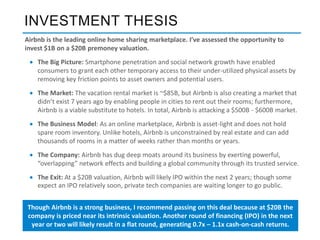
INVESTMENT THESIS
Airbnb is the leading online home sharing marketplace. I’ve assessed the opportunity to
invest $1B on a $20B premoney valuation.
 The Big Picture: Smartphone penetration and social network growth have enabled
consumers to grant each other temporary access to their under-utilized physical assets by
removing key friction points to asset owners and potential users.
 The Market: The vacation rental market is ~$85B, but Airbnb is also creating a market that
didn’t exist 7 years ago by enabling people in cities to rent out their rooms; furthermore,
Airbnb is a viable substitute to hotels. In total, Airbnb is attacking a $500B - $600B market.
 The Business Model: As an online marketplace, Airbnb is asset-light and does not hold
spare room inventory. Unlike hotels, Airbnb is unconstrained by real estate and can add
thousands of rooms in a matter of weeks rather than months or years.
 The Company: Airbnb has dug deep moats around its business by exerting powerful,
“overlapping” network effects and building a global community through its trusted service.
 The Exit: At a $20B valuation, Airbnb will likely IPO within the next 2 years; though some
expect an IPO relatively soon, private tech companies are waiting longer to go public.
Though Airbnb is a strong business, I recommend passing on this deal because at $20B the
company is priced near its intrinsic valuation. Another round of financing (IPO) in the next
year or two will likely result in a flat round, generating 0.7x – 1.1x cash-on-cash returns.
THE TARGET COMPANY
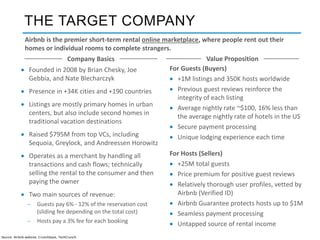
For Guests (Buyers)
 +1M listings and 350K hosts worldwide
 Previous guest reviews reinforce the
integrity of each listing
 Average nightly rate ~$100, 16% less than
the average nightly rate of hotels in the US
 Secure payment processing
 Unique lodging experience each time
For Hosts (Sellers)
 +25M total guests
 Price premium for positive guest reviews
 Relatively thorough user profiles, vetted by
Airbnb (Verified ID)
 Airbnb Guarantee protects hosts up to $1M
 Seamless payment processing
 Untapped source of rental income
Value PropositionCompany Basics
 Founded in 2008 by Brian Chesky, Joe
Gebbia, and Nate Blecharczyk
 Presence in +34K cities and +190 countries
 Listings are mostly primary homes in urban
centers, but also include second homes in
traditional vacation destinations
 Raised $795M from top VCs, including
Sequoia, Greylock, and Andreessen Horowitz
 Operates as a merchant by handling all
transactions and cash flows; technically
selling the rental to the consumer and then
paying the owner
 Two main sources of revenue:
 Guests pay 6% - 12% of the reservation cost
(sliding fee depending on the total cost)
 Hosts pay a 3% fee for each booking
Source: Airbnb website, Crunchbase, TechCrunch
Airbnb is the premier short-term rental online marketplace, where people rent out their
homes or individual rooms to complete strangers.
THE BIG PICTURE
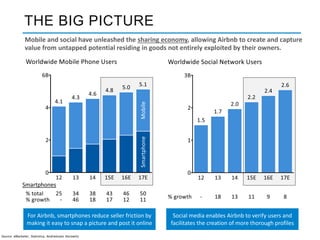
Mobile and social have unleashed the sharing economy, allowing Airbnb to create and capture
value from untapped potential residing in goods not entirely exploited by their owners.
Source: eMarketer, Statistica, Andreessen Horowitz
Smartphones
For Airbnb, smartphones reduce seller friction by
making it easy to snap a picture and post it online
Social media enables Airbnb to verify users and
facilitates the creation of more thorough profiles
MARKET POTENTIAL
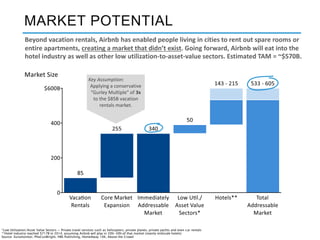
Beyond vacation rentals, Airbnb has enabled people living in cities to rent out spare rooms or
entire apartments, creating a market that didn’t exist. Going forward, Airbnb will eat into the
hotel industry as well as other low utilization-to-asset-value sectors. Estimated TAM = ~$570B.
*Low Utilization/Asset Value Sectors = Private travel services such as helicopters, private planes, private yachts and even car rentals
**Hotel industry reached $717B in 2014; assuming Airbnb will play in 20%-30% of that market (mainly midscale hotels)
Source: Euromonitor, PhoCusWright, HBS Publishing, HomeAway 10K, Above the Crowd
Key Assumption:
Applying a conservative
“Gurley Multiple” of 3x
to the $85B vacation
rentals market.
HomeAway Craigslist OTAs Hotels
Scale
Fixed Costs
Network Effects
Customer
Captivity
Cost
Government
COMPETITIVE ADVANTAGE
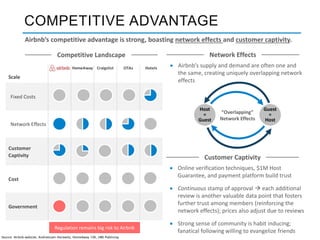
Airbnb’s competitive advantage is strong, boasting network effects and customer captivity.
 Airbnb’s supply and demand are often one and
the same, creating uniquely overlapping network
effects
Network Effects
Guest
=
Host
Host
=
Guest
“Overlapping”
Network Effects
 Online verification techniques, $1M Host
Guarantee, and payment platform build trust
 Continuous stamp of approval  each additional
review is another valuable data point that fosters
further trust among members (reinforcing the
network effects); prices also adjust due to reviews
 Strong sense of community is habit inducing;
fanatical following willing to evangelize friends
Customer Captivity
Competitive Landscape
Regulation remains big risk to Airbnb
Source: Airbnb website, Andreessen Horowitz, HomeAway 10K, HBS Publising
FINANCIALS
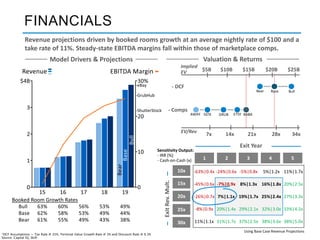
Revenue projections driven by booked rooms growth at an average nightly rate of $100 and a
take rate of 11%. Steady-state EBITDA margins fall within those of marketplace comps.
*DCF Assumptions = Tax Rate @ 35%, Terminal Value Growth Rate @ 3% and Discount Rate @ 9.3%
Source: Capital IQ, Skift
Valuation & ReturnsModel Drivers & Projections
-63%|0.4x -24%|0.6x -5%|0.8x 5%|1.2x 11%|1.7x
-45%|0.6x -7%|0.9x 8%|1.3x 16%|1.8x 20%|2.5x
-26%|0.7x 7%|1.1x 19%|1.7x 25%|2.4x 27%|3.3x
-8%|0.9x 20%|1.4x 29%|2.1x 32%|3.0x 33%|4.2x
11%|1.1x 31%|1.7x 37%|2.5x 38%|3.6x 38%|5.0x
41 2 5
10x
15x
25x
30x
Exit Year
ExitRev.Mult.
Using Base Case Revenue Projections
3
20x
Sensitivity Output:
- IRR (%)
- Cash-on-Cash (x)
-eBay
-GrubHub
-ShutterStock
Booked Room Growth Rates
- DCF
- Comps
Implied
EV
EV/Rev
Bear Base Bull
$5B $10B $15B $20B $25B
7x 14x 21x 28x 34x
AWAY SSTK GRUB ETSY BABA

Airbnb deck

  • 1.
    Roger E. Teran May2015 INVESTMENT DECK
  • 2.
    INVESTMENT THESIS Airbnb isthe leading online home sharing marketplace. I’ve assessed the opportunity to invest $1B on a $20B premoney valuation.  The Big Picture: Smartphone penetration and social network growth have enabled consumers to grant each other temporary access to their under-utilized physical assets by removing key friction points to asset owners and potential users.  The Market: The vacation rental market is ~$85B, but Airbnb is also creating a market that didn’t exist 7 years ago by enabling people in cities to rent out their rooms; furthermore, Airbnb is a viable substitute to hotels. In total, Airbnb is attacking a $500B - $600B market.  The Business Model: As an online marketplace, Airbnb is asset-light and does not hold spare room inventory. Unlike hotels, Airbnb is unconstrained by real estate and can add thousands of rooms in a matter of weeks rather than months or years.  The Company: Airbnb has dug deep moats around its business by exerting powerful, “overlapping” network effects and building a global community through its trusted service.  The Exit: At a $20B valuation, Airbnb will likely IPO within the next 2 years; though some expect an IPO relatively soon, private tech companies are waiting longer to go public. Though Airbnb is a strong business, I recommend passing on this deal because at $20B the company is priced near its intrinsic valuation. Another round of financing (IPO) in the next year or two will likely result in a flat round, generating 0.7x – 1.1x cash-on-cash returns.
  • 3.
    THE TARGET COMPANY ForGuests (Buyers)  +1M listings and 350K hosts worldwide  Previous guest reviews reinforce the integrity of each listing  Average nightly rate ~$100, 16% less than the average nightly rate of hotels in the US  Secure payment processing  Unique lodging experience each time For Hosts (Sellers)  +25M total guests  Price premium for positive guest reviews  Relatively thorough user profiles, vetted by Airbnb (Verified ID)  Airbnb Guarantee protects hosts up to $1M  Seamless payment processing  Untapped source of rental income Value PropositionCompany Basics  Founded in 2008 by Brian Chesky, Joe Gebbia, and Nate Blecharczyk  Presence in +34K cities and +190 countries  Listings are mostly primary homes in urban centers, but also include second homes in traditional vacation destinations  Raised $795M from top VCs, including Sequoia, Greylock, and Andreessen Horowitz  Operates as a merchant by handling all transactions and cash flows; technically selling the rental to the consumer and then paying the owner  Two main sources of revenue:  Guests pay 6% - 12% of the reservation cost (sliding fee depending on the total cost)  Hosts pay a 3% fee for each booking Source: Airbnb website, Crunchbase, TechCrunch Airbnb is the premier short-term rental online marketplace, where people rent out their homes or individual rooms to complete strangers.
  • 4.
    THE BIG PICTURE Mobileand social have unleashed the sharing economy, allowing Airbnb to create and capture value from untapped potential residing in goods not entirely exploited by their owners. Source: eMarketer, Statistica, Andreessen Horowitz Smartphones For Airbnb, smartphones reduce seller friction by making it easy to snap a picture and post it online Social media enables Airbnb to verify users and facilitates the creation of more thorough profiles
  • 5.
    MARKET POTENTIAL Beyond vacationrentals, Airbnb has enabled people living in cities to rent out spare rooms or entire apartments, creating a market that didn’t exist. Going forward, Airbnb will eat into the hotel industry as well as other low utilization-to-asset-value sectors. Estimated TAM = ~$570B. *Low Utilization/Asset Value Sectors = Private travel services such as helicopters, private planes, private yachts and even car rentals **Hotel industry reached $717B in 2014; assuming Airbnb will play in 20%-30% of that market (mainly midscale hotels) Source: Euromonitor, PhoCusWright, HBS Publishing, HomeAway 10K, Above the Crowd Key Assumption: Applying a conservative “Gurley Multiple” of 3x to the $85B vacation rentals market.
  • 6.
    HomeAway Craigslist OTAsHotels Scale Fixed Costs Network Effects Customer Captivity Cost Government COMPETITIVE ADVANTAGE Airbnb’s competitive advantage is strong, boasting network effects and customer captivity.  Airbnb’s supply and demand are often one and the same, creating uniquely overlapping network effects Network Effects Guest = Host Host = Guest “Overlapping” Network Effects  Online verification techniques, $1M Host Guarantee, and payment platform build trust  Continuous stamp of approval  each additional review is another valuable data point that fosters further trust among members (reinforcing the network effects); prices also adjust due to reviews  Strong sense of community is habit inducing; fanatical following willing to evangelize friends Customer Captivity Competitive Landscape Regulation remains big risk to Airbnb Source: Airbnb website, Andreessen Horowitz, HomeAway 10K, HBS Publising
  • 7.
    FINANCIALS Revenue projections drivenby booked rooms growth at an average nightly rate of $100 and a take rate of 11%. Steady-state EBITDA margins fall within those of marketplace comps. *DCF Assumptions = Tax Rate @ 35%, Terminal Value Growth Rate @ 3% and Discount Rate @ 9.3% Source: Capital IQ, Skift Valuation & ReturnsModel Drivers & Projections -63%|0.4x -24%|0.6x -5%|0.8x 5%|1.2x 11%|1.7x -45%|0.6x -7%|0.9x 8%|1.3x 16%|1.8x 20%|2.5x -26%|0.7x 7%|1.1x 19%|1.7x 25%|2.4x 27%|3.3x -8%|0.9x 20%|1.4x 29%|2.1x 32%|3.0x 33%|4.2x 11%|1.1x 31%|1.7x 37%|2.5x 38%|3.6x 38%|5.0x 41 2 5 10x 15x 25x 30x Exit Year ExitRev.Mult. Using Base Case Revenue Projections 3 20x Sensitivity Output: - IRR (%) - Cash-on-Cash (x) -eBay -GrubHub -ShutterStock Booked Room Growth Rates - DCF - Comps Implied EV EV/Rev Bear Base Bull $5B $10B $15B $20B $25B 7x 14x 21x 28x 34x AWAY SSTK GRUB ETSY BABA