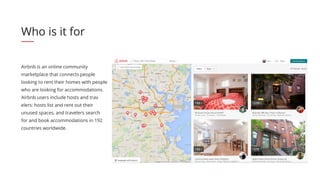
Airbnb is an online community
marketplace that connects people
looking to rent their homes with people
who are looking for accommodations.
Airbnb users include hosts and trav
elers: hosts list and rent out their
unused spaces, and travelers search
for and book accommodations in 192
countries worldwide.
Who is it for
For travellers, not only do they get affordable
accommodations, but they also get an experience that more
closely resembles being a local. This can include living in a
local’s actual home instead of some generic hotel room, as well
as getting tips from an actual local. For instance, where to eat,
what to see, etc.
For property owners, not only do they get to monetize their
homes but they also get to exchange stories and experiences
with visitors. There’s intrinsic value in that too.
What problems does it try to solve
Airbnb ensures guests and hosts contact one another directly through Airbnb by “censoring” certain words, pieces of contact
information and websites out of messages; These include, but are not limited to: “Facebook”, “Google”, email addresses, phone
numbers, and URLs in general.
Note: There are two main reasons for this “censoring”:
•	 The first, and I believe primary reason, is to protect hosts and guests. By keeping communications restricted to the site before
booking, Airbnb can ensure safe, secure, and closed communications between the two parties. Without this censored and
protected messaging, Airbnb could be just as unsafe as Craigslist.
•	 The second, more obvious reason, is to ensure Airbnb makes money off of each booking.
How does the airbnb do this
The first problem: Fear
The first problem is simple: People are afraid to trust strangers.
•	 Set up a good vetting process. TaskRabbit, a peer-to-peer marketplace for personal
services, has a four-step vetting process for its new “Rabbits.” There’s a social
security check, a background check, and various quizzes and training.
•	 Allow people to build a reputation. Ideally, you want many of the market
participants to be repeat players, who can build a reputation over time. Options
here include ratings, reviews, social proof, and gamification. And it’s important to
consider both recent and historical reputation. At thredUP, a marketplace for used
kids’ clothes, for example, users receive an overall rating and a separate rating for
the three most recent transactions.
How will I do it differently
The second problem: Inventory
The second big issue if you’re trying to start one of these marketplaces is more
mundane: getting enough inventory on both sides of the equation.
Busque suggested really nailing down one side of the equation first. In TaskRabbit’s
case, they had plenty of potential Rabbits, which enabled them to focus their
customer acquisition on the Rabbit-employing side of the equation.
•	 Continued geographic expansion. Nearly 75% of Airbnb’s business is overseas, and
TaskRabbit gets requests all the time to expand into other countries (their goal: to
disrupt labor markets on a global scale).
•	 Expansion into mobile. When you can take a photo of your couch, instantly upload
it to a neighborhood resale site, and sell it in a few hours, why bother with the
hassle of listing it on eBay? Mobile apps bring the “right now” ability that’s very
compelling for a lot of these marketplaces.
How will I do it differently

Airbnb presentation

  • 2.
    Airbnb is anonline community marketplace that connects people looking to rent their homes with people who are looking for accommodations. Airbnb users include hosts and trav elers: hosts list and rent out their unused spaces, and travelers search for and book accommodations in 192 countries worldwide. Who is it for
  • 3.
    For travellers, notonly do they get affordable accommodations, but they also get an experience that more closely resembles being a local. This can include living in a local’s actual home instead of some generic hotel room, as well as getting tips from an actual local. For instance, where to eat, what to see, etc. For property owners, not only do they get to monetize their homes but they also get to exchange stories and experiences with visitors. There’s intrinsic value in that too. What problems does it try to solve
  • 4.
    Airbnb ensures guestsand hosts contact one another directly through Airbnb by “censoring” certain words, pieces of contact information and websites out of messages; These include, but are not limited to: “Facebook”, “Google”, email addresses, phone numbers, and URLs in general. Note: There are two main reasons for this “censoring”: • The first, and I believe primary reason, is to protect hosts and guests. By keeping communications restricted to the site before booking, Airbnb can ensure safe, secure, and closed communications between the two parties. Without this censored and protected messaging, Airbnb could be just as unsafe as Craigslist. • The second, more obvious reason, is to ensure Airbnb makes money off of each booking. How does the airbnb do this
  • 5.
    The first problem:Fear The first problem is simple: People are afraid to trust strangers. • Set up a good vetting process. TaskRabbit, a peer-to-peer marketplace for personal services, has a four-step vetting process for its new “Rabbits.” There’s a social security check, a background check, and various quizzes and training. • Allow people to build a reputation. Ideally, you want many of the market participants to be repeat players, who can build a reputation over time. Options here include ratings, reviews, social proof, and gamification. And it’s important to consider both recent and historical reputation. At thredUP, a marketplace for used kids’ clothes, for example, users receive an overall rating and a separate rating for the three most recent transactions. How will I do it differently
  • 6.
    The second problem:Inventory The second big issue if you’re trying to start one of these marketplaces is more mundane: getting enough inventory on both sides of the equation. Busque suggested really nailing down one side of the equation first. In TaskRabbit’s case, they had plenty of potential Rabbits, which enabled them to focus their customer acquisition on the Rabbit-employing side of the equation. • Continued geographic expansion. Nearly 75% of Airbnb’s business is overseas, and TaskRabbit gets requests all the time to expand into other countries (their goal: to disrupt labor markets on a global scale). • Expansion into mobile. When you can take a photo of your couch, instantly upload it to a neighborhood resale site, and sell it in a few hours, why bother with the hassle of listing it on eBay? Mobile apps bring the “right now” ability that’s very compelling for a lot of these marketplaces. How will I do it differently