SOME INTERESTING FINDINGS FROM ON-LINE AIR – QUALITY
MONITORING 2006 DATA FOR SANATHNAGAR, HYDERABAD, A.P
(by G.D. Agrawal, Tencial Advisor, Envirotech Instruments (P) Ltd., New Delhi)
Andhra Pradesh State Pollution Control Board established an On-line Ambient Air- Quality
Monitoring Station at its Sanathnagar Headquarters which was commissioned in late
November 2005. The supplier of the bulk of the instruments as also the integrating systems
was M/s Eoc-tech of Australia, though some of the instruments were also from other
prestigious manufacturers e.g. Met-One of USA and Synspec of Netherlands. The sole-
representatives of Eco-tech and Synspec in India, M/s Envirotech Instruments (P) Ltd., New
Delhi procured and installed the systems and have been assigned the job of operating,
maintaining and calibrating the systems and compiling the data by APPCB. The system
have been operating continuously since commissioning in November 2005 and the data
capture-rate for each parameter individually has been above 96%, the remaining 4% being
accounted for by calibration, zero and span-check, minor repairs, routine maintenance and
power break-down etc. The period for which consistent and acceptable values for all the
parameters are available has been over 92% as verified by CPCB inspecting team.
This paper presents some interesting findings from the above data for 2006 (Jan 1,2006 to
December 31,2006) for the major air-quality parameters, parameter-wise.
RESPIRABLE SUSPENDED PARTICULATE MATTER, PM10
PM10, implying the suspended particulates less than about 10 mcirometers, when present in
ambient air, can result in both short and long term reduction in lung function, especially in
children, elderly, people with respiratory or heart diseases, or others sensitive to dust.
Additional health effects may occur depending on the nature and amounts of chemicals
present in the PM10. e.g. heavy metals, radio-nucleoids or carcinogens present. PM10, and
its finer fractions PM2.5, are currently considered the most critical air-pollutant in India, as
probably in the entire world. Standards for PM10 were first adopted by USEPA in 1987. In
India, the current limits for residential areas are 60 g/m3
for annual average and 100g/m3
for 24-hr average PM10. Being mostly composed of secondary pollutants formed through
chemical reactions, condensation and coagulation of gaseous pollutants and/or fine nuclei
they are likely to peak later and down wind of the emissions and the locations of primary
pollutant peaks. Significant amount of data for 24-hr and annual average values of RSPM or
PM10 has been generated for various cities of India over the last 10 years, through
monitoring with manual 2-stage fractionating samplers, mostly the ENVIROTECH Respirable
Dust Sampler, APM 460.
The continuous monitoring of PM10 at the ASPCB On-line Station of Hyderabad revealed
the following:
(i) Annual Average PM10: The annual average PM10 for 2006 for the station came to
128g/m3
. This was some what higher than the values obtained by manual
samplings in earlier years. (106g/m3
in 2001, 105g/m3
in 2002, 107g/m3
in
2003, 89g/m3
in 2004, 88 g/m3
in 2005)
(ii) 24-hr Average values: While even manual sampling had clearly revealed the
strong seasonal variations with much much higher 24-hr PM10 values during
winters and post-monsoon periods (essentially October to March) with low values
in monsoons (July to September) and medium levels in summers (April to June),
the distributions were much more strongly confirmed by the on line monitoring.
The frequencies were as below:
(i) Season Post-Monsoon
9 10
4 ---- to 29 -----
06 06
Winter
1 01
1 ---- to 29 -----
06 06
&
10 12
30 ---- to 31 -----
06 06
Spring
01 04
30 ---- to 2 -----
06 06
Summers
04 05
3 ---- to 28 -----
06 06
Monsoons
05 09
29 ---- to 3 -----
06 06
(ii) Period Sep. – Oct. Nov. – Jan Feb – March April- June July – August
(iii) Seasonal
Mean
109 196 and 165 161 144 65
(iv) Seasonal Peak
24-hr Avg.
287 (Oct 22) 333 (Jan 18) 330 (Feb 18) 353 (April 29) 154 (Sep 3)
(v) Distribution of
24hrs values
in %
In % (Days)
< 100 g/m3 55.4 (31) 7.6 (7) 25.4 (16) 19.6 (16) 94.9 (93)
101-150g/m3 17.9 (10) 26.1(24) 23.8(15) 48.2(27) 4.1(4)
151-200g/m3 16.1(9) 34.8 (24) 19.0(12) 19.6(11) 1.0(1)
201-250g/m3 7.1(4) 22.8(21) 20.6(13) 3.6(2) -
251-300g/m3 3.6(2) 6.5(6) 7.9(5) 3.6(2) -
300-400g/m3 - 2.2(2) 3.2(2) 3.6(2) -
>400g/m3 - - - 1.8(1) -
(iii) Hourly average PM10 concentrations: On-line continuous monitoring made it
possible to study the di-urinal variations in PM10. This revealed that
a) The day- time, 9AM to 5PM always had lower PM10 concentration than the
other parts of the day showing strong influence of larger mixing heights and
better dispersion during day-time overshadowing the effects of larger
emissions from higher traffic and other activities.
b) In winters and autumns the morning transition periods were very conspicuous
with high PM10 concentrations, low values during the day-time, another peak
(generally lower than the morning peak) in the evening and finally the night
with concentrations significantly larger than day-time but lower than the two
transition time peaks. The situation can be clearly seen in Fig 1
c) As spring set-in, the domination of the morning peak faded and March
onwards, the evening peak was the higher peak with night periods having
similar or slightly lower values as the evening. These changes can be seen
from Fig 2 and Fig 3
d) The worst high concentration of PM10 episodes occurred on following dates.
Night Period
Concentrations, g/m3
Date
744
22/10
652
12/03
642
30/04
606
29/04
518
13/03
516
19/01
495
28/04
465
25/03
461
12/03
436
18/02
433
19/02
Concentrations,
g/m3
Date
423
01/01
387
14/02
345
10/12
341
18/01
341
20/01
340
16/05
331
03/09
329
23/03
320
03/02
316
09/12
315
05/02
Morning Transition Period
Concentrations, g/m3
Date
812
18/01
676
02/02
624
25/02
595
31/01
556
23/02
522
18/02
519
12/02
510
01/02
508
01/01
508
20/12
501
04/02
Concentrations,
g/m3
Date
489
13/01
484
12/04
467
04/01
459
17/02
458
30/12
453
14/02
449
29/01
442
29/12
438
30/02
436
11/02
429
03/01
Evening Transition Period
Concentrations, g/m3
Date
305
24/03
305
29/04
296
21/03
291
12/10
284
15/02
284
22/03
278
07/10
264
23/03
262
11/10
256
12/05
255
11/05
e) Unlike the morning and evening transitions which are of small duration, the
night periods are fairly long, 10 hours. It would be desirable that in interests of
health and comfort of weak and sensitive persons, a target limit of 300 g/m3
of PM10 be set for the periodical averages, particularly for the night periods.
NITRIC OXIDE, NO
Nitric Oxide in itself is considered to be innocuous and no limit is prescribed for it. However,
it is the direct emission from automobiles and other combustion sources and is the essential
precursor for NO2 which is an important pollutant. Since NO is quite rapidly converted to
NO2, one would not expect any significant quantities of NO to be present in the ambient air
except during period of peak emissions these being during the peak traffic periods.
Interestingly the data reveals higher NO concentrations during nights and early mornings,
than during the peak traffic hours of 0900-1100 or 1600-1900. Probably this is due to
restrictions on trucks and other diesel driven heavy vehicles during the daytime.
Nevertheless the extremely high NO concentrations on some particular nights as given
below should by of concern.
Table – A
NO (g/m3
)
Night Of March 11-12 March 24-25 April 27-28 April 29-30 June 18-
19
Peak 1-hr NO, g/m3 314 212 236 264 161
Night 10-hr NO, g/m3 193 130 161 161 97
Obviously such high values point to excessive emissions of NO by vehicles and/or industrial
furnaces on these nights. A look at the NO values in some nights of December 2006 may be
indicative of the situation.
Table – B
NO (g/m3
)
Night of 5-6 7-8 8-9 9-10 24-25 25-26 28-29 29-30 30-31
Peak 1-hr 133 239 174 264 124 103 119 148 107
Peak Time 0300 0300 0000 0100 0300 0400 0500 0500 0200
Av.10hrs 36 62 57 94 54 24 38 40 30
It appears that the heavy trucks and trailers pass the highway in the area during 0000 to
0500 hrs. If the concentrations of NO2 in the city area are to be controlled, obviously the
precursor NO shall also need to be watched and controlled. It may be desirable to specify a
limit of 100 g/m3
on 1-hr NO and of 50 g/m3
on night average NO.
NITROGEN – DI-OXIDE, NO2
Emitted as NO from all combustion sources, but most significantly from diesel vehicles and
rapidly oxidized to NO2 in the atmosphere, NO2 is probably currently the most critical
gaseous air-pollutant in India. In itself it is acidic and causes lacrymation but more
importantly it is involved in photochemical reactions resulting in formation of O3, Fine
Particulates (PM2.5/PM10) and carcinogens like PAN. Also it has a significant rising trend in
almost all Indian cities. The current standards in India would limit NO2 to 80 g/m3
24 hr
average and 60 g/m3
annual average in residential areas.
The data of the ASPCB On-line station reveals the following situation for 2006 in respect of
NO2:
i) The very high 1-hr NO2 concentrations observed were as below:
Values 1316 816 695 692 550 526 444 444 429 409 407 399
Date Feb
19
Feb
21
Feb
15
Jan
19
Jan
11
Jan
19
April
05
Feb
19
Jan
18
Feb
20
May
13
Mar
24
Hour 0000 0200 0400 0100 0000 0100 2000 0100 0600 0100 0000 0100
Values 385 374 359 357 337 325 321 318 307 301 300
Date April
29
Jan
31
Feb
22
Dec
08
April
30
Mar
12
Mar
21
Jan
18
Feb
18
Feb
15
Feb
14
Hour 0000 0300 0300 0300 0100 0000 0000 0900 0200 0500 0300
Besides the above values of over 300 g/m3
, there were 21 values between 200-300 g/m3
.
At no time NO2 concentration was more than 200 g/m3
for more than 2 continuous hours
excepting on Feb 19. Also it may be seen that all the very high values occurred around
midnight. There were no 1-hr values exceeding 200 g/m3
in the months May, June, July
and August.
ii) The peak 24-hr average of 113 g/m3
occurred on March 25. Also on April 29, the
24 hour NO2 was 80g/m3
. On no other day, the 24-hour average NO2 touched or
exceeded the specified limit of 80g/m3
.
iii) The annual average NO2 for 2006 was 40g/m3
, far lower than the specified limit
of 60g/m3
.
iv) Thus while a trend over years needs to be watched, as also the rather high values
around midnight, there is no immediate cause of concern.
SULPHUR-DI-OXIDE, SO2
A highly reactive, pungeant, reducing, acidic gas, SO2 is the most talked of air-pollutant all
over the world and even in India (though most data show that SO2 concentrations remain
low in India) since it is involved in most adverse impact of air-pollution including acid-rain,
corrosion, building damage, plant-damage and health damage. The data of the ASPCB On-
line Station Hyderabad showed:
i) The annual average SO2 at the station during 2006 was 28g/m3
, significantly
below the prescribed 60g/m3
limit.
ii) The 24-hr average SO2 exceeded 80 g/m3
prescribed for residential areas on
January 19(103g/m3
), January 24(149g/m3
), February 5(84g/m3
). February
6(83g/m3
) April 29 (89g/m3
), May 12(82g/m3
) September 29 (128g/m3
) and
October 12 (104g/m3
) and December 18 (110g/m3
). Leaving these few days,
the 24-hr average SO2 remained within the prescribed limit and normally even
below 60g/m3
.
iii) Not-with-standing the low annual average and 24-hr average values, the hourly
SO2 concentration often reached very high values e.g. 708g/m3
on September 29
at 2000 hrs, 645g/m3
, 589g/m3
and 486g/m3
on January 24 at 0500hrs
0600hrs and 0100 hrs respectively and 430g/m3
on January 19 at 0400 hrs.
Besides the above excessive values, values exceeding 300 g/m3
were observed
on January 19 (374g/m3
at 0500 hrs), January 24 (366g/m3
and 358g/m3
at
0700 and 0800hrs respectively) April 30 (349g/m3
at 2000 hrs), April 28
(311g/m3
at 2300 hrs) December 18 (308g/m3
at 0200 hrs) and September 29
(304g/m3
at 1900 hrs). in addition to the above excessive values exceeding
200g/m3
were observed on January 19 (0600,2200 and 2300hrs) January 22
(0200hrs) January 24(0400) January 27(0600hrs) January 29(0900hrs) February
5(0600hrs) February 06(0200hrs) February 11 (0900hrs). February 12(0600hrs),
February 14 (0400 – 0600hrs) February 19 90000hrs) March 11 (2200-2300hrs),
March 25 (0000, 0400hrs) April 28 (0000, 2200, 2300 and 2400hrs) May 11 (0800
and 2400 hrs) May 16 (1900 and 2100 hrs). May 19 (1800hrs), September 27
(1800hrs) September 29 (0600-0800hrs) October 12 (0800 and 2300hrs) October
16 (0100hrs) October 21 (2100-2300hrs) December 2 (0900 hrs) and December
6 (0500hrs). All these high values are so sporadic and short-lived, not seeming to
be related to calms, inversions, vehicular emissions or other urban activity that
they could only be accounted for by some sporadic, industrial emissions. While
they do not breach any prescribed standards, they could cause crop losses (e.g.
mangoes) and health effects. We shall strongly plead for laying down limits for 1-
hr average SO2 say at 200g/m3
.
CARBON-MONO-OXIDE, CO
CO is, a colourless, odourless gaseous air-pollutant causing direct and instant health effects,
so serious that even short exposures of a few minutes to concentrations of 100ppm or more
could be fatal. The health effects depend on length of exposure and for ambient –air 1-hr
average and 8-hr average limits are generally prescribed, not 24-hr or annual average limits
as for most other pollutants.
Carbon-mono-oxide is a primary pollutant, the major source being emissions of petrol-driven
automobiles, although in-efficiently operating industrial furnaces and other combustion
processes (refuse-burning, agricultural-residue-burning, incineration of solid-wastes cooking
etc) could also contribute.
The 1-hr average limit for CO for residential areas in India is currently 4mg/m3
(3.5ppm),
while the 8-hr limit is 2mg/m3
(1.75ppm), both of these an order of magnitude lower (much
more stringent) than in the USA or most other countries. The reasons for prescribing such
stringent limits could be:
(a) If the current CO concentrations in most of India are low enough even to meet such
stringent limits, why to encourage polluters to degrade the environment, through laying
lenient limits, and
(b) CO is essentially the result of incomplete and hence energy – inefficient combustion of
fossil-fuels and bio-mass and why to encourage such in efficient burning of natural
resources through laying lenient CO limits.
The picture emerging from the 2006 continuous data of the ASPCB On-line Air-monitoring
Station at Hyderabad reveals the following:
i) During 2006, the 1-hour average value exceeded the 3.5ppm prescribed limit only
on one day, April 29, when it was 4.16ppm and 4.15ppm respectively at 2200 and
2300 hours. Leaving these two values the 1-hr average value exceeded even
3.0ppm only once on March 12,
ii) The 8-hour average value exceeded the prescribed 1.75 ppm limit also on these
days when the 1-hr limit exceeded 3ppm viz. March 12 and April 29 and besides
on March 25 (0200 to 0900hrs) and December 10 (0100 to 0800 hrs).
iii) It might be noted that most of the high concentrations occurred during late nights
and early mornings. Also March 12 and December 10 were Sundays. Thus it
appears that meteorological factors rather than peak traffic density resulted in
these excedences. While in winters the nights and morning transition periods had
higher CO concentrations, during summers and rainy season, the evening
concentrations were generally higher than nights or mornings.
iv) All-in-all CO remained low and complied with even the present stringent limits.
OZONE, O3
Being a strong oxidant, ozone is known to be, along with CO, an air-pollutant directly and
instantly causing severe health problems, particularly to those especially vulnerable like
children, aged persons, sick and those involved in heavy physical activity during the
exposure period. Due to the instant health effects, one-hour average concentration limits
have been prescribed in U.S. and European countries, unlike the 24hr or even annual
average limits for most other air-pollutants. U.S. Federal limit for 1-hr average ozone is
120ppb, but California has an even more stringent 1-hr limit of 90ppb. In view of the severe
and instant health effects, health advisory levels of 1-hour average O3 at 150ppb and stage I
Episode Levels of 1-hour average O3 at 200ppb has also been prescribed in California. It
might also be noted that in the Azusa and Pasadena areas of Los Angles, notorious for
vehicular air-pollution, the U.S. Federal limit for O3 was exceeded on as many as around
200 days in the year 1960, and the number of such O3 excedence days was still around 100
in 1990. Even to day, ozone is a problem air-pollutant in many U.S. and European cities.
Ozone is essentially a secondary air-pollutant formed through photochemical reactions in the
atmosphere involving nitrogen-oxides and hydrocarbons and normally its concentrations
peaks in afternoon, down wind of, and later than the emissions of primary pollutants. In
India, so far, no standards or limits for O3 have been notified, nor is there much data
indicating the factual situation existing in different parts of the country.
The on-line continuous monitoring data for O3 at the ASPCB on-line monitoring station
Hyderabad reveals the following:
(i) The highest 1-hourly concentration monitored was 119ppb for 1100 hours on
March 25,2006. Other values above 100ppb were 114 ppb, 112ppb and 102ppb at
1300, 1400 and 1200 hours respectively on April 13, 2006. Thus on this day (April
13,2006), the O3 concentration remained above 100ppb continuously for 3 hours.
Four 1-hr average values on March 31, 3 on April 1, and 2 on May 4 also
exceeded 90 ppb, the California State limit. Thus since not even one 1-hr average
O3 value exceeded the U.S. Federal limit of 120ppb, there is no cause of serious
concern and yet since a few values on a few days in spring season (March 15 –
May 15) do exceed the California State limit of 90ppb, a watch needs to be
mainained.
(ii) A rather unexpected observation was the significant ozone concentration during
night periods, both in terms of peak 1hour average values during night (as high as
50 ppb for 0600 hours on April 1) as also the overall averages for the 10-hr night
periods (35-40ppb) on several nights. The factors responsible for these as also
the health implications, if any, need to examined.
(iii) As could be expected, O3 concentration show a well-marked seasonal variation.
The fair weather months of October to Mid- May observed higher O3 values
particularly the spring months of Mid-March to Mid-May. The cloudy monsoon
months of Mid-May to September saw much lower values, the night 1-hr values
remaining below 20ppb and even the day time peak 1-hr values almost always
below 50bbp.
BENZENE/TOLUENE/XYLENE, BTX
All these three are aromatic hydrocarbons well known carcinogens and carcinogen-
precursors, present in vehicular emissions and also used as solvents in many industrial
processes. Currently there are no limits prescribed in India on their concentrations in
ambient air, nor is there much reliable data for India. ASPCB On-line Station Hyderabad was
the first continuous monitoring effort for BTX in India and the data for 2006 reveals the
following:
(a) Benzene:
In the month of February there were 14 days (1,2,4,5,11, 12, 14, 15,17,18, 20, 23,24 & 25)
and 44 occasions when hourly averages of Benzene were recorded above 8ppb with values
ranging between 8ppb to 18.8ppb on different timings. 90% of the high hourly values were
observed between 0000 -0900 hrs and the highest hourly value of 18.8ppb was observed on
February 14 around 0600hrs 32 of these 44 were above 10ppb. The data of values
exceeding 10 ppb for rest of the months is as follows:
Values 31.4 27.6 22.8 19.9 18.8 18.3 18.3 18.1 17.9 17.5 16.3
Date Dec
22
Dec
24
May
12
May
28
Dec
26
May
11
Jan
16
Oct
27
May
13
Dec
22
Dec
22
Hour 0500 0400 2300 1800 0600 2100 0200 2300 0000 0300 0400
Values 15.8 15.7 15.3 15.1 15.1 14.8 14.4 13.5 13.0 12.9 12.5
Date Jan
16
May
12
May
12
April
22
May
11
May
11
Dec
24
April
17
Jan
30
May
13
April
22
Hour 0300 0000 2200 2000 2300 2200 1000 1700 0900 0100 2200
Values 12.3 12.3 12.2 11.9 11.8 11.8 11.7 11.2 11.2 11.1 11.0
Date May
13
Dec
10
May
12
Dec
25
Jan
30
Dec
26
April
29
April
30
May
12
April
29
Dec
24
Hour 2300 0800 0200 0100 0800 0200 2300 0100 2100 0000 0200
Values 10.8 10.8 10.7 10.5 10.5 10.5 10.5 10.4 10.3 10.3 10.2
Date Oct
26
Nov
10
April
29
May
12
May
13
May
14
Dec
06
April
23
April
28
Dec
26
Nov
10
Hour 2300 1900 0100 0300 2200 0000 2200 2100 0300 0700 2000
Besides the above, there were 21 other values exceeding 8ppb. In all 109 Hourly values
during the year exceeded 8ppb.
(b) Toluene:
Similar to Benzene, during February alone there were 17 day (2,4,5,11,12,13,14 to 19 & 21
to 25) and 59 occasions when hourly average of Toluene were recorded above 200ppb with
values ranging between 200ppb and 775ppb at different times. Most of these high values
were observed between 0000 to 0900hrs and the highest hourly value of 773.5 ppb was
observed on February 19 around 0600 hrs. The data of values exceeding 200 ppb in
remaining months is a follows:
Values 367.4 341.3 325.8 325.5 317.2 310.0 293.2 293.2 291.0
Date Oct
25
May
16
Oct
12
April
30
Jan
30
Oct
18
May
16
Oct
12
April
30
Hour 0200 0400 1300 0100 0900 2000 0000 0600 0200
Values 280.5 279.6 279.1 267.3 266.4 262.7 262.4 260.6 257.4
Date Jan
30
April
30
May
12
Nov
12
May
13
April
29
April
28
Oct
28
May
12
Hour 0800 0000 0000 1900 0000 0000 0100 2300 2300
Values 252.6 251.5 250.3 248.1 246.6 246.5 237.4 235.1 234.4
Date April
29
May
12
April
29
Jan
22
May
11
Nov
17
April
28
Sep
03
Oct
23
Hour 0100 0100 0300 0800 2300 0100 2300 0500 1400
Values 233.0 230.1 223.9 222.1 220.2 221.5 206.4 204.9 203.3
Date Nov
18
April
29
Oct
09
May
16
May
11
April
29
April
28
Oct
14
Jan
31
Hour 2200 0200 0500 0300 0100 0800 0400 0600 0800
In all some 95 values exceeding 200ppb were observed, of which 59 were in February
alone.
(c) Xylene:
Like benzene and toluene, in February alone there were 15 days (4 and 12 to 25) and 111
occasions when hourly average value of Xylene were recorded above 20ppb, the values
ranging between 0000 and 0900 hrs and the highest hourly value of 61.5ppb observed on
February 18 around 0200hrs. The data for values exceeding 20ppb in rest of the months is
as follows:
Values 91.6 59.4 43.6 41.7 37.9 36.1 31.0 30.3 29.7
Date May
12
May
13
May
11
May
11
May
12
May
13
May
12
May
12
May
12
Hour 2300 0000 2200 2300 0000 0100 2200 0100 0200
Values 24.1 22.5 22.4 21.7 21.2 21.0 20.1 20.1 20.1
Date April
30
March
25
March
12
June
19
March
12
April
29
March
24
April
28
June
18
Hour 0000 0400 0000 0000 0200 2300 0000 0300 2300
Values 29.4 28.0 27.5 24.9 24.8 24.4 24.4 23.1 23.0
Date April
18
May
24
May
13
April
30
May
11
March
25
May
12
March
11
May
14
Hour 2200 0100 2300 0100 2100 0500 0300 2300 0000
In all 138 values during Jan – June 2006 exceeded 20 ppb, of which 111 were in Feb alone.
Since June 2006, no 1-hour value exceeded 20ppb and only 3 values have exceeded 15
ppb.
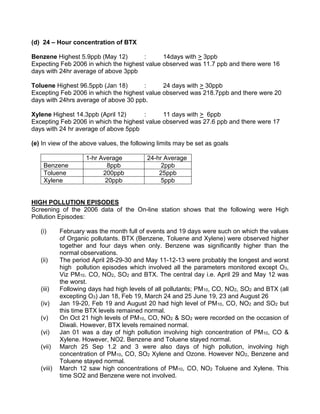
(d) 24 – Hour concentration of BTX
Benzene Highest 5.9ppb (May 12) : 14days with > 3ppb
Expecting Feb 2006 in which the highest value observed was 11.7 ppb and there were 16
days with 24hr average of above 3ppb
Toluene Highest 96.5ppb (Jan 18) : 24 days with > 30ppb
Excepting Feb 2006 in which the highest value observed was 218.7ppb and there were 20
days with 24hrs average of above 30 ppb.
Xylene Highest 14.3ppb (April 12) : 11 days with > 6ppb
Excepting Feb 2006 in which the highest value observed was 27.6 ppb and there were 17
days with 24 hr average of above 5ppb
(e) In view of the above values, the following limits may be set as goals
1-hr Average 24-hr Average
Benzene 8ppb 2ppb
Toluene 200ppb 25ppb
Xylene 20ppb 5ppb
HIGH POLLUTION EPISODES
Screening of the 2006 data of the On-line station shows that the following were High
Pollution Episodes:
(i) February was the month full of events and 19 days were such on which the values
of Organic pollutants. BTX (Benzene, Toluene and Xylene) were observed higher
together and four days when only. Benzene was significantly higher than the
normal observations.
(ii) The period April 28-29-30 and May 11-12-13 were probably the longest and worst
high pollution episodes which involved all the parameters monitored except O3,
Viz PM10. CO, NO2, SO2 and BTX. The central day i.e. April 29 and May 12 was
the worst.
(iii) Following days had high levels of all pollutants; PM10, CO, NO2, SO2 and BTX (all
excepting O3) Jan 18, Feb 19, March 24 and 25 June 19, 23 and August 26
(iv) Jan 19-20, Feb 19 and August 20 had high level of PM10, CO, NO2 and SO2 but
this time BTX levels remained normal.
(v) On Oct 21 high levels of PM10, CO, NO2 & SO2 were recorded on the occasion of
Diwali. However, BTX levels remained normal.
(vi) Jan 01 was a day of high pollution involving high concentration of PM10, CO &
Xylene. However, NO2. Benzene and Toluene stayed normal.
(vii) March 25 Sep 1.2 and 3 were also days of high pollution, involving high
concentration of PM10, CO, SO2 Xylene and Ozone. However NO2, Benzene and
Toluene stayed normal.
(viii) March 12 saw high concentrations of PM10, CO, NO2 Toluene and Xylene. This
time SO2 and Benzene were not involved.
Conclusions:
(i) Availability of hourly concentrations for all parameters and all days of the year
from a CAAQMS such as at Hyderabad makes it possible to examine the
environmental scenario in depth and also examine the behaviour of different
pollutants, the sources and phenomena involved and the likely impacts in detail.
This study was just an over-view to create interest and support for more detailed
and in-depth analyses.
(ii) For the area represented by the CAAQMS studied, February appears to be most
critical from point of view of air quality. In this month PM10, NO2 and BTX all
remained high on most of the days. This being the flowering season for mangoes,
citrus and other fruits as also for wheat, gram, peas and other crops should be of
critical interest to an agricultural community like India’s. April- May- June
afternoons could be of concern for O3 and the months from December to April for
PM10, NO2 and CO. High values of SO2 were only for very short periods and
sporadic, probably related to industrial emissions.
(iii) The rather unexpectedly high concentrations of almost all parameters (except O3)
during late nights and early mornings (including CO, NO, NO2, BTX and PM10)
seems to be a cause of concern and needs further study. The morning peak for
PM10, particularly during winters should be an interesting area for research.
Figure 1: The hourly variation graph of PM10 for winter season.
PM10 24-Hr Variation
0
100
200
300
400
500
600
1.00
2.00
3.00
4.00
5.00
6.00
7.00
8.00
9.00
10.00
11.00
12.00
13.00
14.00
15.00
16.00
17.00
18.00
19.00
20.00
21.00
22.00
23.00
24.00
Time (Hrs.)
Concentration(µg/m3
)
Winter
Figure 2: The hourly variation graph of PM10 for spring Season
PM10 24-Hr Variation
0
100
200
300
400
500
600
1.00
2.00
3.00
4.00
5.00
6.00
7.00
8.00
9.00
10.00
11.00
12.00
13.00
14.00
15.00
16.00
17.00
18.00
19.00
20.00
21.00
22.00
23.00
24.00
Time (Hrs.)
Concentration(µg/m3
)
Spring
Figure 3: The hourly variation graph of PM10 for summer Season
PM10 24-Hr Variation
0
100
200
300
400
500
600
1.00
2.00
3.00
4.00
5.00
6.00
7.00
8.00
9.00
10.00
11.00
12.00
13.00
14.00
15.00
16.00
17.00
18.00
19.00
20.00
21.00
22.00
23.00
24.00
Time (Hrs.)
Concentration(µg/m3
)
Summer

Air Pollution Level in India

  • 1.
    SOME INTERESTING FINDINGSFROM ON-LINE AIR – QUALITY MONITORING 2006 DATA FOR SANATHNAGAR, HYDERABAD, A.P (by G.D. Agrawal, Tencial Advisor, Envirotech Instruments (P) Ltd., New Delhi) Andhra Pradesh State Pollution Control Board established an On-line Ambient Air- Quality Monitoring Station at its Sanathnagar Headquarters which was commissioned in late November 2005. The supplier of the bulk of the instruments as also the integrating systems was M/s Eoc-tech of Australia, though some of the instruments were also from other prestigious manufacturers e.g. Met-One of USA and Synspec of Netherlands. The sole- representatives of Eco-tech and Synspec in India, M/s Envirotech Instruments (P) Ltd., New Delhi procured and installed the systems and have been assigned the job of operating, maintaining and calibrating the systems and compiling the data by APPCB. The system have been operating continuously since commissioning in November 2005 and the data capture-rate for each parameter individually has been above 96%, the remaining 4% being accounted for by calibration, zero and span-check, minor repairs, routine maintenance and power break-down etc. The period for which consistent and acceptable values for all the parameters are available has been over 92% as verified by CPCB inspecting team. This paper presents some interesting findings from the above data for 2006 (Jan 1,2006 to December 31,2006) for the major air-quality parameters, parameter-wise. RESPIRABLE SUSPENDED PARTICULATE MATTER, PM10 PM10, implying the suspended particulates less than about 10 mcirometers, when present in ambient air, can result in both short and long term reduction in lung function, especially in children, elderly, people with respiratory or heart diseases, or others sensitive to dust. Additional health effects may occur depending on the nature and amounts of chemicals present in the PM10. e.g. heavy metals, radio-nucleoids or carcinogens present. PM10, and its finer fractions PM2.5, are currently considered the most critical air-pollutant in India, as probably in the entire world. Standards for PM10 were first adopted by USEPA in 1987. In India, the current limits for residential areas are 60 g/m3 for annual average and 100g/m3 for 24-hr average PM10. Being mostly composed of secondary pollutants formed through chemical reactions, condensation and coagulation of gaseous pollutants and/or fine nuclei they are likely to peak later and down wind of the emissions and the locations of primary pollutant peaks. Significant amount of data for 24-hr and annual average values of RSPM or PM10 has been generated for various cities of India over the last 10 years, through monitoring with manual 2-stage fractionating samplers, mostly the ENVIROTECH Respirable Dust Sampler, APM 460. The continuous monitoring of PM10 at the ASPCB On-line Station of Hyderabad revealed the following: (i) Annual Average PM10: The annual average PM10 for 2006 for the station came to 128g/m3 . This was some what higher than the values obtained by manual samplings in earlier years. (106g/m3 in 2001, 105g/m3 in 2002, 107g/m3 in 2003, 89g/m3 in 2004, 88 g/m3 in 2005) (ii) 24-hr Average values: While even manual sampling had clearly revealed the strong seasonal variations with much much higher 24-hr PM10 values during winters and post-monsoon periods (essentially October to March) with low values in monsoons (July to September) and medium levels in summers (April to June),
  • 2.
    the distributions weremuch more strongly confirmed by the on line monitoring. The frequencies were as below: (i) Season Post-Monsoon 9 10 4 ---- to 29 ----- 06 06 Winter 1 01 1 ---- to 29 ----- 06 06 & 10 12 30 ---- to 31 ----- 06 06 Spring 01 04 30 ---- to 2 ----- 06 06 Summers 04 05 3 ---- to 28 ----- 06 06 Monsoons 05 09 29 ---- to 3 ----- 06 06 (ii) Period Sep. – Oct. Nov. – Jan Feb – March April- June July – August (iii) Seasonal Mean 109 196 and 165 161 144 65 (iv) Seasonal Peak 24-hr Avg. 287 (Oct 22) 333 (Jan 18) 330 (Feb 18) 353 (April 29) 154 (Sep 3) (v) Distribution of 24hrs values in % In % (Days) < 100 g/m3 55.4 (31) 7.6 (7) 25.4 (16) 19.6 (16) 94.9 (93) 101-150g/m3 17.9 (10) 26.1(24) 23.8(15) 48.2(27) 4.1(4) 151-200g/m3 16.1(9) 34.8 (24) 19.0(12) 19.6(11) 1.0(1) 201-250g/m3 7.1(4) 22.8(21) 20.6(13) 3.6(2) - 251-300g/m3 3.6(2) 6.5(6) 7.9(5) 3.6(2) - 300-400g/m3 - 2.2(2) 3.2(2) 3.6(2) - >400g/m3 - - - 1.8(1) - (iii) Hourly average PM10 concentrations: On-line continuous monitoring made it possible to study the di-urinal variations in PM10. This revealed that a) The day- time, 9AM to 5PM always had lower PM10 concentration than the other parts of the day showing strong influence of larger mixing heights and better dispersion during day-time overshadowing the effects of larger emissions from higher traffic and other activities. b) In winters and autumns the morning transition periods were very conspicuous with high PM10 concentrations, low values during the day-time, another peak (generally lower than the morning peak) in the evening and finally the night with concentrations significantly larger than day-time but lower than the two transition time peaks. The situation can be clearly seen in Fig 1 c) As spring set-in, the domination of the morning peak faded and March onwards, the evening peak was the higher peak with night periods having similar or slightly lower values as the evening. These changes can be seen from Fig 2 and Fig 3 d) The worst high concentration of PM10 episodes occurred on following dates.
  • 3.
    Night Period Concentrations, g/m3 Date 744 22/10 652 12/03 642 30/04 606 29/04 518 13/03 516 19/01 495 28/04 465 25/03 461 12/03 436 18/02 433 19/02 Concentrations, g/m3 Date 423 01/01 387 14/02 345 10/12 341 18/01 341 20/01 340 16/05 331 03/09 329 23/03 320 03/02 316 09/12 315 05/02 MorningTransition Period Concentrations, g/m3 Date 812 18/01 676 02/02 624 25/02 595 31/01 556 23/02 522 18/02 519 12/02 510 01/02 508 01/01 508 20/12 501 04/02 Concentrations, g/m3 Date 489 13/01 484 12/04 467 04/01 459 17/02 458 30/12 453 14/02 449 29/01 442 29/12 438 30/02 436 11/02 429 03/01 Evening Transition Period Concentrations, g/m3 Date 305 24/03 305 29/04 296 21/03 291 12/10 284 15/02 284 22/03 278 07/10 264 23/03 262 11/10 256 12/05 255 11/05 e) Unlike the morning and evening transitions which are of small duration, the night periods are fairly long, 10 hours. It would be desirable that in interests of health and comfort of weak and sensitive persons, a target limit of 300 g/m3 of PM10 be set for the periodical averages, particularly for the night periods. NITRIC OXIDE, NO Nitric Oxide in itself is considered to be innocuous and no limit is prescribed for it. However, it is the direct emission from automobiles and other combustion sources and is the essential precursor for NO2 which is an important pollutant. Since NO is quite rapidly converted to NO2, one would not expect any significant quantities of NO to be present in the ambient air except during period of peak emissions these being during the peak traffic periods. Interestingly the data reveals higher NO concentrations during nights and early mornings, than during the peak traffic hours of 0900-1100 or 1600-1900. Probably this is due to restrictions on trucks and other diesel driven heavy vehicles during the daytime. Nevertheless the extremely high NO concentrations on some particular nights as given below should by of concern. Table – A NO (g/m3 ) Night Of March 11-12 March 24-25 April 27-28 April 29-30 June 18- 19 Peak 1-hr NO, g/m3 314 212 236 264 161 Night 10-hr NO, g/m3 193 130 161 161 97
  • 4.
    Obviously such highvalues point to excessive emissions of NO by vehicles and/or industrial furnaces on these nights. A look at the NO values in some nights of December 2006 may be indicative of the situation. Table – B NO (g/m3 ) Night of 5-6 7-8 8-9 9-10 24-25 25-26 28-29 29-30 30-31 Peak 1-hr 133 239 174 264 124 103 119 148 107 Peak Time 0300 0300 0000 0100 0300 0400 0500 0500 0200 Av.10hrs 36 62 57 94 54 24 38 40 30 It appears that the heavy trucks and trailers pass the highway in the area during 0000 to 0500 hrs. If the concentrations of NO2 in the city area are to be controlled, obviously the precursor NO shall also need to be watched and controlled. It may be desirable to specify a limit of 100 g/m3 on 1-hr NO and of 50 g/m3 on night average NO. NITROGEN – DI-OXIDE, NO2 Emitted as NO from all combustion sources, but most significantly from diesel vehicles and rapidly oxidized to NO2 in the atmosphere, NO2 is probably currently the most critical gaseous air-pollutant in India. In itself it is acidic and causes lacrymation but more importantly it is involved in photochemical reactions resulting in formation of O3, Fine Particulates (PM2.5/PM10) and carcinogens like PAN. Also it has a significant rising trend in almost all Indian cities. The current standards in India would limit NO2 to 80 g/m3 24 hr average and 60 g/m3 annual average in residential areas. The data of the ASPCB On-line station reveals the following situation for 2006 in respect of NO2: i) The very high 1-hr NO2 concentrations observed were as below: Values 1316 816 695 692 550 526 444 444 429 409 407 399 Date Feb 19 Feb 21 Feb 15 Jan 19 Jan 11 Jan 19 April 05 Feb 19 Jan 18 Feb 20 May 13 Mar 24 Hour 0000 0200 0400 0100 0000 0100 2000 0100 0600 0100 0000 0100 Values 385 374 359 357 337 325 321 318 307 301 300 Date April 29 Jan 31 Feb 22 Dec 08 April 30 Mar 12 Mar 21 Jan 18 Feb 18 Feb 15 Feb 14 Hour 0000 0300 0300 0300 0100 0000 0000 0900 0200 0500 0300 Besides the above values of over 300 g/m3 , there were 21 values between 200-300 g/m3 . At no time NO2 concentration was more than 200 g/m3 for more than 2 continuous hours excepting on Feb 19. Also it may be seen that all the very high values occurred around midnight. There were no 1-hr values exceeding 200 g/m3 in the months May, June, July and August. ii) The peak 24-hr average of 113 g/m3 occurred on March 25. Also on April 29, the 24 hour NO2 was 80g/m3 . On no other day, the 24-hour average NO2 touched or exceeded the specified limit of 80g/m3 .
  • 5.
    iii) The annualaverage NO2 for 2006 was 40g/m3 , far lower than the specified limit of 60g/m3 . iv) Thus while a trend over years needs to be watched, as also the rather high values around midnight, there is no immediate cause of concern. SULPHUR-DI-OXIDE, SO2 A highly reactive, pungeant, reducing, acidic gas, SO2 is the most talked of air-pollutant all over the world and even in India (though most data show that SO2 concentrations remain low in India) since it is involved in most adverse impact of air-pollution including acid-rain, corrosion, building damage, plant-damage and health damage. The data of the ASPCB On- line Station Hyderabad showed: i) The annual average SO2 at the station during 2006 was 28g/m3 , significantly below the prescribed 60g/m3 limit. ii) The 24-hr average SO2 exceeded 80 g/m3 prescribed for residential areas on January 19(103g/m3 ), January 24(149g/m3 ), February 5(84g/m3 ). February 6(83g/m3 ) April 29 (89g/m3 ), May 12(82g/m3 ) September 29 (128g/m3 ) and October 12 (104g/m3 ) and December 18 (110g/m3 ). Leaving these few days, the 24-hr average SO2 remained within the prescribed limit and normally even below 60g/m3 . iii) Not-with-standing the low annual average and 24-hr average values, the hourly SO2 concentration often reached very high values e.g. 708g/m3 on September 29 at 2000 hrs, 645g/m3 , 589g/m3 and 486g/m3 on January 24 at 0500hrs 0600hrs and 0100 hrs respectively and 430g/m3 on January 19 at 0400 hrs. Besides the above excessive values, values exceeding 300 g/m3 were observed on January 19 (374g/m3 at 0500 hrs), January 24 (366g/m3 and 358g/m3 at 0700 and 0800hrs respectively) April 30 (349g/m3 at 2000 hrs), April 28 (311g/m3 at 2300 hrs) December 18 (308g/m3 at 0200 hrs) and September 29 (304g/m3 at 1900 hrs). in addition to the above excessive values exceeding 200g/m3 were observed on January 19 (0600,2200 and 2300hrs) January 22 (0200hrs) January 24(0400) January 27(0600hrs) January 29(0900hrs) February 5(0600hrs) February 06(0200hrs) February 11 (0900hrs). February 12(0600hrs), February 14 (0400 – 0600hrs) February 19 90000hrs) March 11 (2200-2300hrs), March 25 (0000, 0400hrs) April 28 (0000, 2200, 2300 and 2400hrs) May 11 (0800 and 2400 hrs) May 16 (1900 and 2100 hrs). May 19 (1800hrs), September 27 (1800hrs) September 29 (0600-0800hrs) October 12 (0800 and 2300hrs) October 16 (0100hrs) October 21 (2100-2300hrs) December 2 (0900 hrs) and December 6 (0500hrs). All these high values are so sporadic and short-lived, not seeming to be related to calms, inversions, vehicular emissions or other urban activity that they could only be accounted for by some sporadic, industrial emissions. While they do not breach any prescribed standards, they could cause crop losses (e.g. mangoes) and health effects. We shall strongly plead for laying down limits for 1- hr average SO2 say at 200g/m3 .
  • 6.
    CARBON-MONO-OXIDE, CO CO is,a colourless, odourless gaseous air-pollutant causing direct and instant health effects, so serious that even short exposures of a few minutes to concentrations of 100ppm or more could be fatal. The health effects depend on length of exposure and for ambient –air 1-hr average and 8-hr average limits are generally prescribed, not 24-hr or annual average limits as for most other pollutants. Carbon-mono-oxide is a primary pollutant, the major source being emissions of petrol-driven automobiles, although in-efficiently operating industrial furnaces and other combustion processes (refuse-burning, agricultural-residue-burning, incineration of solid-wastes cooking etc) could also contribute. The 1-hr average limit for CO for residential areas in India is currently 4mg/m3 (3.5ppm), while the 8-hr limit is 2mg/m3 (1.75ppm), both of these an order of magnitude lower (much more stringent) than in the USA or most other countries. The reasons for prescribing such stringent limits could be: (a) If the current CO concentrations in most of India are low enough even to meet such stringent limits, why to encourage polluters to degrade the environment, through laying lenient limits, and (b) CO is essentially the result of incomplete and hence energy – inefficient combustion of fossil-fuels and bio-mass and why to encourage such in efficient burning of natural resources through laying lenient CO limits. The picture emerging from the 2006 continuous data of the ASPCB On-line Air-monitoring Station at Hyderabad reveals the following: i) During 2006, the 1-hour average value exceeded the 3.5ppm prescribed limit only on one day, April 29, when it was 4.16ppm and 4.15ppm respectively at 2200 and 2300 hours. Leaving these two values the 1-hr average value exceeded even 3.0ppm only once on March 12, ii) The 8-hour average value exceeded the prescribed 1.75 ppm limit also on these days when the 1-hr limit exceeded 3ppm viz. March 12 and April 29 and besides on March 25 (0200 to 0900hrs) and December 10 (0100 to 0800 hrs). iii) It might be noted that most of the high concentrations occurred during late nights and early mornings. Also March 12 and December 10 were Sundays. Thus it appears that meteorological factors rather than peak traffic density resulted in these excedences. While in winters the nights and morning transition periods had higher CO concentrations, during summers and rainy season, the evening concentrations were generally higher than nights or mornings. iv) All-in-all CO remained low and complied with even the present stringent limits.
  • 7.
    OZONE, O3 Being astrong oxidant, ozone is known to be, along with CO, an air-pollutant directly and instantly causing severe health problems, particularly to those especially vulnerable like children, aged persons, sick and those involved in heavy physical activity during the exposure period. Due to the instant health effects, one-hour average concentration limits have been prescribed in U.S. and European countries, unlike the 24hr or even annual average limits for most other air-pollutants. U.S. Federal limit for 1-hr average ozone is 120ppb, but California has an even more stringent 1-hr limit of 90ppb. In view of the severe and instant health effects, health advisory levels of 1-hour average O3 at 150ppb and stage I Episode Levels of 1-hour average O3 at 200ppb has also been prescribed in California. It might also be noted that in the Azusa and Pasadena areas of Los Angles, notorious for vehicular air-pollution, the U.S. Federal limit for O3 was exceeded on as many as around 200 days in the year 1960, and the number of such O3 excedence days was still around 100 in 1990. Even to day, ozone is a problem air-pollutant in many U.S. and European cities. Ozone is essentially a secondary air-pollutant formed through photochemical reactions in the atmosphere involving nitrogen-oxides and hydrocarbons and normally its concentrations peaks in afternoon, down wind of, and later than the emissions of primary pollutants. In India, so far, no standards or limits for O3 have been notified, nor is there much data indicating the factual situation existing in different parts of the country. The on-line continuous monitoring data for O3 at the ASPCB on-line monitoring station Hyderabad reveals the following: (i) The highest 1-hourly concentration monitored was 119ppb for 1100 hours on March 25,2006. Other values above 100ppb were 114 ppb, 112ppb and 102ppb at 1300, 1400 and 1200 hours respectively on April 13, 2006. Thus on this day (April 13,2006), the O3 concentration remained above 100ppb continuously for 3 hours. Four 1-hr average values on March 31, 3 on April 1, and 2 on May 4 also exceeded 90 ppb, the California State limit. Thus since not even one 1-hr average O3 value exceeded the U.S. Federal limit of 120ppb, there is no cause of serious concern and yet since a few values on a few days in spring season (March 15 – May 15) do exceed the California State limit of 90ppb, a watch needs to be mainained. (ii) A rather unexpected observation was the significant ozone concentration during night periods, both in terms of peak 1hour average values during night (as high as 50 ppb for 0600 hours on April 1) as also the overall averages for the 10-hr night periods (35-40ppb) on several nights. The factors responsible for these as also the health implications, if any, need to examined. (iii) As could be expected, O3 concentration show a well-marked seasonal variation. The fair weather months of October to Mid- May observed higher O3 values particularly the spring months of Mid-March to Mid-May. The cloudy monsoon months of Mid-May to September saw much lower values, the night 1-hr values remaining below 20ppb and even the day time peak 1-hr values almost always below 50bbp.
  • 8.
    BENZENE/TOLUENE/XYLENE, BTX All thesethree are aromatic hydrocarbons well known carcinogens and carcinogen- precursors, present in vehicular emissions and also used as solvents in many industrial processes. Currently there are no limits prescribed in India on their concentrations in ambient air, nor is there much reliable data for India. ASPCB On-line Station Hyderabad was the first continuous monitoring effort for BTX in India and the data for 2006 reveals the following: (a) Benzene: In the month of February there were 14 days (1,2,4,5,11, 12, 14, 15,17,18, 20, 23,24 & 25) and 44 occasions when hourly averages of Benzene were recorded above 8ppb with values ranging between 8ppb to 18.8ppb on different timings. 90% of the high hourly values were observed between 0000 -0900 hrs and the highest hourly value of 18.8ppb was observed on February 14 around 0600hrs 32 of these 44 were above 10ppb. The data of values exceeding 10 ppb for rest of the months is as follows: Values 31.4 27.6 22.8 19.9 18.8 18.3 18.3 18.1 17.9 17.5 16.3 Date Dec 22 Dec 24 May 12 May 28 Dec 26 May 11 Jan 16 Oct 27 May 13 Dec 22 Dec 22 Hour 0500 0400 2300 1800 0600 2100 0200 2300 0000 0300 0400 Values 15.8 15.7 15.3 15.1 15.1 14.8 14.4 13.5 13.0 12.9 12.5 Date Jan 16 May 12 May 12 April 22 May 11 May 11 Dec 24 April 17 Jan 30 May 13 April 22 Hour 0300 0000 2200 2000 2300 2200 1000 1700 0900 0100 2200 Values 12.3 12.3 12.2 11.9 11.8 11.8 11.7 11.2 11.2 11.1 11.0 Date May 13 Dec 10 May 12 Dec 25 Jan 30 Dec 26 April 29 April 30 May 12 April 29 Dec 24 Hour 2300 0800 0200 0100 0800 0200 2300 0100 2100 0000 0200 Values 10.8 10.8 10.7 10.5 10.5 10.5 10.5 10.4 10.3 10.3 10.2 Date Oct 26 Nov 10 April 29 May 12 May 13 May 14 Dec 06 April 23 April 28 Dec 26 Nov 10 Hour 2300 1900 0100 0300 2200 0000 2200 2100 0300 0700 2000 Besides the above, there were 21 other values exceeding 8ppb. In all 109 Hourly values during the year exceeded 8ppb.
  • 9.
    (b) Toluene: Similar toBenzene, during February alone there were 17 day (2,4,5,11,12,13,14 to 19 & 21 to 25) and 59 occasions when hourly average of Toluene were recorded above 200ppb with values ranging between 200ppb and 775ppb at different times. Most of these high values were observed between 0000 to 0900hrs and the highest hourly value of 773.5 ppb was observed on February 19 around 0600 hrs. The data of values exceeding 200 ppb in remaining months is a follows: Values 367.4 341.3 325.8 325.5 317.2 310.0 293.2 293.2 291.0 Date Oct 25 May 16 Oct 12 April 30 Jan 30 Oct 18 May 16 Oct 12 April 30 Hour 0200 0400 1300 0100 0900 2000 0000 0600 0200 Values 280.5 279.6 279.1 267.3 266.4 262.7 262.4 260.6 257.4 Date Jan 30 April 30 May 12 Nov 12 May 13 April 29 April 28 Oct 28 May 12 Hour 0800 0000 0000 1900 0000 0000 0100 2300 2300 Values 252.6 251.5 250.3 248.1 246.6 246.5 237.4 235.1 234.4 Date April 29 May 12 April 29 Jan 22 May 11 Nov 17 April 28 Sep 03 Oct 23 Hour 0100 0100 0300 0800 2300 0100 2300 0500 1400 Values 233.0 230.1 223.9 222.1 220.2 221.5 206.4 204.9 203.3 Date Nov 18 April 29 Oct 09 May 16 May 11 April 29 April 28 Oct 14 Jan 31 Hour 2200 0200 0500 0300 0100 0800 0400 0600 0800 In all some 95 values exceeding 200ppb were observed, of which 59 were in February alone. (c) Xylene: Like benzene and toluene, in February alone there were 15 days (4 and 12 to 25) and 111 occasions when hourly average value of Xylene were recorded above 20ppb, the values ranging between 0000 and 0900 hrs and the highest hourly value of 61.5ppb observed on February 18 around 0200hrs. The data for values exceeding 20ppb in rest of the months is as follows: Values 91.6 59.4 43.6 41.7 37.9 36.1 31.0 30.3 29.7 Date May 12 May 13 May 11 May 11 May 12 May 13 May 12 May 12 May 12 Hour 2300 0000 2200 2300 0000 0100 2200 0100 0200 Values 24.1 22.5 22.4 21.7 21.2 21.0 20.1 20.1 20.1 Date April 30 March 25 March 12 June 19 March 12 April 29 March 24 April 28 June 18 Hour 0000 0400 0000 0000 0200 2300 0000 0300 2300 Values 29.4 28.0 27.5 24.9 24.8 24.4 24.4 23.1 23.0 Date April 18 May 24 May 13 April 30 May 11 March 25 May 12 March 11 May 14 Hour 2200 0100 2300 0100 2100 0500 0300 2300 0000 In all 138 values during Jan – June 2006 exceeded 20 ppb, of which 111 were in Feb alone. Since June 2006, no 1-hour value exceeded 20ppb and only 3 values have exceeded 15 ppb.
  • 10.
    (d) 24 –Hour concentration of BTX Benzene Highest 5.9ppb (May 12) : 14days with > 3ppb Expecting Feb 2006 in which the highest value observed was 11.7 ppb and there were 16 days with 24hr average of above 3ppb Toluene Highest 96.5ppb (Jan 18) : 24 days with > 30ppb Excepting Feb 2006 in which the highest value observed was 218.7ppb and there were 20 days with 24hrs average of above 30 ppb. Xylene Highest 14.3ppb (April 12) : 11 days with > 6ppb Excepting Feb 2006 in which the highest value observed was 27.6 ppb and there were 17 days with 24 hr average of above 5ppb (e) In view of the above values, the following limits may be set as goals 1-hr Average 24-hr Average Benzene 8ppb 2ppb Toluene 200ppb 25ppb Xylene 20ppb 5ppb HIGH POLLUTION EPISODES Screening of the 2006 data of the On-line station shows that the following were High Pollution Episodes: (i) February was the month full of events and 19 days were such on which the values of Organic pollutants. BTX (Benzene, Toluene and Xylene) were observed higher together and four days when only. Benzene was significantly higher than the normal observations. (ii) The period April 28-29-30 and May 11-12-13 were probably the longest and worst high pollution episodes which involved all the parameters monitored except O3, Viz PM10. CO, NO2, SO2 and BTX. The central day i.e. April 29 and May 12 was the worst. (iii) Following days had high levels of all pollutants; PM10, CO, NO2, SO2 and BTX (all excepting O3) Jan 18, Feb 19, March 24 and 25 June 19, 23 and August 26 (iv) Jan 19-20, Feb 19 and August 20 had high level of PM10, CO, NO2 and SO2 but this time BTX levels remained normal. (v) On Oct 21 high levels of PM10, CO, NO2 & SO2 were recorded on the occasion of Diwali. However, BTX levels remained normal. (vi) Jan 01 was a day of high pollution involving high concentration of PM10, CO & Xylene. However, NO2. Benzene and Toluene stayed normal. (vii) March 25 Sep 1.2 and 3 were also days of high pollution, involving high concentration of PM10, CO, SO2 Xylene and Ozone. However NO2, Benzene and Toluene stayed normal. (viii) March 12 saw high concentrations of PM10, CO, NO2 Toluene and Xylene. This time SO2 and Benzene were not involved.
  • 11.
    Conclusions: (i) Availability ofhourly concentrations for all parameters and all days of the year from a CAAQMS such as at Hyderabad makes it possible to examine the environmental scenario in depth and also examine the behaviour of different pollutants, the sources and phenomena involved and the likely impacts in detail. This study was just an over-view to create interest and support for more detailed and in-depth analyses. (ii) For the area represented by the CAAQMS studied, February appears to be most critical from point of view of air quality. In this month PM10, NO2 and BTX all remained high on most of the days. This being the flowering season for mangoes, citrus and other fruits as also for wheat, gram, peas and other crops should be of critical interest to an agricultural community like India’s. April- May- June afternoons could be of concern for O3 and the months from December to April for PM10, NO2 and CO. High values of SO2 were only for very short periods and sporadic, probably related to industrial emissions. (iii) The rather unexpectedly high concentrations of almost all parameters (except O3) during late nights and early mornings (including CO, NO, NO2, BTX and PM10) seems to be a cause of concern and needs further study. The morning peak for PM10, particularly during winters should be an interesting area for research.
  • 12.
    Figure 1: Thehourly variation graph of PM10 for winter season. PM10 24-Hr Variation 0 100 200 300 400 500 600 1.00 2.00 3.00 4.00 5.00 6.00 7.00 8.00 9.00 10.00 11.00 12.00 13.00 14.00 15.00 16.00 17.00 18.00 19.00 20.00 21.00 22.00 23.00 24.00 Time (Hrs.) Concentration(µg/m3 ) Winter Figure 2: The hourly variation graph of PM10 for spring Season PM10 24-Hr Variation 0 100 200 300 400 500 600 1.00 2.00 3.00 4.00 5.00 6.00 7.00 8.00 9.00 10.00 11.00 12.00 13.00 14.00 15.00 16.00 17.00 18.00 19.00 20.00 21.00 22.00 23.00 24.00 Time (Hrs.) Concentration(µg/m3 ) Spring Figure 3: The hourly variation graph of PM10 for summer Season PM10 24-Hr Variation 0 100 200 300 400 500 600 1.00 2.00 3.00 4.00 5.00 6.00 7.00 8.00 9.00 10.00 11.00 12.00 13.00 14.00 15.00 16.00 17.00 18.00 19.00 20.00 21.00 22.00 23.00 24.00 Time (Hrs.) Concentration(µg/m3 ) Summer