Dr. Deepa J P 24/07/2020
AirPollution
Introduction
Major pollutants
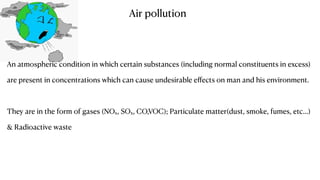
Air pollution
An atmospheric condition in which certain substances (including normal constituents in excess)
are present in concentrations which can cause undesirable effects on man and his environment.
They are in the form of gases (NOx, SOx, CO,VOC); Particulate matter(dust, smoke, fumes, etc…)
& Radioactive waste
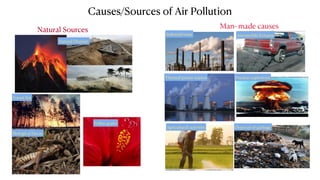
Agricultural activities Disposal of garbage
Nuclear explosionsThermal power station
Automobile ExhaustIndustrial waste
Pollen grains
Biological Decay
Forest fire
Natural Disaster
Natural Sources
Man- made causes
Causes/Sources of Air Pollution
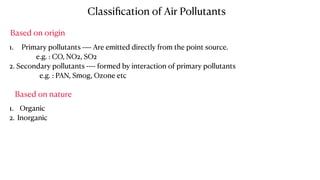
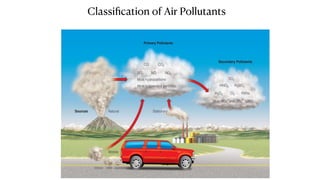
1. Primary pollutants ---- Are emitted directly from the point source.
e.g. : CO, NO2, SO2
2. Secondary pollutants ---- formed by interaction of primary pollutants
e.g. : PAN, Smog, Ozone etc
Classification of Air Pollutants
Based on origin
Based on nature
1. Organic
2. Inorganic
Classification of Air Pollutants
Air is very important as it provides oxygen and other gases that are essential to all life on Earth.Sulphur oxides (SOx)
•SO2 is colorless, but has a suffocating, pungent odor.
•The primary source of SO2 is the combustion of sulfur-containing fuels (e.g., oil and coal).
•Exposure to SO2 can cause the irritation of lung tissues and can damage health and
materials.
•It reduces productivity of plants, yellowing and reduced storage time for paper, yellowing
and damage to limestone and marble, damage to leather, increased rate of corrosion of
iron, steel, zinc and aluminium.
•Further oxidation of SO2 in the presence of a catalyst such as NO2, forms H2SO4 (acid rain)
MAJOR POLLUTANTS
Air is very important as it provides oxygen and other gases that are essential to all life on Earth.Nitrogen oxides (NOx)
• NO2 is a reddish-brown gas with a sharp odor.
• The primary source of this gas is vehicle traffic, and it plays a role in the formation of
tropospheric ozone.
• Large concentrations can reduce visibility and increase the risk of acute and chronic
respiratory .
• Forms photochemical smog, at higher concentrations causes leaf damage or affects the
photosynthetic activities of plants.
MAJOR POLLUTANTS
Carbon dioxide (CO2):
• A greenhouse gas emitted from combustion but is also a gas vital to living organisms.
• It is a natural gas in the atmosphere.
• It causes global warming.
Volatile organic compounds:
• VOCs are an important outdoor air pollutant mainly separated to methane (CH4) and
non-methane (NMVOCs).
• Methane is an extremely efficient greenhouse gas which contributes to enhanced global
warming.
MAJOR POLLUTANTS
Particulate matter:
• Particulate matter (PM) or fine particles, are tiny particles of solid or liquid suspended in
a gas.
• Particulates occur naturally, originating from volcanoes, dust storms, forest and
grassland fires, living vegetation, and sea spray.
• Inhalation of enough PM over time increases the risk of chronic respiratory disease.
Carbon monoxide:
• This odorless, colorless gas is formed from the incomplete combustion of fuels.
• Inhalation of CO reduces the amount of oxygen in the bloodstream, and high
concentrations can lead to headaches, dizziness, unconsciousness, and death.
MAJOR POLLUTANTS
Ozone (O3)
• Tropospheric (“low-level”) ozone is a secondary pollutant formed when sunlight causes
photochemical reactions involving NOX and VOCs.
• Ozone concentrations tend to peak in the afternoon, and can cause eye irritation,
aggravation of respiratory diseases, and damage to plants and animals
Chloro-fluoro carbons (CFCs)
• Refrigerators, air conditioners, foam shaving cream, spray cans and cleaning solvents
• Destroy ozone layer which then permits harmful UV rays to enter the atmosphere. The
human activities depleted ozone layer and the effects on the planet could be
catastrophic.
MAJOR POLLUTANTS
Thank You all

Air pollution

  • 1.
    Dr. Deepa JP 24/07/2020 AirPollution Introduction Major pollutants
  • 2.
    Air pollution An atmosphericcondition in which certain substances (including normal constituents in excess) are present in concentrations which can cause undesirable effects on man and his environment. They are in the form of gases (NOx, SOx, CO,VOC); Particulate matter(dust, smoke, fumes, etc…) & Radioactive waste
  • 3.
    Agricultural activities Disposalof garbage Nuclear explosionsThermal power station Automobile ExhaustIndustrial waste Pollen grains Biological Decay Forest fire Natural Disaster Natural Sources Man- made causes Causes/Sources of Air Pollution
  • 5.
    1. Primary pollutants---- Are emitted directly from the point source. e.g. : CO, NO2, SO2 2. Secondary pollutants ---- formed by interaction of primary pollutants e.g. : PAN, Smog, Ozone etc Classification of Air Pollutants Based on origin Based on nature 1. Organic 2. Inorganic
  • 6.
  • 7.
    Air is veryimportant as it provides oxygen and other gases that are essential to all life on Earth.Sulphur oxides (SOx) •SO2 is colorless, but has a suffocating, pungent odor. •The primary source of SO2 is the combustion of sulfur-containing fuels (e.g., oil and coal). •Exposure to SO2 can cause the irritation of lung tissues and can damage health and materials. •It reduces productivity of plants, yellowing and reduced storage time for paper, yellowing and damage to limestone and marble, damage to leather, increased rate of corrosion of iron, steel, zinc and aluminium. •Further oxidation of SO2 in the presence of a catalyst such as NO2, forms H2SO4 (acid rain) MAJOR POLLUTANTS
  • 8.
    Air is veryimportant as it provides oxygen and other gases that are essential to all life on Earth.Nitrogen oxides (NOx) • NO2 is a reddish-brown gas with a sharp odor. • The primary source of this gas is vehicle traffic, and it plays a role in the formation of tropospheric ozone. • Large concentrations can reduce visibility and increase the risk of acute and chronic respiratory . • Forms photochemical smog, at higher concentrations causes leaf damage or affects the photosynthetic activities of plants. MAJOR POLLUTANTS
  • 9.
    Carbon dioxide (CO2): •A greenhouse gas emitted from combustion but is also a gas vital to living organisms. • It is a natural gas in the atmosphere. • It causes global warming. Volatile organic compounds: • VOCs are an important outdoor air pollutant mainly separated to methane (CH4) and non-methane (NMVOCs). • Methane is an extremely efficient greenhouse gas which contributes to enhanced global warming. MAJOR POLLUTANTS
  • 10.
    Particulate matter: • Particulatematter (PM) or fine particles, are tiny particles of solid or liquid suspended in a gas. • Particulates occur naturally, originating from volcanoes, dust storms, forest and grassland fires, living vegetation, and sea spray. • Inhalation of enough PM over time increases the risk of chronic respiratory disease. Carbon monoxide: • This odorless, colorless gas is formed from the incomplete combustion of fuels. • Inhalation of CO reduces the amount of oxygen in the bloodstream, and high concentrations can lead to headaches, dizziness, unconsciousness, and death. MAJOR POLLUTANTS
  • 11.
    Ozone (O3) • Tropospheric(“low-level”) ozone is a secondary pollutant formed when sunlight causes photochemical reactions involving NOX and VOCs. • Ozone concentrations tend to peak in the afternoon, and can cause eye irritation, aggravation of respiratory diseases, and damage to plants and animals Chloro-fluoro carbons (CFCs) • Refrigerators, air conditioners, foam shaving cream, spray cans and cleaning solvents • Destroy ozone layer which then permits harmful UV rays to enter the atmosphere. The human activities depleted ozone layer and the effects on the planet could be catastrophic. MAJOR POLLUTANTS
  • 12.