EZHIL RAJ.S
AIR FILTERS
1
 Air filter is a device composed of fibrous materials.
 It removes solid particulates such
as dust, pollen, mould, and bacteria from the air.
 Air filters are used in applications where air quality
is important, notably in building ventilation systems .
Air filter
2
Coarse filters
Fine filters
HEPA
ULPA
Carbon Air Filters
UV light air filters
TYPES
3
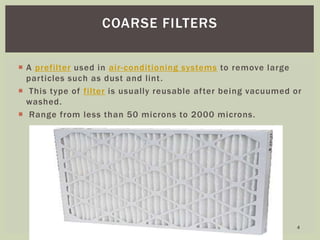
 A prefilter used in air-conditioning systems to remove large
particles such as dust and lint.
 This type of filter is usually reusable after being vacuumed or
washed.
 Range from less than 50 microns to 2000 microns.
COARSE FILTERS
4
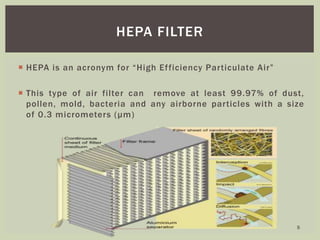
 HEPA is an acronym for “High Efficiency Particulate Air”
 This type of air filter can remove at least 99.97% of dust,
pollen, mold, bacteria and any airborne particles with a size
of 0.3 micrometers (μm)
HEPA FILTER
5
ULPA is an acronym for "Ultra Low Penetration
Air (filter)"
An ULPA filter can remove from the air at least
99.999% .
 With a size of 100 nanometres (0.1 µm) or
larger.
ULPA FILTERS
6
 It can readily be used to absorb particles and
trap odors.
Carbon air filters use activated carbon to trap
chemicals and gases, and can also filter
cigarette smoke
CARBON AIR FILTERS
7
Ultraviolet light air filters use a reaction that
occurs when titanium dioxide is exposed to UV
light.
High intensity UV (240-280 nm) is strong
enough to break down most carbon based
organic compounds, making UV light air filters
a good companion to HEP filters in medical
applications
UV LIGHT AIR FILTERS
8
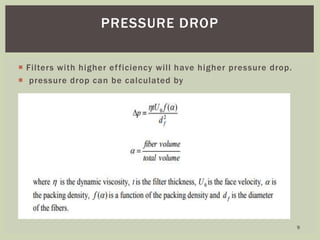
 Filters with higher efficiency will have higher pressure drop.
 pressure drop can be calculated by
PRESSURE DROP
9
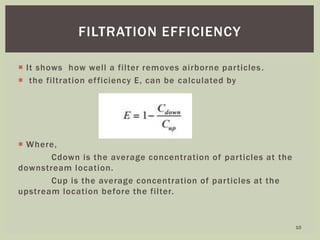
 It shows how well a filter removes airborne particles.
 the filtration efficiency E, can be calculated by
 Where,
Cdown is the average concentration of particles at the
downstream location.
Cup is the average concentration of particles at the
upstream location before the filter.
FILTRATION EFFICIENCY
10
 It is a function of the filtration area.
 The velocity of the air is given by
V=Q/A
where,
Q is the volumetric flow rate through the filter
A is the filtration area.
The standard HEPA filter has an initial 1.0 in. w.c. (249 Pa)
pressure drop at 250 fpm (1.3 m/s) face velocity.
A high capacity HEPA filter has a 1.4 in. w.c. (348 Pa) pressure
drop at 500 fpm (2.5 m/s), with the same quality air filtration
AIR VELOCITY
11
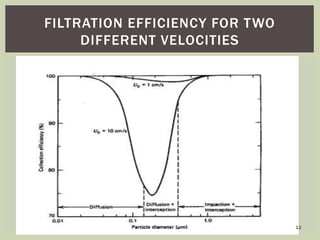
FILTRATION EFFICIENCY FOR TWO
DIFFERENT VELOCITIES
12
 Air Velocity Through The Filter Medium.
Particle Size.
Dust Loading On The Filter.
 Filter Packing Density.
 Fiber Diameter And Thickness Of The
Material.
FACTORS THAT AFFECT FILTRATION
EFFICIENCY
13
Hospital operation theatre
Clean room in medical industry
Toxic environment
Air conditioning
Maintain proper IAQ in living room , office etc
APPLICATIONS
14
15

Air filters

  • 1.
  • 2.
     Air filteris a device composed of fibrous materials.  It removes solid particulates such as dust, pollen, mould, and bacteria from the air.  Air filters are used in applications where air quality is important, notably in building ventilation systems . Air filter 2
  • 3.
    Coarse filters Fine filters HEPA ULPA CarbonAir Filters UV light air filters TYPES 3
  • 4.
     A prefilterused in air-conditioning systems to remove large particles such as dust and lint.  This type of filter is usually reusable after being vacuumed or washed.  Range from less than 50 microns to 2000 microns. COARSE FILTERS 4
  • 5.
     HEPA isan acronym for “High Efficiency Particulate Air”  This type of air filter can remove at least 99.97% of dust, pollen, mold, bacteria and any airborne particles with a size of 0.3 micrometers (μm) HEPA FILTER 5
  • 6.
    ULPA is anacronym for "Ultra Low Penetration Air (filter)" An ULPA filter can remove from the air at least 99.999% .  With a size of 100 nanometres (0.1 µm) or larger. ULPA FILTERS 6
  • 7.
     It canreadily be used to absorb particles and trap odors. Carbon air filters use activated carbon to trap chemicals and gases, and can also filter cigarette smoke CARBON AIR FILTERS 7
  • 8.
    Ultraviolet light airfilters use a reaction that occurs when titanium dioxide is exposed to UV light. High intensity UV (240-280 nm) is strong enough to break down most carbon based organic compounds, making UV light air filters a good companion to HEP filters in medical applications UV LIGHT AIR FILTERS 8
  • 9.
     Filters withhigher efficiency will have higher pressure drop.  pressure drop can be calculated by PRESSURE DROP 9
  • 10.
     It showshow well a filter removes airborne particles.  the filtration efficiency E, can be calculated by  Where, Cdown is the average concentration of particles at the downstream location. Cup is the average concentration of particles at the upstream location before the filter. FILTRATION EFFICIENCY 10
  • 11.
     It isa function of the filtration area.  The velocity of the air is given by V=Q/A where, Q is the volumetric flow rate through the filter A is the filtration area. The standard HEPA filter has an initial 1.0 in. w.c. (249 Pa) pressure drop at 250 fpm (1.3 m/s) face velocity. A high capacity HEPA filter has a 1.4 in. w.c. (348 Pa) pressure drop at 500 fpm (2.5 m/s), with the same quality air filtration AIR VELOCITY 11
  • 12.
    FILTRATION EFFICIENCY FORTWO DIFFERENT VELOCITIES 12
  • 13.
     Air VelocityThrough The Filter Medium. Particle Size. Dust Loading On The Filter.  Filter Packing Density.  Fiber Diameter And Thickness Of The Material. FACTORS THAT AFFECT FILTRATION EFFICIENCY 13
  • 14.
    Hospital operation theatre Cleanroom in medical industry Toxic environment Air conditioning Maintain proper IAQ in living room , office etc APPLICATIONS 14
  • 15.