A-I-D-A MODEL
BY: ABHISHESH KUMAR CHAUDHARY
CONTENTS
1. AIDA
2. Steps proposed by the AIDA model
3. Criticism
4. Variants
1. AIDA
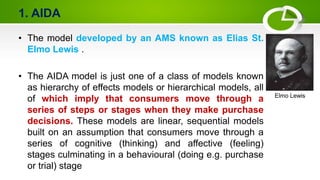
• The model developed by an AMS known as Elias St.
Elmo Lewis .
• The AIDA model is just one of a class of models known
as hierarchy of effects models or hierarchical models, all
of which imply that consumers move through a
series of steps or stages when they make purchase
decisions. These models are linear, sequential models
built on an assumption that consumers move through a
series of cognitive (thinking) and affective (feeling)
stages culminating in a behavioural (doing e.g. purchase
or trial) stage
Elmo Lewis
2. Steps proposed by the AIDA model
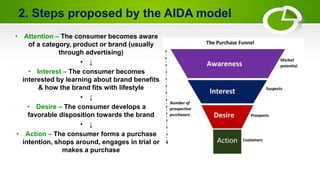
• Attention – The consumer becomes aware
of a category, product or brand (usually
through advertising)
• ↓
• Interest – The consumer becomes
interested by learning about brand benefits
& how the brand fits with lifestyle
• ↓
• Desire – The consumer develops a
favorable disposition towards the brand
• ↓
• Action – The consumer forms a purchase
intention, shops around, engages in trial or
makes a purchase
3. Criticism
• A major deficiency of the AIDA model and other hierarchical models
is the absence of post-purchase effects such as satisfaction,
consumption, repeat patronage behaviour and other post-purchase
behavioural intentions such as referrals or participating in the
preparation of online product reviews.
• Other criticisms include the model's reliance on a linear nature,
hierarchical sequence.
,
In addition, an
extensive review of the literature surrounding advertising effects,
carried out by Vakratsas and Ambler found little empirical support
for the hierarchical models
4. Variants
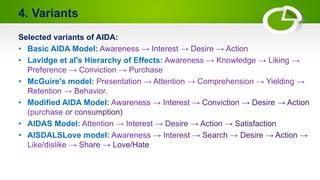
Selected variants of AIDA:
• Basic AIDA Model: Awareness → Interest → Desire → Action
• Lavidge et al's Hierarchy of Effects: Awareness → Knowledge → Liking →
Preference → Conviction → Purchase
• McGuire's model: Presentation → Attention → Comprehension → Yielding →
Retention → Behavior.
• Modified AIDA Model:
• AIDAS Model:
• AISDALSLove model:
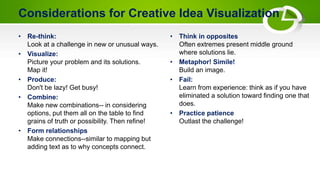
Considerations for Creative Idea Visualization
• Re-think:
Look at a challenge in new or unusual ways.
• Visualize:
Picture your problem and its solutions.
Map it!
• Produce:
Don't be lazy! Get busy!
• Combine:
Make new combinations-- in considering
options, put them all on the table to find
grains of truth or possibility. Then refine!
• Form relationships
Make connections--similar to mapping but
adding text as to why concepts connect.
• Think in opposites
Often extremes present middle ground
where solutions lie.
• Metaphor! Simile!
Build an image.
• Fail:
Learn from experience: think as if you have
eliminated a solution toward finding one that
does.
• Practice patience
Outlast the challenge!

Aida model

  • 1.
  • 2.
    CONTENTS 1. AIDA 2. Stepsproposed by the AIDA model 3. Criticism 4. Variants
  • 3.
    1. AIDA • Themodel developed by an AMS known as Elias St. Elmo Lewis . • The AIDA model is just one of a class of models known as hierarchy of effects models or hierarchical models, all of which imply that consumers move through a series of steps or stages when they make purchase decisions. These models are linear, sequential models built on an assumption that consumers move through a series of cognitive (thinking) and affective (feeling) stages culminating in a behavioural (doing e.g. purchase or trial) stage Elmo Lewis
  • 4.
    2. Steps proposedby the AIDA model • Attention – The consumer becomes aware of a category, product or brand (usually through advertising) • ↓ • Interest – The consumer becomes interested by learning about brand benefits & how the brand fits with lifestyle • ↓ • Desire – The consumer develops a favorable disposition towards the brand • ↓ • Action – The consumer forms a purchase intention, shops around, engages in trial or makes a purchase
  • 5.
    3. Criticism • Amajor deficiency of the AIDA model and other hierarchical models is the absence of post-purchase effects such as satisfaction, consumption, repeat patronage behaviour and other post-purchase behavioural intentions such as referrals or participating in the preparation of online product reviews. • Other criticisms include the model's reliance on a linear nature, hierarchical sequence. , In addition, an extensive review of the literature surrounding advertising effects, carried out by Vakratsas and Ambler found little empirical support for the hierarchical models
  • 6.
    4. Variants Selected variantsof AIDA: • Basic AIDA Model: Awareness → Interest → Desire → Action • Lavidge et al's Hierarchy of Effects: Awareness → Knowledge → Liking → Preference → Conviction → Purchase • McGuire's model: Presentation → Attention → Comprehension → Yielding → Retention → Behavior. • Modified AIDA Model: • AIDAS Model: • AISDALSLove model:
  • 7.
    Considerations for CreativeIdea Visualization • Re-think: Look at a challenge in new or unusual ways. • Visualize: Picture your problem and its solutions. Map it! • Produce: Don't be lazy! Get busy! • Combine: Make new combinations-- in considering options, put them all on the table to find grains of truth or possibility. Then refine! • Form relationships Make connections--similar to mapping but adding text as to why concepts connect. • Think in opposites Often extremes present middle ground where solutions lie. • Metaphor! Simile! Build an image. • Fail: Learn from experience: think as if you have eliminated a solution toward finding one that does. • Practice patience Outlast the challenge!