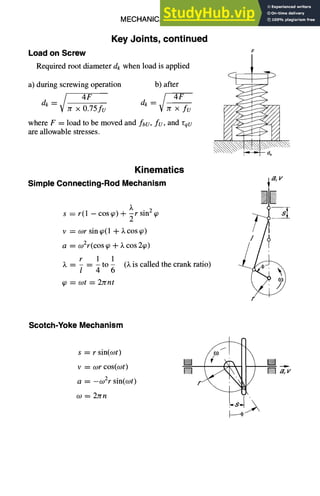
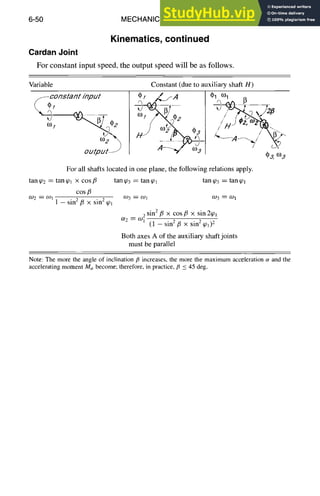
AIAA AEROSPACE DESIGN
ENGINEERS GUIDE
Fifth Edition
American Institute of Aeronautics and Astronautics, Inc.
1801 Alexander Bell Drive
Reston, Virginia20191-4344
September 2003
American Institute of Aeronautics and Astronautics, Inc.,
1801 Alexander Bell Drive,
Reston, Virginia 20191-4344 USA
Library of Congress Cataloging-in-Publication Data
AIAA aerospace design engineers guide. 1 5th ed., revised and enlarged.
p. cm.
Includes bibliographical references.
ISBN 1-56347-590-1 (alk. paper) -- ISBN 1-86058-424-1 (European market
: alk. paper)
1. AirplanesIDesign and construction--Handbooks, manuals, etc. 2.
Space vehicles--Design and construction--Handbooks, manuals, etc. I.
American Institute of Aeronautics and Astronautics.
TL551.A32 2003 2003016823
629.1'2IDC22
ISBN 1-56347-590-1 (softcover : alk. paper)
Copublished in the United Kingdom by
Professional Engineering Publishing Limited.
Northgate Avenue, Bury St Edmunds
Suffolk, IP32 6BW UK.
ISBN 1-86058-424-1
A CIP record for this book is available from the British Library.
Copyright ~'~2003 by the American Institute of Aeronautics and Astronautics, Inc. All rights
reserved. Printed in the United States. No part of this publication may be reproduced, dis-
tributed, or transmitted, in any form or by any means, or stored in a database or retrieval
syslem, without the prior written permission of the publisher.
Dma and information appearing in this book are for informational purposes only. AIAA is
not responsible for any injury or damage resulting from use or reliance, nor does AIAA
warrant that use or reliance will be free l¥om privately owned rights.
Foreword
This fifth edition of the AIAA Aerospace Design Engineers Guide (ADEG) is a
revised and enlarged version of the previous edition. It has been prepared under the
charter of the AIAA Design Engineering Technical Committee to assist the design
engineer in creating and defining practical aerospace products. The intended scope
of this guide is to provide a condensed collection of commonly used engineering
reference data and to also function as a general reference guide for disciplines
related specifically to aerospace design.
The previous editions were published in 1983, 1987, 1993, and 1998, and the
guide will be updated whenever the committee has accumulated sufficient material
to warrant a new edition. The fifth edition has been enlarged and rearranged to
enhance user access and utilization.
Materials included in the guide were compiled principally from design manuals
and handbooks. The Design Engineering Technical Committee is indebted to many
people and companies for their voluntary cooperation.
The committee does not guarantee the accuracy of the information in this guide,
and it should not be referenced as a final authority for certification of designs. We
solicit your comments and suggestions for improvement, including corrections
and candidate new materials, so that future editions can better fulfill the needs of
the design engineering community.
ADEG Subcommittee
AIAA Design Engineering Technical Committee
1801 Alexander Bell Drive
Reston, VA 20191-4344
Preface
Using This Guide
The AIAA Aerospace Design Engineers Guide has been compiled to assist aero-
space design engineers during design inception and development. The purpose of
this guide is to serve as a general purpose, in-field handbook used by design en-
gineers to perform back-of-the-envelope/rough-order-of-magnitudeestimates and
calculations for early preliminary and conceptual aerospace design. The guide
is not intended to be a comprehensive handbook for producing highly detailed
production designs, although some of the design data may be suitable for the
designer's objectives. Other specialized handbooks and detailed company hand-
books/manuals and specifications are generally available to the designer to support
comprehensive detail and production design efforts.
This guide is divided into 11 major sections, as shown in the Table of Contents,
each with a summary topic list. The sections provide the following categories
of aerospace design engineering information. Sections 1, 2, and 3 provide math-
ematical definition, conversion factors and general materials and specifications
information. Sections 4, 5, and 6 provide detailed information on section proper-
ties, structures, and mechanical design. Sections 7 and 8 provide universal product
definition nomenclature in the form of "geometric dimensioning and tolerancing"
and electrical, electronic and electromagnetic design. Sections 9, 10, and 11 pro-
vide aircraft and helicopter, air breathing propulsion, spacecraft and launch vehicle
design.
A list of topics is included at the beginning of each section to help the user quickly
and easily find information. The 11 sections of the Design Guide are arranged to
maximize useability of design data, which appear in the form of visual and written
explanations, tabular data, formulas/equations, graphics, figures, maps, glossaries,
standards, specifications, references, and design rules of thumb.
Introduction
Design engineering is fundamental to every aerospace project.
The role of the design engineer is the creation, synthesis, itera-
tion, optimization and presentation of design solutions. It is the
primary discipline that creates and transforms ideas into a prod-
uct definition that satisfies customer as well as business require-
ments.
This Design Guide provides the design engineer with reference data that can be
used during the execution of systems analyses, trade studies, and detailed designs.
The integrated product development (IPD) concept leverages the multidisciplined
teaming environment to create successful products. The IPD team brings sales,
marketing, engineering, manufacturing, quality assurance, and customer service
disciplines together, focusing on the value of the product to the customer. What-
ever the designer's role in the design process, an understanding of some simple
basic systems engineering concepts will ensure more successful application of the
information in this Design Guide to create better products.
SystemsEngineeringConcepts
Understand Customer's Need
Whether the customer is an internal product team or an external client company,
it is important to understand its needs. Every product starts with a need. Sometimes
product requirements are written that do not reflect the true needs of the customer;
if so, they should be revised to reflect those needs. In the end, the value of the
design is always measured against the customer's needs; therefore those needs
must be accurately captured in the product requirements specification.
Develop Concept of Operations
Most products have multiple users in their lifetimes. Products are tested, de-
ployed, operated, maintained, and eventually retired from service. The require-
ments of all operational phases must be considered for a design to be successful.
Complex systems typically have a formal concept of operations that accompanies
the product requirements. If a concept of operations is not included with the prod-
uct requirements, then one should be developed with the customer. Scenarios for
how the product will be used throughout its life cycle should be developed, and
the concept of operations and the product requirements should be used as the basis
for the design.
Review Product Requirements for Completeness
Product requirements that the design must satisfy likely will be furnished. Use
a checklist to verify that the product requirements are complete. Typical require-
ment categories include 1) performance, 2) lifetime/duty cycle, 3) affordability,
4) reliability, 5) human factors, 6) field support/logistics, and 7) deployment/
disposal. If the product requirements are not complete, appropriate assumptions
xii INTRODUCTION
should be made and then validated with the customer. Just because the product
requirements within a category are incomplete does not mean that they are not
important.
Use Trade Study Methods to Develop the Product Design
After all of the important up-front work necessary for good product design is
completed, there are further systems engineering techniques that can help complete
the product design. Trade study methodology is an effective way to choose among
design alternatives and develop the product design. Essential elements of a trade
study include the following.
Identify design alternatives. If only one design concept is developed, review
it with the future users of the product. This may result in additional design
alternatives. The level of detail to which the design alternatives are de-
fined varies with program phase. Early on, high level concepts are sufficient
whereas during full-scale development, detailed designs and operating concepts are
required.
Develop evaluation criteria and weighting factors. Top-level evaluation criteria
usually include performance, safety, reliability, cost, risk, flexibility, and growth.
Not all of these will apply in every case. Detailed criteria should be tailored to a
particular situation. For example, under the top-level criterion of performance, de-
tailed criteria might include weight, volume, and/or power consumption. If cost is
an evaluation criterion, be sure to consider the total life cycle cost. Finally, weight-
ing factors should be developed based on the relative importance of the evaluation
criteria. Work closely with the customer to develop the evaluation criteria and
appropriate weighting factors.
Analyze design alternatives and select final design concept. Each design al-
ternative should be analyzed and scored against the evaluation criteria, applying
the weighting factors and calculating numerical scores for each alternative. Risk
mitigation approaches should be developed for the key risk areas. Sensitivity stud-
ies should be performed for the highest ranked alternatives to ensure that small
changes in one design parameter do not cause major changes in the other param-
eters. The design alternative with the highest score and acceptable sensitivities is
the preferred solution. For preferred solutions that involve high risk, developing
a second design alternative in parallel with the first should be pursued until the
feasibility of the preferred design is demonstrated.
Benefits of a systems engineering approach. A systems engineering approach is
recommended for any aerospace design project. The systems engineering philoso-
phy integrates and links requirements, schedule, cost, design solutions, alternative
concepts, risk considerations, and product verification and validation in a manner
that enables the design team to have adequate visibility into and accountability of
the complete development effort.
INTRODUCTION xiii
In summary, design engineering is the creative process by which ideas from one
or many contributors are converted to documents that define a product that can be
profitably manufactured and that meets the design, performance, and functional
specifications required. Design engineering seeks an optimal whole, rather than
attempting to perfect each individual part within a system, thus obtaining a bal-
anced, well designed product that fulfills the requirements and satisfies customer
and business needs.
AIAA Systems Engineering Technical Committee
1801 Alexander Bell Drive
Reston, VA 20191-4344
Table of Contents
Preface ............................................................
Introduction .......................................................
Section 1
Section 2
Section 3
Section 4
Section 5
Section 6
Section 7
(ASME Y1
Section 8
Section 9
Section 10
Section 11
Mathematics .........................................
Conversion Factors ..................................
Materials and Specifications ........................
Section Properties ...................................
Structural Design ....................................
Mechanical Design ...................................
Geometric Dimensioning and Tolerancing
4.5M-1994) ............................................
Electrical/Electronic/Electromagnetic Design .......
Aircraft and Helicopter Design ......................
ix
xi
1-1
2-1
3-1
4-1
5-1
6-1
7-1
8-1
9-1
Air Breathing Propulsion Design .................... 10-1
Spacecraft and Launch Vehicle Design ............. 11-1
Section 1 I
MATHEMATICS
Greek Alphabet ............................................... 1-2
SI Prefixes ................................................... 1-2
Algebra ...................................................... 1-3
Trigonometry ................................................. 1-6
Mensuration .................................................. 1-9
Analytic Geometry ............................................ 1-13
Differential Calculus .......................................... 1-17
Integral Calculus ............................................. 1-19
Differential Equations ......................................... 1-22
Complex Quantities ........................................... 1-23
Some Standard Series ........................................ 1-23
Matrix Operations ............................................ 1-25
Determinants ................................................. 1-26
Curve Fitting ................................................. 1-27
Small-Term Approximations ................................... 1-28
Vector Equations ............................................. 1-29
1-2 MATHEMATICS
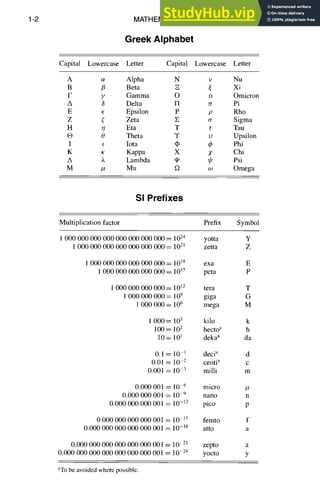
Greek Alphabet
Capital Lowercase Letter Capital Lowercase Letter
A a Alpha N v Nu
B fi Beta E ~ Xi
F y Gamma O o Omicron
A 3 Delta H Jr Pi
E ~ Epsilon P p Rho
Z ~ Zeta ~ ~r Sigma
H q Eta T r Tau
® 0 Theta T v Upsilon
I t Iota ~ ~b Phi
K x Kappa X X Chi
A )~ Lambda qJ lp Psi
M IZ Mu f2 co Omega
SI Prefixes
Multiplication factor Prefix Symbol
1 000 000 000 000 000 000 000 000 = 1024 yotta Y
1 000 000 000 000 000 000 000 = 102t zetta Z
1 000 000 000 000 000 000 = 10 TM exa E
1 000 000 000 000 000 = 1015 peta P
1 000 000 000 000 = 1012 tera T
l 000 000 000 = 109 giga G
1 000 000 = 106 mega M
1 000 = 103 kilo k
1O0 = 102 hecto" h
10 = 101 deka a da
0.1=10 1 deci a d
0.01 = 10 2 centi a c
0.001 = 10 3 milli m
0.000 001 = 10 6 micro #
0.000 000 001 = 10 9 nano n
0.000 000 000 001 = 10-12 pico p
0.000 000 000 000 001 = 10 15 femto f
0.000 000 000 000 000 001 = 10-~8 atto a
0.000 000 000 000 000 000 001 = 10 21 zepto z
0.000 000 000 000 000 000 000 001 = 10 24 yocto y
aTo be avoided where possible.
MATHEMATICS 1-3
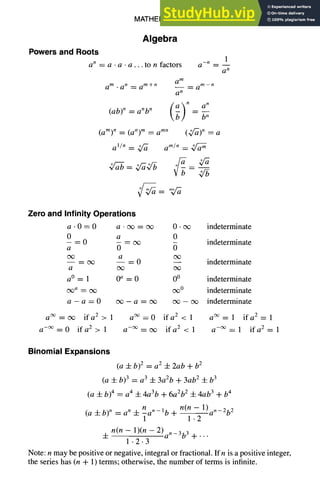
Algebra
Powers and Roots
a n = a • a • a... to n factors
a m . a n ~ a m+n
(ab) n = anb n
1
a -n = --
a n
a m
_ a m-n
a n
(b) n an
b n
(am)n = (an)m = amn (Q'-~)n = a
a'/n _=_ ~ a m/n = Q~
4/5
Zero and Infinity Operations
a • 0 = 0 a - cx~ = c~ 0 • cx~ indeterminate
0 a 0
- = 0 - -- cx~ indeterminate
a 0
oo a
-- = cx~ -- = 0 -- indeterminate
a c~ o~
a°= 1 0 a = 0 0 ° indeterminate
~, = ~ ~0 indeterminate
a - a = 0 c~ - a = cx~ ~ - cx~ indeterminate
a ~ = cx~ if a 2 > 1 a ~ = 0 if a 2 < 1 a ~ = 1 if a 2 = 1
a -~ = 0 if a 2 > 1 a -~ = c~ if a 2 < 1 a -~ = 1 if a 2 = 1
Binomial Expansions
(a 4-b) 2 = a 2 4-2ab +b 2
(a 4- b) 3 = a 3 4- 3a2b + 3ab 2 4- b 3
(a 4- b) 4 = a 4 4- 4a3b + 6a2b 2 4- 4ab 3 + b 4
n(n -- 1)an_2b 2
(a ± b) n = a n -4- nan-lb q- -
1 1.2
4- n(n - 1)(n - 2)an_3b 3 + ...
1.2.3
Note: n may be positive or negative, integral or fractional. If n is a positive integer,
the series has (n + 1) terms; otherwise, the number of terms is infinite.
1-4 MATHEMATICS
Algebra, continued
Logarithms
{_+~ whenb lies between O and l
logb b = t, logb 1 = 0, logb 0 = when b lies between 1 and cx~
logb M • N = logb M + logb N
logb N p = p logb N
logb N -- l°ga N
log~ b
M
logb ~- = log~ M - logb N
10gb ~ = t7 logb N
r
logb b N = N blOgb
N = N
The Quadratic Equation
If
then
ax 2 +bx + c = 0
-b 4- ~/~ - 4ac 2c
X ~
2a -b q: ~ - 4ac
The second equation serves best when the two values of x are nearly equal.
> | the roots are real and unequal
If b2 - 4ac = 0 / the roots are real and equal
< the roots are imaginary
The Cubic Equations
Any cubic equation y3 + py2 -t- qy + r = 0 may be reduced to the form x 3 +
ax + b = 0 by substituting for y the value [x - (p/3)]. Here a = 1/3(3q - p2),
b = 1/27(2p 3 - 9pq + 27r).
Algebraic Solution ofx 3 + ax + b = 0
If
f b ~ a 3
A= -~+ +2-7
f b ~/~ a3
B= -~- + 2--7
x =A+B
A+B A-B A+B A-B l-Z-
~
+--5--4=3 2
b2 a 3 > / 1 real root, 2 conjugate imaginary roots
- - = 0 / 3 real roots, at least 2 equal
4 + ~ < 3 real and unequal roots
MATHEMATICS 1-5
Algebra, continued
Trigonometric Solution for x 3 + ax + b = 0
Where (b2/4) + (a3/27) < 0, these formulas give the roots in impractical form
for numerical computation. (In this case, a is negative.) Compute the value of angle
4~derived from
ta )
cosy = + -~
x = q:2 3 cos 3
Then
where the upper or lower signs describe b as positive or negative.
Where (b2/4) + (a3/27) >= 0, compute the values of the angles ~ and q~from
cot 2~p = [(b2/4) + (a 3/27)] 1/2, tan 4>= (tan ~) 1/3. The real root of the equation
then becomes
x = +2 cot 2~b
where the upper or lower sign describes b as positive or negative.
When (b2/4) + (a3/27) = 0, the roots become
x = T2 3 3
where the upper or lower signs describe b as positive or negative.
The Binomial Equation
When x n = a, the n roots of this equation become
a positive:
Q'a( 2kJr 2kzr)
x = cos + ~ sin
n n
a negative:
~/~-d [ (2k + 1)7r (2k + 1)re]
x = cos + -v/-S1 sin --
n Y/
where k takes in succession values of 0, 1, 2, 3..... n - 1.
1-6 MATHEMATICS
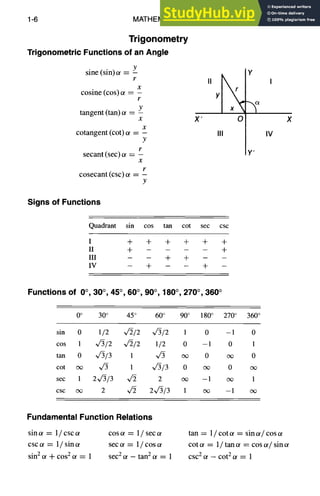
Trigonometry
Trigonometric Functions of an Angle
Y
sine (sin) c~ = -
F
X
cosine (cos) ot = -
F
Y
tangent (tan) a = -
x
x
cotangent (cot) ot = -
Y
F
secant (sec) ot = -
x
/-
cosecant (csc) c~ = -
Y
Signs of Functions
X' 0I
III IV
y,
X
Quadrant sin cos tan cot sec csc
I + + + + + +
II + . . . . +
III - - + + - -
IV - + - - + -
Functions of 0°, 30 °, 45°, 60 °, 90 °, 180 °, 270 °, 360 °
0 ° 30 ° 45 ° 60 ° 90 ° 180 ° 270 ° 360 °
sin 0 1/2 ~/2/2 ~v/3/2 1 0 -1 0
cos 1 V~/2 ~/2/2 1/2 0 --1 0 1
tan 0 v'~/3 1 V'3 o0 0 (x) 0
cot oc ~ 1 V~/3 0 ec 0 ec
sec 1 2v/J/3 x/2 2 oo -- 1 oo 1
csc oc 2 V/2 2~vf3/3 1 ~ -- 1 o~
Fundamental Function Relations
since = 1/cscoe
cscot = 1/sinoe
sin 2 ot + cos 2 ot = 1
cos ot = 1/ sec ot
secot = 1/cosot
sec 2 ot -- tan 2 ot ---- 1
tan = 1/cotot = sinoe/cosot
cot ot = 1/ tan o~ = cos c¢/sin ot
CSC2 O/ -- cot 20t = 1
MATHEMATICS
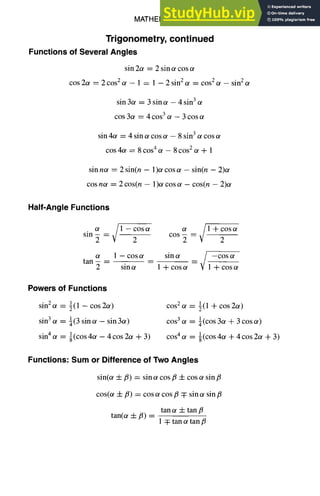
Trigonometry, continued
Functions of Several Angles
sin 2~ = 2 sin ot cos
cos 2c~ = 2 cos 2 ot - 1 = 1 - 2 sin 2 ~ = cos 2 (~ - sin 2
sin 3~ = 3 sin ot - 4 sin 3
cos 3~ = 4 cos 3 ot - 3 cos
sin 4~ = 4 sin ot cos ~ - 8 sin 3 ot cos
cos 4~ = 8 cos 4 c¢ - 8 cos 2 ot + 1
sin n~ = 2 sin(n - 1)~ cos ~ - sin(n - 2)or
cos n~ = 2 cos(n - 1)or cos c~ - cos(n - 2)c¢
1-7
Half-Angle Functions
sin -
~
2 = ~ 1 - 2
cos c~
~1 +cos~
cos 2 2
tan
ot 1 - cos a sin c¢
2 sin a 1 + cos ot
/
__ / --COSOg
- - V 1 + cos ot
Powers of Functions
sin2ot = ½(1 - cos2a)
sin3 ot = ~(3 sinot - sin 3or)
sin4 ot = 1(cos 4c~ - 4cos2ot + 3)
COS2 O/ = l(l 2i- COS 200
COS3 Ot = ¼(COS 30t + 3 COS Or)
COS4 IX = I(COS 4or + 4 cos 2or + 3)
Functions: Sum or Difference of Two Angles
sin(or -4- fl) = sin ot cos/3 4- cos ¢ sin/5
cos(or 4-/3) = cos a cos fl q: sin ot sin fl
tan a -4- tan fi
tan(or 4-/3) =
1 :~ tan ot tan fi
1-8 MATHEMATICS
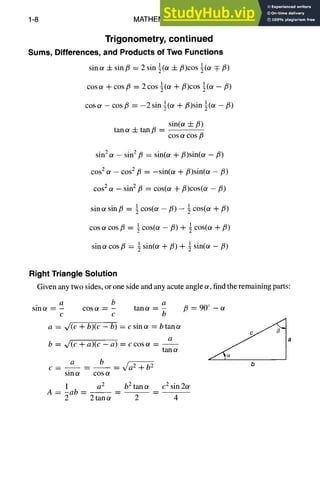
Trigonometry, continued
Sums, Differences, and Products of Two Functions
sinot + sinfl = 2 sin ½(~ -t- fl)cos ½(~ qz fi)
cosc~ + cos/3 = 2cos ½(c¢ +/3)cos ½(c~ - fi)
cosot - cosfi = -2sin ½(~ + fi)sin ½(or -/3)
sin(or -4-/5)
tan ot + tan/5 --
COSOtCOS fl
sin 2 o~ - sin 2/3 = sin(~ + fl)sin(ot -/3)
cos 2 ot - cos 2 fi = -sin(ol + fi)sin(ot - fl)
cos 2 c¢ - sin 2/3 = cos(u +/3)cos(c~ -/3)
i cos(or +/3)
sina sin/3 = ½cos(or -/3) -
I cos(or -/3) + 1 cos(or +/3)
cos ot cos/3 = ~
1 sin(or + fi) + ½ sin(~ - fi)
sin ~ cos/3 =
Right Triangle Solution
Given any two sides, or one side and any acute angle ~, find the remaining parts:
a b a
sin a = - cos a = - tan et = -
c c b
a = ~/(c + b)(c - b) = c sin c¢ = b tan c~
b = ~/(c + a)(c - a) = ccosot -
tan
a b b2
c . . . . ~a2÷
sin ~ cos c¢
1 a 2
A = -ab -- - -
2
b 2 tan c~ c 2 sin 2or
p = 90 ° _
b
2 tan ~ 2 4
Note: A ---- area, V = volume
ObliqueTriangleSolution
Right Triangle
I
A= 2ab
a = ~v/-~-b 2
MATHEMATICS
Mensuration
C= V/-~a
2 q- b2
b=q~-a 2
Oblique Triangle
A = ½bh
Equilateral Triangle
A= ½ah=Ja2,v/3
h---- ½av/3
a
rl -- 2v/~
a
Parallelogram
A ----ah = ab sinot
d] = ~/a2 + b2 - 2 ab cos et
d2 = ~/a2 + b2 + 2 ab cos ot
Trapezoid
I h(a + b)
A=~
1-9
I"!1"......... a -°°--°°~,1
I,,~°H°o°°° °b ....... D,, I
"~,
4 °,~,
o°~ ....... .. ,,
.... ,/ i
v',,B"....... a .......
~-..b--4
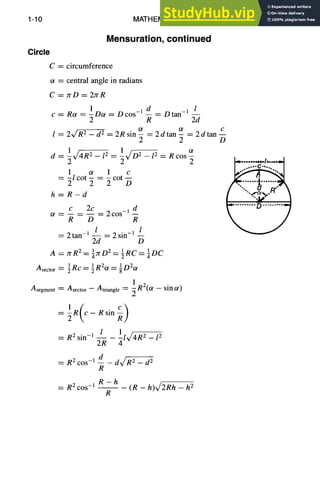
1-10 MATHEMATICS
Circle
C=
ot ~__--:
C=
Mensuration, continued
C
l=
d--
1 2 1 2
~ 4V/-~--12 = ~X/~--I 2
1 ot 1 c
=-lcot-=-cot--
2 2 2 D
h=R-d
c 2c d
ot -- _ _ 2COS -1 --
R D R
---- 2 tan-i 1 2 sin-m l
2d D
A = 7rR2= azrDI 2 = ½RC = ¼DC
A sector 1 1 2 1 2
• = ~Rc=~R ot=gD ot
circumference
central angle in radians
rrD = 27rR
1 d l
Rot = -Dot = Dcos -1 -- = Dtan -1 --
2 R 2d
2~,/'-~ - d 2 2R sin ot ot c
= - = 2dtan- = 2dtan--
2 2 D
ot
= R cos -
2
Asegment = Asector - Atriangle = 1R2(ot - sin Ot)
l 1 2
__ _ al _ 12
= R2 sin-l 2R
= R2 c°s- 1 __d _ dx/~ - d 2
R
R-h
= R 2cos -1 - - - (R - h)~/2Rh - h 2
R
MATHEMATICS 1-11
Mensuration, continued
Area by Approximation
If Y0, Yl, Y2, ..., y. are the lengths of a series of
equally spaced parallel chords and if h is their dis-
tance apart, the area enclosed by boundary is given
approximately by i i I |
~l, I', , L.."
As = ih[(yo + Yn)+ 4(yl + Y3 -'1-"'" -}-y.-~) + 2(y2 + Y4 -I- "'" -I- Yn-1)]
where n is even (Simpson's Rule).
Ellipse
A = zrab/4
Perimeter s
__7r(a+b) [ 1 (a-b]2+ 1 (a-b~ 1 (a-b] 6 ]
4 a+b.] ~ a+b] +~ ~a+b/ +""
(a+b) 3(1 +X) +
~rr 8 ~
?
where X = L2(a + b) J
Parabola
Length of arc s
A = (2/3)1d
1 2 12 [4d+~/16d2+12)
= ~/16d q- 12 --~ ~-'~~,~t l
=1 1+3 1 / -5
d
Height of segment dl = ~(12 _ l2)
v/-d- dl
Width of segment 11 = l -~
1-12 MATHEMATICS
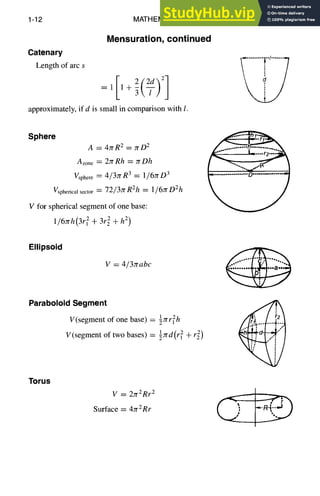
Catenary
Length of arc s
Mensuration, continued
=1 1+3l/ j
approximately, if d is small in comparison with l.
Sphere
A = 4rrR 2 = 7rD 2
Azone = 2rr Rh = :rrDh
gsphere ~--- 4/37rR 3 = l/6rrD 3
Vspherical sector = 72/3rr RZh = 1~6JrDZh
V for spherical segment of one base:
1/6yrh(3r~ + 3r~ + h2)
Ellipsoid
V = 4/3rrabc
ParaboloidSegment
V(segment of one base) = ~rrr
11 2h
:rrd(r, + r2)
V(segment of two bases) = 1 2
Torus
V = 27r2Rr 2
Surface = 4rrZRr
MATHEMATICS 1-13
AnalyticGeometry
Rectangular and Polar Coordinate Relations
x = r cos0 y = r sin0
r = ~5 + yZ 0 = tan -J y sin0 -- Y
x ~r~+y 2
x y
cos 0 -- tan 0 ------
~ y 2 x
Points and Slopes
For P1 (x l, Yl) and P2(x2, Y2) as any two points and ~ the angle from OX to P1 P2
measured counterclockwise,
P1P2 = d = v/(x2 -Xl) 2 + (22 -- 21) 2
xl + x2 Yl + Y2
P1 P2 midpoint -- 2 ' 2
For point m2 that divides PI P2 in the ratio m 1,
m]x2 + m2x, mlY2 + m2Yl ~
ml -}- m2 ' ml + m2 /
Y2 - Yl
Slope of P1 P2 = tan a = m -
X2 -- X1
For angle/3 between two lines of slopes ml and m2,
/3 = tan -1 m2 - - ml
1 + mlm2

P1
J o
Y
P2
Straight Line
Ax+By+C =0
-A -- B = slope
y=mx+b
(where m = slope, b = intercept on OY)
y - Yl = m(x-x~)
O
Y ;2(x2,Y2)
d
XI
[m= slope, where P](Xl, Yl) is a known point on line]
Ax2 + By2 + C
d=
-]-~A'-f + 9 2
[where d equals distance from a point Pz(x2, Y2) to the line Ax + By + C = 0]
1-14 MATHEMATICS
Analytic Geometry, continued
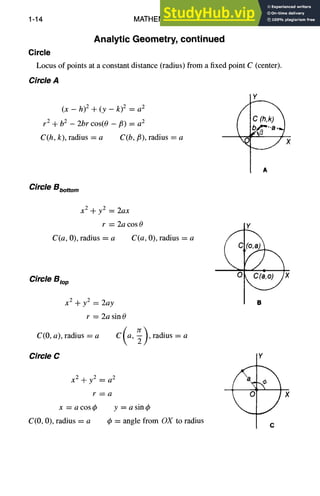
Circle
Locus of points at a constant distance (radius) from a fixed point C (center).
Circle A
(x -- h) 2 + (y - k) 2 = a 2
re + b2 - 2br cos(O -/~) = a 2
C(h, k), radius = a C(b,/3), radius = a
i
Y
Circle Bbottom
x 2 q_ y2 = 2ax
r = 2a cos 0
C(a, 0), radius = a C(a, 0), radius = a
Circle Btop
x 2 q_ y2 = 2ay
r = 2a sin 0
C(O,a),radius=a C(a, 2),radius=a
Circle C
X2 ~_ y2 = a 2
x = a cos ~b y = a sin ~b
C(0, 0), radius = a ~b = angle from OX to radius
Y
X
I B
Y
MATHEMATICS
Analytic Geometry, continued
Parabola
Conic where e = 1; latus rectum, a = LR.
Parabola A
Y
(y - k) 2 = a(x - h) Vertex (h, k), axis I] OX
y2 = ax Vertex (0, 0), axis along OX
1-15
vi
h,
x
Parabola B
(x-h) 2 =a(y-k) Vertex(h,k), axis II OY
X 2 = ay Vertex (0, 0), axis along OY ii
/
1
Distance from vertex V to focus F: ~ a
A
Y V(h,k)
Sine Wave
y = a sin(bx + c)
y = a cos(bx + c') = a sin(bx + c) (where c = c' + Jr/2)
y = m sin bx + n cos bx = a sin(bx + c)
(where a = ~m 2 + n 2, c = tan -x n/m)
Y
1-16 MATHEMATICS
Analytic Geometry,continued
Exponential or Logarithmic Curves
l) y = ab x orx = logb y ".,(2)
a
2) y = ab -x or x = - logb ya : ""
"o
3) x=abYory=tog h-
a 0
X
4) x = ab -y or y = - logb -
a
The equations y = ae ±"x and x = ae ±ny are special cases.
(1) (3)
%...._ X
I -"........ (4)
Catenary
Line of uniform weight suspended freely between two points at the same level:
y= a[cosh(X) - 1]= a(ex/a2"+e-X/a-2a)
(where y is measured from the lowest point of the line, w is the weight per unit
length of the line, Th is the horizontal component of the tension in the line, and a
is the parameter of the catenary; a = Th/W)
Helix
Curve generated by a point moving on a cylinder with the distance it transverses
parallel to the axis of the cylinder being proportional to the angle of rotation about
the axis:
x = acosO
= a sin 0
Y
......."-"..' I
z =kO
,'"...... 2~'kl
(where a = radius of cylinder, 2zrk -=--pitch) .,~ .... 2,1
MATHEMATICS 1-17
Analytic Geometry, continued
Points, Lines, and Planes
Distance between points P~(xl, Yl, Zl) and P2(x2, Y2, Z2):
d = ~/(x 2 - Xl) 2 --~ (Y2 - Yl) 2 + (z2 - Zl) 2
Direction cosine of a line (cosines of the angles t~,/3, y which the line or any
parallel line makes with the coordinate axes) is related by
cosz ot + cos2/3 + cos2 y = 1
If cosa:cos/3:cosy=a:b:c, then
a b
COS (~ ~ COS/3
~/a 2 + b 2 + c 2 ~/a 2 q- b 2 + c 2
c
COS y
~/a 2 + b 2 + c 2
Direction cosine of the line joining P1(Xl, y~, zl) and P2(x2, Y2, Z2):
COSCt : COS/3 : COSy = X2 -- Xl : Y2 -- Y~ : Z2 -- Zl
Angle 0 between two lines, whose direction angles are cq,/31, Y1 and ot2,/3z, Y2:
COS 0 = COS ffl COS Ol2 -~- COS/31 COS/32 -]- COS YI COS Y2
Equation of a plane is of the first degree in x, y, and z:
Ax + By + Cz + D = 0
where A, B, C are proportional to the direction cosines of a normal or perpendi-
cular to the plane.
Angle between two planes is the angle between their normals. Equations of a
straight line are two equations of the first degree.
Alx + Bly + ClZ + D1 = 0 A2x + B2y + C2z + D2 = 0
Equations of a straight line through the point PI (x l, Yl, z l) with direction cosines
proportional to a, b, and c:
x - Xl Y - Yl z - Zl
a b c
Differential Calculus
Derivative Relations
dy dx
Ifx = f(y), then ~- = 1 + dy
dy dy dx
If x = f(t) and y = F(t), then -- +
dx dt dt
If y = f(u) and u = F(x), then dy = dy du
dx du dx
1-18 MATHEMATICS
Differential Calculus, continued
Derivatives
Functions of x represented by u and v, constants by a, n, and e:
~(x) = 1 (a) = 0
d du dv
d du d aU = a.~adU
~(au) = ad~ ~ dx
d dv du
= +
du _ u~
d = v~
d_____(u.) = n-1 du
nu -~
d
loga u -
d
dx
d du d du
-- cos u = -sin u-- -- tan u = see 2 u
dx dx dx dx
d d 1 du
-- cot u = -csc 2 u du -- sin-1 u -- - -
dx dx dx ~/1 - - U2 dx
(where sin -l u lies between -rr/2 and +rr/2)
d 1 du
-- COS -1 U --
dx ~/]- -- u2 dx
(where cos -1 u lies between 0 and Jr)
1 du d 1 du
d tan- 1 u -- -- cot -1 u --
dx 1 +u2dx dx
_ 1 du
d sec l u-
dx uw/~-- 1 dx
(where sec -1 u lies between 0 and zr)
d 1 du
-- csc -1 U
dx uv~-- I dx
(where csc -1 u lies between -re/2 and +re/2)
d du
--e u = e u-
dx dx
d uV vuV_ 1 du v dv
= + u
d du
-- sin u = cos u --
dx dx
log a e du
u dx
1 du
udx
1 +u2dx
MATHEMATICS 1-19
Differential Calculus, continued
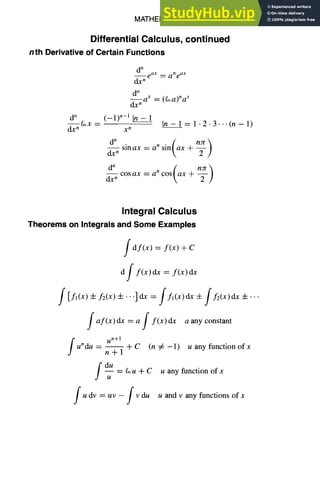
nth Derivative of Certain Functions
an
e ax ~ ane ax
dx n
an
--a x = (~a )nax
dx n
dn (--1) n-1 In - 1
--f~x =
dx n x n
In-1 =1.2.3...(n-1)
dx nsinax=a ~ sin ax ÷
dn (7)
-- COSax a n
dx n = cos ax -k-
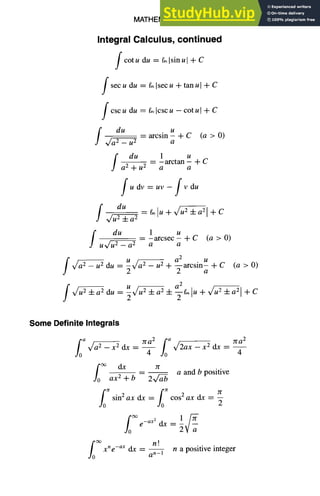
Integral Calculus
Theorems on Integrals and Some Examples
f df(x) = f(x) + C
f af(x) dx = a f f(x) dx
f /~n+l
undu -- + C (n s~ -l)
n+l
f du =fi~u+C
U
a any constant
u any function of x
u any function of x
u and v any functions of x
1-20 MATHEMATICS
Integral Calculus, continued
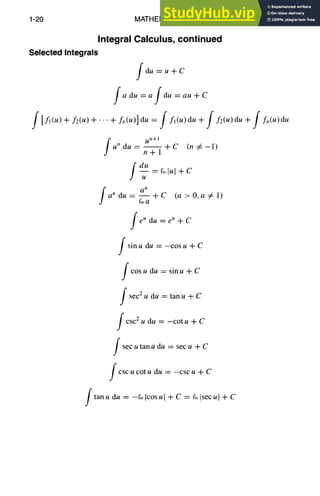
Selected Integrals
f du=u+C
f adu=af du=au+C
f un+l
u"du-- +C (n #-1)
n+l
f du ~ lul + C
U
f a"
aUdu=----~+C (a>O,a¢l)
f e"du=e"+C
f sinu du = -cosu + C
f cosu du = sinu + C
f sec u du -=--tan u + C
f cscZu du = -cotu + C
f sec u tan u du = sec u + C
f cscucotu du = -cscu + C
f tanu du = -e.lcosul + C = e. Isecul + C
MATHEMATICS 1-21
Integral Calculus, continued
f cotu du = fi~lsinu[ + C
f sec u du = ~lsec u + tan ul + C
f cscu du = ~[cscu -cotul +C
f du --arcsinU+c (a>O)
~/a 2 -- t¢2 a
f du 1 u
- - -- arctan-+C
a 2 _.[_g2 a a
fu v=. -fvd.
~/tt 2 "4-a 2
f du 1 u
u u2v/-~-Za2-
a 2 - a-arcseC-a + C (a > O)
f ~q/~ a2
~/a 2-u 2du= u 2_u 2+~_arcsin u+C (a>O)
f U 2 a2
~/g 2 -4-a 2 du = ~v/-~ 4- a 2 4- -~-~,[u q- v/~u
2 q- a21 + C
Some Definite Integrals
fo a i a 7ra2
7ra2 2~/~x -- x 2 dx ~---
~a2- x2 dx = 4 4
fo ~ dx _ n
ax2 + b 2v/.~ a and b positive
fo n" forc 7r
sin2ax dx = cos2ax dx = -~
fo e -ax2 dx =
fo ~ n!
xne-aX dx - an_l n a positive integer
1-22 MATHEMATICS
Differential Equations
Equations of First Order and First Degree: Mdx + Ndy = 0
Variables Separable
XIY] dx + X2Y2 dy = 0
X1 dx Y2 dy
Homogeneous EquaHon
f
[dv/f(v)-vl y
x = Ce and v = -
x
M -- N can be written so that x and y occur only as y -- x, if every term in M and
N have the same degree in x and y.
Linear Equation
dy + (Xly - X2)dx = 0
y=e-fx, e~(fX2efX'e'Xdx+C)
A similar solution exists for dx + (Ylx - Y2) dy = 0.
Exact Equation
Mdx + Ndy = 0 where OM/Oy = ON/Ox
O
fMx+f
for y constant when integrating with respect to x.
Nonexact Equation
Mdx + Ndy = 0 where OM/Oy # ON/Ox
Make equation exact by multiplying by an integrating factor /*(x, y)--a form
readily recognized in many cases.
MATHEMATICS 1-23
Complex Quantities
Properties of Complex Quantities
If z, Zl, z2 represent complex quantities, then
Sum or difference: Zl 4- Z2 = (Xl -{-X2) "~ j(y~ ± Y2)
Product: zl • Z2 = rlr2[cos(01 + 02) ± j sin(01 + 02)]
= rlr2 ej(O'+02) = (XlX2 -- YlY2) ± j(xlY2 Jr-x2Yl)
Quotient : zl/z2 = rl/rz[cos(01 - 02) + j sin(0~ - 02)]
• x2yl - - Xl Y2
_~ rleJ(O~_o2 ) _ XlX2 4- YlY2 + J y2
r2 + + 2
Power: z n = r n [cos nO + j sin nO] = rne jn°
0 + 2krr 0 + 2krr = ~/~ej(O+2krc/n)
Root: ~ = ~/r cos - - + j sin - -
n n
where k takes in succession the values 0, 1, 2, 3 ..... n - 1.
If zl = z2, then x~ = x2 and y~ = Y2.
Periodicity: z = r(cos 0 + j sin 0)
= r[cos(0 + 2kzr) + j sin(0 + 2kzr)]
or
Z = re j° ~ re j(O+2kzr) and e i2k~r = 1
where k is any integer.
Exponential-trigonometric relations:
e jz = cos z ± j sin z e -jz = cos z - j sin z
1 1 . _ e_jZ )
cos z = -~(e jz + e -jz) sin z = (e lz
z
Some Standard Series
Binomial Series
n(n -- 1)an_2x 2
(a + x) n = a n 4- na n - ix + - -
2!
n(n -- 1)(n -- 2)a n_3x 3 + (x 2 < a2 )
-JI- • • •
3~
The number of terms becomes infinite when n is negative or fractional.
( bx b2x2 b3x 3 )
(a - bx) -1 = i 1 ± -- + + +.-- (b2x 2 < a 2)
a a -7
1-24 MATHEMATICS
Some Standard Series, continued
Exponential Series
(X f~,~a)2 (x~a) 3
ax = l + x ~ a + - + - + . . .
2! 3!
x 2 x 3
eX=l+x+~.. +~. + "'"
Logarithmic Series
fi, X = (X -- 1) -- l(x -- 1) 2 + l(x -- 1) 3 .... (0 < X < 2)
x-1 1 (X 1) 2 1 (X I) 3 ( ~ )
+ + x +
Ix-1 1 (x-l~ 3 1 (x-l~ 5 1
Cx = 2 ~-~. ~ x + 1] + 5 x--~] +"" (x positive)
x 2 x 3 x 4
f.(1 +x) = x - T + T - -4-
+...
Trigonometric Series
X 3 X 5 X 7
sin x = x - ~.T + 5~- - 7-~ +'
X 2 X 4 X 6
cosx = 1 - -- + -- - -- +
2! 4! 6!
x3 2xS17x7 62x9 ( ~--~-4
)
tanx=x+~-+~-+ 3--i-~-+2--~-~+... x2<
lx 3 1 .3x 5 1 .3-5x 7
sin-lx=x+7~-+2~523.4 +2.4-~7 +'" (x2<l)
1 1 1
tan-l x=x--x 3+_x 5--x 7+... (x2<1)
3 ~ 7 =
MATHEMATICS 1-25
Some Standard Series, continued
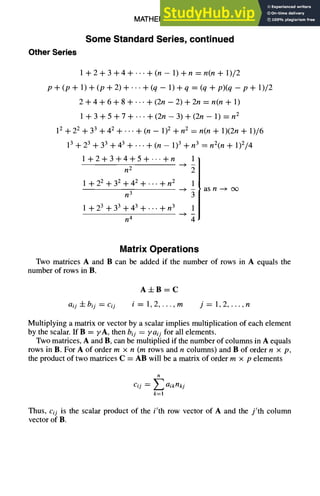
Other Series
l+2+3+4+...+(n-1)+n=n(n+1)/2
p+(p+l)+(p+2)+...+(q-1)+q=(q+p)(q-p+l)/2
2+4+6+8+..-+(2n-2)+2n =n(n+ 1)
1 +3 +5 +7 +... +(2n - 3) + (2n - 1) =n 2
12 + 2 2 + 3 3 + 4 2 + • .. + (n - 1)2 + n 2
13 + 23 + 33 + 43 + .. • + (n - 1)3 +
1+2+3+4+5+---+n
n 2
1 +2 2 + 32 +4 2 + ... +n 2
n 3
1+2 3 +3 3 +4 3+...+n 3
n 4
= n(n + 1)(2n + 1)/6
n 3 = n2(n + 1)2/4
1
2
1
- as n -+ o~
3
1
4
Matrix Operations
Two matrices A and B can be added if the number of rows in A equals the
number of rows in B.
A+B=C
aij q- bij = cij i = 1, 2 ..... m j=l,2 ..... n
Multiplying a matrix or vector by a scalar implies multiplication of each element
by the scalar. If B = yA, then bij ~ yaij for all elements.
Two matrices, A and B, can be multiplied if the number of columns in A equals
rows in B. For A of order m x n (m rows and n columns) and B of order n x p,
the product of two matrices C = AB will be a matrix of order m × p elements
n
Cij ~ Z aikrlkj
k=l
Thus, cij is the scalar product of the i'th row vector of A and the j'th column
vector of B.
1-26 MATHEMATICS
Matrix Operations, continued
In general, matrix multiplication is not commutative: AB # BA. Matrix multi-
plication is associative: A(BC) = (AB)C. The distributive law for multiplication
and addition holds as in the case of scalars.
(A + B)C = AC + BC
C(A + B) = CA + CB
For some applications, the term-by-term product of two matrices A and B of
identical order is defined as C = A • B, where cij = aijbij.
(ABC)' = C' B' A'
(ABC) H = CHBHAH
If both A and B are symmetric, then (AB)' = BA. The product of two symmetric
matrices will usually not be symmetric.
Determinants
A determinant IAI or det(A) is a scalar function of a square matrix.
IAIIBI = lAB{
IA I = all a12 =alla22--a12a21
a21 a22
IAI = IA't
a12 a13
]A] = ;;11 a22 a23 =alla22a33 +a12a23a31 +a13a21a32
O31 032 033 --a13022031 -- alla23a32 -- a12a21a33
all a12 • • • aln
fAI = a21
. . . . .
a22 '" a2n = Z (_l)~ali,a2 i ..... anin
lanl an2 • • • anm r
where the sum is over all permutations: il # i2 # '" # in, and 3 denotes the
number of exchanges necessary to bring the sequence (il, i2..... in) back into the
natural order (1, 2 ..... n).
MATHEMATICS 1-27
Curve Fitting
Polynomial Function
y = bo + blx + b2x2 Jr- • • • -[- bmxm
For a polynomial function fit by the method of least squares, obtain the values of
bo, bl ..... bm by solving the system of m + 1 normal equations.
nbo + blEXi + b2Ex2i + ... + bm~x m = ~Yi
b~]xi + blEx~ + b2Ex 3 +"" + bmExm+l = ~]xiYi
boEx m + bl]~Xm+l ~- b2~x m+2 +... q- bm~x 2m ~_ ~x?y i
Straight Line
y --- bo --I-blX
For a straight line fit by the method of least squares, obtain the values b0 and bl
by solving the normal equations.
nbo + bl EXi = Eyi
bo~xi q-bl~x 2 = ]~xiYi
Solutions for these normal equations:
n~xiYi - - (]~Xi)(~yi) ~Yi ~Xi
bl = nEx2i _ (]~xi)2 b0 -- n bl--n = ~ - blX
Exponential Curve
y =ab x or logy----loga+(logb)x
For an exponential curve fit by the method of least squares, obtain the values log a
and log b by fitting a straight line to the set of ordered pairs {(xi, log Yi)}.
Power Function
y = ax b or logy=loga+blogx
For a power function fit by the method of least squares, obtain the values log a and
b by fitting a straight line to the set or ordered pairs {(log xi, log Yi)}.
1-28 MATHEMATICS
Small-Term Approximations
This section lists some first approximations derived by neglecting all powers
but the first of the small positive or negative quantity, x = s. The expression in
brackets gives the next term beyond that used, and, by means of it, the accuracy
of the approximation can be estimated.
1
-- 1 -- S ["~S 2]
l+s
I n(n-1)s 2]
(l+s) n= l+ns -t 2
eS,+s
(1 +sl)(1 -'1-$2) = (1 +Sl -l-s2) [q-SIS2]
The following expressions may be approximated by 1 + s, where s is a small
positive or negative quantity and n any number:
es 2 - e-s cos
(7
1+ l+fi~
--S
S
(/1 +ns 1 + n sin-
n
¢
+ns,2ns12
MATHEMATICS 1-29
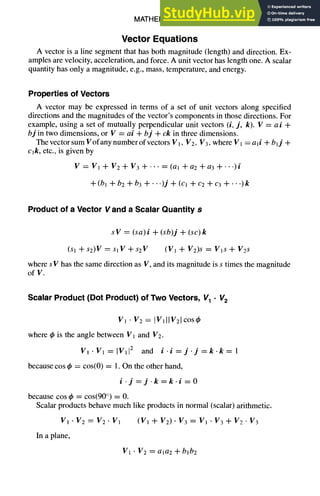
Vector Equations
A vector is a line segment that has both magnitude (length) and direction. Ex-
amples are velocity, acceleration, and force. A unit vector has length one. A scalar
quantity has only a magnitude, e.g., mass, temperature, and energy.
Properties of Vectors
A vector may be expressed in terms of a set of unit vectors along specified
directions and the magnitudes of the vector's components in those directions. For
example, using a set of mutually perpendicular unit vectors (i, j, k). V = a i +
bj in two dimensions, or V = ai + bj + ck in three dimensions.
The vector sum Vofany number of vectors V l, V2, g3, where V 1= a li + blj +
cjk, etc., is given by
V = V1 + V2 + V3 + .... (al + a2 + a3 + ---)i
+(bl +b2+b3+'")j+(cl +c2+c3+'")k
Product of a Vector Vand a Scalar Quantity s
s V -- (sa) i + (sb)j + (sc) k
(S1 ql_s2)V = s1 g + s2V (g 1 + V2)s = Vis + V2s
where s V has the same direction as V, and its magnitude is s times the magnitude
of V.
Scalar Product (Dot Product) of Two Vectors, V1 • V2
V1 • V2 = IVlllV21cos4)
where q~is the angle between V1 and V2.
V1.Vl=lVll 2 and i.i=j.j=k.k=l
because cos q~ = cos(0) = 1. On the other hand,
i.j=j.k=k.i =O
because cos ~b = cos(90 °) = 0.
Scalar products behave much like products in normal (scalar) arithmetic.
V1 • V2 = V2 - V1 (Vl + V2). V3 = VI • V3 + V2 • V3
In a plane,
Vl . V2 = ala2 + bib2
1-30 MATHEMATICS
Vector Equations, continued
In space,
V1 " V2 -m-ala2 + blb2 + c1c2
An example of the scalar product of two vectors V1 • V2 is the work done by
a constant force of magnitude IV1]acting through a distance IV21,where q~is the
angle between the line of force and the direction of motion.
Vector Product (Cross Product) of Two Vectors, V1 x V2
IV 1 N V21 = [VlllV21sinq~
where ~bis the angle between V1 and V2.
Among unit vectors, the significance of the order of vector multiplication can
be seen.
ixj=k jxk=i
but reversing the order changes the sign, so that
and
Also
and always
kxi =j
j ×i=-k, etc.
V 1 X V2 = --V2 >( Vi
ixi=j×j=kxk=O
V1 x V1 = 0
because sin ~b= sin(0) = 0.
An example of a vector product is the moment M0 about a point 0 of a force
Fe applied at point P, where re/o is the position vector of the point of force
application with respect to 0.
Mo = rp/o X Fp
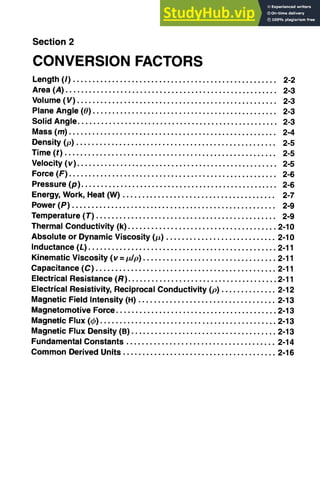
Section 2
CONVERSION FACTORS
Length (I) .................................................... 2-2
Area (A) ...................................................... 2-3
Volume (V) ................................................... 2-3
Plane Angle (8) ............................................... 2-3
Solid Angle ................................................... 2-3
Mass (m) ..................................................... 2-4
Density (p) ................................................... 2-5
Time (t) ...................................................... 2-5
Velocity (v) ................................................... 2-5
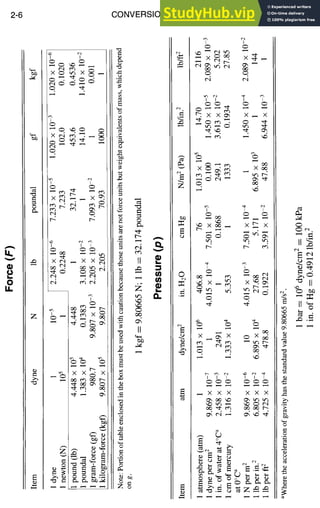
Force (F) ..................................................... 2-6
Pressure (p) .................................................. 2-6
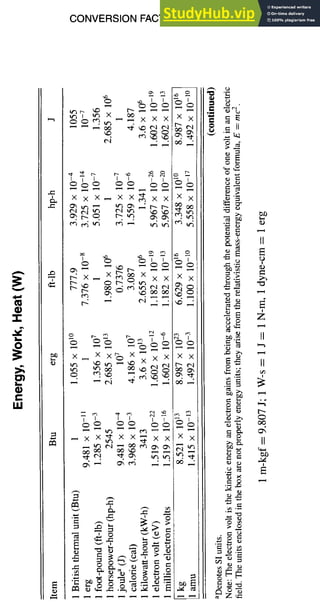
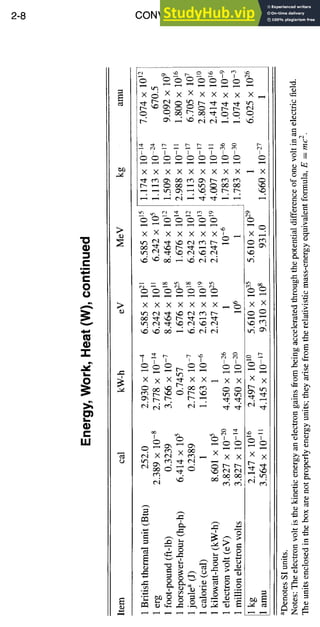
Energy, Work, Heat (W) ....................................... 2-7
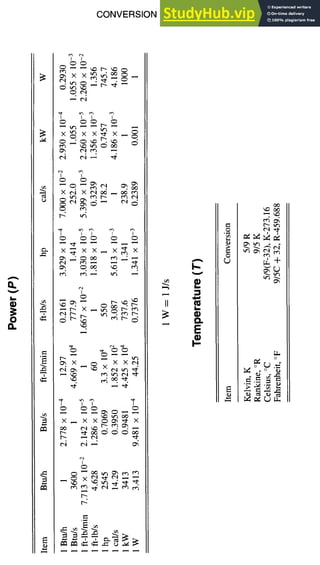
Power (P) .................................................... 2-9
Temperature (T) .............................................. 2-9
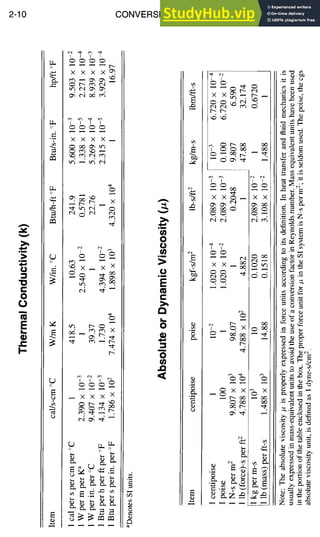
Thermal Conductivity (k) ...................................... 2-10
Absolute or Dynamic Viscosity (/~) ............................ 2-10
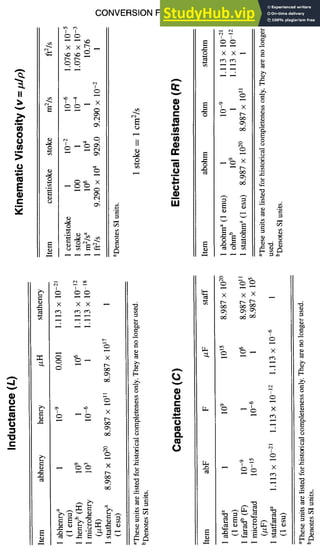
Inductance (L) ................................................ 2-11
Kinematic Viscosity (v = i~/p) .................................. 2-11
Capacitance (C) .............................................. 2-11
Electrical Resistance (R) ...................................... 2-11
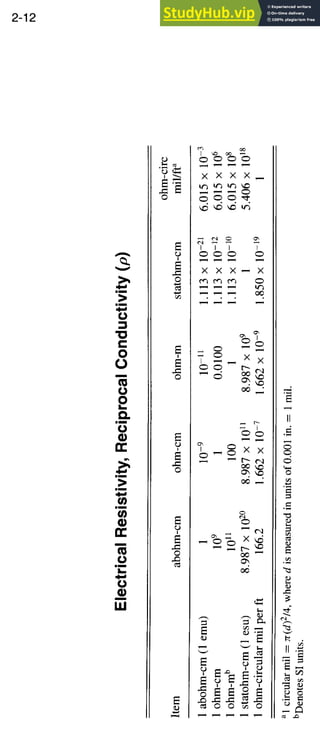
Electrical Resistivity, Reciprocal Conductivity (p) .............. 2-12
Magnetic Field Intensity (H) ................................... 2-13
Magnetomotive Force ......................................... 2-13
Magnetic Flux (~) ............................................. 2-13
Magnetic Flux Density (B) ..................................... 2-13
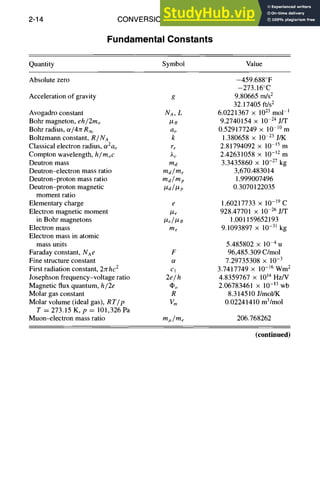
Fundamental Constants ...................................... 2-14
Common Derived Units ....................................... 2-16
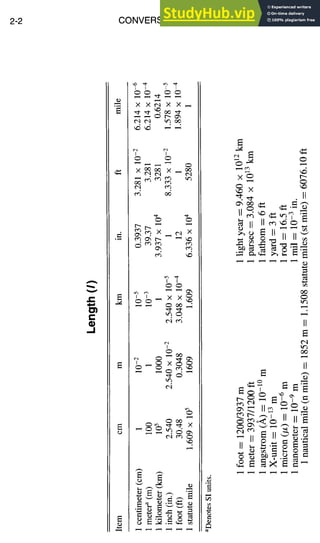
2-2 CONVERSION FACTORS
e-
e"
,.1
£
X X~ X X~
0
x~x_~
~ m
m ~
~x x
'.5
?'t
~_xx~
?
%
8 ~ x
o
X ~
X
~ o4 ~o ~. ~ .,-
t¢'3
II
t"-I
II
.= llm
~, o< __.
CONVERSION FACTORS
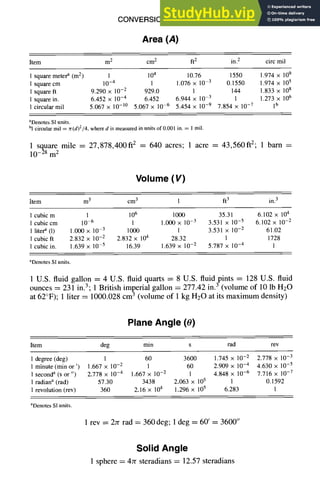
Area (A)
2-3
Item m 2 cm 2 ft2 in. 2 circ mil
1 square meter a (m 2) 1 104 10.76 1550 1.974 × 10⁹
1 square cm 10 -4 1 1.076 × 10 -3 0.1550 1.974 × 10⁵
1 square ft 9.290 × 10⁻² 929.0 1 144 1.833 × 10⁸
1 square in. 6.452 × 10⁻⁴ 6.452 6.944 × 10 3 1 1.273 x 10⁶
1 circular mil 5.067 × 10-l° 5.067 × 10 6 5.454 × 10⁻⁹ 7.854 × 10 -7 1b
aDenotes SI units.
bl circular mil = rr(d)2/4, where d is measured in units of 0.001 in. = 1 mil.
1 square mile = 27,878,400ft 2 ---- 640 acres; 1 acre = 43,560ftz; 1 barn =
10 -28 m 2
Volume (V)
Item m 3 cm 3 1 ft3 in. 3
1 cubic m 1 106 1000 35.31 6.102 × 10⁴
1 cubic cm 10 6 1 1.000 × 10 -3 3.531 × 10 -5 6.102 × 10⁻²
1 litera (1) 1.000 × 10 -3 1000 1 3.531 × 10⁻² 61.02
1 cubic ft 2.832 × 10 -2 2.832 × 10⁴ 28.32 1 1728
1 cubic in. 1.639 x 10 5 16.39 1.639 × 10⁻² 5.787 x 10⁻⁴ 1
aDenotes SI units.
1 U.S. fluid gallon = 4 U.S. fluid quarts = 8 U.S. fluid pints = 128 U.S. fluid
ounces = 231 in.3; 1 British imperial gallon = 277.42 in. 3 (volume of 10 lb H20
at 62°F); 1 liter = 1000.028 cm 3 (volume of 1 kg H20 at its maximum density)
Plane Angle (0)
Item deg min s rad rev
1 degree (deg) 1 60 3600 1.745 x 10 -2 2.778 x 10 -3
1 minute(minor') 1.667 × 10⁻² 1 60 2.909 × 10⁻⁴ 4.630 × 10⁻⁵
1 second a (s or") 2.778 × 10⁻⁴ 1.667 × 10⁻² 1 4.848 × 10⁻⁶ 7.716 × 10⁻⁷
1 radian a (rad) 57.30 3438 2.063 × 10⁵ 1 0.1592
1 revolution (rev) 360 2.16 × 10⁴ 1.296 × 10⁵ 6.283 1
aDenotes SI units.
1 rev = 2re rad = 360 deg; I deg = 60' = 3600"
Solid Angle
1 sphere = 47r steradians = 12.57 steradians
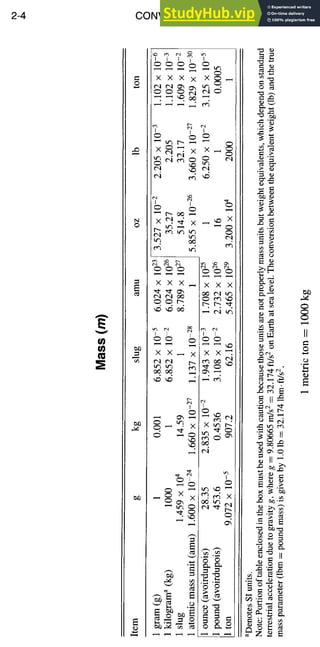
2-4 CONVERSION FACTORS
X X X x
(".1 ~
r-i r4
x ~
M x
d ~
X X X ~
??
X X~ x
,d,d ,.:
I
~ -~
~ ~'~
r4
x ~
X
un ~ ~
c.i e.i ~
X X X
~ t~ t¢3
,-,.~ (-,I tr3
X X~
q
X ~"~ t".-
~.eqX
"r= ~,
II ~
~O
0
H
$
(.#
CONVERSION FACTORS
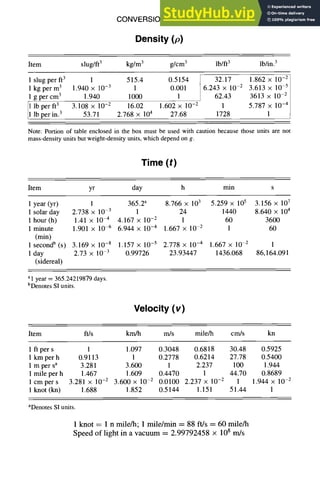
Density (p)
2-5
Item slug/ft3 kg/m 3 g/cm 3 lb/ft3 lb/in. 3
1 slug per ft3 1 515.4 0.5154
1 kg per m 3 1.940 x 10⁻³ 1 0.001
1 g per cm 3 1.940 1000 1
lbper ft3 3.108 x 10⁻² 16.02 1.602 x 10⁻²
lb per in.3 53.71 2.768 x 10⁴ 27.68
32.17 1.862 x 10⁻²i
6.243× 10⁻² 3.613 x 10 5
62.43 3613 x 10 2
1 5.787 X 10 -4
1728 1
Note: Portion of table enclosed in the box must be used with caution because those units are not
mass-density units but weight-density units, which depend on g.
Time (t)
Item yr day h min s
1 year (yr) 1 365.2 a
1 solar day 2.738 x 10 3 1
1 hour(h) 1.41 x 10 4 4.167 X 10 -2
1 minute 1.901 x 10 6 6.944 × 10 -4
(min)
1 secondb (s) 3.169 × 10⁻⁸ 1.157 x 10⁻⁵
1 day 2.73 x 10 3 0.99726
(sidereal)
8.766 x 10³ 5.259 x t05 3.156 x 10⁷
24 1440 8.640 × 10⁴
1 60 3600
1.667 × 10 2 I 60
2.778 × 10 -4 1.667 x 10 2 1
23.93447 1436.068 86,164.091
al year = 365.24219879 days.
bDenotes SI units.
Velocity (v)
Item ft/s km/h m/s mile/h cm/s kn
1 ft per s 1 1.097 0.3048 0.6818 30.48 0.5925
1 km per h 0.9113 1 0.2778 0.6214 27.78 0.5400
1 m per sa 3.281 3.600 1 2.237 100 1.944
1 mile per h 1.467 1.609 0.4470 1 44.70 0.8689
1 cm per s 3.281 × 10 -2 3.600 × 10 2 0.0100 2.237 x 10⁻² 1 1.944 x 10⁻²
1 knot (kn) 1.688 1.852 0.5144 1.151 51.44 1
aDenotes SI units.
1 knot -- 1 n mile/h; 1 mile/min = 88 ft/s = 60 mile/h
Speed of light in a vacuum = 2.99792458 x 10⁸ m/s
2-6 CONVERSION FACTORS
fi °
~ ~ X ~
i
X t
~ ~ X Xcq
?
~ ~-~
& -I~ m x
- ,~o~
oo
t~
_%ix x d x
>-, 0 0 ~."=1
z
E
-a
•
~ ~-~
e~ L.
.~ ,~ ~-
.= o';
g
e~
2
e~
©
o
.=.
Z
(a
o
3:
._=
? ?
x ~ x~_
~×~_~
%
×~_ - x~
. ,d
7 ?
~-~_~ × .~
oo
x ~,x o_x~
~ X X X XXX
•
~... ~z-~-~
.-a
o
~a
8
CONVERSION FACTORS 2-7
@
LU
¢)
~ - - ~ x X X
X X X~ X X~ X X
r-: x_ x ~ o,,,_' x x
X X
~ L
5~
X X
X X
,o ,...:
e4 ~o rm em
x_ x x% Xx x x x x
,-- ,_;
~ x X ~ I ' X X~e~X X
~ ,_~
X X
@
H
'-- [4
4
o
2=..
o
g'r.
~E
~=
0
.~ JD
H
E
?
II
II
oO
II
2-8 CONVERSION FACTORS
!.__
w
>
~ X X X X X X X X~
I I I I I I I I I I
X X X X X X X X X ~ X
X X X X X X X ~
X X X~ X X~ X X
MMd N~ ~
~ x,~ x~_ x x x
0 0 ~.~.~
x,..~
X X
x x
X X
o
~n
o
.o~
CONVERSION FACTORS 2-9
0
?
~x
-r
r4
xt-.i
"I
e~ x
e.,
t'¢3
~ ("4
~ ×
t"-
t"-
?
X X~ X~
?
x~_~
~xx_x~x
?
× ~××~
~?
_ x x ~ x
?
0
E~
II
1=
>.
o
I,,,,,
¢.
E
~+
o
2-10 CONVERSION FACTORS
ca
c
o
ca
m
E
Ii
I-
o
o
rT~
o
LD
o
X X X X
e--
X X X X ~
,4
~ x _ x x
m~
~.x
----o'; .~-
??
~ X X X x
m ~ Q
o
.~_
0
I I
,i
C
~3
0
I
0
.0
~7
~. x ~
I I
~ 0 0
X X ~ X X
0 0
xx ~ -
0 o,0 ~
f~ = "~" '~ ~--I
-= .~ ff-
~'aE
'= ~Z
~'~=
•~ 01=
z ~..=~
II
,~_
0
0
E
Q)
v
O
£
CONVERSION FACTORS
??
O 0
X X ~
?
O
0 0 ~ X
0",
0
X
0
.-~ r~
o
0
II
A
m
o
, D
c4
..~
0 X X~
orion
E ~_x
0
E ~
0
,.~ "" r',,,-
•-~ o
o
o
E
o
2-11
e-
e"
m
b
©
X X X
0
0
oo
0",
0
O 0 X
oo
o~
i
=
o
0
o
A
0
0
&
×
o6
~T~
X X
o6o6
l
0
I
O
I I
'-~ 0 0 X
O
×
,-; [.,
O
8
.=
.=~
.~=
2-12 CONVERSION FACTORS
A
o
I=
0
0
m
0
L_
i m
, m
, m
iii
o
o
o
E
e-
©
?
E
©
E
X X X X ~
~S S
X X X-~ X
32_Xx
oo
-,5 ~• ~
~,_.:
O
o,, = c4
o6
E_=
,-4
II
..=
E
II ._
CONVERSIONFACTORS
Magnetic Field Intensity (H)
2-13
Item abamp-turn/cm amp-turn/cm amp-turn/m amp-turn/in, oersted
1 abamp- 1 10 1000 25.40 12.57
turn per cm
1 amp-turn 0.100 1 100 2.54 1.257
per cm
1 amp-turn 10-3 10-2 1 2.540 x |0 2 1.257 x 10⁻²
per m a
1 amp-turn 3.937 x 10⁻² 0.3937 39.37 1 0.4947
per in.
1 oersted 7.958 x 10⁻² 0.7958 79.58 2.021 1
aDenotes SI units.
1 oersted = 1 gilbert/cm; 1 esu = 2.655 x 10 -9 amp-turn/m; 1 praoersted = 4zr
amp-turn/m
Magnetomotive Force Magnetic Flux (~)
Item abamp-turn amp-turn gilbert
1 abamp-turn 1 10 12.57
1 amp-turna 0.100 1 1.257
1 gilbert 7.958 x 10⁻² 0.7958 1
aDenotes SI units.
1 pragilbert = 4re amp-turn
1 esu = 2.655 x 10 TM amp-turn
Item maxwell kiloline wb
1 maxwell 1 0.001 10 8
(1 line or
1 emu)
1 kiloline 1000 1 10-5
1 webera (wb) 108 105 1
aDenotes SI units.
1 esu = 2.998 wb
Magnetic Flux Density (B)
Item gauss kiloline/in. 2 wb/m 2 milligauss gamma
1 gauss (line per cm 2) 1 6.452 x 10⁻³ 10-4 1000 105
1 kiloline per in.2 155.0 1 1.550 x 10⁻² 1.550 x 10⁵ 1.550 x 10⁷
1 wb per m 2a (T) 104 64.52 1b 107 109
1 milligauss 10-3 6.452 × 10⁻⁶ 10-7 1 100
1 gamma 10-5 6.452 × 10⁻⁸ 10-9 10-2 1
aDenotes SI units.
b1 wb/m2 = 1 tesla (T).
1 esu = 2.998 x 10⁶ wb/m 2
2-14 CONVERSION FACTORS
Fundamental Constants
Quantity Symbol Value
Absolute zero
Acceleration of gravity g
Avogadro constant N A, L
Bohr magneton, eh /2mo tXB
Bohr radius, ot/47r R~ ao
Boltzmann constant, R / N A k
Classical electron radius, ol2ao re
Compton wavelength, h / moC ~.,,
Deutron mass md
Deutron-electron mass ratio md/me
Deutron-proton mass ratio md/mp
Deutron-proton magnetic #d/#r
moment ratio
Elementary charge e
Electron magnetic moment /xe
in Bohr magnetons #e/#B
Electron mass m e
Electron mass in atomic
mass units
Faraday constant, Nae F
Fine structure constant
First radiation constant, 27rhc 2 Cl
Josephson frequency-voltage ratio 2e/h
Magnetic flux quantum, h/2e Oo
Molar gas constant R
Molar volume (ideal gas), RT/p Vm
T = 273.15 K, p = 101,326 Pa
Muon-electron mass ratio m u ~me
-459.688°F
-273.16°C
9.80665m/s 2
32.17405fds 2
6.0221367 × 10²³mol J
9.2740154 × 10 24 J/T
0.529177249 × 10 l°m
1.380658 × 10 23 J/K
2.81794092 x 10 JSm
2.42631058 × 10-~2m
3.3435860 × 10⁻²⁷ kg
3,670.483014
1.999007496
0.3070122035
1.60217733 × 10⁻¹⁹ C
928.47701 x 10 26 J/T
1.001159652193
9.1093897 x 10⁻³¹ kg
5.485802 x 10 4 u
96,485.309C/mol
7.29735308 x 10⁻³
3.7417749 x 10⁻¹⁶Wm2
4.8359767 x 10¹⁴ Hz/V
2.06783461 x 10⁻¹³ wb
8.314510 J/mol/K
0.02241410m3/mol
206.768262
(continued)
CONVERSIONFACTORS
Fundamental Constants, continued
2-15
Quantity Symbol Value
Muon magnetic moment anomaly, au
[lzJ(eh/2mu)]- 1
Muon magnetic moment /zu
Muon mass mu
Muon-proton magnetic moment ratio I~u/Izp
Nuclear magneton, eh/2m p IJ~u
Neutron-electron mass ratio m,/me
Neutron magnetic moment #,
in nuclear magnetrons Iz./IZN
Neutron mass mn
Neutron-proton mass ratio mn/mp
Neutron-proton magnetic #~/tXp
moment ratio
Newtonian constant of G
gravitation
Permeability of vacuum
Permittivity of vacuum, 1/IZoC2
Planck constant
Planck constant, molar
Proton-electron mass ratio
Proton magnetic moment
in Bohr magnetons
in nuclear magnetons
Proton mass
Quantized Hall resistance, h/e 2
Rydberg constant, moCa2/2h
Second radiation constant, hc/k
Speed of light in vacuum
Stefan-Boltzmann constant
Thompson cross section, (8zr/3)ro
2
So
h
Nab
NAhC
mp/me
#p
#pll*B
I*p/l*u
mp
Rh
R~
C2
C
(7
ao
0.0011659230
4.4904514 × 10⁻²⁶ J/I"
1.8835327 x 10⁻²⁸ kg
3.18334547
5.0507866 x 10⁻²⁷ J/T
1,838.683662
0.96623707 x 10⁻²⁶ J/T
1.91304275
1.6749286 x 10⁻²⁷ kg
1.001378404
0.68497934
6.67259 x 10-it m3 kg-l s 2
12.566370614 x 10 -7 NA 2
8.854187817 x 10⁻¹² F/m
6.6260755 x 10 -34 J-s
3.99031323 x 10⁻¹° J-s/mol
0.11962658 Jm/mol
1,836.152701
1.410607 x 10⁻²⁶ J/T
1.521032202
2.792847386
1.6726231 x 10 -27 kg
25,812.8056 f2
10,973,731.534 M -1
0.01438769 mK
299,792,458 m/s
5.67051 x 10⁻⁸ W/m2K4
0.66524616 x 10 28 m2
2-16 CONVERSION FACTORS
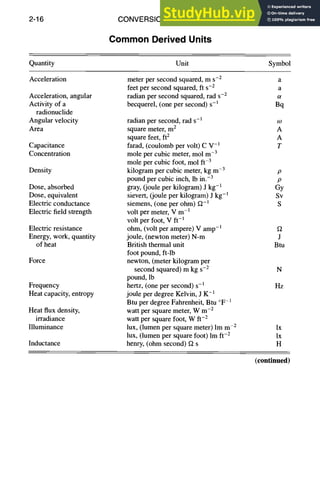
Common Derived Units
Quantity Unit Symbol
Acceleration
Acceleration, angular
Activity of a
radionuclide
Angular velocity
Area
Capacitance
Concentration
Density
Dose, absorbed
Dose, equivalent
Electric conductance
Electric field strength
Electric resistance
Energy, work, quantity
of heat
Force
Frequency
Heat capacity, entropy
Heat flux density,
irradiance
Illuminance
Inductance
meter per second squared, m s-2
feet per second squared, ft s-2
radian per second squared, rad s-2
becquerel, (one per second) s-l
radian per second, rad S-l
square meter, m2
square feet, ft2
farad, (coulomb per volt) C V -1
mole per cubic meter, mol m-3
mole per cubic foot, mol ft-3
kilogram per cubic meter, kg m-3
pound per cubic inch, lb in.-3
gray, (joule per kilogram) J kg -1
sievert, (joule per kilogram) J kg-1
siemens, (one per ohm) f2-1
volt per meter, V m- l
volt per foot, V ft-1
ohm, (volt per ampere) V amp-1
joule, (newton meter) N-m
British thermal unit
foot pound, ft-lb
newton, (meter kilogram per
second squared) m kg s-2
pound, lb
hertz, (one per second) s-1
joule per degree Kelvin, J K-l
Btu per degree Fahrenheit, Btu °F-I
watt per square meter, W m -2
watt per square foot, W ft-z
lux, (lumen per square meter) lm m 2
lux, (lumen per square foot) lm ft-z
henry, (ohm second) f2 s
a
a
Bq
O)
A
A
T
P
P
Gy
Sv
S
f2
J
Btu
N
Hz
Ix
lx
H
(continued)
CONVERSION FACTORS
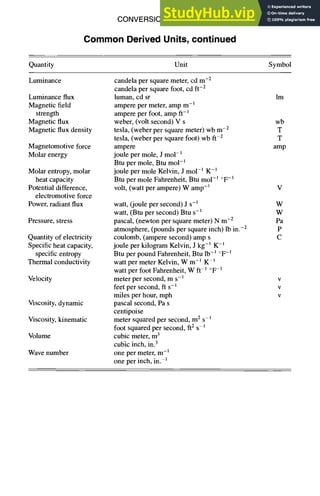
Common Derived Units, continued
2-17
Quantity Unit Symbol
Luminance
Luminance flux
Magnetic field
strength
Magnetic flux
Magnetic flux density
Magnetomotive force
Molar energy
Molar entropy, molar
heat capacity
Potential difference,
electromotive force
Power, radiant flux
Pressure, stress
Quantity of electricity
Specific heat capacity,
specific entropy
Thermal conductivity
Velocity
Viscosity, dynamic
Viscosity, kinematic
Volume
Wave number
candela per square meter, cd m -2
candela per square foot, cd ft -2
luman, cd sr lm
ampere per meter, amp m -1
ampere per foot, amp ft-1
weber, (volt second) V s wb
tesla, (weber per square meter) wb m -2 T
tesla, (weber per square foot) wb ft-2 T
ampere amp
joule per mole, J mol -~
Btu per mole, Btu mo1-1
joule per mole Kelvin, J mo1-1 K -1
Btu per mole Fahrenheit, Btu mo1-1 °F-1
volt, (watt per ampere) W amp -1 V
watt, (joule per second) J s-1 W
watt, (Btu per second) Btu s-1 W
pascal, (newton per square meter) N m -2 Pa
atmosphere, (pounds per square inch) lb in. -2 P
coulomb, (ampere second) amp s C
joule per kilogram Kelvin, J kg -1 K -1
Btu per pound Fahrenheit, Btu lb-1 °F-1
watt per meter Kelvin, W m -1 K 1
watt per foot Fahrenheit, W ft-1 °F 1
meter per second, m s-1 v
feet per second, ft s-1 v
miles per hour, mph v
pascal second, Pa s
centipoise
meter squared per second, m 2 S-1
foot squared per second, ft2 s 1
cubic meter, m 3
cubic inch, in)
one per meter, m -1
one per inch, in. 1
Section 3
MATERIALS AND SPECIFICATIONS
Metallic Materials ............................................. 3-2
Weights of Liquids ............................................ 3-4
Weights of Gases ............................................. 3-4
Composite vs Metal Alloy ..................................... 3-5
Composite Material Behavior .................................. 3-7
Galvanic Series ............................................... 3-13
3-2 MATERIALS AND SPECIFICATIONS
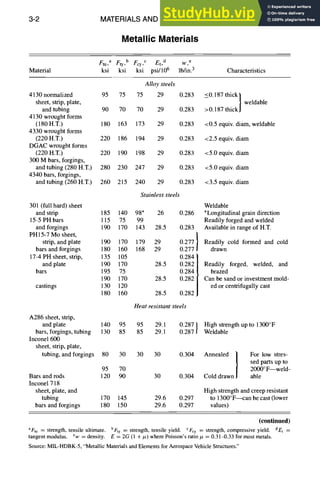
Metallic Materials
Ftu,a Fty,b Fcy,c Et, d w, e
Material ksi ksi ksi psi/106 lb/in.3 Characteristics
Alloy steels
4130 normalized 95 75 75 29 0.283
sheet, strip, plate,
and tubing 90 70 70 29 0.283
4130 wrought forms
(180 H.T.) 180 163 173 29 0.283
4330 wrought forms
(220 H.T.) 220 186 194 29 0.283
DGAC wrought forms
(220 H.T.) 220 190 198 29 0.283
300 M bars, forgings,
and tubing (280 H.T.) 280 230 247 29 0.283
4340 bars, forgings,
and tubing (260H.T.) 260 215 240 29 0.283
Stainless steels
301 (full hard) sheet
and strip 185 140 98* 26 0.286
15-5 PH bars 115 75 99
and forgings 190 170 143 28.5 0.283
PHI5-7 Mo sheet,
strip, and plate 190 170 179 29 0.277
bars and forgings 180 160 168 29 0.277
17-4 PH sheet, strip, 135 105 0.284
and plate 190 170 28.5 0.282
bars 195 75 0.284
190 170 28.5 0.282
castings t30 120
180 160 28.5 0.282
Heat resistant steels
A286 sheet, strip,
and plate 140 95 95 29.1 0.287 |
bars, forgings, tubing 130 85 85 29.1 0.287 !
Incone1600
sheet, strip, plate,
tubing, and forgings 80 30 30 30 0.304
95 70
Bars and rods 120 90 30 0.304
Inconel 718
sheet, plate, and
tubing 170 145 29.6 0.297
bars and forgings 180 150 29.6 0.297
_<0.187 thick / weldable
>0.187 thick/
<0.5 equiv, diam, weldable
<2.5 equiv, diam
<5.0 equiv, diam
<5.0 equiv, diam
<3.5 equiv, diam
Weldable
*Longitudinal grain direction
Readily forged and welded
Available in range of H.T.
Readily cold formed and cold
drawn
Readily forged, welded, and
brazed
Can be sand or investment mold-
ed or centrifugally cast
High strength up to 1300°F
Weldable
Annealed | For low stres-
I
sed parts up to
2000°F--weld -
Cold drawn / able
High strength and creep resistant
to 1300°F---can be cast (lower
values)
(continued)
aFtu = strength, tensile ultimate, bFty = strength, tensile yield. CFcy = strength, compressive yield, dEt =
tangent modulus, ew = density. E = 2G (1 +/z) where Poisson's ratio # = 0.31~).33 for most metals.
Source: MIL-HDBK-5, "Metallic Materials and Elements for AerospaceVehicleStructures?'
MATERIALS AND SPECIFICATIONS
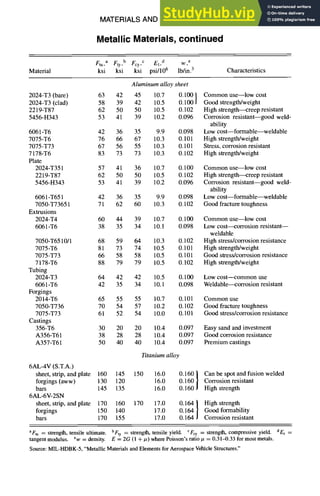
Metallic Materials, continued
3-3
Ftu,a Fty,b Fcy,c Et, d w,e
Material ksi ksi ksi psi/106 lb/in.3 Characteristics
Aluminum alloy sheet
2024-T3 (bare) 63 42 45 10.7 0.100 / Common use--low cost
2024-T3 (clad) 58 39 42 10.5 0.100/ Good strength/weight
2219-T87 62 50 50 10.5 0.102 High strength--creep resistant
5456-H343 53 41 39 10.2 0.096 Corrosion resistant--good weld-
ability
6061-T6 42 36 35 9.9 0.098 Low cost--formable--weldable
7075-T6 76 66 67 10.3 0.101 High strength/weight
7075-T73 67 56 55 10.3 0.101 Stress, corrosion resistant
7178-T6 83 73 73 10.3 0.102 High strength/weight
Plate
2024-T351 57 41 36 10.7 0.100 Common use--low cost
2219-T87 62 50 50 10.5 0.102 High strength---creep resistant
5456-H343 53 41 39 10.2 0.096 Corrosion resistant--good weld-
ability
6061-T651 42 36 35 9.9 0.098 Low cost--formable--weldable
7050-T73651 71 62 60 10.3 0.102 Good fracture toughness
Extrusions
2024-T4 60 44 39 10.7 0.100 Common use--low cost
6061-T6 38 35 34 10.I 0.098 Low cost---corrosion resistant--
weldable
7050-T6510/1 68 59 64 10.3 0.102 High stress/corrosion resistance
7075-T6 81 73 74 10.5 0.101 High strength/weight
7075-T73 66 58 58 10.5 0.101 Good stress/corrosion resistance
7178-T6 88 79 79 10.5 0.102 High strength/weight
Tubing
2024-T3 64 42 42 10.5 0.100 Low cost---common use
6061-T6 42 35 34 10.1 0.098 Weldable--corrosion resistant
Forgings
2014-T6 65 55 55 10.7 0.101 Common use
7050-T736 70 54 57 10.2 0.102 Good fracture toughness
7075-T73 61 52 54 10.0 0.101 Good stress/corrosion resistance
Castings
356-T6 30 20 20 10.4 0.097 Easy sand and investment
A356-T61 38 28 28 10.4 0.097 Good corrosion resistance
A357-T61 50 40 40 10.4 0.097 Premium castings
Titanium alloy
6AL-4V (S.T.A.)
sheet, strip, and plate 160 145 150 16.0 0.160 | Can be spot and fusion welded
forgings (aww) 130 120 16.0 0.160 1 Corrosion resistant
bars 145 135 16.0 0.160 High strength
6AL-6V-2SN
sheet, strip, and plate 170 160 170 17.0 0.164 | High strength
forgings 150 140 17.0 0.164 I Good formability
bars 170 155 17.0 0.164 Corrosion resistant
aFtu = strength, tensile ultimate, bFty = strength, tensile yield. CFcy = strength, compressive yield, dE t =
tangent modulus, ew = density. E = 2G (1 +/z) where Poisson's ratio/z = 0.314).33 for most metals.
Source: MIL-HDBK-5, "Metallic Materials and Elements for Aerospace VehicleStructures"
3-4 MATERIALS AND SPECIFICATIONS
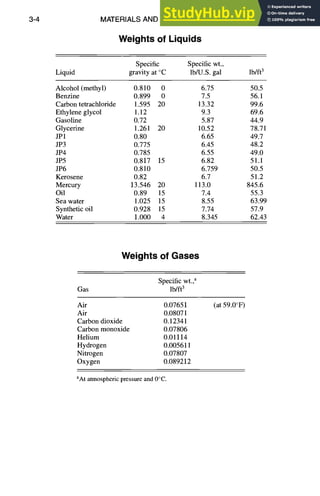
Weights of Liquids
Specific Specific wt.,
Liquid gravity at °C lb/U.S, gal lb/ft3
Alcohol (methyl) 0.810 0 6.75 50.5
Benzine 0.899 0 7.5 56.1
Carbon tetrachloride 1.595 20 13.32 99.6
Ethylene glycol 1.12 9.3 69.6
Gasoline 0.72 5.87 44,9
Glycerine 1.261 20 10.52 78.71
JP1 0.80 6.65 49.7
JP3 0.775 6.45 48.2
JP4 0.785 6.55 49.0
JP5 0.817 15 6.82 51.1
JP6 0.810 6.759 50.5
Kerosene 0.82 6.7 51.2
Mercury 13.546 20 113.0 845.6
Oil 0.89 15 7.4 55.3
Sea water 1.025 15 8.55 63.99
Synthetic oil 0.928 15 7.74 57.9
Water 1.000 4 8.345 62.43
Weights of Gases
Specific wt.,a
Gas lb/ft3
Air 0.07651
Air 0.08071
Carbon dioxide 0.12341
Carbon monoxide 0.07806
Helium 0.01114
Hydrogen 0.005611
Nitrogen 0.07807
Oxygen 0.089212
(at 59.0°F)
aAt atmospheric pressure and 0°C.
MATERIALS AND SPECIFICATIONS 3-5
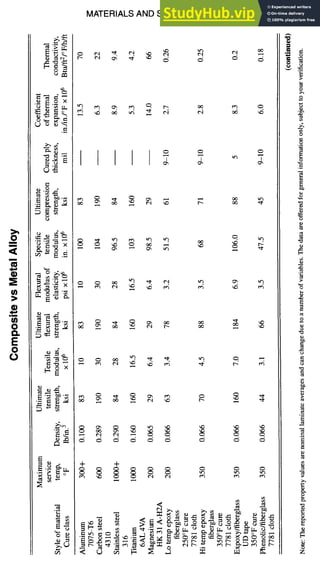
m
m
i m
O
O.
I=
O
t~
~O
O
•r"
"'G
O
,_.;
O
O
+ -I-
o
[,..
E
==
Z
3-6 MATERIALS AND SPECIFICATIONS
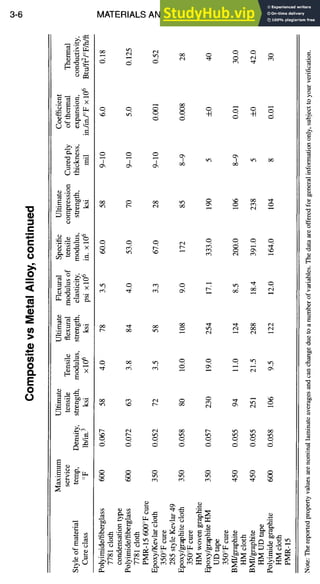
, m
r-
0
0
m
m
m
, i
0
E
0
0
%
~,..=
o
~ ~..~
•~ ~
~ M
N~ s
r.~
O O O O~
Cq
~. 0£. t,q. o. o. o. ~
o. o. o. o. o. o. o. o.
O O
O
$
o=
's
o
&
==
£
o.
z
MATERIALS AND SPECIFICATIONS 3-7
Composite Material Behavior
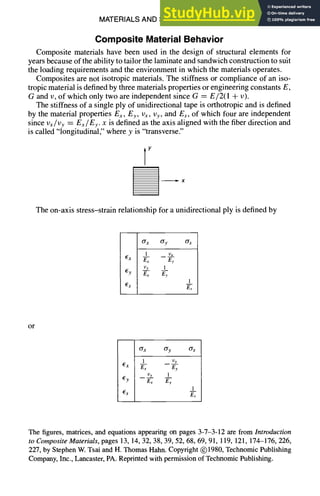
Composite materials have been used in the design of structural elements for
years because of the ability to tailor the laminate and sandwich construction to suit
the loading requirements and the environment in which the materials operates.
Composites are not isotropic materials. The stiffness or compliance of an iso-
tropic material is defined by three materials properties or engineering constants E,
G and v, of which only two are independent since G = E/2(1 + v).
The stiffness of a single ply of unidirectional tape is orthotropic and is defined
by the material properties Ex, Ey, Vx, I)y, and Es, of which four are independent
since Vx/Vy = Ex/Ey. x is defined as the axis aligned with the fiber direction and
is called "longitudinal," where y is "transverse."
Y
The on-axis stress-strain relationship for a unidirectional ply is defined by
O"x O'y O"s
l i)x
Ex Ex Ey
Vy 1
Ey Ex Ey
1
Es E"-~
or
ax ay as
| I)y
~X E~ Ey
Vy 1
Ey Ex E-'~
1
Es E"~
The figures, matrices, and equations appearing on pages 3-7-3-12 are from Introduction
to Composite Materials, pages 13, 14, 32, 38, 39, 52, 68, 69, 91,119, 121,174-176, 226,
227, by Stephen W. Tsai and H. Thomas Hahn. Copyright (~)1980,Technomic Publishing
Company, Inc., Lancaster, PA. Reprinted with permission of Technomic Publishing.
3-8 MATERIALS AND SPECIFICATIONS
Composite Material Behavior, continued
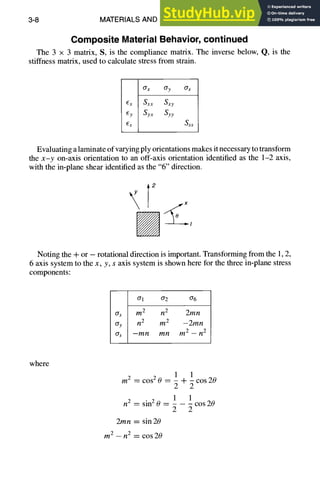
The 3 x 3 matrix, S, is the compliance matrix. The inverse below, Q, is the
stiffness matrix, used to calculate stress from strain.
Crx Cry
(:x Sxx Sxy
~.y Syx Syy
6s Sss
Evaluating a laminate of varying ply orientations makes it necessary to transform
the x-y on-axis orientation to an off-axis orientation identified as the 1-2 axis,
with the in-plane shear identified as the "6" direction.
T
2
x
Noting the + or - rotational direction is important. Transforming from the 1, 2,
6 axis system to the x, y, s axis system is shown here for the three in-plane stress
components:
Crl or2 or6
ax m 2 n 2 2mn
(Yy n 2 m 2 -- 2mn
crs --mn mn m 2 -- n 2
where
1 1
mz = cos 2 0 = ~ ~- ~ cos 20
1 1
n 2 = sin2 0 -- cos 20
2 2
2mn = sin 20
m 2 -- n2 = cos20
MATERIALS AND SPECIFICATIONS
Composite Material Behavior, continued
Similarly, for strain transformations,
3-9
61 f2 E6
f x m2 n2 mn
~y n 2 m 2 -mn
Es -2mn 2mn m 2 - n 2
The off-axis in-plane stress-strain relationship is defined by Qij (i, j = 1, 2, 6).
(a) OiJ • (b)
Off-Axis Off-Axis
Strain Strain
El ~2 if6
0"1 Qll Q12 QI6
o2 Q21 Q22 Q26
06 Q61 Q62 Q66
The transformation of on-axis unidirectional properties to off-axis is given by
Qxx Qyy axy Qs,
Q1] m4 n4 2m2n2 4m2n2
Q22 n4 m4 2m2n2 4m2n2
Q12 m2n2 m 2n2 m 4 + n4 -4m2n 2
Q66 m2n2 mZn2 -2m2n2 (m2 - n2)2
Q16 m3n -mn3 mn 3 - m 3n 2(mn3 - m3n)
Q26 mn3 -m3n m 3n - mn 3 2(m3n - mn 3)
m=cos0, n=sin0
3-10 MATERIALS AND SPECIFICATIONS
Composite Material Behavior, continued
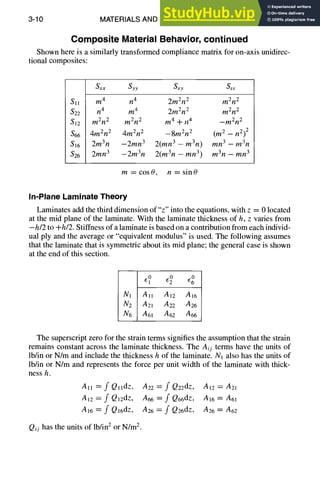
Shown here is a similarly transformed compliance matrix for on-axis unidirec-
tional composites:
Sxx Syy Sxy ass
Sll m4 n4 2m2n 2 m2rt 2
$22 n4 m4 2m2n 2 m2n 2
S12 m2n 2 m2n 2 m 4 -t- n 4 -m2n 2
$66 4m2n 2 4m2n 2 --8m2n 2 (m2 -- n2)2
$16 2m3n -2mn 3 2(mn 3 - m3n) mn 3 - m3n
826 2mn 3 -2m3n 2(m3n - mn 3) m3n - mn 3
m=cos0, n=sin0
In-Plane Laminate Theory
Laminates add the third dimension of"z" into the equations, with z = 0 located
at the mid plane of the laminate. With the laminate thickness of h, z varies from
-h/2 to +h/2. Stiffness of a laminate is based on a contribution from each individ-
ual ply and the average or "equivalent modulus" is used. The following assumes
that the laminate that is symmetric about its mid plane; the general case is shown
at the end of this section.
to to to
N1 All A12 A16
Nz A21 A22 A26
N6 A61 A62 A66
The superscript zero for the strain terms signifies the assumption that the strain
remains constant across the laminate thickness. The Aij terms have the units of
lb/in or N/m and include the thickness h of the laminate. N1 also has the units of
lb/in or N/m and represents the force per unit width of the laminate with thick-
ness h.
All = f QlldZ, A22 = f Qz2dz, A12 = a21
a12 = f Q12dz, A66 = f Q66dz, A16 = A61
A16 ----f Q16dz, A26 = f Q26dz, A26 = A62
Qij has the units of lb/in2 or N/m 2.
MATERIALS AND SPECIFICATIONS 3-11
Composite Material Behavior, continued
Flexural Behavior
For flexural behavior, the moment--curvature relationship is the counterpart of
the stress-strain relationship for in-plane behavior. Simplifying for a symmetric
laminate and assuming a linear strain distribution across the thickness of the lam-
inate,
El(z)=zkl
E2(Z)=zk2
66(z)=zk6
where k is curvature with units of in-l or m -1 .
kl k2 k6
M1 DI! D12 DI6
M2 D21 D22 D26
M6 D61 D62 D66
Dll = f QllZ2dz, D22 = f Q22z2dz, D12 = A21
D12 = f Ql2z2dz, D66 = f Q66z2dz, D16 = A61
D16 = f Qi6z2dz, D26 = f Q26z2dz, D26 = A62
General Laminates
For general laminates, coupling exists between flexure and in-plane loading;
this is seen by the addition of Bij terms:
GI
0 G0 G0 kl k2 k6
N1 Al~ Ai2 AI6
N2 A21 A22 A26
N6 A61 A62 A66
M1 Bll B12 B16
M2 B2~ B22 B26
M6 B61 B62 B66
] Bll B12 B16
I Bzl B22 B26
B61 B62 B66
I DIl DI2 D16
I
I D21 D22 D26
[ D6t D62 D66
i
N1 N2 N6 M1 Me M6
GI
0 0/11 0ll2 0/16
G20 0/21 ~22 0/26
G° 0/61 0/62 0/66
kl J~ll ~21 ~61
k2 ~12 ~22 ~62
k6 ~16 J~26 ~66
[ 3. 312 ~16
] ~61 ~62 fl66
t
[ 811 812 816
] 821 822 826
! 861 862 866
3-12 MATERIALS AND SPECIFICATIONS
Composite Material Behavior, continued
For the symmetric anisotropic laminates, no coupling exists.
~:10 G0 ~) k] k2 k6
NI All AI2 A16 [
N2 A21 A22 A26 [
N 6 A61 At~2 A66 1
I
I
MI [ Dll D12 O16
M2 I D21 D22 D26
M6 [ D61 D62 D66
i
Ni N2 N6 Mt 342 /1//6
¢ 0-,, 0-,2 0-,6 [
I
E2
° O'21 0-22 0-26 1
~:60 0-61 0-62 0-66 I
I
I-
I
kl ~ dll dl2 d16
I
k2 I d21 d22 d26
k6 [ d6t 6/62 d66
For a homogeneous anisotropic laminate, the flexure components are directly
related to the in- plane components.
~10 (20 ~r
0 k 1 k2 k6
Ni All Ai2 AI6 ]
N2 A21 A22 A26 l
N 6 A6t A62 A66 I
i
!
M~ ]
I
M2 [
M6 I
I
h2
Aij
Ni N2 N6 Mt M2 M6
E10 0-11 O"12 (716 [
I
E20 O"21 0"22 0-26 I
~:60 0-61 0"02 0-66 ]
I
kl I
i
k2 I
,,
k6 I
12
~- 0-i
j
Or, in matrix notation,
N = Ae ° + Bk
M = Be ° + Dk
MATERIALS AND SPECIFICATIONS
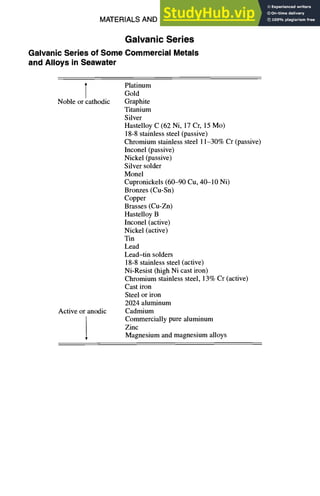
Galvanic Series
Galvanic Series of Some Commercial Metals
and Alloys in Seawater
T
Noble or cathodic
Active or anodic
Platinum
Gold
Graphite
Titanium
Silver
Hastelloy C (62 Ni, 17 Cr, 15 Mo)
18-8 stainless steel (passive)
Chromium stainless steel 11-30% Cr (passive)
Inconel (passive)
Nickel (passive)
Silver solder
Monel
Cupronickels (60-90 Cu, 40-10 Ni)
Bronzes (Cu-Sn)
Copper
Brasses (Cu-Zn)
Hastelloy B
Inconel (active)
Nickel (active)
Tin
Lead
Lead-tin solders
18-8 stainless steel (active)
Ni-Resist (high Ni cast iron)
Chromium stainless steel, 13% Cr (active)
Cast iron
Steel or iron
2024 aluminum
Cadmium
Commercially pure aluminum
Zinc
Magnesium and magnesium alloys
3-13
Section 4
SECTION PROPERTIES
Plane Areas .................................................. 4-2
Solids ........................................................ 4-17
Shells ........................................................ 4-27
The information appearing in this section is from WeightEngineersHandbook, 1976 Revi-
sion. Copyright © 1976, the Society of Allied Weight Engineers, La Mesa, CA. Reproduced
with permission of the Society of Allied Weight Engineers.
4-2 SECTION PROPERTIES
t~
C
II 11 II II
II II -F +
II II II II
II II + +
II II II II
II ~ 11
<
II II II II II II
II I1
+ +
It II II II
-F -F
II II It II II
II o I~ I}
< r.j
o
C
.m
c
o
o
<
c
SECTION PROPERTIES
II if II II
II II II
II II II
II II
II [I II II
, , r i
-*
, ~ , , + + +
~l--- ~:1~ ~ ~, ~
II II II If II II
]1 II
L
I
II I1
i ~ I ,,,,~ ,,.,.~
II II II II II II
I
II .~ II
I
II ..~ li II
4-3
4-4 SECTION PROPERTIES
.m
0
Im
ii
i
II II II II II
I
C
l -I-
+ +
II II II II II
o E E 4-
c
I
I +
+ +
~ ~ ~ ~ ~I~ ~I~
II II II li II
I~I~I ~
II If II
Q) r~
"~
-- II II
il
~ ~ I~ l~
x ~ x x ~
Z
©
+ +~' ?~
+ 4-
~ ' ~
II II II II il
•~ +
• ~*~ ~_
It II II II II II
~ ~ ~1~
tt II
x
!
SECTION PROPERTIES 4-5
,m
,id
0
m
e-
G.
"6
II II
,Z
II
II 11 II
II II
~ ~ o
~m
iiiiiiiiii
%%
~g
d o
ii ii ii ii ii
II II II II
II
4-6 SECTION PROPERTIES
lu
O
÷
i
II II II II II
~+ ~_
÷~ ÷~
H
÷
~ ÷ +
II II II II
+~
~÷
~ ÷ 4-
II II II II x II II
~+ ~ ~+~ ~<+
,~+
II II
II II
II II
rj
SECTION PROPERTIES 4-7
O
. i
o
C
4-
¢5 c5 o o c5
II II II II II
+~
4-
4- 4- 4-
II II II II II
4-
4- ~ 4-
~- % 4- 4-
-" ~1
 ~1"- ~l
~
II II II II II
p
II II
d
II II II
II I1_
II II II
ii ii
II II II
4-8 SECTION PROPERTIES
c
.i
0
t~
c
i
H
ii Li II
li il ~ oo
ii II li
II bl o-,
II II II
oo
.;,6
C~
r j
-i,
~ic4 (-q
li II II
I II
II II II
I
II II
I II
SECTION PROPERTIES 4-9
C
@
t~
C
H ~5 ~5 II II If
,::5 ~5 ,~ ,-; ,~ ,~
If li II It I II
li il II II li II
I I I I I l l l l l l l
• II
x
II II fl If II
II II II II II II
I
,I ,.1 ~l ~" ~
~ ~ + +
II II I fi II II
-t-
r,j
4-10 SECTION PROPERTIES
,m
e.
o
o
w
c-
II II II II II
#7 m ~7 m
II II II II II
~ ~ ~+
~ ~ I
II II II II II
x
<
II II II II II
+ +
~I~ ~i~ ~I~ ~I~ ~
II II II II II
L I I I ~I
~ ~ ~ +
II II + II II + II
SECTION PROPERTIES 4-11
C
0
e-
II II II II II II II II II II II
r ~ g ~ g ~
[I ~1 II II II II
_
II II II II
II II
x x
.~ _L
II
I
I
% i
II
_J +
II II II II
I
II II II +
4-12 SECTION PROPERTIES
"0
e"
, m
t-
O
L_
c-
a.
II II
I
~+ ~'~' ~,
~1~ ~1~ ~1~
II II II
-t-
' } +
2~ ~ + +
II II II II II
+ ~
N~
"~ i "N I
r + N
II II II II
"~
- II II
,9o
II II II
I
+
II II
, ~ +
+ .,~ ~ +
II x II II II II
I " J "
, ~ +
II x II x II x
SECTION PROPERTIES 4-13
l-
, m
i-
0
o
L-
c
n
II II II
i
"1~_ ~~
I ~ ~ ~ "~'
II x II II x II II
i !
II x II II x
P
x x
•.~v- o... 1.. -:
I I I I I I I I I I
~ ~ +
II II II II II
~ ~ +
d ~ d d ~
II II II II II
II II
4-14 SECTION PROPERTIES
c
mn
c-
o
o
a.
II II II II II II
II II II II II II
~ ~ + +
II II II II II II
~E~E~E
~I~ ~ II II
II II
+
~ +
II II II II II II
+CO
II × l l l l l l l l
C
I
C
e~
<
SECTION PROPERTIES 4-15
c-
o
o
m
o
L--
e-
II II II II II II It
It II IL
II II IL
II il II
II II II
x
d d o o d
II II II II I; II
~1~ ~
II II II II II ii
+
II II II fl II
II II
X
4-16 SECTION PROPERTIES
.m
O
t~
m
Ir II II II ~1 II
II II II II II II
~- ~ +
4-
4- L) 4-
4- 4- 4-
II II II II II II
< rj
x
o ~
SECTION PROPERTIES 4-17
"0
.m
m
0
t~
.= II c"
II II
II ]1 II
H
H
H
II II II
+ + -t-
II II II
II
II II
Jl ~= , ii ii
x
II
%
II
II
II
4-18 SECTION PROPERTIES
,m
c-
O
0
, m
0
i
,,D
II II II
II II II
~t~ ~.~
II
c;
II II II
II II II
II o II
'-6
SECTION PROPERTIES 4-19
C
I i
C
O
i
O
"e,
,C',I •
II II II
4- 4-
il II II
~5
rl ,~ ii
II II II
~=1 ~
+ +
4- ,~.
II II
II II II
II 9= li ..
u
4-20 SECTION PROPERTIES
=m
.i.i
c
o
o
0
Z
:.=
II II II
+
II II II II II
+ +
+
~i-
~ ~1~ ~l~
II It H
+ + + +
II II II II II
-. ~ ~ 1 ~
II ~ II
"o
QD
SECTION PROPERTIES 4-21
C
0
t~
0
E
"E
o
II II II
+ ~ ~'~
II II II II
u
II II
-t-
i i
II II
qq ~ iJ
.==
.,,,.,
0
4-22 SECTION PROPERTIES
C
, i
O
i
O
.=.
~3
If II II
4- + 4- 4- 4-
il II II II II
~: "~ ~ ~1, ~
II II tl
4- 4-
II II II
x
SECTION PROPERTIES 4-23
"0
C
C
@
,i
i
o
o
~: ~ ~ •
II fI II ~I
+ + ~-~
+
~I~ ~I~
II II II II
.~ ~I ~
oo
L
II
+ +
i m l i i ~"
i i t
,, , i~
- ~
II -F II II
+ + +
~i ~ , ,
x x
4-24 SECTION PROPERTIES
,m
C
0
m
o
I
¢,q
II
..4'
4-
c*q I ~"
I
ll
4-
I
|1
x
,~ ,.= >-
| |
~,~.~,~ =1 ~ ~, ~
SECTION PROPERTIES 4-25
C
.m
c-
O
O
0
ID
o
II II II II II
+ + +
~l-= ~ ~1-
= ~l~ ~
II II II II II
II ~ II
II II
+
~=1~"
II II
-F
x-
+
+
~ ~l ~
-
+ ,.~
II II
+
© ×
4-26 SECTION PROPERTIES
c-
O
0
0
~r
II <" ~ '-"
o o
I i i
~ E E
~ g
+ It II II It II
II
z
II II II II E
+ .~+
li .~ II
=
~ ~ ~ ~ ~I ~ ,, ~ ~,
II II II II I o ~ ~" ~
O
X
X
I
" n " ~ i
SECTION PROPERTIES 4-27
t~
m
n
,:5
II II
II II II II
II
÷ ~1
-F
~ ÷
~1 ~ .= ~
II × II x II
~ == -~==I,~ ! ÷
r,j
r j
I I~ ~
~ F '  ~
4-28 SECTION PROPERTIES
e"
, m
i-
0
m
w
e-
E
0
+ + +
% ~% ~+
+ ++ 2~
, %%
II II II

+-F + + + ÷
_L + + + +
-F + + + + ÷
II II il H IL li
+-~
~+~+
SECTION PROPERTIES 4-29
O
t~
I
m
's
's
E
4-~
ii II
If II fl
r'4
4-
I I
4-
t"-
II II
4- 4-
eq
II II II
"4' ~.~
4-
+
~ J~-
II 4- II
,,.4~
=
"c
4- 4-
+ ~ ~1~
rj
~ i ~ N x ~,
4-30 SECTION PROPERTIES
's
0
0
m
m
e-
oo
c; ~ II
II /I II
li II II
% %
C4 i r~, ~ C'4 I r~
ii ~ ii
II II II
II II II
~ ,4 ~
rj
N
SECTION PROPERTIES 4-31
I:::
,u
o
+
g--
~:. ~'~ , ,
+
~ ,
n II II
~ +
I
~ ..~-~
oo~17.~ ,, ,,
rm r..)
7
I
I +
-t- +
+ ~
r~
II II II
, i i
~1~ ~1~
+
+ ~ ~
i i I
-I- ~ ,'i:g "~
II II ~ ~ ~ ,~ =
x
 / ~-
Section 5
STRUCTURAL DESIGN
Beam Formulas .............................................. 5-2
Torsion FormulasmSolid and Tubular Sections ................ 5-10
Torsion FormulasmThin-Walled Open Sections ................ 5-12
Position of Flexural Center O for Different Sections ............ 5-14
Buckling and Stress .......................................... 5-17
Columns ..................................................... 5-24
Plates ........................................................ 5-33
Rivet Strengths ............................................... 5-37
Bolt and Screw Strengths ..................................... 5-38
Vibration ..................................................... 5-40
Characteristics of Harmonic Motion ........................... 5-40
Forced Vibration .............................................. 5-41
Beam Natural Frequency ...................................... 5-43
Plate Natural Frequency ...................................... 5-46
5-2 STRUCTURAL DESIGN
Beam Formulas
Bending moment, vertical shear, and deflection of beams of uniform cross
section under various conditions of loading
Nomenclature
E
I =
k =
1 =
M =
mx =
P =
R1, R2
V =
V, =
W =
W =
X
y =
modulus of elasticity, lb/in. 2 (N/m2 = Pa)
area moment of inertia, in.4 (m4)
location of load, fraction of length l
length of beam, in. (m)
maximum bending moment, lb-in. (N-m)
bending moment at any section, lb-in. (N-m)
concentrated loads, lb (N)
reactions, lb (N)
maximum vertical shear, lb (N)
vertical shear at any section, lb (N)
uniformly distributed load per unit length, lb/in. (N/m)
total load on beam, lb (N)
distance from support to any section, in. (m)
maximum deflection, in. (m)
Simple BeammUniformly Distributed Load
W=wl
i ,L
~ - - - k
wl I I
iShear~l wl
,diagram I~ - ~-
/
Moment diagram
wl
R1 = R2 = --
2
wl
Wx -- wx
2
-~- when x
wlx WX 2
mx--
2 2
W12 (when x = ~)
M= 8
5Wl 3
y -- (at center of span)
384 EI
The beam formulas appearing on pages 5-2-5-10 are from Handbook of Engineering Fun-
damentals, 3rd Edition, pages 518-520, by O. W. Eshbach and M. Souders. Copyright @
1976, John Wiley & Sons, Inc., New York. Reprinted by permission of John R. Eshbach.
STRUCTURAL DESIGN
Beam Formulas, continued
Simple BeammConcentrated Load at Any Point
5-3
P
y
IP-X~ I I
L
p--- I ~ ~
I I I
J•x
I ~21 i~o, ,
,diagram '
I !
,' ~'~,~ M ----
Moment diagram y --
y =
RI = P(1 -- k)
R2 = Pk
Vx =R] (whenx <kl)
= -R 2 (when x > kl)
Px(1-k) (whenx <kl)
Pk(1-x) (whenx >kl)
Pkl(1 - k) (at point of load)
3~(1 - k) k -- k2 (when k > 0.5)
3--~k (when k < 0.5)
atx=l(1-/~ -~) (whenk<0.5)
Simple Beam--Concentrated Load at Center
~-- --ll--
I I
p
-- p
2 -~
Shear diagram
I ~,-I---~
,
Moment diagram
P
RI ~ R2 ~ --
2
P
V~= V=+--
2
Mx-- 2
Mx--P(l-x)--2 (whenx>~)
m -- ~ when x =
pl 3
y -- (at center of span)
48EI
5-4 STRUCTURAL DESIGN
Beam Formulas, continued
Simple BeammTwo Equal Concentrated Loads at Equal
Distances from Supports
P P
• n I i •
I. ~ X ~ ~ I
i I
Shear diagram
,'<h. ,~,_
Moment duagram
R1 =R2=P
Vx = P forAC
----0 forCD
= -P for DB
V=+P
Mx = Px for AC
= Pd for CD
= P(l-x) forDB
M=Pd
Pd
y -- (3/2 - 4d 2)
24EI
(at center of span)
pd 2
y = 6-~(3/- 4a)
(at points C and D)
Simple BeammLoad Increasing Linearly from Supports
to Center of Span
• " 4h
b. X -'b I q
I
t
i~[ -r I~
wr. ~
2 P
W
Shear daagram
'l ~ 1-6--
Momentdiagram
W
RI --~R2------
2
V=-4 -W (at supports)
2
1 2x 2
Mx=Wx ~ ~-~}
Wl
M = -- (at center of span)
6
W13
y -- (at center of span)
60El
STRUCTURALDESIGN 5-5
Beam Formulas, continued
Cantilever Beam--Load Concentrated at Free End
, R=P
~ o--X
I
I . V~ =V=-P
I I
- P I i- P Mx = --P(I -- x)
P (
' I M = -PI
Shear diagram
I
I Pl 3
I
I i Y
3El
~ - PI
Moment diagram
(when x = O)
Simple Beam--Load Increasing Linearly from Center to Supports
r-,./1
tx_ : :
wi,,, ,
' ,
- - i
2 Shear~ - W
diagram ' 2
~ T T W I
• ' ~ T'ff
Momen! diagram
W
RI = R2 = --
2
~5 ~) (whenx< ~)
W
V=±--
2
Mx = Wx - 7 + 3-ff,] when x <
Wl
M = -- (at center of span)
12
3W13
y -- (at center of span)
320 E1
5-6 STRUCTURALDESIGN
Beam Formulas, continued
Cantilever BeammUniformly Distributed Load
[ w =wlx_
~ R=W=wl
; ~ Vx = -w(1 - x)
l, I '
' ~ V=-wl (whenx=O)
i
' l--x
'-~'~-..~ - wl Mx = -w(1 - x ) - -
,Shear 2
,,diagram II
, I Wl 2
, I M -- (when x = O)
2
.,,3
Momentdiagram Y -- 8El
Simple BeammLoad Increasing Linearly from One
Support to the Other
i--q
p""- X "'* I
W 2
RI = -- R2 = -W
3 3
1 x 2)
v =w 7-7r
I ,~ 2
I
', , , V =--W (whenx=l)
W 1........~, , 3
3 ,Shear;~ I 2
, diagram"~ - 3
W , Mx= ~-(1- x~)
; ;f2w,
Moment diagram M = WI when x =
0.01304
y----Wl 3 (whenx=0.51931)
E1
STRUCTURAL DESIGN
Beam Formulas, continued
Cantilever Beam--Load Increasing Linearly from
Free End to Support
5-7
R=W
Vx = -W
(l X) 2
12
i
p I I
, V=-W (whenx=0)
i I
i i
' ~ - W W(l-x) 3
I g x ~ - - -
Shear diagram 3 12
' ' WI
' ' WI M -- (when x = 0)
3
W13
Moment diagram y =
15EI
Fixed BeamEConcentrated Load at Center of Span
P
i I i
? IT- d
I
~! ' p
, I--5
Shear diagram
I I pi I
I
I !
Pl
M-g
Momenl diagram
P
RI = R2 = --
2
P
Vx=V=±--
2
Pl
Mx--
8
P1
M = +-'-~-
pl 3
y -- _ _
192EI
(whenx )
(at center of span)
5-8 STRUCTURALDESIGN
Beam Formulas, continued
Fixed Beam--Uniformly Distributed Load
wl W
RI = R2--
2 2
w1
d W=wl_~ Vx-- 2
x V =±-- (at ends)
,- I ~ 2
'
wJ , wl 2 X X 2
2 [ ' Mx- -
,Shear~l_ wl 2 7 +
idlagram ",, -~-
, w,.__22', M=__lw,2 (whenX=~)
~24 ' 12 x
wl2 ~ ~_' wl2
-q-/g
M -- ~- when x =
W13
y - _ _
384EI
Momentdiagram
Simple BeammUniformly Distributed Load over Part of Beam
wb(2c + b)
R 1 --
2l
wb(2a + b)
R2--
w tb/ft 21
A B.[C" c D wb(2c+b) w(x-a)
~a ]:~- --, V~ -- 21
' ' V=R1 (whena <c)
. 4 I '1
R, [--~i I I = R 2 (when a > c)
i wbx(2c + b)
] - R~ Mx = forAB
IR,~+al i 21
,'w ' "~ - - .Lj M w ( x -- a ) 2
/ ~,_ ~ = RlX 2 forBC
= R2(1 - x) for CD
wb(2c + b)[4al + b(2c + b)]
M=
8/2
STRUCTURAL DESIGN 5-9
Beam Formulas, continued
Beam Supported at One End, Fixed at Other--Concentrated
Load at Any Point
pb2(21 + a)
p Rl--
2l 3
,~a31F---b -"~ R2----P -- RI
a
L,.-'/~-x
L. Vx = R~ (when x < a)
I
;"--5- -- -'--~
' =R2 (whenx >a)
I "
[
~ I-R2 Ms-- Pb2x(2l + a) (whenx <a)
R~
, , , 2/3
I t
', /%-'--- 'W = Rlx- P(x-a) (whenx >a)
~ ~ I--;~_pOS Pab2(2l + a) (when x = a)
NM neg Mpositive
--
2l 3
Pab(l + a)
Mnegative -- 2l2 (when x = 1)
Fixed Beam--Concentrated Load at Any Point
I I
R,I I _'
I
t ' I
I
- I- pos
F ' Ii~ ._A~
neg
al bl
3a * b 3b + a
pb2(1 + 2a)
RI--
l3
pa2(l + 2b)
R2--
13
Vx = R1 (whenx <a)
-- R 2 (when x > a)
V2 = Rz V1 = R1
Pab 2
Mx = Rlx - - - (whenx <a)
12
pa2b
= R2(l -x) 12 (when x > a)
2Pa2b2
Mpositive -- 13
Pab 2
Mnegativel -- 12
pa2b
Mnegativ% -- 12
2Pa3b2
y=
3EI(3a + b) 2
2al
when x 1~-2a /
5-10 STRUCTURAL DESIGN
Beam Formulas, continued
Beam Supported at One End, Fixed at Other--Uniformly
Distributed Load
3wl
R1--
8
5wl
R2--
8
W = wl ~ 3wl
l [~ vx= 8 -wx
I,.-X~
3wl
I-- --~ V = (at left support)
3wl L i 8
8 5wl 5wl
: !-....J
3i - ~ 8 (at right support)
I
- ,I_~8 M~ : -
}'-"--31--'-~r~ [-w__
12 9wl 2
4 8 Mp°sitive- 128
wl 2
mnegative ~- 8
0.0054w/4
y -- (at 0.4215/ from Rl)
E1
is
Fsu =
G =
J
l =
T =
T. =
0 =
Torsion FormulasmSolid and Tubular Sections
shear stress, lb/in. 2 (N/m2) (formulas for fs apply for stress not exceeding
the shear yield strength)
ultimate shear strength, lb/in. 2 (N/m2)
shear modulus of elasticity, lb/in. 2 (N/m2)
O~ TI
GJ
torsion constant,* in.4 (m4)
length of section along torsion axis, in. (m)
torque, in.-lb (N-m)
approximate ultimate torque, in.-lb (N-m)
angular deflection
*The torsion constant J is a measure of the stiffness of a member in pure twisting.
STRUCTURAL DESIGN 5-11
Torsion Formulas--Solid and Tubular Sections, continued
2T
Maximum fs = zrR3 at boundary
2reR 3Fsu
Tu= 3
7rR 4
J--
2R~T
Maximum fs -- zr (RI4 -- R2
4) at boundary
2zr(R3-R3)Fs.
T.=
3
Y( 4
J = ~(R1- R4)
Thin-walled sections should be checked for buckling.
4.8T
~- a --~ Maximum fs = a3 at midpoints of sides
a3Fsu
1 T.--
a 3
j = 0.141a 4
(continued)
Note: Formulas for Cs are not given in this table because, for these cross sections, Cs is negligibly
small in comparison to J.
5-12 STRUCTURAL DESIGN
Torsion FormulasmSolid and Tubular Sections, continued
--t ' t--
Maximum f~ = ~ + 0.6 at midpoints of long sides
(approximately 3T/bt 2 for narrow rectangles)
bt2Fs,( t)
T,= 2 - 1-~-~
[
bt3 1 - 0.63 [- + 0.052
J=5- b
(approximately bt3/3 for narrow rectangles)
1
lt2
!
For sides with thickness tl, average fs - -
For sides with thickness t2, average fs --
2tlbd
T
2t2bd
Tu = 2bdtminFsu
(train = tl or t2, whichever is smaller)
2bZd2
J--
Thin-walled sections should be checked for buckling.
Note: Formulas for Cs are notgiven in this table because for these cross sections. Cs is negligiblysmall
in comparison to J.
Torsion FormulasmThin-Walled Open Sections
A = total area of section, in.2 (m 2)
AF -----area of one flange, in.2 (m 2)
C, = torsion-bending constant,* in.6 (m6)
It = moment of inertia of flange number 1 about Y axis, in.4 (m4)
12 = moment of inertia of flange number 2 about Y axis, in.4 (m4)
Iv = moment of inertia of section about Y axis, in.4 (m4)
J = torsion constant,* in.4 (m4)
*The torsion constant J is a measure of the stiffness of a member in pure twisting. The
torsion-bendingconstant Cs is a measure of the resistance to rotation that arises because of
restraint of warping of the cross section.
STRUCTURAL DESIGN 5-13
Torsion Formulas--Thin-Walled Open Sections, continued
i ---~]~"~-- Center
1(2b'~ 4-dt32)
d2Ir
C s --
4
Flange j Y , d
r-q Y,~Ts.ea,
dy], 1 , ~ center
_tECen"o'0
Flange ~ T
no 2 -"~b~ y~"'-t2
tl ~ t2
1
J = 3(bl'~ + b2t3 +dt~)
d21112
Cs--
Iy
Yl Ii -- y212
g--
Iy
Y
Lb I j t,
~rl 'I
~~-r~.ea,
6 T ILK'-' Center
[ t2+ -CentrO'd
~y
!
J = 3(bt3 +dt 3)
C, = 0
Y
T n r I
~ Ce t o d
g2n~lae
r "'~b J ~
Y
CS --
1 3
J = ~(2bt 1 + dt~)
d2ly (1 x(a -
4  r~ x))
xd 2
a--
4~2
Y t~
i f .i
l ~L.,enter
d ~- I T S.ea,
J = ~(2bt 3 + dt32)
d2Ir (l - 3AF~
C~-- 4 -2-A-}
5-14 STRUCTURAL DESIGN
Position of Flexural (3enter (2 for Different Sections
Form of section Position of Q
Any narrow section symmetri-
cal about the x axis.
Centroid at x = 0, y = 0
' ~
X l ,
~ X
1 + 3v f xt3dx
e-
l + vft3dx
For narrow triangle (with v ----0.25),
e = 0.187a
For any equilateral triangle,
e=0
Sector of thin circular tube
e =
2R
(7r - 0) + sin0 cos0 [(rr - 0)cos 0 + sin0]
For complete tube split along element (0 = 0),
e = 2R
Semicircular area
( 8 3_+4 R
e= 15-7r l+v ] (Q is to right ofcentroid)
For sector of solid or hollow circular area
Angle
Y
1 e @
hi xl Y
e
W
22
h
2
Leg 1 = rectangle wlhl; leg 2 = rectangle w2h2
11 = moment of inertia of leg 1 about Yj (central axis)
12 = moment of inertia of leg 2 about Y2 (central axis)
,
ex = ~h2
(For ex, use xl and x2 central axes.)
1 / 11
eY : 2hl~ l~ )
If wl and w2 are small, ex = ey : 0 (practically) and
Q is at 0.
(continued)
The Position of Flexural Center Q for Different Sections table appearing on pages 5-14-
5-16 is from Formulas for Stress and Strain, 4th Edition, pages 142 and 143, by R. J.
Roark. Copyright @ 1965, McGraw-Hill, New York. Reproduced with permission of The
McGraw-Hill Companies.
STRUCTURAL DESIGN
Position of Flexural Center Q for Different
Sections, continued
5-15
Form of section Position of Q
Channel
e=h(~ L )
where nxy ----product of inertia of the half section
(above X) with respect to axes X and Y and Ix --
moment of inertia of whole section with respect to
X axis
If t is uniform,
b2h2t
e--
41~
Tee
-~t'--t~-4
TLLJ_L e= i(tiTt2)
For a T-beam of ordinary proportions, Q may be assu-
med to be at 0.
I with unequal flanges and thin
web
e = b(/l~)
where I1 and 12, respectively, denote moments of iner-
tia about X axis of flange 1 and flange 2
Beam composed of n elements,
of any form, connected or
separate, with common neu-
tral axis (e.g., multiple-spar
airplane wing)
E212x2 + E313x3 q- "'" -{- E,~l,~x,
e=
Ell1 + E212 + E313 + ... + E, In
where la, 12, etc., are moments of inertia of the several
elements about the X axis (i.e., Q is at the centroid of
the products E1 for the several elements)
(continued)
5-16 S
T
R
U
C
T
U
R
A
L
D
E
S
I
G
N
Position of Flexural Center 13 for Different
Sections, continued
Form of section Position of Q
Values of e/h
Lipped channel (t small) ~
~'~c/h~ h 1.0 0.8 0.6 0.4 0.2
Tr~z 0 0.430 0.330 0.236 0.141 0.055
0.1 0.477 0.380 0.280 0.183 0.087
O__.._/ ~ --+-~- -- 0.2 0.530 0.425 0.325 0.222 0.115
04 0 o,6,
/ _LI- q 0.4 0.610 0.503 0.394 0.280 0.155
I.__e__.L_b...] 0.5 0.621 0.517 0.405 0.290 0.161
/ T 1
Hat section (t small)
o z
-LI' ~
Values of e/h
c/h•h 1.0 0.8 0.6 0.4 0.2
0 0.430 0.330 0.236 0.141 0.055
0.1 0.464 0.367 0.270 0.173 0.080
0.2 0.474 0.377 0.280 0.182 0.090
0.3 0.453 0.358 0.265 0.172 0.085
0.4 0.410 0.320 0.235 0.150 0.072
0.5 0.355 0.275 0.196 0.123 0.056
0.6 0.300 0.225 0.155 0.095 0.040
D section (A = enclosed area) ~S/h
t,/ts
-4 0.5
,,"" s " - o 0.6
, , " ~ i th 0.7
- ~ n 0.8
, 0.9
x , 1.0
t 1.2
.o"6
3.0
Values of e(h/A)
1 1.5 2 3 4 5 6 7
1.0 0.800 0.665 0.570 0.500 0.445
0.910 0.712 0.588 0.498 0.434 0.386
-- 0.980 0.831 0.641 0.525 0.443 0.384 0.338
-- 0.910 0.770 0.590 0.475 0.400 0.345 0.305
-- 0.850 0.710 0.540 0.430 0.360 0.310 0.275
1.0 0.800 0.662 0.500 0.400 0.330 0.285 0.250
0.905 0.715 0.525 0.380 0.304 0.285 0.244 0.215
0.765 0.588 0.475 0.345 0.270 0.221 0.190 0.165
0.660 0.497 0.400 0.285 0.220 0.181 0.155 0.135
0.500 0.364 0.285 0.200 0.155 0.125 0.106 0.091
Buckling and Stress
Shear-Buckling Curves for Sheet Materials
50
nel
I
¢~ 40
I,i,.
•-..- 30
w
¢h
8
" 20
, ~
o
,ID
M
,i=
STRUCTURAL DESIGN 5-17
0 10 20 30 40
b
A AMS 4901 Ti
B 18-8 Type 301 1/2 Hard
C 7075-T6 ALC. 0.040 < t < 0.249 in.
D 7075-T6 ALC. 0.012 < t < 0.039 in.
E 2024-T81 ALC. t > 0.063 in.
F 2024-T81 ALC. t _<0.063 in.
G 6061-T6 t _>0.250 in.
H 2024-T3 ALC. 0.063 < t < 0.249 in.
1 2024-T3 ALC. 0.010 < t < 0.062 in.
J 2024-T42 ALC. t < 0.063 in.
K AZ3 lB-H24 0.016 < t < 0.250 in.
50 60
Source: The charts appearing on pages 5-17-5-19 are from Vought Aerospace Corporation
handbook. Copyright (~) Northrop Grumman, Los Angeles. Reproduced with permission
of Northrop Grumman.
5-18 STRUCTURALDESIGN
Buckling and Stress, continued
Allowable Shear Flowm7075-T6 Clad Web
,.=
m
o"
o
D
b
Jc
6000
5000
4000
3000
2000
1500
1000
800
500
400
300
3 4 5 6 7 8 9 10 1.5 2 2.5 3
Stiffener Spacing (d), in.
STRUCTURAL DESIGN 5-19
Buckling and Stress, continued
Shear-BucklingConstant(v~)
c c s s
~-" ~- c c s s
3.8
z
3.6 .
Z
3.4
z
3.2
3.0
2,8
z
2.6
2.4
!
I! 1 '1
i f/ -~ a-Long,,°o
I c=Clamped '
: i ~ "1,, s = Simple support~ --~,
; I t ' l "
~i , i ! , i
!N i : '
, IX: ~Y~,.'~ :~ ....... , .
, I
I
F-
2.2 r" , ~ ~ ,
0 1 2 3 4 5
a/b
5-20 STRUCTURAL DESIGN
Buckling and Stress, continued
Beam Diagonal Tension Nomenclature
A = cross-sectional area, in.2 (m2)
d = spacing of uprights, in. (m)
q = shear flow (shear force per unit length), lb per in. (N/m)
t = thickness, in. (m) (when used without subscript, signifies thickness of web)
k = diagonal-tensionfactor
h = depth of beam, in. (m)
hu = length of upright (measured between centroids of upright-to-flange
rivet patterns), in. (m)
cr = normal stress, lb/in.2 (N/m2 = Pa)
r = shear stress, lb/in.2 = psi (N/m2 = Pa)
cod = flange flexibility factor
= angle between neutral axis of beams and direction of diagonal tension, deg
Subscripts:
DT = diagonal tension
IDT = incomplete diagonal tension
PDT = pure diagonal tension
U = upright
e = effective
Maximum Stress to Average Stress in Web Stiffener
For curved webs: for rings, read abscissa as d/h; for stringers, read abscissa as
h/d.
1.8
1.6
"l
~ ~ 1.4
1.2
1.0 :....
0 .1 .2 .3 .4 .5 .6 .7 .8 .9 1.0
hu
Source: The diagonal tension material appearing on pages 5-20 and 5-21 is from Summary
of Diagonal Tension,Part I, NACA-TN-2661.
STRUCTURAL DESIGN 5-21
Angle Factor C1
.12
.10
.08
.06
.04
.02
0 ~lll
.5
Buckling and Stress, continued


.6 .7
k


.8
tan ot
.9
Stress-Concentration Factors C2 and C3
t
1.2
1.0
o
C
m
o
1.0 -
.8
.6
.4
2 j
O ~A ~ I |
0 1 2
S
/
3
I C = I of compression flange.
I T = I of tension flange.
/
/
5-22 STRUCTURAL DESIGN
Buckling and Stress, continued
Diagonal-Tension Analysis Chart
1.0
.9
.8
.7
.6
.4
.:3
.2
.1
0
0
-a_~-u_
' I '~ : 1' I '/ '//., / / / /
0.05.10 15 20 .25 30 35 -~ ,'-f ~/ ~/ 7' ~2" " / "/"
"l "~ ~. / 7' 4././.,.5055./. /./ /./
:1 I:/:/. l /.£:~'v~.°.,o'://./,,
. . . . . . "~ - ./2: ..... .8o z" > / / /
~ :/~ :I :/ / ;,'Y/, .// /~ .,o."
.///
t
l J !:Ii///.,//;4. z".///// "./I.'.#~/
~ /Ug?//~ <"/-./J..'~
~,.oo~
-till ?/17/~////,~ ~,L//./'j.,j~5o0
.1 .2 .3 .4 .5 .6 .7 .8 .9 1.0
Angle of Diagonal Tension (Incomplete)
1.0
.9
.8
.7
.6 I~==l
0
11111111111ilII
I|~glIilllliIiil
IlIGSSIIlIIIIlil
IIIIIiRllIIIII
IIIIIIIIIR|iHI
45"
41.99 °
I I J
!kl I 38'66°
au
I I I I I I I I IM-4~oi ~
IIIIIIIIIII Iq ~0.°
.5 1.0 1.5 2.0
STRUCTURAL DESIGN
Buckling and Stress, continued
Angle of Diagonal Tension (Pure)
5-23
i-
a
0.
48
44
40
36
32
28
24
20 I
0
lil/ll//I
illmP~
~"-nmn
iKipr~~f-d BiRiRinBnNi
r mmmmmmimnmmnmmn
//,
i /j---
J
l
/!1
.2 .4 .6 .8 1.0 1.2 1.4
AUe
dt
5-24 STRUCTURAL DESIGN
Columns
Interaction of Column Failure with Local Failure (Crippling)
The method of analysis of columns subject to local failure can be summarized as
follows:
a) Sections having four corners [-]%E
b) Sections having two comers, attached
to sheets along both flanges -l_ E
c) Sections having only two corners but
restrained against column failure about
axis thru comers
% E T_'7_'
(Arrow represents direction of column
failure)
d) Sections having three corners, attached
to a sheet along one unlipped flange -L E
For local failing stress (upper limit of column curve) use crippling stress F,.,. (see note)
e) Sections having only two comers (with "~'*" E-- L--I--
no restraint in any direction)
(Arrow represents direction of column
failure)
f) Sections having only two corners, at-
tached to sheet
-k E
(Arrow represents direction of column
failure)
For local failing stress (upper limit of column curve) use local buckling stress F,~r (see
note)
Column curve For columns that fail by Euler buckling,
select the proper column curve and deter-
mine the allowable ultimate stress Fc.
Note: The calculationsfor F,.,. and F,.r shouldbe madeby referenceto sources not includedin
thishandbook.
Source:Northrop GrummanStructuresManual.Copyright @ Northrop Grumman Corporation,
Los Angeles.Reproducedwithpermissionof NorthropGrumman.
STRUCTURAL DESIGN 5-25
Columns,continued
Comparison
ofDifferent
Column
Curves
70,000 !
/r Ouc
60,000!/! I
50,000
o~ 40,000
J~
~ 30,000
20,000
10,000
i!/(b) Reduced
--T-~'m°duluscurv'l~,.
] . t l ,
I [
~j  (C) Tangen /-()

'O~C,( iq~ i ..~-(e) Straight-
line equation
parabola . ~
Euler columncurve
[ I 1 I
Note: all curves drawn assuming
C=1.0, E=1071b/in. 2 I
0 i [ I i J l
0 20 40 60 80 100 120
L/p
Euler Column Formula
CTr2E I
PE--
L 2
where PE ----critical column load and C = end fixity coefficient (pin end -----1.0,
restrained = 4.0). The critical column stress ~E is
C:rrZE
GE- (L/p)2
where p ----radius of gyration = vf[-/A.
The graph and text appearing on pages 5-25 and 5-26 are from WeightEngineersHandbook,
Revised 1976. Copyright (~ 1976, the Society of Allied Weight Engineers, La Mesa, CA.
Used with permission of the Society of Allied Weight Engineers.
5-26 STRUCTURAL DESIGN
Columns, continued
Reduced Modulus Curve
The Lip corresponding to the critical stress Ors,.in the short column range is
where
-/2
E~ = ,/~+,/~/
Tangent Modulus Curve
yg m
Er
Er =
Et
Et = tangent modulus
Straight Line Equation
- k ( L / p )
crsc=~ .1 q-~
where crcc,k, and ~ are chosen to give best agreement with experimental data.
Johnson Parabolic Formula
The Johnson equation gives the critical short column stress crscis
Crsc= Occ 4CTr2E
STRUCTURAL DESIGN 5-27
Columns, continued
Column Curves for Aluminum Alloys--Based on Tangent Modulus
For thick sections-no local crippling
70
60
~ 50
O.
O
O
o Oo,
~ 40.
c_
~ 30
c
E
II
~ 20
10
Curves are based upon "B"
values in MIL-HDBK-5 tables
0 I ~
0 20 40 60 80 1O0 120
r equivalent pin-end column length
p section radius of gyration
where
l t = l/~-C = equivalent pin-end column length
l = total column length
C = end fixity coefficient
Source: Northrop Grumman structures manual. Copyright © Northrop Grumman Corpo-
ration, Los Angeles. Reproduced with permission of Northrop Grumman.
5-28 STRUCTURAL DESIGN
Columns, continued
End Fixity Coefficients
End fixity
Column shape and end conditions coefficient
~P
tP
Uniform column, axially loaded,
pinned ends
C=I
1
~P
t,:,
Uniform column, axially loaded,
fixed ends
C=4
1
-0.5
~P
tp
Uniform column, axially loaded,
one end fixed, one end pinned
C = 2.05
1
-- = 0.70
~P
~p
Uniform column, axially loaded,
one end fixed, one end free
C = 0.25
I
--~2
(continued)
STRUCTURAL DESIGN
Columns, continued
End fixity
Column shape and end conditions coefficient
f
k C = 0.794
Uniform column, distributed
axial load, one end fixed, __1 = 1.12
I p one end free
L C = 1.87
1 Uniform column, distributed l
axial load, pinned ends
lp ~ = 0.732
~-'~ C =7.5
L Uniform column, distributed 1
axial load, fixed ends ~ = 0.365
1 C = 3.55
L Uniform column, distributed (approx.)
axial load, one end fixed,
• one end pinned 1 = 0.530
J~
5-29
5-30 STRUCTURAL DESIGN
columns, continued
Column Stress for Aluminum Alloy columns
E
o
50
40
30
20
10
Johnson-Euler formulas
for aluminum columns
Johnson Formula
Fc = Fcc - Fc%(o~C)2
4r2E
where
C = restraint coefficient
E= 10,300,000 psi
Fc = stress, psi
~ ~ Fcc = crushing stress' psi
Euler Formula
c-~r E~ L ]
O 20 40 60 80 100
L'I~: u(~)
Column Stress for Magnesium Alloy Columns
60~
,,~ 50
9
°
0
0 20
Fc=Fcc- (Fcc)2 L 2
where
Fee = crushing stress, psi
L : column length, in.
p = radius of gyration
C =coefficient of restraint
E = rood. of elas. = 65 x 106 -
40 60 80 100 120
L'lp = L/(p~,/C)
STRUCTURAL DESIGN
Columns, continued
Column Stress for Steel Columns
5-31
200 I ~ i Steel columns
Johnson Formula
F2 / L__~ 2
4~r2E
t.I whe,e
29,°,° 0
Fc = stress, psi
F~ :,~E(~-) ~
_~ Applies to corrosion
and noncorrosion
100 resisting steels
o
= 80 --
61)
0 20 40 60 80
u'/~ = uG-~)
Column Stress for Titanium Alloy Columns
100
70
6 0 ~
50
=
40
3o
m
~ 20
tO
0
(Fcc)2 (~
.~' Fc = Fcc - 4--"~ )2
~,% where
Fee = crushing stress, psi
L = column length, in
~ ....dius of gyration
C = restraint coefficient
E =mod. of
elas = 15 5 x 10e
20 40 60 80 100 120
5-32 STRUCTURAL DESIGN
Columns, continued
Beam-Column Curves for Centrally Loaded Columns
with End Couples
12 M21M 1 = - 1 "--1
P M 1
~: 9 Ma,,
i° - .~;~ ~ 0
' I
0
0 0.4 0.6 0.8
PIPcr= applied axial load/column buckling load
P
Pcr
Fc
= applied axial load
= Fc x A = column buckling load
= column buckling stress
M 1, M2 = applied end moment
Mmax = max. total bending moment including secondaries
'1.0
Source: Westergaard, H. M., "Buckling of Elastic Structure," Transactions of the ASCE,
1922, p. 594.
STRUCTURAL DESIGN 5-33
Plates
Buckling Stress Coefficients for Flat Plates in Shear
14
Elastic buckling stress Fc,e, = KE(IIb) 2
where t = plate thickness
,o__ ~~/--
g L ,,eo.
~ 8 o u / 9° #
II
~4
0 0.2 0.4 0.6 08 1.0
b short side
- =
a long side
Sources: TN 1222, 1559; Timoshenko, "Theory of Elastic Stability;" RAS Data Sheets;
"Stressed Skin Structures."
Buckling Stress Coefficients for Flat Rectangular Plates Loaded
in Compression on the Long Side
9
a?---llI;lllll //
'-L__L_, I ~e/
l t I es r"
~. ttt~tttr ~,,.~f//
~'-~oo0.o.o,...o d "r
,,,. ~.o.s,des,mo,.oo.,.o'
,~/ /
o ---~ f'/
0
0.2 0.4 0,6 0.8 I 0
b short side
a long side
5-34 STRUCTURAL
DESIGN
Plates, continued
Buckling Stress Coefficients for Flat Rectangular Plates Loaded
in Compression on the Short Side
6~ Longsidesclam'pedand
shortside,ssimplysupported I
,~ 3 El! ~i':~i:sli~iPf
'~?~i;:; ed
sticbuck
0
2
O~
¢..
(3
JD
II
,¢ 1.0
0.9
0.8
0.7
0.6
0.5
0.4
0.35
I wheretTplatethickness
I I
Shortsidessimplysupported ~ /
o ~ ~ ~ ~ a ~ '
""~ped I,•, /.~e6
.-----
. ~ ~,,~,'~ ~'-"
0 0.2 0.4 0.6 0.8 1.0
b short side
a long side
Sources: Timoshenko, "Theory of Elastic Stability;" RAS Data Sheets; "Stressed Skin
Structures."
STRUCTURAL DESIGN
Plates, continued
Stress Concentration Factors for an Axially Loaded Plate
with an Eccentric Circular Hole
Note: These factors apply to stresses in the elastic region
fmax = K x fnet = maximum stress (at point "n")
fnet = Pl(dl + d2) (t) = average net section stress
t = plate thickness
5-35
0 0.2 0.4 0.6 0.8
R radius of hole
d 1+ R minimum edge distance
Source: Aeronautical Research Inst. of Sweden, Rept. No. 36.
7
C
0
6
E
e-
o
c~
5 ~
II
5-;
4 ~ •
II
2
1.0
5-36 STRUCTURAL DESIGN
Plates, continued
Stress Concentration Factors for a Flat Plate with a Shoulder
Fillet under Axial Load
fmax = Kfave
~¢~...h p
d~___~P fare = -- stress in shank
average
dt
II
( h t = plate thickness
$
%
rldt = 0.005 0.0~ = rlh
7 ~ 0.007 o.o15 /
0.01 ~ / 0.02
// /°
°'~0 " ~" °l°{/ I
4 " 4
~0.15__
0 . 3 ~ ~ ~ / ~
0.5 ~ ~
1 1'1 ---'~- to 1
0 0.2 0.4 0.6 0.8 1.0
d shank width
d + 2h shoulder width
Sources: Peterson, R. E., "Stress Concentration Factors," Fig. 57; TN 2442; Grumman
Aeronautical and Engineering Company Data.
STRUCTURAL DESIGN 5-37
E
.m "1~ t't~
,..~ ..
,1
~E
O.~
t~
cO,
e
~o
o
~3. ~
.
oo .-
Ill ~ o ~ -
I~~~ I
.~ooo~ooooooo.~
.-.E
o
o
< "~ :'=- c,
5-38 STRUCTURAL DESIGN
Bolt and Screw Strengths
Tension and Shear Values
Minimum ultimate load, lb
160 ksi tensile 180 ksi tensile
Flush Flush
Diameter 95 ksi tension 108 ksi tension
and thread double and pan double and pan
UNJF-3A shear~ headb sheara headb
0.1900-32 5,400 3,180 6,120 3,600
0.2500-28 9,330 5,280 10,600 6,500
0.3125-24 14,600 9,200 16,500 10,400
0.3750-24 21,000 14,000 23,800 15,800
0.4375-20 28,600 18,900 32,400 21,300
0.5000-20 37,300 25,600 42,400 28,700
0.5625-18 47,200 32,400 53,600 36,500
0.6250-18 58,300 41,000 66,200 46,000
0.7500-16 83,900 59,500 95,400 63,200
0.8750-14 114,000 81,500 130,000 86,300
1.0000-12 149,000 106,000 170,000 112,000
1.1250-12 189,000 137,000 214,000 144,000
1.2500-12 233,000 171,000 266,000 180,000
Minimum ultimate load, lb
220 ksi tensile 260 ksi tensile
Flush Flush
Diameter 125 ksi 132 ksi tension 145 ksi 156 ksi tension
and thread double double and pan double double and pan
UNJF-3A shea~ sheaP headc sheara sheaP headd
0.1900-32 7,080 7,480 3,910 8,220 8,840 4,560
0.2500-28 12,300 13,900 6,980 14,200 15,300 8,150
0.3125-24 19,200 20,200 11,100 22,200 24,000 12,900
0.3750-24 27,600 29,200 17,100 32,000 34,400 20,000
0.4375-20 37,600 39,600 23,200 43,600 47,000 27,000
0.5000-20 49,000 51,800 30,900 57,000 61,200 36,100
0.5625-18 62,200 65,600 39,200 72,000 77,600 45,700
0.6250-18 76,600 81,000 49,000 89,000 95,800 57,200
0.7500-16 110,000 117,000 71,100 128,000 138,000 83,000
0.8750-14 150,000 159,000 97,100 174,000 188,000 113,000
1.0000-12 196,000 208,000 126,000 228,000 246,000 148,000
1.1250-12 248,000 262,000 162,000 288,000 310,000 189,000
1.2500-12 306,000 324,000 202,000 356,000 382,000 236,000
aCheckthatholematerialcan developfullbearingstrength.Ref.:MIL-B-87114A.
bBasedonFED-STD-H28tensilestressareas.
cBasedon 180ksi multipliedbyNAS1348tensilestressareas.
aBasedon 210 ksi multipliedby NAS1348tensilestressareas.
STRUCTURAL DESIGN
Bolt and Screw Strengths, continued
Summaryof FastenerMaterials
5-39
Useful design Ultimate tensile
temperature strength at room
Surface limit, temperature,
Material treatment °F ksi Comments
Carbon steel Zinc plate -65 to 250 55 and up
Alloy steels Cadmium plate, -65 to Up to 300 Some can be used
nickel plate, limiting at 900°F
zinc plate, or temperature
chromium of plating
plate
A-286 stainless Passivated per -423 to 1200 Up to 220
MIL-S-5002
17-4PH None -300 to 600 Up to 220
stainless
17-7PH Passivated -200 to 600 Up to 220
stainless
300 series Furnace -423 to 800 70 to 140 Oxidation reduces
stainless oxidized galling
410, 416, and Passivated -250 to 1200 Up to 180 47 ksi at 1200°F;
430 stainless will corrode
slightly
U-212 stainless Cleaned and 1200 185
passivated per
MIL-S-5002
Inconel 718 Passivated per -423 to 900 Up to 220
stainless QQ-P-35 or or cadmium
cadmium plate limit
plated
Inconel X-750 None -320 to 1200 Up to 180
stainless
Waspalloy None -423 to 1600 150
stainless
Titanium None -350 to 500 Up to 160
140 ksi at 1200°F
136 ksi at 1200°F
Source: "Fastener Design Manual," by R. T. Barrett. NASA Reference Publication 1228, Lewis Re-
search Center, Cleveland, OH, 1990.
5-40 STRUCTURAL DESIGN
Vibration
Natural Frequencies
Mass-Spring Systems in Translation (Rigid Mass
and Massless Spring)
k = spring stiffness, lb/in. (N/m)
m = mass, lb-s2/in. (kg)
con = angular natural frequency, rad/s
_ 2.1+__ I÷-- ÷ --'l'~ I + ~ - - -
Uh' ~, ¢ tl~2 m I - ~1~1 fl~ 2 1111 mlm 2
Springsm Combination
kr -- resultant stiffness of combination
k _ ~ ~ kI k kl
k.. k, k, I . lk,, k,) k,
Characteristics of Harmonic Motion
A body that experiences simple harmonic motion follows a displacement pattern
defined by
x = x0 sin(2zrft) = x0 sinwt
where f is the frequency of the simple harmonic motion, 09 = 2zrf is the corre-
sponding angular frequency, and x0 is the amplitude of the displacement.
The material on pages 5-40-5-46 is from Shock and Vibration Handbook pages 1-9, 1-11,
1-13, 1-14, 2-7, 2-9, 7-30, and 7-32, by C. M. Harris and C. E. Crede. Copyright (~) 1976,
McGraw-Hill, New York. Reproduced with permission of The McGraw-Hill Companies.
STRUCTURAL DESIGN 5-41
Characteristics of Harmonic Motion, continued
t,O00
I00
tt~
Z
,0
t--
M
0A
OOll io too i,ooo
FREQUENCY,CPS
Relation of frequency to the amplitudes of displacement, velocity, and acceleration in
harmonic motion. The acceleration amplitude is expressed as a dimensionless multiple
of the gravitational acceleration g, where g = 386 inJs 2.
Forced Vibration
Single Degree of Freedom
• (1 ) 4 c ,.
-Ira', I E
;.,I I I k
The equation of motion of the system is
rn2 + c2 + kx = Fo sin cot
where
m = mass
c = viscous damping constant
k = spring stiffness
F(t) = Fo sin cot = sinusoidal external force
co = forcing frequency
x ( t ~ ck Dampingforce
m~ inertia force
F(I) I I - kx Spring force
5-42 STRUCTURAL DESIGN
Forced Vibration, continued
Single Degree of Freedom, continued
The steady-state solution is
x = a sin(wt - 0)
where
as
a =
~/(1--co2/co2)2+[2~(w/mn)] 2
2~(m/mn)
tan 0 --
i - (o~/oJ~)2
a~ : F0/k = maximum static-load displacement
0 = phase angle
= C/Cc = fraction of critical damping
cc = 2x/--m-k = 2row, : critical damping
con = ~,/~/ m, natural frequency, rad/s
'~ 4
" 3
2
j.-[ = 0
I
i___~ = O. I
,11
~.~~~-~0.5
0 0.5 1.0 I.S 2.0 2.5
Frequency ratio, t,o/wn
Forced response of a single-degree-of-freedom system.
STRUCTURAL DESIGN
Forced Vibration, continued
5-43
P
C
q
=.
g.
180
160
140
120
100
80
6O
40
2O
0
0.1
o:o!Hff j/
0.5
II t[/
~- -21~ :N.~o.o,,
0,2 0.4 0.6 0.8 2 4 6
Frtquency ratio. ~/w n
I
I
I
R I0
Forced response of a single-degree-of-freedom system (continued).
Beam Natural Frequency
Massive Springs (Beams) with Concentrated Mass Loads
m = mass of load, lb-sZ/in. (kg)
ms(rob) = mass of spring (beam), lb-sZ/in. (kg)
k = stiffness of spring, lb/in. (N/m)
l = length of beam, in. (m)
I = area moment of inertia of beam cross section, in.4 (m4)
E = Young's modulus, lb/in,z (N/m 2 = Pa)
(.on ---- angular natural frequency, rad/s
5-44 STRUCTURAL DESIGN
Beam Natural Frequency, continued
M
A
S
S- HELICAL
S
P
R
I
N
G
~ k,ms
=V'
~n _~_~)
Ira+
HINGED-HINGED
C
E
N
T
E
R L
O
A
D
~/ 48EI
en=Vts{m+0.Sin
b)
FIXED-FREE
END LOAD
L t ~i
~I3EI
HINGED-HINGED
CENTER LOAD
L. t ~I
4~3/5-/i
FIXED-FREE
END LOAD
- t d
FIXED-FIXED
C
E
N
T
E
R L
O
A
D
~/ 3EI
~n = 8 Vt3(m+O.37imb)
FIXED -FIXED
OFF-CENTER LOAD
HINGED-HINGED
OFF-CENTER LOAD
un=V 3E!
t3{mt-0.23mb)
STRUCTURAL DESIGN 5-45
Beam Natural Frequency, continued
09. = angular natural frequency, A(~-I/Izl 4)rad/s
E = Young's modulus, lb/in.2 (N/m 2 = Pa)
I = area moment of inertia of beam cross section, in.4 (m4)
l = length of beam, in. (m)
/z = mass per unit length of beam, lb-s2/in.2 (kg/m)
A = coefficient from the following table
Nodes are indicated in the following table as a proportion of length 1 measured
from left end.
First mode Second mode
Fixed-free (cantilever)
• 0.774
Hinged-hinged (simple)
0.500
A = 9.87 A = 39.5
Fixed-fixed (built-in)
A 0.500 /.
I
Free-free
0.224 0.776 0.132 0.500 0.868
A = 22.4 A = 61.7
Fixed-hinged
0.560
Hinged-free
0.736 0.446 0.853
J I
5-46 STRUCTURAL DESIGN
O)n = 2zrfn
D = Eh3/12(1 - #2)
Y
h
S
C
a
b
g
Plate Natural Frequency
= weight density, lb/in.3 (N/m3)
= plate thickness, in. (m)
= denotes simply supported edge
= denotes built-in or clamped edge
=- length of plate, in. (m)
= width of plate, in. (m)
= acceleration of gravity = 32.17 ft/sec2 (9.81 m/sec2)
mr"---~-"~ b/a 1.0 1.5 2.0 2.5 3.0
b
w,/~Dg/yha 4 19.74 14.26 12.34 11.45 10.97 9.87
l ~------a-------q
b/a 1.0 1.5 2.0 2.5 3.0 cx~
~o,/Dv/-D--~yha4 23.65 18.90 17.33 16.63 16.26 15.43
T ~ a/b 1.0 1.5 2.0 2.5 3.0
b
I s I
l
o~,A/Dg/zha4 23.65 15.57 12.92 11.75 11.14 9.87
F------ a-------q
b/a 1.0 1.5 2.0 2.5 3.0
~n/DV/-D'~yha 4 28.95 25.05 23.82 23.27 22.99 22.37
T["""~"7 a/b 1.0 1.5 2.0 2.5 3.0
b Icsol
± ~n/Ov/-O-~-yha4 28.95 17.37 13.69 12.13 11.36 9.87
~----- a-------q
b/a 1.0 1.5 2.0 2.5 3.0 c~
13 wn/D~/-D~-yha 4 35.98 27.00 24.57 23.77 23.19 22.37
I
F------ a-------~
Section 6
MECHANICAL DESIGN
Springs ...................................................... 6-2
Machine ScrewsmTap Drill and Clearance Drill Sizes ........... 6-11
Decimal Equivalents of Drill Size .............................. 6-12
Standard Gages .............................................. 6-13
Coefficients of Static and Sliding Friction ...................... 6-15
Gears ........................................................ 6-17
Formulas for Brakes, Clutches, and Couplings ................. 6-24
Pumps ....................................................... 6-26
Control System Loads ........................................ 6-28
Dynamic-Stop Loads ......................................... 6-29
Friction of Pulleys and Rollers ................................ 6-29
Cables ....................................................... 6-31
Bearings and Bushings ....................................... 6-33
Rods and Links ............................................... 6-38
Shafts ........................................................ 6-40
Pins .......................................................... 6-42
Actuators .................................................... 6-42
Cylindrical Fits ............................................... 6-45
Key Joints .................................................... 6-48
Kinematics ................................................... 6-49
6-2 MECHANICAL DESIGN
Springs
Spring Nomenclature
A = cross-section area of wire, in.2 (m2)
C = spring index = D/d
CL = compressed length, in. (m)
D = mean coil diameter, in. (m)
d = diameter of wire or side of square, in. (m)
E = elastic modulus (Young's modulus), psi (N/m2 = Pa)
FL = free length, unloaded spring, in. (m)
f = stress, tensile or compressive, psi (N/m2 = Pa)
G = shear modulus of elasticity in torsion, E/(2[1 + #]), psi (N/m2 = Pa)
IT = initial tension
in. = inch
J = torsional constant, in.4 (m4)
k = spring rate, P/s, lb/in. (N/m)
L = active length subject to deflection, in. (m)
l = length, in. (m)
lb = pound
N = number of active coils
OD = outside diameter, in. (m)
P = load, lb (N)
P1 = applied load (also P2, etc.), lb (N)
p = pitch, in. (m)
psi = pounds per square inch
r = radius of wire, in. (m)
SH = solid height of compressed spring, in. (m)
s = deflection, in. (m)
T = torque, in.-lb (N-m)
TC = total number of coils
t = leaf spring thickness, in. (m)
U = elastic energy (strain energy), in.-lb (N-m)
w = leaf spring width, in. (m)
/z = Poisson's ratio
zr = pi, 3.1416
r = stress, torsional, psi (N/m 2 = Pa)
Tit = stress, torsional, due to initial tension, psi (N/m 2 = Pa)
MECHANICAL DESIGN 6-3
Springs, continued
Maximum shear stress in wire, r:
Tr P
z=---t---
J A
where
7rd2 P D d
A= T= r=- J--
4 2 2
(PD/2)(d/2) P
r-- - F - -
Jrd4/32 rcd2/4
Let C = D/d and K~ = 1 + 1/2C, then
8PD 1+ =Ks--
r- rrd3 -~ red3
Spring deflection:
S --
T2l 4p2D3N
U __ _ _ - - _ _
2GJ daG
OU 8PD3N
-- - - (Castigliano's Theorem)
OP daG
7rd4
32
Helical Springs
100
90
8O
0
~ 70
O} ×
i ~1~ 60
Q
9 . 50
q..
"6 o
o 40
~'- 30
~o,.Q
"oI,,- 25
II
20
0
Lateral buckling of compression springs
/ / /// /// /// /// /// /// //,
",)////, ,//,//,'//, .//..//.
"///'///"///'///"///'//.,
Y//
1 2 3 4 5 6 7 8
free length FL
Slenderness ratio : : --
mean diameter D
6-4 MECHANICAL DESIGN
Springs,
continued
,~P
L_
P TP
Free-body
diagram
Helical
spring
~r0 ~ ri ro
r~ ~ r~:~
Extension spring ends
Plain end, Squared and ground
right hand end, left hand
Squared or closed Plain end, ground,
end, right hand left hand
Compressionspringends
Source: Mechanical Engineering Design, 3rd Edition, pages 296, 301, and 302, by Joseph
E. Shigley.Copyright © 1977,McGraw-Hill, New York.Reproduced with permission of
The McGraw-Hill Companies.
MECHANICAL DESIGN
Springs, continued
Preferred Sizes for Spring MaterialsmWire, Strip, and Bars
6-5
Spring steels Corrosion resisting Copper and nickel alloys
18-8 Spring quality
High Valve chrome Straight brass phosphor
carbon spring nickel chrome bronze beryllium
Music and alloy quality austenitic martensitic cop. monel K monel and
wire steels steels 300 series 400 series and inconel inconel X-750
0.004 0.032 0.092 0,004 Same as high 0.010
0.006 0.035 0.105 0.006 carbon and 0.012
0.008 0.041 0.125 0.008 alloy steels, 0.014
0.010 0.047 0.135 0.010 Col. 2 0.016
0.012 0.054 0.148 0.012 0.018
0.014 0.063 0.156 0.014 0.020
0.016 0.072 0.162 0.020 0.025
0.018 0.080 0.177 0.026 0.032
0.020 0.092 0.188 0.032 0.036
0.022 0.105 0.192 0.042 0.040
0.024 0.125 0.207 0.048 0.045
0.026 0.135 0.218 0.054 0.051
0.028 O.148 0.225 0.063 0.057
0.032 O.156 0.244 0.072 0.064
0.042 0.162 0.250 0.080 0.072
0.048 0.177 0.092 0.081
0.063 0.188 0.105 0.091
0.072 0.192 0.120 0.102
0.080 0.207 O.125 O.114
0.090 0.218 0.135 0.125
0.107 0.225 0.148 0.128
0.130 0.244 0.156 0.144
0.162 0.250 0.162 0.156
0.177 0.263 0.177 0.162
0.283 0.188 0.182
0.307 0.192 0.188
0.313 0.207 0.250
0.362 0.218
0.375 0.225
0.250
0.312
0.375
0.125
0.156
0.162
0.188
0.250
0.313
0.375
0.475
0.500
0.563
0.688
0.750
0.875
1.000
1.125
1.250
1.375
1.500
1.625
1.750
2.000
6-6 MECHANICAL DESIGN
Springs, continued
Formulas for Compression and Extension Springs
Property Round wire Square wire
PD PD
Torsional stress (r), psi 0.393d 3 0.416d 3
Gds Gds
zrN D 2 2.32ND 2
8PND 3 5.58PND 3
Deflection (s), in.
Gd 4 Gd 4
zr r N D 2 2.32r N D z
Gd Gd
Change in load (P2 - P1), lb (L1 - L2)k (L1 - L2)k
Change in load (P1 - P2), lb (L2 - L1)k (L2 - L1)k
/7 ~7
Stress due to initial -- IT -- IT
tension (tit), psi P P
Rate (k), lb/in. P/s P/s
Compression Spring Dimensional Characteristics
Type of ends
Dimensional Open or plain Open or plain with Squared or closed Closed and
characteristics (not ground) ends ground (not ground) ground
FL - d FL FL - 8d FL - 2d
Pitch (p)
N TC N N
Solid height (SH) (TC + 1)d TC x d (TC+ 1)d TC x d
Active coils (N) TC TC- 1 TC - 2 TC - 2
or or or or
FL - d FL FL - 8d FL - 2d
P P P P
FL - d FL FL - 8d FL - 2d
Total coils (TC) -- - - + 2 - - + 2
P P P P
Free length (FL) (p × TC) + d p x TC (p x N) + 3d (p × N) + 2d
M
E
C
H
A
N
I
C
A
L
D
E
S
I
G
N
Springs, continued
Spring Rate Kand Spring Work U(Strain Energy)
6-7
Characteristic
General Const.
dF F
k d~- s
fo"
U1 F ds F2Sl
Fj . ' ~ F ~
O ~ soft;
SpringsinTension
andCompression
e.g., ring spring (Belleville spring)
Springs in
Parallel Series
r------------7~Ft°t-------Is~
I ~Stot
I I r"!
Stot : Sl : S2 = $3 • • • : Si S1 ~- S2 -~- $3 Jr • • • ~- Si
Ftot = FI+F2+F3+'..+Fi Fl = F2 = F3 .... Fi
1 1 1 1
k ktot = kl + k2 + k3 + "'" + ki -- = -- + + ... -'l-
ktot kl k2 k/
The spring material appearing on pages 6-7-6-10 is fromEngineering Formulas, 7th Edition,
McGraw-Hill, New York. Copyright © 1997, Kurt Gieck, Reiner Gieck, Gieck-Verlag,
Germering, Germany. Reproduced with permission of Gieck-Verlag.
6-8 MECHANICAL DESIGN
Springs, continued
Springs in Bending
Rectangular, Trapezoidal, TriangularSprings
I ~!Y ' 'o
6Fl
Bending stress fbt wot2
Wot2fbt
Permissible load F -- - -
6l
13 F
Deflection s = 47t
Wot3 E
i/ / /
w l/wo Ia 0.8 0.6 0.4 0.2 0b aRectangular spring.
1.000 1.054 1.121 1.202 1.315 1.5 bTriangularspring.
fbt = permissible bending stress
Laminated Leaf Springs
Laminated leaf springs can be imagined as trapezoidal springs cut into strips
and rearranged (spring in sketch can be replaced by two trapezoidal springs in
parallel) of total spring width
W 0 ~ ZW 1
where z is the number of leaves.
Then
Wot2fbt
Fn~
61
If leaves 1 and 2 are the same length (as in
the sketch),
WI =2W
Fn Fn
,i: ~Fni ii ~
o ; : ' : Ill
rj~- @ ,--4 ~-
1 i 1_7_,
The calculation does not consider friction. In practice, friction increases the
carrying capacity by between 2 and 12%.
MECHANICAL DESIGN 6-9
Springs, continued
Disc Springs (Ring Springs)
Different characteristics can be ob-
tained by combining n springs the
same way and i springs the opposite
way.
Ftot = n Fsingle
Stot ~ iSsingle
i=1
Deflection s
i=4
i=4
Material Properties
Hot-worked steels for springs to ASTM A 322, e.g., for leaf springs 9255;
6150--resp. to BS 970/5, e.g., 250 A 53; 735 A 50---(Modulus of elasticity: E =
200,000 N/mmZ).
fbt: static: 910 N/mm 2
oscillating: (500 -t- 225) N/Inm2 (scale removed and tempered)
Coiled TorsionSpring
The type shown in the sketch has both ends free and must be mounted on a guide
post. Positively located arms are better.
Spring forcea F ~ Z fbt
r
Frl
Angle of deflection a ~ --
IE
Spring coil length l ~ Dmrr N
(N = number of coils)
Section modulus
I
Y
F
(Additional correction is needed for deflection of long arms.)
aNot allowing for the stress factor arising from the curvature of the wire.
6-10
Springs in Torsion
Torsion Bar Spring
MECHANICAL DESIGN
Springs, continued
d
0
Y
L,,
Shear stress Torque Angle of twist
5T d 3 Tls IOTI~
r d3 T ~rqt ~ Glp ~ Gd 4
ls = spring length as shown in sketch.
The stress rqt and fatigue strength "gf in N/mm 2 are shown in the following
table:
Static Oscillating"
not preloaded 700 d = 20 mm 500 4- 350
rut preloaded 1020 "gf = "gm4- "~A d = 30 mm 500 4- 240
aSurface ground and shot-blasted, preloaded.
rm = mean stress.
"CA= alternating stress amplitude of fatigue strength.
MECHANICAL DESIGN 6-11
Machine Screws--Tap Drill and Clearance Drill Sizes
Screw size Threads per in. Drill sizes
No. O.D. N.C. N.E Tapa Clear
0 0.060 80 3/64 #51
1 0.073 64 #53 #47
1 0.073 72 #53 #47
2 0.086 56 #50 #42
2 0.086 64 #50 #42
3 0.099 48 #47 #37
3 0.099 56 #46 #37
4 0.112 40 #43 #31
4 0.112 48 3/32 #31
5 0.125 40 #38 #29
5 0.125 44 #37 #29
6 0.138 32 #36 #27
6 0.138 40 #33 #27
8 0.164 32 #29 #18
8 0.164 36 #29 #18
10 0.190 24 #26 #9
10 0.190 32 #21 #9
12 0.216 24 #16 #2
12 0.216 28 #15 #2
Fractional sizes start here
1/4 0.250 20 #7 17/64
1/4 0.250 28 #3 17/64
5/16 0.312 18 F 21/64
5/16 0.312 24 I 21/64
3/8 0.375 16 5/16 25/64
3/8 0.375 24 Q 25/64
7/16 0.437 14 U 29/64
7/16 0.437 20 25/64 29/64
1/2 0.500 13 27/64 33/64
1/2 0.500 20 29/64 33/64
9/16 0.562 12 31/64 37/64
9/16 0.562 18 33/64 37/64
5/8 0.625 11 17/32 41/64
5/8 0.625 18 37/64 41/64
3/4 0.750 10 21/32 49/64
3/4 0.750 16 11/16 49/64
7/8 0.875 9 49/64 57/64
7/8 0.875 14 13/16 57/64
1 1.000 8 7/8 1-1/64
1 1.000 14 15/16 1-1/64
aTapdrill sizes shown give approximately75% depth of thread.
6-12 MECHANICAL DESIGN
Decimal Equivalents of Drill Size
Letter sizes
Letter Sizes in in. No.
Number sizes
Sizes in in. No. Sizes in in.
A 0.234
B 0.238
C 0.242
D 0.246
E 0.250
F 0.257
G 0.261
H 0.266
I 0.272
J 0.277
K 0.281
L 0.290
M 0.295
N 0.302
O 0.316
P 0.323
Q 0.332
R 0.339
S 0.348
T 0.358
U 0.368
V 0.377
W 0.386
X 0.397
Y 0.404
Z 0.413
1 0.2280 41 0.0960
2 0.2210 42 0.0935
3 0.2130 43 0.0890
4 0.2090 44 0.0860
5 0.2055 45 0.0820
6 0.2040 46 0.0810
7 0.2010 47 0.0785
8 0.1990 48 0.0760
9 0.1960 49 0.0730
10 0.1935 50 0.0700
11 0.1910 51 0.0670
12 0.1890 52 0.0635
13 0.1850 53 0.0595
14 0.1820 54 0.0550
15 0.1800 55 0.0520
16 0.1770 56 0.0465
17 0.1730 57 0.0430
18 0.1695 58 0.0420
19 0.1660 59 0.0410
20 0.1610 60 0.0400
2l 0.1590 61 0.0390
22 0.1570 62 0.0380
23 0.1540 63 0.0370
24 0.1520 64 0.0360
25 0.1495 65 0.0350
26 0.1470 66 0.0330
27 0.1440 67 0.0320
28 0.1405 68 0.0310
29 0.1360 69 0.0292
30 0.1285 70 0.0280
31 0.1200 71 0.0260
32 0.1160 72 0.0250
33 0.1130 73 0.0240
34 0.1110 74 0.0225
35 0.1100 75 0.0210
36 0.1065 76 0.0200
37 0.1040 77 0.0180
38 0.1015 78 0.0160
39 0.0995 79 0.0145
40 0.0980 80 0.0135
MECHANICAL DESIGN 6-13
In
(2)
m
m
"112
m
U)
0
_=
0
,.~q=
~o
~J
I.
~o
•~ .~
~.~
0
0
d d S d d d d d d d 5 5 d d d
0 0 0 0 0 0 0 0 0 0 0 0 0 0 0 0 0 0
d d d d d d d d d d d d d d d d d 6
~0
o ~ ~ ~ ~ . ~
~ ~..~.~ ~ m~:-~-- ~ ~ ~ ~-
~.,= =.~ ~ ~_,~ I~'~'~'~
~:~ ~:~ 0 ~= ~ "~
~ ~ ~.~.~ ~ o o~ o o ~ ~ ~ ~
=
=
=
0
6-14 MECHANICAL DESIGN
"0
e"
, m
c-
O
o
¢d
"0
¢,.
~~
E
E
4 d
~Z
O
©
o q q q o o o o q q q o o q q q q q o o o
q q q q ~ o q q q o o q q q ~ q
q q q q q q q ~ q q o q q q q q q q q o q
q q q q ~ q q o q q ~ q o q q q q q q
MECHANICAL DESIGN
Coefficients of Static and Sliding Friction
6-15
Static Sliding
Materials Dry Greasy Dry Greasy
Hard steel on hard steel 0.78 0.11 0.42 0.029
- - - - - - 0.12
Mild steel on mild steel 0.74 -- 0.57 0.09
Hard steel on graphite 0.21 0.09
Hard steel on babbitt (ASTM No. 1) 0.70 0.23 0.33 0.16
Hard steel on babbitt (ASTM No. 8) 0.42 0.17 0.35 0.14
Hard steel on babbitt (ASTM No. 10) -- 0.25 -- 0.13
Mild steel on cadmium silver -- -- -- 0.097
Mild steel on phosphor bronze -- -- 0.34 0.173
Mild steel on copper lead -- -- -- 0.145
Mild steel on cast iron -- 0.183 0.23 0.133
Mild steel on lead 0.95 0.5 0.95 0.3
Nickel on mild steel -- -- 0.64 0.178
Aluminum on mild steel 0.61 -- 0.47
Magnesium on mild steel -- -- 0.42
Magnesium on magnesium 0.6 0.08
Teflon on Teflon 0.04 -- -- 0.04
Teflon on steel 0.04 -- -- 0.04
Tungsten carbide on tungsten carbide 0.2 0.12
Tungsten carbide on steel 0.5 0.08
Tungsten carbide on copper 0.35
Tungsten carbide on iron 0.8
Bonded carbide on copper 0.35
Bonded carbide on iron 0.8
Cadmium on mild steel -- -- 0.46
( c o n t i n u e d )
Note: Static friction between like materials (i.e., aluminum on aluminum, nickel on nickel,
corrosion resistant steel on corrosion resistant steel) is high, and they often gall or sieze when
used together dry.
Source: Marks Standard Handbook for Mechanical Engineers, 6th Edition, page 3-40, by
T. Baumeister and E. Avallone. Copyright © 1958, McGraw-Hill, New York. Reproduced with
permission of The McGraw-Hill Companies.
6-16 MECHANICALDESIGN
Coefficients of Static and Sliding Friction, continued
Static Sliding
Materials Dry Greasy Dry Greasy
Copper on mild steel 0.53 -- 0.36 0.18
Nickel on nickel 1.10 -- 0.53 0.12
Brass on mild steel 0.51 -- 0.44
Brass on cast iron -- -- 0.30
Zinc on cast iron 0.85 -- 0.21
Magnesium on cast iron -- -- 0.25
Copper on cast iron 1.05 -- 0.29
Tin on cast iron -- -- 0.32
Lead on cast iron -- -- 0.43
Aluminum on aluminum 1.05 -- 1.4
Glass on glass 0.94 0.01 0.40 0.09
Carbon on glass -- -- 0.18
Garnet on mild steel -- -- 0.39
Glass on nickel 0.78 -- 0.56
Copper on glass 0.68 -- 0.53
Cast iron on cast iron 1.10 -- 0.15 0.070
Bronze on cast iron -- -- 0.22 0.077
Oak on oak (parallel to grain) 0.62 -- 0.48 0.164
0.067
Oak on oak (perpendicular) 0.54 -- 0.32 0.072
Leather on oak (parallel) 0.61 -- 0.52
Cast iron on oak -- -- 0.49 0.075
Leather on cast iron -- -- 0.56 0.36
Laminated plastic on steel -- -- 0.35 0.05
Fluted rubber bearing on steel -- -- -- 0.05
Note: Static friction between like materials (i.e., aluminum on aluminum, nickel on nickel,
corrosion resistant steel on corrosion resistant steel) is high, and they often gall or sieze
when used together dry.
Source: Marks Standard Handbookfor Mechanical Engineers, 6th Edition, page 3-40, by
T. Baumeister and E. Avallone. Copyright (D 1958, McGraw-Hill, New York. Reproduced
with permission of The McGraw-Hill Companies.
MECHANICAL DESIGN
Gears
Basic Formulas for Involute Gears
6-17
To obtain Symbol Spur gears Helical gears
N N
Pitch diameter D D = -- D -- - -
P Pn COS ~/~
Jr JrD Jr
Circular pitch P P -- -- Pn = --
P N Pn
~rD Pn
Pt --
N cos ~p
1 Pn
Px-- N-- sin~p
zr N N
Diametral P P -- -- Pn -- - -
pitch p D D cos ~p
~rD
Number of N N = P D = -- N = Pn cos ~ D
teeth P
Outside Do Do = D + 2a --
diameter
Root diameter Dr Dr = Do -- 2he
Base diameter D b D b = D cos ~b
Base pitch Pb Pb ~ P COS~b
Circular tooth zr D
thickness at D t t ----0.5p ------
2N
N+2
P
Do = D + 2a
Dr = Do - 2ht
Db = D cos tPt
Pb = Pt cos tPt
tt = 0.5pt
t. = 0.5p.
Source: Marks Standard Handbook for Mechanical Engineers, 6th Edition, page 3-40, by
T. Baumeister and E. Avallone. Copyright © 1958, McGraw-Hill, New York. Reproduced
with permission of The McGraw-Hill Companies.
6-18 MECHANICAL DESIGN
Gears, continued
Bevel Gears
a = standard center distance
b
hao
hap =
hfp =
k =
Pe =
z
Znx
(Cperm) , C =
F, =
KI =
K v =
KFa ="
K F/3 =
KFX =
KH~ =
KH~ =
R e =
R m =
T =
YF,(Ys) =
=
E, =
Ztt
Z e
ZR
Zv
Olp
OlW
t~b
p ----
PaO =
O'F lim
O'H lim
tooth width
addendum of cutting tool
addendum of reference profile
dedendum of reference profile
change of addendum factor
normal pitch (Pe = P cos oe,Pet = Pt COSat)
number of teeth
equivalent number of teeth
(permissible) load coefficient
peripheral force on pitch cylinder (plane section)
operating factor (external shock)
dynamic factor (internal shock)
end load distribution factor /
face load distribution factor ] for root stress
size factor
end load distribution factor /
face load distribution / for flank stress
total pitch cone length (bevel gears)
mean pitch cone length (bevel gears)
torque
form factor, (stress concentration factor)
skew factor
load proportion factor
flank form factor
engagement factor
roughness factor
velocity factor
reference profile angle (DIN 867: ceP = 20°)
operating angle
pitch cylinder
skew angle for helical gears base cylinder
sliding friction angle (tan p = #)
tip edge radius of tool
fatigue strength
Hertz pressure (contact pressure)
The gear materialappearing onpages 6-18-6-23 is fromEngineering Formulas, 6thEdition,
McGraw-Hill, New York. Copyright @ 1990, Kurt Gieck, Reiner Gieck, Gieck-Verlag,
Germering, Germany.Reprinted with permission of Gieck-Verlag.
MECHANICAL DESIGN 6-19
Gears, continued
Bevel Gears, Geometry
Cone angle 3:
sine ~ ~ ~ . e ~
tan 31 -- ~e Cone' Faz
cos E + u
t
(E=90°=~'tan31=l)  ~ . . . - ~
sin E
tan32 -- cos E + 1/u 2
(E = 90° =~ tan 32 = u)
angle between [ Back'co.,~k / -'
shafts / E = 31 + 32
Only the axial end radial
forces acting on mesh
external pitch de wh.. 2 ,,e sho*n
cone distance Re -- 2 sin 3 k~/
Development of the back cone to examine the meshing conditions gives the virtual
cylindrical gear (suffix "v" = virtual) with the values
straight
bevel gears
spiral
Bevel Gears, Design
Z
Zv "~--
cos 3
Z
Zv "~"
cos 3 x cos 3 I3
Zv2
Uv =--
Zvl
b
Rm = Re - -~
dm= 2Rm sin 3
Axial and Radial Forces M Mesh
axial force Fa = Elm tan t~n x sin 3
radial force Fr = El,ntan t~. x cos 3
d~
mm ~ m
Z
2T
Elm ~ m
d~
The design is referred to the midpoint of the width b (suffix "m") with the values
6-20 MECHANICAL DESIGN
Gears, continued
Bevel Gears, continued
Load Capacity of Tooth Root (Approximate Calculation)
Safety factor S F against fatigue failure of tooth root:
O'Flim Ys x KFX
SF ~ Ftm X
bmnm X YF x Yev x Y~ KI x Kv x KFe~ X KF~
Giving the approximate formula
SFmin
Ftm K F~ SFmin
mnm >_ - - X YF X Kl x Kv x Yev x Y# x KFe~X X - -
b Ys X KFX ~Flim
YF: substitute the number of teeth of the complementary spur gear Zv or, with
spiral gears, zvn ,~ z~/cos 3ft.
Load Capacity of Tooth Flank (Approximate Calculation)
Safety factor S H against pitting of tooth surface.
O'Hlim Zv × Kl4x x ZR x Kc
SH = X
~.~.1_ F,,n ~/KI × Kv X KHu X KH,
x gaT, xZuxZuxZev
For metals the material factor ZM is simplified to
Z M = ~ with E-- 2EIE2
El + E2
where E, El, E2 represent the modulus of elasticity.
Giving the approximate formula
v/2T1 Uv + 1
dvml _> -- x 0.35E x Z~lv x ZEv ×
uv ~.1
X g V x gv/~ SH min
x x - -
Zv x KHX × ZR x KL O'Hlim
SHmin
MECHANICAL DESIGN 6-21
Gears, continued
WormGearing
Worm Gearing, Geometry
(Cylindrical worm gearing, normal module
in axial section, BS 2519, angle between shafts
E = 90°.)
Drive Worm
All the forces acting on the teeth in mesh
are shown by the three arrows F,,, Ft, and Ft.
In the example,
zl = 2, right-hand helix
LL~-, ,
I
_ F,, ~7-d,, r,,
a
.... ,., .... L
Worm, suffix 1 Worm wheel, suffix 2
Module
Pitch
Mean diameter
(free to choose, for normal values see DIN 3976)
Form factor q = dml/m
mzl Zl
Center helix angle tan Ym -- -- --
dm~ q
Pitch diameter
Addendum
Dedendum
Tip clearance factor
Outside diameter
Tip groove radius
Tooth width
Root diameter
Center distance
mx = rn = mt
Px = m rr = P2 = d2Ir/Z2
d,.l = 2 rml
d2 ~ mz2
hal = m ha2 = m(1 + x) a
hyl = m(l -F c~) hf2 = m(1 - x + c~)
c I = (0.167...0.2... 0.3) = c2
dal = dml "t- 2hal d~2 = d2 -4-2ha2
rk = a - da2/2
bl >_ V/~2a2 - d~ b2 ~ 0.9dml -- 2m
dfl = dml - 2hfl df2 = d2 - hf2
a = (dml + d2)/2 + xm
aprofile offset factor x for check of a preset center distance. Otherwise, x ----0.
6-22 MECHANICAL DESIGN
Gears, continued
Worm Gearing
Worm Gearing, Design (Worm Driving)
Worm Worm wheel
2r~.
Peripheral force Ftl = -~-~-/~1 x Kv
1
Axial force F,1 = Ftl x
tan(g + p)
cos p x tan an
Radial force Frl = Ftl x
sin(y + p)
dm l (Ol
Rubbing speed Vg = -- X - -
2 cos Fm
Ft2 ~ Fa!
Fo2 = F,1
=Fr=Fr2
Efficiency
Worm driving Worm wheel driving
= tan y,./ tan(?,,, + p) 0' = tan(ym - p)/tan Ym
(Ym < P) :=> self-locking
Coefficient of Friction (Typical Values) I~ = tan p
Vg ~ 1 m/s vg ~ 10 m/s
Worm teeth hardened 0.04 0.02
and ground
Worm teeth tempered 0.08 0.05
and machine cut
MECHANICAL DESIGN 6-23
Gears, continued
Calculation of Modulus m
Load capacity of teeth root and flanks and temperature rise are combined in the
approximate formula
Ft2 = C b2 P2 where b2 ~ 0.8 dml and P2 = mzr
0.8T2 Ft2 = 2T2/d2 = 2T2/(m z2)
m ~. q ~ 10fori = 10,20,40
Cpemaqz2 q ~ 17 for i = 80, self-locking
Assumed values for normal, naturally cooled worm gears (worm hardened and
ground steel, worm, wheel of bronze)
Vg ms -1 1 2 5 10 15 20
Cperm Nmm -2 8 8 5 3.5 2.4 2.2
When cooling is adequate this value can be used for all speeds
Cperm > 8Nm m-2
EpicyclicGearing
Presented here is a velocity diagram and angular velocities (referred to fixed
space).
arm fixed wheel
1fixed
1~"~ __ w2=-wl._.....~
~zl °~=°~=(l+r~.....
)
~ ~ ) arm
fixed wheellfixed
s
Wheel
3fixed
°JI= aJs(]-{-r3"~rl
]
_ 2~ arm
fixed wheel
1fixed wheel
4fixed
.
r~ r2r4 rlr3
6-24 MECHANICAL DESIGN
Formulas for Brakes, Clutches, and Couplings
The kinetic energy E of a rotating body is
E- Igco2 Wk2 N2 Wk2N2
- - - - --x -- ----ftlb
2 g 182.5 5878
where
Ig = mass moment of inertia of the body, lb ft sz
k = radius of gyration of the body, ft 2
W = weight of the body, lb
N = rotational speed, rpm
g = gravitational acceleration, ft/s2
If the angular velocity, co tad/s, of the body changes by AN rpm in t seconds,
the angular acceleration is
2srAN Aco
60t t
The torque T necessary to impart this angular acceleration to the body is
Wk 2 2srAN WkZAN ft
T=Igot= 32.----2x 60t -- 308t
lb
When a torque source drives a load inertia through a gear train, the equivalent
inertia of the load must be used when calculating the torque required to accelerate
the load.
/equivalent Ix~11/ /load
where
]equivalent= equivalent moment of inertia
I2 = moment of inertia of the load
Nl = rotational speed of the torque source
N2 = rotational speed of the load
For example, in the following figure, the equivalent inertia seen by the clutch is
" ( Nz'~2-i-]3(N3~2Nl/
Ul,/
]clutch = It + 12 ~7-~/
MECHANICAL DESIGN 6-25
Formulas for Brakes, Clutches, and Couplings, continued
where
11 = moment of inertia of clutch and attached shaft 1 and gear
12 = moment of inertia of shaft 2 and attached gears
13 = moment of inertia of load and attached shaft and gear
Nl = rotational speed of the clutch and attached shaft and gear
N2 = rotational speed of shaft 2 and attached gears
N3 = rotational speed of the load and attached shaft 3 and gear
r " - - - - ' - i
I "' N1 B 12'N2 1~1
Input
U 13'N3
Work is the product of the magnitude of a force and the distance moved in the
direction of the force. Power is the time rate at which the work is performed. The
English unit of power is
1 hp = 550ft lb/s = 33,000 ft lb/min
Hence,
P2rzrN PrN TN
hp . . . .
33,000 5252 5252
M)
{~P (Ib)
6-26 MECHANICAL DESIGN
Pumps
Pump Relationships
b.hp. = brake horsepower, hp
D = impeller diameter, in.
f.hp. = fluid horsepower, hp
g = gravitational acceleration
Hp = fluid static head, ft
Hsv = suction head above vapor pressure, ft
Ht = fluid total head, ft
Hv = fluid velocity head, fl
Hvp = fluid vapor pressure head, fl
N = rotational speed, rpm
Ns = pump specific speed, (rpm g~/-g--pm)/ft
3/4
Q = volume flow rate, gpm
S = suction specific speed, (rpm ~)/ft 3/4
V = fluid velocity, ft/s
6 = fluid specific gravity
0 = overall efficiency, %
= overall head rise coefficient at point of maximum efficiency
Pump specific speed: Suction specific speed:
Ns = N x/--o s N~
H3/4 n3v/4
Fluid velocity head: Overall efficiency:
V2 f.hp.
Hv=-- ~--
2g b.hp.
Fluid total head: Fluid horsepower:
QH3
lit = Hp + Hv f.hp.-
3960
Suction head above vapor pressure: Impeller diameter:
1840~'-H-
Hs,, =Hp+H~-Hvp D--
N
MECHANICALDESIGN
Pumps, continued
Approximate Relative Impeller Shapes and Efficiencies
as Related to Specific Speed
6-27
100
90
~. 80
0
W
~ 70
L
U.
UI
60
50
40
I i i t I I
I I I I i I t
I b ~ i J i
---,, ~ ,~ -~ ........ ~ ---~---
I i t i l i
, . - - .- . over 10,000 g.p.m.
-I . . . . . ~ - ~ . . . . . r- - - - ~ ~ ~ t- . . . .
i t i ~ t
~ " ', '1 t t
~ ~ 4 ~ t 0 0 to ~ g.p.m. ~ ',
._ ~ ~ o o ~.o~ ..... ~ ..... ~ _ _.
/j,~,~'~" "~; 00 to 2d0 g.p.m.~, ' ~
.~ . _
~ -- ~ _
II l. . . . . . ~L _ L _ _ _ I ]I _ _ ill . . . . . LI --
f ,~T...* t t t i i t
l t t l I
t i I F f
500
RADIAL
1,000 2,000 3,000 4,000 10,000 15,000
SPECIFIC SPEED
FRANCIS MIXED PROPELLER ROTATION
FLOW
6-28 MECHANICAL DESIGN
Control System Loads
Ult. design load (1.5 factor
Control system Type of safety includeda), lb
n
P
Elevator U Stick
w eel
P/ P/2
450/375
450
Aileron
P-----O Stick
P/21~)t P/2 Wheel
150
240
Rudder
& brake
Pedal 450
Flap, tab, Crank, wheel, { 1 + R'~ b cd
stabilizer, or lever ~ ) (50)(1.5) '
spoiler, operated by
landing gear, push or pull
arresting hook,
wing-fold Small wheel 200 in.-lb~'e
controls or knob 150b'e
aFordual systems, design for 75% oftwo-pilot control loads from control bustocontrol
surface connection.
bR = Radius of wheel or length of lever.
CAppliedat circumference of wheel, or grip of crank, or lever,and allowed to be active
at any angle within 20 deg of plane of control.
dBut not less than 75 lb or more than 225 lb.
elf operated only by twist.
flf operated by push or pull.
Source: FederalAviation Regulation (FAR) Part 25 and MIL-A-008865A.
MECHANICALDESIGN 6-29
Dynamic-Stop Loads
Loads due to stopping a moving mass can be estimated from the following:


,• Base
J
Movingsurface -1
where P = V(k •m) 1/2 and where
B = actuator to surface pivot
C = actuator to base pivot
HL = surface hinge line
P = dynamic-stop load
k = linear spring rate (lb/in.) includes actuator and moving surface
m = equivalent mass at B = Ip/386r 2 (for linear movement, m = weight/386)
V = linear velocity of B in direction of stop reaction, in./s
Ip = polar moment of inertia of mass about HL, lb-in.2
Friction of Pulleys and Rollers
A study of the following formula shows friction moment (MF)will be a min-
imum when the diameter of the bearing is as small as practical relative to the
diameter of the pulley.
e
Bearing~ 1
Dp ~
R~'~ ~'8/2
92
6-30 MECHANICAL DESIGN
Friction of Pulleys and Rollers, continued
R#brdbr
MF----
2
(Pl -- P2)Dp
2
0
R = (/1 + Pz)sin ~
= wrap angle
dbr = bearing diameter
0 = 2Jr-c~
#br = bearing coefficient of friction
~o = relative motion
If the bearing is frozen, friction of the cable on the pulley governs. Then,
P1 = P2(eu~) = e2(100"4343#~x)
where
# = coefficient of friction of cable to pulley
u = angle of wrap, rad
Coefficients of Friction
The following values are recommended for Teflon-lined lubricated metal, plain
spherical bearings, and sliding surfaces.
Material in contact with polished
or chromed steel #
Teflon-lined 0.10
Alum. bronze, beryllium copper 0.15
Steel 0.30
Dry nonlubricated bushings or bearings __<0.60
Ball and roller beatings in the unjammed 0.01
or noncorroded condition
MECHANICAL DESIGN 6-31
Cables
Aircraft cable is an efficient means for transmitting control loads over long
distances. To ensure that a control loop will carry load in both legs and to reduce
cable load deformation, preloading or rigging load is applied.
F
cab,eJ
where
d PL R-- P
-- 2ACE,. -2 > 0
P = F(e/r), active cable load
d = cable extension or contraction between supports due to load application
R = rigging load
Ac = cable cross-sectional area
Ec = cable modulus of elasticity
As shown, the rigging load must be greater than one-half of the active load to
reduce cable deflection and ensure that the cable will not become slack and cause
a different load distribution.
Airframe Deformation Loads
Usually the cable run cannot be located at the airframe structure neutral axis,
and so rigging loads will be affected by structure deformations.
An estimate of the change in rigging load AR due to structure deformation is
AR ~ f---AcEc
Es
where
f = average airframe material working stress along the line of cable supports (if
compression, P will be a negative load)
Es = modulus of elasticity of structure
Rigging loads are also affected by temperature changes when steel cables are
used with aluminum airframes.
6-32 MECHANICAL DESIGN
Cables, continued
Cable-Sheave Friction with Groove Radius = (d/2)
-1 -2 -3
o=, II
-1 -2 -3
.020
-1 - 2
.015
.oto ~
35" & 45" Iwra~p
.005 .~rap "
5" v~rap=-"-
"--
0 10
-4
MS20220 pulley with 3116 cable
MS20221 pulley with 114 cable
MS20219 pulley with 3/32 cable
F =Friction, Ib @ 70"F
T =Cable Tension Ibs. @ 70"F
D = Pulley root diam. in.
d = Cable diam. in.
Cables are zinc-coated.
BO* wrap
90"J~rap
Special Pulley, drums & quadrants--
Note: Included In these value,= of P is
20 30 40 50 60 70 80 90
Old
Cable-Sheave Friction with Groove Radius = (d/2) + 0.02
.025
.020
.015
M.
.010
,005
-1 -2 -3
10 20 30
-4 MS20220 pulley with 5132cable
MS20221 pulley with 7/32 cable
F = Friction, lb. @ 70"F
T =Cable tension, Ib @ 70"F
D = Pulley root diam., in.
d = Cable diam., in.
Cables are zinc coated
Special pulleys, drums & quadrants--
•------ Note: Included In these values of P is
0.5 In.-oz of friction for one PDSK beedng.
40 50 60 70 80 90
Did
MECHANICALDESIGN 6-33
Bearings and Bushings
The radial limit load Ps for ball bearings may be obtained from the following
expression:
where
k = a design factor (see table)
n = number of balls
D = ball diameter (in.)
Ps = kn D2 lb
Beating Design k
type factors
Deep groove 10,000
Single row, 4,800
self-aligning
Double row, 3,800
self-aligning
Rod end 3,200
The basic dynamic capacity is the constant radial load at which 10% of the
bearings tested fail within 2000 cycles. (For rating purposes a cycle is defined as a
90-deg rotation from a fixed point and return.) The dynamic load capacity Pd for
N cycles is given by:
Do
Pd =-
L
where Do = basic dynamic capacity and
N -~1/3.6
L = life factor
Variable Dynamic Loads
If the dynamic loads on a beating vary greatly, the following equation may be
used to estimate the representative design load
3,6/~2N(P) 36
ee= V
where
Pe = equivalent dynamic design load to give the same life as the variable loads
N = number of revolutions for a particular value of P
P = load acting for a particular value of N
6-34 MECHANICAL DESIGN
Bearings and Bushings, continued
Combined Loads
For combined radial and thrust loading, either static or dynamic, the equivalent
radial load Pc, is
P,~c=R+YT
where
R = applied radial load
Y = (radial load rating/thrust load rating)
T = applied thrust load
Contact Stresses
Contact stress due to spheres or cylinders on various surfaces can be calculated
from the following expressions where
E = modulus of elasticity
# = Poisson's ratio
R = reaction
D = diameter of cylinder or sphere
Dh = diameter of base
K, k = constant dependent on material and shape of the race to be found by refer-
ences not in this handbook
Compressive Stress on Contact Point
where p = load/in.
where P = total load.
J~~ph) = K~P~) 2
Maximum Tensile Stress in Region of Contact Point
-
- [ 1
- 2#
..... =
Maximum Shear Stress in Region of Contact Point
f~m,x = 0.33f(,
(Spheres or end view of cylinders)--convex case shown. R
MECHANICAL DESIGN
Bearings and Bushings, continued
GeneralBearingCharacteristics
6-35
Operating Rolling Sliding
parameter element surface
Load
static Low (ball) High
to medium
(needle)
oscillating Low High
rotating High Low
dynamic Poor Good
vibration& impact Poor Good
Life a b
Speed High Low
Friction Low High
Noise c Low
Damping Poor Medium
Envelope restrictions
radial Large Small
axial Small Small
Lubricant type Oil or Grease,
grease solid dry
film, or
none
Cost Medium Low
Type of failure ~
Power requirement Low High
aLimitedby propertiesofbearingmetal,lubrication,and seals.
bLimited by resistance to wear, galling, fretting, seizing, and
lubrication.
CDependson bearingqualityandmounting.
dQuiterapid,withoperationsseverelyimpaired.
eGradualwear,bearingoperableunlessseizureoccurs.
6-36 MECHANICAL DESIGN
Bearings and Bushings, continued
Friction Calculation for Airframe Bearings
The total running friction torque in an airframe bearing may be estimated by
means of the following equation:
ST PD
F, ~ ~- + 100----0
where
D = OD of bearing, in.
Ft = total running friction torque, in.-lb
S = speed factor from Bearing Friction Speed Factor chart
T = torque (in.-oz) from the Airframe Bearings Friction Torque chart and table
P = applied radial load, lb
rb = bore radius, in.
1000 is an empirical factor based on test results.
Bearing Friction Speed Factor
3
a2
tl.
qD
o.1
f/)
0
~ w
I ! I I I I I I I I I I f I l !
1 2 3 4 5 6 7 8 9 10 11 12 13 14 15 16 17 18 19 20 21
Speed of Bearing at Periphery, In./s
MECHANICAL DESIGN 6-37
Bearings and Bushings, continued
Airframe Bearings Friction Torque
For maximum expected torque, multiply values from curve by 1.50.
24
Pulley
23 -
Military
22 [- -2 MS20219 -2
21 ! -3 -3
-4 -4
20 - - -5 -5
19 ~ -6 MS20220 - 1
t -7 -2
-8 -3
-9 ~ -4
16 - 10 MS20221- - 1
-11 -2
15  -12 -3

@/-11, -12, Start
~ - 1 1 , -12 Run
9 ,
~"~"'~~-7' -8, -9, -10 Start
8 -8. -,. -,0 Run
7.5  "~,~ j~,~-- - 5 Start
7 ~  ~ ./~ -5 Run
0 I I I
- 60 - 40 - 20 0 20 40 60
TEMPERATURE, °F
18
17.5 - -
17
I,,,i 14
9 13
~12.5 - -
- 12
0 11
0
~_ 10
6-38 MECHANICAL DESIGN
Bearings and Bushings, continued
MachineryBearingsFrictionTorque
The friction of rolling element bearings will vary with the type of lubrication,
temperature, bearing material, and bearing type. The following formula and table
can be used to estimate friction torque.
Ft ~ #rbP
Values of # are given in the following table, which shows friction coefficients
applicable to rolling element machinery bearings.
Friction
Bearing type coefficient, a #
Self-aligning ball 0.0010
Cylindrical roller 0.0011
Thrust ball 0.0013
Single-row ball 0.0015
Tapered roller 0.0018
Full-complement 0.0025
needle
aFrictioncoefficientreferredto bearingboreradius.
Rods and Links
Rods and links used as tension members are designed for the most severe com-
bination of loads. These include rigging, structure deformation, temperature, and
any beam effect loads applied in addition to operation loads. Any rod or link that
it is possible to grasp or step on at any time during construction, maintenance, or
inspection should be checked independently for a 150-1b ultimate lateral load ap-
plied at any point along its length. Transverse vibration and fatigue checks should
also be made on all control rods.
Rods and links used as compression members should be avoided if possible.
When they are necessary, a beam column analysis should be made. Buckling due
to column or transverse load conditions is the most critical mode of failure. The
stiffness of a link support will also affect the stability of the link under compression.
The equation presented below enables an instability load to be determined based
on existing spring rates at each of the link ends. In a system consisting of several
links, it is necessary to check for the instability of the whole system.
Link Stability
MECHANICAL DESIGN
Rods and Links, continued
6-39
Critical buckling load Pcr for the link is
Per -- m
where
kl, k2 = spring rates in lb/in.
e = initial eccentricity
L = link length
klk2L 1 -
kl +k2
Temperature Loads
Change in temperature that will cause buckling in rods or links is |
I
A Tcr = (CT"f2Et I - Pat2)/EsolaL 2
I_ _1
Pa'''-~ " -- "41--- Pa
where
ct = coefficient of thermal expansion
C -----end restraint constant
Et = tangent modulus
Es = secant modulus
Pa = applied mechanical load
6-40 MECHANICAL DESIGN
Rods and Links, continued
Change in tension in a rod, link, or cable due to a change in temperature is
APt = AT(oq -- ff2) "~
.~ , Tensionmember
Airtrame -~,
where
A T = change in temperature
~1, o/2 = coefficient of linear expansion of airframe and member, re-
spectively
A 1El, AzE2 = cross-sectional area times modulus of elasticity of airframe and
member, respectively
A i (effective) for the airframe is usually quite large compared to A2; therefore, in
many cases, 1~ALE1 can be neglected without serious error. In this case, APt "~
AT(or 1 -- o~2)AzE 2.
Shafts
Axles and Shafts (Approximate Calculation)
Axles
Required Solid axle
section of circular Permissible
Axle modulus cross section bending
type for bending (Z ~ d3/10) stressa
fbt U c
fixedb fbt -- - -
M .3~
/ (3... 5)
Z fbl d=
= - - V ~ Ib,A c
rotating fbt -- - -
(3... 5)
afbt allows for stress concentration-, roughness-, size-, safety-factor
and combined stresses--see Gieck reference.
bFormulas are restricted to load classes I and II.
c3... 5 means a number between 3 and 5.
The shaft material appearing on pages 6-40 and 6-41 is from Engineering Formulas, 7th
Edition, McGraw-Hill, New York. Copyright (~) 1997, Kurt Gieck, Reiner Gieck, Gieck-
Verlag, Germering, Germany. Reproduced with permission of Gieck-Verlag.
Shafts
MECHANICALDESIGN
Shafts, continued
6-41
permissible
diameter for torsional
Stress solid shaft stressa
l"tU b
pure torsion ~ rqt -- (3... 5)
d= 3/~-L---
W "t'tU
"~qt c
torsion and bending rqt -- (10... 15)
~rqt allows for stress concentration-, roughness-, size-, safety-factor
and combined stresses--see Gieck reference.
b3... 5 means a number between 3 and 5.
Cl0... 15 means a number between 10 and 15.
Bearing Stress
on shaft | F
J ~ -- ~ fb
extension fbm db-
simpfified actual
-~d - , - -
fbm
f~
Shear Due to Lateral Load
Calculation unnecessary when
1 > d/4 for all shafts
where
l
M,T
1 > 0.325 h for fixed axles
circular
with
rectangular
= moment arm of force F
= bending moment, torque, respectively
fbm, (fb) = mean, (permissible) bearing stress
cross
sections
6-42 MECHANICAL DESIGN
Pins
For hollow pins, keep Do/t at 7.0 or below to avoid local pin deformation.
Check pins for shear and bending as shown for double shear symmetricaljoints.
Shear stress:
"Ca.=
P
1.571(D02 - D2)
Bending stress:
Mmax Do
f bu ~ zc 4
where
Mmax Do
0.0982kb(D4 - D4)
kb = plastic bending coefficient (1.0 to 1.7) (usually 1.56 for pins made from
material with more than 5% elongation)
P
Mmax = ~- +~+g
Pin clamp-up stress will be additive to
bending and tension stress. D,~ , ~- Do
,°/2 ,°/2
Actuators
In general, hydraulic or pneumatic actuators are strength checked as pressure
vessels--with inherent discontinuities and stress risers--and as stepped columns.
Jackscrew actuators are also checked as columns. In jackscrews, combined com-
pression and torque stresses at the thread root along with the reduced section make
the effective length longer than the physical support length.
The system loaded by actuators must withstand maximum actuator output load.
Design pressures for hydraulic and pneumatic actuators are defined in MIL-H-
5490 and MIL-P-5518. Those pressures are defined as a percentage of nominal
system pressure as shown in the following table.
MECHANICAL DESIGN
Actuators, continued
6-43
Load factor, %
Pressure Hydraulic Pneumatic
Operating 100 100
Proof 150a 200
Burst 300 400
aFactors apply to nominal pressure except the
150appliestoreliefvalvesetting(usually 120%
of nominal).
Cylindrical bodies are subject to hoop and axial tension due to internal pressure.
Minimum thickness of the cylinder wall is
t~ =
pD
2ftu
where
p = burst pressure
D = piston rod outside diameter
/x = Poisson's ratio (0.3 for metals)
Stress concentrations at cylinder ends, ports, and section changes should be
carefully considered and stress kept at a low enough level to meet fatigue require-
ments.
tp = D~P(12~E #)2
where
p = burst pressure
D = inside diameter of the cylinder
ftu = ultimate tensile strength
tc should be such that d/tc < 30 to preclude excessive deflection and piston seal
leakage.
The actuator piston rod is subject to an external pressure. The required wall
thickness of a hollow piston rod is
6-44 MECHANICAL DESIGN
Actuators, continued
Margin of Safety
To determine whether an actuator will fail under the combined action of the
applied compressive load, end moment, and moment due to eccentricities, the
following two margins of safety must be obtained. To preclude failure, the resulting
margins of safety must be greater than or equal to zero.
Piston rod with bending and column action:
1
M S - - - - 1
Rc + Rb
where
P fb
Re = - - Rb =
Per fbU
fb = bending stress including beam column effect
fbu -- bending modulus of rupture
P = applied comprehensive load
P,,r = column critical load
Cylinder with combined bending and longitudinal and hoop tension:
1
MS---- - 1
~/R~ + R2t + RbRht
where
fb fhtu
R b = -- Rht-
fby f,y
fo' = tensile yield stress
fhtu = applied ultimate hoop tension stress
f/,y = bending modulus of yield
fb = applied bending stress including beam column effect
MECHANICAL DESIGN 6-45
Cylindrical Fits
Tolerances and allowances for cylindrical fits are given in the table on the
following page, based on a more comprehensive treatment contained in USAS
B4.1-1967 (R1974). Hole diameter shall be selected in accordance with standard
reamer sizes and called out on drawings as decimal conversions. Define tolerances,
in thousandths of inches from Sliding, Running, Location, and Force or Shrink Fit
columns in the table.
Always specify appropriate surface finish on drawings and provide appropriate
lubrication for all rotating applications as well as venting for all interference fit
applications. Ensure associated loads, especially from interference fits, do not
over-stress the mating parts.
Description of Fits
Running and Sliding Fits
Running and sliding fits are intended to provide for rotational applications, with
suitable lubrication allowance, throughout the range of sizes.
RC2 sliding fits are intended for accurate location. Parts made to this fit move
and turn easily but are not intended to run freely, and in the larger sizes may seize
with small temperature changes.
RC5 medium running fits are intended for higher running speeds, or heavy
journal pressures, or both.
RC8 loose running fits are intended for use where wide commercial tolerances
may be necessary, together with an allowance, on the external member.
Locational Fits
Locational fits are intended to determine only the location of mating parts. LT2 &
LT6 locational transition fits are a compromise between clearance and interference
locational fits, for application where accuracy of location is important, but either
a small amount of clearance or interference is permissible.
Force or Shrink Fits
Force or shrink fits constitute a special type of interference fit, normally charac-
terized by maintenance of constant bore pressures throughout the range of sizes.
FN 2 medium drivefits are suitable for ordinary steel parts or for shrink fits on
light sections. They are about the tightest fits that can be used with high-grade
cast-iron external members.
FN4forcefits are suitable for parts that can be highly stressed or for shrink fits
where the heavy pressing forces required are impractical.
6-46 MECHANICAL DESIGN
C
C
0
,m
0
0
i
i
I
i i
.i I
ii
i !
•i "=
I £ i
z I 0
.I
I
i
%
~ d d d d S d d d d d d d d d ~ d d ~
I I I I I I I I I ~
I I I I I I I I I
iii~ ......... ¢ i
" o ~ o I o I o I o ~ o
I _ ~, . . . . . .
I I i i i I I i i ~ ? ? ?
~ ~ ~ ~ ~ ~ ~ ~ ~ ~ ~" ~ ..2 ~ ~ ~ ~" o
i
e~
I
.!
I >
°i
I i i i i i i i I i i I i i I i i i ~
~ ~ ~ o ~ ~ o ~ ~ o ~ o ~ ~ ~ o ~ ~ . ~
II
~ - _
z ~
MECHANICAL DESIGN 6-47
Cylindrical Fits, continued
The following chart provides a graphical representation of the cylindrical fits
provided in the previous table. The scale is thousandths of an inch for a diameter
of one inch.
,- 1
~-2
o
-3
£< m
•
,, m
m RC5 RC8 LT2 LT6 FN2 FN4
m
RC2
m
m
[] HOLES
• SHAFTS
6-48 MECHANICAL DESIGN
Key Joints
TaperedKeys(CotterPins)
Safety margin for load F: In view of the additional load produced when the key
is tightened, a 25% margin should be added in the following.
Contact Pressure Between
1.25 F
rod and key f - - - < fbu
bd
socket and key f-- - -
1.25F
< fbu
b( D - d) - B
I
F
Required Key Width
/0.625F(D + d)
h = 0.871 --
V bfbv
Shear Stress
hi =h2 =k 0.5h < k < 0.7h
1.5F
-- <
r bh - - "gqU
The key joint and kinematics material appearing on pages 6-48-6-50 is from Engineering
Formulas, 7th Edition, McGraw-Hill, New York. Copyright @ 1997, Kurt Gieck, Reiner
Gieck, Gieck-Verlag, Germering, Germany. Reproduced with permission of Gieck-Verlag.
MECHANICAL DESIGN 6-49
Key Joints, continued
Load on Screw
Required root diameter dk when load is applied
a) during screwing operation b) after
dk= dk=
Jr × 0.75fu lr × fu
where F = load to be moved and fbU, fv, and rqU
are allowable stresses.
Kinematics
Simple Connecting-Rod Mechanism
k
s = r(1 - cos ~0) + ~r sin 2 q9
v = wr sintp(1 + ~.coscp)
a = o~2r(cos ~o+ ~. cos 2~p)
r 1 1
~. . . . . to - (k is called the crank ratio)
l 4 6
¢p = cot = 27rnt
,ff, v
f
Scotch-Yoke Mechanism
s = r sin(o~t)
v = wr cos(rot)
a = -wZr sin(a~t)
w = 27rn
Jt~ J
a,v
6-50 MECHANICALDESIGN
Kinematics, continued
Cardan Joint
For constant input speed, the output speed will be as follows.
Variable Constant (due to auxiliary shaft H)
~-constant /nput
output?
(~1 0)I
For all shafts located in one plane, the following relations apply.
tan ~02 = tan (Pl x cos/~ tan ~L)
3 = tan ~ol tan ~o3 = tan @1
COS/~
co2 = co~ 1 - sin2/~ x sin2 ~ol co3 = COl O93 = CO1
2 sin2 fl X COS/3 X sin 2~pl
c~2 = o)l (1 -- sin2 ¢~ x sin2 ~Ol)2
Both axes A of the auxiliary shaft joints
must be parallel
Note: The more the angle of inclination/~ increases, the more the maximum acceleration ~ and the
accelerating moment M,~ become; therefore, in practice,/3 _<45 deg.
Section 7
GEOMETRIC DIMENSIONING
AND TOLERANCING
(ASME Y14.5M-1994)
ASME Y14.5M-1994 ........................................... 7-2
Geometric Symbols, Definitions, and Modifiers ................ 7-4
Material Condition Symbols and Definitions ................... 7-5
Standard Rules ............................................... 7-8
Location Tolerance ........................................... 7-10
Straightness of a Surface ..................................... 7-14
Straightness of an Axis ....................................... 7-15
Flatness ...................................................... 7-16
Circularity (Roundness) ....................................... 7-17
Cylindricity ................................................... 7-18
Parallelism ................................................... 7-19
Profile of a Line .............................................. 7-20
Profile of a Surface ........................................... 7-21
Perpendicularity .............................................. 7-22
Angularity .................................................... 7-24
Concentricity ................................................. 7-25
Symmetry .................................................... 7-26
Circular Runout .............................................. 7-27
Total Runout ................................................. 7-28
Positioning for Symmetry ..................................... 7-29
Composite Positional Tolerancing ............................. 7-31
Datum Targets ................................................ 7-31
Example Datum Targets ....................................... 7-34
Manufacturing Cost vs Tolerance .............................. 7-35
Conversion Chart ............................................. 7-36
Conversion of True Position Tolerance Zone to/from
Coordinate Tolerance Zone ............................... 7-37
7-2 GEOMETRIC DIMENSIONING AND TOLERANCING
ASME Y14.5M-1994
The ASME Y14.5M, revised in 1994, is an accepted geometric dimensioning
standard followed throughout the industry. It is based on a philosophy of estab-
lishing datums and measuring features following the same procedures one would
use to inspect the physical part.
Abbreviations and Acronyms
The following abbreviations and acronyms are commonly used in the industry.
ASA = American Standards Association
ASME = American Society of Mechanical Engineers
AVG = average
CBORE = counterbore
CDRILL = counterdrill
CL = center line
CSK = countersink
FIM = full indicator movement
FIR = full indicator reading
GD&T = geometric dimensioning and tolerancing
ISO = International Standards Organization
LMC = least material condition
MAX = maximum
MDD = master dimension definition
MDS = master dimension surface
MIN = minimum
mm = millimeter
MMC = maximum material condition
PORM = plus or minus
R = radius
REF = reference
REQD = required
RFS = regardless of feature size
SEP REQT = separate requirement
SI = Systbme International (the metric system)
SR = spherical radius
SURF = surface
THRU = through
TIR = total indicator reading
TOL = tolerance
The ASME Y14.5M-1994 material appearing on pages 7-2 and 7-3 is fromASME Y14.5M-
1994, Dimensioning and Tolerancing, by the American Society of Mechanical Engineers.
Copyright @ 1994, ASME, New York. All rights reserved. Reproduced with permission of
ASME.
GEOMETRIC DIMENSIONING AND TOLERANCING 7-3
ASME Y14.5M-1994, continued
Definitions
Datum--a theoretically exact point, axis, or plane derived from the true geometric
counterpart of a specified datum feature. A datum is the origin from which the
location and geometric characteristics or features of a part are established.
Datum feature--an actual feature of a part that is used to establish a datum.
Datum target--a specified point, line, or area on a part used to establish a datum.
Dimension, basic--a numerical value used to describe the theoretically exact size,
profile, orientation, or location of a feature or datum target. It is the basis from
which permissible variations are established by tolerances on other dimensions, in
notes, or in feature control frames.
Feature--the general term applied to a physical portion of a part, such as a surface,
pin, tab, hole, or slot.
Least material condition (LMC) the condition in which a feature of size con-
tains the least amount of material within the stated limits of size, e.g., maximum
hole diameter, minimum shaft diameter.
Maximum material condition (MMC)--the condition in which a feature of size
contains the maximum amount of material within the stated limits of size, e.g.,
minimum hole diameter, maximum shaft diameter.
Regardless of feature size (RFS)--the term used to indicate that a geometric
tolerance or datum reference applies at any increment of size of the feature within
its size tolerance.
Tolerance, geometric--the general term applied to the category of tolerances used
to control form, profile, orientation, location, and runout.
True position--the theoretically exact location of a feature established by basic
dimensions.
7-4 GEOMETRIC DIMENSIONING AND TOLERANCING
Geometric Symbols, Definitions, and Modifiers
/
E
o
u_
~/<b/
efinition
m I Straightness
~l Flatness
(~ I Circularity
#i~ I Cylindricity
ro*,.,Su ace
Profile/ Line
"o
I~/~1~1
/7,~/~-
tUUo:I
i~olooi~i i
I~olnel,.,I I
i~ Parallelism
Perpendicularity
Angularity I,,,l~,,I,,,I I
I
[,',~l~ lIDr~ BB 1
I/ ICircu,arRunout I,o I*~s I"o I I
z.,11 Total Runout I"° I*`s I"° I I
Miscellaneous Definitions
T. I'-~ . ~l . e , I_ iFrame
li I I I I ill TertiaryDatum
Geometric/TolJraocel ~" Seconda~Datum
T~lerance | / rmrnaryuatum
Symbol | Feature(FeatureModifier)
ToleranceShape
Basic (Exact Theoretical) Dimension
A numerical value used to describe the theoretically exact size, profile, orienta-
tion, or location of a feature or datum target. It is the basis from which permissible
variations are established by tolerances on other dimensions, in notes, or in feature
control frames.
The dimensioning and tolerancing material appearing on pages 7-4-7-37 is from Geometric
Dimensioning and Tolerancing, pages 3-20, by C. L. Roland. Copyright (~ 1990, Lockheed
Martin Corporation, Bethesda, MD. Reproduced with permission of Lockheed Martin
Corporation.
GEOMETRIC DIMENSIONING AND TOLERANCING 7-5
Geometric Symbols, Definitions, and Modifiers, continued
O Cylindrical Tolerance Zone or Diameter Symbol
Datum Feature Symbol
A datum is the origin from which the location or geometric characteristics of
features of a part are established. Datums are theoretically exact points, axes, or
planes derived from the true geometric counterpart of a specified datum feature.
Material Condition Symbols and Definitions
Maximum MaterialCondition(MMC)
Condition in which a feature of size contains the maximum amount of material
allowed by the size tolerance of the feature. For example, minimum hole diameter
or maximum shaft diameter.
~6]-----~
iF-7--O I I +
4X J~ .137-.144
005@IAIBIcI
The ~ in the feature control frame invokes the MMC concept and allows an
increase in the amount of positional tolerance as the features depart from the
maximum material condition.
Hole Tolerance
size zone
0.137 0.005
O.138 0.006
O.139 0.007
0.140 0.008
0.141 0.009
0.142 0.010
0.143 0.011
0.144 0.012
7-6 GEOMETRIC DIMENSIONING AND TOLERANCING
Material Condition Symbols and Definitions, continued
(~ Least Material Condition (LMC)
Condition in which a feature of size contains the minimum amount of material
allowed by the size tolerance of the feature. For example, maximum allowable
hole diameter or minimum shaft diameter.
F, I I
o
+
k_ 4X ,(~ .137 -.144
oos©lAIglcI
The (~) in the feature control frame invokes the LMC concept and allows an
increase in the amount of positional tolerance as the features depart from the least
material condition. Note: This example, which is used to demonstrate the least
material condition would hardly ever be seen in real practice. Replacement of the
four holes with a shaft of the same diameter would be more typical.
Hole Tolerance
size zone
0.144 0.005
0.143 0.006
0.142 0.007
0.141 0.008
0.140 0.009
0.139 0.010
0.138 0.011
0.137 0.012
GEOMETRIC DIMENSIONING AND TOLERANCING 7-7
Material Condition Symbols and Definitions, continued
Regardless of Feature Size (RFS)
The term used to indicate that a geometric tolerance or datum reference applies
at any increment of size of the feature within its size tolerance.
I I +
4X ,~ .137 -.144
.Fs IAIBIcI
The absence of a feature control symbol in the feature control frame invokes the
RFS concept and allows no increase in the amount of positional tolerance as the
features depart from the maximum material condition. Note: If nothing appears
in the feature control frame following the tolerance, then the RFS condition is
assumed.
Hole Tolerance
size zone
0.137 0.005
0.138 0.005
0.139 0.005
0.140 0.005
0.141 0.005
0.142 0.005
0.143 0.005
0.144 0.005
7-8 GEOMETRIC DIMENSIONING AND TOLERANCING
Standard Rules
Limits of Size Rule
Where only a tolerance of size is specified, the limits of size of the individual
feature prescribe the extent to which variations in its geometric form as well as
size are allowed.
Tolerance Rule
For all applicable geometric tolerances, RFS applies with respect to the individ-
ual tolerance, datum reference, or both, where no modifying symbol is specified.
~) or (~) must be specified on the drawing where it is desired, when applicable.
Pitch Diameter Rule
Each tolerance of orientation or position and datum reference specified for a
screw thread applies to the axis of the thread derived from the pitch diameter.
I 10.005 Q I I
(MEANS; APPLIES TO THE PITCH D~AMETER
Datum/Virtual Condition Rule
Depending on whether it is used as a primary, secondary, or tertiary datum, a
virtual condition exists for a datum feature of size where its axis or centerplane
is controlled by a geometric tolerance and referenced at MMC. In such a case,
the datum feature applies at its virtual condition even though it is referenced in a
feature control frame at MMC.
Additional
GEOMETRIC DIMENSIONING AND TOLERANCING
Standard Rules, continued
Symbols
REFERENCE DIMENSION
PROJECTED TOLERANCEZONE
DATUM TARGET
DATUM TARGET POINT
DIMENSION ORIGIN
(5o)
®
®
X
CONICAL TAPER
SLOPE
COUNTERBORE/SPOTFACE I I
COUNTERSINK
DEPTH/DEEP
SQUARE (SHAPE)
DIMENSION NOT TO SCALE
NUMBER OF TIMES OR PLACES
ARC LENGTH
RADIUS
SPHERICALRADIUS
SPHERICAL DIAMETER
ALL AROUND (PROFILE)
BETWEEN SYMBOL
TANGENT PLANE
STATISTICALLY DERIVED VALUE
V
• %-- ,
[]
15
8X
105
SR
s~
.0
@
Q
7-9
7-10 GEOMETRIC DIMENSIONING AND TOLERANCING
Drawing Callout
J
~1~Location Tolerance
1.~o0 I--n,~ t
'r
4X ~ ,160
e¢.oo~® ,, ,, cI
7
Interpretation
J
I-;-I ~
"4--H 1.5oo I--b-
J
~.oo~to
~.ol,
F~I
depending on size of hole
GEOMETRIC DIMENSIONING AND TOLERANCING 7-11
Location Tolerance, continued
Basic dimensions establish the true position from specified datum features and
between interrelated features. A positional tolerance defines a zone in which the
center, axis, or centerplane of a feature of size is permitted to vary from the true
position.
• If hole size is 0.160, then the axis of hole must lie within 0.005 dia tol zone.
• If hole size is 0.170, then the axis of hole must lie within 0.015 dia tol zone.
Mating PartsmFixed Fastener
"l r
r
J ~.J
.120
e ,,l c
~q
_ m
_ m
Part 1--Clearance holes.
"AAA I v
J .J
.100
Part 2--Fixed studs. (Inserts, pins, fixed nut plates, countersunk holes.)
7-12 GEOMETRIC DIMENSIONING AND TOLERANCING
Location Tolerance, continued
Mating Parts--Fixed Fastener, continued
To determine positional tolerance if hole and stud size are known and projected
tolerance zone is used:
Positional tolerance calculation--fixedfastener
T-- H-S
2
Hole MMC (H) 0.120
StudMMC (S) (-) 0.110
0.010
-- 0.005
2
0.005 position tolerance on all holes and studs (or any
combination on each part that totals 0.010)
When projected tolerance zone is used,
TI + T2( I + 2-~PD
) = H - S
where
Tj = positional tolerance diameter of hole
T2 = positional tolerance diameter of tapped hole
D = minimum depth of engagement
P = maximum projection of fastener
S = stud diameter (MMC)
H = hole diameter (MMC)
Mating Parts--Floating Fastener
.6oo_11
<k
<)
<J
~._ 4X(~ .130
.120
Iml®oos®lAIBIcl
Part 1--Clearance holes.
GEOMETRIC DIMENSIONING AND TOLERANCING 7-13
Location Tolerance, continued
_ . .~ f',~
j k.j
.120
Part 2---Clearance holes.
To determine positional tolerance if hole and fastener size are known:
Positional tolerance
calculation--floating fastener
T=H-F
Hole MMC 0.120
Fastener MMC (-) 0.112
Positional tolerance at MMC 0.008
--both parts
7-14 GEOMETRIC DIMENSIONING AND TOLERANCING
Straightness of a Surface
Definition
Straightness is the condition where an element of a surface or axis is a straight
line. A straightness tolerance specifies a tolerance zone within which the considered
element or axis must lie and is applied in the view where the elements to he con-
trolled are represented by a straight line.
Tol Datum Implied Allowable Tol zone
type Symbol REF cond. modifiers shape
Form None
N/A for ~) Parallel lines
surfaces if applied to (surface)
RFS an axis or Parallel planes
Rule 3 centerplane (centerplane)
for all axes Cylindrical
or centerplane (axis)
Comment
• Is additive to size when applied to an axis.
Drawing Callout
(I
L,I
(CALLOUT MUST POINT
TO ELEMENT LINES
ON A SURFACE)
.125
O .120
GEOMETRIC DIMENSIONING AND TOLERANCING 7-15
Straightness of a Surface, continued
Interpretation
All elements of the surface must lie within a tolerance zone defined by two
perfectly straight parallel lines 0.002 apart. Additionally, the part must be within
the perfect form boundary (Limits of Size Rule).
, .002
I-- .002
Perfect form Boundary
at MMC
(.125)
f
.125(~
Straightness of an Axis
Definition
Straightness is the condition where an element of a surface or axis is a straight
line. A straightness tolerance specifies a tolerance zone within which the considered
element or axis must lie and is applied in the view where the elements to be con-
trolled are represented by a straight line.
Tol Datum Implied Allowable Tol zone
type Symbol REF cond. modifiers shape
Form None
N/A for (~) Parallel lines
surfaces if applied to (surface)
RFS an axis or Parallel planes
Rule 3 centerplane (centerplane)
for all axes Cylindrical
or centerplane (axis)
Comment
• Is additive to size when applied to an axis.
7-16 GEOMETRIC DIMENSIONING AND TOLERANCING
Straightness of an Axis, continued
Drawing Callout
__Q DO
"~ .125 (CALLOUT
MUST
- - O .120
BEWITHSIZEDIMENSION)
I-Iooo2® I
Interpretation
The axis of the feature must be contained by a cylindrical tolerance zone of
0.002 diameter when the pin is at MMC.
O .127VIRTUALCONDITION
o®
.007 TOL @~ .125('~
k&) .120
DIA AT ANY
J ~ " ' ~ -- CROSSSECTION
/~7 Flatness
Definition
A condition of a surface having all elements in one plane.
Tol Datum Implied Allowable Tol zone
type Symbol REF cond. modifiers shape
Form ~ Never N/A N/A Parallel planes
Comments
• No particular orientation.
• Not additive to size or location limits.
GEOMETRIC DIMENSIONING AND TOLERANCING 7-17
Drawing Callout
Interpretation
/-7 Flatness, continued
.240
I_
PossibleSurfaceContour
I .250 MAX ~ ' ~ MustLie Between.005Tol
.240 MIN
O Circularity (Roundness)
Definition
A condition on a surface or revolution where all points of the surface intersected
by any plane perpendicular to a common axis or center (sphere) are equidistant
from the axis or center.
Tol Datum Implied Allowable Tol zone
type Symbol REF cond. modifiers shape
Form O Never N/A N/A Conc. circles
Comment
• Applies at single cross sections only.
7-18 GEOMETRIC
DIMENSIONINGANDTOLERANCING
O Circularity (Roundness), continued
Drawing Callout
F ( ~ .250
.240
© I .oo
Interpretation
Actual~Feature
.005ToleranceZone~-I It..,,(
(Freeto FloatWithin ~ ~,~.
 ~
Size Limits)
.250MaximumSize
{PerfectFormBoundary)
- - .240MinimumSize
Cylindricity
Definition
A condition on a surface of revolution in which all points of the surface are
equidistant from a common axis.
Tol Datum Implied Allowable Tol zone
type Symbol REF cond. modifiers shape
Form /~ Never N/A N/A Conc. cylnds.
Comment
• Applies over entire surface.
GEOMETRIC DIMENSIONING AND TOLERANCING 7-19
Drawing Callout
/(~ Cylindricity, continued
. . . . .
Ltc, I .oo I
.250
.240
Interpretation
.250MaxSize
& PerfectFormBoundary
] :::::::::::::::::::::::::::::::::::::
~ T Size
P
nce~ntri!Cy~n;ei ie~ 7a;L; _ _ _ : ............. i
2 Co " " a
.005(Freeto FloatwithinSizeLimits)
ff Parallelism
Definition
The condition of a surface or axis which is equidistant at all points from a datum
plane or datum axis.
Tol Datum Implied Allowable Tol zone
type Symbol REF cond. modifiers shape
Orientation ff Always RFS @ or (~ Parallel planes
if feature has a (surface)
size consideration Cylindrical
(axis)
Comment
• Parallelism tolerance is not additive to feature size.
7-20 GEOMETRIC DIMENSIONING AND TOLERANCING
//Parallelism, continued
Drawing Callout
Interpretation
=51 A I
-'--- .005 Tolerance Zone
Parallel
r~ Profile of a Line
Definition
Specifies a uniform boundary along the true profile within which the elements
of the surface must lie.
Tol Datum Implied Allowable Tol zone
type Symbol REF cond. modifiers shape
Profile g'~ W/WO RFS (~) or (~) Two lines disposed
datum may be applied about the theoretical
to the datum exact profile
of REF only
Comments
• Always relates to a theoretically exact profile.
• Profile is the only characteristic that can be used with or without a datum of
reference.
• Two-dimensional tolerance zone.
• Applies only in the view in which the element is shown as a line.
GEOMETRIC DIMENSIONING AND TOLERANCING 7-21
(~ Profile of a Line, continued
Drawing Callout
Interpretation
.005ToleranceZone at Any
S rosssectionAcrossWidth
of Part (2 Dim Tol Zone)
(~ Profile of a Surface
Definition
Specifies a uniform boundary along the true profile within which the elements
of the surface must lie.
Tol Datum Implied Allowable Tol zone
type Symbol REF cond. modifiers shape
Profile t"'x W/WO RFS (~) or (~) Two surfaces disposed
datum may be applied about the theoretical
to the datum exact contour
of REF only
Comments
• Always relates to a theoretically exact profile.
• Profile is the only characteristic that can be used with or without a datum of
reference.
• Three-dimensional tolerance zone.
• Applies to entire surface shown.
7-22 GEOMETRIC DIMENSIONING AND TOLERANCING
(~ Profile of a Surface, continued
Drawing Callout
Interpretation
T V-r-1
.005Tolerance Zone
Across Width and ]
Length of Part 1
_J_Perpendicularity
Definition
Condition of a surface, axis, median plane, or line which is exactly at 90 deg
with respect to a datum plane or axis.
Tol Datum Implied Allowable Tol zone
type Symbol REF cond. modifiers shape
Orientation _1_ Always RFS ~) or (~) Parallel plane (surface
if feature has a size or centerplane)
consideration Cylindrical (axis)
Comment
• Relation to more than one datum feature should be considered to stabilize the
tolerance zone in more than one direction.
GEOMETRIC DIMENSIONING AND TOLERANCING 7-23
Drawing Callout
Example 1
_L_Perpendicularity, continued
l °°A
Interpretation
Example 1
o
90
.005ToleranceZone
Drawing Callout
Example2
i
®.? .... t~-
P4-q
m
t~ .250
v..j .240
I-h I¢,oo,®1 AI
7-24 GEOMETRIC DIMENSIONING AND TOLERANCING
Interpretation
Example 2
_]_Perpendicularity, continued
.255
(~) Virtual
~ Condition
T Possible
.005 Diametral Axis
Tol at (~ .015 Attitude
Diametral Tol
at©
L Angularity
Definition
Condition of a surface, or axis, at a specified angle, other than 90 deg from a
datum plane or axis.
Tol Datum lmplied Allowable Tol zone
type Symbol REF cond. modifiers shape
Orientation L Always RFS ~) or (~) Parallel plane
if feature has a size (surface)
consideration Cylindrical
(axis)
Comments
• Always relates to basic angle.
• Relation to more than one datum feature should be considered to stabilize the
tolerance zone in more than one direction.
GEOMETRIC DIMENSIONING AND TOLERANCING 7-25
Drawing Callout
Interpretation
Z__Angularity, continued
~v--t LI.oosI A I
I
+O0~r.nca,~~ ~
~~--~-~ Poss,b,oOr,o.,a,ooo,
Pea,.re
Zeoo I   ~ ' 2 0 °
I
® Concentricity
Definition
Condition where the axes at all cross-sectional elements of a surface of revolution
are common to a datum axis.
Tol Datum Implied Allowable Tol zone
type Symbol REF cond. modifiers shape
Location Q Always RFS N/A Cylindrical
Comment
• Must compare axes, very expensive, first try to use position or runout.
7-26 GEOMETRIC DIMENSIONING AND TOLERANCING
Drawing Callout
® Concentricity, continued
I°t¢°°~IA
.... -1i
Interpretation
Possible Feature Axis
- - - -
Datum Axis A Tolerance
Zone
Symmetry
Definition
Condition where median points of all opposed elements of two or more feature
surfaces are congruent with the axis or center plane of a datum feature.
Tol Datum Implied Allowable Tol zone
type Symbol REF cond. modifiers shape
Location ~ Always RFS N/A Parallel plane
(surface)
Comment
• May only be specified on an RFS basis.
GEOMETRIC DIMENSIONING AND TOLERANCING 7-27
Drawing Callout
Symmetry, continued
I
Interpretation
1
~ff .Possible
Centerline
I ].O05!ideZone
/ Circular Runout
Definition
A composite tolerance used to control the relationship of one or more features
of a part to a datum axis during a full 360-deg rotation.
Tol Datum Implied Allowable Tol zone
type Symbol REF cond. modifiers shape
Runout / Yes RFS None Individual circular
elements must lie
within the zone
Comments
• Simultaneously detects the combined variations of circularity and coaxial mis-
registration about a datum axis.
• FIM defined as full indicator movement.
7-28 GEOMETRIC DIMENSIONING AND TOLERANCING
f Circular Runout, continued
Drawing Callout
I"10051~~
I"l°°51A~" ~-.1 I ,
Interpretation
.005FIMAtlowe~
ateachCircular
ElementWith/ndicator
Held
i InaFixedPosition
.~ = PartRotated360deg
onDatumAxisA
~ Single
Circular
Elements
Total Runout
Definition
A composite tolerance used to control the relationship of several features at
once, relative to a datum axis.
Tol Datum Implied Allowable Tol zone
type Symbol REF cond. modifiers shape
Runout ~ Always RFS N/A L'r ] "005 I A I
FIM
Comments
• Can be defined as the relationship between two features.
• May only be specified on an RFS basis.
Simultaneously detects combined errors of circularity, cylindricity, straightness,
taper, and position.
GEOMETRIC DIMENSIONING AND TOLERANCING 7-29
ZJ Total Runout, continued
DrawingCallout
Interpretation
, ,.oos,A
.•p.f
.005
FIM
Allowed
Across
Entire
Surface
~ ~ ~ Parf
Rotated.360
deg
~ f ~ - - - --I~,~j~ onDatumAxlsA
Positioning for Symmetry
Definition
A condition in which a feature is symmetrically disposed about the centerline
of a datum feature.
1"ol Datum Implied Allowable Tol zone
type Symbol REF cond. modifiers shape
Location ~ Yes None (~) or (~ Two parallel
planes
7-30 GEOMETRIC
DIMENSIONINGANDTOLERANCING
~1~Positioning for Symmetry, continued
Drawing Callout
...... i.....
Interpretation
~/ /---.Possible
Feature
-  ~~~-'-iii!i~//~
diilriirline
.Datum
Centerplane
on
RFS
Basis
GEOMETRIC DIMENSIONING AND TOLERANCING 7-31
Composite Positional Tolerancing
F~7
~._4× ® .144
.137
@¢0,~@ A B c
~.oo~® A
~f
PATTERN OF HOLES RELATIVE TO
DATUMS A, B, AND C
LOWER TOLERANCE SPECIFIES THE
HOLE TO HOLE LOCATION AND ORIENTATION TO
DATUM A
e Datum Targets
Definition
A specified point, line, or area used to establish a datum, plane, or axis.
DatumTargetPoint
A datum target point is indicated by the symbol X which is dimensionally located
using the other datums that compose the datum reference frame on a direct view
of the surface.
7-32 GEOMETRIC DIMENSIONING AND TOLERANCING
Datum Targets, continued
Datum Target Point, continued
DrawingCallout
Interpretation
POINTCONTACTAT
~I- I BASICLOCATION
COMPONENT
Datum Target Line
A datum target line is indicated by the symbol X on an edge view of the surface
and a phantom line on the direct view or both.
DrawingCallout I
GEOMETRIC DIMENSIONING AND TOLERANCING
0 Datum Targets, continued
Interpretation
//~ LOCATING
/
LINECONTACT
ATBASICDIM
7-33
Drawing Callout
Interpretation
COMPONENT
LOCATING M [~ ~.12
PIN ._~
CONTACTAREAAT
BASICLOCATION
When datum targets are located using basic dimensions, standard gage or tool
tolerances apply.
Datum TargetArea
A datum target area is indicated by section lines inside a phantom outline of the
desired shape with controlling dimensions added. The datum target area diameter
is given in the upper half of the datum target symbol.
7-34 GEOMETRIC DIMENSIONING AND TOLERANCING
Example Datum Targets
Typical drawing callout using datum targets to establish a datum reference frame for
all three axes.
- - COMPONENT
{ROTATED)
DATUM - - DATUM
TARGET TARGET
POI
DATUMTARGET - -
AREAS 19 DIA
Tool for datum targets.
GEOMETRIC DIMENSIONING AND TOLERANCING
Manufacturing Cost vs Tolerance
400
UJ
< v 300
rr
0 O0 200
Z 130
100
7 7
.1 .05 .010 .005 .001
MACHINING SIZE TOLERANCES
7-35
400
LLI~
v 300
LM
100
400 --
W~
< 300
W
0
~ 3 200--
100
065
a i
m m
m .
/
/
J
J
J
2000 1000 500 250 125 63 32 16
0 1 3 3 4 5
ROUGHFINISH I SEMI- I FINAL
SAW MACHINE FINISH FINISH GRIND HONE
MACHINING FINISH TOLERANCES
~1-It in.,RMS
f
.03 .015
_ __ /
_ _J
.010 .005 .001 .0005
SPECIAL
DRILL JIG BORE
PRESS EQUIPMENT
HOLE LOCATION TOLERANCES
7-36 GEOMETRIC DIMENSIONING AND TOLERANCING
Conversion Chart
Diametral True Position Tolerance to Coordinate Tolerance Transform
.030
.029
.028
.027
.026
025
.024
.023
.022
~ .021
~j .020
.019
018
: .017
~ .o16
~) .015
I-- 014
<t[ .013
z
O O12
I- .011
o10
nO 009
008
.007
,006
.005
004
003
.002
.001
CO-ORDINATE DIFFERENCE
• , 0 0 0
+n +i +i +* +i +i .. 4 i
u n I I 1 I
lU~qiil
li~2~h~
nm~2qi~q~Hliil
lid.Him
l i ~ ~
I~h~q
li~NSN~SN~iq~dHMI
i'lilnlmniliii
mnmnnn •muumummmnmnn
_+014
_+013
_+012
±011
±010
±009
_+008 Z~
.,...
±007 (~
EXAMPLE
.010 DIA TP TOL =
-+.0035 CO-ORDINATE TOL
True position symbol =
GEOMETRIC DIMENSIONING AND TOLERANCING 7-37
Conversion of True Position Tolerance Zone to/from
Coordinate Tolerance Zone
Conversion Formula
2V/~+ y2 =
where
X, Y = coordinate tolerance (4-)
= diametral true position tolerance
Tr~
~ Coordinate
I I
D~ametral
Position Tol Coordinate
Tol
This conversion may only be used if the designer takes into account the tolerance
across corners of a square zone. If not, a conversion of this type could result in a
round tolerance zone much larger than is really allowed.
Section 8
E LE CTRIC AL/E LE CTRO NIC/
ELECTROMAGNETIC DESIGN
Electrical Symbol Definition ................................... 8-2
Ohm's Law ................................................... 8-3
Wire Chart ................................................... 8-4
Resistor Color Codes ......................................... 8-4
Properties of Insulating Materials ............................. 8-5
Connectors .................................................. 8-6
Interface Connector Pin Assignments per RS-232-C ............ 8-7
Resistor, Capacitor, Inductance Combinations ................. 8-8
Dynamic Elements and Networks .............................. 8-10
Laplace Transforms ........................................... 8-11
Electromagnetic Symbol Definition ............................ 8-14
Electromagnetic Spectrum (Wave Length vs Frequency) ....... 8-14
Voice Transmission Facilities ................................. 8-15
Radara and Electronics Countermeasures Bands .............. 8-15
Antenna ...................................................... 8-16
Radar Cross Section .......................................... 8-19
Scattering Mechanisms ....................................... 8-23
Radar Cross Section Estimation Formulas ..................... 8-27
Radar Cross Section Design Guidelines ....................... 8-28
8-2 ELECTRICAL/ELECTRONIC/ELECTROMAGNETIC DESIGN
Electrical Symbol Definition
These symbols are generally accepted as standard to represent electrical quan-
tities.
Symbol Definition
C capacitance, farads
E electromotive force, volts
Eeff or Erms effective or rms voltage
Emax peak voltage
f frequency, hertz
fr resonant frequency, hertz
G conductance, siemens
1 current, amperes
i instantaneouscurrent, amperes
leeeor lrm~ effective or rms current
/max peak current
L inductance, henries
~. wavelength
M mutual inductance, henries
O instantaneousvoltage
P power, watts
PF power factor
Q figure of merit (quality)
R resistance, ohms
0 phase angle, degrees
T time, seconds
X reactance, ohms
X¢ capacitive reactance, ohms
XL inductivereactance, ohms
VA apparent power, volt-amperes
Z impedance, ohms
ELECTRICAL/ELECTRONIC/ELECTROMAGNETIC DESIGN
Chin's Law
For AC Circuits
8-3
Formulas for determining unknown values of
Known
values 1 Z E P
I&Z
I&E
I&P
Z&E
Z&P
E&P
E
-2
j,
Z cos 0
P
E cos 0
IZ
E
1
P P
12 cos0 lcos0
E 2 cos 0
IeZ cos 0
I E cos O
E 2 cos 0
z
For DC Circuits
Formulas for determining unknown values of
Known
values I R E P
I&R
I&E
I&P
R&E
R&P
E&P
E
R
P
1R
E
7
P P
/
~ 7
E 2
P
12R
E1
E 2
R
8-4 ELECTRICAL/ELECTRONIC/ELECTROMAGNETIC DESIGN
Wire Chart
Current Capacity and Length vs Voltage Drop
r- 100
Dr
0
Cl
x
3 --.
3~
5~ ~
1 ,
"- ....... 4
_ 4/
4 9 / ~
"410.12
I 1 I I I I ~
22 20 18 16 15 14 12 10 8 6
AWG wire size
I / I I i
5 4 2 1 1/0 2/0 3/0 4/0
Source: Specialties Handbook, 1964. Copyright @ 1964,Avionics Specialties, Inc., Char-
lottesville, VA. Reproduced with permission of Avionics Specialties.
Resistor Color Codes
Color Code for Small Resistors--Military and EIA
A B C D
I
A--lst ~ Significant C--numberofzeros D--tolerance
B--2nd ) Figures ordecimal multiplier
Color Significantfigure Multiplyingvalue
Black 0 1
Brown 1 l0
Red 2 100
Orange 3 1,000
Yellow 4 10,000
Green 5 100,000
Blue 6 1,000,000
Violet 7 10,000,000
Gray 8 100,000,000
White 9 1,000,000,000
Gold -4-5%tolerance 0.1
Silver 4-10% tolerance 0.01
No color 4-20% tolerance
ELECTRICAL/ELECTRONIC/ELECTROMAGNETIC DESIGN
Resistor Color Codes, continued
Resistors Available
8-5
Decimal multiples of
5% 10% 20%
1.0 1.8 3.3 5.6 1.0 3.3 1.0
1.1 2.0 3.6 6.2 1.2 3.9 1.5
1.2 2.2 3.9 6.3 1.5 4.7 2.2
1.3 2.4 4.3 7.5 1.8 5.6 3.3
1.5 2.7 4.7 8.2 2.2 6.8 4.7
1.6 3.0 5.1 9.1 2.7 8.2 6.8
Properties of Insulating Materials
Dielectric Dielectric
constant strength,
Insulating material (60 Hz) V/mil Resistivity, ohm-cm
Air normal pressure 1 19.8-22.8
Amber 2.7-2.9 2300 Very high
Asphalts 2.7-3.1 25-30
Casein-moulded 6.4 400-700 Poor
Cellulose-acetate 6-8 250-1000 4.5 x 10l°
Ceresin wax 2.5-2.6
Fibre 2.5-5 150-180 5 x 10⁹
Glass-electrical 4-5 2000 8 x 10H
Hallowax 3.4-3.8 1013 × 1014
Magnesium silicate 5.9-6.4 200-240 > 1014
Methacrylic resin 2.8
Mica 2.5-8 2 x 10¹⁷
Micalex 364 6-8 350
Nylon 3.6 305 1013
Paper 2-2.6 1250
Paraffin oil 2.2 381
Paraffin wax 2.25 203-305 1016
Phenol-yellow 5.3 500
Phenol-black moulded 5.5 400-500
Phenol-paper base 5.5 650-750 1010 X 1013
Polyethylene 2.25 1000 1017
Polystyrene 2.5 508-706 1017
Polyvinyl chloride 2.9-3.2 400 1014
Porcelain--wet process 6.5-7 150
Porcelain---dry process 6.2-7.5 40-100 5 × 10⁸
Quartz--fused 3.5-4.2 200 1014, 10 TM
(continued)
8-6 ELECTRICAL/ELECTRONIC/ELECTROMAGNETIC DESIGN
Properties of Insulating Materials, continued
Dielectric Dielectric
constant strength,
Insulating material (60 Hz) V/mil Resistivity, ohm-cm
Rubber--hard 2-3.5 450 1012, t015
Shellac 2.5-4 900 1016
Steatite---commercial 4.9-6.5
Steatite---low-toss 4.4 150-315 1014, 1015
Titanium dioxide 90-170 100-210 1013, 1014
Varnished cloth 2-2.5 450-550
Vinyl resins 4 400-500 1014
Wood--dry oak 2.5-6.8
Connectors
Frequently Used Connectors
Governing Max freq.,a Voltage Relative Overall
Type spec Coupling GHz ratingb cost size
SMC MIL-C-39012 Thread 10 500 Low Micro
SMB MIL-C-39012 Snap-on 4 500 Low Micro
SMA MIL-C-39012 Thread 12.4 500 Med Submin
TPS MIL-C-55235 Bayonet 10 500 Med Submin
TNC MIL-C-39012 Thread 11 500 Med Min
BNC MIL-C-39012 Bayonet 4 500 Low Min
N MIL-C-39012 Thread 11 1000 Med-Low Medium
SC MIL-C-39012 Thread 11 1500 Med Medium
C MIL-C-39012 Bayonet 11 1500 Med Medium
QDS MIL-C-18867 Snap-on 11 1500 Med Medium
HN MIL-C-3643 Thread 2.5 5000 Med Medium
LT(LC) MIL-C-26637 Thread 4 5000 High Large
QL MIL-C-39012 Thread 5 5000 High Large
aMaximum recommended operating frequency.
bVoltsrms at sea level, tested at 60 Hz and 5 MHz (derate by a factor of 4 at 70,000-ft altitude).
High-Precision Connectors
Governing Max freq.,a
Size spec Coupling GHz
2.75 mm NIST Thread 40.0
3.5 mm NIST Thread 26.5
7 mm IEEE 287 Thread 18
14 mrn IEEE 287 Thread 8.5
aMaximum recommended operating frequency.
ELECTRICAL/ELECTRONIC/ELECTROMAGNETIC DESIGN
Interface Connector Pin Assignments per RS-232-C
Pin number Circuit Description
1 AA Protective ground
2 BA Transmitted data
3 BB Received data
4 CA Request to send
5 CB Clear to send
6 CC Data set ready
7 AB Signal ground (common return)
8 CF Received line signal detector
9 (Reserved for data set testing)
10 (Reserved for data set testing)
11 Unassigned
12 SCF Sec. rec'd, line sig. detector
13 SCB Sec. clear to send
14 SBA Secondary transmitted data
15 DB Transmissionsignal element
timing (DCE source)
16 SBB Secondary received data
17 DD Receiver signal element timing
(DCE source)
18 Unassigned
19 SCA Secondary request to send
20 CD Data terminal ready
21 CG Signal quality detector
22 CE Ring indicator
23 CIMCI Data signal rate selector
(DTE/DCE source)
24 DA Transmit signal element timing
(DTE source)
25 Unassigned
8-7
8-8 ELECTRICAL/ELECTRONIC/ELECTROMAGNETIC DESIGN
Resistor, Capacitor, Inductance Combinations
Parallel Combinations of Resistors, Capacitors, and Inductors
Magnitude of
Parallel Impedance, ohms impedance, ohms
combination (Z = R + jX) (IZI = ~ X 2)
R1R2 R1R2
R1, R2
R1 + R2 R1 + R2
1 1
C1, C2 j co(CI ~- C2) co(C1 ~- C2)
coZLZR + jcoLR 2 mLR
L,R
CO2L2+ R2 ~/CO2L2+ R2
R - jcoRzC R
R,C
1 ~t_co2R2C2 ~/l + CO2R2C2
wL coL
L, C +J 1 - m2LC 1 - co2LC
L1L2 - M 2 L]L2 - M2
LI(M)L2 +jw co
La + L2 qz 2M L1 + L2 q: 2M
( ,) /j ( l;
L, C, R T - i coC R I+R 2 COC
coL coL
Parallel Phase angle, rad Admittance, siemens
combination [4) = tan I(X/R)] (Y = 1/Z)
R1 +R2
R1, R2 0
R1R2
7/
C1, C2 +jco(C1 + C2)
2
R l j
L, R tan-~ --
coL R coL
1
R,C tan-l(-coRC) ~ + jcoC
L,C -~ j wC
75.,1
(LI_+ LzTZM~
7g
-J~u L1L2 - m 2 ]
LI(M)L2 ±2
L,C,R tan 1-R(wC ~)
ELECTRICAL/ELECTRONIC/ELECTROMAGNETIC DESIGN 8-9
Resistor, Capacitor, Inductance Combinations, continued
Series Combinationsof Resistors,Capacitors,and Inductors
Magnitude of
Series Impedance, ohms impedance, ohms
combination (Z = R + jX) (IZ[ = ~ + X 2)
R R R
L +jcoL coL
C -j(1/wC) 1/wC
R1 + R2 Rj q- R 2 R1 q- R2
Lj(M)L~ +jw(L1 + Le 4- 2M) co(L1 + L2 + 2M)
11c,+c2"~ 1(c,+c2)
c, +c2 ~ c-GG- ) ~ c--EG-)
R + L R + jcoL ~/R2 + c02L2
1 /w2C2R 2 + 1
R q-C R- j w~ */v ~2
(1) ((l)
R + L + C R + j coL o~C R2+ WL - o~C
Series Phase angle, rad Admittance, siemens
combination [q5 = tan-1 (X/R)] (Y = 1/Z)
R 0 1/R
L +re/2 -j(l#oL)
C -re~2 jogC
R 1 q- R 2 0 1/(Rj + R2)
LI(M)L 2 +rr/2 -j/og(L1 + L2 -4-2M)
Y'( . [" GIG 2 "~
c,+c2 2 J'°~,c--,~)
ogL R - jwL
R + L tan-1 __
R R 2 q- 092L2
l wzCZR+ jcoC
R + C -tan -l - -
coRC w2C2R2 + 1
zr j coC
L+C 4---
2 w2LC - 1
(09L -_ l/coC ) R - j(09L -1/o>C)
R + L + C tan-1 R2 + (wL - l/~oC)2
8-10 ELECTRICAL/ELECTRONIC/ELECTROMAGNETIC DESIGN
Dynamic Elements and Networks
Element or System
G(s)
Integrating Circuit
R
¢ ' V ~ -
Vl(s) C~ V2(s)
IL
V2(s) 1
Vl(S) RCs + 1
Differentiating Circuit
C
VI(S) R V2(s)
O -
V2(s) RCs
Vl(S) RCs + 1
Differentiating Circuit
C
R2 V2(5)
¢ - o ,l~sj
s + I/R1C
s + (RI -t- R2)/RI R2C
Lead-Lag Filter Circuit
C1
R2~ V2(s)
R1
o C2T :
ra = R1C1
"gb = R2C2
r~b = R1C1
rlr2 = "garb
rl -~- "g2 = ra -~- rb-~- rab
Vz(s)
Vl(s)
(1 + sr~)(1 + sro)
"Ca'gb$2 "~ ('ga -}- ~b -}" 15ab)S q- 1
(1 + Sra)(1 + Srb)
(1 + Srl)(1 + srz)
The dynamic elements and networks material appearing on pages 8-10 and 8-11 is from
Modern Control Systems, 3rd Edition, page 46, table 2-6, figures 1-6, by R. C. Doff.
Copyright (~) 1980, Addison Wesley Longman, Inc., Upper Saddle River, NJ. Reprinted by
permission of Pearson Education.
ELECTRICAL/ELECTRONIC/ELECTROMAGNETIC DESIGN 8-11
Dynamic Elements and Networks, continued
DC-Motor, Field Controlled
O(s) Km
Vf(s) s(Js + f)(Lfs + R f)
DC-Motor, Armature Controlled
R a La
Va(S)~wl
Vbl
C
O(s) gm
Va(s) s[(Ra -t- Las)(Js q- f) -t- KbKm]
Laplace Transforms
The Laplace transform of a function f(t) is defined by the expression
F(p) = f(t)e -p' dt
If this integral converges for some p = Po, real or complex, then it will converge
for all p such that Re(p) > Re(p0).
The inverse transform may be found by
f
c+joo
f(t) = (j27r) -1 F(z)e tz dz t > 0
v c--joo
where there are no singularities to the fight of the path of integration.
Re (p) denotes real part of p
lm (p) denotes imaginary part of p
The Laplace transform material appearing on pages 8-11-8-13 is from Reference Datafor
Engineers: Radio, Electronics, Computer,and Communications, 8th Edition, page 11-36.
Copyright (~) 1993, Butterworth-Heinemann, Newton, MA. Reproduced with permission
of Elsevier.
8-12 ELECTRICAL/ELECTRONIC/ELECTROMAGNETIC DESIGN
Laplace Transforms, continued
General Equations
Function Transforma
Shifting theorem f(t - a), f(t) = 0,
f/
Convolution fl(X)f2(t - ~) d~.
Linearity al fl(t) + a2f2(t),
(ab a2 const)
Derivative df (t)/ dt
Integral f f(t) dt
J
Periodic function
Final-value theorem
Initial-value theorem
f(t) = f(t + r)
f(t) = - f(t + r)
f(at), a > 0
eatf(t)
t"f(t)
f((x~)
f(O+)
t<0 e apF(p), a > 0
FI(p)F2(p)
al F](p) + azFz(p)
-f(O) + pF(p)
P-ll f f(t)dt]t=o+[f(P)/P],
Rep > 0
~r f('~)e-px __ e-Pr), 0
d)~/(l r >
fo r f()~)e-~ + e-Pr), 0
d,k/(1 F >
F(p/a)/a
F(p -a), Re(p) > Re(a)
(- 1)"[dnF(p)/dp"]
lim pF(p)
p--~0
lim pF(p)
aF(p) denotes the Laplace transform of f(t).
Miscellaneous Functions
Function Transform
Step
Impulse
u(t - a) = O, 0 < t < a e ap/p
= 1, t>a
8(0 l
t~, Re(a) > -1 F(a + 1)/p a+a
e"t 1/(p - a), Re(p) > Re(a)
t"ebt, Re(a) > -1 F(a + 1)/(p - b)a+l, Re(p) > Re(b)
cos at p/(p2 + a2)|
sinat a/(p 2 q- a2) "
~Re(p) IIm(a)l
>
(continued)
ELECTRICAL/ELECTRONIC/ELECTROMAGNETIC DESIGN
Laplace Transforms, continued
Miscellaneous Functions, continued
8-13
Function Transform
cosh a t
sinhat
~t
1/(t+a), a >0
e at2
Bessel function Jv (a t),
Re(v) > - 1
Bessel function Iv(at),
Re(v) > - 1
p/(p2 _ a 2) i
l/(p 2 -- a 2) "IRe(p) IRe(a)l
-(y + f~p)/p, y is Euler's constant = 0.57722
eapEl (ap)
½(rc/a)l/2epZ/n%rfc[p/2(a) 1/2]
r-l[(r - p)/a] v, r =(p2 + a2)1/2, Re(p) > IRe(a)l
R-I[(R - p)/aff, R =(p2 _ a2)1/2, Re(p) > IRe(a)]
InverseTransforms
Transform Function
1 3(t)
1/(p + a) e-at
1/(p + a)v, Re(v) > 0 t v le-at/I'(v)
1/[(p + a)(p + b)] (e.... e b')/(b -- a)
p /[(p + a)(p + b)] (ae .... be-bt)/(a -- b)
1/(p 2 + a 2) a -l sinat
1/(p 2 - a 2) a -1 sinh at
p/(p2 + az) cosat
p/(p2 _ a 2) coshat
1/(p 2 + a2) 1/2 Jo(at)
e-aP/p u(t - a)
e-aP/p v, Re(v) > 0 (t - a)V-lu(t - a)/F(v)
(1/ p)e -alp Jo[2(at)1/2]
(1/ pV)e a/p ]~ , , (t/a)(v-l)/2 jv_l [2(at)l/2]
(1/pv)ea/p IKew) > 0 (t/a)~V_W2lv_l[2(at)i/2]
(l/p) Gp --y -- Gt, 2/ = 0.57722
8-14 ELECTRICAL~ELECTRONIC~ELECTROMAGNETIC
DESIGN
T
F
H
~k
Electromagnetic Symbol Definition
il
f')~=c
k
Ikl = k 9.r
E 377 ohms
Z:T]°-- n --
~= ~: × ~I
1 H 2 1 E 2
W = ~#. + ~e.
#
S
Electric field (volts/meter)
Magnetic field (amps/meter)
Frequency (f) and wavelength (~.)
related by velocity of propagation (c)
Direction of propagation
Propagation constant (1/meter)
Impedance of free space
Energy flow (watts/meter2)
Energy density
Complex permeability
Complex permittivity
Electromagnetic Spectrum (Wave Length vs Frequency)
Frequency (MHz)
o o z o o o o o o o o . . . . . . .
x ~ x x x x . K ~ × x x ~ × x x
03 eo o3 ¢0 03 03 ¢0 co co eo 03 co ¢q 03 03 03 o~ o~ 03
Hertzian waves ,
.c,o I
waves ~ e
~ " ~ --Cosmic rays--~
Wavelength (A) . . . . : | L ~ '~, ~
~x~O~A ~xi°~Ai ~x,O~Ai 4,,0~A
Orange Yellow ] Viole
.ed I IOr;on
Infrared ~ ~ Ultraviolet
Speed of light = 3 x 101°cm/sec White Light ;~ =5500 A
1 micron = 10 "4 cm White Light ~, =0 00022 inches
1 Angstrom unit (A) = 10 "8 cm White Light ~, =0.00055 mm
P1 Vl 11
- - - - = 20 log1
db=10 log10 P2 db=20 Ioglo V2 0"~-
2
Source: WeightEngineers Handbook, Revised 1976. Copyright (~ 1976, the Society of
Allied Weight Engineers, La Mesa, CA. Reproduced with permission of the Society of
Allied WeightEngineers.
ELECTRICAL/ELECTRONIC/ELECTROMAGNETIC DESIGN 8-15
Voice Transmission Facilities
The following table shows the number of voice circuits, present and future.
Maximum Voice Maximum
Transmission frequency circuits voice circuits
method used per system per route
Carrier on paired cable
Digital on paired cable
Cartier on coaxial cable
Carrier on microwave radio
Satellite
Millimeter wave guide
Optical-guide laser
260 kHz 12-24 1,000-2,000
1.5 MHz 24 4,800
2.7 MHz 600 1,800
8.3 MHz 1860 5,580
18.0 MHz 3600 32,900
4.2 GHz 600 3,000
6.4 GHz 1800 14,000
11.7 GHz 100 400
30 GHz 1500 20,000
100 GHz 5000 250,000
1,000,000 GHz ? 10,000,000
Radar a and Electronics Countermeasures Bands
Standard radar bands Electronics countermeasures bands
Band Band
designation Frequency range designation Frequency range
HF 3-30 MHz A 0-250 MHz
VHF 30-300 MHz B 250-500 MHz
C 500-1000 MHz
UHF 300-1000 MHz D 1-2 GHz
E 2-3 GHz
L 1-2 GHz F 3-4 GHz
S 2-4 GHz G 4-6 GHz
H 6-8 GHz
C 4-8 GHz I 8-10 GHz
X 8-12 GHz J 10-20 GHz
Ku 12-t 8 GHz K 20-40 GHz
L 40--60 GHz
K 18-27 GHz M 60-100 GHz
Ka 27-40 GHz
Millimeter 40-300 GHz
aRAdioDetectionAnd Ranging.
Source: "The Changing Criteria for Engineering Designs," by E S. Meyers, SAE-690303.
Copyright (~)1969, the Society of AutomotiveEngineers, Warrendale, PA. Reproduced with
permission of SAE.
8-16 ELECTRICAL/ELECTRONIC/ELECTROMAGNETIC DESIGN
Antenna
Antenna is defined as that part of a transmitting or receiving system that is
designed to radiate or to receive electromagnetic waves.
Antenna Types
f
// 
I /I
N

I
!
PARABOLOID
OF REVOLUTION
DIPOLE
SHUNT-DISPLACED ARRAY
DIAGRAM OF A SECTORAL HORN
---~---
1
AXIAL MODE HELIX (O~r~,}
AND ITS RADIATION PATTERN
BICONICAL
HORN EXCITED IN TEM MODE
INPUT
L FOLDED DIPOLE
REFLECTOR
TWO-CHANNEL YAGI ARRAY, WITH TRAPEZOIDAL TOOTHED LOG-
HAIRPIN-TUNING STUBS ON FOLDED DIPOLE PERIODIC STRUCTURE
Note: Definitions for terms used in the antenna section can be found in "The IEEE Standard
Definitions of Terms for Antennas" (IEEE Std. 145-1983), 1EEE Transaction on Antenna
and Propagation. Vols. AP-17, No. 3, May 1969; AP-22, No. 1, Jan. 1974; and AP-31,
No. 6, Part II, Nov. 1983.
ELECTRICAL/ELECTRONIC/ELECTROMAGNETIC DESIGN 8-17
Antenna, continued
Antenna Radiation Pattern
An antenna radiation pattern consists of lobes, which are classified as major
lobe (main beam), side lobes, and back lobes as illustrated in the figure.
BORESIGHT
AXIS
I MAINBEAM
I~ GAIN(G)
3 dB --/~
TIi~3dB
BEAMWIDTH
I i / sIST SIDELOBE{DOWN17TO35dB)
CROSS
POLARIZATION[
REGIONDUETODISH/
CURVATURE / ~ EAR-IN
~ / ~ I SIDELOBES
0dB > ~ /
(ISOTROPIC) >~= FARSIDELOBES
(NEARISOTROPIC
LEVEL)
LEVEL  BACKLOBES(WELLBELOWISOTROPIC
LEVEL)
REARREGIONAROUND
AXIS(LEVELMAYBE ELEVATED
ABOVEBACKLOI~ES
BY10dBORMORE)
Source: Space VehicleDesign, page 439, by M. D. Griffin and J. R. French. Copyright (~)
1991, AIAA, Washington, DC. All rights reserved. Reprinted with permission of AIAA.
Field Regions
An antenna radiates electromagnetic fields in the surrounding space, which
is subdivided into three regions: 1) reactive near-field, 2) radiating near-field
(Fresnel), and 3) far-field (Fraunhofer), as shown in the following figure. The
far-field region is defined as that region of the field of an antenna where the an-
gular field distribution is essentially independent of the distance from a specified
point in the antenna region.
Far-field(Fraunhofer)
--'" .......... ~'~-. region
Radiatingnear-field "-.
(Fresnel)region "',,
~,Reactivenear-field/'
", region /" /
/
RI = 0.62~Dv~-
2D z
R 2 -
8-18 ELECTRICAL/ELECTRONIC/ELECTROMAGNETIC DESIGN
Antenna, continued
Directivity
Directivity of an antenna is defined as the ratio of the radiation intensity (power
radiated from an antenna per unit solid angle) in a given direction from the antenna
to the radiation intensity averaged over all directions:
4JrU
D--
Prad
For antennas with one narrow major lobe and very negligible minor lobes, the
maximum directivity Do can be approximated by
41,253
Do -- (dimensionless)
[~)hbl " (~hb2
For planar array, a better approximation is
32, 400
Do - (dimensionless)
®hb~ "®hb2
where
®hbl = half power beamwidth in one plane (degrees)
®hb2 = half-power beamwidth in a plane at a right angle to the other (degrees)
Gain
The absolute gain of an antenna, in a given direction, is defined as the ratio of
the radiation intensity, in a given direction, to the radiation intensity that would be
obtained if the power accepted by the antenna was radiated isotropically. Note the
following:
1) Gain does not include losses arising from impedance and polarization mis-
matches.
2) The radiation intensity corresponding to the isotropically radiated power is
equal to the power accepted by the antenna divided by 4~r.
3) If an antenna is without dissipative loss then, in any given direction, its gain
is equal to its directivity.
4) If the direction is not specified, the direction of maximum radiation intensity
is implied.
5) The term absolute gain is used in those instances where added emphasis is
required to distinguish gain from relative gain; for example, absolute gain
measurements.
Effective Area
The effective area (partial) of an antenna, for a given polarization and direction,
is defined as follows: In a given direction, the ratio of the available power at the
terminals of a receiving antenna to the power flux density of a plane wave incident
on the antenna from that direction and with a specified polarization differing from
the receiving polarization of the antenna.
ELECTRICAL/ELECTRONIC/ELECTROMAGNETIC DESIGN
Antenna, continued
Patterns, Gains, and Areas of Typical Antennas
8-19
Power gain Effective
Type Configuration Pattern over isotropic area
Electric doublet "~1> cos0 1.5 1.5k2/4zr
Magnetic doublet - ~ sin0 1.5 1.5k2/4rr
or loop T--
I
Half-wave dipole / ~17~ cos(rr/2 sin0) 1.64 1.64X2/4zr
( cos0
Elm
I
Half-wave dipole ~5~_t~ 2 sin(S°cosfi) 6.5 1.64~.2/4n
and screen
S*7 g x •
S.t~-va sin(nS°/2 sinfi)
Turnstile array s'~_.~__.
-T n sin(S°/2 sinfl)
S*~ • n=5
n n)~2/4rc
or or
2L/k L,k/2rr
so 0
s.~O~
Loop array s°{-O---[~ cos/5 sin(nS°/2 sin fl)
s ' ~ n=5 nsin(S°/2sinfl)
n n~fl/4~r
or or
2L/L LZ/27r
L
~ a ~ b Half-power width
Optimum horn 70 L/a deg (H plane)
L > a2/k 51 ~/b deg (E plane)
lOab/)~2 0.8lab
Half-power width
Parabola ~ 70 )~/d deg 2Jrd2/)~2 d2/2
Source:NAB EngineeringHandbook, 5th Edition.Copyright(~) 1960,McGraw-Hill,New York.
ReproducedwithpermissionofTheMcGraw-HillCompanies.
Radar Cross Section
The term "stealth" pertaining to aircraft has been associated with invisibility
to radar and with radar cross section (RCS). In fact, radar is only one of several
8-20 ELECTRICAL/ELECTRONIC/ELECTROMAGNETIC DESIGN
Radar Cross Section, continued
sensors that are considered in the design of low-observable aircraft platforms.
Others include infrared (IR), optical (visible), and acoustic (sound) sensors. It
is also important that a low-observable target have low emissions such as low
electromagnetic and thermal radiation. Stealthy targets are not completely invisible
to radar. To be undetectable, it is only necessary that a target's RCS be low enough
for its echo return to be below the detection threshold of the radar. RCS reduction
has evolved as a countermeasure against radars and, conversely, more sensitive
radars have evolved to detect lower RCS targets.
Radar Equation
The radar equation describes the performance of a radar system for a given set
of operational, environmental, and target parameters. In the most general case, the
radar transmitter and receiver can be at different locations when viewed from the
target, as shown in the following figure. This is referred to as bistatic radar.
RECEIVER
BISTATIC RADAR
TARGET
R
- - p
TRANSMITTER
& RECEIVER
MONOSTATIC RADAR
Bistatic cross section is defined as the scattering cross section in any specified
direction other than back toward the source. In most applications, the transmitter
and receiver are located on the same platform and frequently share the same
antenna. In this case the radar is monostatic. Monostatic cross section or back
scattering cross section is defined as the scattering cross section in the direction
toward the source.
Except as noted, the radar cross section and scattering mechanisms material appearing on
pages 8-19-8-29 is from Radar and Laser Cross Section Engineering, pages 1-3, 5, 7-9,
337-339, by D. C. Jenn. Copyright (~) 1995, AIAA, Washington, De. All rights reserved.
ELECTRICAL/ELECTRONIC/ELECTROMAGNETIC DESIGN 8-21
Radar Cross Section, continued
The radar equation is usually written as
PT " DT " DR • cr • 3.2
PR ~- (47r)3 . R4
or
Rmax = I PT " DT " DR ")~2"a ]
where
R = distance between monostatic radar and target
Pv = radar transmitting power
PR = radar receive power
DR = transmitting antenna directivity
Dr = receiving antenna directivity
¢r = target "cross section" or radar cross section
~. = wavelength
For a given scattering object, upon which a plane wave is incident, that portion
of the scattering cross section corresponding to a specified polarization component
of the scattered wave is considered the RCS.
Scattering Cross Section
The RCS for a scattering object, upon which a plane wave is incident, is consid-
ered to be that portion of the scattering cross section corresponding to a specified
polarization component of the scattering wave.
The RCS of a target can be simply stated as the projected area of an equivalent
isotropic reflector that returns the same power per unit solid angle as the target
returns; it is expressed by
where
P/
Ps
or-P/
o-.P/
-- Ps • R2
4Jr
= power density incident on target
= power density scattered by target
4zr = power scattered in 4zr steradians solid angle
Ps • R2 = power per unit solid angle reflected to the receiver
Because RCS is a far-field quantity, RCS can then be expressed as
cr= lim (47rR2"~
- ) R - - , ~
Power density can be expressed in terms of electric or magnetic fields, and RCS
8-22 ELECTRICAL/ELECTRONIC/ELECTROMAGNETIC DESIGN
Radar Cross Section, continued
Scattering Cross Section, continued
can be expressed as
2 2
cr = lim 4Jr - R2 • E~s or ~ = lim 4:r -
Hs
R 2
R---> cx~ ~ R--+ ~ "
Because Ei, H i are fixed and Es, Hs vary as 1/R in the far field, cr has a limit as
R --+ e~. The unit for RCS a is area typically 1 m2. Because RCS can have many
orders of magnitude variation, it is usually measured on a logarithmic (decibel)
scale that uses 1 m2 as reference. Thus the name of the unit: dBsm or dBm2.
O'dB sm = 10 • logm (1)
As indicated in the figure, typical values of RCS range from 40 dB sm (10,000 m2)
for ships and large bombers to -30 dBsm (0.01 m2) for insects. Modern radars
are capable of detecting flocks of birds and even swarms of insects. The radar's
computer will examine all detections and can discard these targets on the basis
of their velocity and trajectory. However, the fact that such low RCS targets are
detectable can be explained by the radar equation, which states that detection range
varies as the fourth root of a.
Radar Cross Section
Sq. meters 0.0001 0.001 0.01 0.1 1.0 10 100 1,000 10,000
Decibel I I I I I I } I !
-40 -30 -20 -10 0 10 20 30 40
Sq. meters
(dBsm.) Insects Birds Fighter Bombers Ships
Aircraft
F-117 F/A-18E/F Transport
B-2
F-22 JSF Humans Aircraft
B-52
~pical values of RCS. (Source: Aviation Weekand Space Technology, Feb. 5, 2001, and
AIAA, Reston, VA. Reproduced with permission.)
Radar Frequency Bands and General Usages
Band
Designation Frequency range General usage
VHF 50-300 MHz
UHF 300-1000 MHz
L 1-2 GHz
S 2-4 GHz
C 4-8 GHz
X 8-12 GHz
Ku 12-18 GHz
K 18-27 GHz
Ka 27-40 GHz
Millimeter 40-100 + GHz
Very long range surveillance
Long range surveillance, enroute traffic control
Moderate range surveillance,terminaltraffic control,
long range weather
Long range tracking, airborne weather detection
Short range tracking, missile guidance, mapping,
marine radar, airborne intercept
High resolution mapping, satellite altimetry
Little used (water vapor absorption)
Very high resolution mapping, airport surveillance
Experimental
ELECTRICAL/ELECTRONIC/ELECTROMAGNETIC DESIGN 8-23
Radar Cross Section, continued
A few long-range ballistic missile defense radars operate in the 300 MHz (UHF)
band, but most others use frequencies greater than 1 GHz (L band and above), as
shown in the table. Low-frequency radars are capable of handling more power
because the applied voltages can be higher without causing electrical breakdown.
Finally, ambient noise is lowest in the 1-10 GHz band, and low-altitude atmo-
spheric attenuation favors frequencies below 18 GHz.
Scattering Mechanisms
MULTIPLE
SURFACE REFLECTIONS
S
P
E
C
U
L
A
R WAVES "X. 
CREEPING
DUCTING, WAVEGUIDE ......... ~'-~l"~'~
WAVEGU,OE O,.F A=O.
Most scattering levels relative to the peak RCS may be quite small but, away
from the peaks, scattering due to these mechanisms can dominate. The scattering
mechanisms are described in the following sections.
Reflection
This mechanism yields the highest RCS peaks, but these peaks are limited in
number because Snell's law must be satisfied. A surface location where the angle
of incidence is equal to the angle of reflection is called a specular point. When the
specular points are those surface locations where the local normals points back
to the illuminating radar, it is referred to as backscatter. Multiple reflections can
occur when multiple surfaces are present. For instance, the incident plane wave
could possibly reflect off the fuselage, hit a fin, and then return to the radar.
Diffraction
Diffracted waves are those scattered from discontinuities such as edges and tips.
The waves diffracted from these shapes are less intense than reflected waves, but
they can emerge over a wide range of angles. However, a diffraction phenomenon
called edge scattering may result in a large RCS in the specular direction. Edge
specular points are where edge normals point back toward the illuminating radar. A
leading edge spike occurs when an incident wave, having its electric field parallel
to the leading edge, is diffracted from the edge. Trailing edge spike is the specular
diffraction from an incident wave having its electric field perpendicular to the
trailing edge.
8-24 ELECTRICAL/ELECTRONIC/ELECTROMAGNETIC DESIGN
I,
2.
3.
Scattering Mechanisms, continued
Ener 1
Indident Energy
Angle of Incidence = Angle of Reflection
Bistatic RCS diffraction pattern is a cone.
For Backscatter RCS, the cone shaped pattern becomes a disk
perpendicular to edge.
-
Radar I I
Leading Edge, Trailing Edge,
parallel to edge E perpendicular to edge
Leading and trailing edge spike.
Surface Waves
The term "surface wave" refers to a wave traveling along the surface of a body
and includes several types of waves. In general, the target acts as a transmission
line guiding the wave along its surface. On curved bodies, the surface wave will
continuously radiate in the direction tangential to the surface. If the surface is a
smooth closed shape such as a sphere or cylinder (when viewed nearly broadside),
the wave will circulate around the body many times. These are called creeping
waves because they appear to creep around the back of a curved body. Radiating
surface waves on flat bodies are usually called leaky waves. Traveling waves appear
on slender bodies and along edges and suffer little attenuation as they propagate. If
the surface is terminated with a discontinuity such as an edge, the traveling wave
ELECTRICAL/ELECTRONIC/ELECTROMAGNETIC DESIGN 8-25
Scattering Mechanisms, continued
will be reflected back toward its origin. Traveling wave RCS lobes can achieve
surprisingly large levels.
A metallic sphere of radius a is commonly used as a calibration target for RCS
measurement; its RCS vs circumference in wavelengths ka is illustrated below.
This figure also illustrates three frequency regimes that are applicable to general
targets. For small ka (k >> a) the RCS of the sphere is cr/zra 2 = 9 • (ka) 4. This
is also known as the Rayleigh scattering law, which is applicable when k is large
in comparison with the target characteristic dimension. The oscillatory nature of
the resonance (Mie) region results from the interference between creeping waves
and specular reflected waves. At very large ka (k << a), the scattering behavior is
similar to optical scattering; i.e., cr/~a 2 = 1. In this regime, simple formulas can
be derived for several canonical shapes assuming that the phase of the wavefront is
constant across the impinged target area. The term "constant phase region" refers
to this approximation for RCS at very high frequency.
°l :
1 A4^, .....
]~2 .1
"01L~RAYLEIG H~RESONANCE~L OPTICs
..,V.-,O.T ..o,o. T.-,o.
.1 1 10 100
Im
RCS of a metallic sphere with radius of a. (Source: Radar Cross Section, page 53,
figure 3-5, by Knott, Schaeffer, and Tuley. Copyright (~)1985, Artech House Publishers,
Norwood, MA. Reproduced with permission of Artech House, www.artechhouse.com.)
Ducting(WaveguideModes)
Ducting occurs when a wave is trapped in a partially closed structure. An exam-
ple is an air inlet cavity on a jet propelled vehicle. At high frequencies, where the
wavelengths are small relative to the duct dimensions, the wave enters the cavity
and many bounces can occur before a ray hits the engine face and bounces back
toward the radar, as illustrated in the following figure. The ray can take many paths,
and therefore, rays will emerge at most all angles. The result is a large, broad RCS
lobe. In this situation, radar absorbing material (RAM) is effective in reducing the
backscatter. At the resonant frequencies of the duct, waveguide modes can be ex-
cited by the incoming wave. In this case the use of RAM is less effective. At lower
frequencies, where the wavelength is relatively larger than the duct dimensions, no
energy can couple into the duct and most of the scattering occurs in the lip region
of the duct.
8-26 ELECTRICAL/ELECTRONIC/ELECTROMAGNETIC DESIGN
Scattering Mechanisms, continued
Ducting (Waveguide Modes), continued
F-ouT
Short wave bounces
I
Duct acts as I Wavetoo big
I
Off walls of duct waveguide I to Enter duct
100o/, I I
Conductive ~ . L . - - ~. "~i
Wells~,,~"~ ~ ... ~" r ~'~
Energy f//S¢~S |~
Transmission
I i
EOuT/F~N RAM-Lined Serpentine i~
Duct I ~-~.~
0oA i
d/2 d 2d
Wavelength
(as multiple of Duct width d )
Duct scattering mechanism as a function of wavelength. (Source: Aviation Week and
Space Technology,March 19, 2001. Reproduced with permission.)
The calculation of RCS for targets encountered by most radars is complicated.
Simple shapes, however, such as plates, spheres, cylinders, and wires, are useful
in studying the phenomenology of RCS. Furthermore, complex targets can be
decomposed into primitives (basic geometrical shapes that can be assembled to
form a more complex shape). As shown in the following figure, an aircraft can be
decomposed into cylinders, plates, cones, and hemispheres. A collection of basic
shapes will give a rough order of magnitude RCS estimate that can be used during
the initial design stages of a platform. The locations and levels of the largest RCS
lobes (spikes) are of most concern at this stage of the design process. The accuracy
of the RCS calculation at other angles will depend on how the interactions between
the various shapes are handled.
PLATES
CONE _
HEMIS FRUSTUM
Aircraft represented by geometric components.
ELECTRICAL/ELECTRONIC/ELECTROMAGNETIC DESIGN 8-27
Radar Cross Section Estimation Formulas
Two-dimensional to Three-Dimensional RCS Conversion
In the optics regime, where l >> )~, RCS of a three-dimensional (3-D) object
with constant cross-section and length of l can be approximated by using the two-
dimensional (2-D) RCS solution and then converting from the 2-D RCS to 3-D
RCS by the following formula:
where
Cr3D = RCS of 3-D target
cr2o = RCS of the 2-D cross section
l = length of the object (I >> ~)
)~ = wavelength
Sphere (Optics Regime)
Radius = a
40 , ,
30 • ~ , . ~ , G f
20 • . Oe
10
-20
-30
-40
-50
0 30 60
o- : 7r.a 2
sin(k -1 • sin 0i) ~ 2
a=k.a.12, cos0i - k--/- - si~-/ ,/
a
cre -- k - tan2
0 ~
At broadside or constant phase region:
~r = k .a .l 2
Wedge
I
I
I
I
For a wedge of a length I, the edge-on
broadside RCS is
l2
Jr
Traveling Wave Scattering
a<<~ " i>>z •
w~a"vT,;~
'e''°°
Traveling wave on long thin wire:
1) Traveling wave guided by the wire
2) Wave reflected at aft end
3) Surface attenuation and aft end ter-
mination reduces the traveling wave
lobes
4) Om~ 49.3' VC~
8-28 ELECTRICAL/ELECTRONIC/ELECTROMAGNETIC DESIGN
Radar Cross Section Design Guidelines
A benefit of RCS reduction includes the ability to carry out covert missions.
Stealth greatly enhances system survivability and thus increases the probability of
successful missions. Reduced radar detection range also allows the pilot to take
less evasive maneuvers to avoid being detected by the radar. Because the target
signature is small, the electronic countermeasure effectiveness will be increased,
However, for any system or platform, RCS reduction is achieved at the expense of
almost every other performance measure. In the case of aircraft, increased stealth
has resulted in decreased aerodynamic performance and increased complexity.
Complexity, of course, translates into increased cost. The trend in the design of
new platforms has been to integrate all of the engineering disciplines into a common
process. Thermal, mechanical, aerodynamic, and RCS analyses are carried out in
parallel, using a common database. Changes made to the structure or materials for
the purpose of decreasing RCS are automatically recorded in the databases for use
in all other design analyses. This approach is called concurrent engineering.
Reducing the most intense sources of scattering is the easiest, and the payoff in
decibels is greatest. For example, just tilting a surface or realigning an edge only
a few degrees can reduce the RCS presented to a monostatic radar by 20 or 30 dB.
Further reduction is much more difficult because second-order scattering mech-
anisms (multiple reflections, diffractions, surface waves, etc.) become important.
Therefore, it can be more costly to drop the RCS the next 5 dB than it was for the
first 30 dB. With this point in mind, it is evident that the guidelines for designing
a low-RCS vehicle will not be as extensive as those for an ultralow-RCS vehicle.
The guidelines for both vehicles have several basic points in common, however,
and these are summarized as follows.
1) Design for specific threats when possible to minimize cost. Keep in mind
the threat radar frequency, whether it is monostatic or bistatic, and the target
aspect angle that will be presented to the radar.
2) Orient large flat surfaces and align edges away from high priority quiet zones.
3) Use radar absorbing materials (RAM) or coatings to reduce specular/traveling
wave reflections.
4) Maintain tight tolerances on large surfaces and materials.
5) Treat trailing edges to avoid traveling wave and edge lobes.
6) Avoid comer reflectors (dihedrals or trihedrals).
7) Do not expose cavity inlets, especially the engine front face, to the incoming
radar. Use a mesh cover or locate the inlets/engine front face out of view of
the radar.
8) Shield high-gain antennas from out-of-band threats.
9) Avoid discontinuities in geometry and material to minimize diffraction and
traveling wave radiation.
As an example of the application of these points, consider the following figures.
The first shows a sketch of a typical fighter aircraft with the scattering sources
labeled. Note that size of RCS depends on aspect angle and the relative magnitude
stated in this figure is for maximum RCS from the aircraft. The second shows a
more stealthy design and describes its RCS reduction measures that follow many
of the guidelines listed above.
ELECTRICAL/ELECTRONIC/ELECTROMAGNETIC DESIGN 8-29
Radar Cross Section Design Guidelines, continued
RUDDERS
WING (SMALLWHEN (SMALL)
VIEWE[_=HORIZONTAL,/ /ENGINE EXHAUST (RIG)
BIG AT n i1( / AFTERBURNER (BIG)
o,..,,.o.
~ II I/Jill Jill LARGE "FLAT"
B~P,L~. /~Q~;~./~L ~RUDDER-ELEVATOR
OR AIR CONDITIONING I~
(SMALL) ~
COCKPIT ~ ,
___-.. -- - /-----ORDN,NCE
GUN MUZZLE
~ ~ ~ J~,~,~. ~,.~l~J ,/~/~" ~ ~ / (SEEKER MAY
(SMALL) ~ f~,r~ ~ -- as BIG)
 LEADINGEDGE
 (BIG IF STRAIGHT)
/"j~ f ~-~;~,NEFACE (RIG)
I (RIG)
FUSELAGE
(SMALL)
Standard jet fighter aircraft design with scattering sources indicated. (Source: Radar
Cross Section Lectures, by A. E. Fuhs. Copyright (~)1984, AIAA, New York. All rights
reserved. Reprinted with permission of AIAA.
USE RANI
RADOME,
SHIELD INLETS
)DERS
)ID
is
MINIMIZE BREAI
AND CORNERS
PUT ORDNAI~
ELIMINATE RUMPSAND PROTRUSIONS ROUND WING TIPS
Stealthy jet fighter aircraft design with RCS reduction guidelines incorporated.
(Source:Radar Cross Section Lectures, by A. E. Fuhs. Copyright (~1984, AIAA,New
York.All rights reserved.Reprinted with permissionofAIAA.
Section 9
AIRCRAFT AND HELICOPTER DESIGN
Vehicle Definitions ............................................ 9-2
Aerodynamics ................................................ 9-7
Performance ................................................. 9-38
Helicopter Design ............................................ 9-47
Bibliography ................................................. 9-62
9-2 AIRCRAFT AND HELICOPTER DESIGN
Vehicle Definitions
Geometry
The following figures and formulas provide an introduction on geometric re-
lationships concerning vehicle physical dimensions. These dimensions are used
throughout this section.
WING
45DEG
HORIZONTAL
TAIL
(~ / ~)~ .I
~ . .... 18FT.... ~'11 C
H
o
R
D
R
O
O
T. TAIL
SPAN24
FT
~ ~ _ _ ~ ] ~ ~ T?MAFCT
~ I
I~" 9FT
C/4SWEEP/ M A ~ F ~ L ~ b ...1
=~--, ,, 'T~iL;~ffM'- -'-I-,'I4.SFTI"-
/ ~" 18FT TIPCHORD
LEoS~EEEP " ~ /
--=~ 5.4FT ~-
TIPCHORD
TIPCHORD
.=~i 4
~=_~.~/S VERTICAL
TAIL
I VERTICAL/ // F" f f
COCKPIT ~ TAILARM~ MAC / TAILSPAN /
PILOTVISION ~ 14F A • ,-
T 9 FT HEfGHT
13D E G - ' ~ 1 ~ 9 ; T 18FT
, '
I'u OVERALLLENGTH60FT m
I WINGSPAN4.2FT
II FOLDEDSPAN33FT ---'
I
/ VERTICAL k i I
ITAILDIHEDRAL~ ,I
.?, ,ODEG~ ,~ /
iI -- i1,
/ , ~ ~ ~ h" 4 ., WINGDIHEDRAL
J ~ ~ -3DEG
HORIZONTAL ~ ~'% ~ 40- 45DEG
TAILDIHEDRAL
L " " OVERSIDEVISIONANGLE
-3DEG ~DI WHEELTRACKll~
/ 11FT /
AIRCRAFT AND HELICOPTER DESIGN
Vehicle Definitions, continued
9-3
Geometry Unit Wing H-Tail V-Tail
LE sweep angle deg 30.0 45.0 45.0
c/4 sweep angle deg 23.1 42.2 33.6
Reference area ft2 491.4 162 63 each
Projected span ft 42 24 9
m.a.c, ft 12.83 7 7.42
Aspect ratio AR 3.59 3.55 1.28
Taper ratio L 0.3 0.5 0.4
Thickness ratio t/c 0.05 0.04 0.03
Dihedral F -3 deg -3 deg 70 deg
Airfoil MOD NACA 65A MOD NACA 65A MOD NACA 65A
Tail volume V n/a 0.462 0.28
I I I
where
La = wheel base
W = wheel track
H = height c.g. to ground reference
/3 = tip back angle
0 = tail down angle
ot = turn over angle
Gear in normal static position
Use most aft c.g. for/~, keep/~ > 0
Use most forward c.g. for ol
Use landing weight c.g. for 0
9-4 AIRCRAFT AND HELICOPTER DESIGN
Vehicle Definitions, continued
Geometry, continued
The following definitions and equations apply to trapezoidal planforms, as
illustrated here.
r S~/m(~ r
''I"1
_I.
0,4
~= b/2 =
"~ b
~Y
,p,,
{:
LE  /
r AXE ~ r _ S f C°
. r ~,
-I
x
Co = overall length of zero-taper-ratio planform having same leading- and
trailing-edge sweep as subject planform
(~ = ratio of chordwise position of leading edge at tip to the root chord length
= (b/2) tan ALE(1/Cr)
7,. 72 = span stations of boundary of arbitrary increment of wing area
Am, A. = sweep angles of arbitrary chordwise locations
rn, n = nondimensionalchordwise stations in terms of C
General
y
7=
b/2
~. = C,/Cr
C = Cr[1 - 7(1 - X)]
tan A = 1/ tan E
XLE = (b/2)7 tan ALE
b 1 - aZ
= - tan ALE + Ct = Cr - -
2 1-a
Area
b 2 b b
S -- AR -- 2 Cr(1 +X) -----~Co(1 -a)(1 -X)
CoZ(1 - a)(1 - Z2)
tan ALE
b -ql
AS = ECr[2 - (1 - )v)(71 - 02)] 72
AIRCRAFT AND HELICOPTER DESIGN 9-5
Vehicle Definitions, continued
Aspect Ratio
AR--
b 2
S
2b 4(1 - X)
Cr(l q- )~) (1 -- a)(1 + X)tan ALE
Cutout Factor
a D
tan ATE Cr(1 - ~) 4(1 - )~)
- - -1 -1-
tan ALE (b/2)tan ALE AR(1 + X)tan ALE
Sweep Angles
1 Cr(1 - X) 4(1 - X)
tan ALE : -- tan ATE --
a (b/2)(1 - a) AR(1 + X)(1 - a)
Co(1 - X) AR(1 q- )~)tan Ac/4 -1-(1 - ~,) 4 tan Ac/4
b/2 AR(1 + X) 3 + a
tan A m = tan ALE[1 -- (1 - a)m]
tan Am = tan ALE -- ~--~ ]-~
1
cosAm=tanALE,-,{1 )2
G~LE "[-[1 -- (1 -- a)m] 2
Mean Aerodynamic Chord (m.a.c.)
2f b/2 2 ( )v2 )
e=~,o C2dy=~Cr 1+ 1~- ~
= 5Co(1 - a) +
1
4 S ~ X
2( CrxC~t
)
= -~ Cr + G Cr-7-
2 fb/2 1 -- ((J/Cr)
rl = S., o Cy dy -- 1 - )v --
1
3l+X/
XLE = y tan ALE
9-6 AIRCRAFT AND HELICOPTER DESIGN
Vehicle Definitions, continued
Geometry, continued
Root Chord
Cr - -
S 4(b/2)
(b/2)(1 + )~) AR(1 + )~)
Chordwise Location of Leading Edge at Tip
Cr ~- m
AR
(1 + )0tan ALE
4
Force-Velocity
Airplane Axis System
.k.~,." I L r-x r, Tr
WINO~a -.1~-- " . --.----- IFLIGH T
'~tw
• !
Vwm
Force Moment Linear Ang. of
Axis along about velocity Ang. disp. Ang. vel. Inertia attack
X Fx L u q~ p Ix a
Y Fy M v 0 q ly
Z F z N w gt r Iz fi
AIRCRAFT AND HELICOPTER DESIGN 9-7
Aerodynamics
BasicAerodynamicRelationships
AR = aspect ratio = b2/S
Co = drag coefficient = D/qS = Coo + Col
CDi = induced drag coefficient = CeL/(rcARe)
CL = lift coefficient = L/qS
Ct = rolling-moment coefficient = rolling moment/qbS
Cm = pitching-moment coefficient = pitching moment/qcS
Cn = yawing-moment coefficient = yawing moment/qbS
Cy = side-force coefficient = side force/qS
D = drag = CDqS
d = equivalent body diameter = ~/4AMAx/Yr
FR = fineness ratio = £/d
L = lift = CLqS
M = Mach number = V/a
P = planform shape parameter = S/be
q = dynamic pressure = ½(PV 2) = ½(pa2M2)
Rn = Reynolds number = Vgp/tz
Ro = d/2 = equivalent body radius
(t/C)RMS= root-mean-square thickness ratio
1
i1 [b/2 2dy]~
(t/C)RMS ~- b/2- r~r (t/c)
V = true airspeed = Ve/ff1/2
= chordwise location from apex to C/Z (equivalent to chordwise loca-
tion of centroid of area)
=- cx+ y
Sjo
)¢LE = chordwise location of leading edge of m.a.c.
XLE ~ X -- --
2
I? = spanwise location of C (equivalent to spanwise location of centroid of
area)
2 fb/2
= -- cy dy
Suo
/~ = ~ - 1 (supersonic), ~/1 -- M 2 (subsonic)
= complement to wing sweep angle = 90 deg--ALE
O = nondimensional span station = y/(b/2)
)~ = taper ratio, tip-to-root chord = Ct/Cr
a = air density ratio = P/Po
v = kinematic viscosity = #/p
9-8 AIRCRAFT AND HELICOPTER DESIGN
Symbols
a
AMAX
a.c.
b
C
CDO
c.g.
c.p.
Cr
Ct
d
(dA/dx)AFT =
e =
g =
i
KBODY
KLE
£ =
S, SREF =
SEXP
T =
t =
t/c
v~ =
X
y =
Og
OlLo
F =
6 =
y =
A =
ALE ~---
ATE
AHL
#
P
R
Aerodynamics, continued
= speed of sound
= maximum cross-sectional area
= aerodynamic center
= wing spana
= chorda
= mean aerodynamic chord (m.a.c.)
= drag coefficient at zero lift
= center of gravity
= center of pressure
= root chorda
= tip chorda
= diameter
slope of aft end of configuration distribution curve
Oswald (wing) efficiency factor
acceleration due to gravity
angle of incidence
body wave-drag factor
wing shape factor
characteristic lengtha
reference areaa
exposed planform area
temperature
airfoil maximum thickness at span station y
airfoil thickness ratio (parallel to axis of symmetry)
equivalent velocity
general chordwise location, parallel to plane of symmetrya
general spanwise location, perpendicular to plane of symmetrya
angle of attack, chord plane to relative wind
angle of attack for zero lift
dihedral angle
surface deflection angle
ratio of specific heats
sweep-back angle
wing leading-edge sweep anglea
wing trailing-edge sweep anglea
flap-hinge-line sweep angle
= coefficient of absolute viscosity
= density
= specific gas constant
aDefined in figure appearing on page 9-4.
AIRCRAFT AND HELICOPTER DESIGN 9-9
Aerodynamics, continued
Speed of Sound vs Temperature
200
180
160
150
140
120
100
80
40
20
0
- 20
- 4 0
- 5 0
- 60
80
100
-- Speed of sound (a) in dry air = ~ where 1,= 1.4 and
-- T=absolute temperature in °R.
/
/
/-
J
/
/-
J i i
920 960 1000 1040
6p 6~o
5~o
I 1 I I
1080 1120 t160 1200
700 750 800
I i i
6~o 760
SPEED OF SOUND
/
I
1240 ft/s
850 mph
i
750 knots
Dynamic Pressure (q) vs Mach Number
10,000
8000 --
6OOO
5000
4000--
2000
1000
~L, 800--
.a 600--
500
uJ 400--
¢E
U)
0~
"' 200
n-
o-
<C
z
>.
GI
///×Y//,I/b
@I, ~. I_~ I,/i
7X.V~I#I~, I
,oo iil,%~-°~i~ ' Ji
:o '7;, i ~'j
-/i,</z'J////, "
,o l ii l,
20
/
,oY///////,///,I/, ,,
0.1 0.2 0.40.50.60.81.0 2 4. 5 6 8 10
MACH NUMBER
9-10 AIRCRAFT AND HELICOPTER DESIGN
Aerodynamics, continued
StandardAtmosphere
Standard atmosphere is a hypothetical vertical distribution of atmospheric tem-
perature, pressure, and density which, by international or national agreement, is
taken to be the representative of the atmosphere for the purpose of altimeter calcu-
lations, aircraft design, performance calculations, etc. The internationally accepted
standardatmosphere is called the International Civil Aviation Organization (ICAO)
Standard Atmosphere or the International Standard Atmosphere (ISA).
Temperature p, p x 104 v x 104 S o- Knots
°R K in. Hg sluglft3 ft2s (P/Po) (p/po) a 112 q/M 2 a ao I/2
0 518.7 288.2 29.92 23.77 1.576 1.0000 t.0000 1.0000 1483 661.3 661.3
1,000 515.1 286.2 28.86 23.08 1.614 0.9644 0.9711 0.9854 1430 659.0 649.4
2,000 511.6 284.2 27.82 22.41 1.653 0.9298 0.9428 0.9710 1379 656.7 637.7
3,000 508.0 282.2 26.82 21.75 1.694 0.8962 0.9151 0.9566 1329 654.4 626.0
4,000 504.4 280.2 25.84 21.11 1.735 0.8637 0.8881 0.9424 1280 652.1 614.5
5,000 500.9 278.3 24.90 20.48 1.778 0.8320 0.8617 0.9282 1234 649.8 603.1
6,000 497.3 276.3 23.98 19.87 1.823 0.8014 0.8359 0.9142 1188 647.5 591.9
7,000 493.7 274.3 23.09 19.27 1.869 0.7716 0.8106 0.9003 1144 645.2 580.9
8,000 490.2 272.3 22.22 18.68 1.916 0.7428 0.7860 0.8866 1101 642.9 570.9
9,000 486.6 270.3 21.39 18.11 1.965 0.7148 0.7620 0.8729 1060 640.5 559.1
10,000 483.0 268.3 20.58 17.55 2.015 0.6877 0.7385 0.8593 1019 638.1 548.3
11,000 479.5 266.4 19.79 17.01 2.067 0.6614 0.7155 0.8459 980.5 635.8 537.8
12,000 475.9 264.4 19.03 16.48 2.121 0.6360 0.6932 0.8326 942.8 633.4 527.4
13,000 472.3 262.4 18.29 15.96 2.177 0.6113 0.6713 0.8193 906.3 631.1 517.1
14,000 468.8 260.4 17.58 15.45 2.234 0.5875 0.6500 0.8063 870.9 628.7 506.9
15,000 465.2 258.4 16.89 14.96 2.294 0.5643 0.6292 0.7933 836.6 626.3 496.8
16,000 461.6 256.4 16.22 14.47 2.355 0.5420 0.6090 0.7803 803.5 623.9 486.8
17,000 458.1 254.5 15.57 14.01 2.419 0.5203 0.5892 0.7676 771.3 621.4 477.0
18,000 454.5 252.5 14.94 13.55 2.485 0.4994 0.5699 0.7549 740.3 619.0 467.3
19,000 450.9 250.5 14.34 13.10 2.553 0.4791 0.5511 0.7424 710.2 616.6 457.8
20,000 447.4 248.6 13.75 12.66 2.624 0.4595 0.5328 0.7299 68t.2 614.1 448.2
21,000 443.8 246.6 13.18 12.24 2.696 0.4406 0.5150 0.7176 653.1 611.7 439.0
22,000 440.2 244.6 12.64 11.83 2.772 0.4223 0.4976 0.7054 626.1 609.2 429.7
23,000 436.7 242.6 12.11 11.43 2.850 0.4046 0.4807 0.6933 599.9 606.8 420.7
24,000 433.1 240.6 11.60 11.03 2.932 0.3876 0.4642 0.6813 574.6 604.3 411.7
Po = standard pressure at sea level 29.92 in. Hg, 14.70 lb/in2, 1.013 × 10⁵ N/m2 or Pa
Po = standard density at sea level 23.77 x 10⁻⁴ slugs/ft3, 1.225 x 10 3 kg/m3
= temperature ratio
ct = density ratio
a = speed of sound
(continued)
AIRCRAFT AND HELICOPTER DESIGN
Aerodynamics, continued
9-11
Temperature p, p, 104 v, 104 8 tr Knots
°R K in. Hg slug/ft3 ft2s (P/Po) (P/Po) crl/2 q/M 2 a aa t/2
25,000 429.5 238.6 11.10 10.65 3.016 0.3711 0.4481 0.6694 550.2 601.8 402.8
26,000 426.0 236.7 10.63 10.28 3.103 0.3552 0.4325 0.6576 526.6 599.3 394.1
27,000 422.4 234.7 10.17 9.918 3.194 0.3398 0.4173 0.6460 503.8 596.8 385.5
28,000 418.8 232.7 9.725 9.567 3.287 0.3250 0.4025 0.6344 481.8 594.2 377.0
29,000 415.3 230.7 9.297 9.225 3.385 0.3107 0.3881 0.6230 460.7 591.7 368.6
30,000 411.7 228.7 8.885 8.893 3.486 0.2970 0.3741 0.6117 440.2 589.2 360.4
31,000 408.1 226.7 8.488 8.570 3.591 0.2837 0.3605 0.6005 420.6 586.6 352.3
32,000 404.6 224.8 8.106 8.255 3.700 0.2709 0.3473 0.5893 401.6 584.0 344.2
33,000 401.0 222.8 7.737 7.950 3.813 0.2586 0.3345 0.5783 383.4 581.5 336.3
34,000 397.4 220.8 7.382 7.653 3.931 0.2467 0.3220 0.5674 365.8 578.9 328.5
35,000 393.9 218.8 7.041 7.365 4.053 0.2353 0.3099 0.5567 348.8 576.3 320.8
36,000 390.3 216.8 6.712 7.086 4.181 0.2243 0.2981 0.5460 332.6 573.6 313.2
36,089 390.0 216.7 6.683 7.061 4.192 0.2234 0.2971 0.5450 331.2 573.4 312.5
37,000 390.0 216.7 6.397 6.759 4.380 0.2138 0.2844 0.5332 317.0 573.4 305.7
38,000 390.0 216.7 6.097 6.442 4.596 0.2038 0.2710 0.5206 302.1 573.4 298.5
39,000 390.0 216.7 5.811 6.139 4.822 0.1942 0.2583 0.5082 287.9 573.4 291.4
40,000 390.0 216.7 5.538 5.851 5.059 0.1851 0.2462 0.4962 274.4 573.4 284.5
41,000 390.0 216.7 5.278 5.577 5.308 0.1764 0.2346 0.4844 261.5 573.4 277.8
42,000 390.0 216.7 5.030 5.315 5.570 0.1681 0.2236 0.4729 249.2 573.4 271.2
43,000 390.0 216.7 4.794 5.066 5.844 0.1602 0.2131 0.4616 237.5 573.4 264.7
44,000 390.0 216.7 4.569 4.828 6.132 0.1527 0.2031 0.4507 226.4 573.4 258.4
45,000 390.0 216.7 4.355 4.601 6.434 0.1455 0.1936 0.4400 215.8 573.4 252.3
46,000 390.0 216.7 4.151 4.385 6.750 0.1387 0.1845 0.4295 205.7 573.4 246.3
47,000 390.0 216.7 3.950 4.180 7.083 0.1322 0.1758 0.4193 196.0 573.4 240.4
48,000 390.0 216.7 3.770 3.983 7.432 0.1250 0.1676 0.4094 186.8 573.4 234.7
49,000 390.0 216.7 3.593 3.797 7.797 0.1201 0.1597 0.3996 178.0 573.4 229.1
50,000 390.0 216.7 3.425 3.618 8.181 0.1145 0.1522 0.3902 169.7 573.4 223.7
51,000 390.0 216.7 3.264 3.449 8.584 0.1091 0.1451 0.3809 161.7 573.4 218.4
52,000 390.0 216.7 3.111 3.287 9.007 0.1040 0.1383 0.3719 154.1 573.4 213.2
53,000 390.0 216.7 2.965 3.132 9.450 0.0991 0.1318 0.3630 146.9 573.4 208.1
54,000 390.0 216.7 2.826 2.986 9.916 0.0944 0.1256 0.3544 140.0 573.4 203.2
55,000 390.0 216.7 2.693 2.845 10.40 0.0900 0.1197 0.3460 133.4 573.4 198.4
56,000 390.0 216.7 2.567 2.712 10.92 0.0858 0.1141 0.3378 127.2 573.4 193.7
57,000 390.0 216.7 2.446 2.585 11.45 0.0818 0.1087 0.3298 121.2 573.4 189.1
58,000 390.0 216.7 2.331 2.463 12.02 0.0779 0.1036 0.3219 115.5 573.4 184.6
59,000 390.0 216.7 2.222 2.348 12.61 0.0743 0.0988 0.3143 111.0 573.4 180.2
60,000 390.0 216.7 2.118 2.238 13.23 0.0708 0.0941 0.3068 104.9 573.4 175.9
61,000 390.0 216.7 2.018 2.132 13.88 0.0675 0.0897 0.2995 99.98 573.4 171.7
62,000 390.0 216.7 1.924 2.032 14.56 0.0643 0.0855 0.2924 95.30 573.4 167.7
63,000 390.0 216.7 1.833 1.937 15.28 0.0613 0.0815 0.2855 90.84 573.4 163.7
64,000 390.0 216.7 1.747 1.846 16.04 0.0584 0.0777 0.2787 86.61 573.4 159.8
65,000 390.0 216.7 1.665 1.760 16.82 0.0557 0.0740 0.2721 82.48 573.4 156.0
Po = standard pressure at sea level 29.92 in. Hg, 14.70 lb/in 2, 1.013 x 10⁵ N/m2 or Pa
/90 = standard density at sea level 23.77 x l0g slugs/ft3, 0.1249 kgs2/m4
= temperature ratio
~7= density ratio
a = speed of sound
9-12 AIRCRAFT AND HELICOPTER DESIGN
Aerodynamics, continued
AirspeedRelationships
IAS --indicated airspeed (read from cockpit instrumentation, includes cockpit-
instrument error correction)
CAS--calibrated airspeed (indicated airspeed corrected for airspeed-instru-
mentation position error)
EAS--equivalent airspeed (calibrated airspeed corrected for compressibility
effects)
TAS--true airspeed (equivalent airspeed corrected for change in atmospheric
density)
EAS
TAS --
Mach number:
where
Va = true airspeed
a = sonic velocity
y = specific heat ratio
g = gravitational constant
R = gas constant
T = ambient temperature
M -- vo - vo/,/7 Rr
a
Change in velocity with change in air density, p, at constant horsepower, hp:
V2 = Vl ,3//~]S (approximate)
V /92
Change in velocity with change in horsepower at constant air density:
3/hp2 (approximate)
V2= V1V hpl
The following are equivalent at 15,000 ft, 30°C day:
M = 0.428
TAS = 290 kn
CAS = 215 kn
EAS = 213 kn
AIRCRAFT AND HELICOPTER DESIGN 9-13
Aerodynamics,continued
Airspeed Conversion Charts
1.1
1.0
0.9
0.8
r-t"
iii
CO
0,7
-r
0.6
0,5
0.4
0.3
0.2
100
= ,,~ ~ ~ - / /
VT~
- i
,/
//,
150 200 250 300 350
EAS, KNOTS
400
9-14 AIRCRAFT AND HELICOPTER DESIGN
Aerodynamics, continued
Airspeed Conversion Charts, continued
n"
LU
t,n
Z
~ .40
0
PRESSUREALTITUDE,103FT
50 40 30 20 10
.50 500
~,..] B Soo
/, / I'~.~ / oO/ 400
~20 200
','o ,,.:~ A CAS=215kt
~ ~i B Altitude=15,000ft
C M =.428
D TAS (ICAOstd. day)=268 kt
| E Tam=30°C I
I F TAS=290kt
l
.10 !A| j 100
100 200 300 400
CALIBRATEDAIRSPEED,KNOTS
CB
I--
O
Z
v
d
W
ILl
O.
C
S
~
rr
W
rr
AIRCRAFT AND HELICOPTER DESIGN 9-15
Pt-
uJ
m
Z
T
(J
¢[
Aerodynamics, continued
PRESSURE ALTITUDE, 103FT
50 40 3O 2O
~.2o / / /
300 400 500 600
CALIBRATED AIRSPEED, KNOTS
03
I--
O
Z
C~
UJ
LU
O3
n-
<C
tJJ
tr
I--
9-16 AIRCRAFT AND HELICOPTER DESIGN
Aerodynamics, continued
MinimumDrag
Subsonic
The basic minimum drag of an aerodynamic vehicle consists of not only friction
drag but also drag due to the pressure forces acting on the vehicle.
The following equations present a method of predicting minimum drag:
Minimum drag = Comi.qS
~_,(Cfoomp )< z .... p)
C Omin = S -~- COcamber -~- CDbase -~- C Omisc
where the component skin-friction coefficients are evaluated according to the fol-
lowing equations.
Awcomp
C
Cfcom p =
C fwing =
Cffuselage =
Cfnacelle =
C fcanopy =
C fhoriz&verttails(onepiece)
C fhoriz&verttails(hinged)
CL........ =
CD~.mbe~
C Dbase
CDmin
CDmi~c
CfFP =
FR =
component wetted area
lifting surface exposed streamwise m.a.c.
component drag coefficient
CfFp[1 + L(t/c) + lO0(t/c)4]Res
Cf~[1 + 1.3/P--Ii,15 + 44/F-t~3]Rfus
CSF
P × Q[1 + 0.35/(F--1~)1
CfFp[1 + 1.3/Fl~15 -Jr44/F--I~3]
Cf~[1 + L(t/c) + lO0(t/c)4]Rts
(1.1)CfFp[l + L(t/c) -I- lO0(t/c)a]Rts
CfFo X Q[1 + 1.3/F-R1'5 + 44/~ 3]
0.7(AC2)(SExp/S) (do not use for conical camber)
base drag: a good estimate can be obtained by using a base
pressure coefficientof Cp = -0.1. (More detailed discussion
of base drag may be found in Hoerner's Fluid Dynamic Drag.)
minimum drag coefficient
miscellaneous drag coefficient
White-Christoph's flat-plate turbulent-skin-friction coeffi-
cient based on Mach number and Reynolds number (in which
characteristic length of lifting surface equals exposed m.a.c.)
fineness ratio
length/diameter (for closed bodies of circular cross section)
length/~/(width)(height) (for closed bodies of irregular cross
section and for nacelles)
/ V/ 1 (1 ~) (~)2 (for closed bodies of elliptic
length a 1-4-g -
cross section, where a = minor axis and b = major axis)
AIRCRAFT AND HELICOPTER DESIGN 9-17
L
m.a.c
A maxt/c
q
Q
RLS
Rfus
S
SEXP
t
Aerodynamics,continued
= thickness location parameter
= 1.2 for (t/C)maxlocated at x > 0.3c
= 2.0 for (t/C)maxlocated at x < 0.3c
= mean aerodynamic chord
= sweep of lifting-surface at maximum thickness tic
= dynamic pressure
= interference factor
= 1.0 for nacelles and external stores mounted out of the local
velocity field of the wing
= 1.25 for external stores mounted symmetrically on the wing tip
= 1.3 for nacelles and external stores if mounted in moderate
proximity of the wing
= 1.5 for nacelles and external stores mounted flush to the wing
(The same variation of the interference factor applies in the
case of a nacelle or external store strut-mounted to or flush-
mounted on the fuselage.)
= lifting surface factor (see Lifting Surface Correction graph)
----fuselage correction factor (see Fuselage Corrections graph),
Refusbased on length
= wing gross area
= exposed wing area
-- maximum thickness of section at exposed streamwise m.a.c.
Example
Calculation of uncambered-wing drag coefficient for subsonic case.
Reference wing area, S = 1000 ft2
Wetted area, Aw = 1620 ft2
Velocity, V = 556 ft/s = 0.54 M
Altitude, H = 22,000 ft
Mean chord, g = 12.28 ft
Sweep at maximum thickness tic = 11% at 35% chord = 24 deg
Reynolds number, Re = V~/v = (556)(12.28)/2.7721 × 10-4 = 24.63 x 10⁶
Thickness location parameter, L = 1.2
Lifting surface factor, RLS = 1.13 (see Lifting Surface Correction graph)
Basic skin-friction coefficient, CfFP= 0.00255 (see Turbulent Skin Friction
Coefficient graph)
Wing skin-friction factor, Cf = 0.0033
Wing minimum-drag coefficient, Cd = 0.00535
9-18 AIRCRAFT AND HELICOPTER DESIGN
Aerodynamics, continued
Minimum Drag, continued
Subsonic-Component Correction Factors
OUTBOARDPANELS I ~ --
1.3 --'''" INBOARD P A N E L S ~ I
1.1 - - - - -
"
1.0 '""'' .... I
o.9.~_ t 1 L!
0.8
0.5 0.6 0.7 0.8 0.9
i 1.0
I
COSAMAXt/c
I
I
example
Lifting surface correction.
Apply ratio Awet/Sref value for the fuselage plus attached items (to respective
sets of curves, dashed or solid).
1.1
1.0
0.9
~o.8
tr
0.7
0.6
0.5
m - .6
I I
. . . .
5 10 5
7• 1.5
4.0
r
20 25
REYNOLDS NUMBER x 10-6
Fuselage Corrections.
AIRCRAFT AND HELICOPTER DESIGN 9-19
Aerodynamics, continued
1.0
0.9
rr
0.8
0.7
f
I
6
¥
10
M = .5
~ 4
~ 2
I I
20 40 50 60 100 200 400 600
REYNOLDS NUMBER x 10-6
For Mach < 0.5.
Turbulent Skin-Friction Coefficient
005 ~ ~ , _ MACH(M)
CF ' "
~ - ,~N
REYNOLDS NUMBER x 10-6
!
!
example
Insulated fiat plate (White-Christoph).
9-20 AIRCRAFT AND HELICOPTER DESIGN
Aerodynamics, continued
Minimum Drag,continued
Supersonic
Wavedrag. At supersonic speeds, the pressure drag is associated with the shock-
wave pattern about the vehicle and is called wave drag. "Area-rule" techniques are
generally employed for determining the wave drag of a configuration. Due to the
lengthy calculations involved in solving the wave-drag equation, digital computers
are used exclusively; accuracy primarily depends on the methods employed for
geometrical manipulation. The NASA Harris area-rule program is used extensively
in wave-drag calculations.
Skin friction. Supersonic skin-friction drag is calculated for each component
utilizing flat-plate skin-friction coefficients (see Insulated Flat Plate graph).
Wavedrag--wing. As previously discussed, the calculation of wave drag for most
configurations requires the resources of a digital computer. As a first approximation
for wave drag of an uncambered, untwisted, conventional trapezoidal wing with
sharp-nosed airfoil section, the following can be used.
KLE(t/e)2
CD..... ~.g fi (for fl tan ~ > 1)
CD..... ,,g = KLEtanE(t/c)2 (forfitan¢ < 1)
(for E = 90 deg --ALE)
where the shape factor KLEis shown in the following table.
Configuration KLE
Single wedge 1
Symmetrical double wedge 4
Double wedge with maximum (c/x)
thickness at x/c (1 - x/c)
Biconvex section 5.3
Streamline foil with x/c = 50% 5.5
Round-nose foil with x/c = 30% 6.0
Slender elliptical airfoil section 6.5
AIRCRAFT AND HELICOPTER DESIGN 9-21
Aerodynamics,continued
Wavedrag--body. A first approximation for a body can be obtained from the
preliminary wave-drag evaluation graph here for M = 1.2 using the expression:
AMAXKBODY
CDwave body -- - -
S~F ~--~2
Example
Calculate the wing wave-drag coefficient for the following conditions.
Mach number = 1.2
Airfoil = 6% thick symmetrical double wedge (KLE = 4.0)
fl = 0.663
= 90 deg
/3 tan E = o~
Co ..... i.g = 0.0217
Example
Calculate the body wave-drag coefficient for the following conditions.
Mach number = 1.2
Fuselage = 3 ft diameter, 30 ft length (FR = 10)
dA/dx = 20 ft
Reference wing area = 67 ft2
KBODY = 18 (see Preliminary Wave-Drag Evaluation graph)
CD.... ~y =0.0190
Preliminary Wave-DragEvaluation
30!
25
o-20
, , I I , ~
10
( dA
)AFT
END
AMAxK
CDw SREFF-'R2
9 10
FINENESSRATIO(FR)
32.5
3O
_)7.5
25
22.5
2O
9-22 AIRCRAFT AND HELICOPTER DESIGN
Aerodynamics,continued
Induced Drag
Subsonic
The drag due to lift, or induced drag, reflects lift-producing circulation. Potential
flow theory shows that the relationship to drag is a function of lift squared. Hence,
the basic polar is parabolic. The parabolic polar is shifted from the origin by
camber, wing incidence, minimum drag, etc. and deviates from its parabolic shape
at higher lifts when flow separation exists.
CDi = KC2L
where CL is total lift, including camber effects, and K ----the parabolic drag con-
stant. For plain wings below the parabolic polar break lift coefficient,
1
K -- - -
7t(ARe)
The value of e, the wing efficiency factor, accounts for the non-ellipticity of the lift
distribution; typical values of e for high-subsonic jets are 0.75-0.85. The higher
the wing sweep angle, the lower the e factor.
For wings with sharp leading edges, the drag due to lift can be approximated by
CDi ~- 0.95CL tan ~ (or = wing angle of attack).
Example
Induced drag at a lift coefficient of 0.8 for a vehicle with an effective Oswald
efficiency factor e of 0.80 and an aspect ratio of 8.5 will be
c~ (0.8)2
CD, JrARe Jr(8.5)(0.80) = 0.030
Supersonic
At supersonic speeds, the wave drag due to lift increases as v/MT - 1 and is a
function of planform geometry. For preliminary design evaluation, the following
graphs provide sufficient accuracy. At supersonic speeds, the polars generally show
no tendency to depart from a parabolic shape. Thus, there is no corresponding polar
break as at subsonic speeds.
Example
For straight tapered planform with sharp leading edges,
Mach number = 1.2 Wing area, S = 67 ft 2
Aspect ratio = 1.5 Length = 6.69 ft
Span, b ----10.02 ft Taper ratio = 1.0
yrAR ----0.6
P = S/bg. = 1.0
/3 = 0.663
fi(b/2e) = 0.497
Co, ----0.255C~
AIRCRAFT AND HELICOPTER DESIGN 9-23
Aerodynamics, continued
Supersonic Drag Due to Lift (Empirical)
Straight Tapered Wings Irregular-ShapedWings
2.0 2.0
1.8 //
" ROUNO ~/i 1.6
1!
'EAD~NGEDGES//
0~# ,~ ' ~1~ ,~
P 1.0
.8
• P='bq'
.~.- -~ .~ _./
.4~ .4
0 .4 .8 1.2 1,6 2.0 0 .4 .8 1.2
/~(b/2f ) /3(b12e)
/
/
/
/
1.6 2.0
Critical Mach Number
Subsonic drag evaluation terminates at a Mach number where the onset of shock
formations on a configuration causes a sudden increase in the drag level--the so-
called "critical Mach number." The following graphs show simple working curves
for it.
Example
Find critical Mach number for CL = 0.4.
t/c = 0.068
CLo~,oN = 0.2
Aspect ratio = 3
Ac/4= 45°
MCRcL=0 = 0.895 (see Critical Mach Number graph)
MCRcL=o,/McRc,=o= 0.97 (see Lift Effect on Critical Mach Number graph)
MCRcL=04 = (0.97)(0.895) = 0.868
9-24 AIRCRAFT AND HELICOPTER DESIGN
Aerodynamics, continued
Critical Mach Number, continued
Critical Mach Number Chart
[ C L , ~
CONVENTIONAL DE
ADVANCED DESIGN
I I I ! ! I I I I I
0.4
Acl4
1.0
.9
O
I!
._1
o
o .8
I•
olI
e•
e"• J
AR
AIRCRAFTAND HELICOPTERDESIGN
Aerodynamics, continued
Lift Effect on Critical Mach Number (For Conventional Airfoils)
1.0
o
t4
i
.9
~
.8
9-25
.o2 //o
.06 .1--
.08
'16 18
2 g ~
.4
.18
.5
Drag Rise
Following the critical Mach number, the drag level increases abruptly. This
phenomenon is associated with strong shocks occurring on the wing or body,
causing flow separation. To estimate the drag rise increment at these conditions,
Hoerner, in Fluid Dynamic Drag, gives the following empirical relation.
ACDR,se=(K/IO3)[IOAM/(cos1-ALE
MCR)]n
where
K = 0.35 for 6-series airfoils in open tunnels
= 0.40 for airfoil sections with tic ~ 6%
= 0.50 for thicker airfoils and for 6-series airfoils
AM = M - MCR
n = 3/(1 + ~-~R)
9-26 AIRCRAFT AND HELICOPTER DESIGN
Aerodynamics,continued
Drag Rise, continued
Example
Determine the drag rise increment for the following.
AM ----0.05
Aspect ratio = 3.0
t/c = 0.068 (K = 0.40)
ALE = 50 °
McR = 0.895
0.4 F 10(0.05) ] ,+-]/3
mfoRise -- 1000 kcos(5~ i ~-0.895
= 0.0002136
Aerodynamic Center
The prediction of wing-alone aerodynamic center (a.c.) may be made from
curves presented in the following graphs which show a.c. location as a fraction of
the wing root chord. These curves are based on planform characteristics only and
are most applicable to low-aspect-ratio wings. The characteristics of high-aspect-
ratio wings are primarily determined by two-dimensional section characteristics
of the wing.
The wing is the primary component determining the location of the airplane a.c.,
but aerodynamic effects of body, nacelles, and tail must also be considered. These
effects can be taken into account by considering each component's incremental
lift with its associated center of pressure and utilizing the expression,
CM~
a.c.--
CL~
Example
Determine the location of the aerodynamic center of a wing under the following
conditions.
Machnumber = 1.2 (fl = 0.663)
ALE = 45 deg
Aspect ratio = 2.0
Taper ratio (~.) = 0.2
Xac
-- 0.51 (see Location of Wing Aerodynamic Center graph)
Cr
AIRCRAFT AND HELICOPTER DESIGN
Aerodynamics,continued
Location of Wing Aerodynamic Center
X=O
9-27
1.2
1.0
.8
Xa c
.6
.4
.2
0 0
.rJ
AR TanALE
6
5
4
3
2
1
r I --'! I '
SUBSONIC -.~ ~,- SUPERSONIC
| I
1 0 1 0
TanALE 3 (3 TanALE
;~=0.2
1 /
,, ~,~ / AR TanALE
.4
SUBSONIC -4--=.-- SUPERSONIC
0 1 I =
0 TanALE 1 B 0 3 1 TanALE 0
9-28 AIRCRAFT AND HELICOPTERDESIGN
Aerodynamics, continued
Aerodynamic Center, continued
Location of Wing Aerodynamic Center, continued
1.2
1.0
.8
Xa.c~ .6
.4
.2
00
k=0.25
~ ~ . ~ ARTanALE
SUBSONIC -~-.~ SUPERSONIC J
TanALE 1 /3 0 (3 1 TanALE 0
B-- ~ L E T~,E B-
1.2
1.0
.8
XaC.
---C-;--r .6
.4
.2
0 0
;k=0.33
UNSWEPT T E
I
SUBSONIC
l
TanALE 1 (j
I
.....ARTanALE
- - ~ 5
4
f-- 3
,.....~ 2
1
..=,,,. SUPERSONIC
!
0 1
/3 TanALE
Xac
Xa.c.
c T-,
1.4
12
10
8
.6
.4
.2
0
2.0
1,8
1.6
1.4
1,2
1.0
.8
AIRCRAFT AND HELICOPTER DESIGN
Aerodynamics, continued
;~=0.5
I
SUBSONIC .,~
I
0 TanALE 1 /3
T
M..
_ -- °'
I
AR TanALE
6
~ 5
4
~ a
~ 2
SUPERSONIC
I
0 1
TanALE
-.T~-R-~ LE ~r
;~=1.0
I
AR TanALE
~ s
/
_...~f J
3
1
- j'f
.6 --
J
4 "'-""~ I
SUBSONIC -,~.-.m,,- SUPERSONIC
,2 I I
0 1 0 1
TanALE ~ /3 TanALE
9-29
9-30 AIRCRAFT AND HELICOPTER DESIGN
Aerodynamics, continued
Maximum Lift Coefficient (CLmax)
Determination of maximum lift depends exclusively on the viscous phenomena
controlling the flow over the wing. As wing incidence increases, flow separates
from the surface, and lifting pressures cease to be generated. These phenomena
depend on the wing geometry: sweep, aspect ratio, taper ratio, thickness ratio,
and airfoil section. The thickness ratio has a decidedly marked effect through the
influence of the leading-edge radius. Being a viscous phenomenon, a strong effect
of Reynolds number is apparent. As a consequence, the precise determination
of CLmaxfor an arbitrary wing has never been satisfactorily accomplished. The
USAF Stability and Control Handbook (WADD-TR-60-261: Lib. 57211) does
contain such a method. However, correlations indicate errors exceeding 25%. This
method works with section lift data and applies corrections for finite airplane
effects. Therefore, predictions must depend on existing test data and experience.
High-Lift Devices
Maximum Lift Increment Due to Flaps
High-lift devices are designed for certain specialized functions. Generally they
are used to increase the wing camber or in some other way to control the flow
over the wing, for example, to prevent flow separation. Wing flaps increase the
camber at the wing trailing edge, thus inducing a higher lift due to increased
circulation at the same angle of attack as the plain wing. Plain-flap effectiveness
can be determined very accurately. Other devices customarily employed are slats,
slots, and special leading-edge modification. Evaluation of these devices depends
on the application of NASA results. British report Aero 2185 and NASA Technical
Note 3911 contain prediction curves and techniques for these devices.
At supersonic speeds, high-lift devices are generally not required for flow sta-
bilization. However, flap-type controls may be used to trim the airplane pitching
moments.
The determination of maximum lift increment due to trailing-edge flap deflection
uses the method of NASA TN 3911. The maximum lift increment is given by
CL.
ACLmax = ACe max - - KcKb
Ct~
where ACe max : increment of section lift coefficient due to flap deflection (see
Princeton Report No. 349).
AIRCRAFT AND HELICOPTER DESIGN 9-31
Aerodynamics, continued
AR
cLo/C,o =
oo [@)2 c As
+ 71-cosAc/2] j
where
ao = section lift-curve slope, per radian
Kb = flap span factor (see Flap Span Factor graph)
Kc = flap chord factor (see Flap Chord Factor graph)
Care should be exercised in use of all prediction techniques for ACLmax due to flap
deflection, because flap effectiveness is modified to a large extent by the ability of
the wing-leading-edge devices to maintain attached flow.
Example
Determine AfLmax due to flap deflection, with the following wing characteris-
tics.
Aspect ratio = 4.0
Section lift-curve slope = 5.73 per radian
Semichord sweep = 20 deg
Taper ratio = 0.2
4.0
CL,/Ceo = 1 = 0.6197
5.73 [(_~)2 [ 4.0 ,~1 ~
--Y- + + ~cos(20)t j
For plain flaps with 50 deg deflection, 16% chord,
ACemax = 0.80 for a typical plain flap
Inboard span, rh = 0.15 gbi = 0.22 (see Flap Span Factor graph)
Outboard span, r/o = 0.65 Kbo = 0.80 (see Flap Span Factor graph)
Kb = 0.8 -- 0.22 = 0.58
(otS)Ce = 0.5 (see Flap Chord Factor graph)
Kc = 1.1 (see Flap Chord Factor graph)
CLmax = (0.8)(0.6197)(1.1)(0.58) = 0.3163
9-32 AIRCRAFT AND HELICOPTER DESIGN
Aerodynamics, continued
High-Lift Devices, continued
Flap Chord Factor, Kc
1.0
G
.6
.2
I
I
0
0 .2
I
I
example
S
J
J
J
.4 cf/c ,6 .8 1.0
2.0
1.8
Kc
I
1.4~ I
,,2i - -
i
lol
0 2 4 6 8 10
~ AR
I
I
example
AIRCRAFTANDHELICOPTER
DESIGN
Aerodynamics, continued
Flap SpanFactor,Kb
9-33
1.0=
Kb
0
0
kx~ )
i
/
bf 1.0
I)/2
1.0
.8 411, X
.6 ~1,0 I
I
I
Kb / I
I
.4 I
I
I
I
-- I
.2 / i
I I
I
I
I
0 ! |
0 2 .4 .6 .8
- °' 1
b/2
example example
1.0
9-34 AIRCRAFT AND HELICOPTER DESIGN
Aerodynamics, continued
High-Lift Devices,continued
Effects of Flap Deflection on Zero-Lift Angle of Attack
The set of Plain-Flap Effectiveness graphs may be used with the following
expression to obtain subsonic, plain-flap effectiveness. Correction factors for body
effect, partial span, and flap-leading-edge gap are shown.
AOtLo = (0t~/0~)COS AHLS[I -- (a + bf)l~l]
Example
Determine At~Lodue to plain-flap deflection, with the following wing charac-
teristics.
Aspect ratio = 4.0
Sweep at flap hinge line = 10 deg
Sweep at wing leading edge = 32 deg
For inboard plain flaps with 25 deg deflection, 15% flap chord,
Flap gap ratio, GAP/(f = 0.002
Inboard span, 01 = 0.15
Outboard span, qo = 0.65
Ratio of body diameter to wing span, 2Ro/b = 0.15
Approach Mach number = 0.1
,6 = ~ - M 2 = 0.995
Flap effectiveness = -0ot/0~ = 0.49 (see Plain-Flap Effectiveness graph)
Sweep factor:
-a = 0.039
(see Sweep factor graph)
b = 0.034
Fuselage factor:
(A~Lo)wB
-- 0.93 (see Wing-body graph)
(AOILo)W
Flap span factor:
SF(Ps)/SF(FS) = ~0 -- ~1 = 0.65 -- 0.15 = 0.50
(AOtLo)PS
- - -- 0.55 (see Flap span graph)
(AOtLo)FS
Flap gap factor:
(AOtL°)gap -- 0.96 (see Flap Gap graph)
(AOtLo)sealed
AotLo = (--0.49)cos(10 deg)(25)[1 - (-0.039 + 0.034(0.995))(25)]
x (0.93)(0.55)(0.96) -----6.69 deg
AIRCRAFT AND HELICOPTER DESIGN 9-35
Aerodynamics,continued
Plain-Flap Effectiveness
1.0
_ .75
.8 ~L~.,,,,,. ~ .40 /
.4 ~
.2 ~ ~
Cf/C
o I
0 1 2 3
AR 0 .2 .4 .6
CfiG
Full-span effectiveness.
f
.8 1.0
05 ~,.
04
an~ 03 .~...~
b .02 -- '
I
.01 I
I
0 I
0 .2 .4 .6
1 - COSALE
Sweep factor.
1.0
,,~ .e
A
o,
.6

~, 
.~ o .1 .2
2Ro/b
0W'= = ' 1
0 .2 .4 .6 .8 1.0
SF(pS.)/SF(FS)
Wing-body.
.3
°k
~oql I _~.e',
0 .02 .04 .06
GAPI~f
Flap span. Flap gap.
9-36 AIRCRAFT AND HELICOPTER DESIGN
Aerodynamics, continued
High-Lift Devices, continued
Induced Drag due to Flaps Deployed
Subsonic. Trailing-edge flaps on a wing give it a camber for improving lift.
Elevons in a similar manner camber the wing, although they are utilized for control
at cruise lift values. Drag due to lift ratio can be expressed as follows.
CDi~ (l__F)(Ol~OlLo$) 2 (~--OlL°~
- - - - +F
Coi8 = 0  Ol-- OlLo -- OILo.]
where F = sin Ac/4(0.295 + 0.066ct - 0.00165ot2).
The following graph shows working plots of these relationships. Zero-lift angle
of attack with flaps deflected is obtained from the preceding section.
Supersonic. At the supersonic speeds, flaps as such are not likely to be used.
However, elevons still are required on tailless configurations for pitch control. The
subsonic data listed above may be used.
Example
Find induced-drag ratio for flaps deployed for the following wing characteristics:
angle of attack at zero lift C~Loof --6 deg and quarter-chord sweep Ac/4 : 26 deg.
For a plain flap with 25 deg deflection, and with angle of attack at zero-lift with
flaps deflected aLo~ of -10 deg, the induced-drag ratio at 10 deg angle of attack
will be as follows.
F
- - -- 0.79 (see Drag-Due-to-Lift Ratio with Flap Deflection graph)
sin Ac/4
CDi~
Coi8 = 0
- OtLo~ _ 10 - (-10) _ 1.25
ot - OtLo 10 - (-6)
F = (0.79)sin(26 deg) = 0.3463
- - -- 1.454 (see Drag-Due-to-Lift Ratio with Flap Deflection graph)
AIRCRAFT AND HELICOPTER DESIGN 9-37
Aerodynamics, continued
Drag-Due-to-Lift Ratio with Flap Deflection
2.5 ~-- !
2.0 ,///~.6'
III//.o
1.5 .~...... #////
~'~ )
~j
1.0- I
j, !
F !
I
1.0-.-.-,..~ I
0.5 .8~ I
j ~ ,
,
~" "0 I
I
I
I
0 I
0 0.5 ot--<~Lo
6 1.0 1.5
ot - - ~ L o
1.0
.8
.4
-Sih-Acl4
.2 1
0 5
= 0.295 +.066~-0.00165~ 2
o
10 15 20
9-38 AIRCRAFT AND HELICOPTER DESIGN
Performance
Nomenclature
A = margin above stall speed (typically 1.2 for takeoff and 1.15 for landing)
a
AR =
CD ~-
C L :
D =
e
Fpl =
F
F / O =
AFuel =
g =
h =
hobs :
K =
k =
L =
LID =
M =
MDD =
H
p _--
P~ =
q ----
R =
R/C =
R/D =
S =
Sai r :
Sgnd
gland :
Sobs :
SFC =
STO :
SR
AS
At
V
Vobs
speed of sound at altitude
aspect ratio
drag coefficient
lift coefficient
(Co)(q)(S) = aircraft drag
Oswald efficiency factor (wing)
planform factor for takeoff calculations
Thrust
ratio of thrust to drag
fuel increment
acceleration due to gravity
altitude
height of obstacle
1/(Jr)(AR)(e) = parabolic drag polar factor
(L/D)(V/SFC) = range constant
(CL)(q)(S) = aircraft lift
ratio of lift to drag
Mach number
drag divergence Mach number
load factor (lift/weight)
atmospheric pressure at altitude
specific excess power
1 2
~pV = dynamic pressure
range
rate of climb
rate of descent
reference wing area
air run distance
ground roll distance
total landing distance
distance to clear obstacle
Wf/F = specific fuel consumption
total takeoff distance
= V~ Wf = specific range
= distance increment
= time increment
= velocity
= velocity at obstacle
AIRCRAFT AND HELICOPTER DESIGN 9-39
gstall
VTD
AV
W
%
Y
/z
/ZBRK
P
Performance,continued
= (2W/SpCLmax) U2 = stall speed
= A × Vstan= landing velocity
= velocity increment
= weight
= fuel flow
= flight-path angle
= coefficient of rolling friction
= coefficient of braking friction
= air density at an altitude
= rate of turn
Takeoff
Takeoff-distance calculations treat ground roll and the distance to clear an ob-
stacle. Obstacle requirements differ for commercial (35 ft) and military (50 ft)
aircraft.
Takeoff Ground Roll
Sgnd "~-
w/s
gp(CD -- #CL)
611 - A2(CD - IZCL)
The stall margin A typically is 1.2.
Total Takeoff Distance
STO = (Sgnd)(Fpl)
The factor to clear an obstacle depends greatly on available excess thrust, flight
path, and pilot technique. The following typical factors characterize planforms in
ability to clear a 50-ft obstacle.
Planform Fpl
Straight wing 1.15
Swept wing 1.36
Delta wing 1.58
9-40 AIRCRAFT AND HELICOPTER DESIGN
Performance, continued
Takeoff, continued
Total Takeoff Distance, continued
Example
Takeoff distance for a straight-wing aircraft with the following characteristics:
W = 22,096 lb Sgna = 1255 ft A -----1.2
S = 262 ft2 CLmax= 1.8 STO = 1444 ft
Cc = 0.46 F = 19,290 p = 0.0023769 lb-s2-ft-4
Co = 0.3538 /z = 0.025
Takeoff Fuel Allowance
For brake release to initial climb speed,
WtVl
Fuel -- g(~ ---D1) _(Wf°'~)Wf'
where
W1 ----weight at start of climb
Vl -----initial climb speed, ft/s
g = 32.174 ft/s2
F1 ----maximum power thrust at initial climb speed
D1 = drag at 1-g flight condition, initial climb speed
Wfo = maximum power fuel flow at brake release, lb/s
Wf, = maximum power fuel flow at initial climb speed, lb/s
Climb
Time, fuel, and distance to climb from one altitude (hi) to another (h2) can
be calculated in increments and then summed. By using this technique, specific
climb speed schedules--i.e., constant Mach number climb and maximum rate of
climb---can be depicted.
Rate of Climb
For small angles, the rate of climb can be determined from
/
R/C : (F - D)V W 1+--.
g T#
where V/g •dV/dh is the correction term for flight acceleration.
AIRCRAFT AND HELICOPTER DESIGN 9-41
Performance, continued
The following table gives acceleration corrections for typical flight procedures.
V dV
Altitude, fl Procedure g ' d--h-
36,089 Constant CAS 0.5668 M 2
or less Constant Mach -0.1332 M2
Over Constant CAS 0.7 M 2
36,089 Constant Mach Zero
For low subsonic climb speeds, the acceleration term is usually neglected.
R/C = (F - D)V/W
Flight-Path Gradient
Time to Climb
Distance to Climb
Fuel to Climb
Sum increments for total.
y = sin-X ( - ~ )
At =
2(h2 -- hi)
(R/ C)l -Iv(R/C)2
As-- V(At)
AFuel = Wf(At)
9-42 AIRCRAFT AND HELICOPTER DESIGN
Performance, continued
Acceleration
The time, fuel, and distance for acceleration at a constant altitude from one
speed to another can be calculated in increments and then summed up. By using
this technique, specific functions can be simulated (e.g., engine power spool-up).
Time-to-Accelerate Increment
A t - - - -
AV
g
Distance-to-Accelerate Increment
AS = V(AT)
Fuel-to-Accelerate Increment
AFuel = Wf(At)
Sum increments to yield total time, fuel, and distance to accelerate.
Cruise
The basic cruise distance can be determined by using the Breguet range equation
for jet aircraft, as follows.
Cruise Range
R = L/D(V/SFC) fi~(Wo/W~)
where subscripts "0" and "1" stand for initial and final weight, respectively.
Cruise Fuel
Fuel = W0 - W, = Wf(e R/k - 1)
where k, the range constant, equals L/D(V/SFC).
Dash Range
For flight at constant Mach number and constant altitude, the following equation
gives dash range.
R = (Fuel)
AIRCRAFT AND HELICOPTER DESIGN 9-43
Performance,continued
For large excursions of weight, speed, and altitude during cruise, it is recom-
mended that the range calculations be divided into increments and summed up for
the total.
Example
Find cruise distance for an aircraft with the following characteristics.
W0 = 15,800 lb
W1 = 14,600 lb
V = 268 kn
SFC = 1.26 lb/h/lb
L/D = 9.7
R = 9.7(268/1.26) ~(15,800/14,600) = 163 n mile
Cruise Speeds
Cruise-speed schedules for subsonic flight can be determined by the following
expressions.
Optimum Mach Number (MDD),Optimum-Altitude Cruise
First calculate the pressure at altitude.
W
P=
0.7(MZoo)(CLoo)S
Then enter value from Cruise-Altitude Determination graph for cruise altitude.
Optimum Mach Number, Constant-Altitude Cruise
Optimum occurs at maximum M(L/D).
f ,sf
M= 0.- Vco n
Constant Mach Number, Optimum-Altitude Cruise
Derive optimum altitude, as above, except Moo and CLoo are replaced with
values for the specified cruise conditions.
9-44 AIRCRAFTAND HELICOPTER DESIGN
Performance, continued
Cruise, continued
Cruise-Altitude Determination
I-
LL
E,
t.u
a
i-
_J
,<
ILl
E~
rO
50
40
30
20 L
10~

0
0 400 800
PCRUJSE --
[
WCRUISE
0-7(M2D)(CLDD)S
(STANDARD ATMOSPHERE)
1200 1600 2000
PCRUISE,, LB/FT2
Loiter
Loiter performance is based on conditions at (L/D)max, because maximum
endurance is of primary concern.
Loiter Speed
where
Loiter Time
/ w/s
M = V 0"7(P)(CL)(L/D)m~
CL(L/D)ma x =
t = t/Omax ~ ~-WllJ
AIRCRAFT AND HELICOPTER DESIGN 9-45
Loiter Fuel
Performance,continued
t(SFC) }
Fuel = Wfey wherey = L/-D~max--1
Example
Find time to loiter at altitude for aircraft with the following characteristics.
Initial weight, W0 = 11,074 lb
Final weight, W1 = 10,000 lb
L/Dmax = 10.2
SFC = 2.175 lb/h/lb
t = 0.478 h
Maneuver
The measure of maneuverability of a vehicle can be expressed in terms of sus-
tained and instantaneous performance. For sustained performance, thrust available
from the engines must equal the drag of the vehicle (i.e., specific excess power
equals zero).
Specific Excess Power
Turn Radius
V 2
TR-
Turn Rate
V g
~--TR-- V ~'~-- 1
Fuel Required for N Sustained Turns
(SFC)(F)(N)(fac)
Fuel =
where fac = 360 if ~ is in degrees per second; fac = 2rr if ~k is in radians per
second.
9-46 AIRCRAFT AND HELICOPTER DESIGN
Performance, continued
Maneuver, continued
Fuel Required for N Sustained Turns, continued
Example
Determine turn radius for the following vehicle.
V = 610 fps
n=l.3g
TR = 13,923 ft
Landing
Landing distance calculations cover distance from obstacle height to touchdown
and ground roll from touchdown to a complete stop.
Approach Distance
[V2~ 
Sair = [ oOS2g- + hobs)(L/D)
where Vobs= speed at obstacle, VTo = speed at touchdown, hobs = obstacle height,
and L/D = lift-to-drag ratio.
Landing Ground-Roll
(W/S) ~[1- A2(CD--
#BRKCL)]
Sgnd = gp(CD -- #BRKCL) ((F---'7~ 5 ~aax
This equation, of course, also describes takeoff roll, except being positive to ac-
count for deceleration from touchdown to zero velocity.
Normally the distance would require a two-second delay to cover the time
required to achieve full braking. Commercial requirements may also dictate con-
servative factors be applied to the calculated distances.
Example
Find landing distance for an aircraft with the following characteristics.
W = 17,000 lb #BRK = 0.6
S = 262 ft2 A = 1.15
CL = 0.46 Vobs = 226 ft/s
Co =0.352 VTD =200ft/s
CLm,x= 1.44 L/D = 1.88
p = 0.0023769 lb-sZ-ft-4 hobs = 50 ft
F = 0.0
Sair= 418 ft Sgnd = 1229 ft S~and= S~ir + Sgn~= 1647 ft
AIRCRAFT AND HELICOPTER DESIGN 9-47
Helicopter Design
Geometry
Positive Sign and Vector Conventions for Forces Acting
on the Helicopter
Helicopter geometry is similar to that of the aircraft geometry shown on page 7-6,
except for the addition of rotating blades. The following figure shows a typical side
view of a helicopter with appropriate nomenclature. For a more detailed geometry
breakdown, refer to the helicopter references at the end of this section.
e.g. ----center of gravity
V = airflow
x = distance, e.g. to T
/~0 = coning angle
Mn = hub moment
Lr = lift from horizontal tail
w
It = distance, e.g. to horizontal tail
= fuselage angle of incidence
-al = mast angle
D = drag
T ----rotor thrust vector
DL = disc loading
Ad = disc area
Source: EngineeringDesignHandbook, HelicopterEngineering, PartOne: Preliminary
Design,Headquarters, U.S. Army Materiel Command, Aug. 1974.
PreliminaryDesignProcess
Common design requirements Design constraints
Payload Compliance with applicable safety standards
Range of endurance
Critical hover or vertical
climb condition
Maximum speed
Maximum maneuver load factor
Maximum disc loading
Choice of engine from list of
approved engines
Maximum physical size
Maximum noise level
Minimum one-engine-out performance
Minimum auto-rotate landing capability
9-48 AIRCRAFT AND HELICOPTER DESIGN
Helicopter Design, continued
Preliminary Design Process, continued
Outline of Typical Design Process Steps
1) Guess at the gross weight (GW in lb) and installed power (hpinstalled) on the
basis of existing helicopters with performance similar to that desired.
2) Estimate the fuel required (lb) using a specific fuel consumption (SFC) of 0.5
for piston engines or 0.4 for turboshaft engines applied to the installed power.
Estimate required mission time considering pre-takeoff warm-up, climb to
cruise, cruise, descent, and operation at landing site times. Thirty minutes
reserve fuel is a standard condition.
Fuel = SFC × hpinstalled× Mission time
3) Calculate the useful load (UL in lb).
UL = crew + payload + fuel (weight in lb)
4) Assume a value of the ratio UL/GW based on existing helicopter and trends.
Use the following figure for guidance.
°"I
0.6 o o"
0.5 ~ "
~
"
~
0.4
o.2
Commercial
Helicopters
MilitaryHelicopters
O.1 ¸
1950 1960 1970 1980 1990
Historic trend of ratio of useful load to gross weight. (Source: MilitaryHelicopters--
DesignTechnology,page 30, by R. W. Prouty. Copyright (~) 1989, Jane's Defence Data,
Coulsdon, Surrey, UK. Reproduced with permission from Jane's Information Group.)
5) Estimate gross weight as:
UL
G W - - -
UL/GW
Compare this value with the original estimate (step 1). Modify the estimate
of installed power and fuel if the two calculations are significantly different.
AIRCRAFT AND HELICOPTER DESIGN 9-49
Helicopter Design, continued
6) Assume a disc loading at the maximum allowable value, or at the highest
deemed practical, and lay out the configuration based on the rotor radius
corresponding to this disc loading and the estimated gross weight.
DL = T/Ad
14'
12'
10'
8
g
~ 4¸
2'
~ "~CH-53E
S i n g l e ~
£e$TS~,.o
114'64
° °
I ~ O O A H . ~
l
a
n
o
o
m ..,i?~%i'!:i!
z!ii: "
/
H-~SA
/
! I J I
00 10,000 20,000 30,000 40,000 50,000
/ I I
50,000 70,000
Gross Weight, Ib
Disc loading trends. (Source: "Computer-Aided Helicopter Design" by Rosenstein
and Stanzione. AHS 37th Forum. Copyright ~) 1981,American Helicopter Society,
Alexandria, VA. Reproduced with permission from AHS.)
7) Select a figure of merit (FM) target. The FM is a measure of the rotor's
efficiency in hover, based on the minimum power required to hover. For a
well designed, state-of-the-art rotor designed primarily for hover, assume
FM = 0.8. For a rotor designed for improved performance at high speed (and
less efficient in hover), assume FM = 0.6.
9-50 AIRCRAFTAND HELICOPTERDESIGN
Helicopter Design, continued
Preliminary Design Process, continued
Outfine of Typical Design Process Steps, continued
40
a. 30
$
25
FigL re of Meri
20 1.f.
_o  ~ /---o.~
o. 10 ~ ~ -
5
0(~ 2 4 6 8 10 12 14 16
Disc loading, Ib/ft2
Main-rotor hover performance. (Source: Military Helicopters--Design Technology,
page 23, by R. W. Prouty. Copyright (~ 1989, Jane's Defence Data, Coulsdon, Surrey,
UK. Reproduced with permission from R. W. Prouty.)
AIRCRAFTAND HELICOPTERDESIGN 9-51
Helicopter Design, continued
8) Make first design decisions for main rotor tip speed, based on maximum speed.
m m
Nois ~Limil " J'..J.~ t,
eoo j / i / / / / l / / ~ i / 7~..J j,,,,L~ ~_j,4,~,
~'-
i 700 /~.~
I100
1600 ILl.en.n
,dde' . .n ed*h li~. ,,~ ~ ~'~ _
i a/
300
i
2OO
I00
J
I i I / I I I i i i'=1
Stored
KinelicE~rallyLimit
0 20 40 I10 I0 100 120 Iq 100 180 ZOO 220
Forward Speed (knots)
Constraints on choice oftip speeds. (Source: MilitaryHelicopters--Design Technology,
page 50, by R. W. Prouty. Copyright ~) 1989, Jane's Defence Data, Coulsdon, Surrey,
UK. Reproduced with permission from R. W. Prouty.)
9-52 AIRCRAFT AND HELICOPTER DESIGN
Helicopter Design, continued
PreliminaryDesignProcess,continued
Outline of Typical Design Process Steps, continued
9) Make first estimates of drag in forward flight. Estimatefe [equivalent flat plate
area, ft2(m2)] by using existing helicopters designed for similar missions as a
basis.
Parasite drag in forward flight
l
d
10,000
6,000
4,000
2,000
o~ 1,ooo ,,
e- " " , S,~34
= l
"0 ~u= recor
.2o
O~ 400 "~A341z
¢~ CH58A ~_
200
Alouette II
lOO - h
1,000 10,000 20,000 100,000
Gross Weight, Ib
Helicopter and airplane drag state of the art. (Source: "Computer-Aided Helicopter
Design," byRosenstein and Stanzione,AHS37th Forum. Copyright (~)1981,American
Helicopter Society, Alexandria, VA. Reproduced with permission from AHS.)
AIRCRAFT AND HELICOPTER DESIGN 9-53
HelicopterDesign,continued
10) Calculate installed power required to satisfy vertical rate of climb and max-
imum speed requirements at specified altitude and temperature. Calculating
the installed power properly requires additional information such as gross
weight, maximum speed, altitude, and vertical rate of climb. For a detailed
discourse on installed power, refer to other sources such as Helicopter Perfor-
mance, Stability, and Control by R. W. Prouty. Flat plate drag estimates are
useful to make this calculation, and the following figure may be used.
100 drag
¢~ 90
• 8o
70
-~ 60
"~ 50
~-" ~
• 20
40 gedrag
• 30
•~ Lowdrag
lO
0 10,00020,00030,00040,00050,000
Gross weight, Ib
Statistical trend for equivalent flat plate area. (Source: MilitaryHelicopters--Design
Technology, page 30, by R. W. Prouty. Copyright (~) 1989, Jane's Defence Data,
Coulsdon, Surrey, UK. Reproduced with permission from Jane's Information Group.)
11) Select engine, or engines, that satisfy both requirements and constraints. De-
crease disc loading if necessary to use approved engine if the vertical rate
of climb is the critical flight condition. Use retracting landing gear and other
drag reduction schemes to use approved engine if high speed is the critical
flight condition.
12) Recalculate the fuel required based on the design mission and on known
engine characteristics.
13) Calculate group weights based on statistical methods modified by suitable
state-of-the-art assumptions. If the resulting gross weight is different from the
gross weight currently being used, return to the appropriate previous step.
9-54 AIRCRAFT AND HELICOPTER DESIGN
Helicopter Design, continued
Preliminary Design Process, continued
Outline of Typical Design Process Steps, continued
14) Perform tradeoff studies with respect to disc loading, tip speed, solidity, twist,
taper, type and number of engines, and so on to establish smallest allowable
gross weight.
15) Continue with layout and structural design. Modify group weight statement
as the design progresses.
16) Make detailed drag and vertical drag estimates based on drawings and model
tests if possible.
17) Maintain close coordination between the team members to ensure that design
decisions and design compromises are incorporated in the continual updating
of the various related tasks.
18) The result.
C~
!
IL
~ ~ _ FuelAva,ilable
FuelRequwed
/---- DesignGrossWeight
GrossWei Iht,Ib
Result of preliminary design study. (Source: MilitaryHelicopters--Design Technology,
page 31, by R. W. Prouty. Copyright ~) 1989, Jane's Defence Data, Coulsdon, Surrey,
UK. Reproduced with permission from Jane's Information Group.)
The gross weight that makes the fuel available equal to the fuel required is
the design gross weight (dGW) as shown. As a fallout of this process, the
difference in the slopes of the two lines of fuel weight vs gross weight yields the
growth factor (GF)--the change in gross weight that is forced by a one-pound
AIRCRAFT AND HELICOPTER DESIGN 9-55
Helicopter Design, continued
Preliminary Design Process, continued
Outline of Typical Design Process Steps, continued
increase in the payload or the structural weight. The growth factor is
1
GF -- dFavail dFre
q , lb/lb
dGW dGW
where the two slopes are taken at the design gross weight. The denominator
is always less than unity; so the growth factor is always greater than unity.
InputData
Altitude
Temperature
Tip Speed
No.of Blades
ManeuverLoadFactor
MissionData
Payload
Lengthof Legsor Time
Speed
Reserves
Gross Weight
i I
Subroutine
~Rotor Solidity
CT/c~ )
I Hover .
Subroutine t-"--
_~ M/RRadius "~
M/RChord
IRP REQDfor VROCJ
I Maneuver
Subroutine I
EnginePower )
and Size
EngineDataPerf I
Size I
Subroutine
I FuselageLength
Height,Width,
Horzand VertStab,
T,Ror Notar
FanSize j
__•
ParasiteDrag
Subroutine
~ TotalAircraft"~
ParasiteDrag,,)
Mission I
Subroutine
Fuel
Weight
Subroutine I
~ EmptyWeight
+ Payload .)
CostSubroutine
Block diagram of typical computer program for 13 initial steps of helicopter prelim-
inary design. (Source: Military Helicopters--Design Technology,page 31, by R. W.
Prouty. Copyright (~) 1989, Jane's Defence Data, Coulsdon, Surrey, UK. Reproduced
with permission from Jane's Information Group.)
9-56 AIRCRAFTAND HELICOPTERDESIGN
Helicopter Design, continued
Tail Rotor Diameter Sizing Trend
0.23
0.22
0.21
0.20
0.19
0.18
0.17
0.16
0.15
0.14
o Bell
o Sikorsky
A Hughes
v Kaman
¢ Boelkow
cH-13
BO-105 O
50(
UH-10¢~
cCH-58
CH-54A
CH-53A o
H-37A :~
UH-60 ¢: J
r v UH-2
SH,30 &•_•••-64A
.~esign
DT_ 1
DM 7.15- 0.27 DLM
0.13
0.12
0.11
0.100
Main rotor disc loading, DLM, Ib/ft 2
Source: Wiesner and Kohler, Tail Rotor Design Guide, U.S. Army Air Mobility Research
and Development Laboratory, Fort Eustis, VA, USAAMRDL TR 73-99, 1973.
AIRCRAFT AND HELICOPTER DESIGN 9-57
Helicopter Design, continued
Performance
2200 r
Torque limit
2000 P.~
L ~ ~ • Turboshaft engine
1800 ~'~. ~ ' ~ r r (5 • 1986 technology
.v.o
1400 " . ~ ~ ~ .
°1200
- - "A.'~~ "'%g¢~X"~" .. 7"S~ - ~ ~ )Standard
600 ous -.. ~ "...
400 -.. ~- ~.'~
"...~ 95 Fday
200
0 I i i ] i i ~ i i i i i i i i
2,000 6,000 10,000 14,000 18,000 22,000 26,000 30,000
Altitude, ft
Typical uninstalled engine ratings as a function of altitude and temperature. (Source:
Helicopter Performance, Stability, and Control, page 274, figure 4.1, by R. W. Prouty.
Copyright (~) 1995, Krieger Publishing Company, Malabar, FL. Reproduced with
permission of Krieger.)
9-58 AIRCRAFT AND HELICOPTER DESIGN
Helicopter Design, continued
Performance, continued
1100 - • Turboshaft Engine
,1986 technology /
1000 -
/ /
Std.Day
900 "- Max.Cont.~//.i
= 8OO6oo ~">'"]'Limit/
700- Sea-LevelStd
l< 500 5 , ~ ~ Std Day
If) I ~ ~ T. C).Limit
o 400
30O
/~/,~//.,,~ " 15,000'Std
200 ~..~//..,~" "20,O00'Std
lOO .5,ooo st.
 30,000'Std
O0 260 ' 6()0 ' I0()0 ' 14'00 ' 18'00 ' 22'00
Engine Shaft Horsepower
Typicalengine fuel flowcharacteristics. (Source:Helicopter Performance, Stability, and
Control, page 276, figure 4.3, by R. W. Prouty. Copyright (~) 1995, Krieger Publishing
Company, Malabar, FL. Reproduced with permission of Krieger.)
AIRCRAFT AND HELICOPTER DESIGN 9-59
Helicopter Design, continued
Basic Flight Loading Conditions
Critical flight loading conditions normally considered in the design of a pure
helicopter are defined as follows.
• Maximum speed (design limit speed Vu)
• Symmetrical dive and pullout at design limit speed VDLand at 0.6 VH, approx-
imately the speed of maximum load factor capability
• Vertical takeoff (jump takeoff)
• Rolling pullout
• Yaw (pedal kicks)
• Autorotational maneuvers
3.0
r.~ 2.5
2.0
1.5
1.0
LevelFlight
0.5
0
--0.5
4.0
3.5
/
-40 --20 0 20 40 60 80 100 ~20 140 160 180 200
True Airspeed (V), knots
A typical design V-N diagram. (Source: Helicopter Aerodynamics (Rotor & Wing In-
ternational), by R. W. Prouty. Copyright (~) 1995, PJS Publications. Reproduced with
permission from Raymond W. Prouty.)
These, and other limits, are normally set by the customer or certifying authority
and are depicted in the velocity-load (V-N) diagram. Other parameters usually
defined in the V-N diagram are never-to-exceed velocity (VNE) and maximum
rearward velocity (VAvr). The design structural envelope must satisfy the V-N
diagram limits.
9-60 AIRCRAFT AND HELICOPTER DESIGN
Helicopter Design, continued
Performance, continued
Rotor Thrust Capabilities
The maximum rotor thrust capabilities are shown below.
0.18
0.16
0.14
E
0.12
0.10
0.08
0.06
0.04
0.02
0 0.10 0.20 0.30 0.40 0.50
Low Drag
High Drag
Tip speed ratio,/J
Source: Helicopter Performance, Stability, and Control, page 345, figure 5.2, by R. W.
Prouty. Copyright (~ 1995, Krieger Publishing Company, Malabar, FL. Reproduced with
permission of Krieger.)
Rotor thrust capability
Cv Rotor thrust
Density of air x blade area x (tip speed)2
O"
and tip speed ratio
Forward speed of helicopter
Tip speed
AIRCRAFT AND HELICOPTER DESIGN 9-61
Helicopter Design, continued
One-Hour Helicopter Design Process
Requirements
As an illustration of the procedure, it is helpful to use a specific example. This
will be a small battlefield transport helicopter designed to meet the following
performance requirements.
• Payload: five fully-equipped troops @ 228 lb = 1760 lb
• Crew: two people @ 200 lb = 400 lb
• Maximum speed at sea level: 200 kn at the 30-min rating
• Cruise speed at sea level: at least 175 kn at the maximum continuous engine
rating
• Range: 300 n mile at continuous engine rating with 30-min fuel reserve
• Vertical rate-of-climb: 450 ft/min @ 4000 ft, 95°F, with 95% of 30-min rating
• Engines: two with sea level maximum continuous rating of 650 hp each, 30-min
rating of 800 hp each.
Initial Gross Weight Estimating
Estimate the fuel required to do the mission. Assume a specific fuel consumption
of 0.5 lb per hp-h. For cruise at continuous engine rating and 175 kn for 300 n
mile, this gives 440 lb including reserve. When added to the payload and the crew
weight, the resultant "useful load" is 3600 lb.
Estimate the gross weight using the Historic Trend of Useful Load to Gross
Weight curve. Two lines are shown on the curve, one for commercial helicopters
and a slightly lower one for combat helicopters, which are penalized by the ne-
cessity to carry things such as redundant components, armor protection, and self-
sealing fuel tanks. For a design of the 1990's, the ratio for the combat helicopter
has been chosen as 0.5, which means that the example helicopter should have a
gross weight of about 7200 lb.
Check on Maximum Forward Speed
Estimate the drag characteristics by using the statistical trend for equivalent
plate area as shown in the Statistical Trend for Equivalent Flat Plate Area curve,
which is based on a number of existing helicopters. Choosing to use the line labeled
"Average Drag," the helicopter will have an equivalent flat plate area of 16 ft2. The
maximum speed can be estimated by assuming that 70% of the installed power is
being used to overcome parasite drag at high speed using the following equation.
[30-min rating of both engines~ 1/3
Max Speed = 411 . . . . . | ,
 equivalent flat plate area )
9-62 AIRCRAFT AND HELICOPTER DESIGN
Bibliography
Abbot, I. H., and Von Doenhoff, A. E., Theory of WingSections, Dover, New York, 1958.
AMCP 706-201, Engineering Design Handbook, Helicopter Engineering, Part One: Pre-
liminary Design, Headquarters, U.S. Army Materiel Command, Aug. 1974.
Anon., "Jet Transport Performance Methods," The Boeing Co., Document D6-1460, 1967.
Bligh, J. A., "Methods Report for Aircraft Performance Estimation," Northrop Aircraft,
Rept. MR-l, 1964.
Coming, G., Supersonic and Subsonic, CTOLand VTOL, Airplane Design, published by
author, 1960.
Dommasch, D. O., Airplane Aerodynamics, Pitman, London, 1961.
Etkin, B., Dynamics of Flight, Stability and Control,Wiley, New York, 1959.
Hoerner, S. E, Fluid-Dynamic Drag, published by author, 1965.
Nicolai, L. M., Fundamentals ofAircraft Design, METS, Inc., 1975.
Perkins, C. D., and Hage, R. E., Airplane Performance Stability and Control, Wiley, New
York, 1967.
Pope, A., Aerodynamics of Supersonic Flight, Pitman, London, 1958.
Prouty, R. W., Helicopter Aerodynamics (Rotor & WingInternational), PJS Publications,
Inc., 1985.
Prouty, R. W., Helicopter Performance, Stability, and Control, 1995 Edition, Krieger, Mel-
bourne, FL, 1995.
Prouty, R. W., Military Helicopter Design Technology,Jane's Defence Data, UK, 1989.
Seckel, E., Stability and ControlofAirplanes andHelicopters, Academic, New York, 1964.
Torenbeek, E., Synthesis ofSubsonicAirplane Design, Delft Univ., Delft, The Netherlands,
1981.
Wood, K. D., Aerospace VehicleDesign--Volume h Aircraft Design, Johnson Publishing
Co., 1966.
Section 10
AIR BREATHING
PROPULSION DESIGN
Propeller Propulsion Symbols ................................ 10-2
Propeller Thrust per Shaft Horsepower vs Airspeed ........... 10-3
Jet Propulsion Glossary ..................................... 10-4
Jet Propulsion Engine Nomenclature ......................... 10-5
Gas Turbine and Turbojet Performance Parameters ............ 10-7
Gas Turbine Correction Parameters ........................... 10-8
Gas Turbine Station Notations ................................ 10-9
Gas Turbine Fundamentals ................................... 10-11
Propulsive Efficiency ........................................ 10-15
Normal Shock Waves ........................................ 10-16
Oblique Shock Waves ........................................ 10-17
Subsonic Inlets and Exhaust Systems ........................ 10-23
Multimission Inlets and Exhaust Systems ..................... 10-27
Ramjet and Scramjet Engines ................................ 10-30
The Committee gratefully acknowledges the efforts of the Air Breathing Propulsion Tech-
nical Committee, which was responsible for the generation of all of the material in this
section. Special thanks go to James DeBonis for his help in the preparation of the material,
and to John Rockensies, who spearheaded this effort, for his careful work and enthusiastic
cooperation.
10-2 AIR BREATHING PROPULSION DESIGN
PropellerPropulsionSymbols
Ce = PW/pn3 D 5 = power coefficient
Cs = ~/p V5 / p Wn2 = speed power coefficient
CT = F/pn2D 4
CQ ----Q/pnZD 5
J = V/nD
,7 = FV/eW
Fhp = FV/550
= thrust coefficient
= torque coefficient
= advance ratio
= propeller efficiency
----thrust horsepower
where
D = propeller diameter, ft
n = propeller speed, revolutions/s, rps
P W = propeller shaft power, horsepower
Q = torque, lb-ft
F =thrust, lb
V = aircraft speed, ft/s, fps, or mile/hr, mph or knot (nautical mile/hr), kt
p = air density at altitude, lb-s2/ft4
AIR BREATHING PROPULSION DESIGN 10-3
Propeller Thrust per Shaft Horsepower vs Airspeed
As a function of propeller efficiency
3.4
3.2
~2.6
rr 2.4
I.IJ
2.2
0
"' 2.0
n-
O 1.8
-1-
-'r- 1.4
03
1.2
rr
1" 1.0
I.-
rr .8
LLI
...d
.,-I
I..tl .6
o..
O .4
rr
I1.
.2
0
3.0
2.8
I I~u ~vv ~'~v ~v~ .Jvv ~VV I UU OVU ~ I UUO
0 100 200 300 400 500 600 700 800 900 10001100
AIRSPEED, MPH
Example
V = 550 mph q = 80% F/PW = 0.55
10-4 AIR BREATHING PROPULSION DESIGN
Gas turbine
Turboprop
Turbojet
Turbofan
Nacelle
Pulse-jet
Ramjet
(Athodyd)
Open cycle
Closed cycle
Regenerator
Reheater
Intercooler
Afterburner
Jet PropulsionGlossary
An engine consisting of a compressor, burner or heat
exchanger and turbine, using air as the working fluid,
producing either shaft horsepower or jet thrust, or both
A type of gas turbine that converts heat energy into propeller
shaft work and some jet thrust
A gas turbine whose entire propulsive output is delivered by
the jet thrust
A gas turbine similar to a turboprop except that the shaft work
is used to drive a fan or low-pressure compressor in an
auxiliary duct, usually annular around the primary duct
Multifunctional propulsion component consisting of an inlet
and fan cowl, engine, exhaust nozzle, thrust reverser, and noise
suppressor
A jet engine whose thrust impulses are intermittent; usually a
simple duct with some type of air-control valves at the front end
A jet engine consisting of a duct using the dynamic head (due
to the forward motion) for air compression and producing
thrust by burning fuel in the duct and expanding the result
through a nozzle
A thermodynamic cycle in which the working fluid passes
through the system only once, being thereafter discharged
A thermodynamic cycle in which the working fluid recirculates
through the system
A heat exchanger that transfers heat from the exhaust gas to the
working fluid after compression, before the burner, to increase
cycle thermal efficiency
A burner (or heat exchanger) that adds heat to the fluid,
between turbine stages, to increase the power output
A heat exchanger that cools the working fluid between stages
of compression to decrease the work required for compression
A burner that adds heat to the working fluid after the turbine
stages to increase the thrust
AIR BREATHINGPROPULSIONDESIGN 10-5
A
a
BPR =
C =
Cf =
Cfg =
Cfg peak
Cp
C v
D =
Dcowl =
Ospillage
Ointer
F =
Fg =
Fn =
Fr =
f =
g =
H =
I =
J =
L =
M =
N =
NPF =
P =
p =
q =
Q --
R =
r
S =
TSFC =
T =
V =
V
W
W =
y =
=
r/ =
0
P
O"
F
Jet Propulsion Engine Nomenclature
area, primarily flow area (sq ft)
sonic velocity (ft/s)
bypass ratio = Wean/Wc
coefficient
gross thrust coefficient (ramjet)
nozzle gross thrust coefficient
nozzle peak gross thrust coefficient
specific heat at constant pressure (Btu/lb/°R)
specific heat at constant volume (Btu/lb/°R)
drag (lb)
cowl drag (lb)
spillage drag (lb)
interference drag (lb)
thrust (lb)
gross thrust (lb)
net thrust = Fg - Fr (lb)
ram drag of engine airflow (lb)
fuel-air ratio
gravitational acceleration (32.17 ft/s2)
entbalpy (Btu/lb)
impulse (s)
Joule's constant (778.26 ft-lb/Btu)
length (ft)
Mach number
engine speed (revolutions/min, rpm)
net propulsive force (lb)
power (Btu/s or horsepower, hp)
absolute pressure (lb/ft2)
dynamic pressure (lb/ft2)
heating value of fuel (Btu/lb)
gas constant for air (53.3 ft-lb/lb/°R)
radius (ft)
entropy (Btu/lb/°R)
thrust specific fuel consumption (l/h)
absolute temperature (°R)
velocity (if/s)
specific volume (ft3/lb)
specific weight (lb/ft3)
flow rate (lb/s)
nozzle angularity
ratio of specific heats = Cp/Cv
P/Po, deflection angle across shock
efficiency, usually qualified by subscripts shown in
the following list
T/To
density (lb-s2/ft4)
wave angle from incoming flow direction
10-6 AIR BREATHING PROPULSION DESIGN
Jet Propulsion Engine Nomenclature, continued
Subscripts
a = air
act ---- actual
b = combustion chamber (burner)
c = compressor, core
d = diffuser
e = effective (as in area)
ext = external
f = fuel flow
fan = fan parameters
fan tip = refers to the outer radial dimension of the fan flow path
fc = fan cowl
ff = fan flange
fne = fan nozzle exit
g = gross (when used with thrust, Fg)
hl = hilite plane
i = ideal
int = internal
j = jet
m = mechanical drive
max = maximum
n = net
nac = nacelle
noz = nozzle
p = vehicle velocity (aircraft/ramjet)
r = ram
sp ---- specific
t : total
th = throat
tur = turbine
v = velocity
0 = sea level static (standard), or free stream static
O, 1, 2, = location (station number)
AIR BREATHING PROPULSION DESIGN 10-7
Gas Turbine and Turbojet Performance Parameters"
Quantity Symbol Parameter
T
Temperature ratio b 0
To
P
Pressure ratio c S --
P0
F
Thrust F(F~, F,,,etc.) ~-
wl
Fuel flow Wf 34"0
Wa,,,~
Air flow Wa
3
wl
Fuel/air ratio Wf / Wa Wa0
N
rpm N
,/0
Thrust specific fuel consumption (TSFC) a Wf/F Wf
F,/O
Wa,/O
Specific air consumption Wa/ F
F
T
Any absolute temperature T
0
P
Any absolute pressure p -
3
V
Any velocity V
,/0
aparameters are corrected to engine-inlet total conditions. Customary usage for T and p
temperature and total pressure at the front face of the engine, station 2.
bT0 is defined as the seal level standard temperature on the absolute scale of 518.7°R.
Cpo is defined as the sea level standard pressure of 29.92 in. Hg or 14.696 psia.
dFuel flow is in pounds/hour.
is total
10-8 AIR BREATHING PROPULSION DESIGN
Gas Turbine Correction Parameters
Corrected net thrust:
Corrected fuel flow:
Vn(observed)
Fn (co.) - -
Wf (observed)
W f (corn - ~0 x
Corrected thrust specific fuel consumption:
Wf(com _ TSFC
TSFC(corr) = Ox
Fn(corr)
Corrected air flow:
Wa (corn =
Corrected exhaust gas temperature:
EGT(corr) =
Corrected rotor speed:
N(corr) - - -
Corrected shaft power:
Wa(observed) (0x)
3
EGT(observed)
Ox
N(observed)
Ox
P W(observed)
P W(corO--
(0 x )
The exponent for 0 is a function of the engine cycle as developed from theoretical
and empirical data. The exponent x is approximately 0.5 for correcting fuel flow
and TSFC, air flow, rotor speed, and shaft power, and is approximately 1.0 for
correcting temperature.
AIR BREATHING PROPULSION DESIGN
Gas Turbine Station Notations
Single-Spool Turbojet/Turboshaft
Direction of Flow
II =--
0 1 2 3 4 5
10-9
V
•
7 8 9
Twin-Spool Turbofan
1
0
11 12 13 17 1819
. . . . . .
1A 2 2-* 2-° 3 4 4-* 5
V
TT-
789
Mixed Twin-Spool Turbofan
12 13 16
I I i rl
0 2 2-* 2-* 3 4 4-* 5 6
V
N
6-" 7 8 9
Source: Gas turbine station notations appearing on pages 10-9 and 10-10 are taken from
SAE Aerospace Recommended Practice ARP 775A. Society of Automotive Engineers,
Warrendale, PA. Reproduced with permission of SAE.
10-10 AIR BREATHING PROPULSION DESIGN
Gas Turbine Station Notations, continued
Triple-Spool Turbofan
12 13 17 18
"-'t 1 ~ 1-~ Direction of Flo_w
I
1 2 2-* 2-* 3 4 4-* 5 7 8 9
Twin-Spool Duct Heater
17 18
1--1
12 3 16
l i ,=,,," .
I
0 1 2 2-* 3 4 4-" 5 6 7 8 9
Free-Turbine Turboprop, Turboshaft
..JI
1 2 3 4 4-* 5 7 8
AIR BREATHING PROPULSION DESIGN 10-11
Gas Turbine Fundamentals
The following definitions and relationships are commonly used in gas turbine
analysis; the number subscripts indicate the station at which the parameter is to
be evaluated. Values of y = 1.4, Cp = 0.241 and cv = 0.173 for air at standard
conditions can be used in the equations that follow to yield approximate results. For
more exact results, the work of compression and expansion of air can be determined
by using tables that reference the properties of air at different temperatures and
pressures and take into account variations in y and cp.
Compressor power:
Pc = W2cpc(Tt3 - Tt2) Btu/s
Compressor efficiency:
Tt3 - Tt2
Turbine power:
etur = W4cptur (Tt4 - Tt5) Btu/s
Turbine efficiency:
Power balance:
~tur
Tt4 - Tt5
Tt4[1-(pts/Pt4) ~ ]
Pm 71- W2cpc(Tt3 - Tt2) = W4cptur(Tt4 - Tt5) Btu/s
where Pm= mechanical drive output power required to drive the fan of a turbofan
engine or the power to drive the propeller shaft of a turbo-prop engine. Also
included in this category are aircraft/engine accessories (i.e., fuel pumps, fuel
controls, oil pumps, generators, hydraulic pumps).
In the analysis of an engine, the requirement of airflow continuity through the
engine must be satisfied. Small pressure losses occur in the combustion and exhaust
systems and have to be minimized by careful design of these systems. The amount
of total pressure loss is characterized by the ratio of total pressure at combustion
chamber discharge Pt4 to the total pressure at the combustion chamber entrance
Pt3, and is equal topt4/Pt3. Typical values of total pressure loss coefficients are
between 0.93 and 0.98. Losses in the exhaust system will be minimized if the
tailpipe is made as short as possible, which will reduce wall friction losses.
The gas turbinefundamentalsmaterialappearingon pages 10-11-10-14 is from the General
ElectricAircraftPropulsionDataBook,AEG.215.4168(15 m), pages 3-7; reference data is
taken from Jet Engines:Fundamentalsof Theory,Design,and Operations,pages 128 and
129,by K. Hunecke.Copyright @ 1997,MotorbooksInternational,St. Paul, MN. Reprinted
with permission of GE and Motorbooks.
10-12 AIR BREATHING PROPULSION DESIGN
Gas Turbine Fundamentals, continued
Allowance also must be made for the combustion efficiency of the burner. In
general, injected fuel does not burn completely and produces less heat than would
be possible theoretically. The degree of actual fuel usage is characterized by a
combustion efficiency factor 0b giving the amount of heat released by combustion
to the heat theoretically available in the fuel. Modem combustion chambers achieve
efficiencies between 0.90 and 0.98.
Note that in the following equations subscripts are shown as station 9 indicating a
convergent-divergent nozzle. For a convergent nozzle the subscript would indicate
station 8.
Jet velocity:
V 9 = Cv~ZgJcpTt9 [1 - (p9/Pt9) y-I/e]
where Cv is the coefficient of velocity that is equal to the nozzle efficiency (qnoz)1/2.
Thrust (gross):
W~
Fg = ~V9q-A9(P9-Po)
g
The pressure-area product here is zero if the nozzle allows complete expansion,
that is, if P9 = Po.
In the inlet system the following equations apply:
Tt___~2
= Tto = 1 + ~' - 1M2
To To 2
Pt2po-- --PtoPt2
Pt° -- Pt2 II -k- Y - IM21
Pro 2
where Pt2/Pto is the total pressure recovery of the inlet system.
AIR BREATHING PROPULSION DESIGN 10-13
Gas Turbine Fundamentals, continued
Propulsion of a jet aircraft is accomplished by the principle of reaction, where a
gas exhausting at a high velocity through a nozzle generates a force in the opposite
direction, which is termed thrust. The amount of thrust depends on the mass of
the airflow passing through the engine and the exhaust velocity, the product of
which (Wig × V) is termed momentum. Changes in momentum per unit time
(conservation of momentum theorem) result in a force being generated that is the
basis for jet propulsion. Consider an engine installed in a nacelle as indicated in
the following figure.
V FIo~ velocilv J ................... -7
,.x A~¢,~ " / /
p Pressure /" Dra~ /
----- Control / .... ~ /  /
, / " ~ / - P',- ~Mnbzent
vommc /" ~ 1 .,
lh-essure p~j , " -- i
Pressure force I ~ ;
P0 x A t gA~ 'l]qrttst @
Source: Jet Engines: Fundamentals of Theory, Design, and Operations, page 33, by
K. Hunecke. Copyright @ 1997, Motorbooks International, St. Paul, MN. Reprinted by
permission of Motorbooks.
This figure shows a control volume that allows flow to pass from open boundaries
from engine station 1-9 but does not transfer momentum effects across solid
boundaries that make up the engine casing.
Calculation of the engine thrust can be made knowing the boundary conditions at
the inlet and exit of the engine. The conditions internal to the engine are represented
by Fret,a resultant force where the propulsive thrust can be taken as the integral over
those surfaces and components of the engine where thrust is most directly apparent,
or chiefly exerted (e.g., inlet, compressor, diffuser, burner, turbine, nozzle, and the
surfaces inside and outside of the engine).
Applying the conservation of momentum theorem to the internal flow between
stations 1 and 9 gives
poA1 + /~nt -- p9A9 = W9 V9 - W~Iv1
g g
Fint ~ W9V9 7t- A9(P9 - P0) - W--~Iv1+ po(A9 - A1)
g g
10-14 AIR BREATHING PROPULSION DESIGN
Gas Turbine Fundamentals, continued
The net resultant of external pressure forces including friction acting on the
nacelle (Dext), constitutes the aerodynamic drag that must be overcome by the
propulsive thrust.
The nacelle propulsive thrust is Fnac = Fint - Dext since these are the only forces
directly acting on the nacelle.
Fnac = Fint - Dext = W9V9 q- A9(P9 - P0) - W"-'~IvI-k-po(A9 - A1) - Dext
g g
Because certain terms in this expression for nacelle propulsive thrust axe depen-
dent on installation and nacelle design details (e.g., inlet area A1 and Dext), engine
net thrust F,, is conventionally defined as
Fn ----W9 V9+ A9 (P9 -- P0) -- W--f1
V1
g g
The nacelle drag Dnacthen is defined such that
Fnac = F,, -- Dnac
Dnac = Dext - P0 (A9 - A1)
Computation of the drag as just indicated will results in a nacelle propulsive
thrust consistent with the conventional definition of engine net thrust.
AIR BREATHING PROPULSION DESIGN 10-15
Propulsive Efficiency
If the performance of the power plant alone is to be considered, its useful output
should be taken as (W/Zg)(Vf - V2), and its efficiency should be calculated
on this basis. However, the power p(ant cannot be held responsible if the thrust
resulting from the increase of kinetic energy is not utilized to the greatest possible
extent because the aircraft velocity is low. The efficiency of utilization is measured
by the propulsion efficiency defined as
FVp (W/g)(Vj - Vp) 2
~ = (w/2~)V~? - v~) -- (~~- ~) v~ - 1 + (v~/v~)
Propulsive Efficiency vs Airspeed
9O
,-, .I
>" 70
u.I 60 7~
u.u" 50 ~ - -
uJ 40
-- 30 ..... A- TURBOPROP
a.
"~ ~ / B--CONTRA-ROTATING
O 20 C~ROPFAN (single)
n" D---HIGHBYPASSRATIOTURBOFAN
a. 10 E~OW BYPASSRATIOTURBOFAN
F~URE TURBOFAN
0 i D I l i
0 200 400 600 800 1000
AIR SPEED (MPH)
Source: The Development of Jet and TurbineAero Engines, p. 15, by William Gunston.
Copyright (~) 1995. Reprinted by permission of William Gunston.
10-16 AIR BREATHING PROPULSION DESIGN
Normal Shock Waves
2
M2 -[- y_l
2
My-- 2y
× 1M~ -1
Py _ 2______~_Y
M2_Y-1
Px y+l y+l
y-I M2"~( 2y M2 _ _ 1)
7) = (1 + 7- x/tTz-r*-x
r x (Yq-1)2 M 2
2(-7--1) x
PY-- PY/ ~xx
Px Px
Vy Px
m
V~ py
Pry _ T-'-~ |
p,x l~-Y-l~2/-
2 "".j / LY+I x 777
Subscripts x and y refer to conditions upstream and downstream of a normal shock,
respectively.
AIR BREATHING PROPULSION DESIGN 10-17
Oblique Shock Waves
Nomenclaturefor ObliqueShockAnalysis
S.ear.,lne
_0__y
/
/ i ~ve
/ /l
~v~ / ./
---+~
Control ._~ / o 5
Surface
l/ // V2
V1 ;/V~2n ~v2t
/
/
/
/
/
/
where
Vl = flow velocity upstream of oblique shock
V2 = resultant velocity downstream of oblique shock
Vn = component of velocity normal to shock
Vt = component of velocity parallel to shock
= deflection angle across shock
~r = wave angle from the incoming flow direction
P2 V1 sin cr cos (cr - ~) sin ~ tan
p~ V2 sin (~r - 3) cos ~r sin (or - 3) tan (or - 3)
p,PZ= l + y M~ (sin2~r) (1- P~2
)
The figures on pages 10-17-10-21 (top) are taken from TheDynamicsandThermodynamics
ofCompressibleFluidFlow,Vol. 1, by A. Shapiro, pp. 532, 536, 537, 538. Copyright (~)
1953, Ronald Press, New York. Reprinted by permission of John Wiley & Sons, Inc.
10-18 AIR BREATHING PROPULSION DESIGN
Oblique Shock Waves, continued
Wave Angle vs Initial Mach Number and Deflection Angle (~, ----1.4)
90 Normol Shock)
~o ..i!_~ - ~,~:.o~ ~,~,n~____
el;
lE}
¢-,
<~
~ :"'~--..L ~ -----~ L
50 8 = Deflection Angle ~ ~""~ O= ~ ~ ~
- ~ 5° ~
20 (Moch Wove) --
I I J
I 0 1.5 2.0 2.5 3.0 3.5
M,, Initiol Moch Number
AIR BREATHINGPROPULSIONDESIGN 10-19
Oblique Shock Waves, continued
Final Mach Number vs Initial Mach Number with Deflection
Angle as Parameter (3' ----1.4)
3.5 /
~.0 / /
////
Z
2.0--
o
iT_
- 1.5
IIIIII
~eflection 7
/,///// "
~,~
,.o K~ °'",-y..__
Normalj~ ~ ~ ~
0.5 Shock ~ ~__~ ~"--""-"~-
1.0 1.5 2.0 2.5 3.0 3.5
MI, Initial Mach Number
10-20 AIR BREATHING PROPULSION DESIGN
Oblique Shock Waves, continued
Pressure Ratio vs Initial Mach Number with Deflection Angle as
Parameter (3' = 1.4)
I 0 /~. • l--1
/// o%_....,-'--
9 ~// .~ 35°
8= 0 ° Normal Shock ----~/~/// / ~
/// _I
5
.9
o
n-. 4
3
r,
2
.,////. •
/// k" -
,,/// / "~.
./ILK 8ma~or
//" ~''-"''"- 15°
/ r/ io.
t.5 /
..//~ 5o
~I Deflection .~..~
I'01;#'0 Angle, 8=0°
1.5
/
..~.~2oo~
/
/ -
J
J
f
I v
2.0
M,, Initial Mach Number
Moch Wove ~.
2.5 3.0 3.5
AIR BREATHING PROPULSION DESIGN 10-21
Oblique Shock Waves, continued
Stagnation Pressure Ratio vs Initial Mach Number with
Deflection Angle as Parameter (3' = 1.4)
1.0 Deflection An(
0.9
o
0.8
0.7
a.
" 0.6
o
._
o.5
o
¢/)
0.4
o
o.3
o.
0.2
"%,~', ",~ ..o. or M,m,.-"
"%"~ "-,.
"~,~,,. ".
I1-0 ° (Normal Shock) ~
Math Wove
15° ~ -
~-.~"~ ~._
O I
1.0 1.5 2.0 2.5 3.0 3.5
Mz, Initial Mach Number
Example
A simplified intake for an aircraft designed to operate at M = 2.0 is shown as
follows with a corresponding chart that demonstrates the use of the preceding four
figures to determine oblique shock parameters.
10°
a 1
h M1=2.
0  "~'t~. /t lid M2
 //
Source: Jet Propulsion, page 202, by N. Cumpsty. Copyright © 1997, Cambridge Univ.
Press, Cambridge, England, UK. Reprinted by permission of Cambridge Univ.Press.
10-22 AIR BREATHING PROPULSION DESIGN
II
"6
E
m
°~
~.=._
C
t~
o
.m
t~
~._==
t,/)
©
.~.o
,.o
:z;.~
©
<~-
<
©
L~
,5
II II II
o
oo
II II II
AIR BREATHINGPROPULSIONDESIGN
Subsonic Inlets and Exhaust Systems
10-23
Inlet Suppressing
Lip Treatment
3A
A nacelle and engine cross section is shown to delineate the nacelle component
nomenclature. The major components of the nacelle and their functions are as
follows: 1) inlet, to provide air to fan with acceptable flow qualities; 2) fan exhaust
nozzle, to accelerate flow to produce thrust; 3) core exhaust nozzle, to accelerate
flow to produce thrust; and 4) thrust reverser, to decelerate aircraft during landing
and rejected takeoff.
The figures on pages 10-23-10-25 are taken from "High Bypass Turbofan Nacelles for Sub-
sonic Transports," UTSI short course in Aeropropulsion, April 2001, by D. A. Dietrich and
A. E Kuchar. Sponsored by AIAA and the Air Breathing Propulsion Technical Committee.
10-24 AIR BREATHING PROPULSION DESIGN
Subsonic Inlets and Exhaust Systems, continued
Inlet and Fan Cowl Component Design Parameters
d
I- Lmax D'lq Lfc
~ lr!ax
(Amax)
~~r~ e~BOattail
rhl
(ihl)r]h
(Ath2(~cc~iff)Engine
Centerline }ne
1"~ kinlet=I
The following are the most significant geometric parameters and their major
influence factors used in describing a particular inlet design. These parameters have
been determined from the results of an experimental database, flowfield analysis,
and wind tunnel testing.
rh]/rth : the low speed angle of attack and crosswind performance
rh]/rmax : high speed drag and engine-out cowl drag
rfa. tip/rth : inlet diffuser recovery and influence on distortion
Typical Values for Inlet Design Parameters
Parameter Typical values
Maximum Mth 0.70-0.77
Ld/rff 0.56-0.90
rh]/rth 1.11--1.20
rhl/ rmax 0.75--0.86
Lmax/rmax 0.80-1.30
Typical values are shown for throat Mach number at nominal maximum corrected
flow, rhl/rth (internal lip contraction), rh]/rma× (forebody diameter ratio), and dif-
fuser area ratio Afa, tip/Ath. Specific installation values depend on particular re-
quirements, but the values shown generally reflect the following:
1)Design throat Mach number Mth is moderately high to near choking, to reduce
nacelle size, assuming moderate-to-high cruse flight speed.
2) There are typical takeoff climb incidence and crosswind requirements, with
some tendency toward increasing the ratio rhl/rth, which indicates a thicker lip,
proceeding from top to bottom around the periphery.
AIR BREATHING PROPULSION DESIGN 10-25
Subsonic Inlets and Exhaust Systems, continued
3) Forebody rhl/rmaxvalues are in the 0.81-0.86 range, depending on installation
and design requirements, except for a fan-mounted gearbox, which requires a much
thicker bottom cowl, with lower rhl/rmaxin the range of 0.75 or less depending on
the design of the gearbox.
4) Diffuser area ratio Alantip/Ath is approximately 1.2, with the specific value
depending on Mth selection and engine specific flow defined as Wlz/Afan tip.
Definition of Nozzle Efficiency
The nozzle efficiency is defined in terms of gross thrust coefficient. The follow-
ing figure illustrates the engine locations (station numbers) and relevant thermody-
namic parameters used in determining the ideal gross thrust. The thrust coefficient
is usually estimated analytically and verified by scale model static performance
tests. The coefficient and the thermodynamic properties for determining the ideal
gross thrust are used to calculate the actual gross thrust of the exhaust nozzle as
shown on the following page.
p
1Q. .... -~-------~ Tailpipe and Nozzle
Core Duct W,oz= Wf~,+ W~
Pt¢, T,: ,W c
Note: Core flow is defined as the flow through Station 7
the compressor, burner and turbine, i.e.
does not include flowthrough the fan
c
--! Pt.... Tt.... Wnoz
Fan Station 7
Pt ran, Tt fan, Wfan
Station 17
10-26 AIR BREATHING PROPULSION DESIGN
Subsonic Inlets and Exhaust Systems, continued
Definition of Nozzle Efficiency, continued
Fgact
Cfg -- Finoz -- Nozzle gross thrust coefficient
where
Fgact = nozzle actual gross thrust
Finoz = nozzle ideal gross thrust
= (Wnoz/g) V~noz, for mixed flow
: (Wfan/g) V/fan -']- (We~g) gic, for separate flow
Ideal velocity, where flow is completely expanded to ambient pressure at the
gas stream total temperature and total pressure, is represented by the following:
V/'noz = f (Ptnoz/P0, Ttnoz)
V/fan = f(Ptfan/PO, Ttfan)
V/c = f (Ptc/PO, Tt~)
Definition of Engine Net Thrust Fnand Net Propulsive Force NPF
F. = Fgact -- Dr = engine net thrust (provided by the engine manufacturer)
where Dr = (Wo/g)Vo = ram drag and Fgact = engine actual gross thrust.
NPF = Fn - Dcowl - Dinlet - Dinter
where
Dcowl = cowl drag
Dspillage = inlet spillage drag
Dinte r = interference drag
which are determined by the aircraft manufacturer from scale model wind tunnel
tests.
AIR BREATHING PROPULSION DESIGN 10-27
Multi-Mission Inlets and Exhaust Systems
SupersonicInletTypes
Supersonic inlets may each be classified into one of three types---external,
mixed, or internal compression--according to whether the supersonic diffusion
occurs external to the inlet duct, partly external and partly internal to the duct, or
entirely internal to the duct, respectively. The figure compares the three inlet types.
. .
""-'~'~4.,' Lxternat L;ompression
. . . . . . . . . . . . . . . . . . . resslo
n . . , , . , . . . . , , p
U->~-~ "-'... ', Internal Compression
~///////~/////~/,.
The figures on pages 10-27 and 10-28 are taken from "Inlets and Inlet/Engine Integration,"
page 257, by J. L. Younghans and D. L. Paul. Aircraft Propulsion Systems Technology and
Design, AIAA Education Series, edited by Gordon C. Oates. Copyright @ 1989, AIAA,
Washington, DC. All rights reserved. Reprinted by permission of AIAA.
10-28 AIR BREATHING PROPULSION DESIGN
Multi-Mission Inlets and Exhaust Systems, continued
Inlet Pressure Recovery
Total
Pressure
Recovery
Pt2/Pto
1.0
0.8
0.6
0.4
External~ "~
Compressiohn J 
External
Compression --
0
0 1.0
I
2.0 3.0 4.0 5.0 6.0
Design Mach Number
The figure illustrates the achievable pressure recovery trends with design flight
Mach number for each of the inlet types. Although the mixed compression inlet
provides higher recovery at supersonic conditions, its increased weight, increased
control complexity, and increased bleed requirements must be balanced against
the improved supersonic recovery. For a multi-mission aircraft, this is seldom a
favorable trade.
AIR BREATHING PROPULSION DESIGN 10-29
Multi-Mission Inlets and Exhaust Systems, continued
Definition of Nozzle Gross Thrust Coefficient Crg
Station 7 8 9
WT,PrT,TTT,Y7
Source: "High Bypass Turbofan Nacelles for Subsonic Transports," UTSI short course in
Aeropropulsion, April 2001, by D. A. Dietrich and A. E Kuchar. Sponsored by AIAA and
the Air Breathing Propulsion Technical Committee.
A simplified definition of nozzle gross thrust coefficient and its constituents
follows. In practice, the integral of the momentum is difficult to obtain accurately
by direct measurement. For convenience, the nonuniformities that occur at the
nozzle exit are contained in the peak thrust coefficient Cfgpeak,which is defined as
the nozzle losses due to angularity ot and friction when expanding isentropically
to P0 at station 9; i.e., P9i = PO.The nozzle gross thrust coefficient CTgtakes into
account off-design operation where at other pressure ratios across station 9 the
difference between Cfgpe~ and Cfg is the expansion loss.
Fgact _ _ Cfgpeak(W7/g)V9i -}- (P9i - - p0)A9
Cfg-- Finoz F/noz
= Gross Thrust Coefficient
where
Fgact =
F/noz :
W7/g =
V/noz =
Cfg peak
g =
V9i
P9i :
PO
A9 =
nozzle actual gross thrust
(w7/g)Vi noz = nozzle ideal gross thrust
nozzle actual mass flow
f(Pt7/Po, Tt7,F) = fully expanded ideal velocity
f(A9/A8, ~) = peak thrust coefficient
gravitational constant
f(A9/A8, Tt7, F) = nozzle exit ideal velocity
f(A9/A8, Pt7, Y) = nozzle exit ideal static pressure
ambient pressure
nozzle exit area at station 9
Note that CTg and/or Cfgpeak are normally determined by scale model tests in a
static thrust stand with adjustments for leakage, Reynolds number, and real gas
effects. Other methods for obtaining these factors include historical correlations
or computational fluid dynamics analysis.
10-30 AIR BREATHING PROPULSION DESIGN
Ramjet and Scramjet Engines
The RamjetEngine
The ramjet engine operating cycle is basically similar to that of other air breath-
ing engines, consisting of compression, combustion, and expansion. However, it
needs a boost or a running start before it can operate effectively. Booster speeds
of approximately 300 mph are required for subsonic ramjets; much higher booster
speeds are required for supersonic combustion ramjets (scramjets).
Because a ramjet engine obtains compression by virtue of its motion through
the air, its operating efficiency is considerably affected by flight speed. Above
Mach 2.0 the increased thermal efficiency,coupled with its relative simplicity and
attendant lower weight and cost, causes the ramjet engine to be competitive with
turbojet engines for certain propulsion applications.
The ramjet engine consists of a diffuser, a combustion chamber, and an exhaust
nozzle. Air enters the diffuser, where it is compressed fluid dynamically before
mixing with injected fuel. The fuel-air mixture burns in a combustion chamber
(burner) where typical exit temperatures reach nearly 5400°R. Although present
materials cannot tolerate temperatures much above 2000°R, they can be kept much
cooler than the main flow by injecting the fuel in a pattern such that there is a
cooling layer next to the walls. The hot gases are expelled through the nozzle at
high velocity due to the high temperature of the gases and the rise in pressure
caused by the deceleration of the airstream from flight velocity to low (subsonic)
combustion chamber velocity.
The acceleration ofthe combustion products passing through the engine provides
the reaction force or internal thrust. The net thrust is equal to this internal thrust
less the total drag of the external forces and the nacelle-engine combination.
AIR BREATHING PROPULSION DESIGN 10-31
Ramjet and Scramjet Engines, continued
The following figure is a schematic of a ramjet engine and illustrates the station
numbering.
COMBUSTION
p O'FFUSER--1----ORAMBER
--?--NOZZ'E --1
FUEL INLET 1 I
i L~ii~:=~-FLAME
.OLOERS
EX.AUST,E,
i i COMBUST'ON I EXPANS'ON I
0 1 2 3 4 5 6
/ 
SUPERSONIC SUBSONIC
COMPRESSION COMPRESSION
Source: Mechanics and Thermodynamics of Propulsion, 2nd Edition, page 149, figure 6-3,
by P. Hill and C. Peterson, Copyright (~) 1992, Addison-Wesley,Reading, MA. Reprinted
by permission of Pearson Education, Inc.
The complete ramjet engine system consists of four basic components: 1) inlet
diffuser 2) combustion chamber 3) nozzle, and 4) control and fuel supply system.
The station subscripts are as follows:
0 - Free stream
1 - Diffuser inlet
2 - Combustion chamber inlet or diffuser outlet
3 - Flameholders
4 - Combustion chamber outlet or nozzle inlet
5 - Nozzle throat
6 - Nozzle exit
10-32 AIR BREATHING PROPULSION DESIGN
Ramjet and Scramjet Engines, continued
The RamjetEngine,continued
Jet Engine Operational Envelopes
200
150
ALTITUDE,
1000 FT
100
50
0
0 2 4 6 8 10
FLIGHT MACH NUMBER
Source: "Advanced Ramjet-Scramjet Technology,"UTSI Short Course in Aeropropulsion,
Nov. 1981, by A. N. Thomas, Jr. Sponsored by AIAA and the Air Breathing Propulsion
Technical Committee.
Ideal Performance of a Ramjet
The ideal performance of a ramjet is characterized by a cycle shown on a tem-
perature vs entropy diagram (see page 10-36), where compression in the inlet
and expansion in the nozzle are isentropic processes (constant entropy), and the
heat added in the combustion chamber is a thermodynamically reversible process.
Therefore these processes do not take into account any nonideal conditions where
performance in the cycle is degraded because of total pressure losses due to shocks,
friction, heat due to friction, and mass diffusion.
The ideal engine thrust is
Fn = wa [(1 ~- f) gj -- gp]
g
The ramjet ideal performance text appearing on pages 10-32 and 10-33 is based on
Mechanics and Thermodynamics ofPropulsion, 2nd Edition, pages 151 and 152,by E Hill
and C. Peterson, Copyright @ 1992, Addison-Wesley, Reading, MA. Reprinted by permis-
sion of Pearson Education, Inc.
AIR BREATHING PROPULSION DESIGN
Ramjet and Scramjet Engines, continued
The specific thrust (thrust per pound of airflow per second) is
_,
where
F./ Wa= net thrust/lb airflow/s
Tt4 = total combustion temperature, °R
To = free stream static temperature, °R
The thrust specific fuel consumption, TSFC, is
TSFC -- WI _ f x 3600
Fn F./Wo
where the fuel-air ratio f is defined as
f =
(~4/~0) -- ]
(Q/cp~,o) - (T,4/v,0)
10-33
Note that r/b is the combustion efficiency and qb Q is the actual heat release per
unit weight of fuel.
10-34 AIR BREATHING PROPULSION DESIGN
Ramjet and Scramjet Engines, continued
The Ramjet Engine, continued
The following performance charts are based on several ideal assumptions: 1)
there are no friction or shock losses, 2) there is no dissociation of the combustion
products or air, 3) there are no variations in specific heats 4) there is complete
expansion at engine exit to ambient pressure, and 5) hydrocarbon fuel is used.
Ideal
Ramjet
Perfomlance
80
60
40
20
0
1
Net Thrust Per
Pound of Air
Fn/Wa
" ~ Tt3=3'000°F
~ Tt3=2'500°
F
Tt3=2,000°F
2 3 4
,,o
u)
I-
.2 3
E
=
o
O
2
IA.
O
g
o.
¢-
MachNumber,M0
TSFC vs. Mach Number
Tt3=3,000°F
Tt3=2,500°F
Tt3=2,000°F
MachNumber,M0
Source: "Ramjet Primer," by D. B. Clark. Wright Aeronautical Division, Curtiss-Wright
Corp., Woodbridge,NJ.
AIR BREATHING PROPULSION DESIGN 10-35
Ramjet and Scramjet Engines, continued
Specific Impulse vs Mach Number
Specific impulse Isp, which is defined as F/Wf (lb/s) also can be expressed in
terms of TSFC where Isp = 3600/TSFC.
4000
Isp
Thrust
Per Unit
Fuel Flow
Ib
Ib/s
3000
2000
1000
urb et
%
Ramjet Hydrocarbon
~ ~ Scramjet
, ' ,
Rocket
0 2 4 6 8 1(
Flight Mach Number
Thrust Coefficient
Aerodynamicists use a nondimensional term called a gross thrust coefficient
(Cf) when considering the total integration of a ramjet with a vehicle. This term is
defined as the net thrust of the ramjet engine divided by the incompressible impact
pressure per unit of frontal area.
F. Fn
Cf -- wov2A -- ~M2po A
2g
where A = reference area (normally taken on the basis of nominal ramjet dia-
meter, ft2).
10-36 AIR BREATHING PROPULSION DESIGN
Ramjet and Scramjet Engines,continued
The Ramjet Engine, continued
Thrust Coefficient, continued
Note that whereas this term appears to be similar in name to the nozzle gross
thrust coefficient (Cfg) used in turbojet analysis, it has a different interpretation
when used with a ramjet/vehicle installation. The term "gross" in this application
indicates that the net thrust Fn of the ramjet engine has been taken into consider-
ation, but the drag Dpof the vehicle has not been factored into the net propulsive
power of the integrated installation.
Aerodynamic Losses Incurred During Ramjet Operation
Pt2=Pt0
(Ideal)
/ Pt4=Pt2
C ~ ~ ~/~eal)
Pt4(Aerolosses)

L "~'~/ r n

(Aerolosses)
~":~ ./ rb // /"
Idealcycle
Cycleshowingeffects
0 ofaerodynamics
Entropy,S
The figure shows the effects of aerodynamic losses on a temperature-entropy
(T-S) diagram where the processes are no longer isentropic, thereby resulting in
entropy changes.
The temperature-entropy diagram and text on pages 10-36 and 10-37 is based on Mechanics
and Thermodynamics ofPropulsion, 2nd Edition, pages 154-156, by E Hill and C. Peterson,
Copyright @ 1992, Addison-Wesley, Reading, MA. Figure reprinted by permission of
Pearson Education, Inc.
AIR BREATHING PROPULSION DESIGN 10-37
Ramjet and Scramjet Engines, continued
Losses in the ramjet engine are characterized by total pressure losses due to
shocks, friction, heat and mass diffusion, etc. The total pressure loss ratios for
inlet (diffuser), combustor (burner), nozzle and engine are
rd
rb
r n
Pt6
Pro
Pt2
Pto
Pt4
Pt2
Pt6
Pt4
-- r d rbrn
The thrust per unit air flow rate (nonideal) is
1
Fn _ 1 [(1 + f) Vj - Vp] + Waa(P6 -- PO)A6
Wa g
or
where
Fn (1-l-f) /2yRTt4(m-1) M p6A6 (1_ p~)
- V y,/V-o +
(y l)
m=(I+Y--IM2) (rdrbrnp°)
 P6/
The thrust specific fuel consumption is
f x 3600
TSFC --
F.IW~
10-38 AIR BREATHING PROPULSION DESIGN
Ramjet and Scramjet Engines,continued
The Scramjet Engine
Aerodynamic Losses Incurred During Ramjet Operation, continued
At Mach numbers between 4 and 6, large total pressure losses result from de-
celerating the flow to subsonic speeds and increasing chemical dissociation losses
occur. The supersonic combustion ramjet (scramjet) avoids these losses by elimi-
nating the flow deceleration and thus becoming more efficient. In the scramjet, the
flow enters the combustor after compression in the inlet at supersonic speeds,
and combustion is maintained supersonically. The following figures illustrate
ramjet/scramjet performance using hydrogen fuel.
Ramjet Gross Thrust Coefficient vs Mach number
i I
0
4.,
° [ 1
.-~ Hydrogen Fuel
°
~ 1.0
I-'-
°/
" 0.5
2
0.0
2 3 4 5 6 7 8 9 10 11 12
Flight Mach Number, M
Ramjet Gross Isp vs Mach number
4000'
:,~oo, / ~
o OOO./ ",Oro°en
ue,
1
~ 2500'
.=_=2000,
I~ 1500'
1000'
2 3 4 5 6 7 8 9 10 11 12
Flight Mach Number, M
Source: Ramjet charts courtesy of GenCorp Aerojet, Jan. 2000. Reprinted with permission.
|
Section 11 II
l
SPACECRAFT AND LAUNCH
VEHICLE DESIGN
Spacecraft General Information .............................. 11-2
Launch Vehicles ............................................. 11-5
Space Environment.......................................... 11-11
Orbital Mechanics ........................................... 11-22
Propulsion Systems ......................................... 11-32
Attitude Control ............................................. 11-49
Power Systems.............................................. 11-54
Thermal Control ............................................. 11-61
Fluid Systems for Heat Transfer .............................. 11-68
Communications ............................................ 11-69
Structure Designand Test .................................... 11-71
Bibliography................................................. 11-75
11-2 SPACECRAFT AND LAUNCH VEHICLE DESIGN
Spacecraft General Information
SpaceMissions
Characteristic Relevant missions
Global perspective
Above the
atmosphere
Gravity-free
environment
Abundant
resources
Exploration of
space itself
Communications
Navigation
Weather
Surveillance
Scientific observations at all
wavelengths
Materials processing in space
Space industrialization
Asteroid exploration
Solar power satellites
Exploration of moon and
planets
Scientific probes
Asteroid and comet missions
Source: Space Mission Analysis and Design, 3rd Edition,
page 14, edited by J. Wertz and Wiley J. Larson. Copyright
(~) 1999, Microcosm Press, Torrance, CA, and Kluwer
Academic Publishers, Dordrecht, The Netherlands.
TypicalSpacecraftProgramSequence
• Mission requirements definition
• Conceptual design
• Preliminary design (PDR)
• Detailed design (CDR)
• Subsystem fabrication
• Integration and test (FRR)
• Launch vehicle integration
• Launch
• Orbital verification
• Operational use
SPACECRAFT AND LAUNCH VEHICLE DESIGN 11-3
Spacecraft General Information, continued
Spacecraft BlockDiagram
Spacecraft I
I Payload ]l ,[ Spacecraftbus ]
J Communications
Antennas
Transponder
Meteorology
Veryhigh
resolution
radiometer
Earth resources
Multispectral
scanner
Scientific
Surveillance
Attitude control
Sensors
Torquers
Angularmomentum
storage
Propulsion
Orbit injection(solid
and liquid)
Orbit correction
(liquid)
Torquer (liquid)
Electricpower
Solarcells
Batteries
Powercontrol
electronics
Thermalcontrol
Coatings
Insulation
Activecontrol
_~ Stmcture
Mainstructure
Deployment
mechanisms
Telemetry and command
Encoder
Decoder
Source: Designof Geosynchronous, Spacecraft,page 3, figure 1.2, by B. N. Agrawal.
Copyright (~) 1986, Prentice-Hall, Englewood Cliffs, NJ. Reprinted by permission of
Prentice-Hall, Inc.
11-4 SPACECRAFT
AND LAUNCHVEHICLE DESIGN
Spacecraft General Information, continued
Typical Spacecraft
Antennas
Telemetry
Spacecraft
B
u
s ~ V~
P
r
o
p
u
l
s
i
o
n
SPACECRAFT AND LAUNCH VEHICLE DESIGN 11-5
.C
C
:=
o.
"o
c ~
~°.~ li~ ~
•~ <
~,@
_~.~ - .~
~,[ ~.~
C c=
.C
° ~o~ -~
-_~ =
11-6 SPACECRAFT
AND LAUNCH VEHICLE DESIGN
e"
.m
.k...a
e..
o
o
0
e"
...J
O}
~ 1 1 II |
6'-
,~ ~o, ~i
SPACECRAFT AND LAUNCH VEHICLE DESIGN 11-7
e-
,@.a
C
0
0
r- -o
C "
t~
.J
oE~E ~.-
~ o ~ o ~
~ ! rl [I [~ o o o o
- - o o o
_ ~ o o o ~
o
mm mm
" u~c0e0o~ oo
i5
n 0 °-~
~ ~°~ -~o
~ o o
o ~ m ~
~ o o ~ o ~
oj c> ~ o~ ~ o
o
11-8 SPACECRAFT AND LAUNCH VEHICLE DESIGN
e-
c-
O
e-
oo I I oo ~,,)
~ 0
~ o
~
= ~_~ ~
CI II I I~I I ~ ~ oo~ I
F~ 1 ~
n g
"$I
N N o
®
o m m m o o m
z
X
o o o ~ o ~
SPACECRAFT AND LAUNCH VEHICLE DESIGN 11-9
"0
0
mm
i-
0
0
0
)
d~
0
C
t~
.,i
• : ~-'Tr;
iL
"_.}_.
I
B
J
° ~,
opnIl.l~l
,D
o
11-10 SPACECRAFT AND LAUNCH VEHICLE DESIGN
Launch Vehicles, continued
Space Shuttle Launch Configuration
(2) solid rocket
External / boosters (SRB) ~ ~-
Cargo bay envelope<.,,..,.,,_
~" (16.03'trn)--'~ / ~
Orbit, ~f~.~
100 X103
40 X 103
]0
30 ~0
~20
;0
c &
10 tO
--•lntegral
OMS as early as possible.
,
~T- First OMS
i. Secon O S
"'~' N, ~ ~ "',-,,,,,,dr.--'T-Third
OMS
 '~'-~ k ~ kitadded
•
 "-.,  
0
100 200 300 400 500 600
Circular orbit altitude (nmi)
I I I I I I
200 400 600 800 1000 t 200
• Shuttle performance is a function of program variables
(launch date. engine Thrust, individual orbiler weTghl,
etc.) and must be determined on a caseby casebasis
• Cargo weight includes all payloaOitems ano oayload
support services.
• Data shown for 28.5; inclination only.
• Shadedareasrepresent primary regionsaffec:ed bv
-- program variables. Payloadsrequiring performance
in these regions should verify capability w,tn JSC
Circular orbit altitude (kin)
Near-termSpaceShuttlecargoweightvscircularorbitalaltitude-KSClaunch
700 800
SPACECRAFT AND LAUNCH VEHICLE DESIGN 11-11
Space Environment
Space Environment--Hard Vacuum
• Even in low orbit pressure less than best laboratory vacuum
• Many materials, especially polymers, may outgas extensively
--Change in characteristics
--Contamination of cold surfaces by recondensing
• Some plating metals---e.g., cadmium--may migrate to cold areas
• Removal of adsorbed Oz layer can aggravate galling and allow cold welding
between surfaces of similar metals--e.g., stainless steel
• Essentially no corrosion
• No convective heat transfer
Atmospheric Characteristics
ALTITUDEVARIATIONS
OFDENSITY.TEMPERATURE
ANDGRAVITY
104
2OO 4OO 60O
1'o "1
ACCELERATIONOF GRAVIi - FT/SEC2
g00
!
3O
1000
[h~ o4v I ~ G~Vl~
10-18
" ~ ' r , , , ~ ~ /" ~ ,cT,v,TY /,
Z MIN.
L ARDC 1962ATMOSPHERE
t
i I I i i i i I I I i
0 I000 TEMPERATURE
(OK) 2000
I I l I l I I I i i I I ~ I I I i i J J I f ~ J J I
0 I000 2000 TEMP(aR) 3000 4QO0 5000
~o
3
11-12 SPACECRAFT AND LAUNCH VEHICLE DESIGN
Space Environment, continued
Space Environment--Radiation
• Cosmic Rays
--Infrequent, highly energetic
--Shielding impractical
--Total dose not a problem
--Single event upset can be serious
• Solar Flare
--Usually not serious for electronics
--Human crew requires 2-4 g]cm2 shielding for average event
--Infrequent major event may require 40 g/cm2 for crew
• Radiation Belts
--Charged particles trapped by planetary magnetic field
--Earth's Van Allen belts a major problem to both electronics and crew
--Jupiter radiation environment very severe
Natural Radiation Environment for Various Orbits
lot~
106
ELECTRONS 0
PROTONS 0
. . . . ELLIPTICAL ORBIT SELECTED FOR
HIGH RADIATION EXPOSURE
180 x 10,000 nmi 0° INCLINATION
10TM ~ - GEOSTATIONARY ORBIT - EQUATORIAL
LOW EARTH ORBIT UP TO 400 nmi
%' ANY INCLINATION
ELECTRON DATA -- NASA MODEL AEI-7 Hi
Z • PROTON DATA -- NASA MODEL AP-8
10I1 ~.-.~
DE
1010 el ",.
>. ,.
(3 " ~'
z !' 
109 ,,.e 
%,%-., 
%
-.J 108 "-. ~ "~.
107
p+ ~ ~.. ~ p+
1 2 3 4 5 6
50 100 150 200 250 300
PARTICLE ENERGY (E) MeV
SPACECRAFT AND LAUNCH VEHICLE DESIGN
Space Environment, continued
Natural Radiation Environment
11-13
iI
107
lol
los
lo4
•~H~/I~DING (AI|
~.l MOSTLY
~/,,~ ELECTRONS
3 GJcm
2 (All
MOSTLY
PROTONS
J | | I Ill
4 8R t
103 10 4
ALTITUDE - nmi
• ELECTRONAND PROTON/
SPHERICAL SHIELDING
• 10 YEAR MISSION
• CIRCULAR ORBITS/
0° INCLINATION
103
102 105 106
Ionized Particles/Charging
• Atomic oxygen attack up to several hundred kilometers
• Oxygen attack highly detrimental to many polymers---e.g., Kapton
• Spacecraft charging
--Very high voltages generated
--Affects geosynchronous spacecraft entering eclipse
--Discharge can cause electronic state changes or permanent damage
1 1-14 SPACECRAFT AND LAUNCH VEHICLE DESIGN
Space Environment, continued
Space Environment--Oxygen Atom FluxVariationwith Altitude
a
i-.
.J
<~
9OO
800
700
60(]
sooI
400
 
• 
 
•%


300
1012 1016
SUNSPOT MAXIMUM
~ STANDARD ATMOSPHERE
- ~ SUNSPOT MINIMUM
L
10 I"~ 1014 10is


1017 10TM 1019
OXYGEN ATOM FLUX (m -2 sec-l), v = 8 kin/tee
Space Environment--Meteoroid/Debris
Meteoroid
• Large particles very rare
• Most damage pitting/sandblasting
• Near comet environment can be hazardous
• Planetary bodies increase concentration but also shield
Protection
• "Whipple meteor bumper" very effective for high velocity particles
• Large slow particles very difficult
Debris
• Major, growing problem in lowEarth orbit
• Launch debris, explosions, ASAT tests
• Armoring imposes tremendous mass penalty
SPACECRAFT AND LAUNCH VEHICLE DESIGN 11-15
Space Environment, continued
Space EnvironmentmMicrometeoroid Model
-4
I I r
10-12 , m ~ 10-6
--5 - ~ LOGz0 Nt = -14.339 -1.584 LOG10 m -0.063 (LO( 10 m)2
O
UJ
(n
,,l-
UJ
O.
n-
l¢1
I--
UJ
:Z
W
n-
,<
O
(n
rr
tU
eL.
n-
£U
I--
<[
LU
n-
(3
n-
O
ilk
0
ILl
J
u
n-
<
a.
0
,,.,J
-7
-9
-11 ~ 10-6 <m, 10
LOG10 Nt = -14.37 -1.213 LOG10 m ~
2
-13 ~-
-14
-15
-12 -10 -8 -6 -4 -2 0
LOGt0 m (GRAM)
-Average cumulative total meteoroid flux-mass model for 1 A.U.
11-16 SPACECRAFT AND LAUNCH VEHICLE DESIGN
Space Environment, continued
SpaceDebris
10--1r • • t
10--21~
10__
6 OBSERVED
~'IETEOROIDS~~
10--8 I
10--2 10--1 I 101 102 103
DIAMETER, cm
CUMULATIVE FLUX
Shielding in Planet Orbit
Body shielding factor (
1 + cos 0
2
R
where sin 0 -- - -
R+H
( = ratio, shielded to unshielded concentration
R = radius of shielding body
H = altitude above surface
SPACECRAFT AND LAUNCH VEHICLE DESIGN 11-17
1.0
C:~ 0.9
.~ 0.8
.<
0.7
;Z
0.6
0.5
1
X
Space Environment, continued
DEEP SPACE' ' ~ "~"
2 3 6 8 10 20 40
DISTANCE FROM CENTER OF EARTH (EARTH RADII)
DEFOCUSING FACTOR DUE TO EARTH'S GRAVITY FOR AVERAGE METEOROID VELOCITY OF 20 km/=
60
Space Environment Meteoroid and Debris Flux
10-1
10-2
10-3
10-4
" 10_5
i0-6
10-7
10-8
--'- :>1 mm
• 1985 AVERAGE COLLISION RATE MODEL
• 1 El"4 mm MAN-MADE LEVELS NOT MEASURED
• MODELS PREDICT NO SIGNIFICANT INCREASE IN BACKGROUND
FROM CURRENT MAN-MADE DEBRIS AT THE 1 Et 4 mm LEVELS
> 4 mm -3.7
J
r/
o° 13
500 1000 1500 2000 2500
ALTITUDE, km
IMPACTSIm2-ORBIT
5.7
1 x 10⁻⁶
6.5 x 10 -9
3.5 × 10⁻⁹
2.2 x 10⁻¹⁰
The launch vehicle and space environment material appearing on pages 11-10-11-17 is
from Space VehicleDesign,pages 66, 70, 71, 75, 76, 80, 203, by M. D. Griffin and J. R.
French. Copyright (~) 1991, AIAA, Washington, DC. All rights reserved. Reprinted with
permission of AIAA.
1 1-18 SPACECRAFT AND LAUNCH VEHICLE DESIGN
8
0
I
E
,12
0
=m
~3
t-
O
%
"8
8
<
e~
e~
~a
%
2&
0
~5
•=~ . ~ So~
~ t"-I
;:i~ Z
r-.~ . o~
o eq
u~
X
?
o X
?
0 o
X × X × X
~g
== "~o
~.-~ ~.~
,.~ ~ c~ ~
~=g~~
~~.~
~..~ "~. ~ ~
~ . ~ >
a:
~2
o
©
-8
"-8
e~
,e
m
o
@
6
:=
2:
b
.E
g
SPACECRAFT AND LAUNCH VEHICLE DESIGN 11-19
¢--
,m
C
0
(.1
¢-
E
C
0
!_
>
(..
UJ
~J
U)
%
.o
<
o.=
%
c~
~zdu u d
s ~ ~ T
o
~ ~ t ,
A R ~ x
× T
% x
%
~ ~ X
X X X ~ X
&
.,.-,
r~
i
#
o
@
~=
rj
*4
b
<b
11-20 SPACECRAFT AND LAUNCH VEHICLE DESIGN
Space Environment, continued
AtmosphericCharacteristics--The Solar System,continued
GENERAL DIRECTION OF REVOLUTION
ABOUT SUN - COUNTERCLOCKWISE
VIEWED FROM POINT NORTH OF ECLIPTIC
J ~O~ -" PLUTO
_ o÷+,+o° 
>l&.
'~ MERCURY PC)
"----- ~ N , ~ J I ~ ! "."%
-'~ ~ Yl
EDGEWISEVIEW ALONG ECLIPTICPLANE J I ,I I I [ . . . . J, l, t I
SHOWING ORBIIAL INCLINATIONS OF i ..... , ~
PLANETSAND THEIRSATELLITES 0.3 1 10 40
MEAN DISIANCE FROMSUN - AU
SPACECRAFT AND LAUNCH VEHICLE DESIGN
Space Environment, continued
Gravitation
Newton's law of universal gravitation:
F = GMm/r 2
where
F = universal gravitational force of attraction between two bodies
M, m = masses of the two bodies
G = universal gravitational constant = 6.664 × 10⁻⁸ dyne-cm2/g2
= 6.904 × 10⁻¹⁹ kg m s2
r = distance between the two bodies
11-21
Earth Data
Mean equatorial radius, re
Polar radius
Mass, Me
Average density
Mean orbital velocity
= 3,963.1 statute mile (5,378.14 km)
= 3,450.0 statute mile (6,378.1 km)
= 4.05 x 10²³ slug
= 344.7 lbm/ft3 (5.98 x 1024 kg)
= 344.727 lbm/ft3 (5.522 kg/m3)
= 18.51 st mile/s (29.79 km/s)
Mean surface velocity at equator = 0.289 st mile/s (0.465 km/s)
1' of arc on surface at equator = 1 n mile
Defining a gravitational parameter/z as
Iz = MeG = 398,600.4 kIn3/s2
allows the following expression for spacecraft velocity V in a circular Earth orbit:
V = x/Iz/(re + altitude)
11-22 SPACECRAFT AND LAUNCH VEHICLE DESIGN
Orbital Mechanics
The following figure depicts the nomenclature associated with elliptical orbits:
~scfibing circJe(te,nge
d~ Otei~
periapsis
(general),
perigee
(EaCh)
lineof apsides
focus ~
apogee
(Earth)
 /
e = eccentricity = c/a = (ra - rl,)/(ra + rp)
V = ~/(2u/r) - (#/a)
n = mean motion = ~ (angular velocity the spacecraft would have if traveling
on a tangent circle instead of the ellipse)
Velocity Change AV Required for Orbit Altitude
and Inclination Changes
The chart on the facing page may be used to determine the change in velocity
AV required to change the altitude or inclination of a low-Earth circular orbit.
AV then can be used to calculate the mass of propellant required to execute the
change. Note that the relationships are approximately linear for altitudes between
200 and 1000 kin:
IA Val = ~ -- ~-/ri, knfs
IAEI = 2E sin(Ai/2) km/s
where
IA Val = AV required for altitude change, m/s
IA V,I = 2xV required for inclination change, m/s
a = altitude, km
Re = Earth mean equatorial radius, km
Ri = initial radius, km
Rf = final radius, km
Vi = orbital velocity at beginning of maneuver, km/s
Ai = desired change in inclination, deg
= Re -t- ainitial
= Re -k- afinal
1.0 20
SPACECRAFT AND LAUNCH VEHICLE DESIGN
Orbital Mechanics, continued
I t
~ Altitude change
Inclination change
0~ E
E
0.8 16 c~
E ¢'-
¢-- . . . . . . . . . t--
O o
12 "~
-c}m 0.6 ~ ~ ~
.,..,
~ E
~= 0.4 8
"-~ "1o
; •
o
0.2 4 "-~)
>
11-23
0 0
0 200 400 600 800 1000
Orbit Initial Altitude, km
Hohmann Orbit Transfer
Two-impulse, minimum energy transfer between coplanar circular orbits as
shown in the following figure:
Av2
11-24 SPACECRAFT AND LAUNCH VEHICLE DESIGN
Orbital Mechanics, continued
Elliptical Orbit Parameters
0 ~ll+e E
= tan --
tan ~ - e 2
Auxiliar
circle.
Empty
focus
il
Mp
E = eccentric anomaly
Circle Ellipse Parabola Hyperbola
a=b>0 a>b>0 a-----oc a<0
b2 b2
e=O e2=l-~ e=l e2=1+7
r - p _ rp(l+e) __ a(l e2)
l+ecos0 l+ecos0 l+ecos0
p = a(l - e2) -----h2/#
rp = a(1 - e) = periapsis radius
ra = a(1 + e) = apoapsis radius
ra + rp 2 #
a -- 2 VCIRC r
r~ - rp 2#
e-- V2SC -
r, +rp r
The orbital mechanics material appearing on pages 11-24-11-26 is from Space Vehicle
Design by M. D. Griffin and J. R. French. Copyright @ 1991, AIAA, Washington, DC. All
rights reserved. Reprinted with permission of AIAA.
SPACECRAFTAND LAUNCHVEHICLEDESIGN
Orbital Mechanics, continued
V 2 /z /z
gt --
2 r 2a
h 2
e 2 = 1 + 2Et--~
E ------e sin E - n(t - tp) = 0 (Kepler's equation)
where
tp -~ time of periapsis
n = mean motion = v/-~/a 3
M ~ n(t - tp.) = mean anomaly
E = eccentric motion
for E = 2Jr, y = t - tp = 27r x/~l~
for small e, 0 -~ M + 2e sin M + (5e2/4)sin 2M
11-25
Orbital Elements
hI
I
x
m
I0
~ Periapsi~
~
11-26 SPACECRAFT AND LAUNCH VEHICLE DESIGN
Orbital Mechanics, continued
Hyperbolic Orbit Geometry
tan _e = e/~+l tanh F
2 Ve-l. 2
V~ = hyperbolic approach and
departure velocity relative
to target body M
ea = true anomaly of asymptotes
/3 = 8-plane miss distance;
offset in plane I to
arrival asymptote
= turning angle of passage
V~
Departure
asymptote
rrival
a<o
(esinh F)- F-n(t-tp)=O
n = v/~/(-a) 3
Key point: Hyperbolic orbit must be oriented in external frame to account for
arrival/departure conditions.
At "infinity," the asymptote conditions are as follows:
0a = cos-~(-1/e)
V2 = 2E, = (-t~la)
h =~voo
Key point: Hyperbolic passage alters V-w, but not V~.
~p = 2 sin-l(1/e) = 20a - - ~ = turning angle
AV = 2Vo~ sin ~/2 = 2V~/e
SPACECRAFT AND LAUNCH VEHICLE DESIGN 11-27
Orbital Mechanics, continued
This is the basis for "gravity assist" maneuvers.
e= l+(rpV2/Iz)=~/[l+(~V~/tz) 2]
= rp~[1 + (2#/rpV2~)]
(rp/~) = (--Iz/~V~) = ~ll + (Iz/flV2) 2}
Satellite Lifetime vs Altitude
F=ma
Fd = Msc--
AV _ O'CdV2Af
At 2
.'. Satellite life = At _
MscA V
CdAfpV 2
seconds
where
Fd
Msc =
AV=
At =
p =
C d =
V =
Af =
Cb =
atmospheric drag force, N
spacecraft mass, kg
change in velocity, km/s
time increment (satellite lifetime), s
atmospheric density, kg/m3
drag coefficient, assumed to be 2.0
orbital velocity, km/s
projected area of spacecraft normal to velocity vector, m 2
ballistic coefficient = BC = Msc/CdAf, kg/m 2
The following chart shows the approximate lifetime of a satellite, as determined
by the atmospheric drag. End of life is defined as loss of 50 km of altitude; no
additional propulsion is assumed.
11-28 SPACECRAFT AND LAUNCH VEHICLE DESIGN
i,i
=i
3i
tU
i=
i
..I
Orbital Mechanics, continued
104 i .........................
~ ........ ~
1034.
I
I
I
102~
i
101~
41
l
1
10o !
200
I I I ~ /
I .,--'1 = f
I I _,'" j~_- i
I A / I ~,,,t j
. 1,.= i,* , i
: :::.¢ I / J ~ :: : I
/ Y/ / I :: t
//,//.I I
400 600 800
ALTITUDE, KM
1000
END OF LIFE FOR THE SATELLITE IS
DEFINED AS LOSS OF 50 KM IN ORBITAL
ALTITUDE.
• BC = 50 kg/m2, T = 1200 K
O BC = 200 kg/m2, T = 1200 K
X BC = 50 kg/m2, T = 800 K
~, BC = 200 kg/m 2, T = 800 K
Nodal Regression and Perigee Rotation
The equatorial bulge of the Earth causes a component of the gravitational force
to be out of the orbit plane, causing the orbit plane to precess gyroscopically; the
resulting orbit rotation is called regression of nodes. The bulge also causes rotation
of apsides, or perigee rotation, for elliptical orbits. Regression of nodes, df2/dt,
and perigee rotation, dco/dt, are approximated by
d~2 ~ -3nJz R~ cos(i)
dt - 2a2(1 -- e2) 2
dw ~ 3nJzR 2 (4 - 5 sin2 (i))
dt 4a2(1 -- e2) 2
where
df2/dt = rate of change of the longitude of the ascending node, rad/s
dog/dt = rate of rotation of the line of apsides (or perigee)
R0 --- mean equatorial radius of the central body
a = semimajor axis of the orbit
i = inclination of the orbit
e = eccentricity of the orbit
J2 = zonal coefficient = 0.00108263 for the Earth
n = mean motion = V/~/a 3
The following two charts show the approximate nodal regression for circular Earth
orbits and the approximate perigee rotation for elliptical Earth orbits.
SPACECRAFT AND LAUNCH VEHICLE DESIGN
Orbital Mechanics, continued
Nodal Regression
11-29
- 2 - - - 400
-.- ~0o . . :~!.:~.
800 11 ,"
-4 1000 -.s'~."
:j ~""
= "2 :'"
- .. --" ~C:" "'"
•~ ..~ '..."
m
t~
-o
0 _ 10 0 10 20 30 40 50 60 70 80 90
Orbital inclination, degrees
Nodes move westward for direct orbits (0 deg < i < 90 deg) and eastward for
retrograde orbits (90 deg < i < 180 deg).
Rotation of Perigee
"~ 2o
. I t I
"~ " " Apogee Altitude, km
• • - - - 200
¢: 15 ~ • . . . . 800 '
m ' N ~ 1,600
E "
.~. .~ ~ 2,400
lO "*~, '- 20,000
"O ~ , • Perigee Altitude=200 kn
._ ~ *
s ...... .-.:.... ,
o) ~%,•
¢z • • .~.',~
"6 o •
"~ -s
0 10 20 30 40 SO 60 70 80
OC
90
Orbital inclination, degrees
11-30 SPACECRAFT AND LAUNCH VEHICLE DESIGN
Orbital Mechanics, continued
Inclination for Sun-Synchronous Orbits
The oblateness of Earth can cause fairly large secular changes in the location of
the longitude of the ascending node. Solving for the inclination i in the previous
equation for df2/dt results in
["2a2-~n~df2/dt
e2 _]
/-----zr-acos[ (1 +e 2)
With df2/dt set to the rotational rate of the Earth about the sun, about 1 deg/day,
the following chart results, which shows the approximate inclination of sun-
synchronous, circular, or elliptical orbits:
102 ecentricity, e
0 (circular)
100 -- 0.2
0.4
0.6
................ 0.8
98
O
- ~
~ 96 ~'
94 ~.~.~-~""
92
90
0
, ..... J . . . . . . . . . . . . . ~ ......... ,. -.-
200 400 600 800 1000 1200 1400
Perigee Altitude (km)
SPACECRAFT AND LAUNCH VEHICLE DESIGN 11-31
Orbital Mechanics, continued
Eclipse Time vs Sun Angle
The following chart shows the approximate duration of satellite eclipse, if any,
for various circular, low-Earth orbit altitudes, as a function of the sun/orbit angle /~:
P = 2Jr~/H
Ze -~-ecos-1 IV/1 -
where
Te = eclipse duration, s
P = orbital period, s
Re ~- radius of the Earth, km
R = distance from the center of the Earth to the spacecraft, km
fl = sun/orbit angle, deg
50
40
30
==
._O-
,?, 20. •
10
0
0

2OO
.......... 4oo,  ',/
60o ~I
800 ~it'
~ooo
30 60
Sun/orbit angle, IS(deg)
90
11-32 SPACECRAFT
AND LAUNCH VEHICLE DESIGN
Propulsion Systems
Types of Propulsion Systems
Cold Gas
Characteristics:
Isp ~ 50 s
~ , I I Isp~--Kv/-~M
THRUSTERS F < 1 lb
Monopropellants
cA~_gsr
NO77tt=
BLADDER
Characteristics:
lsp ~ 225 s
1 < F < 600 lb
Bipropellants
Characteristics:
"~ 310-460 s
lsp =
The propulsion systems material appearing on pages 11-32-11-48 is fromRocketPropulsion
Elements, An Introduction to the Engineering of Rockets, 6th Edition, by G. P. Sutton.
Copyright (~) 1992, John Wiley & Sons, Inc. Reprinted by permission of John Wiley &
Sons, Inc.
SPACECRAFT AND LAUNCH VEHICLE DESIGN 11-33
Propulsion Systems, continued
Solids
Characteristics:
~'~'/~//////i ~ lsp -~ 250-290 s
c'-...
Dual Mode Propulsion System
Pressure
~rRegulator~Check ValvesI M 80 0
.Arcjet
BipropellantThruster
Resistojet (Electrothermal Hydrazine Thruster) System
HeatExchanger
~
~ L ~ ~ ~ B e
d
HeaterCoils
Characteristics:
I~p = 280-300 s
F < 0.1 lbf
11-34 SPACECRAFT AND LAUNCH VEHICLE DESIGN
Propulsion Systems, continued
Summaryof Key Equationsfor IdealRockets
Atmosphere@
P3
Chamber ~ k't
01, Pl, A~, Tl
llll
vl at, pt, At p2, P2, Az, T2
Nozzle Nozzle
throat exit
o
Note: Four subscripts are used above (1, 2, 3, t). They are shown in circles and
refer to the specific locations. Thus, Pl is the chamber pressure, P2 is the nozzle
exit pressure, P3 is the external fluid of atmospheric pressure, and Pt is the nozzle
throat pressure. Ta is the combustion chamber absolute temperature.
Parameter Equations
Average exhaust velocity,
v2 (m/s or ft/s)
(assume that Vl = O)
Effective exhaust velocity,
c (m/s or ft/s)
Thrust, F (N or lbf)
Characteristic exhaust
velocity, c* (m/s or ft/s)
v2 = c - (P2 - p3)A2/th
When P2 : P3, v2 : c
v2 = ~/[2k / (k - 1)]RT1 [1 - (pz/ pl) (k-1)/k]
= ~/2(hl -- h2)
c = C*CF = F/rh = Ispgo
c : v2 + (P2 -- p3)A2//n
F = crn = cmp/tb
F = CFP1At
F = rhv2 + (P2 -- p3)A2
F :/nlsp/go
c* = C/CF = piAt/rh
C* =
k~/[2/(k + 1)](k+l)(k l)
C* : Ispgo/ C F
(continued)
SPACECRAFT AND LAUNCH VEHICLE DESIGN
Propulsion Systems, continued
11-35
Parameter Equations
Thrust coefficient, C F
(dimensionless)
C F = c/c* = F/(plAt)
f 2k2 [ 2 (k+l)/(k-l) r (p2) (k-Wk]
= ) j
P2 -- P3 A2
4 - -
Pl At
Atvt
Mass flow rate, rn rh -- -- -- plA1/c*
(kg/s or lb/s) Vt
= A,pl k~/[2/(k + 1)](k+l)/(k-l)
f,b
Total impulse, It It = Fdt
[N-s or lbf-s] =Ftb (F constant over tb)
Specific impulse, Isp Isp = c/go = C*CF/go
[N-s/(kg x 9.8066 Isp = F/mgo = F/w
m/s2) or lbf-s/lbm Isp = v2/go + (P2 -- p3)A2/(rngo)
or s] Isp = It/(mego) = It/w p
Propellant mass fraction
(dimensionless) ( ----"mp/mo -- mo --
m y
m0
(=l-MR
Mass ratio of vehicle or
stage, MR (dimensionless)
Vehicle velocity increase in
gravity free vacuum, Av
(m/s or ft/s)
(assume that v0 = 0)
Propellant mass flow rate, rh
(kg/s or lb/s)
MR- m f _ mo -m a
mo mo
= mi/(m I + rap)
mo = mf --[-mp
Av = -c &MR = +c &m0
mf
= c ~ mo/(mo -- mp)
= c ~,(mp + mf)/mf
= Isago ~ MR
~t = Av/V = Alvl/V1
= Atvt/Vt = A2Vz/V2
rh = F/c = plAt~c*
• , /[2/(k + 1)](k+l)/(k-l)
th : mp/t b
(continued)
11-36 SPACECRAFT
AND LAUNCH VEHICLE DESIGN
Propulsion Systems, continued
Summary of Key Equations for Ideal Rockets, continued
Parameter Equations
Mach number, M
(dimensionless)
Nozzle area ratio, •
Isentropic flow relationships
for stagnation and
free-stream conditions
M ~ 1J/a
= v/ ~,/~
At throat v = a and M -----1.0
• = A2/At
I k 1 27(k+l)/(k-1)
1 l+~M2|
• J
To/T = (po/p) (k l)/k = (V/Wo) k-1
Tx/Ty = (px/Py) (g-1)/k = (Vx/Vy) k 1
where
R = R1/93I
R' = universal gas constant
= 8314 J/kg mol-K (1544 ft-lb/mol-°R)
93l = molecular weight of reaction gases, kg (Ibm)
k = ratio of specific heats = Cp/Cv
Cp = specific heat at constant pressure
Cv = specific heat at constant volume
T = temperature, K (°R)
p = density, kg/m 3 (lbm/ft 3)
V = specific volume, m3/kg (ft3/lbm)
p = pressure, N/m 2 (lb/ft2)
h = enthalpy = Cp T
F = thrust, N (lbf)
go = acceleration due to gravity on Earth = 9.81 m/s (32.2 ft/s2)
tb = total burn time
mp = total propellant mass
w p = total propellant weight
A = cross-sectional area
m0 = mass at start of burn
my = mass at end of burn
v = flow velocity
a = speed of sound
To, k0, V0 = stagnation conditions
SPACECRAFT AND LAUNCH VEHICLE DESIGN 11-37
Propulsion Systems, continued
Summary of Key Equations for Solid Rocket Motors
Mass flow rate, kg/s (lbm/s):
rh = Abrpb
d / k [ 2 "~(k+l)/(k-1)
= ~(plV1) + AtPl~/-~l~-~---~)
Burn rate r, in./s:
Propellant mass mp, kg (Ibm):
Assuming:
r -=ap'~
mp=f rndt=pbf Abrdt
d / k [ 2 ,~(k+l)/(~-l)
-~(p, Vc) <<AtPlV--~I ~-~--~)
(Rate of change of gas mass in motor cavity is small relative to mass flow through
the nozzle.)
Then,
Ab . ['Ratio of burning area-]
At -- /~ Lto nozzle throat area J
p~l-n)x/k[2/(k + 1)](k+l)/(k-l)
pba~--~l
It follows:
Pl = [Kpbac*] 1~(l-n)
where
Ao = burn area of propellant grain
Pa = solid propellant density prior to motor start
V1 = combustion chamber gas volume
a = burn rate coefficient
n = burn rate exponent
11-38 SPACECRAFT
AND LAUNCHVEHICLE DESIGN
Propulsion Systems, continued
Typical Performance of Propulsion Types
E
30,000
20,000
10,000
8000
2000
lOOO
6oo
lO 6
L,I IIIIItll
llllIll
llIilll
illllIi
lO 5
IL Ill
IlllLR
:13,J,,llllllll IHItt~,4~'~fflI:I1FH11~tttfH,JIIII,I IIlllll
!l!~"~'~'~t~,"l,,,t~IIlll I~,i:i!~,i~!+:,iilll Illi~tlllll IIIllll
l~~l~ 1111~
II~~m'~o~''~ll~ I1
IIIII1:~:i:IIIIIIit I qo!dlgK I II/illll t lll.tItll IIIIIIII II111111
HIIII I llllllll I IIIlllll Ill IJlll I IIllllll I
10 -4 i0 3 i0 2 i0 i I i0 I00 i000
Acceleration in multiples of earth grawty gO or thrust to
vehicle weight ratio
SPACECRAFT AND LAUNCH VEHICLE DESIGN 11-39
°~
0
t/) "--
"~
~. E
a.
n
0
!1.
0
¢-
I=
"~ .0
i~"o
0
0
=
~ ~ II ~
~= ~ .= .o E~ ~
"o
o
o
r ~
~~o
11-40 SPACECRAFT AND LAUNCH VEHICLE DESIGN
Propulsion Systems, continued
Properties of Gaseous Propellants Used for Auxiliary Propulsion
Theoretical
Molecular Density," specific impulse,b
Propellant mass lb/ft3 s
Hydrogen 2.0 1.77 284
Helium 4.0 3.54 179
Methane 16.0 14. l 114
Nitrogen 28.0 24.7 76
Air 28.9 25.5 74
Argon 39.9 35.3 57
Krypton 83.8 74.1 50
aAt 5000 psia and 20°C.
bin vacuum with nozzle area ratio of 50:1 and initial temperature
of 20°C.
V2, #/, Power input,
Engine type T/int Isp m/s kg/s kW
Chemical rocket 0.50 300 2,352 0.0425 117
Nuclear fission 0.50 800 6,860 0.0145 682
Arc-electrothermal 0.50 1200 10,780 0.0093 1351
Ion electrostatic 0.90 5000 49,000 0.0020 2668
/lint
power of the jet (output)
power input
i • 2
~mC Flspgo
P 2P
SPACECRAFT AND LAUNCH VEHICLE DESIGN 11-41
o
8
8
}
o
I--
~ ~
0 ©
N
0
~o~ o
q.l
©
-~ .,.-,
~'~ o
~"~ 0
e~ c"- :.H
o~
...-k ~ 0
"~=0
~= ~..~
I ~
.~ .~ ~ o
oO-~
oo 0 e'~ ;..~
..~
11-42 SPACECRAFT AND LAUNCH VEHICLE DESIGN
o
e-
.~ o
£ .~
8
o
ill.
o
k~
o
e-
l-
<~
©
. . . . t"q ('~1 cq t"-q cq ("4 o.I ~.~ ~o
'~ ~ o
B
NEE=
ENo ~"
-; ,- o o o o---- ~i eq-- -- ~ °°'r~
,.~ ..~ ~ '~:~,~ , ~.,~ "~ ~ ~
¢)
0
Z
SPACECRAFTAND LAUNCHVEHICLE DESIGN 11-43
Propulsion Systems, continued
Typical Turbopump Feed System Cycles for Liquid-Propellant
Rocket Engines
Jizer
L~ine
I COMBUSTION
TAP.-OFFCYCLE GASGENERATOR
CYCLE COOLANTBLEEDCYCLE j
Open Cycles
Fuel / Oxidizer
pump ,~P
rue," ~11 I
EXPANDERCYCLE
lizer
Jine
STAGED.COMBUSTION
CYCLE J
Closed Cycles
11-44 SPACECRAFT AND LAUNCH VEHICLE DESIGN
Propulsion Systems, continued
Burning Rate vs Chamber Pressure for Some Typical Propellants
at Several Propellant Temperatures
2.0
1.0
0.8
0,6
o 0.5
0.4
0.3
.=- 0.2
C
0.i
0.08
0.06
0.05
0.04
0.03
300 400 600 1000 2000 3000
Chamber pressure, psi
Burn rate temperature sensitivity at constant pressure:
Burn rate temperature sensitivity at constant K:
Generally,
0.08% < ~p < 0.80%
0.12% < 7rK < 0.50%
SPACECRAFT AND LAUNCH VEHICLE DESIGN 11-45
Propulsion Systems, continued
Typical GrainDesign Configurations
Bonded
~pellant finsulation
IV/* ffChamber
End-burner(casebonded),neutral burn
Internal burning tube (casebondedand end restricted), progressiv(
@ Dogbone(casebonded),neutralburn
@ Slotsand tube (casebonded),neutralburn
@ Ik'~l k'~---~
Rod and tube (casebonded), neutral burn
11-46 SPACECRAFT
AND LAUNCH VEHICLE DESIGN
Propulsion Systems, continued
Typical Grain DesignConfigurations, continued
@
Star (neutral) Wagon Wheel
(neutral)
@
Dendrite
(case bonded)
@
Multipedorated
(progressive-regressive)
Classification of Propellant Grains According
to Pressure-Time Characteristics
oJ
Time
SPACECRAFT AND LAUNCH VEHICLE DESIGN
Propulsion Systems, continued
Theoretical Performance of Typical Solid Rocket
Propellant Combinations
11-47
p,a c*,b £Ij~c, /sp,b
Oxidizer Fuel g/cm3 T1, K m/s kg mol s k
Ammonium 11% binder 1.51 1282 1209 20.1 192 1.26
nitrate and 7%
additives
Ammonium 18% organic 1.69 2816 1590 25.0 262 1.21
perchlorate polymer binder
78-66% and 4-20%
aluminum
Ammonium 12% polymer 1.74 3371 1577 29.3 266 1.17
perchlorate binder and
84-68% 4-20%
aluminum
ap, average specific gravity of propellant.
bConditions for Isp and c*: combustion chamber pressure, 1000psia; nozzleexitpressure, 14.7psia;
optimum nozzle expansion ratio; frozen equilibrium.
11-48 SPACECRAFT AND LAUNCH VEHICLE DESIGN
==
g
.o
C
O
O
I=
O
o
.c
O
ogg
~o
E~
~ ~ rj rj ~=
~g
~,.o
g~
b~
.o<
'~ ooo
SPACECRAFT AND LAUNCH VEHICLE DESIGN
Attitude Control
Types of Attitude Control Systems
11-49
Spin Axis
l b Pulsed Thrustor
I ~ Control
_ ~ J Fan Shaped
~_ ~ J Sensor View
To Star,
Sun or Earth
SPIN STABlUZED CONTROL
Wheel Operates st Bias Speed
to Give Spin (stiffness) In Two Axes,
Where Speed Provides Control In
3rcl Axis
TorqueRods,~ ~
ThrustersRemove
ExcessMementum
MOMENTUM BIAS CONTROL
Position Sensors
Locate Stars, Sun,
or Planet, or Earth
Torque Rods,
Thrusters Remove
Momentum Excess Momentum
Trana/er to
Reaction Wheels
THREE-AXIS AC~VE CONTROL
Spinning Despln
Section
-, Despun
Fan Shaped Platform
Senior View Thuster for (stopped)
Control of
Spinning Section
DUAL SPIN CONTROL
Source: "Spacecraft Systems Design Handbook" by W. J. Larson. Copyright ~) 1988, W. J.
Larson. Reproduced with permission of the author.
11-50 SPACECRAFT AND LAUNCH VEHICLE DESIGN
Attitude Control, continued
Types
ofAttitude
Control
Systems,
continued
Typical
Method accuracy Remarks
Spin 0.1 dog Passive, simple; single axis
stabilized inertial; low cost
Gravity 1-3 dog Passive, simple; central body
gradient oriented; low cost
Jets 0.1 dog Consumables; fast; high cost
Magnetic 1 dog Near Earth; slow; low weight,
low cost
Reaction 0.01 dog Internal torque, requires
wheels other momentum control;
high power, cost
Coordinate
Frames
The attitude of a satellite defines the relation between a reference coordinate
frame and a satellite body-fixed coordinate frame.
ZR ZB ZS
ro~~j Tatt
]Tsen
XR XB XS
Measurements of reference vectors (e.g., sun, stars, local vertical) made in the
sensor frame are used to compute the attitude matrix Tatt. Tatt is usually parame-
terized in Euler angles for analysis or Euler symmetric parameters (quaternions)
for numerical computations.
The choice of an Euler angle sequence for the transformation Tatt is dependent on
the application, such as inertially stabilized, spin stabilized, or vertically stabilized.
Proper choice of the Euler angle sequence will simplify the formulation. A typical
Euler angle sequence (0, q~, gr) is shown in the following figure.
The attitude control material appearing on pages 11-50-11-54 is from SpaceVehicleDesign,
pages 282, 283, 288, 289, by M. D. Griffin and J. R. French. Copyright @ 1991, AIAA,
Washington, DC. All rights reserved. Reprinted with permission of AIAA.
0 ~
II
< :1:.
-'~ I
g
~ ~ +
~ x
<
.<
0
t~
II
×
II
X
t~
0
t"3
?
II
×
"0 c~
o.o
~E
~. ~ ©
c~'G-
C
~
D
Z
0
i ~ o o I
I oo ~1
~ o
~ o
I I
0 --L 0
i ~°~1
3 I!
0
~" m
"° Z
r-
I11
.-4
II I/
O~
f-
r-
m
r-
m
O0 .. m~
,-t--I
-I
× N
r-
-- V ~ N
0 "<
r-
r"
m
I--
0
"0
0")
0
m
"n ,~. 0
m c
Q.
Z
0 o
o
C
o z
"r
0
o <
:3 -r
Q. 0
m
00
G')
z
-t,
6~
m
11-52 SPACECRAFT AND LAUNCH VEHICLE DESIGN
Attitude Control, continued
Coordinate Frames, continued
Euler's Equations
In a body-fixed principal axis frame, with the origin at the center of mass,
I21x = Ixdox = Tx + (ly -- Iz)WyW z
My = ly69y = Ty + (I z - Ix)wzWx
ISlz = Izdoz = Tz + (Ix - ly)cOxCOy
No general solution exists. Particular solutions exist for simple torques. Com-
puter simulation usually required.
An important special case is the torque-free motion of a (nearly) symmetric body
spinning primarily about its symmetry axis, such as a spin-stabilized satellite.
Thus,
A
O)x , Wy ~ W z ~ ~-2
l~-~ ly
And
where
Also,
(0x ~ --Kx~oy
(by ~ Ky~2Ox
(oz ~-- O
~,. O)x ~ O)y ~ A COSOnt
I z -- ly
Ky-- m
Iz>Ix=ly or lz<lx=ly
yields wn real and sinusoidal motion at the nutation frequency wn.
SPACECRAFT AND LAUNCH VEHICLE DESIGN 11-53
Two cases exist:
Attitude Control, continued
Z o) H
SPACE
CONE
Iz < Ix = ly
H
z
Iz > Ix = ly
SPACE
CONE
The preceding figure shows the relationship between the nominal spin axis Z,
the inertial angular velocity vector w, and the angular momentum vector H. In
the torque-free case, the angular momentum H is fixed in space, and the angular
velocity vector w rotates about H. For a disk-shaped body (Ix = Iy < lz), the
precession rate is faster than the spin rate. For a rod-shaped body (Ix = Iy > Iz),
the precession rate is faster than the spin rate.
where
coz = spin rate
f2e = precession rate
Spin Axis Stability
= mi R2+~
Etotal 2 i=1 i=1
mi~b2
Etrans Erot
For a rigid body, center of mass coordinates, with ff~resolved in body axis frame,
½wr lw
Erot = ~oJ.H =
The results above are valid only for a rigid body. When any flexibility exists, energy
dissipation will occur, and w will lose its significance.
11-54 SPACECRAFT AND LAUNCH VEHICLE DESIGN
Attitude Control, continued
Spin Axis Stability, continued
H = Iw ~ constant
Erot : ½~T/~ =~decreasing
.'. Spin goes to maximum I, minimum w
Conclusion: Stable spin is possible only about the axis of maximum inertia. A
classic example is Explorer 1.
Reference measurement methods are given in the following table.
Typical
Reference accuracy Remarks
Sun 1 min
Earth 0.1 deg
Magnetic 1 deg
field
Stars 0.001 deg
Inertial 0.01 deg/h
space
Simple, reliable, low cost; not
always visible
Orbit dependent; usually requires
scan; relatively expensive
Economical; orbit dependent,
low altitude only; low accuracy
Heavy, complex, expensive,
accurate
Rate only; good short-term
ref; high weight, power, cost
Power Systems
PowerSupplyOperatingRegimes
,,=,
(J
E:
J
500K
200K
lOOK
50K - -
20K
IOK
5K
2K
IK
500
200
I00
50
20
IC
~ UCLEAR
REACTOR
// "?h,×"
FUEL CELL
I 1 I
MiN I HR I {:~AY I ~rK I MO I YR a YR
EXJRAT[ON
SPACECRAFT AND LAUNCH VEHICLE DESIGN
Power Systems, continued
Characteristics of Isotopes for Power Production
11-55
Compound
Isotope Half-life Compound power, W/g
Dose rate,a mR/h
3-cm of
Bare uranium
Beta emitters
Cobalt 60 5.27 yr Metal 3.0b
Strontium 90 28 yr SrTiO3 0.2
Promethium 147c 2.67 yr Pm203 0.3
Thulium 170 127 days Tm203 1.75
Alpha emitters
Polonium 210 138 days Metal matrix 17.6
Plutonium 238 86 yr PuO2 0.35
Curium 242 163 days Cm203 in 15.5
metal matrix
Curium 244 18.4 yr Cm203 2.5
3×10⁸ 6×10⁶
6x 10⁶ 1× 10⁴
1 x 10⁵ 1.0
4× 10⁶ 50
760 1.8
5 0.03
280 2
600 32
aAt 1m from 5-thermal-kW source, b200Ci/g metal. CAged,1 half-life.
Isotope Electrical Power vs Time
o
k
o
ioo
"~ Z-"r Pm- 147
~,~- Ce - 144

P0-
iii
zoo 300 400 soo
Time (Days)
600
11-56 SPACECRAFT AND LAUNCH VEHICLE DESIGN
Power Systems, continued
Ni-Cd Battery Life
35
~' 30
ww
tLiI
2s
~-0 20
um
w
~m
T-O'C
T-20
T-30
T=40
0 I 0 20 30 40 50
DEPTH OF DISCHARGE (%)
Source: "Spacecraft Systems Design Handbook" by W. J. Larson. Copyright (~) 1988, W. J.
Larson. Reproduced with permission of the author.
Characteristics of Different Storage Cells
Cycle life at different
Nominal Energy depth of discharge levels Whether
Type of voltage/ density, Temp, space
cells Electrolyte cell, V Wh/kg °C 25% 50% 75% qualified
Ni-Cd Diluted 1.25 25-30 -10-40 21,000 3,000 800 Yes
potassium
hydroxide
(KOH)
solution
Ni-H2 KOH 1.30 50-80 - 10-40 > 15,000 >10,000 >4000 Yesa
solution
Ag-Cd KOH 1.10 60-70 0-40 3,500 750 100 Yes
solution
Ag-Zn KOH 1.50 120-130 10-40 2,000 400 75 Yes
solution
Ag-H2 KOH 1.15 80-100 10-40 >18,000 No
solution
Pb- Diluted 2.10 30-35 10-40 1,000 700 250
acid sulfuric
acid
aNi-H2cells are employedonboardthe NavigationalTechnologySatellite(NTS-2)and othergeosynchronoussatel-
lites. However,thesecellshavenot beenusedon any low-Earthorbitsatellites.
SPACECRAFT AND LAUNCH VEHICLE DESIGN 11-57
Power Systems, continued
Expected Radiation Dose
=C
=¢
tM
>-
=¢
tU
O.
U~
a
tU
ul
O
4
10
3
10
2
10
1
10
0
10
200
INCLINATICN:
41- 30 deg
•--X- 45 deg
60 deg
--B" 90 deg
0 deg
/
/
' 1 '
400 600
/
800 1000
ALTITUDE (XM)
4
--10 O30
CMOS/SC~3
VMOS 8UI~LE
NMOS
-10 3
a
PREC~IC~
CRYSTALS =
¢n
L~
02 n-_~
-1 ~
0,',"
0~
I 'J
0
p-
0 0
1200
I 100 mils AI
Spherical Shielding
Elx~n - 198
Source: "Spacecraft Systems Design Handbook" by W. J. Larson. Copyright (~ 1988, W. J.
Larson. Reproduced with permission of the author.
Characteristics of a Typical Solar Cell for Various Temperatures a
P_.
O
150 l I I I
14o ~ ~ : _
loo  ~ ~ y
80 I~ I I
I1| I | II
: 0 0 ~ 0 ~ 0 0 " "
60 o o oo a o o
40. ++ lit ~ '
=o i ii Ill
o I III III
0 0.2 0.4 0.6 0.8
m
1.0
Voltage (volts)
11-58 SPACECRAFT
AND LAUNCHVEHICLEDESIGN
Power Systems, continued
Characteristics of a Typical Solar Cell Subjected to Successive
Doses of I MeV Electrons
A
<
E
t'-
0
160
140
120
100
80
60
40
20
0
8=0
o,/-~'Z-=I 0,~
= 1014
~.~ = 101S
~ = 101S
L
0 0.1 0.2 0.3 0.4 0.5
Voltage (volts)
Source: "Spacecraft Systems Design Handbook" by W. J. Larson. Copyright @ 1988,W. J.
Larson. Reproduced with permission of the author.
z
z.z.
I
~ ~ , "~--'--- 15.7%
15% [ ~ GaAsCELL
10% ~ ~ i "N~ °
SiCELL ,~ 7.7~'o
I
5% I 'k
I
I
I
I I j 120°Cl
100oC 200°C
TEMPERATUflE,°C
SPACECRAFT AND LAUNCH VEHICLE DESIGN 11-59
Power Systems, continued
Nadir Pointed Spacecraft with a Flat, Rooftop Solar Array
O FIXED, 0° CANT
[] FIXED, 15°CANT
,& FIXED, 30" CANT
O FIXED, 45° CANT
FLAT
PLAT~
22
1~=/iNGLE BErWI-:ENTHEECLIPTICPLANEANO THEORBITPI.,~E
t" CJ~ ANG~
Eclipse Time vs Beta
40
A 3O
_=
E
,?,
10
',",,7 ,
,~0
0
0 30 60 90
s~ (d~)
Source: "Spacecraft Systems Design Handbook" by W. J. Larson. Copyright@ 1988, W. J.
Larson. Reproduced with permission of the author.
Te = (P/180), cos -] [(1 -- R2e/R2)0"5/cos(fl)]
P = 2 • 7~ • [R3/398,600.8]°'5/60
where
Te = eclipse time, min
P = orbital period, min
Re = radius of Earth, 6378.135 km
R = distance from the center of Earth to the s/c, km
fl = sun/orbit angle, deg
11-60 SPACECRAFT AND LAUNCH VEHICLE DESIGN
Power Systems, continued
Altitude Effects on Eclipses
0.7
Q.9
w~ 0.4
0.2.
0.1
O
10
1.1
/I
MAX EC~ZPS~/ [ ORS,T
T[ME / ~ PERIO0
f I , O.s
,L..,. L; SCALE
/ $M SCALE ).B
/ !
1.7
GEOSYNCHRONOU$
-. ~ 1.6
i
r ~
10.000 100.000
MAX ECLTPS~
~ E RIOD
100 1000
Ai.TIT1JDEINMI}
28
16
Solar Array Average Power vs Beta Angle
%
=-
uJ
O~ 100
o.
e~
ul
5O
200" I I I I
600 km, CIRCULAR
" I I I I
PO= 130 W/M 2, BOL 28a C, Corrected
Typical Value
150 -
'
-90 0
BETA, DEG
f Biaxial Sun Pointed
i-
f
/
J f
/Y
90
Source: "Spacecraft Systems Design Handbook" by W. J. Larson. Copyright (~ 1988, W. J.
Larson. Reproduced with permission of the author.
SPACECRAFT AND LAUNCH VEHICLE DESIGN 11-61
Thermal Control
Fundamentals of Heat Transfer
Conducffon
mX~
K
• T2
where
Q = power = energy = w
time
x = thermal conductivity (W/InK)
A = surface area, m2
T = temperature, K
dT
Q =-I¢A --
dx
A 0 dT
= -- = - - K - -
A dx
0 = -KV_T
V2 T __ pC OT gint
x Ot x
1-D conduction equation (Fourier's Law)
1-D heat flux equation
3-D conduction equation
from Ist law thermodynamics
where
p = density, kg/m3
C = specific heat, J/kgK
gint = internal power source, W/m3
Cases
No source
Source but
steady state
steady, no
source
diffusion equation
Poisson equation
Laplace equation
The thermal control materialappearing on pages 11-61-11-64is from Space Vehicle Design,
pages 375, 378, 380, 381, by M. D. Griffin and J. R. French. Copyright @ 1991, AIAA,
Washington,DC. All rights reserved. Reprinted with permission of AIAA.
11-62 SPACECRAFT AND LAUNCH VEHICLE DESIGN
Thermal Control, continued
Fundamentals of Heat Transfer, continued
Convection
a I T,
I
IIII~IIIIIIIIIIIIIIIIIIIIIIIIIIIIIII
Ts
Q = hAAT
ra >rl,
AT=L,--Tf
Radiation
where
where
h = convection or film coefficient, W/m2K
Q = power, w
A = surface area, m 2
AT = temperature difference for process, K
1-D convection equation
forced convection condition
Q = ~AcrT 4 Stefan-Boltzmann law
cr = Stefan-Boltzman constant 5.6696 × 10 -s W/m2K 4
A = snrface area, m 2
= emissivity (blackbody =
• 1)
E 6 Q _ hemispherical total emissive power, W/m 2
A
2rrhc2 Planck's law (vacuum)
E~b = )~5(ehc/Lk T _ 1) = hemispherical spectral emissive power
where
h = 6.626 x 10 -34 Js
k = 1.381 x 10 -23 J/K
c = 2.9979 x 10⁸ m/s
SPACECRAFT AND LAUNCH VEHICLE DESIGN 11-63
Thermal Control, continued
Wien's displacement law--peak intensity of Exb:
1 hc
()~T)MAXIMUM -- - - -- 2897.8 # m K
4.965114 k
Blackbody radiation fundamentals:
• Neither reflects nor transmits incident energy; perfect absorber at all wave-
lengths, angles
• Equivalent blackbody temperature sun ~ 5780 K; Earth ="~290 K
E' b(0)
d~
EXh = I'E'xb d~
J
Lambertian surface:
----Spectral directional radiant intensity, W/m2 #m sr
1
i'zb()~) = --Ezb()~):
Yg
E~ b ~ .I
l~.b cos (9:
= Energy per unit time, per unit solid angle, per unit projected
area dA±, per unit wavelength
= Directional spectral emissive power
----Energy per unit time, per unit wavelength, per unit solid
angle, per unit area dA
11-64 SPACECRAFT AND LAUNCH VEHICLE DESIGN
Thermal Control, continued
Surface Properties for Passive Thermal Controla
1.0
O
0 POLISHED SILVER-FEP
TEFLON
METAL (
I I I I
0 0.2 0.4 0.6 0.8
EMISSIVITY, F,
aAbsorptivity values are at BOL (beginning of life).
Radiation Properties of Various Surfaces
WHITE
PAINT
I
1.0
Solar Infrared
absorptivity emissivity
Surface description alpha epsilon
A1 foil coated w/10 Si 0.52 0.12
Si solar cell 1 mm thick 0.94 0.32
Si solar cell 3 mil glass 0.93 0.84
Stainless steel, type 410 0.76 0.13
Flat black epoxy paint 0.95 0.80
White epoxy paint 0.25 0.88
2 mil Kapton w/vacuum dep AI 0.49 0.71
first surface mirror
vacuum deposited gold 0.3 0.03
vacuum deposited A1 0.14 0.05
second surface mirror
6 mil Teflon, vacuum dep Ag 0.09 0.75
6 mil Teflon, vacuum dep AI 0.14 0.75
Note: Absorptivity values are nominal (at BOL).
Source: "Spacecraft Systems Design Handbook" by W. J. Larson. Copyright (D 1988, W. J.
Larson. Reproduced with permission of the author.
SPACECRAFT AND LAUNCH VEHICLE DESIGN
Thermal Control, continued
Equilibrium Temp vs Absorptivity to Emittance Ratio (/3 = ~/~).
11-65
o
I-
cy
t~
ILl
I--
200
175
150 i
125
100
75 i"
J
50 t
/
2~) j i
-25 / / /-
-50 /
-75 /
-100
-125
-150
E'mEII
I m l l
|~Iml
illI
.0
MII
4111
IIII
IIII
Itll
Itll
IIII
IIII
IIII
IIit
IIII
Iltl
LEGEND
Average (Sphere, Cube, Cyl)
.-~ Ftat Plate
-13- Ins Flat Plate
aDoes not account for shadowing, albedo, Earthshine, or internal heat dis-
sipation. It is appropriate for MLI covers, solar arrays dissipation, and
passive structure.
Source: "Spacecraft Systems Design Handbook" by W. J. Larson. Copyright @ 1988, W. J.
Larson. Reproduced with permission of the author.
Equations
TEs = [(/3 , S • Ae/A~ • Ar)/(AR * 0")]0.25
TESA = [((Or -- Fp * e) * AF * S * Ae)/(eF * AF + e~ * AB)] 0'25
where
/3 = absorbance/emissivity, ~/e
S = solar constant = 1356 W/m 2
Ae -- projected area, m 2
Ar = total area, m 2
AR = radiator area, m 2
A B = back of solar array area, m 2
AF ---- frontal area of solar array, m 2
0" = Boltzman constant = 5.97 × 10 -8 W/m 2
oe = absorbance
Fe = packing factor for solar array
e = solar cell efficiency
eF = emissivity of front of solar array
eB = emissivity of back of solar array
11-66 SPACECRAFT AND LAUNCH VEHICLE DESIGN
Thermal Control, continued
Equilibrium Temp vs Absorptivity to Emittance
Ratio (/3 = c~/e), continued
Assumptions
AF = AB
Fp = 0.95
Ar = AR
Unblocked view to space
Isothermal spacecraft
No MLI
Inputs Required
/~ or temperature, °C
Spacecraft Systems Design and Engineering Thermal Control
ENERGY
BALANCE:
QR a~S FS,SAs (Ts4 4
= - TSPACE)
RADIATED~~K
TO SPACE
QEG = O'E'SFS'E
AS(TE4- TS4)///RADIATED
/ TO/FROM
)¢ EARTH
QER = aes FS,SEAs Is
EARTH *"I,
Source: Space Vehicle Design, p. 392, by M. D. Griffin and J. R. French. Copyright @
1991, AIAA, Washington. DC. All rights reserved. Reprinted with permission of AIAA.
SPACECRAFTANDLAUNCHVEHICLEDESIGN 11-67
where
a =
Ot S
A± =
A S =
6S
~iE
Fs, S
Fs, E
FS,SE
Is =
TE =
Thermal Control, continued
Earth albedo (0.07-0.85)
spacecraft absorptivity (solar)
orbit-averaged spacecraft projected area perpendicular to sun
spacecraft surface area
spacecraft emissivity (IR)
Earth emissivity (IR) ~ 1
view factor, spacecraft to space
view factor, spacecraft to Earth
view factor, spacecraft to sunlit Earth
solar intensity, 1356 W/m 2
Earth blackbody temperature, 261 K
Fs,s + Fs,e= l
IfeE = 1, TSPACE = O, and Fs,s + Fs,E = 1, solve to yield the average satellite
temperature.
¢resas T4 ----~esFs, EAs T4 +Qs +QEI~* +Q,
60
Oo 40 t
-- /
I,. ,
N 20
/
0
E
o 0
i.-
-20
0
/
/
/
,///
/
/
200 400 600
-0- g =.1
/% g=.4
g =.8
e:= 1
Q/A, Watts/m 2
Source: "Spacecraft Systems Design Handbook" by W. J. Larson. Copyright (~) 1988, Wo J.
Larson. Reproduced with permission of the author.
11-68 SPACECRAFT AND LAUNCH VEHICLE DESIGN
im
c
E
m
I,,l.
i
~'~
,..o
>.-.
III
d d o d o
0
O cq
'~ ~=
SPACECRAFT AND LAUNCH VEHICLE DESIGN
Cornmunications
Noise Sources
11-69
Sun
Moon
Earth
Galaxy
Sky
Atmosphere
Weather
Johnson noise
Electronics noise
T = 104-10 l° K
Communicationis effectively impossible with the sun in the
antennafov
Reflected sunlight, but much weaker; communicationusually
unimpeded
Characteristic temperature 254 K
Negligible above 1 GHz
Characteristic temperature 30 K
Noise radiated by 02 and H20 absorption and re-emission,
typically less than 50 K below 20 GHz
Heavy fog, clouds, or heavy rain can outweigh other sources
(except sun), especially above 10 GHz
Due to resistance or attenuationin medium (atmosphere, wire,
cable, etc.); proportional to temperature, resistance
Receiving equipment (antenna, amplifiers) makes a significant
contribution,typically 60 K cryogenicallycooled equipment may
be used for extremely low signal levels; pre-amplifiercustomarily
mounted on antenna
Composite Link Noise Plot (Excluding Weather)
5000
2000
1000
500 -
~ 200
50
20
=" o
o
z
z z
o <
mz--z
it
0.1
i i r ~ i~l I r I i ilfl
1 10 100
f, GHz
11-70 SPACECRAFT AND LAUNCH VEHICLE DESIGN
Communications, continued
Receiver Noise
2500 -- 1 10
2000 --
1500 --
o..,
1000
e00
600
0
Z 400
200
100
5 0 ~
1
t
I
BIPOLAR ~--TUNNEL DIODE AMPLIFIE|
TRANS STOR~  I [ I I
_AMP',FIER [ i L
.~f" GaAs FET _.______~.~#~"
/ A~PL,F,ER1,~5 /'/1'
I ,
-- / / AGMP~IFF
IEET
R- ~ ~{---( RPAR~I~
2 3 5 7 10 20 30 50 70
:)
u_
m
O
z
FREQUENCY (GHz)
Total Absorption Loss (Excluding Weather)
LOSS
dB
1000
100
50
20
10
5
2
1
0.5
0.2
0.1
0.01 0,02 0.05 0.1 0,2 0.5

I 15° IELEVATION,~,
,,
2 5 10 20 50 100 200
/
J
J
f, GHz
SPACECRAFT AND LAUNCH VEHICLE DESIGN 11-71
Communications, continued
Behaviorof Analog and Digital Modulations
t
9
I-
0
z.
0
z
i/U//
RECEIVED SIGNAL POWER ---~
Acceleration
Structure Design and Test
Booster Axial, g Lateral, g
Atlas~Centaur 5.5
Titan II 3-10
Ariane 4.5
Delta 5.8-6.9
5.7-12
Long March 4.1
Shuttle -3.17 + 4.5
2
2.5
0.2
2.5
0.6
+ -1.5
+ 4.5-2
11-72 SPACECRAFT
AND LAUNCH VEHICLE DESIGN
Structure Design and Test, continued
Low-Frequency Vibration
Frequency
Vehicle range Acceleration
Atlas-Centaur 0-50 Hz 1.0 g axial
0.7 g lateral
Ariane 5-100 Hz 1.0 g axial
2-18 Hz 0.8 g lateral
18-100 Hz 0.6 g lateral
Delta 5-6.2 Hz 0.5* amplitude axial
6.2-100 Hz 1.0 g axial
5-100 Hz 0.7 g lateral
Long March 5-8 Hz 3.12 mm axial
8-100 Hz 0.8 g axial
2-8 Hz 2.34 mm lateral
8-100 Hz 0.6 g lateral
Random Vibration
Frequency
Vehicle range Acceleration
Atlas-Centaur 20-80 Hz +9 dB/oct
80-200 Hz 0.03 g2lHz
200-1500 Hz -9 dB/Hz
2.7 gms overall
Ariane 20-150 Hz +6 dB/oct
150-700 Hz 0.04 gZ/Hz
700-2000 Hz -3 dB/Hz
7.3 gms overall
Long March 10-100 Hz +3 dB/oct
100-800 Hz 0.04 gZ/Hz
800-2000 Hz -12 dB/oct
6.23 gms overall
Shuttle 20-100 Hz +6 dB/oct
100-250 Hz 0.015 g2/Hz sill
0.15 g2/Hz keel
250-2000 Hz -6 dB/oct
Acoustics 137 dB to 142 dB
SPACECRAFT AND LAUNCH VEHICLE DESIGN
Structure Design and Test, continued
Load Definitions
11-73
Load
Limit load
Yield load
Ultimate
load
Safety
factor
Margin of
safety
Specified acceleration
Maximum expected acceleration
Member suffers permanent deformation
Structural member fails
Ratio of ultimate load to limit load
Safety factor minus one = SF - 1
Load Factors
Use of Load Factors
Gross factors used in preliminary design
Sometimes multiplied by an uncertainty factor
Design LL = load factor • uncertainty factor
Typical uncertainty factor < 1.5
Gross load factors replaced by nodal accelerations after coupled modes analysis
Limit, Yield, and Ultimate
Expendable launch vehicles
Ultimate = 1.25 × limit
Yield ----1.0 x limit
Sometimes yield = 1.1 x limit
For shuttle ultimate = 1.4 × limit
Pressure vessels are higher
Typically qualification load = 1.2 × limit
Yield = 1.2 × 1.1 × limit
Ultimate = 1.5 × limit
11-74 SPACECRAFT
AND LAUNCHVEHICLE DESIGN
Structure Design and Test, continued
Spacecraft Structure Design/Verification
Launch
vehicle
constraints
Preliminary launch
loads from launch
vehicle user's manual
Launch vehicle
dynamic model
and forcing
function
Coupled launch
vehicle/spacecraft
dynamic analysis
t
Spacecraft dynamic
response
Loads
Accelerations
Compare preliminary
loads with update
loads and modify
structural design, if
necessary
Spacecraft ]
dynamic z
model
Spacecraft
structural
configuration
. [ Preliminary
. spacecraft
I structural design
I.
Structural analysis
Finite element model
Dynamic analysis
Stress analysis
Thermal distortion
Functional
requirements
of subsystems
Natural frequency
constraints
Thermal analysis
Fabricate spacecraft ]
structure
Temperature
distribution
I Environmentaltesting ]
I I
Ista'iotestingllsinetes'ingllAcoustintes'ing I
Source: Designof Geosynchronous Spacecraftby B. N. Agrawal. Copyright (~) 1986,
Prentice-Hall, Englewood Cliffs, NJ. Reprinted by permission of Prentice-Hall, Inc.
SPACECRAFT AND LAUNCH VEHICLE DESIGN 11-75
Bibliography
Agrawal, B. N., Design of Geosynchronous Spacecraft, Prentice-Hall, Englewood Cliffs,
NJ, 1986.
Battin, R. H., An Introduction to the Mathematics and Methods of Astrodynamics, AIAA
Education Series, AIAA, Washington, DC, 1987.
Brown, C. D., Spacecraft Mission Design, 2nd Ed., AIAAEducation Series, AIAA, Reston,
VA, 1998.
Chetty, P. R. K., Satellite Technologyand itsApplications, TAB Professional and Reference
Books, Blue Ridge Summit, PA, 1991.
Collicott, H. E., and Bauer, P.E. (eds.), Spacecraft Thermal Control,Design, and Operation,
Vol. 86, Progress in Astronautics and Aeronautics, AIAA, New York, 1983.
Colwell, R. N. (ed.), Manual ofRemote Sensing, 2nd Ed., American Society of Photogram-
metry, Falls Church, VA, 1983.
Corliss, W., Scientific Satellites, NASA SP-133, 1969.
Garrett, H. B., and Pike, C. P., Space Systems and Their Interactions with Earth's Space
Environments, Vol. 71, Progress in Astronautics and Aeronautics, AIAA, New York,
1980.
Griffin, M. D., and French, J. R., Space Vehicle Design, AIAA Education Series, AIAA,
Washington, DC, 1991.
Horton, T. E. (ed.), Spacecraft Radiative Transfer and Temperature Control, Vol. 83,
Progress in Astronautics and Aeronautics, AIAA, New York, 1982.
Hughes, P. C., Spacecraft Attitude Dynamics, Wiley, New York, 1986.
Kaplan, M. H., Modern Spacecraft Dynamics and Control, Wiley, New York, 1976.
Pocha, J. J., Mission Designfor Geostationary Satellites, D. Reidel, Boston, 1987.
Shahrokhi, E, Greenberg, J. S., and Al-Saud, T. (eds.), Space Commercialization: Launch
Vehicles and Programs, Vol. 126, Progress in Astronautics and Aeronautics, AIAA,
Washington, DC, 1990.
Shahrokhi, E, Hazelrigg, G., and Bayuzick, R. (eds.), Space Commercialization: PlaOeorms
and Processing, Vol. 127,Progress in Astronautics and Aeronautics, AIAA, Washington,
DC, 1990.
Shahrokhi, E, Jasentuliyana, N., and Tarabzouni, N. (eds.), Space Commercialization: Satel-
lite Technology,Vol. 128,Progress in Astronautics and Aeronautics, AIAA, Washington,
DC, 1990.
Sutton, G. P., Rocket Propulsion Elements, An Introduction to the Engineering of Rockets,
6th Ed., Wiley, New York, 1992.
Wertz, J. R. (ed.), Spacecraft Attitude Determination and Control, D. Reidel, Boston, 1978.
Wertz, J. R., and Larson, W. J., Space Mission Analysis and Design, Kluwer Academic,
Boston, 1991.

Aiaa Aerospace Design Engineers Guide.pdf

  • 2.
    AIAA AEROSPACE DESIGN ENGINEERSGUIDE Fifth Edition American Institute of Aeronautics and Astronautics, Inc. 1801 Alexander Bell Drive Reston, Virginia20191-4344 September 2003
  • 3.
    American Institute ofAeronautics and Astronautics, Inc., 1801 Alexander Bell Drive, Reston, Virginia 20191-4344 USA Library of Congress Cataloging-in-Publication Data AIAA aerospace design engineers guide. 1 5th ed., revised and enlarged. p. cm. Includes bibliographical references. ISBN 1-56347-590-1 (alk. paper) -- ISBN 1-86058-424-1 (European market : alk. paper) 1. AirplanesIDesign and construction--Handbooks, manuals, etc. 2. Space vehicles--Design and construction--Handbooks, manuals, etc. I. American Institute of Aeronautics and Astronautics. TL551.A32 2003 2003016823 629.1'2IDC22 ISBN 1-56347-590-1 (softcover : alk. paper) Copublished in the United Kingdom by Professional Engineering Publishing Limited. Northgate Avenue, Bury St Edmunds Suffolk, IP32 6BW UK. ISBN 1-86058-424-1 A CIP record for this book is available from the British Library. Copyright ~'~2003 by the American Institute of Aeronautics and Astronautics, Inc. All rights reserved. Printed in the United States. No part of this publication may be reproduced, dis- tributed, or transmitted, in any form or by any means, or stored in a database or retrieval syslem, without the prior written permission of the publisher. Dma and information appearing in this book are for informational purposes only. AIAA is not responsible for any injury or damage resulting from use or reliance, nor does AIAA warrant that use or reliance will be free l¥om privately owned rights.
  • 4.
    Foreword This fifth editionof the AIAA Aerospace Design Engineers Guide (ADEG) is a revised and enlarged version of the previous edition. It has been prepared under the charter of the AIAA Design Engineering Technical Committee to assist the design engineer in creating and defining practical aerospace products. The intended scope of this guide is to provide a condensed collection of commonly used engineering reference data and to also function as a general reference guide for disciplines related specifically to aerospace design. The previous editions were published in 1983, 1987, 1993, and 1998, and the guide will be updated whenever the committee has accumulated sufficient material to warrant a new edition. The fifth edition has been enlarged and rearranged to enhance user access and utilization. Materials included in the guide were compiled principally from design manuals and handbooks. The Design Engineering Technical Committee is indebted to many people and companies for their voluntary cooperation. The committee does not guarantee the accuracy of the information in this guide, and it should not be referenced as a final authority for certification of designs. We solicit your comments and suggestions for improvement, including corrections and candidate new materials, so that future editions can better fulfill the needs of the design engineering community. ADEG Subcommittee AIAA Design Engineering Technical Committee 1801 Alexander Bell Drive Reston, VA 20191-4344
  • 5.
    Preface Using This Guide TheAIAA Aerospace Design Engineers Guide has been compiled to assist aero- space design engineers during design inception and development. The purpose of this guide is to serve as a general purpose, in-field handbook used by design en- gineers to perform back-of-the-envelope/rough-order-of-magnitudeestimates and calculations for early preliminary and conceptual aerospace design. The guide is not intended to be a comprehensive handbook for producing highly detailed production designs, although some of the design data may be suitable for the designer's objectives. Other specialized handbooks and detailed company hand- books/manuals and specifications are generally available to the designer to support comprehensive detail and production design efforts. This guide is divided into 11 major sections, as shown in the Table of Contents, each with a summary topic list. The sections provide the following categories of aerospace design engineering information. Sections 1, 2, and 3 provide math- ematical definition, conversion factors and general materials and specifications information. Sections 4, 5, and 6 provide detailed information on section proper- ties, structures, and mechanical design. Sections 7 and 8 provide universal product definition nomenclature in the form of "geometric dimensioning and tolerancing" and electrical, electronic and electromagnetic design. Sections 9, 10, and 11 pro- vide aircraft and helicopter, air breathing propulsion, spacecraft and launch vehicle design. A list of topics is included at the beginning of each section to help the user quickly and easily find information. The 11 sections of the Design Guide are arranged to maximize useability of design data, which appear in the form of visual and written explanations, tabular data, formulas/equations, graphics, figures, maps, glossaries, standards, specifications, references, and design rules of thumb.
  • 6.
    Introduction Design engineering isfundamental to every aerospace project. The role of the design engineer is the creation, synthesis, itera- tion, optimization and presentation of design solutions. It is the primary discipline that creates and transforms ideas into a prod- uct definition that satisfies customer as well as business require- ments. This Design Guide provides the design engineer with reference data that can be used during the execution of systems analyses, trade studies, and detailed designs. The integrated product development (IPD) concept leverages the multidisciplined teaming environment to create successful products. The IPD team brings sales, marketing, engineering, manufacturing, quality assurance, and customer service disciplines together, focusing on the value of the product to the customer. What- ever the designer's role in the design process, an understanding of some simple basic systems engineering concepts will ensure more successful application of the information in this Design Guide to create better products. SystemsEngineeringConcepts Understand Customer's Need Whether the customer is an internal product team or an external client company, it is important to understand its needs. Every product starts with a need. Sometimes product requirements are written that do not reflect the true needs of the customer; if so, they should be revised to reflect those needs. In the end, the value of the design is always measured against the customer's needs; therefore those needs must be accurately captured in the product requirements specification. Develop Concept of Operations Most products have multiple users in their lifetimes. Products are tested, de- ployed, operated, maintained, and eventually retired from service. The require- ments of all operational phases must be considered for a design to be successful. Complex systems typically have a formal concept of operations that accompanies the product requirements. If a concept of operations is not included with the prod- uct requirements, then one should be developed with the customer. Scenarios for how the product will be used throughout its life cycle should be developed, and the concept of operations and the product requirements should be used as the basis for the design. Review Product Requirements for Completeness Product requirements that the design must satisfy likely will be furnished. Use a checklist to verify that the product requirements are complete. Typical require- ment categories include 1) performance, 2) lifetime/duty cycle, 3) affordability, 4) reliability, 5) human factors, 6) field support/logistics, and 7) deployment/ disposal. If the product requirements are not complete, appropriate assumptions
  • 7.
    xii INTRODUCTION should bemade and then validated with the customer. Just because the product requirements within a category are incomplete does not mean that they are not important. Use Trade Study Methods to Develop the Product Design After all of the important up-front work necessary for good product design is completed, there are further systems engineering techniques that can help complete the product design. Trade study methodology is an effective way to choose among design alternatives and develop the product design. Essential elements of a trade study include the following. Identify design alternatives. If only one design concept is developed, review it with the future users of the product. This may result in additional design alternatives. The level of detail to which the design alternatives are de- fined varies with program phase. Early on, high level concepts are sufficient whereas during full-scale development, detailed designs and operating concepts are required. Develop evaluation criteria and weighting factors. Top-level evaluation criteria usually include performance, safety, reliability, cost, risk, flexibility, and growth. Not all of these will apply in every case. Detailed criteria should be tailored to a particular situation. For example, under the top-level criterion of performance, de- tailed criteria might include weight, volume, and/or power consumption. If cost is an evaluation criterion, be sure to consider the total life cycle cost. Finally, weight- ing factors should be developed based on the relative importance of the evaluation criteria. Work closely with the customer to develop the evaluation criteria and appropriate weighting factors. Analyze design alternatives and select final design concept. Each design al- ternative should be analyzed and scored against the evaluation criteria, applying the weighting factors and calculating numerical scores for each alternative. Risk mitigation approaches should be developed for the key risk areas. Sensitivity stud- ies should be performed for the highest ranked alternatives to ensure that small changes in one design parameter do not cause major changes in the other param- eters. The design alternative with the highest score and acceptable sensitivities is the preferred solution. For preferred solutions that involve high risk, developing a second design alternative in parallel with the first should be pursued until the feasibility of the preferred design is demonstrated. Benefits of a systems engineering approach. A systems engineering approach is recommended for any aerospace design project. The systems engineering philoso- phy integrates and links requirements, schedule, cost, design solutions, alternative concepts, risk considerations, and product verification and validation in a manner that enables the design team to have adequate visibility into and accountability of the complete development effort.
  • 8.
    INTRODUCTION xiii In summary,design engineering is the creative process by which ideas from one or many contributors are converted to documents that define a product that can be profitably manufactured and that meets the design, performance, and functional specifications required. Design engineering seeks an optimal whole, rather than attempting to perfect each individual part within a system, thus obtaining a bal- anced, well designed product that fulfills the requirements and satisfies customer and business needs. AIAA Systems Engineering Technical Committee 1801 Alexander Bell Drive Reston, VA 20191-4344
  • 9.
    Table of Contents Preface............................................................ Introduction ....................................................... Section 1 Section 2 Section 3 Section 4 Section 5 Section 6 Section 7 (ASME Y1 Section 8 Section 9 Section 10 Section 11 Mathematics ......................................... Conversion Factors .................................. Materials and Specifications ........................ Section Properties ................................... Structural Design .................................... Mechanical Design ................................... Geometric Dimensioning and Tolerancing 4.5M-1994) ............................................ Electrical/Electronic/Electromagnetic Design ....... Aircraft and Helicopter Design ...................... ix xi 1-1 2-1 3-1 4-1 5-1 6-1 7-1 8-1 9-1 Air Breathing Propulsion Design .................... 10-1 Spacecraft and Launch Vehicle Design ............. 11-1
  • 10.
    Section 1 I MATHEMATICS GreekAlphabet ............................................... 1-2 SI Prefixes ................................................... 1-2 Algebra ...................................................... 1-3 Trigonometry ................................................. 1-6 Mensuration .................................................. 1-9 Analytic Geometry ............................................ 1-13 Differential Calculus .......................................... 1-17 Integral Calculus ............................................. 1-19 Differential Equations ......................................... 1-22 Complex Quantities ........................................... 1-23 Some Standard Series ........................................ 1-23 Matrix Operations ............................................ 1-25 Determinants ................................................. 1-26 Curve Fitting ................................................. 1-27 Small-Term Approximations ................................... 1-28 Vector Equations ............................................. 1-29
  • 11.
    1-2 MATHEMATICS Greek Alphabet CapitalLowercase Letter Capital Lowercase Letter A a Alpha N v Nu B fi Beta E ~ Xi F y Gamma O o Omicron A 3 Delta H Jr Pi E ~ Epsilon P p Rho Z ~ Zeta ~ ~r Sigma H q Eta T r Tau ® 0 Theta T v Upsilon I t Iota ~ ~b Phi K x Kappa X X Chi A )~ Lambda qJ lp Psi M IZ Mu f2 co Omega SI Prefixes Multiplication factor Prefix Symbol 1 000 000 000 000 000 000 000 000 = 1024 yotta Y 1 000 000 000 000 000 000 000 = 102t zetta Z 1 000 000 000 000 000 000 = 10 TM exa E 1 000 000 000 000 000 = 1015 peta P 1 000 000 000 000 = 1012 tera T l 000 000 000 = 109 giga G 1 000 000 = 106 mega M 1 000 = 103 kilo k 1O0 = 102 hecto" h 10 = 101 deka a da 0.1=10 1 deci a d 0.01 = 10 2 centi a c 0.001 = 10 3 milli m 0.000 001 = 10 6 micro # 0.000 000 001 = 10 9 nano n 0.000 000 000 001 = 10-12 pico p 0.000 000 000 000 001 = 10 15 femto f 0.000 000 000 000 000 001 = 10-~8 atto a 0.000 000 000 000 000 000 001 = 10 21 zepto z 0.000 000 000 000 000 000 000 001 = 10 24 yocto y aTo be avoided where possible.
  • 12.
    MATHEMATICS 1-3 Algebra Powers andRoots a n = a • a • a... to n factors a m . a n ~ a m+n (ab) n = anb n 1 a -n = -- a n a m _ a m-n a n (b) n an b n (am)n = (an)m = amn (Q'-~)n = a a'/n _=_ ~ a m/n = Q~ 4/5 Zero and Infinity Operations a • 0 = 0 a - cx~ = c~ 0 • cx~ indeterminate 0 a 0 - = 0 - -- cx~ indeterminate a 0 oo a -- = cx~ -- = 0 -- indeterminate a c~ o~ a°= 1 0 a = 0 0 ° indeterminate ~, = ~ ~0 indeterminate a - a = 0 c~ - a = cx~ ~ - cx~ indeterminate a ~ = cx~ if a 2 > 1 a ~ = 0 if a 2 < 1 a ~ = 1 if a 2 = 1 a -~ = 0 if a 2 > 1 a -~ = c~ if a 2 < 1 a -~ = 1 if a 2 = 1 Binomial Expansions (a 4-b) 2 = a 2 4-2ab +b 2 (a 4- b) 3 = a 3 4- 3a2b + 3ab 2 4- b 3 (a 4- b) 4 = a 4 4- 4a3b + 6a2b 2 4- 4ab 3 + b 4 n(n -- 1)an_2b 2 (a ± b) n = a n -4- nan-lb q- - 1 1.2 4- n(n - 1)(n - 2)an_3b 3 + ... 1.2.3 Note: n may be positive or negative, integral or fractional. If n is a positive integer, the series has (n + 1) terms; otherwise, the number of terms is infinite.
  • 13.
    1-4 MATHEMATICS Algebra, continued Logarithms {_+~whenb lies between O and l logb b = t, logb 1 = 0, logb 0 = when b lies between 1 and cx~ logb M • N = logb M + logb N logb N p = p logb N logb N -- l°ga N log~ b M logb ~- = log~ M - logb N 10gb ~ = t7 logb N r logb b N = N blOgb N = N The Quadratic Equation If then ax 2 +bx + c = 0 -b 4- ~/~ - 4ac 2c X ~ 2a -b q: ~ - 4ac The second equation serves best when the two values of x are nearly equal. > | the roots are real and unequal If b2 - 4ac = 0 / the roots are real and equal < the roots are imaginary The Cubic Equations Any cubic equation y3 + py2 -t- qy + r = 0 may be reduced to the form x 3 + ax + b = 0 by substituting for y the value [x - (p/3)]. Here a = 1/3(3q - p2), b = 1/27(2p 3 - 9pq + 27r). Algebraic Solution ofx 3 + ax + b = 0 If f b ~ a 3 A= -~+ +2-7 f b ~/~ a3 B= -~- + 2--7 x =A+B A+B A-B A+B A-B l-Z- ~ +--5--4=3 2 b2 a 3 > / 1 real root, 2 conjugate imaginary roots - - = 0 / 3 real roots, at least 2 equal 4 + ~ < 3 real and unequal roots
  • 14.
    MATHEMATICS 1-5 Algebra, continued TrigonometricSolution for x 3 + ax + b = 0 Where (b2/4) + (a3/27) < 0, these formulas give the roots in impractical form for numerical computation. (In this case, a is negative.) Compute the value of angle 4~derived from ta ) cosy = + -~ x = q:2 3 cos 3 Then where the upper or lower signs describe b as positive or negative. Where (b2/4) + (a3/27) >= 0, compute the values of the angles ~ and q~from cot 2~p = [(b2/4) + (a 3/27)] 1/2, tan 4>= (tan ~) 1/3. The real root of the equation then becomes x = +2 cot 2~b where the upper or lower sign describes b as positive or negative. When (b2/4) + (a3/27) = 0, the roots become x = T2 3 3 where the upper or lower signs describe b as positive or negative. The Binomial Equation When x n = a, the n roots of this equation become a positive: Q'a( 2kJr 2kzr) x = cos + ~ sin n n a negative: ~/~-d [ (2k + 1)7r (2k + 1)re] x = cos + -v/-S1 sin -- n Y/ where k takes in succession values of 0, 1, 2, 3..... n - 1.
  • 15.
    1-6 MATHEMATICS Trigonometry Trigonometric Functionsof an Angle Y sine (sin) c~ = - F X cosine (cos) ot = - F Y tangent (tan) a = - x x cotangent (cot) ot = - Y F secant (sec) ot = - x /- cosecant (csc) c~ = - Y Signs of Functions X' 0I III IV y, X Quadrant sin cos tan cot sec csc I + + + + + + II + . . . . + III - - + + - - IV - + - - + - Functions of 0°, 30 °, 45°, 60 °, 90 °, 180 °, 270 °, 360 ° 0 ° 30 ° 45 ° 60 ° 90 ° 180 ° 270 ° 360 ° sin 0 1/2 ~/2/2 ~v/3/2 1 0 -1 0 cos 1 V~/2 ~/2/2 1/2 0 --1 0 1 tan 0 v'~/3 1 V'3 o0 0 (x) 0 cot oc ~ 1 V~/3 0 ec 0 ec sec 1 2v/J/3 x/2 2 oo -- 1 oo 1 csc oc 2 V/2 2~vf3/3 1 ~ -- 1 o~ Fundamental Function Relations since = 1/cscoe cscot = 1/sinoe sin 2 ot + cos 2 ot = 1 cos ot = 1/ sec ot secot = 1/cosot sec 2 ot -- tan 2 ot ---- 1 tan = 1/cotot = sinoe/cosot cot ot = 1/ tan o~ = cos c¢/sin ot CSC2 O/ -- cot 20t = 1
  • 16.
    MATHEMATICS Trigonometry, continued Functions ofSeveral Angles sin 2~ = 2 sin ot cos cos 2c~ = 2 cos 2 ot - 1 = 1 - 2 sin 2 ~ = cos 2 (~ - sin 2 sin 3~ = 3 sin ot - 4 sin 3 cos 3~ = 4 cos 3 ot - 3 cos sin 4~ = 4 sin ot cos ~ - 8 sin 3 ot cos cos 4~ = 8 cos 4 c¢ - 8 cos 2 ot + 1 sin n~ = 2 sin(n - 1)~ cos ~ - sin(n - 2)or cos n~ = 2 cos(n - 1)or cos c~ - cos(n - 2)c¢ 1-7 Half-Angle Functions sin - ~ 2 = ~ 1 - 2 cos c~ ~1 +cos~ cos 2 2 tan ot 1 - cos a sin c¢ 2 sin a 1 + cos ot / __ / --COSOg - - V 1 + cos ot Powers of Functions sin2ot = ½(1 - cos2a) sin3 ot = ~(3 sinot - sin 3or) sin4 ot = 1(cos 4c~ - 4cos2ot + 3) COS2 O/ = l(l 2i- COS 200 COS3 Ot = ¼(COS 30t + 3 COS Or) COS4 IX = I(COS 4or + 4 cos 2or + 3) Functions: Sum or Difference of Two Angles sin(or -4- fl) = sin ot cos/3 4- cos ¢ sin/5 cos(or 4-/3) = cos a cos fl q: sin ot sin fl tan a -4- tan fi tan(or 4-/3) = 1 :~ tan ot tan fi
  • 17.
    1-8 MATHEMATICS Trigonometry, continued Sums,Differences, and Products of Two Functions sinot + sinfl = 2 sin ½(~ -t- fl)cos ½(~ qz fi) cosc~ + cos/3 = 2cos ½(c¢ +/3)cos ½(c~ - fi) cosot - cosfi = -2sin ½(~ + fi)sin ½(or -/3) sin(or -4-/5) tan ot + tan/5 -- COSOtCOS fl sin 2 o~ - sin 2/3 = sin(~ + fl)sin(ot -/3) cos 2 ot - cos 2 fi = -sin(ol + fi)sin(ot - fl) cos 2 c¢ - sin 2/3 = cos(u +/3)cos(c~ -/3) i cos(or +/3) sina sin/3 = ½cos(or -/3) - I cos(or -/3) + 1 cos(or +/3) cos ot cos/3 = ~ 1 sin(or + fi) + ½ sin(~ - fi) sin ~ cos/3 = Right Triangle Solution Given any two sides, or one side and any acute angle ~, find the remaining parts: a b a sin a = - cos a = - tan et = - c c b a = ~/(c + b)(c - b) = c sin c¢ = b tan c~ b = ~/(c + a)(c - a) = ccosot - tan a b b2 c . . . . ~a2÷ sin ~ cos c¢ 1 a 2 A = -ab -- - - 2 b 2 tan c~ c 2 sin 2or p = 90 ° _ b 2 tan ~ 2 4
  • 18.
    Note: A ----area, V = volume ObliqueTriangleSolution Right Triangle I A= 2ab a = ~v/-~-b 2 MATHEMATICS Mensuration C= V/-~a 2 q- b2 b=q~-a 2 Oblique Triangle A = ½bh Equilateral Triangle A= ½ah=Ja2,v/3 h---- ½av/3 a rl -- 2v/~ a Parallelogram A ----ah = ab sinot d] = ~/a2 + b2 - 2 ab cos et d2 = ~/a2 + b2 + 2 ab cos ot Trapezoid I h(a + b) A=~ 1-9 I"!1"......... a -°°--°°~,1 I,,~°H°o°°° °b ....... D,, I "~, 4 °,~, o°~ ....... .. ,, .... ,/ i v',,B"....... a ....... ~-..b--4
  • 19.
    1-10 MATHEMATICS Circle C= ot ~__--: C= Mensuration,continued C l= d-- 1 2 1 2 ~ 4V/-~--12 = ~X/~--I 2 1 ot 1 c =-lcot-=-cot-- 2 2 2 D h=R-d c 2c d ot -- _ _ 2COS -1 -- R D R ---- 2 tan-i 1 2 sin-m l 2d D A = 7rR2= azrDI 2 = ½RC = ¼DC A sector 1 1 2 1 2 • = ~Rc=~R ot=gD ot circumference central angle in radians rrD = 27rR 1 d l Rot = -Dot = Dcos -1 -- = Dtan -1 -- 2 R 2d 2~,/'-~ - d 2 2R sin ot ot c = - = 2dtan- = 2dtan-- 2 2 D ot = R cos - 2 Asegment = Asector - Atriangle = 1R2(ot - sin Ot) l 1 2 __ _ al _ 12 = R2 sin-l 2R = R2 c°s- 1 __d _ dx/~ - d 2 R R-h = R 2cos -1 - - - (R - h)~/2Rh - h 2 R
  • 20.
    MATHEMATICS 1-11 Mensuration, continued Areaby Approximation If Y0, Yl, Y2, ..., y. are the lengths of a series of equally spaced parallel chords and if h is their dis- tance apart, the area enclosed by boundary is given approximately by i i I | ~l, I', , L.." As = ih[(yo + Yn)+ 4(yl + Y3 -'1-"'" -}-y.-~) + 2(y2 + Y4 -I- "'" -I- Yn-1)] where n is even (Simpson's Rule). Ellipse A = zrab/4 Perimeter s __7r(a+b) [ 1 (a-b]2+ 1 (a-b~ 1 (a-b] 6 ] 4 a+b.] ~ a+b] +~ ~a+b/ +"" (a+b) 3(1 +X) + ~rr 8 ~ ? where X = L2(a + b) J Parabola Length of arc s A = (2/3)1d 1 2 12 [4d+~/16d2+12) = ~/16d q- 12 --~ ~-'~~,~t l =1 1+3 1 / -5 d Height of segment dl = ~(12 _ l2) v/-d- dl Width of segment 11 = l -~
  • 21.
    1-12 MATHEMATICS Catenary Length ofarc s Mensuration, continued =1 1+3l/ j approximately, if d is small in comparison with l. Sphere A = 4rrR 2 = 7rD 2 Azone = 2rr Rh = :rrDh gsphere ~--- 4/37rR 3 = l/6rrD 3 Vspherical sector = 72/3rr RZh = 1~6JrDZh V for spherical segment of one base: 1/6yrh(3r~ + 3r~ + h2) Ellipsoid V = 4/3rrabc ParaboloidSegment V(segment of one base) = ~rrr 11 2h :rrd(r, + r2) V(segment of two bases) = 1 2 Torus V = 27r2Rr 2 Surface = 4rrZRr
  • 22.
    MATHEMATICS 1-13 AnalyticGeometry Rectangular andPolar Coordinate Relations x = r cos0 y = r sin0 r = ~5 + yZ 0 = tan -J y sin0 -- Y x ~r~+y 2 x y cos 0 -- tan 0 ------ ~ y 2 x Points and Slopes For P1 (x l, Yl) and P2(x2, Y2) as any two points and ~ the angle from OX to P1 P2 measured counterclockwise, P1P2 = d = v/(x2 -Xl) 2 + (22 -- 21) 2 xl + x2 Yl + Y2 P1 P2 midpoint -- 2 ' 2 For point m2 that divides PI P2 in the ratio m 1, m]x2 + m2x, mlY2 + m2Yl ~ ml -}- m2 ' ml + m2 / Y2 - Yl Slope of P1 P2 = tan a = m - X2 -- X1 For angle/3 between two lines of slopes ml and m2, /3 = tan -1 m2 - - ml 1 + mlm2 P1 J o Y P2 Straight Line Ax+By+C =0 -A -- B = slope y=mx+b (where m = slope, b = intercept on OY) y - Yl = m(x-x~) O Y ;2(x2,Y2) d XI [m= slope, where P](Xl, Yl) is a known point on line] Ax2 + By2 + C d= -]-~A'-f + 9 2 [where d equals distance from a point Pz(x2, Y2) to the line Ax + By + C = 0]
  • 23.
    1-14 MATHEMATICS Analytic Geometry,continued Circle Locus of points at a constant distance (radius) from a fixed point C (center). Circle A (x -- h) 2 + (y - k) 2 = a 2 re + b2 - 2br cos(O -/~) = a 2 C(h, k), radius = a C(b,/3), radius = a i Y Circle Bbottom x 2 q_ y2 = 2ax r = 2a cos 0 C(a, 0), radius = a C(a, 0), radius = a Circle Btop x 2 q_ y2 = 2ay r = 2a sin 0 C(O,a),radius=a C(a, 2),radius=a Circle C X2 ~_ y2 = a 2 x = a cos ~b y = a sin ~b C(0, 0), radius = a ~b = angle from OX to radius Y X I B Y
  • 24.
    MATHEMATICS Analytic Geometry, continued Parabola Conicwhere e = 1; latus rectum, a = LR. Parabola A Y (y - k) 2 = a(x - h) Vertex (h, k), axis I] OX y2 = ax Vertex (0, 0), axis along OX 1-15 vi h, x Parabola B (x-h) 2 =a(y-k) Vertex(h,k), axis II OY X 2 = ay Vertex (0, 0), axis along OY ii / 1 Distance from vertex V to focus F: ~ a A Y V(h,k) Sine Wave y = a sin(bx + c) y = a cos(bx + c') = a sin(bx + c) (where c = c' + Jr/2) y = m sin bx + n cos bx = a sin(bx + c) (where a = ~m 2 + n 2, c = tan -x n/m) Y
  • 25.
    1-16 MATHEMATICS Analytic Geometry,continued Exponentialor Logarithmic Curves l) y = ab x orx = logb y ".,(2) a 2) y = ab -x or x = - logb ya : "" "o 3) x=abYory=tog h- a 0 X 4) x = ab -y or y = - logb - a The equations y = ae ±"x and x = ae ±ny are special cases. (1) (3) %...._ X I -"........ (4) Catenary Line of uniform weight suspended freely between two points at the same level: y= a[cosh(X) - 1]= a(ex/a2"+e-X/a-2a) (where y is measured from the lowest point of the line, w is the weight per unit length of the line, Th is the horizontal component of the tension in the line, and a is the parameter of the catenary; a = Th/W) Helix Curve generated by a point moving on a cylinder with the distance it transverses parallel to the axis of the cylinder being proportional to the angle of rotation about the axis: x = acosO = a sin 0 Y ......."-"..' I z =kO ,'"...... 2~'kl (where a = radius of cylinder, 2zrk -=--pitch) .,~ .... 2,1
  • 26.
    MATHEMATICS 1-17 Analytic Geometry,continued Points, Lines, and Planes Distance between points P~(xl, Yl, Zl) and P2(x2, Y2, Z2): d = ~/(x 2 - Xl) 2 --~ (Y2 - Yl) 2 + (z2 - Zl) 2 Direction cosine of a line (cosines of the angles t~,/3, y which the line or any parallel line makes with the coordinate axes) is related by cosz ot + cos2/3 + cos2 y = 1 If cosa:cos/3:cosy=a:b:c, then a b COS (~ ~ COS/3 ~/a 2 + b 2 + c 2 ~/a 2 q- b 2 + c 2 c COS y ~/a 2 + b 2 + c 2 Direction cosine of the line joining P1(Xl, y~, zl) and P2(x2, Y2, Z2): COSCt : COS/3 : COSy = X2 -- Xl : Y2 -- Y~ : Z2 -- Zl Angle 0 between two lines, whose direction angles are cq,/31, Y1 and ot2,/3z, Y2: COS 0 = COS ffl COS Ol2 -~- COS/31 COS/32 -]- COS YI COS Y2 Equation of a plane is of the first degree in x, y, and z: Ax + By + Cz + D = 0 where A, B, C are proportional to the direction cosines of a normal or perpendi- cular to the plane. Angle between two planes is the angle between their normals. Equations of a straight line are two equations of the first degree. Alx + Bly + ClZ + D1 = 0 A2x + B2y + C2z + D2 = 0 Equations of a straight line through the point PI (x l, Yl, z l) with direction cosines proportional to a, b, and c: x - Xl Y - Yl z - Zl a b c Differential Calculus Derivative Relations dy dx Ifx = f(y), then ~- = 1 + dy dy dy dx If x = f(t) and y = F(t), then -- + dx dt dt If y = f(u) and u = F(x), then dy = dy du dx du dx
  • 27.
    1-18 MATHEMATICS Differential Calculus,continued Derivatives Functions of x represented by u and v, constants by a, n, and e: ~(x) = 1 (a) = 0 d du dv d du d aU = a.~adU ~(au) = ad~ ~ dx d dv du = + du _ u~ d = v~ d_____(u.) = n-1 du nu -~ d loga u - d dx d du d du -- cos u = -sin u-- -- tan u = see 2 u dx dx dx dx d d 1 du -- cot u = -csc 2 u du -- sin-1 u -- - - dx dx dx ~/1 - - U2 dx (where sin -l u lies between -rr/2 and +rr/2) d 1 du -- COS -1 U -- dx ~/]- -- u2 dx (where cos -1 u lies between 0 and Jr) 1 du d 1 du d tan- 1 u -- -- cot -1 u -- dx 1 +u2dx dx _ 1 du d sec l u- dx uw/~-- 1 dx (where sec -1 u lies between 0 and zr) d 1 du -- csc -1 U dx uv~-- I dx (where csc -1 u lies between -re/2 and +re/2) d du --e u = e u- dx dx d uV vuV_ 1 du v dv = + u d du -- sin u = cos u -- dx dx log a e du u dx 1 du udx 1 +u2dx
  • 28.
    MATHEMATICS 1-19 Differential Calculus,continued nth Derivative of Certain Functions an e ax ~ ane ax dx n an --a x = (~a )nax dx n dn (--1) n-1 In - 1 --f~x = dx n x n In-1 =1.2.3...(n-1) dx nsinax=a ~ sin ax ÷ dn (7) -- COSax a n dx n = cos ax -k- Integral Calculus Theorems on Integrals and Some Examples f df(x) = f(x) + C f af(x) dx = a f f(x) dx f /~n+l undu -- + C (n s~ -l) n+l f du =fi~u+C U a any constant u any function of x u any function of x u and v any functions of x
  • 29.
    1-20 MATHEMATICS Integral Calculus,continued Selected Integrals f du=u+C f adu=af du=au+C f un+l u"du-- +C (n #-1) n+l f du ~ lul + C U f a" aUdu=----~+C (a>O,a¢l) f e"du=e"+C f sinu du = -cosu + C f cosu du = sinu + C f sec u du -=--tan u + C f cscZu du = -cotu + C f sec u tan u du = sec u + C f cscucotu du = -cscu + C f tanu du = -e.lcosul + C = e. Isecul + C
  • 30.
    MATHEMATICS 1-21 Integral Calculus,continued f cotu du = fi~lsinu[ + C f sec u du = ~lsec u + tan ul + C f cscu du = ~[cscu -cotul +C f du --arcsinU+c (a>O) ~/a 2 -- t¢2 a f du 1 u - - -- arctan-+C a 2 _.[_g2 a a fu v=. -fvd. ~/tt 2 "4-a 2 f du 1 u u u2v/-~-Za2- a 2 - a-arcseC-a + C (a > O) f ~q/~ a2 ~/a 2-u 2du= u 2_u 2+~_arcsin u+C (a>O) f U 2 a2 ~/g 2 -4-a 2 du = ~v/-~ 4- a 2 4- -~-~,[u q- v/~u 2 q- a21 + C Some Definite Integrals fo a i a 7ra2 7ra2 2~/~x -- x 2 dx ~--- ~a2- x2 dx = 4 4 fo ~ dx _ n ax2 + b 2v/.~ a and b positive fo n" forc 7r sin2ax dx = cos2ax dx = -~ fo e -ax2 dx = fo ~ n! xne-aX dx - an_l n a positive integer
  • 31.
    1-22 MATHEMATICS Differential Equations Equationsof First Order and First Degree: Mdx + Ndy = 0 Variables Separable XIY] dx + X2Y2 dy = 0 X1 dx Y2 dy Homogeneous EquaHon f [dv/f(v)-vl y x = Ce and v = - x M -- N can be written so that x and y occur only as y -- x, if every term in M and N have the same degree in x and y. Linear Equation dy + (Xly - X2)dx = 0 y=e-fx, e~(fX2efX'e'Xdx+C) A similar solution exists for dx + (Ylx - Y2) dy = 0. Exact Equation Mdx + Ndy = 0 where OM/Oy = ON/Ox O fMx+f for y constant when integrating with respect to x. Nonexact Equation Mdx + Ndy = 0 where OM/Oy # ON/Ox Make equation exact by multiplying by an integrating factor /*(x, y)--a form readily recognized in many cases.
  • 32.
    MATHEMATICS 1-23 Complex Quantities Propertiesof Complex Quantities If z, Zl, z2 represent complex quantities, then Sum or difference: Zl 4- Z2 = (Xl -{-X2) "~ j(y~ ± Y2) Product: zl • Z2 = rlr2[cos(01 + 02) ± j sin(01 + 02)] = rlr2 ej(O'+02) = (XlX2 -- YlY2) ± j(xlY2 Jr-x2Yl) Quotient : zl/z2 = rl/rz[cos(01 - 02) + j sin(0~ - 02)] • x2yl - - Xl Y2 _~ rleJ(O~_o2 ) _ XlX2 4- YlY2 + J y2 r2 + + 2 Power: z n = r n [cos nO + j sin nO] = rne jn° 0 + 2krr 0 + 2krr = ~/~ej(O+2krc/n) Root: ~ = ~/r cos - - + j sin - - n n where k takes in succession the values 0, 1, 2, 3 ..... n - 1. If zl = z2, then x~ = x2 and y~ = Y2. Periodicity: z = r(cos 0 + j sin 0) = r[cos(0 + 2kzr) + j sin(0 + 2kzr)] or Z = re j° ~ re j(O+2kzr) and e i2k~r = 1 where k is any integer. Exponential-trigonometric relations: e jz = cos z ± j sin z e -jz = cos z - j sin z 1 1 . _ e_jZ ) cos z = -~(e jz + e -jz) sin z = (e lz z Some Standard Series Binomial Series n(n -- 1)an_2x 2 (a + x) n = a n 4- na n - ix + - - 2! n(n -- 1)(n -- 2)a n_3x 3 + (x 2 < a2 ) -JI- • • • 3~ The number of terms becomes infinite when n is negative or fractional. ( bx b2x2 b3x 3 ) (a - bx) -1 = i 1 ± -- + + +.-- (b2x 2 < a 2) a a -7
  • 33.
    1-24 MATHEMATICS Some StandardSeries, continued Exponential Series (X f~,~a)2 (x~a) 3 ax = l + x ~ a + - + - + . . . 2! 3! x 2 x 3 eX=l+x+~.. +~. + "'" Logarithmic Series fi, X = (X -- 1) -- l(x -- 1) 2 + l(x -- 1) 3 .... (0 < X < 2) x-1 1 (X 1) 2 1 (X I) 3 ( ~ ) + + x + Ix-1 1 (x-l~ 3 1 (x-l~ 5 1 Cx = 2 ~-~. ~ x + 1] + 5 x--~] +"" (x positive) x 2 x 3 x 4 f.(1 +x) = x - T + T - -4- +... Trigonometric Series X 3 X 5 X 7 sin x = x - ~.T + 5~- - 7-~ +' X 2 X 4 X 6 cosx = 1 - -- + -- - -- + 2! 4! 6! x3 2xS17x7 62x9 ( ~--~-4 ) tanx=x+~-+~-+ 3--i-~-+2--~-~+... x2< lx 3 1 .3x 5 1 .3-5x 7 sin-lx=x+7~-+2~523.4 +2.4-~7 +'" (x2<l) 1 1 1 tan-l x=x--x 3+_x 5--x 7+... (x2<1) 3 ~ 7 =
  • 34.
    MATHEMATICS 1-25 Some StandardSeries, continued Other Series l+2+3+4+...+(n-1)+n=n(n+1)/2 p+(p+l)+(p+2)+...+(q-1)+q=(q+p)(q-p+l)/2 2+4+6+8+..-+(2n-2)+2n =n(n+ 1) 1 +3 +5 +7 +... +(2n - 3) + (2n - 1) =n 2 12 + 2 2 + 3 3 + 4 2 + • .. + (n - 1)2 + n 2 13 + 23 + 33 + 43 + .. • + (n - 1)3 + 1+2+3+4+5+---+n n 2 1 +2 2 + 32 +4 2 + ... +n 2 n 3 1+2 3 +3 3 +4 3+...+n 3 n 4 = n(n + 1)(2n + 1)/6 n 3 = n2(n + 1)2/4 1 2 1 - as n -+ o~ 3 1 4 Matrix Operations Two matrices A and B can be added if the number of rows in A equals the number of rows in B. A+B=C aij q- bij = cij i = 1, 2 ..... m j=l,2 ..... n Multiplying a matrix or vector by a scalar implies multiplication of each element by the scalar. If B = yA, then bij ~ yaij for all elements. Two matrices, A and B, can be multiplied if the number of columns in A equals rows in B. For A of order m x n (m rows and n columns) and B of order n x p, the product of two matrices C = AB will be a matrix of order m × p elements n Cij ~ Z aikrlkj k=l Thus, cij is the scalar product of the i'th row vector of A and the j'th column vector of B.
  • 35.
    1-26 MATHEMATICS Matrix Operations,continued In general, matrix multiplication is not commutative: AB # BA. Matrix multi- plication is associative: A(BC) = (AB)C. The distributive law for multiplication and addition holds as in the case of scalars. (A + B)C = AC + BC C(A + B) = CA + CB For some applications, the term-by-term product of two matrices A and B of identical order is defined as C = A • B, where cij = aijbij. (ABC)' = C' B' A' (ABC) H = CHBHAH If both A and B are symmetric, then (AB)' = BA. The product of two symmetric matrices will usually not be symmetric. Determinants A determinant IAI or det(A) is a scalar function of a square matrix. IAIIBI = lAB{ IA I = all a12 =alla22--a12a21 a21 a22 IAI = IA't a12 a13 ]A] = ;;11 a22 a23 =alla22a33 +a12a23a31 +a13a21a32 O31 032 033 --a13022031 -- alla23a32 -- a12a21a33 all a12 • • • aln fAI = a21 . . . . . a22 '" a2n = Z (_l)~ali,a2 i ..... anin lanl an2 • • • anm r where the sum is over all permutations: il # i2 # '" # in, and 3 denotes the number of exchanges necessary to bring the sequence (il, i2..... in) back into the natural order (1, 2 ..... n).
  • 36.
    MATHEMATICS 1-27 Curve Fitting PolynomialFunction y = bo + blx + b2x2 Jr- • • • -[- bmxm For a polynomial function fit by the method of least squares, obtain the values of bo, bl ..... bm by solving the system of m + 1 normal equations. nbo + blEXi + b2Ex2i + ... + bm~x m = ~Yi b~]xi + blEx~ + b2Ex 3 +"" + bmExm+l = ~]xiYi boEx m + bl]~Xm+l ~- b2~x m+2 +... q- bm~x 2m ~_ ~x?y i Straight Line y --- bo --I-blX For a straight line fit by the method of least squares, obtain the values b0 and bl by solving the normal equations. nbo + bl EXi = Eyi bo~xi q-bl~x 2 = ]~xiYi Solutions for these normal equations: n~xiYi - - (]~Xi)(~yi) ~Yi ~Xi bl = nEx2i _ (]~xi)2 b0 -- n bl--n = ~ - blX Exponential Curve y =ab x or logy----loga+(logb)x For an exponential curve fit by the method of least squares, obtain the values log a and log b by fitting a straight line to the set of ordered pairs {(xi, log Yi)}. Power Function y = ax b or logy=loga+blogx For a power function fit by the method of least squares, obtain the values log a and b by fitting a straight line to the set or ordered pairs {(log xi, log Yi)}.
  • 37.
    1-28 MATHEMATICS Small-Term Approximations Thissection lists some first approximations derived by neglecting all powers but the first of the small positive or negative quantity, x = s. The expression in brackets gives the next term beyond that used, and, by means of it, the accuracy of the approximation can be estimated. 1 -- 1 -- S ["~S 2] l+s I n(n-1)s 2] (l+s) n= l+ns -t 2 eS,+s (1 +sl)(1 -'1-$2) = (1 +Sl -l-s2) [q-SIS2] The following expressions may be approximated by 1 + s, where s is a small positive or negative quantity and n any number: es 2 - e-s cos (7 1+ l+fi~ --S S (/1 +ns 1 + n sin- n ¢ +ns,2ns12
  • 38.
    MATHEMATICS 1-29 Vector Equations Avector is a line segment that has both magnitude (length) and direction. Ex- amples are velocity, acceleration, and force. A unit vector has length one. A scalar quantity has only a magnitude, e.g., mass, temperature, and energy. Properties of Vectors A vector may be expressed in terms of a set of unit vectors along specified directions and the magnitudes of the vector's components in those directions. For example, using a set of mutually perpendicular unit vectors (i, j, k). V = a i + bj in two dimensions, or V = ai + bj + ck in three dimensions. The vector sum Vofany number of vectors V l, V2, g3, where V 1= a li + blj + cjk, etc., is given by V = V1 + V2 + V3 + .... (al + a2 + a3 + ---)i +(bl +b2+b3+'")j+(cl +c2+c3+'")k Product of a Vector Vand a Scalar Quantity s s V -- (sa) i + (sb)j + (sc) k (S1 ql_s2)V = s1 g + s2V (g 1 + V2)s = Vis + V2s where s V has the same direction as V, and its magnitude is s times the magnitude of V. Scalar Product (Dot Product) of Two Vectors, V1 • V2 V1 • V2 = IVlllV21cos4) where q~is the angle between V1 and V2. V1.Vl=lVll 2 and i.i=j.j=k.k=l because cos q~ = cos(0) = 1. On the other hand, i.j=j.k=k.i =O because cos ~b = cos(90 °) = 0. Scalar products behave much like products in normal (scalar) arithmetic. V1 • V2 = V2 - V1 (Vl + V2). V3 = VI • V3 + V2 • V3 In a plane, Vl . V2 = ala2 + bib2
  • 39.
    1-30 MATHEMATICS Vector Equations,continued In space, V1 " V2 -m-ala2 + blb2 + c1c2 An example of the scalar product of two vectors V1 • V2 is the work done by a constant force of magnitude IV1]acting through a distance IV21,where q~is the angle between the line of force and the direction of motion. Vector Product (Cross Product) of Two Vectors, V1 x V2 IV 1 N V21 = [VlllV21sinq~ where ~bis the angle between V1 and V2. Among unit vectors, the significance of the order of vector multiplication can be seen. ixj=k jxk=i but reversing the order changes the sign, so that and Also and always kxi =j j ×i=-k, etc. V 1 X V2 = --V2 >( Vi ixi=j×j=kxk=O V1 x V1 = 0 because sin ~b= sin(0) = 0. An example of a vector product is the moment M0 about a point 0 of a force Fe applied at point P, where re/o is the position vector of the point of force application with respect to 0. Mo = rp/o X Fp
  • 40.
    Section 2 CONVERSION FACTORS Length(I) .................................................... 2-2 Area (A) ...................................................... 2-3 Volume (V) ................................................... 2-3 Plane Angle (8) ............................................... 2-3 Solid Angle ................................................... 2-3 Mass (m) ..................................................... 2-4 Density (p) ................................................... 2-5 Time (t) ...................................................... 2-5 Velocity (v) ................................................... 2-5 Force (F) ..................................................... 2-6 Pressure (p) .................................................. 2-6 Energy, Work, Heat (W) ....................................... 2-7 Power (P) .................................................... 2-9 Temperature (T) .............................................. 2-9 Thermal Conductivity (k) ...................................... 2-10 Absolute or Dynamic Viscosity (/~) ............................ 2-10 Inductance (L) ................................................ 2-11 Kinematic Viscosity (v = i~/p) .................................. 2-11 Capacitance (C) .............................................. 2-11 Electrical Resistance (R) ...................................... 2-11 Electrical Resistivity, Reciprocal Conductivity (p) .............. 2-12 Magnetic Field Intensity (H) ................................... 2-13 Magnetomotive Force ......................................... 2-13 Magnetic Flux (~) ............................................. 2-13 Magnetic Flux Density (B) ..................................... 2-13 Fundamental Constants ...................................... 2-14 Common Derived Units ....................................... 2-16
  • 41.
    2-2 CONVERSION FACTORS e- e" ,.1 £ XX~ X X~ 0 x~x_~ ~ m m ~ ~x x '.5 ?'t ~_xx~ ? % 8 ~ x o X ~ X ~ o4 ~o ~. ~ .,- t¢'3 II t"-I II .= llm ~, o< __.
  • 42.
    CONVERSION FACTORS Area (A) 2-3 Itemm 2 cm 2 ft2 in. 2 circ mil 1 square meter a (m 2) 1 104 10.76 1550 1.974 × 10⁹ 1 square cm 10 -4 1 1.076 × 10 -3 0.1550 1.974 × 10⁵ 1 square ft 9.290 × 10⁻² 929.0 1 144 1.833 × 10⁸ 1 square in. 6.452 × 10⁻⁴ 6.452 6.944 × 10 3 1 1.273 x 10⁶ 1 circular mil 5.067 × 10-l° 5.067 × 10 6 5.454 × 10⁻⁹ 7.854 × 10 -7 1b aDenotes SI units. bl circular mil = rr(d)2/4, where d is measured in units of 0.001 in. = 1 mil. 1 square mile = 27,878,400ft 2 ---- 640 acres; 1 acre = 43,560ftz; 1 barn = 10 -28 m 2 Volume (V) Item m 3 cm 3 1 ft3 in. 3 1 cubic m 1 106 1000 35.31 6.102 × 10⁴ 1 cubic cm 10 6 1 1.000 × 10 -3 3.531 × 10 -5 6.102 × 10⁻² 1 litera (1) 1.000 × 10 -3 1000 1 3.531 × 10⁻² 61.02 1 cubic ft 2.832 × 10 -2 2.832 × 10⁴ 28.32 1 1728 1 cubic in. 1.639 x 10 5 16.39 1.639 × 10⁻² 5.787 x 10⁻⁴ 1 aDenotes SI units. 1 U.S. fluid gallon = 4 U.S. fluid quarts = 8 U.S. fluid pints = 128 U.S. fluid ounces = 231 in.3; 1 British imperial gallon = 277.42 in. 3 (volume of 10 lb H20 at 62°F); 1 liter = 1000.028 cm 3 (volume of 1 kg H20 at its maximum density) Plane Angle (0) Item deg min s rad rev 1 degree (deg) 1 60 3600 1.745 x 10 -2 2.778 x 10 -3 1 minute(minor') 1.667 × 10⁻² 1 60 2.909 × 10⁻⁴ 4.630 × 10⁻⁵ 1 second a (s or") 2.778 × 10⁻⁴ 1.667 × 10⁻² 1 4.848 × 10⁻⁶ 7.716 × 10⁻⁷ 1 radian a (rad) 57.30 3438 2.063 × 10⁵ 1 0.1592 1 revolution (rev) 360 2.16 × 10⁴ 1.296 × 10⁵ 6.283 1 aDenotes SI units. 1 rev = 2re rad = 360 deg; I deg = 60' = 3600" Solid Angle 1 sphere = 47r steradians = 12.57 steradians
  • 43.
    2-4 CONVERSION FACTORS XX X x (".1 ~ r-i r4 x ~ M x d ~ X X X ~ ?? X X~ x ,d,d ,.: I ~ -~ ~ ~'~ r4 x ~ X un ~ ~ c.i e.i ~ X X X ~ t~ t¢3 ,-,.~ (-,I tr3 X X~ q X ~"~ t".- ~.eqX "r= ~, II ~ ~O 0 H $ (.#
  • 44.
    CONVERSION FACTORS Density (p) 2-5 Itemslug/ft3 kg/m 3 g/cm 3 lb/ft3 lb/in. 3 1 slug per ft3 1 515.4 0.5154 1 kg per m 3 1.940 x 10⁻³ 1 0.001 1 g per cm 3 1.940 1000 1 lbper ft3 3.108 x 10⁻² 16.02 1.602 x 10⁻² lb per in.3 53.71 2.768 x 10⁴ 27.68 32.17 1.862 x 10⁻²i 6.243× 10⁻² 3.613 x 10 5 62.43 3613 x 10 2 1 5.787 X 10 -4 1728 1 Note: Portion of table enclosed in the box must be used with caution because those units are not mass-density units but weight-density units, which depend on g. Time (t) Item yr day h min s 1 year (yr) 1 365.2 a 1 solar day 2.738 x 10 3 1 1 hour(h) 1.41 x 10 4 4.167 X 10 -2 1 minute 1.901 x 10 6 6.944 × 10 -4 (min) 1 secondb (s) 3.169 × 10⁻⁸ 1.157 x 10⁻⁵ 1 day 2.73 x 10 3 0.99726 (sidereal) 8.766 x 10³ 5.259 x t05 3.156 x 10⁷ 24 1440 8.640 × 10⁴ 1 60 3600 1.667 × 10 2 I 60 2.778 × 10 -4 1.667 x 10 2 1 23.93447 1436.068 86,164.091 al year = 365.24219879 days. bDenotes SI units. Velocity (v) Item ft/s km/h m/s mile/h cm/s kn 1 ft per s 1 1.097 0.3048 0.6818 30.48 0.5925 1 km per h 0.9113 1 0.2778 0.6214 27.78 0.5400 1 m per sa 3.281 3.600 1 2.237 100 1.944 1 mile per h 1.467 1.609 0.4470 1 44.70 0.8689 1 cm per s 3.281 × 10 -2 3.600 × 10 2 0.0100 2.237 x 10⁻² 1 1.944 x 10⁻² 1 knot (kn) 1.688 1.852 0.5144 1.151 51.44 1 aDenotes SI units. 1 knot -- 1 n mile/h; 1 mile/min = 88 ft/s = 60 mile/h Speed of light in a vacuum = 2.99792458 x 10⁸ m/s
  • 45.
    2-6 CONVERSION FACTORS fi° ~ ~ X ~ i X t ~ ~ X Xcq ? ~ ~-~ & -I~ m x - ,~o~ oo t~ _%ix x d x >-, 0 0 ~."=1 z E -a • ~ ~-~ e~ L. .~ ,~ ~- .= o'; g e~ 2 e~ © o .=. Z (a o 3: ._= ? ? x ~ x~_ ~×~_~ % ×~_ - x~ . ,d 7 ? ~-~_~ × .~ oo x ~,x o_x~ ~ X X X XXX • ~... ~z-~-~ .-a o ~a 8
  • 46.
    CONVERSION FACTORS 2-7 @ LU ¢) ~- - ~ x X X X X X~ X X~ X X r-: x_ x ~ o,,,_' x x X X ~ L 5~ X X X X ,o ,...: e4 ~o rm em x_ x x% Xx x x x x ,-- ,_; ~ x X ~ I ' X X~e~X X ~ ,_~ X X @ H '-- [4 4 o 2=.. o g'r. ~E ~= 0 .~ JD H E ? II II oO II
  • 47.
    2-8 CONVERSION FACTORS !.__ w > ~X X X X X X X X~ I I I I I I I I I I X X X X X X X X X ~ X X X X X X X X ~ X X X~ X X~ X X MMd N~ ~ ~ x,~ x~_ x x x 0 0 ~.~.~ x,..~ X X x x X X o ~n o .o~
  • 48.
    CONVERSION FACTORS 2-9 0 ? ~x -r r4 xt-.i "I e~x e., t'¢3 ~ ("4 ~ × t"- t"- ? X X~ X~ ? x~_~ ~xx_x~x ? × ~××~ ~? _ x x ~ x ? 0 E~ II 1= >. o I,,,,, ¢. E ~+ o
  • 49.
    2-10 CONVERSION FACTORS ca c o ca m E Ii I- o o rT~ o LD o XX X X e-- X X X X ~ ,4 ~ x _ x x m~ ~.x ----o'; .~- ?? ~ X X X x m ~ Q o .~_ 0 I I ,i C ~3 0 I 0 .0 ~7 ~. x ~ I I ~ 0 0 X X ~ X X 0 0 xx ~ - 0 o,0 ~ f~ = "~" '~ ~--I -= .~ ff- ~'aE '= ~Z ~'~= •~ 01= z ~..=~
  • 50.
    II ,~_ 0 0 E Q) v O £ CONVERSION FACTORS ?? O 0 XX ~ ? O 0 0 ~ X 0", 0 X 0 .-~ r~ o 0 II A m o , D c4 ..~ 0 X X~ orion E ~_x 0 E ~ 0 ,.~ "" r',,,- •-~ o o o E o 2-11 e- e" m b © X X X 0 0 oo 0", 0 O 0 X oo o~ i = o 0 o A 0 0 & × o6 ~T~ X X o6o6 l 0 I O I I '-~ 0 0 X O × ,-; [., O 8 .= .=~ .~=
  • 51.
    2-12 CONVERSION FACTORS A o I= 0 0 m 0 L_ im , m , m iii o o o E e- © ? E © E X X X X ~ ~S S X X X-~ X 32_Xx oo -,5 ~• ~ ~,_.: O o,, = c4 o6 E_= ,-4 II ..= E II ._
  • 52.
    CONVERSIONFACTORS Magnetic Field Intensity(H) 2-13 Item abamp-turn/cm amp-turn/cm amp-turn/m amp-turn/in, oersted 1 abamp- 1 10 1000 25.40 12.57 turn per cm 1 amp-turn 0.100 1 100 2.54 1.257 per cm 1 amp-turn 10-3 10-2 1 2.540 x |0 2 1.257 x 10⁻² per m a 1 amp-turn 3.937 x 10⁻² 0.3937 39.37 1 0.4947 per in. 1 oersted 7.958 x 10⁻² 0.7958 79.58 2.021 1 aDenotes SI units. 1 oersted = 1 gilbert/cm; 1 esu = 2.655 x 10 -9 amp-turn/m; 1 praoersted = 4zr amp-turn/m Magnetomotive Force Magnetic Flux (~) Item abamp-turn amp-turn gilbert 1 abamp-turn 1 10 12.57 1 amp-turna 0.100 1 1.257 1 gilbert 7.958 x 10⁻² 0.7958 1 aDenotes SI units. 1 pragilbert = 4re amp-turn 1 esu = 2.655 x 10 TM amp-turn Item maxwell kiloline wb 1 maxwell 1 0.001 10 8 (1 line or 1 emu) 1 kiloline 1000 1 10-5 1 webera (wb) 108 105 1 aDenotes SI units. 1 esu = 2.998 wb Magnetic Flux Density (B) Item gauss kiloline/in. 2 wb/m 2 milligauss gamma 1 gauss (line per cm 2) 1 6.452 x 10⁻³ 10-4 1000 105 1 kiloline per in.2 155.0 1 1.550 x 10⁻² 1.550 x 10⁵ 1.550 x 10⁷ 1 wb per m 2a (T) 104 64.52 1b 107 109 1 milligauss 10-3 6.452 × 10⁻⁶ 10-7 1 100 1 gamma 10-5 6.452 × 10⁻⁸ 10-9 10-2 1 aDenotes SI units. b1 wb/m2 = 1 tesla (T). 1 esu = 2.998 x 10⁶ wb/m 2
  • 53.
    2-14 CONVERSION FACTORS FundamentalConstants Quantity Symbol Value Absolute zero Acceleration of gravity g Avogadro constant N A, L Bohr magneton, eh /2mo tXB Bohr radius, ot/47r R~ ao Boltzmann constant, R / N A k Classical electron radius, ol2ao re Compton wavelength, h / moC ~.,, Deutron mass md Deutron-electron mass ratio md/me Deutron-proton mass ratio md/mp Deutron-proton magnetic #d/#r moment ratio Elementary charge e Electron magnetic moment /xe in Bohr magnetons #e/#B Electron mass m e Electron mass in atomic mass units Faraday constant, Nae F Fine structure constant First radiation constant, 27rhc 2 Cl Josephson frequency-voltage ratio 2e/h Magnetic flux quantum, h/2e Oo Molar gas constant R Molar volume (ideal gas), RT/p Vm T = 273.15 K, p = 101,326 Pa Muon-electron mass ratio m u ~me -459.688°F -273.16°C 9.80665m/s 2 32.17405fds 2 6.0221367 × 10²³mol J 9.2740154 × 10 24 J/T 0.529177249 × 10 l°m 1.380658 × 10 23 J/K 2.81794092 x 10 JSm 2.42631058 × 10-~2m 3.3435860 × 10⁻²⁷ kg 3,670.483014 1.999007496 0.3070122035 1.60217733 × 10⁻¹⁹ C 928.47701 x 10 26 J/T 1.001159652193 9.1093897 x 10⁻³¹ kg 5.485802 x 10 4 u 96,485.309C/mol 7.29735308 x 10⁻³ 3.7417749 x 10⁻¹⁶Wm2 4.8359767 x 10¹⁴ Hz/V 2.06783461 x 10⁻¹³ wb 8.314510 J/mol/K 0.02241410m3/mol 206.768262 (continued)
  • 54.
    CONVERSIONFACTORS Fundamental Constants, continued 2-15 QuantitySymbol Value Muon magnetic moment anomaly, au [lzJ(eh/2mu)]- 1 Muon magnetic moment /zu Muon mass mu Muon-proton magnetic moment ratio I~u/Izp Nuclear magneton, eh/2m p IJ~u Neutron-electron mass ratio m,/me Neutron magnetic moment #, in nuclear magnetrons Iz./IZN Neutron mass mn Neutron-proton mass ratio mn/mp Neutron-proton magnetic #~/tXp moment ratio Newtonian constant of G gravitation Permeability of vacuum Permittivity of vacuum, 1/IZoC2 Planck constant Planck constant, molar Proton-electron mass ratio Proton magnetic moment in Bohr magnetons in nuclear magnetons Proton mass Quantized Hall resistance, h/e 2 Rydberg constant, moCa2/2h Second radiation constant, hc/k Speed of light in vacuum Stefan-Boltzmann constant Thompson cross section, (8zr/3)ro 2 So h Nab NAhC mp/me #p #pll*B I*p/l*u mp Rh R~ C2 C (7 ao 0.0011659230 4.4904514 × 10⁻²⁶ J/I" 1.8835327 x 10⁻²⁸ kg 3.18334547 5.0507866 x 10⁻²⁷ J/T 1,838.683662 0.96623707 x 10⁻²⁶ J/T 1.91304275 1.6749286 x 10⁻²⁷ kg 1.001378404 0.68497934 6.67259 x 10-it m3 kg-l s 2 12.566370614 x 10 -7 NA 2 8.854187817 x 10⁻¹² F/m 6.6260755 x 10 -34 J-s 3.99031323 x 10⁻¹° J-s/mol 0.11962658 Jm/mol 1,836.152701 1.410607 x 10⁻²⁶ J/T 1.521032202 2.792847386 1.6726231 x 10 -27 kg 25,812.8056 f2 10,973,731.534 M -1 0.01438769 mK 299,792,458 m/s 5.67051 x 10⁻⁸ W/m2K4 0.66524616 x 10 28 m2
  • 55.
    2-16 CONVERSION FACTORS CommonDerived Units Quantity Unit Symbol Acceleration Acceleration, angular Activity of a radionuclide Angular velocity Area Capacitance Concentration Density Dose, absorbed Dose, equivalent Electric conductance Electric field strength Electric resistance Energy, work, quantity of heat Force Frequency Heat capacity, entropy Heat flux density, irradiance Illuminance Inductance meter per second squared, m s-2 feet per second squared, ft s-2 radian per second squared, rad s-2 becquerel, (one per second) s-l radian per second, rad S-l square meter, m2 square feet, ft2 farad, (coulomb per volt) C V -1 mole per cubic meter, mol m-3 mole per cubic foot, mol ft-3 kilogram per cubic meter, kg m-3 pound per cubic inch, lb in.-3 gray, (joule per kilogram) J kg -1 sievert, (joule per kilogram) J kg-1 siemens, (one per ohm) f2-1 volt per meter, V m- l volt per foot, V ft-1 ohm, (volt per ampere) V amp-1 joule, (newton meter) N-m British thermal unit foot pound, ft-lb newton, (meter kilogram per second squared) m kg s-2 pound, lb hertz, (one per second) s-1 joule per degree Kelvin, J K-l Btu per degree Fahrenheit, Btu °F-I watt per square meter, W m -2 watt per square foot, W ft-z lux, (lumen per square meter) lm m 2 lux, (lumen per square foot) lm ft-z henry, (ohm second) f2 s a a Bq O) A A T P P Gy Sv S f2 J Btu N Hz Ix lx H (continued)
  • 56.
    CONVERSION FACTORS Common DerivedUnits, continued 2-17 Quantity Unit Symbol Luminance Luminance flux Magnetic field strength Magnetic flux Magnetic flux density Magnetomotive force Molar energy Molar entropy, molar heat capacity Potential difference, electromotive force Power, radiant flux Pressure, stress Quantity of electricity Specific heat capacity, specific entropy Thermal conductivity Velocity Viscosity, dynamic Viscosity, kinematic Volume Wave number candela per square meter, cd m -2 candela per square foot, cd ft -2 luman, cd sr lm ampere per meter, amp m -1 ampere per foot, amp ft-1 weber, (volt second) V s wb tesla, (weber per square meter) wb m -2 T tesla, (weber per square foot) wb ft-2 T ampere amp joule per mole, J mol -~ Btu per mole, Btu mo1-1 joule per mole Kelvin, J mo1-1 K -1 Btu per mole Fahrenheit, Btu mo1-1 °F-1 volt, (watt per ampere) W amp -1 V watt, (joule per second) J s-1 W watt, (Btu per second) Btu s-1 W pascal, (newton per square meter) N m -2 Pa atmosphere, (pounds per square inch) lb in. -2 P coulomb, (ampere second) amp s C joule per kilogram Kelvin, J kg -1 K -1 Btu per pound Fahrenheit, Btu lb-1 °F-1 watt per meter Kelvin, W m -1 K 1 watt per foot Fahrenheit, W ft-1 °F 1 meter per second, m s-1 v feet per second, ft s-1 v miles per hour, mph v pascal second, Pa s centipoise meter squared per second, m 2 S-1 foot squared per second, ft2 s 1 cubic meter, m 3 cubic inch, in) one per meter, m -1 one per inch, in. 1
  • 57.
    Section 3 MATERIALS ANDSPECIFICATIONS Metallic Materials ............................................. 3-2 Weights of Liquids ............................................ 3-4 Weights of Gases ............................................. 3-4 Composite vs Metal Alloy ..................................... 3-5 Composite Material Behavior .................................. 3-7 Galvanic Series ............................................... 3-13
  • 58.
    3-2 MATERIALS ANDSPECIFICATIONS Metallic Materials Ftu,a Fty,b Fcy,c Et, d w, e Material ksi ksi ksi psi/106 lb/in.3 Characteristics Alloy steels 4130 normalized 95 75 75 29 0.283 sheet, strip, plate, and tubing 90 70 70 29 0.283 4130 wrought forms (180 H.T.) 180 163 173 29 0.283 4330 wrought forms (220 H.T.) 220 186 194 29 0.283 DGAC wrought forms (220 H.T.) 220 190 198 29 0.283 300 M bars, forgings, and tubing (280 H.T.) 280 230 247 29 0.283 4340 bars, forgings, and tubing (260H.T.) 260 215 240 29 0.283 Stainless steels 301 (full hard) sheet and strip 185 140 98* 26 0.286 15-5 PH bars 115 75 99 and forgings 190 170 143 28.5 0.283 PHI5-7 Mo sheet, strip, and plate 190 170 179 29 0.277 bars and forgings 180 160 168 29 0.277 17-4 PH sheet, strip, 135 105 0.284 and plate 190 170 28.5 0.282 bars 195 75 0.284 190 170 28.5 0.282 castings t30 120 180 160 28.5 0.282 Heat resistant steels A286 sheet, strip, and plate 140 95 95 29.1 0.287 | bars, forgings, tubing 130 85 85 29.1 0.287 ! Incone1600 sheet, strip, plate, tubing, and forgings 80 30 30 30 0.304 95 70 Bars and rods 120 90 30 0.304 Inconel 718 sheet, plate, and tubing 170 145 29.6 0.297 bars and forgings 180 150 29.6 0.297 _<0.187 thick / weldable >0.187 thick/ <0.5 equiv, diam, weldable <2.5 equiv, diam <5.0 equiv, diam <5.0 equiv, diam <3.5 equiv, diam Weldable *Longitudinal grain direction Readily forged and welded Available in range of H.T. Readily cold formed and cold drawn Readily forged, welded, and brazed Can be sand or investment mold- ed or centrifugally cast High strength up to 1300°F Weldable Annealed | For low stres- I sed parts up to 2000°F--weld - Cold drawn / able High strength and creep resistant to 1300°F---can be cast (lower values) (continued) aFtu = strength, tensile ultimate, bFty = strength, tensile yield. CFcy = strength, compressive yield, dEt = tangent modulus, ew = density. E = 2G (1 +/z) where Poisson's ratio # = 0.31~).33 for most metals. Source: MIL-HDBK-5, "Metallic Materials and Elements for AerospaceVehicleStructures?'
  • 59.
    MATERIALS AND SPECIFICATIONS MetallicMaterials, continued 3-3 Ftu,a Fty,b Fcy,c Et, d w,e Material ksi ksi ksi psi/106 lb/in.3 Characteristics Aluminum alloy sheet 2024-T3 (bare) 63 42 45 10.7 0.100 / Common use--low cost 2024-T3 (clad) 58 39 42 10.5 0.100/ Good strength/weight 2219-T87 62 50 50 10.5 0.102 High strength--creep resistant 5456-H343 53 41 39 10.2 0.096 Corrosion resistant--good weld- ability 6061-T6 42 36 35 9.9 0.098 Low cost--formable--weldable 7075-T6 76 66 67 10.3 0.101 High strength/weight 7075-T73 67 56 55 10.3 0.101 Stress, corrosion resistant 7178-T6 83 73 73 10.3 0.102 High strength/weight Plate 2024-T351 57 41 36 10.7 0.100 Common use--low cost 2219-T87 62 50 50 10.5 0.102 High strength---creep resistant 5456-H343 53 41 39 10.2 0.096 Corrosion resistant--good weld- ability 6061-T651 42 36 35 9.9 0.098 Low cost--formable--weldable 7050-T73651 71 62 60 10.3 0.102 Good fracture toughness Extrusions 2024-T4 60 44 39 10.7 0.100 Common use--low cost 6061-T6 38 35 34 10.I 0.098 Low cost---corrosion resistant-- weldable 7050-T6510/1 68 59 64 10.3 0.102 High stress/corrosion resistance 7075-T6 81 73 74 10.5 0.101 High strength/weight 7075-T73 66 58 58 10.5 0.101 Good stress/corrosion resistance 7178-T6 88 79 79 10.5 0.102 High strength/weight Tubing 2024-T3 64 42 42 10.5 0.100 Low cost---common use 6061-T6 42 35 34 10.1 0.098 Weldable--corrosion resistant Forgings 2014-T6 65 55 55 10.7 0.101 Common use 7050-T736 70 54 57 10.2 0.102 Good fracture toughness 7075-T73 61 52 54 10.0 0.101 Good stress/corrosion resistance Castings 356-T6 30 20 20 10.4 0.097 Easy sand and investment A356-T61 38 28 28 10.4 0.097 Good corrosion resistance A357-T61 50 40 40 10.4 0.097 Premium castings Titanium alloy 6AL-4V (S.T.A.) sheet, strip, and plate 160 145 150 16.0 0.160 | Can be spot and fusion welded forgings (aww) 130 120 16.0 0.160 1 Corrosion resistant bars 145 135 16.0 0.160 High strength 6AL-6V-2SN sheet, strip, and plate 170 160 170 17.0 0.164 | High strength forgings 150 140 17.0 0.164 I Good formability bars 170 155 17.0 0.164 Corrosion resistant aFtu = strength, tensile ultimate, bFty = strength, tensile yield. CFcy = strength, compressive yield, dE t = tangent modulus, ew = density. E = 2G (1 +/z) where Poisson's ratio/z = 0.314).33 for most metals. Source: MIL-HDBK-5, "Metallic Materials and Elements for Aerospace VehicleStructures"
  • 60.
    3-4 MATERIALS ANDSPECIFICATIONS Weights of Liquids Specific Specific wt., Liquid gravity at °C lb/U.S, gal lb/ft3 Alcohol (methyl) 0.810 0 6.75 50.5 Benzine 0.899 0 7.5 56.1 Carbon tetrachloride 1.595 20 13.32 99.6 Ethylene glycol 1.12 9.3 69.6 Gasoline 0.72 5.87 44,9 Glycerine 1.261 20 10.52 78.71 JP1 0.80 6.65 49.7 JP3 0.775 6.45 48.2 JP4 0.785 6.55 49.0 JP5 0.817 15 6.82 51.1 JP6 0.810 6.759 50.5 Kerosene 0.82 6.7 51.2 Mercury 13.546 20 113.0 845.6 Oil 0.89 15 7.4 55.3 Sea water 1.025 15 8.55 63.99 Synthetic oil 0.928 15 7.74 57.9 Water 1.000 4 8.345 62.43 Weights of Gases Specific wt.,a Gas lb/ft3 Air 0.07651 Air 0.08071 Carbon dioxide 0.12341 Carbon monoxide 0.07806 Helium 0.01114 Hydrogen 0.005611 Nitrogen 0.07807 Oxygen 0.089212 (at 59.0°F) aAt atmospheric pressure and 0°C.
  • 61.
    MATERIALS AND SPECIFICATIONS3-5 m m i m O O. I= O t~ ~O O •r" "'G O ,_.; O O + -I- o [,.. E == Z
  • 62.
    3-6 MATERIALS ANDSPECIFICATIONS , m r- 0 0 m m m , i 0 E 0 0 % ~,..= o ~ ~..~ •~ ~ ~ M N~ s r.~ O O O O~ Cq ~. 0£. t,q. o. o. o. ~ o. o. o. o. o. o. o. o. O O O $ o= 's o & == £ o. z
  • 63.
    MATERIALS AND SPECIFICATIONS3-7 Composite Material Behavior Composite materials have been used in the design of structural elements for years because of the ability to tailor the laminate and sandwich construction to suit the loading requirements and the environment in which the materials operates. Composites are not isotropic materials. The stiffness or compliance of an iso- tropic material is defined by three materials properties or engineering constants E, G and v, of which only two are independent since G = E/2(1 + v). The stiffness of a single ply of unidirectional tape is orthotropic and is defined by the material properties Ex, Ey, Vx, I)y, and Es, of which four are independent since Vx/Vy = Ex/Ey. x is defined as the axis aligned with the fiber direction and is called "longitudinal," where y is "transverse." Y The on-axis stress-strain relationship for a unidirectional ply is defined by O"x O'y O"s l i)x Ex Ex Ey Vy 1 Ey Ex Ey 1 Es E"-~ or ax ay as | I)y ~X E~ Ey Vy 1 Ey Ex E-'~ 1 Es E"~ The figures, matrices, and equations appearing on pages 3-7-3-12 are from Introduction to Composite Materials, pages 13, 14, 32, 38, 39, 52, 68, 69, 91,119, 121,174-176, 226, 227, by Stephen W. Tsai and H. Thomas Hahn. Copyright (~)1980,Technomic Publishing Company, Inc., Lancaster, PA. Reprinted with permission of Technomic Publishing.
  • 64.
    3-8 MATERIALS ANDSPECIFICATIONS Composite Material Behavior, continued The 3 x 3 matrix, S, is the compliance matrix. The inverse below, Q, is the stiffness matrix, used to calculate stress from strain. Crx Cry (:x Sxx Sxy ~.y Syx Syy 6s Sss Evaluating a laminate of varying ply orientations makes it necessary to transform the x-y on-axis orientation to an off-axis orientation identified as the 1-2 axis, with the in-plane shear identified as the "6" direction. T 2 x Noting the + or - rotational direction is important. Transforming from the 1, 2, 6 axis system to the x, y, s axis system is shown here for the three in-plane stress components: Crl or2 or6 ax m 2 n 2 2mn (Yy n 2 m 2 -- 2mn crs --mn mn m 2 -- n 2 where 1 1 mz = cos 2 0 = ~ ~- ~ cos 20 1 1 n 2 = sin2 0 -- cos 20 2 2 2mn = sin 20 m 2 -- n2 = cos20
  • 65.
    MATERIALS AND SPECIFICATIONS CompositeMaterial Behavior, continued Similarly, for strain transformations, 3-9 61 f2 E6 f x m2 n2 mn ~y n 2 m 2 -mn Es -2mn 2mn m 2 - n 2 The off-axis in-plane stress-strain relationship is defined by Qij (i, j = 1, 2, 6). (a) OiJ • (b) Off-Axis Off-Axis Strain Strain El ~2 if6 0"1 Qll Q12 QI6 o2 Q21 Q22 Q26 06 Q61 Q62 Q66 The transformation of on-axis unidirectional properties to off-axis is given by Qxx Qyy axy Qs, Q1] m4 n4 2m2n2 4m2n2 Q22 n4 m4 2m2n2 4m2n2 Q12 m2n2 m 2n2 m 4 + n4 -4m2n 2 Q66 m2n2 mZn2 -2m2n2 (m2 - n2)2 Q16 m3n -mn3 mn 3 - m 3n 2(mn3 - m3n) Q26 mn3 -m3n m 3n - mn 3 2(m3n - mn 3) m=cos0, n=sin0
  • 66.
    3-10 MATERIALS ANDSPECIFICATIONS Composite Material Behavior, continued Shown here is a similarly transformed compliance matrix for on-axis unidirec- tional composites: Sxx Syy Sxy ass Sll m4 n4 2m2n 2 m2rt 2 $22 n4 m4 2m2n 2 m2n 2 S12 m2n 2 m2n 2 m 4 -t- n 4 -m2n 2 $66 4m2n 2 4m2n 2 --8m2n 2 (m2 -- n2)2 $16 2m3n -2mn 3 2(mn 3 - m3n) mn 3 - m3n 826 2mn 3 -2m3n 2(m3n - mn 3) m3n - mn 3 m=cos0, n=sin0 In-Plane Laminate Theory Laminates add the third dimension of"z" into the equations, with z = 0 located at the mid plane of the laminate. With the laminate thickness of h, z varies from -h/2 to +h/2. Stiffness of a laminate is based on a contribution from each individ- ual ply and the average or "equivalent modulus" is used. The following assumes that the laminate that is symmetric about its mid plane; the general case is shown at the end of this section. to to to N1 All A12 A16 Nz A21 A22 A26 N6 A61 A62 A66 The superscript zero for the strain terms signifies the assumption that the strain remains constant across the laminate thickness. The Aij terms have the units of lb/in or N/m and include the thickness h of the laminate. N1 also has the units of lb/in or N/m and represents the force per unit width of the laminate with thick- ness h. All = f QlldZ, A22 = f Qz2dz, A12 = a21 a12 = f Q12dz, A66 = f Q66dz, A16 = A61 A16 ----f Q16dz, A26 = f Q26dz, A26 = A62 Qij has the units of lb/in2 or N/m 2.
  • 67.
    MATERIALS AND SPECIFICATIONS3-11 Composite Material Behavior, continued Flexural Behavior For flexural behavior, the moment--curvature relationship is the counterpart of the stress-strain relationship for in-plane behavior. Simplifying for a symmetric laminate and assuming a linear strain distribution across the thickness of the lam- inate, El(z)=zkl E2(Z)=zk2 66(z)=zk6 where k is curvature with units of in-l or m -1 . kl k2 k6 M1 DI! D12 DI6 M2 D21 D22 D26 M6 D61 D62 D66 Dll = f QllZ2dz, D22 = f Q22z2dz, D12 = A21 D12 = f Ql2z2dz, D66 = f Q66z2dz, D16 = A61 D16 = f Qi6z2dz, D26 = f Q26z2dz, D26 = A62 General Laminates For general laminates, coupling exists between flexure and in-plane loading; this is seen by the addition of Bij terms: GI 0 G0 G0 kl k2 k6 N1 Al~ Ai2 AI6 N2 A21 A22 A26 N6 A61 A62 A66 M1 Bll B12 B16 M2 B2~ B22 B26 M6 B61 B62 B66 ] Bll B12 B16 I Bzl B22 B26 B61 B62 B66 I DIl DI2 D16 I I D21 D22 D26 [ D6t D62 D66 i N1 N2 N6 M1 Me M6 GI 0 0/11 0ll2 0/16 G20 0/21 ~22 0/26 G° 0/61 0/62 0/66 kl J~ll ~21 ~61 k2 ~12 ~22 ~62 k6 ~16 J~26 ~66 [ 3. 312 ~16 ] ~61 ~62 fl66 t [ 811 812 816 ] 821 822 826 ! 861 862 866
  • 68.
    3-12 MATERIALS ANDSPECIFICATIONS Composite Material Behavior, continued For the symmetric anisotropic laminates, no coupling exists. ~:10 G0 ~) k] k2 k6 NI All AI2 A16 [ N2 A21 A22 A26 [ N 6 A61 At~2 A66 1 I I MI [ Dll D12 O16 M2 I D21 D22 D26 M6 [ D61 D62 D66 i Ni N2 N6 Mt 342 /1//6 ¢ 0-,, 0-,2 0-,6 [ I E2 ° O'21 0-22 0-26 1 ~:60 0-61 0-62 0-66 I I I- I kl ~ dll dl2 d16 I k2 I d21 d22 d26 k6 [ d6t 6/62 d66 For a homogeneous anisotropic laminate, the flexure components are directly related to the in- plane components. ~10 (20 ~r 0 k 1 k2 k6 Ni All Ai2 AI6 ] N2 A21 A22 A26 l N 6 A6t A62 A66 I i ! M~ ] I M2 [ M6 I I h2 Aij Ni N2 N6 Mt M2 M6 E10 0-11 O"12 (716 [ I E20 O"21 0"22 0-26 I ~:60 0-61 0"02 0-66 ] I kl I i k2 I ,, k6 I 12 ~- 0-i j Or, in matrix notation, N = Ae ° + Bk M = Be ° + Dk
  • 69.
    MATERIALS AND SPECIFICATIONS GalvanicSeries Galvanic Series of Some Commercial Metals and Alloys in Seawater T Noble or cathodic Active or anodic Platinum Gold Graphite Titanium Silver Hastelloy C (62 Ni, 17 Cr, 15 Mo) 18-8 stainless steel (passive) Chromium stainless steel 11-30% Cr (passive) Inconel (passive) Nickel (passive) Silver solder Monel Cupronickels (60-90 Cu, 40-10 Ni) Bronzes (Cu-Sn) Copper Brasses (Cu-Zn) Hastelloy B Inconel (active) Nickel (active) Tin Lead Lead-tin solders 18-8 stainless steel (active) Ni-Resist (high Ni cast iron) Chromium stainless steel, 13% Cr (active) Cast iron Steel or iron 2024 aluminum Cadmium Commercially pure aluminum Zinc Magnesium and magnesium alloys 3-13
  • 70.
    Section 4 SECTION PROPERTIES PlaneAreas .................................................. 4-2 Solids ........................................................ 4-17 Shells ........................................................ 4-27 The information appearing in this section is from WeightEngineersHandbook, 1976 Revi- sion. Copyright © 1976, the Society of Allied Weight Engineers, La Mesa, CA. Reproduced with permission of the Society of Allied Weight Engineers.
  • 71.
    4-2 SECTION PROPERTIES t~ C II11 II II II II -F + II II II II II II + + II II II II II ~ 11 < II II II II II II II I1 + + It II II II -F -F II II It II II II o I~ I} < r.j o
  • 72.
    C .m c o o < c SECTION PROPERTIES II ifII II II II II II II II II II II [I II II , , r i -* , ~ , , + + + ~l--- ~:1~ ~ ~, ~ II II II If II II ]1 II L I II I1 i ~ I ,,,,~ ,,.,.~ II II II II II II I II .~ II I II ..~ li II 4-3
  • 73.
    4-4 SECTION PROPERTIES .m 0 Im ii i IIII II II II I C l -I- + + II II II II II o E E 4- c I I + + + ~ ~ ~ ~ ~I~ ~I~ II II II li II I~I~I ~ II If II Q) r~ "~ -- II II il ~ ~ I~ l~ x ~ x x ~ Z © + +~' ?~ + 4- ~ ' ~ II II II II il •~ + • ~*~ ~_ It II II II II II ~ ~ ~1~ tt II x !
  • 74.
    SECTION PROPERTIES 4-5 ,m ,id 0 m e- G. "6 IIII ,Z II II 11 II II II ~ ~ o ~m iiiiiiiiii %% ~g d o ii ii ii ii ii II II II II II
  • 75.
    4-6 SECTION PROPERTIES lu O ÷ i IIII II II II ~+ ~_ ÷~ ÷~ H ÷ ~ ÷ + II II II II +~ ~÷ ~ ÷ 4- II II II II x II II ~+ ~ ~+~ ~<+ ,~+ II II II II II II rj
  • 76.
    SECTION PROPERTIES 4-7 O .i o C 4- ¢5 c5 o o c5 II II II II II +~ 4- 4- 4- 4- II II II II II 4- 4- ~ 4- ~- % 4- 4- -" ~1 ~1"- ~l ~ II II II II II p II II d II II II II I1_ II II II ii ii II II II
  • 77.
    4-8 SECTION PROPERTIES c .i 0 t~ c i H iiLi II li il ~ oo ii II li II bl o-, II II II oo .;,6 C~ r j -i, ~ic4 (-q li II II I II II II II I II II I II
  • 78.
    SECTION PROPERTIES 4-9 C @ t~ C H~5 ~5 II II If ,::5 ~5 ,~ ,-; ,~ ,~ If li II It I II li il II II li II I I I I I l l l l l l l • II x II II fl If II II II II II II II I ,I ,.1 ~l ~" ~ ~ ~ + + II II I fi II II -t- r,j
  • 79.
    4-10 SECTION PROPERTIES ,m e. o o w c- IIII II II II #7 m ~7 m II II II II II ~ ~ ~+ ~ ~ I II II II II II x < II II II II II + + ~I~ ~i~ ~I~ ~I~ ~ II II II II II L I I I ~I ~ ~ ~ + II II + II II + II
  • 80.
    SECTION PROPERTIES 4-11 C 0 e- IIII II II II II II II II II II r ~ g ~ g ~ [I ~1 II II II II _ II II II II II II x x .~ _L II I I % i II _J + II II II II I II II II +
  • 81.
    4-12 SECTION PROPERTIES "0 e" ,m t- O L_ c- a. II II I ~+ ~'~' ~, ~1~ ~1~ ~1~ II II II -t- ' } + 2~ ~ + + II II II II II + ~ N~ "~ i "N I r + N II II II II "~ - II II ,9o II II II I + II II , ~ + + .,~ ~ + II x II II II II I " J " , ~ + II x II x II x
  • 82.
    SECTION PROPERTIES 4-13 l- ,m i- 0 o L- c n II II II i "1~_ ~~ I ~ ~ ~ "~' II x II II x II II i ! II x II II x P x x •.~v- o... 1.. -: I I I I I I I I I I ~ ~ + II II II II II ~ ~ + d ~ d d ~ II II II II II II II
  • 83.
    4-14 SECTION PROPERTIES c mn c- o o a. IIII II II II II II II II II II II ~ ~ + + II II II II II II ~E~E~E ~I~ ~ II II II II + ~ + II II II II II II +CO II × l l l l l l l l C I C e~ <
  • 84.
    SECTION PROPERTIES 4-15 c- o o m o L-- e- IIII II II II II It It II IL II II IL II il II II II II x d d o o d II II II II I; II ~1~ ~ II II II II II ii + II II II fl II II II X
  • 85.
    4-16 SECTION PROPERTIES .m O t~ m IrII II II ~1 II II II II II II II ~- ~ + 4- 4- L) 4- 4- 4- 4- II II II II II II < rj x o ~
  • 86.
    SECTION PROPERTIES 4-17 "0 .m m 0 t~ .=II c" II II II ]1 II H H H II II II + + -t- II II II II II II Jl ~= , ii ii x II % II II II
  • 87.
    4-18 SECTION PROPERTIES ,m c- O 0 ,m 0 i ,,D II II II II II II ~t~ ~.~ II c; II II II II II II II o II '-6
  • 88.
    SECTION PROPERTIES 4-19 C Ii C O i O "e, ,C',I • II II II 4- 4- il II II ~5 rl ,~ ii II II II ~=1 ~ + + 4- ,~. II II II II II II 9= li .. u
  • 89.
    4-20 SECTION PROPERTIES =m .i.i c o o 0 Z :.= IIII II + II II II II II + + + ~i- ~ ~1~ ~l~ II It H + + + + II II II II II -. ~ ~ 1 ~ II ~ II "o QD
  • 90.
    SECTION PROPERTIES 4-21 C 0 t~ 0 E "E o IIII II + ~ ~'~ II II II II u II II -t- i i II II qq ~ iJ .== .,,,., 0
  • 91.
    4-22 SECTION PROPERTIES C ,i O i O .=. ~3 If II II 4- + 4- 4- 4- il II II II II ~: "~ ~ ~1, ~ II II tl 4- 4- II II II x
  • 92.
    SECTION PROPERTIES 4-23 "0 C C @ ,i i o o ~:~ ~ • II fI II ~I + + ~-~ + ~I~ ~I~ II II II II .~ ~I ~ oo L II + + i m l i i ~" i i t ,, , i~ - ~ II -F II II + + + ~i ~ , , x x
  • 93.
    4-24 SECTION PROPERTIES ,m C 0 m o I ¢,q II ..4' 4- c*qI ~" I ll 4- I |1 x ,~ ,.= >- | | ~,~.~,~ =1 ~ ~, ~
  • 94.
    SECTION PROPERTIES 4-25 C .m c- O O 0 ID o IIII II II II + + + ~l-= ~ ~1- = ~l~ ~ II II II II II II ~ II II II + ~=1~" II II -F x- + + ~ ~l ~ - + ,.~ II II + © ×
  • 95.
    4-26 SECTION PROPERTIES c- O 0 0 ~r II<" ~ '-" o o I i i ~ E E ~ g + It II II It II II z II II II II E + .~+ li .~ II = ~ ~ ~ ~ ~I ~ ,, ~ ~, II II II II I o ~ ~" ~ O X X I " n " ~ i
  • 96.
    SECTION PROPERTIES 4-27 t~ m n ,:5 IIII II II II II II ÷ ~1 -F ~ ÷ ~1 ~ .= ~ II × II x II ~ == -~==I,~ ! ÷ r,j r j I I~ ~ ~ F ' ~
  • 97.
    4-28 SECTION PROPERTIES e" ,m i- 0 m w e- E 0 + + + % ~% ~+ + ++ 2~ , %% II II II +-F + + + ÷ _L + + + + -F + + + + ÷ II II il H IL li +-~ ~+~+
  • 98.
    SECTION PROPERTIES 4-29 O t~ I m 's 's E 4-~ iiII If II fl r'4 4- I I 4- t"- II II 4- 4- eq II II II "4' ~.~ 4- + ~ J~- II 4- II ,,.4~ = "c 4- 4- + ~ ~1~ rj ~ i ~ N x ~,
  • 99.
    4-30 SECTION PROPERTIES 's 0 0 m m e- oo c;~ II II /I II li II II % % C4 i r~, ~ C'4 I r~ ii ~ ii II II II II II II ~ ,4 ~ rj N
  • 100.
    SECTION PROPERTIES 4-31 I::: ,u o + g-- ~:.~'~ , , + ~ , n II II ~ + I ~ ..~-~ oo~17.~ ,, ,, rm r..) 7 I I + -t- + + ~ r~ II II II , i i ~1~ ~1~ + + ~ ~ i i I -I- ~ ,'i:g "~ II II ~ ~ ~ ,~ = x / ~-
  • 101.
    Section 5 STRUCTURAL DESIGN BeamFormulas .............................................. 5-2 Torsion FormulasmSolid and Tubular Sections ................ 5-10 Torsion FormulasmThin-Walled Open Sections ................ 5-12 Position of Flexural Center O for Different Sections ............ 5-14 Buckling and Stress .......................................... 5-17 Columns ..................................................... 5-24 Plates ........................................................ 5-33 Rivet Strengths ............................................... 5-37 Bolt and Screw Strengths ..................................... 5-38 Vibration ..................................................... 5-40 Characteristics of Harmonic Motion ........................... 5-40 Forced Vibration .............................................. 5-41 Beam Natural Frequency ...................................... 5-43 Plate Natural Frequency ...................................... 5-46
  • 102.
    5-2 STRUCTURAL DESIGN BeamFormulas Bending moment, vertical shear, and deflection of beams of uniform cross section under various conditions of loading Nomenclature E I = k = 1 = M = mx = P = R1, R2 V = V, = W = W = X y = modulus of elasticity, lb/in. 2 (N/m2 = Pa) area moment of inertia, in.4 (m4) location of load, fraction of length l length of beam, in. (m) maximum bending moment, lb-in. (N-m) bending moment at any section, lb-in. (N-m) concentrated loads, lb (N) reactions, lb (N) maximum vertical shear, lb (N) vertical shear at any section, lb (N) uniformly distributed load per unit length, lb/in. (N/m) total load on beam, lb (N) distance from support to any section, in. (m) maximum deflection, in. (m) Simple BeammUniformly Distributed Load W=wl i ,L ~ - - - k wl I I iShear~l wl ,diagram I~ - ~- / Moment diagram wl R1 = R2 = -- 2 wl Wx -- wx 2 -~- when x wlx WX 2 mx-- 2 2 W12 (when x = ~) M= 8 5Wl 3 y -- (at center of span) 384 EI The beam formulas appearing on pages 5-2-5-10 are from Handbook of Engineering Fun- damentals, 3rd Edition, pages 518-520, by O. W. Eshbach and M. Souders. Copyright @ 1976, John Wiley & Sons, Inc., New York. Reprinted by permission of John R. Eshbach.
  • 103.
    STRUCTURAL DESIGN Beam Formulas,continued Simple BeammConcentrated Load at Any Point 5-3 P y IP-X~ I I L p--- I ~ ~ I I I J•x I ~21 i~o, , ,diagram ' I ! ,' ~'~,~ M ---- Moment diagram y -- y = RI = P(1 -- k) R2 = Pk Vx =R] (whenx <kl) = -R 2 (when x > kl) Px(1-k) (whenx <kl) Pk(1-x) (whenx >kl) Pkl(1 - k) (at point of load) 3~(1 - k) k -- k2 (when k > 0.5) 3--~k (when k < 0.5) atx=l(1-/~ -~) (whenk<0.5) Simple Beam--Concentrated Load at Center ~-- --ll-- I I p -- p 2 -~ Shear diagram I ~,-I---~ , Moment diagram P RI ~ R2 ~ -- 2 P V~= V=+-- 2 Mx-- 2 Mx--P(l-x)--2 (whenx>~) m -- ~ when x = pl 3 y -- (at center of span) 48EI
  • 104.
    5-4 STRUCTURAL DESIGN BeamFormulas, continued Simple BeammTwo Equal Concentrated Loads at Equal Distances from Supports P P • n I i • I. ~ X ~ ~ I i I Shear diagram ,'<h. ,~,_ Moment duagram R1 =R2=P Vx = P forAC ----0 forCD = -P for DB V=+P Mx = Px for AC = Pd for CD = P(l-x) forDB M=Pd Pd y -- (3/2 - 4d 2) 24EI (at center of span) pd 2 y = 6-~(3/- 4a) (at points C and D) Simple BeammLoad Increasing Linearly from Supports to Center of Span • " 4h b. X -'b I q I t i~[ -r I~ wr. ~ 2 P W Shear daagram 'l ~ 1-6-- Momentdiagram W RI --~R2------ 2 V=-4 -W (at supports) 2 1 2x 2 Mx=Wx ~ ~-~} Wl M = -- (at center of span) 6 W13 y -- (at center of span) 60El
  • 105.
    STRUCTURALDESIGN 5-5 Beam Formulas,continued Cantilever Beam--Load Concentrated at Free End , R=P ~ o--X I I . V~ =V=-P I I - P I i- P Mx = --P(I -- x) P ( ' I M = -PI Shear diagram I I Pl 3 I I i Y 3El ~ - PI Moment diagram (when x = O) Simple Beam--Load Increasing Linearly from Center to Supports r-,./1 tx_ : : wi,,, , ' , - - i 2 Shear~ - W diagram ' 2 ~ T T W I • ' ~ T'ff Momen! diagram W RI = R2 = -- 2 ~5 ~) (whenx< ~) W V=±-- 2 Mx = Wx - 7 + 3-ff,] when x < Wl M = -- (at center of span) 12 3W13 y -- (at center of span) 320 E1
  • 106.
    5-6 STRUCTURALDESIGN Beam Formulas,continued Cantilever BeammUniformly Distributed Load [ w =wlx_ ~ R=W=wl ; ~ Vx = -w(1 - x) l, I ' ' ~ V=-wl (whenx=O) i ' l--x '-~'~-..~ - wl Mx = -w(1 - x ) - - ,Shear 2 ,,diagram II , I Wl 2 , I M -- (when x = O) 2 .,,3 Momentdiagram Y -- 8El Simple BeammLoad Increasing Linearly from One Support to the Other i--q p""- X "'* I W 2 RI = -- R2 = -W 3 3 1 x 2) v =w 7-7r I ,~ 2 I ', , , V =--W (whenx=l) W 1........~, , 3 3 ,Shear;~ I 2 , diagram"~ - 3 W , Mx= ~-(1- x~) ; ;f2w, Moment diagram M = WI when x = 0.01304 y----Wl 3 (whenx=0.51931) E1
  • 107.
    STRUCTURAL DESIGN Beam Formulas,continued Cantilever Beam--Load Increasing Linearly from Free End to Support 5-7 R=W Vx = -W (l X) 2 12 i p I I , V=-W (whenx=0) i I i i ' ~ - W W(l-x) 3 I g x ~ - - - Shear diagram 3 12 ' ' WI ' ' WI M -- (when x = 0) 3 W13 Moment diagram y = 15EI Fixed BeamEConcentrated Load at Center of Span P i I i ? IT- d I ~! ' p , I--5 Shear diagram I I pi I I I ! Pl M-g Momenl diagram P RI = R2 = -- 2 P Vx=V=±-- 2 Pl Mx-- 8 P1 M = +-'-~- pl 3 y -- _ _ 192EI (whenx ) (at center of span)
  • 108.
    5-8 STRUCTURALDESIGN Beam Formulas,continued Fixed Beam--Uniformly Distributed Load wl W RI = R2-- 2 2 w1 d W=wl_~ Vx-- 2 x V =±-- (at ends) ,- I ~ 2 ' wJ , wl 2 X X 2 2 [ ' Mx- - ,Shear~l_ wl 2 7 + idlagram ",, -~- , w,.__22', M=__lw,2 (whenX=~) ~24 ' 12 x wl2 ~ ~_' wl2 -q-/g M -- ~- when x = W13 y - _ _ 384EI Momentdiagram Simple BeammUniformly Distributed Load over Part of Beam wb(2c + b) R 1 -- 2l wb(2a + b) R2-- w tb/ft 21 A B.[C" c D wb(2c+b) w(x-a) ~a ]:~- --, V~ -- 21 ' ' V=R1 (whena <c) . 4 I '1 R, [--~i I I = R 2 (when a > c) i wbx(2c + b) ] - R~ Mx = forAB IR,~+al i 21 ,'w ' "~ - - .Lj M w ( x -- a ) 2 / ~,_ ~ = RlX 2 forBC = R2(1 - x) for CD wb(2c + b)[4al + b(2c + b)] M= 8/2
  • 109.
    STRUCTURAL DESIGN 5-9 BeamFormulas, continued Beam Supported at One End, Fixed at Other--Concentrated Load at Any Point pb2(21 + a) p Rl-- 2l 3 ,~a31F---b -"~ R2----P -- RI a L,.-'/~-x L. Vx = R~ (when x < a) I ;"--5- -- -'--~ ' =R2 (whenx >a) I " [ ~ I-R2 Ms-- Pb2x(2l + a) (whenx <a) R~ , , , 2/3 I t ', /%-'--- 'W = Rlx- P(x-a) (whenx >a) ~ ~ I--;~_pOS Pab2(2l + a) (when x = a) NM neg Mpositive -- 2l 3 Pab(l + a) Mnegative -- 2l2 (when x = 1) Fixed Beam--Concentrated Load at Any Point I I R,I I _' I t ' I I - I- pos F ' Ii~ ._A~ neg al bl 3a * b 3b + a pb2(1 + 2a) RI-- l3 pa2(l + 2b) R2-- 13 Vx = R1 (whenx <a) -- R 2 (when x > a) V2 = Rz V1 = R1 Pab 2 Mx = Rlx - - - (whenx <a) 12 pa2b = R2(l -x) 12 (when x > a) 2Pa2b2 Mpositive -- 13 Pab 2 Mnegativel -- 12 pa2b Mnegativ% -- 12 2Pa3b2 y= 3EI(3a + b) 2 2al when x 1~-2a /
  • 110.
    5-10 STRUCTURAL DESIGN BeamFormulas, continued Beam Supported at One End, Fixed at Other--Uniformly Distributed Load 3wl R1-- 8 5wl R2-- 8 W = wl ~ 3wl l [~ vx= 8 -wx I,.-X~ 3wl I-- --~ V = (at left support) 3wl L i 8 8 5wl 5wl : !-....J 3i - ~ 8 (at right support) I - ,I_~8 M~ : - }'-"--31--'-~r~ [-w__ 12 9wl 2 4 8 Mp°sitive- 128 wl 2 mnegative ~- 8 0.0054w/4 y -- (at 0.4215/ from Rl) E1 is Fsu = G = J l = T = T. = 0 = Torsion FormulasmSolid and Tubular Sections shear stress, lb/in. 2 (N/m2) (formulas for fs apply for stress not exceeding the shear yield strength) ultimate shear strength, lb/in. 2 (N/m2) shear modulus of elasticity, lb/in. 2 (N/m2) O~ TI GJ torsion constant,* in.4 (m4) length of section along torsion axis, in. (m) torque, in.-lb (N-m) approximate ultimate torque, in.-lb (N-m) angular deflection *The torsion constant J is a measure of the stiffness of a member in pure twisting.
  • 111.
    STRUCTURAL DESIGN 5-11 TorsionFormulas--Solid and Tubular Sections, continued 2T Maximum fs = zrR3 at boundary 2reR 3Fsu Tu= 3 7rR 4 J-- 2R~T Maximum fs -- zr (RI4 -- R2 4) at boundary 2zr(R3-R3)Fs. T.= 3 Y( 4 J = ~(R1- R4) Thin-walled sections should be checked for buckling. 4.8T ~- a --~ Maximum fs = a3 at midpoints of sides a3Fsu 1 T.-- a 3 j = 0.141a 4 (continued) Note: Formulas for Cs are not given in this table because, for these cross sections, Cs is negligibly small in comparison to J.
  • 112.
    5-12 STRUCTURAL DESIGN TorsionFormulasmSolid and Tubular Sections, continued --t ' t-- Maximum f~ = ~ + 0.6 at midpoints of long sides (approximately 3T/bt 2 for narrow rectangles) bt2Fs,( t) T,= 2 - 1-~-~ [ bt3 1 - 0.63 [- + 0.052 J=5- b (approximately bt3/3 for narrow rectangles) 1 lt2 ! For sides with thickness tl, average fs - - For sides with thickness t2, average fs -- 2tlbd T 2t2bd Tu = 2bdtminFsu (train = tl or t2, whichever is smaller) 2bZd2 J-- Thin-walled sections should be checked for buckling. Note: Formulas for Cs are notgiven in this table because for these cross sections. Cs is negligiblysmall in comparison to J. Torsion FormulasmThin-Walled Open Sections A = total area of section, in.2 (m 2) AF -----area of one flange, in.2 (m 2) C, = torsion-bending constant,* in.6 (m6) It = moment of inertia of flange number 1 about Y axis, in.4 (m4) 12 = moment of inertia of flange number 2 about Y axis, in.4 (m4) Iv = moment of inertia of section about Y axis, in.4 (m4) J = torsion constant,* in.4 (m4) *The torsion constant J is a measure of the stiffness of a member in pure twisting. The torsion-bendingconstant Cs is a measure of the resistance to rotation that arises because of restraint of warping of the cross section.
  • 113.
    STRUCTURAL DESIGN 5-13 TorsionFormulas--Thin-Walled Open Sections, continued i ---~]~"~-- Center 1(2b'~ 4-dt32) d2Ir C s -- 4 Flange j Y , d r-q Y,~Ts.ea, dy], 1 , ~ center _tECen"o'0 Flange ~ T no 2 -"~b~ y~"'-t2 tl ~ t2 1 J = 3(bl'~ + b2t3 +dt~) d21112 Cs-- Iy Yl Ii -- y212 g-- Iy Y Lb I j t, ~rl 'I ~~-r~.ea, 6 T ILK'-' Center [ t2+ -CentrO'd ~y ! J = 3(bt3 +dt 3) C, = 0 Y T n r I ~ Ce t o d g2n~lae r "'~b J ~ Y CS -- 1 3 J = ~(2bt 1 + dt~) d2ly (1 x(a - 4 r~ x)) xd 2 a-- 4~2 Y t~ i f .i l ~L.,enter d ~- I T S.ea, J = ~(2bt 3 + dt32) d2Ir (l - 3AF~ C~-- 4 -2-A-}
  • 114.
    5-14 STRUCTURAL DESIGN Positionof Flexural (3enter (2 for Different Sections Form of section Position of Q Any narrow section symmetri- cal about the x axis. Centroid at x = 0, y = 0 ' ~ X l , ~ X 1 + 3v f xt3dx e- l + vft3dx For narrow triangle (with v ----0.25), e = 0.187a For any equilateral triangle, e=0 Sector of thin circular tube e = 2R (7r - 0) + sin0 cos0 [(rr - 0)cos 0 + sin0] For complete tube split along element (0 = 0), e = 2R Semicircular area ( 8 3_+4 R e= 15-7r l+v ] (Q is to right ofcentroid) For sector of solid or hollow circular area Angle Y 1 e @ hi xl Y e W 22 h 2 Leg 1 = rectangle wlhl; leg 2 = rectangle w2h2 11 = moment of inertia of leg 1 about Yj (central axis) 12 = moment of inertia of leg 2 about Y2 (central axis) , ex = ~h2 (For ex, use xl and x2 central axes.) 1 / 11 eY : 2hl~ l~ ) If wl and w2 are small, ex = ey : 0 (practically) and Q is at 0. (continued) The Position of Flexural Center Q for Different Sections table appearing on pages 5-14- 5-16 is from Formulas for Stress and Strain, 4th Edition, pages 142 and 143, by R. J. Roark. Copyright @ 1965, McGraw-Hill, New York. Reproduced with permission of The McGraw-Hill Companies.
  • 115.
    STRUCTURAL DESIGN Position ofFlexural Center Q for Different Sections, continued 5-15 Form of section Position of Q Channel e=h(~ L ) where nxy ----product of inertia of the half section (above X) with respect to axes X and Y and Ix -- moment of inertia of whole section with respect to X axis If t is uniform, b2h2t e-- 41~ Tee -~t'--t~-4 TLLJ_L e= i(tiTt2) For a T-beam of ordinary proportions, Q may be assu- med to be at 0. I with unequal flanges and thin web e = b(/l~) where I1 and 12, respectively, denote moments of iner- tia about X axis of flange 1 and flange 2 Beam composed of n elements, of any form, connected or separate, with common neu- tral axis (e.g., multiple-spar airplane wing) E212x2 + E313x3 q- "'" -{- E,~l,~x, e= Ell1 + E212 + E313 + ... + E, In where la, 12, etc., are moments of inertia of the several elements about the X axis (i.e., Q is at the centroid of the products E1 for the several elements) (continued)
  • 116.
    5-16 S T R U C T U R A L D E S I G N Position ofFlexural Center 13 for Different Sections, continued Form of section Position of Q Values of e/h Lipped channel (t small) ~ ~'~c/h~ h 1.0 0.8 0.6 0.4 0.2 Tr~z 0 0.430 0.330 0.236 0.141 0.055 0.1 0.477 0.380 0.280 0.183 0.087 O__.._/ ~ --+-~- -- 0.2 0.530 0.425 0.325 0.222 0.115 04 0 o,6, / _LI- q 0.4 0.610 0.503 0.394 0.280 0.155 I.__e__.L_b...] 0.5 0.621 0.517 0.405 0.290 0.161 / T 1 Hat section (t small) o z -LI' ~ Values of e/h c/h•h 1.0 0.8 0.6 0.4 0.2 0 0.430 0.330 0.236 0.141 0.055 0.1 0.464 0.367 0.270 0.173 0.080 0.2 0.474 0.377 0.280 0.182 0.090 0.3 0.453 0.358 0.265 0.172 0.085 0.4 0.410 0.320 0.235 0.150 0.072 0.5 0.355 0.275 0.196 0.123 0.056 0.6 0.300 0.225 0.155 0.095 0.040 D section (A = enclosed area) ~S/h t,/ts -4 0.5 ,,"" s " - o 0.6 , , " ~ i th 0.7 - ~ n 0.8 , 0.9 x , 1.0 t 1.2 .o"6 3.0 Values of e(h/A) 1 1.5 2 3 4 5 6 7 1.0 0.800 0.665 0.570 0.500 0.445 0.910 0.712 0.588 0.498 0.434 0.386 -- 0.980 0.831 0.641 0.525 0.443 0.384 0.338 -- 0.910 0.770 0.590 0.475 0.400 0.345 0.305 -- 0.850 0.710 0.540 0.430 0.360 0.310 0.275 1.0 0.800 0.662 0.500 0.400 0.330 0.285 0.250 0.905 0.715 0.525 0.380 0.304 0.285 0.244 0.215 0.765 0.588 0.475 0.345 0.270 0.221 0.190 0.165 0.660 0.497 0.400 0.285 0.220 0.181 0.155 0.135 0.500 0.364 0.285 0.200 0.155 0.125 0.106 0.091
  • 117.
    Buckling and Stress Shear-BucklingCurves for Sheet Materials 50 nel I ¢~ 40 I,i,. •-..- 30 w ¢h 8 " 20 , ~ o ,ID M ,i= STRUCTURAL DESIGN 5-17 0 10 20 30 40 b A AMS 4901 Ti B 18-8 Type 301 1/2 Hard C 7075-T6 ALC. 0.040 < t < 0.249 in. D 7075-T6 ALC. 0.012 < t < 0.039 in. E 2024-T81 ALC. t > 0.063 in. F 2024-T81 ALC. t _<0.063 in. G 6061-T6 t _>0.250 in. H 2024-T3 ALC. 0.063 < t < 0.249 in. 1 2024-T3 ALC. 0.010 < t < 0.062 in. J 2024-T42 ALC. t < 0.063 in. K AZ3 lB-H24 0.016 < t < 0.250 in. 50 60 Source: The charts appearing on pages 5-17-5-19 are from Vought Aerospace Corporation handbook. Copyright (~) Northrop Grumman, Los Angeles. Reproduced with permission of Northrop Grumman.
  • 118.
    5-18 STRUCTURALDESIGN Buckling andStress, continued Allowable Shear Flowm7075-T6 Clad Web ,.= m o" o D b Jc 6000 5000 4000 3000 2000 1500 1000 800 500 400 300 3 4 5 6 7 8 9 10 1.5 2 2.5 3 Stiffener Spacing (d), in.
  • 119.
    STRUCTURAL DESIGN 5-19 Bucklingand Stress, continued Shear-BucklingConstant(v~) c c s s ~-" ~- c c s s 3.8 z 3.6 . Z 3.4 z 3.2 3.0 2,8 z 2.6 2.4 ! I! 1 '1 i f/ -~ a-Long,,°o I c=Clamped ' : i ~ "1,, s = Simple support~ --~, ; I t ' l " ~i , i ! , i !N i : ' , IX: ~Y~,.'~ :~ ....... , . , I I F- 2.2 r" , ~ ~ , 0 1 2 3 4 5 a/b
  • 120.
    5-20 STRUCTURAL DESIGN Bucklingand Stress, continued Beam Diagonal Tension Nomenclature A = cross-sectional area, in.2 (m2) d = spacing of uprights, in. (m) q = shear flow (shear force per unit length), lb per in. (N/m) t = thickness, in. (m) (when used without subscript, signifies thickness of web) k = diagonal-tensionfactor h = depth of beam, in. (m) hu = length of upright (measured between centroids of upright-to-flange rivet patterns), in. (m) cr = normal stress, lb/in.2 (N/m2 = Pa) r = shear stress, lb/in.2 = psi (N/m2 = Pa) cod = flange flexibility factor = angle between neutral axis of beams and direction of diagonal tension, deg Subscripts: DT = diagonal tension IDT = incomplete diagonal tension PDT = pure diagonal tension U = upright e = effective Maximum Stress to Average Stress in Web Stiffener For curved webs: for rings, read abscissa as d/h; for stringers, read abscissa as h/d. 1.8 1.6 "l ~ ~ 1.4 1.2 1.0 :.... 0 .1 .2 .3 .4 .5 .6 .7 .8 .9 1.0 hu Source: The diagonal tension material appearing on pages 5-20 and 5-21 is from Summary of Diagonal Tension,Part I, NACA-TN-2661.
  • 121.
    STRUCTURAL DESIGN 5-21 AngleFactor C1 .12 .10 .08 .06 .04 .02 0 ~lll .5 Buckling and Stress, continued .6 .7 k .8 tan ot .9 Stress-Concentration Factors C2 and C3 t 1.2 1.0 o C m o 1.0 - .8 .6 .4 2 j O ~A ~ I | 0 1 2 S / 3 I C = I of compression flange. I T = I of tension flange. / /
  • 122.
    5-22 STRUCTURAL DESIGN Bucklingand Stress, continued Diagonal-Tension Analysis Chart 1.0 .9 .8 .7 .6 .4 .:3 .2 .1 0 0 -a_~-u_ ' I '~ : 1' I '/ '//., / / / / 0.05.10 15 20 .25 30 35 -~ ,'-f ~/ ~/ 7' ~2" " / "/" "l "~ ~. / 7' 4././.,.5055./. /./ /./ :1 I:/:/. l /.£:~'v~.°.,o'://./,, . . . . . . "~ - ./2: ..... .8o z" > / / / ~ :/~ :I :/ / ;,'Y/, .// /~ .,o." ./// t l J !:Ii///.,//;4. z".///// "./I.'.#~/ ~ /Ug?//~ <"/-./J..'~ ~,.oo~ -till ?/17/~////,~ ~,L//./'j.,j~5o0 .1 .2 .3 .4 .5 .6 .7 .8 .9 1.0 Angle of Diagonal Tension (Incomplete) 1.0 .9 .8 .7 .6 I~==l 0 11111111111ilII I|~glIilllliIiil IlIGSSIIlIIIIlil IIIIIiRllIIIII IIIIIIIIIR|iHI 45" 41.99 ° I I J !kl I 38'66° au I I I I I I I I IM-4~oi ~ IIIIIIIIIII Iq ~0.° .5 1.0 1.5 2.0
  • 123.
    STRUCTURAL DESIGN Buckling andStress, continued Angle of Diagonal Tension (Pure) 5-23 i- a 0. 48 44 40 36 32 28 24 20 I 0 lil/ll//I illmP~ ~"-nmn iKipr~~f-d BiRiRinBnNi r mmmmmmimnmmnmmn //, i /j--- J l /!1 .2 .4 .6 .8 1.0 1.2 1.4 AUe dt
  • 124.
    5-24 STRUCTURAL DESIGN Columns Interactionof Column Failure with Local Failure (Crippling) The method of analysis of columns subject to local failure can be summarized as follows: a) Sections having four corners [-]%E b) Sections having two comers, attached to sheets along both flanges -l_ E c) Sections having only two corners but restrained against column failure about axis thru comers % E T_'7_' (Arrow represents direction of column failure) d) Sections having three corners, attached to a sheet along one unlipped flange -L E For local failing stress (upper limit of column curve) use crippling stress F,.,. (see note) e) Sections having only two comers (with "~'*" E-- L--I-- no restraint in any direction) (Arrow represents direction of column failure) f) Sections having only two corners, at- tached to sheet -k E (Arrow represents direction of column failure) For local failing stress (upper limit of column curve) use local buckling stress F,~r (see note) Column curve For columns that fail by Euler buckling, select the proper column curve and deter- mine the allowable ultimate stress Fc. Note: The calculationsfor F,.,. and F,.r shouldbe madeby referenceto sources not includedin thishandbook. Source:Northrop GrummanStructuresManual.Copyright @ Northrop Grumman Corporation, Los Angeles.Reproducedwithpermissionof NorthropGrumman.
  • 125.
    STRUCTURAL DESIGN 5-25 Columns,continued Comparison ofDifferent Column Curves 70,000! /r Ouc 60,000!/! I 50,000 o~ 40,000 J~ ~ 30,000 20,000 10,000 i!/(b) Reduced --T-~'m°duluscurv'l~,. ] . t l , I [ ~j (C) Tangen /-() 'O~C,( iq~ i ..~-(e) Straight- line equation parabola . ~ Euler columncurve [ I 1 I Note: all curves drawn assuming C=1.0, E=1071b/in. 2 I 0 i [ I i J l 0 20 40 60 80 100 120 L/p Euler Column Formula CTr2E I PE-- L 2 where PE ----critical column load and C = end fixity coefficient (pin end -----1.0, restrained = 4.0). The critical column stress ~E is C:rrZE GE- (L/p)2 where p ----radius of gyration = vf[-/A. The graph and text appearing on pages 5-25 and 5-26 are from WeightEngineersHandbook, Revised 1976. Copyright (~ 1976, the Society of Allied Weight Engineers, La Mesa, CA. Used with permission of the Society of Allied Weight Engineers.
  • 126.
    5-26 STRUCTURAL DESIGN Columns,continued Reduced Modulus Curve The Lip corresponding to the critical stress Ors,.in the short column range is where -/2 E~ = ,/~+,/~/ Tangent Modulus Curve yg m Er Er = Et Et = tangent modulus Straight Line Equation - k ( L / p ) crsc=~ .1 q-~ where crcc,k, and ~ are chosen to give best agreement with experimental data. Johnson Parabolic Formula The Johnson equation gives the critical short column stress crscis Crsc= Occ 4CTr2E
  • 127.
    STRUCTURAL DESIGN 5-27 Columns,continued Column Curves for Aluminum Alloys--Based on Tangent Modulus For thick sections-no local crippling 70 60 ~ 50 O. O O o Oo, ~ 40. c_ ~ 30 c E II ~ 20 10 Curves are based upon "B" values in MIL-HDBK-5 tables 0 I ~ 0 20 40 60 80 1O0 120 r equivalent pin-end column length p section radius of gyration where l t = l/~-C = equivalent pin-end column length l = total column length C = end fixity coefficient Source: Northrop Grumman structures manual. Copyright © Northrop Grumman Corpo- ration, Los Angeles. Reproduced with permission of Northrop Grumman.
  • 128.
    5-28 STRUCTURAL DESIGN Columns,continued End Fixity Coefficients End fixity Column shape and end conditions coefficient ~P tP Uniform column, axially loaded, pinned ends C=I 1 ~P t,:, Uniform column, axially loaded, fixed ends C=4 1 -0.5 ~P tp Uniform column, axially loaded, one end fixed, one end pinned C = 2.05 1 -- = 0.70 ~P ~p Uniform column, axially loaded, one end fixed, one end free C = 0.25 I --~2 (continued)
  • 129.
    STRUCTURAL DESIGN Columns, continued Endfixity Column shape and end conditions coefficient f k C = 0.794 Uniform column, distributed axial load, one end fixed, __1 = 1.12 I p one end free L C = 1.87 1 Uniform column, distributed l axial load, pinned ends lp ~ = 0.732 ~-'~ C =7.5 L Uniform column, distributed 1 axial load, fixed ends ~ = 0.365 1 C = 3.55 L Uniform column, distributed (approx.) axial load, one end fixed, • one end pinned 1 = 0.530 J~ 5-29
  • 130.
    5-30 STRUCTURAL DESIGN columns,continued Column Stress for Aluminum Alloy columns E o 50 40 30 20 10 Johnson-Euler formulas for aluminum columns Johnson Formula Fc = Fcc - Fc%(o~C)2 4r2E where C = restraint coefficient E= 10,300,000 psi Fc = stress, psi ~ ~ Fcc = crushing stress' psi Euler Formula c-~r E~ L ] O 20 40 60 80 100 L'I~: u(~) Column Stress for Magnesium Alloy Columns 60~ ,,~ 50 9 ° 0 0 20 Fc=Fcc- (Fcc)2 L 2 where Fee = crushing stress, psi L : column length, in. p = radius of gyration C =coefficient of restraint E = rood. of elas. = 65 x 106 - 40 60 80 100 120 L'lp = L/(p~,/C)
  • 131.
    STRUCTURAL DESIGN Columns, continued ColumnStress for Steel Columns 5-31 200 I ~ i Steel columns Johnson Formula F2 / L__~ 2 4~r2E t.I whe,e 29,°,° 0 Fc = stress, psi F~ :,~E(~-) ~ _~ Applies to corrosion and noncorrosion 100 resisting steels o = 80 -- 61) 0 20 40 60 80 u'/~ = uG-~) Column Stress for Titanium Alloy Columns 100 70 6 0 ~ 50 = 40 3o m ~ 20 tO 0 (Fcc)2 (~ .~' Fc = Fcc - 4--"~ )2 ~,% where Fee = crushing stress, psi L = column length, in ~ ....dius of gyration C = restraint coefficient E =mod. of elas = 15 5 x 10e 20 40 60 80 100 120
  • 132.
    5-32 STRUCTURAL DESIGN Columns,continued Beam-Column Curves for Centrally Loaded Columns with End Couples 12 M21M 1 = - 1 "--1 P M 1 ~: 9 Ma,, i° - .~;~ ~ 0 ' I 0 0 0.4 0.6 0.8 PIPcr= applied axial load/column buckling load P Pcr Fc = applied axial load = Fc x A = column buckling load = column buckling stress M 1, M2 = applied end moment Mmax = max. total bending moment including secondaries '1.0 Source: Westergaard, H. M., "Buckling of Elastic Structure," Transactions of the ASCE, 1922, p. 594.
  • 133.
    STRUCTURAL DESIGN 5-33 Plates BucklingStress Coefficients for Flat Plates in Shear 14 Elastic buckling stress Fc,e, = KE(IIb) 2 where t = plate thickness ,o__ ~~/-- g L ,,eo. ~ 8 o u / 9° # II ~4 0 0.2 0.4 0.6 08 1.0 b short side - = a long side Sources: TN 1222, 1559; Timoshenko, "Theory of Elastic Stability;" RAS Data Sheets; "Stressed Skin Structures." Buckling Stress Coefficients for Flat Rectangular Plates Loaded in Compression on the Long Side 9 a?---llI;lllll // '-L__L_, I ~e/ l t I es r" ~. ttt~tttr ~,,.~f// ~'-~oo0.o.o,...o d "r ,,,. ~.o.s,des,mo,.oo.,.o' ,~/ / o ---~ f'/ 0 0.2 0.4 0,6 0.8 I 0 b short side a long side
  • 134.
    5-34 STRUCTURAL DESIGN Plates, continued BucklingStress Coefficients for Flat Rectangular Plates Loaded in Compression on the Short Side 6~ Longsidesclam'pedand shortside,ssimplysupported I ,~ 3 El! ~i':~i:sli~iPf '~?~i;:; ed sticbuck 0 2 O~ ¢.. (3 JD II ,¢ 1.0 0.9 0.8 0.7 0.6 0.5 0.4 0.35 I wheretTplatethickness I I Shortsidessimplysupported ~ / o ~ ~ ~ ~ a ~ ' ""~ped I,•, /.~e6 .----- . ~ ~,,~,'~ ~'-" 0 0.2 0.4 0.6 0.8 1.0 b short side a long side Sources: Timoshenko, "Theory of Elastic Stability;" RAS Data Sheets; "Stressed Skin Structures."
  • 135.
    STRUCTURAL DESIGN Plates, continued StressConcentration Factors for an Axially Loaded Plate with an Eccentric Circular Hole Note: These factors apply to stresses in the elastic region fmax = K x fnet = maximum stress (at point "n") fnet = Pl(dl + d2) (t) = average net section stress t = plate thickness 5-35 0 0.2 0.4 0.6 0.8 R radius of hole d 1+ R minimum edge distance Source: Aeronautical Research Inst. of Sweden, Rept. No. 36. 7 C 0 6 E e- o c~ 5 ~ II 5-; 4 ~ • II 2 1.0
  • 136.
    5-36 STRUCTURAL DESIGN Plates,continued Stress Concentration Factors for a Flat Plate with a Shoulder Fillet under Axial Load fmax = Kfave ~¢~...h p d~___~P fare = -- stress in shank average dt II ( h t = plate thickness $ % rldt = 0.005 0.0~ = rlh 7 ~ 0.007 o.o15 / 0.01 ~ / 0.02 // /° °'~0 " ~" °l°{/ I 4 " 4 ~0.15__ 0 . 3 ~ ~ ~ / ~ 0.5 ~ ~ 1 1'1 ---'~- to 1 0 0.2 0.4 0.6 0.8 1.0 d shank width d + 2h shoulder width Sources: Peterson, R. E., "Stress Concentration Factors," Fig. 57; TN 2442; Grumman Aeronautical and Engineering Company Data.
  • 137.
    STRUCTURAL DESIGN 5-37 E .m"1~ t't~ ,..~ .. ,1 ~E O.~ t~ cO, e ~o o ~3. ~ . oo .- Ill ~ o ~ - I~~~ I .~ooo~ooooooo.~ .-.E o o < "~ :'=- c,
  • 138.
    5-38 STRUCTURAL DESIGN Boltand Screw Strengths Tension and Shear Values Minimum ultimate load, lb 160 ksi tensile 180 ksi tensile Flush Flush Diameter 95 ksi tension 108 ksi tension and thread double and pan double and pan UNJF-3A shear~ headb sheara headb 0.1900-32 5,400 3,180 6,120 3,600 0.2500-28 9,330 5,280 10,600 6,500 0.3125-24 14,600 9,200 16,500 10,400 0.3750-24 21,000 14,000 23,800 15,800 0.4375-20 28,600 18,900 32,400 21,300 0.5000-20 37,300 25,600 42,400 28,700 0.5625-18 47,200 32,400 53,600 36,500 0.6250-18 58,300 41,000 66,200 46,000 0.7500-16 83,900 59,500 95,400 63,200 0.8750-14 114,000 81,500 130,000 86,300 1.0000-12 149,000 106,000 170,000 112,000 1.1250-12 189,000 137,000 214,000 144,000 1.2500-12 233,000 171,000 266,000 180,000 Minimum ultimate load, lb 220 ksi tensile 260 ksi tensile Flush Flush Diameter 125 ksi 132 ksi tension 145 ksi 156 ksi tension and thread double double and pan double double and pan UNJF-3A shea~ sheaP headc sheara sheaP headd 0.1900-32 7,080 7,480 3,910 8,220 8,840 4,560 0.2500-28 12,300 13,900 6,980 14,200 15,300 8,150 0.3125-24 19,200 20,200 11,100 22,200 24,000 12,900 0.3750-24 27,600 29,200 17,100 32,000 34,400 20,000 0.4375-20 37,600 39,600 23,200 43,600 47,000 27,000 0.5000-20 49,000 51,800 30,900 57,000 61,200 36,100 0.5625-18 62,200 65,600 39,200 72,000 77,600 45,700 0.6250-18 76,600 81,000 49,000 89,000 95,800 57,200 0.7500-16 110,000 117,000 71,100 128,000 138,000 83,000 0.8750-14 150,000 159,000 97,100 174,000 188,000 113,000 1.0000-12 196,000 208,000 126,000 228,000 246,000 148,000 1.1250-12 248,000 262,000 162,000 288,000 310,000 189,000 1.2500-12 306,000 324,000 202,000 356,000 382,000 236,000 aCheckthatholematerialcan developfullbearingstrength.Ref.:MIL-B-87114A. bBasedonFED-STD-H28tensilestressareas. cBasedon 180ksi multipliedbyNAS1348tensilestressareas. aBasedon 210 ksi multipliedby NAS1348tensilestressareas.
  • 139.
    STRUCTURAL DESIGN Bolt andScrew Strengths, continued Summaryof FastenerMaterials 5-39 Useful design Ultimate tensile temperature strength at room Surface limit, temperature, Material treatment °F ksi Comments Carbon steel Zinc plate -65 to 250 55 and up Alloy steels Cadmium plate, -65 to Up to 300 Some can be used nickel plate, limiting at 900°F zinc plate, or temperature chromium of plating plate A-286 stainless Passivated per -423 to 1200 Up to 220 MIL-S-5002 17-4PH None -300 to 600 Up to 220 stainless 17-7PH Passivated -200 to 600 Up to 220 stainless 300 series Furnace -423 to 800 70 to 140 Oxidation reduces stainless oxidized galling 410, 416, and Passivated -250 to 1200 Up to 180 47 ksi at 1200°F; 430 stainless will corrode slightly U-212 stainless Cleaned and 1200 185 passivated per MIL-S-5002 Inconel 718 Passivated per -423 to 900 Up to 220 stainless QQ-P-35 or or cadmium cadmium plate limit plated Inconel X-750 None -320 to 1200 Up to 180 stainless Waspalloy None -423 to 1600 150 stainless Titanium None -350 to 500 Up to 160 140 ksi at 1200°F 136 ksi at 1200°F Source: "Fastener Design Manual," by R. T. Barrett. NASA Reference Publication 1228, Lewis Re- search Center, Cleveland, OH, 1990.
  • 140.
    5-40 STRUCTURAL DESIGN Vibration NaturalFrequencies Mass-Spring Systems in Translation (Rigid Mass and Massless Spring) k = spring stiffness, lb/in. (N/m) m = mass, lb-s2/in. (kg) con = angular natural frequency, rad/s _ 2.1+__ I÷-- ÷ --'l'~ I + ~ - - - Uh' ~, ¢ tl~2 m I - ~1~1 fl~ 2 1111 mlm 2 Springsm Combination kr -- resultant stiffness of combination k _ ~ ~ kI k kl k.. k, k, I . lk,, k,) k, Characteristics of Harmonic Motion A body that experiences simple harmonic motion follows a displacement pattern defined by x = x0 sin(2zrft) = x0 sinwt where f is the frequency of the simple harmonic motion, 09 = 2zrf is the corre- sponding angular frequency, and x0 is the amplitude of the displacement. The material on pages 5-40-5-46 is from Shock and Vibration Handbook pages 1-9, 1-11, 1-13, 1-14, 2-7, 2-9, 7-30, and 7-32, by C. M. Harris and C. E. Crede. Copyright (~) 1976, McGraw-Hill, New York. Reproduced with permission of The McGraw-Hill Companies.
  • 141.
    STRUCTURAL DESIGN 5-41 Characteristicsof Harmonic Motion, continued t,O00 I00 tt~ Z ,0 t-- M 0A OOll io too i,ooo FREQUENCY,CPS Relation of frequency to the amplitudes of displacement, velocity, and acceleration in harmonic motion. The acceleration amplitude is expressed as a dimensionless multiple of the gravitational acceleration g, where g = 386 inJs 2. Forced Vibration Single Degree of Freedom • (1 ) 4 c ,. -Ira', I E ;.,I I I k The equation of motion of the system is rn2 + c2 + kx = Fo sin cot where m = mass c = viscous damping constant k = spring stiffness F(t) = Fo sin cot = sinusoidal external force co = forcing frequency x ( t ~ ck Dampingforce m~ inertia force F(I) I I - kx Spring force
  • 142.
    5-42 STRUCTURAL DESIGN ForcedVibration, continued Single Degree of Freedom, continued The steady-state solution is x = a sin(wt - 0) where as a = ~/(1--co2/co2)2+[2~(w/mn)] 2 2~(m/mn) tan 0 -- i - (o~/oJ~)2 a~ : F0/k = maximum static-load displacement 0 = phase angle = C/Cc = fraction of critical damping cc = 2x/--m-k = 2row, : critical damping con = ~,/~/ m, natural frequency, rad/s '~ 4 " 3 2 j.-[ = 0 I i___~ = O. I ,11 ~.~~~-~0.5 0 0.5 1.0 I.S 2.0 2.5 Frequency ratio, t,o/wn Forced response of a single-degree-of-freedom system.
  • 143.
    STRUCTURAL DESIGN Forced Vibration,continued 5-43 P C q =. g. 180 160 140 120 100 80 6O 40 2O 0 0.1 o:o!Hff j/ 0.5 II t[/ ~- -21~ :N.~o.o,, 0,2 0.4 0.6 0.8 2 4 6 Frtquency ratio. ~/w n I I I R I0 Forced response of a single-degree-of-freedom system (continued). Beam Natural Frequency Massive Springs (Beams) with Concentrated Mass Loads m = mass of load, lb-sZ/in. (kg) ms(rob) = mass of spring (beam), lb-sZ/in. (kg) k = stiffness of spring, lb/in. (N/m) l = length of beam, in. (m) I = area moment of inertia of beam cross section, in.4 (m4) E = Young's modulus, lb/in,z (N/m 2 = Pa) (.on ---- angular natural frequency, rad/s
  • 144.
    5-44 STRUCTURAL DESIGN BeamNatural Frequency, continued M A S S- HELICAL S P R I N G ~ k,ms =V' ~n _~_~) Ira+ HINGED-HINGED C E N T E R L O A D ~/ 48EI en=Vts{m+0.Sin b) FIXED-FREE END LOAD L t ~i ~I3EI HINGED-HINGED CENTER LOAD L. t ~I 4~3/5-/i FIXED-FREE END LOAD - t d FIXED-FIXED C E N T E R L O A D ~/ 3EI ~n = 8 Vt3(m+O.37imb) FIXED -FIXED OFF-CENTER LOAD HINGED-HINGED OFF-CENTER LOAD un=V 3E! t3{mt-0.23mb)
  • 145.
    STRUCTURAL DESIGN 5-45 BeamNatural Frequency, continued 09. = angular natural frequency, A(~-I/Izl 4)rad/s E = Young's modulus, lb/in.2 (N/m 2 = Pa) I = area moment of inertia of beam cross section, in.4 (m4) l = length of beam, in. (m) /z = mass per unit length of beam, lb-s2/in.2 (kg/m) A = coefficient from the following table Nodes are indicated in the following table as a proportion of length 1 measured from left end. First mode Second mode Fixed-free (cantilever) • 0.774 Hinged-hinged (simple) 0.500 A = 9.87 A = 39.5 Fixed-fixed (built-in) A 0.500 /. I Free-free 0.224 0.776 0.132 0.500 0.868 A = 22.4 A = 61.7 Fixed-hinged 0.560 Hinged-free 0.736 0.446 0.853 J I
  • 146.
    5-46 STRUCTURAL DESIGN O)n= 2zrfn D = Eh3/12(1 - #2) Y h S C a b g Plate Natural Frequency = weight density, lb/in.3 (N/m3) = plate thickness, in. (m) = denotes simply supported edge = denotes built-in or clamped edge =- length of plate, in. (m) = width of plate, in. (m) = acceleration of gravity = 32.17 ft/sec2 (9.81 m/sec2) mr"---~-"~ b/a 1.0 1.5 2.0 2.5 3.0 b w,/~Dg/yha 4 19.74 14.26 12.34 11.45 10.97 9.87 l ~------a-------q b/a 1.0 1.5 2.0 2.5 3.0 cx~ ~o,/Dv/-D--~yha4 23.65 18.90 17.33 16.63 16.26 15.43 T ~ a/b 1.0 1.5 2.0 2.5 3.0 b I s I l o~,A/Dg/zha4 23.65 15.57 12.92 11.75 11.14 9.87 F------ a-------q b/a 1.0 1.5 2.0 2.5 3.0 ~n/DV/-D'~yha 4 28.95 25.05 23.82 23.27 22.99 22.37 T["""~"7 a/b 1.0 1.5 2.0 2.5 3.0 b Icsol ± ~n/Ov/-O-~-yha4 28.95 17.37 13.69 12.13 11.36 9.87 ~----- a-------q b/a 1.0 1.5 2.0 2.5 3.0 c~ 13 wn/D~/-D~-yha 4 35.98 27.00 24.57 23.77 23.19 22.37 I F------ a-------~
  • 147.
    Section 6 MECHANICAL DESIGN Springs...................................................... 6-2 Machine ScrewsmTap Drill and Clearance Drill Sizes ........... 6-11 Decimal Equivalents of Drill Size .............................. 6-12 Standard Gages .............................................. 6-13 Coefficients of Static and Sliding Friction ...................... 6-15 Gears ........................................................ 6-17 Formulas for Brakes, Clutches, and Couplings ................. 6-24 Pumps ....................................................... 6-26 Control System Loads ........................................ 6-28 Dynamic-Stop Loads ......................................... 6-29 Friction of Pulleys and Rollers ................................ 6-29 Cables ....................................................... 6-31 Bearings and Bushings ....................................... 6-33 Rods and Links ............................................... 6-38 Shafts ........................................................ 6-40 Pins .......................................................... 6-42 Actuators .................................................... 6-42 Cylindrical Fits ............................................... 6-45 Key Joints .................................................... 6-48 Kinematics ................................................... 6-49
  • 148.
    6-2 MECHANICAL DESIGN Springs SpringNomenclature A = cross-section area of wire, in.2 (m2) C = spring index = D/d CL = compressed length, in. (m) D = mean coil diameter, in. (m) d = diameter of wire or side of square, in. (m) E = elastic modulus (Young's modulus), psi (N/m2 = Pa) FL = free length, unloaded spring, in. (m) f = stress, tensile or compressive, psi (N/m2 = Pa) G = shear modulus of elasticity in torsion, E/(2[1 + #]), psi (N/m2 = Pa) IT = initial tension in. = inch J = torsional constant, in.4 (m4) k = spring rate, P/s, lb/in. (N/m) L = active length subject to deflection, in. (m) l = length, in. (m) lb = pound N = number of active coils OD = outside diameter, in. (m) P = load, lb (N) P1 = applied load (also P2, etc.), lb (N) p = pitch, in. (m) psi = pounds per square inch r = radius of wire, in. (m) SH = solid height of compressed spring, in. (m) s = deflection, in. (m) T = torque, in.-lb (N-m) TC = total number of coils t = leaf spring thickness, in. (m) U = elastic energy (strain energy), in.-lb (N-m) w = leaf spring width, in. (m) /z = Poisson's ratio zr = pi, 3.1416 r = stress, torsional, psi (N/m 2 = Pa) Tit = stress, torsional, due to initial tension, psi (N/m 2 = Pa)
  • 149.
    MECHANICAL DESIGN 6-3 Springs,continued Maximum shear stress in wire, r: Tr P z=---t--- J A where 7rd2 P D d A= T= r=- J-- 4 2 2 (PD/2)(d/2) P r-- - F - - Jrd4/32 rcd2/4 Let C = D/d and K~ = 1 + 1/2C, then 8PD 1+ =Ks-- r- rrd3 -~ red3 Spring deflection: S -- T2l 4p2D3N U __ _ _ - - _ _ 2GJ daG OU 8PD3N -- - - (Castigliano's Theorem) OP daG 7rd4 32 Helical Springs 100 90 8O 0 ~ 70 O} × i ~1~ 60 Q 9 . 50 q.. "6 o o 40 ~'- 30 ~o,.Q "oI,,- 25 II 20 0 Lateral buckling of compression springs / / /// /// /// /// /// /// //, ",)////, ,//,//,'//, .//..//. "///'///"///'///"///'//., Y// 1 2 3 4 5 6 7 8 free length FL Slenderness ratio : : -- mean diameter D
  • 150.
    6-4 MECHANICAL DESIGN Springs, continued ,~P L_ PTP Free-body diagram Helical spring ~r0 ~ ri ro r~ ~ r~:~ Extension spring ends Plain end, Squared and ground right hand end, left hand Squared or closed Plain end, ground, end, right hand left hand Compressionspringends Source: Mechanical Engineering Design, 3rd Edition, pages 296, 301, and 302, by Joseph E. Shigley.Copyright © 1977,McGraw-Hill, New York.Reproduced with permission of The McGraw-Hill Companies.
  • 151.
    MECHANICAL DESIGN Springs, continued PreferredSizes for Spring MaterialsmWire, Strip, and Bars 6-5 Spring steels Corrosion resisting Copper and nickel alloys 18-8 Spring quality High Valve chrome Straight brass phosphor carbon spring nickel chrome bronze beryllium Music and alloy quality austenitic martensitic cop. monel K monel and wire steels steels 300 series 400 series and inconel inconel X-750 0.004 0.032 0.092 0,004 Same as high 0.010 0.006 0.035 0.105 0.006 carbon and 0.012 0.008 0.041 0.125 0.008 alloy steels, 0.014 0.010 0.047 0.135 0.010 Col. 2 0.016 0.012 0.054 0.148 0.012 0.018 0.014 0.063 0.156 0.014 0.020 0.016 0.072 0.162 0.020 0.025 0.018 0.080 0.177 0.026 0.032 0.020 0.092 0.188 0.032 0.036 0.022 0.105 0.192 0.042 0.040 0.024 0.125 0.207 0.048 0.045 0.026 0.135 0.218 0.054 0.051 0.028 O.148 0.225 0.063 0.057 0.032 O.156 0.244 0.072 0.064 0.042 0.162 0.250 0.080 0.072 0.048 0.177 0.092 0.081 0.063 0.188 0.105 0.091 0.072 0.192 0.120 0.102 0.080 0.207 O.125 O.114 0.090 0.218 0.135 0.125 0.107 0.225 0.148 0.128 0.130 0.244 0.156 0.144 0.162 0.250 0.162 0.156 0.177 0.263 0.177 0.162 0.283 0.188 0.182 0.307 0.192 0.188 0.313 0.207 0.250 0.362 0.218 0.375 0.225 0.250 0.312 0.375 0.125 0.156 0.162 0.188 0.250 0.313 0.375 0.475 0.500 0.563 0.688 0.750 0.875 1.000 1.125 1.250 1.375 1.500 1.625 1.750 2.000
  • 152.
    6-6 MECHANICAL DESIGN Springs,continued Formulas for Compression and Extension Springs Property Round wire Square wire PD PD Torsional stress (r), psi 0.393d 3 0.416d 3 Gds Gds zrN D 2 2.32ND 2 8PND 3 5.58PND 3 Deflection (s), in. Gd 4 Gd 4 zr r N D 2 2.32r N D z Gd Gd Change in load (P2 - P1), lb (L1 - L2)k (L1 - L2)k Change in load (P1 - P2), lb (L2 - L1)k (L2 - L1)k /7 ~7 Stress due to initial -- IT -- IT tension (tit), psi P P Rate (k), lb/in. P/s P/s Compression Spring Dimensional Characteristics Type of ends Dimensional Open or plain Open or plain with Squared or closed Closed and characteristics (not ground) ends ground (not ground) ground FL - d FL FL - 8d FL - 2d Pitch (p) N TC N N Solid height (SH) (TC + 1)d TC x d (TC+ 1)d TC x d Active coils (N) TC TC- 1 TC - 2 TC - 2 or or or or FL - d FL FL - 8d FL - 2d P P P P FL - d FL FL - 8d FL - 2d Total coils (TC) -- - - + 2 - - + 2 P P P P Free length (FL) (p × TC) + d p x TC (p x N) + 3d (p × N) + 2d
  • 153.
    M E C H A N I C A L D E S I G N Springs, continued Spring RateKand Spring Work U(Strain Energy) 6-7 Characteristic General Const. dF F k d~- s fo" U1 F ds F2Sl Fj . ' ~ F ~ O ~ soft; SpringsinTension andCompression e.g., ring spring (Belleville spring) Springs in Parallel Series r------------7~Ft°t-------Is~ I ~Stot I I r"! Stot : Sl : S2 = $3 • • • : Si S1 ~- S2 -~- $3 Jr • • • ~- Si Ftot = FI+F2+F3+'..+Fi Fl = F2 = F3 .... Fi 1 1 1 1 k ktot = kl + k2 + k3 + "'" + ki -- = -- + + ... -'l- ktot kl k2 k/ The spring material appearing on pages 6-7-6-10 is fromEngineering Formulas, 7th Edition, McGraw-Hill, New York. Copyright © 1997, Kurt Gieck, Reiner Gieck, Gieck-Verlag, Germering, Germany. Reproduced with permission of Gieck-Verlag.
  • 154.
    6-8 MECHANICAL DESIGN Springs,continued Springs in Bending Rectangular, Trapezoidal, TriangularSprings I ~!Y ' 'o 6Fl Bending stress fbt wot2 Wot2fbt Permissible load F -- - - 6l 13 F Deflection s = 47t Wot3 E i/ / / w l/wo Ia 0.8 0.6 0.4 0.2 0b aRectangular spring. 1.000 1.054 1.121 1.202 1.315 1.5 bTriangularspring. fbt = permissible bending stress Laminated Leaf Springs Laminated leaf springs can be imagined as trapezoidal springs cut into strips and rearranged (spring in sketch can be replaced by two trapezoidal springs in parallel) of total spring width W 0 ~ ZW 1 where z is the number of leaves. Then Wot2fbt Fn~ 61 If leaves 1 and 2 are the same length (as in the sketch), WI =2W Fn Fn ,i: ~Fni ii ~ o ; : ' : Ill rj~- @ ,--4 ~- 1 i 1_7_, The calculation does not consider friction. In practice, friction increases the carrying capacity by between 2 and 12%.
  • 155.
    MECHANICAL DESIGN 6-9 Springs,continued Disc Springs (Ring Springs) Different characteristics can be ob- tained by combining n springs the same way and i springs the opposite way. Ftot = n Fsingle Stot ~ iSsingle i=1 Deflection s i=4 i=4 Material Properties Hot-worked steels for springs to ASTM A 322, e.g., for leaf springs 9255; 6150--resp. to BS 970/5, e.g., 250 A 53; 735 A 50---(Modulus of elasticity: E = 200,000 N/mmZ). fbt: static: 910 N/mm 2 oscillating: (500 -t- 225) N/Inm2 (scale removed and tempered) Coiled TorsionSpring The type shown in the sketch has both ends free and must be mounted on a guide post. Positively located arms are better. Spring forcea F ~ Z fbt r Frl Angle of deflection a ~ -- IE Spring coil length l ~ Dmrr N (N = number of coils) Section modulus I Y F (Additional correction is needed for deflection of long arms.) aNot allowing for the stress factor arising from the curvature of the wire.
  • 156.
    6-10 Springs in Torsion TorsionBar Spring MECHANICAL DESIGN Springs, continued d 0 Y L,, Shear stress Torque Angle of twist 5T d 3 Tls IOTI~ r d3 T ~rqt ~ Glp ~ Gd 4 ls = spring length as shown in sketch. The stress rqt and fatigue strength "gf in N/mm 2 are shown in the following table: Static Oscillating" not preloaded 700 d = 20 mm 500 4- 350 rut preloaded 1020 "gf = "gm4- "~A d = 30 mm 500 4- 240 aSurface ground and shot-blasted, preloaded. rm = mean stress. "CA= alternating stress amplitude of fatigue strength.
  • 157.
    MECHANICAL DESIGN 6-11 MachineScrews--Tap Drill and Clearance Drill Sizes Screw size Threads per in. Drill sizes No. O.D. N.C. N.E Tapa Clear 0 0.060 80 3/64 #51 1 0.073 64 #53 #47 1 0.073 72 #53 #47 2 0.086 56 #50 #42 2 0.086 64 #50 #42 3 0.099 48 #47 #37 3 0.099 56 #46 #37 4 0.112 40 #43 #31 4 0.112 48 3/32 #31 5 0.125 40 #38 #29 5 0.125 44 #37 #29 6 0.138 32 #36 #27 6 0.138 40 #33 #27 8 0.164 32 #29 #18 8 0.164 36 #29 #18 10 0.190 24 #26 #9 10 0.190 32 #21 #9 12 0.216 24 #16 #2 12 0.216 28 #15 #2 Fractional sizes start here 1/4 0.250 20 #7 17/64 1/4 0.250 28 #3 17/64 5/16 0.312 18 F 21/64 5/16 0.312 24 I 21/64 3/8 0.375 16 5/16 25/64 3/8 0.375 24 Q 25/64 7/16 0.437 14 U 29/64 7/16 0.437 20 25/64 29/64 1/2 0.500 13 27/64 33/64 1/2 0.500 20 29/64 33/64 9/16 0.562 12 31/64 37/64 9/16 0.562 18 33/64 37/64 5/8 0.625 11 17/32 41/64 5/8 0.625 18 37/64 41/64 3/4 0.750 10 21/32 49/64 3/4 0.750 16 11/16 49/64 7/8 0.875 9 49/64 57/64 7/8 0.875 14 13/16 57/64 1 1.000 8 7/8 1-1/64 1 1.000 14 15/16 1-1/64 aTapdrill sizes shown give approximately75% depth of thread.
  • 158.
    6-12 MECHANICAL DESIGN DecimalEquivalents of Drill Size Letter sizes Letter Sizes in in. No. Number sizes Sizes in in. No. Sizes in in. A 0.234 B 0.238 C 0.242 D 0.246 E 0.250 F 0.257 G 0.261 H 0.266 I 0.272 J 0.277 K 0.281 L 0.290 M 0.295 N 0.302 O 0.316 P 0.323 Q 0.332 R 0.339 S 0.348 T 0.358 U 0.368 V 0.377 W 0.386 X 0.397 Y 0.404 Z 0.413 1 0.2280 41 0.0960 2 0.2210 42 0.0935 3 0.2130 43 0.0890 4 0.2090 44 0.0860 5 0.2055 45 0.0820 6 0.2040 46 0.0810 7 0.2010 47 0.0785 8 0.1990 48 0.0760 9 0.1960 49 0.0730 10 0.1935 50 0.0700 11 0.1910 51 0.0670 12 0.1890 52 0.0635 13 0.1850 53 0.0595 14 0.1820 54 0.0550 15 0.1800 55 0.0520 16 0.1770 56 0.0465 17 0.1730 57 0.0430 18 0.1695 58 0.0420 19 0.1660 59 0.0410 20 0.1610 60 0.0400 2l 0.1590 61 0.0390 22 0.1570 62 0.0380 23 0.1540 63 0.0370 24 0.1520 64 0.0360 25 0.1495 65 0.0350 26 0.1470 66 0.0330 27 0.1440 67 0.0320 28 0.1405 68 0.0310 29 0.1360 69 0.0292 30 0.1285 70 0.0280 31 0.1200 71 0.0260 32 0.1160 72 0.0250 33 0.1130 73 0.0240 34 0.1110 74 0.0225 35 0.1100 75 0.0210 36 0.1065 76 0.0200 37 0.1040 77 0.0180 38 0.1015 78 0.0160 39 0.0995 79 0.0145 40 0.0980 80 0.0135
  • 159.
    MECHANICAL DESIGN 6-13 In (2) m m "112 m U) 0 _= 0 ,.~q= ~o ~J I. ~o •~.~ ~.~ 0 0 d d S d d d d d d d 5 5 d d d 0 0 0 0 0 0 0 0 0 0 0 0 0 0 0 0 0 0 d d d d d d d d d d d d d d d d d 6 ~0 o ~ ~ ~ ~ . ~ ~ ~..~.~ ~ m~:-~-- ~ ~ ~ ~- ~.,= =.~ ~ ~_,~ I~'~'~'~ ~:~ ~:~ 0 ~= ~ "~ ~ ~ ~.~.~ ~ o o~ o o ~ ~ ~ ~ = = = 0
  • 160.
    6-14 MECHANICAL DESIGN "0 e" ,m c- O o ¢d "0 ¢,. ~~ E E 4 d ~Z O © o q q q o o o o q q q o o q q q q q o o o q q q q ~ o q q q o o q q q ~ q q q q q q q q ~ q q o q q q q q q q q o q q q q q ~ q q o q q ~ q o q q q q q q
  • 161.
    MECHANICAL DESIGN Coefficients ofStatic and Sliding Friction 6-15 Static Sliding Materials Dry Greasy Dry Greasy Hard steel on hard steel 0.78 0.11 0.42 0.029 - - - - - - 0.12 Mild steel on mild steel 0.74 -- 0.57 0.09 Hard steel on graphite 0.21 0.09 Hard steel on babbitt (ASTM No. 1) 0.70 0.23 0.33 0.16 Hard steel on babbitt (ASTM No. 8) 0.42 0.17 0.35 0.14 Hard steel on babbitt (ASTM No. 10) -- 0.25 -- 0.13 Mild steel on cadmium silver -- -- -- 0.097 Mild steel on phosphor bronze -- -- 0.34 0.173 Mild steel on copper lead -- -- -- 0.145 Mild steel on cast iron -- 0.183 0.23 0.133 Mild steel on lead 0.95 0.5 0.95 0.3 Nickel on mild steel -- -- 0.64 0.178 Aluminum on mild steel 0.61 -- 0.47 Magnesium on mild steel -- -- 0.42 Magnesium on magnesium 0.6 0.08 Teflon on Teflon 0.04 -- -- 0.04 Teflon on steel 0.04 -- -- 0.04 Tungsten carbide on tungsten carbide 0.2 0.12 Tungsten carbide on steel 0.5 0.08 Tungsten carbide on copper 0.35 Tungsten carbide on iron 0.8 Bonded carbide on copper 0.35 Bonded carbide on iron 0.8 Cadmium on mild steel -- -- 0.46 ( c o n t i n u e d ) Note: Static friction between like materials (i.e., aluminum on aluminum, nickel on nickel, corrosion resistant steel on corrosion resistant steel) is high, and they often gall or sieze when used together dry. Source: Marks Standard Handbook for Mechanical Engineers, 6th Edition, page 3-40, by T. Baumeister and E. Avallone. Copyright © 1958, McGraw-Hill, New York. Reproduced with permission of The McGraw-Hill Companies.
  • 162.
    6-16 MECHANICALDESIGN Coefficients ofStatic and Sliding Friction, continued Static Sliding Materials Dry Greasy Dry Greasy Copper on mild steel 0.53 -- 0.36 0.18 Nickel on nickel 1.10 -- 0.53 0.12 Brass on mild steel 0.51 -- 0.44 Brass on cast iron -- -- 0.30 Zinc on cast iron 0.85 -- 0.21 Magnesium on cast iron -- -- 0.25 Copper on cast iron 1.05 -- 0.29 Tin on cast iron -- -- 0.32 Lead on cast iron -- -- 0.43 Aluminum on aluminum 1.05 -- 1.4 Glass on glass 0.94 0.01 0.40 0.09 Carbon on glass -- -- 0.18 Garnet on mild steel -- -- 0.39 Glass on nickel 0.78 -- 0.56 Copper on glass 0.68 -- 0.53 Cast iron on cast iron 1.10 -- 0.15 0.070 Bronze on cast iron -- -- 0.22 0.077 Oak on oak (parallel to grain) 0.62 -- 0.48 0.164 0.067 Oak on oak (perpendicular) 0.54 -- 0.32 0.072 Leather on oak (parallel) 0.61 -- 0.52 Cast iron on oak -- -- 0.49 0.075 Leather on cast iron -- -- 0.56 0.36 Laminated plastic on steel -- -- 0.35 0.05 Fluted rubber bearing on steel -- -- -- 0.05 Note: Static friction between like materials (i.e., aluminum on aluminum, nickel on nickel, corrosion resistant steel on corrosion resistant steel) is high, and they often gall or sieze when used together dry. Source: Marks Standard Handbookfor Mechanical Engineers, 6th Edition, page 3-40, by T. Baumeister and E. Avallone. Copyright (D 1958, McGraw-Hill, New York. Reproduced with permission of The McGraw-Hill Companies.
  • 163.
    MECHANICAL DESIGN Gears Basic Formulasfor Involute Gears 6-17 To obtain Symbol Spur gears Helical gears N N Pitch diameter D D = -- D -- - - P Pn COS ~/~ Jr JrD Jr Circular pitch P P -- -- Pn = -- P N Pn ~rD Pn Pt -- N cos ~p 1 Pn Px-- N-- sin~p zr N N Diametral P P -- -- Pn -- - - pitch p D D cos ~p ~rD Number of N N = P D = -- N = Pn cos ~ D teeth P Outside Do Do = D + 2a -- diameter Root diameter Dr Dr = Do -- 2he Base diameter D b D b = D cos ~b Base pitch Pb Pb ~ P COS~b Circular tooth zr D thickness at D t t ----0.5p ------ 2N N+2 P Do = D + 2a Dr = Do - 2ht Db = D cos tPt Pb = Pt cos tPt tt = 0.5pt t. = 0.5p. Source: Marks Standard Handbook for Mechanical Engineers, 6th Edition, page 3-40, by T. Baumeister and E. Avallone. Copyright © 1958, McGraw-Hill, New York. Reproduced with permission of The McGraw-Hill Companies.
  • 164.
    6-18 MECHANICAL DESIGN Gears,continued Bevel Gears a = standard center distance b hao hap = hfp = k = Pe = z Znx (Cperm) , C = F, = KI = K v = KFa =" K F/3 = KFX = KH~ = KH~ = R e = R m = T = YF,(Ys) = = E, = Ztt Z e ZR Zv Olp OlW t~b p ---- PaO = O'F lim O'H lim tooth width addendum of cutting tool addendum of reference profile dedendum of reference profile change of addendum factor normal pitch (Pe = P cos oe,Pet = Pt COSat) number of teeth equivalent number of teeth (permissible) load coefficient peripheral force on pitch cylinder (plane section) operating factor (external shock) dynamic factor (internal shock) end load distribution factor / face load distribution factor ] for root stress size factor end load distribution factor / face load distribution / for flank stress total pitch cone length (bevel gears) mean pitch cone length (bevel gears) torque form factor, (stress concentration factor) skew factor load proportion factor flank form factor engagement factor roughness factor velocity factor reference profile angle (DIN 867: ceP = 20°) operating angle pitch cylinder skew angle for helical gears base cylinder sliding friction angle (tan p = #) tip edge radius of tool fatigue strength Hertz pressure (contact pressure) The gear materialappearing onpages 6-18-6-23 is fromEngineering Formulas, 6thEdition, McGraw-Hill, New York. Copyright @ 1990, Kurt Gieck, Reiner Gieck, Gieck-Verlag, Germering, Germany.Reprinted with permission of Gieck-Verlag.
  • 165.
    MECHANICAL DESIGN 6-19 Gears,continued Bevel Gears, Geometry Cone angle 3: sine ~ ~ ~ . e ~ tan 31 -- ~e Cone' Faz cos E + u t (E=90°=~'tan31=l) ~ . . . - ~ sin E tan32 -- cos E + 1/u 2 (E = 90° =~ tan 32 = u) angle between [ Back'co.,~k / -' shafts / E = 31 + 32 Only the axial end radial forces acting on mesh external pitch de wh.. 2 ,,e sho*n cone distance Re -- 2 sin 3 k~/ Development of the back cone to examine the meshing conditions gives the virtual cylindrical gear (suffix "v" = virtual) with the values straight bevel gears spiral Bevel Gears, Design Z Zv "~-- cos 3 Z Zv "~" cos 3 x cos 3 I3 Zv2 Uv =-- Zvl b Rm = Re - -~ dm= 2Rm sin 3 Axial and Radial Forces M Mesh axial force Fa = Elm tan t~n x sin 3 radial force Fr = El,ntan t~. x cos 3 d~ mm ~ m Z 2T Elm ~ m d~ The design is referred to the midpoint of the width b (suffix "m") with the values
  • 166.
    6-20 MECHANICAL DESIGN Gears,continued Bevel Gears, continued Load Capacity of Tooth Root (Approximate Calculation) Safety factor S F against fatigue failure of tooth root: O'Flim Ys x KFX SF ~ Ftm X bmnm X YF x Yev x Y~ KI x Kv x KFe~ X KF~ Giving the approximate formula SFmin Ftm K F~ SFmin mnm >_ - - X YF X Kl x Kv x Yev x Y# x KFe~X X - - b Ys X KFX ~Flim YF: substitute the number of teeth of the complementary spur gear Zv or, with spiral gears, zvn ,~ z~/cos 3ft. Load Capacity of Tooth Flank (Approximate Calculation) Safety factor S H against pitting of tooth surface. O'Hlim Zv × Kl4x x ZR x Kc SH = X ~.~.1_ F,,n ~/KI × Kv X KHu X KH, x gaT, xZuxZuxZev For metals the material factor ZM is simplified to Z M = ~ with E-- 2EIE2 El + E2 where E, El, E2 represent the modulus of elasticity. Giving the approximate formula v/2T1 Uv + 1 dvml _> -- x 0.35E x Z~lv x ZEv × uv ~.1 X g V x gv/~ SH min x x - - Zv x KHX × ZR x KL O'Hlim SHmin
  • 167.
    MECHANICAL DESIGN 6-21 Gears,continued WormGearing Worm Gearing, Geometry (Cylindrical worm gearing, normal module in axial section, BS 2519, angle between shafts E = 90°.) Drive Worm All the forces acting on the teeth in mesh are shown by the three arrows F,,, Ft, and Ft. In the example, zl = 2, right-hand helix LL~-, , I _ F,, ~7-d,, r,, a .... ,., .... L Worm, suffix 1 Worm wheel, suffix 2 Module Pitch Mean diameter (free to choose, for normal values see DIN 3976) Form factor q = dml/m mzl Zl Center helix angle tan Ym -- -- -- dm~ q Pitch diameter Addendum Dedendum Tip clearance factor Outside diameter Tip groove radius Tooth width Root diameter Center distance mx = rn = mt Px = m rr = P2 = d2Ir/Z2 d,.l = 2 rml d2 ~ mz2 hal = m ha2 = m(1 + x) a hyl = m(l -F c~) hf2 = m(1 - x + c~) c I = (0.167...0.2... 0.3) = c2 dal = dml "t- 2hal d~2 = d2 -4-2ha2 rk = a - da2/2 bl >_ V/~2a2 - d~ b2 ~ 0.9dml -- 2m dfl = dml - 2hfl df2 = d2 - hf2 a = (dml + d2)/2 + xm aprofile offset factor x for check of a preset center distance. Otherwise, x ----0.
  • 168.
    6-22 MECHANICAL DESIGN Gears,continued Worm Gearing Worm Gearing, Design (Worm Driving) Worm Worm wheel 2r~. Peripheral force Ftl = -~-~-/~1 x Kv 1 Axial force F,1 = Ftl x tan(g + p) cos p x tan an Radial force Frl = Ftl x sin(y + p) dm l (Ol Rubbing speed Vg = -- X - - 2 cos Fm Ft2 ~ Fa! Fo2 = F,1 =Fr=Fr2 Efficiency Worm driving Worm wheel driving = tan y,./ tan(?,,, + p) 0' = tan(ym - p)/tan Ym (Ym < P) :=> self-locking Coefficient of Friction (Typical Values) I~ = tan p Vg ~ 1 m/s vg ~ 10 m/s Worm teeth hardened 0.04 0.02 and ground Worm teeth tempered 0.08 0.05 and machine cut
  • 169.
    MECHANICAL DESIGN 6-23 Gears,continued Calculation of Modulus m Load capacity of teeth root and flanks and temperature rise are combined in the approximate formula Ft2 = C b2 P2 where b2 ~ 0.8 dml and P2 = mzr 0.8T2 Ft2 = 2T2/d2 = 2T2/(m z2) m ~. q ~ 10fori = 10,20,40 Cpemaqz2 q ~ 17 for i = 80, self-locking Assumed values for normal, naturally cooled worm gears (worm hardened and ground steel, worm, wheel of bronze) Vg ms -1 1 2 5 10 15 20 Cperm Nmm -2 8 8 5 3.5 2.4 2.2 When cooling is adequate this value can be used for all speeds Cperm > 8Nm m-2 EpicyclicGearing Presented here is a velocity diagram and angular velocities (referred to fixed space). arm fixed wheel 1fixed 1~"~ __ w2=-wl._.....~ ~zl °~=°~=(l+r~..... ) ~ ~ ) arm fixed wheellfixed s Wheel 3fixed °JI= aJs(]-{-r3"~rl ] _ 2~ arm fixed wheel 1fixed wheel 4fixed . r~ r2r4 rlr3
  • 170.
    6-24 MECHANICAL DESIGN Formulasfor Brakes, Clutches, and Couplings The kinetic energy E of a rotating body is E- Igco2 Wk2 N2 Wk2N2 - - - - --x -- ----ftlb 2 g 182.5 5878 where Ig = mass moment of inertia of the body, lb ft sz k = radius of gyration of the body, ft 2 W = weight of the body, lb N = rotational speed, rpm g = gravitational acceleration, ft/s2 If the angular velocity, co tad/s, of the body changes by AN rpm in t seconds, the angular acceleration is 2srAN Aco 60t t The torque T necessary to impart this angular acceleration to the body is Wk 2 2srAN WkZAN ft T=Igot= 32.----2x 60t -- 308t lb When a torque source drives a load inertia through a gear train, the equivalent inertia of the load must be used when calculating the torque required to accelerate the load. /equivalent Ix~11/ /load where ]equivalent= equivalent moment of inertia I2 = moment of inertia of the load Nl = rotational speed of the torque source N2 = rotational speed of the load For example, in the following figure, the equivalent inertia seen by the clutch is " ( Nz'~2-i-]3(N3~2Nl/ Ul,/ ]clutch = It + 12 ~7-~/
  • 171.
    MECHANICAL DESIGN 6-25 Formulasfor Brakes, Clutches, and Couplings, continued where 11 = moment of inertia of clutch and attached shaft 1 and gear 12 = moment of inertia of shaft 2 and attached gears 13 = moment of inertia of load and attached shaft and gear Nl = rotational speed of the clutch and attached shaft and gear N2 = rotational speed of shaft 2 and attached gears N3 = rotational speed of the load and attached shaft 3 and gear r " - - - - ' - i I "' N1 B 12'N2 1~1 Input U 13'N3 Work is the product of the magnitude of a force and the distance moved in the direction of the force. Power is the time rate at which the work is performed. The English unit of power is 1 hp = 550ft lb/s = 33,000 ft lb/min Hence, P2rzrN PrN TN hp . . . . 33,000 5252 5252 M) {~P (Ib)
  • 172.
    6-26 MECHANICAL DESIGN Pumps PumpRelationships b.hp. = brake horsepower, hp D = impeller diameter, in. f.hp. = fluid horsepower, hp g = gravitational acceleration Hp = fluid static head, ft Hsv = suction head above vapor pressure, ft Ht = fluid total head, ft Hv = fluid velocity head, fl Hvp = fluid vapor pressure head, fl N = rotational speed, rpm Ns = pump specific speed, (rpm g~/-g--pm)/ft 3/4 Q = volume flow rate, gpm S = suction specific speed, (rpm ~)/ft 3/4 V = fluid velocity, ft/s 6 = fluid specific gravity 0 = overall efficiency, % = overall head rise coefficient at point of maximum efficiency Pump specific speed: Suction specific speed: Ns = N x/--o s N~ H3/4 n3v/4 Fluid velocity head: Overall efficiency: V2 f.hp. Hv=-- ~-- 2g b.hp. Fluid total head: Fluid horsepower: QH3 lit = Hp + Hv f.hp.- 3960 Suction head above vapor pressure: Impeller diameter: 1840~'-H- Hs,, =Hp+H~-Hvp D-- N
  • 173.
    MECHANICALDESIGN Pumps, continued Approximate RelativeImpeller Shapes and Efficiencies as Related to Specific Speed 6-27 100 90 ~. 80 0 W ~ 70 L U. UI 60 50 40 I i i t I I I I I I i I t I b ~ i J i ---,, ~ ,~ -~ ........ ~ ---~--- I i t i l i , . - - .- . over 10,000 g.p.m. -I . . . . . ~ - ~ . . . . . r- - - - ~ ~ ~ t- . . . . i t i ~ t ~ " ', '1 t t ~ ~ 4 ~ t 0 0 to ~ g.p.m. ~ ', ._ ~ ~ o o ~.o~ ..... ~ ..... ~ _ _. /j,~,~'~" "~; 00 to 2d0 g.p.m.~, ' ~ .~ . _ ~ -- ~ _ II l. . . . . . ~L _ L _ _ _ I ]I _ _ ill . . . . . LI -- f ,~T...* t t t i i t l t t l I t i I F f 500 RADIAL 1,000 2,000 3,000 4,000 10,000 15,000 SPECIFIC SPEED FRANCIS MIXED PROPELLER ROTATION FLOW
  • 174.
    6-28 MECHANICAL DESIGN ControlSystem Loads Ult. design load (1.5 factor Control system Type of safety includeda), lb n P Elevator U Stick w eel P/ P/2 450/375 450 Aileron P-----O Stick P/21~)t P/2 Wheel 150 240 Rudder & brake Pedal 450 Flap, tab, Crank, wheel, { 1 + R'~ b cd stabilizer, or lever ~ ) (50)(1.5) ' spoiler, operated by landing gear, push or pull arresting hook, wing-fold Small wheel 200 in.-lb~'e controls or knob 150b'e aFordual systems, design for 75% oftwo-pilot control loads from control bustocontrol surface connection. bR = Radius of wheel or length of lever. CAppliedat circumference of wheel, or grip of crank, or lever,and allowed to be active at any angle within 20 deg of plane of control. dBut not less than 75 lb or more than 225 lb. elf operated only by twist. flf operated by push or pull. Source: FederalAviation Regulation (FAR) Part 25 and MIL-A-008865A.
  • 175.
    MECHANICALDESIGN 6-29 Dynamic-Stop Loads Loadsdue to stopping a moving mass can be estimated from the following: ,• Base J Movingsurface -1 where P = V(k •m) 1/2 and where B = actuator to surface pivot C = actuator to base pivot HL = surface hinge line P = dynamic-stop load k = linear spring rate (lb/in.) includes actuator and moving surface m = equivalent mass at B = Ip/386r 2 (for linear movement, m = weight/386) V = linear velocity of B in direction of stop reaction, in./s Ip = polar moment of inertia of mass about HL, lb-in.2 Friction of Pulleys and Rollers A study of the following formula shows friction moment (MF)will be a min- imum when the diameter of the bearing is as small as practical relative to the diameter of the pulley. e Bearing~ 1 Dp ~ R~'~ ~'8/2 92
  • 176.
    6-30 MECHANICAL DESIGN Frictionof Pulleys and Rollers, continued R#brdbr MF---- 2 (Pl -- P2)Dp 2 0 R = (/1 + Pz)sin ~ = wrap angle dbr = bearing diameter 0 = 2Jr-c~ #br = bearing coefficient of friction ~o = relative motion If the bearing is frozen, friction of the cable on the pulley governs. Then, P1 = P2(eu~) = e2(100"4343#~x) where # = coefficient of friction of cable to pulley u = angle of wrap, rad Coefficients of Friction The following values are recommended for Teflon-lined lubricated metal, plain spherical bearings, and sliding surfaces. Material in contact with polished or chromed steel # Teflon-lined 0.10 Alum. bronze, beryllium copper 0.15 Steel 0.30 Dry nonlubricated bushings or bearings __<0.60 Ball and roller beatings in the unjammed 0.01 or noncorroded condition
  • 177.
    MECHANICAL DESIGN 6-31 Cables Aircraftcable is an efficient means for transmitting control loads over long distances. To ensure that a control loop will carry load in both legs and to reduce cable load deformation, preloading or rigging load is applied. F cab,eJ where d PL R-- P -- 2ACE,. -2 > 0 P = F(e/r), active cable load d = cable extension or contraction between supports due to load application R = rigging load Ac = cable cross-sectional area Ec = cable modulus of elasticity As shown, the rigging load must be greater than one-half of the active load to reduce cable deflection and ensure that the cable will not become slack and cause a different load distribution. Airframe Deformation Loads Usually the cable run cannot be located at the airframe structure neutral axis, and so rigging loads will be affected by structure deformations. An estimate of the change in rigging load AR due to structure deformation is AR ~ f---AcEc Es where f = average airframe material working stress along the line of cable supports (if compression, P will be a negative load) Es = modulus of elasticity of structure Rigging loads are also affected by temperature changes when steel cables are used with aluminum airframes.
  • 178.
    6-32 MECHANICAL DESIGN Cables,continued Cable-Sheave Friction with Groove Radius = (d/2) -1 -2 -3 o=, II -1 -2 -3 .020 -1 - 2 .015 .oto ~ 35" & 45" Iwra~p .005 .~rap " 5" v~rap=-"- "-- 0 10 -4 MS20220 pulley with 3116 cable MS20221 pulley with 114 cable MS20219 pulley with 3/32 cable F =Friction, Ib @ 70"F T =Cable Tension Ibs. @ 70"F D = Pulley root diam. in. d = Cable diam. in. Cables are zinc-coated. BO* wrap 90"J~rap Special Pulley, drums & quadrants-- Note: Included In these value,= of P is 20 30 40 50 60 70 80 90 Old Cable-Sheave Friction with Groove Radius = (d/2) + 0.02 .025 .020 .015 M. .010 ,005 -1 -2 -3 10 20 30 -4 MS20220 pulley with 5132cable MS20221 pulley with 7/32 cable F = Friction, lb. @ 70"F T =Cable tension, Ib @ 70"F D = Pulley root diam., in. d = Cable diam., in. Cables are zinc coated Special pulleys, drums & quadrants-- •------ Note: Included In these values of P is 0.5 In.-oz of friction for one PDSK beedng. 40 50 60 70 80 90 Did
  • 179.
    MECHANICALDESIGN 6-33 Bearings andBushings The radial limit load Ps for ball bearings may be obtained from the following expression: where k = a design factor (see table) n = number of balls D = ball diameter (in.) Ps = kn D2 lb Beating Design k type factors Deep groove 10,000 Single row, 4,800 self-aligning Double row, 3,800 self-aligning Rod end 3,200 The basic dynamic capacity is the constant radial load at which 10% of the bearings tested fail within 2000 cycles. (For rating purposes a cycle is defined as a 90-deg rotation from a fixed point and return.) The dynamic load capacity Pd for N cycles is given by: Do Pd =- L where Do = basic dynamic capacity and N -~1/3.6 L = life factor Variable Dynamic Loads If the dynamic loads on a beating vary greatly, the following equation may be used to estimate the representative design load 3,6/~2N(P) 36 ee= V where Pe = equivalent dynamic design load to give the same life as the variable loads N = number of revolutions for a particular value of P P = load acting for a particular value of N
  • 180.
    6-34 MECHANICAL DESIGN Bearingsand Bushings, continued Combined Loads For combined radial and thrust loading, either static or dynamic, the equivalent radial load Pc, is P,~c=R+YT where R = applied radial load Y = (radial load rating/thrust load rating) T = applied thrust load Contact Stresses Contact stress due to spheres or cylinders on various surfaces can be calculated from the following expressions where E = modulus of elasticity # = Poisson's ratio R = reaction D = diameter of cylinder or sphere Dh = diameter of base K, k = constant dependent on material and shape of the race to be found by refer- ences not in this handbook Compressive Stress on Contact Point where p = load/in. where P = total load. J~~ph) = K~P~) 2 Maximum Tensile Stress in Region of Contact Point - - [ 1 - 2# ..... = Maximum Shear Stress in Region of Contact Point f~m,x = 0.33f(, (Spheres or end view of cylinders)--convex case shown. R
  • 181.
    MECHANICAL DESIGN Bearings andBushings, continued GeneralBearingCharacteristics 6-35 Operating Rolling Sliding parameter element surface Load static Low (ball) High to medium (needle) oscillating Low High rotating High Low dynamic Poor Good vibration& impact Poor Good Life a b Speed High Low Friction Low High Noise c Low Damping Poor Medium Envelope restrictions radial Large Small axial Small Small Lubricant type Oil or Grease, grease solid dry film, or none Cost Medium Low Type of failure ~ Power requirement Low High aLimitedby propertiesofbearingmetal,lubrication,and seals. bLimited by resistance to wear, galling, fretting, seizing, and lubrication. CDependson bearingqualityandmounting. dQuiterapid,withoperationsseverelyimpaired. eGradualwear,bearingoperableunlessseizureoccurs.
  • 182.
    6-36 MECHANICAL DESIGN Bearingsand Bushings, continued Friction Calculation for Airframe Bearings The total running friction torque in an airframe bearing may be estimated by means of the following equation: ST PD F, ~ ~- + 100----0 where D = OD of bearing, in. Ft = total running friction torque, in.-lb S = speed factor from Bearing Friction Speed Factor chart T = torque (in.-oz) from the Airframe Bearings Friction Torque chart and table P = applied radial load, lb rb = bore radius, in. 1000 is an empirical factor based on test results. Bearing Friction Speed Factor 3 a2 tl. qD o.1 f/) 0 ~ w I ! I I I I I I I I I I f I l ! 1 2 3 4 5 6 7 8 9 10 11 12 13 14 15 16 17 18 19 20 21 Speed of Bearing at Periphery, In./s
  • 183.
    MECHANICAL DESIGN 6-37 Bearingsand Bushings, continued Airframe Bearings Friction Torque For maximum expected torque, multiply values from curve by 1.50. 24 Pulley 23 - Military 22 [- -2 MS20219 -2 21 ! -3 -3 -4 -4 20 - - -5 -5 19 ~ -6 MS20220 - 1 t -7 -2 -8 -3 -9 ~ -4 16 - 10 MS20221- - 1 -11 -2 15 -12 -3 @/-11, -12, Start ~ - 1 1 , -12 Run 9 , ~"~"'~~-7' -8, -9, -10 Start 8 -8. -,. -,0 Run 7.5 "~,~ j~,~-- - 5 Start 7 ~ ~ ./~ -5 Run 0 I I I - 60 - 40 - 20 0 20 40 60 TEMPERATURE, °F 18 17.5 - - 17 I,,,i 14 9 13 ~12.5 - - - 12 0 11 0 ~_ 10
  • 184.
    6-38 MECHANICAL DESIGN Bearingsand Bushings, continued MachineryBearingsFrictionTorque The friction of rolling element bearings will vary with the type of lubrication, temperature, bearing material, and bearing type. The following formula and table can be used to estimate friction torque. Ft ~ #rbP Values of # are given in the following table, which shows friction coefficients applicable to rolling element machinery bearings. Friction Bearing type coefficient, a # Self-aligning ball 0.0010 Cylindrical roller 0.0011 Thrust ball 0.0013 Single-row ball 0.0015 Tapered roller 0.0018 Full-complement 0.0025 needle aFrictioncoefficientreferredto bearingboreradius. Rods and Links Rods and links used as tension members are designed for the most severe com- bination of loads. These include rigging, structure deformation, temperature, and any beam effect loads applied in addition to operation loads. Any rod or link that it is possible to grasp or step on at any time during construction, maintenance, or inspection should be checked independently for a 150-1b ultimate lateral load ap- plied at any point along its length. Transverse vibration and fatigue checks should also be made on all control rods. Rods and links used as compression members should be avoided if possible. When they are necessary, a beam column analysis should be made. Buckling due to column or transverse load conditions is the most critical mode of failure. The stiffness of a link support will also affect the stability of the link under compression. The equation presented below enables an instability load to be determined based on existing spring rates at each of the link ends. In a system consisting of several links, it is necessary to check for the instability of the whole system.
  • 185.
    Link Stability MECHANICAL DESIGN Rodsand Links, continued 6-39 Critical buckling load Pcr for the link is Per -- m where kl, k2 = spring rates in lb/in. e = initial eccentricity L = link length klk2L 1 - kl +k2 Temperature Loads Change in temperature that will cause buckling in rods or links is | I A Tcr = (CT"f2Et I - Pat2)/EsolaL 2 I_ _1 Pa'''-~ " -- "41--- Pa where ct = coefficient of thermal expansion C -----end restraint constant Et = tangent modulus Es = secant modulus Pa = applied mechanical load
  • 186.
    6-40 MECHANICAL DESIGN Rodsand Links, continued Change in tension in a rod, link, or cable due to a change in temperature is APt = AT(oq -- ff2) "~ .~ , Tensionmember Airtrame -~, where A T = change in temperature ~1, o/2 = coefficient of linear expansion of airframe and member, re- spectively A 1El, AzE2 = cross-sectional area times modulus of elasticity of airframe and member, respectively A i (effective) for the airframe is usually quite large compared to A2; therefore, in many cases, 1~ALE1 can be neglected without serious error. In this case, APt "~ AT(or 1 -- o~2)AzE 2. Shafts Axles and Shafts (Approximate Calculation) Axles Required Solid axle section of circular Permissible Axle modulus cross section bending type for bending (Z ~ d3/10) stressa fbt U c fixedb fbt -- - - M .3~ / (3... 5) Z fbl d= = - - V ~ Ib,A c rotating fbt -- - - (3... 5) afbt allows for stress concentration-, roughness-, size-, safety-factor and combined stresses--see Gieck reference. bFormulas are restricted to load classes I and II. c3... 5 means a number between 3 and 5. The shaft material appearing on pages 6-40 and 6-41 is from Engineering Formulas, 7th Edition, McGraw-Hill, New York. Copyright (~) 1997, Kurt Gieck, Reiner Gieck, Gieck- Verlag, Germering, Germany. Reproduced with permission of Gieck-Verlag.
  • 187.
    Shafts MECHANICALDESIGN Shafts, continued 6-41 permissible diameter fortorsional Stress solid shaft stressa l"tU b pure torsion ~ rqt -- (3... 5) d= 3/~-L--- W "t'tU "~qt c torsion and bending rqt -- (10... 15) ~rqt allows for stress concentration-, roughness-, size-, safety-factor and combined stresses--see Gieck reference. b3... 5 means a number between 3 and 5. Cl0... 15 means a number between 10 and 15. Bearing Stress on shaft | F J ~ -- ~ fb extension fbm db- simpfified actual -~d - , - - fbm f~ Shear Due to Lateral Load Calculation unnecessary when 1 > d/4 for all shafts where l M,T 1 > 0.325 h for fixed axles circular with rectangular = moment arm of force F = bending moment, torque, respectively fbm, (fb) = mean, (permissible) bearing stress cross sections
  • 188.
    6-42 MECHANICAL DESIGN Pins Forhollow pins, keep Do/t at 7.0 or below to avoid local pin deformation. Check pins for shear and bending as shown for double shear symmetricaljoints. Shear stress: "Ca.= P 1.571(D02 - D2) Bending stress: Mmax Do f bu ~ zc 4 where Mmax Do 0.0982kb(D4 - D4) kb = plastic bending coefficient (1.0 to 1.7) (usually 1.56 for pins made from material with more than 5% elongation) P Mmax = ~- +~+g Pin clamp-up stress will be additive to bending and tension stress. D,~ , ~- Do ,°/2 ,°/2 Actuators In general, hydraulic or pneumatic actuators are strength checked as pressure vessels--with inherent discontinuities and stress risers--and as stepped columns. Jackscrew actuators are also checked as columns. In jackscrews, combined com- pression and torque stresses at the thread root along with the reduced section make the effective length longer than the physical support length. The system loaded by actuators must withstand maximum actuator output load. Design pressures for hydraulic and pneumatic actuators are defined in MIL-H- 5490 and MIL-P-5518. Those pressures are defined as a percentage of nominal system pressure as shown in the following table.
  • 189.
    MECHANICAL DESIGN Actuators, continued 6-43 Loadfactor, % Pressure Hydraulic Pneumatic Operating 100 100 Proof 150a 200 Burst 300 400 aFactors apply to nominal pressure except the 150appliestoreliefvalvesetting(usually 120% of nominal). Cylindrical bodies are subject to hoop and axial tension due to internal pressure. Minimum thickness of the cylinder wall is t~ = pD 2ftu where p = burst pressure D = piston rod outside diameter /x = Poisson's ratio (0.3 for metals) Stress concentrations at cylinder ends, ports, and section changes should be carefully considered and stress kept at a low enough level to meet fatigue require- ments. tp = D~P(12~E #)2 where p = burst pressure D = inside diameter of the cylinder ftu = ultimate tensile strength tc should be such that d/tc < 30 to preclude excessive deflection and piston seal leakage. The actuator piston rod is subject to an external pressure. The required wall thickness of a hollow piston rod is
  • 190.
    6-44 MECHANICAL DESIGN Actuators,continued Margin of Safety To determine whether an actuator will fail under the combined action of the applied compressive load, end moment, and moment due to eccentricities, the following two margins of safety must be obtained. To preclude failure, the resulting margins of safety must be greater than or equal to zero. Piston rod with bending and column action: 1 M S - - - - 1 Rc + Rb where P fb Re = - - Rb = Per fbU fb = bending stress including beam column effect fbu -- bending modulus of rupture P = applied comprehensive load P,,r = column critical load Cylinder with combined bending and longitudinal and hoop tension: 1 MS---- - 1 ~/R~ + R2t + RbRht where fb fhtu R b = -- Rht- fby f,y fo' = tensile yield stress fhtu = applied ultimate hoop tension stress f/,y = bending modulus of yield fb = applied bending stress including beam column effect
  • 191.
    MECHANICAL DESIGN 6-45 CylindricalFits Tolerances and allowances for cylindrical fits are given in the table on the following page, based on a more comprehensive treatment contained in USAS B4.1-1967 (R1974). Hole diameter shall be selected in accordance with standard reamer sizes and called out on drawings as decimal conversions. Define tolerances, in thousandths of inches from Sliding, Running, Location, and Force or Shrink Fit columns in the table. Always specify appropriate surface finish on drawings and provide appropriate lubrication for all rotating applications as well as venting for all interference fit applications. Ensure associated loads, especially from interference fits, do not over-stress the mating parts. Description of Fits Running and Sliding Fits Running and sliding fits are intended to provide for rotational applications, with suitable lubrication allowance, throughout the range of sizes. RC2 sliding fits are intended for accurate location. Parts made to this fit move and turn easily but are not intended to run freely, and in the larger sizes may seize with small temperature changes. RC5 medium running fits are intended for higher running speeds, or heavy journal pressures, or both. RC8 loose running fits are intended for use where wide commercial tolerances may be necessary, together with an allowance, on the external member. Locational Fits Locational fits are intended to determine only the location of mating parts. LT2 & LT6 locational transition fits are a compromise between clearance and interference locational fits, for application where accuracy of location is important, but either a small amount of clearance or interference is permissible. Force or Shrink Fits Force or shrink fits constitute a special type of interference fit, normally charac- terized by maintenance of constant bore pressures throughout the range of sizes. FN 2 medium drivefits are suitable for ordinary steel parts or for shrink fits on light sections. They are about the tightest fits that can be used with high-grade cast-iron external members. FN4forcefits are suitable for parts that can be highly stressed or for shrink fits where the heavy pressing forces required are impractical.
  • 192.
    6-46 MECHANICAL DESIGN C C 0 ,m 0 0 i i I ii .i I ii i ! •i "= I £ i z I 0 .I I i % ~ d d d d S d d d d d d d d d ~ d d ~ I I I I I I I I I ~ I I I I I I I I I iii~ ......... ¢ i " o ~ o I o I o I o ~ o I _ ~, . . . . . . I I i i i I I i i ~ ? ? ? ~ ~ ~ ~ ~ ~ ~ ~ ~ ~ ~" ~ ..2 ~ ~ ~ ~" o i e~ I .! I > °i I i i i i i i i I i i I i i I i i i ~ ~ ~ ~ o ~ ~ o ~ ~ o ~ o ~ ~ ~ o ~ ~ . ~ II ~ - _ z ~
  • 193.
    MECHANICAL DESIGN 6-47 CylindricalFits, continued The following chart provides a graphical representation of the cylindrical fits provided in the previous table. The scale is thousandths of an inch for a diameter of one inch. ,- 1 ~-2 o -3 £< m • ,, m m RC5 RC8 LT2 LT6 FN2 FN4 m RC2 m m [] HOLES • SHAFTS
  • 194.
    6-48 MECHANICAL DESIGN KeyJoints TaperedKeys(CotterPins) Safety margin for load F: In view of the additional load produced when the key is tightened, a 25% margin should be added in the following. Contact Pressure Between 1.25 F rod and key f - - - < fbu bd socket and key f-- - - 1.25F < fbu b( D - d) - B I F Required Key Width /0.625F(D + d) h = 0.871 -- V bfbv Shear Stress hi =h2 =k 0.5h < k < 0.7h 1.5F -- < r bh - - "gqU The key joint and kinematics material appearing on pages 6-48-6-50 is from Engineering Formulas, 7th Edition, McGraw-Hill, New York. Copyright @ 1997, Kurt Gieck, Reiner Gieck, Gieck-Verlag, Germering, Germany. Reproduced with permission of Gieck-Verlag.
  • 195.
    MECHANICAL DESIGN 6-49 KeyJoints, continued Load on Screw Required root diameter dk when load is applied a) during screwing operation b) after dk= dk= Jr × 0.75fu lr × fu where F = load to be moved and fbU, fv, and rqU are allowable stresses. Kinematics Simple Connecting-Rod Mechanism k s = r(1 - cos ~0) + ~r sin 2 q9 v = wr sintp(1 + ~.coscp) a = o~2r(cos ~o+ ~. cos 2~p) r 1 1 ~. . . . . to - (k is called the crank ratio) l 4 6 ¢p = cot = 27rnt ,ff, v f Scotch-Yoke Mechanism s = r sin(o~t) v = wr cos(rot) a = -wZr sin(a~t) w = 27rn Jt~ J a,v
  • 196.
    6-50 MECHANICALDESIGN Kinematics, continued CardanJoint For constant input speed, the output speed will be as follows. Variable Constant (due to auxiliary shaft H) ~-constant /nput output? (~1 0)I For all shafts located in one plane, the following relations apply. tan ~02 = tan (Pl x cos/~ tan ~L) 3 = tan ~ol tan ~o3 = tan @1 COS/~ co2 = co~ 1 - sin2/~ x sin2 ~ol co3 = COl O93 = CO1 2 sin2 fl X COS/3 X sin 2~pl c~2 = o)l (1 -- sin2 ¢~ x sin2 ~Ol)2 Both axes A of the auxiliary shaft joints must be parallel Note: The more the angle of inclination/~ increases, the more the maximum acceleration ~ and the accelerating moment M,~ become; therefore, in practice,/3 _<45 deg.
  • 197.
    Section 7 GEOMETRIC DIMENSIONING ANDTOLERANCING (ASME Y14.5M-1994) ASME Y14.5M-1994 ........................................... 7-2 Geometric Symbols, Definitions, and Modifiers ................ 7-4 Material Condition Symbols and Definitions ................... 7-5 Standard Rules ............................................... 7-8 Location Tolerance ........................................... 7-10 Straightness of a Surface ..................................... 7-14 Straightness of an Axis ....................................... 7-15 Flatness ...................................................... 7-16 Circularity (Roundness) ....................................... 7-17 Cylindricity ................................................... 7-18 Parallelism ................................................... 7-19 Profile of a Line .............................................. 7-20 Profile of a Surface ........................................... 7-21 Perpendicularity .............................................. 7-22 Angularity .................................................... 7-24 Concentricity ................................................. 7-25 Symmetry .................................................... 7-26 Circular Runout .............................................. 7-27 Total Runout ................................................. 7-28 Positioning for Symmetry ..................................... 7-29 Composite Positional Tolerancing ............................. 7-31 Datum Targets ................................................ 7-31 Example Datum Targets ....................................... 7-34 Manufacturing Cost vs Tolerance .............................. 7-35 Conversion Chart ............................................. 7-36 Conversion of True Position Tolerance Zone to/from Coordinate Tolerance Zone ............................... 7-37
  • 198.
    7-2 GEOMETRIC DIMENSIONINGAND TOLERANCING ASME Y14.5M-1994 The ASME Y14.5M, revised in 1994, is an accepted geometric dimensioning standard followed throughout the industry. It is based on a philosophy of estab- lishing datums and measuring features following the same procedures one would use to inspect the physical part. Abbreviations and Acronyms The following abbreviations and acronyms are commonly used in the industry. ASA = American Standards Association ASME = American Society of Mechanical Engineers AVG = average CBORE = counterbore CDRILL = counterdrill CL = center line CSK = countersink FIM = full indicator movement FIR = full indicator reading GD&T = geometric dimensioning and tolerancing ISO = International Standards Organization LMC = least material condition MAX = maximum MDD = master dimension definition MDS = master dimension surface MIN = minimum mm = millimeter MMC = maximum material condition PORM = plus or minus R = radius REF = reference REQD = required RFS = regardless of feature size SEP REQT = separate requirement SI = Systbme International (the metric system) SR = spherical radius SURF = surface THRU = through TIR = total indicator reading TOL = tolerance The ASME Y14.5M-1994 material appearing on pages 7-2 and 7-3 is fromASME Y14.5M- 1994, Dimensioning and Tolerancing, by the American Society of Mechanical Engineers. Copyright @ 1994, ASME, New York. All rights reserved. Reproduced with permission of ASME.
  • 199.
    GEOMETRIC DIMENSIONING ANDTOLERANCING 7-3 ASME Y14.5M-1994, continued Definitions Datum--a theoretically exact point, axis, or plane derived from the true geometric counterpart of a specified datum feature. A datum is the origin from which the location and geometric characteristics or features of a part are established. Datum feature--an actual feature of a part that is used to establish a datum. Datum target--a specified point, line, or area on a part used to establish a datum. Dimension, basic--a numerical value used to describe the theoretically exact size, profile, orientation, or location of a feature or datum target. It is the basis from which permissible variations are established by tolerances on other dimensions, in notes, or in feature control frames. Feature--the general term applied to a physical portion of a part, such as a surface, pin, tab, hole, or slot. Least material condition (LMC) the condition in which a feature of size con- tains the least amount of material within the stated limits of size, e.g., maximum hole diameter, minimum shaft diameter. Maximum material condition (MMC)--the condition in which a feature of size contains the maximum amount of material within the stated limits of size, e.g., minimum hole diameter, maximum shaft diameter. Regardless of feature size (RFS)--the term used to indicate that a geometric tolerance or datum reference applies at any increment of size of the feature within its size tolerance. Tolerance, geometric--the general term applied to the category of tolerances used to control form, profile, orientation, location, and runout. True position--the theoretically exact location of a feature established by basic dimensions.
  • 200.
    7-4 GEOMETRIC DIMENSIONINGAND TOLERANCING Geometric Symbols, Definitions, and Modifiers / E o u_ ~/<b/ efinition m I Straightness ~l Flatness (~ I Circularity #i~ I Cylindricity ro*,.,Su ace Profile/ Line "o I~/~1~1 /7,~/~- tUUo:I i~olooi~i i I~olnel,.,I I i~ Parallelism Perpendicularity Angularity I,,,l~,,I,,,I I I [,',~l~ lIDr~ BB 1 I/ ICircu,arRunout I,o I*~s I"o I I z.,11 Total Runout I"° I*`s I"° I I Miscellaneous Definitions T. I'-~ . ~l . e , I_ iFrame li I I I I ill TertiaryDatum Geometric/TolJraocel ~" Seconda~Datum T~lerance | / rmrnaryuatum Symbol | Feature(FeatureModifier) ToleranceShape Basic (Exact Theoretical) Dimension A numerical value used to describe the theoretically exact size, profile, orienta- tion, or location of a feature or datum target. It is the basis from which permissible variations are established by tolerances on other dimensions, in notes, or in feature control frames. The dimensioning and tolerancing material appearing on pages 7-4-7-37 is from Geometric Dimensioning and Tolerancing, pages 3-20, by C. L. Roland. Copyright (~ 1990, Lockheed Martin Corporation, Bethesda, MD. Reproduced with permission of Lockheed Martin Corporation.
  • 201.
    GEOMETRIC DIMENSIONING ANDTOLERANCING 7-5 Geometric Symbols, Definitions, and Modifiers, continued O Cylindrical Tolerance Zone or Diameter Symbol Datum Feature Symbol A datum is the origin from which the location or geometric characteristics of features of a part are established. Datums are theoretically exact points, axes, or planes derived from the true geometric counterpart of a specified datum feature. Material Condition Symbols and Definitions Maximum MaterialCondition(MMC) Condition in which a feature of size contains the maximum amount of material allowed by the size tolerance of the feature. For example, minimum hole diameter or maximum shaft diameter. ~6]-----~ iF-7--O I I + 4X J~ .137-.144 005@IAIBIcI The ~ in the feature control frame invokes the MMC concept and allows an increase in the amount of positional tolerance as the features depart from the maximum material condition. Hole Tolerance size zone 0.137 0.005 O.138 0.006 O.139 0.007 0.140 0.008 0.141 0.009 0.142 0.010 0.143 0.011 0.144 0.012
  • 202.
    7-6 GEOMETRIC DIMENSIONINGAND TOLERANCING Material Condition Symbols and Definitions, continued (~ Least Material Condition (LMC) Condition in which a feature of size contains the minimum amount of material allowed by the size tolerance of the feature. For example, maximum allowable hole diameter or minimum shaft diameter. F, I I o + k_ 4X ,(~ .137 -.144 oos©lAIglcI The (~) in the feature control frame invokes the LMC concept and allows an increase in the amount of positional tolerance as the features depart from the least material condition. Note: This example, which is used to demonstrate the least material condition would hardly ever be seen in real practice. Replacement of the four holes with a shaft of the same diameter would be more typical. Hole Tolerance size zone 0.144 0.005 0.143 0.006 0.142 0.007 0.141 0.008 0.140 0.009 0.139 0.010 0.138 0.011 0.137 0.012
  • 203.
    GEOMETRIC DIMENSIONING ANDTOLERANCING 7-7 Material Condition Symbols and Definitions, continued Regardless of Feature Size (RFS) The term used to indicate that a geometric tolerance or datum reference applies at any increment of size of the feature within its size tolerance. I I + 4X ,~ .137 -.144 .Fs IAIBIcI The absence of a feature control symbol in the feature control frame invokes the RFS concept and allows no increase in the amount of positional tolerance as the features depart from the maximum material condition. Note: If nothing appears in the feature control frame following the tolerance, then the RFS condition is assumed. Hole Tolerance size zone 0.137 0.005 0.138 0.005 0.139 0.005 0.140 0.005 0.141 0.005 0.142 0.005 0.143 0.005 0.144 0.005
  • 204.
    7-8 GEOMETRIC DIMENSIONINGAND TOLERANCING Standard Rules Limits of Size Rule Where only a tolerance of size is specified, the limits of size of the individual feature prescribe the extent to which variations in its geometric form as well as size are allowed. Tolerance Rule For all applicable geometric tolerances, RFS applies with respect to the individ- ual tolerance, datum reference, or both, where no modifying symbol is specified. ~) or (~) must be specified on the drawing where it is desired, when applicable. Pitch Diameter Rule Each tolerance of orientation or position and datum reference specified for a screw thread applies to the axis of the thread derived from the pitch diameter. I 10.005 Q I I (MEANS; APPLIES TO THE PITCH D~AMETER Datum/Virtual Condition Rule Depending on whether it is used as a primary, secondary, or tertiary datum, a virtual condition exists for a datum feature of size where its axis or centerplane is controlled by a geometric tolerance and referenced at MMC. In such a case, the datum feature applies at its virtual condition even though it is referenced in a feature control frame at MMC.
  • 205.
    Additional GEOMETRIC DIMENSIONING ANDTOLERANCING Standard Rules, continued Symbols REFERENCE DIMENSION PROJECTED TOLERANCEZONE DATUM TARGET DATUM TARGET POINT DIMENSION ORIGIN (5o) ® ® X CONICAL TAPER SLOPE COUNTERBORE/SPOTFACE I I COUNTERSINK DEPTH/DEEP SQUARE (SHAPE) DIMENSION NOT TO SCALE NUMBER OF TIMES OR PLACES ARC LENGTH RADIUS SPHERICALRADIUS SPHERICAL DIAMETER ALL AROUND (PROFILE) BETWEEN SYMBOL TANGENT PLANE STATISTICALLY DERIVED VALUE V • %-- , [] 15 8X 10⁵ SR s~ .0 @ Q 7-9
  • 206.
    7-10 GEOMETRIC DIMENSIONINGAND TOLERANCING Drawing Callout J ~1~Location Tolerance 1.~o0 I--n,~ t 'r 4X ~ ,160 e¢.oo~® ,, ,, cI 7 Interpretation J I-;-I ~ "4--H 1.5oo I--b- J ~.oo~to ~.ol, F~I depending on size of hole
  • 207.
    GEOMETRIC DIMENSIONING ANDTOLERANCING 7-11 Location Tolerance, continued Basic dimensions establish the true position from specified datum features and between interrelated features. A positional tolerance defines a zone in which the center, axis, or centerplane of a feature of size is permitted to vary from the true position. • If hole size is 0.160, then the axis of hole must lie within 0.005 dia tol zone. • If hole size is 0.170, then the axis of hole must lie within 0.015 dia tol zone. Mating PartsmFixed Fastener "l r r J ~.J .120 e ,,l c ~q _ m _ m Part 1--Clearance holes. "AAA I v J .J .100 Part 2--Fixed studs. (Inserts, pins, fixed nut plates, countersunk holes.)
  • 208.
    7-12 GEOMETRIC DIMENSIONINGAND TOLERANCING Location Tolerance, continued Mating Parts--Fixed Fastener, continued To determine positional tolerance if hole and stud size are known and projected tolerance zone is used: Positional tolerance calculation--fixedfastener T-- H-S 2 Hole MMC (H) 0.120 StudMMC (S) (-) 0.110 0.010 -- 0.005 2 0.005 position tolerance on all holes and studs (or any combination on each part that totals 0.010) When projected tolerance zone is used, TI + T2( I + 2-~PD ) = H - S where Tj = positional tolerance diameter of hole T2 = positional tolerance diameter of tapped hole D = minimum depth of engagement P = maximum projection of fastener S = stud diameter (MMC) H = hole diameter (MMC) Mating Parts--Floating Fastener .6oo_11 <k <) <J ~._ 4X(~ .130 .120 Iml®oos®lAIBIcl Part 1--Clearance holes.
  • 209.
    GEOMETRIC DIMENSIONING ANDTOLERANCING 7-13 Location Tolerance, continued _ . .~ f',~ j k.j .120 Part 2---Clearance holes. To determine positional tolerance if hole and fastener size are known: Positional tolerance calculation--floating fastener T=H-F Hole MMC 0.120 Fastener MMC (-) 0.112 Positional tolerance at MMC 0.008 --both parts
  • 210.
    7-14 GEOMETRIC DIMENSIONINGAND TOLERANCING Straightness of a Surface Definition Straightness is the condition where an element of a surface or axis is a straight line. A straightness tolerance specifies a tolerance zone within which the considered element or axis must lie and is applied in the view where the elements to he con- trolled are represented by a straight line. Tol Datum Implied Allowable Tol zone type Symbol REF cond. modifiers shape Form None N/A for ~) Parallel lines surfaces if applied to (surface) RFS an axis or Parallel planes Rule 3 centerplane (centerplane) for all axes Cylindrical or centerplane (axis) Comment • Is additive to size when applied to an axis. Drawing Callout (I L,I (CALLOUT MUST POINT TO ELEMENT LINES ON A SURFACE) .125 O .120
  • 211.
    GEOMETRIC DIMENSIONING ANDTOLERANCING 7-15 Straightness of a Surface, continued Interpretation All elements of the surface must lie within a tolerance zone defined by two perfectly straight parallel lines 0.002 apart. Additionally, the part must be within the perfect form boundary (Limits of Size Rule). , .002 I-- .002 Perfect form Boundary at MMC (.125) f .125(~ Straightness of an Axis Definition Straightness is the condition where an element of a surface or axis is a straight line. A straightness tolerance specifies a tolerance zone within which the considered element or axis must lie and is applied in the view where the elements to be con- trolled are represented by a straight line. Tol Datum Implied Allowable Tol zone type Symbol REF cond. modifiers shape Form None N/A for (~) Parallel lines surfaces if applied to (surface) RFS an axis or Parallel planes Rule 3 centerplane (centerplane) for all axes Cylindrical or centerplane (axis) Comment • Is additive to size when applied to an axis.
  • 212.
    7-16 GEOMETRIC DIMENSIONINGAND TOLERANCING Straightness of an Axis, continued Drawing Callout __Q DO "~ .125 (CALLOUT MUST - - O .120 BEWITHSIZEDIMENSION) I-Iooo2® I Interpretation The axis of the feature must be contained by a cylindrical tolerance zone of 0.002 diameter when the pin is at MMC. O .127VIRTUALCONDITION o® .007 TOL @~ .125('~ k&) .120 DIA AT ANY J ~ " ' ~ -- CROSSSECTION /~7 Flatness Definition A condition of a surface having all elements in one plane. Tol Datum Implied Allowable Tol zone type Symbol REF cond. modifiers shape Form ~ Never N/A N/A Parallel planes Comments • No particular orientation. • Not additive to size or location limits.
  • 213.
    GEOMETRIC DIMENSIONING ANDTOLERANCING 7-17 Drawing Callout Interpretation /-7 Flatness, continued .240 I_ PossibleSurfaceContour I .250 MAX ~ ' ~ MustLie Between.005Tol .240 MIN O Circularity (Roundness) Definition A condition on a surface or revolution where all points of the surface intersected by any plane perpendicular to a common axis or center (sphere) are equidistant from the axis or center. Tol Datum Implied Allowable Tol zone type Symbol REF cond. modifiers shape Form O Never N/A N/A Conc. circles Comment • Applies at single cross sections only.
  • 214.
    7-18 GEOMETRIC DIMENSIONINGANDTOLERANCING O Circularity(Roundness), continued Drawing Callout F ( ~ .250 .240 © I .oo Interpretation Actual~Feature .005ToleranceZone~-I It..,,( (Freeto FloatWithin ~ ~,~. ~ Size Limits) .250MaximumSize {PerfectFormBoundary) - - .240MinimumSize Cylindricity Definition A condition on a surface of revolution in which all points of the surface are equidistant from a common axis. Tol Datum Implied Allowable Tol zone type Symbol REF cond. modifiers shape Form /~ Never N/A N/A Conc. cylnds. Comment • Applies over entire surface.
  • 215.
    GEOMETRIC DIMENSIONING ANDTOLERANCING 7-19 Drawing Callout /(~ Cylindricity, continued . . . . . Ltc, I .oo I .250 .240 Interpretation .250MaxSize & PerfectFormBoundary ] ::::::::::::::::::::::::::::::::::::: ~ T Size P nce~ntri!Cy~n;ei ie~ 7a;L; _ _ _ : ............. i 2 Co " " a .005(Freeto FloatwithinSizeLimits) ff Parallelism Definition The condition of a surface or axis which is equidistant at all points from a datum plane or datum axis. Tol Datum Implied Allowable Tol zone type Symbol REF cond. modifiers shape Orientation ff Always RFS @ or (~ Parallel planes if feature has a (surface) size consideration Cylindrical (axis) Comment • Parallelism tolerance is not additive to feature size.
  • 216.
    7-20 GEOMETRIC DIMENSIONINGAND TOLERANCING //Parallelism, continued Drawing Callout Interpretation =51 A I -'--- .005 Tolerance Zone Parallel r~ Profile of a Line Definition Specifies a uniform boundary along the true profile within which the elements of the surface must lie. Tol Datum Implied Allowable Tol zone type Symbol REF cond. modifiers shape Profile g'~ W/WO RFS (~) or (~) Two lines disposed datum may be applied about the theoretical to the datum exact profile of REF only Comments • Always relates to a theoretically exact profile. • Profile is the only characteristic that can be used with or without a datum of reference. • Two-dimensional tolerance zone. • Applies only in the view in which the element is shown as a line.
  • 217.
    GEOMETRIC DIMENSIONING ANDTOLERANCING 7-21 (~ Profile of a Line, continued Drawing Callout Interpretation .005ToleranceZone at Any S rosssectionAcrossWidth of Part (2 Dim Tol Zone) (~ Profile of a Surface Definition Specifies a uniform boundary along the true profile within which the elements of the surface must lie. Tol Datum Implied Allowable Tol zone type Symbol REF cond. modifiers shape Profile t"'x W/WO RFS (~) or (~) Two surfaces disposed datum may be applied about the theoretical to the datum exact contour of REF only Comments • Always relates to a theoretically exact profile. • Profile is the only characteristic that can be used with or without a datum of reference. • Three-dimensional tolerance zone. • Applies to entire surface shown.
  • 218.
    7-22 GEOMETRIC DIMENSIONINGAND TOLERANCING (~ Profile of a Surface, continued Drawing Callout Interpretation T V-r-1 .005Tolerance Zone Across Width and ] Length of Part 1 _J_Perpendicularity Definition Condition of a surface, axis, median plane, or line which is exactly at 90 deg with respect to a datum plane or axis. Tol Datum Implied Allowable Tol zone type Symbol REF cond. modifiers shape Orientation _1_ Always RFS ~) or (~) Parallel plane (surface if feature has a size or centerplane) consideration Cylindrical (axis) Comment • Relation to more than one datum feature should be considered to stabilize the tolerance zone in more than one direction.
  • 219.
    GEOMETRIC DIMENSIONING ANDTOLERANCING 7-23 Drawing Callout Example 1 _L_Perpendicularity, continued l °°A Interpretation Example 1 o 90 .005ToleranceZone Drawing Callout Example2 i ®.? .... t~- P4-q m t~ .250 v..j .240 I-h I¢,oo,®1 AI
  • 220.
    7-24 GEOMETRIC DIMENSIONINGAND TOLERANCING Interpretation Example 2 _]_Perpendicularity, continued .255 (~) Virtual ~ Condition T Possible .005 Diametral Axis Tol at (~ .015 Attitude Diametral Tol at© L Angularity Definition Condition of a surface, or axis, at a specified angle, other than 90 deg from a datum plane or axis. Tol Datum lmplied Allowable Tol zone type Symbol REF cond. modifiers shape Orientation L Always RFS ~) or (~) Parallel plane if feature has a size (surface) consideration Cylindrical (axis) Comments • Always relates to basic angle. • Relation to more than one datum feature should be considered to stabilize the tolerance zone in more than one direction.
  • 221.
    GEOMETRIC DIMENSIONING ANDTOLERANCING 7-25 Drawing Callout Interpretation Z__Angularity, continued ~v--t LI.oosI A I I +O0~r.nca,~~ ~ ~~--~-~ Poss,b,oOr,o.,a,ooo, Pea,.re Zeoo I ~ ' 2 0 ° I ® Concentricity Definition Condition where the axes at all cross-sectional elements of a surface of revolution are common to a datum axis. Tol Datum Implied Allowable Tol zone type Symbol REF cond. modifiers shape Location Q Always RFS N/A Cylindrical Comment • Must compare axes, very expensive, first try to use position or runout.
  • 222.
    7-26 GEOMETRIC DIMENSIONINGAND TOLERANCING Drawing Callout ® Concentricity, continued I°t¢°°~IA .... -1i Interpretation Possible Feature Axis - - - - Datum Axis A Tolerance Zone Symmetry Definition Condition where median points of all opposed elements of two or more feature surfaces are congruent with the axis or center plane of a datum feature. Tol Datum Implied Allowable Tol zone type Symbol REF cond. modifiers shape Location ~ Always RFS N/A Parallel plane (surface) Comment • May only be specified on an RFS basis.
  • 223.
    GEOMETRIC DIMENSIONING ANDTOLERANCING 7-27 Drawing Callout Symmetry, continued I Interpretation 1 ~ff .Possible Centerline I ].O05!ideZone / Circular Runout Definition A composite tolerance used to control the relationship of one or more features of a part to a datum axis during a full 360-deg rotation. Tol Datum Implied Allowable Tol zone type Symbol REF cond. modifiers shape Runout / Yes RFS None Individual circular elements must lie within the zone Comments • Simultaneously detects the combined variations of circularity and coaxial mis- registration about a datum axis. • FIM defined as full indicator movement.
  • 224.
    7-28 GEOMETRIC DIMENSIONINGAND TOLERANCING f Circular Runout, continued Drawing Callout I"10051~~ I"l°°51A~" ~-.1 I , Interpretation .005FIMAtlowe~ ateachCircular ElementWith/ndicator Held i InaFixedPosition .~ = PartRotated360deg onDatumAxisA ~ Single Circular Elements Total Runout Definition A composite tolerance used to control the relationship of several features at once, relative to a datum axis. Tol Datum Implied Allowable Tol zone type Symbol REF cond. modifiers shape Runout ~ Always RFS N/A L'r ] "005 I A I FIM Comments • Can be defined as the relationship between two features. • May only be specified on an RFS basis. Simultaneously detects combined errors of circularity, cylindricity, straightness, taper, and position.
  • 225.
    GEOMETRIC DIMENSIONING ANDTOLERANCING 7-29 ZJ Total Runout, continued DrawingCallout Interpretation , ,.oos,A .•p.f .005 FIM Allowed Across Entire Surface ~ ~ ~ Parf Rotated.360 deg ~ f ~ - - - --I~,~j~ onDatumAxlsA Positioning for Symmetry Definition A condition in which a feature is symmetrically disposed about the centerline of a datum feature. 1"ol Datum Implied Allowable Tol zone type Symbol REF cond. modifiers shape Location ~ Yes None (~) or (~ Two parallel planes
  • 226.
    7-30 GEOMETRIC DIMENSIONINGANDTOLERANCING ~1~Positioning forSymmetry, continued Drawing Callout ...... i..... Interpretation ~/ /---.Possible Feature - ~~~-'-iii!i~//~ diilriirline .Datum Centerplane on RFS Basis
  • 227.
    GEOMETRIC DIMENSIONING ANDTOLERANCING 7-31 Composite Positional Tolerancing F~7 ~._4× ® .144 .137 @¢0,~@ A B c ~.oo~® A ~f PATTERN OF HOLES RELATIVE TO DATUMS A, B, AND C LOWER TOLERANCE SPECIFIES THE HOLE TO HOLE LOCATION AND ORIENTATION TO DATUM A e Datum Targets Definition A specified point, line, or area used to establish a datum, plane, or axis. DatumTargetPoint A datum target point is indicated by the symbol X which is dimensionally located using the other datums that compose the datum reference frame on a direct view of the surface.
  • 228.
    7-32 GEOMETRIC DIMENSIONINGAND TOLERANCING Datum Targets, continued Datum Target Point, continued DrawingCallout Interpretation POINTCONTACTAT ~I- I BASICLOCATION COMPONENT Datum Target Line A datum target line is indicated by the symbol X on an edge view of the surface and a phantom line on the direct view or both. DrawingCallout I
  • 229.
    GEOMETRIC DIMENSIONING ANDTOLERANCING 0 Datum Targets, continued Interpretation //~ LOCATING / LINECONTACT ATBASICDIM 7-33 Drawing Callout Interpretation COMPONENT LOCATING M [~ ~.12 PIN ._~ CONTACTAREAAT BASICLOCATION When datum targets are located using basic dimensions, standard gage or tool tolerances apply. Datum TargetArea A datum target area is indicated by section lines inside a phantom outline of the desired shape with controlling dimensions added. The datum target area diameter is given in the upper half of the datum target symbol.
  • 230.
    7-34 GEOMETRIC DIMENSIONINGAND TOLERANCING Example Datum Targets Typical drawing callout using datum targets to establish a datum reference frame for all three axes. - - COMPONENT {ROTATED) DATUM - - DATUM TARGET TARGET POI DATUMTARGET - - AREAS 19 DIA Tool for datum targets.
  • 231.
    GEOMETRIC DIMENSIONING ANDTOLERANCING Manufacturing Cost vs Tolerance 400 UJ < v 300 rr 0 O0 200 Z 130 100 7 7 .1 .05 .010 .005 .001 MACHINING SIZE TOLERANCES 7-35 400 LLI~ v 300 LM 100 400 -- W~ < 300 W 0 ~ 3 200-- 100 065 a i m m m . / / J J J 2000 1000 500 250 125 63 32 16 0 1 3 3 4 5 ROUGHFINISH I SEMI- I FINAL SAW MACHINE FINISH FINISH GRIND HONE MACHINING FINISH TOLERANCES ~1-It in.,RMS f .03 .015 _ __ / _ _J .010 .005 .001 .0005 SPECIAL DRILL JIG BORE PRESS EQUIPMENT HOLE LOCATION TOLERANCES
  • 232.
    7-36 GEOMETRIC DIMENSIONINGAND TOLERANCING Conversion Chart Diametral True Position Tolerance to Coordinate Tolerance Transform .030 .029 .028 .027 .026 025 .024 .023 .022 ~ .021 ~j .020 .019 018 : .017 ~ .o16 ~) .015 I-- 014 <t[ .013 z O O12 I- .011 o10 nO 009 008 .007 ,006 .005 004 003 .002 .001 CO-ORDINATE DIFFERENCE • , 0 0 0 +n +i +i +* +i +i .. 4 i u n I I 1 I lU~qiil li~2~h~ nm~2qi~q~Hliil lid.Him l i ~ ~ I~h~q li~NSN~SN~iq~dHMI i'lilnlmniliii mnmnnn •muumummmnmnn _+014 _+013 _+012 ±011 ±010 ±009 _+008 Z~ .,... ±007 (~ EXAMPLE .010 DIA TP TOL = -+.0035 CO-ORDINATE TOL True position symbol =
  • 233.
    GEOMETRIC DIMENSIONING ANDTOLERANCING 7-37 Conversion of True Position Tolerance Zone to/from Coordinate Tolerance Zone Conversion Formula 2V/~+ y2 = where X, Y = coordinate tolerance (4-) = diametral true position tolerance Tr~ ~ Coordinate I I D~ametral Position Tol Coordinate Tol This conversion may only be used if the designer takes into account the tolerance across corners of a square zone. If not, a conversion of this type could result in a round tolerance zone much larger than is really allowed.
  • 234.
    Section 8 E LECTRIC AL/E LE CTRO NIC/ ELECTROMAGNETIC DESIGN Electrical Symbol Definition ................................... 8-2 Ohm's Law ................................................... 8-3 Wire Chart ................................................... 8-4 Resistor Color Codes ......................................... 8-4 Properties of Insulating Materials ............................. 8-5 Connectors .................................................. 8-6 Interface Connector Pin Assignments per RS-232-C ............ 8-7 Resistor, Capacitor, Inductance Combinations ................. 8-8 Dynamic Elements and Networks .............................. 8-10 Laplace Transforms ........................................... 8-11 Electromagnetic Symbol Definition ............................ 8-14 Electromagnetic Spectrum (Wave Length vs Frequency) ....... 8-14 Voice Transmission Facilities ................................. 8-15 Radara and Electronics Countermeasures Bands .............. 8-15 Antenna ...................................................... 8-16 Radar Cross Section .......................................... 8-19 Scattering Mechanisms ....................................... 8-23 Radar Cross Section Estimation Formulas ..................... 8-27 Radar Cross Section Design Guidelines ....................... 8-28
  • 235.
    8-2 ELECTRICAL/ELECTRONIC/ELECTROMAGNETIC DESIGN ElectricalSymbol Definition These symbols are generally accepted as standard to represent electrical quan- tities. Symbol Definition C capacitance, farads E electromotive force, volts Eeff or Erms effective or rms voltage Emax peak voltage f frequency, hertz fr resonant frequency, hertz G conductance, siemens 1 current, amperes i instantaneouscurrent, amperes leeeor lrm~ effective or rms current /max peak current L inductance, henries ~. wavelength M mutual inductance, henries O instantaneousvoltage P power, watts PF power factor Q figure of merit (quality) R resistance, ohms 0 phase angle, degrees T time, seconds X reactance, ohms X¢ capacitive reactance, ohms XL inductivereactance, ohms VA apparent power, volt-amperes Z impedance, ohms
  • 236.
    ELECTRICAL/ELECTRONIC/ELECTROMAGNETIC DESIGN Chin's Law ForAC Circuits 8-3 Formulas for determining unknown values of Known values 1 Z E P I&Z I&E I&P Z&E Z&P E&P E -2 j, Z cos 0 P E cos 0 IZ E 1 P P 12 cos0 lcos0 E 2 cos 0 IeZ cos 0 I E cos O E 2 cos 0 z For DC Circuits Formulas for determining unknown values of Known values I R E P I&R I&E I&P R&E R&P E&P E R P 1R E 7 P P / ~ 7 E 2 P 12R E1 E 2 R
  • 237.
    8-4 ELECTRICAL/ELECTRONIC/ELECTROMAGNETIC DESIGN WireChart Current Capacity and Length vs Voltage Drop r- 100 Dr 0 Cl x 3 --. 3~ 5~ ~ 1 , "- ....... 4 _ 4/ 4 9 / ~ "410.12 I 1 I I I I ~ 22 20 18 16 15 14 12 10 8 6 AWG wire size I / I I i 5 4 2 1 1/0 2/0 3/0 4/0 Source: Specialties Handbook, 1964. Copyright @ 1964,Avionics Specialties, Inc., Char- lottesville, VA. Reproduced with permission of Avionics Specialties. Resistor Color Codes Color Code for Small Resistors--Military and EIA A B C D I A--lst ~ Significant C--numberofzeros D--tolerance B--2nd ) Figures ordecimal multiplier Color Significantfigure Multiplyingvalue Black 0 1 Brown 1 l0 Red 2 100 Orange 3 1,000 Yellow 4 10,000 Green 5 100,000 Blue 6 1,000,000 Violet 7 10,000,000 Gray 8 100,000,000 White 9 1,000,000,000 Gold -4-5%tolerance 0.1 Silver 4-10% tolerance 0.01 No color 4-20% tolerance
  • 238.
    ELECTRICAL/ELECTRONIC/ELECTROMAGNETIC DESIGN Resistor ColorCodes, continued Resistors Available 8-5 Decimal multiples of 5% 10% 20% 1.0 1.8 3.3 5.6 1.0 3.3 1.0 1.1 2.0 3.6 6.2 1.2 3.9 1.5 1.2 2.2 3.9 6.3 1.5 4.7 2.2 1.3 2.4 4.3 7.5 1.8 5.6 3.3 1.5 2.7 4.7 8.2 2.2 6.8 4.7 1.6 3.0 5.1 9.1 2.7 8.2 6.8 Properties of Insulating Materials Dielectric Dielectric constant strength, Insulating material (60 Hz) V/mil Resistivity, ohm-cm Air normal pressure 1 19.8-22.8 Amber 2.7-2.9 2300 Very high Asphalts 2.7-3.1 25-30 Casein-moulded 6.4 400-700 Poor Cellulose-acetate 6-8 250-1000 4.5 x 10l° Ceresin wax 2.5-2.6 Fibre 2.5-5 150-180 5 x 10⁹ Glass-electrical 4-5 2000 8 x 10H Hallowax 3.4-3.8 1013 × 1014 Magnesium silicate 5.9-6.4 200-240 > 1014 Methacrylic resin 2.8 Mica 2.5-8 2 x 10¹⁷ Micalex 364 6-8 350 Nylon 3.6 305 1013 Paper 2-2.6 1250 Paraffin oil 2.2 381 Paraffin wax 2.25 203-305 1016 Phenol-yellow 5.3 500 Phenol-black moulded 5.5 400-500 Phenol-paper base 5.5 650-750 1010 X 1013 Polyethylene 2.25 1000 1017 Polystyrene 2.5 508-706 1017 Polyvinyl chloride 2.9-3.2 400 1014 Porcelain--wet process 6.5-7 150 Porcelain---dry process 6.2-7.5 40-100 5 × 10⁸ Quartz--fused 3.5-4.2 200 1014, 10 TM (continued)
  • 239.
    8-6 ELECTRICAL/ELECTRONIC/ELECTROMAGNETIC DESIGN Propertiesof Insulating Materials, continued Dielectric Dielectric constant strength, Insulating material (60 Hz) V/mil Resistivity, ohm-cm Rubber--hard 2-3.5 450 1012, t015 Shellac 2.5-4 900 1016 Steatite---commercial 4.9-6.5 Steatite---low-toss 4.4 150-315 1014, 1015 Titanium dioxide 90-170 100-210 1013, 1014 Varnished cloth 2-2.5 450-550 Vinyl resins 4 400-500 1014 Wood--dry oak 2.5-6.8 Connectors Frequently Used Connectors Governing Max freq.,a Voltage Relative Overall Type spec Coupling GHz ratingb cost size SMC MIL-C-39012 Thread 10 500 Low Micro SMB MIL-C-39012 Snap-on 4 500 Low Micro SMA MIL-C-39012 Thread 12.4 500 Med Submin TPS MIL-C-55235 Bayonet 10 500 Med Submin TNC MIL-C-39012 Thread 11 500 Med Min BNC MIL-C-39012 Bayonet 4 500 Low Min N MIL-C-39012 Thread 11 1000 Med-Low Medium SC MIL-C-39012 Thread 11 1500 Med Medium C MIL-C-39012 Bayonet 11 1500 Med Medium QDS MIL-C-18867 Snap-on 11 1500 Med Medium HN MIL-C-3643 Thread 2.5 5000 Med Medium LT(LC) MIL-C-26637 Thread 4 5000 High Large QL MIL-C-39012 Thread 5 5000 High Large aMaximum recommended operating frequency. bVoltsrms at sea level, tested at 60 Hz and 5 MHz (derate by a factor of 4 at 70,000-ft altitude). High-Precision Connectors Governing Max freq.,a Size spec Coupling GHz 2.75 mm NIST Thread 40.0 3.5 mm NIST Thread 26.5 7 mm IEEE 287 Thread 18 14 mrn IEEE 287 Thread 8.5 aMaximum recommended operating frequency.
  • 240.
    ELECTRICAL/ELECTRONIC/ELECTROMAGNETIC DESIGN Interface ConnectorPin Assignments per RS-232-C Pin number Circuit Description 1 AA Protective ground 2 BA Transmitted data 3 BB Received data 4 CA Request to send 5 CB Clear to send 6 CC Data set ready 7 AB Signal ground (common return) 8 CF Received line signal detector 9 (Reserved for data set testing) 10 (Reserved for data set testing) 11 Unassigned 12 SCF Sec. rec'd, line sig. detector 13 SCB Sec. clear to send 14 SBA Secondary transmitted data 15 DB Transmissionsignal element timing (DCE source) 16 SBB Secondary received data 17 DD Receiver signal element timing (DCE source) 18 Unassigned 19 SCA Secondary request to send 20 CD Data terminal ready 21 CG Signal quality detector 22 CE Ring indicator 23 CIMCI Data signal rate selector (DTE/DCE source) 24 DA Transmit signal element timing (DTE source) 25 Unassigned 8-7
  • 241.
    8-8 ELECTRICAL/ELECTRONIC/ELECTROMAGNETIC DESIGN Resistor,Capacitor, Inductance Combinations Parallel Combinations of Resistors, Capacitors, and Inductors Magnitude of Parallel Impedance, ohms impedance, ohms combination (Z = R + jX) (IZI = ~ X 2) R1R2 R1R2 R1, R2 R1 + R2 R1 + R2 1 1 C1, C2 j co(CI ~- C2) co(C1 ~- C2) coZLZR + jcoLR 2 mLR L,R CO2L2+ R2 ~/CO2L2+ R2 R - jcoRzC R R,C 1 ~t_co2R2C2 ~/l + CO2R2C2 wL coL L, C +J 1 - m2LC 1 - co2LC L1L2 - M 2 L]L2 - M2 LI(M)L2 +jw co La + L2 qz 2M L1 + L2 q: 2M ( ,) /j ( l; L, C, R T - i coC R I+R 2 COC coL coL Parallel Phase angle, rad Admittance, siemens combination [4) = tan I(X/R)] (Y = 1/Z) R1 +R2 R1, R2 0 R1R2 7/ C1, C2 +jco(C1 + C2) 2 R l j L, R tan-~ -- coL R coL 1 R,C tan-l(-coRC) ~ + jcoC L,C -~ j wC 75.,1 (LI_+ LzTZM~ 7g -J~u L1L2 - m 2 ] LI(M)L2 ±2 L,C,R tan 1-R(wC ~)
  • 242.
    ELECTRICAL/ELECTRONIC/ELECTROMAGNETIC DESIGN 8-9 Resistor,Capacitor, Inductance Combinations, continued Series Combinationsof Resistors,Capacitors,and Inductors Magnitude of Series Impedance, ohms impedance, ohms combination (Z = R + jX) (IZ[ = ~ + X 2) R R R L +jcoL coL C -j(1/wC) 1/wC R1 + R2 Rj q- R 2 R1 q- R2 Lj(M)L~ +jw(L1 + Le 4- 2M) co(L1 + L2 + 2M) 11c,+c2"~ 1(c,+c2) c, +c2 ~ c-GG- ) ~ c--EG-) R + L R + jcoL ~/R2 + c02L2 1 /w2C2R 2 + 1 R q-C R- j w~ */v ~2 (1) ((l) R + L + C R + j coL o~C R2+ WL - o~C Series Phase angle, rad Admittance, siemens combination [q5 = tan-1 (X/R)] (Y = 1/Z) R 0 1/R L +re/2 -j(l#oL) C -re~2 jogC R 1 q- R 2 0 1/(Rj + R2) LI(M)L 2 +rr/2 -j/og(L1 + L2 -4-2M) Y'( . [" GIG 2 "~ c,+c2 2 J'°~,c--,~) ogL R - jwL R + L tan-1 __ R R 2 q- 092L2 l wzCZR+ jcoC R + C -tan -l - - coRC w2C2R2 + 1 zr j coC L+C 4--- 2 w2LC - 1 (09L -_ l/coC ) R - j(09L -1/o>C) R + L + C tan-1 R2 + (wL - l/~oC)2
  • 243.
    8-10 ELECTRICAL/ELECTRONIC/ELECTROMAGNETIC DESIGN DynamicElements and Networks Element or System G(s) Integrating Circuit R ¢ ' V ~ - Vl(s) C~ V2(s) IL V2(s) 1 Vl(S) RCs + 1 Differentiating Circuit C VI(S) R V2(s) O - V2(s) RCs Vl(S) RCs + 1 Differentiating Circuit C R2 V2(5) ¢ - o ,l~sj s + I/R1C s + (RI -t- R2)/RI R2C Lead-Lag Filter Circuit C1 R2~ V2(s) R1 o C2T : ra = R1C1 "gb = R2C2 r~b = R1C1 rlr2 = "garb rl -~- "g2 = ra -~- rb-~- rab Vz(s) Vl(s) (1 + sr~)(1 + sro) "Ca'gb$2 "~ ('ga -}- ~b -}" 15ab)S q- 1 (1 + Sra)(1 + Srb) (1 + Srl)(1 + srz) The dynamic elements and networks material appearing on pages 8-10 and 8-11 is from Modern Control Systems, 3rd Edition, page 46, table 2-6, figures 1-6, by R. C. Doff. Copyright (~) 1980, Addison Wesley Longman, Inc., Upper Saddle River, NJ. Reprinted by permission of Pearson Education.
  • 244.
    ELECTRICAL/ELECTRONIC/ELECTROMAGNETIC DESIGN 8-11 DynamicElements and Networks, continued DC-Motor, Field Controlled O(s) Km Vf(s) s(Js + f)(Lfs + R f) DC-Motor, Armature Controlled R a La Va(S)~wl Vbl C O(s) gm Va(s) s[(Ra -t- Las)(Js q- f) -t- KbKm] Laplace Transforms The Laplace transform of a function f(t) is defined by the expression F(p) = f(t)e -p' dt If this integral converges for some p = Po, real or complex, then it will converge for all p such that Re(p) > Re(p0). The inverse transform may be found by f c+joo f(t) = (j27r) -1 F(z)e tz dz t > 0 v c--joo where there are no singularities to the fight of the path of integration. Re (p) denotes real part of p lm (p) denotes imaginary part of p The Laplace transform material appearing on pages 8-11-8-13 is from Reference Datafor Engineers: Radio, Electronics, Computer,and Communications, 8th Edition, page 11-36. Copyright (~) 1993, Butterworth-Heinemann, Newton, MA. Reproduced with permission of Elsevier.
  • 245.
    8-12 ELECTRICAL/ELECTRONIC/ELECTROMAGNETIC DESIGN LaplaceTransforms, continued General Equations Function Transforma Shifting theorem f(t - a), f(t) = 0, f/ Convolution fl(X)f2(t - ~) d~. Linearity al fl(t) + a2f2(t), (ab a2 const) Derivative df (t)/ dt Integral f f(t) dt J Periodic function Final-value theorem Initial-value theorem f(t) = f(t + r) f(t) = - f(t + r) f(at), a > 0 eatf(t) t"f(t) f((x~) f(O+) t<0 e apF(p), a > 0 FI(p)F2(p) al F](p) + azFz(p) -f(O) + pF(p) P-ll f f(t)dt]t=o+[f(P)/P], Rep > 0 ~r f('~)e-px __ e-Pr), 0 d)~/(l r > fo r f()~)e-~ + e-Pr), 0 d,k/(1 F > F(p/a)/a F(p -a), Re(p) > Re(a) (- 1)"[dnF(p)/dp"] lim pF(p) p--~0 lim pF(p) aF(p) denotes the Laplace transform of f(t). Miscellaneous Functions Function Transform Step Impulse u(t - a) = O, 0 < t < a e ap/p = 1, t>a 8(0 l t~, Re(a) > -1 F(a + 1)/p a+a e"t 1/(p - a), Re(p) > Re(a) t"ebt, Re(a) > -1 F(a + 1)/(p - b)a+l, Re(p) > Re(b) cos at p/(p2 + a2)| sinat a/(p 2 q- a2) " ~Re(p) IIm(a)l > (continued)
  • 246.
    ELECTRICAL/ELECTRONIC/ELECTROMAGNETIC DESIGN Laplace Transforms,continued Miscellaneous Functions, continued 8-13 Function Transform cosh a t sinhat ~t 1/(t+a), a >0 e at2 Bessel function Jv (a t), Re(v) > - 1 Bessel function Iv(at), Re(v) > - 1 p/(p2 _ a 2) i l/(p 2 -- a 2) "IRe(p) IRe(a)l -(y + f~p)/p, y is Euler's constant = 0.57722 eapEl (ap) ½(rc/a)l/2epZ/n%rfc[p/2(a) 1/2] r-l[(r - p)/a] v, r =(p2 + a2)1/2, Re(p) > IRe(a)l R-I[(R - p)/aff, R =(p2 _ a2)1/2, Re(p) > IRe(a)] InverseTransforms Transform Function 1 3(t) 1/(p + a) e-at 1/(p + a)v, Re(v) > 0 t v le-at/I'(v) 1/[(p + a)(p + b)] (e.... e b')/(b -- a) p /[(p + a)(p + b)] (ae .... be-bt)/(a -- b) 1/(p 2 + a 2) a -l sinat 1/(p 2 - a 2) a -1 sinh at p/(p2 + az) cosat p/(p2 _ a 2) coshat 1/(p 2 + a2) 1/2 Jo(at) e-aP/p u(t - a) e-aP/p v, Re(v) > 0 (t - a)V-lu(t - a)/F(v) (1/ p)e -alp Jo[2(at)1/2] (1/ pV)e a/p ]~ , , (t/a)(v-l)/2 jv_l [2(at)l/2] (1/pv)ea/p IKew) > 0 (t/a)~V_W2lv_l[2(at)i/2] (l/p) Gp --y -- Gt, 2/ = 0.57722
  • 247.
    8-14 ELECTRICAL~ELECTRONIC~ELECTROMAGNETIC DESIGN T F H ~k Electromagnetic SymbolDefinition il f')~=c k Ikl = k 9.r E 377 ohms Z:T]°-- n -- ~= ~: × ~I 1 H 2 1 E 2 W = ~#. + ~e. # S Electric field (volts/meter) Magnetic field (amps/meter) Frequency (f) and wavelength (~.) related by velocity of propagation (c) Direction of propagation Propagation constant (1/meter) Impedance of free space Energy flow (watts/meter2) Energy density Complex permeability Complex permittivity Electromagnetic Spectrum (Wave Length vs Frequency) Frequency (MHz) o o z o o o o o o o o . . . . . . . x ~ x x x x . K ~ × x x ~ × x x 03 eo o3 ¢0 03 03 ¢0 co co eo 03 co ¢q 03 03 03 o~ o~ 03 Hertzian waves , .c,o I waves ~ e ~ " ~ --Cosmic rays--~ Wavelength (A) . . . . : | L ~ '~, ~ ~x~O~A ~xi°~Ai ~x,O~Ai 4,,0~A Orange Yellow ] Viole .ed I IOr;on Infrared ~ ~ Ultraviolet Speed of light = 3 x 101°cm/sec White Light ;~ =5500 A 1 micron = 10 "4 cm White Light ~, =0 00022 inches 1 Angstrom unit (A) = 10 "8 cm White Light ~, =0.00055 mm P1 Vl 11 - - - - = 20 log1 db=10 log10 P2 db=20 Ioglo V2 0"~- 2 Source: WeightEngineers Handbook, Revised 1976. Copyright (~ 1976, the Society of Allied Weight Engineers, La Mesa, CA. Reproduced with permission of the Society of Allied WeightEngineers.
  • 248.
    ELECTRICAL/ELECTRONIC/ELECTROMAGNETIC DESIGN 8-15 VoiceTransmission Facilities The following table shows the number of voice circuits, present and future. Maximum Voice Maximum Transmission frequency circuits voice circuits method used per system per route Carrier on paired cable Digital on paired cable Cartier on coaxial cable Carrier on microwave radio Satellite Millimeter wave guide Optical-guide laser 260 kHz 12-24 1,000-2,000 1.5 MHz 24 4,800 2.7 MHz 600 1,800 8.3 MHz 1860 5,580 18.0 MHz 3600 32,900 4.2 GHz 600 3,000 6.4 GHz 1800 14,000 11.7 GHz 100 400 30 GHz 1500 20,000 100 GHz 5000 250,000 1,000,000 GHz ? 10,000,000 Radar a and Electronics Countermeasures Bands Standard radar bands Electronics countermeasures bands Band Band designation Frequency range designation Frequency range HF 3-30 MHz A 0-250 MHz VHF 30-300 MHz B 250-500 MHz C 500-1000 MHz UHF 300-1000 MHz D 1-2 GHz E 2-3 GHz L 1-2 GHz F 3-4 GHz S 2-4 GHz G 4-6 GHz H 6-8 GHz C 4-8 GHz I 8-10 GHz X 8-12 GHz J 10-20 GHz Ku 12-t 8 GHz K 20-40 GHz L 40--60 GHz K 18-27 GHz M 60-100 GHz Ka 27-40 GHz Millimeter 40-300 GHz aRAdioDetectionAnd Ranging. Source: "The Changing Criteria for Engineering Designs," by E S. Meyers, SAE-690303. Copyright (~)1969, the Society of AutomotiveEngineers, Warrendale, PA. Reproduced with permission of SAE.
  • 249.
    8-16 ELECTRICAL/ELECTRONIC/ELECTROMAGNETIC DESIGN Antenna Antennais defined as that part of a transmitting or receiving system that is designed to radiate or to receive electromagnetic waves. Antenna Types f // I /I N I ! PARABOLOID OF REVOLUTION DIPOLE SHUNT-DISPLACED ARRAY DIAGRAM OF A SECTORAL HORN ---~--- 1 AXIAL MODE HELIX (O~r~,} AND ITS RADIATION PATTERN BICONICAL HORN EXCITED IN TEM MODE INPUT L FOLDED DIPOLE REFLECTOR TWO-CHANNEL YAGI ARRAY, WITH TRAPEZOIDAL TOOTHED LOG- HAIRPIN-TUNING STUBS ON FOLDED DIPOLE PERIODIC STRUCTURE Note: Definitions for terms used in the antenna section can be found in "The IEEE Standard Definitions of Terms for Antennas" (IEEE Std. 145-1983), 1EEE Transaction on Antenna and Propagation. Vols. AP-17, No. 3, May 1969; AP-22, No. 1, Jan. 1974; and AP-31, No. 6, Part II, Nov. 1983.
  • 250.
    ELECTRICAL/ELECTRONIC/ELECTROMAGNETIC DESIGN 8-17 Antenna,continued Antenna Radiation Pattern An antenna radiation pattern consists of lobes, which are classified as major lobe (main beam), side lobes, and back lobes as illustrated in the figure. BORESIGHT AXIS I MAINBEAM I~ GAIN(G) 3 dB --/~ TIi~3dB BEAMWIDTH I i / sIST SIDELOBE{DOWN17TO35dB) CROSS POLARIZATION[ REGIONDUETODISH/ CURVATURE / ~ EAR-IN ~ / ~ I SIDELOBES 0dB > ~ / (ISOTROPIC) >~= FARSIDELOBES (NEARISOTROPIC LEVEL) LEVEL BACKLOBES(WELLBELOWISOTROPIC LEVEL) REARREGIONAROUND AXIS(LEVELMAYBE ELEVATED ABOVEBACKLOI~ES BY10dBORMORE) Source: Space VehicleDesign, page 439, by M. D. Griffin and J. R. French. Copyright (~) 1991, AIAA, Washington, DC. All rights reserved. Reprinted with permission of AIAA. Field Regions An antenna radiates electromagnetic fields in the surrounding space, which is subdivided into three regions: 1) reactive near-field, 2) radiating near-field (Fresnel), and 3) far-field (Fraunhofer), as shown in the following figure. The far-field region is defined as that region of the field of an antenna where the an- gular field distribution is essentially independent of the distance from a specified point in the antenna region. Far-field(Fraunhofer) --'" .......... ~'~-. region Radiatingnear-field "-. (Fresnel)region "',, ~,Reactivenear-field/' ", region /" / / RI = 0.62~Dv~- 2D z R 2 -
  • 251.
    8-18 ELECTRICAL/ELECTRONIC/ELECTROMAGNETIC DESIGN Antenna,continued Directivity Directivity of an antenna is defined as the ratio of the radiation intensity (power radiated from an antenna per unit solid angle) in a given direction from the antenna to the radiation intensity averaged over all directions: 4JrU D-- Prad For antennas with one narrow major lobe and very negligible minor lobes, the maximum directivity Do can be approximated by 41,253 Do -- (dimensionless) [~)hbl " (~hb2 For planar array, a better approximation is 32, 400 Do - (dimensionless) ®hb~ "®hb2 where ®hbl = half power beamwidth in one plane (degrees) ®hb2 = half-power beamwidth in a plane at a right angle to the other (degrees) Gain The absolute gain of an antenna, in a given direction, is defined as the ratio of the radiation intensity, in a given direction, to the radiation intensity that would be obtained if the power accepted by the antenna was radiated isotropically. Note the following: 1) Gain does not include losses arising from impedance and polarization mis- matches. 2) The radiation intensity corresponding to the isotropically radiated power is equal to the power accepted by the antenna divided by 4~r. 3) If an antenna is without dissipative loss then, in any given direction, its gain is equal to its directivity. 4) If the direction is not specified, the direction of maximum radiation intensity is implied. 5) The term absolute gain is used in those instances where added emphasis is required to distinguish gain from relative gain; for example, absolute gain measurements. Effective Area The effective area (partial) of an antenna, for a given polarization and direction, is defined as follows: In a given direction, the ratio of the available power at the terminals of a receiving antenna to the power flux density of a plane wave incident on the antenna from that direction and with a specified polarization differing from the receiving polarization of the antenna.
  • 252.
    ELECTRICAL/ELECTRONIC/ELECTROMAGNETIC DESIGN Antenna, continued Patterns,Gains, and Areas of Typical Antennas 8-19 Power gain Effective Type Configuration Pattern over isotropic area Electric doublet "~1> cos0 1.5 1.5k2/4zr Magnetic doublet - ~ sin0 1.5 1.5k2/4rr or loop T-- I Half-wave dipole / ~17~ cos(rr/2 sin0) 1.64 1.64X2/4zr ( cos0 Elm I Half-wave dipole ~5~_t~ 2 sin(S°cosfi) 6.5 1.64~.2/4n and screen S*7 g x • S.t~-va sin(nS°/2 sinfi) Turnstile array s'~_.~__. -T n sin(S°/2 sinfl) S*~ • n=5 n n)~2/4rc or or 2L/k L,k/2rr so 0 s.~O~ Loop array s°{-O---[~ cos/5 sin(nS°/2 sin fl) s ' ~ n=5 nsin(S°/2sinfl) n n~fl/4~r or or 2L/L LZ/27r L ~ a ~ b Half-power width Optimum horn 70 L/a deg (H plane) L > a2/k 51 ~/b deg (E plane) lOab/)~2 0.8lab Half-power width Parabola ~ 70 )~/d deg 2Jrd2/)~2 d2/2 Source:NAB EngineeringHandbook, 5th Edition.Copyright(~) 1960,McGraw-Hill,New York. ReproducedwithpermissionofTheMcGraw-HillCompanies. Radar Cross Section The term "stealth" pertaining to aircraft has been associated with invisibility to radar and with radar cross section (RCS). In fact, radar is only one of several
  • 253.
    8-20 ELECTRICAL/ELECTRONIC/ELECTROMAGNETIC DESIGN RadarCross Section, continued sensors that are considered in the design of low-observable aircraft platforms. Others include infrared (IR), optical (visible), and acoustic (sound) sensors. It is also important that a low-observable target have low emissions such as low electromagnetic and thermal radiation. Stealthy targets are not completely invisible to radar. To be undetectable, it is only necessary that a target's RCS be low enough for its echo return to be below the detection threshold of the radar. RCS reduction has evolved as a countermeasure against radars and, conversely, more sensitive radars have evolved to detect lower RCS targets. Radar Equation The radar equation describes the performance of a radar system for a given set of operational, environmental, and target parameters. In the most general case, the radar transmitter and receiver can be at different locations when viewed from the target, as shown in the following figure. This is referred to as bistatic radar. RECEIVER BISTATIC RADAR TARGET R - - p TRANSMITTER & RECEIVER MONOSTATIC RADAR Bistatic cross section is defined as the scattering cross section in any specified direction other than back toward the source. In most applications, the transmitter and receiver are located on the same platform and frequently share the same antenna. In this case the radar is monostatic. Monostatic cross section or back scattering cross section is defined as the scattering cross section in the direction toward the source. Except as noted, the radar cross section and scattering mechanisms material appearing on pages 8-19-8-29 is from Radar and Laser Cross Section Engineering, pages 1-3, 5, 7-9, 337-339, by D. C. Jenn. Copyright (~) 1995, AIAA, Washington, De. All rights reserved.
  • 254.
    ELECTRICAL/ELECTRONIC/ELECTROMAGNETIC DESIGN 8-21 RadarCross Section, continued The radar equation is usually written as PT " DT " DR • cr • 3.2 PR ~- (47r)3 . R4 or Rmax = I PT " DT " DR ")~2"a ] where R = distance between monostatic radar and target Pv = radar transmitting power PR = radar receive power DR = transmitting antenna directivity Dr = receiving antenna directivity ¢r = target "cross section" or radar cross section ~. = wavelength For a given scattering object, upon which a plane wave is incident, that portion of the scattering cross section corresponding to a specified polarization component of the scattered wave is considered the RCS. Scattering Cross Section The RCS for a scattering object, upon which a plane wave is incident, is consid- ered to be that portion of the scattering cross section corresponding to a specified polarization component of the scattering wave. The RCS of a target can be simply stated as the projected area of an equivalent isotropic reflector that returns the same power per unit solid angle as the target returns; it is expressed by where P/ Ps or-P/ o-.P/ -- Ps • R2 4Jr = power density incident on target = power density scattered by target 4zr = power scattered in 4zr steradians solid angle Ps • R2 = power per unit solid angle reflected to the receiver Because RCS is a far-field quantity, RCS can then be expressed as cr= lim (47rR2"~ - ) R - - , ~ Power density can be expressed in terms of electric or magnetic fields, and RCS
  • 255.
    8-22 ELECTRICAL/ELECTRONIC/ELECTROMAGNETIC DESIGN RadarCross Section, continued Scattering Cross Section, continued can be expressed as 2 2 cr = lim 4Jr - R2 • E~s or ~ = lim 4:r - Hs R 2 R---> cx~ ~ R--+ ~ " Because Ei, H i are fixed and Es, Hs vary as 1/R in the far field, cr has a limit as R --+ e~. The unit for RCS a is area typically 1 m2. Because RCS can have many orders of magnitude variation, it is usually measured on a logarithmic (decibel) scale that uses 1 m2 as reference. Thus the name of the unit: dBsm or dBm2. O'dB sm = 10 • logm (1) As indicated in the figure, typical values of RCS range from 40 dB sm (10,000 m2) for ships and large bombers to -30 dBsm (0.01 m2) for insects. Modern radars are capable of detecting flocks of birds and even swarms of insects. The radar's computer will examine all detections and can discard these targets on the basis of their velocity and trajectory. However, the fact that such low RCS targets are detectable can be explained by the radar equation, which states that detection range varies as the fourth root of a. Radar Cross Section Sq. meters 0.0001 0.001 0.01 0.1 1.0 10 100 1,000 10,000 Decibel I I I I I I } I ! -40 -30 -20 -10 0 10 20 30 40 Sq. meters (dBsm.) Insects Birds Fighter Bombers Ships Aircraft F-117 F/A-18E/F Transport B-2 F-22 JSF Humans Aircraft B-52 ~pical values of RCS. (Source: Aviation Weekand Space Technology, Feb. 5, 2001, and AIAA, Reston, VA. Reproduced with permission.) Radar Frequency Bands and General Usages Band Designation Frequency range General usage VHF 50-300 MHz UHF 300-1000 MHz L 1-2 GHz S 2-4 GHz C 4-8 GHz X 8-12 GHz Ku 12-18 GHz K 18-27 GHz Ka 27-40 GHz Millimeter 40-100 + GHz Very long range surveillance Very long range surveillance Long range surveillance, enroute traffic control Moderate range surveillance,terminaltraffic control, long range weather Long range tracking, airborne weather detection Short range tracking, missile guidance, mapping, marine radar, airborne intercept High resolution mapping, satellite altimetry Little used (water vapor absorption) Very high resolution mapping, airport surveillance Experimental
  • 256.
    ELECTRICAL/ELECTRONIC/ELECTROMAGNETIC DESIGN 8-23 RadarCross Section, continued A few long-range ballistic missile defense radars operate in the 300 MHz (UHF) band, but most others use frequencies greater than 1 GHz (L band and above), as shown in the table. Low-frequency radars are capable of handling more power because the applied voltages can be higher without causing electrical breakdown. Finally, ambient noise is lowest in the 1-10 GHz band, and low-altitude atmo- spheric attenuation favors frequencies below 18 GHz. Scattering Mechanisms MULTIPLE SURFACE REFLECTIONS S P E C U L A R WAVES "X. CREEPING DUCTING, WAVEGUIDE ......... ~'-~l"~'~ WAVEGU,OE O,.F A=O. Most scattering levels relative to the peak RCS may be quite small but, away from the peaks, scattering due to these mechanisms can dominate. The scattering mechanisms are described in the following sections. Reflection This mechanism yields the highest RCS peaks, but these peaks are limited in number because Snell's law must be satisfied. A surface location where the angle of incidence is equal to the angle of reflection is called a specular point. When the specular points are those surface locations where the local normals points back to the illuminating radar, it is referred to as backscatter. Multiple reflections can occur when multiple surfaces are present. For instance, the incident plane wave could possibly reflect off the fuselage, hit a fin, and then return to the radar. Diffraction Diffracted waves are those scattered from discontinuities such as edges and tips. The waves diffracted from these shapes are less intense than reflected waves, but they can emerge over a wide range of angles. However, a diffraction phenomenon called edge scattering may result in a large RCS in the specular direction. Edge specular points are where edge normals point back toward the illuminating radar. A leading edge spike occurs when an incident wave, having its electric field parallel to the leading edge, is diffracted from the edge. Trailing edge spike is the specular diffraction from an incident wave having its electric field perpendicular to the trailing edge.
  • 257.
    8-24 ELECTRICAL/ELECTRONIC/ELECTROMAGNETIC DESIGN I, 2. 3. ScatteringMechanisms, continued Ener 1 Indident Energy Angle of Incidence = Angle of Reflection Bistatic RCS diffraction pattern is a cone. For Backscatter RCS, the cone shaped pattern becomes a disk perpendicular to edge. - Radar I I Leading Edge, Trailing Edge, parallel to edge E perpendicular to edge Leading and trailing edge spike. Surface Waves The term "surface wave" refers to a wave traveling along the surface of a body and includes several types of waves. In general, the target acts as a transmission line guiding the wave along its surface. On curved bodies, the surface wave will continuously radiate in the direction tangential to the surface. If the surface is a smooth closed shape such as a sphere or cylinder (when viewed nearly broadside), the wave will circulate around the body many times. These are called creeping waves because they appear to creep around the back of a curved body. Radiating surface waves on flat bodies are usually called leaky waves. Traveling waves appear on slender bodies and along edges and suffer little attenuation as they propagate. If the surface is terminated with a discontinuity such as an edge, the traveling wave
  • 258.
    ELECTRICAL/ELECTRONIC/ELECTROMAGNETIC DESIGN 8-25 ScatteringMechanisms, continued will be reflected back toward its origin. Traveling wave RCS lobes can achieve surprisingly large levels. A metallic sphere of radius a is commonly used as a calibration target for RCS measurement; its RCS vs circumference in wavelengths ka is illustrated below. This figure also illustrates three frequency regimes that are applicable to general targets. For small ka (k >> a) the RCS of the sphere is cr/zra 2 = 9 • (ka) 4. This is also known as the Rayleigh scattering law, which is applicable when k is large in comparison with the target characteristic dimension. The oscillatory nature of the resonance (Mie) region results from the interference between creeping waves and specular reflected waves. At very large ka (k << a), the scattering behavior is similar to optical scattering; i.e., cr/~a 2 = 1. In this regime, simple formulas can be derived for several canonical shapes assuming that the phase of the wavefront is constant across the impinged target area. The term "constant phase region" refers to this approximation for RCS at very high frequency. °l : 1 A4^, ..... ]~2 .1 "01L~RAYLEIG H~RESONANCE~L OPTICs ..,V.-,O.T ..o,o. T.-,o. .1 1 10 100 Im RCS of a metallic sphere with radius of a. (Source: Radar Cross Section, page 53, figure 3-5, by Knott, Schaeffer, and Tuley. Copyright (~)1985, Artech House Publishers, Norwood, MA. Reproduced with permission of Artech House, www.artechhouse.com.) Ducting(WaveguideModes) Ducting occurs when a wave is trapped in a partially closed structure. An exam- ple is an air inlet cavity on a jet propelled vehicle. At high frequencies, where the wavelengths are small relative to the duct dimensions, the wave enters the cavity and many bounces can occur before a ray hits the engine face and bounces back toward the radar, as illustrated in the following figure. The ray can take many paths, and therefore, rays will emerge at most all angles. The result is a large, broad RCS lobe. In this situation, radar absorbing material (RAM) is effective in reducing the backscatter. At the resonant frequencies of the duct, waveguide modes can be ex- cited by the incoming wave. In this case the use of RAM is less effective. At lower frequencies, where the wavelength is relatively larger than the duct dimensions, no energy can couple into the duct and most of the scattering occurs in the lip region of the duct.
  • 259.
    8-26 ELECTRICAL/ELECTRONIC/ELECTROMAGNETIC DESIGN ScatteringMechanisms, continued Ducting (Waveguide Modes), continued F-ouT Short wave bounces I Duct acts as I Wavetoo big I Off walls of duct waveguide I to Enter duct 100o/, I I Conductive ~ . L . - - ~. "~i Wells~,,~"~ ~ ... ~" r ~'~ Energy f//S¢~S |~ Transmission I i EOuT/F~N RAM-Lined Serpentine i~ Duct I ~-~.~ 0oA i d/2 d 2d Wavelength (as multiple of Duct width d ) Duct scattering mechanism as a function of wavelength. (Source: Aviation Week and Space Technology,March 19, 2001. Reproduced with permission.) The calculation of RCS for targets encountered by most radars is complicated. Simple shapes, however, such as plates, spheres, cylinders, and wires, are useful in studying the phenomenology of RCS. Furthermore, complex targets can be decomposed into primitives (basic geometrical shapes that can be assembled to form a more complex shape). As shown in the following figure, an aircraft can be decomposed into cylinders, plates, cones, and hemispheres. A collection of basic shapes will give a rough order of magnitude RCS estimate that can be used during the initial design stages of a platform. The locations and levels of the largest RCS lobes (spikes) are of most concern at this stage of the design process. The accuracy of the RCS calculation at other angles will depend on how the interactions between the various shapes are handled. PLATES CONE _ HEMIS FRUSTUM Aircraft represented by geometric components.
  • 260.
    ELECTRICAL/ELECTRONIC/ELECTROMAGNETIC DESIGN 8-27 RadarCross Section Estimation Formulas Two-dimensional to Three-Dimensional RCS Conversion In the optics regime, where l >> )~, RCS of a three-dimensional (3-D) object with constant cross-section and length of l can be approximated by using the two- dimensional (2-D) RCS solution and then converting from the 2-D RCS to 3-D RCS by the following formula: where Cr3D = RCS of 3-D target cr2o = RCS of the 2-D cross section l = length of the object (I >> ~) )~ = wavelength Sphere (Optics Regime) Radius = a 40 , , 30 • ~ , . ~ , G f 20 • . Oe 10 -20 -30 -40 -50 0 30 60 o- : 7r.a 2 sin(k -1 • sin 0i) ~ 2 a=k.a.12, cos0i - k--/- - si~-/ ,/ a cre -- k - tan2 0 ~ At broadside or constant phase region: ~r = k .a .l 2 Wedge I I I I For a wedge of a length I, the edge-on broadside RCS is l2 Jr Traveling Wave Scattering a<<~ " i>>z • w~a"vT,;~ 'e''°° Traveling wave on long thin wire: 1) Traveling wave guided by the wire 2) Wave reflected at aft end 3) Surface attenuation and aft end ter- mination reduces the traveling wave lobes 4) Om~ 49.3' VC~
  • 261.
    8-28 ELECTRICAL/ELECTRONIC/ELECTROMAGNETIC DESIGN RadarCross Section Design Guidelines A benefit of RCS reduction includes the ability to carry out covert missions. Stealth greatly enhances system survivability and thus increases the probability of successful missions. Reduced radar detection range also allows the pilot to take less evasive maneuvers to avoid being detected by the radar. Because the target signature is small, the electronic countermeasure effectiveness will be increased, However, for any system or platform, RCS reduction is achieved at the expense of almost every other performance measure. In the case of aircraft, increased stealth has resulted in decreased aerodynamic performance and increased complexity. Complexity, of course, translates into increased cost. The trend in the design of new platforms has been to integrate all of the engineering disciplines into a common process. Thermal, mechanical, aerodynamic, and RCS analyses are carried out in parallel, using a common database. Changes made to the structure or materials for the purpose of decreasing RCS are automatically recorded in the databases for use in all other design analyses. This approach is called concurrent engineering. Reducing the most intense sources of scattering is the easiest, and the payoff in decibels is greatest. For example, just tilting a surface or realigning an edge only a few degrees can reduce the RCS presented to a monostatic radar by 20 or 30 dB. Further reduction is much more difficult because second-order scattering mech- anisms (multiple reflections, diffractions, surface waves, etc.) become important. Therefore, it can be more costly to drop the RCS the next 5 dB than it was for the first 30 dB. With this point in mind, it is evident that the guidelines for designing a low-RCS vehicle will not be as extensive as those for an ultralow-RCS vehicle. The guidelines for both vehicles have several basic points in common, however, and these are summarized as follows. 1) Design for specific threats when possible to minimize cost. Keep in mind the threat radar frequency, whether it is monostatic or bistatic, and the target aspect angle that will be presented to the radar. 2) Orient large flat surfaces and align edges away from high priority quiet zones. 3) Use radar absorbing materials (RAM) or coatings to reduce specular/traveling wave reflections. 4) Maintain tight tolerances on large surfaces and materials. 5) Treat trailing edges to avoid traveling wave and edge lobes. 6) Avoid comer reflectors (dihedrals or trihedrals). 7) Do not expose cavity inlets, especially the engine front face, to the incoming radar. Use a mesh cover or locate the inlets/engine front face out of view of the radar. 8) Shield high-gain antennas from out-of-band threats. 9) Avoid discontinuities in geometry and material to minimize diffraction and traveling wave radiation. As an example of the application of these points, consider the following figures. The first shows a sketch of a typical fighter aircraft with the scattering sources labeled. Note that size of RCS depends on aspect angle and the relative magnitude stated in this figure is for maximum RCS from the aircraft. The second shows a more stealthy design and describes its RCS reduction measures that follow many of the guidelines listed above.
  • 262.
    ELECTRICAL/ELECTRONIC/ELECTROMAGNETIC DESIGN 8-29 RadarCross Section Design Guidelines, continued RUDDERS WING (SMALLWHEN (SMALL) VIEWE[_=HORIZONTAL,/ /ENGINE EXHAUST (RIG) BIG AT n i1( / AFTERBURNER (BIG) o,..,,.o. ~ II I/Jill Jill LARGE "FLAT" B~P,L~. /~Q~;~./~L ~RUDDER-ELEVATOR OR AIR CONDITIONING I~ (SMALL) ~ COCKPIT ~ , ___-.. -- - /-----ORDN,NCE GUN MUZZLE ~ ~ ~ J~,~,~. ~,.~l~J ,/~/~" ~ ~ / (SEEKER MAY (SMALL) ~ f~,r~ ~ -- as BIG) LEADINGEDGE (BIG IF STRAIGHT) /"j~ f ~-~;~,NEFACE (RIG) I (RIG) FUSELAGE (SMALL) Standard jet fighter aircraft design with scattering sources indicated. (Source: Radar Cross Section Lectures, by A. E. Fuhs. Copyright (~)1984, AIAA, New York. All rights reserved. Reprinted with permission of AIAA. USE RANI RADOME, SHIELD INLETS )DERS )ID is MINIMIZE BREAI AND CORNERS PUT ORDNAI~ ELIMINATE RUMPSAND PROTRUSIONS ROUND WING TIPS Stealthy jet fighter aircraft design with RCS reduction guidelines incorporated. (Source:Radar Cross Section Lectures, by A. E. Fuhs. Copyright (~1984, AIAA,New York.All rights reserved.Reprinted with permissionofAIAA.
  • 263.
    Section 9 AIRCRAFT ANDHELICOPTER DESIGN Vehicle Definitions ............................................ 9-2 Aerodynamics ................................................ 9-7 Performance ................................................. 9-38 Helicopter Design ............................................ 9-47 Bibliography ................................................. 9-62
  • 264.
    9-2 AIRCRAFT ANDHELICOPTER DESIGN Vehicle Definitions Geometry The following figures and formulas provide an introduction on geometric re- lationships concerning vehicle physical dimensions. These dimensions are used throughout this section. WING 45DEG HORIZONTAL TAIL (~ / ~)~ .I ~ . .... 18FT.... ~'11 C H o R D R O O T. TAIL SPAN24 FT ~ ~ _ _ ~ ] ~ ~ T?MAFCT ~ I I~" 9FT C/4SWEEP/ M A ~ F ~ L ~ b ...1 =~--, ,, 'T~iL;~ffM'- -'-I-,'I4.SFTI"- / ~" 18FT TIPCHORD LEoS~EEEP " ~ / --=~ 5.4FT ~- TIPCHORD TIPCHORD .=~i 4 ~=_~.~/S VERTICAL TAIL I VERTICAL/ // F" f f COCKPIT ~ TAILARM~ MAC / TAILSPAN / PILOTVISION ~ 14F A • ,- T 9 FT HEfGHT 13D E G - ' ~ 1 ~ 9 ; T 18FT , ' I'u OVERALLLENGTH60FT m I WINGSPAN4.2FT II FOLDEDSPAN33FT ---' I / VERTICAL k i I ITAILDIHEDRAL~ ,I .?, ,ODEG~ ,~ / iI -- i1, / , ~ ~ ~ h" 4 ., WINGDIHEDRAL J ~ ~ -3DEG HORIZONTAL ~ ~'% ~ 40- 45DEG TAILDIHEDRAL L " " OVERSIDEVISIONANGLE -3DEG ~DI WHEELTRACKll~ / 11FT /
  • 265.
    AIRCRAFT AND HELICOPTERDESIGN Vehicle Definitions, continued 9-3 Geometry Unit Wing H-Tail V-Tail LE sweep angle deg 30.0 45.0 45.0 c/4 sweep angle deg 23.1 42.2 33.6 Reference area ft2 491.4 162 63 each Projected span ft 42 24 9 m.a.c, ft 12.83 7 7.42 Aspect ratio AR 3.59 3.55 1.28 Taper ratio L 0.3 0.5 0.4 Thickness ratio t/c 0.05 0.04 0.03 Dihedral F -3 deg -3 deg 70 deg Airfoil MOD NACA 65A MOD NACA 65A MOD NACA 65A Tail volume V n/a 0.462 0.28 I I I where La = wheel base W = wheel track H = height c.g. to ground reference /3 = tip back angle 0 = tail down angle ot = turn over angle Gear in normal static position Use most aft c.g. for/~, keep/~ > 0 Use most forward c.g. for ol Use landing weight c.g. for 0
  • 266.
    9-4 AIRCRAFT ANDHELICOPTER DESIGN Vehicle Definitions, continued Geometry, continued The following definitions and equations apply to trapezoidal planforms, as illustrated here. r S~/m(~ r ''I"1 _I. 0,4 ~= b/2 = "~ b ~Y ,p,, {: LE / r AXE ~ r _ S f C° . r ~, -I x Co = overall length of zero-taper-ratio planform having same leading- and trailing-edge sweep as subject planform (~ = ratio of chordwise position of leading edge at tip to the root chord length = (b/2) tan ALE(1/Cr) 7,. 72 = span stations of boundary of arbitrary increment of wing area Am, A. = sweep angles of arbitrary chordwise locations rn, n = nondimensionalchordwise stations in terms of C General y 7= b/2 ~. = C,/Cr C = Cr[1 - 7(1 - X)] tan A = 1/ tan E XLE = (b/2)7 tan ALE b 1 - aZ = - tan ALE + Ct = Cr - - 2 1-a Area b 2 b b S -- AR -- 2 Cr(1 +X) -----~Co(1 -a)(1 -X) CoZ(1 - a)(1 - Z2) tan ALE b -ql AS = ECr[2 - (1 - )v)(71 - 02)] 72
  • 267.
    AIRCRAFT AND HELICOPTERDESIGN 9-5 Vehicle Definitions, continued Aspect Ratio AR-- b 2 S 2b 4(1 - X) Cr(l q- )~) (1 -- a)(1 + X)tan ALE Cutout Factor a D tan ATE Cr(1 - ~) 4(1 - )~) - - -1 -1- tan ALE (b/2)tan ALE AR(1 + X)tan ALE Sweep Angles 1 Cr(1 - X) 4(1 - X) tan ALE : -- tan ATE -- a (b/2)(1 - a) AR(1 + X)(1 - a) Co(1 - X) AR(1 q- )~)tan Ac/4 -1-(1 - ~,) 4 tan Ac/4 b/2 AR(1 + X) 3 + a tan A m = tan ALE[1 -- (1 - a)m] tan Am = tan ALE -- ~--~ ]-~ 1 cosAm=tanALE,-,{1 )2 G~LE "[-[1 -- (1 -- a)m] 2 Mean Aerodynamic Chord (m.a.c.) 2f b/2 2 ( )v2 ) e=~,o C2dy=~Cr 1+ 1~- ~ = 5Co(1 - a) + 1 4 S ~ X 2( CrxC~t ) = -~ Cr + G Cr-7- 2 fb/2 1 -- ((J/Cr) rl = S., o Cy dy -- 1 - )v -- 1 3l+X/ XLE = y tan ALE
  • 268.
    9-6 AIRCRAFT ANDHELICOPTER DESIGN Vehicle Definitions, continued Geometry, continued Root Chord Cr - - S 4(b/2) (b/2)(1 + )~) AR(1 + )~) Chordwise Location of Leading Edge at Tip Cr ~- m AR (1 + )0tan ALE 4 Force-Velocity Airplane Axis System .k.~,." I L r-x r, Tr WINO~a -.1~-- " . --.----- IFLIGH T '~tw • ! Vwm Force Moment Linear Ang. of Axis along about velocity Ang. disp. Ang. vel. Inertia attack X Fx L u q~ p Ix a Y Fy M v 0 q ly Z F z N w gt r Iz fi
  • 269.
    AIRCRAFT AND HELICOPTERDESIGN 9-7 Aerodynamics BasicAerodynamicRelationships AR = aspect ratio = b2/S Co = drag coefficient = D/qS = Coo + Col CDi = induced drag coefficient = CeL/(rcARe) CL = lift coefficient = L/qS Ct = rolling-moment coefficient = rolling moment/qbS Cm = pitching-moment coefficient = pitching moment/qcS Cn = yawing-moment coefficient = yawing moment/qbS Cy = side-force coefficient = side force/qS D = drag = CDqS d = equivalent body diameter = ~/4AMAx/Yr FR = fineness ratio = £/d L = lift = CLqS M = Mach number = V/a P = planform shape parameter = S/be q = dynamic pressure = ½(PV 2) = ½(pa2M2) Rn = Reynolds number = Vgp/tz Ro = d/2 = equivalent body radius (t/C)RMS= root-mean-square thickness ratio 1 i1 [b/2 2dy]~ (t/C)RMS ~- b/2- r~r (t/c) V = true airspeed = Ve/ff1/2 = chordwise location from apex to C/Z (equivalent to chordwise loca- tion of centroid of area) =- cx+ y Sjo )¢LE = chordwise location of leading edge of m.a.c. XLE ~ X -- -- 2 I? = spanwise location of C (equivalent to spanwise location of centroid of area) 2 fb/2 = -- cy dy Suo /~ = ~ - 1 (supersonic), ~/1 -- M 2 (subsonic) = complement to wing sweep angle = 90 deg--ALE O = nondimensional span station = y/(b/2) )~ = taper ratio, tip-to-root chord = Ct/Cr a = air density ratio = P/Po v = kinematic viscosity = #/p
  • 270.
    9-8 AIRCRAFT ANDHELICOPTER DESIGN Symbols a AMAX a.c. b C CDO c.g. c.p. Cr Ct d (dA/dx)AFT = e = g = i KBODY KLE £ = S, SREF = SEXP T = t = t/c v~ = X y = Og OlLo F = 6 = y = A = ALE ~--- ATE AHL # P R Aerodynamics, continued = speed of sound = maximum cross-sectional area = aerodynamic center = wing spana = chorda = mean aerodynamic chord (m.a.c.) = drag coefficient at zero lift = center of gravity = center of pressure = root chorda = tip chorda = diameter slope of aft end of configuration distribution curve Oswald (wing) efficiency factor acceleration due to gravity angle of incidence body wave-drag factor wing shape factor characteristic lengtha reference areaa exposed planform area temperature airfoil maximum thickness at span station y airfoil thickness ratio (parallel to axis of symmetry) equivalent velocity general chordwise location, parallel to plane of symmetrya general spanwise location, perpendicular to plane of symmetrya angle of attack, chord plane to relative wind angle of attack for zero lift dihedral angle surface deflection angle ratio of specific heats sweep-back angle wing leading-edge sweep anglea wing trailing-edge sweep anglea flap-hinge-line sweep angle = coefficient of absolute viscosity = density = specific gas constant aDefined in figure appearing on page 9-4.
  • 271.
    AIRCRAFT AND HELICOPTERDESIGN 9-9 Aerodynamics, continued Speed of Sound vs Temperature 200 180 160 150 140 120 100 80 40 20 0 - 20 - 4 0 - 5 0 - 60 80 100 -- Speed of sound (a) in dry air = ~ where 1,= 1.4 and -- T=absolute temperature in °R. / / /- J / /- J i i 920 960 1000 1040 6p 6~o 5~o I 1 I I 1080 1120 t160 1200 700 750 800 I i i 6~o 760 SPEED OF SOUND / I 1240 ft/s 850 mph i 750 knots Dynamic Pressure (q) vs Mach Number 10,000 8000 -- 6OOO 5000 4000-- 2000 1000 ~L, 800-- .a 600-- 500 uJ 400-- ¢E U) 0~ "' 200 n- o- <C z >. GI ///×Y//,I/b @I, ~. I_~ I,/i 7X.V~I#I~, I ,oo iil,%~-°~i~ ' Ji :o '7;, i ~'j -/i,</z'J////, " ,o l ii l, 20 / ,oY///////,///,I/, ,, 0.1 0.2 0.40.50.60.81.0 2 4. 5 6 8 10 MACH NUMBER
  • 272.
    9-10 AIRCRAFT ANDHELICOPTER DESIGN Aerodynamics, continued StandardAtmosphere Standard atmosphere is a hypothetical vertical distribution of atmospheric tem- perature, pressure, and density which, by international or national agreement, is taken to be the representative of the atmosphere for the purpose of altimeter calcu- lations, aircraft design, performance calculations, etc. The internationally accepted standardatmosphere is called the International Civil Aviation Organization (ICAO) Standard Atmosphere or the International Standard Atmosphere (ISA). Temperature p, p x 104 v x 104 S o- Knots °R K in. Hg sluglft3 ft2s (P/Po) (p/po) a 112 q/M 2 a ao I/2 0 518.7 288.2 29.92 23.77 1.576 1.0000 t.0000 1.0000 1483 661.3 661.3 1,000 515.1 286.2 28.86 23.08 1.614 0.9644 0.9711 0.9854 1430 659.0 649.4 2,000 511.6 284.2 27.82 22.41 1.653 0.9298 0.9428 0.9710 1379 656.7 637.7 3,000 508.0 282.2 26.82 21.75 1.694 0.8962 0.9151 0.9566 1329 654.4 626.0 4,000 504.4 280.2 25.84 21.11 1.735 0.8637 0.8881 0.9424 1280 652.1 614.5 5,000 500.9 278.3 24.90 20.48 1.778 0.8320 0.8617 0.9282 1234 649.8 603.1 6,000 497.3 276.3 23.98 19.87 1.823 0.8014 0.8359 0.9142 1188 647.5 591.9 7,000 493.7 274.3 23.09 19.27 1.869 0.7716 0.8106 0.9003 1144 645.2 580.9 8,000 490.2 272.3 22.22 18.68 1.916 0.7428 0.7860 0.8866 1101 642.9 570.9 9,000 486.6 270.3 21.39 18.11 1.965 0.7148 0.7620 0.8729 1060 640.5 559.1 10,000 483.0 268.3 20.58 17.55 2.015 0.6877 0.7385 0.8593 1019 638.1 548.3 11,000 479.5 266.4 19.79 17.01 2.067 0.6614 0.7155 0.8459 980.5 635.8 537.8 12,000 475.9 264.4 19.03 16.48 2.121 0.6360 0.6932 0.8326 942.8 633.4 527.4 13,000 472.3 262.4 18.29 15.96 2.177 0.6113 0.6713 0.8193 906.3 631.1 517.1 14,000 468.8 260.4 17.58 15.45 2.234 0.5875 0.6500 0.8063 870.9 628.7 506.9 15,000 465.2 258.4 16.89 14.96 2.294 0.5643 0.6292 0.7933 836.6 626.3 496.8 16,000 461.6 256.4 16.22 14.47 2.355 0.5420 0.6090 0.7803 803.5 623.9 486.8 17,000 458.1 254.5 15.57 14.01 2.419 0.5203 0.5892 0.7676 771.3 621.4 477.0 18,000 454.5 252.5 14.94 13.55 2.485 0.4994 0.5699 0.7549 740.3 619.0 467.3 19,000 450.9 250.5 14.34 13.10 2.553 0.4791 0.5511 0.7424 710.2 616.6 457.8 20,000 447.4 248.6 13.75 12.66 2.624 0.4595 0.5328 0.7299 68t.2 614.1 448.2 21,000 443.8 246.6 13.18 12.24 2.696 0.4406 0.5150 0.7176 653.1 611.7 439.0 22,000 440.2 244.6 12.64 11.83 2.772 0.4223 0.4976 0.7054 626.1 609.2 429.7 23,000 436.7 242.6 12.11 11.43 2.850 0.4046 0.4807 0.6933 599.9 606.8 420.7 24,000 433.1 240.6 11.60 11.03 2.932 0.3876 0.4642 0.6813 574.6 604.3 411.7 Po = standard pressure at sea level 29.92 in. Hg, 14.70 lb/in2, 1.013 × 10⁵ N/m2 or Pa Po = standard density at sea level 23.77 x 10⁻⁴ slugs/ft3, 1.225 x 10 3 kg/m3 = temperature ratio ct = density ratio a = speed of sound (continued)
  • 273.
    AIRCRAFT AND HELICOPTERDESIGN Aerodynamics, continued 9-11 Temperature p, p, 104 v, 104 8 tr Knots °R K in. Hg slug/ft3 ft2s (P/Po) (P/Po) crl/2 q/M 2 a aa t/2 25,000 429.5 238.6 11.10 10.65 3.016 0.3711 0.4481 0.6694 550.2 601.8 402.8 26,000 426.0 236.7 10.63 10.28 3.103 0.3552 0.4325 0.6576 526.6 599.3 394.1 27,000 422.4 234.7 10.17 9.918 3.194 0.3398 0.4173 0.6460 503.8 596.8 385.5 28,000 418.8 232.7 9.725 9.567 3.287 0.3250 0.4025 0.6344 481.8 594.2 377.0 29,000 415.3 230.7 9.297 9.225 3.385 0.3107 0.3881 0.6230 460.7 591.7 368.6 30,000 411.7 228.7 8.885 8.893 3.486 0.2970 0.3741 0.6117 440.2 589.2 360.4 31,000 408.1 226.7 8.488 8.570 3.591 0.2837 0.3605 0.6005 420.6 586.6 352.3 32,000 404.6 224.8 8.106 8.255 3.700 0.2709 0.3473 0.5893 401.6 584.0 344.2 33,000 401.0 222.8 7.737 7.950 3.813 0.2586 0.3345 0.5783 383.4 581.5 336.3 34,000 397.4 220.8 7.382 7.653 3.931 0.2467 0.3220 0.5674 365.8 578.9 328.5 35,000 393.9 218.8 7.041 7.365 4.053 0.2353 0.3099 0.5567 348.8 576.3 320.8 36,000 390.3 216.8 6.712 7.086 4.181 0.2243 0.2981 0.5460 332.6 573.6 313.2 36,089 390.0 216.7 6.683 7.061 4.192 0.2234 0.2971 0.5450 331.2 573.4 312.5 37,000 390.0 216.7 6.397 6.759 4.380 0.2138 0.2844 0.5332 317.0 573.4 305.7 38,000 390.0 216.7 6.097 6.442 4.596 0.2038 0.2710 0.5206 302.1 573.4 298.5 39,000 390.0 216.7 5.811 6.139 4.822 0.1942 0.2583 0.5082 287.9 573.4 291.4 40,000 390.0 216.7 5.538 5.851 5.059 0.1851 0.2462 0.4962 274.4 573.4 284.5 41,000 390.0 216.7 5.278 5.577 5.308 0.1764 0.2346 0.4844 261.5 573.4 277.8 42,000 390.0 216.7 5.030 5.315 5.570 0.1681 0.2236 0.4729 249.2 573.4 271.2 43,000 390.0 216.7 4.794 5.066 5.844 0.1602 0.2131 0.4616 237.5 573.4 264.7 44,000 390.0 216.7 4.569 4.828 6.132 0.1527 0.2031 0.4507 226.4 573.4 258.4 45,000 390.0 216.7 4.355 4.601 6.434 0.1455 0.1936 0.4400 215.8 573.4 252.3 46,000 390.0 216.7 4.151 4.385 6.750 0.1387 0.1845 0.4295 205.7 573.4 246.3 47,000 390.0 216.7 3.950 4.180 7.083 0.1322 0.1758 0.4193 196.0 573.4 240.4 48,000 390.0 216.7 3.770 3.983 7.432 0.1250 0.1676 0.4094 186.8 573.4 234.7 49,000 390.0 216.7 3.593 3.797 7.797 0.1201 0.1597 0.3996 178.0 573.4 229.1 50,000 390.0 216.7 3.425 3.618 8.181 0.1145 0.1522 0.3902 169.7 573.4 223.7 51,000 390.0 216.7 3.264 3.449 8.584 0.1091 0.1451 0.3809 161.7 573.4 218.4 52,000 390.0 216.7 3.111 3.287 9.007 0.1040 0.1383 0.3719 154.1 573.4 213.2 53,000 390.0 216.7 2.965 3.132 9.450 0.0991 0.1318 0.3630 146.9 573.4 208.1 54,000 390.0 216.7 2.826 2.986 9.916 0.0944 0.1256 0.3544 140.0 573.4 203.2 55,000 390.0 216.7 2.693 2.845 10.40 0.0900 0.1197 0.3460 133.4 573.4 198.4 56,000 390.0 216.7 2.567 2.712 10.92 0.0858 0.1141 0.3378 127.2 573.4 193.7 57,000 390.0 216.7 2.446 2.585 11.45 0.0818 0.1087 0.3298 121.2 573.4 189.1 58,000 390.0 216.7 2.331 2.463 12.02 0.0779 0.1036 0.3219 115.5 573.4 184.6 59,000 390.0 216.7 2.222 2.348 12.61 0.0743 0.0988 0.3143 111.0 573.4 180.2 60,000 390.0 216.7 2.118 2.238 13.23 0.0708 0.0941 0.3068 104.9 573.4 175.9 61,000 390.0 216.7 2.018 2.132 13.88 0.0675 0.0897 0.2995 99.98 573.4 171.7 62,000 390.0 216.7 1.924 2.032 14.56 0.0643 0.0855 0.2924 95.30 573.4 167.7 63,000 390.0 216.7 1.833 1.937 15.28 0.0613 0.0815 0.2855 90.84 573.4 163.7 64,000 390.0 216.7 1.747 1.846 16.04 0.0584 0.0777 0.2787 86.61 573.4 159.8 65,000 390.0 216.7 1.665 1.760 16.82 0.0557 0.0740 0.2721 82.48 573.4 156.0 Po = standard pressure at sea level 29.92 in. Hg, 14.70 lb/in 2, 1.013 x 10⁵ N/m2 or Pa /90 = standard density at sea level 23.77 x l0g slugs/ft3, 0.1249 kgs2/m4 = temperature ratio ~7= density ratio a = speed of sound
  • 274.
    9-12 AIRCRAFT ANDHELICOPTER DESIGN Aerodynamics, continued AirspeedRelationships IAS --indicated airspeed (read from cockpit instrumentation, includes cockpit- instrument error correction) CAS--calibrated airspeed (indicated airspeed corrected for airspeed-instru- mentation position error) EAS--equivalent airspeed (calibrated airspeed corrected for compressibility effects) TAS--true airspeed (equivalent airspeed corrected for change in atmospheric density) EAS TAS -- Mach number: where Va = true airspeed a = sonic velocity y = specific heat ratio g = gravitational constant R = gas constant T = ambient temperature M -- vo - vo/,/7 Rr a Change in velocity with change in air density, p, at constant horsepower, hp: V2 = Vl ,3//~]S (approximate) V /92 Change in velocity with change in horsepower at constant air density: 3/hp2 (approximate) V2= V1V hpl The following are equivalent at 15,000 ft, 30°C day: M = 0.428 TAS = 290 kn CAS = 215 kn EAS = 213 kn
  • 275.
    AIRCRAFT AND HELICOPTERDESIGN 9-13 Aerodynamics,continued Airspeed Conversion Charts 1.1 1.0 0.9 0.8 r-t" iii CO 0,7 -r 0.6 0,5 0.4 0.3 0.2 100 = ,,~ ~ ~ - / / VT~ - i ,/ //, 150 200 250 300 350 EAS, KNOTS 400
  • 276.
    9-14 AIRCRAFT ANDHELICOPTER DESIGN Aerodynamics, continued Airspeed Conversion Charts, continued n" LU t,n Z ~ .40 0 PRESSUREALTITUDE,103FT 50 40 30 20 10 .50 500 ~,..] B Soo /, / I'~.~ / oO/ 400 ~20 200 ','o ,,.:~ A CAS=215kt ~ ~i B Altitude=15,000ft C M =.428 D TAS (ICAOstd. day)=268 kt | E Tam=30°C I I F TAS=290kt l .10 !A| j 100 100 200 300 400 CALIBRATEDAIRSPEED,KNOTS CB I-- O Z v d W ILl O. C S ~ rr W rr
  • 277.
    AIRCRAFT AND HELICOPTERDESIGN 9-15 Pt- uJ m Z T (J ¢[ Aerodynamics, continued PRESSURE ALTITUDE, 103FT 50 40 3O 2O ~.2o / / / 300 400 500 600 CALIBRATED AIRSPEED, KNOTS 03 I-- O Z C~ UJ LU O3 n- <C tJJ tr I--
  • 278.
    9-16 AIRCRAFT ANDHELICOPTER DESIGN Aerodynamics, continued MinimumDrag Subsonic The basic minimum drag of an aerodynamic vehicle consists of not only friction drag but also drag due to the pressure forces acting on the vehicle. The following equations present a method of predicting minimum drag: Minimum drag = Comi.qS ~_,(Cfoomp )< z .... p) C Omin = S -~- COcamber -~- CDbase -~- C Omisc where the component skin-friction coefficients are evaluated according to the fol- lowing equations. Awcomp C Cfcom p = C fwing = Cffuselage = Cfnacelle = C fcanopy = C fhoriz&verttails(onepiece) C fhoriz&verttails(hinged) CL........ = CD~.mbe~ C Dbase CDmin CDmi~c CfFP = FR = component wetted area lifting surface exposed streamwise m.a.c. component drag coefficient CfFp[1 + L(t/c) + lO0(t/c)4]Res Cf~[1 + 1.3/P--Ii,15 + 44/F-t~3]Rfus CSF P × Q[1 + 0.35/(F--1~)1 CfFp[1 + 1.3/Fl~15 -Jr44/F--I~3] Cf~[1 + L(t/c) + lO0(t/c)4]Rts (1.1)CfFp[l + L(t/c) -I- lO0(t/c)a]Rts CfFo X Q[1 + 1.3/F-R1'5 + 44/~ 3] 0.7(AC2)(SExp/S) (do not use for conical camber) base drag: a good estimate can be obtained by using a base pressure coefficientof Cp = -0.1. (More detailed discussion of base drag may be found in Hoerner's Fluid Dynamic Drag.) minimum drag coefficient miscellaneous drag coefficient White-Christoph's flat-plate turbulent-skin-friction coeffi- cient based on Mach number and Reynolds number (in which characteristic length of lifting surface equals exposed m.a.c.) fineness ratio length/diameter (for closed bodies of circular cross section) length/~/(width)(height) (for closed bodies of irregular cross section and for nacelles) / V/ 1 (1 ~) (~)2 (for closed bodies of elliptic length a 1-4-g - cross section, where a = minor axis and b = major axis)
  • 279.
    AIRCRAFT AND HELICOPTERDESIGN 9-17 L m.a.c A maxt/c q Q RLS Rfus S SEXP t Aerodynamics,continued = thickness location parameter = 1.2 for (t/C)maxlocated at x > 0.3c = 2.0 for (t/C)maxlocated at x < 0.3c = mean aerodynamic chord = sweep of lifting-surface at maximum thickness tic = dynamic pressure = interference factor = 1.0 for nacelles and external stores mounted out of the local velocity field of the wing = 1.25 for external stores mounted symmetrically on the wing tip = 1.3 for nacelles and external stores if mounted in moderate proximity of the wing = 1.5 for nacelles and external stores mounted flush to the wing (The same variation of the interference factor applies in the case of a nacelle or external store strut-mounted to or flush- mounted on the fuselage.) = lifting surface factor (see Lifting Surface Correction graph) ----fuselage correction factor (see Fuselage Corrections graph), Refusbased on length = wing gross area = exposed wing area -- maximum thickness of section at exposed streamwise m.a.c. Example Calculation of uncambered-wing drag coefficient for subsonic case. Reference wing area, S = 1000 ft2 Wetted area, Aw = 1620 ft2 Velocity, V = 556 ft/s = 0.54 M Altitude, H = 22,000 ft Mean chord, g = 12.28 ft Sweep at maximum thickness tic = 11% at 35% chord = 24 deg Reynolds number, Re = V~/v = (556)(12.28)/2.7721 × 10-4 = 24.63 x 10⁶ Thickness location parameter, L = 1.2 Lifting surface factor, RLS = 1.13 (see Lifting Surface Correction graph) Basic skin-friction coefficient, CfFP= 0.00255 (see Turbulent Skin Friction Coefficient graph) Wing skin-friction factor, Cf = 0.0033 Wing minimum-drag coefficient, Cd = 0.00535
  • 280.
    9-18 AIRCRAFT ANDHELICOPTER DESIGN Aerodynamics, continued Minimum Drag, continued Subsonic-Component Correction Factors OUTBOARDPANELS I ~ -- 1.3 --'''" INBOARD P A N E L S ~ I 1.1 - - - - - " 1.0 '""'' .... I o.9.~_ t 1 L! 0.8 0.5 0.6 0.7 0.8 0.9 i 1.0 I COSAMAXt/c I I example Lifting surface correction. Apply ratio Awet/Sref value for the fuselage plus attached items (to respective sets of curves, dashed or solid). 1.1 1.0 0.9 ~o.8 tr 0.7 0.6 0.5 m - .6 I I . . . . 5 10 5 7• 1.5 4.0 r 20 25 REYNOLDS NUMBER x 10-6 Fuselage Corrections.
  • 281.
    AIRCRAFT AND HELICOPTERDESIGN 9-19 Aerodynamics, continued 1.0 0.9 rr 0.8 0.7 f I 6 ¥ 10 M = .5 ~ 4 ~ 2 I I 20 40 50 60 100 200 400 600 REYNOLDS NUMBER x 10-6 For Mach < 0.5. Turbulent Skin-Friction Coefficient 005 ~ ~ , _ MACH(M) CF ' " ~ - ,~N REYNOLDS NUMBER x 10-6 ! ! example Insulated fiat plate (White-Christoph).
  • 282.
    9-20 AIRCRAFT ANDHELICOPTER DESIGN Aerodynamics, continued Minimum Drag,continued Supersonic Wavedrag. At supersonic speeds, the pressure drag is associated with the shock- wave pattern about the vehicle and is called wave drag. "Area-rule" techniques are generally employed for determining the wave drag of a configuration. Due to the lengthy calculations involved in solving the wave-drag equation, digital computers are used exclusively; accuracy primarily depends on the methods employed for geometrical manipulation. The NASA Harris area-rule program is used extensively in wave-drag calculations. Skin friction. Supersonic skin-friction drag is calculated for each component utilizing flat-plate skin-friction coefficients (see Insulated Flat Plate graph). Wavedrag--wing. As previously discussed, the calculation of wave drag for most configurations requires the resources of a digital computer. As a first approximation for wave drag of an uncambered, untwisted, conventional trapezoidal wing with sharp-nosed airfoil section, the following can be used. KLE(t/e)2 CD..... ~.g fi (for fl tan ~ > 1) CD..... ,,g = KLEtanE(t/c)2 (forfitan¢ < 1) (for E = 90 deg --ALE) where the shape factor KLEis shown in the following table. Configuration KLE Single wedge 1 Symmetrical double wedge 4 Double wedge with maximum (c/x) thickness at x/c (1 - x/c) Biconvex section 5.3 Streamline foil with x/c = 50% 5.5 Round-nose foil with x/c = 30% 6.0 Slender elliptical airfoil section 6.5
  • 283.
    AIRCRAFT AND HELICOPTERDESIGN 9-21 Aerodynamics,continued Wavedrag--body. A first approximation for a body can be obtained from the preliminary wave-drag evaluation graph here for M = 1.2 using the expression: AMAXKBODY CDwave body -- - - S~F ~--~2 Example Calculate the wing wave-drag coefficient for the following conditions. Mach number = 1.2 Airfoil = 6% thick symmetrical double wedge (KLE = 4.0) fl = 0.663 = 90 deg /3 tan E = o~ Co ..... i.g = 0.0217 Example Calculate the body wave-drag coefficient for the following conditions. Mach number = 1.2 Fuselage = 3 ft diameter, 30 ft length (FR = 10) dA/dx = 20 ft Reference wing area = 67 ft2 KBODY = 18 (see Preliminary Wave-Drag Evaluation graph) CD.... ~y =0.0190 Preliminary Wave-DragEvaluation 30! 25 o-20 , , I I , ~ 10 ( dA )AFT END AMAxK CDw SREFF-'R2 9 10 FINENESSRATIO(FR) 32.5 3O _)7.5 25 22.5 2O
  • 284.
    9-22 AIRCRAFT ANDHELICOPTER DESIGN Aerodynamics,continued Induced Drag Subsonic The drag due to lift, or induced drag, reflects lift-producing circulation. Potential flow theory shows that the relationship to drag is a function of lift squared. Hence, the basic polar is parabolic. The parabolic polar is shifted from the origin by camber, wing incidence, minimum drag, etc. and deviates from its parabolic shape at higher lifts when flow separation exists. CDi = KC2L where CL is total lift, including camber effects, and K ----the parabolic drag con- stant. For plain wings below the parabolic polar break lift coefficient, 1 K -- - - 7t(ARe) The value of e, the wing efficiency factor, accounts for the non-ellipticity of the lift distribution; typical values of e for high-subsonic jets are 0.75-0.85. The higher the wing sweep angle, the lower the e factor. For wings with sharp leading edges, the drag due to lift can be approximated by CDi ~- 0.95CL tan ~ (or = wing angle of attack). Example Induced drag at a lift coefficient of 0.8 for a vehicle with an effective Oswald efficiency factor e of 0.80 and an aspect ratio of 8.5 will be c~ (0.8)2 CD, JrARe Jr(8.5)(0.80) = 0.030 Supersonic At supersonic speeds, the wave drag due to lift increases as v/MT - 1 and is a function of planform geometry. For preliminary design evaluation, the following graphs provide sufficient accuracy. At supersonic speeds, the polars generally show no tendency to depart from a parabolic shape. Thus, there is no corresponding polar break as at subsonic speeds. Example For straight tapered planform with sharp leading edges, Mach number = 1.2 Wing area, S = 67 ft 2 Aspect ratio = 1.5 Length = 6.69 ft Span, b ----10.02 ft Taper ratio = 1.0 yrAR ----0.6 P = S/bg. = 1.0 /3 = 0.663 fi(b/2e) = 0.497 Co, ----0.255C~
  • 285.
    AIRCRAFT AND HELICOPTERDESIGN 9-23 Aerodynamics, continued Supersonic Drag Due to Lift (Empirical) Straight Tapered Wings Irregular-ShapedWings 2.0 2.0 1.8 // " ROUNO ~/i 1.6 1! 'EAD~NGEDGES// 0~# ,~ ' ~1~ ,~ P 1.0 .8 • P='bq' .~.- -~ .~ _./ .4~ .4 0 .4 .8 1.2 1,6 2.0 0 .4 .8 1.2 /~(b/2f ) /3(b12e) / / / / 1.6 2.0 Critical Mach Number Subsonic drag evaluation terminates at a Mach number where the onset of shock formations on a configuration causes a sudden increase in the drag level--the so- called "critical Mach number." The following graphs show simple working curves for it. Example Find critical Mach number for CL = 0.4. t/c = 0.068 CLo~,oN = 0.2 Aspect ratio = 3 Ac/4= 45° MCRcL=0 = 0.895 (see Critical Mach Number graph) MCRcL=o,/McRc,=o= 0.97 (see Lift Effect on Critical Mach Number graph) MCRcL=04 = (0.97)(0.895) = 0.868
  • 286.
    9-24 AIRCRAFT ANDHELICOPTER DESIGN Aerodynamics, continued Critical Mach Number, continued Critical Mach Number Chart [ C L , ~ CONVENTIONAL DE ADVANCED DESIGN I I I ! ! I I I I I 0.4 Acl4 1.0 .9 O I! ._1 o o .8 I• olI e• e"• J AR
  • 287.
    AIRCRAFTAND HELICOPTERDESIGN Aerodynamics, continued LiftEffect on Critical Mach Number (For Conventional Airfoils) 1.0 o t4 i .9 ~ .8 9-25 .o2 //o .06 .1-- .08 '16 18 2 g ~ .4 .18 .5 Drag Rise Following the critical Mach number, the drag level increases abruptly. This phenomenon is associated with strong shocks occurring on the wing or body, causing flow separation. To estimate the drag rise increment at these conditions, Hoerner, in Fluid Dynamic Drag, gives the following empirical relation. ACDR,se=(K/IO3)[IOAM/(cos1-ALE MCR)]n where K = 0.35 for 6-series airfoils in open tunnels = 0.40 for airfoil sections with tic ~ 6% = 0.50 for thicker airfoils and for 6-series airfoils AM = M - MCR n = 3/(1 + ~-~R)
  • 288.
    9-26 AIRCRAFT ANDHELICOPTER DESIGN Aerodynamics,continued Drag Rise, continued Example Determine the drag rise increment for the following. AM ----0.05 Aspect ratio = 3.0 t/c = 0.068 (K = 0.40) ALE = 50 ° McR = 0.895 0.4 F 10(0.05) ] ,+-]/3 mfoRise -- 1000 kcos(5~ i ~-0.895 = 0.0002136 Aerodynamic Center The prediction of wing-alone aerodynamic center (a.c.) may be made from curves presented in the following graphs which show a.c. location as a fraction of the wing root chord. These curves are based on planform characteristics only and are most applicable to low-aspect-ratio wings. The characteristics of high-aspect- ratio wings are primarily determined by two-dimensional section characteristics of the wing. The wing is the primary component determining the location of the airplane a.c., but aerodynamic effects of body, nacelles, and tail must also be considered. These effects can be taken into account by considering each component's incremental lift with its associated center of pressure and utilizing the expression, CM~ a.c.-- CL~ Example Determine the location of the aerodynamic center of a wing under the following conditions. Machnumber = 1.2 (fl = 0.663) ALE = 45 deg Aspect ratio = 2.0 Taper ratio (~.) = 0.2 Xac -- 0.51 (see Location of Wing Aerodynamic Center graph) Cr
  • 289.
    AIRCRAFT AND HELICOPTERDESIGN Aerodynamics,continued Location of Wing Aerodynamic Center X=O 9-27 1.2 1.0 .8 Xa c .6 .4 .2 0 0 .rJ AR TanALE 6 5 4 3 2 1 r I --'! I ' SUBSONIC -.~ ~,- SUPERSONIC | I 1 0 1 0 TanALE 3 (3 TanALE ;~=0.2 1 / ,, ~,~ / AR TanALE .4 SUBSONIC -4--=.-- SUPERSONIC 0 1 I = 0 TanALE 1 B 0 3 1 TanALE 0
  • 290.
    9-28 AIRCRAFT ANDHELICOPTERDESIGN Aerodynamics, continued Aerodynamic Center, continued Location of Wing Aerodynamic Center, continued 1.2 1.0 .8 Xa.c~ .6 .4 .2 00 k=0.25 ~ ~ . ~ ARTanALE SUBSONIC -~-.~ SUPERSONIC J TanALE 1 /3 0 (3 1 TanALE 0 B-- ~ L E T~,E B- 1.2 1.0 .8 XaC. ---C-;--r .6 .4 .2 0 0 ;k=0.33 UNSWEPT T E I SUBSONIC l TanALE 1 (j I .....ARTanALE - - ~ 5 4 f-- 3 ,.....~ 2 1 ..=,,,. SUPERSONIC ! 0 1 /3 TanALE
  • 291.
    Xac Xa.c. c T-, 1.4 12 10 8 .6 .4 .2 0 2.0 1,8 1.6 1.4 1,2 1.0 .8 AIRCRAFT ANDHELICOPTER DESIGN Aerodynamics, continued ;~=0.5 I SUBSONIC .,~ I 0 TanALE 1 /3 T M.. _ -- °' I AR TanALE 6 ~ 5 4 ~ a ~ 2 SUPERSONIC I 0 1 TanALE -.T~-R-~ LE ~r ;~=1.0 I AR TanALE ~ s / _...~f J 3 1 - j'f .6 -- J 4 "'-""~ I SUBSONIC -,~.-.m,,- SUPERSONIC ,2 I I 0 1 0 1 TanALE ~ /3 TanALE 9-29
  • 292.
    9-30 AIRCRAFT ANDHELICOPTER DESIGN Aerodynamics, continued Maximum Lift Coefficient (CLmax) Determination of maximum lift depends exclusively on the viscous phenomena controlling the flow over the wing. As wing incidence increases, flow separates from the surface, and lifting pressures cease to be generated. These phenomena depend on the wing geometry: sweep, aspect ratio, taper ratio, thickness ratio, and airfoil section. The thickness ratio has a decidedly marked effect through the influence of the leading-edge radius. Being a viscous phenomenon, a strong effect of Reynolds number is apparent. As a consequence, the precise determination of CLmaxfor an arbitrary wing has never been satisfactorily accomplished. The USAF Stability and Control Handbook (WADD-TR-60-261: Lib. 57211) does contain such a method. However, correlations indicate errors exceeding 25%. This method works with section lift data and applies corrections for finite airplane effects. Therefore, predictions must depend on existing test data and experience. High-Lift Devices Maximum Lift Increment Due to Flaps High-lift devices are designed for certain specialized functions. Generally they are used to increase the wing camber or in some other way to control the flow over the wing, for example, to prevent flow separation. Wing flaps increase the camber at the wing trailing edge, thus inducing a higher lift due to increased circulation at the same angle of attack as the plain wing. Plain-flap effectiveness can be determined very accurately. Other devices customarily employed are slats, slots, and special leading-edge modification. Evaluation of these devices depends on the application of NASA results. British report Aero 2185 and NASA Technical Note 3911 contain prediction curves and techniques for these devices. At supersonic speeds, high-lift devices are generally not required for flow sta- bilization. However, flap-type controls may be used to trim the airplane pitching moments. The determination of maximum lift increment due to trailing-edge flap deflection uses the method of NASA TN 3911. The maximum lift increment is given by CL. ACLmax = ACe max - - KcKb Ct~ where ACe max : increment of section lift coefficient due to flap deflection (see Princeton Report No. 349).
  • 293.
    AIRCRAFT AND HELICOPTERDESIGN 9-31 Aerodynamics, continued AR cLo/C,o = oo [@)2 c As + 71-cosAc/2] j where ao = section lift-curve slope, per radian Kb = flap span factor (see Flap Span Factor graph) Kc = flap chord factor (see Flap Chord Factor graph) Care should be exercised in use of all prediction techniques for ACLmax due to flap deflection, because flap effectiveness is modified to a large extent by the ability of the wing-leading-edge devices to maintain attached flow. Example Determine AfLmax due to flap deflection, with the following wing characteris- tics. Aspect ratio = 4.0 Section lift-curve slope = 5.73 per radian Semichord sweep = 20 deg Taper ratio = 0.2 4.0 CL,/Ceo = 1 = 0.6197 5.73 [(_~)2 [ 4.0 ,~1 ~ --Y- + + ~cos(20)t j For plain flaps with 50 deg deflection, 16% chord, ACemax = 0.80 for a typical plain flap Inboard span, rh = 0.15 gbi = 0.22 (see Flap Span Factor graph) Outboard span, r/o = 0.65 Kbo = 0.80 (see Flap Span Factor graph) Kb = 0.8 -- 0.22 = 0.58 (otS)Ce = 0.5 (see Flap Chord Factor graph) Kc = 1.1 (see Flap Chord Factor graph) CLmax = (0.8)(0.6197)(1.1)(0.58) = 0.3163
  • 294.
    9-32 AIRCRAFT ANDHELICOPTER DESIGN Aerodynamics, continued High-Lift Devices, continued Flap Chord Factor, Kc 1.0 G .6 .2 I I 0 0 .2 I I example S J J J .4 cf/c ,6 .8 1.0 2.0 1.8 Kc I 1.4~ I ,,2i - - i lol 0 2 4 6 8 10 ~ AR I I example
  • 295.
    AIRCRAFTANDHELICOPTER DESIGN Aerodynamics, continued Flap SpanFactor,Kb 9-33 1.0= Kb 0 0 kx~) i / bf 1.0 I)/2 1.0 .8 411, X .6 ~1,0 I I I Kb / I I .4 I I I I -- I .2 / i I I I I I 0 ! | 0 2 .4 .6 .8 - °' 1 b/2 example example 1.0
  • 296.
    9-34 AIRCRAFT ANDHELICOPTER DESIGN Aerodynamics, continued High-Lift Devices,continued Effects of Flap Deflection on Zero-Lift Angle of Attack The set of Plain-Flap Effectiveness graphs may be used with the following expression to obtain subsonic, plain-flap effectiveness. Correction factors for body effect, partial span, and flap-leading-edge gap are shown. AOtLo = (0t~/0~)COS AHLS[I -- (a + bf)l~l] Example Determine At~Lodue to plain-flap deflection, with the following wing charac- teristics. Aspect ratio = 4.0 Sweep at flap hinge line = 10 deg Sweep at wing leading edge = 32 deg For inboard plain flaps with 25 deg deflection, 15% flap chord, Flap gap ratio, GAP/(f = 0.002 Inboard span, 01 = 0.15 Outboard span, qo = 0.65 Ratio of body diameter to wing span, 2Ro/b = 0.15 Approach Mach number = 0.1 ,6 = ~ - M 2 = 0.995 Flap effectiveness = -0ot/0~ = 0.49 (see Plain-Flap Effectiveness graph) Sweep factor: -a = 0.039 (see Sweep factor graph) b = 0.034 Fuselage factor: (A~Lo)wB -- 0.93 (see Wing-body graph) (AOILo)W Flap span factor: SF(Ps)/SF(FS) = ~0 -- ~1 = 0.65 -- 0.15 = 0.50 (AOtLo)PS - - -- 0.55 (see Flap span graph) (AOtLo)FS Flap gap factor: (AOtL°)gap -- 0.96 (see Flap Gap graph) (AOtLo)sealed AotLo = (--0.49)cos(10 deg)(25)[1 - (-0.039 + 0.034(0.995))(25)] x (0.93)(0.55)(0.96) -----6.69 deg
  • 297.
    AIRCRAFT AND HELICOPTERDESIGN 9-35 Aerodynamics,continued Plain-Flap Effectiveness 1.0 _ .75 .8 ~L~.,,,,,. ~ .40 / .4 ~ .2 ~ ~ Cf/C o I 0 1 2 3 AR 0 .2 .4 .6 CfiG Full-span effectiveness. f .8 1.0 05 ~,. 04 an~ 03 .~...~ b .02 -- ' I .01 I I 0 I 0 .2 .4 .6 1 - COSALE Sweep factor. 1.0 ,,~ .e A o, .6 ~, .~ o .1 .2 2Ro/b 0W'= = ' 1 0 .2 .4 .6 .8 1.0 SF(pS.)/SF(FS) Wing-body. .3 °k ~oql I _~.e', 0 .02 .04 .06 GAPI~f Flap span. Flap gap.
  • 298.
    9-36 AIRCRAFT ANDHELICOPTER DESIGN Aerodynamics, continued High-Lift Devices, continued Induced Drag due to Flaps Deployed Subsonic. Trailing-edge flaps on a wing give it a camber for improving lift. Elevons in a similar manner camber the wing, although they are utilized for control at cruise lift values. Drag due to lift ratio can be expressed as follows. CDi~ (l__F)(Ol~OlLo$) 2 (~--OlL°~ - - - - +F Coi8 = 0 Ol-- OlLo -- OILo.] where F = sin Ac/4(0.295 + 0.066ct - 0.00165ot2). The following graph shows working plots of these relationships. Zero-lift angle of attack with flaps deflected is obtained from the preceding section. Supersonic. At the supersonic speeds, flaps as such are not likely to be used. However, elevons still are required on tailless configurations for pitch control. The subsonic data listed above may be used. Example Find induced-drag ratio for flaps deployed for the following wing characteristics: angle of attack at zero lift C~Loof --6 deg and quarter-chord sweep Ac/4 : 26 deg. For a plain flap with 25 deg deflection, and with angle of attack at zero-lift with flaps deflected aLo~ of -10 deg, the induced-drag ratio at 10 deg angle of attack will be as follows. F - - -- 0.79 (see Drag-Due-to-Lift Ratio with Flap Deflection graph) sin Ac/4 CDi~ Coi8 = 0 - OtLo~ _ 10 - (-10) _ 1.25 ot - OtLo 10 - (-6) F = (0.79)sin(26 deg) = 0.3463 - - -- 1.454 (see Drag-Due-to-Lift Ratio with Flap Deflection graph)
  • 299.
    AIRCRAFT AND HELICOPTERDESIGN 9-37 Aerodynamics, continued Drag-Due-to-Lift Ratio with Flap Deflection 2.5 ~-- ! 2.0 ,///~.6' III//.o 1.5 .~...... #//// ~'~ ) ~j 1.0- I j, ! F ! I 1.0-.-.-,..~ I 0.5 .8~ I j ~ , , ~" "0 I I I I 0 I 0 0.5 ot--<~Lo 6 1.0 1.5 ot - - ~ L o 1.0 .8 .4 -Sih-Acl4 .2 1 0 5 = 0.295 +.066~-0.00165~ 2 o 10 15 20
  • 300.
    9-38 AIRCRAFT ANDHELICOPTER DESIGN Performance Nomenclature A = margin above stall speed (typically 1.2 for takeoff and 1.15 for landing) a AR = CD ~- C L : D = e Fpl = F F / O = AFuel = g = h = hobs : K = k = L = LID = M = MDD = H p _-- P~ = q ---- R = R/C = R/D = S = Sai r : Sgnd gland : Sobs : SFC = STO : SR AS At V Vobs speed of sound at altitude aspect ratio drag coefficient lift coefficient (Co)(q)(S) = aircraft drag Oswald efficiency factor (wing) planform factor for takeoff calculations Thrust ratio of thrust to drag fuel increment acceleration due to gravity altitude height of obstacle 1/(Jr)(AR)(e) = parabolic drag polar factor (L/D)(V/SFC) = range constant (CL)(q)(S) = aircraft lift ratio of lift to drag Mach number drag divergence Mach number load factor (lift/weight) atmospheric pressure at altitude specific excess power 1 2 ~pV = dynamic pressure range rate of climb rate of descent reference wing area air run distance ground roll distance total landing distance distance to clear obstacle Wf/F = specific fuel consumption total takeoff distance = V~ Wf = specific range = distance increment = time increment = velocity = velocity at obstacle
  • 301.
    AIRCRAFT AND HELICOPTERDESIGN 9-39 gstall VTD AV W % Y /z /ZBRK P Performance,continued = (2W/SpCLmax) U2 = stall speed = A × Vstan= landing velocity = velocity increment = weight = fuel flow = flight-path angle = coefficient of rolling friction = coefficient of braking friction = air density at an altitude = rate of turn Takeoff Takeoff-distance calculations treat ground roll and the distance to clear an ob- stacle. Obstacle requirements differ for commercial (35 ft) and military (50 ft) aircraft. Takeoff Ground Roll Sgnd "~- w/s gp(CD -- #CL) 611 - A2(CD - IZCL) The stall margin A typically is 1.2. Total Takeoff Distance STO = (Sgnd)(Fpl) The factor to clear an obstacle depends greatly on available excess thrust, flight path, and pilot technique. The following typical factors characterize planforms in ability to clear a 50-ft obstacle. Planform Fpl Straight wing 1.15 Swept wing 1.36 Delta wing 1.58
  • 302.
    9-40 AIRCRAFT ANDHELICOPTER DESIGN Performance, continued Takeoff, continued Total Takeoff Distance, continued Example Takeoff distance for a straight-wing aircraft with the following characteristics: W = 22,096 lb Sgna = 1255 ft A -----1.2 S = 262 ft2 CLmax= 1.8 STO = 1444 ft Cc = 0.46 F = 19,290 p = 0.0023769 lb-s2-ft-4 Co = 0.3538 /z = 0.025 Takeoff Fuel Allowance For brake release to initial climb speed, WtVl Fuel -- g(~ ---D1) _(Wf°'~)Wf' where W1 ----weight at start of climb Vl -----initial climb speed, ft/s g = 32.174 ft/s2 F1 ----maximum power thrust at initial climb speed D1 = drag at 1-g flight condition, initial climb speed Wfo = maximum power fuel flow at brake release, lb/s Wf, = maximum power fuel flow at initial climb speed, lb/s Climb Time, fuel, and distance to climb from one altitude (hi) to another (h2) can be calculated in increments and then summed. By using this technique, specific climb speed schedules--i.e., constant Mach number climb and maximum rate of climb---can be depicted. Rate of Climb For small angles, the rate of climb can be determined from / R/C : (F - D)V W 1+--. g T# where V/g •dV/dh is the correction term for flight acceleration.
  • 303.
    AIRCRAFT AND HELICOPTERDESIGN 9-41 Performance, continued The following table gives acceleration corrections for typical flight procedures. V dV Altitude, fl Procedure g ' d--h- 36,089 Constant CAS 0.5668 M 2 or less Constant Mach -0.1332 M2 Over Constant CAS 0.7 M 2 36,089 Constant Mach Zero For low subsonic climb speeds, the acceleration term is usually neglected. R/C = (F - D)V/W Flight-Path Gradient Time to Climb Distance to Climb Fuel to Climb Sum increments for total. y = sin-X ( - ~ ) At = 2(h2 -- hi) (R/ C)l -Iv(R/C)2 As-- V(At) AFuel = Wf(At)
  • 304.
    9-42 AIRCRAFT ANDHELICOPTER DESIGN Performance, continued Acceleration The time, fuel, and distance for acceleration at a constant altitude from one speed to another can be calculated in increments and then summed up. By using this technique, specific functions can be simulated (e.g., engine power spool-up). Time-to-Accelerate Increment A t - - - - AV g Distance-to-Accelerate Increment AS = V(AT) Fuel-to-Accelerate Increment AFuel = Wf(At) Sum increments to yield total time, fuel, and distance to accelerate. Cruise The basic cruise distance can be determined by using the Breguet range equation for jet aircraft, as follows. Cruise Range R = L/D(V/SFC) fi~(Wo/W~) where subscripts "0" and "1" stand for initial and final weight, respectively. Cruise Fuel Fuel = W0 - W, = Wf(e R/k - 1) where k, the range constant, equals L/D(V/SFC). Dash Range For flight at constant Mach number and constant altitude, the following equation gives dash range. R = (Fuel)
  • 305.
    AIRCRAFT AND HELICOPTERDESIGN 9-43 Performance,continued For large excursions of weight, speed, and altitude during cruise, it is recom- mended that the range calculations be divided into increments and summed up for the total. Example Find cruise distance for an aircraft with the following characteristics. W0 = 15,800 lb W1 = 14,600 lb V = 268 kn SFC = 1.26 lb/h/lb L/D = 9.7 R = 9.7(268/1.26) ~(15,800/14,600) = 163 n mile Cruise Speeds Cruise-speed schedules for subsonic flight can be determined by the following expressions. Optimum Mach Number (MDD),Optimum-Altitude Cruise First calculate the pressure at altitude. W P= 0.7(MZoo)(CLoo)S Then enter value from Cruise-Altitude Determination graph for cruise altitude. Optimum Mach Number, Constant-Altitude Cruise Optimum occurs at maximum M(L/D). f ,sf M= 0.- Vco n Constant Mach Number, Optimum-Altitude Cruise Derive optimum altitude, as above, except Moo and CLoo are replaced with values for the specified cruise conditions.
  • 306.
    9-44 AIRCRAFTAND HELICOPTERDESIGN Performance, continued Cruise, continued Cruise-Altitude Determination I- LL E, t.u a i- _J ,< ILl E~ rO 50 40 30 20 L 10~ 0 0 400 800 PCRUJSE -- [ WCRUISE 0-7(M2D)(CLDD)S (STANDARD ATMOSPHERE) 1200 1600 2000 PCRUISE,, LB/FT2 Loiter Loiter performance is based on conditions at (L/D)max, because maximum endurance is of primary concern. Loiter Speed where Loiter Time / w/s M = V 0"7(P)(CL)(L/D)m~ CL(L/D)ma x = t = t/Omax ~ ~-WllJ
  • 307.
    AIRCRAFT AND HELICOPTERDESIGN 9-45 Loiter Fuel Performance,continued t(SFC) } Fuel = Wfey wherey = L/-D~max--1 Example Find time to loiter at altitude for aircraft with the following characteristics. Initial weight, W0 = 11,074 lb Final weight, W1 = 10,000 lb L/Dmax = 10.2 SFC = 2.175 lb/h/lb t = 0.478 h Maneuver The measure of maneuverability of a vehicle can be expressed in terms of sus- tained and instantaneous performance. For sustained performance, thrust available from the engines must equal the drag of the vehicle (i.e., specific excess power equals zero). Specific Excess Power Turn Radius V 2 TR- Turn Rate V g ~--TR-- V ~'~-- 1 Fuel Required for N Sustained Turns (SFC)(F)(N)(fac) Fuel = where fac = 360 if ~ is in degrees per second; fac = 2rr if ~k is in radians per second.
  • 308.
    9-46 AIRCRAFT ANDHELICOPTER DESIGN Performance, continued Maneuver, continued Fuel Required for N Sustained Turns, continued Example Determine turn radius for the following vehicle. V = 610 fps n=l.3g TR = 13,923 ft Landing Landing distance calculations cover distance from obstacle height to touchdown and ground roll from touchdown to a complete stop. Approach Distance [V2~ Sair = [ oOS2g- + hobs)(L/D) where Vobs= speed at obstacle, VTo = speed at touchdown, hobs = obstacle height, and L/D = lift-to-drag ratio. Landing Ground-Roll (W/S) ~[1- A2(CD-- #BRKCL)] Sgnd = gp(CD -- #BRKCL) ((F---'7~ 5 ~aax This equation, of course, also describes takeoff roll, except being positive to ac- count for deceleration from touchdown to zero velocity. Normally the distance would require a two-second delay to cover the time required to achieve full braking. Commercial requirements may also dictate con- servative factors be applied to the calculated distances. Example Find landing distance for an aircraft with the following characteristics. W = 17,000 lb #BRK = 0.6 S = 262 ft2 A = 1.15 CL = 0.46 Vobs = 226 ft/s Co =0.352 VTD =200ft/s CLm,x= 1.44 L/D = 1.88 p = 0.0023769 lb-sZ-ft-4 hobs = 50 ft F = 0.0 Sair= 418 ft Sgnd = 1229 ft S~and= S~ir + Sgn~= 1647 ft
  • 309.
    AIRCRAFT AND HELICOPTERDESIGN 9-47 Helicopter Design Geometry Positive Sign and Vector Conventions for Forces Acting on the Helicopter Helicopter geometry is similar to that of the aircraft geometry shown on page 7-6, except for the addition of rotating blades. The following figure shows a typical side view of a helicopter with appropriate nomenclature. For a more detailed geometry breakdown, refer to the helicopter references at the end of this section. e.g. ----center of gravity V = airflow x = distance, e.g. to T /~0 = coning angle Mn = hub moment Lr = lift from horizontal tail w It = distance, e.g. to horizontal tail = fuselage angle of incidence -al = mast angle D = drag T ----rotor thrust vector DL = disc loading Ad = disc area Source: EngineeringDesignHandbook, HelicopterEngineering, PartOne: Preliminary Design,Headquarters, U.S. Army Materiel Command, Aug. 1974. PreliminaryDesignProcess Common design requirements Design constraints Payload Compliance with applicable safety standards Range of endurance Critical hover or vertical climb condition Maximum speed Maximum maneuver load factor Maximum disc loading Choice of engine from list of approved engines Maximum physical size Maximum noise level Minimum one-engine-out performance Minimum auto-rotate landing capability
  • 310.
    9-48 AIRCRAFT ANDHELICOPTER DESIGN Helicopter Design, continued Preliminary Design Process, continued Outline of Typical Design Process Steps 1) Guess at the gross weight (GW in lb) and installed power (hpinstalled) on the basis of existing helicopters with performance similar to that desired. 2) Estimate the fuel required (lb) using a specific fuel consumption (SFC) of 0.5 for piston engines or 0.4 for turboshaft engines applied to the installed power. Estimate required mission time considering pre-takeoff warm-up, climb to cruise, cruise, descent, and operation at landing site times. Thirty minutes reserve fuel is a standard condition. Fuel = SFC × hpinstalled× Mission time 3) Calculate the useful load (UL in lb). UL = crew + payload + fuel (weight in lb) 4) Assume a value of the ratio UL/GW based on existing helicopter and trends. Use the following figure for guidance. °"I 0.6 o o" 0.5 ~ " ~ " ~ 0.4 o.2 Commercial Helicopters MilitaryHelicopters O.1 ¸ 1950 1960 1970 1980 1990 Historic trend of ratio of useful load to gross weight. (Source: MilitaryHelicopters-- DesignTechnology,page 30, by R. W. Prouty. Copyright (~) 1989, Jane's Defence Data, Coulsdon, Surrey, UK. Reproduced with permission from Jane's Information Group.) 5) Estimate gross weight as: UL G W - - - UL/GW Compare this value with the original estimate (step 1). Modify the estimate of installed power and fuel if the two calculations are significantly different.
  • 311.
    AIRCRAFT AND HELICOPTERDESIGN 9-49 Helicopter Design, continued 6) Assume a disc loading at the maximum allowable value, or at the highest deemed practical, and lay out the configuration based on the rotor radius corresponding to this disc loading and the estimated gross weight. DL = T/Ad 14' 12' 10' 8 g ~ 4¸ 2' ~ "~CH-53E S i n g l e ~ £e$TS~,.o 114'64 ° ° I ~ O O A H . ~ l a n o o m ..,i?~%i'!:i! z!ii: " / H-~SA / ! I J I 00 10,000 20,000 30,000 40,000 50,000 / I I 50,000 70,000 Gross Weight, Ib Disc loading trends. (Source: "Computer-Aided Helicopter Design" by Rosenstein and Stanzione. AHS 37th Forum. Copyright ~) 1981,American Helicopter Society, Alexandria, VA. Reproduced with permission from AHS.) 7) Select a figure of merit (FM) target. The FM is a measure of the rotor's efficiency in hover, based on the minimum power required to hover. For a well designed, state-of-the-art rotor designed primarily for hover, assume FM = 0.8. For a rotor designed for improved performance at high speed (and less efficient in hover), assume FM = 0.6.
  • 312.
    9-50 AIRCRAFTAND HELICOPTERDESIGN HelicopterDesign, continued Preliminary Design Process, continued Outfine of Typical Design Process Steps, continued 40 a. 30 $ 25 FigL re of Meri 20 1.f. _o ~ /---o.~ o. 10 ~ ~ - 5 0(~ 2 4 6 8 10 12 14 16 Disc loading, Ib/ft2 Main-rotor hover performance. (Source: Military Helicopters--Design Technology, page 23, by R. W. Prouty. Copyright (~ 1989, Jane's Defence Data, Coulsdon, Surrey, UK. Reproduced with permission from R. W. Prouty.)
  • 313.
    AIRCRAFTAND HELICOPTERDESIGN 9-51 HelicopterDesign, continued 8) Make first design decisions for main rotor tip speed, based on maximum speed. m m Nois ~Limil " J'..J.~ t, eoo j / i / / / / l / / ~ i / 7~..J j,,,,L~ ~_j,4,~, ~'- i 700 /~.~ I100 1600 ILl.en.n ,dde' . .n ed*h li~. ,,~ ~ ~'~ _ i a/ 300 i 2OO I00 J I i I / I I I i i i'=1 Stored KinelicE~rallyLimit 0 20 40 I10 I0 100 120 Iq 100 180 ZOO 220 Forward Speed (knots) Constraints on choice oftip speeds. (Source: MilitaryHelicopters--Design Technology, page 50, by R. W. Prouty. Copyright ~) 1989, Jane's Defence Data, Coulsdon, Surrey, UK. Reproduced with permission from R. W. Prouty.)
  • 314.
    9-52 AIRCRAFT ANDHELICOPTER DESIGN Helicopter Design, continued PreliminaryDesignProcess,continued Outline of Typical Design Process Steps, continued 9) Make first estimates of drag in forward flight. Estimatefe [equivalent flat plate area, ft2(m2)] by using existing helicopters designed for similar missions as a basis. Parasite drag in forward flight l d 10,000 6,000 4,000 2,000 o~ 1,ooo ,, e- " " , S,~34 = l "0 ~u= recor .2o O~ 400 "~A341z ¢~ CH58A ~_ 200 Alouette II lOO - h 1,000 10,000 20,000 100,000 Gross Weight, Ib Helicopter and airplane drag state of the art. (Source: "Computer-Aided Helicopter Design," byRosenstein and Stanzione,AHS37th Forum. Copyright (~)1981,American Helicopter Society, Alexandria, VA. Reproduced with permission from AHS.)
  • 315.
    AIRCRAFT AND HELICOPTERDESIGN 9-53 HelicopterDesign,continued 10) Calculate installed power required to satisfy vertical rate of climb and max- imum speed requirements at specified altitude and temperature. Calculating the installed power properly requires additional information such as gross weight, maximum speed, altitude, and vertical rate of climb. For a detailed discourse on installed power, refer to other sources such as Helicopter Perfor- mance, Stability, and Control by R. W. Prouty. Flat plate drag estimates are useful to make this calculation, and the following figure may be used. 100 drag ¢~ 90 • 8o 70 -~ 60 "~ 50 ~-" ~ • 20 40 gedrag • 30 •~ Lowdrag lO 0 10,00020,00030,00040,00050,000 Gross weight, Ib Statistical trend for equivalent flat plate area. (Source: MilitaryHelicopters--Design Technology, page 30, by R. W. Prouty. Copyright (~) 1989, Jane's Defence Data, Coulsdon, Surrey, UK. Reproduced with permission from Jane's Information Group.) 11) Select engine, or engines, that satisfy both requirements and constraints. De- crease disc loading if necessary to use approved engine if the vertical rate of climb is the critical flight condition. Use retracting landing gear and other drag reduction schemes to use approved engine if high speed is the critical flight condition. 12) Recalculate the fuel required based on the design mission and on known engine characteristics. 13) Calculate group weights based on statistical methods modified by suitable state-of-the-art assumptions. If the resulting gross weight is different from the gross weight currently being used, return to the appropriate previous step.
  • 316.
    9-54 AIRCRAFT ANDHELICOPTER DESIGN Helicopter Design, continued Preliminary Design Process, continued Outline of Typical Design Process Steps, continued 14) Perform tradeoff studies with respect to disc loading, tip speed, solidity, twist, taper, type and number of engines, and so on to establish smallest allowable gross weight. 15) Continue with layout and structural design. Modify group weight statement as the design progresses. 16) Make detailed drag and vertical drag estimates based on drawings and model tests if possible. 17) Maintain close coordination between the team members to ensure that design decisions and design compromises are incorporated in the continual updating of the various related tasks. 18) The result. C~ ! IL ~ ~ _ FuelAva,ilable FuelRequwed /---- DesignGrossWeight GrossWei Iht,Ib Result of preliminary design study. (Source: MilitaryHelicopters--Design Technology, page 31, by R. W. Prouty. Copyright ~) 1989, Jane's Defence Data, Coulsdon, Surrey, UK. Reproduced with permission from Jane's Information Group.) The gross weight that makes the fuel available equal to the fuel required is the design gross weight (dGW) as shown. As a fallout of this process, the difference in the slopes of the two lines of fuel weight vs gross weight yields the growth factor (GF)--the change in gross weight that is forced by a one-pound
  • 317.
    AIRCRAFT AND HELICOPTERDESIGN 9-55 Helicopter Design, continued Preliminary Design Process, continued Outline of Typical Design Process Steps, continued increase in the payload or the structural weight. The growth factor is 1 GF -- dFavail dFre q , lb/lb dGW dGW where the two slopes are taken at the design gross weight. The denominator is always less than unity; so the growth factor is always greater than unity. InputData Altitude Temperature Tip Speed No.of Blades ManeuverLoadFactor MissionData Payload Lengthof Legsor Time Speed Reserves Gross Weight i I Subroutine ~Rotor Solidity CT/c~ ) I Hover . Subroutine t-"-- _~ M/RRadius "~ M/RChord IRP REQDfor VROCJ I Maneuver Subroutine I EnginePower ) and Size EngineDataPerf I Size I Subroutine I FuselageLength Height,Width, Horzand VertStab, T,Ror Notar FanSize j __• ParasiteDrag Subroutine ~ TotalAircraft"~ ParasiteDrag,,) Mission I Subroutine Fuel Weight Subroutine I ~ EmptyWeight + Payload .) CostSubroutine Block diagram of typical computer program for 13 initial steps of helicopter prelim- inary design. (Source: Military Helicopters--Design Technology,page 31, by R. W. Prouty. Copyright (~) 1989, Jane's Defence Data, Coulsdon, Surrey, UK. Reproduced with permission from Jane's Information Group.)
  • 318.
    9-56 AIRCRAFTAND HELICOPTERDESIGN HelicopterDesign, continued Tail Rotor Diameter Sizing Trend 0.23 0.22 0.21 0.20 0.19 0.18 0.17 0.16 0.15 0.14 o Bell o Sikorsky A Hughes v Kaman ¢ Boelkow cH-13 BO-105 O 50( UH-10¢~ cCH-58 CH-54A CH-53A o H-37A :~ UH-60 ¢: J r v UH-2 SH,30 &•_•••-64A .~esign DT_ 1 DM 7.15- 0.27 DLM 0.13 0.12 0.11 0.100 Main rotor disc loading, DLM, Ib/ft 2 Source: Wiesner and Kohler, Tail Rotor Design Guide, U.S. Army Air Mobility Research and Development Laboratory, Fort Eustis, VA, USAAMRDL TR 73-99, 1973.
  • 319.
    AIRCRAFT AND HELICOPTERDESIGN 9-57 Helicopter Design, continued Performance 2200 r Torque limit 2000 P.~ L ~ ~ • Turboshaft engine 1800 ~'~. ~ ' ~ r r (5 • 1986 technology .v.o 1400 " . ~ ~ ~ . °1200 - - "A.'~~ "'%g¢~X"~" .. 7"S~ - ~ ~ )Standard 600 ous -.. ~ "... 400 -.. ~- ~.'~ "...~ 95 Fday 200 0 I i i ] i i ~ i i i i i i i i 2,000 6,000 10,000 14,000 18,000 22,000 26,000 30,000 Altitude, ft Typical uninstalled engine ratings as a function of altitude and temperature. (Source: Helicopter Performance, Stability, and Control, page 274, figure 4.1, by R. W. Prouty. Copyright (~) 1995, Krieger Publishing Company, Malabar, FL. Reproduced with permission of Krieger.)
  • 320.
    9-58 AIRCRAFT ANDHELICOPTER DESIGN Helicopter Design, continued Performance, continued 1100 - • Turboshaft Engine ,1986 technology / 1000 - / / Std.Day 900 "- Max.Cont.~//.i = 8OO6oo ~">'"]'Limit/ 700- Sea-LevelStd l< 500 5 , ~ ~ Std Day If) I ~ ~ T. C).Limit o 400 30O /~/,~//.,,~ " 15,000'Std 200 ~..~//..,~" "20,O00'Std lOO .5,ooo st. 30,000'Std O0 260 ' 6()0 ' I0()0 ' 14'00 ' 18'00 ' 22'00 Engine Shaft Horsepower Typicalengine fuel flowcharacteristics. (Source:Helicopter Performance, Stability, and Control, page 276, figure 4.3, by R. W. Prouty. Copyright (~) 1995, Krieger Publishing Company, Malabar, FL. Reproduced with permission of Krieger.)
  • 321.
    AIRCRAFT AND HELICOPTERDESIGN 9-59 Helicopter Design, continued Basic Flight Loading Conditions Critical flight loading conditions normally considered in the design of a pure helicopter are defined as follows. • Maximum speed (design limit speed Vu) • Symmetrical dive and pullout at design limit speed VDLand at 0.6 VH, approx- imately the speed of maximum load factor capability • Vertical takeoff (jump takeoff) • Rolling pullout • Yaw (pedal kicks) • Autorotational maneuvers 3.0 r.~ 2.5 2.0 1.5 1.0 LevelFlight 0.5 0 --0.5 4.0 3.5 / -40 --20 0 20 40 60 80 100 ~20 140 160 180 200 True Airspeed (V), knots A typical design V-N diagram. (Source: Helicopter Aerodynamics (Rotor & Wing In- ternational), by R. W. Prouty. Copyright (~) 1995, PJS Publications. Reproduced with permission from Raymond W. Prouty.) These, and other limits, are normally set by the customer or certifying authority and are depicted in the velocity-load (V-N) diagram. Other parameters usually defined in the V-N diagram are never-to-exceed velocity (VNE) and maximum rearward velocity (VAvr). The design structural envelope must satisfy the V-N diagram limits.
  • 322.
    9-60 AIRCRAFT ANDHELICOPTER DESIGN Helicopter Design, continued Performance, continued Rotor Thrust Capabilities The maximum rotor thrust capabilities are shown below. 0.18 0.16 0.14 E 0.12 0.10 0.08 0.06 0.04 0.02 0 0.10 0.20 0.30 0.40 0.50 Low Drag High Drag Tip speed ratio,/J Source: Helicopter Performance, Stability, and Control, page 345, figure 5.2, by R. W. Prouty. Copyright (~ 1995, Krieger Publishing Company, Malabar, FL. Reproduced with permission of Krieger.) Rotor thrust capability Cv Rotor thrust Density of air x blade area x (tip speed)2 O" and tip speed ratio Forward speed of helicopter Tip speed
  • 323.
    AIRCRAFT AND HELICOPTERDESIGN 9-61 Helicopter Design, continued One-Hour Helicopter Design Process Requirements As an illustration of the procedure, it is helpful to use a specific example. This will be a small battlefield transport helicopter designed to meet the following performance requirements. • Payload: five fully-equipped troops @ 228 lb = 1760 lb • Crew: two people @ 200 lb = 400 lb • Maximum speed at sea level: 200 kn at the 30-min rating • Cruise speed at sea level: at least 175 kn at the maximum continuous engine rating • Range: 300 n mile at continuous engine rating with 30-min fuel reserve • Vertical rate-of-climb: 450 ft/min @ 4000 ft, 95°F, with 95% of 30-min rating • Engines: two with sea level maximum continuous rating of 650 hp each, 30-min rating of 800 hp each. Initial Gross Weight Estimating Estimate the fuel required to do the mission. Assume a specific fuel consumption of 0.5 lb per hp-h. For cruise at continuous engine rating and 175 kn for 300 n mile, this gives 440 lb including reserve. When added to the payload and the crew weight, the resultant "useful load" is 3600 lb. Estimate the gross weight using the Historic Trend of Useful Load to Gross Weight curve. Two lines are shown on the curve, one for commercial helicopters and a slightly lower one for combat helicopters, which are penalized by the ne- cessity to carry things such as redundant components, armor protection, and self- sealing fuel tanks. For a design of the 1990's, the ratio for the combat helicopter has been chosen as 0.5, which means that the example helicopter should have a gross weight of about 7200 lb. Check on Maximum Forward Speed Estimate the drag characteristics by using the statistical trend for equivalent plate area as shown in the Statistical Trend for Equivalent Flat Plate Area curve, which is based on a number of existing helicopters. Choosing to use the line labeled "Average Drag," the helicopter will have an equivalent flat plate area of 16 ft2. The maximum speed can be estimated by assuming that 70% of the installed power is being used to overcome parasite drag at high speed using the following equation. [30-min rating of both engines~ 1/3 Max Speed = 411 . . . . . | , equivalent flat plate area )
  • 324.
    9-62 AIRCRAFT ANDHELICOPTER DESIGN Bibliography Abbot, I. H., and Von Doenhoff, A. E., Theory of WingSections, Dover, New York, 1958. AMCP 706-201, Engineering Design Handbook, Helicopter Engineering, Part One: Pre- liminary Design, Headquarters, U.S. Army Materiel Command, Aug. 1974. Anon., "Jet Transport Performance Methods," The Boeing Co., Document D6-1460, 1967. Bligh, J. A., "Methods Report for Aircraft Performance Estimation," Northrop Aircraft, Rept. MR-l, 1964. Coming, G., Supersonic and Subsonic, CTOLand VTOL, Airplane Design, published by author, 1960. Dommasch, D. O., Airplane Aerodynamics, Pitman, London, 1961. Etkin, B., Dynamics of Flight, Stability and Control,Wiley, New York, 1959. Hoerner, S. E, Fluid-Dynamic Drag, published by author, 1965. Nicolai, L. M., Fundamentals ofAircraft Design, METS, Inc., 1975. Perkins, C. D., and Hage, R. E., Airplane Performance Stability and Control, Wiley, New York, 1967. Pope, A., Aerodynamics of Supersonic Flight, Pitman, London, 1958. Prouty, R. W., Helicopter Aerodynamics (Rotor & WingInternational), PJS Publications, Inc., 1985. Prouty, R. W., Helicopter Performance, Stability, and Control, 1995 Edition, Krieger, Mel- bourne, FL, 1995. Prouty, R. W., Military Helicopter Design Technology,Jane's Defence Data, UK, 1989. Seckel, E., Stability and ControlofAirplanes andHelicopters, Academic, New York, 1964. Torenbeek, E., Synthesis ofSubsonicAirplane Design, Delft Univ., Delft, The Netherlands, 1981. Wood, K. D., Aerospace VehicleDesign--Volume h Aircraft Design, Johnson Publishing Co., 1966.
  • 325.
    Section 10 AIR BREATHING PROPULSIONDESIGN Propeller Propulsion Symbols ................................ 10-2 Propeller Thrust per Shaft Horsepower vs Airspeed ........... 10-3 Jet Propulsion Glossary ..................................... 10-4 Jet Propulsion Engine Nomenclature ......................... 10-5 Gas Turbine and Turbojet Performance Parameters ............ 10-7 Gas Turbine Correction Parameters ........................... 10-8 Gas Turbine Station Notations ................................ 10-9 Gas Turbine Fundamentals ................................... 10-11 Propulsive Efficiency ........................................ 10-15 Normal Shock Waves ........................................ 10-16 Oblique Shock Waves ........................................ 10-17 Subsonic Inlets and Exhaust Systems ........................ 10-23 Multimission Inlets and Exhaust Systems ..................... 10-27 Ramjet and Scramjet Engines ................................ 10-30 The Committee gratefully acknowledges the efforts of the Air Breathing Propulsion Tech- nical Committee, which was responsible for the generation of all of the material in this section. Special thanks go to James DeBonis for his help in the preparation of the material, and to John Rockensies, who spearheaded this effort, for his careful work and enthusiastic cooperation.
  • 326.
    10-2 AIR BREATHINGPROPULSION DESIGN PropellerPropulsionSymbols Ce = PW/pn3 D 5 = power coefficient Cs = ~/p V5 / p Wn2 = speed power coefficient CT = F/pn2D 4 CQ ----Q/pnZD 5 J = V/nD ,7 = FV/eW Fhp = FV/550 = thrust coefficient = torque coefficient = advance ratio = propeller efficiency ----thrust horsepower where D = propeller diameter, ft n = propeller speed, revolutions/s, rps P W = propeller shaft power, horsepower Q = torque, lb-ft F =thrust, lb V = aircraft speed, ft/s, fps, or mile/hr, mph or knot (nautical mile/hr), kt p = air density at altitude, lb-s2/ft4
  • 327.
    AIR BREATHING PROPULSIONDESIGN 10-3 Propeller Thrust per Shaft Horsepower vs Airspeed As a function of propeller efficiency 3.4 3.2 ~2.6 rr 2.4 I.IJ 2.2 0 "' 2.0 n- O 1.8 -1- -'r- 1.4 03 1.2 rr 1" 1.0 I.- rr .8 LLI ...d .,-I I..tl .6 o.. O .4 rr I1. .2 0 3.0 2.8 I I~u ~vv ~'~v ~v~ .Jvv ~VV I UU OVU ~ I UUO 0 100 200 300 400 500 600 700 800 900 10001100 AIRSPEED, MPH Example V = 550 mph q = 80% F/PW = 0.55
  • 328.
    10-4 AIR BREATHINGPROPULSION DESIGN Gas turbine Turboprop Turbojet Turbofan Nacelle Pulse-jet Ramjet (Athodyd) Open cycle Closed cycle Regenerator Reheater Intercooler Afterburner Jet PropulsionGlossary An engine consisting of a compressor, burner or heat exchanger and turbine, using air as the working fluid, producing either shaft horsepower or jet thrust, or both A type of gas turbine that converts heat energy into propeller shaft work and some jet thrust A gas turbine whose entire propulsive output is delivered by the jet thrust A gas turbine similar to a turboprop except that the shaft work is used to drive a fan or low-pressure compressor in an auxiliary duct, usually annular around the primary duct Multifunctional propulsion component consisting of an inlet and fan cowl, engine, exhaust nozzle, thrust reverser, and noise suppressor A jet engine whose thrust impulses are intermittent; usually a simple duct with some type of air-control valves at the front end A jet engine consisting of a duct using the dynamic head (due to the forward motion) for air compression and producing thrust by burning fuel in the duct and expanding the result through a nozzle A thermodynamic cycle in which the working fluid passes through the system only once, being thereafter discharged A thermodynamic cycle in which the working fluid recirculates through the system A heat exchanger that transfers heat from the exhaust gas to the working fluid after compression, before the burner, to increase cycle thermal efficiency A burner (or heat exchanger) that adds heat to the fluid, between turbine stages, to increase the power output A heat exchanger that cools the working fluid between stages of compression to decrease the work required for compression A burner that adds heat to the working fluid after the turbine stages to increase the thrust
  • 329.
    AIR BREATHINGPROPULSIONDESIGN 10-5 A a BPR= C = Cf = Cfg = Cfg peak Cp C v D = Dcowl = Ospillage Ointer F = Fg = Fn = Fr = f = g = H = I = J = L = M = N = NPF = P = p = q = Q -- R = r S = TSFC = T = V = V W W = y = = r/ = 0 P O" F Jet Propulsion Engine Nomenclature area, primarily flow area (sq ft) sonic velocity (ft/s) bypass ratio = Wean/Wc coefficient gross thrust coefficient (ramjet) nozzle gross thrust coefficient nozzle peak gross thrust coefficient specific heat at constant pressure (Btu/lb/°R) specific heat at constant volume (Btu/lb/°R) drag (lb) cowl drag (lb) spillage drag (lb) interference drag (lb) thrust (lb) gross thrust (lb) net thrust = Fg - Fr (lb) ram drag of engine airflow (lb) fuel-air ratio gravitational acceleration (32.17 ft/s2) entbalpy (Btu/lb) impulse (s) Joule's constant (778.26 ft-lb/Btu) length (ft) Mach number engine speed (revolutions/min, rpm) net propulsive force (lb) power (Btu/s or horsepower, hp) absolute pressure (lb/ft2) dynamic pressure (lb/ft2) heating value of fuel (Btu/lb) gas constant for air (53.3 ft-lb/lb/°R) radius (ft) entropy (Btu/lb/°R) thrust specific fuel consumption (l/h) absolute temperature (°R) velocity (if/s) specific volume (ft3/lb) specific weight (lb/ft3) flow rate (lb/s) nozzle angularity ratio of specific heats = Cp/Cv P/Po, deflection angle across shock efficiency, usually qualified by subscripts shown in the following list T/To density (lb-s2/ft4) wave angle from incoming flow direction
  • 330.
    10-6 AIR BREATHINGPROPULSION DESIGN Jet Propulsion Engine Nomenclature, continued Subscripts a = air act ---- actual b = combustion chamber (burner) c = compressor, core d = diffuser e = effective (as in area) ext = external f = fuel flow fan = fan parameters fan tip = refers to the outer radial dimension of the fan flow path fc = fan cowl ff = fan flange fne = fan nozzle exit g = gross (when used with thrust, Fg) hl = hilite plane i = ideal int = internal j = jet m = mechanical drive max = maximum n = net nac = nacelle noz = nozzle p = vehicle velocity (aircraft/ramjet) r = ram sp ---- specific t : total th = throat tur = turbine v = velocity 0 = sea level static (standard), or free stream static O, 1, 2, = location (station number)
  • 331.
    AIR BREATHING PROPULSIONDESIGN 10-7 Gas Turbine and Turbojet Performance Parameters" Quantity Symbol Parameter T Temperature ratio b 0 To P Pressure ratio c S -- P0 F Thrust F(F~, F,,,etc.) ~- wl Fuel flow Wf 34"0 Wa,,,~ Air flow Wa 3 wl Fuel/air ratio Wf / Wa Wa0 N rpm N ,/0 Thrust specific fuel consumption (TSFC) a Wf/F Wf F,/O Wa,/O Specific air consumption Wa/ F F T Any absolute temperature T 0 P Any absolute pressure p - 3 V Any velocity V ,/0 aparameters are corrected to engine-inlet total conditions. Customary usage for T and p temperature and total pressure at the front face of the engine, station 2. bT0 is defined as the seal level standard temperature on the absolute scale of 518.7°R. Cpo is defined as the sea level standard pressure of 29.92 in. Hg or 14.696 psia. dFuel flow is in pounds/hour. is total
  • 332.
    10-8 AIR BREATHINGPROPULSION DESIGN Gas Turbine Correction Parameters Corrected net thrust: Corrected fuel flow: Vn(observed) Fn (co.) - - Wf (observed) W f (corn - ~0 x Corrected thrust specific fuel consumption: Wf(com _ TSFC TSFC(corr) = Ox Fn(corr) Corrected air flow: Wa (corn = Corrected exhaust gas temperature: EGT(corr) = Corrected rotor speed: N(corr) - - - Corrected shaft power: Wa(observed) (0x) 3 EGT(observed) Ox N(observed) Ox P W(observed) P W(corO-- (0 x ) The exponent for 0 is a function of the engine cycle as developed from theoretical and empirical data. The exponent x is approximately 0.5 for correcting fuel flow and TSFC, air flow, rotor speed, and shaft power, and is approximately 1.0 for correcting temperature.
  • 333.
    AIR BREATHING PROPULSIONDESIGN Gas Turbine Station Notations Single-Spool Turbojet/Turboshaft Direction of Flow II =-- 0 1 2 3 4 5 10-9 V • 7 8 9 Twin-Spool Turbofan 1 0 11 12 13 17 1819 . . . . . . 1A 2 2-* 2-° 3 4 4-* 5 V TT- 789 Mixed Twin-Spool Turbofan 12 13 16 I I i rl 0 2 2-* 2-* 3 4 4-* 5 6 V N 6-" 7 8 9 Source: Gas turbine station notations appearing on pages 10-9 and 10-10 are taken from SAE Aerospace Recommended Practice ARP 775A. Society of Automotive Engineers, Warrendale, PA. Reproduced with permission of SAE.
  • 334.
    10-10 AIR BREATHINGPROPULSION DESIGN Gas Turbine Station Notations, continued Triple-Spool Turbofan 12 13 17 18 "-'t 1 ~ 1-~ Direction of Flo_w I 1 2 2-* 2-* 3 4 4-* 5 7 8 9 Twin-Spool Duct Heater 17 18 1--1 12 3 16 l i ,=,,," . I 0 1 2 2-* 3 4 4-" 5 6 7 8 9 Free-Turbine Turboprop, Turboshaft ..JI 1 2 3 4 4-* 5 7 8
  • 335.
    AIR BREATHING PROPULSIONDESIGN 10-11 Gas Turbine Fundamentals The following definitions and relationships are commonly used in gas turbine analysis; the number subscripts indicate the station at which the parameter is to be evaluated. Values of y = 1.4, Cp = 0.241 and cv = 0.173 for air at standard conditions can be used in the equations that follow to yield approximate results. For more exact results, the work of compression and expansion of air can be determined by using tables that reference the properties of air at different temperatures and pressures and take into account variations in y and cp. Compressor power: Pc = W2cpc(Tt3 - Tt2) Btu/s Compressor efficiency: Tt3 - Tt2 Turbine power: etur = W4cptur (Tt4 - Tt5) Btu/s Turbine efficiency: Power balance: ~tur Tt4 - Tt5 Tt4[1-(pts/Pt4) ~ ] Pm 71- W2cpc(Tt3 - Tt2) = W4cptur(Tt4 - Tt5) Btu/s where Pm= mechanical drive output power required to drive the fan of a turbofan engine or the power to drive the propeller shaft of a turbo-prop engine. Also included in this category are aircraft/engine accessories (i.e., fuel pumps, fuel controls, oil pumps, generators, hydraulic pumps). In the analysis of an engine, the requirement of airflow continuity through the engine must be satisfied. Small pressure losses occur in the combustion and exhaust systems and have to be minimized by careful design of these systems. The amount of total pressure loss is characterized by the ratio of total pressure at combustion chamber discharge Pt4 to the total pressure at the combustion chamber entrance Pt3, and is equal topt4/Pt3. Typical values of total pressure loss coefficients are between 0.93 and 0.98. Losses in the exhaust system will be minimized if the tailpipe is made as short as possible, which will reduce wall friction losses. The gas turbinefundamentalsmaterialappearingon pages 10-11-10-14 is from the General ElectricAircraftPropulsionDataBook,AEG.215.4168(15 m), pages 3-7; reference data is taken from Jet Engines:Fundamentalsof Theory,Design,and Operations,pages 128 and 129,by K. Hunecke.Copyright @ 1997,MotorbooksInternational,St. Paul, MN. Reprinted with permission of GE and Motorbooks.
  • 336.
    10-12 AIR BREATHINGPROPULSION DESIGN Gas Turbine Fundamentals, continued Allowance also must be made for the combustion efficiency of the burner. In general, injected fuel does not burn completely and produces less heat than would be possible theoretically. The degree of actual fuel usage is characterized by a combustion efficiency factor 0b giving the amount of heat released by combustion to the heat theoretically available in the fuel. Modem combustion chambers achieve efficiencies between 0.90 and 0.98. Note that in the following equations subscripts are shown as station 9 indicating a convergent-divergent nozzle. For a convergent nozzle the subscript would indicate station 8. Jet velocity: V 9 = Cv~ZgJcpTt9 [1 - (p9/Pt9) y-I/e] where Cv is the coefficient of velocity that is equal to the nozzle efficiency (qnoz)1/2. Thrust (gross): W~ Fg = ~V9q-A9(P9-Po) g The pressure-area product here is zero if the nozzle allows complete expansion, that is, if P9 = Po. In the inlet system the following equations apply: Tt___~2 = Tto = 1 + ~' - 1M2 To To 2 Pt2po-- --PtoPt2 Pt° -- Pt2 II -k- Y - IM21 Pro 2 where Pt2/Pto is the total pressure recovery of the inlet system.
  • 337.
    AIR BREATHING PROPULSIONDESIGN 10-13 Gas Turbine Fundamentals, continued Propulsion of a jet aircraft is accomplished by the principle of reaction, where a gas exhausting at a high velocity through a nozzle generates a force in the opposite direction, which is termed thrust. The amount of thrust depends on the mass of the airflow passing through the engine and the exhaust velocity, the product of which (Wig × V) is termed momentum. Changes in momentum per unit time (conservation of momentum theorem) result in a force being generated that is the basis for jet propulsion. Consider an engine installed in a nacelle as indicated in the following figure. V FIo~ velocilv J ................... -7 ,.x A~¢,~ " / / p Pressure /" Dra~ / ----- Control / .... ~ / / , / " ~ / - P',- ~Mnbzent vommc /" ~ 1 ., lh-essure p~j , " -- i Pressure force I ~ ; P0 x A t gA~ 'l]qrttst @ Source: Jet Engines: Fundamentals of Theory, Design, and Operations, page 33, by K. Hunecke. Copyright @ 1997, Motorbooks International, St. Paul, MN. Reprinted by permission of Motorbooks. This figure shows a control volume that allows flow to pass from open boundaries from engine station 1-9 but does not transfer momentum effects across solid boundaries that make up the engine casing. Calculation of the engine thrust can be made knowing the boundary conditions at the inlet and exit of the engine. The conditions internal to the engine are represented by Fret,a resultant force where the propulsive thrust can be taken as the integral over those surfaces and components of the engine where thrust is most directly apparent, or chiefly exerted (e.g., inlet, compressor, diffuser, burner, turbine, nozzle, and the surfaces inside and outside of the engine). Applying the conservation of momentum theorem to the internal flow between stations 1 and 9 gives poA1 + /~nt -- p9A9 = W9 V9 - W~Iv1 g g Fint ~ W9V9 7t- A9(P9 - P0) - W--~Iv1+ po(A9 - A1) g g
  • 338.
    10-14 AIR BREATHINGPROPULSION DESIGN Gas Turbine Fundamentals, continued The net resultant of external pressure forces including friction acting on the nacelle (Dext), constitutes the aerodynamic drag that must be overcome by the propulsive thrust. The nacelle propulsive thrust is Fnac = Fint - Dext since these are the only forces directly acting on the nacelle. Fnac = Fint - Dext = W9V9 q- A9(P9 - P0) - W"-'~IvI-k-po(A9 - A1) - Dext g g Because certain terms in this expression for nacelle propulsive thrust axe depen- dent on installation and nacelle design details (e.g., inlet area A1 and Dext), engine net thrust F,, is conventionally defined as Fn ----W9 V9+ A9 (P9 -- P0) -- W--f1 V1 g g The nacelle drag Dnacthen is defined such that Fnac = F,, -- Dnac Dnac = Dext - P0 (A9 - A1) Computation of the drag as just indicated will results in a nacelle propulsive thrust consistent with the conventional definition of engine net thrust.
  • 339.
    AIR BREATHING PROPULSIONDESIGN 10-15 Propulsive Efficiency If the performance of the power plant alone is to be considered, its useful output should be taken as (W/Zg)(Vf - V2), and its efficiency should be calculated on this basis. However, the power p(ant cannot be held responsible if the thrust resulting from the increase of kinetic energy is not utilized to the greatest possible extent because the aircraft velocity is low. The efficiency of utilization is measured by the propulsion efficiency defined as FVp (W/g)(Vj - Vp) 2 ~ = (w/2~)V~? - v~) -- (~~- ~) v~ - 1 + (v~/v~) Propulsive Efficiency vs Airspeed 9O ,-, .I >" 70 u.I 60 7~ u.u" 50 ~ - - uJ 40 -- 30 ..... A- TURBOPROP a. "~ ~ / B--CONTRA-ROTATING O 20 C~ROPFAN (single) n" D---HIGHBYPASSRATIOTURBOFAN a. 10 E~OW BYPASSRATIOTURBOFAN F~URE TURBOFAN 0 i D I l i 0 200 400 600 800 1000 AIR SPEED (MPH) Source: The Development of Jet and TurbineAero Engines, p. 15, by William Gunston. Copyright (~) 1995. Reprinted by permission of William Gunston.
  • 340.
    10-16 AIR BREATHINGPROPULSION DESIGN Normal Shock Waves 2 M2 -[- y_l 2 My-- 2y × 1M~ -1 Py _ 2______~_Y M2_Y-1 Px y+l y+l y-I M2"~( 2y M2 _ _ 1) 7) = (1 + 7- x/tTz-r*-x r x (Yq-1)2 M 2 2(-7--1) x PY-- PY/ ~xx Px Px Vy Px m V~ py Pry _ T-'-~ | p,x l~-Y-l~2/- 2 "".j / LY+I x 777 Subscripts x and y refer to conditions upstream and downstream of a normal shock, respectively.
  • 341.
    AIR BREATHING PROPULSIONDESIGN 10-17 Oblique Shock Waves Nomenclaturefor ObliqueShockAnalysis S.ear.,lne _0__y / / i ~ve / /l ~v~ / ./ ---+~ Control ._~ / o 5 Surface l/ // V2 V1 ;/V~2n ~v2t / / / / / / where Vl = flow velocity upstream of oblique shock V2 = resultant velocity downstream of oblique shock Vn = component of velocity normal to shock Vt = component of velocity parallel to shock = deflection angle across shock ~r = wave angle from the incoming flow direction P2 V1 sin cr cos (cr - ~) sin ~ tan p~ V2 sin (~r - 3) cos ~r sin (or - 3) tan (or - 3) p,PZ= l + y M~ (sin2~r) (1- P~2 ) The figures on pages 10-17-10-21 (top) are taken from TheDynamicsandThermodynamics ofCompressibleFluidFlow,Vol. 1, by A. Shapiro, pp. 532, 536, 537, 538. Copyright (~) 1953, Ronald Press, New York. Reprinted by permission of John Wiley & Sons, Inc.
  • 342.
    10-18 AIR BREATHINGPROPULSION DESIGN Oblique Shock Waves, continued Wave Angle vs Initial Mach Number and Deflection Angle (~, ----1.4) 90 Normol Shock) ~o ..i!_~ - ~,~:.o~ ~,~,n~____ el; lE} ¢-, <~ ~ :"'~--..L ~ -----~ L 50 8 = Deflection Angle ~ ~""~ O= ~ ~ ~ - ~ 5° ~ 20 (Moch Wove) -- I I J I 0 1.5 2.0 2.5 3.0 3.5 M,, Initiol Moch Number
  • 343.
    AIR BREATHINGPROPULSIONDESIGN 10-19 ObliqueShock Waves, continued Final Mach Number vs Initial Mach Number with Deflection Angle as Parameter (3' ----1.4) 3.5 / ~.0 / / //// Z 2.0-- o iT_ - 1.5 IIIIII ~eflection 7 /,///// " ~,~ ,.o K~ °'",-y..__ Normalj~ ~ ~ ~ 0.5 Shock ~ ~__~ ~"--""-"~- 1.0 1.5 2.0 2.5 3.0 3.5 MI, Initial Mach Number
  • 344.
    10-20 AIR BREATHINGPROPULSION DESIGN Oblique Shock Waves, continued Pressure Ratio vs Initial Mach Number with Deflection Angle as Parameter (3' = 1.4) I 0 /~. • l--1 /// o%_....,-'-- 9 ~// .~ 35° 8= 0 ° Normal Shock ----~/~/// / ~ /// _I 5 .9 o n-. 4 3 r, 2 .,////. • /// k" - ,,/// / "~. ./ILK 8ma~or //" ~''-"''"- 15° / r/ io. t.5 / ..//~ 5o ~I Deflection .~..~ I'01;#'0 Angle, 8=0° 1.5 / ..~.~2oo~ / / - J J f I v 2.0 M,, Initial Mach Number Moch Wove ~. 2.5 3.0 3.5
  • 345.
    AIR BREATHING PROPULSIONDESIGN 10-21 Oblique Shock Waves, continued Stagnation Pressure Ratio vs Initial Mach Number with Deflection Angle as Parameter (3' = 1.4) 1.0 Deflection An( 0.9 o 0.8 0.7 a. " 0.6 o ._ o.5 o ¢/) 0.4 o o.3 o. 0.2 "%,~', ",~ ..o. or M,m,.-" "%"~ "-,. "~,~,,. ". I1-0 ° (Normal Shock) ~ Math Wove 15° ~ - ~-.~"~ ~._ O I 1.0 1.5 2.0 2.5 3.0 3.5 Mz, Initial Mach Number Example A simplified intake for an aircraft designed to operate at M = 2.0 is shown as follows with a corresponding chart that demonstrates the use of the preceding four figures to determine oblique shock parameters. 10° a 1 h M1=2. 0 "~'t~. /t lid M2 // Source: Jet Propulsion, page 202, by N. Cumpsty. Copyright © 1997, Cambridge Univ. Press, Cambridge, England, UK. Reprinted by permission of Cambridge Univ.Press.
  • 346.
    10-22 AIR BREATHINGPROPULSION DESIGN II "6 E m °~ ~.=._ C t~ o .m t~ ~._== t,/) © .~.o ,.o :z;.~ © <~- < © L~ ,5 II II II o oo II II II
  • 347.
    AIR BREATHINGPROPULSIONDESIGN Subsonic Inletsand Exhaust Systems 10-23 Inlet Suppressing Lip Treatment 3A A nacelle and engine cross section is shown to delineate the nacelle component nomenclature. The major components of the nacelle and their functions are as follows: 1) inlet, to provide air to fan with acceptable flow qualities; 2) fan exhaust nozzle, to accelerate flow to produce thrust; 3) core exhaust nozzle, to accelerate flow to produce thrust; and 4) thrust reverser, to decelerate aircraft during landing and rejected takeoff. The figures on pages 10-23-10-25 are taken from "High Bypass Turbofan Nacelles for Sub- sonic Transports," UTSI short course in Aeropropulsion, April 2001, by D. A. Dietrich and A. E Kuchar. Sponsored by AIAA and the Air Breathing Propulsion Technical Committee.
  • 348.
    10-24 AIR BREATHINGPROPULSION DESIGN Subsonic Inlets and Exhaust Systems, continued Inlet and Fan Cowl Component Design Parameters d I- Lmax D'lq Lfc ~ lr!ax (Amax) ~~r~ e~BOattail rhl (ihl)r]h (Ath2(~cc~iff)Engine Centerline }ne 1"~ kinlet=I The following are the most significant geometric parameters and their major influence factors used in describing a particular inlet design. These parameters have been determined from the results of an experimental database, flowfield analysis, and wind tunnel testing. rh]/rth : the low speed angle of attack and crosswind performance rh]/rmax : high speed drag and engine-out cowl drag rfa. tip/rth : inlet diffuser recovery and influence on distortion Typical Values for Inlet Design Parameters Parameter Typical values Maximum Mth 0.70-0.77 Ld/rff 0.56-0.90 rh]/rth 1.11--1.20 rhl/ rmax 0.75--0.86 Lmax/rmax 0.80-1.30 Typical values are shown for throat Mach number at nominal maximum corrected flow, rhl/rth (internal lip contraction), rh]/rma× (forebody diameter ratio), and dif- fuser area ratio Afa, tip/Ath. Specific installation values depend on particular re- quirements, but the values shown generally reflect the following: 1)Design throat Mach number Mth is moderately high to near choking, to reduce nacelle size, assuming moderate-to-high cruse flight speed. 2) There are typical takeoff climb incidence and crosswind requirements, with some tendency toward increasing the ratio rhl/rth, which indicates a thicker lip, proceeding from top to bottom around the periphery.
  • 349.
    AIR BREATHING PROPULSIONDESIGN 10-25 Subsonic Inlets and Exhaust Systems, continued 3) Forebody rhl/rmaxvalues are in the 0.81-0.86 range, depending on installation and design requirements, except for a fan-mounted gearbox, which requires a much thicker bottom cowl, with lower rhl/rmaxin the range of 0.75 or less depending on the design of the gearbox. 4) Diffuser area ratio Alantip/Ath is approximately 1.2, with the specific value depending on Mth selection and engine specific flow defined as Wlz/Afan tip. Definition of Nozzle Efficiency The nozzle efficiency is defined in terms of gross thrust coefficient. The follow- ing figure illustrates the engine locations (station numbers) and relevant thermody- namic parameters used in determining the ideal gross thrust. The thrust coefficient is usually estimated analytically and verified by scale model static performance tests. The coefficient and the thermodynamic properties for determining the ideal gross thrust are used to calculate the actual gross thrust of the exhaust nozzle as shown on the following page. p 1Q. .... -~-------~ Tailpipe and Nozzle Core Duct W,oz= Wf~,+ W~ Pt¢, T,: ,W c Note: Core flow is defined as the flow through Station 7 the compressor, burner and turbine, i.e. does not include flowthrough the fan c --! Pt.... Tt.... Wnoz Fan Station 7 Pt ran, Tt fan, Wfan Station 17
  • 350.
    10-26 AIR BREATHINGPROPULSION DESIGN Subsonic Inlets and Exhaust Systems, continued Definition of Nozzle Efficiency, continued Fgact Cfg -- Finoz -- Nozzle gross thrust coefficient where Fgact = nozzle actual gross thrust Finoz = nozzle ideal gross thrust = (Wnoz/g) V~noz, for mixed flow : (Wfan/g) V/fan -']- (We~g) gic, for separate flow Ideal velocity, where flow is completely expanded to ambient pressure at the gas stream total temperature and total pressure, is represented by the following: V/'noz = f (Ptnoz/P0, Ttnoz) V/fan = f(Ptfan/PO, Ttfan) V/c = f (Ptc/PO, Tt~) Definition of Engine Net Thrust Fnand Net Propulsive Force NPF F. = Fgact -- Dr = engine net thrust (provided by the engine manufacturer) where Dr = (Wo/g)Vo = ram drag and Fgact = engine actual gross thrust. NPF = Fn - Dcowl - Dinlet - Dinter where Dcowl = cowl drag Dspillage = inlet spillage drag Dinte r = interference drag which are determined by the aircraft manufacturer from scale model wind tunnel tests.
  • 351.
    AIR BREATHING PROPULSIONDESIGN 10-27 Multi-Mission Inlets and Exhaust Systems SupersonicInletTypes Supersonic inlets may each be classified into one of three types---external, mixed, or internal compression--according to whether the supersonic diffusion occurs external to the inlet duct, partly external and partly internal to the duct, or entirely internal to the duct, respectively. The figure compares the three inlet types. . . ""-'~'~4.,' Lxternat L;ompression . . . . . . . . . . . . . . . . . . . resslo n . . , , . , . . . . , , p U->~-~ "-'... ', Internal Compression ~///////~/////~/,. The figures on pages 10-27 and 10-28 are taken from "Inlets and Inlet/Engine Integration," page 257, by J. L. Younghans and D. L. Paul. Aircraft Propulsion Systems Technology and Design, AIAA Education Series, edited by Gordon C. Oates. Copyright @ 1989, AIAA, Washington, DC. All rights reserved. Reprinted by permission of AIAA.
  • 352.
    10-28 AIR BREATHINGPROPULSION DESIGN Multi-Mission Inlets and Exhaust Systems, continued Inlet Pressure Recovery Total Pressure Recovery Pt2/Pto 1.0 0.8 0.6 0.4 External~ "~ Compressiohn J External Compression -- 0 0 1.0 I 2.0 3.0 4.0 5.0 6.0 Design Mach Number The figure illustrates the achievable pressure recovery trends with design flight Mach number for each of the inlet types. Although the mixed compression inlet provides higher recovery at supersonic conditions, its increased weight, increased control complexity, and increased bleed requirements must be balanced against the improved supersonic recovery. For a multi-mission aircraft, this is seldom a favorable trade.
  • 353.
    AIR BREATHING PROPULSIONDESIGN 10-29 Multi-Mission Inlets and Exhaust Systems, continued Definition of Nozzle Gross Thrust Coefficient Crg Station 7 8 9 WT,PrT,TTT,Y7 Source: "High Bypass Turbofan Nacelles for Subsonic Transports," UTSI short course in Aeropropulsion, April 2001, by D. A. Dietrich and A. E Kuchar. Sponsored by AIAA and the Air Breathing Propulsion Technical Committee. A simplified definition of nozzle gross thrust coefficient and its constituents follows. In practice, the integral of the momentum is difficult to obtain accurately by direct measurement. For convenience, the nonuniformities that occur at the nozzle exit are contained in the peak thrust coefficient Cfgpeak,which is defined as the nozzle losses due to angularity ot and friction when expanding isentropically to P0 at station 9; i.e., P9i = PO.The nozzle gross thrust coefficient CTgtakes into account off-design operation where at other pressure ratios across station 9 the difference between Cfgpe~ and Cfg is the expansion loss. Fgact _ _ Cfgpeak(W7/g)V9i -}- (P9i - - p0)A9 Cfg-- Finoz F/noz = Gross Thrust Coefficient where Fgact = F/noz : W7/g = V/noz = Cfg peak g = V9i P9i : PO A9 = nozzle actual gross thrust (w7/g)Vi noz = nozzle ideal gross thrust nozzle actual mass flow f(Pt7/Po, Tt7,F) = fully expanded ideal velocity f(A9/A8, ~) = peak thrust coefficient gravitational constant f(A9/A8, Tt7, F) = nozzle exit ideal velocity f(A9/A8, Pt7, Y) = nozzle exit ideal static pressure ambient pressure nozzle exit area at station 9 Note that CTg and/or Cfgpeak are normally determined by scale model tests in a static thrust stand with adjustments for leakage, Reynolds number, and real gas effects. Other methods for obtaining these factors include historical correlations or computational fluid dynamics analysis.
  • 354.
    10-30 AIR BREATHINGPROPULSION DESIGN Ramjet and Scramjet Engines The RamjetEngine The ramjet engine operating cycle is basically similar to that of other air breath- ing engines, consisting of compression, combustion, and expansion. However, it needs a boost or a running start before it can operate effectively. Booster speeds of approximately 300 mph are required for subsonic ramjets; much higher booster speeds are required for supersonic combustion ramjets (scramjets). Because a ramjet engine obtains compression by virtue of its motion through the air, its operating efficiency is considerably affected by flight speed. Above Mach 2.0 the increased thermal efficiency,coupled with its relative simplicity and attendant lower weight and cost, causes the ramjet engine to be competitive with turbojet engines for certain propulsion applications. The ramjet engine consists of a diffuser, a combustion chamber, and an exhaust nozzle. Air enters the diffuser, where it is compressed fluid dynamically before mixing with injected fuel. The fuel-air mixture burns in a combustion chamber (burner) where typical exit temperatures reach nearly 5400°R. Although present materials cannot tolerate temperatures much above 2000°R, they can be kept much cooler than the main flow by injecting the fuel in a pattern such that there is a cooling layer next to the walls. The hot gases are expelled through the nozzle at high velocity due to the high temperature of the gases and the rise in pressure caused by the deceleration of the airstream from flight velocity to low (subsonic) combustion chamber velocity. The acceleration ofthe combustion products passing through the engine provides the reaction force or internal thrust. The net thrust is equal to this internal thrust less the total drag of the external forces and the nacelle-engine combination.
  • 355.
    AIR BREATHING PROPULSIONDESIGN 10-31 Ramjet and Scramjet Engines, continued The following figure is a schematic of a ramjet engine and illustrates the station numbering. COMBUSTION p O'FFUSER--1----ORAMBER --?--NOZZ'E --1 FUEL INLET 1 I i L~ii~:=~-FLAME .OLOERS EX.AUST,E, i i COMBUST'ON I EXPANS'ON I 0 1 2 3 4 5 6 / SUPERSONIC SUBSONIC COMPRESSION COMPRESSION Source: Mechanics and Thermodynamics of Propulsion, 2nd Edition, page 149, figure 6-3, by P. Hill and C. Peterson, Copyright (~) 1992, Addison-Wesley,Reading, MA. Reprinted by permission of Pearson Education, Inc. The complete ramjet engine system consists of four basic components: 1) inlet diffuser 2) combustion chamber 3) nozzle, and 4) control and fuel supply system. The station subscripts are as follows: 0 - Free stream 1 - Diffuser inlet 2 - Combustion chamber inlet or diffuser outlet 3 - Flameholders 4 - Combustion chamber outlet or nozzle inlet 5 - Nozzle throat 6 - Nozzle exit
  • 356.
    10-32 AIR BREATHINGPROPULSION DESIGN Ramjet and Scramjet Engines, continued The RamjetEngine,continued Jet Engine Operational Envelopes 200 150 ALTITUDE, 1000 FT 100 50 0 0 2 4 6 8 10 FLIGHT MACH NUMBER Source: "Advanced Ramjet-Scramjet Technology,"UTSI Short Course in Aeropropulsion, Nov. 1981, by A. N. Thomas, Jr. Sponsored by AIAA and the Air Breathing Propulsion Technical Committee. Ideal Performance of a Ramjet The ideal performance of a ramjet is characterized by a cycle shown on a tem- perature vs entropy diagram (see page 10-36), where compression in the inlet and expansion in the nozzle are isentropic processes (constant entropy), and the heat added in the combustion chamber is a thermodynamically reversible process. Therefore these processes do not take into account any nonideal conditions where performance in the cycle is degraded because of total pressure losses due to shocks, friction, heat due to friction, and mass diffusion. The ideal engine thrust is Fn = wa [(1 ~- f) gj -- gp] g The ramjet ideal performance text appearing on pages 10-32 and 10-33 is based on Mechanics and Thermodynamics ofPropulsion, 2nd Edition, pages 151 and 152,by E Hill and C. Peterson, Copyright @ 1992, Addison-Wesley, Reading, MA. Reprinted by permis- sion of Pearson Education, Inc.
  • 357.
    AIR BREATHING PROPULSIONDESIGN Ramjet and Scramjet Engines, continued The specific thrust (thrust per pound of airflow per second) is _, where F./ Wa= net thrust/lb airflow/s Tt4 = total combustion temperature, °R To = free stream static temperature, °R The thrust specific fuel consumption, TSFC, is TSFC -- WI _ f x 3600 Fn F./Wo where the fuel-air ratio f is defined as f = (~4/~0) -- ] (Q/cp~,o) - (T,4/v,0) 10-33 Note that r/b is the combustion efficiency and qb Q is the actual heat release per unit weight of fuel.
  • 358.
    10-34 AIR BREATHINGPROPULSION DESIGN Ramjet and Scramjet Engines, continued The Ramjet Engine, continued The following performance charts are based on several ideal assumptions: 1) there are no friction or shock losses, 2) there is no dissociation of the combustion products or air, 3) there are no variations in specific heats 4) there is complete expansion at engine exit to ambient pressure, and 5) hydrocarbon fuel is used. Ideal Ramjet Perfomlance 80 60 40 20 0 1 Net Thrust Per Pound of Air Fn/Wa " ~ Tt3=3'000°F ~ Tt3=2'500° F Tt3=2,000°F 2 3 4 ,,o u) I- .2 3 E = o O 2 IA. O g o. ¢- MachNumber,M0 TSFC vs. Mach Number Tt3=3,000°F Tt3=2,500°F Tt3=2,000°F MachNumber,M0 Source: "Ramjet Primer," by D. B. Clark. Wright Aeronautical Division, Curtiss-Wright Corp., Woodbridge,NJ.
  • 359.
    AIR BREATHING PROPULSIONDESIGN 10-35 Ramjet and Scramjet Engines, continued Specific Impulse vs Mach Number Specific impulse Isp, which is defined as F/Wf (lb/s) also can be expressed in terms of TSFC where Isp = 3600/TSFC. 4000 Isp Thrust Per Unit Fuel Flow Ib Ib/s 3000 2000 1000 urb et % Ramjet Hydrocarbon ~ ~ Scramjet , ' , Rocket 0 2 4 6 8 1( Flight Mach Number Thrust Coefficient Aerodynamicists use a nondimensional term called a gross thrust coefficient (Cf) when considering the total integration of a ramjet with a vehicle. This term is defined as the net thrust of the ramjet engine divided by the incompressible impact pressure per unit of frontal area. F. Fn Cf -- wov2A -- ~M2po A 2g where A = reference area (normally taken on the basis of nominal ramjet dia- meter, ft2).
  • 360.
    10-36 AIR BREATHINGPROPULSION DESIGN Ramjet and Scramjet Engines,continued The Ramjet Engine, continued Thrust Coefficient, continued Note that whereas this term appears to be similar in name to the nozzle gross thrust coefficient (Cfg) used in turbojet analysis, it has a different interpretation when used with a ramjet/vehicle installation. The term "gross" in this application indicates that the net thrust Fn of the ramjet engine has been taken into consider- ation, but the drag Dpof the vehicle has not been factored into the net propulsive power of the integrated installation. Aerodynamic Losses Incurred During Ramjet Operation Pt2=Pt0 (Ideal) / Pt4=Pt2 C ~ ~ ~/~eal) Pt4(Aerolosses) L "~'~/ r n (Aerolosses) ~":~ ./ rb // /" Idealcycle Cycleshowingeffects 0 ofaerodynamics Entropy,S The figure shows the effects of aerodynamic losses on a temperature-entropy (T-S) diagram where the processes are no longer isentropic, thereby resulting in entropy changes. The temperature-entropy diagram and text on pages 10-36 and 10-37 is based on Mechanics and Thermodynamics ofPropulsion, 2nd Edition, pages 154-156, by E Hill and C. Peterson, Copyright @ 1992, Addison-Wesley, Reading, MA. Figure reprinted by permission of Pearson Education, Inc.
  • 361.
    AIR BREATHING PROPULSIONDESIGN 10-37 Ramjet and Scramjet Engines, continued Losses in the ramjet engine are characterized by total pressure losses due to shocks, friction, heat and mass diffusion, etc. The total pressure loss ratios for inlet (diffuser), combustor (burner), nozzle and engine are rd rb r n Pt6 Pro Pt2 Pto Pt4 Pt2 Pt6 Pt4 -- r d rbrn The thrust per unit air flow rate (nonideal) is 1 Fn _ 1 [(1 + f) Vj - Vp] + Waa(P6 -- PO)A6 Wa g or where Fn (1-l-f) /2yRTt4(m-1) M p6A6 (1_ p~) - V y,/V-o + (y l) m=(I+Y--IM2) (rdrbrnp°) P6/ The thrust specific fuel consumption is f x 3600 TSFC -- F.IW~
  • 362.
    10-38 AIR BREATHINGPROPULSION DESIGN Ramjet and Scramjet Engines,continued The Scramjet Engine Aerodynamic Losses Incurred During Ramjet Operation, continued At Mach numbers between 4 and 6, large total pressure losses result from de- celerating the flow to subsonic speeds and increasing chemical dissociation losses occur. The supersonic combustion ramjet (scramjet) avoids these losses by elimi- nating the flow deceleration and thus becoming more efficient. In the scramjet, the flow enters the combustor after compression in the inlet at supersonic speeds, and combustion is maintained supersonically. The following figures illustrate ramjet/scramjet performance using hydrogen fuel. Ramjet Gross Thrust Coefficient vs Mach number i I 0 4., ° [ 1 .-~ Hydrogen Fuel ° ~ 1.0 I-'- °/ " 0.5 2 0.0 2 3 4 5 6 7 8 9 10 11 12 Flight Mach Number, M Ramjet Gross Isp vs Mach number 4000' :,~oo, / ~ o OOO./ ",Oro°en ue, 1 ~ 2500' .=_=2000, I~ 1500' 1000' 2 3 4 5 6 7 8 9 10 11 12 Flight Mach Number, M Source: Ramjet charts courtesy of GenCorp Aerojet, Jan. 2000. Reprinted with permission.
  • 363.
    | Section 11 II l SPACECRAFTAND LAUNCH VEHICLE DESIGN Spacecraft General Information .............................. 11-2 Launch Vehicles ............................................. 11-5 Space Environment.......................................... 11-11 Orbital Mechanics ........................................... 11-22 Propulsion Systems ......................................... 11-32 Attitude Control ............................................. 11-49 Power Systems.............................................. 11-54 Thermal Control ............................................. 11-61 Fluid Systems for Heat Transfer .............................. 11-68 Communications ............................................ 11-69 Structure Designand Test .................................... 11-71 Bibliography................................................. 11-75
  • 364.
    11-2 SPACECRAFT ANDLAUNCH VEHICLE DESIGN Spacecraft General Information SpaceMissions Characteristic Relevant missions Global perspective Above the atmosphere Gravity-free environment Abundant resources Exploration of space itself Communications Navigation Weather Surveillance Scientific observations at all wavelengths Materials processing in space Space industrialization Asteroid exploration Solar power satellites Exploration of moon and planets Scientific probes Asteroid and comet missions Source: Space Mission Analysis and Design, 3rd Edition, page 14, edited by J. Wertz and Wiley J. Larson. Copyright (~) 1999, Microcosm Press, Torrance, CA, and Kluwer Academic Publishers, Dordrecht, The Netherlands. TypicalSpacecraftProgramSequence • Mission requirements definition • Conceptual design • Preliminary design (PDR) • Detailed design (CDR) • Subsystem fabrication • Integration and test (FRR) • Launch vehicle integration • Launch • Orbital verification • Operational use
  • 365.
    SPACECRAFT AND LAUNCHVEHICLE DESIGN 11-3 Spacecraft General Information, continued Spacecraft BlockDiagram Spacecraft I I Payload ]l ,[ Spacecraftbus ] J Communications Antennas Transponder Meteorology Veryhigh resolution radiometer Earth resources Multispectral scanner Scientific Surveillance Attitude control Sensors Torquers Angularmomentum storage Propulsion Orbit injection(solid and liquid) Orbit correction (liquid) Torquer (liquid) Electricpower Solarcells Batteries Powercontrol electronics Thermalcontrol Coatings Insulation Activecontrol _~ Stmcture Mainstructure Deployment mechanisms Telemetry and command Encoder Decoder Source: Designof Geosynchronous, Spacecraft,page 3, figure 1.2, by B. N. Agrawal. Copyright (~) 1986, Prentice-Hall, Englewood Cliffs, NJ. Reprinted by permission of Prentice-Hall, Inc.
  • 366.
    11-4 SPACECRAFT AND LAUNCHVEHICLEDESIGN Spacecraft General Information, continued Typical Spacecraft Antennas Telemetry Spacecraft B u s ~ V~ P r o p u l s i o n
  • 367.
    SPACECRAFT AND LAUNCHVEHICLE DESIGN 11-5 .C C := o. "o c ~ ~°.~ li~ ~ •~ < ~,@ _~.~ - .~ ~,[ ~.~ C c= .C ° ~o~ -~ -_~ =
  • 368.
    11-6 SPACECRAFT AND LAUNCHVEHICLE DESIGN e" .m .k...a e.. o o 0 e" ...J O} ~ 1 1 II | 6'- ,~ ~o, ~i
  • 369.
    SPACECRAFT AND LAUNCHVEHICLE DESIGN 11-7 e- ,@.a C 0 0 r- -o C " t~ .J oE~E ~.- ~ o ~ o ~ ~ ! rl [I [~ o o o o - - o o o _ ~ o o o ~ o mm mm " u~c0e0o~ oo i5 n 0 °-~ ~ ~°~ -~o ~ o o o ~ m ~ ~ o o ~ o ~ oj c> ~ o~ ~ o o
  • 370.
    11-8 SPACECRAFT ANDLAUNCH VEHICLE DESIGN e- c- O e- oo I I oo ~,,) ~ 0 ~ o ~ = ~_~ ~ CI II I I~I I ~ ~ oo~ I F~ 1 ~ n g "$I N N o ® o m m m o o m z X o o o ~ o ~
  • 371.
    SPACECRAFT AND LAUNCHVEHICLE DESIGN 11-9 "0 0 mm i- 0 0 0 ) d~ 0 C t~ .,i • : ~-'Tr; iL "_.}_. I B J ° ~, opnIl.l~l ,D o
  • 372.
    11-10 SPACECRAFT ANDLAUNCH VEHICLE DESIGN Launch Vehicles, continued Space Shuttle Launch Configuration (2) solid rocket External / boosters (SRB) ~ ~- Cargo bay envelope<.,,..,.,,_ ~" (16.03'trn)--'~ / ~ Orbit, ~f~.~ 100 X103 40 X 103 ]0 30 ~0 ~20 ;0 c & 10 tO --•lntegral OMS as early as possible. , ~T- First OMS i. Secon O S "'~' N, ~ ~ "',-,,,,,,dr.--'T-Third OMS '~'-~ k ~ kitadded • "-., 0 100 200 300 400 500 600 Circular orbit altitude (nmi) I I I I I I 200 400 600 800 1000 t 200 • Shuttle performance is a function of program variables (launch date. engine Thrust, individual orbiler weTghl, etc.) and must be determined on a caseby casebasis • Cargo weight includes all payloaOitems ano oayload support services. • Data shown for 28.5; inclination only. • Shadedareasrepresent primary regionsaffec:ed bv -- program variables. Payloadsrequiring performance in these regions should verify capability w,tn JSC Circular orbit altitude (kin) Near-termSpaceShuttlecargoweightvscircularorbitalaltitude-KSClaunch 700 800
  • 373.
    SPACECRAFT AND LAUNCHVEHICLE DESIGN 11-11 Space Environment Space Environment--Hard Vacuum • Even in low orbit pressure less than best laboratory vacuum • Many materials, especially polymers, may outgas extensively --Change in characteristics --Contamination of cold surfaces by recondensing • Some plating metals---e.g., cadmium--may migrate to cold areas • Removal of adsorbed Oz layer can aggravate galling and allow cold welding between surfaces of similar metals--e.g., stainless steel • Essentially no corrosion • No convective heat transfer Atmospheric Characteristics ALTITUDEVARIATIONS OFDENSITY.TEMPERATURE ANDGRAVITY 104 2OO 4OO 60O 1'o "1 ACCELERATIONOF GRAVIi - FT/SEC2 g00 ! 3O 1000 [h~ o4v I ~ G~Vl~ 10-18 " ~ ' r , , , ~ ~ /" ~ ,cT,v,TY /, Z MIN. L ARDC 1962ATMOSPHERE t i I I i i i i I I I i 0 I000 TEMPERATURE (OK) 2000 I I l I l I I I i i I I ~ I I I i i J J I f ~ J J I 0 I000 2000 TEMP(aR) 3000 4QO0 5000 ~o 3
  • 374.
    11-12 SPACECRAFT ANDLAUNCH VEHICLE DESIGN Space Environment, continued Space Environment--Radiation • Cosmic Rays --Infrequent, highly energetic --Shielding impractical --Total dose not a problem --Single event upset can be serious • Solar Flare --Usually not serious for electronics --Human crew requires 2-4 g]cm2 shielding for average event --Infrequent major event may require 40 g/cm2 for crew • Radiation Belts --Charged particles trapped by planetary magnetic field --Earth's Van Allen belts a major problem to both electronics and crew --Jupiter radiation environment very severe Natural Radiation Environment for Various Orbits lot~ 106 ELECTRONS 0 PROTONS 0 . . . . ELLIPTICAL ORBIT SELECTED FOR HIGH RADIATION EXPOSURE 180 x 10,000 nmi 0° INCLINATION 10TM ~ - GEOSTATIONARY ORBIT - EQUATORIAL LOW EARTH ORBIT UP TO 400 nmi %' ANY INCLINATION ELECTRON DATA -- NASA MODEL AEI-7 Hi Z • PROTON DATA -- NASA MODEL AP-8 10I1 ~.-.~ DE 1010 el ",. >. ,. (3 " ~' z !' 109 ,,.e %,%-., % -.J 108 "-. ~ "~. 107 p+ ~ ~.. ~ p+ 1 2 3 4 5 6 50 100 150 200 250 300 PARTICLE ENERGY (E) MeV
  • 375.
    SPACECRAFT AND LAUNCHVEHICLE DESIGN Space Environment, continued Natural Radiation Environment 11-13 iI 107 lol los lo4 •~H~/I~DING (AI| ~.l MOSTLY ~/,,~ ELECTRONS 3 GJcm 2 (All MOSTLY PROTONS J | | I Ill 4 8R t 103 10 4 ALTITUDE - nmi • ELECTRONAND PROTON/ SPHERICAL SHIELDING • 10 YEAR MISSION • CIRCULAR ORBITS/ 0° INCLINATION 103 102 105 106 Ionized Particles/Charging • Atomic oxygen attack up to several hundred kilometers • Oxygen attack highly detrimental to many polymers---e.g., Kapton • Spacecraft charging --Very high voltages generated --Affects geosynchronous spacecraft entering eclipse --Discharge can cause electronic state changes or permanent damage
  • 376.
    1 1-14 SPACECRAFTAND LAUNCH VEHICLE DESIGN Space Environment, continued Space Environment--Oxygen Atom FluxVariationwith Altitude a i-. .J <~ 9OO 800 700 60(] sooI 400 • •% 300 1012 1016 SUNSPOT MAXIMUM ~ STANDARD ATMOSPHERE - ~ SUNSPOT MINIMUM L 10 I"~ 1014 10is 1017 10TM 1019 OXYGEN ATOM FLUX (m -2 sec-l), v = 8 kin/tee Space Environment--Meteoroid/Debris Meteoroid • Large particles very rare • Most damage pitting/sandblasting • Near comet environment can be hazardous • Planetary bodies increase concentration but also shield Protection • "Whipple meteor bumper" very effective for high velocity particles • Large slow particles very difficult Debris • Major, growing problem in lowEarth orbit • Launch debris, explosions, ASAT tests • Armoring imposes tremendous mass penalty
  • 377.
    SPACECRAFT AND LAUNCHVEHICLE DESIGN 11-15 Space Environment, continued Space EnvironmentmMicrometeoroid Model -4 I I r 10-12 , m ~ 10-6 --5 - ~ LOGz0 Nt = -14.339 -1.584 LOG10 m -0.063 (LO( 10 m)2 O UJ (n ,,l- UJ O. n- l¢1 I-- UJ :Z W n- ,< O (n rr tU eL. n- £U I-- <[ LU n- (3 n- O ilk 0 ILl J u n- < a. 0 ,,.,J -7 -9 -11 ~ 10-6 <m, 10 LOG10 Nt = -14.37 -1.213 LOG10 m ~ 2 -13 ~- -14 -15 -12 -10 -8 -6 -4 -2 0 LOGt0 m (GRAM) -Average cumulative total meteoroid flux-mass model for 1 A.U.
  • 378.
    11-16 SPACECRAFT ANDLAUNCH VEHICLE DESIGN Space Environment, continued SpaceDebris 10--1r • • t 10--21~ 10__ 6 OBSERVED ~'IETEOROIDS~~ 10--8 I 10--2 10--1 I 101 102 103 DIAMETER, cm CUMULATIVE FLUX Shielding in Planet Orbit Body shielding factor ( 1 + cos 0 2 R where sin 0 -- - - R+H ( = ratio, shielded to unshielded concentration R = radius of shielding body H = altitude above surface
  • 379.
    SPACECRAFT AND LAUNCHVEHICLE DESIGN 11-17 1.0 C:~ 0.9 .~ 0.8 .< 0.7 ;Z 0.6 0.5 1 X Space Environment, continued DEEP SPACE' ' ~ "~" 2 3 6 8 10 20 40 DISTANCE FROM CENTER OF EARTH (EARTH RADII) DEFOCUSING FACTOR DUE TO EARTH'S GRAVITY FOR AVERAGE METEOROID VELOCITY OF 20 km/= 60 Space Environment Meteoroid and Debris Flux 10-1 10-2 10-3 10-4 " 10_5 i0-6 10-7 10-8 --'- :>1 mm • 1985 AVERAGE COLLISION RATE MODEL • 1 El"4 mm MAN-MADE LEVELS NOT MEASURED • MODELS PREDICT NO SIGNIFICANT INCREASE IN BACKGROUND FROM CURRENT MAN-MADE DEBRIS AT THE 1 Et 4 mm LEVELS > 4 mm -3.7 J r/ o° 13 500 1000 1500 2000 2500 ALTITUDE, km IMPACTSIm2-ORBIT 5.7 1 x 10⁻⁶ 6.5 x 10 -9 3.5 × 10⁻⁹ 2.2 x 10⁻¹⁰ The launch vehicle and space environment material appearing on pages 11-10-11-17 is from Space VehicleDesign,pages 66, 70, 71, 75, 76, 80, 203, by M. D. Griffin and J. R. French. Copyright (~) 1991, AIAA, Washington, DC. All rights reserved. Reprinted with permission of AIAA.
  • 380.
    1 1-18 SPACECRAFTAND LAUNCH VEHICLE DESIGN 8 0 I E ,12 0 =m ~3 t- O % "8 8 < e~ e~ ~a % 2& 0 ~5 •=~ . ~ So~ ~ t"-I ;:i~ Z r-.~ . o~ o eq u~ X ? o X ? 0 o X × X × X ~g == "~o ~.-~ ~.~ ,.~ ~ c~ ~ ~=g~~ ~~.~ ~..~ "~. ~ ~ ~ . ~ > a: ~2 o © -8 "-8 e~ ,e m o @ 6 := 2: b .E g
  • 381.
    SPACECRAFT AND LAUNCHVEHICLE DESIGN 11-19 ¢-- ,m C 0 (.1 ¢- E C 0 !_ > (.. UJ ~J U) % .o < o.= % c~ ~zdu u d s ~ ~ T o ~ ~ t , A R ~ x × T % x % ~ ~ X X X X ~ X & .,.-, r~ i # o @ ~= rj *4 b <b
  • 382.
    11-20 SPACECRAFT ANDLAUNCH VEHICLE DESIGN Space Environment, continued AtmosphericCharacteristics--The Solar System,continued GENERAL DIRECTION OF REVOLUTION ABOUT SUN - COUNTERCLOCKWISE VIEWED FROM POINT NORTH OF ECLIPTIC J ~O~ -" PLUTO _ o÷+,+o° >l&. '~ MERCURY PC) "----- ~ N , ~ J I ~ ! "."% -'~ ~ Yl EDGEWISEVIEW ALONG ECLIPTICPLANE J I ,I I I [ . . . . J, l, t I SHOWING ORBIIAL INCLINATIONS OF i ..... , ~ PLANETSAND THEIRSATELLITES 0.3 1 10 40 MEAN DISIANCE FROMSUN - AU
  • 383.
    SPACECRAFT AND LAUNCHVEHICLE DESIGN Space Environment, continued Gravitation Newton's law of universal gravitation: F = GMm/r 2 where F = universal gravitational force of attraction between two bodies M, m = masses of the two bodies G = universal gravitational constant = 6.664 × 10⁻⁸ dyne-cm2/g2 = 6.904 × 10⁻¹⁹ kg m s2 r = distance between the two bodies 11-21 Earth Data Mean equatorial radius, re Polar radius Mass, Me Average density Mean orbital velocity = 3,963.1 statute mile (5,378.14 km) = 3,450.0 statute mile (6,378.1 km) = 4.05 x 10²³ slug = 344.7 lbm/ft3 (5.98 x 1024 kg) = 344.727 lbm/ft3 (5.522 kg/m3) = 18.51 st mile/s (29.79 km/s) Mean surface velocity at equator = 0.289 st mile/s (0.465 km/s) 1' of arc on surface at equator = 1 n mile Defining a gravitational parameter/z as Iz = MeG = 398,600.4 kIn3/s2 allows the following expression for spacecraft velocity V in a circular Earth orbit: V = x/Iz/(re + altitude)
  • 384.
    11-22 SPACECRAFT ANDLAUNCH VEHICLE DESIGN Orbital Mechanics The following figure depicts the nomenclature associated with elliptical orbits: ~scfibing circJe(te,nge d~ Otei~ periapsis (general), perigee (EaCh) lineof apsides focus ~ apogee (Earth) / e = eccentricity = c/a = (ra - rl,)/(ra + rp) V = ~/(2u/r) - (#/a) n = mean motion = ~ (angular velocity the spacecraft would have if traveling on a tangent circle instead of the ellipse) Velocity Change AV Required for Orbit Altitude and Inclination Changes The chart on the facing page may be used to determine the change in velocity AV required to change the altitude or inclination of a low-Earth circular orbit. AV then can be used to calculate the mass of propellant required to execute the change. Note that the relationships are approximately linear for altitudes between 200 and 1000 kin: IA Val = ~ -- ~-/ri, knfs IAEI = 2E sin(Ai/2) km/s where IA Val = AV required for altitude change, m/s IA V,I = 2xV required for inclination change, m/s a = altitude, km Re = Earth mean equatorial radius, km Ri = initial radius, km Rf = final radius, km Vi = orbital velocity at beginning of maneuver, km/s Ai = desired change in inclination, deg = Re -t- ainitial = Re -k- afinal
  • 385.
    1.0 20 SPACECRAFT ANDLAUNCH VEHICLE DESIGN Orbital Mechanics, continued I t ~ Altitude change Inclination change 0~ E E 0.8 16 c~ E ¢'- ¢-- . . . . . . . . . t-- O o 12 "~ -c}m 0.6 ~ ~ ~ .,.., ~ E ~= 0.4 8 "-~ "1o ; • o 0.2 4 "-~) > 11-23 0 0 0 200 400 600 800 1000 Orbit Initial Altitude, km Hohmann Orbit Transfer Two-impulse, minimum energy transfer between coplanar circular orbits as shown in the following figure: Av2
  • 386.
    11-24 SPACECRAFT ANDLAUNCH VEHICLE DESIGN Orbital Mechanics, continued Elliptical Orbit Parameters 0 ~ll+e E = tan -- tan ~ - e 2 Auxiliar circle. Empty focus il Mp E = eccentric anomaly Circle Ellipse Parabola Hyperbola a=b>0 a>b>0 a-----oc a<0 b2 b2 e=O e2=l-~ e=l e2=1+7 r - p _ rp(l+e) __ a(l e2) l+ecos0 l+ecos0 l+ecos0 p = a(l - e2) -----h2/# rp = a(1 - e) = periapsis radius ra = a(1 + e) = apoapsis radius ra + rp 2 # a -- 2 VCIRC r r~ - rp 2# e-- V2SC - r, +rp r The orbital mechanics material appearing on pages 11-24-11-26 is from Space Vehicle Design by M. D. Griffin and J. R. French. Copyright @ 1991, AIAA, Washington, DC. All rights reserved. Reprinted with permission of AIAA.
  • 387.
    SPACECRAFTAND LAUNCHVEHICLEDESIGN Orbital Mechanics,continued V 2 /z /z gt -- 2 r 2a h 2 e 2 = 1 + 2Et--~ E ------e sin E - n(t - tp) = 0 (Kepler's equation) where tp -~ time of periapsis n = mean motion = v/-~/a 3 M ~ n(t - tp.) = mean anomaly E = eccentric motion for E = 2Jr, y = t - tp = 27r x/~l~ for small e, 0 -~ M + 2e sin M + (5e2/4)sin 2M 11-25 Orbital Elements hI I x m I0 ~ Periapsi~ ~
  • 388.
    11-26 SPACECRAFT ANDLAUNCH VEHICLE DESIGN Orbital Mechanics, continued Hyperbolic Orbit Geometry tan _e = e/~+l tanh F 2 Ve-l. 2 V~ = hyperbolic approach and departure velocity relative to target body M ea = true anomaly of asymptotes /3 = 8-plane miss distance; offset in plane I to arrival asymptote = turning angle of passage V~ Departure asymptote rrival a<o (esinh F)- F-n(t-tp)=O n = v/~/(-a) 3 Key point: Hyperbolic orbit must be oriented in external frame to account for arrival/departure conditions. At "infinity," the asymptote conditions are as follows: 0a = cos-~(-1/e) V2 = 2E, = (-t~la) h =~voo Key point: Hyperbolic passage alters V-w, but not V~. ~p = 2 sin-l(1/e) = 20a - - ~ = turning angle AV = 2Vo~ sin ~/2 = 2V~/e
  • 389.
    SPACECRAFT AND LAUNCHVEHICLE DESIGN 11-27 Orbital Mechanics, continued This is the basis for "gravity assist" maneuvers. e= l+(rpV2/Iz)=~/[l+(~V~/tz) 2] = rp~[1 + (2#/rpV2~)] (rp/~) = (--Iz/~V~) = ~ll + (Iz/flV2) 2} Satellite Lifetime vs Altitude F=ma Fd = Msc-- AV _ O'CdV2Af At 2 .'. Satellite life = At _ MscA V CdAfpV 2 seconds where Fd Msc = AV= At = p = C d = V = Af = Cb = atmospheric drag force, N spacecraft mass, kg change in velocity, km/s time increment (satellite lifetime), s atmospheric density, kg/m3 drag coefficient, assumed to be 2.0 orbital velocity, km/s projected area of spacecraft normal to velocity vector, m 2 ballistic coefficient = BC = Msc/CdAf, kg/m 2 The following chart shows the approximate lifetime of a satellite, as determined by the atmospheric drag. End of life is defined as loss of 50 km of altitude; no additional propulsion is assumed.
  • 390.
    11-28 SPACECRAFT ANDLAUNCH VEHICLE DESIGN i,i =i 3i tU i= i ..I Orbital Mechanics, continued 104 i ......................... ~ ........ ~ 1034. I I I 102~ i 101~ 41 l 1 10o ! 200 I I I ~ / I .,--'1 = f I I _,'" j~_- i I A / I ~,,,t j . 1,.= i,* , i : :::.¢ I / J ~ :: : I / Y/ / I :: t //,//.I I 400 600 800 ALTITUDE, KM 1000 END OF LIFE FOR THE SATELLITE IS DEFINED AS LOSS OF 50 KM IN ORBITAL ALTITUDE. • BC = 50 kg/m2, T = 1200 K O BC = 200 kg/m2, T = 1200 K X BC = 50 kg/m2, T = 800 K ~, BC = 200 kg/m 2, T = 800 K Nodal Regression and Perigee Rotation The equatorial bulge of the Earth causes a component of the gravitational force to be out of the orbit plane, causing the orbit plane to precess gyroscopically; the resulting orbit rotation is called regression of nodes. The bulge also causes rotation of apsides, or perigee rotation, for elliptical orbits. Regression of nodes, df2/dt, and perigee rotation, dco/dt, are approximated by d~2 ~ -3nJz R~ cos(i) dt - 2a2(1 -- e2) 2 dw ~ 3nJzR 2 (4 - 5 sin2 (i)) dt 4a2(1 -- e2) 2 where df2/dt = rate of change of the longitude of the ascending node, rad/s dog/dt = rate of rotation of the line of apsides (or perigee) R0 --- mean equatorial radius of the central body a = semimajor axis of the orbit i = inclination of the orbit e = eccentricity of the orbit J2 = zonal coefficient = 0.00108263 for the Earth n = mean motion = V/~/a 3 The following two charts show the approximate nodal regression for circular Earth orbits and the approximate perigee rotation for elliptical Earth orbits.
  • 391.
    SPACECRAFT AND LAUNCHVEHICLE DESIGN Orbital Mechanics, continued Nodal Regression 11-29 - 2 - - - 400 -.- ~0o . . :~!.:~. 800 11 ," -4 1000 -.s'~." :j ~"" = "2 :'" - .. --" ~C:" "'" •~ ..~ '..." m t~ -o 0 _ 10 0 10 20 30 40 50 60 70 80 90 Orbital inclination, degrees Nodes move westward for direct orbits (0 deg < i < 90 deg) and eastward for retrograde orbits (90 deg < i < 180 deg). Rotation of Perigee "~ 2o . I t I "~ " " Apogee Altitude, km • • - - - 200 ¢: 15 ~ • . . . . 800 ' m ' N ~ 1,600 E " .~. .~ ~ 2,400 lO "*~, '- 20,000 "O ~ , • Perigee Altitude=200 kn ._ ~ * s ...... .-.:.... , o) ~%,• ¢z • • .~.',~ "6 o • "~ -s 0 10 20 30 40 SO 60 70 80 OC 90 Orbital inclination, degrees
  • 392.
    11-30 SPACECRAFT ANDLAUNCH VEHICLE DESIGN Orbital Mechanics, continued Inclination for Sun-Synchronous Orbits The oblateness of Earth can cause fairly large secular changes in the location of the longitude of the ascending node. Solving for the inclination i in the previous equation for df2/dt results in ["2a2-~n~df2/dt e2 _] /-----zr-acos[ (1 +e 2) With df2/dt set to the rotational rate of the Earth about the sun, about 1 deg/day, the following chart results, which shows the approximate inclination of sun- synchronous, circular, or elliptical orbits: 102 ecentricity, e 0 (circular) 100 -- 0.2 0.4 0.6 ................ 0.8 98 O - ~ ~ 96 ~' 94 ~.~.~-~"" 92 90 0 , ..... J . . . . . . . . . . . . . ~ ......... ,. -.- 200 400 600 800 1000 1200 1400 Perigee Altitude (km)
  • 393.
    SPACECRAFT AND LAUNCHVEHICLE DESIGN 11-31 Orbital Mechanics, continued Eclipse Time vs Sun Angle The following chart shows the approximate duration of satellite eclipse, if any, for various circular, low-Earth orbit altitudes, as a function of the sun/orbit angle /~: P = 2Jr~/H Ze -~-ecos-1 IV/1 - where Te = eclipse duration, s P = orbital period, s Re ~- radius of the Earth, km R = distance from the center of the Earth to the spacecraft, km fl = sun/orbit angle, deg 50 40 30 == ._O- ,?, 20. • 10 0 0 2OO .......... 4oo, ',/ 60o ~I 800 ~it' ~ooo 30 60 Sun/orbit angle, IS(deg) 90
  • 394.
    11-32 SPACECRAFT AND LAUNCHVEHICLE DESIGN Propulsion Systems Types of Propulsion Systems Cold Gas Characteristics: Isp ~ 50 s ~ , I I Isp~--Kv/-~M THRUSTERS F < 1 lb Monopropellants cA~_gsr NO77tt= BLADDER Characteristics: lsp ~ 225 s 1 < F < 600 lb Bipropellants Characteristics: "~ 310-460 s lsp = The propulsion systems material appearing on pages 11-32-11-48 is fromRocketPropulsion Elements, An Introduction to the Engineering of Rockets, 6th Edition, by G. P. Sutton. Copyright (~) 1992, John Wiley & Sons, Inc. Reprinted by permission of John Wiley & Sons, Inc.
  • 395.
    SPACECRAFT AND LAUNCHVEHICLE DESIGN 11-33 Propulsion Systems, continued Solids Characteristics: ~'~'/~//////i ~ lsp -~ 250-290 s c'-... Dual Mode Propulsion System Pressure ~rRegulator~Check ValvesI M 80 0 .Arcjet BipropellantThruster Resistojet (Electrothermal Hydrazine Thruster) System HeatExchanger ~ ~ L ~ ~ ~ B e d HeaterCoils Characteristics: I~p = 280-300 s F < 0.1 lbf
  • 396.
    11-34 SPACECRAFT ANDLAUNCH VEHICLE DESIGN Propulsion Systems, continued Summaryof Key Equationsfor IdealRockets Atmosphere@ P3 Chamber ~ k't 01, Pl, A~, Tl llll vl at, pt, At p2, P2, Az, T2 Nozzle Nozzle throat exit o Note: Four subscripts are used above (1, 2, 3, t). They are shown in circles and refer to the specific locations. Thus, Pl is the chamber pressure, P2 is the nozzle exit pressure, P3 is the external fluid of atmospheric pressure, and Pt is the nozzle throat pressure. Ta is the combustion chamber absolute temperature. Parameter Equations Average exhaust velocity, v2 (m/s or ft/s) (assume that Vl = O) Effective exhaust velocity, c (m/s or ft/s) Thrust, F (N or lbf) Characteristic exhaust velocity, c* (m/s or ft/s) v2 = c - (P2 - p3)A2/th When P2 : P3, v2 : c v2 = ~/[2k / (k - 1)]RT1 [1 - (pz/ pl) (k-1)/k] = ~/2(hl -- h2) c = C*CF = F/rh = Ispgo c : v2 + (P2 -- p3)A2//n F = crn = cmp/tb F = CFP1At F = rhv2 + (P2 -- p3)A2 F :/nlsp/go c* = C/CF = piAt/rh C* = k~/[2/(k + 1)](k+l)(k l) C* : Ispgo/ C F (continued)
  • 397.
    SPACECRAFT AND LAUNCHVEHICLE DESIGN Propulsion Systems, continued 11-35 Parameter Equations Thrust coefficient, C F (dimensionless) C F = c/c* = F/(plAt) f 2k2 [ 2 (k+l)/(k-l) r (p2) (k-Wk] = ) j P2 -- P3 A2 4 - - Pl At Atvt Mass flow rate, rn rh -- -- -- plA1/c* (kg/s or lb/s) Vt = A,pl k~/[2/(k + 1)](k+l)/(k-l) f,b Total impulse, It It = Fdt [N-s or lbf-s] =Ftb (F constant over tb) Specific impulse, Isp Isp = c/go = C*CF/go [N-s/(kg x 9.8066 Isp = F/mgo = F/w m/s2) or lbf-s/lbm Isp = v2/go + (P2 -- p3)A2/(rngo) or s] Isp = It/(mego) = It/w p Propellant mass fraction (dimensionless) ( ----"mp/mo -- mo -- m y m0 (=l-MR Mass ratio of vehicle or stage, MR (dimensionless) Vehicle velocity increase in gravity free vacuum, Av (m/s or ft/s) (assume that v0 = 0) Propellant mass flow rate, rh (kg/s or lb/s) MR- m f _ mo -m a mo mo = mi/(m I + rap) mo = mf --[-mp Av = -c &MR = +c &m0 mf = c ~ mo/(mo -- mp) = c ~,(mp + mf)/mf = Isago ~ MR ~t = Av/V = Alvl/V1 = Atvt/Vt = A2Vz/V2 rh = F/c = plAt~c* • , /[2/(k + 1)](k+l)/(k-l) th : mp/t b (continued)
  • 398.
    11-36 SPACECRAFT AND LAUNCHVEHICLE DESIGN Propulsion Systems, continued Summary of Key Equations for Ideal Rockets, continued Parameter Equations Mach number, M (dimensionless) Nozzle area ratio, • Isentropic flow relationships for stagnation and free-stream conditions M ~ 1J/a = v/ ~,/~ At throat v = a and M -----1.0 • = A2/At I k 1 27(k+l)/(k-1) 1 l+~M2| • J To/T = (po/p) (k l)/k = (V/Wo) k-1 Tx/Ty = (px/Py) (g-1)/k = (Vx/Vy) k 1 where R = R1/93I R' = universal gas constant = 8314 J/kg mol-K (1544 ft-lb/mol-°R) 93l = molecular weight of reaction gases, kg (Ibm) k = ratio of specific heats = Cp/Cv Cp = specific heat at constant pressure Cv = specific heat at constant volume T = temperature, K (°R) p = density, kg/m 3 (lbm/ft 3) V = specific volume, m3/kg (ft3/lbm) p = pressure, N/m 2 (lb/ft2) h = enthalpy = Cp T F = thrust, N (lbf) go = acceleration due to gravity on Earth = 9.81 m/s (32.2 ft/s2) tb = total burn time mp = total propellant mass w p = total propellant weight A = cross-sectional area m0 = mass at start of burn my = mass at end of burn v = flow velocity a = speed of sound To, k0, V0 = stagnation conditions
  • 399.
    SPACECRAFT AND LAUNCHVEHICLE DESIGN 11-37 Propulsion Systems, continued Summary of Key Equations for Solid Rocket Motors Mass flow rate, kg/s (lbm/s): rh = Abrpb d / k [ 2 "~(k+l)/(k-1) = ~(plV1) + AtPl~/-~l~-~---~) Burn rate r, in./s: Propellant mass mp, kg (Ibm): Assuming: r -=ap'~ mp=f rndt=pbf Abrdt d / k [ 2 ,~(k+l)/(~-l) -~(p, Vc) <<AtPlV--~I ~-~--~) (Rate of change of gas mass in motor cavity is small relative to mass flow through the nozzle.) Then, Ab . ['Ratio of burning area-] At -- /~ Lto nozzle throat area J p~l-n)x/k[2/(k + 1)](k+l)/(k-l) pba~--~l It follows: Pl = [Kpbac*] 1~(l-n) where Ao = burn area of propellant grain Pa = solid propellant density prior to motor start V1 = combustion chamber gas volume a = burn rate coefficient n = burn rate exponent
  • 400.
    11-38 SPACECRAFT AND LAUNCHVEHICLEDESIGN Propulsion Systems, continued Typical Performance of Propulsion Types E 30,000 20,000 10,000 8000 2000 lOOO 6oo lO 6 L,I IIIIItll llllIll llIilll illllIi lO 5 IL Ill IlllLR :13,J,,llllllll IHItt~,4~'~fflI:I1FH11~tttfH,JIIII,I IIlllll !l!~"~'~'~t~,"l,,,t~IIlll I~,i:i!~,i~!+:,iilll Illi~tlllll IIIllll l~~l~ 1111~ II~~m'~o~''~ll~ I1 IIIII1:~:i:IIIIIIit I qo!dlgK I II/illll t lll.tItll IIIIIIII II111111 HIIII I llllllll I IIIlllll Ill IJlll I IIllllll I 10 -4 i0 3 i0 2 i0 i I i0 I00 i000 Acceleration in multiples of earth grawty gO or thrust to vehicle weight ratio
  • 401.
    SPACECRAFT AND LAUNCHVEHICLE DESIGN 11-39 °~ 0 t/) "-- "~ ~. E a. n 0 !1. 0 ¢- I= "~ .0 i~"o 0 0 = ~ ~ II ~ ~= ~ .= .o E~ ~ "o o o r ~ ~~o
  • 402.
    11-40 SPACECRAFT ANDLAUNCH VEHICLE DESIGN Propulsion Systems, continued Properties of Gaseous Propellants Used for Auxiliary Propulsion Theoretical Molecular Density," specific impulse,b Propellant mass lb/ft3 s Hydrogen 2.0 1.77 284 Helium 4.0 3.54 179 Methane 16.0 14. l 114 Nitrogen 28.0 24.7 76 Air 28.9 25.5 74 Argon 39.9 35.3 57 Krypton 83.8 74.1 50 aAt 5000 psia and 20°C. bin vacuum with nozzle area ratio of 50:1 and initial temperature of 20°C. V2, #/, Power input, Engine type T/int Isp m/s kg/s kW Chemical rocket 0.50 300 2,352 0.0425 117 Nuclear fission 0.50 800 6,860 0.0145 682 Arc-electrothermal 0.50 1200 10,780 0.0093 1351 Ion electrostatic 0.90 5000 49,000 0.0020 2668 /lint power of the jet (output) power input i • 2 ~mC Flspgo P 2P
  • 403.
    SPACECRAFT AND LAUNCHVEHICLE DESIGN 11-41 o 8 8 } o I-- ~ ~ 0 © N 0 ~o~ o q.l © -~ .,.-, ~'~ o ~"~ 0 e~ c"- :.H o~ ...-k ~ 0 "~=0 ~= ~..~ I ~ .~ .~ ~ o oO-~ oo 0 e'~ ;..~ ..~
  • 404.
    11-42 SPACECRAFT ANDLAUNCH VEHICLE DESIGN o e- .~ o £ .~ 8 o ill. o k~ o e- l- <~ © . . . . t"q ('~1 cq t"-q cq ("4 o.I ~.~ ~o '~ ~ o B NEE= ENo ~" -; ,- o o o o---- ~i eq-- -- ~ °°'r~ ,.~ ..~ ~ '~:~,~ , ~.,~ "~ ~ ~ ¢) 0 Z
  • 405.
    SPACECRAFTAND LAUNCHVEHICLE DESIGN11-43 Propulsion Systems, continued Typical Turbopump Feed System Cycles for Liquid-Propellant Rocket Engines Jizer L~ine I COMBUSTION TAP.-OFFCYCLE GASGENERATOR CYCLE COOLANTBLEEDCYCLE j Open Cycles Fuel / Oxidizer pump ,~P rue," ~11 I EXPANDERCYCLE lizer Jine STAGED.COMBUSTION CYCLE J Closed Cycles
  • 406.
    11-44 SPACECRAFT ANDLAUNCH VEHICLE DESIGN Propulsion Systems, continued Burning Rate vs Chamber Pressure for Some Typical Propellants at Several Propellant Temperatures 2.0 1.0 0.8 0,6 o 0.5 0.4 0.3 .=- 0.2 C 0.i 0.08 0.06 0.05 0.04 0.03 300 400 600 1000 2000 3000 Chamber pressure, psi Burn rate temperature sensitivity at constant pressure: Burn rate temperature sensitivity at constant K: Generally, 0.08% < ~p < 0.80% 0.12% < 7rK < 0.50%
  • 407.
    SPACECRAFT AND LAUNCHVEHICLE DESIGN 11-45 Propulsion Systems, continued Typical GrainDesign Configurations Bonded ~pellant finsulation IV/* ffChamber End-burner(casebonded),neutral burn Internal burning tube (casebondedand end restricted), progressiv( @ Dogbone(casebonded),neutralburn @ Slotsand tube (casebonded),neutralburn @ Ik'~l k'~---~ Rod and tube (casebonded), neutral burn
  • 408.
    11-46 SPACECRAFT AND LAUNCHVEHICLE DESIGN Propulsion Systems, continued Typical Grain DesignConfigurations, continued @ Star (neutral) Wagon Wheel (neutral) @ Dendrite (case bonded) @ Multipedorated (progressive-regressive) Classification of Propellant Grains According to Pressure-Time Characteristics oJ Time
  • 409.
    SPACECRAFT AND LAUNCHVEHICLE DESIGN Propulsion Systems, continued Theoretical Performance of Typical Solid Rocket Propellant Combinations 11-47 p,a c*,b £Ij~c, /sp,b Oxidizer Fuel g/cm3 T1, K m/s kg mol s k Ammonium 11% binder 1.51 1282 1209 20.1 192 1.26 nitrate and 7% additives Ammonium 18% organic 1.69 2816 1590 25.0 262 1.21 perchlorate polymer binder 78-66% and 4-20% aluminum Ammonium 12% polymer 1.74 3371 1577 29.3 266 1.17 perchlorate binder and 84-68% 4-20% aluminum ap, average specific gravity of propellant. bConditions for Isp and c*: combustion chamber pressure, 1000psia; nozzleexitpressure, 14.7psia; optimum nozzle expansion ratio; frozen equilibrium.
  • 410.
    11-48 SPACECRAFT ANDLAUNCH VEHICLE DESIGN == g .o C O O I= O o .c O ogg ~o E~ ~ ~ rj rj ~= ~g ~,.o g~ b~ .o< '~ ooo
  • 411.
    SPACECRAFT AND LAUNCHVEHICLE DESIGN Attitude Control Types of Attitude Control Systems 11-49 Spin Axis l b Pulsed Thrustor I ~ Control _ ~ J Fan Shaped ~_ ~ J Sensor View To Star, Sun or Earth SPIN STABlUZED CONTROL Wheel Operates st Bias Speed to Give Spin (stiffness) In Two Axes, Where Speed Provides Control In 3rcl Axis TorqueRods,~ ~ ThrustersRemove ExcessMementum MOMENTUM BIAS CONTROL Position Sensors Locate Stars, Sun, or Planet, or Earth Torque Rods, Thrusters Remove Momentum Excess Momentum Trana/er to Reaction Wheels THREE-AXIS AC~VE CONTROL Spinning Despln Section -, Despun Fan Shaped Platform Senior View Thuster for (stopped) Control of Spinning Section DUAL SPIN CONTROL Source: "Spacecraft Systems Design Handbook" by W. J. Larson. Copyright ~) 1988, W. J. Larson. Reproduced with permission of the author.
  • 412.
    11-50 SPACECRAFT ANDLAUNCH VEHICLE DESIGN Attitude Control, continued Types ofAttitude Control Systems, continued Typical Method accuracy Remarks Spin 0.1 dog Passive, simple; single axis stabilized inertial; low cost Gravity 1-3 dog Passive, simple; central body gradient oriented; low cost Jets 0.1 dog Consumables; fast; high cost Magnetic 1 dog Near Earth; slow; low weight, low cost Reaction 0.01 dog Internal torque, requires wheels other momentum control; high power, cost Coordinate Frames The attitude of a satellite defines the relation between a reference coordinate frame and a satellite body-fixed coordinate frame. ZR ZB ZS ro~~j Tatt ]Tsen XR XB XS Measurements of reference vectors (e.g., sun, stars, local vertical) made in the sensor frame are used to compute the attitude matrix Tatt. Tatt is usually parame- terized in Euler angles for analysis or Euler symmetric parameters (quaternions) for numerical computations. The choice of an Euler angle sequence for the transformation Tatt is dependent on the application, such as inertially stabilized, spin stabilized, or vertically stabilized. Proper choice of the Euler angle sequence will simplify the formulation. A typical Euler angle sequence (0, q~, gr) is shown in the following figure. The attitude control material appearing on pages 11-50-11-54 is from SpaceVehicleDesign, pages 282, 283, 288, 289, by M. D. Griffin and J. R. French. Copyright @ 1991, AIAA, Washington, DC. All rights reserved. Reprinted with permission of AIAA.
  • 413.
    0 ~ II < :1:. -'~I g ~ ~ + ~ x < .< 0 t~ II × II X t~ 0 t"3 ? II × "0 c~ o.o ~E ~. ~ © c~'G- C ~ D Z 0 i ~ o o I I oo ~1 ~ o ~ o I I 0 --L 0 i ~°~1 3 I! 0 ~" m "° Z r- I11 .-4 II I/ O~ f- r- m r- m O0 .. m~ ,-t--I -I × N r- -- V ~ N 0 "< r- r" m I-- 0 "0 0") 0 m "n ,~. 0 m c Q. Z 0 o o C o z "r 0 o < :3 -r Q. 0 m 00 G') z -t, 6~ m
  • 414.
    11-52 SPACECRAFT ANDLAUNCH VEHICLE DESIGN Attitude Control, continued Coordinate Frames, continued Euler's Equations In a body-fixed principal axis frame, with the origin at the center of mass, I21x = Ixdox = Tx + (ly -- Iz)WyW z My = ly69y = Ty + (I z - Ix)wzWx ISlz = Izdoz = Tz + (Ix - ly)cOxCOy No general solution exists. Particular solutions exist for simple torques. Com- puter simulation usually required. An important special case is the torque-free motion of a (nearly) symmetric body spinning primarily about its symmetry axis, such as a spin-stabilized satellite. Thus, A O)x , Wy ~ W z ~ ~-2 l~-~ ly And where Also, (0x ~ --Kx~oy (by ~ Ky~2Ox (oz ~-- O ~,. O)x ~ O)y ~ A COSOnt I z -- ly Ky-- m Iz>Ix=ly or lz<lx=ly yields wn real and sinusoidal motion at the nutation frequency wn.
  • 415.
    SPACECRAFT AND LAUNCHVEHICLE DESIGN 11-53 Two cases exist: Attitude Control, continued Z o) H SPACE CONE Iz < Ix = ly H z Iz > Ix = ly SPACE CONE The preceding figure shows the relationship between the nominal spin axis Z, the inertial angular velocity vector w, and the angular momentum vector H. In the torque-free case, the angular momentum H is fixed in space, and the angular velocity vector w rotates about H. For a disk-shaped body (Ix = Iy < lz), the precession rate is faster than the spin rate. For a rod-shaped body (Ix = Iy > Iz), the precession rate is faster than the spin rate. where coz = spin rate f2e = precession rate Spin Axis Stability = mi R2+~ Etotal 2 i=1 i=1 mi~b2 Etrans Erot For a rigid body, center of mass coordinates, with ff~resolved in body axis frame, ½wr lw Erot = ~oJ.H = The results above are valid only for a rigid body. When any flexibility exists, energy dissipation will occur, and w will lose its significance.
  • 416.
    11-54 SPACECRAFT ANDLAUNCH VEHICLE DESIGN Attitude Control, continued Spin Axis Stability, continued H = Iw ~ constant Erot : ½~T/~ =~decreasing .'. Spin goes to maximum I, minimum w Conclusion: Stable spin is possible only about the axis of maximum inertia. A classic example is Explorer 1. Reference measurement methods are given in the following table. Typical Reference accuracy Remarks Sun 1 min Earth 0.1 deg Magnetic 1 deg field Stars 0.001 deg Inertial 0.01 deg/h space Simple, reliable, low cost; not always visible Orbit dependent; usually requires scan; relatively expensive Economical; orbit dependent, low altitude only; low accuracy Heavy, complex, expensive, accurate Rate only; good short-term ref; high weight, power, cost Power Systems PowerSupplyOperatingRegimes ,,=, (J E: J 500K 200K lOOK 50K - - 20K IOK 5K 2K IK 500 200 I00 50 20 IC ~ UCLEAR REACTOR // "?h,×" FUEL CELL I 1 I MiN I HR I {:~AY I ~rK I MO I YR a YR EXJRAT[ON
  • 417.
    SPACECRAFT AND LAUNCHVEHICLE DESIGN Power Systems, continued Characteristics of Isotopes for Power Production 11-55 Compound Isotope Half-life Compound power, W/g Dose rate,a mR/h 3-cm of Bare uranium Beta emitters Cobalt 60 5.27 yr Metal 3.0b Strontium 90 28 yr SrTiO3 0.2 Promethium 147c 2.67 yr Pm203 0.3 Thulium 170 127 days Tm203 1.75 Alpha emitters Polonium 210 138 days Metal matrix 17.6 Plutonium 238 86 yr PuO2 0.35 Curium 242 163 days Cm203 in 15.5 metal matrix Curium 244 18.4 yr Cm203 2.5 3×10⁸ 6×10⁶ 6x 10⁶ 1× 10⁴ 1 x 10⁵ 1.0 4× 10⁶ 50 760 1.8 5 0.03 280 2 600 32 aAt 1m from 5-thermal-kW source, b200Ci/g metal. CAged,1 half-life. Isotope Electrical Power vs Time o k o ioo "~ Z-"r Pm- 147 ~,~- Ce - 144 P0- iii zoo 300 400 soo Time (Days) 600
  • 418.
    11-56 SPACECRAFT ANDLAUNCH VEHICLE DESIGN Power Systems, continued Ni-Cd Battery Life 35 ~' 30 ww tLiI 2s ~-0 20 um w ~m T-O'C T-20 T-30 T=40 0 I 0 20 30 40 50 DEPTH OF DISCHARGE (%) Source: "Spacecraft Systems Design Handbook" by W. J. Larson. Copyright (~) 1988, W. J. Larson. Reproduced with permission of the author. Characteristics of Different Storage Cells Cycle life at different Nominal Energy depth of discharge levels Whether Type of voltage/ density, Temp, space cells Electrolyte cell, V Wh/kg °C 25% 50% 75% qualified Ni-Cd Diluted 1.25 25-30 -10-40 21,000 3,000 800 Yes potassium hydroxide (KOH) solution Ni-H2 KOH 1.30 50-80 - 10-40 > 15,000 >10,000 >4000 Yesa solution Ag-Cd KOH 1.10 60-70 0-40 3,500 750 100 Yes solution Ag-Zn KOH 1.50 120-130 10-40 2,000 400 75 Yes solution Ag-H2 KOH 1.15 80-100 10-40 >18,000 No solution Pb- Diluted 2.10 30-35 10-40 1,000 700 250 acid sulfuric acid aNi-H2cells are employedonboardthe NavigationalTechnologySatellite(NTS-2)and othergeosynchronoussatel- lites. However,thesecellshavenot beenusedon any low-Earthorbitsatellites.
  • 419.
    SPACECRAFT AND LAUNCHVEHICLE DESIGN 11-57 Power Systems, continued Expected Radiation Dose =C =¢ tM >- =¢ tU O. U~ a tU ul O 4 10 3 10 2 10 1 10 0 10 200 INCLINATICN: 41- 30 deg •--X- 45 deg 60 deg --B" 90 deg 0 deg / / ' 1 ' 400 600 / 800 1000 ALTITUDE (XM) 4 --10 O30 CMOS/SC~3 VMOS 8UI~LE NMOS -10 3 a PREC~IC~ CRYSTALS = ¢n L~ 02 n-_~ -1 ~ 0,'," 0~ I 'J 0 p- 0 0 1200 I 100 mils AI Spherical Shielding Elx~n - 198 Source: "Spacecraft Systems Design Handbook" by W. J. Larson. Copyright (~ 1988, W. J. Larson. Reproduced with permission of the author. Characteristics of a Typical Solar Cell for Various Temperatures a P_. O 150 l I I I 14o ~ ~ : _ loo ~ ~ y 80 I~ I I I1| I | II : 0 0 ~ 0 ~ 0 0 " " 60 o o oo a o o 40. ++ lit ~ ' =o i ii Ill o I III III 0 0.2 0.4 0.6 0.8 m 1.0 Voltage (volts)
  • 420.
    11-58 SPACECRAFT AND LAUNCHVEHICLEDESIGN PowerSystems, continued Characteristics of a Typical Solar Cell Subjected to Successive Doses of I MeV Electrons A < E t'- 0 160 140 120 100 80 60 40 20 0 8=0 o,/-~'Z-=I 0,~ = 1014 ~.~ = 101S ~ = 101S L 0 0.1 0.2 0.3 0.4 0.5 Voltage (volts) Source: "Spacecraft Systems Design Handbook" by W. J. Larson. Copyright @ 1988,W. J. Larson. Reproduced with permission of the author. z z.z. I ~ ~ , "~--'--- 15.7% 15% [ ~ GaAsCELL 10% ~ ~ i "N~ ° SiCELL ,~ 7.7~'o I 5% I 'k I I I I I j 120°Cl 100oC 200°C TEMPERATUflE,°C
  • 421.
    SPACECRAFT AND LAUNCHVEHICLE DESIGN 11-59 Power Systems, continued Nadir Pointed Spacecraft with a Flat, Rooftop Solar Array O FIXED, 0° CANT [] FIXED, 15°CANT ,& FIXED, 30" CANT O FIXED, 45° CANT FLAT PLAT~ 22 1~=/iNGLE BErWI-:ENTHEECLIPTICPLANEANO THEORBITPI.,~E t" CJ~ ANG~ Eclipse Time vs Beta 40 A 3O _= E ,?, 10 ',",,7 , ,~0 0 0 30 60 90 s~ (d~) Source: "Spacecraft Systems Design Handbook" by W. J. Larson. Copyright@ 1988, W. J. Larson. Reproduced with permission of the author. Te = (P/180), cos -] [(1 -- R2e/R2)0"5/cos(fl)] P = 2 • 7~ • [R3/398,600.8]°'5/60 where Te = eclipse time, min P = orbital period, min Re = radius of Earth, 6378.135 km R = distance from the center of Earth to the s/c, km fl = sun/orbit angle, deg
  • 422.
    11-60 SPACECRAFT ANDLAUNCH VEHICLE DESIGN Power Systems, continued Altitude Effects on Eclipses 0.7 Q.9 w~ 0.4 0.2. 0.1 O 10 1.1 /I MAX EC~ZPS~/ [ ORS,T T[ME / ~ PERIO0 f I , O.s ,L..,. L; SCALE / $M SCALE ).B / ! 1.7 GEOSYNCHRONOU$ -. ~ 1.6 i r ~ 10.000 100.000 MAX ECLTPS~ ~ E RIOD 100 1000 Ai.TIT1JDEINMI} 28 16 Solar Array Average Power vs Beta Angle % =- uJ O~ 100 o. e~ ul 5O 200" I I I I 600 km, CIRCULAR " I I I I PO= 130 W/M 2, BOL 28a C, Corrected Typical Value 150 - ' -90 0 BETA, DEG f Biaxial Sun Pointed i- f / J f /Y 90 Source: "Spacecraft Systems Design Handbook" by W. J. Larson. Copyright (~ 1988, W. J. Larson. Reproduced with permission of the author.
  • 423.
    SPACECRAFT AND LAUNCHVEHICLE DESIGN 11-61 Thermal Control Fundamentals of Heat Transfer Conducffon mX~ K • T2 where Q = power = energy = w time x = thermal conductivity (W/InK) A = surface area, m2 T = temperature, K dT Q =-I¢A -- dx A 0 dT = -- = - - K - - A dx 0 = -KV_T V2 T __ pC OT gint x Ot x 1-D conduction equation (Fourier's Law) 1-D heat flux equation 3-D conduction equation from Ist law thermodynamics where p = density, kg/m3 C = specific heat, J/kgK gint = internal power source, W/m3 Cases No source Source but steady state steady, no source diffusion equation Poisson equation Laplace equation The thermal control materialappearing on pages 11-61-11-64is from Space Vehicle Design, pages 375, 378, 380, 381, by M. D. Griffin and J. R. French. Copyright @ 1991, AIAA, Washington,DC. All rights reserved. Reprinted with permission of AIAA.
  • 424.
    11-62 SPACECRAFT ANDLAUNCH VEHICLE DESIGN Thermal Control, continued Fundamentals of Heat Transfer, continued Convection a I T, I IIII~IIIIIIIIIIIIIIIIIIIIIIIIIIIIIII Ts Q = hAAT ra >rl, AT=L,--Tf Radiation where where h = convection or film coefficient, W/m2K Q = power, w A = surface area, m 2 AT = temperature difference for process, K 1-D convection equation forced convection condition Q = ~AcrT 4 Stefan-Boltzmann law cr = Stefan-Boltzman constant 5.6696 × 10 -s W/m2K 4 A = snrface area, m 2 = emissivity (blackbody = • 1) E 6 Q _ hemispherical total emissive power, W/m 2 A 2rrhc2 Planck's law (vacuum) E~b = )~5(ehc/Lk T _ 1) = hemispherical spectral emissive power where h = 6.626 x 10 -34 Js k = 1.381 x 10 -23 J/K c = 2.9979 x 10⁸ m/s
  • 425.
    SPACECRAFT AND LAUNCHVEHICLE DESIGN 11-63 Thermal Control, continued Wien's displacement law--peak intensity of Exb: 1 hc ()~T)MAXIMUM -- - - -- 2897.8 # m K 4.965114 k Blackbody radiation fundamentals: • Neither reflects nor transmits incident energy; perfect absorber at all wave- lengths, angles • Equivalent blackbody temperature sun ~ 5780 K; Earth ="~290 K E' b(0) d~ EXh = I'E'xb d~ J Lambertian surface: ----Spectral directional radiant intensity, W/m2 #m sr 1 i'zb()~) = --Ezb()~): Yg E~ b ~ .I l~.b cos (9: = Energy per unit time, per unit solid angle, per unit projected area dA±, per unit wavelength = Directional spectral emissive power ----Energy per unit time, per unit wavelength, per unit solid angle, per unit area dA
  • 426.
    11-64 SPACECRAFT ANDLAUNCH VEHICLE DESIGN Thermal Control, continued Surface Properties for Passive Thermal Controla 1.0 O 0 POLISHED SILVER-FEP TEFLON METAL ( I I I I 0 0.2 0.4 0.6 0.8 EMISSIVITY, F, aAbsorptivity values are at BOL (beginning of life). Radiation Properties of Various Surfaces WHITE PAINT I 1.0 Solar Infrared absorptivity emissivity Surface description alpha epsilon A1 foil coated w/10 Si 0.52 0.12 Si solar cell 1 mm thick 0.94 0.32 Si solar cell 3 mil glass 0.93 0.84 Stainless steel, type 410 0.76 0.13 Flat black epoxy paint 0.95 0.80 White epoxy paint 0.25 0.88 2 mil Kapton w/vacuum dep AI 0.49 0.71 first surface mirror vacuum deposited gold 0.3 0.03 vacuum deposited A1 0.14 0.05 second surface mirror 6 mil Teflon, vacuum dep Ag 0.09 0.75 6 mil Teflon, vacuum dep AI 0.14 0.75 Note: Absorptivity values are nominal (at BOL). Source: "Spacecraft Systems Design Handbook" by W. J. Larson. Copyright (D 1988, W. J. Larson. Reproduced with permission of the author.
  • 427.
    SPACECRAFT AND LAUNCHVEHICLE DESIGN Thermal Control, continued Equilibrium Temp vs Absorptivity to Emittance Ratio (/3 = ~/~). 11-65 o I- cy t~ ILl I-- 200 175 150 i 125 100 75 i" J 50 t / 2~) j i -25 / / /- -50 / -75 / -100 -125 -150 E'mEII I m l l |~Iml illI .0 MII 4111 IIII IIII Itll Itll IIII IIII IIII IIit IIII Iltl LEGEND Average (Sphere, Cube, Cyl) .-~ Ftat Plate -13- Ins Flat Plate aDoes not account for shadowing, albedo, Earthshine, or internal heat dis- sipation. It is appropriate for MLI covers, solar arrays dissipation, and passive structure. Source: "Spacecraft Systems Design Handbook" by W. J. Larson. Copyright @ 1988, W. J. Larson. Reproduced with permission of the author. Equations TEs = [(/3 , S • Ae/A~ • Ar)/(AR * 0")]0.25 TESA = [((Or -- Fp * e) * AF * S * Ae)/(eF * AF + e~ * AB)] 0'25 where /3 = absorbance/emissivity, ~/e S = solar constant = 1356 W/m 2 Ae -- projected area, m 2 Ar = total area, m 2 AR = radiator area, m 2 A B = back of solar array area, m 2 AF ---- frontal area of solar array, m 2 0" = Boltzman constant = 5.97 × 10 -8 W/m 2 oe = absorbance Fe = packing factor for solar array e = solar cell efficiency eF = emissivity of front of solar array eB = emissivity of back of solar array
  • 428.
    11-66 SPACECRAFT ANDLAUNCH VEHICLE DESIGN Thermal Control, continued Equilibrium Temp vs Absorptivity to Emittance Ratio (/3 = c~/e), continued Assumptions AF = AB Fp = 0.95 Ar = AR Unblocked view to space Isothermal spacecraft No MLI Inputs Required /~ or temperature, °C Spacecraft Systems Design and Engineering Thermal Control ENERGY BALANCE: QR a~S FS,SAs (Ts4 4 = - TSPACE) RADIATED~~K TO SPACE QEG = O'E'SFS'E AS(TE4- TS4)///RADIATED / TO/FROM )¢ EARTH QER = aes FS,SEAs Is EARTH *"I, Source: Space Vehicle Design, p. 392, by M. D. Griffin and J. R. French. Copyright @ 1991, AIAA, Washington. DC. All rights reserved. Reprinted with permission of AIAA.
  • 429.
    SPACECRAFTANDLAUNCHVEHICLEDESIGN 11-67 where a = OtS A± = A S = 6S ~iE Fs, S Fs, E FS,SE Is = TE = Thermal Control, continued Earth albedo (0.07-0.85) spacecraft absorptivity (solar) orbit-averaged spacecraft projected area perpendicular to sun spacecraft surface area spacecraft emissivity (IR) Earth emissivity (IR) ~ 1 view factor, spacecraft to space view factor, spacecraft to Earth view factor, spacecraft to sunlit Earth solar intensity, 1356 W/m 2 Earth blackbody temperature, 261 K Fs,s + Fs,e= l IfeE = 1, TSPACE = O, and Fs,s + Fs,E = 1, solve to yield the average satellite temperature. ¢resas T4 ----~esFs, EAs T4 +Qs +QEI~* +Q, 60 Oo 40 t -- / I,. , N 20 / 0 E o 0 i.- -20 0 / / / ,/// / / 200 400 600 -0- g =.1 /% g=.4 g =.8 e:= 1 Q/A, Watts/m 2 Source: "Spacecraft Systems Design Handbook" by W. J. Larson. Copyright (~) 1988, Wo J. Larson. Reproduced with permission of the author.
  • 430.
    11-68 SPACECRAFT ANDLAUNCH VEHICLE DESIGN im c E m I,,l. i ~'~ ,..o >.-. III d d o d o 0 O cq '~ ~=
  • 431.
    SPACECRAFT AND LAUNCHVEHICLE DESIGN Cornmunications Noise Sources 11-69 Sun Moon Earth Galaxy Sky Atmosphere Weather Johnson noise Electronics noise T = 104-10 l° K Communicationis effectively impossible with the sun in the antennafov Reflected sunlight, but much weaker; communicationusually unimpeded Characteristic temperature 254 K Negligible above 1 GHz Characteristic temperature 30 K Noise radiated by 02 and H20 absorption and re-emission, typically less than 50 K below 20 GHz Heavy fog, clouds, or heavy rain can outweigh other sources (except sun), especially above 10 GHz Due to resistance or attenuationin medium (atmosphere, wire, cable, etc.); proportional to temperature, resistance Receiving equipment (antenna, amplifiers) makes a significant contribution,typically 60 K cryogenicallycooled equipment may be used for extremely low signal levels; pre-amplifiercustomarily mounted on antenna Composite Link Noise Plot (Excluding Weather) 5000 2000 1000 500 - ~ 200 50 20 =" o o z z z o < mz--z it 0.1 i i r ~ i~l I r I i ilfl 1 10 100 f, GHz
  • 432.
    11-70 SPACECRAFT ANDLAUNCH VEHICLE DESIGN Communications, continued Receiver Noise 2500 -- 1 10 2000 -- 1500 -- o.., 1000 e00 600 0 Z 400 200 100 5 0 ~ 1 t I BIPOLAR ~--TUNNEL DIODE AMPLIFIE| TRANS STOR~ I [ I I _AMP',FIER [ i L .~f" GaAs FET _.______~.~#~" / A~PL,F,ER1,~5 /'/1' I , -- / / AGMP~IFF IEET R- ~ ~{---( RPAR~I~ 2 3 5 7 10 20 30 50 70 :) u_ m O z FREQUENCY (GHz) Total Absorption Loss (Excluding Weather) LOSS dB 1000 100 50 20 10 5 2 1 0.5 0.2 0.1 0.01 0,02 0.05 0.1 0,2 0.5 I 15° IELEVATION,~, ,, 2 5 10 20 50 100 200 / J J f, GHz
  • 433.
    SPACECRAFT AND LAUNCHVEHICLE DESIGN 11-71 Communications, continued Behaviorof Analog and Digital Modulations t 9 I- 0 z. 0 z i/U// RECEIVED SIGNAL POWER ---~ Acceleration Structure Design and Test Booster Axial, g Lateral, g Atlas~Centaur 5.5 Titan II 3-10 Ariane 4.5 Delta 5.8-6.9 5.7-12 Long March 4.1 Shuttle -3.17 + 4.5 2 2.5 0.2 2.5 0.6 + -1.5 + 4.5-2
  • 434.
    11-72 SPACECRAFT AND LAUNCHVEHICLE DESIGN Structure Design and Test, continued Low-Frequency Vibration Frequency Vehicle range Acceleration Atlas-Centaur 0-50 Hz 1.0 g axial 0.7 g lateral Ariane 5-100 Hz 1.0 g axial 2-18 Hz 0.8 g lateral 18-100 Hz 0.6 g lateral Delta 5-6.2 Hz 0.5* amplitude axial 6.2-100 Hz 1.0 g axial 5-100 Hz 0.7 g lateral Long March 5-8 Hz 3.12 mm axial 8-100 Hz 0.8 g axial 2-8 Hz 2.34 mm lateral 8-100 Hz 0.6 g lateral Random Vibration Frequency Vehicle range Acceleration Atlas-Centaur 20-80 Hz +9 dB/oct 80-200 Hz 0.03 g2lHz 200-1500 Hz -9 dB/Hz 2.7 gms overall Ariane 20-150 Hz +6 dB/oct 150-700 Hz 0.04 gZ/Hz 700-2000 Hz -3 dB/Hz 7.3 gms overall Long March 10-100 Hz +3 dB/oct 100-800 Hz 0.04 gZ/Hz 800-2000 Hz -12 dB/oct 6.23 gms overall Shuttle 20-100 Hz +6 dB/oct 100-250 Hz 0.015 g2/Hz sill 0.15 g2/Hz keel 250-2000 Hz -6 dB/oct Acoustics 137 dB to 142 dB
  • 435.
    SPACECRAFT AND LAUNCHVEHICLE DESIGN Structure Design and Test, continued Load Definitions 11-73 Load Limit load Yield load Ultimate load Safety factor Margin of safety Specified acceleration Maximum expected acceleration Member suffers permanent deformation Structural member fails Ratio of ultimate load to limit load Safety factor minus one = SF - 1 Load Factors Use of Load Factors Gross factors used in preliminary design Sometimes multiplied by an uncertainty factor Design LL = load factor • uncertainty factor Typical uncertainty factor < 1.5 Gross load factors replaced by nodal accelerations after coupled modes analysis Limit, Yield, and Ultimate Expendable launch vehicles Ultimate = 1.25 × limit Yield ----1.0 x limit Sometimes yield = 1.1 x limit For shuttle ultimate = 1.4 × limit Pressure vessels are higher Typically qualification load = 1.2 × limit Yield = 1.2 × 1.1 × limit Ultimate = 1.5 × limit
  • 436.
    11-74 SPACECRAFT AND LAUNCHVEHICLEDESIGN Structure Design and Test, continued Spacecraft Structure Design/Verification Launch vehicle constraints Preliminary launch loads from launch vehicle user's manual Launch vehicle dynamic model and forcing function Coupled launch vehicle/spacecraft dynamic analysis t Spacecraft dynamic response Loads Accelerations Compare preliminary loads with update loads and modify structural design, if necessary Spacecraft ] dynamic z model Spacecraft structural configuration . [ Preliminary . spacecraft I structural design I. Structural analysis Finite element model Dynamic analysis Stress analysis Thermal distortion Functional requirements of subsystems Natural frequency constraints Thermal analysis Fabricate spacecraft ] structure Temperature distribution I Environmentaltesting ] I I Ista'iotestingllsinetes'ingllAcoustintes'ing I Source: Designof Geosynchronous Spacecraftby B. N. Agrawal. Copyright (~) 1986, Prentice-Hall, Englewood Cliffs, NJ. Reprinted by permission of Prentice-Hall, Inc.
  • 437.
    SPACECRAFT AND LAUNCHVEHICLE DESIGN 11-75 Bibliography Agrawal, B. N., Design of Geosynchronous Spacecraft, Prentice-Hall, Englewood Cliffs, NJ, 1986. Battin, R. H., An Introduction to the Mathematics and Methods of Astrodynamics, AIAA Education Series, AIAA, Washington, DC, 1987. Brown, C. D., Spacecraft Mission Design, 2nd Ed., AIAAEducation Series, AIAA, Reston, VA, 1998. Chetty, P. R. K., Satellite Technologyand itsApplications, TAB Professional and Reference Books, Blue Ridge Summit, PA, 1991. Collicott, H. E., and Bauer, P.E. (eds.), Spacecraft Thermal Control,Design, and Operation, Vol. 86, Progress in Astronautics and Aeronautics, AIAA, New York, 1983. Colwell, R. N. (ed.), Manual ofRemote Sensing, 2nd Ed., American Society of Photogram- metry, Falls Church, VA, 1983. Corliss, W., Scientific Satellites, NASA SP-133, 1969. Garrett, H. B., and Pike, C. P., Space Systems and Their Interactions with Earth's Space Environments, Vol. 71, Progress in Astronautics and Aeronautics, AIAA, New York, 1980. Griffin, M. D., and French, J. R., Space Vehicle Design, AIAA Education Series, AIAA, Washington, DC, 1991. Horton, T. E. (ed.), Spacecraft Radiative Transfer and Temperature Control, Vol. 83, Progress in Astronautics and Aeronautics, AIAA, New York, 1982. Hughes, P. C., Spacecraft Attitude Dynamics, Wiley, New York, 1986. Kaplan, M. H., Modern Spacecraft Dynamics and Control, Wiley, New York, 1976. Pocha, J. J., Mission Designfor Geostationary Satellites, D. Reidel, Boston, 1987. Shahrokhi, E, Greenberg, J. S., and Al-Saud, T. (eds.), Space Commercialization: Launch Vehicles and Programs, Vol. 126, Progress in Astronautics and Aeronautics, AIAA, Washington, DC, 1990. Shahrokhi, E, Hazelrigg, G., and Bayuzick, R. (eds.), Space Commercialization: PlaOeorms and Processing, Vol. 127,Progress in Astronautics and Aeronautics, AIAA, Washington, DC, 1990. Shahrokhi, E, Jasentuliyana, N., and Tarabzouni, N. (eds.), Space Commercialization: Satel- lite Technology,Vol. 128,Progress in Astronautics and Aeronautics, AIAA, Washington, DC, 1990. Sutton, G. P., Rocket Propulsion Elements, An Introduction to the Engineering of Rockets, 6th Ed., Wiley, New York, 1992. Wertz, J. R. (ed.), Spacecraft Attitude Determination and Control, D. Reidel, Boston, 1978. Wertz, J. R., and Larson, W. J., Space Mission Analysis and Design, Kluwer Academic, Boston, 1991.