ARTIFICIAL INTELLIGENCE
INTRODUCTION W.W.W. – a virtual society. WEB MINING – a challenging activity. Web – unstructured data, changes are frequent and rapid.
WEB MINING Process of discovering useful information or knowledge from hyperlink structure, page contents and data usage. Three types: Web structure mining. Web content mining. Web usage mining.
WEB STRUCTURE MINING Discovering knowledge from hyperlinks. Pages are ranked according to prestige. Pages are social animals and hyperlinks are relations.
WEB CONTENT MINING Extracts useful information from the content of web pages. Pages are classified according to their topics, or user’s option. Ex. -- <meta> tag used in html scripting.
WEB USAGE MINING Aims to automatically discover and analyze patterns. Profiles of users interacting with a web site is captured, modeled and analyzed in order to improve services. Ex. --  private messaging in “orkut”
SWARM  INTELLIGENCE
SWARM INTELLIGENCE Used in representing collective behavior of decentralized, self organized artificial systems. Collective behavior can lead to emergence of apparent intelligent behavior. SI systems are able to communicate with each other and to interact with their environment.
EXAMPLES OF SI SYSTEM Bird flocking Ant colony Animal herding
ANT COLONY OPTIMIZER Inspired by ants. Ants find path from nest to food by creating a network of pheromone trails. Similar to ants a www user navigates without the information of route and without having a view of global environment.
BIOLOGICAL INSPIRATION A French entomologist observed that: A significant stimulus is an indirect, non symbolic form of communication, mediated by the environment. Information is local,  can be accessed only by visiting local area in which it was released.
Swarming – The Definition aggregation of similar animals, generally cruising in the same direction Termites swarm to build colonies Birds swarm to find food Bees swarm to reproduce
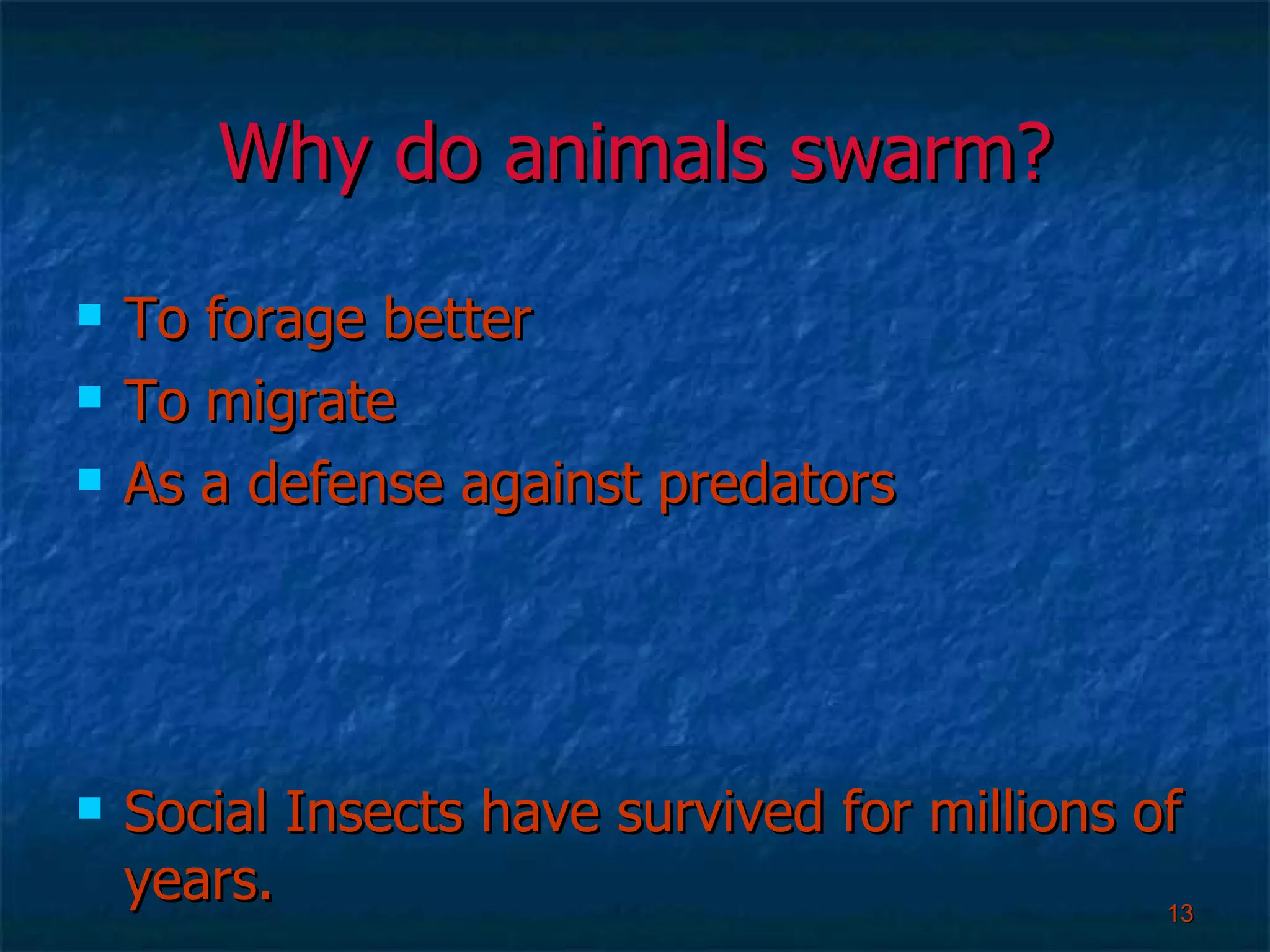
Why do animals swarm? To forage better To migrate As a defense against predators Social Insects have survived for millions of years.
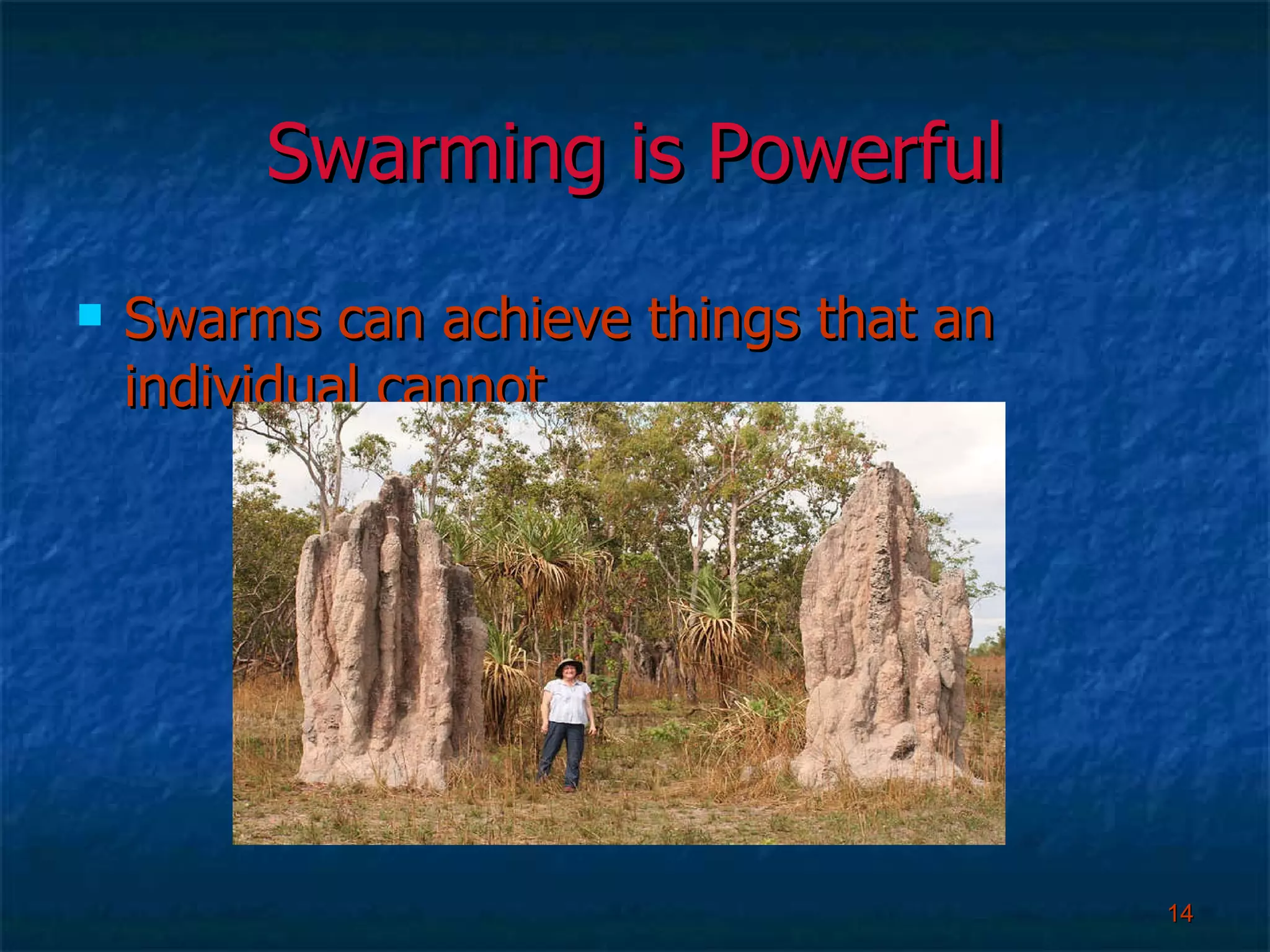
Swarming is Powerful Swarms can achieve things that an individual cannot
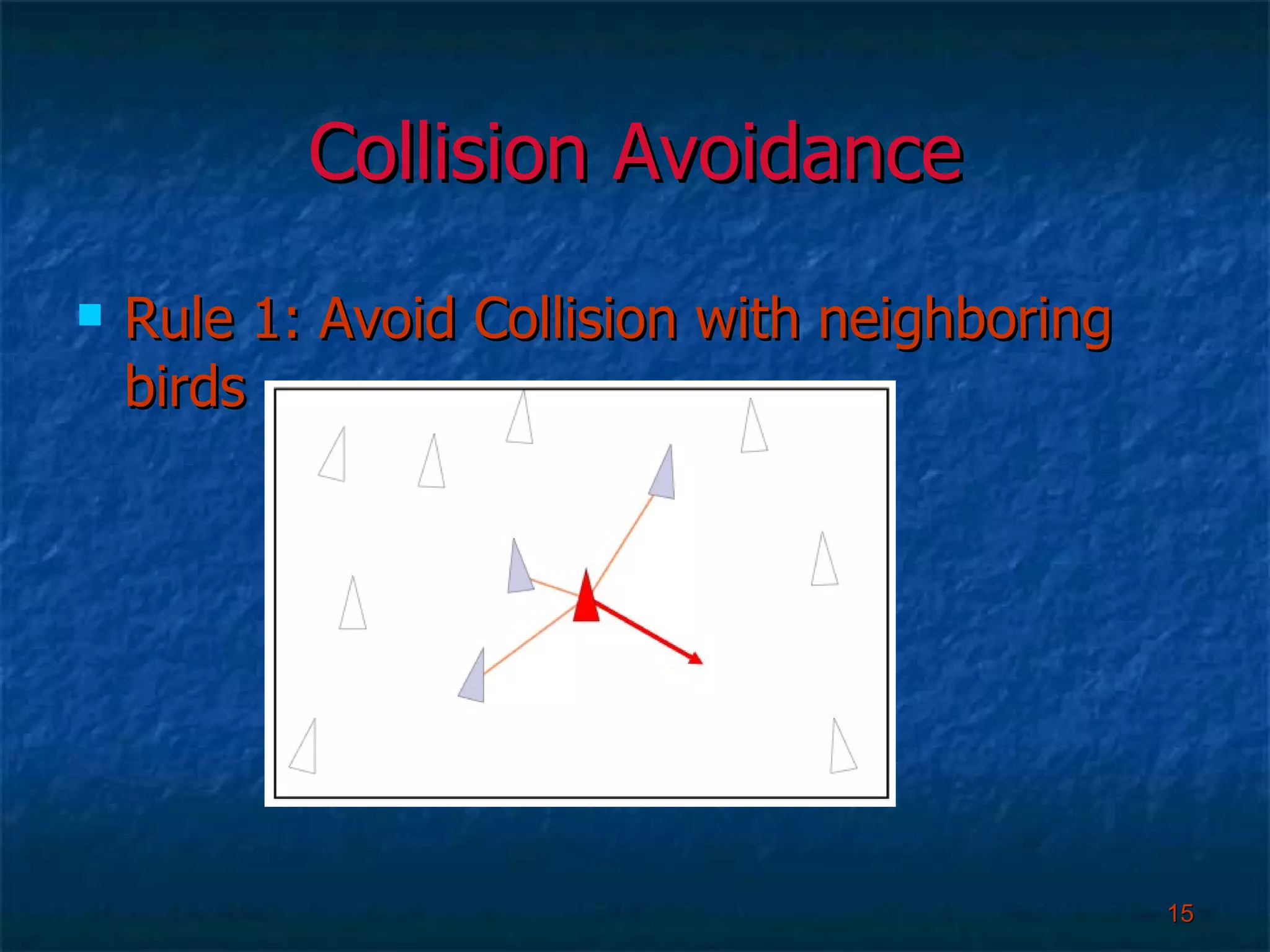
Collision Avoidance Rule 1: Avoid Collision with neighboring birds
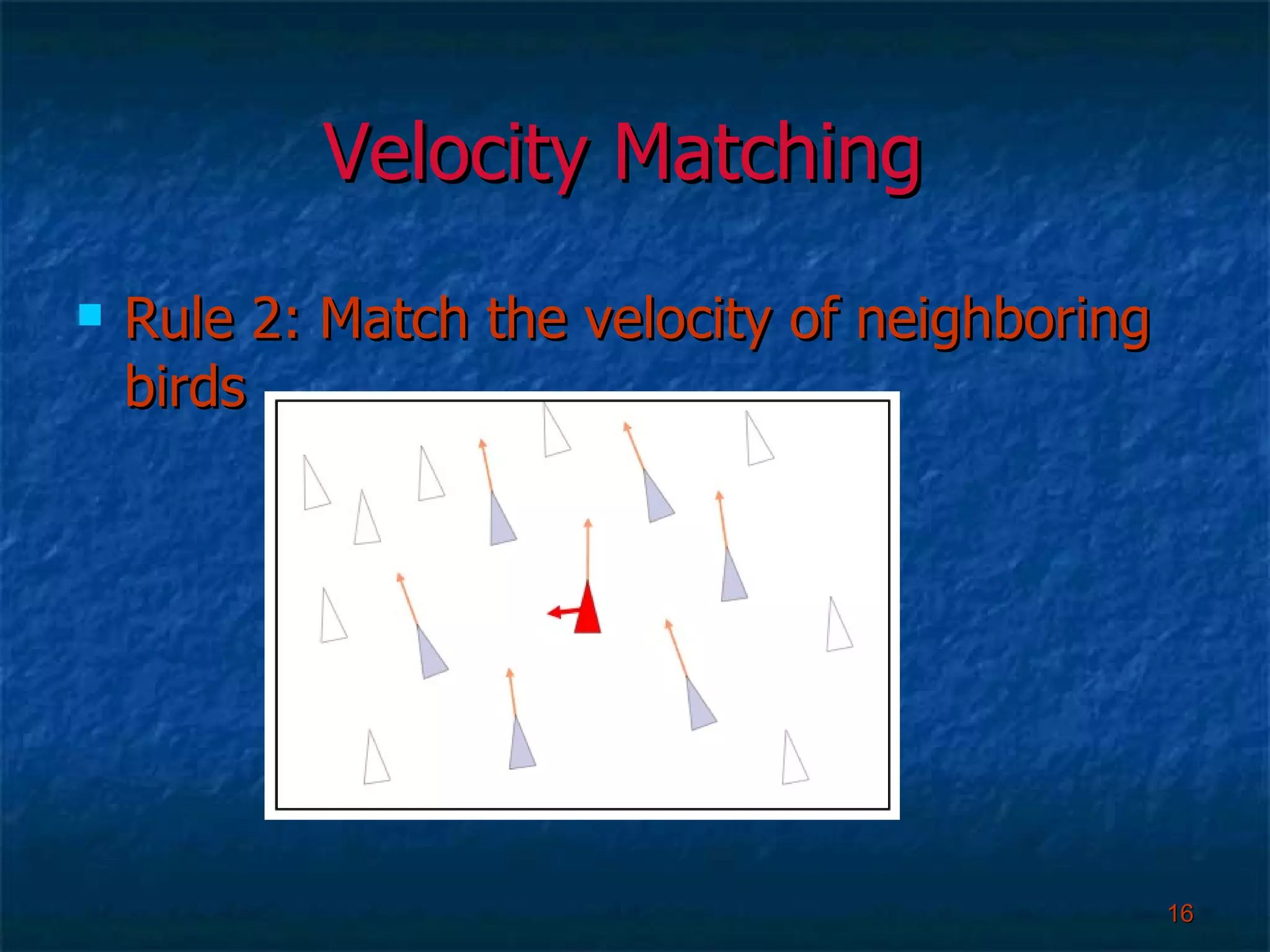
Velocity Matching  Rule 2: Match the velocity of neighboring birds
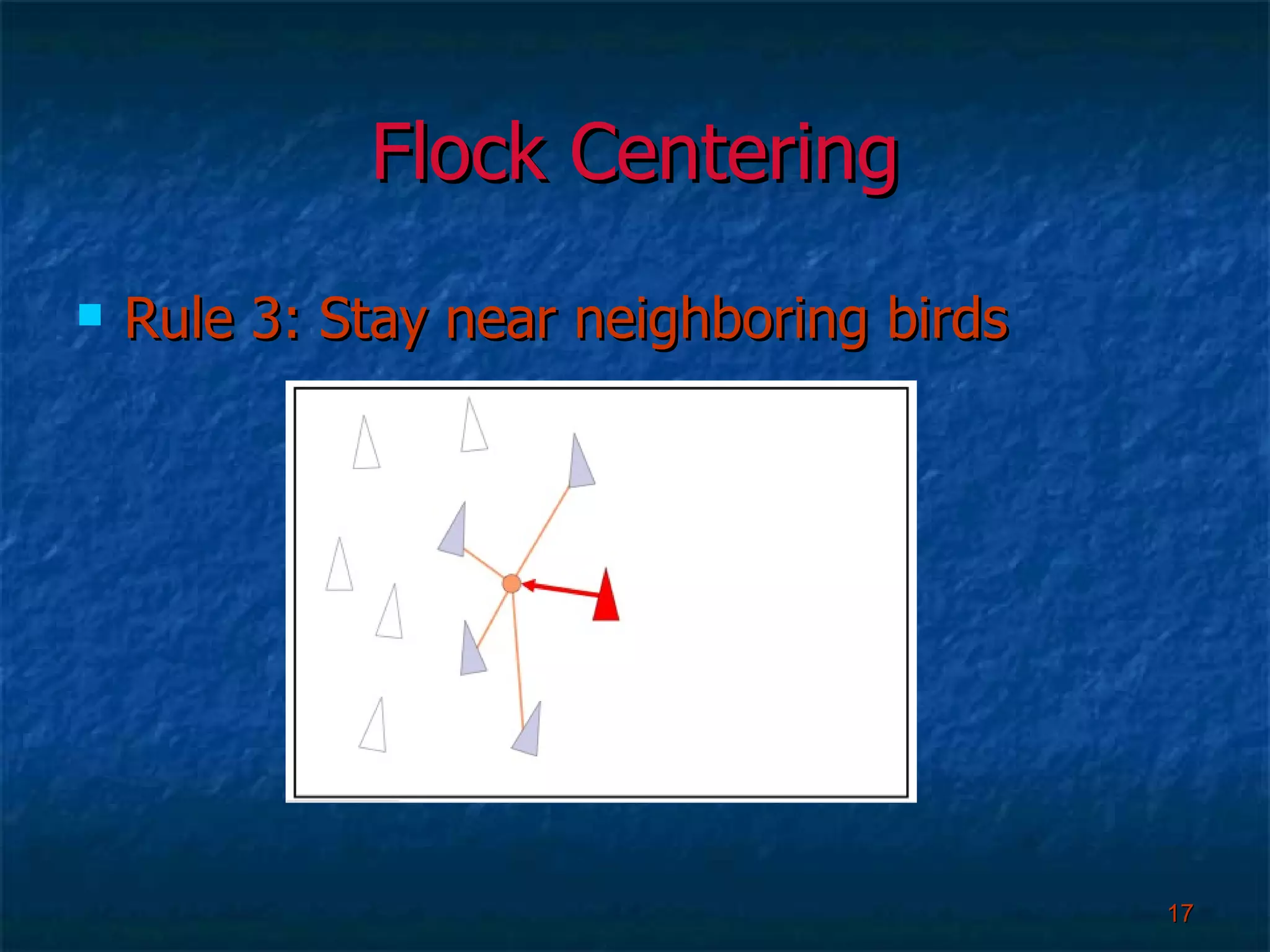
Flock Centering Rule 3: Stay near neighboring birds
Swarming - Characteristics Simple rules for each individual No central control Decentralized and hence robust Emergent Performs complex functions
Learn from insects Computer Systems are getting complicated Hard to have a master control Swarm intelligence systems are: Robust Relatively simple
Applications  Movie effects Lord of the Rings Network Routing ACO Routing Swarm Robotics Swarm bots
Particle Swarm Optimization
Particle Swarm Optimization Particle swarm optimization imitates human or insects social behavior. Individuals interact with one another while learning from their own experience, and gradually move towards the goal. It is easily implemented and has proven both very effective and quick when applied to a diverse set of optimization problems.
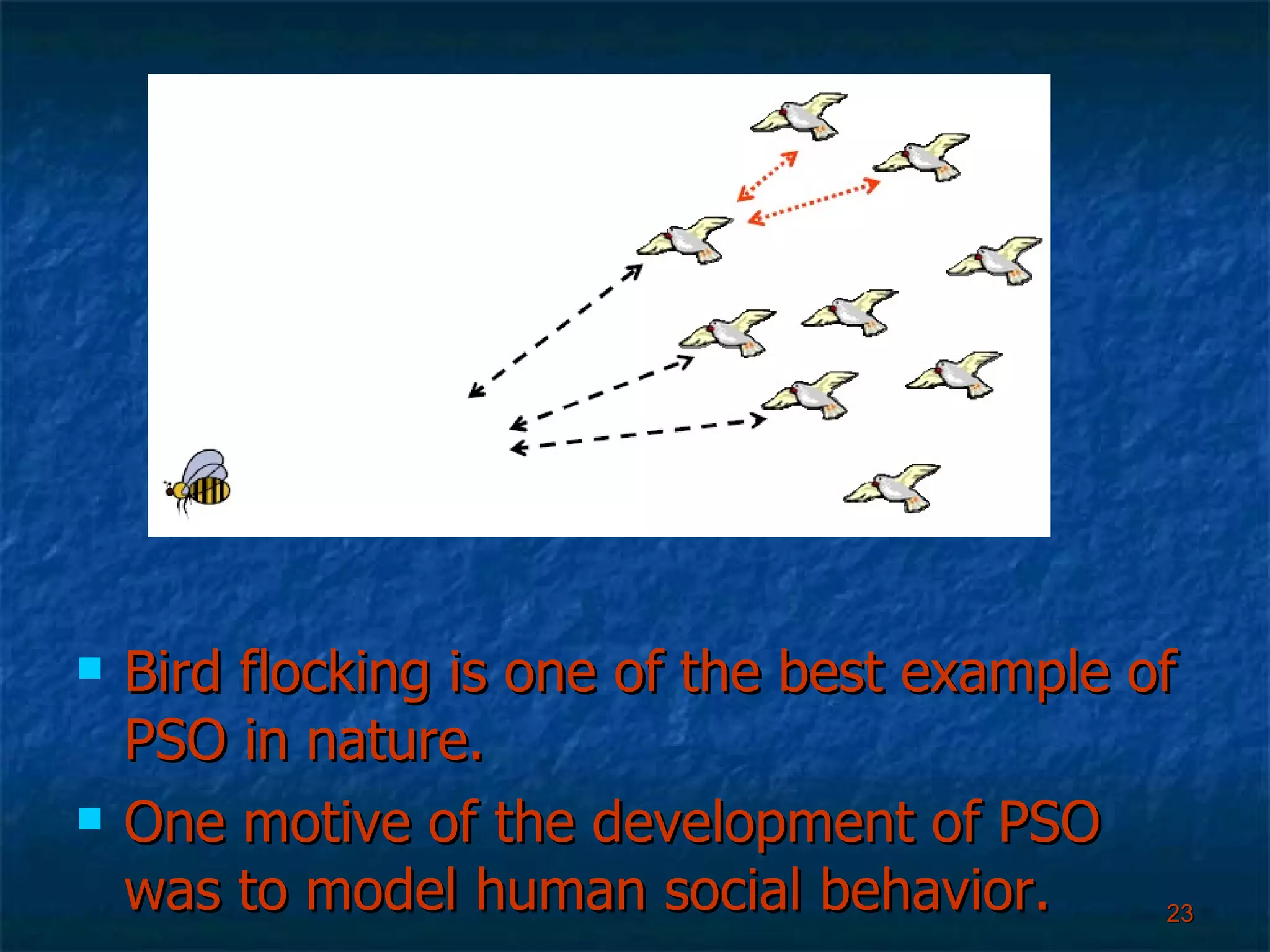
Bird flocking is one of the best example of PSO in nature. One motive of the development of PSO was to model human social behavior.
Applications of PSO Neural networks like Human tumor analysis, Computer numerically controlled milling optimization; Ingredient mix optimization; Pressure vessel (design a container of compressed air, with many constraints). Basically all the above applications fall in a category of finding the global maxima of a continuous, discrete, or mixed search space, with multiple local maxima.
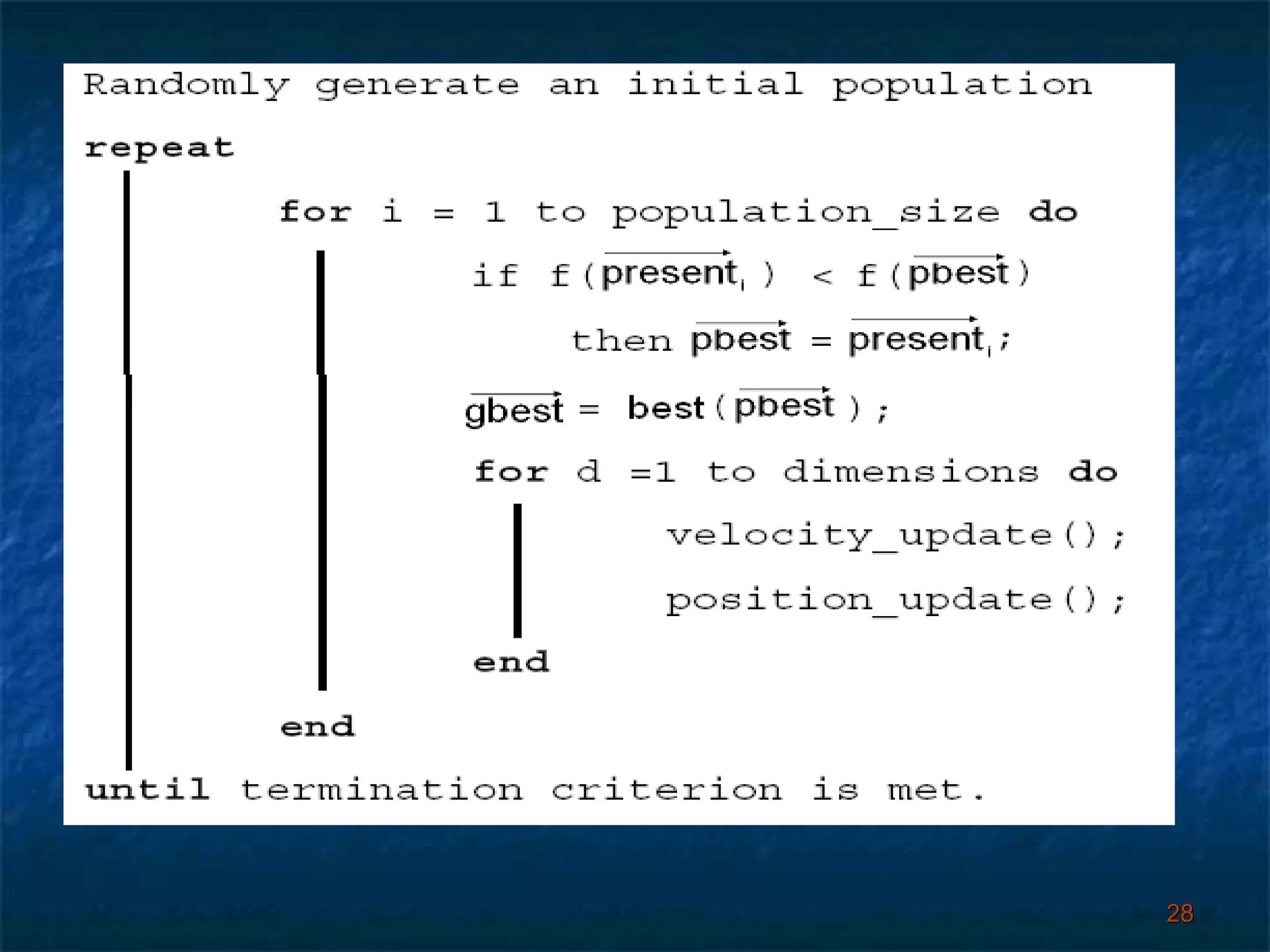
Algorithm of PSO Each particle (or agent) evaluates the function to maximize at each point it visits in spaces. Each agent remembers the best value of the function found so far by it (pbest) and its co-ordinates. Secondly, each agent know the globally best position that one member of the flock had found, and its value (gbest).
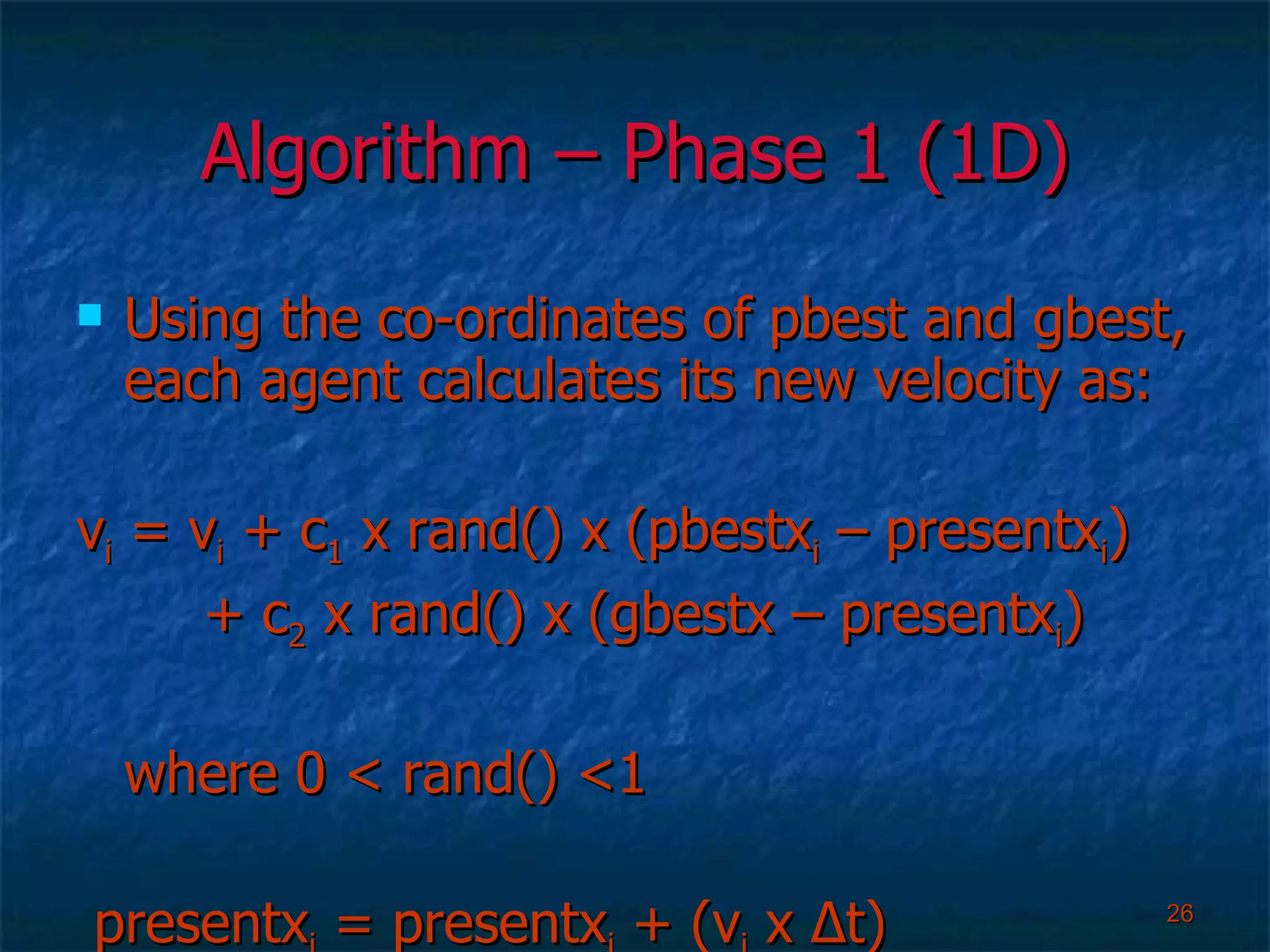
Algorithm – Phase 1 (1D) Using the co-ordinates of pbest and gbest, each agent calculates its new velocity as: v i  = v i  + c 1  x rand() x (pbestx i  – presentx i ) + c 2  x rand() x (gbestx – presentx i ) where 0 < rand() <1 presentx i  = presentx i  + (v i  x  Δ t)
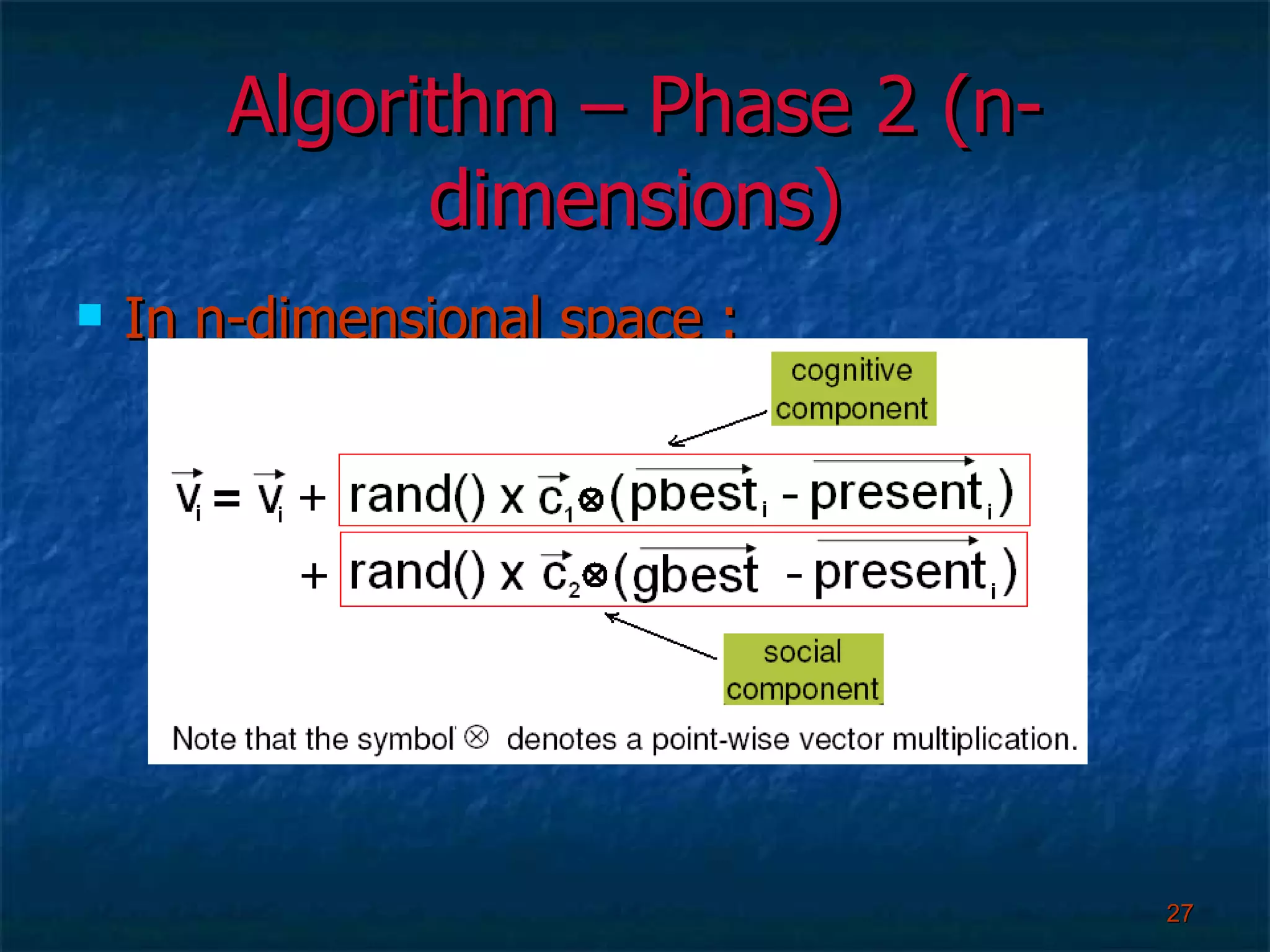
Algorithm – Phase 2 (n-dimensions) In n-dimensional space :
Ant Colony Optimization
Ant Colony Optimization - Biological Inspiration  Inspired by foraging behavior of ants. Ants find shortest path to food source from nest. Ants deposit pheromone along traveled path which is used by other ants to follow the trail. This kind of indirect communication via the local environment is called stigmergy. Has adaptability, robustness and redundancy.
Foraging behavior of Ants 2 ants start with equal probability of going on either path.
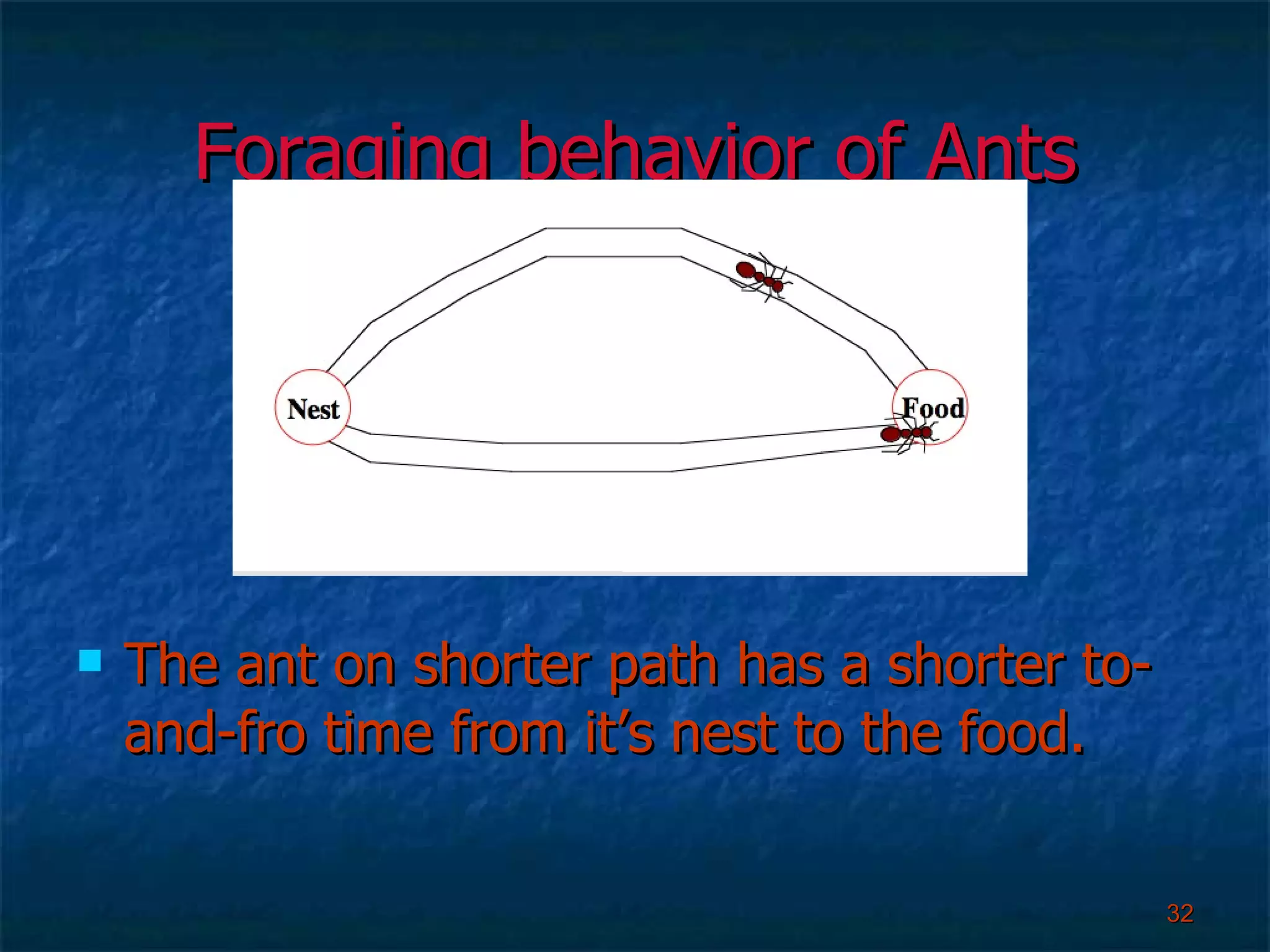
Foraging behavior of Ants The ant on shorter path has a shorter to-and-fro time from it’s nest to the food.
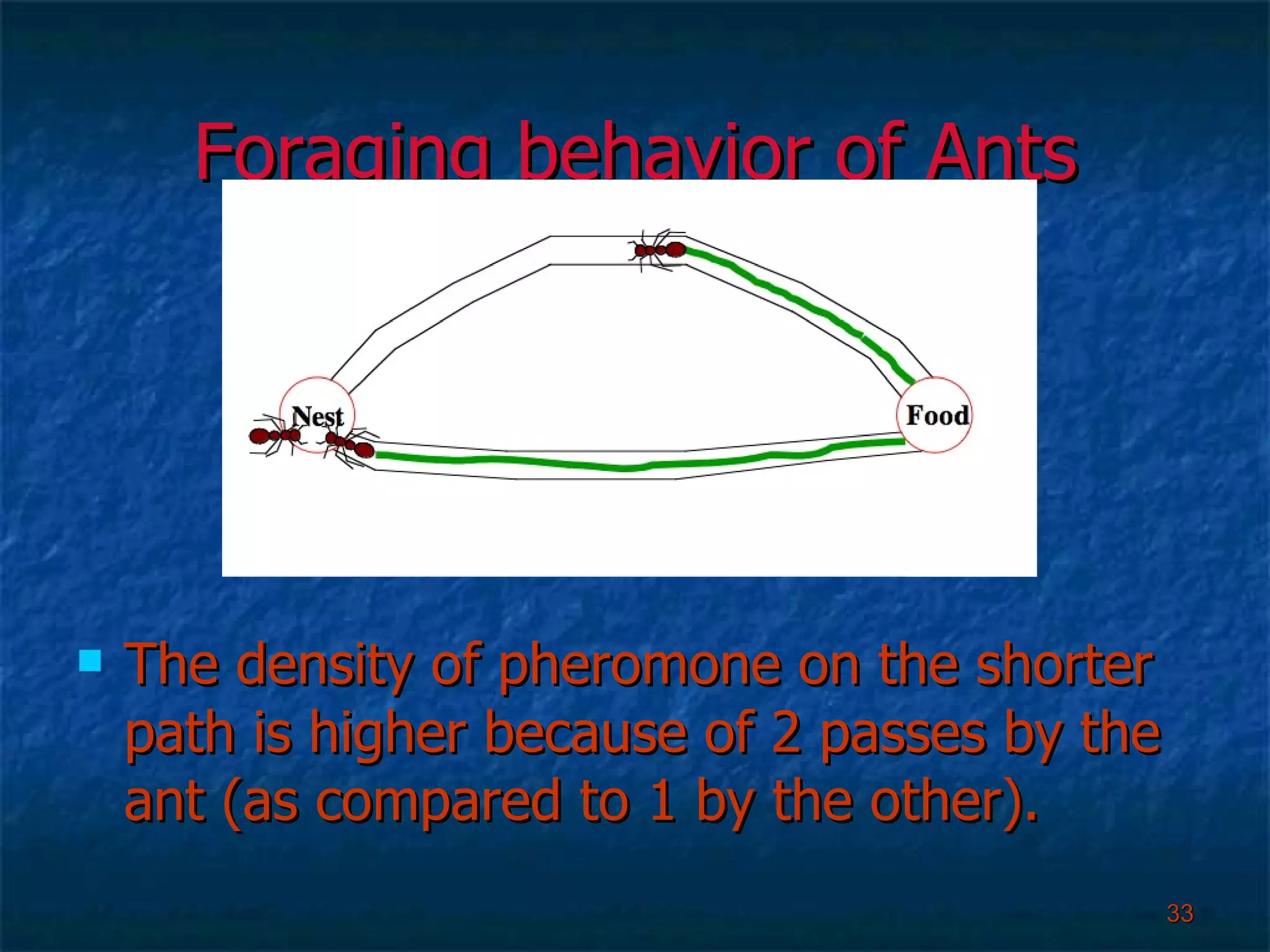
Foraging behavior of Ants The density of pheromone on the shorter path is higher because of 2 passes by the ant (as compared to 1 by the other).
Foraging behavior of Ants The next ant takes the shorter route.
Foraging behavior of Ants Over many iterations, more ants begin using the path with higher pheromone, thereby further reinforcing it.
Foraging behavior of Ants After some time, the shorter path is almost exclusively used.
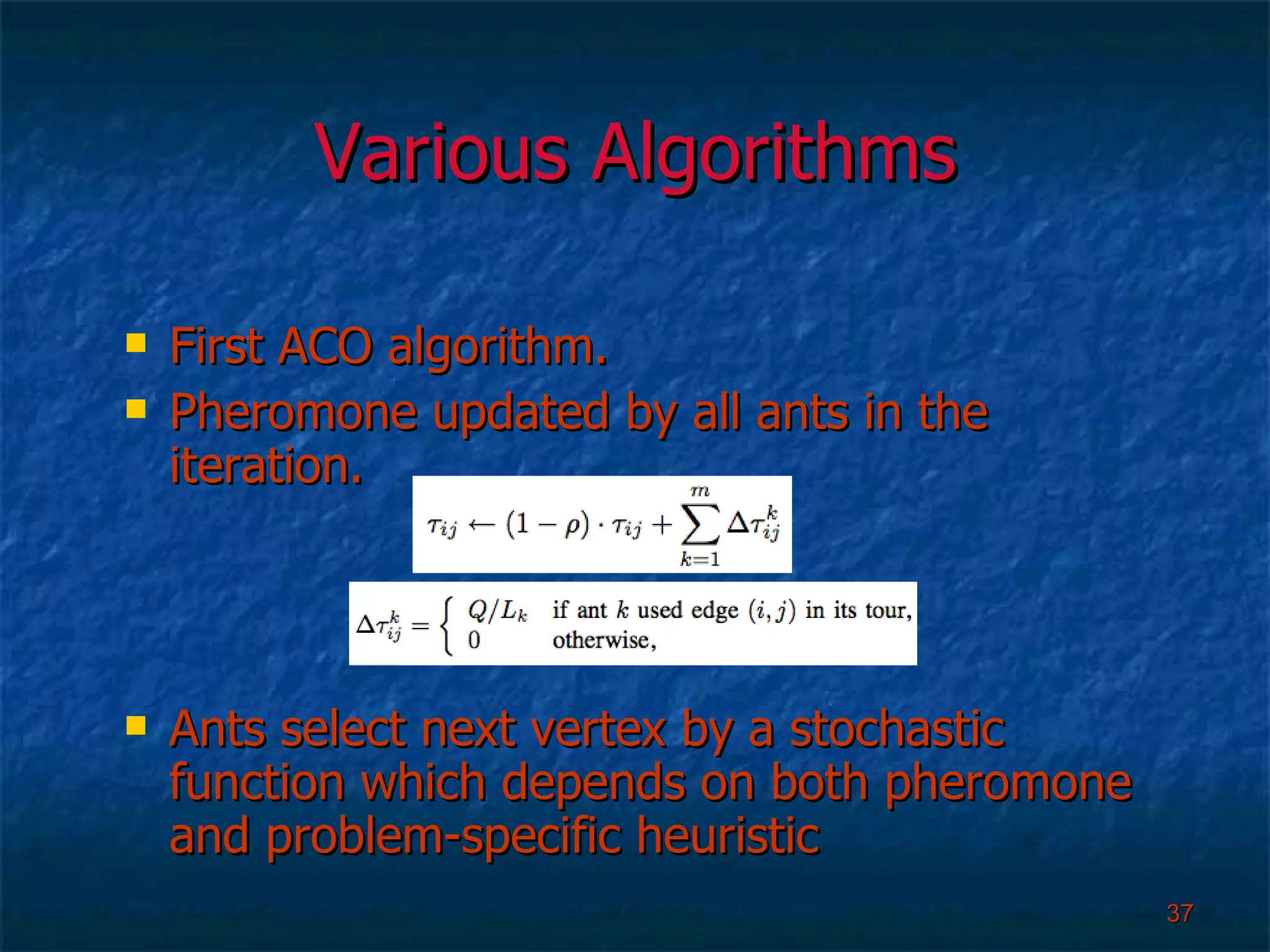
Various Algorithms First ACO algorithm. Pheromone updated by all ants in the iteration. Ants select next vertex by a stochastic function which depends on both pheromone and problem-specific heuristic
Various Algorithms - 2 Ant Colony System (ACS): Local pheromone update in addition to offline pheromone update. By all ants after each construction step only to last edge traversed. Diversify search by subsequent ants and produce different solutions in an iteration. Local update:  Offline update :
Theoretical Details Convergence to optimal solutions has been proved. Can’t predict how quickly optimal results will be found. Suffer from stagnation and selection bias.
ACO in Network Routing
Ant like agents for routing Intuitive to think of ants for routing. Aim is to get shortest path Start as usual Release a number of ants from source, let the age of ant increases with increase in hops decide on pheromone trails .  Problem – Ants at an node do not know the path to destination, can't cahnge table entry
Routing continued ... Possible Solutions first get to dest. and then retrace Needs memory to store the path And intelligence to revert the path Leave unique entries on nodes a lot of entries at every node Observation – At any intermediate node, ant knows the path to source from that node. now leave influence on routing table having entry “route to source via that link”
Routing contd ... Now at any node it has information about shortest path to dest., left by ants from dest. The ant following shortest path should have maximum influence A convenient form of pheromone can be inverse of age + constant The table may get frozen, with one entry almost 1, add some noise f i.e probabilty that an ant choses purely random path
Dealing with congestion  Add a function of degree of congestion of each node to age of an ant Delay an ant at congested node, this prevents ants from influencing route table
SI - Limitations Theoretical analysis is difficult, due to sequences of probabilistic choices Most of the research are experimental Though convergence in guaranteed, time to convergence is uncertain
Conclusion Provide heuristic to solve difficult problems  Has been applied to wide variety of applications Can be used in dynamic applications

Ai presentation

  • 1.
  • 2.
    INTRODUCTION W.W.W. –a virtual society. WEB MINING – a challenging activity. Web – unstructured data, changes are frequent and rapid.
  • 3.
    WEB MINING Processof discovering useful information or knowledge from hyperlink structure, page contents and data usage. Three types: Web structure mining. Web content mining. Web usage mining.
  • 4.
    WEB STRUCTURE MININGDiscovering knowledge from hyperlinks. Pages are ranked according to prestige. Pages are social animals and hyperlinks are relations.
  • 5.
    WEB CONTENT MININGExtracts useful information from the content of web pages. Pages are classified according to their topics, or user’s option. Ex. -- <meta> tag used in html scripting.
  • 6.
    WEB USAGE MININGAims to automatically discover and analyze patterns. Profiles of users interacting with a web site is captured, modeled and analyzed in order to improve services. Ex. -- private messaging in “orkut”
  • 7.
  • 8.
    SWARM INTELLIGENCE Usedin representing collective behavior of decentralized, self organized artificial systems. Collective behavior can lead to emergence of apparent intelligent behavior. SI systems are able to communicate with each other and to interact with their environment.
  • 9.
    EXAMPLES OF SISYSTEM Bird flocking Ant colony Animal herding
  • 10.
    ANT COLONY OPTIMIZERInspired by ants. Ants find path from nest to food by creating a network of pheromone trails. Similar to ants a www user navigates without the information of route and without having a view of global environment.
  • 11.
    BIOLOGICAL INSPIRATION AFrench entomologist observed that: A significant stimulus is an indirect, non symbolic form of communication, mediated by the environment. Information is local, can be accessed only by visiting local area in which it was released.
  • 12.
    Swarming – TheDefinition aggregation of similar animals, generally cruising in the same direction Termites swarm to build colonies Birds swarm to find food Bees swarm to reproduce
  • 13.
    Why do animalsswarm? To forage better To migrate As a defense against predators Social Insects have survived for millions of years.
  • 14.
    Swarming is PowerfulSwarms can achieve things that an individual cannot
  • 15.
    Collision Avoidance Rule1: Avoid Collision with neighboring birds
  • 16.
    Velocity Matching Rule 2: Match the velocity of neighboring birds
  • 17.
    Flock Centering Rule3: Stay near neighboring birds
  • 18.
    Swarming - CharacteristicsSimple rules for each individual No central control Decentralized and hence robust Emergent Performs complex functions
  • 19.
    Learn from insectsComputer Systems are getting complicated Hard to have a master control Swarm intelligence systems are: Robust Relatively simple
  • 20.
    Applications Movieeffects Lord of the Rings Network Routing ACO Routing Swarm Robotics Swarm bots
  • 21.
  • 22.
    Particle Swarm OptimizationParticle swarm optimization imitates human or insects social behavior. Individuals interact with one another while learning from their own experience, and gradually move towards the goal. It is easily implemented and has proven both very effective and quick when applied to a diverse set of optimization problems.
  • 23.
    Bird flocking isone of the best example of PSO in nature. One motive of the development of PSO was to model human social behavior.
  • 24.
    Applications of PSONeural networks like Human tumor analysis, Computer numerically controlled milling optimization; Ingredient mix optimization; Pressure vessel (design a container of compressed air, with many constraints). Basically all the above applications fall in a category of finding the global maxima of a continuous, discrete, or mixed search space, with multiple local maxima.
  • 25.
    Algorithm of PSOEach particle (or agent) evaluates the function to maximize at each point it visits in spaces. Each agent remembers the best value of the function found so far by it (pbest) and its co-ordinates. Secondly, each agent know the globally best position that one member of the flock had found, and its value (gbest).
  • 26.
    Algorithm – Phase1 (1D) Using the co-ordinates of pbest and gbest, each agent calculates its new velocity as: v i = v i + c 1 x rand() x (pbestx i – presentx i ) + c 2 x rand() x (gbestx – presentx i ) where 0 < rand() <1 presentx i = presentx i + (v i x Δ t)
  • 27.
    Algorithm – Phase2 (n-dimensions) In n-dimensional space :
  • 29.
  • 30.
    Ant Colony Optimization- Biological Inspiration Inspired by foraging behavior of ants. Ants find shortest path to food source from nest. Ants deposit pheromone along traveled path which is used by other ants to follow the trail. This kind of indirect communication via the local environment is called stigmergy. Has adaptability, robustness and redundancy.
  • 31.
    Foraging behavior ofAnts 2 ants start with equal probability of going on either path.
  • 32.
    Foraging behavior ofAnts The ant on shorter path has a shorter to-and-fro time from it’s nest to the food.
  • 33.
    Foraging behavior ofAnts The density of pheromone on the shorter path is higher because of 2 passes by the ant (as compared to 1 by the other).
  • 34.
    Foraging behavior ofAnts The next ant takes the shorter route.
  • 35.
    Foraging behavior ofAnts Over many iterations, more ants begin using the path with higher pheromone, thereby further reinforcing it.
  • 36.
    Foraging behavior ofAnts After some time, the shorter path is almost exclusively used.
  • 37.
    Various Algorithms FirstACO algorithm. Pheromone updated by all ants in the iteration. Ants select next vertex by a stochastic function which depends on both pheromone and problem-specific heuristic
  • 38.
    Various Algorithms -2 Ant Colony System (ACS): Local pheromone update in addition to offline pheromone update. By all ants after each construction step only to last edge traversed. Diversify search by subsequent ants and produce different solutions in an iteration. Local update: Offline update :
  • 39.
    Theoretical Details Convergenceto optimal solutions has been proved. Can’t predict how quickly optimal results will be found. Suffer from stagnation and selection bias.
  • 40.
  • 41.
    Ant like agentsfor routing Intuitive to think of ants for routing. Aim is to get shortest path Start as usual Release a number of ants from source, let the age of ant increases with increase in hops decide on pheromone trails . Problem – Ants at an node do not know the path to destination, can't cahnge table entry
  • 42.
    Routing continued ...Possible Solutions first get to dest. and then retrace Needs memory to store the path And intelligence to revert the path Leave unique entries on nodes a lot of entries at every node Observation – At any intermediate node, ant knows the path to source from that node. now leave influence on routing table having entry “route to source via that link”
  • 43.
    Routing contd ...Now at any node it has information about shortest path to dest., left by ants from dest. The ant following shortest path should have maximum influence A convenient form of pheromone can be inverse of age + constant The table may get frozen, with one entry almost 1, add some noise f i.e probabilty that an ant choses purely random path
  • 44.
    Dealing with congestion Add a function of degree of congestion of each node to age of an ant Delay an ant at congested node, this prevents ants from influencing route table
  • 45.
    SI - LimitationsTheoretical analysis is difficult, due to sequences of probabilistic choices Most of the research are experimental Though convergence in guaranteed, time to convergence is uncertain
  • 46.
    Conclusion Provide heuristicto solve difficult problems Has been applied to wide variety of applications Can be used in dynamic applications