Local Search Algorithms and Optimization problems.pptx
1.
Hill climbing -Introduction
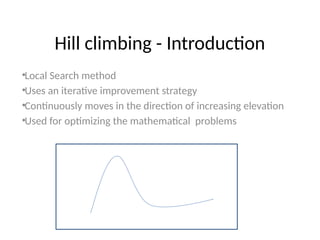
•Local Search method
•Uses an iterative improvement strategy
•Continuously moves in the direction of increasing elevation
•Used for optimizing the mathematical problems
2.
Hill climbing -Introduction
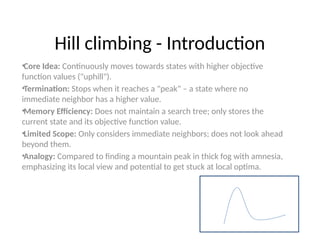
•Core Idea: Continuously moves towards states with higher objective
function values ("uphill").
•Termination: Stops when it reaches a "peak" – a state where no
immediate neighbor has a higher value.
•Memory Efficiency: Does not maintain a search tree; only stores the
current state and its objective function value.
•Limited Scope: Only considers immediate neighbors; does not look ahead
beyond them.
•Analogy: Compared to finding a mountain peak in thick fog with amnesia,
emphasizing its local view and potential to get stuck at local optima.
3.
Steps in HillClimbing
• Applied to a single point – the current point(or
state) – in the search space.
• At each iteration , a new point x’ is selected by
performing a small displacement in the current
point x .
• Depending on the representation used for x,
this can be implemented by simply adding a
small random number ,DELTA X, to the current
value of x:x’=x+deltaX.
4.
• If thatnew point provides a better value for
the evaluation function , then the new point
become the current point .
• Else , some other displacement is promoted in
the current point ( a new neighbour is chosen)
and tested against its previous value.
5.
Stopping criteria –Hill Climbing
• No Further improvement can be made
• A fixed number of iteration have been
performed
• A goal point is attained
6.
Algorithm –hill climbing
Procedure[x] =hill-climbing (max_it,g)
Initialize x
eval(x)
T 1
While t< max_it & x!=g & no_improvement do ,
x’ perturb(x)
eval(x’)
if eval(x’) is better than eval(x),
then x x’
end if
t t+1
end while
end procedure
Iterated –Hill climbing
Startsfrom number of random points
Procedure [best] –IHC(n_start,max_it,g)
Initialize best
T1 1
While t1 <n_start & best !=g do,
Initialize x
eval (x)
x hill –climbing (max_it,g) // Algorithm 1
T1 t1+1
If x is better that best,
then best x
End if
End while
End procedure
12.
Stochastic –hill climbing
AcceptsX’ With some probability
Procedure [x] =Stochastic hill-climbing (max_it,g)
Initialize x
eval(x)
T 1
While t< max_it & x!=g & no_improvement do ,
x’ perturb(x)
eval(x’)
if random(0,1) < (1/(1+exp[(eval(x)-eval(x’))/T])),
then x x’
end if
t t+1
end while
end procedure

![Algorithm –hill climbing
Procedure [x] =hill-climbing (max_it,g)
Initialize x
eval(x)
T 1
While t< max_it & x!=g & no_improvement do ,
x’ perturb(x)
eval(x’)
if eval(x’) is better than eval(x),
then x x’
end if
t t+1
end while
end procedure](https://image.slidesharecdn.com/localsearchalgorithmsandoptimizationproblems-250630155001-2f0ea6b0/85/Local-Search-Algorithms-and-Optimization-problems-pptx-6-320.jpg)



![Iterated –Hill climbing
Starts from number of random points
Procedure [best] –IHC(n_start,max_it,g)
Initialize best
T1 1
While t1 <n_start & best !=g do,
Initialize x
eval (x)
x hill –climbing (max_it,g) // Algorithm 1
T1 t1+1
If x is better that best,
then best x
End if
End while
End procedure](https://image.slidesharecdn.com/localsearchalgorithmsandoptimizationproblems-250630155001-2f0ea6b0/85/Local-Search-Algorithms-and-Optimization-problems-pptx-11-320.jpg)
![Stochastic –hill climbing
Accepts X’ With some probability
Procedure [x] =Stochastic hill-climbing (max_it,g)
Initialize x
eval(x)
T 1
While t< max_it & x!=g & no_improvement do ,
x’ perturb(x)
eval(x’)
if random(0,1) < (1/(1+exp[(eval(x)-eval(x’))/T])),
then x x’
end if
t t+1
end while
end procedure](https://image.slidesharecdn.com/localsearchalgorithmsandoptimizationproblems-250630155001-2f0ea6b0/85/Local-Search-Algorithms-and-Optimization-problems-pptx-12-320.jpg)


