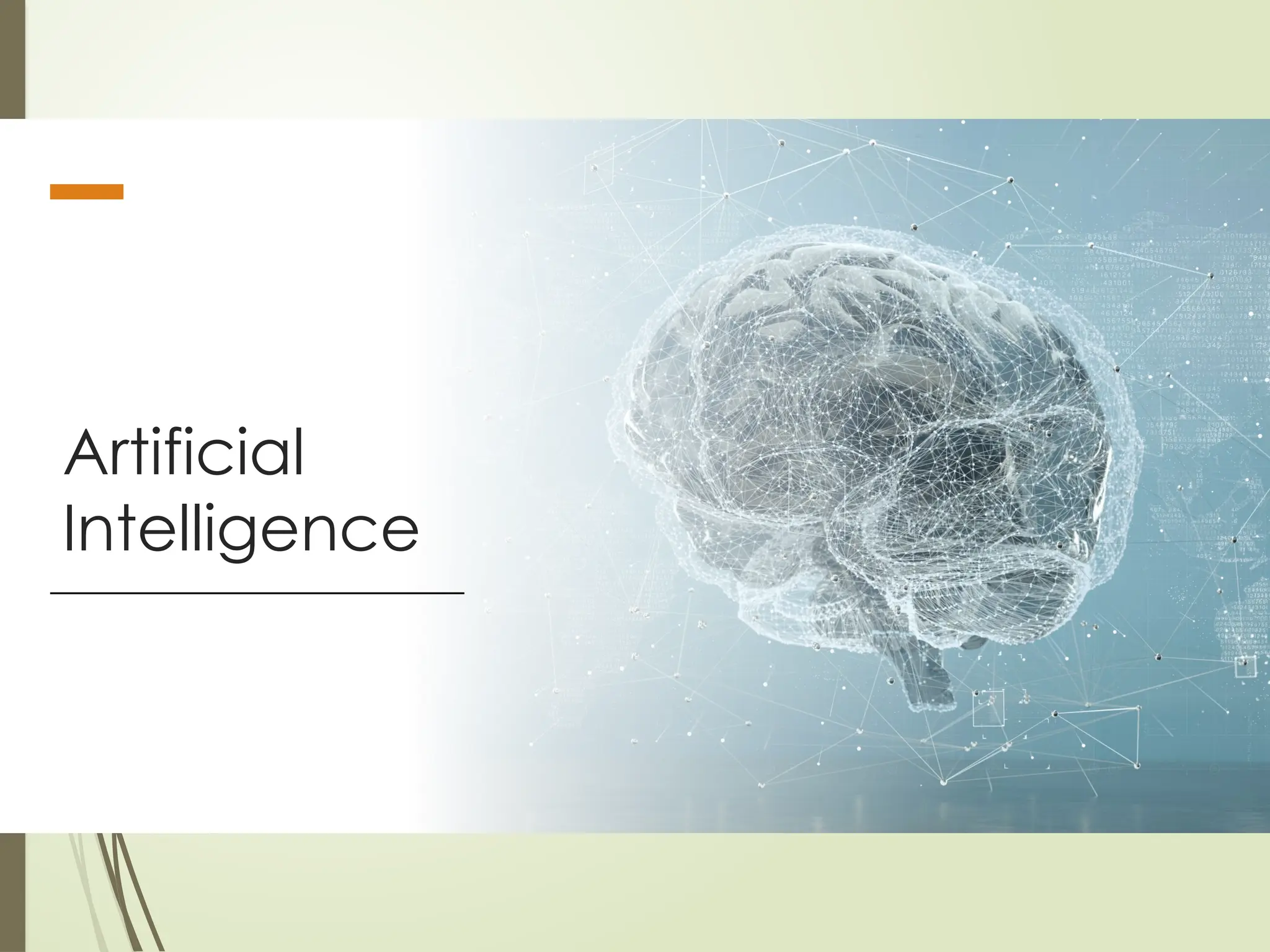
Artificial
Intelligence
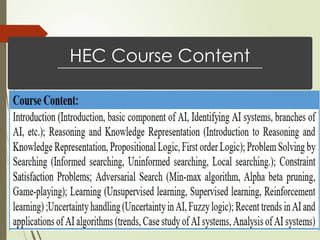
HEC Course Content
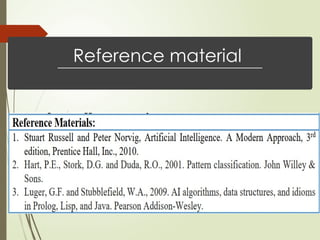
Reference material
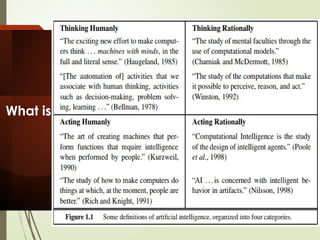
What is AI
 Intelligence?
 Intelligence has been defined in
many ways:
The capacity for abstraction,
logic, understanding,
self-awareness, learning,
knowledge, reasoning, planning
, creativity, critical thinking, and
problem-solving.
Continue
More generally, it can be described as
the ability to perceive or infer
information, and to retain it as
knowledge to be applied towards
adaptive behaviors within an
environment or context.
Artificial
Something that is not natural.
• 1955: John McCarthy held a workshop at Dartmouth on
“artificial intelligence” which is the first use of the word, and
how it came into popular usage.
• Name itself was coined in 1956, after WW-II
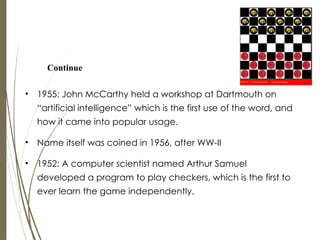
• 1952: A computer scientist named Arthur Samuel
developed a program to play checkers, which is the first to
ever learn the game independently.
Continue
Cont..
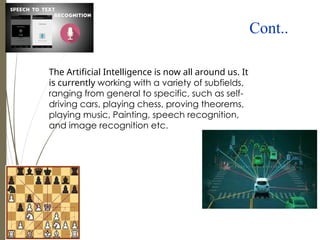
The Artificial Intelligence is now all around us. It
is currently working with a variety of subfields,
ranging from general to specific, such as self-
driving cars, playing chess, proving theorems,
playing music, Painting, speech recognition,
and image recognition etc.
Cont..
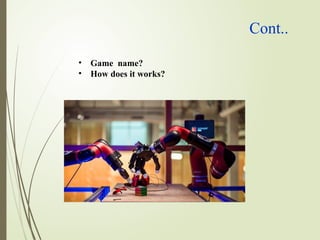
• Game name?
• How does it works?
What is
Continue
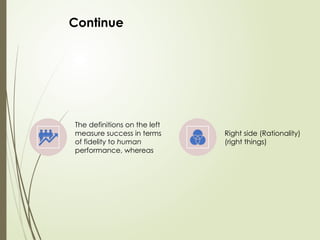
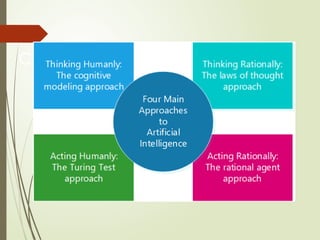
The definitions on the left
measure success in terms
of fidelity to human
performance, whereas
Right side (Rationality)
(right things)
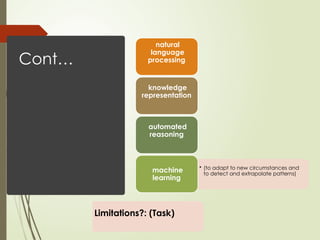
Acting humanly: The Turing Test approach
Physical interaction between
computer and human is not necessary
The Turing Test, proposed by Alan Turing (1950), was
designed to provide a satisfactory operational definition
of intelligence.
A computer passes the test if a human interrogator, after
posing some written questions, cannot tell whether the
written responses come from a person or from a
computer.
For now, we note that programming a computer to pass a
rigorously applied test provides plenty to work on. The
computer would need to possess the following
capabilities.
Cont…
natural
language
processing
knowledge
representation
automated
reasoning
• (to adapt to new circumstances and
to detect and extrapolate patterns)
machine
learning
Limitations?: (Task)
Cont…
Cont…
• Thinking humanly is to make a system or program to think
like a human. But to achieve that, we need to know how
does a human thinks.
• Suppose if we ask a person to explain how his brain
connects different things during the thinking process,
he/she will probably close both eyes and will start to check
how he/she thinks but he/she cannot explain or interpret
the process.
• Ask the same question to yourself, and most likely you will
have the same pattern and will end up saying “you do not
know, or you may say something like “I am thinking
through my mind”, but you cannot express more than
that. Read through neuroscience books to get a deeper
understanding of this.
Cont…
Cont…
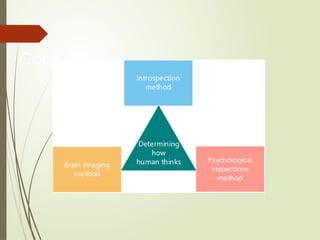
1.Introspection method – Catch our thoughts and
see how it flows.
2.Psychological Inspections method – Observe a
person on the action.
3.Brain Imaging method (MRI (Magnetic
resonance imaging) or fMRI (Functional Magnetic
resonance imaging) scanning) – Observe a
person’s brain in action.

AI Lecture 1 introduction to artificial intelligence.pptx

  • 1.
  • 2.
  • 3.
  • 4.
    What is AI Intelligence?  Intelligence has been defined in many ways: The capacity for abstraction, logic, understanding, self-awareness, learning, knowledge, reasoning, planning , creativity, critical thinking, and problem-solving.
  • 5.
    Continue More generally, itcan be described as the ability to perceive or infer information, and to retain it as knowledge to be applied towards adaptive behaviors within an environment or context. Artificial Something that is not natural.
  • 6.
    • 1955: JohnMcCarthy held a workshop at Dartmouth on “artificial intelligence” which is the first use of the word, and how it came into popular usage. • Name itself was coined in 1956, after WW-II • 1952: A computer scientist named Arthur Samuel developed a program to play checkers, which is the first to ever learn the game independently. Continue
  • 7.
    Cont.. The Artificial Intelligenceis now all around us. It is currently working with a variety of subfields, ranging from general to specific, such as self- driving cars, playing chess, proving theorems, playing music, Painting, speech recognition, and image recognition etc.
  • 8.
    Cont.. • Game name? •How does it works?
  • 9.
  • 10.
    Continue The definitions onthe left measure success in terms of fidelity to human performance, whereas Right side (Rationality) (right things)
  • 11.
    Acting humanly: TheTuring Test approach Physical interaction between computer and human is not necessary The Turing Test, proposed by Alan Turing (1950), was designed to provide a satisfactory operational definition of intelligence. A computer passes the test if a human interrogator, after posing some written questions, cannot tell whether the written responses come from a person or from a computer. For now, we note that programming a computer to pass a rigorously applied test provides plenty to work on. The computer would need to possess the following capabilities.
  • 12.
    Cont… natural language processing knowledge representation automated reasoning • (to adaptto new circumstances and to detect and extrapolate patterns) machine learning Limitations?: (Task)
  • 13.
  • 14.
    Cont… • Thinking humanlyis to make a system or program to think like a human. But to achieve that, we need to know how does a human thinks. • Suppose if we ask a person to explain how his brain connects different things during the thinking process, he/she will probably close both eyes and will start to check how he/she thinks but he/she cannot explain or interpret the process. • Ask the same question to yourself, and most likely you will have the same pattern and will end up saying “you do not know, or you may say something like “I am thinking through my mind”, but you cannot express more than that. Read through neuroscience books to get a deeper understanding of this.
  • 15.
  • 16.
    Cont… 1.Introspection method –Catch our thoughts and see how it flows. 2.Psychological Inspections method – Observe a person on the action. 3.Brain Imaging method (MRI (Magnetic resonance imaging) or fMRI (Functional Magnetic resonance imaging) scanning) – Observe a person’s brain in action.