Topic To Be Covered:
First Order Logic(Part-03)
Proof By Resolution In FOL
Jagdamba Education Society's
SND College of Engineering & Research Centre
Department of Computer Engineering
SUBJECT: Artificial Intelligence & Robotics
Lecture No-12(UNIT-03)
Logic & Reasoning
Prof.Dhakane Vikas N
Resolution in FOL
Resolution in FOL: Example
Example:
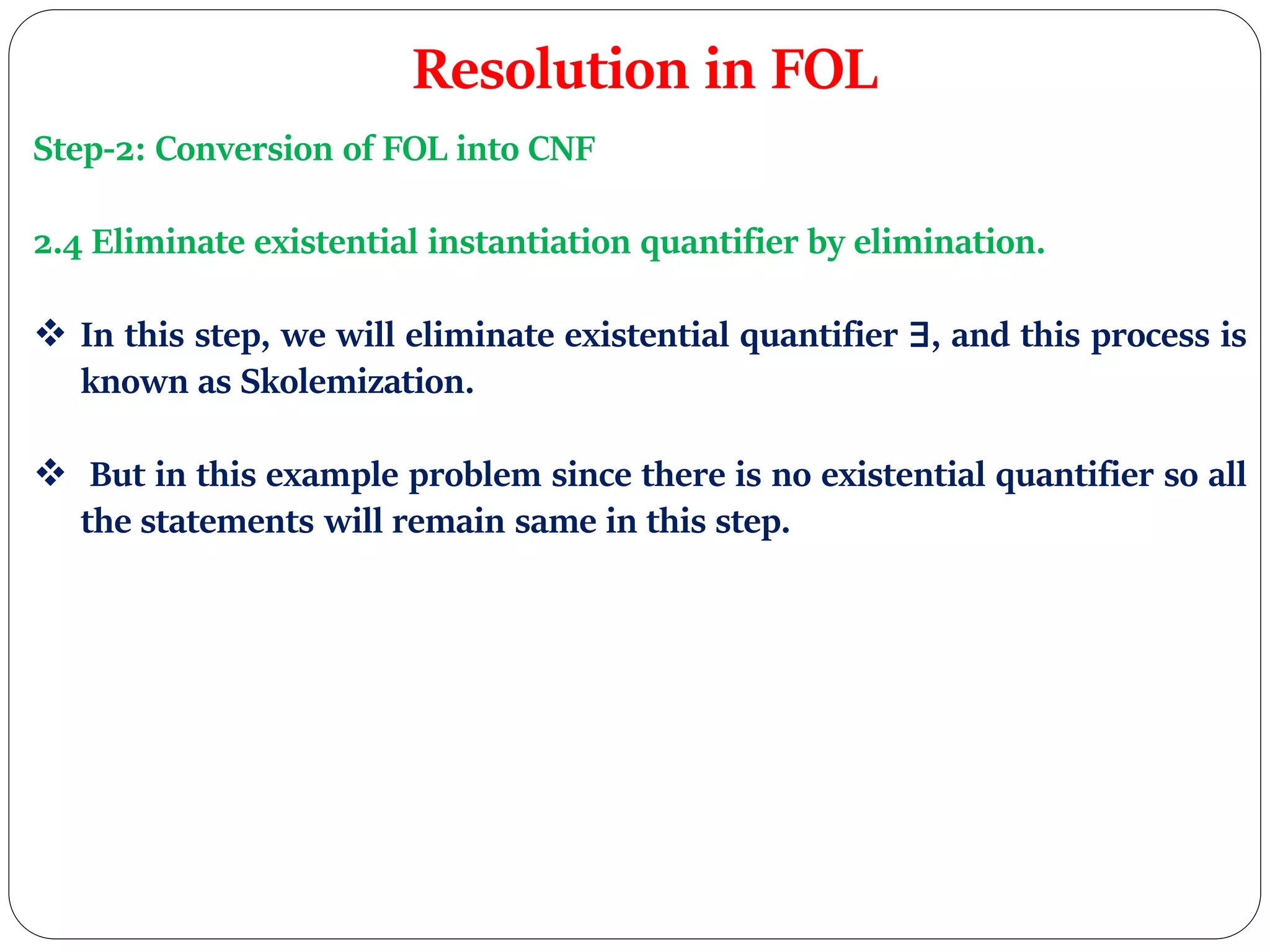
a. John likes all kind of food.
b. Apple and vegetable are food
c. Anything anyone eats and not killed is
food.
d. Anil eats peanuts and still alive
e. Harry eats everything that Anil eats.
Prove by resolution that:
John likes peanuts.
Step-1: Conversion of Facts into FOL
In the first step we will convert all the
given statements into its first order logic.
Resolution in FOL
Step-2: Conversion of FOL into CNF
In First order logic resolution, it is required to
convert the FOL into CNF as CNF form makes
easier for resolution proofs.
2.1: Eliminate all implication (→) and
rewrite
a. ∀x ¬ food(x) V likes(John, x)
b. food(Apple) Λ food(vegetables)
c. ∀x ∀y ¬ [eats(x, y) Λ ¬ killed(x)] V
food(y)
d. eats (Anil, Peanuts) Λ alive(Anil)
e. ∀x ¬ eats(Anil, x) V eats(Harry, x)
f. ∀x¬ [¬ killed(x) ] V alive(x)
g. ¬ alive(x) V ¬ killed(x)
h. likes(John, Peanuts).
Resolution in FOL
Step-2: Conversion of FOL into CNF
In First order logic resolution, it is required
to convert the FOL into CNF as CNF form
makes easier for resolution proofs.
2.2: Move negation (¬)inwards and rewrite
a. ∀x ¬ food(x) V likes(John, x)
b. food(Apple) Λ food(vegetables)
c. ∀x ∀y ¬ eats(x, y) V killed(x) V food(y)
d. eats (Anil, Peanuts) Λ alive(Anil)
e. ∀x ¬ eats(Anil, x) V eats(Harry, x)
f. ∀x ¬killed(x) ] V alive(x)
g. ¬ alive(x) V ¬ killed(x)
h. likes(John, Peanuts).
a. ∀x ¬ food(x) V
likes(John, x)
b. food(Apple) Λ
food(vegetables)
c. ∀x ∀y ¬ [eats(x, y) Λ ¬
killed(x)] V food(y)
d. eats (Anil, Peanuts) Λ
alive(Anil)
e. ∀x ¬ eats(Anil, x) V
eats(Harry, x)
f. ∀x¬ [¬ killed(x) ] V
alive(x)
g. ¬ alive(x) V ¬ killed(x)
h. likes(John, Peanuts).
Resolution in FOL
Step-2: Conversion of FOL into CNF
In First order logic resolution, it is required to
convert the FOL into CNF as CNF form makes
easier for resolution proofs.
2.3: Rename variables or standardize
variables
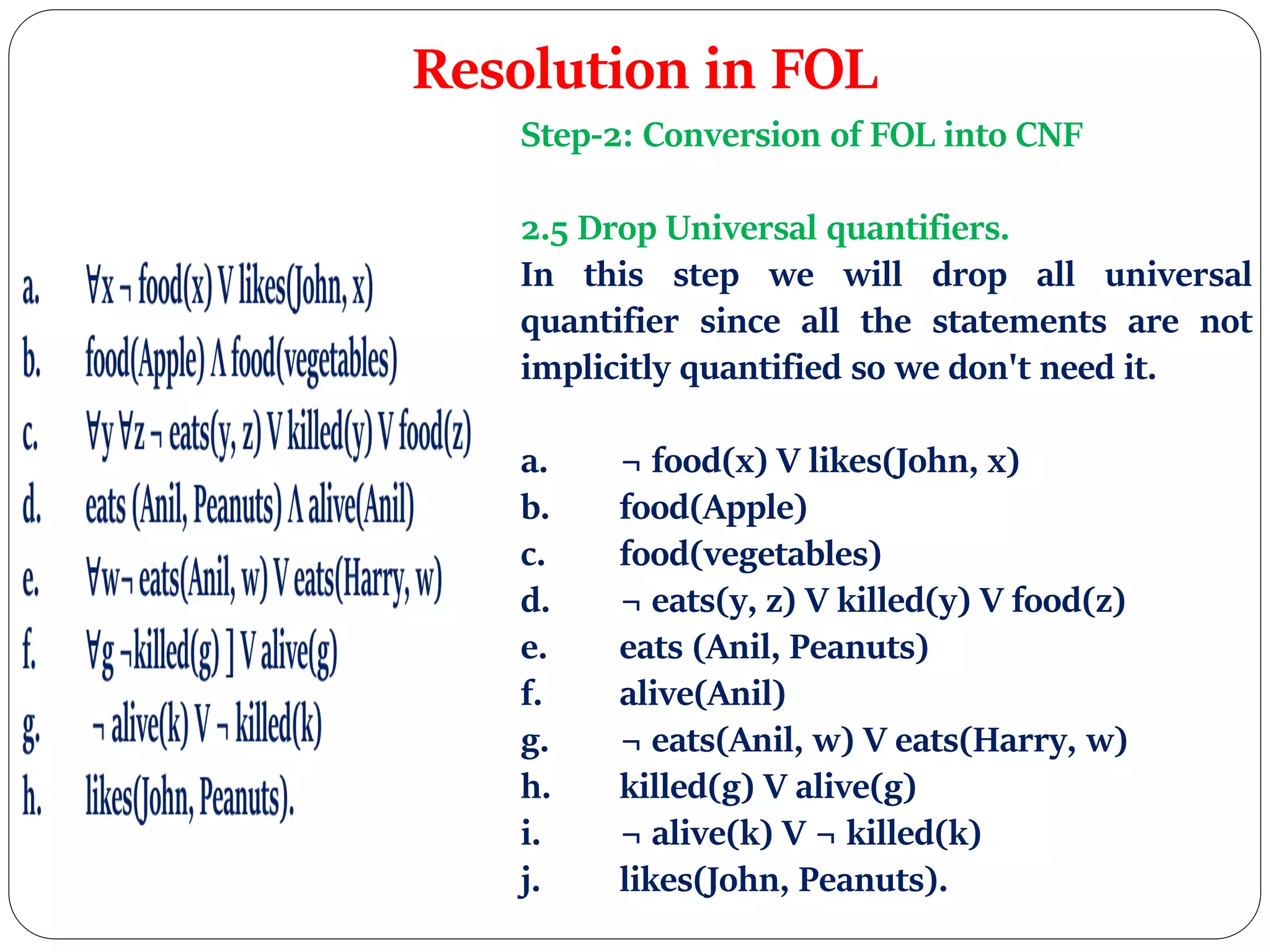
a. ∀x ¬ food(x) V likes(John, x)
b. food(Apple) Λ food(vegetables)
c. ∀y ∀z ¬ eats(y, z) V killed(y) V food(z)
d. eats (Anil, Peanuts) Λ alive(Anil)
e. ∀w¬ eats(Anil, w) V eats(Harry, w)
f. ∀g ¬killed(g) ] V alive(g)
g. ¬ alive(k) V ¬ killed(k)
h. likes(John, Peanuts).
Resolution in FOL
Step-2: Conversion of FOL into CNF
2.4 Eliminate existential instantiation quantifier by elimination.
 In this step, we will eliminate existential quantifier ∃, and this process is
known as Skolemization.
 But in this example problem since there is no existential quantifier so all
the statements will remain same in this step.
Resolution in FOL
Step-2: Conversion of FOL into CNF
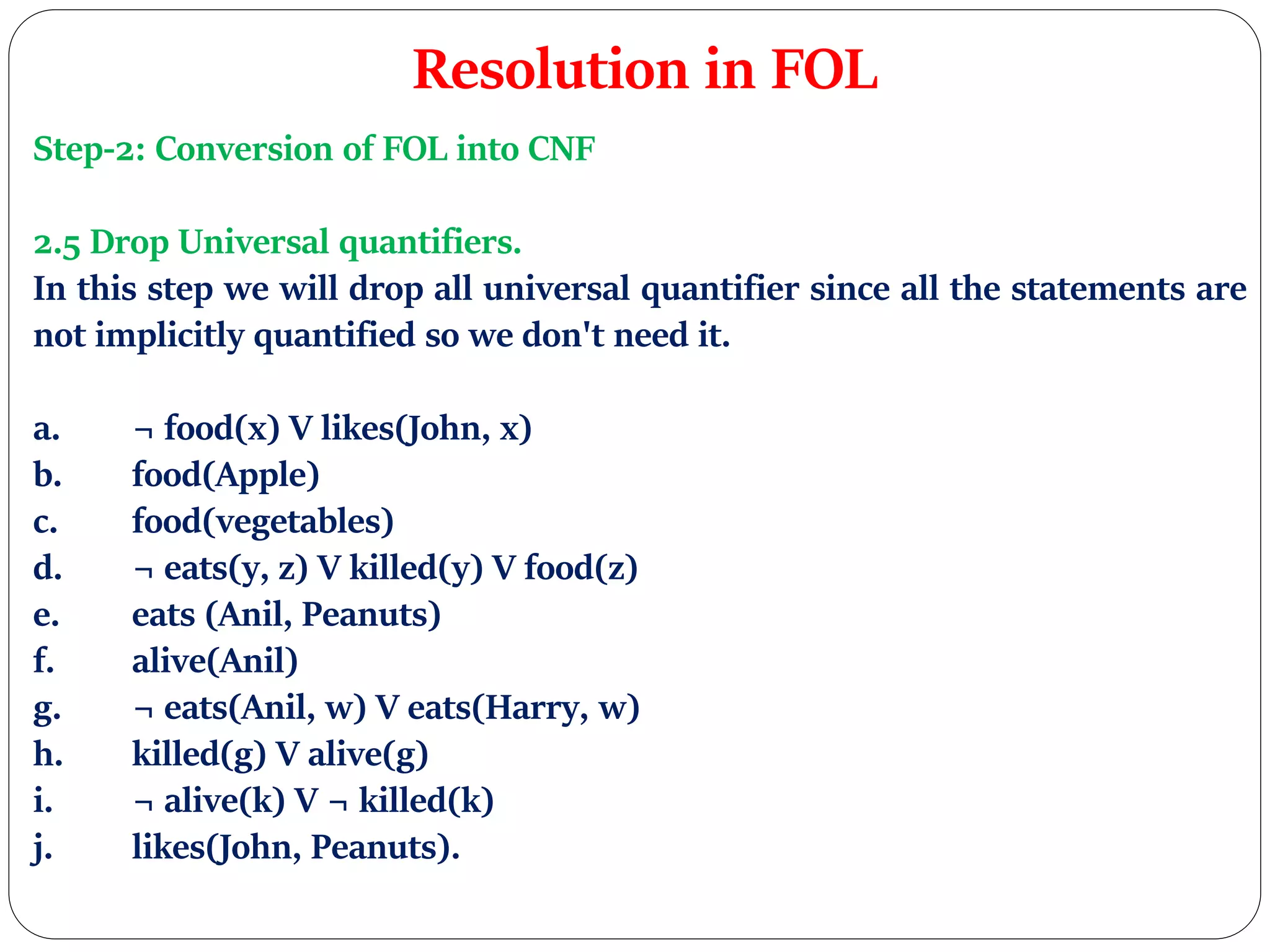
2.5 Drop Universal quantifiers.
In this step we will drop all universal
quantifier since all the statements are not
implicitly quantified so we don't need it.
a. ¬ food(x) V likes(John, x)
b. food(Apple)
c. food(vegetables)
d. ¬ eats(y, z) V killed(y) V food(z)
e. eats (Anil, Peanuts)
f. alive(Anil)
g. ¬ eats(Anil, w) V eats(Harry, w)
h. killed(g) V alive(g)
i. ¬ alive(k) V ¬ killed(k)
j. likes(John, Peanuts).
Resolution in FOL
Step-2: Conversion of FOL into CNF
2.5 Drop Universal quantifiers.
In this step we will drop all universal quantifier since all the statements are
not implicitly quantified so we don't need it.
a. ¬ food(x) V likes(John, x)
b. food(Apple)
c. food(vegetables)
d. ¬ eats(y, z) V killed(y) V food(z)
e. eats (Anil, Peanuts)
f. alive(Anil)
g. ¬ eats(Anil, w) V eats(Harry, w)
h. killed(g) V alive(g)
i. ¬ alive(k) V ¬ killed(k)
j. likes(John, Peanuts).
Resolution in FOL
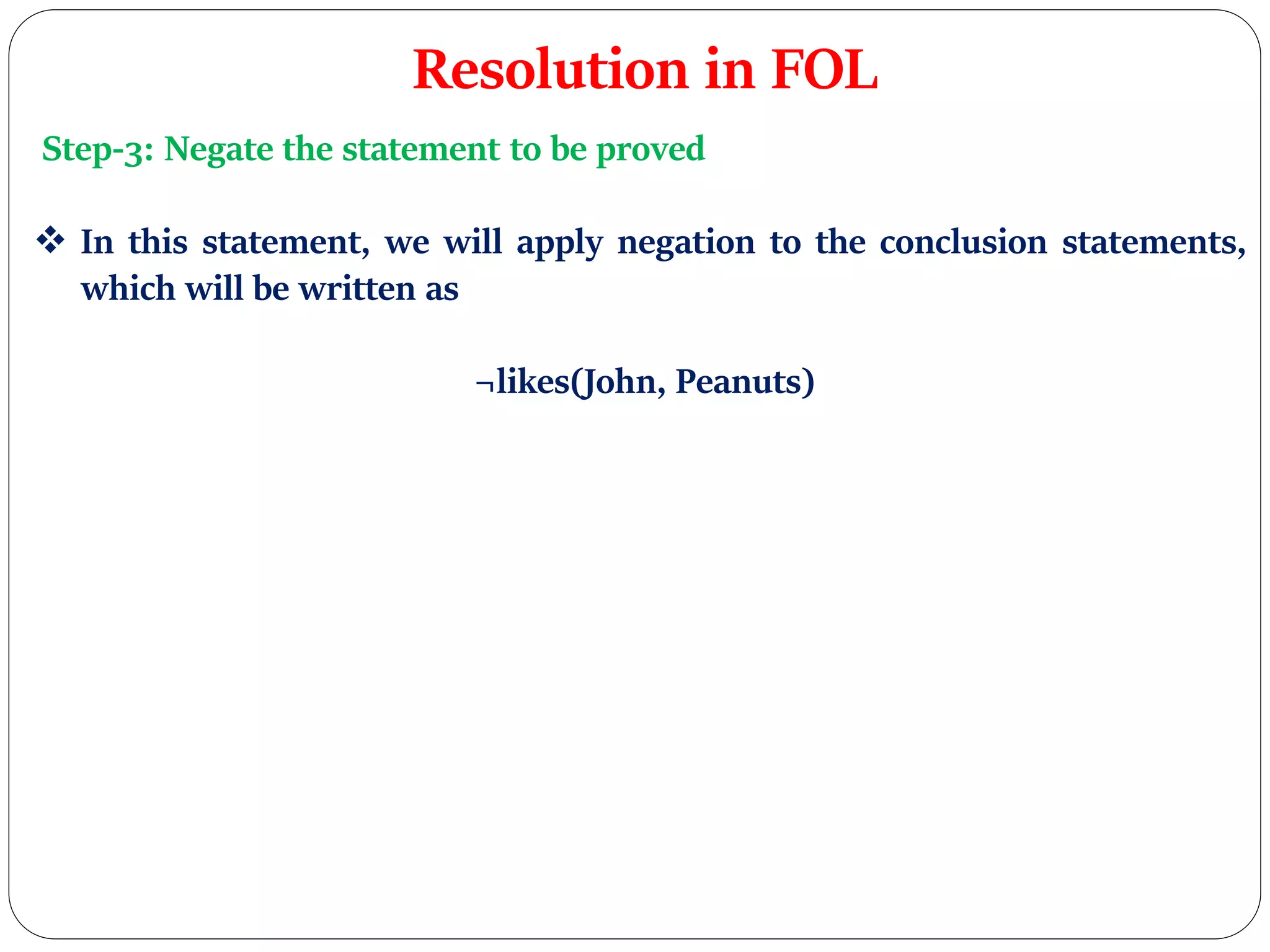
Step-3: Negate the statement to be proved
 In this statement, we will apply negation to the conclusion statements,
which will be written as
¬likes(John, Peanuts)
Resolution in FOL
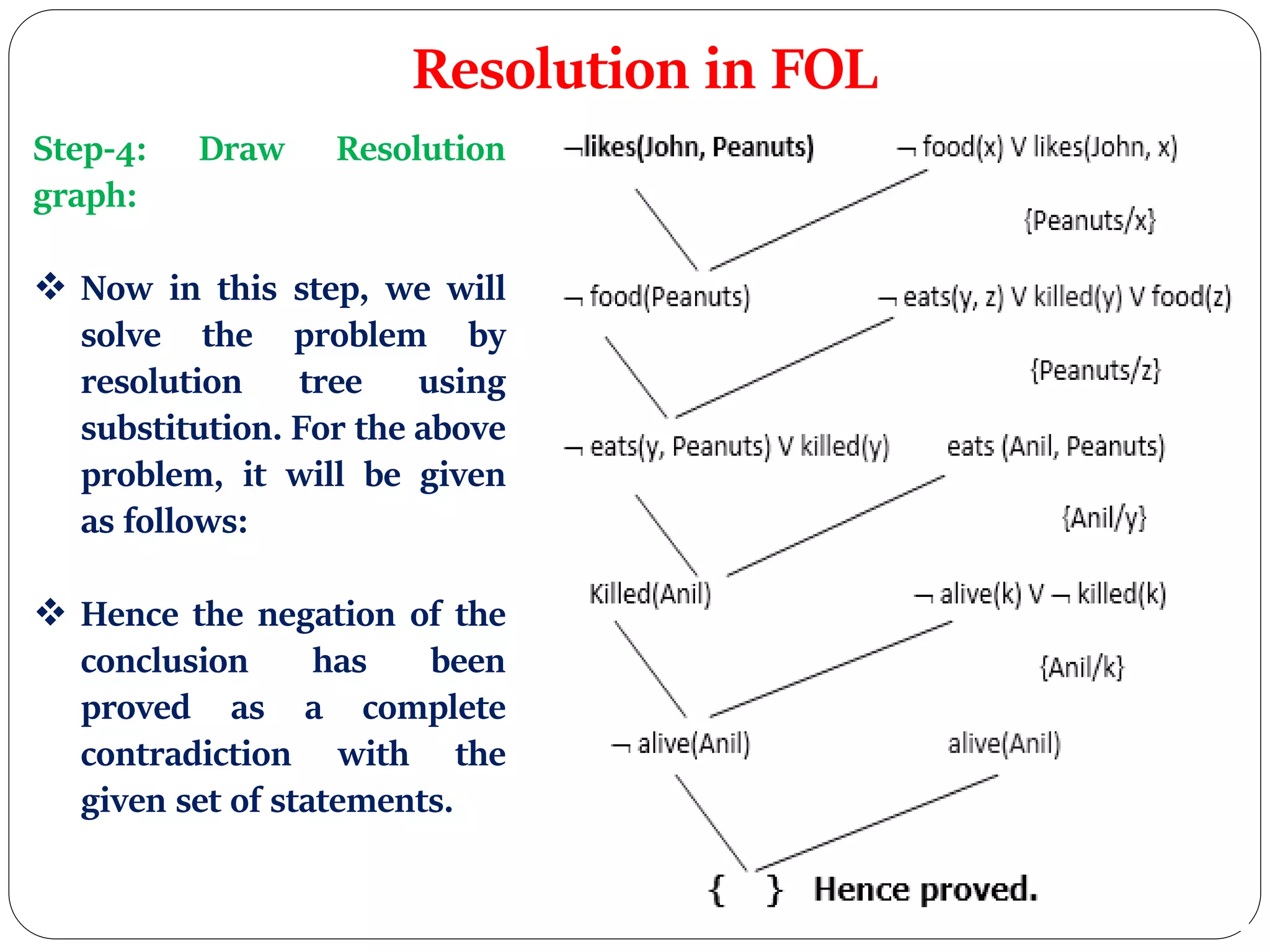
Step-4: Draw Resolution
graph:
 Now in this step, we will
solve the problem by
resolution tree using
substitution. For the above
problem, it will be given
as follows:
 Hence the negation of the
conclusion has been
proved as a complete
contradiction with the
given set of statements.
Resolution in FOL
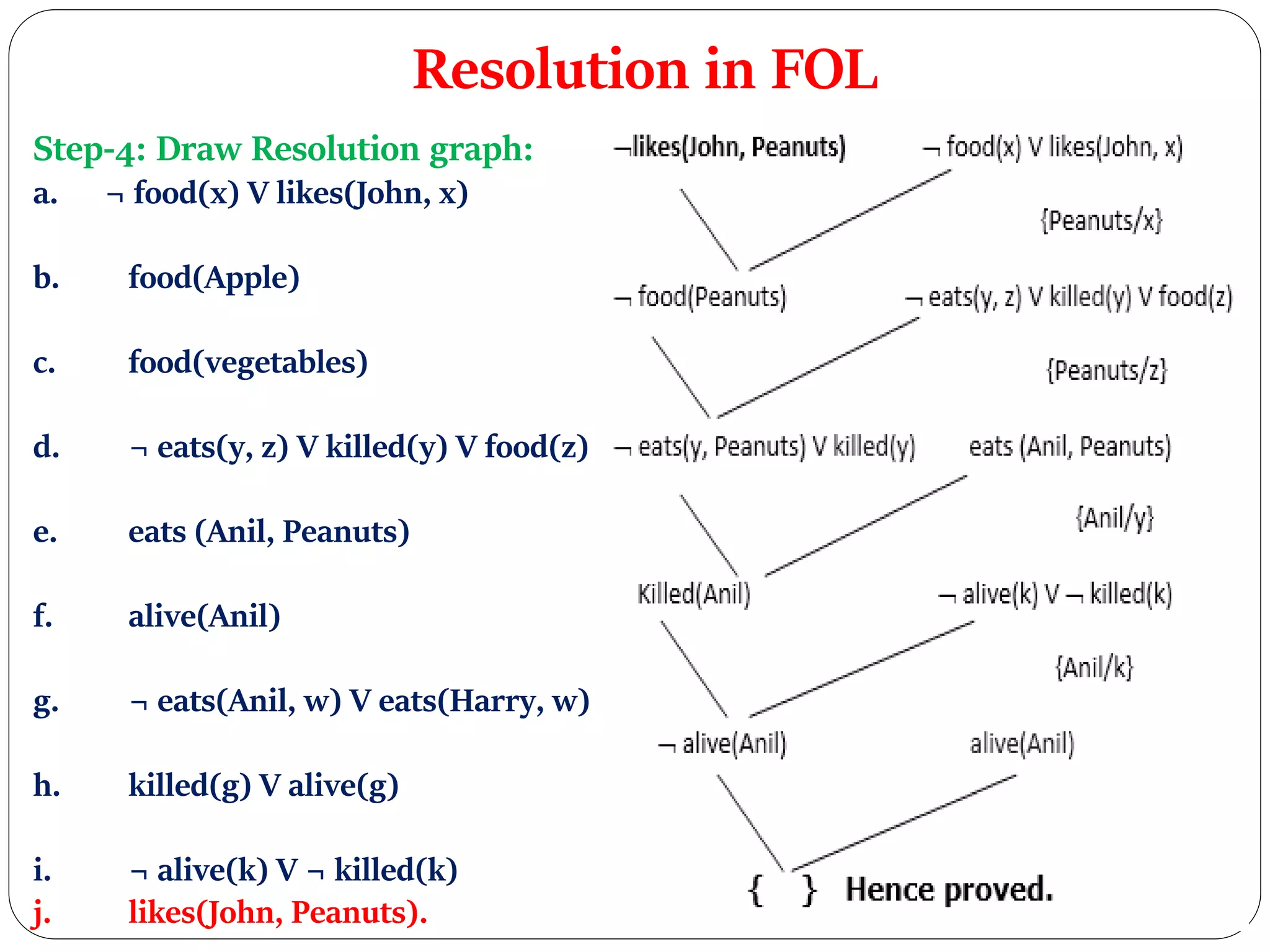
Step-4: Draw Resolution graph:
a. ¬ food(x) V likes(John, x)
b. food(Apple)
c. food(vegetables)
d. ¬ eats(y, z) V killed(y) V food(z)
e. eats (Anil, Peanuts)
f. alive(Anil)
g. ¬ eats(Anil, w) V eats(Harry, w)
h. killed(g) V alive(g)
i. ¬ alive(k) V ¬ killed(k)
j. likes(John, Peanuts).
Resolution in FOL
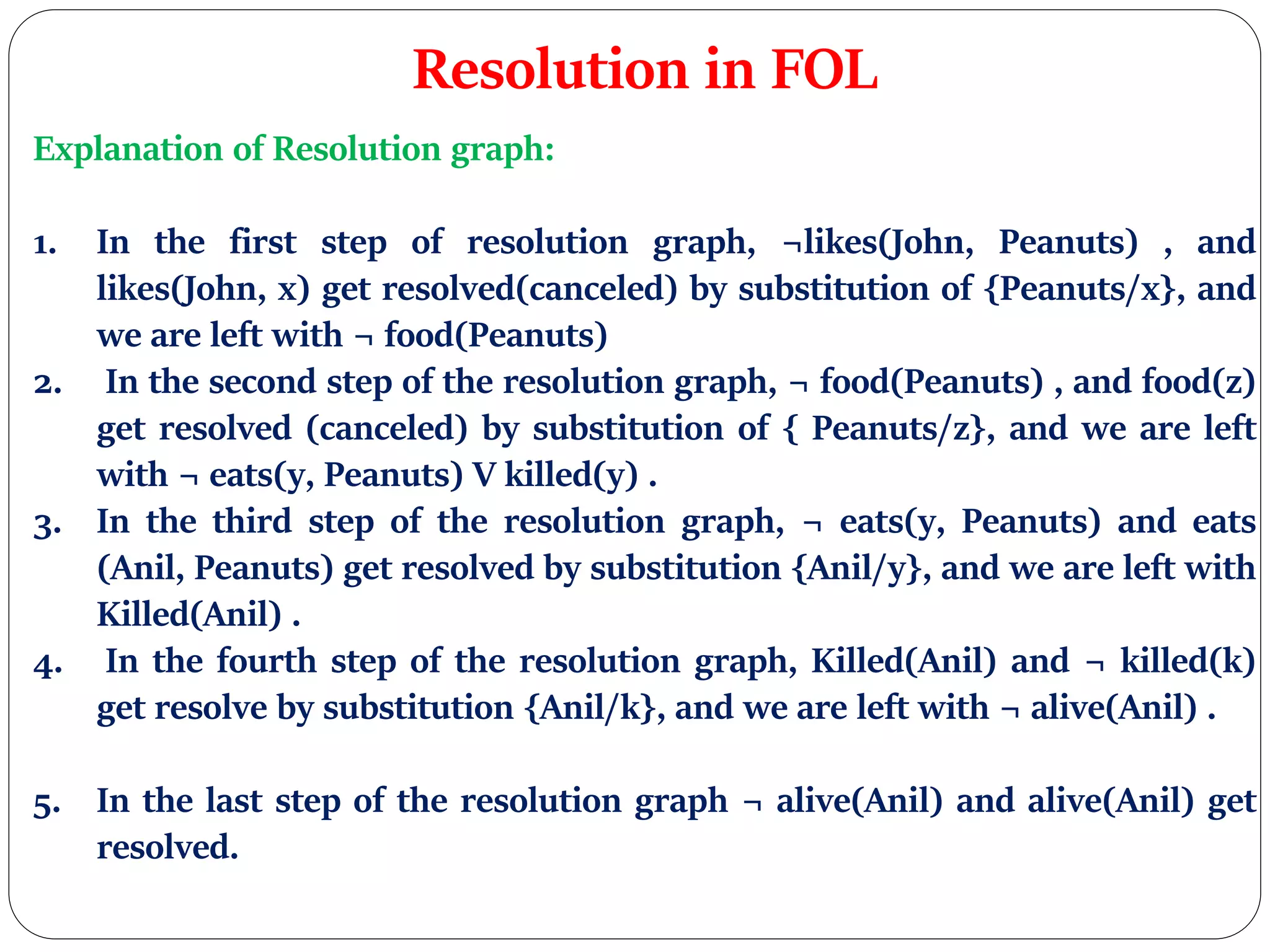
Explanation of Resolution graph:
1. In the first step of resolution graph, ¬likes(John, Peanuts) , and
likes(John, x) get resolved(canceled) by substitution of {Peanuts/x}, and
we are left with ¬ food(Peanuts)
2. In the second step of the resolution graph, ¬ food(Peanuts) , and food(z)
get resolved (canceled) by substitution of { Peanuts/z}, and we are left
with ¬ eats(y, Peanuts) V killed(y) .
3. In the third step of the resolution graph, ¬ eats(y, Peanuts) and eats
(Anil, Peanuts) get resolved by substitution {Anil/y}, and we are left with
Killed(Anil) .
4. In the fourth step of the resolution graph, Killed(Anil) and ¬ killed(k)
get resolve by substitution {Anil/k}, and we are left with ¬ alive(Anil) .
5. In the last step of the resolution graph ¬ alive(Anil) and alive(Anil) get
resolved.
Ai lecture  12(unit03)

Ai lecture 12(unit03)

  • 1.
    Topic To BeCovered: First Order Logic(Part-03) Proof By Resolution In FOL Jagdamba Education Society's SND College of Engineering & Research Centre Department of Computer Engineering SUBJECT: Artificial Intelligence & Robotics Lecture No-12(UNIT-03) Logic & Reasoning Prof.Dhakane Vikas N
  • 2.
    Resolution in FOL Resolutionin FOL: Example Example: a. John likes all kind of food. b. Apple and vegetable are food c. Anything anyone eats and not killed is food. d. Anil eats peanuts and still alive e. Harry eats everything that Anil eats. Prove by resolution that: John likes peanuts. Step-1: Conversion of Facts into FOL In the first step we will convert all the given statements into its first order logic.
  • 3.
    Resolution in FOL Step-2:Conversion of FOL into CNF In First order logic resolution, it is required to convert the FOL into CNF as CNF form makes easier for resolution proofs. 2.1: Eliminate all implication (→) and rewrite a. ∀x ¬ food(x) V likes(John, x) b. food(Apple) Λ food(vegetables) c. ∀x ∀y ¬ [eats(x, y) Λ ¬ killed(x)] V food(y) d. eats (Anil, Peanuts) Λ alive(Anil) e. ∀x ¬ eats(Anil, x) V eats(Harry, x) f. ∀x¬ [¬ killed(x) ] V alive(x) g. ¬ alive(x) V ¬ killed(x) h. likes(John, Peanuts).
  • 4.
    Resolution in FOL Step-2:Conversion of FOL into CNF In First order logic resolution, it is required to convert the FOL into CNF as CNF form makes easier for resolution proofs. 2.2: Move negation (¬)inwards and rewrite a. ∀x ¬ food(x) V likes(John, x) b. food(Apple) Λ food(vegetables) c. ∀x ∀y ¬ eats(x, y) V killed(x) V food(y) d. eats (Anil, Peanuts) Λ alive(Anil) e. ∀x ¬ eats(Anil, x) V eats(Harry, x) f. ∀x ¬killed(x) ] V alive(x) g. ¬ alive(x) V ¬ killed(x) h. likes(John, Peanuts). a. ∀x ¬ food(x) V likes(John, x) b. food(Apple) Λ food(vegetables) c. ∀x ∀y ¬ [eats(x, y) Λ ¬ killed(x)] V food(y) d. eats (Anil, Peanuts) Λ alive(Anil) e. ∀x ¬ eats(Anil, x) V eats(Harry, x) f. ∀x¬ [¬ killed(x) ] V alive(x) g. ¬ alive(x) V ¬ killed(x) h. likes(John, Peanuts).
  • 5.
    Resolution in FOL Step-2:Conversion of FOL into CNF In First order logic resolution, it is required to convert the FOL into CNF as CNF form makes easier for resolution proofs. 2.3: Rename variables or standardize variables a. ∀x ¬ food(x) V likes(John, x) b. food(Apple) Λ food(vegetables) c. ∀y ∀z ¬ eats(y, z) V killed(y) V food(z) d. eats (Anil, Peanuts) Λ alive(Anil) e. ∀w¬ eats(Anil, w) V eats(Harry, w) f. ∀g ¬killed(g) ] V alive(g) g. ¬ alive(k) V ¬ killed(k) h. likes(John, Peanuts).
  • 6.
    Resolution in FOL Step-2:Conversion of FOL into CNF 2.4 Eliminate existential instantiation quantifier by elimination.  In this step, we will eliminate existential quantifier ∃, and this process is known as Skolemization.  But in this example problem since there is no existential quantifier so all the statements will remain same in this step.
  • 7.
    Resolution in FOL Step-2:Conversion of FOL into CNF 2.5 Drop Universal quantifiers. In this step we will drop all universal quantifier since all the statements are not implicitly quantified so we don't need it. a. ¬ food(x) V likes(John, x) b. food(Apple) c. food(vegetables) d. ¬ eats(y, z) V killed(y) V food(z) e. eats (Anil, Peanuts) f. alive(Anil) g. ¬ eats(Anil, w) V eats(Harry, w) h. killed(g) V alive(g) i. ¬ alive(k) V ¬ killed(k) j. likes(John, Peanuts).
  • 8.
    Resolution in FOL Step-2:Conversion of FOL into CNF 2.5 Drop Universal quantifiers. In this step we will drop all universal quantifier since all the statements are not implicitly quantified so we don't need it. a. ¬ food(x) V likes(John, x) b. food(Apple) c. food(vegetables) d. ¬ eats(y, z) V killed(y) V food(z) e. eats (Anil, Peanuts) f. alive(Anil) g. ¬ eats(Anil, w) V eats(Harry, w) h. killed(g) V alive(g) i. ¬ alive(k) V ¬ killed(k) j. likes(John, Peanuts).
  • 9.
    Resolution in FOL Step-3:Negate the statement to be proved  In this statement, we will apply negation to the conclusion statements, which will be written as ¬likes(John, Peanuts)
  • 10.
    Resolution in FOL Step-4:Draw Resolution graph:  Now in this step, we will solve the problem by resolution tree using substitution. For the above problem, it will be given as follows:  Hence the negation of the conclusion has been proved as a complete contradiction with the given set of statements.
  • 11.
    Resolution in FOL Step-4:Draw Resolution graph: a. ¬ food(x) V likes(John, x) b. food(Apple) c. food(vegetables) d. ¬ eats(y, z) V killed(y) V food(z) e. eats (Anil, Peanuts) f. alive(Anil) g. ¬ eats(Anil, w) V eats(Harry, w) h. killed(g) V alive(g) i. ¬ alive(k) V ¬ killed(k) j. likes(John, Peanuts).
  • 12.
    Resolution in FOL Explanationof Resolution graph: 1. In the first step of resolution graph, ¬likes(John, Peanuts) , and likes(John, x) get resolved(canceled) by substitution of {Peanuts/x}, and we are left with ¬ food(Peanuts) 2. In the second step of the resolution graph, ¬ food(Peanuts) , and food(z) get resolved (canceled) by substitution of { Peanuts/z}, and we are left with ¬ eats(y, Peanuts) V killed(y) . 3. In the third step of the resolution graph, ¬ eats(y, Peanuts) and eats (Anil, Peanuts) get resolved by substitution {Anil/y}, and we are left with Killed(Anil) . 4. In the fourth step of the resolution graph, Killed(Anil) and ¬ killed(k) get resolve by substitution {Anil/k}, and we are left with ¬ alive(Anil) . 5. In the last step of the resolution graph ¬ alive(Anil) and alive(Anil) get resolved.