Artificial Intelligence and
Dental Care
Presented by:
• Nourhan Makhlouf
• Mohamed Goda
• Reem Sabry
• Marena Sameh
• Abd Alkareem Taha
Under-supervision
Dean: Prof. Dr. Rabab Mubarak
Assistant lecturer: Dr. Shimaa Kotb
outlines
• What is AI?
• Impact Of AI
• Branches of AI
• AI technology
• Application of AI in Dentistry
• Conclusion
• References
“Predicting
the future is
not a matter of
magic, its an
artificial
intelligence.”
Dave Waters
What is meant by
Artificial intelligence ?
technology that's
used to train the
machines to mimic
the intelligent of
human behavior
to perform a
specific task.
Artificial intelligence (AI)
AI represents a broad spectrum of emerging innovative technologies that are
becoming increasingly essential to everyday life.
The impact of application of artificial intelligence :
analysis of large datasets
providing reliable insights accuracy in detecting, evaluating, and predicting
diseases.
and enhancing the decision-making process.
Branches of AI
including:
• Machine learning (ML),
• Natural language process.
• Computer vision
• Robotics, and more.
“AI“ technologies
Driven by algorithms
sets of instructions, guide the computer’s
actions.
The most widely used algorithms in AI include:
Decision trees …………..for decision-making
Neural networks ……………………for pattern recognition,
Deep learning algorithms for tasks like image and speech
recognition.
“AI “in health
care divided into:
• Virtual type deals with mathematical algorithms.
• Robotic type supports the physical part of healthcare
systems.
• Examples of the technology which improved
dentistry:
• Intraoral scanner,
• 3D printers to create dentures,
• robotic surgery,
• virtual reality, and AI.
• pivotal force,
transforming
numerous
industries and
reshaping our
daily experiences.
Artificial Intelligence
Application of AI in Dentistry
Normal anatomy
Electronic
Dental record
Oral Medicine
,
Periodontolog
y
Cariology
Endodontics
Oral
Maxillofacial
surgery,
Implantology
Tele Dentistry
Identification of Normal
Anatomy
•“ Identify and segment the
anatomical structures are
now possible with AI-
generated algorithms in
dental radiographs,
particularly cone beam
computed tomography
(CBCT).
Electronic Record
Dental chart
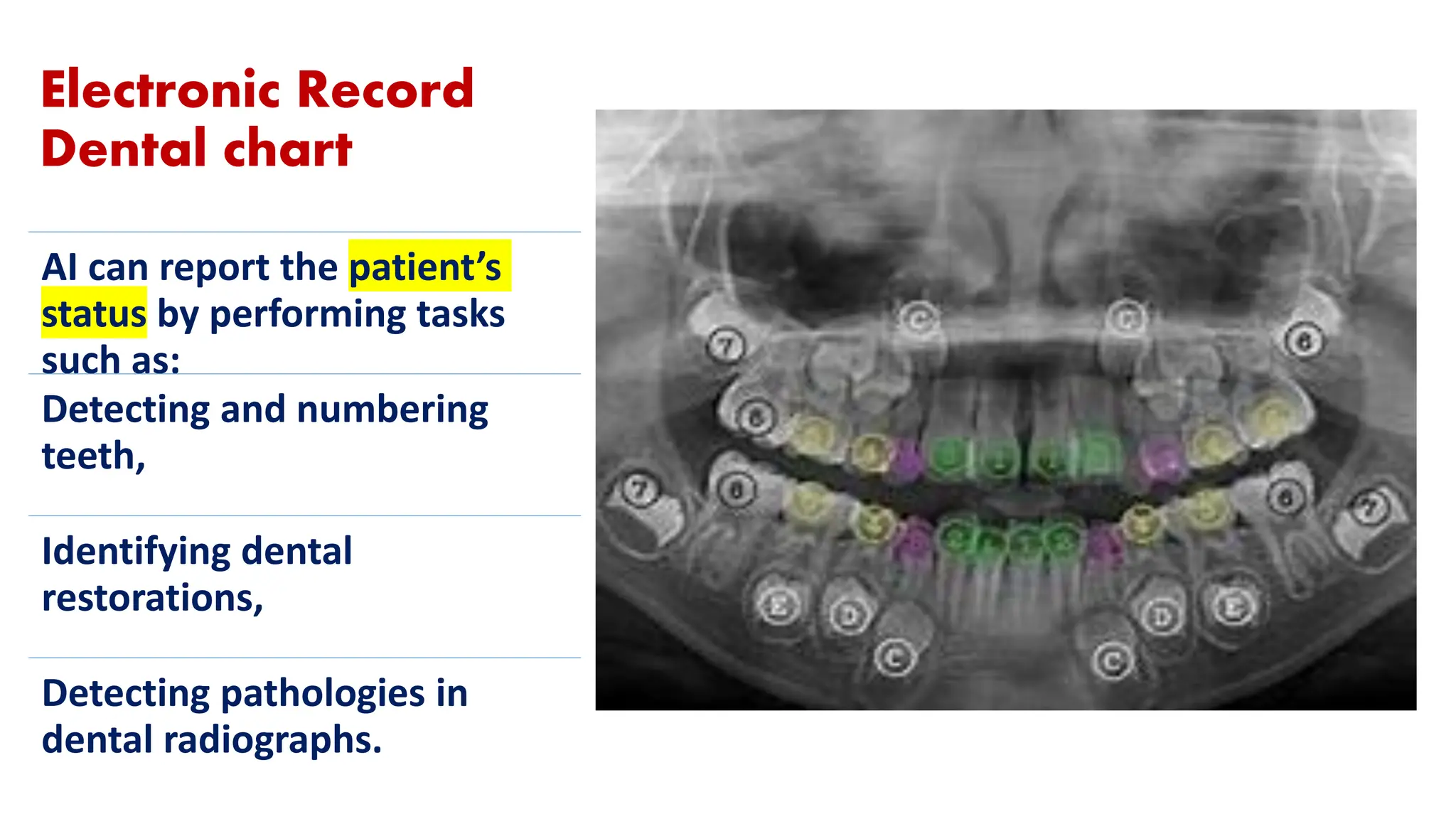
AI can report the patient’s
status by performing tasks
such as:
Detecting and numbering
teeth,
Identifying dental
restorations,
Detecting pathologies in
dental radiographs.
Oral Medicine /
Oral Pathology
AI “deep neural networks” collecting
worldwide images data set of oral lesions to
aid in automatic lesion classification
algorithms.
AI aid in accurate diagnosis, screening and
predicting the recurrence rate in:
• Early detection of different oral lesions.
• Oral Cancer detection.
• Head & neck pre-cancer lesions
• Lichen planus
• Dental caries one of the most common
diseases in oral cavity.
• Early and accurate detection of dental caries
is crucial for appropriate treatment and
prevention of further complications.
• Using AI in caries detection offers several
potential benefits, including:
• improved accuracy,
• faster diagnosis,
• and minimize dependence on human
interpretation.
Cariology
Periodontology
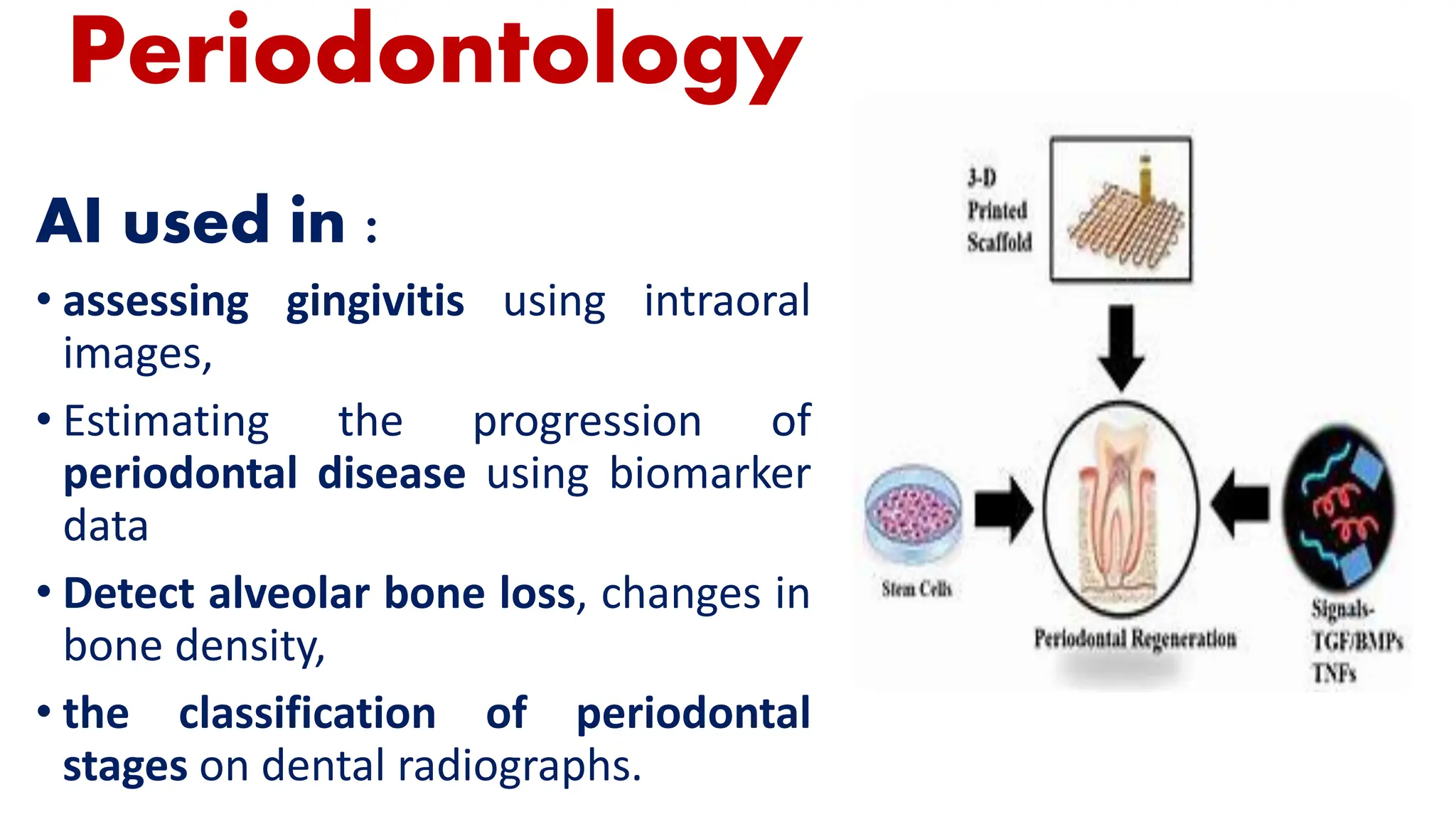
AI used in :
• assessing gingivitis using intraoral
images,
• Estimating the progression of
periodontal disease using biomarker
data
• Detect alveolar bone loss, changes in
bone density,
• the classification of periodontal
stages on dental radiographs.
Endodontics
AI utilize for :
•identify periapical lesions.
•Crown and root fractures
•Working length
determination
•Detecting root canal
morphology
Oral and Maxillofacial
Surgery
• AI algorithms utilized for diagnosis,
treatment, prediction of outcomes
• preoperative surgical planning.
• Impacted tooth detection.
• Assessment the relationship with
surrounding anatomical structures
(such as the maxillary sinus, nasal
fossa, and mandibular canal).
• predicting postsurgical complication.
Dental Implantology
AI utilize in:
detection of various aspects
related to dental implants:
•Implant position
•Implant fractures
•and peri-implant bone loss.
Tele dentistry
• provision of dental care and education
through tele-communication platforms such
as:
• phones,
• computers,
• email,
• Help in remote diagnosis,
• Follow up
• and treatment advice.
• Tele dentistry becoming smarter and more
powerful tools used today.
Dental
Education
Visual
patient
simulator
Prosthetic
Dentistry
using
CAD-CAM
technolgy
Orthodontics.
-Analysis of
radiographs
movements
-3D aligners,
-treatment
plan
Forensic
Dentistry
Biological age,
gender,
Bite marks ,
mandibular
morphology
Dental
Radiology
Precise and
accurate
reading
Patient
management
virtual dental
assistance
, emergency
Tele-dentistry.
Application of AI in Dental Fields
The pros and cons of using AI
Pros
Reducing Human Error
Quick Decision Making
Reduce The Risk
Automates Repetition
Assist With Digital
Tasks
Cons
Higher overall costs
Human job losts
Lack creativity
Lack emotional
attitude
No Ethical principals
Conclusion
AI can decrease the strain on healthcare systems by taking over routine
tasks, freeing up clinicians to focus on more challenging cases.
AI not a replacement for human expertise, AI can only assist clinicians
in performing their tasks professionally.
Application of AI in medicine should always guided by ethical principles
References
• Schwendicke F, Samek W, Krois J. Artificial intelligence in dentistry: Chances and challenges. J
Dent Res 2020;99:769-74.
• Patil S, Albogami S, Hosmani J et al. Artificial Intelligence in the Diagnosis of Oral Diseases:
Applications and Pitfalls. Diagnostics (Basel) 2022; 12: 1029.
• Scott J, Biancardi AM, Jones O, Andrew D. Artifcial intelligence in periodontology: a scoping
review. Dent J (Basel). 2023;11:43.
• Hung KF, Yeung AWK, Bornstein MM, Schwendicke F. Personalized dental medicine, artifcial
intelligence, and their relevance for dentomaxillofacial imaging. Dentomaxillofac Radiol.
2023;52:20220335.
• Hussein Rafat Kotb, Shaimaa. ‘Perspective Chapter: Teledentistry and Distance Learning – Access
to Oral Health State during COVID-19’. Dentistry, IntechOpen, 14 June 2023. Crossref,
doi:10.5772/intechopen.107135.
• Mehrabanian, M. Artificial intelligence in dentistry. 2024;Br Dent J 236, 522.
https://doi.org/10.1038/s41415-024-7281-3.
ARTIFICAL INTELLEGENCE IN DENTAL CARE. power point.pdf

ARTIFICAL INTELLEGENCE IN DENTAL CARE. power point.pdf

  • 1.
    Artificial Intelligence and DentalCare Presented by: • Nourhan Makhlouf • Mohamed Goda • Reem Sabry • Marena Sameh • Abd Alkareem Taha Under-supervision Dean: Prof. Dr. Rabab Mubarak Assistant lecturer: Dr. Shimaa Kotb
  • 2.
    outlines • What isAI? • Impact Of AI • Branches of AI • AI technology • Application of AI in Dentistry • Conclusion • References
  • 3.
    “Predicting the future is nota matter of magic, its an artificial intelligence.” Dave Waters
  • 4.
    What is meantby Artificial intelligence ? technology that's used to train the machines to mimic the intelligent of human behavior to perform a specific task.
  • 5.
    Artificial intelligence (AI) AIrepresents a broad spectrum of emerging innovative technologies that are becoming increasingly essential to everyday life. The impact of application of artificial intelligence : analysis of large datasets providing reliable insights accuracy in detecting, evaluating, and predicting diseases. and enhancing the decision-making process.
  • 6.
    Branches of AI including: •Machine learning (ML), • Natural language process. • Computer vision • Robotics, and more.
  • 7.
    “AI“ technologies Driven byalgorithms sets of instructions, guide the computer’s actions. The most widely used algorithms in AI include: Decision trees …………..for decision-making Neural networks ……………………for pattern recognition, Deep learning algorithms for tasks like image and speech recognition.
  • 8.
    “AI “in health caredivided into: • Virtual type deals with mathematical algorithms. • Robotic type supports the physical part of healthcare systems. • Examples of the technology which improved dentistry: • Intraoral scanner, • 3D printers to create dentures, • robotic surgery, • virtual reality, and AI.
  • 9.
    • pivotal force, transforming numerous industriesand reshaping our daily experiences. Artificial Intelligence
  • 10.
    Application of AIin Dentistry Normal anatomy Electronic Dental record Oral Medicine , Periodontolog y Cariology Endodontics Oral Maxillofacial surgery, Implantology Tele Dentistry
  • 11.
    Identification of Normal Anatomy •“Identify and segment the anatomical structures are now possible with AI- generated algorithms in dental radiographs, particularly cone beam computed tomography (CBCT).
  • 12.
    Electronic Record Dental chart AIcan report the patient’s status by performing tasks such as: Detecting and numbering teeth, Identifying dental restorations, Detecting pathologies in dental radiographs.
  • 13.
    Oral Medicine / OralPathology AI “deep neural networks” collecting worldwide images data set of oral lesions to aid in automatic lesion classification algorithms. AI aid in accurate diagnosis, screening and predicting the recurrence rate in: • Early detection of different oral lesions. • Oral Cancer detection. • Head & neck pre-cancer lesions • Lichen planus
  • 14.
    • Dental cariesone of the most common diseases in oral cavity. • Early and accurate detection of dental caries is crucial for appropriate treatment and prevention of further complications. • Using AI in caries detection offers several potential benefits, including: • improved accuracy, • faster diagnosis, • and minimize dependence on human interpretation. Cariology
  • 15.
    Periodontology AI used in: • assessing gingivitis using intraoral images, • Estimating the progression of periodontal disease using biomarker data • Detect alveolar bone loss, changes in bone density, • the classification of periodontal stages on dental radiographs.
  • 16.
    Endodontics AI utilize for: •identify periapical lesions. •Crown and root fractures •Working length determination •Detecting root canal morphology
  • 17.
    Oral and Maxillofacial Surgery •AI algorithms utilized for diagnosis, treatment, prediction of outcomes • preoperative surgical planning. • Impacted tooth detection. • Assessment the relationship with surrounding anatomical structures (such as the maxillary sinus, nasal fossa, and mandibular canal). • predicting postsurgical complication.
  • 18.
    Dental Implantology AI utilizein: detection of various aspects related to dental implants: •Implant position •Implant fractures •and peri-implant bone loss.
  • 19.
    Tele dentistry • provisionof dental care and education through tele-communication platforms such as: • phones, • computers, • email, • Help in remote diagnosis, • Follow up • and treatment advice. • Tele dentistry becoming smarter and more powerful tools used today.
  • 20.
    Dental Education Visual patient simulator Prosthetic Dentistry using CAD-CAM technolgy Orthodontics. -Analysis of radiographs movements -3D aligners, -treatment plan Forensic Dentistry Biologicalage, gender, Bite marks , mandibular morphology Dental Radiology Precise and accurate reading Patient management virtual dental assistance , emergency Tele-dentistry. Application of AI in Dental Fields
  • 21.
    The pros andcons of using AI Pros Reducing Human Error Quick Decision Making Reduce The Risk Automates Repetition Assist With Digital Tasks Cons Higher overall costs Human job losts Lack creativity Lack emotional attitude No Ethical principals
  • 22.
    Conclusion AI can decreasethe strain on healthcare systems by taking over routine tasks, freeing up clinicians to focus on more challenging cases. AI not a replacement for human expertise, AI can only assist clinicians in performing their tasks professionally. Application of AI in medicine should always guided by ethical principles
  • 23.
    References • Schwendicke F,Samek W, Krois J. Artificial intelligence in dentistry: Chances and challenges. J Dent Res 2020;99:769-74. • Patil S, Albogami S, Hosmani J et al. Artificial Intelligence in the Diagnosis of Oral Diseases: Applications and Pitfalls. Diagnostics (Basel) 2022; 12: 1029. • Scott J, Biancardi AM, Jones O, Andrew D. Artifcial intelligence in periodontology: a scoping review. Dent J (Basel). 2023;11:43. • Hung KF, Yeung AWK, Bornstein MM, Schwendicke F. Personalized dental medicine, artifcial intelligence, and their relevance for dentomaxillofacial imaging. Dentomaxillofac Radiol. 2023;52:20220335. • Hussein Rafat Kotb, Shaimaa. ‘Perspective Chapter: Teledentistry and Distance Learning – Access to Oral Health State during COVID-19’. Dentistry, IntechOpen, 14 June 2023. Crossref, doi:10.5772/intechopen.107135. • Mehrabanian, M. Artificial intelligence in dentistry. 2024;Br Dent J 236, 522. https://doi.org/10.1038/s41415-024-7281-3.