Artificial Intelligence (AI) for
Safety-Critical Systems
Jon Perez
jmperez@ikerlan.es
(INSIDE SC)
Promising technologies for ECS
22nd September 2022
© 2022 IKERLAN. All rights reserved
2
ÍNDICE
Introduction
Safety standards
ML development (training)
ML development (inference)
Trustworthiness
Conclusion
AGENDA
© 2022 IKERLAN. All rights reserved
Example AI and dependable / Safety systems
3
[mov]
[ver]
[guard]
[kone]
Automatic
Automation level:
Level of intelligence
Heteronomous Autonomous
Operating
conditions
Closed
World
Open
World
High
Computing
Performance
(HPC)
Reliability, availability
Safety & Safety
Certification
Dependability
[Pe20b]
© 2022 IKERLAN. All rights reserved
Machine learning
Artificial intelligence
Machine learning
Deep learning
Linear regression.
Logistic regression.
Bayesian networks.
Decision tree.
Greedy algorithm.
Support Vector Machine (SVM).
Naive bayes.
Random forest.
Gradient boosting algorithm.
….
Neural Network (NN).
Deep learning.
Recurrent Neural Network (RNN).
Long Short Term Memory (LSTM).
…..
[Pe20b]
Artificial Intelligence [ISO 22989]:
“set of methods or automated entities that together
build, optimize and apply a model so that the system
can, for a given set of predefined tasks, compute
predictions, recommendations, or decisions”
Machine Learning [Oxford]:
“the use and development of computer systems that are
able to learn and adapt without following explicit
instructions, by using algorithms and statistical models
to analyze and draw inferences from patterns in data”
© 2022 IKERLAN. All rights reserved
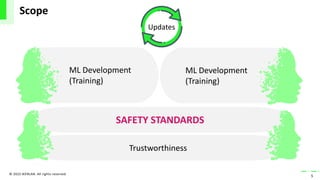
Scope
5
Updates
ML Development
(Training)
ML Development
(Training)
SAFETY STANDARDS
Trustworthiness
© 2022 IKERLAN. All rights reserved
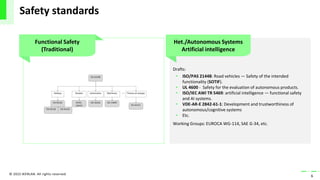
Safety standards
6
Het./Autonomous Systems
Artificial intelligence
Drafts:
• ISO/PAS 21448: Road vehicles — Safety of the intended
functionality (SOTIF).
• UL 4600 - Safety for the evaluation of autonomous products.
• ISO/IEC AWI TR 5469: artificial intelligence — functional safety
and AI systems.
• VDE-AR-E 2842-61-1: Development and trustworthiness of
autonomous/cognitive systems
• Etc.
Working Groups: EUROCA WG-114, SAE G-34, etc.
Functional Safety
(Traditional)
© 2022 IKERLAN. All rights reserved
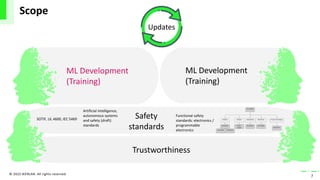
Scope
7
Updates
ML Development
(Training)
ML Development
(Training)
Trustworthiness
Artificial intelligence,
autonomous systems
and safety (draft)
standards
SOTIF, UL 4600, IEC 5469
Functional safety
standards: electronics /
programmable
electronics
Safety
standards
© 2022 IKERLAN. All rights reserved
Safety standards
8
AI Lifecycle
ML Lifecycle
Example safety case
[Bu17] – GSN
System
Concept
Specification
Architecture
Specification
Module
Detailed Design
Implementation
ModuleTesting
Integration
Validation
Verification
Validation
[AS19]
© 2022 IKERLAN. All rights reserved
Development (training)
9
[cbc, hre, Ka18]
© 2022 IKERLAN. All rights reserved
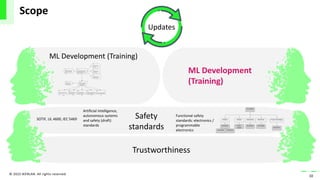
Scope
10
Updates
ML Development
(Training)
Trustworthiness
Functional safety
standards: electronics /
programmable
electronics
Safety
standards
ML Development (Training)
Artificial intelligence,
autonomous systems
and safety (draft)
standards
SOTIF, UL 4600, IEC 5469
© 2022 IKERLAN. All rights reserved
Deployment (inference)
11
Hardware device Software
• Multi-core devices and MPSoCs [Pe20]
• GPUs [Ko19, Le18, Pe22]
• FPGAs [Ko19]
• Specialized devices, e.g., TPU
• Proprietary devices, e.g. Tesla FSD [Ta20]
High-Performance Embedded Computing (HPEC) – Hardware and software.
• Safety compliance of ‘Parallel Programming runtime’ and ‘ML software libraries’ .
• Temporal Independence, guarantees and diagnosis [Pe20].
• Spatial independence [Pe20].
• Diagnosistic coverage (DC) [Pe20].
• Thermal dissipation, energy consumption [Ko19].
Hypervisor Operating system Domain specific runtime env.
Parallel ProgrammingRuntimes
© 2022 IKERLAN. All rights reserved
14
Generic purpose computing
Specialized computing solutions
Safety Std. Compliance and support
Deployment (inference)
12
Hardware device
• Multi-core devices and MPSoCs [Pe20]
• GPUs [Ko19, Le18, Pe22]
• FPGAs [Ko19]
• Specialized devices, e.g., TPU
• Proprietary devices, e.g. Tesla FSD [Ta20]
High-Performance Embedded Computing (HPEC) – Hardware and software.
• Safety compliance of ‘Parallel Programming runtime’ and ‘ML software libraries’ .
• Temporal Independence, guarantees and diagnosis [Pe20].
• Spatial independence [Pe20].
• Diagnosistic coverage (DC) [Pe20].
• Thermal dissipation, energy consumption [Ko19].
[Co17]
[xilinx]
[Co17] [nvidia]
[mbeye]
© 2022 IKERLAN. All rights reserved
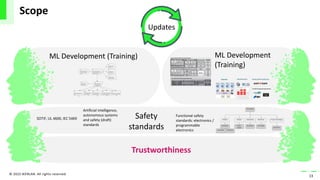
Scope
13
Updates
Trustworthiness
Functional safety
standards: electronics /
programmable
electronics
Safety
standards
ML Development (Training) ML Development
(Training)
Artificial intelligence,
autonomous systems
and safety (draft)
standards
SOTIF, UL 4600, IEC 5469
© 2022 IKERLAN. All rights reserved
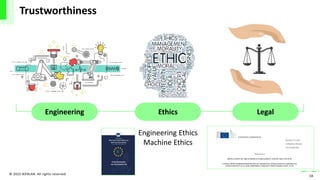
Trustworthiness
14
Engineering Ethics Legal
Engineering Ethics
Machine Ethics
15
© 2022 IKERLAN. All rights reserved
C
O
N
C
L
U
S
I
O
N
There is a need to pave the way towards the
development and certification of AI-based safety
systems:
• Need for AI safety standard(s) definition and consolidation,
complementary with functional safety standards.
• Many ML technical challenges: training data coverage (e.g., corner
cases), understability, testability, verifiability, etc.
• Evolution of HPC challenges (HW / SW): integration of functions of
different criticality in a HPC safe execution platform:
• Safety compliance of ML libraries and parallel programming
languages.
• Temporal and spatial independence.
• Thermal and energy requirements.
• Trustworthiness: Engineering, Ethics and Legal
• Safe and secure update of systems
© 2022 IKERLAN. All rights reserved
References
16
• [AS19] R. Ashmore, R. Calinescu, and C. Paterson, "Assuring the Machine Learning Lifecycle: Desiderata, Methods, and Challenges," ArXiv, vol. abs/1905.04223, 2019.
• [AV04] A. Avizienis, J.-C. Laprie, B. Randell, and C. Landwehr, "Basic Concepts and Taxonomy of Dependable and Secure Computing," in IEEE Transactions on Dependable and Secure Computing, January/March 2004, vol. 1, pp.
11-33
• [Bu17] S. Burton, L. Gauerhof, and C. Heinzemann, "Making the Case for Safety of Machine Learning in Highly Automated Driving," in Computer Safety, Reliability, and Security, Cham, S. Tonetta, E. Schoitsch, and F. Bitsch,
Eds., 2017: Springer International Publishing, pp. 5-16.
• [Bo18] U. bodemhausen, "Deep learning and functional safety," in ESE Kongress, 2018
• [cbc] https://www.cbc.ca/news/canada/toronto/smart-traffic-signals-1.4417573
• [Co17] Giulio Corradi, Xilinx, Tools, Architectures and Trends on Industrial all Programmable Heterogeneous MPSoC, ECRTS (Keynote talk), 2017
• [guard] https://www.theguardian.com/world/2018/sep/23/potsdam-inside-the-worlds-first-autonomous-tram
• [HE18] J. Henriksson, M. Borg, and C. Englund, "Automotive Safety and Machine Learning: Initial Results from a Study on How to Adapt the ISO 26262 Safety Standard," in IEEE/ACM 1st International Workshop on Software
Engineering for AI in Autonomous Systems (SEFAIAS), 28-28 May 2018, pp. 47-49.
• [IEC61508] IEC 61508-4: Functional safety of electrical/electronic/programmable electronic safety-related systems – Part 4: Definitions and abbreviations, IEC 61508, 2010.
• [Ka18] Karpathy, Andrej, “Building the Software 2.0 Stack”, 2018
• [KN02] J. C. Knight, "Safety critical systems: challenges and directions," in 24rd International Conference on Software Engineering (ICSE 2002), 2002, pp. 547-550.
• [Ko19] L. Kosmidis, J. Lachaize, J. Abella, O. Notebaert, F. J. Cazorla, and D. Steenari, "GPU4S: Embedded GPUs in Space," in 22nd Euromicro Conference on Digital System Design (DSD), 28-30 Aug. 2019, pp. 399-405, doi:
10.1109/DSD.2019.00064.
• [kone] https://guinea.kone.com/Images/brochure-kone-polaris_tcm170-18639.pdf
• [Le18] G. Lentaris et al., "High-Performance Embedded Computing in Space: Evaluation of Platforms for Vision-Based Navigation," Journal of Aerospace Information Systems, vol. 15, no. 4, pp. 178-192, 2018, doi:
10.2514/1.I010555.
• [MA19] R. Mariani, "Challenges in AI/ML for Safety Critical Systems (Key Note)," in 32nd IEEE International Symposium on Defect and Fault Tolerance in VLSI and Nanotechnology Systems (DFT), 2019: NVIDIA.
• [mbeye] https://www.mobileye.com/our-technology/evolution-eyeq-chip/
• [mov] Tenerife prueba un autobús eléctrico de Vectia. 2018; https://movilidadelectrica.com/tenerife-prueba-un-autobus-electrico-de-vectia/
• [nvidia] https://www.anandtech.com/show/15245/nvidia-details-drive-agx-orin-a-herculean-arm-automotive-soc-for-2022
• [Pe14] Perez, Jon; Alonso, Alejandro; Crespo, Alfons; “Tutorial: Developing Mixed-Criticality Systems with GNAT/ORK and Xtratum”, DATE Workshop, 2014
• [Pe20] J. Perez Cerrolaza et al., "Multi-core Devices for Safety-critical Systems: A Survey," ACM Comput. Surv., vol. 53, no. 4, July 2020, doi: https://doi.org/10.1145/3398665.
• [Pe20b] Perez, Jon; “Challenges of artificial intelligence and dependable systems - A focus on safety”, HIPEAC 2020
• [Pe22] J. Perez-Cerrolaza, J. Abella, L. Kosmidis, A. J. Calderon, F. J. Cazorla, and J. L. Flores, "GPU Devices for Safety-Critical Systems: A Survey," ACM Comput. Surv., 2022, doi: 10.1145/3549526.
• [Pl18] Andreas Platschek, Nicholas Mc Guire, Lukas Bulwahn; “Certifying Linux: Lessons Learned in Three Years of SIL2LinuxMP”, Embedded World, 2018
• [RA21] Nijat Rajabli et. Al., Software Verification and Validation of Safe Autonomous Cars: A Systematic Literature Review, IEEE Access, 2021
• [rhe] https://www.reporterherald.com/2019/10/31/dinosaur-big-brown-bear-help-children-cross-the-street-at-berthoud-elementary/
• [Ro17]. Royuela, A. Duran, M. A. Serrano, E. Quiñones, and X. Martorell. 2017. A Functional Safety OpenMP* for Critical Real-Time Embedded Systems. Springer, Book section 16.
• [Ta20] E. Talpes et al., "Compute Solution for Tesla's Full Self-Driving Computer," IEEE Micro, vol. 40, no. 2, pp. 25-35, 2020, doi: 10.1109/MM.2020.2975764.
• [ver] https://www.theverge.com/2018/5/9/17307156/google-waymo-driverless-cars-deep-learning-neural-net-interview
• [xilinx] https://www.xilinx.com/support/documentation/user_guides/ug1085-zynq-ultrascale-trm.pdf
THANK YOU
www.ikerlan.es
P.º J. M.ª. Arizmendiarrieta, 2 - 20500 Arrasate-Mondragón
T. +34 943 712 400 F. +34 943 796 944

AI for safety critical systems.pdf

  • 1.
    Artificial Intelligence (AI)for Safety-Critical Systems Jon Perez jmperez@ikerlan.es (INSIDE SC) Promising technologies for ECS 22nd September 2022
  • 2.
    © 2022 IKERLAN.All rights reserved 2 ÍNDICE Introduction Safety standards ML development (training) ML development (inference) Trustworthiness Conclusion AGENDA
  • 3.
    © 2022 IKERLAN.All rights reserved Example AI and dependable / Safety systems 3 [mov] [ver] [guard] [kone] Automatic Automation level: Level of intelligence Heteronomous Autonomous Operating conditions Closed World Open World High Computing Performance (HPC) Reliability, availability Safety & Safety Certification Dependability [Pe20b]
  • 4.
    © 2022 IKERLAN.All rights reserved Machine learning Artificial intelligence Machine learning Deep learning Linear regression. Logistic regression. Bayesian networks. Decision tree. Greedy algorithm. Support Vector Machine (SVM). Naive bayes. Random forest. Gradient boosting algorithm. …. Neural Network (NN). Deep learning. Recurrent Neural Network (RNN). Long Short Term Memory (LSTM). ….. [Pe20b] Artificial Intelligence [ISO 22989]: “set of methods or automated entities that together build, optimize and apply a model so that the system can, for a given set of predefined tasks, compute predictions, recommendations, or decisions” Machine Learning [Oxford]: “the use and development of computer systems that are able to learn and adapt without following explicit instructions, by using algorithms and statistical models to analyze and draw inferences from patterns in data”
  • 5.
    © 2022 IKERLAN.All rights reserved Scope 5 Updates ML Development (Training) ML Development (Training) SAFETY STANDARDS Trustworthiness
  • 6.
    © 2022 IKERLAN.All rights reserved Safety standards 6 Het./Autonomous Systems Artificial intelligence Drafts: • ISO/PAS 21448: Road vehicles — Safety of the intended functionality (SOTIF). • UL 4600 - Safety for the evaluation of autonomous products. • ISO/IEC AWI TR 5469: artificial intelligence — functional safety and AI systems. • VDE-AR-E 2842-61-1: Development and trustworthiness of autonomous/cognitive systems • Etc. Working Groups: EUROCA WG-114, SAE G-34, etc. Functional Safety (Traditional)
  • 7.
    © 2022 IKERLAN.All rights reserved Scope 7 Updates ML Development (Training) ML Development (Training) Trustworthiness Artificial intelligence, autonomous systems and safety (draft) standards SOTIF, UL 4600, IEC 5469 Functional safety standards: electronics / programmable electronics Safety standards
  • 8.
    © 2022 IKERLAN.All rights reserved Safety standards 8 AI Lifecycle ML Lifecycle Example safety case [Bu17] – GSN System Concept Specification Architecture Specification Module Detailed Design Implementation ModuleTesting Integration Validation Verification Validation [AS19]
  • 9.
    © 2022 IKERLAN.All rights reserved Development (training) 9 [cbc, hre, Ka18]
  • 10.
    © 2022 IKERLAN.All rights reserved Scope 10 Updates ML Development (Training) Trustworthiness Functional safety standards: electronics / programmable electronics Safety standards ML Development (Training) Artificial intelligence, autonomous systems and safety (draft) standards SOTIF, UL 4600, IEC 5469
  • 11.
    © 2022 IKERLAN.All rights reserved Deployment (inference) 11 Hardware device Software • Multi-core devices and MPSoCs [Pe20] • GPUs [Ko19, Le18, Pe22] • FPGAs [Ko19] • Specialized devices, e.g., TPU • Proprietary devices, e.g. Tesla FSD [Ta20] High-Performance Embedded Computing (HPEC) – Hardware and software. • Safety compliance of ‘Parallel Programming runtime’ and ‘ML software libraries’ . • Temporal Independence, guarantees and diagnosis [Pe20]. • Spatial independence [Pe20]. • Diagnosistic coverage (DC) [Pe20]. • Thermal dissipation, energy consumption [Ko19]. Hypervisor Operating system Domain specific runtime env. Parallel ProgrammingRuntimes
  • 12.
    © 2022 IKERLAN.All rights reserved 14 Generic purpose computing Specialized computing solutions Safety Std. Compliance and support Deployment (inference) 12 Hardware device • Multi-core devices and MPSoCs [Pe20] • GPUs [Ko19, Le18, Pe22] • FPGAs [Ko19] • Specialized devices, e.g., TPU • Proprietary devices, e.g. Tesla FSD [Ta20] High-Performance Embedded Computing (HPEC) – Hardware and software. • Safety compliance of ‘Parallel Programming runtime’ and ‘ML software libraries’ . • Temporal Independence, guarantees and diagnosis [Pe20]. • Spatial independence [Pe20]. • Diagnosistic coverage (DC) [Pe20]. • Thermal dissipation, energy consumption [Ko19]. [Co17] [xilinx] [Co17] [nvidia] [mbeye]
  • 13.
    © 2022 IKERLAN.All rights reserved Scope 13 Updates Trustworthiness Functional safety standards: electronics / programmable electronics Safety standards ML Development (Training) ML Development (Training) Artificial intelligence, autonomous systems and safety (draft) standards SOTIF, UL 4600, IEC 5469
  • 14.
    © 2022 IKERLAN.All rights reserved Trustworthiness 14 Engineering Ethics Legal Engineering Ethics Machine Ethics
  • 15.
    15 © 2022 IKERLAN.All rights reserved C O N C L U S I O N There is a need to pave the way towards the development and certification of AI-based safety systems: • Need for AI safety standard(s) definition and consolidation, complementary with functional safety standards. • Many ML technical challenges: training data coverage (e.g., corner cases), understability, testability, verifiability, etc. • Evolution of HPC challenges (HW / SW): integration of functions of different criticality in a HPC safe execution platform: • Safety compliance of ML libraries and parallel programming languages. • Temporal and spatial independence. • Thermal and energy requirements. • Trustworthiness: Engineering, Ethics and Legal • Safe and secure update of systems
  • 16.
    © 2022 IKERLAN.All rights reserved References 16 • [AS19] R. Ashmore, R. Calinescu, and C. Paterson, "Assuring the Machine Learning Lifecycle: Desiderata, Methods, and Challenges," ArXiv, vol. abs/1905.04223, 2019. • [AV04] A. Avizienis, J.-C. Laprie, B. Randell, and C. Landwehr, "Basic Concepts and Taxonomy of Dependable and Secure Computing," in IEEE Transactions on Dependable and Secure Computing, January/March 2004, vol. 1, pp. 11-33 • [Bu17] S. Burton, L. Gauerhof, and C. Heinzemann, "Making the Case for Safety of Machine Learning in Highly Automated Driving," in Computer Safety, Reliability, and Security, Cham, S. Tonetta, E. Schoitsch, and F. Bitsch, Eds., 2017: Springer International Publishing, pp. 5-16. • [Bo18] U. bodemhausen, "Deep learning and functional safety," in ESE Kongress, 2018 • [cbc] https://www.cbc.ca/news/canada/toronto/smart-traffic-signals-1.4417573 • [Co17] Giulio Corradi, Xilinx, Tools, Architectures and Trends on Industrial all Programmable Heterogeneous MPSoC, ECRTS (Keynote talk), 2017 • [guard] https://www.theguardian.com/world/2018/sep/23/potsdam-inside-the-worlds-first-autonomous-tram • [HE18] J. Henriksson, M. Borg, and C. Englund, "Automotive Safety and Machine Learning: Initial Results from a Study on How to Adapt the ISO 26262 Safety Standard," in IEEE/ACM 1st International Workshop on Software Engineering for AI in Autonomous Systems (SEFAIAS), 28-28 May 2018, pp. 47-49. • [IEC61508] IEC 61508-4: Functional safety of electrical/electronic/programmable electronic safety-related systems – Part 4: Definitions and abbreviations, IEC 61508, 2010. • [Ka18] Karpathy, Andrej, “Building the Software 2.0 Stack”, 2018 • [KN02] J. C. Knight, "Safety critical systems: challenges and directions," in 24rd International Conference on Software Engineering (ICSE 2002), 2002, pp. 547-550. • [Ko19] L. Kosmidis, J. Lachaize, J. Abella, O. Notebaert, F. J. Cazorla, and D. Steenari, "GPU4S: Embedded GPUs in Space," in 22nd Euromicro Conference on Digital System Design (DSD), 28-30 Aug. 2019, pp. 399-405, doi: 10.1109/DSD.2019.00064. • [kone] https://guinea.kone.com/Images/brochure-kone-polaris_tcm170-18639.pdf • [Le18] G. Lentaris et al., "High-Performance Embedded Computing in Space: Evaluation of Platforms for Vision-Based Navigation," Journal of Aerospace Information Systems, vol. 15, no. 4, pp. 178-192, 2018, doi: 10.2514/1.I010555. • [MA19] R. Mariani, "Challenges in AI/ML for Safety Critical Systems (Key Note)," in 32nd IEEE International Symposium on Defect and Fault Tolerance in VLSI and Nanotechnology Systems (DFT), 2019: NVIDIA. • [mbeye] https://www.mobileye.com/our-technology/evolution-eyeq-chip/ • [mov] Tenerife prueba un autobús eléctrico de Vectia. 2018; https://movilidadelectrica.com/tenerife-prueba-un-autobus-electrico-de-vectia/ • [nvidia] https://www.anandtech.com/show/15245/nvidia-details-drive-agx-orin-a-herculean-arm-automotive-soc-for-2022 • [Pe14] Perez, Jon; Alonso, Alejandro; Crespo, Alfons; “Tutorial: Developing Mixed-Criticality Systems with GNAT/ORK and Xtratum”, DATE Workshop, 2014 • [Pe20] J. Perez Cerrolaza et al., "Multi-core Devices for Safety-critical Systems: A Survey," ACM Comput. Surv., vol. 53, no. 4, July 2020, doi: https://doi.org/10.1145/3398665. • [Pe20b] Perez, Jon; “Challenges of artificial intelligence and dependable systems - A focus on safety”, HIPEAC 2020 • [Pe22] J. Perez-Cerrolaza, J. Abella, L. Kosmidis, A. J. Calderon, F. J. Cazorla, and J. L. Flores, "GPU Devices for Safety-Critical Systems: A Survey," ACM Comput. Surv., 2022, doi: 10.1145/3549526. • [Pl18] Andreas Platschek, Nicholas Mc Guire, Lukas Bulwahn; “Certifying Linux: Lessons Learned in Three Years of SIL2LinuxMP”, Embedded World, 2018 • [RA21] Nijat Rajabli et. Al., Software Verification and Validation of Safe Autonomous Cars: A Systematic Literature Review, IEEE Access, 2021 • [rhe] https://www.reporterherald.com/2019/10/31/dinosaur-big-brown-bear-help-children-cross-the-street-at-berthoud-elementary/ • [Ro17]. Royuela, A. Duran, M. A. Serrano, E. Quiñones, and X. Martorell. 2017. A Functional Safety OpenMP* for Critical Real-Time Embedded Systems. Springer, Book section 16. • [Ta20] E. Talpes et al., "Compute Solution for Tesla's Full Self-Driving Computer," IEEE Micro, vol. 40, no. 2, pp. 25-35, 2020, doi: 10.1109/MM.2020.2975764. • [ver] https://www.theverge.com/2018/5/9/17307156/google-waymo-driverless-cars-deep-learning-neural-net-interview • [xilinx] https://www.xilinx.com/support/documentation/user_guides/ug1085-zynq-ultrascale-trm.pdf
  • 17.
    THANK YOU www.ikerlan.es P.º J.M.ª. Arizmendiarrieta, 2 - 20500 Arrasate-Mondragón T. +34 943 712 400 F. +34 943 796 944