Presented by:
WANDILE MAYA
COURSE : AGS 321
STUDENT NO: 201310334
Introduction
Study purpose/ objective
Soil Reaction
Sources of acidity
Sources of basicity in soil
 Buffering of soil and importance of
buffering
Soil pH and availability of nutrients
Conclusion & recommendations
Understanding that soil pH governs the
availability of most nutrients is very important
for proper nutrient management.
However, In crop production maintaining the
proper soil pH for efficient utilisation of other
crop inputs is imperative (Miller ; 1990).
By a strict chemical definition, pH = -log[H+]
activity in an aqueous solution. Hence, pH
values are reported on a negative log scale.
Increased amount of [H+] in the soil
decreases soil pH ; thus becoming more
acidic and vice versa is true about decreased
[H+] amount.
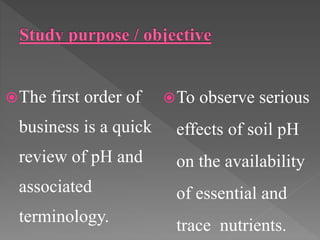
The first order of
business is a quick
review of pH and
associated
terminology.
To observe serious
effects of soil pH
on the availability
of essential and
trace nutrients.
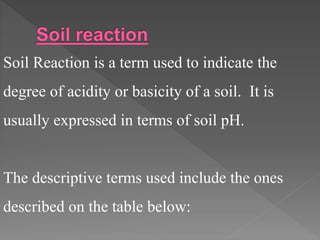
Soil Reaction is a term used to indicate the
degree of acidity or basicity of a soil. It is
usually expressed in terms of soil pH.
The descriptive terms used include the ones
described on the table below:
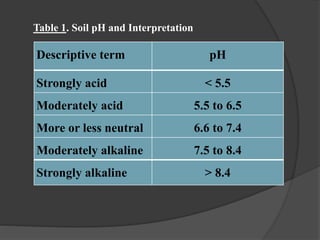
Descriptive term pH
Strongly acid < 5.5
Moderately acid 5.5 to 6.5
More or less neutral 6.6 to 7.4
Moderately alkaline 7.5 to 8.4
Strongly alkaline > 8.4
Table 1. Soil pH and Interpretation
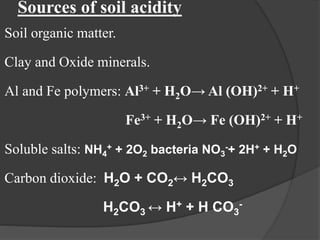
Sources of soil acidity
Soil organic matter.
Clay and Oxide minerals.
Al and Fe polymers: Al3+ + H2O→ Al (OH)2+ + H+
Fe3+ + H2O→ Fe (OH)2+ + H+
Soluble salts: NH4
+ + 2O2 bacteria NO3
-+ 2H+ + H2O
Carbon dioxide: H2O + CO2↔ H2CO3
H2CO3 ↔ H+ + H CO3
-
Sources of alkalinity in soils
Any process that encourages high levels of
exchangeable bases e.g. Ca, Mg, K & Na results in
reduction in acidity and increase in alkalinity.
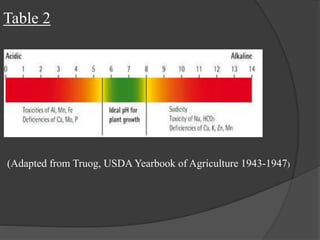
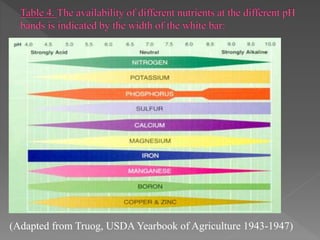
Table 2
(Adapted from Truog, USDA Yearbook of Agriculture 1943-1947)
This is described as a distinct resistance of change in
the pH of the soil solution, even when limed.
Importance of buffering
• Affect the availability of several plant nutrients, and
• Influence the levels of other elements that may be
toxic to higher plants and micro-organisms.
Farmers frequently ask that; “what effect does soil
pH have on nutrients in the soil?”
Nitrogen
High soil pH can result in significant loss of N by
volatilization, especially when urea-used fertilizers
are surface applied.
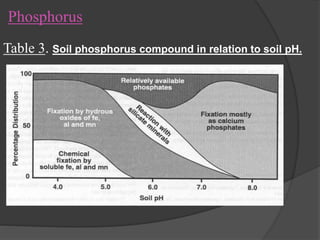
Phosphorus
Table 3. Soil phosphorus compound in relation to soil pH.
(Adapted from Truog, USDA Yearbook of Agriculture 1943-1947)
Ultimately, the soil pH does play a role in nutrient
availability and a most paramount one.
Should you be worried about your production on your field
or farm?
Be more aware than concerned.
How so?
Keep or bear the pH factor in mind when planning nutrient
management programme.
Soils tend to acidify over time, particularly when large
applications of NH4
+ based fertilizers are used.
Research have shown the pH decline occurring more
rapidly in continuously cropped, direct-seeded land
(McKenzie; 2003). Thus, a soil with an optimum pH
today may be too acid or alkaline a decade from now,
depending on producer land management.
“The sluggard does not plow in the autumn; he will seek at harvest and
have nothing. Proverbs 20:4”
THANK YOU FOR LISTENING!

AGS 321 SEMINAR PRESENTAION

  • 1.
    Presented by: WANDILE MAYA COURSE: AGS 321 STUDENT NO: 201310334
  • 2.
  • 3.
    Sources of basicityin soil  Buffering of soil and importance of buffering Soil pH and availability of nutrients Conclusion & recommendations
  • 4.
    Understanding that soilpH governs the availability of most nutrients is very important for proper nutrient management. However, In crop production maintaining the proper soil pH for efficient utilisation of other crop inputs is imperative (Miller ; 1990).
  • 5.
    By a strictchemical definition, pH = -log[H+] activity in an aqueous solution. Hence, pH values are reported on a negative log scale.
  • 6.
    Increased amount of[H+] in the soil decreases soil pH ; thus becoming more acidic and vice versa is true about decreased [H+] amount.
  • 7.
    The first orderof business is a quick review of pH and associated terminology. To observe serious effects of soil pH on the availability of essential and trace nutrients.
  • 8.
    Soil Reaction isa term used to indicate the degree of acidity or basicity of a soil. It is usually expressed in terms of soil pH. The descriptive terms used include the ones described on the table below:
  • 9.
    Descriptive term pH Stronglyacid < 5.5 Moderately acid 5.5 to 6.5 More or less neutral 6.6 to 7.4 Moderately alkaline 7.5 to 8.4 Strongly alkaline > 8.4 Table 1. Soil pH and Interpretation
  • 10.
    Sources of soilacidity Soil organic matter. Clay and Oxide minerals. Al and Fe polymers: Al3+ + H2O→ Al (OH)2+ + H+ Fe3+ + H2O→ Fe (OH)2+ + H+ Soluble salts: NH4 + + 2O2 bacteria NO3 -+ 2H+ + H2O Carbon dioxide: H2O + CO2↔ H2CO3 H2CO3 ↔ H+ + H CO3 -
  • 11.
    Sources of alkalinityin soils Any process that encourages high levels of exchangeable bases e.g. Ca, Mg, K & Na results in reduction in acidity and increase in alkalinity.
  • 12.
    Table 2 (Adapted fromTruog, USDA Yearbook of Agriculture 1943-1947)
  • 13.
    This is describedas a distinct resistance of change in the pH of the soil solution, even when limed. Importance of buffering • Affect the availability of several plant nutrients, and • Influence the levels of other elements that may be toxic to higher plants and micro-organisms.
  • 14.
    Farmers frequently askthat; “what effect does soil pH have on nutrients in the soil?” Nitrogen High soil pH can result in significant loss of N by volatilization, especially when urea-used fertilizers are surface applied.
  • 15.
    Phosphorus Table 3. Soilphosphorus compound in relation to soil pH.
  • 16.
    (Adapted from Truog,USDA Yearbook of Agriculture 1943-1947)
  • 17.
    Ultimately, the soilpH does play a role in nutrient availability and a most paramount one. Should you be worried about your production on your field or farm? Be more aware than concerned. How so? Keep or bear the pH factor in mind when planning nutrient management programme.
  • 18.
    Soils tend toacidify over time, particularly when large applications of NH4 + based fertilizers are used. Research have shown the pH decline occurring more rapidly in continuously cropped, direct-seeded land (McKenzie; 2003). Thus, a soil with an optimum pH today may be too acid or alkaline a decade from now, depending on producer land management.
  • 19.
    “The sluggard doesnot plow in the autumn; he will seek at harvest and have nothing. Proverbs 20:4” THANK YOU FOR LISTENING!