CONVERTING LOW VALUE BIOMASS AND OTHER
WASTE MATERIALS INTO CLEAN, AFFORDABLE AND
HIGH VALUE HEAT ENERGY AND ELECTRIC POWER
TECHNICAL AND BUSINESS PRESENTATION PREPARED
ESPECIALLY FOR:
GENERAL VIEWING
MAY 16, 2016
© 2016. AGRIPOWER, INC. ALL RIGHTS RESERVED.
Our clients are looking for a way to:
• Reduce their waste disposal costs.
• Reduce their cost of fuel to generate electricity and/or
produce hot air and hot water to heat (or cool or refrigerate)
their businesses.
• Affordably comply with environmental laws that regulate the
disposal of their waste materials.
• Have predictable and controllable waste disposal and energy
costs.
• Operate “Responsibly” and be a “Good Neighbor”.
• Have Sustainable, Secure, Reliable, Resilient and Customer
Controlled On-Site Heat Energy.
• Obtain a Customized Solution for their waste and energy
problems.
Our Customers’ Problems
2
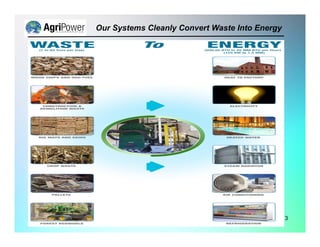
Our Systems Cleanly Convert Waste Into Energy
3
AgriPower’s unique, proprietary and advanced
technology, Waste-to-Energy Systems:
• Fueled by Biomass and many other waste materials.
• Biomass waste consists of:
wood
cardboard
paper
agricultural waste
forest residuals (stumpage and hog fuel)).
• Our Systems are proven; more than 60 Systems are
installed, some for more than 10 years.
• We provide significant operational and economic benefits.
• We offer individual building and District Electric Power and
Heating options.
AgriPower’s Solutions
4
5
AgriPower’s Waste to Energy Product Line
We offer a wide range of Waste to Heat Energy and Waste to
Combined Heat & Power Systems.
They use from 1 to 60 tons of waste as fuel per day.
Their heat energy output ranges from 500,000 to 25 Million
BTU/hour (net).
Their electric power output ranges from 150 kW to 1.2 MW
(gross). Multiple Systems can operate together.
They provide numerous heat energy outputs:
heated air
hot water (up to 350°F)
high-, medium- and low-pressure steam
with an add-on module, air conditioning and refrigeration
(without electricity)
We Can Handle Many Problematic Fuels
The Systems can utilize a wide variety of waste and
problematic materials as fuel including:
• Wood pallets and crates (even with nails and screws)
• Wood waste
• Agricultural by-products and residues
• Cardboard and paper (even with ink and glue)
• Many types of plastic
• Construction and demolition debris (even with glue and paint)
• Forest Residuals (even with high moisture and bark content)
• Field Mats (Rig, Road & Swamp) and Pipeline Skids
• Waste water treatment sludge
• Sorted Municipal Solid Waste or Refuse Derived Fuel pellets
• Animal manure
• “Green Waste” including tree trimmings, grass clippings,
vines, twigs, branches and leafs 6
7
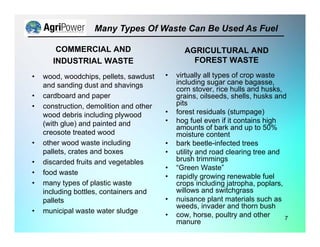
COMMERCIAL AND
INDUSTRIAL WASTE
• wood, woodchips, pellets, sawdust
and sanding dust and shavings
• cardboard and paper
• construction, demolition and other
wood debris including plywood
(with glue) and painted and
creosote treated wood
• other wood waste including
pallets, crates and boxes
• discarded fruits and vegetables
• food waste
• many types of plastic waste
including bottles, containers and
pallets
• municipal waste water sludge
AGRICULTURAL AND
FOREST WASTE
• virtually all types of crop waste
including sugar cane bagasse,
corn stover, rice hulls and husks,
grains, oilseeds, shells, husks and
pits
• forest residuals (stumpage)
• hog fuel even if it contains high
amounts of bark and up to 50%
moisture content
• bark beetle-infected trees
• utility and road clearing tree and
brush trimmings
• “Green Waste”
• rapidly growing renewable fuel
crops including jatropha, poplars,
willows and switchgrass
• nuisance plant materials such as
weeds, invader and thorn bush
• cow, horse, poultry and other
manure
Many Types Of Waste Can Be Used As Fuel
Our Systems Can Use A Wide Variety Of Commercial Waste As Fuel
Clockwise from top left:
(1) Sorted Biomass (Cardboard and Paper);
(2) Baled Cardboard; and
(3) Discarded Wooden Pallets and Other Wood Debris.
(1)
(2)
(3)
Sample Fuels- 1
8
Our Systems Can Use A Wide Variety of Biomass Feed-Stocks as Fuel
Clockwise from top left: (1) Wood Chips; (2) Hog Fuel; (3) Sugar Cane Bagasse;
and Fast-Growing Energy Crops such as (4) Willows and Poplars; (5) Giant
Miscanthus; and (6) Jatropha.
Sample Fuels- 2
9
Our Systems Can Use A Wide Variety Of Agricultural Waste, Forest
Residuals and Various Wood Products As Fuel
Clockwise from top left: (1) Crop Waste; (2) Discarded Fruits and Vegetables; (3)
Forest Residuals; (4) Timber Slash and Brush; (5) Out Of Service Rig Mats and
Pipeline Skids; and (6) Cow, Horse and Poultry Manure.
Sample Fuels- 3
10
Converting Waste Materials Into Fuel
The Systems cleanly convert a wide variety of worthless
waste into valuable fuel instead of its going to a landfill or being
burned or decomposing in the open air.
The Systems can use the fuel to responsibly and
sustainably produce electric power and heat energy.
Each ton of wood waste contains the same amount of
usable energy as 65 gallons (250 liters) of diesel fuel.
One ton of wood costs $____ per ton.
One gallon (3.8 liters) of diesel fuel costs $_______.
65 gallons (250 liters) of diesel fuel costs $_______.
11
12
ON-GRID
• factories, warehouses, cold
storage units, supermarkets, “Big
Box” stores and malls and
shopping centers
• hospitals, hotels, casinos, colleges
and universities
• municipal buildings such as
correctional facilities, shelters,
libraries, schools and town halls
• food processors (especially those
that need hot water and
refrigeration), brewers, roasters
and greenhouses
• lumber mills, paper and pulp
companies and corrugated
cardboard producers
• furniture manufacturers and
industrial parks (especially those
that have unreliable or “dirty”
power)
• municipal waste and landfill sites
REMOTE
• remote communities including
small and mid-size villages and
towns
• sugar cane and palm oil
plantations
• worker camps
• mining sites
• Indigenous communities
• lumber processing sites
• farms and ranches
• military bases
• disaster sites
• oil rig support facilities
• resort facilities
Numerous On-Grid And Remote Applications
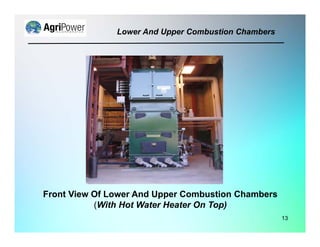
Front View Of Lower And Upper Combustion Chambers
(With Hot Water Heater On Top)
Lower And Upper Combustion Chambers
13
14
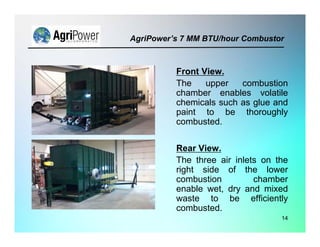
Front View.
The upper combustion
chamber enables volatile
chemicals such as glue and
paint to be thoroughly
combusted.
Rear View.
The three air inlets on the
right side of the lower
combustion chamber
enable wet, dry and mixed
waste to be efficiently
combusted.
AgriPower’s 7 MM BTU/hour Combustor
15
1) We use unique, proprietary, technically advanced and
proven “extended, multi-zone, variable temperature”
combustion technology that controls both a lower and an
upper combustion chamber.
2) The Combustion Module consists of two modular, pre-
cast, customized refractory, ceramic-lined, combustion
chambers that enable easy repair, low maintenance and a
long operating life.
3) The primary (lower) combustion chamber automatically
controls the insertion of three sources of combustion air.
This unique over-, under- and mid-fire air design provides
greater flexibility to cleanly combust a wide variety of wet, dry
and mixed fuels (up to 50% moisture content).
4) The extended (upper) combustion chamber provides
longer dwell time (>1.5 seconds) to completely combust the
fuel enabling compliance with all air permit requirements.
Benefits Of Our Combustors- 1
16
5) They can operate from 2,200ºF down to 1,000ºF which is
below the chemical reaction point of many troublesome
emission materials. This enables a wide variety of difficult
materials to be used as fuel.
6) This high temperature extended combustion chamber
also cleanly and efficiently combusts volatile chemicals.
This reduces pollution and enables plywood (with glue) and
painted and creosote treated wood to be used as fuel when
permitted.
7) They are able to operate efficiently at 20% to 100% of
their rated output to handle seasonal and fuel availability
variations.
Benefits Of Our Combustors- 2
8) Their efficient operation generates minimal residual ash
(only 1 - 3%) which can be mixed with cement or used as
fertilizer.
9) They use multiple screw augers that operate on a timed
and specific fuel basis to ensure a consistent, thorough and
clean combustion process.
10) They contain a fully automated stoking and ash removal
system.
11) They are non-condensing and do not require water,
steam or high air pressure (or on-site technical or safety
personnel) to operate.
Benefits Of Our Combustors- 3
17
18
Automated Control ModuleAll facets of our Systems are
controlled using proprietary
algorithms installed on an included
Programmable Logic Controller
(“PLC”) that closely monitors and
automatically controls their entire
operation many times each
second.
Their proven operating software,
installed in an included Automated
Control Module, enables maximum
operating flexibility, continuous
System optimization and constant
emissions compliance without the
need for any on-site personnel.
Their user-friendly screens enable
easy System monitoring.
Complete Automation
19
Examples of User Friendly
Touch Screen Panels
Easy System Monitoring
The basic System comes with a multi-clone air filter that
catches most particulate matter so there is no smoke.
Particulate matter (>PM 2.5 microns) and other
emissions from the Systems will comply with most air
permitting regulations.
If required by the local air permitting authority, standard
emission control devices can be added to catch very small
particulate matter (<PM 2.5 microns) and thereby enable
compliance with their emission regulations.
For high value opportunity or problematic fuels (e.g.,
wood containing glue, paint, creosote, chemicals, etc.),
additional emission control equipment can be added such as
a catalyst based system that will neutralize most problem
emission materials.
Emissions Compliance
20
The Combustion Chamber Is Equipped With A Modular, High Temperature, Cast Refractory
Ceramic Lining That Can Range From 4” to 12” Thick (Depending On Model Size And Output).
The Above Door Is Lined With A 3” Thick Ceramic Lining. This Design Provides A Long
Operating Life And Enables Easy And Low Cost Repairs And Replacements.
The 6 Screw Augers Move The Fuel Into, Through And Out Of The Combustion Chamber.
Combustor Internal View
21
2222
Combustor Features
23
Other Manufacturers’
Step Grate Design.
Note the various steps in the
grate. This design allows fuel to
accumulate and then fall onto
each step resulting in uneven
operating temperatures, and
numerous and large clinkers
and emission issues.
AgriPower’s Multiple
Screw Auger Design.
Note the four screw augers in
the combustor bed. This design
permits a timed and steady
advancement of the fuel,
consistent and controlled
operating temperatures, only a
few and small clinkers and a
thorough and clean burn for low
emissions.
AgriPower’s Screw Auger Design
Our basic Systems produce heated air, hot water
and low-, medium- and high-pressure steam.
With the addition of a waste heat electric generation
module, they can also generate between 150 kW and
1.2 MW (gross) of electric power.
With the addition of a waste heat absorption chiller
module, they can also produce air conditioning and
refrigeration without electric power.
The add-on modules are manufactured for us by
world class companies such as Mitsubishi, Carrier,
Johnson Controls and Kaishan.
AgriPower’s Add-On Modules- 1
24
25
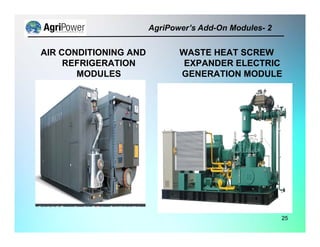
AIR CONDITIONING AND
REFRIGERATION
MODULES
WASTE HEAT SCREW
EXPANDER ELECTRIC
GENERATION MODULE
AgriPower’s Add-On Modules- 2
26
ADVANCED SCREW
EXPANDER
TECHNOLOGY
SIGNIFICANT
MANUFACTURING
CAPABILITY
AgriPower’s Screw Expanders
• We use the highest quality Waste Heat Generators (“WHGs”) that
are configured for our customers’ specific requirements.
• Our high temperature WHGs operate at 700ºF instead of 200ºF.
• Our WHGs use a high efficiency, hot oil or steam organic fluid
system instead of a low efficiency, hot air or hot water system.
• This technology minimizes the erosion of metal parts and blades as
well as mechanical stress = expected useful life of 20 years.
• These high temperature, high efficiency, hot oil WHGs will typically
produce considerably more net electrical output and greater
customer value compared to low temperature, low efficiency units
(e.g., net output of about 95% of rated capacity vs. about 60 - 80%).
• The WHGs’ flexible design enables them to be operated in parallel
so we can offer our customers customized Systems up to 15 MW.
Benefits Of Our Waste Heat Electric Generators
27
Sources of savings from a 1.2 MW (gross) AgriPower
Combined Heat and Power System at a typical location.
1) Reduced waste disposal costs.
2) Reduced diesel fuel purchases to produce heat, hot water,
steam, air conditioning and/or refrigeration.
3) Reduced diesel fuel purchases to produce electric power.
4) Typical Customer’s total annual savings: approximately
$1,000,000 to $2,000,000 per year.
The typical payback period ranges from 2.5 to 4 years.
Note: The payback period does NOT include tax benefits, grants
or carbon credits or Renewable Energy Certificates.
Each ton of inexpensive wood contains the same amount of
usable energy as 65 gallons of expensive diesel fuel.
Economic Benefits Of Our Systems
28
Very Low Annual Maintenance and
Replacement Costs:
The annual maintenance and replacement costs of a
typical Heat Only AgriPower System are between
$5,000 to $10,000 per year and $80,000 to $100,000
for a Combined Heat and Power System.
This primarily consists of replacing the screw augers
approximately every 4 to 6 years as their blade edges
wear out and payment for a service and parts
replacement contract for the WHG.
The useful life of each System, with proper maintenance,
is expected to be more than 30 years.
Very Low Maintenance and Replacement Costs
29
Heat Energy has many valuable uses:
• Can generate electric power
• Heated Air (buildings, greenhouses, district heating)
• Hot Water (kitchens, showers, laundries, swimming
pools, food processing, district heating)
• Steam (single buildings and district heating)
• Air conditioning (rooms and common areas)
• Refrigeration (supermarkets, food and flower storage)
• Drying and bonding (kilns, lumber mills, plywood)
• Pre-drying excessively wet fuels (paper and pulp
sludge, municipal waste water sludge)
Heat Energy Applications
30
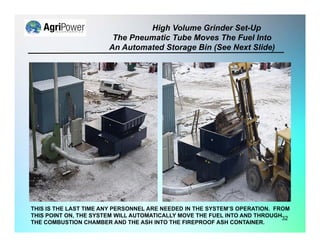
The same employee that currently brings separated waste
to a compactor or trash bin drops it into a grinder as shown in
slide #32 which reduces the waste to its proper size.
The automated pneumatic air system shown in slide #32
sends the ground-up material into a “walking floor” storage bin
as shown in the upper right corner of slide #33 where it is stored.
When the combustor requires additional fuel, a signal is
sent for the ground-up material to be transferred from the
storage bin into its lower combustion chamber using an
enclosed screw auger as shown in the blue colored fuel transfer
unit on the left of slide #33.
After the fuel has been thoroughly combusted, the ash is
automatically removed from the combustor and deposited into a
fireproof ash container as shown on the right in slide #34 where
it is safely stored until it is disposed of.
No Operating Employees Required
31
High Volume Grinder Set-Up
The Pneumatic Tube Moves The Fuel Into
An Automated Storage Bin (See Next Slide)
32
THIS IS THE LAST TIME ANY PERSONNEL ARE NEEDED IN THE SYSTEM’S OPERATION. FROM
THIS POINT ON, THE SYSTEM WILL AUTOMATICALLY MOVE THE FUEL INTO AND THROUGH
THE COMBUSTION CHAMBER AND THE ASH INTO THE FIREPROOF ASH CONTAINER.
33
8.5 MM BTU/hr Steam System (In-Line Installation) With 250 HP Low-
Pressure Steam Boiler, 35 Cubic Yard Live Auger
And Automated Bottom Storage Bin
In-Line Steam System With Automated Storage Bin
Clockwise:
(1) 10 MM BTU/hr Combustor;
(2) 10 MM BTU/hr Combustor Configured for Hot Air and Hot Water (Stacked Installation);
(3) Automated, Fireproof De-Ash Collection Bin Used With All Systems; and
(4) 30 MM BTU/hr Combustor Configured for Hot Air and Hot Water (In-Line Installation).
(1) (2)
(4) (3)
Combustors and Automated Ash Removal
34
Multiple Combustion Unit Installation
Hot Water System with Four 800 HP combustors
Multiple Combustor Installation
35
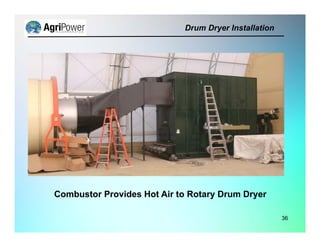
Combustor Provides Hot Air to Rotary Drum Dryer
Drum Dryer Installation
36
Combustor Provides Steam For Dry Kiln Operation
Dry Kiln Installation
37
38
• Prefabricated, modular and transportable.
• Easily brought to remote sites.
• Quickly installed within a small space (± 2,500 sq. ft.).
• Customized, scalable solutions provide the precise amount of
electric power, heated air, hot water, steam, air conditioning and
refrigeration needed.
Additional Benefits:
We do NOT use food crops or animal feed for fuel.
Reduced commodity risk: Customers that use their own
waste as fuel eliminate the market risk of obtaining diesel fuel oil
at an uncertain price.
Our Systems - 1
• Proven technology reduces maintenance, operating costs and
downtime.
• Experience generated from more than 60 operating Systems
(some have been operating for more than 10 years).
• Reliable, with an uptime rate of over 95%.
• Fully-automated; no need for expensive on-site engineers or
technicians.
• Can be remotely monitored by the customer and/or
AgriPower.
• Maintenance and service can be provided by the customer or
locally available, factory trained technicians on a 24/7 basis.
Our Systems - 2
39
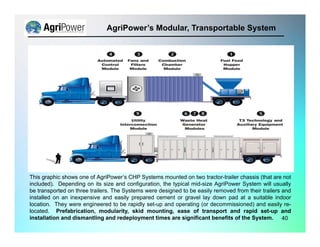
This graphic shows one of AgriPower’s CHP Systems mounted on two tractor-trailer chassis (that are not
included). Depending on its size and configuration, the typical mid-size AgriPower System will usually
be transported on three trailers. The Systems were designed to be easily removed from their trailers and
installed on an inexpensive and easily prepared cement or gravel lay down pad at a suitable indoor
location. They were engineered to be rapidly set-up and operating (or decommissioned) and easily re-
located. Prefabrication, modularity, skid mounting, ease of transport and rapid set-up and
installation and dismantling and redeployment times are significant benefits of the System.
AgriPower’s Modular, Transportable System
40
Fuel Preparation &
Storage
Combustion
Chamber
Boiler Emissions
Reduction & ID Fan
Control
Module
Electric
Generation
Module
Spare
Parts
Approximately 50 feet
Approximately50feet
Maintenance Space Boundary
Total Footprint for an In-Line Layout (as shown)
is Approximately 2,500 Feet and Approximately
2,000 Feet for a Stacked Layout
Maintenance Space Boundary
Typical 20 Ton Per Day Space Requirements
41
Using Biomass as a fuel helps to combat climate change. That’s because
Biomass is often considered “carbon neutral” because the carbon dioxide
released when it is combusted is eventually absorbed by other Biomass as it
grows. So, unlike fossil fuels such as natural gas, diesel or propane, Biomass
releases no net carbon dioxide into the atmosphere. It is a closed-loop energy
source, simply re-circulating the carbon dioxide already within the Earth’s carbon
cycle. And it’s a perpetual, renewable fuel source.
Combusting Biomass Is Carbon Neutral
42
Environmental And Sustainability Benefits- 1
Using our System on-site reduces:
• truck traffic, road wear, emissions and accidents
• driver and truck expenses (salaries, fuel, oil, repairs,
fees, insurance)
• waste going to landfills and allows the landfills to have a
longer operating life
• outdoor burning (or decomposing) of Biomass waste, and
resulting air pollution and methane gas
• the use and expense of diesel as fuel to produce electric
power, heated air, hot water, steam, air conditioning and
refrigeration
4343
Environmental And Sustainability Benefits- 2
Using our System on-site:
• Means using waste in a responsible, environmentally
friendly and sustainable manner
• Enhances environmental credentials with customers,
stakeholders, the public and regulatory authorities
• Creates local fuel preparation jobs
• Enables more fuel purchase money to remain in the
community to stimulate additional private and community
business development and create new jobs
• Provides an attractive “Clean Energy” Demonstration Site
that enables continuing favorable publicity from site visits by
school children, the public, customers, public officials, etc.
• Can create Carbon Credits 4444
Carbon Credits
We can usually generate carbon credits by:
• reducing the number of trucks on the road and the
amount of diesel fuel they would otherwise combust;
• reducing truck emissions
• reducing the amount of daily Biomass waste (wood,
cardboard, paper, agricultural waste and forest residuals
(stumpage and hog fuel)) that would otherwise be sent to a
landfill where it will ultimately convert into methane gas; and
• using this daily waste stream to reduce the amount of
diesel used to produce electric power, heated air, hot water,
steam, air conditioning and refrigeration.
4545
For Additional Information
FOR ADDITIONAL INFORMATION,
PLEASE CONTACT:
BARRY J. BERMAN, CEO
TEL: (516) 829-2000
MOB: (516) 384-2100
E-MAIL: BBERMAN@AGRIPOWER.COM
OR VISIT OUR WEBSITE:
WWW.AGRIPOWER.COM
46

Agripower general presentation may 16, 2016

  • 1.
    CONVERTING LOW VALUEBIOMASS AND OTHER WASTE MATERIALS INTO CLEAN, AFFORDABLE AND HIGH VALUE HEAT ENERGY AND ELECTRIC POWER TECHNICAL AND BUSINESS PRESENTATION PREPARED ESPECIALLY FOR: GENERAL VIEWING MAY 16, 2016 © 2016. AGRIPOWER, INC. ALL RIGHTS RESERVED.
  • 2.
    Our clients arelooking for a way to: • Reduce their waste disposal costs. • Reduce their cost of fuel to generate electricity and/or produce hot air and hot water to heat (or cool or refrigerate) their businesses. • Affordably comply with environmental laws that regulate the disposal of their waste materials. • Have predictable and controllable waste disposal and energy costs. • Operate “Responsibly” and be a “Good Neighbor”. • Have Sustainable, Secure, Reliable, Resilient and Customer Controlled On-Site Heat Energy. • Obtain a Customized Solution for their waste and energy problems. Our Customers’ Problems 2
  • 3.
    Our Systems CleanlyConvert Waste Into Energy 3
  • 4.
    AgriPower’s unique, proprietaryand advanced technology, Waste-to-Energy Systems: • Fueled by Biomass and many other waste materials. • Biomass waste consists of: wood cardboard paper agricultural waste forest residuals (stumpage and hog fuel)). • Our Systems are proven; more than 60 Systems are installed, some for more than 10 years. • We provide significant operational and economic benefits. • We offer individual building and District Electric Power and Heating options. AgriPower’s Solutions 4
  • 5.
    5 AgriPower’s Waste toEnergy Product Line We offer a wide range of Waste to Heat Energy and Waste to Combined Heat & Power Systems. They use from 1 to 60 tons of waste as fuel per day. Their heat energy output ranges from 500,000 to 25 Million BTU/hour (net). Their electric power output ranges from 150 kW to 1.2 MW (gross). Multiple Systems can operate together. They provide numerous heat energy outputs: heated air hot water (up to 350°F) high-, medium- and low-pressure steam with an add-on module, air conditioning and refrigeration (without electricity)
  • 6.
    We Can HandleMany Problematic Fuels The Systems can utilize a wide variety of waste and problematic materials as fuel including: • Wood pallets and crates (even with nails and screws) • Wood waste • Agricultural by-products and residues • Cardboard and paper (even with ink and glue) • Many types of plastic • Construction and demolition debris (even with glue and paint) • Forest Residuals (even with high moisture and bark content) • Field Mats (Rig, Road & Swamp) and Pipeline Skids • Waste water treatment sludge • Sorted Municipal Solid Waste or Refuse Derived Fuel pellets • Animal manure • “Green Waste” including tree trimmings, grass clippings, vines, twigs, branches and leafs 6
  • 7.
    7 COMMERCIAL AND INDUSTRIAL WASTE •wood, woodchips, pellets, sawdust and sanding dust and shavings • cardboard and paper • construction, demolition and other wood debris including plywood (with glue) and painted and creosote treated wood • other wood waste including pallets, crates and boxes • discarded fruits and vegetables • food waste • many types of plastic waste including bottles, containers and pallets • municipal waste water sludge AGRICULTURAL AND FOREST WASTE • virtually all types of crop waste including sugar cane bagasse, corn stover, rice hulls and husks, grains, oilseeds, shells, husks and pits • forest residuals (stumpage) • hog fuel even if it contains high amounts of bark and up to 50% moisture content • bark beetle-infected trees • utility and road clearing tree and brush trimmings • “Green Waste” • rapidly growing renewable fuel crops including jatropha, poplars, willows and switchgrass • nuisance plant materials such as weeds, invader and thorn bush • cow, horse, poultry and other manure Many Types Of Waste Can Be Used As Fuel
  • 8.
    Our Systems CanUse A Wide Variety Of Commercial Waste As Fuel Clockwise from top left: (1) Sorted Biomass (Cardboard and Paper); (2) Baled Cardboard; and (3) Discarded Wooden Pallets and Other Wood Debris. (1) (2) (3) Sample Fuels- 1 8
  • 9.
    Our Systems CanUse A Wide Variety of Biomass Feed-Stocks as Fuel Clockwise from top left: (1) Wood Chips; (2) Hog Fuel; (3) Sugar Cane Bagasse; and Fast-Growing Energy Crops such as (4) Willows and Poplars; (5) Giant Miscanthus; and (6) Jatropha. Sample Fuels- 2 9
  • 10.
    Our Systems CanUse A Wide Variety Of Agricultural Waste, Forest Residuals and Various Wood Products As Fuel Clockwise from top left: (1) Crop Waste; (2) Discarded Fruits and Vegetables; (3) Forest Residuals; (4) Timber Slash and Brush; (5) Out Of Service Rig Mats and Pipeline Skids; and (6) Cow, Horse and Poultry Manure. Sample Fuels- 3 10
  • 11.
    Converting Waste MaterialsInto Fuel The Systems cleanly convert a wide variety of worthless waste into valuable fuel instead of its going to a landfill or being burned or decomposing in the open air. The Systems can use the fuel to responsibly and sustainably produce electric power and heat energy. Each ton of wood waste contains the same amount of usable energy as 65 gallons (250 liters) of diesel fuel. One ton of wood costs $____ per ton. One gallon (3.8 liters) of diesel fuel costs $_______. 65 gallons (250 liters) of diesel fuel costs $_______. 11
  • 12.
    12 ON-GRID • factories, warehouses,cold storage units, supermarkets, “Big Box” stores and malls and shopping centers • hospitals, hotels, casinos, colleges and universities • municipal buildings such as correctional facilities, shelters, libraries, schools and town halls • food processors (especially those that need hot water and refrigeration), brewers, roasters and greenhouses • lumber mills, paper and pulp companies and corrugated cardboard producers • furniture manufacturers and industrial parks (especially those that have unreliable or “dirty” power) • municipal waste and landfill sites REMOTE • remote communities including small and mid-size villages and towns • sugar cane and palm oil plantations • worker camps • mining sites • Indigenous communities • lumber processing sites • farms and ranches • military bases • disaster sites • oil rig support facilities • resort facilities Numerous On-Grid And Remote Applications
  • 13.
    Front View OfLower And Upper Combustion Chambers (With Hot Water Heater On Top) Lower And Upper Combustion Chambers 13
  • 14.
    14 Front View. The uppercombustion chamber enables volatile chemicals such as glue and paint to be thoroughly combusted. Rear View. The three air inlets on the right side of the lower combustion chamber enable wet, dry and mixed waste to be efficiently combusted. AgriPower’s 7 MM BTU/hour Combustor
  • 15.
    15 1) We useunique, proprietary, technically advanced and proven “extended, multi-zone, variable temperature” combustion technology that controls both a lower and an upper combustion chamber. 2) The Combustion Module consists of two modular, pre- cast, customized refractory, ceramic-lined, combustion chambers that enable easy repair, low maintenance and a long operating life. 3) The primary (lower) combustion chamber automatically controls the insertion of three sources of combustion air. This unique over-, under- and mid-fire air design provides greater flexibility to cleanly combust a wide variety of wet, dry and mixed fuels (up to 50% moisture content). 4) The extended (upper) combustion chamber provides longer dwell time (>1.5 seconds) to completely combust the fuel enabling compliance with all air permit requirements. Benefits Of Our Combustors- 1
  • 16.
    16 5) They canoperate from 2,200ºF down to 1,000ºF which is below the chemical reaction point of many troublesome emission materials. This enables a wide variety of difficult materials to be used as fuel. 6) This high temperature extended combustion chamber also cleanly and efficiently combusts volatile chemicals. This reduces pollution and enables plywood (with glue) and painted and creosote treated wood to be used as fuel when permitted. 7) They are able to operate efficiently at 20% to 100% of their rated output to handle seasonal and fuel availability variations. Benefits Of Our Combustors- 2
  • 17.
    8) Their efficientoperation generates minimal residual ash (only 1 - 3%) which can be mixed with cement or used as fertilizer. 9) They use multiple screw augers that operate on a timed and specific fuel basis to ensure a consistent, thorough and clean combustion process. 10) They contain a fully automated stoking and ash removal system. 11) They are non-condensing and do not require water, steam or high air pressure (or on-site technical or safety personnel) to operate. Benefits Of Our Combustors- 3 17
  • 18.
    18 Automated Control ModuleAllfacets of our Systems are controlled using proprietary algorithms installed on an included Programmable Logic Controller (“PLC”) that closely monitors and automatically controls their entire operation many times each second. Their proven operating software, installed in an included Automated Control Module, enables maximum operating flexibility, continuous System optimization and constant emissions compliance without the need for any on-site personnel. Their user-friendly screens enable easy System monitoring. Complete Automation
  • 19.
    19 Examples of UserFriendly Touch Screen Panels Easy System Monitoring
  • 20.
    The basic Systemcomes with a multi-clone air filter that catches most particulate matter so there is no smoke. Particulate matter (>PM 2.5 microns) and other emissions from the Systems will comply with most air permitting regulations. If required by the local air permitting authority, standard emission control devices can be added to catch very small particulate matter (<PM 2.5 microns) and thereby enable compliance with their emission regulations. For high value opportunity or problematic fuels (e.g., wood containing glue, paint, creosote, chemicals, etc.), additional emission control equipment can be added such as a catalyst based system that will neutralize most problem emission materials. Emissions Compliance 20
  • 21.
    The Combustion ChamberIs Equipped With A Modular, High Temperature, Cast Refractory Ceramic Lining That Can Range From 4” to 12” Thick (Depending On Model Size And Output). The Above Door Is Lined With A 3” Thick Ceramic Lining. This Design Provides A Long Operating Life And Enables Easy And Low Cost Repairs And Replacements. The 6 Screw Augers Move The Fuel Into, Through And Out Of The Combustion Chamber. Combustor Internal View 21
  • 22.
  • 23.
    23 Other Manufacturers’ Step GrateDesign. Note the various steps in the grate. This design allows fuel to accumulate and then fall onto each step resulting in uneven operating temperatures, and numerous and large clinkers and emission issues. AgriPower’s Multiple Screw Auger Design. Note the four screw augers in the combustor bed. This design permits a timed and steady advancement of the fuel, consistent and controlled operating temperatures, only a few and small clinkers and a thorough and clean burn for low emissions. AgriPower’s Screw Auger Design
  • 24.
    Our basic Systemsproduce heated air, hot water and low-, medium- and high-pressure steam. With the addition of a waste heat electric generation module, they can also generate between 150 kW and 1.2 MW (gross) of electric power. With the addition of a waste heat absorption chiller module, they can also produce air conditioning and refrigeration without electric power. The add-on modules are manufactured for us by world class companies such as Mitsubishi, Carrier, Johnson Controls and Kaishan. AgriPower’s Add-On Modules- 1 24
  • 25.
    25 AIR CONDITIONING AND REFRIGERATION MODULES WASTEHEAT SCREW EXPANDER ELECTRIC GENERATION MODULE AgriPower’s Add-On Modules- 2
  • 26.
  • 27.
    • We usethe highest quality Waste Heat Generators (“WHGs”) that are configured for our customers’ specific requirements. • Our high temperature WHGs operate at 700ºF instead of 200ºF. • Our WHGs use a high efficiency, hot oil or steam organic fluid system instead of a low efficiency, hot air or hot water system. • This technology minimizes the erosion of metal parts and blades as well as mechanical stress = expected useful life of 20 years. • These high temperature, high efficiency, hot oil WHGs will typically produce considerably more net electrical output and greater customer value compared to low temperature, low efficiency units (e.g., net output of about 95% of rated capacity vs. about 60 - 80%). • The WHGs’ flexible design enables them to be operated in parallel so we can offer our customers customized Systems up to 15 MW. Benefits Of Our Waste Heat Electric Generators 27
  • 28.
    Sources of savingsfrom a 1.2 MW (gross) AgriPower Combined Heat and Power System at a typical location. 1) Reduced waste disposal costs. 2) Reduced diesel fuel purchases to produce heat, hot water, steam, air conditioning and/or refrigeration. 3) Reduced diesel fuel purchases to produce electric power. 4) Typical Customer’s total annual savings: approximately $1,000,000 to $2,000,000 per year. The typical payback period ranges from 2.5 to 4 years. Note: The payback period does NOT include tax benefits, grants or carbon credits or Renewable Energy Certificates. Each ton of inexpensive wood contains the same amount of usable energy as 65 gallons of expensive diesel fuel. Economic Benefits Of Our Systems 28
  • 29.
    Very Low AnnualMaintenance and Replacement Costs: The annual maintenance and replacement costs of a typical Heat Only AgriPower System are between $5,000 to $10,000 per year and $80,000 to $100,000 for a Combined Heat and Power System. This primarily consists of replacing the screw augers approximately every 4 to 6 years as their blade edges wear out and payment for a service and parts replacement contract for the WHG. The useful life of each System, with proper maintenance, is expected to be more than 30 years. Very Low Maintenance and Replacement Costs 29
  • 30.
    Heat Energy hasmany valuable uses: • Can generate electric power • Heated Air (buildings, greenhouses, district heating) • Hot Water (kitchens, showers, laundries, swimming pools, food processing, district heating) • Steam (single buildings and district heating) • Air conditioning (rooms and common areas) • Refrigeration (supermarkets, food and flower storage) • Drying and bonding (kilns, lumber mills, plywood) • Pre-drying excessively wet fuels (paper and pulp sludge, municipal waste water sludge) Heat Energy Applications 30
  • 31.
    The same employeethat currently brings separated waste to a compactor or trash bin drops it into a grinder as shown in slide #32 which reduces the waste to its proper size. The automated pneumatic air system shown in slide #32 sends the ground-up material into a “walking floor” storage bin as shown in the upper right corner of slide #33 where it is stored. When the combustor requires additional fuel, a signal is sent for the ground-up material to be transferred from the storage bin into its lower combustion chamber using an enclosed screw auger as shown in the blue colored fuel transfer unit on the left of slide #33. After the fuel has been thoroughly combusted, the ash is automatically removed from the combustor and deposited into a fireproof ash container as shown on the right in slide #34 where it is safely stored until it is disposed of. No Operating Employees Required 31
  • 32.
    High Volume GrinderSet-Up The Pneumatic Tube Moves The Fuel Into An Automated Storage Bin (See Next Slide) 32 THIS IS THE LAST TIME ANY PERSONNEL ARE NEEDED IN THE SYSTEM’S OPERATION. FROM THIS POINT ON, THE SYSTEM WILL AUTOMATICALLY MOVE THE FUEL INTO AND THROUGH THE COMBUSTION CHAMBER AND THE ASH INTO THE FIREPROOF ASH CONTAINER.
  • 33.
    33 8.5 MM BTU/hrSteam System (In-Line Installation) With 250 HP Low- Pressure Steam Boiler, 35 Cubic Yard Live Auger And Automated Bottom Storage Bin In-Line Steam System With Automated Storage Bin
  • 34.
    Clockwise: (1) 10 MMBTU/hr Combustor; (2) 10 MM BTU/hr Combustor Configured for Hot Air and Hot Water (Stacked Installation); (3) Automated, Fireproof De-Ash Collection Bin Used With All Systems; and (4) 30 MM BTU/hr Combustor Configured for Hot Air and Hot Water (In-Line Installation). (1) (2) (4) (3) Combustors and Automated Ash Removal 34
  • 35.
    Multiple Combustion UnitInstallation Hot Water System with Four 800 HP combustors Multiple Combustor Installation 35
  • 36.
    Combustor Provides HotAir to Rotary Drum Dryer Drum Dryer Installation 36
  • 37.
    Combustor Provides SteamFor Dry Kiln Operation Dry Kiln Installation 37
  • 38.
    38 • Prefabricated, modularand transportable. • Easily brought to remote sites. • Quickly installed within a small space (± 2,500 sq. ft.). • Customized, scalable solutions provide the precise amount of electric power, heated air, hot water, steam, air conditioning and refrigeration needed. Additional Benefits: We do NOT use food crops or animal feed for fuel. Reduced commodity risk: Customers that use their own waste as fuel eliminate the market risk of obtaining diesel fuel oil at an uncertain price. Our Systems - 1
  • 39.
    • Proven technologyreduces maintenance, operating costs and downtime. • Experience generated from more than 60 operating Systems (some have been operating for more than 10 years). • Reliable, with an uptime rate of over 95%. • Fully-automated; no need for expensive on-site engineers or technicians. • Can be remotely monitored by the customer and/or AgriPower. • Maintenance and service can be provided by the customer or locally available, factory trained technicians on a 24/7 basis. Our Systems - 2 39
  • 40.
    This graphic showsone of AgriPower’s CHP Systems mounted on two tractor-trailer chassis (that are not included). Depending on its size and configuration, the typical mid-size AgriPower System will usually be transported on three trailers. The Systems were designed to be easily removed from their trailers and installed on an inexpensive and easily prepared cement or gravel lay down pad at a suitable indoor location. They were engineered to be rapidly set-up and operating (or decommissioned) and easily re- located. Prefabrication, modularity, skid mounting, ease of transport and rapid set-up and installation and dismantling and redeployment times are significant benefits of the System. AgriPower’s Modular, Transportable System 40
  • 41.
    Fuel Preparation & Storage Combustion Chamber BoilerEmissions Reduction & ID Fan Control Module Electric Generation Module Spare Parts Approximately 50 feet Approximately50feet Maintenance Space Boundary Total Footprint for an In-Line Layout (as shown) is Approximately 2,500 Feet and Approximately 2,000 Feet for a Stacked Layout Maintenance Space Boundary Typical 20 Ton Per Day Space Requirements 41
  • 42.
    Using Biomass asa fuel helps to combat climate change. That’s because Biomass is often considered “carbon neutral” because the carbon dioxide released when it is combusted is eventually absorbed by other Biomass as it grows. So, unlike fossil fuels such as natural gas, diesel or propane, Biomass releases no net carbon dioxide into the atmosphere. It is a closed-loop energy source, simply re-circulating the carbon dioxide already within the Earth’s carbon cycle. And it’s a perpetual, renewable fuel source. Combusting Biomass Is Carbon Neutral 42
  • 43.
    Environmental And SustainabilityBenefits- 1 Using our System on-site reduces: • truck traffic, road wear, emissions and accidents • driver and truck expenses (salaries, fuel, oil, repairs, fees, insurance) • waste going to landfills and allows the landfills to have a longer operating life • outdoor burning (or decomposing) of Biomass waste, and resulting air pollution and methane gas • the use and expense of diesel as fuel to produce electric power, heated air, hot water, steam, air conditioning and refrigeration 4343
  • 44.
    Environmental And SustainabilityBenefits- 2 Using our System on-site: • Means using waste in a responsible, environmentally friendly and sustainable manner • Enhances environmental credentials with customers, stakeholders, the public and regulatory authorities • Creates local fuel preparation jobs • Enables more fuel purchase money to remain in the community to stimulate additional private and community business development and create new jobs • Provides an attractive “Clean Energy” Demonstration Site that enables continuing favorable publicity from site visits by school children, the public, customers, public officials, etc. • Can create Carbon Credits 4444
  • 45.
    Carbon Credits We canusually generate carbon credits by: • reducing the number of trucks on the road and the amount of diesel fuel they would otherwise combust; • reducing truck emissions • reducing the amount of daily Biomass waste (wood, cardboard, paper, agricultural waste and forest residuals (stumpage and hog fuel)) that would otherwise be sent to a landfill where it will ultimately convert into methane gas; and • using this daily waste stream to reduce the amount of diesel used to produce electric power, heated air, hot water, steam, air conditioning and refrigeration. 4545
  • 46.
    For Additional Information FORADDITIONAL INFORMATION, PLEASE CONTACT: BARRY J. BERMAN, CEO TEL: (516) 829-2000 MOB: (516) 384-2100 E-MAIL: BBERMAN@AGRIPOWER.COM OR VISIT OUR WEBSITE: WWW.AGRIPOWER.COM 46