CHAPTER-4
AGRICULTURE
TAPAN KUMAR BHOI
TGT SST
OAV LATHIKATA, SUNDARGARH
PREVIOUS KNOWLEDGE
• India is an agrarian country.
• We are getting food because someone is doing agriculture and
producing food grains for us.
• Our climate and soil fertility has favored agriculture.
• Agriculture supplies raw materials to the industries.
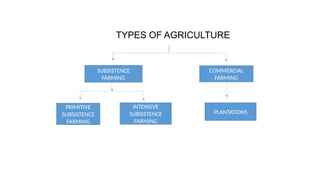
TYPES OF AGRICULTURE
COMMERCIAL
FARMING
PRIMITIVE
SUBSISTENCE
FARMING
INTENSIVE
SUBSISTENCE
FARMING
PLANTATIONS
SUBSISTENCE
FARMING
Primitive Subsistence Farming
• Done with primitive tools like hoe, dao and digging sticks, and community
labour
• Depends upon natural rain and natural fertility of the land.
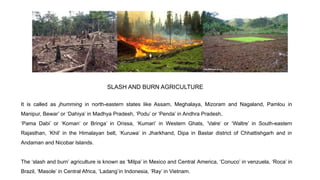
• It is also known as slash and burn agriculture in which a patch of forest
land is cleared and the trees are burnt to do cultivation.
• When the fertility is decreased they will shift and clear a new patch of
forest.
SLASH AND BURN AGRICULTURE
It is called as jhumming in north-eastern states like Assam, Meghalaya, Mizoram and Nagaland, Pamlou in
Manipur, Bewar’ or ‘Dahiya’ in Madhya Pradesh, ‘Podu’ or ‘Penda’ in Andhra Pradesh,
‘Pama Dabi’ or ‘Koman’ or Bringa’ in Orissa, ‘Kumari’ in Western Ghats, ‘Valre’ or ‘Waltre’ in South-eastern
Rajasthan, ‘Khil’ in the Himalayan belt, ‘Kuruwa’ in Jharkhand, Dipa in Bastar district of Chhattishgarh and in
Andaman and Nicobar Islands.
The ‘slash and burn’ agriculture is known as ‘Milpa’ in Mexico and Central America, ‘Conuco’ in venzuela, ‘Roca’ in
Brazil, ‘Masole’ in Central Africa, ‘Ladang’in Indonesia, ‘Ray’ in Vietnam.
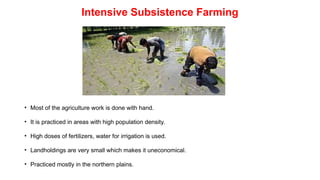
Intensive Subsistence Farming
• Most of the agriculture work is done with hand.
• It is practiced in areas with high population density.
• High doses of fertilizers, water for irrigation is used.
• Landholdings are very small which makes it uneconomical.
• Practiced mostly in the northern plains.
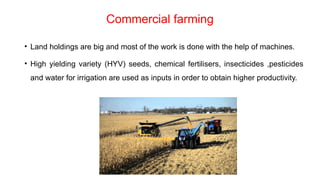
Commercial farming
• Land holdings are big and most of the work is done with the help of machines.
• High yielding variety (HYV) seeds, chemical fertilisers, insecticides ,pesticides
and water for irrigation are used as inputs in order to obtain higher productivity.
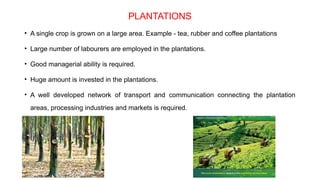
PLANTATIONS
• A single crop is grown on a large area. Example - tea, rubber and coffee plantations
• Large number of labourers are employed in the plantations.
• Good managerial ability is required.
• Huge amount is invested in the plantations.
• A well developed network of transport and communication connecting the plantation
areas, processing industries and markets is required.
RABI, KHARIF AND ZAID CROPPING SEASON
Rabi crop
• Rabi crops are sown in winter from October to December and
harvested in summer from April to June.
• The crop requires less temperature and less rainfall.
• It is mainly grown in the north and north western part of the country.
• Example-Wheat, barley, peas, mustard etc.
KHARIF CROP
• Grown with the onset of monsoon.
• Sown in the month of June and harvested in the month of September –October.
• It requires high temperature and high rainfall for its growth.
• Main crops are Rice, jowar, bajra, jute etc.
• It is grown all over the country during the summer season.
• In states like Assam, West Bengal and Orissa, three crops of paddy are grown
in a year. These are Aus, Aman and Boro.
ZAID CROP
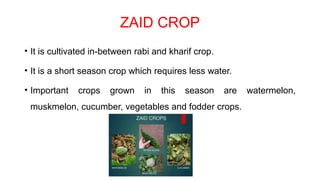
• It is cultivated in-between rabi and kharif crop.
• It is a short season crop which requires less water.
• Important crops grown in this season are watermelon,
muskmelon, cucumber, vegetables and fodder crops.
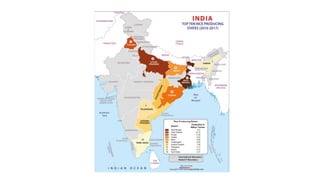
RICE
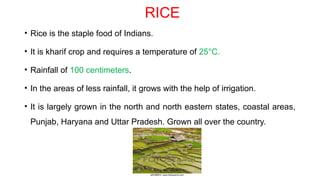
• Rice is the staple food of Indians.
• It is kharif crop and requires a temperature of 25°C.
• Rainfall of 100 centimeters.
• In the areas of less rainfall, it grows with the help of irrigation.
• It is largely grown in the north and north eastern states, coastal areas,
Punjab, Haryana and Uttar Pradesh. Grown all over the country.
WHEAT
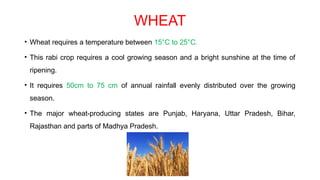
• Wheat requires a temperature between 15°C to 25°C.
• This rabi crop requires a cool growing season and a bright sunshine at the time of
ripening.
• It requires 50cm to 75 cm of annual rainfall evenly distributed over the growing
season.
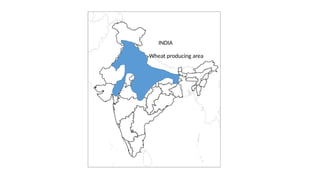
• The major wheat-producing states are Punjab, Haryana, Uttar Pradesh, Bihar,
Rajasthan and parts of Madhya Pradesh.
INDIA
Wheat producing area
MILLETS or coarse grains- Jowar, Bajra and Ragi
JOWAR
• It is a rain-fed crop mostly grown in the moist areas
• Maharashtra is the largest producer of jowar followed by Karnataka, Andhra Pradesh and Madhya Pradesh.
BAJRA
• Bajra grows well on sandy soils and shallow black soil.
• Rajasthan is the largest producer of bajra followed by Uttar Pradesh, Maharashtra,Gujarat and Haryana.
• RAGI
• Ragi is a crop of dry regions and grows well on red, black, sandy, loamy and shallow black soils.
• Karnataka is the largest producer of ragi followed by TamilNadu, Himachal Pradesh, Uttarakhand, Sikkim,
Jharkhand and Arunachal Pradesh.
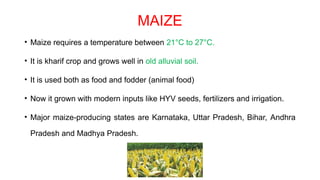
MAIZE
• Maize requires a temperature between 21°C to 27°C.
• It is kharif crop and grows well in old alluvial soil.
• It is used both as food and fodder (animal food)
• Now it grown with modern inputs like HYV seeds, fertilizers and irrigation.
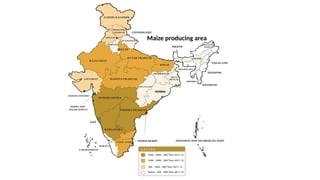
• Major maize-producing states are Karnataka, Uttar Pradesh, Bihar, Andhra
Pradesh and Madhya Pradesh.
Maize producing area
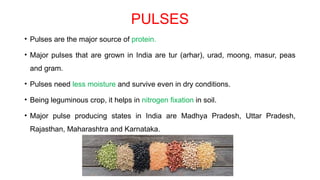
PULSES
• Pulses are the major source of protein.
• Major pulses that are grown in India are tur (arhar), urad, moong, masur, peas
and gram.
• Pulses need less moisture and survive even in dry conditions.
• Being leguminous crop, it helps in nitrogen fixation in soil.
• Major pulse producing states in India are Madhya Pradesh, Uttar Pradesh,
Rajasthan, Maharashtra and Karnataka.
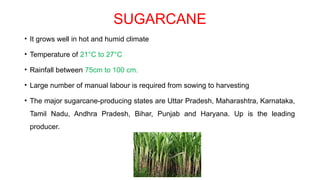
SUGARCANE
• It grows well in hot and humid climate
• Temperature of 21°C to 27°C
• Rainfall between 75cm to 100 cm.
• Large number of manual labour is required from sowing to harvesting
• The major sugarcane-producing states are Uttar Pradesh, Maharashtra, Karnataka,
Tamil Nadu, Andhra Pradesh, Bihar, Punjab and Haryana. Up is the leading
producer.
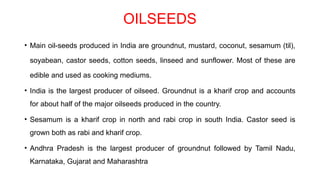
OILSEEDS
• Main oil-seeds produced in India are groundnut, mustard, coconut, sesamum (til),
soyabean, castor seeds, cotton seeds, linseed and sunflower. Most of these are
edible and used as cooking mediums.
• India is the largest producer of oilseed. Groundnut is a kharif crop and accounts
for about half of the major oilseeds produced in the country.
• Sesamum is a kharif crop in north and rabi crop in south India. Castor seed is
grown both as rabi and kharif crop.
• Andhra Pradesh is the largest producer of groundnut followed by Tamil Nadu,
Karnataka, Gujarat and Maharashtra
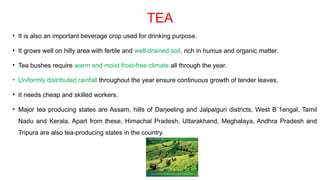
TEA
• It is also an important beverage crop used for drinking purpose.
• It grows well on hilly area with fertile and well-drained soil, rich in humus and organic matter.
• Tea bushes require warm and moist frost-free climate all through the year.
• Uniformly distributed rainfall throughout the year ensure continuous growth of tender leaves.
• It needs cheap and skilled workers.
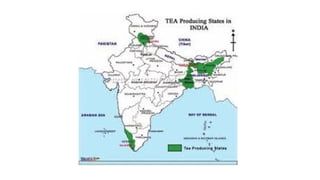
• Major tea producing states are Assam, hills of Darjeeling and Jalpaiguri districts, West B`1engal, Tamil
Nadu and Kerala. Apart from these, Himachal Pradesh, Uttarakhand, Meghalaya, Andhra Pradesh and
Tripura are also tea-producing states in the country.
COFFEE
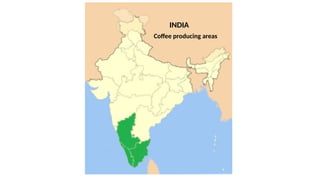
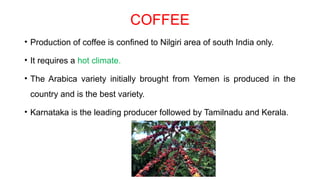
• Production of coffee is confined to Nilgiri area of south India only.
• It requires a hot climate.
• The Arabica variety initially brought from Yemen is produced in the
country and is the best variety.
• Karnataka is the leading producer followed by Tamilnadu and Kerala.
Coffee producing areas
INDIA
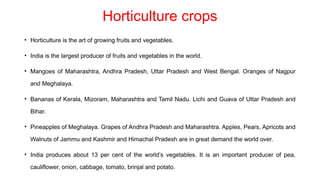
Horticulture crops
• Horticulture is the art of growing fruits and vegetables.
• India is the largest producer of fruits and vegetables in the world.
• Mangoes of Maharashtra, Andhra Pradesh, Uttar Pradesh and West Bengal. Oranges of Nagpur
and Meghalaya.
• Bananas of Kerala, Mizoram, Maharashtra and Tamil Nadu. Lichi and Guava of Uttar Pradesh and
Bihar.
• Pineapples of Meghalaya. Grapes of Andhra Pradesh and Maharashtra. Apples, Pears, Apricots and
Walnuts of Jammu and Kashmir and Himachal Pradesh are in great demand the world over.
• India produces about 13 per cent of the world’s vegetables. It is an important producer of pea,
cauliflower, onion, cabbage, tomato, brinjal and potato.
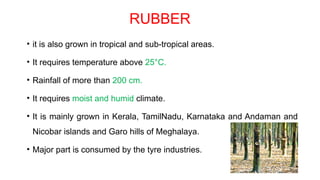
RUBBER
• it is also grown in tropical and sub-tropical areas.
• It requires temperature above 25°C.
• Rainfall of more than 200 cm.
• It requires moist and humid climate.
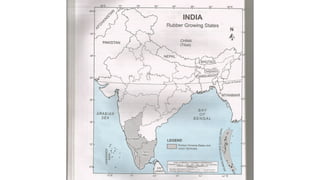
• It is mainly grown in Kerala, TamilNadu, Karnataka and Andaman and
Nicobar islands and Garo hills of Meghalaya.
• Major part is consumed by the tyre industries.
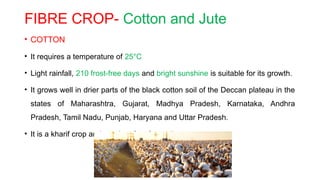
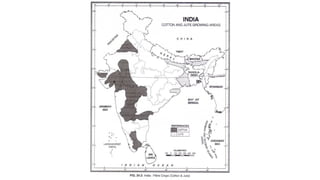
FIBRE CROP- Cotton and Jute
• COTTON
• It requires a temperature of 25°C
• Light rainfall, 210 frost-free days and bright sunshine is suitable for its growth.
• It grows well in drier parts of the black cotton soil of the Deccan plateau in the
states of Maharashtra, Gujarat, Madhya Pradesh, Karnataka, Andhra
Pradesh, Tamil Nadu, Punjab, Haryana and Uttar Pradesh.
• It is a kharif crop and requires 6 to 8 months to mature.
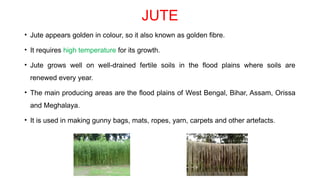
JUTE
• Jute appears golden in colour, so it also known as golden fibre.
• It requires high temperature for its growth.
• Jute grows well on well-drained fertile soils in the flood plains where soils are
renewed every year.
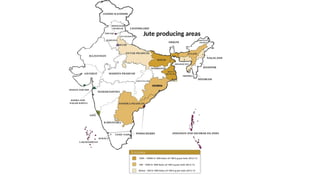
• The main producing areas are the flood plains of West Bengal, Bihar, Assam, Orissa
and Meghalaya.
• It is used in making gunny bags, mats, ropes, yarn, carpets and other artefacts.
Jute producing areas
Challenges for Agriculture
• Continuous agriculture without break has reduced the soil fertility.
• Landholding of the farmers are small.
• Still many farmers depend on natural fertility of soil and monsoon
rainfall.
• Follow old traditional method of farming.
TECHNOLOGICAL REFORMS
• Thus, collectivisation programme encouraged the farmers to do collective
farming
• Consolidation of holdings was done to prevent further fragmentation of
land.
• cooperation and abolition of zamindari system.
• Provided HYV seeds, chemical fertilizers and water for irrigation.
• Machines and agricultural equipments were made available.
INSTITUTIONAL REFORMS
• Provision for crop insurance against drought, flood, cyclone, fire and disease,
• Establishment of Grameen banks, cooperative societies and banks for
providing loan facilities to the farmers.
• Kissan Credit Card (KCC), Personal Accident Insurance Scheme (PAIS) are
some other schemes introduced by the Government of India for the benefit of
the farmers.
• Minimum support price.
Contribution of agriculture to the national
economy, employment and output
• Agriculture has been the backbone of the Indian economy
• Its share in providing employment and livelihood to the
population continues to be as high as 63 per cent.
• There is a decling share of agriculture in GDP.
Efforts to modernise agriculture.
• Establishment of Indian Council of Agricultural Research (ICAR),
agricultural universities, veterinary services and animal breeding
centres, horticulture development were initiated.
• Research and development in the field of meteorology and weather
forecast, etc. were given priority for improving Indian agriculture.
• Steps were taken for improving the rural infrastructure.
FOOD SECURITY
• In order to ensure availability of food to all sections of society our government
carefully designed a national food security system.
• It consists of two components (a)PDS (b)buffer stock
• (a) Public distribution system -PDS is a programme which provides food
grains and other essential commodities at subsidised prices in rural and
urban areas.
• (b)buffer stock- Food Corporation of India (FCI) is responsible for procuring
and stocking food grains, whereas distribution is ensured by public
distribution system
How food security led to problems?
• The government used to provide subsidies on agriculture inputs such as fertilizers,
power and water. Excessive and imprudent use of fertilizers and water has led to
waterlogging, salinity and depletion of essential micronutrients in the soil.
• There has been a gradual shift from cultivation of food crops to cultivation of fruits,
vegetables, oil-seeds and industrial crops.
• The competition for land between non-agricultural uses such as housing etc. and
agriculture has resulted in reduction in the net sown area.
• Periodic scarcity of water has led to reduction in area under irrigation. Inefficient
water management has led to water logging and salinity with reduction of ground
water.
Impact of Globalisation on Agriculture
• Despite being an important producer of rice, cotton, rubber, tea, coffee, jute and spices our
agricultural products are not able to compete with the developed countries because of the highly
subsidised agriculture in those countries.
• To make agriculture successful and profitable, proper thrust should be given to the improvement of
the condition of marginal and small farmers.
• Green revolution is being alleged that it has caused land degradation due to overuse of chemicals,
drying aquifers and vanishing biodiversity.
• organic farming which is practised without factory made chemicals such as fertilisers and pesticides
can be encouraged.
• The decreasing size of the land holding due to inheritance has led to low productivity of foodgrains.
THANK YOU

CBSE CLASS 10 AGRICULTURE CHAPTER 3.pptx

  • 1.
    CHAPTER-4 AGRICULTURE TAPAN KUMAR BHOI TGTSST OAV LATHIKATA, SUNDARGARH
  • 2.
    PREVIOUS KNOWLEDGE • Indiais an agrarian country. • We are getting food because someone is doing agriculture and producing food grains for us. • Our climate and soil fertility has favored agriculture. • Agriculture supplies raw materials to the industries.
  • 3.
  • 4.
    Primitive Subsistence Farming •Done with primitive tools like hoe, dao and digging sticks, and community labour • Depends upon natural rain and natural fertility of the land. • It is also known as slash and burn agriculture in which a patch of forest land is cleared and the trees are burnt to do cultivation. • When the fertility is decreased they will shift and clear a new patch of forest.
  • 5.
    SLASH AND BURNAGRICULTURE It is called as jhumming in north-eastern states like Assam, Meghalaya, Mizoram and Nagaland, Pamlou in Manipur, Bewar’ or ‘Dahiya’ in Madhya Pradesh, ‘Podu’ or ‘Penda’ in Andhra Pradesh, ‘Pama Dabi’ or ‘Koman’ or Bringa’ in Orissa, ‘Kumari’ in Western Ghats, ‘Valre’ or ‘Waltre’ in South-eastern Rajasthan, ‘Khil’ in the Himalayan belt, ‘Kuruwa’ in Jharkhand, Dipa in Bastar district of Chhattishgarh and in Andaman and Nicobar Islands. The ‘slash and burn’ agriculture is known as ‘Milpa’ in Mexico and Central America, ‘Conuco’ in venzuela, ‘Roca’ in Brazil, ‘Masole’ in Central Africa, ‘Ladang’in Indonesia, ‘Ray’ in Vietnam.
  • 6.
    Intensive Subsistence Farming •Most of the agriculture work is done with hand. • It is practiced in areas with high population density. • High doses of fertilizers, water for irrigation is used. • Landholdings are very small which makes it uneconomical. • Practiced mostly in the northern plains.
  • 7.
    Commercial farming • Landholdings are big and most of the work is done with the help of machines. • High yielding variety (HYV) seeds, chemical fertilisers, insecticides ,pesticides and water for irrigation are used as inputs in order to obtain higher productivity.
  • 8.
    PLANTATIONS • A singlecrop is grown on a large area. Example - tea, rubber and coffee plantations • Large number of labourers are employed in the plantations. • Good managerial ability is required. • Huge amount is invested in the plantations. • A well developed network of transport and communication connecting the plantation areas, processing industries and markets is required.
  • 9.
    RABI, KHARIF ANDZAID CROPPING SEASON Rabi crop • Rabi crops are sown in winter from October to December and harvested in summer from April to June. • The crop requires less temperature and less rainfall. • It is mainly grown in the north and north western part of the country. • Example-Wheat, barley, peas, mustard etc.
  • 10.
    KHARIF CROP • Grownwith the onset of monsoon. • Sown in the month of June and harvested in the month of September –October. • It requires high temperature and high rainfall for its growth. • Main crops are Rice, jowar, bajra, jute etc. • It is grown all over the country during the summer season. • In states like Assam, West Bengal and Orissa, three crops of paddy are grown in a year. These are Aus, Aman and Boro.
  • 11.
    ZAID CROP • Itis cultivated in-between rabi and kharif crop. • It is a short season crop which requires less water. • Important crops grown in this season are watermelon, muskmelon, cucumber, vegetables and fodder crops.
  • 12.
    RICE • Rice isthe staple food of Indians. • It is kharif crop and requires a temperature of 25°C. • Rainfall of 100 centimeters. • In the areas of less rainfall, it grows with the help of irrigation. • It is largely grown in the north and north eastern states, coastal areas, Punjab, Haryana and Uttar Pradesh. Grown all over the country.
  • 14.
    WHEAT • Wheat requiresa temperature between 15°C to 25°C. • This rabi crop requires a cool growing season and a bright sunshine at the time of ripening. • It requires 50cm to 75 cm of annual rainfall evenly distributed over the growing season. • The major wheat-producing states are Punjab, Haryana, Uttar Pradesh, Bihar, Rajasthan and parts of Madhya Pradesh.
  • 15.
  • 16.
    MILLETS or coarsegrains- Jowar, Bajra and Ragi JOWAR • It is a rain-fed crop mostly grown in the moist areas • Maharashtra is the largest producer of jowar followed by Karnataka, Andhra Pradesh and Madhya Pradesh. BAJRA • Bajra grows well on sandy soils and shallow black soil. • Rajasthan is the largest producer of bajra followed by Uttar Pradesh, Maharashtra,Gujarat and Haryana. • RAGI • Ragi is a crop of dry regions and grows well on red, black, sandy, loamy and shallow black soils. • Karnataka is the largest producer of ragi followed by TamilNadu, Himachal Pradesh, Uttarakhand, Sikkim, Jharkhand and Arunachal Pradesh.
  • 17.
    MAIZE • Maize requiresa temperature between 21°C to 27°C. • It is kharif crop and grows well in old alluvial soil. • It is used both as food and fodder (animal food) • Now it grown with modern inputs like HYV seeds, fertilizers and irrigation. • Major maize-producing states are Karnataka, Uttar Pradesh, Bihar, Andhra Pradesh and Madhya Pradesh.
  • 18.
  • 19.
    PULSES • Pulses arethe major source of protein. • Major pulses that are grown in India are tur (arhar), urad, moong, masur, peas and gram. • Pulses need less moisture and survive even in dry conditions. • Being leguminous crop, it helps in nitrogen fixation in soil. • Major pulse producing states in India are Madhya Pradesh, Uttar Pradesh, Rajasthan, Maharashtra and Karnataka.
  • 20.
    SUGARCANE • It growswell in hot and humid climate • Temperature of 21°C to 27°C • Rainfall between 75cm to 100 cm. • Large number of manual labour is required from sowing to harvesting • The major sugarcane-producing states are Uttar Pradesh, Maharashtra, Karnataka, Tamil Nadu, Andhra Pradesh, Bihar, Punjab and Haryana. Up is the leading producer.
  • 22.
    OILSEEDS • Main oil-seedsproduced in India are groundnut, mustard, coconut, sesamum (til), soyabean, castor seeds, cotton seeds, linseed and sunflower. Most of these are edible and used as cooking mediums. • India is the largest producer of oilseed. Groundnut is a kharif crop and accounts for about half of the major oilseeds produced in the country. • Sesamum is a kharif crop in north and rabi crop in south India. Castor seed is grown both as rabi and kharif crop. • Andhra Pradesh is the largest producer of groundnut followed by Tamil Nadu, Karnataka, Gujarat and Maharashtra
  • 23.
    TEA • It isalso an important beverage crop used for drinking purpose. • It grows well on hilly area with fertile and well-drained soil, rich in humus and organic matter. • Tea bushes require warm and moist frost-free climate all through the year. • Uniformly distributed rainfall throughout the year ensure continuous growth of tender leaves. • It needs cheap and skilled workers. • Major tea producing states are Assam, hills of Darjeeling and Jalpaiguri districts, West B`1engal, Tamil Nadu and Kerala. Apart from these, Himachal Pradesh, Uttarakhand, Meghalaya, Andhra Pradesh and Tripura are also tea-producing states in the country.
  • 25.
    COFFEE • Production ofcoffee is confined to Nilgiri area of south India only. • It requires a hot climate. • The Arabica variety initially brought from Yemen is produced in the country and is the best variety. • Karnataka is the leading producer followed by Tamilnadu and Kerala.
  • 26.
  • 27.
    Horticulture crops • Horticultureis the art of growing fruits and vegetables. • India is the largest producer of fruits and vegetables in the world. • Mangoes of Maharashtra, Andhra Pradesh, Uttar Pradesh and West Bengal. Oranges of Nagpur and Meghalaya. • Bananas of Kerala, Mizoram, Maharashtra and Tamil Nadu. Lichi and Guava of Uttar Pradesh and Bihar. • Pineapples of Meghalaya. Grapes of Andhra Pradesh and Maharashtra. Apples, Pears, Apricots and Walnuts of Jammu and Kashmir and Himachal Pradesh are in great demand the world over. • India produces about 13 per cent of the world’s vegetables. It is an important producer of pea, cauliflower, onion, cabbage, tomato, brinjal and potato.
  • 28.
    RUBBER • it isalso grown in tropical and sub-tropical areas. • It requires temperature above 25°C. • Rainfall of more than 200 cm. • It requires moist and humid climate. • It is mainly grown in Kerala, TamilNadu, Karnataka and Andaman and Nicobar islands and Garo hills of Meghalaya. • Major part is consumed by the tyre industries.
  • 30.
    FIBRE CROP- Cottonand Jute • COTTON • It requires a temperature of 25°C • Light rainfall, 210 frost-free days and bright sunshine is suitable for its growth. • It grows well in drier parts of the black cotton soil of the Deccan plateau in the states of Maharashtra, Gujarat, Madhya Pradesh, Karnataka, Andhra Pradesh, Tamil Nadu, Punjab, Haryana and Uttar Pradesh. • It is a kharif crop and requires 6 to 8 months to mature.
  • 32.
    JUTE • Jute appearsgolden in colour, so it also known as golden fibre. • It requires high temperature for its growth. • Jute grows well on well-drained fertile soils in the flood plains where soils are renewed every year. • The main producing areas are the flood plains of West Bengal, Bihar, Assam, Orissa and Meghalaya. • It is used in making gunny bags, mats, ropes, yarn, carpets and other artefacts.
  • 33.
  • 34.
    Challenges for Agriculture •Continuous agriculture without break has reduced the soil fertility. • Landholding of the farmers are small. • Still many farmers depend on natural fertility of soil and monsoon rainfall. • Follow old traditional method of farming.
  • 35.
    TECHNOLOGICAL REFORMS • Thus,collectivisation programme encouraged the farmers to do collective farming • Consolidation of holdings was done to prevent further fragmentation of land. • cooperation and abolition of zamindari system. • Provided HYV seeds, chemical fertilizers and water for irrigation. • Machines and agricultural equipments were made available.
  • 36.
    INSTITUTIONAL REFORMS • Provisionfor crop insurance against drought, flood, cyclone, fire and disease, • Establishment of Grameen banks, cooperative societies and banks for providing loan facilities to the farmers. • Kissan Credit Card (KCC), Personal Accident Insurance Scheme (PAIS) are some other schemes introduced by the Government of India for the benefit of the farmers. • Minimum support price.
  • 37.
    Contribution of agricultureto the national economy, employment and output • Agriculture has been the backbone of the Indian economy • Its share in providing employment and livelihood to the population continues to be as high as 63 per cent. • There is a decling share of agriculture in GDP.
  • 38.
    Efforts to moderniseagriculture. • Establishment of Indian Council of Agricultural Research (ICAR), agricultural universities, veterinary services and animal breeding centres, horticulture development were initiated. • Research and development in the field of meteorology and weather forecast, etc. were given priority for improving Indian agriculture. • Steps were taken for improving the rural infrastructure.
  • 39.
    FOOD SECURITY • Inorder to ensure availability of food to all sections of society our government carefully designed a national food security system. • It consists of two components (a)PDS (b)buffer stock • (a) Public distribution system -PDS is a programme which provides food grains and other essential commodities at subsidised prices in rural and urban areas. • (b)buffer stock- Food Corporation of India (FCI) is responsible for procuring and stocking food grains, whereas distribution is ensured by public distribution system
  • 40.
    How food securityled to problems? • The government used to provide subsidies on agriculture inputs such as fertilizers, power and water. Excessive and imprudent use of fertilizers and water has led to waterlogging, salinity and depletion of essential micronutrients in the soil. • There has been a gradual shift from cultivation of food crops to cultivation of fruits, vegetables, oil-seeds and industrial crops. • The competition for land between non-agricultural uses such as housing etc. and agriculture has resulted in reduction in the net sown area. • Periodic scarcity of water has led to reduction in area under irrigation. Inefficient water management has led to water logging and salinity with reduction of ground water.
  • 41.
    Impact of Globalisationon Agriculture • Despite being an important producer of rice, cotton, rubber, tea, coffee, jute and spices our agricultural products are not able to compete with the developed countries because of the highly subsidised agriculture in those countries. • To make agriculture successful and profitable, proper thrust should be given to the improvement of the condition of marginal and small farmers. • Green revolution is being alleged that it has caused land degradation due to overuse of chemicals, drying aquifers and vanishing biodiversity. • organic farming which is practised without factory made chemicals such as fertilisers and pesticides can be encouraged. • The decreasing size of the land holding due to inheritance has led to low productivity of foodgrains.
  • 42.