ASST. PROF. DR. SUPAVADEE ARAMVITH
Presenter Zahid Maqbool(6572017221)
Depertment Electrical Engreening Chulalongkron university
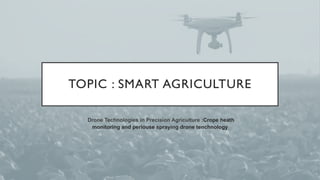
TOPIC : SMART AGRICULTURE
Drone Technologies in Precision Agriculture :Crope heath
monitoring and periouse spraying drone tenchnology
AGRICULTURE DRONE
INTRODUCTION:
Agriculture drone, also known as a farming drone or precision agriculture drone, is an unmanned
aerial vehicle (UAV) used in the agricultural industry to gather data and perform various tasks related
to farming. These drones are equipped with specialized sensors, cameras, and other data-gathering
technologies that allow them to capture high-resolution images, thermal data, and other
environmental data from crops, soil, and other agricultural assets.
Agriculture drones can be used for a variety of tasks such as crop mapping, plant counting, soil
analysis, irrigation management, crop spraying, and monitoring livestock.
This technology can also help reduce the use of pesticides and fertilizers, increase crop yields, and
ultimately, increase profitability.
COMPOMENT
OF DRONE:
• Frame and body
• Motors and propellers
• Flight controller
• GPS system
• Sensors (e.g. RGB, multispectral, thermal)
• Camera and imaging system
• Batteries and power system
• Communication systems (e.g. radio, Wi-Fi)
•
TYPE OF
AGR.
DRONE
There are main three type of Drone:
1)Fixed-wing drone:
2) Helicopters drone:
3) Multi-copter drone:
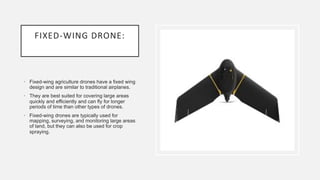
FIXED-WING DRONE:
• Fixed-wing agriculture drones have a fixed wing
design and are similar to traditional airplanes.
• They are best suited for covering large areas
quickly and efficiently and can fly for longer
periods of time than other types of drones.
• Fixed-wing drones are typically used for
mapping, surveying, and monitoring large areas
of land, but they can also be used for crop
spraying.
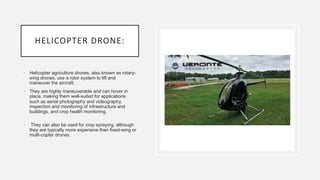
HELICOPTER DRONE:
• Helicopter agriculture drones, also known as rotary-
wing drones, use a rotor system to lift and
maneuver the aircraft.
• They are highly maneuverable and can hover in
place, making them well-suited for applications
such as aerial photography and videography,
inspection and monitoring of infrastructure and
buildings, and crop health monitoring.
• They can also be used for crop spraying, although
they are typically more expensive than fixed-wing or
multi-copter drones.
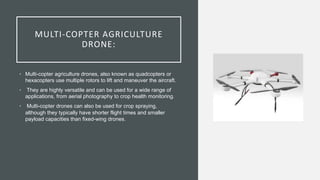
MULTI-COPTER AGRICULTURE
DRONE:
• Multi-copter agriculture drones, also known as quadcopters or
hexacopters use multiple rotors to lift and maneuver the aircraft.
• They are highly versatile and can be used for a wide range of
applications, from aerial photography to crop health monitoring.
• Multi-copter drones can also be used for crop spraying,
although they typically have shorter flight times and smaller
payload capacities than fixed-wing drones.
AGR.DRONE
TECHNOLOGY
APPLICATIOM
Agricultue drone have a lot application for different
purpose i discuess two
Application:
1)Crope heath mointoring
2)Periouse crope spraing
1)CROPE HEATH
MOINTORING
Agriculture drones equipped with remote sensing technology can be used
to monitor crop health, identify areas of stress or disease, and assess
crop growth.
L/R
In 2010, a digital color-infrared camera system was developed for wheat
field monitoring, and image data were successfully analyzed for crop
condition and soil types
In 2012, an unmanned aerial vehicle (UAV) named VIPtero was
developed for site-specific vineyard management, and it showed good
capability to perform the specified task with improved control.
In 2015, AggieAir was proposed as a remote sensing technology for
agricultural application, and it provided high-quality multispectral image
data for crop health monitoring.
LITERATUR REVIEW
• In 2016, a drone system was utilized for the study of water status in vineyard crops, and
thermal images were captured for estimation of instantaneous as well as seasonal water
status in the crop.
• In 2017, a simple multispectral image system for UAV-based agricultural applications was
developed
• In 2018, an IoT-based real-time crop data monitoring drone system was proposed, and it was
integrated with the drone using the Raspberry Pi 3B module.
• In 2019, a system for estimation of soil properties based on the square of Visible
Atmospherically Resistant Index (VARI) was proposed for predicting essential soil nutrients
and pH.
CONT.
• Finally, in 2020, an automatic yellow rust disease monitoring system was proposed using
UAV with a multispectral camera, and it relied on U-Net for semantic segmentation and the
Random Forest algorithm-based deep learning process for the classification of the image
data.
TYPES OF
SENSORS
USED FOR
CROP
HEALTH
MONITORING
1. RGB sensors: RGB sensors capture visible light
wavelengths and are useful for capturing color images
of crops.
2. Multispectral sensors: Multispectral sensors capture
light wavelengths beyond visible light, including near-
infrared, red-edge, and thermal. These sensors can
detect early signs of plant stress and nutrient
deficiencies.
3. Thermal sensors: Thermal sensors capture infrared
radiation emitted by crops and can detect changes in
temperature, which can indicate plant stress.
LATEST CROP
HEATH MOINTORING
DRONE
• Parrot Bluegrass Fields
• DJI Matrice 300 RTK
PESTICIDE SPRAYING:
Pesticide spraying is an essential component of modern agriculture to control pests,
diseases, and weeds that can damage crops and reduce yields. The timely and
effective application of pesticides is crucial to protect the crop and ensure a healthy
yield.
However, traditional manual spraying methods can be time-consuming, labor-
intensive, and may not result in uniform coverage of the crop. Pesticide spraying
using agriculture drones offers a solution to these challenges by providing a faster,
more efficient, and cost-effective way to apply pesticides.
LETEATURE REVIEW:
First UAV (unmanned helicopter) for pesticides application was developed by Yamaha Motor
Co. Ltd., Shizuoka Japan in 1983.
but it was unstable and had poor controllability. Many researchers have since worked on UAV
stability, controllability, and spraying systems.
In 2010, a pre-programmed and remotely controlled helicopter for pesticide spraying was
developed using pulse width modulation (PWM) technology
A system was developed in 2017 using an adaptive control approach with an environment
system (AdEn) software, which improved the performance of the pesticide sprayer system in
dynamic environments.
L/R
• Another 2017 proposal by Luo et al. introduced a genetic algorithm-based multi-UAV system
for the optimization of pesticide spraying tasks. The system was found to be more accurate
than manual procedures for pesticide application
• In 2018, a hexacopter was designed for agriculture monitoring applications, with Python
language programming for disease and weed detection.
• In 2019, variable spray systems based on an artificial neural network (ANN) were developed
to predict droplet deposition and regulate the flow rate of the spray system. An efficient drone
named AeroDrone was designed in the same year for field monitoring and chemical spraying
Finally, a low-budget aerial pesticide spraying system was developed using a UAV weighing
approximately 6 kg.
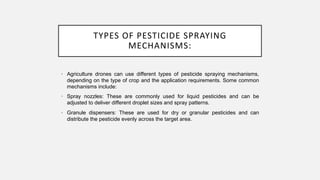
TYPES OF PESTICIDE SPRAYING
MECHANISMS:
• Agriculture drones can use different types of pesticide spraying mechanisms,
depending on the type of crop and the application requirements. Some common
mechanisms include:
• Spray nozzles: These are commonly used for liquid pesticides and can be
adjusted to deliver different droplet sizes and spray patterns.
• Granule dispensers: These are used for dry or granular pesticides and can
distribute the pesticide evenly across the target area.
LATEST
CROPE
PESTICIDE
SPRAING
DRONE
• DJI Agras T20:
• Yamaha RMAX:
• TTA D1:
FUTURE CHALLENGES
• Data management: As the use of drones for
crop health monitoring and pesticide
spraying increases, the amount of data
collected also increases. Managing and
analyzing this data in an efficient manner
will be a challenge.
• Accuracy and reliability: The accuracy and
reliability of sensors and data analysis
techniques used for crop health monitoring
and pesticide spraying need to be improved
to ensure better decision-making and
effective use of resources.
• Cost-effectiveness: The cost of using
drones for crop health monitoring and
pesticide spraying is relatively high
compared to traditional methods. There is a
need to improve cost-effectiveness to
increase adoption.
CONT.
• Regulatory challenges: The use of drones for
crop health monitoring and pesticide spraying
is subject to regulatory requirements.
Complying with these requirements can be a
challenge for farmers and drone
manufacturers.
• Security and privacy: As drones collect data on
crop health and pesticide use, there is a need
to ensure that this data is secure and that the
privacy of farmers and landowners is
protected.
• Public perception: The use of drones for
agriculture has raised concerns among the
public regarding safety, privacy, and job
displacement. Addressing these concerns and
educating the public about the benefits of
drones for agriculture will be crucial for wider
adoption.
REFERENCE
• There are some reference :
• [1] Ehrlich PR, Harte J. Opinion: To feed the world in 2050 will require a global revolution. PNAS
2015;112:14743–4. https:// doi.org/10.1073/pnas.1519841112.
• [2] Chakraborty S, Newton AC. Climate change, plant diseases and food security: An overview. Plant Pathol
2011;60:2–14. https://doi.org/10.1111/j.1365-3059.2010.02411.x.
• [3] 2019 - The State of Food Security and Nutrition in the World (SOFI): Safeguarding against economic
slowdowns and downturns | World Food Programme n.d. https://www.wfp. org/publications/2019-state-food-
security-and-nutrition- world-sofi-safeguarding-against-economic [accessed November 27, 2020].
• [4] The State of Food Security and Nutrition in the World 2020 | FAO | Food and Agriculture Organization of
the United Nations n.d. http://www.fao.org/publications/sofi/2020/en [accessed November 12, 2020].
• [5] Varshney D, Roy D, Meenakshi JV. Impact of COVID-19 on agricultural markets: assessing the roles of
commodity characteristics, disease caseload and market reforms. Indian Econ Rev 2020;55:83–103.
https://doi.org/10.1007/s41775-020- 00095-1.

Agriculture Drone and types.pdf

  • 1.
    ASST. PROF. DR.SUPAVADEE ARAMVITH Presenter Zahid Maqbool(6572017221) Depertment Electrical Engreening Chulalongkron university
  • 2.
    TOPIC : SMARTAGRICULTURE Drone Technologies in Precision Agriculture :Crope heath monitoring and periouse spraying drone tenchnology
  • 3.
    AGRICULTURE DRONE INTRODUCTION: Agriculture drone,also known as a farming drone or precision agriculture drone, is an unmanned aerial vehicle (UAV) used in the agricultural industry to gather data and perform various tasks related to farming. These drones are equipped with specialized sensors, cameras, and other data-gathering technologies that allow them to capture high-resolution images, thermal data, and other environmental data from crops, soil, and other agricultural assets. Agriculture drones can be used for a variety of tasks such as crop mapping, plant counting, soil analysis, irrigation management, crop spraying, and monitoring livestock. This technology can also help reduce the use of pesticides and fertilizers, increase crop yields, and ultimately, increase profitability.
  • 4.
    COMPOMENT OF DRONE: • Frameand body • Motors and propellers • Flight controller • GPS system • Sensors (e.g. RGB, multispectral, thermal) • Camera and imaging system • Batteries and power system • Communication systems (e.g. radio, Wi-Fi) •
  • 5.
    TYPE OF AGR. DRONE There aremain three type of Drone: 1)Fixed-wing drone: 2) Helicopters drone: 3) Multi-copter drone:
  • 6.
    FIXED-WING DRONE: • Fixed-wingagriculture drones have a fixed wing design and are similar to traditional airplanes. • They are best suited for covering large areas quickly and efficiently and can fly for longer periods of time than other types of drones. • Fixed-wing drones are typically used for mapping, surveying, and monitoring large areas of land, but they can also be used for crop spraying.
  • 7.
    HELICOPTER DRONE: • Helicopteragriculture drones, also known as rotary- wing drones, use a rotor system to lift and maneuver the aircraft. • They are highly maneuverable and can hover in place, making them well-suited for applications such as aerial photography and videography, inspection and monitoring of infrastructure and buildings, and crop health monitoring. • They can also be used for crop spraying, although they are typically more expensive than fixed-wing or multi-copter drones.
  • 8.
    MULTI-COPTER AGRICULTURE DRONE: • Multi-copteragriculture drones, also known as quadcopters or hexacopters use multiple rotors to lift and maneuver the aircraft. • They are highly versatile and can be used for a wide range of applications, from aerial photography to crop health monitoring. • Multi-copter drones can also be used for crop spraying, although they typically have shorter flight times and smaller payload capacities than fixed-wing drones.
  • 9.
    AGR.DRONE TECHNOLOGY APPLICATIOM Agricultue drone havea lot application for different purpose i discuess two Application: 1)Crope heath mointoring 2)Periouse crope spraing
  • 10.
    1)CROPE HEATH MOINTORING Agriculture dronesequipped with remote sensing technology can be used to monitor crop health, identify areas of stress or disease, and assess crop growth. L/R In 2010, a digital color-infrared camera system was developed for wheat field monitoring, and image data were successfully analyzed for crop condition and soil types In 2012, an unmanned aerial vehicle (UAV) named VIPtero was developed for site-specific vineyard management, and it showed good capability to perform the specified task with improved control. In 2015, AggieAir was proposed as a remote sensing technology for agricultural application, and it provided high-quality multispectral image data for crop health monitoring.
  • 11.
    LITERATUR REVIEW • In2016, a drone system was utilized for the study of water status in vineyard crops, and thermal images were captured for estimation of instantaneous as well as seasonal water status in the crop. • In 2017, a simple multispectral image system for UAV-based agricultural applications was developed • In 2018, an IoT-based real-time crop data monitoring drone system was proposed, and it was integrated with the drone using the Raspberry Pi 3B module. • In 2019, a system for estimation of soil properties based on the square of Visible Atmospherically Resistant Index (VARI) was proposed for predicting essential soil nutrients and pH.
  • 12.
    CONT. • Finally, in2020, an automatic yellow rust disease monitoring system was proposed using UAV with a multispectral camera, and it relied on U-Net for semantic segmentation and the Random Forest algorithm-based deep learning process for the classification of the image data.
  • 13.
    TYPES OF SENSORS USED FOR CROP HEALTH MONITORING 1.RGB sensors: RGB sensors capture visible light wavelengths and are useful for capturing color images of crops. 2. Multispectral sensors: Multispectral sensors capture light wavelengths beyond visible light, including near- infrared, red-edge, and thermal. These sensors can detect early signs of plant stress and nutrient deficiencies. 3. Thermal sensors: Thermal sensors capture infrared radiation emitted by crops and can detect changes in temperature, which can indicate plant stress.
  • 14.
    LATEST CROP HEATH MOINTORING DRONE •Parrot Bluegrass Fields • DJI Matrice 300 RTK
  • 15.
    PESTICIDE SPRAYING: Pesticide sprayingis an essential component of modern agriculture to control pests, diseases, and weeds that can damage crops and reduce yields. The timely and effective application of pesticides is crucial to protect the crop and ensure a healthy yield. However, traditional manual spraying methods can be time-consuming, labor- intensive, and may not result in uniform coverage of the crop. Pesticide spraying using agriculture drones offers a solution to these challenges by providing a faster, more efficient, and cost-effective way to apply pesticides.
  • 16.
    LETEATURE REVIEW: First UAV(unmanned helicopter) for pesticides application was developed by Yamaha Motor Co. Ltd., Shizuoka Japan in 1983. but it was unstable and had poor controllability. Many researchers have since worked on UAV stability, controllability, and spraying systems. In 2010, a pre-programmed and remotely controlled helicopter for pesticide spraying was developed using pulse width modulation (PWM) technology A system was developed in 2017 using an adaptive control approach with an environment system (AdEn) software, which improved the performance of the pesticide sprayer system in dynamic environments.
  • 17.
    L/R • Another 2017proposal by Luo et al. introduced a genetic algorithm-based multi-UAV system for the optimization of pesticide spraying tasks. The system was found to be more accurate than manual procedures for pesticide application • In 2018, a hexacopter was designed for agriculture monitoring applications, with Python language programming for disease and weed detection. • In 2019, variable spray systems based on an artificial neural network (ANN) were developed to predict droplet deposition and regulate the flow rate of the spray system. An efficient drone named AeroDrone was designed in the same year for field monitoring and chemical spraying Finally, a low-budget aerial pesticide spraying system was developed using a UAV weighing approximately 6 kg.
  • 18.
    TYPES OF PESTICIDESPRAYING MECHANISMS: • Agriculture drones can use different types of pesticide spraying mechanisms, depending on the type of crop and the application requirements. Some common mechanisms include: • Spray nozzles: These are commonly used for liquid pesticides and can be adjusted to deliver different droplet sizes and spray patterns. • Granule dispensers: These are used for dry or granular pesticides and can distribute the pesticide evenly across the target area.
  • 19.
    LATEST CROPE PESTICIDE SPRAING DRONE • DJI AgrasT20: • Yamaha RMAX: • TTA D1:
  • 20.
    FUTURE CHALLENGES • Datamanagement: As the use of drones for crop health monitoring and pesticide spraying increases, the amount of data collected also increases. Managing and analyzing this data in an efficient manner will be a challenge. • Accuracy and reliability: The accuracy and reliability of sensors and data analysis techniques used for crop health monitoring and pesticide spraying need to be improved to ensure better decision-making and effective use of resources. • Cost-effectiveness: The cost of using drones for crop health monitoring and pesticide spraying is relatively high compared to traditional methods. There is a need to improve cost-effectiveness to increase adoption.
  • 21.
    CONT. • Regulatory challenges:The use of drones for crop health monitoring and pesticide spraying is subject to regulatory requirements. Complying with these requirements can be a challenge for farmers and drone manufacturers. • Security and privacy: As drones collect data on crop health and pesticide use, there is a need to ensure that this data is secure and that the privacy of farmers and landowners is protected. • Public perception: The use of drones for agriculture has raised concerns among the public regarding safety, privacy, and job displacement. Addressing these concerns and educating the public about the benefits of drones for agriculture will be crucial for wider adoption.
  • 22.
    REFERENCE • There aresome reference : • [1] Ehrlich PR, Harte J. Opinion: To feed the world in 2050 will require a global revolution. PNAS 2015;112:14743–4. https:// doi.org/10.1073/pnas.1519841112. • [2] Chakraborty S, Newton AC. Climate change, plant diseases and food security: An overview. Plant Pathol 2011;60:2–14. https://doi.org/10.1111/j.1365-3059.2010.02411.x. • [3] 2019 - The State of Food Security and Nutrition in the World (SOFI): Safeguarding against economic slowdowns and downturns | World Food Programme n.d. https://www.wfp. org/publications/2019-state-food- security-and-nutrition- world-sofi-safeguarding-against-economic [accessed November 27, 2020]. • [4] The State of Food Security and Nutrition in the World 2020 | FAO | Food and Agriculture Organization of the United Nations n.d. http://www.fao.org/publications/sofi/2020/en [accessed November 12, 2020]. • [5] Varshney D, Roy D, Meenakshi JV. Impact of COVID-19 on agricultural markets: assessing the roles of commodity characteristics, disease caseload and market reforms. Indian Econ Rev 2020;55:83–103. https://doi.org/10.1007/s41775-020- 00095-1.