Table of Contents
i
1 INTRODUCTION ........................ 1
1.1 MARKET AND MARKETING DEFINED.........................1
1.2 TYPES OF MARKETS.............................................2
1.3 HISTORICAL DEVELOPMENT OF MARKETING...............3
1.4 MARKETING AND OTHER DISCIPLINES......................5
1.5 BASIC APPROACHES TO THE STUDY OF MARKETING .....6
1.5.1 Commodity Approach ................................. 6
1.5.2 Functional Approach................................... 7
1.5.3 Institutional Approach ................................ 7
1.6 MAJOR CLASSIFICATION OF COMMODITIES MARKETED .8
1.6.1 Consumer‟s Goods ..................................... 8
1.6.2 Industrial Goods ........................................ 9
1.7 THE ROLE OF MARKETING...................................10
2 AGRICULTURAL MARKETING....................... 16
2.1 AGRICULTURAL MARKETING DEFINED ....................17
2.2 DISTINGUISHING CHARACTERISTICS OF AGRICULTURAL
PRODUCTION AND MARKETING.............................21
2.3 FUNCTIONS OF AGRICULTURAL MARKETING.............23
2.3.1 Utility Generation Function ........................ 27
2.3.2 Resource Allocation Function ..................... 32
2.3.3 Welfare Generation Function ..................... 35
2.4 THE ROLE OF GOVERNMENT IN THE MARKETING
SYSTEM .........................................................36
2.5 COMMON MARKETING PROBLEMS IN DEVELOPING
COUNTRIES.....................................................41
2.6 RISK ELEMENT IN AGRICULTURAL MARKETING .........42
Table of Contents
ii
3 MARKETING INSTITUTIONS AND COMMODITY
CHAINS 45
3.1 MARKETING INSTITUTIONS .................................45
3.2 MIDDLEMEN ....................................................45
3.2.1 Merchant Middlemen ................................ 46
3.3 COMMODITY CHAIN...........................................57
3.3.1 The Nature of Commodity Chain ................ 58
3.3.2 A Typical Commodity Chain for Agricultural
Products .................................................. 59
4 CO-OPERATIVES AND CROP BOARDS........... 62
4.1 CO-OPERATIVE DEFINED ....................................62
4.2 THE RATIONALE OF COOPERATIVE ........................62
4.3 REASON FOR FORMATION OF CO-OPERATIVES..........63
4.4 BASIC PRINCIPLES OF COOPERATIVES ....................64
4.5 WAYS OF FORMING CO-OPERATIVE MARKETING .......68
4.5.1 Government Coerced Co-operative Marketing69
4.5.2 Voluntary Co-operative Marketing............... 69
4.6 DISTINGUISHING FEATURES OF CO-OPERATIVES.......69
4.7 TYPES OF CO-OPERATIVES ..................................71
4.7.1 Machinery Sharing Co-operative................. 71
4.7.2 Production Co-operative............................ 72
4.7.3 Marketing Co-operative............................. 73
4.7.4 Cooperation in Supply of Farm Requisites.... 74
4.7.5 Service Co-operative ................................ 74
4.7.6 Processing Co-operatives .......................... 75
4.7.7 Consumer Co-operative ............................ 75
4.8 THE HISTORY OF CO-OPERATIVE MARKETING IN
TANZANIA.......................................................75
Table of Contents
iii
4.9 FACTORS LIMITING GROWTH OF AGRICULTURAL
MARKETING CO-OPERATIVES ...............................77
4.10 THE FUTURE OF AGRICULTURAL MARKETING CO-
OPERATIVES ....................................................78
4.11 CROP MARKETING BOARDS IN TANZANIA................78
4.11.1 The History of Agricultural Marketing Boards79
4.11.2 Classification of Agricultural Marketing
Boards..................................................... 80
4.11.3 Functions of Marketing Boards................. 82
4.11.4 Failures of Agricultural Marketing Boards... 82
4.11.5 Justification for the Persistence of
Agricultural Marketing Boards...................... 83
4.12 EVOLUTION OF GRAIN MARKETING ORGANISATIONS IN
TANZANIA.......................................................86
5.1 MARKETING MANAGEMENT ........................ 93
5.1 THE MARKETING CONCEPT..................................93
5.2 MARKETING AND PRODUCTION (SELLING) ORIENTATION
CONCEPTS.......................................................95
5.3 THE MARKETING MANAGEMENT PROCESS ...............99
5.4 MARKETING SYSTEM ENVIRONMENT ....................100
5.4.1 External forces ...................................... 101
5.4.2 Internal Forces ...................................... 105
5.5 MARKETING STRATEGY PLANNING.......................107
5.5.1 Target Market ....................................... 107
5.5.2 Marketing Mix........................................ 108
(A) NEW PRODUCT DEVELOPMENT AND PRODUCT
MANAGEMENT ................................................110
5.6 MARKETING DEPARTMENT IN AN ORGANISATION ....119
Table of Contents
iv
6.1 ANALYSIS OF AGRICULTURAL MARKETING
SYSTEM Error! Bookmark not
defined.
6.1 MARKETING EFFICIENCY DEFINEDERROR! BOOKMARK NOT DEFI
6.2 MEASURES OF MARKETING EFFICIENCYERROR! BOOKMARK NOT
6.2.1 Technical EfficiencyError! Bookmark not defined.
6.2.2 Pricing EfficiencyError! Bookmark not defined.
6.3 THE STRUCTURE-CONDUCT-PERFORMANCE-APPROACHERROR! BO
6.3.1 Market StructureError! Bookmark not defined.
6.3.2 Market ConductError! Bookmark not defined.
6.3.3 Market PerformanceError! Bookmark not defined.
6.4 ANALYSIS OF THE PERFORMANCE OF UTILITY
GENERATION MARKETING FUNCTIONSERROR! BOOKMARK NOT D
6.4.1 Storage or Temporal UtilityError! Bookmark not defi
6.4.2 Transport or Transport UtilityError! Bookmark not de
6.4.3 Processing or Form UtilityError! Bookmark not defin
7 MARKETING INFORMATION SYSTEM AND
RESEARCH Error! Bookmark not
defined.
7.1 MARKET INFORMATION SYSTEMSERROR! BOOKMARK NOT DEFIN
7.1.1 Marketing Information System DefinedError! Bookmar
7.1.2 Benefits and Uses of an MkISError! Bookmark not de
7.2 MARKETING RESEARCHERROR! BOOKMARK NOT DEFINED.
7.2.1 The Role of Marketing ResearchError! Bookmark not
7.2.2 Some Limitations of Marketing ResearchError! Bookma
7.2.3 Marketing Research ProcedureError! Bookmark not d
7.2.4 Steps in Marketing ResearchError! Bookmark not de
7.2.5 Sources of Marketing DataError! Bookmark not defi
Table of Contents
v
7.2.6 Techniques for Primary Data CollectionError! Bookmar
7.2.7 Data Analysis TechniquesError! Bookmark not defin
Table of Contents
1
UNIT ONE
1 INTRODUCTION
1.1 Market and Marketing Defined
Market is one of those areas that one could get four
different answers if he posed a question seeking its
meaning to four experts. Clearly, there are many
usages of the term in economic theory, in business in
general, and in marketing in particular. The following
definitions extracted from literature will give you an
idea about what market is:
(a) Market is a place where sellers and buyers meet,
goods or services are offered for sale.
(b) Market is an area in which a businessperson plans
to locate business and from which he or she will
draw customers.
(c) Market is demand made by a certain group of
potential buyers for a product or service.
(d) Market is people with needs to satisfy, money to
spend, and willingness to spend it.
(e) Market exists wherever a supply of goods is
meeting the corresponding demand and price is
being determined.
From the above definitions it can be deduced that
market is not just a place, area or product, it is rather a
condition that enables a group of potential customers
Table of Contents
2
with similar needs who are willing to exchange
something of value with sellers who can satisfy those
needs.
1.2 Types of Markets
There are several types of markets depending on the
criterion used:
(a) Location – e.g. Morogoro market, Kariakoo
market, etc
(b) Product – e.g. Tomato market, used car
market, etc
(c) Time – seasonal market e.g. December
Christmas tree market, etc.
(d) Level - e.g. the retail food market, wholesale
market etc
(e) Media- electronic market (E-commerce)
Similarly, marketing is defined in different way:
(a) Basic definition: Marketing is the process of
goods flow to satisfying human needs by
bringing products to people in the proper form
and at the proper time and place
(b) The product definition: Marketing is the
performance of all the transactions and services
associated with the flow of a good from the point
of initial production to the final consumer
Table of Contents
3
(c) The marketing firm‟s definition: Marketing is
complete management concept through which
the company sells itself as well as its line of
products.
(d) Society‟s definition: Marketing is all the
processes necessary to determine consumers‟
surplus and societal needs and to conceptualise
and effect their fulfilment.
For the purpose of this course, the first definition is
adopted with minor modification. Thus marketing is a
process of satisfying human needs by bringing products
to people at the proper time and place, and in the
proper form they want them. Of course the process of a
commodity to change hands from a seller to a buyer at
(a price) may need some negotiations. This can be
done face-to-face at some physical locations (e.g.
farmers‟ market), or it can be done indirectly through a
complex network that links middlemen, buyers, and
sellers living far apart
1.3 Historical Development of Marketing
The role of marketing in the society dates back to the
immergence of humanity. From the earliest days men
NOTE:
Frequently the term “marketing” is used to include the activities involved in providing consumers
with such services as those offered by insurance, financial institutions (e.g. banks), accounting,
hotel, entertainment, etc. Although this is entirely justifiable, a consideration of services brings
so many complexities into an introductory course of marketing like this one.
Table of Contents
4
realised that different men could make different
products, and that trade could make products available
in different places. Trade started from person to
person, but grew to involve different towns and
different land.
Marketing develops as a society and its economy
develop. The need for marketing arises and grows as a
society moves from an economy of agriculture and self-
sufficiency to an economy built around industrialisation
and urbanisation. In an agrarian economy, the people
are largely self-sufficient. They grow their own food,
make their own clothes, and build their own houses and
tools. Marketing does not exist because there is no
exchange. As time passes, however, the concept of
division of labour begins to evolve. People concentrates
on producing the items in which they excel, the process
known as specialisation. This results in their producing
more than they need of some items. Whenever people
make more than they need or want more than they
make, the foundation is laid for trade, and trade
(exchange) is the heart of marketing.
At first the exchange process is a simple one. The
emphasis is largely on the production of basics, which
usually are in short supply, and the exchanges are very
local - among neighbours or perhaps among
neighbouring villages. In the next step in the evolution
of marketing, small producers begin to manufacture
Table of Contents
5
their goods in large quantities in anticipation of future
orders. Further division of labour occurs, and a type of
business develops to help sell the increased output. The
person doing this business, which acts as an
intermediary between producers and consumers - is
called a middleman. In order to facilitate
communication and buying and selling, the various
interested parties tend to settle near each other.
Trading centres are thus formed. There are nations
today, including Tanzania, which are going through
these earlier stages of economic development
1.4 Marketing and Other Disciplines
Marketing is interdisciplinary in nature, but it draws
heavily form economics. Economics is engaged in the
study of how the society produce, divide, exchange and
use the scarce things people want, i.e. how human
wants are satisfied. Wants clearly cannot be satisfied
without all the other activities necessary to place
tangible goods in the hands of consumers.
Consequently, as a branch of economics, a study of
marketing draws on such economic concepts as the law
of diminishing returns, marginal cost, marginal revenue,
specialization of labour etc.
Apart from being inclined to economics, marketing is
also heavily indebted to many other disciplines
including psychology, which expand marketing
knowledge about consumer motivation, buying habits
Table of Contents
6
and advertising appeals. Indeed marketing managers
of the future will have to be thoroughly grounded in the
concepts and knowledge of psychology. Other fields
include communication skills, sociology, mathematics,
statistics and anthropology.
1.5 Basic Approaches to the Study of Marketing
Marketing is commonly studied through three basic
approaches:
1. Commodity approach
2. Functional approach
3. Institutional approach
1.5.1 Commodity Approach
The commodity approach involves a study of how
goods move (in different forms) from points of
production to the consumer or user on a commodity
basis. For example, we might take a large number of
farm products and study how each of them is
marketed. In such a study, we would note where each
product is produced. Who are the people engaged in
buying and selling it, how it is transported, and what
problems of advertising, financing and storage are
involved. By repeating this procedure for different
products e.g. rubber, cotton, coffee, paddy, gold,
diamond, shoes, cars, radios, we could get a full picture
of the field of marketing.
Table of Contents
7
1.5.2 Functional Approach
A second approach to the study of marketing, known as
the functional approach, is through the classification
and study of specialized activities or functions involved
in transferring goods to consumers. To illustrate: In
the marketing of wheat, certain specialized activities
are performed. Someone must engage in selling
activities, someone else in buying. Still others assume
responsibility for the transportation of wheat to those
places where it is desired or for its storage to meet
future wants.
By a careful investigation how each of these activities
or functions is performer, together with an analysis of
the cost and problems involved, we might obtain an
understanding of marketing.
1.5.3 Institutional Approach
The third major approach to the study of marketing-
the institutional approach – considers the various
middlemen and facilitating agencies, which perform the
marketing functions. This approach emphasizes the
types of middlemen and agencies involved. To
continue with the wheat example, this approach would
require an investigation of the operating methods,
problems, and costs of the local assembler who
purchases the farmer‟s grain, of the wholesaler or
interregional trader, who holds it until another buyer
Table of Contents
8
can be found, and of truck owner and the railway
company, which provides transport action.
Although there are still other approaches (such as the
historical, cost, behavioural systems, and managerial)
through which the students may study marketing, the
aforementioned approaches – commodity, functional,
and institutional – represent those which experience
has proved to be of greatest value, especially to the
beginning student. Put another way, the nature of
marketing is such that it can best be understood if all
three of these approaches are used in covering various
aspects of the subject.
1.6 Major Classification of Commodities Marketed
Marketing is performed for a great variety of
commodities, extending from the primary raw materials
that must be placed in the hands of manufacturers to
the manufactured and agricultural goods, which end up
in the consumer‟s possession. Broadly speaking, these
goods may be divided into two major groups depending
on the final buyer of the good: consumer goods and
industrial goods.
1.6.1 Consumer’s Goods
These are goods which find their final market among
ultimate consumers, that is, persons use them to satisfy
personal or household wants, e.g. bread, TV set, radio,
shirts, cars, bulbs, etc.
Table of Contents
9
1.6.2 Industrial Goods
These are goods destined for use in producing other
goods, e.g. spare parts, raw cotton, steel, metal sheets,
iron bars, automobile batteries, etc. For simplicity,
industrial goods are sharply distinguishable from
consumers‟ goods in three ways:
I. By the market in which they are consumed
II. By the purpose for which they are bought,
III. By the methods by which they are marketed.
IV. By the quantity marketed
As regards to the market, industrial goods are
consumed by enterprises that use them in producing
consumers‟ goods or other industrial goods and
services. Generally their markets lies among companies
engaged in manufacturing, mining and construction
work, as well as the service industries (hotels,
theatres), public and private institutions (hospitals,
schools), commercial institutions (supermarkets, banks,
office buildings), and government institutions. The
distinction based on purpose follows directly from that
based on the market: Industrial goods are bought to
aid in the furthering of production, rendering services
or conducting business enterprises. Regarding the
method, trade channels for industrial goods are shorter
than channels for consumers‟ goods, so that fewer
middlemen are involved and direct sale is relatively
more important.
Table of Contents
10
Certain goods may be classified as either Consumers‟ or
industrial goods, depending upon whether they are
bought for the gratification of personal or household
wants or for use in business. For instance, an
automobile battery sold for use in a family car is a
consumers‟ good, but one sold for use in hospital
vehicle is an industrial good.
1.7 The Role of Marketing
To appreciate the role played by marketing, it is
important to start by seeking an understanding of its
nature. Marketing, serves as the bridge between
production and consumption. It includes all the
activities necessary to place tangible goods in the
hands of consumers (households & firms). In other
words marketing does not include activities involved in
the process of creating the goods themselves i.e.
production. In marketing of agricultural products such
as crops one would say marketing entails all activities
involved in moving a product from a tree to a plate.
The plate may be in the local area or abroad. Examples
of marketing task/ activities in Tanzania:
- The harvesting process of maize, coffee,
cotton, tomatoes, etc.
- Trucks loaded with sacks of maize, cabbage, rice,
tobacco, etc heading to town and cities.
- Factories receiving raw materials.
Table of Contents
11
- Milling machines and plants processing paddy,
maize, cotton, milk, into other forms desired by
consumers.
- Consumer goods being loaded into trucks and
mkokoteni (carts) and sent for sale through dealers
domestically and abroad.
- Salesmen housemen receiving money in exchange
of goods from customers in grocery store, pubs,
shopping centres, etc.
- Matching-gays (machinga) moving up and down
the streets of towns.
- Food vendors alongside roads selling bans, rice etc.
- Railway trains moving in and out from the cities
carrying merchandise.
- Banks carrying out purchase transaction, etc.
If one considered all such activities taking place
throughout the entire United Republic of Tanzania, He
would be amazed at their magnitude. The gigantic
nature of marketing activities is indicated by the fact
that it involves the movement of commodities worth
trillions of money annually. To accomplish the task,
thousands of people are employed as salesmen,
advertisers, retailers, whole sellers, warehousemen,
product planners, market researchers, transporters,
bankers, speculators, and others too numerous to
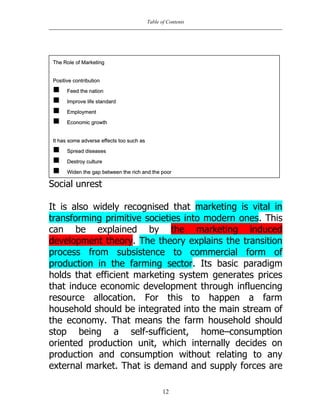
mention. The role of marketing in the economy can be
summarised in the box below. A student is advised to
find explanation on each of the items in the box.
Table of Contents
12
Social unrest
It is also widely recognised that marketing is vital in
transforming primitive societies into modern ones. This
can be explained by the marketing induced
development theory. The theory explains the transition
process from subsistence to commercial form of
production in the farming sector. Its basic paradigm
holds that efficient marketing system generates prices
that induce economic development through influencing
resource allocation. For this to happen a farm
household should be integrated into the main stream of
the economy. That means the farm household should
stop being a self-sufficient, home–consumption
oriented production unit, which internally decides on
production and consumption without relating to any
external market. That is demand and supply forces are
TThhee RRoollee ooff MMaarrkkeettiinngg
PPoossiittiivvee ccoonnttrriibbuuttiioonn
 FFeeeedd tthhee nnaattiioonn
 IImmpprroovvee lliiffee ssttaannddaarrdd
 EEmmppllooyymmeenntt
 EEccoonnoommiicc ggrroowwtthh
IItt hhaass ssoommee aaddvveerrssee eeffffeeccttss ttoooo ssuucchh aass
 SSpprreeaadd ddiisseeaasseess
 DDeessttrrooyy ccuullttuurree
 WWiiddeenn tthhee ggaapp bbeettwweeeenn tthhee rriicchh aanndd tthhee ppoooorr
 nnnnkk
 SSoocciiaall uunnrreesstt
Table of Contents
13
adjusted internally. All needs of the family are satisfied
out of own production; whatever is needed may be
produced even though at high costs because the farm
may be having a comparative disadvantage in
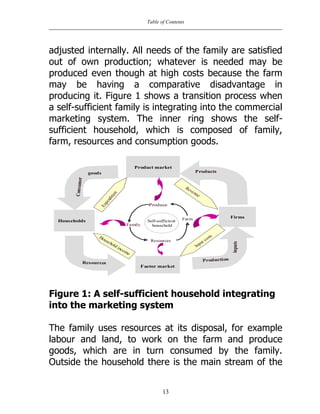
producing it. Figure 1 shows a transition process when
a self-sufficient family is integrating into the commercial
marketing system. The inner ring shows the self-
sufficient household, which is composed of family,
farm, resources and consumption goods.
Self-sufficient
household
Produce
Farm
Resources
Family
Factor market
Firms
Households
Product market
Consumer
goods
Resources
Production
inputs
Products
Expenditure
Revenue
Input costsHousehold income
Figure 1: A self-sufficient household integrating
into the marketing system
The family uses resources at its disposal, for example
labour and land, to work on the farm and produce
goods, which are in turn consumed by the family.
Outside the household there is the main stream of the
Table of Contents
14
economy, comprised of households, firms, factor
market and consumer goods market. When the
household is exposed to the external world, it starts
producing not only to its local consumption but also to
the needs of the others. The self-sufficient household
disintegrates and its components become absolved in
respective components of the economic system. The
household joins other households, resources join the
factor market, consumption goods find their way to the
consumer goods market and farm joins firms. The
household becomes part of the national marketing
system.
Review questions
1. How would you describe marketing to someone
who has no knowledge of the subject?
2. Marketing, although a branch of economics is
heavily indebted to many other disciplines. Discuss
and illustrate the validity of this statement.
3. In not more than 500 words explain how market
evolved, carefully comparing marketing in the early
days and marketing today.
4. Carefully, distinguish between industrial goods and
consumers‟ goods, using examples in your
explanation. Give examples of three products,
which fit in both classifications.
5. Discuss the role of marketing in the economy of
your country. It is said that marketing can
transform primitive societies from subsistence-
Table of Contents
15
home consumption oriented kind of production to
market oriented societies. Discuss.
Table of Contents
16
UNIT TWO
2 AGRICULTURAL MARKETING
One of the biggest problems that countries in the
transitional stage face is how to market their hard
grown agricultural products, both inland and for export.
The aspect of professional agricultural marketing is
regarded as a way to overcome seasonal agricultural
surpluses and shortages of food supply and also as a
means of generating more income.
The marketing of agricultural produce has its own
unique problems and requires specialised attention due
to the bulkiness and perishable nature of the products
involved. Most of these products are basic foodstuffs,
whose price and distribution are considered strategic by
governments and thus the establishment of statutory
institutions is required within the marketing of
agricultural produce.
Successful marketing of agricultural products is
dependent on the creation of conducive circumstances
as well as the provision of resources and services. The
effective marketing channels have to include
infrastructure and facilities such as storage, handling,
transporting, processing, packaging and retailing
services. It will include product location, timing, types,
quantity, quality, prices and any other information
Table of Contents
17
required by producers and consumers to make
beneficial decisions.
To further enhance the development of export
marketing, one has to invest in the entrepreneurial and
technical skills of personnel from all facets of the
marketing process, including the capability to choose
between different products, types, seasons, markets
and processing options to maximise farming income.
Research must be invested into product varieties, post-
harvest handling, preservation, processing, preparation
and presentation. Development of public and private
services required by the producers to market products
such as: marketing; financing; information
dissemination; market research; predictions and
estimations dispute resolution; representation and co-
ordination is mandatory.
2.1 Agricultural Marketing Defined
Agricultural marketing has been defined in various ways
by different authors depending on one‟s school of
thought. For the purpose of this course the definition
by Kohls and Uhl (1990) has been adopted. They define
agricultural marketing as the performance of all
business activities (marketing functions) involved in the
flow of goods and services from the point of initial
agricultural production until the same goods are in the
hands of ultimate consumers. The entire marketing
Table of Contents
18
process can be conceptualised by looking at the
following example
19
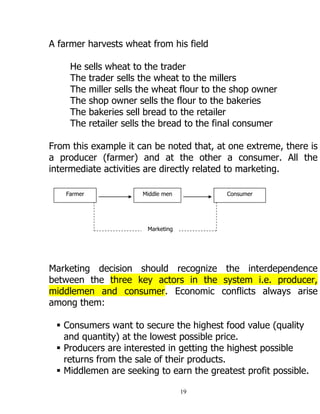
A farmer harvests wheat from his field
He sells wheat to the trader
The trader sells the wheat to the millers
The miller sells the wheat flour to the shop owner
The shop owner sells the flour to the bakeries
The bakeries sell bread to the retailer
The retailer sells the bread to the final consumer
From this example it can be noted that, at one extreme, there is
a producer (farmer) and at the other a consumer. All the
intermediate activities are directly related to marketing.
Marketing decision should recognize the interdependence
between the three key actors in the system i.e. producer,
middlemen and consumer. Economic conflicts always arise
among them:
 Consumers want to secure the highest food value (quality
and quantity) at the lowest possible price.
 Producers are interested in getting the highest possible
returns from the sale of their products.
 Middlemen are seeking to earn the greatest profit possible.
Farmer Middle men Consumer
Marketing
20
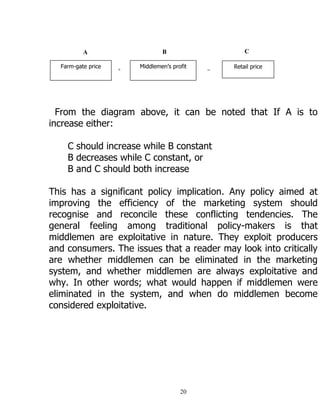
From the diagram above, it can be noted that If A is to
increase either:
C should increase while B constant
B decreases while C constant, or
B and C should both increase
This has a significant policy implication. Any policy aimed at
improving the efficiency of the marketing system should
recognise and reconcile these conflicting tendencies. The
general feeling among traditional policy-makers is that
middlemen are exploitative in nature. They exploit producers
and consumers. The issues that a reader may look into critically
are whether middlemen can be eliminated in the marketing
system, and whether middlemen are always exploitative and
why. In other words; what would happen if middlemen were
eliminated in the system, and when do middlemen become
considered exploitative.
Farm-gate price Middlemen‟s profit Retail price
=+
A B C
21
2.2 Distinguishing Characteristics of Agricultural
Production and Marketing
Agricultural marketing deserves a separate treatment from
marketing of manufactured goods because of the nature of
production and commodity characteristics.
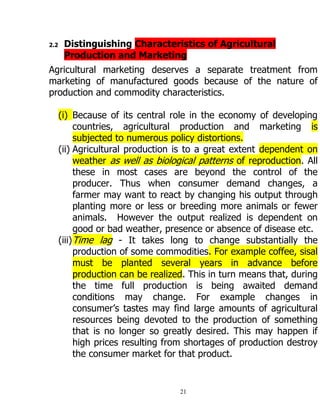
(i) Because of its central role in the economy of developing
countries, agricultural production and marketing is
subjected to numerous policy distortions.
(ii) Agricultural production is to a great extent dependent on
weather as well as biological patterns of reproduction. All
these in most cases are beyond the control of the
producer. Thus when consumer demand changes, a
farmer may want to react by changing his output through
planting more or less or breeding more animals or fewer
animals. However the output realized is dependent on
good or bad weather, presence or absence of disease etc.
(iii)Time lag - It takes long to change substantially the
production of some commodities. For example coffee, sisal
must be planted several years in advance before
production can be realized. This in turn means that, during
the time full production is being awaited demand
conditions may change. For example changes in
consumer‟s tastes may find large amounts of agricultural
resources being devoted to the production of something
that is no longer so greatly desired. This may happen if
high prices resulting from shortages of production destroy
the consumer market for that product.
22
(iv)Farmers themselves may also find it difficult to improve
the prices they receive through independent or group
activity. This is made worse by the fact that farmers are
price takers such that they cannot individually influence
the price of their products through decisions on their
outputs. In order to increase the price they receive by
controlling supplies or through advertising programs they
must act as a group e.g. cooperatives. However the fact
that farmers are so many, scattered, sometimes ignorant,
and are faced with different economic circumstances
frustrates any attempts to organize themselves and act
jointly.
(v) There is always a free rider problem and pooling effect.
These free-riders constrain group efforts that require each
member to sacrifice for the overall welfare of the group
when benefits of the group go to everyone regardless of
their participation.
(vi)Cost-price squeeze problem - This is through the fact that
competitive conditions of agriculture tend to keep farm
prices close to the cost of production. The falling farm
prices are not usually accompanied by falling farm cost.
On the other hand rising farm prices attract farmers more
lucrative enterprises and tend to bid up prices/cost of
factors of production. To make things worse we find that
buyers of the farm products have superior bargaining
powers as compared to farmers. This is because these
buyers are usually larger and have better marketing
information than farmers. Also through contractual buying
23
food marketing forms tend to gain some control over farm
decisions as well as farm markets.
2.3 Functions of Agricultural Marketing
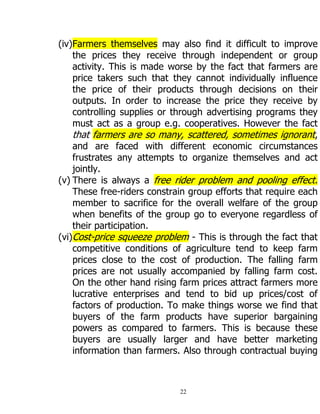
The system of production and marketing in agriculture can be
described as the interaction and outcome of decisions by
various actors (stakeholders) in pursuit of a number of specific
activities, each following certain economic principles. In this
setting, the system of production and marketing fulfils three
basic functions: utility generation, resource allocation and
welfare generation. This is shown as interplay of actors and
their activities in Table 1. The actors are farmers, traders,
consumers and public decision makers, each playing a specific
role in the system.
24
nctio Activity
(Economic
principle)
Actors
Private decision makers
Farmers Traders/Middlemen Consumer
25
lity
nerat
n
Transportation
(Profit
maximisation)
Storage
(Profit
maximisation)
Processing
(Profit
maximisation)
Transaction and
price finding
(Marginal
cost=Price=Mar
ginal utility
(MC=P=MU)
From farm to
assembly markets
In small
stores/bags for
own consumption
or sale
For own
consumption
From assembly
markets to
wholesale/retail
markets
Limited storage
because turnover is
more important
Industrial milling
and processing
From
retailer to
home
Hardly any
storage
Partial
processing
and cooking
Opportuni
ty value
of
produce
consumed
at home
or not
sold
First
transac
tion in
assemb
ly
market
s:
produc
er price
Intermedi
ate
transactio
n in trade
sector:
various
market
prices
Transacti
on at
retail
markets:
consumer
price
Opportunity
value of
money not
spent
26
sour
ocati
Direction
(Comparative
advantage)
Intensity
(Maximising
returns)
Extent
(economies of
scale)
High farm prices
Specialisation or
diversification
Intensification,
innovation
Increased
production,
increased
marketed surplus
Low costs
Specialisation or
diversification
Improved capacity
utilisation
Expansion of
enterprise
Lower
consumer
prices
Increase in
quantity of
consumptio
n
Increase in
quality of
consumptio
n
elfare
nerat
n
Market
intervention
(Efficiency
maximisation
subject to
acceptable
equity level
Increase in
producer surplus
vs.
taxation/redistribu
tion
Increase in
efficiency gains vs.
taxation, fees,
increasing
competition
Increase in
consumer
surplus Vs
taxation,
support
schemes
Agricultural Marketing
27
2.3.1 Utility Generation Function/Direct functions
Utility generation is the most obvious function of the
market, and has received great attention from scholars.
The activities involved in utility generation are
transportation, storage, processing, transaction or price
finding and facilitation function.
2.3.1.1 Transportation
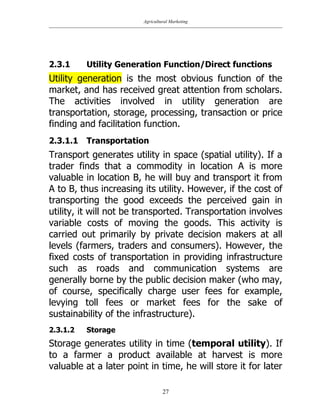
Transport generates utility in space (spatial utility). If a
trader finds that a commodity in location A is more
valuable in location B, he will buy and transport it from
A to B, thus increasing its utility. However, if the cost of
transporting the good exceeds the perceived gain in
utility, it will not be transported. Transportation involves
variable costs of moving the goods. This activity is
carried out primarily by private decision makers at all
levels (farmers, traders and consumers). However, the
fixed costs of transportation in providing infrastructure
such as roads and communication systems are
generally borne by the public decision maker (who may,
of course, specifically charge user fees for example,
levying toll fees or market fees for the sake of
sustainability of the infrastructure).
2.3.1.2 Storage
Storage generates utility in time (temporal utility). If
to a farmer a product available at harvest is more
valuable at a later point in time, he will store it for later
Agricultural Marketing
28
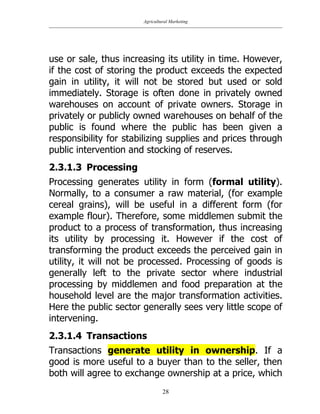
use or sale, thus increasing its utility in time. However,
if the cost of storing the product exceeds the expected
gain in utility, it will not be stored but used or sold
immediately. Storage is often done in privately owned
warehouses on account of private owners. Storage in
privately or publicly owned warehouses on behalf of the
public is found where the public has been given a
responsibility for stabilizing supplies and prices through
public intervention and stocking of reserves.
2.3.1.3 Processing
Processing generates utility in form (formal utility).
Normally, to a consumer a raw material, (for example
cereal grains), will be useful in a different form (for
example flour). Therefore, some middlemen submit the
product to a process of transformation, thus increasing
its utility by processing it. However if the cost of
transforming the product exceeds the perceived gain in
utility, it will not be processed. Processing of goods is
generally left to the private sector where industrial
processing by middlemen and food preparation at the
household level are the major transformation activities.
Here the public sector generally sees very little scope of
intervening.
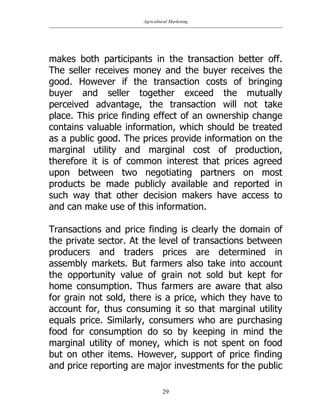
2.3.1.4 Transactions
Transactions generate utility in ownership. If a
good is more useful to a buyer than to the seller, then
both will agree to exchange ownership at a price, which
Agricultural Marketing
29
makes both participants in the transaction better off.
The seller receives money and the buyer receives the
good. However if the transaction costs of bringing
buyer and seller together exceed the mutually
perceived advantage, the transaction will not take
place. This price finding effect of an ownership change
contains valuable information, which should be treated
as a public good. The prices provide information on the
marginal utility and marginal cost of production,
therefore it is of common interest that prices agreed
upon between two negotiating partners on most
products be made publicly available and reported in
such way that other decision makers have access to
and can make use of this information.
Transactions and price finding is clearly the domain of
the private sector. At the level of transactions between
producers and traders prices are determined in
assembly markets. But farmers also take into account
the opportunity value of grain not sold but kept for
home consumption. Thus farmers are aware that also
for grain not sold, there is a price, which they have to
account for, thus consuming it so that marginal utility
equals price. Similarly, consumers who are purchasing
food for consumption do so by keeping in mind the
marginal utility of money, which is not spent on food
but on other items. However, support of price finding
and price reporting are major investments for the public
Agricultural Marketing
30
policy makers, to provide transparency and competition
in the marketing system. This implies organizing
markets in a way that competitive price finding can take
place at minimum costs and that price reporting is done
correctly and effectively.
2.3.1.5 Facilitation Functions
These make possible the smooth performance of the
exchange and physical functions. They include:
(i) Standardisation and grading - Here uniform
measurements are established and maintained.
These measurements could be in terms of quality or
quantity. For example, standardisation of maize may
be based on weight per bag, percent of damaged
kernels, moisture content, and percent of foreign
matter. Other bases of standards are used
depending on the type of good, eg fat content, size,
colour, etc. Once the standards have been
established, the commodity is graded based on
those standards. Both hand and mechanical devices
are employed in the grading or sorting process.
Frequently, grading is carried out on a sample basis.
Standardisation and grading are important to
ultimate consumer and industrial buyers, since
(a) Consumers desire goods of uniform
quality, which they may purchase and again to
satisfy their needs.
Agricultural Marketing
31
(b) The costs of buying and selling are
decreased because the need for inspection
and samples is reduced.
(c) Lower transportation costs result from the
fact that only the grades worth transporting
are transported.
(d) Lower storage costs result from space
economisation by storing only the grades
worth storing.
(e) Make financing easier and less expensive,
for financial institutions will loan large
amounts and at a lower interest rates on
commodities of definitely known grade.
(f) Improve market intelligence and reduce
marketing risks. Market information is of
considerable more value when it applies to
specific grade.
(ii) Financing - This involves advancing money in order
to carry on the various aspects of marketing. Since
there is a delay between the time of purchase of
raw materials and the sale of the finished good
capital is tied up in the operation. Thus someon
must finance the holding of goods when storage or
delay on selling is involved. Commercial bank or one
tie up his/her own capital resources.
(iii) Packaging, Market research, Risk bearing, Market
intelligence
Agricultural Marketing
32
2.3.2 Resource Allocation Function
The process of agricultural transformation consists of
change in the cropping pattern. Cropping pattern
means the proportion of area under different crops.
Allocation of area to different crops (resource
allocation) undergoes a change as a result of changes
in relative profitability of various crops, which is an
outcome of improvements in productivity and changes
in relative price structure.
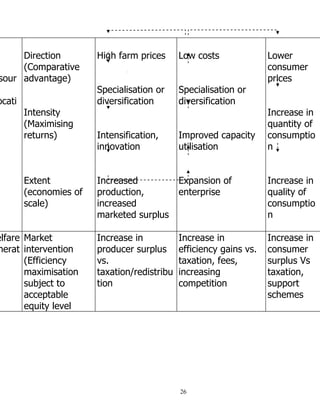
Price signals indicate the direction into which a farm
enterprise should change its activities. This implies
specialization or diversification as the comparative
advantage may indicate. Further, the intensity by which
an activity is pursued is decided such as to maximize
returns. The extent, to which an activity is followed,
depends on the economies of scale inherent in an
operation. Thus decisions about direction, intensity, and
extent of activities are implicitly reflecting decisions on
resource allocation. Causal relationships exist between
these decisions so that some of these decisions
reinforce one another and generate self-accelerating
virtuous circular effects involving decision makers at all
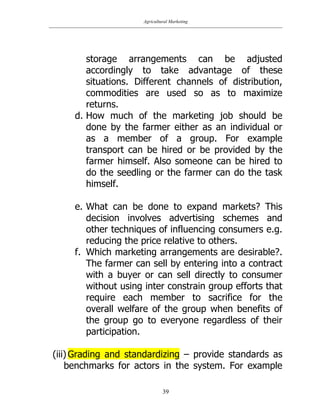
levels along the value-chain as shown in Figure 2.
Agricultural Marketing
33
Priority setting
High producer price
Specialization/
diversication
Intensification,
innovation
Increased production,
increased marker surplus
Lower costs Lower consumer price
Specialization/
diversification
Improved capacity
utilization
Expansion of
enterprise
Increase in quantity
of consumption
Increase in quality
of consumption
Physical infrastructure
Institutional
infrastructure
Support systems
Farmers Traders Consumers Public
Actors
Figure 2: Virtuous circular effects of a marketing
system
On the part of a farmer, if he receives a clear price
signal, about a price of a product, which he could sell in
a market within his reach, he will immediately calculate
and compare the price with his own costs of
production. If he finds, that the price is and will stay
high enough to promise him a profit, he will decide to
Agricultural Marketing
34
redirect his production system by specializing (or
possibly diversifying) into the direction of this
comparative advantage. Once having decided to
specialize or diversify he is likely to increase the
intensity of land use, by utilizing the proceeds from the
market sales for purchasing inputs and for adoption of
improved technologies.
Since farmers in the same village or region operate
under similar agro-climatic conditions, it is quite likely
that the majority will choose to follow similar directions
of specialization and intensification of production with
the results that at aggregate level in the region the
density of marketed surplus will increase. The increase
in marketed surplus is likely to be very large since a
constant quantity is normally used for own
consumption; it is only the residual, which is being
marketed. Any slight increase in productivity will
dramatically increase this residual.
On the part of traders, if they are faced with
dramatically growing densities of production and
market arrivals they will expand their operation,
because their utility generating activities are all subject
to considerable economies of scale, and of capacity
utilization. Likewise, traders will specialize or diversify
according to comparative advantage. Increased density
Agricultural Marketing
35
of market surplus implies lower costs of processing and
handling. Under the pressure of competition, these cost
savings are passed on to producers in the form of
higher farm-gate prices and to consumers in the form
of lower consumer prices. Higher farm-gate price
implies more income to the producer, which permits
further intensification. Lower consumer price implies
increased disposable income to the consumers,
especially in urban areas. Marketing services become a
large portion of the consumer food bill and the
composition of the market basket shifts from low-cost,
starchy foods toward high cost livestock products, fruits
and vegetables.
2.3.3 Welfare Generation Function
From the previous discussion, it has been shown that
an efficient marketing system generates gains (welfare)
to the society in terms of reduced marketing costs and
increased output. These gains to the society are
supposedly enjoyed by the key actors in the system.
Farmers benefit from increased farm-gate, traders
enjoy increased profit margin, and consumers benefit
from reduced consumer price.
Agricultural Marketing
36
2.4 The role of Government in the Marketing
System
Marketing does not necessarily deliver a socially
desirable distribution of income. The gains may be
enjoyed by producers, consumers or traders. Even
within the same group of key actors the gains from
marketing cannot be distributed equally. For instance,
in an openly competitive market system the larger
farmers will generally be better off (getting more
revenue on account of larger quantities sold, and
accessing more credit on favourable terms on account
of more collateral) than his counterpart small farmer in
the same village. Similarly, those farmers in a
favourably endowed region (good soil irrigation, roads
providing good market access) will on average be
better off than their neighbours in a more remote
region with poor resources. Because of this market
forces tend to accentuate the gap between the rich and
the poor.
In this case the public, through appropriate policies,
should intervene in the production and marketing
process to bring equity and macroeconomic stability. If
consumers are enjoying the welfare gains,
redistribution should take place in favour of producers,
Agricultural Marketing
37
and the same applies if the farmers reap the lion‟s
share in the welfare gains.
There are several ways by which the government may
intervene in the production and marketing system,
apart from the use of taxation policy:
(i) Conducting awareness campaigns to change
farmers‟ attitude - farming in developing countries is
carried out on traditional basis. People grow crops
because they inherited them from their ancestors.
The situation could change if farmers were made to
view farming as a business entity, that is, they
become market oriented. Personal aspirations and
opinions will determine how farmers view their
farming activities. So the two identifiable extreme
positions include the production oriented and
marketing oriented tendencies. Production oriented
means that the person looks at the major part of
the business as being concerned with goods, which
he wants to produce for personal consumption
(subsistence).
(ii) Providing Market intelligence/Information - Market
intelligence involves collecting, interpreting and
dissemination of data, which is necessary for
smooth operation of the marketing processes. The
market information systems are designed to track
the factors that can influence the market for
Agricultural Marketing
38
product so that changes can be anticipated.
Information provided may include price, places with
excess supply, places with shortage (demand),
population, income levels, sales trends, emerging
business opportunities domestically and abroad,
research results, etc. In Tanzania Marketing
Development Bureau of the Ministry of Agriculture
supplies information. Other means of data
dissemination include Radio broadcast (Kariakoo
market), Newspapers etc.
Once the knowledge of marketing and its problems
is available to the farmer he/she will be in a better
position to make decisions concerning the
operations of the farm. The decision will be
determined by answers to the following questions.
a. What should a farm produce and prepare it for
sale. This has to do with form utility since
different people desire different things e.g.
b. some vegetable varieties are more desired by
consumers than others.
c. When and where to buy or sell. For example
price of commodities will vary depending on
the season of the year. Thus production and
Agricultural Marketing
39
storage arrangements can be adjusted
accordingly to take advantage of these
situations. Different channels of distribution,
commodities are used so as to maximize
returns.
d. How much of the marketing job should be
done by the farmer either as an individual or
as a member of a group. For example
transport can be hired or be provided by the
farmer himself. Also someone can be hired to
do the seedling or the farmer can do the task
himself.
e. What can be done to expand markets? This
decision involves advertising schemes and
other techniques of influencing consumers e.g.
reducing the price relative to others.
f. Which marketing arrangements are desirable?.
The farmer can sell by entering into a contract
with a buyer or can sell directly to consumer
without using inter constrain group efforts that
require each member to sacrifice for the
overall welfare of the group when benefits of
the group go to everyone regardless of their
participation.
(iii) Grading and standardizing – provide standards as
benchmarks for actors in the system. For example
Agricultural Marketing
40
definition of weights and measures used in the
country, approving grades and standards for various
types of goods. In Tanzania, some of these tasks
are carried out by Tanzania Bureau of Standards.
(iv)Investment in market infrastructure – e.g. roads,
railways, market buildings, telecommunication. All
these reduce marketing costs
(v) Price stabilisation – e.g. price ceiling and price floor
of important or basic goods. Tanzania government
determines the floor price for cash crops. Other
price stabilisation efforts may involve buying excess
output and release it during shortage periods, and
setting production quotas. Example Ruvuma in
Songea (2011).
(vi)Food security programs - e.g. Strategic Grain
Reserve (SGR), subsidising inputs in certain regions,
and distribution of relief food.
(vii) Maintain law and order – e.g. property rights,
contract enforcement, antitrust laws. Antitrust laws
prevent large-scale business from rising monopolies,
which could buy patents to prevent new products
from reaching the market and engage in cutthroat
competition to eliminate competitors. Other
examples include laws against damping practice,
cheating and selling harmful products, quarantines
etc.
Agricultural Marketing
41
2.5 Common Marketing Problems in Developing
Countries
i) Barrier to entry due to overwhelmingly
bureaucratic and unclear registration procedures
ii) Lack of economies of scale in transport, storage,
and processing
iii) Poor infrastructure including information
dissemination on important marketing
parameters – that impedes physical flows of
goods and leads to excessive price differences
between markets
iv) High rates of physical losses or spoilage, i.e.
poor post-harvest handling.
v) Wide spread risk aversion attitude among actors
vi)Inadequate capital market to match supply and
demand over time and space.
vii) Absence of standardised grades – varieties,
qualities, weight, etc, which make visual
inspection necessary.
viii) Lack of legal means to enforce contracts,
which inhibit distance trade
Agricultural Marketing
42
ix) Low effective demand as a result of low
purchasing power (income) – this calls for small
retail transaction.
2.6 Risk Element in Agricultural Marketing
In the early days‟ when producer market was restricted
to his immediate small community, market risks were
nearly at minimum because the distance was short. In
addition, the seller was also the producer. But today, a
producer and a buyer are typically geographically
separated from each other. In this situation, the
marketing of goods involves a large number of
unavoidable risks, and thus increased marketing cost.
Examples of marketing risks include: physical
deterioration, obsolescence, theft (shoplifting is
common phenomenon in large shops), damage, waste,
bad debts, change in demand and supply with impact
on price, etc. It should be noted that Fresh fruits and
vegetables, which are highly perishable, are highly
risky.
Risks in Agricultural Marketing can be dealt with in
many ways. In some cases a person may transfer some
of his risk to others. For example, losses from fire,
floods and theft may be transferred to insurance
companies. Also, with some commodities, it is possible
to ensure against losses due to price changes through
hedging and futures market. To some degree, some of
the risks, which cannot be transferred to others, may
Agricultural Marketing
43
be eliminated or minimised. Thus the development of
cold storage and refrigerated cars has reduced the risk
arising from perishability. The increase in quality and
quantity of marketing information, that is, market
intelligence, is an additional important factor in
reducing risk.
Cooperatives and Crop Boards
44
Review questions
1. In your own words explain the marketing
functions. Discuss the importance of
standardisation and grading function.
2. Based on the library materials and other sources,
prepare a list of 40 different non-traditional crops
which you think your country can produce and
market profitably domestically and abroad
3. What do you consider to be the main bottlenecks
in your county‟s agricultural marketing system?
Suggest ways to solve those problems
4. In your own words, explain why you think
government intervention in the economy is
inevitable. Discuss the various ways by which the
government may intervene in the marketing
system. Give illustration for each.
5. Discuss possible side effects of government
intervention in the marketing system. Use
examples to support your argument
6. One of the ways by which the government may
stabilise prices is through buying excess produces
during bumper season and injects them back to
the system during lean season. (a) Explain how
this may work (b) What are the likely problem with
this approach to stabilise price?
7. In your own words, discuss the nature and ways of
dealing with risks in agricultural marketing.
Cooperatives and Crop Boards
45
UNIT THREE
3 MARKETING INSTITUTIONS AND COMMODITY
CHAINS
3.1 Marketing Institutions
Marketing institutions consist of those middlemen and
facilitating organisations, which perform the marketing
functions discussed in the previous unit. Middlemen
include, for example, individuals, crop marketing
boards, primary co-operative societies, co-operative
unions and farmers associations. Examples of
facilitating marketing agencies in Tanzania include the
former marketing development bureau (MDB),
chambers of commerce e.g. T.C.C.I.A, C.T.I, rail road
or tracking companies, banks from which buyers
borrow fund, assembly markets, public warehouses and
advertising agents. This course will limit its coverage to
middlemen; facilitating marketing agents will be left for
advanced courses in marketing.
3.2 Middlemen
A middleman is an individual or a business organisation
operating between the producer and the ultimate
consumer or industrial user. Some middlemen actually
take the title to the goods in which they deal, while
others aid in the buying and selling of merchandise
Cooperatives and Crop Boards
46
without taking title. Based on this, we have two types
of middlemen:
(i) Merchant middlemen
(ii) Agent middlemen
3.2.1 Merchant Middlemen
These are middlemen who take title while performing
marketing functions. They may be divided into two
groups: retailers and wholesaler. This classification of
merchant middlemen rests basically upon the markets
to which these groups cater. Thus, retailers sell mainly
to the ultimate consume, whereas, wholesalers the
main outlet is other middlemen (e.g. retailers),
industrial users (large private and public companies) or
both. Retailing is further subdivided into small
independent shop/store and large-scale retailing (e.g.
supermarkets). Similarly, different types of wholesalers
exist, but for the sake of keeping the course at a
manageable level will not be discussed in this course.
3.2.2.3 Retailers
(a) The Small Independent Retailer
The typical independent retailer is a small, non-
integrated middleman lacking any appreciable degree
Cooperatives and Crop Boards
47
of specialisation in management or employees. The
owner of the business usually acts as its manager. If
the shop happens to be very small, he or she may
perform all the essential functions himself.
(b) Large-scale Retailing: Supermarkets
One of the large-scale retail institutions, which are
developing in Sub-Saharan Africa (SSB), is the
supermarket. They are proliferating fast beyond middle-
class big cities into smaller towns and poorer areas.
Supermarkets are overwhelmingly transforming the
food retail sector in the region, with a lot of potentials
and challenges in supplying them. By definition, a
Supermarket is a departmentalised retail shop having
annual sales worth several billions of shillings in a
variety of merchandise (cloth, soft drinks, liquor,
meats, fruits and vegetables, dairy products, etc), and
in which the sale of commodities is on a self-service
basis. The major characteristics of a supermarket are:
i) Relatively low prices, due to economies of large
size
ii) Minimum customer service, (operate on self-service
basis)
iii)Ample parking area
iv)Increased departmentalisation
v) Skilful promotion in television, radios etc.
vi)Wide variety of merchandise (a one-stop shopping
centre), though foodstuff dominate
Cooperatives and Crop Boards
48
vii) Have a closer cooperation with manufacturers
viii) Owned by shareholders
ix)Part of a larger network of supermarkets
Although supermarkets operate profitably, they do face
some problems, which include:
(i) Because of space requirement, it becomes
difficult to find good location
(ii) Stiff competition among themselves and
between other retailing shops
(iii)Start-up investment cost is exorbitantly high, it
takes billions of shillings to stock the store
(iv)Low purchasing power of the people in
developing countries
(v) Lack of bargaining repels some customers
(vi)Because of self-service system, shoplifting is a
significant source of losses
3.2.2.4 Wholesaling Agricultural Consumers’
Goods
Many farm products are particularly ready for the
ultimate consumer when they leave the farm. Among
such products are fluid milk, eggs, poultry, and fresh
fruits and vegetable. Of course, some of these are used
as raw materials in processing industries (fruit canning,
wineries, milk drying and evaporation, etc). This section
will concentrate on the marketing of farm products,
which go to the consumer without any significant
Cooperatives and Crop Boards
49
change in form. As discussed previously, marketing of
agricultural products is influenced greatly by the factors
involved in production and consumption.
Characteristics such as small-scale and seasonal
production, widely distributed throughout the country,
variation in quantity and quality grown each year,
owing to changeable weather conditions and improved
technology, bulkiness and perishability and others serve
to complicate the marketing problems for farmers and
to necessitate the use of wholesale middlemen of
various types. Wholesalers dealing in agricultural
consumers‟ goods operate in one or two, sometimes
three different markets collectively known as central
markets. Central market is a broad concept and may
mean something different to some scholars. But it is
simply a convenient place where buyers and sellers can
meet one-on-one to exchange goods and services. It
can be categorised into three levels namely local or
primary, secondary, and tertiary markets. More often
than not central and tertiary market terminologies are
used interchangeably.
As stated in previously, central market is a convenient
place where buyers and sellers can meets one-on-one
to exchange goods and services. This is very typical in
primitive market. In our information age, central
markets as exhibited in the western world, take a
variety of forms – ranging from suburb shopping
Cooperatives and Crop Boards
50
centres to website that operate in a cyberspace such as
www.e-bay.com and www.amazon.com.
(a) Reasons for Development of Central Markets
Central markets help the exchange process. To
understand this, imagine a small village of five families
– each with a special skill for producing some need
satisfying product (assume no money is involved). After
meeting basic needs, each family decides to specialise.
It is easier for one family to make two pots and another
to make two baskets. Specialisation makes labour more
efficient and more productive. It can increase the total
amount of form utility created.
If the five families, each specialises in one product,
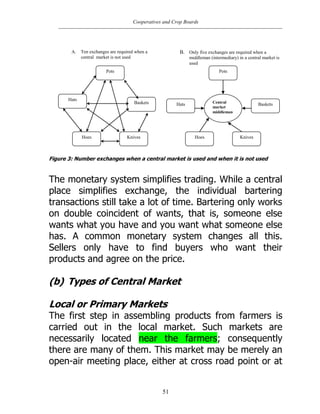
they will have to trade with each other. As Figure 3
shows, it will take the five families 10 separate
exchanges to obtain some of each of the products. If
the families live near each other the exchange process
is relatively simple. But if they are far apart, travelling
back and forth will take time. Faced with this problem,
the families may agree to come to central market and
trade on a certain day. Then each family makes only
one trip to the market to trade with all the others. This
reduces the total number of trips to five, which makes
exchange easier, leaves more time for producing and
consuming, and also provides for social gathering.
Cooperatives and Crop Boards
51
Figure 3: Number exchanges when a central market is used and when it is not used
The monetary system simplifies trading. While a central
place simplifies exchange, the individual bartering
transactions still take a lot of time. Bartering only works
on double coincident of wants, that is, someone else
wants what you have and you want what someone else
has. A common monetary system changes all this.
Sellers only have to find buyers who want their
products and agree on the price.
(b) Types of Central Market
Local or Primary Markets
The first step in assembling products from farmers is
carried out in the local market. Such markets are
necessarily located near the farmers; consequently
there are many of them. This market may be merely an
open-air meeting place, either at cross road point or at
A. Ten exchanges are required when a
central market is not used
B. Only five exchanges are required when a
middleman (intermediary) in a central market is
used
Pots
Hats
Hoes Knives
Pots
Baskets Hats Baskets
KnivesHoes
Central
market
middleman
Cooperatives and Crop Boards
52
established places in villages and towns, where farmers
with products to sell may contact one or more buyers.
Or the meeting place may be the office of potential
buyer located fairly close together in a small town. Still,
in other cases the market may be established, where
special facilities exist for handling the product; for
instance, a local market for orange may grow up
around a large cold-storage warehouse. Sales at local
markets usually result from direct negotiation between
buyers and sellers.
Secondary Markets
From local markets or directly from the large growers,
agricultural consumers‟ goods are frequently
concentrated still more by moving them into a smaller
number of small central or terminal markets. These
markets are located in important transportation centres
and, in contrast with many local markets which lack
special handling facilities, are well equipped to perform
all the handling functions, including storage, for the
wide variety of products entering them by tracks, rail or
ship. Here, also, are found additional facilities such as
auctions and financial institutions.
Tertiary Markets
Cooperatives and Crop Boards
53
From the secondary markets products move to tertiary
markets. Many agricultural consumers‟ goods move
directly from the tertiary market to the retailer‟s
warehouse or to retail shops, especially for large-scale
retailers. However, in many cases, tertiary markets
constitute the main source of supply for many of the
smaller secondary markets in surrounding towns,
although some of the products sold in such markets
come directly from the growers. It should be
emphasized here that, with economic development
secondary and tertiary markets tend to be bypassed but
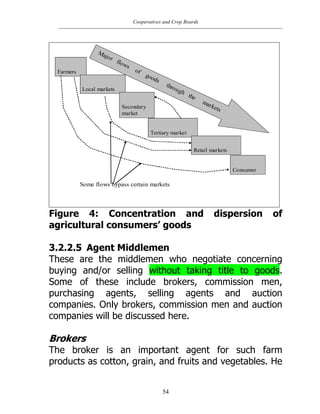
cannot be eliminated (Figure 4). The reasons for
bypassing them are as following:
(i) the growth of large scale retailers (e.g.
supermarkets) and large consumers (eg. big
hotels and restaurants), who can send buyers
into local markets
(ii) improved roads and transportation by truck,
which makes it convenient for the farmers to
deliver to retailers, and for the retailers to buy at
the farm or in the local markets
(iii) increased market intelligence among farmers
Cooperatives and Crop Boards
54
Farmers
Local markets
Secondary
market
Tertiary market
Retail markets
Consumer
Major flows
of
goods
through
the
markets
Some flows bypass certain markets
Figure 4: Concentration and dispersion of
agricultural consumers’ goods
3.2.2.5 Agent Middlemen
These are the middlemen who negotiate concerning
buying and/or selling without taking title to goods.
Some of these include brokers, commission men,
purchasing agents, selling agents and auction
companies. Only brokers, commission men and auction
companies will be discussed here.
Brokers
The broker is an important agent for such farm
products as cotton, grain, and fruits and vegetables. He
Cooperatives and Crop Boards
55
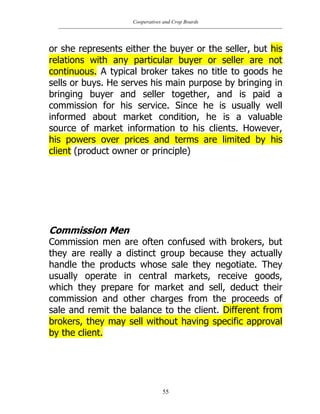
or she represents either the buyer or the seller, but his
relations with any particular buyer or seller are not
continuous. A typical broker takes no title to goods he
sells or buys. He serves his main purpose by bringing in
bringing buyer and seller together, and is paid a
commission for his service. Since he is usually well
informed about market condition, he is a valuable
source of market information to his clients. However,
his powers over prices and terms are limited by his
client (product owner or principle)
Commission Men
Commission men are often confused with brokers, but
they are really a distinct group because they actually
handle the products whose sale they negotiate. They
usually operate in central markets, receive goods,
which they prepare for market and sell, deduct their
commission and other charges from the proceeds of
sale and remit the balance to the client. Different from
brokers, they may sell without having specific approval
by the client.
Cooperatives and Crop Boards
56
Purchasing Argents
They differ from brokers in that they have continuous
relationship with their principals and operate only in
buying side of the transaction. They often combine the
orders of a number of wholesalers and retailers to gain
economies of scale. Some are paid on commission
basis, whereas others receive a flat fee per month.
They are commonly known as resident buyers. For their
small clients they serve as a valuable source of
information. Since they are independent businessmen,
they should be sharply distinguished from the
purchasing officer of an industrial enterprise, who is not
in business for himself but is employed to buy for one
particular company.
Selling Argents
Selling argents are independent operators who function
as the sales department for their clients. They handle
the entire output of their clients on continuous basis
and have unlimited sales area with a large degree of
authority over prices and terms of sales. In addition,
they often render financial aid both to their clients and
to those to whom they sell. They are used often by
small companies in the sales of industrial goods,
clothing food stuffs, etc.
Auction Companies
Auction companies in connection with agriculture,
operate mainly in wholesaling fresh fruits and
Cooperatives and Crop Boards
57
vegetable, livestock, and leaf tobacco. They provide
facilities through which goods turned over for sale to
them can be displayed to prospective buyers. At stated
times and under definite rules of trading, these goods
are offered for sale and sold to the highest bidder.
Charges and commissions are deducted, and the
balance is sent to the client. In performing their selling
functions, they provide some storage services, and at
times they extend credit to purchases, but their main
activity is in negotiating sales.
3.3 Commodity Chain
The commodity on its way from the producer to the
consumer follows what is known as a commodity chain
(sometimes referred to as channel of distribution, trade
channel, value chain, or supply chain), which adds
value (utility) to the product. Commodity chains for
different products may have different lengths;
depending upon how much utility a consumer wants to
have been added before he consumes the product.
Generally, the more utility added when transforming
the raw material into a final consumer good, the larger
the cost margin and consequently the lower the
farmer's share in the consumer price. Under the
condition of effective competition among traders, the
margins of traders cannot exceed the actual costs
involved in the transformation process plus a normal
profit margin. A normal profit margin in this case refers
to the level of profit, which is equivalent to the interest
Cooperatives and Crop Boards
58
a businessman would get if he deposited the money
(used in business) in the financial institutions.
Competition among traders is a necessary condition for
an efficient functioning of the commodity chain.
3.3.1 The Nature of Commodity Chain
A commodity chain consists of middlemen and any
other buyers or sellers involved in the process of
moving a good from producer to consumer. In other
words, it is the route used by a producer to move his
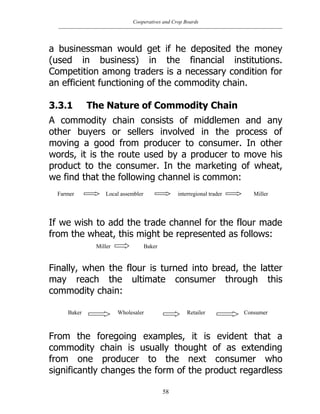
product to the consumer. In the marketing of wheat,
we find that the following channel is common:
If we wish to add the trade channel for the flour made
from the wheat, this might be represented as follows:
Finally, when the flour is turned into bread, the latter
may reach the ultimate consumer through this
commodity chain:
From the foregoing examples, it is evident that a
commodity chain is usually thought of as extending
from one producer to the next consumer who
significantly changes the form of the product regardless
Farmer Local assembler interregional trader Miller
Miller Baker
Baker Wholesaler Retailer Consumer
Cooperatives and Crop Boards
59
of whether this consumer is or is not the ultimate
consumer. Thus the commodity chain for wheat begins
with the farmer and ends with the miller; that for the
flour begins with the baker and ends with the ultimate
consumer. Thus, getting wheat from the farmer to the
consumer in the form of bread really involves three
distinct products and three commodity chains. Unless
one thinks of a chain in this sense, it would be difficult
to trace, for example, the commodity chain for rubber
and its products, which reach the industrial user and
ultimate consumer in many forms and through
numerous kinds of middlemen, the functions of whom
vary from product to product.
3.3.2 A Typical Commodity Chain for
Agricultural Products
There are numerous types of commodity chains the
main ones being:
(i) Producer to retailer to consumer
(ii) Producer to wholesaler to Industrial user
(iii) Producer to wholesaler to retailer to consumer
Cooperatives and Crop Boards
60
(iv) Producer to agent to wholesaler to retailer to
consumer
Of all, Producer to wholesaler to retailer to consumer,
often referred to as the “orthodox” channel, is the most
widely used, not only for moving manufactured goods
to consumers, but also large quantities of agricultural
commodities follow the same route. Each product has
its own distribution chain. The chain might be longer or
short, depending on the number of changes in the
forms to be done on the product. Also, its links and
extensions may differ from one commodity to another.
Several of these chains, including the input supply
chains form the marketing system, coordinated by price
signals. In terms of number of actors involved in
different function along the chain, a typical commodity
chain for a particular commodity assumes an 8-figure
shape, in the sense that there are a few input suppliers,
many producers, a few assemblers, very few
wholesalers, a few retailers, and many consumers
(Figure 4). The shape is necessary for the system to
operate sustainably. Think of a situation where each
farmer or consumer has his own (one) supplier! He or
she will have to meet all the cost involved in the
marketing process.
Cooperatives and Crop Boards
61
Input suppliers
Producers
Assemblers
Wholesale
Retailers
Transporters, Warehousemen, Processors
Consumers
Figure 5: Relative numbers of actors along a
typical commodity chain
UNIT FOUR
Cooperatives and Crop Boards
62
4 CO-OPERATIVES AND CROP BOARDS
4.1 Co-operative Defined
In general co-operatives are legally institutionalised
voluntary organizations which are set up to serve and
benefit those who are going to use them and their
group can compete within the framework of other types
of business organisation. Thus co-operatives are
established on basis of equal participation in terms of
providing capital, management, distribution of profits
and liability when losses occur.
4.2 The Rationale of Cooperative
The aim of co-operation is to reduce the weakness of
farmer operating individually in the market since his/her
influence on the market is severely limited by the
relative smallness of the scale of operation compared to
the people with whom he/she is trading. Cooperation
brings about synergistic returns because of the
increased scale of operations. Synergy is sometimes
defined as “2 + 2 = 5 effect” This takes place when the
combined return on the resources is greater than the
sum of its parts. In the case of cooperation synergy
would mean that when farmers cooperate there is a
combination of a variety of resources including
management and marketing competence. It is this
pooling/combining effect, which will result in increased
returns enjoyed by the farmers for their products.
Cooperatives and Crop Boards
63
4.3 Reason for Formation of Co-operatives
1. Attempt to increase prices for products sold – the
co-operatives has been used simply as a
bargaining association; based on the fact that,
while the farmer as an individual has weak
bargaining power, this weakness is minimised by
united efforts.
2. Absorbing the middleman‟s profit – Co-operative
marketing organisations, with a few exceptions,
serve to replace other middlemen in the channel of
distribution. If the formed organisation can be run
efficiently as the private businessman, the profits,
which would be earned by the latter, will accrue to
the former.
3. Reducing the cost of marketing - Like in any other
business, vertical integration in farmers‟ co-
operatives, is a factor in reducing cost. Co-
operatives find that it is advantageous to own the
production, transportation facilities and processing,
and in some cases the retailing or wholesaling
parts of the marketing system. Such kind of
integration reduces marketing costs through
elimination of some of the traders.
4. Lowering the cost of production – In addition to
their main function of performing essential
marketing activities in the sale of their members‟
products, many co-operative associations effect
substantial savings in the cost of supplies,
equipment, and machinery to their members
Cooperatives and Crop Boards
64
through purchasing them co-operatively. Similarly,
excessive transport charges on inputs and products
can be reduced.
5. To provide marketing services which were not
being provided before. This is possible in Tanzania,
where the transport system was nationalised for a
long time because private operators will not risk
sending their vehicles to remote markets. People
must therefore co-operate to arrange for transport.
4.4 Basic Principles of Cooperatives
Cooperative societies have a long history. The first
cooperative societies were attempted in European
countries long before 1844, the date at which modern
cooperative movement places its origin. These earlier
cooperatives, however, were not successful, and they
gradually went out of business. It remained for a group
of flannel weavers in Rochdale, England, who organised
as the Rochdale Society of Equitable Pioneers, to
develop certain basic principles which, when applied to
the earlier-formed cooperative idea , led to the success
of cooperatives. These principles collectively known as
the “Rochdale Plans” are six in number:
1)Open membership
2) democratic control
3) sales at prevailing prices and with patronage
dividends
4) limited interest on capital
5) sales for cash
Cooperatives and Crop Boards
65
6) Educational activities.
i. Open membership – The Rochdale Plan places
no limitation on membership. Whether or not a
person joins a cooperative society is a voluntary
matter; but if he desires to join, the possibility is
open to him regardless of his political and religious
views. To become a member, all he has to do is to
subscribe to one or more shares of the society‟s
stock. In many cases the full value of the stock
need not be paid at once but on an instalment
plan or out of dividends.
ii. Democratic control – The Rochdale pioneers
opposed the domination of a society by a few
individuals, and maintaining open membership was
one way of avoiding clique control. A more direct
way of achieving this same end was found in
limiting the number of votes per member. In
modern corporation, voting is based on the
number of shares held by the voter; but in a
cooperative society, only one vote per member is
allowed, regardless of the number of shares.
Furthermore, any member may be elected to the
board of directors, an additional safeguard against
Cooperatives and Crop Boards
66
clique control is provided, in some societies, by
preventing re-election of a member to the board
until after a certain period has elapsed. Other
societies however, have found that in the interest
of efficiency, it is wise to allow certain directors to
be re-elected indefinitely. This decision illustrates
one of the many points where cooperative
principles and efficiency in operation come into
conflict.
iii. Sale at prevailing prices and patronage
dividends – Some of the cooperative societies
which failed in the years before the development
of Rochdale principles had attempted to pass
savings to their members by selling at prices below
those charges by other merchants. This procedure
had the obvious advantage of making it clear to
member that he was realising saving but, by not
allowing for the accumulation of adequate
reserves, often led to failure. In addition, it gave
non-members the same price advantage as
members. The Rochdale plan calls for sale at going
market prices so as to allow the society to make a
profit (referred to as a saving or a surplus in
cooperative language) out of which reserves may
Cooperatives and Crop Boards
67
be accumulated. Any earning in excess of those
needed in the business is returned to members,
thus returned in a lower net cost of merchandise
for the members. These dividends to members are
paid according to patronage, on the theory that
they should go to those who make them possible
by using the cooperative.
iv. Limited interest on capital – In contrast with
the owners of common stock of a modern
corporation, members owning stocks issued by
cooperative societies receive a definitely limited
rate of dividends - commonly 4-6 percent –
because the cooperatives prefer to return the bulk
of their savings to members on a patronage basis.
Although limiting the return on capital invested in
a cooperative makes it more difficult to raise fund,
a number of other ways to obtain money are open
to the cooperative. Weekly fees or annual dues
may be collected. Members may make loans to the
society. Profits or savings may be retained. Once a
society is successfully established, borrowing in
the name of the cooperative is possible just as it is
to the private firm.
Cooperatives and Crop Boards
68
v. Sales for cash – Although many cooperative
societies transact part of their business on credit
basis, the original Rochdale plan called for all sales
for cash. By eliminating the cost of credit
extension, the cooperative was to be in a better
position to sell at prevailing prices and return a
large patronage dividend to its members.
vi. Educational activities – From the beginning, the
cooperatives have realised the necessity of
educational activities to foster the cooperative
spirit, urge loyalty to the movement, and
encourage its development. Consequently, the
majority of present-day cooperatives make some
efforts in this direction by using part of each year‟s
profits for financing lectures, distributing
literatures, and sponsoring classes in cooperation.
4.5 Ways of Forming Co-operative Marketing
Co-operative marketing can take place in two ways:
1)The government can coerce the individual
producers
2)Individuals can cooperate voluntarily
Cooperatives and Crop Boards
69
4.5.1 Government Coerced Co-operative
Marketing
This takes place when the government, understanding
the importance of cooperation, forces farmers to unite
in marketing of farm products. However, the
sustainability of such cohesion is often not sustainable.
As we shall see later, this might be one of the reasons
why co-operative failed in Tanzania.
4.5.2 Voluntary Co-operative Marketing
In this case farmers cooperate on their own will having
realised that the small output of their typical farms, the
great distance to the market, and the financial
requirements involved are among the factors limiting
profitability of their farms. And thus, by joining
together, they can make it possible to perform all or
part of the marketing functions on a more economical
basis. Also, apart from marketing their products, the
organisation formed can assist them in purchasing
some of the supplies needed to operate their farms,
such as fertiliser, seeds, herbicides, machinery, and
other services.
4.6 Distinguishing Features of Co-operatives
Agricultural marketing co-operative, although
incorporated, differs from the ordinary business
corporation in several significant respects. These
Cooperatives and Crop Boards
70
differences emanate from the basic principles presented
in section 4.3 above. They include:
(i) Democratic control by member patrons. Thus,
each stockholder has but one vote, regardless of
the number of shares of stock he owns. In an
ordinary corporation a man owning of 51% of the
stock obtains control (more say) over company
affairs.
(ii) Some co-operatives will receive products for
sale from both members and non-members, but
most of them restrict their business to members.
(iii) Services at cost for member patrons. That is,
business operations are concluded in order to
approach a cost basis, such that, any returns
above cost are returned to the patrons. This
means therefore overcharges or under-payments
are returned to the owner-patrons. In contrast
business corporations tend to maximise returns
over costs for the benefit of the owner-investors.
(iv) Limited return on equity capital. Instead of
returning the profits of the business to the
stockholders in relation to the number of shares
held (just like ordinary corporations do), co-
operatives pay the stockholders a set rate of
interest on their shares and distribute the
reminder as a patronage dividend. A patronage
dividend is paid to members in proportion to the
Cooperatives and Crop Boards
71
sales or purchases, which members have made
through the co-operative.
(v) In a co-operative venture the patron-owner
invests money primarily in order to get desired
services. On the other hand in a non-co-operative
business investors offer their money in expectation
of profitable return on it.
4.7 Types of Co-operatives
There are 7 most important types of co-operative
organisations: they include machinery sharing,
production co-operative, marketing co-operative, supply
of farmer‟s co-operative, service co-operative,
processing co-operative and consumer co-operative
4.7.1 Machinery Sharing Co-operative
Here the farmers share many kinds of farm machinery
and equipment. This would enable the farm to take
advantage of up to-date, efficient and labour–saving
equipment at less than the cost which would be
required if the purchase were made independently such
machines or equipment in most cases could not be
justified economically for an independent purchase. For
example, suppose there were 100 farmers, each
owning 2 acres of land. It would be cost ineffective for
a single farmer to buy a tractor for farming his land.
But if those farmers joined effort and bought a tractor
to farm their 200 acres, or they hired a tractor, the
Cooperatives and Crop Boards
72
savings could be immense. Some of the advantages of
machinery sharing include:
(i)There is a reduction in capital investment
requirements
(ii) The fuller use and availability of high capacity
machinery results in reduced running costs per
hectare.
(iii) The money that is saved as a result of the
reduced capital investment can be put into other
uses.
4.7.2 Production Co-operative
This requires a greater commitment from member.
Here the machinery is shared and in addition labour is
pooled along pre-arranged lines to operate the
production process in union. Such co-operatives may be
introduced for production of livestock. For example the
farmer can have mixed grazing of many types of land
e.g. cattle, sheep, goats, poultry etc. The members also
can decide to purchase jointly quality bulls or top
quality heifers, which individually may not be able to
afford. Also substantial proportions of the farms are
likely to be committed to co-operative management and
utilization such that production cooperation should be
entered into very carefully. Some of the guidelines
(aspects) to be considered that may contribute to the
success of production coops are as follows:
Cooperatives and Crop Boards
73
1. Compatible membership. This should take into
account the number of partners, their location,
farm size as well as the system of farming. Large
and small-scale farmers should not belong to the
same association.
2. There should be sound organizational structure.
This should be included in the partnership
agreement with a record kept of decisions made
and with administration and finance agreed upon
by all members of the co-operative.
4.7.3 Marketing Co-operative
Here the farmers join together to market part or all of
the produce of their farms. The basis of co-operation is
related to three major factors:
(i)The Bargaining power of the farmers
This is increased because individually the farmers
are weak and disorganized in relation to the
buyers. Therefore the farmers can get favourable
prices.
(ii) Market economies of scale
It is possible to reduce the costs of marketing by
improving the efficiency of existing services or
achieving scale economies in certain operations
e.g. can have more vehicles for collection of
produce, can have effective arrangement of farm
supplies/requisites
(iii) Marketing investment
Cooperatives and Crop Boards
74
Co-operation provides an additional investment
opportunity so that marketing covered by the co-
operation is considered as an additional enterprise
to those already carried out by the farmers e.g.
storage, buying posts, weighing scales. In
addition, agricultural marketing groups are a
direct application of the theory of horizontal
integration. This involves bringing together units
of production involved in the same stage of the
production process. Horizontal integration allows
for considerable economies of scale. This is
because the materials required by the group can
be purchased in bulk, transport and distribution
services can be combined and the capital reserves
of one unit can be used to finance the expansion
of another.
4.7.4 Cooperation in Supply of Farm Requisites
This involves buying in bulk e.g. from the factory in
order to reduce costs by getting requisites/inputs as
efficiently and as economically as possible. There are
savings essentially coming from lower prices or from
higher quality and better-adapted supplies and
equipment.
4.7.5 Service Co-operative
These are organized in order to provide their members
with improved services or with services they could not
Cooperatives and Crop Boards
75
otherwise obtain. These may include credit, insurance,
electric power, irrigation drainage etc.
4.7.6 Processing Co-operatives
These may be organized to engage in the packing or
processing of the farmers product.
4.7.7 Consumer Co-operative
This is usually undertaken to reduce food costs. And by
forming consumers co-operative, the consumers
participate fully in food retail decisions.
4.7.8.Saving and Credit Cooperatives(SACCOS)
SACCOS are democratic, member driven, self help
financial institutions. They are owned and governed by
members who share the same common bond. SACCOS
are revolutionalizing the microfinance system.
4.8 The History of Co-operative Marketing in
Tanzania
The Co-operative movement in Tanzania has a long
history. Between 1932 and 1967 co-operative were
owned and controlled by the members on democratic
principles. After 1967, co-operatives were perceived as
vehicles for furtherance of socialistic policies. Since then
co-operatives have been characterised by excessive
political interference. The worst scenario was in 1976
when co-operative unions and agricultural marketing
Cooperatives and Crop Boards
76
societies were dissolved to give way to parastatal crop
authorities to handle all agriculture marketing functions.
This had a disastrous impact on the sector.
By 1980 the problems related to the new set up had
become so alarming that the government decided to re-
establish the co-operative movement in 1982. However,
primary societies and unions were hastily formed,
without regard for economic viability or managerial
capacity while crop marketing and processing system
collapsed. This chaos, coupled with external pressure
from financial supporters, led to the establishment of
the 1991 Co-operative Act, which provided for the
formation of an independent, member-controlled, co-
operative movement based on co-operative principles.
The process of restructuring the movement is being
carried out but at a slow pace. The recently formed
Ministry of Co-operatives and Marketing guided by the
Co-operative Development Policy (CDP) of 1997 will
probably transform co-operative movement into
independent, voluntary and economically viable
institutions for providing and dissemination of
agricultural inputs for the betterment of small-scale
farmers.
Cooperatives and Crop Boards
77
4.9 Factors Limiting Growth of Agricultural
Marketing Co-operatives
(i) Inefficient business methods - Success in co-
operative marketing is lessened to a considerable
degree by a failure to adopt effective business
methods. Because the yearly cash income of many
farmers is relatively low, it is difficult for them to
grasp the necessity of adequate salaries to attract
capable managers. As a result, in many cases,
adequate accounting is neglected, sufficient capital is
not raised, and reserves are depleted by excessive
payments of patronage dividends, etc.
(ii) Lack of co-operative spirit - An inherent limitation
on the growth of co-operatives has been the fact
that many farmers have little desire to cooperate.
They place a high value on the freedom to sell to
whom they like, in the quantity they please and at
prices arrived at through their own bargaining with
buyers. This may explain why many marketing co-
operative members are entirely loyal to their
associations – remember the free riding problem
discussed Unit 2.
(iii) Other factors include monetary benefits below
expectations, lack of adequate leadership, dislike of
pooling arrangement, production and selling
conditions
Cooperatives and Crop Boards
78
4.10 The Future of Agricultural Marketing Co-
operatives
It is not uncommon for co-operative marketing to fail.
Inefficient management, lack of member interest,
limited volume of business, insufficient capital, too few
members, too liberal extension of credit, and
inadequate accounting and control are some of the
reasons for these failures. Despite many failures,
agricultural co-operatives do possess merit as a method
of rising the income of many farmers by securing
higher prices, by eliminating other middlemen and
absorbing their profits, by more efficient marketing, and
by lowering farmers‟ production costs.
Looking to the future, agricultural marketing co-
operatives should take four courses of action:
(i) Gear up for more effective long range planning
(ii) Updating management know-how by attracting
qualified personnel
(iii) Placing greater emphasis on the modern
financial techniques
(iv)Developing more of their own applied research
programs
4.11 Crop Marketing Boards in Tanzania
A marketing board is a legalised single government
agency charged with the responsibility of marketing
nation‟s total output of particular commodity. Marketing
Cooperatives and Crop Boards
79
boards are one form of direct involvement by
governments in marketing. In other words, the boards
are marketing agencies/institutions with government
power over essential export crops.
4.11.1 The History of Agricultural Marketing
Boards
Agricultural Marketing Boards in Tropical Africa are a
result of Great Depression and World War II when
colonial governments found their principal sources of
revenue severely depressed and both European and
African populations financially stressed. Agricultural
Marketing Boards are essentially of British origin
although French and Belgium Africa also advocated
them. The first Agricultural Marketing Boards were
authorised partly in response to wider belief that
(a) They would increase prices, farm incomes and
exports,
(b) Government control would reduce marketing costs
to the benefit of producers and consumers. In Eastern
and Southern Africa they were meant to protect white
farmers against natives and provide food to British
territories in Asia during the Second World War.
Marketing Boards held back some of their proceeds
from farmers to establish “stabilisation funds that could
be used to cushion the fall of their prices later. But
these funds (initially meant to develop agriculture) were
Cooperatives and Crop Boards
80
used as government revenues and hence used in other
ways. Marketing Boards were also initially meant for
exporting crops but by the 1960s Agricultural Marketing
Boards controlled even domestic trade. In more recent
years, governments have often felt compelled by their
urban populations to reduce food prices regardless of
marketing costs, making losses on their accounts and
paying out less to farmers. This has led to increased
movement of staples through illegal channels and
shortages in official ones.
4.11.2 Classification of Agricultural Marketing
Boards
There are basically two types of marketing Boards
(a) Cash crop/Export marketing boards and
(b) Food marketing boards.
4.11.2.1 Cash Crop Marketing Boards
Exporting marketing Boards have the following
features:
i) They are instructed to get the highest price
possible for the crop they sell.
ii) They enjoy some protection from international
commodity agreements such as the international
Coffee Agreement (ICA).
Cooperatives and Crop Boards
81
iii) They make use of the export parity pricing
mechanism (that is, producers prices are the
difference between export price and domestic
marketing costs).
iv) They have relatively more realistic crop yield
forecasts because negligible quantities of produce
are consumed domestically.
v) For overvalued domestic currencies exported
crops become less competitive in the world
market when the export price is converted into
local currency at the official exchange rate.
4.11.2.2 Food Crop Marketing Boards
Food marketing boards differ from export marketing
boards because in that
i) Prices for food crops are mostly set by the
government. This leads to smaller marketing
margins because most governments want to
please both producers and consumers.
ii) They face seasonal supply fluctuations while
demand is always constant. This necessitates the
holding of stocks.
iii) They face uncertainty about farmers‟ decisions on
retention of produced food and about the
competition in dual marketing systems involving
both the official and open markets.
Cooperatives and Crop Boards
82
4.11.3 Functions of Marketing Boards
Seven basic functions are common to marketing boards
1) Market analyses and forecasts
2) Setting of domestic quotas and prices
3) Estimating export demand
4) Issuance of marketing permits
5) Establishment of producers‟ marketing pools
6) Domestic licensing
7) Effecting payments to producers
4.11.4 Failures of Agricultural Marketing Boards
1) Several reasons have been advanced as
causing the failure of AMBs. Most prominent of
them are:
Misuse of funds and inefficiency of operations
2) Monopoly power which leads to higher costs,
corruption and poor physical performance
3) Differential pricing over time, space and form
4) Deficiencies are attributed to political
favouritism in allocation of supplies and
selection of staff. This implies that inefficient
performance of basic functions of storage,
transport and processing – and because
bureaucracy which inhibits on-the-spot-
decision making will prevail.
5) Major failures of the food crop marketing
boards has been in estimating domestic
Cooperatives and Crop Boards
83
supplies and requirements and inability to
control more than a small share of domestic
transactions, especially in times of shortage
giving room for black market distribution.
4.11.5 Justification for the Persistence of
Agricultural Marketing Boards
Despite these deficiencies and in efficiencies in the
boards to date governments still officially endorse the
existence of AMBs. It has been argued that their
presses are vital because:
1. Bargaining power. African farmers are at a great
bargaining disadvantage when negotiating the sale
of their crops to traders. It is expected that AMBs
will increase farmers bargaining capacity because
of three reasons: First, international trading firms
may fail to collude with their rivals and to corrupt
vigilant AMB officials as they may with other
government officials. Second, in well settled areas
there are enough buyers and markets so that
collusion among wholesalers and assemblers is
difficult. Finally, ethnic monopolies tend to
decrease dishonesty and unfair competition.
2. Inertia: An elemental reason for the persistence of
AMB after independence in Africa is simply that
they were already there acting as a source of
employment.
Cooperatives and Crop Boards
84
3. Political Stability and National Unity: AMBs have
acted as sources of investment for many
governments. In addition, they limit private
domestic monopolies and assist in maintenance of
reserve stocks.
4. Disaster: Insurance against the disaster of food
shortages resulting from war crop failure.
5. The Poor: Case for the disadvantaged is also an
appropriate task for government and sometimes
may be in a form of food supplements or
subsidised prices.
Cooperatives and Crop Boards
85
Case 1: Coffee Marketing Board
The marketing of coffee in the liberalised system is overseen by Tanzania Coffee Board (TCB), which was
established by an Act of Parliament in 1993. The functions of the board include; regulatory, supervisory,
advisory, monitoring, co-ordination and representation. Other functions include licensing all operators in
coffee business and also conducting coffee auctions. The new Act passed in 2000-01 for coffee enhanced
the regulatory and discretionary powers of TCB. Under the legislation, the coffee board has the power to
inspect, monitor, register, regulate and/or license producers, traders, processors, storage facilities, and
exporters. The additional regulatory powers were introduced largely to address perceived need to enhance
competition, promote fair trade, improve quality, and augment value. In pursuit of these objectives the TCB
has applied buying rules and introduced the „one licenses rule‟ to maintain the integrity of the coffee
auction.
Under the TCB arrangement, the coffee marketing system is conceptually categorized into two groups
namely internal and external marketing systems. Internal marketing system involves buying of coffee from
farmers at designated buying posts. Following liberalisation of coffee trade in Tanzania, since 1994/95
coffee season, farmers became free to sell their coffee in cherry or parchment to any licensed coffee buyer.
Every coffee buyer is supposed to get a licence from Tanzania Coffee Board after fulfilling the basic
conditions underlying this type of business. For the purpose of monitoring coffee movements from farmers,
the buyer must send all parchment and/or cherry to licensed coffee processing factories and inform TCB
accordingly. Prices are purely based on negotiations between farmers and coffee buyers.
With regard to external marketing, all clean coffee in Tanzania is sold through auctions conducted centrally
by the Tanzania Coffee Board. Licensed coffee exporters participate in auctions held at the head office of
the Board in Moshi twice every month. The auctions operate by a fall of hammer and coffee is sold EX
licensed clean coffee warehouses. The seller in this case is coffee buyer whereas bidder is licensed coffee
exporter.
Recent Supplement to the Third Schedule Rules for Direct Export of Green coffee found in the Tanzania
coffee Industry Regulations, 2003 , has allowed direct export of higher quality coffees by producers
bypassing the auction, and have served to encourage production of higher quality coffee. Direct export of
coffee is defined as a contract for the sale and export of premium green coffee made between a qualified
seller and a buyer located outside of Tanzania. These include legally registered farmer groups and
associations, cooperative societies, individual farmers, and Companies of Non-Governmental Organizations.
The board has also sought to improve access to financing of inputs. In this case the Coffee Board has
offered to repay creditors of groups of growers who bring coffee directly to the auction. The Coffee Board in
collaboration with Tanzania coffee Association has introduced a coffee voucher program facilitating savings
and pre-payment of inputs.
Given the volume of work, which the TCB is supposed to do in order to get the desired quality coffee for
export, the existing manpower is not enough particularly in the areas of field operations and zonal officers.
Largely due to lack of manpower in TCB, quality control is very minimum. There is also a serious lack of
market information and in some cases unjustified deductions have been effected at farm level. That‟s why
observers have reported problems attributed to the current activities of the board, including disruption of
marketing and exports, costs in excess of services received, and interference in growth of the private sector
in marketing. In addition, the „one license rule‟, introduced to enhance competition and maintain integrity of
coffee auction, has served perversely to reduce competition. As coffee buyers cannot export, the number of
coffee buyers has declined. More that 50 percent of coffee transactions took place with only one buyer in
the market during the 2002/03 season (World Bank, 2005). Although the number of processing plants
increased following liberalization, capacity utilization and break-even operations are undermined by declining
production of raw coffee.
However, some achievements are registered in different parts of the coffee sector. For example the
processing capacity for coffee has increased enormously. Before 1988 there were only two (2) union-owned
coffee processing facilities. In 1988 two more Arabica (also union-owned) processing factories were added.
Since 1993 at least 12 new factories have been built. Coffee processing capacity in Tanzania now exceeds
72 tonnes an hour (40 tonnes an hour for Arabica and 32 tonnes an hour for Robusta. Furthermore, the
board is recognized to offer services that might not be provide by the private sector, and is perceived by
some participants to provide protection against monopsonistic behaviour by private marketing agents
(World Bank, 2005).
Cooperatives and Crop Boards
86
4.12 Evolution of Grain Marketing Organisations in
Tanzania
Official grain control in Tanzania dates back to the time
of the Second World War when a statutory Cereal Board
to ensure bulk purchases of food grains was set up. The
enactment of the Agricultural Products Act (Control and
Marketing) in October 1962 and the subsequent
establishment of the National Agriculture Products Board
(NAPB) (under authority of this act) in March 1963 was
one of the first manifestations of the post-independence
agricultural policies in Tanzania. The Agricultural
Products Act led to the institution of a three-tier single-
channel marketing system.
With respect to grain marketing, the NAPB became the
apex of the system and had monopoly power on
commercial purchases of grain. The functions of the
NAPB were limited to purchases from Co-operative
Unions or local Co-operative Societies and sales to
licensed grain millers. Under this arrangement Co-
operative Unions were, either directly or through their
Primary Societies, appointed as agents of NSBP. The
elimination of middlemen in grain trading appeared to
be the main objective of NAPB. As a further control, no
transportation of significant quantities of grain was
allowed without the approval of the NAPB. By 1966 for
example, almost all purchases of maize acquired by the
NAPB came through the co-operatives.
Cooperatives and Crop Boards
87
In 1967 the major grain-milling companies had been
nationalised and a National Milling Corporation (NMC)
was established. In 1973, the activities of NAPB were
taken over by the NMC. It is, however, worth noting that
in the period prior to 1973 the main emphasis of
government intervention in agricultural markets was the
consolidation of the three tier crop marketing system
consisting of Primary Co-operative Unions, Regional Co-
operatives and Marketing Boards. By 1973 some 2,300
Primary Societies had been formed, affiliated to 20
Regional Co-operatives, and there were 8 other
Marketing Boards.
The role of the co-operatives in agricultural marketing
was, in the early 1970s, associated to a large extent,
with the villagelisation programme that started in 1973.
By 1976, 13 million people had been moved into
villages. In 1976 the Villagelisation Act was enacted and
a legal framework for villages to operate as production
and marketing co-operates was provided.
Between 1973 and 1975 the agricultural Marketing
Boards were reorganized into semi-autonomous state
institutions – the parastatal Crop Authorities. These
changes arose out of official dissatisfaction with the
marketing performance of the NAPB and Co-operatives
as well as out of preoccupation with achieving food
security and ensuring stable producers and consumer
prices. These institutional and organisational changes
had significant implications on crop marketing efficiency.
Cooperatives and Crop Boards
88
To operate such a marketing system efficiently meant
that massive infrastructure and co-ordination abilities
were required. But both were lacking at the time the
system was instituted.
In May 1976, a Government Task Force recommended
the abolishment of the Co-operatives on the grounds
that they have failed to provide adequate crop
purchasing services. Besides economic/financial critique,
the Task Force also agreed that the changes then being
recommended in Tanzania‟s rural society had rendered
the traditional co-operative structure inappropriate. As a
result of these problems a new marketing structure for
food grain marketing was devised.
In particular, the marketing arrangements proposed in
1976 emphasised the role of a single marketing system
for the country with slightly different distribution
procedures for Dar es Salaam and other regions.
Accordingly, after the Co-operatives were abolished in
1976 the NMC (which assumed crop authority functions
in 1973) became the sole authorised agency responsible
for grain marketing from the national to the village level.
The NMC therefore enjoyed the status of a single
channel marketing agent buying grain directly from
producers.
Despite the fact that policy changes were centred only
on the official marketing system, a parallel market
operated by the private sector also developed
Cooperatives and Crop Boards
89
simultaneously. During this period, however, the open
market was not official although its operations were not
restricted in some parts of the country. Official grain and
flour supplies were concentrated in Dar-es-Salaam city.
These supplies were channelled through the NMC, which
in turn distributed it to consumers through the Regional
Trading Companies (RTCs) and other institutions like
schools and the army. The NMC supplies in turn were
secured from the NMC regional branches, imports and
Strategic Grain Reserve (SGR). The above explanation
implies that NMC was by far the largest parastatal
institution which undertook marketing of food grains.
The NMC and RTCs constituted the official or legal
marketing channels while private traders and the local
markets formed the parallel or unofficial channel.
In areas outside Dar-es-Salaam the major participants in
the marketing system were the farmers, the NMC
regional branches, and the RTCs. The NMC and RTC
branches operated in regional and district centres with a
central administration at the national level. While the
NMC had a legal monopoly of buying and selling food
grains domestically as well as to import and export food,
the RTCs and Co-operative Unions operated exclusively
in the domestic markets. The private and village
level/local markets operate independently. The
interaction of the official and parallel marketing outlets
formed a complex grain management institutional
system. Due to limited supplies, the official markets
were unable to satisfy all the food demand of the urban
Cooperatives and Crop Boards
90
population. The parallel markets, therefore, played an
important role in serving both the urban and rural
consumers.
The multiple roles of NMC in processing, marketing,
importing and exporting of grain and serving as the
agent of the government in handling SGR stocks
strained its ability both financially and in terms of skilled
manpower and facilities. The result was inability of the
NMC to respond promptly in its grain marketing
functions. Delay in paying farmers and inability to move
grain promptly after purchase became the chronic
problems facing NMC. The effect of these marketing
inefficiencies was a discouragement of producers to
market grain through the official channel.
Cooperatives and Crop Boards
91
Review questions for Unit Three and Four
1. Discuss the basic principles of cooperatives as
stipulated in the Rochdale Plan.
2. What are the main differences between the
agricultural marketing co-operative and the typical
business corporation
3. Discuss the factors responsible for the growth of co-
operative marketing associations in developing
countries
4. Discuss the factors leading to the success and
failures of marketing co-operatives in your country.
5. Explain briefly the history of agricultural co-operative
marketing in Tanzania.
6. Prepare a detailed outline of the steps that should be
followed in organising a co-operative marketing
association in a particular commodity field such as
grain, cotton, coffee, dairy products, livestock. In
doing so, consult library references and/or nearby
co-operative officials
7. Distinguish among the following kinds of co-
operative marketing associations: (a) Machinery
sharing (b) Marketing co-operative and (c)
Production co-operative.
8. Write an essay about the significance of small
independent retail shops in the economy of
Tanzania. (Hints: what is the precise definition of a
small retail shop, or how small should a shop be to
be classified as a small independent retail shop
Cooperatives and Crop Boards
92
(consider annual sales, total assets, number of
employees, division of labour, forms of ownership,
etc), how much percentage of all retail units in the
country do independent retail shops account for? Of
all retail sales in the country, how much is accounted
for by independent retail shops? What are the
advantages and disadvantages of small independent
retail shops over large retail stores?
9. With the aid of a flow chart, explain in details a
commodity chain for sunflower in an area of your
choice.
10.In your own words discuss the major characteristics
of supermarkets. Suggest the inherent
disadvantages of supermarkets, and indicate what
can be attempted to rectify the situation.
11.There are general complaints among stakeholders in
the farming sector, that supermarkets and big hotels
in Tanzania do not accept locally produced farm
products. Instead they get their supplies from
abroad, mainly from South Africa. To what extent is
this observation valid, and what do you think can be
done rectify the problem.
12.There is a general feeling that middlemen are
exploitative in nature. They exploit producers as well
as consumers and enjoy super profits. Suppose we
designed a policy to eliminate middlemen, do you
think this would increase the efficiency of the system
and benefit both farmers and consumers?
Cooperatives and Crop Boards
93
13.Why should a typical commodity chain assume an 8-
figure shape in terms of number of participants in
the system?
14.Discuss the rationale of rotational market days in
rural communities
15.Using a commodity of your choice explain the
meaning and functions of local, secondary and
tertiary market in your country.
16.By using example of one traditional cash crop and
one food crop in Tanzania explain the marketing
system for agricultural products in Tanzania.
17.Compare the marketing system for tobacco and that
for coffee in Tanzania. Which one is more efficient?
Why?
UNIT FIVE
5.0MARKETING MANAGEMENT
5.1The Marketing Concept
To understand marketing management one needs to be
conversant with the marketing concept. Business people in
the world have begun to realise that marketing is vitally
important to the success of a firm. This has evolved an
entirely new philosophy in business. It is called the
marketing concept. The marketing concept is based on
three fundamental principles – Customer satisfaction,
profitable sales volume and coordination of marketing
activities (Figure 6). This means:
Cooperatives and Crop Boards
94
(a) All company planning and operations should be
customer oriented
(b) Profitable sales volume should be the goal of the
firm and not just volume for sake of volume alone
(c) All marketing activities in a firm should be
organisationally coordinated
Figure 6: Fundamental principles of the marketing concept
In its fullest sense, the marketing concept is a philosophy
of business that states that the customers‟ want-
satisfaction is the economic and social justification for a
firm‟s existence. Consequently, all company activities must
be devoted to finding out what the customers want and
Customer
satisfaction
Profit (or another measure of long-
term success) as an objective
Total company effort
and coordination
The
marketing
concept
Cooperatives and Crop Boards
95
then satisfy those wants, while still making a profit over
the long run.
Marketing concept is not a new idea – it has been around
for a long time. But some managers act as if they are
stuck at the beginning of the production era when there
were shortages of most products. They show little interest
in customers‟ needs. These managers still have a
production orientation (selling) - making whatever
products are easy to produce and then trying to sell them.
They think of customers existing to buy the firm‟s output
firms existing to serve customers and – more broadly –
the needs of the society. Well managed firms have
replaced this production orientation with marketing
orientation. A market orientation means trying to carry out
the marketing concept. Instead of just trying to get
customers to buy what the firm has produced, a market-
oriented firm tries to offer customers what they need.
5.2Marketing and Production (selling) orientation
concepts
Many people including some business executives still do
not understand the difference between selling and
marketing. They consider the two terms to be
synonymous. In actual fact the two concepts have
opposite meanings.
Under the selling concept, a company makes a product
and then uses various methods of selling to persuade a
customer to buy the article. In effect the company bends
Cooperatives and Crop Boards
96
consumer demand to fit the company‟s supply. Just the
opposite occurs under the marketing concept, The
company finds out what the customer wants and then
tries to develop a product that will satisfy that want and
still yields a profit. In this case the company bends its
supply to the will of consumer demand. The contrast
between selling and marketing can be summarised as in
Table 2 below.
Cooperatives and Crop Boards
97
Table 2: Some difference in outlook between
adopters of marketing concept and the
typical production orientated managers
Topic Marketing
orientation
Production
orientation
Attitude
toward
customers
Customer needs
determine
company plans
They should be
glad we exist,
trying to cut cost
and bringing out
better products
An internet
website
A new way to
serve customers
If we have a
website customers
will flock to us
Product
offering
Company makes
what it can sell
Company sell what
it can make
Role of
marketing
research
To determine
customer needs
and how well
company is
satisfying them
To determine
customer reaction,
if used at all
Interest in
innovation
Focus on
locating new
opportunities
Focus is technology
and cost cutting
Importance
of profit
A critical
objective
A residual, what‟s
left after all costs
are covered
Role of
packaging
Designed for
customer
Seen merely as
protection for the
Cooperatives and Crop Boards
98
convenience and
as a selling tool
product
Inventory
levels
Set with
customer
requirements
and costs in
mind
Set to make
production more
convenient
Focus of
advertising
Need-satisfying
benefits of
product and
services
Product features
and how products
are made
Role of sales
force
Helps the
customer to buy
if the product fits
customer‟s
needs, while
coordinating with
rest of firms.
Sell the customer,
don‟t worry about
coordination with
other promotion
efforts or rest of
firm
Relationship
with
customers
Customer
satisfaction
before and after
sale leads to a
profitable long-
run relationship
Relationship is
seen as short-term
– ends when sale
is made
Costs Eliminate costs
that do not add
value to
customer
Keep cost as low
as possible.
Cooperatives and Crop Boards
99
5.3The Marketing Management Process
Marketing management is the process of managing the
marketing concept. The marketing management process
comprises of several components such as planning,
organising, staffing, communicating, motivating, directing,
controlling and evaluating the effort of a group of people
toward a common goal. Management is involved in
carrying out all of the functions of marketing. It is the
responsibility of management to make the various policy
decisions necessary for effective buying and selling. It
must decide how to finance the business and what risks
taking. In view of the above, it can be realised that a
company‟s success depends mainly on the quality of its
management.
The various parts of the marketing organisation must be
co-ordinated to ensure that policies are followed, and
management must constantly evaluate the results of its
policies. For simplicity the marketing management process
consists basically of: (i) Planning a program (ii) Executing
the program, and (iii) Controlling the plans (measuring
and evaluating results)
Cooperatives and Crop Boards
100
The planning stage includes setting the goals and planning
how to reach them. Execution includes forming and
staffing the marketing organisation and directing the
actual operation of the organisation according to the plan.
The evaluation stage is both a look back and a look ahead
of the implementation process. The three components of
management are all connected to show that the marketing
management process is continuous (Figure 7).
Figure 7: The marketing management process
5.4Marketing System Environment
A company‟s marketing system must operate within a
framework of forces that constitute the system‟s
Marketing planning
- set objectives
- evaluate opportunities
- creating marketing strategies
- prepare marketing plans
- develop marketing program
Control marketing plan(s)
- measure results
- evaluate progress
Executing plan(s)
Cooperatives and Crop Boards
101
environment. These forces are either external or internal
to the firm.
5.4.1 External forces
These generally refer to forces that cannot be controlled
by the firm. The external environment elements can be
divided into two groups. The first is a set of broad (macro)
influences such as culture, laws, and economic conditions.
The second is a set of microenvironment (the market,
suppliers and marketing intermediaries). Although these
(microenvironment forces) are external to the firms, the
company can exert some influence on them. Detailed
discussion of these forces is not considered important in
this course; a reader may consult standard marketing text
books. The following six interrelated macro-environmental
forces have considerable effects on any company‟s
marketing system. Yet they generally are not controllable
by management.
5.4.1.1 Demography
Demography is the statistical study of human population
and its distribution characteristics. People are the main
component of a market. Therefore, marketers should
analyse the geographical distribution and demographic
composition of the population as a first step toward
understanding the consumer market. Demographic
variables include population size, population regional
distribution, rural –urban distribution, density, race,
Cooperatives and Crop Boards
102
marital status, age, ethnicity, etc. All these will influence
the way the company operates its marketing system.
5.4.1.2 Economic Conditions
People alone do not make a market. They must have
money to spend and be willing to spend it. Consequently
the condition of the economy is a significant force that
affects the marketing system. The most pervasive
macroeconomic elements include economic growth rate,
interest rate, inflation rate, money supply, credit
availability, level of disposal income, etc.
5.4.1.3 Social and Cultural Forces
Social-cultural environment is a broad theme. For the case
of this topic only three sets of social forces that have
significant marketing implications are highlighted. These
include lifestyle and social values; major social problems
and consumerism (Table 3).
Table 3: Sets of social forces that have marketing
implications
Lifestyle and social vale (consider these
changes)
Cooperatives and Crop Boards
103
 From the thrift and savings ethnic to spending
freely and buying on credit
 From a work ethnic to self indulgence and having
fun
 From sexual chastity to sexual freedom
 From male –dominance to gender equality
 From emphasis on quantity of goods to emphasis
on quality of goods
 From artificial to natural products
Major social problems
 Pollution of natural environment
 Safety in the products in occupations
 Conservation of irreplaceable resources
 Marketing to low-income markets/customers
Consumerism
 Increasing consumer discontent on
products/services
 Perceived injustices in the marketplace
5.4.1.4 Political and Legal forces
To an increasing extent a company‟s conduct is being
influenced by the political-legal processes in society. The
political-legal influences on marketing can be shown by
the following five examples. In each, the influence stems
Cooperatives and Crop Boards
104
both from legislation and from policies established by the
government regulatory agencies. The examples include:
 General monetary and fiscal policies – government
spending, money supply, and tax legislation.
 Broad social legislation and associated policies set by
respective agencies – civil rights law, programs to
reduce unemployment, environmental control laws,
etc
 Government relationships with individual industries –
subsidies in agriculture and other industries, tariffs
and import quotas, affect specific industries.
 Legislation specific related to marketing – marketers
should know why the laws were passed, what their
main provisions are, and what is the current planning
and operational ground rules set by the courts and
regulatory agencies for these laws.
 Providing information and the purchase of goods –
designed to help business e.g. source of secondary
information, and the government is the single largest
buyer of goods and services, etc.
5.4.1.5 Technology
Technology has a tremendous impact on our lifestyle, our
consumption patterns, and our economic well-being.
Consider for example the impact of technological
development like the automobile, airplane, television,
computer, antibiotics, and contraceptive pills. Think how
human life in future might be affected by cures of
Cooperatives and Crop Boards
105
incurable diseases such as cancer, development of energy
sources to replace fossil fuels, low-cost methods for
making ocean water drinkable, or even commercial travel
to the moon. These developments would; start an entirely
new industry, radically alter, or virtually destroy existing
industries, or stimulate other markets and industries not
related to the new technology.
5.4.1.6 Competition
In virtually all socio-economic systems, competition is a
strong environmental force to be recognised. People
basically buy want-satisfying products or services. They
can get the products or services from a wide range of
manufacturers. In other words, for any given product a
company is dealing in, there are a number of similar
products and substitutes. Therefore firms must compete
for the consumer‟s limited buying power.
5.4.2 Internal Forces
These are forces that a company has ability to influence
them. To reach its marketing goals, management has at
its disposal two sets of internal, controllable forces:
1)The company‟s resources in non-marketing areas
include financial and personnel capability, company‟s
location, and its research and development (R&D)
strength.
2)The components of its marketing mix.
Cooperatives and Crop Boards
106
marketing mix forces have been discussed earlier. Figure 8
gives a pictorial presentation of the marketing
environment.
Figure 8: Pictorial presentation of the marketing
environment
INTERNAL ENVIRONMENT
EXTERNAL ENVIRONMENT
Government Competitors Unions
Shareholders
SuppliersCustomersCreditors
Public
Objectives Personnel
Organogram
Managerialapproach
Marketingmix
Figure 8: Marketing system environment
Cooperatives and Crop Boards
107
5.5Marketing Strategy Planning
Marketing strategy planning means finding attractive
opportunities and developing profitable marketing
strategies, to be able to understand marketing strategy
planning one need to know what a market strategy is. A
marketing strategy specifies a target market and a related
marketing mix. It is a big picture of what a firm will do in
a particular market.
5.5.1 Target Market
The market for almost all products is not homogeneous.
There are people with different attributes that make them
have different buying patterns. These are women, men,
children, old, young, sick, religious, education illiterate etc.
If the
Marketer assumes that there is no significant difference in
the buying pattern of the people for the product he is
selling, he can go ahead and sell without regard to these
attributes. Such kind of marketing is called mass
marketing and the process is called market aggregation.
However, if the marketer believes that the market is not
homogenous he would divide the market into groups of
buyers with similar buying patterns (fairly homogeneous
group of customers) to whom the company wishes to
appeal. Such a process is called market segmentation.
By definition: Market segmentation is the process of dividing the total market into parts, or
groups, of buyers who have something in common with one another, which cause them to
have similar buying patterns.
Cooperatives and Crop Boards
108
Most of the widely used bases for segmenting the market
are based on the three components of effective demand –
people with wants, with money to spend and willingness
to spend money
(a) People with wants – the market can be
segmented on demographic bases such as population
geographical distribution (urban and rural), age, sex,
family life cycle (bachelor, young married couples,
couple with children, older couples with older
children, other couples with no children (all children
independent) older single, etc. It can also be
segmented along race, religion, nationality, education,
occupation etc.
(b) With money to spend – In this case the
segmentation is based on the distribution of
disposable income in which groups such as poor and
rich customers can be formed.
(c) Willingness to spend money – The willingness to
spent money is determined by two main factors:
sociological factors (ego pampering) and
psychological (Psychographic) factors such as
personality, attitude etc.
5.5.2 Marketing Mix
Marketing mix is a set of controllable variables the
company puts together to satisfy the target market. There
Cooperatives and Crop Boards
109
are many possible ways to satisfy the needs of target
market. A product might have many different features.
Customer service before or after the sale can be adjusted.
The packaging, brand name, and warranty can be
changed. Various advertising media – newspapers,
magazine, cable, the internet – may be used. A company‟s
own sales force or other sales specialists can be used. The
price can be changed, discounts can be given, and so on.
With so many possible variables, is there ways to help
organise all these decisions and simplify the selection of
marketing mixes? The answer is yes. It is useful to reduce
all the variables in the marketing mix to four basic ones –
product, place, promotion and price. These four elements
are referred to as the four Ps of a marketing mix . Only
when all four elements of the marketing mix are right and
correctly balanced with each other will the customer
receive in full measures the satisfaction they are seeking.
The 4Ps of the marketing mix are related and have a
common focus on the customer, which is represented as
“C” at the centre in Figure 9.
Customer
Product
Place
Promotion
Price
Cooperatives and Crop Boards
110
Figure 9: Marketing strategy showing the four “P”
of a marketing mix
5.5.2.1 Product
The product area is concern with the developing the right
product “product” for target market. This offering may
involve a physical good, service or a blend of both. In
addition, strategies are needed for managing existing
products over time, adding new ones, and dropping failed
products. Strategic decisions must also be made regarding
branding, packaging, size, product differentiation and
other product features such as warranties. All these are
collectively referred to as product mix.
(a) New product development and product
management
In a narrow sense a product is a physical thing carrying a
commonly understood descriptive name, such as shoes,
apple, banana, steel, ball, etc. However, such perception
of a product omits/ignores certain attributes appealing to
consumer buying patterns e.g. brands, manufacturer,
packaging, colour, etc. A broader interpretation recognises
Cooperatives and Crop Boards
111
tangible and intangible attributes of a product. Thus a
definition of a product from this perspective is as follows:
(a) Categories of new product
There are 3 recognisable categories of new products as
follows:
Truly unique
Example: A cure for a disease, which no medicine is
available e.g. Cancer, HIV, A machine to simplify pancake
making, or ugali making. Also in this category we can also
include products that are quite different from existing
products but satisfy the same needs. e.g. TV replacing
radios, plastic replacing wood and metals, etc
Replacement for Existing Product
Examples include different coffee products replacing each
other. Instant coffee replaced ground coffee and coffee
beans. Other examples include the different models of
cars and equipment fashions in clothes etc.
A product is a set of tangible and intangible attributes (including packaging, colour, price,
manufacturer‟s prestige, retailer‟s prestige, and manufacturer‟s and retailer‟s services) as
offering that leads to customer satisfaction. The key idea in this definition is that consumers are
buying more than a set of physical attributes.
Cooperatives and Crop Boards
112
Imitative Products:
These are new to a particular company but not new to the
market. The company simply wants to capture part of an
existing market.
(b) New Product Development Process
As a new product is developed, it progresses from the
idea stage to the production and marketing stages. In
general, the development process follows certain steps. In
each stage, management must decide whether to move
on to the next stage, abandon the product, or seek
additional information. The steps include (Figure 9):
1)Generation of new product idea
2)Screening of ideas to determine which ones warrant
further study
3)Idea analysis and proposal development - Product
features, Market demand, Profitability analysis, Draw
on action plan for developing the product.
4)Product development - translate idea on paper into a
physical product. Small quantities are manufactured
and technically evaluated.
5)Test marketing - Commercial experiments in limited
geographical areas are conducted to ascertain the
feasibility of a full-scale marketing program.
Adjustments are made to the product.
6)Commercialisation – Full-scale production and
marketing programs are planned and a product
launched.
Cooperatives and Crop Boards
113
GENRATE NEW
PRODUCT IDEAS
Analyse
Continue?
End
Develop
CONCEPT
End
Test market
End
Yes
Yes
Continue?
Yes
Continue?
No
No
No
LIMITED
PRODUCTION
FULL
PRODUCTION
Market
PROTOTYPE
1
2
3
4
5
6
Cooperatives and Crop Boards
114
Figure 9: The new product development process
(c) Reasons for Failure and Success of a New
Product
Some products do fail while others succeed. Surveys show
that the reasons for failure may include:
1) Inadequate market analysis – over estimating
potential sales of the new product and misjudgement
of what products the market wanted.
2) Product deficiencies- Poor quality and performance,
product unable to offer any significant advantage over
competing items already on the market.
3) Lack of effective marketing effort - Failure to provide
sufficient follow-through effort introductory program,
failure to train marketing personnel for new products
and new markets.
4) Higher costs than anticipated- Leading to higher
prices and lower sales volume.
5) Poor timing of introduction –Product introduced too
early or too late, or affected by circumstance e.g. the
MC Donald with the Mc Africa saga
6) Technical or production problem – Product designed
and/or produced with defects
Cooperatives and Crop Boards
115
On the other hand, the reasons for success include:
1)Organisational changes aimed at strengthening new
product planning
2)Better marketing research to evaluate market needs
and prospects
3)Improved screening and evaluation of idea and
products
4)Skilful advertisement.
(d) Product Management
Like human beings, products go through a life cycle. They
grow (in sales), then decline, and eventually are replaced.
From birth to death, a product‟s life cycle can generally be
divided into five stages: introduction, growth, maturity,
decline and abandonment. A typical pattern of sale growth
and decline for products is shown in Figure 10 below.
Profit margin usually starts to decline while a product‟s
sales volume is still increasing. Two points related to the
life cycle concept help to explain why product innovation is
so important to a company. A company‟s present products
become obsolete. They must be changed or replaced as
their sales volume and market share are reduced by
competitive products.
Cooperatives and Crop Boards
116
Figure 10: The new product development process
5.5.2.2 Place
Place is concerned with all the decisions involved in
getting the “right” product to the target market‟s place. A
product isn‟t much good to the customer if it isn‟t available
when and where it is wanted. A product reaches
customers through a channel of distribution, which is any
series of firms (or individuals) who participate in the flow
of products from producers to final consumers or users.
Profit from another new
product is needed to sustain
company’s growth
DeclineMaturityGrowth
Sales volume
Profit
Introduction
TShs
Life of product
Cooperatives and Crop Boards
117
That‟s why “place” component is sometimes refereed to as
distribution element of the marketing mix. Decisions have
to be made on the routes to be taken for example door to
door (direct marketing), independent shops,
supermarkets, cooperatives, franchise, etc.
5.5.2.3 Promotion
Promotion is concerned with telling the target market or
others in the channel of distribution about the “right”
product. Sometimes promotion is focused on acquiring
new customers, and sometimes it‟s focused on retaining
current customers. Promotion includes personal selling,
mass selling, and sales promotion. Personal selling
involves direct spoken communication between sellers and
potential customers. Personal selling usually happens face-
to-face, but sometimes the communication occurs over
the telephone. Personal selling entails individual attention
of each potential customer. This makes it very expensive.
Mass selling is communicating with large numbers of
customers at the same time. The main forms of mass
selling are advertising (paid non-personal presentation)
and publicity (unpaid non-personal presentation). Mass
selling may involve a wide variety of media, ranging from
newspapers and billboards and Internet. Sales promotion
refers to those promotion activities – other than
advertising, publicity and personal selling that stimulate
interest, trial or purchase by final customers or others in
the channel. This can involve use of samples, signs,
catalogs, novelties etc.
Cooperatives and Crop Boards
118
5.5.2.4 Price
In addition to developing the right product, place, and
promotion, marketing managers must also decide the right
price. Price setting must consider the kind of competition
in the target market and the cost of the whole marketing
mix. A manager must also try to estimate customer
reaction to possible prices. Besides this, the manager must
know current practices as to mark-ups, discounts, and
other terms of sales. And if customers will not accept the
price, all of the planning effort is wasted. In summary,
some of the factors that that influence price setting
include pricing objectives, price flexibility, discounts and
allowances, legal environment, geographical pricing, mark-
up chain in channels, competition, cost, demand and price
of other products.
Cooperatives and Crop Boards
119
5.6 Marketing Department in an Organisation
To manage the marketing concept companies create a
marketing department with responsibility to for all (or
nearly all) of the marketing functions. Such a department
is run by an individual labelled different names by
different companies - “marketing manager”, “director of
marketing”, “vice president for marketing”, etc. This
person usually reports directly to the firm‟s president or
general manager and therefore is on the same level as the
production manager. Within the department will be found
subdivisions carrying out such activities as sales,
advertising, product development, transportation,
warehousing, marketing research, pricing, product
scheduling, customer relations, packaging, dealer relations
and marketing personnel (Figure 11). However there are
great differences from company to company as to the
number of these activities which have been consolidated.
Cooperatives and Crop Boards
120
Figure 11: Basic company organisation embracing
marketing concept
Revision questions
Review questions
1. Explain what it means by marketing management,
showing clearly the concept of strategic planning.
2. Define the marketing concept in your own words and
explain why the notion of profit is usually included in
this definition.
3. Distinguish between production orientation and
marketing orientation, illustrating with local examples.
4. Distinguish clearly between a marketing strategy and a
marketing mix. Use examples.
5. Distinguish clearly between mass marketing and target
marketing.
President
Vice
president
production
Vice
president
Marketing
Vice
president
Finance
Vice president
Human
Resources
Advertising
manager
Sales
promotion
manager
Marketing
research
manager
Sales
manager
Physical
distribution
manager
Managers of
other marketing
activities
Vice
President
production
Cooperatives and Crop Boards
121
6. Explain, in your own words, what each of the four Ps in
the marketing mix involves.
7. What is price, and explain different approaches in
setting price for a product.
8. What id breakeven point. Explain how it can be
determined graphically and mathematically. Discuss at
least two ses of breakeven analysis.
9. Why would a business scan marketing environment of a
country when making decision about relocation or
expansion? Explain with examples
AM GOOD IN MARKETING SO AM WHERE
IS DA PAPER.

AGRIBUSINESS AND MARKET COMPENDIUM

  • 1.
    Table of Contents i 1INTRODUCTION ........................ 1 1.1 MARKET AND MARKETING DEFINED.........................1 1.2 TYPES OF MARKETS.............................................2 1.3 HISTORICAL DEVELOPMENT OF MARKETING...............3 1.4 MARKETING AND OTHER DISCIPLINES......................5 1.5 BASIC APPROACHES TO THE STUDY OF MARKETING .....6 1.5.1 Commodity Approach ................................. 6 1.5.2 Functional Approach................................... 7 1.5.3 Institutional Approach ................................ 7 1.6 MAJOR CLASSIFICATION OF COMMODITIES MARKETED .8 1.6.1 Consumer‟s Goods ..................................... 8 1.6.2 Industrial Goods ........................................ 9 1.7 THE ROLE OF MARKETING...................................10 2 AGRICULTURAL MARKETING....................... 16 2.1 AGRICULTURAL MARKETING DEFINED ....................17 2.2 DISTINGUISHING CHARACTERISTICS OF AGRICULTURAL PRODUCTION AND MARKETING.............................21 2.3 FUNCTIONS OF AGRICULTURAL MARKETING.............23 2.3.1 Utility Generation Function ........................ 27 2.3.2 Resource Allocation Function ..................... 32 2.3.3 Welfare Generation Function ..................... 35 2.4 THE ROLE OF GOVERNMENT IN THE MARKETING SYSTEM .........................................................36 2.5 COMMON MARKETING PROBLEMS IN DEVELOPING COUNTRIES.....................................................41 2.6 RISK ELEMENT IN AGRICULTURAL MARKETING .........42
  • 2.
    Table of Contents ii 3MARKETING INSTITUTIONS AND COMMODITY CHAINS 45 3.1 MARKETING INSTITUTIONS .................................45 3.2 MIDDLEMEN ....................................................45 3.2.1 Merchant Middlemen ................................ 46 3.3 COMMODITY CHAIN...........................................57 3.3.1 The Nature of Commodity Chain ................ 58 3.3.2 A Typical Commodity Chain for Agricultural Products .................................................. 59 4 CO-OPERATIVES AND CROP BOARDS........... 62 4.1 CO-OPERATIVE DEFINED ....................................62 4.2 THE RATIONALE OF COOPERATIVE ........................62 4.3 REASON FOR FORMATION OF CO-OPERATIVES..........63 4.4 BASIC PRINCIPLES OF COOPERATIVES ....................64 4.5 WAYS OF FORMING CO-OPERATIVE MARKETING .......68 4.5.1 Government Coerced Co-operative Marketing69 4.5.2 Voluntary Co-operative Marketing............... 69 4.6 DISTINGUISHING FEATURES OF CO-OPERATIVES.......69 4.7 TYPES OF CO-OPERATIVES ..................................71 4.7.1 Machinery Sharing Co-operative................. 71 4.7.2 Production Co-operative............................ 72 4.7.3 Marketing Co-operative............................. 73 4.7.4 Cooperation in Supply of Farm Requisites.... 74 4.7.5 Service Co-operative ................................ 74 4.7.6 Processing Co-operatives .......................... 75 4.7.7 Consumer Co-operative ............................ 75 4.8 THE HISTORY OF CO-OPERATIVE MARKETING IN TANZANIA.......................................................75
  • 3.
    Table of Contents iii 4.9FACTORS LIMITING GROWTH OF AGRICULTURAL MARKETING CO-OPERATIVES ...............................77 4.10 THE FUTURE OF AGRICULTURAL MARKETING CO- OPERATIVES ....................................................78 4.11 CROP MARKETING BOARDS IN TANZANIA................78 4.11.1 The History of Agricultural Marketing Boards79 4.11.2 Classification of Agricultural Marketing Boards..................................................... 80 4.11.3 Functions of Marketing Boards................. 82 4.11.4 Failures of Agricultural Marketing Boards... 82 4.11.5 Justification for the Persistence of Agricultural Marketing Boards...................... 83 4.12 EVOLUTION OF GRAIN MARKETING ORGANISATIONS IN TANZANIA.......................................................86 5.1 MARKETING MANAGEMENT ........................ 93 5.1 THE MARKETING CONCEPT..................................93 5.2 MARKETING AND PRODUCTION (SELLING) ORIENTATION CONCEPTS.......................................................95 5.3 THE MARKETING MANAGEMENT PROCESS ...............99 5.4 MARKETING SYSTEM ENVIRONMENT ....................100 5.4.1 External forces ...................................... 101 5.4.2 Internal Forces ...................................... 105 5.5 MARKETING STRATEGY PLANNING.......................107 5.5.1 Target Market ....................................... 107 5.5.2 Marketing Mix........................................ 108 (A) NEW PRODUCT DEVELOPMENT AND PRODUCT MANAGEMENT ................................................110 5.6 MARKETING DEPARTMENT IN AN ORGANISATION ....119
  • 4.
    Table of Contents iv 6.1ANALYSIS OF AGRICULTURAL MARKETING SYSTEM Error! Bookmark not defined. 6.1 MARKETING EFFICIENCY DEFINEDERROR! BOOKMARK NOT DEFI 6.2 MEASURES OF MARKETING EFFICIENCYERROR! BOOKMARK NOT 6.2.1 Technical EfficiencyError! Bookmark not defined. 6.2.2 Pricing EfficiencyError! Bookmark not defined. 6.3 THE STRUCTURE-CONDUCT-PERFORMANCE-APPROACHERROR! BO 6.3.1 Market StructureError! Bookmark not defined. 6.3.2 Market ConductError! Bookmark not defined. 6.3.3 Market PerformanceError! Bookmark not defined. 6.4 ANALYSIS OF THE PERFORMANCE OF UTILITY GENERATION MARKETING FUNCTIONSERROR! BOOKMARK NOT D 6.4.1 Storage or Temporal UtilityError! Bookmark not defi 6.4.2 Transport or Transport UtilityError! Bookmark not de 6.4.3 Processing or Form UtilityError! Bookmark not defin 7 MARKETING INFORMATION SYSTEM AND RESEARCH Error! Bookmark not defined. 7.1 MARKET INFORMATION SYSTEMSERROR! BOOKMARK NOT DEFIN 7.1.1 Marketing Information System DefinedError! Bookmar 7.1.2 Benefits and Uses of an MkISError! Bookmark not de 7.2 MARKETING RESEARCHERROR! BOOKMARK NOT DEFINED. 7.2.1 The Role of Marketing ResearchError! Bookmark not 7.2.2 Some Limitations of Marketing ResearchError! Bookma 7.2.3 Marketing Research ProcedureError! Bookmark not d 7.2.4 Steps in Marketing ResearchError! Bookmark not de 7.2.5 Sources of Marketing DataError! Bookmark not defi
  • 5.
    Table of Contents v 7.2.6Techniques for Primary Data CollectionError! Bookmar 7.2.7 Data Analysis TechniquesError! Bookmark not defin
  • 6.
    Table of Contents 1 UNITONE 1 INTRODUCTION 1.1 Market and Marketing Defined Market is one of those areas that one could get four different answers if he posed a question seeking its meaning to four experts. Clearly, there are many usages of the term in economic theory, in business in general, and in marketing in particular. The following definitions extracted from literature will give you an idea about what market is: (a) Market is a place where sellers and buyers meet, goods or services are offered for sale. (b) Market is an area in which a businessperson plans to locate business and from which he or she will draw customers. (c) Market is demand made by a certain group of potential buyers for a product or service. (d) Market is people with needs to satisfy, money to spend, and willingness to spend it. (e) Market exists wherever a supply of goods is meeting the corresponding demand and price is being determined. From the above definitions it can be deduced that market is not just a place, area or product, it is rather a condition that enables a group of potential customers
  • 7.
    Table of Contents 2 withsimilar needs who are willing to exchange something of value with sellers who can satisfy those needs. 1.2 Types of Markets There are several types of markets depending on the criterion used: (a) Location – e.g. Morogoro market, Kariakoo market, etc (b) Product – e.g. Tomato market, used car market, etc (c) Time – seasonal market e.g. December Christmas tree market, etc. (d) Level - e.g. the retail food market, wholesale market etc (e) Media- electronic market (E-commerce) Similarly, marketing is defined in different way: (a) Basic definition: Marketing is the process of goods flow to satisfying human needs by bringing products to people in the proper form and at the proper time and place (b) The product definition: Marketing is the performance of all the transactions and services associated with the flow of a good from the point of initial production to the final consumer
  • 8.
    Table of Contents 3 (c)The marketing firm‟s definition: Marketing is complete management concept through which the company sells itself as well as its line of products. (d) Society‟s definition: Marketing is all the processes necessary to determine consumers‟ surplus and societal needs and to conceptualise and effect their fulfilment. For the purpose of this course, the first definition is adopted with minor modification. Thus marketing is a process of satisfying human needs by bringing products to people at the proper time and place, and in the proper form they want them. Of course the process of a commodity to change hands from a seller to a buyer at (a price) may need some negotiations. This can be done face-to-face at some physical locations (e.g. farmers‟ market), or it can be done indirectly through a complex network that links middlemen, buyers, and sellers living far apart 1.3 Historical Development of Marketing The role of marketing in the society dates back to the immergence of humanity. From the earliest days men NOTE: Frequently the term “marketing” is used to include the activities involved in providing consumers with such services as those offered by insurance, financial institutions (e.g. banks), accounting, hotel, entertainment, etc. Although this is entirely justifiable, a consideration of services brings so many complexities into an introductory course of marketing like this one.
  • 9.
    Table of Contents 4 realisedthat different men could make different products, and that trade could make products available in different places. Trade started from person to person, but grew to involve different towns and different land. Marketing develops as a society and its economy develop. The need for marketing arises and grows as a society moves from an economy of agriculture and self- sufficiency to an economy built around industrialisation and urbanisation. In an agrarian economy, the people are largely self-sufficient. They grow their own food, make their own clothes, and build their own houses and tools. Marketing does not exist because there is no exchange. As time passes, however, the concept of division of labour begins to evolve. People concentrates on producing the items in which they excel, the process known as specialisation. This results in their producing more than they need of some items. Whenever people make more than they need or want more than they make, the foundation is laid for trade, and trade (exchange) is the heart of marketing. At first the exchange process is a simple one. The emphasis is largely on the production of basics, which usually are in short supply, and the exchanges are very local - among neighbours or perhaps among neighbouring villages. In the next step in the evolution of marketing, small producers begin to manufacture
  • 10.
    Table of Contents 5 theirgoods in large quantities in anticipation of future orders. Further division of labour occurs, and a type of business develops to help sell the increased output. The person doing this business, which acts as an intermediary between producers and consumers - is called a middleman. In order to facilitate communication and buying and selling, the various interested parties tend to settle near each other. Trading centres are thus formed. There are nations today, including Tanzania, which are going through these earlier stages of economic development 1.4 Marketing and Other Disciplines Marketing is interdisciplinary in nature, but it draws heavily form economics. Economics is engaged in the study of how the society produce, divide, exchange and use the scarce things people want, i.e. how human wants are satisfied. Wants clearly cannot be satisfied without all the other activities necessary to place tangible goods in the hands of consumers. Consequently, as a branch of economics, a study of marketing draws on such economic concepts as the law of diminishing returns, marginal cost, marginal revenue, specialization of labour etc. Apart from being inclined to economics, marketing is also heavily indebted to many other disciplines including psychology, which expand marketing knowledge about consumer motivation, buying habits
  • 11.
    Table of Contents 6 andadvertising appeals. Indeed marketing managers of the future will have to be thoroughly grounded in the concepts and knowledge of psychology. Other fields include communication skills, sociology, mathematics, statistics and anthropology. 1.5 Basic Approaches to the Study of Marketing Marketing is commonly studied through three basic approaches: 1. Commodity approach 2. Functional approach 3. Institutional approach 1.5.1 Commodity Approach The commodity approach involves a study of how goods move (in different forms) from points of production to the consumer or user on a commodity basis. For example, we might take a large number of farm products and study how each of them is marketed. In such a study, we would note where each product is produced. Who are the people engaged in buying and selling it, how it is transported, and what problems of advertising, financing and storage are involved. By repeating this procedure for different products e.g. rubber, cotton, coffee, paddy, gold, diamond, shoes, cars, radios, we could get a full picture of the field of marketing.
  • 12.
    Table of Contents 7 1.5.2Functional Approach A second approach to the study of marketing, known as the functional approach, is through the classification and study of specialized activities or functions involved in transferring goods to consumers. To illustrate: In the marketing of wheat, certain specialized activities are performed. Someone must engage in selling activities, someone else in buying. Still others assume responsibility for the transportation of wheat to those places where it is desired or for its storage to meet future wants. By a careful investigation how each of these activities or functions is performer, together with an analysis of the cost and problems involved, we might obtain an understanding of marketing. 1.5.3 Institutional Approach The third major approach to the study of marketing- the institutional approach – considers the various middlemen and facilitating agencies, which perform the marketing functions. This approach emphasizes the types of middlemen and agencies involved. To continue with the wheat example, this approach would require an investigation of the operating methods, problems, and costs of the local assembler who purchases the farmer‟s grain, of the wholesaler or interregional trader, who holds it until another buyer
  • 13.
    Table of Contents 8 canbe found, and of truck owner and the railway company, which provides transport action. Although there are still other approaches (such as the historical, cost, behavioural systems, and managerial) through which the students may study marketing, the aforementioned approaches – commodity, functional, and institutional – represent those which experience has proved to be of greatest value, especially to the beginning student. Put another way, the nature of marketing is such that it can best be understood if all three of these approaches are used in covering various aspects of the subject. 1.6 Major Classification of Commodities Marketed Marketing is performed for a great variety of commodities, extending from the primary raw materials that must be placed in the hands of manufacturers to the manufactured and agricultural goods, which end up in the consumer‟s possession. Broadly speaking, these goods may be divided into two major groups depending on the final buyer of the good: consumer goods and industrial goods. 1.6.1 Consumer’s Goods These are goods which find their final market among ultimate consumers, that is, persons use them to satisfy personal or household wants, e.g. bread, TV set, radio, shirts, cars, bulbs, etc.
  • 14.
    Table of Contents 9 1.6.2Industrial Goods These are goods destined for use in producing other goods, e.g. spare parts, raw cotton, steel, metal sheets, iron bars, automobile batteries, etc. For simplicity, industrial goods are sharply distinguishable from consumers‟ goods in three ways: I. By the market in which they are consumed II. By the purpose for which they are bought, III. By the methods by which they are marketed. IV. By the quantity marketed As regards to the market, industrial goods are consumed by enterprises that use them in producing consumers‟ goods or other industrial goods and services. Generally their markets lies among companies engaged in manufacturing, mining and construction work, as well as the service industries (hotels, theatres), public and private institutions (hospitals, schools), commercial institutions (supermarkets, banks, office buildings), and government institutions. The distinction based on purpose follows directly from that based on the market: Industrial goods are bought to aid in the furthering of production, rendering services or conducting business enterprises. Regarding the method, trade channels for industrial goods are shorter than channels for consumers‟ goods, so that fewer middlemen are involved and direct sale is relatively more important.
  • 15.
    Table of Contents 10 Certaingoods may be classified as either Consumers‟ or industrial goods, depending upon whether they are bought for the gratification of personal or household wants or for use in business. For instance, an automobile battery sold for use in a family car is a consumers‟ good, but one sold for use in hospital vehicle is an industrial good. 1.7 The Role of Marketing To appreciate the role played by marketing, it is important to start by seeking an understanding of its nature. Marketing, serves as the bridge between production and consumption. It includes all the activities necessary to place tangible goods in the hands of consumers (households & firms). In other words marketing does not include activities involved in the process of creating the goods themselves i.e. production. In marketing of agricultural products such as crops one would say marketing entails all activities involved in moving a product from a tree to a plate. The plate may be in the local area or abroad. Examples of marketing task/ activities in Tanzania: - The harvesting process of maize, coffee, cotton, tomatoes, etc. - Trucks loaded with sacks of maize, cabbage, rice, tobacco, etc heading to town and cities. - Factories receiving raw materials.
  • 16.
    Table of Contents 11 -Milling machines and plants processing paddy, maize, cotton, milk, into other forms desired by consumers. - Consumer goods being loaded into trucks and mkokoteni (carts) and sent for sale through dealers domestically and abroad. - Salesmen housemen receiving money in exchange of goods from customers in grocery store, pubs, shopping centres, etc. - Matching-gays (machinga) moving up and down the streets of towns. - Food vendors alongside roads selling bans, rice etc. - Railway trains moving in and out from the cities carrying merchandise. - Banks carrying out purchase transaction, etc. If one considered all such activities taking place throughout the entire United Republic of Tanzania, He would be amazed at their magnitude. The gigantic nature of marketing activities is indicated by the fact that it involves the movement of commodities worth trillions of money annually. To accomplish the task, thousands of people are employed as salesmen, advertisers, retailers, whole sellers, warehousemen, product planners, market researchers, transporters, bankers, speculators, and others too numerous to mention. The role of marketing in the economy can be summarised in the box below. A student is advised to find explanation on each of the items in the box.
  • 17.
    Table of Contents 12 Socialunrest It is also widely recognised that marketing is vital in transforming primitive societies into modern ones. This can be explained by the marketing induced development theory. The theory explains the transition process from subsistence to commercial form of production in the farming sector. Its basic paradigm holds that efficient marketing system generates prices that induce economic development through influencing resource allocation. For this to happen a farm household should be integrated into the main stream of the economy. That means the farm household should stop being a self-sufficient, home–consumption oriented production unit, which internally decides on production and consumption without relating to any external market. That is demand and supply forces are TThhee RRoollee ooff MMaarrkkeettiinngg PPoossiittiivvee ccoonnttrriibbuuttiioonn  FFeeeedd tthhee nnaattiioonn  IImmpprroovvee lliiffee ssttaannddaarrdd  EEmmppllooyymmeenntt  EEccoonnoommiicc ggrroowwtthh IItt hhaass ssoommee aaddvveerrssee eeffffeeccttss ttoooo ssuucchh aass  SSpprreeaadd ddiisseeaasseess  DDeessttrrooyy ccuullttuurree  WWiiddeenn tthhee ggaapp bbeettwweeeenn tthhee rriicchh aanndd tthhee ppoooorr  nnnnkk  SSoocciiaall uunnrreesstt
  • 18.
    Table of Contents 13 adjustedinternally. All needs of the family are satisfied out of own production; whatever is needed may be produced even though at high costs because the farm may be having a comparative disadvantage in producing it. Figure 1 shows a transition process when a self-sufficient family is integrating into the commercial marketing system. The inner ring shows the self- sufficient household, which is composed of family, farm, resources and consumption goods. Self-sufficient household Produce Farm Resources Family Factor market Firms Households Product market Consumer goods Resources Production inputs Products Expenditure Revenue Input costsHousehold income Figure 1: A self-sufficient household integrating into the marketing system The family uses resources at its disposal, for example labour and land, to work on the farm and produce goods, which are in turn consumed by the family. Outside the household there is the main stream of the
  • 19.
    Table of Contents 14 economy,comprised of households, firms, factor market and consumer goods market. When the household is exposed to the external world, it starts producing not only to its local consumption but also to the needs of the others. The self-sufficient household disintegrates and its components become absolved in respective components of the economic system. The household joins other households, resources join the factor market, consumption goods find their way to the consumer goods market and farm joins firms. The household becomes part of the national marketing system. Review questions 1. How would you describe marketing to someone who has no knowledge of the subject? 2. Marketing, although a branch of economics is heavily indebted to many other disciplines. Discuss and illustrate the validity of this statement. 3. In not more than 500 words explain how market evolved, carefully comparing marketing in the early days and marketing today. 4. Carefully, distinguish between industrial goods and consumers‟ goods, using examples in your explanation. Give examples of three products, which fit in both classifications. 5. Discuss the role of marketing in the economy of your country. It is said that marketing can transform primitive societies from subsistence-
  • 20.
    Table of Contents 15 homeconsumption oriented kind of production to market oriented societies. Discuss.
  • 21.
    Table of Contents 16 UNITTWO 2 AGRICULTURAL MARKETING One of the biggest problems that countries in the transitional stage face is how to market their hard grown agricultural products, both inland and for export. The aspect of professional agricultural marketing is regarded as a way to overcome seasonal agricultural surpluses and shortages of food supply and also as a means of generating more income. The marketing of agricultural produce has its own unique problems and requires specialised attention due to the bulkiness and perishable nature of the products involved. Most of these products are basic foodstuffs, whose price and distribution are considered strategic by governments and thus the establishment of statutory institutions is required within the marketing of agricultural produce. Successful marketing of agricultural products is dependent on the creation of conducive circumstances as well as the provision of resources and services. The effective marketing channels have to include infrastructure and facilities such as storage, handling, transporting, processing, packaging and retailing services. It will include product location, timing, types, quantity, quality, prices and any other information
  • 22.
    Table of Contents 17 requiredby producers and consumers to make beneficial decisions. To further enhance the development of export marketing, one has to invest in the entrepreneurial and technical skills of personnel from all facets of the marketing process, including the capability to choose between different products, types, seasons, markets and processing options to maximise farming income. Research must be invested into product varieties, post- harvest handling, preservation, processing, preparation and presentation. Development of public and private services required by the producers to market products such as: marketing; financing; information dissemination; market research; predictions and estimations dispute resolution; representation and co- ordination is mandatory. 2.1 Agricultural Marketing Defined Agricultural marketing has been defined in various ways by different authors depending on one‟s school of thought. For the purpose of this course the definition by Kohls and Uhl (1990) has been adopted. They define agricultural marketing as the performance of all business activities (marketing functions) involved in the flow of goods and services from the point of initial agricultural production until the same goods are in the hands of ultimate consumers. The entire marketing
  • 23.
    Table of Contents 18 processcan be conceptualised by looking at the following example
  • 24.
    19 A farmer harvestswheat from his field He sells wheat to the trader The trader sells the wheat to the millers The miller sells the wheat flour to the shop owner The shop owner sells the flour to the bakeries The bakeries sell bread to the retailer The retailer sells the bread to the final consumer From this example it can be noted that, at one extreme, there is a producer (farmer) and at the other a consumer. All the intermediate activities are directly related to marketing. Marketing decision should recognize the interdependence between the three key actors in the system i.e. producer, middlemen and consumer. Economic conflicts always arise among them:  Consumers want to secure the highest food value (quality and quantity) at the lowest possible price.  Producers are interested in getting the highest possible returns from the sale of their products.  Middlemen are seeking to earn the greatest profit possible. Farmer Middle men Consumer Marketing
  • 25.
    20 From the diagramabove, it can be noted that If A is to increase either: C should increase while B constant B decreases while C constant, or B and C should both increase This has a significant policy implication. Any policy aimed at improving the efficiency of the marketing system should recognise and reconcile these conflicting tendencies. The general feeling among traditional policy-makers is that middlemen are exploitative in nature. They exploit producers and consumers. The issues that a reader may look into critically are whether middlemen can be eliminated in the marketing system, and whether middlemen are always exploitative and why. In other words; what would happen if middlemen were eliminated in the system, and when do middlemen become considered exploitative. Farm-gate price Middlemen‟s profit Retail price =+ A B C
  • 26.
    21 2.2 Distinguishing Characteristicsof Agricultural Production and Marketing Agricultural marketing deserves a separate treatment from marketing of manufactured goods because of the nature of production and commodity characteristics. (i) Because of its central role in the economy of developing countries, agricultural production and marketing is subjected to numerous policy distortions. (ii) Agricultural production is to a great extent dependent on weather as well as biological patterns of reproduction. All these in most cases are beyond the control of the producer. Thus when consumer demand changes, a farmer may want to react by changing his output through planting more or less or breeding more animals or fewer animals. However the output realized is dependent on good or bad weather, presence or absence of disease etc. (iii)Time lag - It takes long to change substantially the production of some commodities. For example coffee, sisal must be planted several years in advance before production can be realized. This in turn means that, during the time full production is being awaited demand conditions may change. For example changes in consumer‟s tastes may find large amounts of agricultural resources being devoted to the production of something that is no longer so greatly desired. This may happen if high prices resulting from shortages of production destroy the consumer market for that product.
  • 27.
    22 (iv)Farmers themselves mayalso find it difficult to improve the prices they receive through independent or group activity. This is made worse by the fact that farmers are price takers such that they cannot individually influence the price of their products through decisions on their outputs. In order to increase the price they receive by controlling supplies or through advertising programs they must act as a group e.g. cooperatives. However the fact that farmers are so many, scattered, sometimes ignorant, and are faced with different economic circumstances frustrates any attempts to organize themselves and act jointly. (v) There is always a free rider problem and pooling effect. These free-riders constrain group efforts that require each member to sacrifice for the overall welfare of the group when benefits of the group go to everyone regardless of their participation. (vi)Cost-price squeeze problem - This is through the fact that competitive conditions of agriculture tend to keep farm prices close to the cost of production. The falling farm prices are not usually accompanied by falling farm cost. On the other hand rising farm prices attract farmers more lucrative enterprises and tend to bid up prices/cost of factors of production. To make things worse we find that buyers of the farm products have superior bargaining powers as compared to farmers. This is because these buyers are usually larger and have better marketing information than farmers. Also through contractual buying
  • 28.
    23 food marketing formstend to gain some control over farm decisions as well as farm markets. 2.3 Functions of Agricultural Marketing The system of production and marketing in agriculture can be described as the interaction and outcome of decisions by various actors (stakeholders) in pursuit of a number of specific activities, each following certain economic principles. In this setting, the system of production and marketing fulfils three basic functions: utility generation, resource allocation and welfare generation. This is shown as interplay of actors and their activities in Table 1. The actors are farmers, traders, consumers and public decision makers, each playing a specific role in the system.
  • 29.
    24 nctio Activity (Economic principle) Actors Private decisionmakers Farmers Traders/Middlemen Consumer
  • 30.
    25 lity nerat n Transportation (Profit maximisation) Storage (Profit maximisation) Processing (Profit maximisation) Transaction and price finding (Marginal cost=Price=Mar ginalutility (MC=P=MU) From farm to assembly markets In small stores/bags for own consumption or sale For own consumption From assembly markets to wholesale/retail markets Limited storage because turnover is more important Industrial milling and processing From retailer to home Hardly any storage Partial processing and cooking Opportuni ty value of produce consumed at home or not sold First transac tion in assemb ly market s: produc er price Intermedi ate transactio n in trade sector: various market prices Transacti on at retail markets: consumer price Opportunity value of money not spent
  • 31.
    26 sour ocati Direction (Comparative advantage) Intensity (Maximising returns) Extent (economies of scale) High farmprices Specialisation or diversification Intensification, innovation Increased production, increased marketed surplus Low costs Specialisation or diversification Improved capacity utilisation Expansion of enterprise Lower consumer prices Increase in quantity of consumptio n Increase in quality of consumptio n elfare nerat n Market intervention (Efficiency maximisation subject to acceptable equity level Increase in producer surplus vs. taxation/redistribu tion Increase in efficiency gains vs. taxation, fees, increasing competition Increase in consumer surplus Vs taxation, support schemes
  • 32.
    Agricultural Marketing 27 2.3.1 UtilityGeneration Function/Direct functions Utility generation is the most obvious function of the market, and has received great attention from scholars. The activities involved in utility generation are transportation, storage, processing, transaction or price finding and facilitation function. 2.3.1.1 Transportation Transport generates utility in space (spatial utility). If a trader finds that a commodity in location A is more valuable in location B, he will buy and transport it from A to B, thus increasing its utility. However, if the cost of transporting the good exceeds the perceived gain in utility, it will not be transported. Transportation involves variable costs of moving the goods. This activity is carried out primarily by private decision makers at all levels (farmers, traders and consumers). However, the fixed costs of transportation in providing infrastructure such as roads and communication systems are generally borne by the public decision maker (who may, of course, specifically charge user fees for example, levying toll fees or market fees for the sake of sustainability of the infrastructure). 2.3.1.2 Storage Storage generates utility in time (temporal utility). If to a farmer a product available at harvest is more valuable at a later point in time, he will store it for later
  • 33.
    Agricultural Marketing 28 use orsale, thus increasing its utility in time. However, if the cost of storing the product exceeds the expected gain in utility, it will not be stored but used or sold immediately. Storage is often done in privately owned warehouses on account of private owners. Storage in privately or publicly owned warehouses on behalf of the public is found where the public has been given a responsibility for stabilizing supplies and prices through public intervention and stocking of reserves. 2.3.1.3 Processing Processing generates utility in form (formal utility). Normally, to a consumer a raw material, (for example cereal grains), will be useful in a different form (for example flour). Therefore, some middlemen submit the product to a process of transformation, thus increasing its utility by processing it. However if the cost of transforming the product exceeds the perceived gain in utility, it will not be processed. Processing of goods is generally left to the private sector where industrial processing by middlemen and food preparation at the household level are the major transformation activities. Here the public sector generally sees very little scope of intervening. 2.3.1.4 Transactions Transactions generate utility in ownership. If a good is more useful to a buyer than to the seller, then both will agree to exchange ownership at a price, which
  • 34.
    Agricultural Marketing 29 makes bothparticipants in the transaction better off. The seller receives money and the buyer receives the good. However if the transaction costs of bringing buyer and seller together exceed the mutually perceived advantage, the transaction will not take place. This price finding effect of an ownership change contains valuable information, which should be treated as a public good. The prices provide information on the marginal utility and marginal cost of production, therefore it is of common interest that prices agreed upon between two negotiating partners on most products be made publicly available and reported in such way that other decision makers have access to and can make use of this information. Transactions and price finding is clearly the domain of the private sector. At the level of transactions between producers and traders prices are determined in assembly markets. But farmers also take into account the opportunity value of grain not sold but kept for home consumption. Thus farmers are aware that also for grain not sold, there is a price, which they have to account for, thus consuming it so that marginal utility equals price. Similarly, consumers who are purchasing food for consumption do so by keeping in mind the marginal utility of money, which is not spent on food but on other items. However, support of price finding and price reporting are major investments for the public
  • 35.
    Agricultural Marketing 30 policy makers,to provide transparency and competition in the marketing system. This implies organizing markets in a way that competitive price finding can take place at minimum costs and that price reporting is done correctly and effectively. 2.3.1.5 Facilitation Functions These make possible the smooth performance of the exchange and physical functions. They include: (i) Standardisation and grading - Here uniform measurements are established and maintained. These measurements could be in terms of quality or quantity. For example, standardisation of maize may be based on weight per bag, percent of damaged kernels, moisture content, and percent of foreign matter. Other bases of standards are used depending on the type of good, eg fat content, size, colour, etc. Once the standards have been established, the commodity is graded based on those standards. Both hand and mechanical devices are employed in the grading or sorting process. Frequently, grading is carried out on a sample basis. Standardisation and grading are important to ultimate consumer and industrial buyers, since (a) Consumers desire goods of uniform quality, which they may purchase and again to satisfy their needs.
  • 36.
    Agricultural Marketing 31 (b) Thecosts of buying and selling are decreased because the need for inspection and samples is reduced. (c) Lower transportation costs result from the fact that only the grades worth transporting are transported. (d) Lower storage costs result from space economisation by storing only the grades worth storing. (e) Make financing easier and less expensive, for financial institutions will loan large amounts and at a lower interest rates on commodities of definitely known grade. (f) Improve market intelligence and reduce marketing risks. Market information is of considerable more value when it applies to specific grade. (ii) Financing - This involves advancing money in order to carry on the various aspects of marketing. Since there is a delay between the time of purchase of raw materials and the sale of the finished good capital is tied up in the operation. Thus someon must finance the holding of goods when storage or delay on selling is involved. Commercial bank or one tie up his/her own capital resources. (iii) Packaging, Market research, Risk bearing, Market intelligence
  • 37.
    Agricultural Marketing 32 2.3.2 ResourceAllocation Function The process of agricultural transformation consists of change in the cropping pattern. Cropping pattern means the proportion of area under different crops. Allocation of area to different crops (resource allocation) undergoes a change as a result of changes in relative profitability of various crops, which is an outcome of improvements in productivity and changes in relative price structure. Price signals indicate the direction into which a farm enterprise should change its activities. This implies specialization or diversification as the comparative advantage may indicate. Further, the intensity by which an activity is pursued is decided such as to maximize returns. The extent, to which an activity is followed, depends on the economies of scale inherent in an operation. Thus decisions about direction, intensity, and extent of activities are implicitly reflecting decisions on resource allocation. Causal relationships exist between these decisions so that some of these decisions reinforce one another and generate self-accelerating virtuous circular effects involving decision makers at all levels along the value-chain as shown in Figure 2.
  • 38.
    Agricultural Marketing 33 Priority setting Highproducer price Specialization/ diversication Intensification, innovation Increased production, increased marker surplus Lower costs Lower consumer price Specialization/ diversification Improved capacity utilization Expansion of enterprise Increase in quantity of consumption Increase in quality of consumption Physical infrastructure Institutional infrastructure Support systems Farmers Traders Consumers Public Actors Figure 2: Virtuous circular effects of a marketing system On the part of a farmer, if he receives a clear price signal, about a price of a product, which he could sell in a market within his reach, he will immediately calculate and compare the price with his own costs of production. If he finds, that the price is and will stay high enough to promise him a profit, he will decide to
  • 39.
    Agricultural Marketing 34 redirect hisproduction system by specializing (or possibly diversifying) into the direction of this comparative advantage. Once having decided to specialize or diversify he is likely to increase the intensity of land use, by utilizing the proceeds from the market sales for purchasing inputs and for adoption of improved technologies. Since farmers in the same village or region operate under similar agro-climatic conditions, it is quite likely that the majority will choose to follow similar directions of specialization and intensification of production with the results that at aggregate level in the region the density of marketed surplus will increase. The increase in marketed surplus is likely to be very large since a constant quantity is normally used for own consumption; it is only the residual, which is being marketed. Any slight increase in productivity will dramatically increase this residual. On the part of traders, if they are faced with dramatically growing densities of production and market arrivals they will expand their operation, because their utility generating activities are all subject to considerable economies of scale, and of capacity utilization. Likewise, traders will specialize or diversify according to comparative advantage. Increased density
  • 40.
    Agricultural Marketing 35 of marketsurplus implies lower costs of processing and handling. Under the pressure of competition, these cost savings are passed on to producers in the form of higher farm-gate prices and to consumers in the form of lower consumer prices. Higher farm-gate price implies more income to the producer, which permits further intensification. Lower consumer price implies increased disposable income to the consumers, especially in urban areas. Marketing services become a large portion of the consumer food bill and the composition of the market basket shifts from low-cost, starchy foods toward high cost livestock products, fruits and vegetables. 2.3.3 Welfare Generation Function From the previous discussion, it has been shown that an efficient marketing system generates gains (welfare) to the society in terms of reduced marketing costs and increased output. These gains to the society are supposedly enjoyed by the key actors in the system. Farmers benefit from increased farm-gate, traders enjoy increased profit margin, and consumers benefit from reduced consumer price.
  • 41.
    Agricultural Marketing 36 2.4 Therole of Government in the Marketing System Marketing does not necessarily deliver a socially desirable distribution of income. The gains may be enjoyed by producers, consumers or traders. Even within the same group of key actors the gains from marketing cannot be distributed equally. For instance, in an openly competitive market system the larger farmers will generally be better off (getting more revenue on account of larger quantities sold, and accessing more credit on favourable terms on account of more collateral) than his counterpart small farmer in the same village. Similarly, those farmers in a favourably endowed region (good soil irrigation, roads providing good market access) will on average be better off than their neighbours in a more remote region with poor resources. Because of this market forces tend to accentuate the gap between the rich and the poor. In this case the public, through appropriate policies, should intervene in the production and marketing process to bring equity and macroeconomic stability. If consumers are enjoying the welfare gains, redistribution should take place in favour of producers,
  • 42.
    Agricultural Marketing 37 and thesame applies if the farmers reap the lion‟s share in the welfare gains. There are several ways by which the government may intervene in the production and marketing system, apart from the use of taxation policy: (i) Conducting awareness campaigns to change farmers‟ attitude - farming in developing countries is carried out on traditional basis. People grow crops because they inherited them from their ancestors. The situation could change if farmers were made to view farming as a business entity, that is, they become market oriented. Personal aspirations and opinions will determine how farmers view their farming activities. So the two identifiable extreme positions include the production oriented and marketing oriented tendencies. Production oriented means that the person looks at the major part of the business as being concerned with goods, which he wants to produce for personal consumption (subsistence). (ii) Providing Market intelligence/Information - Market intelligence involves collecting, interpreting and dissemination of data, which is necessary for smooth operation of the marketing processes. The market information systems are designed to track the factors that can influence the market for
  • 43.
    Agricultural Marketing 38 product sothat changes can be anticipated. Information provided may include price, places with excess supply, places with shortage (demand), population, income levels, sales trends, emerging business opportunities domestically and abroad, research results, etc. In Tanzania Marketing Development Bureau of the Ministry of Agriculture supplies information. Other means of data dissemination include Radio broadcast (Kariakoo market), Newspapers etc. Once the knowledge of marketing and its problems is available to the farmer he/she will be in a better position to make decisions concerning the operations of the farm. The decision will be determined by answers to the following questions. a. What should a farm produce and prepare it for sale. This has to do with form utility since different people desire different things e.g. b. some vegetable varieties are more desired by consumers than others. c. When and where to buy or sell. For example price of commodities will vary depending on the season of the year. Thus production and
  • 44.
    Agricultural Marketing 39 storage arrangementscan be adjusted accordingly to take advantage of these situations. Different channels of distribution, commodities are used so as to maximize returns. d. How much of the marketing job should be done by the farmer either as an individual or as a member of a group. For example transport can be hired or be provided by the farmer himself. Also someone can be hired to do the seedling or the farmer can do the task himself. e. What can be done to expand markets? This decision involves advertising schemes and other techniques of influencing consumers e.g. reducing the price relative to others. f. Which marketing arrangements are desirable?. The farmer can sell by entering into a contract with a buyer or can sell directly to consumer without using inter constrain group efforts that require each member to sacrifice for the overall welfare of the group when benefits of the group go to everyone regardless of their participation. (iii) Grading and standardizing – provide standards as benchmarks for actors in the system. For example
  • 45.
    Agricultural Marketing 40 definition ofweights and measures used in the country, approving grades and standards for various types of goods. In Tanzania, some of these tasks are carried out by Tanzania Bureau of Standards. (iv)Investment in market infrastructure – e.g. roads, railways, market buildings, telecommunication. All these reduce marketing costs (v) Price stabilisation – e.g. price ceiling and price floor of important or basic goods. Tanzania government determines the floor price for cash crops. Other price stabilisation efforts may involve buying excess output and release it during shortage periods, and setting production quotas. Example Ruvuma in Songea (2011). (vi)Food security programs - e.g. Strategic Grain Reserve (SGR), subsidising inputs in certain regions, and distribution of relief food. (vii) Maintain law and order – e.g. property rights, contract enforcement, antitrust laws. Antitrust laws prevent large-scale business from rising monopolies, which could buy patents to prevent new products from reaching the market and engage in cutthroat competition to eliminate competitors. Other examples include laws against damping practice, cheating and selling harmful products, quarantines etc.
  • 46.
    Agricultural Marketing 41 2.5 CommonMarketing Problems in Developing Countries i) Barrier to entry due to overwhelmingly bureaucratic and unclear registration procedures ii) Lack of economies of scale in transport, storage, and processing iii) Poor infrastructure including information dissemination on important marketing parameters – that impedes physical flows of goods and leads to excessive price differences between markets iv) High rates of physical losses or spoilage, i.e. poor post-harvest handling. v) Wide spread risk aversion attitude among actors vi)Inadequate capital market to match supply and demand over time and space. vii) Absence of standardised grades – varieties, qualities, weight, etc, which make visual inspection necessary. viii) Lack of legal means to enforce contracts, which inhibit distance trade
  • 47.
    Agricultural Marketing 42 ix) Loweffective demand as a result of low purchasing power (income) – this calls for small retail transaction. 2.6 Risk Element in Agricultural Marketing In the early days‟ when producer market was restricted to his immediate small community, market risks were nearly at minimum because the distance was short. In addition, the seller was also the producer. But today, a producer and a buyer are typically geographically separated from each other. In this situation, the marketing of goods involves a large number of unavoidable risks, and thus increased marketing cost. Examples of marketing risks include: physical deterioration, obsolescence, theft (shoplifting is common phenomenon in large shops), damage, waste, bad debts, change in demand and supply with impact on price, etc. It should be noted that Fresh fruits and vegetables, which are highly perishable, are highly risky. Risks in Agricultural Marketing can be dealt with in many ways. In some cases a person may transfer some of his risk to others. For example, losses from fire, floods and theft may be transferred to insurance companies. Also, with some commodities, it is possible to ensure against losses due to price changes through hedging and futures market. To some degree, some of the risks, which cannot be transferred to others, may
  • 48.
    Agricultural Marketing 43 be eliminatedor minimised. Thus the development of cold storage and refrigerated cars has reduced the risk arising from perishability. The increase in quality and quantity of marketing information, that is, market intelligence, is an additional important factor in reducing risk.
  • 49.
    Cooperatives and CropBoards 44 Review questions 1. In your own words explain the marketing functions. Discuss the importance of standardisation and grading function. 2. Based on the library materials and other sources, prepare a list of 40 different non-traditional crops which you think your country can produce and market profitably domestically and abroad 3. What do you consider to be the main bottlenecks in your county‟s agricultural marketing system? Suggest ways to solve those problems 4. In your own words, explain why you think government intervention in the economy is inevitable. Discuss the various ways by which the government may intervene in the marketing system. Give illustration for each. 5. Discuss possible side effects of government intervention in the marketing system. Use examples to support your argument 6. One of the ways by which the government may stabilise prices is through buying excess produces during bumper season and injects them back to the system during lean season. (a) Explain how this may work (b) What are the likely problem with this approach to stabilise price? 7. In your own words, discuss the nature and ways of dealing with risks in agricultural marketing.
  • 50.
    Cooperatives and CropBoards 45 UNIT THREE 3 MARKETING INSTITUTIONS AND COMMODITY CHAINS 3.1 Marketing Institutions Marketing institutions consist of those middlemen and facilitating organisations, which perform the marketing functions discussed in the previous unit. Middlemen include, for example, individuals, crop marketing boards, primary co-operative societies, co-operative unions and farmers associations. Examples of facilitating marketing agencies in Tanzania include the former marketing development bureau (MDB), chambers of commerce e.g. T.C.C.I.A, C.T.I, rail road or tracking companies, banks from which buyers borrow fund, assembly markets, public warehouses and advertising agents. This course will limit its coverage to middlemen; facilitating marketing agents will be left for advanced courses in marketing. 3.2 Middlemen A middleman is an individual or a business organisation operating between the producer and the ultimate consumer or industrial user. Some middlemen actually take the title to the goods in which they deal, while others aid in the buying and selling of merchandise
  • 51.
    Cooperatives and CropBoards 46 without taking title. Based on this, we have two types of middlemen: (i) Merchant middlemen (ii) Agent middlemen 3.2.1 Merchant Middlemen These are middlemen who take title while performing marketing functions. They may be divided into two groups: retailers and wholesaler. This classification of merchant middlemen rests basically upon the markets to which these groups cater. Thus, retailers sell mainly to the ultimate consume, whereas, wholesalers the main outlet is other middlemen (e.g. retailers), industrial users (large private and public companies) or both. Retailing is further subdivided into small independent shop/store and large-scale retailing (e.g. supermarkets). Similarly, different types of wholesalers exist, but for the sake of keeping the course at a manageable level will not be discussed in this course. 3.2.2.3 Retailers (a) The Small Independent Retailer The typical independent retailer is a small, non- integrated middleman lacking any appreciable degree
  • 52.
    Cooperatives and CropBoards 47 of specialisation in management or employees. The owner of the business usually acts as its manager. If the shop happens to be very small, he or she may perform all the essential functions himself. (b) Large-scale Retailing: Supermarkets One of the large-scale retail institutions, which are developing in Sub-Saharan Africa (SSB), is the supermarket. They are proliferating fast beyond middle- class big cities into smaller towns and poorer areas. Supermarkets are overwhelmingly transforming the food retail sector in the region, with a lot of potentials and challenges in supplying them. By definition, a Supermarket is a departmentalised retail shop having annual sales worth several billions of shillings in a variety of merchandise (cloth, soft drinks, liquor, meats, fruits and vegetables, dairy products, etc), and in which the sale of commodities is on a self-service basis. The major characteristics of a supermarket are: i) Relatively low prices, due to economies of large size ii) Minimum customer service, (operate on self-service basis) iii)Ample parking area iv)Increased departmentalisation v) Skilful promotion in television, radios etc. vi)Wide variety of merchandise (a one-stop shopping centre), though foodstuff dominate
  • 53.
    Cooperatives and CropBoards 48 vii) Have a closer cooperation with manufacturers viii) Owned by shareholders ix)Part of a larger network of supermarkets Although supermarkets operate profitably, they do face some problems, which include: (i) Because of space requirement, it becomes difficult to find good location (ii) Stiff competition among themselves and between other retailing shops (iii)Start-up investment cost is exorbitantly high, it takes billions of shillings to stock the store (iv)Low purchasing power of the people in developing countries (v) Lack of bargaining repels some customers (vi)Because of self-service system, shoplifting is a significant source of losses 3.2.2.4 Wholesaling Agricultural Consumers’ Goods Many farm products are particularly ready for the ultimate consumer when they leave the farm. Among such products are fluid milk, eggs, poultry, and fresh fruits and vegetable. Of course, some of these are used as raw materials in processing industries (fruit canning, wineries, milk drying and evaporation, etc). This section will concentrate on the marketing of farm products, which go to the consumer without any significant
  • 54.
    Cooperatives and CropBoards 49 change in form. As discussed previously, marketing of agricultural products is influenced greatly by the factors involved in production and consumption. Characteristics such as small-scale and seasonal production, widely distributed throughout the country, variation in quantity and quality grown each year, owing to changeable weather conditions and improved technology, bulkiness and perishability and others serve to complicate the marketing problems for farmers and to necessitate the use of wholesale middlemen of various types. Wholesalers dealing in agricultural consumers‟ goods operate in one or two, sometimes three different markets collectively known as central markets. Central market is a broad concept and may mean something different to some scholars. But it is simply a convenient place where buyers and sellers can meet one-on-one to exchange goods and services. It can be categorised into three levels namely local or primary, secondary, and tertiary markets. More often than not central and tertiary market terminologies are used interchangeably. As stated in previously, central market is a convenient place where buyers and sellers can meets one-on-one to exchange goods and services. This is very typical in primitive market. In our information age, central markets as exhibited in the western world, take a variety of forms – ranging from suburb shopping
  • 55.
    Cooperatives and CropBoards 50 centres to website that operate in a cyberspace such as www.e-bay.com and www.amazon.com. (a) Reasons for Development of Central Markets Central markets help the exchange process. To understand this, imagine a small village of five families – each with a special skill for producing some need satisfying product (assume no money is involved). After meeting basic needs, each family decides to specialise. It is easier for one family to make two pots and another to make two baskets. Specialisation makes labour more efficient and more productive. It can increase the total amount of form utility created. If the five families, each specialises in one product, they will have to trade with each other. As Figure 3 shows, it will take the five families 10 separate exchanges to obtain some of each of the products. If the families live near each other the exchange process is relatively simple. But if they are far apart, travelling back and forth will take time. Faced with this problem, the families may agree to come to central market and trade on a certain day. Then each family makes only one trip to the market to trade with all the others. This reduces the total number of trips to five, which makes exchange easier, leaves more time for producing and consuming, and also provides for social gathering.
  • 56.
    Cooperatives and CropBoards 51 Figure 3: Number exchanges when a central market is used and when it is not used The monetary system simplifies trading. While a central place simplifies exchange, the individual bartering transactions still take a lot of time. Bartering only works on double coincident of wants, that is, someone else wants what you have and you want what someone else has. A common monetary system changes all this. Sellers only have to find buyers who want their products and agree on the price. (b) Types of Central Market Local or Primary Markets The first step in assembling products from farmers is carried out in the local market. Such markets are necessarily located near the farmers; consequently there are many of them. This market may be merely an open-air meeting place, either at cross road point or at A. Ten exchanges are required when a central market is not used B. Only five exchanges are required when a middleman (intermediary) in a central market is used Pots Hats Hoes Knives Pots Baskets Hats Baskets KnivesHoes Central market middleman
  • 57.
    Cooperatives and CropBoards 52 established places in villages and towns, where farmers with products to sell may contact one or more buyers. Or the meeting place may be the office of potential buyer located fairly close together in a small town. Still, in other cases the market may be established, where special facilities exist for handling the product; for instance, a local market for orange may grow up around a large cold-storage warehouse. Sales at local markets usually result from direct negotiation between buyers and sellers. Secondary Markets From local markets or directly from the large growers, agricultural consumers‟ goods are frequently concentrated still more by moving them into a smaller number of small central or terminal markets. These markets are located in important transportation centres and, in contrast with many local markets which lack special handling facilities, are well equipped to perform all the handling functions, including storage, for the wide variety of products entering them by tracks, rail or ship. Here, also, are found additional facilities such as auctions and financial institutions. Tertiary Markets
  • 58.
    Cooperatives and CropBoards 53 From the secondary markets products move to tertiary markets. Many agricultural consumers‟ goods move directly from the tertiary market to the retailer‟s warehouse or to retail shops, especially for large-scale retailers. However, in many cases, tertiary markets constitute the main source of supply for many of the smaller secondary markets in surrounding towns, although some of the products sold in such markets come directly from the growers. It should be emphasized here that, with economic development secondary and tertiary markets tend to be bypassed but cannot be eliminated (Figure 4). The reasons for bypassing them are as following: (i) the growth of large scale retailers (e.g. supermarkets) and large consumers (eg. big hotels and restaurants), who can send buyers into local markets (ii) improved roads and transportation by truck, which makes it convenient for the farmers to deliver to retailers, and for the retailers to buy at the farm or in the local markets (iii) increased market intelligence among farmers
  • 59.
    Cooperatives and CropBoards 54 Farmers Local markets Secondary market Tertiary market Retail markets Consumer Major flows of goods through the markets Some flows bypass certain markets Figure 4: Concentration and dispersion of agricultural consumers’ goods 3.2.2.5 Agent Middlemen These are the middlemen who negotiate concerning buying and/or selling without taking title to goods. Some of these include brokers, commission men, purchasing agents, selling agents and auction companies. Only brokers, commission men and auction companies will be discussed here. Brokers The broker is an important agent for such farm products as cotton, grain, and fruits and vegetables. He
  • 60.
    Cooperatives and CropBoards 55 or she represents either the buyer or the seller, but his relations with any particular buyer or seller are not continuous. A typical broker takes no title to goods he sells or buys. He serves his main purpose by bringing in bringing buyer and seller together, and is paid a commission for his service. Since he is usually well informed about market condition, he is a valuable source of market information to his clients. However, his powers over prices and terms are limited by his client (product owner or principle) Commission Men Commission men are often confused with brokers, but they are really a distinct group because they actually handle the products whose sale they negotiate. They usually operate in central markets, receive goods, which they prepare for market and sell, deduct their commission and other charges from the proceeds of sale and remit the balance to the client. Different from brokers, they may sell without having specific approval by the client.
  • 61.
    Cooperatives and CropBoards 56 Purchasing Argents They differ from brokers in that they have continuous relationship with their principals and operate only in buying side of the transaction. They often combine the orders of a number of wholesalers and retailers to gain economies of scale. Some are paid on commission basis, whereas others receive a flat fee per month. They are commonly known as resident buyers. For their small clients they serve as a valuable source of information. Since they are independent businessmen, they should be sharply distinguished from the purchasing officer of an industrial enterprise, who is not in business for himself but is employed to buy for one particular company. Selling Argents Selling argents are independent operators who function as the sales department for their clients. They handle the entire output of their clients on continuous basis and have unlimited sales area with a large degree of authority over prices and terms of sales. In addition, they often render financial aid both to their clients and to those to whom they sell. They are used often by small companies in the sales of industrial goods, clothing food stuffs, etc. Auction Companies Auction companies in connection with agriculture, operate mainly in wholesaling fresh fruits and
  • 62.
    Cooperatives and CropBoards 57 vegetable, livestock, and leaf tobacco. They provide facilities through which goods turned over for sale to them can be displayed to prospective buyers. At stated times and under definite rules of trading, these goods are offered for sale and sold to the highest bidder. Charges and commissions are deducted, and the balance is sent to the client. In performing their selling functions, they provide some storage services, and at times they extend credit to purchases, but their main activity is in negotiating sales. 3.3 Commodity Chain The commodity on its way from the producer to the consumer follows what is known as a commodity chain (sometimes referred to as channel of distribution, trade channel, value chain, or supply chain), which adds value (utility) to the product. Commodity chains for different products may have different lengths; depending upon how much utility a consumer wants to have been added before he consumes the product. Generally, the more utility added when transforming the raw material into a final consumer good, the larger the cost margin and consequently the lower the farmer's share in the consumer price. Under the condition of effective competition among traders, the margins of traders cannot exceed the actual costs involved in the transformation process plus a normal profit margin. A normal profit margin in this case refers to the level of profit, which is equivalent to the interest
  • 63.
    Cooperatives and CropBoards 58 a businessman would get if he deposited the money (used in business) in the financial institutions. Competition among traders is a necessary condition for an efficient functioning of the commodity chain. 3.3.1 The Nature of Commodity Chain A commodity chain consists of middlemen and any other buyers or sellers involved in the process of moving a good from producer to consumer. In other words, it is the route used by a producer to move his product to the consumer. In the marketing of wheat, we find that the following channel is common: If we wish to add the trade channel for the flour made from the wheat, this might be represented as follows: Finally, when the flour is turned into bread, the latter may reach the ultimate consumer through this commodity chain: From the foregoing examples, it is evident that a commodity chain is usually thought of as extending from one producer to the next consumer who significantly changes the form of the product regardless Farmer Local assembler interregional trader Miller Miller Baker Baker Wholesaler Retailer Consumer
  • 64.
    Cooperatives and CropBoards 59 of whether this consumer is or is not the ultimate consumer. Thus the commodity chain for wheat begins with the farmer and ends with the miller; that for the flour begins with the baker and ends with the ultimate consumer. Thus, getting wheat from the farmer to the consumer in the form of bread really involves three distinct products and three commodity chains. Unless one thinks of a chain in this sense, it would be difficult to trace, for example, the commodity chain for rubber and its products, which reach the industrial user and ultimate consumer in many forms and through numerous kinds of middlemen, the functions of whom vary from product to product. 3.3.2 A Typical Commodity Chain for Agricultural Products There are numerous types of commodity chains the main ones being: (i) Producer to retailer to consumer (ii) Producer to wholesaler to Industrial user (iii) Producer to wholesaler to retailer to consumer
  • 65.
    Cooperatives and CropBoards 60 (iv) Producer to agent to wholesaler to retailer to consumer Of all, Producer to wholesaler to retailer to consumer, often referred to as the “orthodox” channel, is the most widely used, not only for moving manufactured goods to consumers, but also large quantities of agricultural commodities follow the same route. Each product has its own distribution chain. The chain might be longer or short, depending on the number of changes in the forms to be done on the product. Also, its links and extensions may differ from one commodity to another. Several of these chains, including the input supply chains form the marketing system, coordinated by price signals. In terms of number of actors involved in different function along the chain, a typical commodity chain for a particular commodity assumes an 8-figure shape, in the sense that there are a few input suppliers, many producers, a few assemblers, very few wholesalers, a few retailers, and many consumers (Figure 4). The shape is necessary for the system to operate sustainably. Think of a situation where each farmer or consumer has his own (one) supplier! He or she will have to meet all the cost involved in the marketing process.
  • 66.
    Cooperatives and CropBoards 61 Input suppliers Producers Assemblers Wholesale Retailers Transporters, Warehousemen, Processors Consumers Figure 5: Relative numbers of actors along a typical commodity chain UNIT FOUR
  • 67.
    Cooperatives and CropBoards 62 4 CO-OPERATIVES AND CROP BOARDS 4.1 Co-operative Defined In general co-operatives are legally institutionalised voluntary organizations which are set up to serve and benefit those who are going to use them and their group can compete within the framework of other types of business organisation. Thus co-operatives are established on basis of equal participation in terms of providing capital, management, distribution of profits and liability when losses occur. 4.2 The Rationale of Cooperative The aim of co-operation is to reduce the weakness of farmer operating individually in the market since his/her influence on the market is severely limited by the relative smallness of the scale of operation compared to the people with whom he/she is trading. Cooperation brings about synergistic returns because of the increased scale of operations. Synergy is sometimes defined as “2 + 2 = 5 effect” This takes place when the combined return on the resources is greater than the sum of its parts. In the case of cooperation synergy would mean that when farmers cooperate there is a combination of a variety of resources including management and marketing competence. It is this pooling/combining effect, which will result in increased returns enjoyed by the farmers for their products.
  • 68.
    Cooperatives and CropBoards 63 4.3 Reason for Formation of Co-operatives 1. Attempt to increase prices for products sold – the co-operatives has been used simply as a bargaining association; based on the fact that, while the farmer as an individual has weak bargaining power, this weakness is minimised by united efforts. 2. Absorbing the middleman‟s profit – Co-operative marketing organisations, with a few exceptions, serve to replace other middlemen in the channel of distribution. If the formed organisation can be run efficiently as the private businessman, the profits, which would be earned by the latter, will accrue to the former. 3. Reducing the cost of marketing - Like in any other business, vertical integration in farmers‟ co- operatives, is a factor in reducing cost. Co- operatives find that it is advantageous to own the production, transportation facilities and processing, and in some cases the retailing or wholesaling parts of the marketing system. Such kind of integration reduces marketing costs through elimination of some of the traders. 4. Lowering the cost of production – In addition to their main function of performing essential marketing activities in the sale of their members‟ products, many co-operative associations effect substantial savings in the cost of supplies, equipment, and machinery to their members
  • 69.
    Cooperatives and CropBoards 64 through purchasing them co-operatively. Similarly, excessive transport charges on inputs and products can be reduced. 5. To provide marketing services which were not being provided before. This is possible in Tanzania, where the transport system was nationalised for a long time because private operators will not risk sending their vehicles to remote markets. People must therefore co-operate to arrange for transport. 4.4 Basic Principles of Cooperatives Cooperative societies have a long history. The first cooperative societies were attempted in European countries long before 1844, the date at which modern cooperative movement places its origin. These earlier cooperatives, however, were not successful, and they gradually went out of business. It remained for a group of flannel weavers in Rochdale, England, who organised as the Rochdale Society of Equitable Pioneers, to develop certain basic principles which, when applied to the earlier-formed cooperative idea , led to the success of cooperatives. These principles collectively known as the “Rochdale Plans” are six in number: 1)Open membership 2) democratic control 3) sales at prevailing prices and with patronage dividends 4) limited interest on capital 5) sales for cash
  • 70.
    Cooperatives and CropBoards 65 6) Educational activities. i. Open membership – The Rochdale Plan places no limitation on membership. Whether or not a person joins a cooperative society is a voluntary matter; but if he desires to join, the possibility is open to him regardless of his political and religious views. To become a member, all he has to do is to subscribe to one or more shares of the society‟s stock. In many cases the full value of the stock need not be paid at once but on an instalment plan or out of dividends. ii. Democratic control – The Rochdale pioneers opposed the domination of a society by a few individuals, and maintaining open membership was one way of avoiding clique control. A more direct way of achieving this same end was found in limiting the number of votes per member. In modern corporation, voting is based on the number of shares held by the voter; but in a cooperative society, only one vote per member is allowed, regardless of the number of shares. Furthermore, any member may be elected to the board of directors, an additional safeguard against
  • 71.
    Cooperatives and CropBoards 66 clique control is provided, in some societies, by preventing re-election of a member to the board until after a certain period has elapsed. Other societies however, have found that in the interest of efficiency, it is wise to allow certain directors to be re-elected indefinitely. This decision illustrates one of the many points where cooperative principles and efficiency in operation come into conflict. iii. Sale at prevailing prices and patronage dividends – Some of the cooperative societies which failed in the years before the development of Rochdale principles had attempted to pass savings to their members by selling at prices below those charges by other merchants. This procedure had the obvious advantage of making it clear to member that he was realising saving but, by not allowing for the accumulation of adequate reserves, often led to failure. In addition, it gave non-members the same price advantage as members. The Rochdale plan calls for sale at going market prices so as to allow the society to make a profit (referred to as a saving or a surplus in cooperative language) out of which reserves may
  • 72.
    Cooperatives and CropBoards 67 be accumulated. Any earning in excess of those needed in the business is returned to members, thus returned in a lower net cost of merchandise for the members. These dividends to members are paid according to patronage, on the theory that they should go to those who make them possible by using the cooperative. iv. Limited interest on capital – In contrast with the owners of common stock of a modern corporation, members owning stocks issued by cooperative societies receive a definitely limited rate of dividends - commonly 4-6 percent – because the cooperatives prefer to return the bulk of their savings to members on a patronage basis. Although limiting the return on capital invested in a cooperative makes it more difficult to raise fund, a number of other ways to obtain money are open to the cooperative. Weekly fees or annual dues may be collected. Members may make loans to the society. Profits or savings may be retained. Once a society is successfully established, borrowing in the name of the cooperative is possible just as it is to the private firm.
  • 73.
    Cooperatives and CropBoards 68 v. Sales for cash – Although many cooperative societies transact part of their business on credit basis, the original Rochdale plan called for all sales for cash. By eliminating the cost of credit extension, the cooperative was to be in a better position to sell at prevailing prices and return a large patronage dividend to its members. vi. Educational activities – From the beginning, the cooperatives have realised the necessity of educational activities to foster the cooperative spirit, urge loyalty to the movement, and encourage its development. Consequently, the majority of present-day cooperatives make some efforts in this direction by using part of each year‟s profits for financing lectures, distributing literatures, and sponsoring classes in cooperation. 4.5 Ways of Forming Co-operative Marketing Co-operative marketing can take place in two ways: 1)The government can coerce the individual producers 2)Individuals can cooperate voluntarily
  • 74.
    Cooperatives and CropBoards 69 4.5.1 Government Coerced Co-operative Marketing This takes place when the government, understanding the importance of cooperation, forces farmers to unite in marketing of farm products. However, the sustainability of such cohesion is often not sustainable. As we shall see later, this might be one of the reasons why co-operative failed in Tanzania. 4.5.2 Voluntary Co-operative Marketing In this case farmers cooperate on their own will having realised that the small output of their typical farms, the great distance to the market, and the financial requirements involved are among the factors limiting profitability of their farms. And thus, by joining together, they can make it possible to perform all or part of the marketing functions on a more economical basis. Also, apart from marketing their products, the organisation formed can assist them in purchasing some of the supplies needed to operate their farms, such as fertiliser, seeds, herbicides, machinery, and other services. 4.6 Distinguishing Features of Co-operatives Agricultural marketing co-operative, although incorporated, differs from the ordinary business corporation in several significant respects. These
  • 75.
    Cooperatives and CropBoards 70 differences emanate from the basic principles presented in section 4.3 above. They include: (i) Democratic control by member patrons. Thus, each stockholder has but one vote, regardless of the number of shares of stock he owns. In an ordinary corporation a man owning of 51% of the stock obtains control (more say) over company affairs. (ii) Some co-operatives will receive products for sale from both members and non-members, but most of them restrict their business to members. (iii) Services at cost for member patrons. That is, business operations are concluded in order to approach a cost basis, such that, any returns above cost are returned to the patrons. This means therefore overcharges or under-payments are returned to the owner-patrons. In contrast business corporations tend to maximise returns over costs for the benefit of the owner-investors. (iv) Limited return on equity capital. Instead of returning the profits of the business to the stockholders in relation to the number of shares held (just like ordinary corporations do), co- operatives pay the stockholders a set rate of interest on their shares and distribute the reminder as a patronage dividend. A patronage dividend is paid to members in proportion to the
  • 76.
    Cooperatives and CropBoards 71 sales or purchases, which members have made through the co-operative. (v) In a co-operative venture the patron-owner invests money primarily in order to get desired services. On the other hand in a non-co-operative business investors offer their money in expectation of profitable return on it. 4.7 Types of Co-operatives There are 7 most important types of co-operative organisations: they include machinery sharing, production co-operative, marketing co-operative, supply of farmer‟s co-operative, service co-operative, processing co-operative and consumer co-operative 4.7.1 Machinery Sharing Co-operative Here the farmers share many kinds of farm machinery and equipment. This would enable the farm to take advantage of up to-date, efficient and labour–saving equipment at less than the cost which would be required if the purchase were made independently such machines or equipment in most cases could not be justified economically for an independent purchase. For example, suppose there were 100 farmers, each owning 2 acres of land. It would be cost ineffective for a single farmer to buy a tractor for farming his land. But if those farmers joined effort and bought a tractor to farm their 200 acres, or they hired a tractor, the
  • 77.
    Cooperatives and CropBoards 72 savings could be immense. Some of the advantages of machinery sharing include: (i)There is a reduction in capital investment requirements (ii) The fuller use and availability of high capacity machinery results in reduced running costs per hectare. (iii) The money that is saved as a result of the reduced capital investment can be put into other uses. 4.7.2 Production Co-operative This requires a greater commitment from member. Here the machinery is shared and in addition labour is pooled along pre-arranged lines to operate the production process in union. Such co-operatives may be introduced for production of livestock. For example the farmer can have mixed grazing of many types of land e.g. cattle, sheep, goats, poultry etc. The members also can decide to purchase jointly quality bulls or top quality heifers, which individually may not be able to afford. Also substantial proportions of the farms are likely to be committed to co-operative management and utilization such that production cooperation should be entered into very carefully. Some of the guidelines (aspects) to be considered that may contribute to the success of production coops are as follows:
  • 78.
    Cooperatives and CropBoards 73 1. Compatible membership. This should take into account the number of partners, their location, farm size as well as the system of farming. Large and small-scale farmers should not belong to the same association. 2. There should be sound organizational structure. This should be included in the partnership agreement with a record kept of decisions made and with administration and finance agreed upon by all members of the co-operative. 4.7.3 Marketing Co-operative Here the farmers join together to market part or all of the produce of their farms. The basis of co-operation is related to three major factors: (i)The Bargaining power of the farmers This is increased because individually the farmers are weak and disorganized in relation to the buyers. Therefore the farmers can get favourable prices. (ii) Market economies of scale It is possible to reduce the costs of marketing by improving the efficiency of existing services or achieving scale economies in certain operations e.g. can have more vehicles for collection of produce, can have effective arrangement of farm supplies/requisites (iii) Marketing investment
  • 79.
    Cooperatives and CropBoards 74 Co-operation provides an additional investment opportunity so that marketing covered by the co- operation is considered as an additional enterprise to those already carried out by the farmers e.g. storage, buying posts, weighing scales. In addition, agricultural marketing groups are a direct application of the theory of horizontal integration. This involves bringing together units of production involved in the same stage of the production process. Horizontal integration allows for considerable economies of scale. This is because the materials required by the group can be purchased in bulk, transport and distribution services can be combined and the capital reserves of one unit can be used to finance the expansion of another. 4.7.4 Cooperation in Supply of Farm Requisites This involves buying in bulk e.g. from the factory in order to reduce costs by getting requisites/inputs as efficiently and as economically as possible. There are savings essentially coming from lower prices or from higher quality and better-adapted supplies and equipment. 4.7.5 Service Co-operative These are organized in order to provide their members with improved services or with services they could not
  • 80.
    Cooperatives and CropBoards 75 otherwise obtain. These may include credit, insurance, electric power, irrigation drainage etc. 4.7.6 Processing Co-operatives These may be organized to engage in the packing or processing of the farmers product. 4.7.7 Consumer Co-operative This is usually undertaken to reduce food costs. And by forming consumers co-operative, the consumers participate fully in food retail decisions. 4.7.8.Saving and Credit Cooperatives(SACCOS) SACCOS are democratic, member driven, self help financial institutions. They are owned and governed by members who share the same common bond. SACCOS are revolutionalizing the microfinance system. 4.8 The History of Co-operative Marketing in Tanzania The Co-operative movement in Tanzania has a long history. Between 1932 and 1967 co-operative were owned and controlled by the members on democratic principles. After 1967, co-operatives were perceived as vehicles for furtherance of socialistic policies. Since then co-operatives have been characterised by excessive political interference. The worst scenario was in 1976 when co-operative unions and agricultural marketing
  • 81.
    Cooperatives and CropBoards 76 societies were dissolved to give way to parastatal crop authorities to handle all agriculture marketing functions. This had a disastrous impact on the sector. By 1980 the problems related to the new set up had become so alarming that the government decided to re- establish the co-operative movement in 1982. However, primary societies and unions were hastily formed, without regard for economic viability or managerial capacity while crop marketing and processing system collapsed. This chaos, coupled with external pressure from financial supporters, led to the establishment of the 1991 Co-operative Act, which provided for the formation of an independent, member-controlled, co- operative movement based on co-operative principles. The process of restructuring the movement is being carried out but at a slow pace. The recently formed Ministry of Co-operatives and Marketing guided by the Co-operative Development Policy (CDP) of 1997 will probably transform co-operative movement into independent, voluntary and economically viable institutions for providing and dissemination of agricultural inputs for the betterment of small-scale farmers.
  • 82.
    Cooperatives and CropBoards 77 4.9 Factors Limiting Growth of Agricultural Marketing Co-operatives (i) Inefficient business methods - Success in co- operative marketing is lessened to a considerable degree by a failure to adopt effective business methods. Because the yearly cash income of many farmers is relatively low, it is difficult for them to grasp the necessity of adequate salaries to attract capable managers. As a result, in many cases, adequate accounting is neglected, sufficient capital is not raised, and reserves are depleted by excessive payments of patronage dividends, etc. (ii) Lack of co-operative spirit - An inherent limitation on the growth of co-operatives has been the fact that many farmers have little desire to cooperate. They place a high value on the freedom to sell to whom they like, in the quantity they please and at prices arrived at through their own bargaining with buyers. This may explain why many marketing co- operative members are entirely loyal to their associations – remember the free riding problem discussed Unit 2. (iii) Other factors include monetary benefits below expectations, lack of adequate leadership, dislike of pooling arrangement, production and selling conditions
  • 83.
    Cooperatives and CropBoards 78 4.10 The Future of Agricultural Marketing Co- operatives It is not uncommon for co-operative marketing to fail. Inefficient management, lack of member interest, limited volume of business, insufficient capital, too few members, too liberal extension of credit, and inadequate accounting and control are some of the reasons for these failures. Despite many failures, agricultural co-operatives do possess merit as a method of rising the income of many farmers by securing higher prices, by eliminating other middlemen and absorbing their profits, by more efficient marketing, and by lowering farmers‟ production costs. Looking to the future, agricultural marketing co- operatives should take four courses of action: (i) Gear up for more effective long range planning (ii) Updating management know-how by attracting qualified personnel (iii) Placing greater emphasis on the modern financial techniques (iv)Developing more of their own applied research programs 4.11 Crop Marketing Boards in Tanzania A marketing board is a legalised single government agency charged with the responsibility of marketing nation‟s total output of particular commodity. Marketing
  • 84.
    Cooperatives and CropBoards 79 boards are one form of direct involvement by governments in marketing. In other words, the boards are marketing agencies/institutions with government power over essential export crops. 4.11.1 The History of Agricultural Marketing Boards Agricultural Marketing Boards in Tropical Africa are a result of Great Depression and World War II when colonial governments found their principal sources of revenue severely depressed and both European and African populations financially stressed. Agricultural Marketing Boards are essentially of British origin although French and Belgium Africa also advocated them. The first Agricultural Marketing Boards were authorised partly in response to wider belief that (a) They would increase prices, farm incomes and exports, (b) Government control would reduce marketing costs to the benefit of producers and consumers. In Eastern and Southern Africa they were meant to protect white farmers against natives and provide food to British territories in Asia during the Second World War. Marketing Boards held back some of their proceeds from farmers to establish “stabilisation funds that could be used to cushion the fall of their prices later. But these funds (initially meant to develop agriculture) were
  • 85.
    Cooperatives and CropBoards 80 used as government revenues and hence used in other ways. Marketing Boards were also initially meant for exporting crops but by the 1960s Agricultural Marketing Boards controlled even domestic trade. In more recent years, governments have often felt compelled by their urban populations to reduce food prices regardless of marketing costs, making losses on their accounts and paying out less to farmers. This has led to increased movement of staples through illegal channels and shortages in official ones. 4.11.2 Classification of Agricultural Marketing Boards There are basically two types of marketing Boards (a) Cash crop/Export marketing boards and (b) Food marketing boards. 4.11.2.1 Cash Crop Marketing Boards Exporting marketing Boards have the following features: i) They are instructed to get the highest price possible for the crop they sell. ii) They enjoy some protection from international commodity agreements such as the international Coffee Agreement (ICA).
  • 86.
    Cooperatives and CropBoards 81 iii) They make use of the export parity pricing mechanism (that is, producers prices are the difference between export price and domestic marketing costs). iv) They have relatively more realistic crop yield forecasts because negligible quantities of produce are consumed domestically. v) For overvalued domestic currencies exported crops become less competitive in the world market when the export price is converted into local currency at the official exchange rate. 4.11.2.2 Food Crop Marketing Boards Food marketing boards differ from export marketing boards because in that i) Prices for food crops are mostly set by the government. This leads to smaller marketing margins because most governments want to please both producers and consumers. ii) They face seasonal supply fluctuations while demand is always constant. This necessitates the holding of stocks. iii) They face uncertainty about farmers‟ decisions on retention of produced food and about the competition in dual marketing systems involving both the official and open markets.
  • 87.
    Cooperatives and CropBoards 82 4.11.3 Functions of Marketing Boards Seven basic functions are common to marketing boards 1) Market analyses and forecasts 2) Setting of domestic quotas and prices 3) Estimating export demand 4) Issuance of marketing permits 5) Establishment of producers‟ marketing pools 6) Domestic licensing 7) Effecting payments to producers 4.11.4 Failures of Agricultural Marketing Boards 1) Several reasons have been advanced as causing the failure of AMBs. Most prominent of them are: Misuse of funds and inefficiency of operations 2) Monopoly power which leads to higher costs, corruption and poor physical performance 3) Differential pricing over time, space and form 4) Deficiencies are attributed to political favouritism in allocation of supplies and selection of staff. This implies that inefficient performance of basic functions of storage, transport and processing – and because bureaucracy which inhibits on-the-spot- decision making will prevail. 5) Major failures of the food crop marketing boards has been in estimating domestic
  • 88.
    Cooperatives and CropBoards 83 supplies and requirements and inability to control more than a small share of domestic transactions, especially in times of shortage giving room for black market distribution. 4.11.5 Justification for the Persistence of Agricultural Marketing Boards Despite these deficiencies and in efficiencies in the boards to date governments still officially endorse the existence of AMBs. It has been argued that their presses are vital because: 1. Bargaining power. African farmers are at a great bargaining disadvantage when negotiating the sale of their crops to traders. It is expected that AMBs will increase farmers bargaining capacity because of three reasons: First, international trading firms may fail to collude with their rivals and to corrupt vigilant AMB officials as they may with other government officials. Second, in well settled areas there are enough buyers and markets so that collusion among wholesalers and assemblers is difficult. Finally, ethnic monopolies tend to decrease dishonesty and unfair competition. 2. Inertia: An elemental reason for the persistence of AMB after independence in Africa is simply that they were already there acting as a source of employment.
  • 89.
    Cooperatives and CropBoards 84 3. Political Stability and National Unity: AMBs have acted as sources of investment for many governments. In addition, they limit private domestic monopolies and assist in maintenance of reserve stocks. 4. Disaster: Insurance against the disaster of food shortages resulting from war crop failure. 5. The Poor: Case for the disadvantaged is also an appropriate task for government and sometimes may be in a form of food supplements or subsidised prices.
  • 90.
    Cooperatives and CropBoards 85 Case 1: Coffee Marketing Board The marketing of coffee in the liberalised system is overseen by Tanzania Coffee Board (TCB), which was established by an Act of Parliament in 1993. The functions of the board include; regulatory, supervisory, advisory, monitoring, co-ordination and representation. Other functions include licensing all operators in coffee business and also conducting coffee auctions. The new Act passed in 2000-01 for coffee enhanced the regulatory and discretionary powers of TCB. Under the legislation, the coffee board has the power to inspect, monitor, register, regulate and/or license producers, traders, processors, storage facilities, and exporters. The additional regulatory powers were introduced largely to address perceived need to enhance competition, promote fair trade, improve quality, and augment value. In pursuit of these objectives the TCB has applied buying rules and introduced the „one licenses rule‟ to maintain the integrity of the coffee auction. Under the TCB arrangement, the coffee marketing system is conceptually categorized into two groups namely internal and external marketing systems. Internal marketing system involves buying of coffee from farmers at designated buying posts. Following liberalisation of coffee trade in Tanzania, since 1994/95 coffee season, farmers became free to sell their coffee in cherry or parchment to any licensed coffee buyer. Every coffee buyer is supposed to get a licence from Tanzania Coffee Board after fulfilling the basic conditions underlying this type of business. For the purpose of monitoring coffee movements from farmers, the buyer must send all parchment and/or cherry to licensed coffee processing factories and inform TCB accordingly. Prices are purely based on negotiations between farmers and coffee buyers. With regard to external marketing, all clean coffee in Tanzania is sold through auctions conducted centrally by the Tanzania Coffee Board. Licensed coffee exporters participate in auctions held at the head office of the Board in Moshi twice every month. The auctions operate by a fall of hammer and coffee is sold EX licensed clean coffee warehouses. The seller in this case is coffee buyer whereas bidder is licensed coffee exporter. Recent Supplement to the Third Schedule Rules for Direct Export of Green coffee found in the Tanzania coffee Industry Regulations, 2003 , has allowed direct export of higher quality coffees by producers bypassing the auction, and have served to encourage production of higher quality coffee. Direct export of coffee is defined as a contract for the sale and export of premium green coffee made between a qualified seller and a buyer located outside of Tanzania. These include legally registered farmer groups and associations, cooperative societies, individual farmers, and Companies of Non-Governmental Organizations. The board has also sought to improve access to financing of inputs. In this case the Coffee Board has offered to repay creditors of groups of growers who bring coffee directly to the auction. The Coffee Board in collaboration with Tanzania coffee Association has introduced a coffee voucher program facilitating savings and pre-payment of inputs. Given the volume of work, which the TCB is supposed to do in order to get the desired quality coffee for export, the existing manpower is not enough particularly in the areas of field operations and zonal officers. Largely due to lack of manpower in TCB, quality control is very minimum. There is also a serious lack of market information and in some cases unjustified deductions have been effected at farm level. That‟s why observers have reported problems attributed to the current activities of the board, including disruption of marketing and exports, costs in excess of services received, and interference in growth of the private sector in marketing. In addition, the „one license rule‟, introduced to enhance competition and maintain integrity of coffee auction, has served perversely to reduce competition. As coffee buyers cannot export, the number of coffee buyers has declined. More that 50 percent of coffee transactions took place with only one buyer in the market during the 2002/03 season (World Bank, 2005). Although the number of processing plants increased following liberalization, capacity utilization and break-even operations are undermined by declining production of raw coffee. However, some achievements are registered in different parts of the coffee sector. For example the processing capacity for coffee has increased enormously. Before 1988 there were only two (2) union-owned coffee processing facilities. In 1988 two more Arabica (also union-owned) processing factories were added. Since 1993 at least 12 new factories have been built. Coffee processing capacity in Tanzania now exceeds 72 tonnes an hour (40 tonnes an hour for Arabica and 32 tonnes an hour for Robusta. Furthermore, the board is recognized to offer services that might not be provide by the private sector, and is perceived by some participants to provide protection against monopsonistic behaviour by private marketing agents (World Bank, 2005).
  • 91.
    Cooperatives and CropBoards 86 4.12 Evolution of Grain Marketing Organisations in Tanzania Official grain control in Tanzania dates back to the time of the Second World War when a statutory Cereal Board to ensure bulk purchases of food grains was set up. The enactment of the Agricultural Products Act (Control and Marketing) in October 1962 and the subsequent establishment of the National Agriculture Products Board (NAPB) (under authority of this act) in March 1963 was one of the first manifestations of the post-independence agricultural policies in Tanzania. The Agricultural Products Act led to the institution of a three-tier single- channel marketing system. With respect to grain marketing, the NAPB became the apex of the system and had monopoly power on commercial purchases of grain. The functions of the NAPB were limited to purchases from Co-operative Unions or local Co-operative Societies and sales to licensed grain millers. Under this arrangement Co- operative Unions were, either directly or through their Primary Societies, appointed as agents of NSBP. The elimination of middlemen in grain trading appeared to be the main objective of NAPB. As a further control, no transportation of significant quantities of grain was allowed without the approval of the NAPB. By 1966 for example, almost all purchases of maize acquired by the NAPB came through the co-operatives.
  • 92.
    Cooperatives and CropBoards 87 In 1967 the major grain-milling companies had been nationalised and a National Milling Corporation (NMC) was established. In 1973, the activities of NAPB were taken over by the NMC. It is, however, worth noting that in the period prior to 1973 the main emphasis of government intervention in agricultural markets was the consolidation of the three tier crop marketing system consisting of Primary Co-operative Unions, Regional Co- operatives and Marketing Boards. By 1973 some 2,300 Primary Societies had been formed, affiliated to 20 Regional Co-operatives, and there were 8 other Marketing Boards. The role of the co-operatives in agricultural marketing was, in the early 1970s, associated to a large extent, with the villagelisation programme that started in 1973. By 1976, 13 million people had been moved into villages. In 1976 the Villagelisation Act was enacted and a legal framework for villages to operate as production and marketing co-operates was provided. Between 1973 and 1975 the agricultural Marketing Boards were reorganized into semi-autonomous state institutions – the parastatal Crop Authorities. These changes arose out of official dissatisfaction with the marketing performance of the NAPB and Co-operatives as well as out of preoccupation with achieving food security and ensuring stable producers and consumer prices. These institutional and organisational changes had significant implications on crop marketing efficiency.
  • 93.
    Cooperatives and CropBoards 88 To operate such a marketing system efficiently meant that massive infrastructure and co-ordination abilities were required. But both were lacking at the time the system was instituted. In May 1976, a Government Task Force recommended the abolishment of the Co-operatives on the grounds that they have failed to provide adequate crop purchasing services. Besides economic/financial critique, the Task Force also agreed that the changes then being recommended in Tanzania‟s rural society had rendered the traditional co-operative structure inappropriate. As a result of these problems a new marketing structure for food grain marketing was devised. In particular, the marketing arrangements proposed in 1976 emphasised the role of a single marketing system for the country with slightly different distribution procedures for Dar es Salaam and other regions. Accordingly, after the Co-operatives were abolished in 1976 the NMC (which assumed crop authority functions in 1973) became the sole authorised agency responsible for grain marketing from the national to the village level. The NMC therefore enjoyed the status of a single channel marketing agent buying grain directly from producers. Despite the fact that policy changes were centred only on the official marketing system, a parallel market operated by the private sector also developed
  • 94.
    Cooperatives and CropBoards 89 simultaneously. During this period, however, the open market was not official although its operations were not restricted in some parts of the country. Official grain and flour supplies were concentrated in Dar-es-Salaam city. These supplies were channelled through the NMC, which in turn distributed it to consumers through the Regional Trading Companies (RTCs) and other institutions like schools and the army. The NMC supplies in turn were secured from the NMC regional branches, imports and Strategic Grain Reserve (SGR). The above explanation implies that NMC was by far the largest parastatal institution which undertook marketing of food grains. The NMC and RTCs constituted the official or legal marketing channels while private traders and the local markets formed the parallel or unofficial channel. In areas outside Dar-es-Salaam the major participants in the marketing system were the farmers, the NMC regional branches, and the RTCs. The NMC and RTC branches operated in regional and district centres with a central administration at the national level. While the NMC had a legal monopoly of buying and selling food grains domestically as well as to import and export food, the RTCs and Co-operative Unions operated exclusively in the domestic markets. The private and village level/local markets operate independently. The interaction of the official and parallel marketing outlets formed a complex grain management institutional system. Due to limited supplies, the official markets were unable to satisfy all the food demand of the urban
  • 95.
    Cooperatives and CropBoards 90 population. The parallel markets, therefore, played an important role in serving both the urban and rural consumers. The multiple roles of NMC in processing, marketing, importing and exporting of grain and serving as the agent of the government in handling SGR stocks strained its ability both financially and in terms of skilled manpower and facilities. The result was inability of the NMC to respond promptly in its grain marketing functions. Delay in paying farmers and inability to move grain promptly after purchase became the chronic problems facing NMC. The effect of these marketing inefficiencies was a discouragement of producers to market grain through the official channel.
  • 96.
    Cooperatives and CropBoards 91 Review questions for Unit Three and Four 1. Discuss the basic principles of cooperatives as stipulated in the Rochdale Plan. 2. What are the main differences between the agricultural marketing co-operative and the typical business corporation 3. Discuss the factors responsible for the growth of co- operative marketing associations in developing countries 4. Discuss the factors leading to the success and failures of marketing co-operatives in your country. 5. Explain briefly the history of agricultural co-operative marketing in Tanzania. 6. Prepare a detailed outline of the steps that should be followed in organising a co-operative marketing association in a particular commodity field such as grain, cotton, coffee, dairy products, livestock. In doing so, consult library references and/or nearby co-operative officials 7. Distinguish among the following kinds of co- operative marketing associations: (a) Machinery sharing (b) Marketing co-operative and (c) Production co-operative. 8. Write an essay about the significance of small independent retail shops in the economy of Tanzania. (Hints: what is the precise definition of a small retail shop, or how small should a shop be to be classified as a small independent retail shop
  • 97.
    Cooperatives and CropBoards 92 (consider annual sales, total assets, number of employees, division of labour, forms of ownership, etc), how much percentage of all retail units in the country do independent retail shops account for? Of all retail sales in the country, how much is accounted for by independent retail shops? What are the advantages and disadvantages of small independent retail shops over large retail stores? 9. With the aid of a flow chart, explain in details a commodity chain for sunflower in an area of your choice. 10.In your own words discuss the major characteristics of supermarkets. Suggest the inherent disadvantages of supermarkets, and indicate what can be attempted to rectify the situation. 11.There are general complaints among stakeholders in the farming sector, that supermarkets and big hotels in Tanzania do not accept locally produced farm products. Instead they get their supplies from abroad, mainly from South Africa. To what extent is this observation valid, and what do you think can be done rectify the problem. 12.There is a general feeling that middlemen are exploitative in nature. They exploit producers as well as consumers and enjoy super profits. Suppose we designed a policy to eliminate middlemen, do you think this would increase the efficiency of the system and benefit both farmers and consumers?
  • 98.
    Cooperatives and CropBoards 93 13.Why should a typical commodity chain assume an 8- figure shape in terms of number of participants in the system? 14.Discuss the rationale of rotational market days in rural communities 15.Using a commodity of your choice explain the meaning and functions of local, secondary and tertiary market in your country. 16.By using example of one traditional cash crop and one food crop in Tanzania explain the marketing system for agricultural products in Tanzania. 17.Compare the marketing system for tobacco and that for coffee in Tanzania. Which one is more efficient? Why? UNIT FIVE 5.0MARKETING MANAGEMENT 5.1The Marketing Concept To understand marketing management one needs to be conversant with the marketing concept. Business people in the world have begun to realise that marketing is vitally important to the success of a firm. This has evolved an entirely new philosophy in business. It is called the marketing concept. The marketing concept is based on three fundamental principles – Customer satisfaction, profitable sales volume and coordination of marketing activities (Figure 6). This means:
  • 99.
    Cooperatives and CropBoards 94 (a) All company planning and operations should be customer oriented (b) Profitable sales volume should be the goal of the firm and not just volume for sake of volume alone (c) All marketing activities in a firm should be organisationally coordinated Figure 6: Fundamental principles of the marketing concept In its fullest sense, the marketing concept is a philosophy of business that states that the customers‟ want- satisfaction is the economic and social justification for a firm‟s existence. Consequently, all company activities must be devoted to finding out what the customers want and Customer satisfaction Profit (or another measure of long- term success) as an objective Total company effort and coordination The marketing concept
  • 100.
    Cooperatives and CropBoards 95 then satisfy those wants, while still making a profit over the long run. Marketing concept is not a new idea – it has been around for a long time. But some managers act as if they are stuck at the beginning of the production era when there were shortages of most products. They show little interest in customers‟ needs. These managers still have a production orientation (selling) - making whatever products are easy to produce and then trying to sell them. They think of customers existing to buy the firm‟s output firms existing to serve customers and – more broadly – the needs of the society. Well managed firms have replaced this production orientation with marketing orientation. A market orientation means trying to carry out the marketing concept. Instead of just trying to get customers to buy what the firm has produced, a market- oriented firm tries to offer customers what they need. 5.2Marketing and Production (selling) orientation concepts Many people including some business executives still do not understand the difference between selling and marketing. They consider the two terms to be synonymous. In actual fact the two concepts have opposite meanings. Under the selling concept, a company makes a product and then uses various methods of selling to persuade a customer to buy the article. In effect the company bends
  • 101.
    Cooperatives and CropBoards 96 consumer demand to fit the company‟s supply. Just the opposite occurs under the marketing concept, The company finds out what the customer wants and then tries to develop a product that will satisfy that want and still yields a profit. In this case the company bends its supply to the will of consumer demand. The contrast between selling and marketing can be summarised as in Table 2 below.
  • 102.
    Cooperatives and CropBoards 97 Table 2: Some difference in outlook between adopters of marketing concept and the typical production orientated managers Topic Marketing orientation Production orientation Attitude toward customers Customer needs determine company plans They should be glad we exist, trying to cut cost and bringing out better products An internet website A new way to serve customers If we have a website customers will flock to us Product offering Company makes what it can sell Company sell what it can make Role of marketing research To determine customer needs and how well company is satisfying them To determine customer reaction, if used at all Interest in innovation Focus on locating new opportunities Focus is technology and cost cutting Importance of profit A critical objective A residual, what‟s left after all costs are covered Role of packaging Designed for customer Seen merely as protection for the
  • 103.
    Cooperatives and CropBoards 98 convenience and as a selling tool product Inventory levels Set with customer requirements and costs in mind Set to make production more convenient Focus of advertising Need-satisfying benefits of product and services Product features and how products are made Role of sales force Helps the customer to buy if the product fits customer‟s needs, while coordinating with rest of firms. Sell the customer, don‟t worry about coordination with other promotion efforts or rest of firm Relationship with customers Customer satisfaction before and after sale leads to a profitable long- run relationship Relationship is seen as short-term – ends when sale is made Costs Eliminate costs that do not add value to customer Keep cost as low as possible.
  • 104.
    Cooperatives and CropBoards 99 5.3The Marketing Management Process Marketing management is the process of managing the marketing concept. The marketing management process comprises of several components such as planning, organising, staffing, communicating, motivating, directing, controlling and evaluating the effort of a group of people toward a common goal. Management is involved in carrying out all of the functions of marketing. It is the responsibility of management to make the various policy decisions necessary for effective buying and selling. It must decide how to finance the business and what risks taking. In view of the above, it can be realised that a company‟s success depends mainly on the quality of its management. The various parts of the marketing organisation must be co-ordinated to ensure that policies are followed, and management must constantly evaluate the results of its policies. For simplicity the marketing management process consists basically of: (i) Planning a program (ii) Executing the program, and (iii) Controlling the plans (measuring and evaluating results)
  • 105.
    Cooperatives and CropBoards 100 The planning stage includes setting the goals and planning how to reach them. Execution includes forming and staffing the marketing organisation and directing the actual operation of the organisation according to the plan. The evaluation stage is both a look back and a look ahead of the implementation process. The three components of management are all connected to show that the marketing management process is continuous (Figure 7). Figure 7: The marketing management process 5.4Marketing System Environment A company‟s marketing system must operate within a framework of forces that constitute the system‟s Marketing planning - set objectives - evaluate opportunities - creating marketing strategies - prepare marketing plans - develop marketing program Control marketing plan(s) - measure results - evaluate progress Executing plan(s)
  • 106.
    Cooperatives and CropBoards 101 environment. These forces are either external or internal to the firm. 5.4.1 External forces These generally refer to forces that cannot be controlled by the firm. The external environment elements can be divided into two groups. The first is a set of broad (macro) influences such as culture, laws, and economic conditions. The second is a set of microenvironment (the market, suppliers and marketing intermediaries). Although these (microenvironment forces) are external to the firms, the company can exert some influence on them. Detailed discussion of these forces is not considered important in this course; a reader may consult standard marketing text books. The following six interrelated macro-environmental forces have considerable effects on any company‟s marketing system. Yet they generally are not controllable by management. 5.4.1.1 Demography Demography is the statistical study of human population and its distribution characteristics. People are the main component of a market. Therefore, marketers should analyse the geographical distribution and demographic composition of the population as a first step toward understanding the consumer market. Demographic variables include population size, population regional distribution, rural –urban distribution, density, race,
  • 107.
    Cooperatives and CropBoards 102 marital status, age, ethnicity, etc. All these will influence the way the company operates its marketing system. 5.4.1.2 Economic Conditions People alone do not make a market. They must have money to spend and be willing to spend it. Consequently the condition of the economy is a significant force that affects the marketing system. The most pervasive macroeconomic elements include economic growth rate, interest rate, inflation rate, money supply, credit availability, level of disposal income, etc. 5.4.1.3 Social and Cultural Forces Social-cultural environment is a broad theme. For the case of this topic only three sets of social forces that have significant marketing implications are highlighted. These include lifestyle and social values; major social problems and consumerism (Table 3). Table 3: Sets of social forces that have marketing implications Lifestyle and social vale (consider these changes)
  • 108.
    Cooperatives and CropBoards 103  From the thrift and savings ethnic to spending freely and buying on credit  From a work ethnic to self indulgence and having fun  From sexual chastity to sexual freedom  From male –dominance to gender equality  From emphasis on quantity of goods to emphasis on quality of goods  From artificial to natural products Major social problems  Pollution of natural environment  Safety in the products in occupations  Conservation of irreplaceable resources  Marketing to low-income markets/customers Consumerism  Increasing consumer discontent on products/services  Perceived injustices in the marketplace 5.4.1.4 Political and Legal forces To an increasing extent a company‟s conduct is being influenced by the political-legal processes in society. The political-legal influences on marketing can be shown by the following five examples. In each, the influence stems
  • 109.
    Cooperatives and CropBoards 104 both from legislation and from policies established by the government regulatory agencies. The examples include:  General monetary and fiscal policies – government spending, money supply, and tax legislation.  Broad social legislation and associated policies set by respective agencies – civil rights law, programs to reduce unemployment, environmental control laws, etc  Government relationships with individual industries – subsidies in agriculture and other industries, tariffs and import quotas, affect specific industries.  Legislation specific related to marketing – marketers should know why the laws were passed, what their main provisions are, and what is the current planning and operational ground rules set by the courts and regulatory agencies for these laws.  Providing information and the purchase of goods – designed to help business e.g. source of secondary information, and the government is the single largest buyer of goods and services, etc. 5.4.1.5 Technology Technology has a tremendous impact on our lifestyle, our consumption patterns, and our economic well-being. Consider for example the impact of technological development like the automobile, airplane, television, computer, antibiotics, and contraceptive pills. Think how human life in future might be affected by cures of
  • 110.
    Cooperatives and CropBoards 105 incurable diseases such as cancer, development of energy sources to replace fossil fuels, low-cost methods for making ocean water drinkable, or even commercial travel to the moon. These developments would; start an entirely new industry, radically alter, or virtually destroy existing industries, or stimulate other markets and industries not related to the new technology. 5.4.1.6 Competition In virtually all socio-economic systems, competition is a strong environmental force to be recognised. People basically buy want-satisfying products or services. They can get the products or services from a wide range of manufacturers. In other words, for any given product a company is dealing in, there are a number of similar products and substitutes. Therefore firms must compete for the consumer‟s limited buying power. 5.4.2 Internal Forces These are forces that a company has ability to influence them. To reach its marketing goals, management has at its disposal two sets of internal, controllable forces: 1)The company‟s resources in non-marketing areas include financial and personnel capability, company‟s location, and its research and development (R&D) strength. 2)The components of its marketing mix.
  • 111.
    Cooperatives and CropBoards 106 marketing mix forces have been discussed earlier. Figure 8 gives a pictorial presentation of the marketing environment. Figure 8: Pictorial presentation of the marketing environment INTERNAL ENVIRONMENT EXTERNAL ENVIRONMENT Government Competitors Unions Shareholders SuppliersCustomersCreditors Public Objectives Personnel Organogram Managerialapproach Marketingmix Figure 8: Marketing system environment
  • 112.
    Cooperatives and CropBoards 107 5.5Marketing Strategy Planning Marketing strategy planning means finding attractive opportunities and developing profitable marketing strategies, to be able to understand marketing strategy planning one need to know what a market strategy is. A marketing strategy specifies a target market and a related marketing mix. It is a big picture of what a firm will do in a particular market. 5.5.1 Target Market The market for almost all products is not homogeneous. There are people with different attributes that make them have different buying patterns. These are women, men, children, old, young, sick, religious, education illiterate etc. If the Marketer assumes that there is no significant difference in the buying pattern of the people for the product he is selling, he can go ahead and sell without regard to these attributes. Such kind of marketing is called mass marketing and the process is called market aggregation. However, if the marketer believes that the market is not homogenous he would divide the market into groups of buyers with similar buying patterns (fairly homogeneous group of customers) to whom the company wishes to appeal. Such a process is called market segmentation. By definition: Market segmentation is the process of dividing the total market into parts, or groups, of buyers who have something in common with one another, which cause them to have similar buying patterns.
  • 113.
    Cooperatives and CropBoards 108 Most of the widely used bases for segmenting the market are based on the three components of effective demand – people with wants, with money to spend and willingness to spend money (a) People with wants – the market can be segmented on demographic bases such as population geographical distribution (urban and rural), age, sex, family life cycle (bachelor, young married couples, couple with children, older couples with older children, other couples with no children (all children independent) older single, etc. It can also be segmented along race, religion, nationality, education, occupation etc. (b) With money to spend – In this case the segmentation is based on the distribution of disposable income in which groups such as poor and rich customers can be formed. (c) Willingness to spend money – The willingness to spent money is determined by two main factors: sociological factors (ego pampering) and psychological (Psychographic) factors such as personality, attitude etc. 5.5.2 Marketing Mix Marketing mix is a set of controllable variables the company puts together to satisfy the target market. There
  • 114.
    Cooperatives and CropBoards 109 are many possible ways to satisfy the needs of target market. A product might have many different features. Customer service before or after the sale can be adjusted. The packaging, brand name, and warranty can be changed. Various advertising media – newspapers, magazine, cable, the internet – may be used. A company‟s own sales force or other sales specialists can be used. The price can be changed, discounts can be given, and so on. With so many possible variables, is there ways to help organise all these decisions and simplify the selection of marketing mixes? The answer is yes. It is useful to reduce all the variables in the marketing mix to four basic ones – product, place, promotion and price. These four elements are referred to as the four Ps of a marketing mix . Only when all four elements of the marketing mix are right and correctly balanced with each other will the customer receive in full measures the satisfaction they are seeking. The 4Ps of the marketing mix are related and have a common focus on the customer, which is represented as “C” at the centre in Figure 9. Customer Product Place Promotion Price
  • 115.
    Cooperatives and CropBoards 110 Figure 9: Marketing strategy showing the four “P” of a marketing mix 5.5.2.1 Product The product area is concern with the developing the right product “product” for target market. This offering may involve a physical good, service or a blend of both. In addition, strategies are needed for managing existing products over time, adding new ones, and dropping failed products. Strategic decisions must also be made regarding branding, packaging, size, product differentiation and other product features such as warranties. All these are collectively referred to as product mix. (a) New product development and product management In a narrow sense a product is a physical thing carrying a commonly understood descriptive name, such as shoes, apple, banana, steel, ball, etc. However, such perception of a product omits/ignores certain attributes appealing to consumer buying patterns e.g. brands, manufacturer, packaging, colour, etc. A broader interpretation recognises
  • 116.
    Cooperatives and CropBoards 111 tangible and intangible attributes of a product. Thus a definition of a product from this perspective is as follows: (a) Categories of new product There are 3 recognisable categories of new products as follows: Truly unique Example: A cure for a disease, which no medicine is available e.g. Cancer, HIV, A machine to simplify pancake making, or ugali making. Also in this category we can also include products that are quite different from existing products but satisfy the same needs. e.g. TV replacing radios, plastic replacing wood and metals, etc Replacement for Existing Product Examples include different coffee products replacing each other. Instant coffee replaced ground coffee and coffee beans. Other examples include the different models of cars and equipment fashions in clothes etc. A product is a set of tangible and intangible attributes (including packaging, colour, price, manufacturer‟s prestige, retailer‟s prestige, and manufacturer‟s and retailer‟s services) as offering that leads to customer satisfaction. The key idea in this definition is that consumers are buying more than a set of physical attributes.
  • 117.
    Cooperatives and CropBoards 112 Imitative Products: These are new to a particular company but not new to the market. The company simply wants to capture part of an existing market. (b) New Product Development Process As a new product is developed, it progresses from the idea stage to the production and marketing stages. In general, the development process follows certain steps. In each stage, management must decide whether to move on to the next stage, abandon the product, or seek additional information. The steps include (Figure 9): 1)Generation of new product idea 2)Screening of ideas to determine which ones warrant further study 3)Idea analysis and proposal development - Product features, Market demand, Profitability analysis, Draw on action plan for developing the product. 4)Product development - translate idea on paper into a physical product. Small quantities are manufactured and technically evaluated. 5)Test marketing - Commercial experiments in limited geographical areas are conducted to ascertain the feasibility of a full-scale marketing program. Adjustments are made to the product. 6)Commercialisation – Full-scale production and marketing programs are planned and a product launched.
  • 118.
    Cooperatives and CropBoards 113 GENRATE NEW PRODUCT IDEAS Analyse Continue? End Develop CONCEPT End Test market End Yes Yes Continue? Yes Continue? No No No LIMITED PRODUCTION FULL PRODUCTION Market PROTOTYPE 1 2 3 4 5 6
  • 119.
    Cooperatives and CropBoards 114 Figure 9: The new product development process (c) Reasons for Failure and Success of a New Product Some products do fail while others succeed. Surveys show that the reasons for failure may include: 1) Inadequate market analysis – over estimating potential sales of the new product and misjudgement of what products the market wanted. 2) Product deficiencies- Poor quality and performance, product unable to offer any significant advantage over competing items already on the market. 3) Lack of effective marketing effort - Failure to provide sufficient follow-through effort introductory program, failure to train marketing personnel for new products and new markets. 4) Higher costs than anticipated- Leading to higher prices and lower sales volume. 5) Poor timing of introduction –Product introduced too early or too late, or affected by circumstance e.g. the MC Donald with the Mc Africa saga 6) Technical or production problem – Product designed and/or produced with defects
  • 120.
    Cooperatives and CropBoards 115 On the other hand, the reasons for success include: 1)Organisational changes aimed at strengthening new product planning 2)Better marketing research to evaluate market needs and prospects 3)Improved screening and evaluation of idea and products 4)Skilful advertisement. (d) Product Management Like human beings, products go through a life cycle. They grow (in sales), then decline, and eventually are replaced. From birth to death, a product‟s life cycle can generally be divided into five stages: introduction, growth, maturity, decline and abandonment. A typical pattern of sale growth and decline for products is shown in Figure 10 below. Profit margin usually starts to decline while a product‟s sales volume is still increasing. Two points related to the life cycle concept help to explain why product innovation is so important to a company. A company‟s present products become obsolete. They must be changed or replaced as their sales volume and market share are reduced by competitive products.
  • 121.
    Cooperatives and CropBoards 116 Figure 10: The new product development process 5.5.2.2 Place Place is concerned with all the decisions involved in getting the “right” product to the target market‟s place. A product isn‟t much good to the customer if it isn‟t available when and where it is wanted. A product reaches customers through a channel of distribution, which is any series of firms (or individuals) who participate in the flow of products from producers to final consumers or users. Profit from another new product is needed to sustain company’s growth DeclineMaturityGrowth Sales volume Profit Introduction TShs Life of product
  • 122.
    Cooperatives and CropBoards 117 That‟s why “place” component is sometimes refereed to as distribution element of the marketing mix. Decisions have to be made on the routes to be taken for example door to door (direct marketing), independent shops, supermarkets, cooperatives, franchise, etc. 5.5.2.3 Promotion Promotion is concerned with telling the target market or others in the channel of distribution about the “right” product. Sometimes promotion is focused on acquiring new customers, and sometimes it‟s focused on retaining current customers. Promotion includes personal selling, mass selling, and sales promotion. Personal selling involves direct spoken communication between sellers and potential customers. Personal selling usually happens face- to-face, but sometimes the communication occurs over the telephone. Personal selling entails individual attention of each potential customer. This makes it very expensive. Mass selling is communicating with large numbers of customers at the same time. The main forms of mass selling are advertising (paid non-personal presentation) and publicity (unpaid non-personal presentation). Mass selling may involve a wide variety of media, ranging from newspapers and billboards and Internet. Sales promotion refers to those promotion activities – other than advertising, publicity and personal selling that stimulate interest, trial or purchase by final customers or others in the channel. This can involve use of samples, signs, catalogs, novelties etc.
  • 123.
    Cooperatives and CropBoards 118 5.5.2.4 Price In addition to developing the right product, place, and promotion, marketing managers must also decide the right price. Price setting must consider the kind of competition in the target market and the cost of the whole marketing mix. A manager must also try to estimate customer reaction to possible prices. Besides this, the manager must know current practices as to mark-ups, discounts, and other terms of sales. And if customers will not accept the price, all of the planning effort is wasted. In summary, some of the factors that that influence price setting include pricing objectives, price flexibility, discounts and allowances, legal environment, geographical pricing, mark- up chain in channels, competition, cost, demand and price of other products.
  • 124.
    Cooperatives and CropBoards 119 5.6 Marketing Department in an Organisation To manage the marketing concept companies create a marketing department with responsibility to for all (or nearly all) of the marketing functions. Such a department is run by an individual labelled different names by different companies - “marketing manager”, “director of marketing”, “vice president for marketing”, etc. This person usually reports directly to the firm‟s president or general manager and therefore is on the same level as the production manager. Within the department will be found subdivisions carrying out such activities as sales, advertising, product development, transportation, warehousing, marketing research, pricing, product scheduling, customer relations, packaging, dealer relations and marketing personnel (Figure 11). However there are great differences from company to company as to the number of these activities which have been consolidated.
  • 125.
    Cooperatives and CropBoards 120 Figure 11: Basic company organisation embracing marketing concept Revision questions Review questions 1. Explain what it means by marketing management, showing clearly the concept of strategic planning. 2. Define the marketing concept in your own words and explain why the notion of profit is usually included in this definition. 3. Distinguish between production orientation and marketing orientation, illustrating with local examples. 4. Distinguish clearly between a marketing strategy and a marketing mix. Use examples. 5. Distinguish clearly between mass marketing and target marketing. President Vice president production Vice president Marketing Vice president Finance Vice president Human Resources Advertising manager Sales promotion manager Marketing research manager Sales manager Physical distribution manager Managers of other marketing activities Vice President production
  • 126.
    Cooperatives and CropBoards 121 6. Explain, in your own words, what each of the four Ps in the marketing mix involves. 7. What is price, and explain different approaches in setting price for a product. 8. What id breakeven point. Explain how it can be determined graphically and mathematically. Discuss at least two ses of breakeven analysis. 9. Why would a business scan marketing environment of a country when making decision about relocation or expansion? Explain with examples AM GOOD IN MARKETING SO AM WHERE IS DA PAPER.