in africa
agriculture
Initiative led by Office of the Chief Economist for Africa
The team
About LSMS-ISA
Luc Christiaensen: lchristiaensen@worldbank.org
Amparo Palacios-Lopez: apalacioslopez@worldbank.org
www.worldbank.org/LSMS-ISA
the DATA
Chris Barrett
Hans Binswanger
Gero Carletto
Luc Christiaensen,
Task Team Leader
Ben Davis
Brian Dillon
Klaus Deininger
Chris Gilbert
Daniel Zerfu Gurara
Jonathan Kaminski
Mentorees: Abidoye Babatunde, Nigeria, Fuje Habtamu,
Ethiopia, Gandonou Esaie, Benin, Kasirye Ibrahim, Uganda,
Kinuthia Bethuel, Kenya, Liverpool-Tasie Lenis, Sierra Leone,
Ndiaye Moctar, Senegal, Ngenzebuke Rama Lionel, Burundi,
Ogunyemi Oluwole, Nigeria, Owoo Nkechi, Ghana
Talip Kilic
Ellen McCullough
Siobhan Murray
Paula Nagler
Wim Naude
Amparo Palacios-Lopez
Sara Savastano
Megan Sheahan
Abebe Shimeles
Christopher Udry
Alberto Zezza
The LSMS-ISA project is funded by the Bill and Melinda Gates
Foundation and other donor agencies, and is implemented by
the Research department of the World Bank (DECRG) and
the national statistical agencies.
• The surveys are nationally representative and have been
conducted in Ethiopia, Malawi, Niger, Nigeria, Tanzania,
and Uganda from 2008 onwards.
• The data are geo-referenced and contain detailed informa-
tion on agriculture at the plot level as well as many non-agri-
cultural facets of people’s livelihoods (employment, income,
consumption, shocks, assets, nutrition).
• By 2014, all households will have been visited at least
twice, enabling the construction of panel data and in-depth
causal analysis.
“High quality data are to economists, what high quality
genes are to agronomists. Without them, reality cannot be
properly understood nor enhanced.”
Eric Tollens, Prof Agricultural Economics Emeritus, Catholic
University of Leuven, Belgium
For more
information
Contributors: World Bank, African Development Bank,
Cornell University, Food and Agriculture Organization,
Maastricht School of Management, University of Rome
Tor Vergata, University of Trente, Yale University
Telling facts
from myths
agriculture
in africa today
TELLING FACTS FROM MYTHS
PROJECT CONTRIBUTIONS
Governments, donors, and the private sector are again invest-
ing billions of dollars in Africa’s agriculture. A thorough bot-
tom-up update is needed to guide these investments, establish
baselines, and ground the agricultural policy dialogues.
“Agriculture in Africa Today – Telling Facts from Myths”
addresses this void, using the Living Standards Measurement
Study-Integrated Surveys on Agriculture (LSMS-ISA). The
surveys are conducted in 6 countries, representing 40 percent
of the population in Sub-Saharan Africa.
The project revisits conventional wisdoms about Africa’s
agricultural sector, its farmers and their livelihoods. These
may no longer be valid given Africa’s rapid economic growth,
fast urbanization, and the new era of high food prices.
40%
of the population surveyed
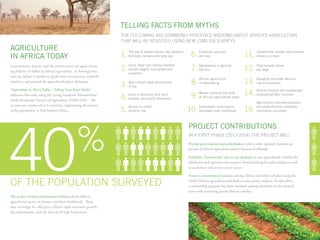
THE FOLLOWING ARE COMMONLY PERCEIVED WISDOMS ABOUT AFRICA’S AGRICULTURE
THAT WILL BE REVISITED USING NEW LSMS-ISA SURVEYS.
IN A FIRST PHASE (2013-2014) THE PROJECT WILL:
Extension services
are poor
Agroforestry is gaining
traction
African agriculture
is intensifying
Women perform the bulk
of Africa’s agricultural tasks
Seasonality continues to
permeate rural livelihoods
Smallholder market participation
remains limited
Post-harvest losses
are large
Droughts dominate Africa’s
risk environment
African farmers are increasingly
diversifying their incomes
Agricultural commercialization
and diversification improves
nutritional outcomes
The use of modern inputs, like chemical
fertilizer, remains dismally low
Land, labor and capital markets
remain largely incomplete and
imperfect
Agricultural labor productivity
is low
Land is abundant and land
markets are poorly developed
Access to credit
remains low
1.
2.
3.
4.
5.
6.
7.
8.
9.
10.
11.
12.
13.
14.
15.
Provide governments and policymakers with a solid, updated, bottom-up
picture of Africa’s agriculture and its farmers livelihoods.
Establish a harmonized, easy-to-use database of core agricultural variables for
tabulation and regional cross country benchmarking by policymakers as well
as academics and private sector actors.
Foster a community of practice among African and other scholars using the
LSMS-ISA for agriculture and food security policy analysis. To this effect,
a mentorship program has been initiated, pairing members of the research
team with promising junior African scholars.

Agriafrica brochure web

  • 1.
    in africa agriculture Initiative ledby Office of the Chief Economist for Africa The team About LSMS-ISA Luc Christiaensen: lchristiaensen@worldbank.org Amparo Palacios-Lopez: apalacioslopez@worldbank.org www.worldbank.org/LSMS-ISA the DATA Chris Barrett Hans Binswanger Gero Carletto Luc Christiaensen, Task Team Leader Ben Davis Brian Dillon Klaus Deininger Chris Gilbert Daniel Zerfu Gurara Jonathan Kaminski Mentorees: Abidoye Babatunde, Nigeria, Fuje Habtamu, Ethiopia, Gandonou Esaie, Benin, Kasirye Ibrahim, Uganda, Kinuthia Bethuel, Kenya, Liverpool-Tasie Lenis, Sierra Leone, Ndiaye Moctar, Senegal, Ngenzebuke Rama Lionel, Burundi, Ogunyemi Oluwole, Nigeria, Owoo Nkechi, Ghana Talip Kilic Ellen McCullough Siobhan Murray Paula Nagler Wim Naude Amparo Palacios-Lopez Sara Savastano Megan Sheahan Abebe Shimeles Christopher Udry Alberto Zezza The LSMS-ISA project is funded by the Bill and Melinda Gates Foundation and other donor agencies, and is implemented by the Research department of the World Bank (DECRG) and the national statistical agencies. • The surveys are nationally representative and have been conducted in Ethiopia, Malawi, Niger, Nigeria, Tanzania, and Uganda from 2008 onwards. • The data are geo-referenced and contain detailed informa- tion on agriculture at the plot level as well as many non-agri- cultural facets of people’s livelihoods (employment, income, consumption, shocks, assets, nutrition). • By 2014, all households will have been visited at least twice, enabling the construction of panel data and in-depth causal analysis. “High quality data are to economists, what high quality genes are to agronomists. Without them, reality cannot be properly understood nor enhanced.” Eric Tollens, Prof Agricultural Economics Emeritus, Catholic University of Leuven, Belgium For more information Contributors: World Bank, African Development Bank, Cornell University, Food and Agriculture Organization, Maastricht School of Management, University of Rome Tor Vergata, University of Trente, Yale University Telling facts from myths
  • 2.
    agriculture in africa today TELLINGFACTS FROM MYTHS PROJECT CONTRIBUTIONS Governments, donors, and the private sector are again invest- ing billions of dollars in Africa’s agriculture. A thorough bot- tom-up update is needed to guide these investments, establish baselines, and ground the agricultural policy dialogues. “Agriculture in Africa Today – Telling Facts from Myths” addresses this void, using the Living Standards Measurement Study-Integrated Surveys on Agriculture (LSMS-ISA). The surveys are conducted in 6 countries, representing 40 percent of the population in Sub-Saharan Africa. The project revisits conventional wisdoms about Africa’s agricultural sector, its farmers and their livelihoods. These may no longer be valid given Africa’s rapid economic growth, fast urbanization, and the new era of high food prices. 40% of the population surveyed THE FOLLOWING ARE COMMONLY PERCEIVED WISDOMS ABOUT AFRICA’S AGRICULTURE THAT WILL BE REVISITED USING NEW LSMS-ISA SURVEYS. IN A FIRST PHASE (2013-2014) THE PROJECT WILL: Extension services are poor Agroforestry is gaining traction African agriculture is intensifying Women perform the bulk of Africa’s agricultural tasks Seasonality continues to permeate rural livelihoods Smallholder market participation remains limited Post-harvest losses are large Droughts dominate Africa’s risk environment African farmers are increasingly diversifying their incomes Agricultural commercialization and diversification improves nutritional outcomes The use of modern inputs, like chemical fertilizer, remains dismally low Land, labor and capital markets remain largely incomplete and imperfect Agricultural labor productivity is low Land is abundant and land markets are poorly developed Access to credit remains low 1. 2. 3. 4. 5. 6. 7. 8. 9. 10. 11. 12. 13. 14. 15. Provide governments and policymakers with a solid, updated, bottom-up picture of Africa’s agriculture and its farmers livelihoods. Establish a harmonized, easy-to-use database of core agricultural variables for tabulation and regional cross country benchmarking by policymakers as well as academics and private sector actors. Foster a community of practice among African and other scholars using the LSMS-ISA for agriculture and food security policy analysis. To this effect, a mentorship program has been initiated, pairing members of the research team with promising junior African scholars.