











Getting Started with Scrum
Silvana Wasitova, CSM, CSP, PMP, PMI-ACP
Frankfurt, April 2014
Managed projects in 12 countries, lived in 7
2002: PMP
2004: President of PMI Silicon Valley
2005: started practicing Scrum
2009: Scrum Coach & Trainer
2011: PMI-ACP
Silvana Wasitova, PMP, ACP, CSM, CSP
Rolland Garros
February
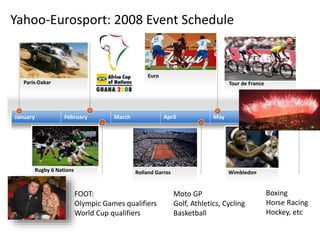
Yahoo-Eurosport: 2008 Event Schedule
January April May JuneMarch
Rugby 6 Nations Wimbledon
TDF
Euro
Paris-Dakar Tour de France
Moto GP
Golf, Athletics, Cycling
Basketball
Boxing
Horse Racing
Hockey, etc
FOOT:
Olympic Games qualifiers
World Cup qualifiers
30-Apr-14
5
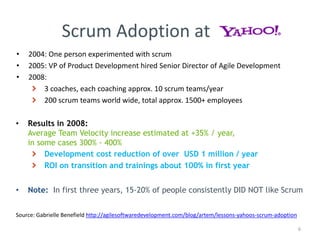
Scrum Adoption at
Source: Gabrielle Benefield http://agilesoftwaredevelopment.com/blog/artem/lessons-yahoos-scrum-adoption
• 2004: One person experimented with scrum
• 2005: VP of Product Development hired Senior Director of Agile Development
• 2008:
3 coaches, each coaching approx. 10 scrum teams/year
200 scrum teams world wide, total approx. 1500+ employees
• Results in 2008:
Average Team Velocity increase estimated at +35% / year,
in some cases 300% - 400%
Development cost reduction of over USD 1 million / year
ROI on transition and trainings about 100% in first year
• Note: In first three years, 15-20% of people consistently DID NOT like Scrum
6
Everyone wants to
change the world,
but no one wants
to change
themselves.
– Leo Tolstoy
© Silvana Wasitova
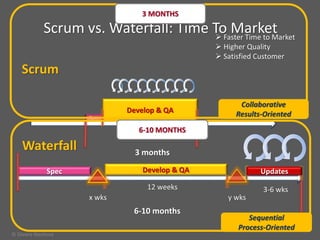
Scrum vs. Waterfall: Time To Market
Develop & QASpec
Develop & QA
Spec
Scrum
Waterfall
12 weeks 3-6 wks
y wks
9 weeks
3 months
6-10 months
Collaborative
Results-Oriented
3 MONTHS
x wks
Updates
Sequential
Process-Oriented
6-10 MONTHS
 Faster Time to Market
 Higher Quality
 Satisfied Customer
Why Scrum works:
1. Close collaboration with Customer
2. Transparency through daily reviews → risk reduction
3. LEAN ‘flow’ → frequent delivery of business value
4. Eliminate waste, focus on highest priorities
5. Inspect, adapt, improve - in each iteration
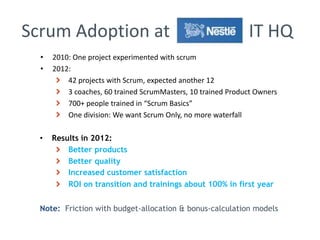
Scrum Adoption at G IT HQ
• 2010: One project experimented with scrum
• 2012:
42 projects with Scrum, expected another 12
3 coaches, 60 trained ScrumMasters, 10 trained Product Owners
700+ people trained in “Scrum Basics”
One division: We want Scrum Only, no more waterfall
• Results in 2012:
Better products
Better quality
Increased customer satisfaction
ROI on transition and trainings about 100% in first year
Note: Friction with budget-allocation & bonus-calculation models
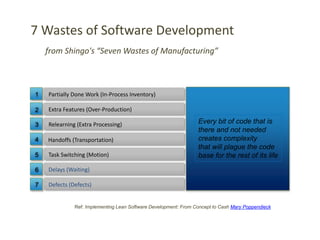
from Shingo's “Seven Wastes of Manufacturing”
7 Wastes of Software Development
Partially Done Work (In-Process Inventory)
Defects (Defects)
Relearning (Extra Processing)
Extra Features (Over-Production)
Handoffs (Transportation)
Delays (Waiting)
1
2
3
4
5
6
7
Every bit of code that is
there and not needed
creates complexity
that will plague the code
base for the rest of its lifeTask Switching (Motion)
Ref: Implementing Lean Software Development: From Concept to Cash Mary Poppendieck
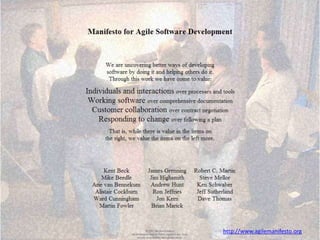
http://www.agilemanifesto.org
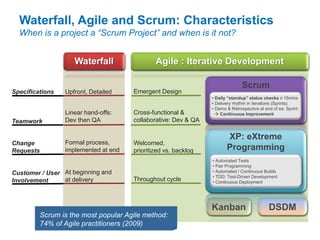
Waterfall, Agile and Scrum: Characteristics
When is a project a “Scrum Project” and when is it not?
30-Apr-14 13
Waterfall Agile : Iterative Development
Kanban DSDM
Upfront, Detailed Emergent Design
Linear hand-offs:
Dev then QA
Cross-functional &
collaborative: Dev & QA
Formal process,
implemented at end
Welcomed,
prioritized vs. backlog
At beginning and
at delivery Throughout cycle
Scrum
• Daily “standup” status checks ≤ 15mins
• Delivery rhythm in iterations (Sprints)
• Demo & Retrospective at end of ea. Sprint
 Continuous Improvement
XP: eXtreme
Programming
• Automated Tests
• Pair Programming
• Automated / Continuous Builds
• TDD: Test-Driven Development
• Continuous Deployment
Teamwork
Change
Requests
Customer / User
Involvement
Specifications
Scrum is the most popular Agile method:
74% of Agile practitioners (2009)
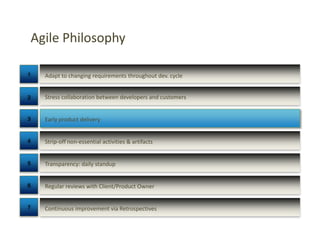
Adapt to changing requirements throughout dev. cycle
Continuous improvement via Retrospectives
Early product delivery
Transparency: daily standup
Stress collaboration between developers and customers
Strip-off non-essential activities & artifacts
Regular reviews with Client/Product Owner
Agile Philosophy
1
2
3
4
5
6
7
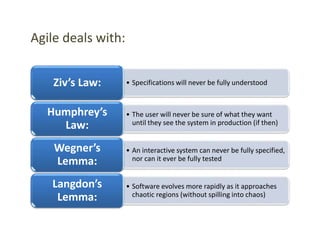
• Specifications will never be fully understoodZiv’s Law:
• The user will never be sure of what they want
until they see the system in production (if then)
Humphrey’s
Law:
• An interactive system can never be fully specified,
nor can it ever be fully tested
Wegner’s
Lemma:
• Software evolves more rapidly as it approaches
chaotic regions (without spilling into chaos)
Langdon’s
Lemma:
Agile deals with:
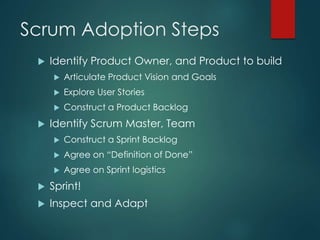
Scrum Adoption Steps
 Identify Product Owner, and Product to build
 Articulate Product Vision and Goals
 Explore User Stories
 Construct a Product Backlog
 Identify Scrum Master, Team
 Construct a Sprint Backlog
 Agree on “Definition of Done”
 Agree on Sprint logistics
 Sprint!
 Inspect and Adapt
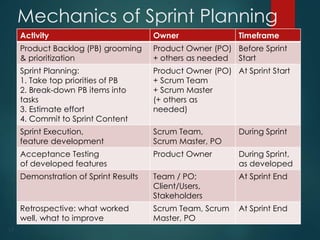
Mechanics of Sprint Planning
Activity Owner Timeframe
Product Backlog (PB) grooming
& prioritization
Product Owner (PO)
+ others as needed
Before Sprint
Start
Sprint Planning:
1. Take top priorities of PB
2. Break-down PB items into
tasks
3. Estimate effort
4. Commit to Sprint Content
Product Owner (PO)
+ Scrum Team
+ Scrum Master
(+ others as
needed)
At Sprint Start
Sprint Execution,
feature development
Scrum Team,
Scrum Master, PO
During Sprint
Acceptance Testing
of developed features
Product Owner During Sprint,
as developed
Demonstration of Sprint Results Team / PO;
Client/Users,
Stakeholders
At Sprint End
Retrospective: what worked
well, what to improve
Scrum Team, Scrum
Master, PO
At Sprint End
17
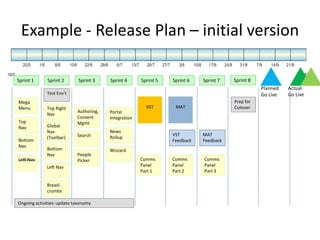
Example - Release Plan – initial version
30-Apr-14
Sprint 1 Sprint 6Sprint 2 Sprint 5Sprint 4Sprint 3
Mega
Menu
Top
Nav
Bottom
Nav
Left Nav
version
People
Picker
VSTTop Right
Nav
Test Env’t
Left Nav
Global
Nav
(Toolbar)
Bottom
Nav
Bread-
crumbs
Authoring,
Content
Mgmt
Search
Portal
Integration
Wizzard
Comms
Panel
Part 1
Comms
Panel
Part 3
Comms
Panel
Part 2
MAT
News
Rollup
Ongoing activities: update taxonomy
VST
Feedback
MAT
Feedback
Sprint 7
Prep for
Cutover
Planned
Go Live
Actual
Go Live
Sprint 8
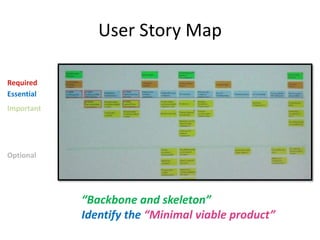
User Story Map
Required
Important
Optional
Essential
“Backbone and skeleton”
Identify the “Minimal viable product”
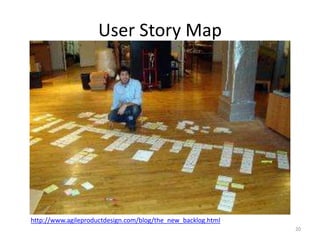
User Story Map
20
http://www.agileproductdesign.com/blog/the_new_backlog.html
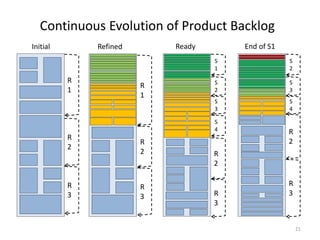
Continuous Evolution of Product Backlog
21
Initial
R
1
R
2
R
3
Ready
R
3
S
1
S
2
S
3
S
4
R
2
Refined
R
1
R
2
R
3
End of S1
R
3
S
2
S
3
S
4
R
2
Agile Success Factors @
 Commitment from Management & Execs
 Trainings: Scrum Master, PO, Team members
 Culture of learning -
apply retrospective findings
 Respect teams to be self-organizing
 Agile Coach at each location
Scrum of Scrums (15 mins)
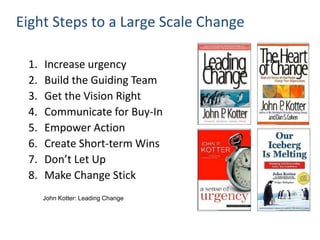
Eight Steps to a Large Scale Change
John Kotter: Leading Change
1. Increase urgency
2. Build the Guiding Team
3. Get the Vision Right
4. Communicate for Buy-In
5. Empower Action
6. Create Short-term Wins
7. Don’t Let Up
8. Make Change Stick
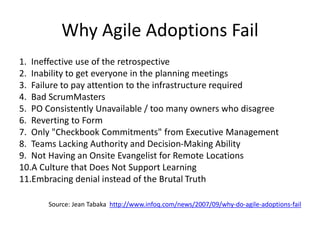
Why Agile Adoptions Fail
1. Ineffective use of the retrospective
2. Inability to get everyone in the planning meetings
3. Failure to pay attention to the infrastructure required
4. Bad ScrumMasters
5. PO Consistently Unavailable / too many owners who disagree
6. Reverting to Form
7. Only "Checkbook Commitments" from Executive Management
8. Teams Lacking Authority and Decision-Making Ability
9. Not Having an Onsite Evangelist for Remote Locations
10.A Culture that Does Not Support Learning
11.Embracing denial instead of the Brutal Truth
Source: Jean Tabaka http://www.infoq.com/news/2007/09/why-do-agile-adoptions-fail
26© Itecor all rights reserved
Align Incentives
Appreciate
TRUST
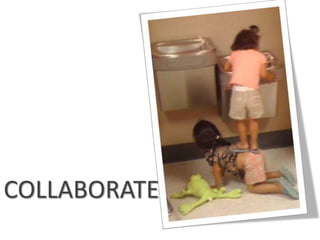
COLLABORATE
http://www.flickr.com/photos/psmithy/
PURPOSE
How much do you trust each other?RESPECT
Silvana Wasitova, CSM, CSP
Lausanne, Switzerland
wasitova@yahoo.com
slideshare.com/wasitova

Getting Started with Scrum

  • 1.
    Getting Started withScrum Silvana Wasitova, CSM, CSP, PMP, PMI-ACP Frankfurt, April 2014
  • 2.
    Managed projects in12 countries, lived in 7 2002: PMP 2004: President of PMI Silicon Valley 2005: started practicing Scrum 2009: Scrum Coach & Trainer 2011: PMI-ACP Silvana Wasitova, PMP, ACP, CSM, CSP
  • 5.
    Rolland Garros February Yahoo-Eurosport: 2008Event Schedule January April May JuneMarch Rugby 6 Nations Wimbledon TDF Euro Paris-Dakar Tour de France Moto GP Golf, Athletics, Cycling Basketball Boxing Horse Racing Hockey, etc FOOT: Olympic Games qualifiers World Cup qualifiers 30-Apr-14 5
  • 6.
    Scrum Adoption at Source:Gabrielle Benefield http://agilesoftwaredevelopment.com/blog/artem/lessons-yahoos-scrum-adoption • 2004: One person experimented with scrum • 2005: VP of Product Development hired Senior Director of Agile Development • 2008: 3 coaches, each coaching approx. 10 scrum teams/year 200 scrum teams world wide, total approx. 1500+ employees • Results in 2008: Average Team Velocity increase estimated at +35% / year, in some cases 300% - 400% Development cost reduction of over USD 1 million / year ROI on transition and trainings about 100% in first year • Note: In first three years, 15-20% of people consistently DID NOT like Scrum 6
  • 7.
    Everyone wants to changethe world, but no one wants to change themselves. – Leo Tolstoy
  • 8.
    © Silvana Wasitova Scrumvs. Waterfall: Time To Market Develop & QASpec Develop & QA Spec Scrum Waterfall 12 weeks 3-6 wks y wks 9 weeks 3 months 6-10 months Collaborative Results-Oriented 3 MONTHS x wks Updates Sequential Process-Oriented 6-10 MONTHS  Faster Time to Market  Higher Quality  Satisfied Customer
  • 9.
    Why Scrum works: 1.Close collaboration with Customer 2. Transparency through daily reviews → risk reduction 3. LEAN ‘flow’ → frequent delivery of business value 4. Eliminate waste, focus on highest priorities 5. Inspect, adapt, improve - in each iteration
  • 10.
    Scrum Adoption atG IT HQ • 2010: One project experimented with scrum • 2012: 42 projects with Scrum, expected another 12 3 coaches, 60 trained ScrumMasters, 10 trained Product Owners 700+ people trained in “Scrum Basics” One division: We want Scrum Only, no more waterfall • Results in 2012: Better products Better quality Increased customer satisfaction ROI on transition and trainings about 100% in first year Note: Friction with budget-allocation & bonus-calculation models
  • 11.
    from Shingo's “SevenWastes of Manufacturing” 7 Wastes of Software Development Partially Done Work (In-Process Inventory) Defects (Defects) Relearning (Extra Processing) Extra Features (Over-Production) Handoffs (Transportation) Delays (Waiting) 1 2 3 4 5 6 7 Every bit of code that is there and not needed creates complexity that will plague the code base for the rest of its lifeTask Switching (Motion) Ref: Implementing Lean Software Development: From Concept to Cash Mary Poppendieck
  • 12.
  • 13.
    Waterfall, Agile andScrum: Characteristics When is a project a “Scrum Project” and when is it not? 30-Apr-14 13 Waterfall Agile : Iterative Development Kanban DSDM Upfront, Detailed Emergent Design Linear hand-offs: Dev then QA Cross-functional & collaborative: Dev & QA Formal process, implemented at end Welcomed, prioritized vs. backlog At beginning and at delivery Throughout cycle Scrum • Daily “standup” status checks ≤ 15mins • Delivery rhythm in iterations (Sprints) • Demo & Retrospective at end of ea. Sprint  Continuous Improvement XP: eXtreme Programming • Automated Tests • Pair Programming • Automated / Continuous Builds • TDD: Test-Driven Development • Continuous Deployment Teamwork Change Requests Customer / User Involvement Specifications Scrum is the most popular Agile method: 74% of Agile practitioners (2009)
  • 14.
    Adapt to changingrequirements throughout dev. cycle Continuous improvement via Retrospectives Early product delivery Transparency: daily standup Stress collaboration between developers and customers Strip-off non-essential activities & artifacts Regular reviews with Client/Product Owner Agile Philosophy 1 2 3 4 5 6 7
  • 15.
    • Specifications willnever be fully understoodZiv’s Law: • The user will never be sure of what they want until they see the system in production (if then) Humphrey’s Law: • An interactive system can never be fully specified, nor can it ever be fully tested Wegner’s Lemma: • Software evolves more rapidly as it approaches chaotic regions (without spilling into chaos) Langdon’s Lemma: Agile deals with:
  • 16.
    Scrum Adoption Steps Identify Product Owner, and Product to build  Articulate Product Vision and Goals  Explore User Stories  Construct a Product Backlog  Identify Scrum Master, Team  Construct a Sprint Backlog  Agree on “Definition of Done”  Agree on Sprint logistics  Sprint!  Inspect and Adapt
  • 17.
    Mechanics of SprintPlanning Activity Owner Timeframe Product Backlog (PB) grooming & prioritization Product Owner (PO) + others as needed Before Sprint Start Sprint Planning: 1. Take top priorities of PB 2. Break-down PB items into tasks 3. Estimate effort 4. Commit to Sprint Content Product Owner (PO) + Scrum Team + Scrum Master (+ others as needed) At Sprint Start Sprint Execution, feature development Scrum Team, Scrum Master, PO During Sprint Acceptance Testing of developed features Product Owner During Sprint, as developed Demonstration of Sprint Results Team / PO; Client/Users, Stakeholders At Sprint End Retrospective: what worked well, what to improve Scrum Team, Scrum Master, PO At Sprint End 17
  • 18.
    Example - ReleasePlan – initial version 30-Apr-14 Sprint 1 Sprint 6Sprint 2 Sprint 5Sprint 4Sprint 3 Mega Menu Top Nav Bottom Nav Left Nav version People Picker VSTTop Right Nav Test Env’t Left Nav Global Nav (Toolbar) Bottom Nav Bread- crumbs Authoring, Content Mgmt Search Portal Integration Wizzard Comms Panel Part 1 Comms Panel Part 3 Comms Panel Part 2 MAT News Rollup Ongoing activities: update taxonomy VST Feedback MAT Feedback Sprint 7 Prep for Cutover Planned Go Live Actual Go Live Sprint 8
  • 19.
    User Story Map Required Important Optional Essential “Backboneand skeleton” Identify the “Minimal viable product”
  • 20.
  • 21.
    Continuous Evolution ofProduct Backlog 21 Initial R 1 R 2 R 3 Ready R 3 S 1 S 2 S 3 S 4 R 2 Refined R 1 R 2 R 3 End of S1 R 3 S 2 S 3 S 4 R 2
  • 22.
    Agile Success Factors@  Commitment from Management & Execs  Trainings: Scrum Master, PO, Team members  Culture of learning - apply retrospective findings  Respect teams to be self-organizing  Agile Coach at each location
  • 23.
    Scrum of Scrums(15 mins)
  • 24.
    Eight Steps toa Large Scale Change John Kotter: Leading Change 1. Increase urgency 2. Build the Guiding Team 3. Get the Vision Right 4. Communicate for Buy-In 5. Empower Action 6. Create Short-term Wins 7. Don’t Let Up 8. Make Change Stick
  • 25.
    Why Agile AdoptionsFail 1. Ineffective use of the retrospective 2. Inability to get everyone in the planning meetings 3. Failure to pay attention to the infrastructure required 4. Bad ScrumMasters 5. PO Consistently Unavailable / too many owners who disagree 6. Reverting to Form 7. Only "Checkbook Commitments" from Executive Management 8. Teams Lacking Authority and Decision-Making Ability 9. Not Having an Onsite Evangelist for Remote Locations 10.A Culture that Does Not Support Learning 11.Embracing denial instead of the Brutal Truth Source: Jean Tabaka http://www.infoq.com/news/2007/09/why-do-agile-adoptions-fail
  • 26.
    26© Itecor allrights reserved Align Incentives
  • 27.
  • 28.
  • 29.
  • 30.
  • 31.
    How much doyou trust each other?RESPECT
  • 32.
    Silvana Wasitova, CSM,CSP Lausanne, Switzerland wasitova@yahoo.com slideshare.com/wasitova