Transition to Agile (Scrum)


      Prepared by: Naydene Brickus
Contents
●   Definition of Agile
●   Scrum Definition and Principles
●   Reason for Adopting Agile
●   The Present Situation
●   Development up to present
●   Potential Alternatives
●   Recommendation
Definition of Agile

●   Agile is not a method, it is a way of doing. It is a way we
    do things and a way we do not do. It challenges us to do
    things differently and to determine the underlying reasons
    ”why” we make those decisions.
●   There is no such thing as almost agile. You are either
    agile or you're not.
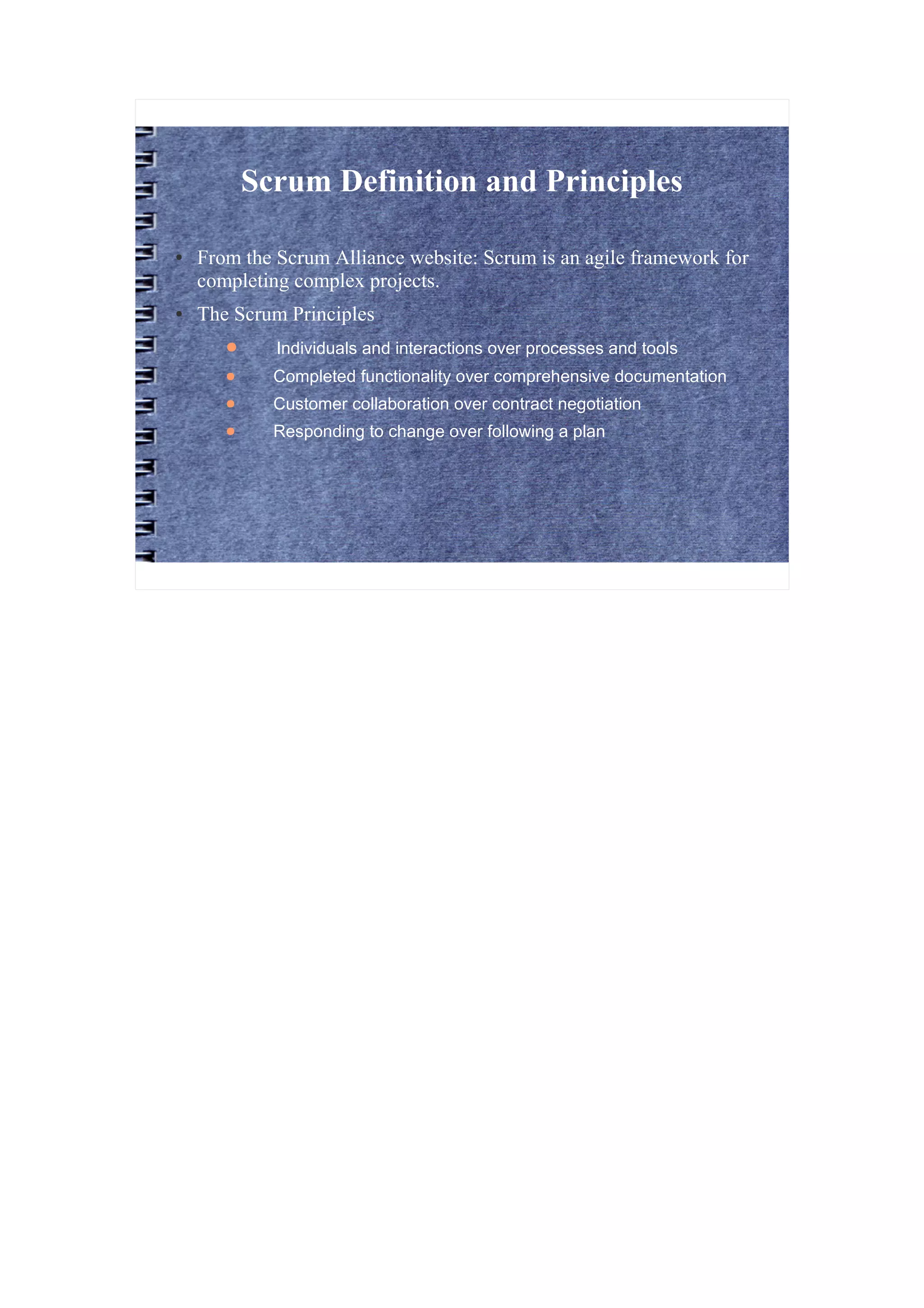
Scrum Definition and Principles

●   From the Scrum Alliance website: Scrum is an agile framework for
    completing complex projects.
●   The Scrum Principles
       ●     Individuals and interactions over processes and tools
       ●     Completed functionality over comprehensive documentation
       ●     Customer collaboration over contract negotiation
       ●     Responding to change over following a plan
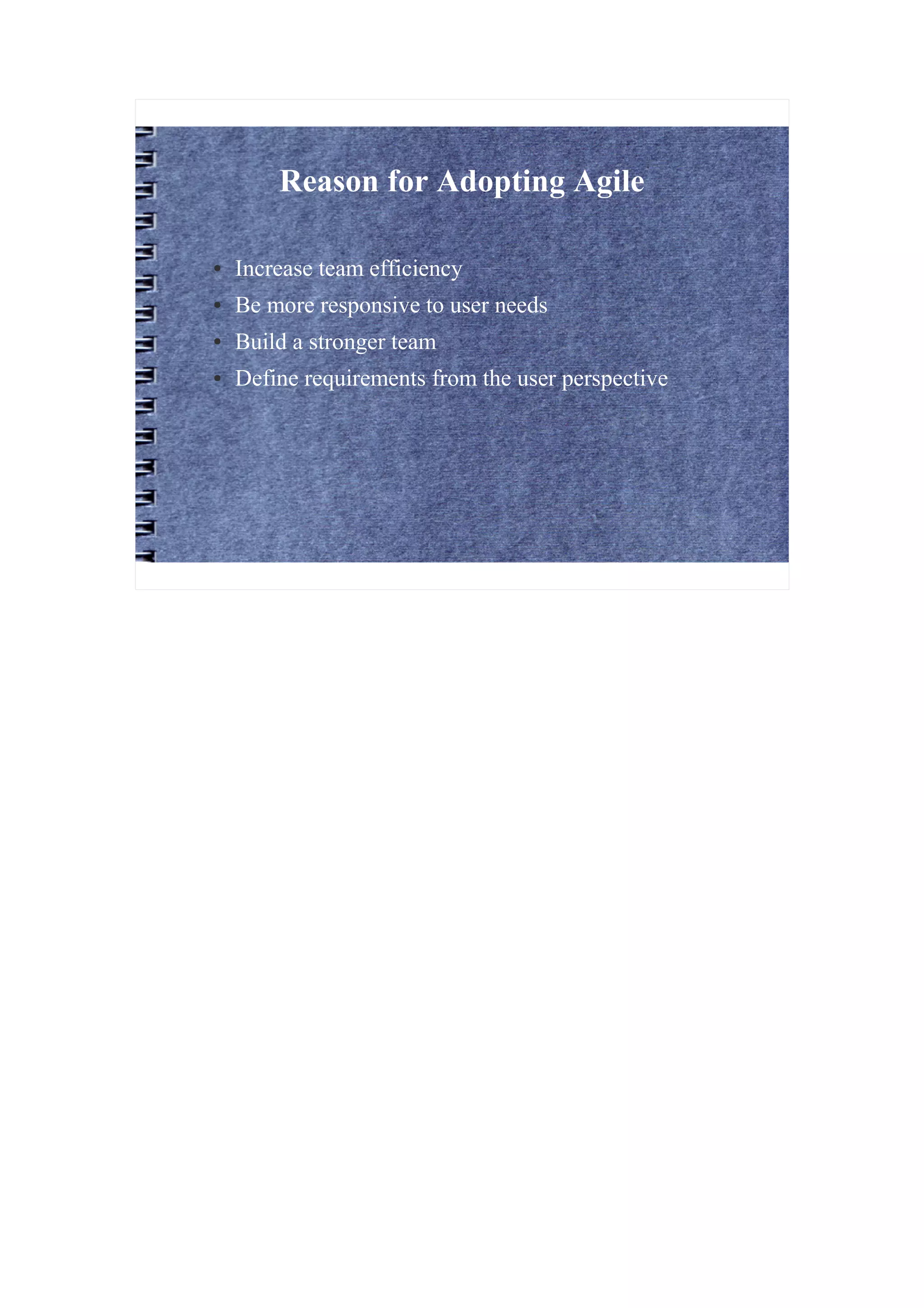
Reason for Adopting Agile

●   Increase team efficiency
●   Be more responsive to user needs
●   Build a stronger team
●   Define requirements from the user perspective
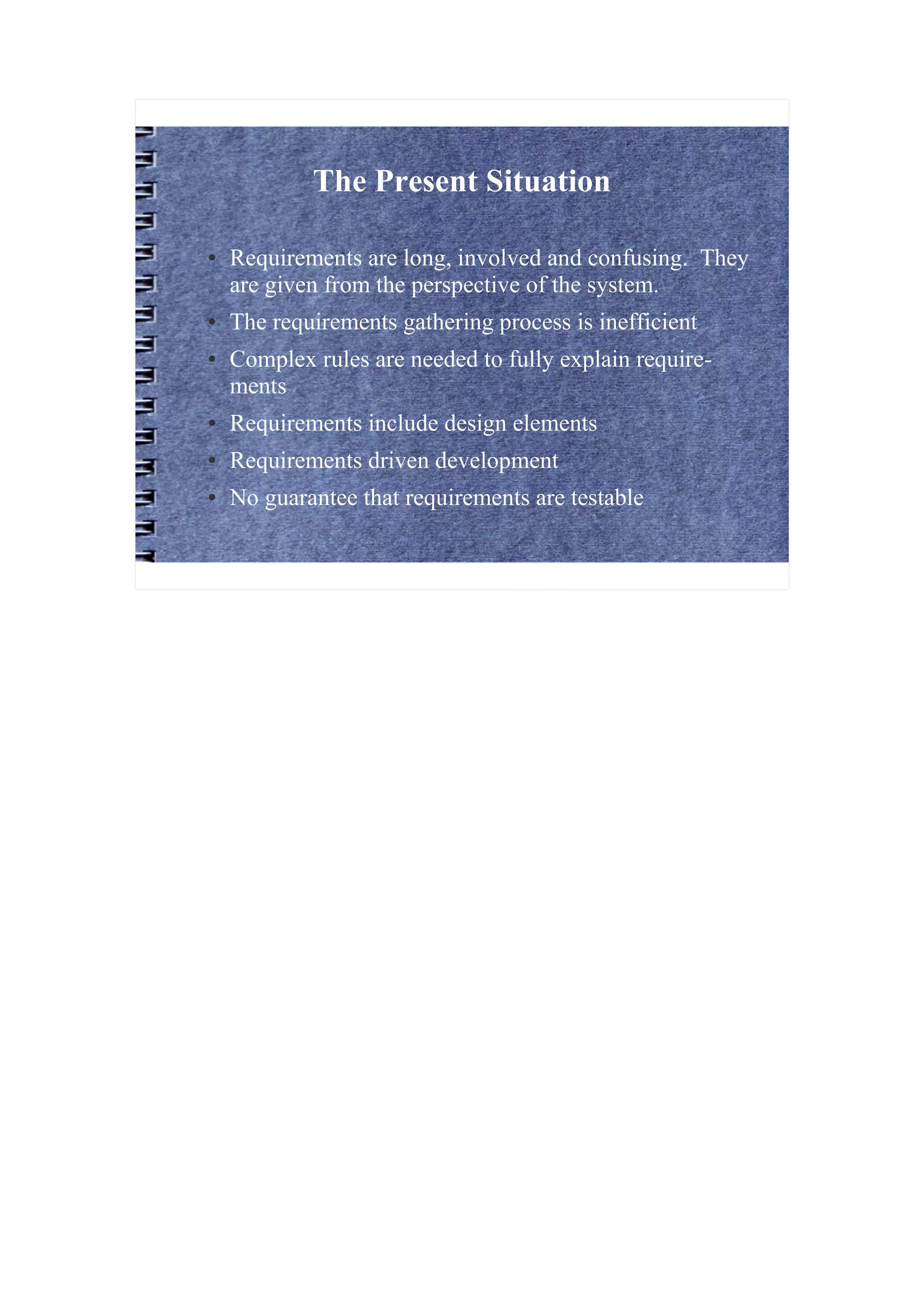
The Present Situation

●   Requirements are long, involved and confusing. They
    are given from the perspective of the system.
●   The requirements gathering process is inefficient
●   Complex rules are needed to fully explain require-
    ments
●   Requirements include design elements
●   Requirements driven development
●   No guarantee that requirements are testable
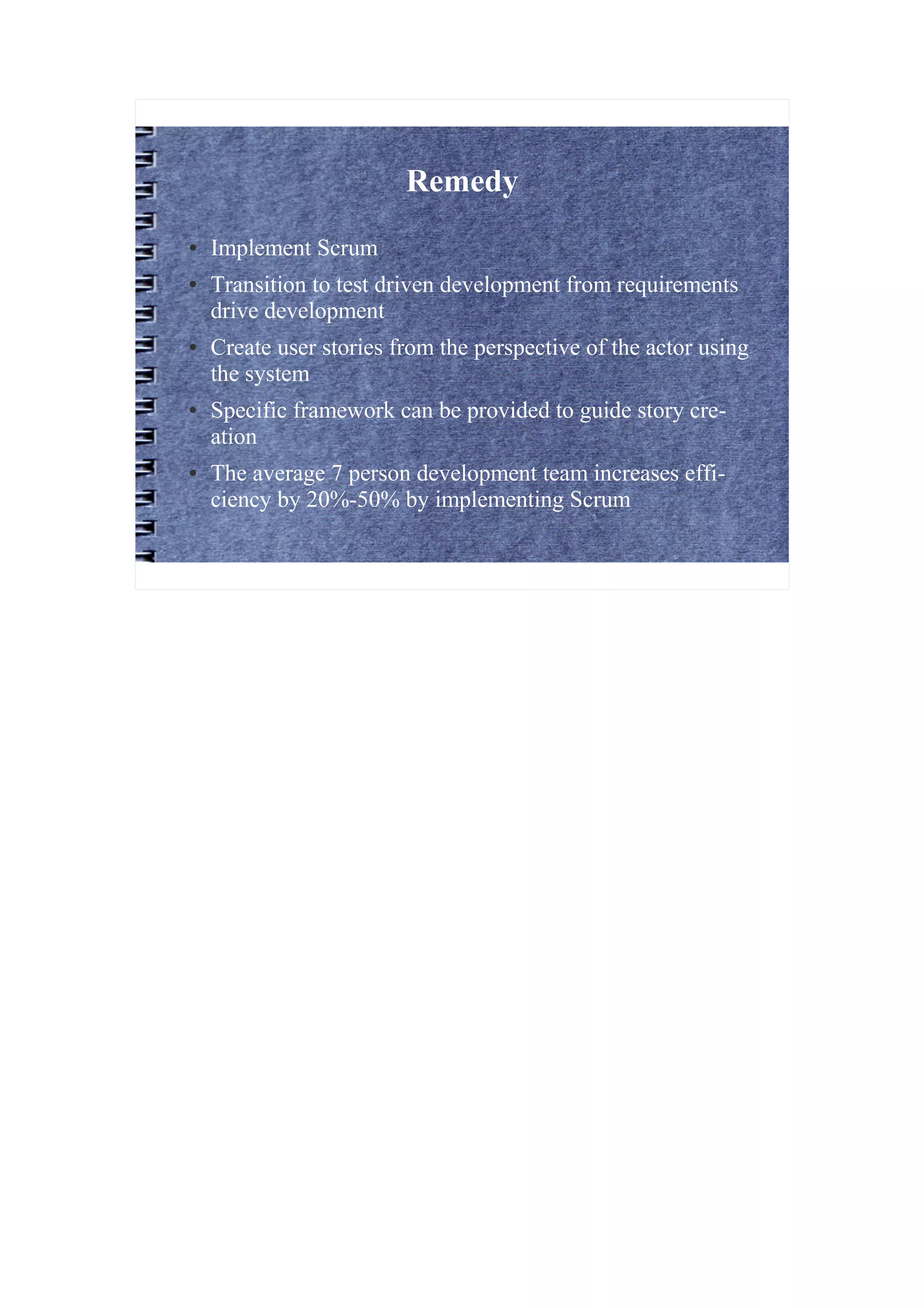
Remedy
●   Implement Scrum
●   Transition to test driven development from requirements
    drive development
●   Create user stories from the perspective of the actor using
    the system
●   Specific framework can be provided to guide story cre-
    ation
●   The average 7 person development team increases effi-
    ciency by 20%-50% by implementing Scrum
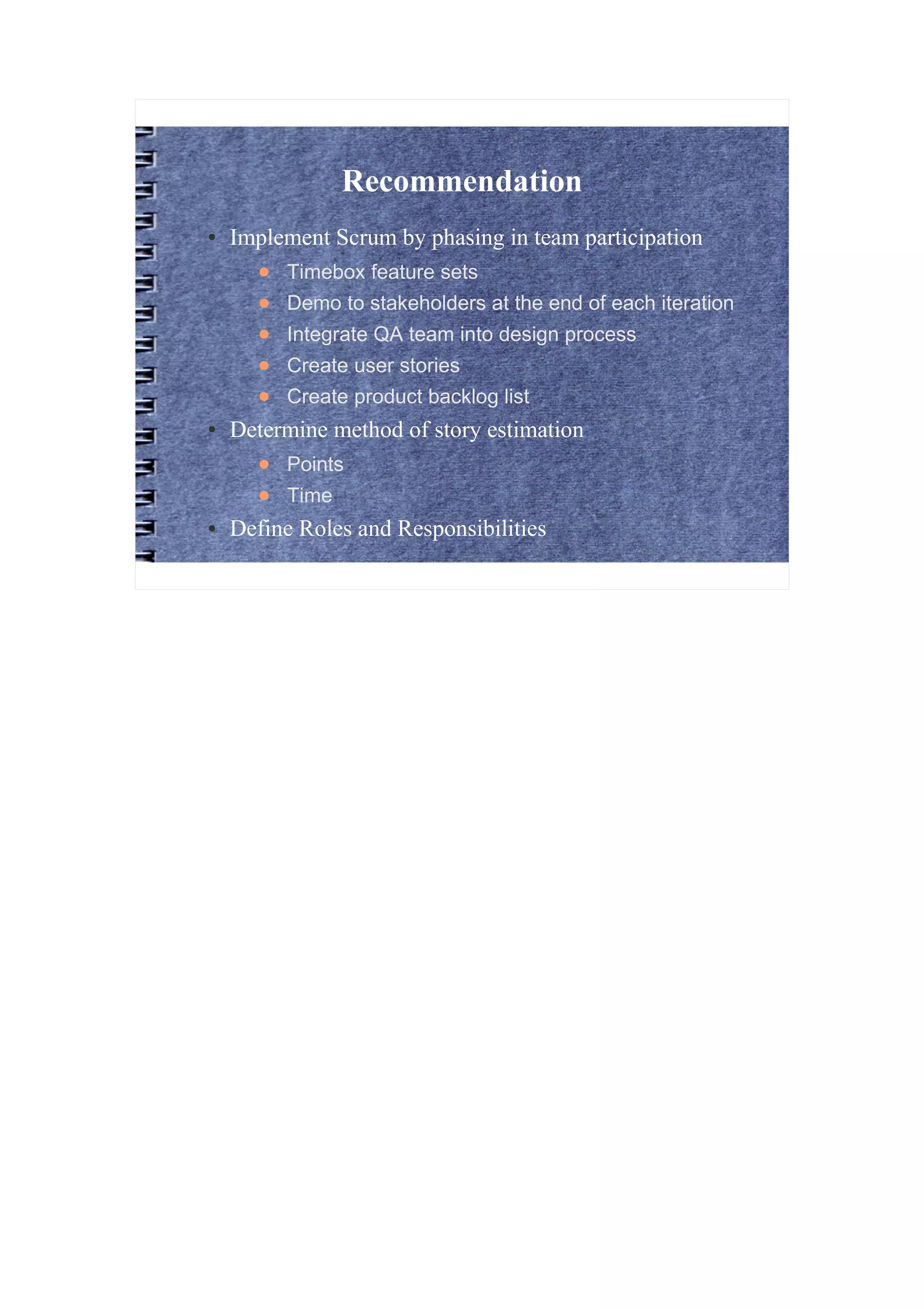
Recommendation
●   Implement Scrum by phasing in team participation
      ●   Timebox feature sets
      ●   Demo to stakeholders at the end of each iteration
      ●   Integrate QA team into design process
      ●   Create user stories
      ●   Create product backlog list
●   Determine method of story estimation
      ●   Points
      ●   Time
●   Define Roles and Responsibilities
Transition to Agile (Scrum)


      Prepared by: Naydene Brickus
Contents
●   Definition of Agile
●   Scrum Definition and Principles
●   Reason for Adopting Agile
●   The Present Situation
●   Development up to present
●   Potential Alternatives
●   Recommendation
Definition of Agile

●   Agile is not a method, it is a way of doing. It is a way we
    do things and a way we do not do. It challenges us to do
    things differently and to determine the underlying reasons
    ”why” we make those decisions.
●   There is no such thing as almost agile. You are either
    agile or you're not.
Scrum Definition and Principles

●   From the Scrum Alliance website: Scrum is an agile framework for
    completing complex projects.
●   The Scrum Principles
       ●     Individuals and interactions over processes and tools
       ●     Completed functionality over comprehensive documentation
       ●     Customer collaboration over contract negotiation
       ●     Responding to change over following a plan
Reason for Adopting Agile

●   Increase team efficiency
●   Be more responsive to user needs
●   Build a stronger team
●   Define requirements from the user perspective
The Present Situation

●   Requirements are long, involved and confusing. They
    are given from the perspective of the system.
●   The requirements gathering process is inefficient
●   Complex rules are needed to fully explain require-
    ments
●   Requirements include design elements
●   Requirements driven development
●   No guarantee that requirements are testable
Remedy
●   Implement Scrum
●   Transition to test driven development from requirements
    drive development
●   Create user stories from the perspective of the actor using
    the system
●   Specific framework can be provided to guide story cre-
    ation
●   The average 7 person development team increases effi-
    ciency by 20%-50% by implementing Scrum
Recommendation
●   Implement Scrum by phasing in team participation
      ●   Timebox feature sets
      ●   Demo to stakeholders at the end of each iteration
      ●   Integrate QA team into design process
      ●   Create user stories
      ●   Create product backlog list
●   Determine method of story estimation
      ●   Points
      ●   Time
●   Define Roles and Responsibilities

Agile transition

  • 1.
    Transition to Agile(Scrum) Prepared by: Naydene Brickus
  • 2.
    Contents ● Definition of Agile ● Scrum Definition and Principles ● Reason for Adopting Agile ● The Present Situation ● Development up to present ● Potential Alternatives ● Recommendation
  • 3.
    Definition of Agile ● Agile is not a method, it is a way of doing. It is a way we do things and a way we do not do. It challenges us to do things differently and to determine the underlying reasons ”why” we make those decisions. ● There is no such thing as almost agile. You are either agile or you're not.
  • 4.
    Scrum Definition andPrinciples ● From the Scrum Alliance website: Scrum is an agile framework for completing complex projects. ● The Scrum Principles ● Individuals and interactions over processes and tools ● Completed functionality over comprehensive documentation ● Customer collaboration over contract negotiation ● Responding to change over following a plan
  • 5.
    Reason for AdoptingAgile ● Increase team efficiency ● Be more responsive to user needs ● Build a stronger team ● Define requirements from the user perspective
  • 6.
    The Present Situation ● Requirements are long, involved and confusing. They are given from the perspective of the system. ● The requirements gathering process is inefficient ● Complex rules are needed to fully explain require- ments ● Requirements include design elements ● Requirements driven development ● No guarantee that requirements are testable
  • 7.
    Remedy ● Implement Scrum ● Transition to test driven development from requirements drive development ● Create user stories from the perspective of the actor using the system ● Specific framework can be provided to guide story cre- ation ● The average 7 person development team increases effi- ciency by 20%-50% by implementing Scrum
  • 8.
    Recommendation ● Implement Scrum by phasing in team participation ● Timebox feature sets ● Demo to stakeholders at the end of each iteration ● Integrate QA team into design process ● Create user stories ● Create product backlog list ● Determine method of story estimation ● Points ● Time ● Define Roles and Responsibilities
  • 9.
    Transition to Agile(Scrum) Prepared by: Naydene Brickus
  • 10.
    Contents ● Definition of Agile ● Scrum Definition and Principles ● Reason for Adopting Agile ● The Present Situation ● Development up to present ● Potential Alternatives ● Recommendation
  • 11.
    Definition of Agile ● Agile is not a method, it is a way of doing. It is a way we do things and a way we do not do. It challenges us to do things differently and to determine the underlying reasons ”why” we make those decisions. ● There is no such thing as almost agile. You are either agile or you're not.
  • 12.
    Scrum Definition andPrinciples ● From the Scrum Alliance website: Scrum is an agile framework for completing complex projects. ● The Scrum Principles ● Individuals and interactions over processes and tools ● Completed functionality over comprehensive documentation ● Customer collaboration over contract negotiation ● Responding to change over following a plan
  • 13.
    Reason for AdoptingAgile ● Increase team efficiency ● Be more responsive to user needs ● Build a stronger team ● Define requirements from the user perspective
  • 14.
    The Present Situation ● Requirements are long, involved and confusing. They are given from the perspective of the system. ● The requirements gathering process is inefficient ● Complex rules are needed to fully explain require- ments ● Requirements include design elements ● Requirements driven development ● No guarantee that requirements are testable
  • 15.
    Remedy ● Implement Scrum ● Transition to test driven development from requirements drive development ● Create user stories from the perspective of the actor using the system ● Specific framework can be provided to guide story cre- ation ● The average 7 person development team increases effi- ciency by 20%-50% by implementing Scrum
  • 16.
    Recommendation ● Implement Scrum by phasing in team participation ● Timebox feature sets ● Demo to stakeholders at the end of each iteration ● Integrate QA team into design process ● Create user stories ● Create product backlog list ● Determine method of story estimation ● Points ● Time ● Define Roles and Responsibilities